A complete issue · 36 pages · 1930
Judge — September 27, 1930
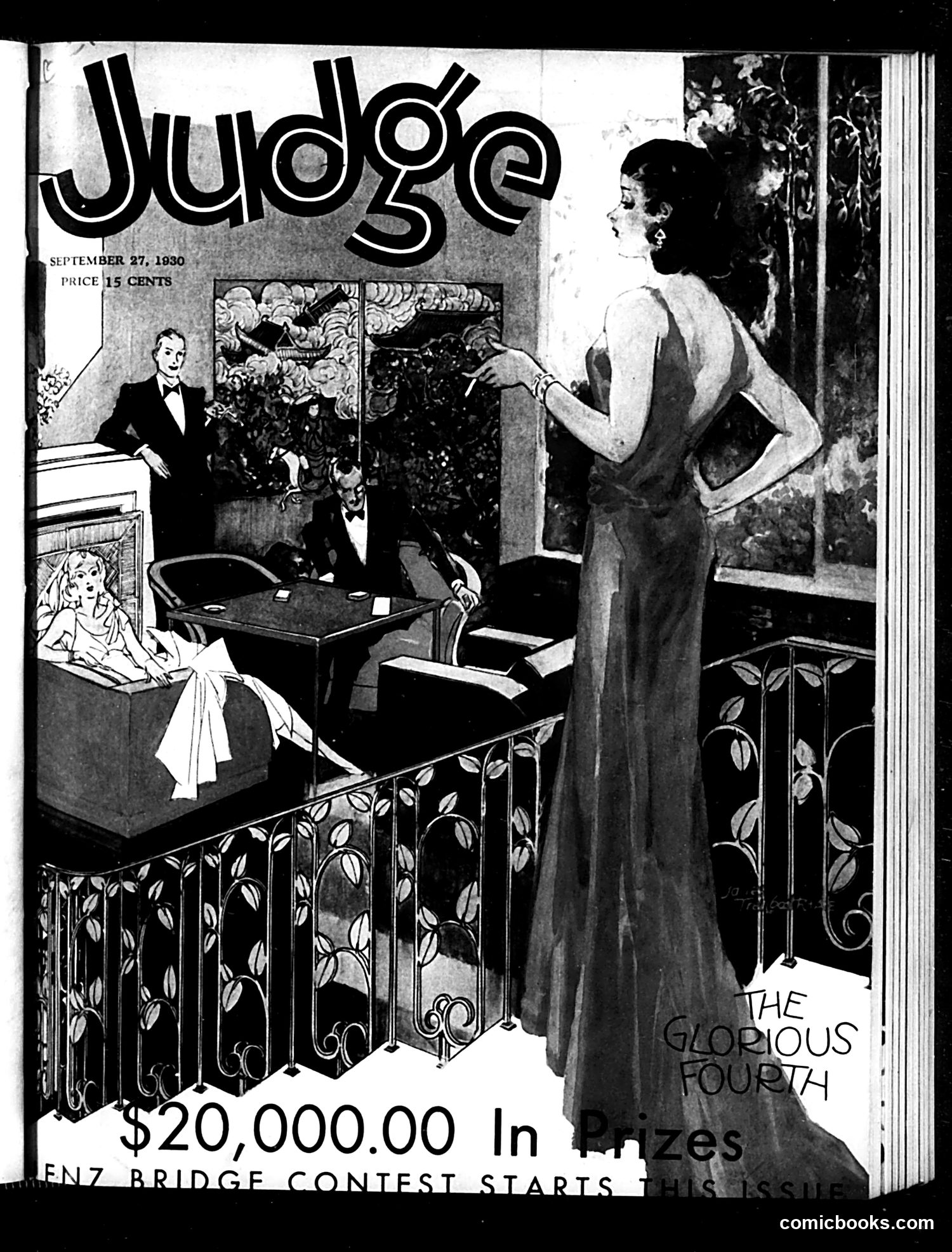
# Judge Magazine, September 27, 1930 This cover advertises a bridge-playing contest with $20,000 in prizes—a significant sum during the Great Depression. The illustration depicts an elegant woman in an evening gown observing men in formal attire engaged in a card game, with decorative Art Deco styling throughout. The satire likely mocks the disconnect between wealthy Americans' leisure pursuits and the economic crisis affecting ordinary citizens. In 1930, as the Depression deepened, depicting lavish bridge tournaments with substantial prize money satirizes the frivolous indulgence of the privileged classes. The woman's fashionable presentation and the luxurious setting underscore this contrast between high society's indifference to broader hardship and the financial struggles of average Americans.
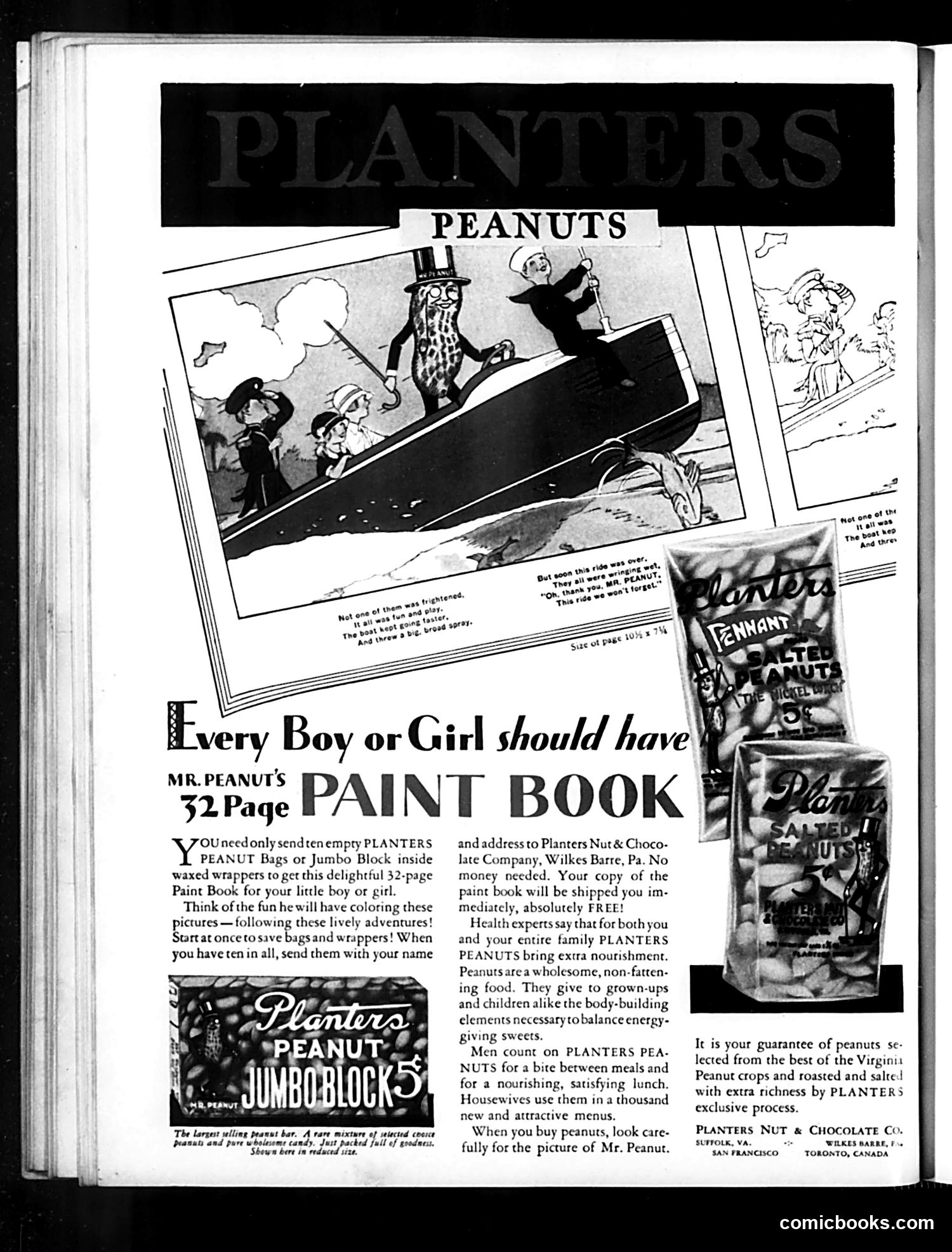
# Analysis This page is primarily a **commercial advertisement**, not political satire. It promotes Planters Peanuts products, particularly Mr. Peanut's 32-page Paint Book. The cartoon depicts Mr. Peanut (the anthropomorphic peanut mascot in top hat) on what appears to be a ship or boat with other figures. The narrative suggests a whimsical adventure story—children could color these scenes themselves by obtaining the free paint book through Planters product packaging. The advertisement emphasizes peanuts as wholesome nutrition for families and children. There is no political satire present. This is straightforward early 20th-century branded marketing content designed to appeal to young readers and their parents by combining entertainment (a coloring book) with product promotion.
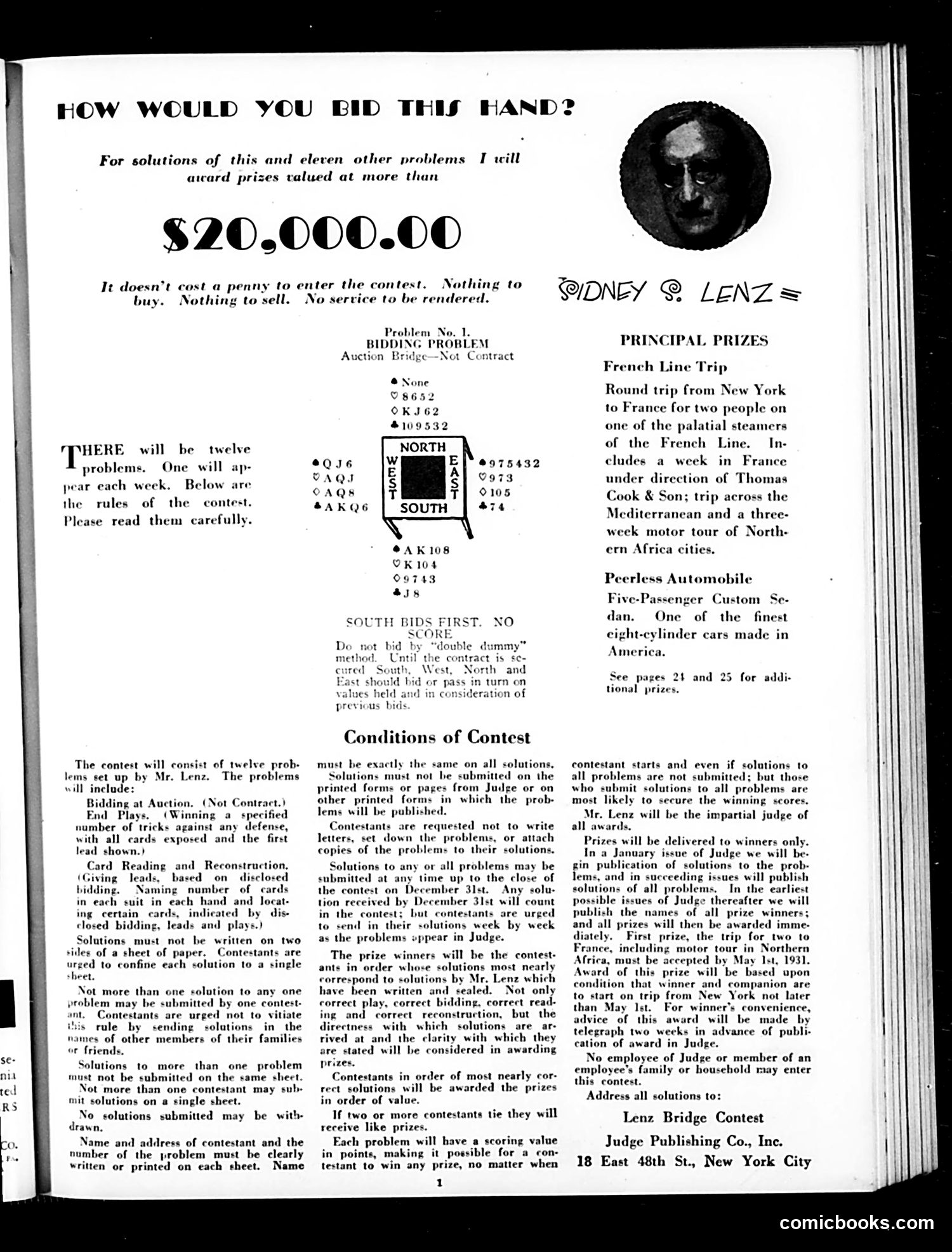
# Analysis of Judge Magazine Page This page is primarily **a bridge-bidding contest**, not political satire. It announces a $20,000 prize competition sponsored by Sidney Lenz (the prominent face shown) for solving twelve contract bridge problems. The contest offers prizes including a French luxury cruise and a Peerless automobile. Entries were free and due by December 31st. **Historical context**: Contract bridge was a newly popular card game in the 1930s. Sidney Lenz was a famous bridge player and promoter who sponsored such competitions to popularize the game. The page is essentially **advertising disguised as editorial content**—a common Judge magazine practice. It's not satirical commentary but rather a commercial promotion, reflecting how 1930s magazines blended advertising with editorial material.
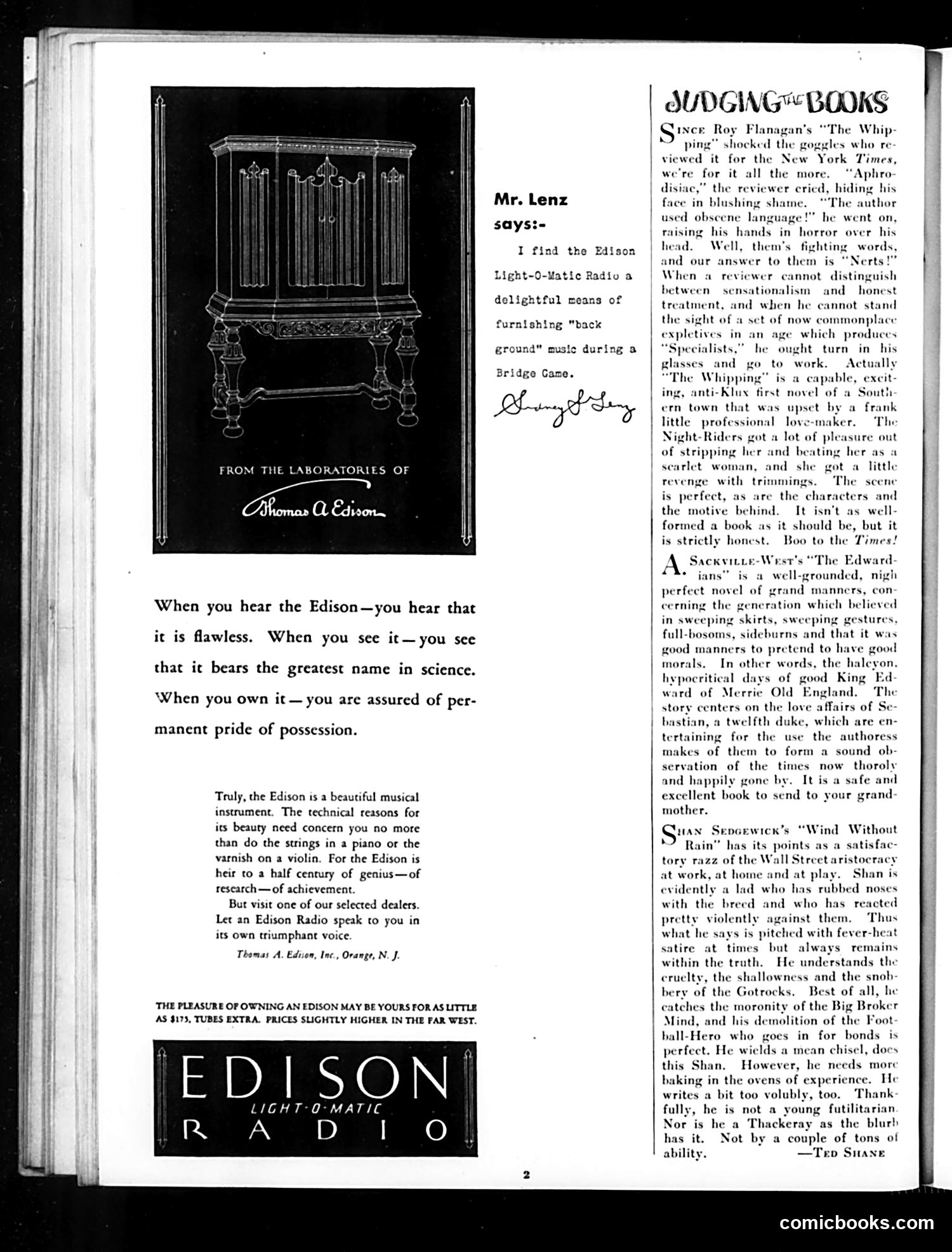
# Analysis This page is primarily **advertising**, not political satire. The left side features a full advertisement for the Edison Light-O-Matic Radio, with an endorsement from "Mr. Lenz" praising its use during bridge games. The ad emphasizes Edison's reputation for quality and scientific achievement. The right side contains **book reviews** under "Judging the Books," critiquing recent novels including Roy Flanagan's "The Whipping," A. Sackville-West's "The Edwardians," and Shan Sendewick's "Wind Without Rain." The reviews discuss literary merit, characterization, and moral content—typical highbrow criticism of the era. There is no political cartoon or social satire visible on this page. It represents Judge magazine's commercial content and cultural commentary.
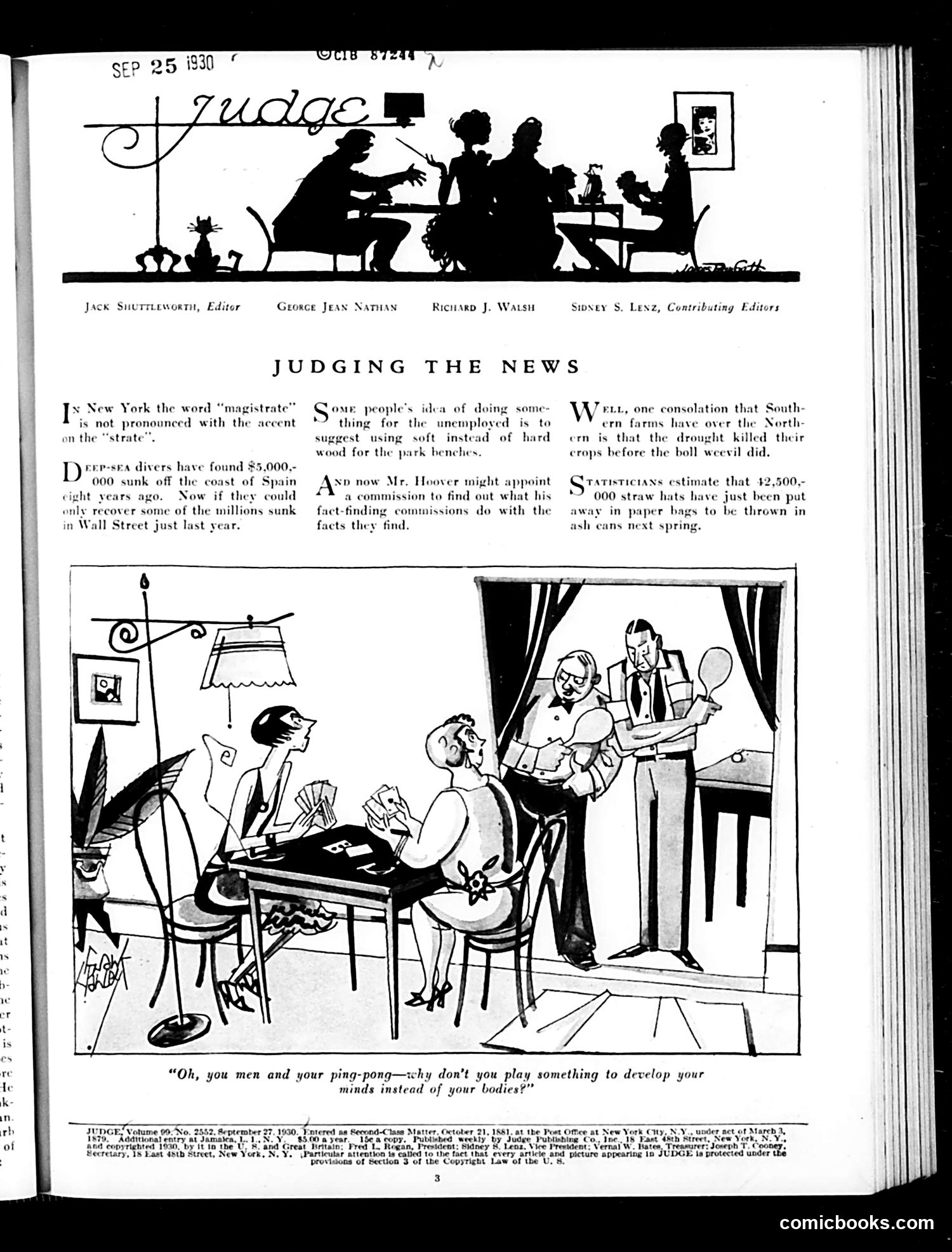
# Analysis of "Judging the News" (Judge, September 25, 1930) This satirical page critiques news stories through brief commentary and a cartoon. The main cartoon depicts a domestic scene where two men (appears to be wealthy, given the formal dress) are at a table with money visible, while hosts stand nearby. The caption reads: "Oh, you men and your ping-pong—why don't you play something to develop your minds instead of your bodies?" The satire targets wealthy leisure culture during the Depression era—the irony being that accumulating money while unemployed Americans suffer suggests the wealthy prioritize frivolous entertainment (ping-pong) over meaningful pursuits. The suggestion to "develop your minds" is sarcastic, implying the wealthy are intellectually vacant. The text snippets above comment on tangential news items, likely setting up the page's overall tone of social criticism.
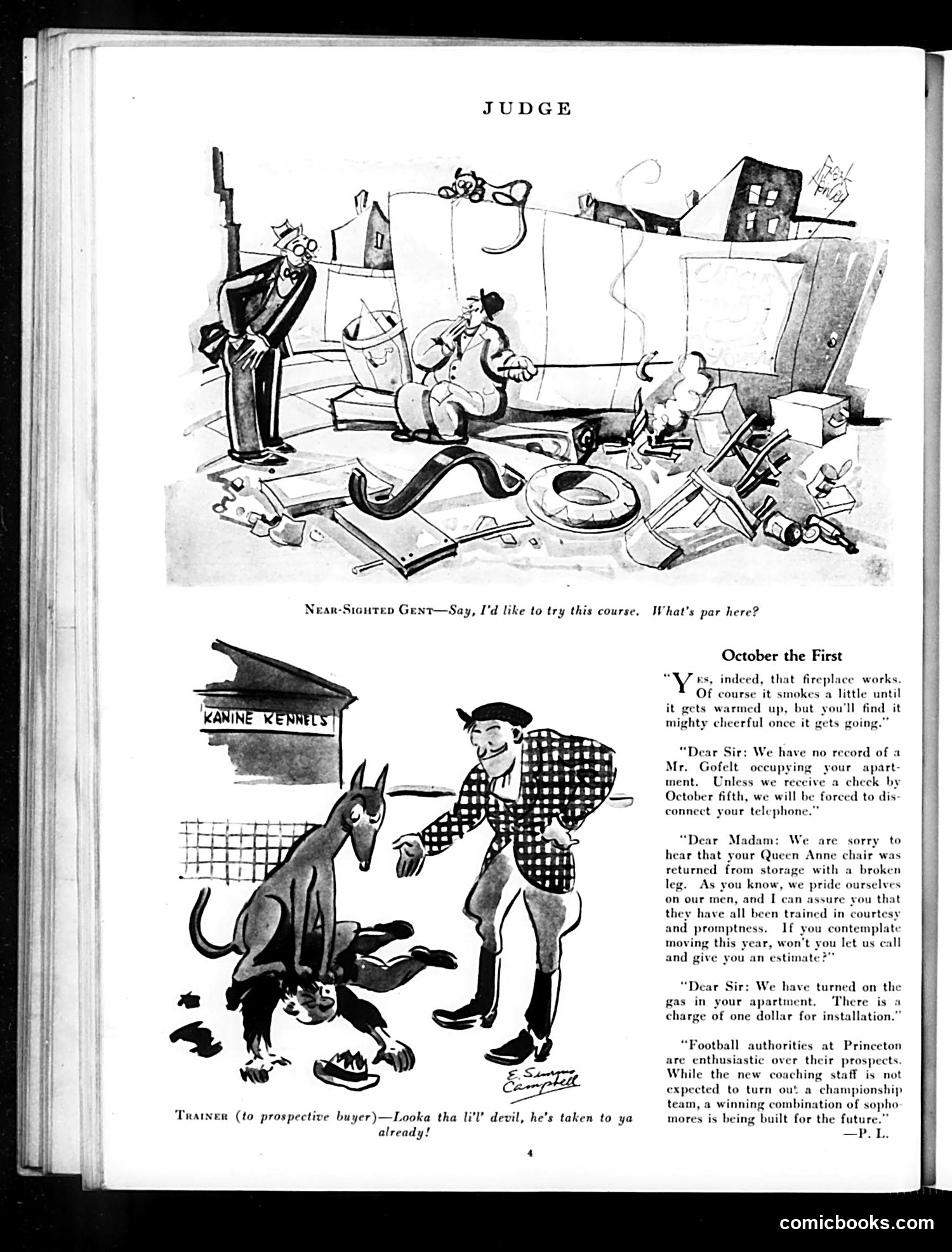
# Analysis of Judge Magazine Page **Top Cartoon ("Near-Sighted Gent"):** A humorous scene showing chaos at what appears to be a golf course—scattered clubs, bags, and debris everywhere. The joke plays on a near-sighted golfer attempting to play, with the caption suggesting he's asking about the "par" while surrounded by destruction, implying his poor vision causes comedic havoc. **Bottom Cartoon ("Trainer to Prospective Buyer"):** A trainer presents a mule to a potential buyer, describing it as "taken to ya already!" This is straightforward animal-trading humor—the mule's aggressive stance toward the buyer becomes the joke about the animal's temperament and suitability. **"October the First" Section:** Brief humorous letters about domestic complaints (fireplaces, apartment records, furniture storage) and Princeton football prospects—typical period magazine filler combining advice-column comedy with sports commentary.
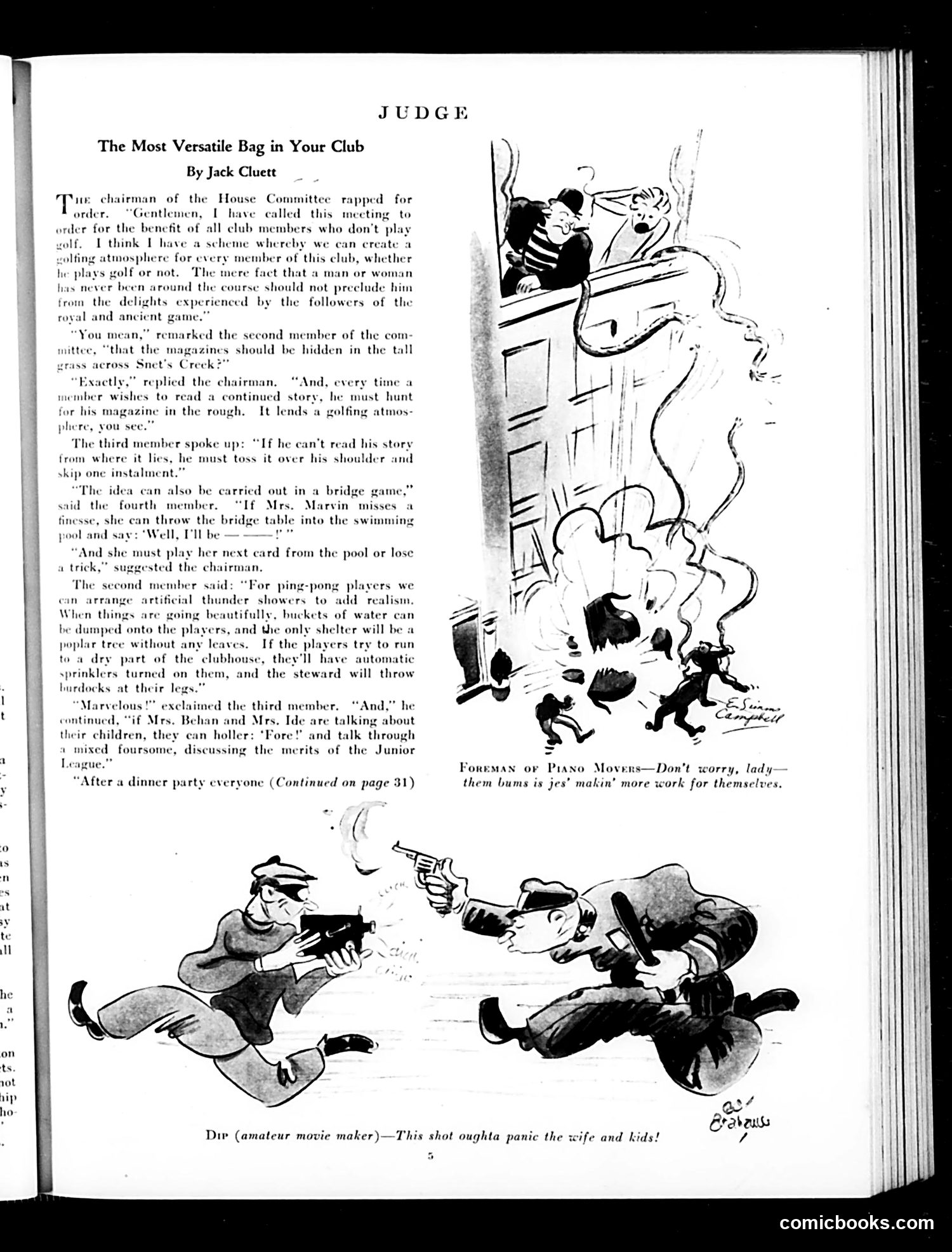
# "The Most Versatile Bag in Your Club" This humor piece by Jack Cluett satirizes club members' suggestions for accommodating non-golfers. The text describes increasingly absurd proposals: hiding magazine installments in grass, using bridge games, arranging artificial thunder showers for ping-pong, and discussing children during foursomes. The top cartoon shows a chaotic scene of people being thrown from a window amid tangled ropes—exaggerating the club's desperation to entertain everyone. The bottom cartoon depicts an "amateur movie maker" accidentally shooting a revolver during filming, panicking a woman and children—presumably illustrating how adding non-golf activities creates dangerous chaos. The satire's point: country clubs can't actually serve everyone; attempts to be "versatile" venues produce ridiculous and dangerous complications.
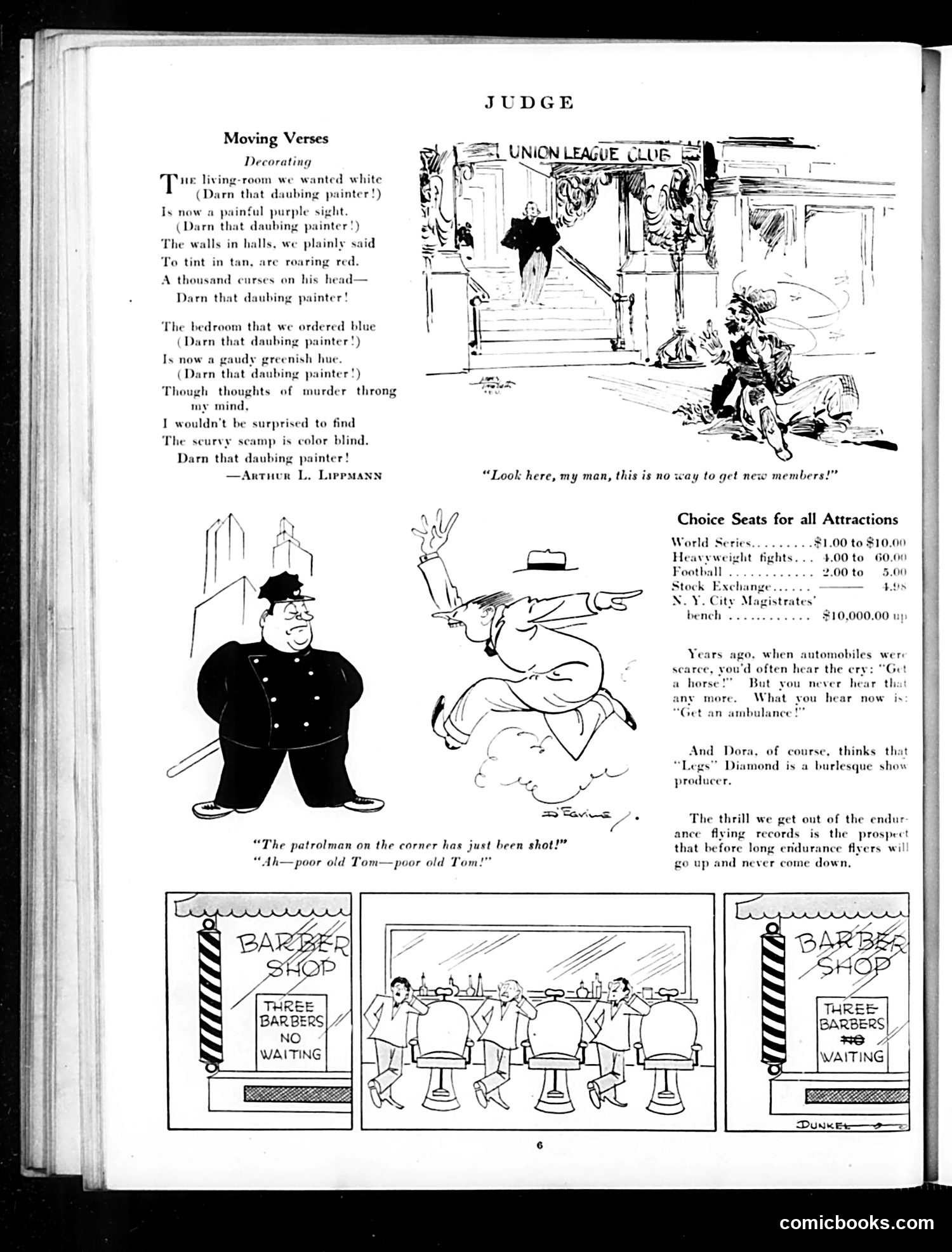
# Analysis of Judge Magazine Page This page contains humorous commentary on early 20th-century American life: **"Moving Verses" poem** by Arthur L. Lippmann satirizes frustrations with a house painter who fails to deliver the requested colors—white becomes purple, blue becomes greenish-hue. The repeated refrain "Darn that daubing painter!" expresses domestic exasperation. **Upper cartoon** shows a Union League Club scene where a new member recruitment attempt goes poorly, with the caption "Look here, my man, this is no way to get new members!" **Middle cartoons** include a policeman and a figure labeled with "The patrolman on the corner has just been shot!" **Bottom section** advertises a barber shop with "Three Barbers No Waiting," featuring men in chairs. The page mixes domestic frustrations, social club satire, and commercial advertisements typical of Judge's satirical format.
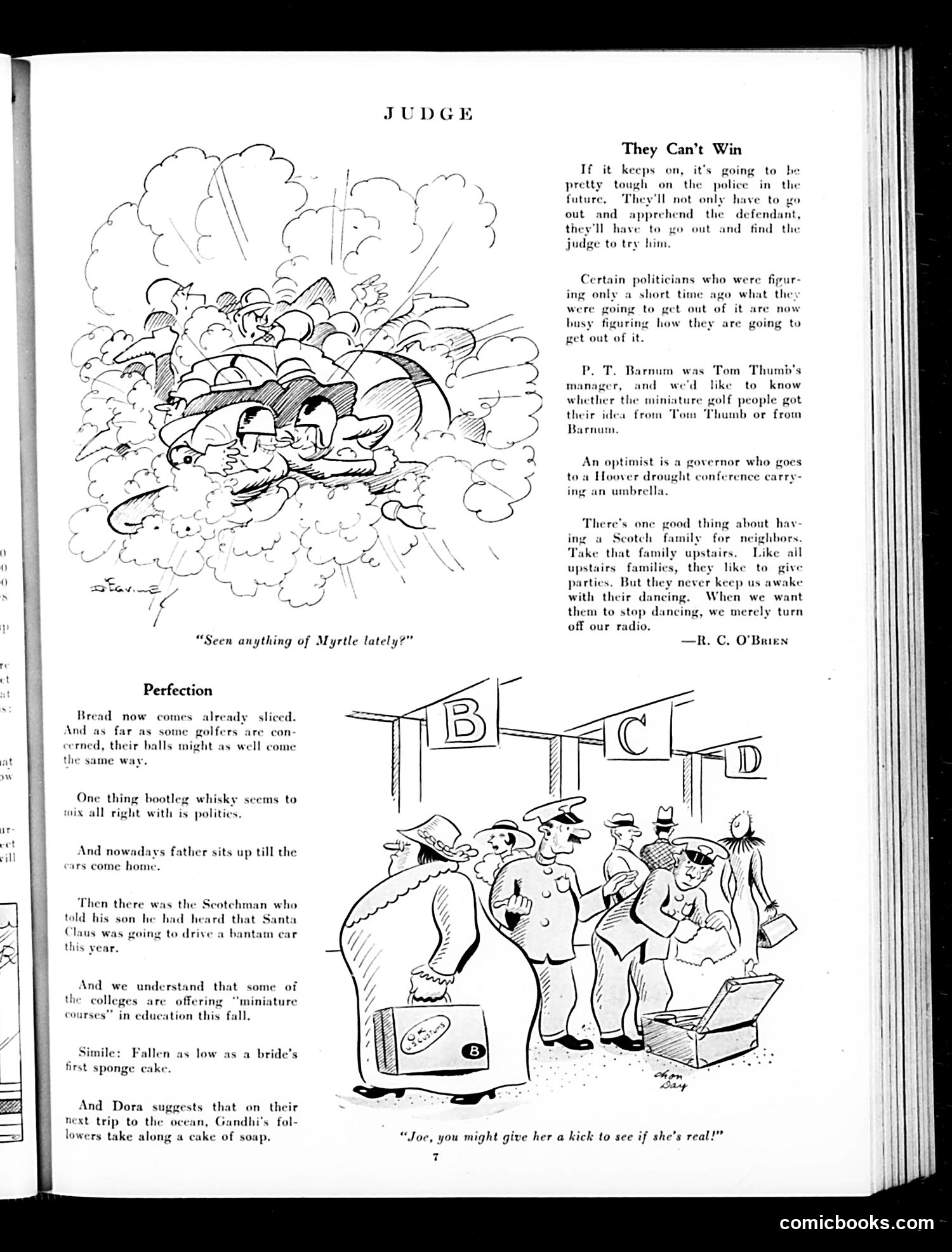
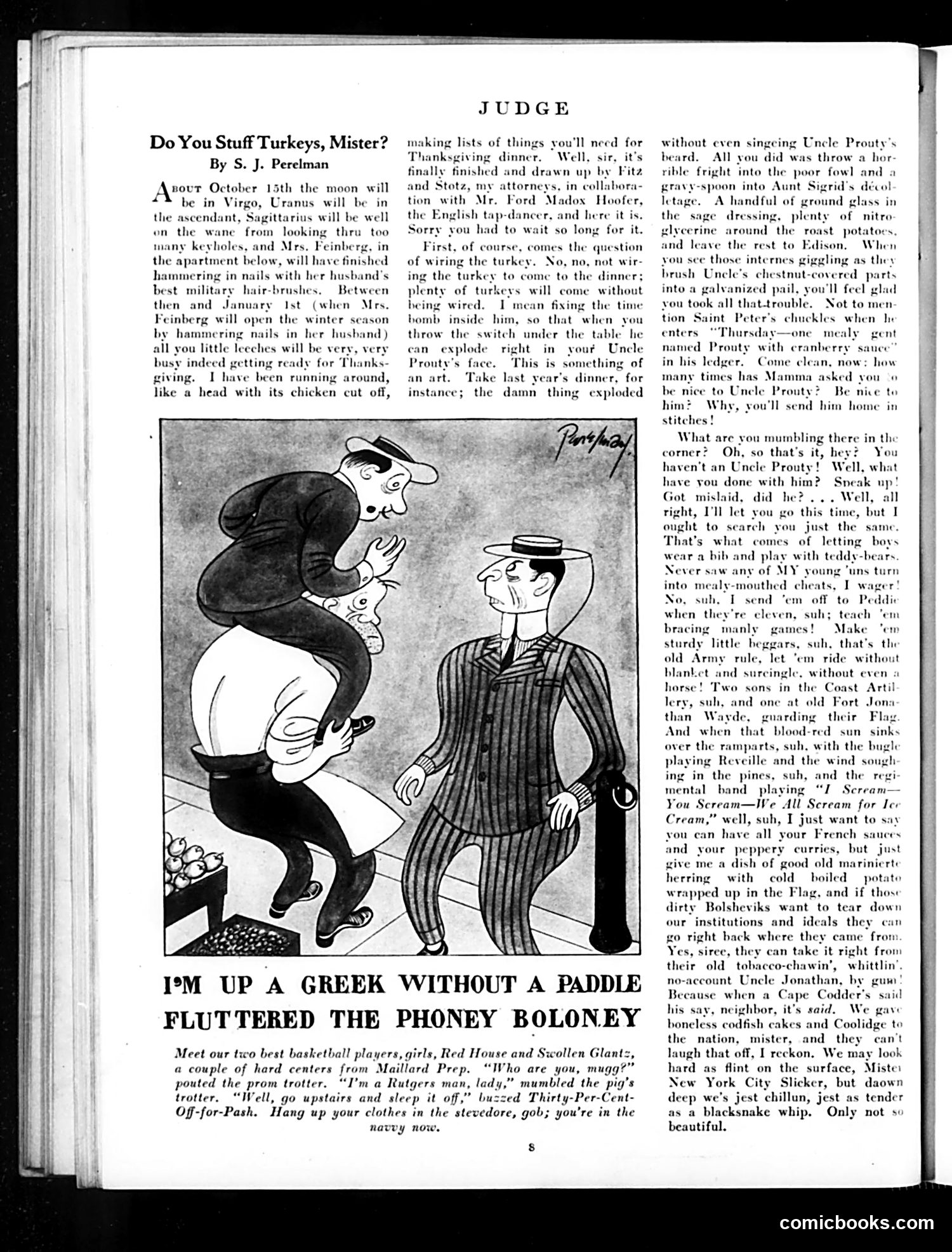
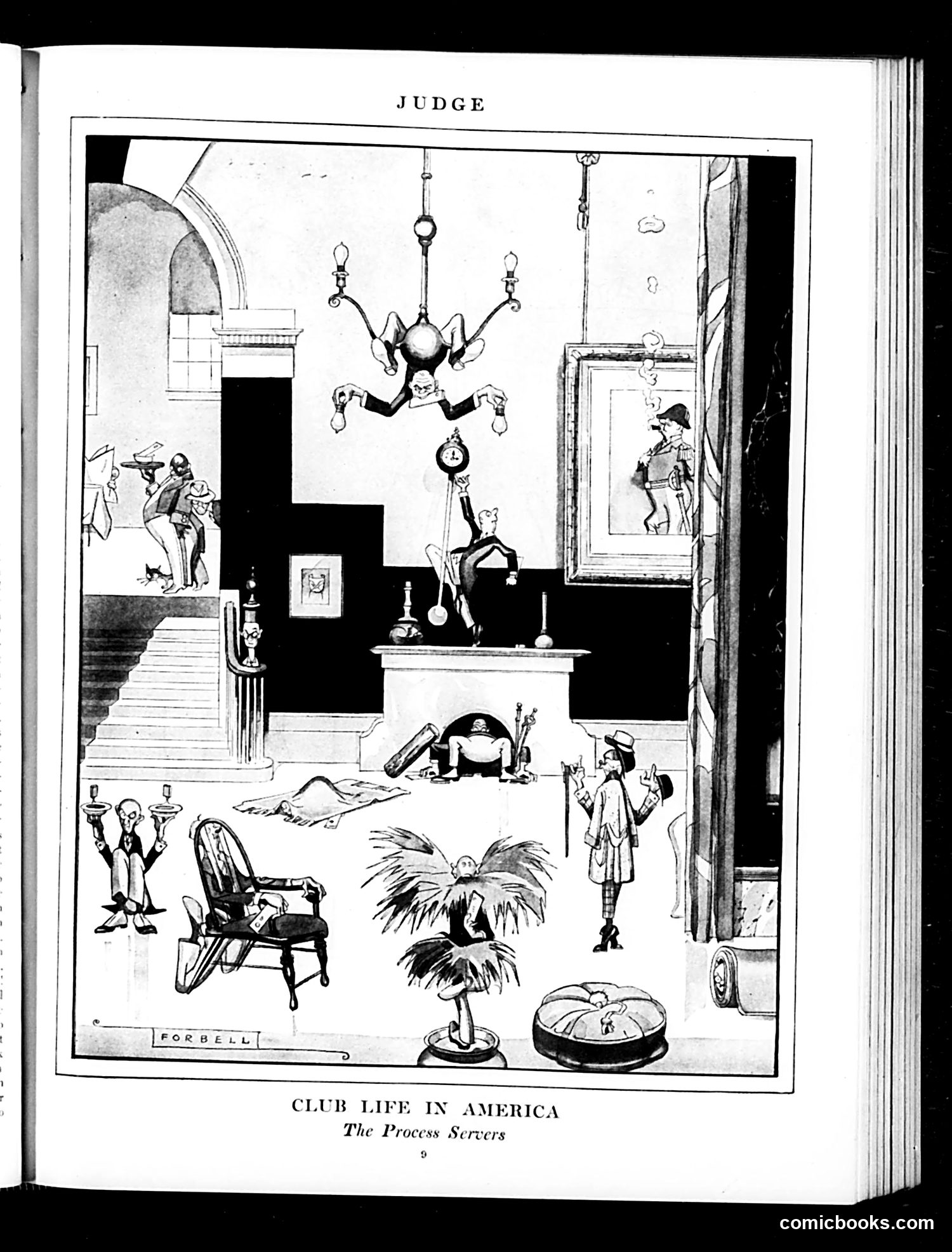
# "The Process Servers" - Judge Magazine Cartoon This satirical illustration depicts a judge's chamber as a surreal, mechanized courtroom where "process servers" (legal officials who deliver court documents) operate like an absurd bureaucratic machine. The central figure—a large spherical head suspended from chains and pulleys—represents the judge himself, depicted as a dehumanized cog in the legal system. Smaller figures around the room appear to be process servers in various poses, suggesting they are constantly in motion, serving documents and conducting legal business. The satire targets the mechanization and absurdity of American legal procedure and judicial authority. By visualizing the judge and court apparatus as literal machines and puppets, the cartoonist critiques how law has become an impersonal, automated system disconnected from human justice.
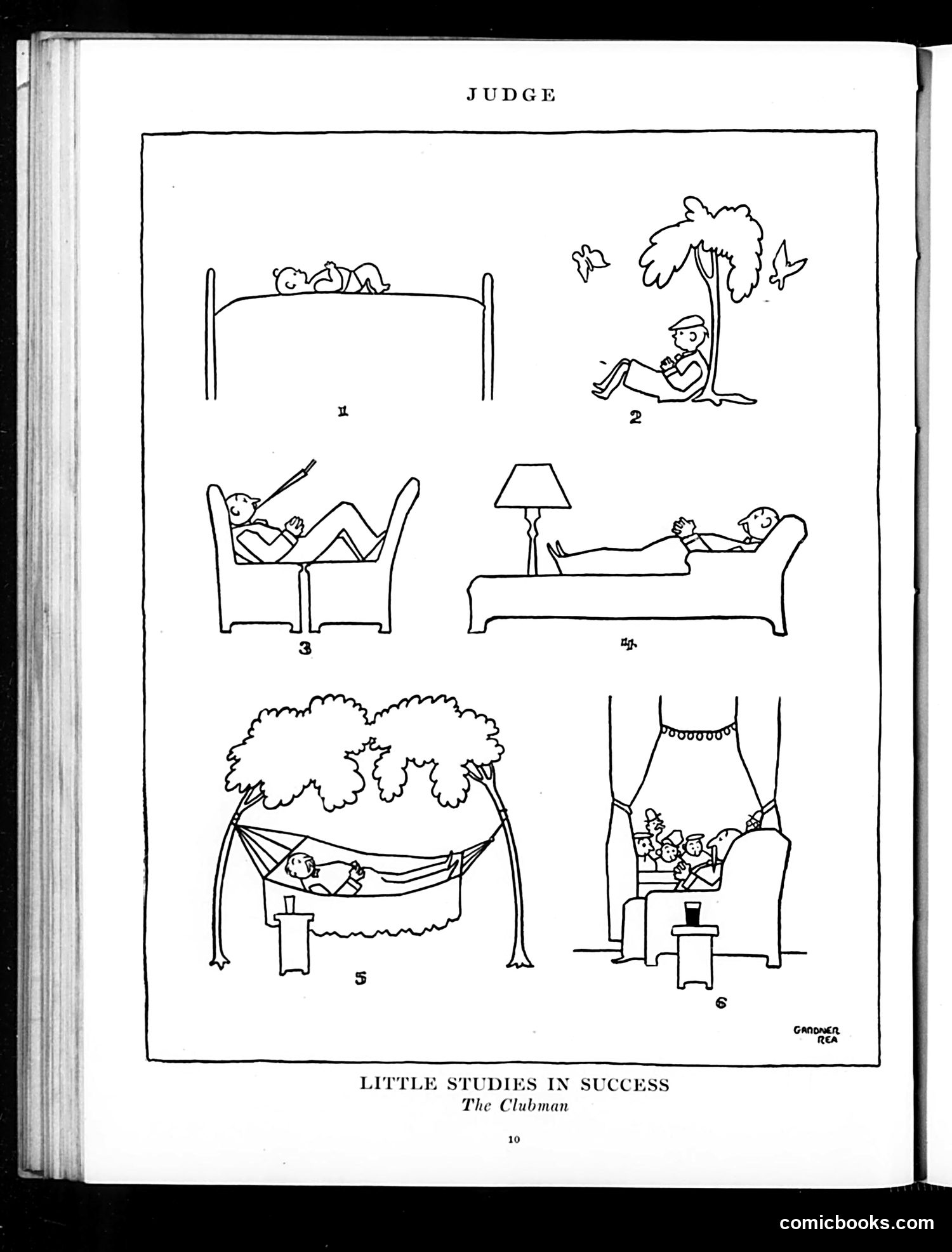
# "The Clubman" - Judge Magazine Satire This cartoon series mocks the leisured lifestyle of a wealthy "clubman" — a gentleman member of exclusive social clubs. The six panels depict his ideal day: 1. Lounging in an overstuffed chair at the club 2. Relaxing under a tree 3. Napping in a chair 4. Reclining on a sofa at home 5. Hammocking between trees 6. Swinging in a suspended basket The satire is straightforward: the cartoon defines "success" for this privileged figure as perpetual idleness and comfort-seeking. By presenting only leisure activities without any work or productive contribution, Judge ridicules the idle wealthy class — suggesting their "success" amounts to nothing more than avoiding labor while enjoying material comforts. It's social commentary on class privilege and the leisured aristocracy during the Gilded Age era.