
Judge, 1930-09-27 · page 18 of 36
Judge — September 27, 1930 — page 18: what you’re looking at
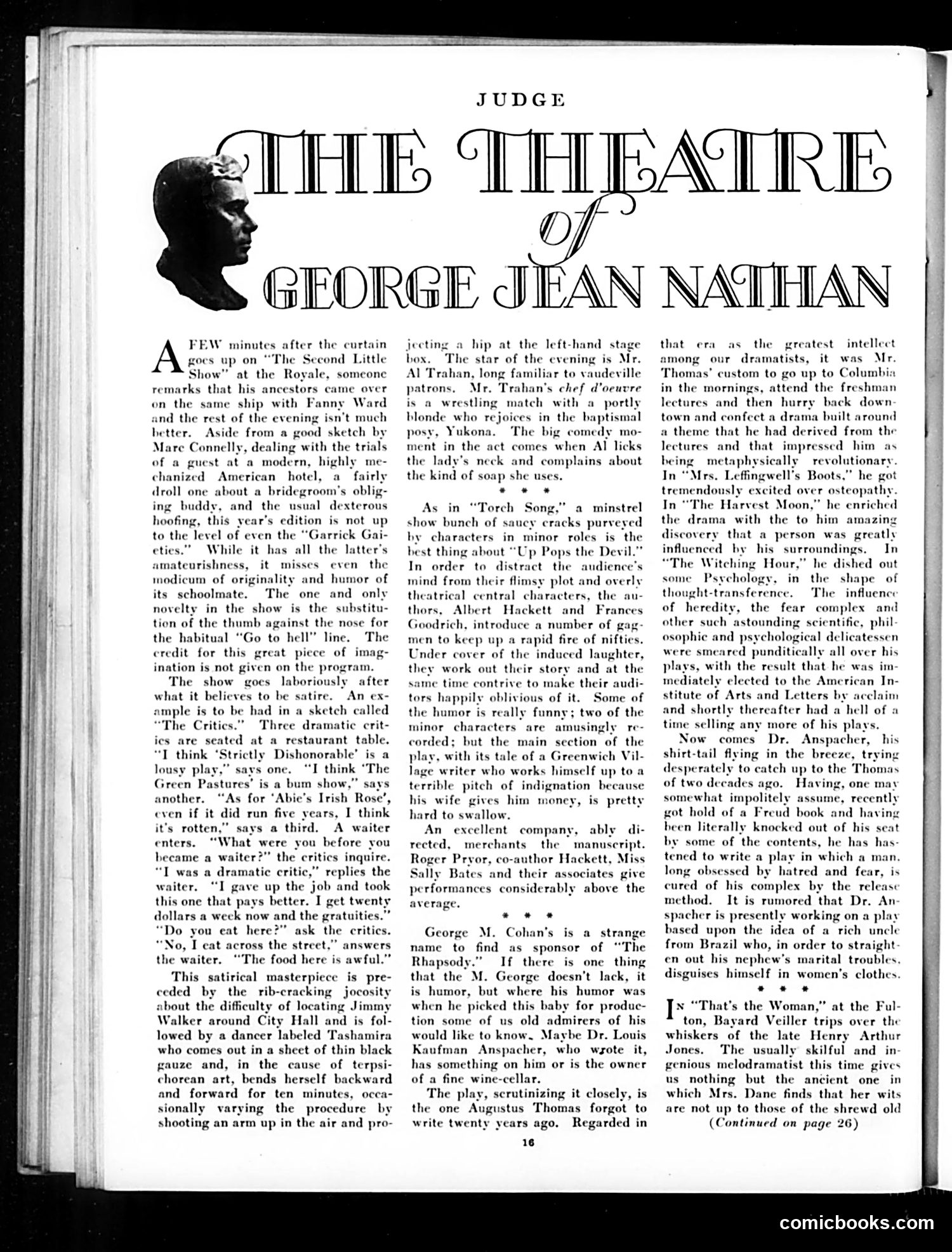
A restored page from Judge, 1930-09-27. Page through the whole issue in the reader above.
📄 Transcribed text from this page (OCR, searchable)
Machine-transcribed from the original scan — historical spelling and the odd misread are preserved.
0 GEORGE J FEW minutes after the curtain Aes up on “The Second Little Show" at the Royale, someone remarks that his a tors came over on the same ship with Fanny Ward and the rest of the evening isn't much hetter. Aside from a good sketch by Mare Connelly, dealing with the trials of a guest at a modern, high chanized American hotel, a droll one about a bridegroom's oblig- buddy, and the usual dexterous hoofing, this year's edition is not up to the level of even the “Garrick Gai- eties.” While it has all the latter's amateurishness, it even the modicum of originality and humor its schoolmate. The one and only novelty in the show is the substitu- tion of the thumb against the nose for the habitual “Go to hell” line. The credit for this great piece of im ination is not given on the program. The show gocs laboriously after what it believes to be satire. An ex- mple is to be had in a sketch called The Critics.” Three dramatic crit- ics are seated at a restaurant table. “T think ‘Strictly Dishonorable’ is a ysone, “I think ‘The is a bum show,” says As for ‘Abie's Irish Rose’, did run five years, I think it's rotten,” says a third. A waiter enters. “What were you before you became a waiter?” the critics inquire. “I was a dramatic critic,” replies the waiter. “I gave up the job and took this one that pays better. I get twenty lars a week now and the gratuities. Do you eat here?” ask the critics. “No, I cat across the street,” answers the waiter. “The food here is awful.” misses This satirical masterpiece is pre- ceded by the rib-cracking jocosi about the difficulty of locating Jimmy Walker around City Hall and is fol- lowed by a dancer labeled Tasham who comes out in a sheet of thin b gauze and, in the cause of terpsi- chorean art, bends herself backward and forward for ten minutes, occa- sionally varying the procedure by shooting an arm up in the air and pro- ack jecting a hip at the left-hand stag box. The star of the evening is Mr. Al Trahan, long familiar to vaudeville patrons. Mr. Trahan’s chef d’oeuvre is a wrestling match with a_ portly blonde who rejoices in the baptismal posy, Yuko The big comedy mo- ment in the act comes when Al licks the lady's neck and complains about the kind of soap she uses. * * As in “Torch Song,” a minstrel show bunch of saucy cracks purveyed hy characters in minor roles is the vest thing about “Up Pops the Devil.” In order to distract the audience’ mind from their flimsy plot and overly theatrical central characters, the thors, Albert Hackett and Fra Goodrich, introduce a number of gag- men to keep up a rapid fire of nifties. Under cover of the induced laughter, they work out their story and at the same time contrive to make their audi- appily oblivious of it. Some of the humor is really funny; two of the minor characters amusingly re- corded; but the main section of the play, with its tale of a Greenwich Vil- lage writer who works himself up to a terrible pitch of indignation because his wife gives him money, is pretty hard to swallow. An excellent company, ably di- rected, merchants the manuscript. Roger Pryor, co-author Hackett, Miss ally Bates and their associates give performances considerably above the average. tors “* * George M. Cohan’s is a strange name to find as sponsor of “The Rhapsody.” If there is one thing that the M. George doesn’t lack, it is humor, but where his humor was when he picked this baby for produc- tion some of us old admirers of his would like to know. Maybe Dr. Louis Kaufman Anspacher, who wsote it, has something on him or is the owner of a fine wine-cella The play, scrutinizing it closely, is the one Augustus Thomas forgot to write twenty years ago. Regarded in 16 ACI Es NAHIBIAN that era as the greatest intellect among our dramatists, it was Mr. homas’ custom to go up to Columbia in the mornings, attend the freshman lectures and then hurry back down town and confect a dr: built around a theme that he had derived from the lectures and that impressed him as being metaphysically revolutionary. In “Mrs. Leffingwell’s Boots,” he got tremendously excited over osteopathy. In “The Harvest Moon,” he enriched the drama with the to him amazing discovery that a person was greatly influenced by his surroundings. In “The Witching Hour,” he dished out some Psychology, in the shape of thought-transferencs The influence of heredity, the fear complex and other such astounding scientific, phil osophic and psychological delicatessen were smeared punditically all over his plays, with the result that he mediately elected to the American In- stitute of Arts and Letters by acclaim and shortly thereafter had a hell of a time selling any more of his plays. Now comes Dr. Anspacher, his shirt-tail flying in the breeze, tryi desperately to catch up to the Thon of two decades ag somewhat impolitel yot hold of a Freud book and ha been literally knocked out of his se by some of the contents, he has h: tened to write a play in which a man. long obsessed by hatred and fear, is cured of his complex by the release method. It is rumored that Dr. An her is presently working on a play sed upon the idea of a rich unck from Brazil who, in order to straight en out his nephew's marital troubles. disguises himself in women's clothes. oe * Ik “That's the Woman,” at the Ful- ton, Bayard Veiller trips over the whiskers of the late Henry Arthur Jones, The usually skilful and in genious mclodramatist this time gives us nothing but the ancient one in which Mrs. Dane finds that her wits are not up to those of the shrewd old (Continued on page 26) comicbooks.com