
Judge, 1930-09-27 · page 15 of 36
Judge — September 27, 1930 — page 15: what you’re looking at
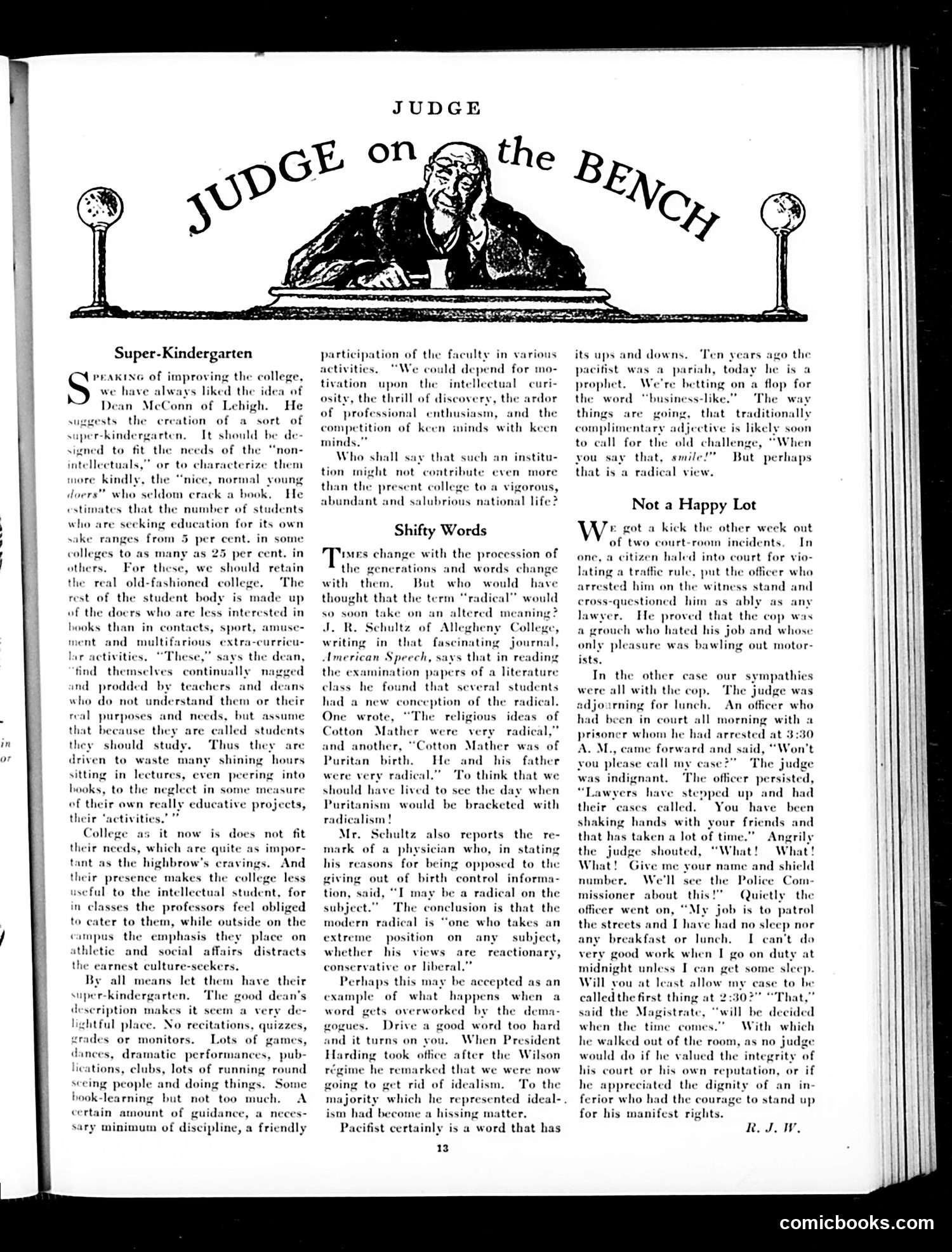
A restored page from Judge, 1930-09-27. Page through the whole issue in the reader above.
📄 Transcribed text from this page (OCR, searchable)
Machine-transcribed from the original scan — historical spelling and the odd misread are preserved.
: ] j in Super-Kindergarten PEAKING of improving the college: S we have always liked the idea ¢ Dean MeConn of Lehigh. He creation of a sort of It should be de- suggests the super-kindergarten, signed to fit the needs of the “non- Hectuals,” or to characterize them more kindly, the “nice, normal young doers” who seldom crack a book, He estimates that the number of students who are seeking education for its own nges from 5 per cent. in some colleges to as many as per cent. in others. For these, we should retain the real old-fashioned college. The rest of the student body is made up of the doers who are less interested in books than in contacts, sport, amuse- ment and multifarious extra-curricu- lar activities, “These,” says the dean, find themselves continually n ind prodded by chers and d who do not understand them or their real purposes. : in = nd needs, but assume that because they are called students they should stud Thus they are driven to waste n shining hours sitting in lectures, even peering into hooks, to the neglect in some measure of their own r their ‘activities. College as it now is does not fit their needs, which are quite as impor- tant as the highbrow's er. . And their presence makes the college less useful to the intellectual student, for in classes the professors feel obliged to cater to them, while outside on the campus the emphasis they place on and social affairs distracts arnest culture-seekers, all means let them have their ver-kindergart! The good dean's leseription makes it seem a very de- hitful place. No recitations, qui . ides or monitors. Lots of games, dances, dramatic performances, pub- lications, clubs, lots of running round seeing people and doing things, Some ok-learning but not too much. A in amount of guidance, a neces- sary minimum of discipline, a friendly ly educative projects, s. participation of the faculty in various activities. “We could depend for mo- tivation upon the intellectual curi- osity, the thrill of discove the ardor of professional enthusiasm, and. the competition of keen minds with keen minds.” Who shall say that such an institu- tion might not contribute even more than the present college to a vigorous, abundant and salubrious national life? Shifty Words Tiss change with the procession of the generations and words change with them. But who would thought that the term “radical” would so soon take on an altered meanin J. R. Schultz of Allegheny Coll writing in that fascinating journal, American Speech, says that in reading the examing class he ve ion papers of a literature do that several students had a new conception of the radica One wrote, “The religious ide: Cotton Mather were very radical,” and other, “Cotton Mather was of Puritan birth. He and his father were very radical.” think that we should have lived to see the day when Puritanism would be bracketed with radicalism ! Mr. Schultz mark of a physi his reasons for being opposed to th giving out of birth control informa- tion, said, “I may be a radical on the subject.” The conclusion is that the modern radical is ‘one who takes an extreme position on any — subject, whether his views are reactionary, ative or liberal.” aps this may be accepted as an example of what happens when a word gets overworked by the dema- gogues. Drive a good word too hard nd it turns on you, When President Harding took office after the Wilson régime he remarked that we were ing to get rid of idealism. To the majority which he represented ideal- ism had become a hissing matter. Pacifist certainly is a word that has 13 so reports the re- n who, in stating now its ups and downs. ‘Ten years ago the pacifist we pariah, today he is a prophet. We're hetting on a flop for the word “business-like.” The was things that t complimentary adjective to call for the old cha you say that, smile that is a radical view, are g ditionally is likely soon Henge, “When But perhaps Not a Happy Lot WwW: got a kick the other week out of two court-room incidents, In r, a citizen haled into court for vio- lating a traffic rule, put the officer who arres| him on the witness stand and cross-questioned him as ably as lawyer. He proved that th a grouch who hated his jol only pleasure was bawlin, ists. ny cop was nd whose out motor- In the other case our sympathies call with the cop, The judge was adjourning for lunch. An officer who had been in court all morning with prisoner whom he had arrested at 3: A.M., » forward and said, “Won't all my case?” The judge nt. The officer persisted, ave stepped up and had their cases called. You have been shaking hands with your friends and that has taken a lot of time.” Angrily the judge shouted, “What! What! What! Give me your name and shield number. We'll see the Police Com- ner about. thi Quietly the r went on, “My job is to patrol the streets and I have had no sleep nor any breakfast or lunch. I can't do very good work when I go on duty at midnight unless I can get some sleep. Will you at least allow my case to b called the first thing pb?” “That, said the Magistra “will be decided when the time comes.” With which he walked out of the room, as no judge would do if he valued the integrity of his court or his own reputation, or if he appreciated the dignity of an in- ferior who had the courage to stand up for his manifest we RSIW, comicbooks.com