A complete issue · 36 pages · 1930
Judge — September 13, 1930
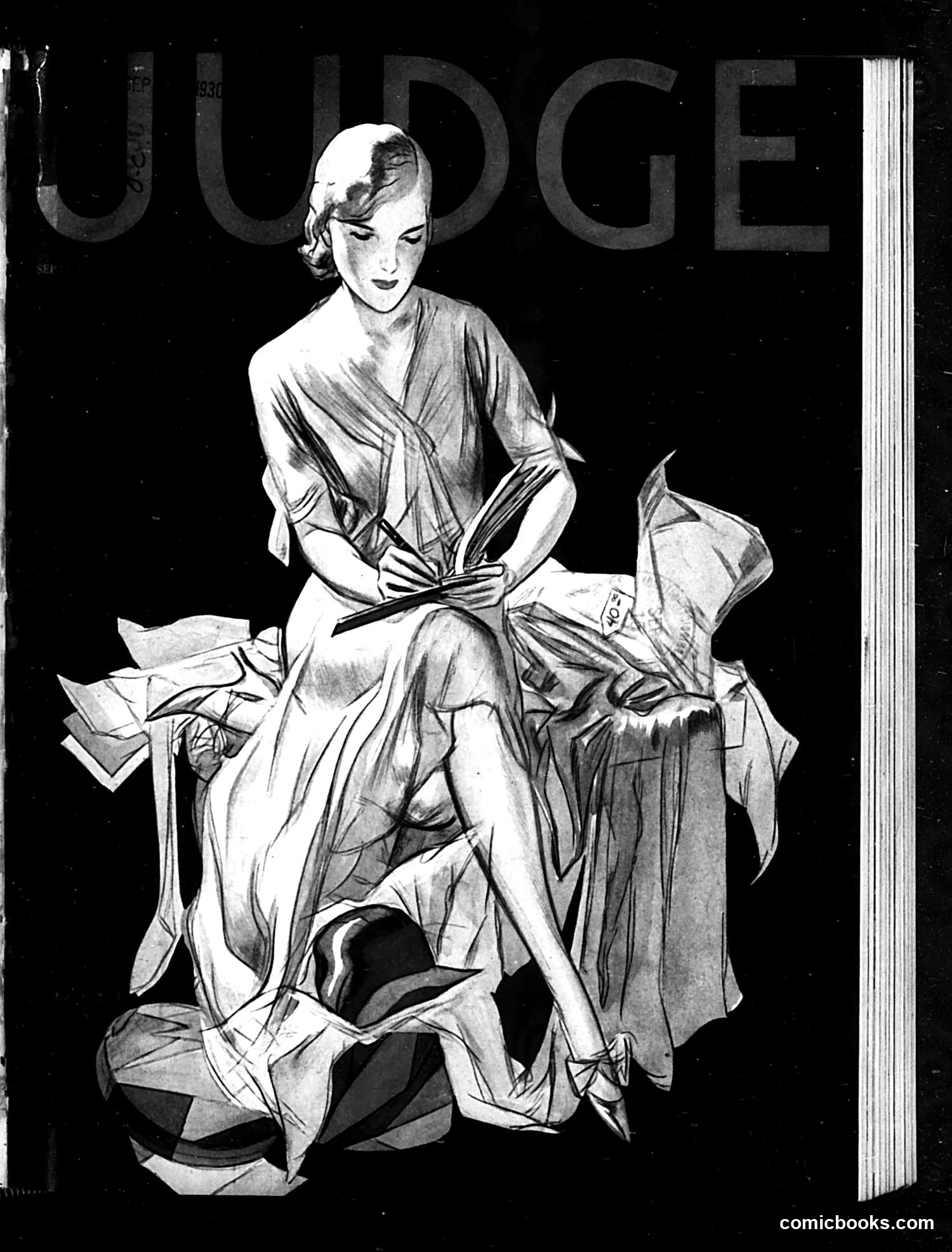
I can see this is a Judge magazine cover featuring an illustration of a stylishly dressed woman sitting among scattered papers or documents. The partial text visible reads "JUDGE" at the top. However, I cannot reliably determine the specific political or social reference from the image alone. The woman's fashionable 1920s-30s appearance and the scattered papers suggest commentary on either women's changing social roles, workplace involvement, or possibly a specific contemporary event or figure. Without clearer text or additional context, I cannot confidently identify what particular satire or joke this cover intended to convey to its original audience. To properly explain this cartoon's meaning, I would need more legible text or additional publication information.
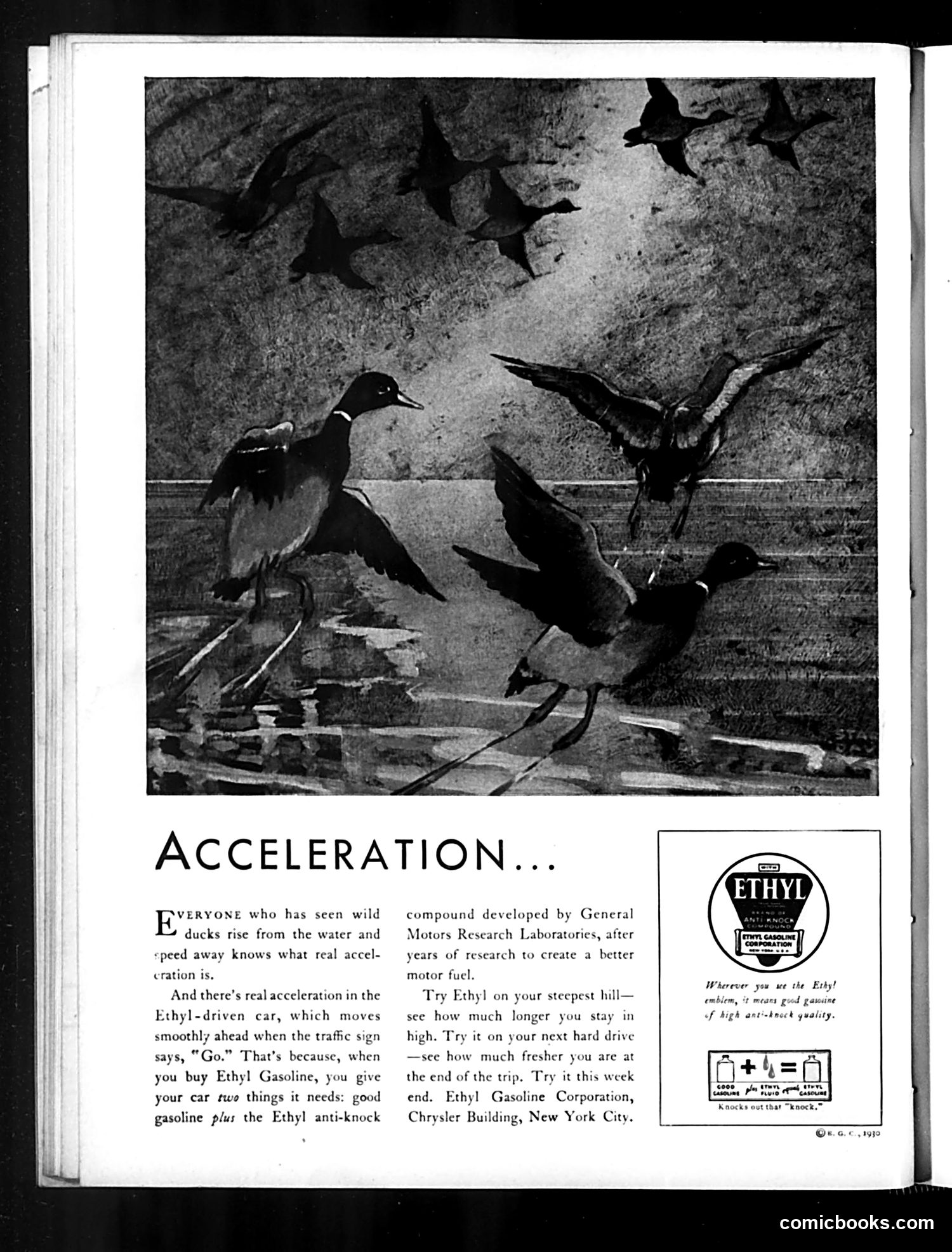
# Ethyl Gasoline Advertisement This page is primarily a **product advertisement** rather than political satire. It promotes Ethyl Gasoline, a fuel additive developed by General Motors Research Laboratories. The advertisement uses ducks taking flight as a metaphor for acceleration and performance. The image shows multiple ducks launching from water, visually representing the smooth, rapid acceleration drivers would experience using Ethyl fuel versus standard gasoline. The ad claims Ethyl Gasoline provides "two things" cars need: "good gasoline plus the Ethyl anti-knock compound." The copy encourages drivers to test the product on hills and long drives to experience superior performance. This reflects 1920s-30s automotive marketing, when fuel additives were novel innovations promoted through comparative lifestyle imagery.
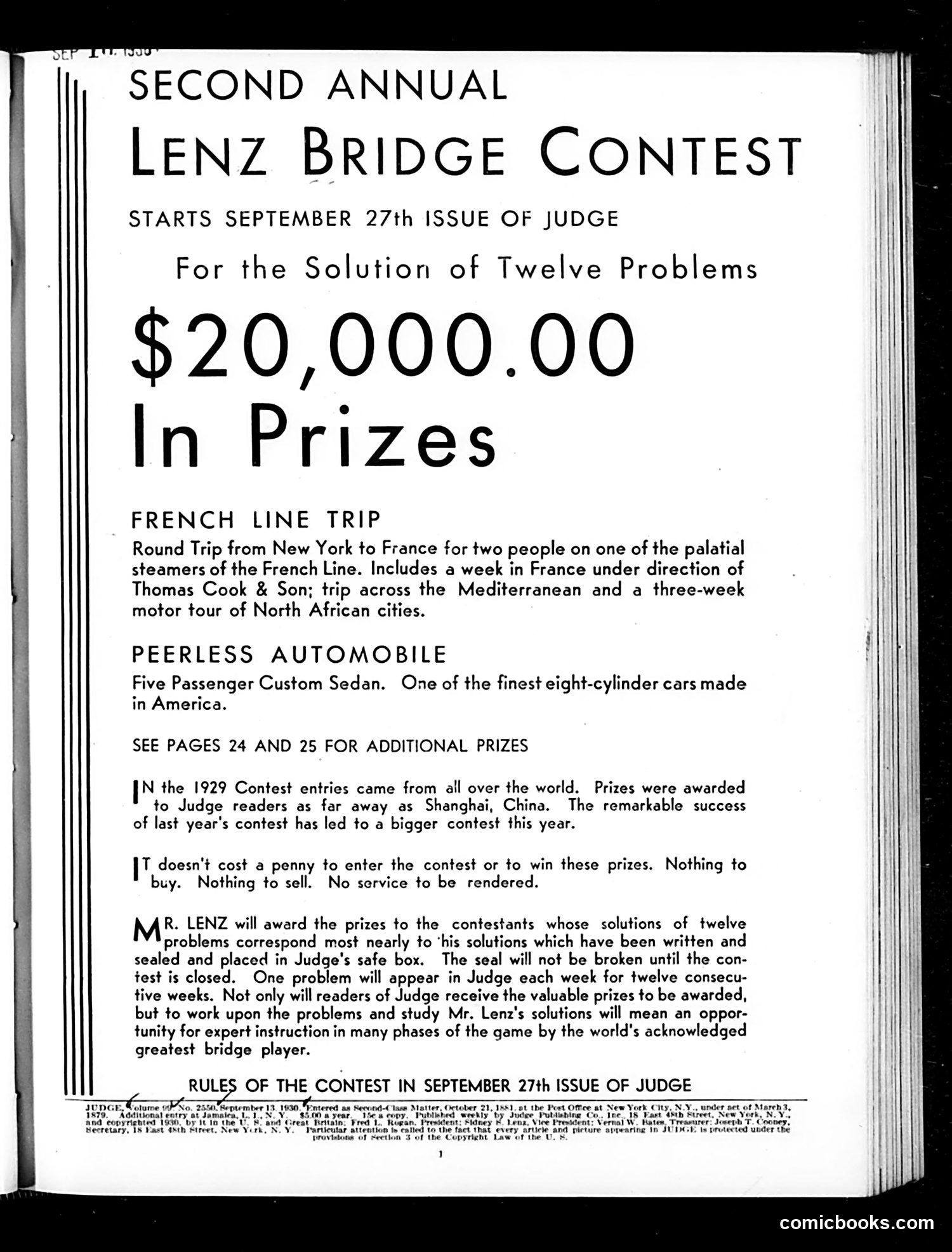
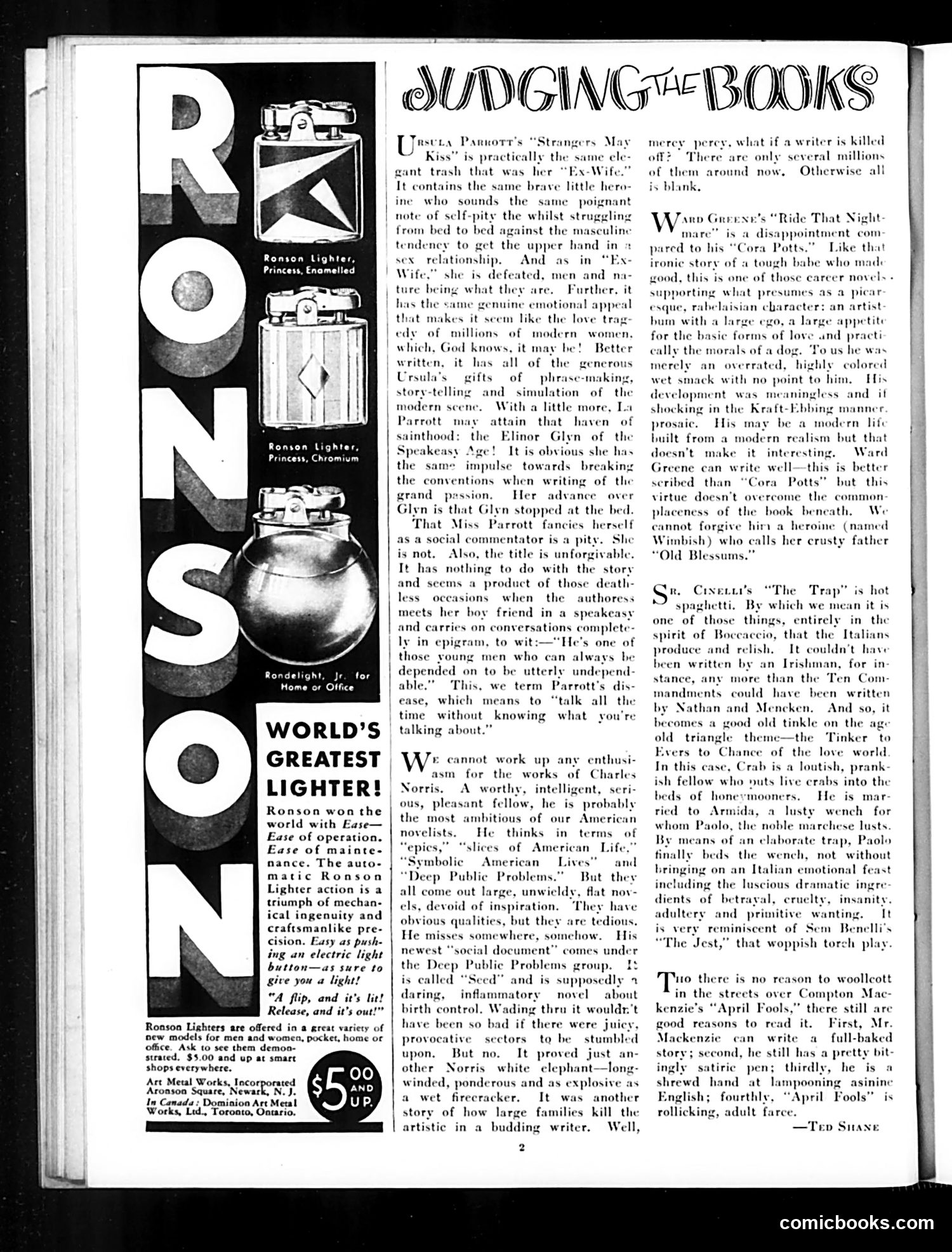
# Analysis of "Judging the Books" Page This page is primarily a **book review column**, not a political cartoon. The left side features a **Ronson lighter advertisement** (the "world's greatest lighter"), while the right side contains literary criticism by Ted Shane. The reviews discuss several novels: - Ursula Parrott's "Strange Max Kiss" - Ward Greene's "Ride That Nightmare" - S. Cinelis's "The Trap" (described as Boccaccio-inspired Italian fiction) - Charles Norris's works, praised as ambitious American social documents The tone is **satirical toward contemporary literature**: Shane critiques overly colorful prose, shallow character development, and writers who mistake sentiment for artistry. The satire targets 1920s-30s authors who relied on stylistic flourish rather than genuine insight—mocking the era's literary pretensions rather than politics.
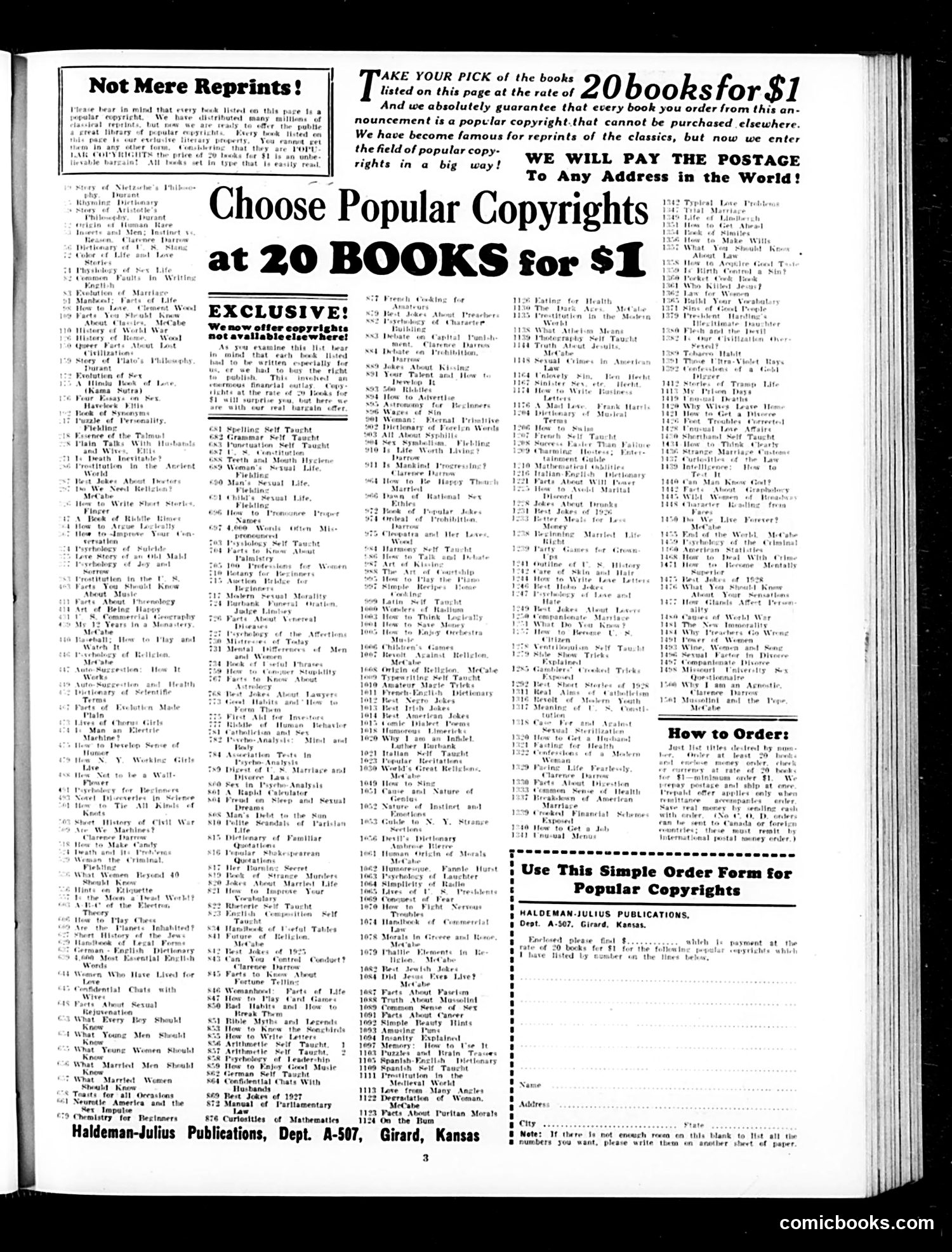
# Content Description This page is primarily **advertising**, not editorial content or political cartoons. It's a book sales advertisement from Haldeman-Julius Publications offering 20 books for $1—a Depression-era bargain offer. The top-left contains a brief notice stating "Not Mere Reprints!" defending the quality of their reprinted editions. The bulk of the page lists hundreds of book titles available through their mail-order service, organized in multiple columns. The bottom includes an order form for customers to select titles and mail payment to the company's Kansas address. There are no political cartoons, caricatures, or satirical content visible on this page. It's a straightforward commercial offering from a major publisher of inexpensive reprints during the early-to-mid 20th century.

# Analysis This page is **primarily an advertisement**, not satire or editorial content. It promotes the Barbizon-Plaza hotel located at Central Park South and 101 West 58th Street in New York City. The ad emphasizes the hotel's cultural appeal and convenient location overlooking Central Park. The illustration depicts a tall building with desert scenery and mounted figures below—likely evoking a romanticized "cultural" theme, though the specific reference is unclear. The copy highlights amenities: Continental breakfast delivered to rooms, studio apartments at various rates ($18-45 weekly), and proximity to public transportation. It notes the hotel operates under the same management as the famous Barbizon Hotel at 140 East 63rd Street. There is **no political satire or cartoon commentary** on this page—it's a straightforward hospitality advertisement typical of Judge magazine's commercial content.
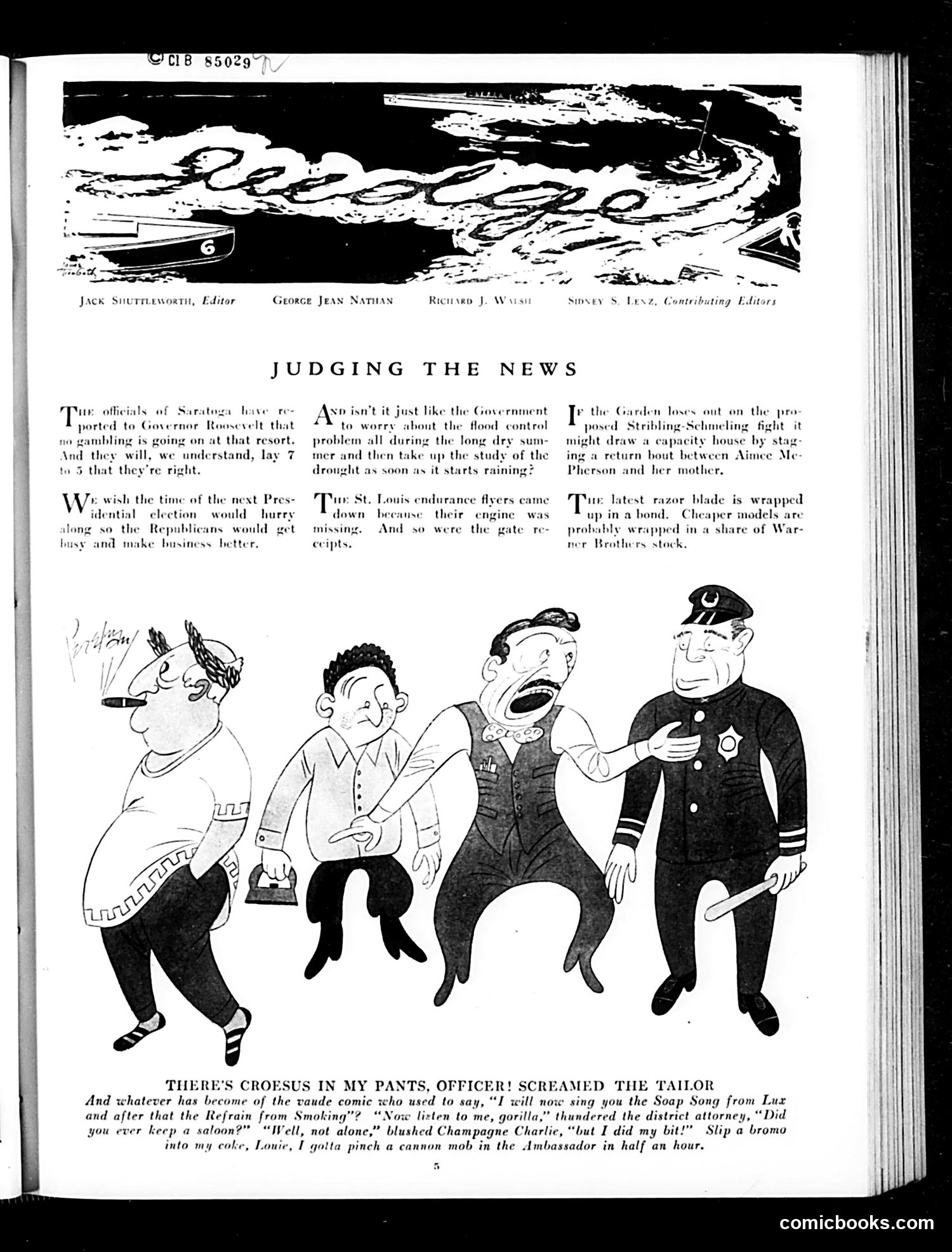
# "Judging the News" - Analysis This page contains brief editorial commentary paired with a satirical cartoon. The text items reference: 1. **Saratoga flood control** - Officials reported to Governor Roosevelt about gambling, which he called "a real evil" 2. **St. Louis endurance flyers** - Their engine failed, so gates had to be closed 3. **Garden vs. Striking Scheming fight** - A potential boxing match being blocked by Aimee McPherson's mother 4. **Razor blade wrapping** - Cheaper models wrapped in Warner Brothers stock as a joke The main cartoon depicts four caricatured men in comedic distress about "crocus in my pants." The accompanying dialogue references vaudeville comic and musical references ("Soap Song from Lux"), appearing to satirize entertainment industry figures reacting with exaggerated shock. The specific identities of these figures remain unclear without additional context.
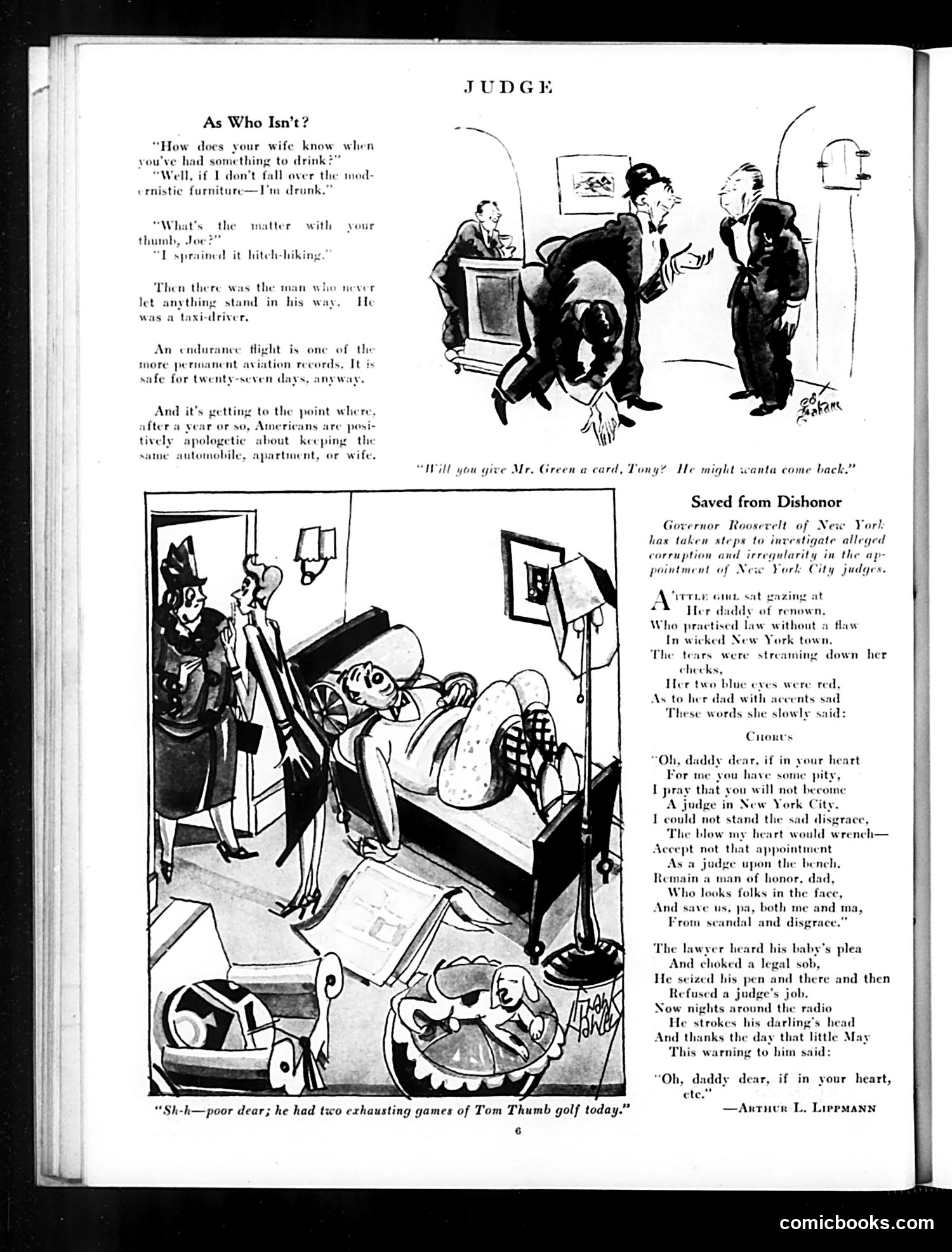
# Analysis of Judge Magazine Page **Top Cartoon ("As Who Isn't?"):** A humorous piece about how spouses recognize intoxication—the wife notes her husband "won't fall over the modernistic furniture" when drunk. The taxi driver anecdote suggests people are becoming apathetic about keeping the same car, apartment, or spouse, satirizing American consumer culture and casual attitudes toward commitment. **Bottom Section ("Saved from Dishonor"):** This depicts Governor Roosevelt of New York investigating corruption among NYC judges. The illustration shows a sick man in bed (apparently a dishonored judge) while his daughter pleads with her father not to become a judge himself, fearing judicial scandal. The verse emphasizes maintaining honor and avoiding disgrace in public service—commentary on the serious corruption problems plaguing New York's judicial system at this time.
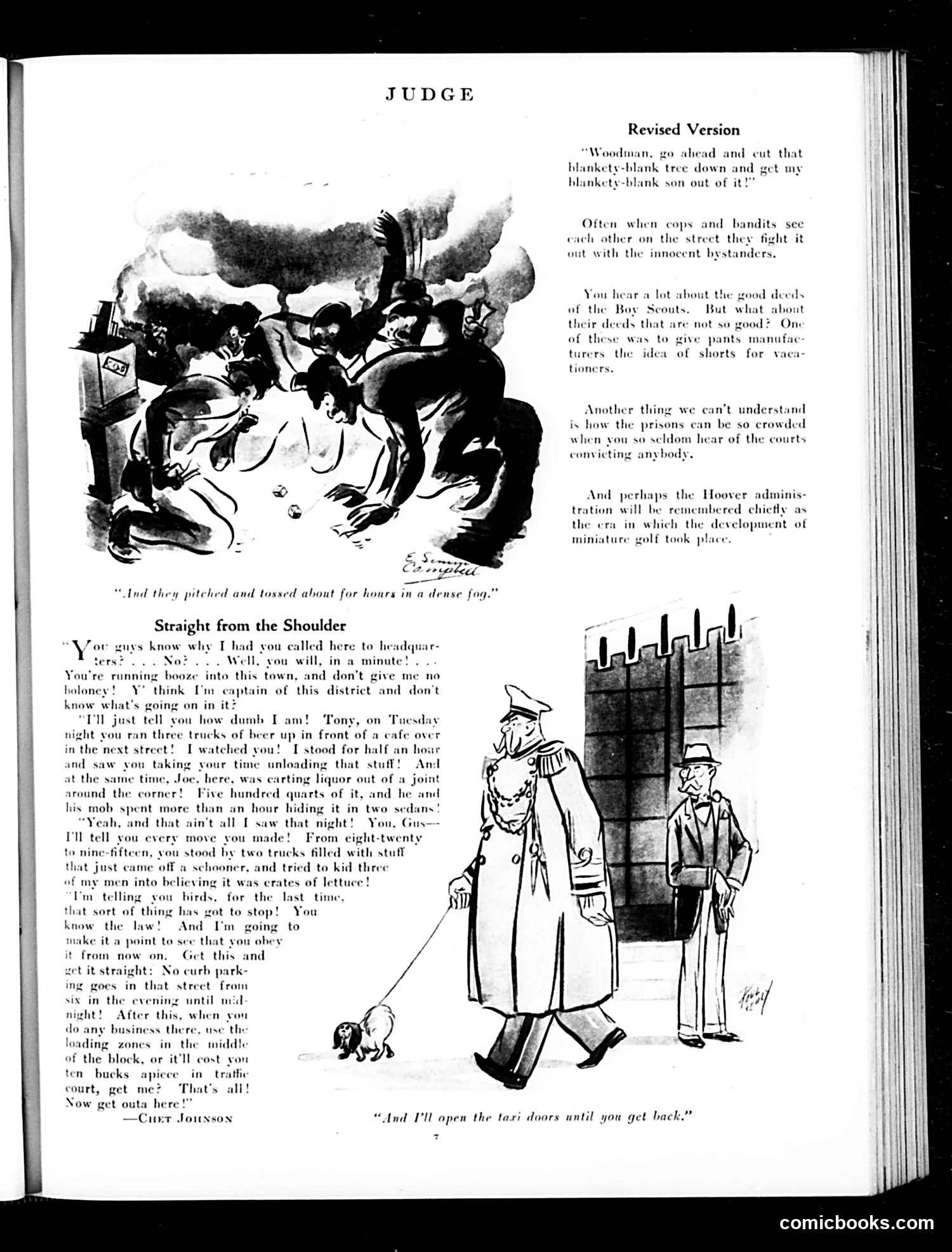
# Judge Magazine Page Analysis This page contains two satirical pieces from the Prohibition era (likely 1920s-early 1930s, given references to bootlegging and the Hoover administration). **"Straight from the Shoulder"** depicts a police captain chewing out officers for their incompetence in combating illegal alcohol trafficking. The captain sarcastically details how his own men witnessed bootleggers operating brazenly—trucks unloading beer, smuggled liquor hidden in sedans—yet did nothing. The joke is that despite Prohibition's strict laws, enforcement is laughably ineffective due to corrupt or negligent police. **"Revised Version"** (top right) offers brief social commentary: joking about censoring profanity in a tree-rescue scenario, mocking Boy Scouts for popularizing shorts (benefiting manufacturers), questioning why prisons overflow yet courts convict nobody, and sarcastically crediting Hoover's administration mainly for the miniature golf craze. Together, these pieces ridicule Prohibition enforcement failures, judicial inefficiency, and the Hoover administration's perceived ineffectiveness—common Judge magazine targets during this period.
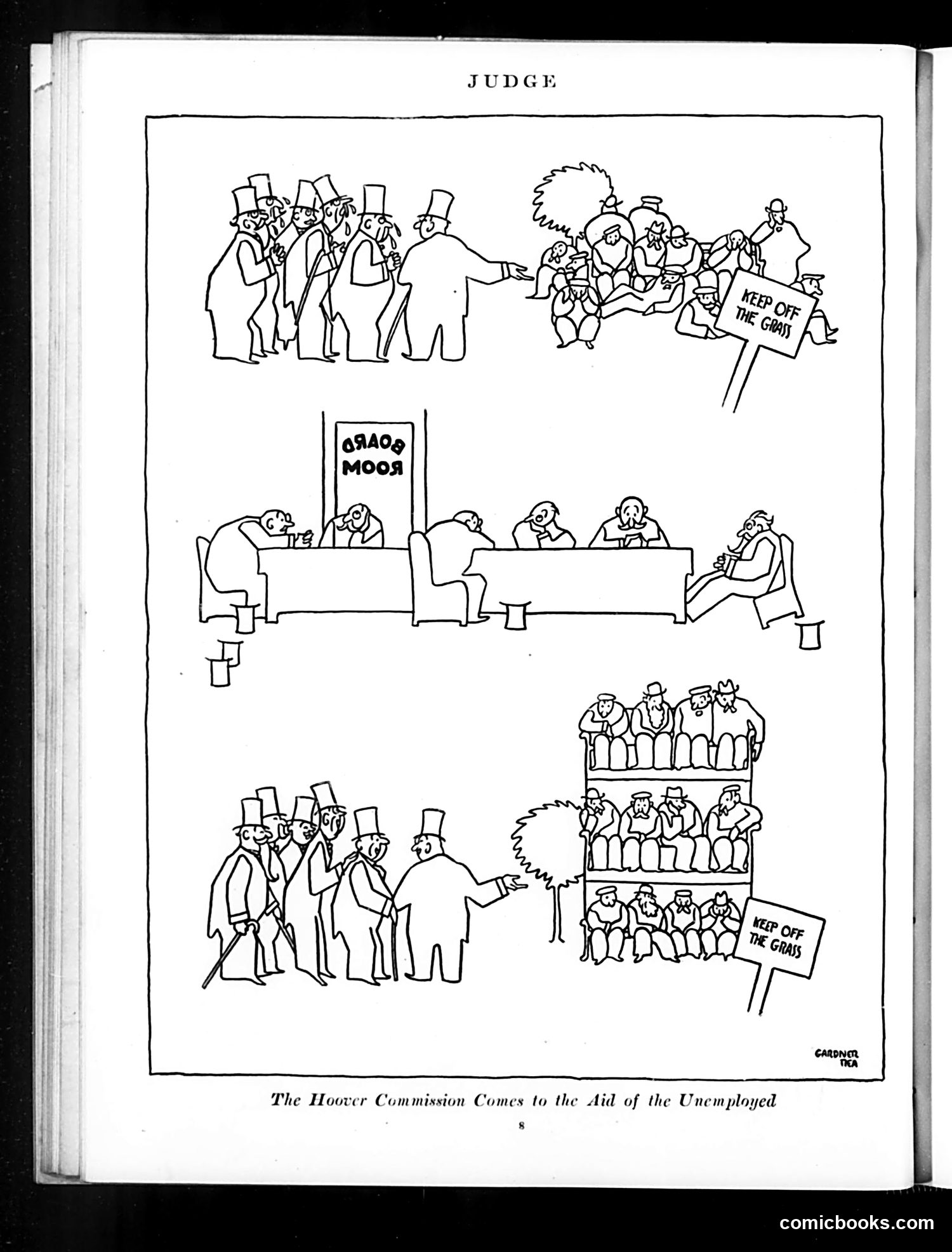
# Political Cartoon Analysis: "The Hoover Commission Comes to the Aid of the Unemployed" This satirical cartoon critiques the Hoover Commission's ineffectual response to unemployment, likely during the Great Depression era. The three panels show: 1. **Top**: Wealthy top-hatted figures (representing the commission/establishment) observe a crowd of unemployed people holding a "Keep Off the Grass" sign—suggesting elite indifference. 2. **Middle**: A formal courtroom or official proceeding where bureaucrats conduct business while unemployment issues remain unresolved. 3. **Bottom**: The same wealthy figures still observe crowds, now behind barriers marked "Keep Off the Grass," implying the commission provides only symbolic gestures rather than substantive aid. The satire attacks the gap between official activity and actual relief for the unemployed, portraying the Hoover response as performative rather than helpful.
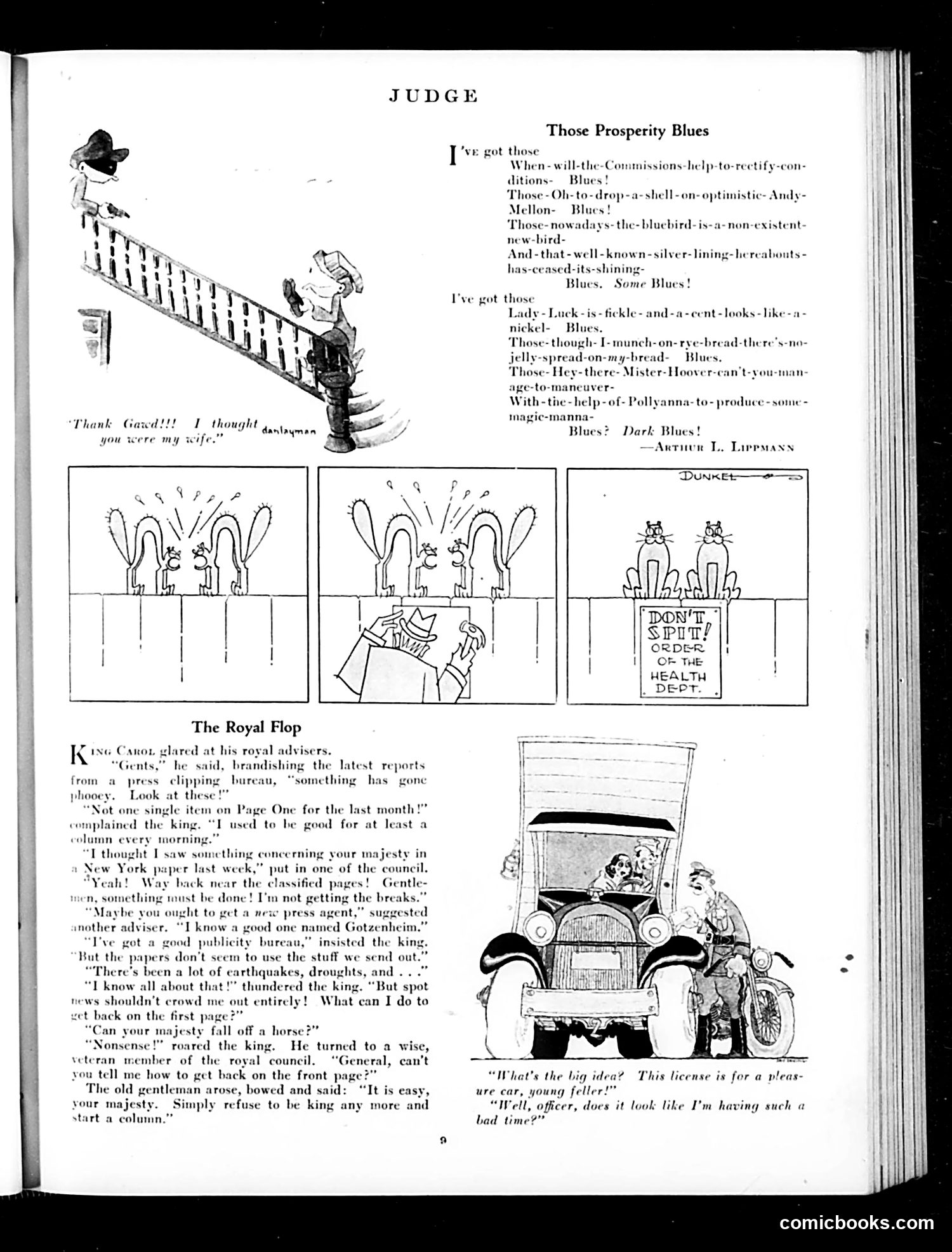
# Analysis: Judge Magazine Page This page satirizes economic hardship masked by official optimism during the prosperous 1920s. **"Those Prosperity Blues"** (poem by Arthur L. Lippmann) mocks government promises of economic recovery. References to "Commissions," "Mellon" (Treasury Secretary Andrew Mellon), and "Hoover" indicate this targets the Coolidge-Hoover administrations' assurances that prosperity would continue. The blues catalog—fickle luck, poverty amid plenty ("a cent looks like a nickel"), food scarcity—reflects ordinary Americans' actual struggles despite official claims of success. **"The Royal Flop"** depicts a king (representing government/leadership) desperate to regain newspaper prominence after being overshadowed by natural disasters and other news. His publicist's solution—"refuse to be king any more and start a column"—suggests leaders have become mere entertainers disconnected from real governance. **The car cartoon** shows a young driver pulled over, claiming his pleasure vehicle "license" justifies reckless driving. The officer's skepticism mirrors public doubt about whether official prosperity narratives match reality. Together, these pieces critique the gap between government rhetoric and citizens' lived experience.
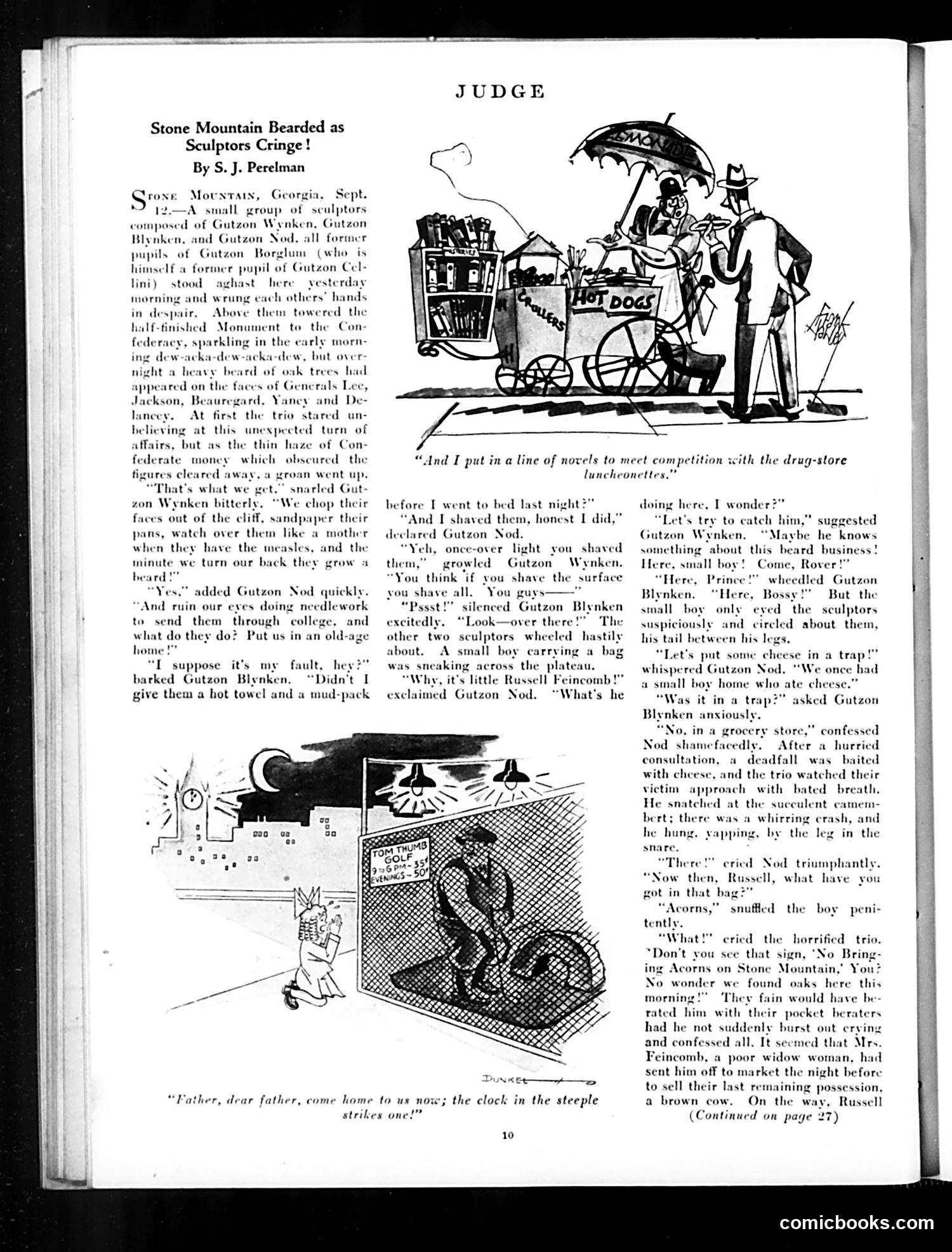
# Stone Mountain Satirized This is S.J. Perelman's humorous short story, illustrated with cartoons about sculptors working on Stone Mountain Monument (the Confederate memorial in Georgia). The joke plays on the sculptors' names—all variations of "Gutzon" (referencing Mount Rushmore sculptor Gutzon Borglum)—treating them as bumbling, vain artists. They discover their carved Confederate generals' faces have sprouted oak tree beards overnight, leading to slapstick attempts to catch a boy they suspect of sabotage using cheese traps. The satire mocks both the pretensions of monumental sculpture and the Confederate monument itself. The ridiculous premise—that trees grew beards on stone faces—deflates the grandiosity of such projects. The confused, incompetent sculptors suggest the absurdity of preserving Confederate heroes. The story's continued narrative ending on page 27 indicates this was a full-length satirical fiction piece, not a single cartoon.