
Judge, 1930-09-13 · page 4 of 36
Judge — September 13, 1930 — page 4: what you’re looking at
What you’re looking at
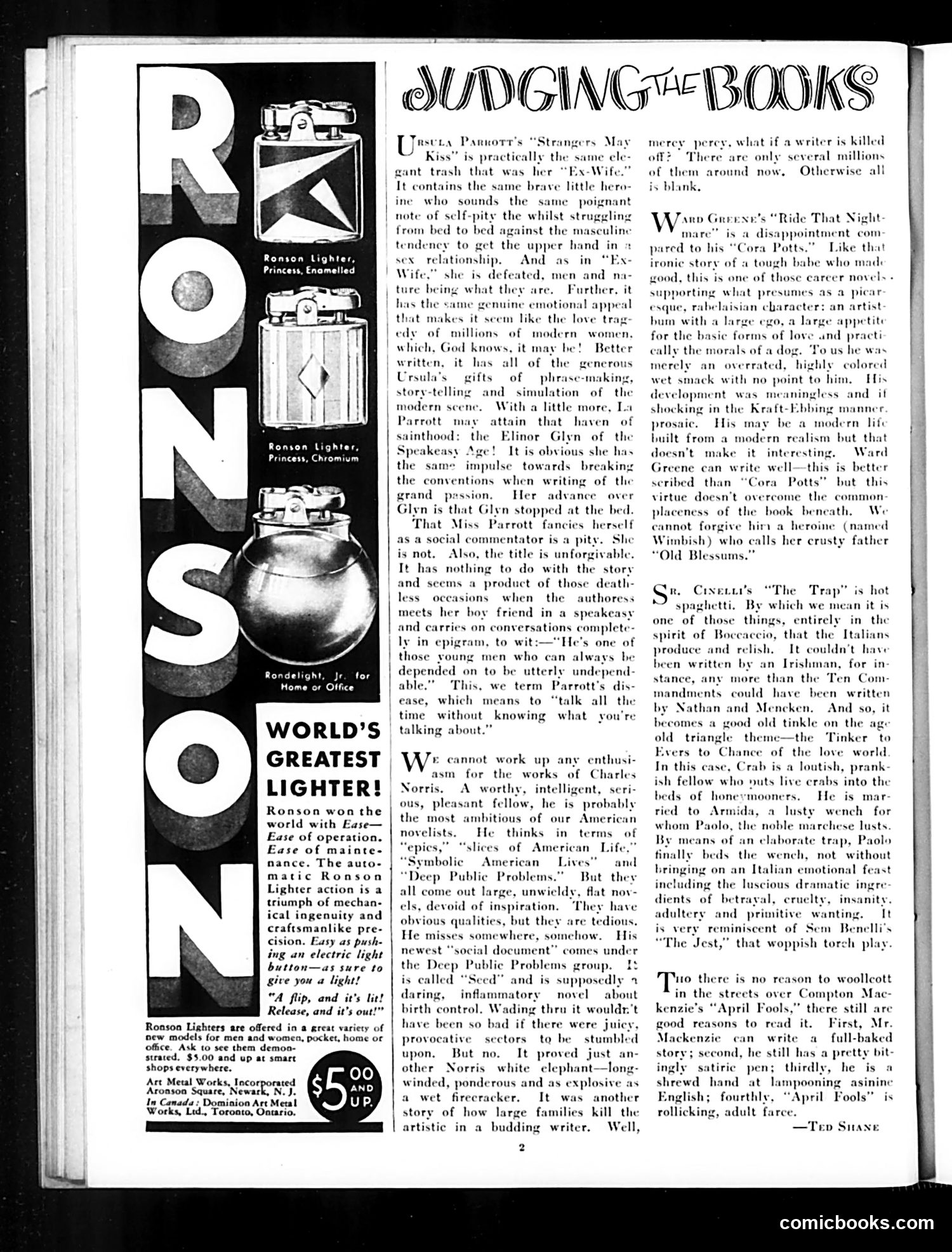
# Analysis of "Judging the Books" Page This page is primarily a **book review column**, not a political cartoon. The left side features a **Ronson lighter advertisement** (the "world's greatest lighter"), while the right side contains literary criticism by Ted Shane. The reviews discuss several novels: - Ursula Parrott's "Strange Max Kiss" - Ward Greene's "Ride That Nightmare" - S. Cinelis's "The Trap" (described as Boccaccio-inspired Italian fiction) - Charles Norris's works, praised as ambitious American social documents The tone is **satirical toward contemporary literature**: Shane critiques overly colorful prose, shallow character development, and writers who mistake sentiment for artistry. The satire targets 1920s-30s authors who relied on stylistic flourish rather than genuine insight—mocking the era's literary pretensions rather than politics.
📄 Transcribed text from this page (OCR, searchable)
Machine-transcribed from the original scan — historical spelling and the odd misread are preserved.
Ronson Lighter, Princess, Enamelied Ronson Lighter, Princess, Chromium Rondelight, Jr Home or Office for WORLD’S GREATEST LIGHTER! Ronson won the world with Ease— Ease of operation. Ease of mainte- nance. The auto- matic Ronson Lighter action is a triumph of mechan- ical ingenuity and craftsmanlike pre- | cision. Easy as push- ing an electric light button—as sure to give you a light! "A flip, and it’s lit! Release, and it's out!” Ronson Lighters are offered in a great variety of few models for men and women, pocket, home or office. Ask to see them demoo- strated. $3.00 and up at smart shops everywhere. Art Metal Works, Incorporated Aronson Square, Newark, N. J. In Canada : Dominion Art Metal Works, Led., Toronto, Ontario, AUDGING“ BOOKS Strangers Ma Kiss” is practically the same gant trash that was her “Ex-Wife It contains the same brave little he ine who sounds the poignant | note of self-pity the whilst struggli from bed to bed against the masculine tendency to get the upper hand in sex relationship. And as in “Ex- Wif is defeated, men and na- ture being what they are. Further, it has the same genuine ¢ nal appeal that makes it seem like the love trag edy of millions of Uesees Pannore's * J same modern which, God knows, it may be! Better written, it has all of the generous Ursula’s gifts of phrase-makin story-telling and simulation of the With a little more, La att at haven of Elinor Glyn of the It is obvious she h the same impulse towards breaki the conventions when writing of th: grand Her advance over Glyn is that Glyn stopped at the bed. That Miss Parrott fancies herself as a social commentator is a pity. Shi is not. Also, the title is unforgivable. It has nothing to do with the story and seems a product of those death- occasions when the authoress meets her boy friend in a speakeasy and carries on conversations complete- | ly in epigram, to wit:—"He's one of those young men who can a depended on to be utterly women, modern scene. Parrott) may sainthood: the A passion. less able.” This, we term ease, which means to all the time without knowing what you're talking about.” W e asm Norris. cannot work up any enthusi- for the works of Cha A worthy, intelligent, seri- ous, pleasant fellow, he is probably the most ambitious of our American novelist He thinks in epics,” “slices of American Lif Symbolic American Lives” “Deep Public Problems.” all come out larg terms of and But they » unwieldy, flat nov- They : obvious qualities, but they are tedious. His newest “social document” comes under the Deep Public Problems group. is called “Seed” and is supposedly 1 daring, inflammatory novel about birth control. Wading thru it wouldn't have been so bad if there were j provocative to be But no. It proved just Norris white elephant—lo winded, ponderous and as explosive a wet firecracker. It was story of how large famili artistic in a budding writer. els, devoid of inspiration. He misses somewhere, somchow. sectors upon, other another kill the Well, merey perey, what if a writer is killed off? There are only several millions of them around now. Otherwise all is blank. Winer Greese’s “Ride That Ni mare” is a disappointment com pared to his “Cora Potts.” Like that ironic story of a tough babe who mad good, this is one of those carcer novels - supporting what presumes as a picar aisian character: an artist a large appetite for the basic forms of love and practi cally the morals of a dog. To us he was ? highly colored int to him, His anin, and if ing in the Kraft- manner prosaic. lite built from a modern realism but that doesn't make it interesti Ward Greene can write well—this is better seribed than “Cora Potts” but this virtue doesn't overcome the common reness of the book We cannot forgive hira a heroine (named Wimbish) who calls her crusty father “Old Blessums.”” esque, ri bum with a merely an overrated, wet smack with no p development was 1 less shoe! His may be a modern beneath. » Cixecur’s “The Trap” is hot spaghetti, By which we mean it is one of those things, entirely in the spirit of Boccaccio, that the Italians produce and relish, It couldn't have been written by an Irishman, for in than the Ten Com- written And so, it stance, any mor mandments could have been by Nathan and Mencken. becomes a good old tinkle on the age old trian theme—the Tinker to Evers to Chance of the love world In this case, Crab is a loutish, prank- ish fellow who puts live erabs into the beds of honeymooners. He is mar- ried to Armida, a lusty wench for whom Paolo, the noble By means of an el ite trap, Paolo finall the wench, not without bringing on an Italian emotional feast including the luscious dramatic ingre dients of betrayal, cruelty, insanity. adultery and primitive wanting. — It is very reminiscent of Sem Benelli’s Jest,” that woppish torch play. rohe beds 110 there is no reason to woollcott in the streets over Compton Mac- kenzie’s “April Fools,” there still 4 good reasons to read it. First, Mr. Mackenzie write a full-baked second, he still has a pretty bit- ingly s pen; thirdly, he a shrewd hand at lampooning asinine English; fourthly, “April Fools” is rollicking, adult farce. —Tep Suane can comicbooks.com