A complete issue · 36 pages · 1929
Judge — September 7, 1929
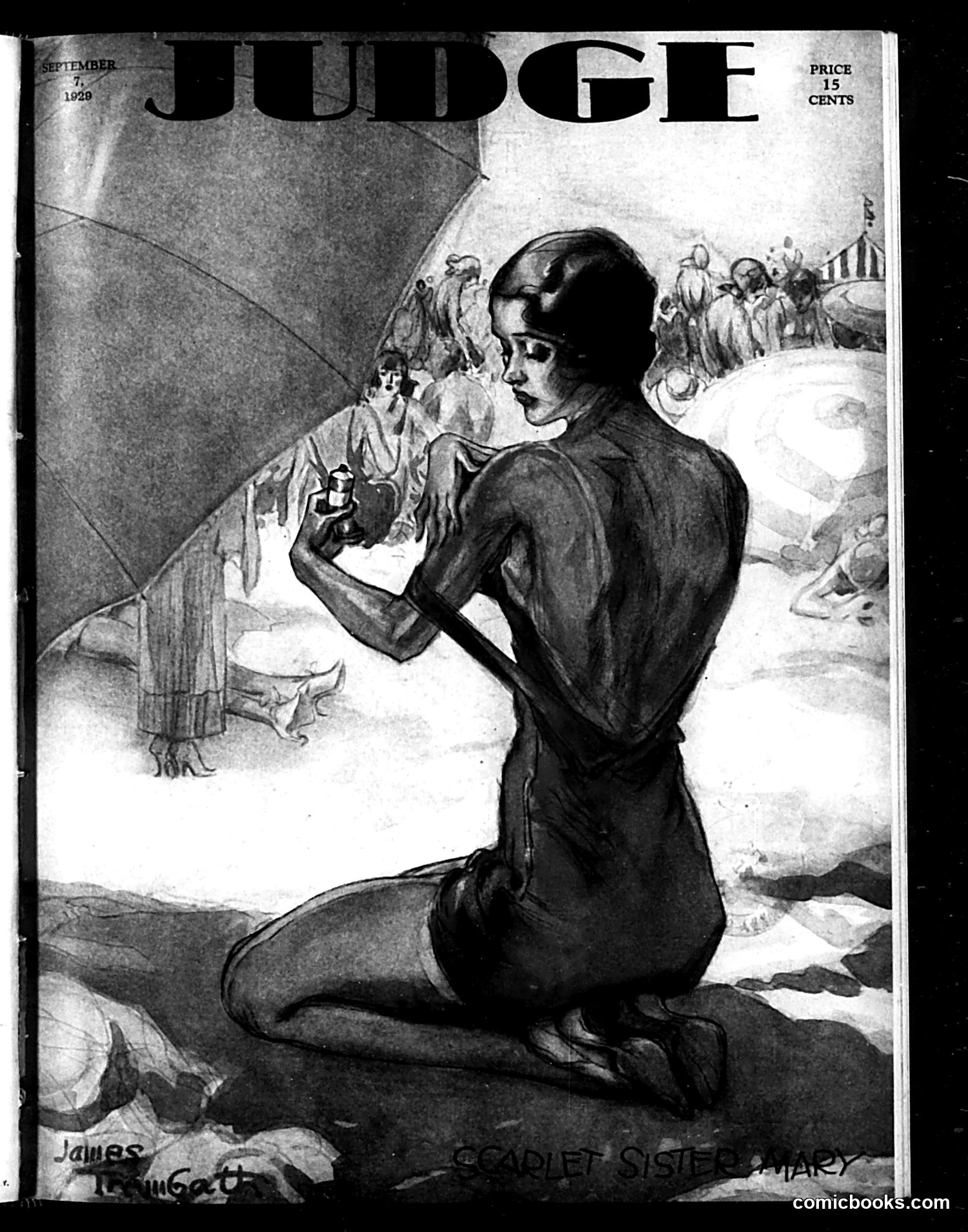
# Analysis of Judge Magazine Cover, September 1929 This cover illustration by James Montgomery Flagg depicts a woman in dark clothing kneeling on a beach, gazing toward a distant seaside carnival or fair. The title "Scarlet Sister Mary" references a 1928 novel by Julia Peterkin about a Southern woman's moral struggles. The image appears to satirize attitudes toward female morality and respectability of the era. The woman's posture—solitary, contemplative, somewhat vulnerable—combined with the carnival scene in the background suggests commentary on the contrast between societal judgment of "fallen women" and the gaiety of public life continuing indifferently. The September 1929 date places this just before the stock market crash, during the Jazz Age when traditional morality was being openly questioned in American culture.
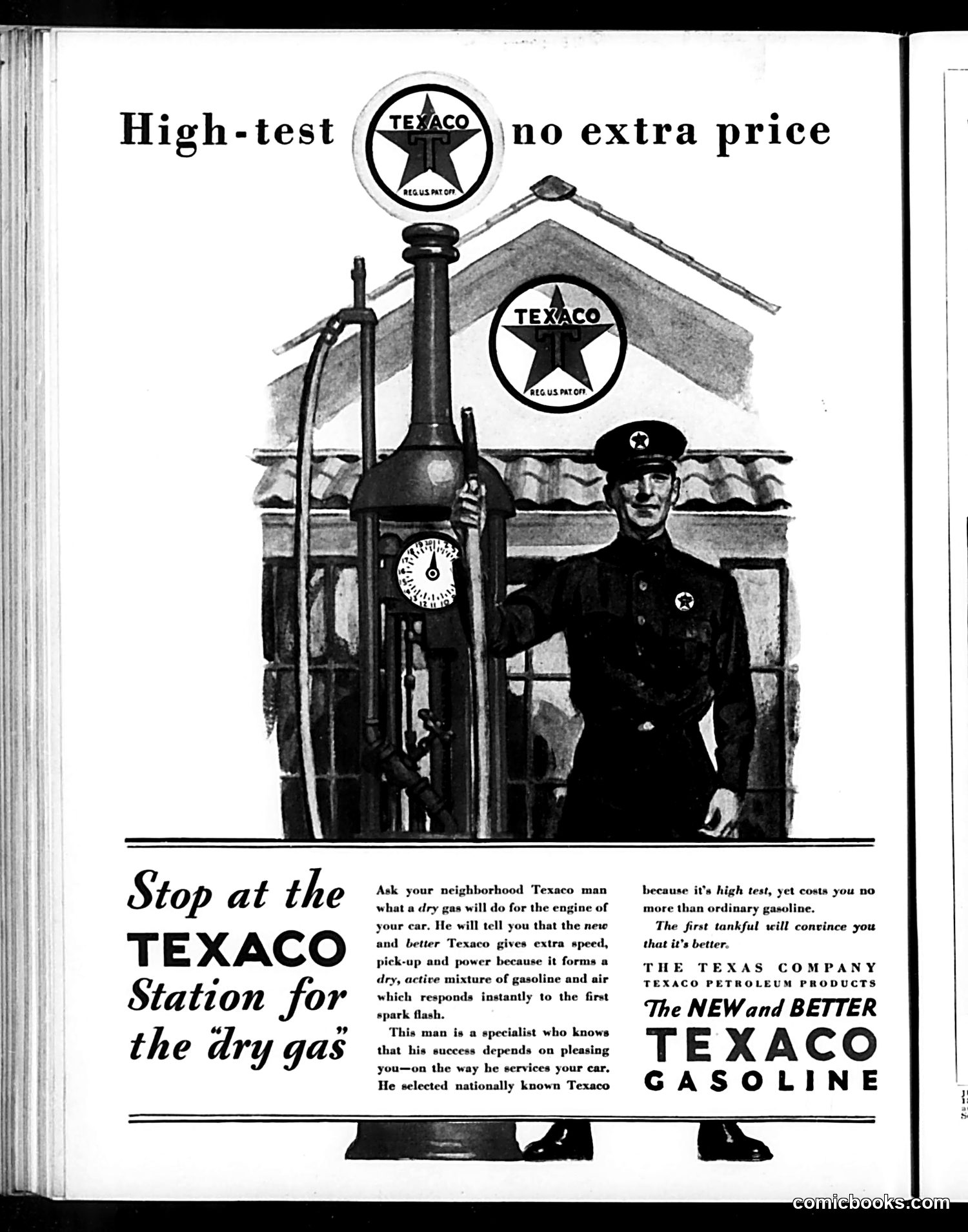
# Texaco Gasoline Advertisement This is a commercial advertisement, not political satire. It promotes Texaco's "new and better" gasoline product, marketed as "the dry gas." The image shows a uniformed Texaco station attendant standing beside a vintage gas pump. The advertisement's central claim is that this gasoline provides superior engine performance—"extra speed, pick-up and power"—by forming "a dry, active mixture of gasoline and air" that ignites more effectively. The tagline "High-test...no extra price" emphasizes value. The attendant represents Texaco's promise of professional, specialized service. This appears to be early automotive advertising, likely from the 1920s-1930s era, when gasoline quality and engine performance were active competitive concerns among fuel producers.
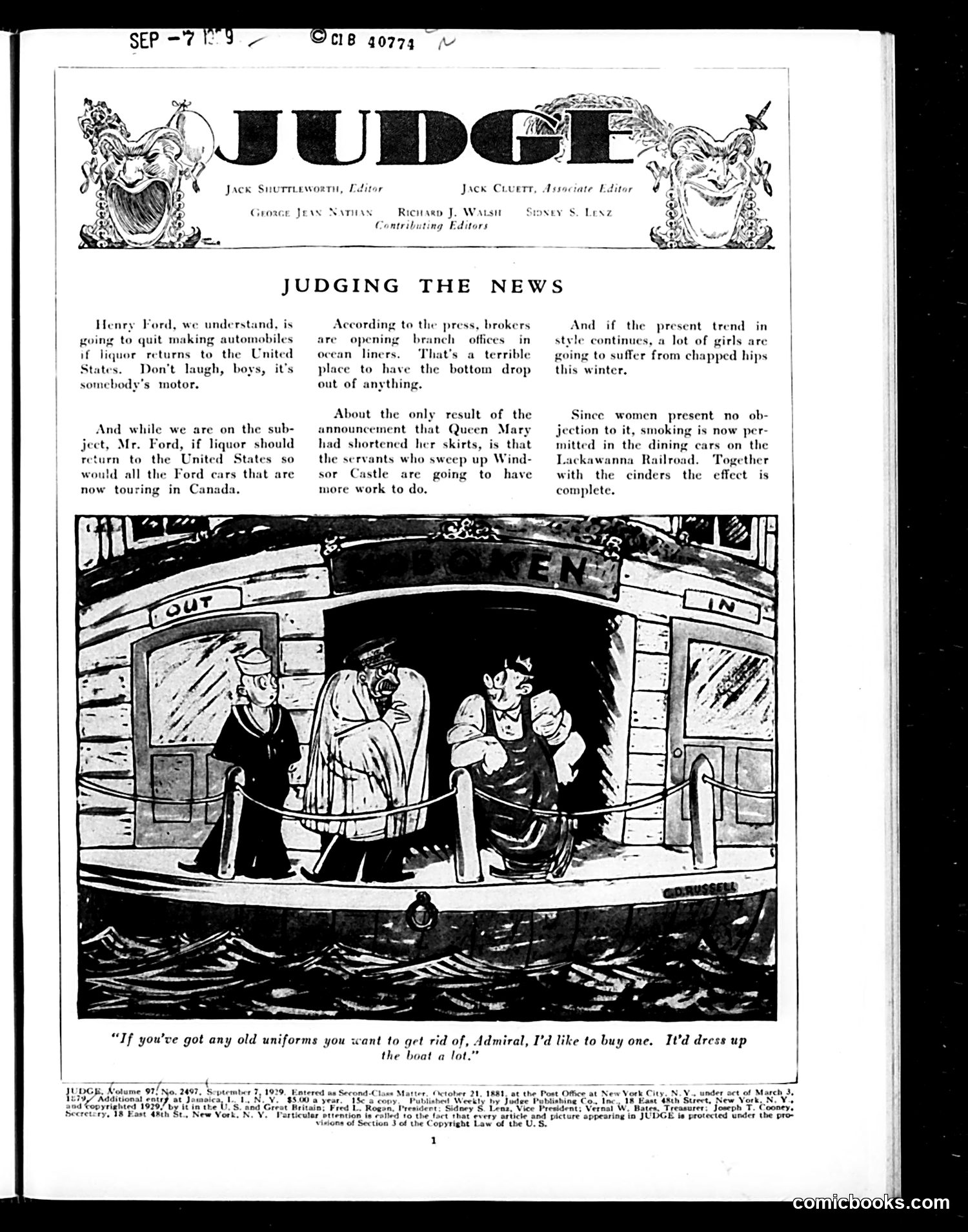
# Analysis of Judge Magazine Page This page from Judge magazine contains a satirical column titled "Judging the News" that comments on contemporary events, and a cartoon depicting people at what appears to be a naval vessel entrance. **The Column** jokes about: - Henry Ford quitting automobile manufacturing (likely referencing Ford's various business decisions) - Ford cars touring in Canada - Queen Mary shortening her skirts (a fashion reference) - Women smoking on the Lackawanna Railroad **The Cartoon** shows figures in period dress at a ship's entrance, with the caption: "If you've got any old uniforms you want to get rid of, Admiral, I'd like to buy one. I'd dress up the boat a lot." The joke appears to reference naval uniforms or maritime aesthetics, though the specific historical context remains unclear without additional dating information.
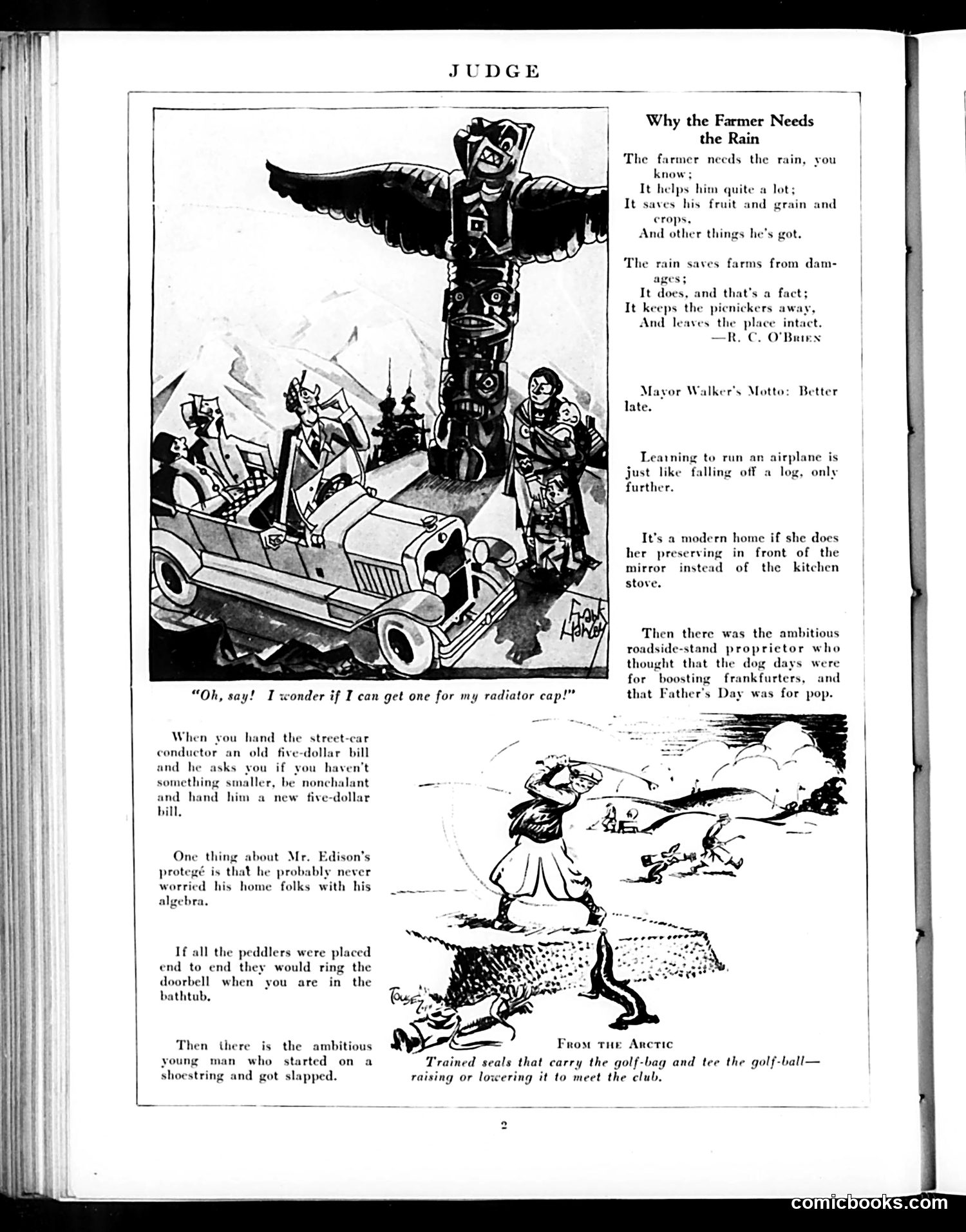
# Analysis of Judge Magazine Page **Main Cartoon:** The upper illustration depicts a totem pole with various figures examining an automobile, captioned "Oh, say! I wonder if I can get one for my radiator cap!" This satirizes early automobile enthusiasm—specifically the craze for radiator cap ornaments that were fashionable on 1920s cars. The totem pole joke suggests Native American artifacts were being collected and repurposed as automotive decorations, reflecting the period's problematic appropriation of Indigenous imagery. **Surrounding Humor:** Various short quips mock contemporary culture: Edison's home algebra, peddlers and doorbells, a shoestring-bound young man, and street-car conductors. The lower cartoon, "From the Arctic," humorously depicts trained seals playing golf. The page reflects Jazz Age consumer culture and satirizes Americans' fascination with novelty items and status symbols.
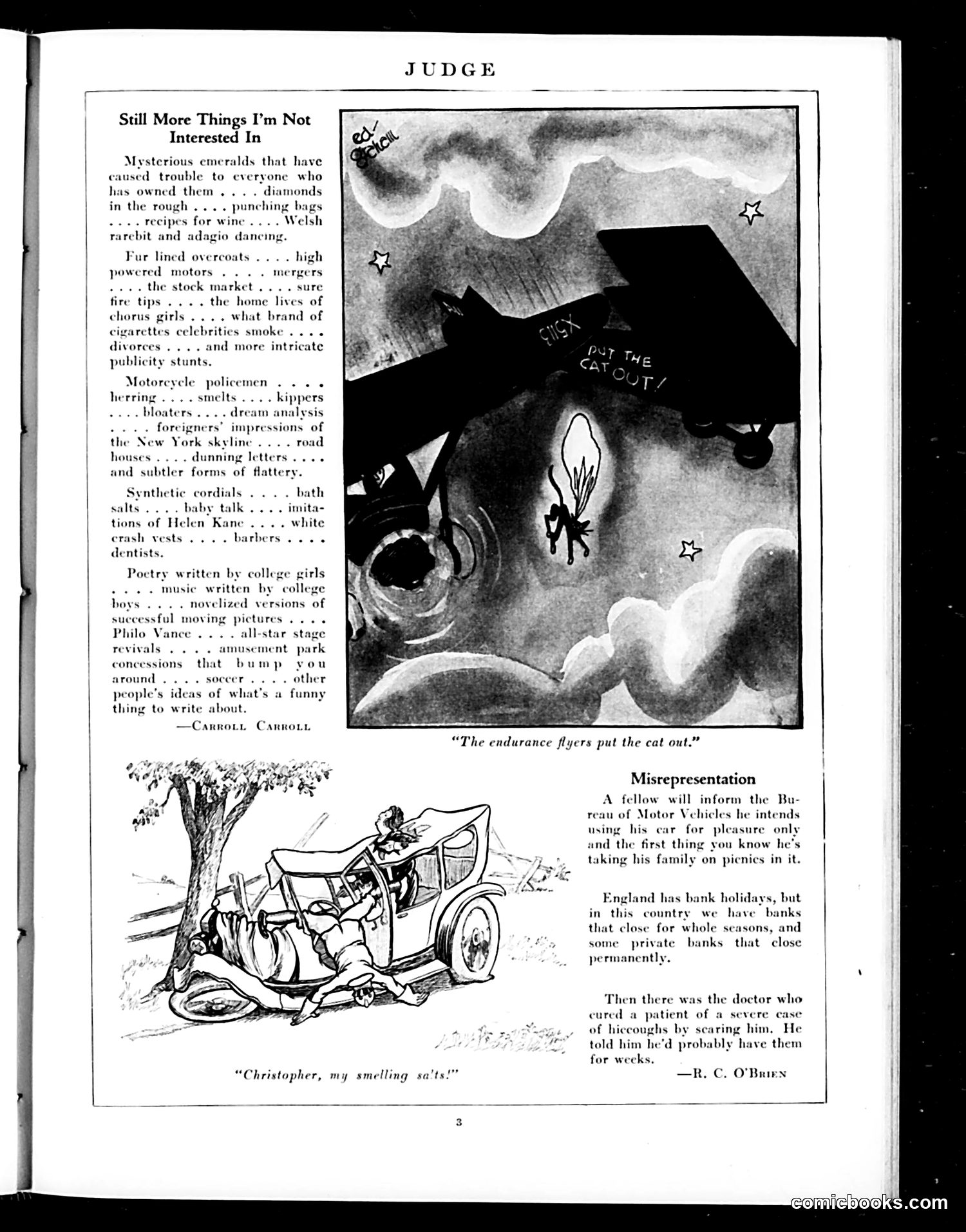
# Analysis of Judge Magazine Page This page contains two unrelated satirical items: **"Still More Things I'm Not Interested In"** (left): Carroll Carroll's humorous essay lists contemporary annoyances—fur coats, motors, stock market tips, chorus girls, and poetry by college students. It reflects 1920s consumer culture anxieties and complaints about modern life. **"The endurance flyers put the cat out"** (top right): A surreal cartoon mocking early aviation stunts. The sketch shows a cat being ejected from an airplane, captioned as a joke about endurance flights—a popular 1920s aviation fad where pilots competed for long-distance records. The humor suggests these flights were so tedious that even pets couldn't tolerate them. **"Christopher, my smelling salts!"** (bottom): An automobile accident cartoon depicting a car crash into a tree, likely satirizing reckless driving.
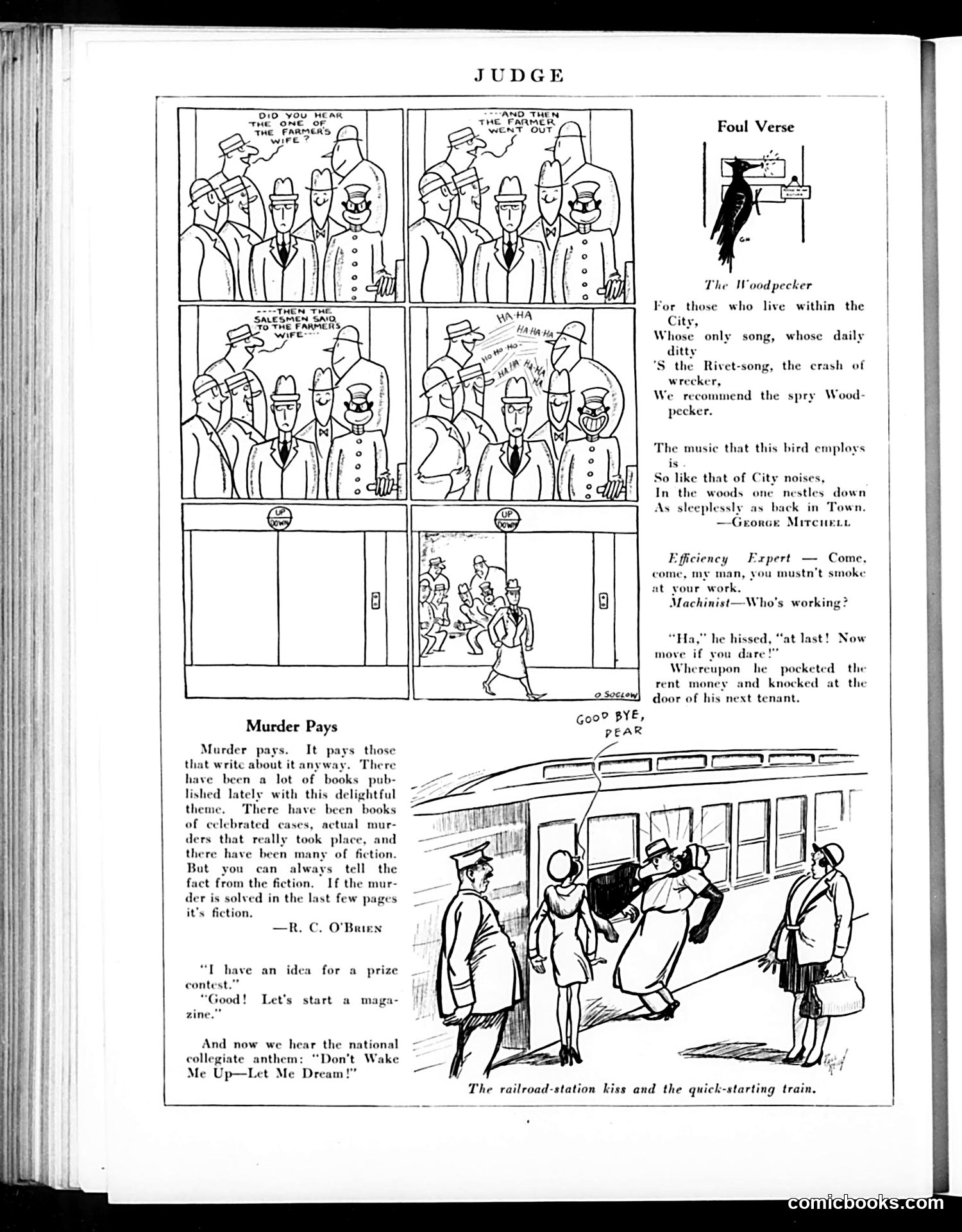
# Analysis of Judge Magazine Page This page contains three distinct pieces of humor: 1. **"Murder Pays" comic strip** (top): Shows a group of men repeatedly telling the same joke about a wife's death, with escalating laughter. The satire critiques popular "murder mystery" novels and books—a publishing trend—by mocking how predictable and formulaic these stories are. The joke is that readers always know it's fiction because the solution appears in the last pages. 2. **"Foul Verse" section** (right): Poetry about the woodpecker bird, offering it as entertainment for city-dwellers tired of industrial noise. 3. **Railroad station illustration** (bottom): Depicts an energetic farewell scene at a train platform, captioned about "the railroad-station kiss and the quick-starting train"—likely satirizing sentimental romance clichés. The page reflects early 20th-century American popular culture and publishing trends.
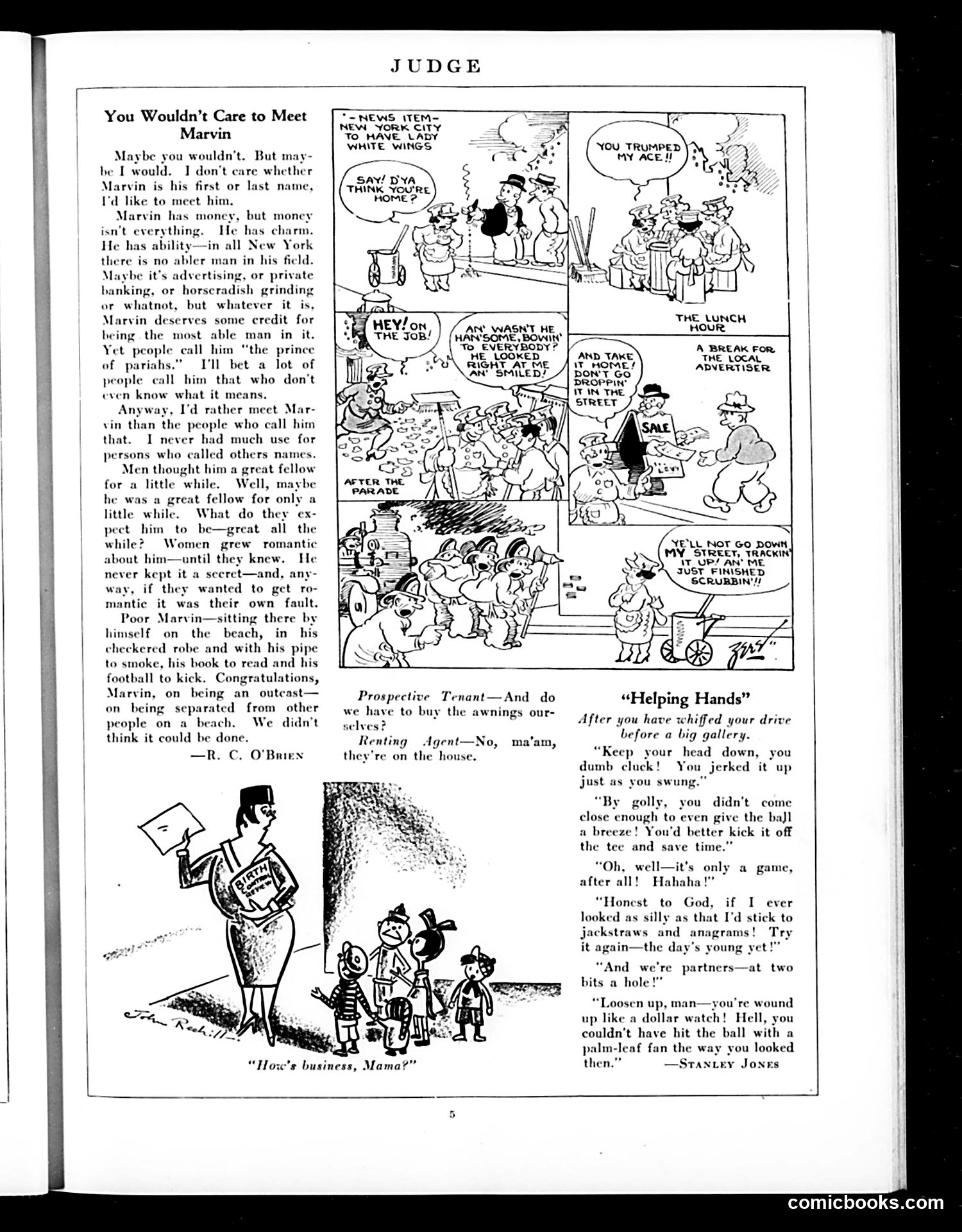
# Analysis This Judge page contains humorous commentary and comics rather than political satire. The main feature, "You Wouldn't Care to Meet Marvin," is an essay by R.C. O'Brien praising an unnamed man named Marvin as exceptionally capable and honorable, despite lacking wealth or social prominence. The accompanying comic strip illustrates Marvin's ordinary life—working, socializing at lunch, and relaxing. Below is a separate comic titled "Helping Hands" about golf, where one player criticizes another's swing technique, leading to banter about their partnership. The bottom illustration, captioned "How's business, Mama?" shows a woman in business attire with children, likely satirizing women entering the workforce or business ownership—a social commentary on changing gender roles. The page is primarily entertainment-focused rather than explicitly political.
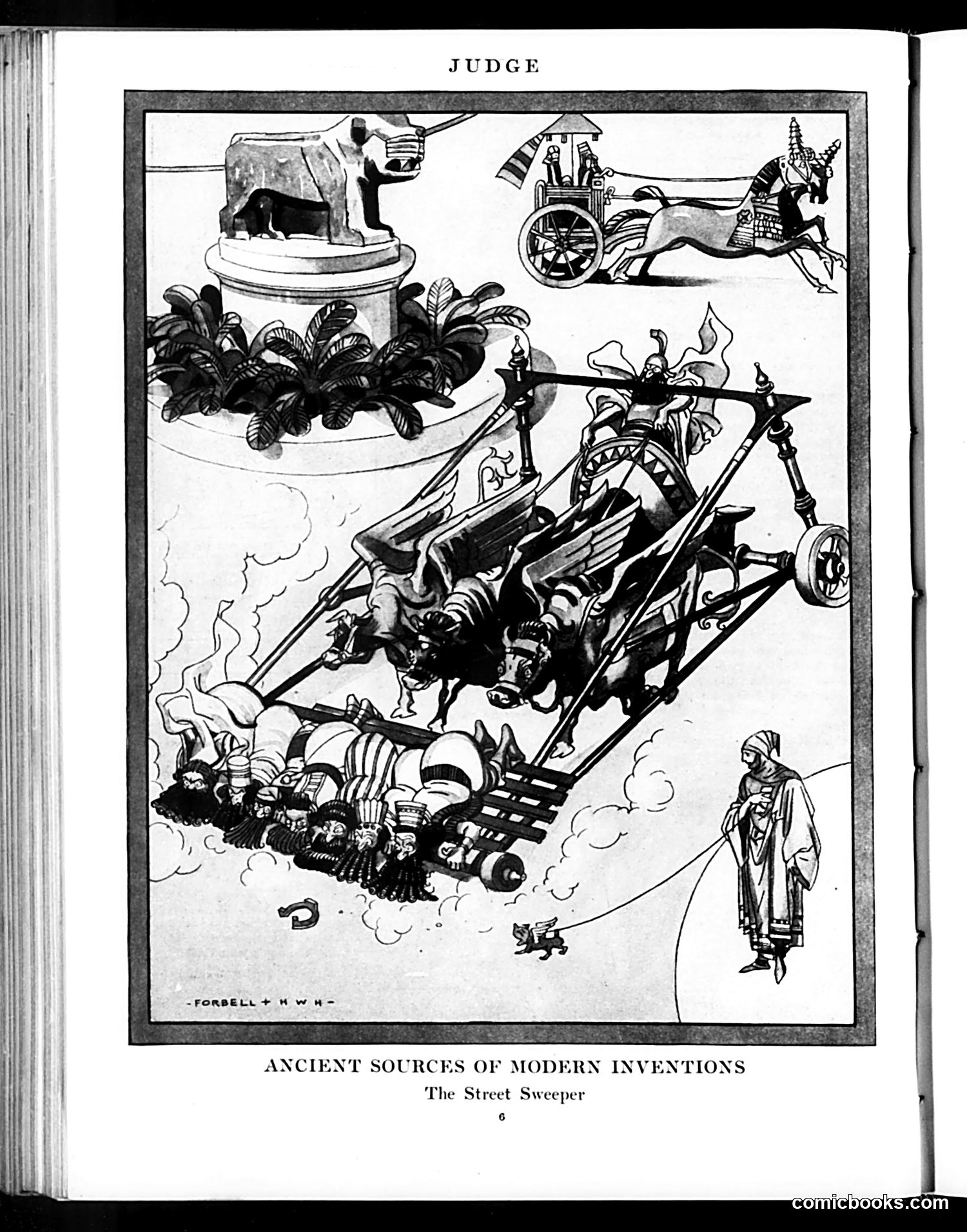
# "Ancient Sources of Modern Inventions: The Street Sweeper" This satirical illustration presents a humorous genealogy of the street sweeper. The page shows mythological and historical figures in elaborate chariots and processions above, with demonic or fantastical beings depicted below in clouds of smoke, suggesting infernal origins. The joke appears to be that modern street-sweeping technology has absurdly grandiose "ancient sources"—mocking the period's tendency to trace modern inventions to classical or mythological precedents. By depicting street sweepers with such elaborate, chaotic imagery involving demons and mythological figures, Judge ridicules both the pretension of such historical claims and perhaps the lowly nature of street-sweeping work itself. The artist credits "Forbell + H.W.H." at bottom.
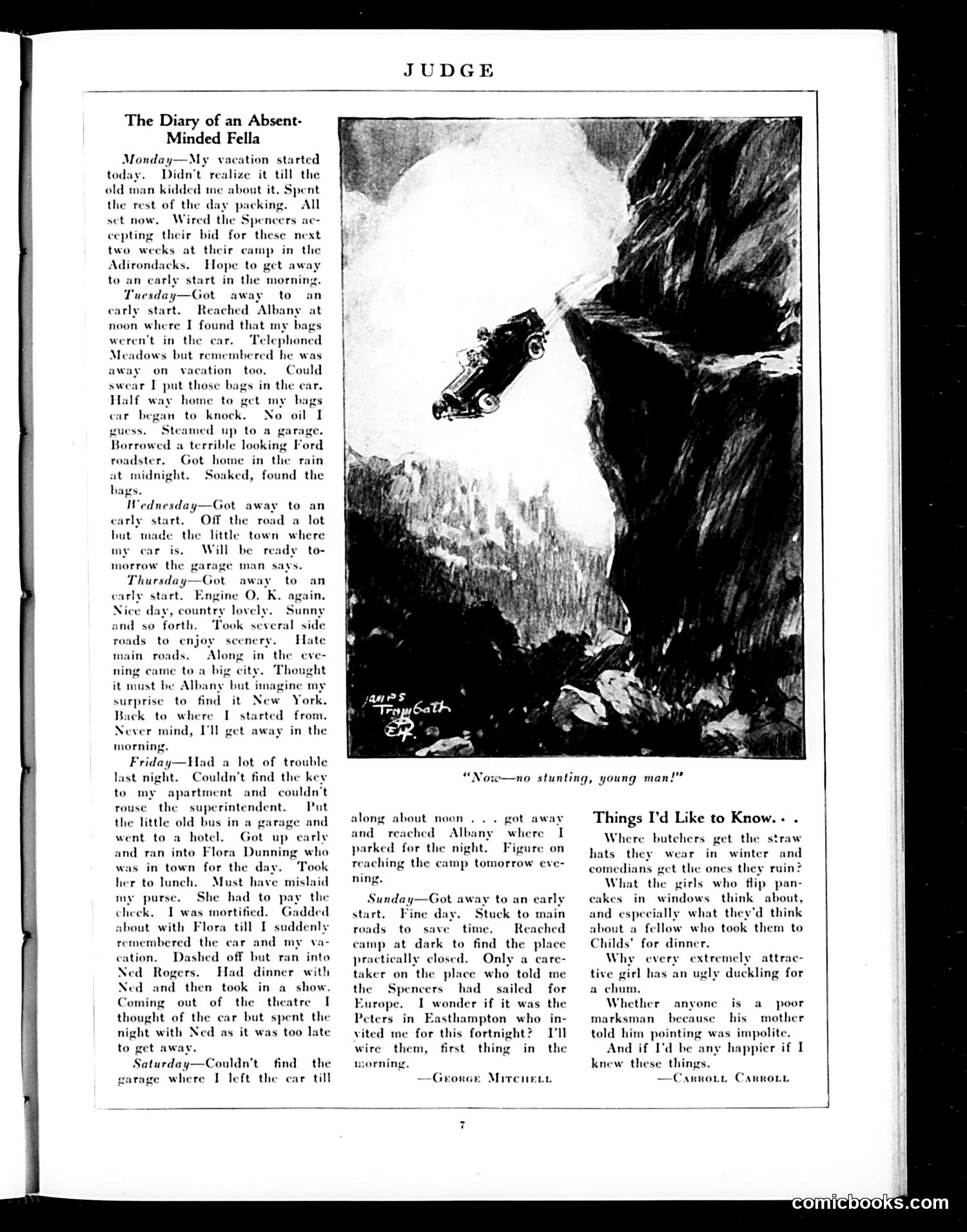
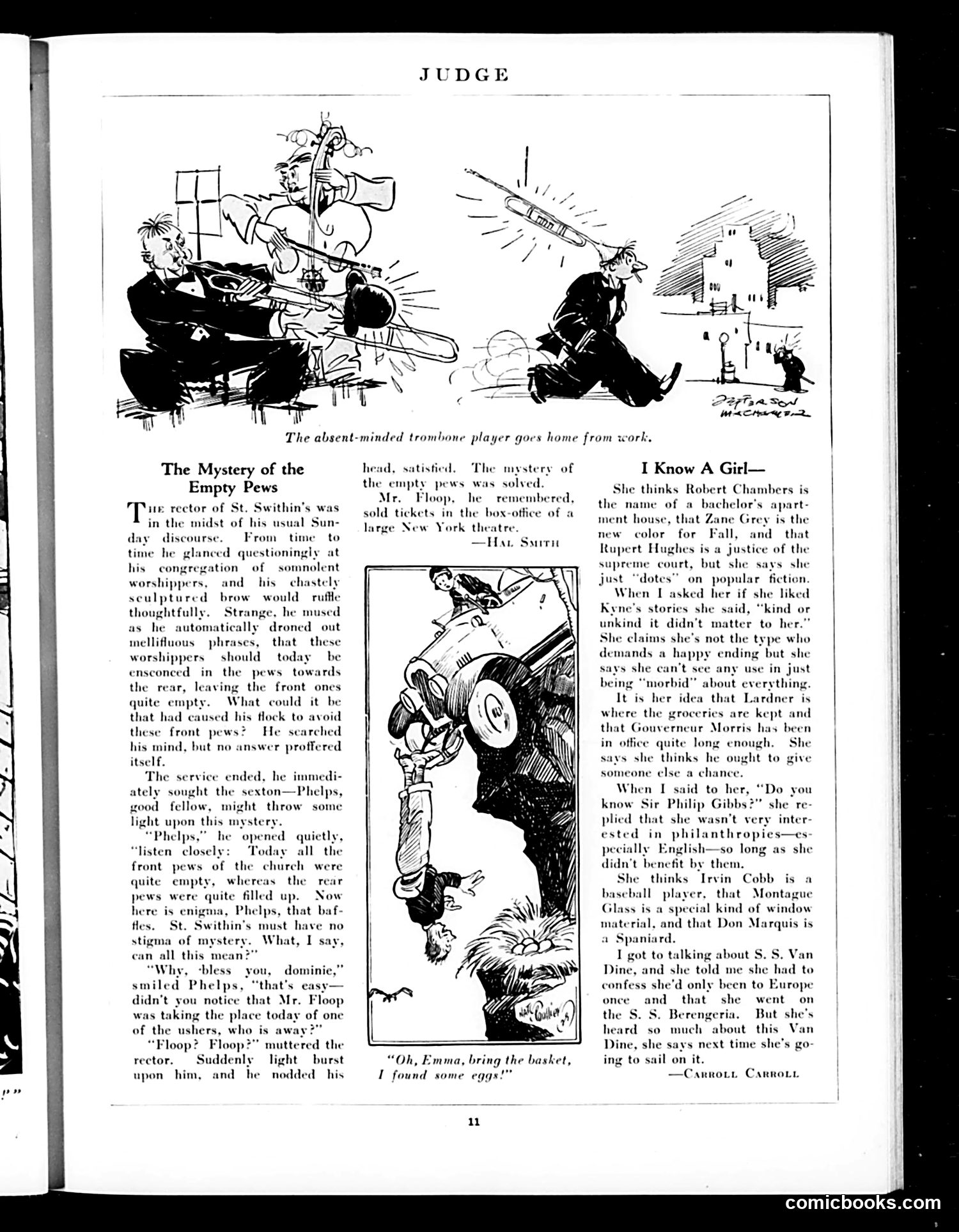
# "The Diary of an Absent-Minded Fella" This is a humorous two-part page from Judge magazine. The main feature is a satirical diary chronicling a vacationing man's comedic mishaps: he forgets his luggage, gets lost returning to his starting point instead of reaching his destination, misses appointments, and ultimately arrives at a closed vacation home after the hosts have sailed to Europe. The accompanying illustration shows a car precariously perched on a cliff edge—visual reinforcement of the protagonist's chaotic journey. The caption "Now—no stunting, young man!" suggests reckless driving. The sidebar "Things I'd Like to Know" offers social commentary on period quirks: butchers' winter hats, pancake-flippers' thoughts, why attractive girls befriend plain ones. This reflects 1920s-era casual observations about social behavior and gender dynamics, written with tongue-in-cheek curiosity rather than genuine inquiry. The satire targets absent-mindedness and poor planning as comedic character flaws.
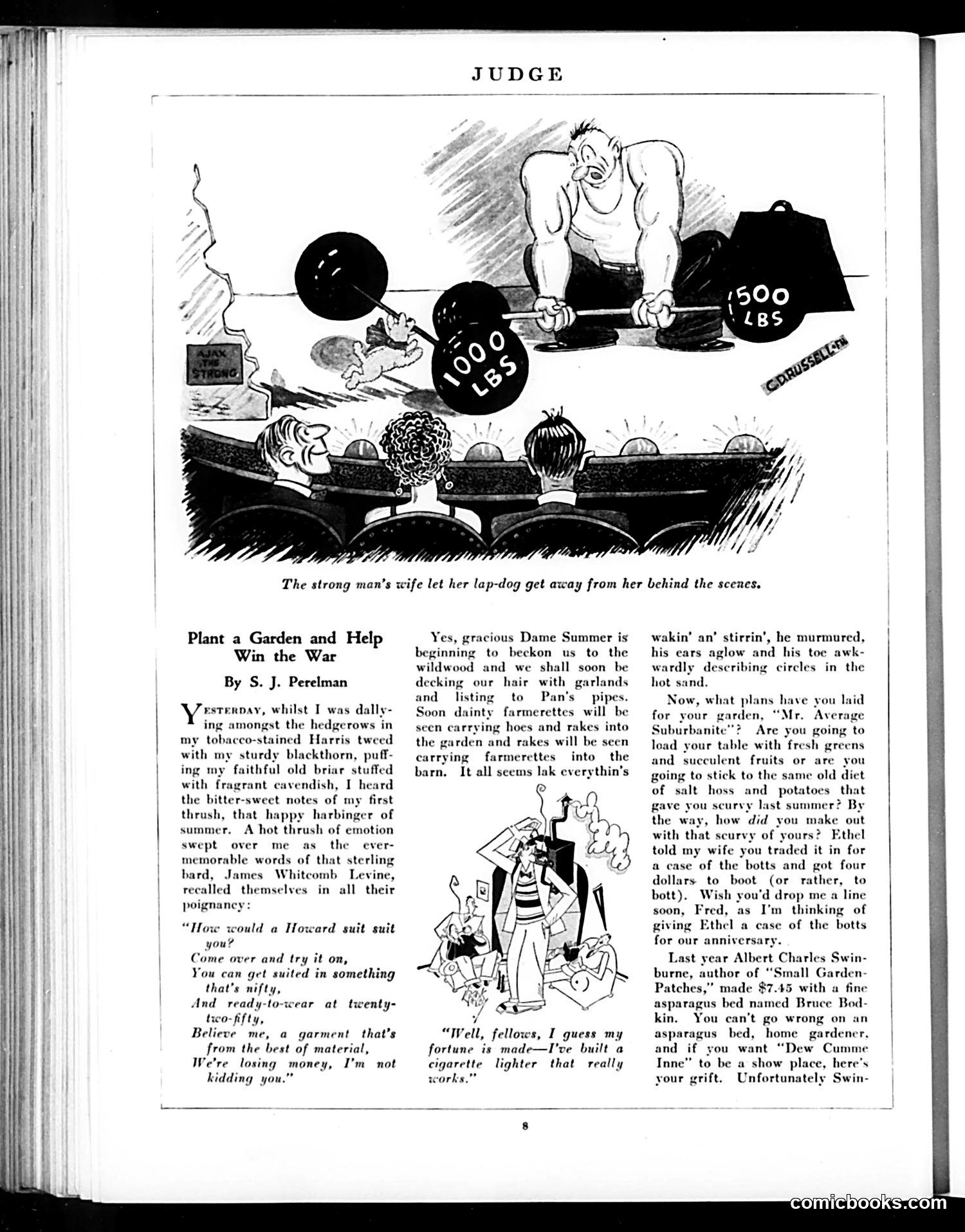
# Explanation for Modern Readers This page contains a satirical article by S.J. Perelman titled "Plant a Garden and Help Win the War," written during a wartime period (likely WWI or WWII, based on references to "winning the war"). The cartoon at top shows a strongman performing at what appears to be a circus or carnival, with judges observing. The caption suggests a metaphorical critique: "The strong man's wife let her lap-dog get away from her behind the scenes"—implying something questionable occurs away from public view. Perelman's article satirizes the home-gardening propaganda campaign encouraging Americans to grow vegetables to support the war effort. He mockingly applies high commercial language to humble gardening, invents absurd anecdotes (a man making $7.45 from an asparagus bed named "Bruce Bodkin"), and parodies patriotic rhetoric. The humor targets both the oversold promises of wartime gardening initiatives and the gap between propaganda and reality. The fake James Whitcomb Levine poetry quote is Perelman's invention, adding to the absurdist satire.
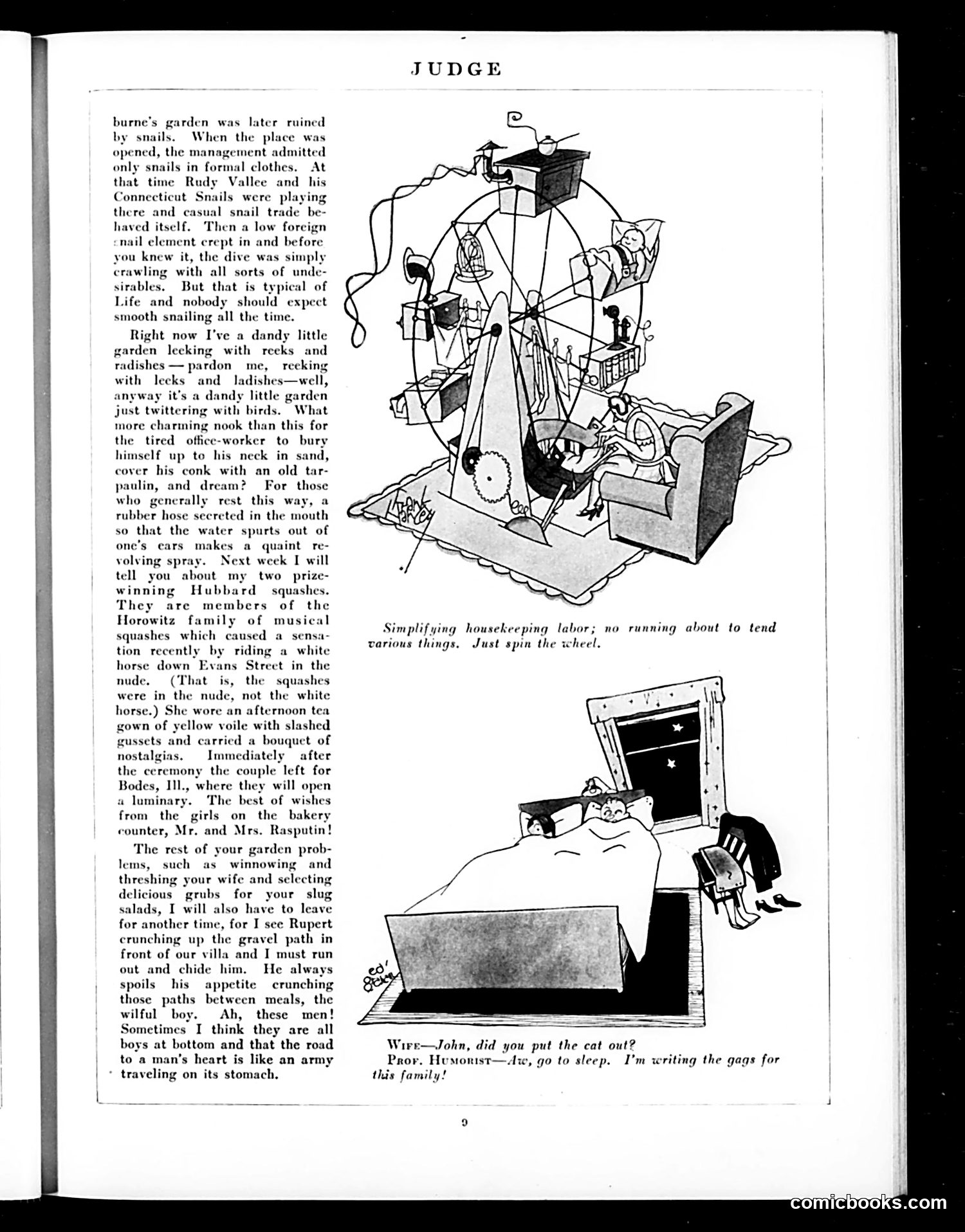
# Analysis of This Judge Magazine Page This page contains absurdist humor typical of Judge's satirical style. The main text is a rambling, deliberately nonsensical garden column filled with deliberate malapropisms ("lecks and ladishes" instead of "leeks and radishes") and surreal non-sequiturs. The writer references Rudy Vallée and Connecticut Snails, playing on Jazz Age celebrity culture and the then-popular "Connecticut" social set. The two cartoons illustrate domestic labor: the top depicts a Rube Goldberg-style contraption meant to automate housework, satirizing the era's obsession with labor-saving devices. The bottom shows a wife asking if the cat's been put out while her husband writes comic material, poking fun at the division of domestic labor and the writer's absorption in his work. The overall effect mocks both elaborate domesticity and the pretensions of modern life through absurdist humor—characteristic of Judge's satirical approach in this period.
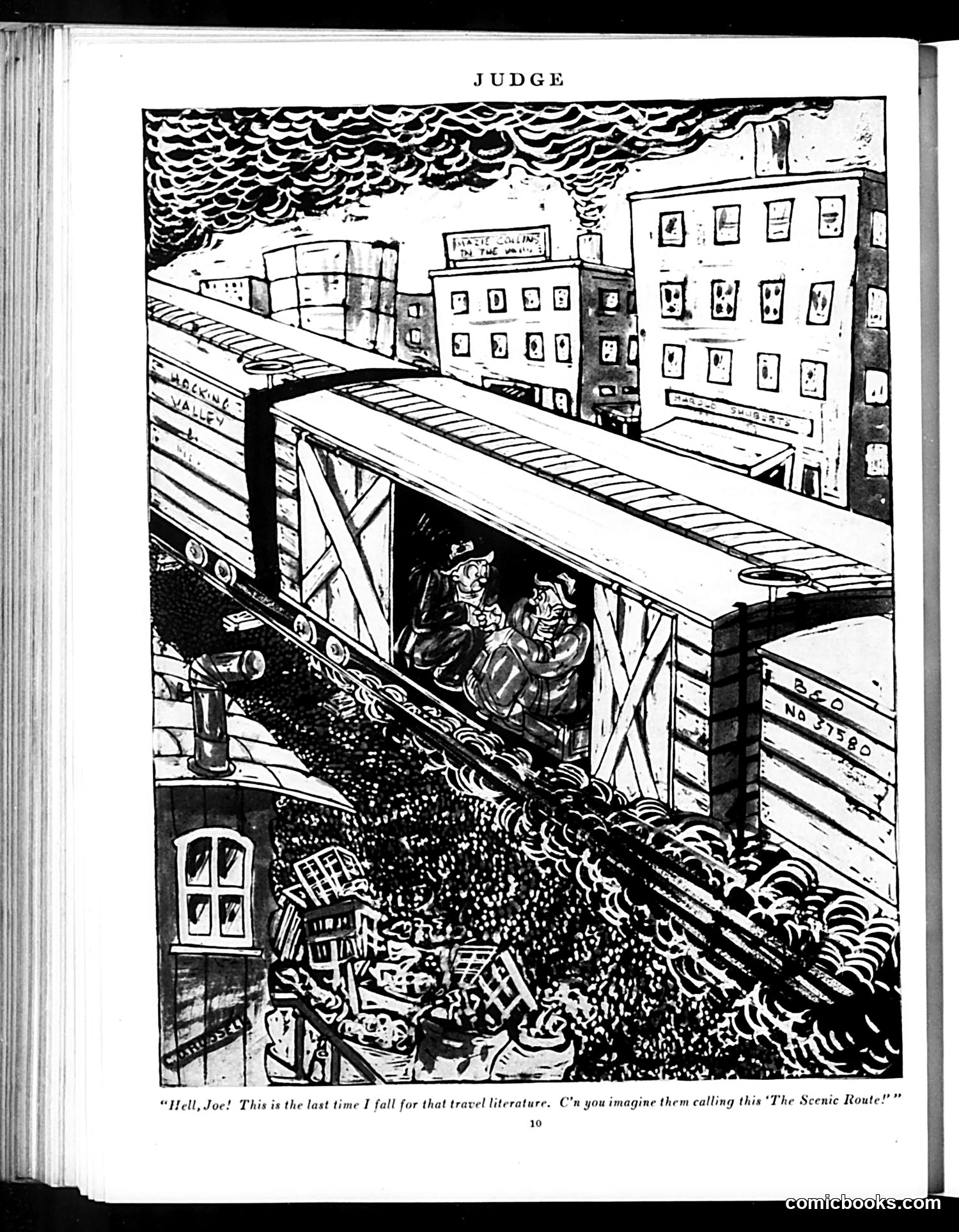
# Analysis of Judge Magazine Cartoon This cartoon depicts a rail yard scene where a person in the lower left observes passengers in a freight car, commenting: "Hell, Joe! This is the last time I fell for that travel literature. Can you imagine them calling this 'The Scenic Route'!" The satire targets **misleading travel advertising** of the era. The "scenic route" was apparently marketed to travelers as an attractive journey, but the cartoon reveals the reality: cramped, uncomfortable conditions in a boxcar rather than pleasant passenger accommodations. The contrast between promised luxury and actual poor conditions—along with the industrial, unglamorous urban setting—mocks the exaggerated claims in travel company promotions. This reflects early 20th-century consumer skepticism about advertising's truthfulness.