
Judge, 1929-09-07 · page 15 of 36
Judge — September 7, 1929 — page 15: what you’re looking at
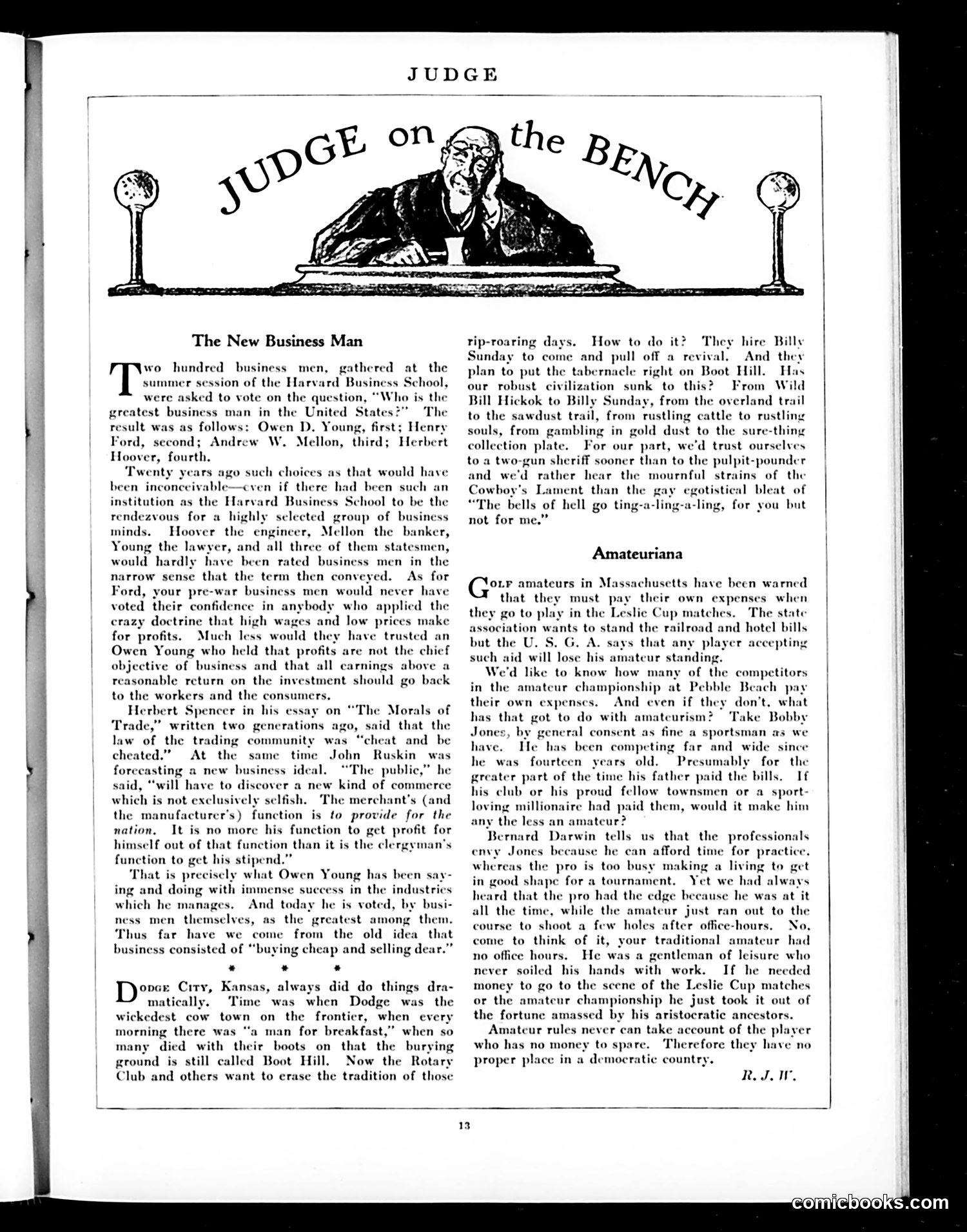
A restored page from Judge, 1929-09-07. Page through the whole issue in the reader above.
📄 Transcribed text from this page (OCR, searchable)
Machine-transcribed from the original scan — historical spelling and the odd misread are preserved.
The New Business Man wo hundred business men, gathered at the I summer session of the Harvard Business School, were asked to vote on the question, “Who i greatest business man in the United States?" result was as follows: Owen D. Young, first; Henry Ford, second; Andrew W. Mellon, third; Herbert Hoover, fourth, Twenty as that would have been incone -cven if there had been such an institution as the Harvard Business School to be the rendezvous for a highly selected group of business minds. Hoover the engincer, Mellon the banker, Young the lawyer, and all three of them statesmen, would hardly have been rated business men in the narrow sense t the term then conveyed. As for Ford, your pre s men would never have voted their confidence in anybody who applied the crazy doctrine that high wages and low prices make for profits. Much less would they have trusted « Owen Young who held that profits are not the ch objective of business and that all earnings above a reasonable return on the investment should go back to the workers and the consumers, Herbert Spencer in his essay on “The Morals of Trade,” written two generations ago, said that the law of the trading community was “cheat and be cheated.” At the same © John Ruskin was forecasting a new business ideal. ‘The public,” he id, “will to discover a new kind of commerce which is not exclusively selfish. The merchant's (and the manufacturer's) function is to provide for the nation, It is no more his function to get profit for himself out of that function than it is the clergyman’s function to get his stipend.” That is precisely what Owen Young has been say- ing and doing with immense success in the industries which he n es. And today he is voted, by busi- ness men themselves, as the greatest among them. Thus © we come from the old id business consisted of “buying cheap and selling d » such choices * * * De City, Kansas, alw: did do things dra- matically. ‘Time was when Dodge the wickedest cow town on the frontier, when every morning there was “a man for breakfast,” when so many died with their boots on that the burying ground is still called Boot Hill. Now the Rotary Club and others want to erase the tradition of those rip-roaring days. How to do it? They hire Billy Sunday to come and pull off a revival. And t plan to put the tabernacle right on Boot Hill. Has our robust civilization sunk to this? From Wild Bill Hickok to Billy Sunday, from the overland trail to the sawdust trail, from rustling cattle to rustling souls, from gambling in gold dust to the sure-thing collection pla For our part, we'd trust ourselves to a two-gun sheriff sooner than to the pulpit-pounder and we'd rather hear the mournful strains of the Cowboy's Lament than the gay egotistical bleat of “The bells of hell go ting-a-ling-a-ling, for you but not for me.” Amateuriana Gur amateurs in Massachusetts have been ned that they must pay their own expenses when zo to play in the Leslie Cup matches. The state ation wants to stand the railroad and hotel bills but the U. S. G. A. says that any player accepting id will lose his amateur standing. ‘d like to know how many of the competitors in the amateur championship at Pebble Beach p: their own expenses, And even if they don't, what has that got to do with amateurism? Take Bobby Jones, by general consent as fine a sportsman as we have. Tle has been competing far and wide since he was fourteen years old. Presumably for the greater part of the time his father paid the bills. If his club or his proud fellow townsmen or a sport- loving millionaire had paid them, would it make him any the less eur? Bernard Darwin tells us that the professionals envy Jones because he can afford time for practice. whereas the pro is too busy making a living to get in good shape for a tournament. Yet we had always heard that the pro had the edge because he was at it all the time, while the amateur just ran out to the course to shoot a few holes after office-hours. No, come to think of it, your traditional amateur had no office hours. He a gentleman of leisure who never soiled his hands with work. If he needed money to go to the scene of the Leslie Cup matches or the amateur championship he just took it out of the fortune amassed by his aristocratic ancestors. Amateur rules never can take account of the player who has no money to spare. Therefore they have no proper place in a democratic country. RoW,