
Judge, 1929-09-07 · page 18 of 36
Judge — September 7, 1929 — page 18: what you’re looking at
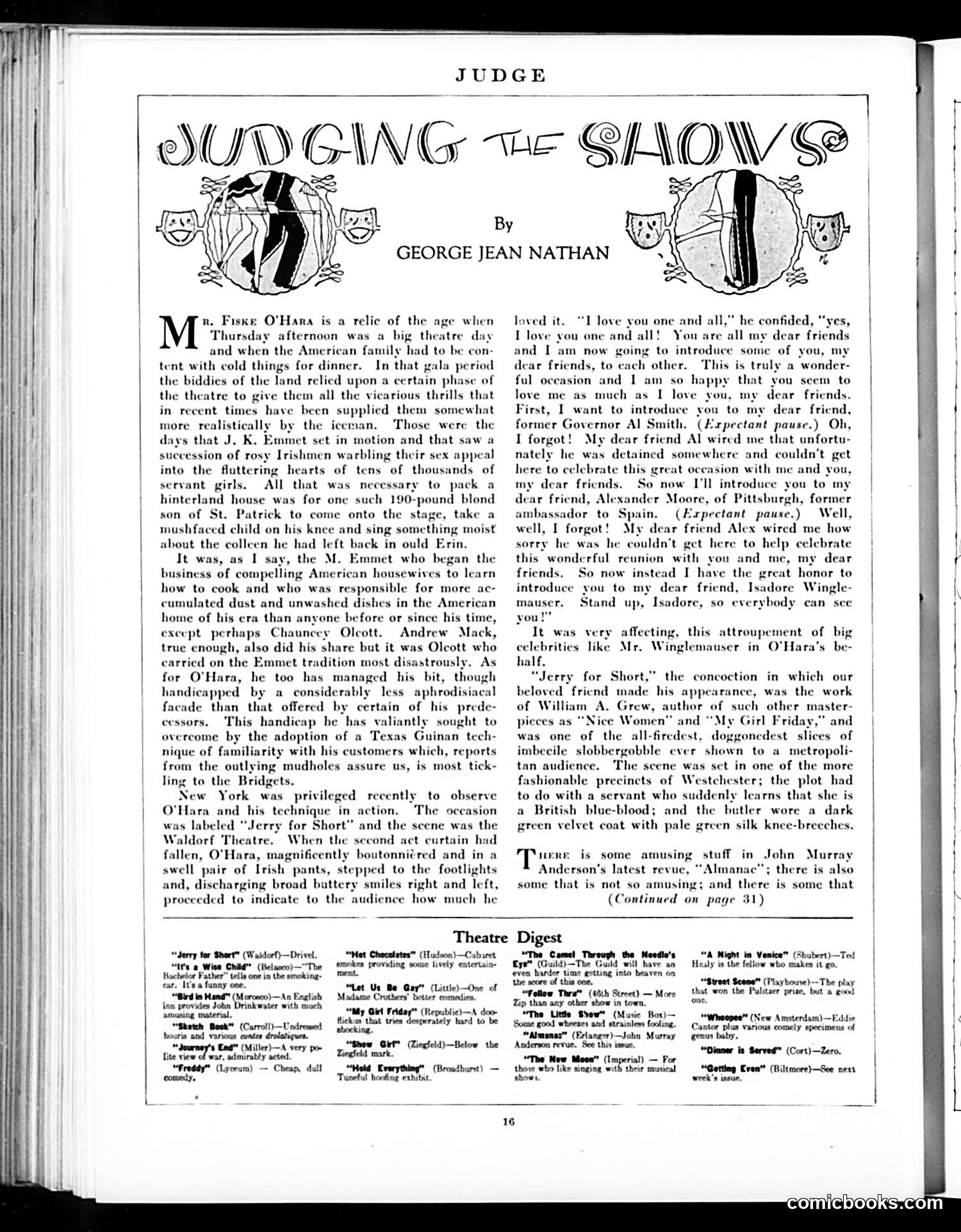
A restored page from Judge, 1929-09-07. Page through the whole issue in the reader above.
📄 Transcribed text from this page (OCR, searchable)
Machine-transcribed from the original scan — historical spelling and the odd misread are preserved.
JUDGE a | € oo GI NG we SINOWS b= GEORGE iis NATHAN ske O'Hara is a relic of the age when Thursday afternoon was a big theatre day and when the American family had to be con- tent with cold things for dinner. In that gala period the biddies of the land relied upon a certain phase of the theatre to give them all the vicarious thrills that in recent times have been supplied them somewhat more realistically by the iceman, Those were the days that J. minet sect in motion and that saw a succession of rosy Irishmen warbling their sex appeal into the fluttering hearts of tens of thousands of servant girls. All that was necessary to pack a hinterland house was for one such 190-pound blond son of St. Patrick to come onto the sts take a mushfaced child on his knee and sing something moist about the colleen he had left back in ould Erin. It was, as I say, the M. Emmet who began the business of compelling American housewives to learn how to cook and who was responsible for more ac- cumulated dust and unwashed dishes in the American home of his era than anyone before or since his time, except perhaps Chauncey Olcott. Andrew Mack, true enough, also did his share but it was Olcott who carried on the Emmet tradition most disastrously. As for O'Hara, he too has managed his bit, though handicapped by a considerably less aphrodisiacal facade than that offered by certain of his prede- cessors. This handicap he has valiantly sought to overcome by the adoption of a Texas Guinan tech- nique of familiarity with his customers which, reports from the outlying mudholes assure us, is most tick- ling to the Bridgets. New York was privileged recently to observe O'Hara and his technique ion. The occasion was labeled “Jerry for Short” and the scene Waldorf Theatre. When the second act curt. fallen, O'Hara, magnificently boutonniéred and in a swell pair of Irish pants, stepped to the footlights and, discharging broad buttery smiles right and left, proceeded to indicate to the audience how much he loved it. “I love you one and all,” he confided, “yes, I love you one and all! You are all my dear friends and I am now going to introduce some of you, my dear friends, to each other. This is truly a wonder- ful oceasion and I am so happy that you seem to love me as much as I love you, my dear friends. First, I want to introduce you to my dear friend, former Governor Al Smith, (Expectant pause.) Oh, I forgot! My dear friend Al wired me that unfortu- nately he rtained somewhere and couldn't get here to celebrate this great occasion with me and you, my dear friends. So now I'll introduce you to my dear friend, Alexander Moore, of Pittsburgh, former ambassador to Spain. (Expectant pause.) Well, well, I forgot! My dear friend Alex wired me how sorry he was he couldn't get here to help celebrate this wonderful reunion with you and me, my dear friends. So now instead I have the great honor to introduce you to my dear friend, Isadore Wingle- mauser. Stand up, Isadore, so everybody can see very affecting, this attroupement of big celebrities like Mr. Wingle user in O'Hara's be- half. “Jerry for Short,” the concoction in which our beloved friend made his appearance, was the work of Will ‘ew, author of such other master- pieces as “Nice Women” and “My Girl Friday,” and was one of the all-fircdest, doggonedest slices of imbecile slobbergobble ever shown to a metropoli- tan audience. The scene was set in one of the more fashionable precincts of Westchester; the plot had to do with a servant who suddenly learns that she is a British blue-blood; and the butler wore a dark green velvet coat with pale green silk knce-breeches. err is some amusing stuff in John Murray Anderson’s latest revue, “Almana: here is also some that is not so amusing; and there is some that (Continued on page 31) Theatre “Jerry tor Short” (Waldorf}—Drivel. “Het Chocolates” (Hudsoa)—Cabaret Digest Wise Chie” (Belasco) —"The Smokes providing some lively entertain- Bachelor Father” tells one in the smoking- ent car. It's. funay one. “Let Us Be Gay” (Little)—One of Madame Crothers’ better comedies. “Bly Girt Friday” (Republic)—A doo flickus that tries desperately hard to be ing. “Show Git" (Ziegfeld)—Below the iegfeld mark. “Sketch Book" (Carroll) —Undrewt hours and various contes drolatiques. .) 's Eng” (Miller)—A very pox Lite view of war, admirably acted. “Freddy” (Lyceum) — Cheap, dull comedy, “Hold Everything” (Broadhurst) — Tuneful boofing exhibit “The Camel Through the Meedie’s Eye” (Guild)—The Guild will have an even harder time getting into heaven oa the score of this one. “Follow Tara” (40th Street) — More Zip than any other show in town. “The Litte Syew" (Music Bor)— Some good wheees and strainlesy fooling. “Almanaz” (Erlanger)—John Murray Andersoa revue. See this issue “The New Moon” (Imperial) — For those who like singing with their musical shows. “A Night ia Venice” (Shubert)—Ted Healy is the fellow who makes it go. “Street Scene” (Playbouve)—The play that won the Pulitzer prize, but a good one. “whoopee” (New Amsterdam) —Eddie Cantor plus various comely specimens of genus baby. “Dinner is Served” (Cort)—Zero, “Getting Even” (Biltmore)—See next week's issue. PAIR Hee Comicbooks.com