
A complete issue · 36 pages · 1929
Judge — June 15, 1929
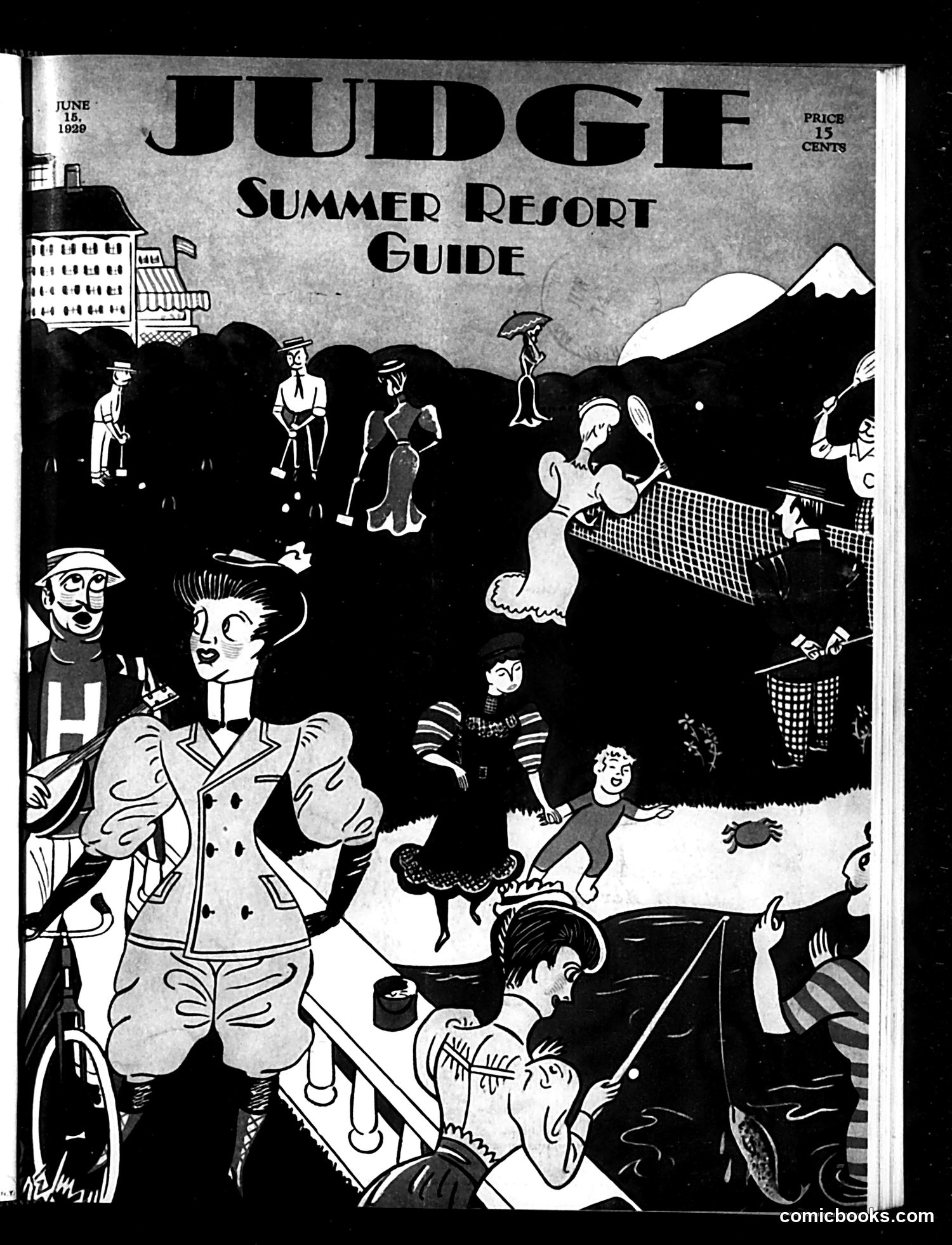
This is a cover for Judge's "Summer Resort Guide"—a lighthearted compilation issue about vacation destinations. The illustration satirizes the diverse social scene at fashionable American summer resorts during the 1920s. The cartoon depicts various leisure activities: golf, tennis, swimming, and socializing. The figures represent different social types—a bellhop, fashionably dressed women in swimwear, children playing, and men in sporting attire. The style reflects 1920s social dynamics, including the "New Woman" gaining public visibility in bathing suits and athletic pursuits. The satire likely mocks the pretensions of resort culture and the mixing of social classes in these vacation spaces. The exaggerated, cartoonish portrayal emphasizes the comedy inherent in Americans' summer leisure activities during this prosperous era.
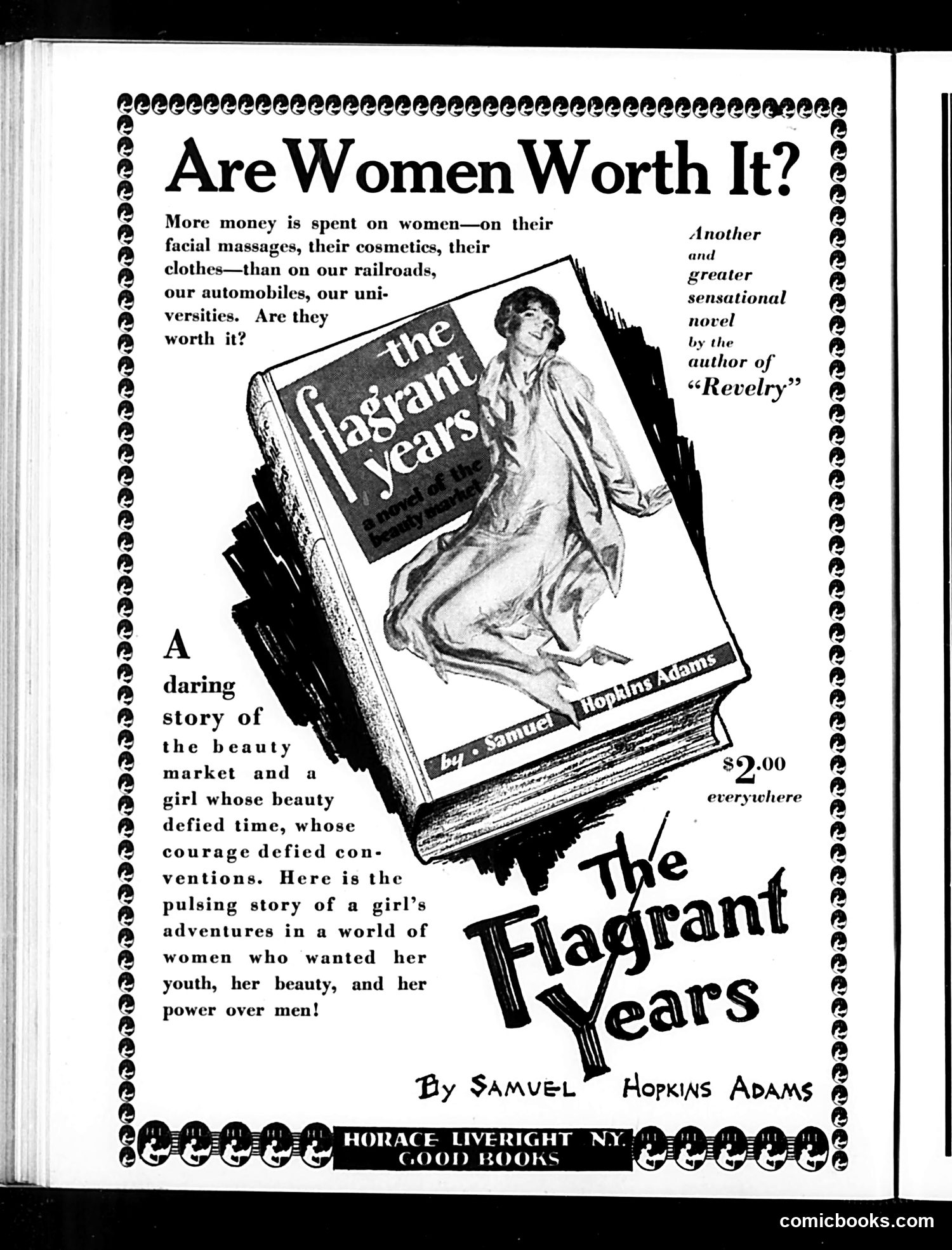
This is primarily a **book advertisement**, not a political cartoon. It promotes "The Flagrant Years" by Samuel Hopkins Adams, priced at $2.00, published by Horace Liveright. The ad's rhetorical hook is a provocative question: "Are Women Worth It?" — referencing society's spending on women's beauty, fashion, and cosmetics versus investments in railroads, automobiles, and universities. This frames the novel as addressing contemporary debates about women's roles and consumerism during the 1920s. The illustrated woman holding the book suggests the story concerns beauty, youth, and female power—themes that would have appealed to Jazz Age readers. The ad emphasizes this as a "daring story" about "a girl's adventures," positioning it as sensational popular fiction exploring women's independence and sexuality during an era of significant social change.
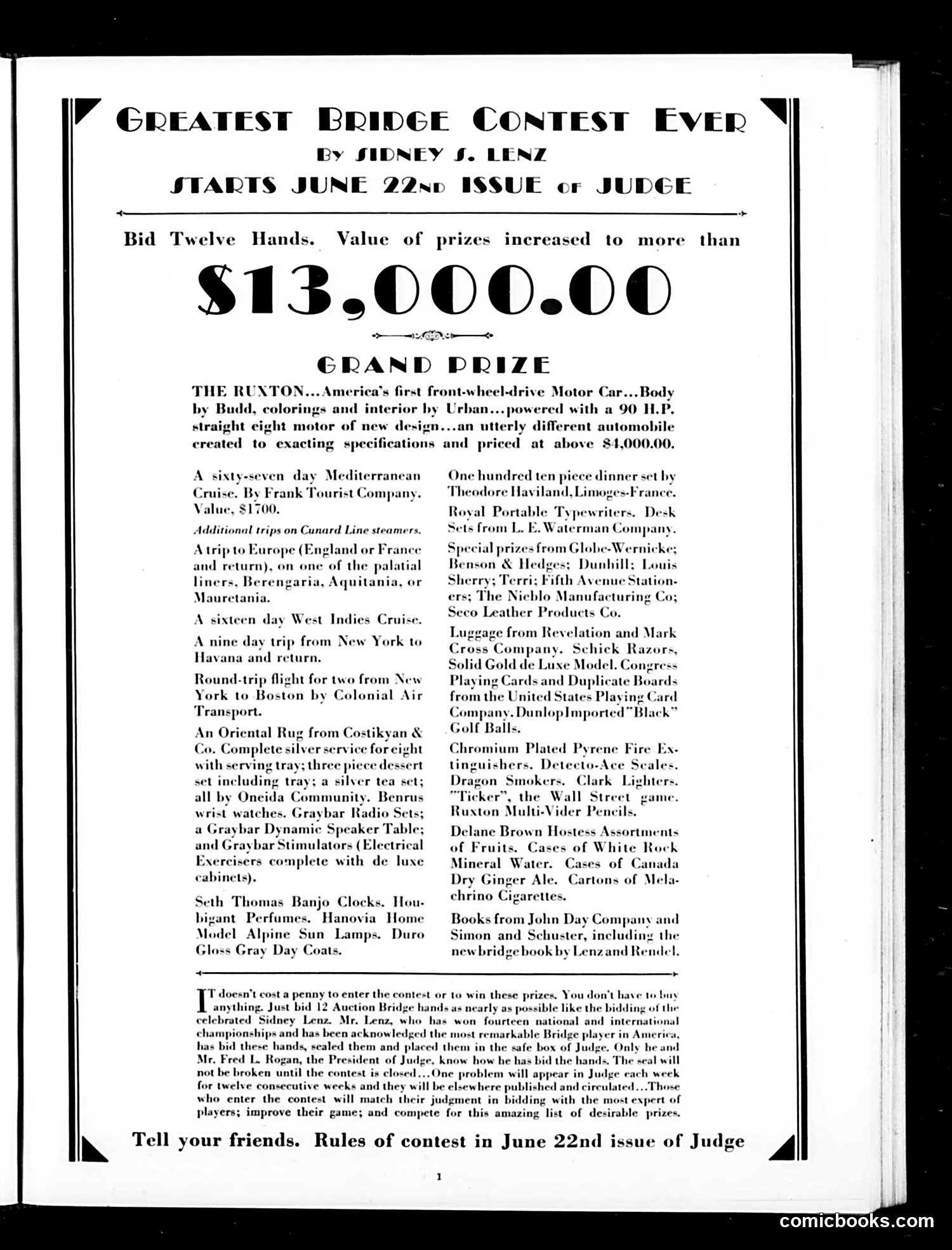
This page is primarily **advertising content**, not a political cartoon. It announces the "Greatest Bridge Contest Ever" by Sidney S. Lenz, starting in Judge's June 22nd issue. The contest invites readers to bid twelve hands of auction bridge (a card game popular in the 1920s-30s), competing for prizes valued over $13,000. The grand prize is a Ruxton automobile; additional prizes include a Mediterranean cruise, Caribbean cruises, typewriters, golf equipment, and various luxury goods. The text emphasizes that entry is free—no purchase necessary—and that contestants will be judged by bridge experts, competing on skill rather than luck. The contest capitalizes on bridge's popularity among American leisure-class audiences during this era.
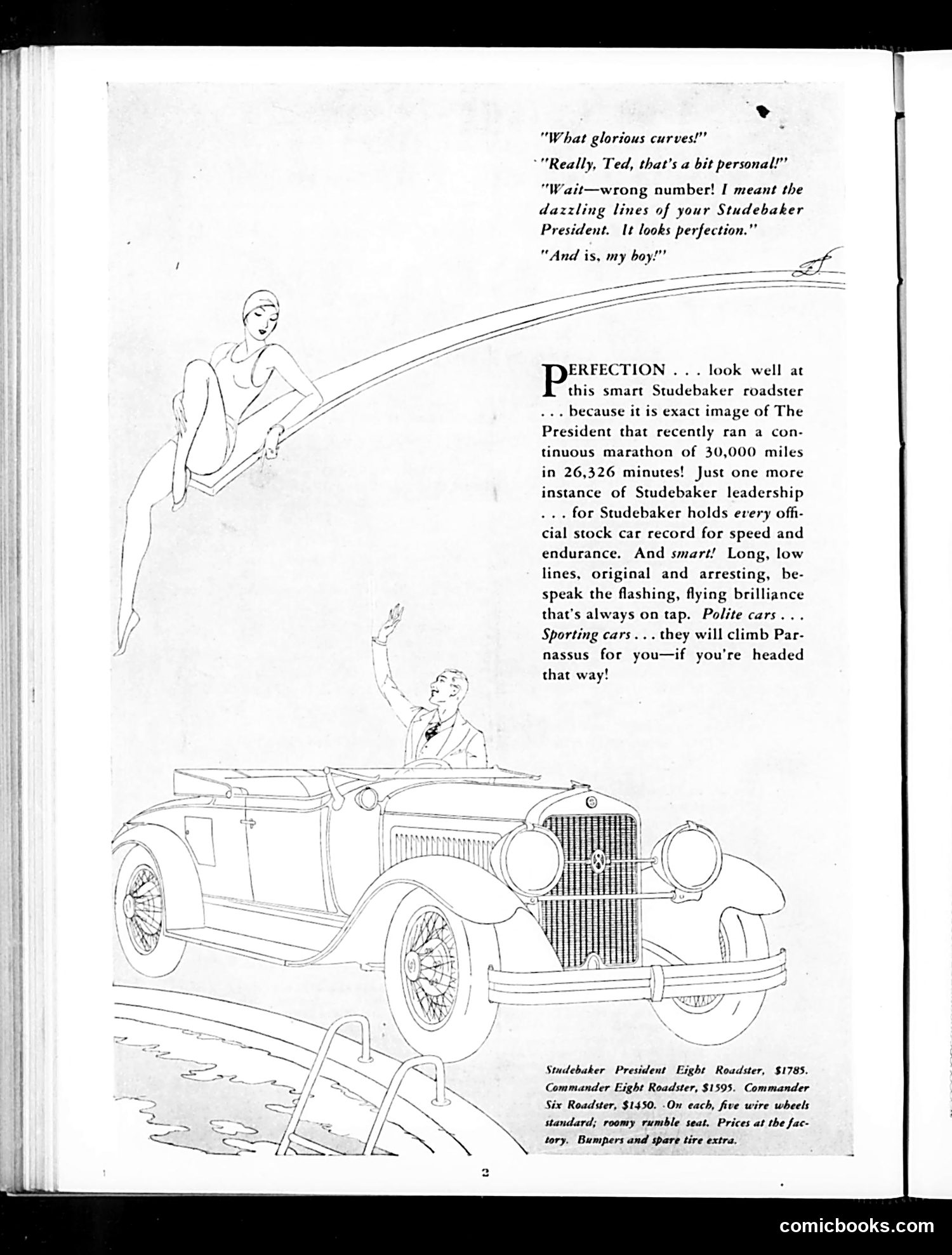
This page is primarily **advertising**, not political satire. It promotes the Studebaker automobile line through an illustration showing a stylized woman draped along the car's curves, emphasizing the vehicle's sleek design. The dialogue at top makes a **sales pitch**: the speaker praises the "dazzling lines" of the Studebaker President model, claiming it's the exact image of the actual President's car that completed a 30,000-mile marathon in 26,326 minutes. This blends product endorsement with achievement-based marketing. The ad emphasizes Studebaker's speed records and design elegance ("long, low lines, original and arresting"), positioning the brand as aspirational for both "polite cars" and "sporting cars." Pricing information appears at bottom for various models.
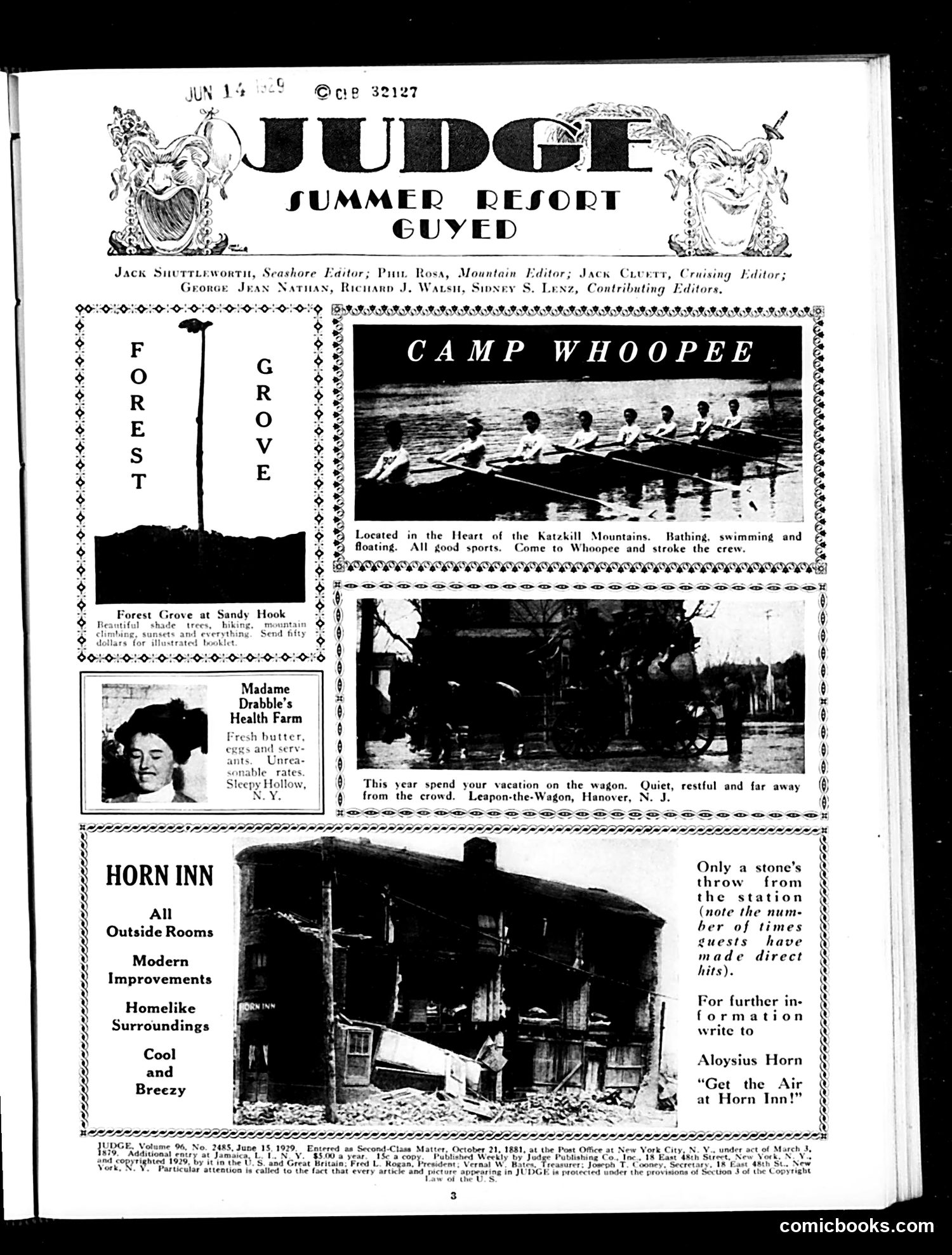
This page is primarily **advertising content**, not political satire. It showcases vacation destinations and businesses from the early 20th century. The advertisements feature: 1. **Camp Whoopee** — a rowing/bathing resort in the Catskill Mountains 2. **Madame Drabble's Health Farm** — offering fresh butter, eggs, and servants at "Sleepy Hollow" 3. **Horn Inn** — a rustic lodging with "modern improvements," promoting itself as conveniently close to the train station The "Judge Summer Resort Guided" header frames these as recommendations for readers seeking leisure activities. The imagery emphasizes outdoor recreation (rowing), pastoral farm life, and rustic getaways—reflecting upper/middle-class vacation preferences of the era. No political commentary or satire is apparent; this is straightforward period advertising.
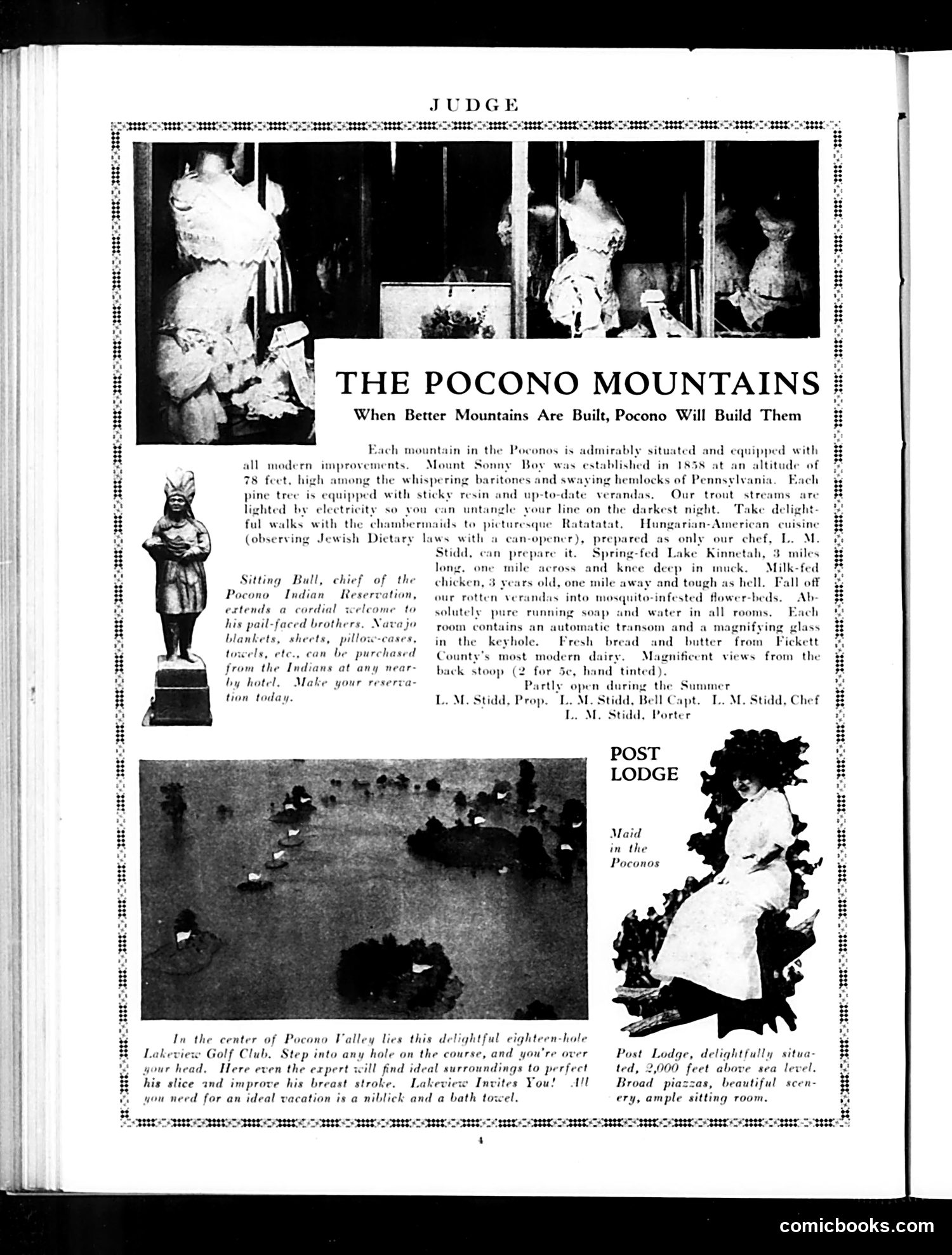
This page is primarily **advertising content** rather than political satire. The headline "THE POCONO MOUNTAINS: When Better Mountains Are Built, Pocono Will Build Them" promotes vacation resorts in Pennsylvania's Pocono region. The left side features a statue labeled "Sitting Bull, chief of the Pocono Indian Reservation," which appears to be a novelty or kitsch element of the resort's Native American-themed attractions. The text mentions purchasing "Indian relics" from the hotel. The page advertises specific lodges—Mount Sonny Boy and Post Lodge—highlighting amenities like golf courses, dining facilities, and scenic views. The photographs show guests enjoying outdoor activities and leisure accommodations. Rather than satire, this represents early 20th-century resort marketing that incorporated stereotyped Native American imagery as entertainment value for wealthy tourists.
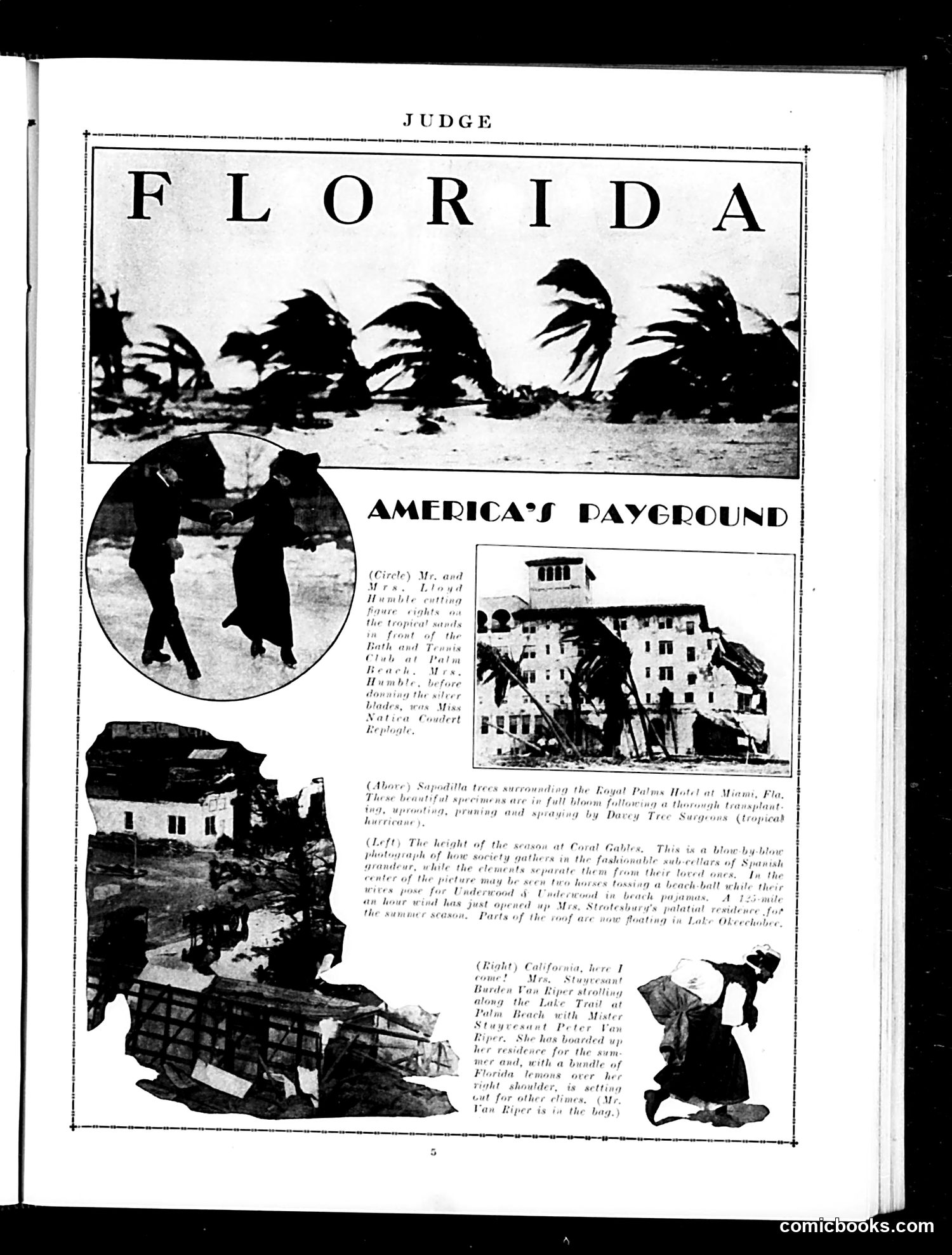
This page celebrates Florida as a tourist destination, showing idealized scenes of leisure and natural beauty. The top image features palm trees bending in wind, establishing Florida's exotic appeal. The circular photo shows two men in formal dress enjoying the beach—representing wealthy visitors. Other images depict the Royal Palms Hotel in Miami, Coral Gables architecture, and a woman (identified as "California here!") enjoying recreation. The caption describes Florida's attractions: tropical scenery, fashionable resorts, and leisure activities like golf. The satirical angle appears subtle—the page promotes Florida as an exclusive playground for the wealthy and well-to-do during the 1920s Florida real estate boom. The emphasis on high society enjoying "America's Playground" suggests both genuine promotion and gentle mockery of leisure-class excess.
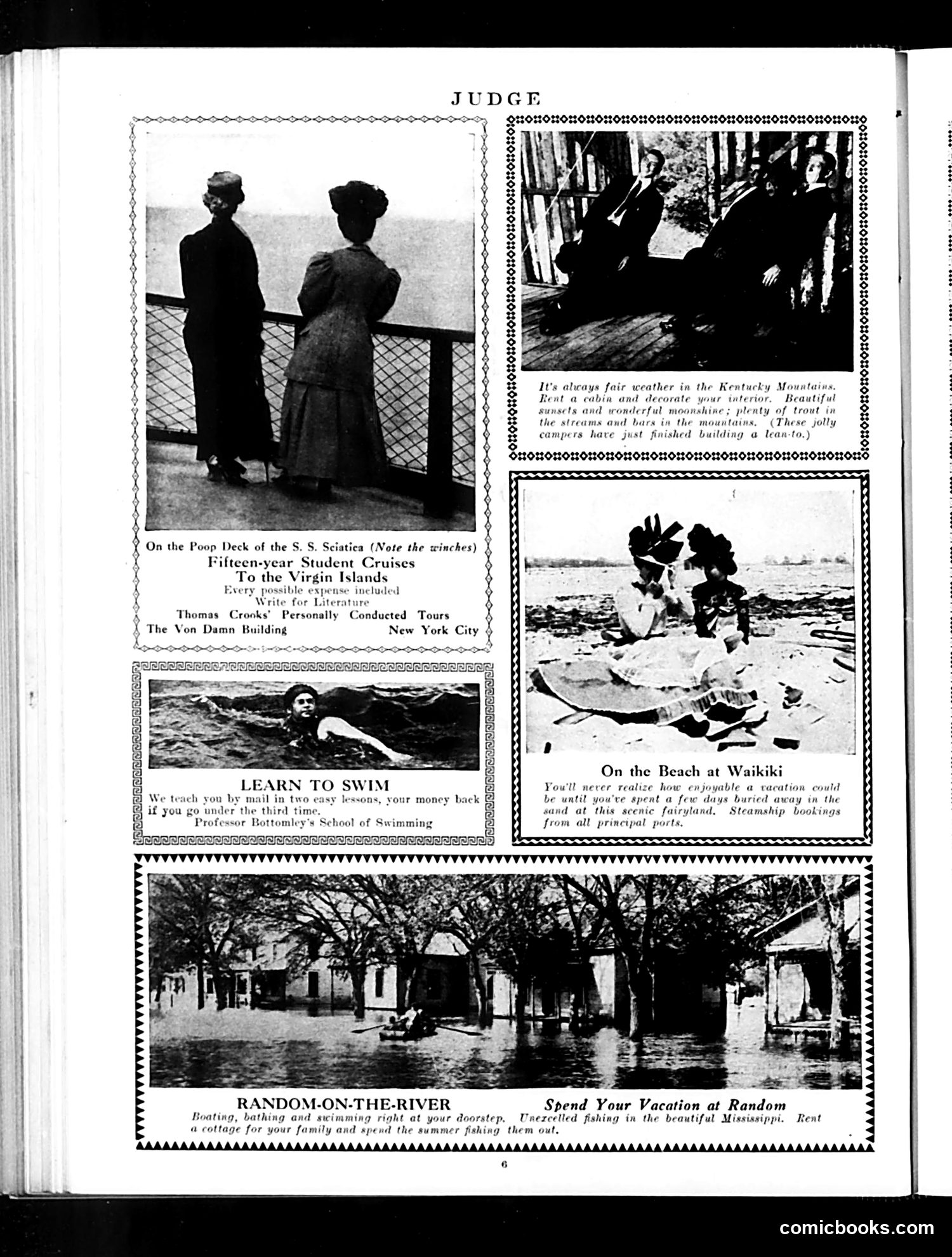
This page is primarily **advertisement and travel promotion content**, not political satire. It features vacation advertisements for: - Fifteen-year student cruises to the Virgin Islands aboard the S.S. Sciatica - Swimming lessons from Professor Rothschild's School of Swimming - Beach recreation at Waikiki - Random-on-the-River cottage rentals for Mississippi River fishing The only potential satire is the ship's name "S.S. Sciatica" (a nerve pain condition), which appears to be a playful joke—using a medical ailment as a vessel name for leisure cruises. The other advertisements are straightforward tourism promotions typical of early 20th-century Judge magazine, emphasizing accessible vacation opportunities and leisure activities. There are no identifiable political figures or social commentary visible on this page.
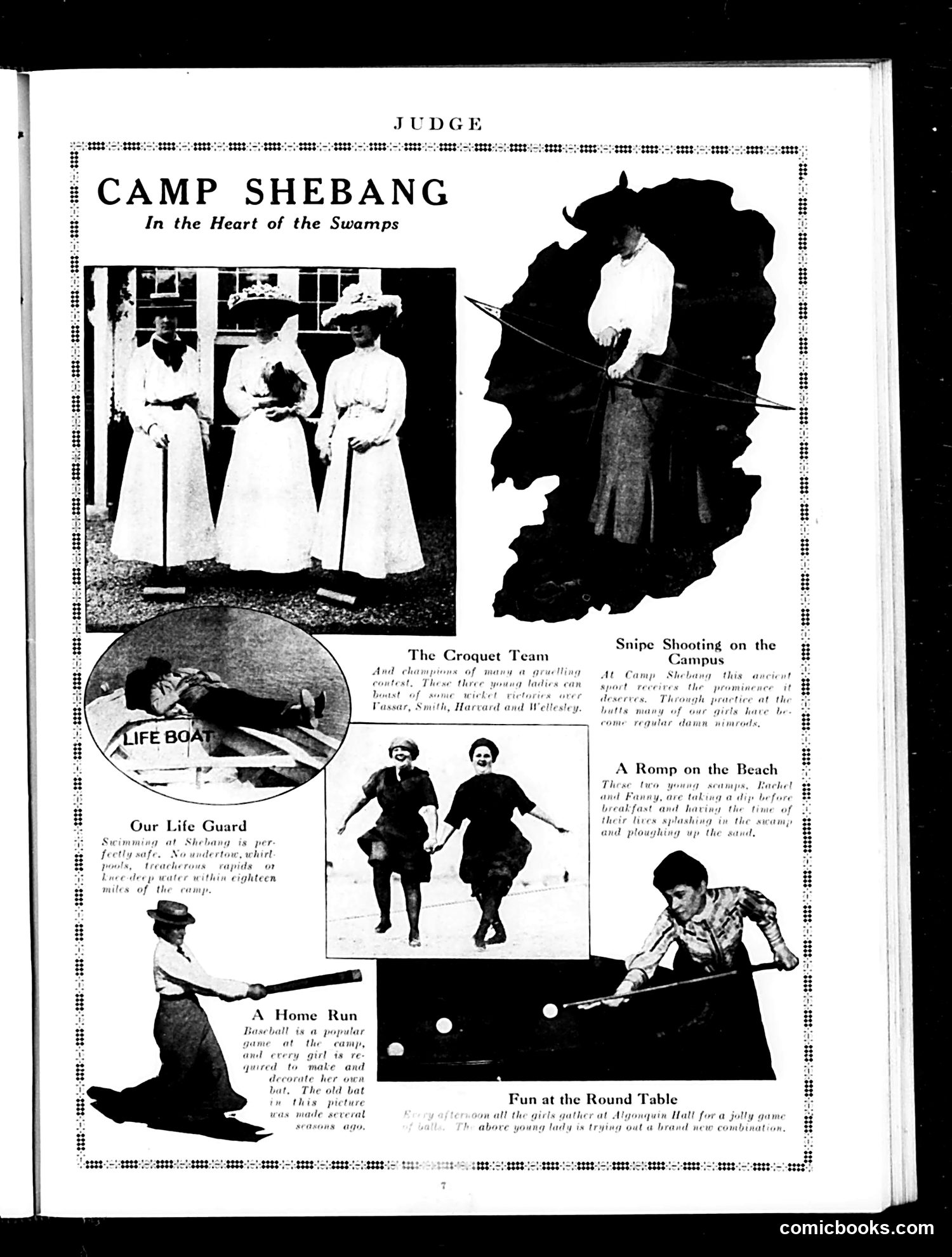
This page from *Judge* magazine satirizes a women's summer camp called "Camp Shebang," presenting various recreational activities with gentle humor. The content shows: **The Activities Depicted:** - Croquet and shooting sports (snipe shooting) - Swimming and life-guarding - Baseball (where "every girl is required" to participate) - Beach outings and recreational games **The Satire's Point:** The humor appears to target the growing trend of organized women's camps and physical education for women—still relatively novel in the early 20th century. By presenting "manly" activities like shooting sports and competitive baseball as camp staples for young women, *Judge* gently mocks both the camp's ambitions and contemporary anxieties about changing gender roles. The tone is lighthearted rather than hostile; the magazine seems amused by women's increasing participation in outdoor recreation and athletics rather than outright disapproving. This reflects a transitional cultural moment when women's athletic participation was becoming normalized, though still treated as somewhat noteworthy or amusing by satirical publications.
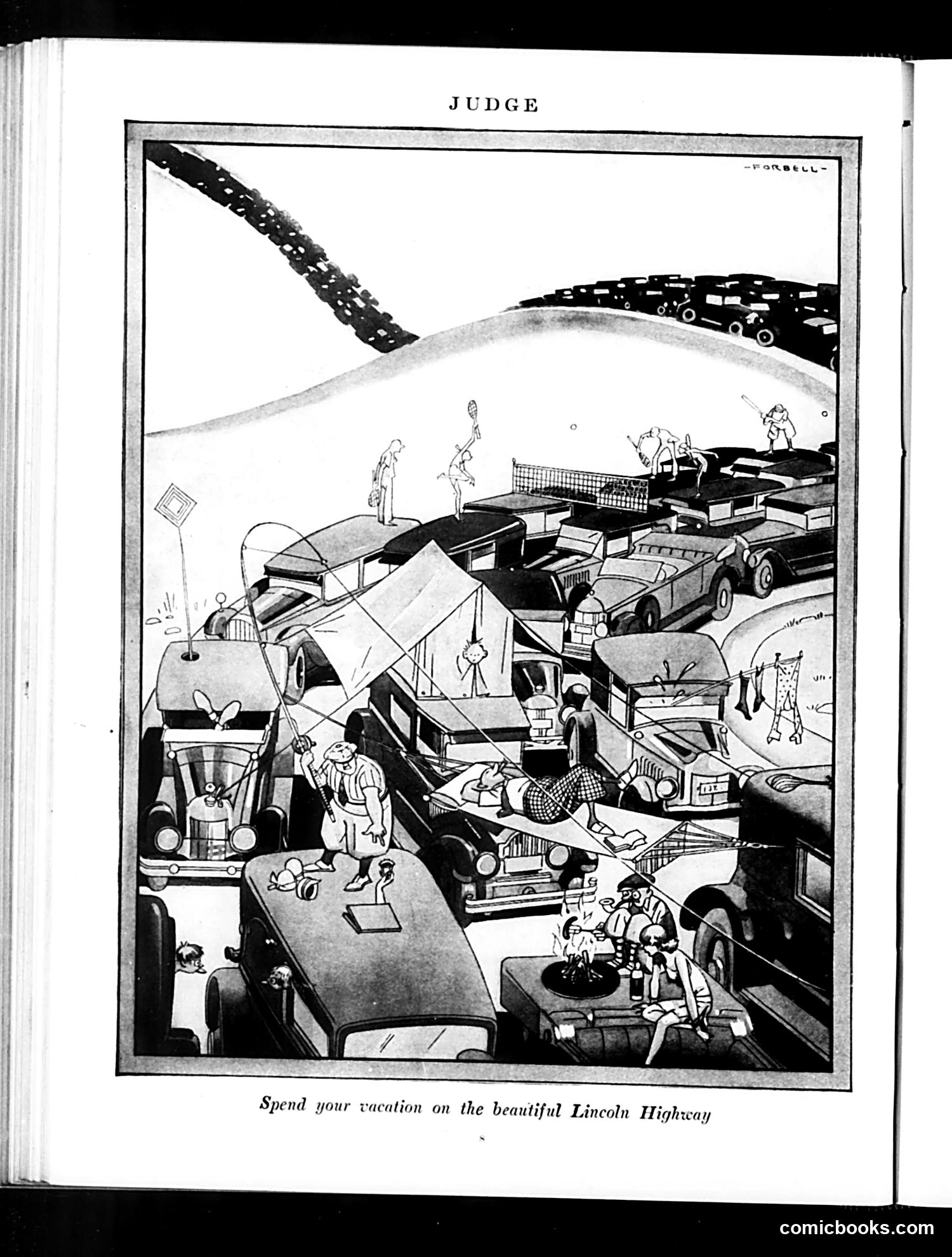
This page from *Judge* magazine contains a single satirical cartoon advertising the Lincoln Highway. The illustration depicts a crowded, chaotic vacation scene along the highway, with numerous automobiles, camping tents, and tourists engaged in various leisure activities. The satire appears to mock the romanticized promotion of highway vacationing. While the caption promises to "Spend your vacation on the beautiful Lincoln Highway," the actual depicted scene shows overcrowding, congestion, and disorder—suggesting the reality falls far short of the marketing promise. This likely reflects 1920s-era anxieties about mass automobile tourism, commercialization of leisure, and the gap between advertising ideals and messy reality. The cartoon humorously exposes the contradiction between vacation fantasies and the crowded, somewhat unglamorous actual experience.
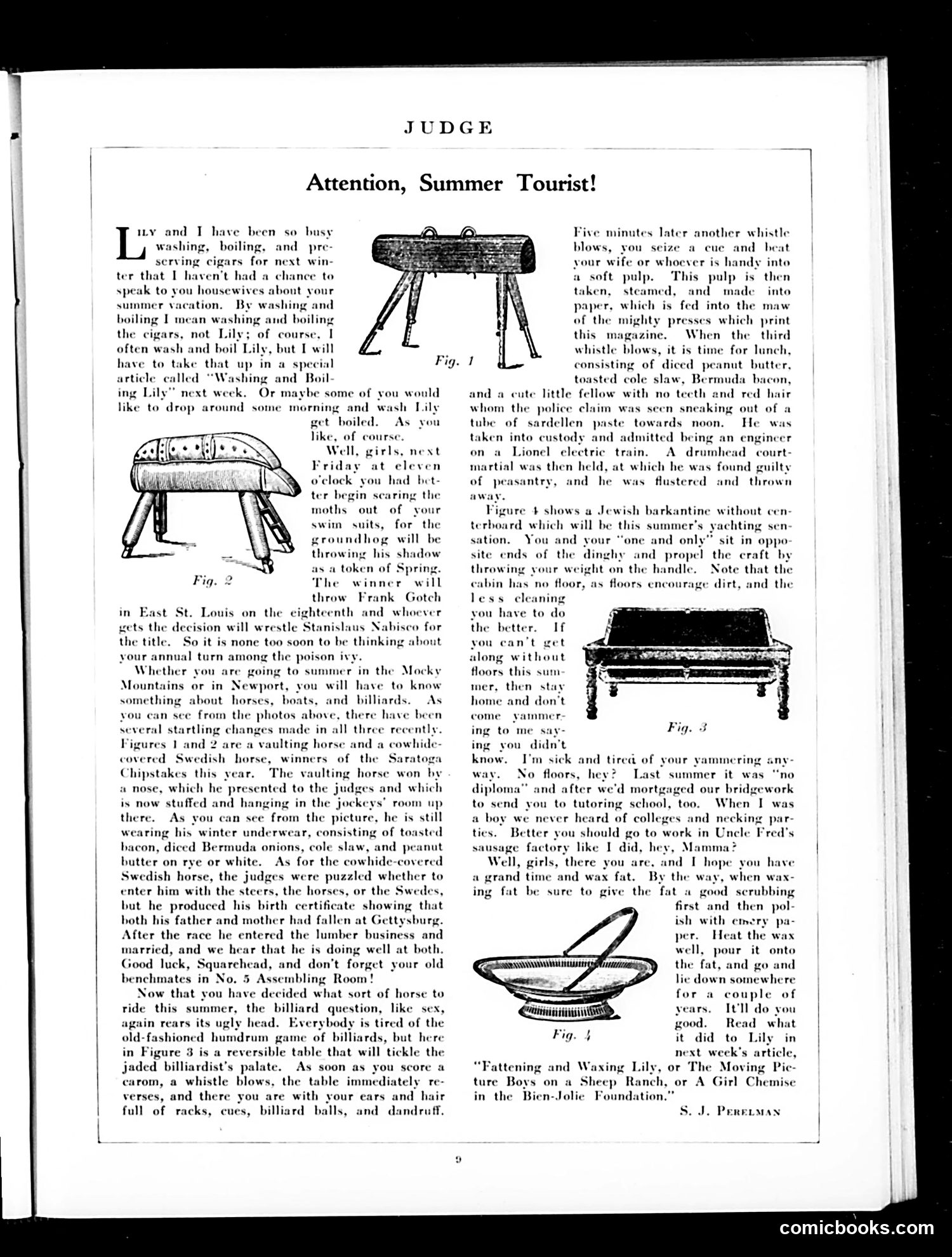
This is a humorous advice column disguised as satirical commentary on summer leisure activities. The author (writing as "Lily," apparently a domestic persona) mocks wealthy tourists planning vacations by presenting deliberately absurd "improvements" to recreational equipment. The satire targets: 1. **Pretentious summer culture**: References to fashionable destinations (the Rockies, Newport) and activities (horseback riding, boating, billiards) 2. **Bizarre "innovations"**: The three figures show ridiculous contraptions—a vaulting horse that won a race and now hangs stuffed in a jockey's room; a Swedish horse with a Civil War genealogy; a reversible billiards table that flips when you score 3. **Class anxiety**: Jokes about people struggling to keep up with leisure expectations while lacking basic knowledge 4. **Domestic complaints**: The author sarcastically suggests readers avoid summer travel altogether, stay home, and stop complaining—a working-class perspective on elite vacation pretensions The humor relies on absurdist exaggeration to mock the nouveau-riche obsession with fashionable pursuits and unnecessary complications of simple pleasures.
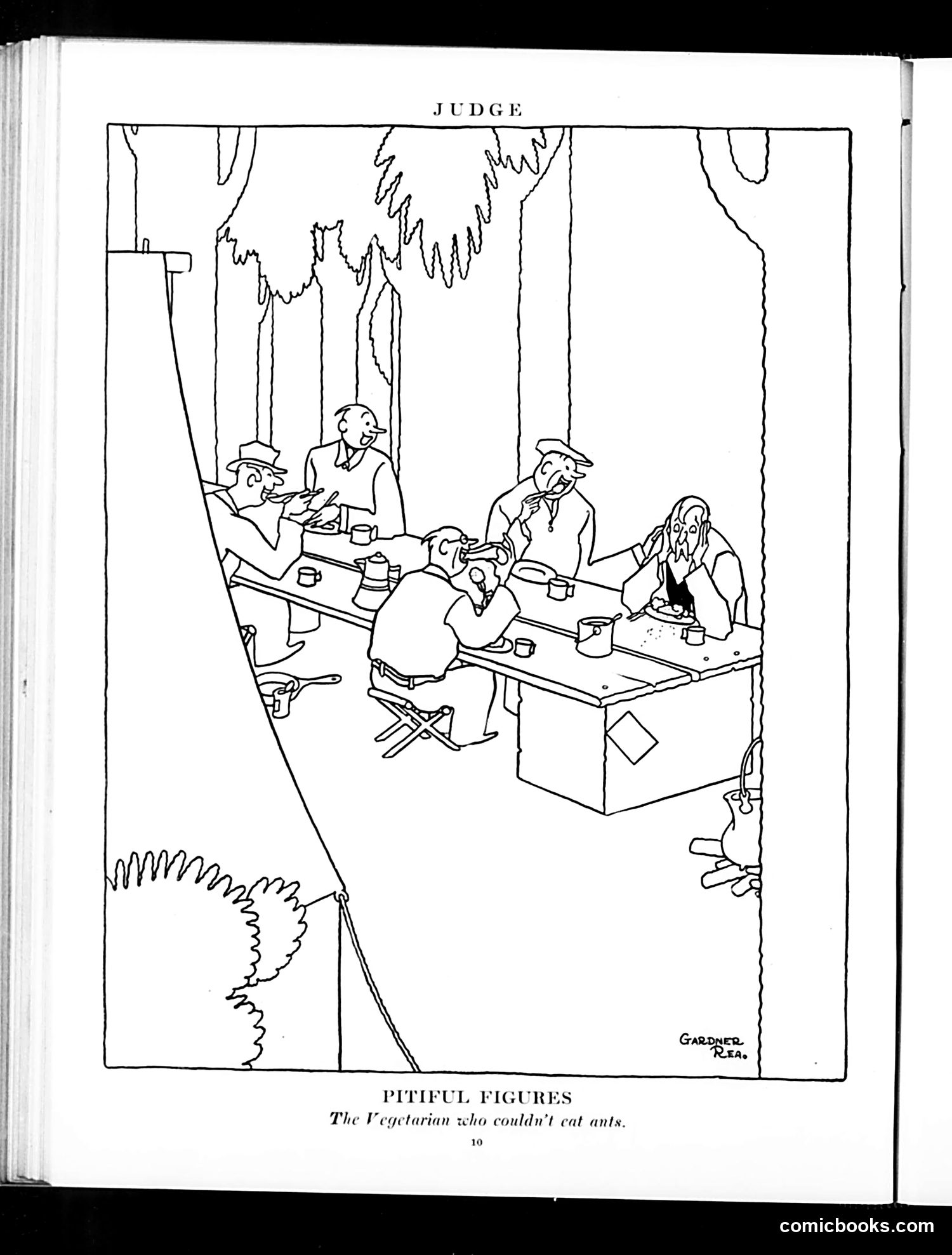
This cartoon satirizes vegetarians through dark humor. The scene shows men dining outdoors in a forest setting, with one figure appearing distressed or recoiling. The title's joke—that a vegetarian "couldn't eat ants"—plays on the logical absurdity of strict vegetarianism: if one won't eat meat, why refuse insects, which are also living creatures? The cartoon mocks vegetarian principles as hypocritical or impractical, suggesting vegetarians draw arbitrary lines about which animals to consume. The figures' reactions suggest the vegetarian protagonist faces an awkward social or moral predicament at the meal. This reflects early 20th-century satirical attitudes toward dietary reform movements, which Judge magazine frequently ridiculed as pretentious or philosophically inconsistent.
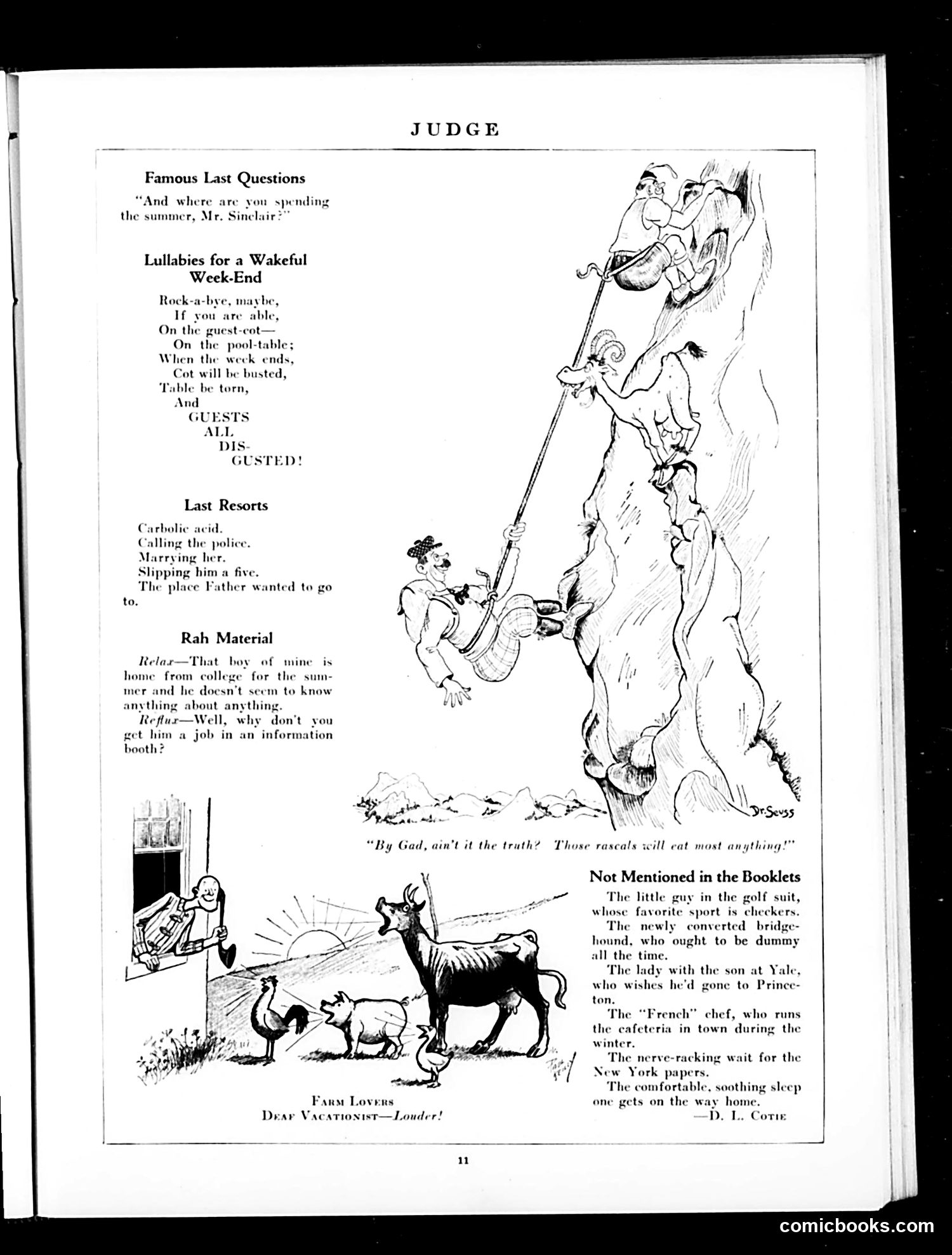
This page from Judge magazine contains multiple satirical pieces about summer vacation culture and social types. The main Dr. Seuss cartoon depicts people climbing a cliff labeled "Rab Material," mocking college-educated young men who return home unemployable and ignorant—a jab at privileged youth and education's practical failures. "Lullabies for a Wakeful Week-End" sarcastically describes weekend guests who destroy homes (busted cots, torn tables), reflecting post-WWI anxieties about social disorder and unruly behavior among the leisure class. "Last Resorts" darkly lists marriage, poison, and police calls as solutions to summer problems—cynical commentary on vacation stress and social entrapment. "Not Mentioned in the Booklets" catalogs the unseemly vacation realities glossed over in travel promotion: incompetent help, boring pastimes, homesick relatives, and nervous newspaper addiction—deflating romanticized vacation marketing. The satire targets wealthy Americans' summer leisure culture and its pretensions and disappointments.
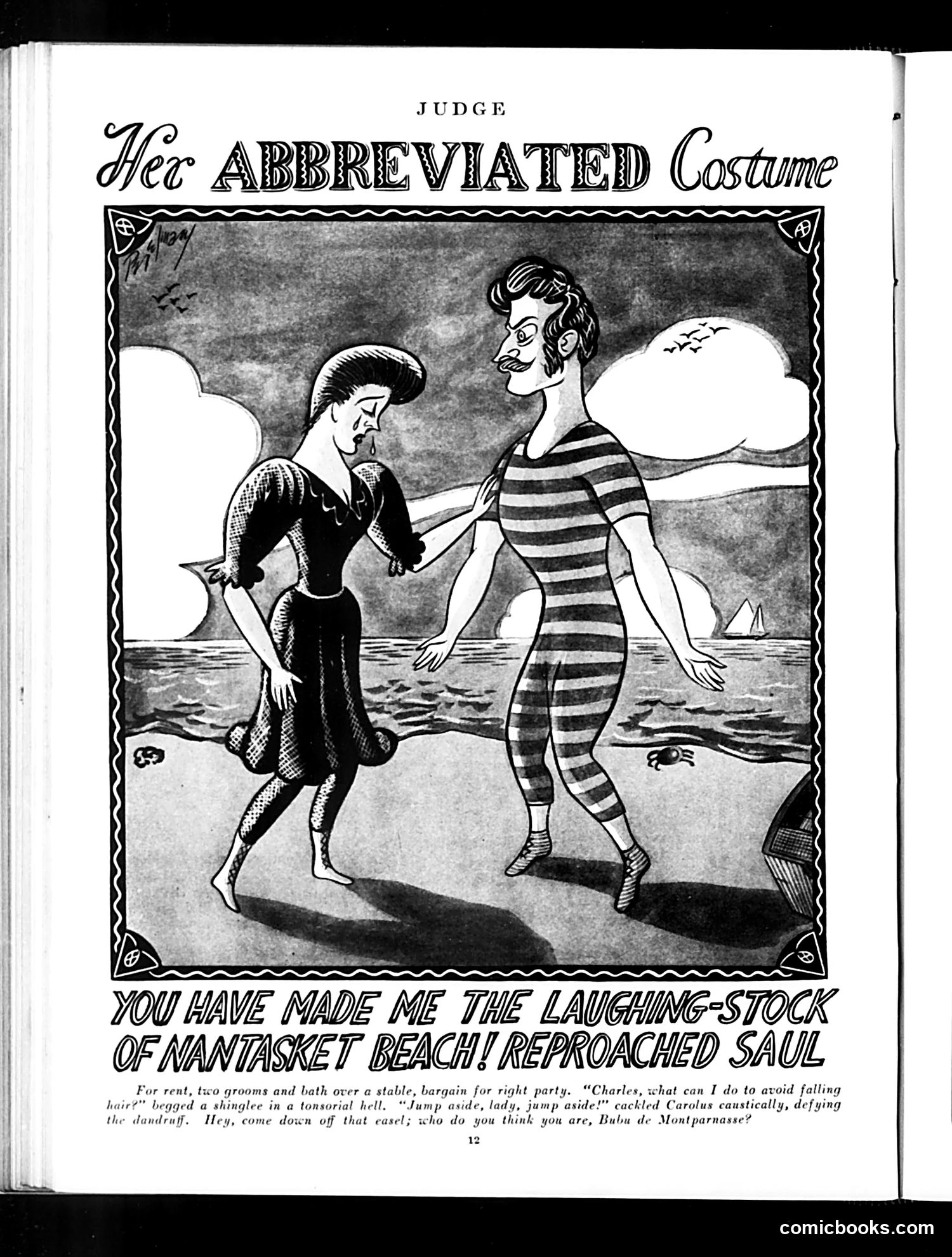
This Judge magazine cartoon satirizes women's abbreviated bathing costumes—likely from the early 1900s when swimwear was becoming shorter and more revealing. The title mocks a woman in a striped one-piece suit, claiming she's made "the laughing-stock of Nantasket Beach" (a popular Massachusetts resort). The cartoon jokes about scandalous beachwear by having a man in equally abbreviated striped attire reproach her. The satire cuts both ways: while criticizing women's exposed legs and bodies, it simultaneously ridicules male prudishness by showing a man dressed equally scantly complaining about impropriety. The lower text contains unrelated jokes about hair loss and artistic pretension, typical of Judge's miscellaneous humor. The overall point targets social hypocrisy around changing fashion norms and gender double standards regarding bodily exposure.
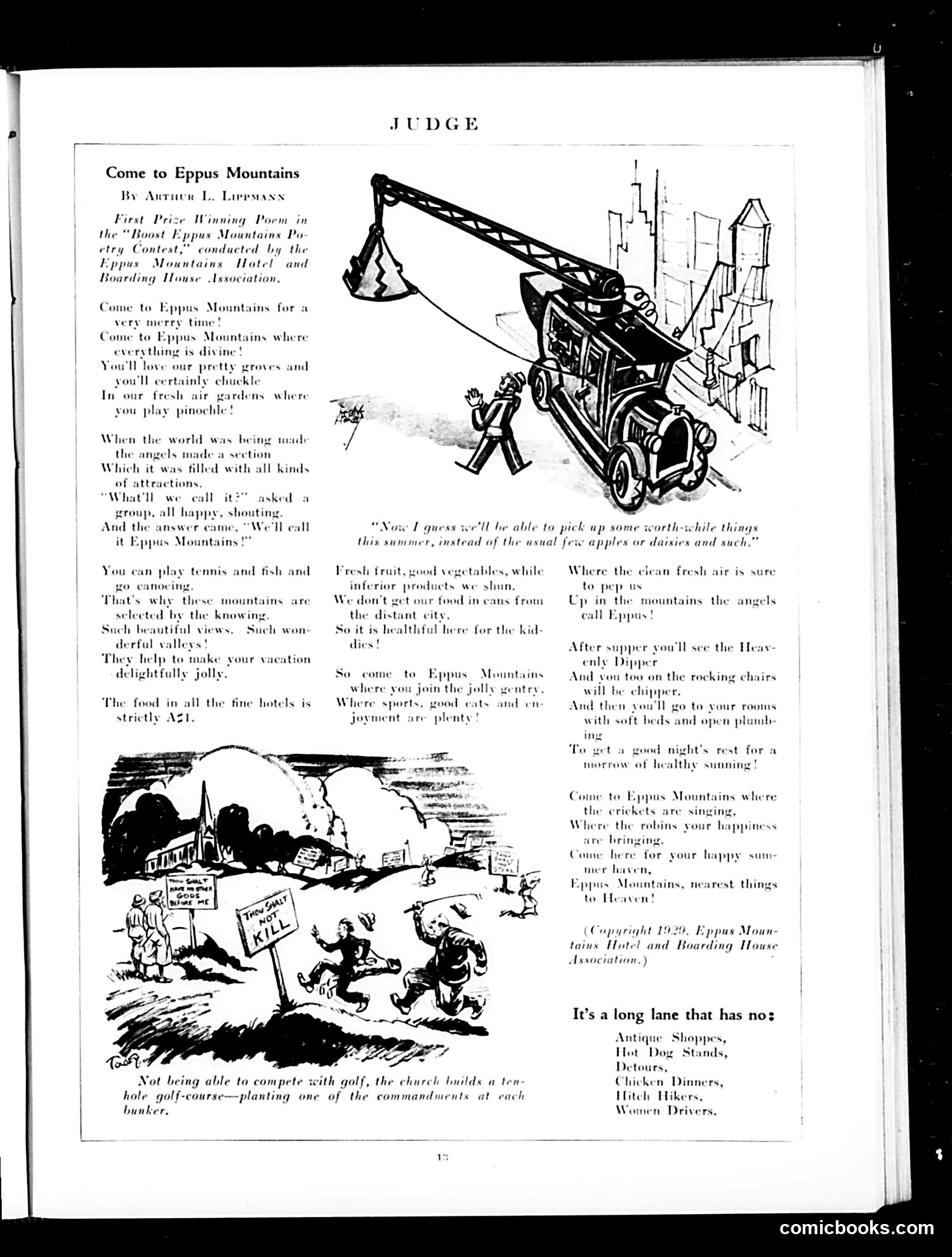
This page features a prize-winning promotional poem for the fictional Eppus Mountains resort, accompanied by satirical cartoons mocking American tourism marketing and social hypocrisy of the 1920s. The top cartoon shows a crane depositing commercial goods into a mountain landscape—critiquing how "attractions" are artificially manufactured rather than naturally occurring. The lower cartoon depicts a church building a ten-hole golf course with "commandments" planted at each bunker, satirizing how religious institutions compromised their values to compete with secular leisure activities. This reflects 1920s anxieties about declining church attendance as entertainment and vacationing became more popular. The poem itself parodies saccharine resort advertising—promising paradise while emphasizing fresh produce and wholesome recreation. The final section, "It's a long lane that has no..." lists modern annoyances (detours, traffic, women drivers)—suggesting underlying anxiety about modernization and changing social roles, particularly regarding women's newfound mobility and independence.
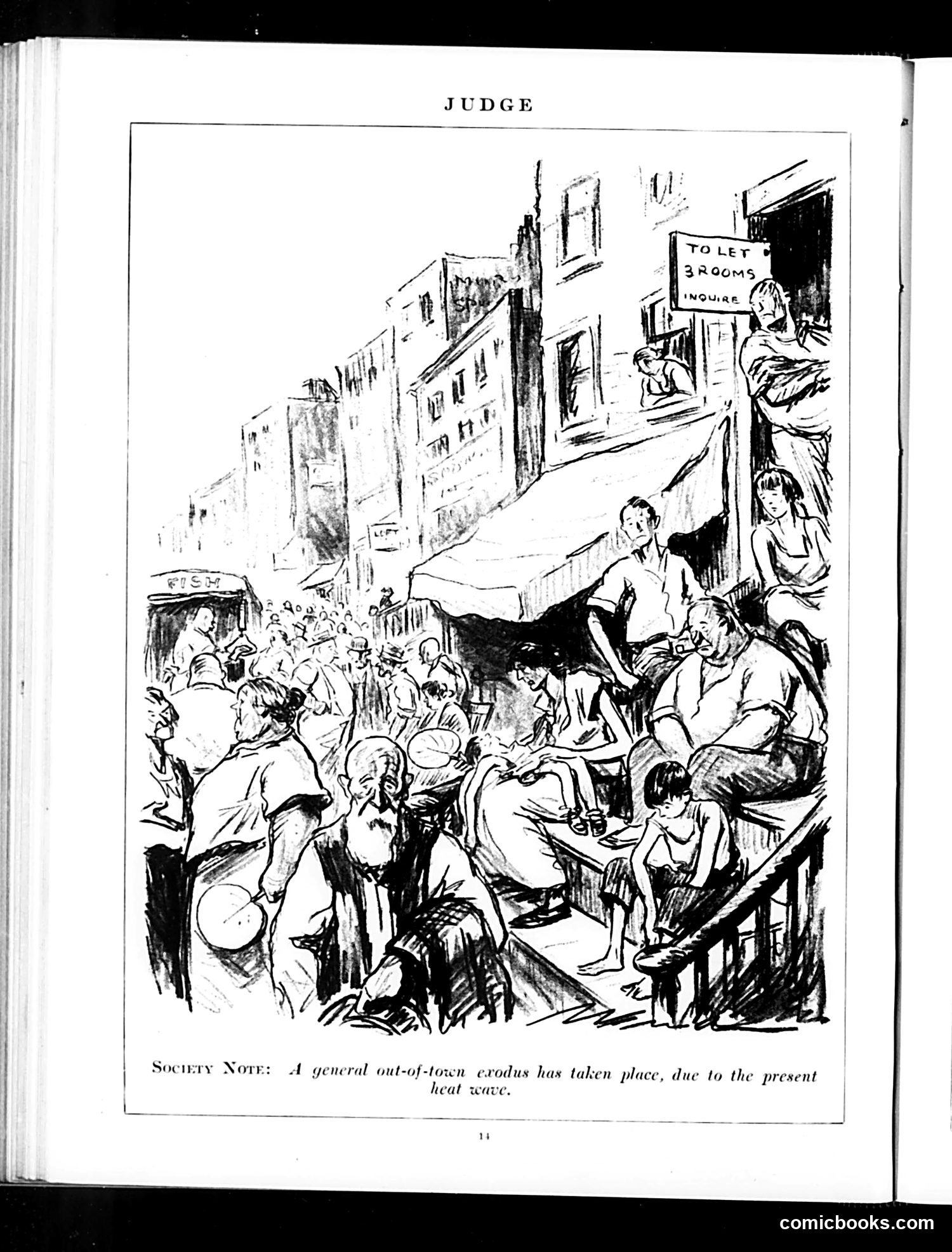
This single cartoon from *Judge* magazine satirizes urban heat waves through a chaotic street scene. The "Society Note" caption explains the joke: wealthy out-of-town residents are fleeing the city to escape oppressive summer temperatures, creating a mass exodus. The sketch depicts a crowded, disorganized street packed with people, luggage, and belongings. A "TO LET 3 ROOMS" sign visible on a building emphasizes the sudden housing vacancy left behind. The satire targets the affluent class's seasonal migration patterns—a privileged response to weather that ordinary working-class residents couldn't afford to escape. The cartoon mocks both the pretension of the wealthy and the comical disorder their departure creates in the urban landscape.
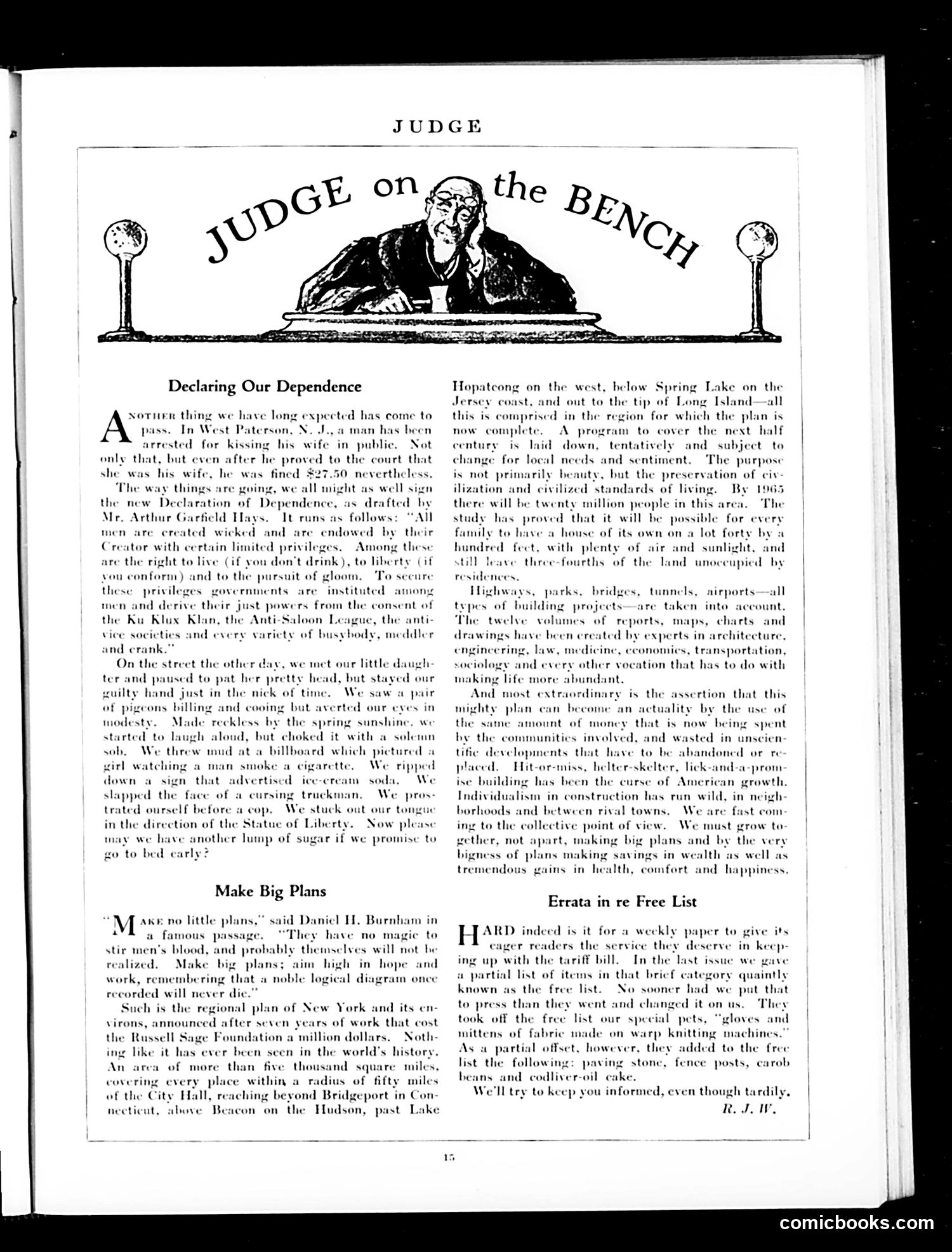
This page from *Judge* satirizes American social restrictions and celebrates ambitious urban planning. **"Declaring Our Dependence"** mockingly inverts the Declaration of Independence. It satirizes what the author sees as creeping government and moral-busybody control—citing a West Paterson man fined for kissing his wife despite proving she was his wife. The satire attacks the Ku Klux Klan, Anti-Saloon League, and "vice societies" for criminalizing ordinary behavior. The anecdotes (avoiding petting pigeons, suppressing laughter, fearing authority) exaggerate how constrained Americans have become under prohibition and moral policing. **"Make Big Plans"** praises a massive regional development scheme for New York and surrounding areas, citing urban planner Daniel Burnham's philosophy that "noble logical diagrams" inspire progress. The article celebrates a Russell Foundation-funded regional plan covering thousands of square miles, promising rational infrastructure—highways, airports, parks—and enabling family homeownership by 1965 through coordinated, scientific planning rather than "hit-or-miss" development. The page contrasts repressive social control with optimistic technocratic urban vision.
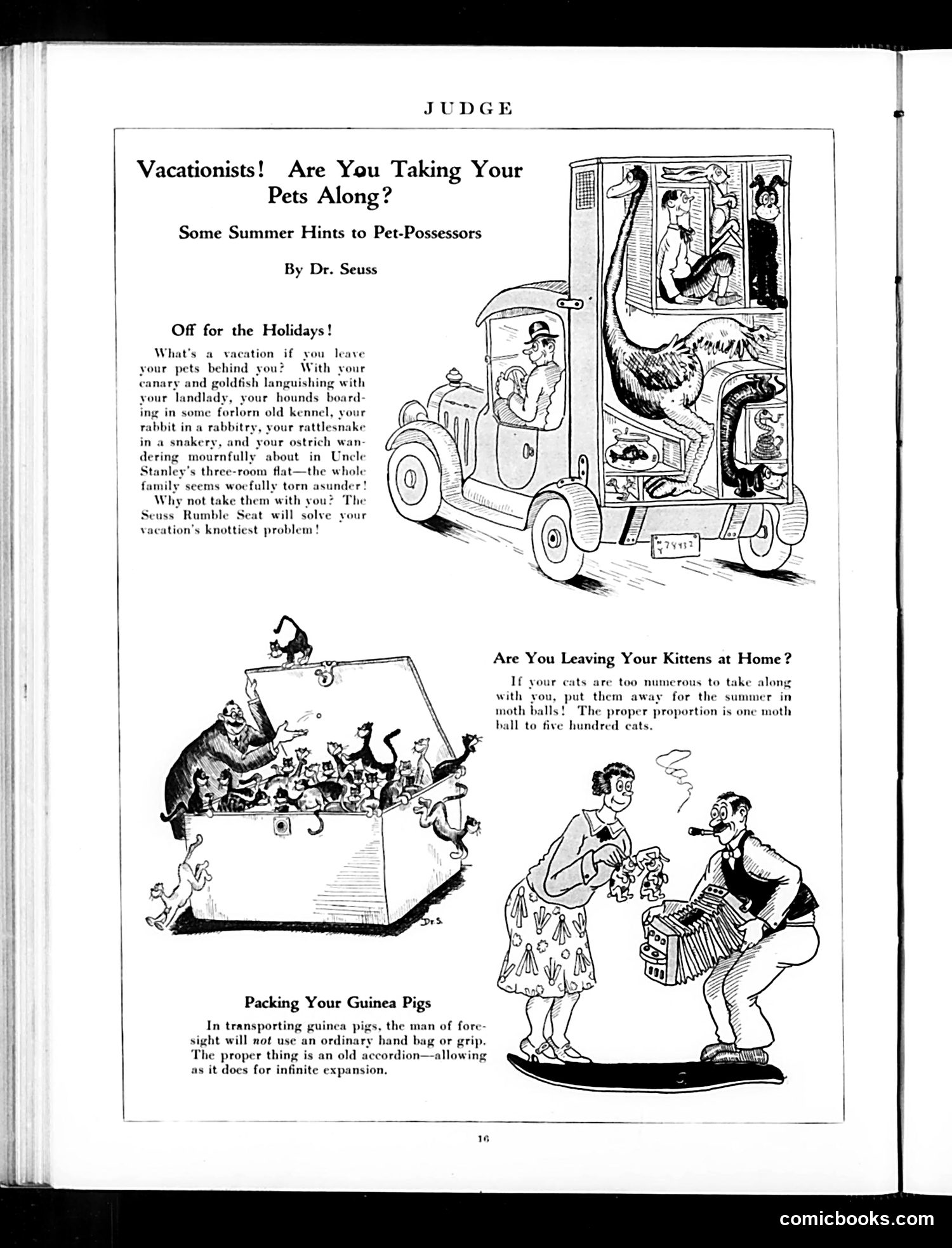
This is a humorous advice column by Dr. Seuss from *Judge* magazine offering absurd "solutions" for vacationing pet owners. The satire works through deliberately impractical and ridiculous suggestions: **"The Seuss Rumble Seat"**: A car modification that comically crams every possible pet (canary, goldfish, hounds, rabbit, rattlesnake, ostrich) into an overflowing contraption—mocking the idea that pets should accompany vacationers. **Kittens in mothballs**: Dark humor suggesting storing cats like winter clothes using an impossible ratio ("one mothball to five hundred cats"), obviously lethal and absurd. **Guinea pigs in accordions**: Using an expandable instrument to transport animals, playing on the word "expansion." The point: vacation pet-care is genuinely complicated, and the column ridicules both overly-sentimental pet owners unwilling to leave animals behind and the impractical alternatives. Seuss uses exaggeration to highlight real vacation dilemmas for pet owners—boarding, kennels, and pet-sitters being inconvenient and anxiety-inducing.
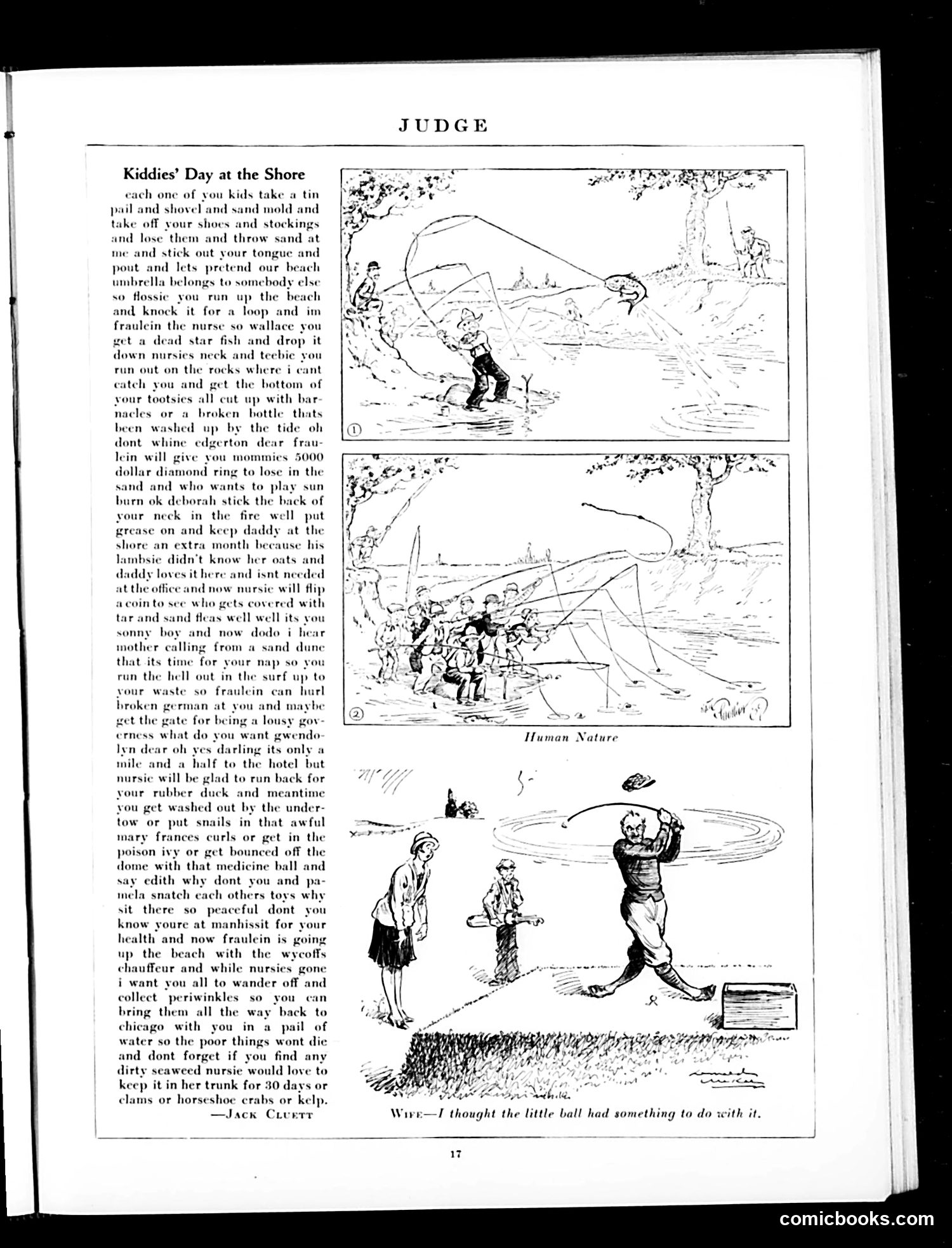
This is satirical parenting advice by Jack Clueett that mocks negligent, chaotic childcare at the beach. The joke presents an absurdly irresponsible "itinerary" where parents encourage kids to: lose belongings, destroy others' property (knock over umbrellas), create hazards (drop dead fish down the nurse's dress), injure themselves on rocks and broken bottles, get sunburned, suffer undertow, collect toxic plants, and wander off unsupervised. The satire targets wealthy early-20th-century parents who hired nurses (Fräulein, nursie) to supervise children while parents socialized, then blamed the hired help when disasters occurred. The elaborate, breathless listing of catastrophes emphasizes parental indifference disguised as permissiveness. The bottom cartoon titled "Human Nature" shows a wife bewildered that a man playing catch is concerned about a ball—implying men obsess over trivial sports while ignoring larger chaos around them.
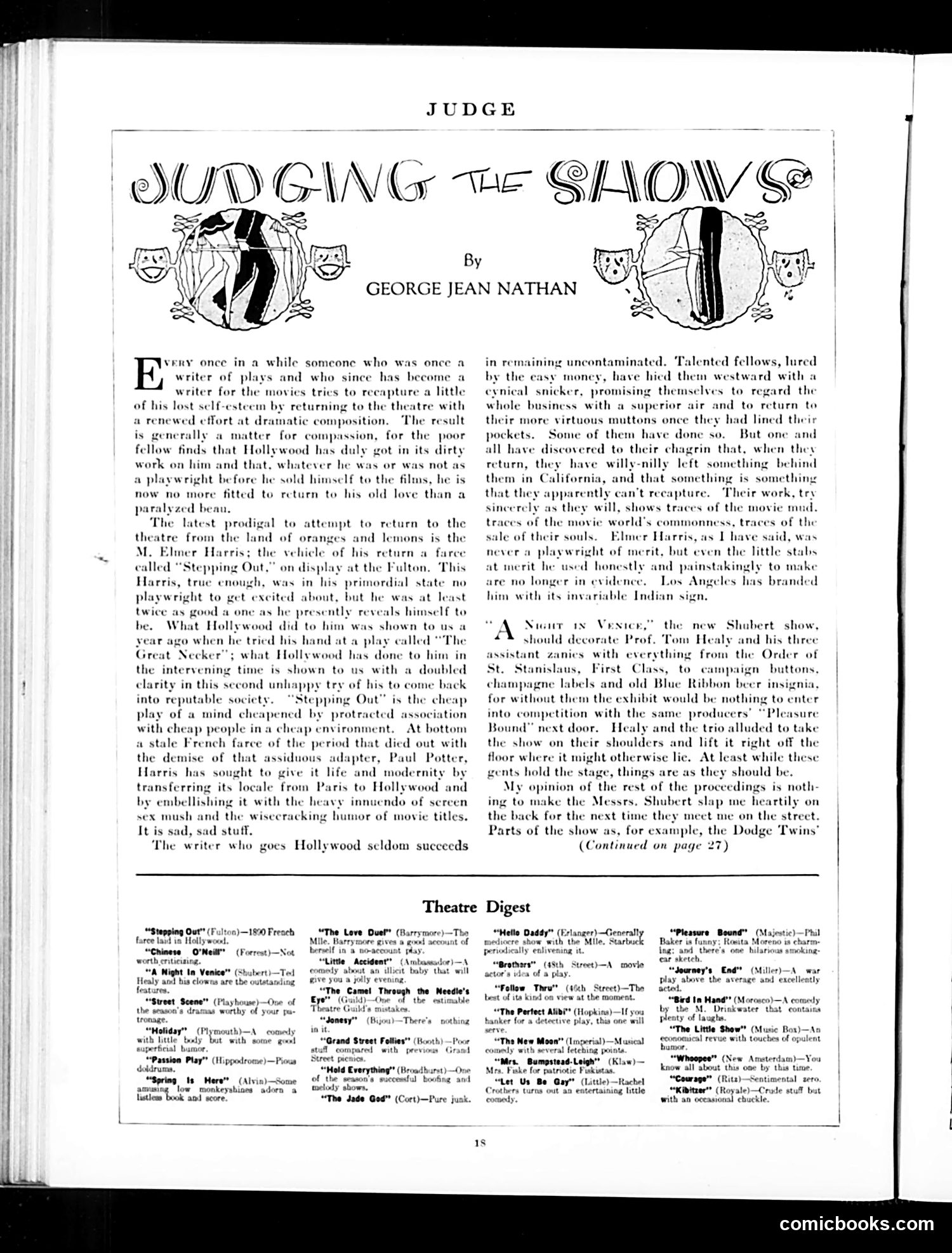
This page presents theater criticism by George Jean Nathan, a prominent drama critic of the era. The main article attacks playwright M. Elmer Harris's new farce "Stepping Out" at the Fulton Theatre. Nathan's central argument: Hollywood corrupts playwrights. Harris, once mediocre but functional, has been further degraded by movie work. Nathan claims screenwriting's cheap sensationalism—"heavy innuendo of screen sex mush and wisecracking humor"—permanently damages writers' abilities. Harris's attempt to revive his theatrical career by transplanting a stale French farce to Hollywood and padding it with movie-style jokes exemplifies this contamination. The piece also briefly praises the Shubert show "A Night in Venice," crediting performers Tom Healy and his team for salvaging weak material. This reflects Jazz Age anxieties about cinema's cultural dominance and its supposed corrupting influence on "serious" theater artists.
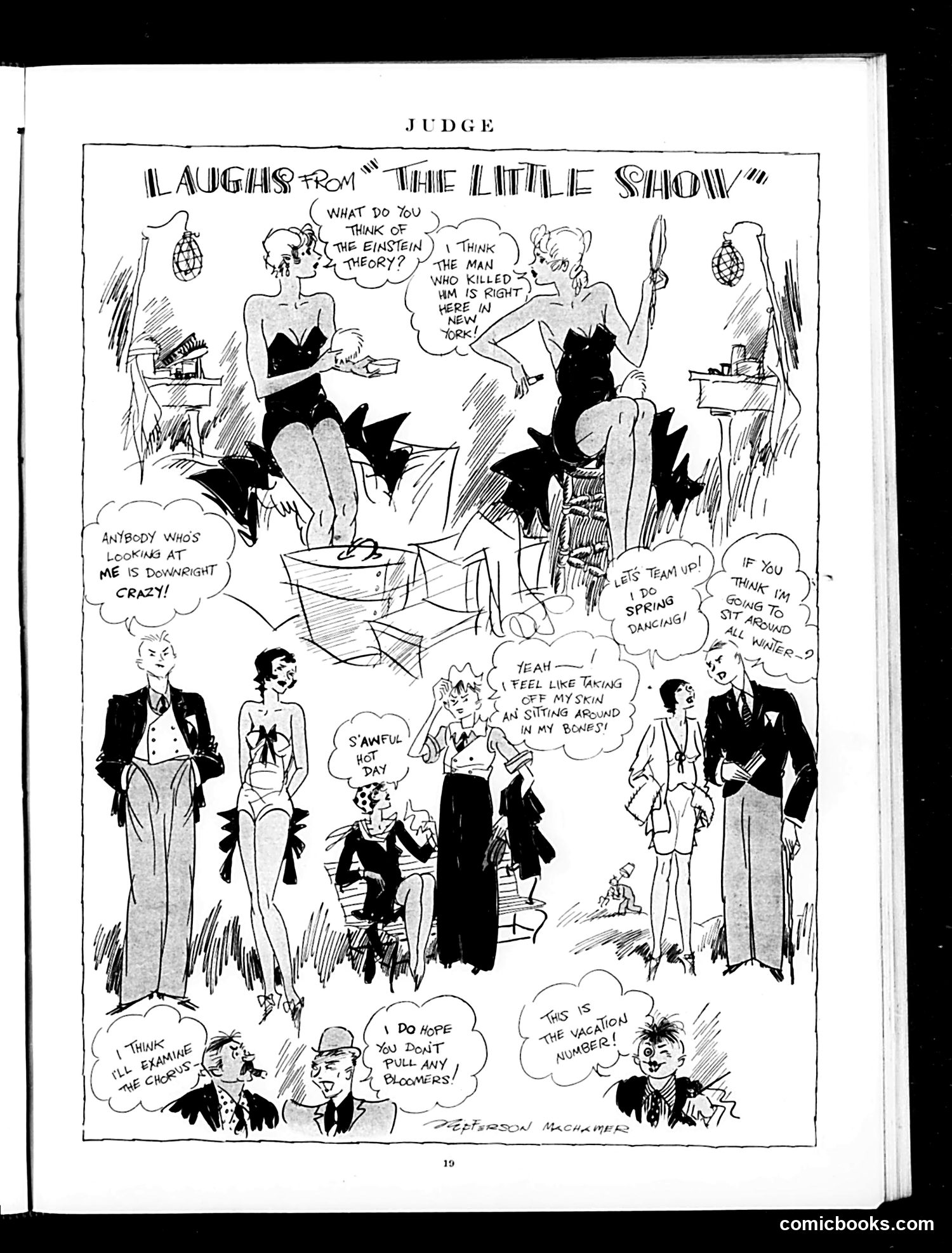
This is a cartoon satirizing a Broadway revue called "The Little Show." The humor derives from characters in elaborate, revealing costumes discussing incongruous topics—Einstein's theory and a murder case—while making complaints about physical discomfort from their skimpy attire ("feel like taking off my skin"). The satire targets the show's apparent attempt to combine intellectual sophistication with scantily-clad performers. Supporting characters (appearing to be theatrical producers or critics) make commentary below, with one expressing concern about "pulling bloomers" (suggesting risqué costume malfunctions). The cartoon mocks the disconnect between highbrow content and lowbrow spectacle—a common Judge magazine critique of entertainment trends. The exaggerated anatomy and sarcastic dialogue emphasize the absurdity of juxtaposing serious topics with burlesque-style presentation.
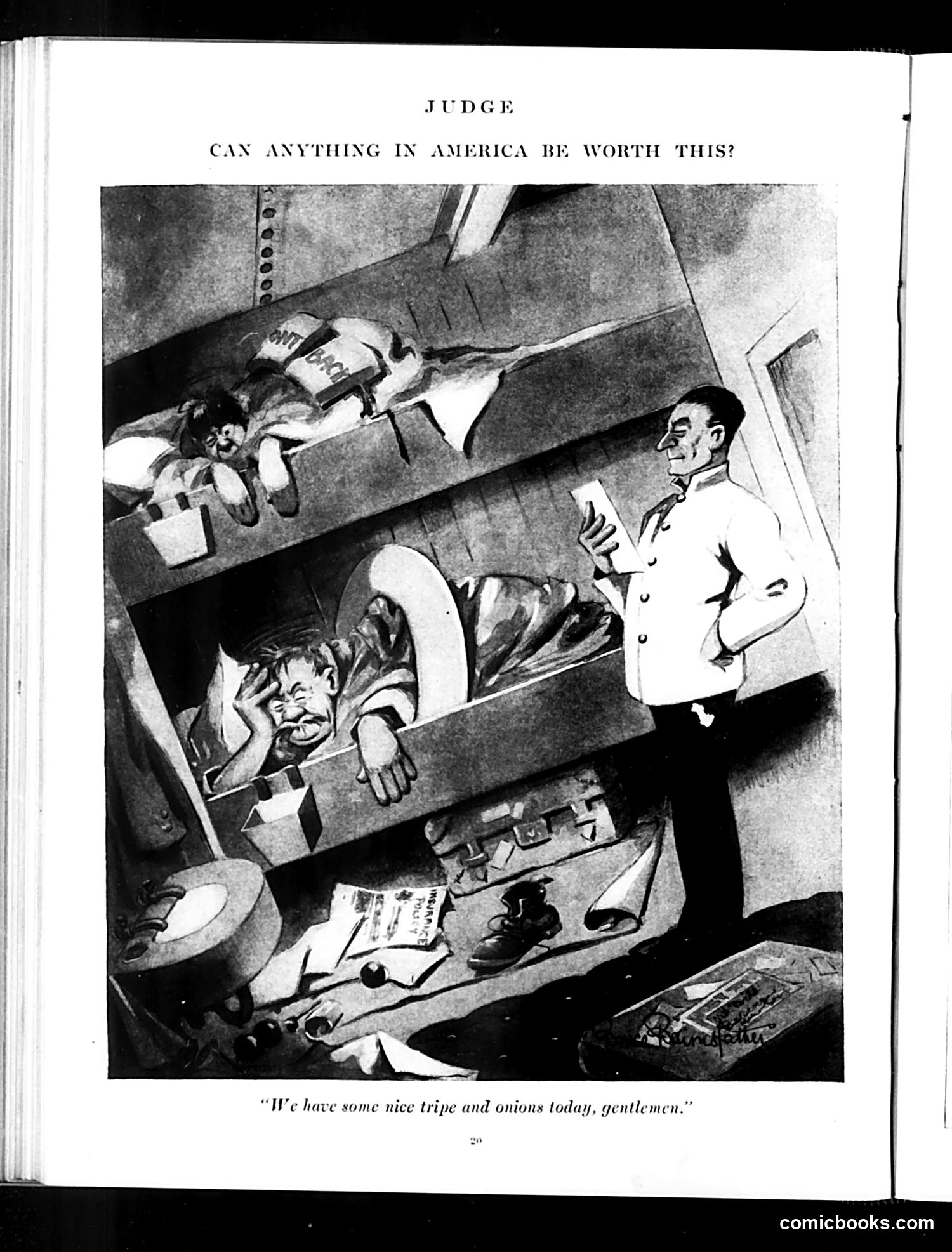
This Judge magazine cartoon satirizes American consumerism and materialism. The headline "CAN ANYTHING IN AMERICA BE WORTH THIS?" frames the critique. The image shows a well-dressed man (appearing to be a wealthy businessman or judge, given the page header) in what seems to be an elegant dining setting, being offered humble fare—"tripe and onions"—by a server. The caricatured faces visible in the scene appear grotesque or exaggerated, suggesting greed or moral degradation. The satire's point: American pursuit of wealth and status is so excessive that even the privileged are reduced to valuing worthless things (literally offal—tripe). The irony undercuts the notion that material success brings dignity or refinement. It's social commentary on Gilded Age excess and American consumer culture's spiritual bankruptcy, mocking those who accumulate wealth without corresponding moral or cultural values.
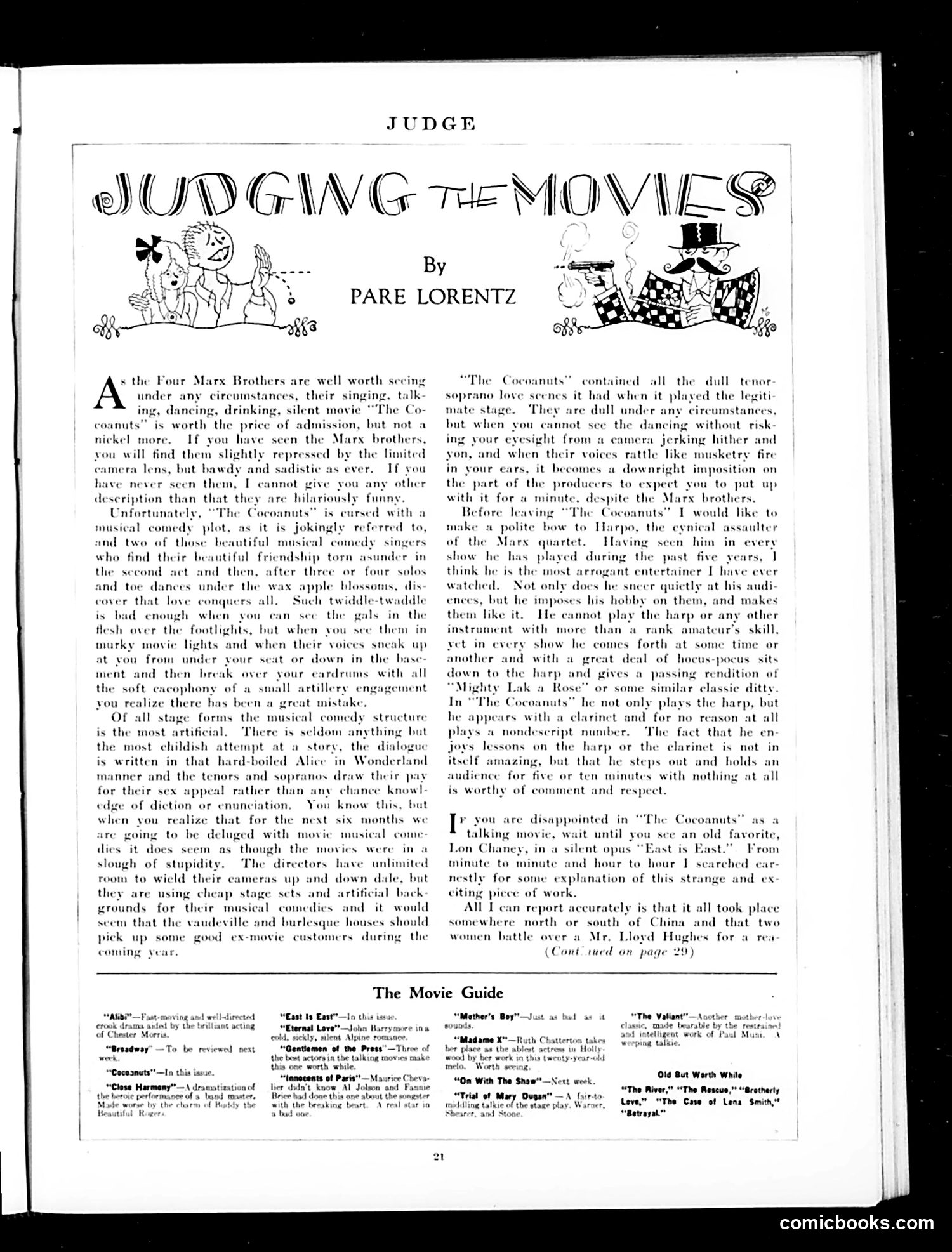
This is a theater review by Pare Lorentz critiquing the Marx Brothers' early talkie *The Cocoanuts* (1929). Lorentz praises the Marx Brothers' comedic talents as "hilariously funny" but harshly criticizes the film's artificial musical-comedy plot with its tedious love scenes and soprano solos—standard Broadway fare that translates poorly to cinema with its "murky movie lights" and disembodied voices "rattle like musketry fire." He particularly singles out Harpo Marx for special scorn, calling him "the most arrogant entertainer" for his harp and clarinet performances, which Lorentz sees as ego-driven interruptions lacking real skill—mere "hocus-pocus" meant to manipulate audiences. The broader satire targets Hollywood's rush to adapt stage musicals for talking pictures without adapting them cinematically, using cheap sets and artificial backdrops. Lorentz predicts vaudeville theaters will recoup customers from disappointed moviegoers during this coming "slough of stupidity."
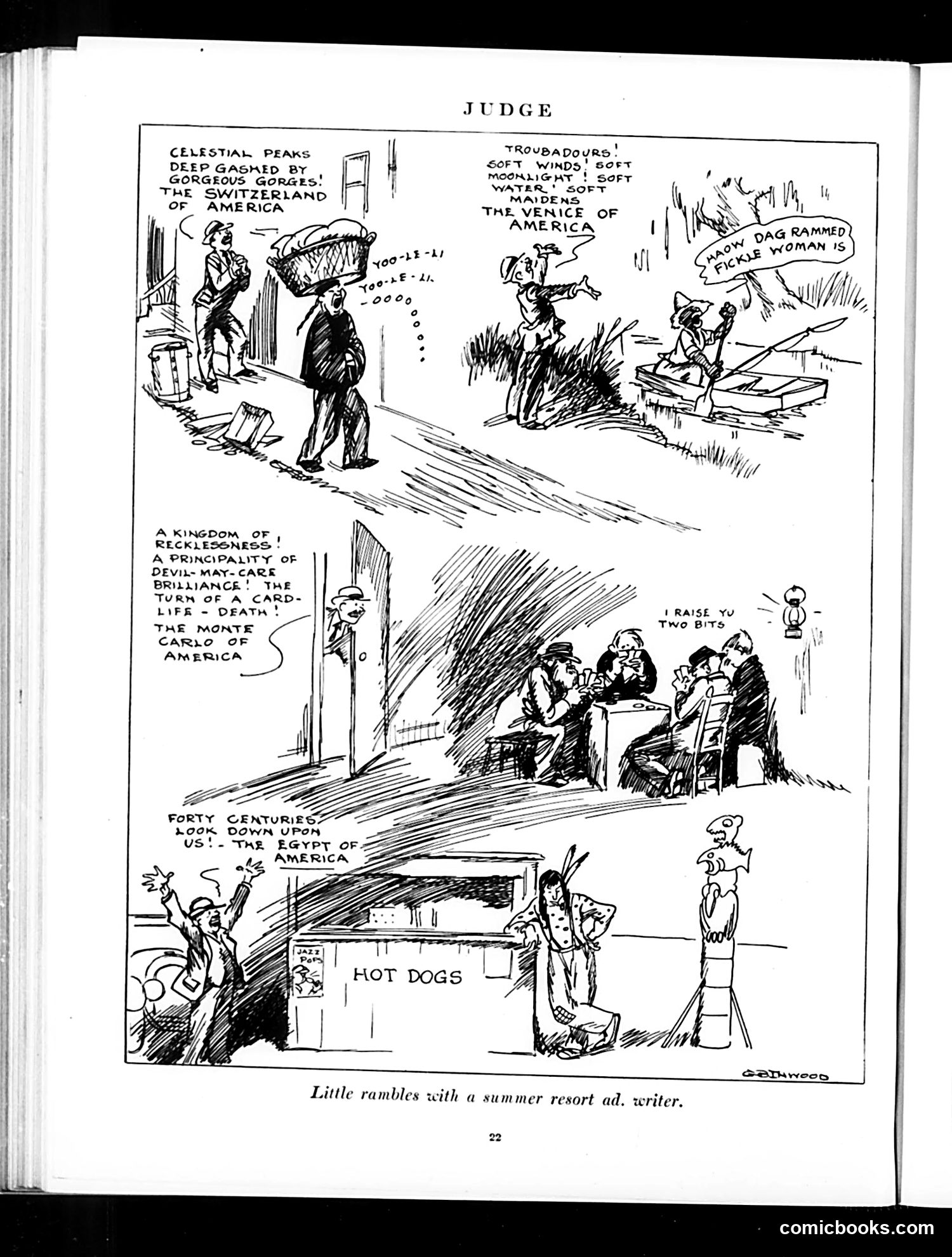
This cartoon satirizes **summer resort advertising copy** from the early 20th century. The joke mocks the grandiose, hyperbolic language resort promoters used to market American destinations. The upper panels show actual resort ads making absurd claims—comparing American locations to famous European landmarks: "Switzerland of America," "Venice of America," "Monte Carlo of America," and "Egypt of America." These comparisons were standard marketing exaggeration. The lower panels reveal the reality: a hot dog stand and ordinary vacation scenes—the mundane truth behind flowery promotional language. The satire targets how advertisers transformed modest American resorts into fantastical destinations through pure linguistic excess, selling ordinary middle-class getaways as exotic, worldly experiences. For modern readers, this exemplifies early advertising's creative dishonesty and consumers' gullibility toward marketing hyperbole—a practice that continues today.
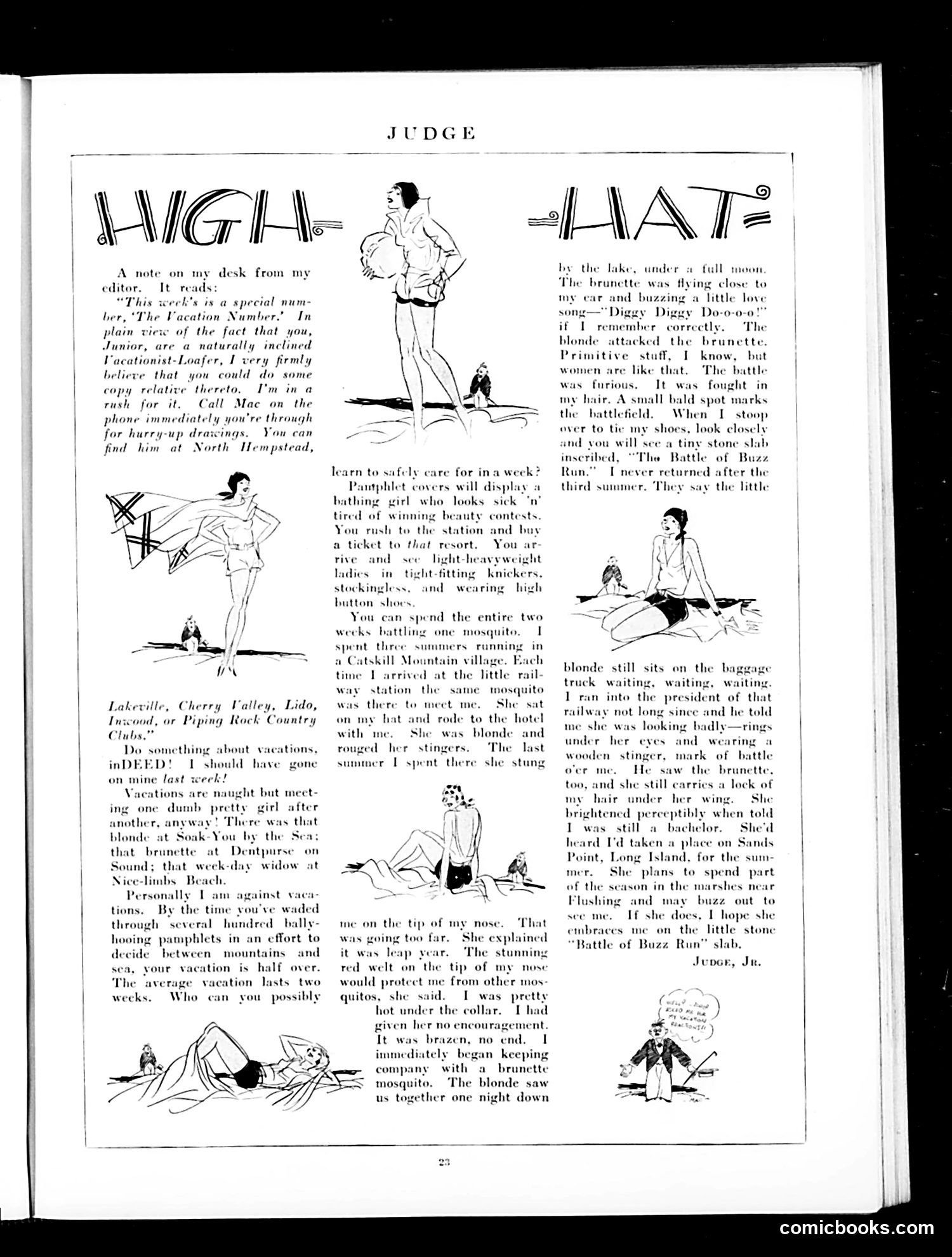
This is a humorous essay titled "High" and "Swat" by Judge Jr., satirizing American vacation culture in the early 20th century. The piece mocks the impracticality of vacations: promotional pamphlets waste time deciding where to go, leaving little actual vacation time remaining. The main joke concerns three mosquitoes encountered during summers in a Catskill Mountain village. The author develops a comedic love triangle: he abandons a blonde mosquito for a brunette, triggering a jealous battle in his hair that leaves a bald spot. Years later, the abandoned blonde still waits at the railway station for him. The satire operates on two levels: it ridicules vacation marketing hype while using the absurd mosquito narrative to parody romantic melodrama and women's supposedly irrational jealousy ("women are like that"). The accompanying pen-and-ink illustrations depict the author in various vacation scenarios and the climactic mosquito confrontation. The piece targets leisure industry exaggeration and early 20th-century gender stereotypes simultaneously.
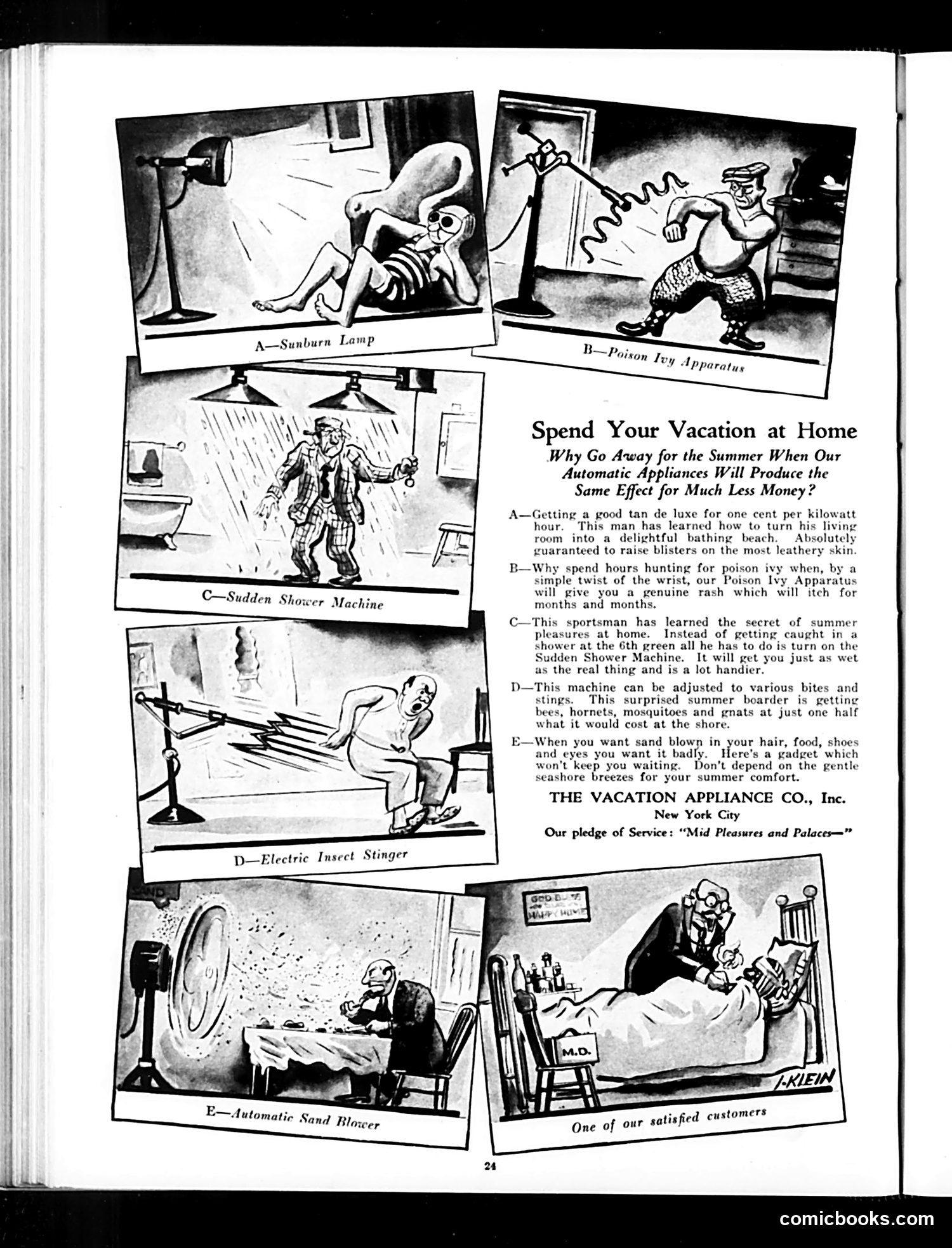
This is a satirical advertisement from Judge magazine mocking the emerging consumer culture of automatic home appliances in early 20th-century America. The "Vacation Appliance Co." is a fictional company selling absurd machines that replicate unpleasant vacation experiences: sunburn lamps, poison ivy dispensers, shower machines, insect-sting devices, and sand blowers. The satire targets two trends: 1. **Marketing excess**: Companies claiming appliances solve every problem while actually creating discomfort 2. **Consumerism replacing nature**: The implication that Americans are becoming so dependent on buying convenience that they'd literally purchase machines to recreate natural (and unpleasant) vacation experiences rather than actually vacationing The joke's bite comes from the absurdity being just plausible enough—if companies were selling these "solutions," they'd genuinely market them as money-saving alternatives to travel. The final satisfied customer image ironically validates the concept, amplifying the satire's criticism of blind consumer faith in technological "progress."
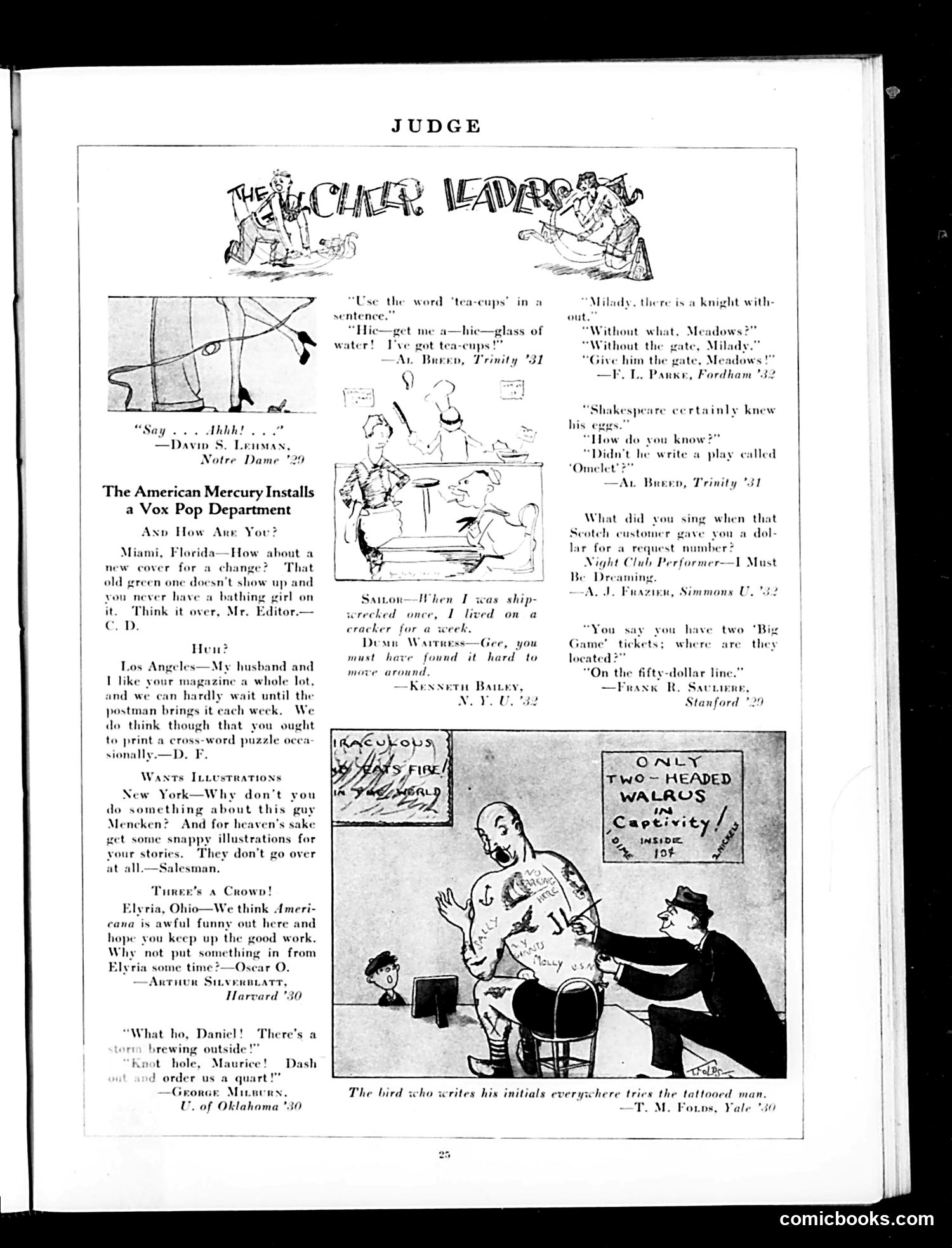
This page from **Judge** magazine features a "Vox Pop" column from *The American Mercury*, a satirical publication edited by H.L. Mencken. The page collects humorous reader letters and joke submissions—a common magazine format of the era. The content consists mostly of brief, punny jokes submitted by college students (noted by their school affiliations). Examples include wordplay about "teacups" vs. "tea-cups," Shakespeare's knowledge of eggs (pun on "Hamlet"), and a sailor's shipwreck story with a weak punchline. The prominent cartoon shows a tattooed man with "Only Two-Headed Walrus in Captivity" marked on his body, while a smaller figure writes initials on him—the joke being someone compulsively writing their initials everywhere, even on people. The page satirizes reader submissions to literary magazines and the often-corny humor college students found clever. It's primarily **comedic filler content** rather than political satire, showcasing the magazine's irreverent approach to culture and education.
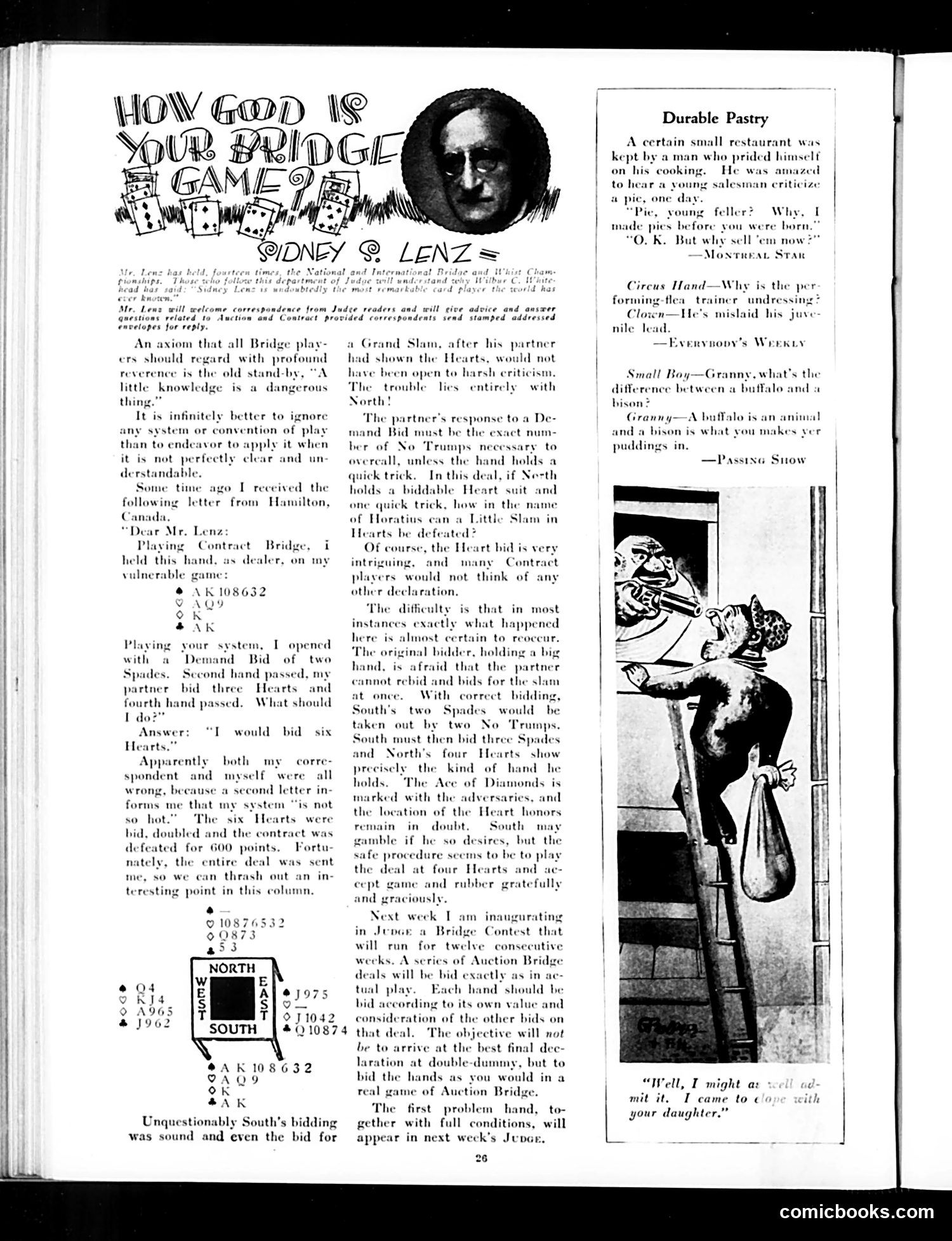
This page from *Judge* magazine is primarily a **bridge card game column** by Sidney Lenz, a famous contract bridge expert. The content is instructional rather than satirical. The column addresses a reader's bridge hand problem from Hamilton, Canada. Lenz explains bidding strategy, critiquing both the original bidder and responder's decisions that led to a failed slam contract. The lesson concerns proper signaling in contract bridge—specifically, that responders should indicate their hand's exact strength through precise bids rather than aggressive slam attempts. The right column contains **light humor fillers** unrelated to bridge: jokes about a pie maker's longevity, a circus flea trainer's costume malfunction, and a pun distinguishing "buffalo" from "bison" (what makes puddings "rise"). The portrait appears to be Lenz himself, establishing his authority on the subject. This represents *Judge*'s adaptation to 1920s-30s leisure culture, mixing satirical tradition with practical advice for popular pastimes like contract bridge.
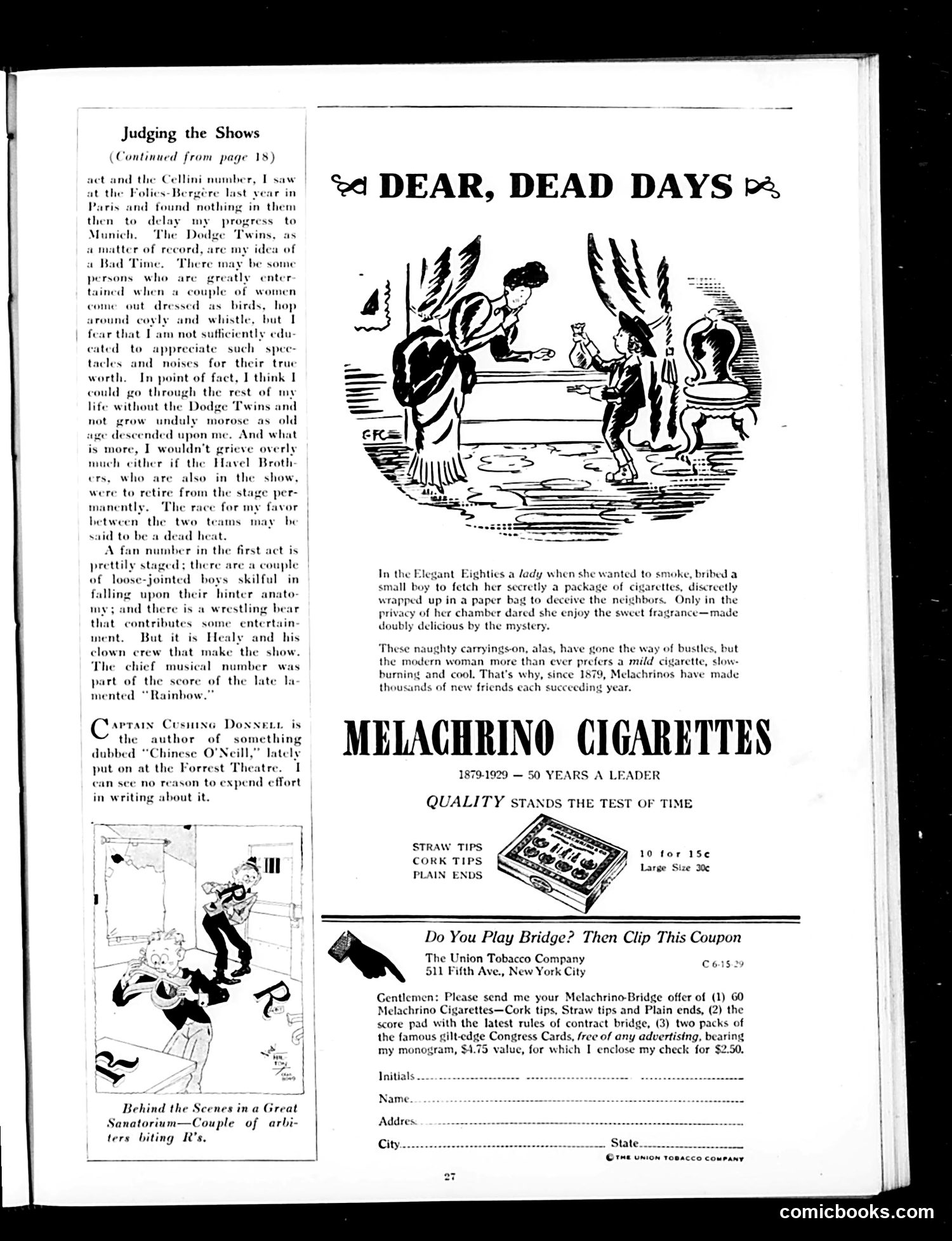
This page is primarily a **cigarette advertisement** for Melachrino brand, disguised as nostalgic social commentary. The top cartoon depicts a Victorian-era lady secretly bribing a boy to fetch her cigarettes in disguise, highlighting how scandalous women smoking was in the 1880s. The text sardonically notes that such "naughty carryings-on" are now obsolete—modern women openly smoke mild cigarettes. The advertisement celebrates this social change while promoting Melachrino as "slow-burning and cool," positioning the brand as sophisticated and modern (founded 1879, now at 50 years). The coupon offers bridge players a deal combining cigarettes with bridge score pads and Congress Cards—targeting a specific leisure-class demographic in 1929. The left column contains unrelated theater reviews by what appears to be Judge magazine's drama critic, critiquing various stage shows.
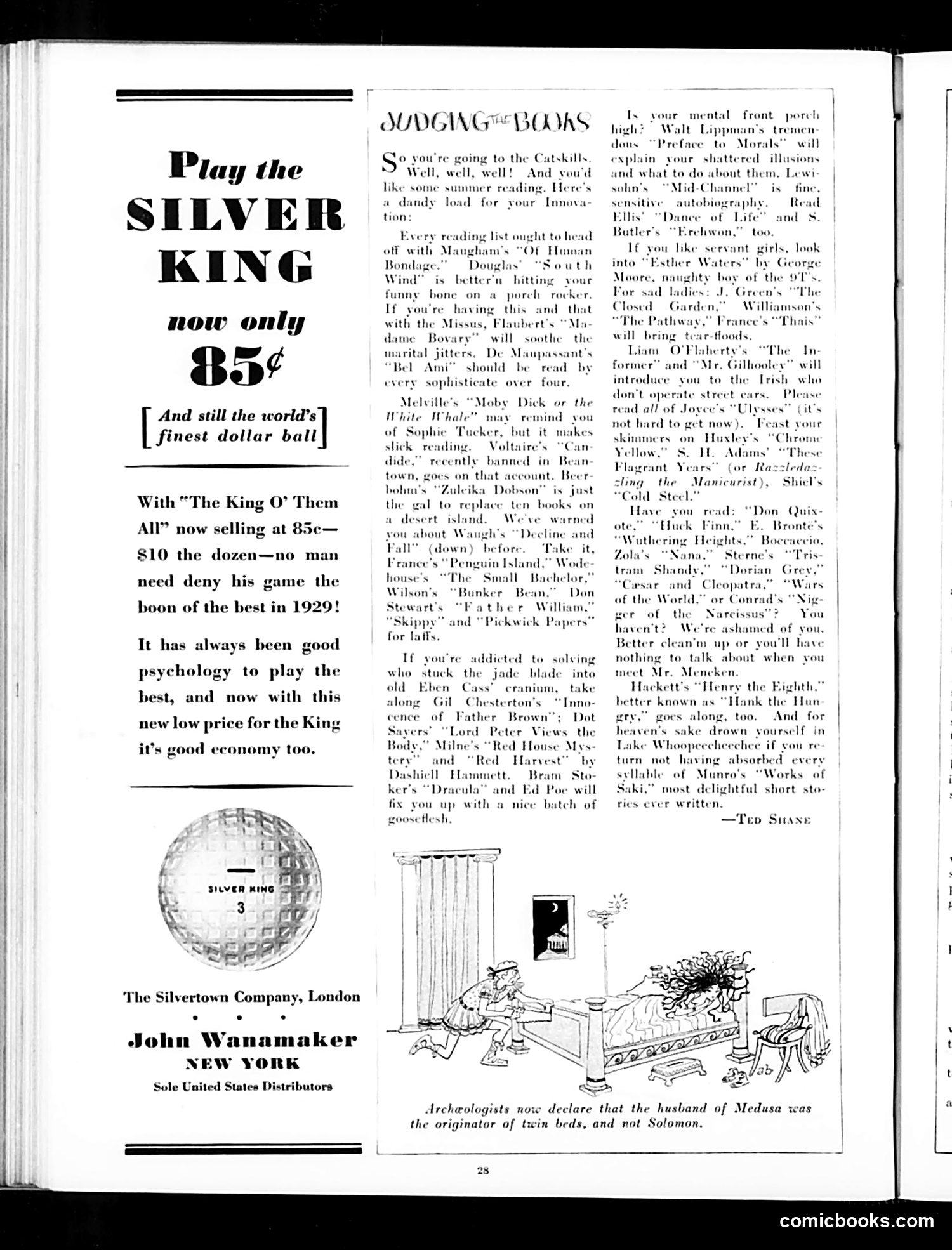
This page is primarily **advertising and book recommendations**, not political satire. The left side advertises the "Silver King" baseball—a consumer product pitched as economical at 85¢. The right side contains a humorous **summer reading list** by Ted Shane, recommending classic and contemporary literature (Maugham, Melville, Joyce, Flaubert, etc.). The joke is that it's structured as advice for different romantic/marital situations: books for the Catskills, for soothing marital discord, for "servant girls," etc. This satirizes how people use literature to escape their lives. The small cartoon at bottom shows a husband in bed while his wife rants—illustrating the caption's joke that twin beds, not Solomon, originated with Medusa's husband. This is a mild domestic humor gag about married couples' sleeping arrangements. The page reflects 1920s consumer culture and literary taste-making, with no significant political content.
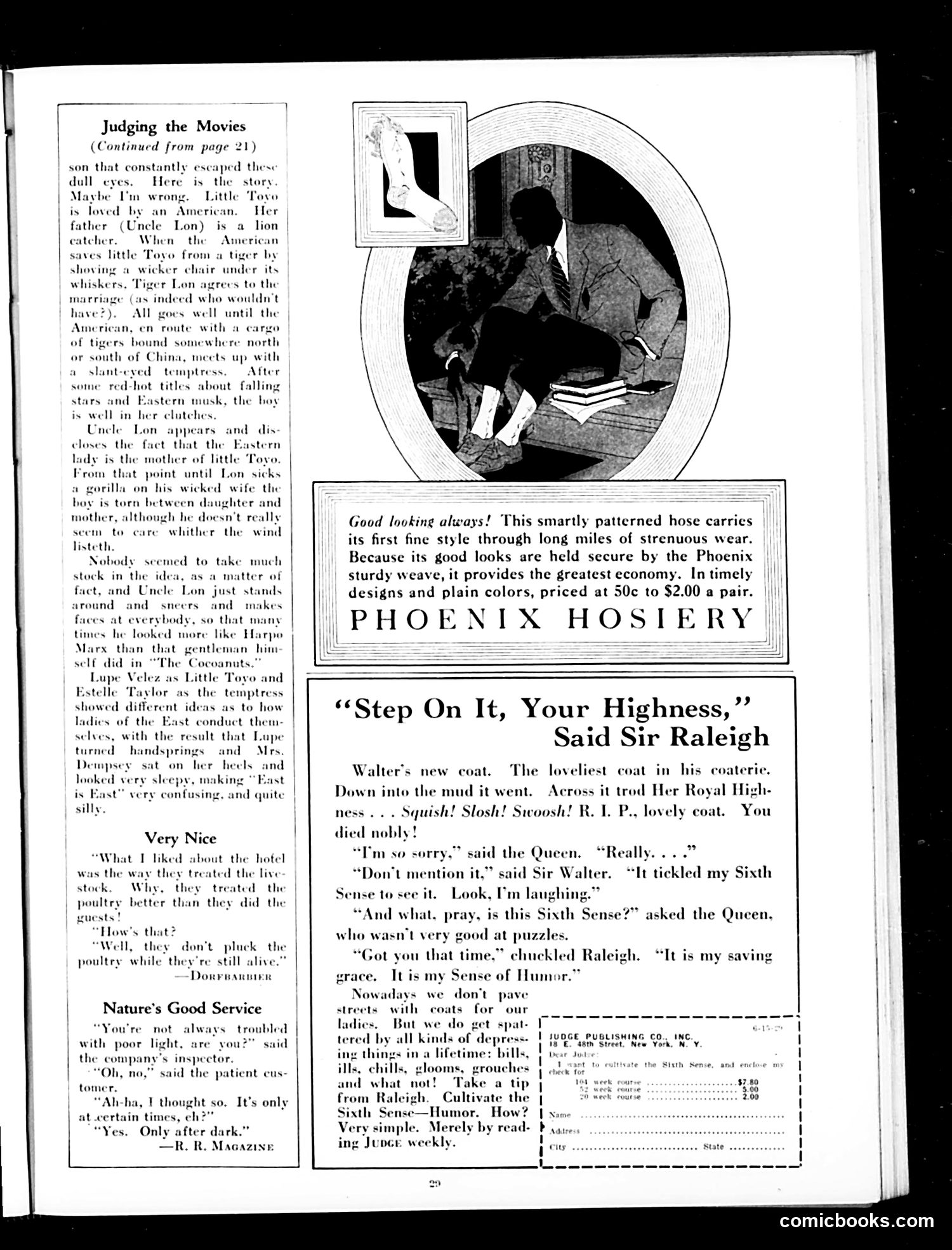
This page features a humorous short story parodying the legend of Sir Walter Raleigh placing his coat in mud for Queen Elizabeth I. The satire inverts the historical narrative: here, Raleigh deliberately sacrifices his "lovely coat" to the mud, then jokes that it tickled his "Sixth Sense"—his sense of humor. The joke satirizes performative chivalry and masculine vanity. Rather than noble self-sacrifice, Raleigh appears foolishly comedic, claiming his destroyed coat demonstrates wit rather than devotion. The Queen's confusion about his "Sixth Sense" (since she's "not very good at puzzles") adds to the absurdist humor. The piece mockingly suggests that cultivating humor—particularly the ability to laugh at one's own misfortunes—is more valuable than grand romantic gestures. It's gentle satire of outdated courtly behavior and the pretense surrounding historical "gallantry." The rest of the page contains movie reviews and advertisements unrelated to this story.
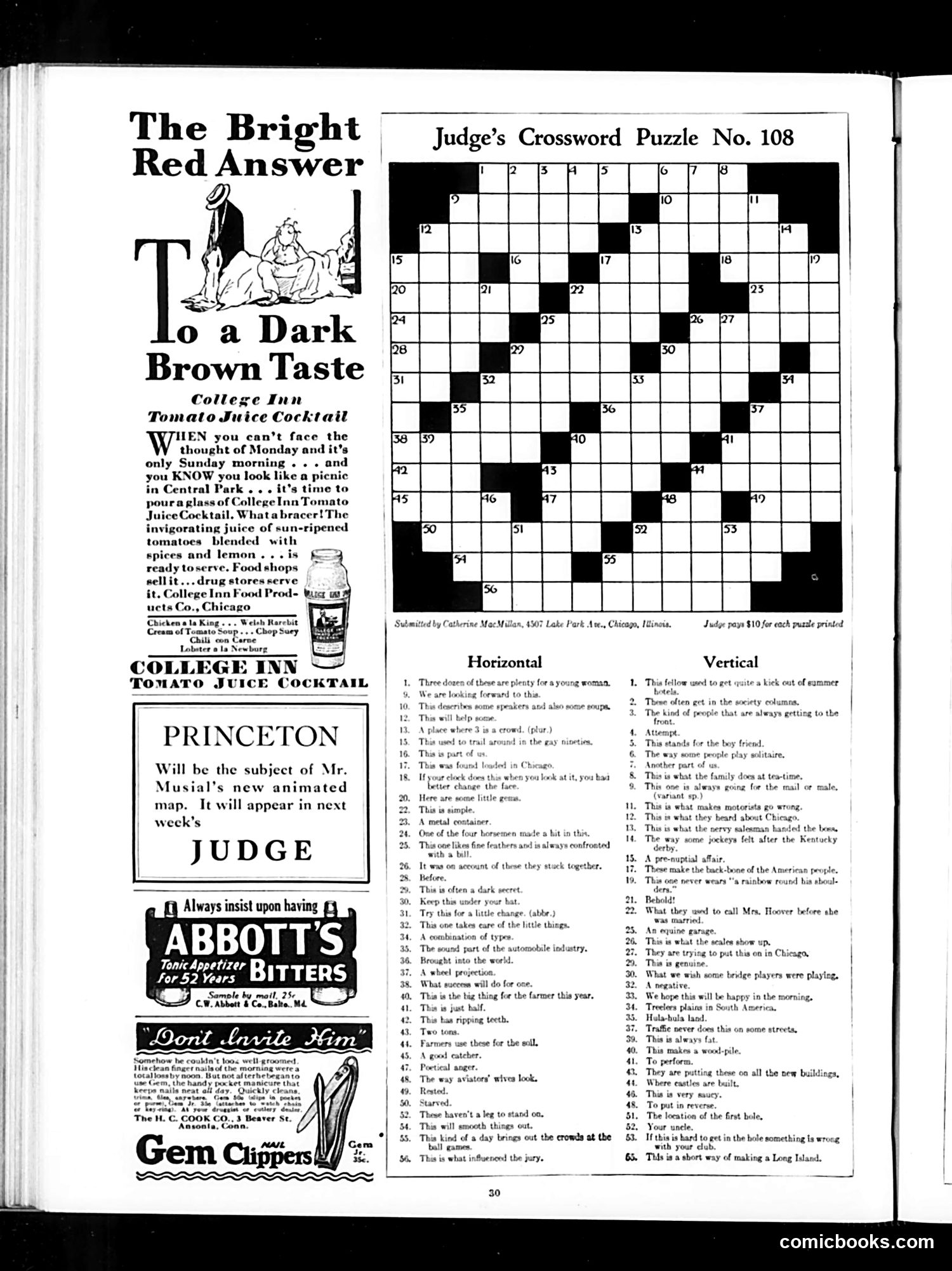
This page is primarily **advertising and a crossword puzzle**, not political satire. The dominant content includes: 1. **College Inn Tomato Juice Cocktail ad** (left): A tongue-in-cheek advertisement using humor to sell a hangover remedy. The copy acknowledges Monday blues and Sunday regret with self-aware jokes about looking "like a picnic in Central Park"—meaning disheveled. 2. **Crossword Puzzle No. 108** (center/right): A standard Judge feature with typical clues of the era referencing contemporary culture (Chicago, Kentucky Derby, bridge players, aviators' wives). 3. **Other ads**: Abbott's Bitters, Gem Clippers, and a notice about an upcoming animated map of Princeton by "Mr. Musial." The page reflects **1920s-30s advertising culture**—using mild self-deprecating humor to sell products to a middle/upper-class audience. There is no significant political commentary, just commercialism dressed in period witticisms.
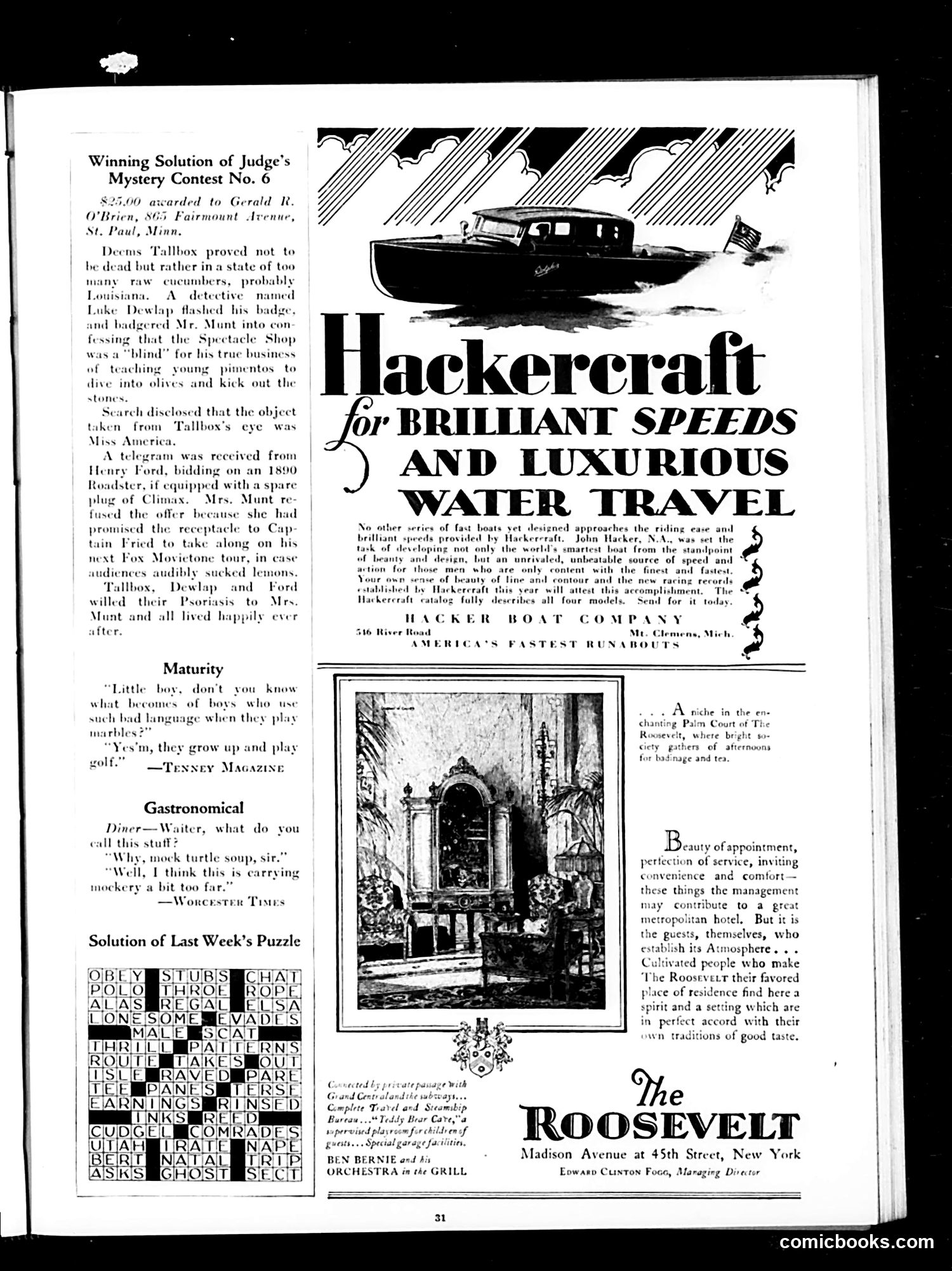
This page is primarily **advertising and contest results**, not political satire. The top section announces the winning solution to "Judge's Mystery Contest No. 6"—a puzzle contest where readers solved a narrative mystery involving characters named Deems Tallbox, Luke Dewlap, and Mr. Munt. The winner received $25. The page also contains **humor filler**: three brief jokes about maturity, food (turtle soup), and social etiquette from various publications. The advertisements dominate the page: - **Hackercraft boats** (center): promoting luxury speedboats for wealthy consumers - **The Roosevelt hotel** (lower right): a high-end Manhattan establishment emphasizing refinement and service The small illustration shows the Roosevelt's interior courtyard. This is a typical **commercial magazine page** mixing light humor with luxury advertising aimed at Judge's affluent readership. There is no evident political commentary or social satire present.
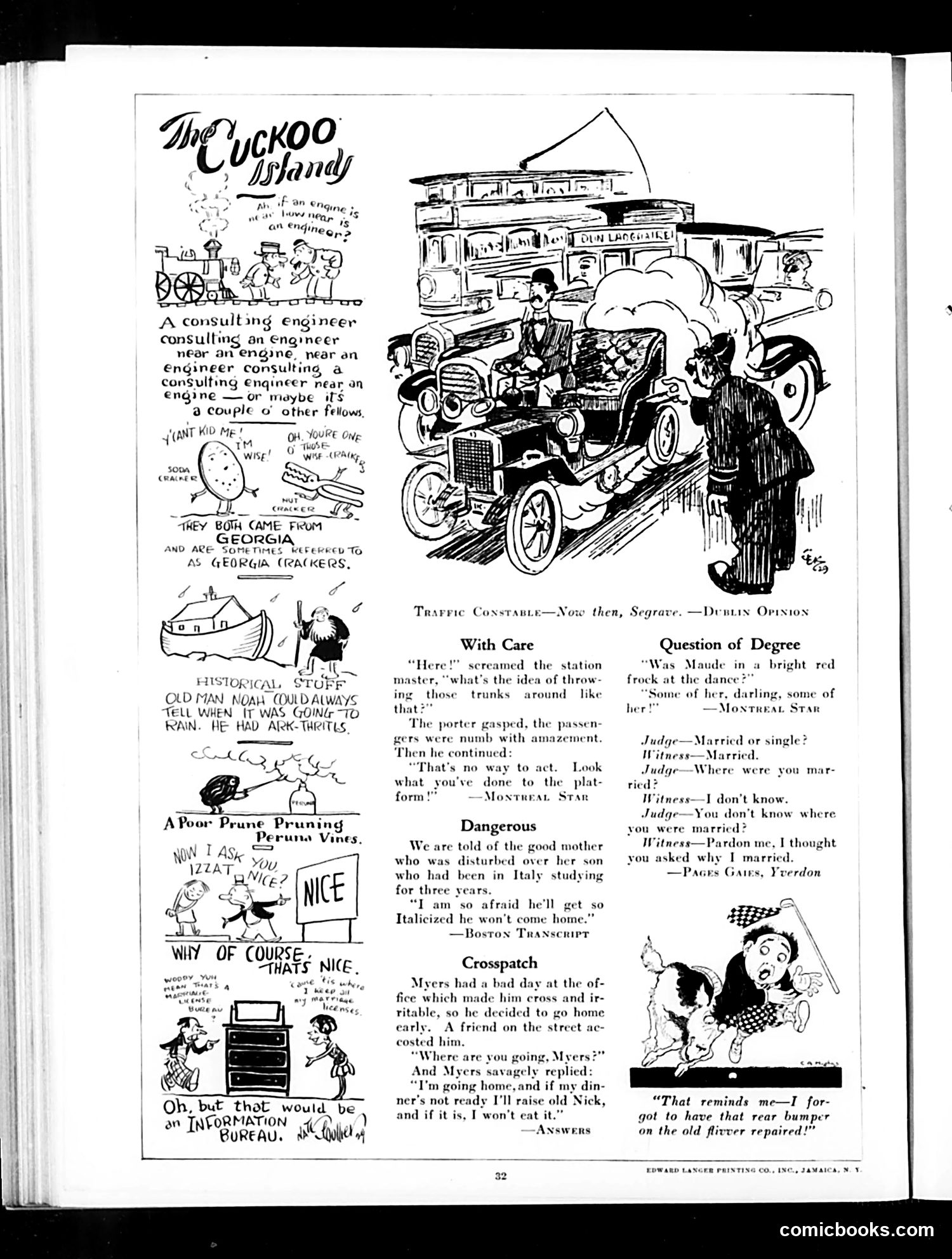
This is a **humor and satire page** from Judge magazine featuring multiple unrelated comic strips and joke columns typical of early 20th-century American periodicals. The content includes: 1. **"The Cuckoo Island"** — A nonsensical wordplay joke about consulting engineers, playing on circular logic and redundancy. 2. **"A Poor Prune Pruning Prune Vines"** — A visual pun where someone asks a character to prune vines, misheard as "prunes," leading to absurdist humor about an "Information Bureau." 3. **Short humor items** ("With Care," "Dangerous," "Crosspatch," "Question of Degree") — Brief anecdotes mocking human behavior: station porters abusing luggage, anxious mothers, irritable men, courtroom witness confusion, and absent-minded car owners. The large **central illustration** shows an early automobile with exaggerated passengers and luggage, captioned about traffic rules—emphasizing early automotive-era humor. These are **generic observational jokes** without political content, typical of Judge's satirical approach to everyday American life and human foibles, targeting middle-class readers.
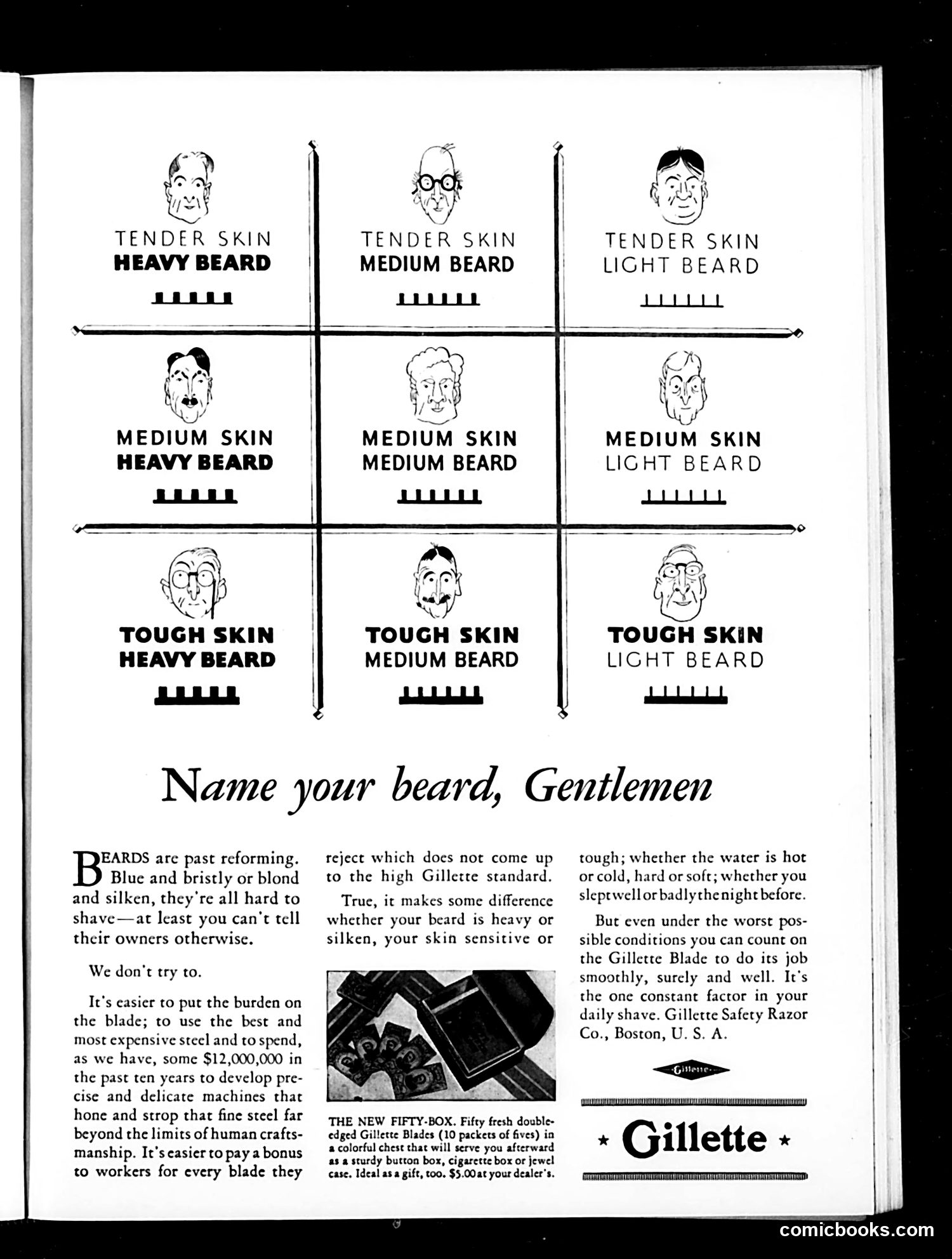
This is primarily a **Gillette Safety Razor advertisement**, not political satire. The content uses humor to sell razor blades rather than to comment on current events. The "Name Your Beard" chart is a **humorous classification system** organizing nine male face types by skin texture (tender/medium/tough) and beard density (heavy/medium/light). The cartoon faces illustrate each category with exaggerated features—a playful way to suggest that different men have different shaving challenges. The ad's core argument is **anti-boastful**: Gillette claims it doesn't blame beards for poor shaves (as competitors might). Instead, it invested $12 million over ten years in superior blade engineering and quality control. The company positions itself as putting the burden of performance on its product, not the user's facial hair. The "Fifty-Box" promotion offers 50 blades in an attractive chest serving double duty as storage—a practical gift angle for the era. This appears to be vintage advertising, likely early-to-mid 20th century, emphasizing manufacturing precision as a selling point.
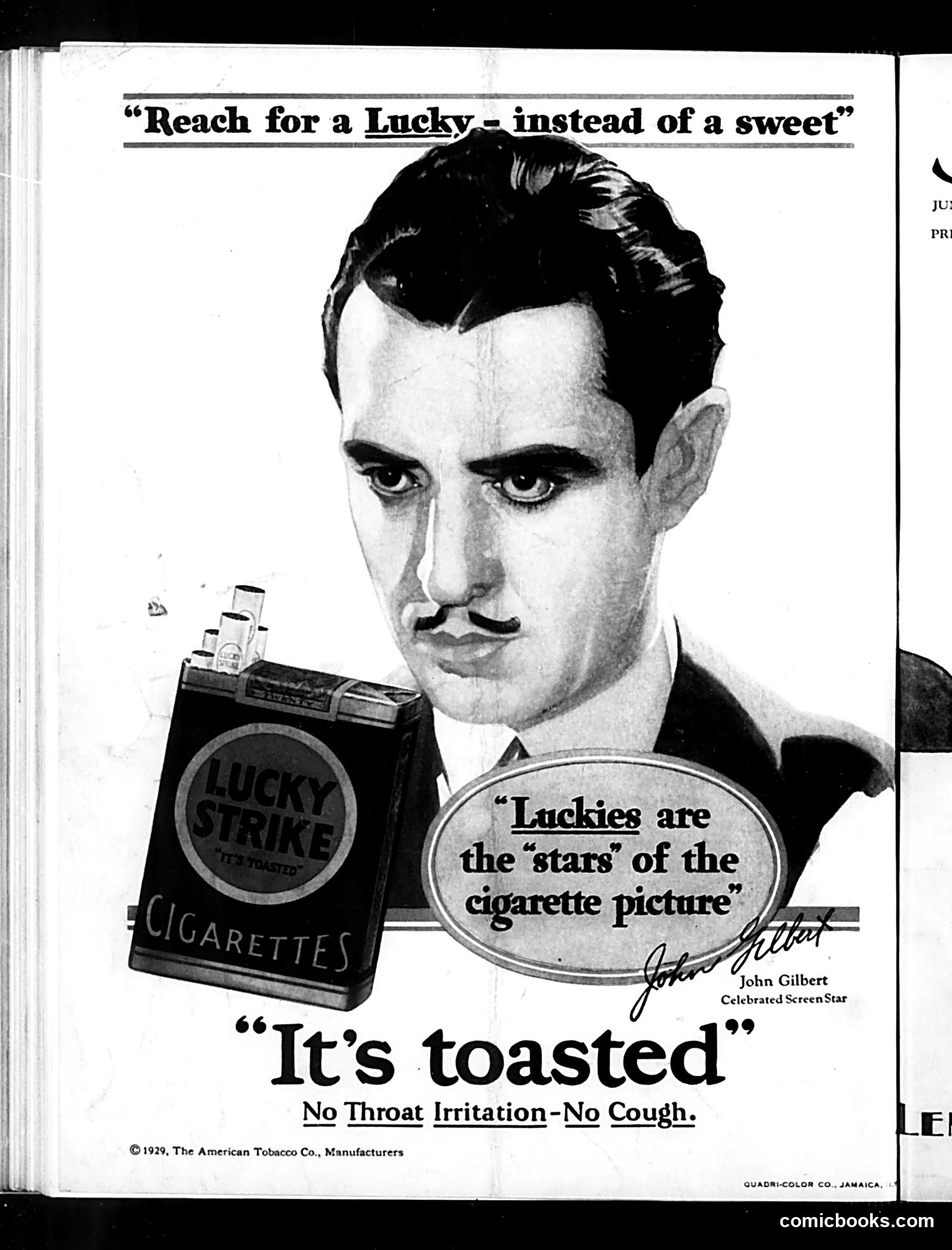
This is a **cigarette advertisement**, not political satire. It features John Gilbert, a celebrated silent film star of the 1920s, endorsing Lucky Strike cigarettes. The ad's slogan—"Reach for a Lucky instead of a sweet"—promotes cigarettes as a weight-control alternative to candy, a common marketing tactic of that era targeting women concerned about staying thin. The tagline "It's toasted" and "No Throat Irritation—No Cough" represent early cigarette health claims. Gilbert's quote about Luckies being "stars" of cigarette pictures plays on his Hollywood celebrity status for endorsement credibility. This reflects 1929 advertising before tobacco's health dangers were widely acknowledged or regulated.