
Judge, 1929-06-15 · page 20 of 36
Judge — June 15, 1929 — page 20: what you’re looking at
What you’re looking at
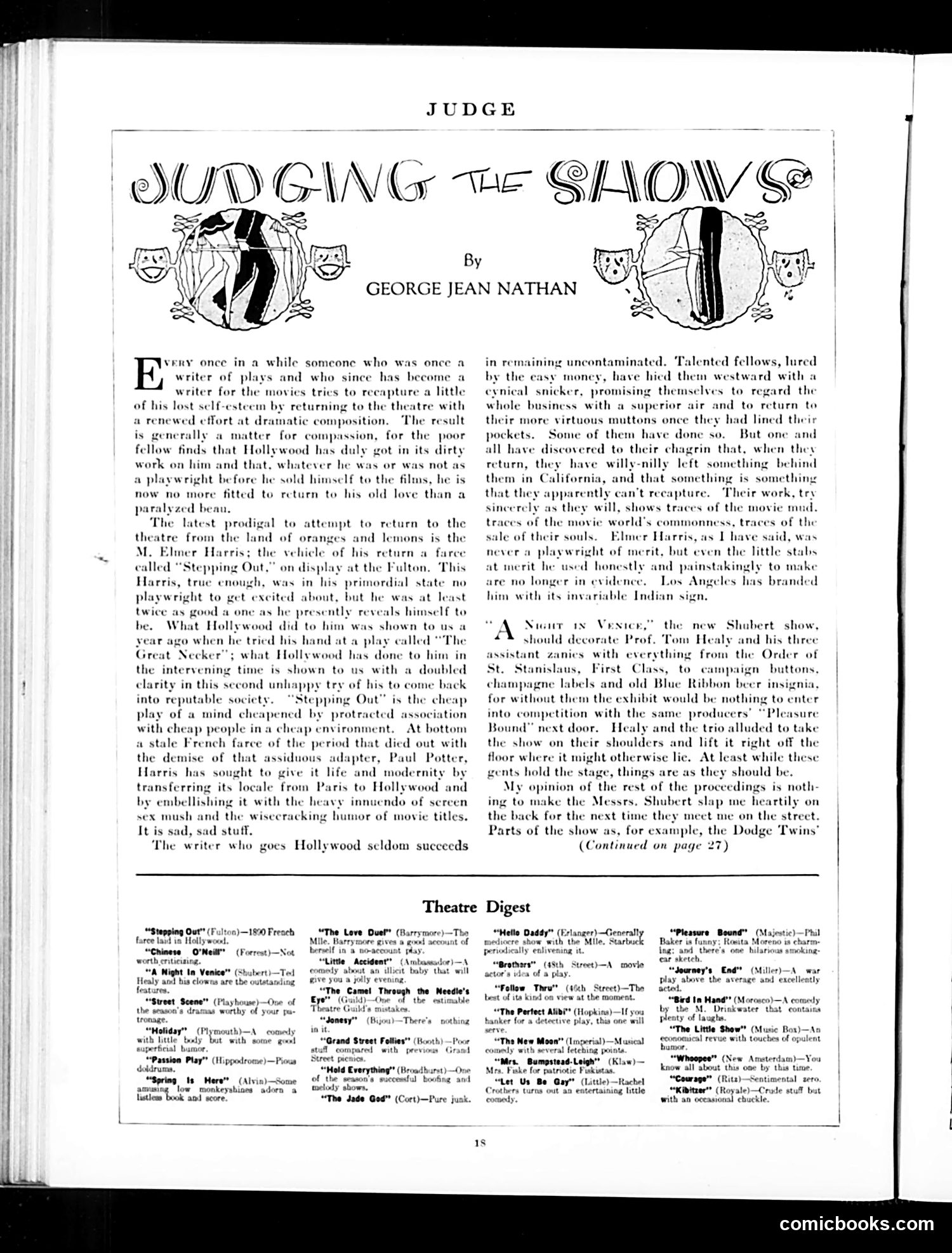
This page presents theater criticism by George Jean Nathan, a prominent drama critic of the era. The main article attacks playwright M. Elmer Harris's new farce "Stepping Out" at the Fulton Theatre. Nathan's central argument: Hollywood corrupts playwrights. Harris, once mediocre but functional, has been further degraded by movie work. Nathan claims screenwriting's cheap sensationalism—"heavy innuendo of screen sex mush and wisecracking humor"—permanently damages writers' abilities. Harris's attempt to revive his theatrical career by transplanting a stale French farce to Hollywood and padding it with movie-style jokes exemplifies this contamination. The piece also briefly praises the Shubert show "A Night in Venice," crediting performers Tom Healy and his team for salvaging weak material. This reflects Jazz Age anxieties about cinema's cultural dominance and its supposed corrupting influence on "serious" theater artists.
📄 Transcribed text from this page (OCR, searchable)
Machine-transcribed from the original scan — historical spelling and the odd misread are preserved.
By very once in a while someone who was once a writer of plays and who since has become a writer for the movies tries to recapture a little of his lost self-esteem by returning to the theatre with a renewed effort at dramatic composition. The result is generally a matter for compassion, for the poor fellow finds that Hollywood has duly got in its dirty work on him and that, whatever he was or was not as a playwright before he sold himself to the films, he is now no more fitted to return to his old love than a paralyzed beau. The latest prodigal to attempt to return to the theatre from the land of oranges and lemons is the M. Elmer Harris; the vehicle of his return a farce called “Stepping Out,” on display at the Fulton. ‘This Harris, true enough, was in his primordial state no playwright to get excited about, but he was at least twice as good a one as he presently reveals himself to be. What Hollywood did to him was shown to us a year ago when he tried his hand ata play called “The Great Necker”; what Hollywood has done to him in the intervening time is shown to us with a doubled clarity in this second unhappy try of his to come back into reputable society. “Stepping Out” is the cheap play of a mind cheapened by protracted association with cheap people ina cheap environment. At bottom a stale French farce of the period that died out with the demise of that assiduous adapter, Paul Potter, Harris has sought to give it life and modernity by transferring its locale from Paris to Hollywood and by embellishing it with the heavy innuendo of screen sex mush and the wisecracking humor of movie titles. It is sad, sad stuff. The writer who goes Hollywood seldom succeeds GEORGE JEAN NATHAN in remaining uncontamin: . Talented fellows, lured by the easy moncy, have hied them westward with a cynical snicker, promising themselves to regard the whole business with a superior air and return to their more virtuous muttons once they had lined their pockets. Some of them have done so. But one and all have discovered to their chagrin that, when thes return, they have willy them in California, and that something is something that they apparently can't reeapture. Their work, try sincerely as they will, shows tr: illy left. something behind ss of the movie mud. traces of the movie world’s commonness, traces of the Elmer Harris, as 1 have said, was never a playwright of merit, but even the little stabs atamerit he used honestly and painstakingly to make are no longer in evidence. Los Angeles has branded him with its invariable Indian sign, sale of their souls Nigro ix Vester,” the new Shubert show, should decorate Prof. Tom Healy and his three assistant zanies with everything from the Order of St. Stanis d us, First Class, to campaign buttons, champagne labels and old Blue Ribbon beer insignia, for without them the exhibit would nothing to enter into competition with the same producers’ “Pleasure Bound” next door. Healy and the trio alluded to take the show on their shoulders and lift it right off the floor where it might otherwise lie. At least while these gents hold the s s things are as they should be. My opinion of the rest of the proceedings is noth- ing to make the Messrs. Shubert slap me heartily on the back for the next time they meet me on the stre Parts of the show as, for example, the Dodge ‘Tw (Continued on page 27) Theatre Out” (Fulton) —1890 Freach “The Love Quel” (Barrym —The farce laid in Hollywood. Mile. Barrymore gives o account of bervelf in a no-accos “Little Accident” (A\mbasdor)— comedy ab Heit baby that will “Chinese O'Neill” (Forrest) —Not worth eriticising. “A Might In Venice” (Shubert)—Tel Healy and his clowns are tbe outstanding features. “Street Scene” (Payhouse)—Ove of the season's dramas worthy of your pu tronage. give you a jolly evening. (Plymouth)—A comedy ttle body but with some goal {Passion Play” (Iippostrome)—Piows doldrums. “Spring ts Here’ (Aly monkeyshines to} score, fing and “Hold Everything” (Be of the season's successful taelody shows, “The dade God” (Cort)—Pure junk. Digest “Helle Daddy” (Erlanzer)—Generall; “Pleasure Bound” (Majestic) Baker is funny; Resta ing: and there's ome hila etch, Journey's End’ (Miller)—A war play above the average and excellently (AGch Steeet)—The acted. a view at the moment “Bird tn Hand’ (Morceco The Pertect Alibi (Hophins)—If you by the M. Drinkwater th hanker for a detective play, thas one plenty of laugh. serve. “The Little Show"? (Music Box)—An “The Wow Meon’® (Im: al revue with touches of opulent Phil s smoking: “Brothers” (45th Street) =A movie actor's idea of a play (New Amsterdain)—You know all about this og by this time, “Courage” (MRitz)—Sen ““Kibiteer’” (Royale) —Crade stu but with an oceasional chuckle. Mra. Fiske for pat Us Be Gay” (Little)—Rachel turns out aa entertaining little comicbooks.com