
A complete issue · 36 pages · 1929
Judge — May 18, 1929
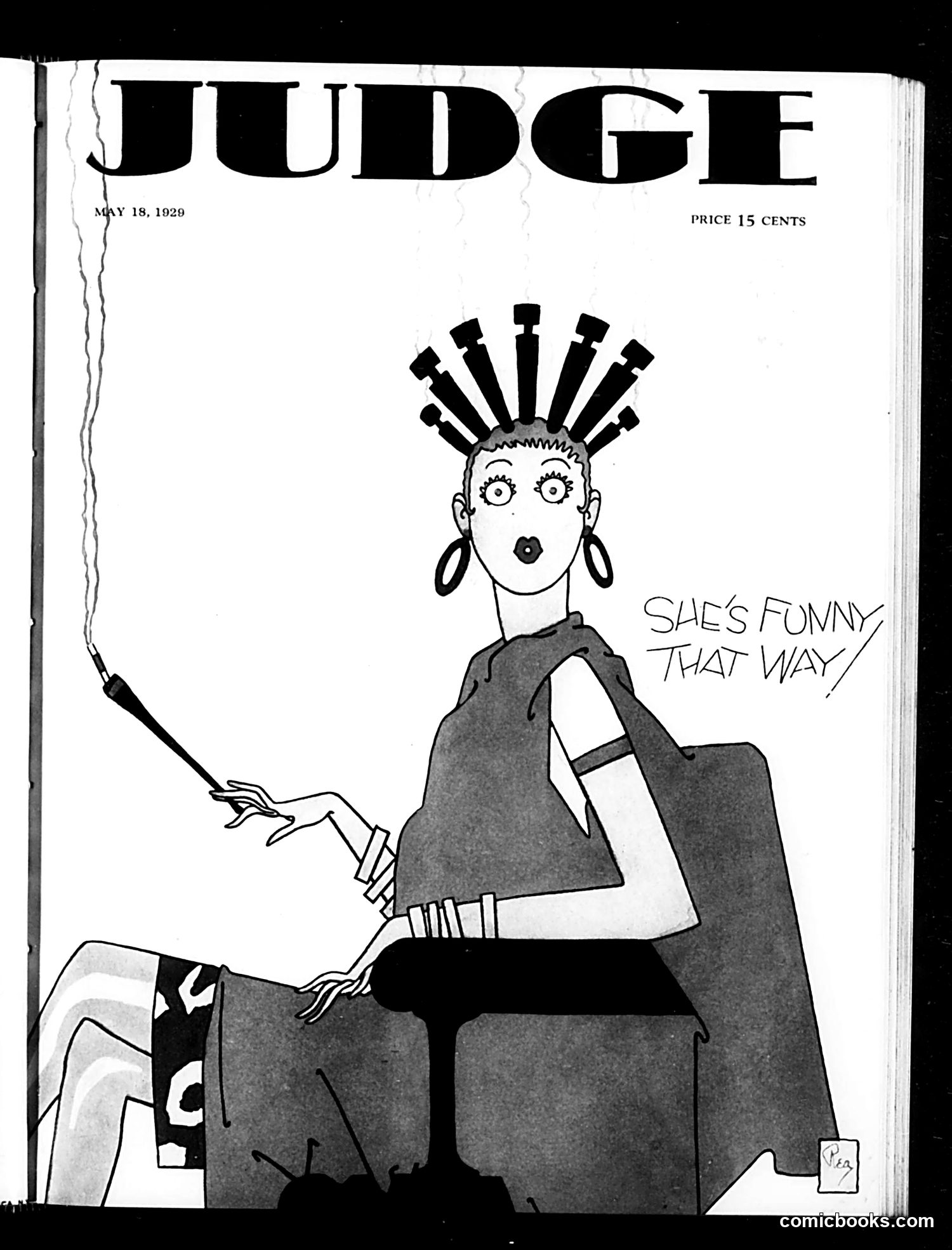
This cover satirizes 1920s fashion and female behavior. The illustration shows a woman with an exaggerated, avant-garde appearance: severely bobbed hair styled with what appear to be nails or bolts radiating outward, large hoop earrings, and a fashionable but androgynous outfit featuring a cape. The caption "SHE'S FUNNY THAT WAY" appears to mock modern women's styling choices and social independence during the Jazz Age. The exaggerated, almost grotesque presentation of her hair and makeup suggests Judge magazine's satirical critique of contemporary women's fashion trends and the "New Woman" of the 1920s—her increasingly unconventional appearance and behavior. The humor relies on visual caricature to comment on generational shifts in female presentation and social norms.
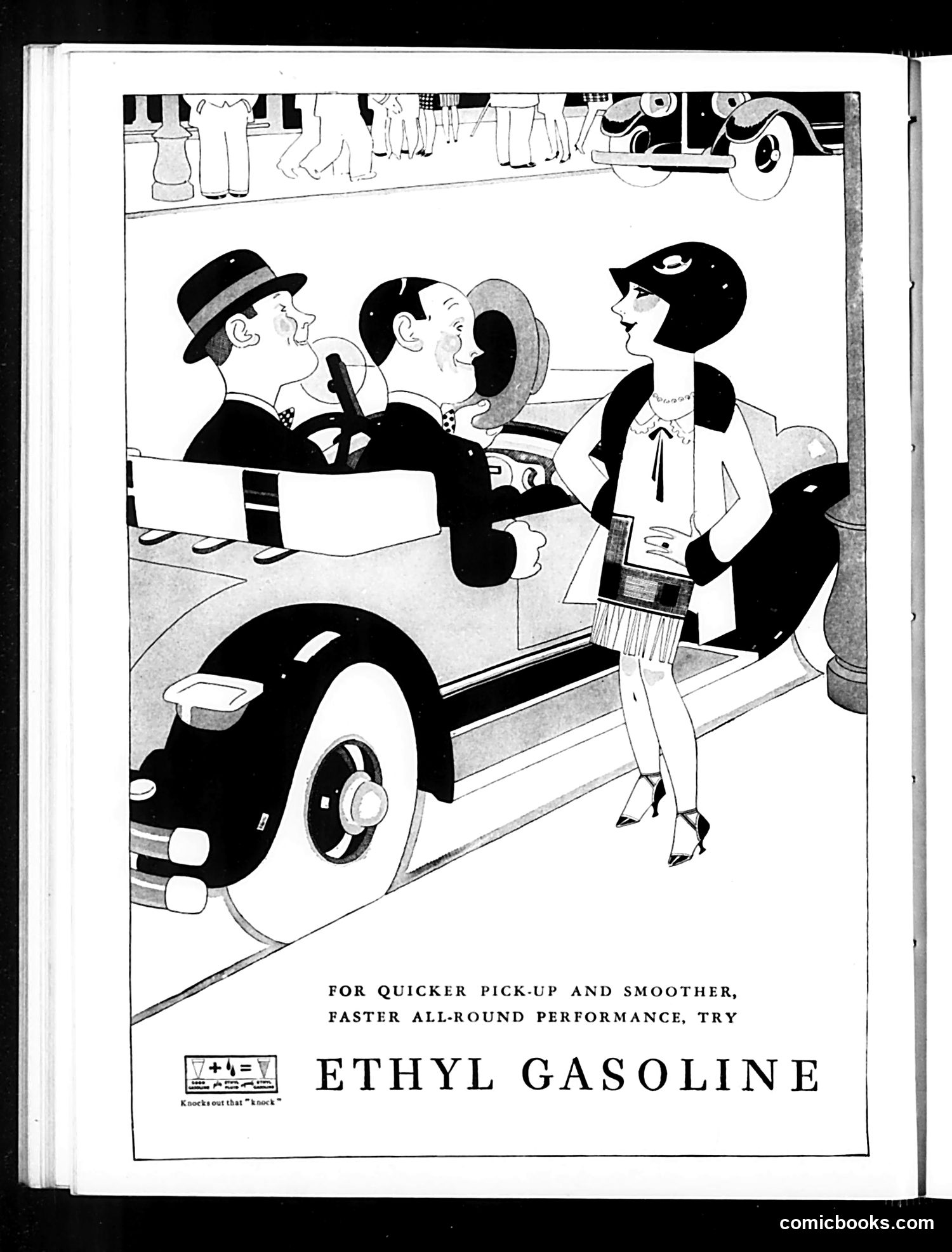
This page is primarily **advertising rather than political satire**. It depicts a 1920s-era automobile advertisement for Ethyl Gasoline, featuring a stylish woman standing beside a car with two men inside. The ad uses a social scene—what appears to be a fashionable outing or car show—to market the product. The tagline promises "quicker pick-up and smoother, faster all-round performance." The small symbol at lower left appears to be a trademark or chemical notation (possibly referencing tetraethyl lead, the actual additive in Ethyl gasoline). The illustration's Art Deco style and the woman's fashionable 1920s appearance suggest this targets affluent, modern consumers interested in automotive performance and lifestyle. This is commercial messaging, not editorial commentary.
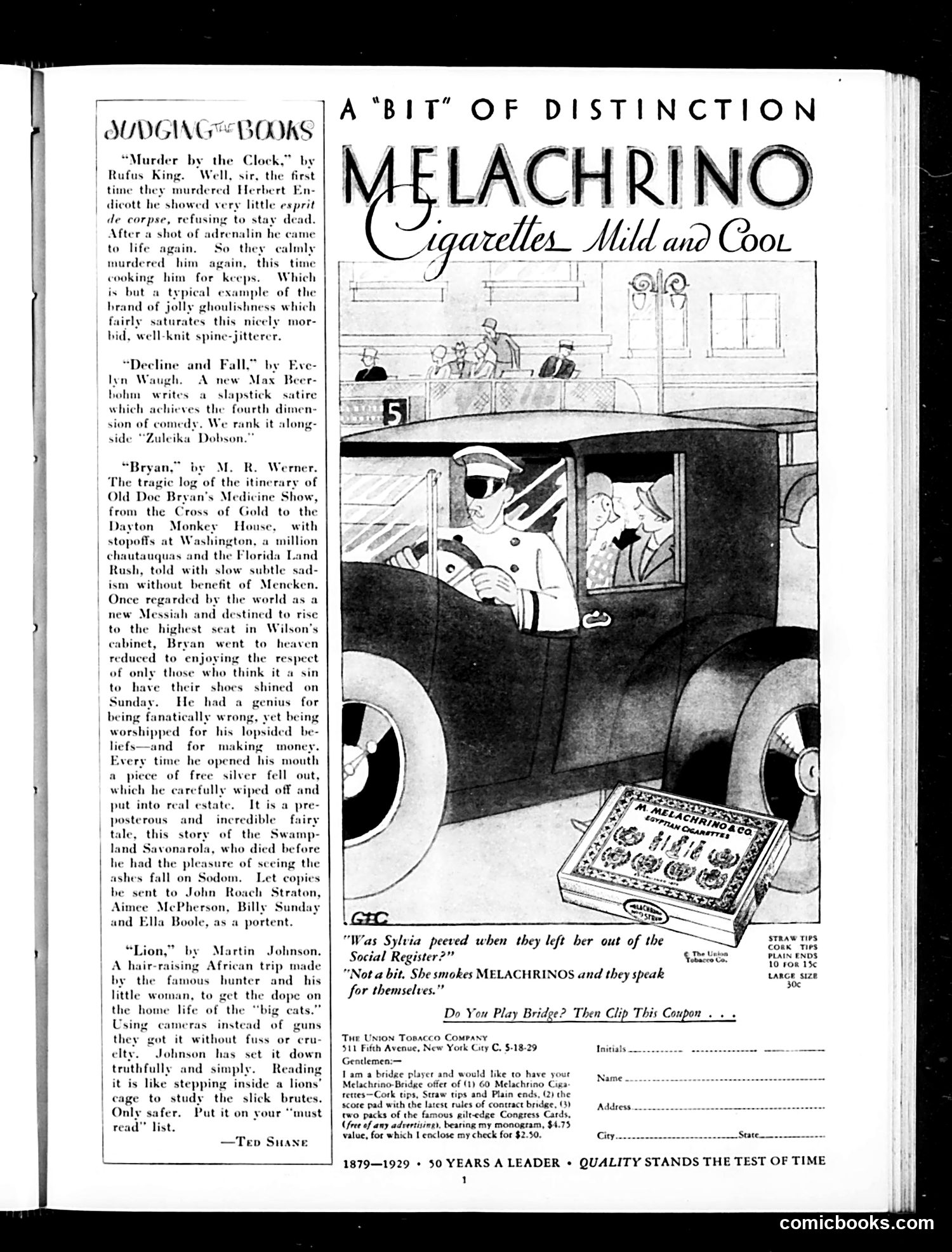
This page is primarily a **cigarette advertisement** for Melachrino brand, occupying roughly half the page with an illustration of a woman in 1920s fashion smoking in what appears to be an automobile. The left column contains book reviews under "Judging the Books," discussing literary works including titles by Rufus King, Eve Waugh, M.R. Werner, and Martin Johnson. The advertisement's caption reads: "Was Sylvia petted when they left her out of the Social Register?" and "Yes! She smokes MELACHRINOS and they speak for themselves." The humor targets social anxieties of the 1920s—exclusion from elite social registers—while using cigarette smoking as a marker of sophistication and belonging. The cartoon positions smoking as compensation for social status, a common advertising trope of this era promoting cigarettes to women.
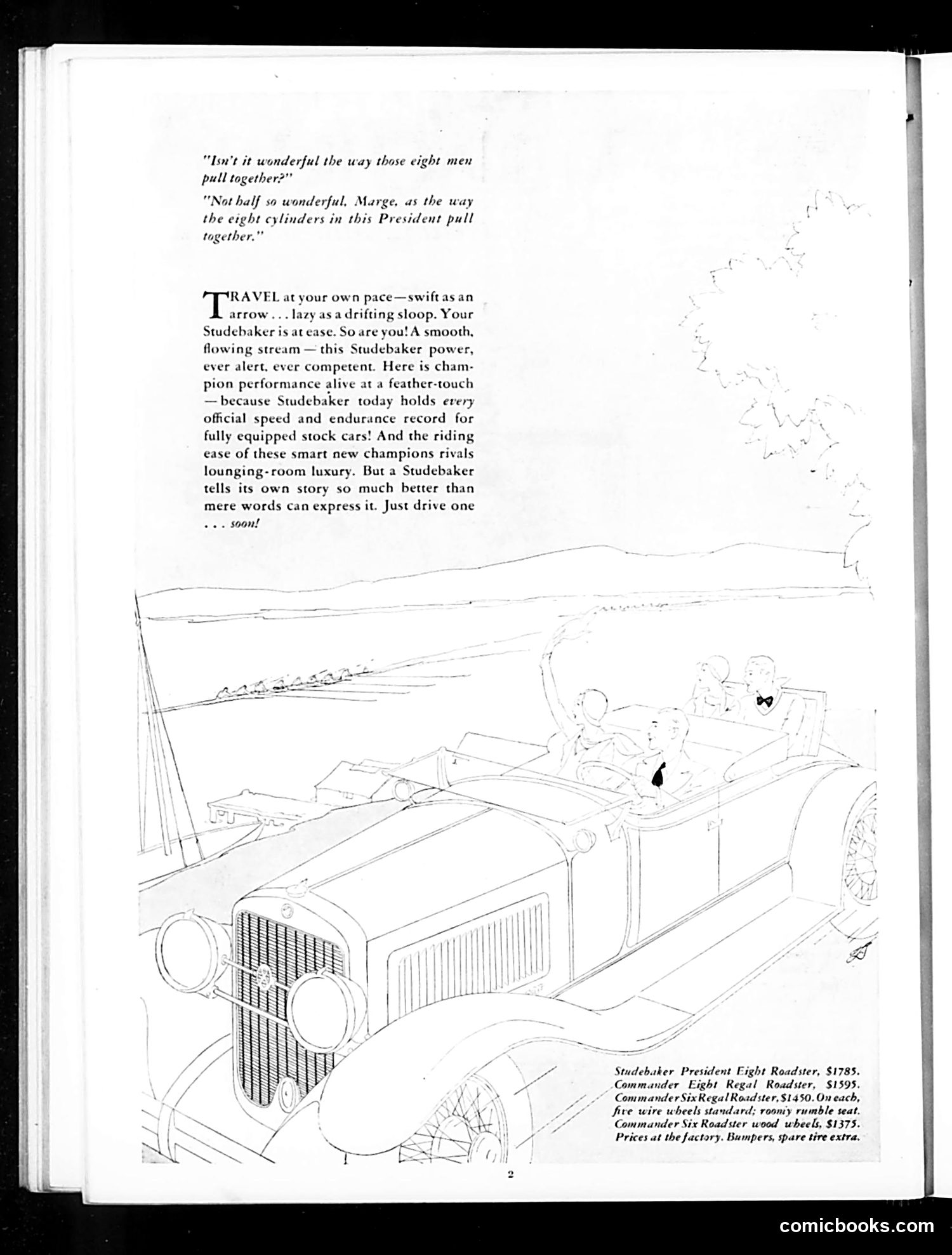
This page is primarily **advertising copy**, not political satire. It promotes the Studebaker automobile, specifically highlighting the brand's speed and endurance records for "fully equipped stock cars." The text uses poetic language ("swift as an arrow... lazy as a drifting sloop") to describe the car's performance capabilities. It emphasizes that Studebaker holds "every official speed and endurance record," positioning the vehicle as a champion performer rivaling luxury competitors. The sketch shows a Studebaker roadster in motion on a scenic road. Below the illustration, pricing information lists various Studebaker models (President Eight Roadster, Commander models, etc.) with prices ranging from $1,375 to $1,795. This is a straightforward commercial advertisement typical of Judge magazine's content—not political commentary or satire.
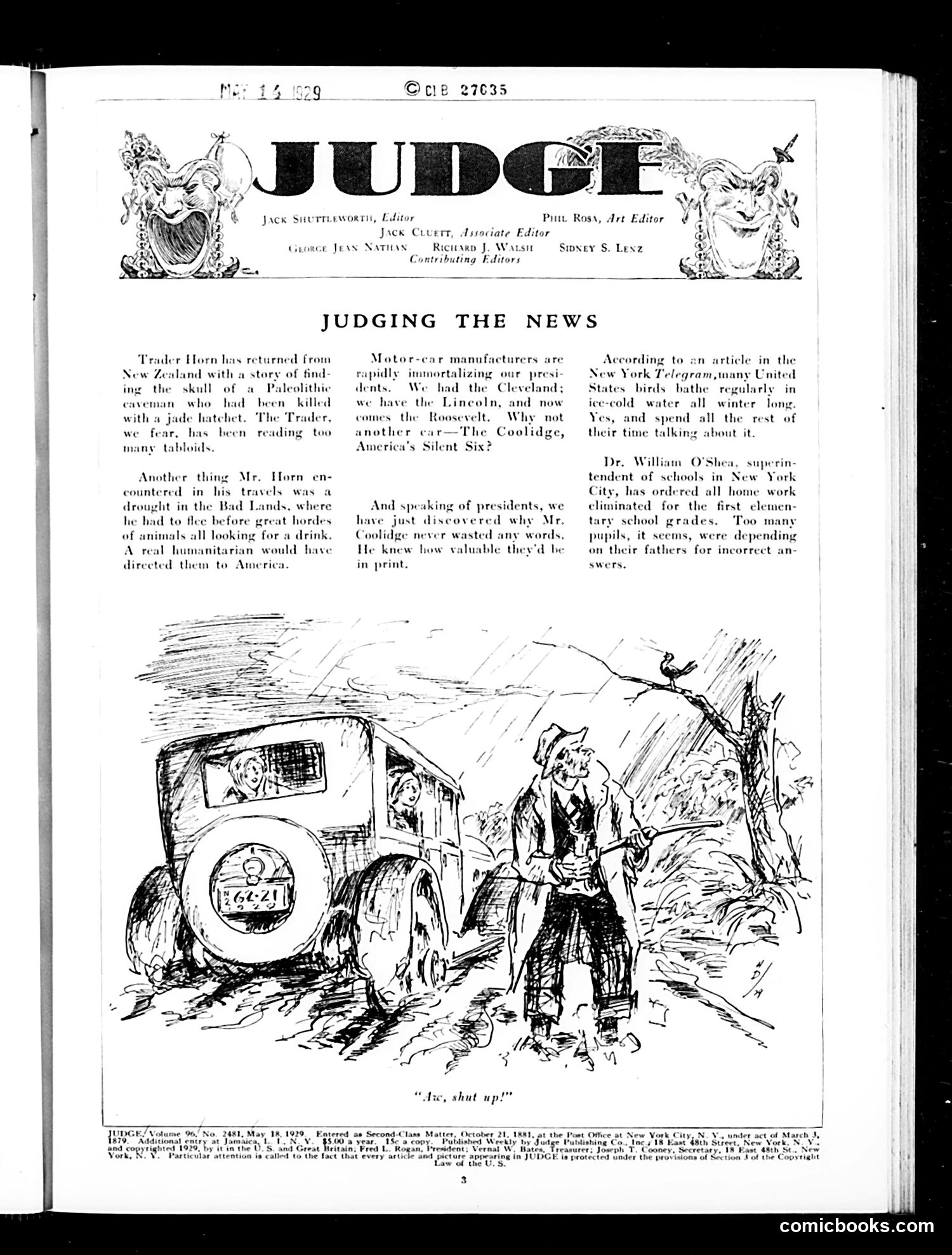
This page satirizes contemporary news stories. The main cartoon depicts a stranded motorist saying "Aye, shut up!" to a companion—likely mocking the proliferation of automobile breakdowns despite manufacturers' grand promises of reliability. The text discusses Trader Horn's return from New Zealand with stories of finding a Paleolithic caveman, sarcastically noting this discovery would have saved manufacturers advertising costs. It also mocks Mr. Coolidge's famous brevity ("he knew how valuable they'd be in print"), and criticizes New York's Dr. William O'Shea for eliminating homework in elementary schools, joking that pupils now depend on their fathers for "incorrect answers" instead. The humor relies on contemporary absurdities and public figures recognizable to 1929 readers.
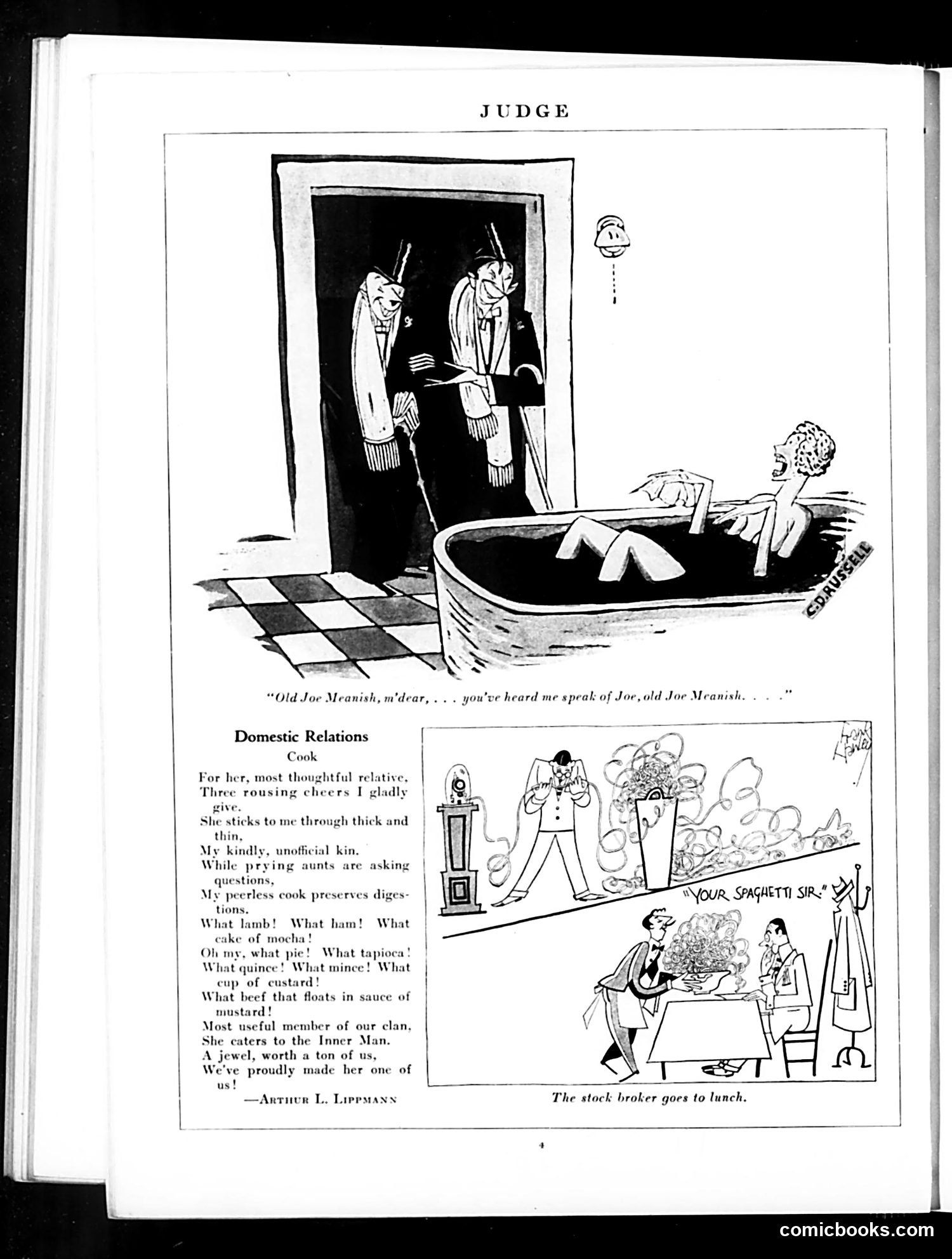
**Top Cartoon:** Two judges in robes stand in a doorway observing a woman bathing. The caption references "Old Joe Menanish," suggesting this is about a legal case or scandal involving someone by that name. The joke appears to concern judicial impropriety—judges conducting official business while intruding on private moments. **Bottom Section:** "Domestic Relations" is a poem by Arthur L. Lippmann praising a cook as an indispensable family member. The accompanying cartoon shows a stock broker taking a woman to lunch, captioned "Your spaghetti, sir?" This likely satirizes the contrast between working-class domestic labor and wealthy businessman culture during the early 20th century. Both items use humor to comment on class distinctions and social hierarchies of the era.
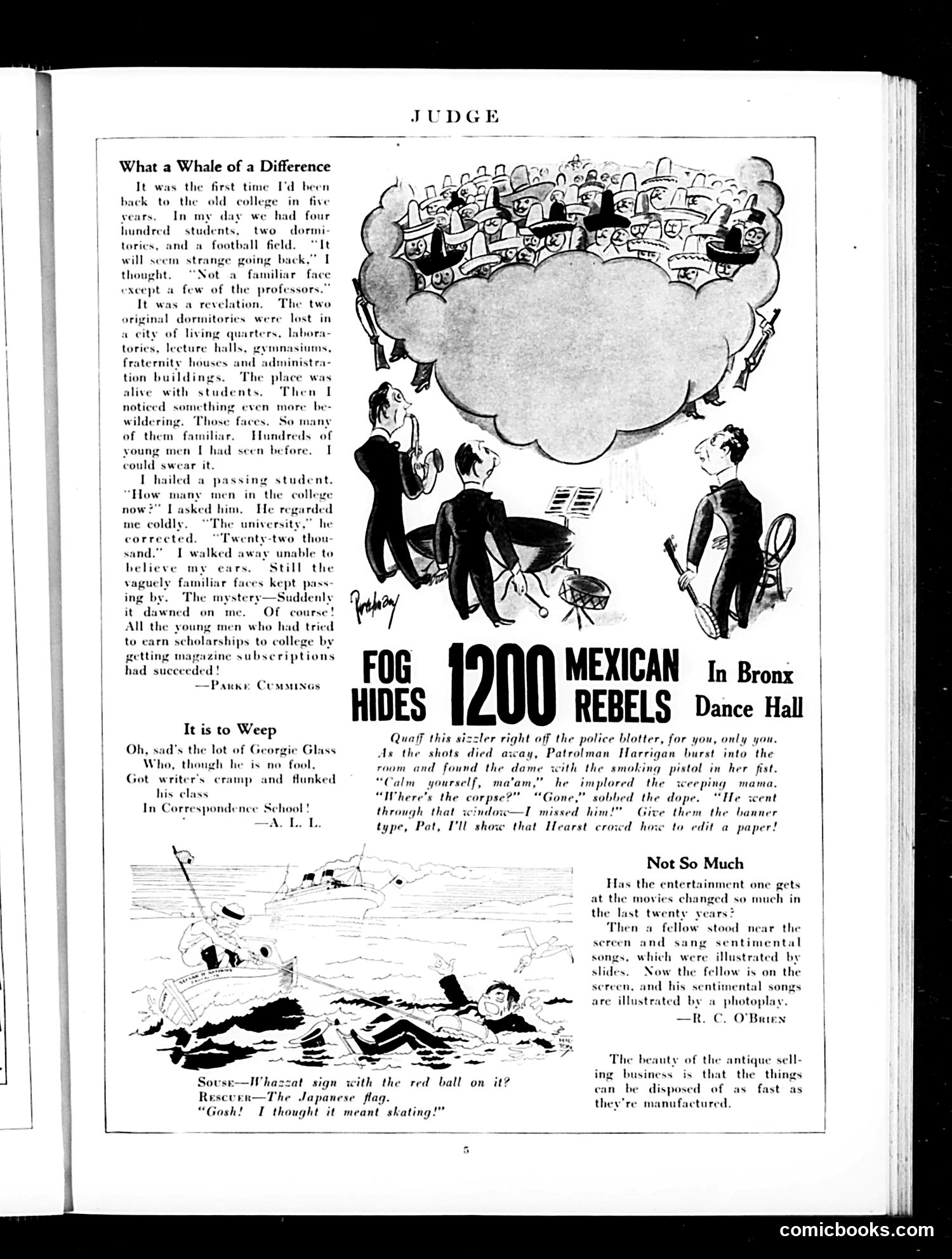
This page contains several satirical pieces typical of Judge's early 20th-century style: **"What a Whale of a Difference"** presents a humorous observation about college expansion. The author revisits their alma mater and is shocked by enrollment growth—from about 100 to 22,000 students. The large cloud illustration shows a crowded lecture hall, satirizing how mass education has transformed intimate academic settings into impersonal institutions. **"Fog Hides 1200 Mexican Rebels in Bronx Dance Hall"** is a mock newspaper headline joke about a police blotter story, suggesting the absurdity of hiding 1,200 rebels in an urban dance venue. **Lower illustrations** depict a ship rescue, apparently referencing a Japanese flag mixup ("I thought it meant ice skating"). The page is primarily humor and light satire rather than hard political commentary.
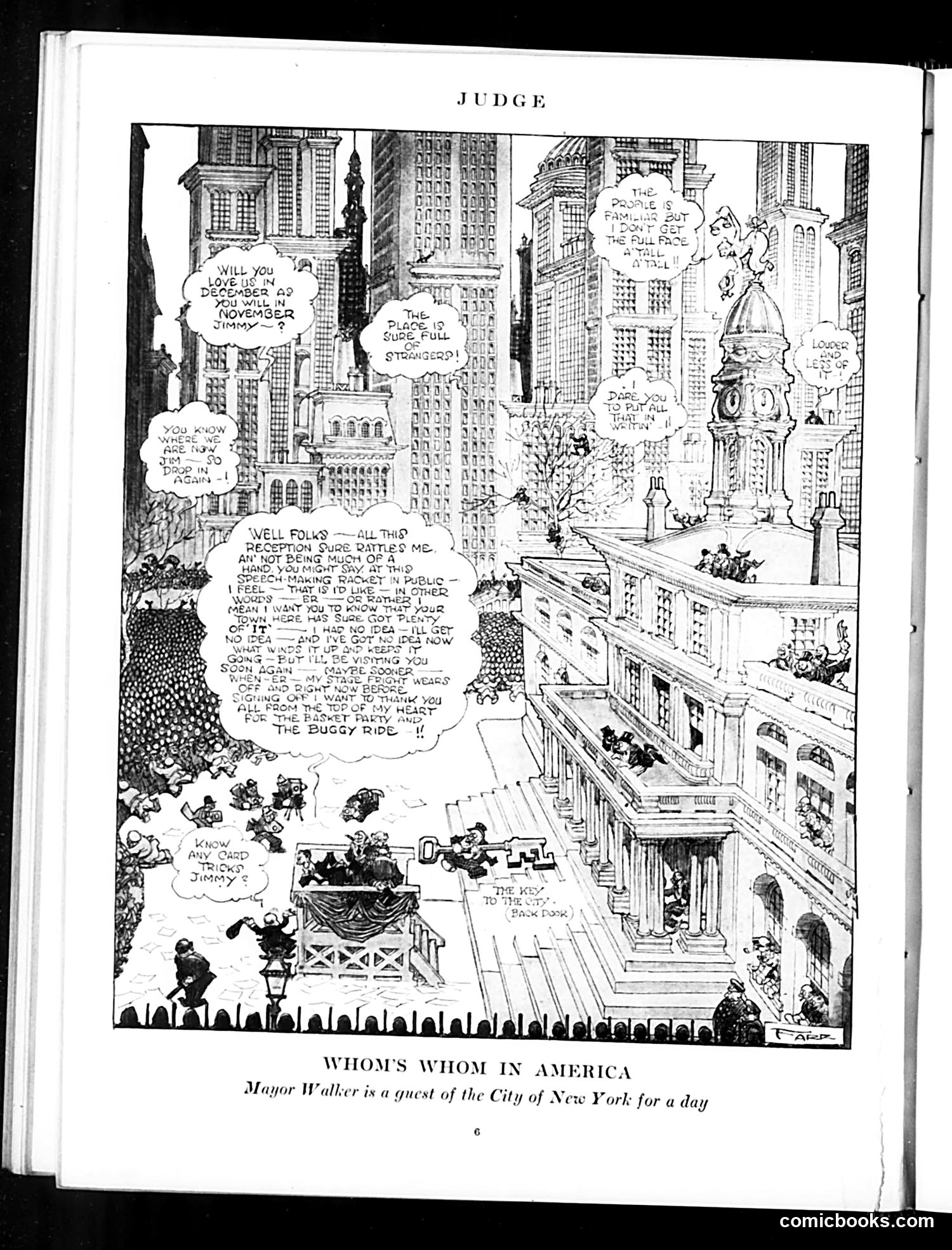
This single-panel cartoon depicts **Mayor Walker as a guest of New York City for a day**. The satire shows the Mayor addressing a massive crowd in what appears to be a public square or courthouse steps, surrounded by towering skyscrapers. Walker's lengthy speech (visible in the large speech bubble) promises various civic improvements and addresses to the assembled crowd. The cartoon satirizes political rhetoric—politicians making grandiose promises to the public while crowds gather to hear them speak. The title's grammatical error ("Whom's" instead of "Who's") appears intentional, possibly mocking pretentious or incorrect political language. The dense urban setting emphasizes the scale of municipal politics and public spectacle in 1920s New York.
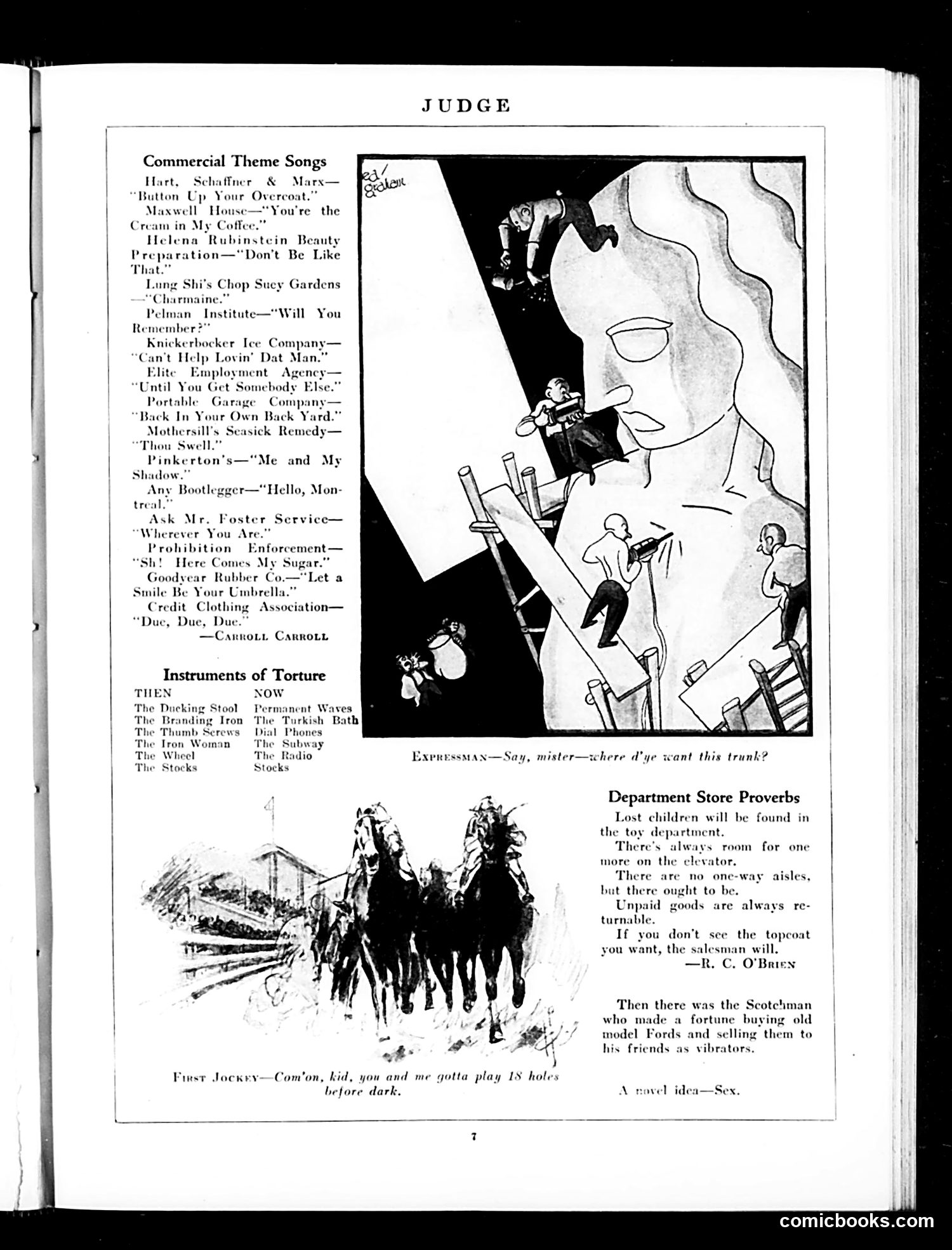
This Judge magazine page satirizes 1920s American consumer culture through multiple humor formats: **Commercial Theme Songs**: The satire pairs well-known popular songs with brand names, mocking how advertising infiltrated entertainment. For example, Maxwell House gets "You're the Cream in My Coffee"—blending product placement with sentiment. **"Instruments of Torture"**: A darkly humorous list comparing modern inconveniences (dial phones, subways, radio) to medieval torture devices, reflecting anxiety about rapid technological change. **The Main Cartoon**: Shows an expressman struggling with a massive trunk while tiny people labor around a giant figure's head—likely satirizing the challenge of moving or shipping belongings in an increasingly consumer-driven society. **Department Store Proverbs**: Mock retail observations about crowding and shopping behavior, suggesting department stores were overwhelming spaces. **"Instruments of Torture" section finale**: A joke about a Scotsman buying old Fords cheap and reselling them as "vibrators"—either mocking a scam or implying the cars' poor condition made them vibrate uncontrollably. The overall theme critiques consumerism, modern technology, and commercial culture's growing dominance.
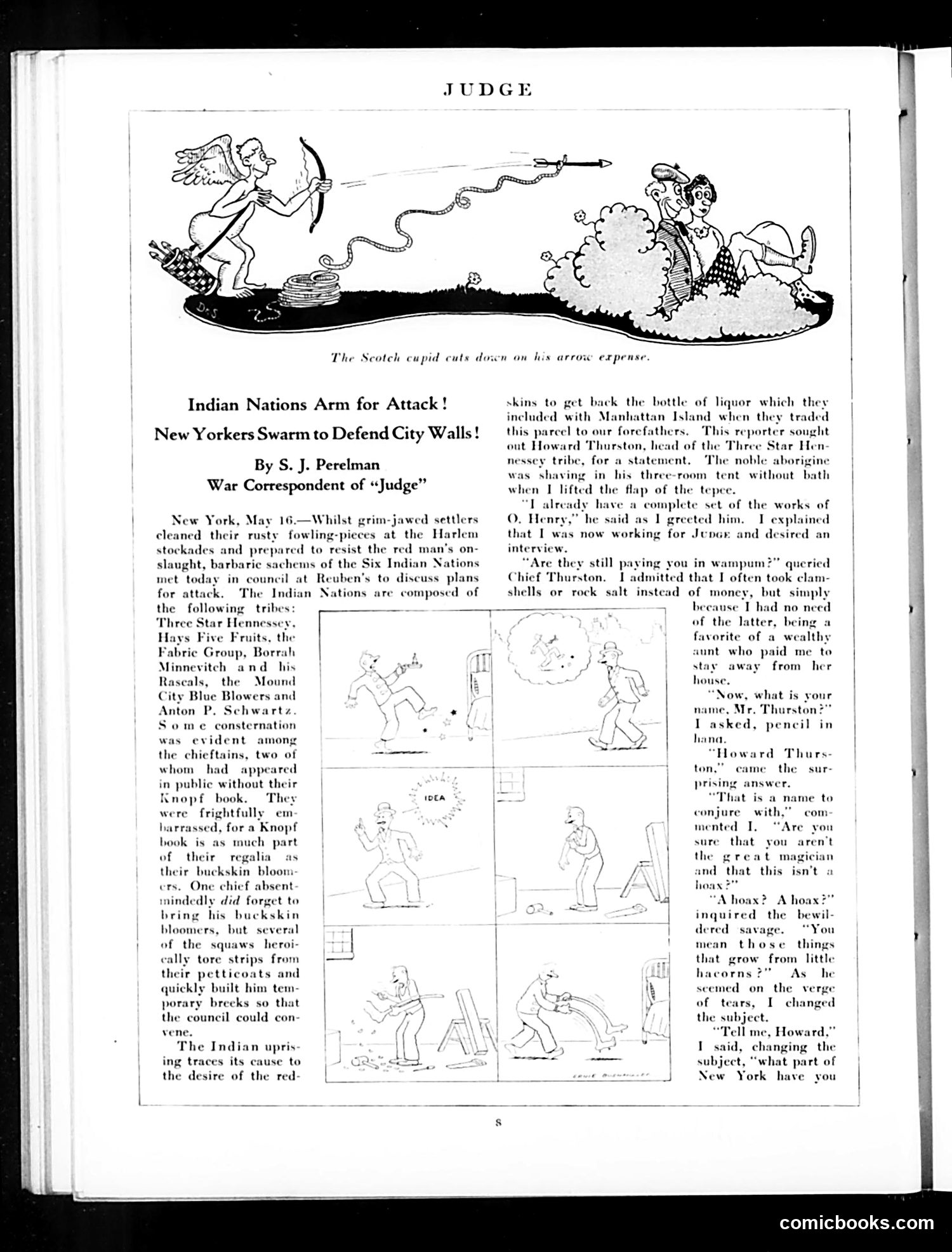
This is a satirical piece by S.J. Perelman (later famous as a humorist) mocking New York's entertainment and publishing elite by casting them as "Indian Nations" threatening the city. The joke conflates real Broadway/vaudeville performers (Three Star Hennessey, Borrah Minnevitch and his Harmonica Rascals, magician Howard Thurston) with Native American tribes. The satire targets these entertainers' self-importance and their dependence on Knopf publishing contracts—"as much part of their regalia as buckskin bloomers." The humor plays on the absurd juxtaposition: dignified performers reduced to stereotypical "savages," their status anxiety about appearing publicly without their Knopf books, and the trivial complaint that tribes want back "the bottle of liquor" included in the original Manhattan land sale. The accompanying cartoons show slapstick violence and physical comedy, reinforcing the satirical mockery of these public figures and contemporary entertainment culture.
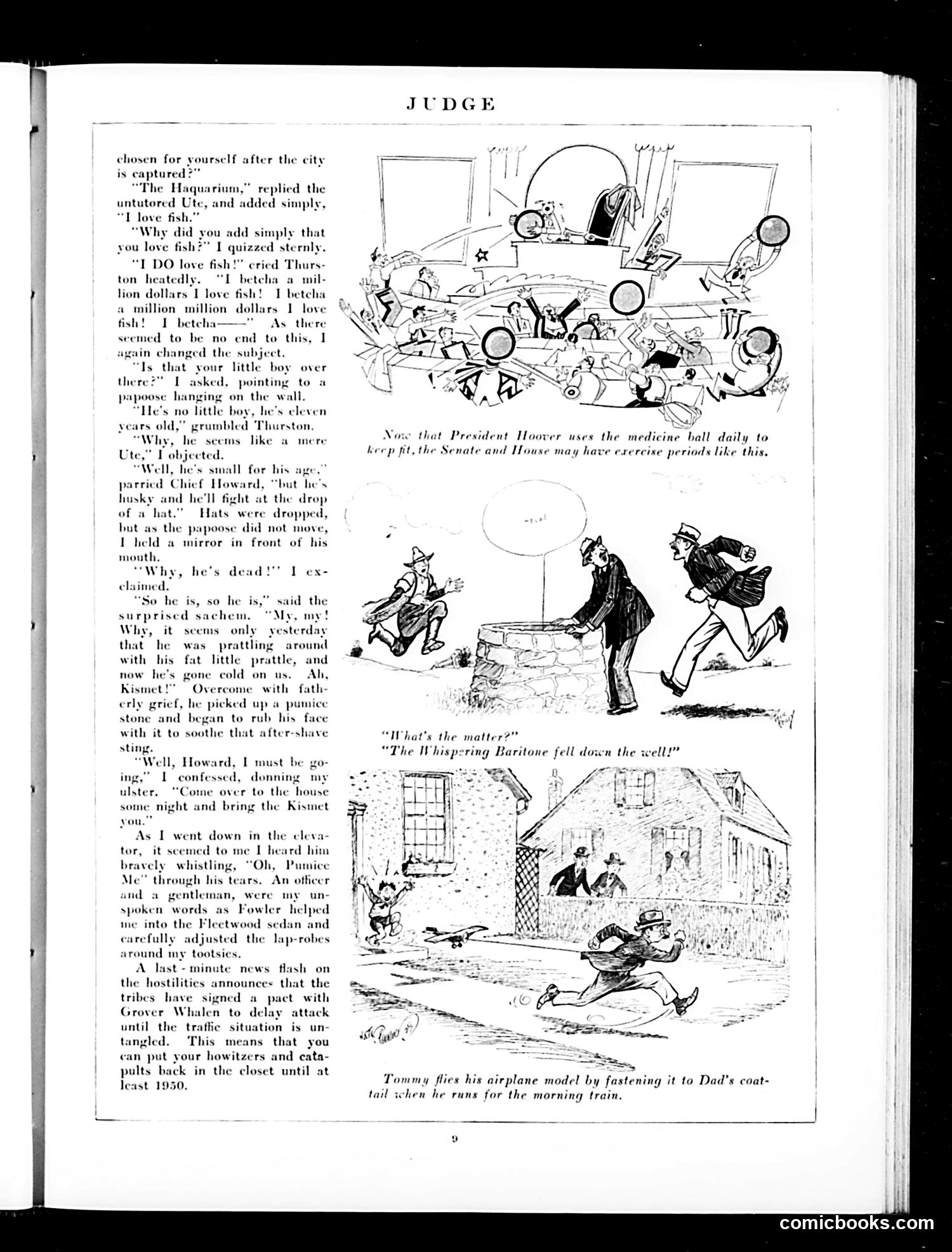
This page contains multiple satirical pieces mocking 1920s-30s American life and politics. **Top cartoon**: Depicts Congress members exercising with medicine balls, referencing President Hoover's recent adoption of daily medicine ball routines. The satire suggests that if the President does it, Congress will follow—mocking both their herd mentality and the fitness craze. **Middle cartoon**: Shows figures around a well, captioning "The Whispering Baritone fell down the well"—likely referencing a popular radio personality or song, used here as absurdist humor. **Story section**: A humorous narrative about meeting a Native American chief ("Chief Howard") and his eleven-year-old son who is actually dead—the chief casually accepting this fact. This reflects the era's casual, dehumanizing stereotypes about Indigenous peoples. **Bottom cartoon**: Shows a boy launching a toy airplane attached to his father's coattail during his morning commute—depicting suburban domestic absurdity. The overall tone targets both government pretension and everyday American oddities through exaggeration and dark humor typical of Judge's satirical approach.
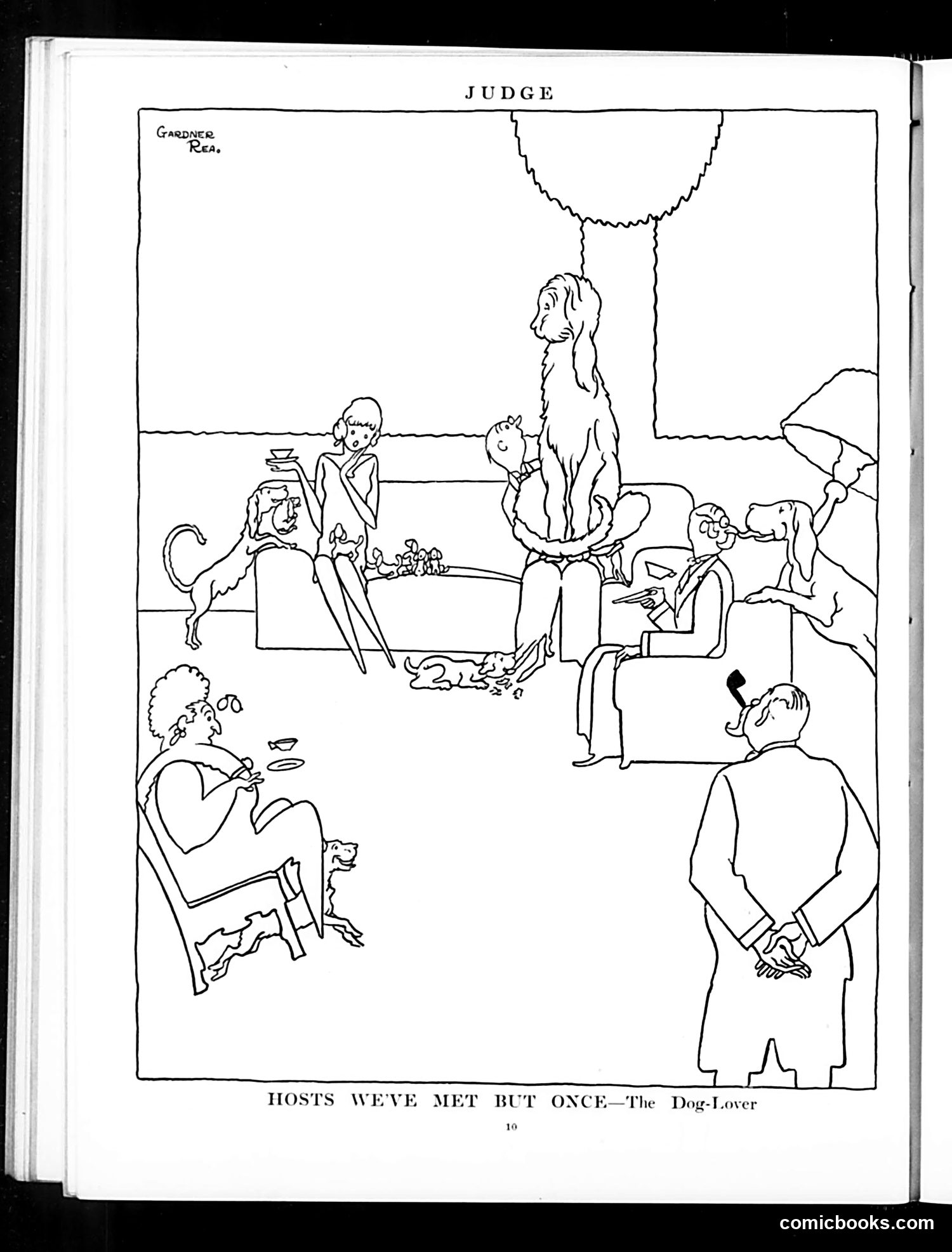
This cartoon satirizes a particular social type: the overly enthusiastic dog owner who prioritizes their pet above human guests. The scene depicts a formal social gathering where a woman sits prominently with a large dog, appearing to give it more attention and affection than her human visitors. Several guests are shown awkwardly positioned around the room, seemingly ignored or displaced by the dog's central importance. The humor targets the pretension of certain hosts who use their pets as status symbols or conversation pieces, inadvertently (or deliberately) neglecting proper hospitality toward people. The title suggests this is a recognizable social phenomenon—people who've hosted gatherings centered inappropriately around their animals rather than their guests' comfort.
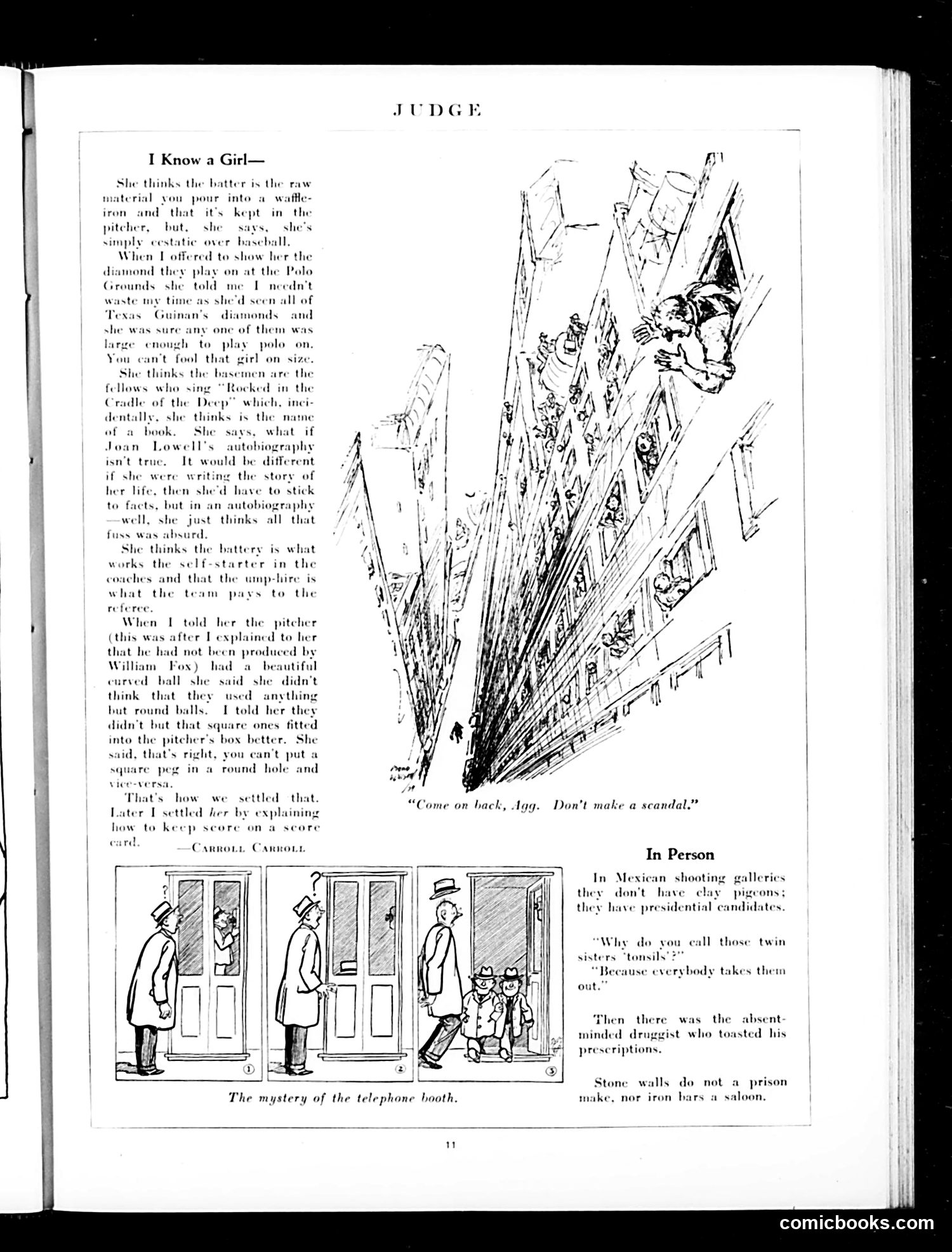
This page satirizes a woman's willful ignorance about baseball and everyday mechanics. The humor centers on her absurd misunderstandings: she confuses baseball's "battery" (pitcher and catcher) with an automobile's electrical system, thinks "batter" is kept in a pitcher like liquid, and believes a "square peg" argument applies to baseballs in the pitcher's box. The satire targets early 20th-century gender stereotypes—portraying women as disinterested in sports and unable to grasp practical concepts. The accompanying three-panel cartoon "The mystery of the telephone booth" appears to show a related gag about spatial confusion or incompetence. The page also includes unrelated brief jokes ("In Person") about Mexican shooting galleries, twin sisters called "tonsils," and a druggist's toast—typical of Judge's mixed-content satirical format.
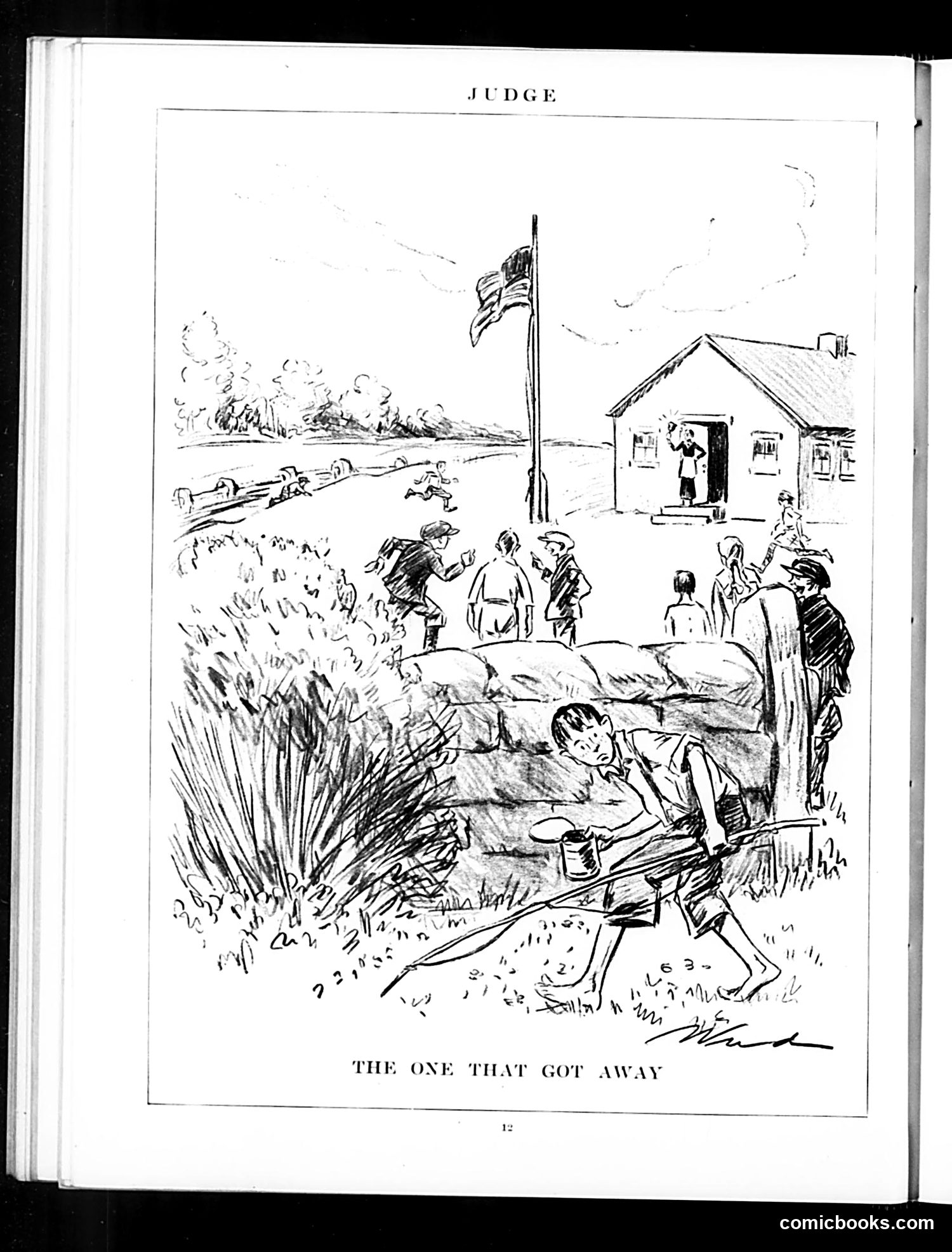
This cartoon satirizes a fishing expedition at what appears to be a summer camp or rural settlement. A boy in the foreground has caught a fish, while adults and other children observe from behind a sandbag fortification. An American flag flies prominently in the background. The title "The One That Got Away" is a fishing idiom referring to a catch that escaped. The humor likely stems from the juxtaposition of the boy's apparent success against the common fisherman's lament about lost catches. The military-style sandbags and flag suggest this may reference a wartime or patriotic context, though without additional context, the specific satirical target remains unclear. The cartoon's point appears to celebrate an actual success against typical disappointment.
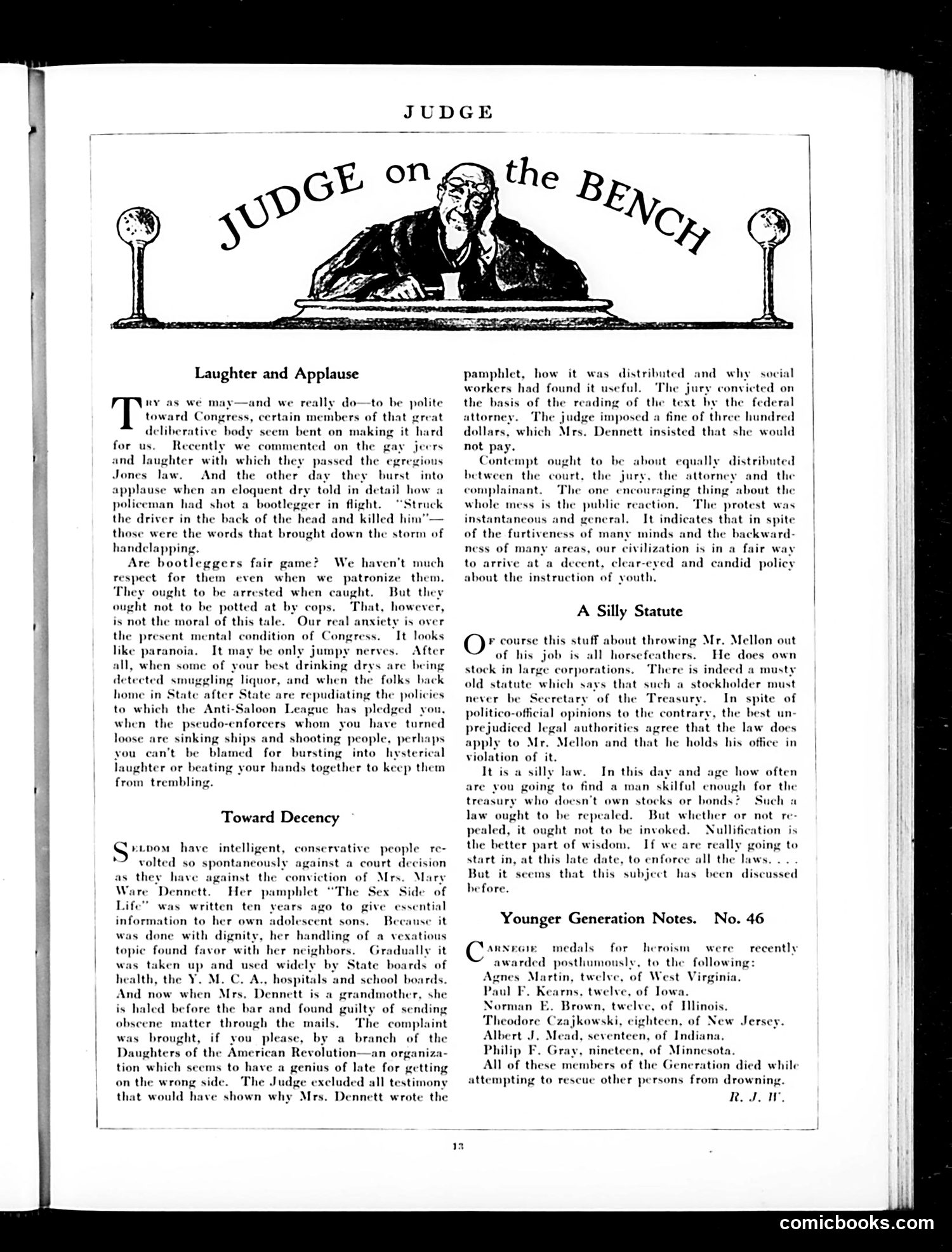
This page from Judge satirizes three contemporary issues, likely from the Prohibition era (1920s-early 1930s): **"Laughter and Applause"** criticizes Congress for finding humor in a policeman killing a bootlegger. Judge's point: Congress's apparent delight at extrajudicial violence suggests paranoia or mental instability, especially as Prohibition enforcement becomes chaotic and hypocritical (enforcers are themselves "drinking drys" caught smuggling). **"Toward Decency"** defends Mary Ware Dennett, convicted for mailing a sex-education pamphlet. Judge condemns the conviction as unjust—the Daughters of the American Revolution brought charges, the judge excluded relevant testimony, and Dennett refuses to pay the fine. The public's outrage suggests civilization can still achieve "clear-eyed and candid policy." **"A Silly Statute"** argues that Andrew Mellon (Treasury Secretary) technically violates an archaic law requiring treasury secretaries to own no stock, but the law itself is absurd and shouldn't be enforced. The cartoons reflect Judge's skepticism toward Prohibition, government overreach, and outdated legislation.
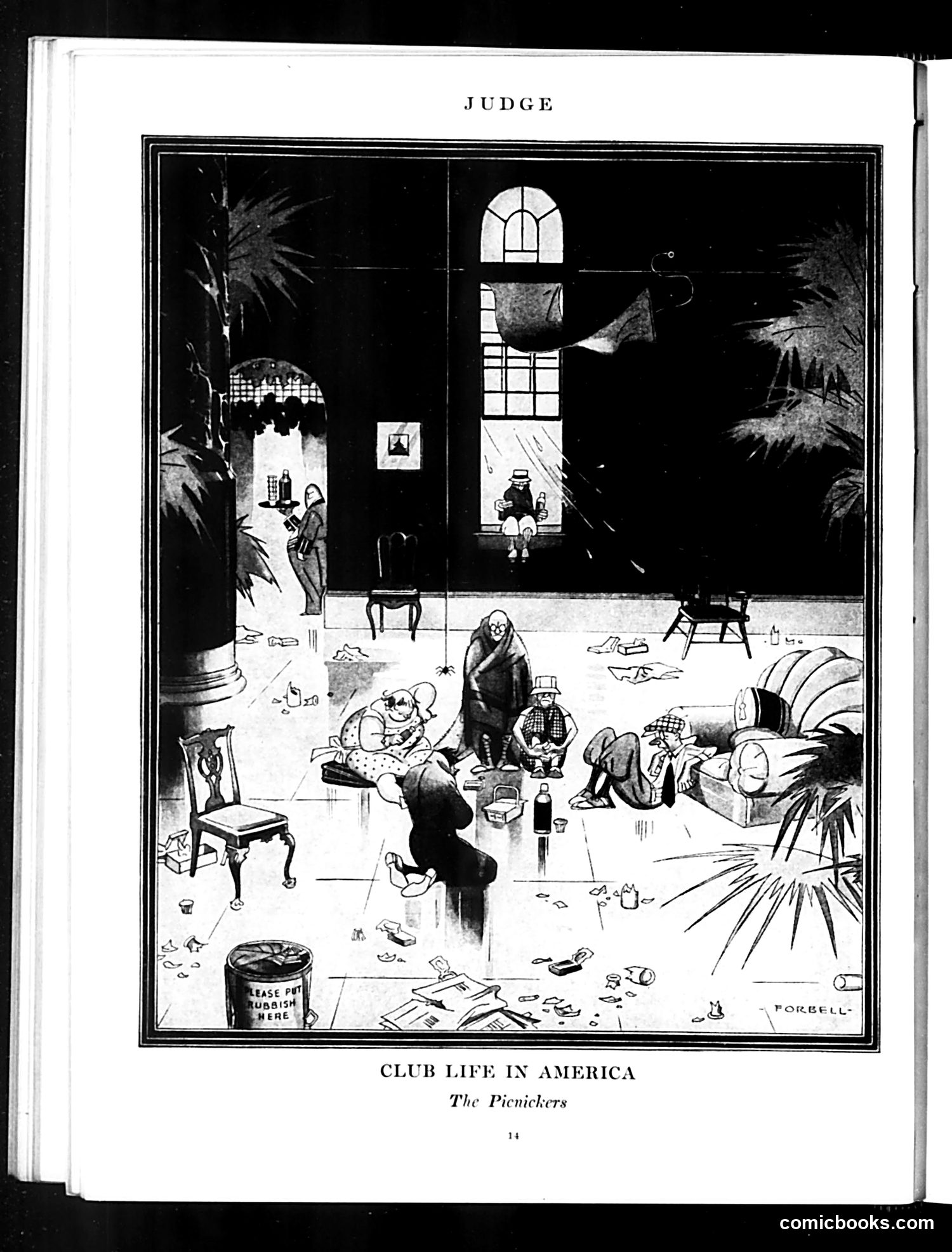
This is a satirical cartoon titled "The Picnickers" from *Judge* magazine, captioned under "Club Life in America." The image depicts an indoor scene of apparent chaos and disorder during what should be a refined club gathering. The satire appears to target upper-class club members or social organizations, showing their activities as messy and undignified—scattered debris, overturned furniture, people in disarray on the floor, and general slovenliness. The large windows and formal architectural setting contrast sharply with the chaotic behavior, suggesting hypocrisy between the clubs' pretensions of gentility and their actual conduct. The artist (signed "Porbell") mocks the disconnect between wealthy Americans' self-image as sophisticated and their actual, ungainly behavior. This reflects *Judge's* characteristic satirizing of American social pretension and class contradictions.
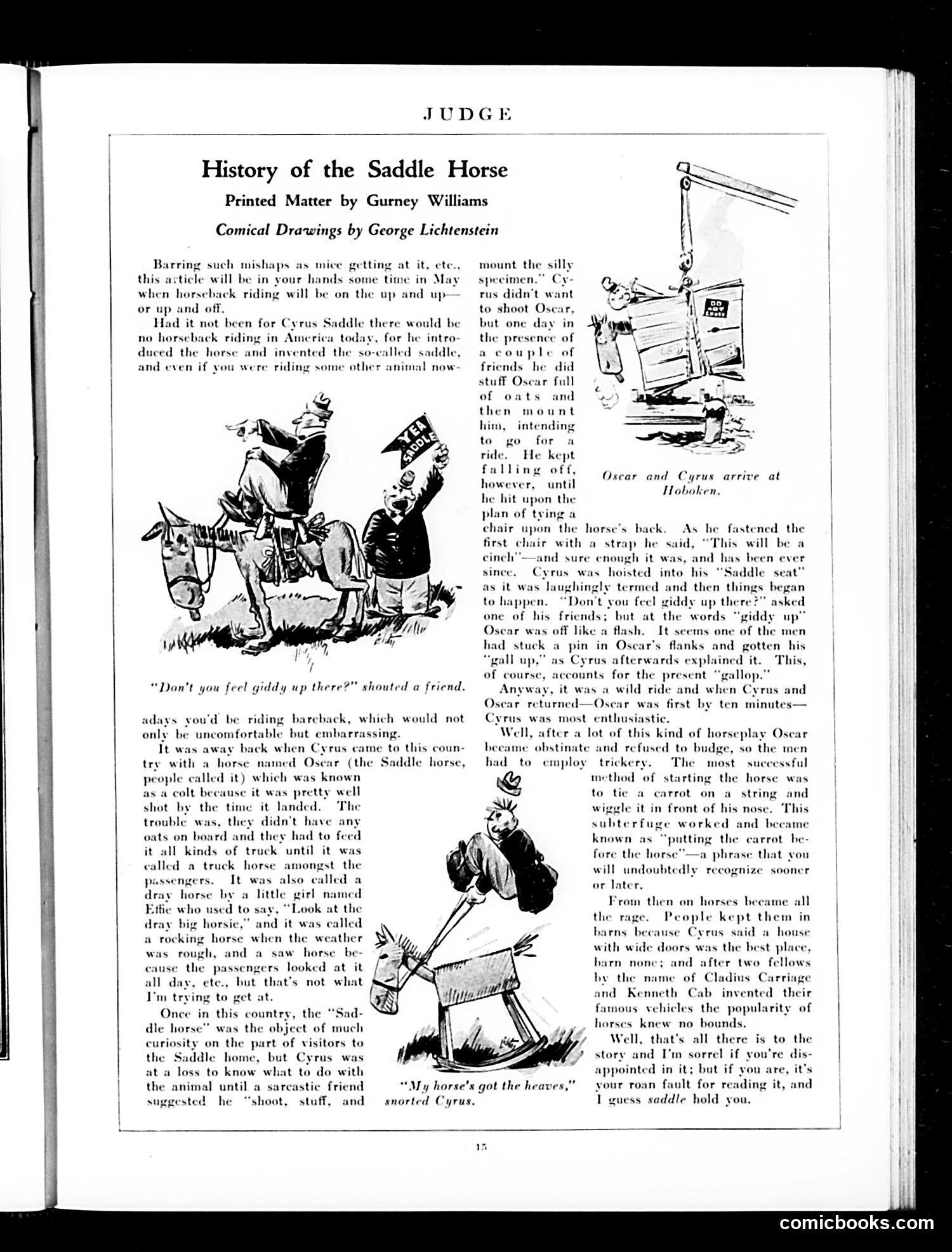
This is a humorous pseudo-historical article presenting a fanciful origin story for horseback riding in America. The satire mocks both tall tales and overwrought historical narratives. The narrative credits a man named "Cyrus Saddle" with inventing the saddle, presented as foundational to American equestrian culture. The comic illustrations show slapstick mishaps: Cyrus repeatedly falling off an unsaddled horse named Oscar before securing a chair to the animal's back with a "cinch" (strap)—a pun since "cinch" means something easy. The piece is laden with horse-related puns ("giddy up," "putting the carrot before the horse," "roan fault," "saddle hold you") that signal the author's intent as entertainment rather than serious history. The invented etymology of "gallop" (from a pin-pricked horse "getting his gall up") and references to Cladius Carriage and Kenneth Cab extend the absurdist humor. This is lightweight satire celebrating American frontier mythology and equestrian culture through ridiculous wordplay rather than political commentary.
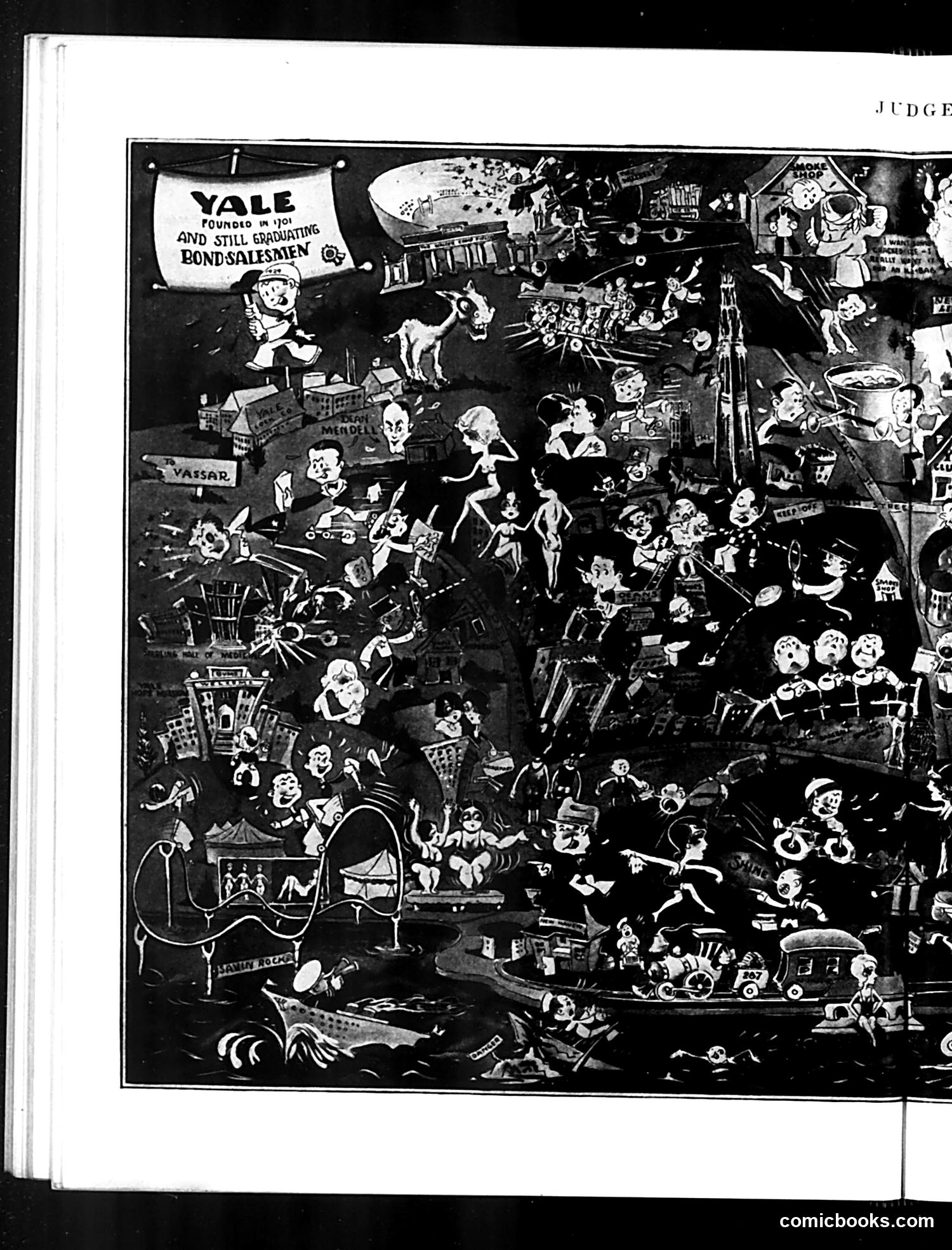
This is a chaotic satirical illustration from *Judge* magazine depicting Yale University's founding in 1701 and its role in "still graduating bond salesmen." The cartoon presents a densely packed scene with numerous cartoon characters engaged in various activities—trading, dealing, socializing—suggesting the commercialization of Yale education. The satire targets the perception that Yale, rather than producing scholars or civic leaders, primarily graduates financial professionals and bond traders. This criticism reflects early-20th-century anxieties about Ivy League universities becoming finishing schools for Wall Street rather than institutions of genuine intellectual development. The "bond salesmen" reference indicates concern that elite education was being corrupted by financial interests, producing commercially-minded graduates rather than thoughtful citizens.
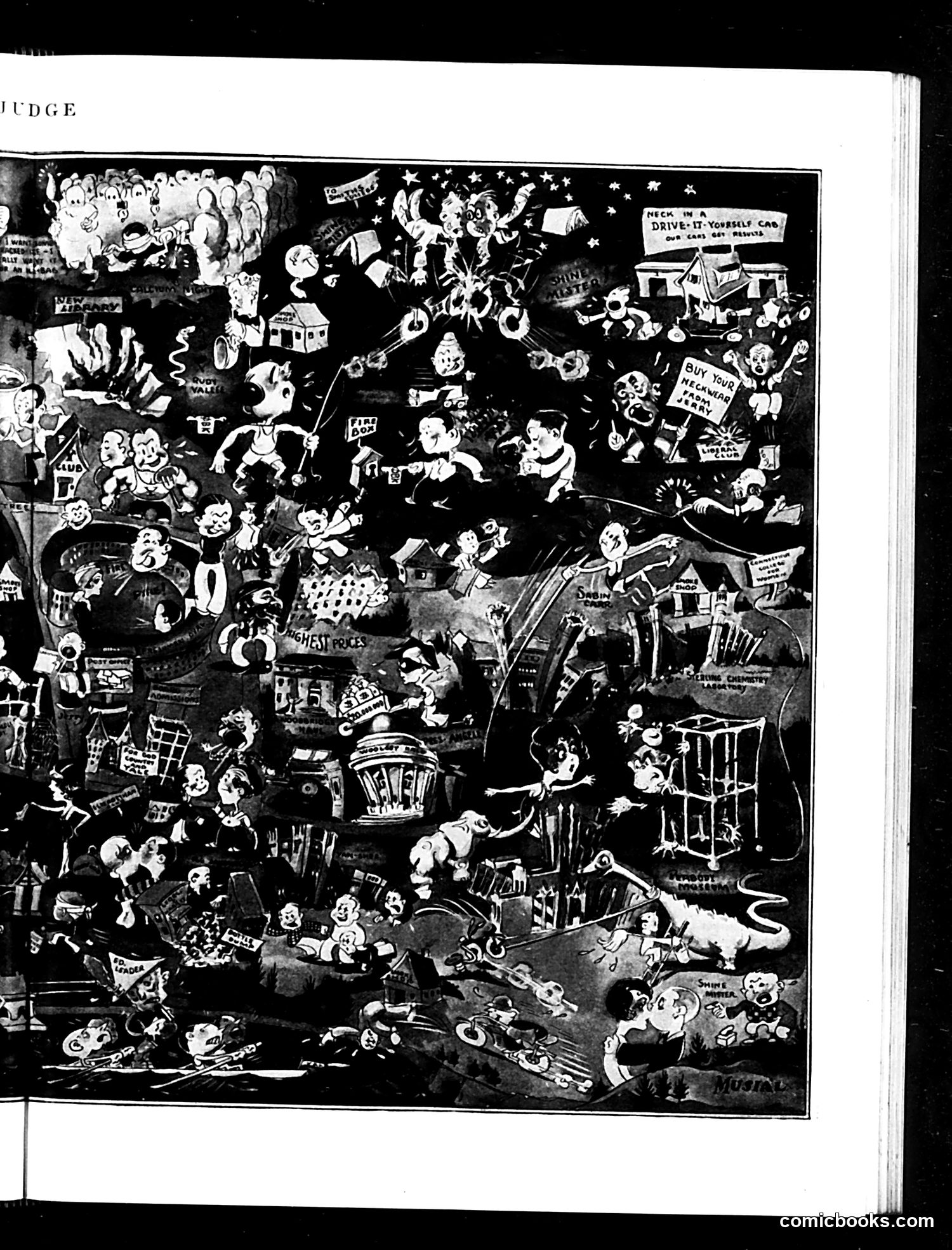
This is a densely packed satirical cartoon from *Judge* magazine depicting a chaotic New Year's Eve celebration scene. The image is crowded with revelers, party-goers, and various comic situations typical of holiday excess—people drinking, dancing, and engaging in rowdy behavior. Visible text references include "NECK IN A" (appears to reference a dare or stunt), "DRIVE-IT-YOURSELF CAR" (suggesting automobile culture humor), and "BUY YOUR NEW YEAR'S TAXES" (likely satirizing financial burdens or New Year's resolutions). The cartoon satirizes the excess and frivolity of New Year's celebrations, with exaggerated characters and situations mocking the chaos of holiday festivities. The chaotic composition itself becomes part of the joke—visual pandemonium matching the theme of uncontrolled celebration.
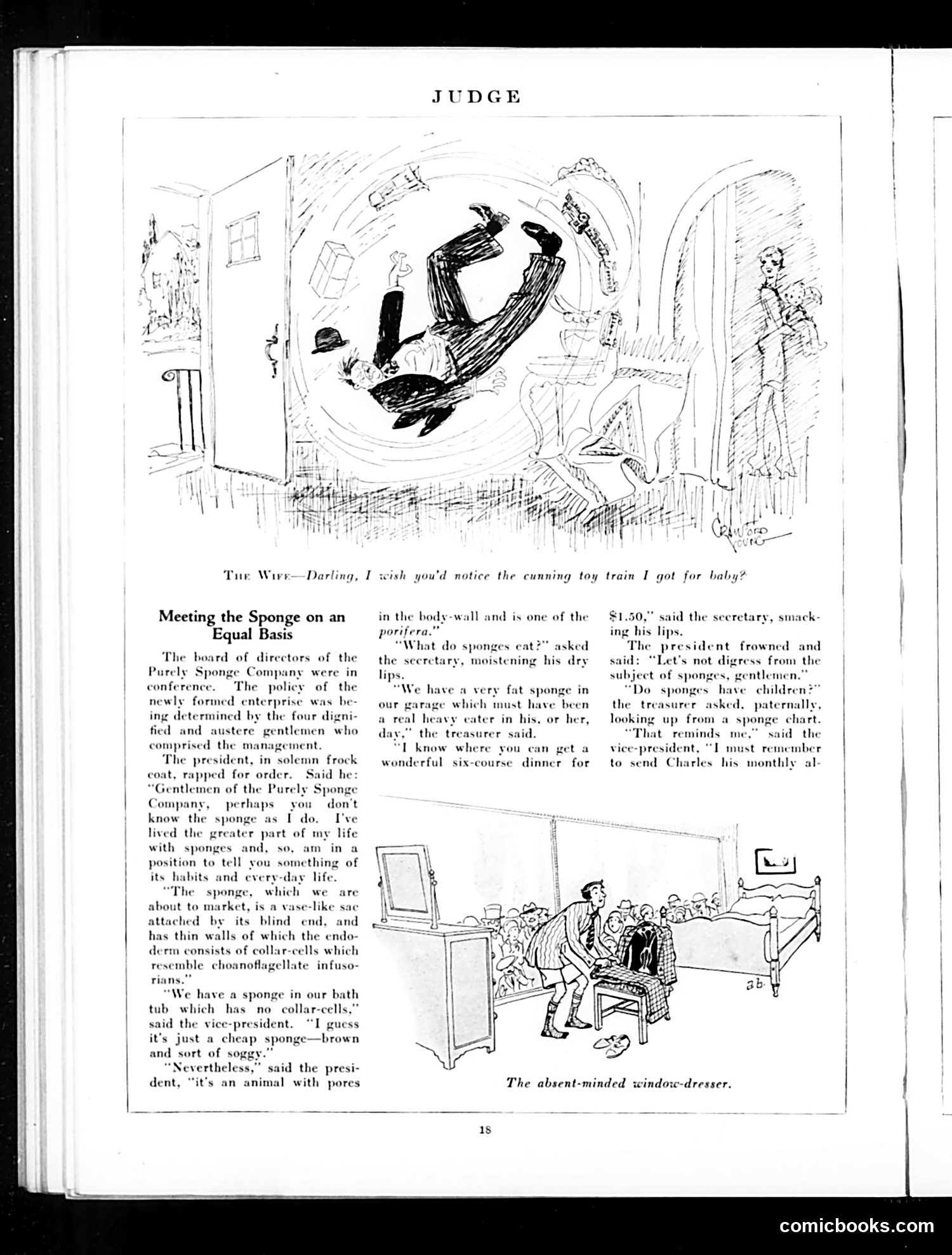
This page contains two satirical cartoons from *Judge* magazine mocking corporate pretension and absent-mindedness. **"Meeting the Sponge on an Equal Basis"** ridicules a board of directors discussing their newly formed sponge company. The humor lies in their pompous pseudoscientific language—the president delivers elaborate biological jargon about sponges' "collar-cells" and "choanoflagellate infusorians"—while other board members derail the meeting with absurd practical questions ("What do sponges eat?" "Do sponges have children?"). The satire targets corporate management's pretentious intellectualism masking their actual ignorance. **"The absent-minded window-dresser"** (bottom cartoon) shows a man gesturing expansively while surrounded by crowds, apparently daydreaming rather than attending to his actual window-dressing duties. Together, these pieces satirize early-20th-century American business culture: bloated corporate jargon, incompetent management, and workplace distraction among the white-collar classes.
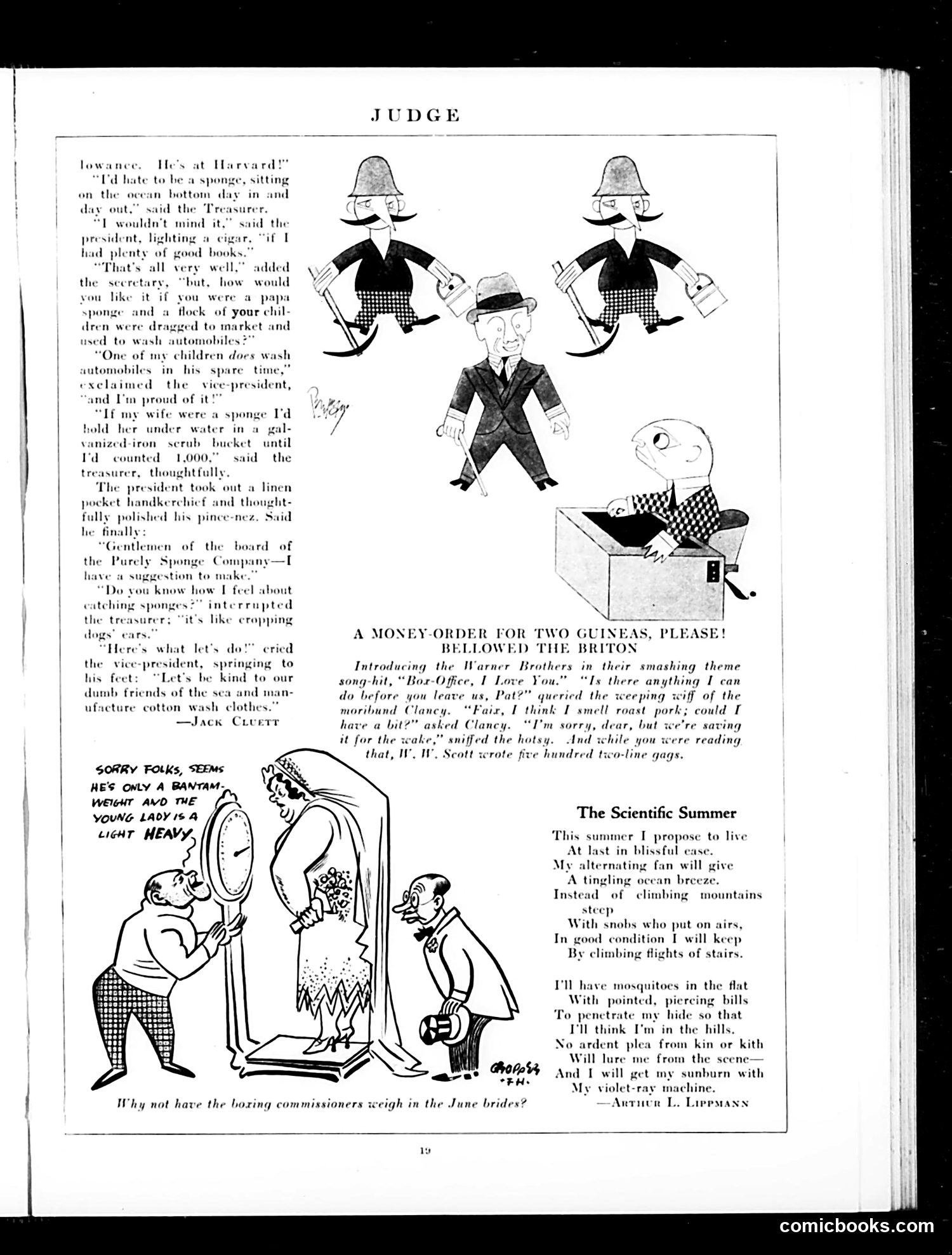
This page contains several satirical pieces typical of early 20th-century Judge magazine: **Top cartoon**: Business executives of the "Purely Sponge Company" debate harvesting sea sponges. The joke satirizes corporate indifference—they casually discuss sponges as if they were children, revealing callous attitudes toward both labor practices and natural resources. One executive proudly mentions his child washes automobiles, missing the absurdity entirely. **Center cartoon**: "A Money-Order for Two Guineas, Please!" references Warner Brothers' song "Box-Office, I Love You," satirizing how entertainment industry products exploit emotional scenarios (here, an Irish wake) for profit. **Bottom left cartoon**: A weighing joke about "loaning commissioners" and June brides—likely mocking the custom of weighing newlyweds or satirizing marriage as a commercial transaction. **Right side**: "The Scientific Summer" is a humorous poem about avoiding outdoor activities through mechanical means—fans, stairs instead of mountains—mocking people who seek leisure while avoiding actual nature. The overall tone is characteristic Judge satire: cynical about business, entertainment, and social pretension.
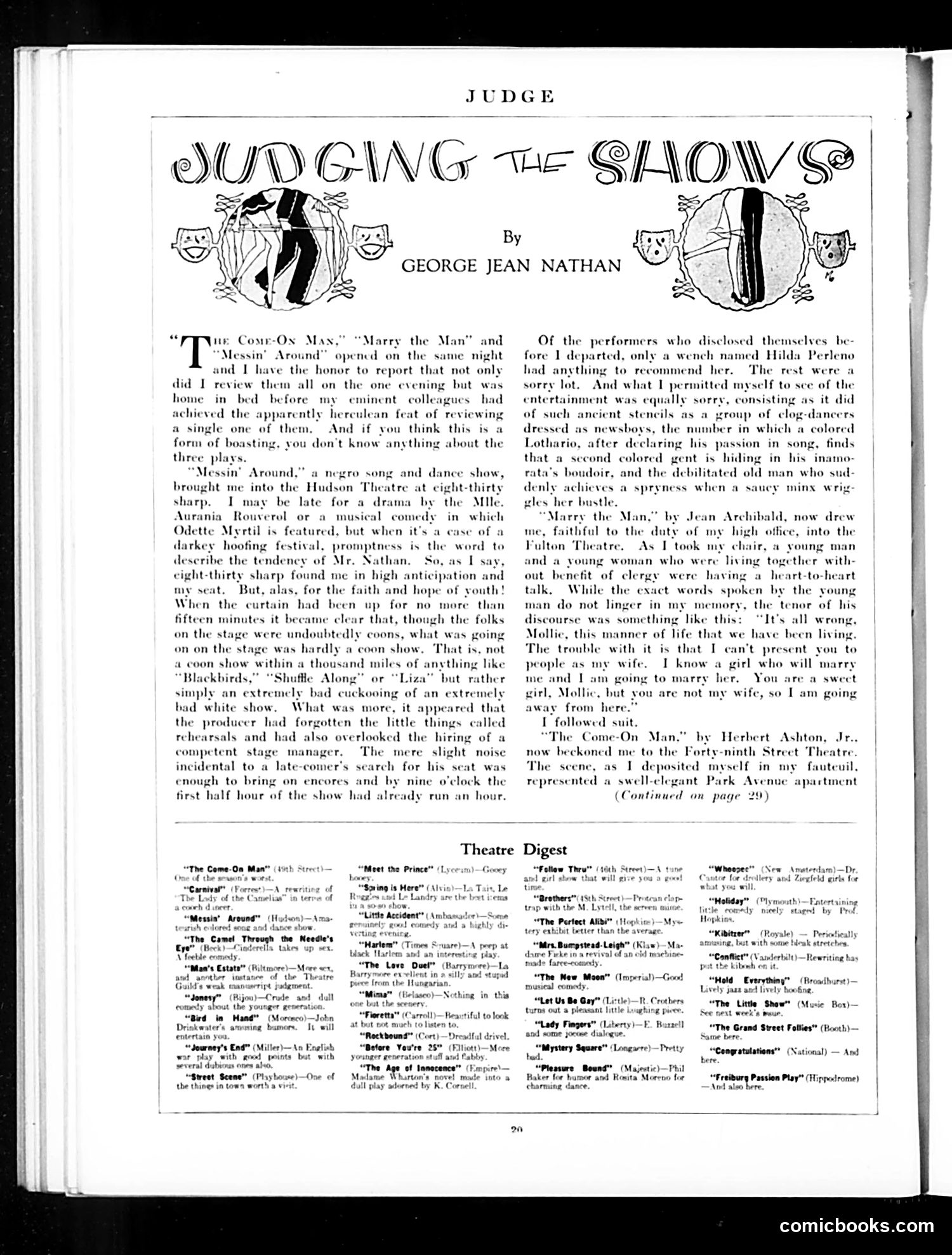
This is a theater review column by George Jean Nathan critiquing three Broadway productions: "The Come-On Man," "Marry the Man," and "Messin' Around." Nathan employs caustic satire to pan these shows, particularly those featuring Black performers. He dismisses "Messin' Around" as a poorly-executed imitation of successful all-Black revues like "Blackbirds" and "Shuffle Along"—popular shows that had legitimate artistic merit. Nathan criticizes the production's lack of rehearsal, incompetent staging, and recycled theatrical "stencils" (tired routines). "Marry the Man" receives similar treatment for its overwrought melodrama about cohabitation without marriage. The satire targets theatrical incompetence and fraud—producers presenting shoddy shows while claiming artistic legitimacy. However, the language reflects period racial attitudes, using derogatory terms now considered offensive. The piece demonstrates both Nathan's sharp critical eye and the casual racism embedded in 1920s entertainment criticism.
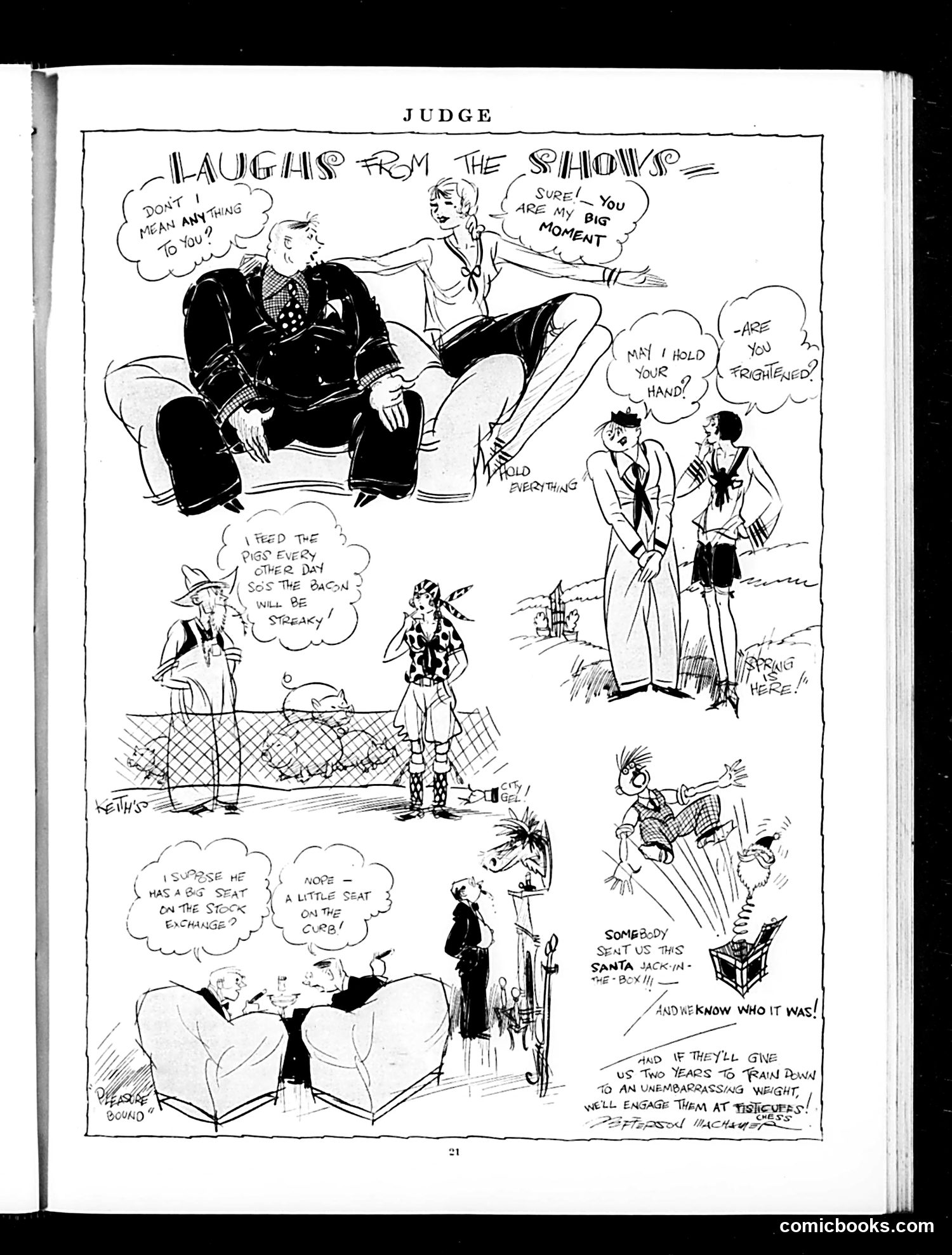
This Judge cartoon page satirizes theatrical/vaudeville entertainment through multiple sketches. The central figure appears to be a wealthy patron or impresario on a couch, being flattered by performers seeking his approval and financial backing ("Sure! You are my big moment"). The jokes mock show-business desperation: performers promising various acts (feeding pigs for bacon, training acrobats), each trying to secure the patron's investment. One sketch references someone being sent "in a box" (possibly an escape artist act reference), with characters joking about recognizing who performed it. The bottom gag suggests a producer would give performers two years to lose weight before engaging them at Tuskegee—a reference to the Tuskegee Institute, a historically Black educational institution. This reflects period attitudes about physical appearance requirements for performers. Overall, the page satirizes theatrical hustling, the power dynamics between wealthy patrons and desperate performers, and entertainment industry pretensions.
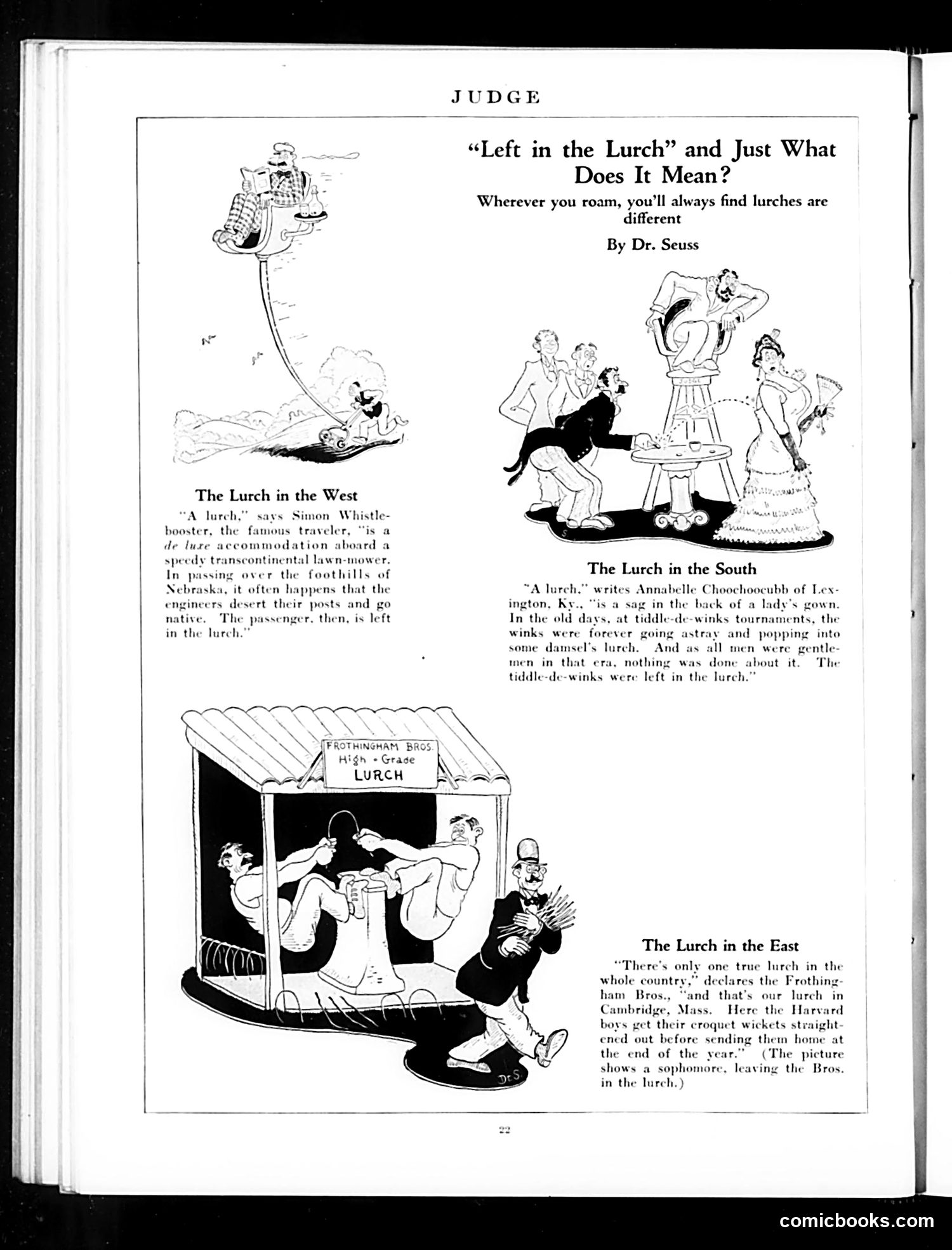
This early Dr. Seuss piece is a humorous wordplay exercise rather than political satire. It plays on the phrase "left in the lurch" (meaning abandoned in a difficult situation) by collecting invented, absurd definitions of "lurch" from different American regions. Each section presents a fictional expert providing a ridiculous regional meaning: a Western traveler claims it's a seat on a transcontinental vehicle; a Kentucky woman describes it as a sag in a lady's dress (with a tiddle-de-winks anecdote); the Frothing Bros. in Cambridge, Massachusetts define it as a croquet equipment storage or repair location. The satire mocks regional pride and made-up "local traditions," with the final image showing a Harvard student leaving equipment behind. This is characteristic of Seuss's early Judge work—lighthearted, nonsensical humor aimed at educated readers who'd appreciate the absurdist premise and regional stereotypes.
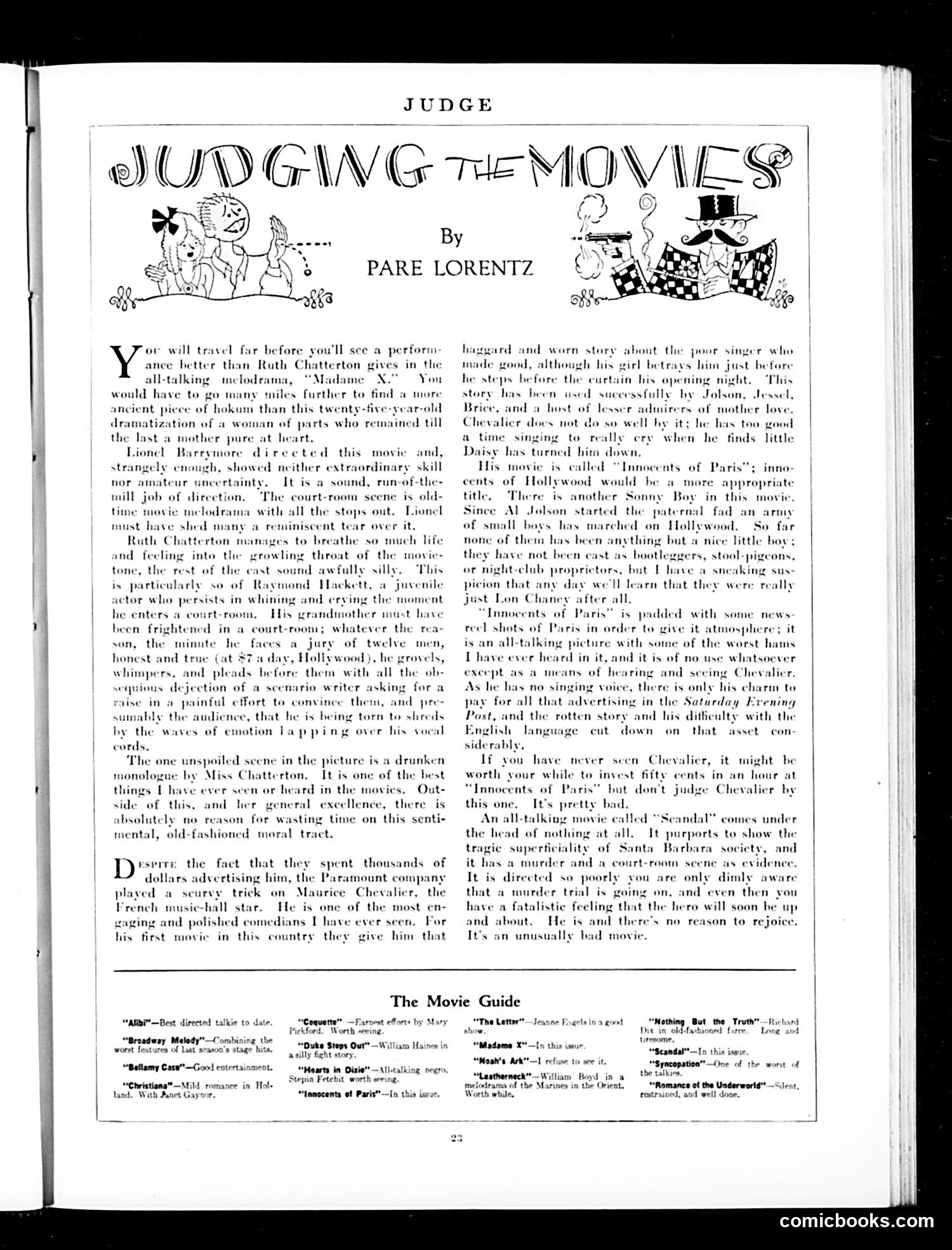
This is a film review column by Pare Lorentz critiquing early sound movies ("talkies"). The page discusses several 1929 films: **"Madame X"** — Lorentz criticizes this as tired melodrama, praising Ruth Chatterton's performance but faulting director Lionel Barrymore's uninspired direction and actor Raymond Hackett's overwrought, whining delivery. **"Innocents of Paris"** — Maurice Chevalier's first American film. Lorentz praises Chevalier as a talented performer but condemns the film as a recycled "poor singer betrayed" plot padded with newsreel footage. He's skeptical of Hollywood's recent trend of featuring child actors ("Sonny Boy" imitators). **"Scandal"** — An all-talking picture dismissed as shallow and poorly made. The satire targets Hollywood's wasteful advertising spending and formulaic storytelling, while acknowledging genuine talent hampered by poor material. The reviews reflect early talkies' technical limitations and theatrical conventions.
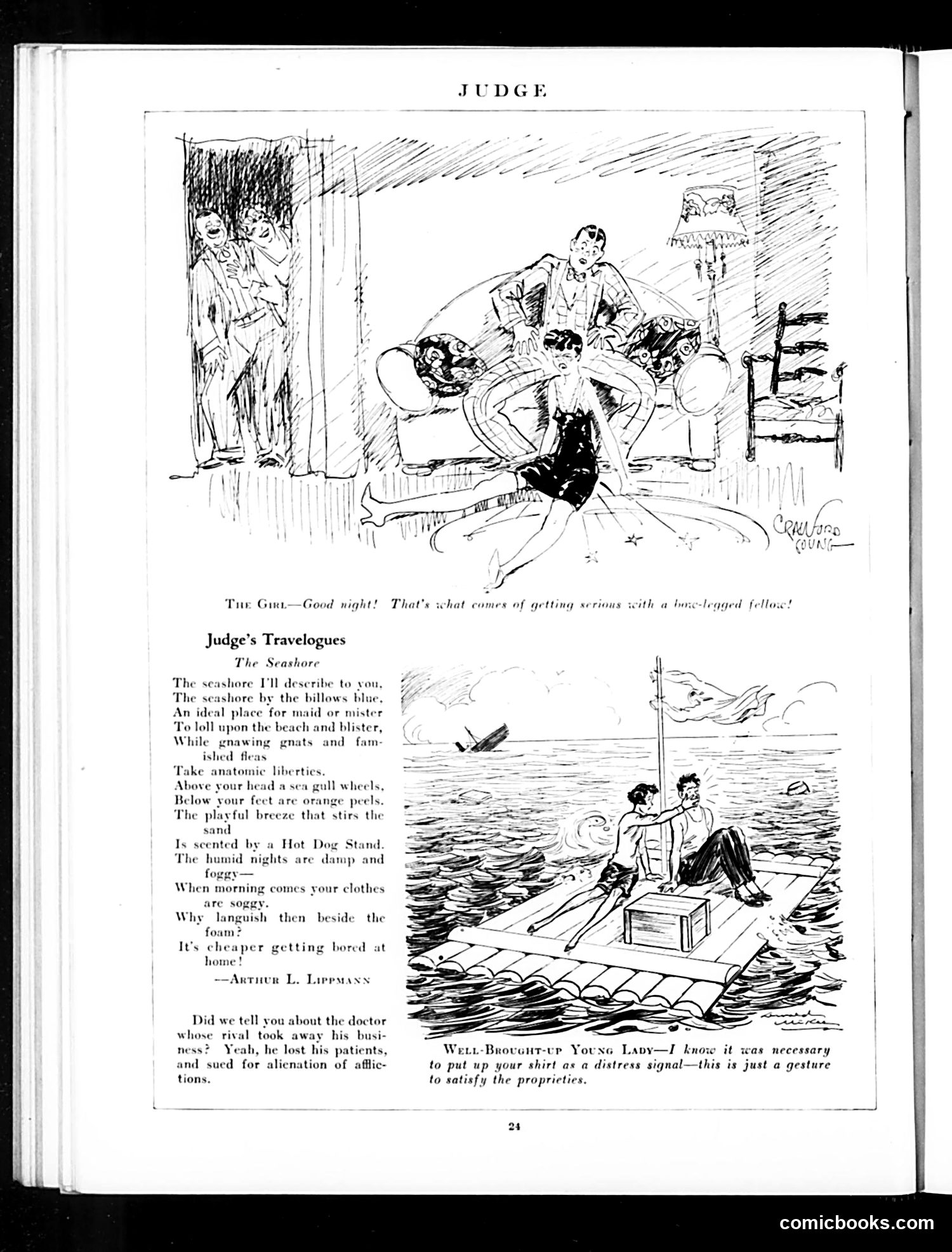
This page contains two distinct humor pieces from Judge magazine: **Top cartoon**: A young woman in a bathing suit says goodnight to a bow-legged man. The joke relies on physical comedy—the implication that getting "serious" (romantic/intimate) with someone bow-legged creates an awkward or uncomfortable situation, playing on crude slapstick humor about body shapes. **Bottom section**: "Judge's Travelogues: The Seashore" is satirical verse mocking seaside vacations. The poem catalogs beach unpleasantries—sunburn, biting insects, seagulls, sand, humidity, and hot dog stand odors—puncturing the romantic ideal of beachside leisure. The accompanying illustration shows a couple in a rowboat; the caption jokes that the woman must display her shirt as a "distress signal" for propriety's sake. The humor targets middle-class vacation expectations versus disappointing reality. Both pieces use physical comedy and exaggerated complaints typical of early 20th-century American satirical magazines aimed at urban readers.
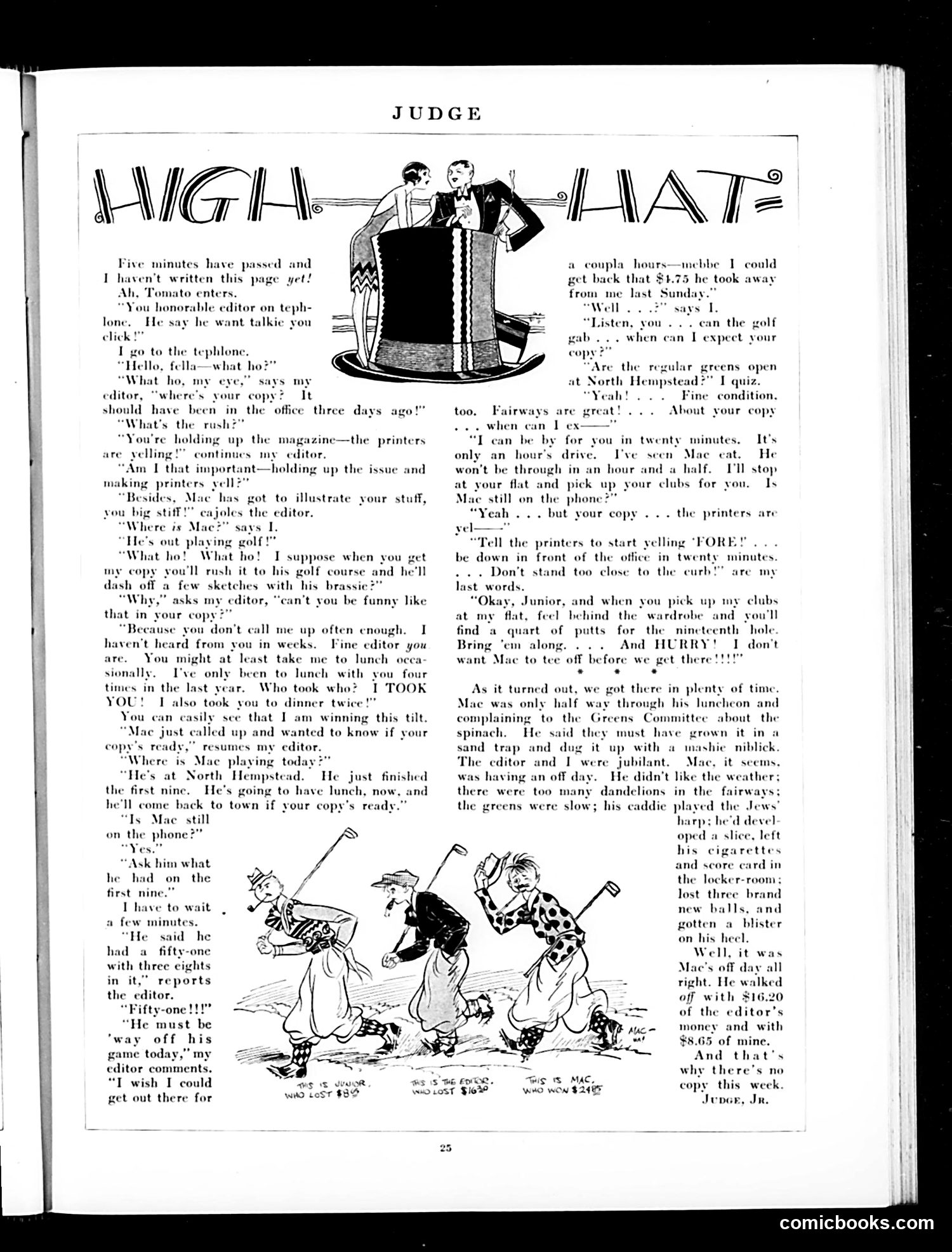
This is a humorous narrative about the friction between a magazine editor and a freelance illustrator named Mac. The joke centers on chronic professional dysfunction: the editor repeatedly calls the writer/narrator demanding copy, but Mac—the illustrator essential to completing pages—has abandoned work to play golf. The satire mocks several things: the editor's desperation and poor management (he hasn't even taken the writer to lunch regularly); the illustrator's irresponsibility (golfing while deadlines loom); and workplace chaos where a single person's absence derails production. The bottom illustration shows three golfers losing balls and equipment, reinforcing the theme of incompetence and wastefulness. The punchline—that Mac's golf outing costs both men money and produces no magazine copy that week—suggests editorial incompetence has real financial consequences. This likely resonated with Judge readers familiar with magazine publishing's precarious economics during this era.
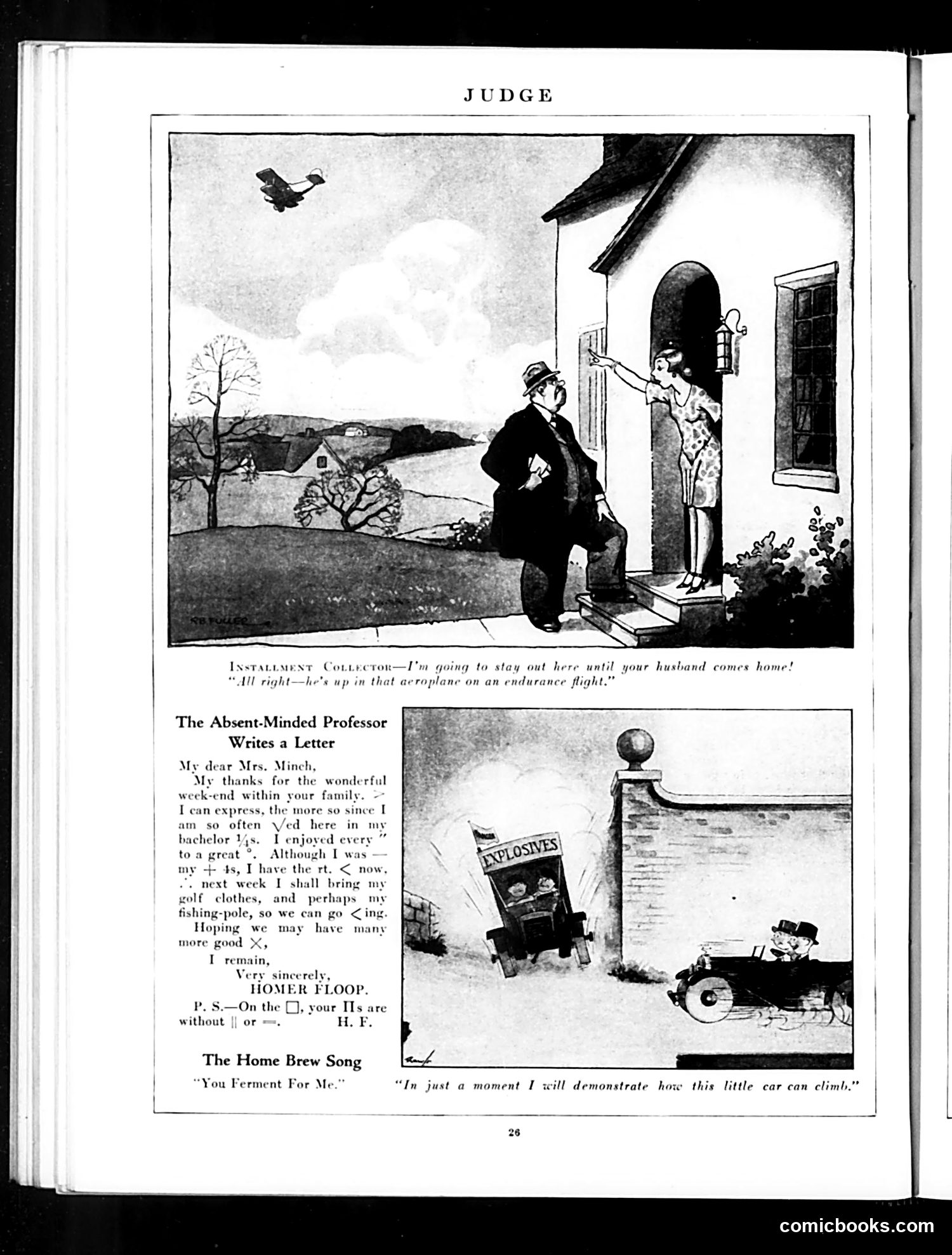
This page from *Judge* contains three humor pieces satirizing early 20th-century life: **Top cartoon**: An installment collector threatens to wait at a woman's home until her husband returns, claiming he's "up in that aeroplane on an endurance flight"—a clear excuse. The joke mocks both deadbeat debtors and the era's fascination with aviation as an alibi. **Middle section**: "The Absent-Minded Professor Writes a Letter" by Homer Floof satirizes academic absentmindedness. The professor thanks his hosts for a visit but the letter is garbled and nonsensical—words are crossed out, replaced with symbols, and the postscript contradicts itself. It's a visual gag about forgetfulness and poor communication from impractical academics. **Bottom cartoon**: Titled "The Home Brew Song," it depicts a dangerous homemade car or explosive device attempting to climb, with "EXPLOSIVES" marked on it. This likely references Prohibition-era home brewing and the dangers of amateur chemical experimentation. All three pieces use exaggeration and visual humor typical of early Judge satire.
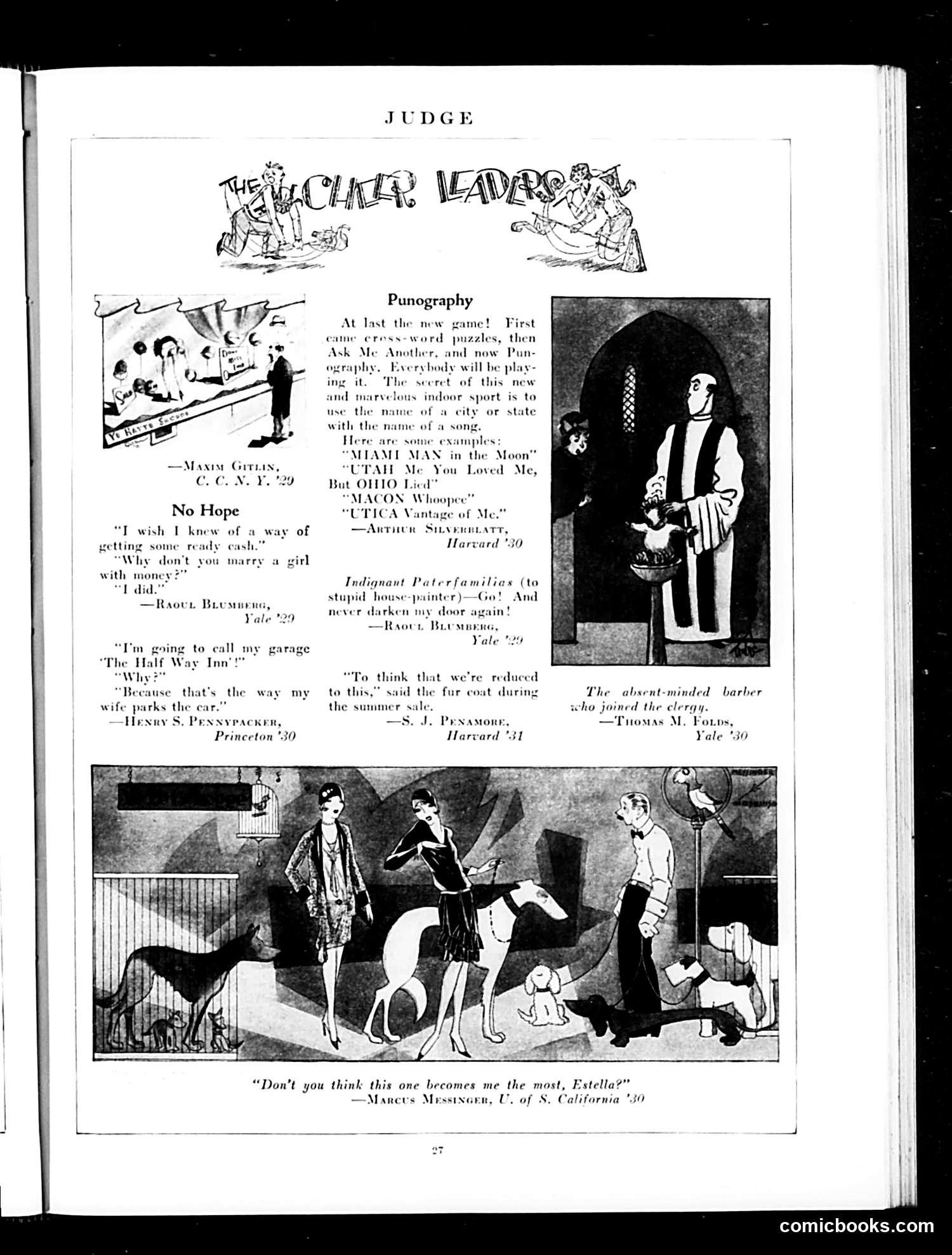
This page contains **humor pieces and cartoons** aimed at college-educated readers (note the attributions to Yale, Princeton, Harvard). **"No Hope"** section: Brief jokes about young men's financial troubles during what appears to be the Great Depression—wishing for ready cash, joking about marrying for money. **"Punography"**: A new word-game where players combine city/state names with song titles (e.g., "UTAH Me You Loved Me, But OHIO Lied" = "Utah Sweet You Loved Me, But I Lied"). It's positioned as the latest fad after crossword puzzles. **Visual cartoons**: The right-side illustration shows "the absent-minded barber who joined the clergy"—a figure in clerical robes, likely depicting someone so distracted they accidentally became a priest. The bottom cartoon shows a woman modeling clothes with the caption "Don't you think this one becomes me the most, Estella?"—a visual pun on "becomes" (suits/flatters). The page targets educated, affluent readers with wordplay and light social satire about Depression-era anxieties and fashion consciousness.
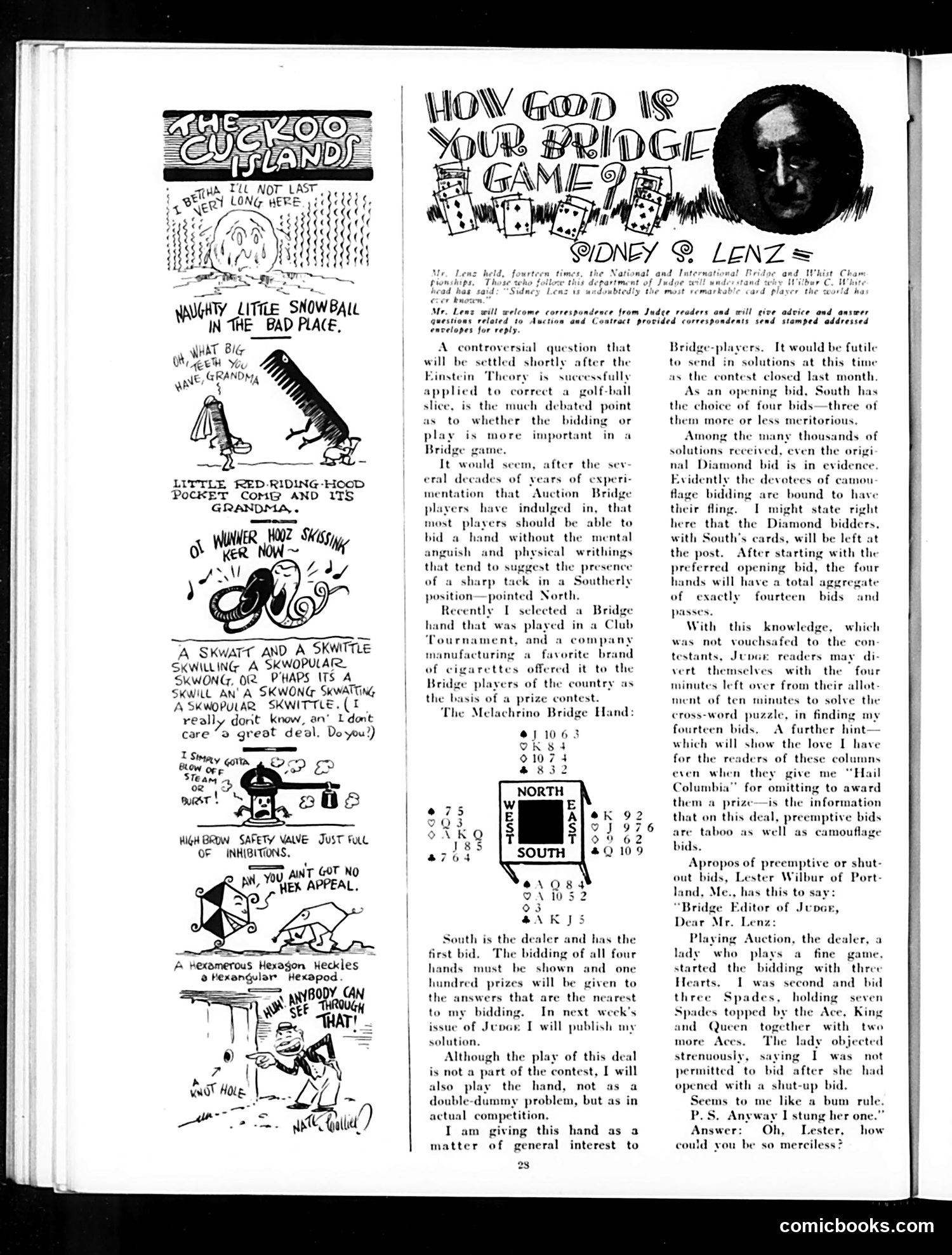
This page combines **humorous cartoons** (left side) with **bridge card game instruction** (right side). The cartoons mock nursery rhymes and children's tales through absurdist wordplay—"Little Red Riding Hood Pocket Comb," incomprehensible compound words ("Skwatt," "Skwittle"), and nonsensical scenarios. They're satirizing overwrought children's literature and pretentious modern entertainment, typical of Judge's irreverent humor. The main content is **Sidney Lenz's bridge column**, addressing the competitive card game Auction Bridge. Lenz discusses bidding strategy and presents the "Melachrino Bridge Hand"—a contest where readers submit solutions. A reader's letter describes a dispute over preemptive bidding rules; Lenz humorously chastises the correspondent for unsportsmanlike gloating ("stung her one"). The page reflects Judge's 1920s-30s mix: **satirical comics mocking popular culture** alongside **serious hobby content** for educated readers interested in competitive bridge—then a major leisure pursuit among the middle and upper classes.
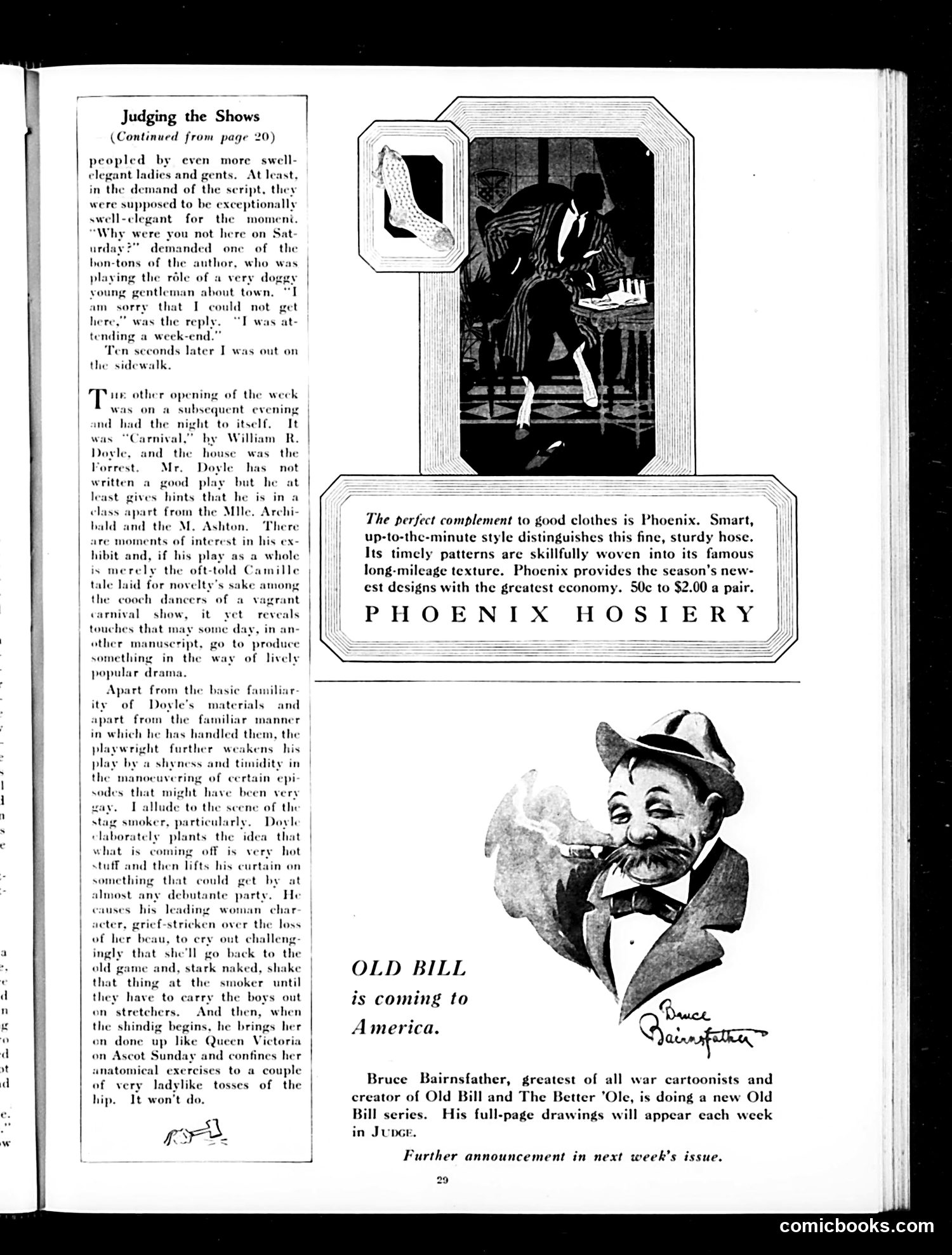
This page contains a theater review of William R. Doyle's play "Carnival," which the critic praises for showing promise while criticizing its execution. The reviewer notes Doyle has talent but weakens his work through excessive timidity—particularly in a scene where a female character threatens scandalous behavior (stripping at a carnival show), but the actual staging proves disappointingly demure, with the actress appearing "like Queen Victoria on Ascot Sunday." The satire mocks the gap between theatrical hype and prudish reality. The lower section announces cartoonist Bruce Bairnsfather's new "Old Bill" series coming to Judge. Bairnsfather was famous for WWI political cartoons; "Old Bill" was his popular character. This represents a major publishing coup for the magazine. The Phoenix Hosiery advertisement occupies the center—typical period advertising.
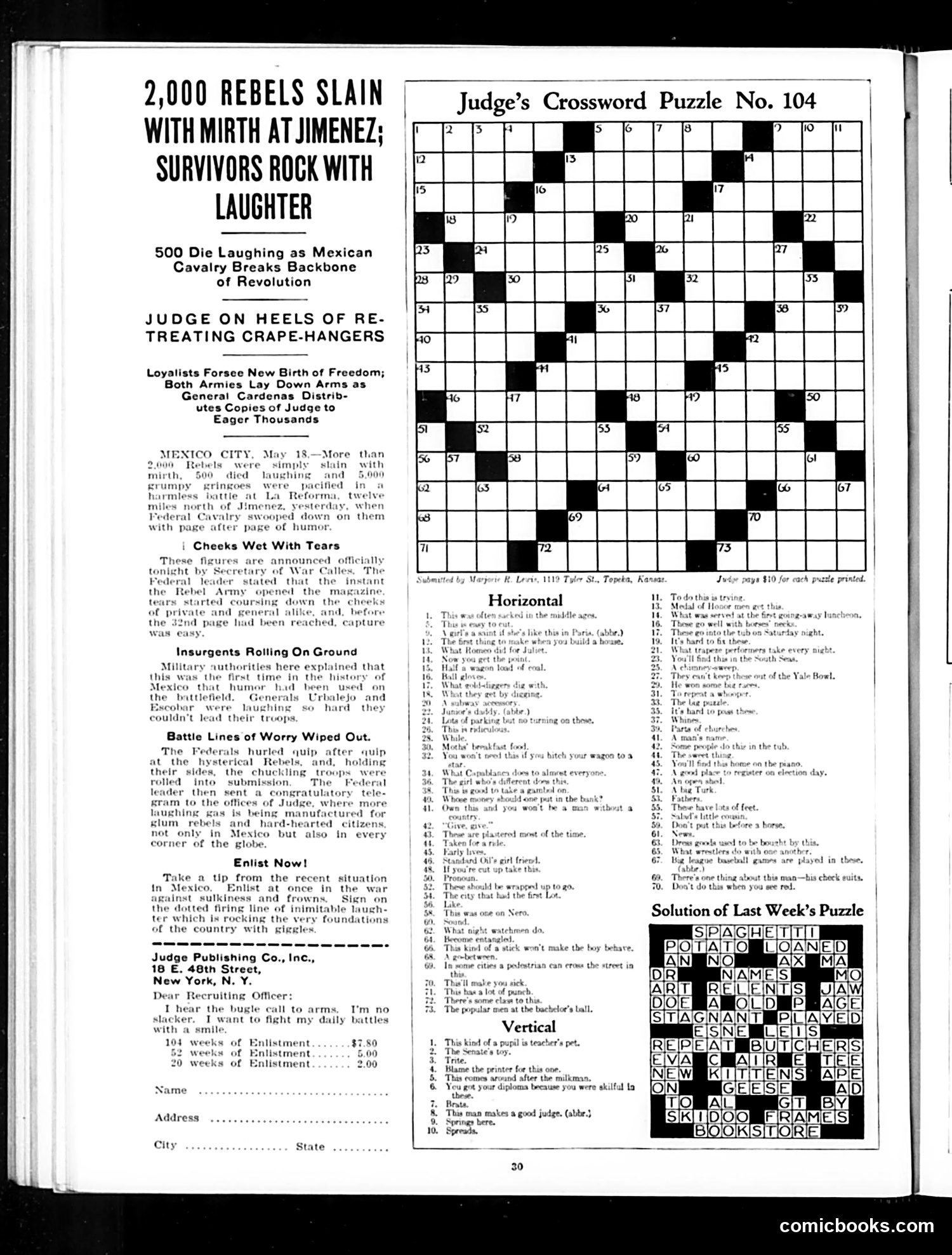
This is a humorous satirical piece about the Mexican Revolution, likely from the 1910s-1920s based on references to Generals Urbalejo, Escobar, and Secretary of War Calles. The joke: Judge magazine itself has become so powerful a weapon that Federal forces are using it to defeat rebels—literally making them laugh into submission rather than fighting them militarily. The satire mocks both Mexican political instability and American cultural superiority. By suggesting that American humor is more devastating than actual military force, Judge ridicules the rebellion as absurd while positioning the magazine as civilization's superior tool. The recruitment call at bottom ("Enlist Now!") extends the joke: readers should join the "war" against daily gloom using Judge's humor as their weapon. It's essentially propaganda wrapped in absurdist comedy—turning real military conflict into a punchline while promoting the magazine's importance to American readers.
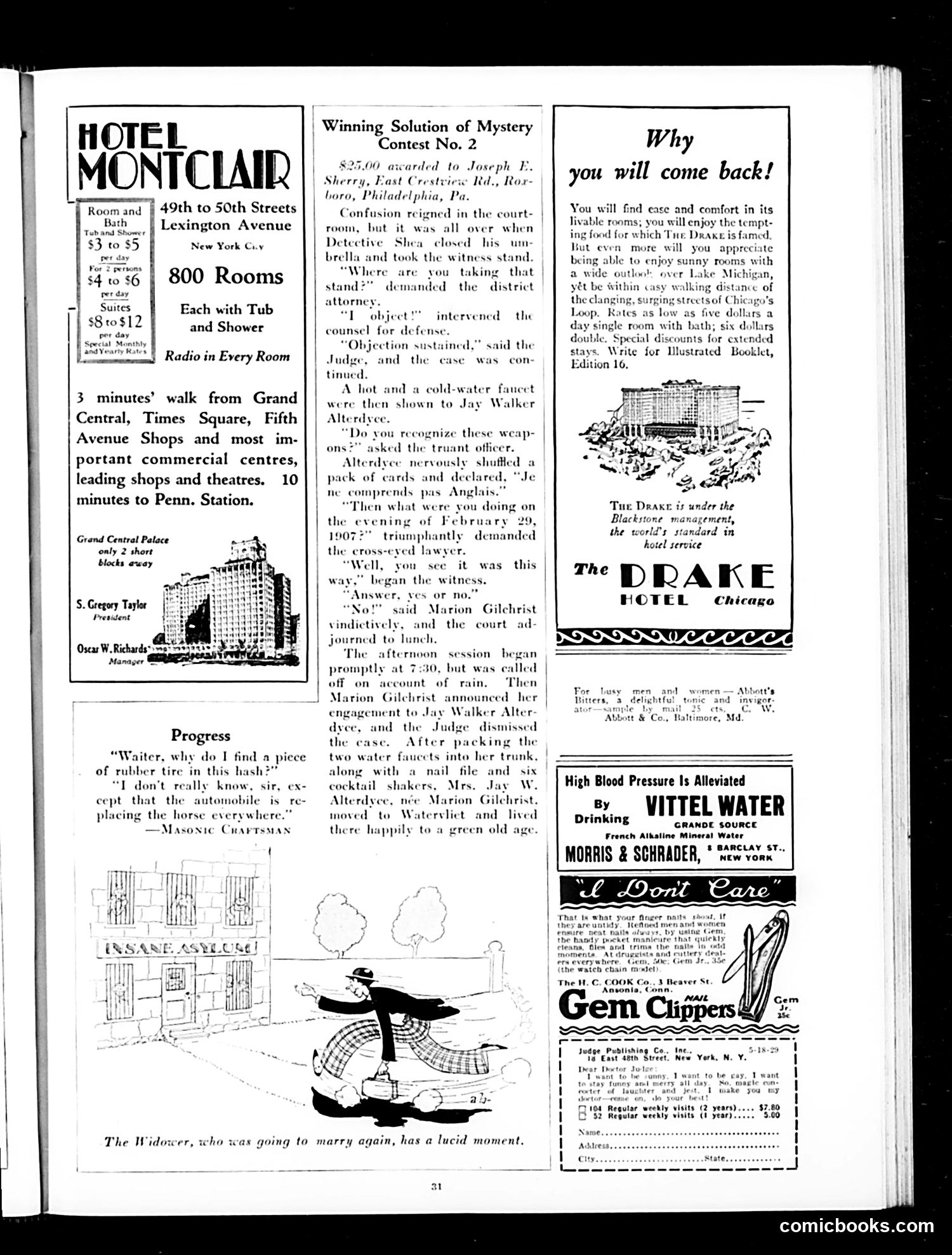
This page is primarily **advertising and light humor**, not political satire. The dominant content includes hotel ads (Montclair, Drake) and patent medicine advertisements (Vittel Water for blood pressure, Gem Clippers). The one cartoon presents "Progress," a joke about industrial change. A waiter explains finding rubber tire in a customer's hash by noting "the automobile is replacing the horse everywhere"—a straightforward quip about early 20th-century motorization displacing traditional transportation. The "Mystery Contest" solution is absurdist courtroom humor with no clear political angle—judges dismissing cases, witnesses speaking French, marriage announcements. It's wordplay and legal satire, not commentary on actual events or figures. The cartoon illustration showing "The Widower, who was going to marry again, has a lucid moment" depicts a man in motion with luggage—likely satirizing remarriage or hasty decisions, though the specific target remains unclear from context alone. Overall, this is a humor and advertising page with no identifiable political figures or contemporary political references.
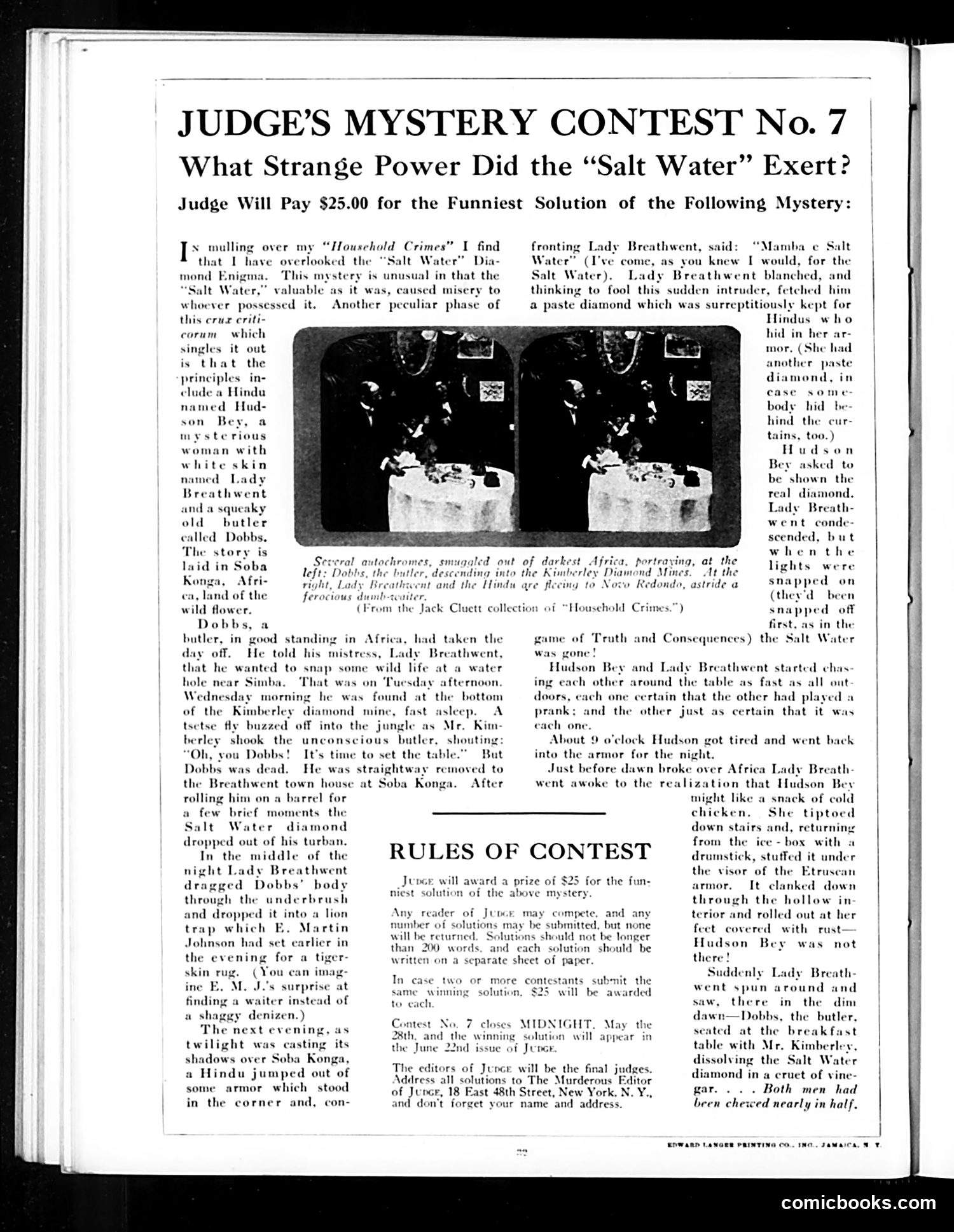
This page presents "Judge's Mystery Contest No. 7," a reader participation puzzle typical of early 20th-century magazine entertainment. The narrative is a deliberately absurd murder mystery set in colonial Africa featuring stock characters: Hudson Bey (a mysterious Hindu), Lady Breathwent (a white woman), and Dobbs (a butler), centered around a magical "Salt Water" diamond. The humor derives from the **overwrought melodrama and improbable plot**: a butler disappears into a diamond mine, is found dead, then disposed of via lion trap, only for a Hindu to emerge from armor demanding the jewel. Lady Breathwent substitutes a paste diamond; it mysteriously vanishes when lights turn on. Readers were invited to submit the "funniest solution" explaining the diamond's disappearance for a $25 prize. The contest exploits popular tastes for mystery stories and participatory entertainment while gently mocking both colonial adventure fiction and the era's fascination with "exotic" settings and stereotypical characters.
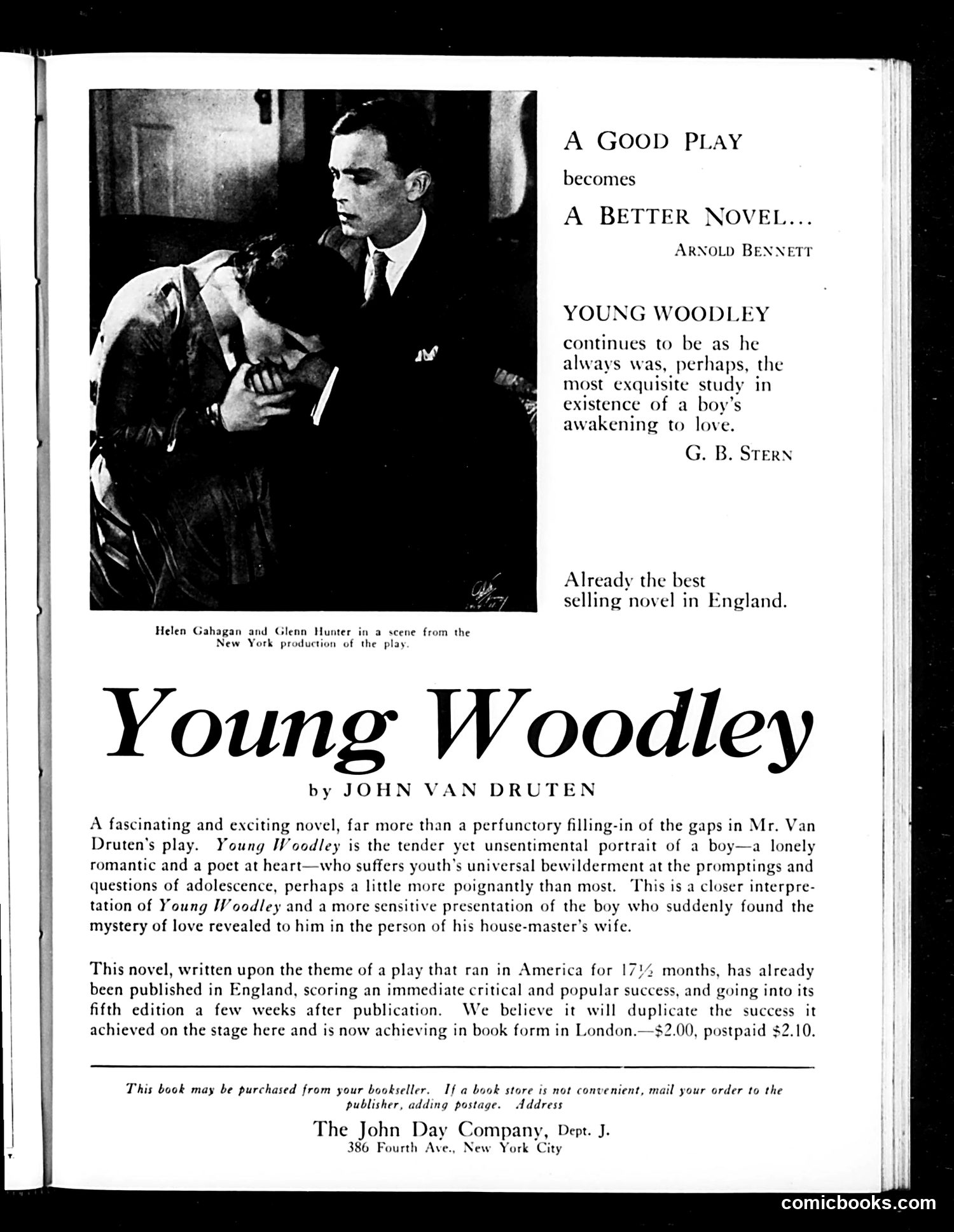
The page advertises the novel *Young Woodley* by John Van Druten, adapted from his successful stage play. The photograph shows actors Helen Gahagan and Glenn Hunter in a scene from the New York production. The advertisement emphasizes the novel's critical success in England (already in its fifth edition) and argues that the book improves upon the play by providing deeper psychological insight into its protagonist—a lonely adolescent boy experiencing his first love with his housemaster's wife. Notable quotes from literary figures (Arnold Bennett, G.B. Stern) vouch for the work's quality. The play had run 17½ months in America; the publisher predicts the novel will achieve similar commercial success in book form. The price is $2.00 (plus $2.10 postpaid). This represents typical 1920s-era advertising strategy: leveraging theatrical success to promote a literary adaptation.
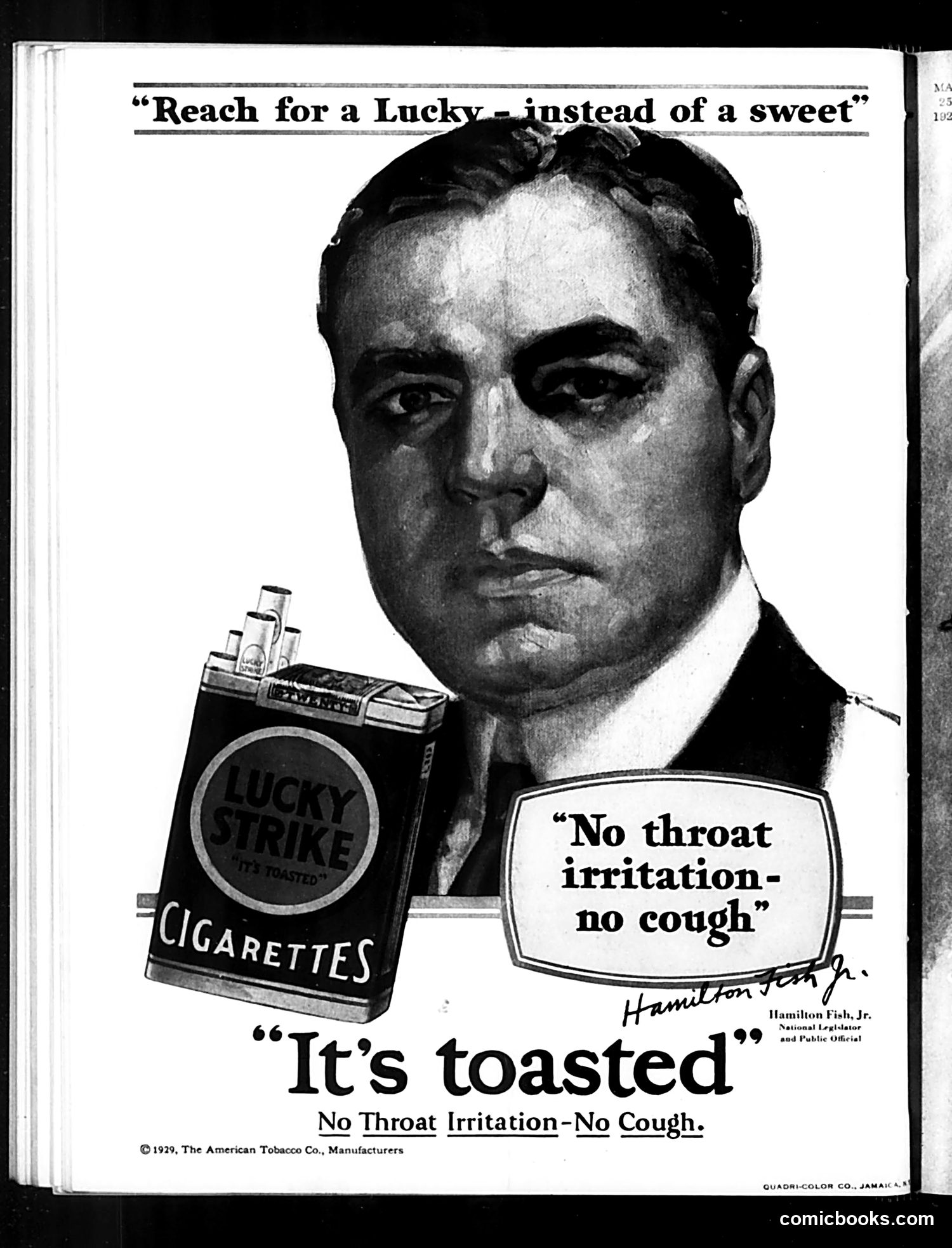
This is a 1929 advertisement for Lucky Strike cigarettes, not satire. The page features Hamilton Fish Jr., identified as a "National Legislator and Public Official," endorsing the product. The ad's central claim—"It's toasted" and "No Throat Irritation—No Cough"—represents Lucky Strike's famous marketing pitch that the toasting process made cigarettes safer and less irritating than competitors' products. The slogan "Reach for a Lucky instead of a sweet" encouraged smoking as an alternative to candy consumption, a strategy that appealed to weight-conscious consumers, particularly women. This reflects early 20th-century advertising before cigarettes' health dangers were widely acknowledged or regulated.