
A complete issue · 36 pages · 1928
Judge — May 12, 1928
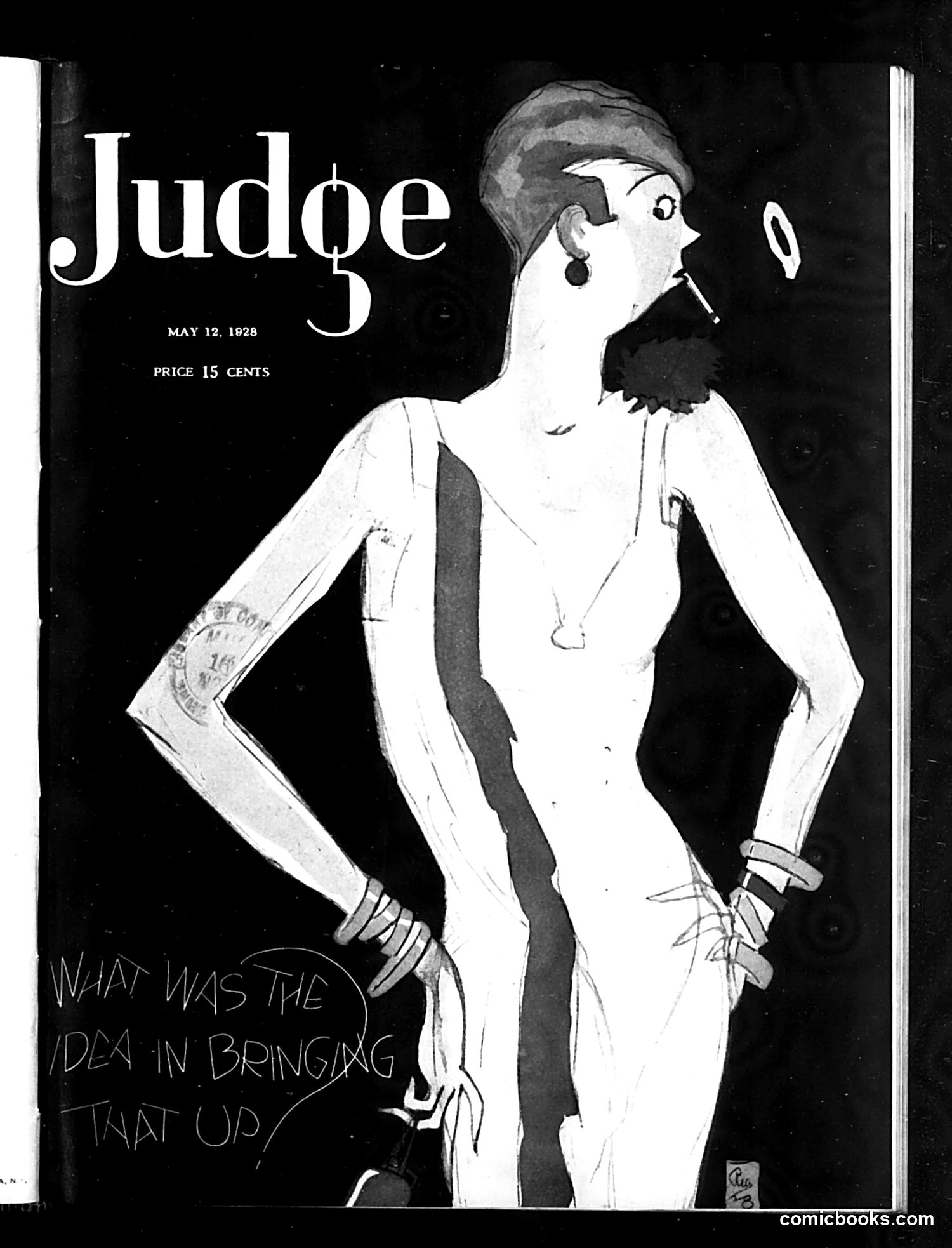
This cover features a stylized woman in 1920s fashion (cloche hat, bobbed hair, cigarette, bare arms with bracelets) alongside the caption "What was the idea in bringing that up?" The satire targets the "New Woman" of the Jazz Age—a figure who challenged Victorian conventions through smoking, revealing clothing, and frank speech. The woman's glamorous but somewhat aggressive pose, combined with her defensive question, suggests social tension around changing gender roles and women's increasing public presence. The caption implies she's being confronted about her modern behavior—perhaps dating freely, working, or simply existing visibly in public spaces. The humor relies on readers recognizing this as commentary on generational and cultural conflict of the late 1920s, when traditional society clashed with rapidly evolving social norms.
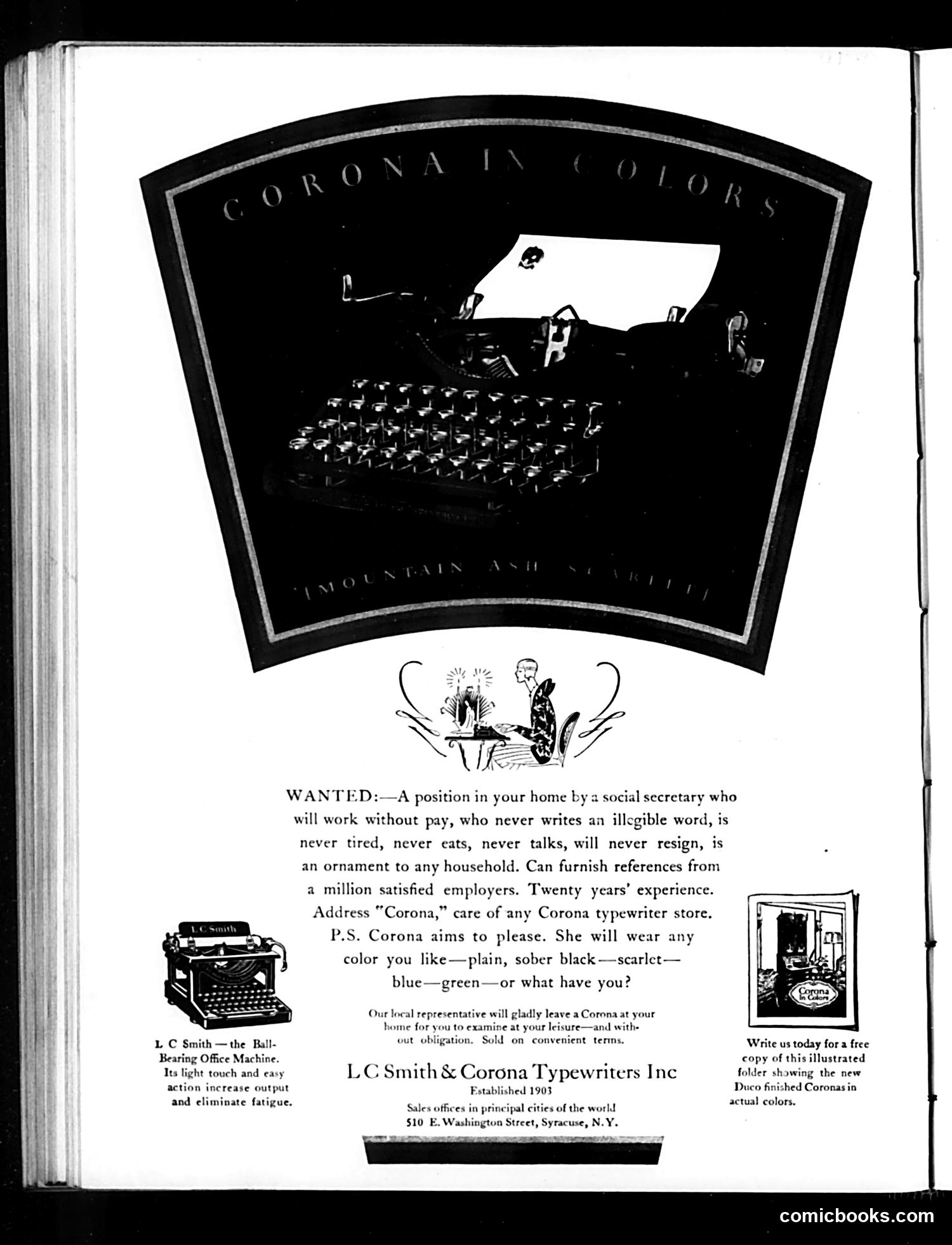
This page is primarily a **Corona typewriter advertisement** with satirical humor rather than political cartooning. The main ad features a mock "WANTED" notice seeking a social secretary willing to work without pay, never write illegibly, never tire, never eat, never talk, and never resign—essentially describing an impossible, exploited employee. The joke: Corona typewriters can do all this work instead. The satire targets **labor exploitation and unrealistic employer expectations**, particularly regarding secretarial work (traditionally female positions). By listing absurd demands, the ad ironically critiques how employers treated office workers, especially women. The bottom includes product testimonials and ordering information for Corona's new color options. This reflects 1920s workplace attitudes toward clerical staff and the ongoing tension between labor and management during the industrial era.
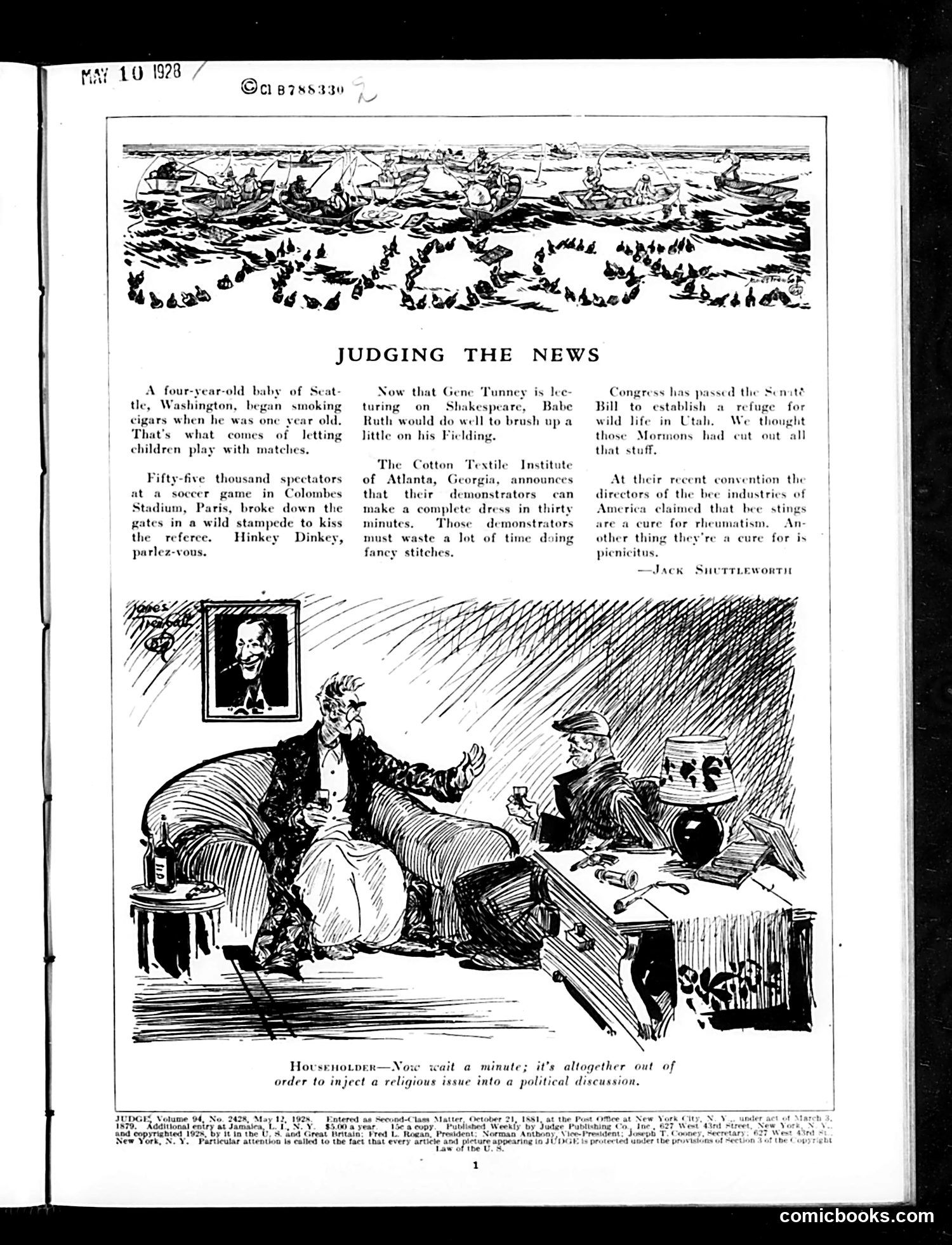
The main cartoon depicts a householder interrupting two visitors during political discussion, with the caption: "Now wait a minute; it's altogether out of order to inject a religious issue into a political discussion." **The satire**: This cartoon mocks the artificial separation between religion and politics. The householder's complaint is ironic—he's treating religious intrusion into politics as improper, yet the cartoon suggests this boundary is routinely crossed and contested. In 1928, this likely references the presidential campaign featuring Al Smith, a Catholic Democrat whose religion became a major campaign issue, violating norms about keeping such matters separate. The accompanying brief items (about Gene Tunney, a baby smoking cigars, and textile manufacturing) are lighter satirical jabs at contemporary news and social absurdities.
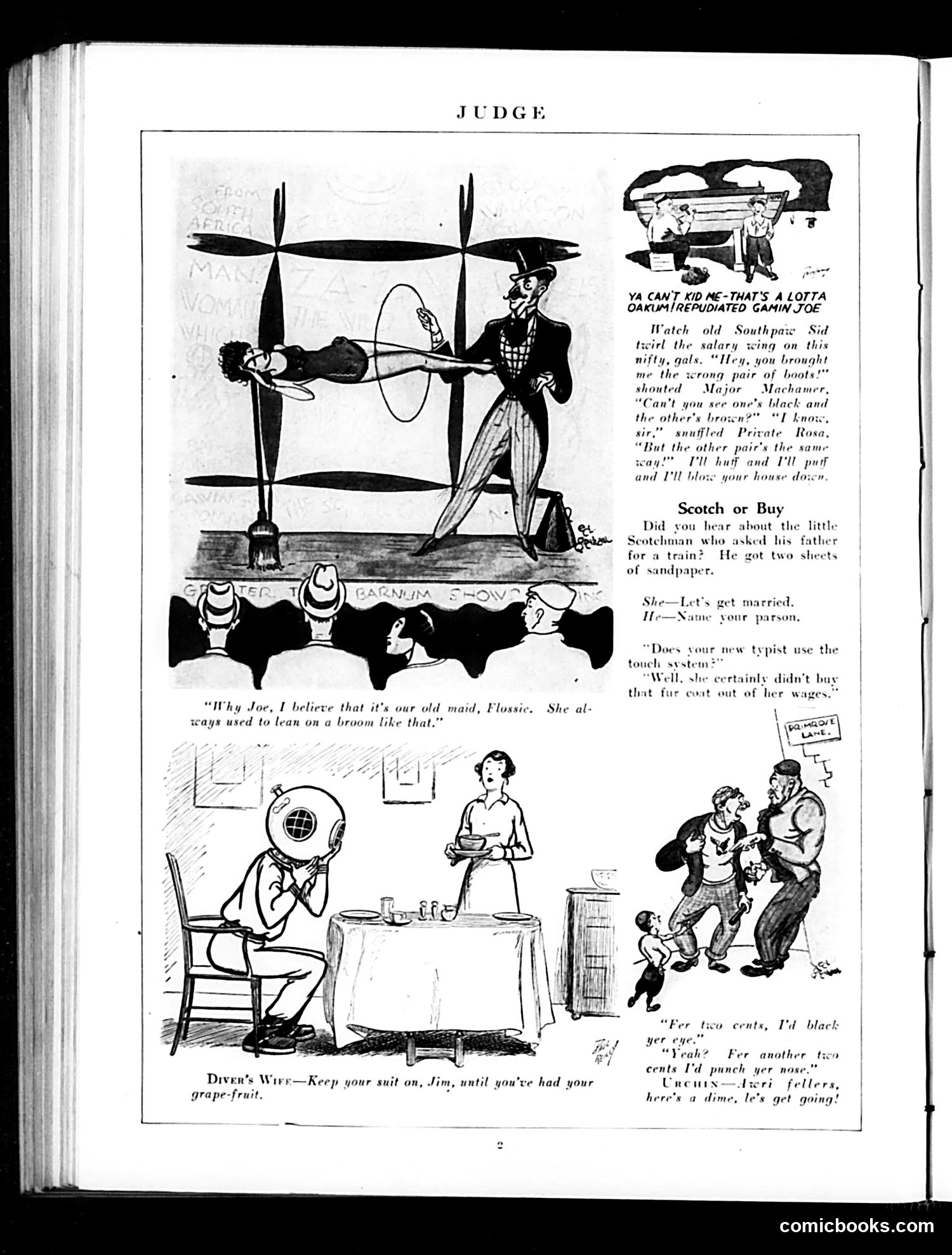
This page contains three separate satirical cartoons from Judge magazine: 1. **Top cartoon**: A circus/sideshow scene mocking a disreputable character ("Oakum/Repudiated Gamin Joe"). The joke plays on boot sizing and deception. 2. **"Scotch or Buy"**: A brief joke about a Scottish boy asking his father for a train, receiving sandpaper instead—a play on frugality stereotypes. 3. **Lower cartoons**: Two domestic scenes—one about an old maid and housework, another about a diver's wife and grape-fruit. The final vignette shows children negotiating prices for black eyes and bloody noses, reflecting working-class street violence as comedy. These cartoons reflect early 20th-century working-class humor, ethnic stereotyping, and casual treatment of poverty and violence as entertainment.
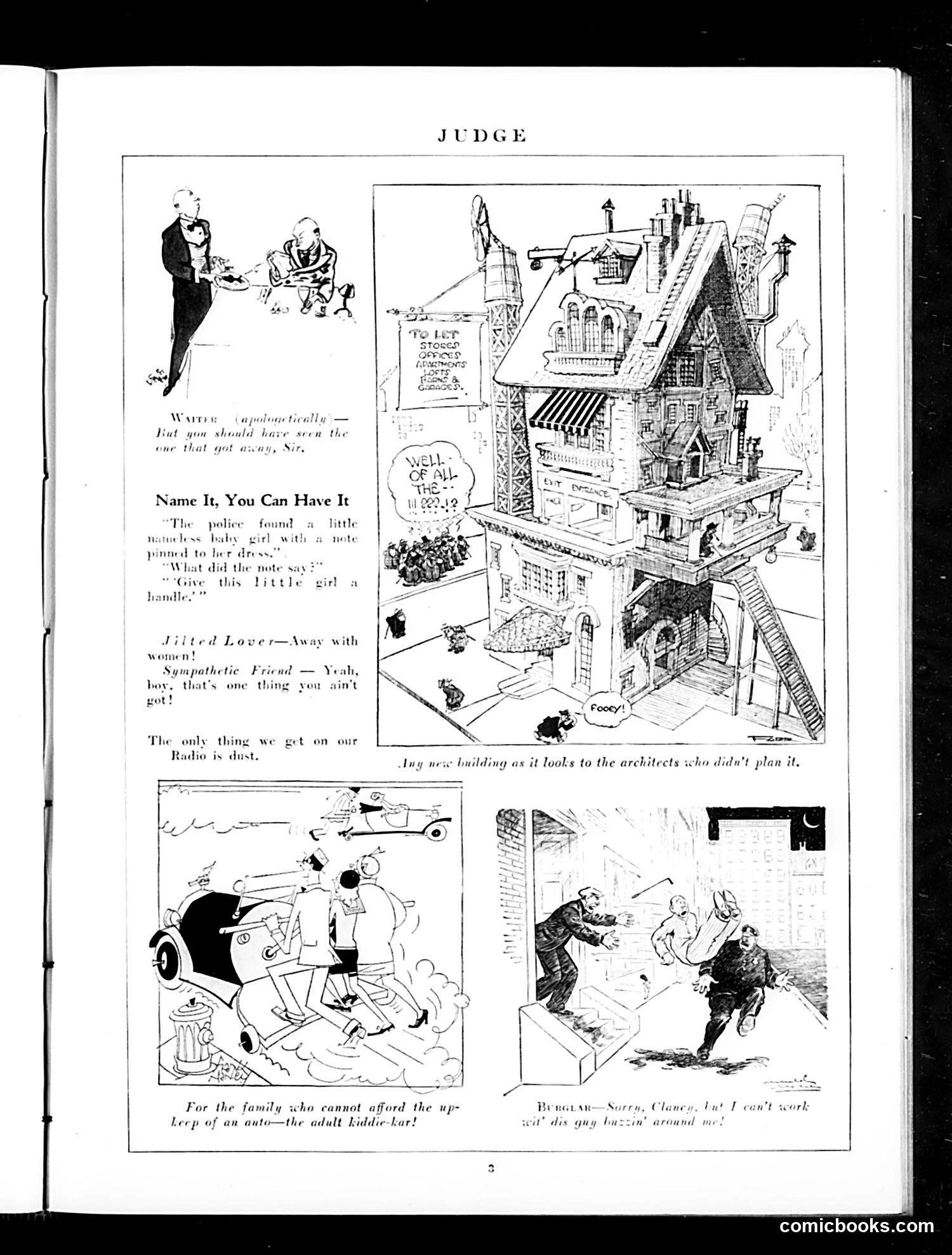
This page contains four satirical cartoons commenting on 1920s American life: 1. **"Waiter Apologetically"**: A waiter offers a diner a "tiny" portion, satirizing post-WWI food scarcity or rationing effects. 2. **"Name It, You Can Have It"**: Police find an abandoned baby with a note—likely mocking adoption bureaucracy or the proliferation of unwanted children during economic hardship. 3. **"Jilted Lover—Away with Women!"**: A sympathetic friend consoles a heartbroken man, using contemporary slang ("one thing you ain't got"). 4. **"For the family who cannot afford the upkeep of an auto"**: An absurdist "adult kiddie car"—satirizing automobile culture and aspiration among working-class families during the consumer boom era. 5. **"Burglar"**: A thief complains he can't work with neighbors' noise—dark humor about urban crime and congestion. The cartoons mock consumerism, urban life, and social anxieties of the period.
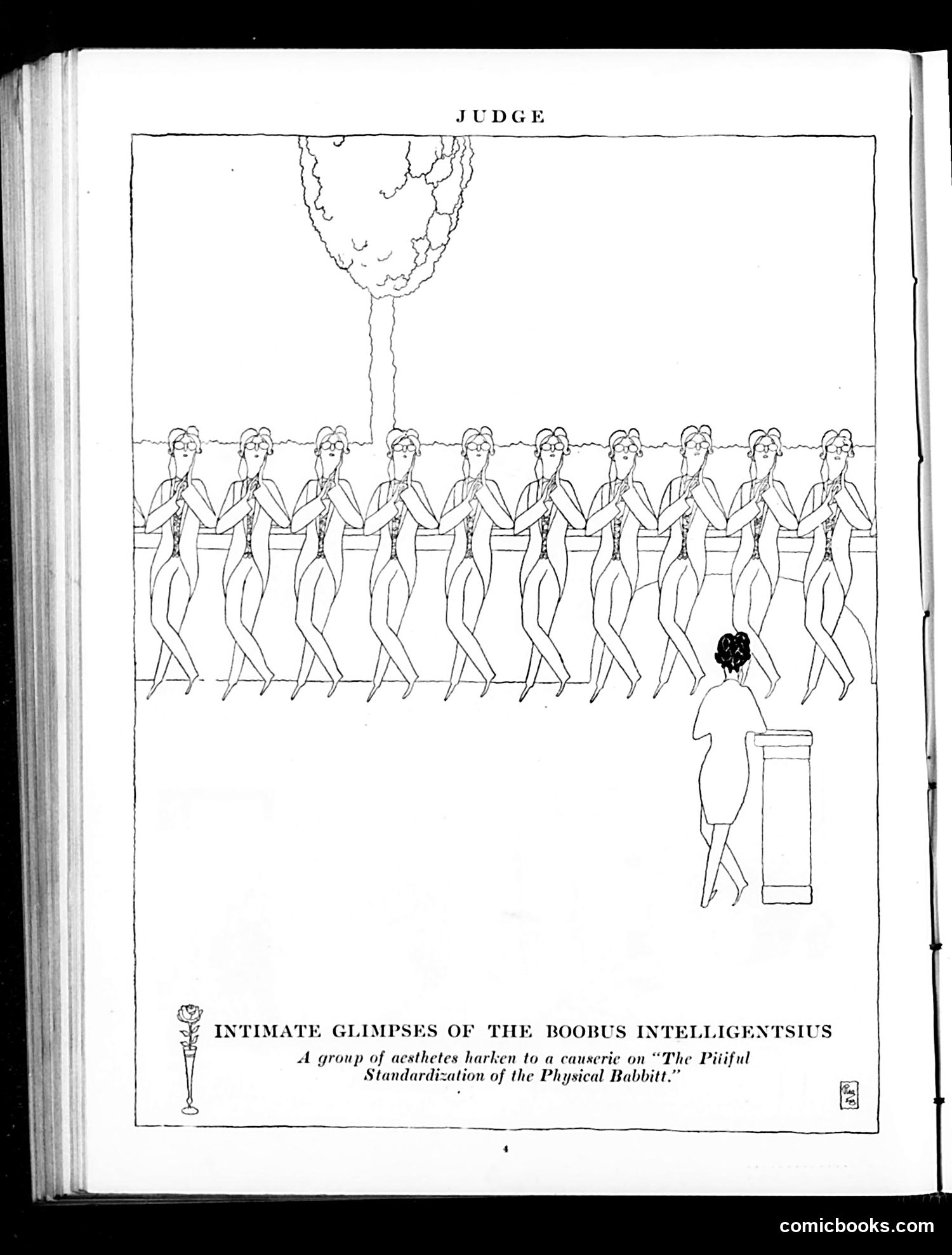
This cartoon satirizes **Boob's Intelligentsius**—a group claiming aesthetic sophistication. The image shows ten identically-posed female dancers in a choreographed line, viewed by a single male judge figure on the right. The satire targets pretentious intellectuals who claim to judge and standardize physical beauty and "high" aesthetics. The repetitive, uniform dancers mock the notion that human individuality can be reduced to standardized physical types or that such standardization represents genuine aesthetic intelligence. The title's reference to "The Pitiful Standardization of the Physical Rabbit" reinforces this critique—suggesting that attempts to create uniform physical ideals reduce humans to mere animals stripped of individual character. The humor mocks both the aesthetic movement's pretensions and its dehumanizing implications.
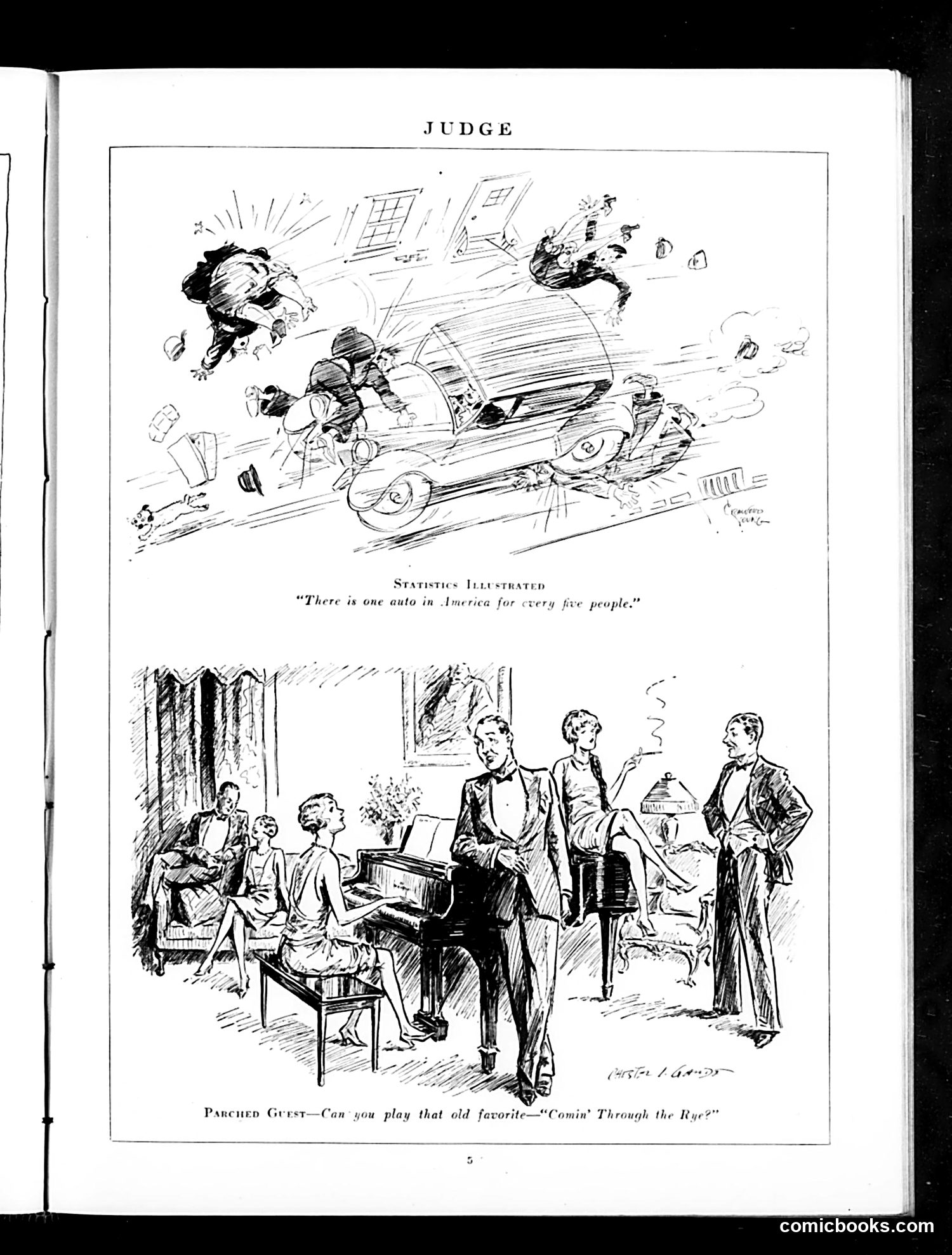
**Top Cartoon:** Satirizes automobile accident statistics. The caption reads "There is one auto in America for every five people," but the illustration shows a chaotic collision where a car has struck multiple pedestrians and objects are flying everywhere. The joke inverts the statistic's reassuring intent—instead of suggesting cars are rare, the cartoon argues that with so many automobiles, accidents are inevitable and devastating. It's dark commentary on the dangers of rapid automobile adoption in early 20th-century America. **Bottom Cartoon:** Shows a parlor scene where a guest requests a pianist play "Comin' Through the Rye," a popular sentimental song. The satire likely mocks middlebrow musical taste or the tedious predictability of parlor entertainment among the upper classes—the guest's demand for this "old favorite" suggests clichéd, uninspired social gatherings.
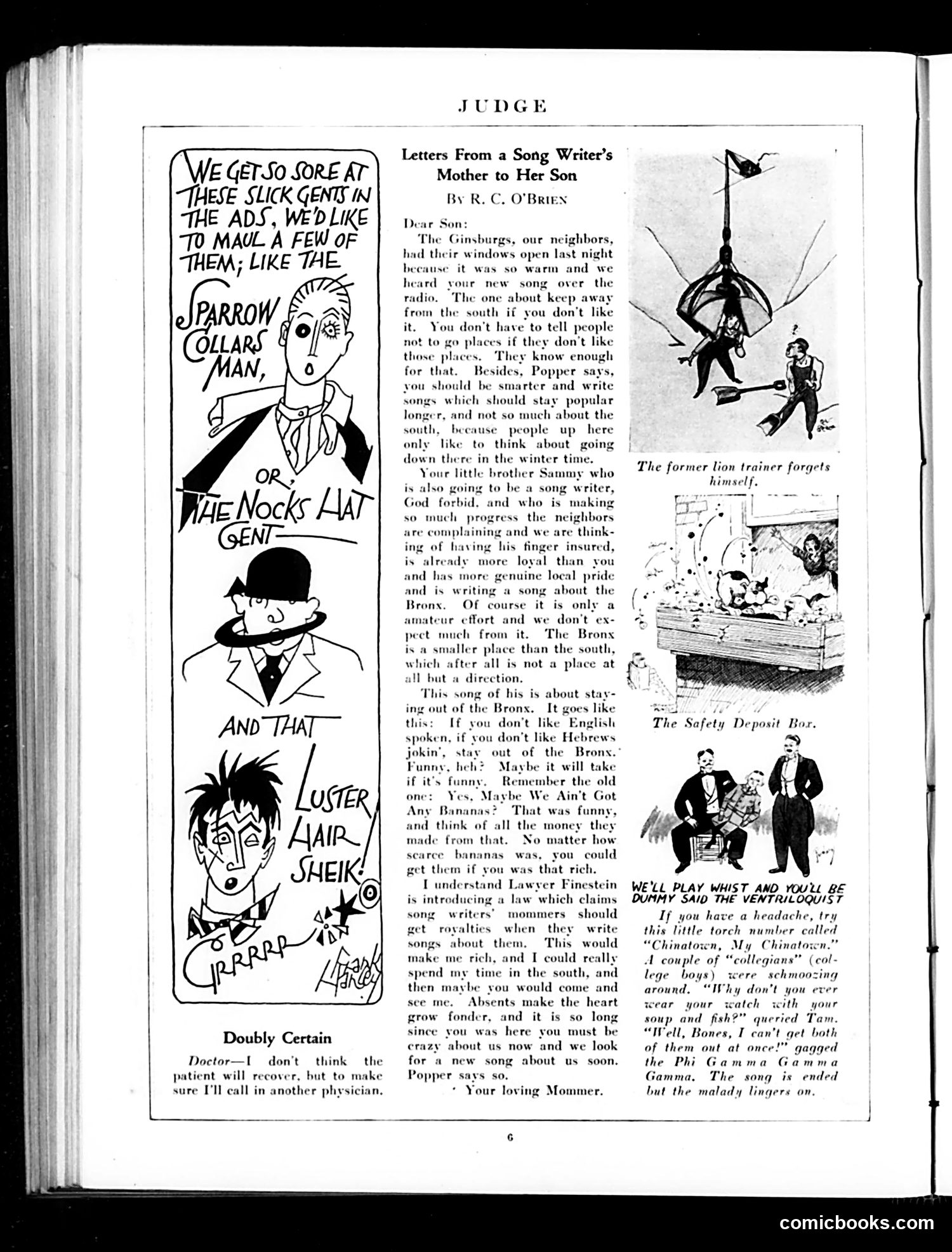
This Judge magazine page contains multiple satirical pieces about early 20th-century American entertainment and advertising. **Left cartoon:** Criticizes slick advertising copywriters who use ethnic stereotypes ("Sparrow Collars Man," "The Nocks Hat Gent," "Luster Hair Sheik") to sell products. The caricatured faces represent exaggerated ethnic types used in period advertising—a common but now-offensive marketing tactic. **Main article:** A mother's humorous letter to her songwriter son critiques popular song trends. She mocks sentimental "southern" songs dominating radio, noting they appeal to northerners' fantasies. She mentions her younger son writing local "Bronx" songs instead. The mother references "Yes, We Have No Bananas," a 1923 hit, as an example of absurdly successful novelty songs. **Right cartoons:** Three unrelated jokes about lion trainers, whist card games, and college humor—typical Judge filler content. The satire targets 1920s commercial entertainment's formulaic approach to song-writing and advertising's reliance on ethnic caricature.
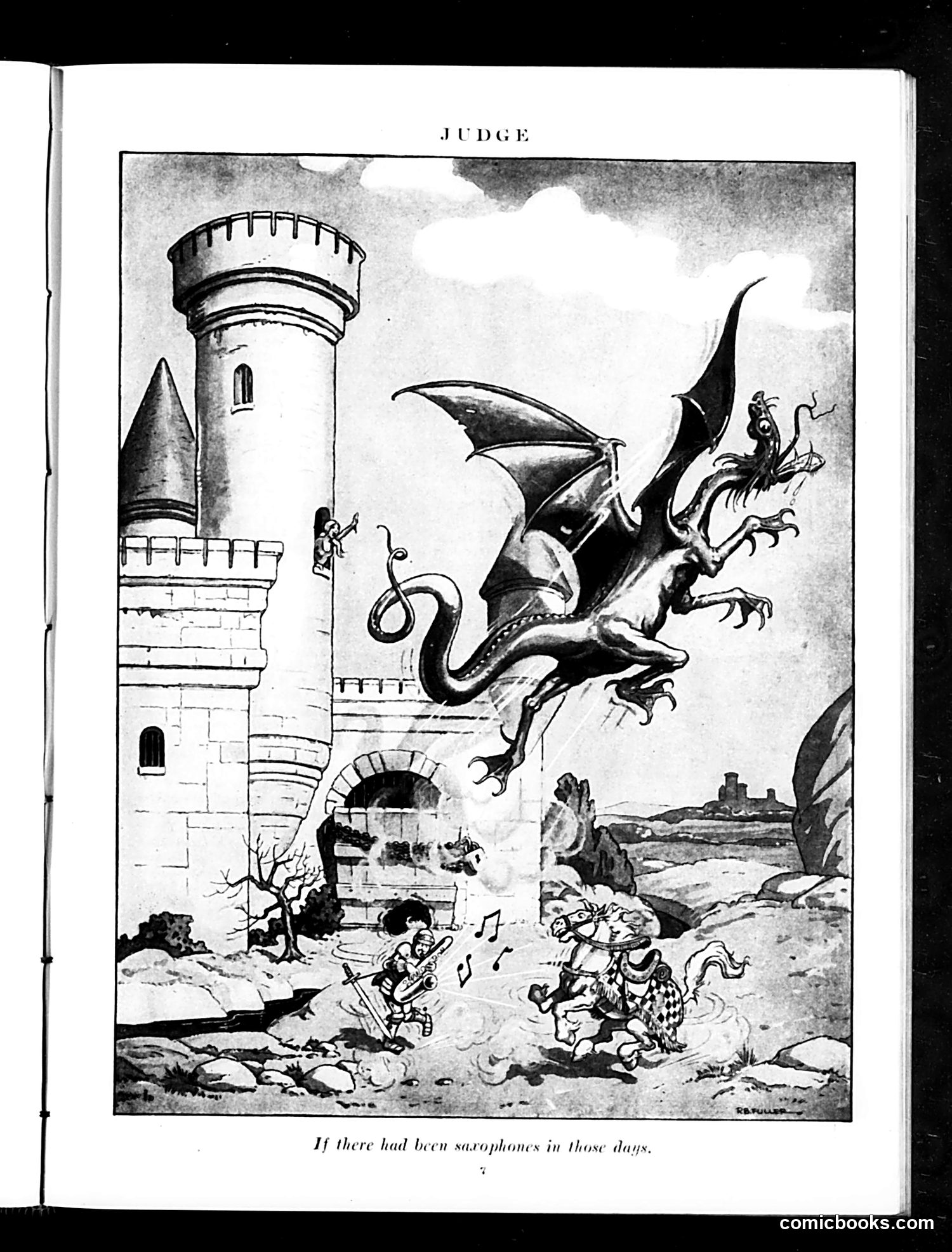
This cartoon is titled "If there had been saxophones in those days," presenting an anachronistic fantasy. The image depicts a medieval castle scene with a dragon flying overhead while two small figures below play saxophones and appear to be dancing or celebrating. The humor lies in imagining medieval knights or peasants possessing saxophones—an instrument that wouldn't be invented until the 19th century. This is a straightforward visual joke about temporal impossibility rather than political satire. The cartoon likely plays on the emerging popularity of jazz and saxophones in early 20th-century America, humorously suggesting how different history might have been with this modern musical technology available to medieval inhabitants.
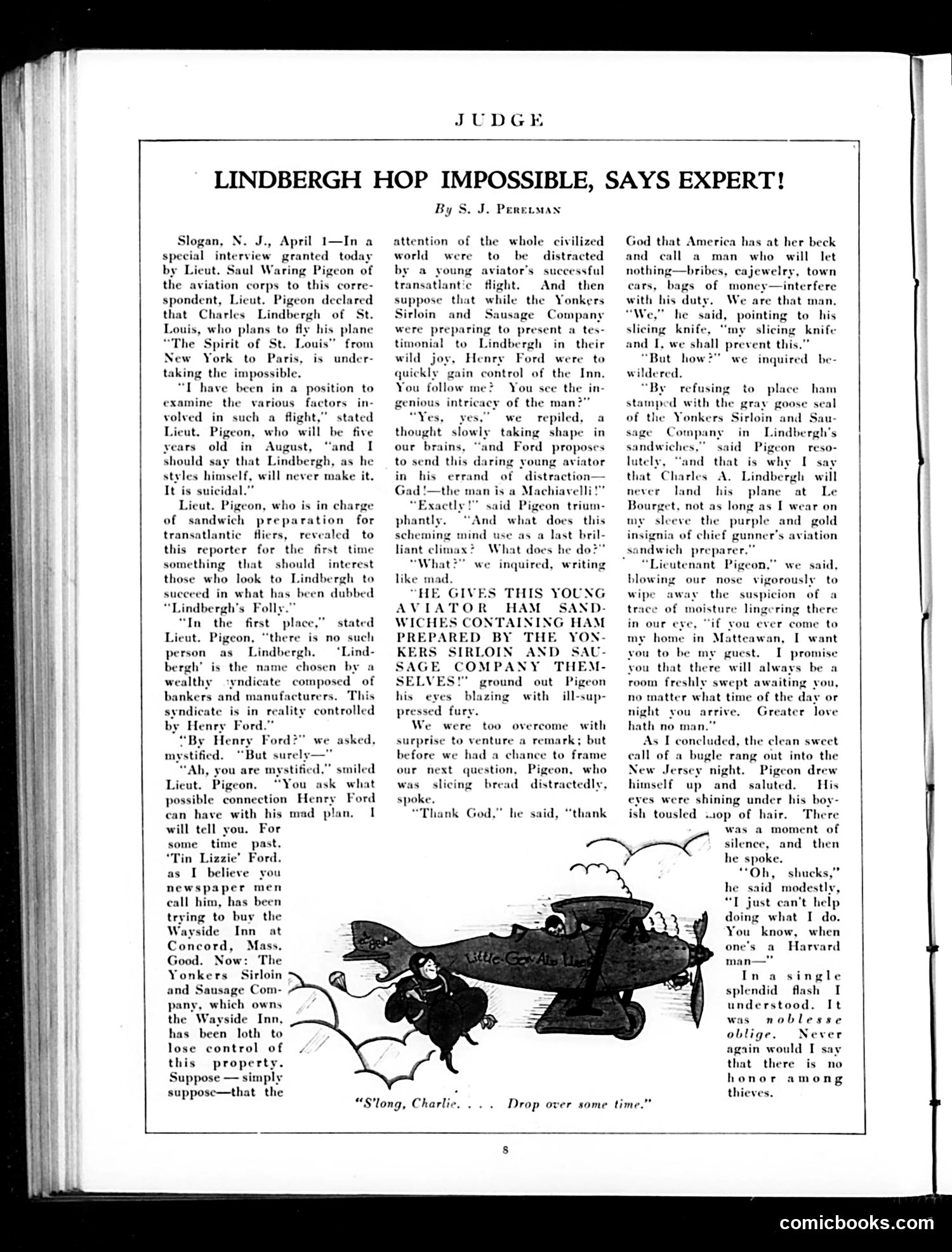
This is a mock-serious article satirizing Charles Lindbergh's planned 1927 transatlantic flight. "Lieutenant Pigeon"—a five-year-old sandwich preparer for aviators—presents an absurdly elaborate conspiracy theory: Lindbergh is actually a front for Henry Ford, who orchestrated the flight to distract the public while seizing control of the Wayside Inn in Concord, Massachusetts from the Yonkers Sirloin and Sausage Company. The satire mocks both contemporary paranoia about wealthy industrialists' hidden machinations and the breathless media coverage surrounding Lindbergh's upcoming journey. The cartoonist ridicules conspiracy-minded thinking by making the "expert" source laughably unqualified and the conspiracy preposterously convoluted. The illustration shows Lindbergh's plane with Pigeon clinging below. The joke pivots on Pigeon's declaration that he'll sabotage the flight by refusing to use branded ham in sandwiches—an absurdly ineffectual form of resistance that undercuts his grand theory.
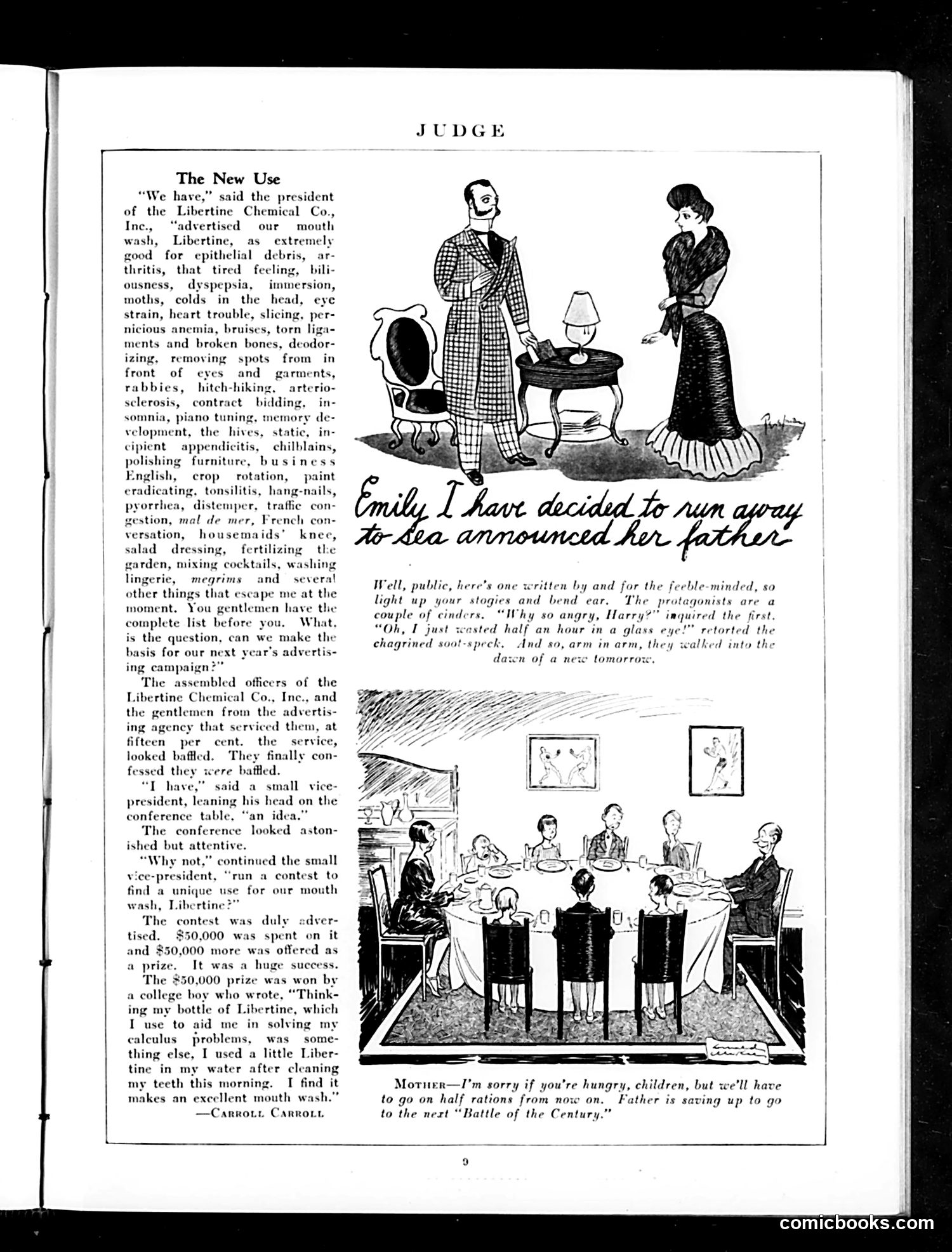
This page satirizes the absurd overclaiming of patent medicines and mouthwash advertising, a major target of early 20th-century satirists. The "Libertine Chemical Co." advertises their mouthwash as a cure-all for an absurdly comprehensive list of ailments—from arthritis to traffic congestion to "business English"—a parody of real advertising practices of the era, when patent medicines genuinely made wildly false health claims. The joke: a company executive contests for a "unique use" for the product. A college student wins by discovering what it actually does—functioning as mouthwash—having mistaken it for something else. The satire mocks both the fraudulent marketing and consumer gullibility. The second cartoon (lower half) appears to be a separate, unrelated joke about domestic hardship, mentioning reduced rations and the "Battle of the Century" (likely a boxing reference).
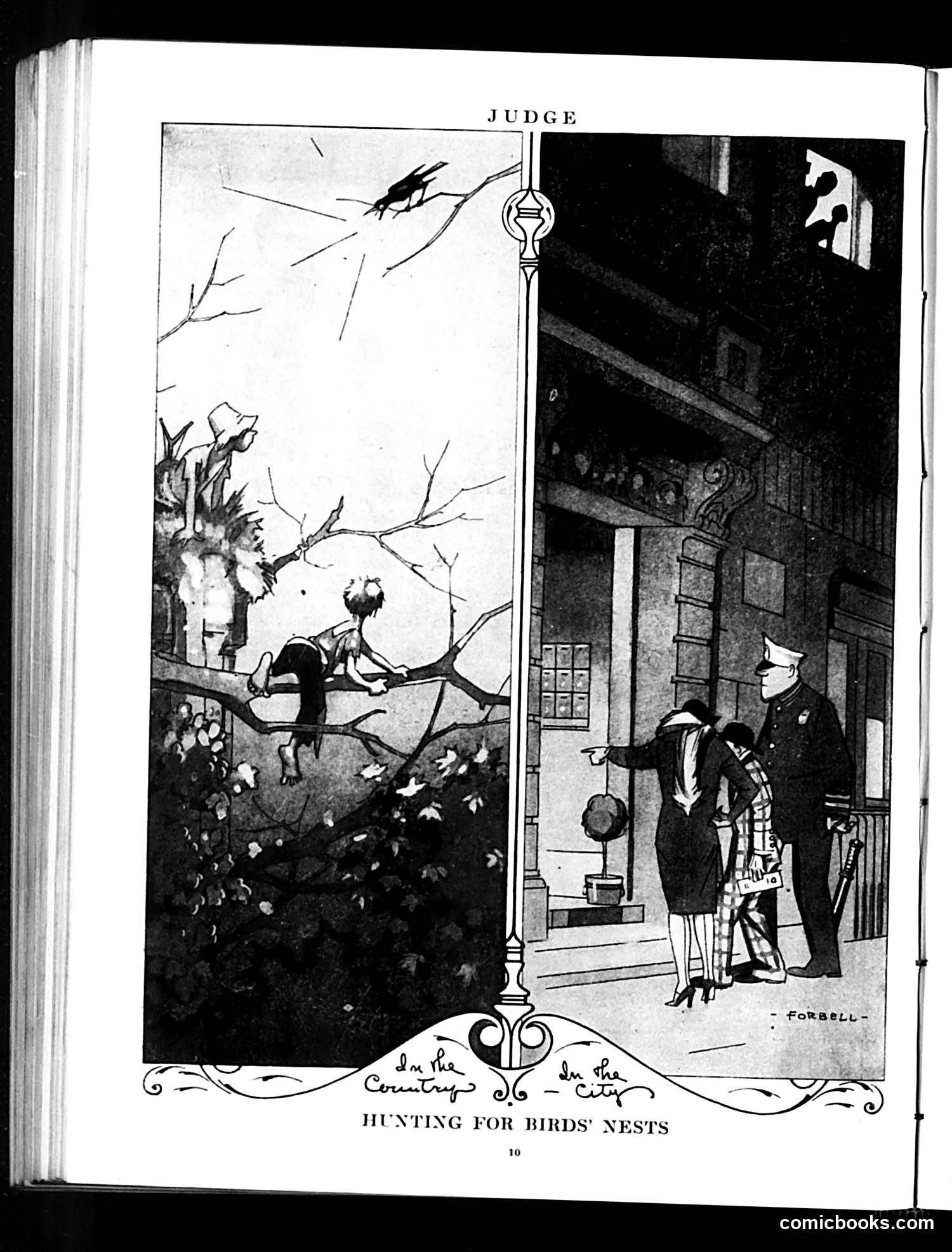
This page presents a two-panel contrast titled "In the Country" (left) and "In the City" (right), a common satirical format in Judge magazine. The **left panel** shows a child climbing a bare tree branch, hunting for birds' nests in a natural setting, with a bird flying overhead and flowers below. The **right panel** depicts an urban scene where a uniformed police officer appears to be stopping or questioning a well-dressed figure, with a question mark visible above the building. The satire likely critiques urban versus rural life or different forms of "hunting." The wordplay on "birds' nests" (literal in the country) probably refers to something else in the city—possibly illicit activities, corruption, or moral failings—suggesting that city dwellers hunt for different, less innocent "nests." The police presence reinforces this contrast.
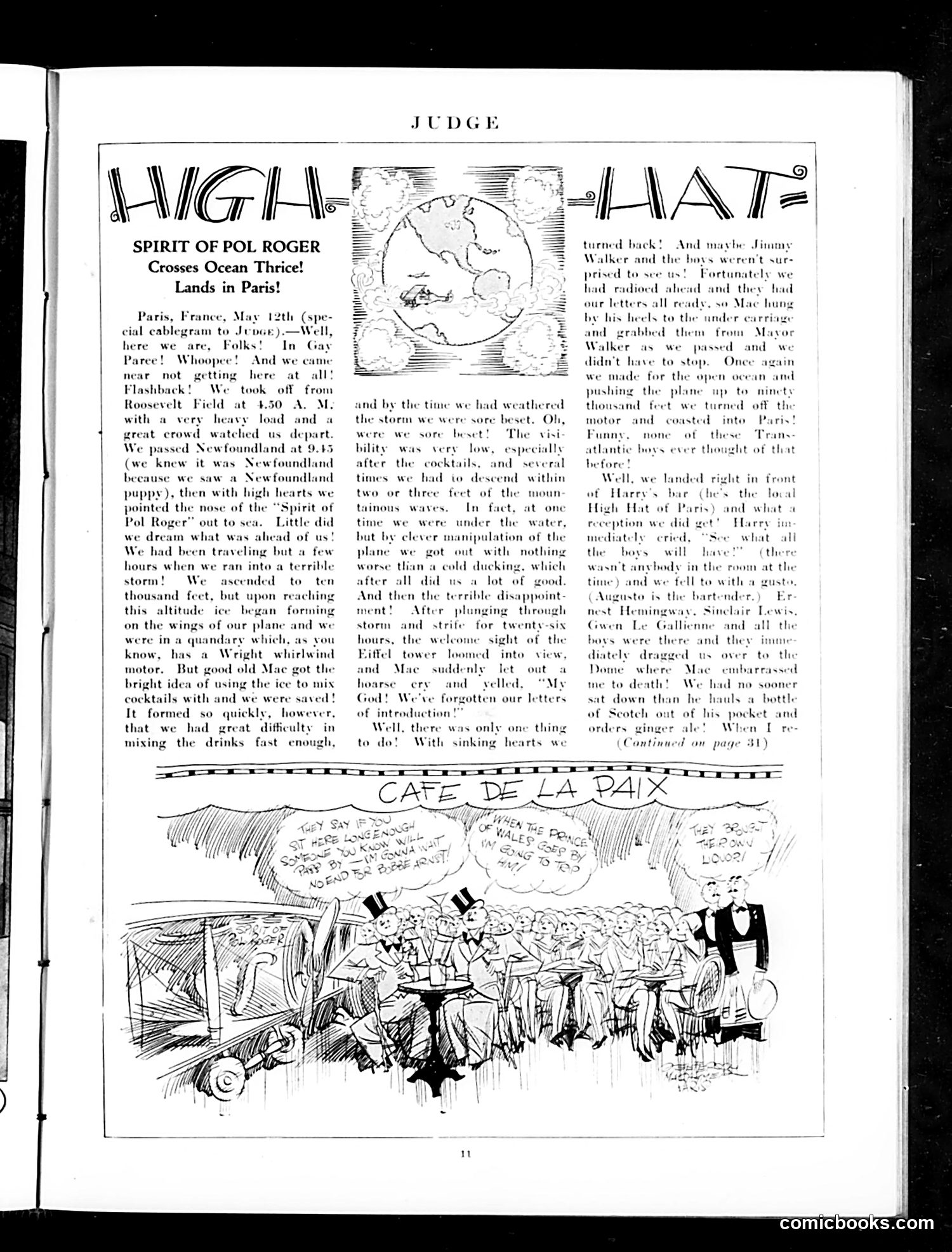
This is a humorous account of a transatlantic flight, likely referencing Charles Lindbergh's famous 1927 solo flight (the "Spirit of St. Louis"). The satire parodies the excessive celebration and chaos surrounding such aviation achievements. The joke centers on the pilots' comic misadventures: encountering terrible storms, flying blind, accidentally going underwater, forming ice on the wings which they repurpose as cocktail mix—all while forgetting their letters of introduction to Paris. The "Café de la Paix" cartoon below depicts the rowdy reception, with famous literary figures present (Hemingway, Sinclair Lewis, Gwen Le Gallienne are named). The humor mocks both the pilots' incompetence and the absurd celebrity circus surrounding aviation pioneers. The satire targets how the public glamorized dangerous aviation while the actual aviators were often unprepared or ridiculous. It's gentle mockery of the Jazz Age's obsession with daring-do adventure and celebrity culture.
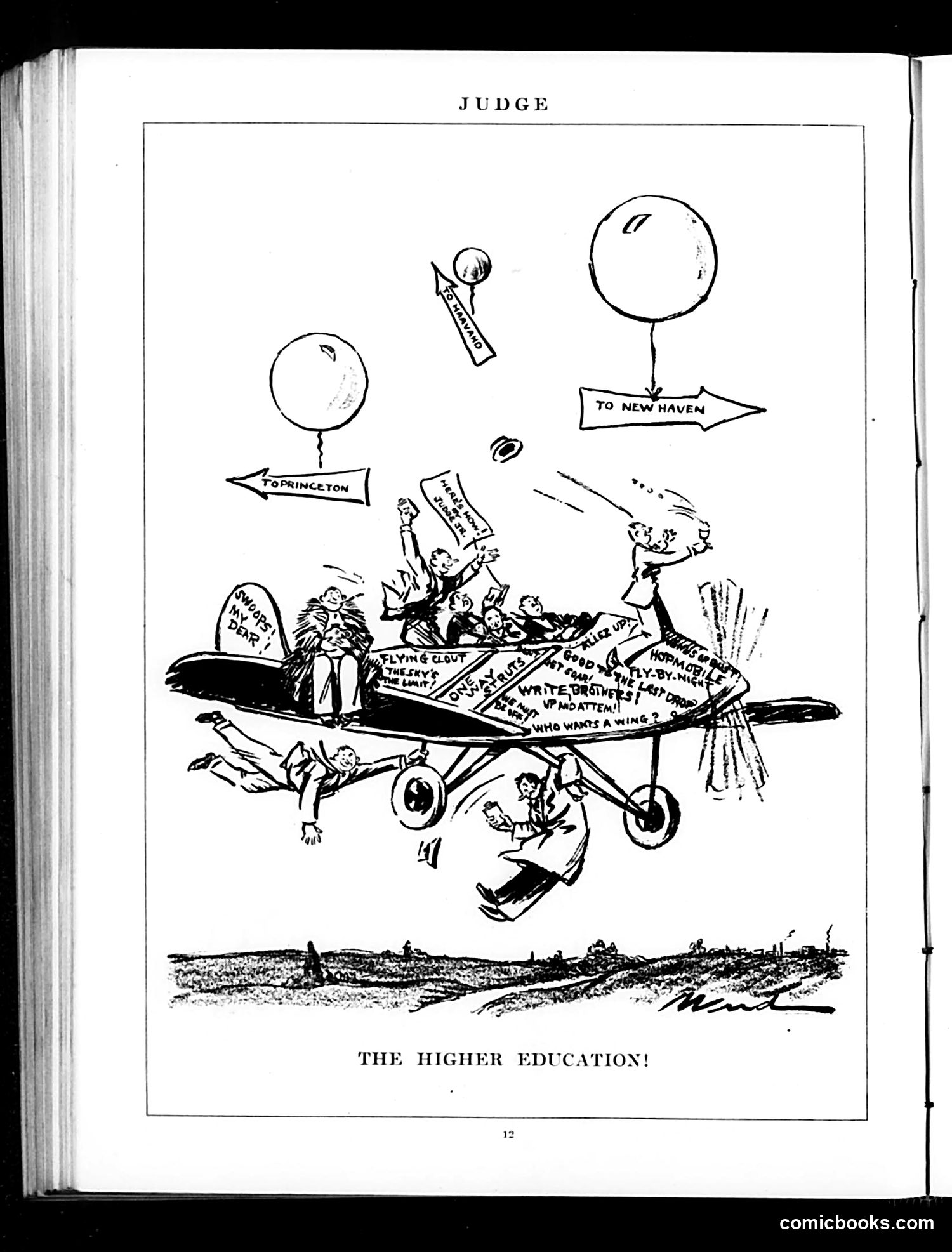
This satirical cartoon depicts an airplane piloted by various figures labeled with educational institutions (Princeton and New Haven visible on directional markers). The aircraft is chaotically overloaded with people and papers bearing text like "Flying Club," "Polo," and various social activities—suggesting frivolous pursuits rather than serious academics. The cartoon critiques "higher education" as being more focused on extracurricular social activities and sports than genuine scholarly work. Multiple figures are literally flying off or falling from the plane, implying chaos and lack of substance. The balloons floating above labeled "Princeton" and "New Haven" further mock prestigious universities. The satire suggests these elite institutions have lost focus on actual education, becoming instead centers for wealthy students' leisure activities and social clubs. This reflects early-20th-century concerns about commercialization and frivolousness in American higher education.
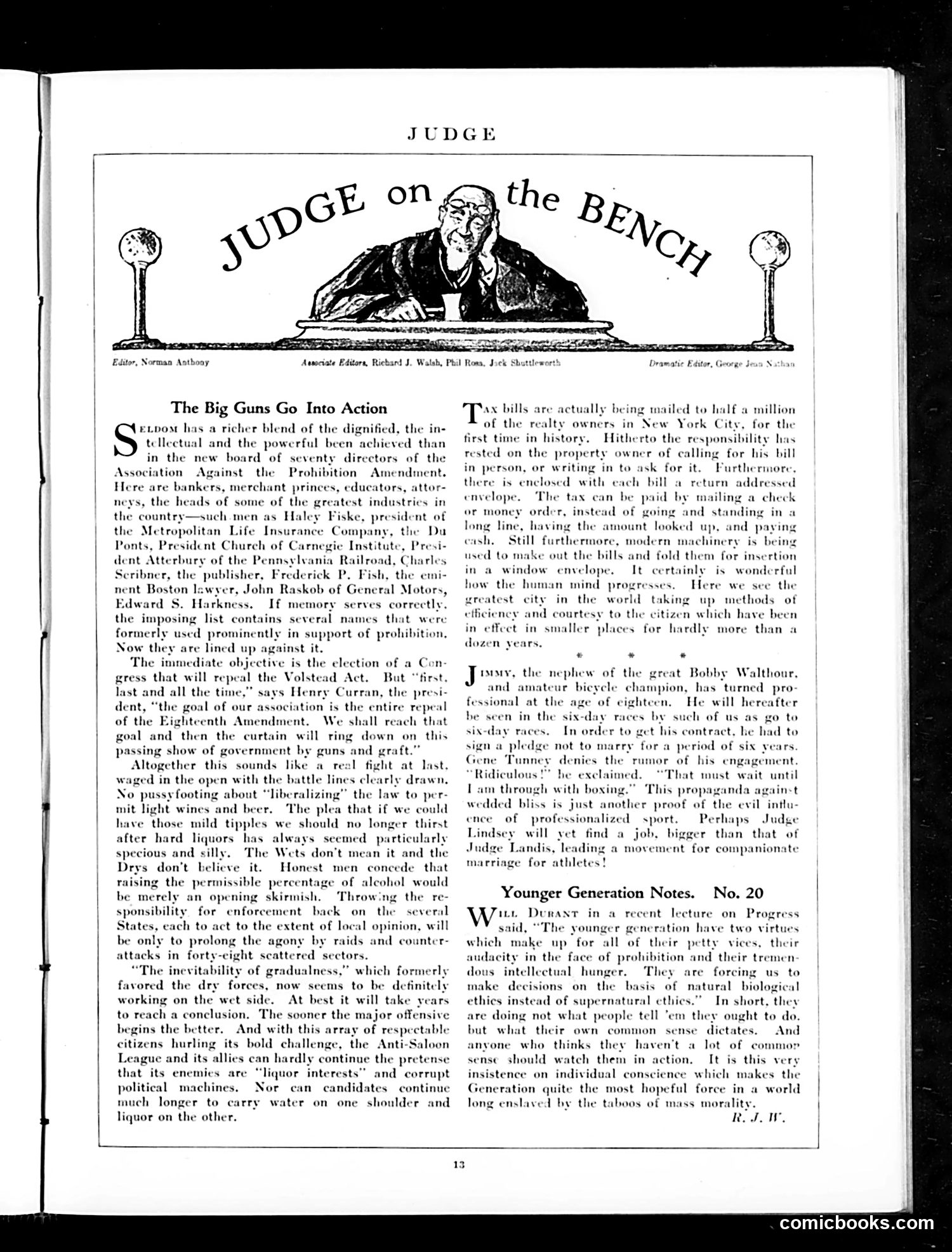
This page from *Judge* satirizes the newly formed Association Against the Prohibition Amendment, which sought to repeal the Volstead Act (Prohibition law). The main article praises the "Big Guns" involved—prominent businessmen like Haley Fiske (Metropolitan Life Insurance), the Du Ponts, and John Raskob (General Motors)—noting the irony that some formerly supported prohibition. The satire's point: these wealthy, respectable figures now openly fight Prohibition, abandoning the pretense that only "liquor interests" opposed it. Judge applauds this direct challenge, contrasting it with previous gradual approaches. The author argues honest men should openly admit alcohol restriction failed, rather than claiming people only want "mild tipples." The cartoon's judge figure likely represents judicial authority or impartiality overseeing this political reversal. Secondary items cover mundane civic improvements (NYC tax billing) and sports gossip, typical of the magazine's mixed content.
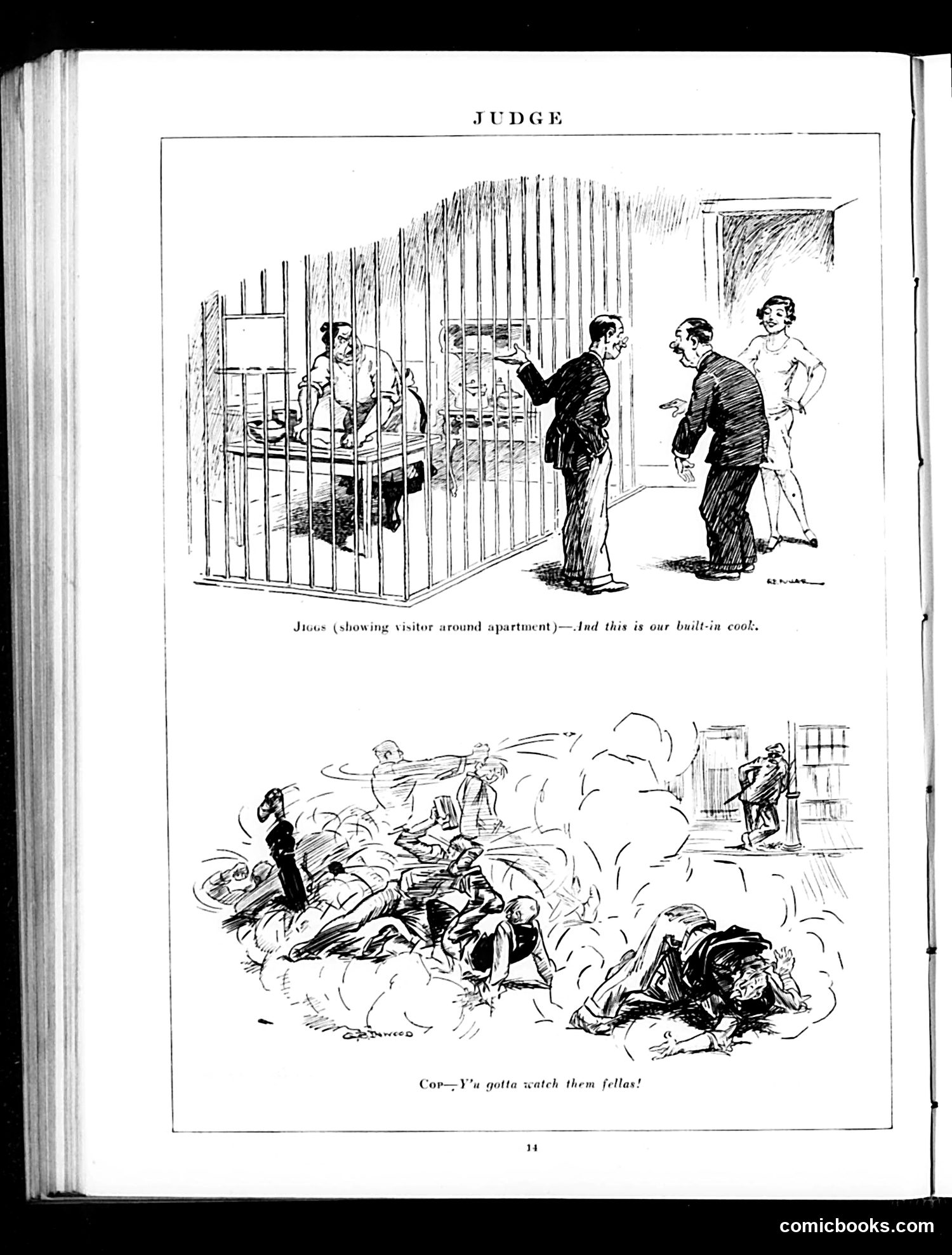
This page contains two satirical cartoons about domestic servants, likely from the early 20th century. The **top cartoon** shows men touring an apartment, with the caption "Jigs (showing visitor around apartment)—And this is our built-in cook." The humor derives from treating a person (appears to be a caricatured servant) as fixed apartment infrastructure rather than an employee—a dark joke about how servants were regarded as permanent fixtures in wealthy households. The **bottom cartoon** depicts multiple figures falling chaotically with the caption "Cop—Ya gotta watch them fellas!" This appears to satirize either workplace safety violations or the difficulty of supervising domestic staff, suggesting servants frequently caused mishaps or damage. Both cartoons mock upper-class attitudes toward their servants as expendable or amusing rather than as dignified workers deserving respect.
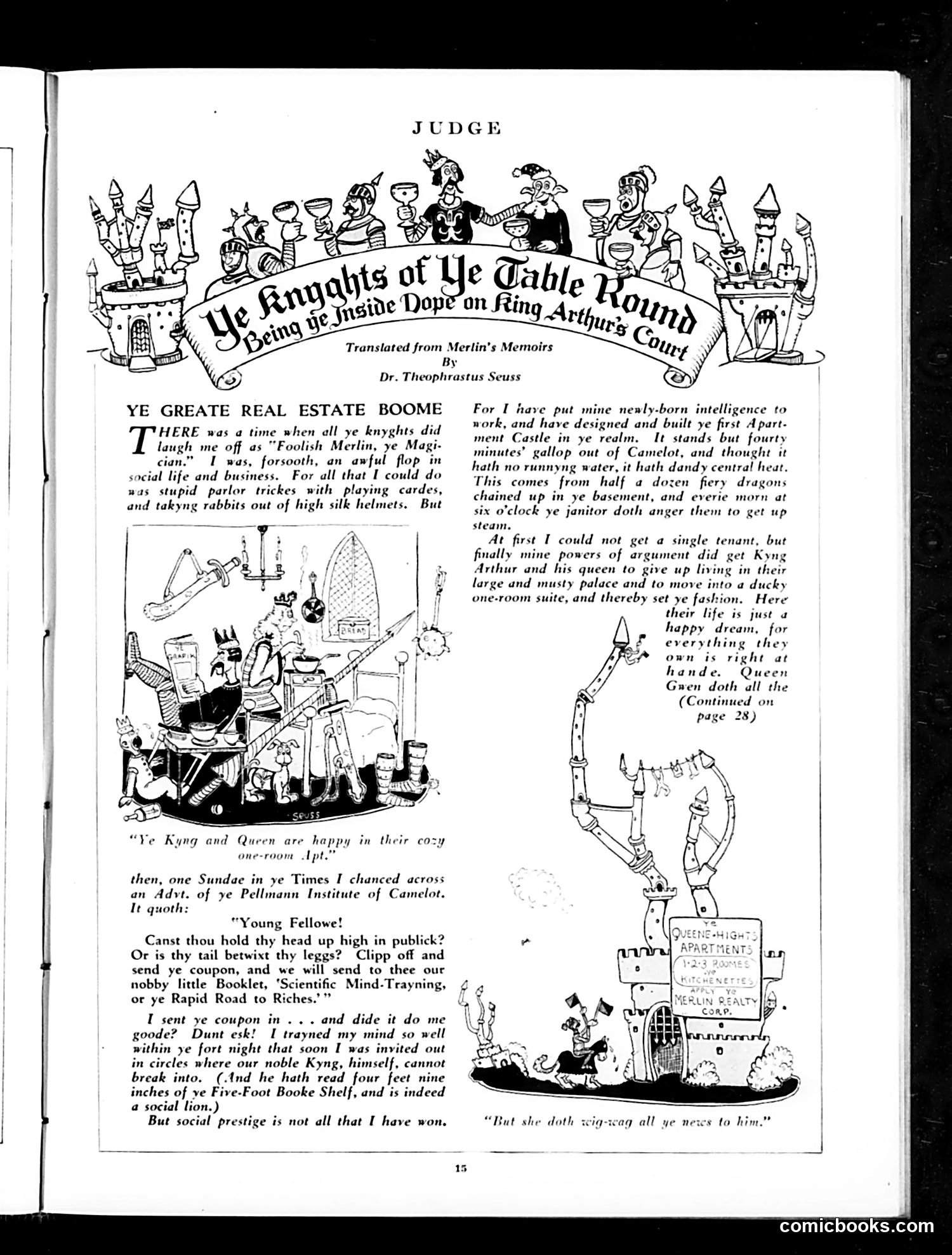
This satirical piece, attributed to Dr. Seuss, mocks the 1920s real estate boom and self-improvement culture. The narrator—Merlin the magician—represents a previously unsuccessful figure who transforms himself through a mail-order "mind training" course from the "Pellmann Institute." He then exploits this newfound social credibility to become a real estate developer, building an "Apartment Castle" outside Camelot. The satire's target: he convinces King Arthur and Queen Guinevere to abandon their palace for a cramped one-room suite, establishing it as fashionable simply through royal association. The joke criticizes both the era's real estate speculation (promising luxury living with minimal substance—note the apartments lack running water but have dragons for heat) and the absurdity of following trends blindly based on celebrity endorsement, regardless of actual quality or practicality.
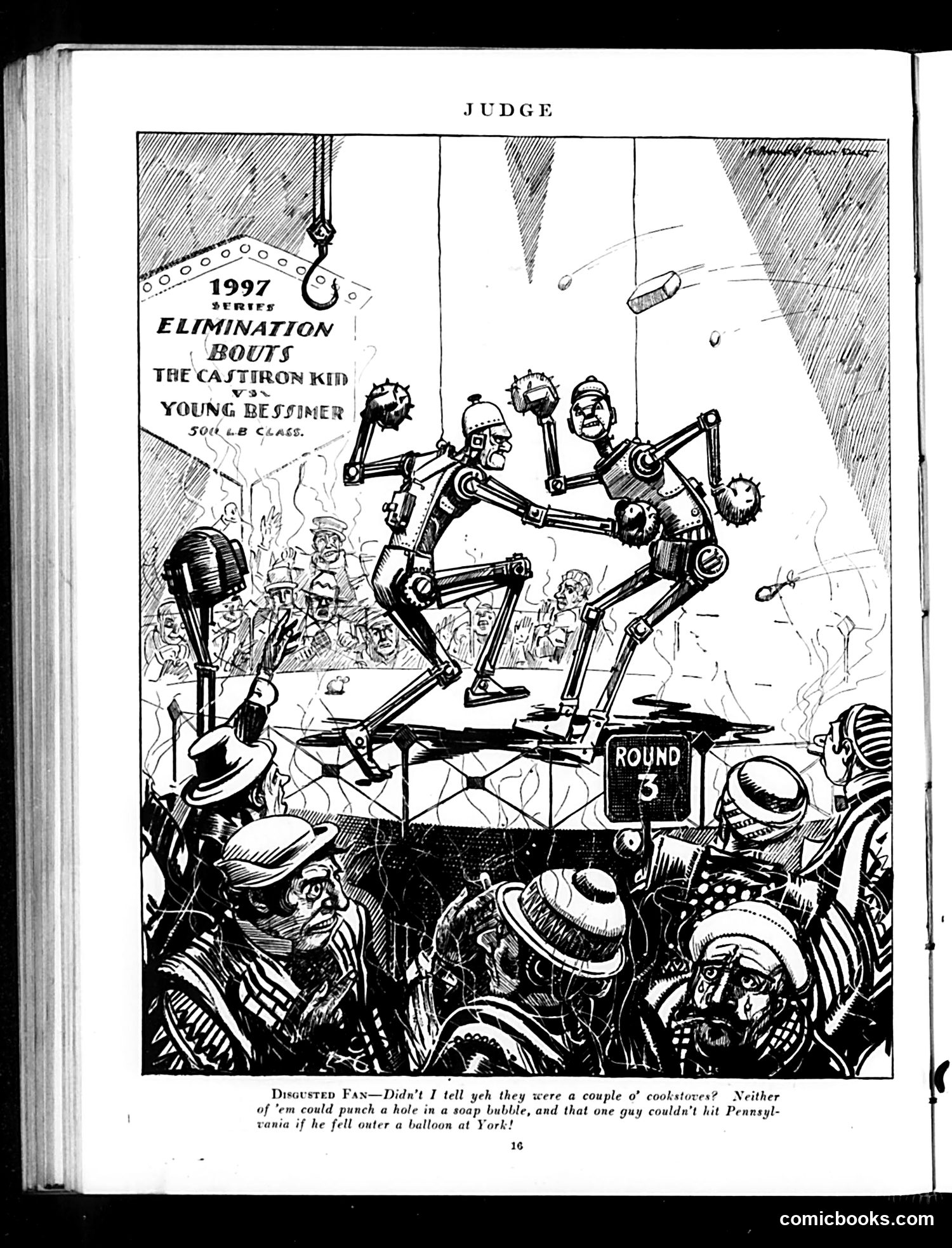
This is a boxing satire depicting a 1997 "Series Elimination Bouts" in the 50-pound class, featuring "The Castiron Kid" versus "Young Bessimer." The mechanical, skeletal figures represent boxers made of metal—likely satirizing weak or incompetent fighters as mere "cookstoves" (slang for inferior boxers). The caption shows a "Disgusted Fan" complaining that neither fighter can punch effectively—one couldn't make a hole in a soap bubble, and the other has such poor aim he "couldn't hit Pennsylvania if he fell out a balloon at York" (likely York, Pennsylvania). The joke targets the poor quality of these particular boxers or a specific boxing match from this era, mocking their lack of skill and the fan's disappointment. The mechanical appearance emphasizes they're essentially lifeless performers, devoid of real boxing ability. Without identifying the specific 1997 bout referenced, the satire clearly ridicules underwhelming athletic competition.
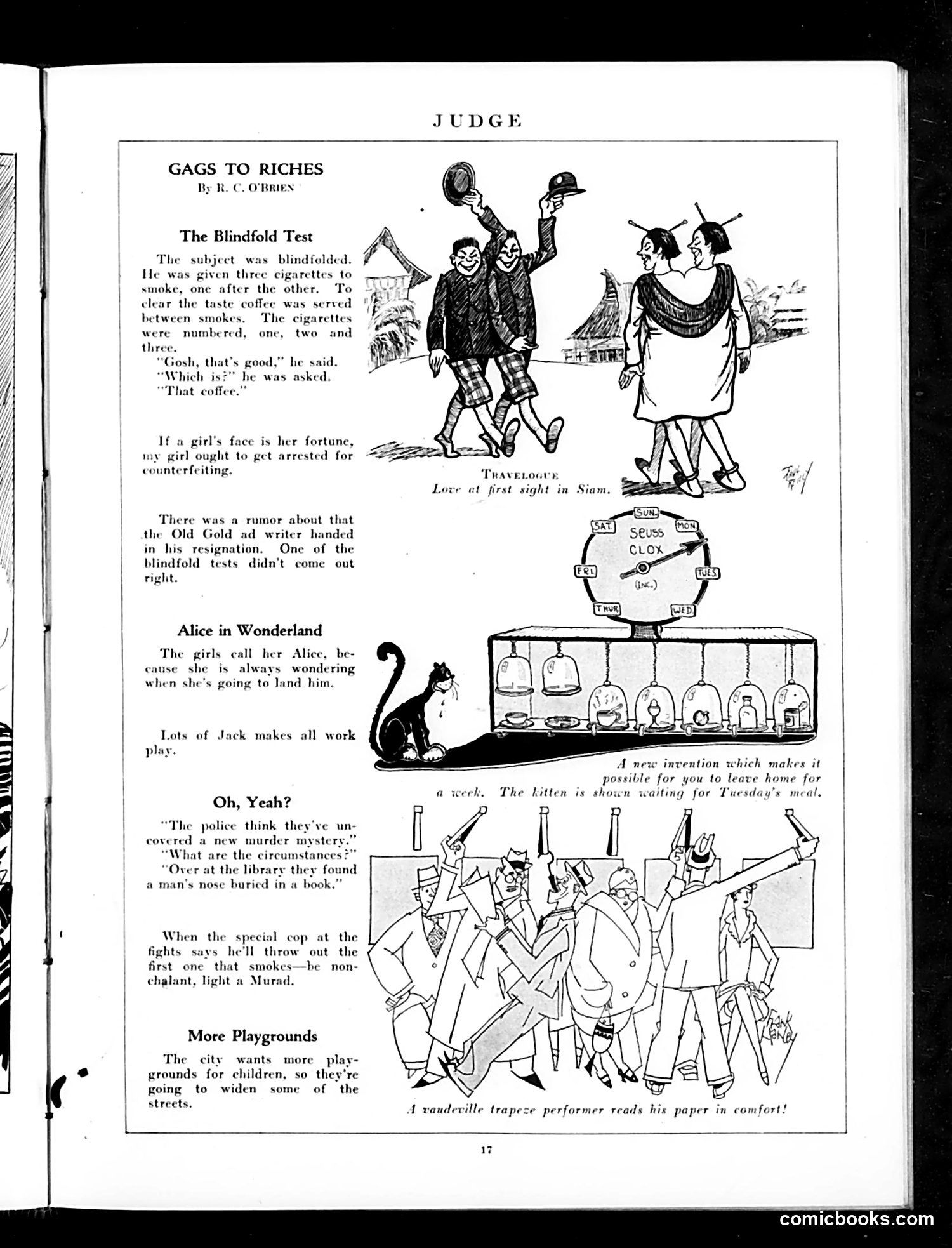
This page from *Judge* contains several brief comedic pieces satirizing early 20th-century American life and advertising. **"The Blindfold Test"** mocks cigarette advertising's taste tests. The joke: a blindfolded smoker declares the coffee (the palate cleanser) superior to the actual cigarettes being tested—suggesting the advertised cigarettes aren't worth smoking. **"Alice in Wonderland"** and other sections are short, punchy jokes about dating and relationships using wordplay ("wondering when she's going to land him"). **"Oh, Yeah?"** satirizes boxing culture and masculine posturing—the idea that a tough fighter casually lights up despite rules against smoking. The cartoons illustrate these gags with exaggerated line drawings typical of the era. The humor relies on observational comedy about consumer culture, dating, and social conventions rather than political commentary. "Murad" was an actual cigarette brand, showing how *Judge* satirized contemporary advertising and consumer behavior.
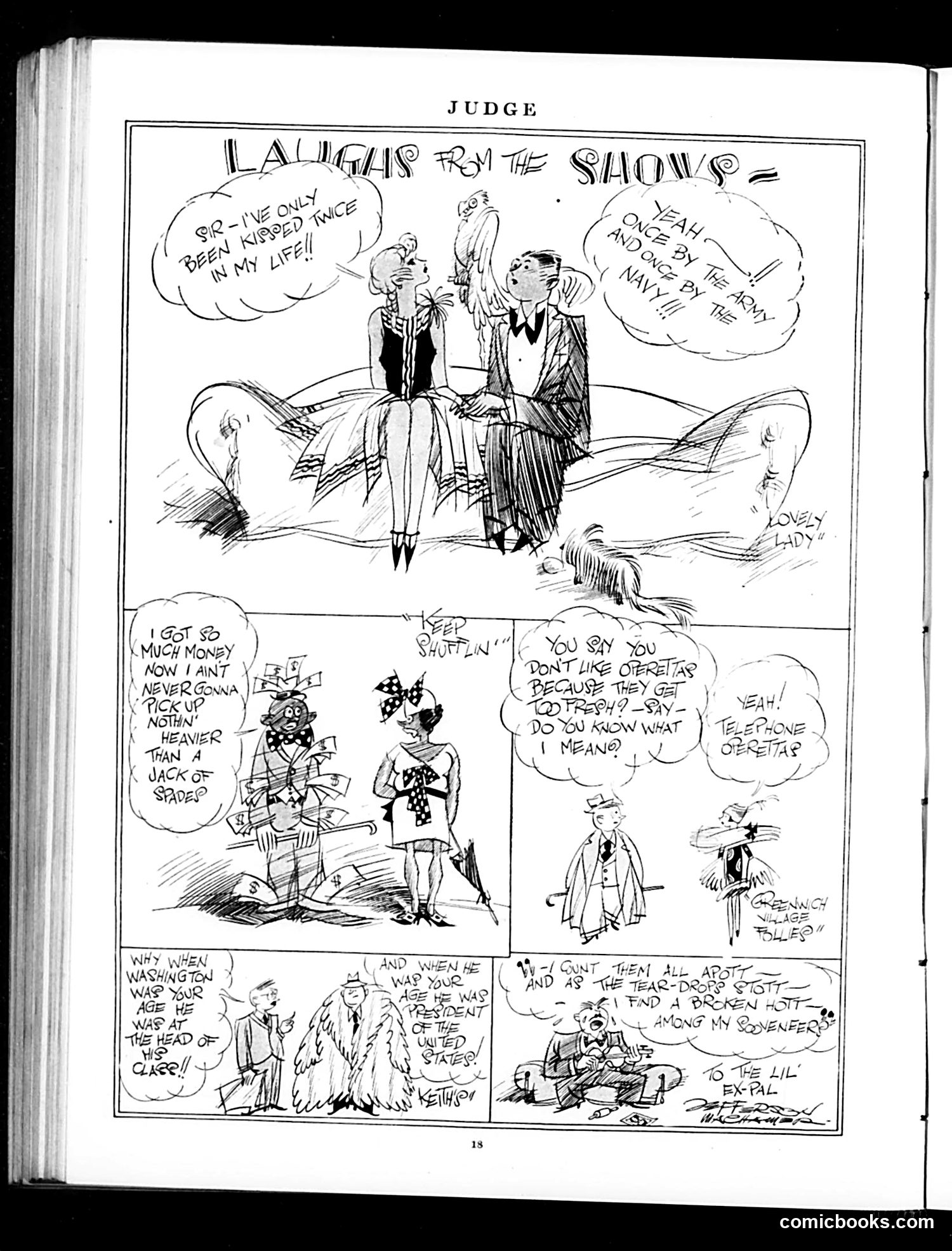
This satirical comic mocks wealthy show-business figures and their pretensions. The top panel shows a man and woman in elegant dress boasting about their success—he's "only been married twice in my life," she's made money "by the Army and Navy." The subsequent panels feature characters displaying nouveau-riche behavior: one brags about wealth and refusing to "pick up" checks, another flaunts fresh produce as a status symbol. The satire targets their ignorance and vulgarity despite financial success. References to Washington and presidential age suggest broader mockery of powerful figures lacking substance. The overall point: entertainment industry wealth doesn't confer sophistication or dignity—these characters remain fundamentally crude and ridiculous, merely displaying their money in embarrassingly obvious ways.
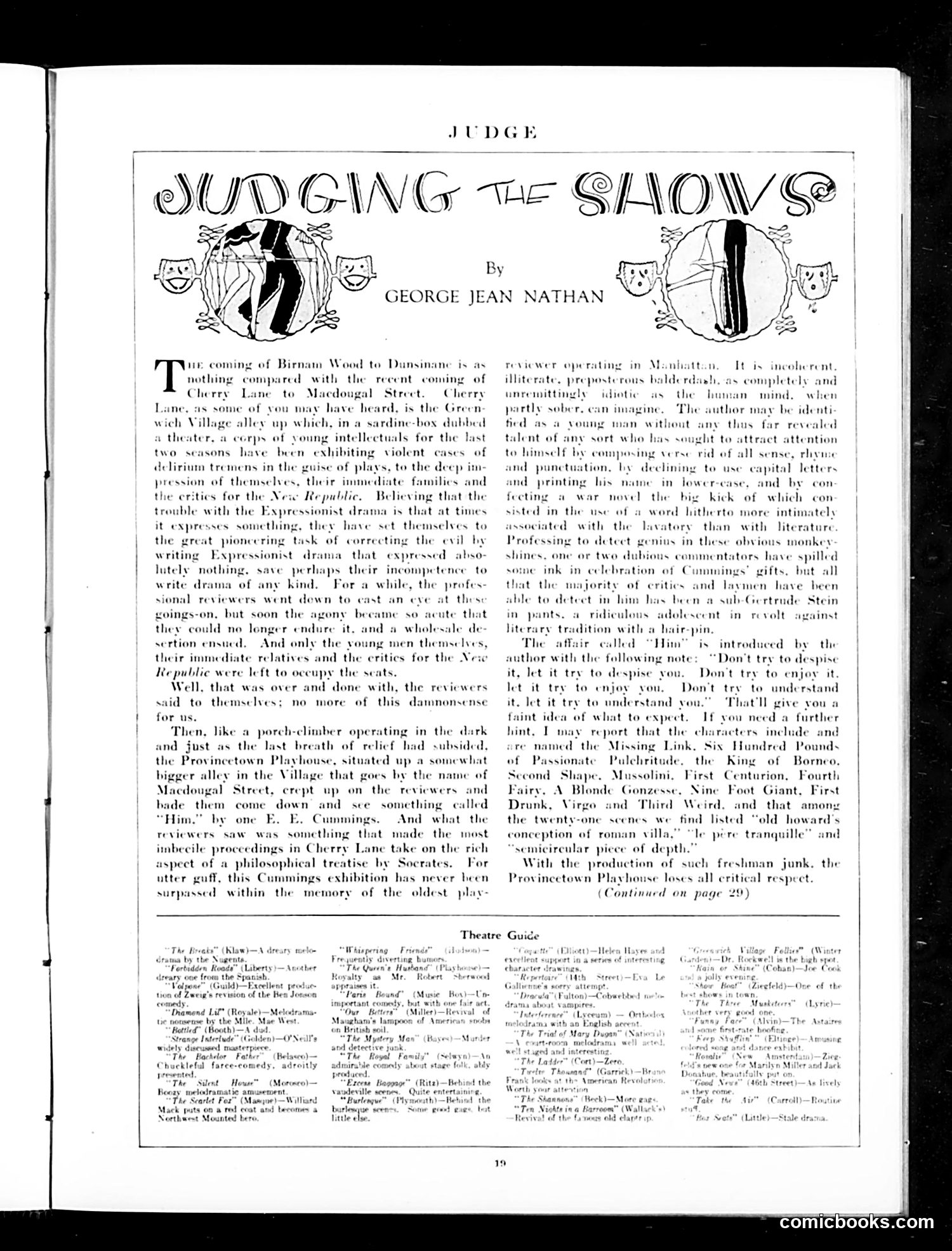
This is theater critic George Jean Nathan's scathing review of E.E. Cummings' avant-garde play "Him" at the Provincetown Playhouse in Greenwich Village. Nathan excoriates the work as incomprehensible nonsense masquerading as experimental art. He contrasts it unfavorably with Cherry Lane Theater's Expressionist productions—which at least attempted meaning—saying Cummings achieves the dubious distinction of creating drama expressing "absolutely nothing." The review mocks both the play (with absurd character names like "Six Hundred Pounds of Passionate Pulchritude") and Cummings himself, ridiculing his lowercase signature and avant-garde affectations. Nathan suggests only Cummings' friends and New Republic critics defend this "freshman junk," while serious reviewers have abandoned the Provincetown Playhouse entirely. The satire targets Greenwich Village's artistic pretensions: young intellectuals treating incompetence as innovation, and critics validating obvious mediocrity as daring experimentalism.
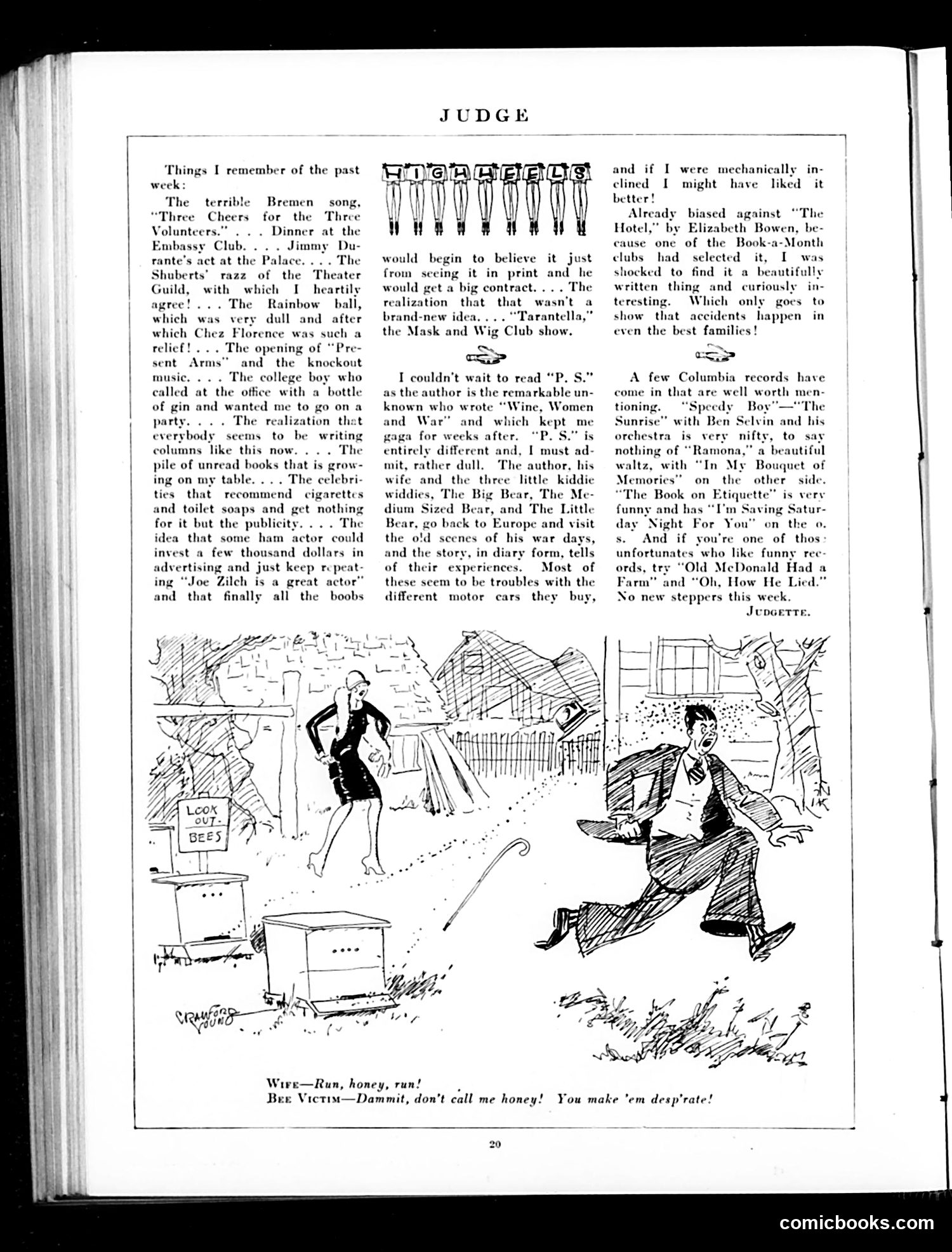
This is a **personal column** rather than a political cartoon. The writer reflects on Manhattan's entertainment scene from the past week—Broadway shows ("Present Arms," Shuberts productions), nightclubs (Embassy Club, Chez Florence), and personalities like Jimmy Durante. The **cartoon at bottom** depicts a domestic scene: a husband fleeing from an angry wife wielding a rolling pin, labeled "Bee Victim." The joke plays on the phrase "honey" (a term of endearment)—the man complains that his wife calling him "honey" makes their neighbors desperate, implying her aggressive behavior and their heated arguments are noticeable and distressing to onlookers. It's a straightforward marital-discord gag typical of 1920s humor. The column also reviews books, records, and other entertainment, criticizing pretentious theater advertising while discussing jazz recordings and comedic novelty records—capturing the era's popular culture interests.
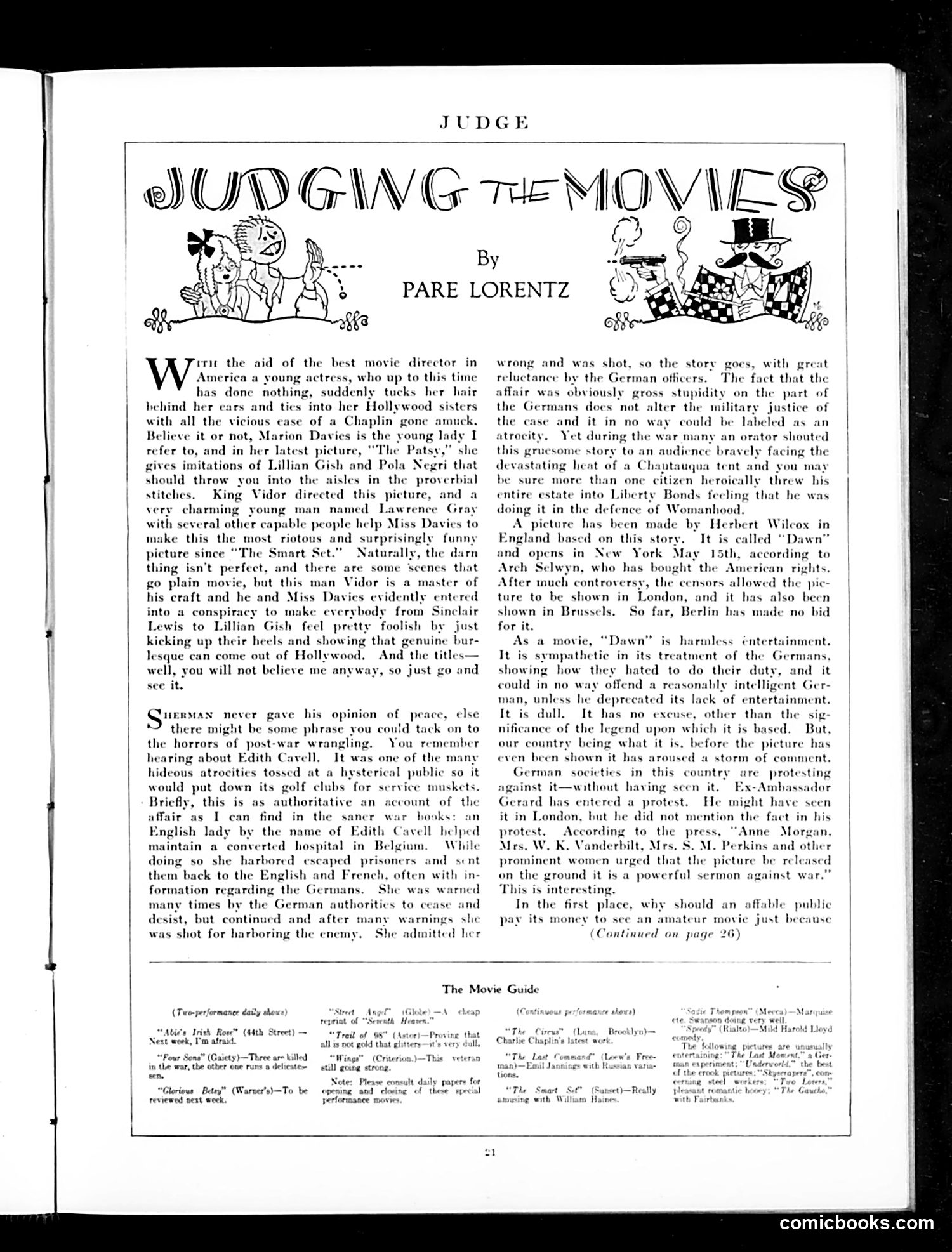
This page reviews two films for a post-WWI American audience. The main review praises Marion Davies' comedy "The Patsy," directed by King Vidor, celebrating her ability to parody other famous actresses (Lillian Gish, Pola Negri) and prove that genuine slapstick humor can emerge from Hollywood. The secondary review critiques the British film "Dawn," based on the true story of Edith Cavell, a British nurse executed by Germans in WWI for helping prisoners escape. Lorentz argues the film is harmless but dull—its only significance derives from the famous historical tragedy it depicts. He notes the picture has already sparked controversy in Germany despite being sympathetic to German soldiers' reluctance to follow orders, and that Berlin has refused to show it. The satire questions why audiences pay money to see amateur movies, and critiques how wartime propaganda weaponized Cavell's execution to sell Liberty Bonds.
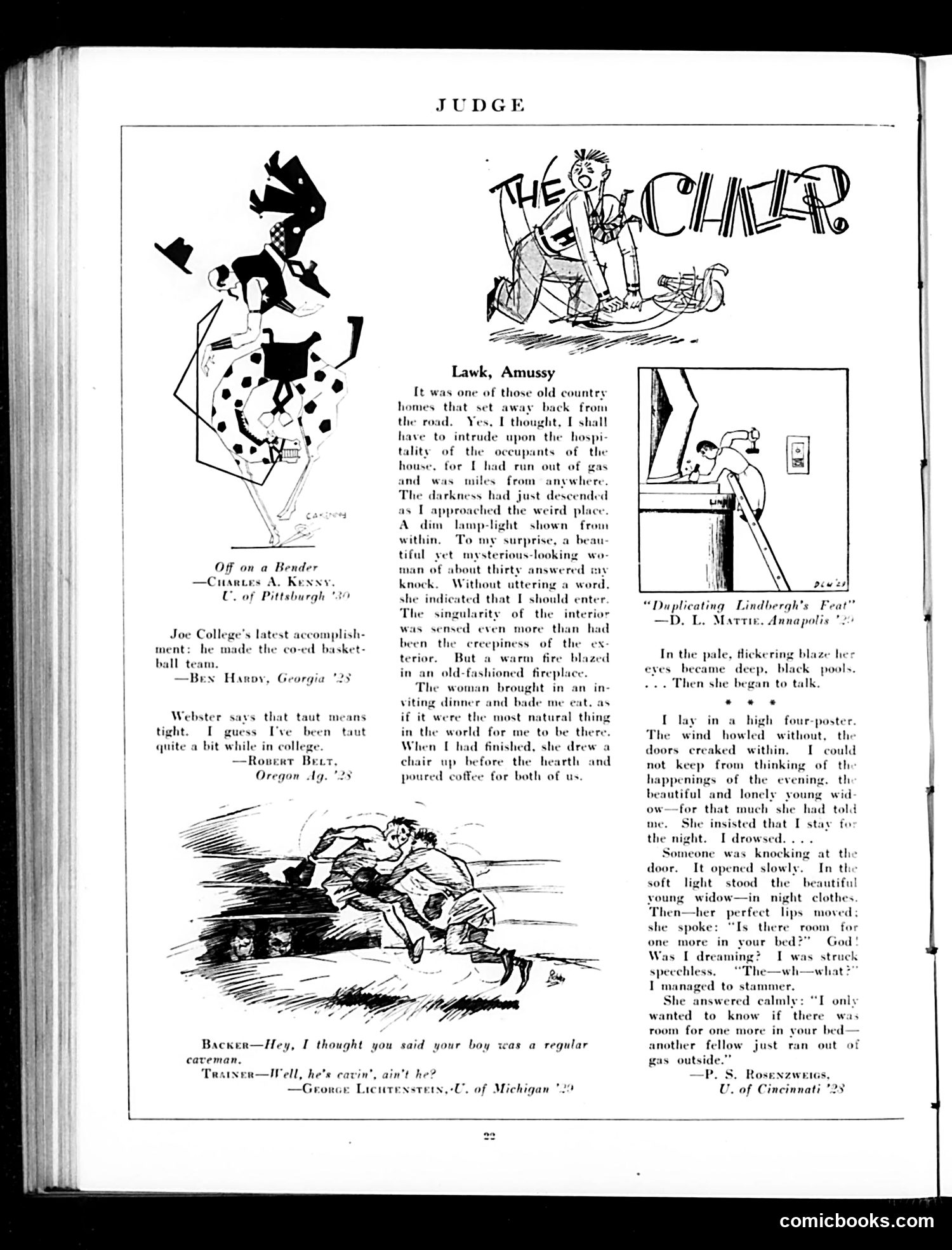
This page contains college humor submissions typical of 1920s Judge magazine. The cartoons and jokes satirize contemporary college life and social conventions. **"Off on a Bender"** depicts a disheveled student, mocking the "Joe College" archetype—young men supposedly dedicated to athletics and academics but actually prone to drinking and misbehavior. The accompanying quips ("taut quite a bit while in college") use double meanings to joke about drunkenness. **"The Clocher"** and **"Duplicating Lindbergh's Feat"** appear to be wordplay or visual gags referencing contemporary culture (Lindbergh's 1927 transatlantic flight was famous). **"Lawk, Amussy"** is a longer humorous story about a stranded motorist encountering a mysterious widow—a setup for risqué innuendo typical of Judge's adult-oriented humor. The punchline subverts expectations: the widow merely needs help, not seduction. The page reflects 1920s attitudes toward dating, drinking, and gender roles through irreverent collegiate humor aimed at educated readers.
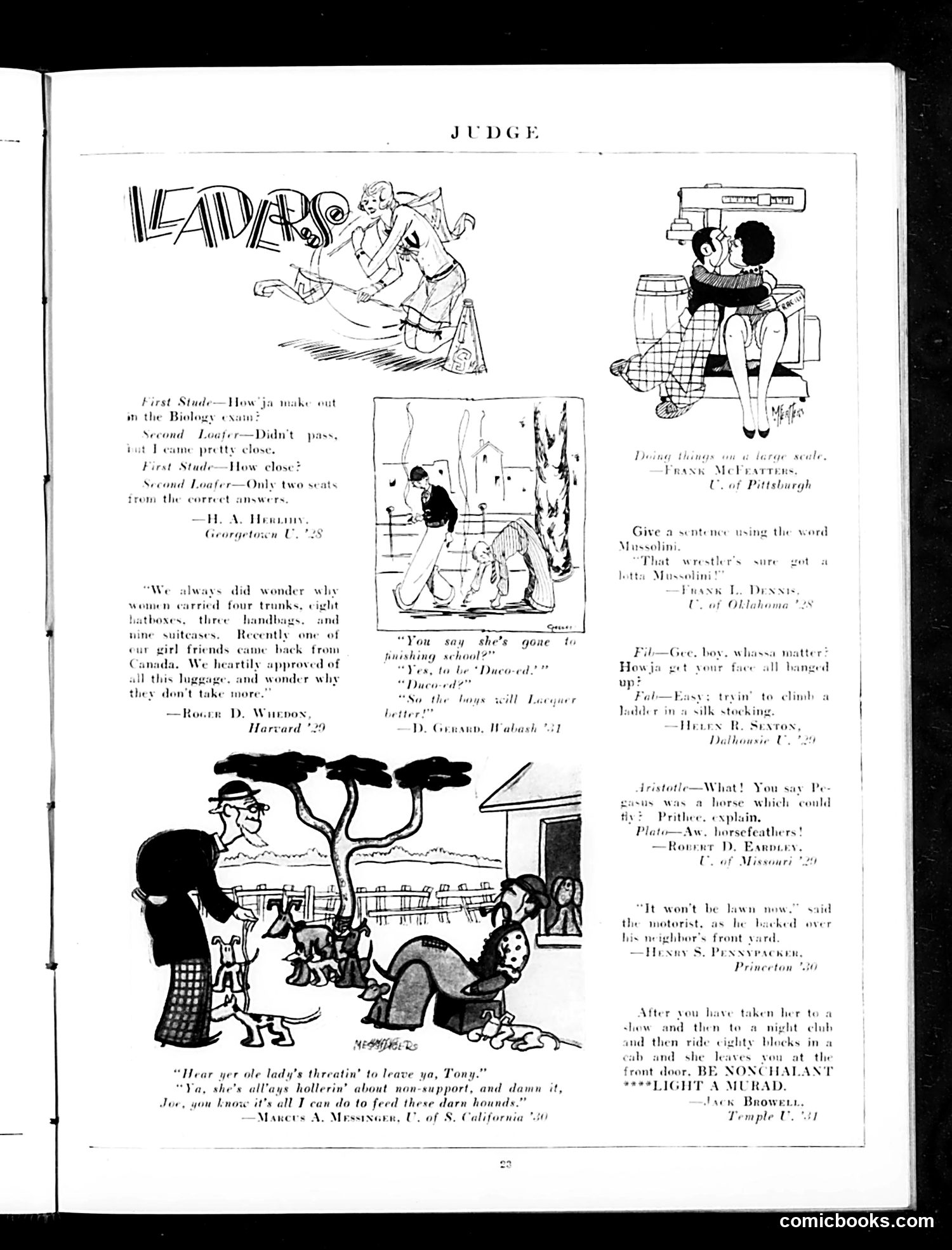
This page from *Judge* contains student humor submissions—jokes and cartoons submitted by college students from universities across America (Georgetown, Harvard, Pittsburgh, etc.). The content reflects 1920s-early 1930s college life: academic struggles (failing exams, "loafers"), dating and courtship rituals, automobile culture, and domestic situations. One cartoon depicts a man's lawn being destroyed by a motorist—a topical concern as automobiles became commonplace. The jokes employ typical collegiate humor of the era: wordplay (a Latin student confuses Pegasus with a literal horse), physical comedy (a woman struggling with luggage), and marital/dating mishaps. The final submission humorously addresses infidelity with the advice to "light a Murad" cigarette—a period product placement disguised as nonchalant advice. The satire here targets not politics but rather college culture itself—student pretension, romantic fumbling, and modern conveniences creating unexpected problems. These are lighthearted observations rather than sharp social commentary.
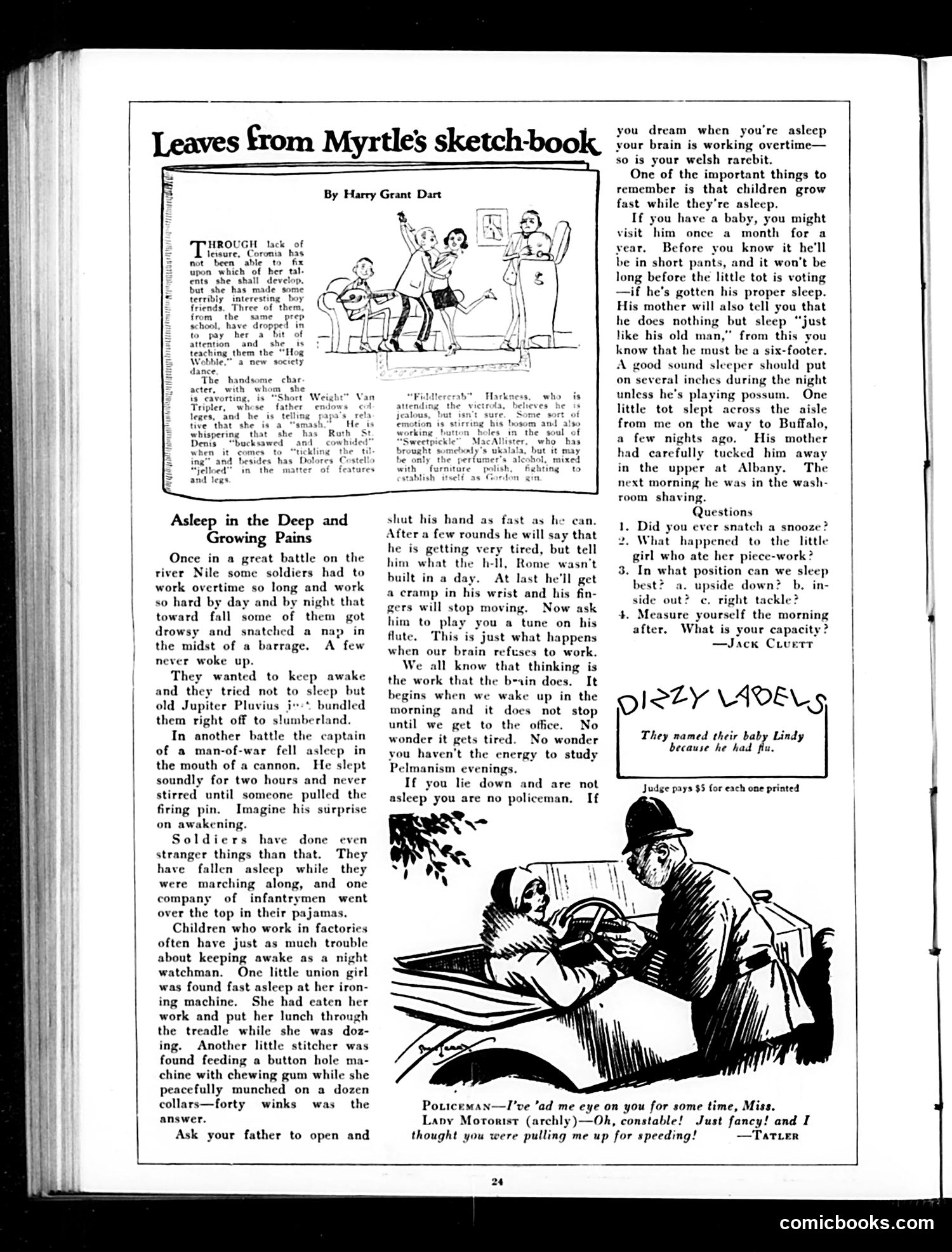
This page combines humorous illustrations by Harry Grant Dart with satirical commentary on sleep deprivation, particularly among soldiers and factory workers. The main article uses exaggerated anecdotes (soldiers sleeping through cannon fire, infantrymen going "over the top in their pajamas") to mock both military absurdity and industrial labor conditions. The piece suggests that overwork—whether in wartime or factories—drives people to dangerous, involuntary sleep. A secondary cartoon (bottom) shows a policeman stopping a lady motorist for speeding, with the caption's ironic suggestion that he's been watching her "for some time." The humor lies in the implied romantic pursuit masquerading as law enforcement. The page reflects early 20th-century concerns: workplace safety for child laborers, military inefficiency, and traffic law enforcement. The tone is light, but the underlying critique concerns the physical toll of overwork on vulnerable populations.
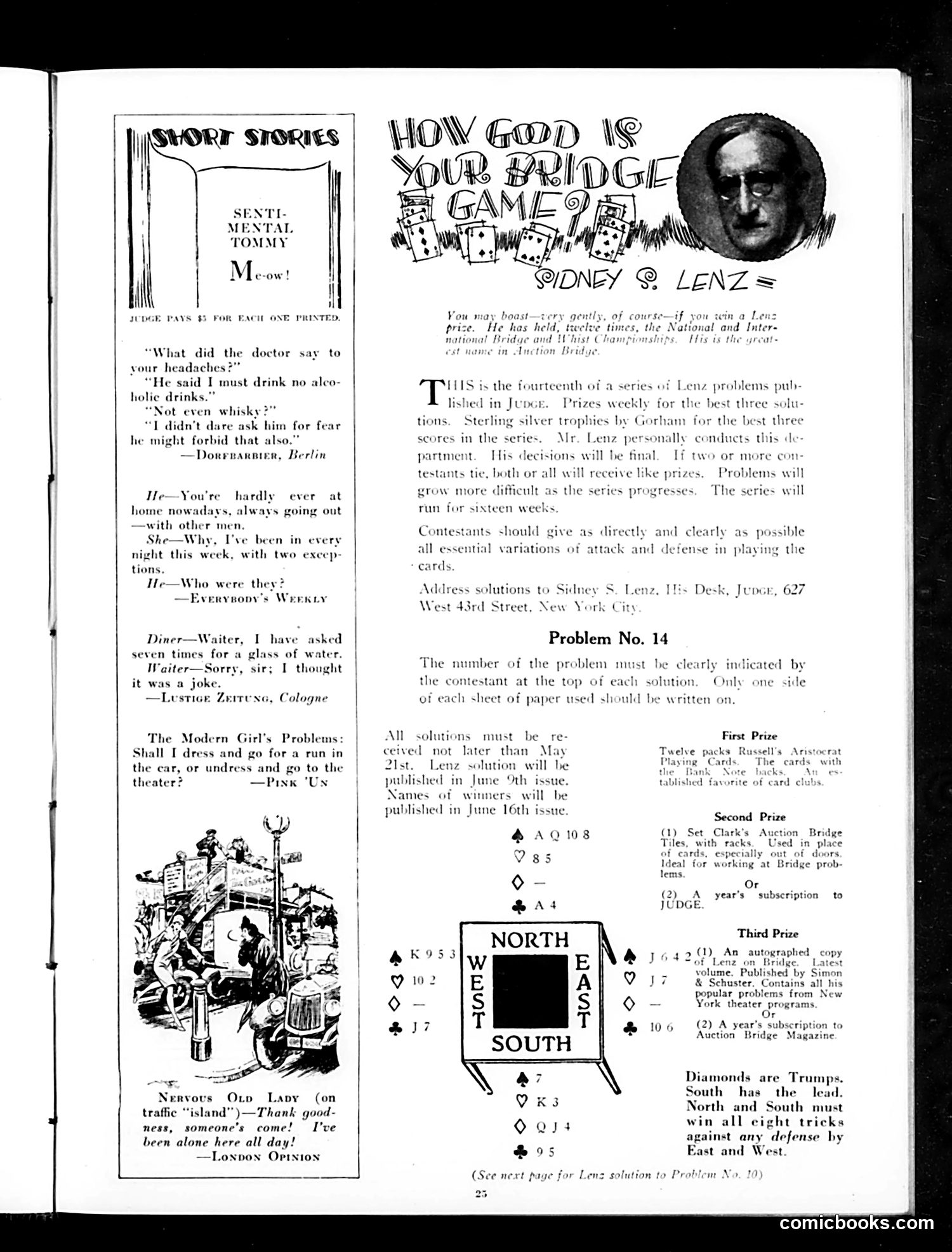
This page contains **short humor pieces and a bridge card game problem** rather than political satire. The left column features brief jokes attributed to various sources (Berlin, Everybody's Weekly, etc.)—typical filler content. Topics include domestic comedy ("You're hardly ever at home"), a waiter misunderstanding a dinner guest's request, and observations about "modern girl" behavior. These reflect early 20th-century gender humor conventions. The main content is **Problem No. 14 of a bridge series** by Sidney S. Lenz, a prominent bridge expert. Judge magazine ran a weekly bridge competition offering prizes: sterling silver trophies, card sets, and subscriptions. This appears to be instructional/competitive content for the magazine's readers interested in bridge, the popular card game. The illustration labeled "Nervous Old Lady" shows an elderly woman amid urban traffic—a social comment on modern city life's chaos, not political commentary. This is essentially a **puzzle/game page with incidental humor**, typical of Judge's mixed content format.
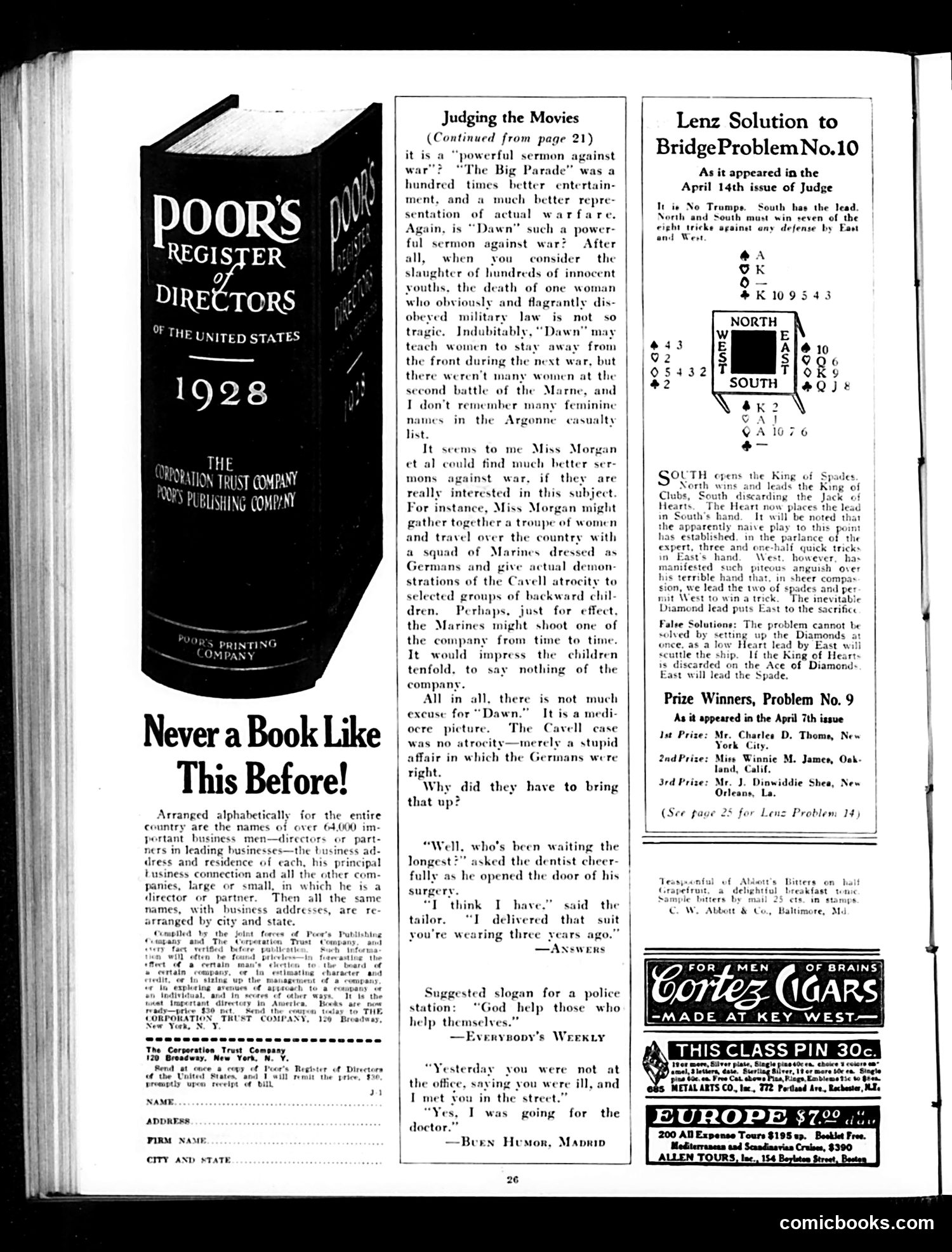
This page is primarily a **title page and advertisement** for Poor's Register of Directors of the United States (1928), a business directory. The large left side advertises this reference book containing 64,000 business leaders' names, addresses, and corporate affiliations. The remainder consists of **unrelated content typical of Judge magazine**: - A film criticism column continues, debating whether the antiwar movie "Dawn" effectively criticizes warfare (the author skeptically argues it doesn't) - A "Bridge Problem" with solution, a popular puzzle feature - Several short jokes and humorous anecdotes unrelated to each other - Advertisements for cigars, a class pin, and a breakfast tonic There are **no political cartoons or caricatures** on this page. It's a miscellaneous collection of advertising, instructional puzzles, and light humor typical of Judge's back pages, with no coherent satirical commentary.
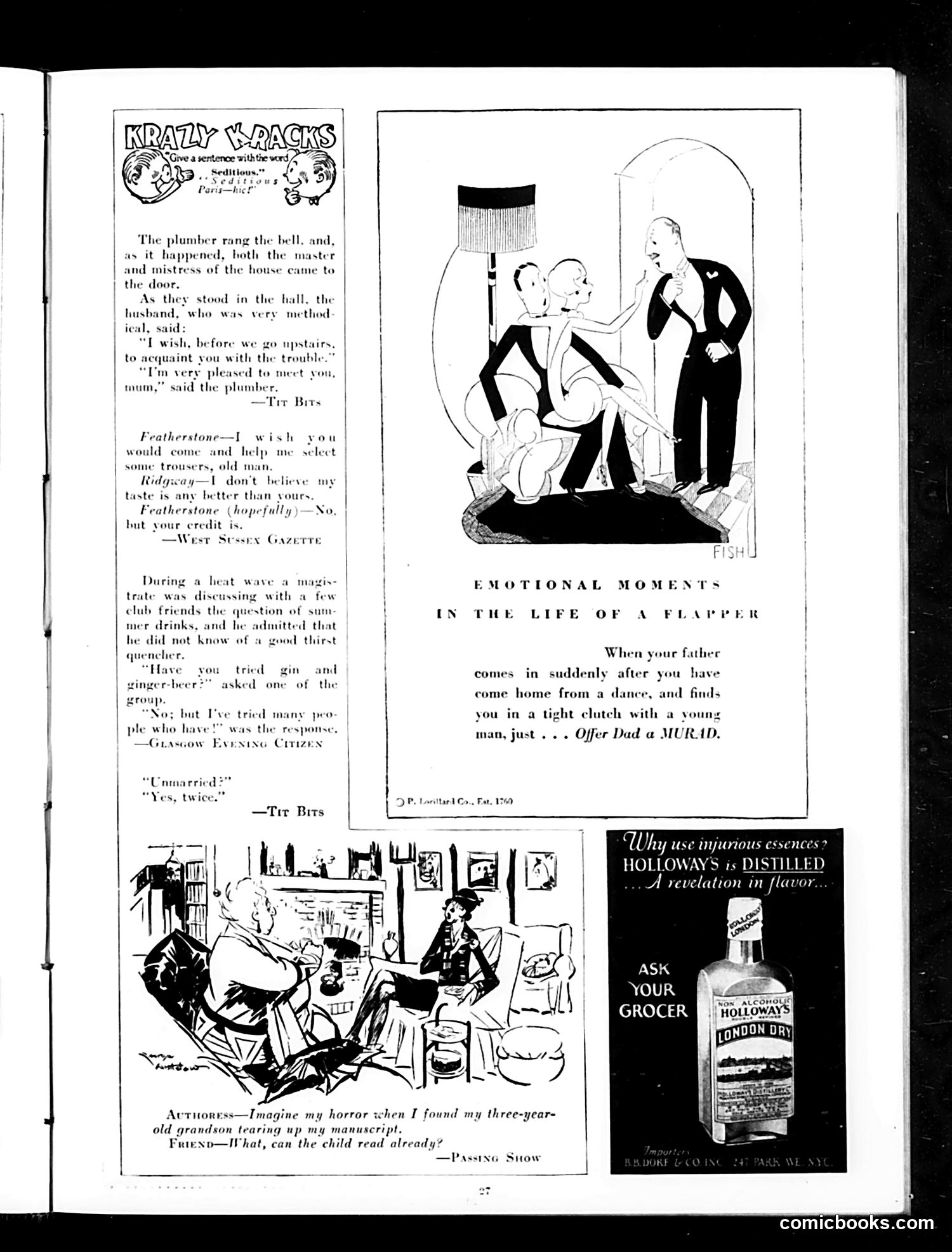
This page contains several brief humorous anecdotes and an advertisement, typical of early 20th-century Judge magazine's format. **"Krazy Knacks" section:** Short jokes including one about a plumber's visit, quips about selecting trousers (playing on credit worthiness vs. taste), and an anecdote about a magistrate admitting he's "tried many people" as a thirst quencher—a dark joke suggesting judicial severity during Prohibition era or general legal harshness. **"Emotional Moments in the Life of a Flapper":** A cartoon satirizing 1920s youth culture. It shows a young woman caught in a "tight clutch" with a man by her disapproving father. The joke is her solution: offer dad a MURAD cigarette—implying bribery or distraction rather than explanation. This mocks both flapper behavior and parental anxiety about modern dating. **Bottom cartoon:** An author horrified her young grandson is tearing her manuscript, with the punchline that he can already read—suggesting his literacy makes the destruction worse (or funnier, depending on perspective). The **Holloway's gin advertisement** occupies the lower right.
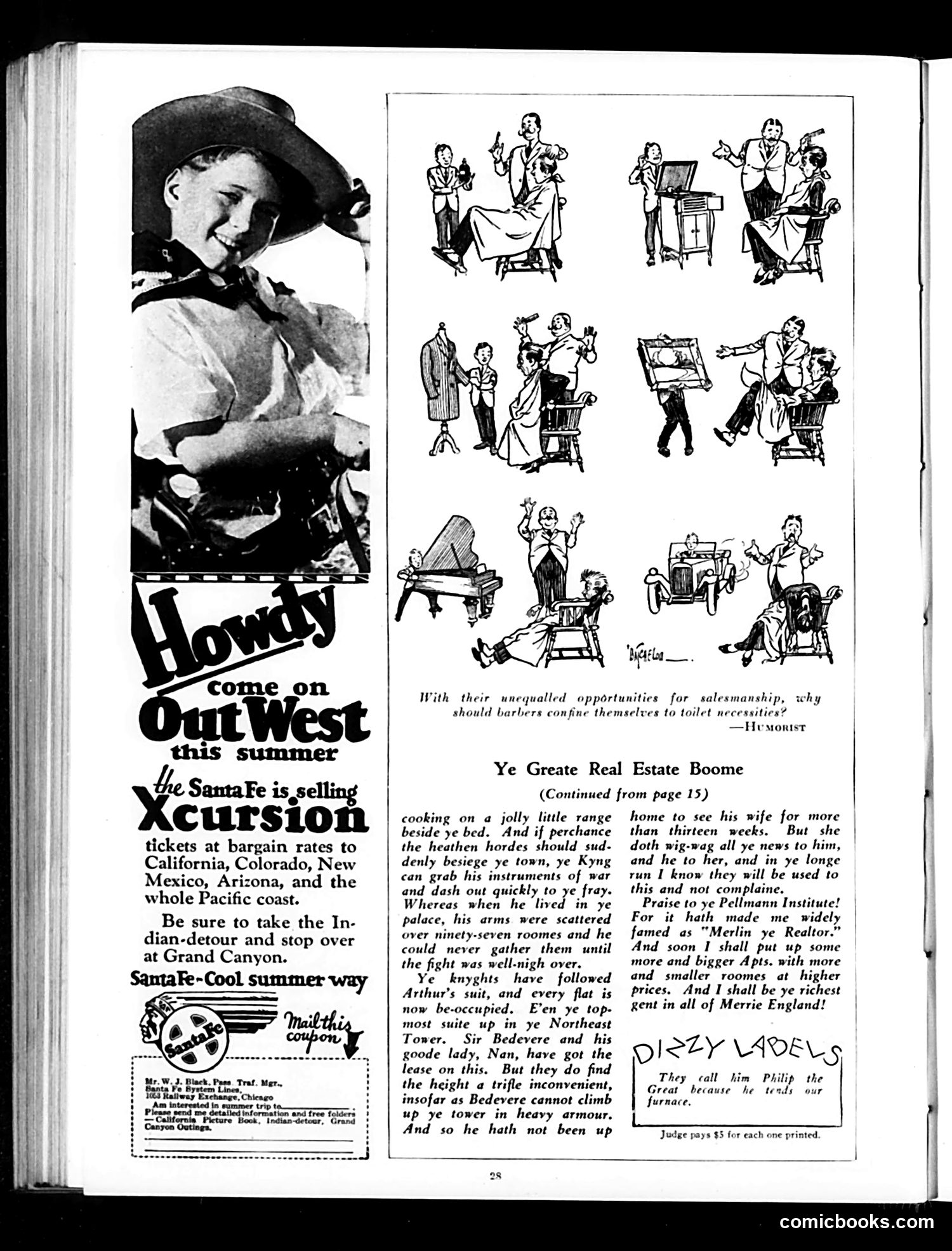
This page contains two distinct elements: a Santa Fe railroad advertisement and a satirical article titled "Ye Greate Real Estate Boome." **The Advertisement** (left): Standard travel promotion for bargain excursion tickets to Western destinations, nothing satirical. **The Main Satire** (right): A mock-medieval parody of a real estate boom, written in pseudo-Shakespearean dialect ("ye," "knyghts," "hath"). The piece ridicules aggressive real estate speculation by imagining a medieval kingdom where a developer character ("Merlin ye Realtor") convinces King Arthur and knights to abandon their spacious palaces for cramped apartment rentals—including one tower apartment so high the tenant can't climb it in armor. The satire mocks: - Salesmen's ability to convince people to accept inferior living conditions - Overpopulation from unchecked development - Landlord indifference to tenant complaints The accompanying cartoons show various inconvenient scenarios of cramped apartment living. The joke at bottom about "Philip the Great" tending the furnace mockingly elevates a lowly servant—commenting on false status from real estate dealings. This reflects 1920s anxiety about urban overcrowding and speculative building booms.
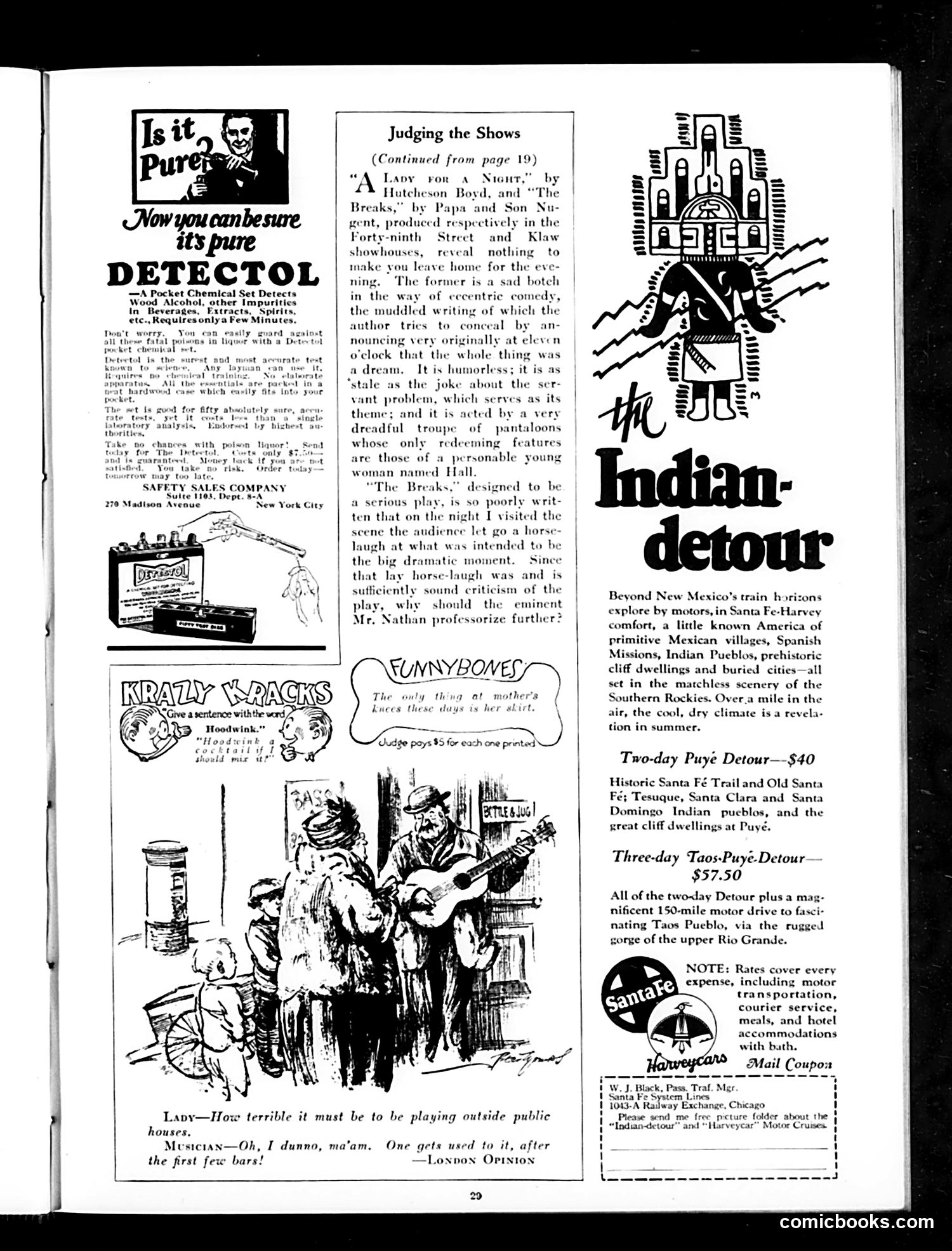
This page mixes theater criticism with advertising and light humor typical of 1920s Judge magazine. **Theater Critique Section**: The "Judging the Shows" column critiques three Broadway productions. The reviewer dismisses "A Lady for a Night" as poorly written comedy and "The Breaks" as such badly written drama that the audience's horse-laugh at its climactic moment became the play's best criticism. The subtext reflects jazz-age sophistication—mocking both earnest playwrights and audiences who take melodrama seriously. **Comic Strip "Funnybones"**: A mild joke about a musician forced to play outdoors. **Advertisements**: Detectol (chemical test kit for detecting wood alcohol poisoning) and Harvey/Santa Fe tourism packages highlight contemporary concerns—Prohibition-era bootleg liquor dangers and the growing motor-tour vacation industry. The page reflects 1920s preoccupations: Prohibition enforcement, consumer safety skepticism, and emerging leisure travel culture.
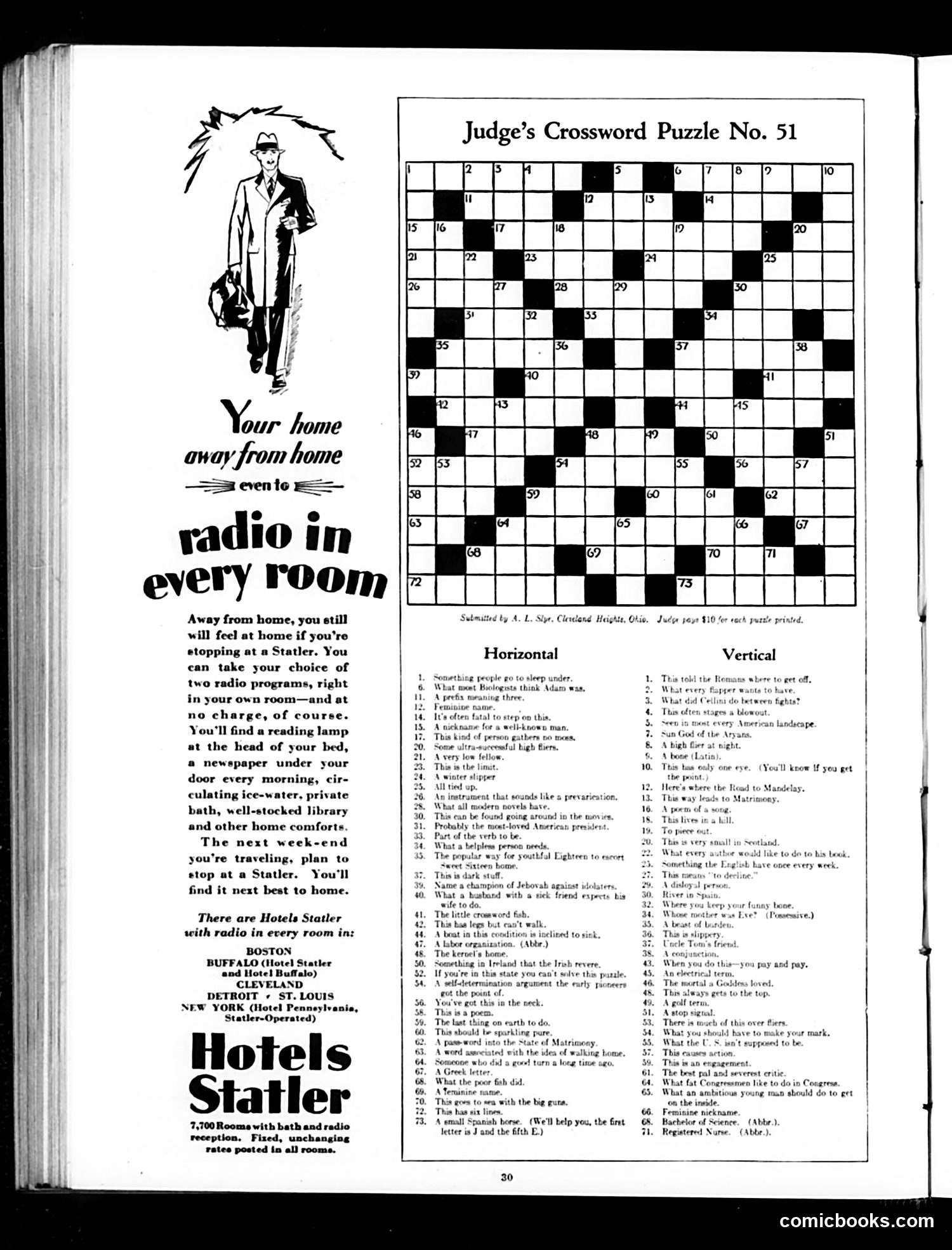
This page is primarily a **crossword puzzle advertisement**, not a political cartoon. The left side features an advertisement for Hotels Statler, emphasizing their modern amenities—particularly radios in every room, a novel luxury feature. The copy appeals to business travelers ("away from home, you still will feel at home"), highlighting creature comforts like reading lamps, newspapers, and running water. The right side is Judge's Crossword Puzzle No. 51, with clues referencing 1920s-era culture: flappers, Mandalay, Matrimony, and modern novels. The advertisement's emphasis on "radio in every room" reflects the 1920s fascination with radio technology as a cutting-edge convenience. This was during radio's early commercial phase, before it became ubiquitous. The Statler chain is positioning itself as a forward-thinking, comfortable alternative to home—targeting affluent travelers who valued modern amenities and leisure. The puzzle itself uses contemporary cultural references typical of Judge's satirical readership.
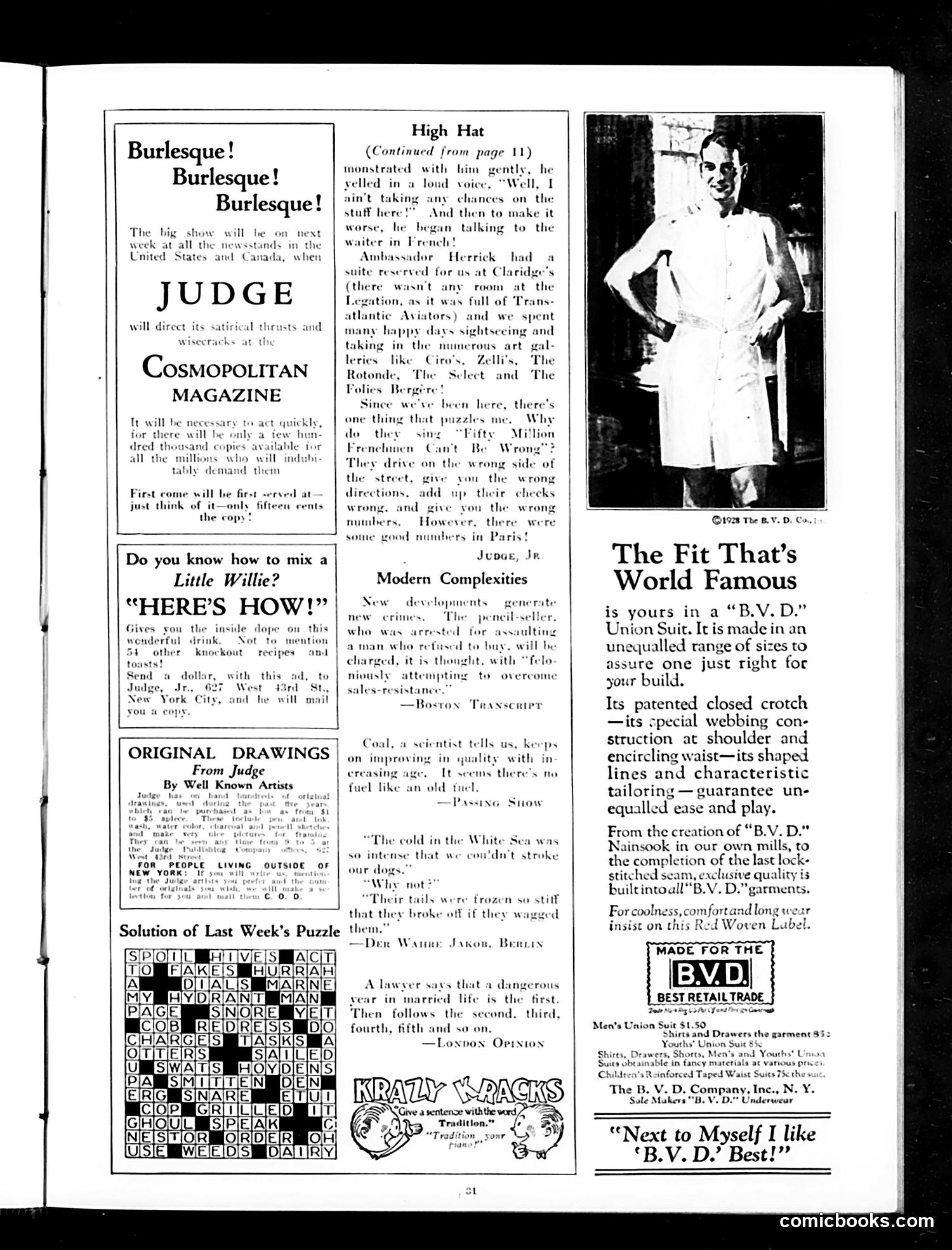
This page is primarily **advertising and filler content** rather than political satire. The main elements are: **"High Hat" Column**: A gossip piece (continued from page 11) about an ambassador's suite at Claridge's in Paris, focusing on humorous cultural misunderstandings—a Frenchman's poor behavior, Parisians' driving habits, and frozen dog tails in the White Sea. This is light travel humor, not political commentary. **"Modern Complexities"**: Brief anecdotes about crime and married life—conventional jokes about human behavior rather than satire. **Advertisements**: The page features substantial advertising, notably a large B.V.D. underwear ad (center-right) and smaller ads for "Here's How!" cocktail recipes and Judge's own upcoming burlesque issue. **"Krazy Whacks"**: A small wordplay cartoon at bottom. **Puzzles & Miscellany**: Crossword puzzle solutions and other filler. The page reflects Judge's evolution toward more commercial content—less sharp political satire, more lifestyle humor and advertising revenue.
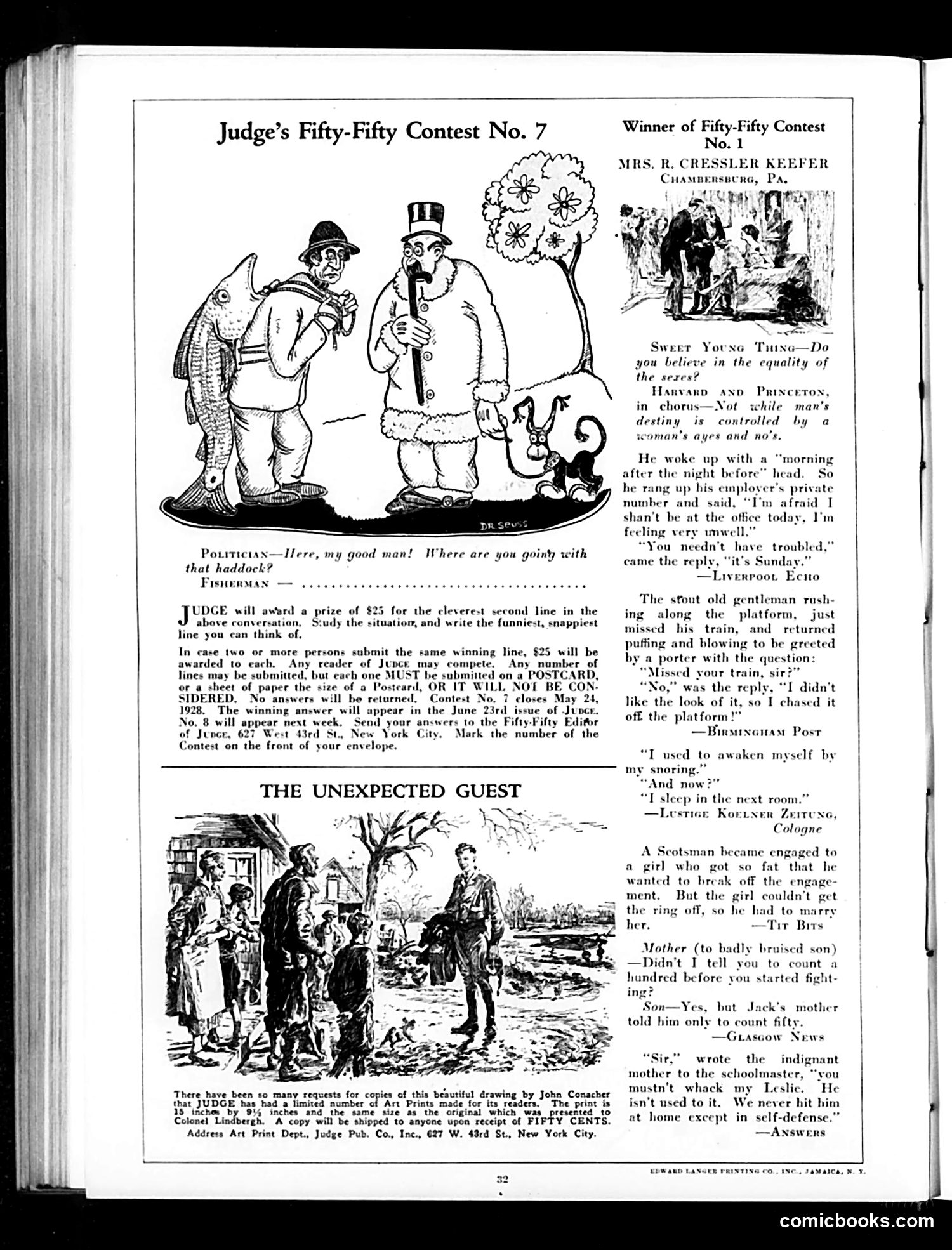
This page from Judge (circa 1928) contains several satirical humor pieces: **"Judge's Fifty-Fifty Contest No. 7"**: A cartoon shows a politician confronting a fisherman carrying a large fish, asking where he's going with "that haddock." The contest invites readers to supply a witty second line, offering $25 for the cleverest response. This is a participatory humor format popular in the era. **"The Unexpected Guest"**: A John Conacher drawing depicts an unexpected arrival at a modest home, likely satirizing social disruption or class tensions typical of period satire. **Humor snippets** throughout mock contemporary attitudes: college men denying women's equality, a hungover worker calling in sick, a Scotsman unable to escape an engagement, and a mother defending her son from corporal punishment—reflecting 1920s social debates about gender, work culture, and child-rearing. The page exemplifies Judge's formula: visual cartoons combined with short joke submissions, targeting educated, middle-class readers with mild social commentary and wordplay.
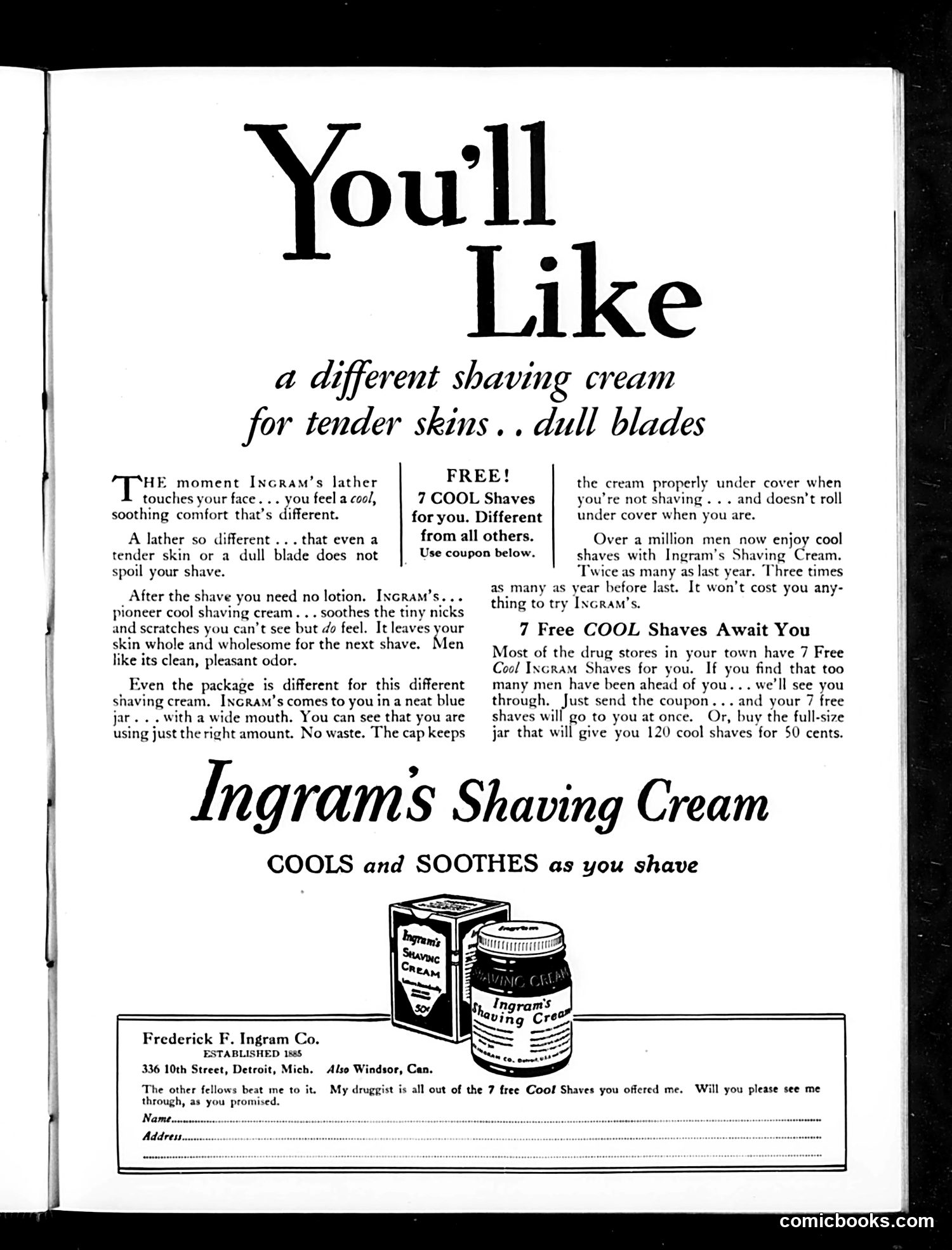
This page is **not a cartoon or satire**—it's a straightforward **advertisement for Ingram's Shaving Cream**, a real product from the Frederick F. Ingram Co. of Detroit, Michigan (established 1885). The ad promotes the product's key features: a cooling, soothing lather suitable for tender skin and dull blades, requiring no post-shave lotion. It emphasizes the distinctive blue jar packaging and claims over a million men use it, with sales tripling year-over-year. The main marketing hook is a promotional offer: **seven free sample shaves** available at drugstores, with a coupon for mail-order if supplies run out locally. A jar providing 120 shaves costs 50 cents. The bottom includes a testimonial coupon format where customers can request their promised free samples if their local druggist has sold out. This represents typical early-to-mid 20th century men's grooming advertising emphasizing product differentiation and free trial offers.
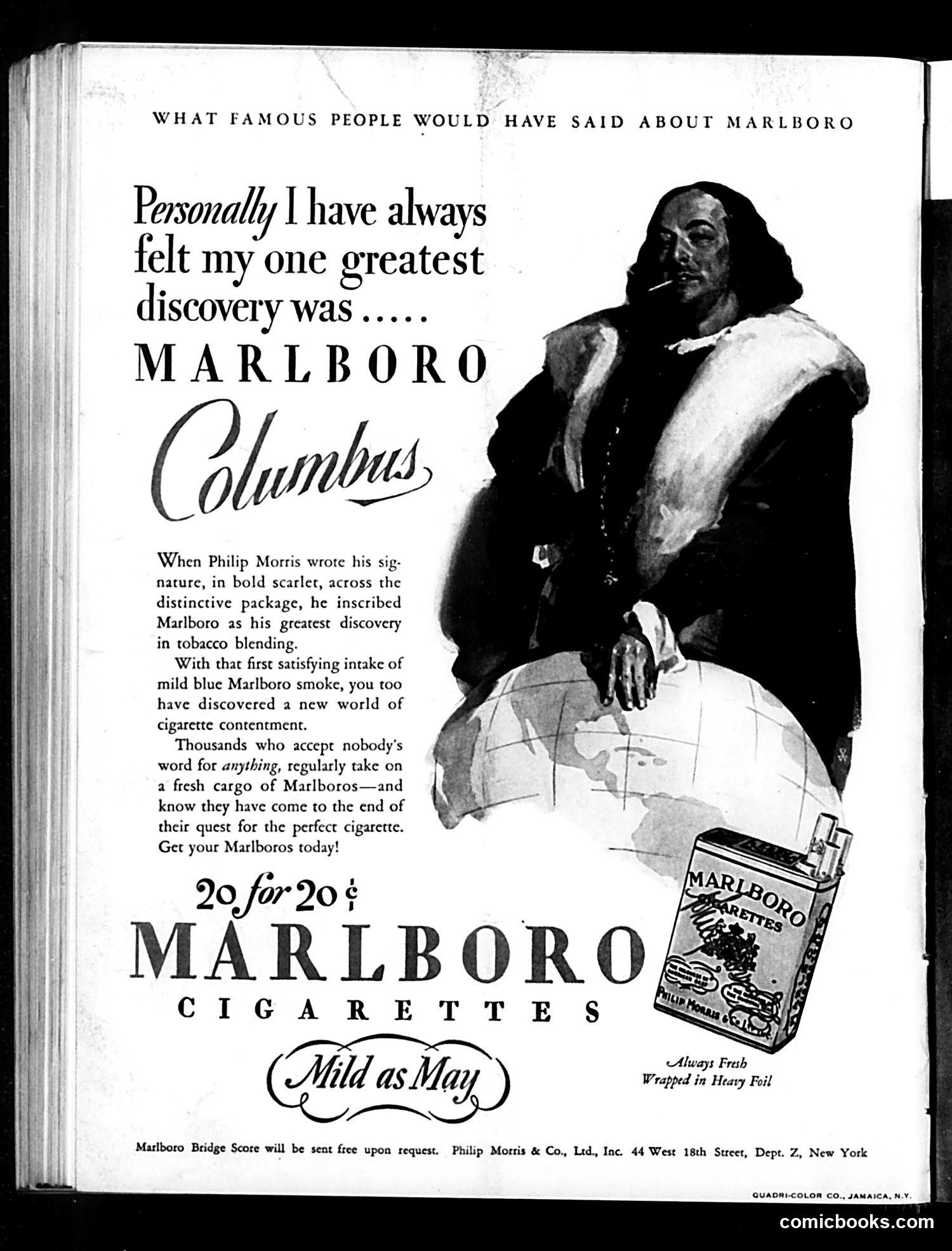
This is primarily a **cigarette advertisement**, not political satire. It uses a famous historical figure—**Columbus**—to promote Marlboro cigarettes by drawing a parallel between Columbus's "discovery" of the New World and the smoker's "discovery" of Marlboro as the perfect cigarette. The ad attributes the quote to Philip Morris (the company founder), claiming he considered Marlboro his greatest "discovery in tobacco blending." The Columbus imagery reinforces this theme of groundbreaking exploration and achievement. The price point ("20 for 20¢") and tagline "Mild as May" emphasize accessibility and gentleness. A bridge-scoring game offer attempts to drive consumer engagement. By modern standards, this advertisement is striking for its casual endorsement of tobacco and its use of historical achievement to legitimize a consumer product—marketing tactics now heavily restricted.