
Judge, 1928-05-12 · page 15 of 36
Judge — May 12, 1928 — page 15: what you’re looking at
What you’re looking at
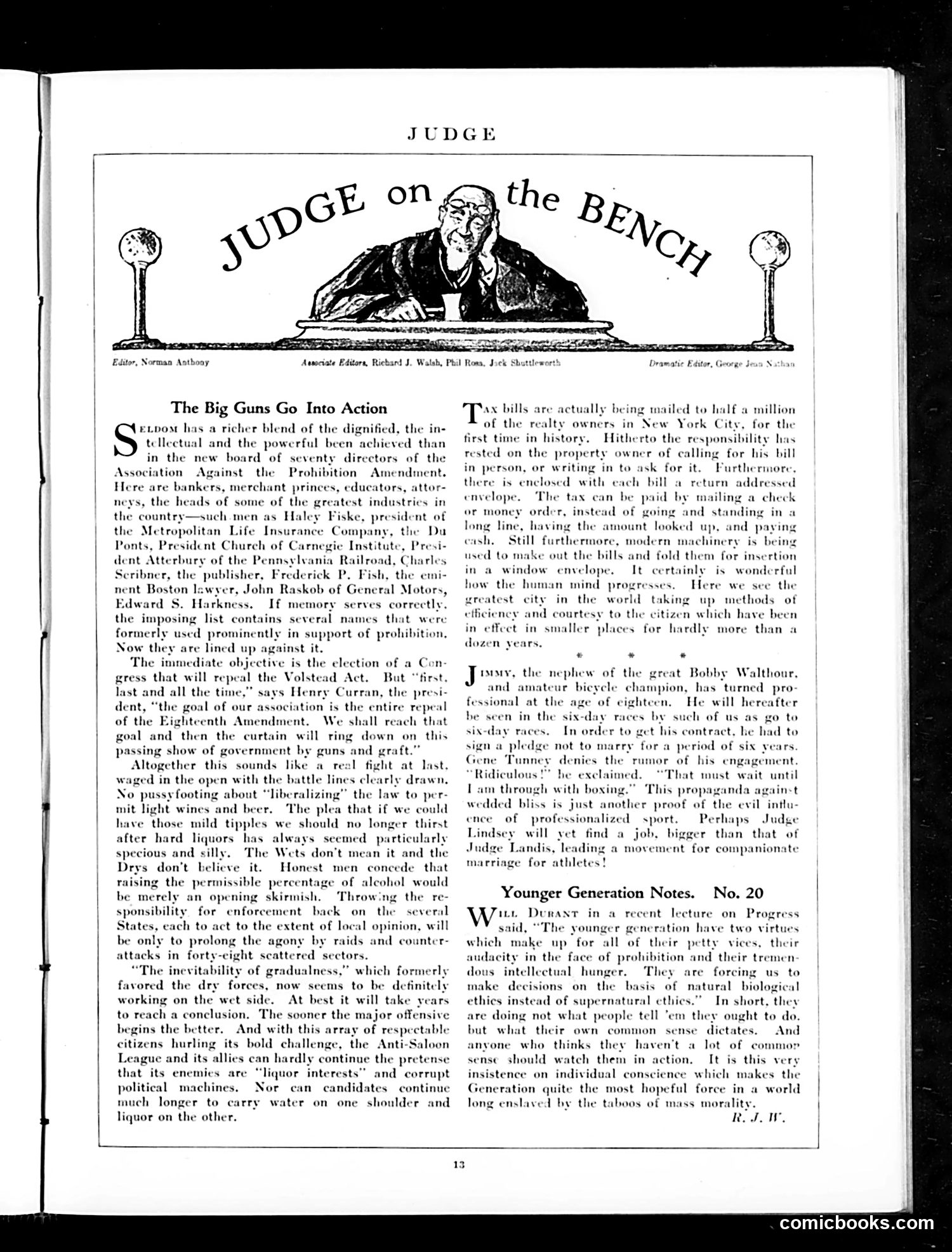
This page from *Judge* satirizes the newly formed Association Against the Prohibition Amendment, which sought to repeal the Volstead Act (Prohibition law). The main article praises the "Big Guns" involved—prominent businessmen like Haley Fiske (Metropolitan Life Insurance), the Du Ponts, and John Raskob (General Motors)—noting the irony that some formerly supported prohibition. The satire's point: these wealthy, respectable figures now openly fight Prohibition, abandoning the pretense that only "liquor interests" opposed it. Judge applauds this direct challenge, contrasting it with previous gradual approaches. The author argues honest men should openly admit alcohol restriction failed, rather than claiming people only want "mild tipples." The cartoon's judge figure likely represents judicial authority or impartiality overseeing this political reversal. Secondary items cover mundane civic improvements (NYC tax billing) and sports gossip, typical of the magazine's mixed content.
📄 Transcribed text from this page (OCR, searchable)
Machine-transcribed from the original scan — historical spelling and the odd misread are preserved.
JUDGE Loom has a richer blend of the d ed, the in- S tellectual and the powerful been achieved than in the new board of seventy directors of the Association Against the Prohibition Amendment. Here are bankers, merchant princes, educators, att neys, the heads of some of the greatest industries in the country—such men as Haley Fiske, president of the Metropolitan Life Insurance Company, the Du Ponts, President Church of Carnegie Institute, Presi- dent Atterbury of the Pennsylvania Railroad, ( Scribner, the publisher, Frederick P. Fish, the nent Boston lawyer, John Raskob of General Motors, Edward S. Harkness. If memory serves correctly. the imposing list contains several names that were formerly used prominently in support of prohibition, Now they are lined up against it. The immediate objective is the election of a Con- gress that will repeal the Volstead Act. But “first. ast and all the time,” dent, “the goal of our association is the peal of the Eighteenth Amendment. We shall reach that goal and then the curtain will ring down on this passing show of government by guns and graft.” Altogether this sounds like a real fight at last. waged in the open with the battle lines clearly drawn, No pussyfooting about “liberalizing” the law to per- mit light wines and beer. The plea that if we could have those mild tipples we should no longer thirst after hard liquors has always seemed particularly specious and silly. The Wets don’t mean it and the Drys don’t believe it. Honest men concede that Sing the permissible percentage of alcohol would an opening skirmish. Throwing the re- for enforcement back on the several ach to act to the extent of local opinion, will : to prolong the agony by raids and counter- attacks in forty-cight scattered sectors. emi- n, the presi- States, y of gradualness,” which formerly favored the dry forces, now seems to be definitely working on the wet side. At best it will take years ch a conclusion. The sooner the major offensive begins the better. And with this array of respectable citizens hurling its bold challenge, the Anti-Saloon League and its allies can hardly continue the pretense that its enemies are “liquor interests’ and corrupt political machines. Nor can candidates continue much longer to carry water on one shoulder and liquor on the other. T* bills are actually being mailed to half a million the realty owners in New York City, for the first time in history. Hitherto the responsibility has rested on the property owner of calling for his bill in person, or writing in to ask for it. Furthermore, there is enclosed with cach bill a return addressed envelope. The tax can be paid by mailing a check order, instead of going and standing in a having the amount looked up, and paying Still furthermore, modern machinery is being used to make out the bills and fold them for insertion in a window envelope. It rtainly is wonderful how the human mind progresses. Here we see the greatest city in the world taking up methods of cificiency and courtesy to the citizen which have bee in effect in smaller places for hardly more than a dozen years. * * « je the nephew of the great Bobby Walthour, and amateur bicycle champion, has ‘turned pro fessional at the f eighteen, He will hereafter be scen in the six-day races by such of us as go to six-day races. In order to get his contract, he had to sign a pledge not to marry for a period of six years. Gene Tunney denies the rumor of his engagement. “Ridiculous!” he exe! 1. “That must wait until Lam through with boxing.” This propaganda against wedded bliss is just another proof of the evil intlu- ence of professionalized sport. Perhaps Juc Lindsey will yet find a job, b than that of Judge Landis, ding a movement for companionate marriage for athletes! Younger Generation Notes. No. 20 Durant in a recent lecture on Progress “The younger generation have two virtues ce up for all of their petty vices, their lacity in the face of prohibition and their tremen dous intellectual hur They are fore a decisions on basis of natural nstead of supernatural ethics.” In short, they are doing not what people tell "em they ought to do. but what their own common sense dictates. And anyone who thinks they haven't a lot of commor sense should watch them in action. It is this very insistence on individual conscience which makes the eneration quite the most hopeful force in a world long enslaved by the taboos of mass morality. SY Le comicbooks.com