
A complete issue · 36 pages · 1928
Judge — April 21, 1928
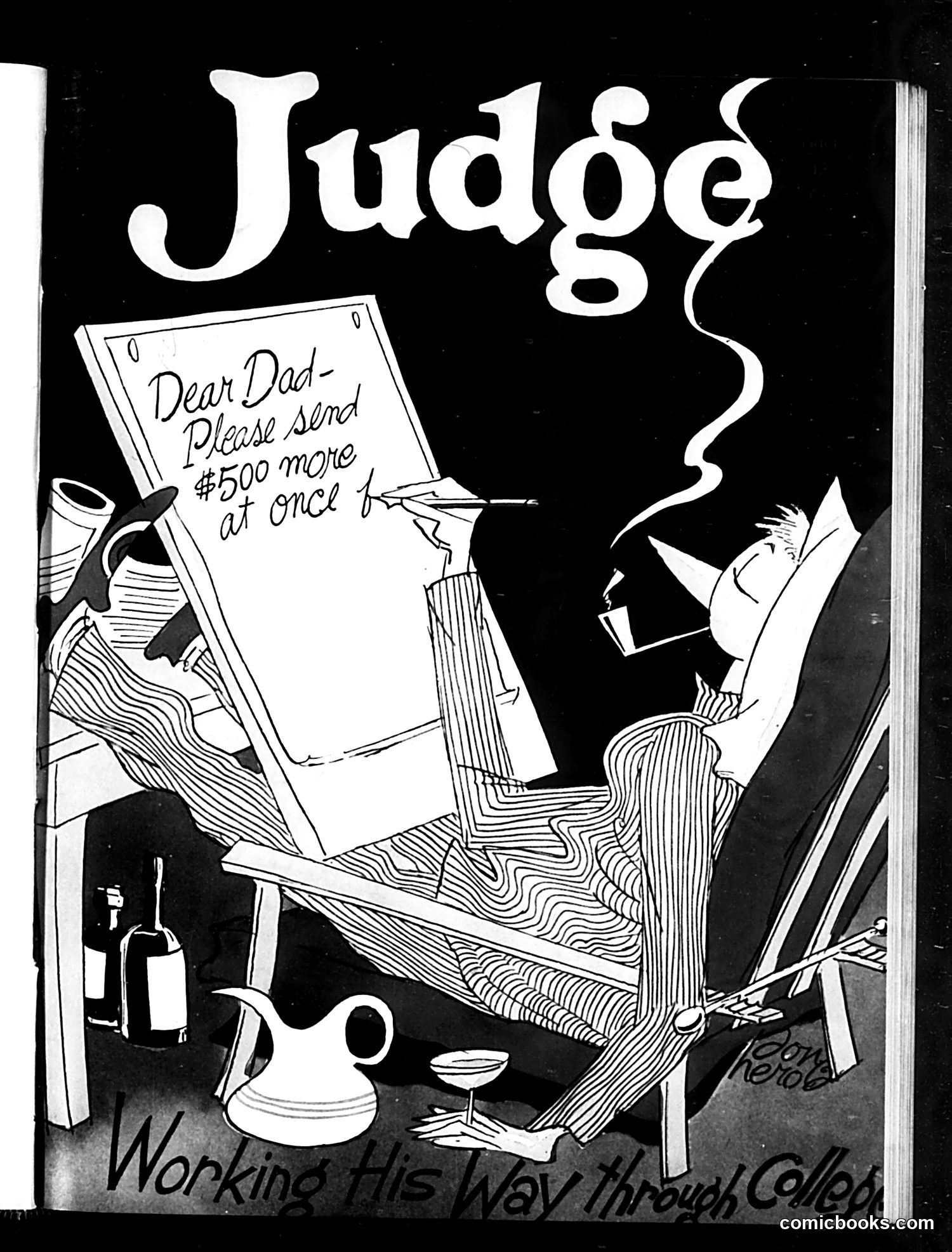
This cartoon satirizes financial hardship during what appears to be an economic crisis period (likely Depression-era). The central figure, a man reclining luxuriously despite poverty, writes to his father requesting $500 more money "at once." The caption "Working His Way Through College" is deeply ironic—he's clearly not working or studying, but instead living indulgently with alcohol, fine dining, and leisure activities visible around him. The satire targets wealthy young men who exploit family resources under the pretense of education, contrasting their lavish spending with the economic struggles of ordinary people. The cartoon criticizes both parental enabling and the entitlement of privileged youth who expect continuous financial support without effort or appreciation.
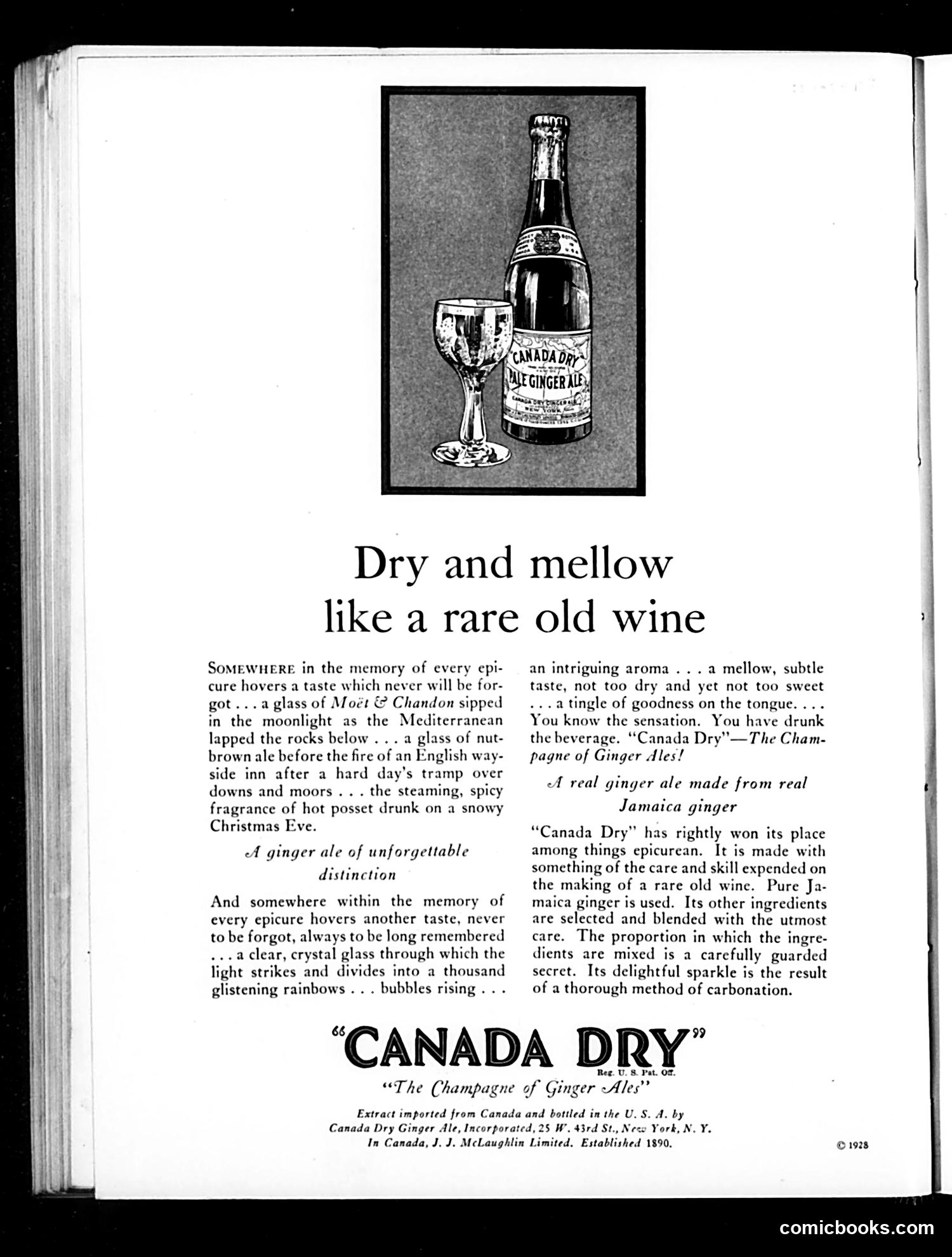
This page is primarily **an advertisement**, not political satire. It promotes "Canada Dry" ginger ale, marketed as "The Champagne of Ginger Ales." The ad uses nostalgic, evocative language to position the beverage as refined and sophisticated—comparing it to luxurious experiences like fine wine and champagne. References to "Moët & Chandon," moonlight, English firesides, and Christmas Eve create an aspirational tone suggesting genteel leisure and elegance. The product itself is emphasized as made from "real Jamaica ginger" with carefully guarded proportions and carbonation methods, positioning it as a premium, carefully-crafted beverage worthy of fancy glassware. There is no political cartoon or satire visible. The copyright date is 1928.
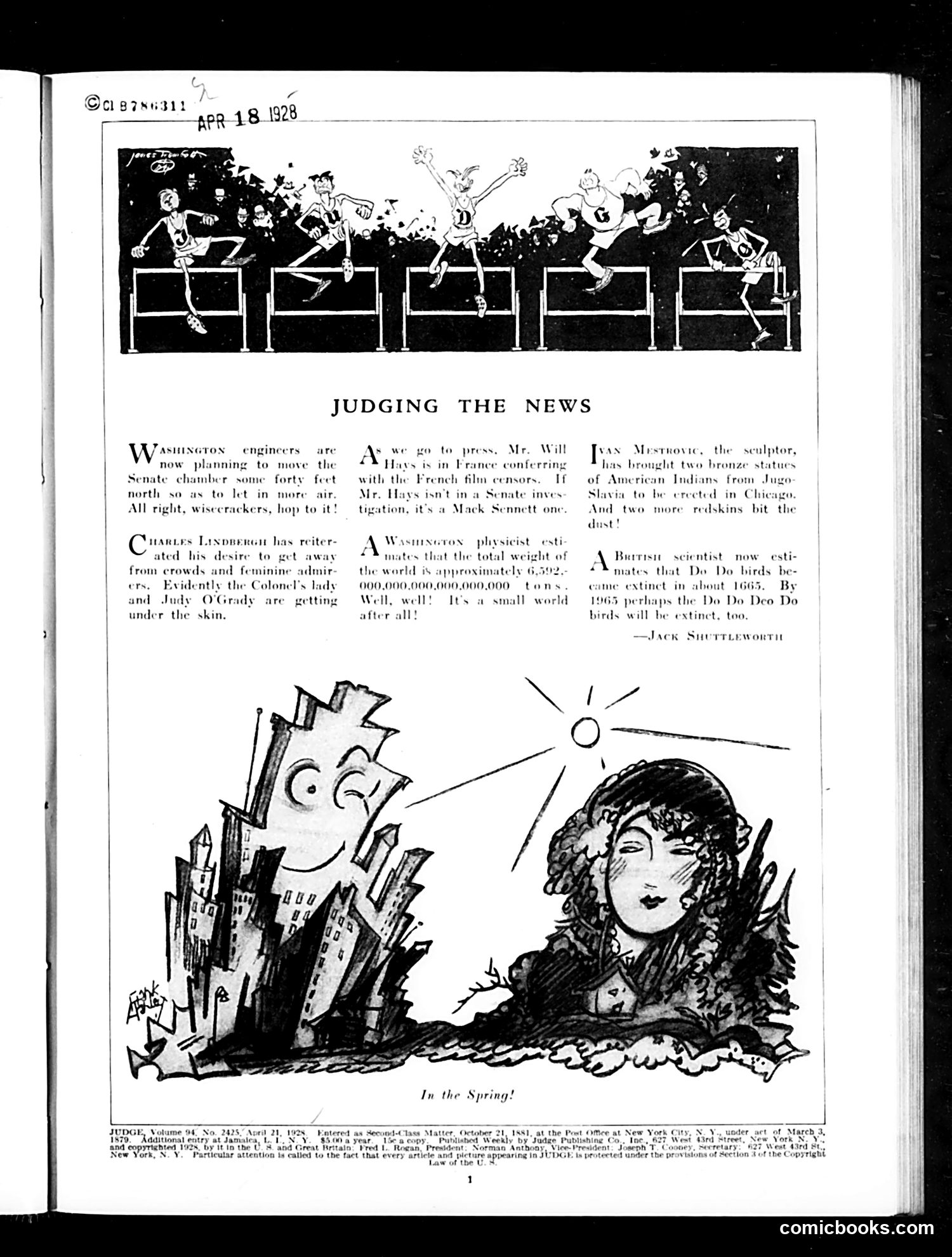
This satirical page mocks contemporary news stories: **Top cartoon**: Skeletal figures hurdle over barriers labeled with letters, satirizing competitive news coverage or journalistic "races." **Column items** (left to right): - Washington engineers debate expanding the Senate chamber—satirized as absurd - Charles Lindbergh's celebrity causing crowd hysteria - A physicist's estimate of the world's population (6.5 billion) - Will Hays (film censor) blocking French films from Senate investigation - Ivan Mestrovic's bronze Indian statues arriving in Chicago - A British scientist's claim that Do Do birds existed until 1905 **Bottom illustration**: "In the Spring!" shows a man's face emerging from urban buildings, paired with a woman's face—likely satirizing spring romance or renewal amid modern city life. The page exemplifies Judge's style: mocking celebrity obsession, government inefficiency, and pseudo-scientific claims.
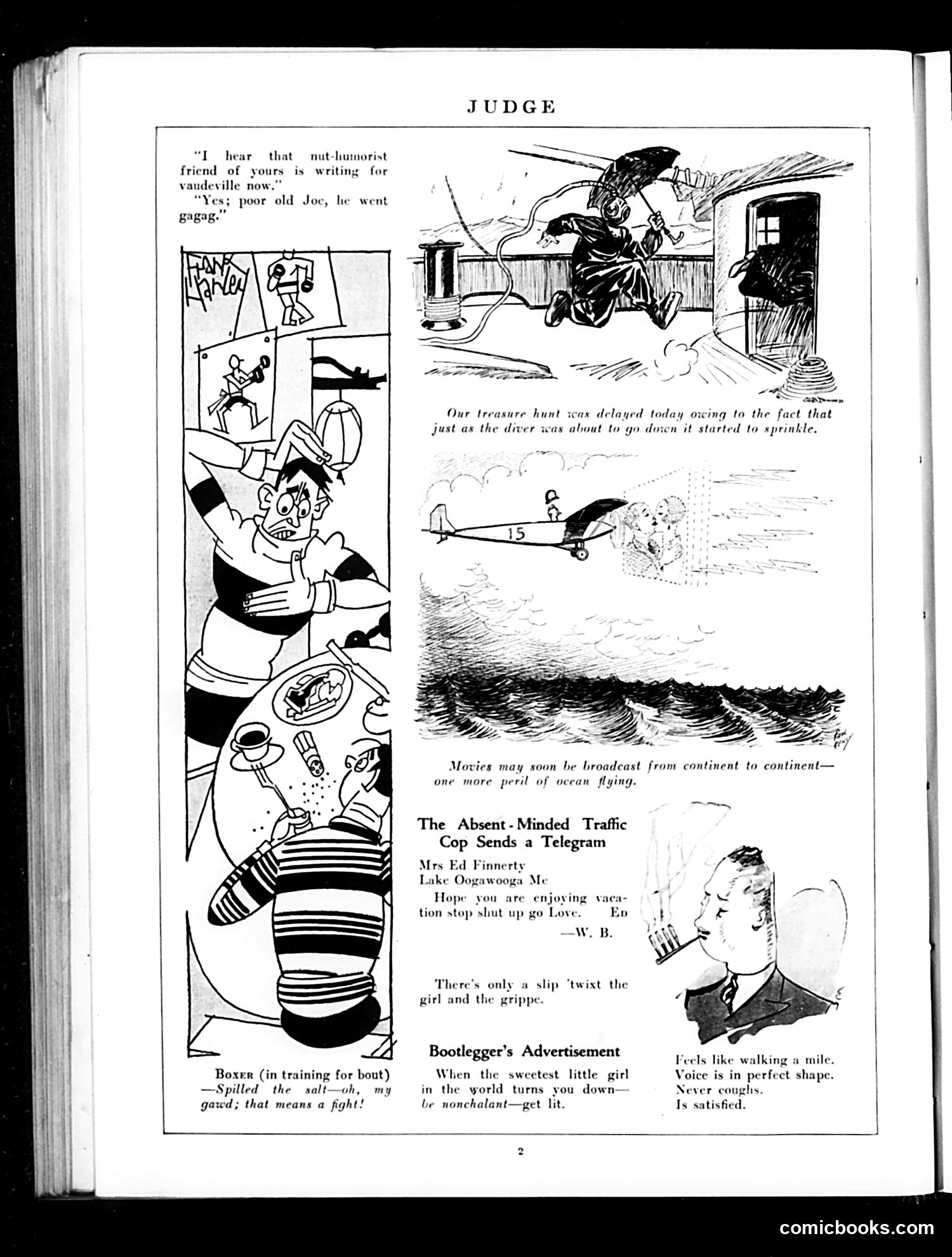
This page contains several unrelated humor pieces typical of Judge magazine's format: **Left panel ("Boxer in training for bout")**: A comic strip showing a boxer who "spilled the salt" and interprets this superstition as a fight challenge—visual wordplay on boxing terminology. **Top right ("Treasure hunt" delayed by sprinkle)**: Satirizes absent-minded behavior, likely referencing a contemporary news story or common occurrence. The joke appears to be about trivial delays. **Center ("Movies may soon be broadcast")**: Early commentary on technological advancement in aviation and film distribution—satirizing optimistic predictions about emerging technology. **Bottom section**: Contains a telegram joke about a traffic cop, bootlegger advertisement (playing on Prohibition-era humor), and a voice advertisement—mostly filler advertising and minor gags rather than political satire. The page reflects 1920s concerns: Prohibition, new technology, and everyday absurdities.
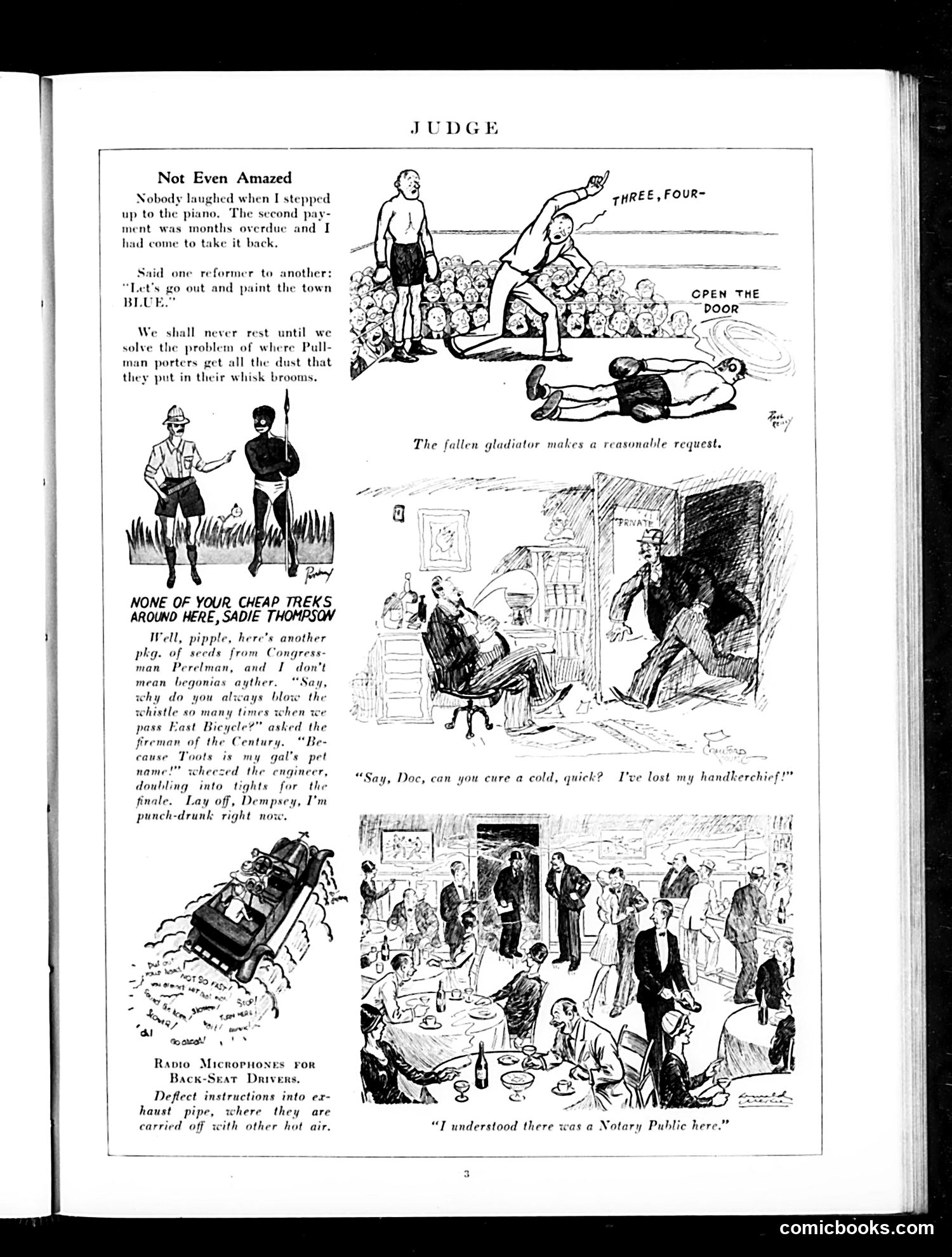
This satirical page mocks various early 20th-century annoyances and social absurdities: **"Not Even Amazed"** (top): Acrobats perform for a crowd while someone requests they "open the door"—satirizing how people ignore performers' skills for mundane requests. **"None of Your Cheap Tricks, Sadie Thomson"**: A dialogue between two men mocking someone (likely a real person or type) who constantly whistles or makes noise, with references to "East Bicycle" and drinking. **"Radio Microphones for Back-Seat Drivers"**: Mock advertisement ridiculing backseat drivers by suggesting microphones to broadcast their constant instructions and complaints to other cars—satirizing this universal social nuisance. **Bottom cartoon**: Shows a crowded social gathering where someone mentions "a Notary Public here"—unclear specific reference but likely mocks pretentious or overly formal social situations.
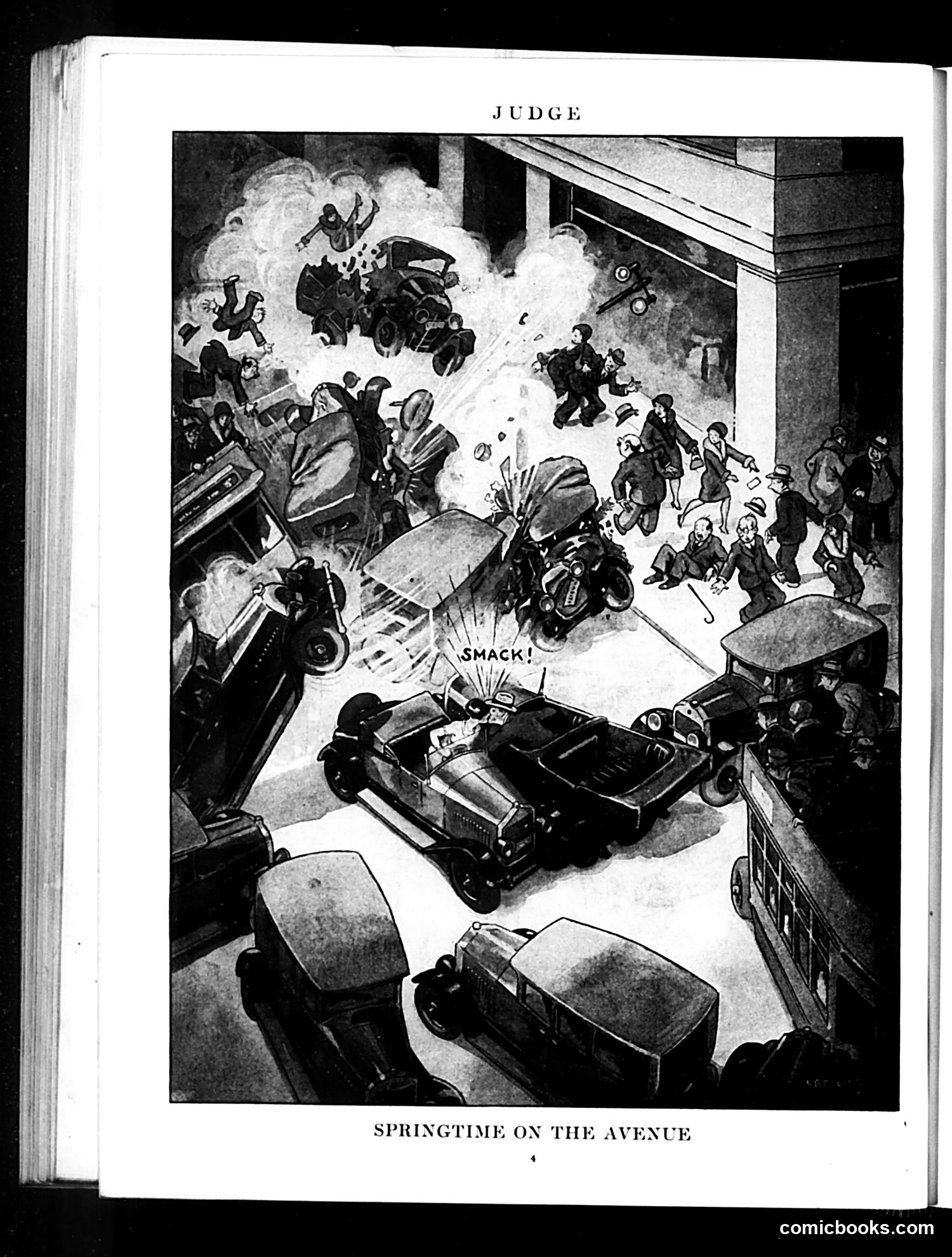
This Judge cartoon satirizes chaotic traffic and pedestrian dangers on a major city avenue, likely New York. The bird's-eye view shows multiple automobiles colliding in the center with a prominent "SMACK!" sound effect, while pedestrians scatter in panic around the accident. Figures appear to be falling or jumping away from the vehicles. The satire targets the hazards of early automobile adoption in urban areas—a common concern in the 1910s-1920s when cars were becoming prevalent but traffic rules and safety practices were poorly established. The title's ironic "springtime" reference suggests the season brings not renewal but increased traffic chaos and danger as more people and vehicles take to city streets.
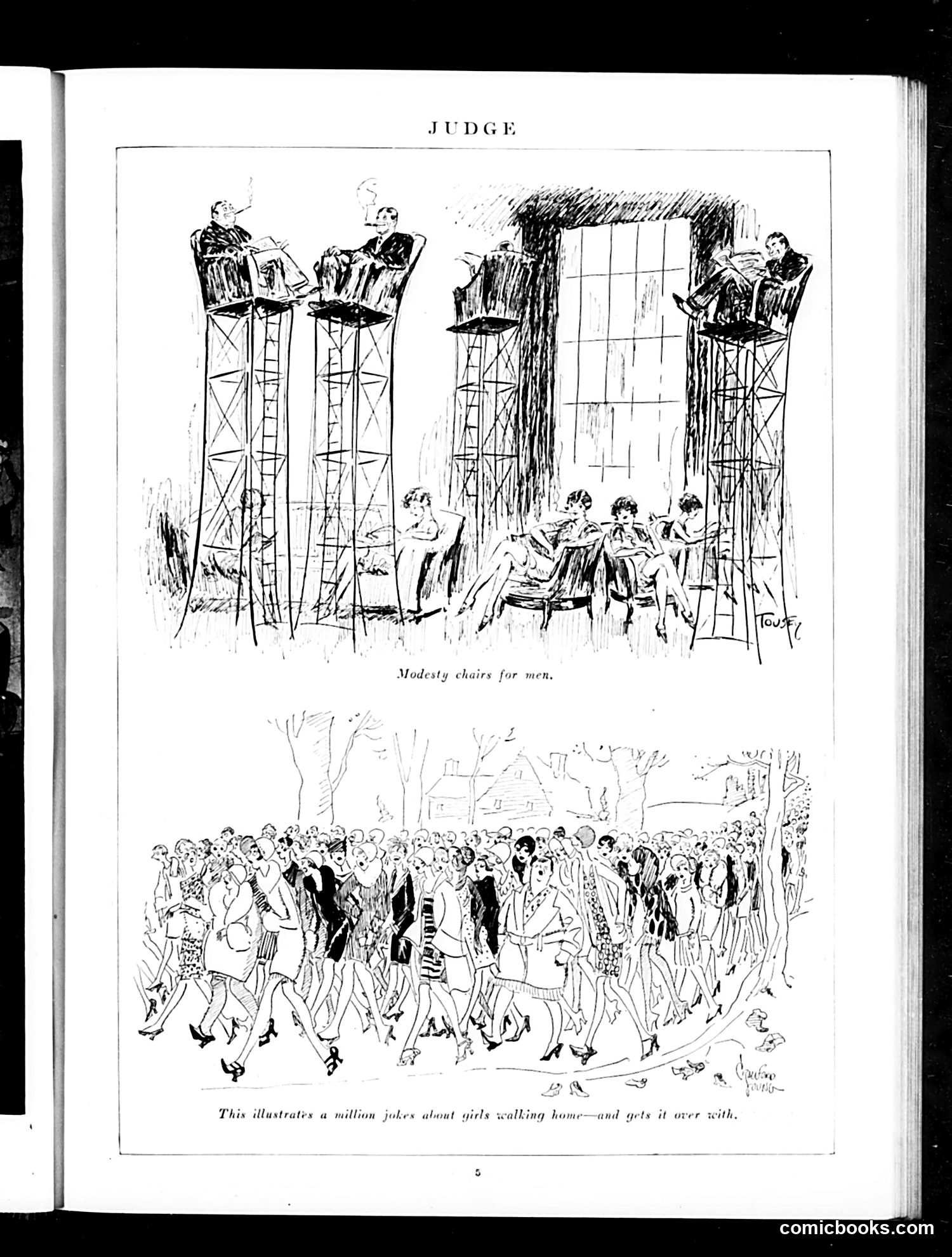
This page contains two satirical cartoons about gender and social behavior: **Top cartoon** ("Modesty chairs for men"): Shows men seated on extremely tall, elevated chairs in what appears to be a courtroom or formal setting. The satire mocks male modesty by depicting men requiring absurdly high seating—likely commenting on men's prudishness or exaggerated propriety claims. **Bottom cartoon**: Depicts a large crowd of women walking together outdoors, with the caption "This illustrates a million jokes about girls walking home—and gets it over with." This is satire about common jokes/stereotypes regarding groups of women walking, suggesting the cartoonist is humorously "exhausting" this overused comedic trope by illustrating it once comprehensively. Both cartoons appear designed to mock gender-based social conventions and tired comedic clichés of the era.
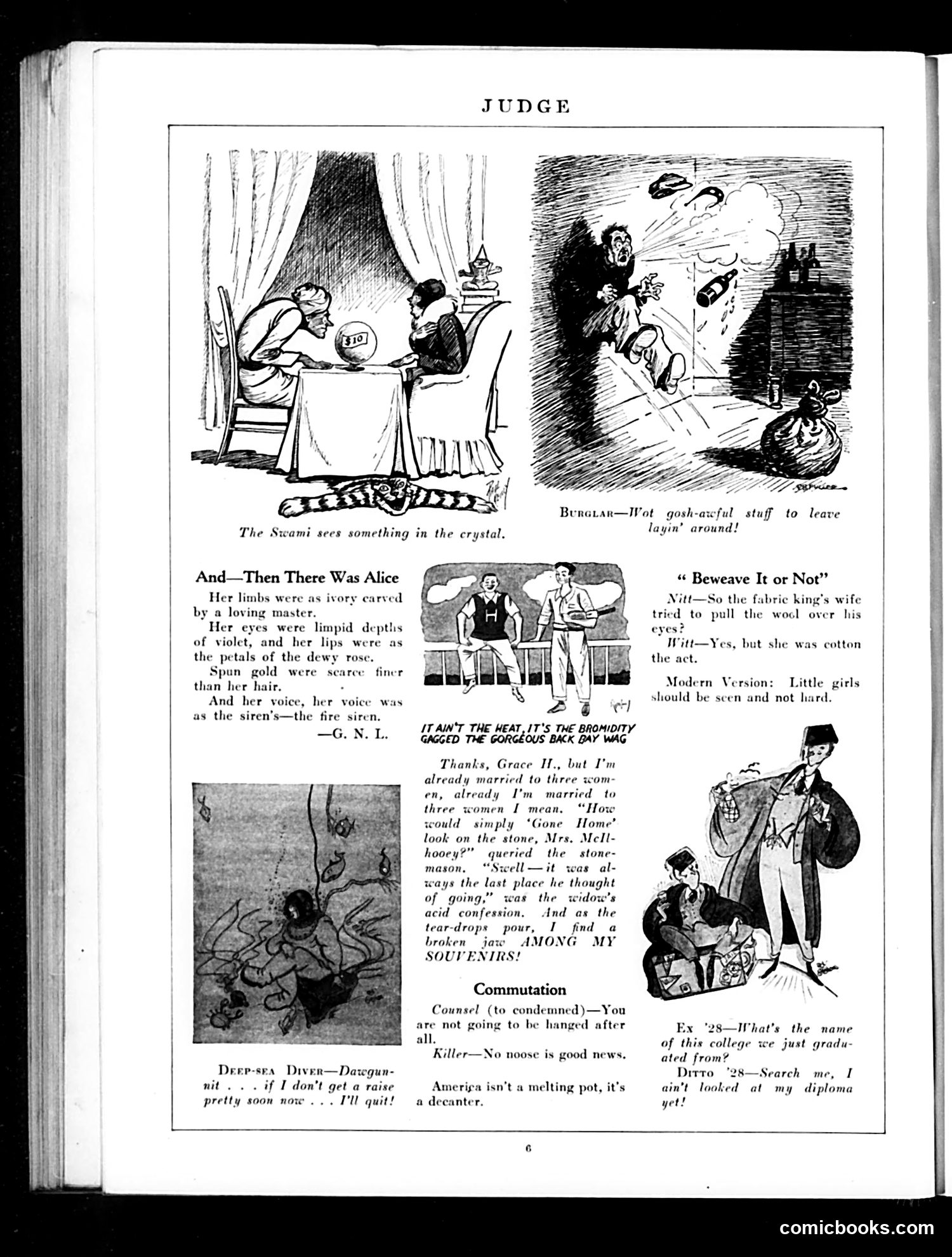
This page contains multiple satirical jokes and cartoons typical of early-20th-century American humor: **"And—Then There Was Alice"** parodies flowery romantic prose by describing a woman in elaborate poetic terms, then undercutting it with the final line—her voice is "as the siren's—the fire siren," a crude joke deflating the sentimentality. **"Beweave It or Not"** is a pun-based joke about a fabric merchant's wife attempting to deceive him ("pull the wool over his eyes"), with the punchline playing on "cotton" (the fabric) and "caught in the act." **"Commutation"** shows a death-row inmate told he won't be hanged, with his dark reply "No noose is good news"—a grim play on the phrase "No news is good news." **"Deep-sea Diver"** appears to reference Darwinian evolution, with a laborer threatening to quit if conditions don't improve. The other brief jokes target bigamy, college graduates, and immigration ("decanter" vs. "melting pot"). The cartoons use visual exaggeration and wordplay typical of Judge's satirical style.
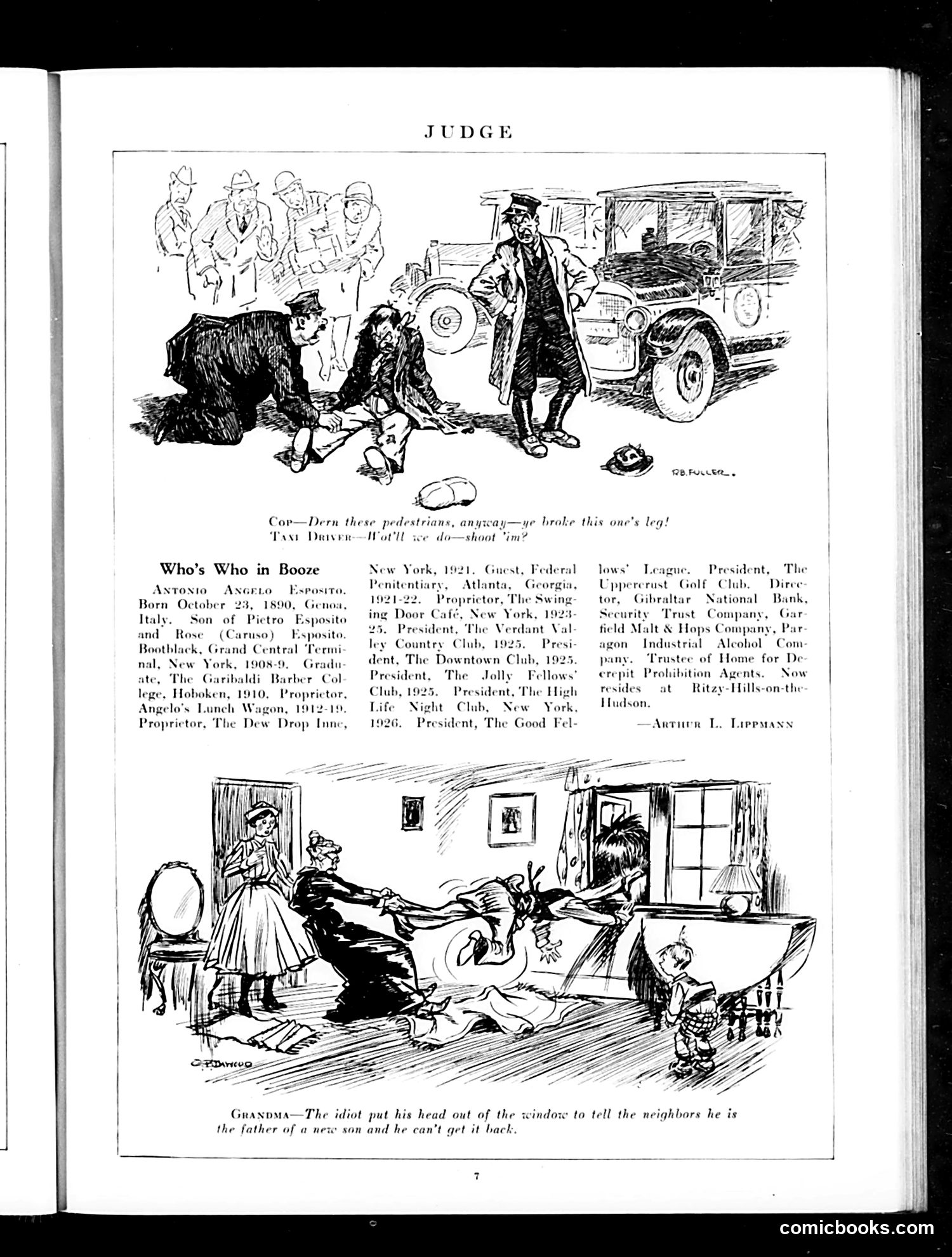
**Top Cartoon ("Judge"):** A taxi driver has struck a pedestrian. When a cop demands to know what happened, the driver quips they should "shoot 'im"—dark humor about disposing of the victim rather than dealing with legal consequences. This satirizes reckless drivers and the casual violence of 1920s city streets. **"Who's Who in Booze" Section:** This is satirical biography mocking Prohibition-era corruption. It catalogs Antonio Angelo Esposito's rise from bootblack to speakeasy proprietor ("Swinging Door Café"), listing his memberships in exclusive clubs. The humor lies in celebrating criminal enterprise through society-page language—treating a bootlegger like a respectable businessman. The final joke names him "Trustee of Home for Decrepit Prohibition Agents," sarcastically suggesting speakeasy owners support the very agents supposed to stop them. **Bottom Cartoon:** An elderly man can't retract his head from a window after announcing he's fathered a son. Simple slapstick humor about foolish pride and physical consequences.
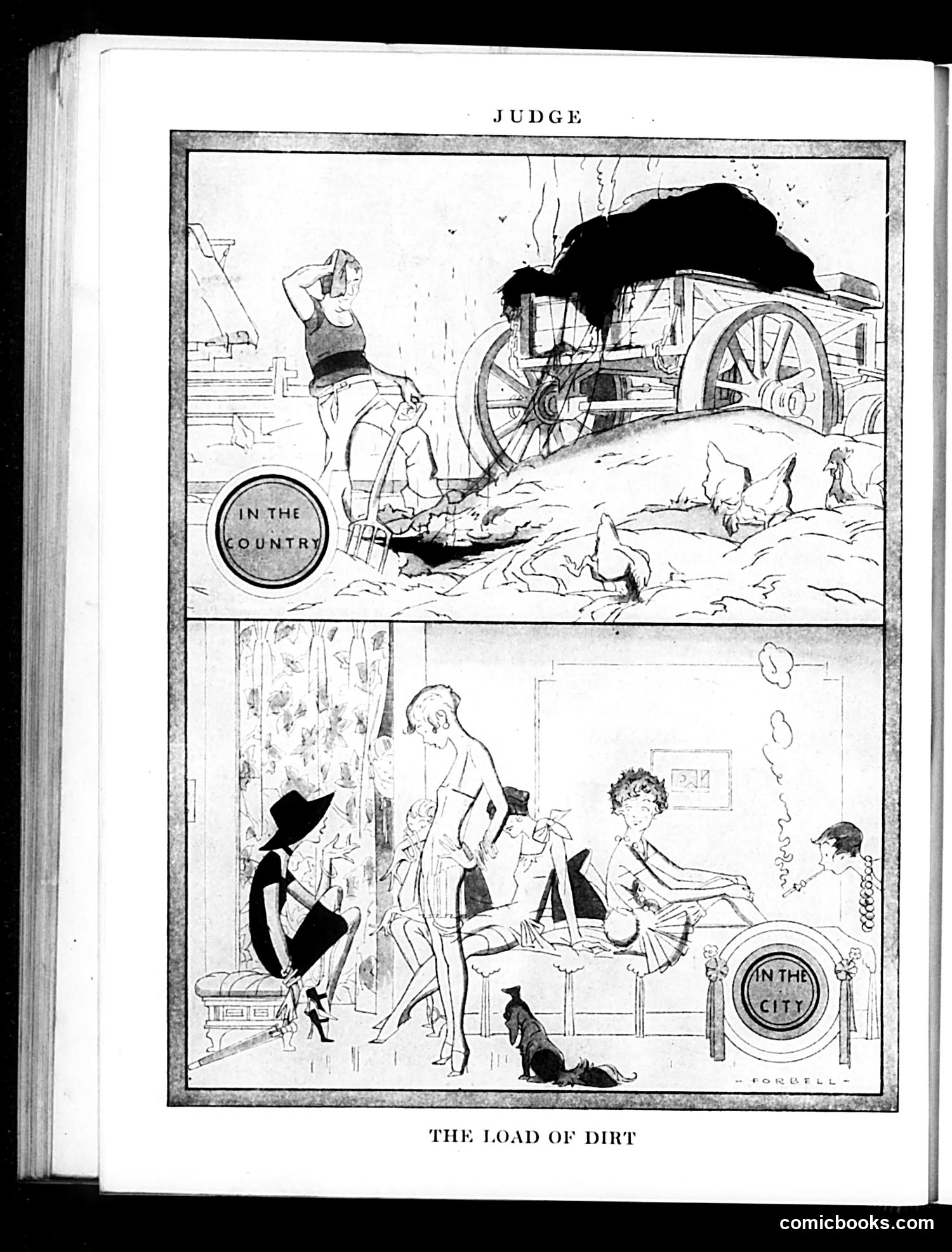
This two-panel satirical cartoon contrasts rural and urban life. The top panel ("In the Country") shows a woman encountering literal dirt—a muddy road, wagon, and animals. The bottom panel ("In the City") depicts the same woman now dealing with metaphorical "dirt"—socializing with what appear to be morally questionable figures in an indoor setting. The satire suggests that city life, despite its cleaner appearance, actually exposes people to moral corruption and social vice. The "load of dirt" transforms from physical mud in the countryside to the figurative filth of urban society—suggesting city dwellers encounter worse contamination through bad influences and immoral associates than rural inhabitants face from actual dirt.
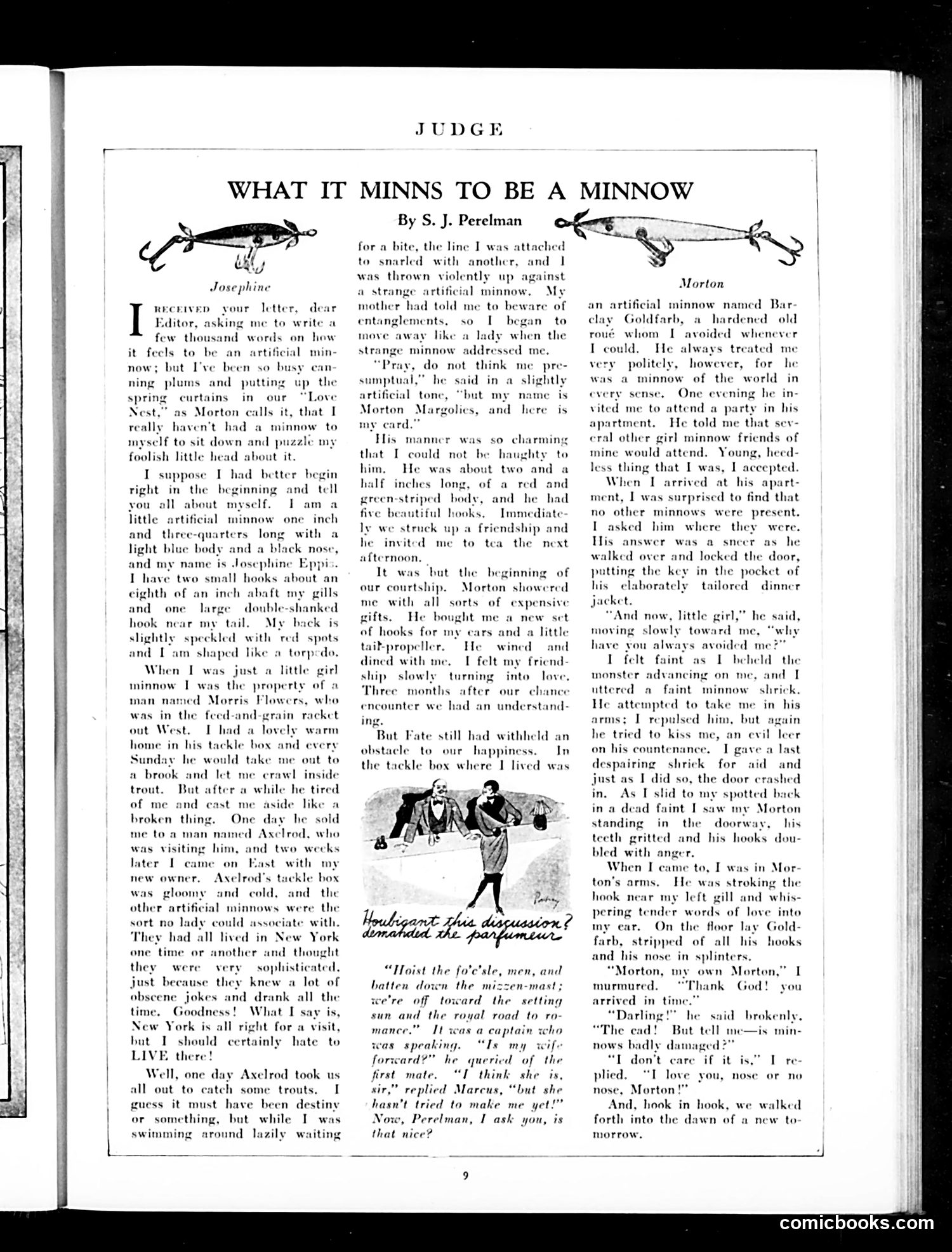
This is a humorous short story (not a political cartoon) by S.J. Perelman, told from the perspective of Josephine Eppis, an artificial fishing lure who narrates her romantic entanglements with other lures. The satire mocks human romance and melodrama by transposing it onto inanimate fishing equipment. Josephine recounts her courtship with Morton Margolies, a fancy lure with "five beautiful hooks," who showers her with gifts. She also mentions Barclay Goldfarb, a "hardened old roué" (seducer), creating predictable romantic tension. The joke lies in treating fishing lures as if they were human characters with desires, social anxiety, and romantic drama—inflating trivial objects into soap-opera subjects. This absurdist approach to domestic romance reflects *Judge* magazine's satirical style: deflating sentimental literary conventions through ridiculous juxtaposition.
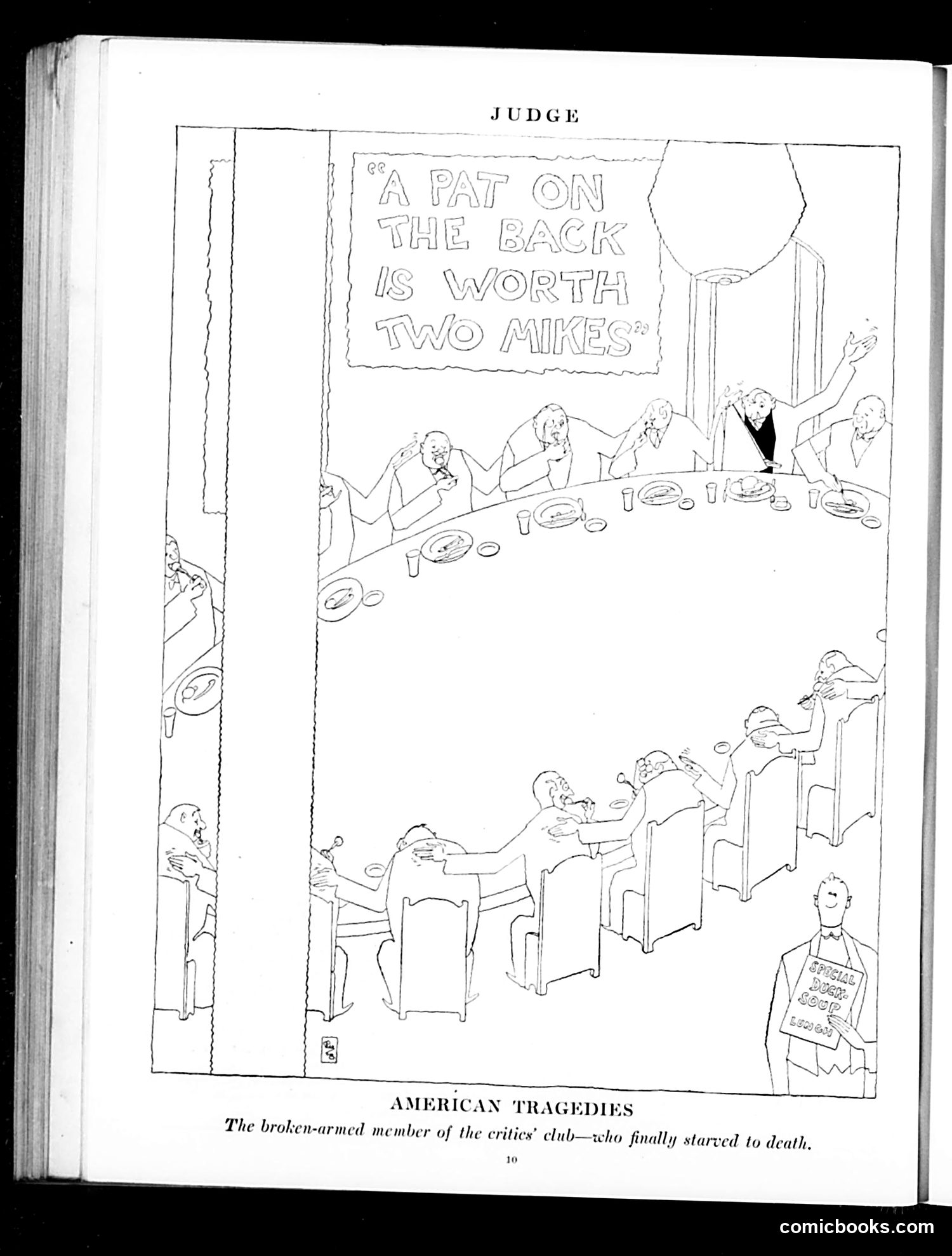
This cartoon satirizes **food critics** and their influence. The scene depicts a formal dining club where critics sit at an elevated table, while a one-armed waiter stands before them. The caption reads: "The broken-armed member of the critics' club—who finally starved to death." The joke is dark: a critic with only one arm cannot both eat AND give approving "pats on the back" to restaurants/chefs—the currency of critical praise. Without the ability to deliver this symbolic gesture, he receives no good food and literally starves. The satire mocks how restaurant owners cater exclusively to critics' whims, suggesting critics wield disproportionate power through praise rather than merit, and that this system is absurdly distorted.
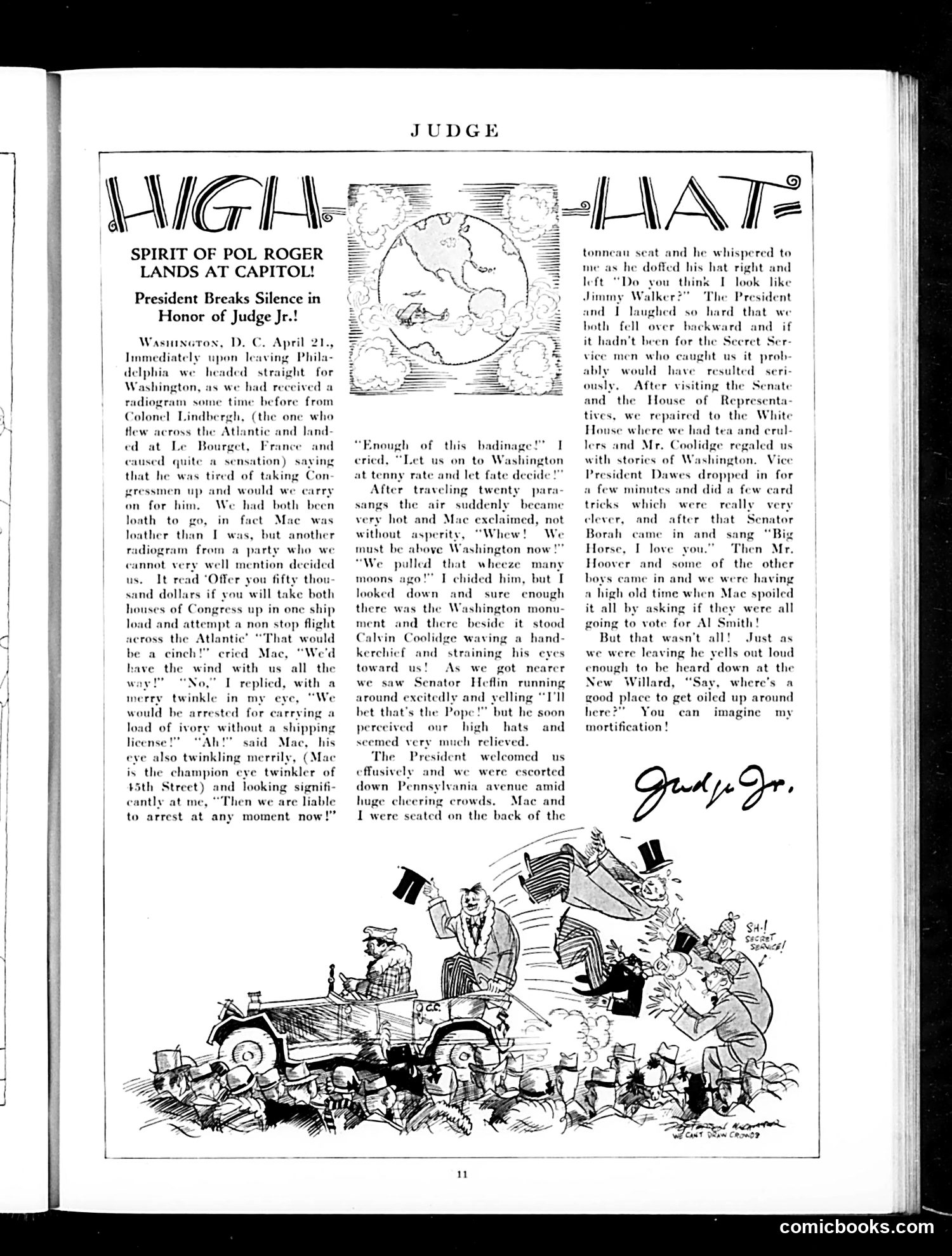
This 1928 Judge magazine piece satirizes Congress through a humorous fictional account of an aviation stunt. The narrator and companion "Mac" undertake a transatlantic flight (evoking Lindbergh's famous 1927 crossing) and are offered $50,000 to transport both houses of Congress on a non-stop flight. The satire targets politicians' frivolousness and corruption: Congress members are portrayed as eager to abandon their duties, and the joke about carrying "ivory without a shipping license" references the contemporary perception of congressmen as morally compromised. The piece mocks President Coolidge's stoicism, Vice President Dawes's showiness, and concludes with "Mac" creating embarrassment by asking about getting "oiled up" (drunk) near the White House—a jab at Prohibition-era hypocrisy. The final reference to voting for "Al Smith" (Democratic presidential candidate) adds partisan commentary.
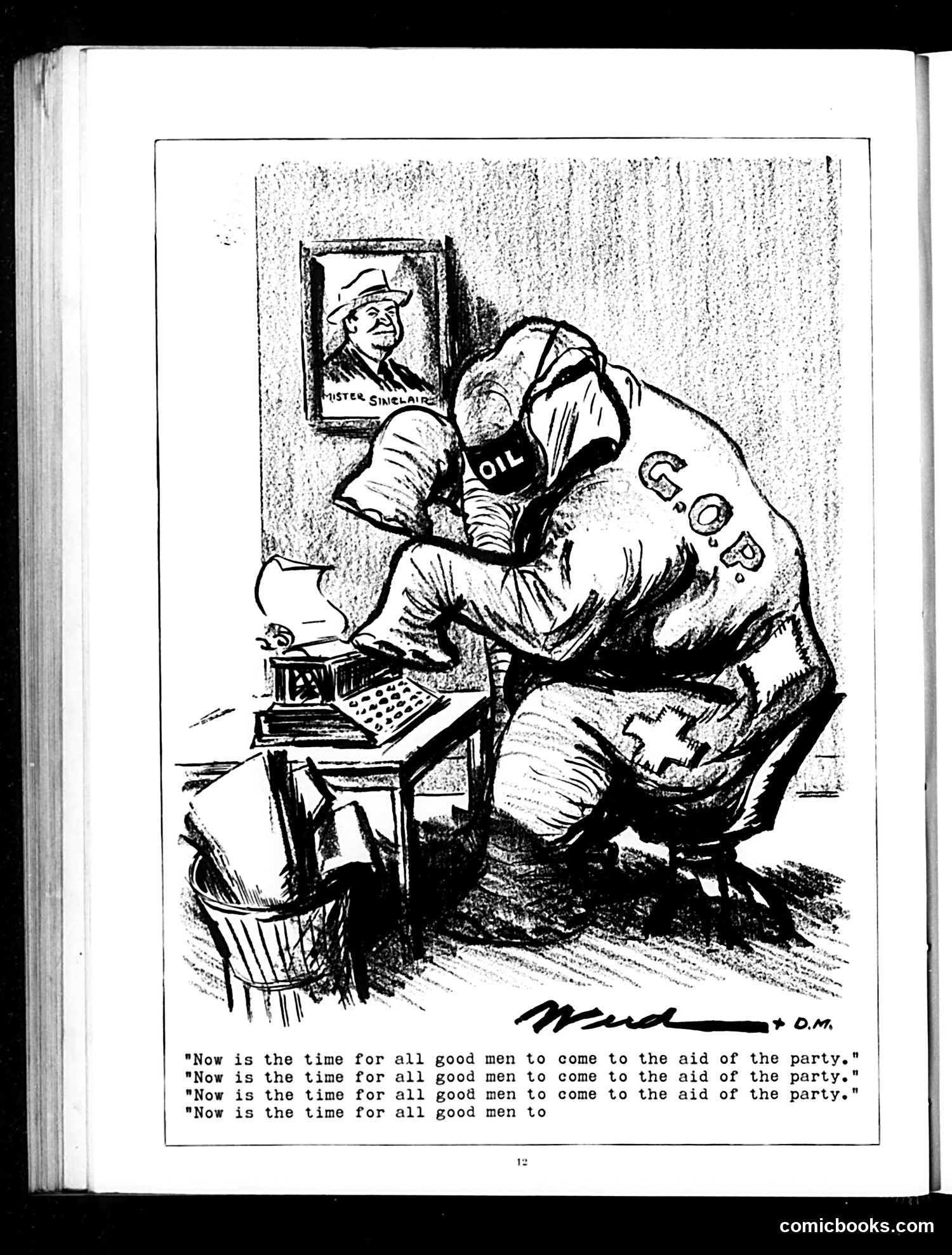
This political cartoon depicts a large figure labeled "G.O.P." (Republican Party) sitting at a desk, repeatedly typing the phrase "Now is the time for all good men to come to the aid of the party." A portrait labeled "Mister Sinclair" hangs on the wall behind. The satire mocks the Republican Party's desperate plea for support, likely during an election cycle. The repetitive typing suggests mechanical, hollow campaigning rather than genuine political substance. "Mister Sinclair" appears to reference Upton Sinclair, the socialist activist and author, though his precise connection here remains unclear—possibly suggesting the GOP's anxiety about radical political challenges. The cartoon critiques the GOP's reliance on party loyalty rhetoric rather than substantive governance.
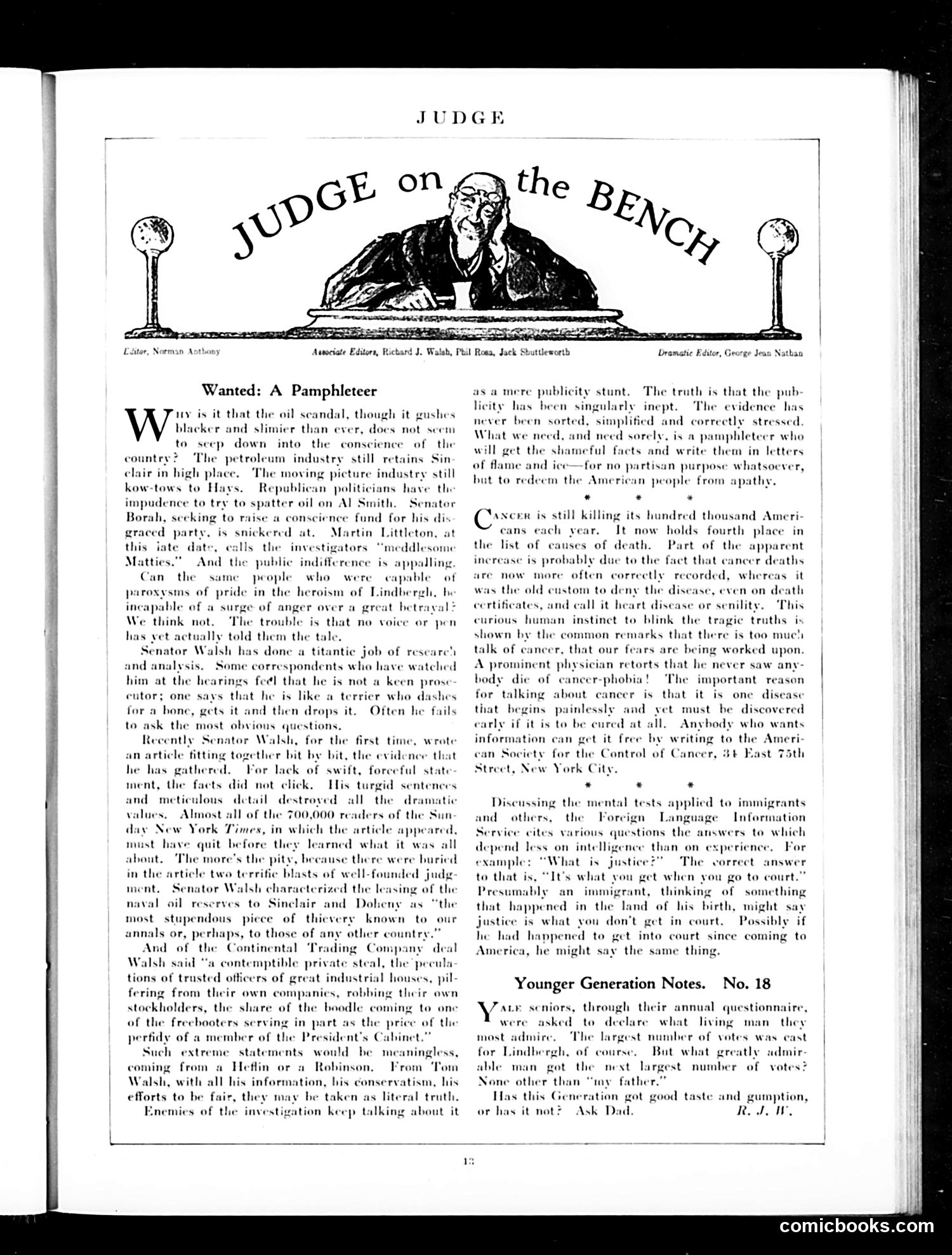
This page contains editorial commentary on the **Teapot Dome Scandal** (oil reserves illegally leased to private companies Sinclair and Doheny during the Harding administration). The main article, "Wanted: A Pamphleteer," criticizes Senator Thomas Walsh's investigative work as thorough but poorly communicated. Though Walsh uncovered damning evidence—characterizing the oil leasing as "the most stupendous piece of thievery"—his dense, academic writing failed to reach the 700,000 readers of the Sunday New York Times. The author argues that while Republicans try deflecting scandal onto Democrat Al Smith and the public shows indifference, what's needed is a persuasive pamphleteer to present these "shameful facts" in dramatic, accessible language to awaken public conscience. The secondary article briefly discusses cancer prevention education for immigrants, emphasizing the importance of straightforward health information over fear-mongering.
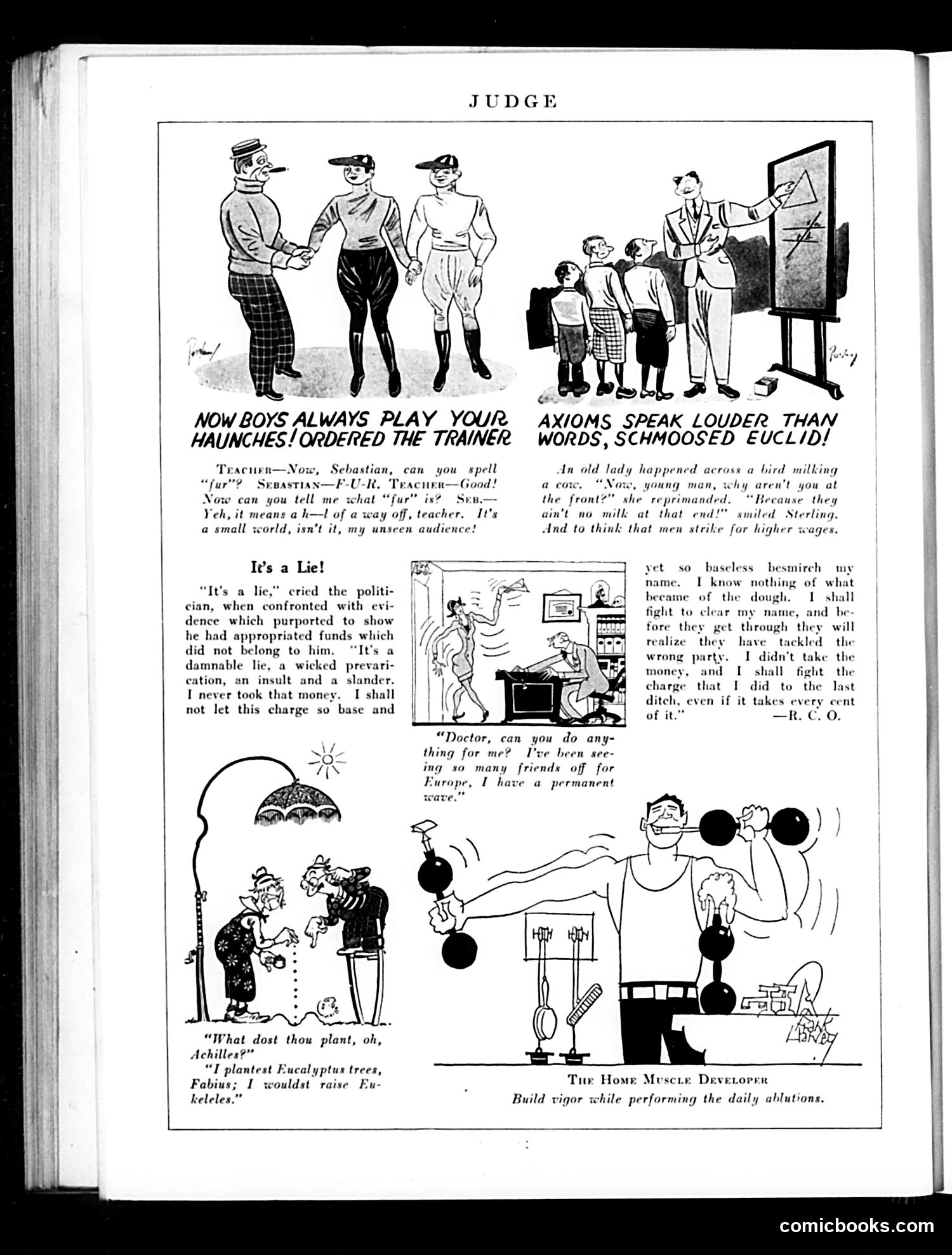
This Judge magazine page contains several satirical cartoons mocking early 20th-century social absurdities: **"Now Boys Always Play Your Haunches"**: A teacher's interaction with a student named Sebastian highlights class dialect humor—the child misunderstands "fur" (meaning "far") as a distance concept, satirizing rural or working-class speech patterns. **"Axioms Speak Louder Than Words"**: An old woman scolds a young man for not being at "the front" (WWI), and he replies crudely that there's "no milk at that end"—mocking both patriotic shaming and soldiers' crude irreverence toward war sacrifice. **"It's a Lie!"**: A corrupt politician denies embezzlement with theatrical outrage, satirizing political dishonesty and the performative indignation politicians use to deflect. **"Home Muscle Developer"**: An exercise device advertisement, likely satirizing fitness fads and dubious health claims. The cartoons collectively mock political corruption, class pretension, wartime hypocrisy, and dubious consumer products—typical Judge editorial targets.
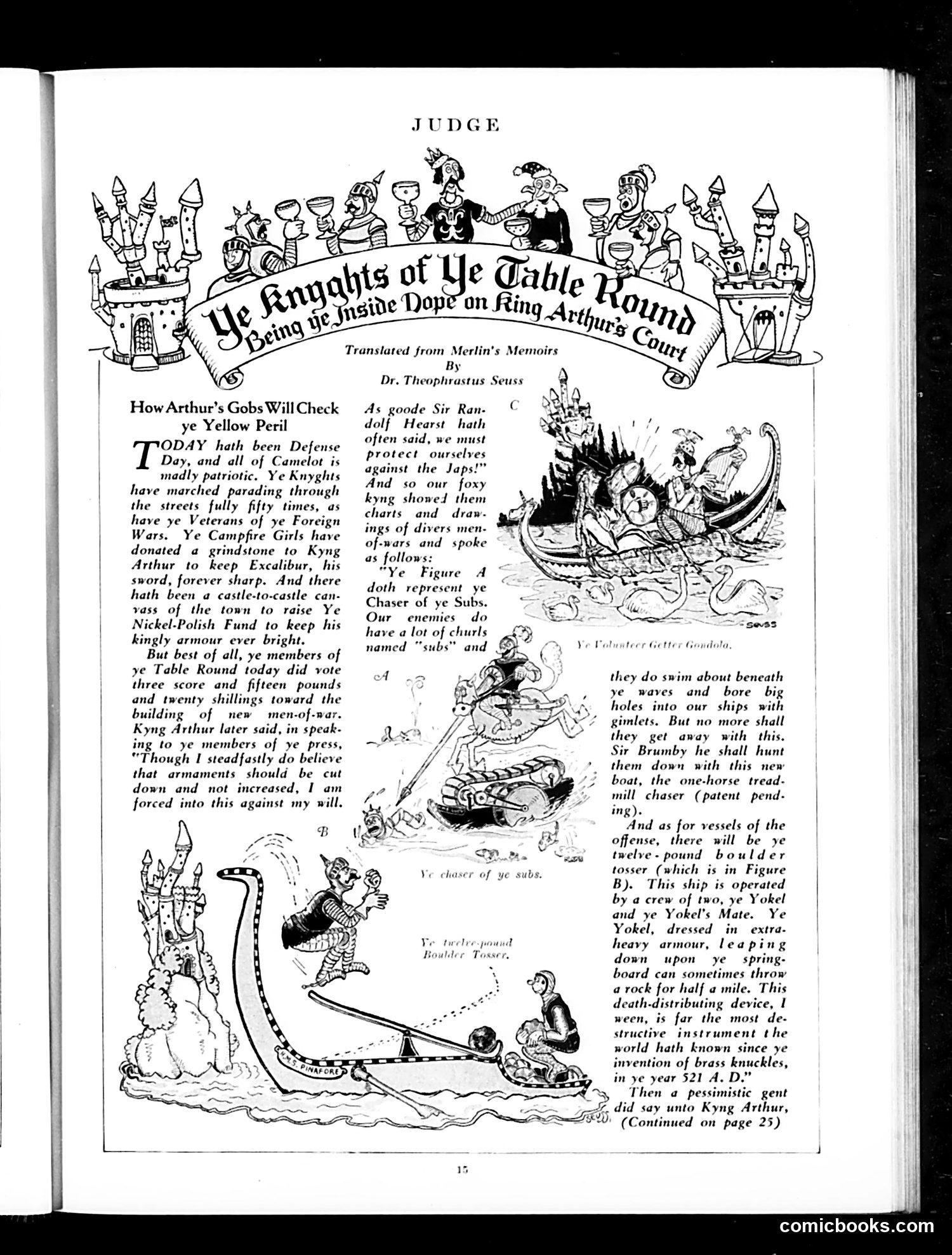
This Dr. Seuss piece satirizes American military expansion during the interwar period, likely the 1920s-30s. The medieval Arthurian setting mockingly frames contemporary defense spending. **The joke:** King Arthur's court enacts "Defense Day," promoting patriotic fundraising for warships ostensibly to combat "the Yellow Peril" (Japan). The king claims reluctance—"I am forced into this against my will"—while promoting aggressive naval construction. **The satire targets:** - Politicians citing security threats to justify military budgets while claiming pacifism - Appeal to Hearst's jingoistic rhetoric about Japanese threat - The absurdity of proposed weapons (a spring-loaded boulder-tosser operated by "ye Yokel")—mocking both military and civilian preparations as comically ineffective **The point:** Seuss exposes the contradiction between disarmament rhetoric and actual militarization, and questions whether public fear-mongering ("Yellow Peril") genuinely justifies massive defense spending or merely serves political interests.
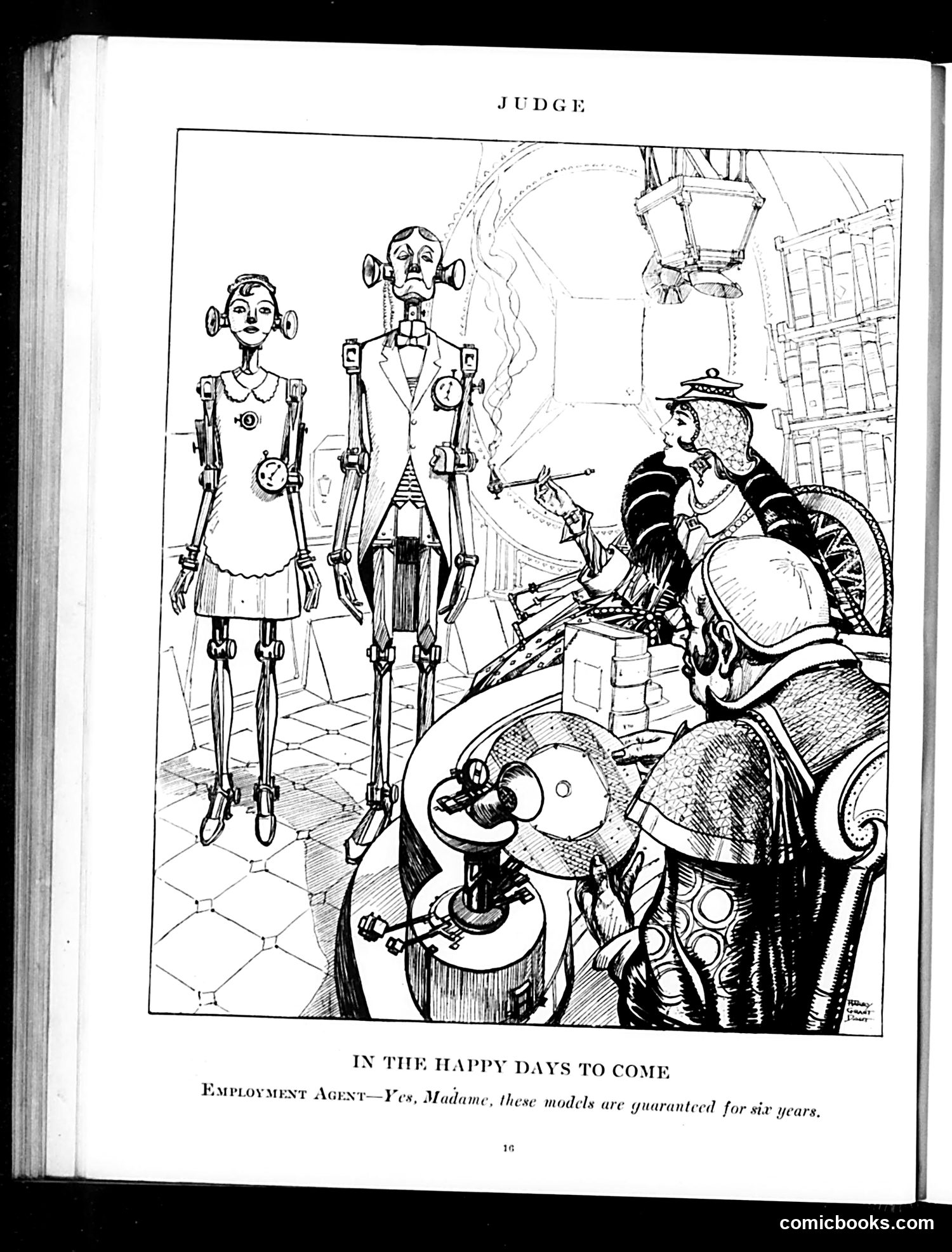
This satirical cartoon depicts a futuristic employment agency scene where robot servants are being sold to wealthy clients. Two mechanical humanoids with exposed mechanical parts, antenna-like appendages, and articulated limbs stand on display like merchandise. The "Employment Agent" assures a fashionable woman that these robotic models come with a six-year guarantee. The satire targets anxieties about automation and labor displacement—themes relevant during the early-to-mid 20th century industrial era. The cartoon mocks both technological optimism and the dehumanization of workers by depicting servants as interchangeable, guaranteed commodities. The "happy days to come" title is ironic, suggesting a future where human employment is replaced by mechanical labor. The joke lies in presenting what should be socially troubling as a normal consumer transaction.
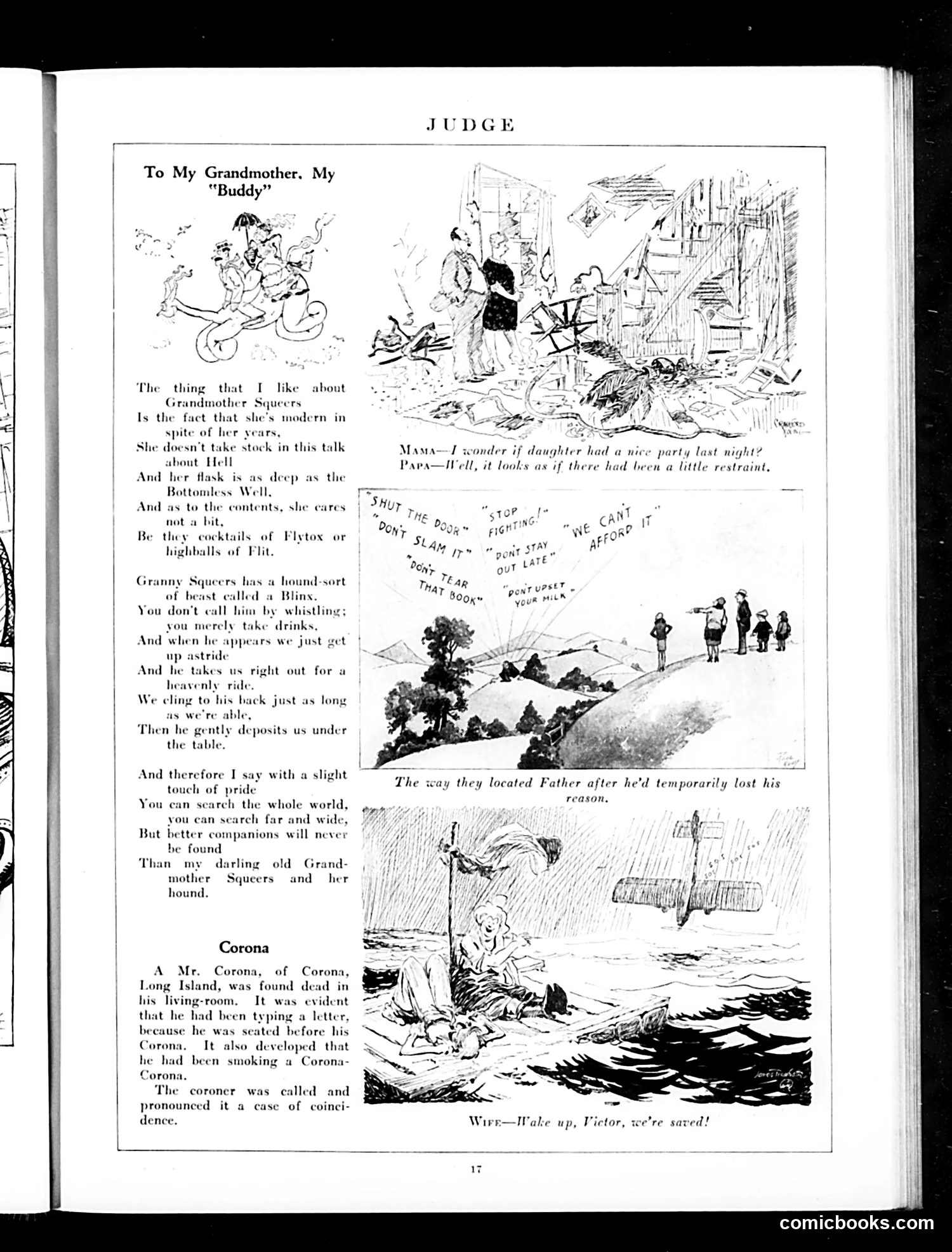
This page contains two separate pieces of satire: **"To My Grandmother, My 'Buddy'"** (top): A humorous poem praising a modern, unconventional grandmother figure ("Grandmother Squeers") who drinks cocktails and highballs despite her age, rejects traditional morality talk about Hell, and owns a dog that responds to drinks rather than whistles. The joke mocks both Prohibition-era drinking culture (where cocktails like "Flytox" suggest low-quality liquor) and generational change—presenting an elderly woman as a liberated "buddy" rather than a prim Victorian grandmother. The accompanying cartoons illustrate the chaos and revelry this causes. **"Corona"** (bottom): A dark pun about a Mr. Corona found dead at his typewriter. The "joke" is that he was coincidentally surrounded by Corona-brand products (Corona typewriter, Corona cigarettes), making his death appear to be about the brand name rather than actual causes. It's wordplay relying on the coincidence of the surname matching commercial products. Both pieces reflect 1920s-30s satirical humor targeting social conventions and consumer culture.
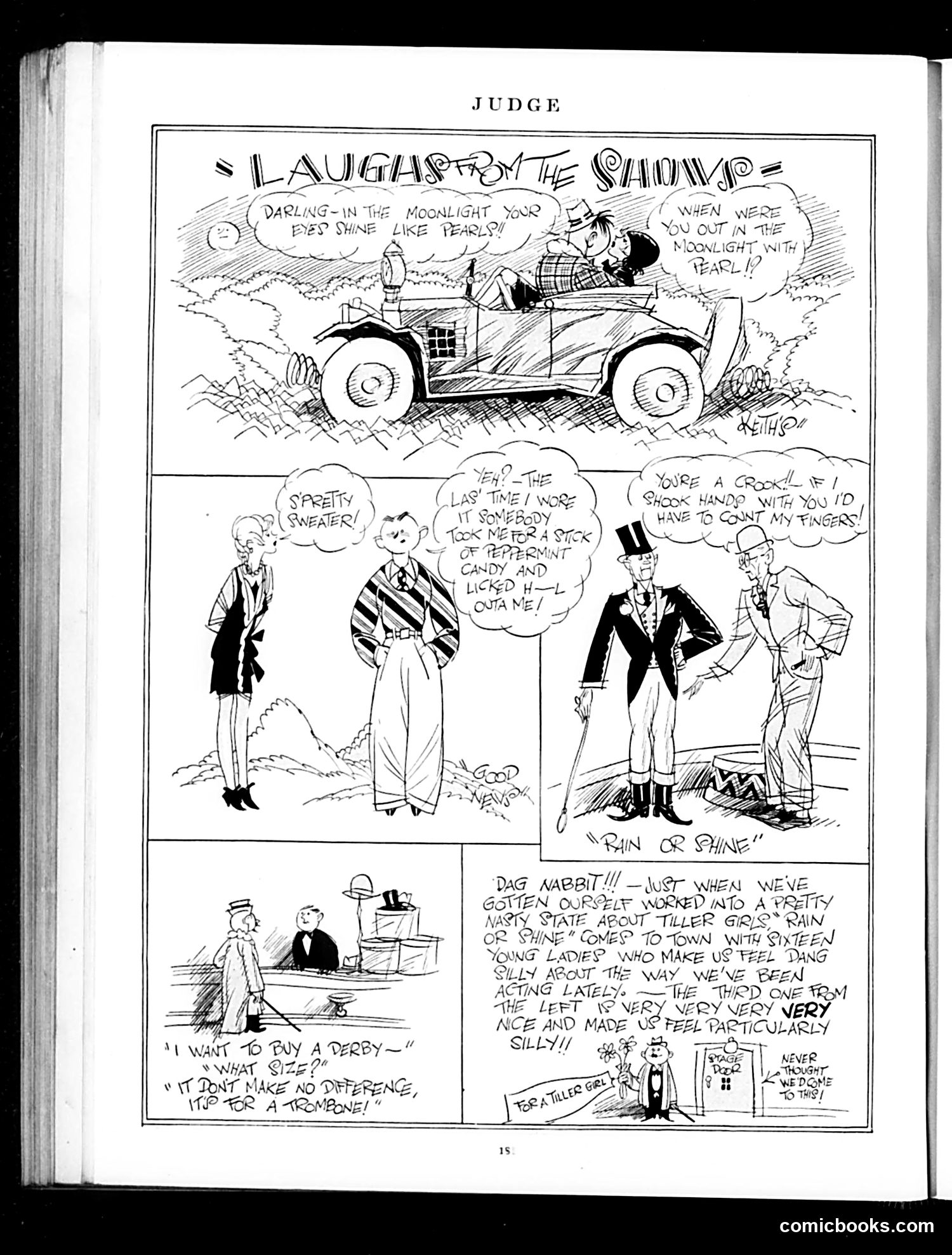
This page satirizes male vanity and romantic pretense through contrasting scenarios. The top panel mocks men's sentimental posturing—a couple in a car exchanging flowery moonlight compliments about shining eyes and pearls, language typically associated with romantic poetry. The lower panels deflate this artifice. Men boast about taking out "pretty nasty" girls, listing superficial attributes ("tiller girls," references to physical appearance). The final punchline—a conversation about buying a derby hat where size "doesn't make no difference, it's for a trombone"—appears to be a crude double entendre mocking masculine boasting about conquests. The satire targets early 20th-century male attitudes: the gap between flowery romantic language men use versus their actual shallow motivations, and the self-aggrandizing way men discuss their dating experiences. The humor relies on exposing this hypocrisy through juxtaposition and crude insinuation typical of Judge's satirical approach.
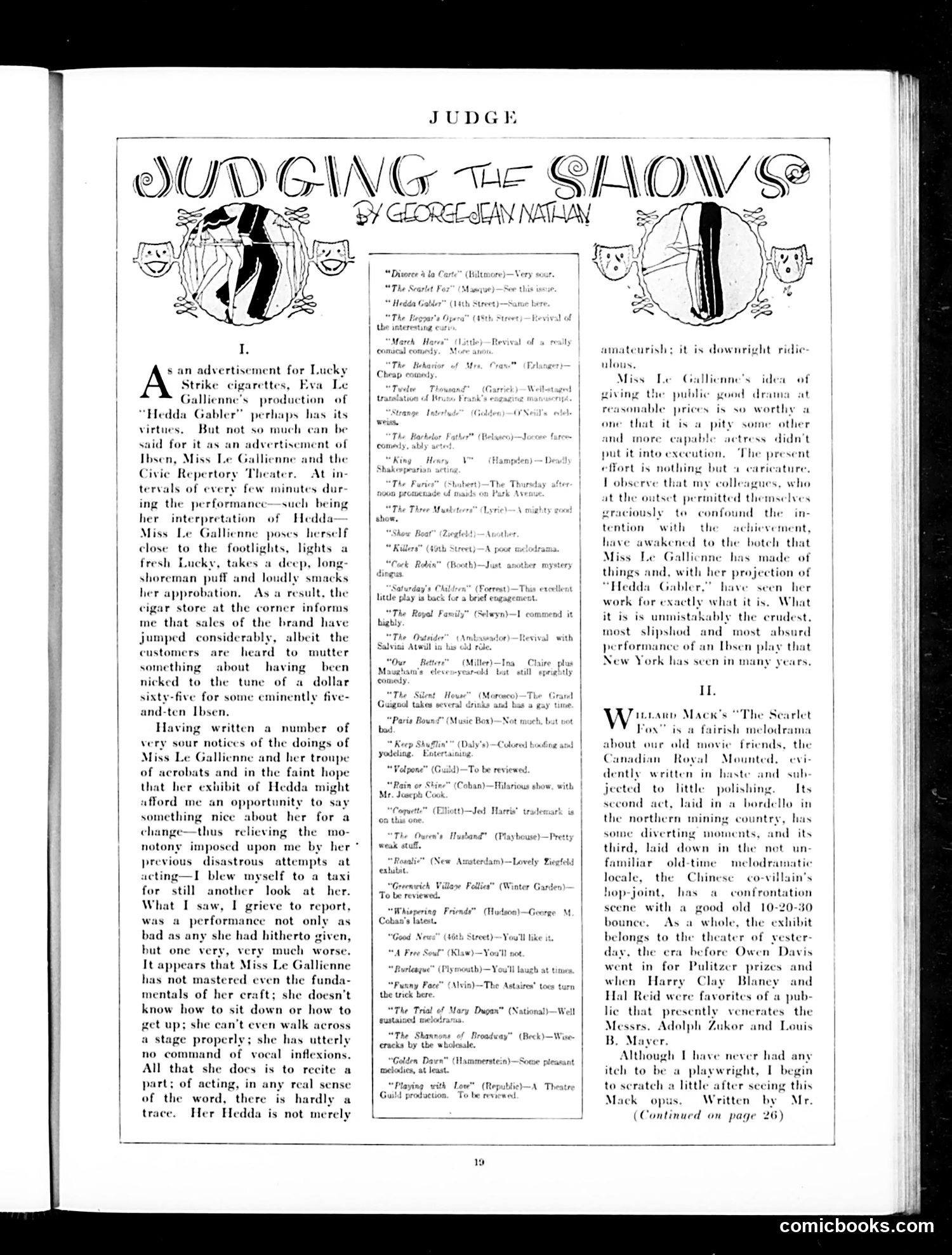
This page contains theater reviews by George Jean Nathan, a prominent drama critic. The main text critiques Eva Le Gallienne's production of Ibsen's "Hedda Gabler" at the Civic Repertory Theater. The satire: Nathan sarcastically notes that Le Gallienne's only successful advertisement is for Lucky Strike cigarettes—she chain-smokes throughout her performance of Hedda, posing theatrically at the footlights. The joke is that her cigarette smoking is more memorable and effective than her actual acting. Nathan's core complaint: despite her reputation, Le Gallienne fundamentally lacks basic stagecraft skills—she cannot properly sit, stand, walk, or modulate her voice. He characterizes her performance as mere recitation rather than genuine acting, calling it "the most slipshod and most abhorred performance of an Ibsen play that New York has seen in many years." The review exemplifies Judge's satirical theater criticism, using exaggeration and commercial irony to skewer pretentious or inadequate theatrical productions.
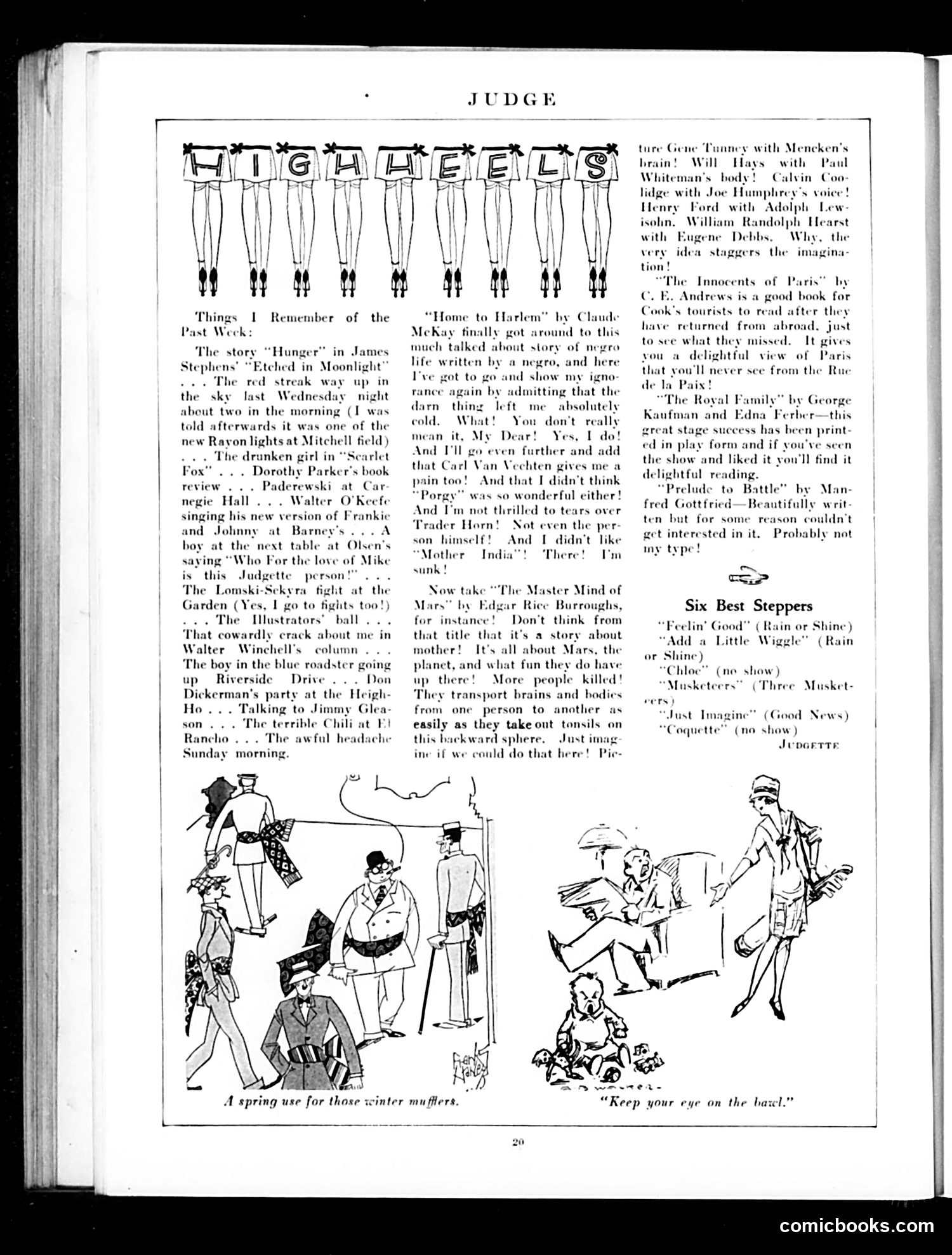
This page from *Judge* magazine contains a satirical column reviewing recent cultural experiences and entertainments, alongside cartoon illustrations. **The Content:** The author critiques recently popular works: Claude McKay's "Home to Harlem" and Carl Van Vechten's work on African American life (which the author dismisses as overrated), contrasts them with Edgar Rice Burroughs' "The Master Mind of Mars" (which they enjoyed), and imagines absurdly swapping the brains of famous figures—placing H.L. Mencken's intellect into Gene Tunney's body, or Eugene Debs' views into William Randolph Hearst. **The Cartoons:** Two illustrations accompany the text: one showing fashionable people at what appears to be a social gathering ("A spring use for those winter mufflers"), and another labeled "Keep your eye on the bar!" showing adults supervising a child, likely referencing Prohibition-era concerns about alcohol. The page exemplifies *Judge*'s blend of entertainment criticism and social satire typical of 1920s American magazines.
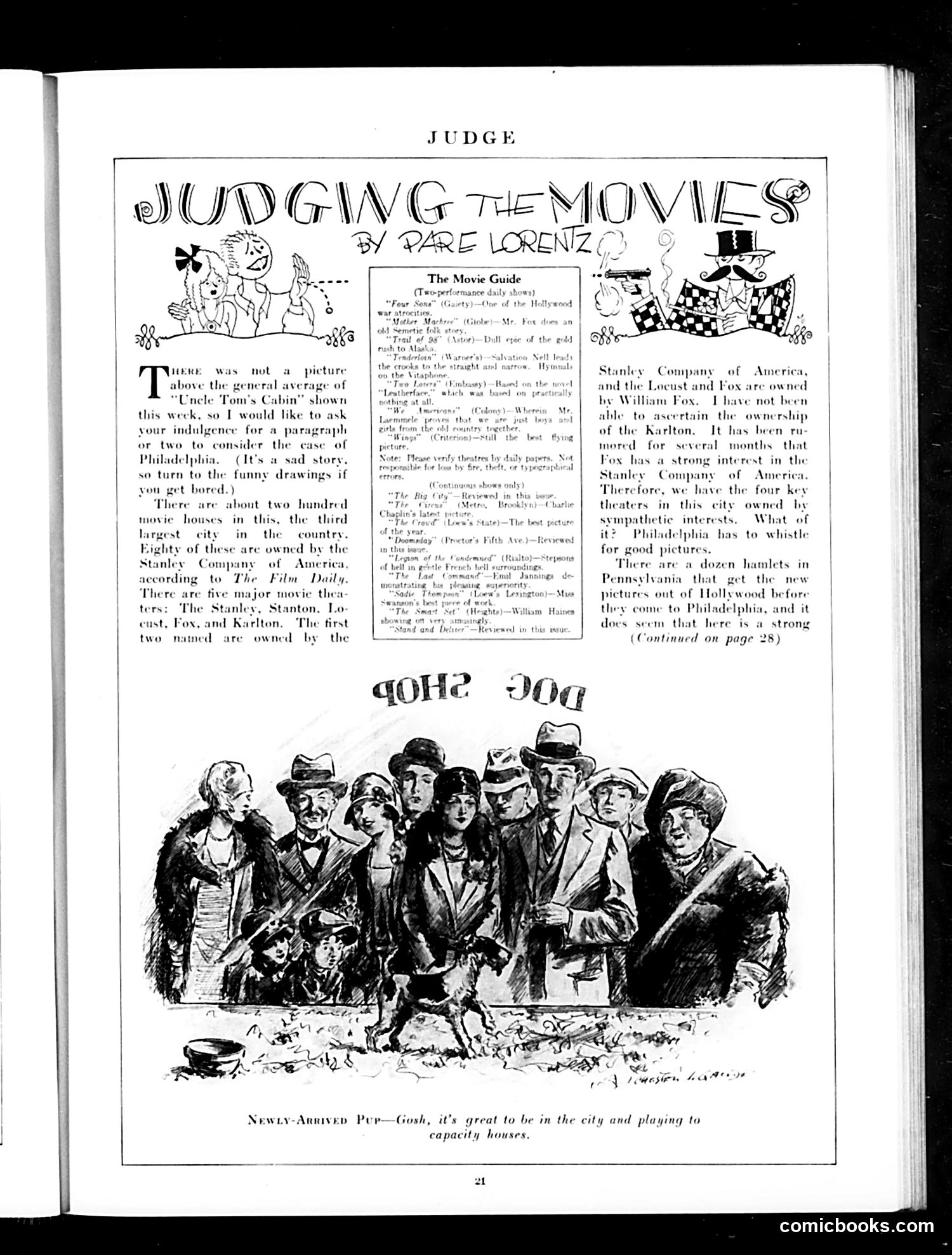
This 1920s Judge magazine page critiques **movie theater monopolies** in Philadelphia. The text argues that a handful of corporations—Stanley Company, Fox, and others—control most major theaters in the city, creating an anti-competitive situation that harms the public. The complaint: despite Philadelphia being the third-largest U.S. city, these "sympathetic interests" (allied companies) control film distribution, preventing quality pictures from reaching audiences promptly. Small Pennsylvania towns get new Hollywood releases before Philadelphia does. The cartoon below depicts a newly arrived pup surrounded by city people and establishments—a visual metaphor for the monopolistic control: the little dog (audience/consumers) is surrounded and confined by the larger forces dominating the entertainment landscape. This reflects Progressive Era concerns about corporate consolidation and consumer welfare, arguing that vertical integration of theaters with distributors reduces competition and disadvantages the public.
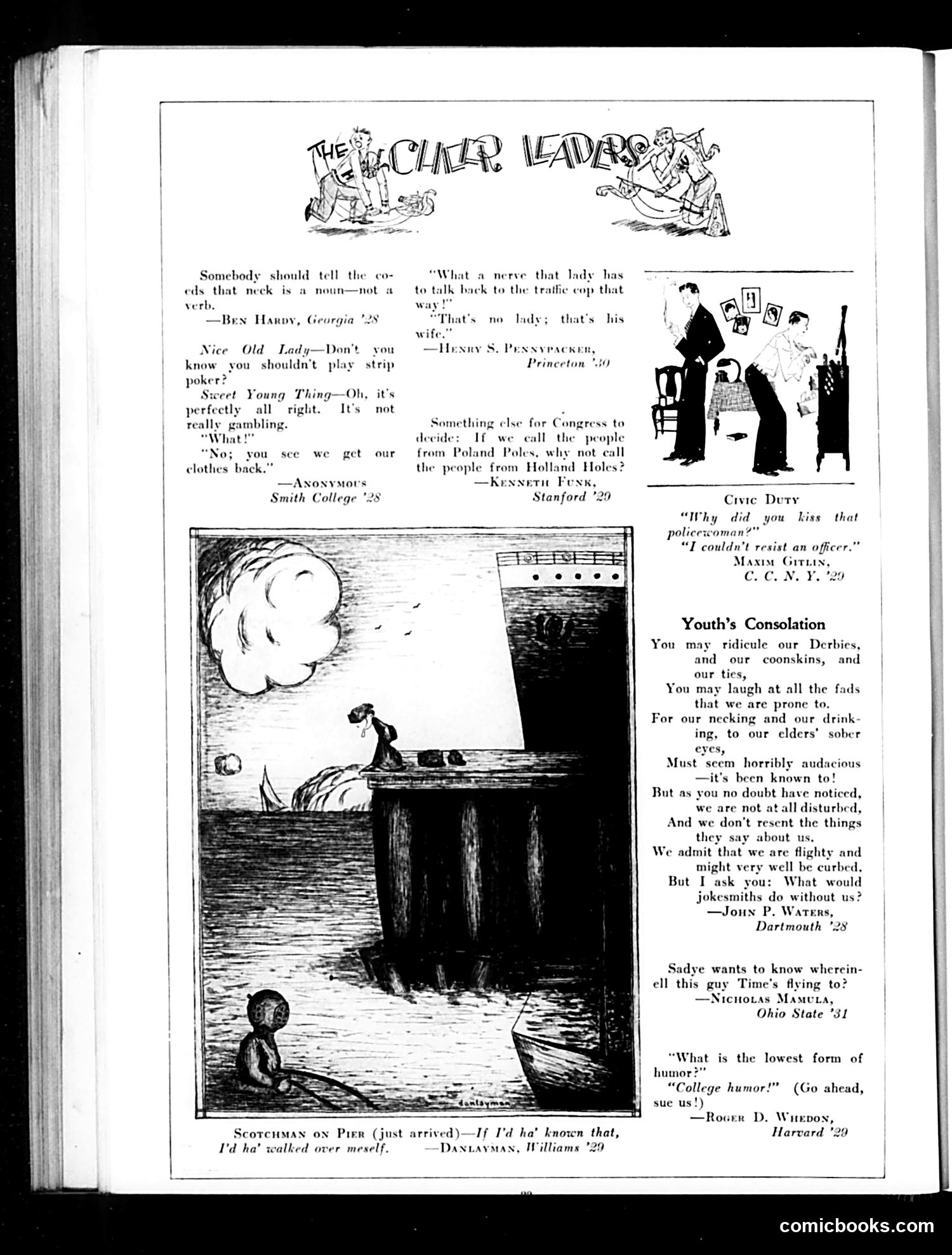
This is a humor section from *Judge* magazine featuring college-themed jokes and a cartoon, likely from the late 1920s based on contributor attributions ('28, '29, '31). **The Main Cartoon** depicts a Scottish man arriving at a pier, seemingly having just walked over water. The joke plays on Scottish dialect and nautical circumstances—the caption suggests he'd have walked across had he known earlier, implying either drunkenness or absurdity. **The Jokes** satirize 1920s college culture: references to "necking" (kissing/petting—then considered scandalous), strip poker, and drinking reflect post-Prohibition youth behavior that shocked older generations. The "Civic Duty" cartoon mocks a woman kissing a policeman. **The "Youth's Consolation"** poem is self-aware satire—college contributors acknowledge their generation's wild reputation (flappers, drinking, fads) while defending themselves as harmless and entertaining to older critics. These pieces capture Jazz Age anxieties about changing youth morality, with the magazine's college audience both joking about their own rebelliousness and defending it.
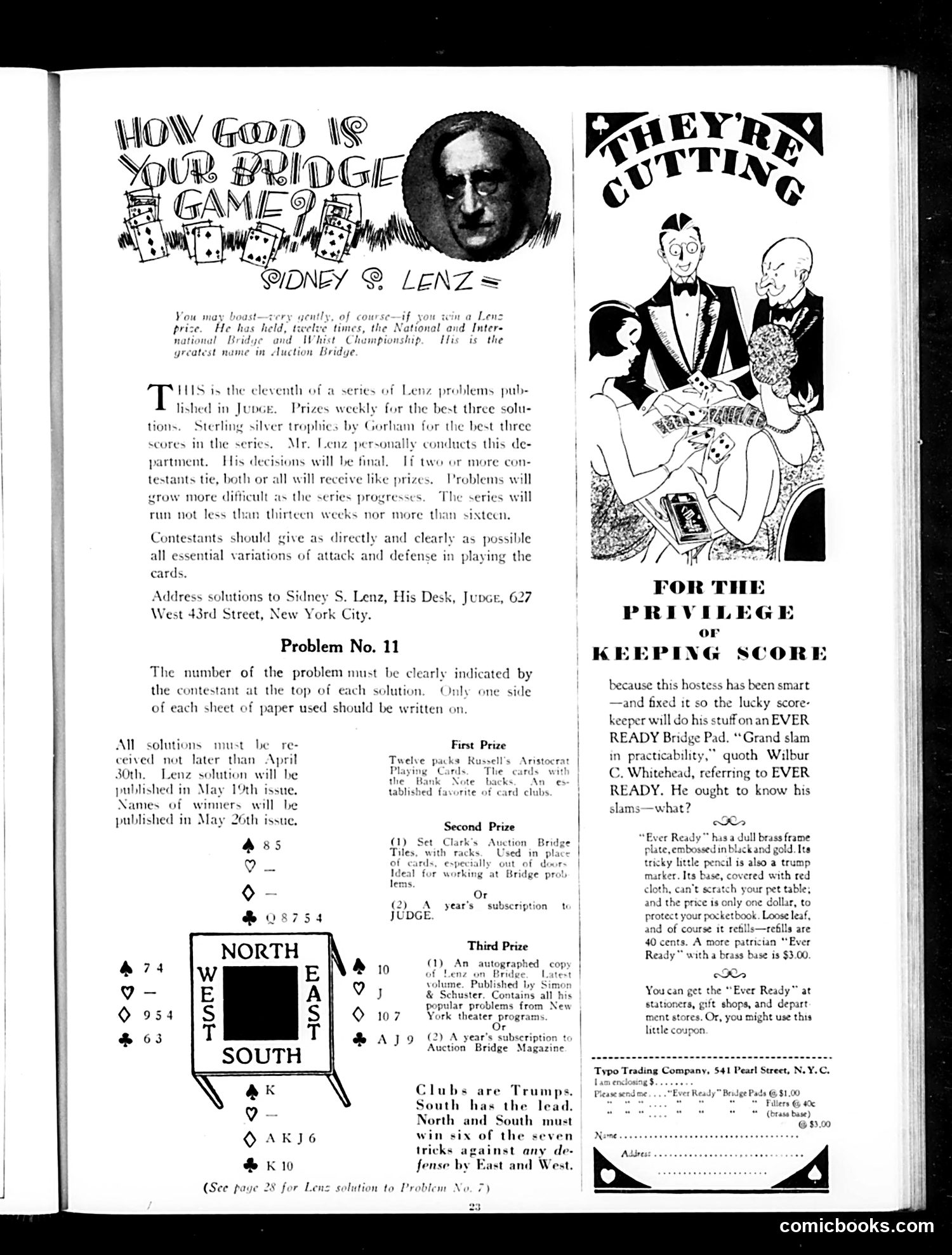
This page features a bridge card game problem contest sponsored by *Judge* magazine, centered on renowned bridge player **Sidney Lenz**. The circular portrait shows Lenz himself. The left column presents "Problem No. 11"—a bridge hand puzzle with specific card distributions. Readers submit solutions to win prizes: sterling silver trophies by Gorham and subscriptions to bridge publications. The right side is an advertisement for the "Ever Ready" bridge score pad, depicting three well-dressed people at a bridge table. The ad humorously suggests that using this score pad grants the "privilege of keeping score"—implying that organized scorekeeping is essential for the game's legitimacy and enjoyment among the social elite. This reflects 1920s-30s society where bridge was a fashionable parlor game among the upper classes. The combination of problem-solving competition and consumer advertising reflects how *Judge* marketed intellectual leisure activities to its affluent readership.
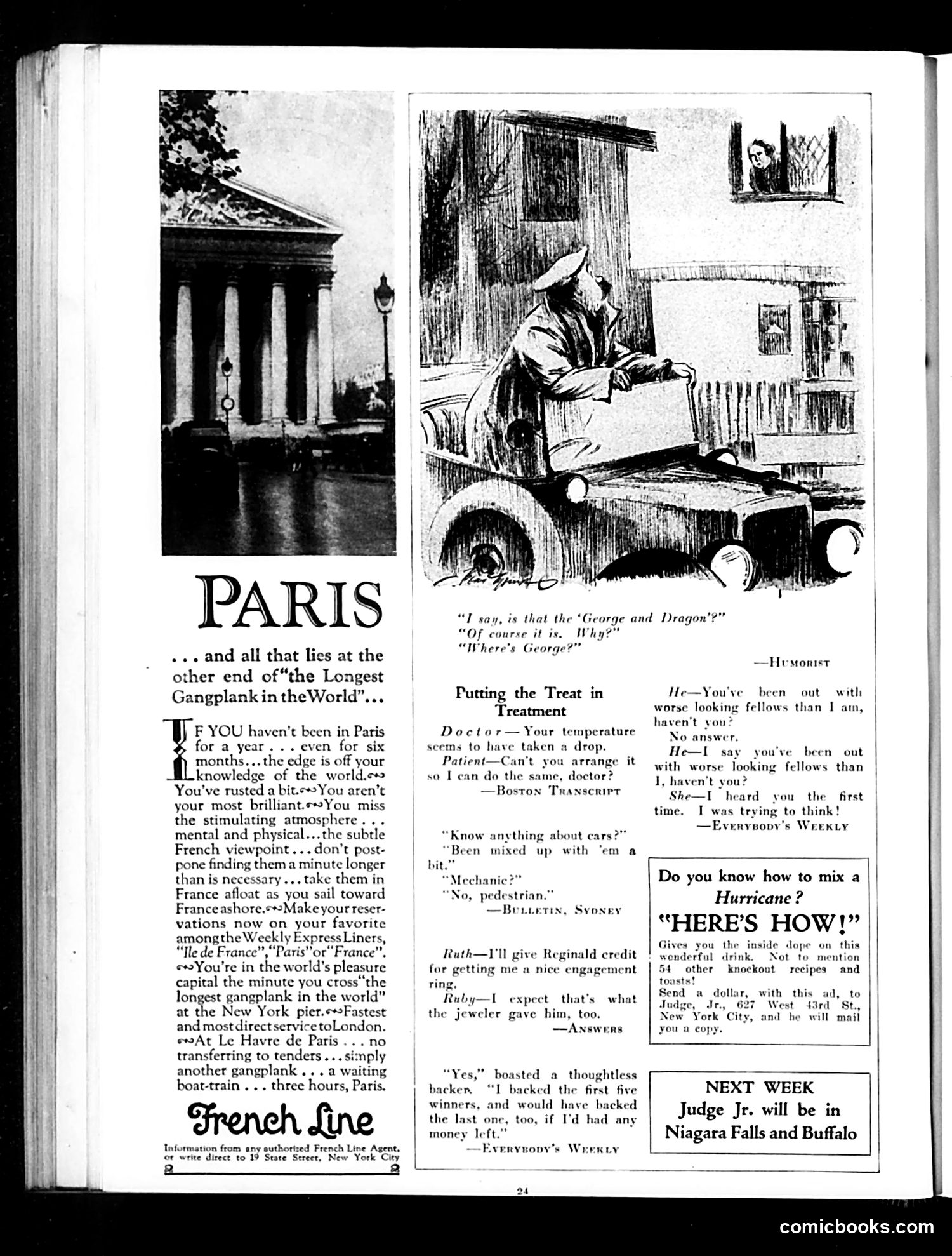
This page combines a French Line cruise advertisement with several short humorous jokes typical of 1920s-30s satirical magazines. The main cartoon (top right) shows a man in a car pointing at a pub sign reading "George and Dragon," asking where George is—a visual pun on the traditional English pub sign depicting St. George slaying a dragon. The jokes below mock various social situations: a doctor-patient exchange about temperature, automotive ignorance, engagement ring credit, overconfident betting, and flirtation. One recurring theme involves a man repeatedly asking a woman if she's dated worse-looking men, with her ignoring him the first time. The "Hurricane" cocktail advertisement offers a recipe booklet for a dollar, capitalizing on Prohibition-era interest in home drink-making. The French Line ad emphasizes Paris as essential cultural experience, using the phrase "longest gangplank in the world" as marketing copy for transatlantic travel. This reflects 1920s-30s American fascination with European sophistication.
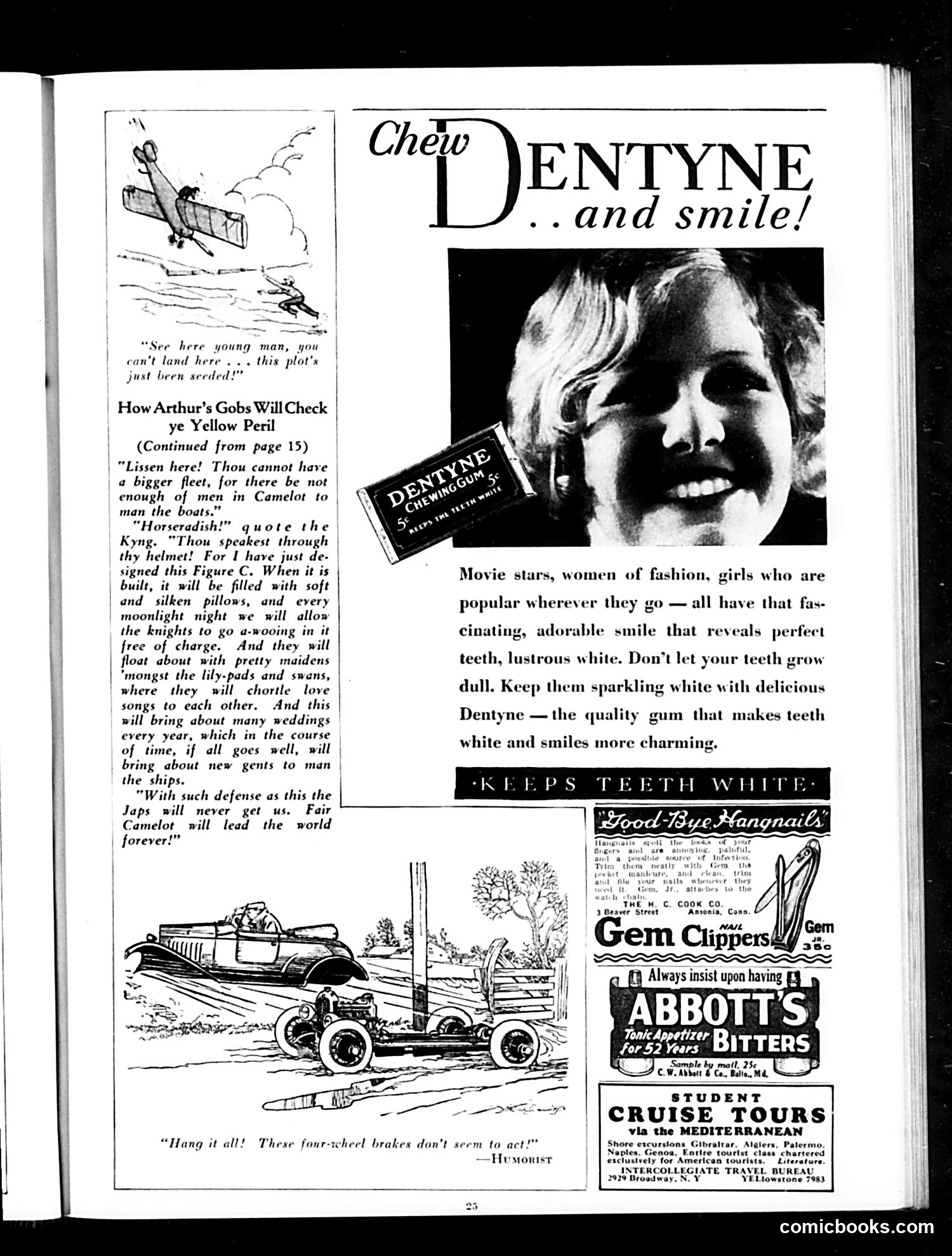
This page contains a **Arthurian legend parody** mocking American military preparedness during the "Yellow Peril" era (anti-Japanese sentiment common in early 20th-century America). The cartoon "How Arthur's Gobs Will Check ye Yellow Peril" satirizes a supposed naval strategy: King Arthur proposes filling ships with "soft and silken pillows" and pretty women to lure knights into military service, arguing this will defend against Japanese attack. The humor is **absurdist and deeply sexist**—it ridicules both ineffective military planning and treats women as recruitment tools. The page also includes **vintage advertisements** (Dentyne gum, Abbott's Bitters, cruise tours) unrelated to the satire. A second cartoon shows a car with failing brakes, captioned with a humorist's quip about mechanical failure. The overall satirical point appears to be that American military strategy was dangerously naive or foolish—though the specific policy being mocked is unclear from this excerpt alone.
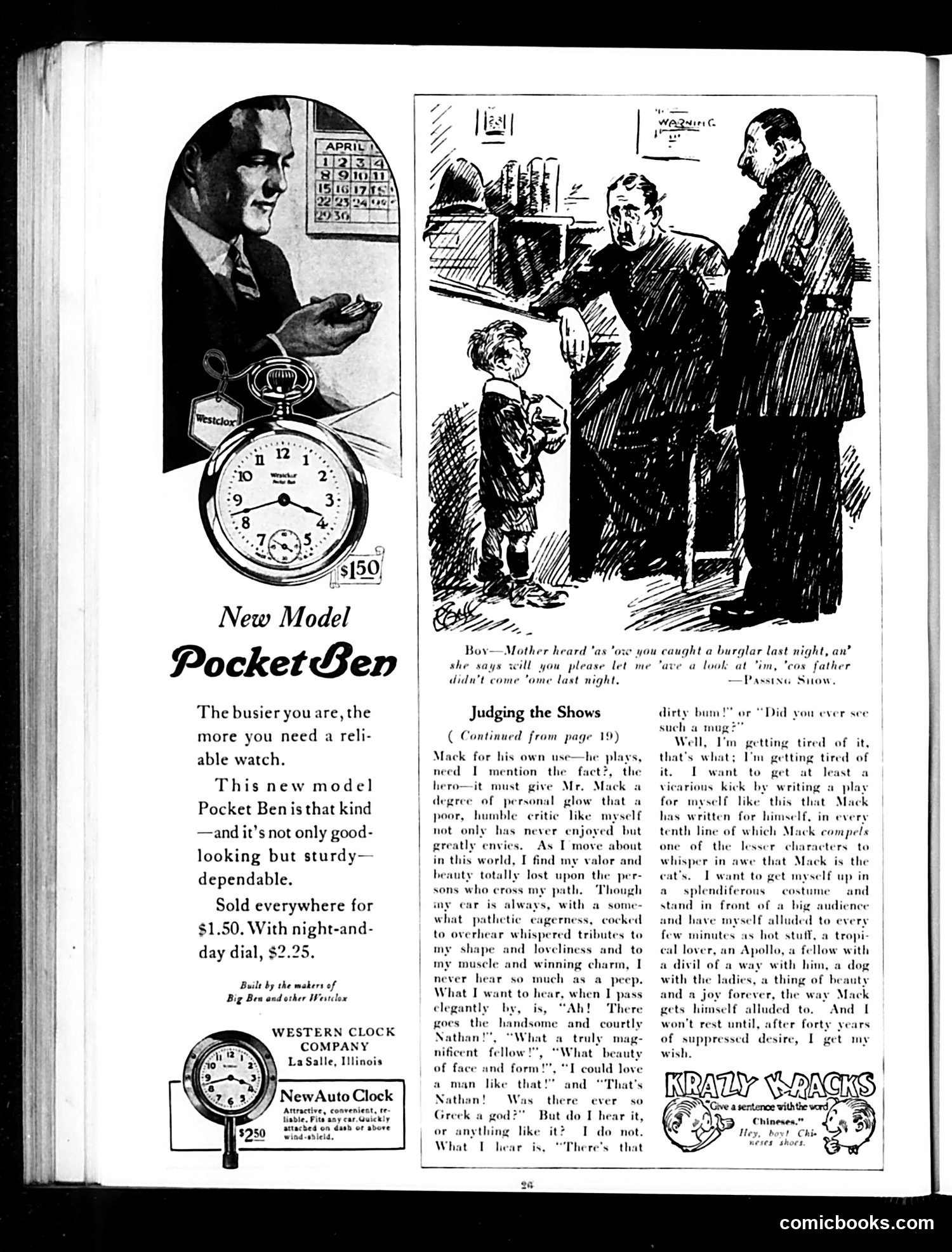
This page contains **advertising and theatrical commentary**, not political satire. The **left side** is a Pocket Ben watch advertisement, emphasizing reliability for busy people—a straightforward commercial from Western Clock Company. The **right side** features two items: 1. **"Judging the Shows"** (theater criticism, continued from page 19): A critic named Nathan vents about his invisibility and lack of acclaim. He envies actor Mack, who receives public admiration and gets to star in flattering plays. Nathan fantasizes about writing himself a starring role where audiences shower him with praise as "hot stuff" and "a thing of beauty." This is humorous self-deprecating commentary on theatrical ambition and ego—Nathan admits his jealousy of performers' glamorous treatment. 2. **A caption cartoon** (bottom right) shows a boy telling adults his mother caught a burglar, but the father didn't come home—implying marital infidelity rather than actual burglary. It's labeled "Passing Snow," suggesting dark humor about domestic situations. The page is primarily **not satirical but entertainingly cynical** about show business and relationships.
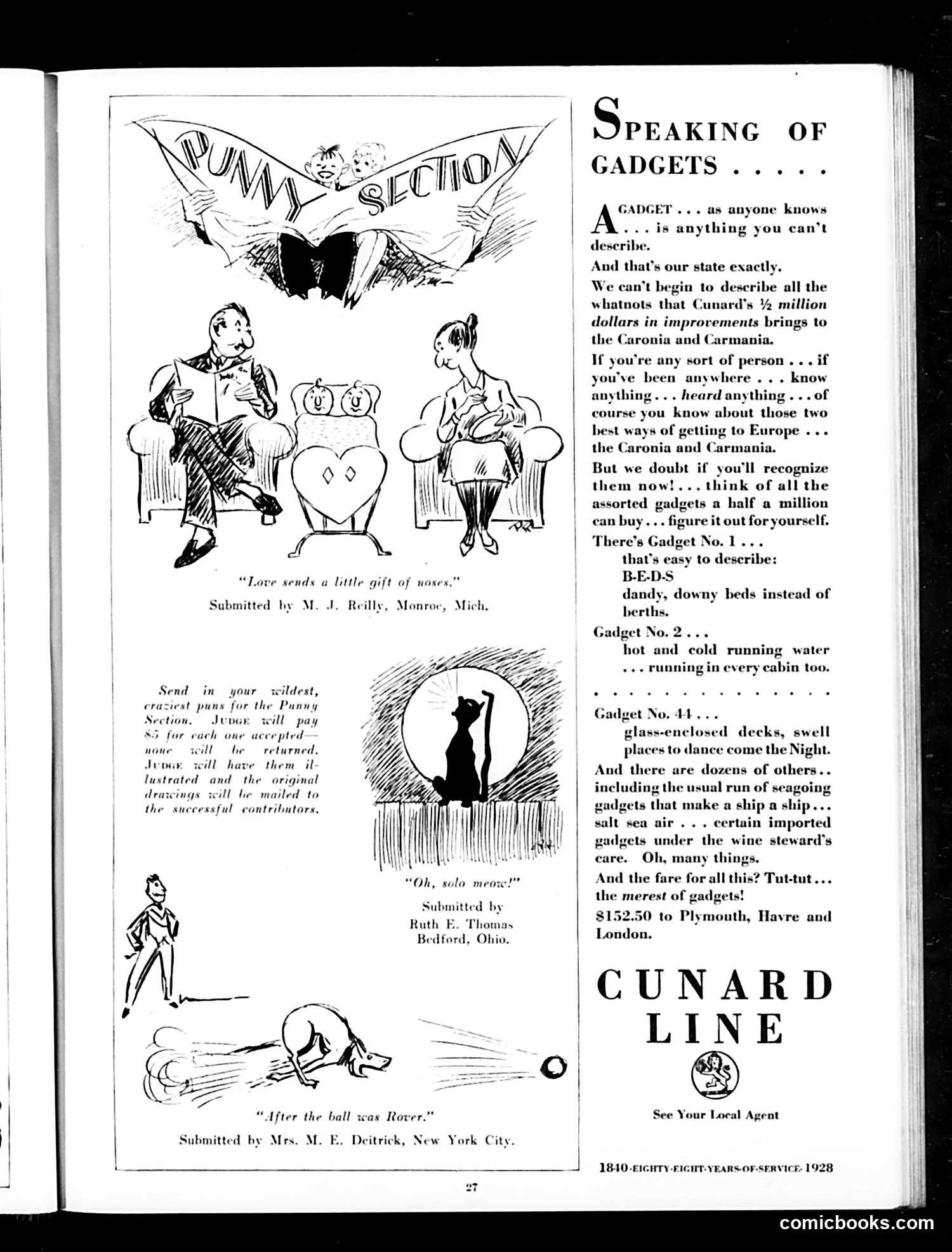
This page primarily contains a **reader-submission humor section** ("Punny Section") featuring puns submitted by Judge readers, with cartoons illustrating the jokes. The three visible puns play on familiar phrases: "Love sends a little gift of noses" (riffing on romance), "Oh, solo meow!" (a cat pun), and "After the ball was Rover" (a dog reference). These are lighthearted wordplay with no political content. The **right side is a Cunard Line cruise ship advertisement** disguised as editorial commentary. It humorously refers to luxury amenities on the Caronia and Carmania ships as indescribable "gadgets"—beds, running water, glass-enclosed decks—emphasizing the modernized comfort of ocean travel to Europe. The price of $152.50 represents an attractive fare for the era. This is 1928 advertising targeting affluent travelers, not satire.
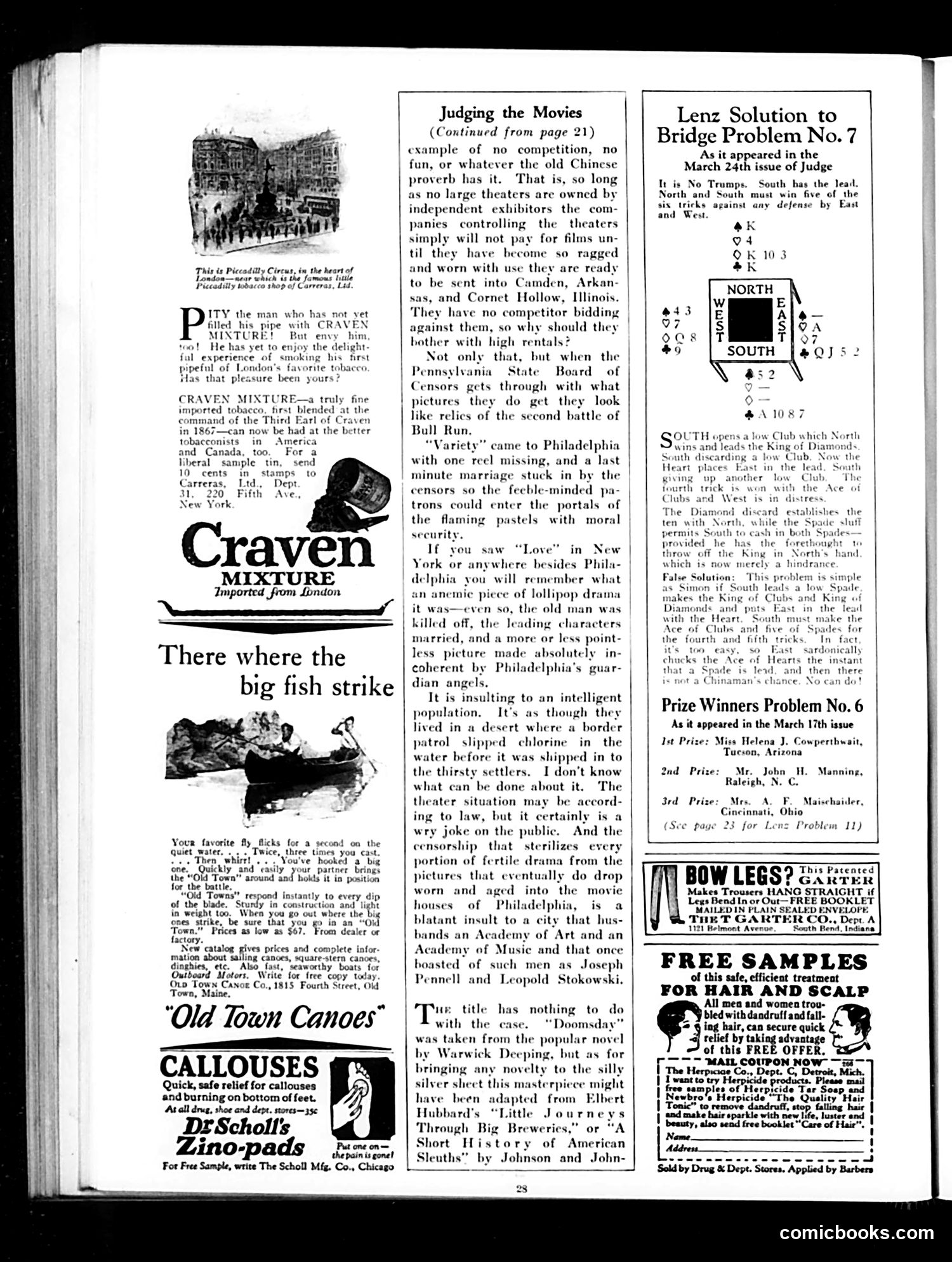
This page is primarily **advertising**, not political satire. The main cartoons illustrate product advertisements: **"Craven Mixture"** (top left): An imported London tobacco brand advertised with an illustration of Piccadilly Circus. The copy emphasizes its prestige heritage (blended for the Third Earl of Craven in 1867). **"Old Town Canoes"** (center-left): A fishing-themed ad showing a man catching "the big fish" from a canoe, promoting the product's reliability and performance. **"Dr. Scholl's Zino-pads"** (bottom): An advertisement for foot pain relief. The only editorial content is **"Judging the Movies"** (right column), which critiques film censorship in Philadelphia. The author argues that Pennsylvania's Board of Censors strips films of artistic merit, making them incoherent—comparing it insultingly to poisoning settlers' water. He cites specific examples like the film "Love" becoming nonsensical after censorship edits. The page reflects 1920s consumer culture and ongoing debates about film censorship standards.
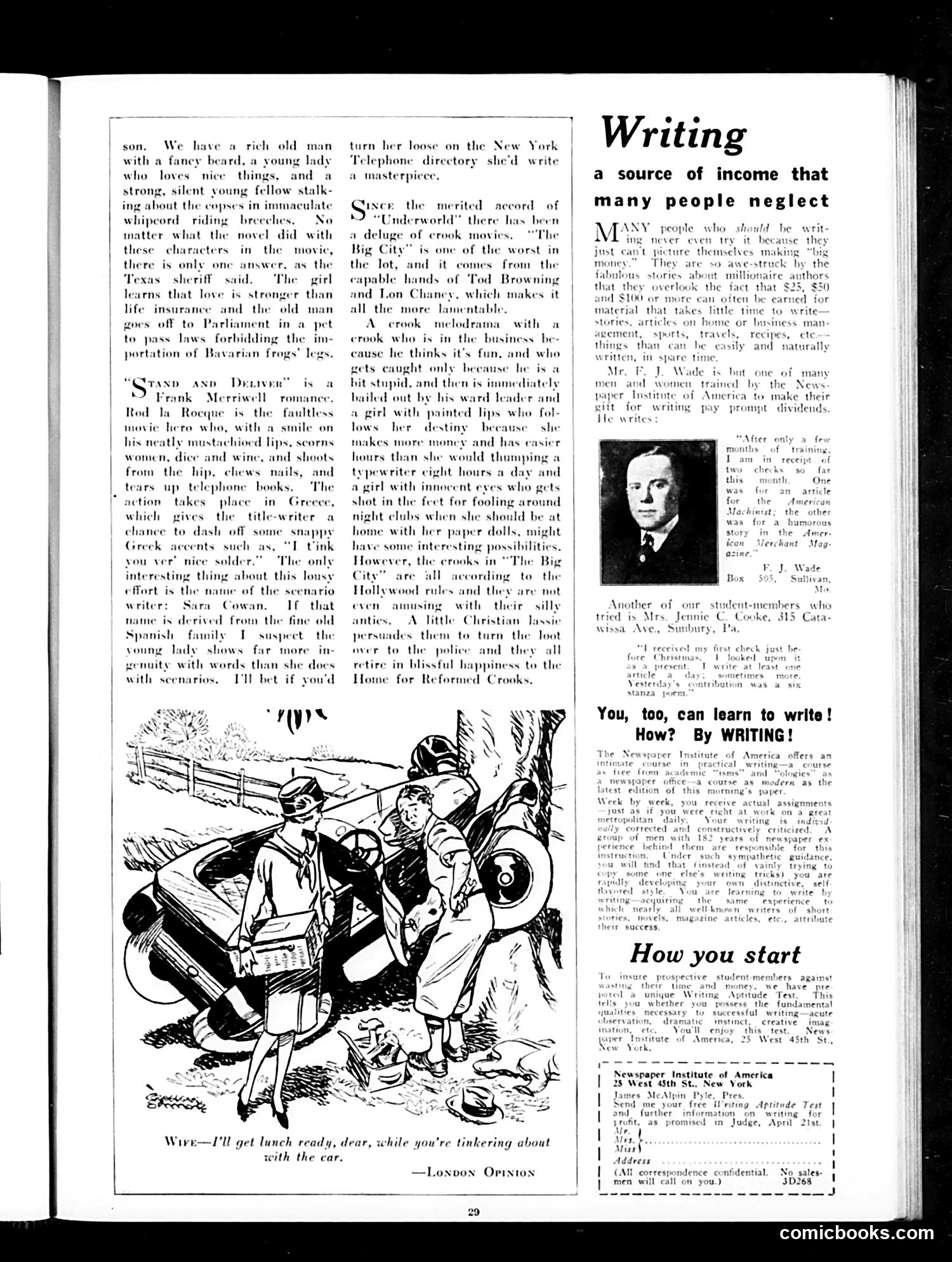
This page combines film criticism with a writing-instruction advertisement. The main cartoon depicts a couple in a car, with the wife offering to prepare lunch while the husband tinkers with the vehicle—a domestic scene satirizing traditional gender roles where men handle mechanical work while women manage household tasks. The editorial content criticizes contemporary films, particularly Tod Browning's "The Big City" and "Stand and Deliver," dismissing them as poorly-written crook melodramas that glorify criminals. The author (Sara Cowan, herself a female scenario writer) argues these films lack originality. The page's primary purpose, however, is promoting the Newspaper Institute of America's writing course. The advertisement promises readers can earn income through freelance writing—an appealing proposition during economically uncertain times. The pitch targets aspiring writers by showcasing success stories and offering a "Writing Aptitude Test." The implicit message: unlike the mediocre film scenarios criticized above, readers could develop superior writing skills and earn substantial supplementary income through disciplined practice.
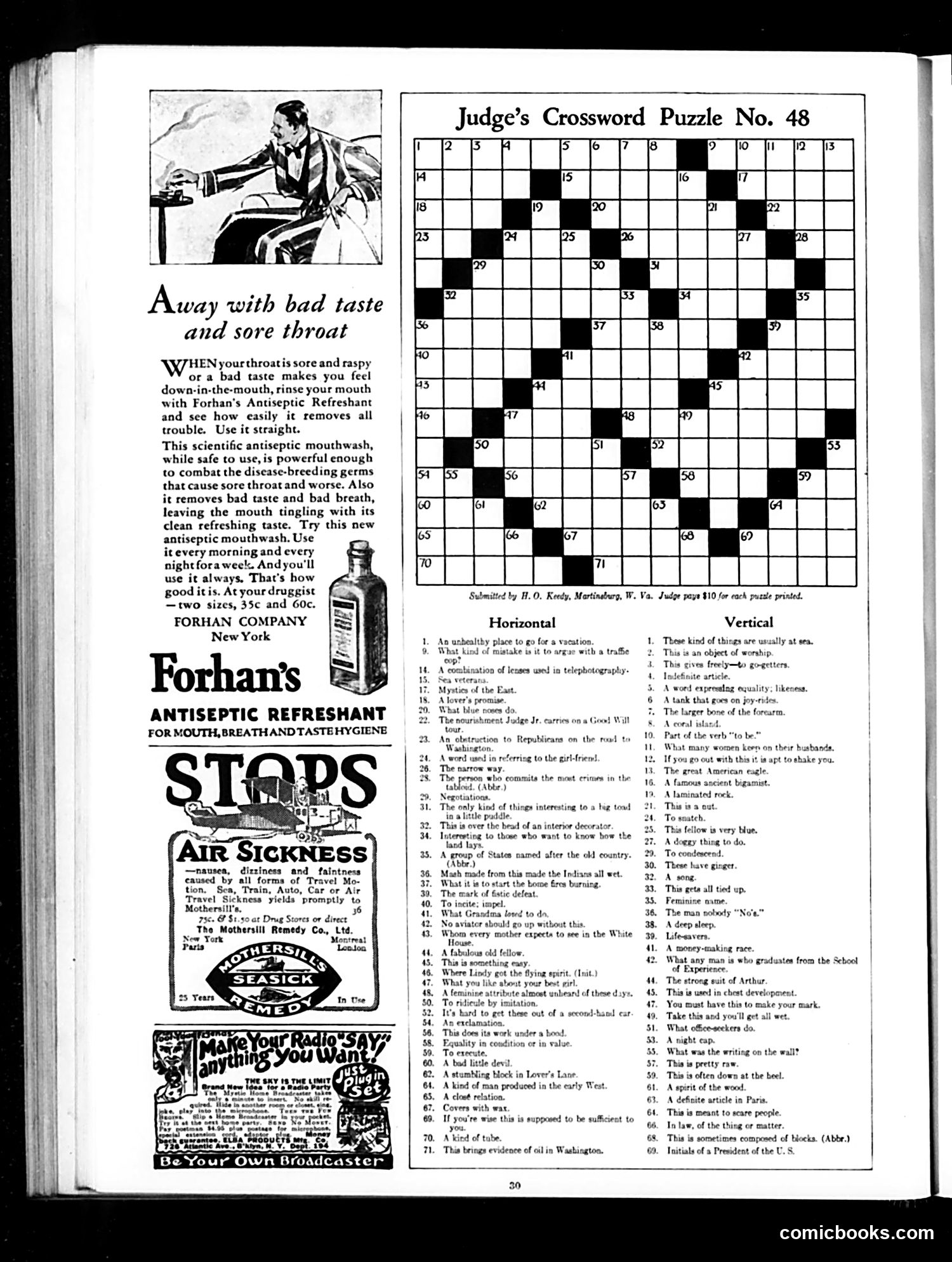
This page is primarily **advertising and a crossword puzzle**, not political satire. The main content consists of three advertisements for consumer products (Forhan's Antiseptic Refreshant mouthwash, Mothersill's travel sickness remedy, and a radio broadcasting service) surrounding "Judge's Crossword Puzzle No. 48." The puzzle itself contains contemporary 1920s-30s references embedded in its clues—mentions of Judge Jr., "Lindy" (Lindbergh), the White House, and various colloquialisms of the era. These clues reflect period culture but aren't satirical commentary. **The satire element is minimal here.** This represents Judge magazine's primary revenue model: selling advertising space while providing entertainment content (the puzzle) to readers. The cartoon illustration at top left simply decorates the ad copy about sore throats—it's generic rather than pointed social commentary. The page demonstrates how Judge balanced satirical editorial content with commercial advertising to sustain publication.
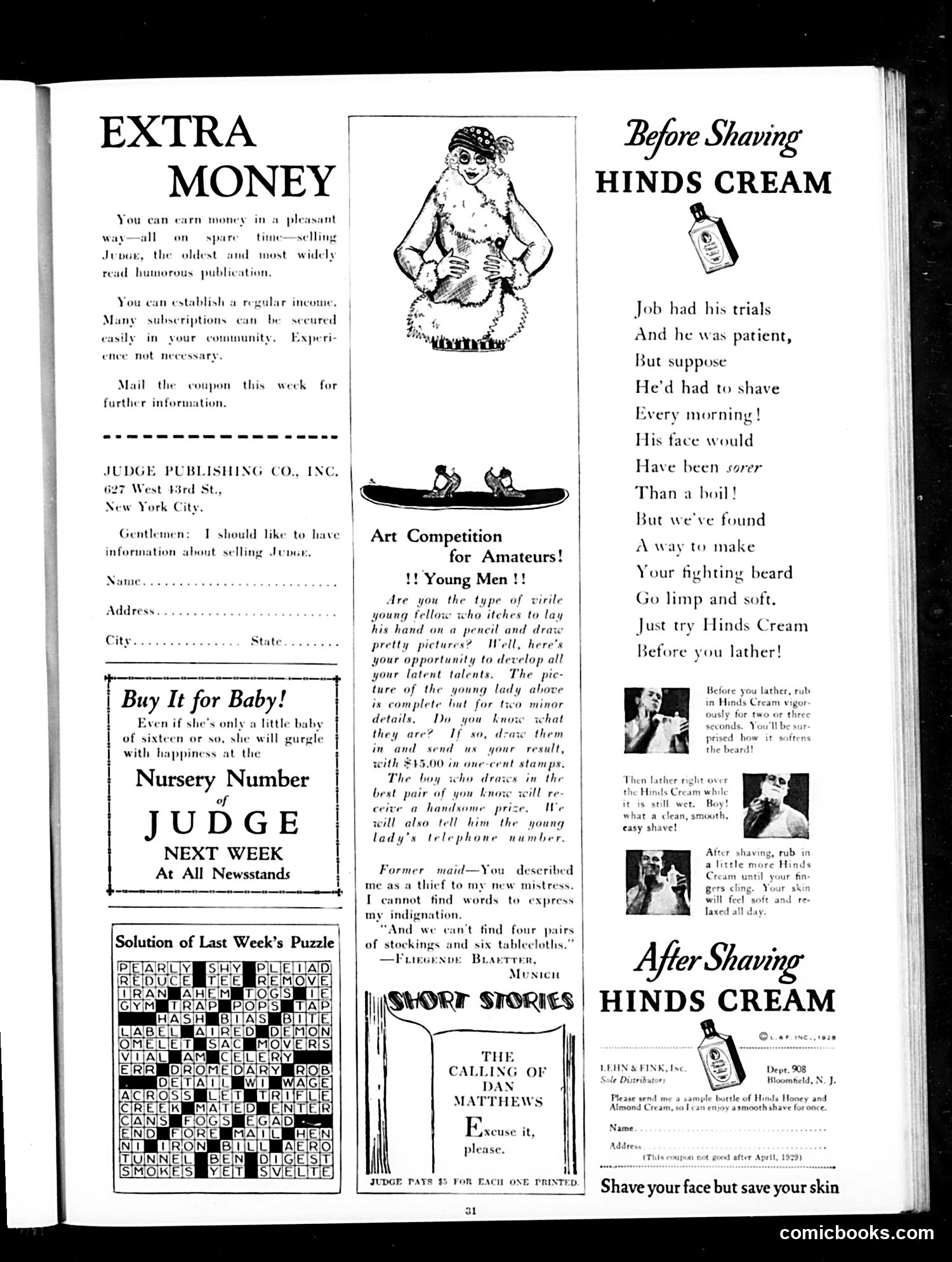
This page consists primarily of **advertisements and filler content** rather than satirical cartoons requiring historical context. The main elements are: 1. **Subscription solicitation** for Judge magazine itself, offering spare-time income selling subscriptions 2. **"Buy It for Baby!"** advertisement for an upcoming "Nursery Number" issue 3. **Art competition** inviting young men to complete a drawing of a woman's face for $15 in stamps, with the prize being the woman's telephone number—reflecting early 20th-century attitudes treating women as objects and prizes 4. **Crossword puzzle solution** from the previous week 5. **Hinds Cream advertisements** (before and after shaving) featuring photographs of men using the product 6. **A brief joke** about a former maid accused of theft, and a short story announcement The page reflects Judge's era (appears to be 1920s) with its combination of humor, advertising, and relatively crude gender stereotypes presented as entertainment.
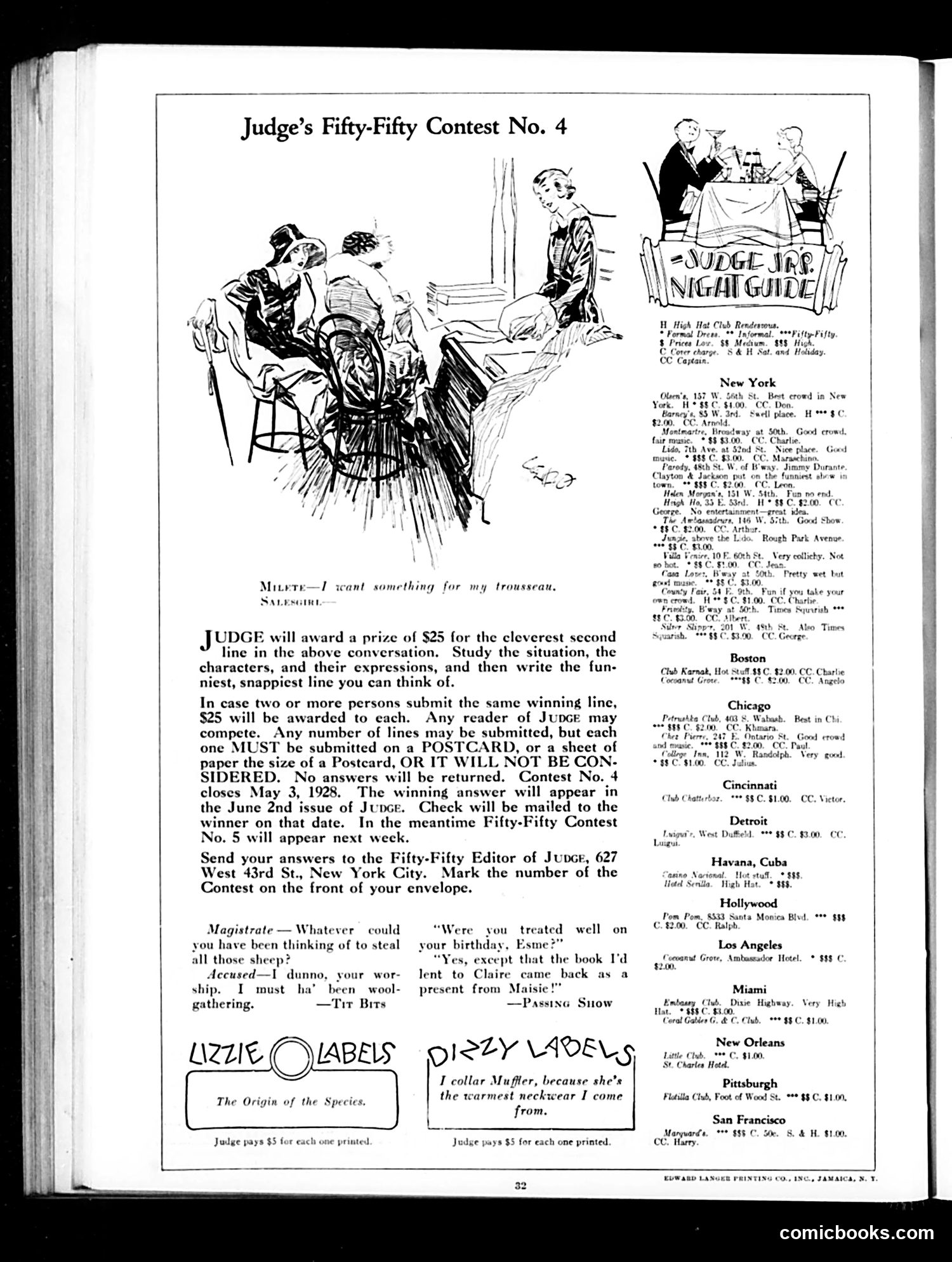
This page features Judge's "Fifty-Fifty Contest No. 4," a reader participation contest typical of 1920s magazines. The main cartoon shows a bride-to-be asking a salesperson for trousseau items; readers must submit the cleverest second line of dialogue. The $25 prize (substantial for 1928) attracted widespread participation. Below are two smaller comic panels with puns: one about wool-gathering (a sheep thief's excuse), another playing on "collar muffler" as a girlfriend's warm embrace, and a third about a book gift. The majority of the page lists nightclub and entertainment venue recommendations across major American cities—New York, Boston, Chicago, Detroit, Los Angeles, etc.—with admission prices and crowd assessments ("CC"=crowd character). This reflects the 1920s speakeasy culture during Prohibition, when Judge marketed itself to affluent urbanites seeking nightlife recommendations. The content reflects Judge's target audience: wealthy city-dwellers with disposable income for entertainment and contests.
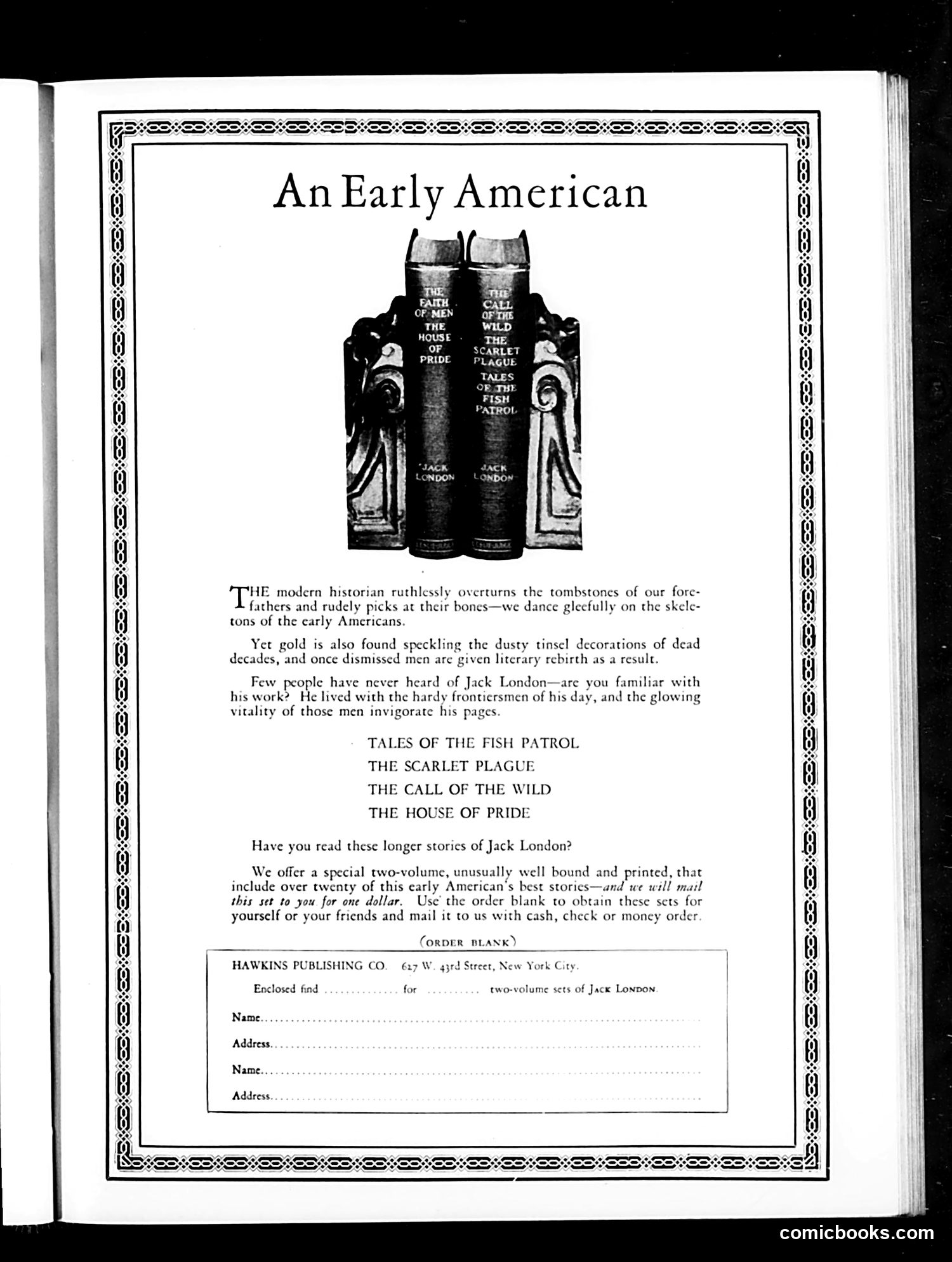
This is primarily an **advertisement**, not a cartoon or satirical content. It's a book advertisement from *Judge* magazine promoting a two-volume collection of Jack London stories published by Hawkins Publishing Co. The ad uses a framing device about historical reassessment: the text argues that modern historians dismiss earlier eras, yet valuable figures like Jack London deserve rediscovery. London is presented as an "early American" whose authentic experience with "hardy frontiersmen" gives his writing vitality and enduring worth. The four titles promoted are *Tales of the Fish Patrol*, *The Scarlet Plague*, *The Call of the Wild*, and *The House of Pride*—London's actual works. The advertisement capitalizes on London's reputation to sell a discounted ($1) two-volume set via mail order. There is **no political satire or caricature** visible. This is straightforward commercial promotion leveraging literary nostalgia and the author's frontier authenticity to appeal to readers.
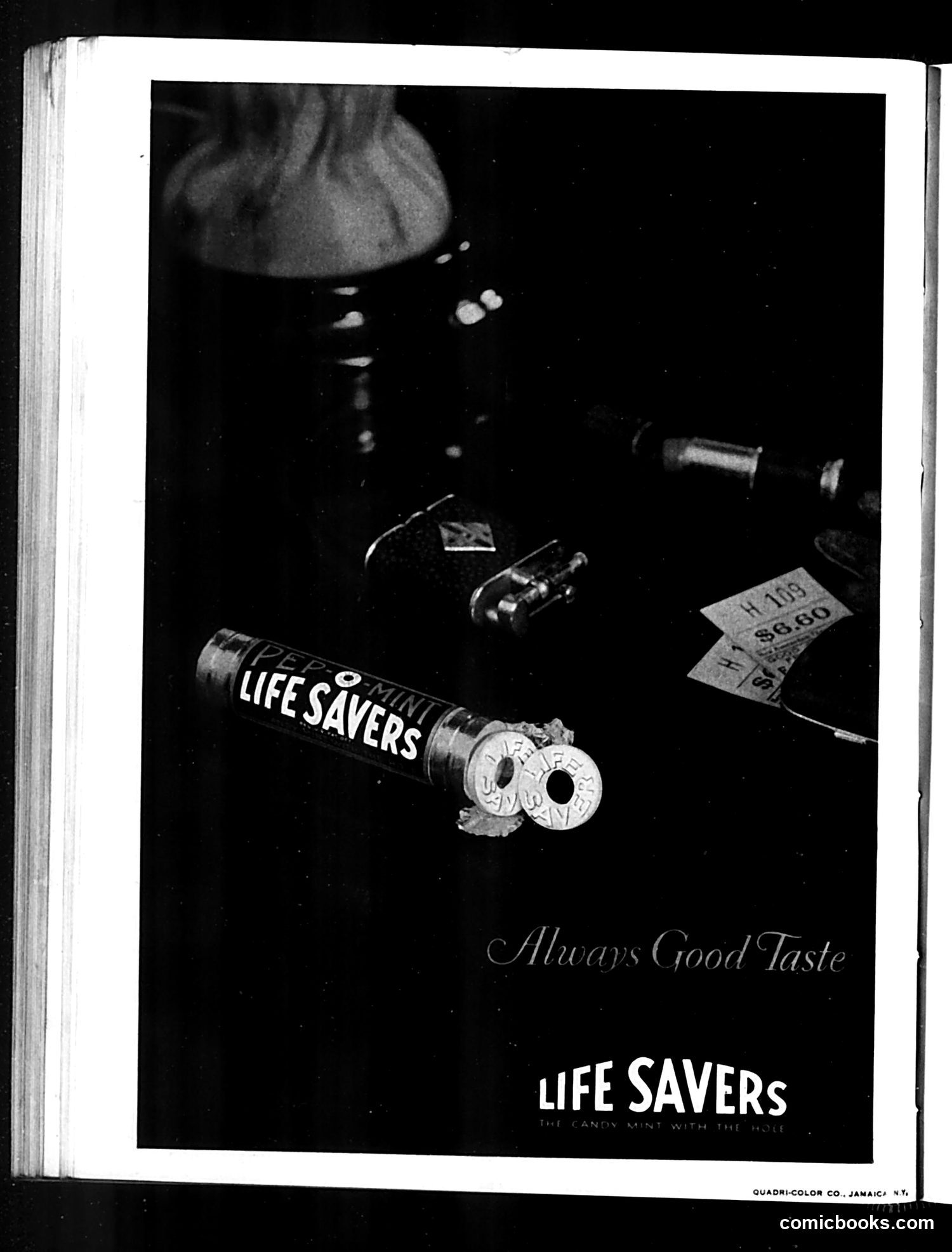
This is not a political cartoon but rather a **vintage advertisement** for Life Savers candy. The black-and-white image displays the iconic cylindrical roll of Life Savers mints with their characteristic hole in the center, along with what appears to be product packaging and a price tag (showing "$8.80"). The ad's tagline reads "Always Good Taste," which is a straightforward marketing claim rather than satire. The dramatic lighting and artistic presentation were typical of mid-20th-century candy advertising. This appears to be a product advertisement page rather than satirical editorial content, so there is no political commentary or joke to decode—simply commercial promotion of the popular American candy brand.