
A complete issue · 36 pages · 1928
Judge — March 3, 1928
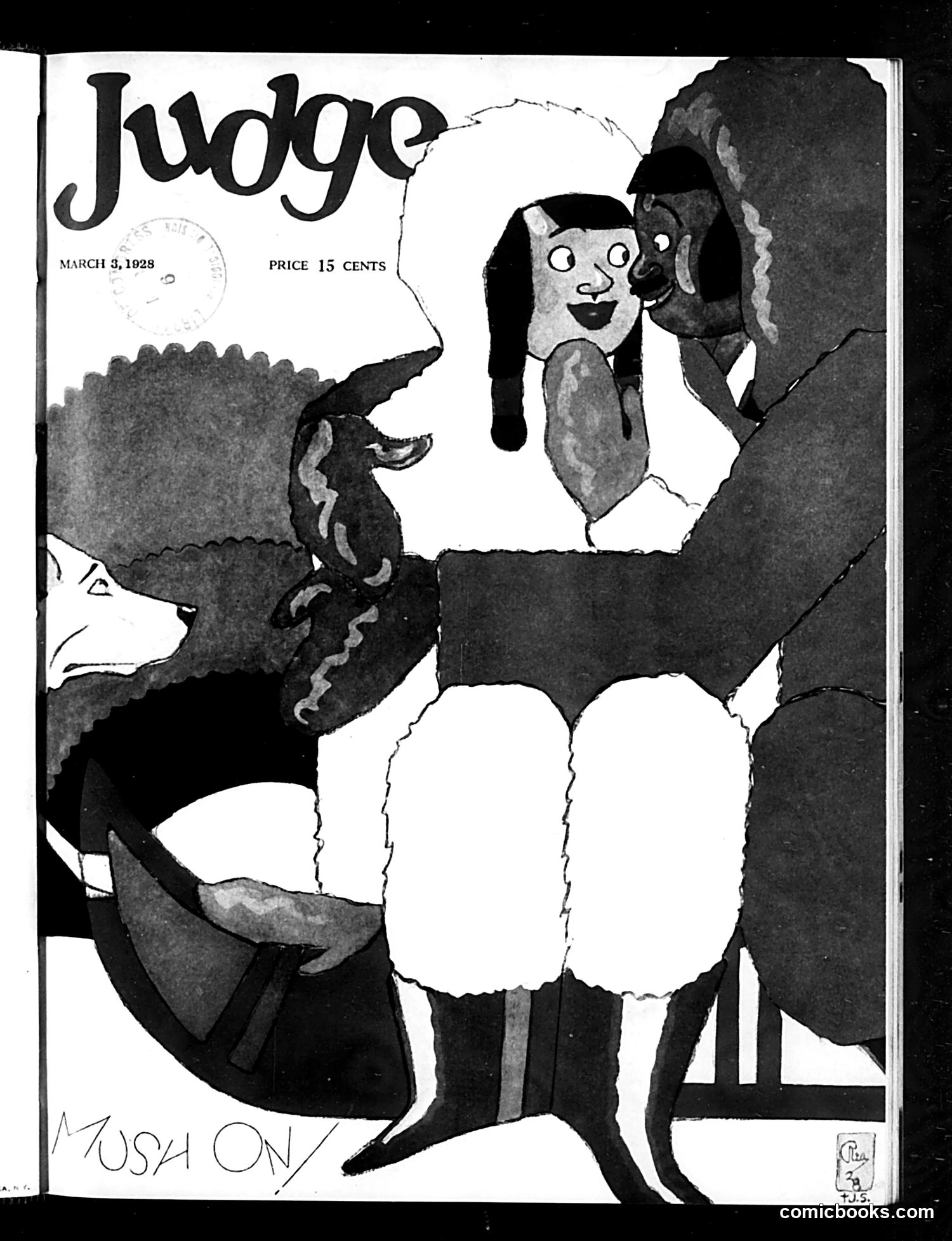
This cover depicts a domestic scene with satirical commentary. A woman with exaggerated features holds a telephone receiver, speaking to someone off-panel, while a man in a suit stands nearby gesturing emphatically. The large white shape between them appears to be a piece of furniture or household item. The caption reads "MUSH ON!" suggesting the cartoon satirizes sentimental telephone conversations or domestic sentimentality of the era. The art style and composition suggest humor about romantic or overly emotional communication between couples. Without additional context from the magazine's interior, the specific incident or public figure being referenced remains unclear, though the satire targets early-20th-century dating or marital customs and the new technology of the telephone in domestic life.
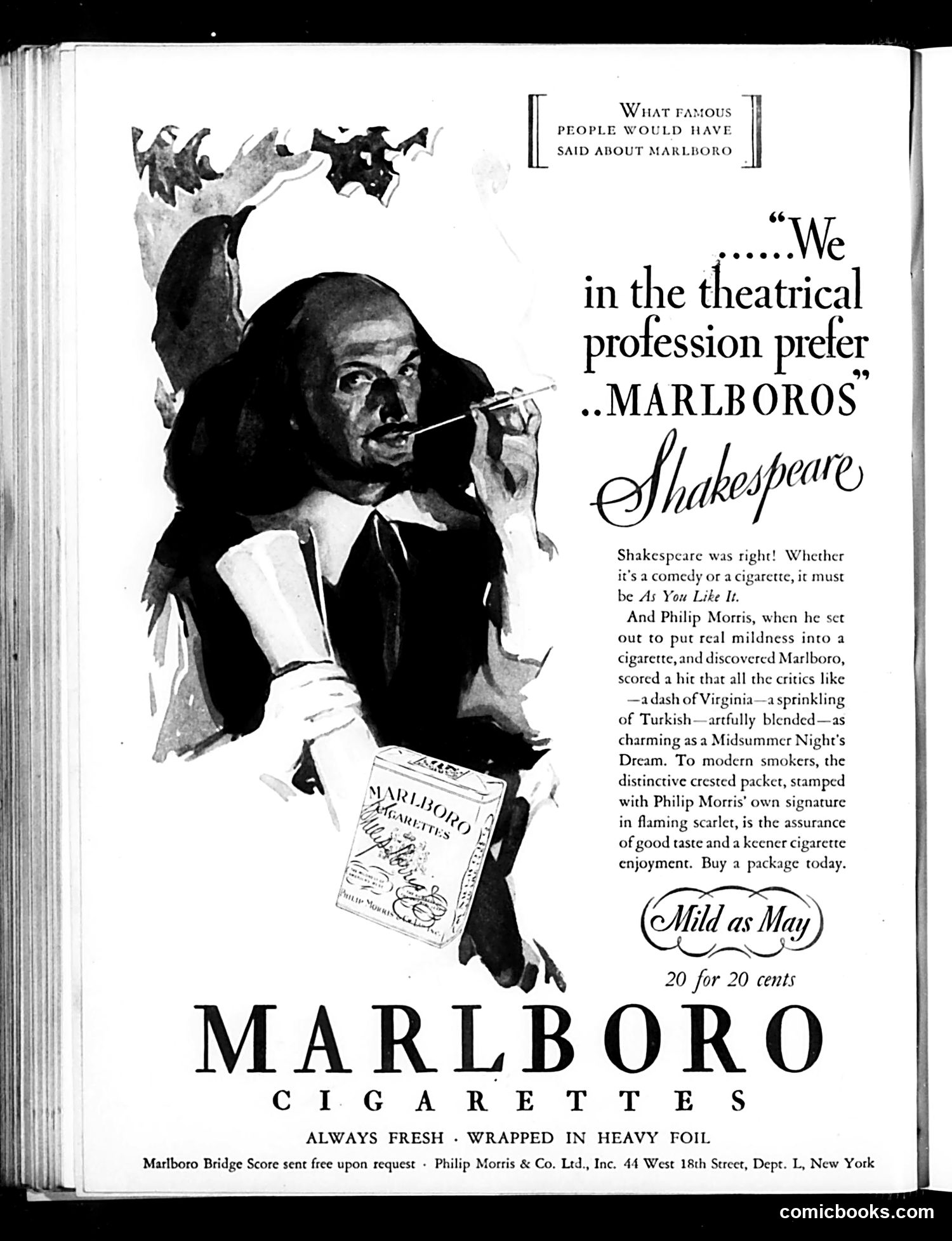
This page is primarily a **Marlboro cigarette advertisement**, not political satire. The ad features a theatrical figure (appearing to be a Shakespearean actor or jester) holding a cigarette package and gesturing dramatically. The advertisement leverages Shakespeare's name and authority, claiming he would have preferred Marlboro cigarettes, attributing a fake quote to him: "We in the theatrical profession prefer Marlboros." The copy references Philip Morris introducing "real mildness" into cigarettes, comparing the product to Shakespeare's comedies. It emphasizes the packaging ("distinctive crested packet") and markets the cigarettes as "Mild as May" at "20 for 20 cents." This represents period advertising that casually exploited high-culture references and celebrity association to market tobacco—practices now heavily restricted.
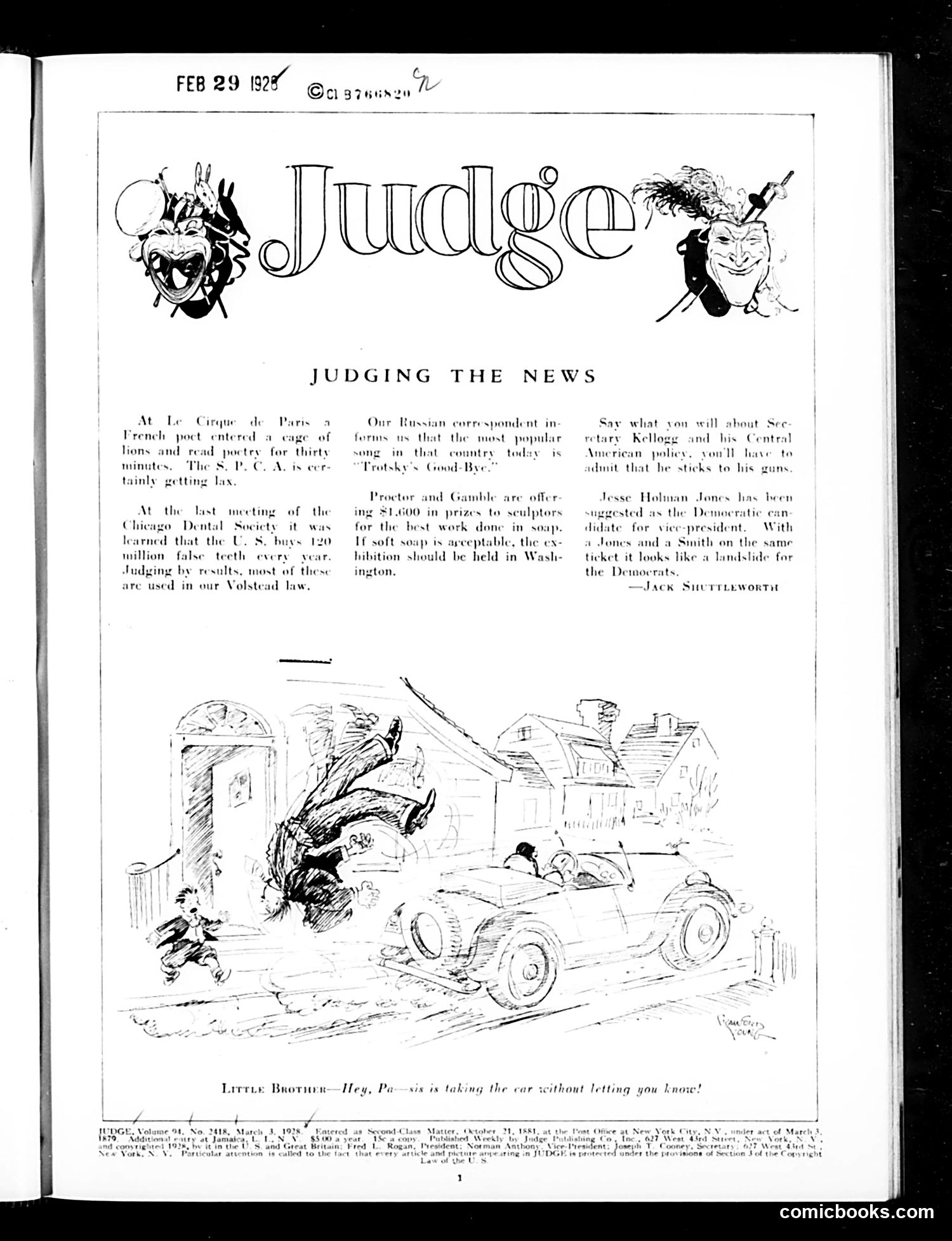
This page contains satirical news commentary and a cartoon. The main illustration shows a man in a car driving recklessly past a small boy, with the caption "Little Brother: 'Hey, Pa—sis is taking the car without letting you know!'" The joke satirizes parental hypocrisy: a father appears to be stealing or joyriding in a car himself, yet would presumably punish his daughter for the same behavior. It reflects 1920s anxieties about automobiles, youth independence (particularly young women gaining mobility), and inconsistent family discipline. The "Judging the News" section above contains brief political commentary on topics including Russian popular songs, dental fraud statistics, and Democratic Party politics, written by Jack Shuttleworth.
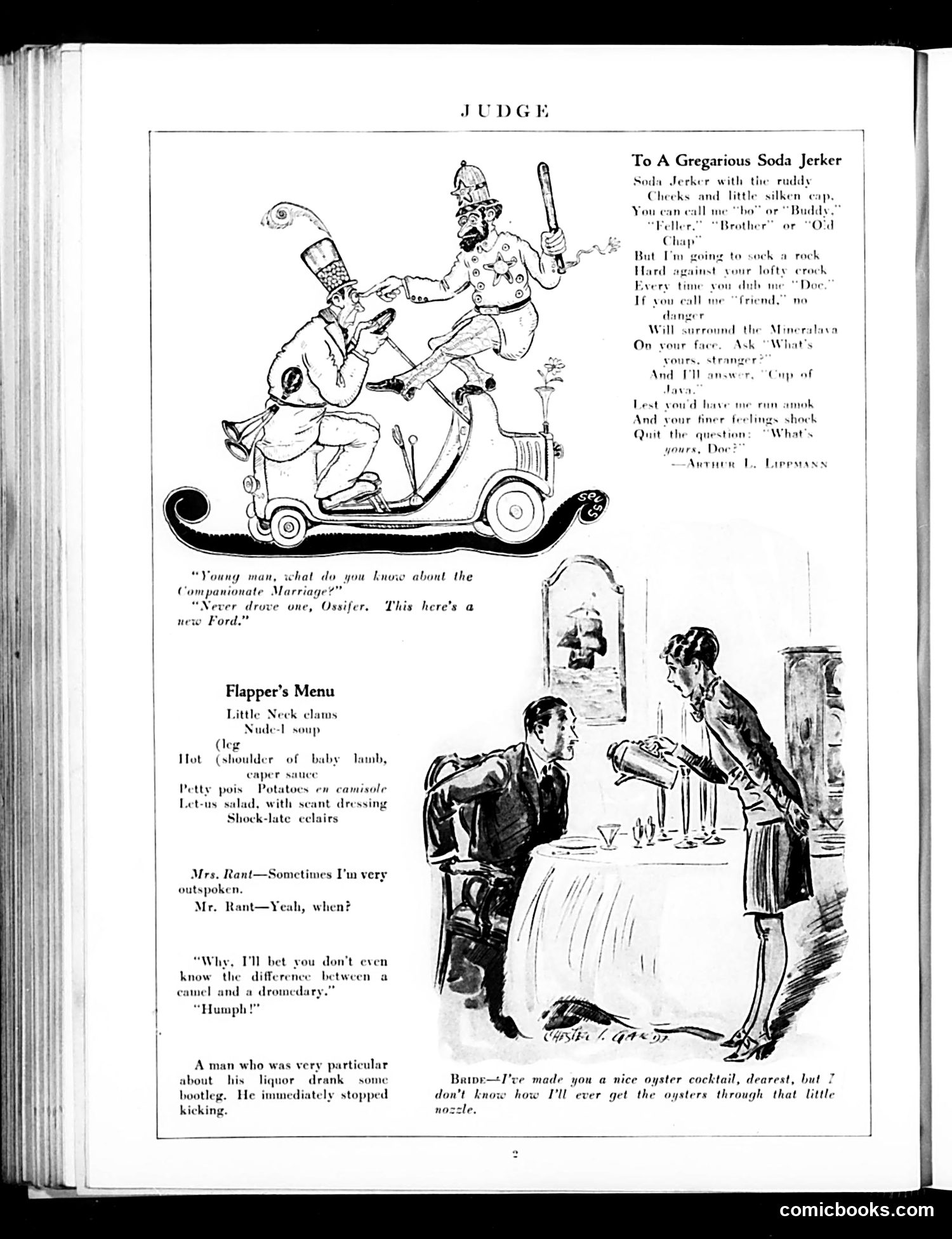
This page contains two unrelated satirical pieces: **Top cartoon**: Depicts two figures on a motorized scooter-like vehicle, mocking a soda jerker (fountain worker). The accompanying poem threatens violence ("sock a rock / Hard against your lofts crock") in response to being called insulting nicknames. It's satire on working-class dignity and the casual disrespect service workers faced. **Bottom section**: "Flapper's Menu" lists period-appropriate dishes (clams, lamb shoulder, potatoes). Below, a domestic scene shows a husband and wife discussing alcohol—he mentions drinking bootleg liquor ("bootleg"), she threatens exposure. This satirizes Prohibition-era hypocrisy and marital tensions over illegal drinking. Both pieces reflect 1920s American social anxieties: class relations, changing gender dynamics, and Prohibition enforcement.
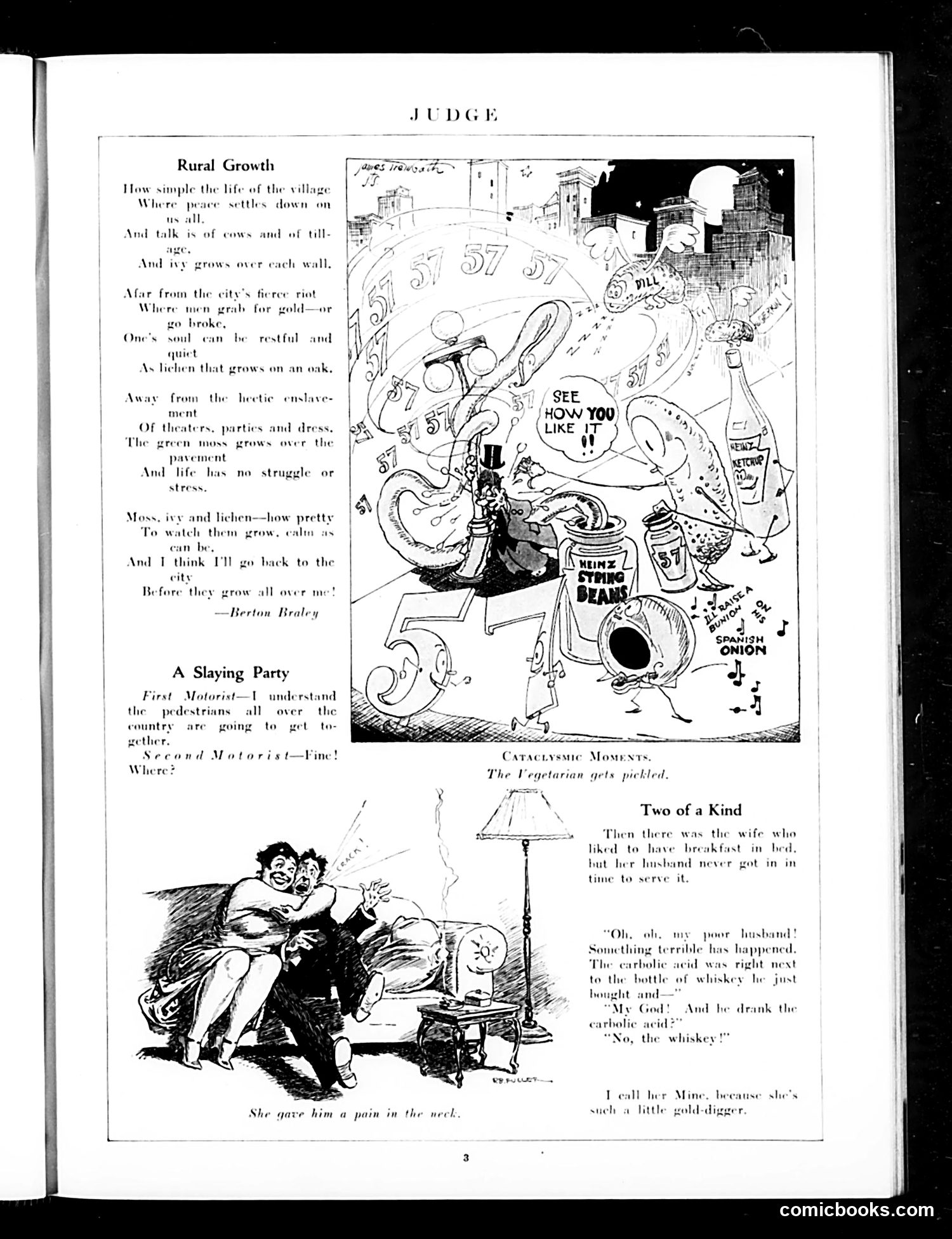
**"Rural Growth"** (top left): A poem by Berton Braley celebrating pastoral simplicity and escape from urban chaos—reflecting early 20th-century nostalgia for countryside life amid rapid industrialization. **"Cataclysmic Moments"** (center): A satirical cartoon showing a vegetarian surrounded by anthropomorphized food items (beans, onions). The caption "See how you like it!!" suggests dark humor about vegetarians being consumed by their own food—mocking vegetarianism as an oddly reversed natural order. **"A Slaying Party"** (bottom left): References pedestrian traffic fatalities from automobiles, a growing public concern as cars proliferated. The joke critiques motorists' carelessness. **"Two of a Kind"** (right): A domestic humor piece about marital conflict over a husband's drinking, featuring a wife who serves breakfast in bed but must contend with his alcoholism.
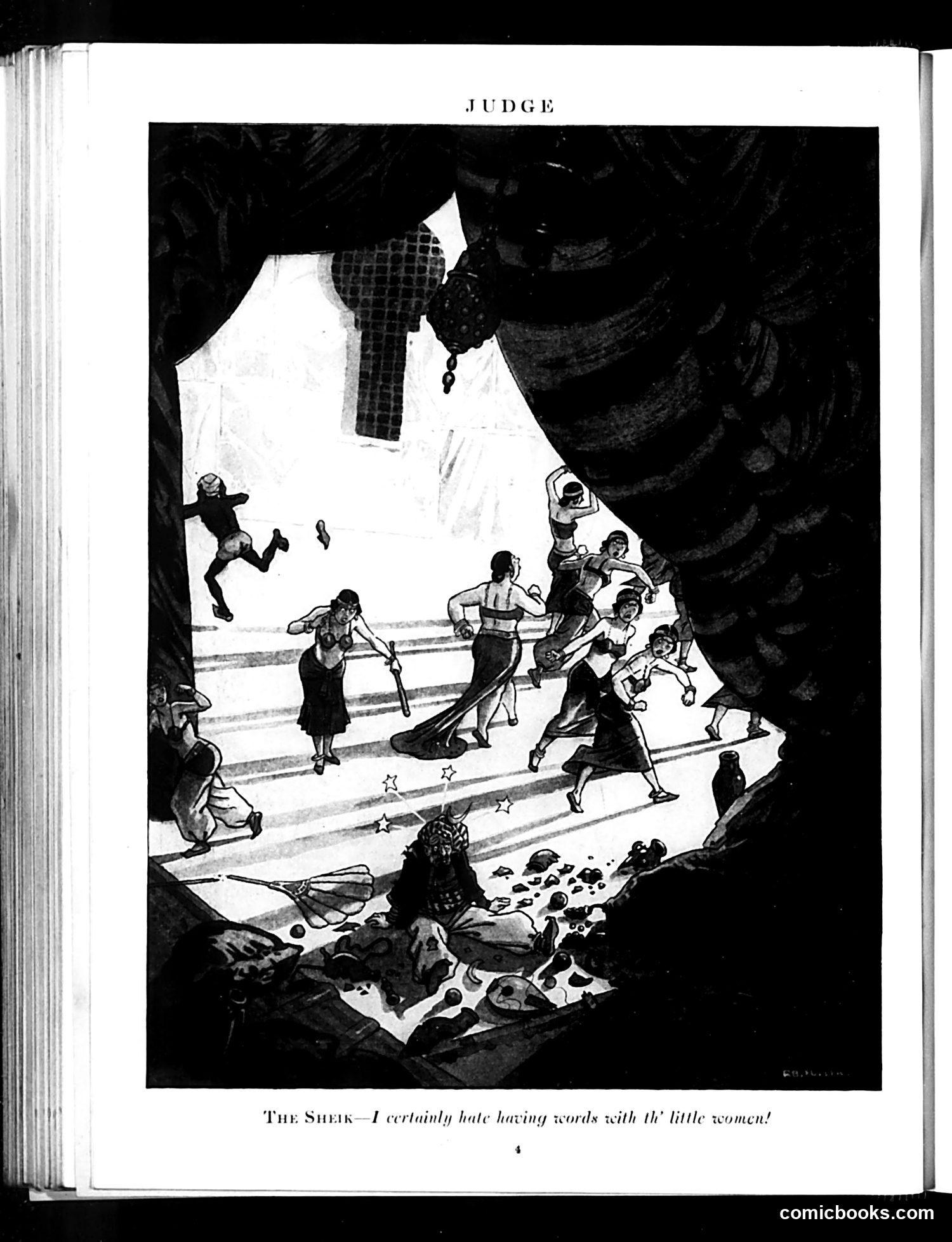
This is a satirical illustration titled "The Sheik—I certainly hate having words with th' little women!" The image depicts a dramatic underground or cavern scene where a male figure (representing "the Sheik," likely referencing the popular 1921 film) confronts multiple women wielding weapons and tools. The satire appears to mock the romanticized "Sheik" archetype—the domineering male lover figure popular in 1920s cinema—by showing him vastly outnumbered and threatened by organized women. The women's aggressive stance suggests a commentary on female empowerment or the growing assertiveness of women in the post-suffrage era. The joke inverts typical gender power dynamics, presenting women as the formidable force rather than passive romantic subjects, likely satirizing both contemporary film tropes and evolving social attitudes toward women's roles.
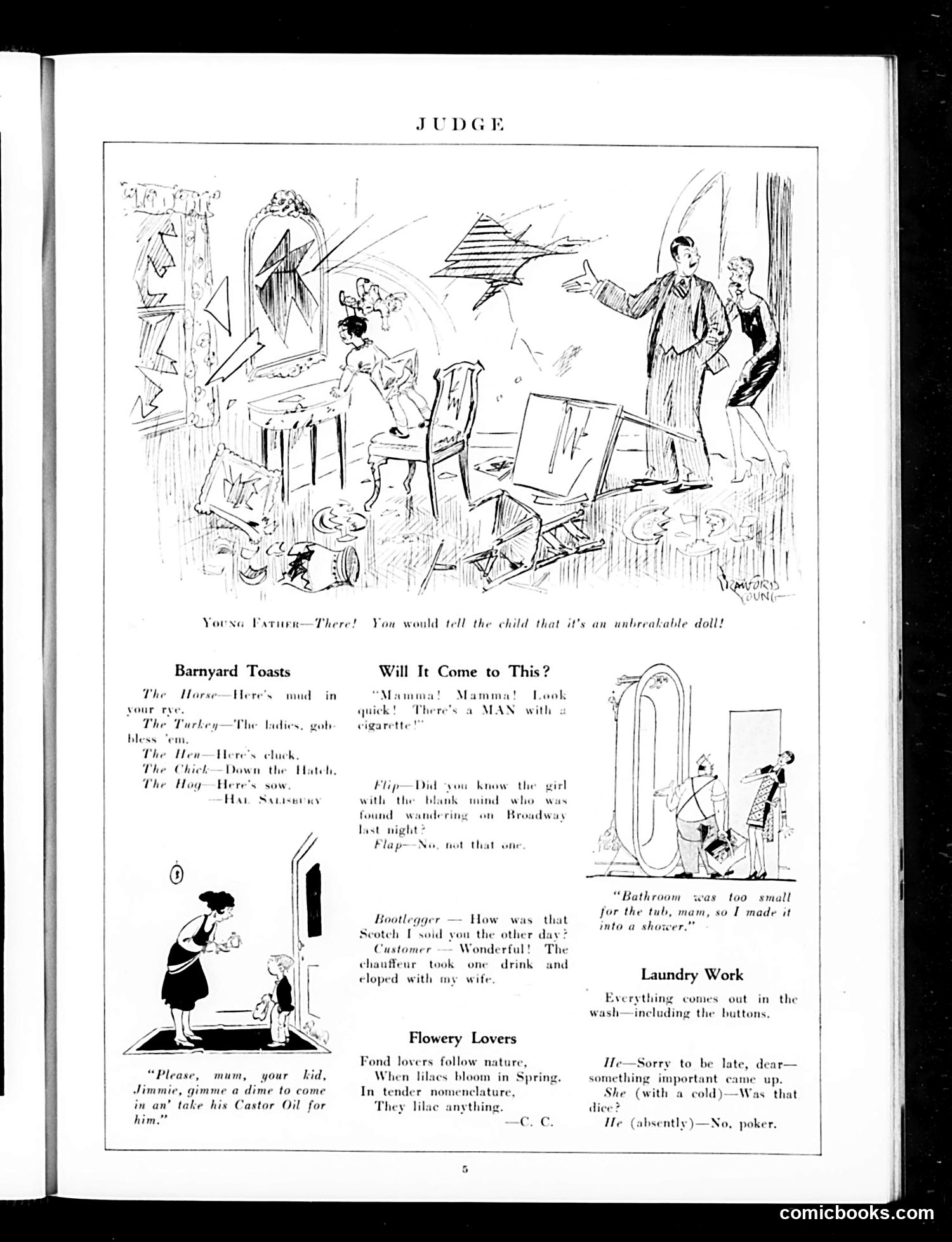
This page contains several separate humorous items rather than a unified political cartoon: **Main cartoon** ("Young Father"): A domestic scene satirizing parental exasperation—a father tells a child that a broken doll is "unrepairable," likely poking fun at overly indulgent parenting or consumerism. **"Barnyard Toasts"**: Wordplay jokes about farm animals (the Horse, Turkey, Hen, Chick, Hog). **Additional humor pieces** include vignettes about bathroom renovations, laundry mishaps, and romantic complications—standard domestic comedy with no apparent political content. **"Flowery Lovers"**: A satirical poem mocking overly sentimental courtship language, signed "C.C." The page represents typical early-20th-century magazine humor: light domestic satire and observational comedy about middle-class life, rather than political commentary.
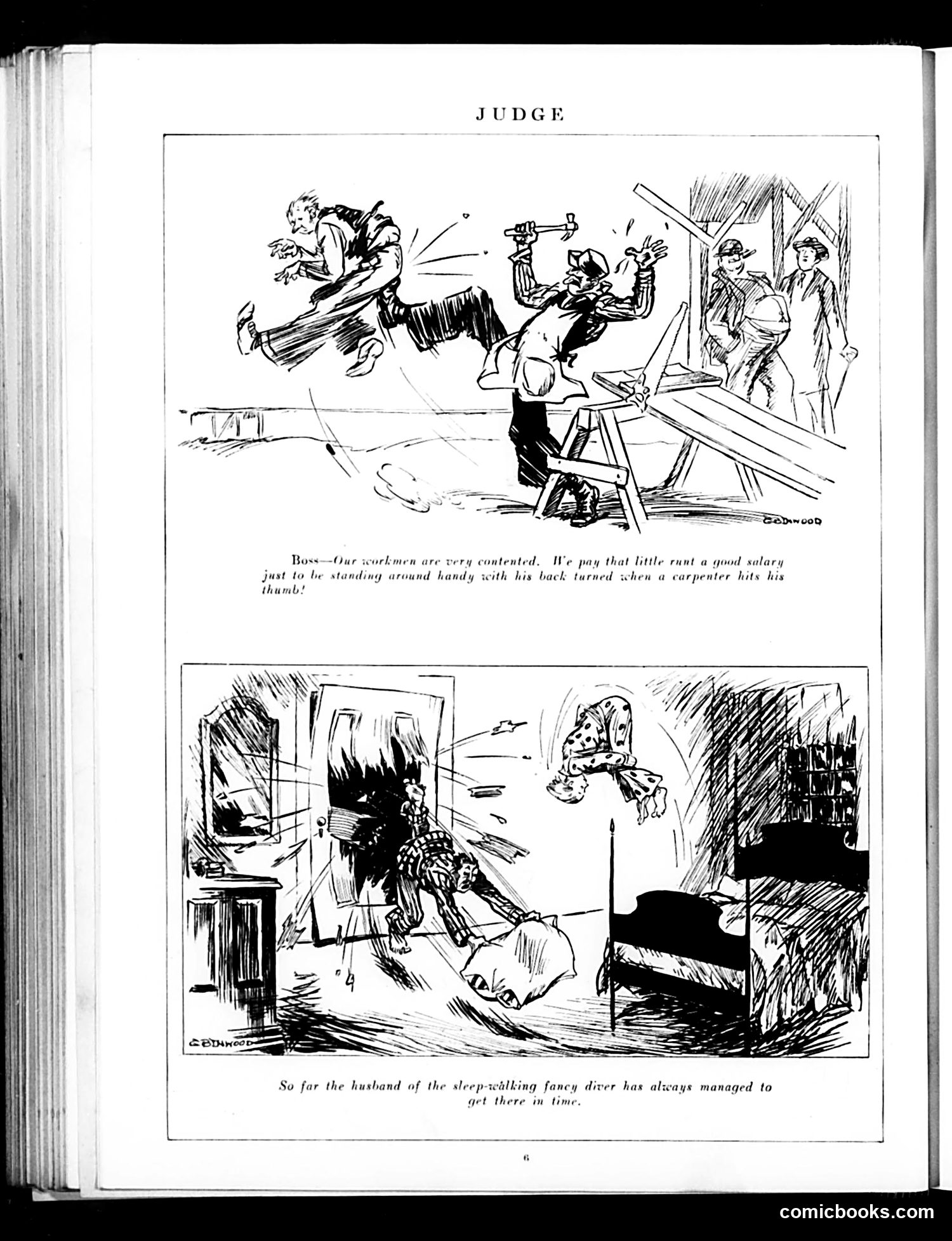
This page contains two comic panels satirizing workplace safety and marital dynamics. The **top cartoon** depicts a construction site accident where a worker has been struck by debris. The boss dismisses worker complaints about safety, claiming employees are "very contented" and paid adequately—implying workers should accept dangerous conditions without complaint. The satire mocks management's callous indifference to worker injuries. The **bottom cartoon** jokes about a husband who is a "sleep-walking fancy diver"—apparently someone who sleepwalks and performs diving movements in bed. The caption suggests he habitually arrives "in time" (presumably returning to bed before his wife fully awakens). The humor derives from the absurdity of the situation and the husband's ability to engage in this behavior without detection. Both cartoons reflect early 20th-century attitudes toward workplace safety and domestic humor.
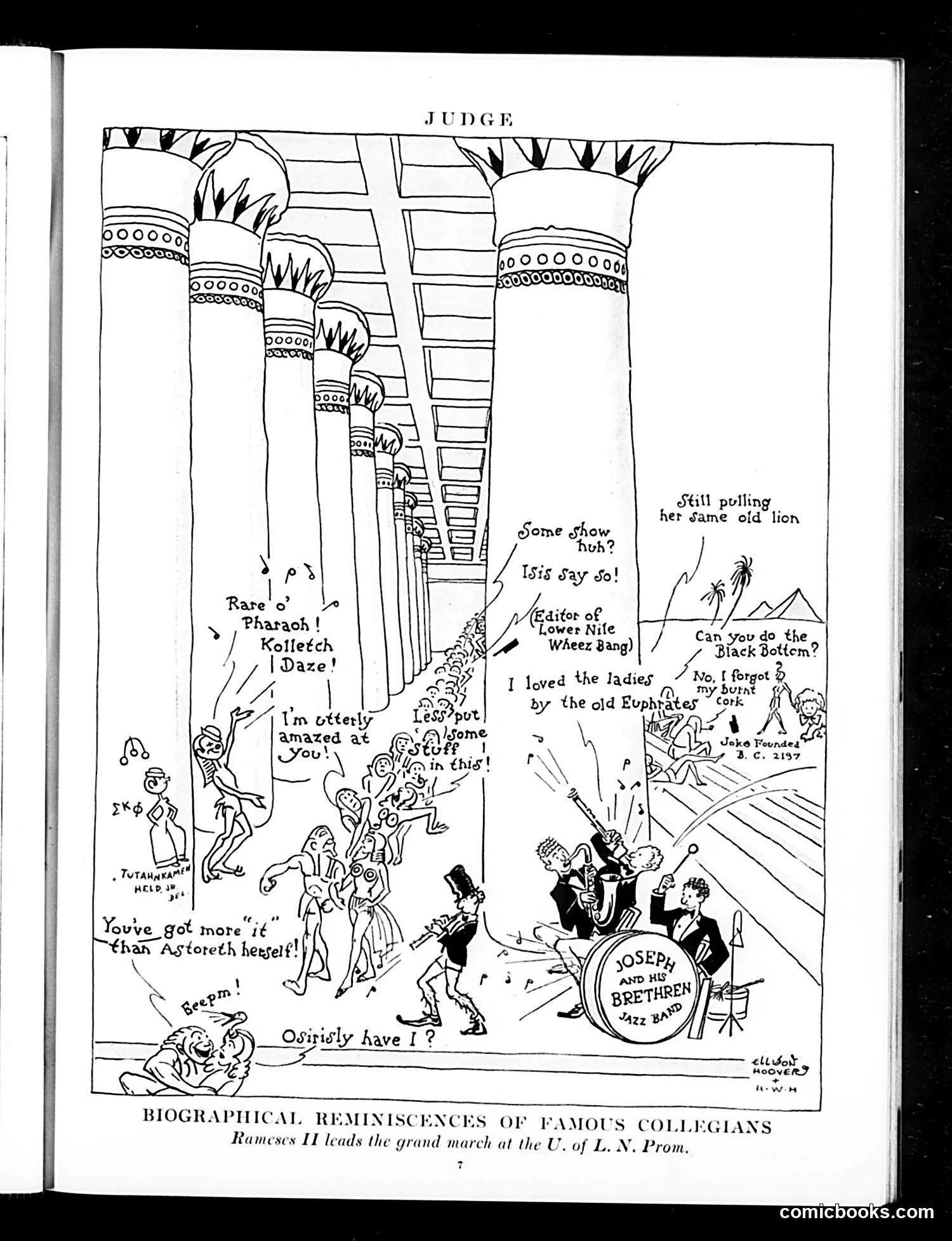
This page is a humorous cartoon titled "Biographical Reminiscences of Famous Collegians," depicting the Egyptian pharaoh Rameses II leading a grand march at a University of L.N. prom (likely University of Louisville or similar). The satire compares ancient Egyptian figures to modern college characters through dialogue. References include: - **Rameses II** (the main figure) interacting with various characters making anachronistic comments - **Isis** (Egyptian goddess) as an "Editor of Lower Nile Wheez Gang" - **Tutankhamen** ("Tutankhaten") - Jazz band labeled "Joseph and His Brethren Jazz Band" (1927) The joke plays on mixing biblical/Egyptian mythology with 1920s American college culture—jazz music, prom dances, and flirtatious behavior. Characters reference "the Black Bottom" (a contemporary dance) and other period slang, absurdly imagining ancient pharaohs as modern college students. The cartoonist (Elliot Hoover) uses this anachronistic clash for comedic effect about collegiate social life.
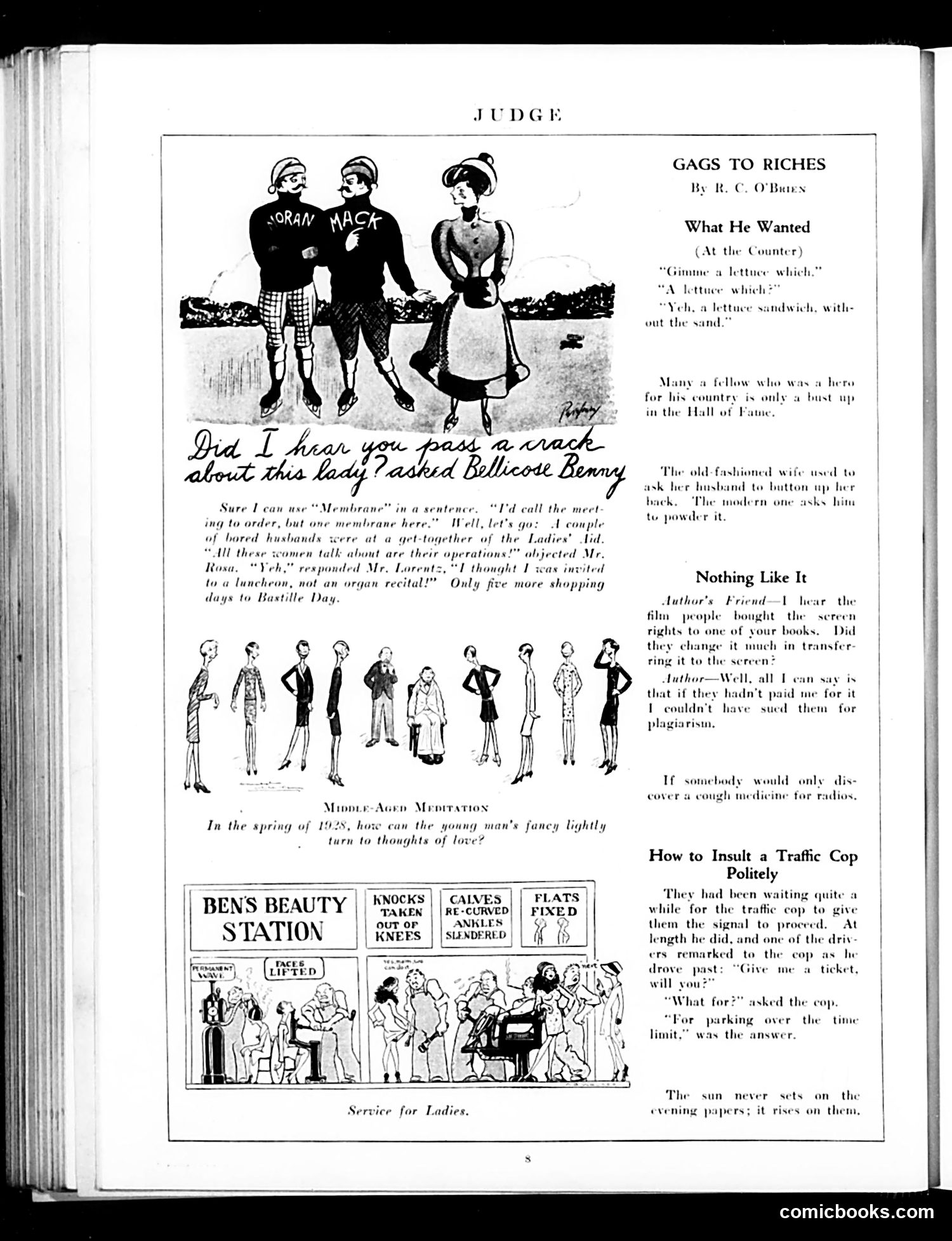
This page contains multiple satirical pieces typical of 1920s American humor: **"Gags to Riches"** features short jokes about modern life: a man ordering a "lettuce sandwich without the sand," commentary on war heroes forgotten at home, and the contrast between old-fashioned wives (who ask husbands to button their backs) versus modern wives (who ask them to powder). These reflect post-WWI disillusionment and changing gender roles. **"Nothing Like It"** jokes about book-to-film adaptation, where an author admits he wouldn't have sued filmmakers for plagiarism had they not paid him—mocking both Hollywood's creative liberties and authors' mercenary attitudes. **"How to Insult a Traffic Cop Politely"** depicts someone asking a cop for a ticket after the cop signals him to proceed, claiming he "parked over the time limit"—absurdist humor about traffic enforcement. **"Ben's Beauty Station"** advertises beauty services, showing the era's emerging consumer culture around female grooming and appearance. The overall tone is cynical about modern American life—marriages, war, commerce, and bureaucracy.
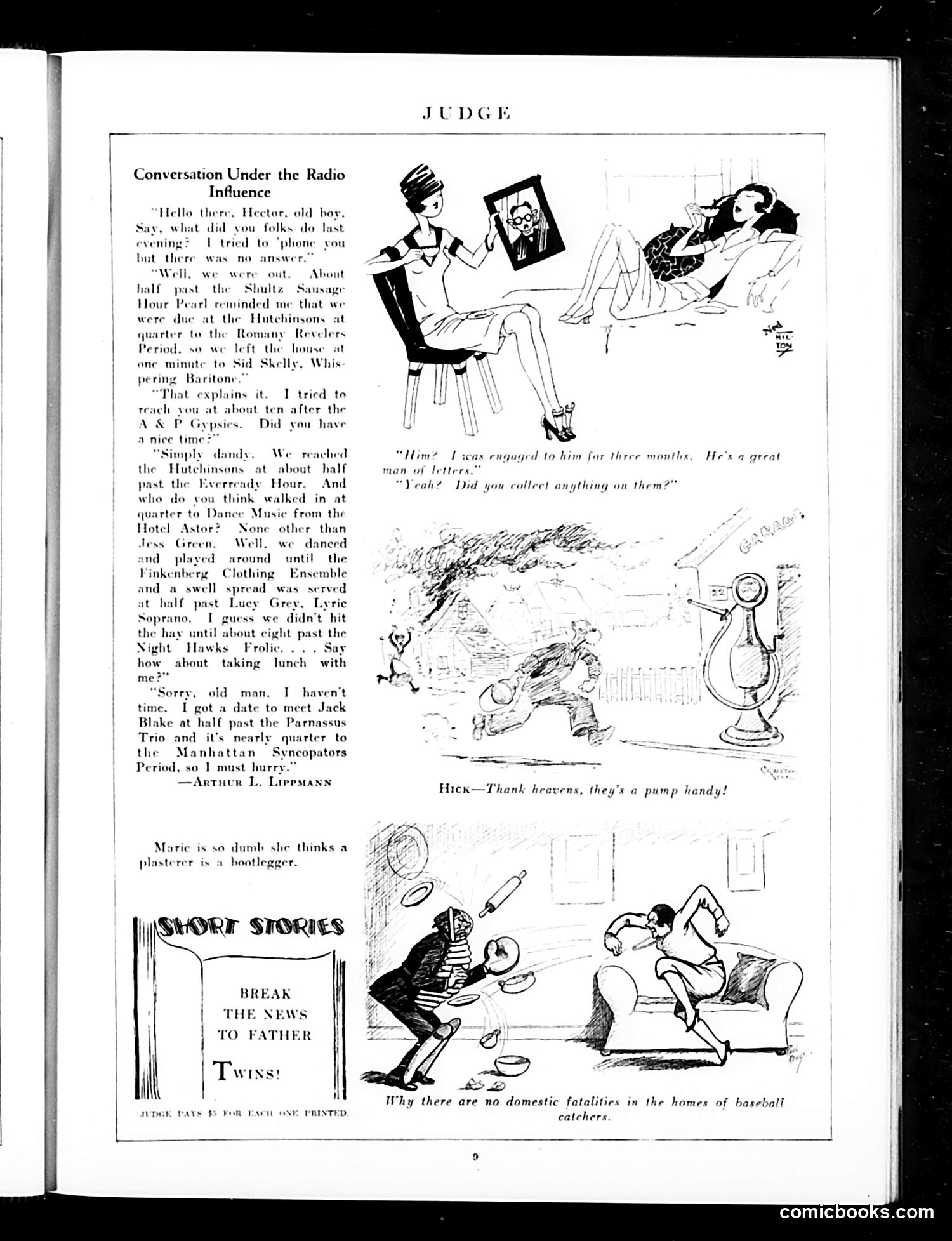
This satire mocks how radio programs had become so ubiquitous in 1920s American life that people used them as time references instead of clocks. The conversation shows two men describing their evening entirely in terms of radio show schedules—"half past the Shultz Sausage Hour," "quarter to the Romany Revelers Period," "eight past the Night Hawks Frolic"—making their social calendar absurd and radio-dependent. The lower cartoons offer additional period humor: one about a man throwing bowling balls indoors (captioned "Why there are no domestic fatalities in the homes of baseball catchers"—playing on a catcher's reflexes), and a joke about a woman confusing "plasterer" with "bootlegger" (referencing Prohibition-era slang). The satire targets radio's grip on American leisure time and culture during the medium's explosive popularity.
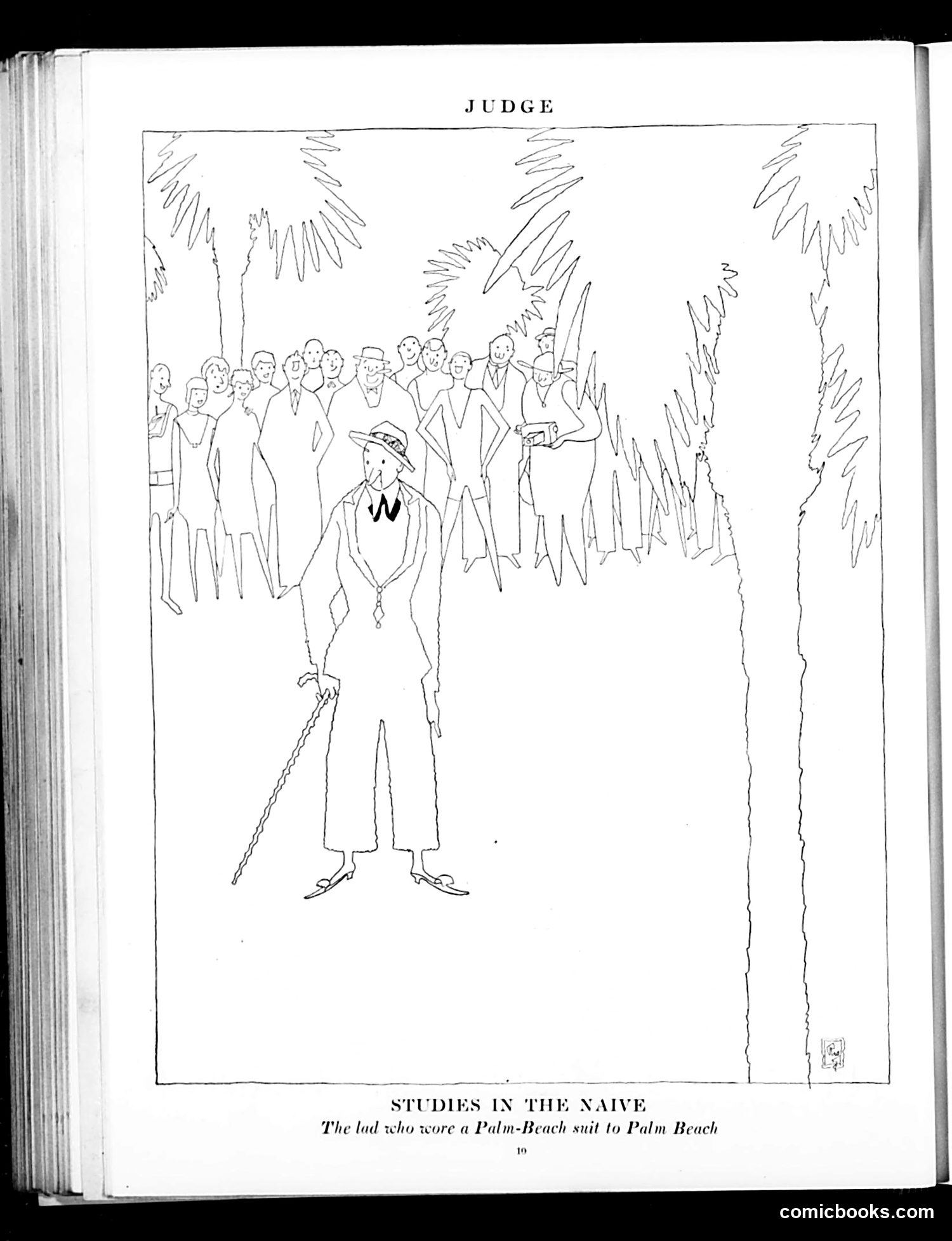
This cartoon satirizes social pretension and fashion consciousness among the wealthy. The title "The lad who wore a Palm-Beach suit to Palm Beach" is the joke: a young man arrives at the exclusive Palm Beach resort wearing a "Palm Beach suit" (a lightweight tropical suit marketed with that name), apparently unaware that fashionable Palm Beach residents would wear something more sophisticated or current. The figure in the foreground, distinguished by his hat and cane, stands before a crowd of onlookers in the background who appear to be observing him—suggesting he's the object of social ridicule. The cartoon mocks his naïveté: he's taken the suit's name literally, not realizing that brand-name fashion marketed to appeal to the aspirational middle class would be precisely what to *avoid* wearing among actual Palm Beach society.
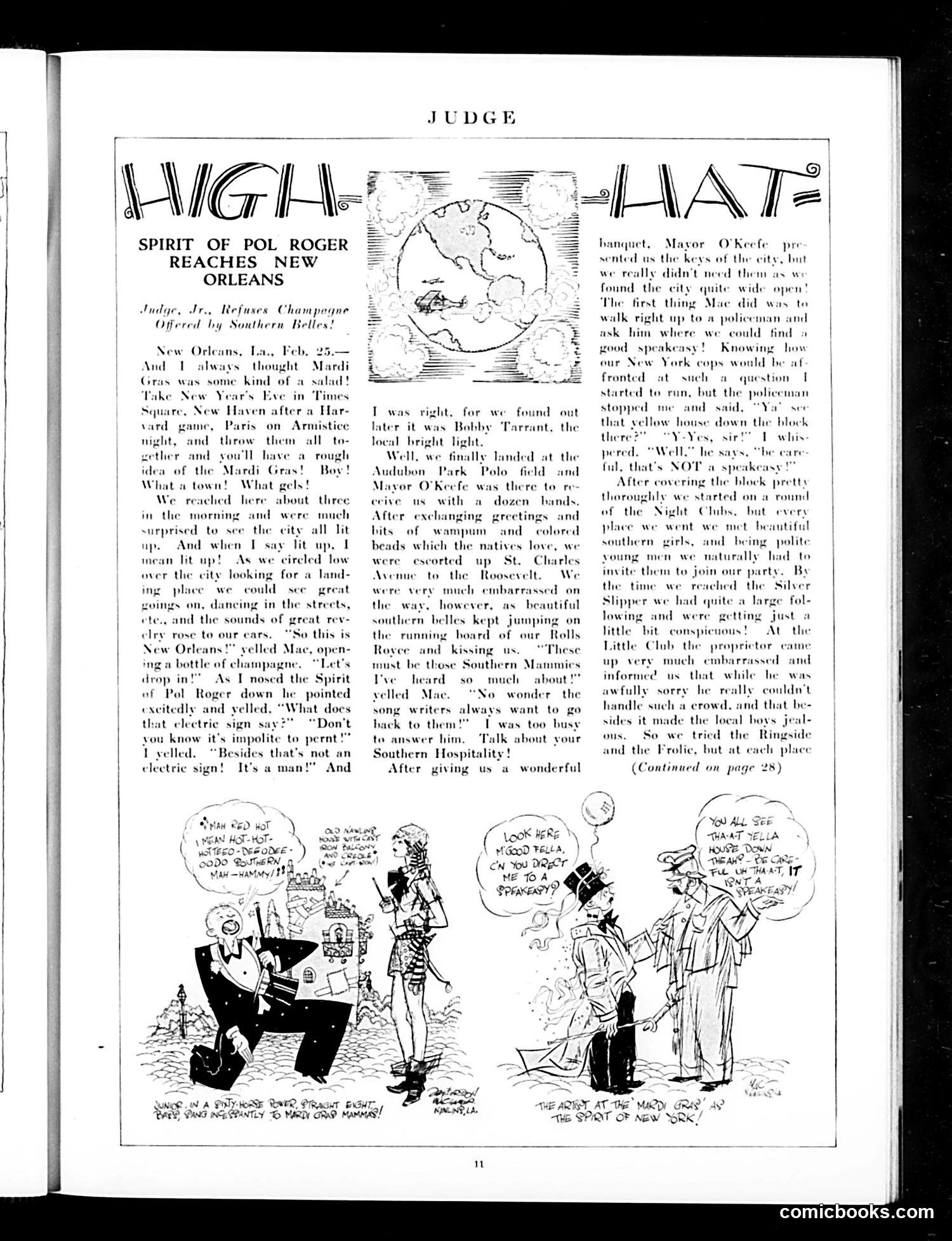
This is a humorous travel narrative about a visitor (likely a wealthy socialite or celebrity named "Judge") touring Mardi Gras in New Orleans with a friend named Mac. The piece satirizes both Northern tourists and Southern hospitality stereotypes. The cartoons depict the narrator's misadventures: mistaking a drunken man for an electric sign, being overwhelmed by enthusiastic Southern women, and getting repeatedly kicked out of nightclubs because their increasingly large party of invited guests becomes conspicuous and disruptive. The satire targets: - Northern ignorance of Southern customs - Excessive Southern hospitality ("Mammy" stereotypes) - The speakeasy culture of Prohibition-era America - Tourist behavior and social awkwardness The humor relies on the narrator's bewilderment at local customs and the escalating chaos of their night-clubbing spree.
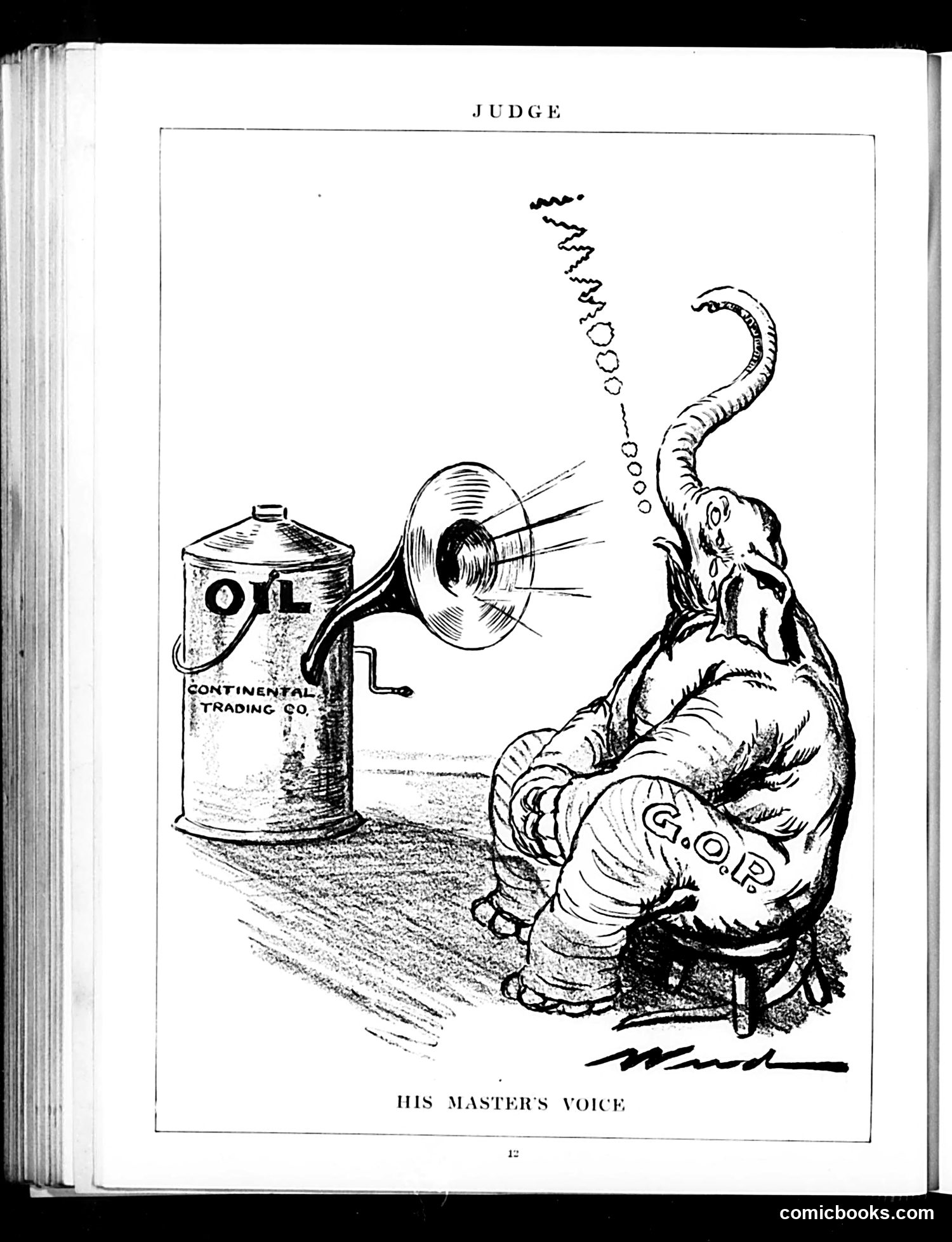
This political cartoon satirizes the relationship between the **Grand Old Party (G.O.P.)** and **Continental Trading Company**. The figure labeled "G.O.P." sits obediently listening to an oil can (labeled "Continental Trading Co.") that broadcasts through a megaphone—a clear reference to the famous "His Master's Voice" trademark. The satire suggests the Republican Party blindly follows the oil company's directives, functioning as its puppet or servant rather than acting independently. This likely critiques corporate influence over political decision-making, particularly regarding oil industry interests and regulation during the early 20th century when such monopolistic practices faced public scrutiny. The image uses the recognizable advertising slogan ironically to mock GOP subservience to big business.
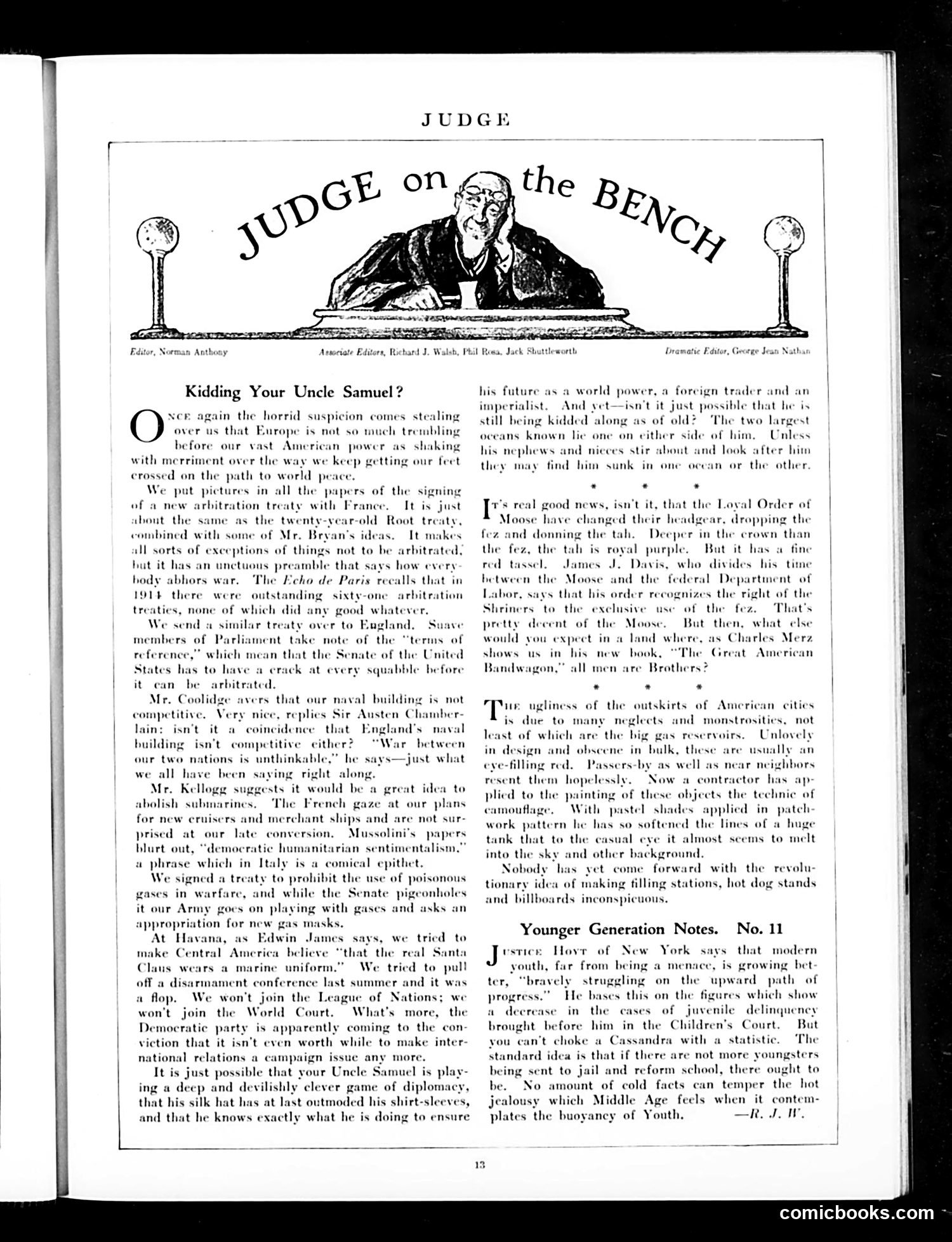
This page mocks American diplomatic inconsistency under the Coolidge administration (1920s). The main article, "Kidding Your Uncle Samuel?", argues that the U.S. publicly promotes peace treaties and disarmament while undermining them through contradictory actions: signing arbitration treaties with loopholes, claiming non-competitive naval building while expanding the fleet, prohibiting poison gas while stockpiling it, and refusing to join the League of Nations or World Court. The satire suggests European powers laugh at American hypocrisy rather than fear American strength. References include Secretary Kellogg's submarine proposal, Secretary Coolidge's naval claims, and a failed 1924 Havana disarmament conference. The piece implies the U.S. either plays diplomatic games incompetently or naively thinks itself clever while actually appearing foolish to the world.
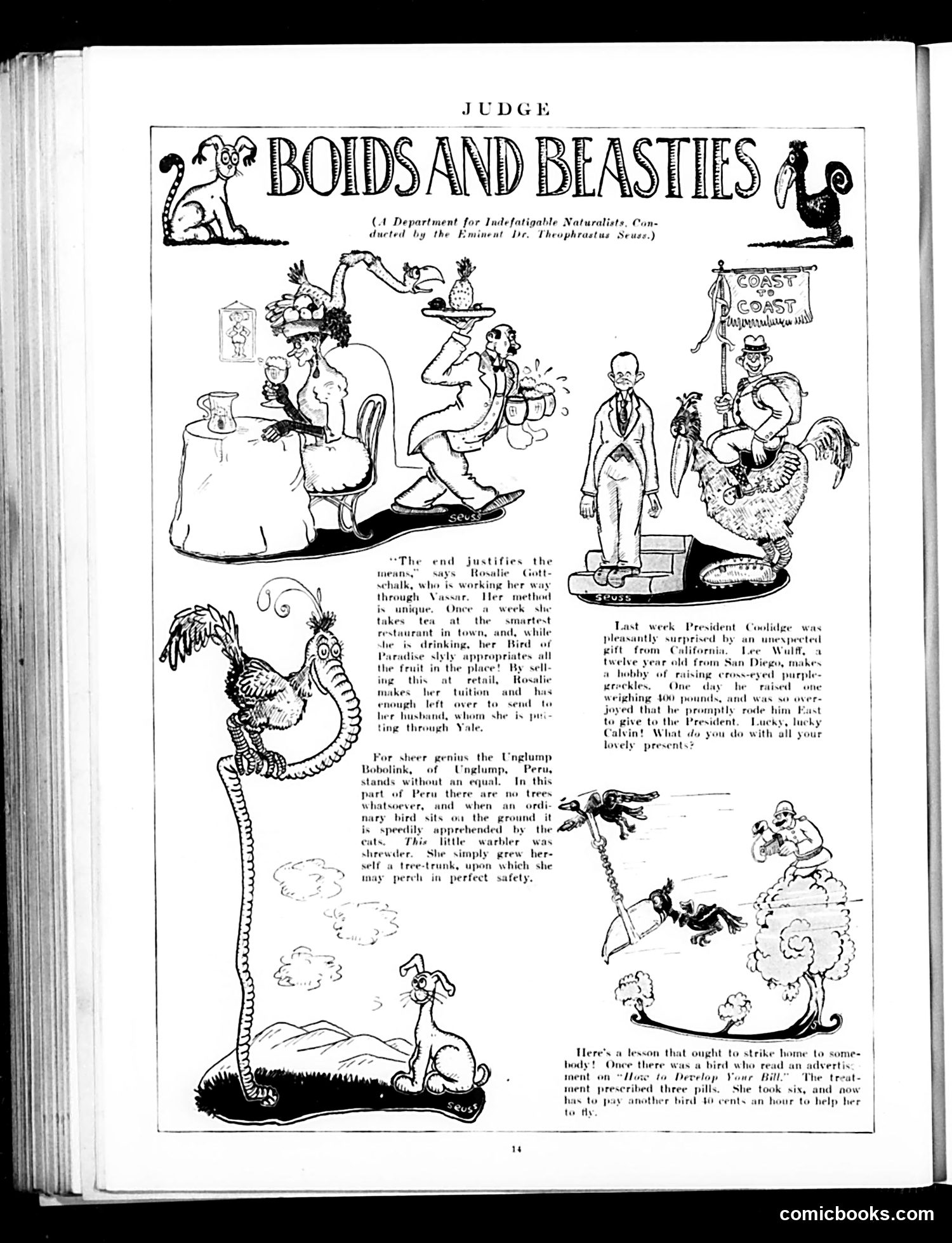
This is a humorous naturalist column by "Dr. Theophrastus Seuss" (likely a pseudonym) featuring fictional or exaggerated creatures from Peru and elsewhere. The page mocks both social pretension and get-rich-quick schemes. One story satirizes a woman named Rosalie who freeloads at fancy restaurants, stealing flowers while drinking tea—working her way through Yale by essentially grifting. Another ridicules President Coolidge (referenced as "Calvin"), who apparently received an absurd gift of cross-bred purple grackles from California, highlighting how wealthy people accumulate useless status symbols. The final anecdote—about a bird taking an overdose of advertised pills and now paying another bird by the hour for help—critiques false advertising and consumer gullibility, a common Judge target. The crude cartoonish drawings and deadpan delivery create satirical comedy through absurdist exaggeration of human folly.
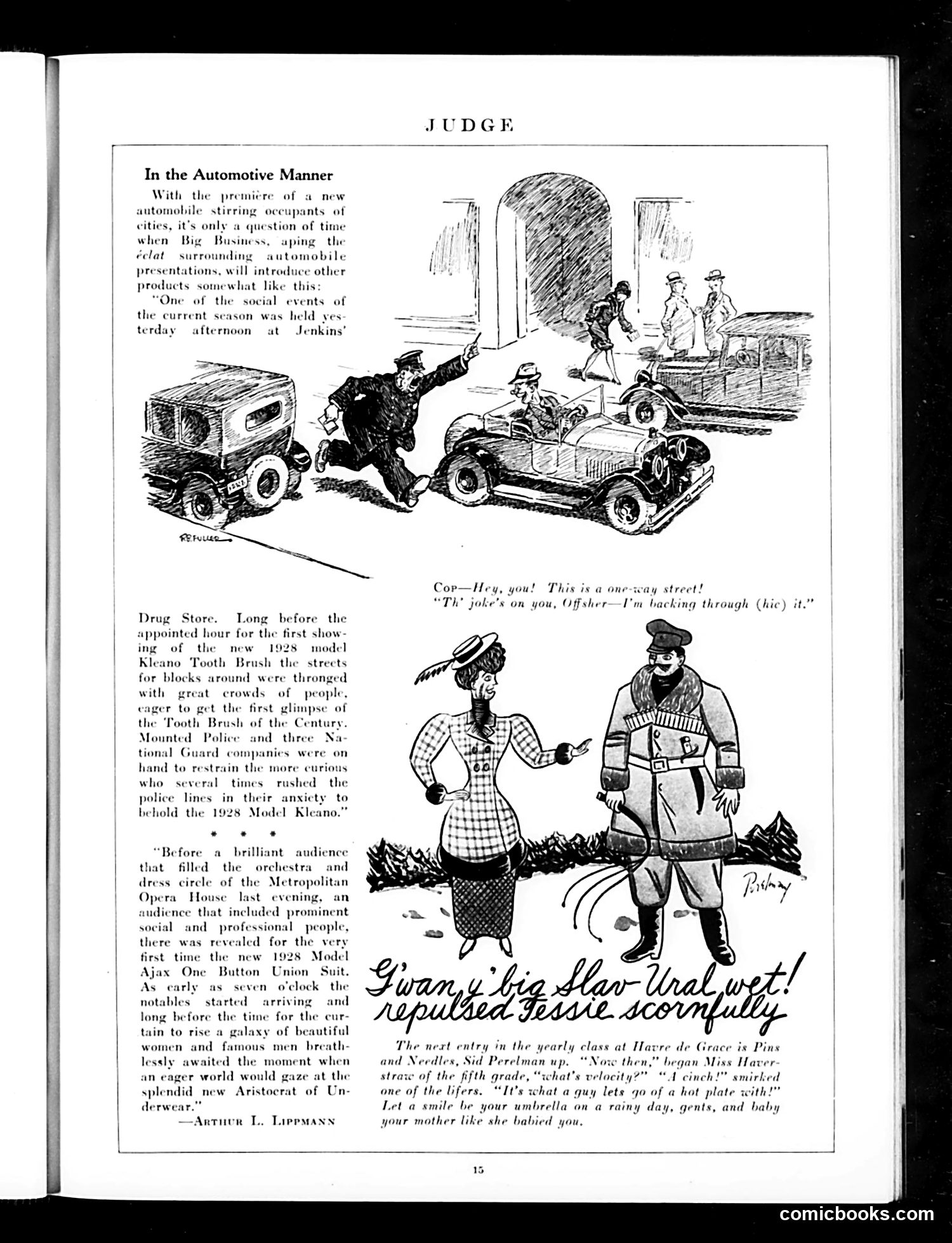
This Judge magazine page satirizes 1920s consumer culture and the excessive hype surrounding new product launches. The main cartoon mocks how automobile debuts—genuine social events with police presence and crowds—had become so glamorous that Big Business was now applying the same theatrical treatment to mundane products like toothbrushes and underwear. The top cartoon shows chaotic traffic caused by a drunk driver ignoring traffic laws ("one-way street"), a reference to the automobile's disruptive impact on city life. The lower section ironically describes a toothbrush unveiling and underwear debut at the Metropolitan Opera House with the same breathless language and social importance as actual high-society events. The satire criticizes commercialism and manufactured excitement—treating ordinary goods as cultural spectacles simply through elaborate marketing and presentation. The author is Arthur L. Lipmann; illustrator appears to be signed "Briggs."
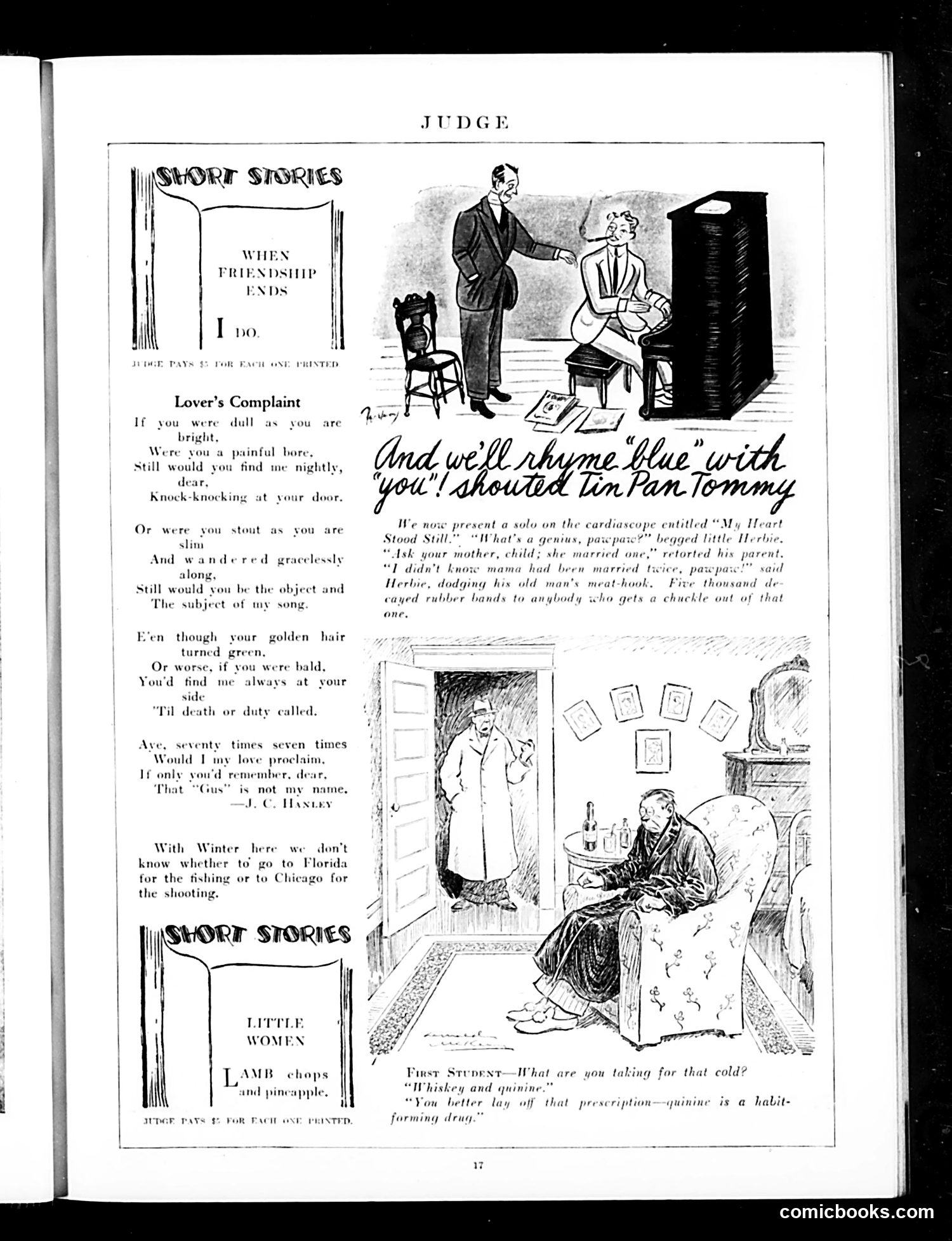
This page contains **short humorous pieces** rather than political cartoons. The content includes: 1. **"Lover's Complaint"** (left): A sentimental poem by J.C. Huxley satirizing romantic declarations—the twist being the speaker's lover keeps forgetting his name is "Gus," not the pet name used throughout. 2. **"When Friendship Ends"** (top right): A domestic scene where a man shows a woman sheet music titled "And we'll rhyme 'blue' with you! shouted Tin Pan Alley." This mocks the predictable, formulaic songwriting of Tin Pan Alley (the popular music industry). 3. **"Little Women"** section (bottom): A humorous dialogue where a child asks his mother what a "genius" is, and she jokes that she married one—implying her husband foolishly spent money on worthless rubber bands. 4. **"First Student"** (footer): A brief joke about quinine being "habit-forming," playing on period anxieties about drug dependency. The page is primarily **entertainment and wordplay** rather than social commentary.
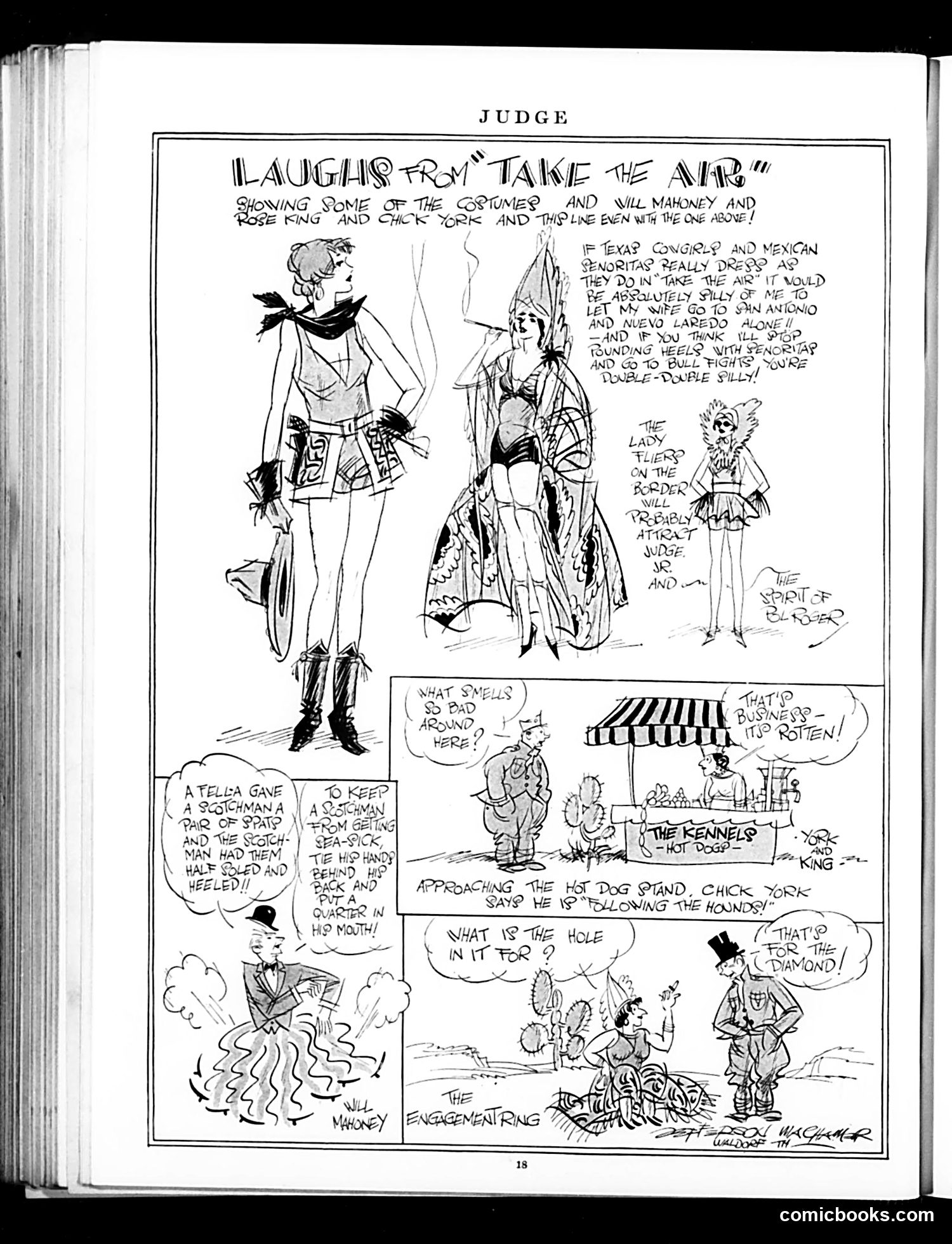
This Judge magazine page satirizes early 1920s leisure culture and gender politics. The top illustration showcases theatrical costumes from a "Take the Air" production, featuring Will Mahoney and Rose King among performers. The comic strips below mock upper-class social pretensions. A wealthy man boasts about giving his wife "a pair of spats and a stitch-man" while complaining she wants to travel to Texas and Mexico unsupervised—the satire targets his absurd double standard: he objects to her independence while expecting his own freedom. Another sequence mocks a couple at a hot dog stand who obsess over a diamond engagement ring, with the husband's crude reaction ("That's a swell stone, Diamond!") undermining their romantic pretense. The humor derives from exposing the contradictions between 1920s modernity (women's greater social mobility) and lingering Victorian-era male control, rendered through exaggerated dialogue and class-based comedy.
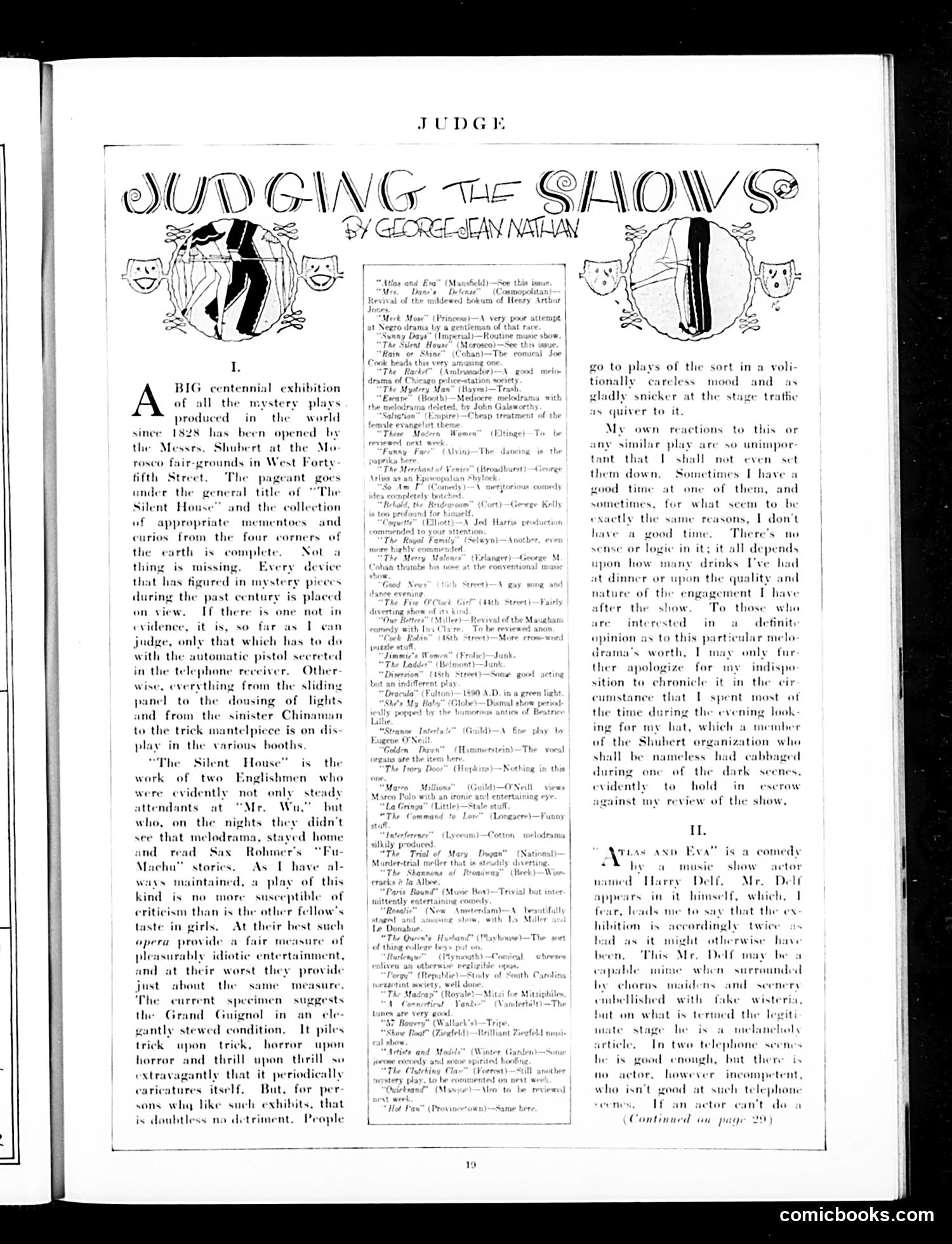
This is a critical essay (not a cartoon) reviewing contemporary Broadway productions. Nathan criticizes "The Silent House," a melodrama by two English playwrights performed at the Shubert theaters. He notes it borrows heavily from popular sources like the "Mr. Wu" melodrama and Sax Rohmer's pulp "Machu" stories, piling on tricks and horror effects so excessively that it "periodically caricatures itself." Nathan then reviews "Atlas and Eva," a comedy-musical starring actor Harris Delf. He dismisses Delf's performance, suggesting actors cannot act convincingly in telephone scenes—implying Delf is incompetent even in that supposedly easy task. The tone is characteristically sardonic: Nathan refuses to judge the melodrama seriously, admitting his reactions depend on drinks consumed and lost property (a hat misappropriated during a dark scene), undercutting any pretense of critical objectivity while maintaining acerbic wit about low-brow theatrical entertainment.
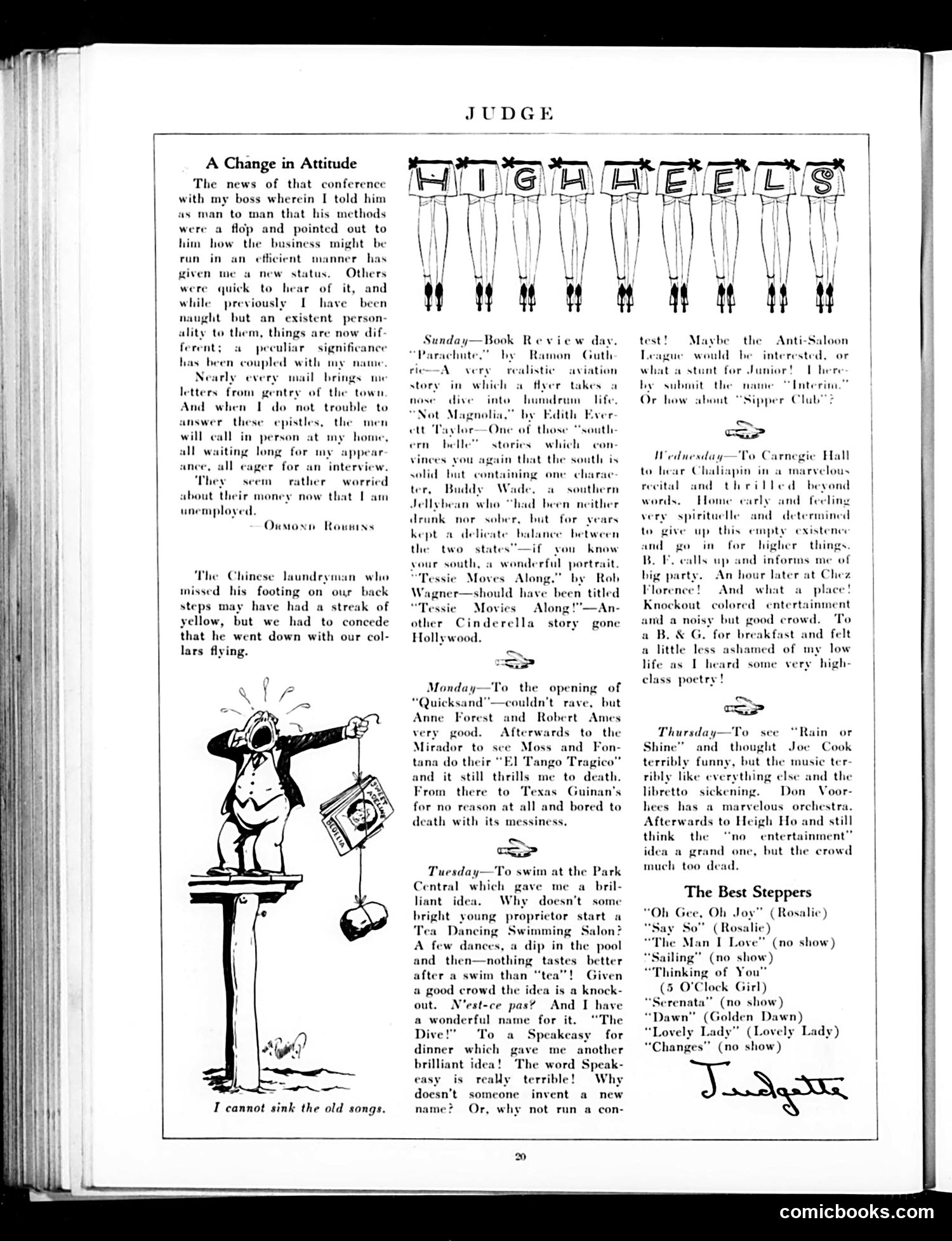
This page features a humorous essay titled "A Change in Attitude" by Osmond Rowntree. The joke: the narrator confidently told his boss that his management methods were ineffective and outlined better approaches. Rather than being fired on the spot, this boldness apparently impressed people around town—now they seek him out constantly, eager for his advice. The punchline: they're all worried about their money now that he's *unemployed*. The satire mocks how people fawn over those perceived as successful or confident, regardless of actual competence. His unemployment doesn't diminish his newfound status among the townspeople. The page also includes entertainment reviews (theater, speakeasies, classical music) and a lighthearted anecdote about a Chinese laundyman falling down stairs while maintaining dignity ("went down with our collars flying"). The illustrations feature a cartoon figure and period advertisements—typical of 1920s Judge magazine's mix of satirical commentary and lifestyle content.
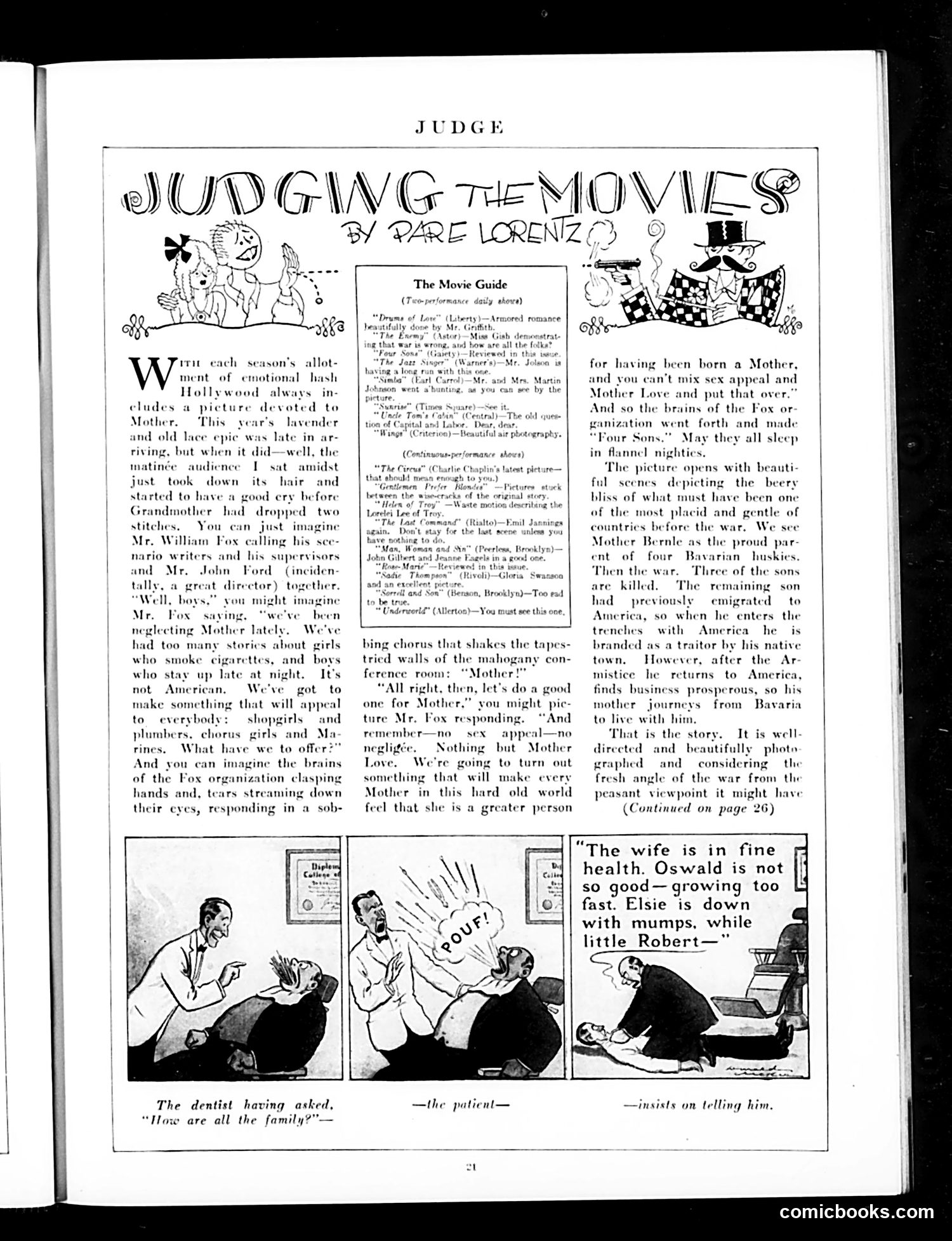
This page satirizes Hollywood's formulaic approach to making emotional "Mother" pictures. Critic Pare Lorenz reviews "Four Sons," a Fox film about a Bavarian mother and her sons during WWI—typical of the sentimental melodramas studios churned out annually. The satire mocks how studio executives (William Fox and director John Ford are named) cynically manufacture tear-jerking content, imagining them in a conference room deciding: "We've neglected Mother lately. Let's make something with NO sex appeal, just pure emotion to appeal to everybody." Lorenz describes the plot: a mother loses sons to war; one emigrates to America and is branded a traitor before returning. He acknowledges the film's technical quality but criticizes its predictable sentimentality. The bottom comic strip shows a dentist asking about a patient's family health, the patient launching into complaints—a joke about people's tendency to overshare medical complaints with their doctor, regardless of whether asked for details.
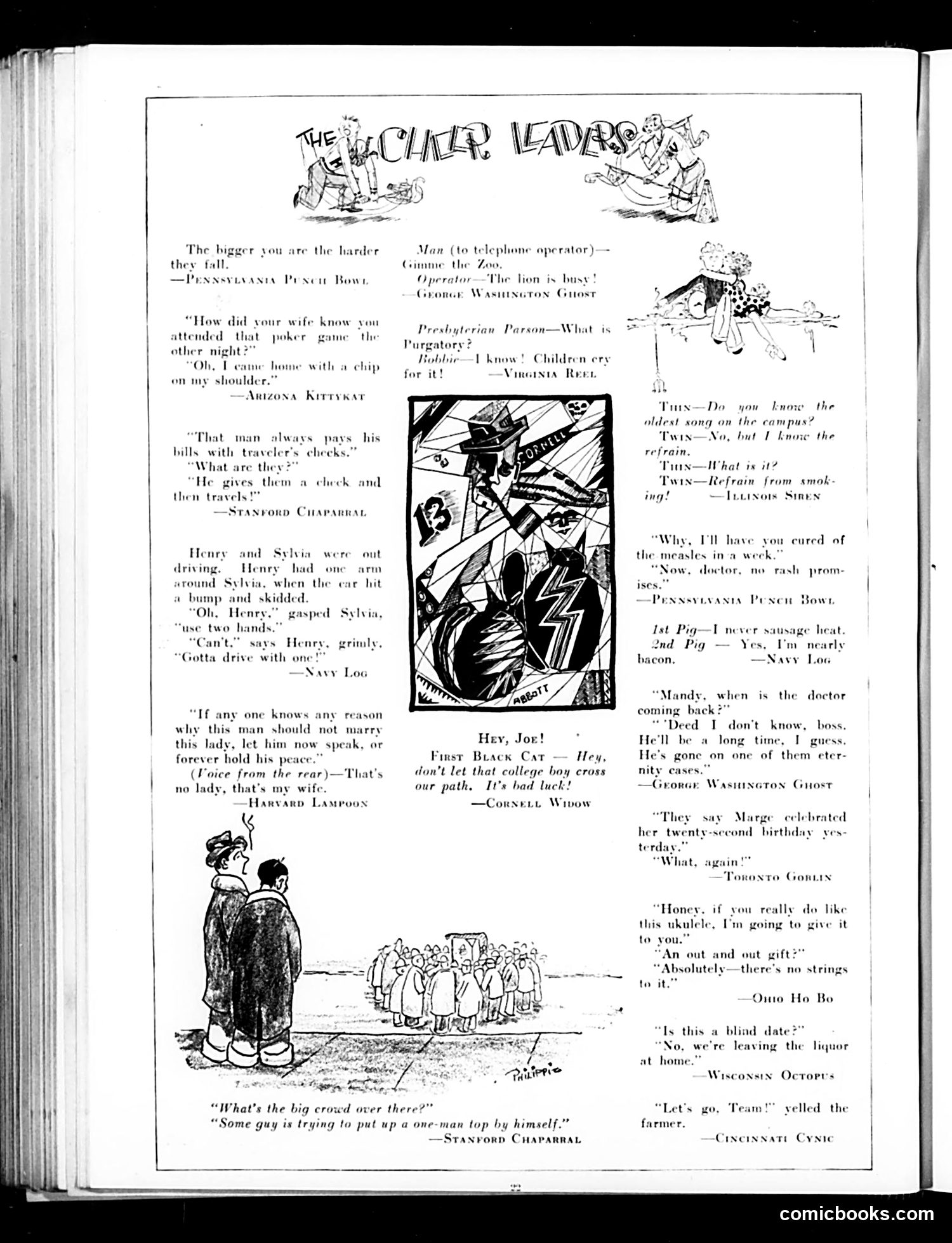
This page collects brief jokes and witticisms attributed to various American regional stereotypes and character types (Pennsylvania Dutch, Arizona, Stanford students, Navy personnel, etc.), a common Judge format. The humor relies on wordplay and domestic situations: a man caught at poker explains a "chip on his shoulder"; a traveler's checks joke; a motorcar accident joke. Several jokes target marriage and gender relations ("that's my wife," not a lady). One features an Irish caricature and a Black cat (superstition gag). Others play on homophonic puns ("sausage heat/bacon" for pig characters). The central cartoon depicts a crowd gathering around someone attempting solo acrobatics, captioned with a Stanford Chaparral joke. The page's satire is largely **social observation** rather than political—gentle ribbing of American types, courtship follies, and urban/rural contrasts. The attributed sources (college humor magazines, regional papers) suggest this was recycled collegiate humor.
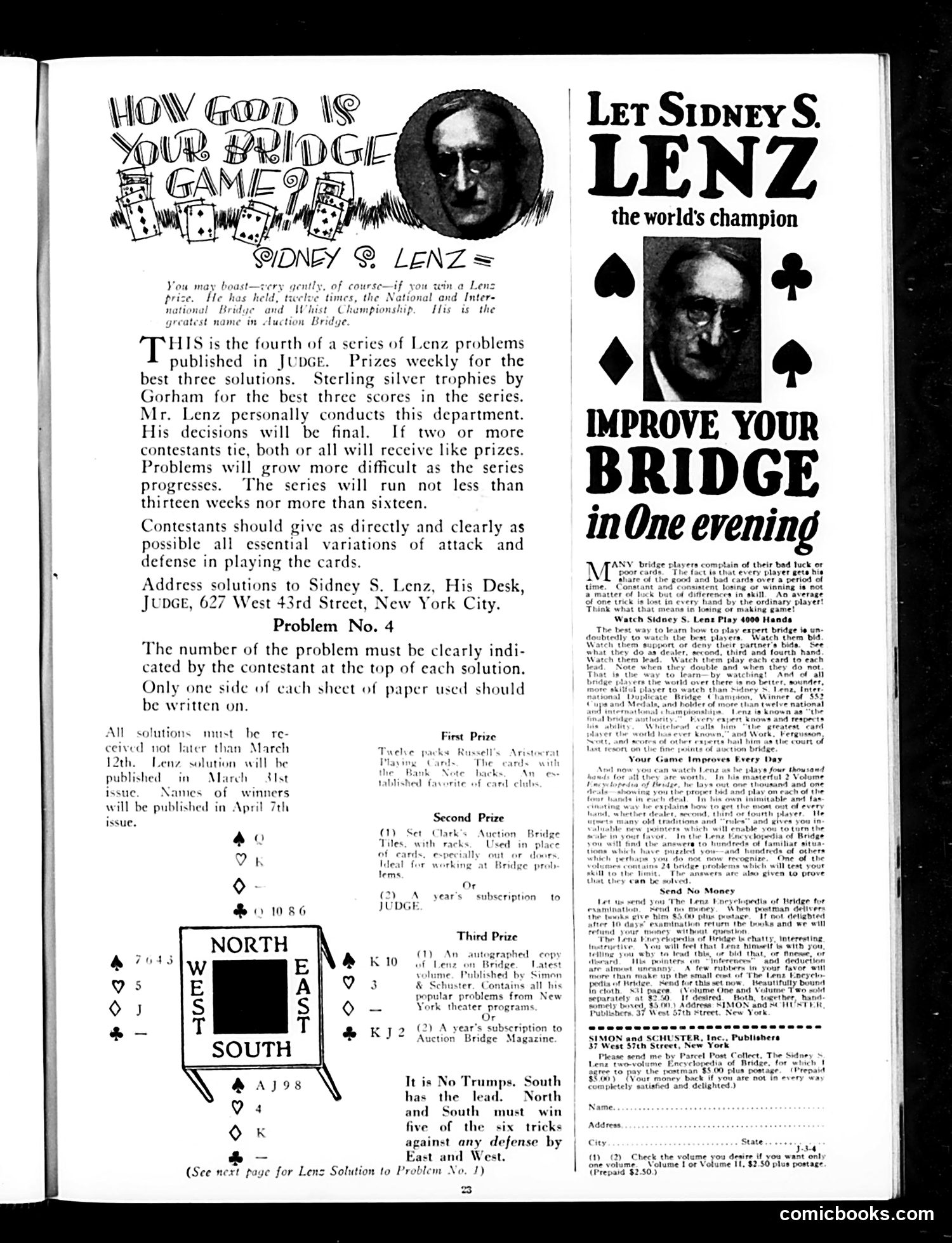
This page from *Judge* combines a bridge card game problem with advertising for Sidney S. Lenz, presented as "the world's champion" of auction bridge—a popular card game of the era. **The Content:** The main feature is "Problem No. 4" in a series where readers submit solutions to bridge scenarios for prizes (silver trophies by Gorham). Lenz personally judges entries. The specific hand shown requires North-South to win five of six tricks with no trump suit. **The Advertisement:** The right side promotes Lenz's instructional materials: a two-volume book published by Simon & Schuster containing his "popular problems from New York theater programs," and subscriptions to bridge magazines. The ad claims studying Lenz's 4,000 hands will dramatically improve average players' game. **Social Context:** Bridge was enormously popular among educated, middle-class Americans in the 1920s-30s. Lenz was a genuine bridge celebrity. This page exploits his fame to drive subscriptions and book sales while *Judge* builds readership through competitive problem-solving—a common editorial strategy combining entertainment with commerce.
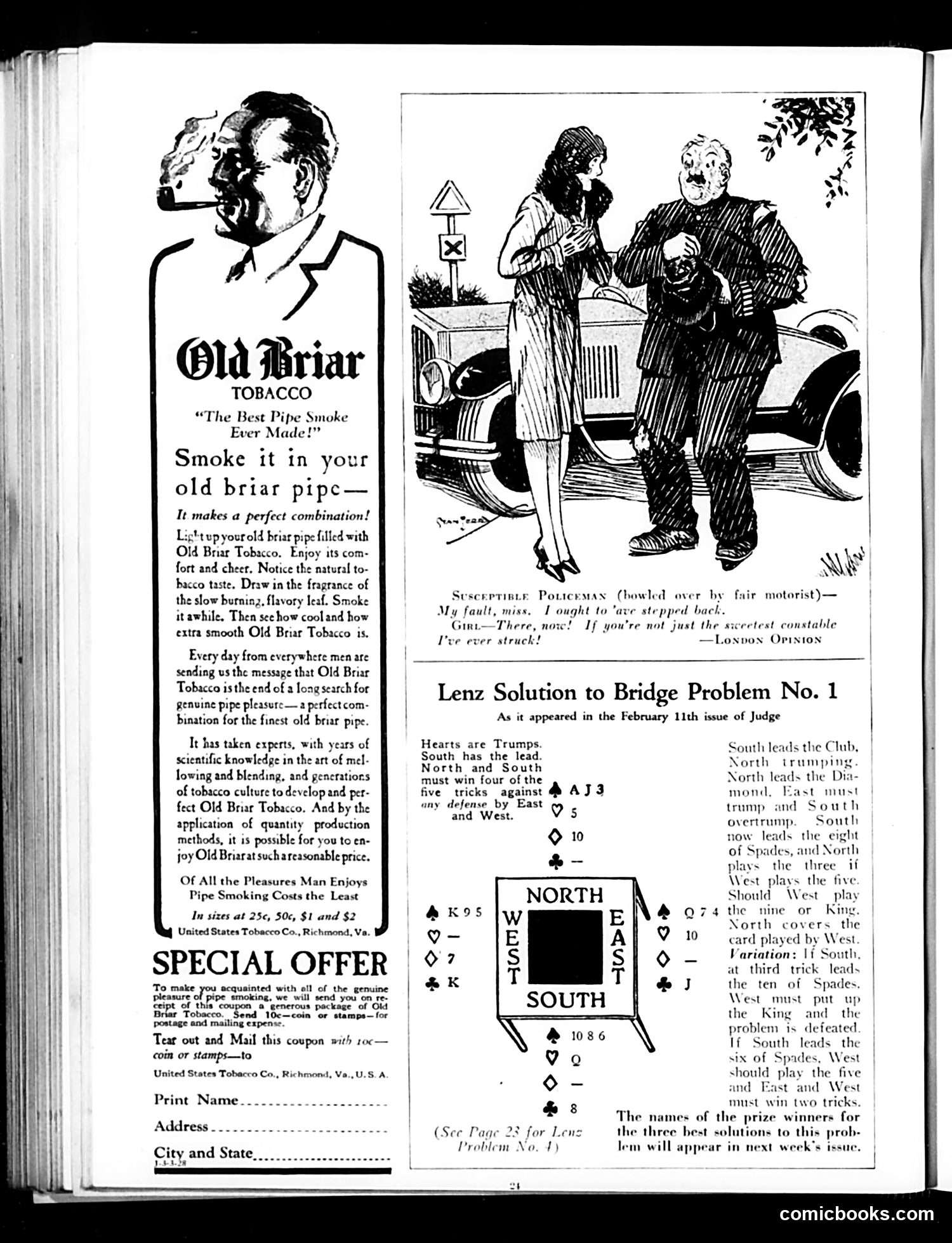
This page is primarily **advertising and puzzle content** rather than political satire. The main cartoon shows a "Susceptible Policeman" being charmed by a young woman after a minor traffic incident—a gentle social humor piece about flirtation undermining authority, reflecting period attitudes about gender and propriety. The bulk of the page is devoted to: 1. **Old Briar Tobacco advertisement** (left side)—a standard commercial promoting pipe tobacco as an affordable, quality pleasure for men 2. **Bridge card game puzzle** (right side)—a technical problem for readers to solve, with solutions to be published the following week This appears to be a typical early 20th-century magazine page mixing light humor, advertising revenue, and reader engagement puzzles. There is no clear political commentary or satirical content visible—the "Judge" brand here functions more as general entertainment than hard-hitting satire.
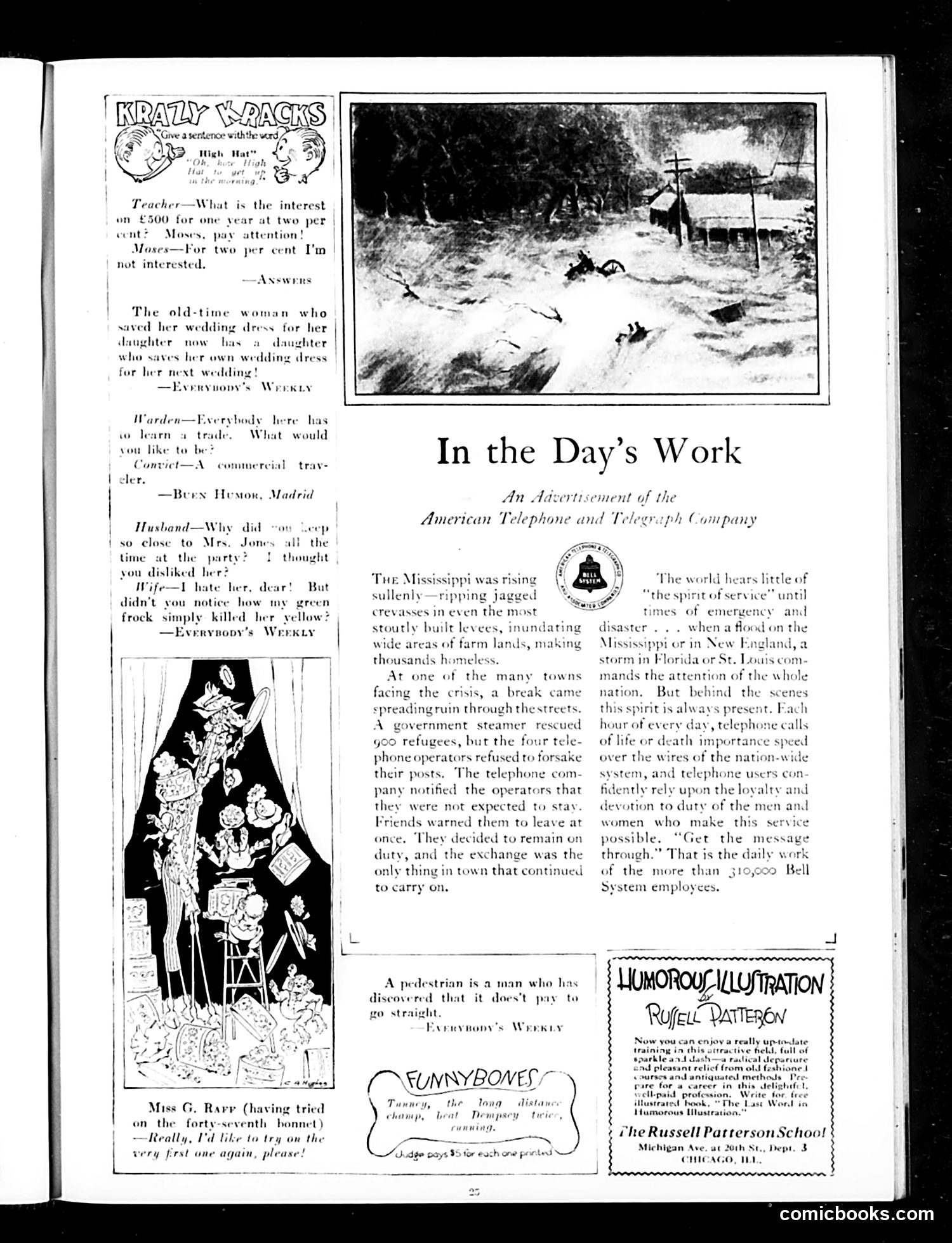
This page contains **humorous "Krazy Knacks" jokes** (left column) mocking various social types: a disinterested student, a woman marrying off multiple daughters, a prisoner, and a woman obsessed with bonnets. The humor relies on period stereotypes and wordplay. The main content is **"In the Day's Work,"** an advertisement for American Telephone and Telegraph Company. It presents a heroic narrative: during the Mississippi River flooding crisis, four female telephone operators refused to abandon their posts despite evacuation orders, keeping communication lines operational. The ad celebrates their patriotic "spirit of service." This reflects early-20th-century corporate PR, framing workers (specifically women) as noble public servants. The accompanying image shows flood destruction—reinforcing the "emergency" justifying the narrative. The page also includes period **advertising** for Russell Patterson's illustration school and a joke about pedestrians, typical of Judge's satirical format.
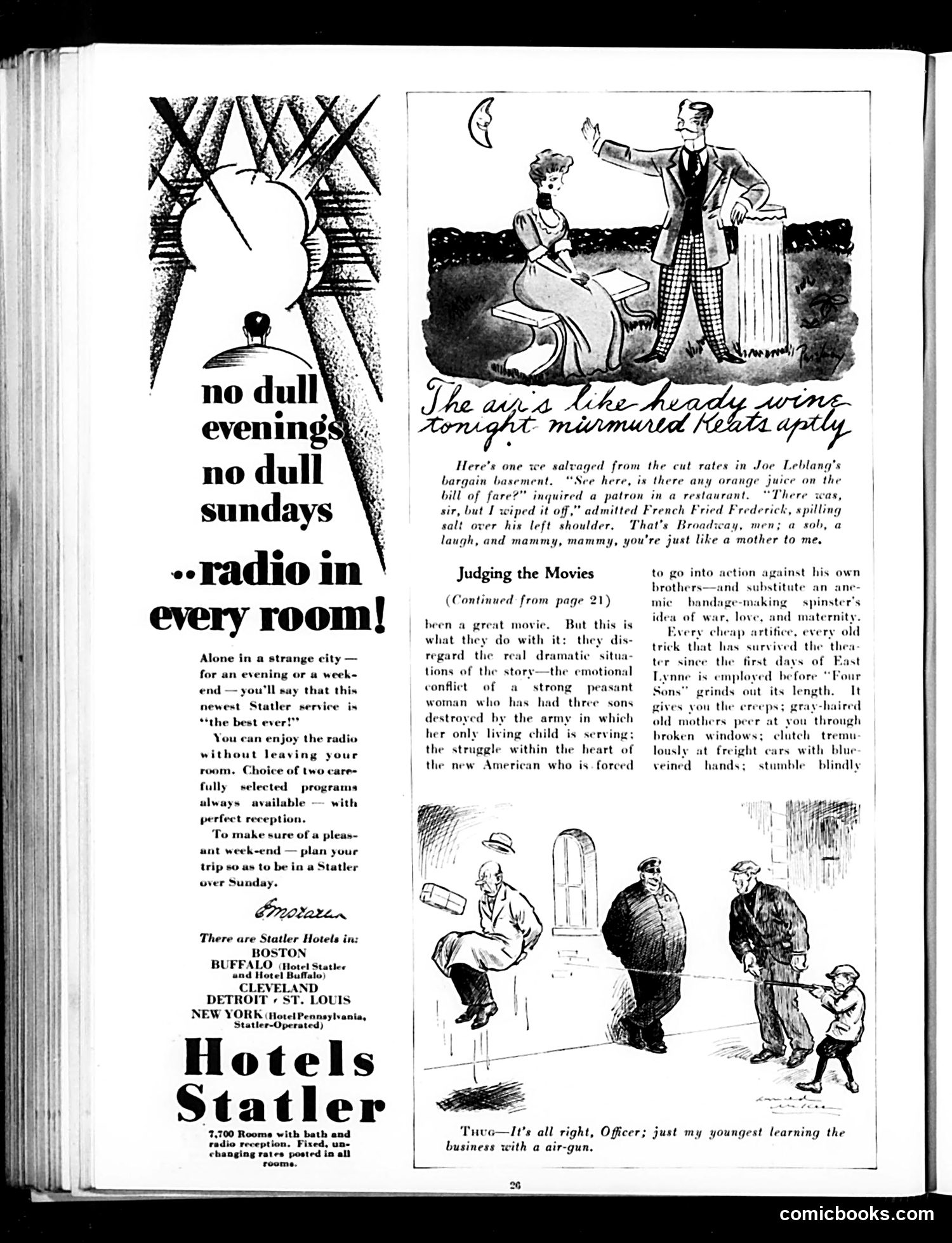
This page contains primarily **advertising and entertainment content** rather than political satire. The left side features a **Statler Hotels advertisement** promoting radio reception in guest rooms—a modern luxury amenity for 1920s-30s travelers. The pitch emphasizes convenience for business travelers and tourists. The right side contains two unrelated pieces: 1. **"The Airs Like Heady Wine Tonight"**—a Broadway humor sketch about a cheapskate patron asking about orange juice on the bill of fare at a restaurant, with a waiter's comic anecdote about salt-spilling and sentiment ("you're just like a mother to me"). 2. **"Judging the Movies"** (continued from page 21)—a film criticism section discussing how movies about serious dramatic subjects (a peasant woman losing sons in war) get undermined by theatrical sentimentality and melodrama rather than genuine emotional depth. The bottom cartoon shows police with a child carrying a toy gun, with the caption making light of teaching children weapons. These are entertainment pieces, not political commentary.
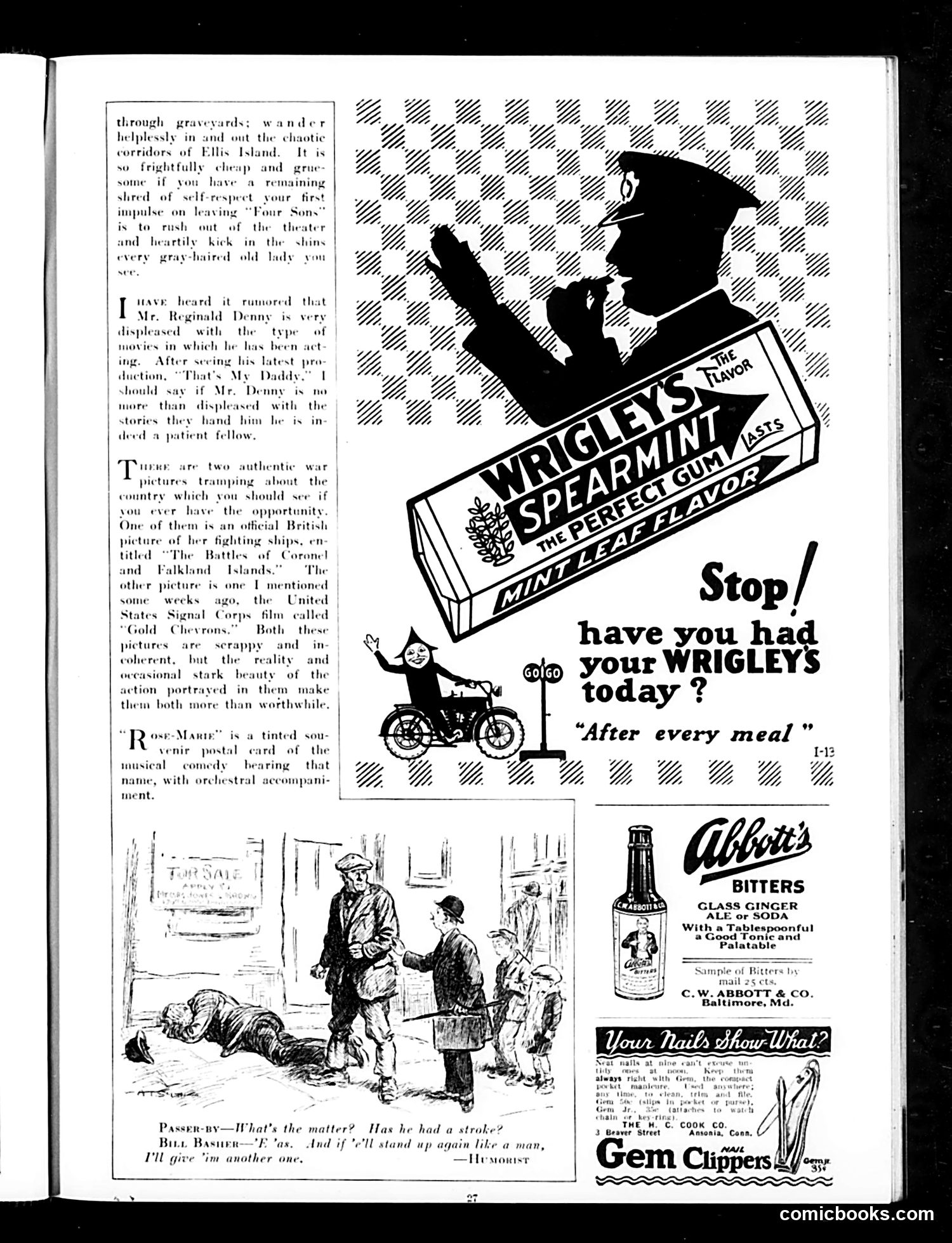
This page from Judge magazine contains film reviews and advertisements typical of the 1920s era. The **cartoon** (bottom left) depicts a street scene with working-class figures—a man lying on the ground and others standing nearby. The caption references a "stroke" (likely a punch), with one figure threatening to give "another one." This appears to be a humorous working-class sketch about a street altercation, drawn in a style common to period humor magazines. The **film reviews** criticize contemporary movies: "Four Sons" is described as melodramatically grim (set in graveyards and Ellis Island), prompting the reviewer to want to "kick in the shins every gray-haired old lady" he sees afterward. Actor Reginald Denny is mocked for appearing in low-quality films like "That's My Daddy." The **advertisements**—Wrigley's spearmint gum, Abbott's Bitters, and Gem Clippers—are standard period product placement, with the famous Wrigley's "After every meal" slogan prominent. The overall page reflects 1920s popular entertainment criticism and consumer culture.
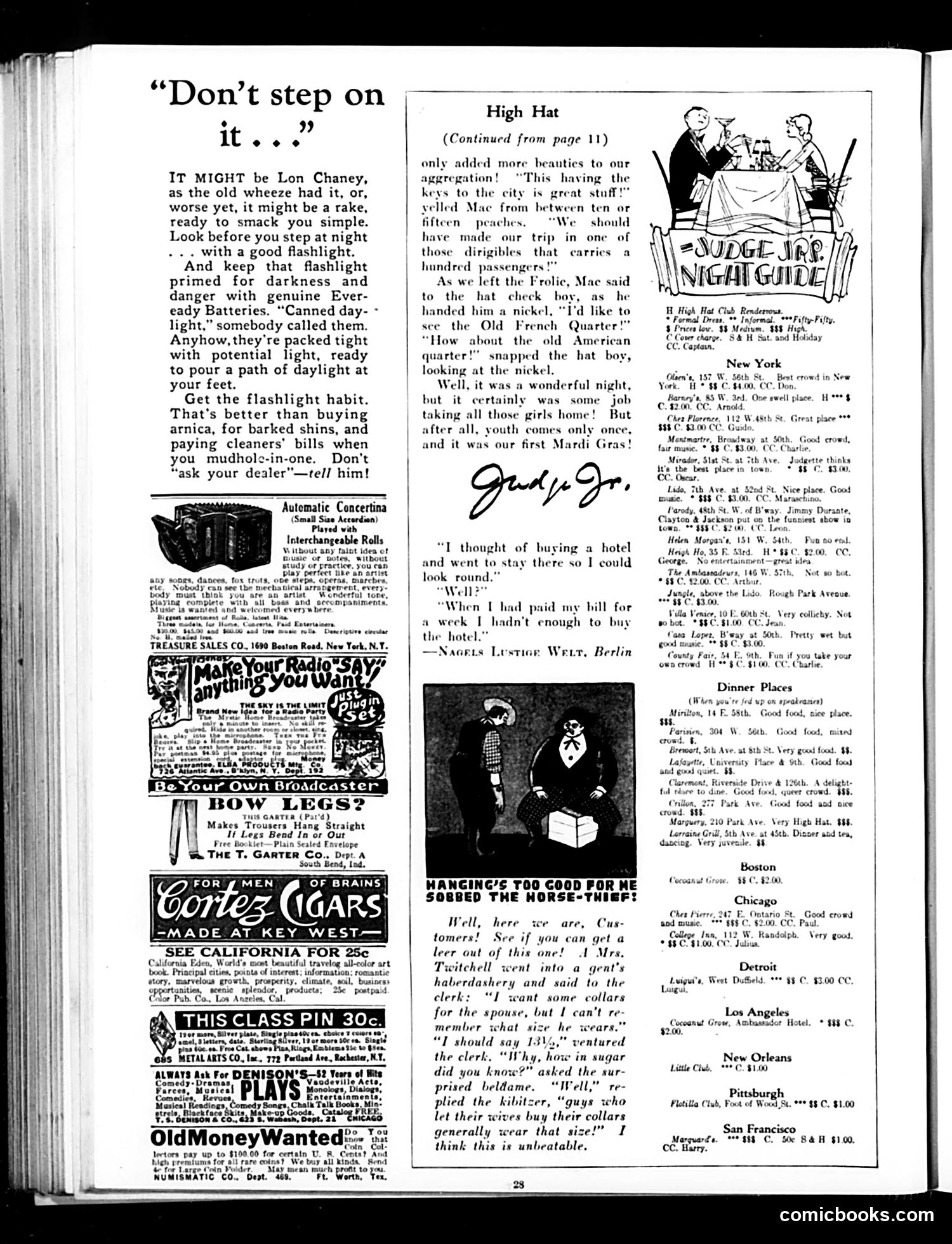
This page from Judge magazine (a satirical weekly) contains primarily **advertisements and reprinted content** rather than new editorial cartoons. The main narrative piece, "High Hat" (continued from page 11), appears to be a humorous short story about a group's visit to New Orleans' Mardi Gras, featuring characters Mac and a hat check boy. The joke about the hat boy's nickel retort—suggesting Americans have nothing valuable—pokes fun at American tipping customs and relative poverty after the 1920s. The sidebar joke about the haberdashery involves a wife buying collars for her husband. The punchline exploits the stereotype that dominated husbands ("guys who let their spouses buy their collars") wear size 13—a crude jab at marital dynamics of the era. The page is otherwise filled with period advertisements: flashlights, accordions, cigars, and coin collecting services—typical commercial content padding Judge's pages during this period.
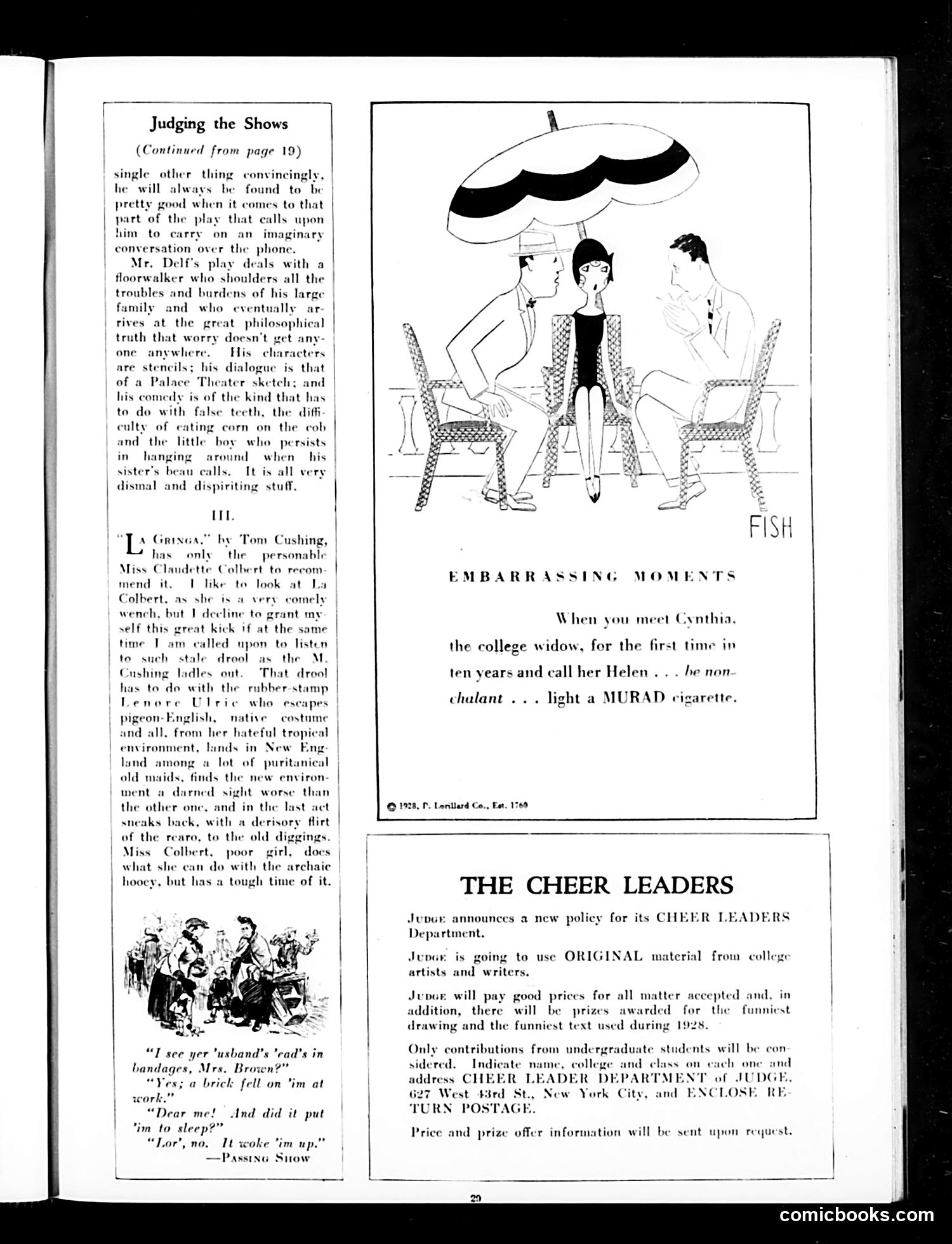
This is primarily a **theater review column** with advertising. The left side critiques three Broadway plays: Mr. Delf's floorwalker comedy (dismissed as crude slapstick about false teeth and corn-eating), Tom Cushing's "La Gringa" (praised only for actress Claudette Colbert, but criticized for relying on tired "pigeon-English" stereotypes about a tropical girl displaced to New England). The **"Fish" cartoon** (upper right) satirizes awkward social situations—specifically the embarrassment of encountering someone after years and mistakenly calling them by the wrong name, then nervously covering with a cigarette. The lower section announces **Judge magazine's "Cheer Leaders" contest**, soliciting original college humor and artwork from undergraduate contributors, with payment and prizes offered. This reflects 1928 entertainment culture: Broadway's reliance on ethnic stereotypes and physical comedy, plus magazines' practice of crowdsourcing collegiate content.
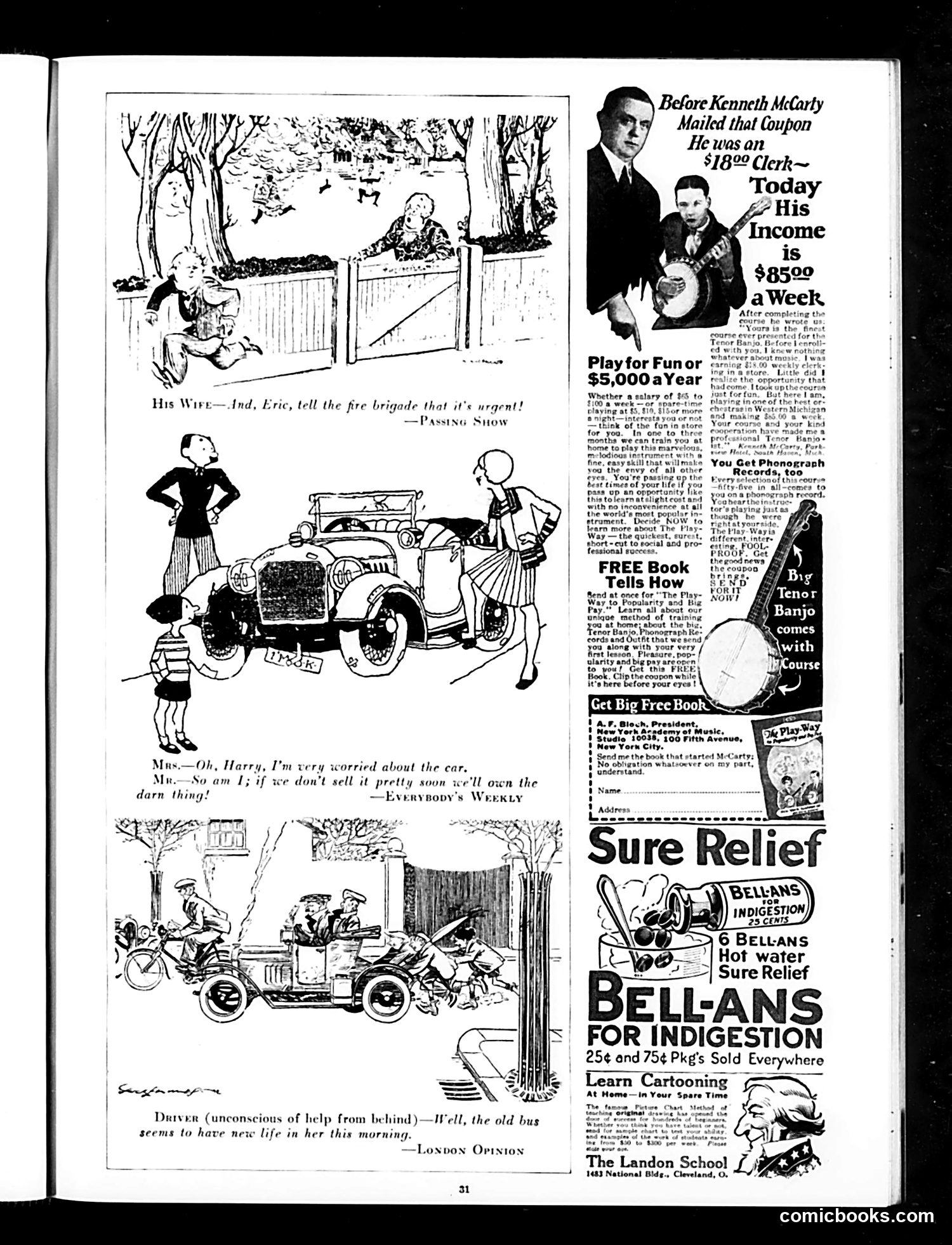
This page from *Judge* magazine contains three separate cartoons satirizing early 20th-century American life: 1. **"Fire Brigade" cartoon (top)**: A couple frantically summons firefighters over an urgent matter—revealed as a minor domestic crisis. The satire mocks overwrought responses to trivial problems. 2. **"The Car" cartoon (middle)**: A husband and wife worry about selling their automobile before they're forced to keep it permanently. This jokes about the financial burden of car ownership during the early auto era, when vehicles were expensive and required constant upkeep. 3. **"Old Bus" cartoon (bottom)**: A driver attributes the car's improved performance to mysterious intervention, unaware that people are literally pushing it from behind. The satire targets either the driver's obliviousness or perhaps mocks the poor reliability of early automobiles. The page also contains numerous advertisements for mail-order courses (tenor banjo lessons, cartooning school) and patent medicines (Bellans for indigestion)—typical of period publications.
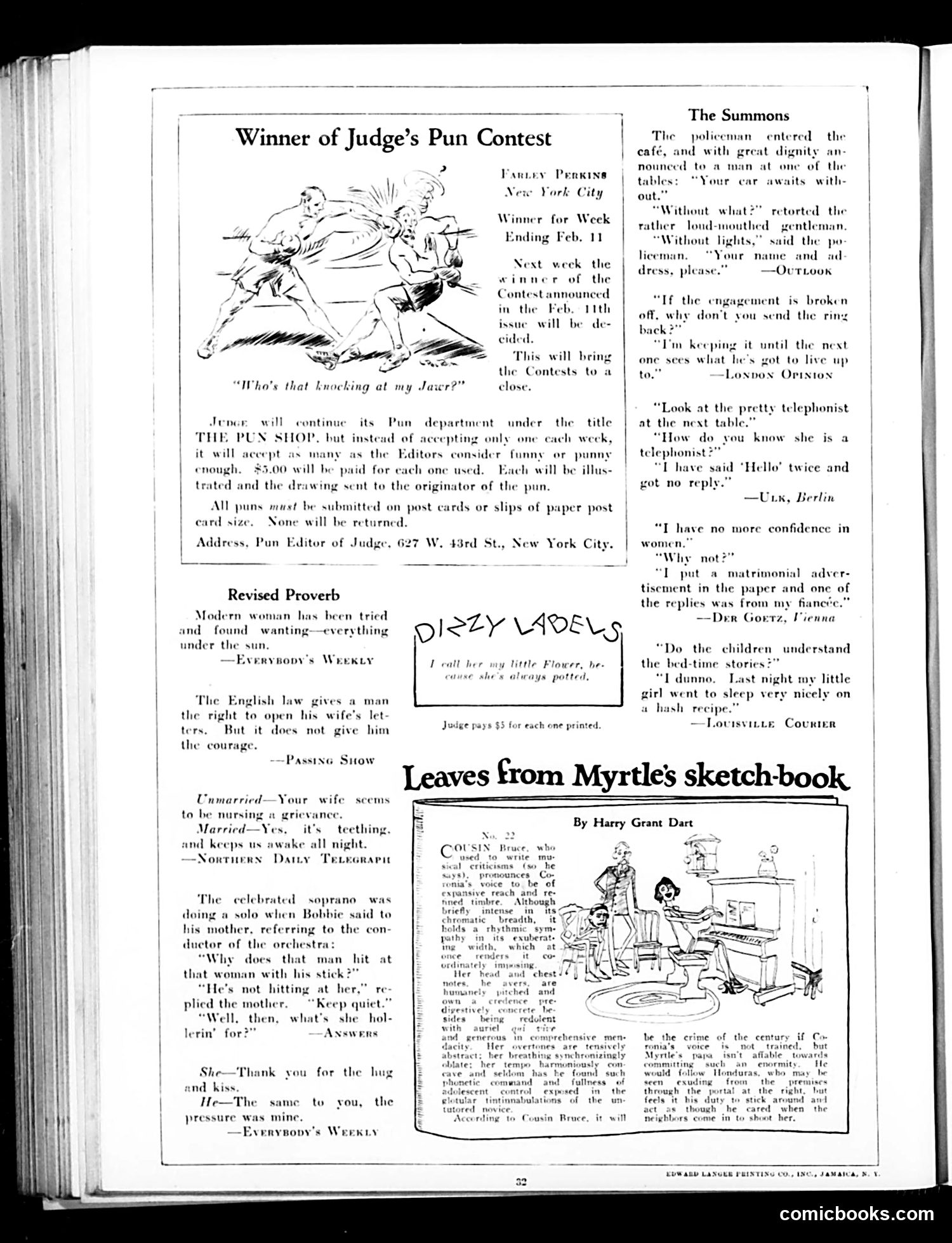
This page from **Judge** (a late-19th/early-20th century American satirical magazine) contains several humor sections: **Main Content:** - A **Pun Contest** announcement with cartoon showing two figures in combat, illustrating the winning pun: "Who's that knocking at my Jaw?"—a visual play on "door" vs. fighting. - **Revised Proverbs:** Short quips mocking modern society, including commentary on women's changing social roles and marriage dynamics. References like "Modern woman has been tried and found wanting—everything under the sun" reflect era anxieties about women's independence. - **Comic anecdotes** about domestic life, romantic misunderstandings, and gender relations typical of period humor. - **"Leaves from Myrtle's Sketch-book":** An illustrated feature depicting social situations with brief commentary on female behavior and relationships. **Context:** The page exemplifies how **Judge** satirized contemporary social changes—particularly shifting gender roles and the emerging "modern woman"—through lighthearted jokes and cartoons aimed at middle-class readers.
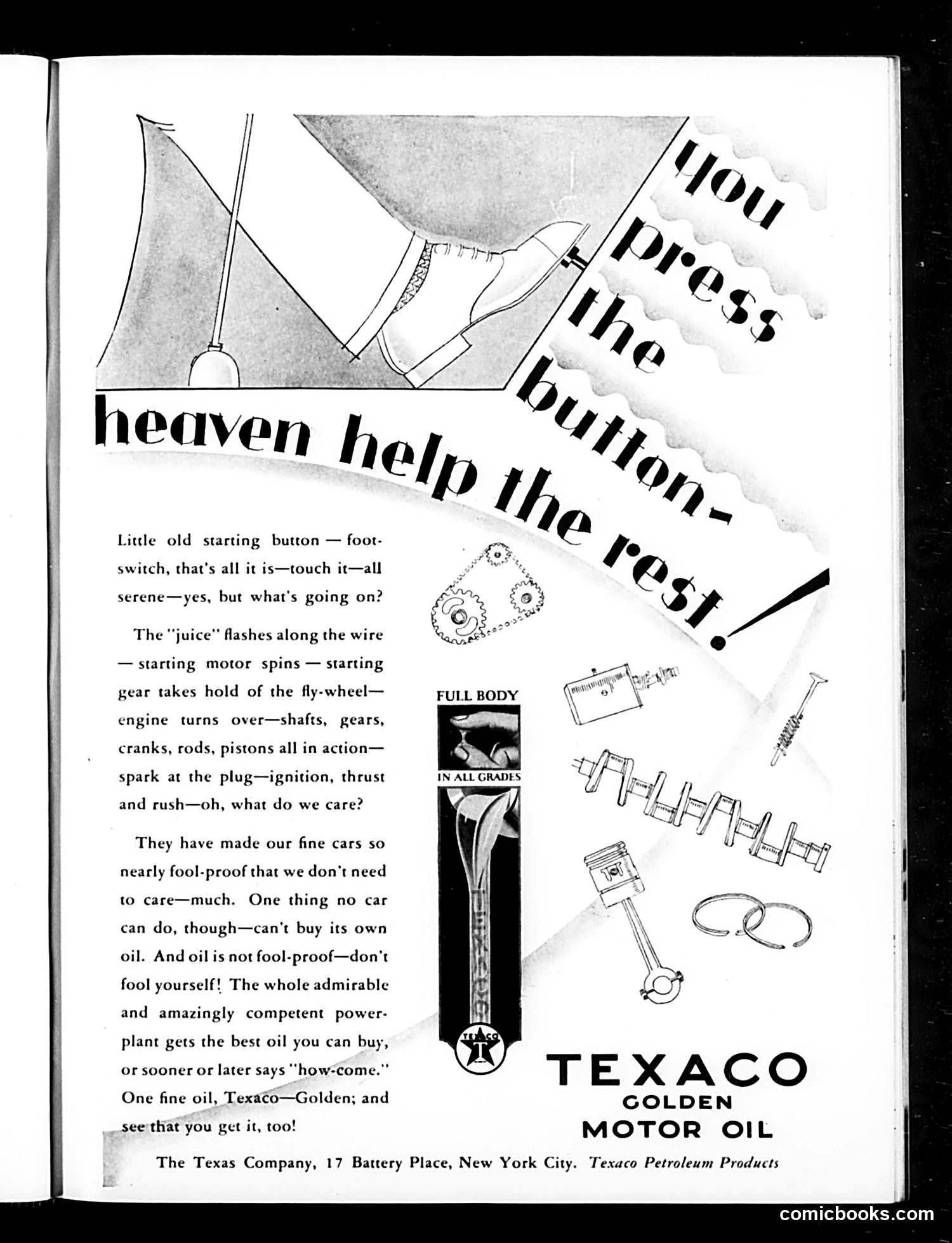
This is primarily a **Texaco motor oil advertisement**, not political satire. The page uses humor to promote Texaco's "Golden" motor oil to car owners. The joke centers on modern automobile convenience: drivers simply press a foot-switch to start their cars without understanding the complex mechanical processes occurring—pistons, gears, cranks, all working automatically. The ad humorously suggests cars have become "nearly fool-proof." However, the satire's point is that while cars are mechanically sophisticated and require minimal driver knowledge, **one thing remains critical and non-negotiable: quality oil**. The ad warns against false economy, arguing that even the best-engineered engine will fail without proper lubrication. The accompanying technical illustrations (crankshaft, pistons, cylinders, valve mechanisms) reinforce that engine complexity demands premium oil protection. The tone is tongue-in-cheek: don't be fooled by your car's apparent simplicity—use Texaco Golden Motor Oil or face mechanical failure.
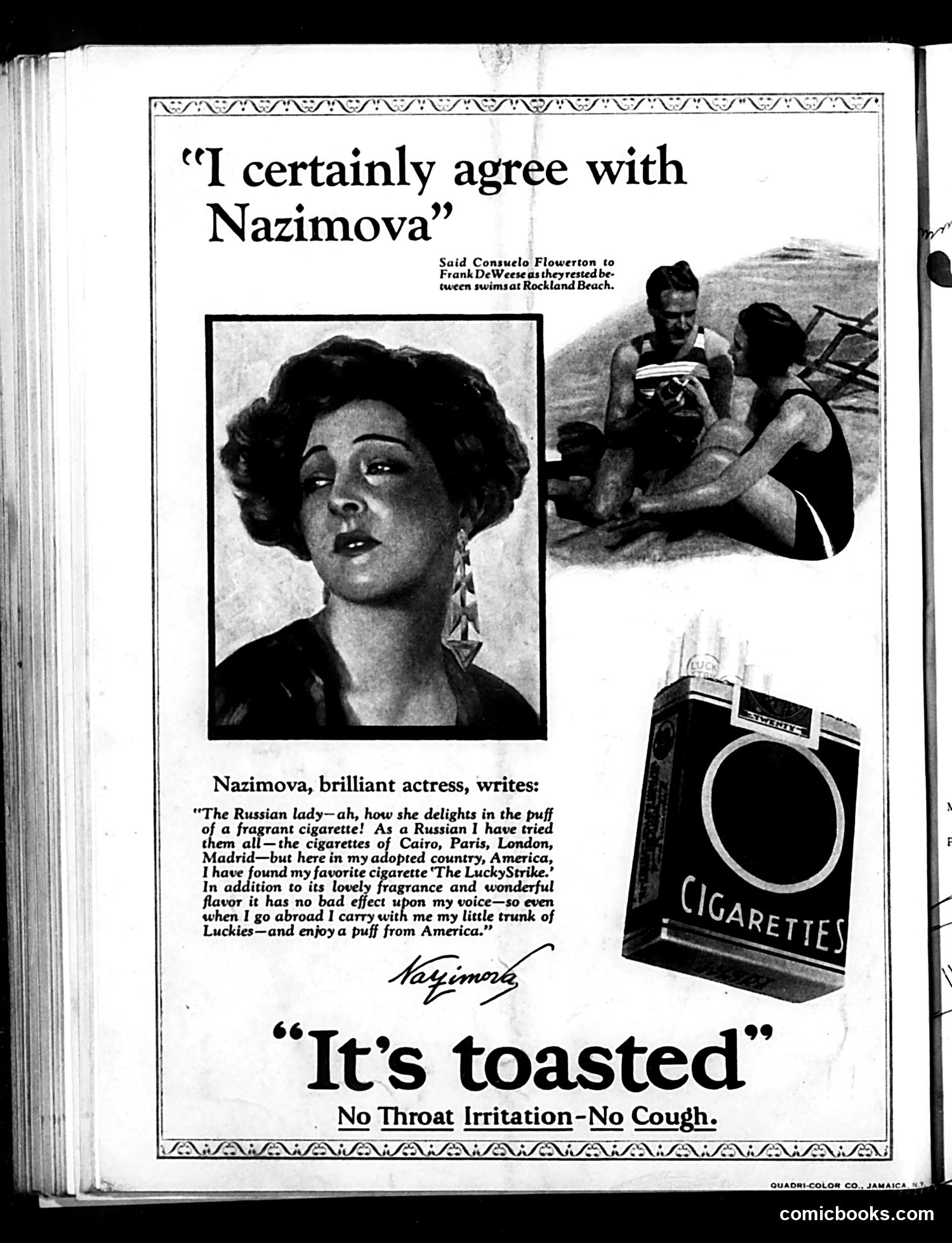
This is a **cigarette advertisement**, not political satire. It features actress **Alla Nazimova**, a prominent Russian-American silent film star of the 1920s, endorsing Lucky Strike cigarettes. The ad uses a common advertising strategy of the era: celebrity testimonial. Nazimova's quote emphasizes that Lucky Strikes are superior to cigarettes from major European cities (Cairo, Paris, London, Madrid) and claims they won't harm her voice—a key selling point for performers. The framing device shows "Consuelo Flowerton" and "Frank DeWeese" at a beach agreeing with Nazimova's endorsement, suggesting ordinary people validate the celebrity's opinion. The slogan **"It's toasted"** and promise of "No Throat Irritation—No Cough" represent typical health claims cigarette companies made before the dangers were publicly acknowledged. This reflects early-20th-century advertising before tobacco regulation.