
A complete issue · 36 pages · 1927
Judge — October 8, 1927
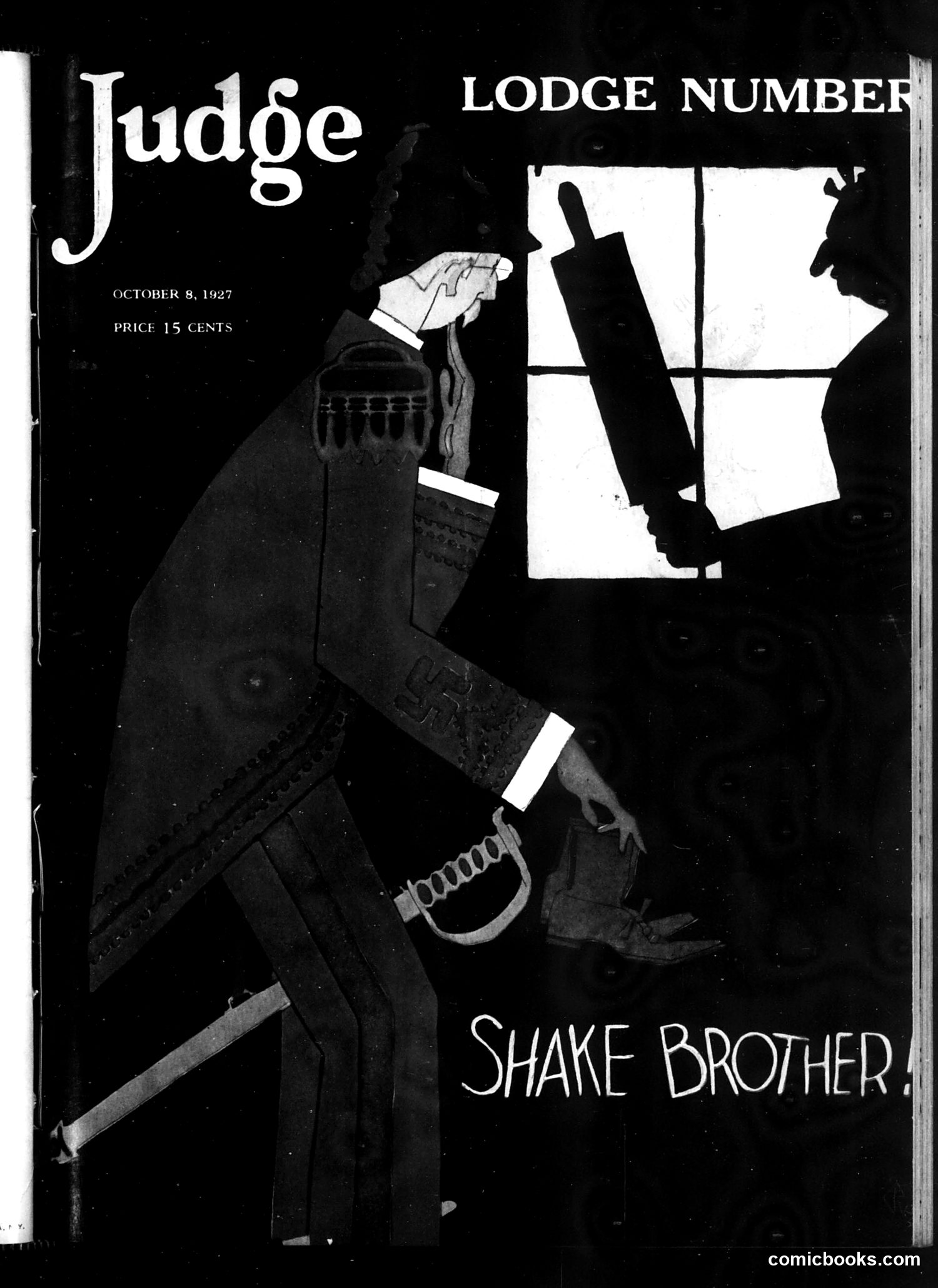
This appears to be a satirical illustration about Freemasonry, given the visible Masonic symbol (swastika-like emblem) on the figure's clothing. The silhouetted scene shows two figures in what seems to be a clandestine meeting—one peering through a window while another figure inside performs what appears to be a Masonic handshake or gesture. The title "Shake Brother" references the secret handshakes central to Masonic ritual and recognition. The satire likely mocks either the secretive nature of Masonic societies or contemporary concerns about their hidden influence in American society. In 1927, anti-Masonic sentiment and conspiracy theories about secret societies were circulating in American popular culture, making this a timely subject for Judge's satirical commentary.
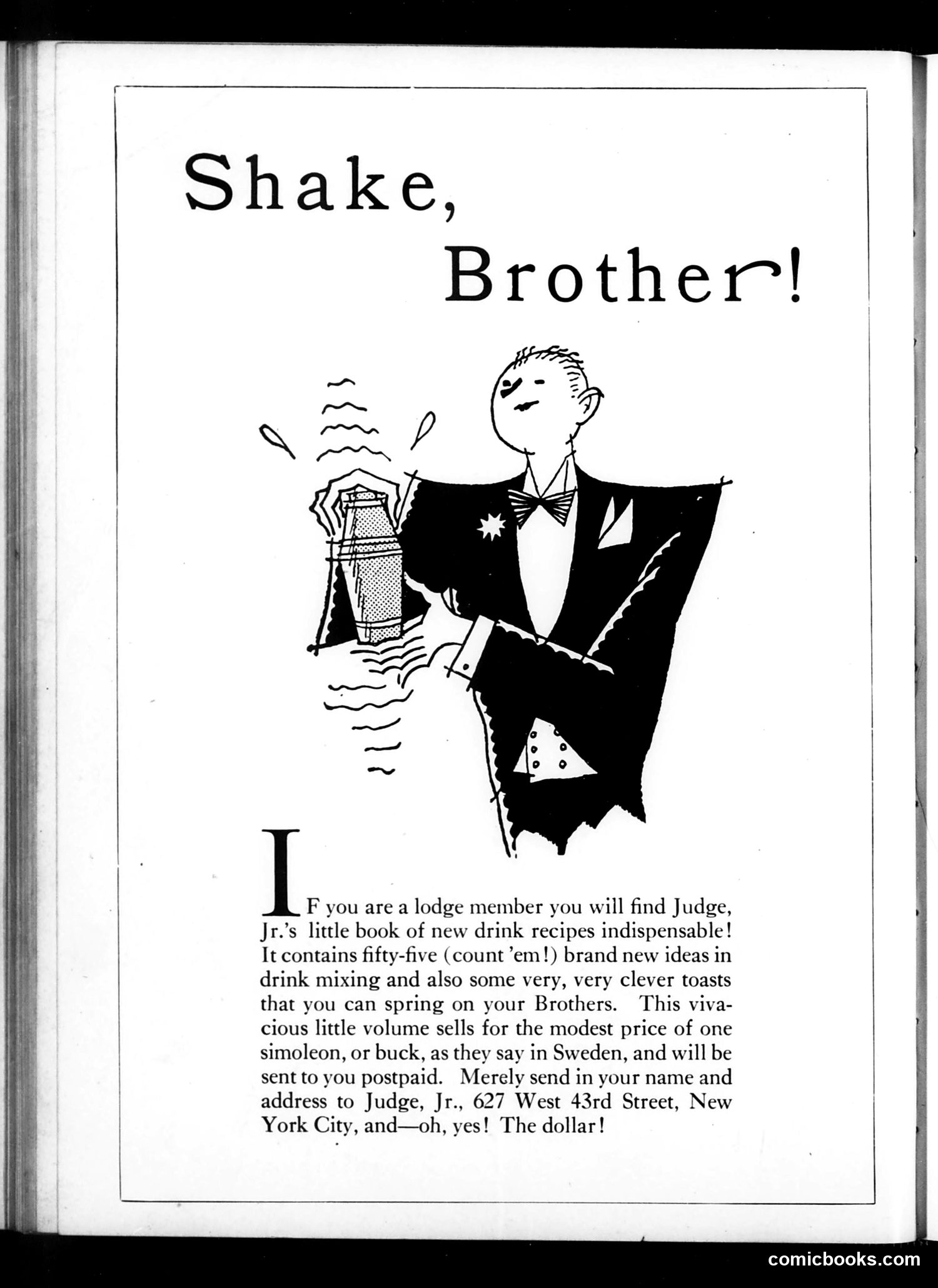
This page is primarily an **advertisement**, not political satire. The illustration shows a man in formal attire (tuxedo, bow tie) shaking a cocktail shaker, addressing the reader as "Brother!" The ad promotes **Judge Jr.'s drink recipe book** — a collection of 55 cocktail recipes and humorous toasts targeting lodge members (fraternal organizations). The copywriting emphasizes the book's modest price ("one simoleon, or buck") and includes a casual reference to Swedish slang, suggesting cosmopolitan sophistication. The cartoon's "Brother" address appeals to fraternal lodge culture, which was prominent in early 20th-century American social life. The stylized illustration is typical of Judge magazine's aesthetic. This is fundamentally a **commercial promotion** rather than political commentary, reflecting the era's social drinking culture among organized fraternity groups.
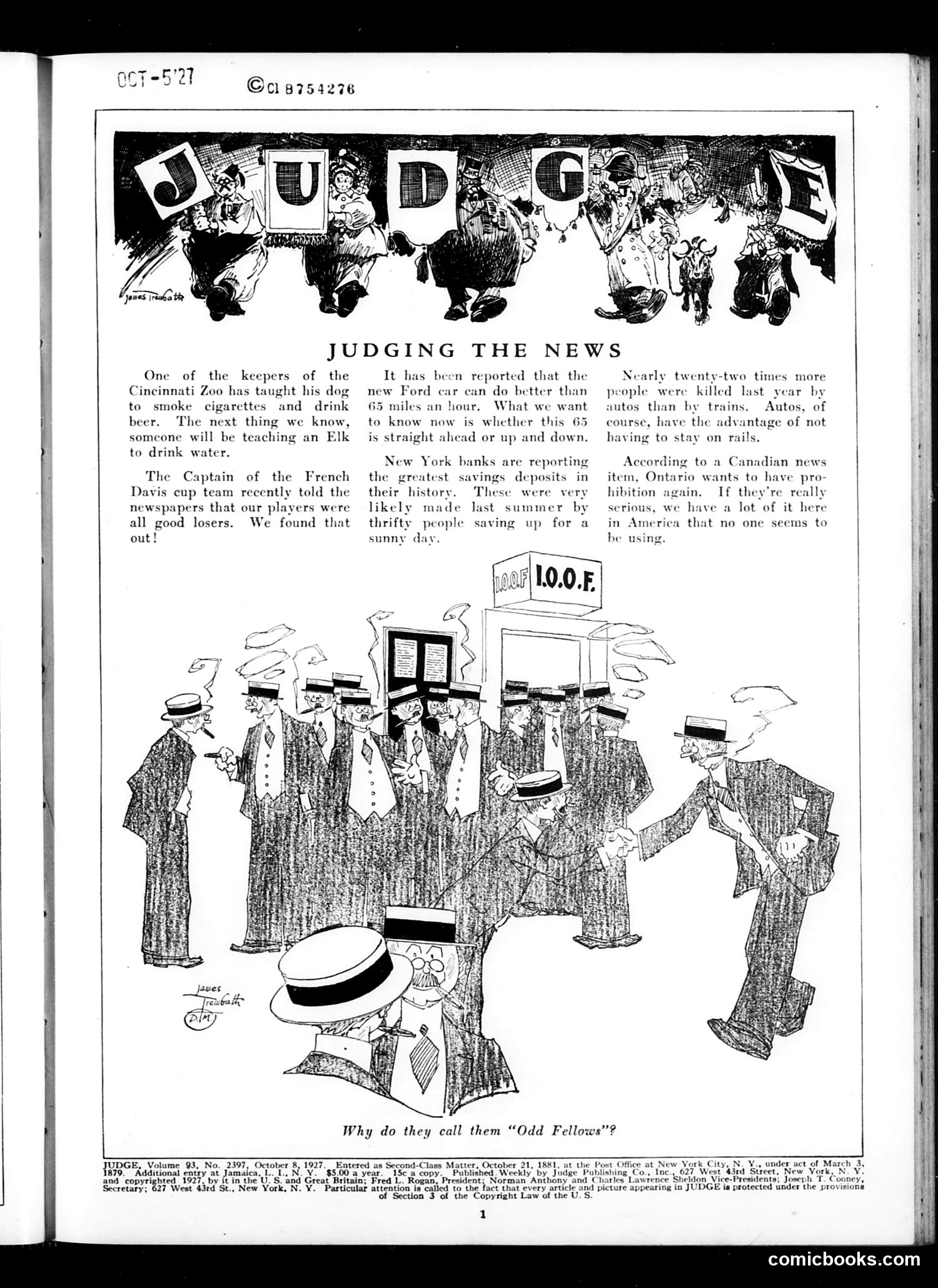
This page satirizes news stories through brief commentary and a cartoon titled "Why do they call them 'Odd Fellows'?" The main cartoon depicts men in formal attire gathered around an I.O.O.F. (Independent Order of Odd Fellows) lodge building. The joke appears to mock the fraternal organization's name by showing these formally-dressed men as genuinely "odd"—the cartoon uses visual humor to suggest the members themselves justify the organization's peculiar name. The text column comments on lighter news items: a Cincinnati Zoo dog learning to drink beer, a French naval team's poor sports performance, Ford automobiles' speed capabilities, auto fatality statistics compared to trains, New York bank savings deposits, and Canadian prohibition debates. The satire is gentle and observational rather than biting political commentary.
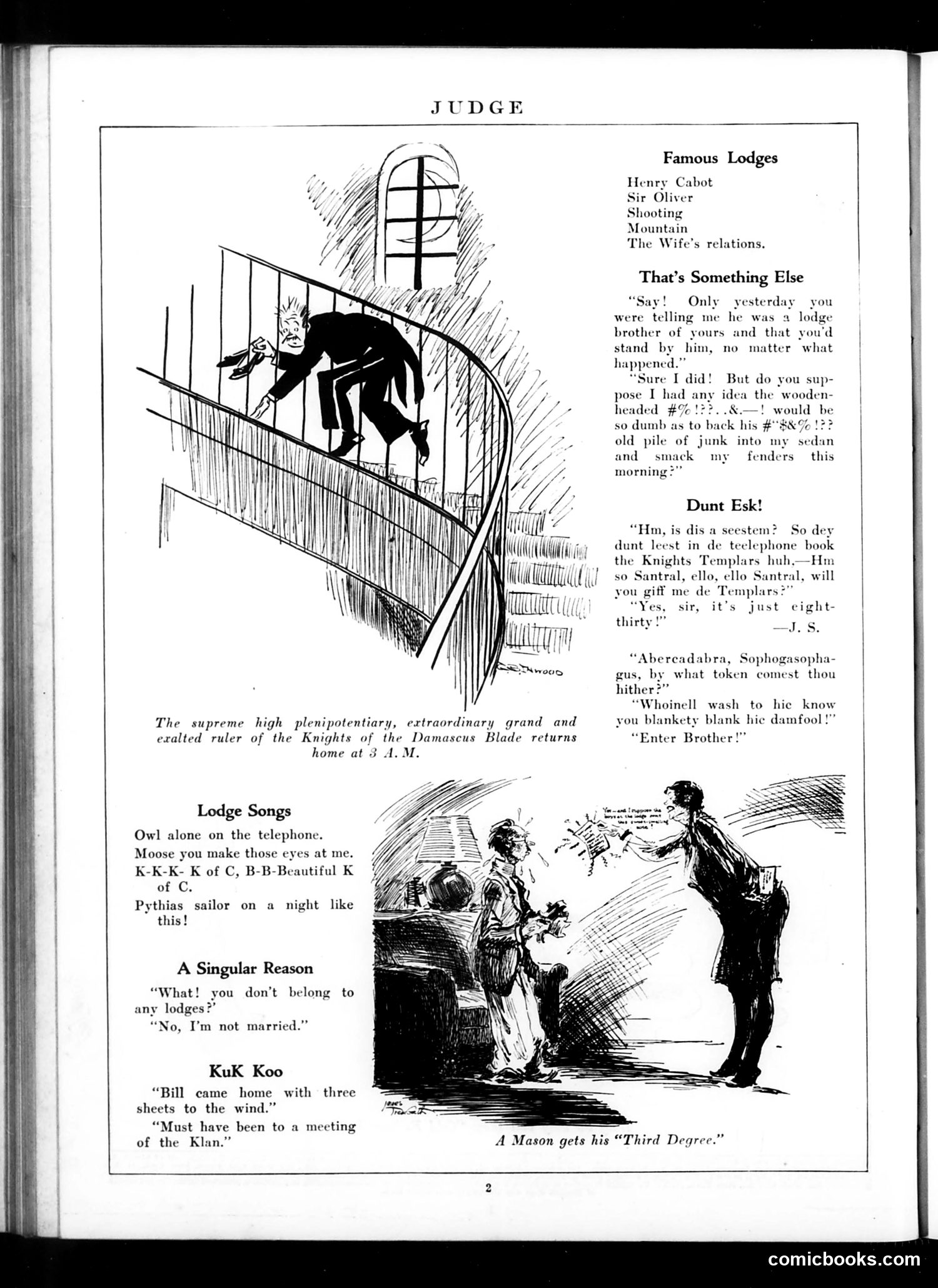
This page contains satirical humor pieces and illustrations mocking fraternal organizations and secret societies. **Top illustration**: Shows a man tumbling down stairs at 3 A.M., captioned as "The supreme high plenipotentiary...ruler of the Knights of the Damascus Blade returns home." This mocks elaborate fraternal lodge titles and implies members engage in frivolous nighttime activities. **Right column**: Multiple short jokes reference lodge life—"Famous Lodges," "Lodge Songs," and "A Singular Reason" (suggesting non-married men join lodges). The "KuK Koo" section jokes about lodge meetings. **Bottom illustration**: Titled "A Mason gets his 'Third Degree'"—shows a Masonic initiation ceremony being mocked. The overall satirical thrust criticizes fraternal organizations (particularly Masons and other secret societies) as pretentious, exclusionary, and providing escapism for men.
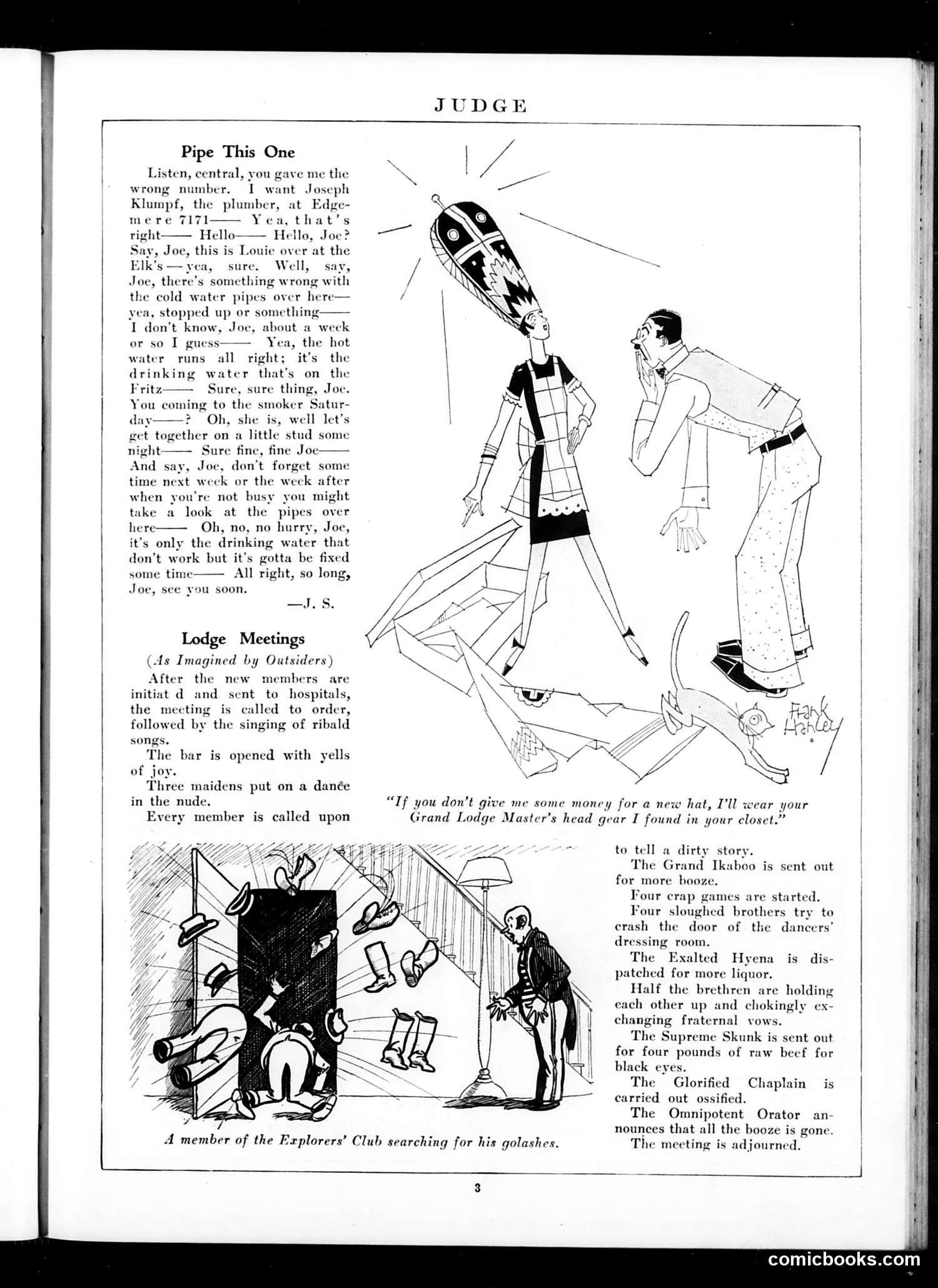
This page from *Judge* contains two humorous pieces: **"Pipe This One"** depicts a comedic phone conversation between plumbers arranging service. The joke relies on mistaken phone numbers and confusion—a relatable everyday scenario made funny through dialogue. **"Lodge Meetings (As Imagined by Outsiders)"** satirizes fraternal organizations' secret rituals and hazing practices. The cartoons mock what outsiders imagined happened at lodge meetings: the top illustration shows apparent chaos with pipe-wielding figures, while the bottom shows members in ridiculous costumes searching for "golashes." The accompanying text lists absurd "lodge activities" (the "Grand Ikaboo," various pranks, and outlandish officers). The satire pokes fun at the mystery and supposed absurdity of fraternal lodge culture, which was widespread and culturally significant in early-20th-century America.
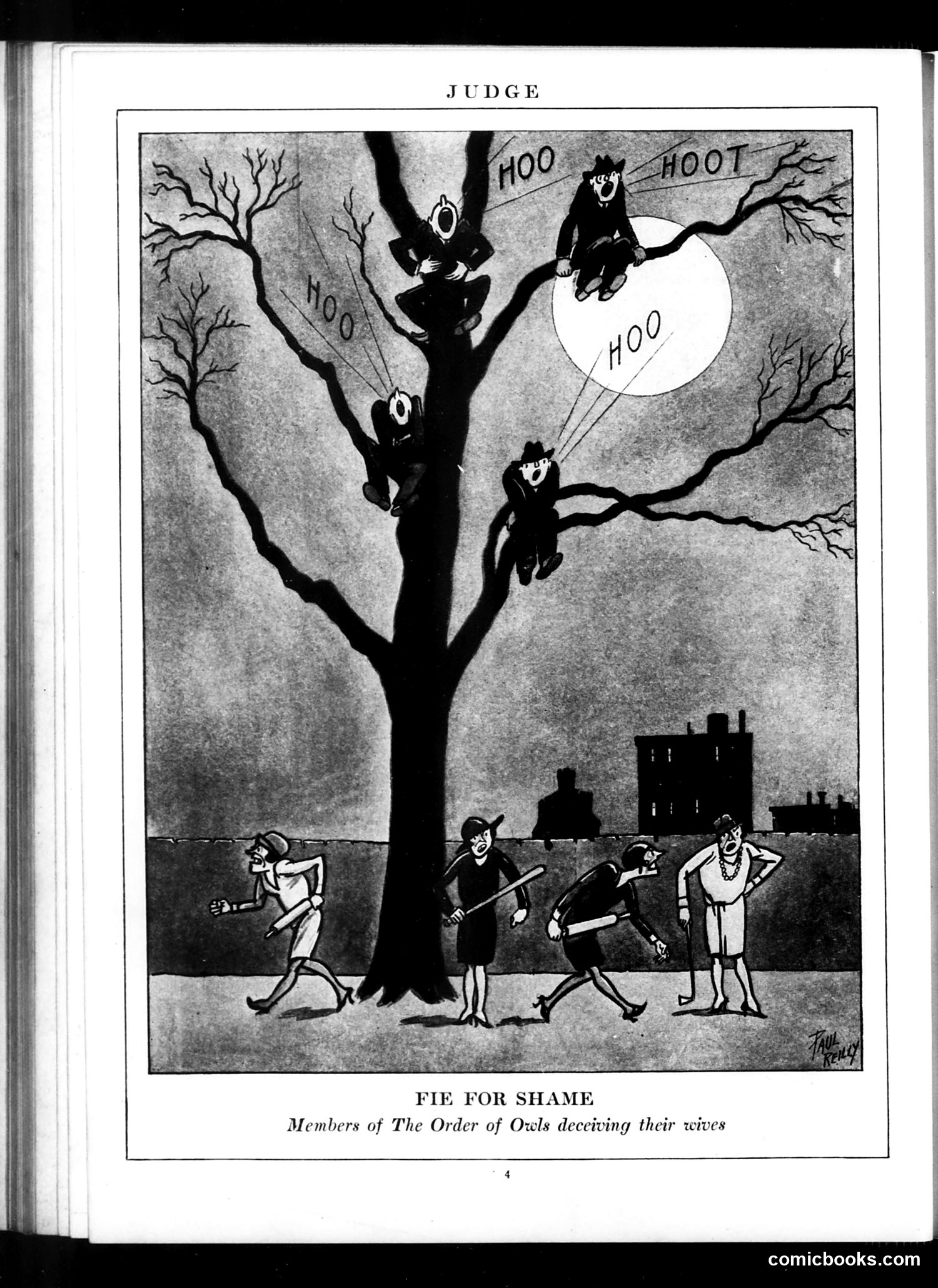
This satirical cartoon mocks "The Order of Owls," apparently a fraternal organization or men's club. The image shows men in the bare tree at night—their silhouettes visible—making owl hoots ("hoo hoot") while their wives stand below, seemingly unaware or fooled by the deception. The satire targets husbands using fraternal lodge membership as cover for nighttime activities away from home. The "owls" pun (nocturnal creatures making owl calls) reinforces the deception: men pretending their absences are innocent fraternal gatherings when the cartoon suggests otherwise. The wives' presence below emphasizes the domestic deception at the cartoon's heart—men hiding their true whereabouts behind club membership.
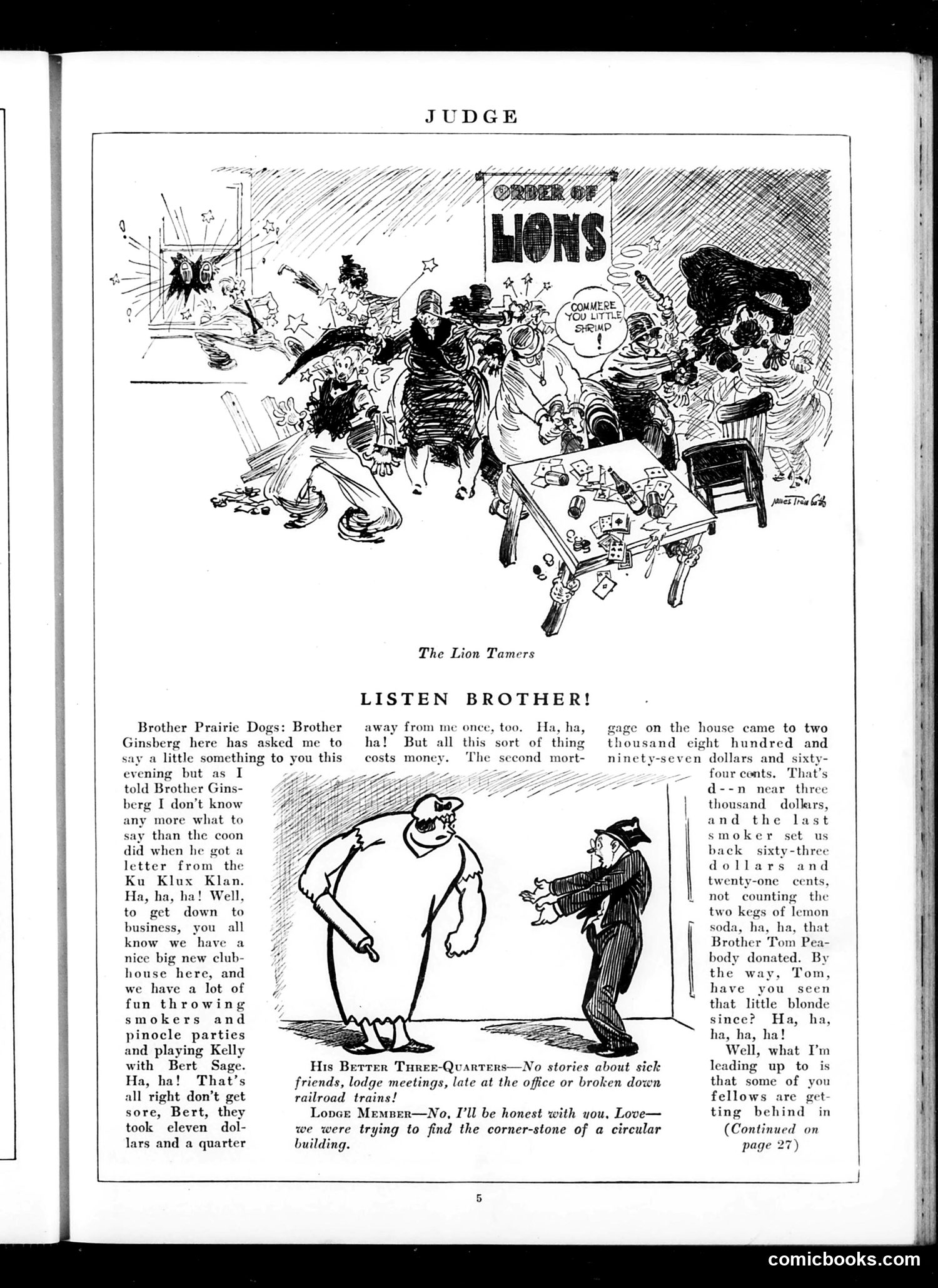
This page satirizes the "Lion Tamers"—likely a fraternal organization or club experiencing financial and organizational troubles. The top cartoon shows chaotic scene with members in disarray around a sign reading "Order of Lions." The main text features "Brother Prairie Dogs" complaining to "Brother Ginsberg" about the club's problems: expensive meetings, broken-down railroad trains, and mounting debts (nearly $3,000). The humor stems from the contrast between the group's grandiose name ("Lions") and their actual dysfunction and poverty. The bottom cartoon depicts "His Better Three-Quarters" (a wife) confronting her husband about the club's failures—late meetings, broken equipment, and unpaid debts—delivering the satirical punchline that they're seeking "the corner-stone of a circular building" (an impossible task, metaphorically representing their futile organization).
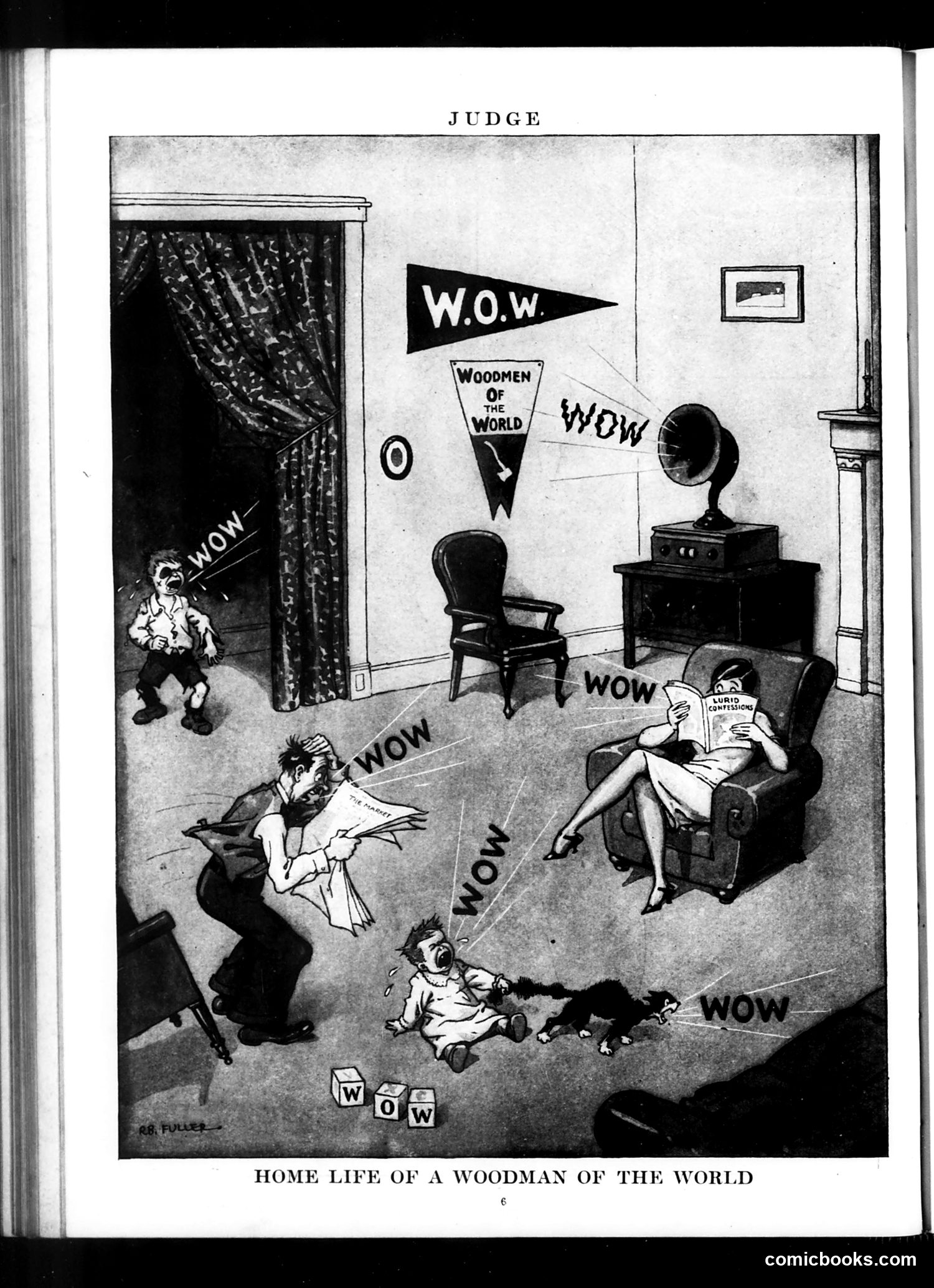
This satirical cartoon mocks the "Woodmen of the World" (W.O.W.), a fraternal organization popular in early 20th-century America. The cartoon depicts a domestic interior where W.O.W. symbols and merchandise dominate every aspect of family life—banners, pennants, and emblems cover the walls. The family members appear distracted or consumed by these organizational materials: an adult reads "Lurid Confessions," another displays the literature, and children play with W.O.W. alphabet blocks. The satire targets how fraternal organizations infiltrated American home life, suggesting the group's symbols and culture had become an obsessive, all-consuming presence that displaced normal family activities. The "WOW" text scattered throughout reinforces the relentless marketing and cultural saturation of this fraternal movement in domestic spaces.
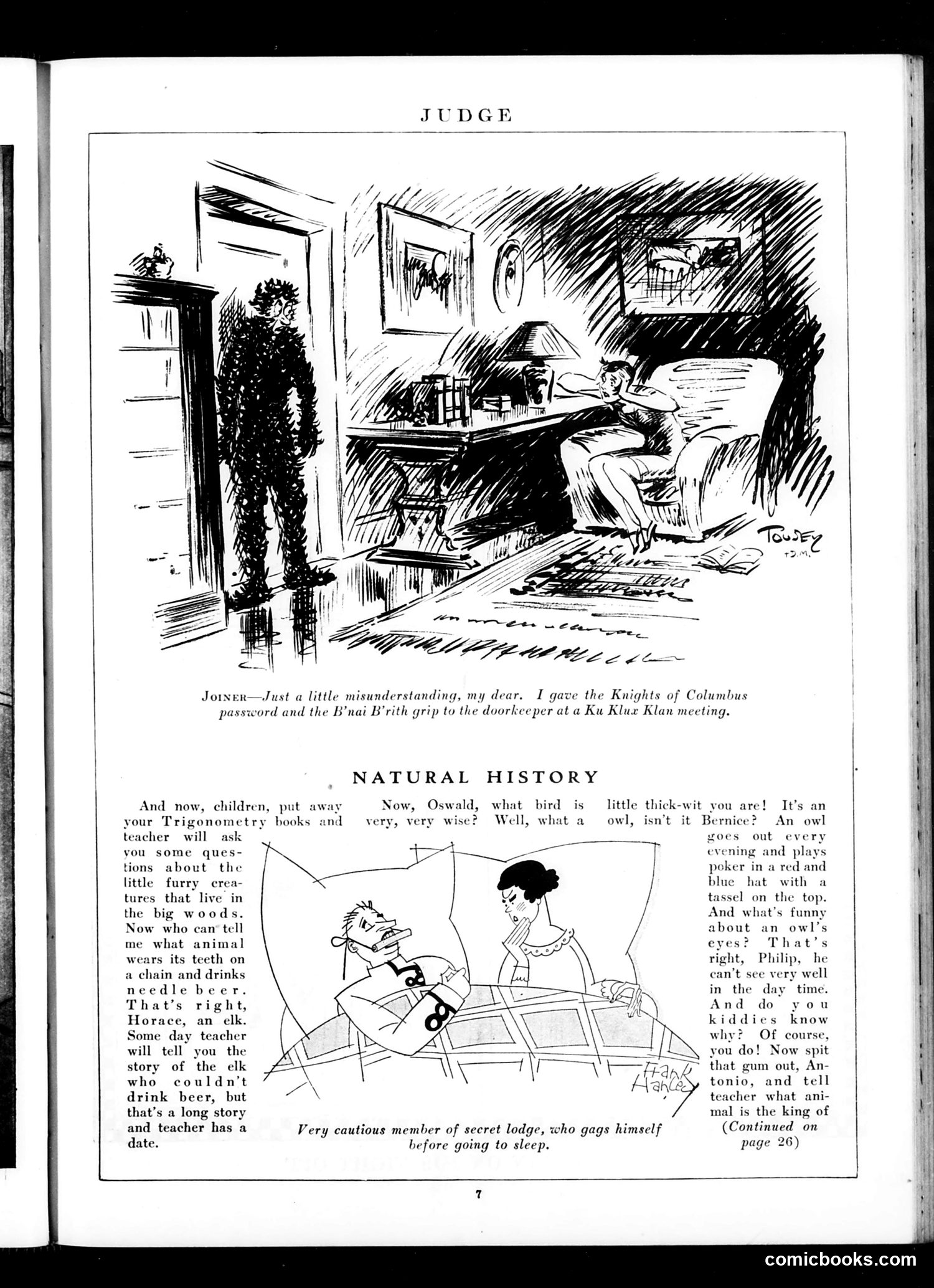
This page contains two distinct satirical pieces targeting early 1920s American anxieties. **Top cartoon ("Judge"):** A husband explains a "misunderstanding" to his wife—he accidentally revealed secret fraternal organization passwords and grips (Knights of Columbus, B'nai B'rith) to a doorkeeper at a Ku Klux Klan meeting. The satire mocks the era's proliferation of secretive fraternal lodges and their paranoid exclusivity, while implicitly critiquing the KKK's nativism by showing its members might inadvertently admit Catholic and Jewish members. **"Natural History" section:** A schoolteacher's naturalistic lessons devolve into absurdist non-sequiturs—an elk drinking "needle beer," owls playing poker in funny hats, inability to see daytime. The satire ridicules both pedantic educational approaches and the era's Prohibition-era anxieties (references to beer drinking). The casual ethnic name-dropping ("Antonio") reflects period attitudes. Both pieces reflect 1920s concerns: secret societies, religious/ethnic tensions, and Prohibition.
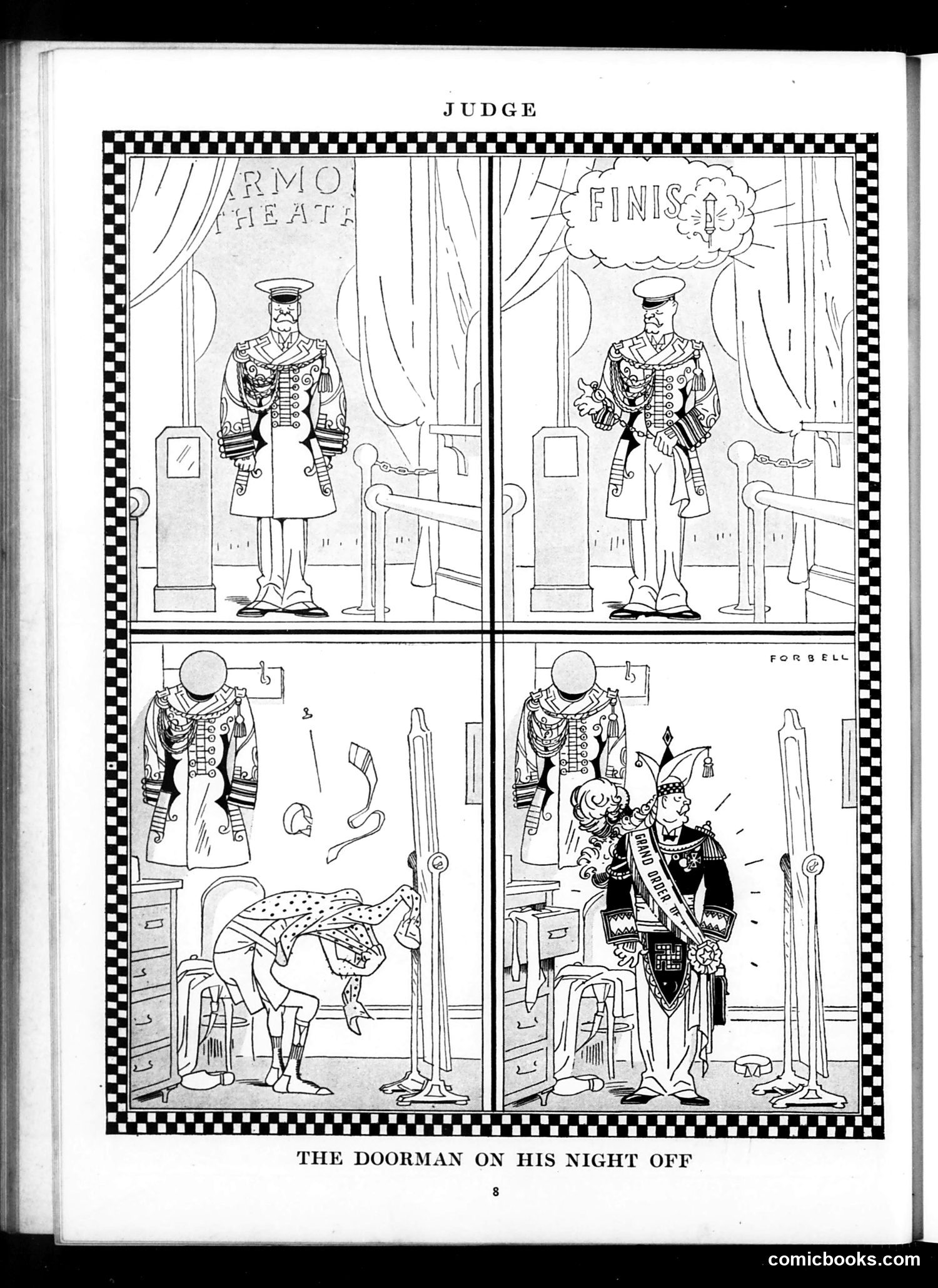
This four-panel comic depicts a military doorman's evening transformation. In the first two panels (top), he stands formally in uniform at what appears to be an armory or theater entrance, marked "FINIS" (finished/end of shift). In the bottom panels, his night off reveals a dramatic reversal: he's now dressed as an elaborately costumed theatrical figure—possibly a European nobleman or operatic character with ornate regalia, feathers, and jewelry. He's being attended to by a woman in equally fancy dress. The satire contrasts his rigid, subordinate role as a doorman with his fantastical alter-ego during leisure time. The joke likely mocks working-class aspirations to aristocratic grandeur, or satirizes the escapist fantasies people pursue in evenings out—theater, opera, or costume entertainment were popular diversions of the era. The exaggerated theatrical costume emphasizes the absurdity of the transformation.
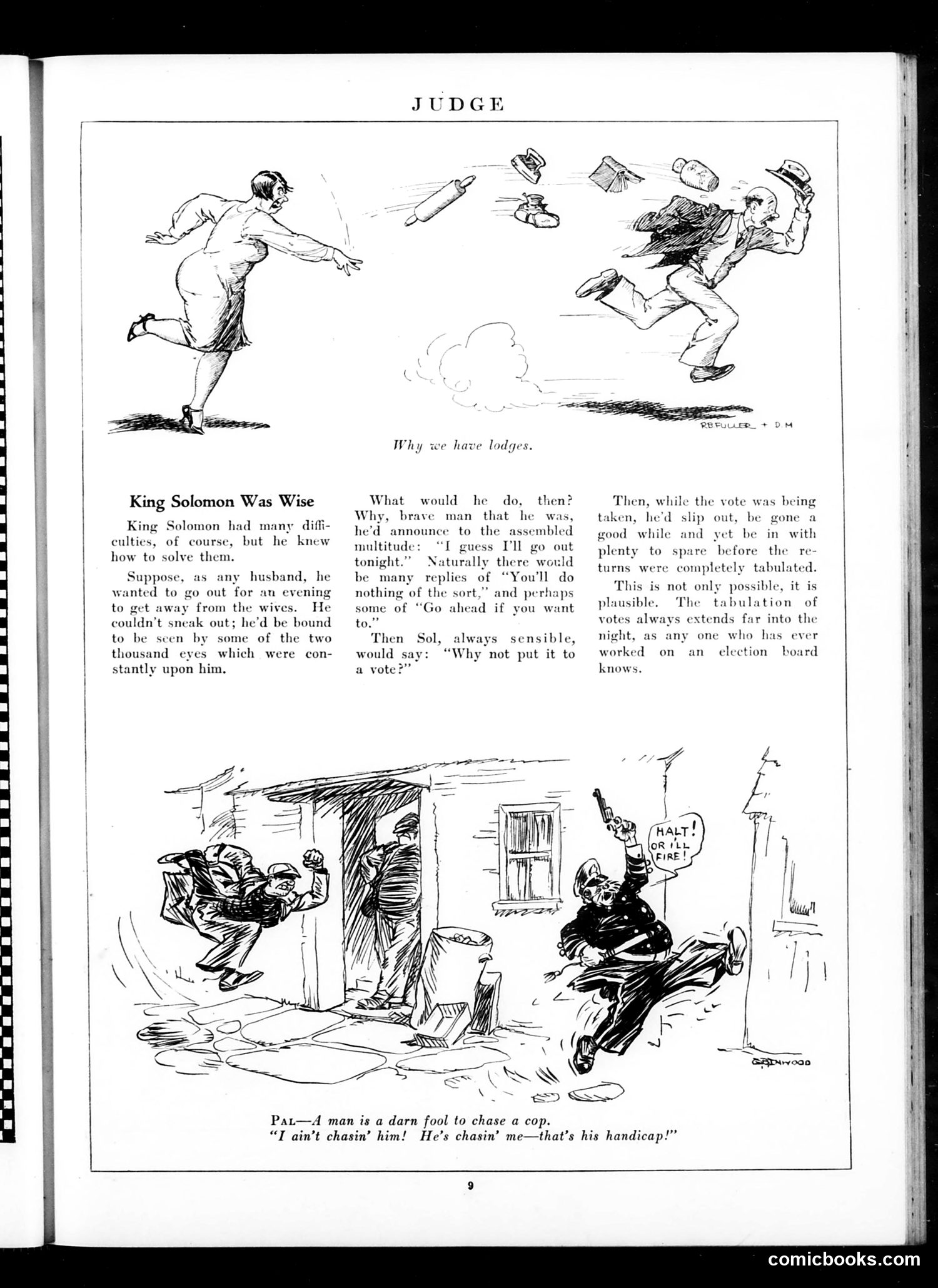
**Top Cartoon ("Why we have lodges"):** This satirizes married life and male escapes from domestic oversight. King Solomon—presented as an archetype of wisdom—couldn't leave home without his wives noticing. The joke suggests men need "lodges" (fraternal organizations, social clubs) as legitimate excuses to escape wives' surveillance. Solomon's solution of putting decisions to a vote is presented as proto-democratic, though the satire implies voting itself becomes another delay tactic—tabulation extends "far into the night," mocking both marital evasion and election board inefficiency. **Bottom Cartoon ("Pat"):** A chase scene between a cop and a man. The dialogue reveals the apparent pursuer is actually being chased—the man's "handicap" is that he's fleeing, which ironically slows down the cop. The humor lies in this reversal and the absurdist logic that being chased is strategically advantageous. Both pieces use exaggeration and role-reversal to satirize domestic life, authority, and social institutions typical of early 20th-century Judge humor.
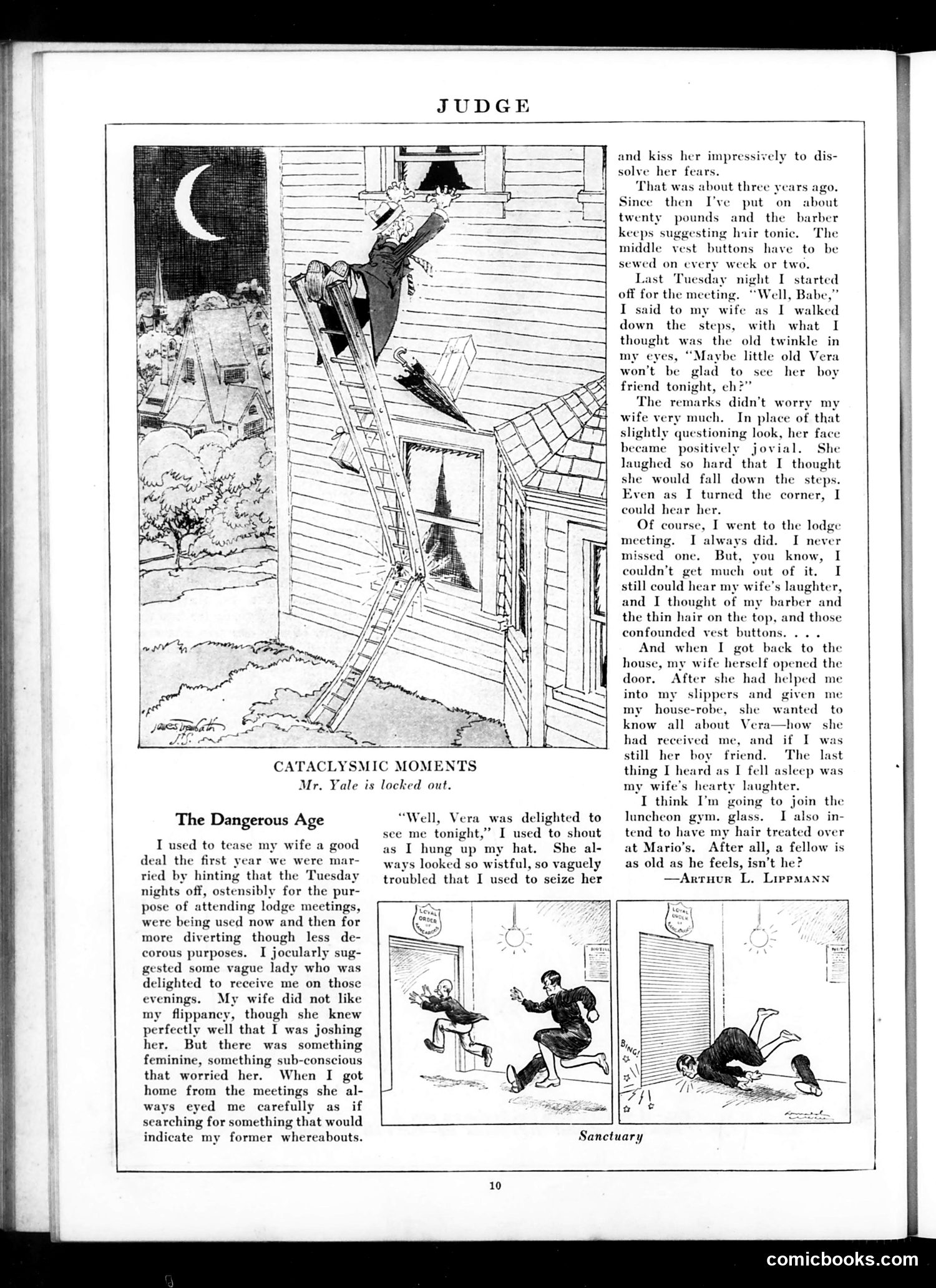
This humorous story by Arthur L. Lippmann satirizes middle-aged male anxiety and shifting marriage dynamics. The narrator describes how he once teased his wife by jokingly mentioning an imaginary woman named "Vera" he'd visit during lodge nights. His wife, though knowing he was joking, showed subtle worry—typical feminine concern that he found endearing. Three years later, the situation reverses. Having gained twenty pounds, lost hair, and developed a paunch, he makes the same joke. This time, his wife laughs *heartily*—not from jealousy but from amusement at the absurdity that anyone would be interested in him now. The satire mocks how physical decline deflates male vanity and confidence. His wife's laughter wounds him more than suspicion ever did, prompting him to join a gym and visit Mario's salon. The joke: aging men discover their wives' indifference cuts deeper than jealousy.
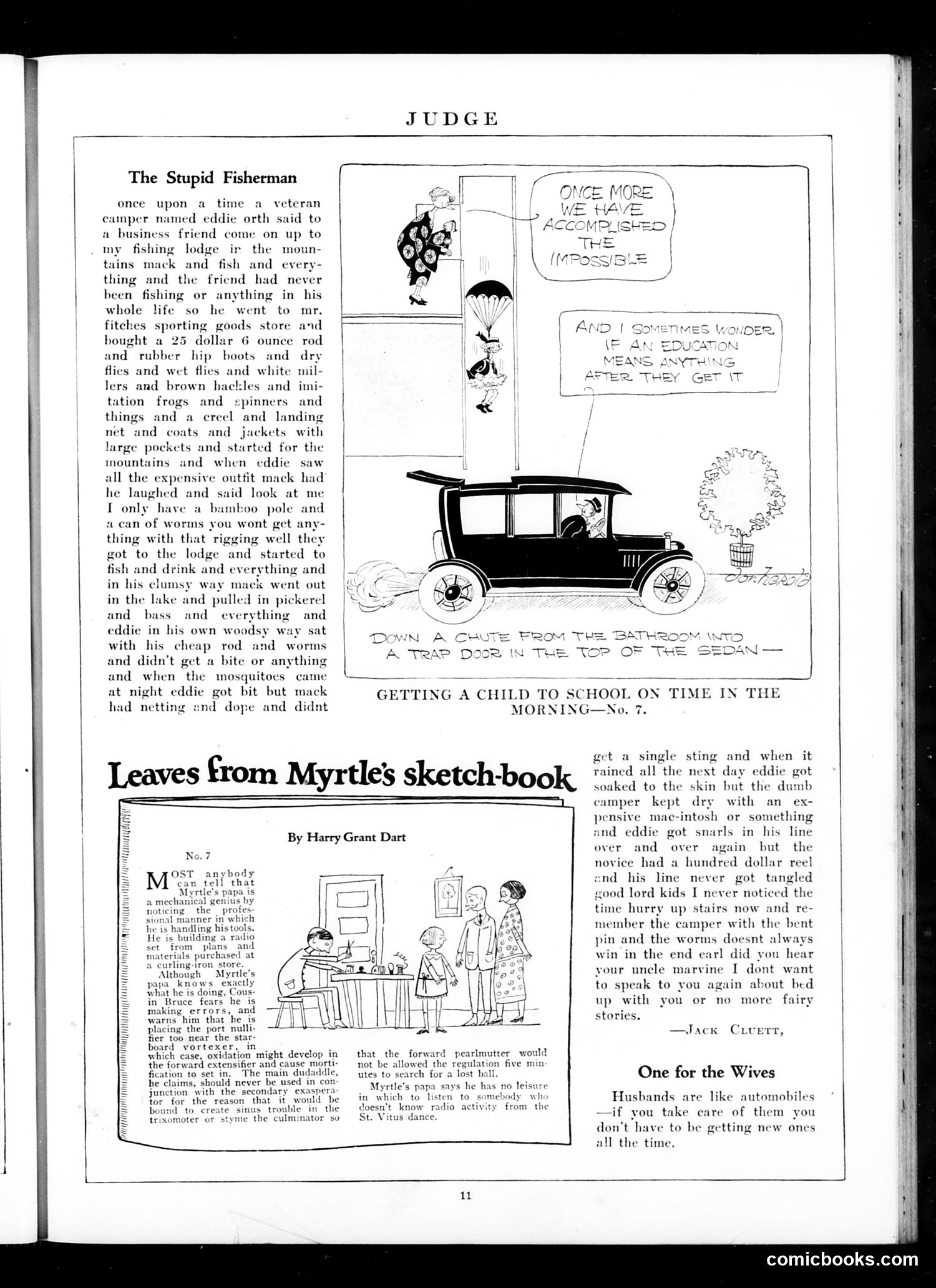
This page contains three satirical pieces typical of early 20th-century American humor: **"The Stupid Fisherman"** mocks the notion that expensive equipment guarantees success. Eddie, an experienced camper, ridicules his friend Mack's $25 rod and elaborate gear—yet Mack catches fish while Eddie, using cheap bamboo and worms, catches nothing. The joke satirizes American consumer culture and the assumption that wealth and fancy purchases equal competence. **"Leaves from Myrtle's Sketch-book"** by Harry Grant Dart depicts a father confidently explaining nonsensical mechanical terminology ("pearlmutter," "dudaddl") to his skeptical cousin. The humor lies in pseudo-intellectual bluffing—people confidently using jargon they don't understand. **"One for the Wives"** is a brief quip comparing husbands to automobiles requiring maintenance, suggesting marital pragmatism over romance. The page satirizes consumer excess, false expertise, and gender dynamics—common Judge targets reflecting 1920s American anxieties.
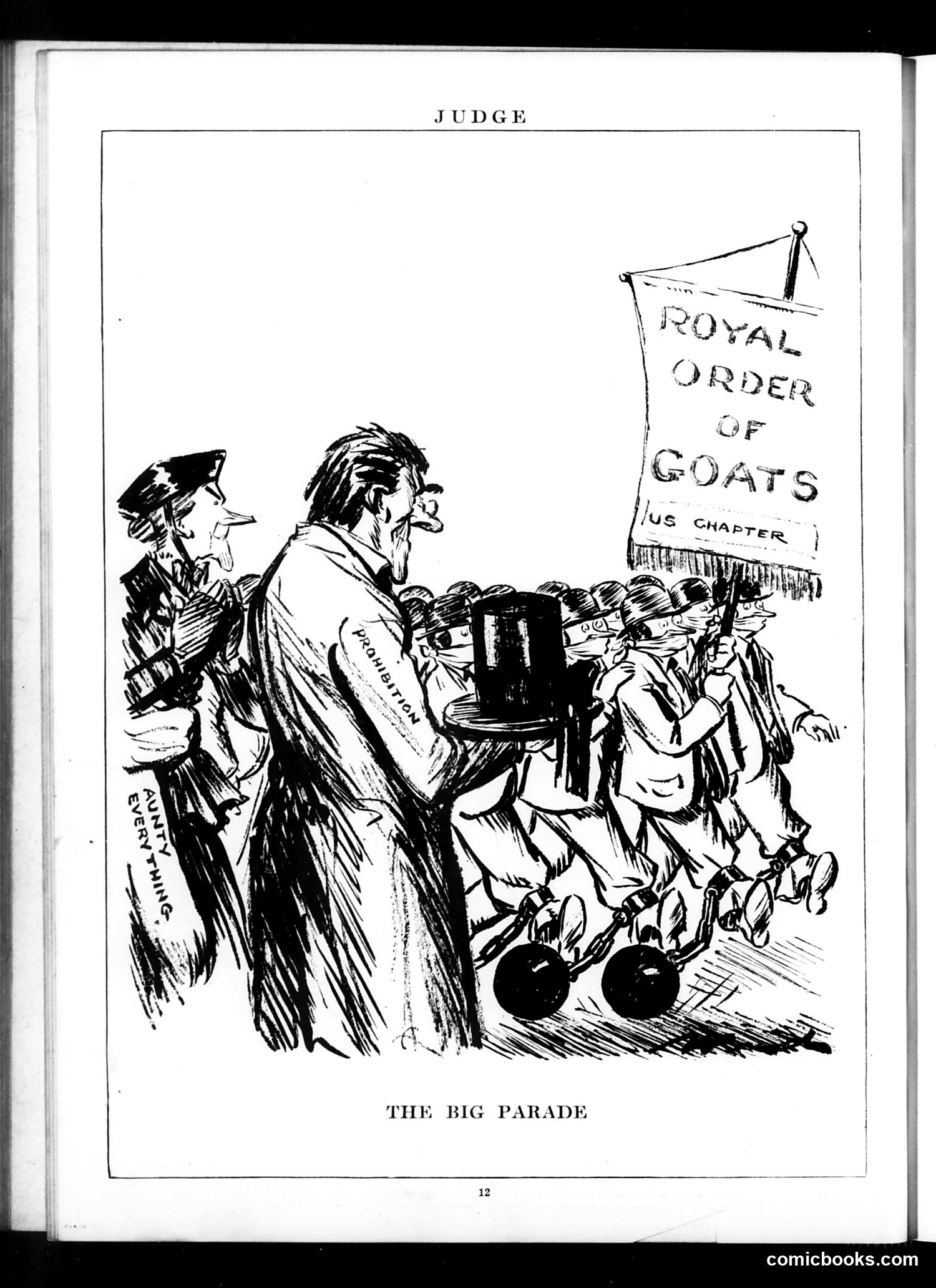
This satire depicts a parade led by a figure carrying a banner reading "Royal Order of Goats [US Chapter]." The central character, labeled "Prohibition," wears a top hat and appears to be leading a procession of smaller figures (goats). A military or official figure on the left observes the scene. The cartoon mocks Prohibition—the constitutional ban on alcohol (1920-1933)—by portraying it as a ridiculous "Royal Order" parading through America. The "goats" likely represent either foolish supporters or the absurd consequences of the policy. The satirist suggests Prohibition is a laughable, organized farce rather than serious governance, reflecting Judge magazine's skeptical stance toward this controversial policy during the Prohibition era.
This page contains two opinion pieces by Judge magazine's editorial staff, circa post-WWI era. **Left column** critiques American colleges for admitting unprepared masses while clinging to outdated curricula and lax discipline. The author argues colleges prioritize enrollment over education quality, though he praises experimental programs at Wisconsin, Swarthmore, and Antioch. His main complaint: parents focus on athletics/social matters rather than demanding rigorous instruction. **Right column** ("Three Long Hushes!") satirizes Philadelphia Athletics manager Connie Mack for arresting a vocal fan. The piece defends the fan's "ancient right" to vigorously criticize his team—distinguishing between silent, passive sports spectatorship and participatory heckling. Mack reportedly tried silencing the fan with gifts of baseballs. The author warns this reflects a broader campaign to suppress Americans' freedom of spirited sports commentary. Both articles reflect 1920s progressivism: skepticism toward institutional gatekeeping and defense of ordinary citizens' voices.
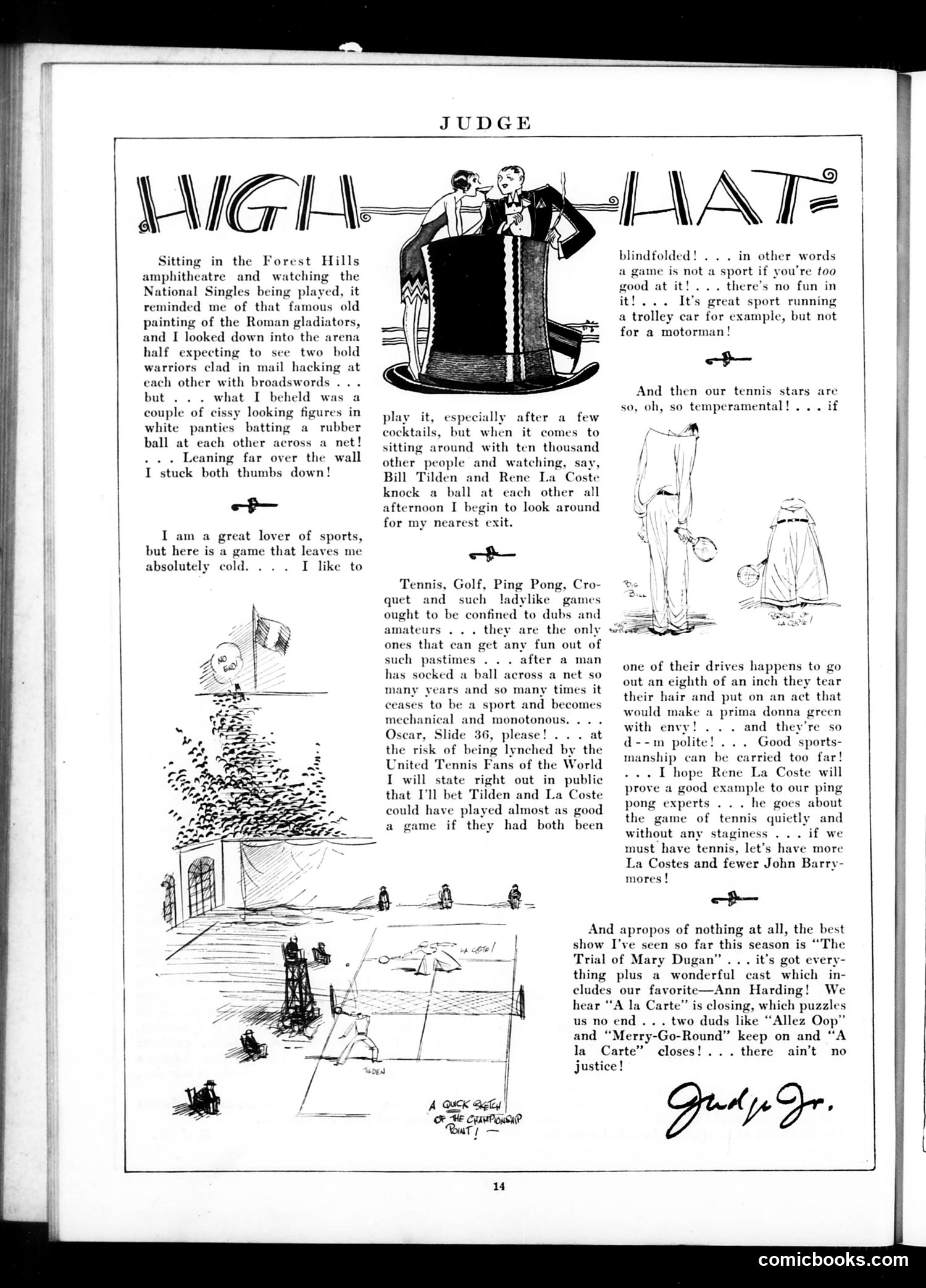
This is a satirical sports column by Judge magazine's social critic (signed "Judge Jr."). The author attacks tennis—specifically the National Singles at Forest Hills—as an effete, overly-civilized "sport" unworthy of spectation. **The Satire:** The piece ridicules tennis players (notably Bill Tilden and René Lacoste, famous 1920s champions) as "cissy" figures in "white panties," comparing them unfavorably to Roman gladiators. The author argues that once any activity becomes too perfected and professional, it loses genuine sport value and becomes "mechanical and monotonous." **The Hypocrisy:** The column also mocks tennis stars' dramatics and temperament while simultaneously celebrating their "good sportsmanship"—revealing class anxieties about genteel sports versus working-class activities (trolley cars). **Context:** This reflects 1920s debates about "amateur" versus "professional" athletics, masculine versus feminine sports, and which pastimes suited respectable society. The theatrical references (Mary Dugan, Ann Harding) suggest this appeared during the Jazz Age when entertainment and sports competed for leisure attention.
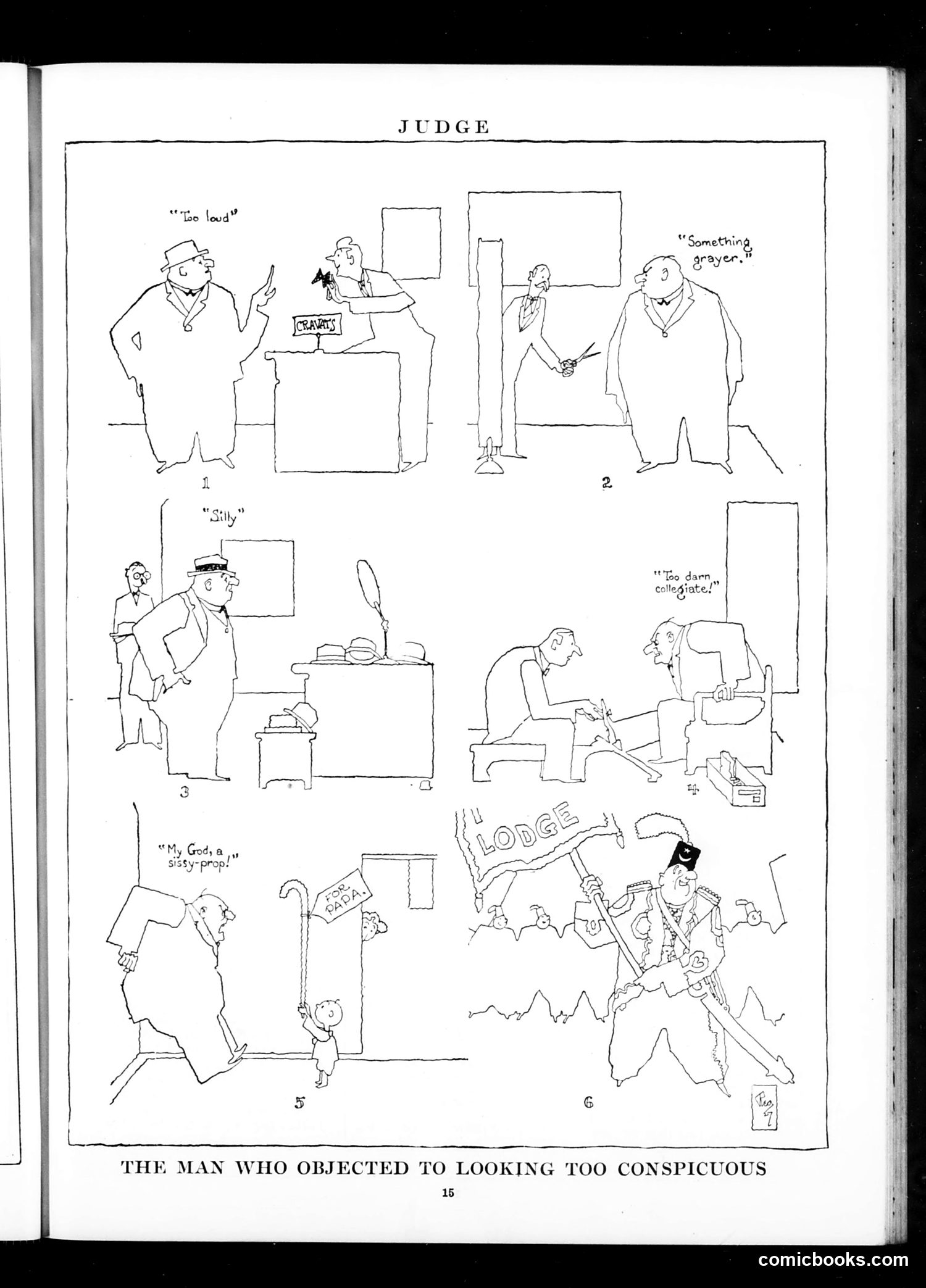
This comic strip satirizes a man attempting to behave inconspicuously in public settings. Across six panels, he progressively fails at his goal through increasingly absurd behavior: 1. He speaks "too loud" in what appears to be a courtroom or public space 2. He attempts "something prayer-like" 3. He's described as "Silly" 4. Two men discuss him as "too darn collegiate" 5. He exclaims "My God, a sissy-pop!" 6. Final panel shows him leading a lodge procession with dramatic gestures and regalia The joke's irony is clear: his attempts to avoid drawing attention result in the opposite—his self-conscious efforts to appear "normal" make him conspicuous. The final lodge scene suggests that even formal, socially-sanctioned conspicuousness (like fraternal organization pageantry) contradicts his stated goal. The satire mocks social anxiety and performative normalcy.
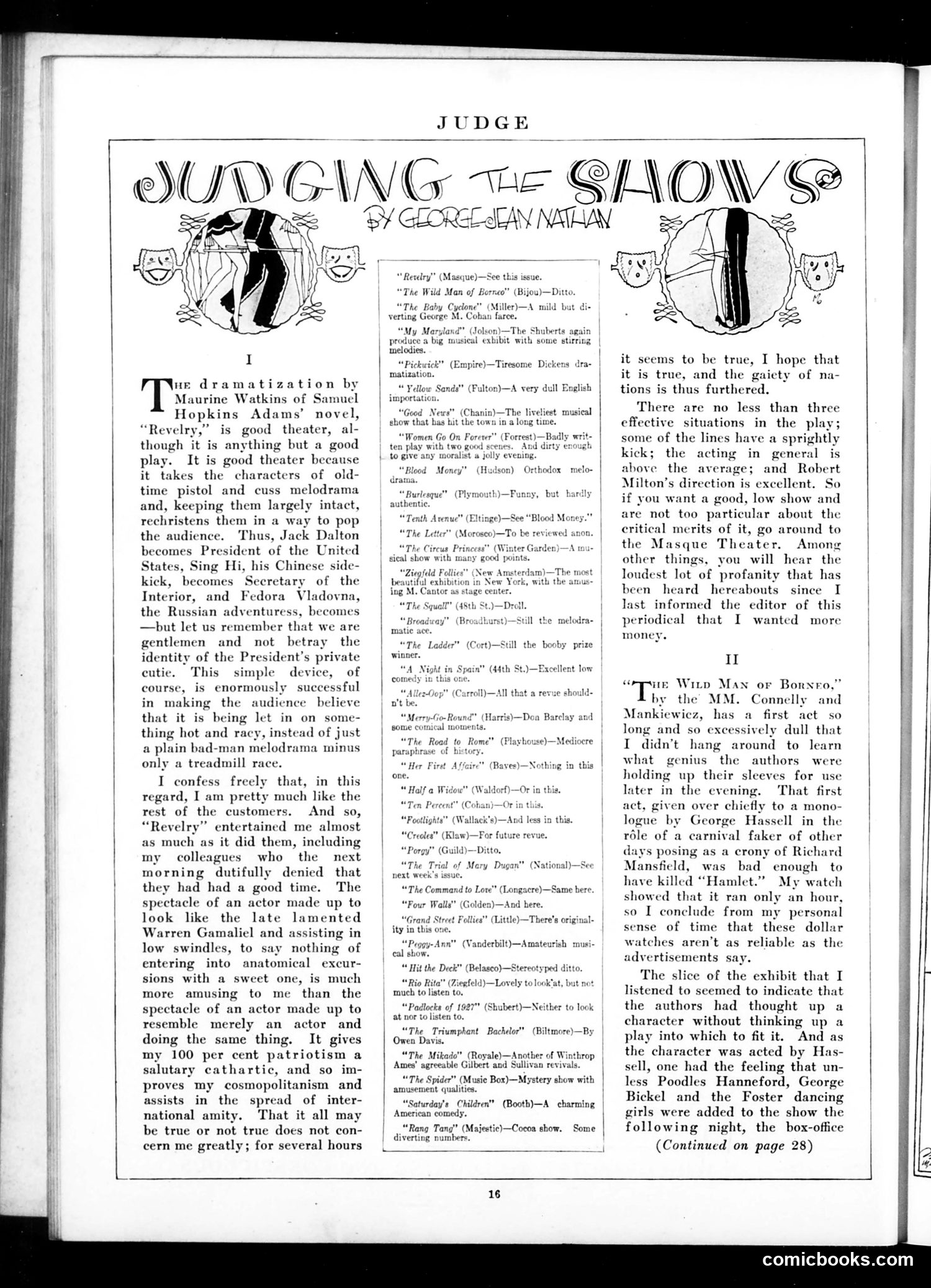
This page presents theater criticism by George Jean Nathan reviewing Broadway productions, including the play "Revelry." The main article discusses how "Revelry" succeeds as entertainment by thinly disguising a melodrama with topical references—specifically, its protagonist "Jack Dalton" is clearly meant to represent President Warren G. Harding, with a Chinese sidekick as Secretary of the Interior and a Russian woman as the President's mistress. Nathan acknowledges this transparent satire amuses audiences by letting them feel "in on" scandalous insider knowledge about presidential misconduct, even though it's fundamentally just pulp melodrama in disguise. The humor relies on the audience recognizing the Harding administration's actual corruption scandals (the Teapot Dome scandal and Harding's affair with Nan Britton were contemporary news). Nathan admits he enjoys this vicarious thrill despite calling it intellectually cheap entertainment. The rest of the page lists brief reviews of other current Broadway shows.
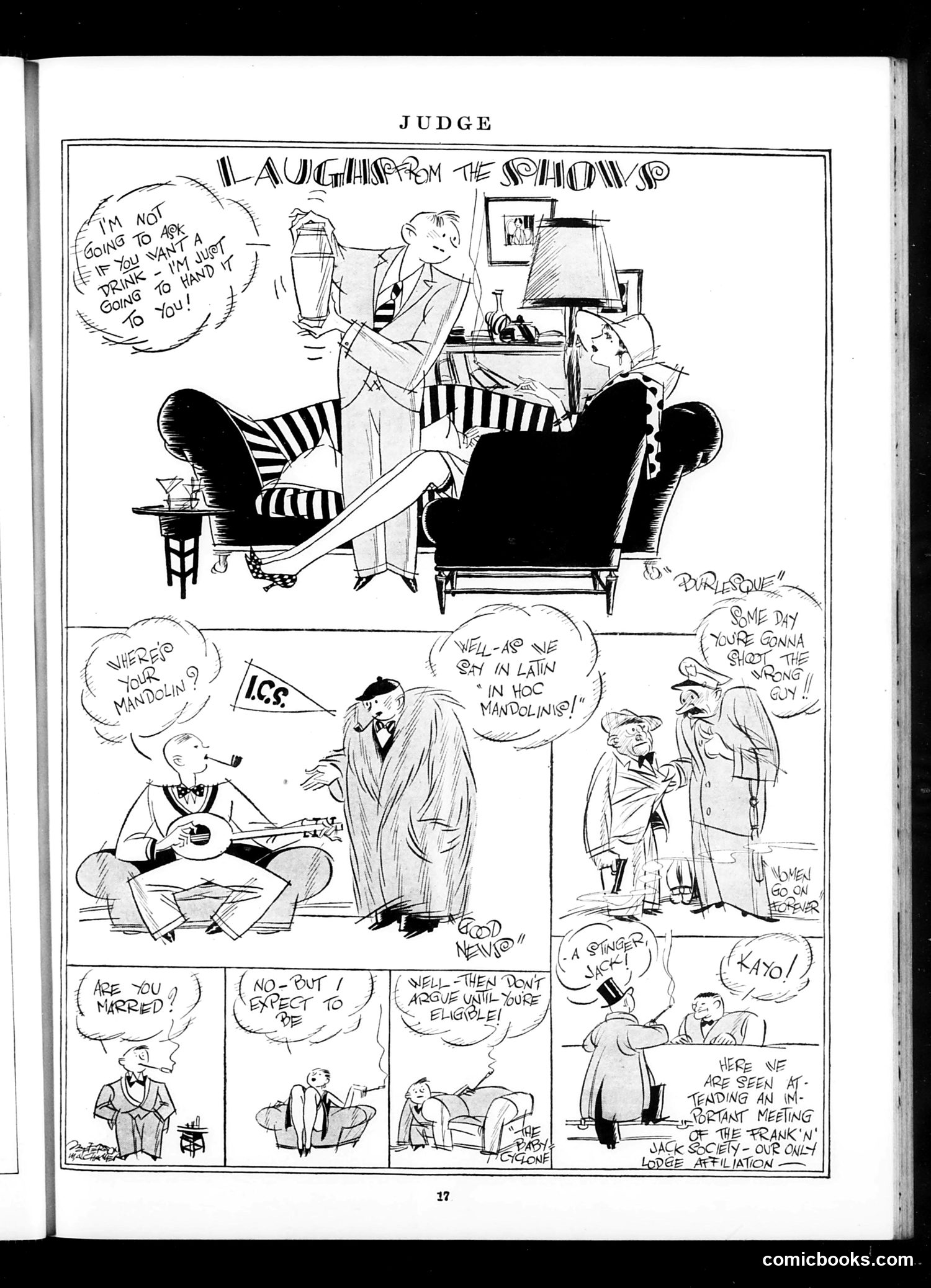
This multi-panel cartoon satirizes social pretension and dating behavior, likely from the early-to-mid 20th century. The top panel shows a judge relaxing while a man serves drinks, refusing to ask the judge to have one—establishing the judge as someone of superior social status who needn't be pestered. Subsequent panels mock courtship rituals: a man with a mandolin attempts serenading; someone awkwardly proposes marriage; another panel jokes about eligibility requirements ("not past 30"). The final panels feature a "ginger ticket" and "kayo" reference—appearing to mock both romantic incompetence and boxing terminology. The overall theme ridicules the awkwardness of dating etiquette and social climbing among different classes, with the judge's detachment framing it all as ridiculous theater. The satire targets both male fumbling in romance and the artificial rules governing courtship and social eligibility in the era.
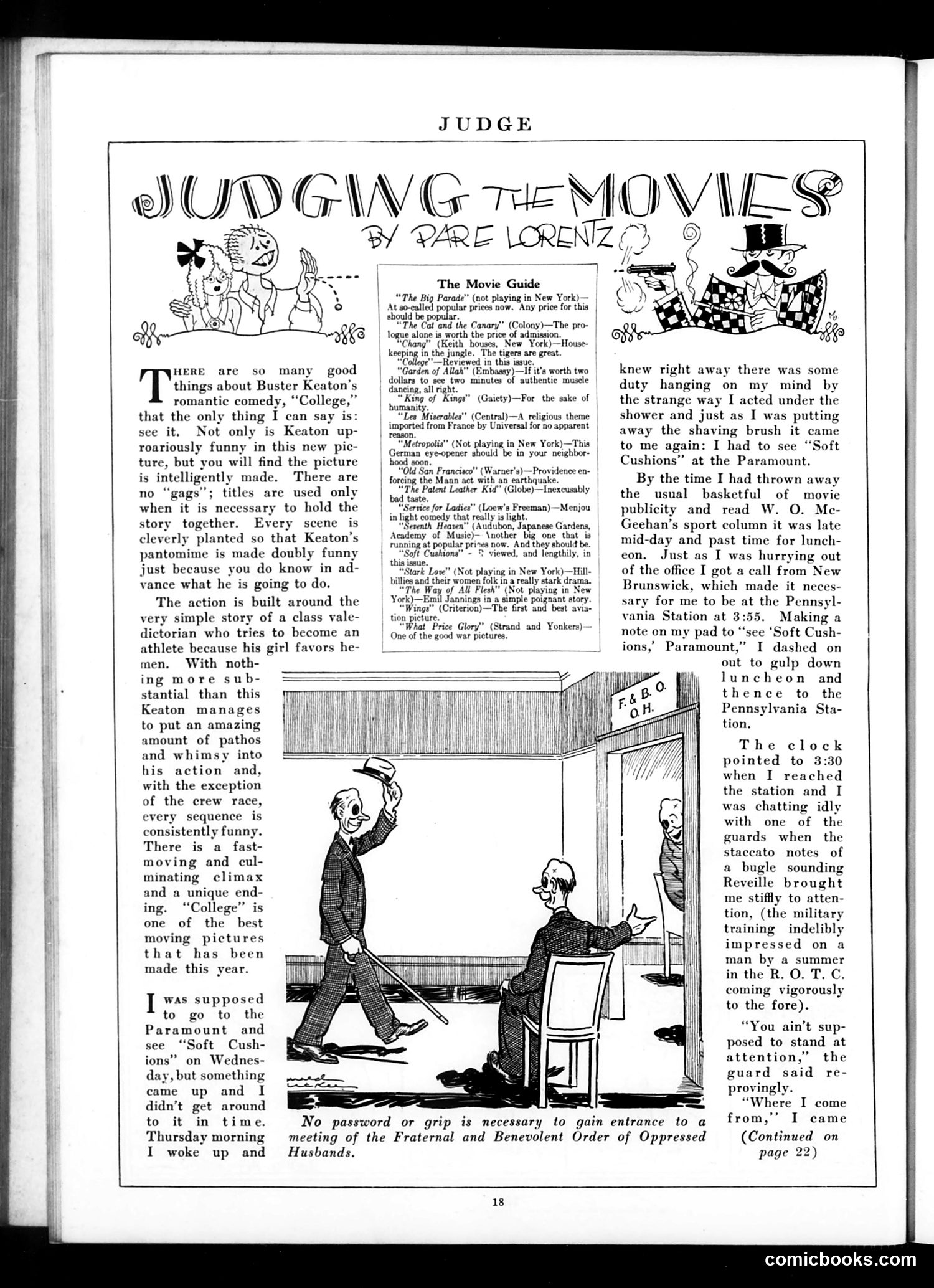
This page from *Judge* magazine contains a film review column by Pare Lorentz evaluating Buster Keaton's silent comedy "College." The reviewer praises the film's intelligence and humor, noting Keaton's physical comedy works effectively because the audience understands the setup in advance. The accompanying illustration depicts a humorous anecdote: the reviewer was supposed to see "Soft Cushions" at the Paramount theater but kept forgetting due to daily distractions—work calls, reading sports columns, lunch delays. Finally remembering while at Pennsylvania Station at 3:30 PM (too late for the showing), he resolves to see it another time. The cartoon satirizes how modern life's bustle prevents people from enjoying entertainment they intend to see—a relatable joke for 1920s urban readers juggling multiple obligations. The "Movie Guide" sidebar lists current theatrical releases with brief, witty critiques typical of *Judge's* satirical style.
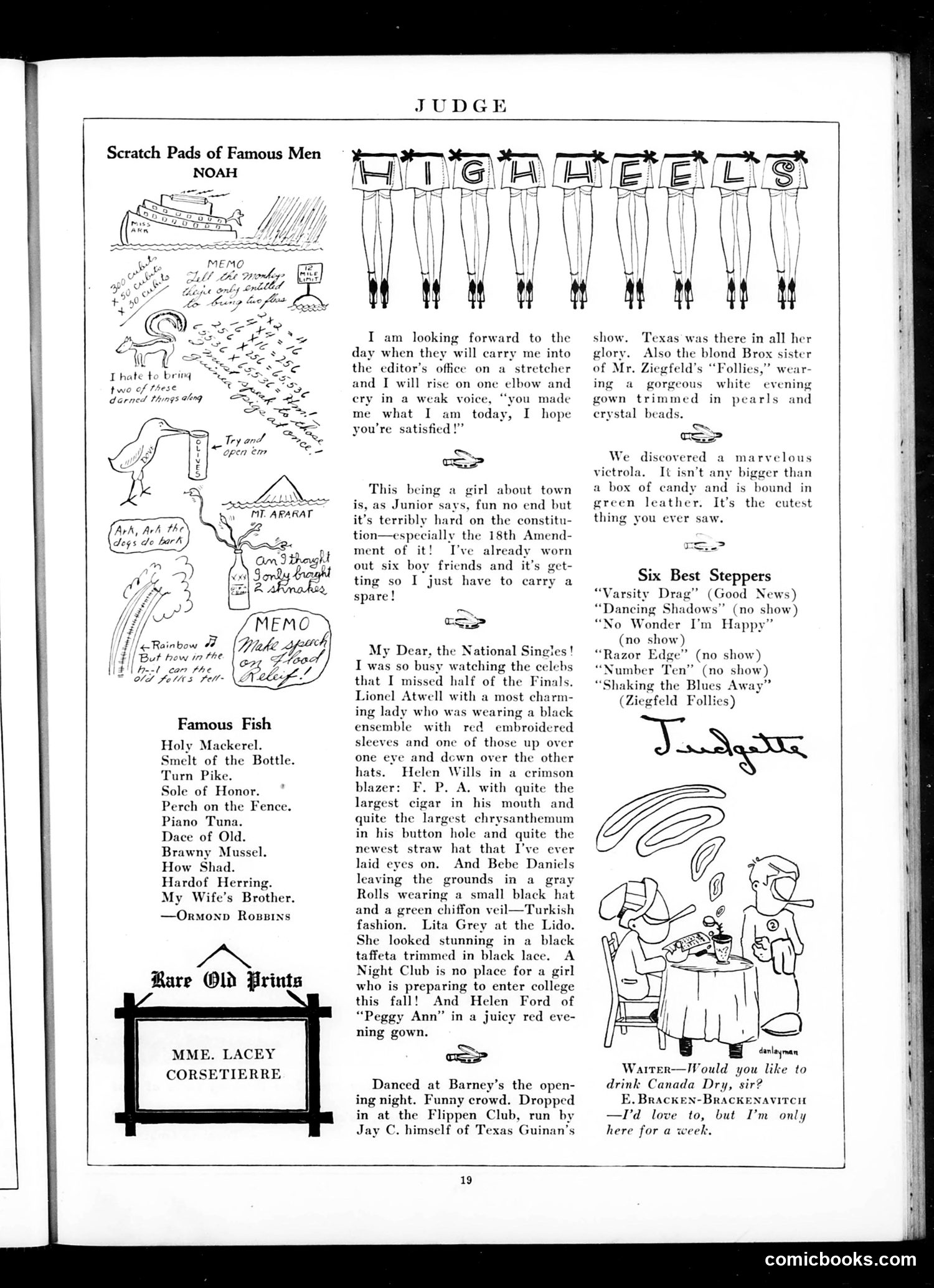
This Judge magazine page is a society/gossip column satirizing 1920s nightlife and celebrity culture. The main content consists of: **"Scratch Pads of Famous Men"** — humorous fake quotes attributed to Noah, featuring silly puns about fish ("Holy Mackerel," "Sole of Honor") — simple wordplay humor. **The central gossip column** mocks the social scene of wealthy young women attending nightclubs and sporting events despite Prohibition (the "18th Amendment"). The writer catalogs celebrities spotted at venues like Barney's and the Flippen Club (run by "Texas Guinan," a real speakeasy operator), describing their fashions in breathless detail. **The satire targets**: - Young women flaunting multiple boyfriends while supposedly preparing for college - The frivolity of nightclub culture during Prohibition - Celebrity-worship and obsessive fashion commentary - The absurdity of hiding illegal drinking under the guise of wholesome entertainment The tone is gentle mockery of leisure-class excess and the contradiction between propriety and actual behavior during the Jazz Age.
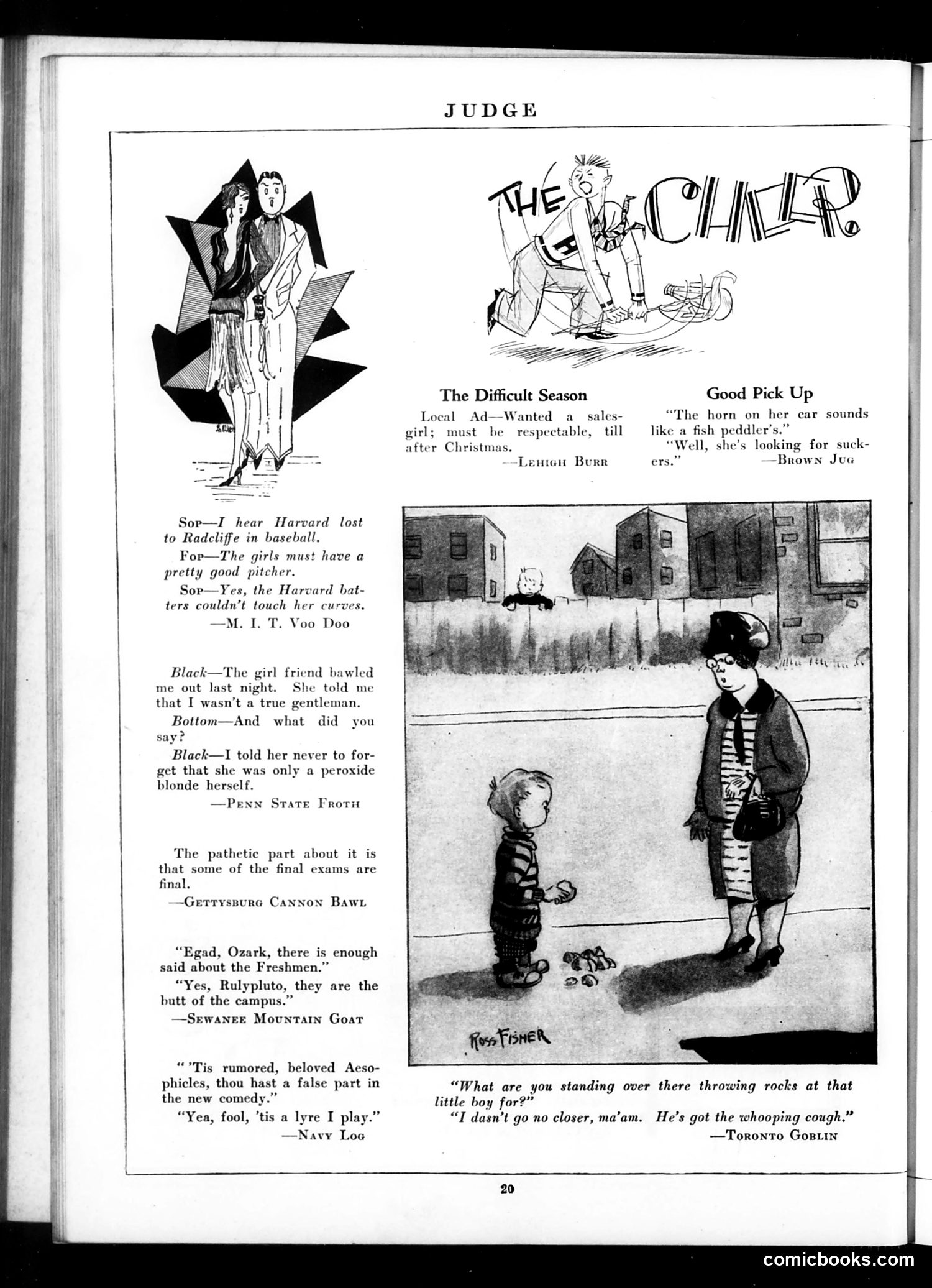
This page collects humor from various college publications (MIT Voo Doo, Penn State Froth, etc.)—a common Judge feature. The jokes target early 20th-century college life and gender relations: **Key satirical points:** 1. **Harvard vs. Radcliffe baseball joke**: Mocks women's athletic ability and uses double entendre about "curves" to suggest women pitchers aren't legitimately skilled. 2. **"Peroxide blonde" exchange**: Reflects period anxieties about women's authenticity and respectability; the blonde dye joke was contemporary slang mockery. 3. **"Respectable till after Christmas" ad**: Darkly satirizes seasonal hiring of women workers, implying moral standards relaxed after the holidays. 4. **Whooping cough cartoon**: Shows a woman keeping distance from a sick boy—likely commenting on either maternal hesitation or women's general squeamishness about illness. The humor relies on period stereotypes about women's competence, sexual morality, and femininity—reflecting Judge's conservative editorial stance on gender roles.
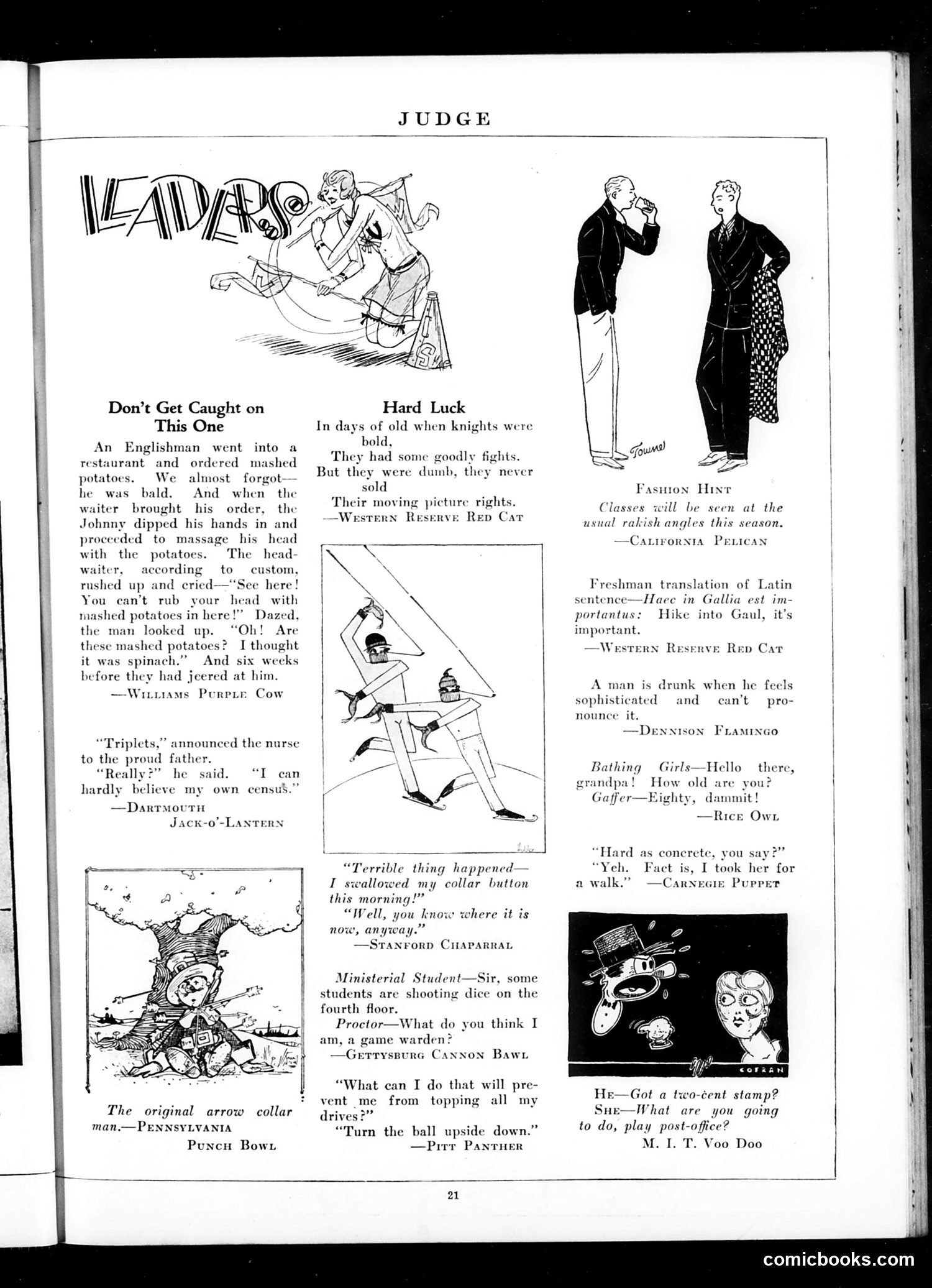
This page from *Judge* contains humorous anecdotes and jokes reflecting early 20th-century American social attitudes. Key content includes: **"Don't Get Caught on This One"**: A joke mocking British eccentricity—an English bald man mistakes mashed potatoes for hair treatment, confusing restaurant staff. **"Hard Luck"**: Silent-era film industry satire. Early movie knights failed to retain rights to their films, losing profits as their pictures became valuable commodities. **"The Original Arrow Collar Man"**: References the famous Arrow shirt advertising campaign featuring a distinctive masculine ideal. **Fashion and campus humor**: References to "rakish angles," college pranks (dice games), and flirtation ("post-office" was a kissing game). The page reflects period concerns: British stereotypes, emerging film industry economics, advertising culture, and college social customs. Most humor relies on mild puns, cultural references, and social observation rather than sophisticated satire.
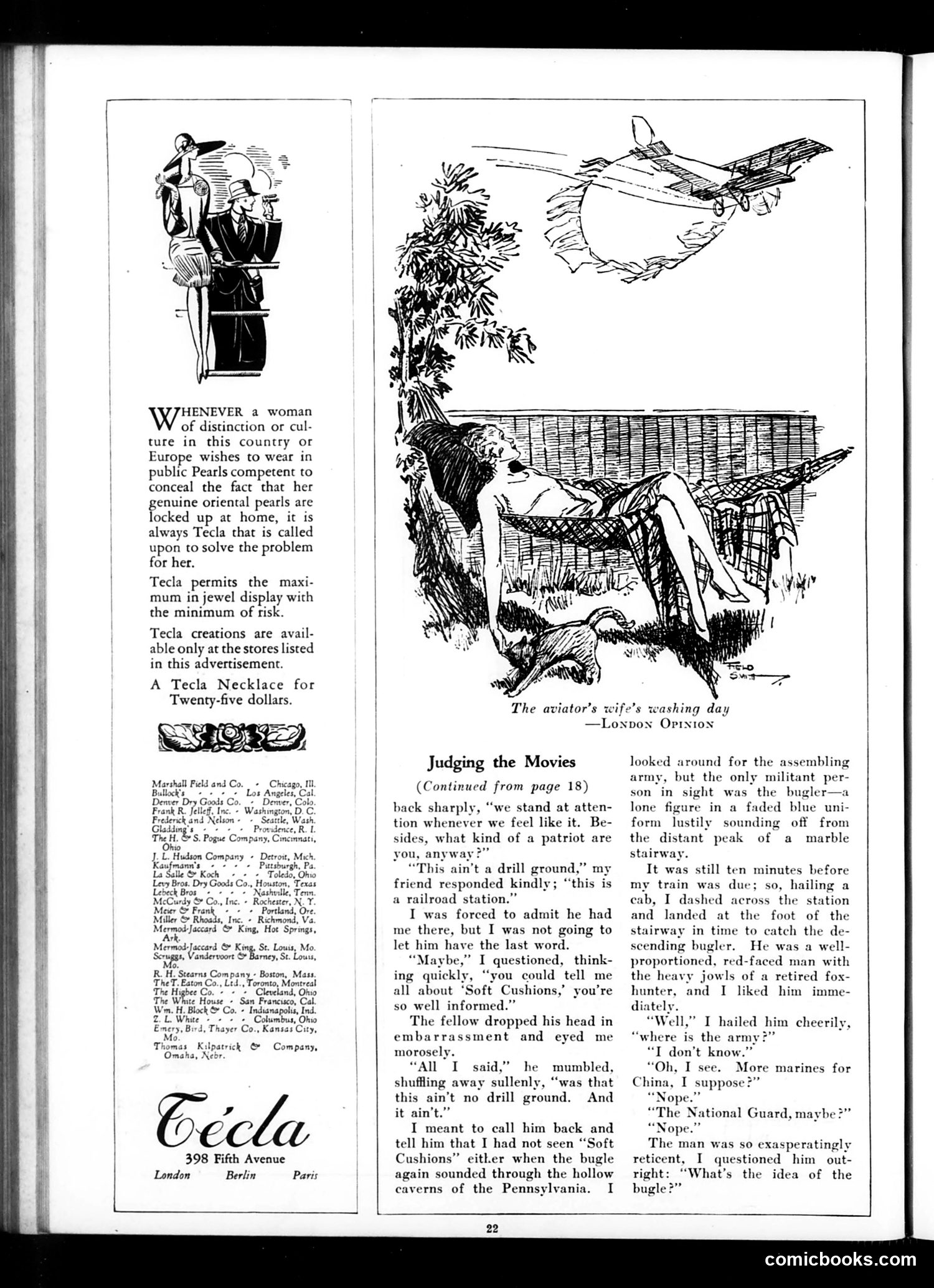
This page contains **two unrelated sections**: an advertisement for Tecla imitation pearls (left) and a movie review column (right). **The Tecla Advertisement:** A straightforward luxury goods ad targeting wealthy women. "Tecla" appears to be a brand of high-quality artificial pearls marketed to distinguished women who want to display fine jewelry publicly while keeping their genuine oriental pearls secured at home. The ad emphasizes discretion and maximum display with "minimum risk." The top illustration shows an elegantly dressed woman, establishing the product's aspirational appeal. **"Judging the Movies" (right side):** A humorous anecdote about the author encountering a cantankerous bugler at a train station who played military calls. When questioned about a movie called "Soft Cushions," the bugler becomes embarrassed and defensive, admitting he hasn't seen it. The narrator eventually tracks him down—revealing him as a retired fox-hunter—suggesting the absurdity of someone loudly criticizing things they know nothing about. The cartoon illustration (top right, credited to London Opinion) shows a woman relaxing while an airplane flies overhead, captioned "The aviator's wife's washing day"—likely satirizing women's domestic concerns amid modern technological change.
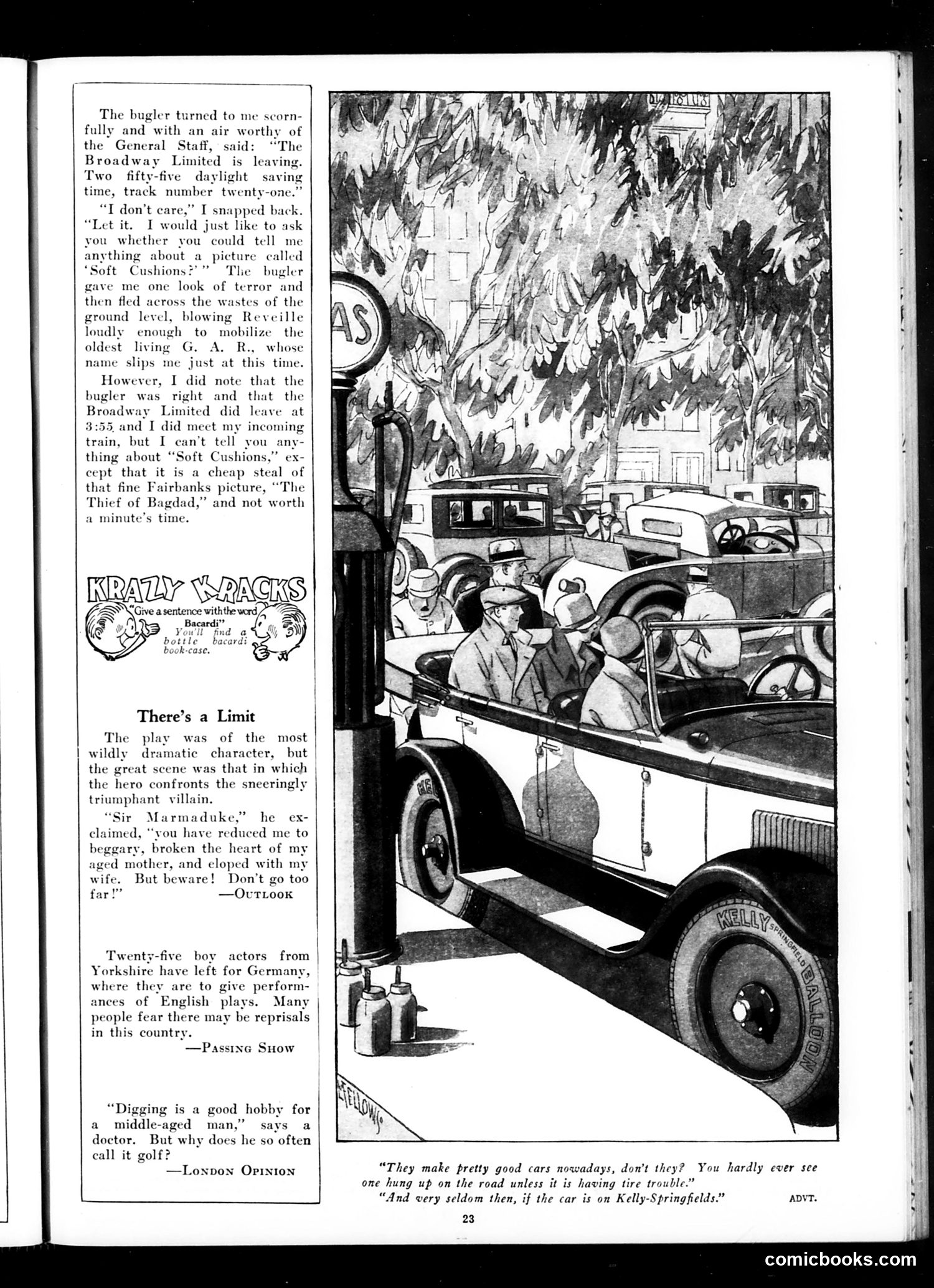
This page contains **multiple satirical items** rather than one unified cartoon: 1. **Top narrative** mocks a pompous railroad worker who dismisses the narrator's question about a film called "Soft Cushions," then proves unreliable—the Broadway Limited does depart as scheduled. The satire targets bureaucratic arrogance and the disconnect between workers' self-importance and actual competence. 2. **"There's a Limit"** section excerpts a melodramatic play scene where a villain has ruined the hero. The humor lies in the villain's absurd catalog of wrongs ("reduced me to beggary, broken the heart of my aged mother, and eloped with my wife"), which exceeds even theatrical convention—hence "there's a limit." 3. **Brief items** include: Yorkshire boy actors touring Germany (with anxieties about potential retaliation), and a doctor's quip that middle-aged men call digging "golf." 4. **Bottom illustration and caption** feature a car advertisement for Kelly-Springfields tires, with dialogue praising modern cars' reliability. The page is primarily **light satirical humor and advertising** rather than serious political commentary.
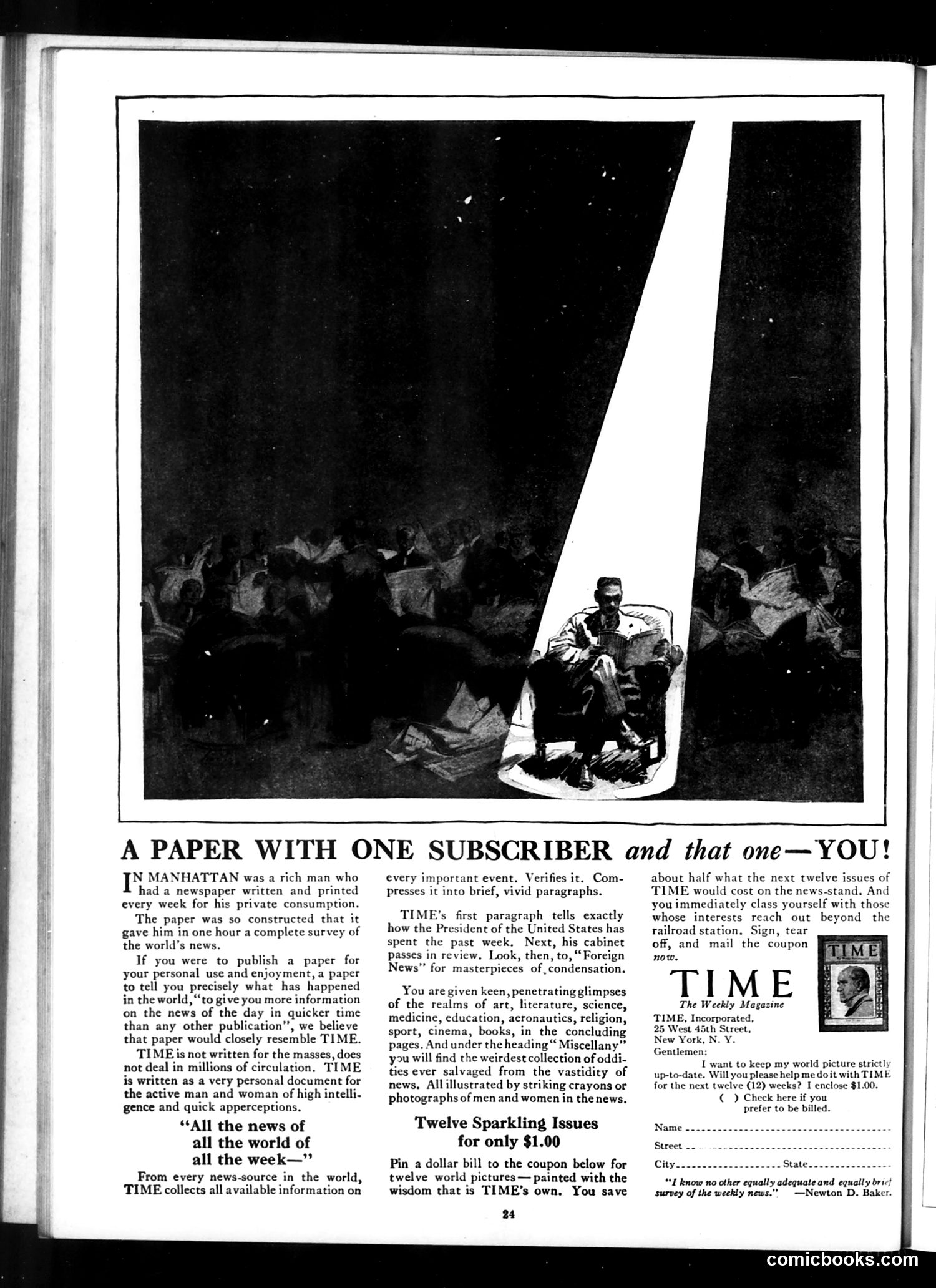
This is primarily an advertisement for TIME magazine's inaugural subscription offer, disguised as satirical commentary. The cartoon depicts a lone, well-dressed man seated in a spotlight within a vast, dark auditorium—symbolizing TIME's positioning as a publication for the selective elite rather than the masses. The satire targets the magazine's own exclusivity: it humorously compares TIME to a vanity publication a wealthy Manhattan businessman might commission solely for himself. The copy emphasizes TIME serves "the active man and woman of high intelligence"—a deliberately snobbish pitch that frames regular newspapers as inadequate. The "$1.00 for twelve issues" offer (presented as half the newsstand price) undercuts the elitism while promoting accessibility to this rarefied audience. The Newton D. Baker endorsement adds authority. This appears to be from TIME's early marketing phase, establishing its brand identity as intelligent, concise, and superior to competitors' coverage.
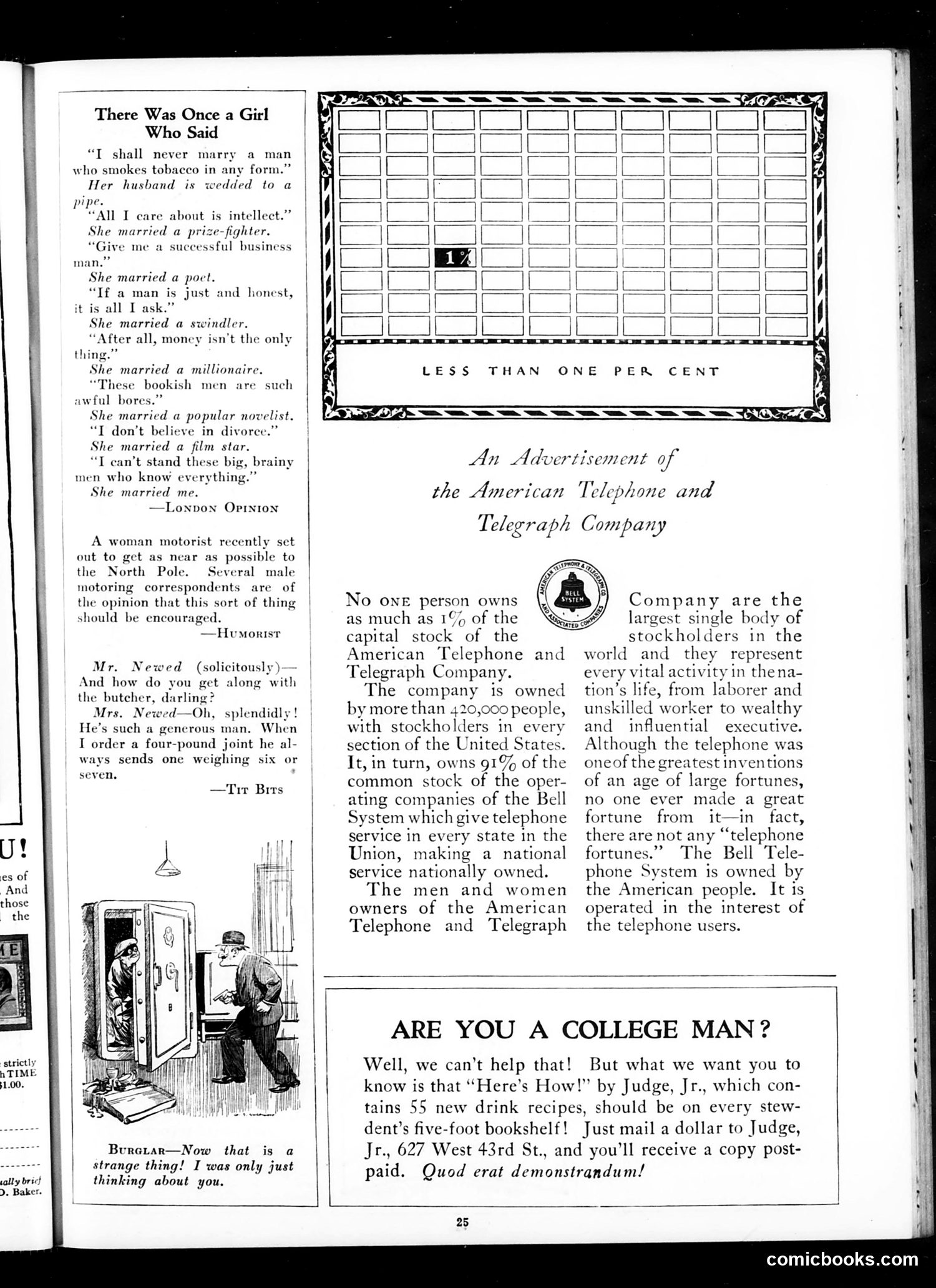
This page contains three distinct elements: **The "Girl Who Said" Comic** (left): A satirical piece from *London Opinion* mocking women's inconsistency in romantic preferences. A woman repeatedly declares what she wants in a husband, then marries the opposite type each time—rejecting smokers but marrying a pipe-smoker, valuing intellect but marrying a prize-fighter, etc. The punchline: she ultimately married the narrator (implying he's unremarkable). The satire targets women's contradictory nature and changing standards. **Two Brief Jokes** (left): Humorous anecdotes about a female motorist attempting to reach the North Pole (with implied male encouragement) and a butcher generously overweighting meat orders. **AT&T Advertisement** (right): A corporate PR piece emphasizing democratic stock ownership—no single person owns more than 1% of American Telephone and Telegraph Company, with 420,000+ stockholders across all social classes. This appears designed to counter anti-monopoly sentiment by presenting the company as widely owned by ordinary Americans. **College Advertisement** (bottom): Promotes a humor book of cocktail recipes for students.
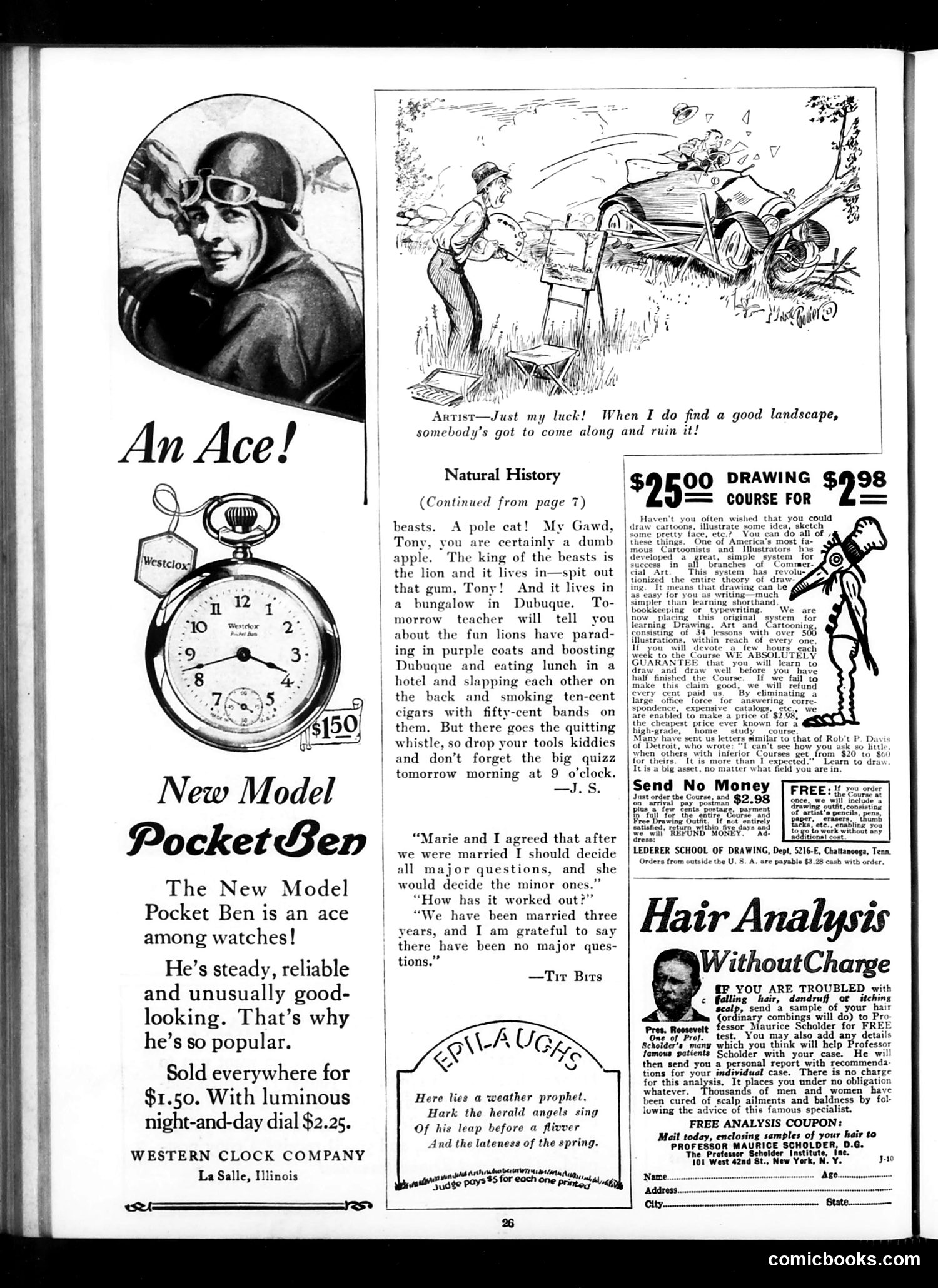
This page is primarily **advertising**, with one small cartoon at the top. The cartoon shows an artist complaining that when he finds a good landscape to paint, someone ruins it—illustrated by a chaotic car crash in the background. This is a simple **visual gag about interruption**, likely reflecting early 20th-century anxieties about automobiles intruding on pastoral scenes and artistic pursuits. The page otherwise features period advertisements: a Pocket Ben watch ("An Ace!"), a drawing course, and a "Hair Analysis Without Charge" service from Professor Maurice Scholder's institute. There's also a brief comedic marriage anecdote about a couple's division of decision-making. The only substantive satirical content is minimal—the marriage joke gently mocks traditional gender roles regarding household authority. The page reflects Judge's mix of light humor and commercial promotion typical of American magazines from this era.
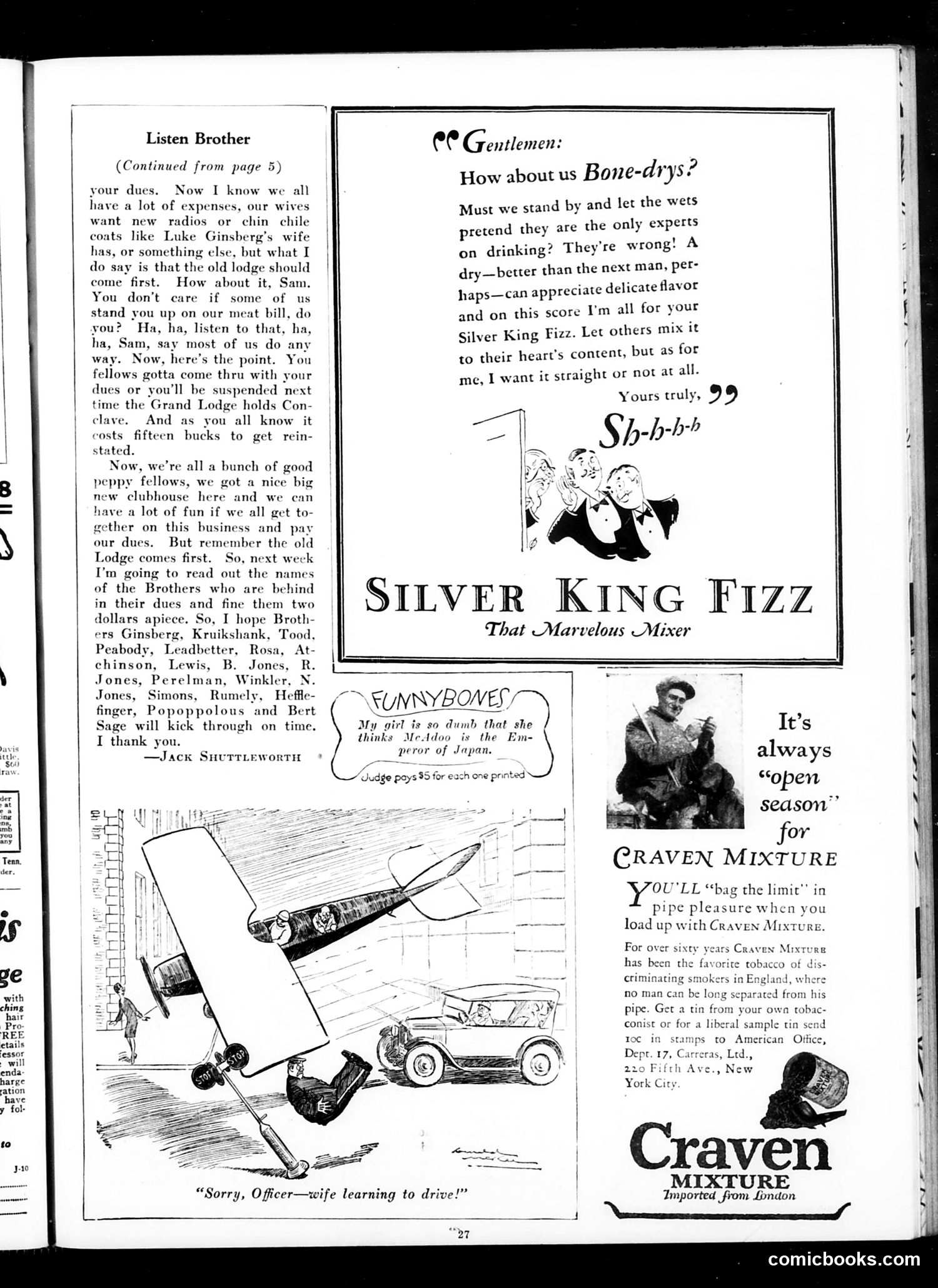
This page contains multiple advertisements and a fraternal lodge appeal, reflecting 1920s consumer culture and social concerns. **"Listen Brother" Column:** Jack Shuttleworth pressures lodge members to pay overdue dues, threatening suspension and fines. This reflects Depression-era financial strain on fraternal organizations and the tension between members' family expenses (radios, fur coats) and organizational obligations. **Silver King Fizz Advertisement:** A reader defends non-alcoholic beverages during Prohibition, arguing abstainers can appreciate flavor too. This satirizes the "wets vs. drys" debate over alcohol prohibition—the letter writer humorously claims bone-dry drinkers deserve respect as connoisseurs. **"Sorry, Officer" Cartoon:** A wife's reckless driving endangers a policeman, playing on contemporary anxiety about women drivers—a newer social phenomenon in the 1920s presented as comedic incompetence. **Craven Mixture & Funny Bones:** Tobacco and product advertisements typical of the era's magazine content. The overall tone captures 1920s preoccupations: Prohibition debates, organizational dues pressure, and gender anxieties about modern women.
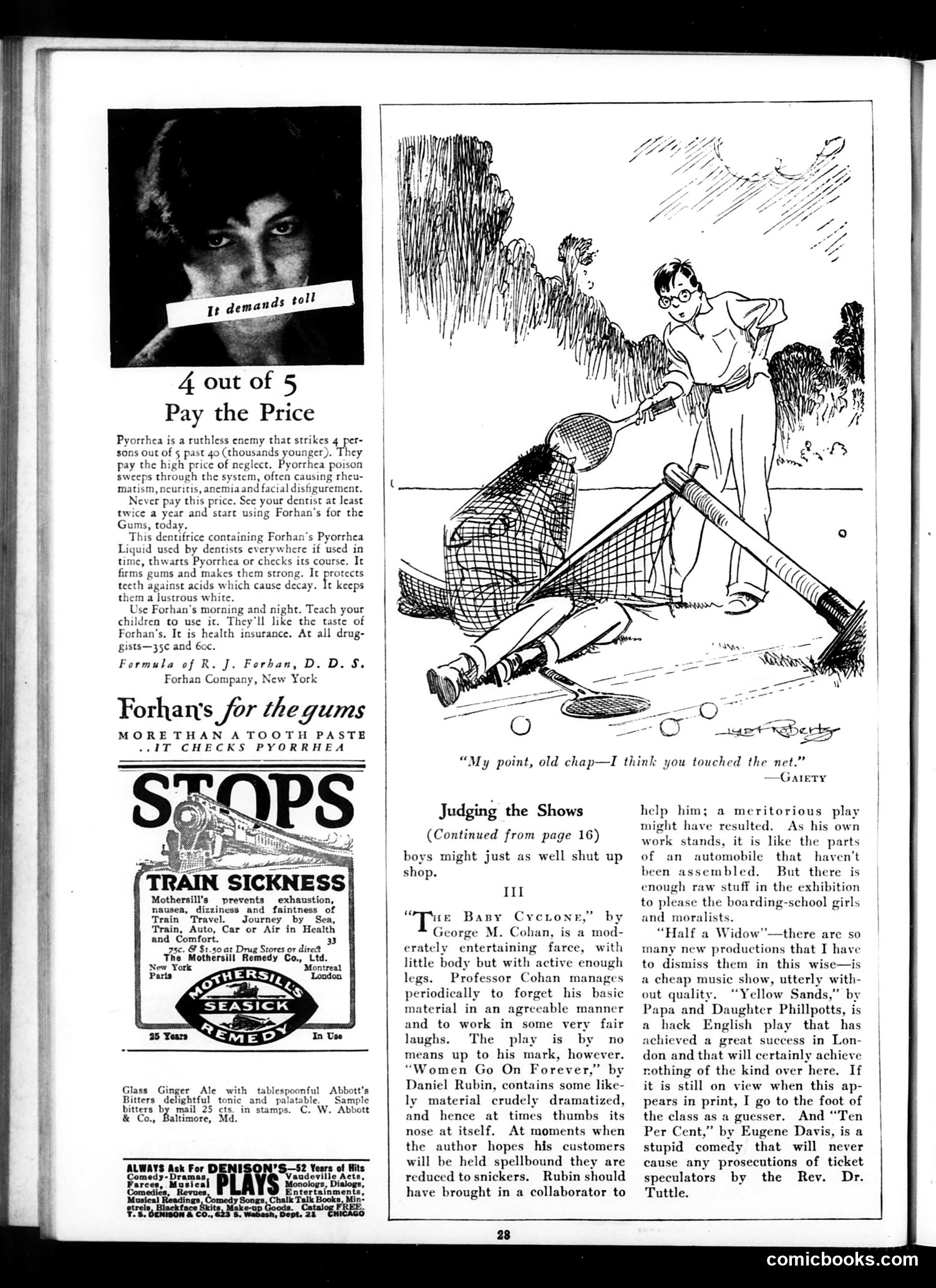
This page is primarily **advertising and theater reviews**, not political satire. The dominant content includes: **Main Advertisement**: Forhan's toothpaste dominates the left column, warning of pyorrhea (gum disease) affecting "4 out of 5" people over 40. The product promises to prevent serious systemic complications like rheumatism and anemia. **Cartoon**: A single-panel sporting joke (right side) shows a tennis player complaining to his opponent that the ball touched the net—a lighthearted, non-political humor about the rules of the game. **Theater Reviews**: The bottom half contains brief critiques of Broadway productions including "The Baby Cyclone" by George M. Cohan, "Women Go On Forever," and "Half a Widow," discussing their dramatic merit and entertainment value. **Secondary Ads**: Motion sickness remedies and other patent medicines appear throughout. The page reflects Judge's mixed business model: satirical commentary supported by extensive commercial advertising for consumer products, particularly patent medicines—common for early 20th-century magazines.
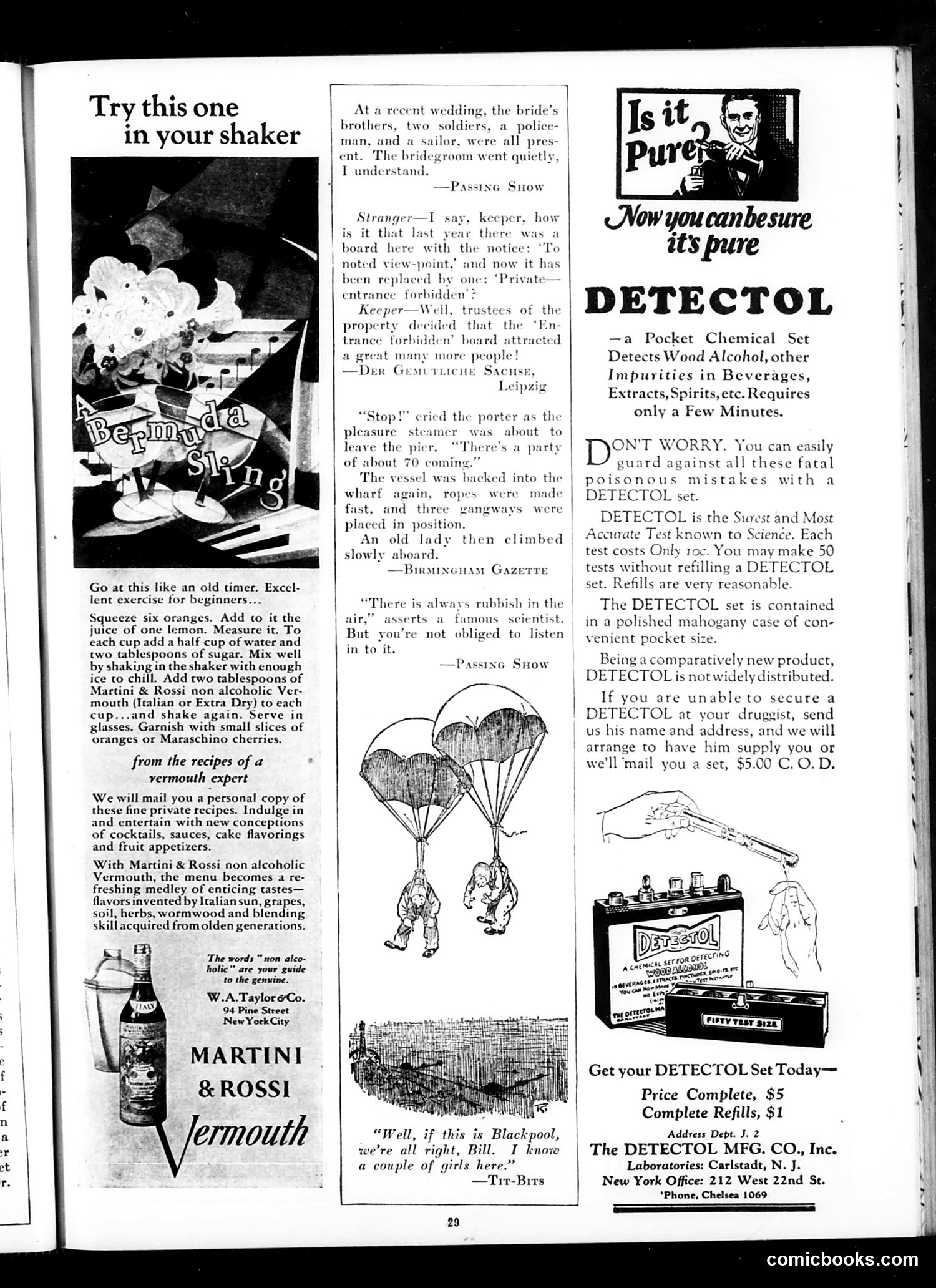
This page combines humor and advertising, likely from the Prohibition era (1920s-1930s). **The Cartoons/Jokes:** The center section contains brief anecdotes satirizing human nature: a keeper notes that a "No Entrance" sign attracted *more* visitors than the previous "Private Entrance Forbidden" sign; a porter must back a steamer into the wharf for a single 70-year-old passenger; and a scientist claims there's "always rubbish in the air" but people needn't listen to him. **The Advertisements:** The left features Martini & Rossi "non-alcoholic vermouth"—likely a workaround during Prohibition, when alcohol was banned but non-alcoholic versions were marketed with cocktail recipes. The right advertises DETECTOL, a chemical test kit to detect wood alcohol and other poisons in beverages—reflecting real Prohibition-era dangers when illegal alcohol production sometimes produced toxic methanol. Together, the page reflects Prohibition's absurdities: legal cocktail recipes using non-alcoholic ingredients, and the genuine public health crisis of poisoned bootleg liquor.
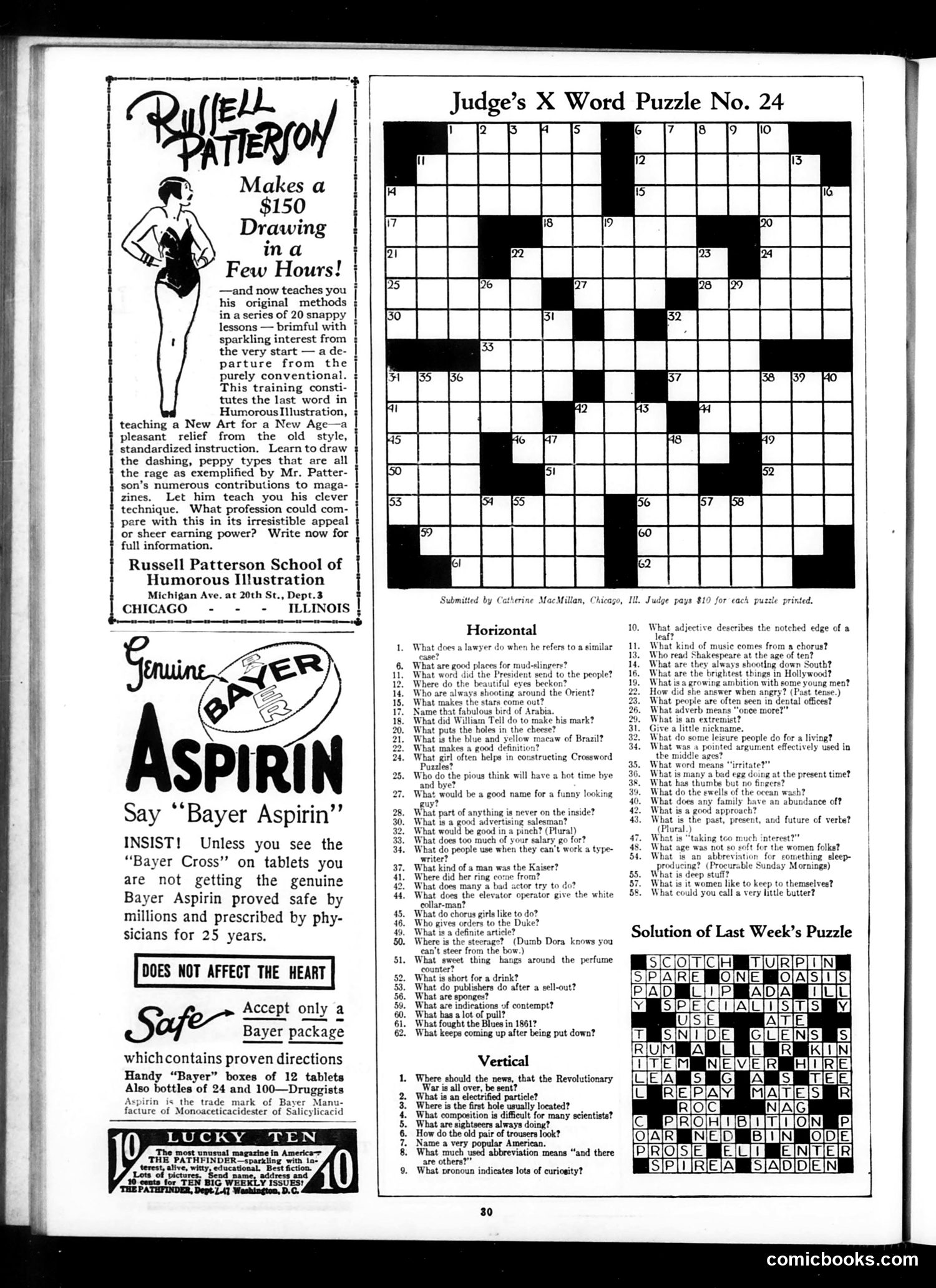
This page is primarily **advertising** for three products/services, with a crossword puzzle. The main content advertises **Russell Patterson's School of Humorous Illustration**—a correspondence course teaching cartooning techniques. Patterson was apparently a successful magazine illustrator whose modern "peppy" drawing style could earn students $150 per drawing. The pitch emphasizes this as a "New Art for a New Age," positioning his methods as more appealing and lucrative than traditional art instruction. Below that are ads for **Bayer Aspirin** (emphasizing the branded "Bayer Cross" on genuine tablets, as aspirin was becoming genericized) and **Lucky Ten magazine**. The **crossword puzzle** contains period-specific humor clues referencing contemporary topics: President Wilson, Hollywood stars, the recent end of WWI, and popular culture. Clues like "What does a lawyer do?" and "Who gives orders to the Duke?" reflect 1920s concerns. The page reflects early 20th-century consumer culture, mail-order education, and patent medicine marketing—all before modern advertising regulations.
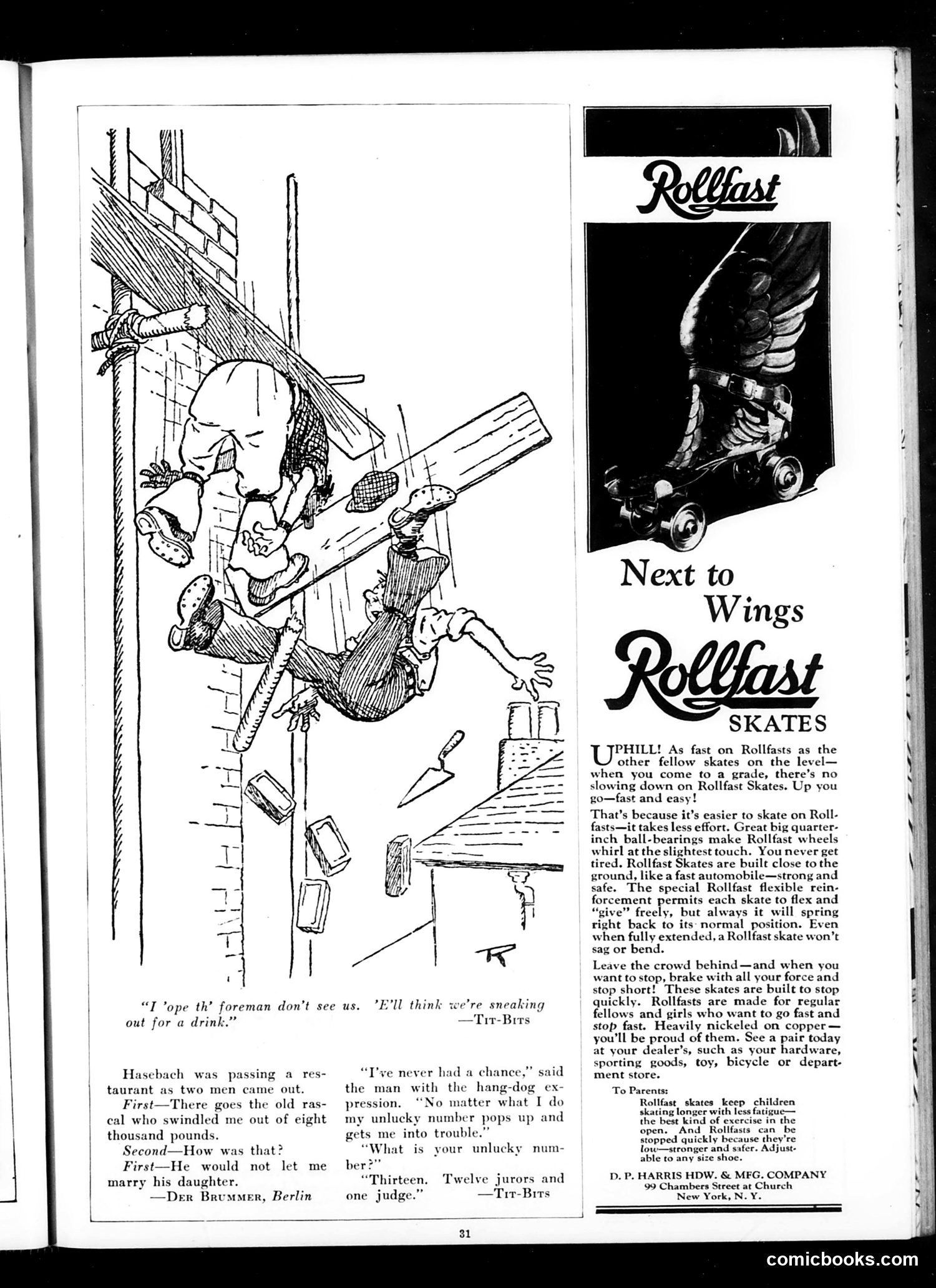
This page contains two distinct elements: **Left side:** Three brief jokes from international sources (Der Brummer, Berlin; Tir-Brrs). The cartoons illustrate everyday social humor—a man worried about sneaking away from work unnoticed; a man bitter about being denied marriage to a woman due to her father's disapproval; and a criminal lamenting that the number thirteen (his "unlucky number") keeps getting him convicted before juries of twelve jurors plus one judge. **Right side:** An advertisement for Rollfast Skates. The ad uses period marketing language emphasizing mechanical superiority (ball-bearings, flexible reinforcement) to position roller skates as fast, safe, and durable for children and young people. The imagery shows a winged figure (appearing angelic or Mercury-like) on skates. The page is primarily **advertising-driven content** rather than political satire. The jokes are mild social humor with no clear political messaging.
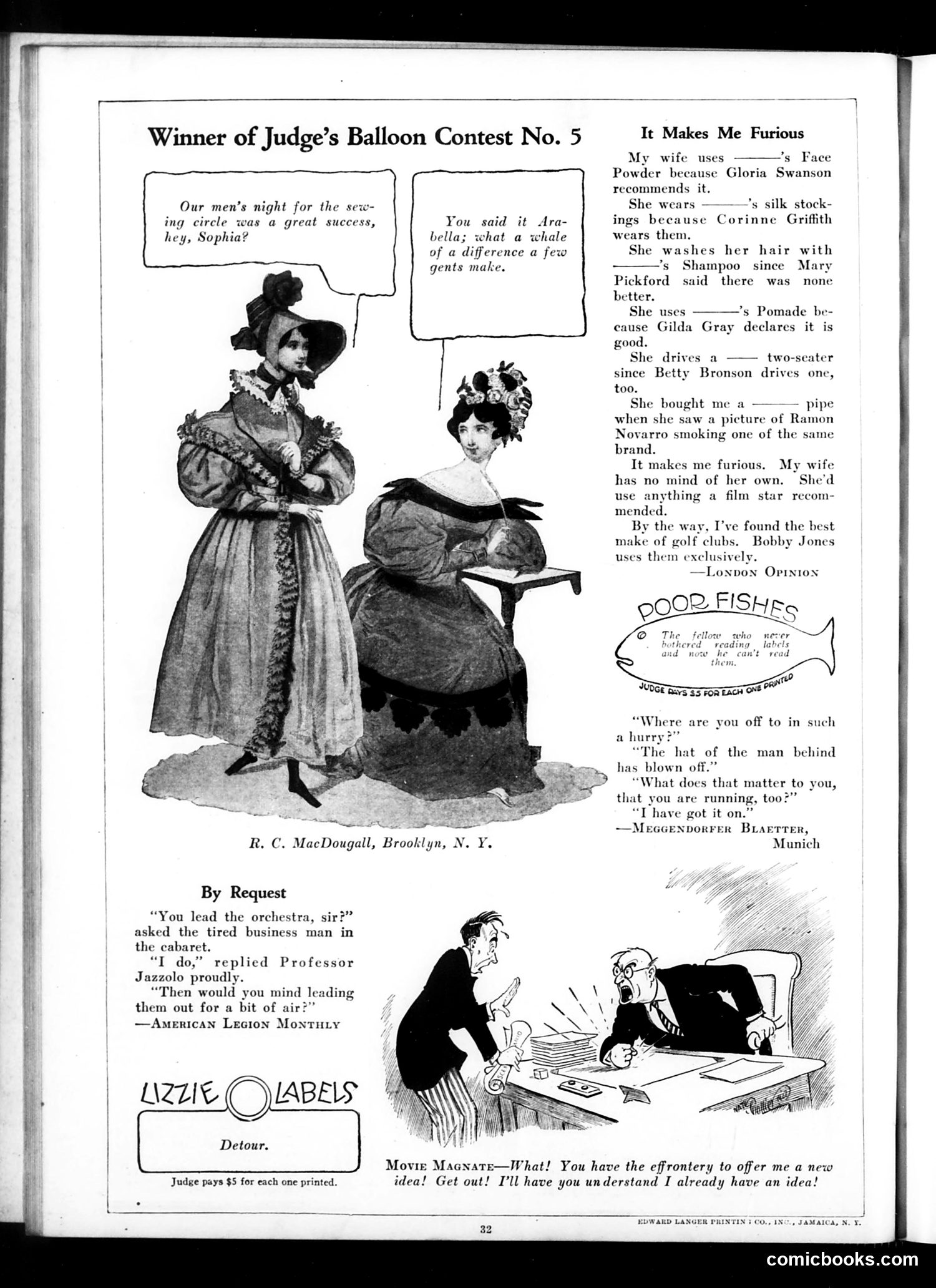
This page contains multiple satirical pieces from Judge magazine (likely 1920s-30s based on references): **"Winner of Judge's Balloon Contest"**: A fill-in-the-blank cartoon mocking celebrity endorsement culture. The joke satirizes wives who mindlessly copy film stars—Gloria Swanson, Corinne Griffith, Mary Pickford, Gilda Gray, Betty Bronson, and Ramon Novarro are name-dropped as sources of consumer choices. The London Opinion caption adds irony: a husband chases after a blown hat, claiming "I have got it"—blind conformity even to absurdity. **"By Request"**: A brief joke about a Professor Jazzolo conducting an orchestra, with a tired businessman asking him to "lead them out for a bit of air"—a pun on orchestral conducting. **"Movie Magnate"**: A cartoon depicting a Hollywood executive dismissing a writer's pitch, claiming he "already has an idea"—satire on Hollywood's creative pretension and gatekeeping. The page satirizes 1920s consumer culture, celebrity worship, and entertainment industry pomposity.
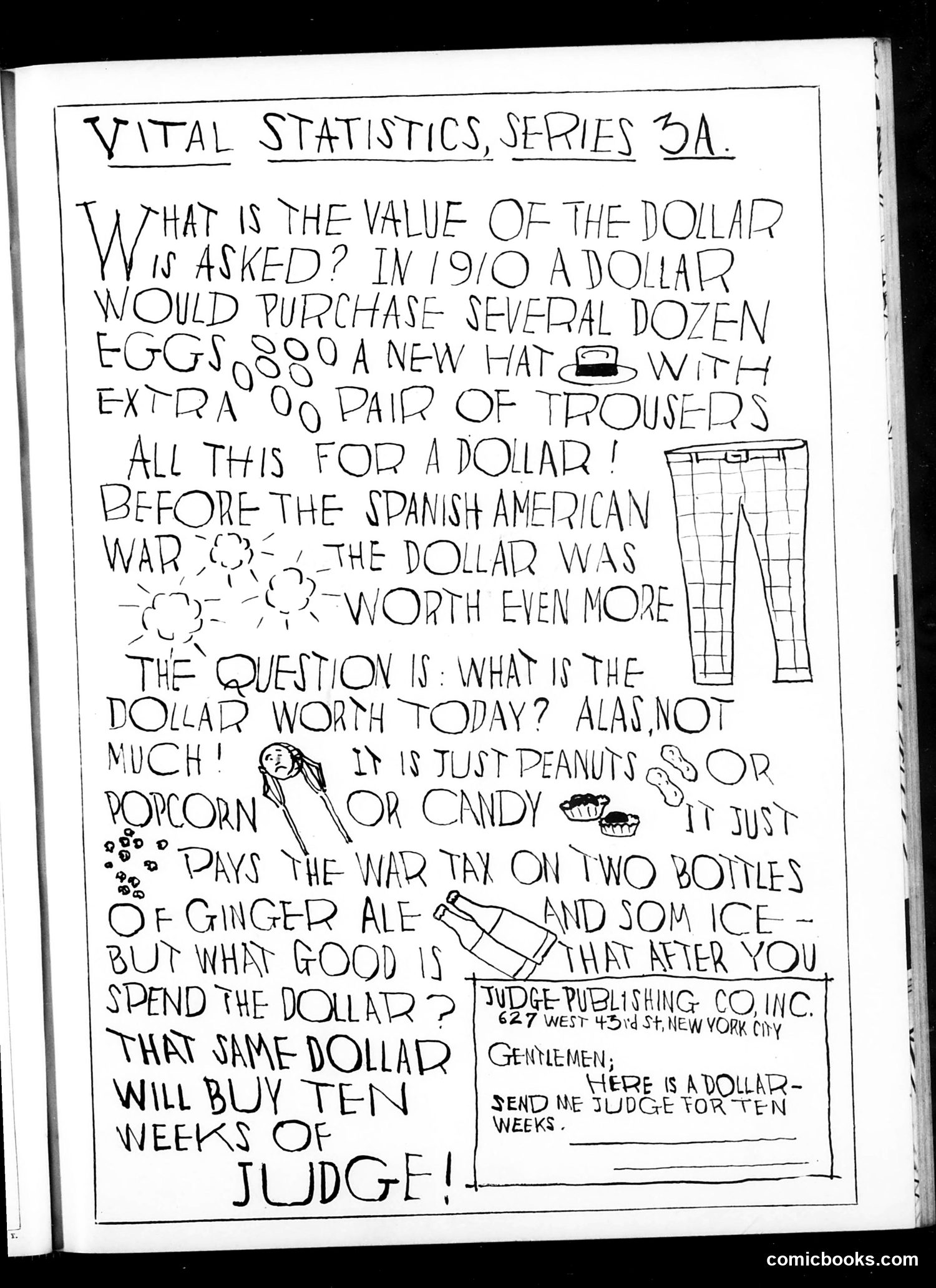
This satirical piece addresses **inflation and the declining purchasing power of the dollar**, likely from the early 20th century (references to the Spanish-American War, circa 1898, as a historical benchmark). The cartoon contrasts what one dollar could buy in 1910—several dozen eggs, a new hat, trousers—with its contemporary value, which the author laments is "alas, not much!" By 1910, that same dollar buys only "peanuts or popcorn or candy," or pays the war tax on two bottles of ginger ale and ice. The satire's punchline: after you spend the dollar on these trivial items, "that same dollar will buy ten weeks of **Judge!**" This is both self-promotional and ironic—a tongue-in-cheek advertisement suggesting that Judge magazine alone offers better value than anything else money can purchase in the current economy. The piece critiques wartime inflation and economic decline while humorously plugging the magazine itself.
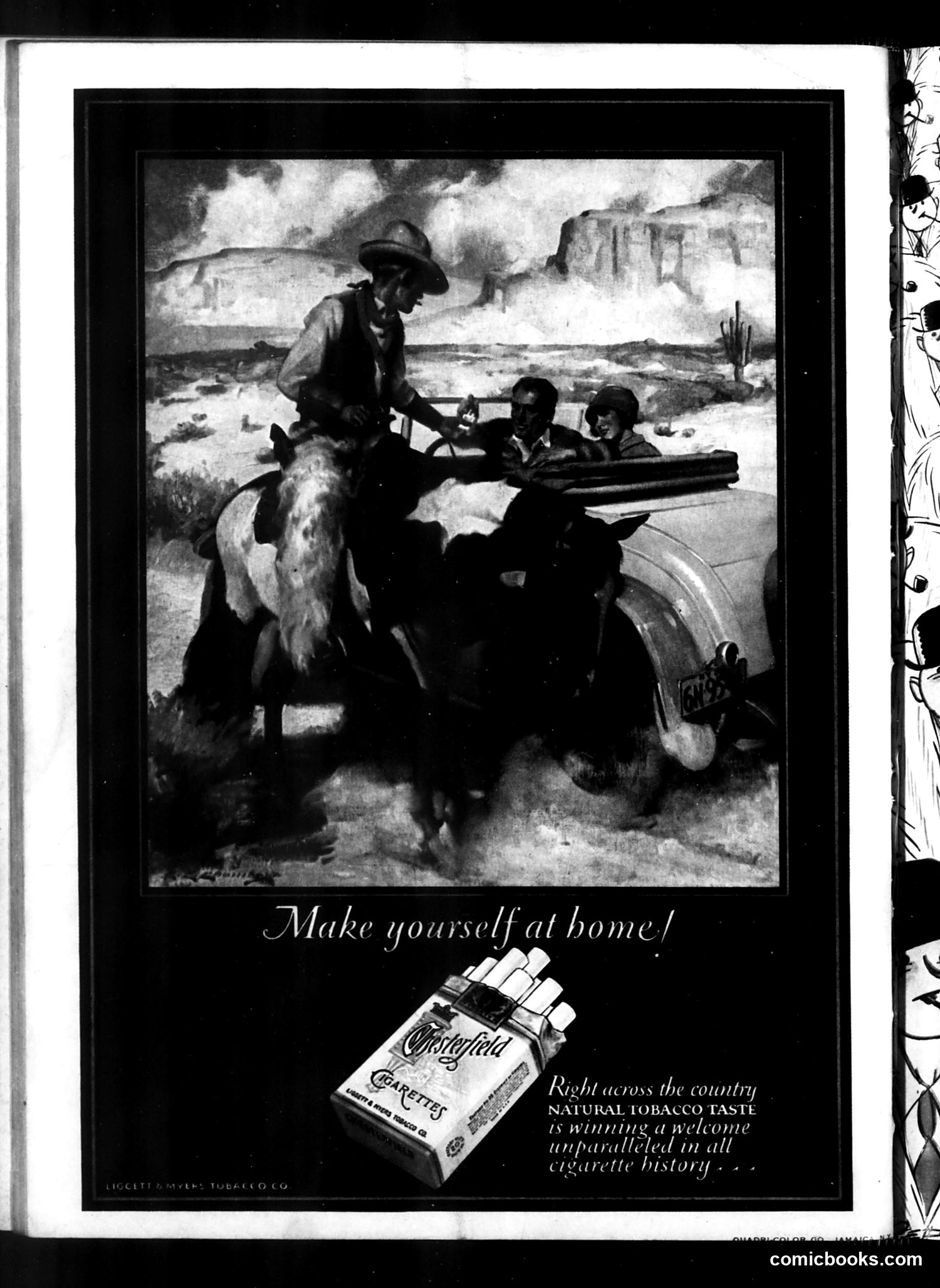
This is a **Chesterfield cigarette advertisement**, not a political cartoon. The image depicts a Western scene: a cowboy on horseback with two men in a vehicle (appears to be an early automobile), set against desert landscape with rock formations and a cactus. The ad's message juxtaposes rugged frontier imagery with modern consumer culture, using the "Wild West" as shorthand for authenticity and natural appeal. The slogan "Make yourself at home" suggests Chesterfield cigarettes offer comfort and familiarity. The text claims the cigarette's "natural tobacco taste" is gaining unprecedented popularity nationwide. This appears to be a vintage advertisement (likely early-to-mid 20th century) leveraging frontier mythology to market tobacco as wholesome and genuinely American—a common advertising strategy before tobacco's health risks became widely acknowledged.