
A complete issue · 36 pages · 1927
Judge — August 13, 1927
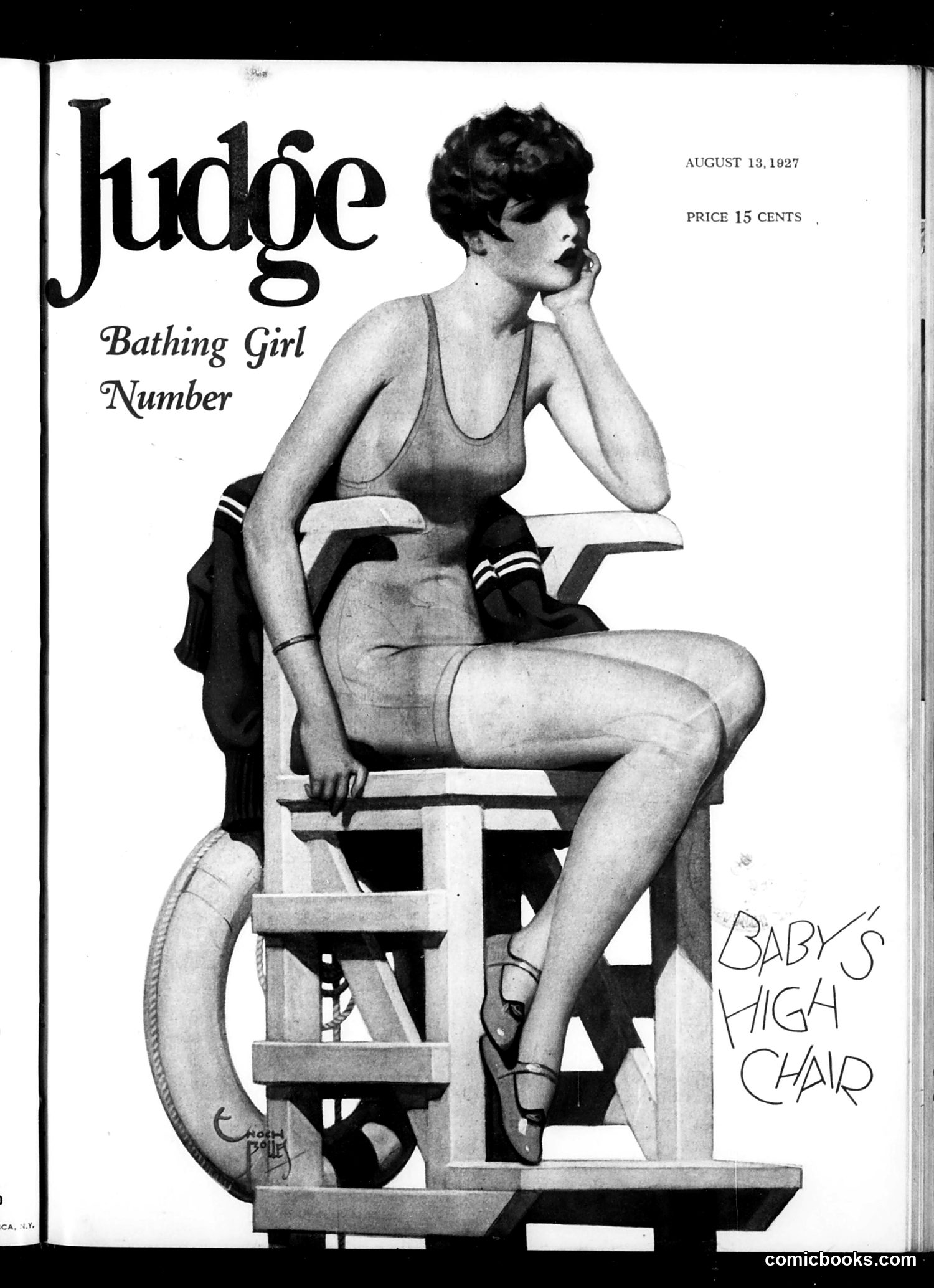
This is primarily a **cover advertisement** rather than political satire. It depicts a woman in a 1920s bathing suit seated on a lifeguard chair, reading what appears to be Judge magazine itself. The cover is labeled "Bathing Girl Number," indicating this is a themed issue capitalizing on summer leisure culture. The handwritten note "BABY'S HIGH CHAIR" is a visual pun—the lifeguard chair resembles furniture for infants. This plays on the era's fascination with bathing beauties and the beach culture of the Jazz Age. The price of 15 cents and date reflect Judge's status as a popular humor magazine of the period. There's no apparent political commentary; it's entertainment-focused advertising.
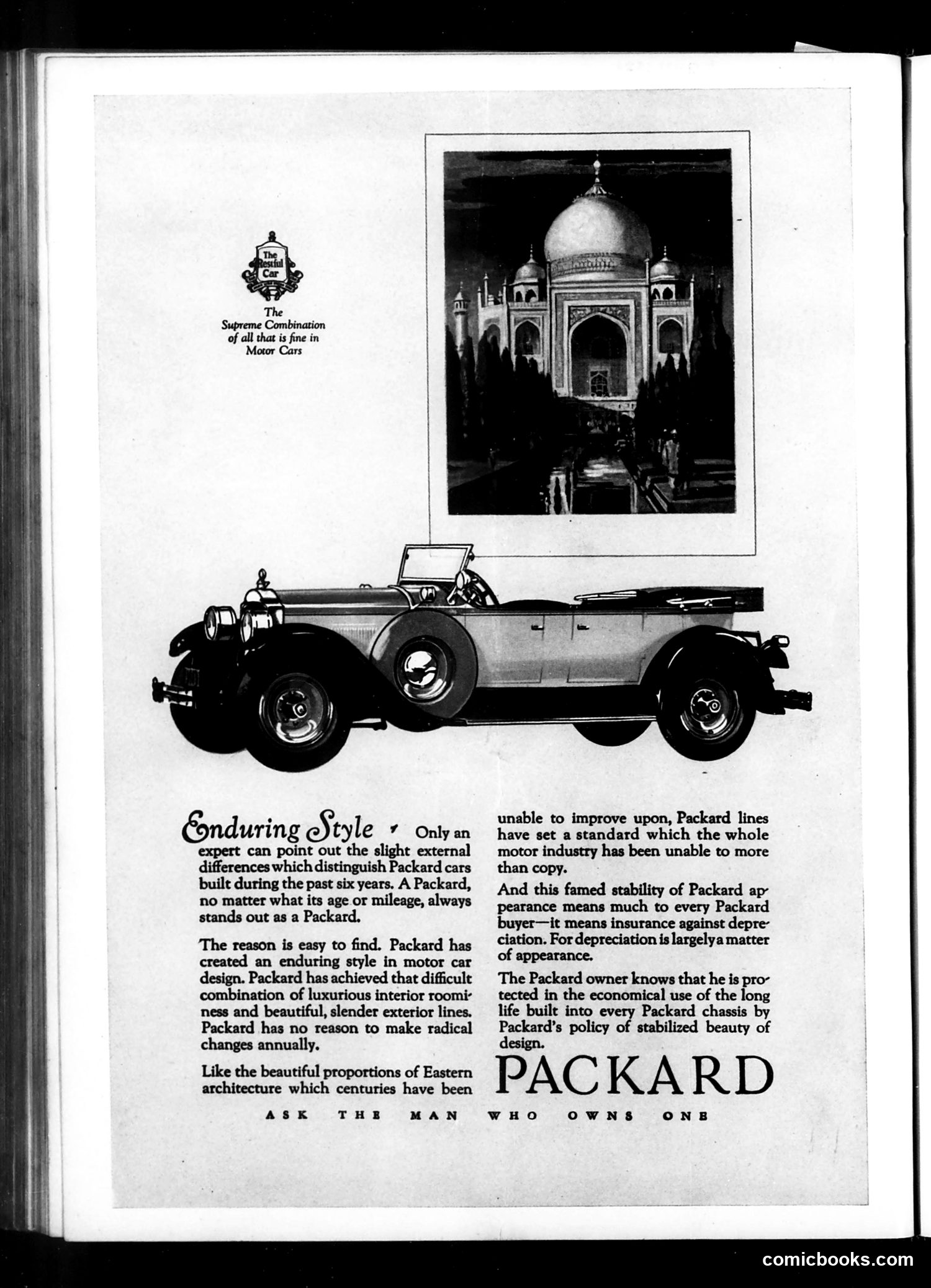
This page is **primarily an advertisement**, not political satire. It's a Packard automobile ad from Judge magazine, likely from the 1920s based on the car's design and style. The ad compares Packard's design consistency to Eastern architecture (the Taj Mahal image shown), arguing that Packard maintains timeless, elegant styling across model years without radical annual changes—unlike competitors. The text emphasizes that this "enduring style" provides investment protection through better resale value and reduced depreciation. The satire element is subtle: it's satirizing the broader automobile industry's practice of forcing yearly design changes to drive new purchases. Packard positions itself as the sophisticated, stable alternative to manufacturers constantly chasing novelty.
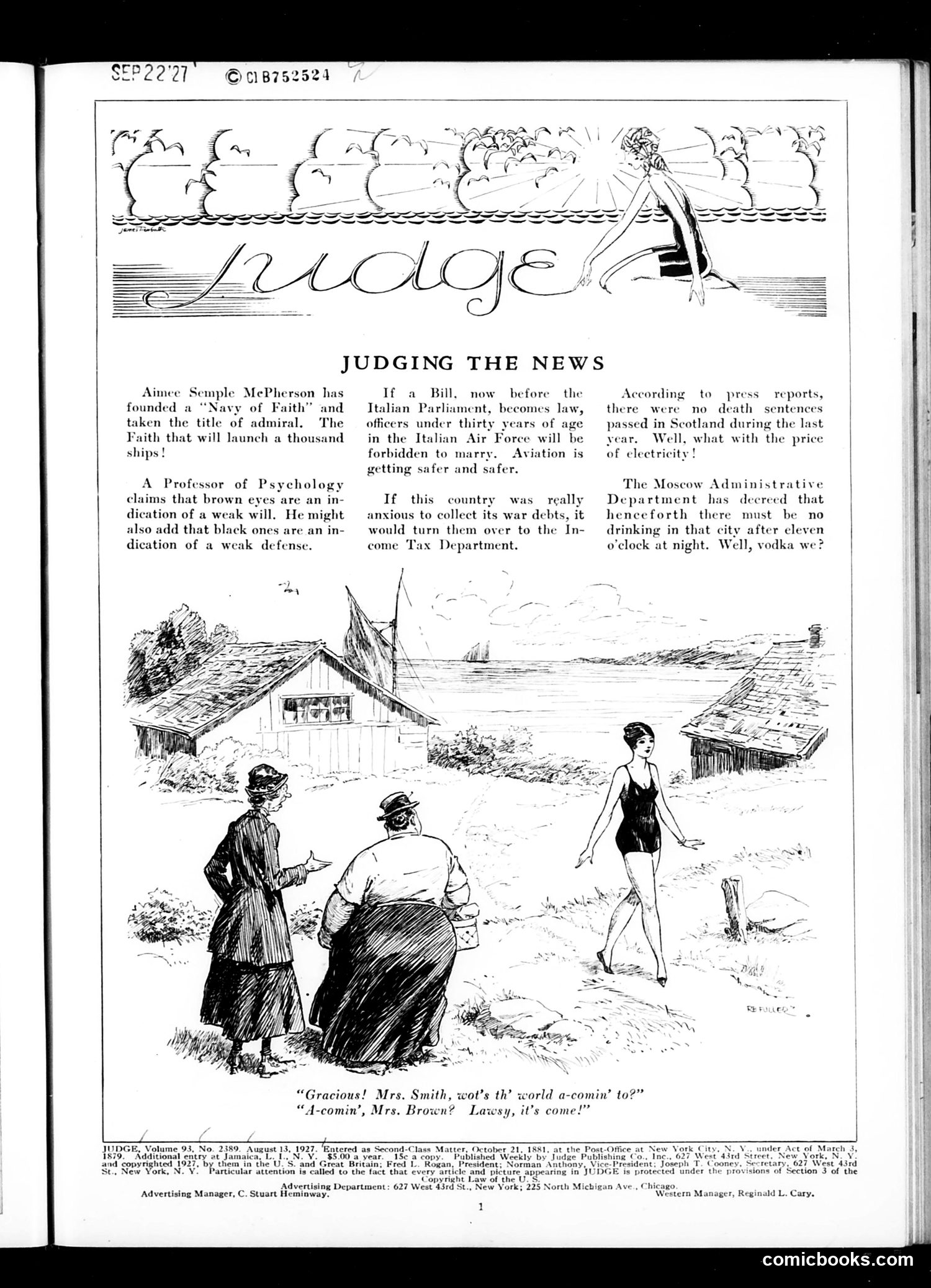
This satirical section contains brief commentary on contemporary events with a accompanying cartoon. The main cartoon depicts a beach scene where two fully-clothed women encounter a young woman in a bathing suit, with the caption suggesting surprise at modern swimwear ("A-comin', Mrs. Brown? Luvey, it's come!"). The "Judging the News" section above offers brief satirical takes on current topics: Admiral Aimee Simple McPherson's naval ambitions, a psychology professor's theory about brown eyes, Italian parliamentary legislation restricting youth marriage, Scottish electricity prices, and a Moscow administrative drinking restriction. The humor relies on topical references to 1920s news and social debates about modernity—particularly the shock of changing women's fashion and swimwear—rather than specific political figures or events.
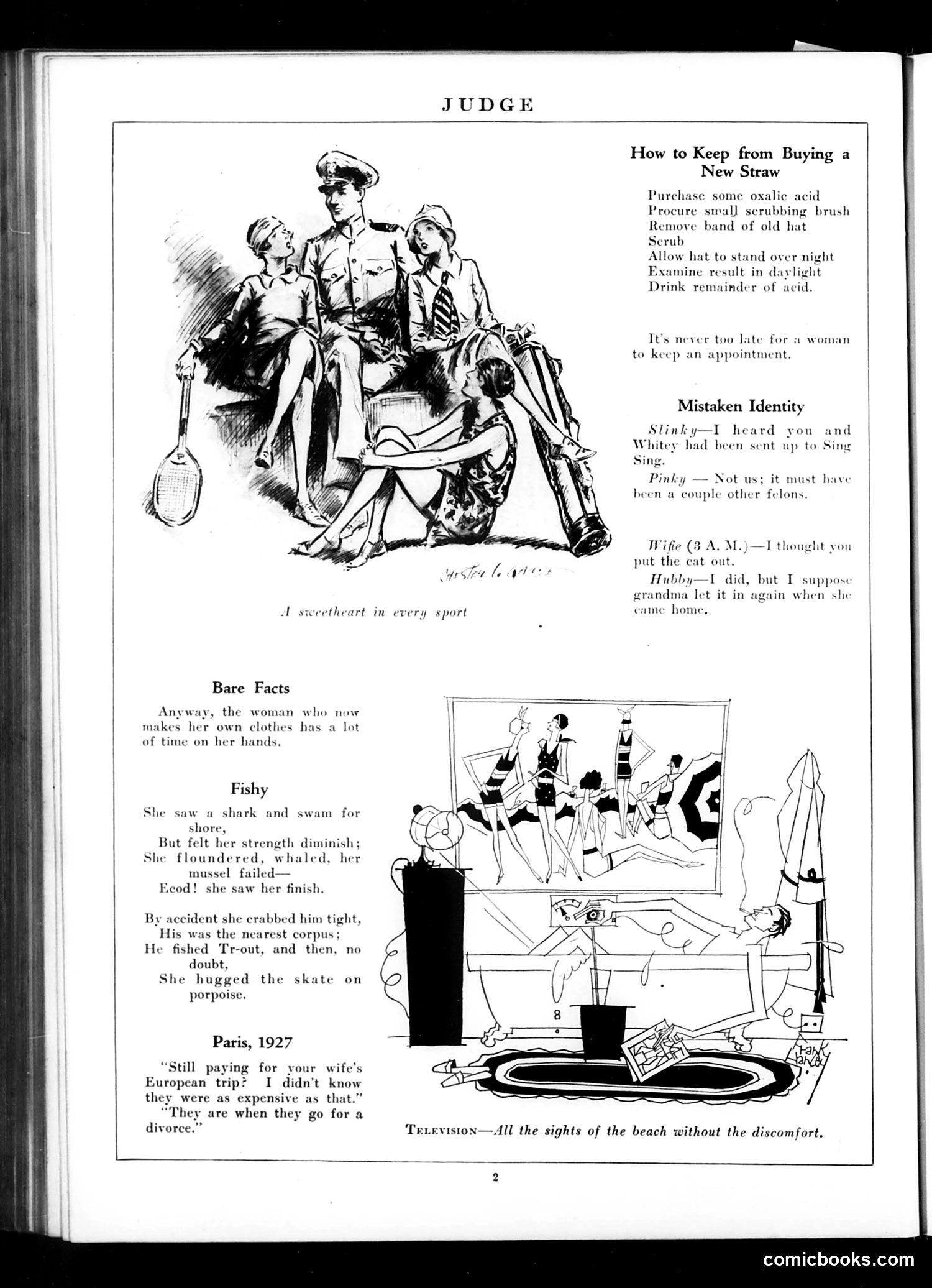
This page from Judge magazine contains several satirical pieces about 1920s social life: **"A sweetheart in every sport"** depicts military officers flirting with women—likely mocking the popularity of uniformed men in the post-WWI era. **"Bare Facts"** and **"Fishy"** are humorous anecdotes about women's changing roles (making their own clothes) and a woman's swimming mishap. **"Television"** cartoon satirizes the then-new television technology, showing beach scenes broadcast indoors—mocking both the novelty of TV and the desire to avoid actual discomfort while enjoying entertainment. **"Paris, 1927"** jokes about expensive European vacations ending in divorce—social commentary on wealthy Americans' leisure spending and marital instability. The humor reflects 1920s anxieties about modernity, women's independence, and consumer culture.
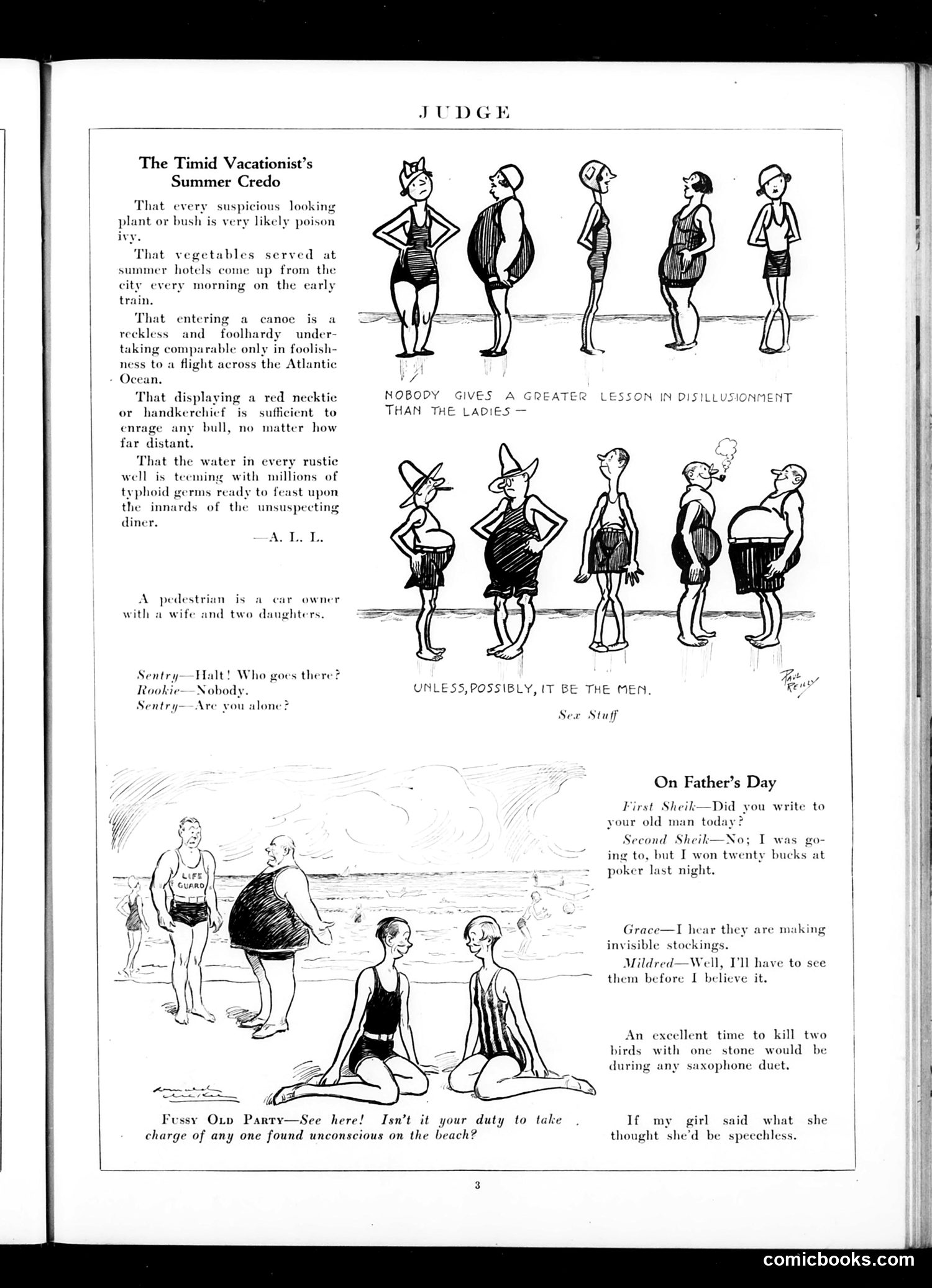
This page satirizes anxieties of early 20th-century middle-class vacationers. The top section mocks paranoid beliefs: that unfamiliar plants are poisonous, vegetables from city hotels are contaminated, canoeing is suicidal, red neckties provoke bulls, and rustic well-water carries typhoid germs. The humor lies in exaggerating common vacation fears. The middle comic shows men's disillusionment—presumably about encountering only other men rather than women at vacation spots. "On Father's Day" jokes about domestic life: a wife won't write to her husband (busy winning at poker), women discuss invisible stockings and saxophone performances, and one woman jokes that if her daughter said what she thought, she'd be speechless. The satire targets gender relations and consumer fads of the era.
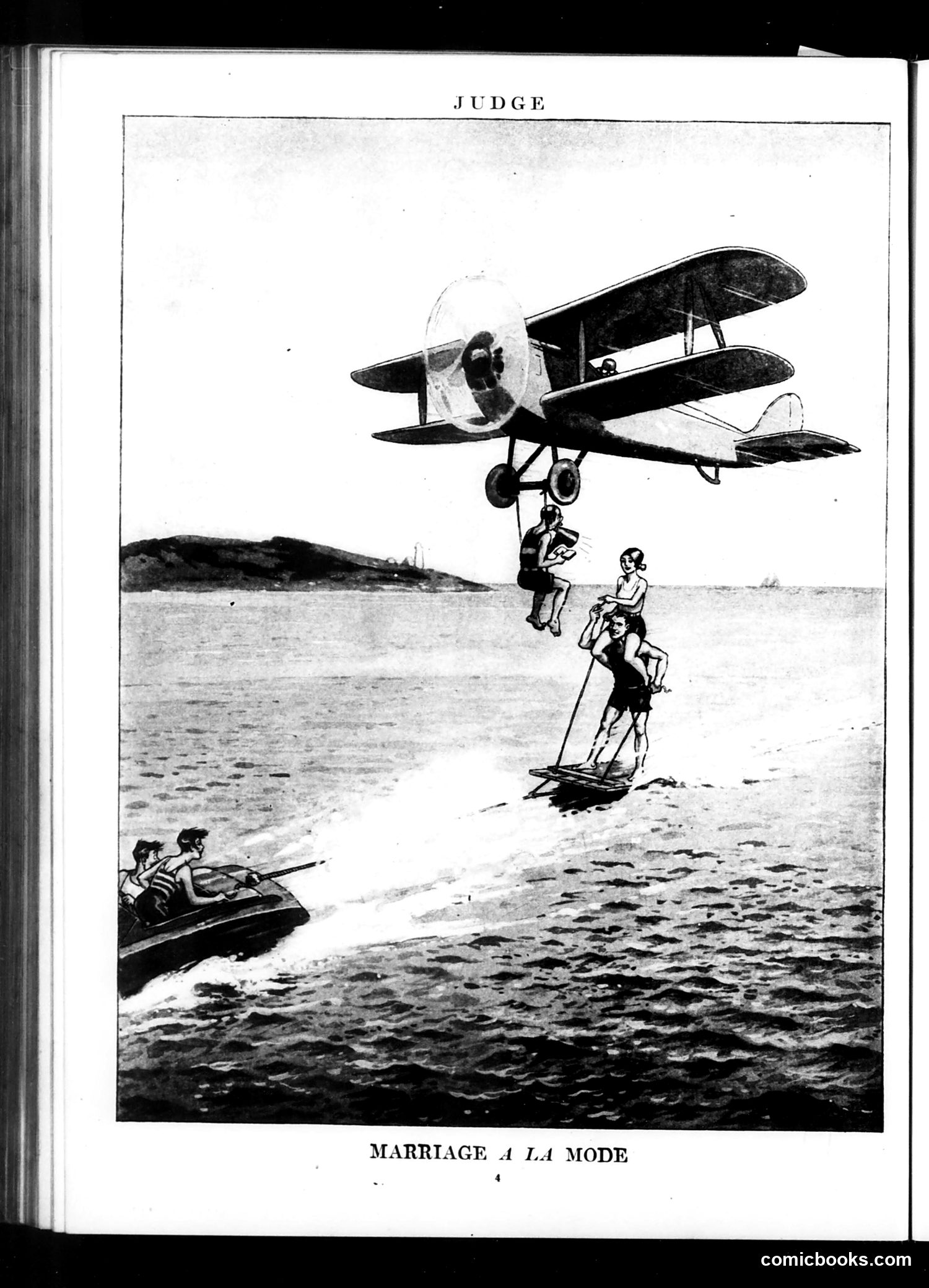
This satirical cartoon depicts an unconventional courtship scene at a beach. A biplane hovers overhead with a man suspended beneath it by a rope, while several people on the sand below appear to be participating in or witnessing this aerial spectacle. The title "Marriage à la Mode" (Marriage in the Modern Fashion) suggests this illustrates contemporary courtship practices of the 1920s-1930s era. The cartoon likely satirizes the increasingly adventurous and publicity-seeking nature of modern romance and engagement announcements during this period—when aviation was still novel and daring. The aerial stunt represents how young couples were adopting flashy, attention-grabbing methods to announce relationships, reflecting broader social anxieties about changing courtship customs and the influence of new technology on traditional romance.
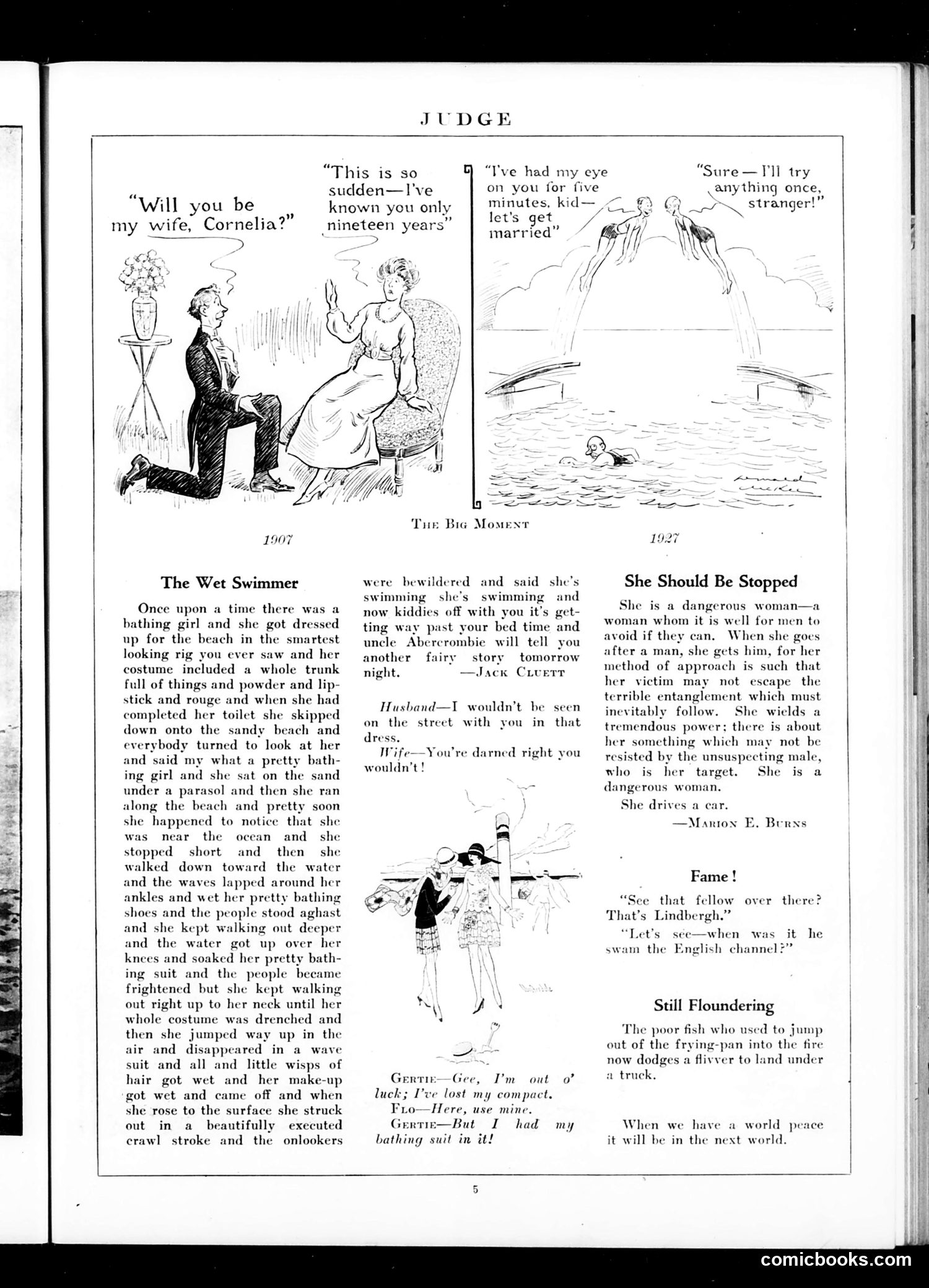
This page contains three satirical cartoons and humorous stories from Judge magazine: **"The Big Moment" (1907-1927)**: Two panels contrast romantic proposals across eras. The 1907 image shows a traditional kneeling proposal; the 1927 image depicts a casual beach proposal to a woman swimming. The satire mocks how courtship customs changed dramatically in just two decades—from formal, serious rituals to casual, modern interactions. **"The Wet Swimmer"**: A humorous story about a woman who wades into the ocean fully clothed and performs an impressive crawl stroke, shocking beachgoers. The joke satirizes impropriety and absurdity. **Other sections** include brief satirical pieces about women's behavior and social commentary, typical of Judge's early 20th-century humor targeting changing gender roles and modern manners.
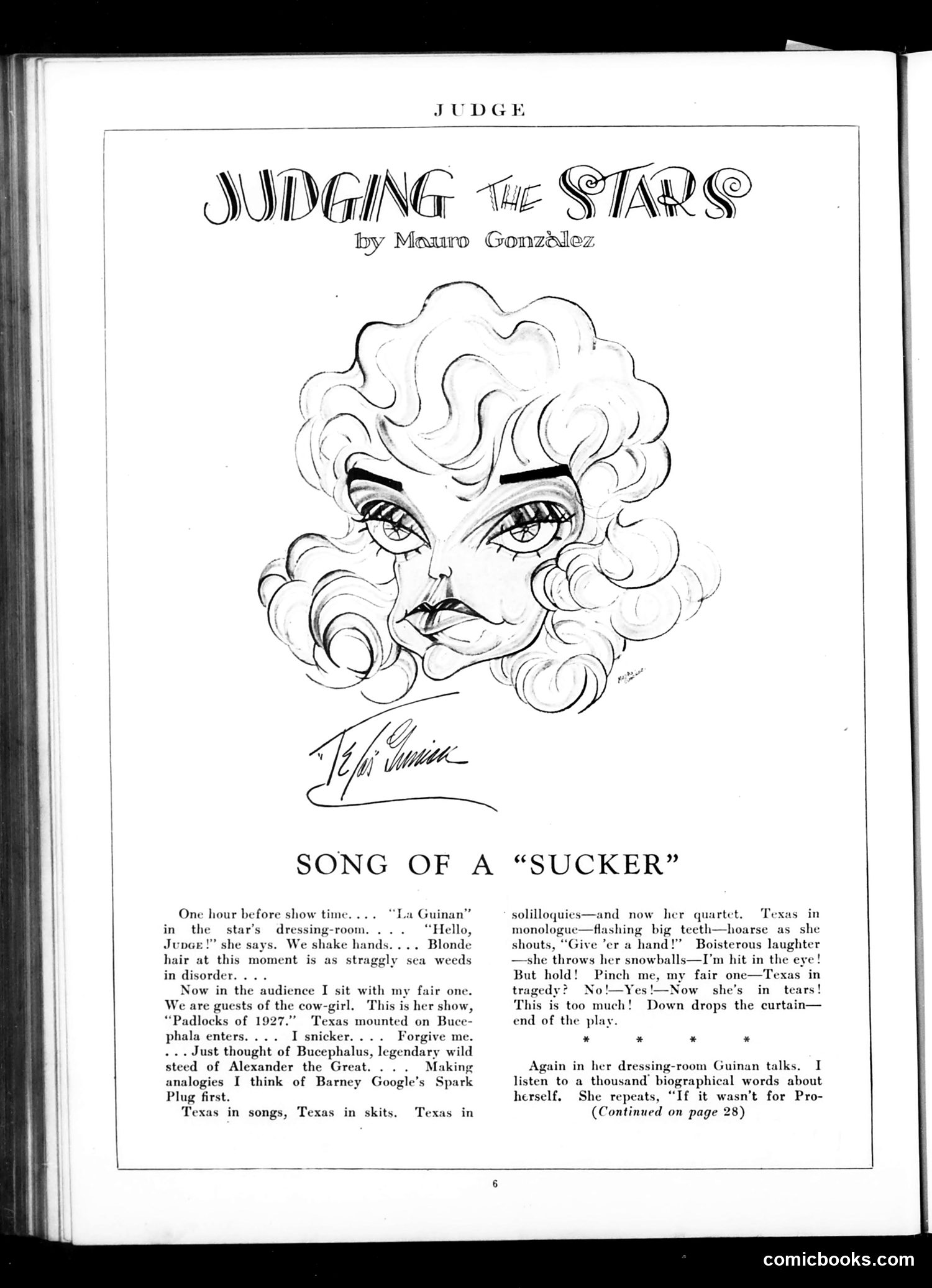
This article by Mauro Gonzalez is a theatrical review satirizing a gullible audience member ("sucker") attending a Broadway show. The subject is "La Guinan"—likely **Texas Guinan**, a famous 1920s nightclub hostess and entertainer known for her brash, comedic stage presence. The satire mocks the narrator's naïve infatuation with the performer. He describes her unflattering appearance (straggly blonde hair), absurd on-stage antics (throwing snowballs, melodramatic tears), and endless self-promotion in her dressing room. The joke is that despite the obviously artificial, over-the-top performance, the "sucker" remains enchanted—the title refers to audience members easily duped by theatrical spectacle and a star's charm. The reference to "Barney Google's Spark Plug" anchors this to 1920s popular culture, while "Padlocks of 1927" suggests a real or fictional Broadway revue.
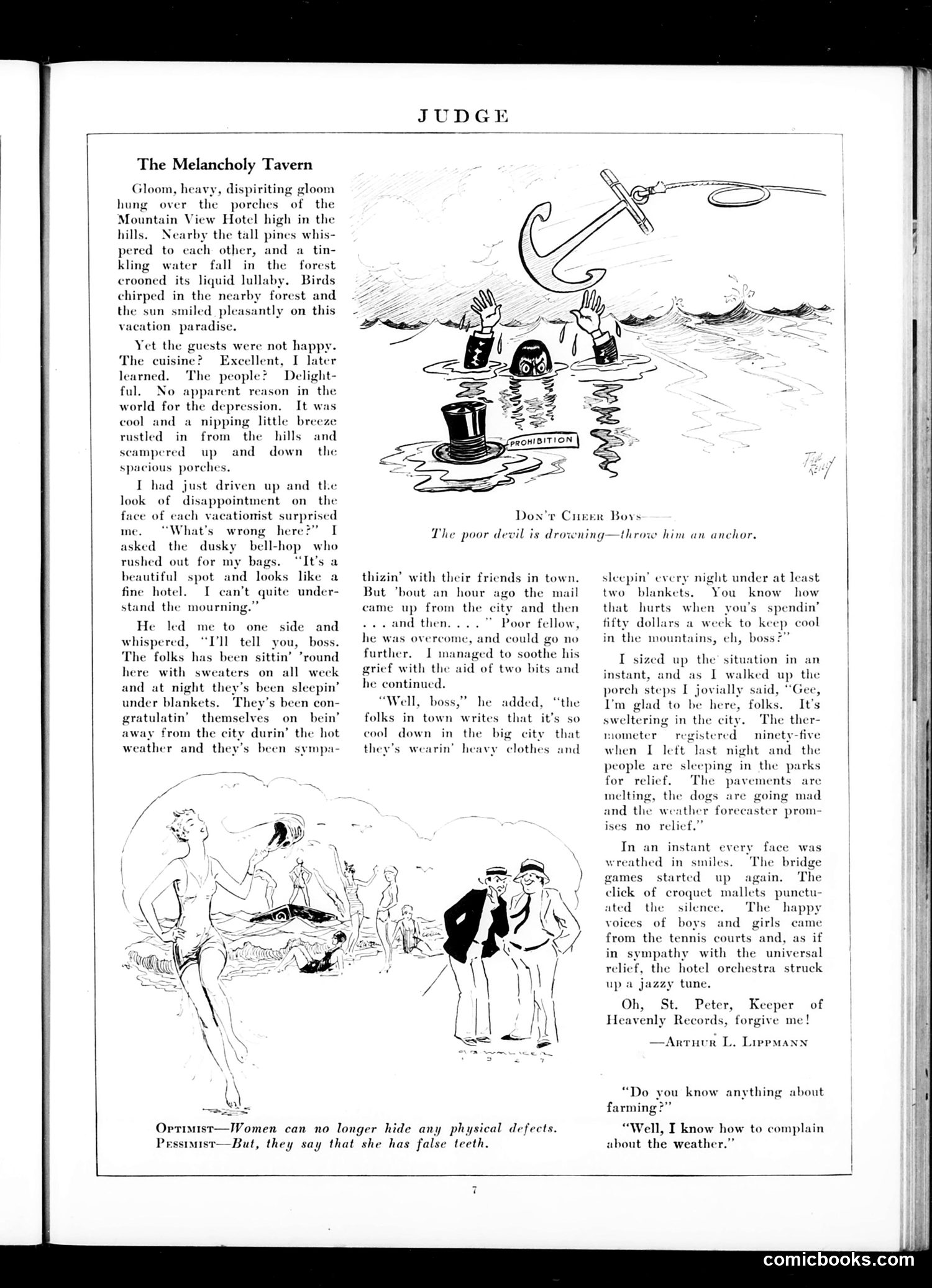
This page satirizes the psychology of vacation satisfaction and human complaint. The main story describes guests at a mountain resort mysteriously miserable despite ideal conditions—excellent food, pleasant scenery, and cool weather. The joke: A bellhop reveals guests are depressed because mail from the city reports it's sweltering there. Once the narrator cheerfully points out they're escaping that heat, everyone instantly becomes happy. The satire targets human nature—people need comparative misery to feel content. Vacationing is only enjoyable when you're reminded how much worse things are elsewhere. The accompanying cartoons reinforce this theme: one shows boys drowning (needing an "anchor" of bad news to cheer up), another mocks optimists versus pessimists regarding physical appearance and false teeth. The final joke confirms the point: someone asks "Do you know anything about farming?" The answer: "Well, I know how to complain about the weather"—suggesting complaint is humanity's default state.
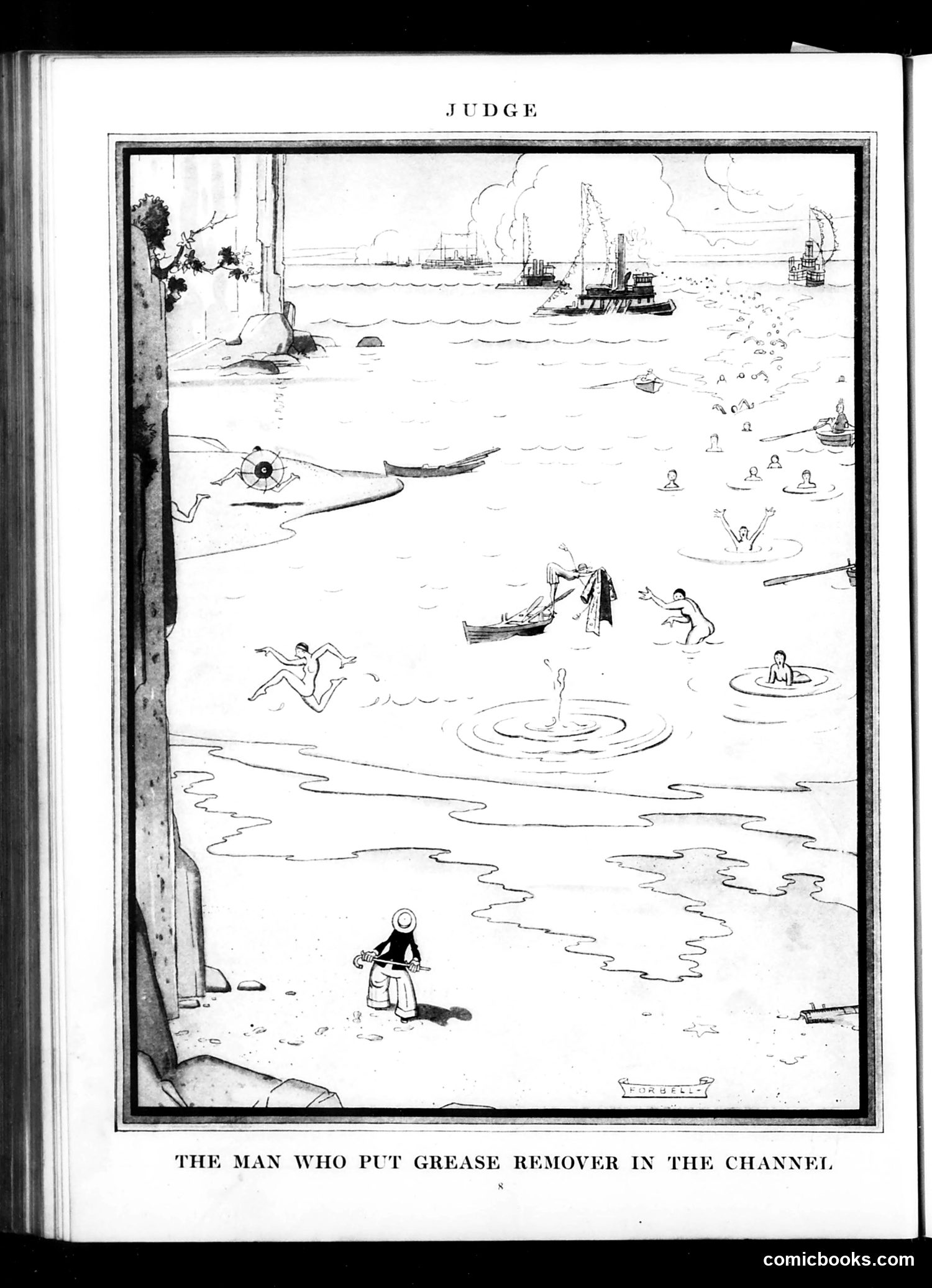
This appears to be a satirical cartoon from Judge magazine depicting a beach scene in the English Channel. The caption suggests someone introduced grease remover to the water, creating chaos among swimmers and boats. The joke likely references a contemporary incident or concern about water pollution or chemical contamination in the Channel—a major shipping route. The cartoon shows the absurd consequences: swimmers fleeing, boats disturbed, and general disruption. The satire critiques either industrial negligence, environmental recklessness, or possibly a specific publicized incident involving chemical discharge into public waterways. The "man who put" framing suggests either intentional mischief or corporate irresponsibility causing unintended public harm. Without the publication date visible, the specific historical reference remains unclear, though it reflects early 20th-century concerns about industrial pollution and public safety.
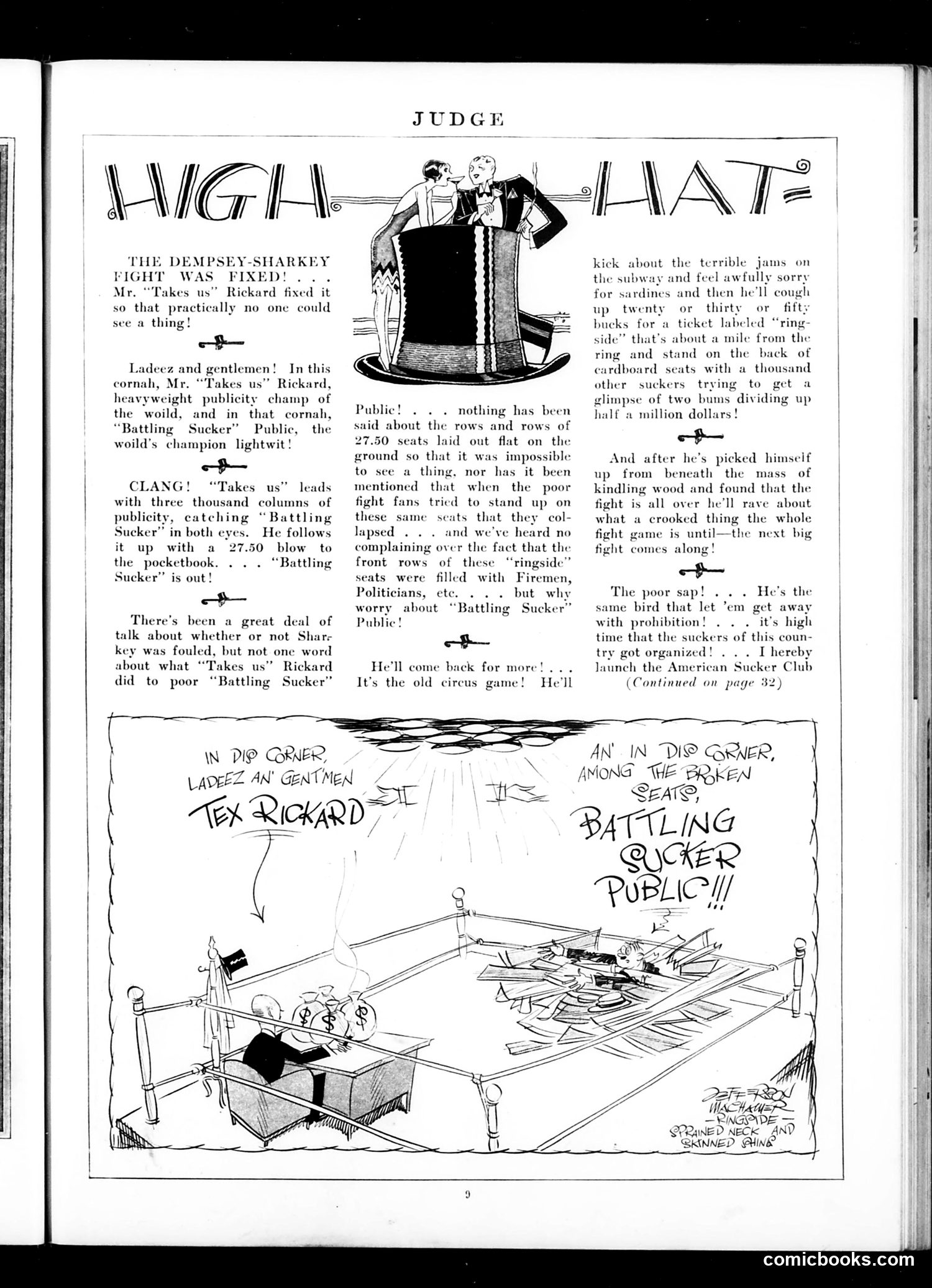
This page satirizes the famous Dempsey-Sharkey heavyweight boxing match. "Tex Rickard" was the real boxing promoter notorious for theatrical publicity stunts and inflated ticket prices. The cartoon attacks Rickard (represented as "Takes us" Rickard—a pun on his name) for victimizing ordinary fans ("Battling Sucker" Public). The satire targets: - **Obstructed seating**: Rickard sold ringside seats placed impossibly far from the actual ring - **Collapsed bleachers**: Cheap cardboard seats that collapsed under spectators' weight - **Reserved seats for elites**: Front rows filled with firemen and politicians rather than paying fans - **Exploitation**: Fans paid premium prices for terrible views and dangerous conditions The cartoon mocks working-class spectators ("the poor sap") for repeatedly accepting such treatment, while launching the "American Sucker Club" to organize consumer resistance. The underlying message: Rickard and similar promoters deliberately defraud the public while media focuses on peripheral controversies instead of actual fraud.
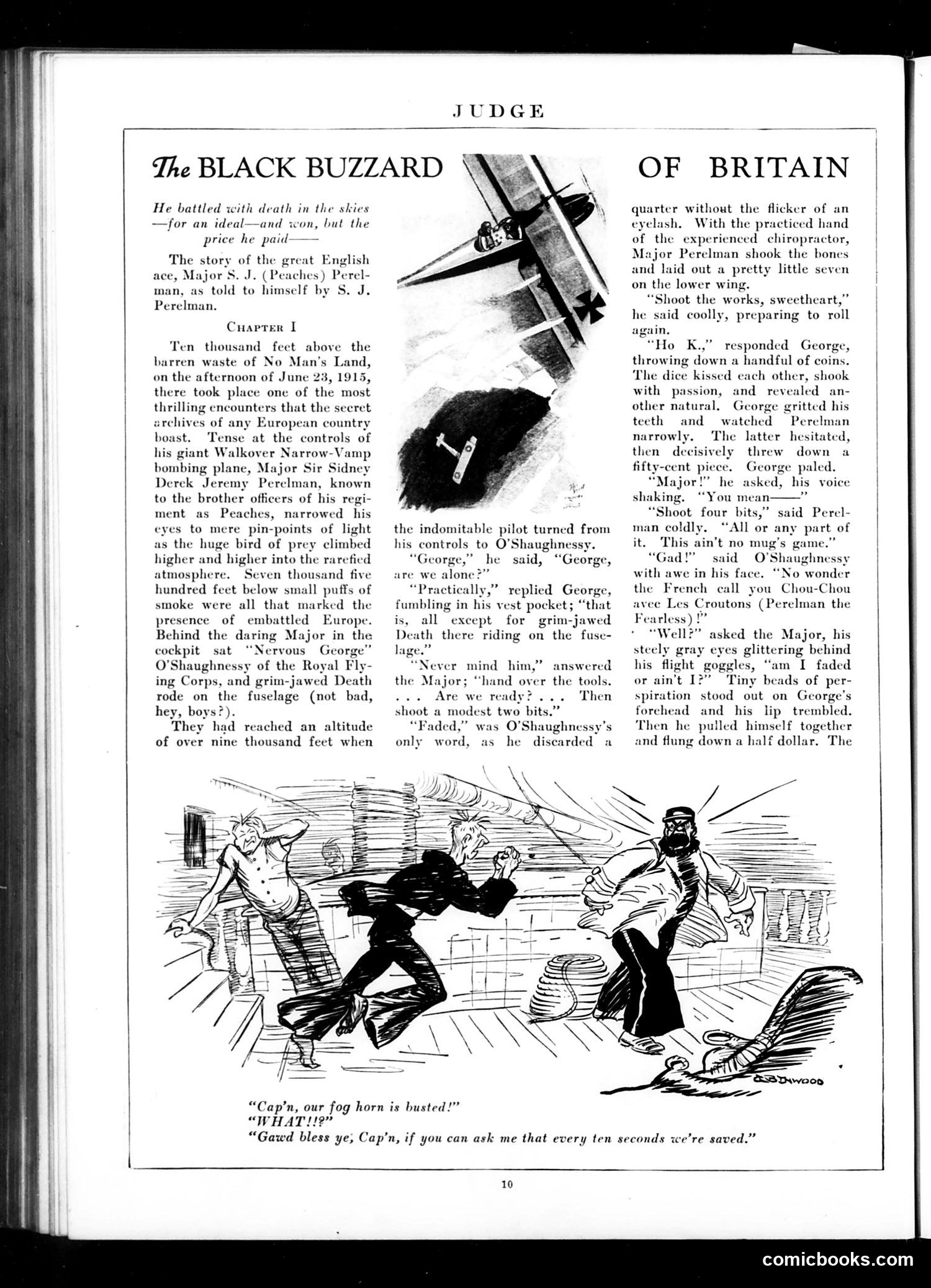
This is a humorous fictional story by S. J. Perelman, a famous American humorist, presented as WWI aviation fiction. The narrative parodies heroic war literature: Major Perelman is supposedly a celebrated British flying ace in combat above No Man's Land in 1915. The satire lies in undercutting this heroism. Rather than depicting intense aerial combat, the story shows the pilot and his observer "Nervous George" O'Shaughnessy gambling with dice during their dangerous mission—shooting craps at 9,000 feet. The bottom illustration depicts them casually playing dice inside the aircraft while Death literally rides the fuselage. The joke satirizes both overwrought war fiction and the absurdity of risking one's life for trivial pursuits. By treating a combat mission as backdrop for casual gambling and banter, Perelman mocks the romanticization of war and the disconnect between real danger and human behavior. The repeated dice-rolling and casual dialogue ("This ain't no mug's game") emphasize the surreal triteness.
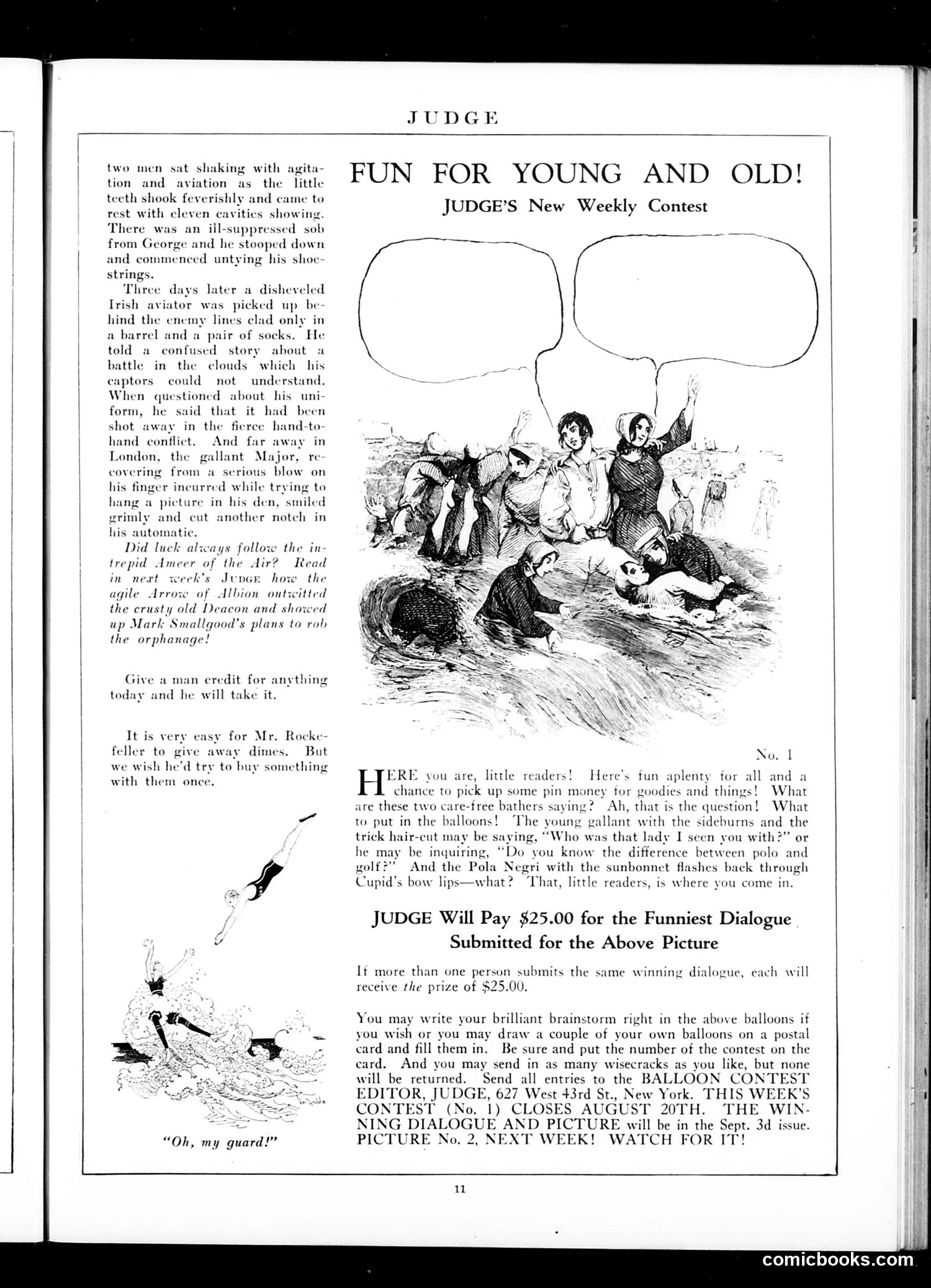
This page announces Judge's new weekly "Balloon Contest" — a reader participation feature where audiences submit funny dialogue for comic illustrations. **The Main Image:** Shows two bathers at what appears to be a beach or swimming area, with empty speech balloons above them. The figures represent generic "everyman" characters rather than specific political figures. **The Contest Mechanism:** Readers can write witty dialogue for the bathers' conversation and submit entries for a $25 prize. The text hints at possible topics — romantic pickup lines ("Who was that lady?"), sophisticated questions about polo versus golf, or references to contemporary figures like actress Pola Negri. **The Satirical Angle:** The humor relies on readers' ability to imagine amusing or clever exchanges, suggesting that ordinary people possess creative wit worth rewarding. It's also a cost-effective way for the magazine to generate reader engagement and content. This was a common early 20th-century magazine feature, predating modern interactive media by decades.
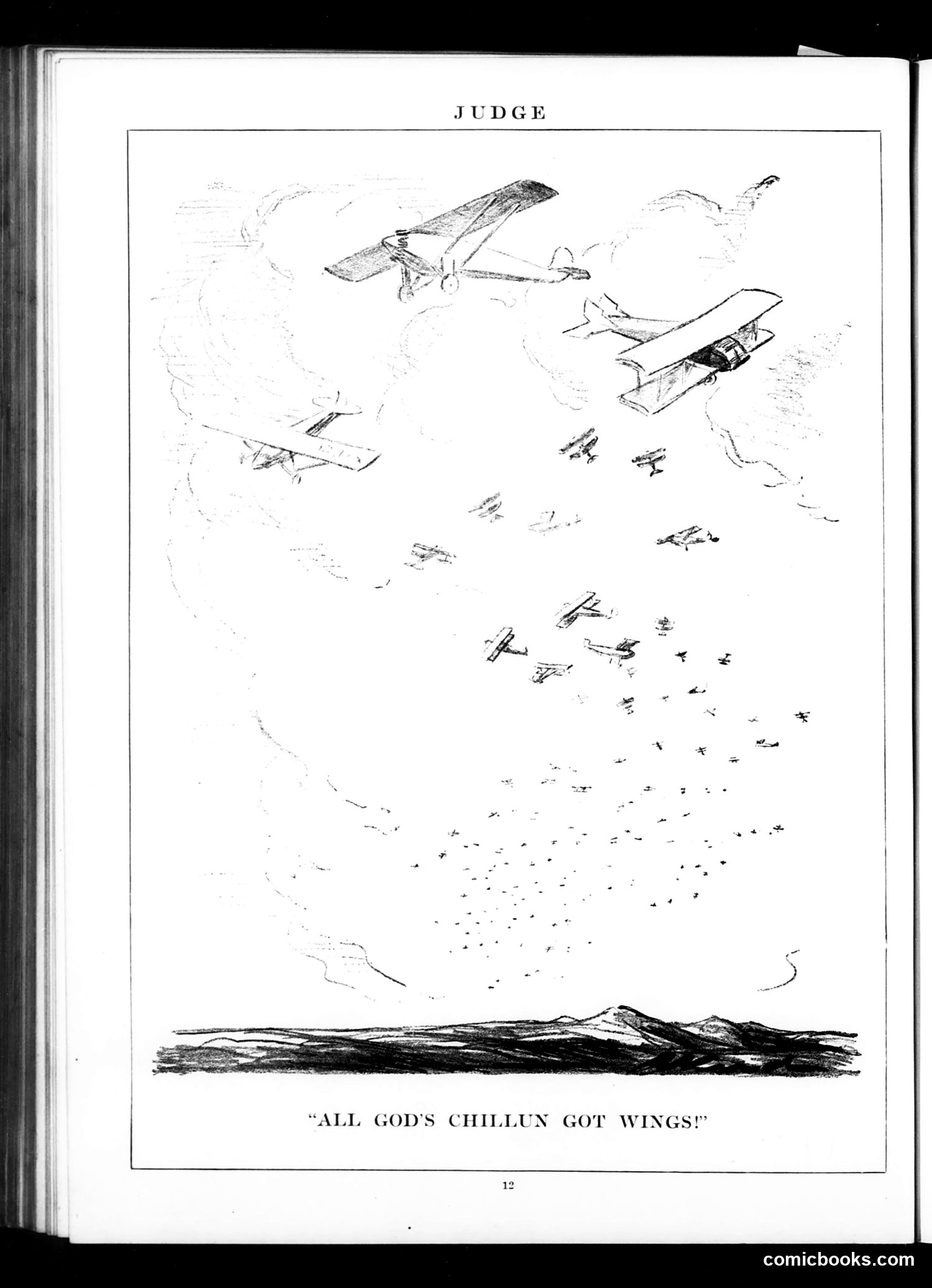
This Judge magazine cartoon uses the caption "All God's Chillun Got Wings!" — a reference to a 1924 Marc Connelly play about African Americans in heaven — as satirical commentary on aviation. The illustration depicts a hierarchical scene: larger, more detailed military or civilian aircraft at the top represent established aviators, while progressively smaller and cruder flying contraptions descend downward, finally becoming dots near the horizon. The landscape below suggests Earth. The satire appears to mock the rapid democratization of flight during the aviation boom, suggesting that "everyone" (the masses, regardless of skill or resources) now aspires to fly. The racial reference in the caption adds a layer of social satire common to Judge's era, likely critiquing class aspiration or the proliferation of amateur aviators. The joke hinges on depicting aviation ambition as widespread and indiscriminate.
This satirical column attacks the excessive influence of "experts"—particularly military and naval strategists—in matters requiring common sense and democratic judgment. **Main Arguments:** 1. **"Outlawing the Experts"**: The piece mocks fight promoters and boxing analysts who make failed predictions. More broadly, it argues that military minds should not dictate peace policy. It cites Lord Lee of Fareham's position that post-WWI diplomacy between England and America is "too serious" for naval experts, and references a Clemenceau quote that war decisions shouldn't be left to generals. The satire's point: ordinary citizens' judgment often surpasses that of credentialed "experts." 2. **Prohibition enforcement** receives brief mockery—Senator Borah wants it made a political issue, but Judge suggests the law is already effectively dead in many regions and cannot be coerced upon unwilling populations. 3. **Boxing's decline** is attributed to lack of genuine spectacle, with Jack Dempsey's comeback insufficient to revive fan interest despite large initial crowds. The overall theme: common sense and public will matter more than expert pronouncements.
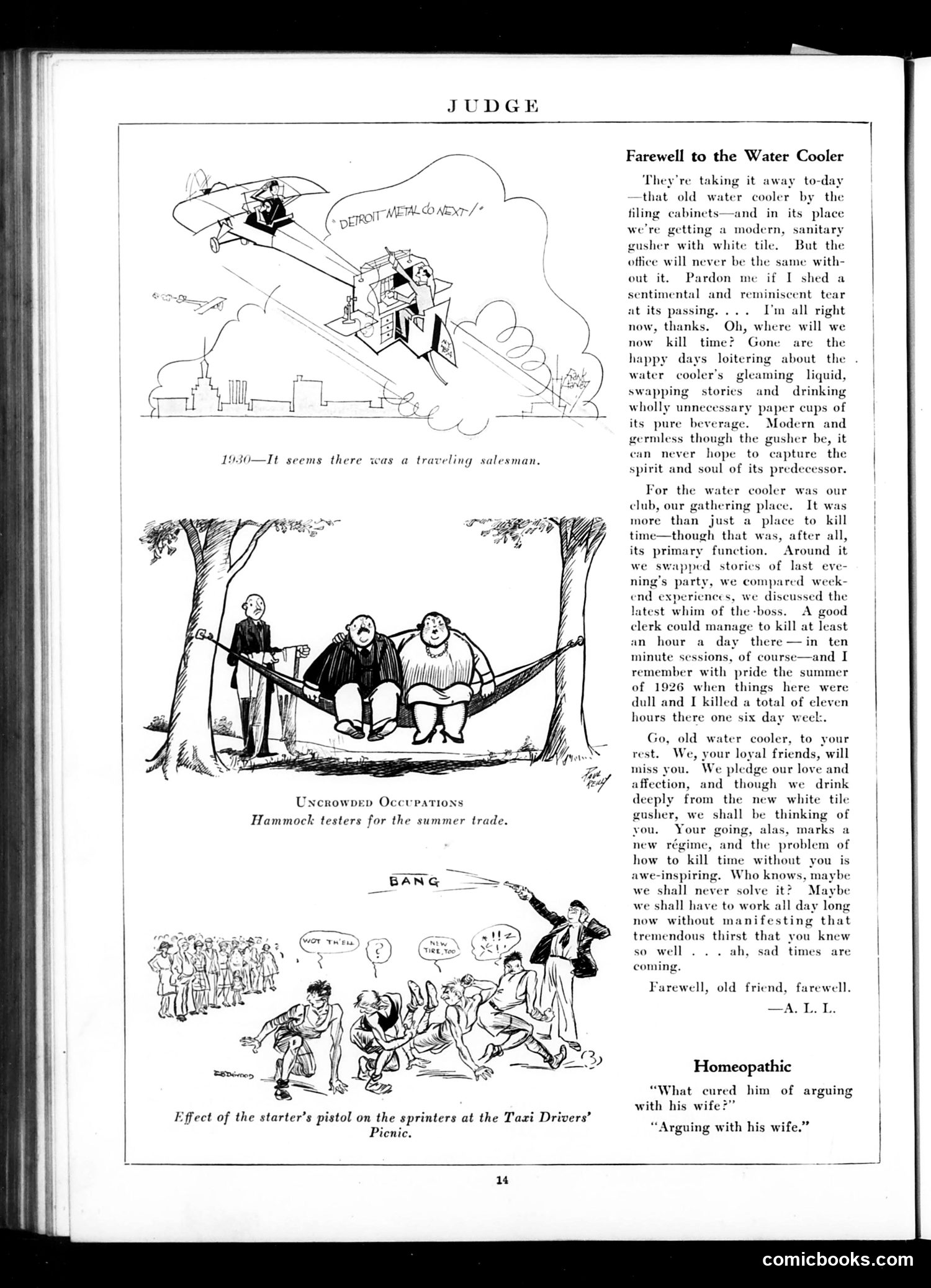
This 1930 Judge magazine page satirizes workplace nostalgia and productivity loss through three cartoons: **"Farewell to the Water Cooler"**: The main piece humorously laments replacing an old office water cooler with a modern sanitary dispenser. The joke: the water cooler wasn't primarily about hydration—it was the office's unofficial social hub where workers "killed time" chatting, swapping stories, and avoiding work. One clerk claims he killed eleven hours there in summer 1926 alone. The satire mocks both sentimental attachment to outdated workplace fixtures and the reality that office efficiency depends partly on workers' ability to procrastinate socially. **"Uncrowded Occupations"**: A lighthearted sketch showing people relaxing in hammocks—implying "hammock testing" as a desirable, leisurely summer job. **"Homeopathic"**: A brief joke: a man cured himself of arguing with his wife by arguing with his wife—satirizing the contradictory logic of "fighting fire with fire." The page reflects 1930s workplace culture and humor about time-wasting office socializing.
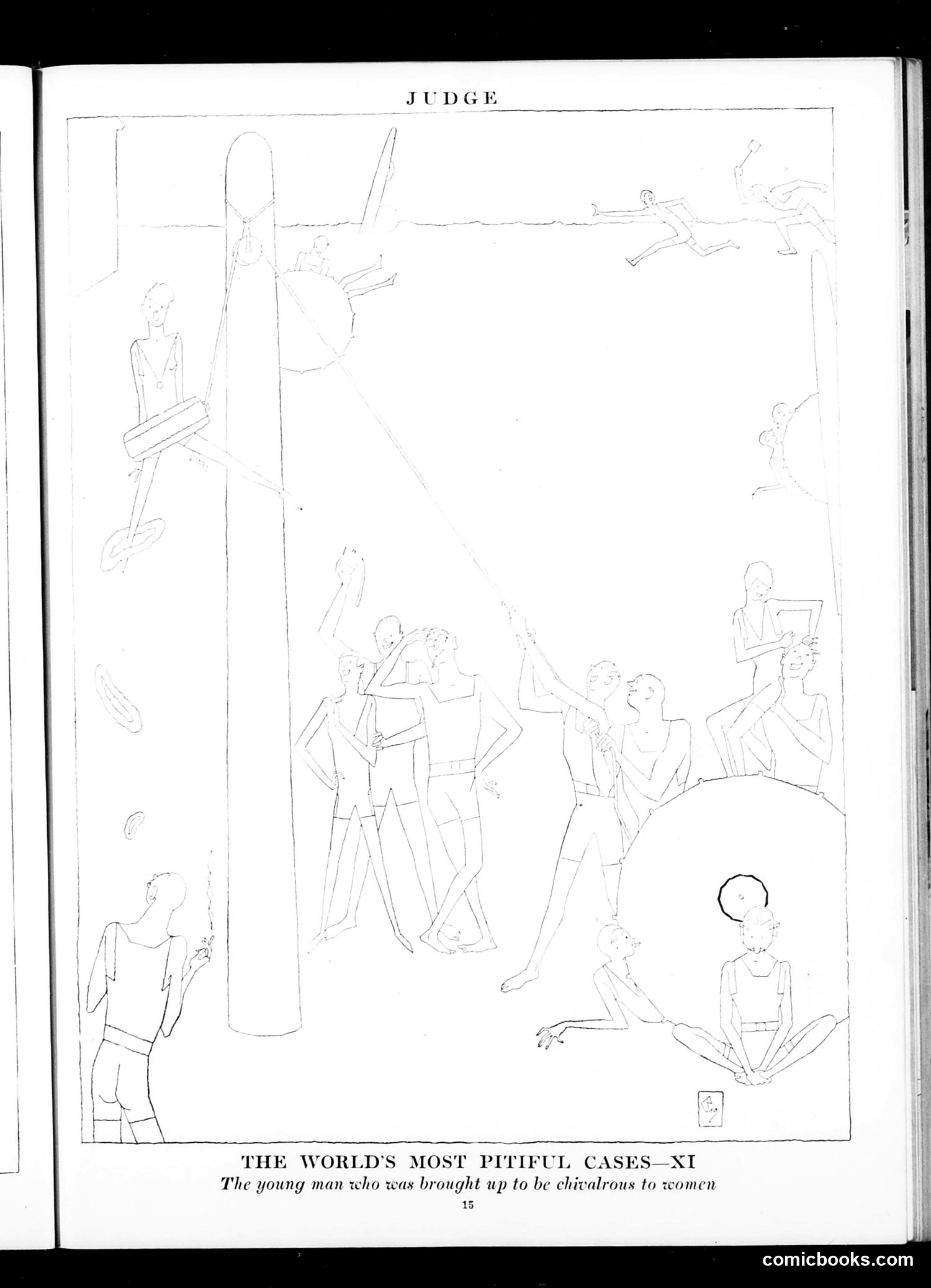
This is a satirical cartoon from Judge magazine titled "The World's Most Pitiful Cases—XI," depicting "The young man who was brought up to be chivalrous to women." The sketch shows a man in various awkward situations with women in what appears to be an interior space. The satire mocks the contradiction between traditional chivalrous ideals (protecting and deferring to women) and modern women's independence and assertiveness. The cartoon suggests that a man raised with old-fashioned courtly behavior finds himself helpless and disadvantaged in contemporary society where women are more autonomous and aggressive—hence he's "pitiful." This reflects early 20th-century anxieties about changing gender roles as women gained more social and economic independence.
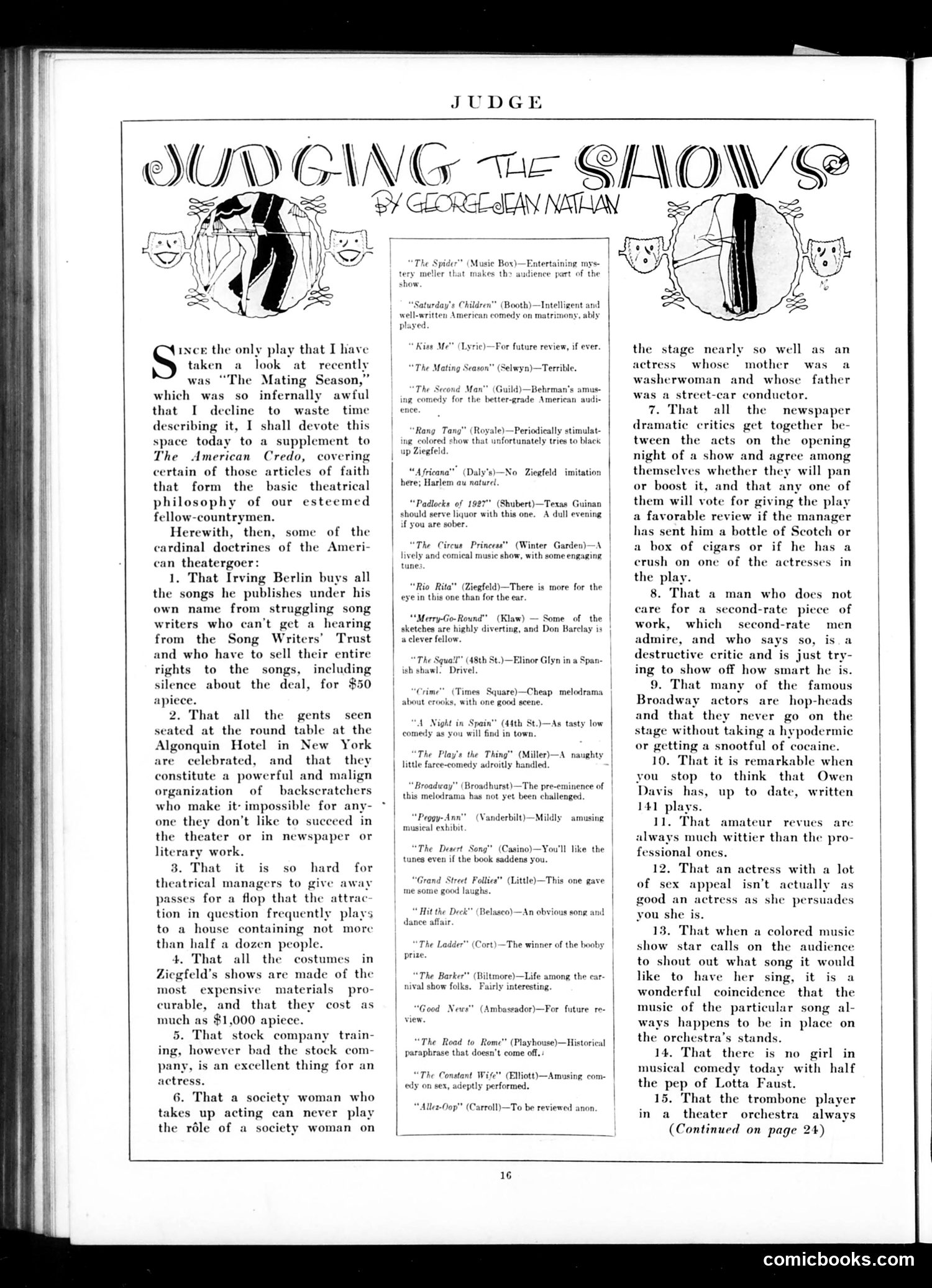
This page contains George Jean Nathan's satirical column mocking theatrical conventions and hypocrisies of 1920s Broadway. Rather than reviewing "The Mating Season" (which he found awful), Nathan presents "The American Credo" — 15 supposedly universal beliefs held by theatergoers and the industry. The satire targets Irving Berlin's allegedly predatory songwriting deals, the Algonquin Round Table's alleged power as a theatrical cabal, the gap between critical consensus and actual attendance, Florenz Ziegfeld's extravagant costumes, and the assumption that society women make poor actresses. Nathan also mocks the notion that critics collude on opening nights and that amateur revues are inherently superior to professional work. The column uses deadpan enumeration to expose industry absurdities: exaggerated costume costs ($1,000), the arbitrary gatekeeping of theatrical success, and the pretense surrounding celebrity. It's characteristic 1920s insider satire aimed at Judge's sophisticated Manhattan readership.
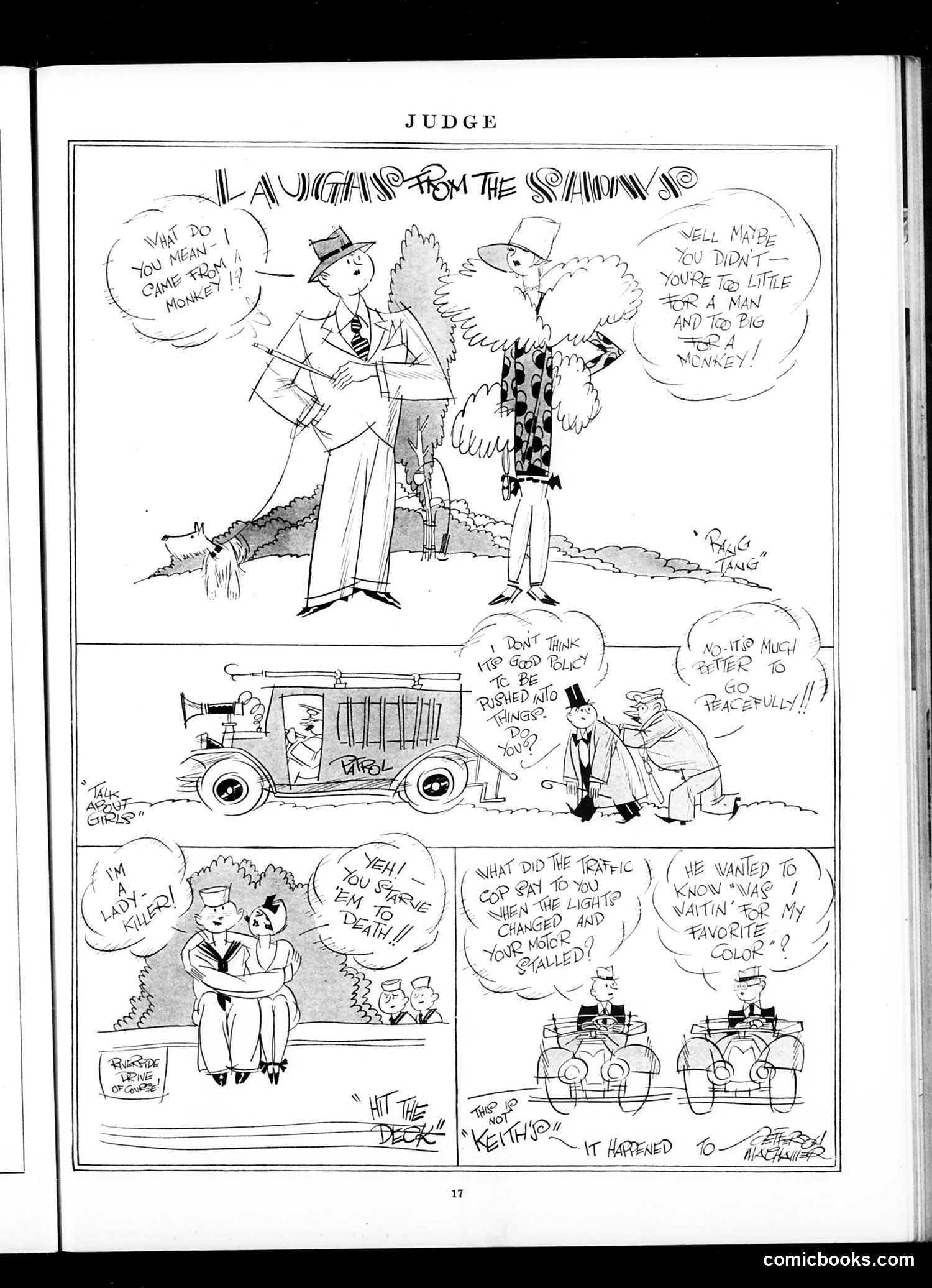
This multi-panel satirical comic mocks judicial incompetence and traffic law enforcement. The narrative follows a traffic case where a police officer and motorist argue about a traffic violation. The humor centers on absurd judicial logic: a judge, depicted as pompous and out-of-touch, apparently rules in favor of a defendant who committed obvious infractions. The officers' exasperation (visible in their speech balloons expressing disbelief) suggests the judge's decision defies common sense. The comic ridicules the legal system's inefficiency and judges' disconnect from practical reality. The caricatured figures—uptight officers and a self-important judge—represent institutional incompetence. The "Lady Killer" reference in one panel appears to be unrelated comic banter. This reflects early-20th-century American skepticism toward bureaucratic institutions and judicial reliability, common themes in satirical magazines like *Judge*. The satire targets both legal absurdity and professional pomposity.
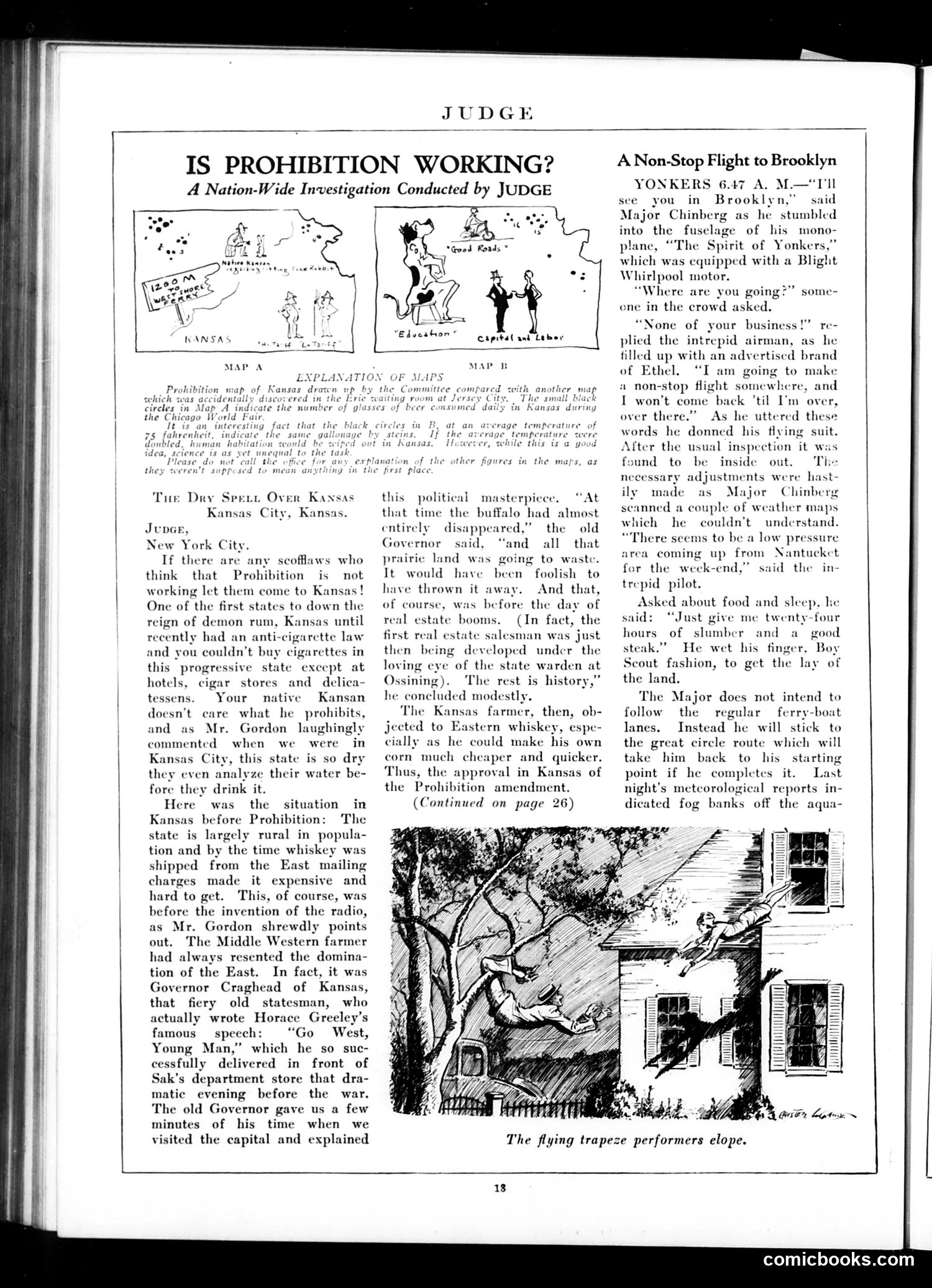
This page satirizes **Prohibition's effectiveness** through a mock "investigation." The top section mocks Kansas's extreme dryness, featuring absurd claims (a Governor writing Greeley's speech, buffalo disappearing) to lampoon the state's self-righteous prohibition stance. The satire suggests Kansas farmers supported Prohibition not from moral conviction but because they could make cheaper moonshine themselves—revealing hypocrisy beneath the reform movement. The bottom section parodies reckless aviation stunts popular in the 1920s. "Major Chinberg" embarks on a ridiculous non-stop flight to Brooklyn with an inside-out flying suit, relying on weather maps he "couldn't understand," fueled by advertised "Ethel" (ethyl gasoline or alcohol). This mocks both the era's dangerous aviation fads and the absurdity of Prohibition enforcement—he's clearly using alcohol while claiming a legitimate flight. Together, the page ridicules Prohibition's contradictions: rural hypocrisy and widespread flouting among the supposedly respectable.
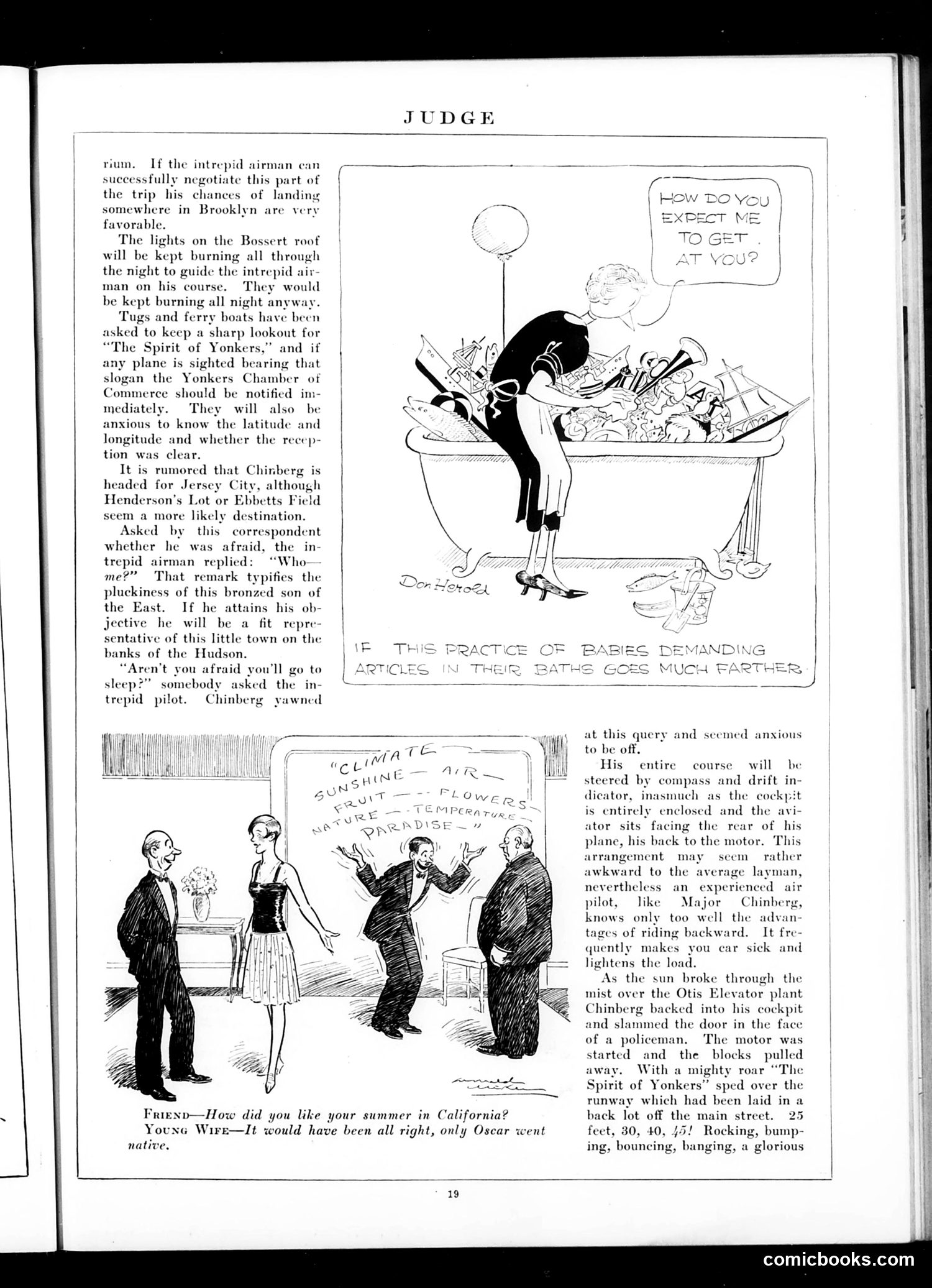
This page satirizes early aviation stunts and local boosterism. The top cartoon mocks an amateur pilot named Chinberg attempting a flight from Yonkers, New York in a plane called "The Spirit of Yonkers." The satire targets: **The Setup:** Absurd safety measures (roof lights, ferry boats watching for the plane) and ridiculous predictions of where he'll land (Brooklyn, Jersey City, Ebbetts Field). **The Joke:** The pilot sits facing *backward* in an enclosed cockpit with his back to the motor—an intentionally nonsensical arrangement presented as legitimate aviation practice. The caption suggests this causes car sickness and "lightens the load." **The Context:** This reflects 1920s enthusiasm for aviation stunts and municipal pride. Judge mocks both the reckless adventurism of early pilots and Yonkers' desperate civic promotion of a local aviation hero. The bottom cartoon (about California) is separate—a domestic joke about a couple's vacation.
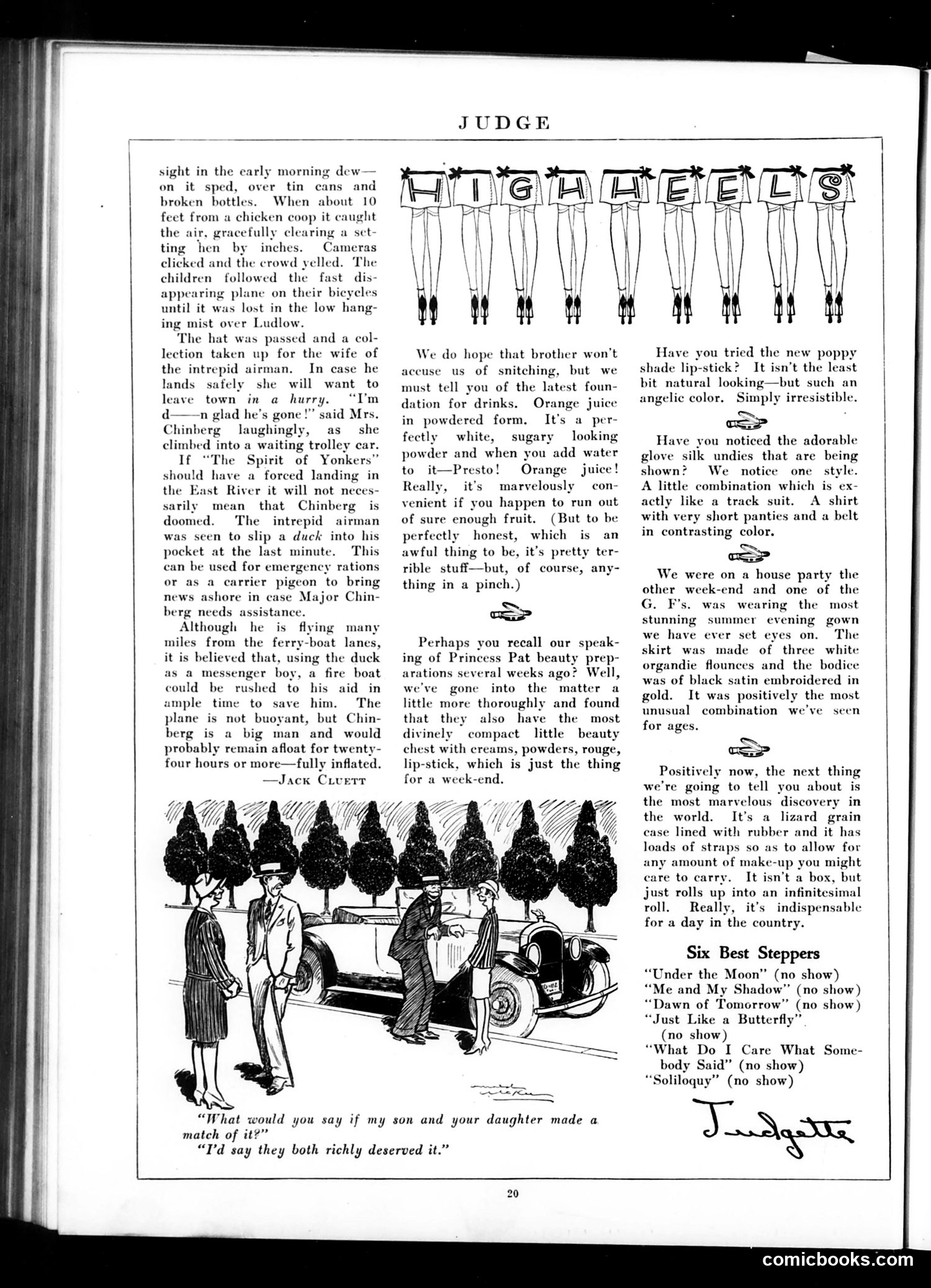
This page contains two distinct humor pieces from Judge magazine: **The Main Cartoon** (bottom half) depicts a mundane social interaction—a man proposing a match between his son and another's daughter—with the punchline being mutual agreement that "they both richly deserved it." This is deadpan marital satire, mocking the resigned acceptance of matrimony as mutual punishment rather than romantic blessing. **The "Highlights" Column** (top/right) is gossip-style commentary on 1920s women's fashion and beauty products. It mocks the frivolity of emerging consumer culture—powdered orange juice, makeup compacts, designer undergarments—through breathless, exaggerated enthusiasm. The satire targets both the absurdity of these products and women's eager adoption of them. The repeated "(no show)" listings at bottom reference theatrical performances, likely contemporary. Overall, Judge used these pieces to satirize both marriage as social obligation and the commercialization of women's consumer habits during the Jazz Age.
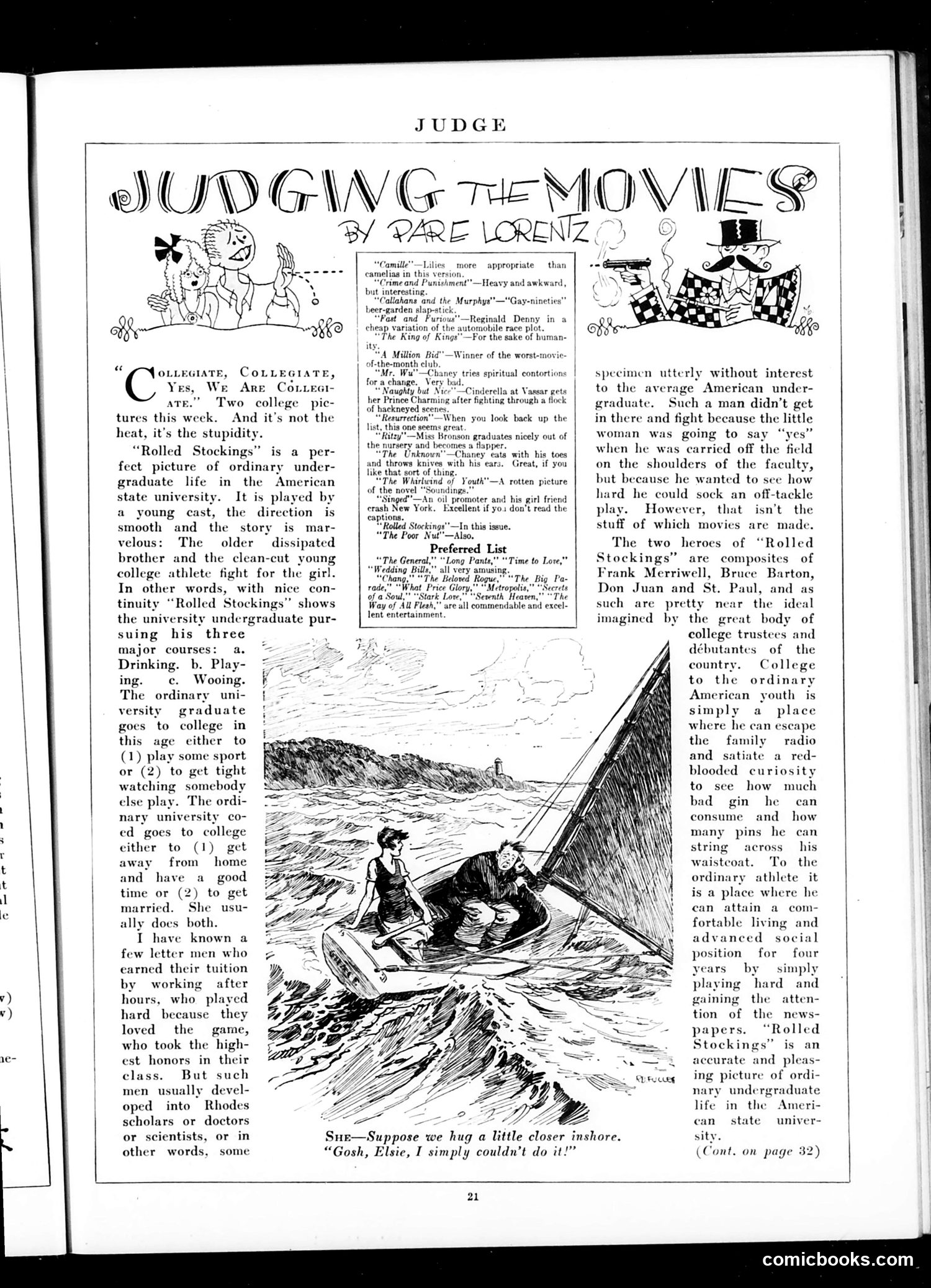
This page reviews recent films while satirizing American college life. The main article critiques various movies with brief, dismissive judgments ("Heavy and awkward," "rotten picture"). The featured film "Rolled Stockings" depicts typical undergraduate behavior: drinking, playing sports, and pursuing romance. Lorenz uses it to mock the idealized version of college promoted by administrators and trustees—portrayed as composed of heroic figures like "Don Juan and St. Paul"—versus reality: young men seeking escape from family, curiosity about vice, and social advancement. The cartoon illustration shows two figures in a rowboat with suggestive dialogue ("hug a little closer inshore"/"I simply couldn't do it!"), likely commenting on the era's tension between progressive "rolled stockings" youth culture and lingering Victorian propriety. The satire targets both film quality and the gap between college's marketed prestige and its actual appeal to ordinary American youth.
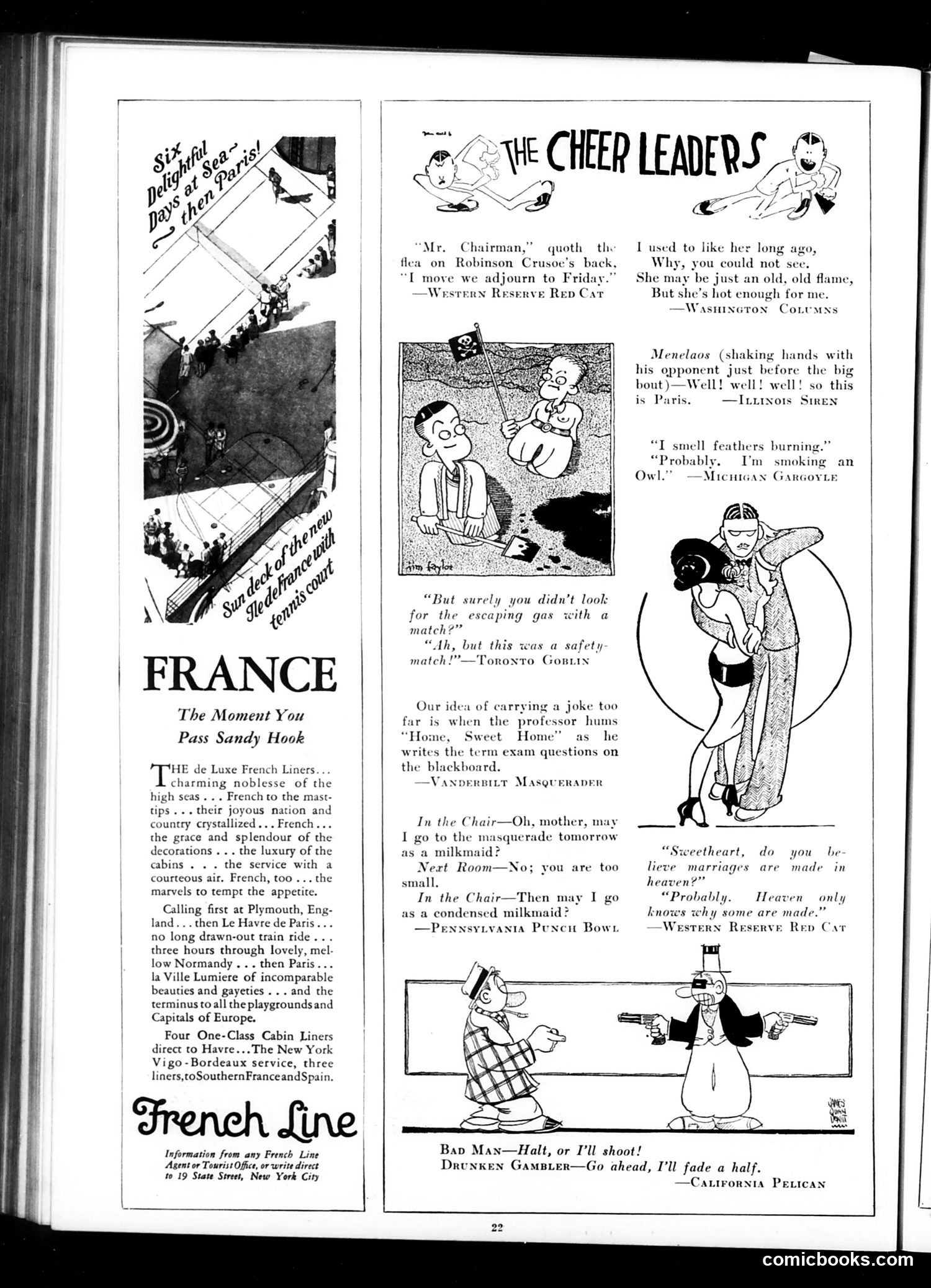
This page collects brief jokes and witticisms from various American newspapers and publications, each credited to their source. The content reflects early 20th-century humor styles: The cartoons depict absurdist scenarios: a flea proposing to adjourn to Friday; someone using a "safety match" to search for escaping gas (the joke being safety matches won't ignite gas); a professor humming "Home, Sweet Home" while writing harsh exam questions; wordplay about condensed milk and milkmaids. The bottom cartoon shows a mugger confronting a drunk gambler who responds "I'll fade a half"—poker terminology, suggesting even facing a gun, the gambler thinks in gambling terms. The humor relies on puns, literal interpretations of expressions, and absurd juxtapositions typical of period American comic magazines. The left page advertises French Line steamships, offering luxury transatlantic travel. The content is primarily entertainment rather than political satire.
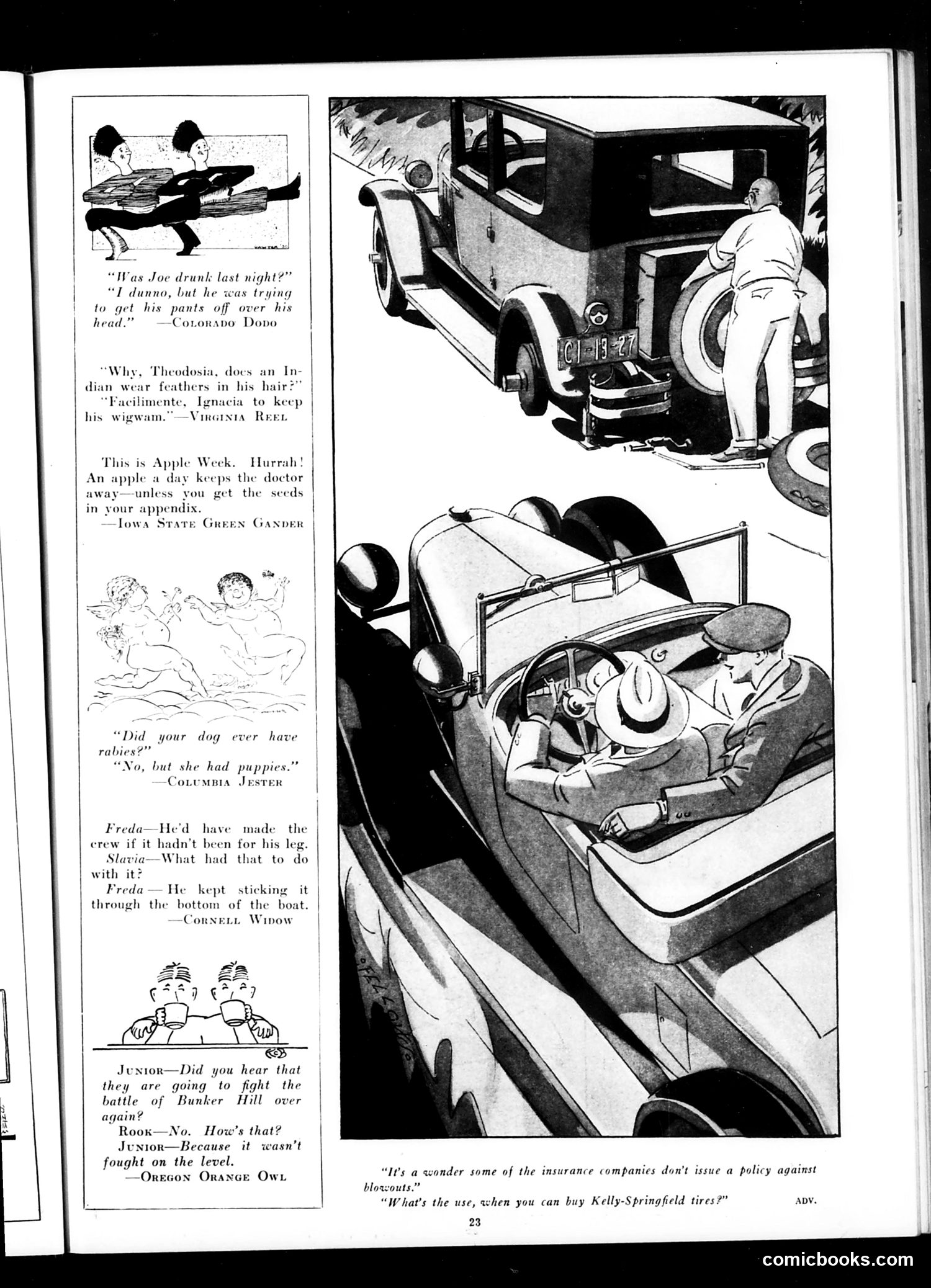
This page contains a collection of short jokes and humorous quips typical of early-20th-century American comic magazines, alongside vintage automobile photographs serving as advertisement for Kelly-Springfield tires. The left column presents brief jokes attributed to various sources (college humor publications like *Colorado Dodo*, *Virginia Reel*, *Columbia Jester*). These jokes reflect period humor conventions: physical comedy (a drunk man), ethnic stereotypes about Native Americans, puns (the "Apple Week" joke), and absurdist logic (the Bunker Hill levity pun). The right side shows photographs of early automobiles with people examining or driving them—clearly promotional material for the tire advertisement at the bottom. The humor is gentle, non-political satire focused on everyday situations rather than substantive social critique. The magazine format—mixing jokes, illustrations, and advertisements—was standard for *Judge* during this era.
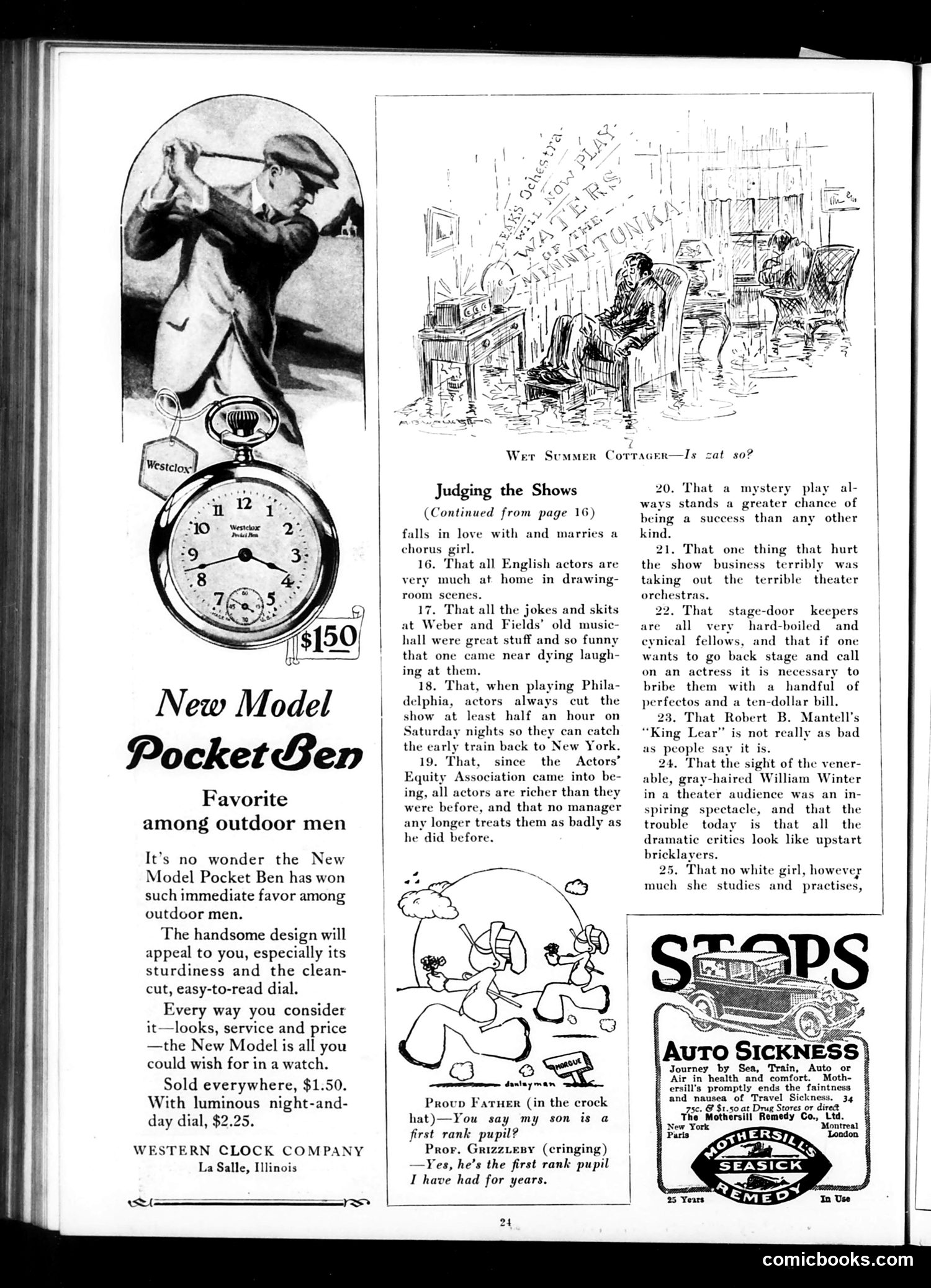
This page contains primarily **advertisements and theater industry satire**, not political cartoons. The main content is "Judging the Shows," a humorous list mocking theatrical conventions and beliefs of the era. It satirizes common assumptions about actors and theater—that English actors excel at drawing-room scenes, that mystery plays always succeed, that theater orchestras were terrible, and that actors became wealthy after unionization (the Actors' Equity Association). The small cartoon shows a proud father in a crooked hat asking a professor if his son is a good student. The professor replies the boy is "the first rank pupil I have had for years"—a backhanded insult implying he's the worst student ever taught. The page also advertises a **Pocket Ben watch** (Western Clock Company) marketed to outdoor men, and a **Mothersill's Seasickness Remedy**—products targeting travelers. These ads represent typical early 20th-century magazine revenue. The "Wet Summer Cottager" illustration at top appears to be an unrelated humor drawing about vacation weather.
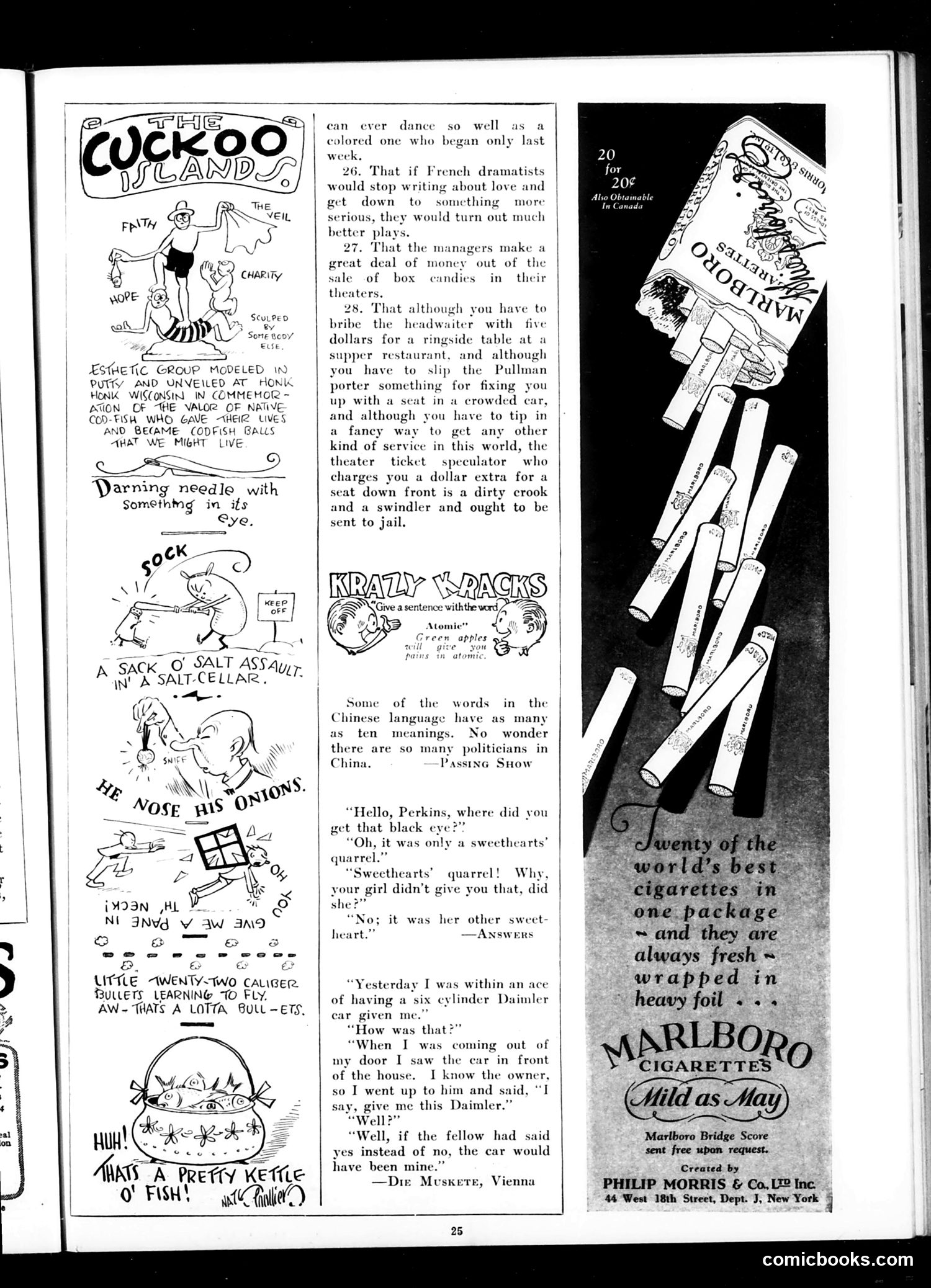
This page contains several humorous sketches and jokes typical of Judge's satirical humor, plus a Marlboro cigarette advertisement. **"The Cuckoo Islands"** cartoon mocks pretentious art movements, depicting an "aesthetic group" of absurdly posed figures unveiled in Wisconsin to commemorate "native cod-fish" who "became codfish balls." It satirizes both artistic pretension and absurd monument construction. **"Krazy Khacks"** presents short jokes about daily annoyances: Chinese language ambiguity explaining proliferation of politicians; theater ticket scalpers' dishonesty; and a humorous anecdote about someone failing to acquire a Daimler automobile by simply asking for it. **Small cartoons** mock physical misfortunes: a "salt assault in a salt-cellar," a needle "with something in its eye," and bullets "learning to fly." The overall tone targets middle-class irritations (service industry corruption, artistic pretension) and contemporary technology (automobiles, firearms) with light satire. The **Marlboro advertisement** emphasizes freshness and premium quality, representing early cigarette marketing before health warnings.
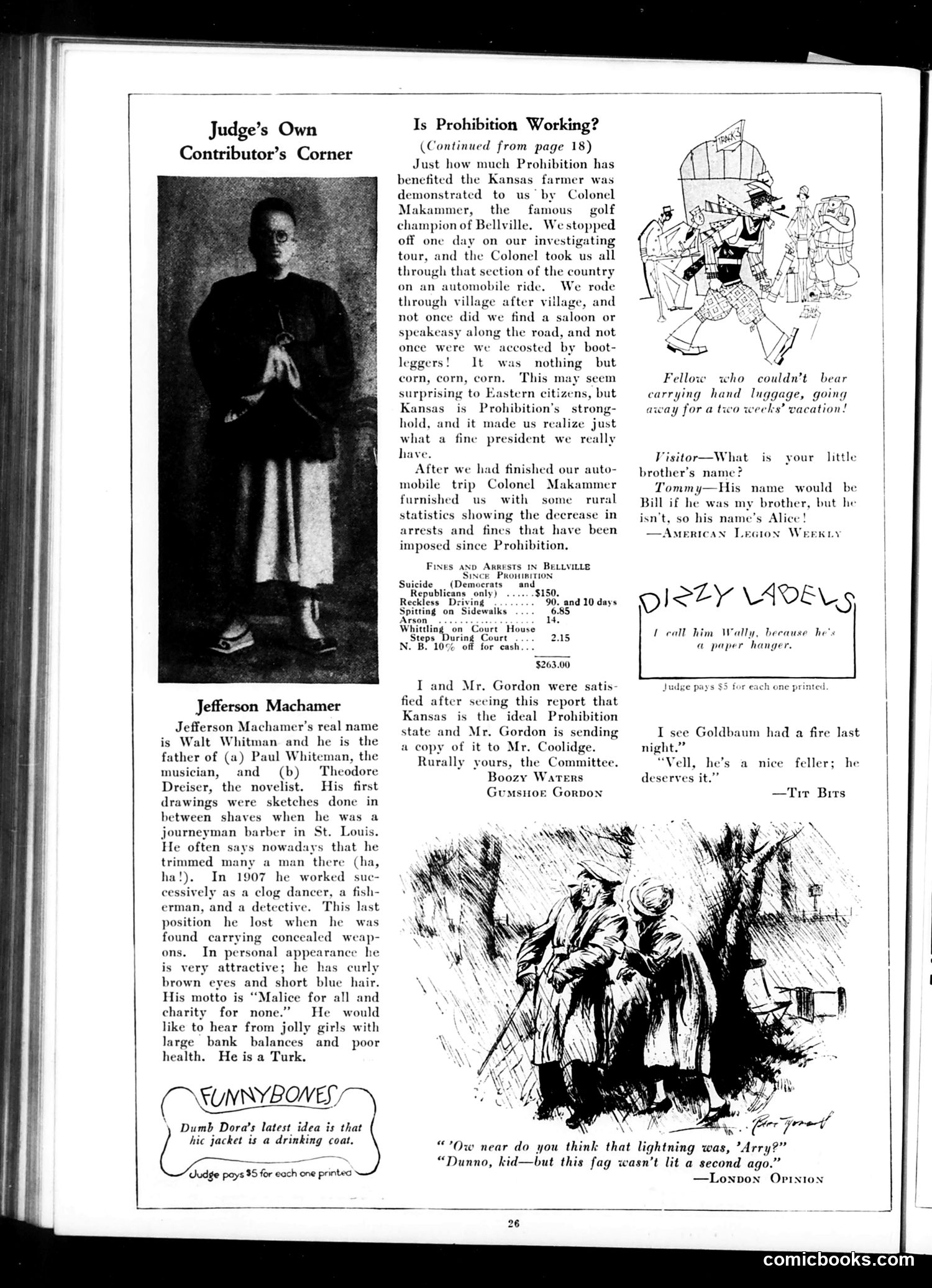
This page contains three distinct satirical pieces: **1. "Is Prohibition Working?"** — A mock investigation of Kansas under Prohibition (the 1920s alcohol ban). The satire presents fabricated statistics showing Prohibition's "success" (zero saloons, no bootleggers), then reveals the absurdity through Colonel Makammer's data: the only documented crimes are ridiculous offenses like "spitting on sidewalks" ($6.85) and "whittling on courthouse steps" ($2.15). The joke mocks Prohibition advocates who cherry-picked data to claim success, while implying Kansas remained dry only through selective reporting. **2. "Judge's Own Contributor's Corner"** — A humorous biographical sketch of cartoonist Jefferson Machamer, presenting obviously false claims (his real name is Walt Whitman; he's related to musician Paul Whiteman and novelist Theodore Dreiser). The joke lies in the absurdity of the biography itself. **3. Comic strips and brief jokes** — Including "Dizzy Dora's" quip about jackets as drinking coats (Prohibition-era humor about hiding alcohol) and British jokes about cigarettes and lightning. The page overall satirizes both Prohibition enforcement and contemporary cultural attitudes.
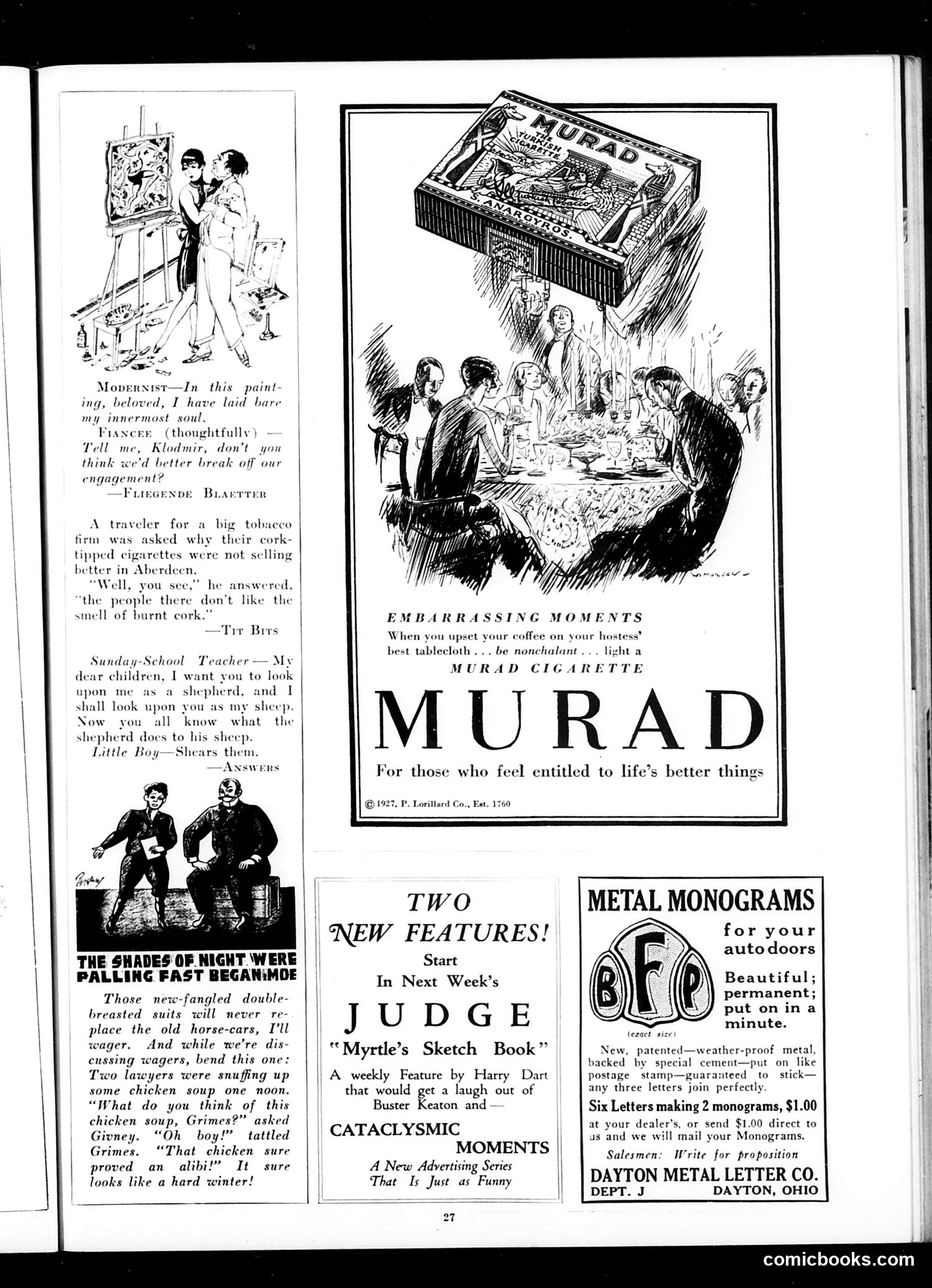
This page from Judge magazine (1927) contains several humorous vignettes and advertisements typical of the era: **The cartoon at top left** shows a fiancée rejecting her artist suitor after viewing his self-portrait, satirizing pretentious artists who believe their work reveals profound inner truths. **The tobacco anecdote** jokes about regional preferences—Aberdeen (Scotland) residents supposedly dislike cork-tipped cigarettes because they object to the smell of burnt cork. **The Sunday School joke** plays on a naive teacher's shepherd metaphor, with a child innocently pointing out that shepherds shear sheep for wool—implying an awkward double meaning. **The lawyer soup joke** uses "alibi" as a pun, suggesting the soup could serve as false evidence of innocence. **The main advertisement** promotes Murad cigarettes as luxury goods "for those who feel entitled to life's better things"—appealing to class aspirations common in 1920s advertising. The page is primarily **humorous filler and advertising** rather than political satire, reflecting Judge's mixed content of light comedy and commercial promotion.
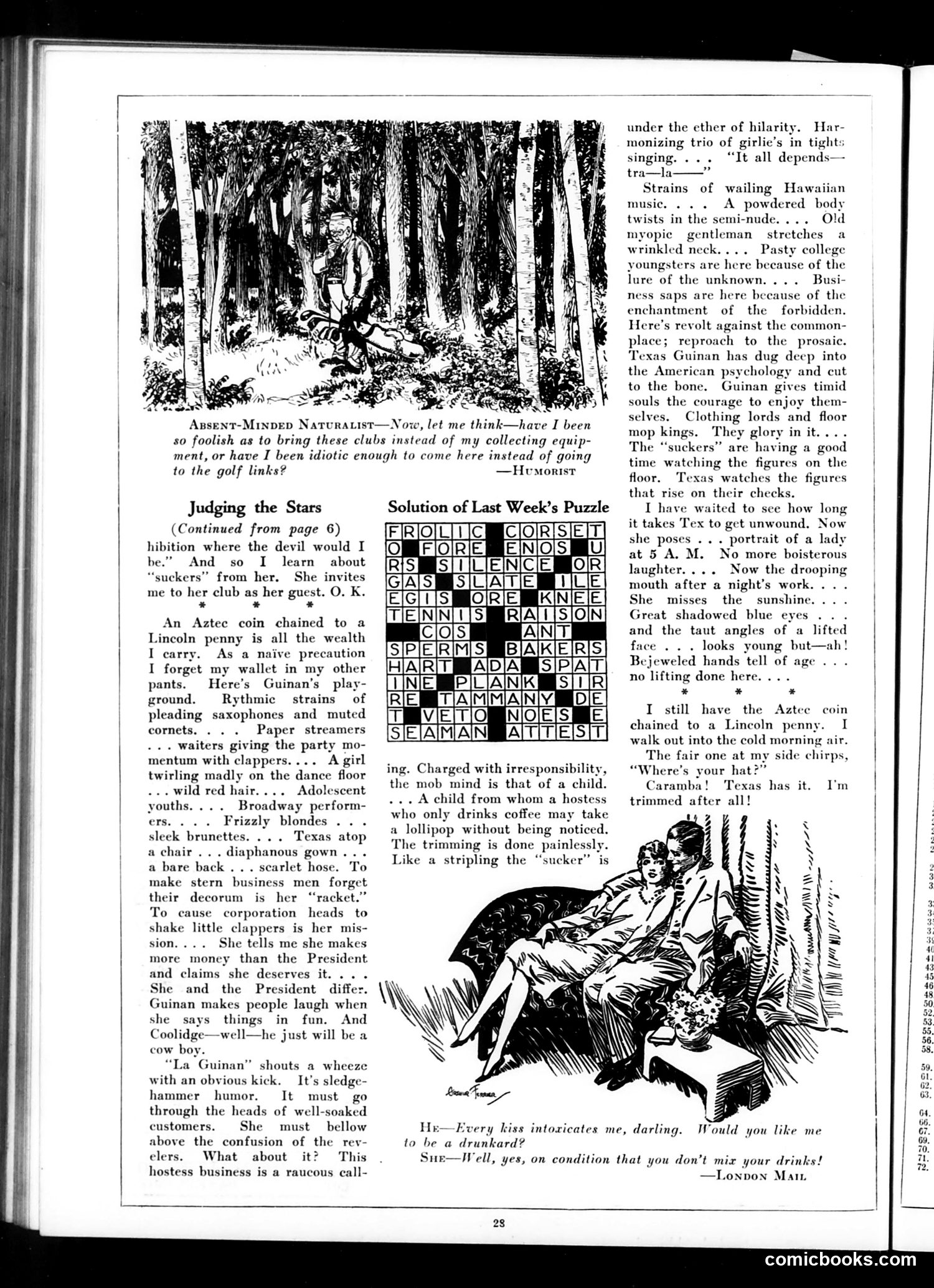
This Judge magazine page satirizes **Texas Guinan**, a famous speakeasy hostess during Prohibition. The text describes her operation as a glamorous but morally questionable nightclub where wealthy "suckers" (naive customers) pay to watch entertainment and lose their inhibitions. The satire criticizes how Guinan exploits Prohibition-era appetite for forbidden pleasures. She's portrayed as deliberately manipulating intoxicated, intellectually vulnerable customers through crude humor and spectacle. The narrative voice is an observer who arrives with an Aztec coin and Lincoln penny (his only wealth), suggesting the economic gap between the desperate and the wealthy patrons. The cartoon at bottom depicts a romantic couple, unrelated to the Guinan piece—a typical flirtation joke. The overall message: Guinan represents commercial exploitation of Prohibition's lawlessness and Americans' desire to defy authority, reducing them to easily-managed "mobs" with childlike minds.
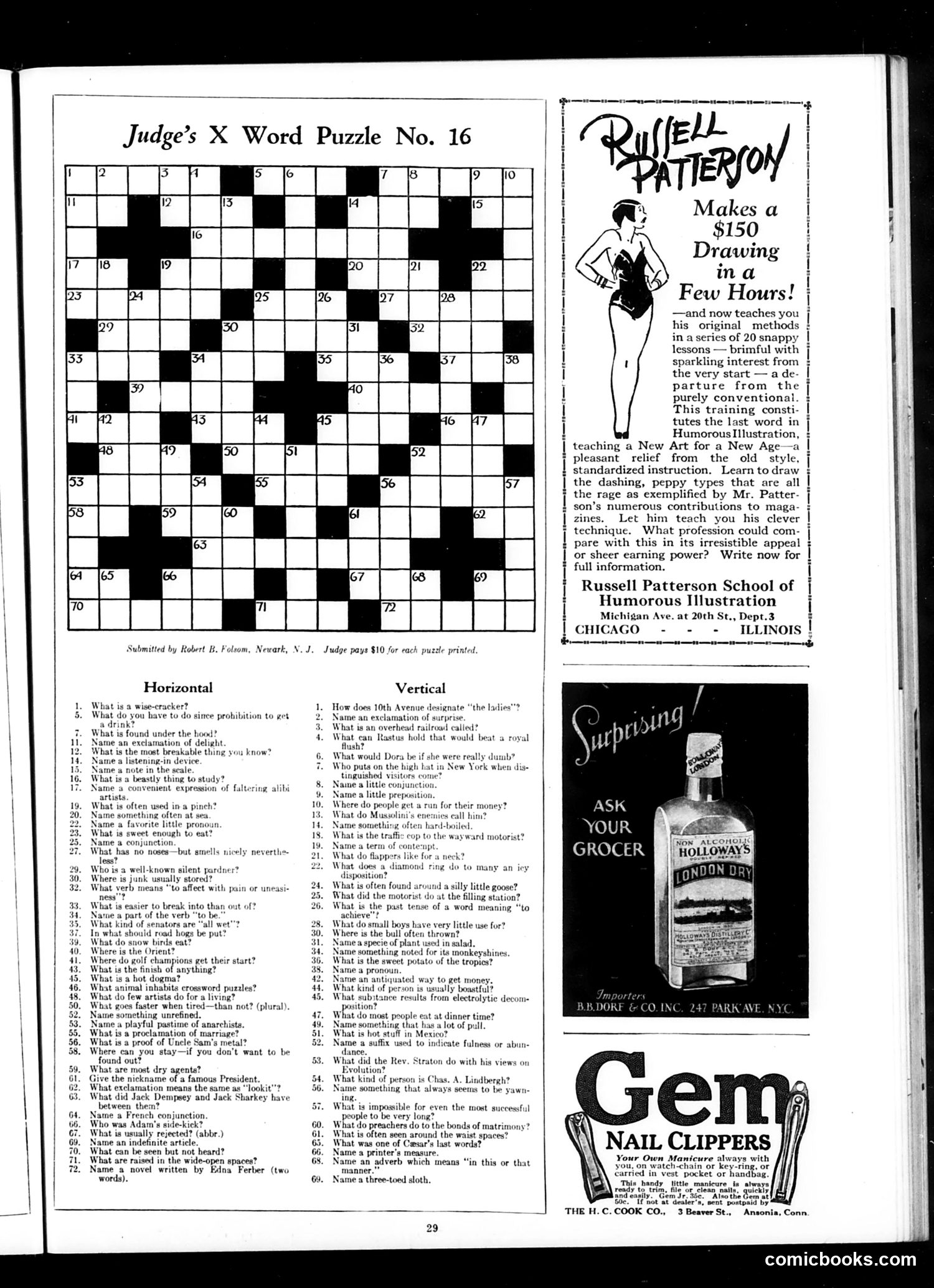
This page is primarily a **crossword puzzle** ("Judge's X Word Puzzle No. 16") submitted by Robert B. Folsom of Newark, N.J., with Judge offering $10 payment for each puzzle printed. The page contains three **advertisements**: 1. **Russell Patterson School of Humorous Illustration** (top right) — promoting drawing lessons by cartoonist Russell Patterson, promising to teach readers his technique for creating "dashing, peppy types" in humorous illustration, with potential to earn "$150 Drawing in a Few Hours." 2. **Holloways London Dry Gin** (center right) — a liquor advertisement asking grocers to stock the product, notable given Prohibition was in effect when this was published. 3. **Gem Nail Clippers** (bottom right) — advertising at-home manicure tools. **No political cartoons appear on this page.** It's primarily a puzzle page with period advertisements reflecting 1920s consumer products and services.
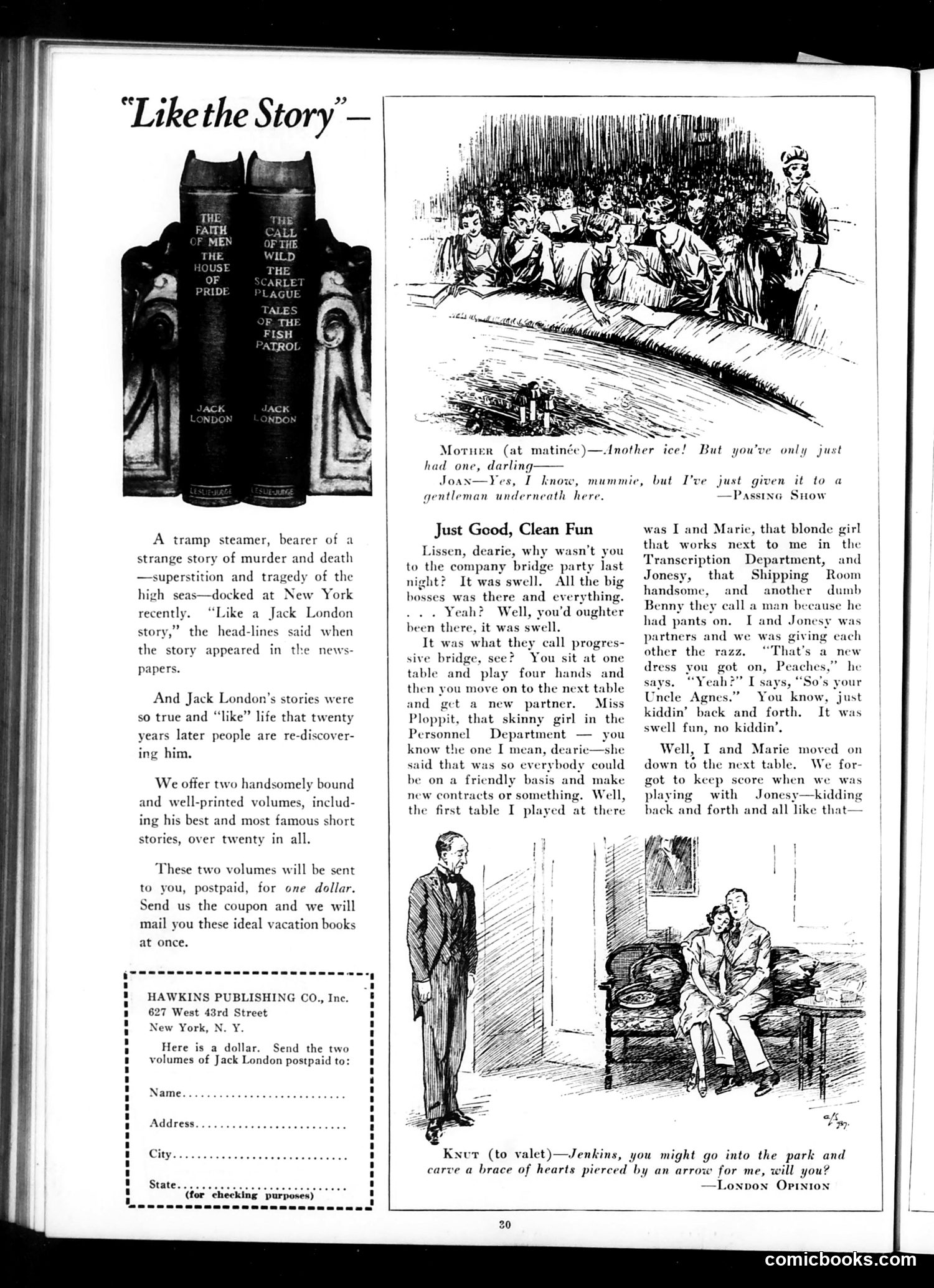
This page is primarily **advertising for Jack London books** rather than political satire. The left side promotes a two-volume collection of London's short stories through Hawkins Publishing Co., emphasizing their authenticity ("so true and 'like' life"). The right side contains two items: 1. **A humorous office dialogue** depicting female clerical workers discussing a "progressive bridge" party—a social game where players rotate tables. The comedy relies on working-class vernacular and gentle mockery of office socializing. This reflects early 20th-century workplace culture. 2. **A captioned illustration** labeled "LONDON OPINION" showing a valet being asked to carve hearts into trees—a romantic (if destructive) gesture. This appears to be a reprinted cartoon from a British publication. The page's primary purpose is **selling Jack London books** by capitalizing on his reputation for gritty, authentic stories about ordinary life—a marketing angle that clearly resonated with Depression-era readers seeking affordable "vacation books."
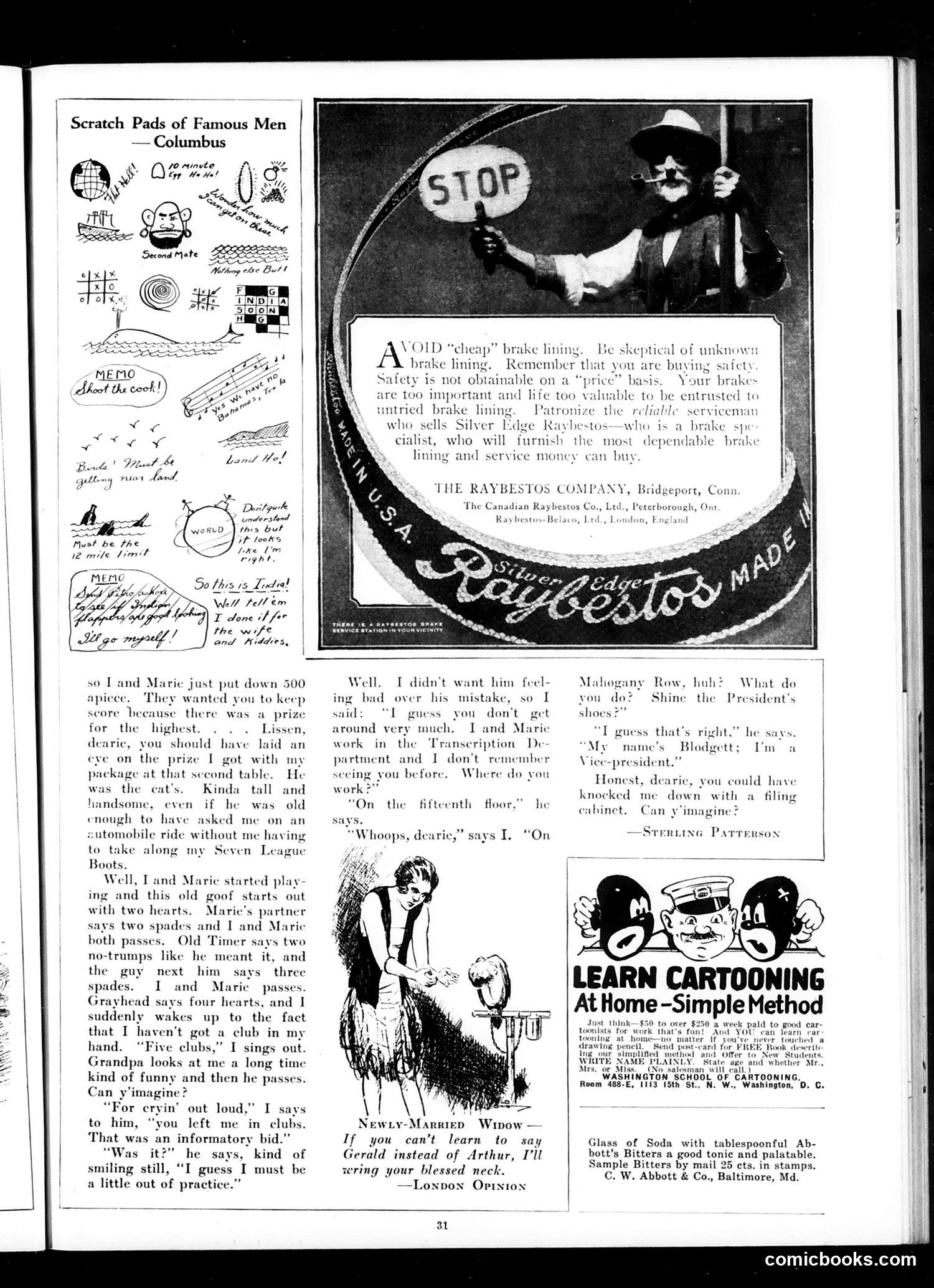
This page contains multiple unrelated items typical of Judge magazine's format: **Main Cartoon (top right):** A Raybestos brake lining advertisement disguised as safety advocacy. A man holds a STOP sign, warning against cheap brake linings. The ad positions Raybestos as the "reliable serviceman's" choice, appealing to 1920s-era concerns about automobile safety and quality. **Left Column:** "Scratch Pads of Famous Men—Columbus" shows doodles attributed to Columbus, likely mocking the famous explorer through absurdist humor—his supposed notes contain nonsensical sketches and observations. **Center Story:** A humorous anecdote about a card game (bridge) where a woman plays with an older man ("Old Timer") who makes a bidding error. She tactfully covers for him, then discovers he works in a prestigious "Transcription Department" on the fifteenth floor, creating comedic irony about hidden professional status. **Other Ads:** Include a cartooning correspondence school, an Abbott's Bitters tonic advertisement, and a brief "Newly-Married Widow" joke from London Opinion. The page reflects typical 1920s magazine advertising and humor without clear political content.
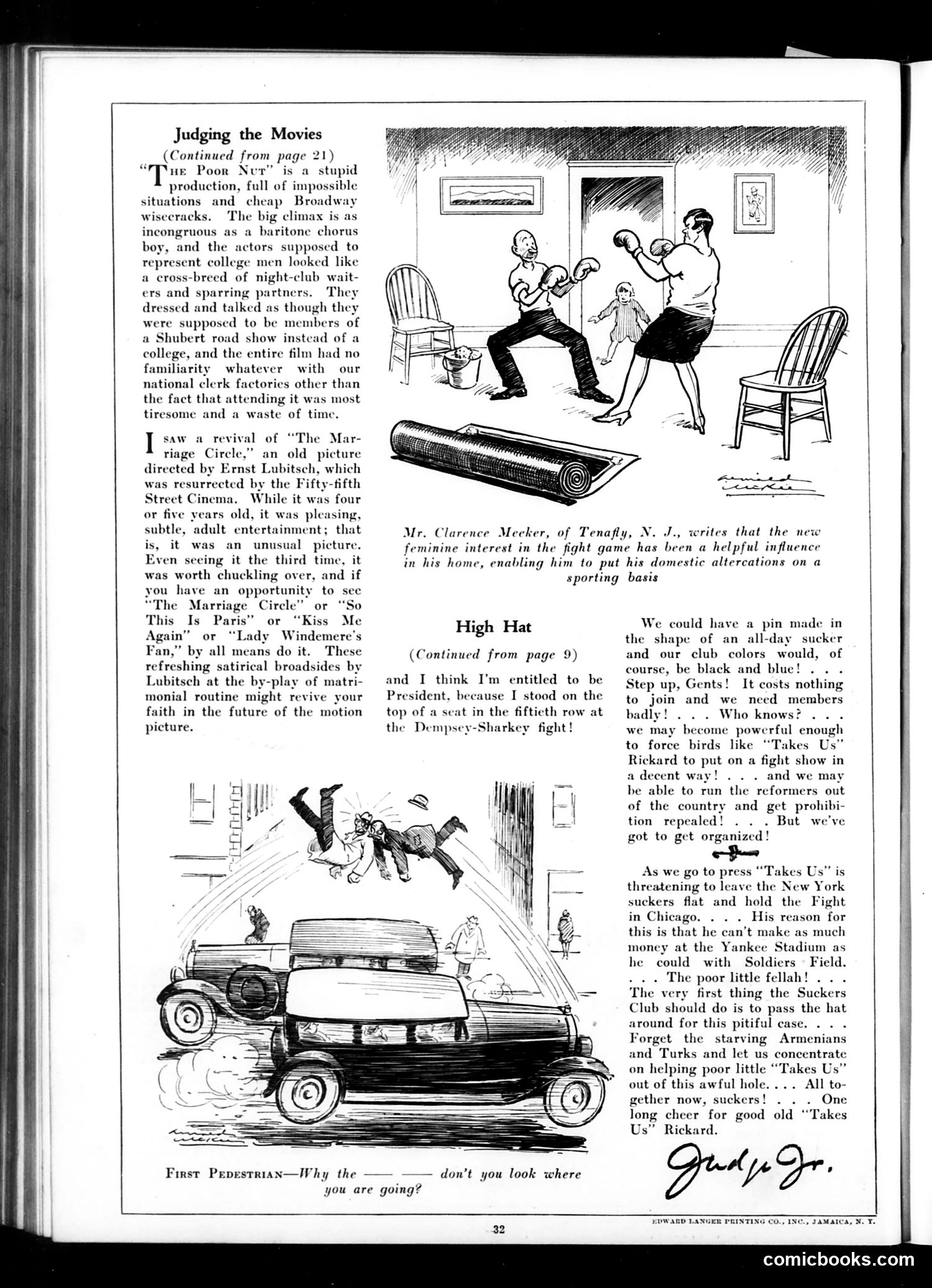
This page contains film and sports criticism typical of Judge's satirical commentary. **"The Poor Nut" review** attacks a college-themed film as cheaply made and inauthentic, with actors who look like "night-club waiters" rather than genuine students. The critic mocks the production's Broadway theatricality and lack of familiarity with actual college life. **"High Hat" section** mocks boxing promoter Tex Rickard's decision to move the upcoming fight (appears to be Dempsey-Sharkey) from New York to Chicago. The satirist ridicules wealthy "suckers" (fans) who blindly support Rickard's profit-driven decisions while starving Armenians and Turks go unhelped. The proposed "Suckers Club" is biting satire—these privileged fight fans should redirect charity toward genuine suffering. **The cartoon** shows a car accident with a pedestrian being struck, captioned "Why don't you look where you are going?" — likely satirizing either reckless driving or inattentive pedestrians. The page reflects 1920s concerns: entertainment authenticity, sports commercialism, and indifference to international humanitarian crises.
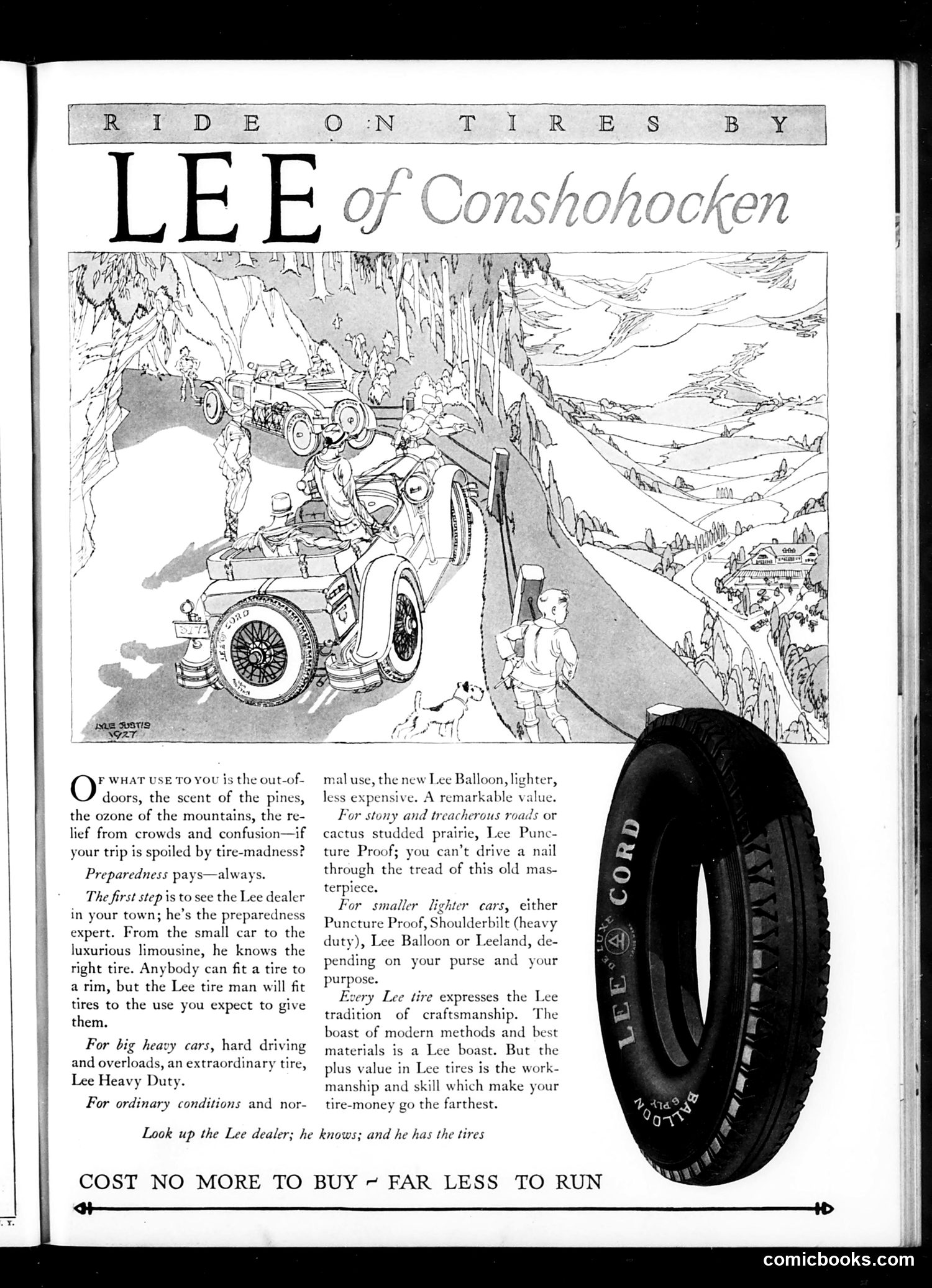
This is an **advertisement for Lee tires**, not a political cartoon. The page features an illustration of a vintage automobile with passengers on a mountain road, alongside promotional text. The ad uses the concept of "preparedness"—likely referencing the pre-WWI preparedness movement gaining traction around 1916—to sell tires. The pitch: outdoor recreation trips are ruined by tire failures, so buyers should visit a Lee dealer to select the right tire for their specific driving needs. Lee offers different tire models for different conditions: Heavy Duty for big cars, Balloon for lighter vehicles, and Puncture Proof for rough terrain. The tagline "Cost No More to Buy—Far Less to Run" emphasizes value through durability and longevity. The modern reader should note this reflects an era when tire selection required expert consultation and when tire failure was a genuine hazard of automobile travel.
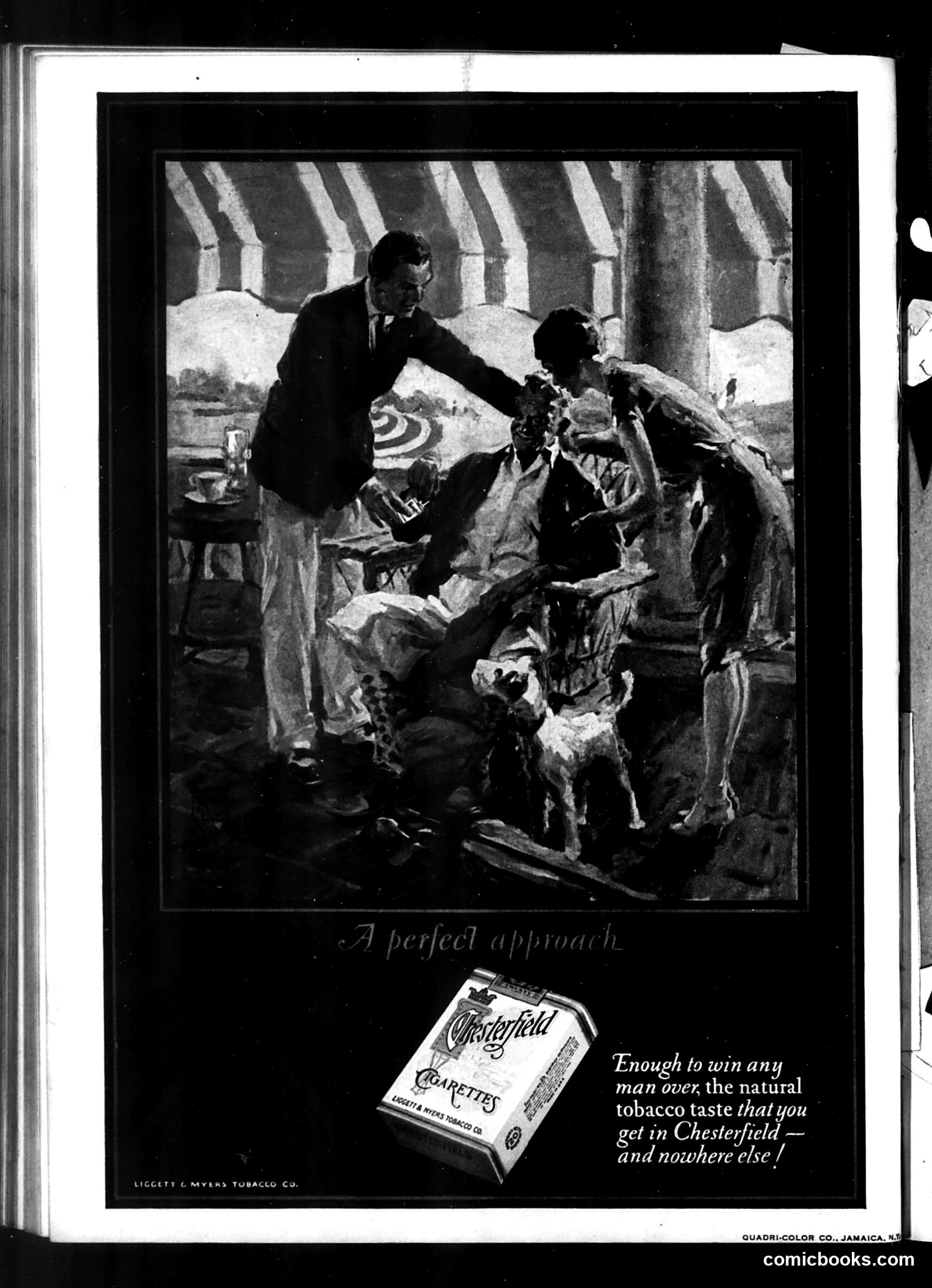
This is primarily a **cigarette advertisement**, not satire or political commentary. It features a Chesterfield cigarettes ad from Liggett & Myers Tobacco Co. The image shows a social scene—a man in formal dress approaching a seated woman while others observe, set in what appears to be an elegant tent or pavilion with striped awning. The caption "A perfect approach" suggests the ad uses romantic/social success as its marketing angle. The advertising copy claims Chesterfield's "natural tobacco taste" is uniquely appealing and superior to competitors. This appears designed to appeal to male consumers by associating the cigarette brand with social sophistication and romantic success—a common advertising strategy of that era. There is no political satire visible on this page.