
A complete issue · 36 pages · 1926
Judge — December 4, 1926
This is a **Season's Greetings** card from *Judge* magazine, dated December 4, 1926. The page features a decorative Christmas design with holly leaves and berries arranged in a wreath pattern, tied with a black ribbon bow. The design is purely festive—a holiday greeting card rather than political satire. The holly and berries are rendered in silhouette against a white background, creating a classic Christmas aesthetic typical of 1920s seasonal imagery. The tag reading "Season's Greetings Judge" identifies this as the magazine's holiday message to readers. There is no apparent satirical content or political commentary on this particular page. It serves as a straightforward seasonal decoration and greeting.
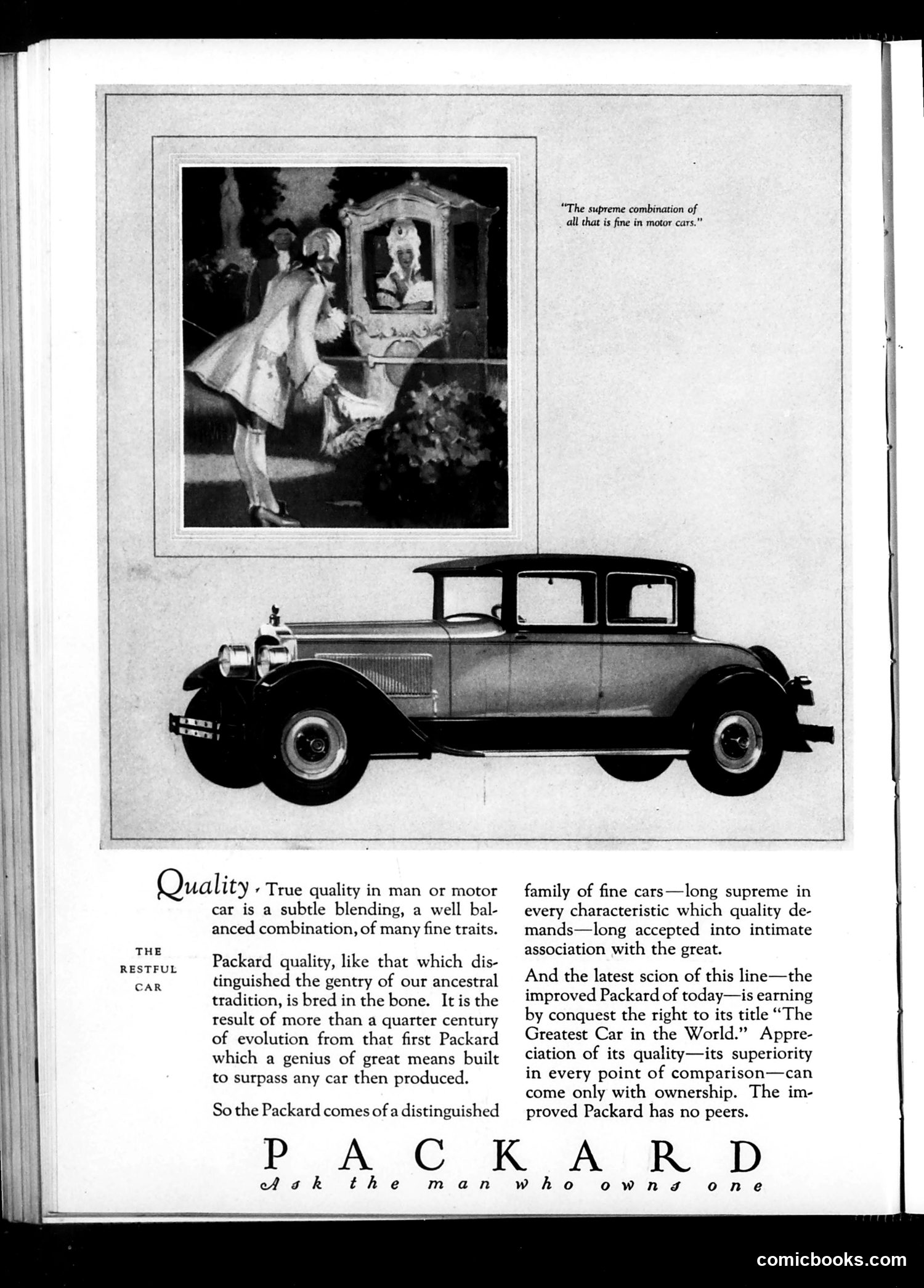
This page is primarily a **Packard automobile advertisement**, not political satire. The image shows a 1920s-era luxury car alongside an illustration of elegantly dressed figures at what appears to be a formal social event. The advertisement uses a social/class appeal strategy common to the era: associating the car with refinement, tradition, and distinguished taste. The tagline "Ask the man who owns one" suggests peer endorsement among the wealthy. The quote "The supreme combination of all that is fine in motor cars" emphasizes quality and exclusivity. The text emphasizes Packard's century-long heritage and claims it has "no peers"—typical luxury brand positioning. This reflects 1920s advertising that marketed automobiles as status symbols to affluent consumers, with quality and social prestige as intertwined selling points.
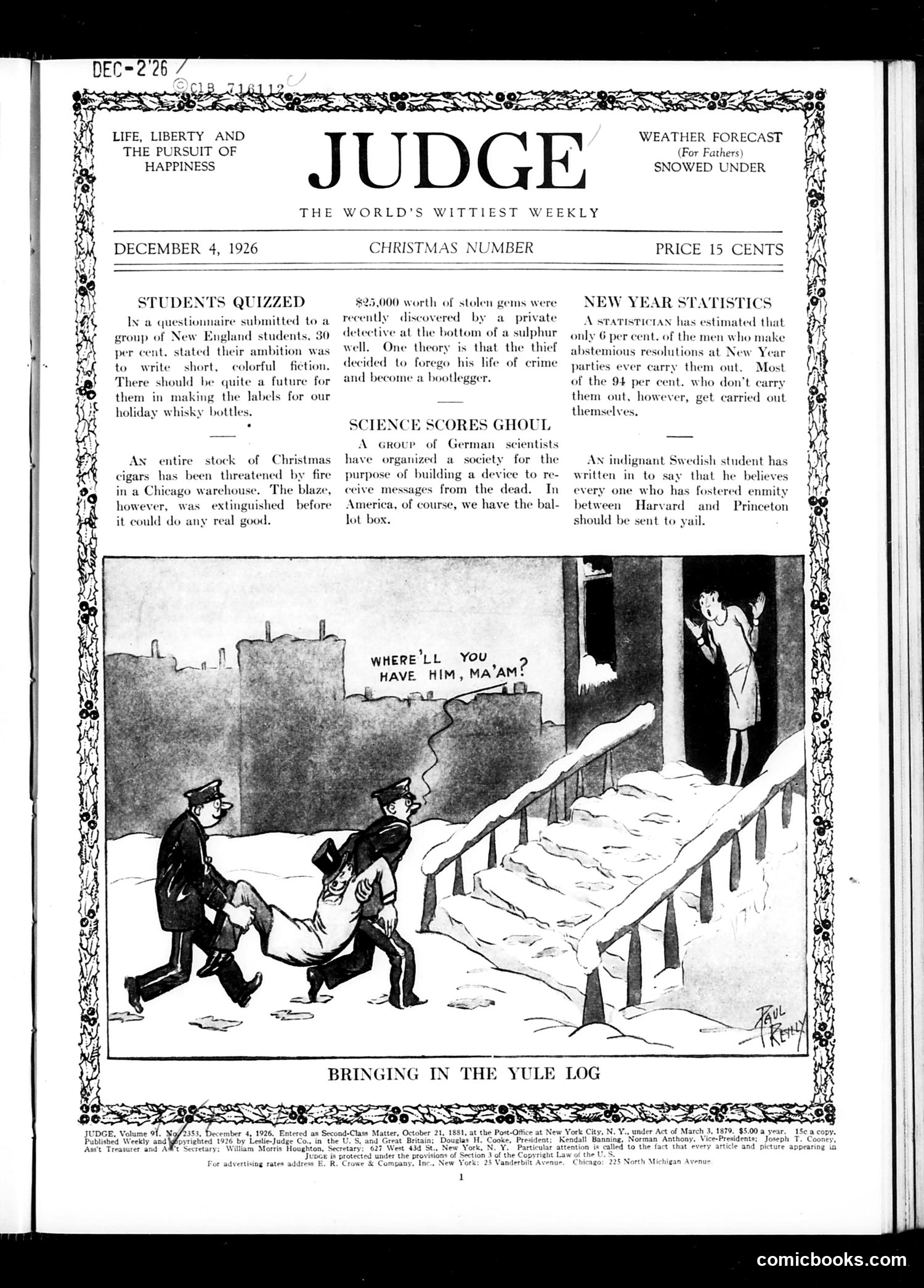
This Christmas-themed cartoon depicts two uniformed police officers struggling to carry an enormous log while asking a woman at a doorway: "Where'll you have him, ma'am?" The joke plays on Prohibition-era slang. "Yule log" appears to be a euphemism for an intoxicated person or smuggled alcohol. The officers' formal question and the woman's willingness to receive this "delivery" suggest they're depicting corrupt cops facilitating illegal alcohol distribution—a common satirical target during Prohibition (1920-1933). The humor mocks how openly police participated in bootlegging operations despite their sworn duty to enforce alcohol laws. The domestic holiday setting emphasizes the casual, normalized nature of this corruption in American life.
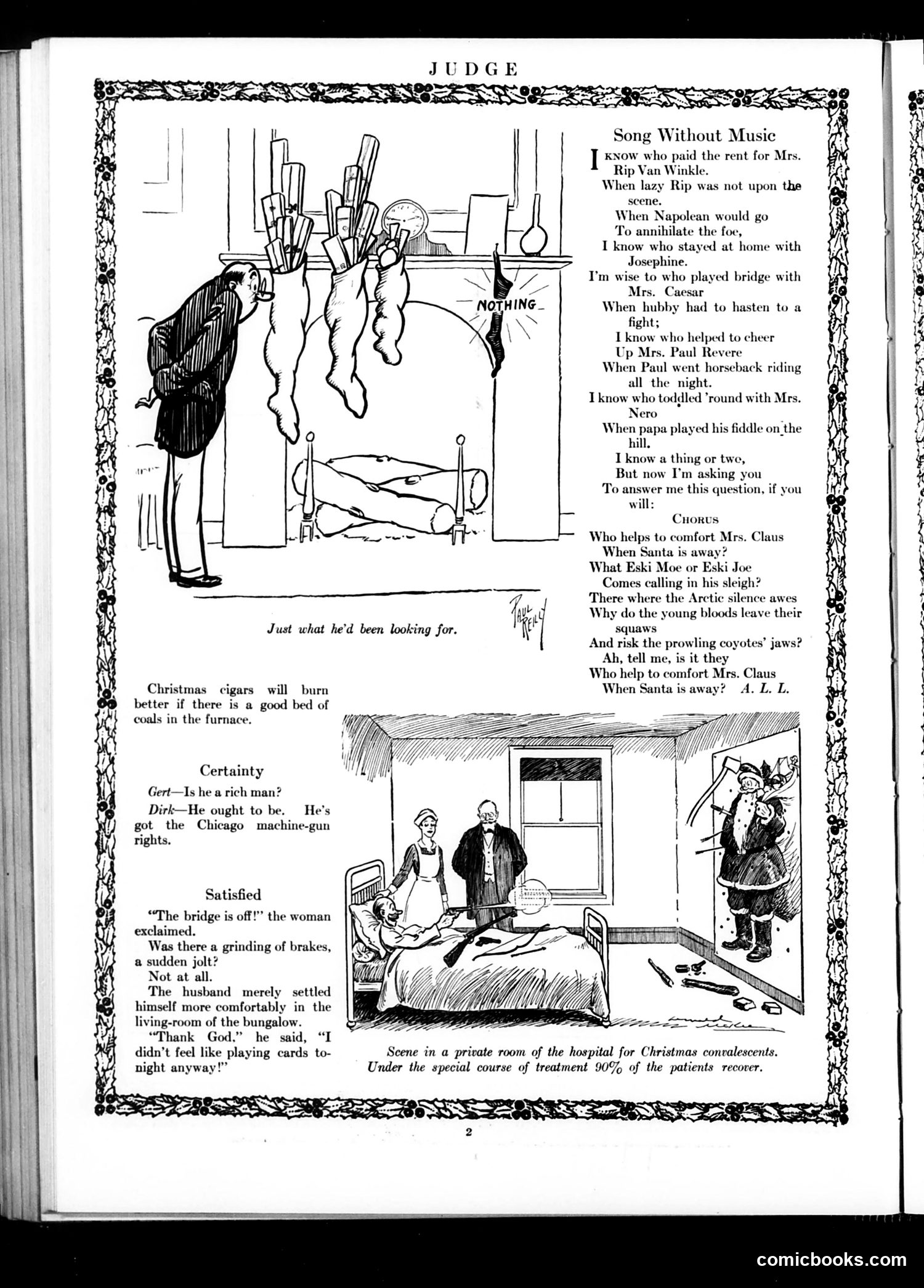
**Top Cartoon ("Just what he'd been looking for"):** A man discovers a fireplace mantelpiece laden with expensive items—likely representing desirable Christmas gifts or valuables. The joke appears to be about theft or acquisition of desired goods during the holiday season, satirizing either holiday greed or burglary. **Middle Section ("Certainty"):** Brief dialogue joke about a wealthy man's riches, referencing Chicago machine-gun "rights"—likely alluding to organized crime or gangster activity during Prohibition era (appears to be 1920s-1930s). **Bottom Section:** A hospital scene captioned as treating Christmas convalescents, with accompanying domestic humor about marital comfort and card-playing. The page contains general satirical humor about wealth, crime, and holiday-season behaviors typical of early 20th-century American magazine satire.
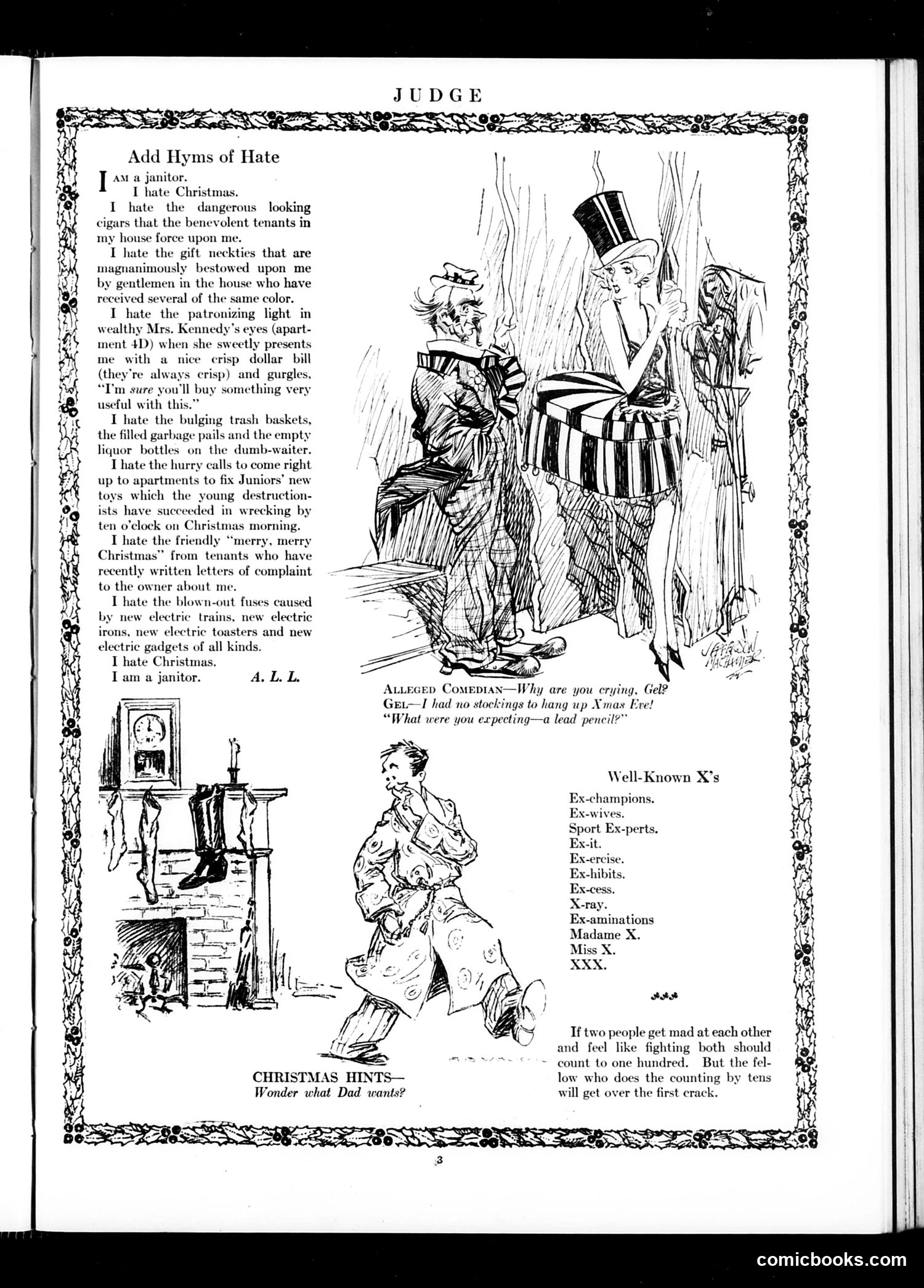
This page contains Christmas-themed humor from an unknown date (likely early 20th century based on style). **"Add Hyms of Hate"** is a janitor's complaint poem listing irritants: dangerous cigars, gift neckties, patronizing wealthy patrons (specifically referencing Mrs. Kennedy's "new crescent" diamonds), bulging trash baskets, drunken tenants, complaints from tenants, and modern electric conveniences. The satire targets both wealthy residents' obliviousness and the new technology's inconveniences. **"Alleged Comedian"** shows a poorly-dressed man claiming he lacks Christmas stockings, a lead pencil—obvious lies suggesting he's panhandling. **"Well-Known X's"** is wordplay listing "ex-" terms: ex-champions, ex-wives, ex-perts, exercise, exhibits, excess, X-ray, etc. The humor targets class tensions, domestic complaints, and modern inconveniences typical of Judge's satirical approach.
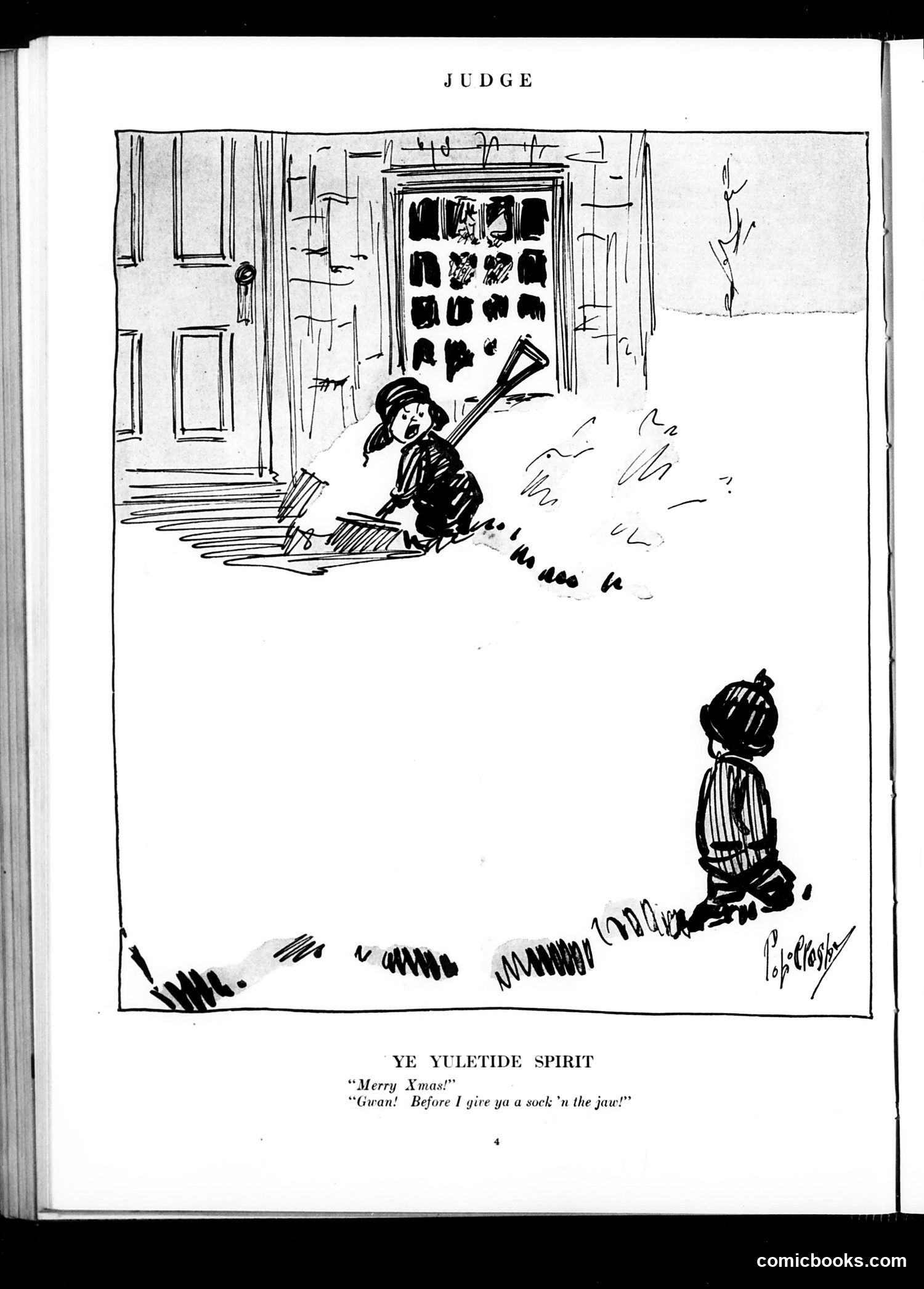
This cartoon depicts a Christmas-themed domestic scene satirizing holiday behavior. A child sits at a window, looking out at snow, holding what appears to be a weapon or stick. Another figure (likely a parent or authority figure) stands at the doorway of a house with a boarded-up window. The caption reads: "Merry Xmas!" followed by "Givan! Before I give ya a sock 'n the jaw!" The satire targets the contrast between idealized Christmas sentiment and actual family behavior—specifically the threat of physical punishment couched within holiday greetings. The boarded window and aggressive language suggest domestic discord masked by festive rhetoric, mocking how people maintain pretenses of seasonal good cheer while harboring genuine hostility. It's social commentary on hypocrisy during the holidays.
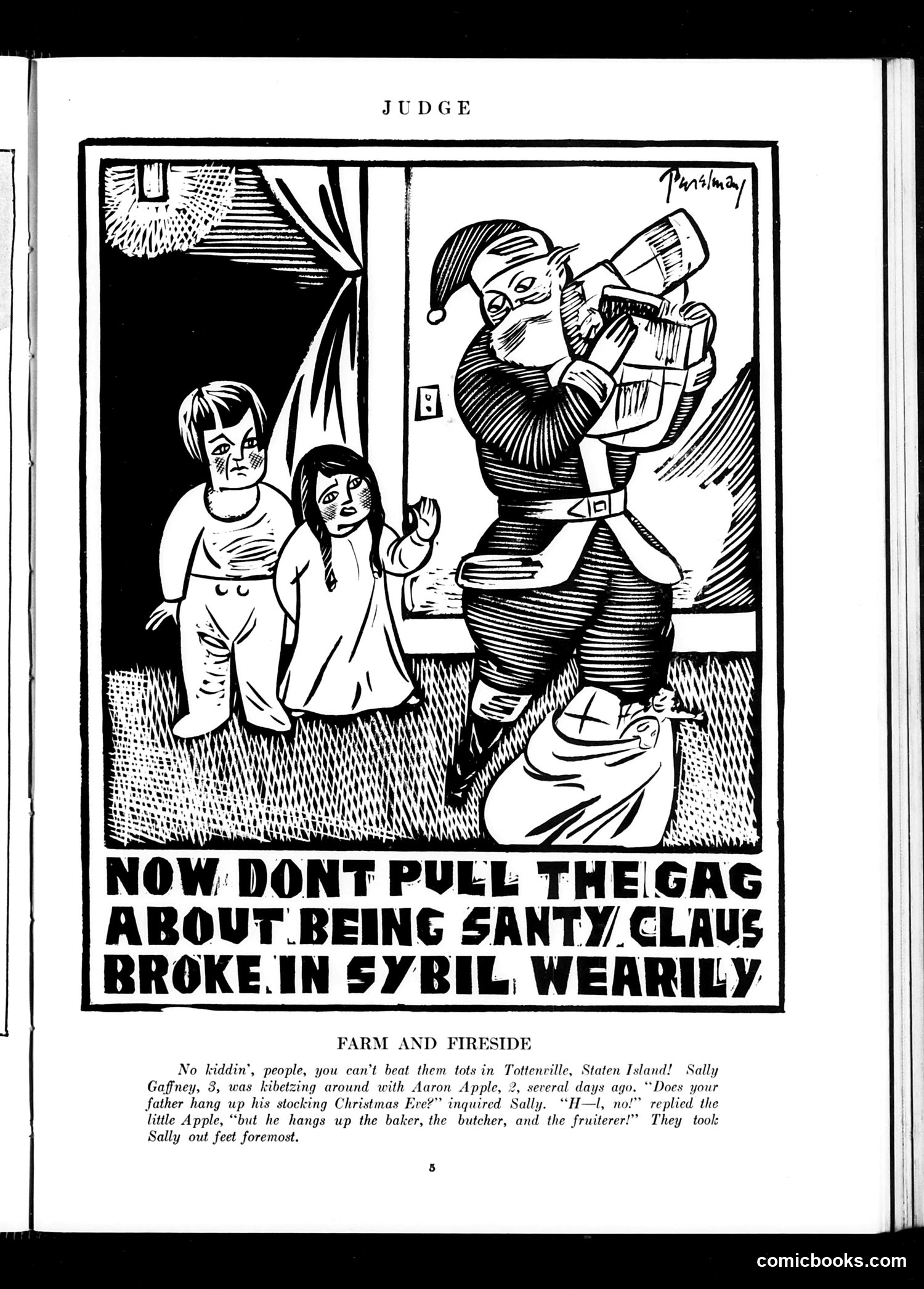
This is a Christmas-themed joke cartoon titled "Farm and Fireside." It depicts Santa Claus with two children, illustrating a humorous domestic anecdote. The caption reads: "Now don't pull the gag about being santy claus broke in sybil wearily" — suggesting Santa's wife (Sybil) is tired of hearing Santa make the same joke about being broke. The accompanying "Farm and Fireside" section contains a brief comedic story about a child named Sally Apple asking her father about Christmas stockings. When her father mentions hanging up his own stocking, Sally replies that he hangs up the baker, butcher, and fruiterer's stockings instead — meaning his debts go to these merchants rather than receiving gifts. The humor targets working-class financial struggles during the holiday season.
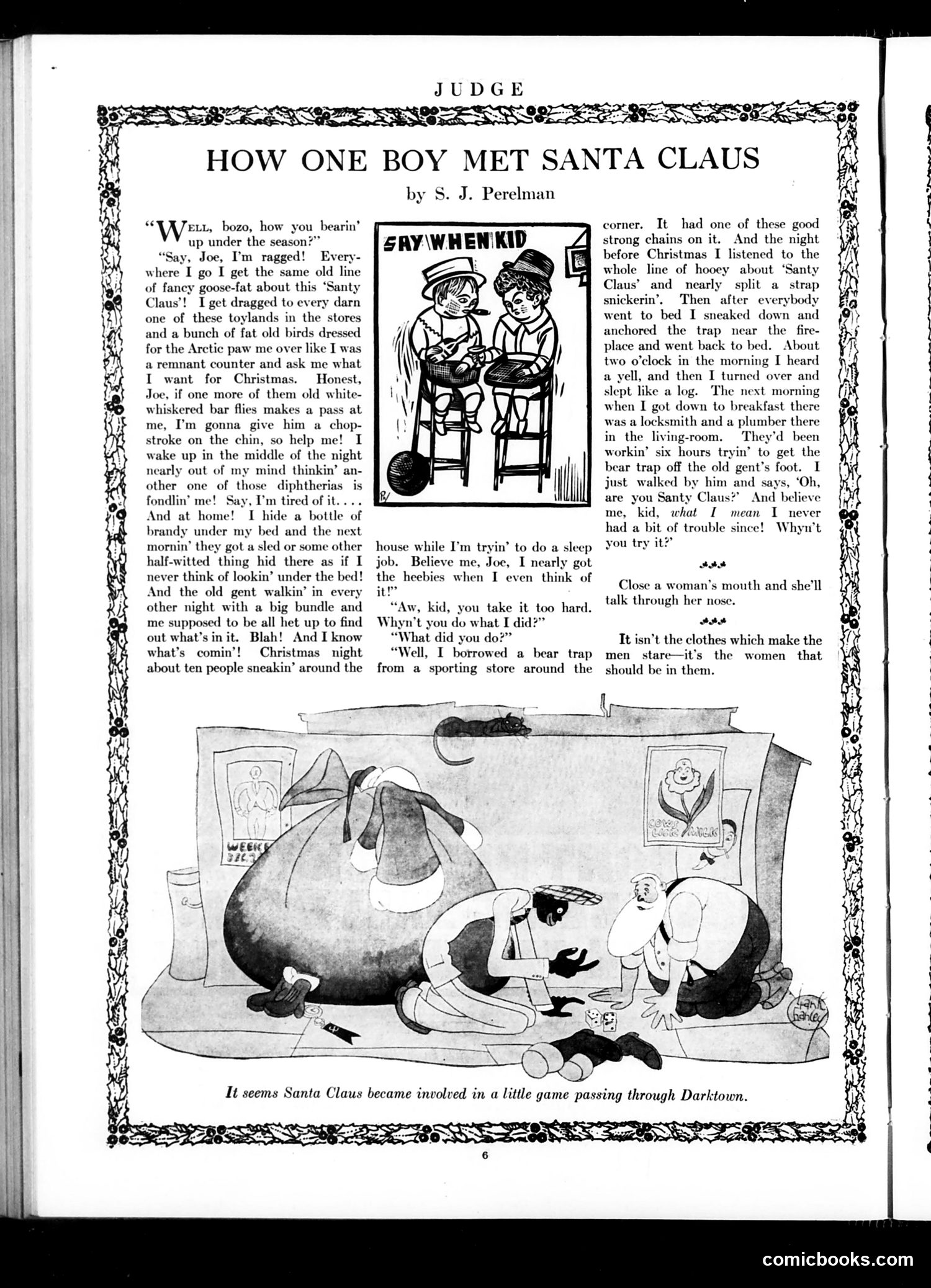
This humorous story by S.J. Perelman satirizes the commercialization of Christmas and the exhaustion children experience from relentless holiday marketing. Two boys discuss their frustration with department store "Santa" encounters—where costumed employees aggressively push children toward toy purchases while making physical contact ("fat old birds dressed for the Arctic paw me over"). The joke's punchline involves one boy's "solution": setting a bear trap for Santa on Christmas Eve, which catches his actual father. The accompanying cartoon illustrates this trap springing on an unfortunate man in a Santa suit stuck in a chimney or fireplace. The satire critiques: - Aggressive commercialization targeting children - Adults' manipulation of childhood innocence for profit - The absurdity of perpetuating the Santa myth The page also includes aphoristic humor about women unrelated to the main story, typical of Judge's satirical style. The overall message mocks 1920s-era Christmas consumerism as intrusive and exhausting rather than joyful.
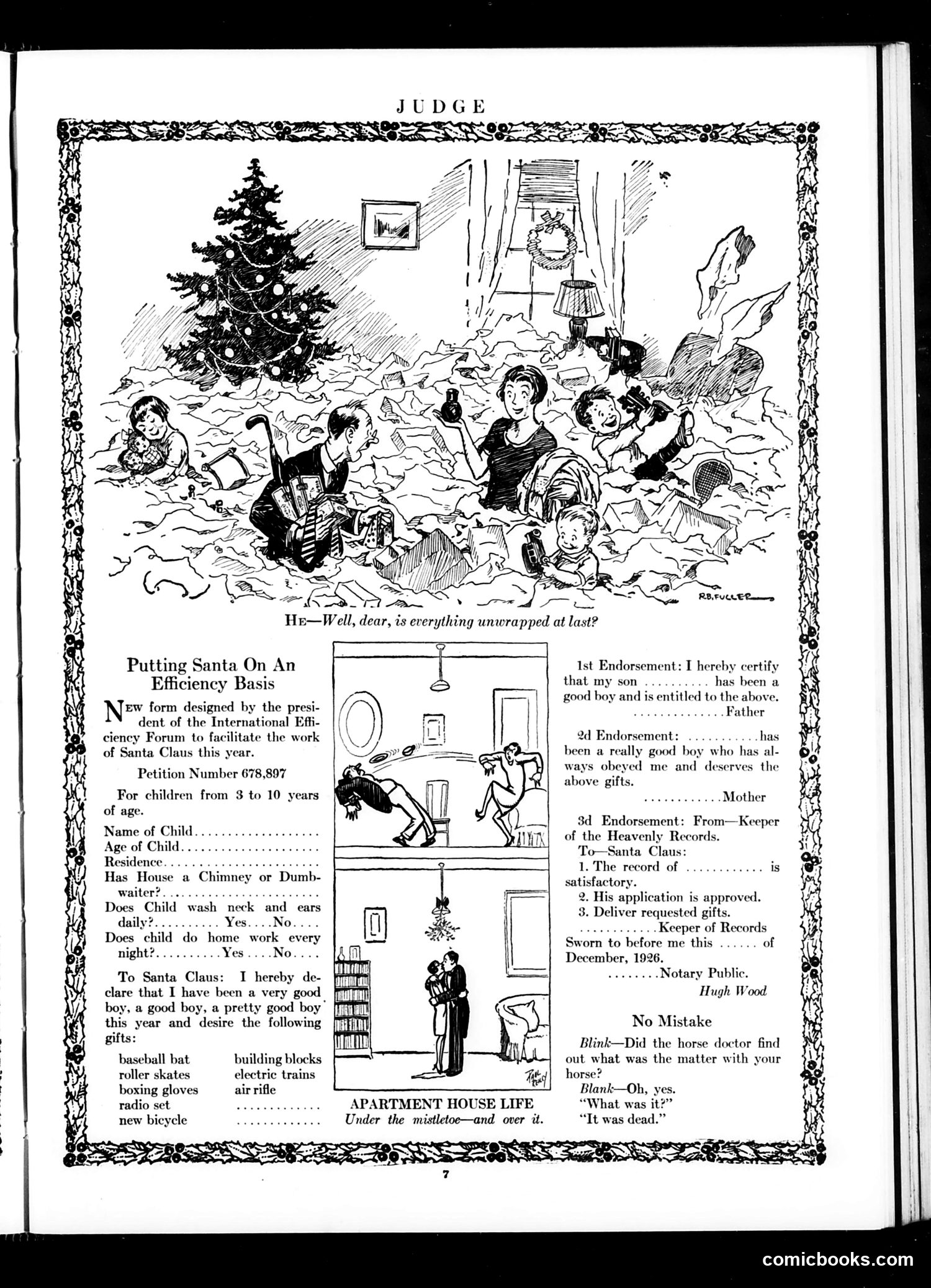
This page satirizes the early 20th-century "efficiency movement"—a business-management craze that applied industrial optimization principles to all aspects of life. The main cartoon mocks this by proposing bureaucratic forms and endorsements to vet children's worthiness for Santa gifts, requiring parental certification, heavenly records verification, and notary signatures. The joke targets how efficiency obsession had invaded even sacred traditions like Christmas gift-giving. Instead of simple childish letters to Santa, children now need formal "Petition Number 678,897" with multiple endorsements—a absurd parody of corporate red tape. The smaller "Apartment House Life" and "No Mistake" comics appear to be filler humor unrelated to the main satire. The page dates to 1926, when such efficiency-movement critiques were topical commentary on American culture's rationalization fetish.
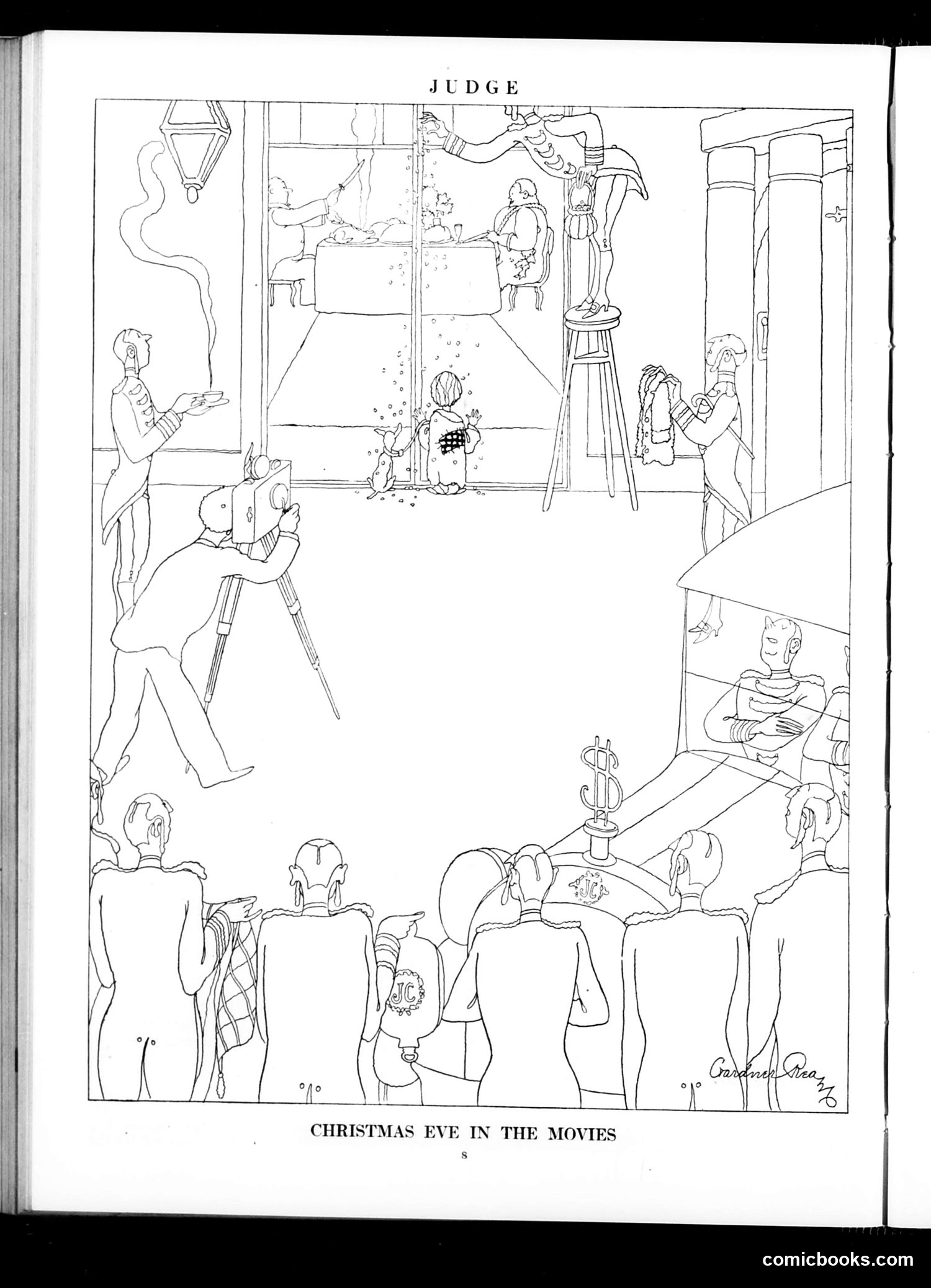
This Judge cartoon satirizes the extravagance and artificiality of Hollywood film production during the Christmas season. The scene depicts a movie studio set where an elaborate Christmas celebration is being staged for cameras. The satire targets the contrast between authentic holiday sentiment and the manufactured spectacle of cinema: we see studio equipment (cameras on tripods, lighting rigs), directors and crew coordinating an elaborate scene, while actors perform a Christmas dinner or celebration for the cameras below. The joke critiques how movies commodify and dramatize Christmas into an over-produced, inauthentic performance—replacing genuine holiday warmth with theatrical excess and commercial calculation. The viewpoint from the "audience" (bottom of frame) emphasizes how viewers consume this fabricated sentimentality as entertainment rather than sincere celebration.
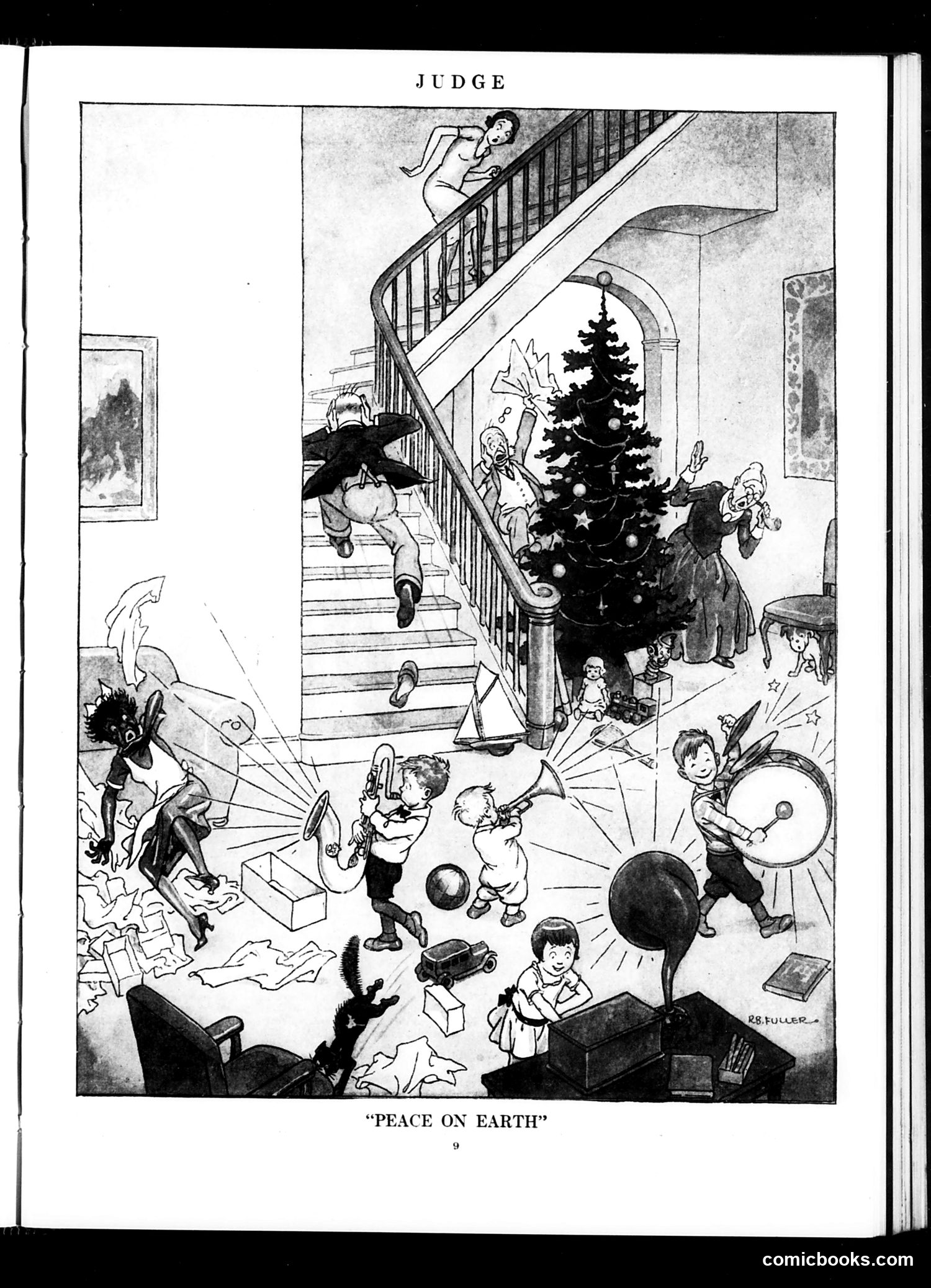
This is a Christmas-themed satirical cartoon titled "Peace on Earth." It depicts a chaotic domestic scene centered around a decorated Christmas tree, directly contradicting the caption's message of peace. The cartoon shows children engaged in raucous play—fighting with toys, drums, and other objects—while adults attempt to maintain order on a staircase above. The scene captures the ironic gap between the holiday's peaceful ideals and the actual pandemonium of Christmas morning in a household with multiple children. The satire mocks the sentimental Christmas imagery of harmony and tranquility by presenting the messy reality: children running wild, toys scattered everywhere, and general mayhem. It's a gentle, humorous commentary on the disconnect between what Christmas is supposed to represent and what it actually looks like in practice.
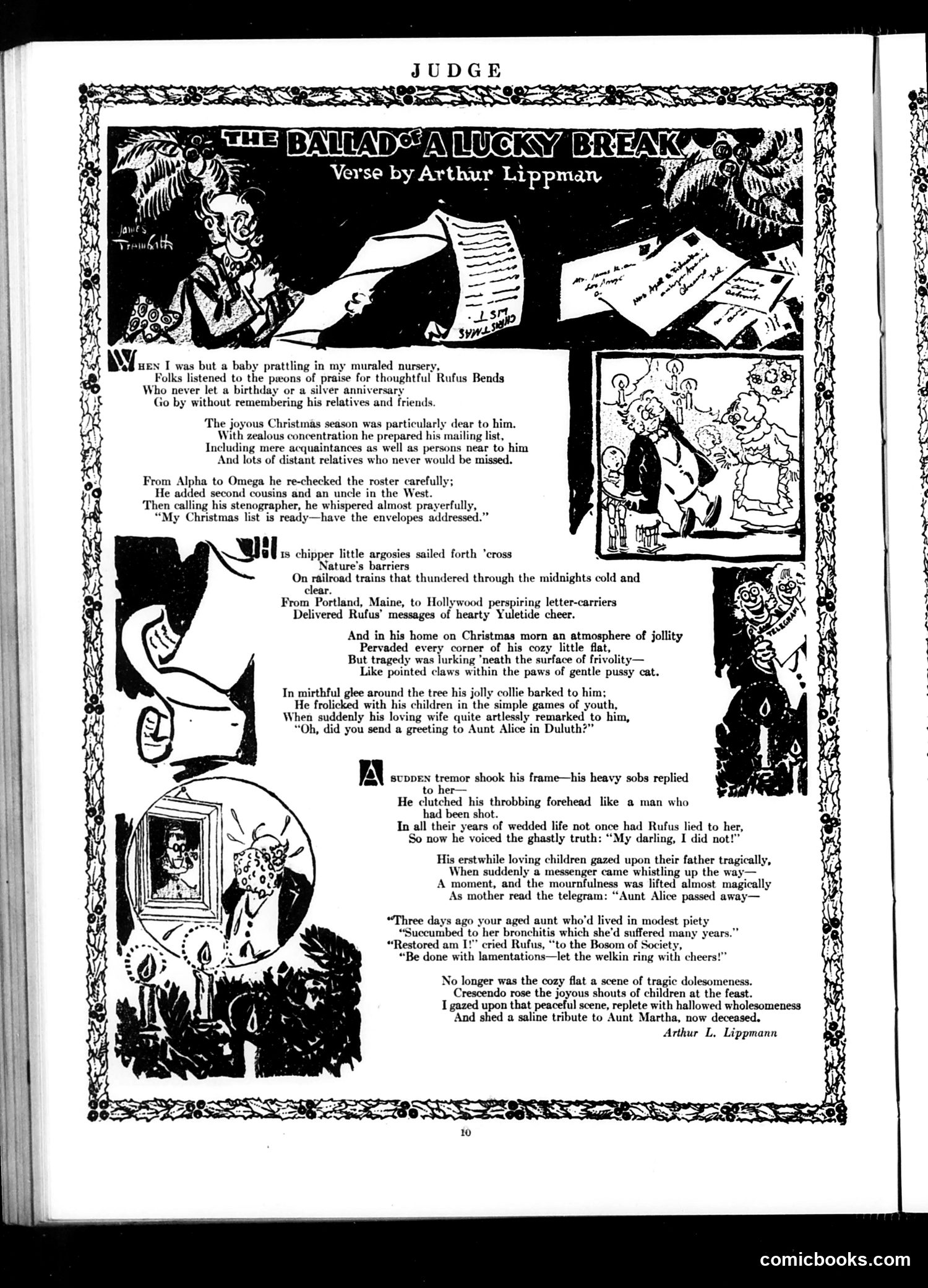
This is a humorous narrative poem illustrated with woodcut-style drawings. The satire concerns Rufus Benda, a compulsively conscientious man who meticulously prepares Christmas cards to distant relatives—including Aunt Alice in Duluth, whom he barely knows. On Christmas morning, his wife asks if he sent Alice a card. Rufus realizes he forgot her and is devastated, having prided himself on never forgetting anyone. The family's joy turns to despair. However, a telegram arrives announcing that Aunt Alice died three days prior—before she would have received the card anyway. Rufus is thus absolved of his negligence by coincidental timing. The joke satirizes both obsessive courtesy culture (the compulsion to acknowledge every distant relative) and the irony of being saved from social embarrassment by death. It's light holiday humor playing on the anxiety of modern social obligation and the absurdity of guilt over forgotten thank-yous.
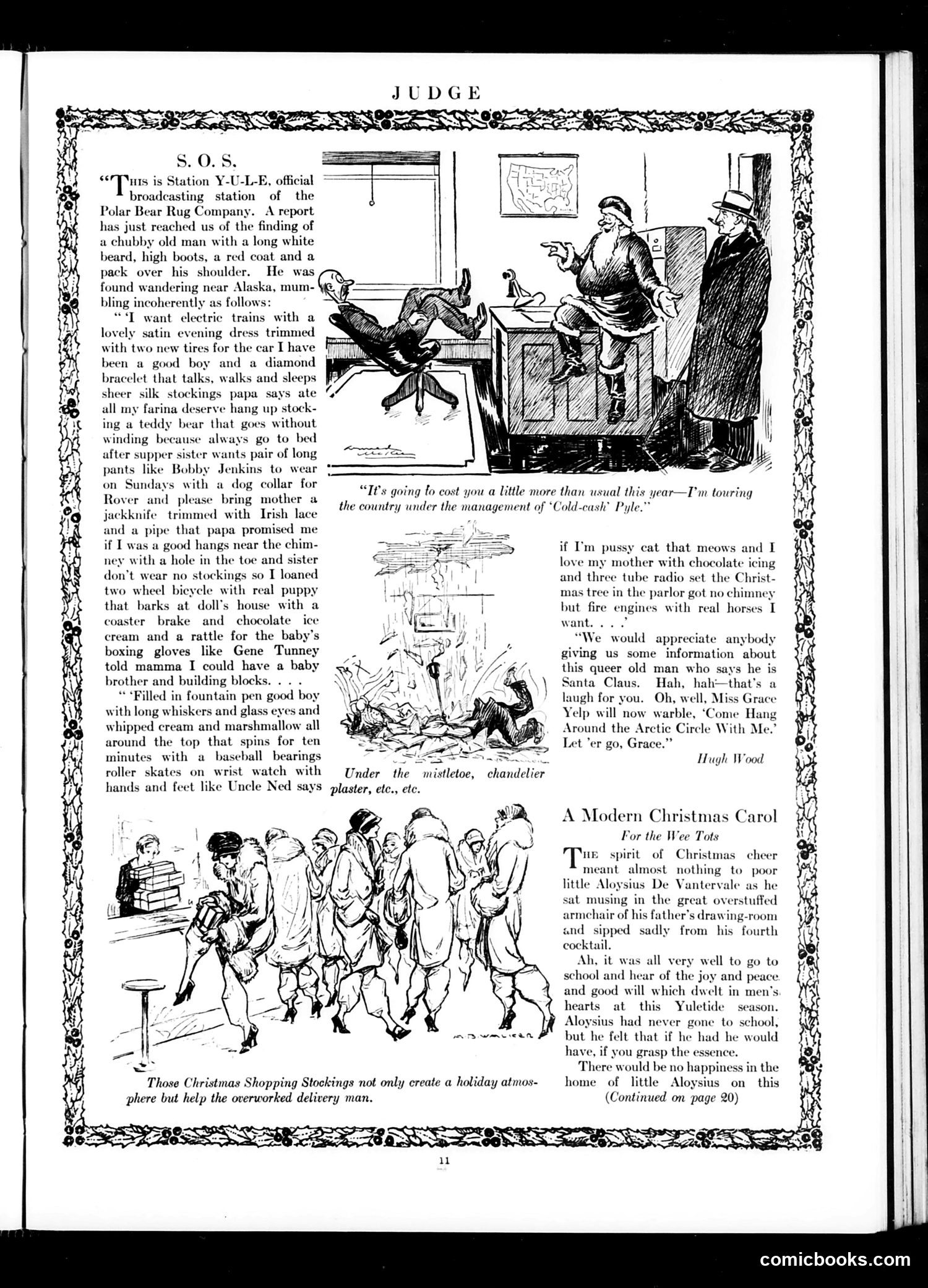
This page contains two satirical pieces: **1. The "S.O.S." Radio Broadcast (top):** A mock emergency report about a confused old man (clearly Santa Claus) found wandering and incoherently reciting an absurdly endless Christmas wish list from children. The joke satirizes both children's materialistic greed and the commercialization of Christmas—the list includes everything from electric trains to radios to real horses, reflecting 1920s consumer culture excess. The cartoon below shows exhausted delivery workers overwhelmed by Christmas shopping, mocking how commercialism has burdened working people rather than spreading cheer. **2. "A Modern Christmas Carol" (bottom):** This story parodies Dickens's *A Christmas Carol*, introducing "poor little Aloysius De Vantervale"—a wealthy child sitting in his father's luxury drawing-room drinking cocktails. The irony is clear: he's materially privileged but spiritually empty, suggesting that wealth and excess create unhappiness. The piece critiques how even privileged children have lost genuine Christmas spirit to materialism and adult excess (his drinking). Both pieces mock 1920s consumer culture and its corruption of Christmas's spiritual meaning.
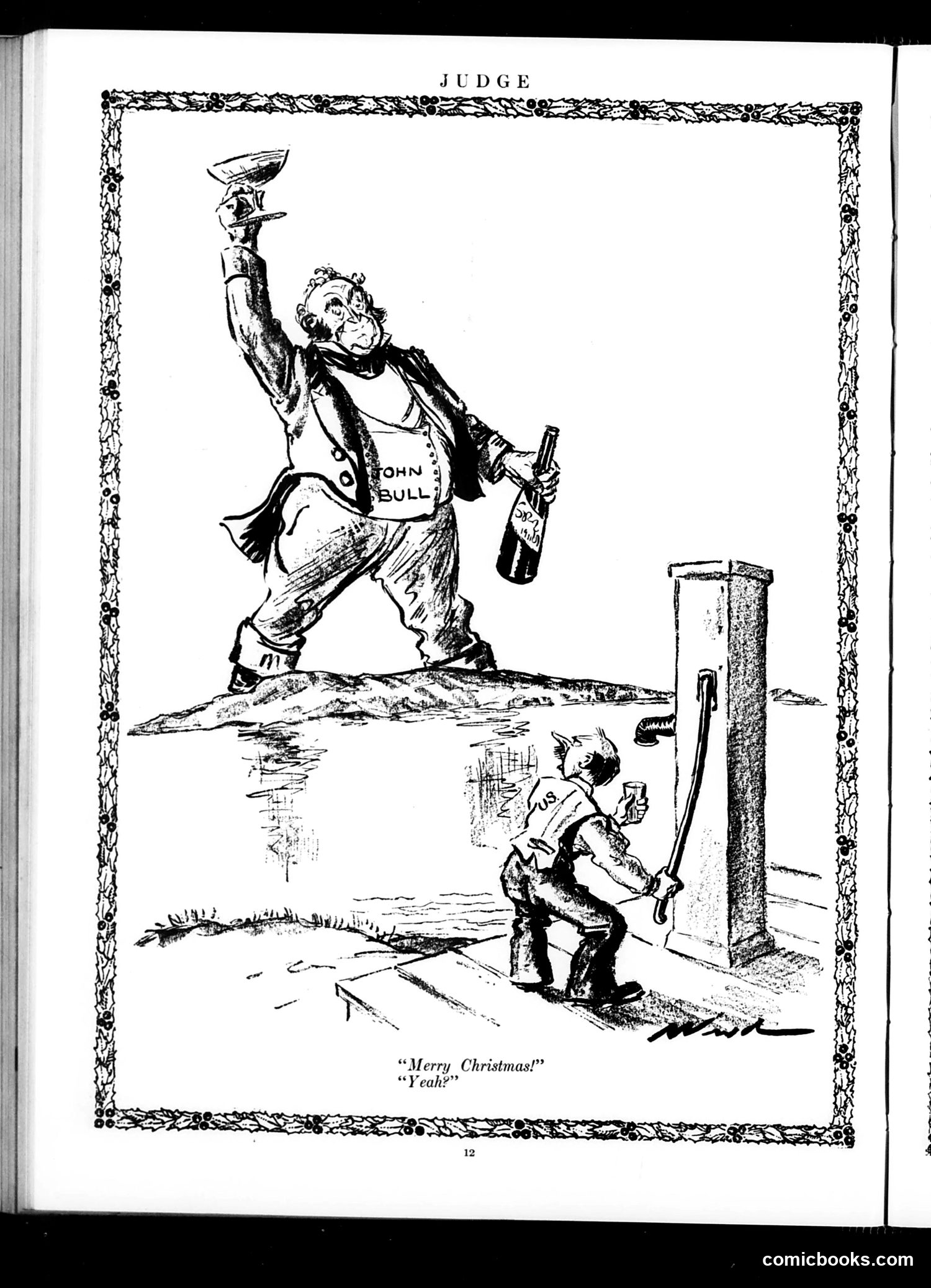
This cartoon depicts two figures in a stark size contrast. A large, well-dressed man labeled "JOHN BULL" (personifying Britain) stands triumphantly holding a goblet and what appears to be a wine bottle, celebrating with "Merry Christmas!" Below him, a much smaller figure labeled "CUB" (likely representing a British colony or subordinate nation) responds skeptically with "Yeah?" The satire critiques British imperial dominance and the inequality of the relationship—suggesting that while Britain celebrates its prosperity and power, its colonial subjects have little reason for cheer. The contrast in scale emphasizes the power imbalance inherent in the British Empire during this period of Judge magazine's publication.
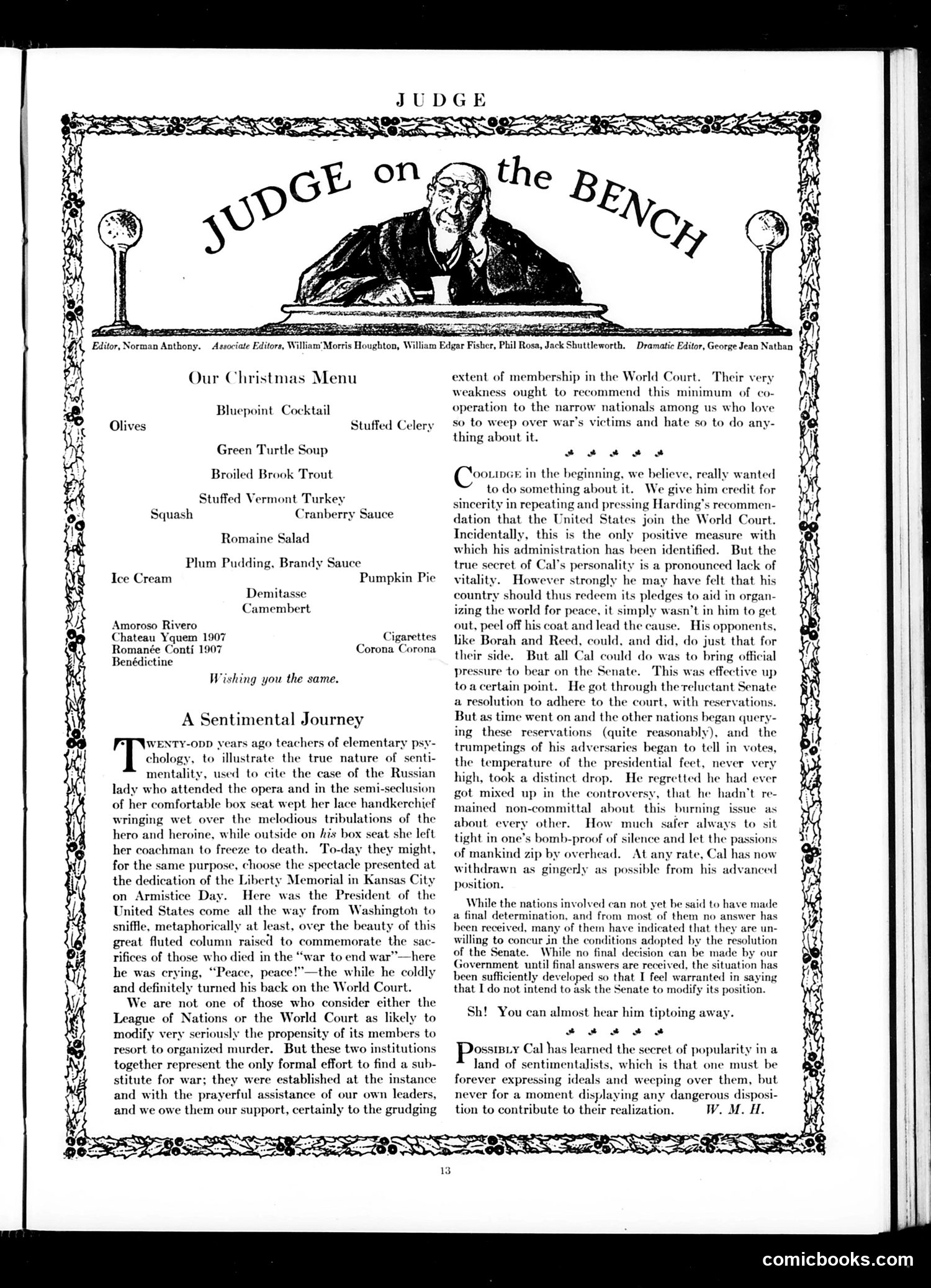
This editorial cartoon criticizes President **Calvin Coolidge** for hypocrisy regarding American involvement in the World Court. The article contrasts Coolidge's emotional public support for international peace efforts (he championed joining the World Court, following Harding's recommendation) with his actual lack of commitment when facing political opposition. The satire's point: Coolidge is like the Russian opera-goer from the opening anecdote—weeping sentimentally over war's victims while doing nothing substantive to prevent future conflicts. Though he initially pushed the Senate toward court membership, when other nations questioned America's proposed reservations and domestic opposition intensified (notably from Senator Borah), Coolidge quietly abandoned the effort rather than expend political capital. The magazine argues his "pronounced lack of vitality" and preference for political safety over genuine leadership made him withdraw "as gingerly as possible" from his advanced position—exposing his sentimentality as performative rather than principled.
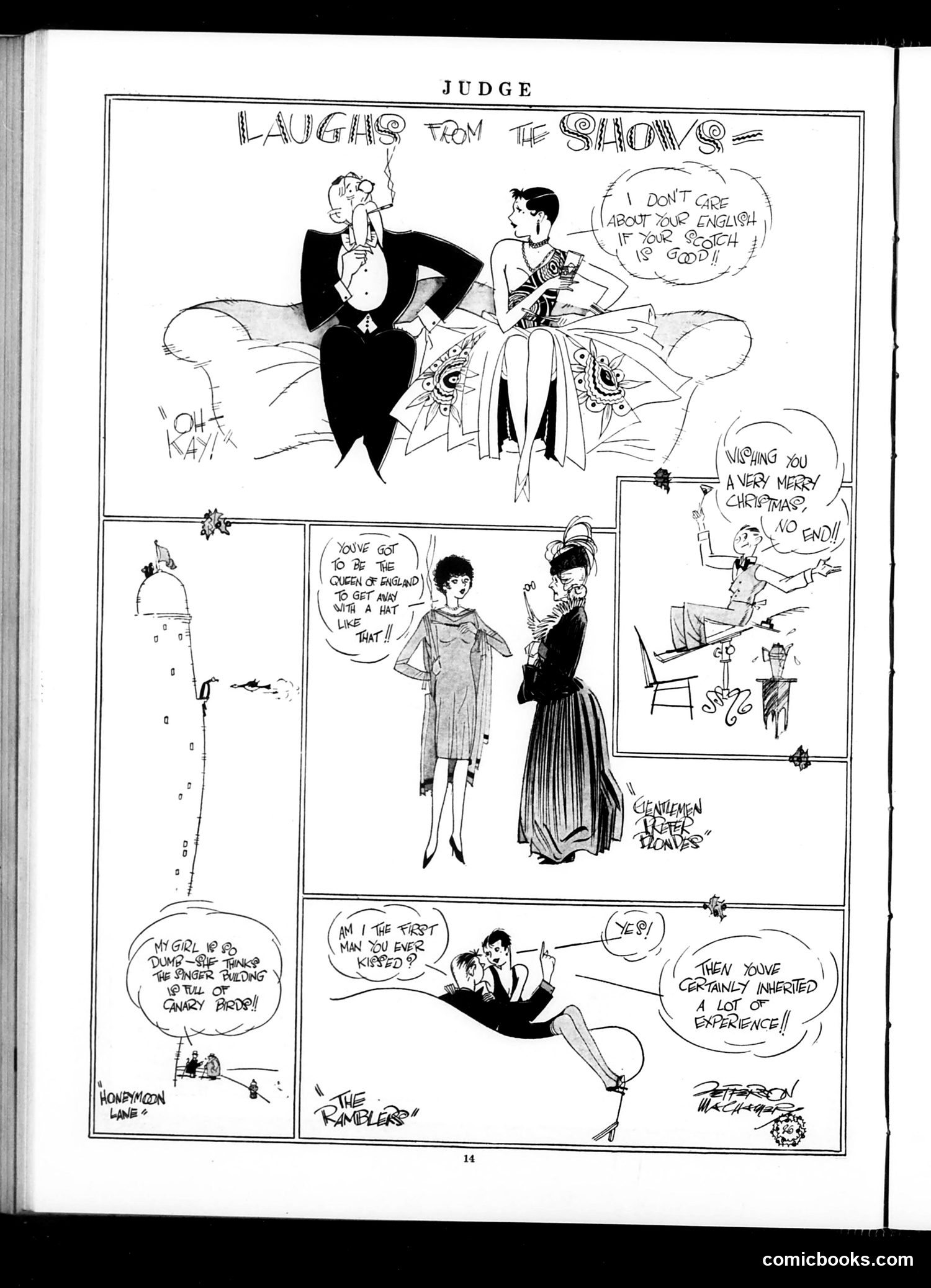
This page contains three comic strips satirizing romantic and social situations, likely from the early-to-mid 20th century based on the style. **Top strip**: A couple on a couch discusses grammar and propriety—she's unconcerned about "rough English" if his behavior is acceptable, suggesting physical intimacy as a social equalizer. **Middle strip** ("Gentlemen Prefer Stories"): Shows a woman being told she needs to act like a "dumb" girl to attract men, reflecting the period's satirical commentary on gender expectations and the gap between women's actual intelligence and what men supposedly preferred. **Bottom strip** ("The Ramblers"): A man claims to be the first person a woman kissed, then boasts she "certainly inherited a lot of experience"—mocking male vanity and the double standard regarding women's sexual history. The overall theme mocks social pretenses around courtship, gender roles, and romantic conventions of the era, using humor to critique both male and female behavior.
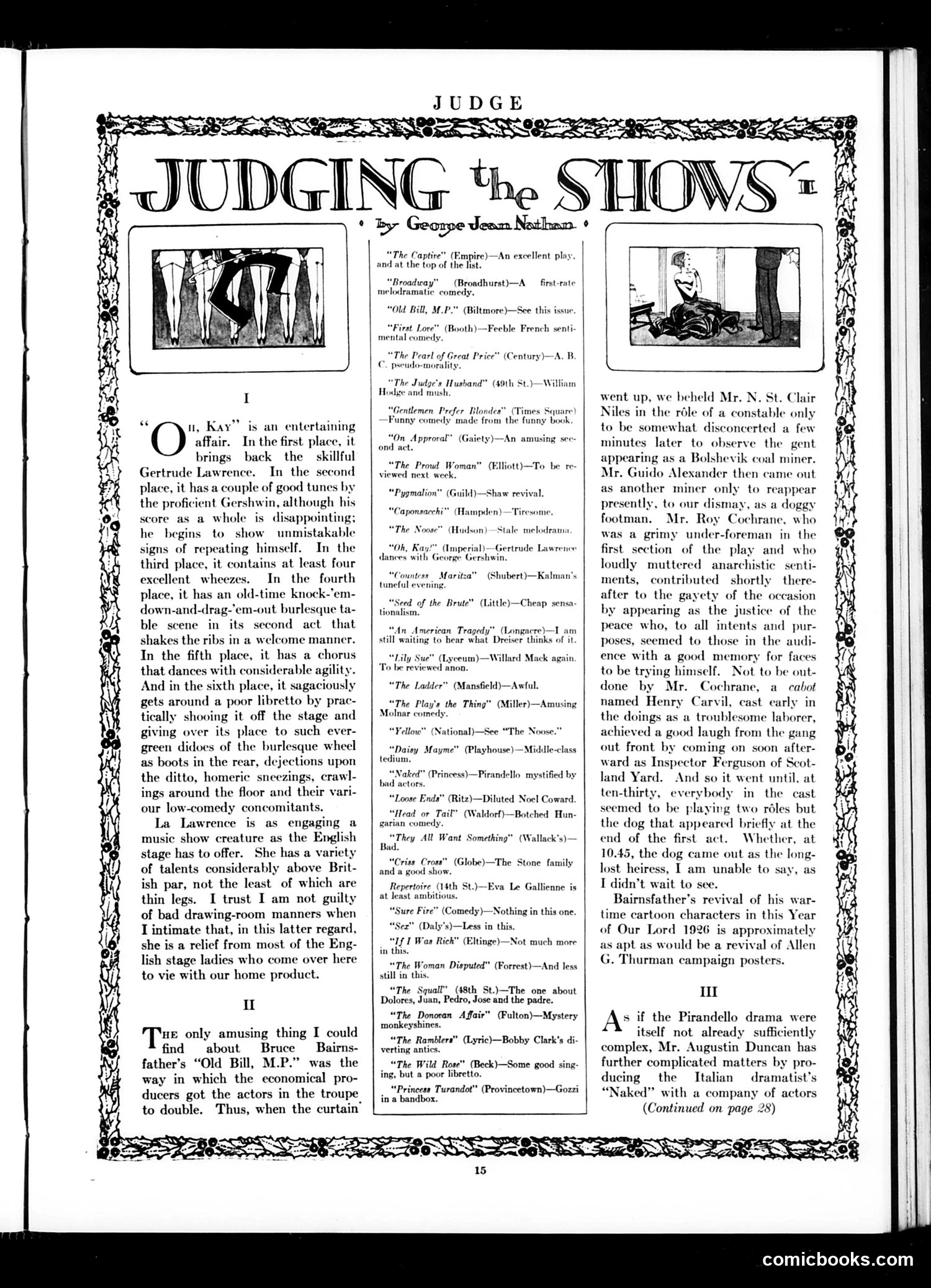
This page contains theater reviews by prominent drama critic George Jean Nathan. It's not a political cartoon but rather entertainment criticism from Judge magazine's theater section. Nathan reviews contemporary Broadway productions, offering brief assessments of plays and musicals. He uses characteristic wit—praising "The Captive" as "excellent" while dismissing others as "stale melodrama" or "awful." The accompanying photos show scenes from productions like "Old Bill, M.P." The narrative section describes a Pirandello drama where actors repeatedly changed costumes and characters (appearing as a coal miner, footman, justice of the peace, etc.), creating comedic confusion—satirizing pretentious avant-garde theater through rapid costume changes that bewildered audiences. This reflects 1920s theatrical culture and Nathan's role as a sophisticated critic mocking both hackneyed melodrama and overly experimental drama.
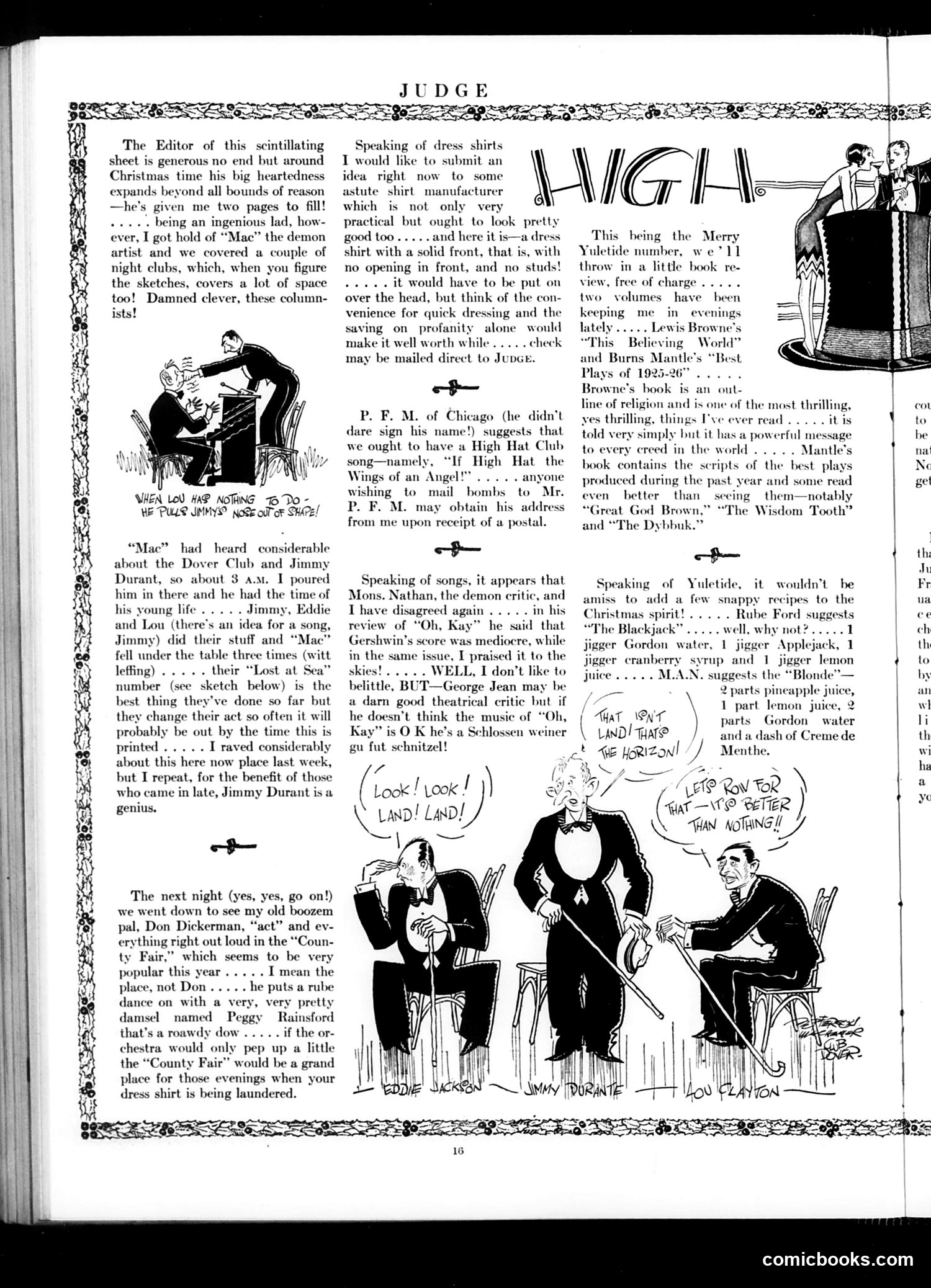
This page from Judge magazine is a holiday special featuring casual entertainment criticism and social commentary. The main cartoons depict Jimmy Durante and other nightclub performers at venues like the Dover Club and County Fair—popular speakeasy-era entertainment spots (this is Prohibition era, given references to "booze" and nightclub culture). The satirical content mocks theatrical critic George Jean Nathan's dismissal of Gershwin's score for "Oh, Kay!" while praising it himself. There's gentle mockery of dress codes (suggesting impractical formal shirts) and suggestions for Christmas cocktail recipes. The cartoons show men in formal wear at nightclubs exclaiming "Look! Land!" and discussing Yuletide spirit—typical 1920s sophisticated humor about entertainment and drinking culture. Durante, a vaudeville star, is celebrated as a "genius" for his improvisational comedy and musical performances. The overall tone is insider gossip about New York nightlife and theater during the Jazz Age.
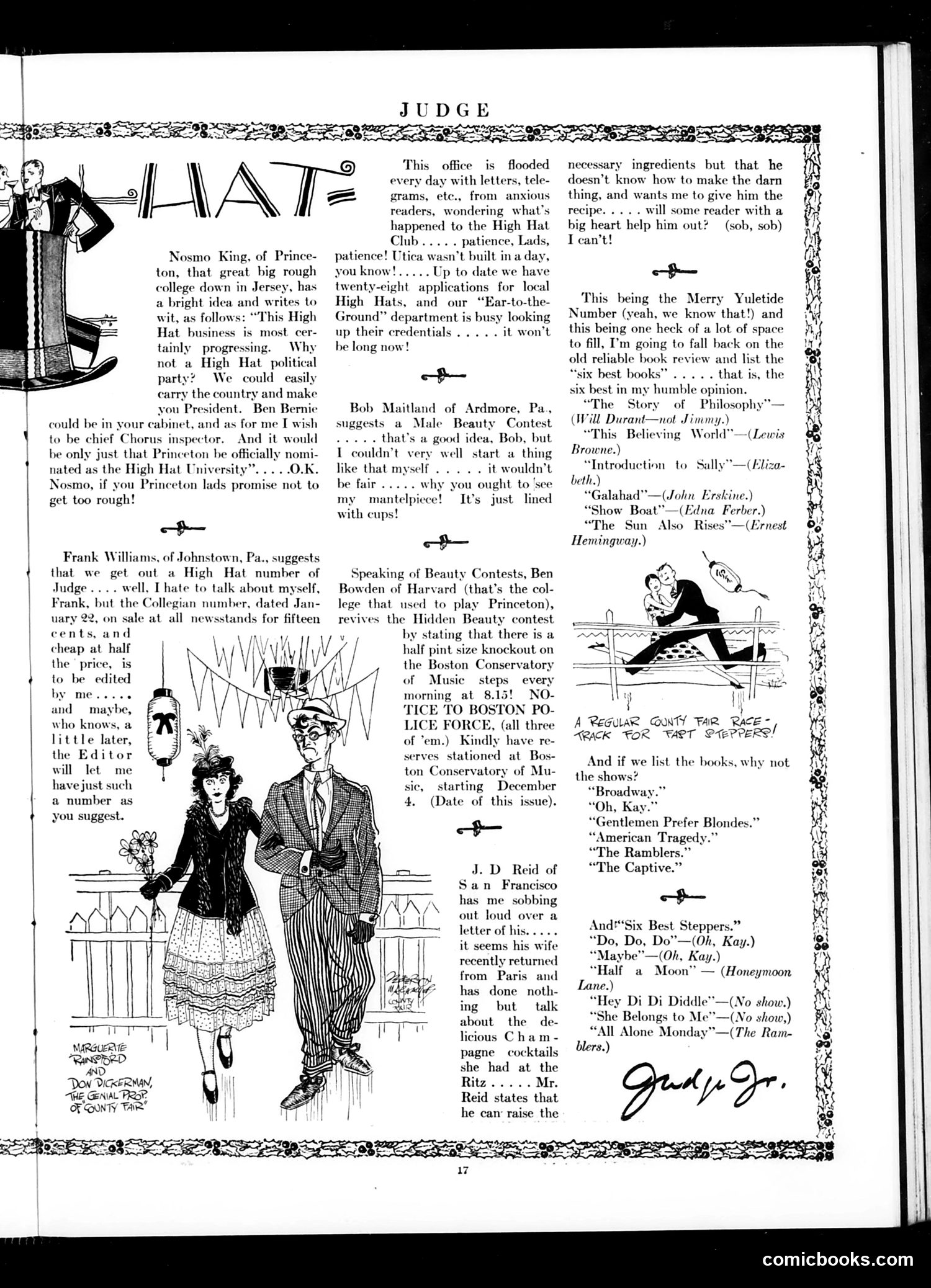
This page showcases **Judge's "High Hat" humor campaign**—a satirical trend about social pretension and sophistication. Readers submit humorous suggestions tied to this running joke, including: **Main Satire:** - A "High Hat political party" concept mocking upper-class affectation - Beauty contests and collegiate humor - References to Princeton, Harvard, and Boston Conservatory as elite institutions being gently ridiculed **Specific References:** - Ben Bowden's quip about a "knockout" at Boston Conservatory (8:15 AM) prompts mock "police notice"—satirizing both the beauty-obsessed culture and Prohibition-era Boston policing - J.D. Reid's letter about his wife returning from Paris, obsessing over expensive Ritz cocktails while he can't afford to make them—poking fun at post-war wealth disparities and marital dynamics **Book/Show Reviews:** The closing lists popular 1920s works ("The Sun Also Rises," "Show Boat," "American Tragedy"), treating them satirically as cultural markers. Overall, the page mocks 1920s collegiate culture, wealthy pretension, and gender dynamics through reader contributions and editorial commentary.
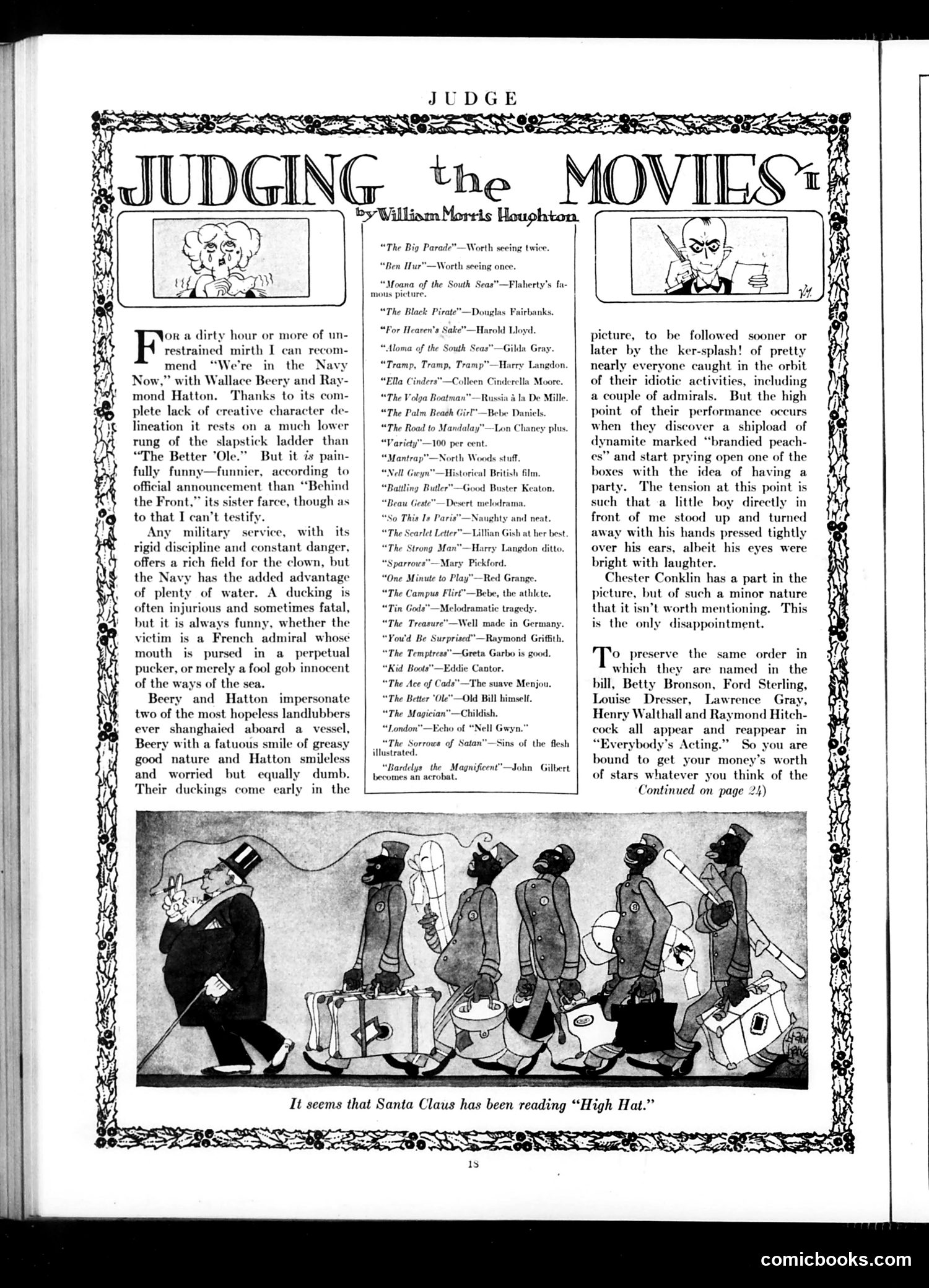
This is a film criticism column by William Morris Houghton reviewing 1920s silent movies. The main text praises the comedy "We're in the Navy Now," starring Wallace Beery and Raymond Hatton as incompetent sailors repeatedly dunked in water—a standard slapstick trope of the era. The accompanying cartoon (captioned "It seems that Santa Claus has been reading 'High Hat'") shows Santa Claus leading a line of toy soldiers, apparently referencing the film "High Hat." The joke appears to be visual wordplay—the soldiers literally wear "high hats." The right column lists contemporary films with brief reviews, including classics like "The Big Parade," "Ben-Hur," and "Metropolis." The satire targets the era's lowbrow comedy conventions and the predictable formula of physical humor in silent films, while the magazine positions itself as arbiter of entertainment taste.
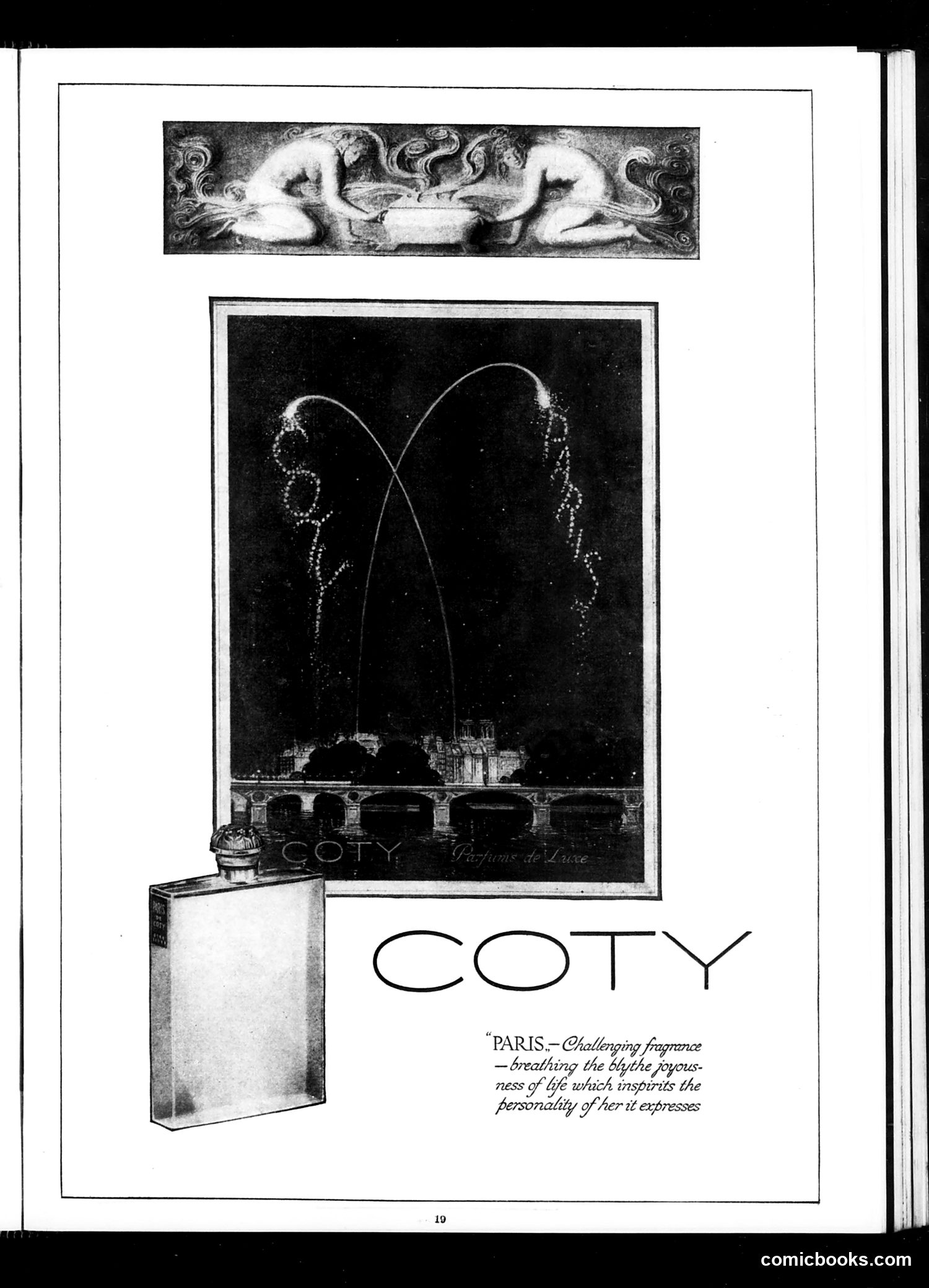
This is a **perfume advertisement** rather than political satire. It promotes "Coty," a Paris-based fragrance brand, using an Art Deco aesthetic popular in the 1920s-1930s. The main image depicts two silhouetted female figures in an elegant pose, their hair adorned with jewels, against a nighttime Parisian cityscape with fountains. The decorative panel above shows classical cherubs or putti. The ad copy describes the fragrance as "challenging" and captures "the blithe joyousness of life," positioning the perfume as expressing the wearer's sophisticated personality. The tagline "Parfum de Luxe" emphasizes luxury branding. This represents commercial advertising in *Judge* magazine, not editorial satire—companies purchased premium ad space to reach the magazine's affluent readership.
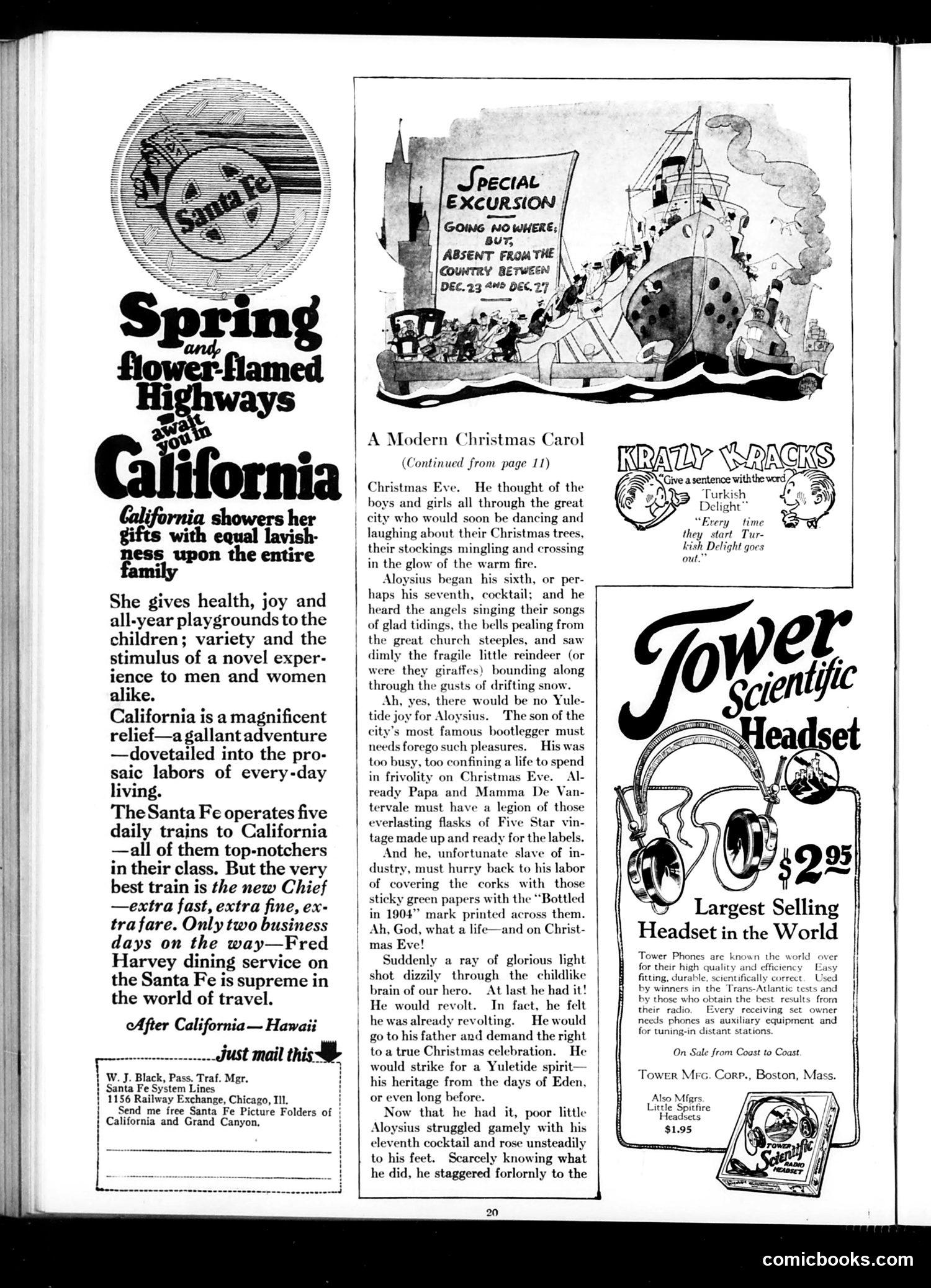
This page contains a satirical story excerpt mocking Prohibition-era excess and hypocrisy. The protagonist, Aloysius, is the son of a famous bootlegger (illegal alcohol producer) during the 1920s-30s. The satire depicts him as a cynical, hard-drinking young man who claims he's too busy covering up bootleg liquor bottles to enjoy Christmas—while simultaneously getting progressively drunk on cocktails. The joke targets the absurdity of Prohibition: wealthy criminals' sons lived lavishly despite (or because of) illegal alcohol production, yet complain about missing "wholesome" holiday celebrations. The story mocks both the bootlegger economy and sentimental Christmas sentimentality, portraying Aloysius as morally bankrupt and delusional. His dramatic "revolt" to demand Christmas joy while intoxicated underscores the satire's cynical view of 1920s urban corruption and moral decay. The page also contains unrelated period advertisements for California travel and radio headsets.
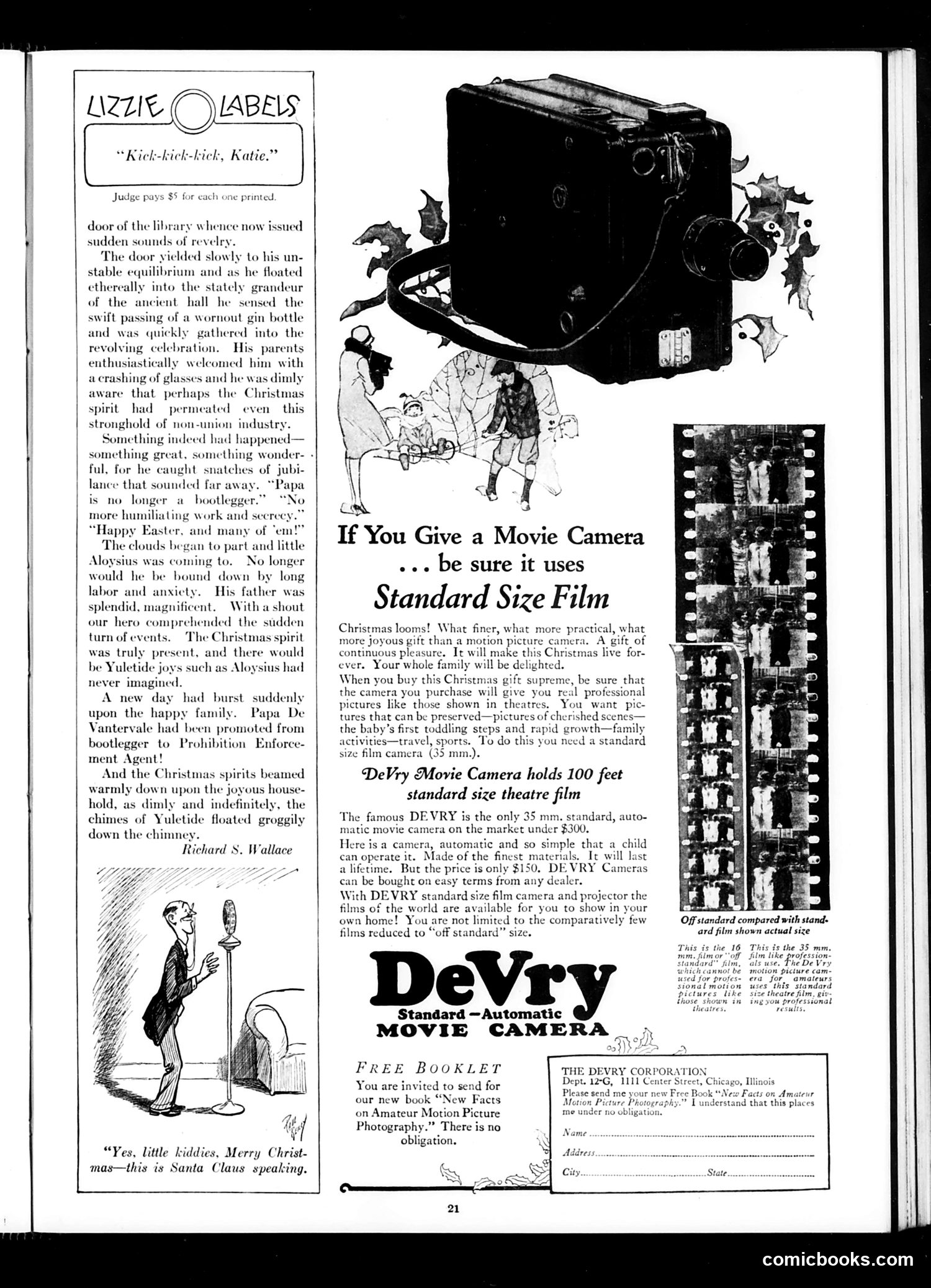
This Judge page combines a short story and advertisement, both satirizing Prohibition-era America (1920-1933). The "Lizzie Labels" story mocks the sudden social mobility of bootleggers during Prohibition. A man named Papa De Vantervale—apparently an illegal alcohol distributor—gets promoted to **Prohibition Enforcement Agent**, a government position meant to stop bootlegging. The satire targets the hypocrisy and corruption of Prohibition enforcement: former criminals become enforcers, and the family celebrates this reversal as if it were moral redemption ("the Christmas spirit"). Richard S. Wallace's cartoon emphasizes the absurdity through the father figure who now represents authority while having recently profited from lawbreaking. The DeVry movie camera advertisement below occupies the page's remainder, unrelated to the satire above it. It pitches home movie equipment as a Christmas gift, emphasizing standard 35mm film compatibility. Together, the page captures how Prohibition created perverse incentives and institutional corruption in 1920s America.
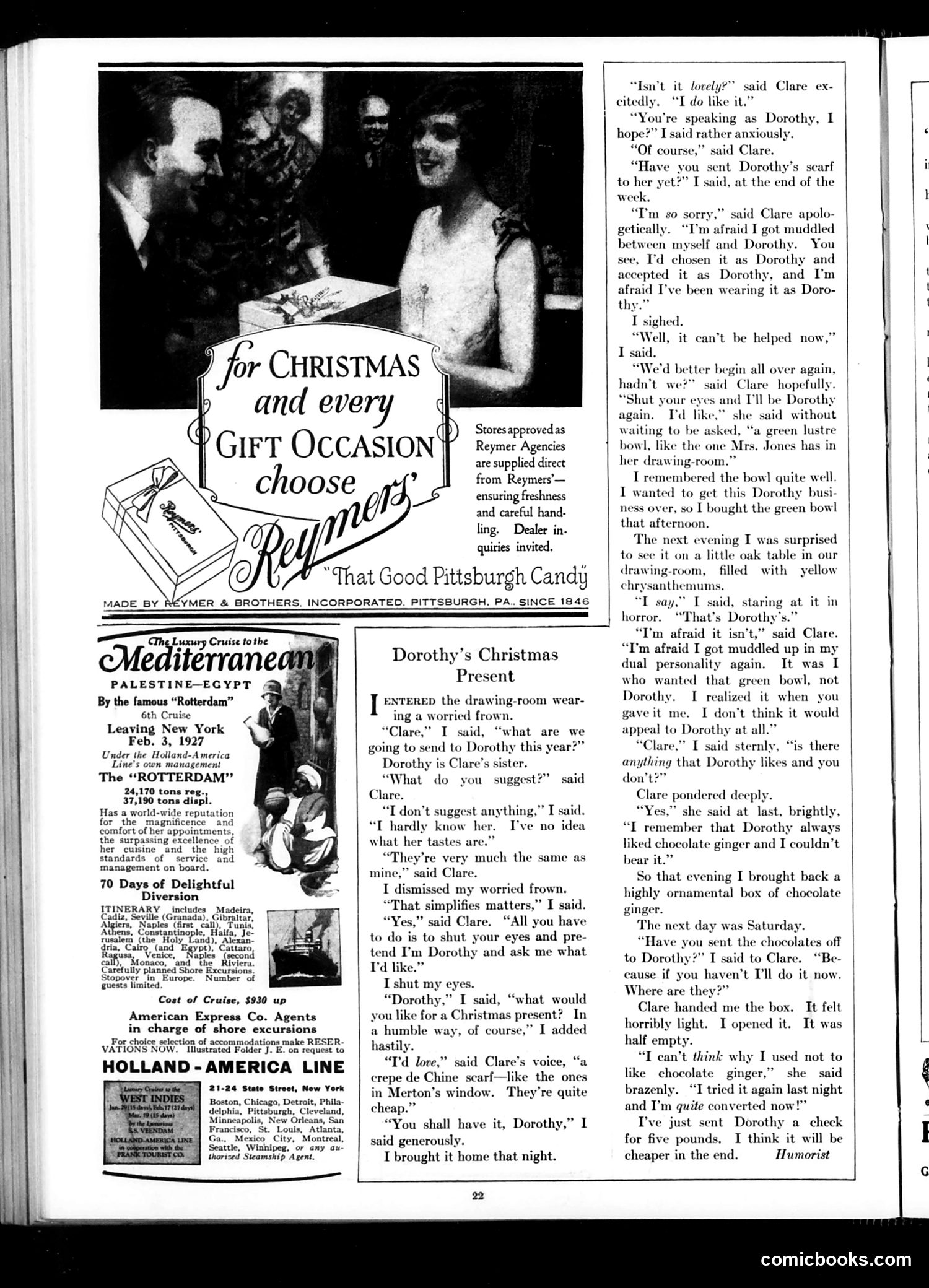
This page is primarily **advertising and fiction**, not political satire. The dominant content is a humorous short story titled "Dorothy's Christmas Present" that plays on a domestic comedy premise. **The Story's Joke:** A husband and wife attempt to buy a Christmas gift for Dorothy (the wife's sister) by having the wife roleplay as Dorothy. The satire is on **marital dynamics and self-deception**: the wife repeatedly confuses her own preferences with Dorothy's, actually keeping gifts meant for her sister. The punchline suggests she's also eating chocolate gingers she claimed to dislike. **Supporting Advertisements:** - Reymer's candy (top left) — positioned ironically given the chocolate ginger plot - Holland-America Line cruise advertisement (bottom) - Meditteranean travel cruise (left side) **Context for Modern Readers:** This reflects 1920s domesticity where wives managed household gift-giving while husbands deferred to their judgment — yet the story gently mocks feminine self-interest masked as thoughtfulness. The tone is light, middle-class humor typical of Judge's entertainment-focused content.
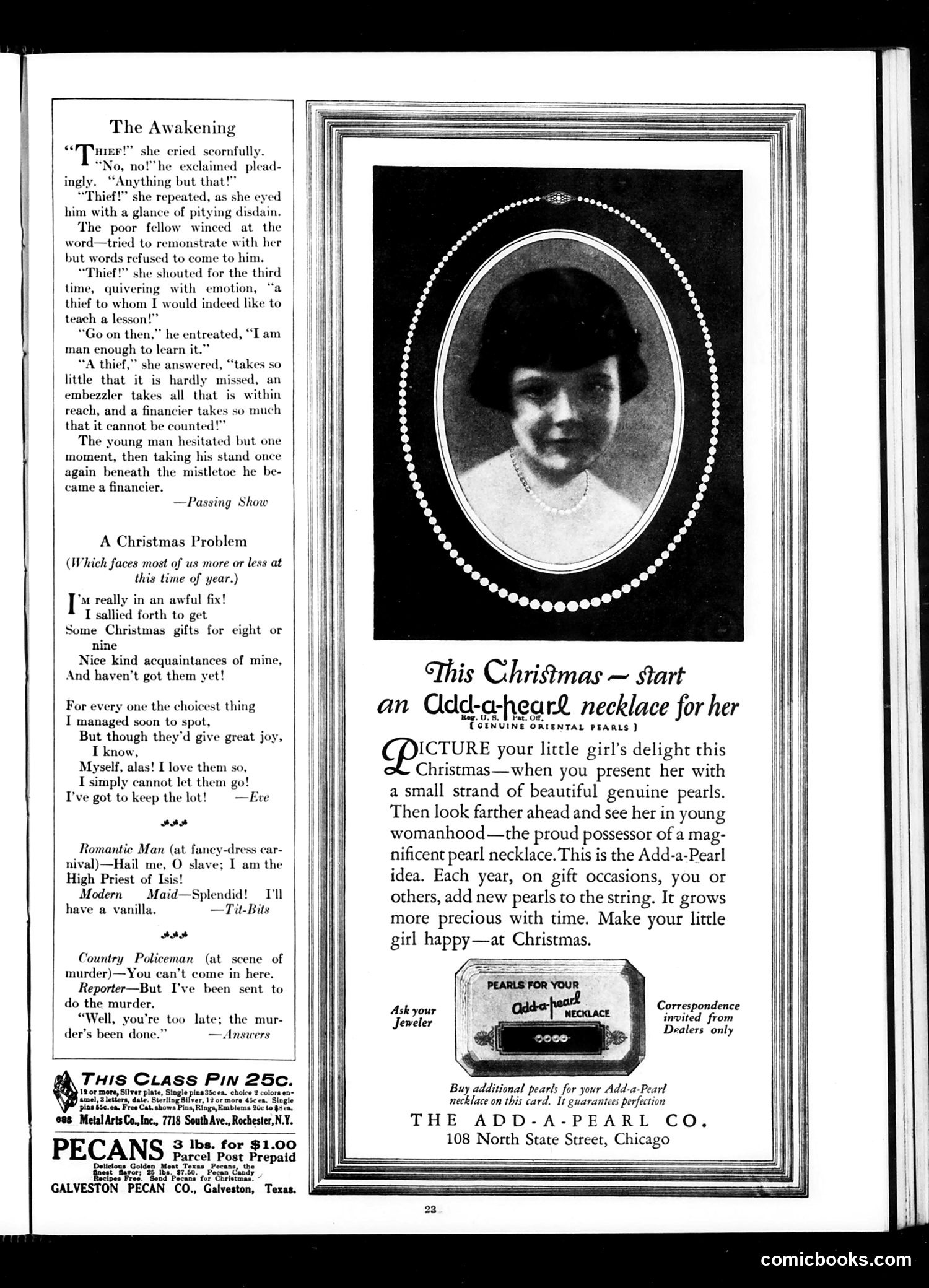
This page mixes satirical content with period advertisements. **"The Awakening"** is a brief comic dialogue about ambition and morality. A woman scolds a man for being a "thief," but he cleverly reframes himself—claiming that while thieves and embezzlers take modest amounts, a "financier" takes so much it cannot be counted. The joke satirizes early-20th-century financiers as essentially legalized thieves operating at a grander scale. It's a critique of wealthy industrialists and financial manipulation. **"A Christmas Problem"** presents humorous dilemmas: gift-buying anxiety and a dark joke about a crime reporter arriving too late to cover a murder. The page is dominated by **advertising**—primarily for an "Add-a-Pearl" necklace (genuine pearls added incrementally over years as gifts) and lesser ads for pecans and a class pin. This reflects Judge's commercial nature: satirical content alongside luxury goods marketing to affluent readers.
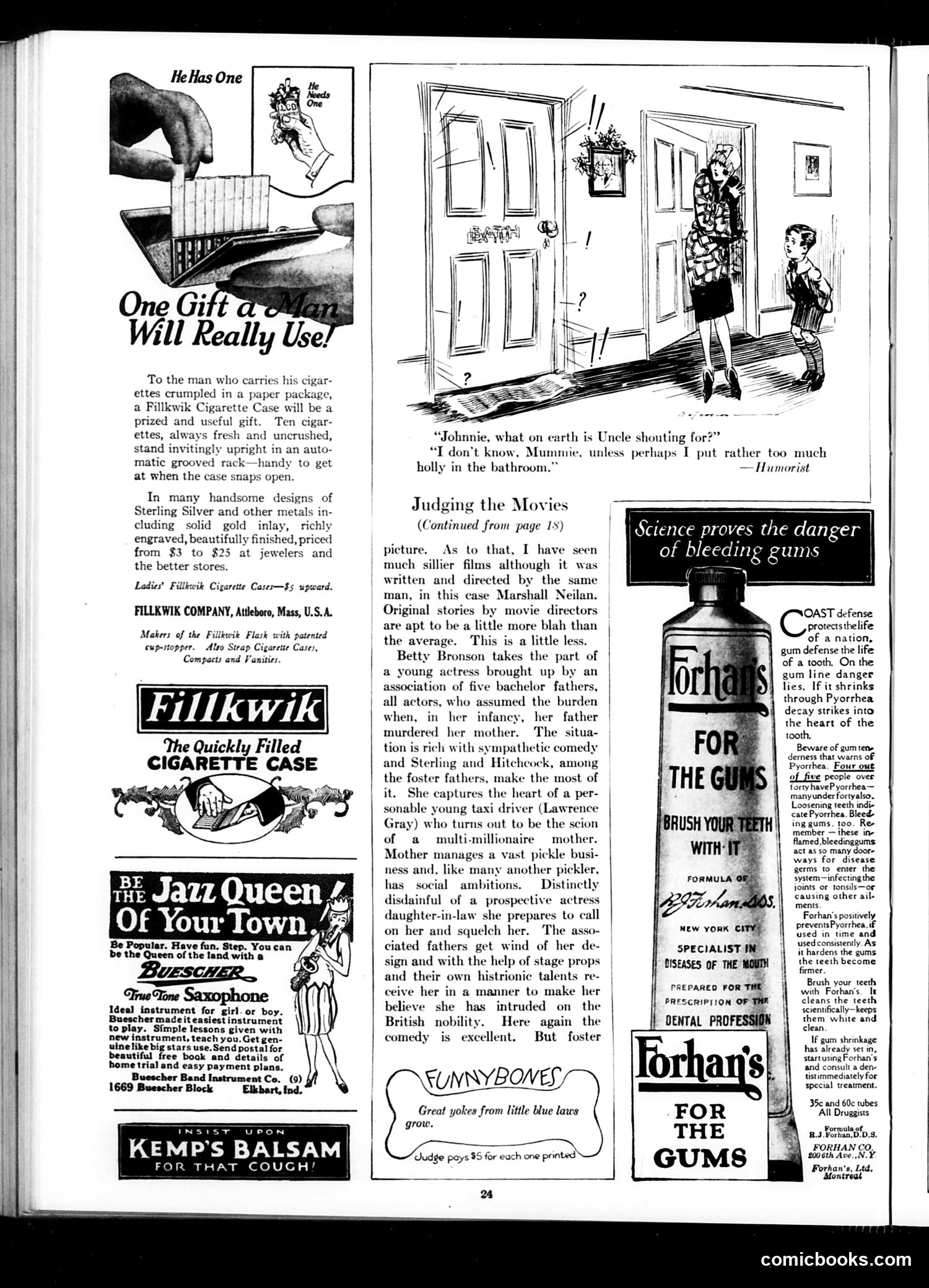
This page is primarily **advertising**, featuring several product promotions typical of the 1920s era: cigarette cases, saxophones, cough balsam, and dental products. The only satirical content is a small cartoon captioned "Johnnie, what on earth is Uncle shouting for?" The child's reply—that he "put rather too much holly in the bathroom"—appears to be a mild joke about holiday decorations being placed in an inappropriate location, creating domestic chaos. The humor relies on understated British propriety and children's innocent mischief, typical of the *Humorist* publication credited. The movie review discusses *Betty Bronson* in a film about a young actress raised by five bachelor fathers. The reviewer criticizes the plot as sentimental but praises the performances and Sterling and Hitchcock's comedic contributions. The page reflects 1920s consumer culture and entertainment, with no significant political satire or social commentary visible.
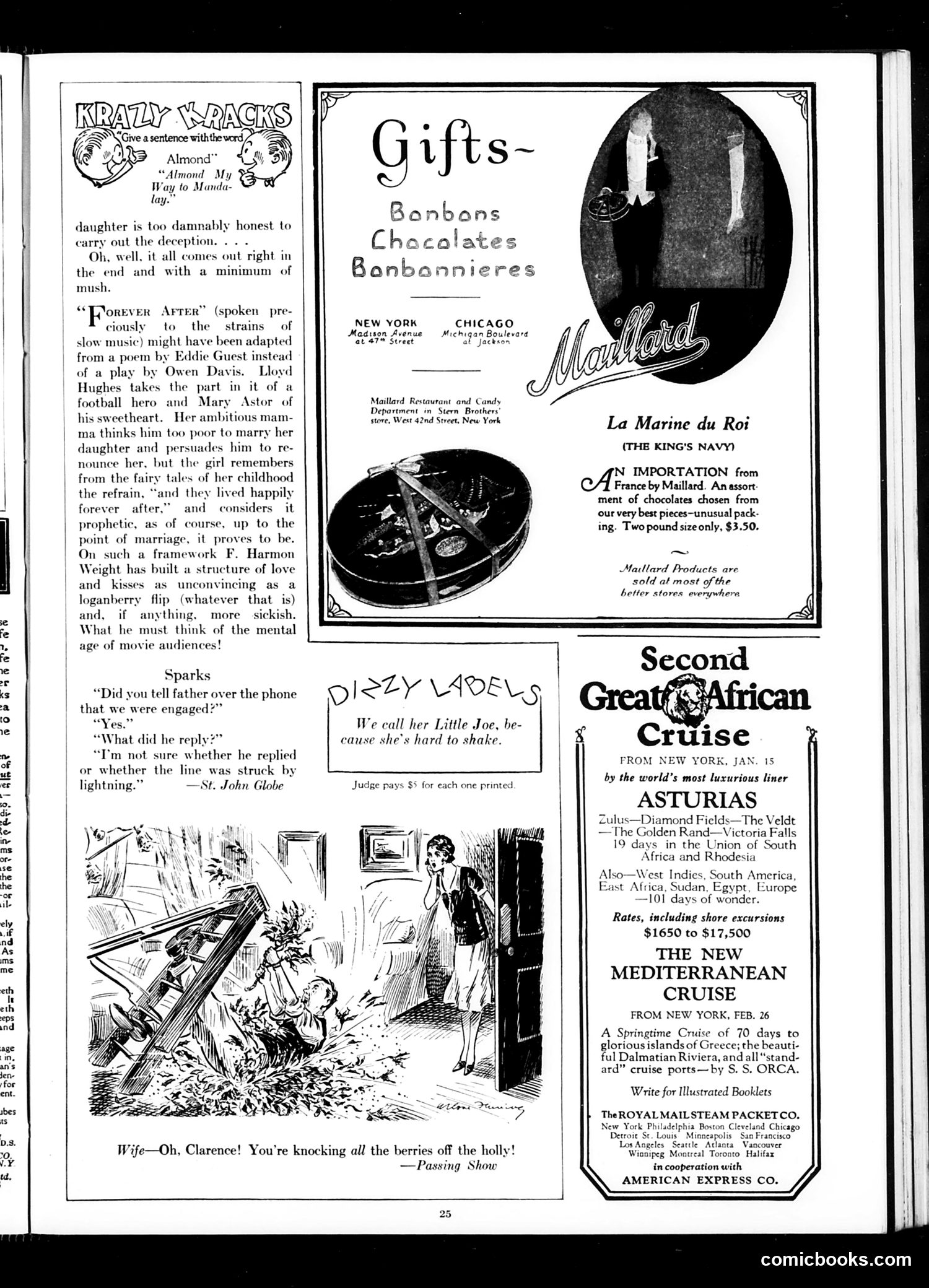
This page combines satirical humor with period advertising, typical of 1920s Judge magazine. **"Krazy Kracks" Section:** A humor column featuring brief jokes. The "Sparks" item jokes about a phone call proposing engagement—the father's angry response is so extreme the line "was struck by lightning," a hyperbolic exaggeration of paternal disapproval common in the era. **Main Cartoon:** The illustration labeled "Wife—Oh, Clarence! You're knocking all the berries off the holly!" depicts domestic comedy. A husband appears to be enthusiastically (and clumsily) helping with holiday decorations, destroying them in the process. The humor relies on the wife's exasperated reaction to his well-intentioned but destructive help—a standard marital sitcom trope. **Advertisements:** The majority of the page features luxury goods (Maillard chocolates) and cruise ship travel to Africa, the Mediterranean, and Caribbean—aspirational products for wealthy 1920s readers. The page reflects Judge's core audience: educated, financially comfortable urbanites interested in light domestic satire and consumer leisure activities.
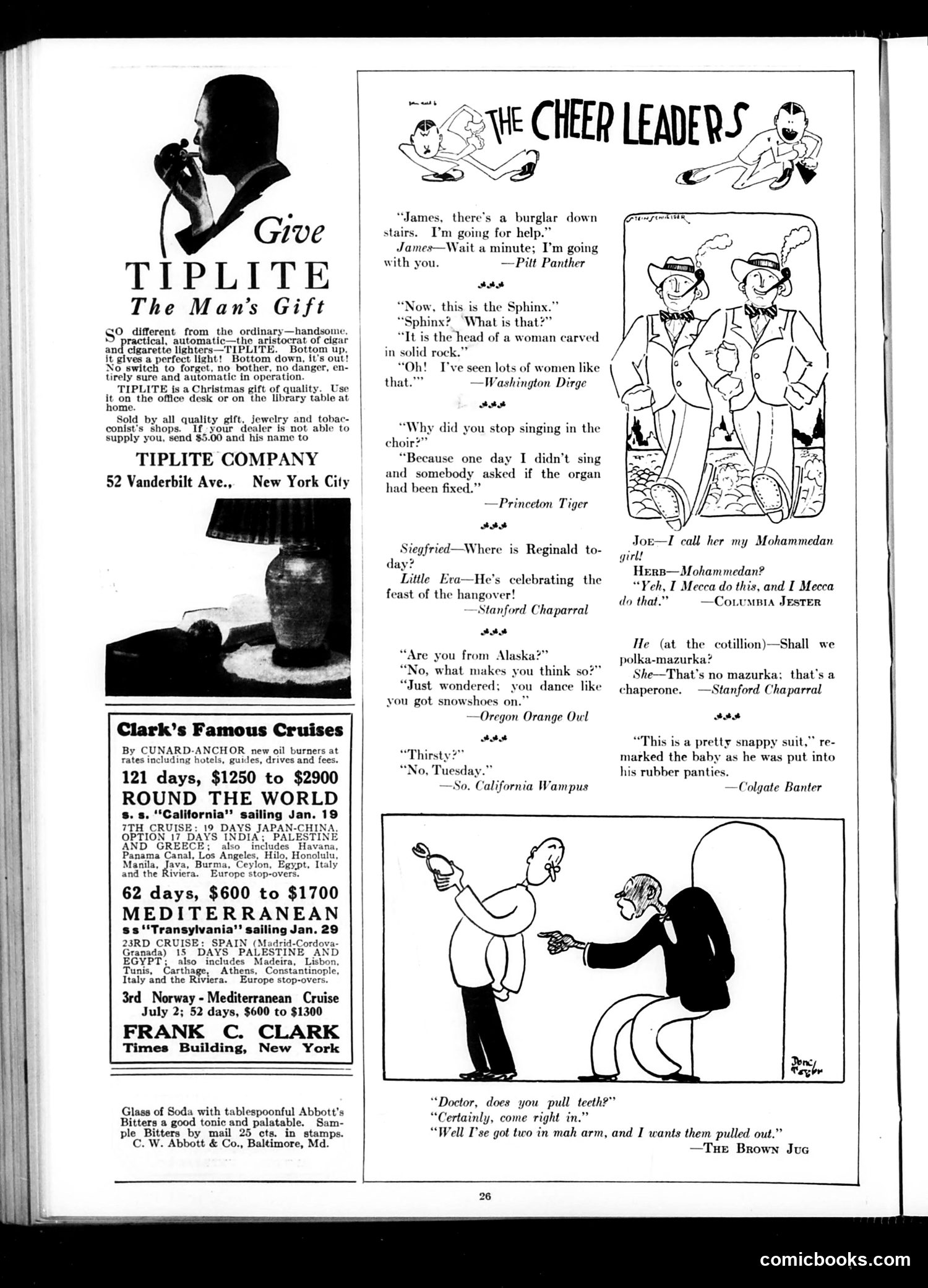
This page from Judge magazine contains primarily **humorous jokes and advertisements** rather than political content. The main feature, "The Cheerleaders," collects brief comedic quips from college humor publications (Princeton Tiger, Stanford Chaparral, Oregon Orange Owl, etc.)—a common Judge format. The jokes are gentle, collegiate humor typical of the 1920s era: puns about romance ("Mohammedan" girl), drinking hangovers, singing in choirs, and dancing. One cartoon shows a doctor's exchange about tooth-pulling with dialect humor. Another depicts a couple where the woman asks about "polka-mazurka" dancing. The **satire is social, not political**: it mocks young people's dating rituals, their linguistic pretensions, and mild vices. A baby's remark about "snappy" rubber pants represents typical period slapstick. The page is primarily **advertising space** for luxury cruise lines, Tiplite lighters, and patent medicines—reflecting Judge's commercial orientation and its affluent readership's interests in leisure travel and gift-giving.
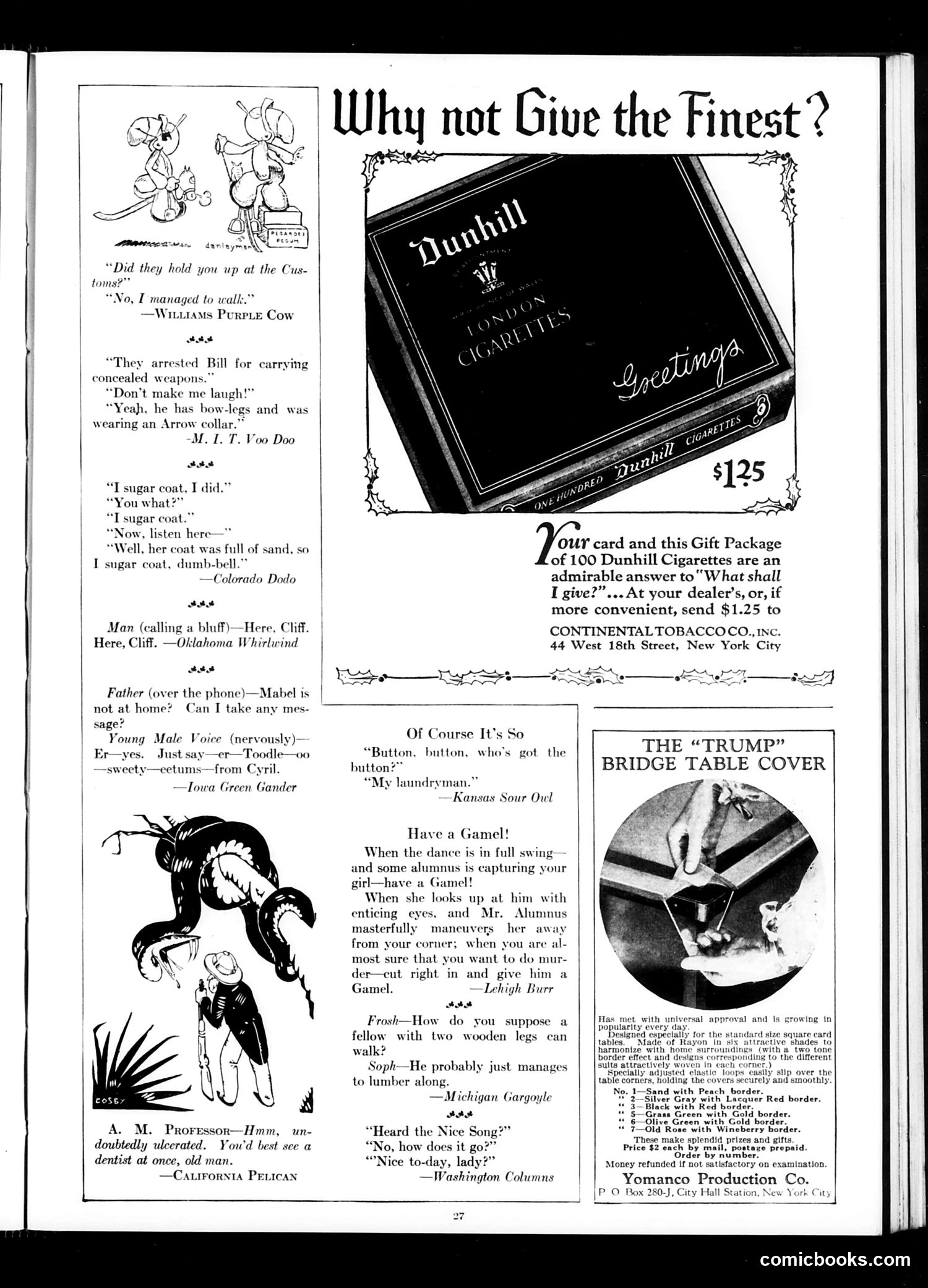
This page contains primarily **humorous one-liners and jokes** rather than political cartoons, typical of Judge's satirical humor section. The jokes reference **contemporary college and social life**: customs inspections, concealed weapons laws, Arrow collar shirts (a fashion brand), campus romance dynamics, and fraternity behavior. One joke mocks a young man nervously asking his girlfriend's father to relay a message—playing on awkward romantic anxiety. The main **advertisement** promotes **Dunhill cigarettes** ($1.25 for 100) as an ideal gift, with decorative packaging shown. A secondary advertisement displays the **"Trump" bridge table cover** by Yomanco Production Co.—a bridge game accessory available in various colors. "Trump" here refers to the card game term, not anything political. The humor is **light, domestic, and class-conscious**, reflecting 1920s-30s college culture and consumer goods marketing. No specific political figures or events are caricatured on this page.
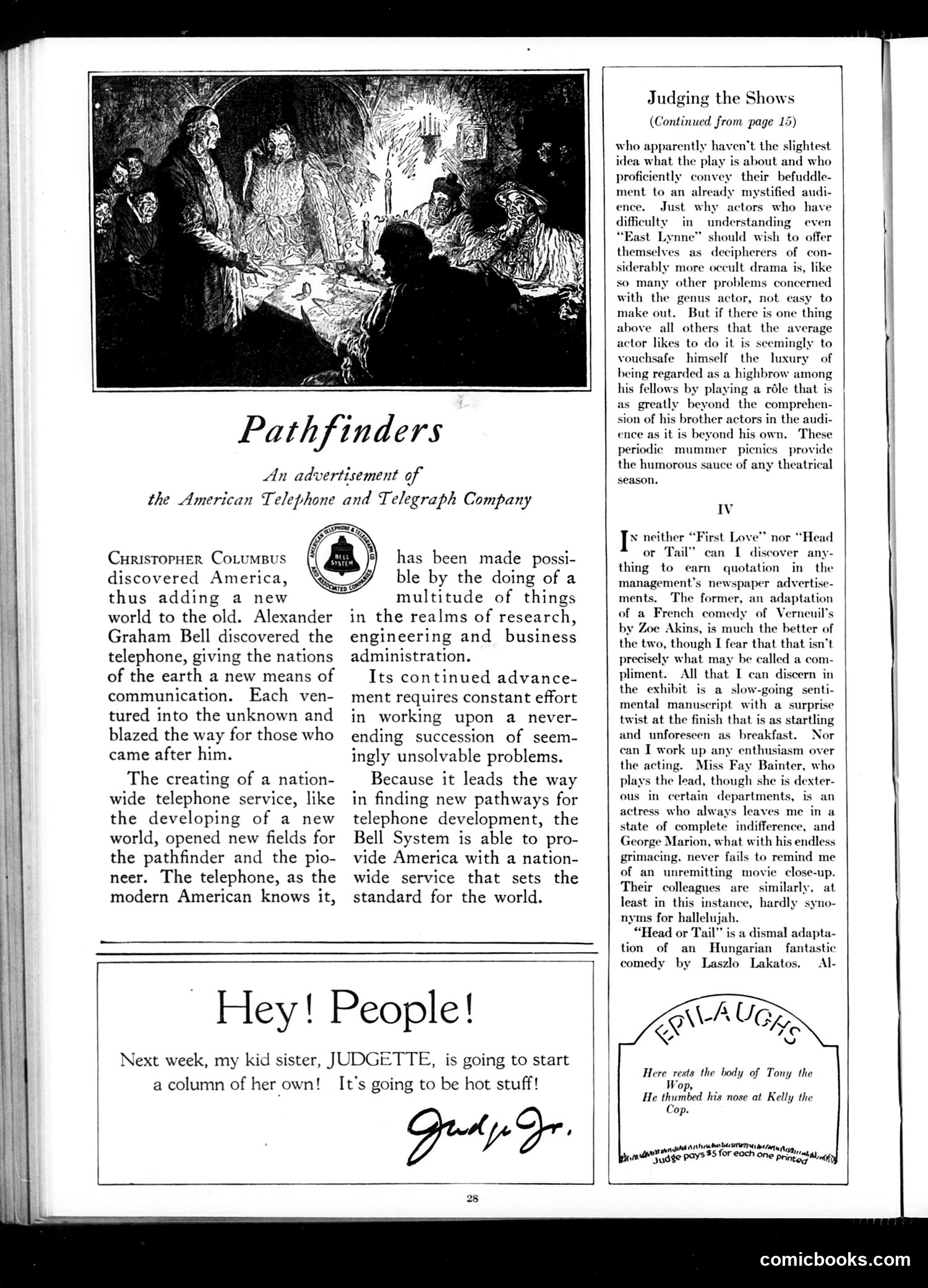
This page primarily contains **advertising and theater criticism**, not political satire. The main content is a Bell Telephone Company advertisement ("Pathfinders") comparing Alexander Graham Bell's invention to Columbus's discovery—a corporate PR piece equating telephone infrastructure development with pioneering achievement. The "Judging the Shows" column reviews theatrical productions: "First Love" and "Head or Tail." The critic dismisses both plays as mediocre, particularly criticizing actress Fay Bainter's "complete indifference" and actor George Marion's "endless grimacing" in "First Love." The Hungarian comedy "Head or Tail" receives equally harsh treatment as a "dismal adaptation." The brief announcement "Hey! People!" announces that "Judgette" (the author's sister) will launch her own column next week. The "Epilaughs" section appears to be a humorous filler about a character named Tony who angered "Kelly the Cop." Overall, this is a standard magazine page mixing advertising, entertainment criticism, and light humor—not political commentary.
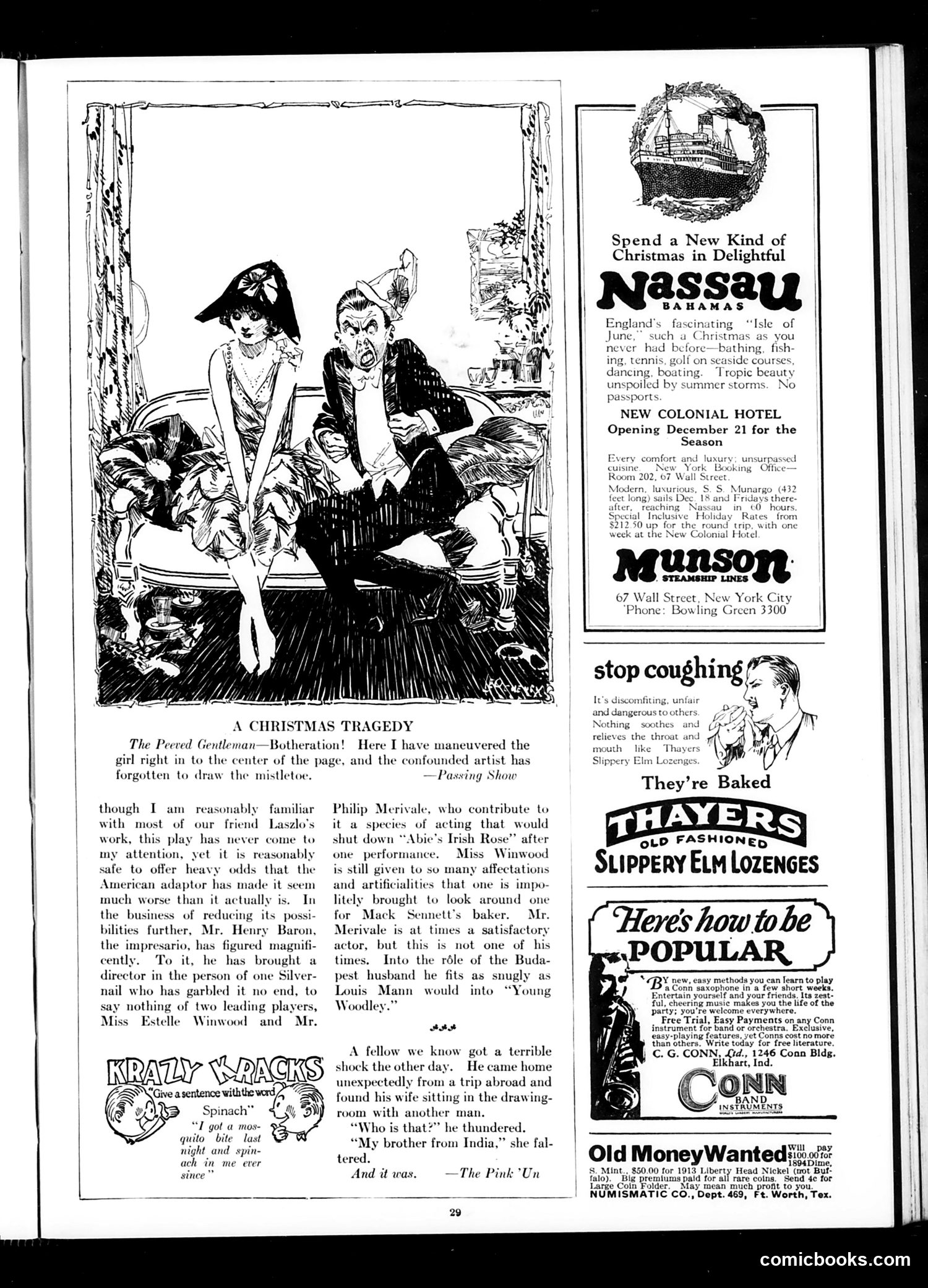
This page primarily contains **advertisements and theater criticism** rather than political satire. The main content is a theater review critiquing a play called "A Christmas Tragedy." The reviewer expresses disappointment with the production, particularly faulting: - **Henry Baron** (impresario) and an unnamed director (Silvernail) for mishandling the work - **Estelle Winwood** for excessive affectations and artificiality (the critic sarcastically suggests calling in Mack Sennett's baker—a vaudeville reference implying her acting is slapstick) - **Philip Merivale** for unconvincing performance as a Budapest husband The page also includes a small joke ("Krazy Kracks") about mistaking one's wife's brother for an affair, plus period advertisements for Nassau tourism, cough lozenges, musical instruments, and rare coins. **For modern readers**: This reflects how early 20th-century magazines mixed entertainment criticism with commercial ads. The theater references are now obscure.
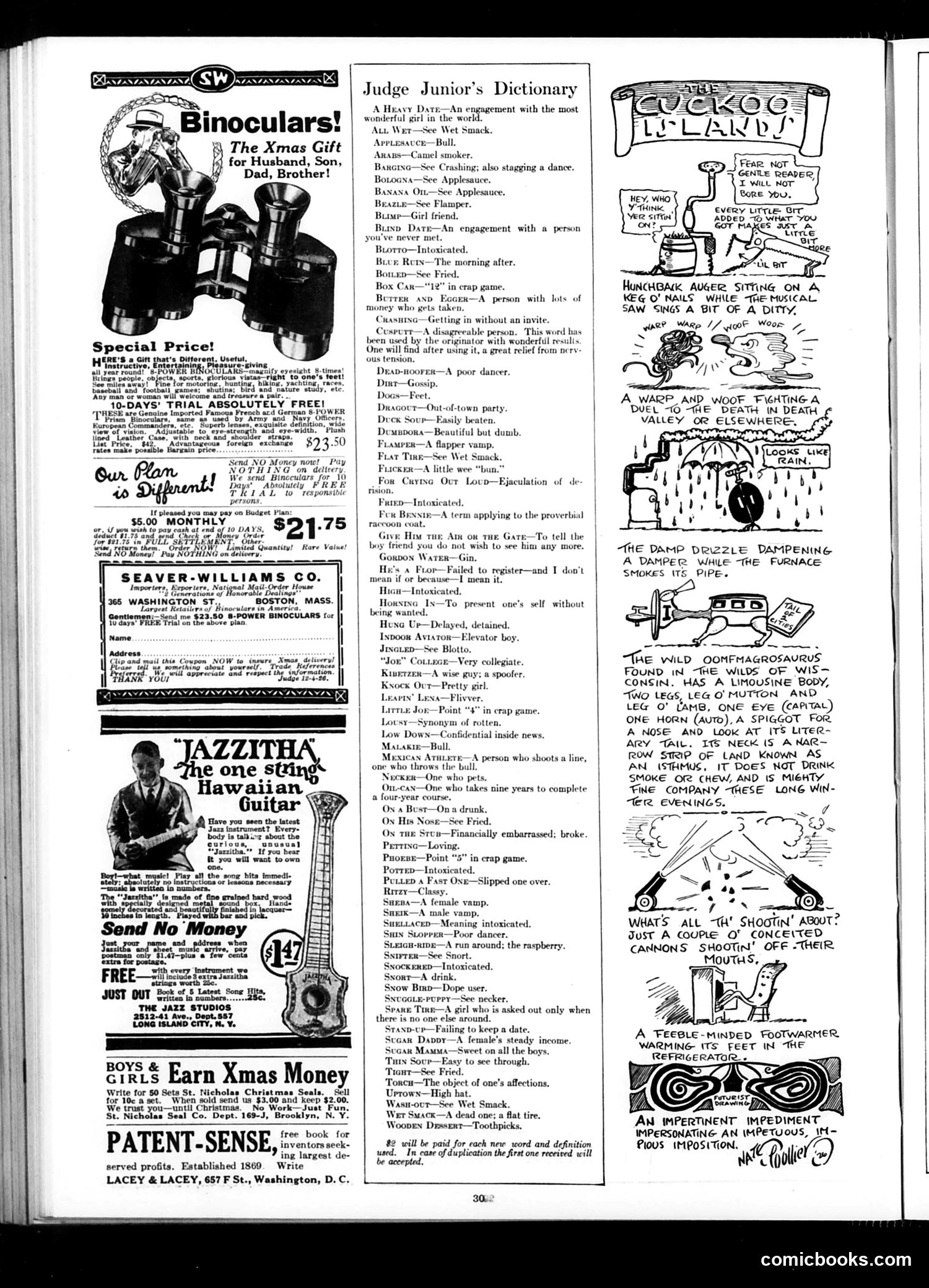
This page is primarily **advertising and reference material** from Judge magazine, circa 1920s (based on slang and product offerings). **Left side:** Binocular ads, a Hawaiian guitar advertisement, and calls for boys/girls to sell Christmas seals—typical period marketing. **Center:** "Judge Junior's Dictionary"—a humorous slang glossary defining 1920s youth vernacular. Terms like "Blind Date," "Petting," "Necker," and "Flivver" reflect Jazz Age social customs. Entries mock flapper culture and dating rituals ("Wet Smack"=kiss, "Fried"=intoxicated). The dictionary satirizes how rapidly slang dates language. **Right side:** Surreal cartoon vignettes by what appears to be a regular contributor, depicting absurdist scenarios (a hunchback musician, metaphorical battles, mechanical creatures) with no apparent satirical target—pure whimsy illustrating the magazine's comedic sensibility. The page captures Judge's dual purpose: satirizing contemporary culture while serving as a commercial vehicle for holiday shopping and patent medicines.
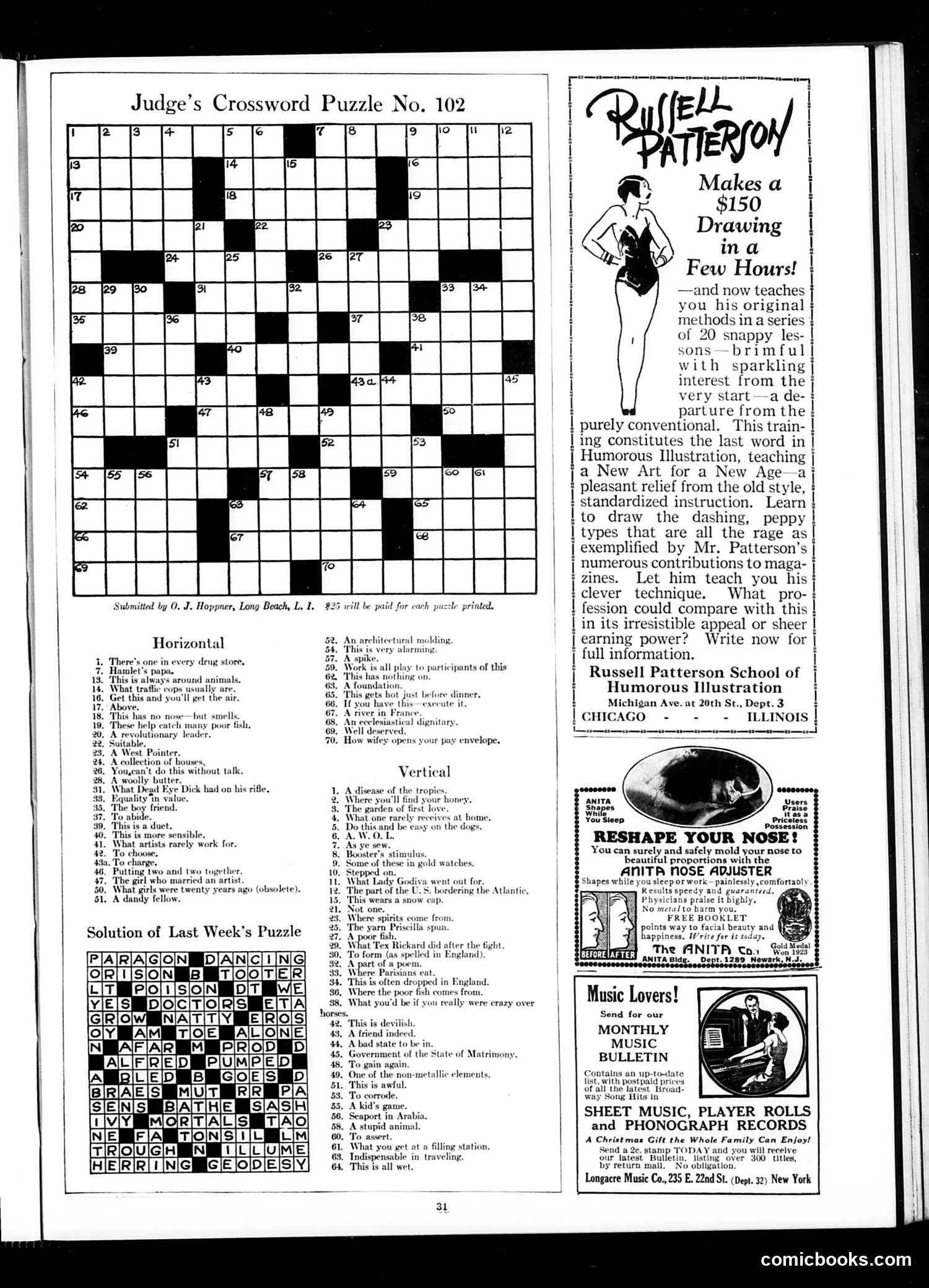
This page is primarily a **crossword puzzle** (No. 102) with accompanying advertisements—not a political cartoon. The main content consists of the puzzle grid and clue lists (Horizontal and Vertical), plus the solution to the previous week's puzzle. The advertisements reflect **1920s consumer culture**: Russell Patterson's mail-order drawing school ("Makes a $150 Drawing in a Few Hours"), promoting commercial illustration skills; an "Anita Nose Adjuster" for cosmetic nose-reshaping; and music-related services (sheet music and phonograph records). The Patterson ad references contemporary illustration trends—"dashing, peppy types" exemplifying modern humor cartooning, contrasting with "old style, standardized instruction." This reflects the era's interest in modernizing artistic education. The page serves primarily as entertainment and advertisement filler typical of Judge magazine's commercial content, rather than political satire.
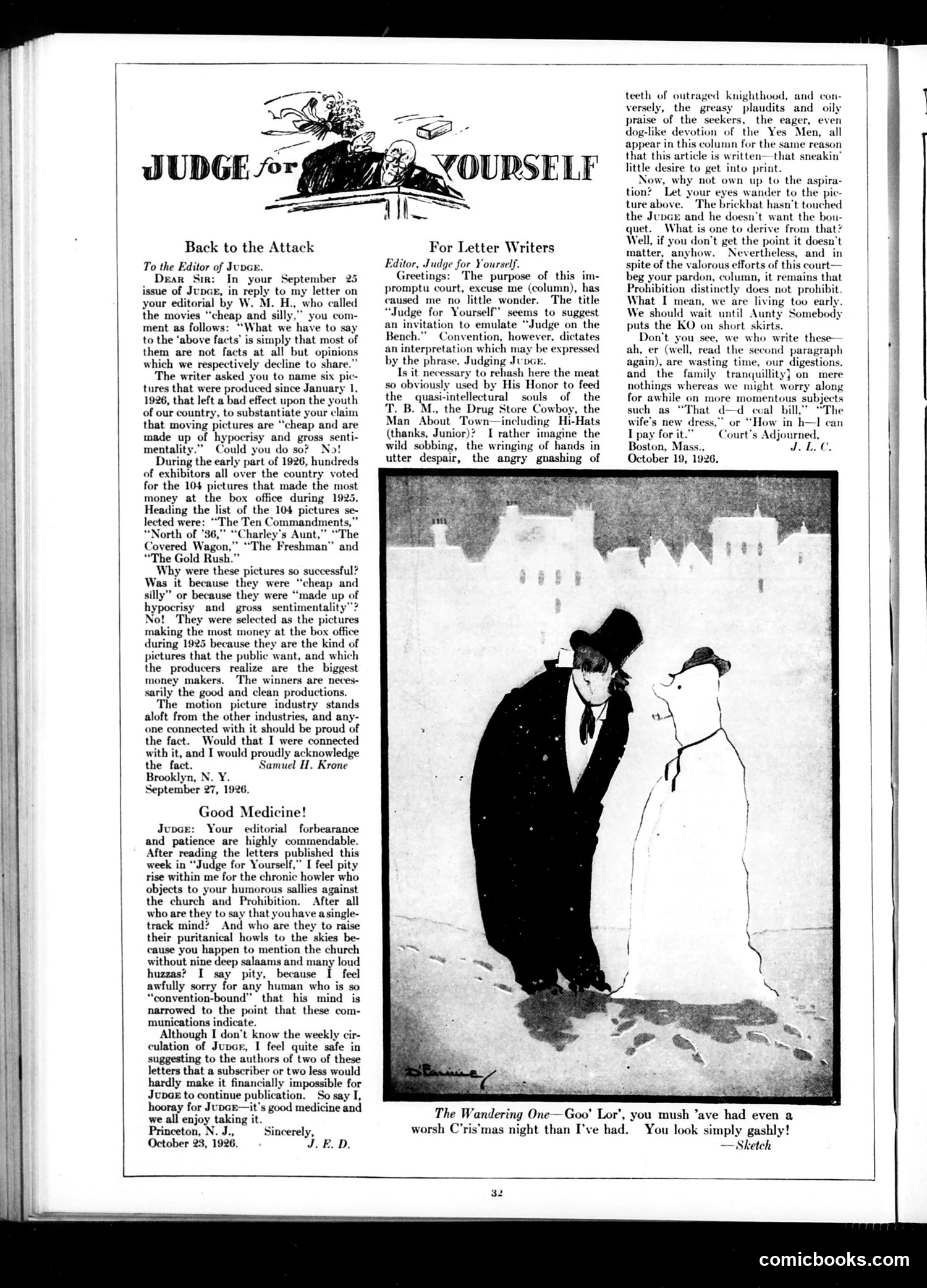
This page contains reader letters to *Judge* magazine's "Judge for Yourself" column, debating the magazine's editorial stance on movies and religion. **The Debate:** Samuel Krone (Brooklyn) defends the motion picture industry against criticism that films are "cheap and silly," citing commercially successful 1925 films like *The Ten Commandments* and *The Gold Rush* as evidence of quality. He argues popular success indicates audience approval and industry respectability. **The Satire:** J.E.D. (Princeton) sarcastically praises *Judge's* editorial "forbearance" while mocking letter-writers who object to the magazine's jokes about churches and Prohibition. He dismissively calls them "convention-bound" and suggests the magazine would survive losing their subscriptions. **The Context:** This reflects 1926 tensions over modern entertainment, religious authority, and Prohibition—*Judge* positioned itself as urbane and irreverent toward conservative institutions, while defenders of those institutions objected. The cartoon below (captioned "The Wandering One") appears to illustrate poverty or hardship, likely commenting on one of these social debates.
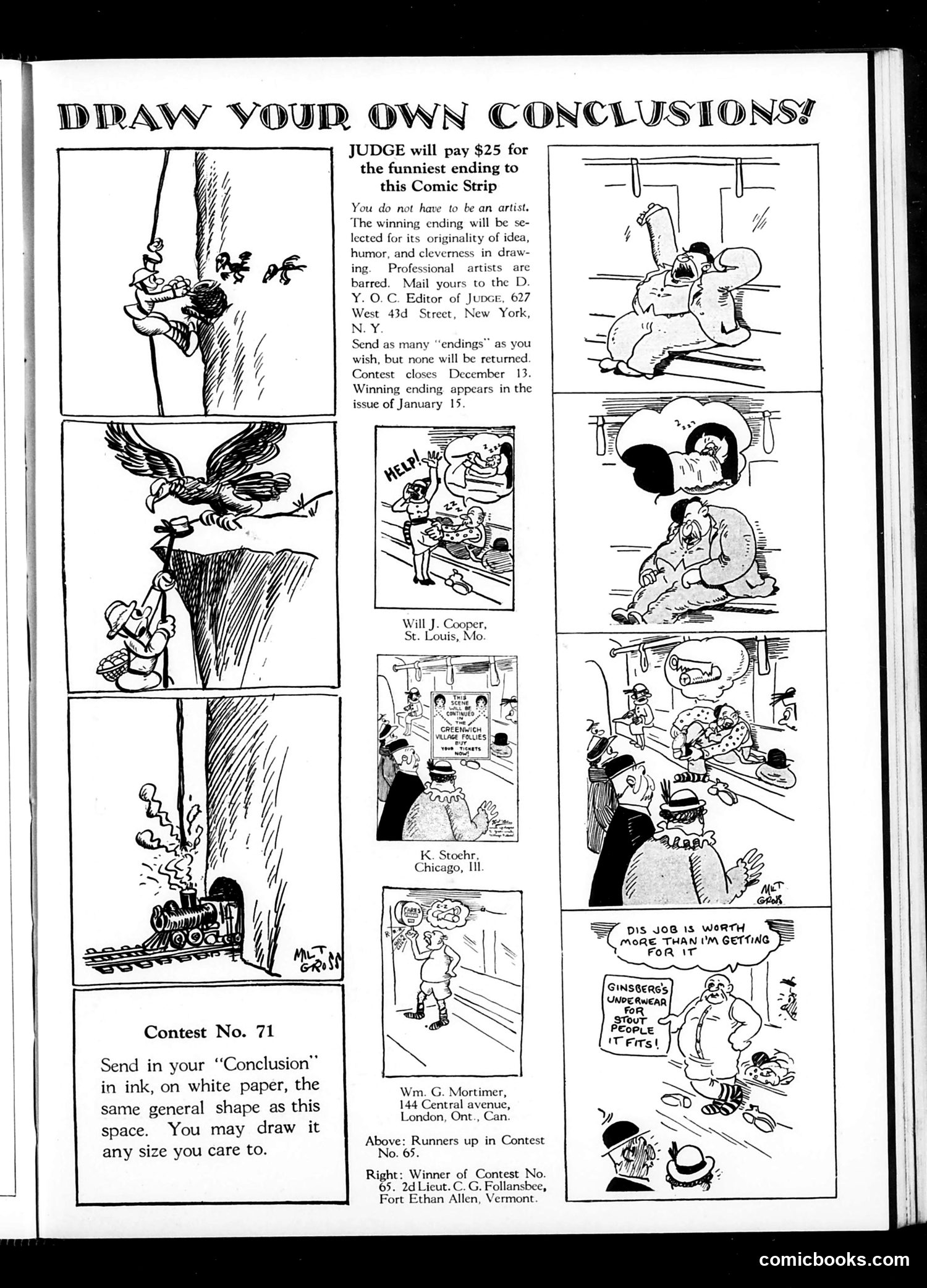
This page announces a reader-participation contest where Judge magazine invites non-professional artists to submit humorous "conclusions" to an incomplete comic strip. The prize is $25—substantial money during this era—for the funniest ending. The left side shows the comic's setup: three panels depicting increasingly chaotic situations (a man on a rope, a winged creature carrying someone, a train crash). Readers must complete the narrative with their own final panel. Below are examples: previous contest winners and runners-up from Contest No. 65, credited to various contributors. These demonstrate the expected style and humor level. This reflects Judge's interactive approach to content creation, leveraging reader creativity while maintaining editorial control through judging criteria emphasizing "originality of idea, humor, and cleverness." Professional artists were explicitly barred, democratizing participation.
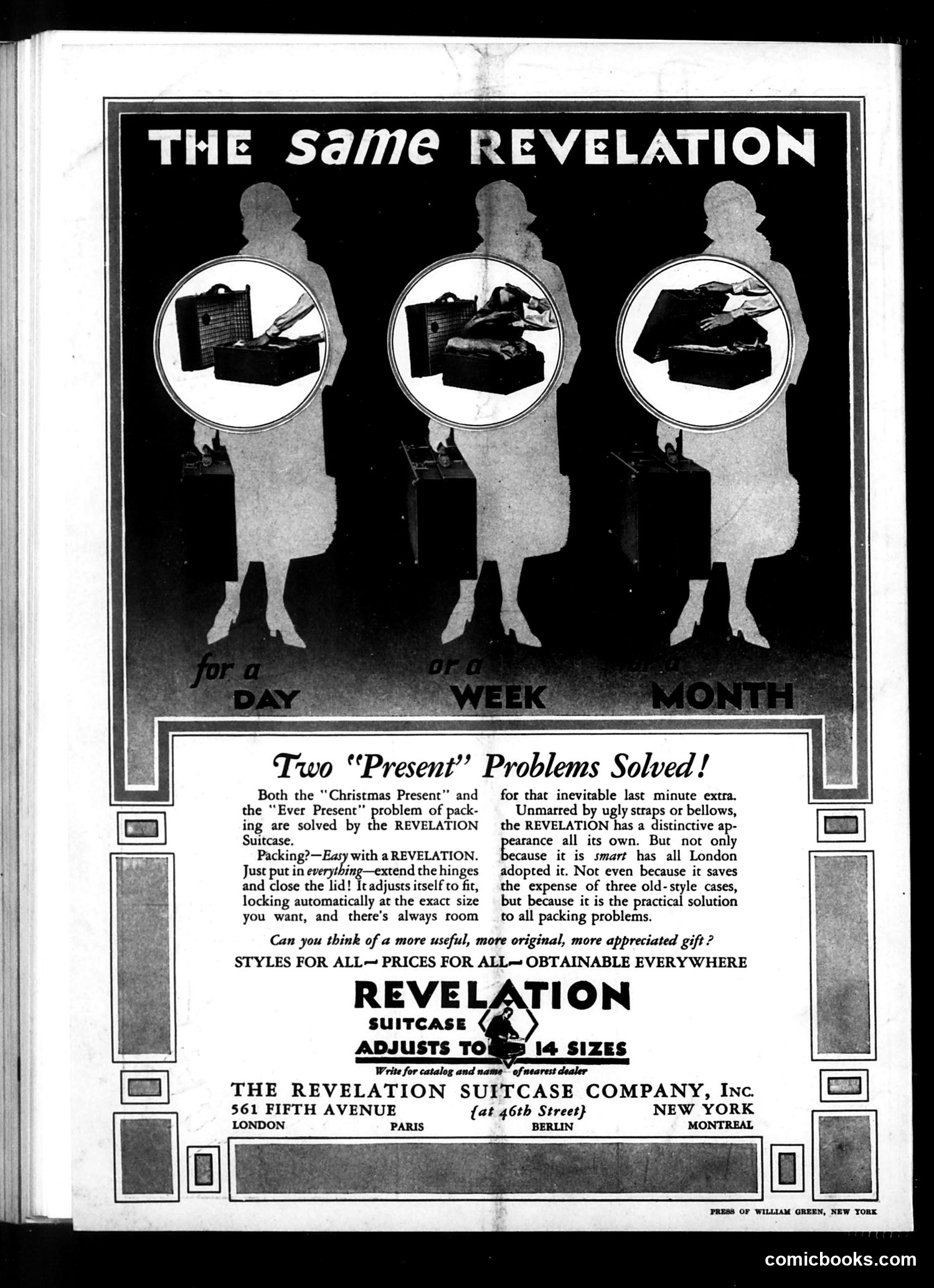
This is primarily a **product advertisement**, not a political cartoon. It appears in Judge magazine promoting the Revelation Suitcase. The "satire" is commercial rather than political: the ad humorously frames luggage-packing as a social problem ("the Christmas Present" and "Ever Present" problem) that the product solves. Three identical female silhouettes illustrate the suitcase's adjustability—packing for a day, week, or month with the same case. The copywriting plays on gift-giving anxiety and practical concerns of the era. References to "old-style cases" and the suitcase's adoption by London society suggest this targets affluent travelers. The "two problems solved" framing is tongue-in-cheek advertising language rather than genuine satire. There are **no political figures, caricatures, or social commentary**—just marketing that capitalizes on relatable inconveniences through humor and aspirational messaging about style and practicality.