
Judge, 1926-12-04 · page 15 of 36
Judge — December 4, 1926 — page 15: what you’re looking at
What you’re looking at
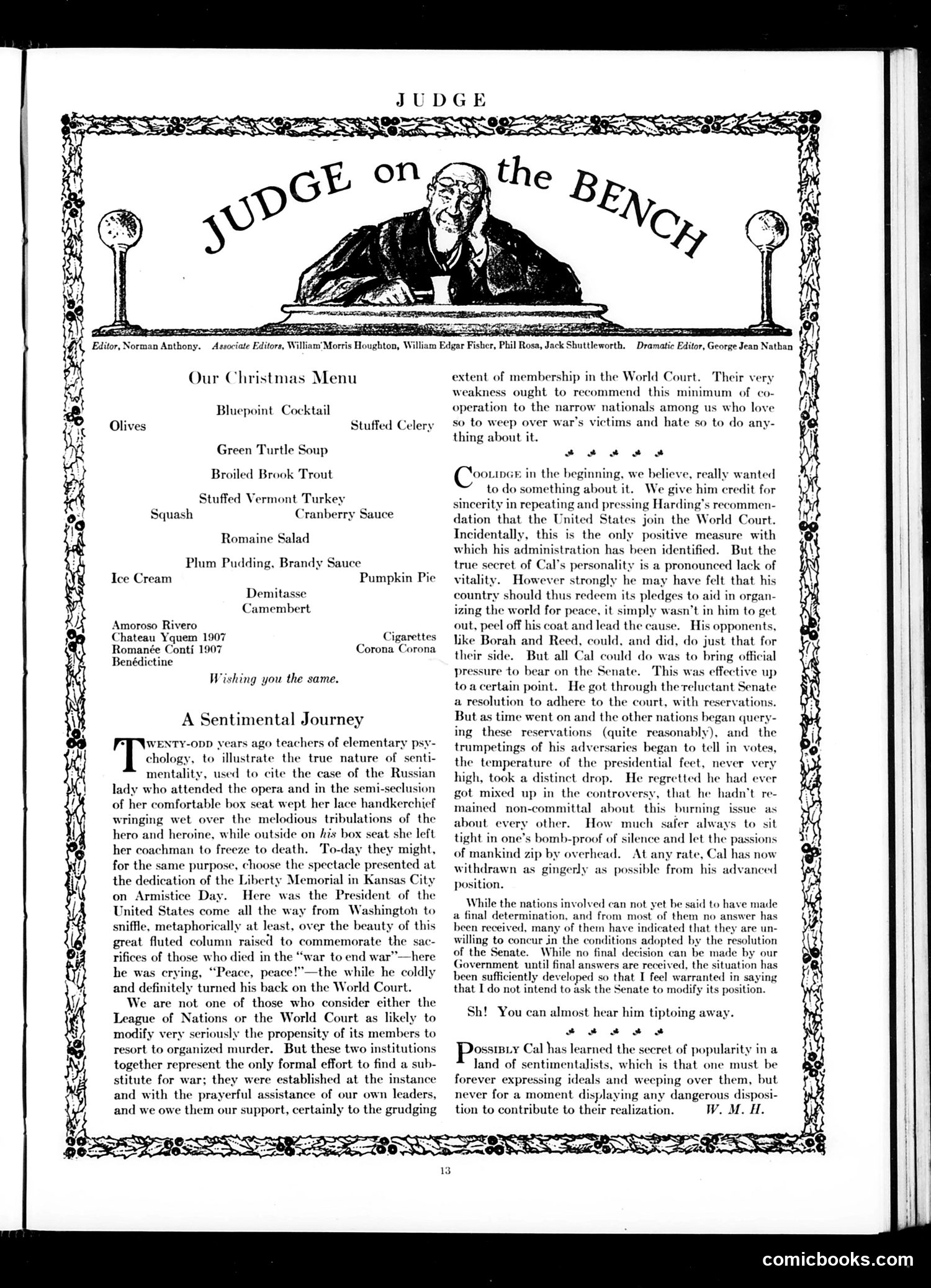
This editorial cartoon criticizes President **Calvin Coolidge** for hypocrisy regarding American involvement in the World Court. The article contrasts Coolidge's emotional public support for international peace efforts (he championed joining the World Court, following Harding's recommendation) with his actual lack of commitment when facing political opposition. The satire's point: Coolidge is like the Russian opera-goer from the opening anecdote—weeping sentimentally over war's victims while doing nothing substantive to prevent future conflicts. Though he initially pushed the Senate toward court membership, when other nations questioned America's proposed reservations and domestic opposition intensified (notably from Senator Borah), Coolidge quietly abandoned the effort rather than expend political capital. The magazine argues his "pronounced lack of vitality" and preference for political safety over genuine leadership made him withdraw "as gingerly as possible" from his advanced position—exposing his sentimentality as performative rather than principled.
📄 Transcribed text from this page (OCR, searchable)
Machine-transcribed from the original scan — historical spelling and the odd misread are preserved.
am Edgar Fisher, Phil Rosa, Jack Shuttleworth. Our Christmas Menu Bluepoint Cocktail Stuffed Celery Green Turtle Soup Broiled Brook Trout Stuffed Vermont Turkey Squash Cranberry Sauce Romaine Salad Plum Pudding, Brandy Sauce Ice Cream Pumpkin Pie Camembert Amoroso Rivero Chateau Yquem 1907 Romanée Conti 1907 Benédictine Cigarettes Corona Corona Wishing you the same. A Sentimental Journey |WENTY-ODD years ago teachers of elementary psy- chology, to illustrate the true nature of senti- mentality, used to cite the case of the Russian lady who attended the opera and in the semi-seclusion of her comfortable box seat wept her lace handkerchief wringing wet over the melodious tribulations of the hero and heroine, while outside on his box seat she left her coachman to freeze to death. To-day they might, for the same purpose, choose the spectacle presented at the dedication of the Liberty Memorial in Kansas City on Armistice Day. Here was the President of the United States come all the way from Washington to sniffle, metaphorically at least, over the beauty of this great fluted column raised to commemorate the sac- rifices of those who died in the “war to end war”—here he was crying, “Peace, peace!”’—the while he coldly and definitely turned his back on the World Court. We are not one of those who consider either the League of Nations or the World Court as likely to modify very seriously the propensity of its members to resort to organized murder. But these two institutions together represent the only formal effort to find a sub- stitute for war; they were established at the instance and with the prayerful ance of our own leaders, and we owe them our support, certainly to the grudging Dramatic Editor, George Jean Nathan extent of membership in the World Court. Their very weakness ought to recommend this minimum of co- operation to the narrow nationals among us who love so to weep over war's victims and hate so to do any- thing about it. soe a Cx oLIDGE in the beginning, we believe, really ted to do something about it. We give him credit for sincerity in repeating and pressing Harding’s recommen- dation that the United States join the World Court. Incidentally, this is the only positive measure with which his administration has been identified. But the true secret of Cal’s personality is a pronounced lack of vitality. However strongly he may have felt that his country should thus redeem its pledges to aid in organ- izing the world for peace, it simply wasn’t in him to get out, peel off his coat and lead the cause. His opponents, like Borah and Reed, could, and did, do just that for their side. But all Cal could do was to bring official pressure to bear on the Senate. This was effective up toacertain point. He got through the reluctant Senate a resolution to adhere to the court, with reservations. But as time went on and the other nations began query- ing these reservations (quite reasonably), and the trumpetings of his adversaries began to tell in vote the temperature of the presidential feet, never v high, took a distinct drop. He regretted he had ever got mixed up in the controversy, that he hadn't re- mained non-committal about this burning issue as about every other. How much safer always to sit tight in one’s bomb-proof of silence and let the passions of mankind zip by overhead. At any rate, Cal has now withdrawn as gingerly as possible from his advanced position. While the nations involved can not yet be said to have made a final determination, and from most of them no an: has been received, many of them have indicated that they are un- willing to concur in the conditions adopted by the resolution of the Senate. While no final decision can be made by our Government until final answers are received, the situation has been sufficiently developed so that I feel warranted in saying that I do not intend to ask the Senate to modify its position. Sh! You can almost hear him tiptoing away. st te ey ossIBLY Cal has learned the secret of popularity in a land of sentimentalists, which is that one must be forever expressing ideals and weeping over them, but never for a moment displaying any dangerous disposi- tion to contribute to their realization. W. M. H. comicbooks.com