
A complete issue · 36 pages · 1926
Judge — March 6, 1926
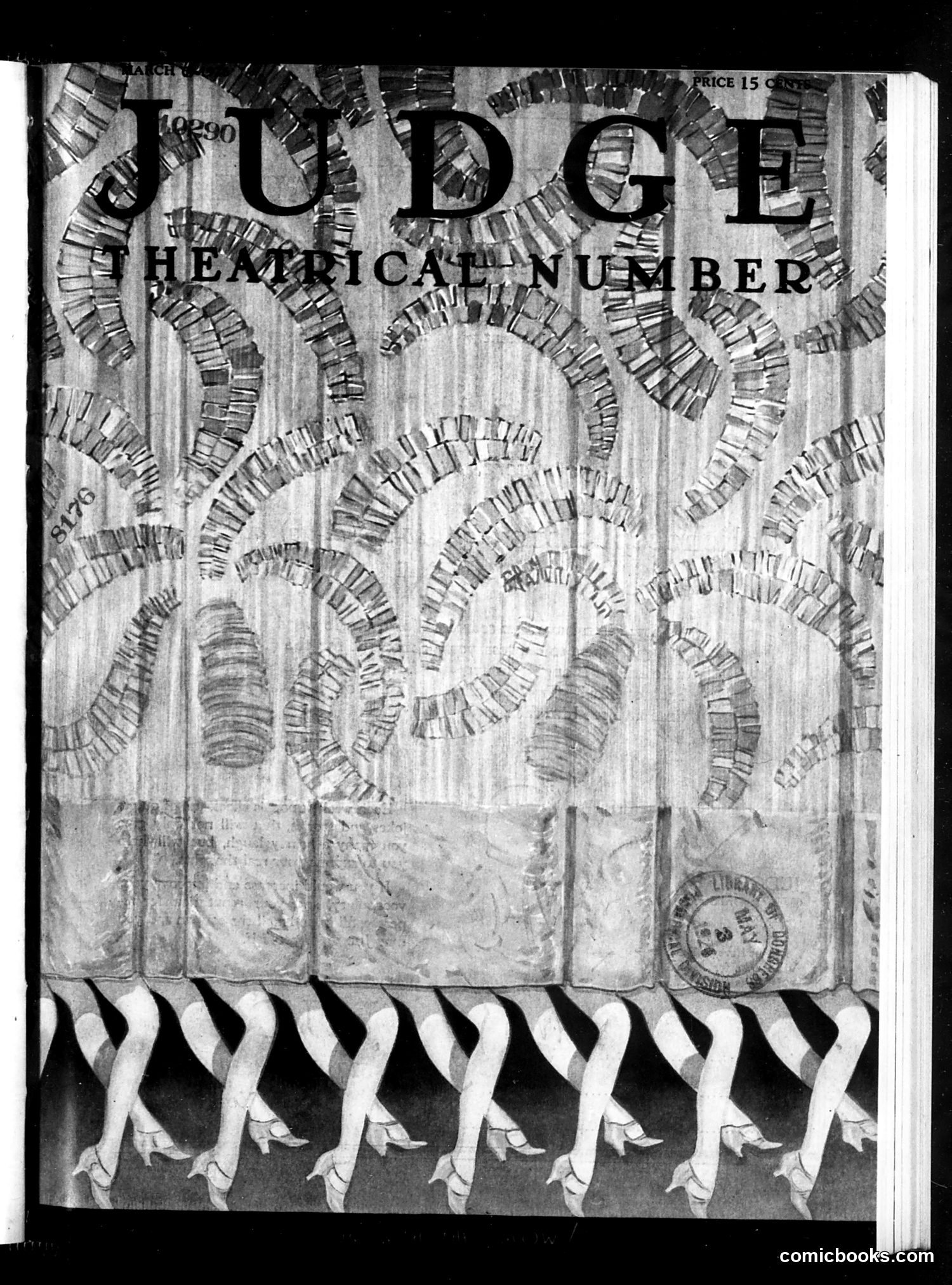
This appears to be a Judge magazine cover featuring a chorus line of women's legs at the bottom—a common visual motif in 1920s-30s entertainment satire. The upper portion shows an ornate, symmetrical Art Deco design with radiating patterns and what appears to be architectural or geometric elements. The title "JUDGE HEARTBEAT NUMBER" suggests this is a special issue. The phrase "heartbeat" likely references the magazine's commentary on popular culture and entertainment, particularly the Jazz Age fascination with dancers and theatrical productions. The recurring leg imagery served as visual shorthand for Broadway shows, nightlife, and modern entertainment culture that Judge regularly satirized or celebrated. Without clearer text visibility, the specific social or political commentary remains unclear, but the aesthetic reflects typical 1920s-30s magazine design celebrating contemporary entertainment.
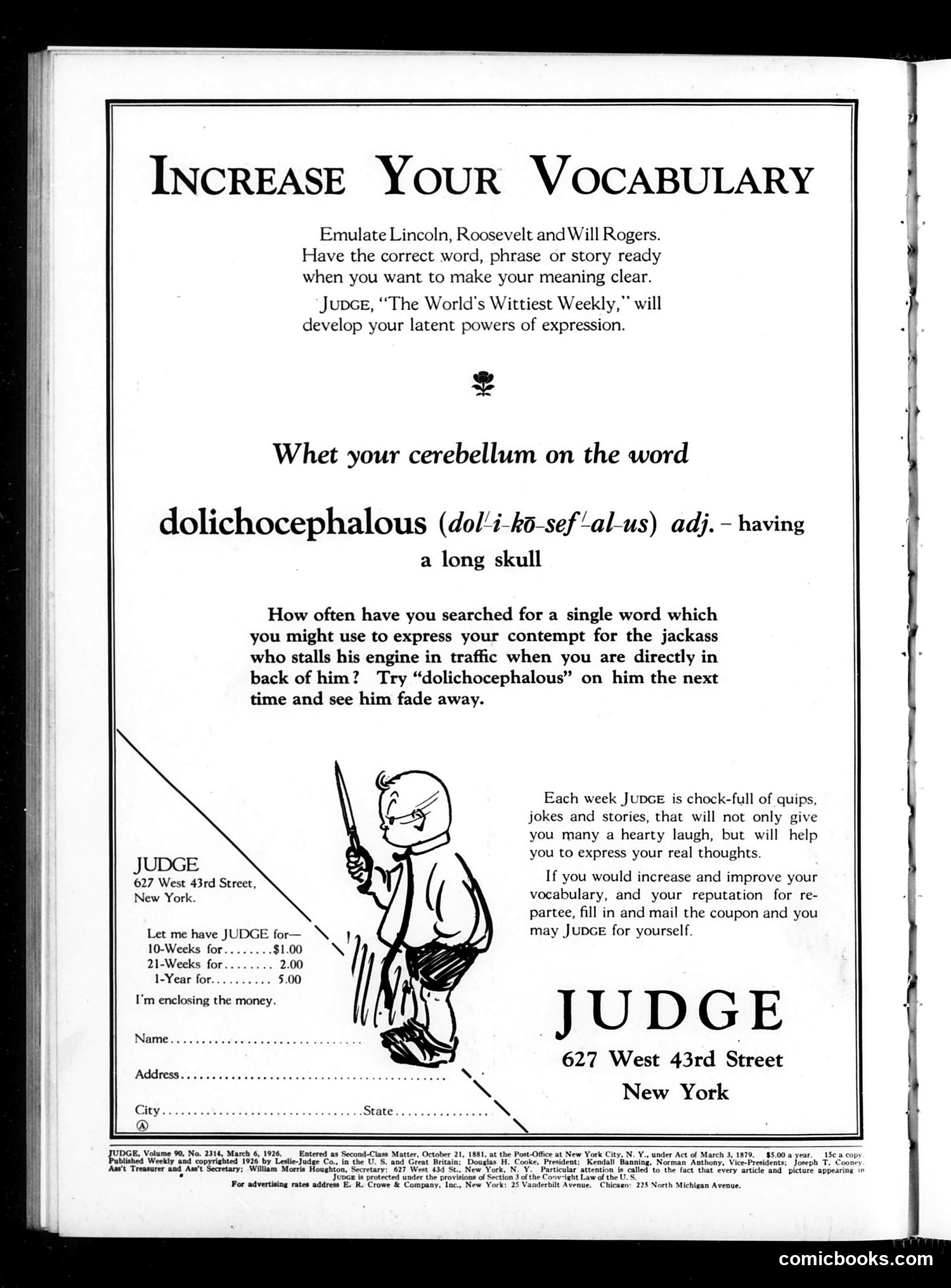
This page is primarily **advertising for Judge magazine itself**, not political satire. The main content teaches readers a vocabulary word—"dolichocephalous" (having a long skull)—as part of Judge's claimed mission to develop readers' "latent powers of expression" by emulating figures like Lincoln, Roosevelt, and Will Rogers. The small cartoon shows a figure wielding a sword or club, illustrating the humorous application: using "dolichocephalous" as an insult toward rude drivers who stall traffic. The joke suggests this fancy term insults someone's intelligence. The page essentially pitches Judge magazine subscriptions (10 weeks for $1.00 to 1 year for $5.00) by positioning it as entertainment that also improves vocabulary and wit. It's a self-promotional advertisement rather than political commentary.
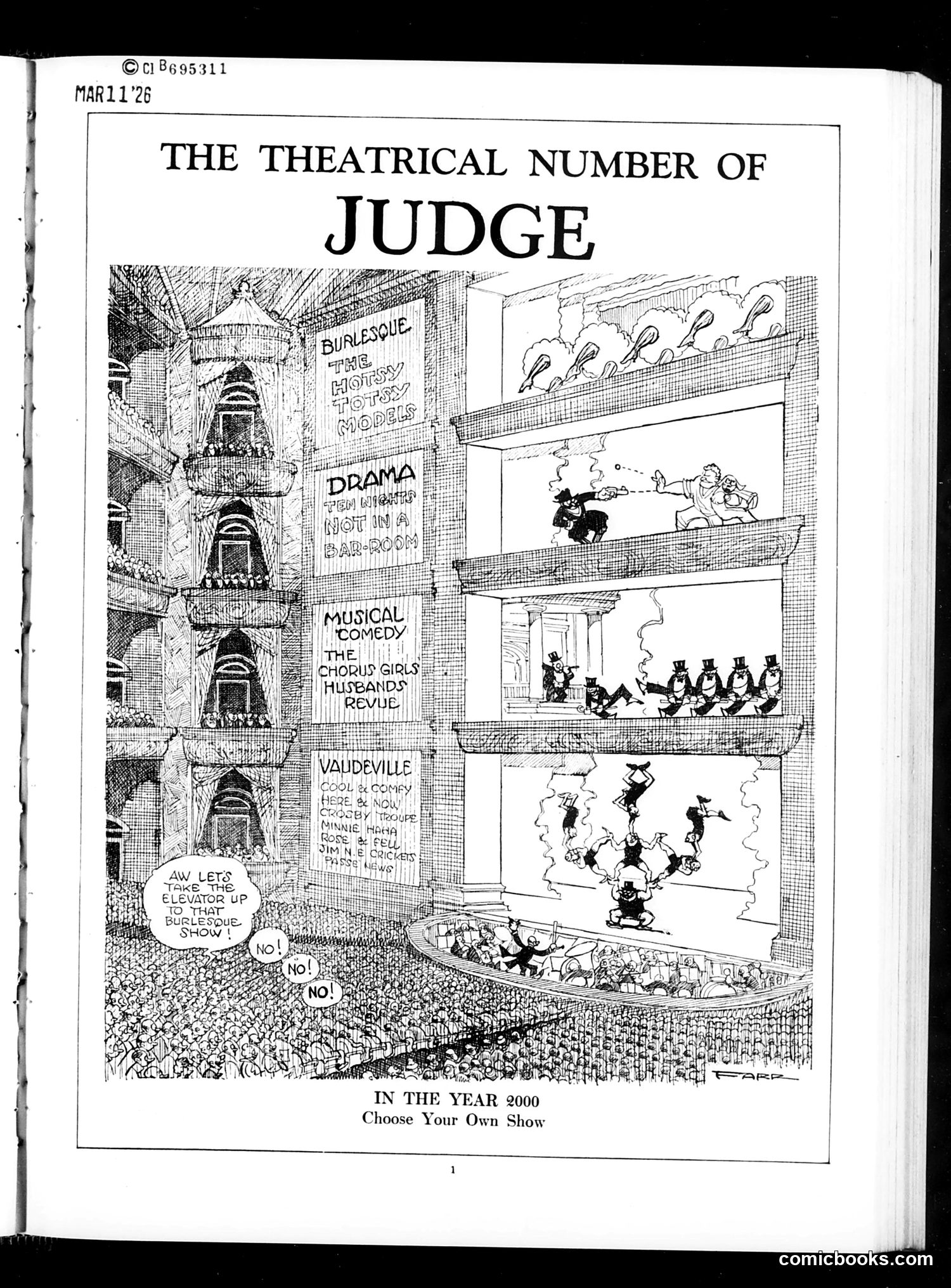
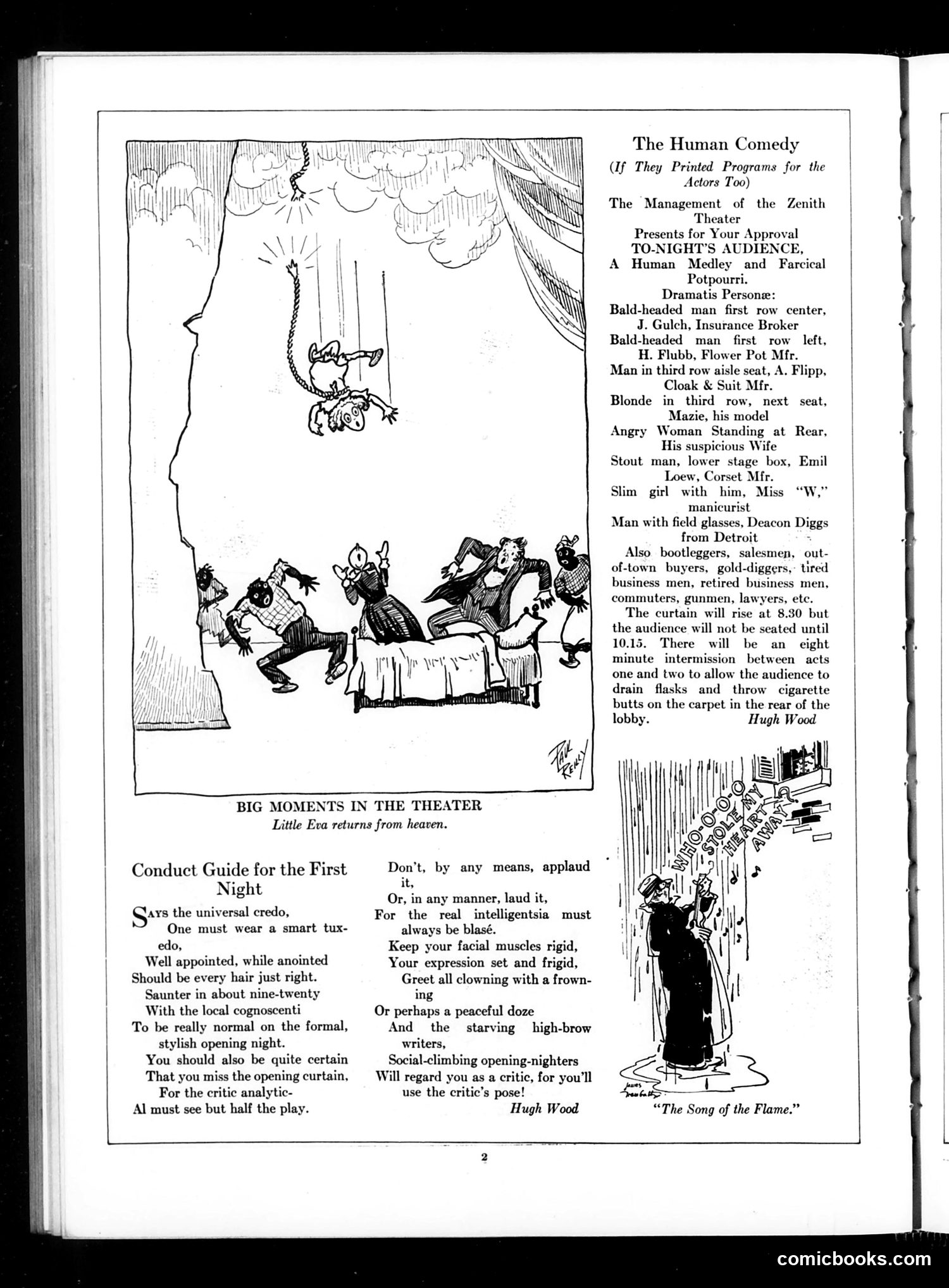
This is a theatrical program page for "The Human Comedy," a comedy/farce at the Zenith Theater. The top cartoon titled "Big Moments in the Theater: Little Eva Returns from Heaven" depicts a slapstick scene where a character descends on a rope while others below react with exaggerated physical comedy—characteristic of vaudeville-style theater humor. The "Conduct Guide for the First Night" by Hugh Wood offers satirical advice to theater patrons about proper deportment: wear formal dress, maintain composure, and don't applaud too enthusiastically. It mocks both pretentious audience behavior and social-climbing "opening-nighters" who adopt affected sophistication. The right illustration titled "The Song of the Flame" shows theater attendees in the audience, likely satirizing typical theatergoer types of the era.
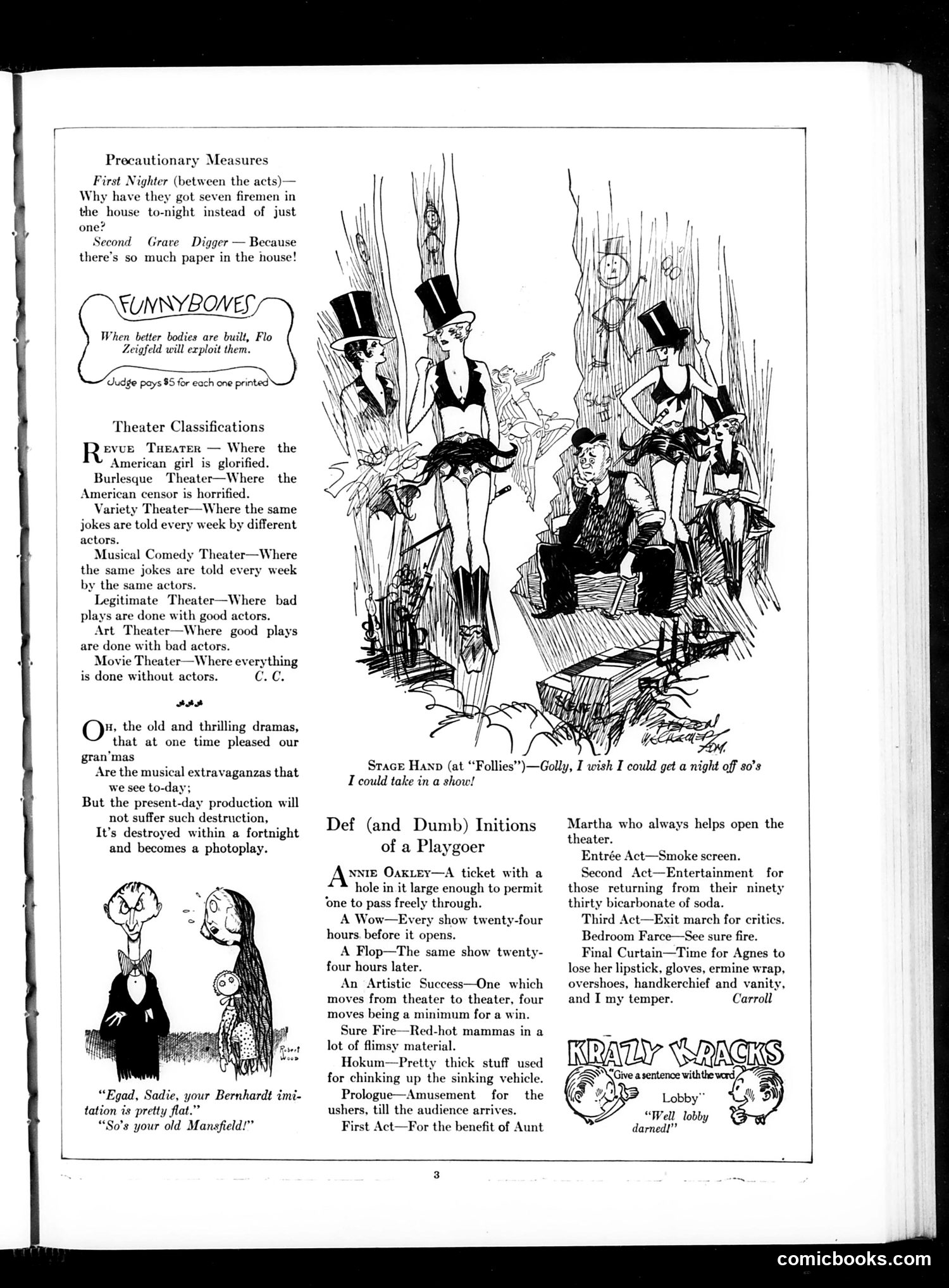
This page contains theater satire and humor definitions rather than political commentary. The "Precautionary Measures" joke references a theater fire hazard—seven firemen are positioned in a house because of excessive paper stockpiled inside, creating a fire risk. The central illustration depicts flamboyantly-dressed theater performers (likely showgirls or revue dancers in top hats) amid dramatic rain or water spray, captioned as a "Stage Hand" from a Follies production wishing for theatrical work. The "Theater Classifications" section humorously defines different theater types (Revue, Burlesque, Variety, Musical Comedy, Legitimate, Art, Movie theaters) through satirical comparisons about actors and play quality. The "Def (and Dumb) Initiations of a Playgoer" provides insider theater terminology mockingly, while the bottom "Krazy Cracks" section offers brief joke definitions. This is entertainment-focused satire, not political commentary.
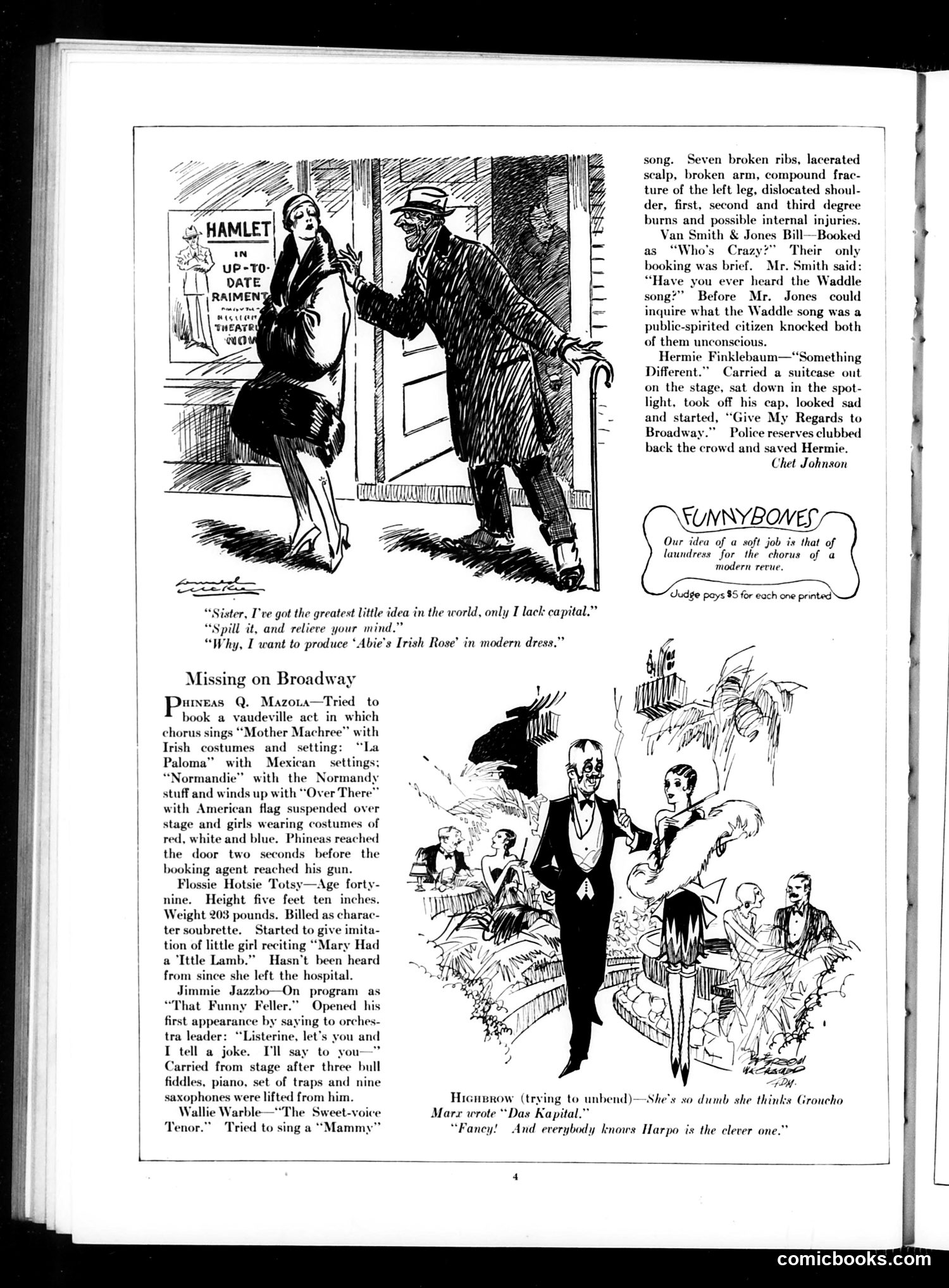
This page from *Judge* magazine contains theatrical satire and humor. The top cartoon depicts a man pitching a theatrical producer on an idea: producing "Abie's Irish Rose" in modern dress. The satire mocks both the theatrical industry's desperation for concepts and the absurdity of reimagining a well-known play with contemporary costumes. The "Missing on Broadway" section satirizes theatrical performers and their mishaps. It references specific entertainers attempting various productions with comedic results—performers getting injured, attempting inappropriate material, or creating absurd theatrical combinations. The "Funnybones" section offers a joke about a laundress starting a theater chorus line, poking fun at unconventional career transitions. The bottom cartoon appears to mock an overly ambitious theatrical production with too many animals and performers, satirizing Broadway's tendency toward spectacle and excess.
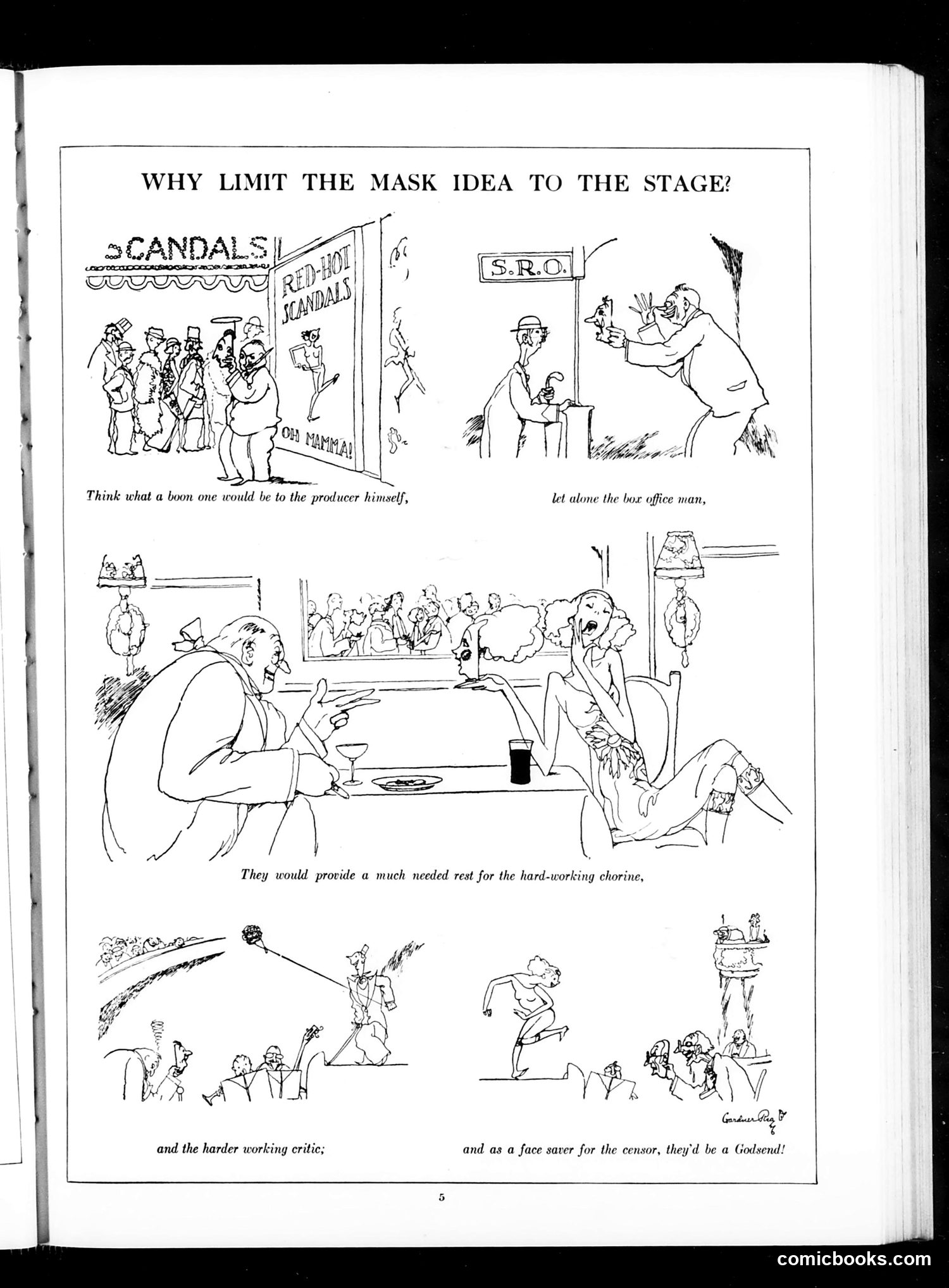
This satirical cartoon advocates expanding theatrical masks beyond stage performance into everyday life. The humor rests on four scenarios showing how masks could benefit various professions: 1. **Theater producers and box-office managers** would gain relief from scandal and criticism 2. **Chorus performers** would get needed rest 3. **Theater critics** would be protected from harsh reviews 4. **Censors** would be protected from moral offense The cartoon suggests that if masks hide actors' identities on stage, they should similarly protect real-world figures from accountability—producers from scandals, workers from exhaustion visibility, critics from backlash, and censors from having to witness objectionable content. It's satire mocking how masks create convenient anonymity and plausible deniability, questioning why this theatrical convention shouldn't extend to those who might benefit from hiding.
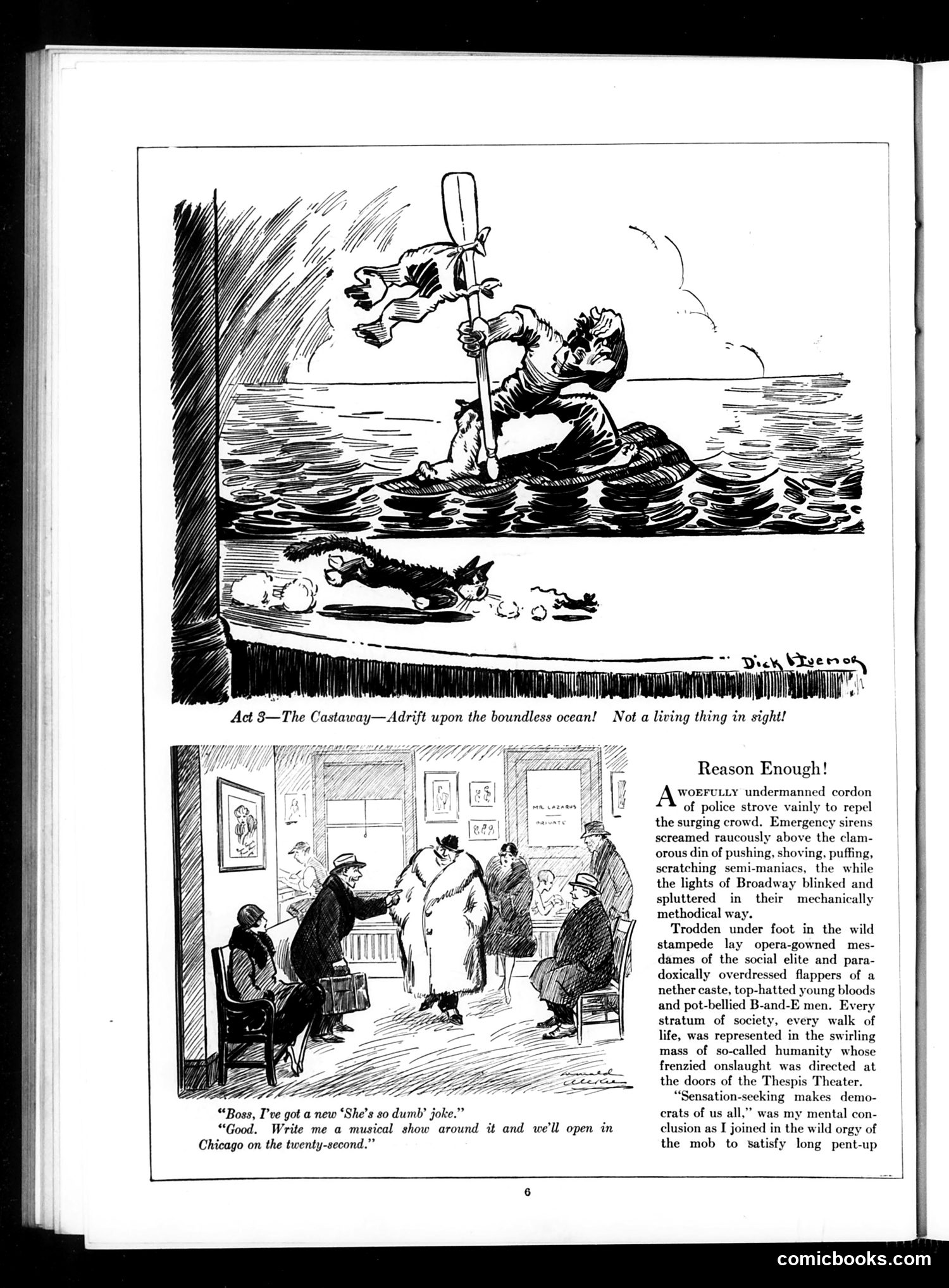
This page satirizes 1920s Broadway theater culture and mob mentality. The top cartoon depicts a castaway scene—likely a theatrical production being pitched. The bottom cartoon shows the actual satire: a chaotic mob storming the "Thespis Theater" (a classical reference to theater's origins). The joke mocks both theatrical producers and audiences. A man pitches a joke to his "Boss"—"She's so dumb"—and the boss immediately greenlit it as a full musical show for Chicago. This ridicules the formulaic, lowest-common-denominator approach to Broadway entertainment. The accompanying text describes the frenzied crowd as representing "every stratum of society," suggesting that theater's appeal transcends class boundaries, yet the mob's desperation to see such thin material satirizes mass culture and herd mentality. The author admits joining the "wild orgy" despite recognizing the absurdity, critiquing both producers exploiting audiences and audiences eagerly consuming vapid entertainment.
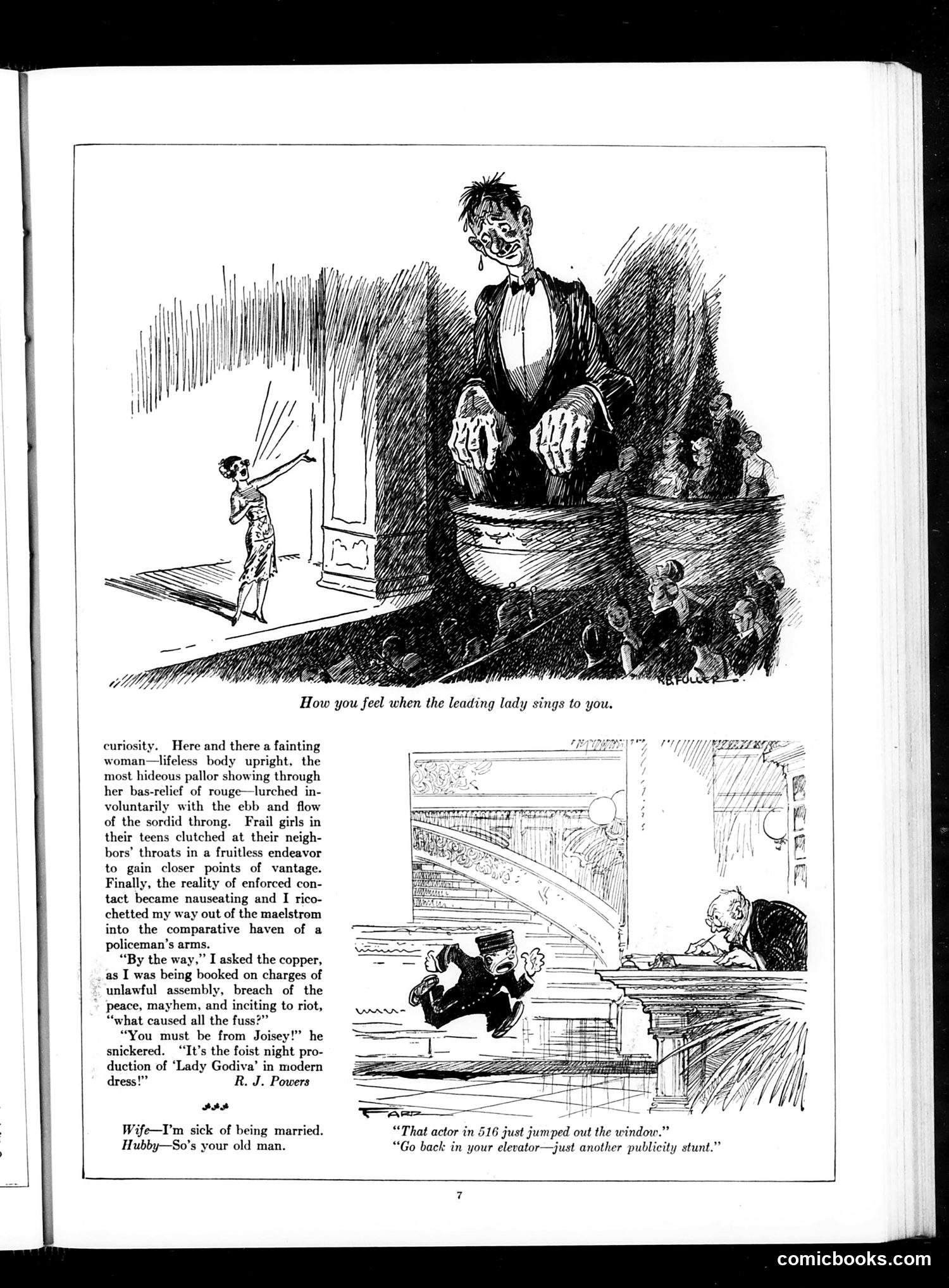
This page satirizes early 20th-century opera fandom and theatrical publicity. The top cartoon mocks the chaos surrounding a modern production of "Lady Godiva" (a classical opera subject). The artist depicts an enormous, grotesque figure (likely representing either an opera diva or the spectacle itself) presiding over a hysterical crowd of society women fainting and fighting for position—satirizing the absurd behavior of theatergoers and the media circus around new productions. The caption "How you feel when the leading lady sings to you" underscores the mockery. The bottom cartoon jokes about Hollywood publicity stunts: when an actor jumps from a high building, an elevator operator dismisses it as merely another manufactured stunt for attention—reflecting contemporary cynicism about theatrical self-promotion and sensationalism. The page also includes two marriage joke quips unrelated to the main cartoons.
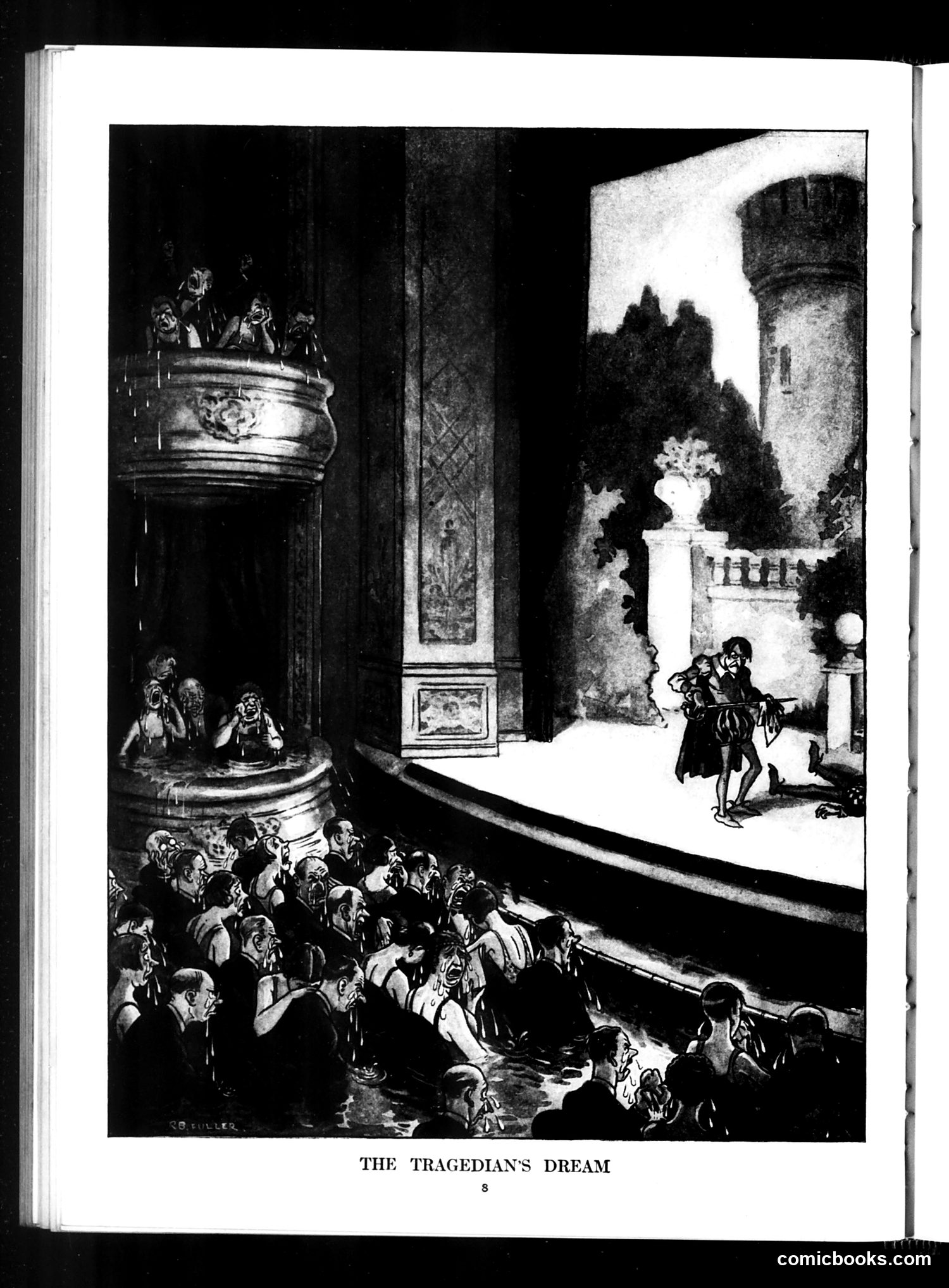
This illustration depicts a theatrical scene showing the contrast between a actor's humble reality and his aspirations. The lower portion shows a crowded theater audience watching a stage performance (visible in the upper right). The left side features an ornate theatrical box or balcony with elaborately dressed figures, while the stage right shows a moonlit courtyard with classical architecture. The satire appears to comment on theatrical ambition—the "tragedian's dream" likely refers to an actor fantasizing about performing in grand, prestigious productions or venues, contrasting with the modest circumstances of actual theater life. The elaborate architectural framing emphasizes the gap between theatrical fantasy and reality. The artist's signature reads "C. Bulles" or similar.
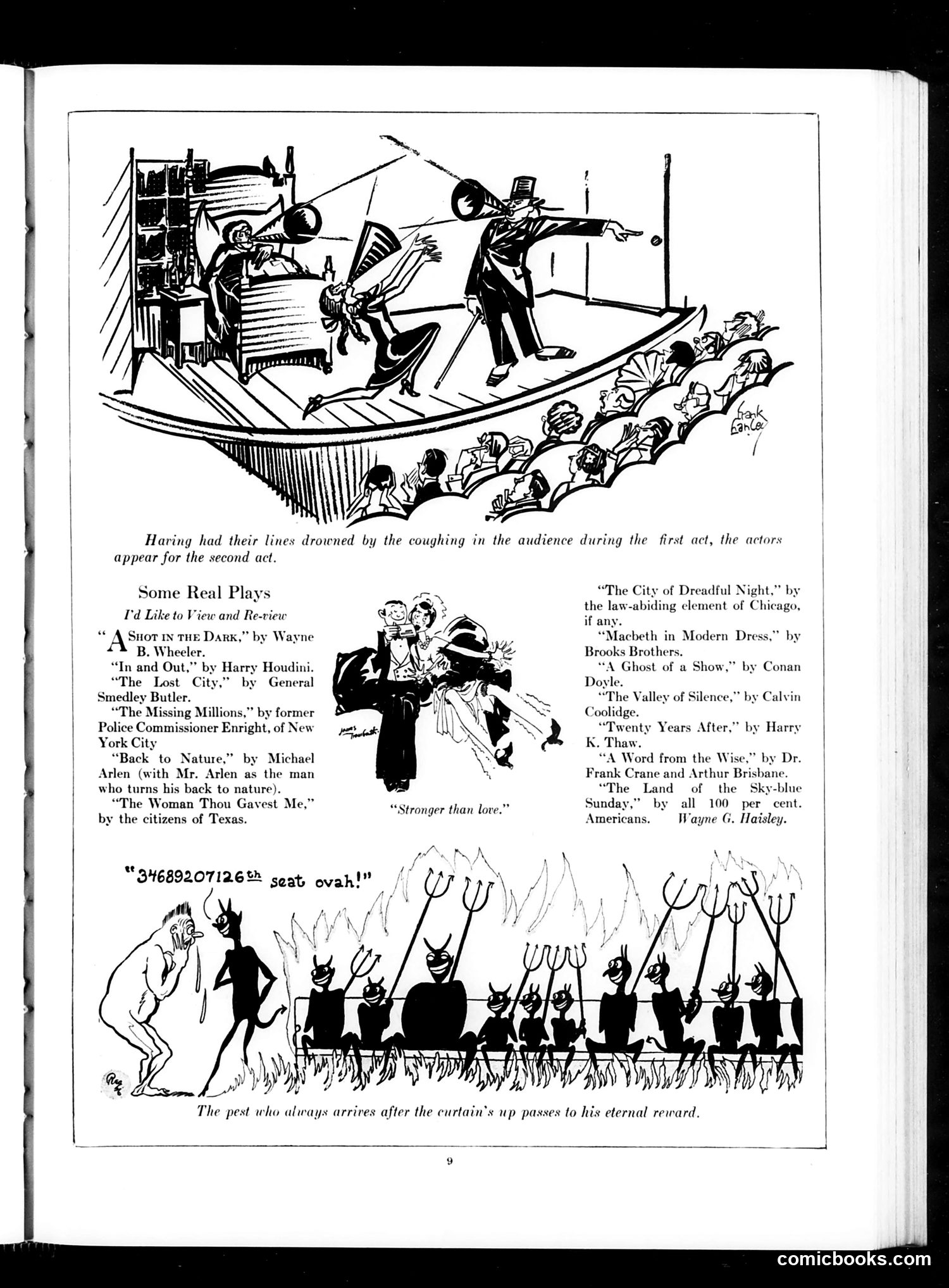
**Top cartoon:** Shows theater actors struggling through a performance while audience members cough loudly during the first act, forcing them to return for a second act. This is straightforward theatrical satire about inconsiderate audiences disrupting performances. **Middle section:** Lists fictional play titles as jokes targeting contemporary public figures and politicians—Wayne B. Wheeler (Prohibition advocate), Harry Houdini, General Smedley Butler, Police Commissioner Enright, Michael Arlen, and others. Each title mockingly references scandals or character traits associated with these men (e.g., "The Missing Millions" about alleged corruption). **Bottom cartoon:** Depicts a devil-like figure (representing "the pest") addressing Hell's inhabitants after the theatrical curtain falls, suggesting damnation awaits theater critics or troublemakers. The page satirizes both theater culture and contemporary political figures through clever wordplay, typical of Judge magazine's humorous commentary on early 20th-century American society.
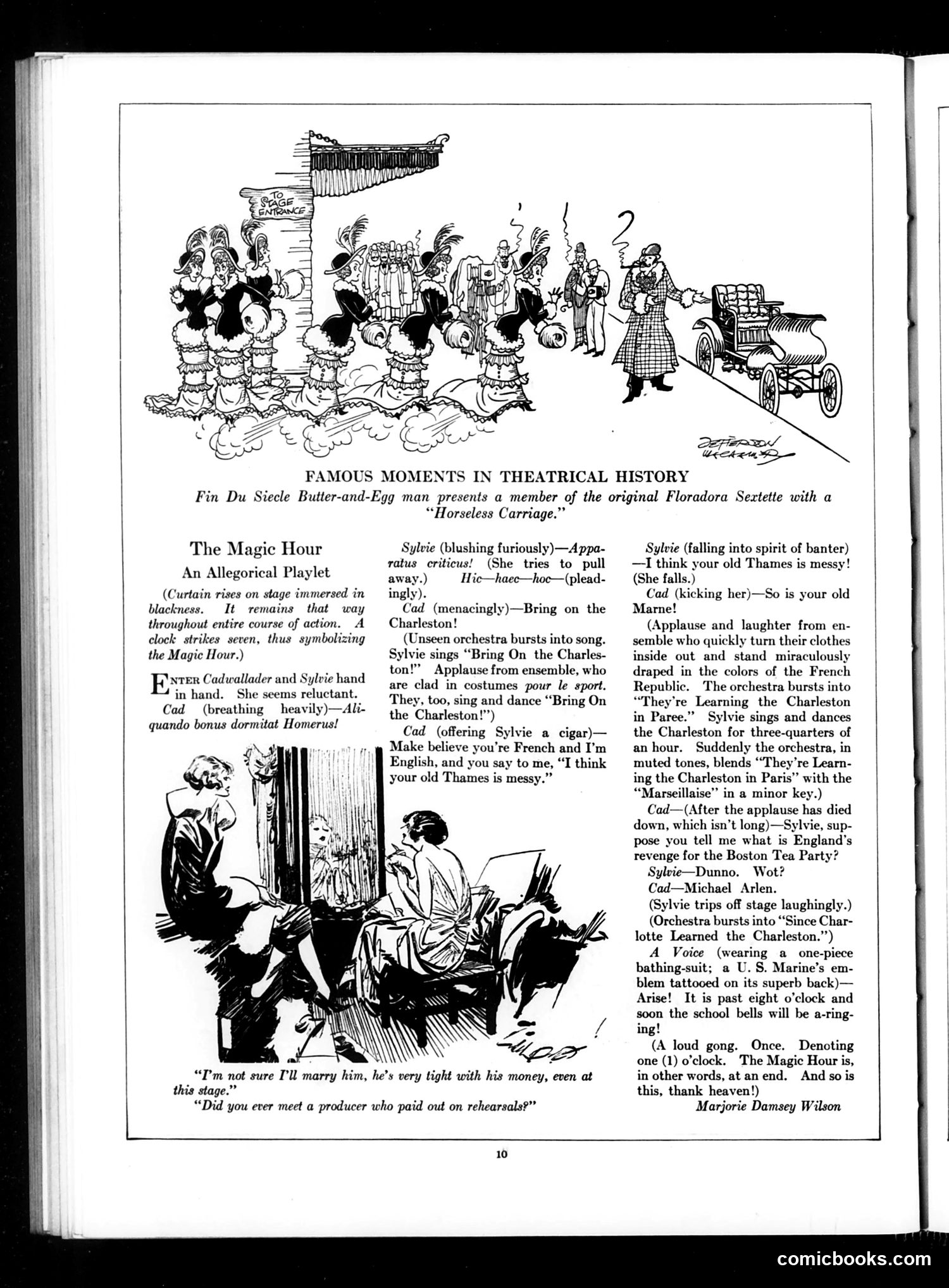
This is a theatrical parody mocking 1920s pretension and faddishness. The playlet satirizes: **The "Butter-and-Egg Man"**: A wealthy, unsophisticated businessman (Cad) trying to seduce an actress (Sylvie) by affecting intellectual superiority—quoting Latin and speaking French while kicking her and offering cigars. **Charleston Obsession**: The dance craze dominates absurdly; characters inexplicably break into song about learning the Charleston, with costumes magically transforming to French colors. **Literary Snobbery**: Michael Arlen (a fashionable 1920s author) is dismissively called "England's revenge for the Boston Tea Party"—mocking contemporary literary pretension. **The Whole Affair**: A one-hour "Magic Hour" that supposedly occurs in darkness, filled with non-sequiturs, illogical stage business, and pseudo-intellectual dialogue—parodying modernist experimental theater's self-importance while capturing 1920s Jazz Age frivolity. The satire targets both wealthy patrons and theatrical absurdism of the era.
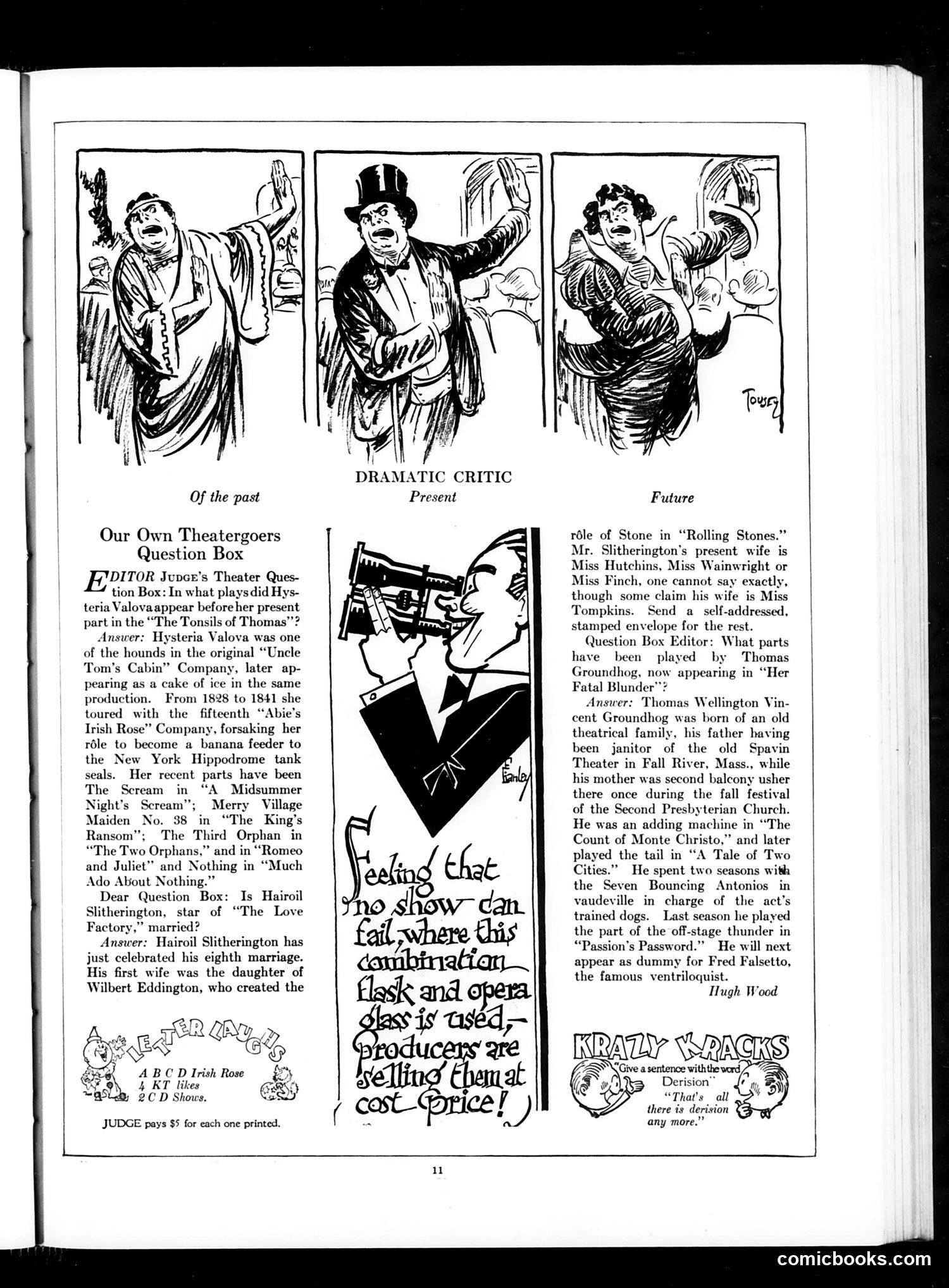
This page satirizes theatrical mediocrity through fake "Question Box" responses about obscure actors. The humor relies on absurdist fabrications: "Hysteria Valova" supposedly played "a cake of ice" and "Merry Village Maiden No. 38," while "Hairoil Slitherington" has had eight marriages with uncertainty about his current wife's identity. The top cartoon panel titled "Dramatic Critic" shows three exaggerated theatrical figures (past, present, future) in increasingly overwrought poses—mocking dramatic overacting. The center cartoon critiques producers selling cheap theatrical productions at inflated prices, noting that "flask and opera glass" combinations are marketed as high-art theater. These pieces collectively ridicule: low-quality theatrical productions passing as legitimate entertainment, actors with ridiculous stage names and negligible experience, and the theater industry's commercial exploitation of audiences. The satire targets theatrical pretension and mediocrity circa the 1920s-30s era.
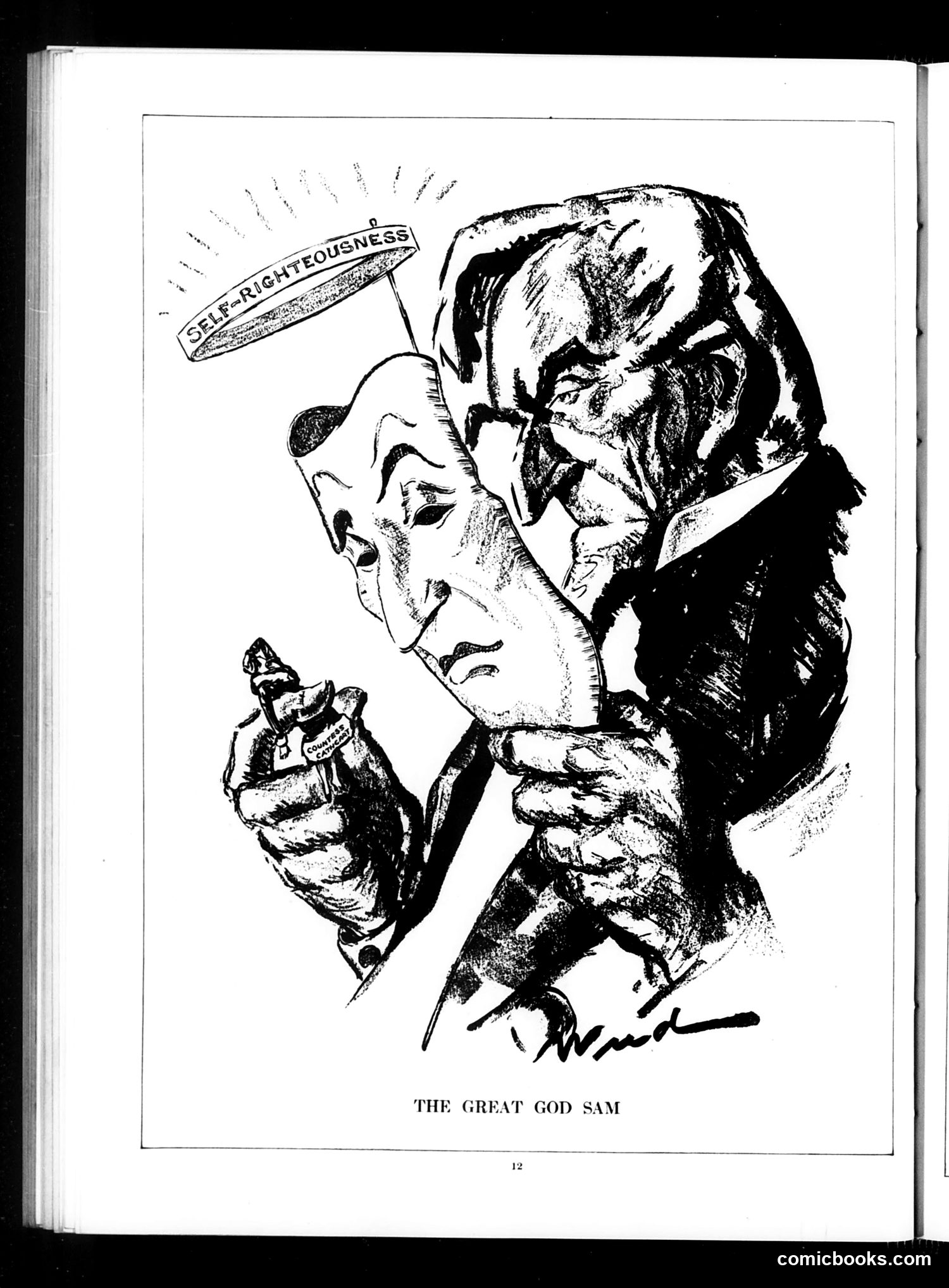
This political cartoon depicts two figures—a mask-like face in front and a grotesque caricature behind it—with the front figure holding a smaller figure labeled "Self-Righteousness." The banner floating above reads "Self-Righteousness." The title "The Great God Sam" suggests satire of someone named Sam (likely a public figure of Judge magazine's era) who presented himself with moral superiority or self-righteous claims. The two-faced imagery implies hypocrisy—a contrast between the public persona and actual character. The smaller figure being clutched suggests the subject weaponizes righteousness for personal gain or control. Without the publication date visible, the specific political target remains unclear, though the satire unmistakably mocks pretended virtue masking questionable motives.
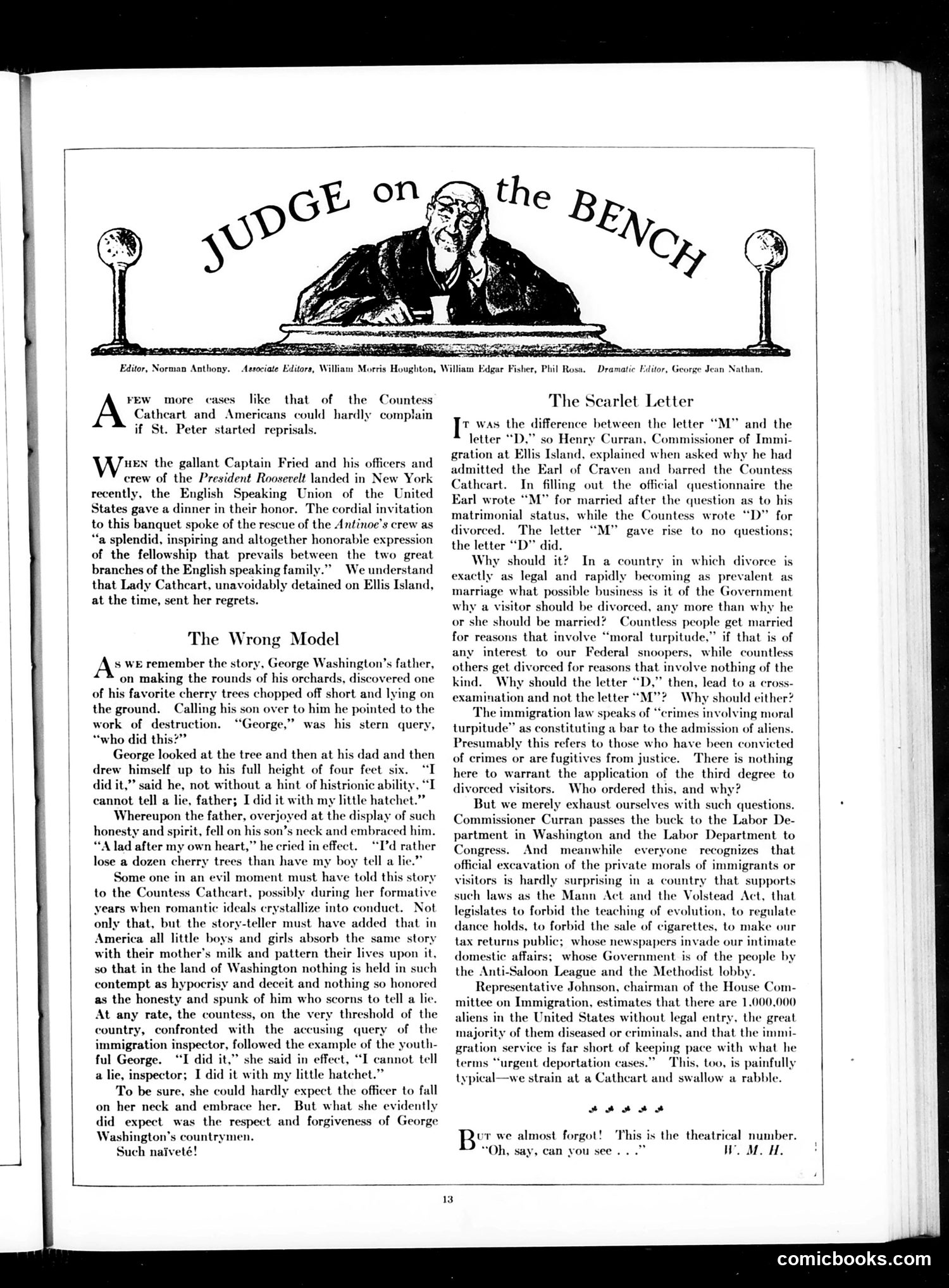
This page satirizes the hypocrisy of American immigration policy in the early 20th century. The main targets are: **"The Wrong Model"**: Mocks the Countess Cathcart, a British noblewoman detained at Ellis Island after honestly admitting to immigration inspectors that she'd hidden assets (following the George Washington cherry-tree honesty lesson). The satire criticizes Americans for idealizing honesty in principle while punishing it in practice—she expected respect for truthfulness but faced suspicion instead. **"The Scarlet Letter"**: Attacks Commissioner Henry Curran's arbitrary decision to admit the Earl of Craven (marked "M" for married) while barring Countess Cathcart (marked "D" for divorced). The piece questions why divorce—legal and increasingly common—should disqualify visitors, when the government has no legitimate interest in visitors' marital status. The satire exposes selective enforcement and moral judgment masked as bureaucratic procedure. Both articles highlight American pretension: preaching virtue while practicing discrimination.
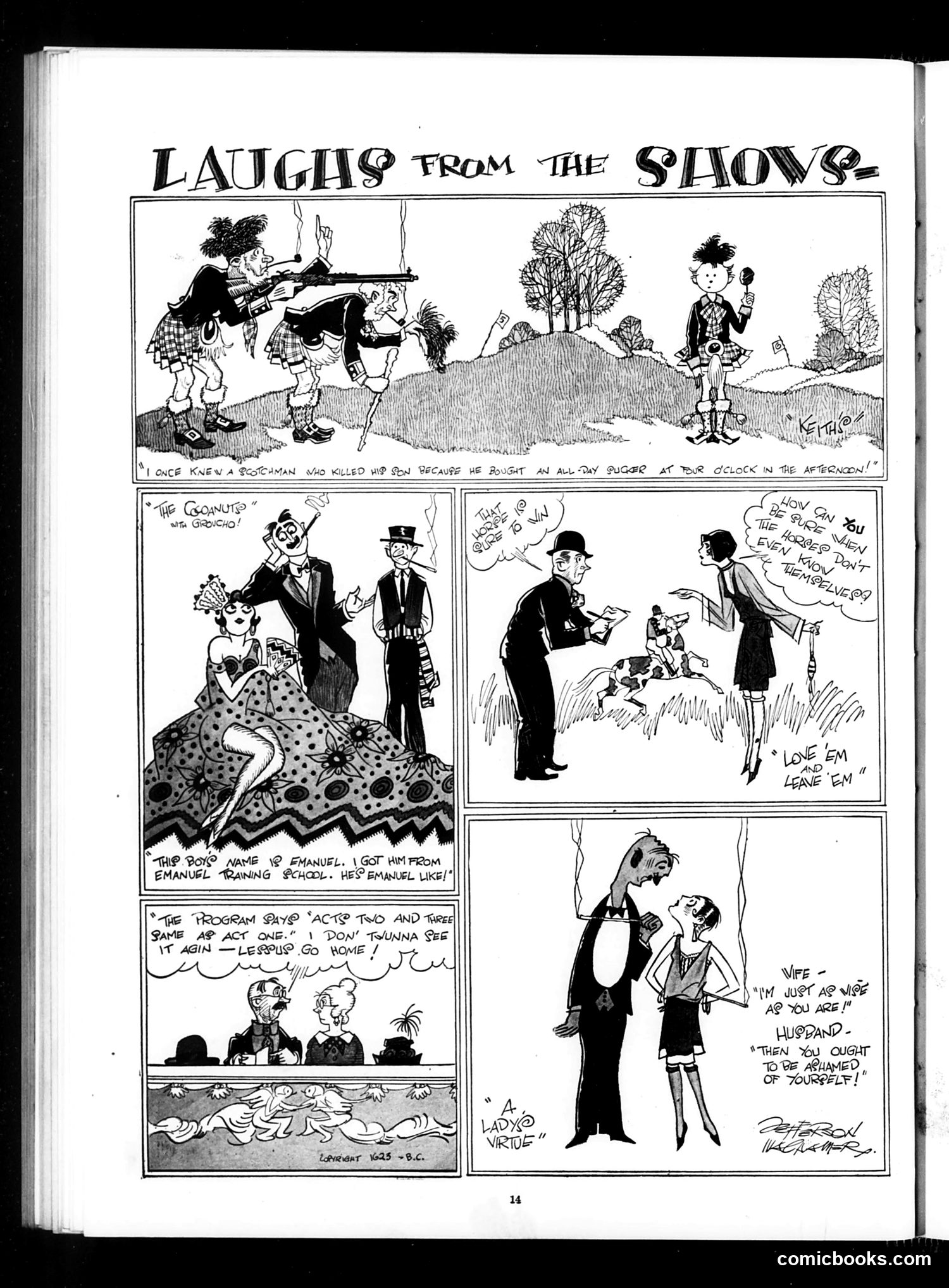
This is a comedy page satirizing theatrical productions of the era. The top panel mocks a Scottish vaudeville performer who killed his son because he bought sugar at 2 o'clock instead of the scheduled time—absurdist humor about strict discipline. The remaining panels joke about Broadway/theater conventions: a woman named after a training school ("Emanuel"), a vaudeville program with repetitive acts, and domestic squabbling where a husband tells his wife she's "as wifey as you are" (circular, meaningless logic)—mocking bad acting and lazy writing. The final panel's punchline about her being "ashamed" of herself plays on melodramatic spousal arguments typical of stage comedies. The humor targets theatrical clichés and unconvincing performances rather than specific political figures.
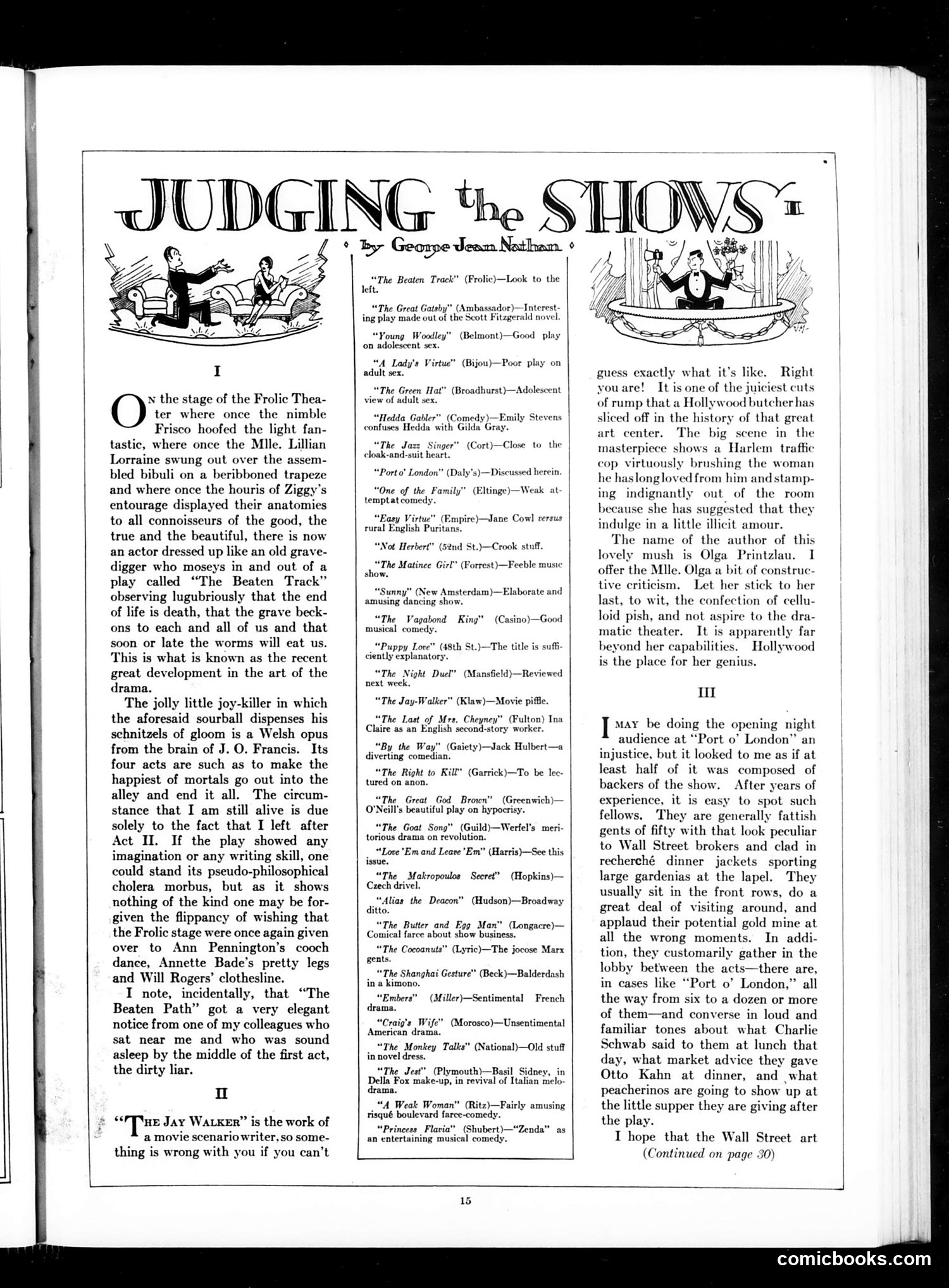
This is a theater review column by George Jean Nathan, a prominent drama critic. The main article mocks "The Beaten Track," a Welsh play then running at the Frolic Theater. Nathan sarcastically attacks it as pretentious gloom-mongering—a "joy-killer" about death and decay that makes no theatrical contribution. He contrasts it bitterly with the Frolic's former glamorous variety acts (Mlle. Lillian Lorraine, Ann Pennington), suggesting serious drama has replaced spectacle without merit. Nathan also complains that a colleague who slept through Act I nonetheless praised the play—calling him a "dirty liar." The right column lists current Broadway productions with brief, caustic verdicts: "The Great Gatsby" (interesting), "Young Woodley" (good adolescent sex play), "Not Herbert" (crook stuff), etc. This represents Nathan's influential but acerbic theater criticism from the Jazz Age era.
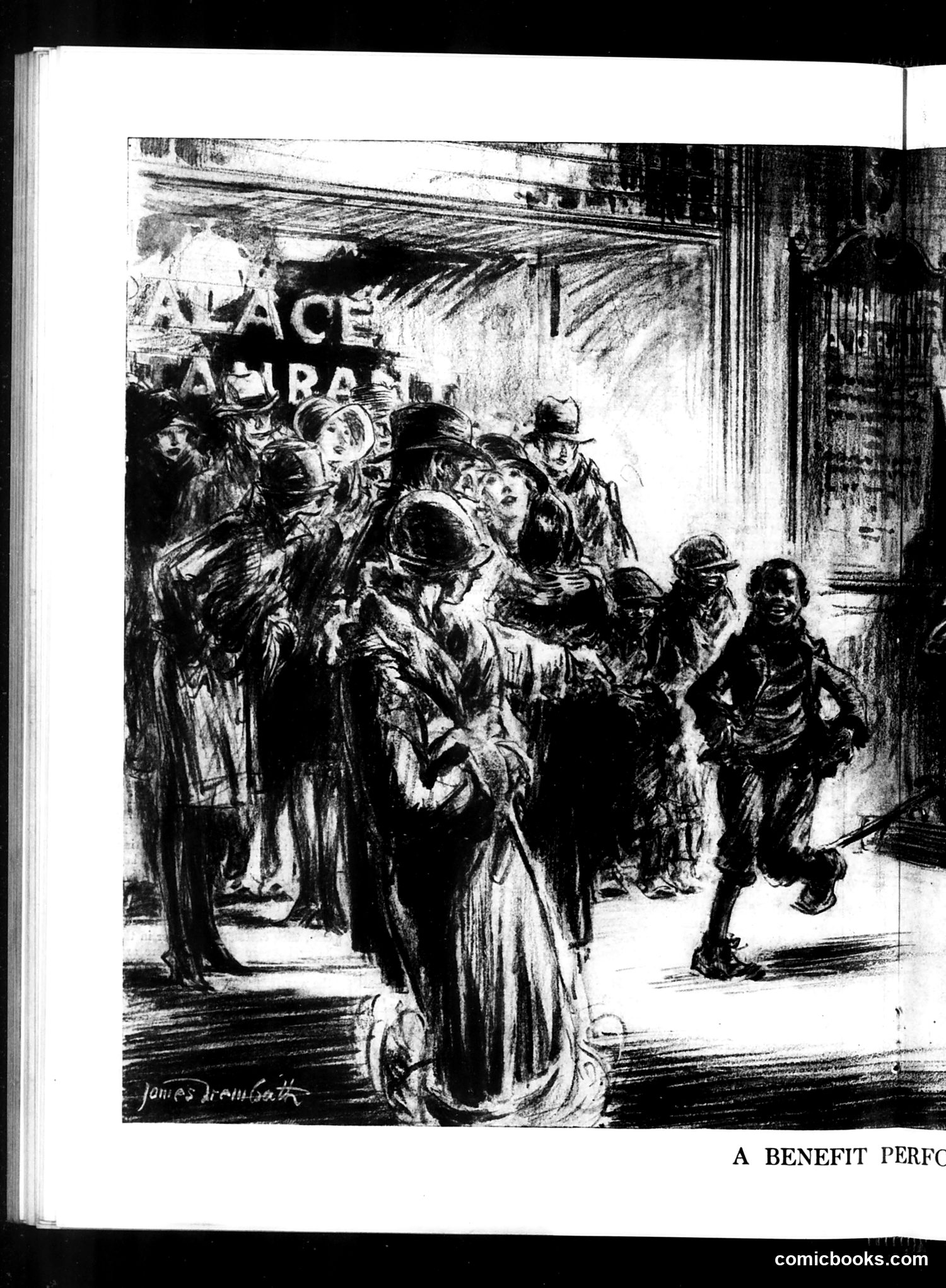
This appears to be an illustration from *Judge* magazine, signed by what looks like "James Donahue" (or similar). The caption reads "A BENEFIT PERF[ORMANCE]" (likely "A Benefit Performance"), suggesting this depicts a theatrical or charitable event. The image shows a crowded urban scene with numerous figures wearing hats and period clothing, gathered outside what appears to be a storefront or venue marked "ACE" and "AIRBAG" (though text is partially obscured). The style and composition suggest this is satirizing either a crowded public event or social commentary on urban life. Without clearer text or additional context, I cannot definitively identify which specific benefit performance or social event this references. The satirical intent appears directed at crowd behavior or public gathering dynamics, but the particular target remains unclear from the visible information.
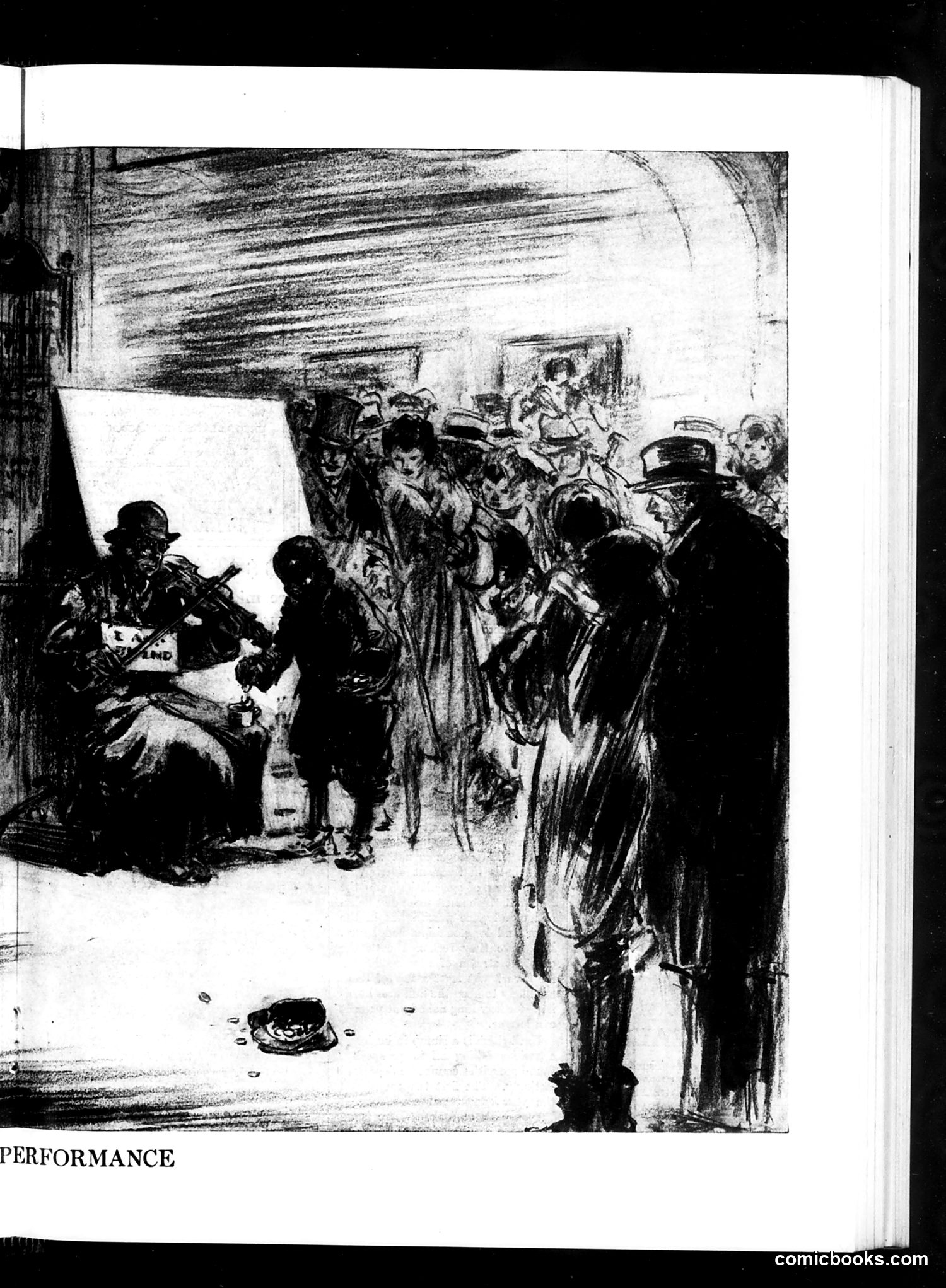
This appears to be a sketch-style illustration titled "Performance" from the satirical magazine *Judge*. The image depicts what seems to be a street or indoor scene with multiple figures gathered around. On the left, one figure appears to be playing a musical instrument (possibly a fiddle or violin), while others—dressed in period clothing with hats—stand watching or listening. The composition suggests this may be satirizing a street performance or public musical act. Without additional context or visible text identifying specific individuals or events, the exact political or social commentary remains unclear. The sketch style is characteristic of *Judge*'s satirical approach, but the specific target of satire cannot be definitively determined from the image alone.
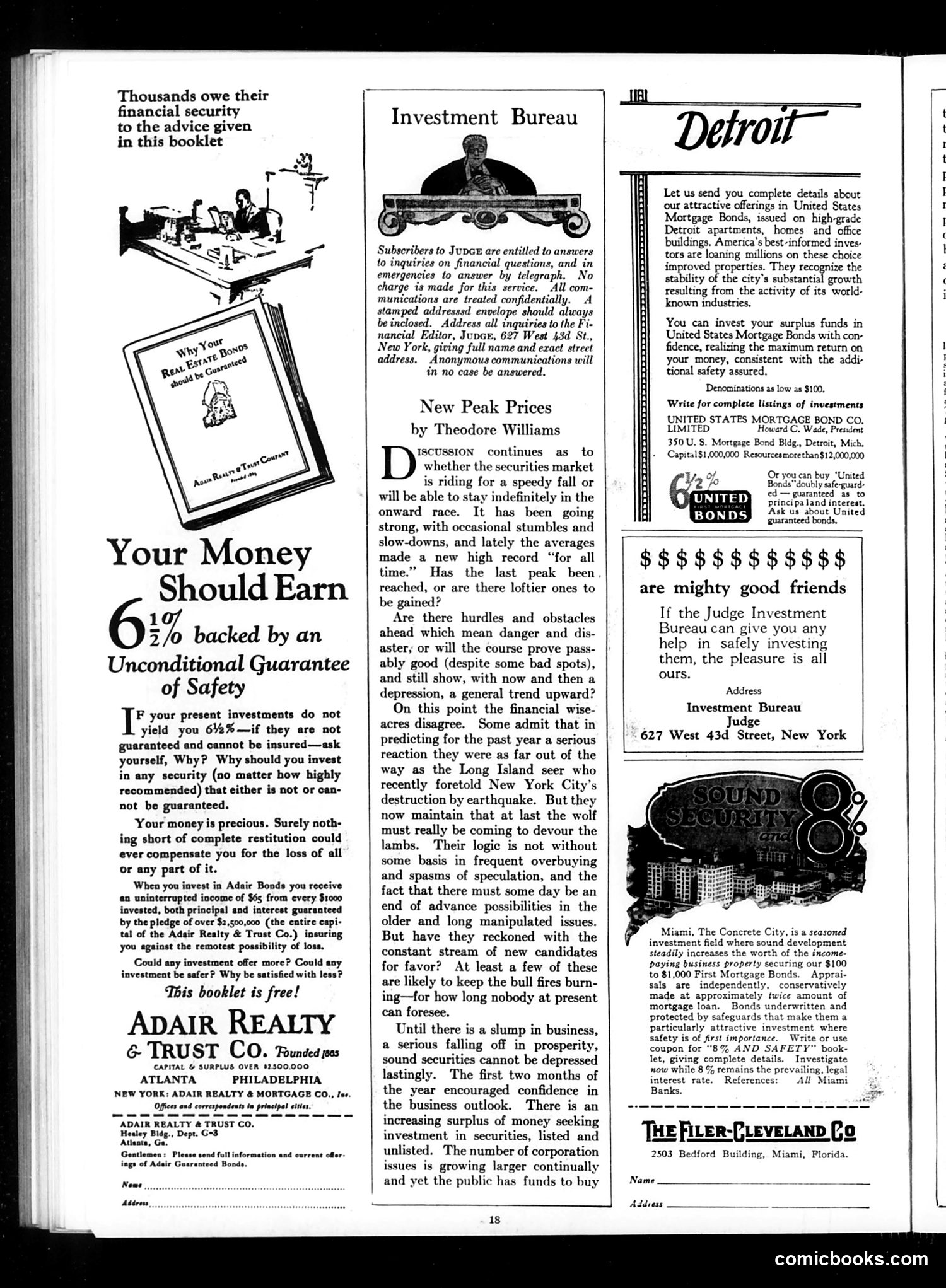
This page is primarily **advertising and financial advice**, not political satire. It contains: **Main Content:** - Multiple investment advertisements (Adair Realty & Trust Co., Judge's Investment Bureau, United Bonds, Detroit mortgages) - A financial column by Theodore Williams titled "New Peak Prices" discussing whether the stock market will continue rising or crash **Historical Context:** The page reflects pre-1929 stock market optimism. Williams discusses whether securities have reached their peak or will continue climbing, mentions speculation concerns, and notes an "increasing surplus of money seeking investment." This reads as cautiously bullish commentary from the Roaring Twenties era. **The Satire (Mild):** The left sidebar mocking investment guarantees ("Your Money Should Earn 6½% backed by an Unconditional Guarantee of Safety") appears slightly tongue-in-cheek about financial promises, though it's primarily earnest advertising. **Overall:** This is a straightforward business/financial page with minimal satirical content—mostly period investment promotions and market analysis.
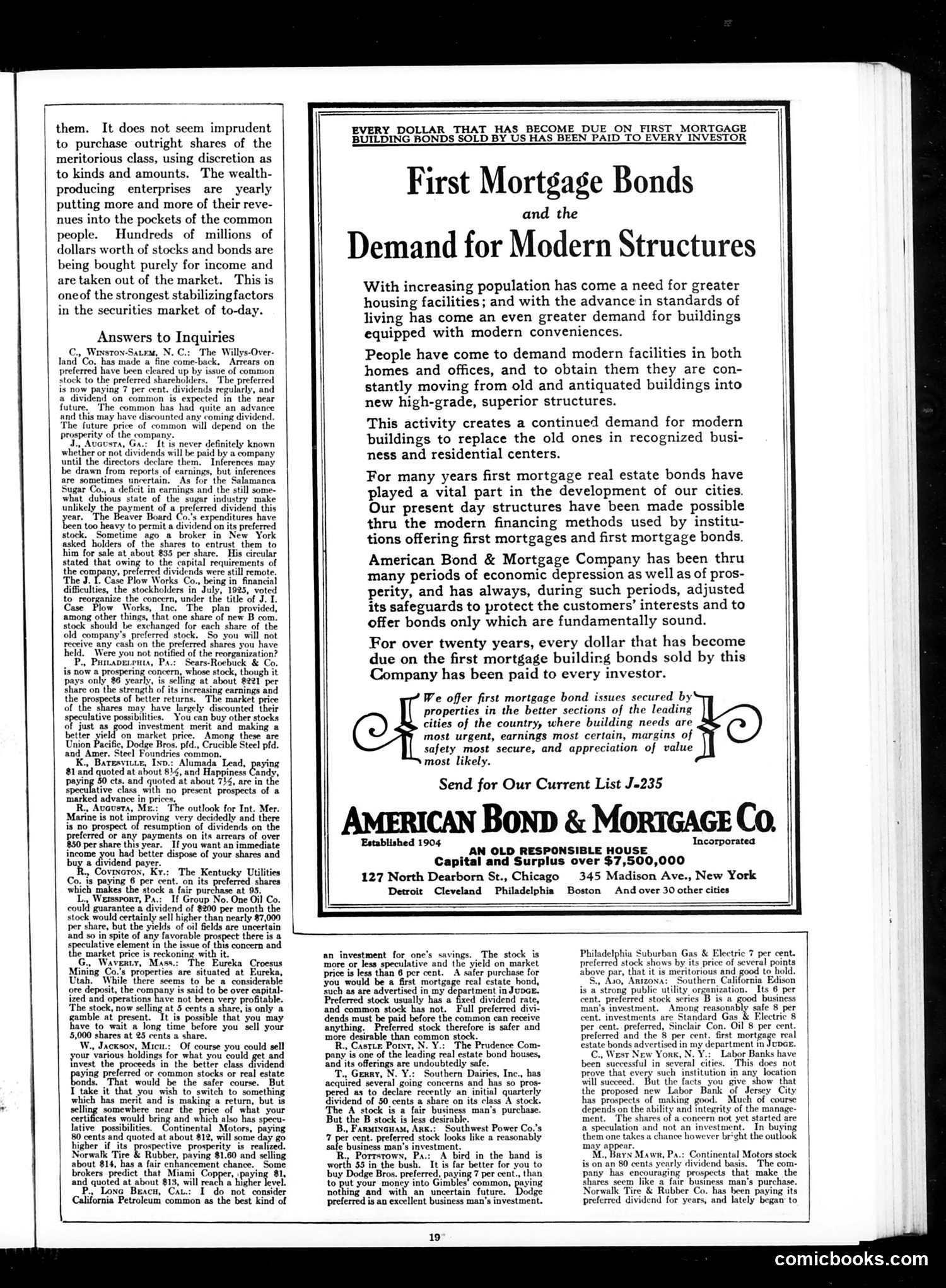
This page is primarily **advertising and investment advice**, not political satire. The dominant content is a large advertisement for the American Bond & Mortgage Company (established 1904), promoting first mortgage bonds as secure investments tied to real estate development. The left column contains "Answers to Inquiries"—an investment advice column addressing reader questions about stocks and preferred dividends. The writer discusses various companies' dividend prospects (Sears-Roebuck, Case Plow Works, various mining and utility stocks) with cautionary notes about speculative investments. The page reflects **1920s economic optimism** and the period's investment culture, where ordinary readers sought guidance on stock purchases. The ad emphasizes safety and steady returns—typical marketing for the era before the 1929 crash. There is no cartoon visible; this appears to be a standard editorial/advertising page from Judge's financial section.
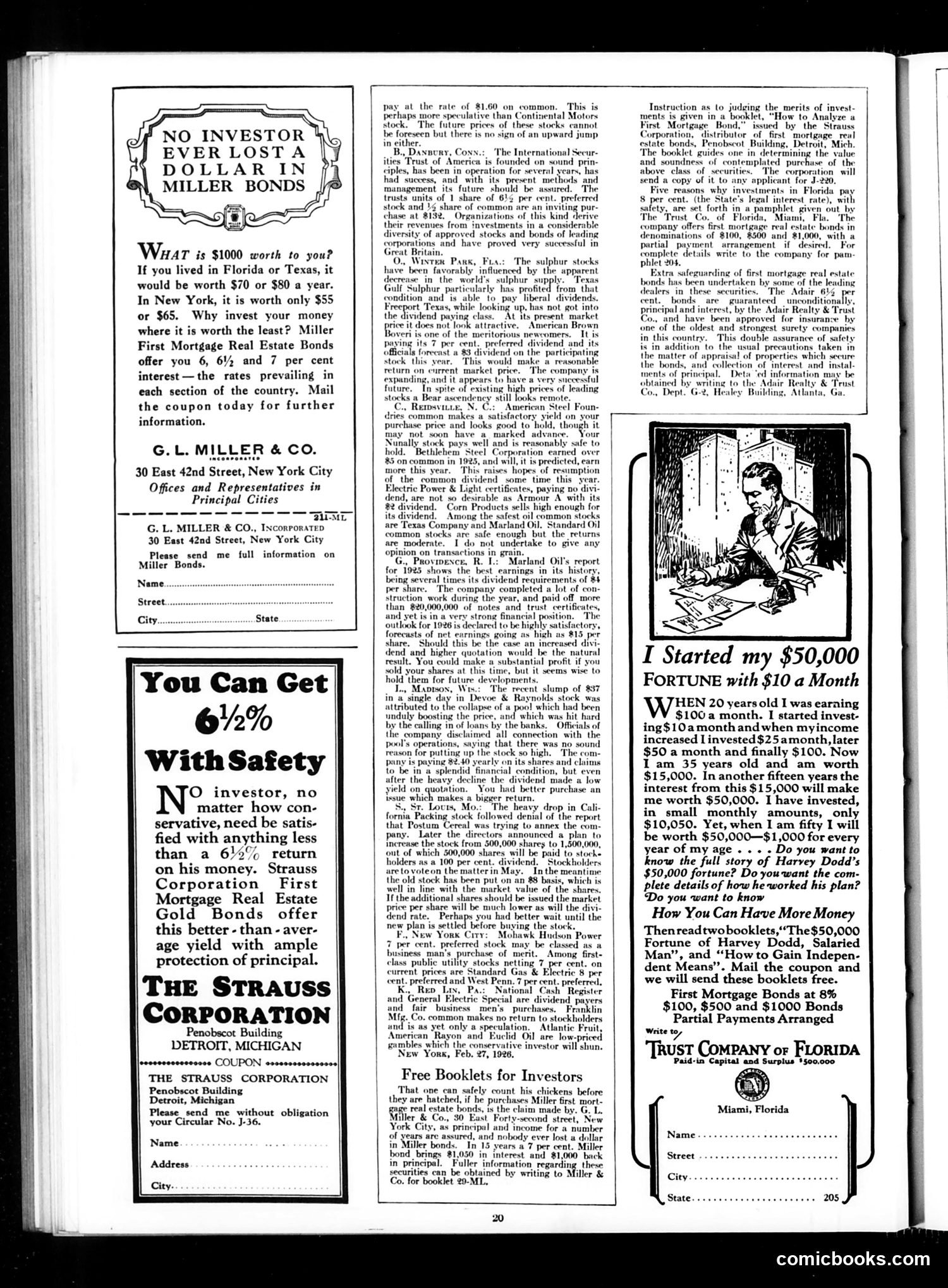
This page is predominantly **financial advertising** rather than satire or political commentary. It features three major investment firms (G.L. Miller & Co., Strauss Corporation, and Trust Company of Florida) promoting **First Mortgage Real Estate Bonds** and similar securities. The key claim—repeated across advertisements—is that these bonds offer safety with attractive returns (6-7% interest). The repeated assertion "NO INVESTOR EVER LOST A DOLLAR IN MILLER BONDS" reflects the **pre-1929 optimism** about real estate investments. The right column contains stock advice addressing individual investors' questions about dividends and corporate earnings, treating investment as accessible to ordinary people with modest capital. **Historical context**: This represents the speculative investment culture immediately before the 1929 stock market crash. The aggressive marketing of real estate bonds as "safe" would prove tragically ironic within years. The page reflects widespread belief that financial returns could steadily exceed inflation with minimal risk—a confidence that the Great Depression would shatter.
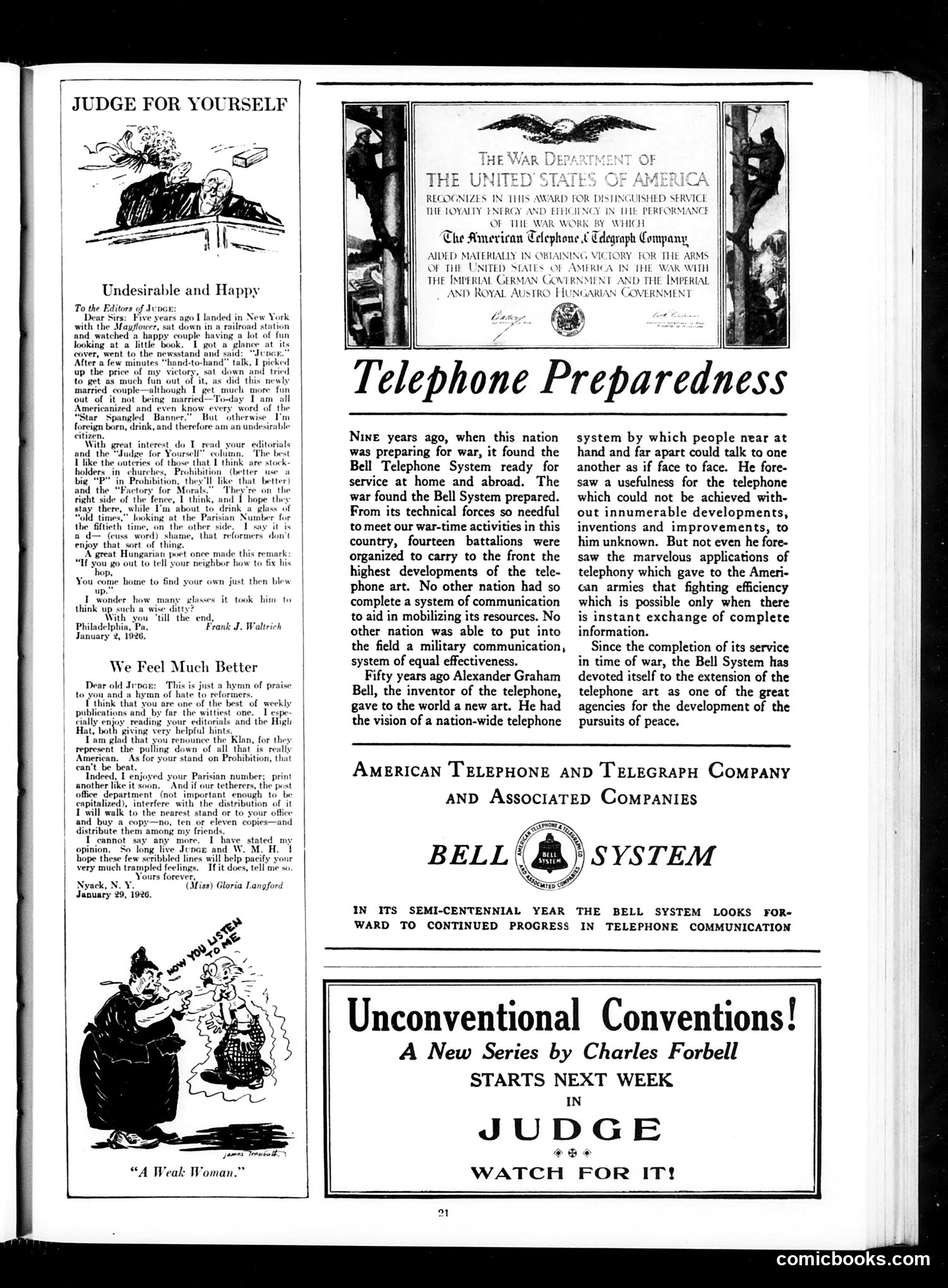
This page contains reader letters and advertising rather than satirical cartoons. The left side features two brief humorous letters to the editor: "Undesirable and Happy" and "We Feel Much Better"—typical reader submissions to a satirical magazine. The dominant content is a full-page advertisement for the Bell Telephone System, featuring a War Department award certificate praising AT&T's contributions to WWI victory. The ad emphasizes that the telephone system was "ready" nine years prior (around 1917) and provided crucial military communication infrastructure. It references Alexander Graham Bell's vision of nationwide communication. The page appears designed to appeal to patriotic sentiment—linking telephone infrastructure to American military success. A small announcement at bottom promotes an upcoming "Unconventional Conventions" comic series by Charles Forbell. The page is primarily commercial rather than satirical content, serving as both a magazine feature and paid corporate advertisement during the post-WWI era.
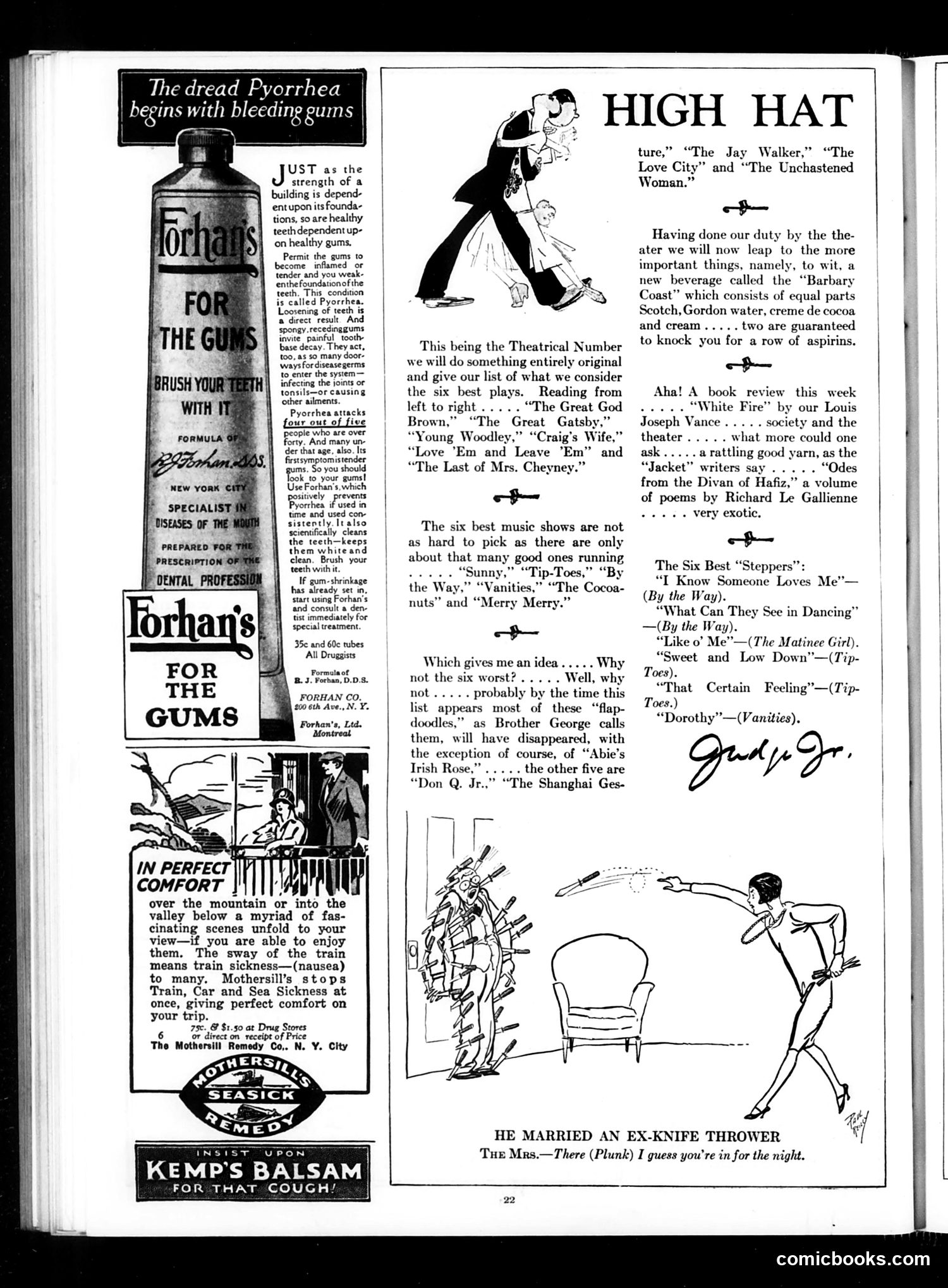
This is primarily a **theatrical/entertainment review column** titled "High Hat," not political satire. The page discusses 1920s Broadway plays and musicals, listing what the critic considers the "six best" productions: *The Great God Brown, The Great Gatsby, Young Woodley, Craig's Wife, Love 'Em and Leave 'Em,* and *The Last of Mrs. Cheyney.* The humor is **satirical entertainment critique**: the writer jokes about why not list the "six worst" plays, noting most will have "disappeared" by publication—a jab at the ephemeral nature of Broadway flops. References to "flapdoodles" (slang for frivolous things) mock low-quality productions. The bottom cartoon depicts a domestic scene where a husband, married to "an ex-knife thrower," faces incoming projectiles—a visual pun on marital conflict. The page also includes **period advertisements** (Forhan's toothpaste, Mothersill's seasickness remedy, Kemp's Balsam) typical of 1920s magazine content. **Context for modern readers**: This represents 1920s popular entertainment culture and advertising standards.
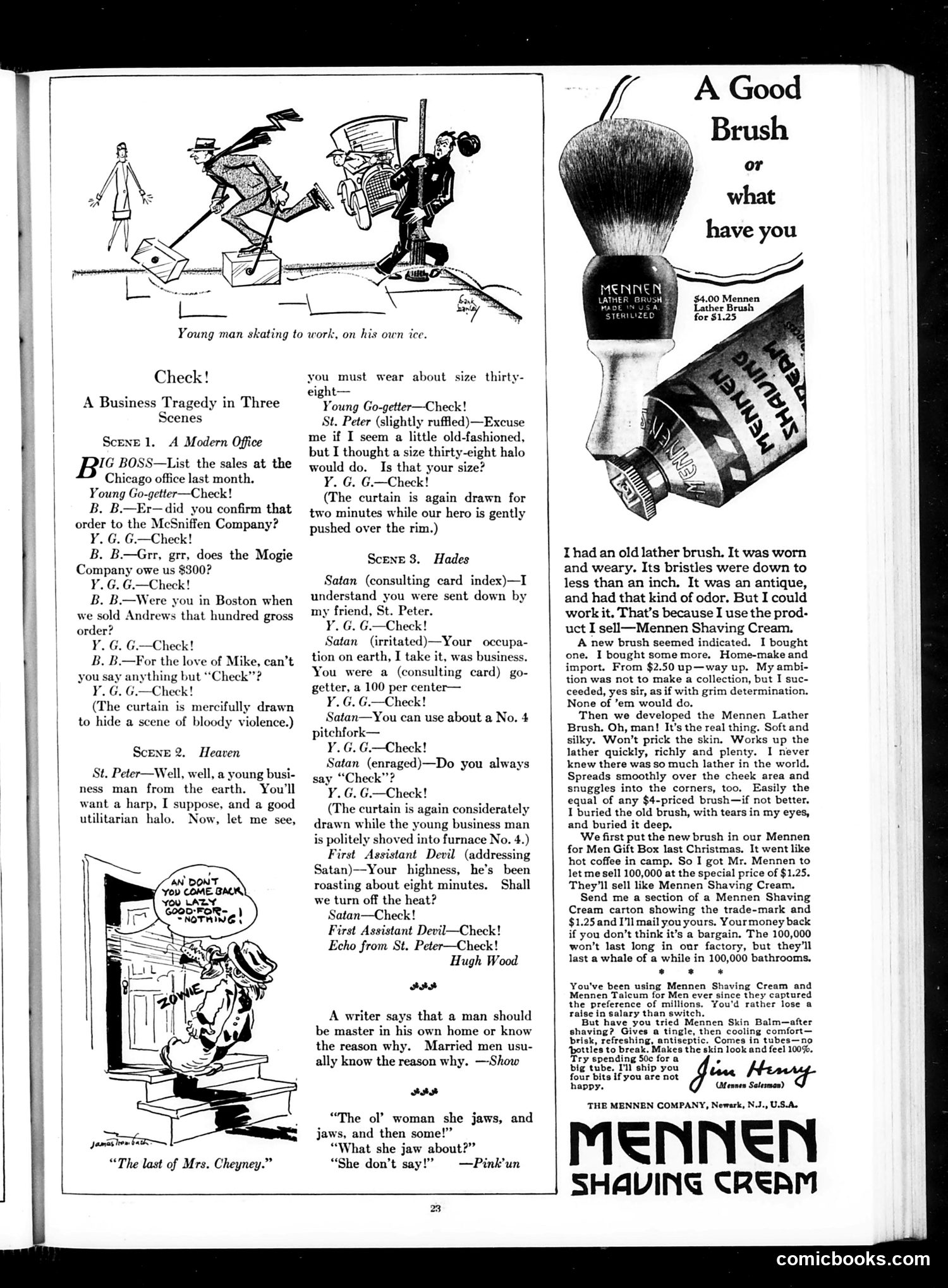
**Main Satire: "Check!" — A Business Tragedy** The three-scene play mocks the mindless conformity and empty language of early 20th-century American businessmen. A young "Go-getter" responds to every question—regardless of context—with "Check!" At his office job, he mechanically confirms orders and sales figures. Even arriving in Heaven, when St. Peter asks what clothing size he needs, he says "Check!" This automaticity gets him literally kicked into Hell, where Satan finally loses patience and hurls him into furnace No. 4. The joke targets the dehumanizing nature of modern business culture and corporate standardization. Men are reduced to robotic yes-men who've lost the capacity for actual thought or conversation. **Secondary Content** The page includes a Mennen Shaving Cream advertisement featuring a personal testimonial from "Jim Henry," and unrelated domestic humor about wives.
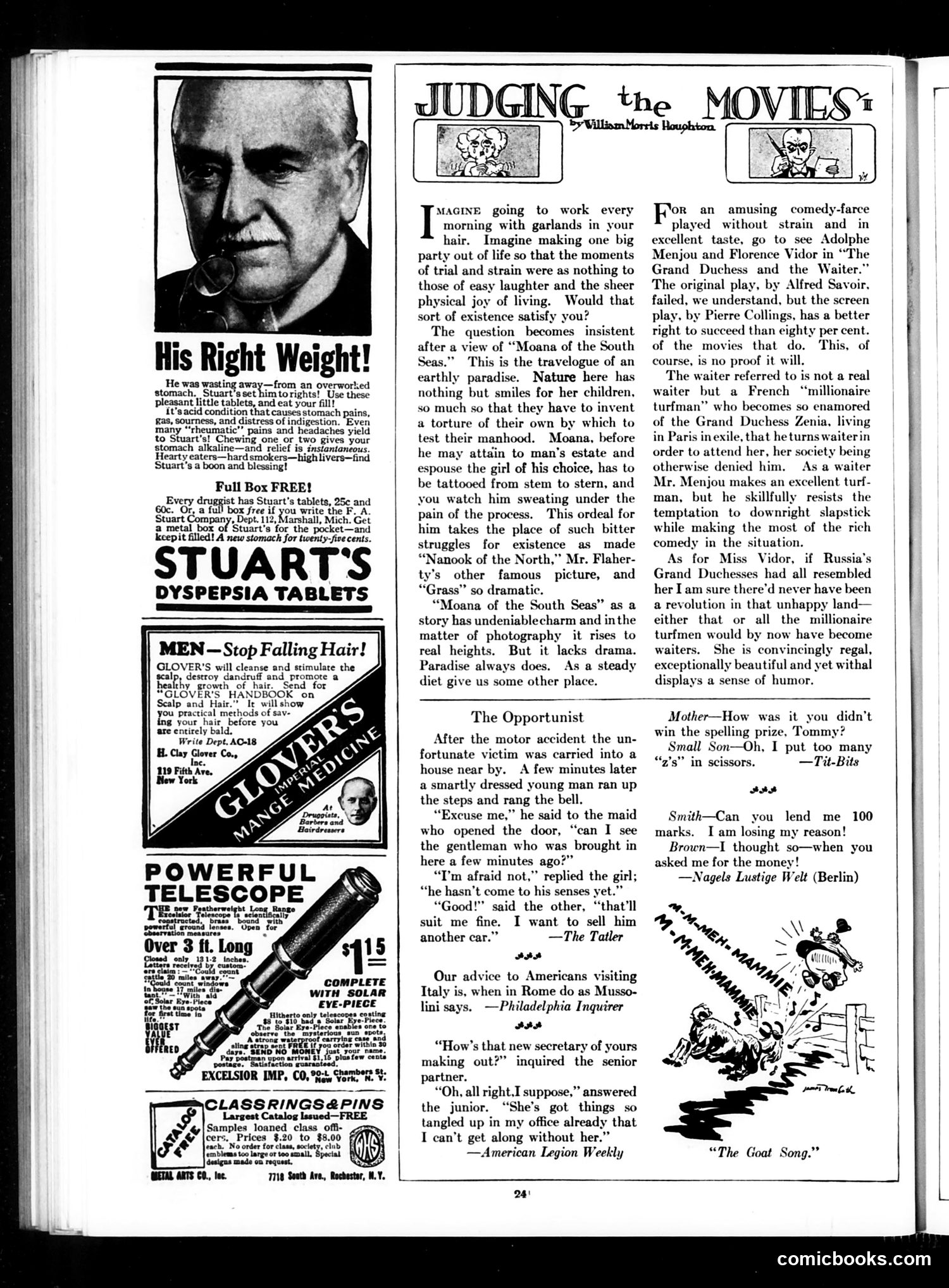
This page reviews three films. The main review critiques "Moana of the South Seas," a documentary travelogue about Pacific Island life and a coming-of-age ritual involving tattooing. The reviewer acknowledges its photographic beauty but finds it dramatically weak—paradise, they argue, lacks the conflict that makes compelling cinema (unlike director Flaherty's "Nanook of the North"). A second review praises "The Grand Duchess and the Waiter," a comedy-farce starring Adolphe Menjou and Florence Vidor. The plot involves a wealthy French "turfman" (horseman/gambler) posing as a waiter to court an exiled Russian Grand Duchess. The reviewer finds the adaptation superior to the original stage play and praises both leads' performances. The page is primarily advertisements for patent medicines and products (dyspepsia tablets, hair treatment, telescopes), typical of 1920s magazine content.
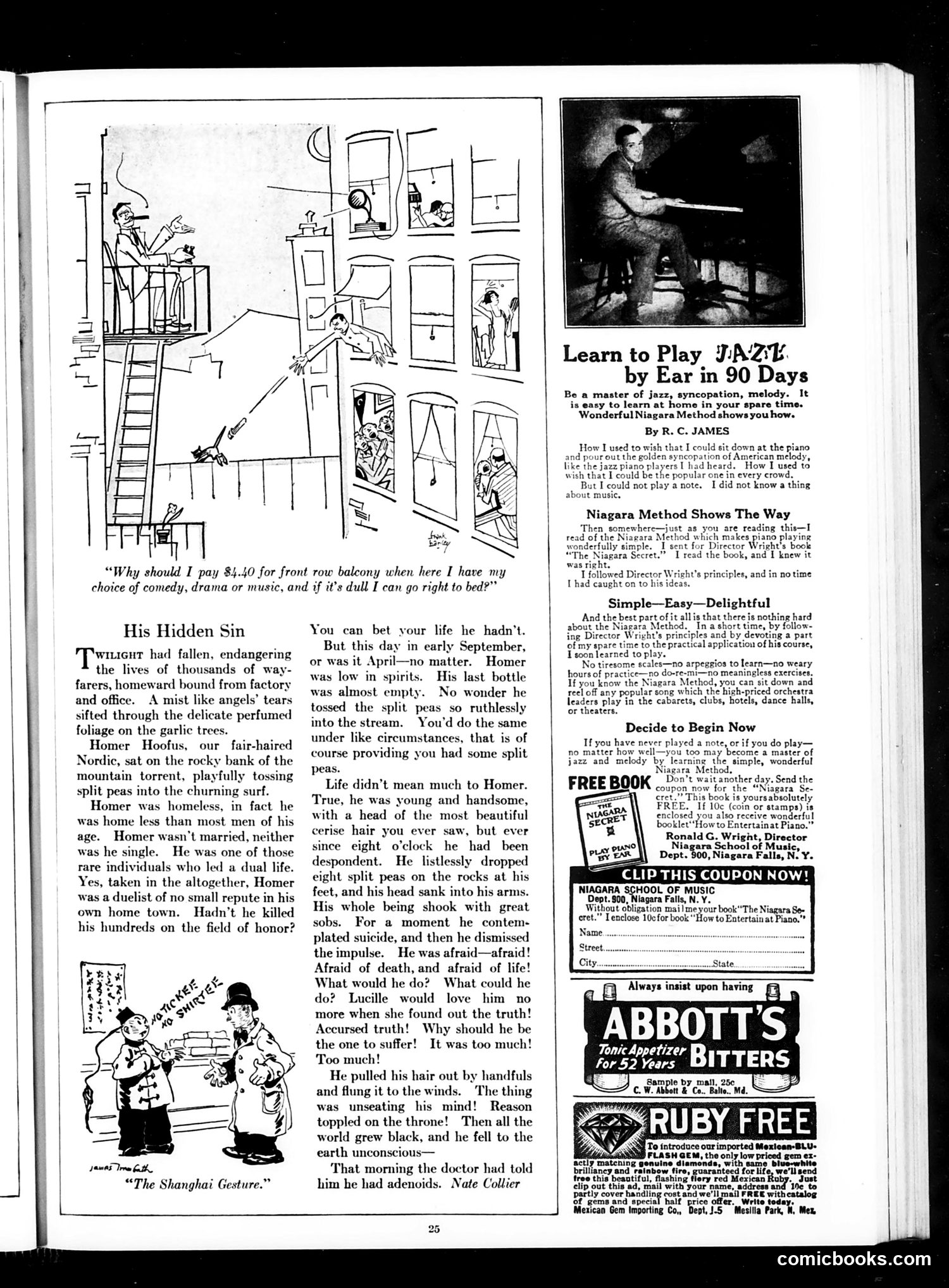
This page is primarily **advertising and instructional content** rather than political satire. The main cartoon "His Hidden Sin" is a **melodramatic parody** by Nate Collier. It mocks overwrought literary and theatrical conventions of the era—particularly florid, emotionally excessive prose. The protagonist Homer is depicted as absurdly devastated over a trivial concern (his doctor diagnosed him with adenoids), yet the text treats this with exaggerated gravity ("Reason toppled on the throne!"). The joke satirizes **sentimental storytelling excess** common in contemporary drama and cheap fiction. The page's dominant content is an **advertisement for the Niagara Method**, a mail-order course teaching jazz piano by ear in 90 days. This reflects 1920s enthusiasm for jazz as a cultural phenomenon and the era's faith in correspondence-course education schemes. The opening quote about theater seats humorously critiques the value proposition of live entertainment—if it's dull, you can just go to bed instead.
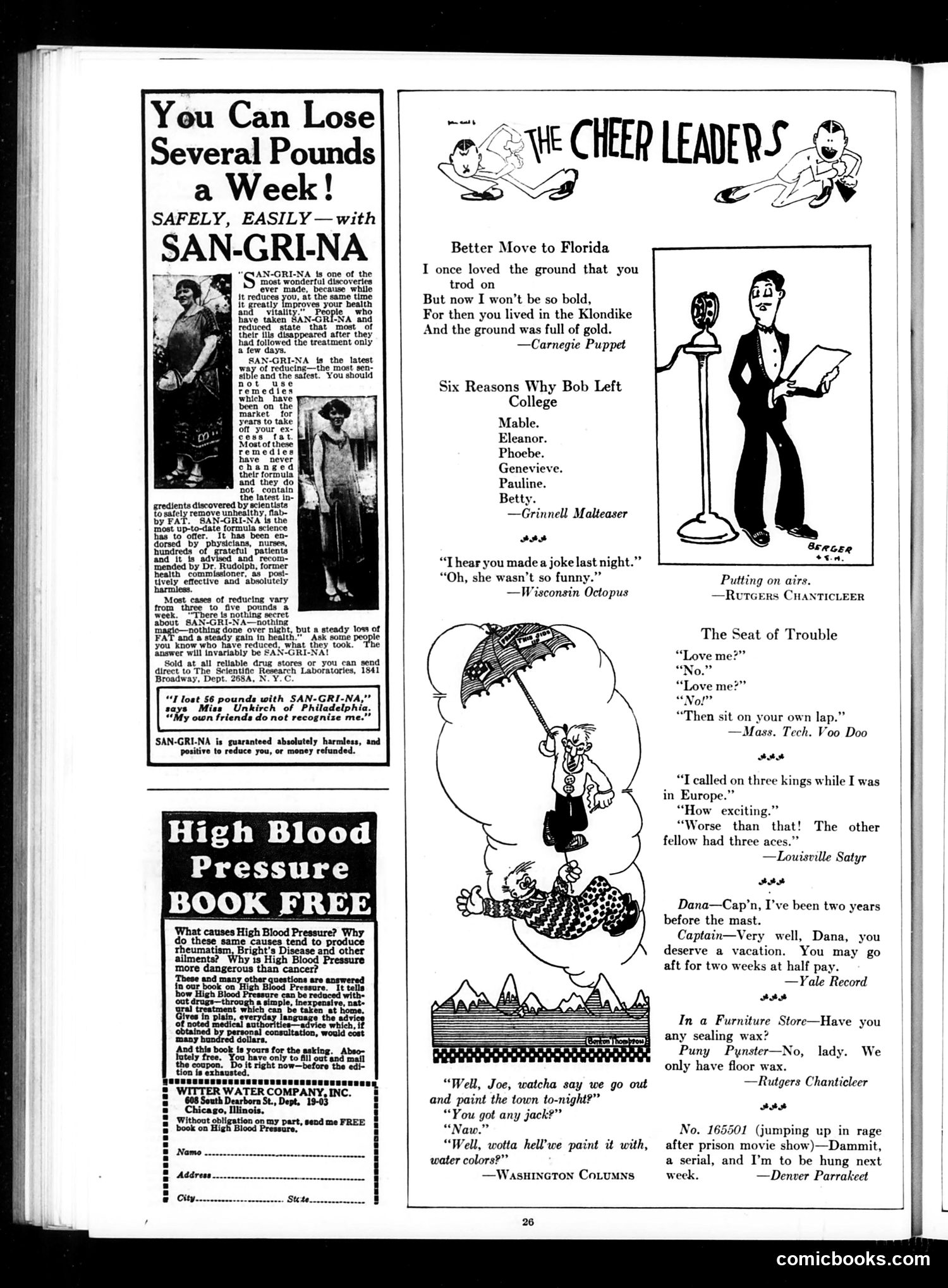
This is primarily a **advertising and humor page** from Judge magazine, mixing commercial pitches with college humor. **The main content:** The left side features advertisements for **San-Gri-Na** (a weight-loss product) and a **High Blood Pressure book**—typical early 20th-century dubious health remedies promising quick results. The right side contains **college humor submissions**—jokes contributed by students from universities like Grinnell, Wisconsin, Rutgers, and Yale. These are lighthearted one-liners about dating, relationships, and college life. For example, "Six Reasons Why Bob Left College" is simply six women's names (implying romantic entanglements caused his departure). **The satirical cartoon** shows a man in the rain under an umbrella with multiple romantic interests stacked above him—visualizing the joke about juggling relationships. The humor is mild, focused on dating mishaps and clever wordplay rather than political satire. This represents Judge's **college-aimed content**, targeting educated young readers through relatable campus life jokes.
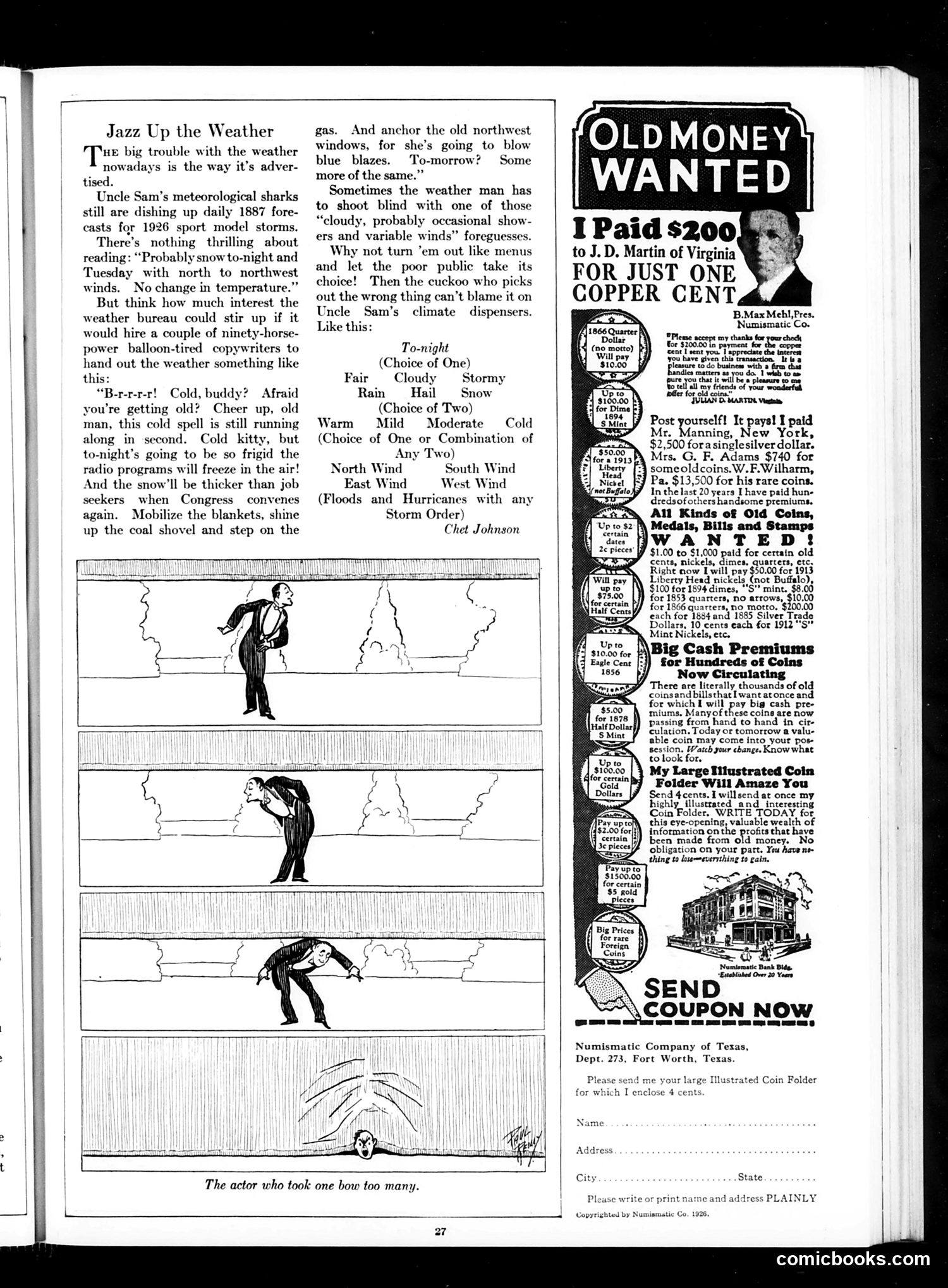
This satirical piece by Chet Johnson critiques the U.S. Weather Bureau's dull forecasting language. The author argues that meteorologists issue boring, vague predictions ("Probably snow to-night...No change in temperature") using outdated 1887 methods for 1926 conditions. The joke: Johnson proposes "jazzing up" forecasts like restaurant menus, letting the public choose weather options (Fair/Cloudy/Stormy, Rain/Hail/Snow, etc.). The accompanying cartoons show a man progressively bending and contorting, illustrating the absurdity. The political context: This reflects 1920s frustration with inefficient government bureaucracies. Weather forecasting was notoriously inaccurate, and Johnson mocks both the formal language and the bureau's inability to provide useful predictions. The satire targets institutional stiffness and advocates for more engaging, consumer-friendly public communication—a distinctly modern concern wrapped in Jazz Age humor.
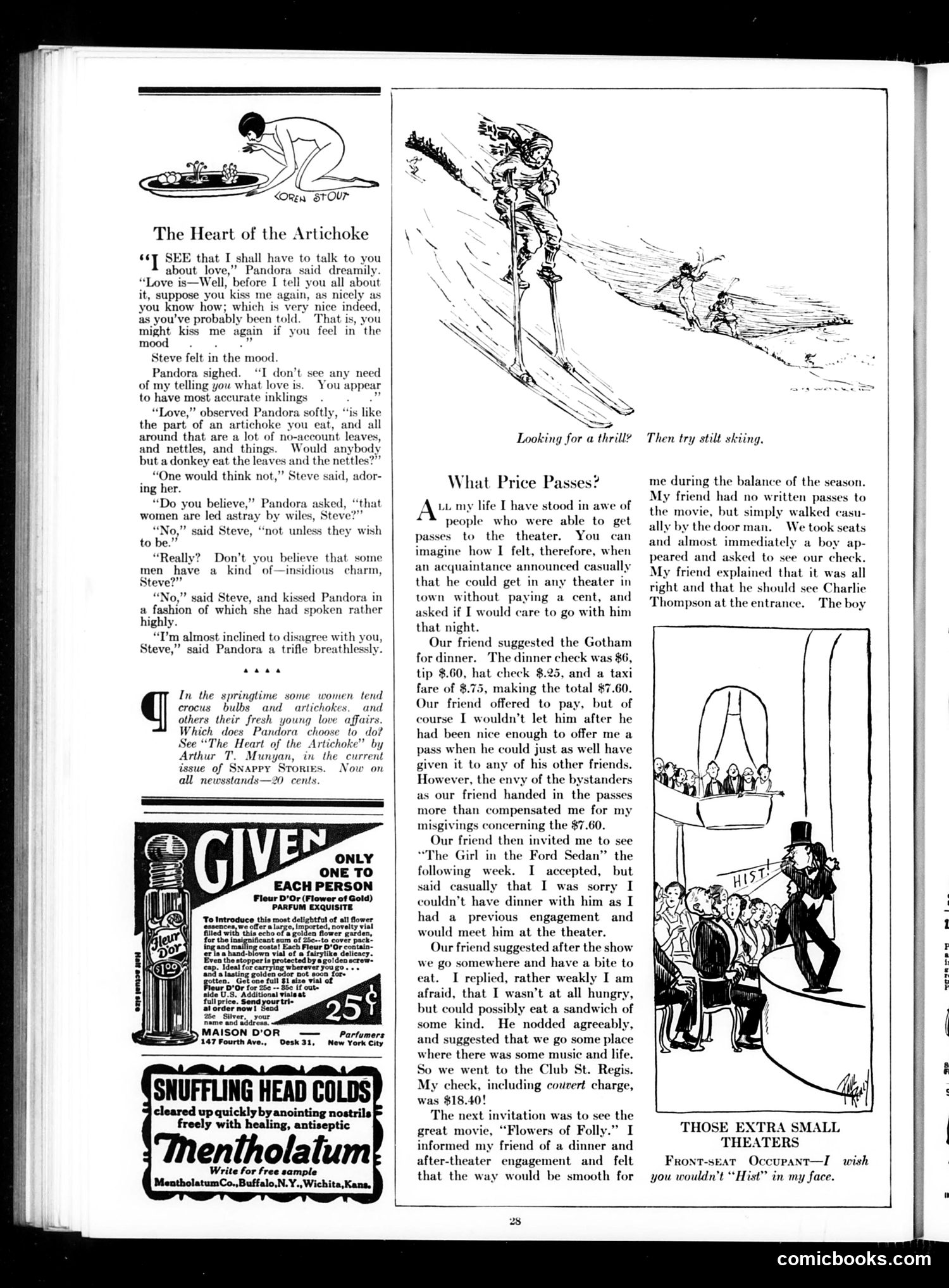
This page contains two distinct pieces: **"The Heart of the Artichoke"** (left): A romantic short-story excerpt featuring characters Steve and Pandora. The satire is gentle—Pandora uses an extended metaphor comparing love to an artichoke's edible heart surrounded by worthless leaves and nettles, humorously suggesting that romance, like dining, requires discarding the inessential to reach what matters. The piece advertises "Snappy Stories," a competing magazine. **"What Price Passes?"** (right): Social satire about theater-going etiquette and economics. The narrator's friend offers a "free" theater pass, but the narrator ends up spending $7.60 on dinner and $18.40 at a nightclub—far exceeding normal costs. The humor exposes how accepting supposedly "free" entertainment from others creates social pressure to reciprocate expenditures, ultimately making the "pass" quite expensive. It's satirizing the hidden costs of accepting favors and the performative envy of onlookers. The page also contains period advertisements (perfume, cold remedy) typical of early 20th-century magazines.
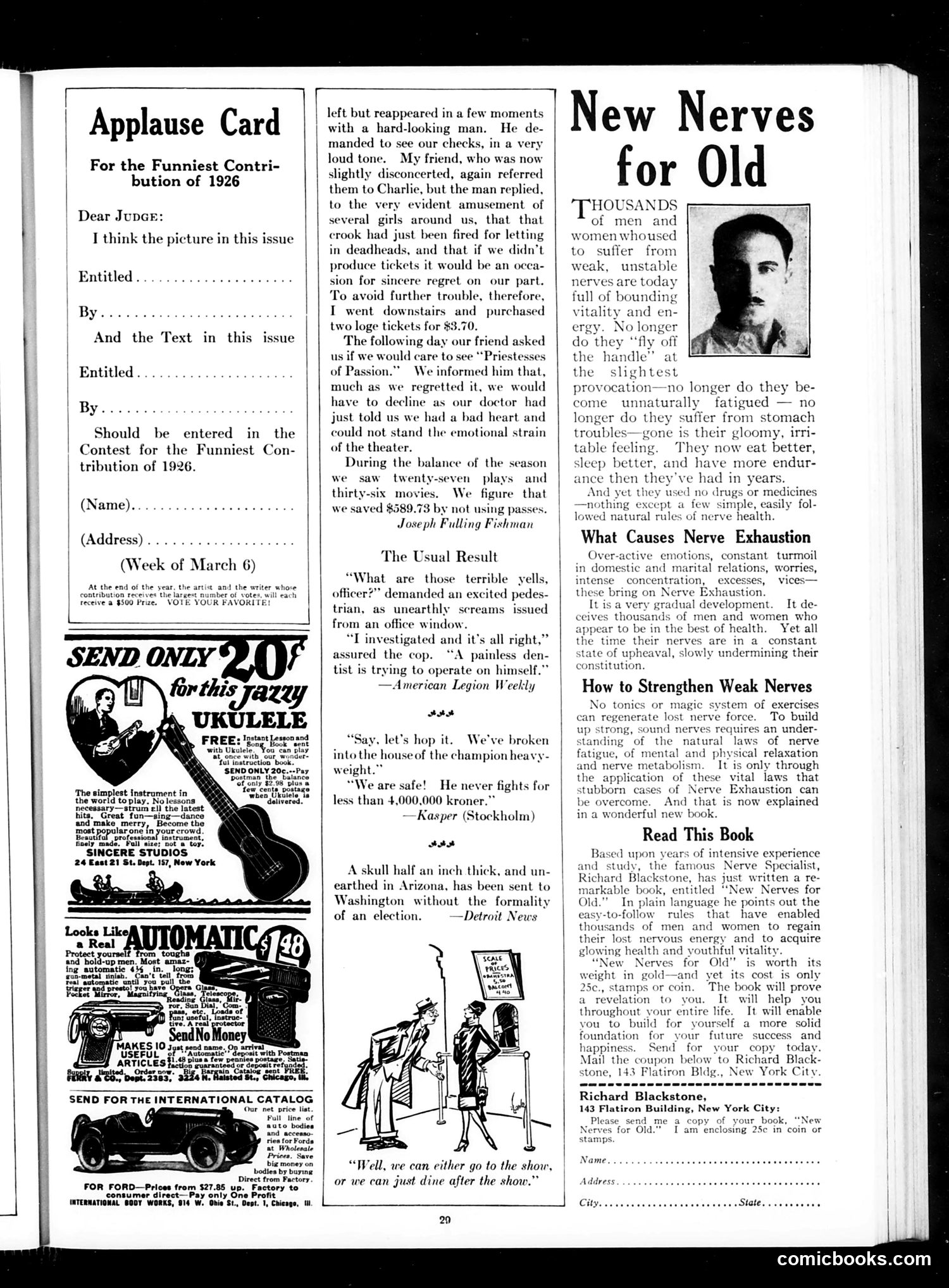
This page is primarily **advertising and reader-participation content**, not political satire. The main feature is an "Applause Card"—a voting mechanism where readers could nominate the funniest contribution and writer from that issue for a $500 prize. The page includes several **vintage advertisements**: a ukulele offer, an automobile business opportunity, and a mail-order catalog. The scattered anecdotes and jokes (about theater tickets, a dentist, a thick skull from Arizona) are typical lighthearted filler material. The substantial right-hand article, "New Nerves for Old," is **advertorial content** promoting a book by Richard Blackstone claiming to cure "nerve exhaustion" through natural methods rather than drugs—a common early-20th-century health pitch reflecting period anxieties about modern life's psychological toll. There are **no clear political cartoons or caricatures** on this page. It represents Judge's commercial side: reader engagement and product promotion rather than satirical commentary.
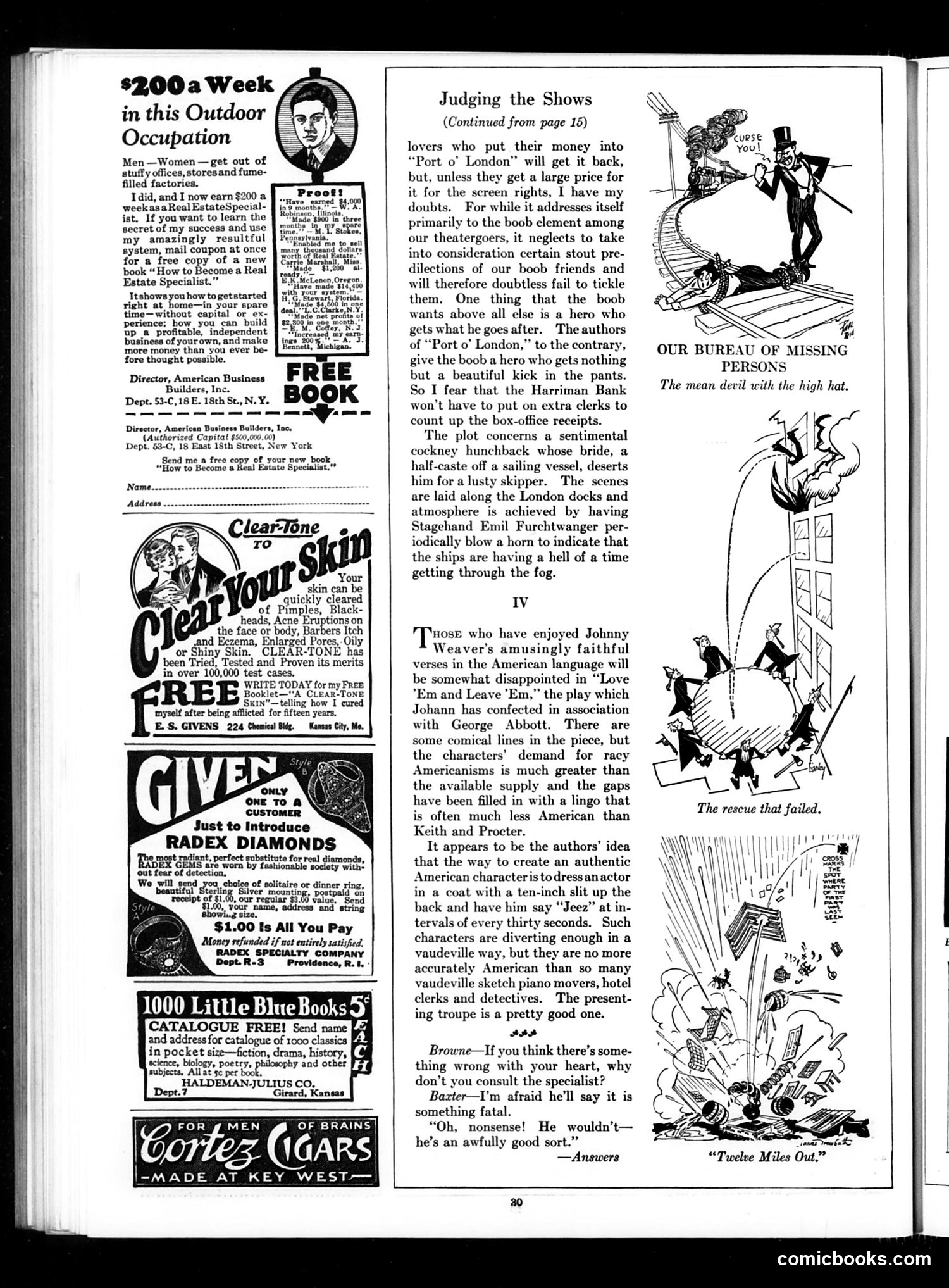
This page is primarily **advertisements** for various products and services (real estate courses, skin treatments, diamond rings, books), with a theater review column titled "Judging the Shows" occupying the right side. The review critiques two Broadway plays. "Port o' London" is dismissed as appealing only to unsophisticated audiences ("boob element"), criticizing that its protagonist fails to achieve his goals—the opposite of what common audiences want. The reviewer sarcastically notes that atmospheric effects rely on a stagehand periodically blowing a horn to simulate ships in fog. The second play, "Love 'Em and Leave 'Em" (by Johnny Weaver and George Abbott), disappoints by relying on cheap Americanisms. The satire mocks the authors' assumption that authentic American characters are created merely by dressing actors in slit-back coats and having them repeatedly say "Jeez"—a lazy, stereotypical approach to portraying working-class Americans. The cartoons ("Our Bureau of Missing Persons") appear to be humorous illustrations unrelated to the main text.
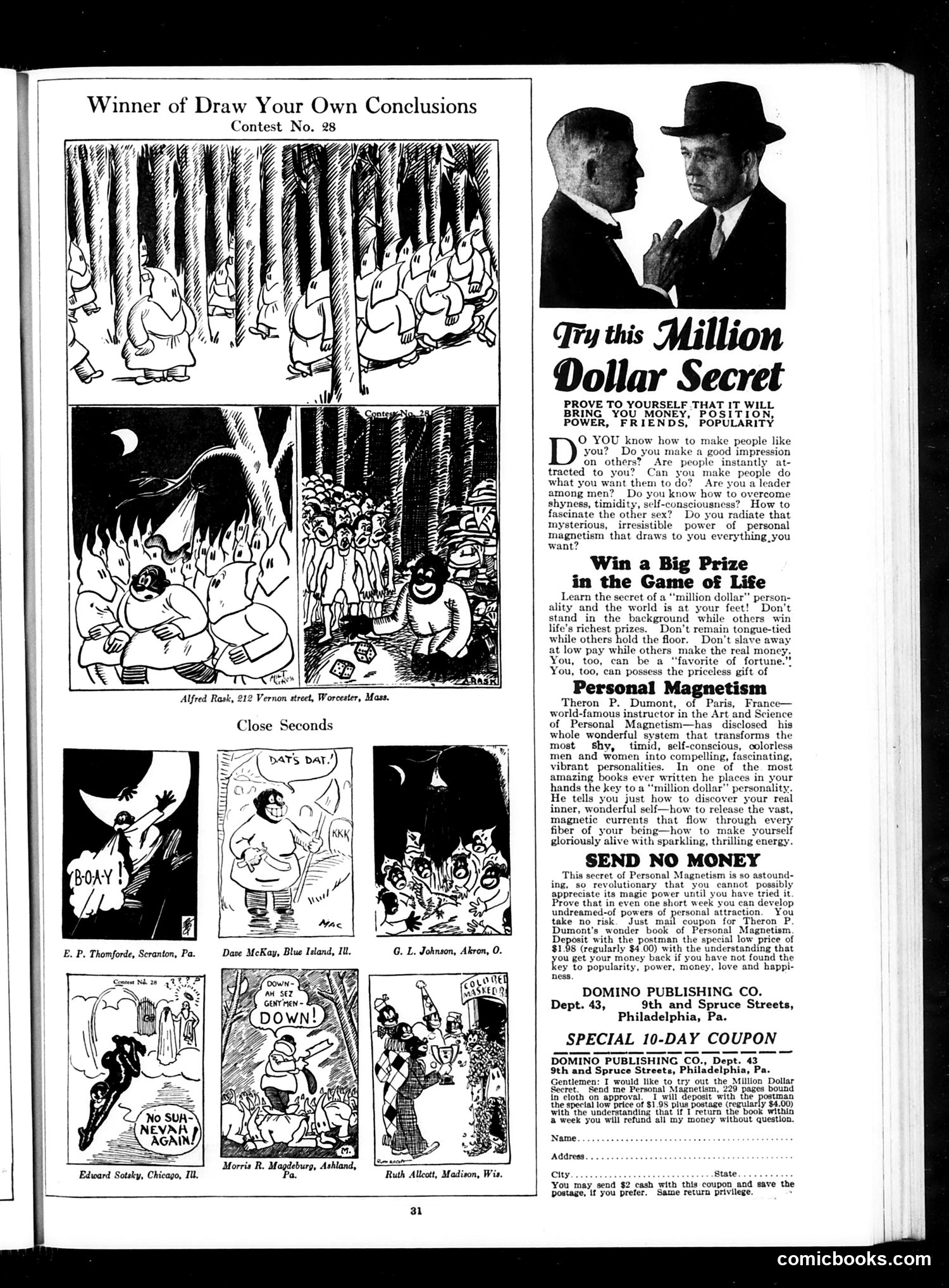
This page combines two distinct elements: a satirical cartoon contest and a period advertisement. **The Cartoon ("Draw Your Own Conclusions"):** The contest-winning comic strips by Alfred Rask depict anthropomorphic animals in various scenarios—forests, nighttime scenes, and social gatherings. Without additional context, the specific satire isn't entirely clear from the images alone, though the title suggests readers were meant to interpret the cartoons' meaning themselves, a popular Judge format. **The Advertisement:** The bulk of the page advertises a self-help book on "Personal Magnetism" by Theron P. Dumont. This reflects early 20th-century mail-order publishing culture, promoting pseudoscientific claims about developing charisma and personal power. The ads promise solutions to social anxiety, romantic success, and financial gain through mysterious "magnetic currents"—typical of period hucksterism. The "no money down" appeal and satisfaction guarantee were common sales tactics targeting insecure readers seeking self-improvement. This represents Judge's dual function: satire alongside commercial revenue.
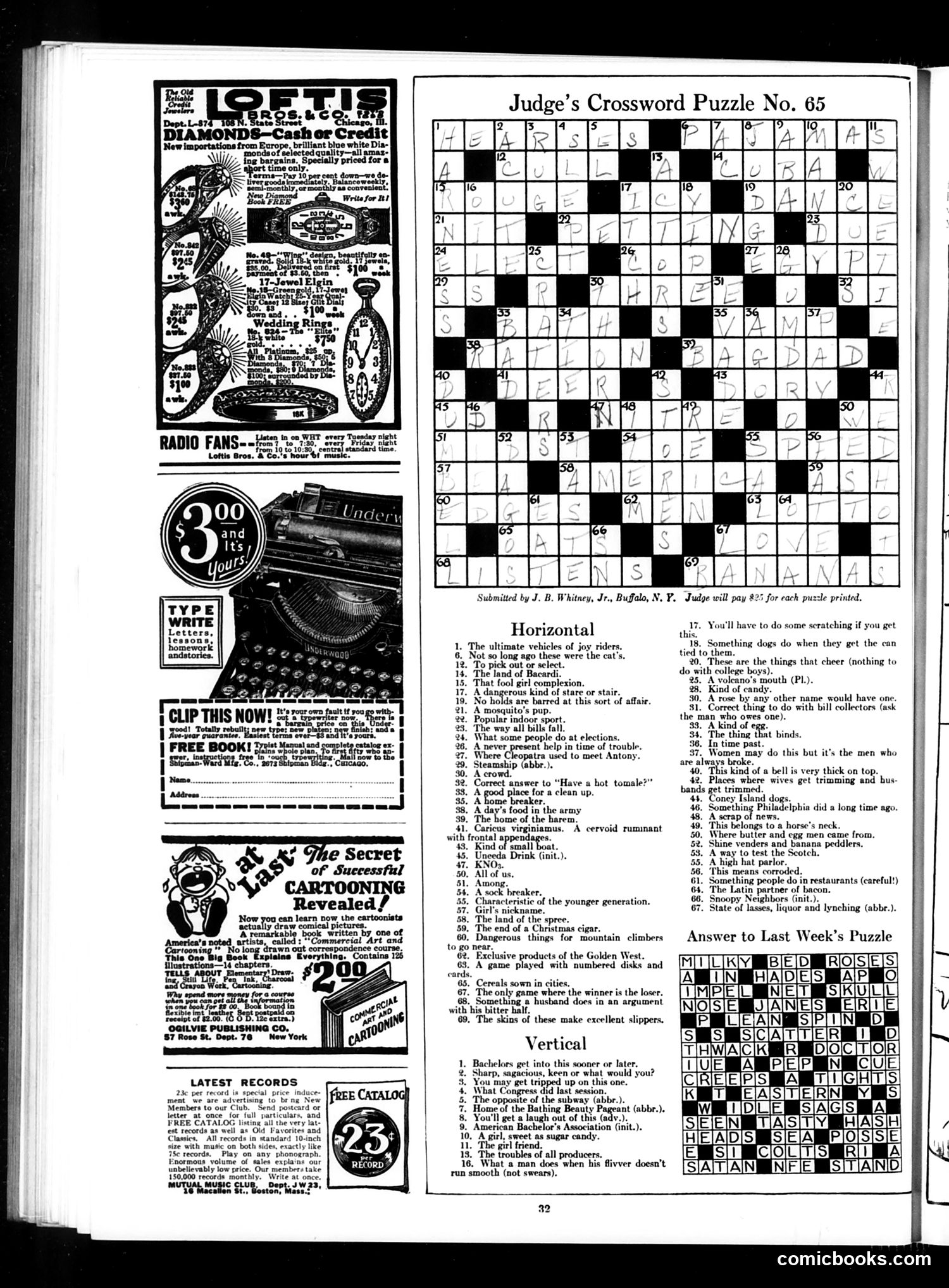
This page is primarily a **crossword puzzle** ("Judge's Crossword Puzzle No. 65") with advertising and other magazine content surrounding it. The clues reflect 1920s social attitudes and slang. References include "joy riders" (young people in automobiles—a contemporary moral concern), "the cat's meow" (fashionable slang), Prohibition-era references ("land of Bacardi," "land of the spree"), and period-specific humor about "flivvers" (Model T Fords) and "bill collectors." The surrounding advertisements promote a cartooning correspondence course and phonograph records—typical 1920s commercial products. The tone throughout is light and humorous rather than overtly political satire. The "Answer to Last Week's Puzzle" grid shown uses typical crossword answers of the era. Overall, this represents Judge magazine's format: mixing puzzles, light humor, and advertising for middle-class readers seeking entertainment during the Jazz Age.
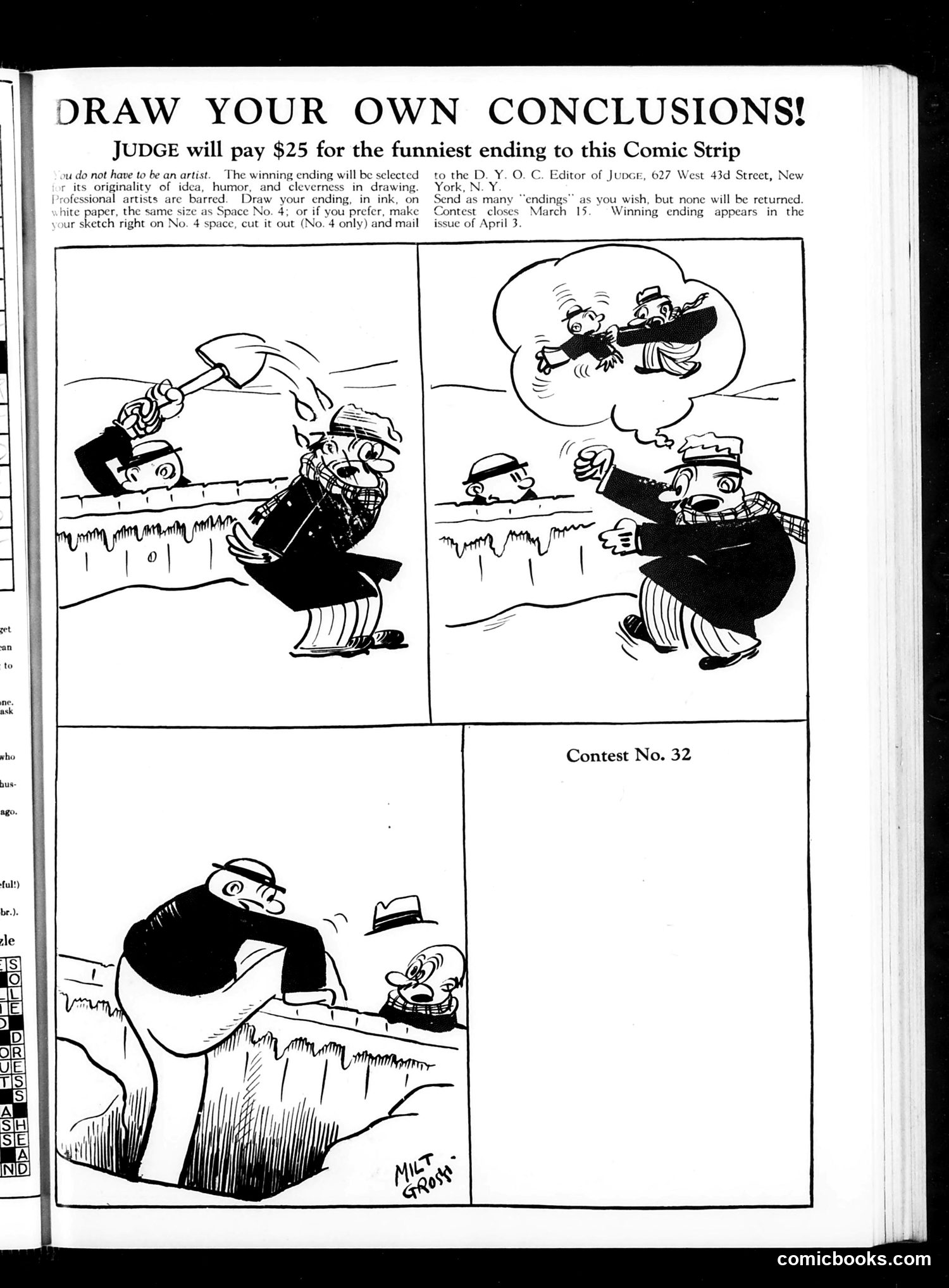
This is a reader-participation contest from *Judge* magazine. The incomplete comic strip shows two men in suits and hats (appearing to be early 20th-century businessmen or politicians) engaged in some kind of confrontation or negotiation over what looks like a fence or barrier. The first three panels establish a scenario—likely involving a dispute, deal, or comedic misunderstanding—but the final panel is blank, inviting readers to supply their own humorous ending. The $25 prize (substantial for the era) incentivized participation from non-professionals. The satire likely targets contemporary business practices, labor disputes, or political dealings, though without knowing the specific historical moment or recognizing the caricatured figures, the precise reference remains unclear. The appeal to readers' sense of humor suggests social commentary on recognizable types or situations of the period.
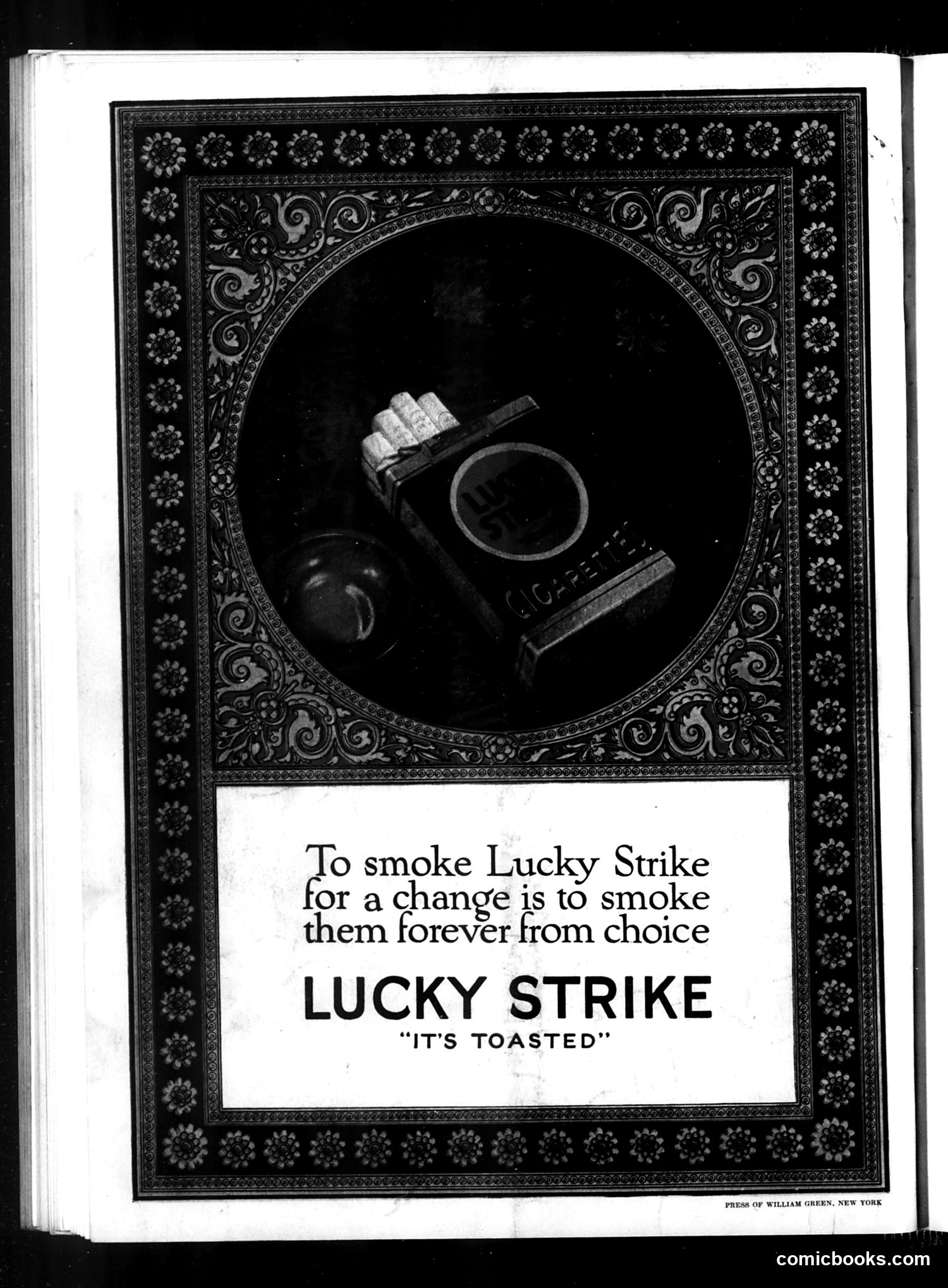
This is a Lucky Strike cigarette advertisement rather than political satire. The ad employs a persuasive marketing strategy common in early-to-mid 20th century tobacco advertising, using the slogan "It's Toasted" as a selling point. The ornate decorative frame suggests luxury and quality. The copyline plays on addiction psychology: smoking Lucky Strikes "for a change" will make you smoke them "forever from choice"—essentially admitting that trying the brand leads to habitual use. By 1920s-1940s advertising standards, this was presented as a positive attribute rather than a warning. The image shows smoking implements arranged formally, emphasizing the product's appeal to consumers of that era, before health warnings became mandatory and cigarette marketing faced significant restrictions.