
Judge, 1926-03-06 · page 15 of 36
Judge — March 6, 1926 — page 15: what you’re looking at
What you’re looking at
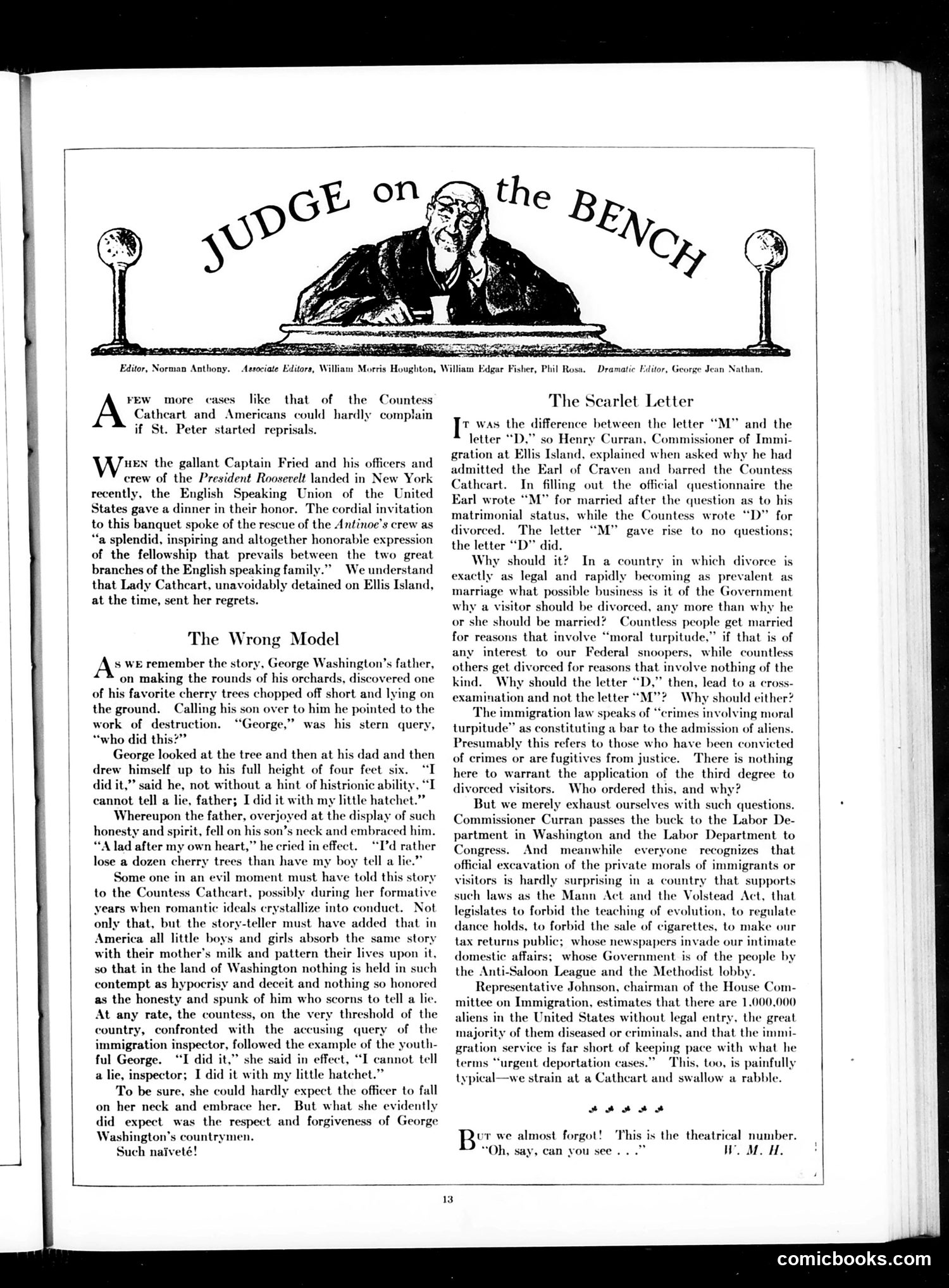
This page satirizes the hypocrisy of American immigration policy in the early 20th century. The main targets are: **"The Wrong Model"**: Mocks the Countess Cathcart, a British noblewoman detained at Ellis Island after honestly admitting to immigration inspectors that she'd hidden assets (following the George Washington cherry-tree honesty lesson). The satire criticizes Americans for idealizing honesty in principle while punishing it in practice—she expected respect for truthfulness but faced suspicion instead. **"The Scarlet Letter"**: Attacks Commissioner Henry Curran's arbitrary decision to admit the Earl of Craven (marked "M" for married) while barring Countess Cathcart (marked "D" for divorced). The piece questions why divorce—legal and increasingly common—should disqualify visitors, when the government has no legitimate interest in visitors' marital status. The satire exposes selective enforcement and moral judgment masked as bureaucratic procedure. Both articles highlight American pretension: preaching virtue while practicing discrimination.
📄 Transcribed text from this page (OCR, searchable)
Machine-transcribed from the original scan — historical spelling and the odd misread are preserved.
Editor, Norman Anthony. FEW more cases like that of the Countess Catheart and Americans could hardly complain if St. Peter started reprisals, N the gallant Captain Fried and his officers and crew of the President Roosevelt landed in New York recently, the English Speaking Union of the United States gave a dinner in their honor. The cordial invitation to this banquet spoke of the rescue of the Antinoe’s crew as iring and altogether honorable expression of the fellowship that prevails between the two great branches of the English speaking family.” We understand that Lady Cathcart, unavoidably detained on Ellis Island, at the time, sent her regrets. The Wrong Model AS WE remember the story, George Washington’s father, on making the rounds of his orchards, discovered one of his favorite cherry trees chopped off short and lying on the ground. Calling his son over to him he pointed to the work of destruction. “George,” was his stern “who did this?” George looked at the tree and then at his dad and then drew himself up to his full height of four feet six. “I did it,” said he, not without a hint of histrionic ability, “ cannot tell a lie, father; I did it with my little hatchet. Whereupon the father, overjoyed at the display of such honesty and spirit, fell on his son’s neck and embraced him. “A lad after my own heart,” he cried in effect. “I'd rather lose a dozen cherry trees than have my boy tell a lie.” Some one in an evil moment must have told this story to the Countess Cathcart, possibly during her formative years when romantic ideals ¢ allize into conduct. Not only that, but the story-teller must have added that in America all little boys and girls absorb the same story with their mother’s milk and pattern their lives upon it, so that in the land of Washington nothing is held in such contempt as hypocrisy and deceit and nothing so honored as the honesty and spunk of him who scorns to tell a lie. At any rate, the countess, on the very threshold of the country, confronted with the accusing query of the immigration inspector, followed the example of the youth- ful George. “‘I did it,” she said in effect, “I cannot tell a lie, inspector; I did it with my little hatchet.” To be sure, she could hardly expect the officer to fall on her neck and embrace her. But what she evidently did expect was the respect and forgiveness of George Washington’s countrymen. Such naiveté! query, Associate Editors, William Morris Houghton, William Edgar Fisher, Phil Rosa, Dramatic Editor, George Jean Nathan, The Scarlet Letter I" was the difference between the letter “M” and the letter “D,”” so Henry Curran, Commissioner of Immi- gration at Ellis Island, explained when asked why he had admitted the Earl of Craven and barred the Countess Cathcart. In filling out the official questionnaire the Earl wrote “M” for married after the question as to his matrimonial status, while the Countess wrote “D” for divorced. The letter “M” gave rise to no questions: the letter “D” did. Why should it? In a country in which divorce is exactly as legal and rapidly becoming as prevalent as marriage what possible business is it of the Government why a visitor should be divorced, any more than why he or she should be married? for reasons that involve * Countless people get married ‘moral turpitude,” if that is of any interest to our Federal snoopers, while countless others get divorced for reasons that involve nothing of the kind. Why should the letter “D,” then, lead to a cross- examination and not the letter “M”? Why should either? The immigration law speaks of “crimes involving moral turpitude” as constituting a bar to the admission of aliens. Presumably this refers to those who have been convicted of crimes or are fugitives from justice. There is nothing here to warrant the application of the third degree to divorced visitors. Who ordered this, and why? But we merely exhaust ourselves with such questions. Commissioner Curran passes the buck to the Labor De- partment in Washington and the Labor Department to Congress. And meanwhile everyone recognizes that official excavation of the private morals of immigrants or visitors is hardly surprising in a country that supports such laws as the Mann Act and the Volstead Act, that legislates to forbid the teaching of evolution, to regulate dance holds, to forbid the sale of cigarettes, to make our tax returns public; whose newspapers invade our intimate domestic affairs; whose Government is of the people by the Anti-Saloon League and the Methodist lobby. Representative Johnson, chairman of the House Com- mittee on Immigration, estimates that there are 1,000,000 aliens in the United States without legal entry, the great majority of them diseased or criminals, and that the immi- gration service is far short of keeping pace with what he terms “urgent deportation cases.” This, too, is painfully typical—we strain at a Cathcart and swallow a rabble. tae ae B ‘tt we almost forgot! “Oh, say, can you see... This is the theatrical number. ” W.M.H. comicbooks.com