
Judge, 1926-03-06 · page 17 of 36
Judge — March 6, 1926 — page 17: what you’re looking at
What you’re looking at
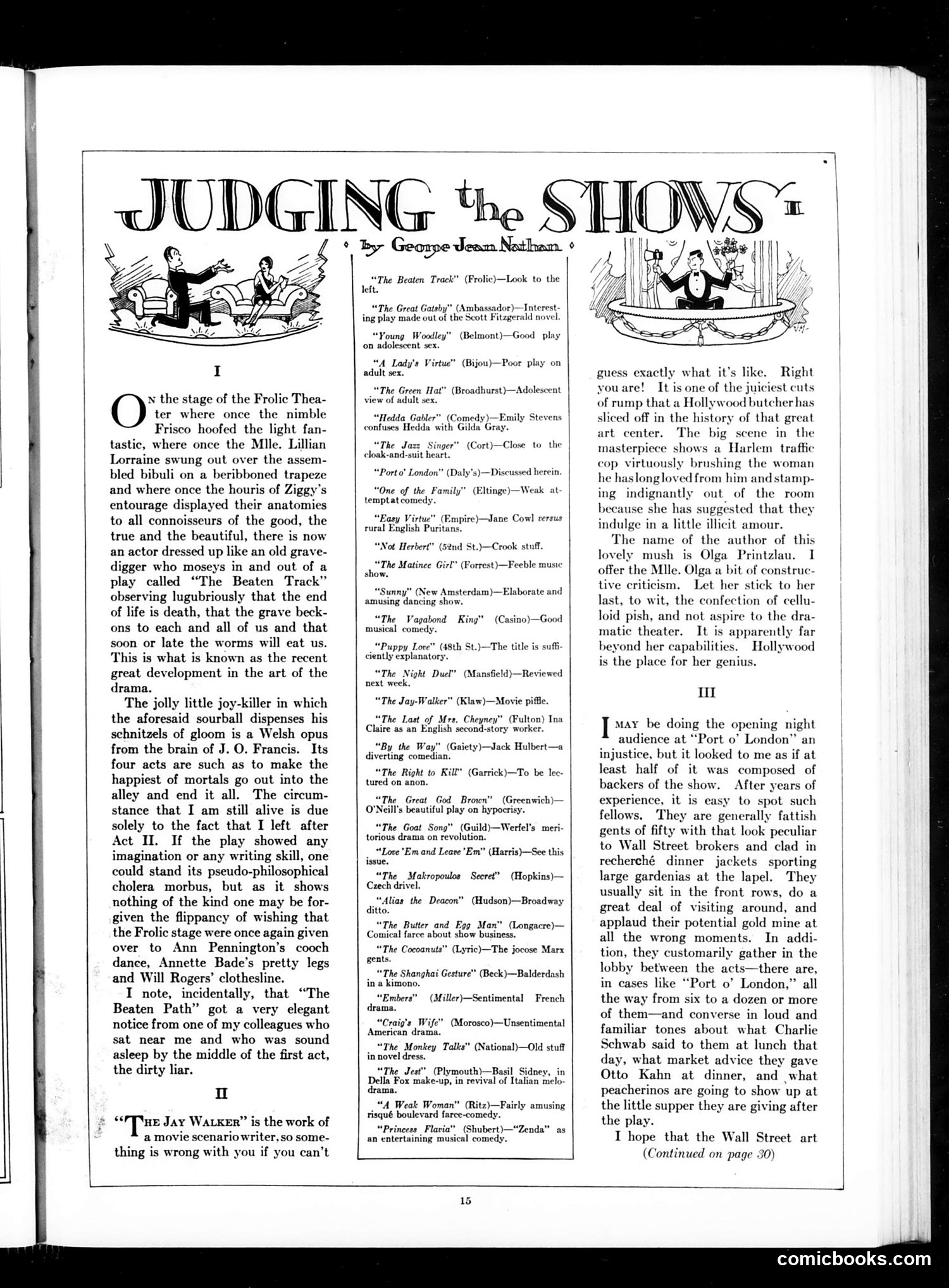
This is a theater review column by George Jean Nathan, a prominent drama critic. The main article mocks "The Beaten Track," a Welsh play then running at the Frolic Theater. Nathan sarcastically attacks it as pretentious gloom-mongering—a "joy-killer" about death and decay that makes no theatrical contribution. He contrasts it bitterly with the Frolic's former glamorous variety acts (Mlle. Lillian Lorraine, Ann Pennington), suggesting serious drama has replaced spectacle without merit. Nathan also complains that a colleague who slept through Act I nonetheless praised the play—calling him a "dirty liar." The right column lists current Broadway productions with brief, caustic verdicts: "The Great Gatsby" (interesting), "Young Woodley" (good adolescent sex play), "Not Herbert" (crook stuff), etc. This represents Nathan's influential but acerbic theater criticism from the Jazz Age era.
📄 Transcribed text from this page (OCR, searchable)
Machine-transcribed from the original scan — historical spelling and the odd misread are preserved.
v the stage of the Frolic Thea- ter where once the nimble Frisco hoofed the light fan- tastic, where once the Mlle. Lillian Lorraine swung out over the assem- bled bibuli on a beribboned trapeze and where once the houris of Ziggy’s entourage displayed their anatomies to all connoisseurs of the good, the true and the beautiful, there is now an actor dressed up like an old grave- digger who moseys in and out of a play called “The Beaten Track” observing lugubriously that the end of life is death, that the grave beck- ons to each and all of us and that soon or late the worms will eat us. This is what is known as the recent great development in the art of the drama. The jolly little joy-killer in which the aforesaid sourball dispenses his schnitzels of gloom is a Welsh opus from the brain of J. O. Francis. Its four acts are such as to make the happiest of mortals go out into the alley and end it all. The circum- stance that I am still alive is due solely to the fact that I left after Act II. If the play showed any imagination or any writing skill, one could stand its pseudo-philosophical cholera morbus, but as it shows nothing of the kind one may be for- given the flippancy of wishing that the Frolic stage were once again given over to Ann Pennington’s cooch dance, Annette Bade’s pretty legs and Will Rogers’ clothesline. I note, incidentally, that “The Beaten Path” got a very elegant notice from one of my colleagues who sat near me and who was sound asleep by the middle of the first act, the dirty liar. 0 SS I YE Jay WALKER” is the work of a movie scenariowriter,so some- thing is wrong with you if you can’t “The Beaten Track” (Frolic)\—Look to the deft. “The Great Gatsby” (Ambassador)—Interest- ing play made out of the Scott Fitzgerald novel. “Young Woodley” (Belmont)—Good play on adolescent sex. “4 Lady's Virtue” (Bijou)—Poor play on adult sex. “The Green Hat” (Broadhurst)—Adolescent view of adult sex. “Hedda Gabler” (Comedy)—Emily Stevens confuses Hedda with Gilda Gray. “The Jazz Singer” (Cort)—Close to the cloak-and- art. “Port o' London" (Di “One of the Family” (Eltinge)—Weak at temptat comedy. “Easy Virtue” (Empire)—Jane Cowl rersus rural English Puritans. “Not Herbert” (52nd St.)—Crook stuff. “The Matince Girl” (Forrest)—Feeble music show. “Sunny” (New Amsterdam)—Elaborate and amusing dancing show. “The Vagabond King” (Casino)—Good musical comedy. “Puppy Lore” (48th St.)—The title is suff ciently explanate “The Night Duel” (Mansfield)—Reviewed next week. “The Jay-Walker” (Klaw)—Movie piffie. “The Last of Mrs. Cheyney"” (Fulton) Ina Claire as an English second-story worker. “By the Way” (Gaiety)—Jack Hulbert—a diverting comedian. “The Right to Kill" (Garrick)—To be lec- tured on anon. “The Great God Brown" (Greenwich)— O'Neill's beautiful play on hypocrisy. “The Goat Song” (Guild)—Werfel’s meri- torious drama on revolution. _ “Love'Em and Leave "Em" (Harris)}—See this issue. “The Makropoulos Secret” (Hopkins)— Czech drivel. “Alias the Deacon” (Hudson)—Broadway jitto. The Butter and Egg Man” (Longacre)— Comical farce about show business. “The Cocoanuts” (Lytic)—The jocose Marx gents, “The Shanghai Gesture” (Beck)—Balderdash in a kimono. “Embers” (Miller)—Sentimental French drama. “Craig's Wife” (Morosco)—Unsentimental American drama. The Monkey Talks” (National)—Old stuf in novel dress. “The Jest” (Plymouth)—Basil Sidney, in Delia Fox make-up, in revival of Italian melo- ama. “A Weak Woman” (Ritz)—Fairly amusing risqué boulevard farce-comedy. “Princess Flavia” (Shubert)—“Zenda” as an entertaining m | comedy. )—Discussed herein. | guess exactly what it’s like. Right youare! It is one of the juiciest cuts of rump that a Hollywood butcher has sliced off in the history of that great art center. The big scene in the masterpiece shows a Harlem. traffic cop virtuously brushing the woman he haslongloved from him andstamp- ing indignantly out of the room because she has suggested that they indulge in a little illicit amour. The name of the author of this lovely mush is Olga Printzlau. 1 offer the Mlle. Olga a bit of construc- tive criticism. Let her stick to her last, to wit, the confection of cellu- loid pish, and not aspire to the dra- matic theater. It is apparently far beyond her capabilities. Hollywood is the place for her genius. Il I may be doing the opening night audience at “Port o’ London” an injustice, but it looked to me as if at least half of it was composed of backers of the show. After years of experience, it is easy to spot such fellows. They are generally fattish gents of fifty with that look peculiar to Wall Street brokers and clad in recherché dinner jackets sporting large gardenias at the lapel. They usually sit in the front rows, do a great deal of visiting around, and applaud their potential gold mine at all the wrong moments. In addi- tion, they customarily gather in the lobby between the acts—there are, in cases like “Port 0’ London,” all the way from six to a dozen or more of them—and converse in loud and familiar tones about what Charlie Schwab said to them at lunch that day, what market advice they gave Otto Kahn at dinner, and what peacherinos are going to show up at the little supper they are giving after the play. I hope that the Wall Street art (Continued on page 30) comicbooks.com