
A complete issue · 36 pages · 1926
Judge — February 20, 1926
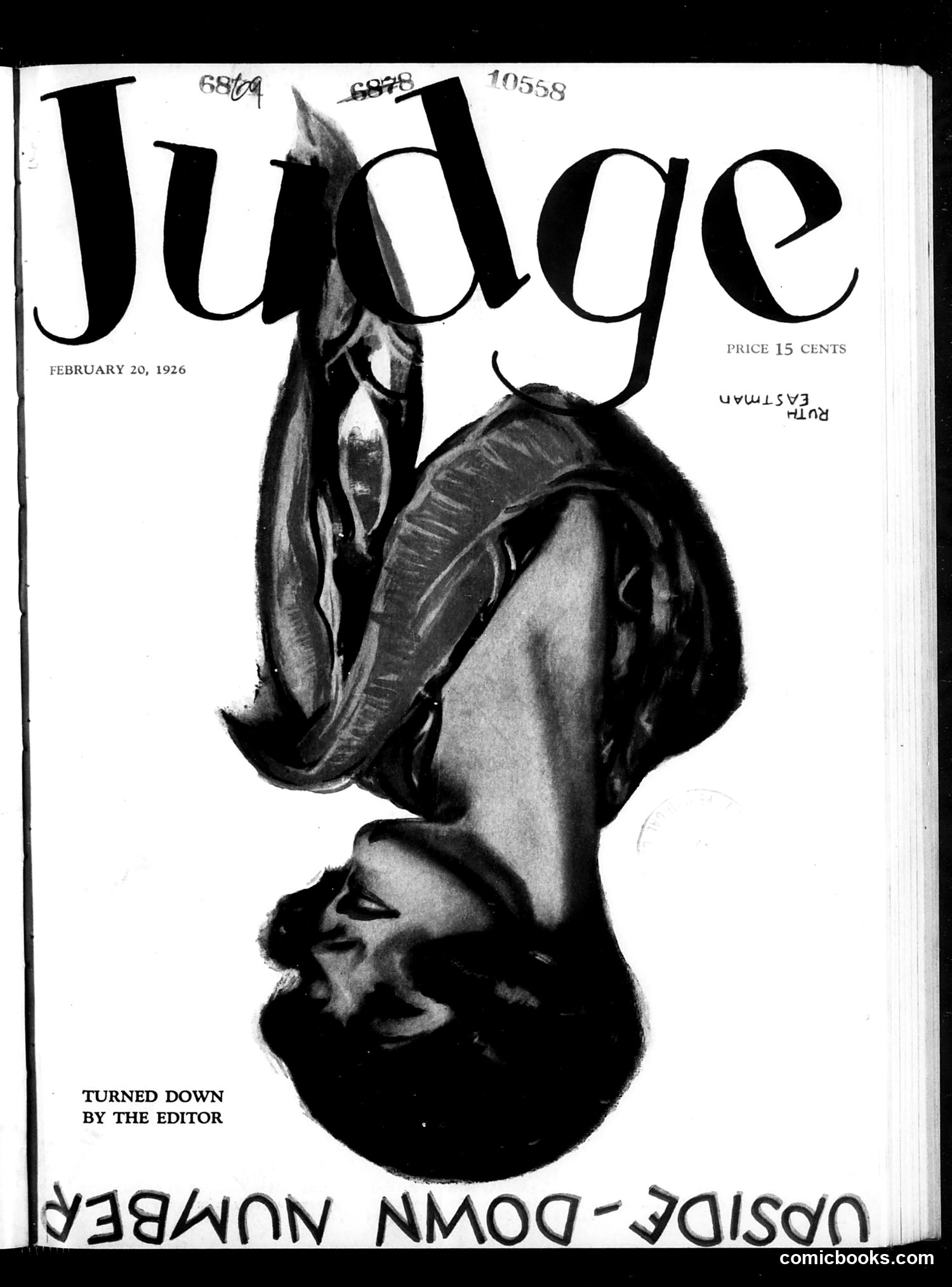
**Date & Publication:** February 20, 1926 issue of Judge magazine (15 cents) **The Image:** A stylized portrait of a person's head shown upside-down, wearing what appears to be 1920s fashion including a hat or headpiece. **The Notation:** "TURNED DOWN BY THE EDITOR" appears at bottom left, and "UNSOLICITED—DOOMED—NUNNERY" is printed upside-down at the bottom. **The Satire:** This appears to be a self-referential joke by Judge's editors about rejected submissions or proposals. The upside-down presentation combined with the "turned down" caption suggests mockery of rejected manuscript illustrations or comic contributions. The cryptic bottom text may reference editorial decisions or rejected story concepts, though the exact meaning remains unclear without additional context about Judge's 1926 operations.
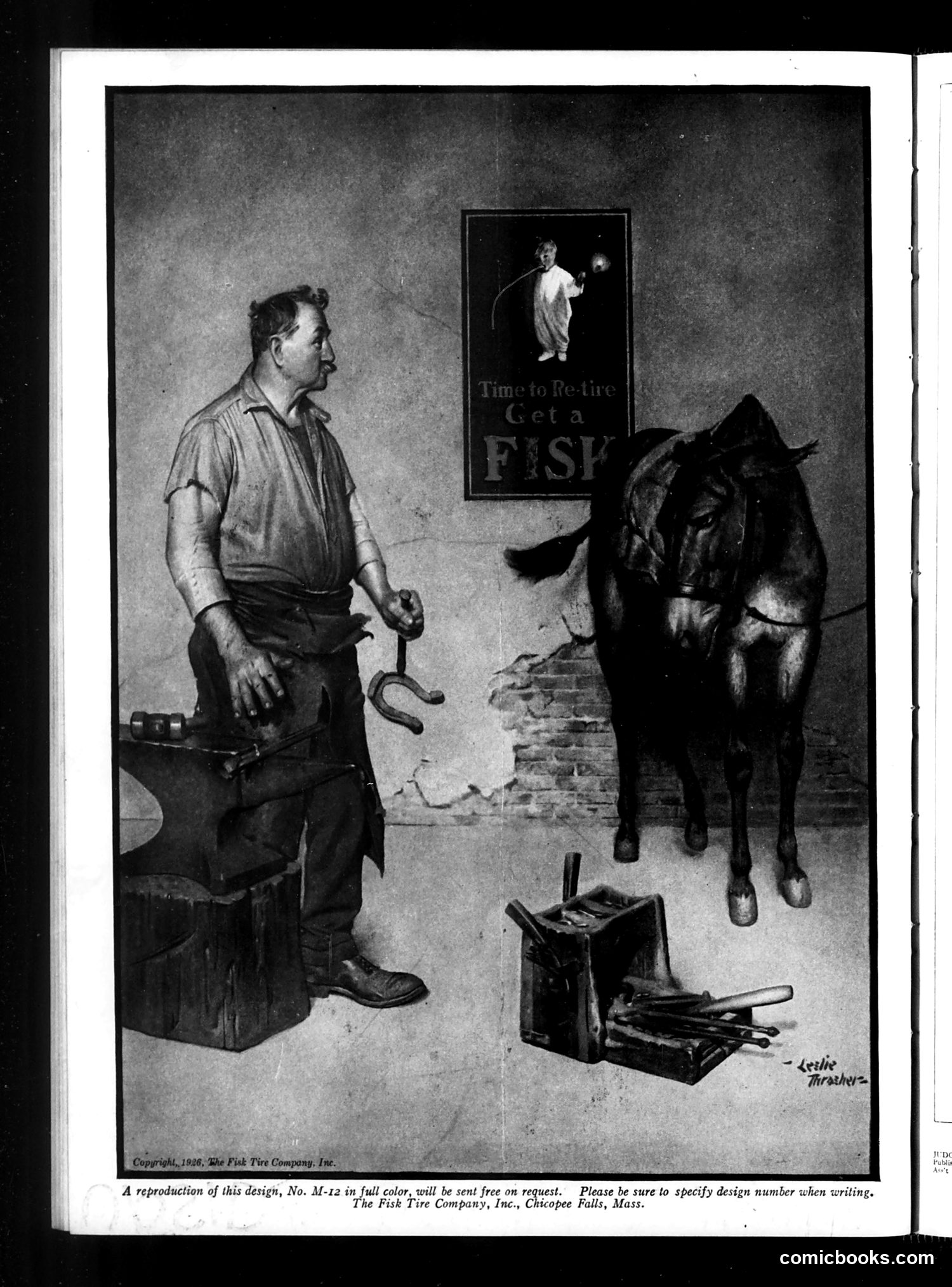
This is primarily a **Fish Tire Company advertisement** from 1936, not political satire. The image shows a blacksmith or farrier at work, holding a horseshoe while a horse stands nearby. A poster on the wall reads "Time to Re-tire—Get a FISH" (a pun on tire replacement). The humor is straightforward commercial wordplay: "re-tire" applies both to horseshoes (the blacksmith's traditional work) and vehicle tires (the advertiser's product). The advertisement positions Fish tires as the modern alternative to old-fashioned blacksmith labor, suggesting progress and convenience for motorists. The signature appears to be "Leslie Arrowsmith," the artist. This represents typical 1930s advertising strategy using visual puns in popular magazines.
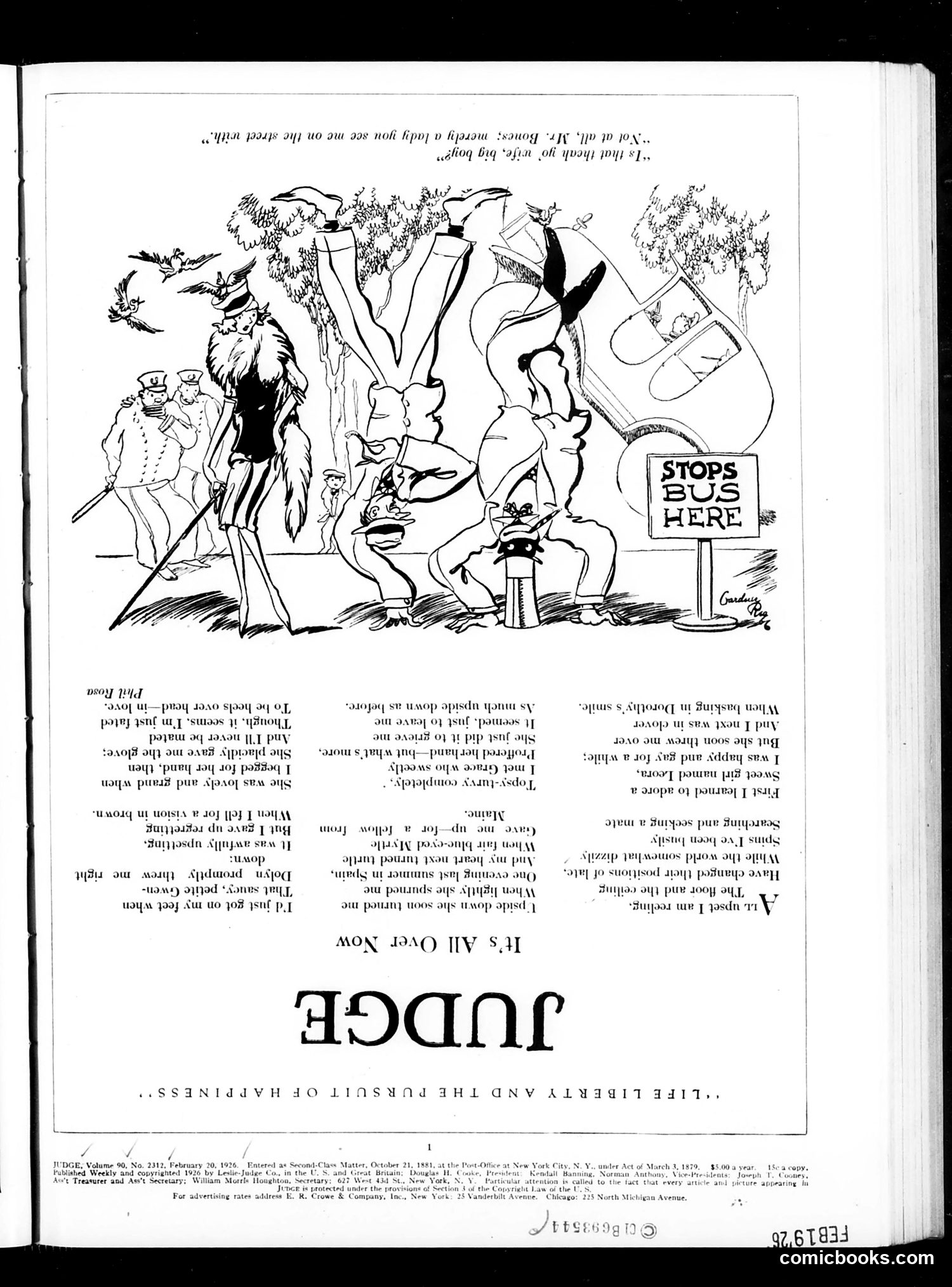
This appears to be a satirical cartoon mocking bus transportation and passenger behavior. The illustration shows exaggerated figures contorted in uncomfortable positions while boarding or riding a bus, with a "STOPS BUS HERE" sign visible. The cartoon satirizes the cramped, undignified nature of public bus travel—passengers are depicted with grotesque body distortions to emphasize discomfort and loss of dignity. The accompanying text (though difficult to read clearly in the OCR) likely comments on urban transportation problems and the indignities suffered by commuters. The cartoonist's signature appears present. This reflects early-20th-century *Judge* magazine's typical focus on social satire regarding modern urban life and its inconveniences.
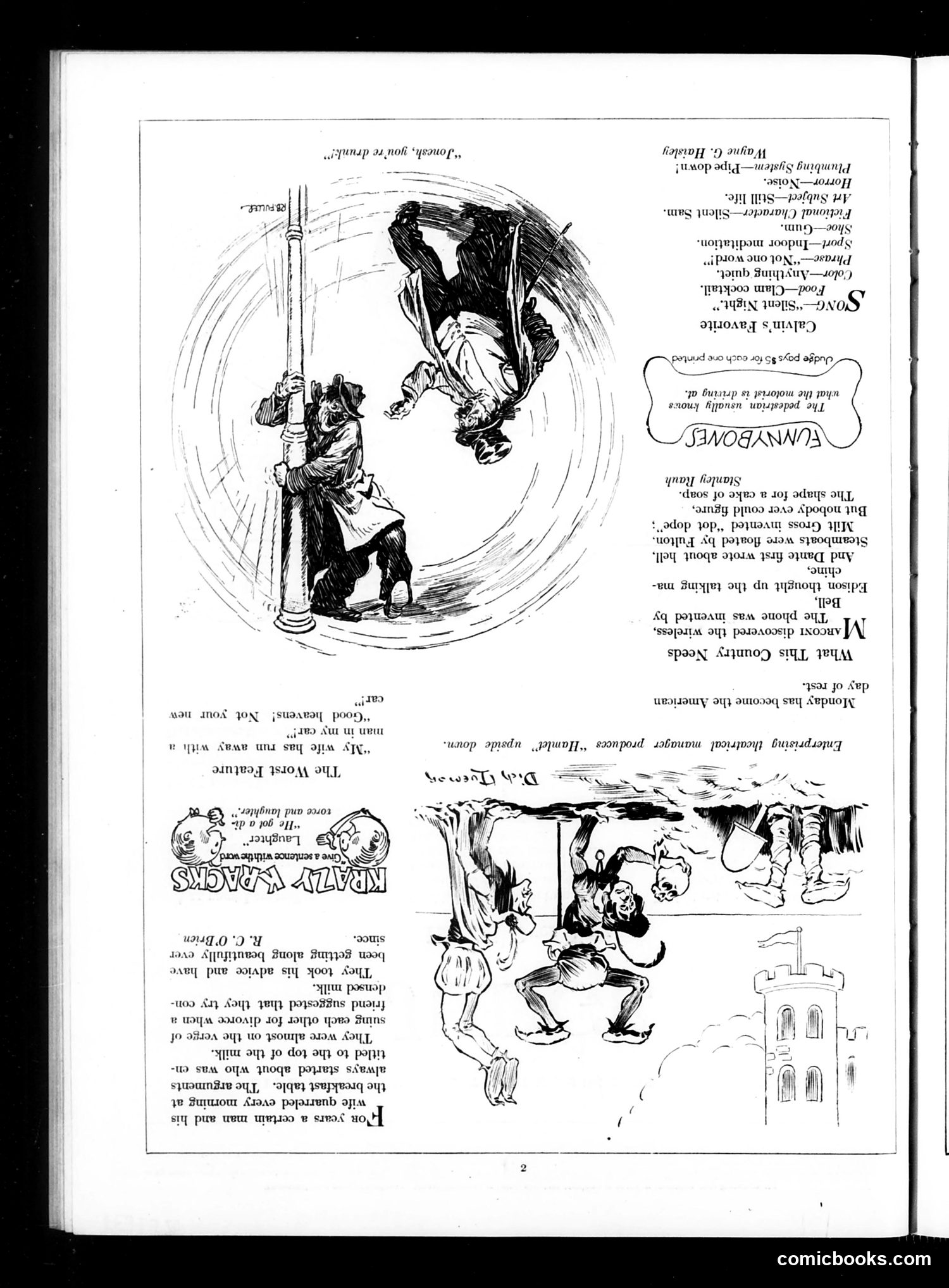
This appears to be a satirical page from Judge magazine, though the OCR text is heavily reversed/corrupted and largely illegible, making precise interpretation difficult. The visible illustrations include: - A central circular vignette showing figures around a pole (possibly political commentary on power or leadership) - A "Nursery Rhymes" section with cartoon characters - Street-level scenes with figures in apparent distress or comic situations - A tower or building structure Without reliable text, I cannot definitively identify the specific political figures, events, or satirical targets. The style and composition suggest early-20th-century American political satire, but claiming specific meanings would require legible source material. The page appears to mix political commentary with humorous domestic scenes typical of Judge's editorial approach.
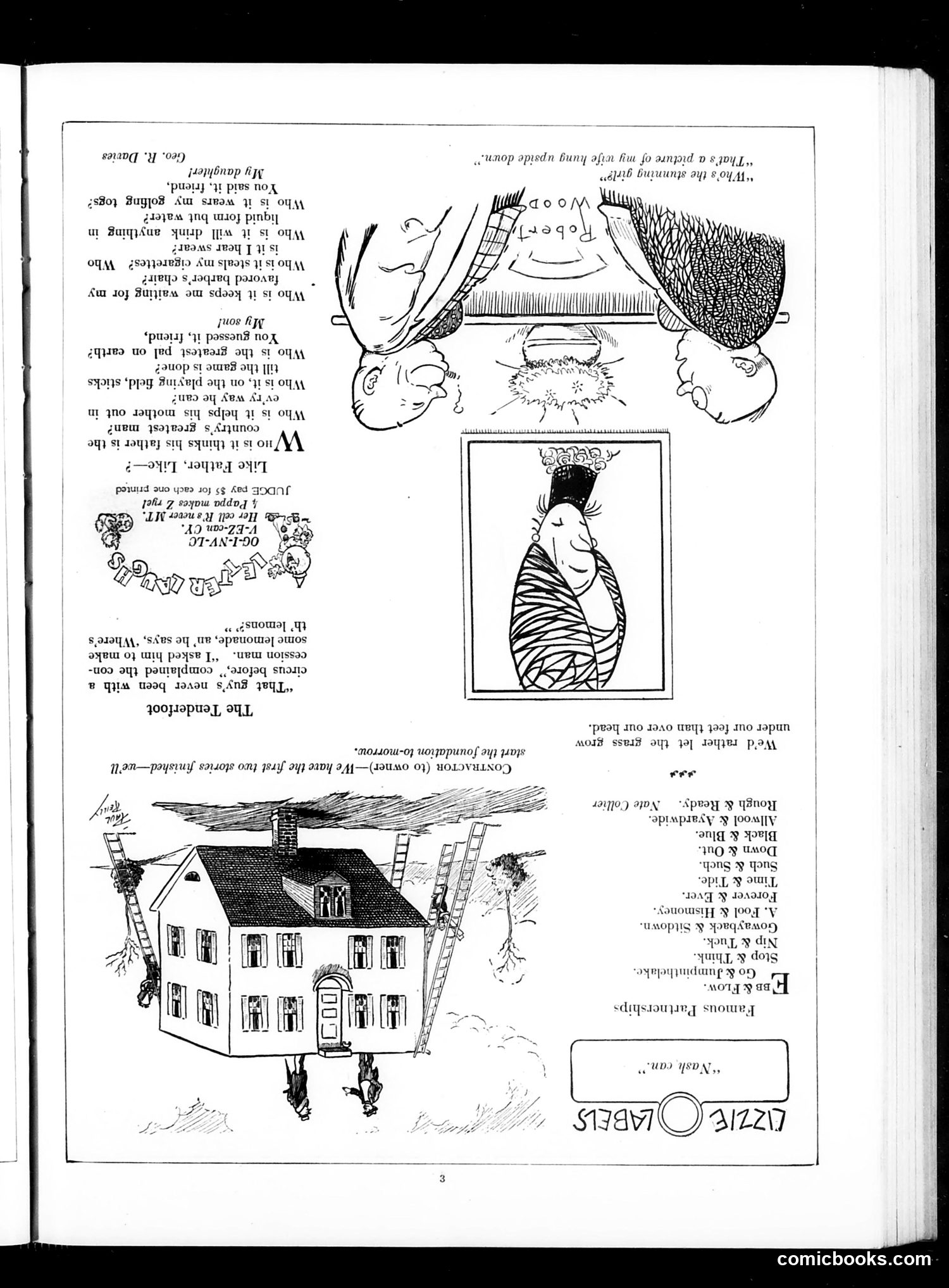
This page appears to contain multiple cartoons and illustrations with reversed/mirrored text that makes complete transcription difficult. The visible elements include: 1. **Top illustration**: Two figures in an intimate moment, with text suggesting domestic or romantic satire 2. **Center image**: A swaddled infant or figure, appearing to mock some contemporary social situation 3. **Bottom illustration**: A house with figures on ladders, possibly depicting domestic chaos or disorder The text references "The Imperfect Nurse" and includes character names, suggesting domestic servant or household staff satire—a common Judge magazine topic. Without clearer OCR text, I cannot definitively identify specific political figures or events being mocked. The satire appears focused on domestic situations, household management, or romantic relationships rather than major political events. The exact subject and satirical point remain unclear from this reproduction.
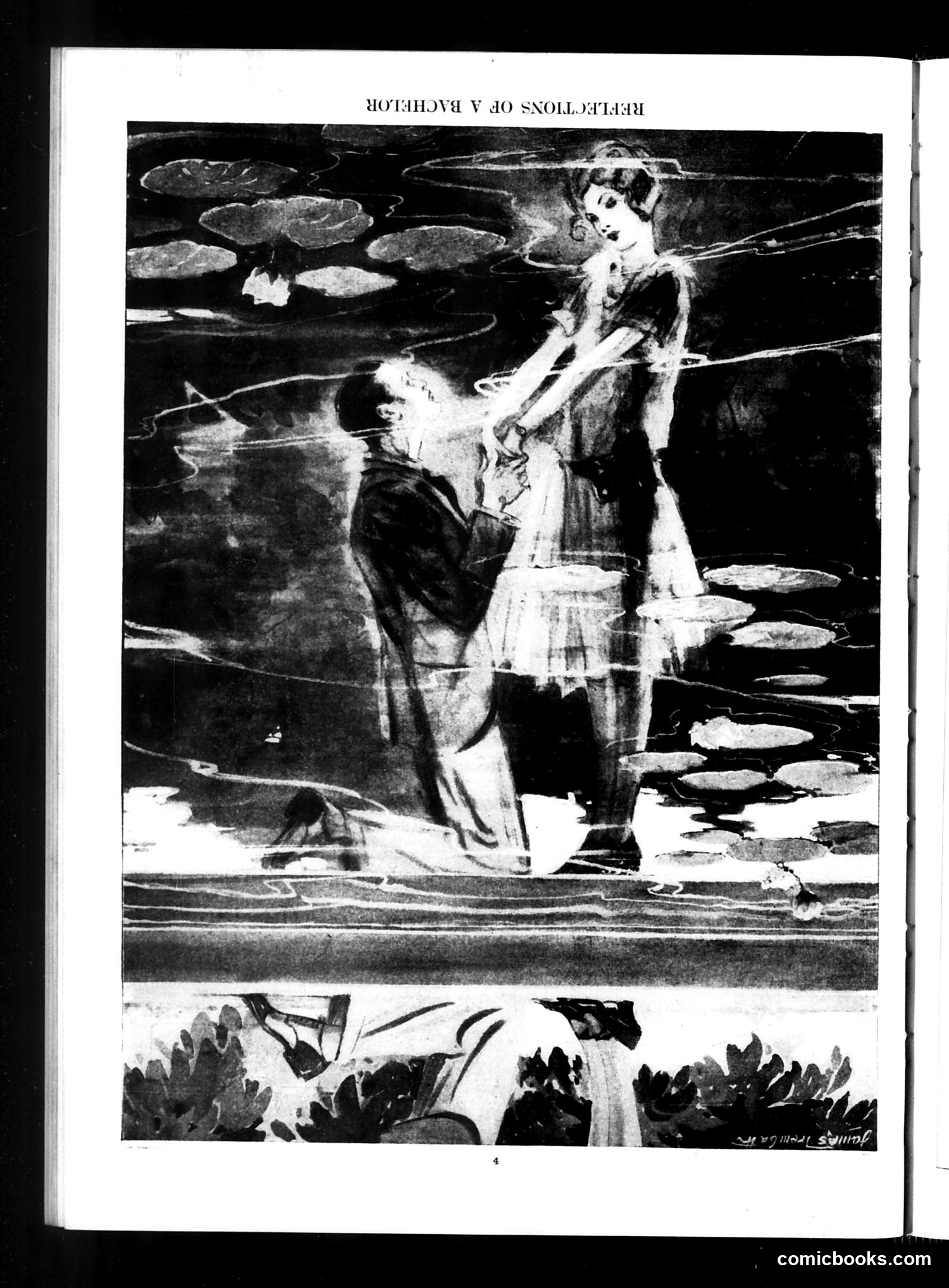
This appears to be a page from Judge magazine featuring an illustration of two figures in an aquatic or pond setting with lily pads. The image shows what appears to be a romantic or domestic scene with a man kneeling and a woman standing, suggesting a proposal or intimate moment. However, without clearer OCR text or visible captions identifying the specific figures, political references, or historical context, I cannot confidently explain what satire or social commentary this cartoon intends. The setting with water lilies and the formal poses suggest it may reference a literary work, romantic trope, or contemporary social situation, but I cannot specify which without risking inaccuracy. The page number appears to be 4. More legible text or captions would be needed for proper historical interpretation.
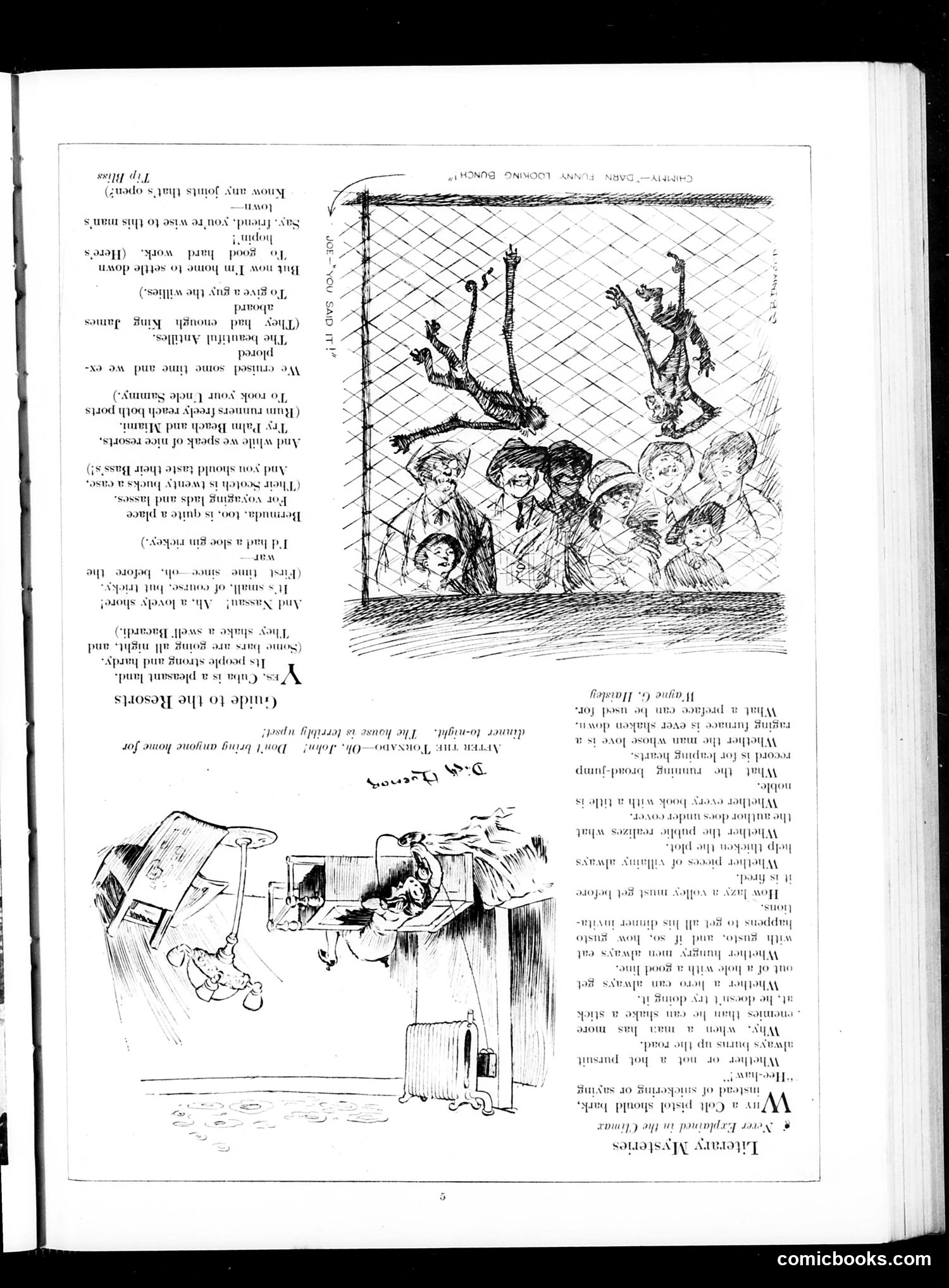
This page contains two cartoons satirizing travel and luggage issues, likely from the early 20th century. The **upper cartoon** depicts tourists at what appears to be a seaside resort or beach destination, with exaggerated luggage and belongings piled overhead. The satire targets the excessive baggage travelers brought and the chaos of holiday travel. The **lower cartoon** shows a figure struggling with oversized luggage or a traveling trunk, suggesting difficulties with travel accommodations and baggage handling—common complaints among tourists of this era. Both cartoons mock the impracticalities of contemporary vacation travel, particularly the cumbersome amount of luggage people insisted on bringing. The humor relies on visual exaggeration of common travel frustrations rather than specific political figures or events.
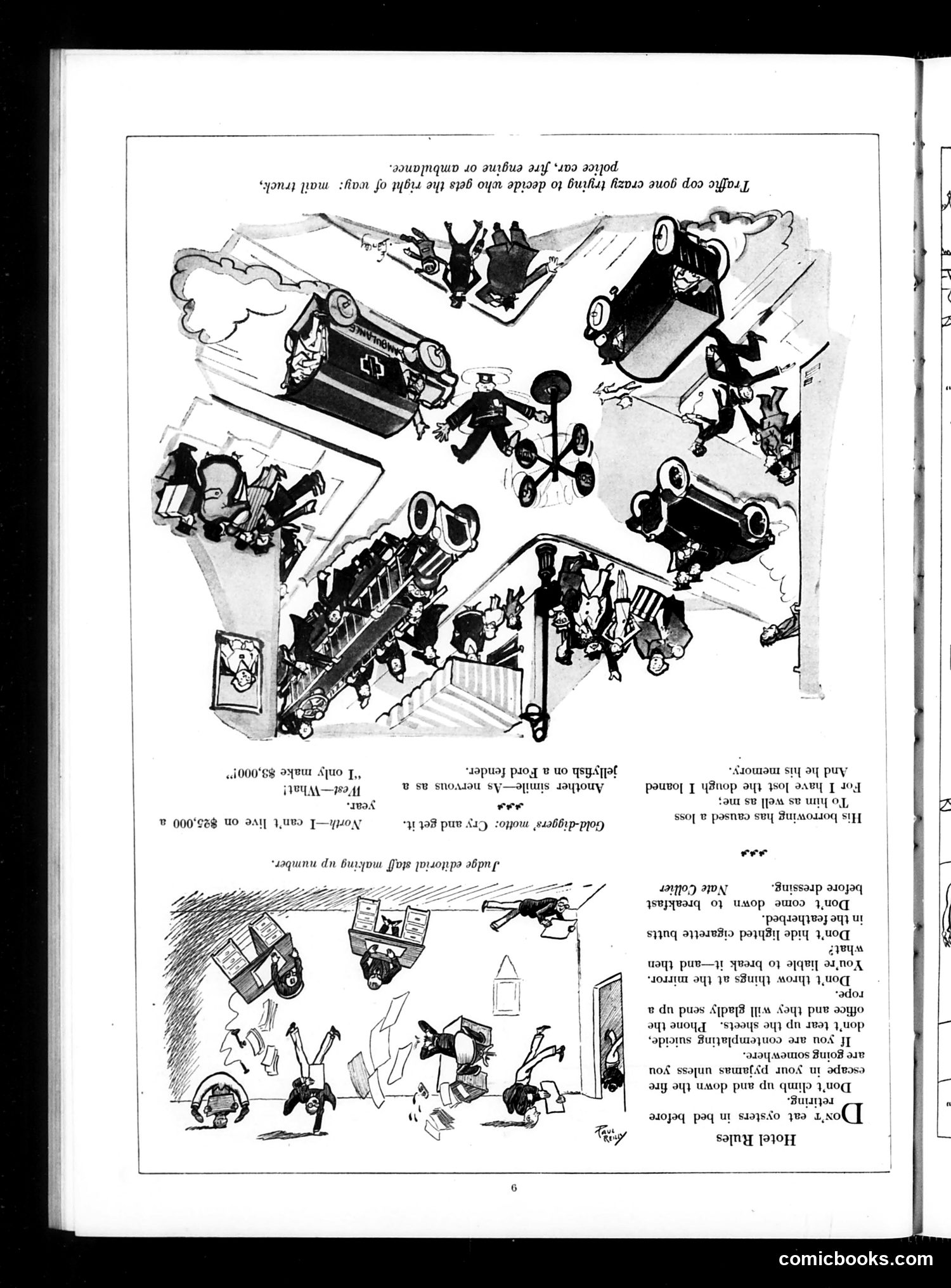
This page contains two cartoons satirizing traffic chaos and automobile culture, likely from the 1920s-30s era of Judge magazine. **Upper cartoon:** Shows an aerial view of a chaotic intersection with multiple vehicles (cars, trucks, motorcycles) and pedestrians colliding in all directions. The caption indicates this illustrates the dangerous consequences of poor traffic control and reckless driving. **Lower cartoon:** Depicts a figure being thrown around violently by various vehicles and objects, suggesting the hazards facing pedestrians in modern traffic. **The satire:** These cartoons mock the rapid, unregulated growth of automobile traffic in American cities and the lack of effective traffic management systems. They highlight the comic but genuinely dangerous collision between horse-era infrastructure and the new automobile age—showing how drivers, pedestrians, and various vehicle types competed chaotically for limited street space without modern traffic signals or rules. The humor derives from exaggeration of real urban traffic problems that contemporary readers would have directly experienced.
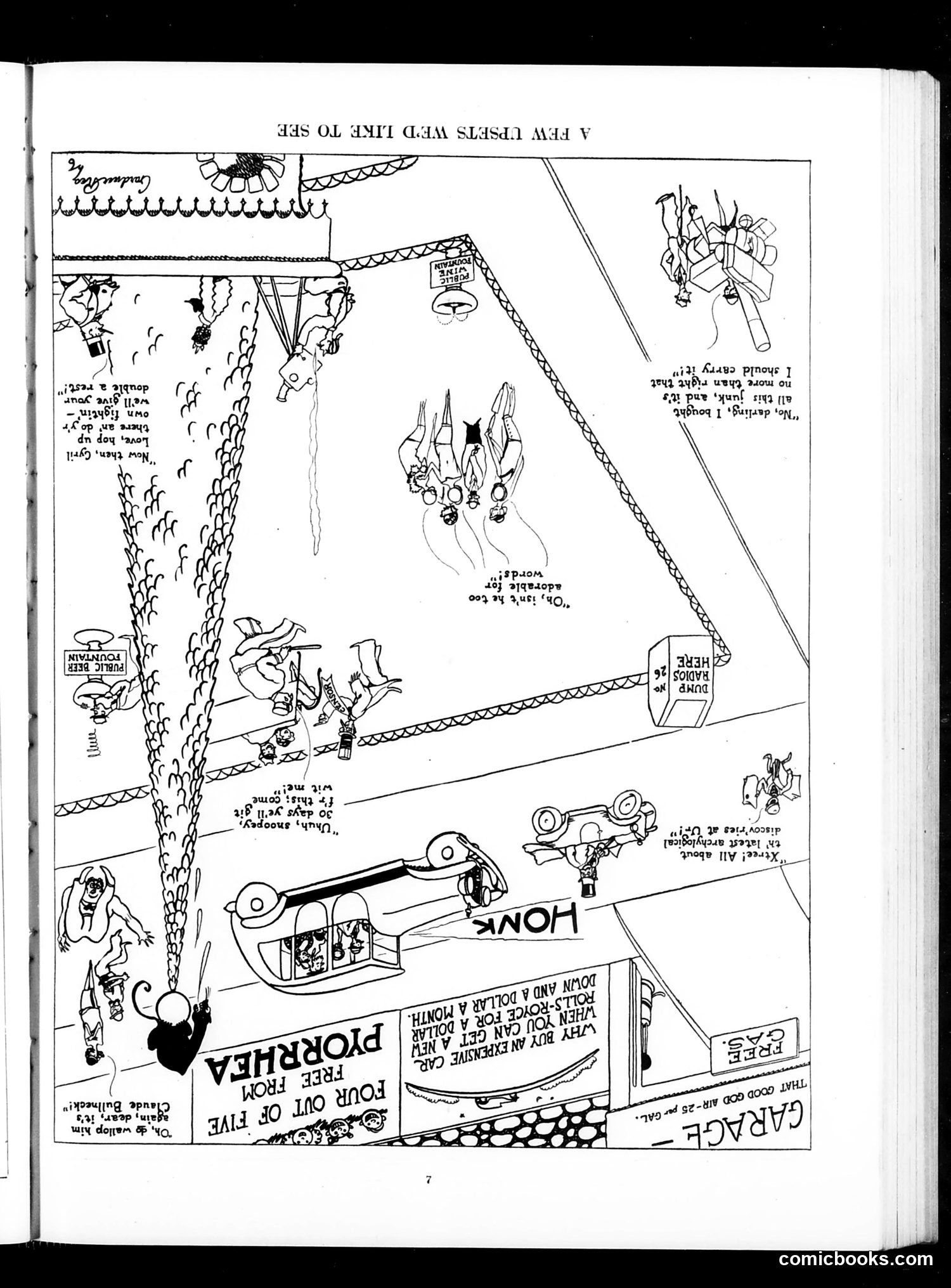
This appears to be a Judge magazine satirical cartoon, though the OCR text is heavily corrupted and largely illegible, making precise interpretation difficult. The visible imagery shows what appears to be an industrial or factory setting with mechanical equipment labeled "HONK" and various human figures in period dress (early 20th century, likely). There are references to "PORK BARREL" and "FEED" visible in the cartoon panels. The satire likely critiques political pork-barrel spending or government waste—common Judge targets. The mechanical/industrial framing and the "pork" metaphor suggest commentary on how politicians distribute government resources or contracts to favored districts. However, without legible text identifying specific figures, dates, or political events, I cannot confidently specify which legislation, politicians, or contemporary scandal this cartoon addresses. The page number indicates this is page 7 of the magazine.
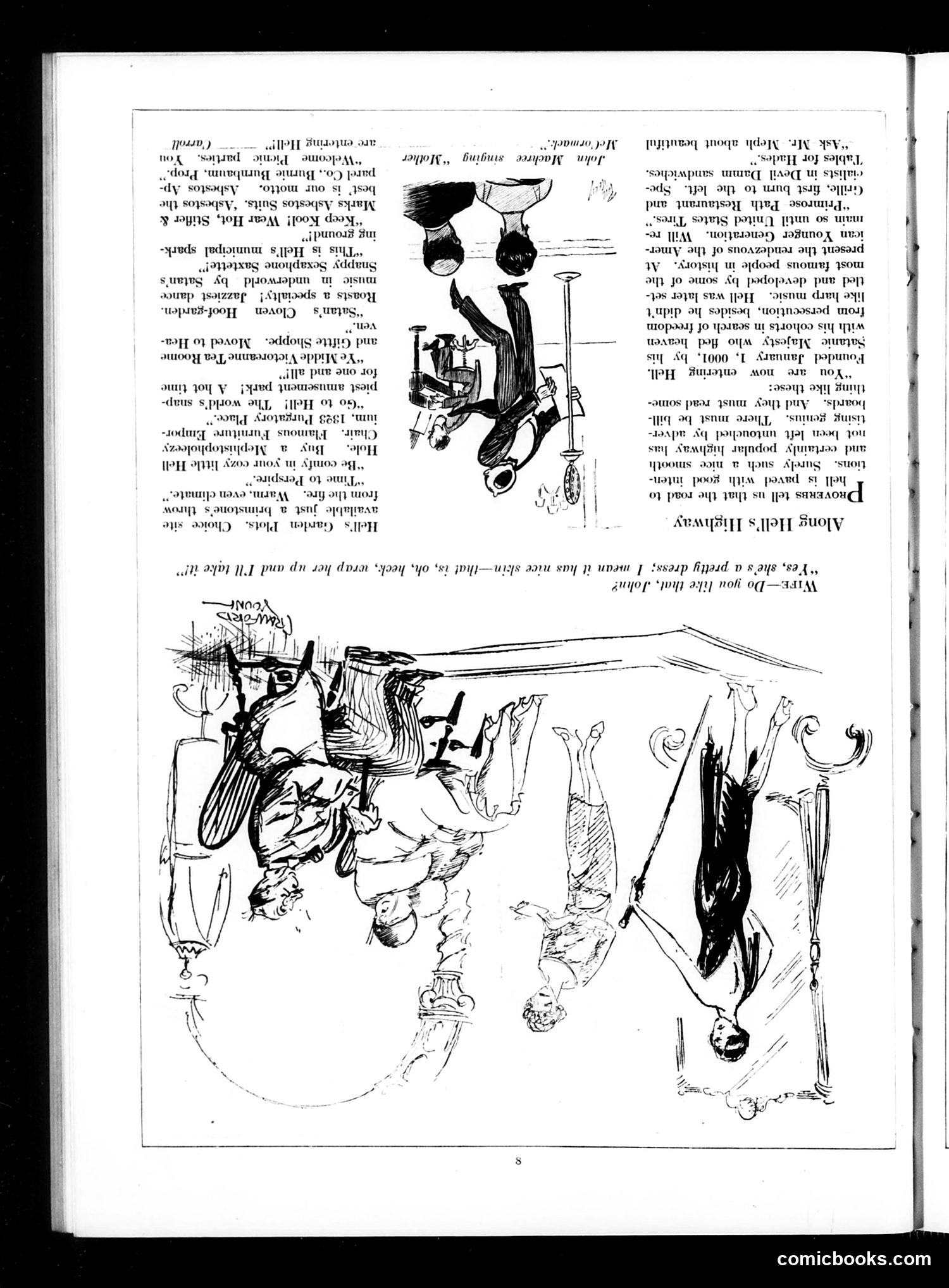
This page contains two distinct cartoon illustrations satirizing late 19th or early 20th-century social behavior. **Upper cartoon**: Depicts a figure (appears to be a dandy or fashionable gentleman) riding a peculiar contraption—likely a bicycle or similar wheeled device. The exaggerated style mocks contemporary fads and fashionable affectations, poking fun at men adopting trendy leisure activities. **Lower cartoon**: Shows multiple figures in various acrobatic or undignified poses, apparently suspended or hanging. This likely satirizes a specific social phenomenon or entertainment craze of the era—possibly vaudeville, gymnastics fads, or another popular pastime. **The satire**: Both cartoons mock the absurdity of following fashionable trends without question. The humor relies on exaggerated physical depictions to ridicule those who adopt new crazes uncritically. The OCR text is heavily corrupted and unreadable, preventing precise identification of specific references or punchlines. The actual social commentary remains unclear without legible text.
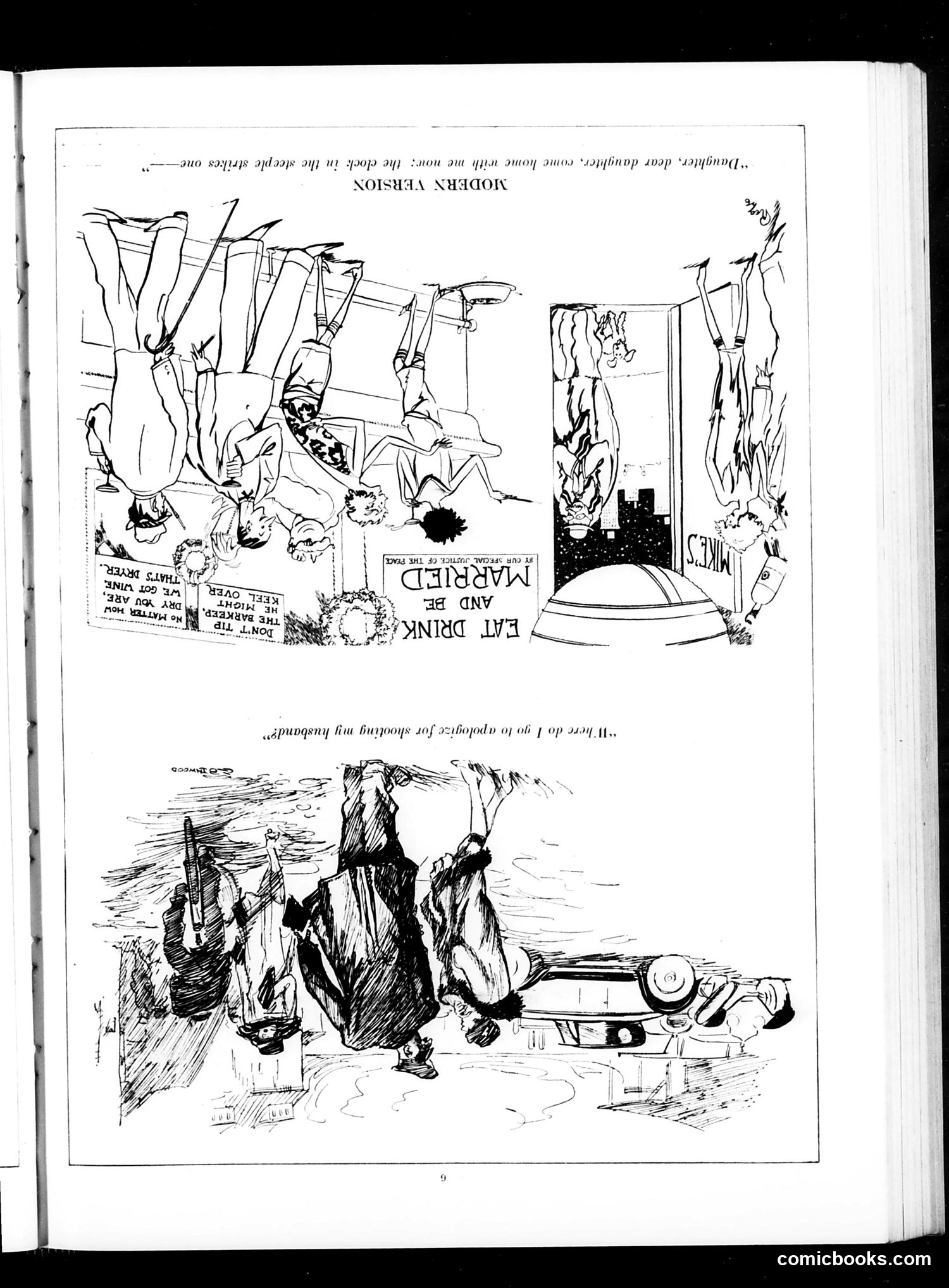
This page from *Judge* magazine contains two satirical cartoons, though the OCR text is largely corrupted and unreadable, making precise identification difficult. The **top cartoon** appears to depict an inverted or chaotic domestic scene with figures suspended upside-down among household items and furniture. The text references "BROKEN VISION," suggesting this may satirize distorted perception or confused circumstances—possibly political or social disorder presented through domestic imagery. The **bottom cartoon** shows figures in what appears to be an outdoor scene with supplies or equipment, rendered in *Judge*'s typical satirical sketch style. Without legible captions or clearer context, I cannot confidently identify the specific political figures, events, or social commentary these cartoons target. The page quality and OCR errors prevent accurate determination of the magazine's date or the particular issues being mocked. A higher-resolution source or uncorrupted text would be necessary for reliable interpretation.
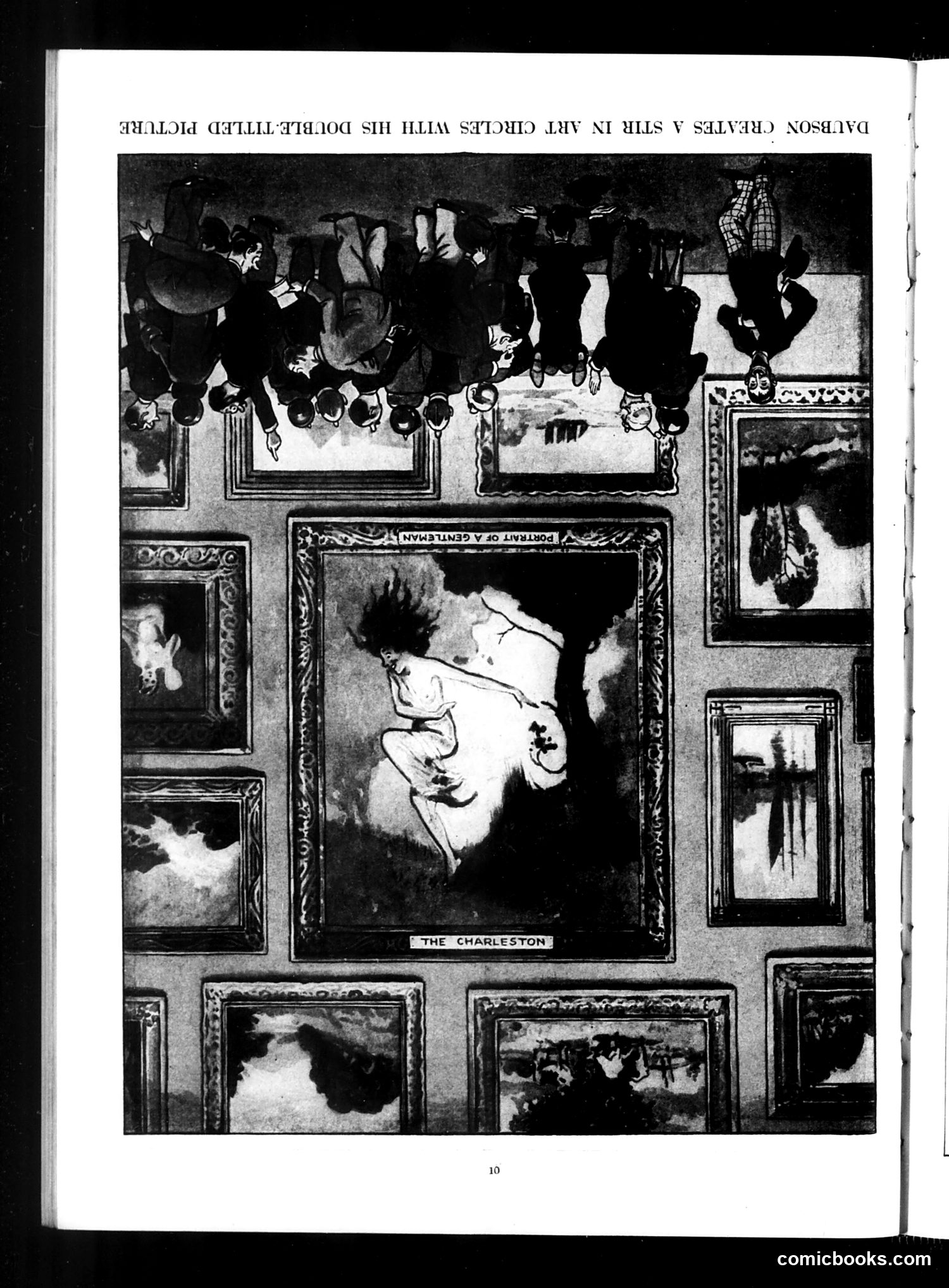
This page depicts "The Charleston," a wildly popular 1920s dance craze that scandalized older generations. The central image shows a dancer in the characteristic Charleston pose—head thrown back, legs kicked high. The surrounding smaller frames show dancers at what appears to be a speakeasy or jazz club during Prohibition, viewed from above. The satire targets the moral panic around the Charleston and Jazz Age culture. Conservative Americans viewed the dance as sexually suggestive and socially dangerous, associated with flappers, drinking (illegal during Prohibition), and youth rebellion. Judge magazine, aimed at educated urban readers, likely mocks this generational outrage by presenting the Charleston's popularity as unstoppable cultural reality—the tiny figures at top suggest crowds embracing the trend despite establishment disapproval. This captures 1920s culture-war anxieties about modernity threatening traditional values.
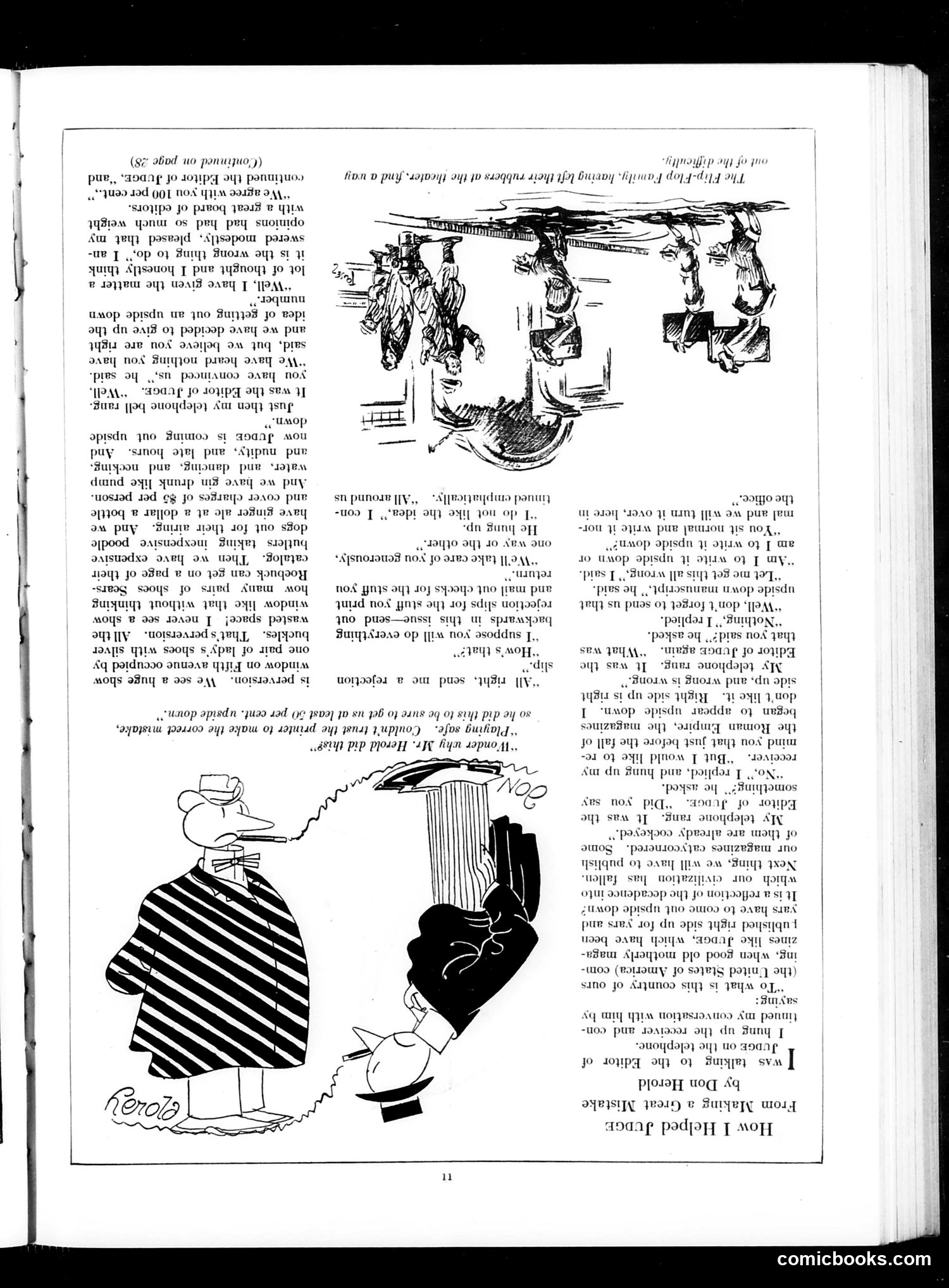
This page from *Judge* magazine contains satirical commentary on domestic life and marriage, presented through cartoon illustrations and accompanying text. The main cartoon (lower left) depicts a husband being controlled or manipulated by his wife—a common domestic satire theme in early 20th-century humor magazines. The upper illustration shows what appears to be a social gathering or party scene with multiple figures, likely satirizing contemporary social conventions or behavior. The text, though heavily OCR-corrupted and difficult to parse with certainty, discusses marital dynamics, household management, and social expectations. Specific references are unclear due to transcription errors, but the overall theme appears to be poking fun at power dynamics within marriage and the struggles of domestic life. Without clearer text or visible publication date, precise political or social context cannot be definitively established, though the satirical tone toward traditional gender roles and marriage was characteristic of *Judge's* humor during the early 1900s.
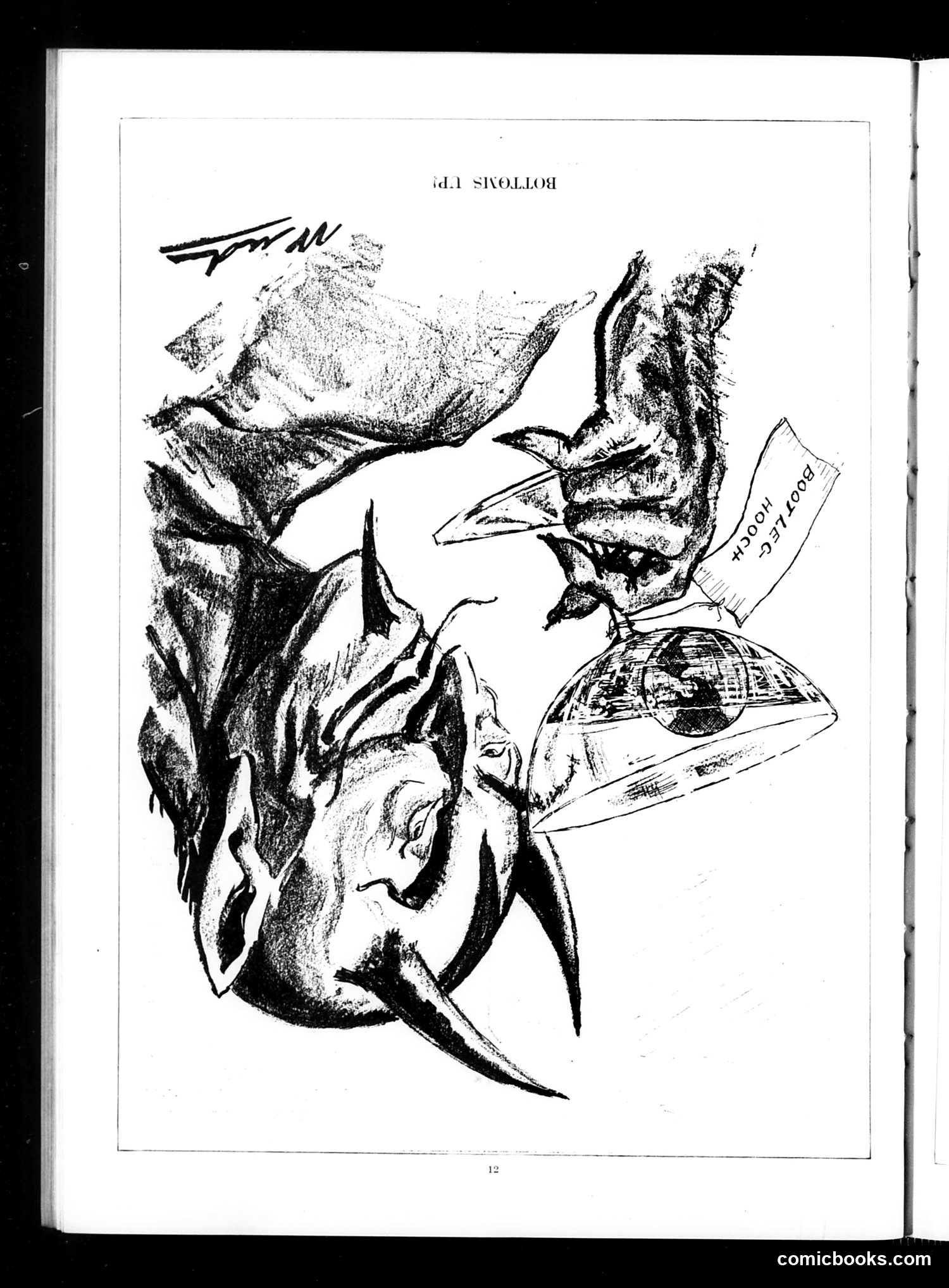
This page appears to be primarily **illustrative rather than a traditional political cartoon**, showing detailed black-and-white sketches of what look like fantastical or alien-like creatures with organic, textured forms. One figure holds what appears to be a UFO or spacecraft model labeled (text unclear in image). The header "id.l SINOLLOG" appears to be either corrupted OCR or intentionally reversed text, making its meaning unclear. Without clearer context about the publication date or accompanying article text, I cannot definitively identify the specific political or social satire being referenced. The imagery suggests science fiction or speculative content, possibly commenting on contemporary concerns about space exploration or technological advancement, but **the specific target and message remain uncertain** from this page alone.
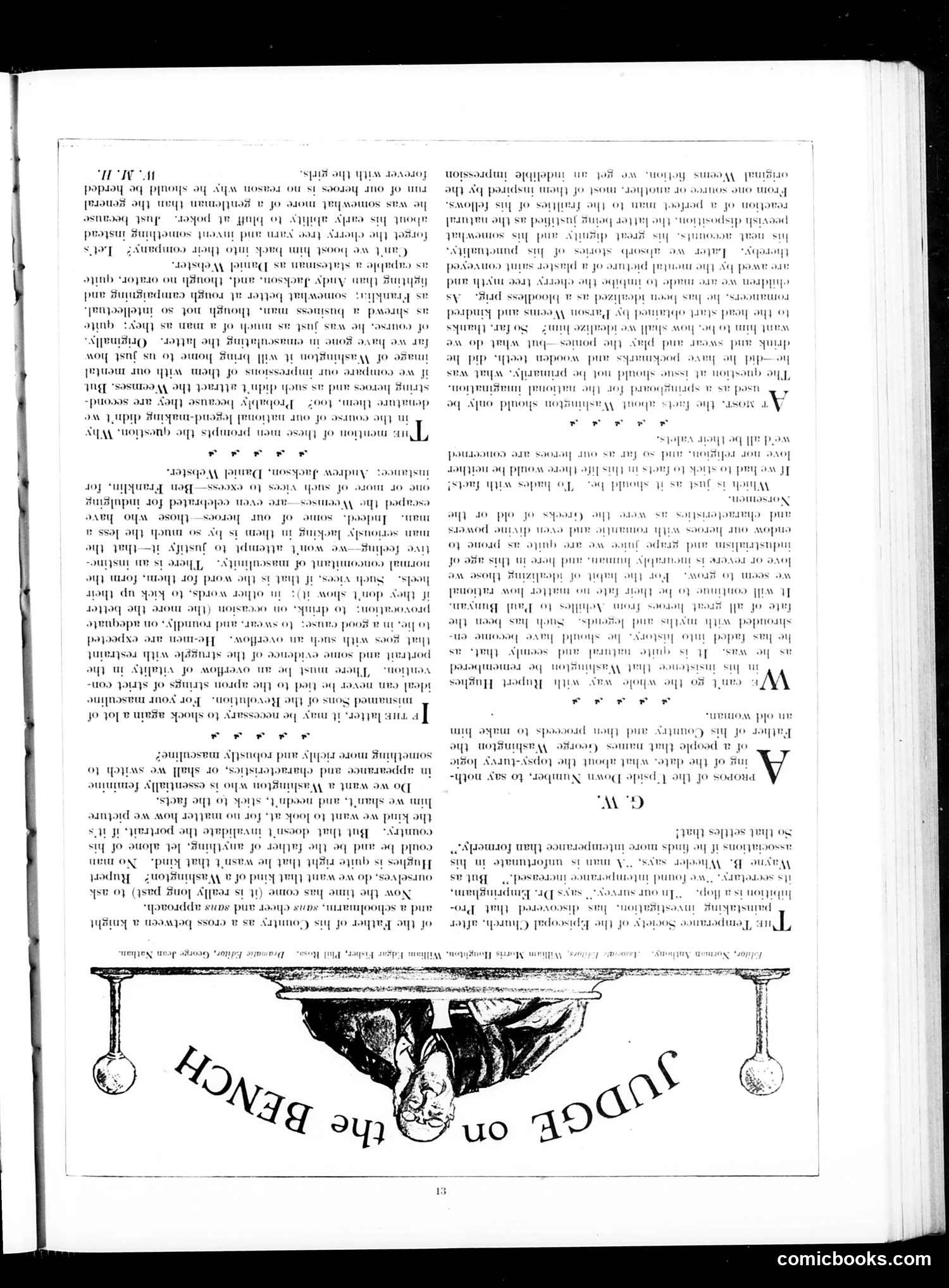
The OCR text is severely corrupted and largely illegible, making accurate interpretation impossible. However, the IMAGE shows a clear visual element: an upside-down figure (appears to be a caricatured man in formal dress) balanced on his head on a horizontal bar, with the caption "UNDER on the BENCH" (or similar reversed text). This is likely a political cartoon satirizing judicial overreach or judicial incompetence—the upside-down judge or legal figure suggests the law/justice system is inverted or operating backwards. The "bench" reference indicates this targets someone in judicial office. Without legible OCR text to confirm the specific political context, date, or figures involved, I cannot identify which judge or case is being ridiculed. The style and printing suggest late 19th or early 20th century *Judge* magazine satire.
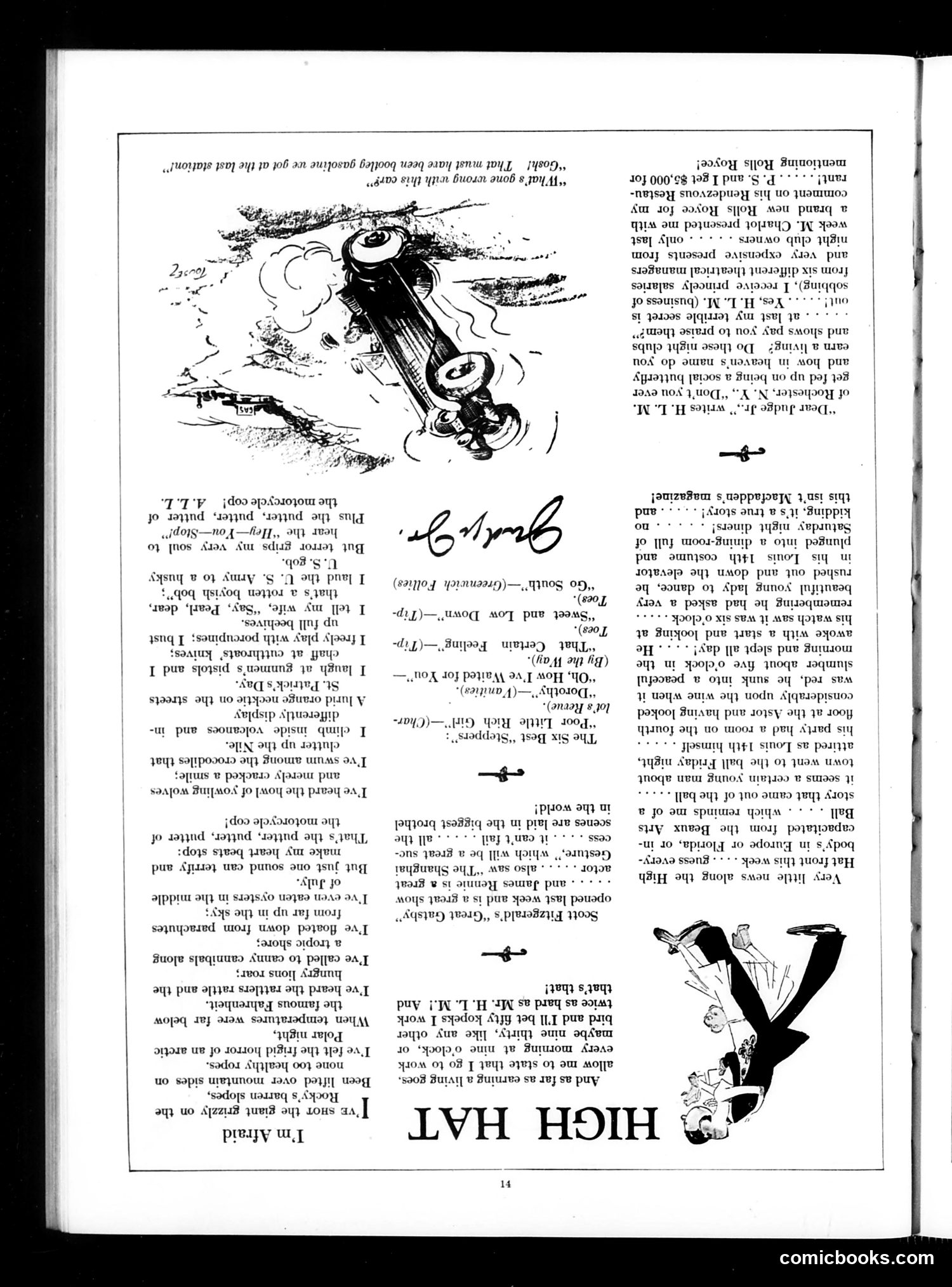
This page from *Judge* magazine features satirical commentary on fashionable pretension, likely from the early 1900s. The large illustration shows a man in formal attire (top hat and tailcoat) literally tumbling or falling headfirst—a visual metaphor for comeuppance or deflation of ego. The text consists of humorous quotations and commentary mocking affected speech and snobbish behavior. Repeated phrases like "Nod—Nod—Nod" and exaggerated dialogue suggest mockery of pompous social climbers who adopt ridiculous affectations. References to fashionable locations and pretentious talk indicate satire directed at wealthy urbanites aping European sophistication. The overall point appears to be satirizing the vanity and absurdity of "high hat" (snobby) social pretension—showing that such affectation inevitably leads to embarrassment or humiliation. The fallen figure literally represents the fall of inflated ego.
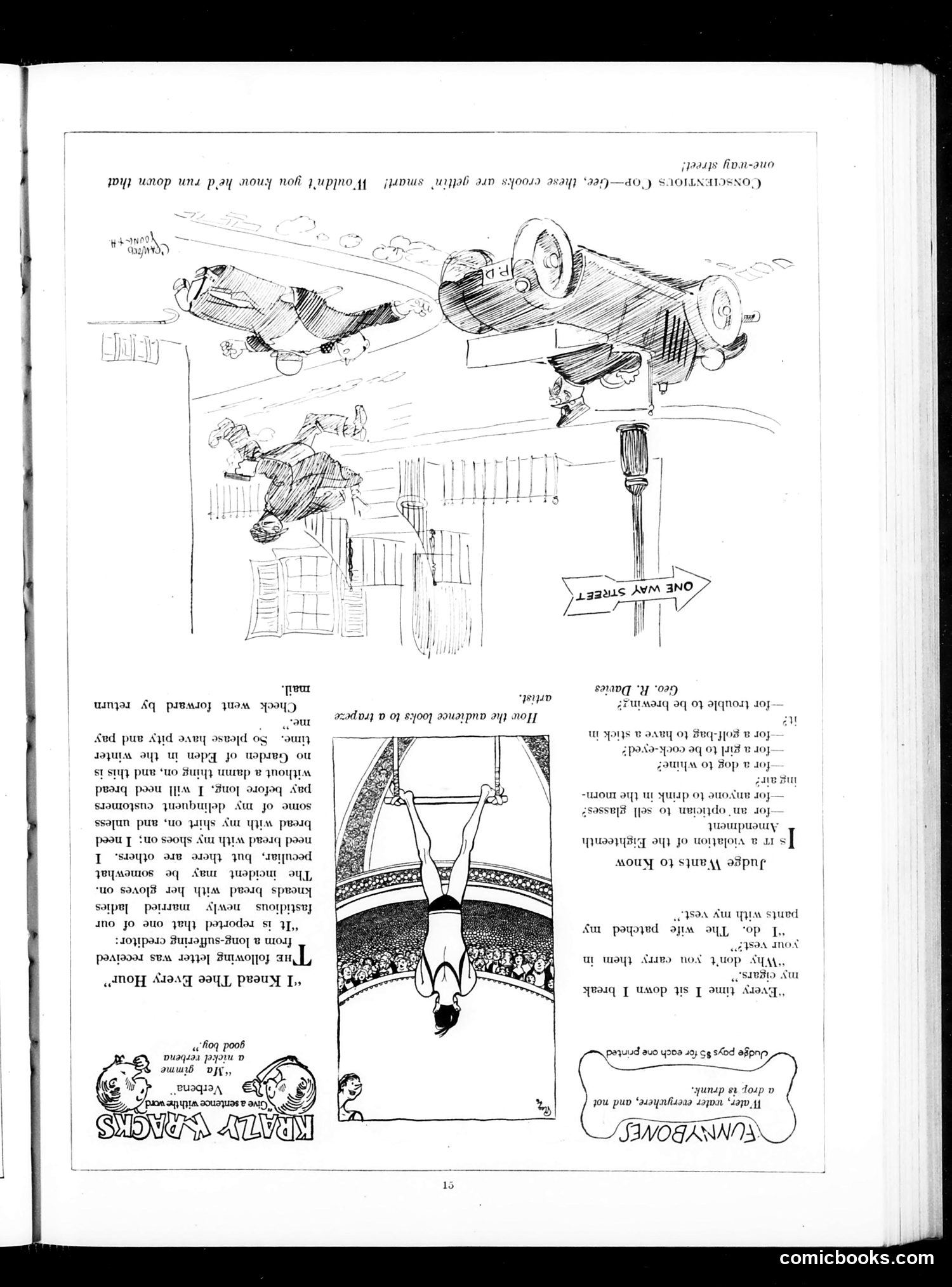
This page appears heavily corrupted by OCR errors, making definitive interpretation difficult. However, the visible imagery shows: **Upper section:** Sketches of what appear to be early aircraft or flying machines with human figures, suggesting aviation or aeronautical satire—a common Judge topic in the early 20th century when flight technology was novel and often mocked. **Lower section:** A cross-sectional diagram of what appears to be a structural element (possibly architectural or mechanical) with a figure inside, surrounded by text panels with dialogue or commentary. The overall tone seems satirical toward technological progress or engineering claims. Without clearer OCR text, I cannot definitively identify specific politicians, events, or the precise satirical target. The page likely comments on contemporary innovations or public figures associated with them, but the corruption of the text prevents accurate specification of which ones.
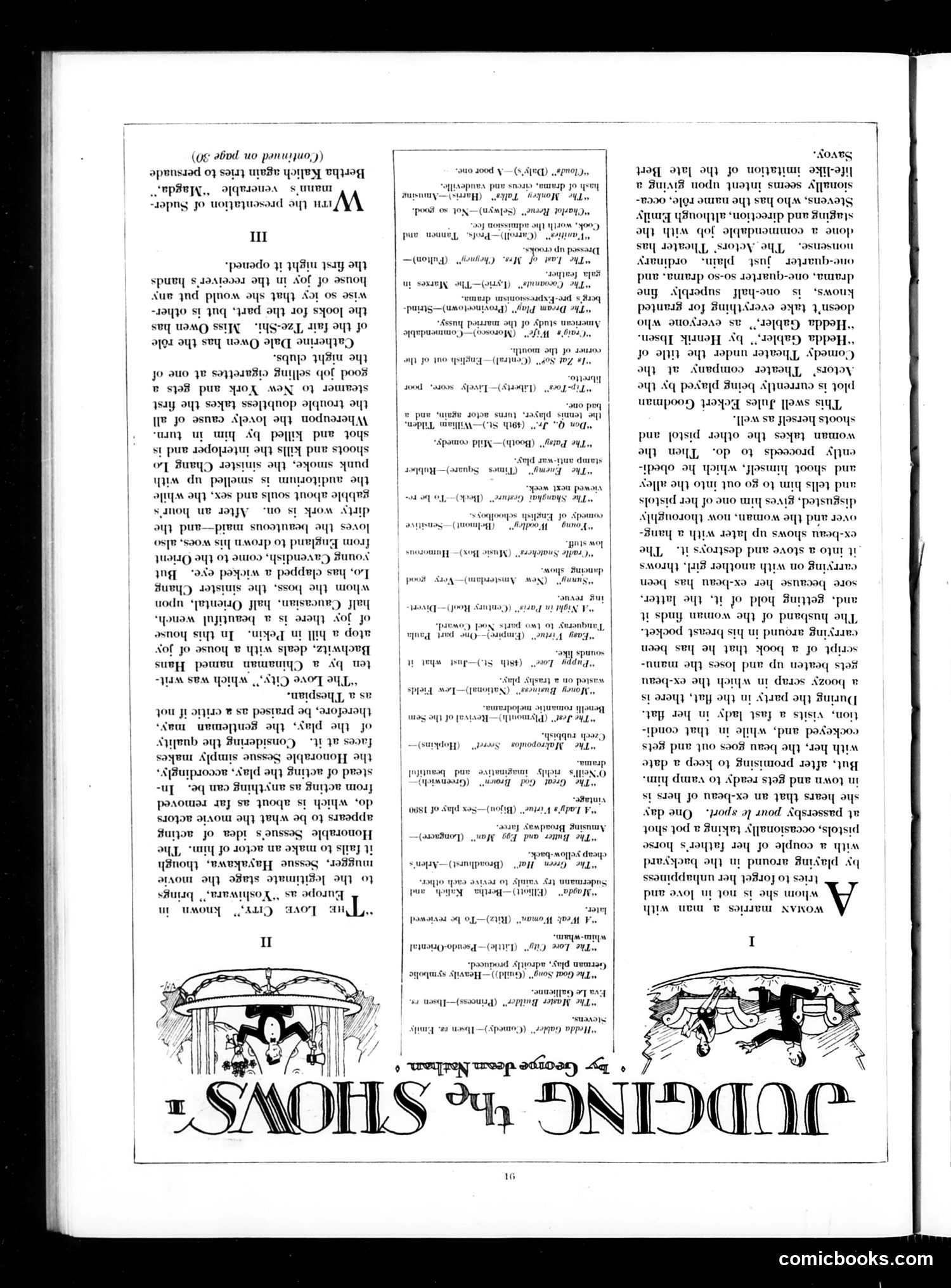
This page presents two satirical cartoon panels titled "FLORENCE & SHOWS" (appears to be upside-down text reading "FLORENCE & SHOWS"), depicting what seem to be theatrical or social scenes with caricatured figures. The OCR text is largely corrupted and illegible, making detailed interpretation difficult. However, based on visible cartoon panels, this appears to be social satire typical of Judge magazine's approach—likely mocking contemporary theatrical productions, social pretensions, or public figures of the era. The illustrations show figures in exaggerated poses within architectural settings, suggesting commentary on artifice or performance in society. Without legible text or clearer identification of specific historical figures or events referenced, I cannot confidently identify the exact targets of satire or explain the specific point being made. **The severe OCR corruption prevents accurate analysis of the intended message.**
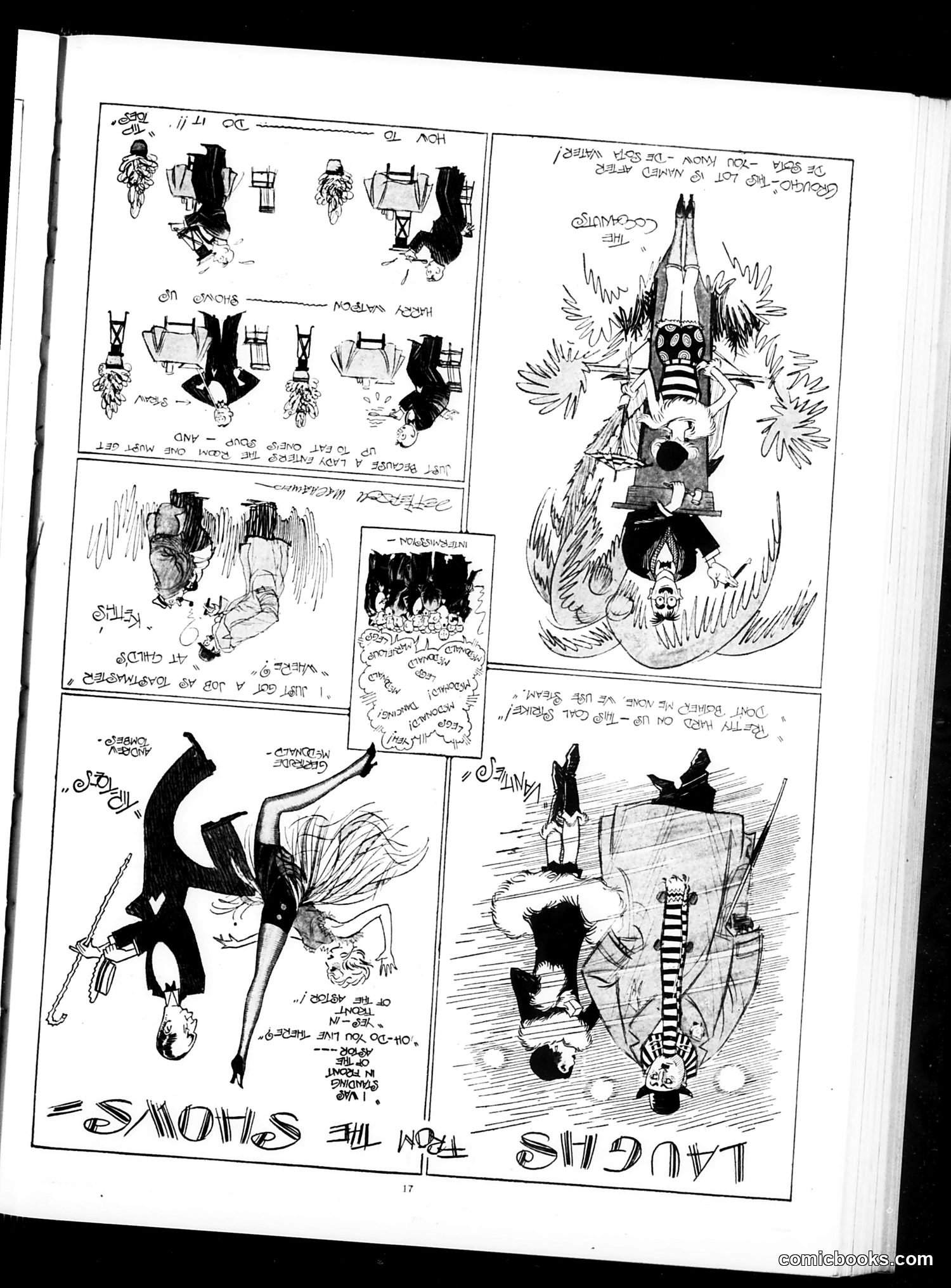
This appears to be a multi-panel comic strip, though the heavily degraded OCR text makes precise identification difficult. The page shows cartoon figures in various action sequences—notably what appears to be characters falling or in acrobatic poses, and an elaborate tower or structure with decorative elements. The sketchy, energetic drawing style is typical of early-to-mid 20th century Judge magazine humor. Without legible text or clear identifying captions, I cannot definitively state what political or social satire this addresses. The repeated figures and physical comedy suggest either: - A running gag about specific public figures - Social commentary on contemporary events or behaviors - Slapstick physical humor popular to the era The page number (17) indicates this is mid-publication content. To accurately explain the satire's target and meaning, clearer text or caption information would be necessary. The quality of reproduction significantly limits detailed analysis.
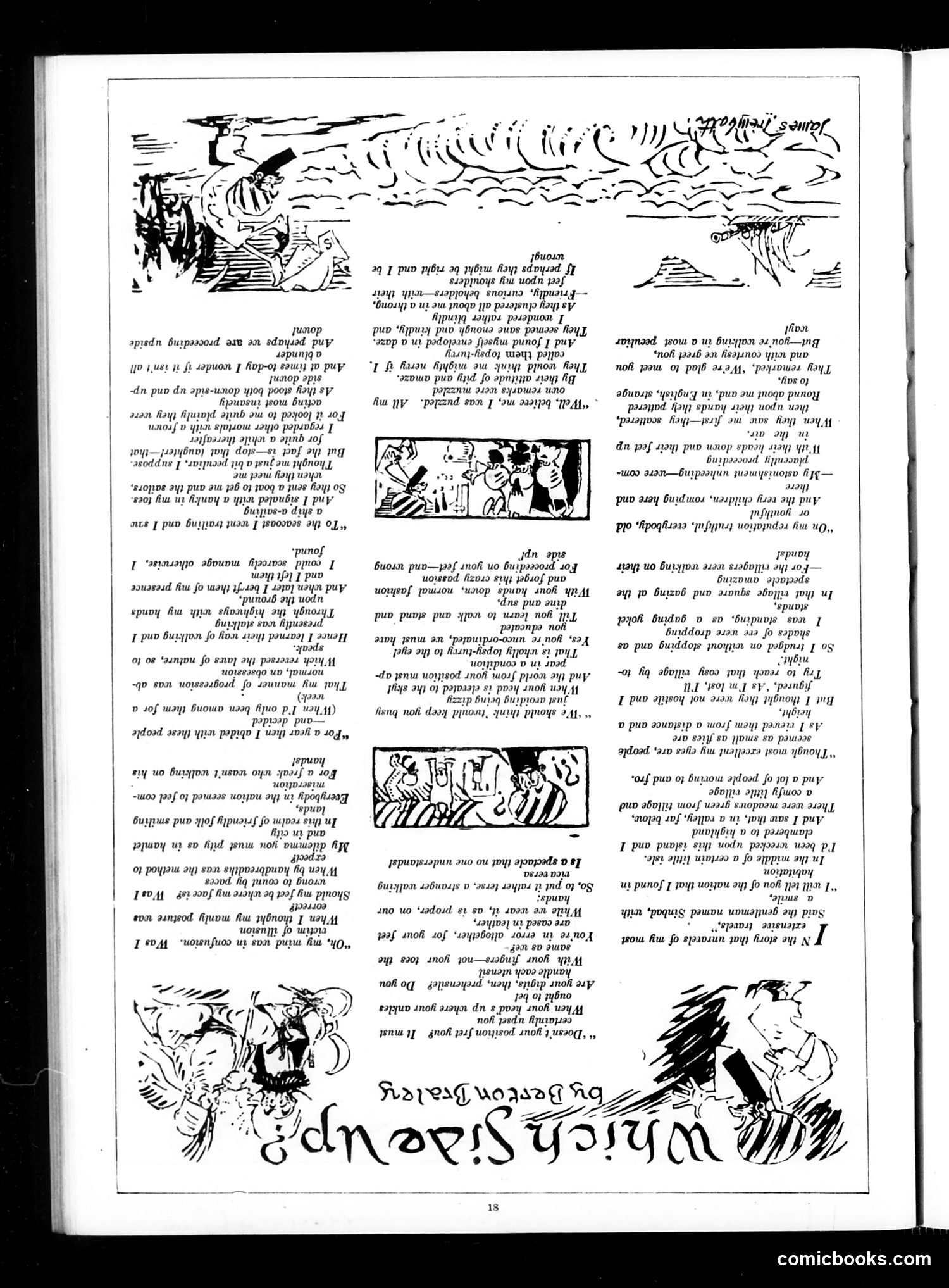
This page from *Judge* appears heavily corrupted by OCR errors, making the text largely illegible. However, the visible illustrations show what appear to be **political or social satire cartoons** typical of the publication's style. The three cartoon panels visible display exaggerated character drawings characteristic of early-to-mid 20th century American satirical cartooning. The sketchy, dynamic linework and caricatured figures suggest commentary on contemporary social or political issues, but **without readable text, I cannot identify the specific subjects, figures, or satirical points being made**. The large reversed text at the bottom ("Willyum Skaespeered") appears to be a stylized title or caption, but its precise meaning or context remains unclear from this image. **To properly explain this page's satire, legible OCR text or publication date would be essential.**
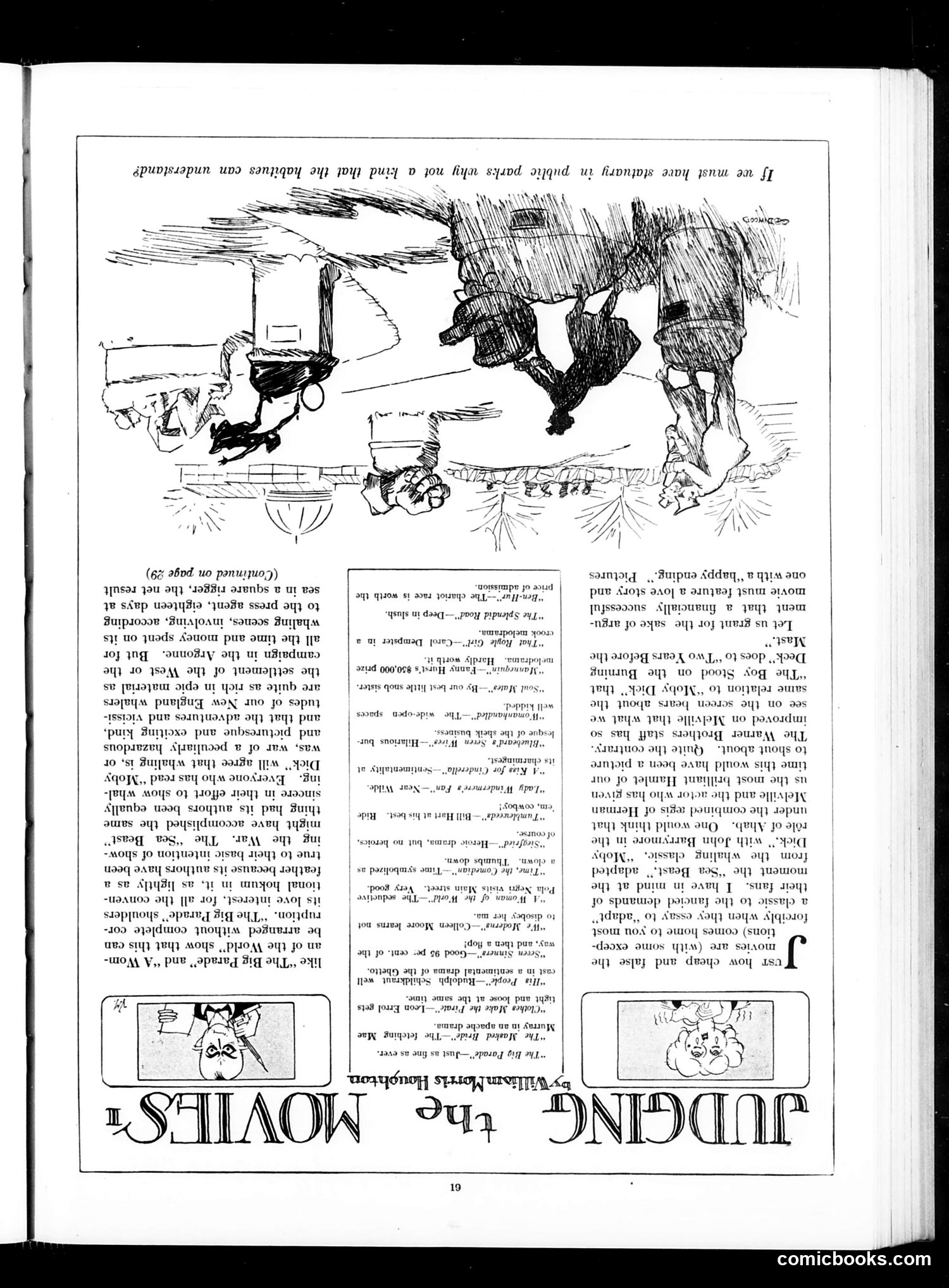
This page appears to be a satirical piece titled "Lunch The Second" featuring a chaotic sketch of what looks like a dining or social scene. The OCR text is heavily corrupted and largely illegible, making precise interpretation difficult. From the visible IMAGE, the cartoon depicts multiple figures in an animated, crowded scene—possibly a restaurant or social gathering—with exaggerated poses and expressions typical of Judge magazine's comedic style. The sketch uses heavy cross-hatching and energetic linework. **What I cannot determine with confidence:** The specific political or social targets, the identities of caricatured figures, the exact date, and the particular satirical point being made. The corrupted OCR text prevents reading the accompanying commentary that would clarify the satire's meaning. **Assessment:** Without legible text explaining the context and targets, I cannot accurately explain what modern readers are missing regarding the specific references or jokes intended.
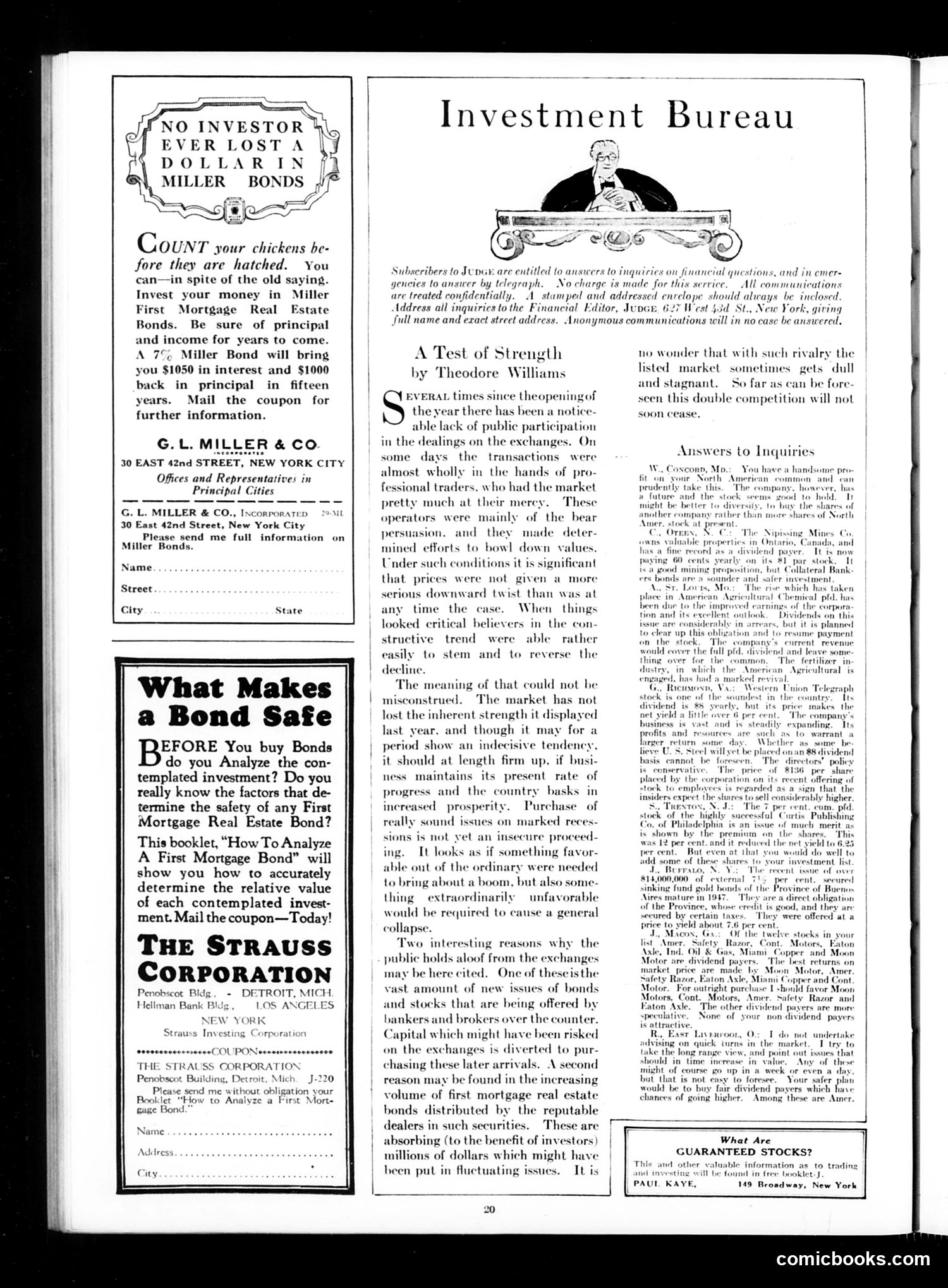
This page is primarily **financial advertising** rather than satire or political commentary. It contains multiple bond investment solicitations from companies like G.L. Miller & Co., The Strauss Corporation, and others, each claiming their bonds are safe investments. The only editorial content is Theodore Williams's article "A Test of Strength," which discusses stock market conditions. Williams argues that despite bear traders' efforts to depress prices, the market demonstrates underlying strength because investors continue purchasing bonds and real estate securities instead of trading stocks—suggesting confidence in economic fundamentals. The repeated advertising emphasizes bond safety through phrases like "What Makes a Bond Safe" and "No Investor Ever Lost a Dollar in Miller Bonds." This reflects early 20th-century investment culture where bonds were promoted as conservative, income-producing alternatives to volatile stocks. The page essentially functions as a financial services advertorial aimed at middle-class savers.
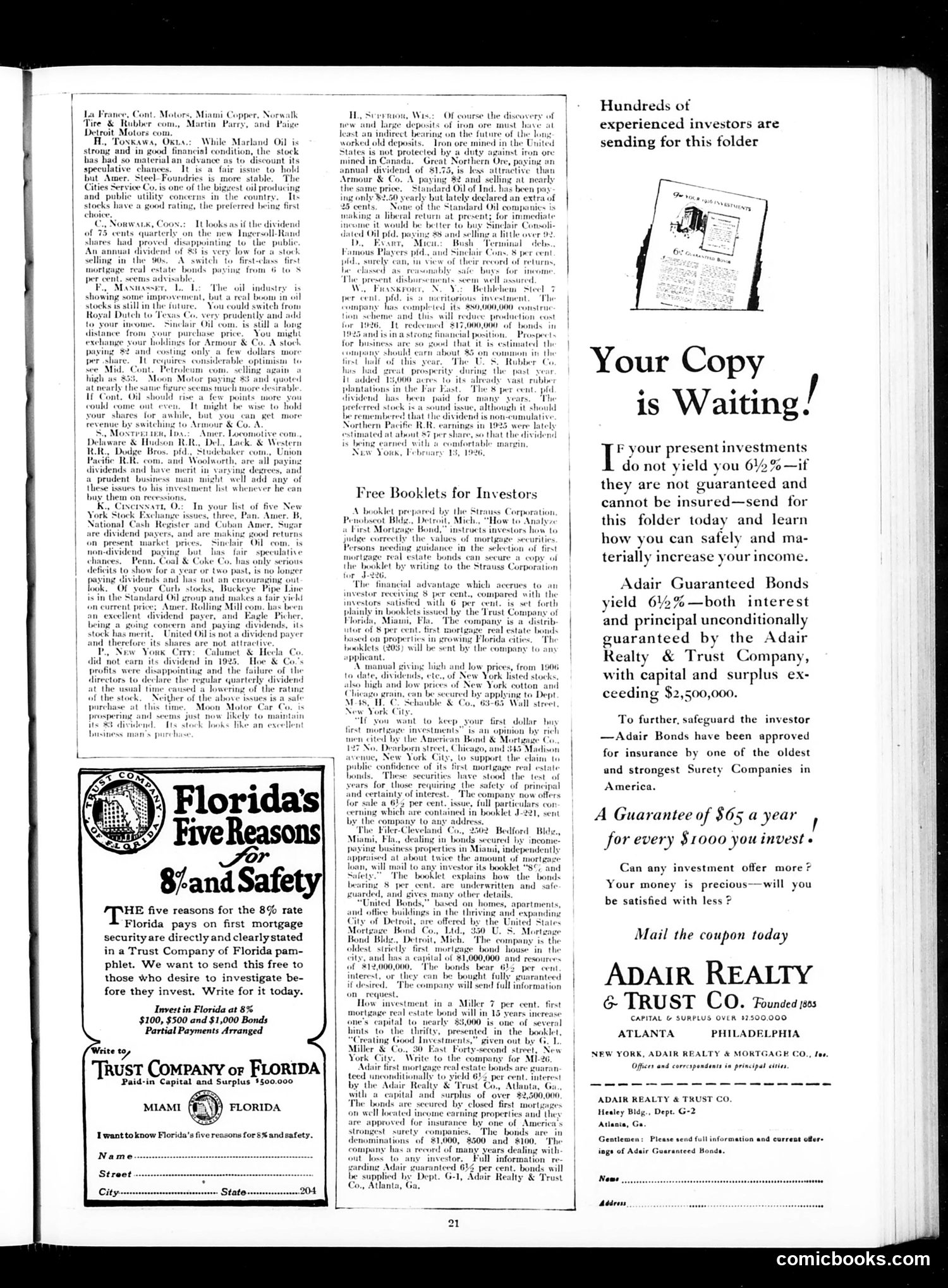
This page is primarily **financial and investment advertising**, not political satire. It contains: 1. **Investment advice columns** discussing stocks (Sinclair Oil, Standard Oil, U.S. Rubber, Northern Pacific Railroad, etc.) and bonds—typical 1920s financial guidance for wealthy readers. 2. **Two major advertisements**: - **Trust Company of Florida** promoting 8% first-mortgage bonds as a safe investment - **Adair Realty & Trust Company** advertising guaranteed bonds yielding 6½%, emphasizing insurance protection and capital surplus The page reflects the **pre-1929 stock market boom** when investment was heavily promoted to the affluent. The emphasis on "guarantees" and "safety" is notable—within a few years, such assurances would prove meaningless. There are **no political cartoons or satirical content** visible. This appears to be a standard financial section of Judge magazine, which, while satirical in other sections, contained conventional investment information for its wealthy readership.
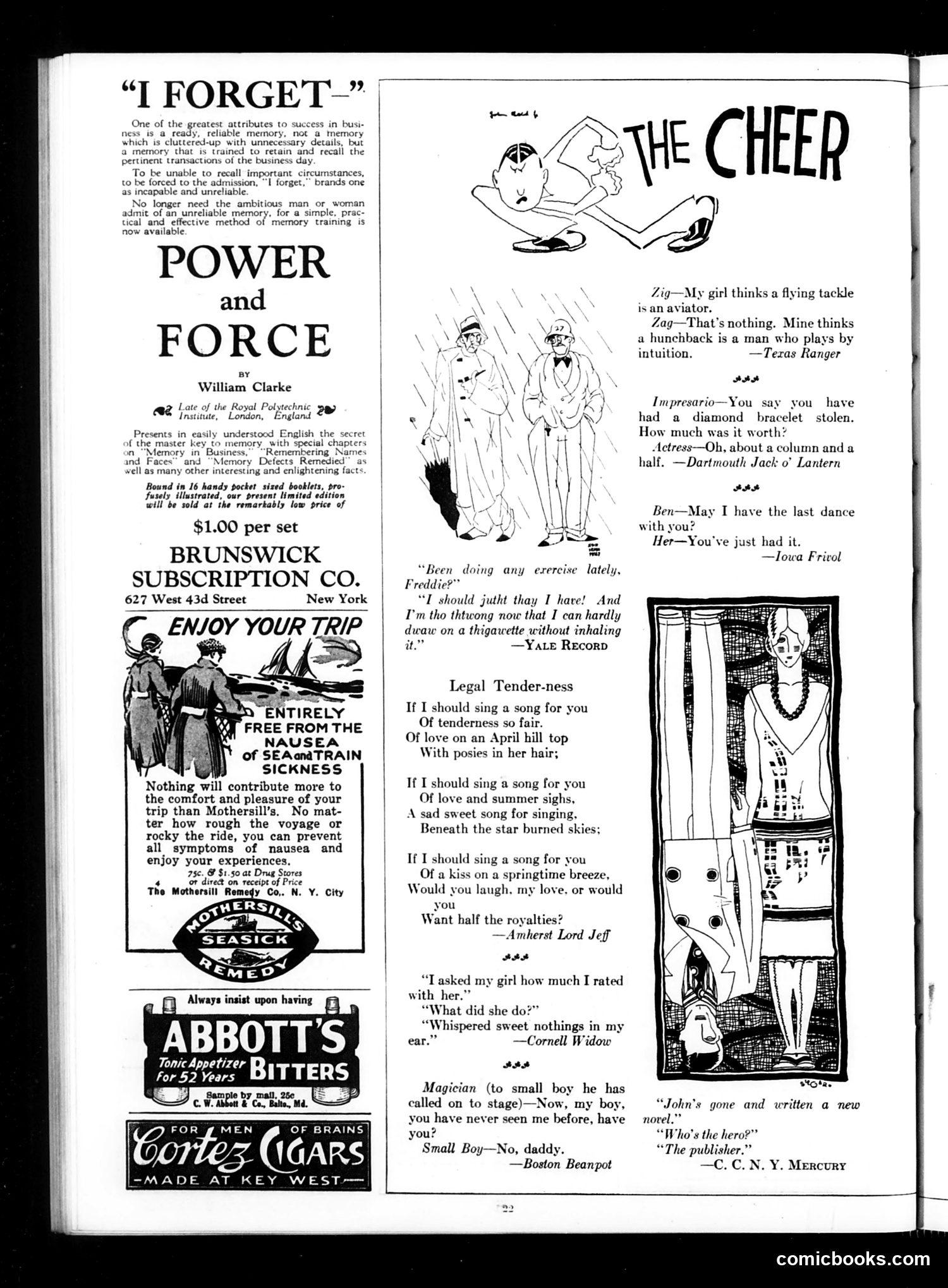
This page contains several unrelated jokes and a cartoon titled "The Cheer" depicting two figures in casual poses. The cartoon's humor appears to rely on visual gags rather than specific political content. The page is primarily filled with brief humor items typical of *Judge* magazine's format: one-liners and short anecdotes poking fun at contemporary social situations. These include jokes about confused definitions (a "flying tackle" as an aviator), romantic misunderstandings, and theatrical pretense. One recurring theme involves women's materialism (a stolen bracelet's value measured in column inches; asking for "half the royalties" for romantic songs). The left side features advertisements for memory-training books and various patent remedies (Mothersill's for seasickness, Abbott's Bitters, cigars)—standard magazine filler of the era. The content reflects early 20th-century attitudes toward relationships, gender, and consumer culture rather than specific political satire.
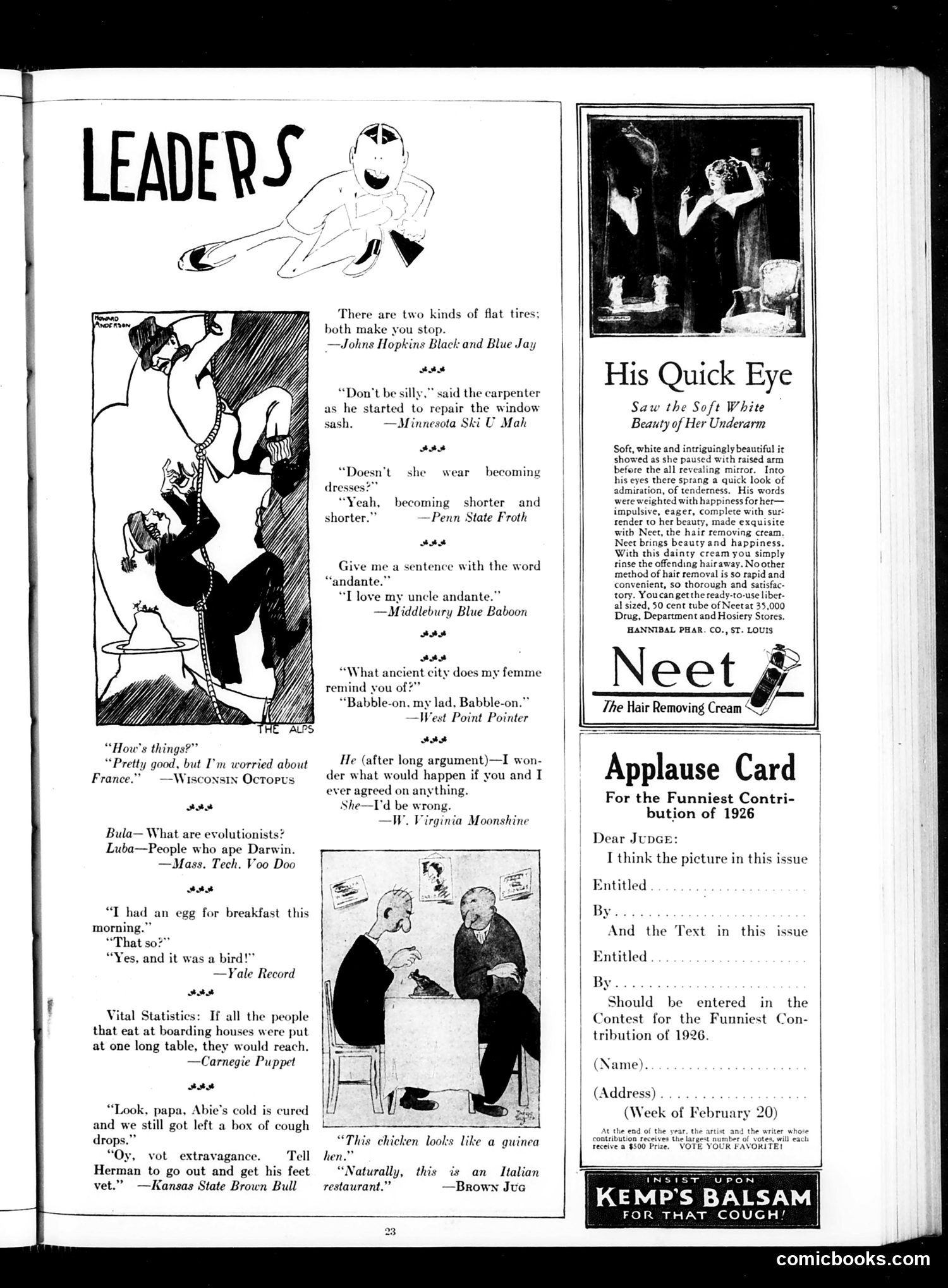
This is primarily a **humor compilation page** featuring short jokes from college magazines, plus advertisements. The cartoons and quips lack sustained political commentary—instead offering light social satire typical of 1920s college humor. **Notable content:** - **"Pretty good, but I'm worried about France"** — References post-WWI anxieties about France's stability or economy, a recurring concern in American media of the mid-1920s. - **Ethnic humor** — Several jokes employ Yiddish-inflected dialogue ("Oy, vot extravagance") and Italian stereotypes ("Naturally, this is an Italian restaurant"), reflecting casual ethnic humor acceptable in period publications. - **Gender dynamics** — The Neet cream advertisement emphasizes male admiration of women's depilated underarms, reflecting 1920s beauty standards and emerging consumer culture targeting women. The page primarily serves as a **advertising vehicle** for hair removal cream and cough syrup, with humor as filler content and an "Applause Card" contest encouraging reader engagement.
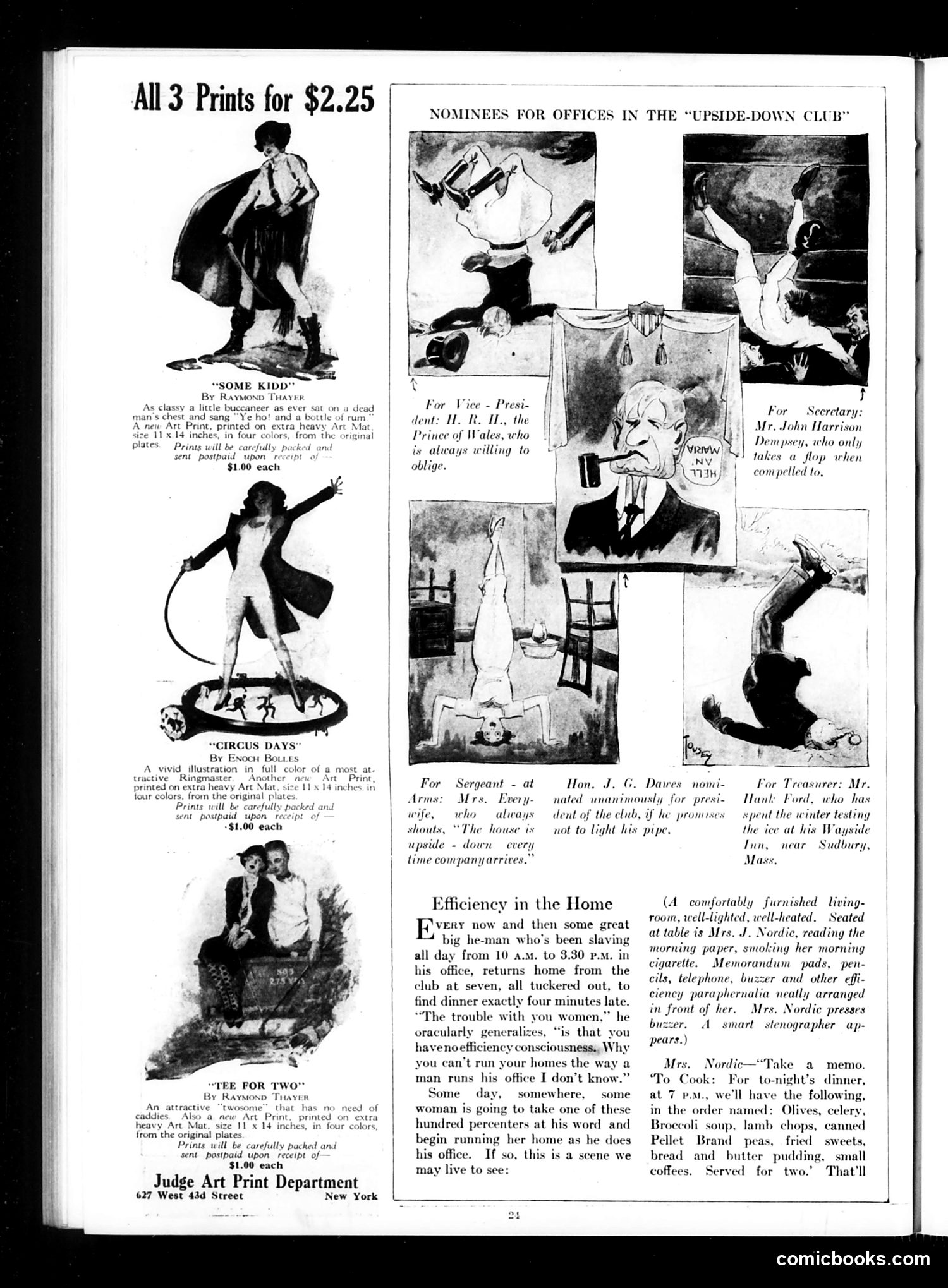
This page contains three art print advertisements (left) and satirical content about gender roles and domestic efficiency (right). The **left side** advertises three Raymond Thayer and Enoch Bolles prints: "Some Kidd" (pirate-themed), "Circus Days" (ringmaster), and "Tee for Two" (golf scene)—priced at $1 each or bundled for $2.25. The **right side** mocks the "Upside-Down Club" with humorous nominee sketches, but the main satire is the "Efficiency in the Home" article. It lampoons husbands who criticize wives' housekeeping while demanding their offices run like clockwork. The scenario imagines a wife literally adopting her husband's "efficiency consciousness"—treating home management like corporate operations, complete with memos, stenographers, and meal schedules delivered with mechanical precision. The satire suggests such rigid efficiency would be absurd domestically, implicitly criticizing men who demand perfection from wives while remaining oblivious to the absurdity of their standards.
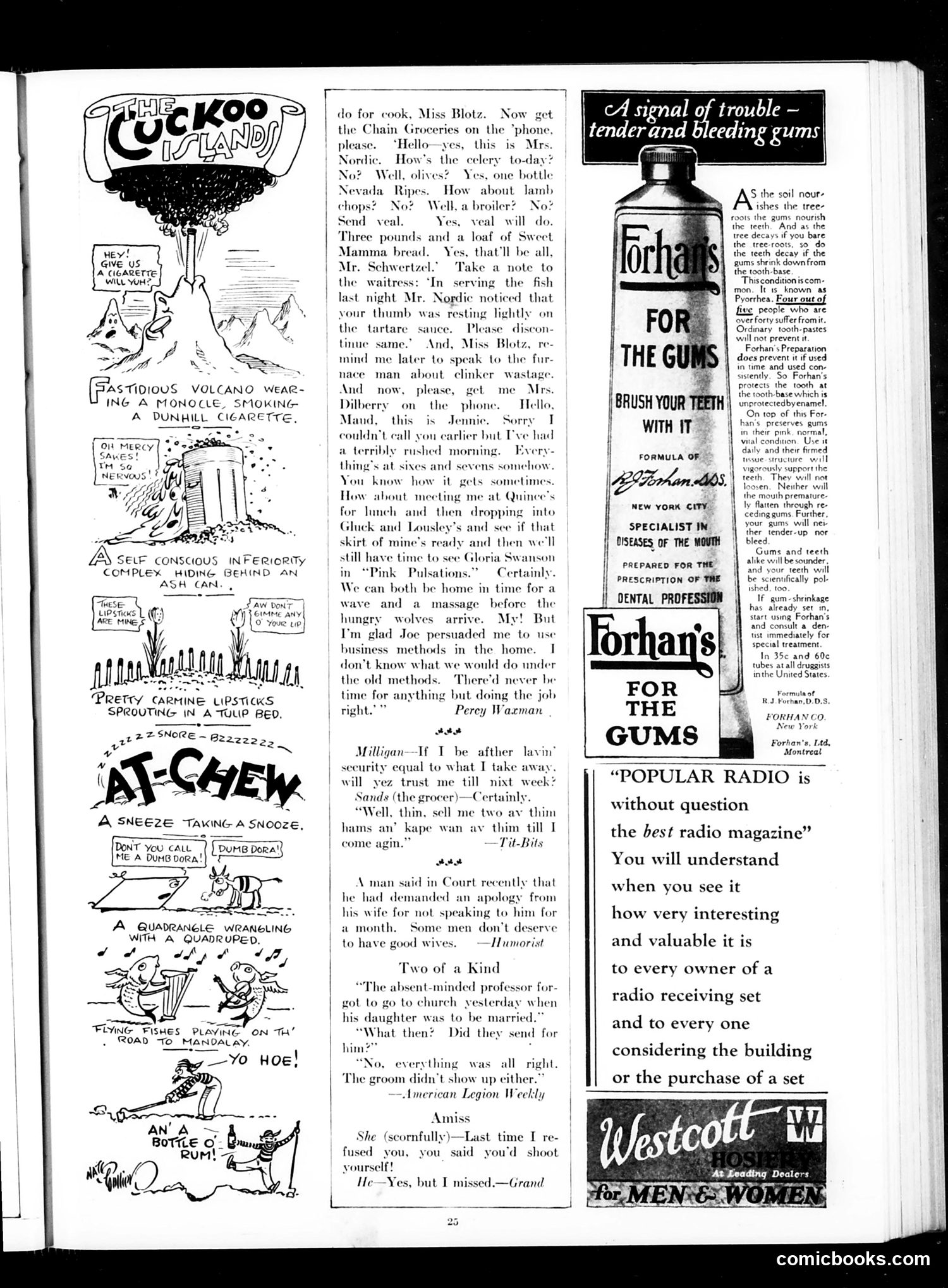
This Judge magazine page contains satirical humor about domestic life and includes period advertisements. **Left side cartoons:** "The Cuckoo Land" section offers absurdist visual jokes—a fastidious volcano smoking a cigarette, a lipstick-sprouting tulip bed, fish dancing. These are nonsensical gags typical of 1920s-30s humor magazines, relying on surrealism rather than political commentary. **Center column:** The main text satirizes modern household management. A wealthy woman orchestrates her cook and groceries via telephone while coordinating social activities (lunch, massage, salon visit). The humor targets the affectation of running a home like a business—treating servants and schedules with corporate efficiency. Her husband "Joe" apparently convinced her to adopt these "business methods," which the piece gently mocks as excessive systematization of domestic life. **Advertisements:** Right side contains vintage dental product ads (Forhan's toothpaste for gum disease) and Westcott radio sets—typical period commercial messaging. The overall page reflects 1920s-30s anxieties about modernization, efficiency culture, and changing gender roles in middle-class households.
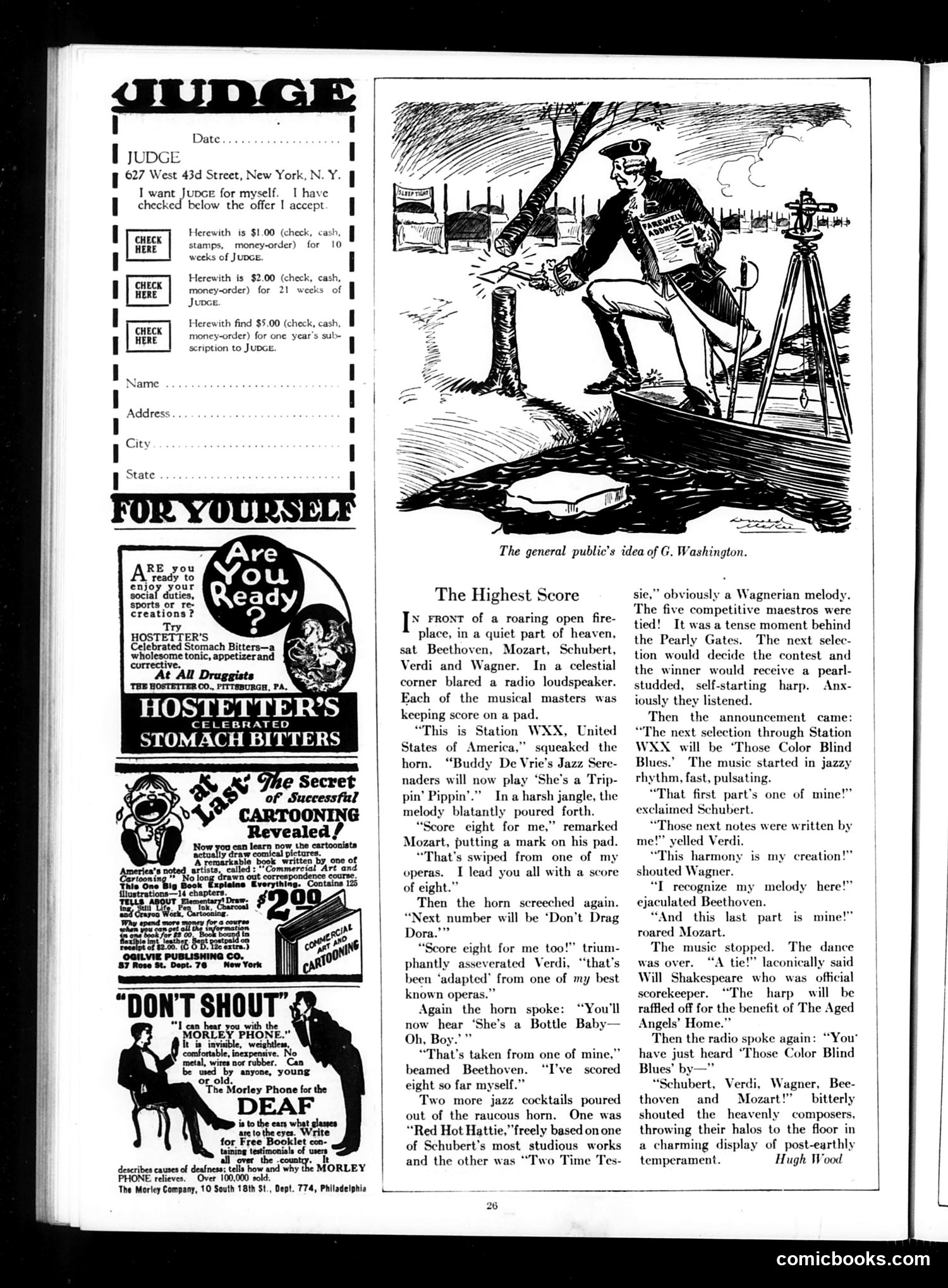
This story satirizes **modern jazz music's plagiarism** and the anxieties of classical composers about their work being appropriated. Five dead masters—Beethoven, Mozart, Schubert, Verdi, and Wagner—compete by scoring points whenever a jazz radio broadcast uses melodies stolen from their compositions. The joke exposes how 1920s jazz seamlessly incorporated classical themes into popular "jazz cocktails" with frivolous names like "She's a Trippin' Pippin'" and "Red Hot Hattie." Each composer recognizes his own work, creating absurd competition until they tie. The satire's sting: when the radio credits the song, it omits all five composers entirely, crediting only the jazz arrangement. This mocks both **commercial music's disregard for classical heritage** and the **bitter, wounded pride** of serious artists watching their legacies repackaged as disposable entertainment. The composers' petulant halo-throwing provides slapstick commentary on artistic ego versus popular culture's indifference.
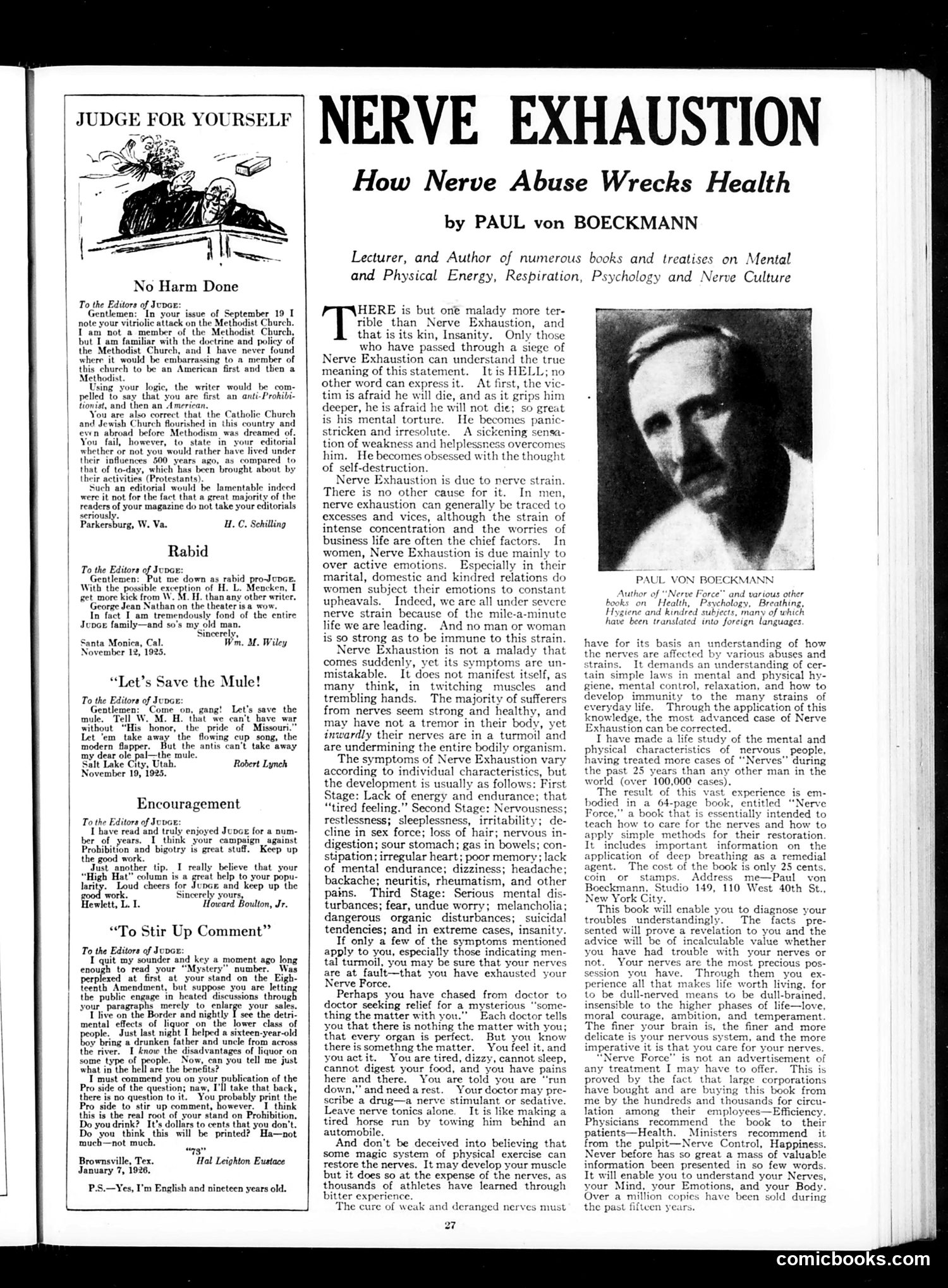
This page combines letters to the editor with a feature article on "Nerve Exhaustion" by Paul von Boeckmann. **The Letters Section:** Readers debate contemporary issues. One defends the Methodist Church against Judge's "vitriolic attack," suggesting the magazine attacked organized religion unfairly. Another celebrates writer W.M.H. (likely H.L. Mencken or similar contributor). A third protests Judge's anti-Prohibition stance, describing the harmful effects of alcohol on the "lower class" along the Texas border. **The Article:** Von Boeckmann addresses "Nerve Exhaustion," a period medical concept treating psychological strain as physical nerve damage. He describes symptoms—insomnia, irritability, poor digestion, memory loss—attributed to modern life's stresses: business pressures, emotional turmoil, and overwork. **The Cartoon (top left):** Simple illustration showing someone judging a situation labeled "No Harm Done"—likely satirizing readers who dismiss concerns. The page reflects 1920s concerns: Prohibition debates, modern medicine's nervous system theories, and Judge's role soliciting reader controversy to boost circulation.
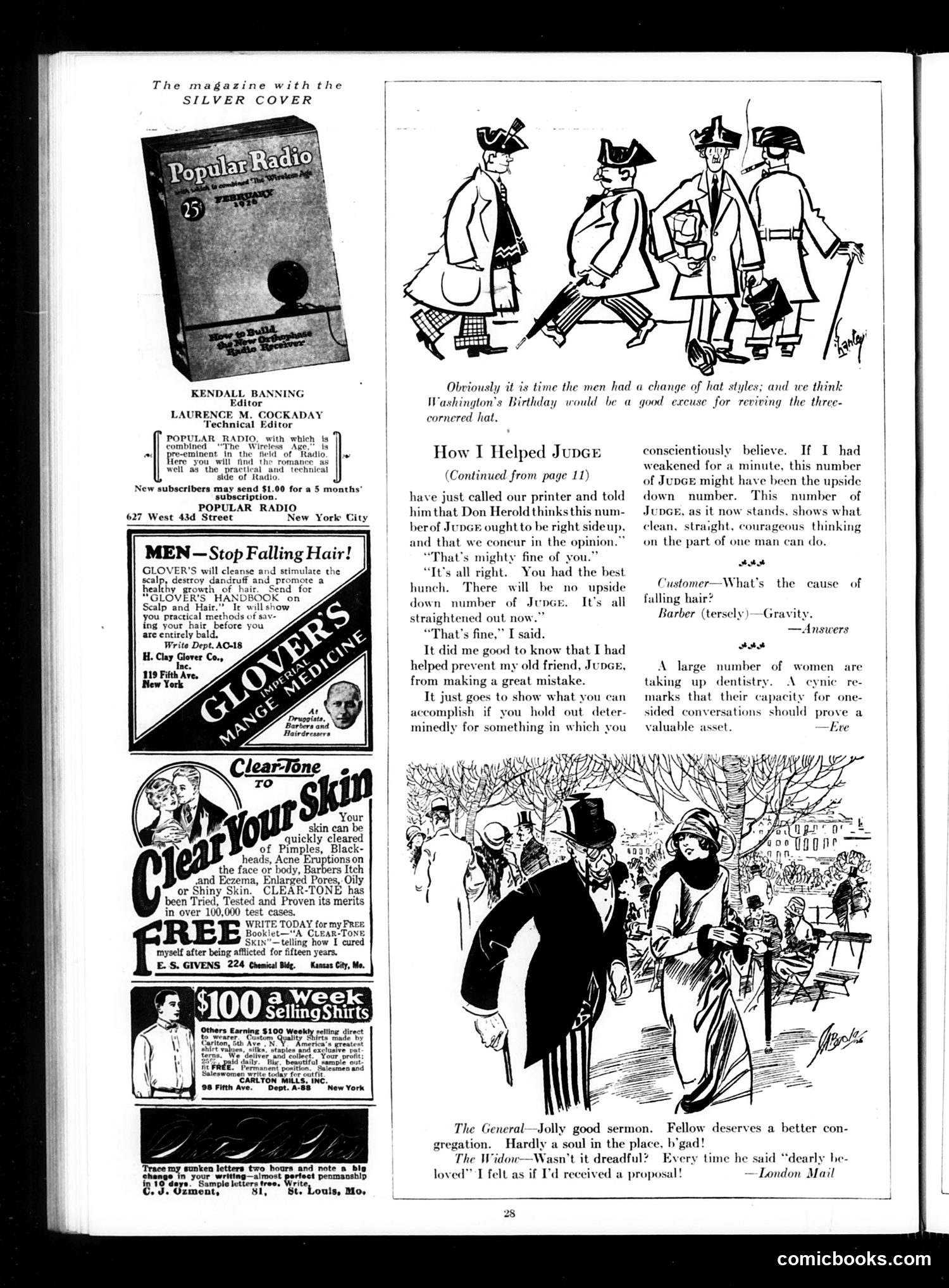
This page combines satirical humor with period advertisements typical of early 20th-century magazines. **The Main Content:** The central article "How I Helped Judge" is a self-congratulatory satire about someone who claims credit for preventing the magazine from printing an issue upside-down. The humor lies in the narrator's inflated sense of importance—he believes his "courageous thinking" saved Judge from embarrassment, when he merely made a phone call. It mocks people who exaggerate their own significance in minor matters. **The Cartoons:** The top sketch shows fashionable figures discussing hat styles, referencing Washington's Birthday as a moment to update men's headwear—light social satire. The lower illustration depicts a park scene with romantic or social commentary, though the specific reference is unclear from visible text. **The Advertisements:** These include hair-loss remedies (Glover's), skin treatments (Clear-Tone), shirt sales, and handwriting improvement—typical product pitches exploiting common insecurities of the era. The page reflects Judge's mix of gentle social satire and commercial content.
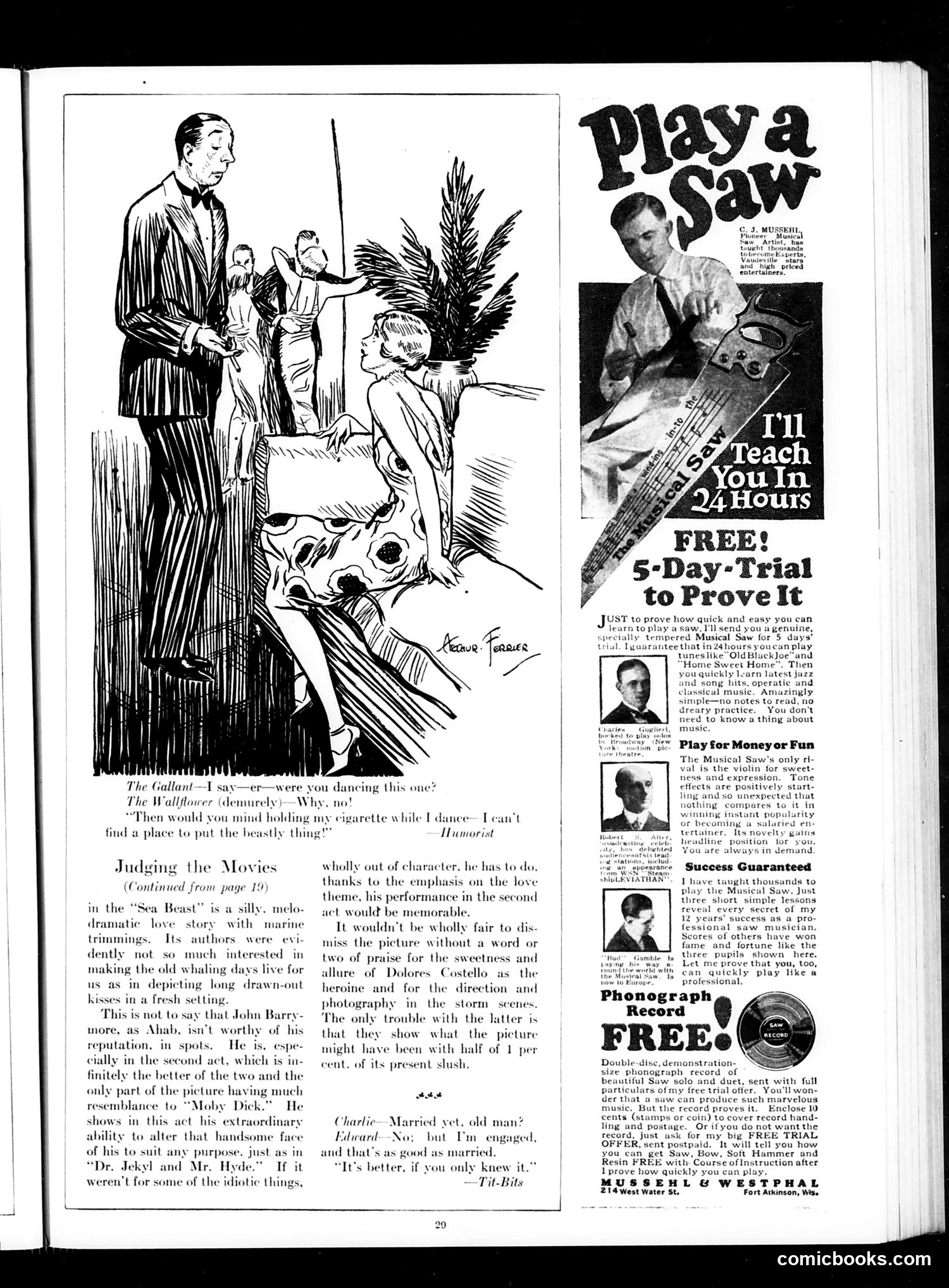
**The Cartoon:** A man approaches a woman at a social gathering, asking if she's dancing. When she says no, he requests she hold his cigarette while he dances—unable to find anywhere to set it down. The joke satirizes the absurdity of 1920s social etiquette and male entitlement: he's using a transparent excuse to involve her while dodging the actual problem (his own carelessness with the cigarette). **"Judging the Movies":** A film review critiquing John Barrymore's 1926 "The Sea Beast" (loosely based on *Moby Dick*). The reviewer praises Barrymore's acting ability but faults the film for emphasizing melodramatic romance over the whaling story, calling it "slush." Dolores Costello and the storm cinematography receive praise. **The Advertisements:** The right side features ads for a "Musical Saw"—a novelty instrument marketed as teachable in 24 hours, with testimonials and a free trial offer. This reflects 1920s Jazz Age culture: leisure activities, cinema criticism, and mail-order novelty products.
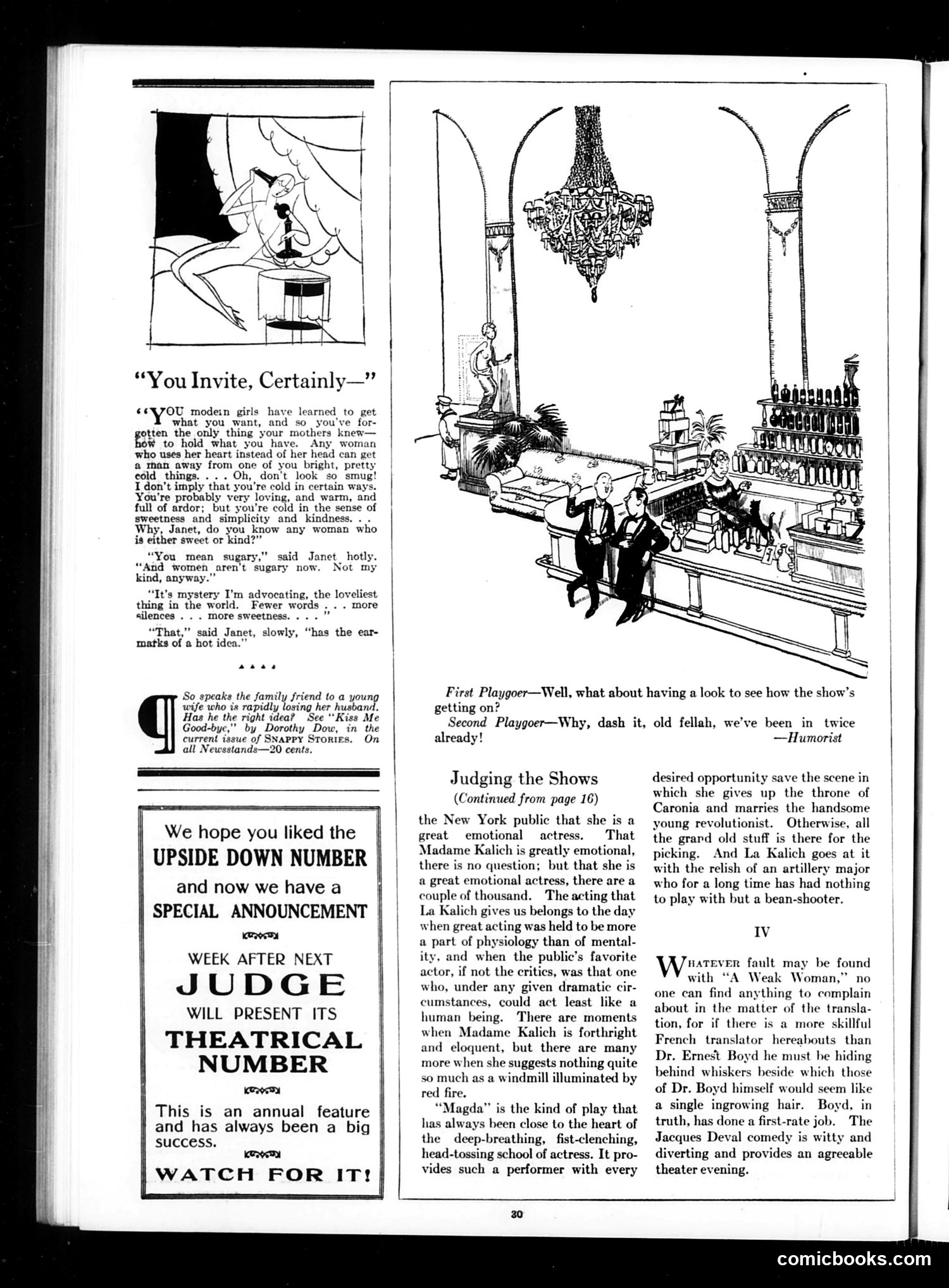
This page contains **social commentary disguised as advice**, plus theater reviews. The main piece, "You Invite, Certainly—," presents a "family friend" counseling a young wife that she's losing her husband because modern girls are too clever and direct. He advocates for "mystery," fewer words, and "sweetness"—coded language for women being less assertive and more traditionally submissive. Janet's responses suggest she finds this advice outdated ("hot idea" = ridiculous notion). The satire targets both the old-fashioned advisor clinging to pre-modern gender expectations AND the contemporary debate about how "modern girls" should behave. The theater reviews discuss actress Madame Kalich's overly physical, melodramatic acting style in the play "Magda." The critic prefers subtlety to exaggerated physiology-based performance—a technical theater critique typical of the era. The brief joke about playgoers attending a show twice without actually watching it satirizes theater-going as social performance rather than genuine interest.
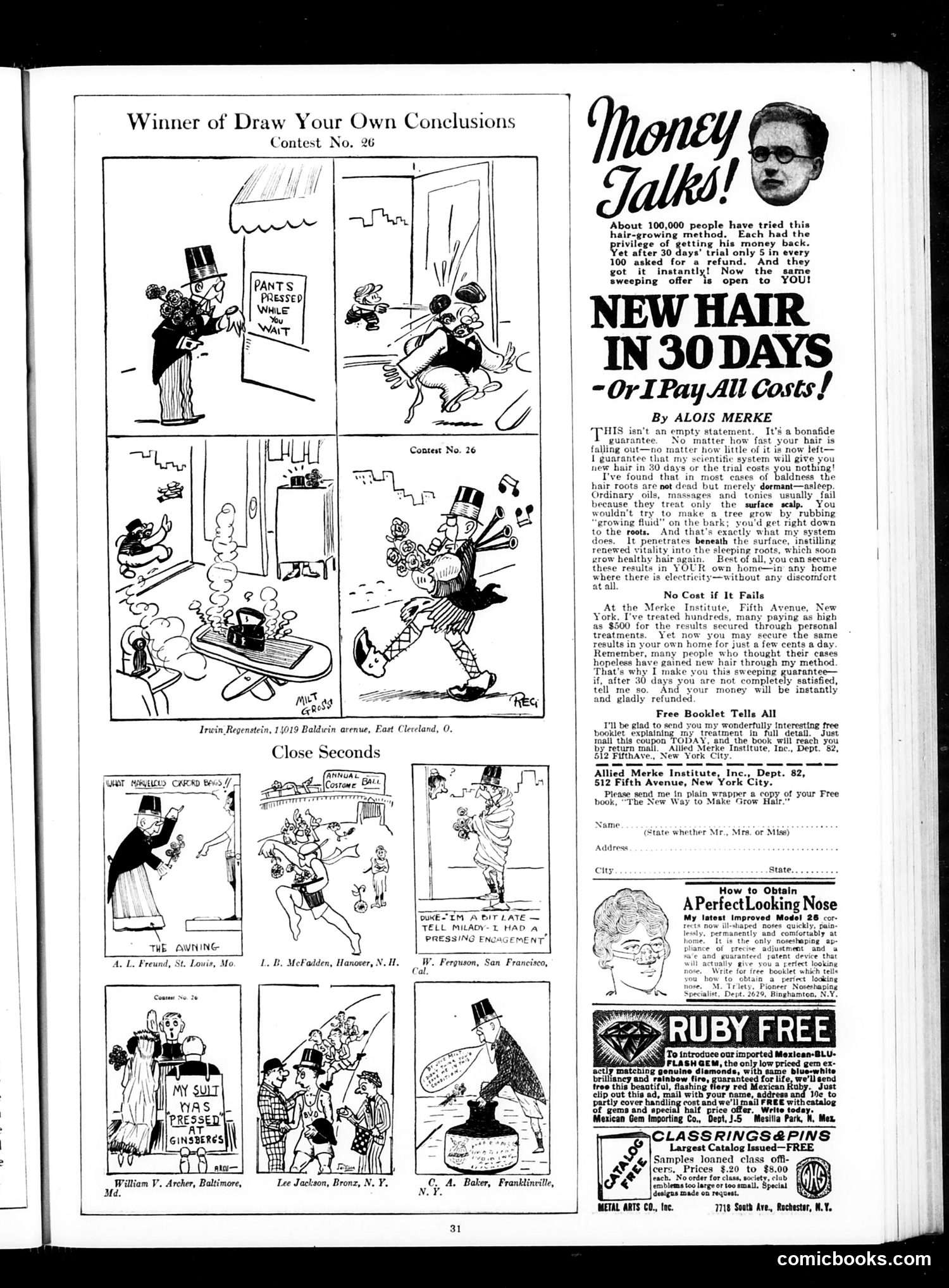
This page displays the winning entries from Judge's cartoon contest #26, where readers submitted humorous four-panel comic strips with minimal or no captions, leaving the joke's interpretation open. The top winner by Irwin Regenstein shows a man in a top hat at a pants-pressing shop; subsequent panels depict increasingly chaotic results—suggesting the humor derives from the absurd consequences of a simple service going catastrophically wrong. The "Close Seconds" section shows other contestants' entries, each presenting visual gags: a woman's clothing mishap, a man's "pressing engagement" misfire, and similar slapstick scenarios. The page is primarily **advertising space**, featuring prominent promotions for hair-growth treatments, nose-correction devices, and class rings—typical early-20th-century mail-order products targeting insecurities. These ads reflect the era's approach to personal appearance remedies and consumer marketing tactics.
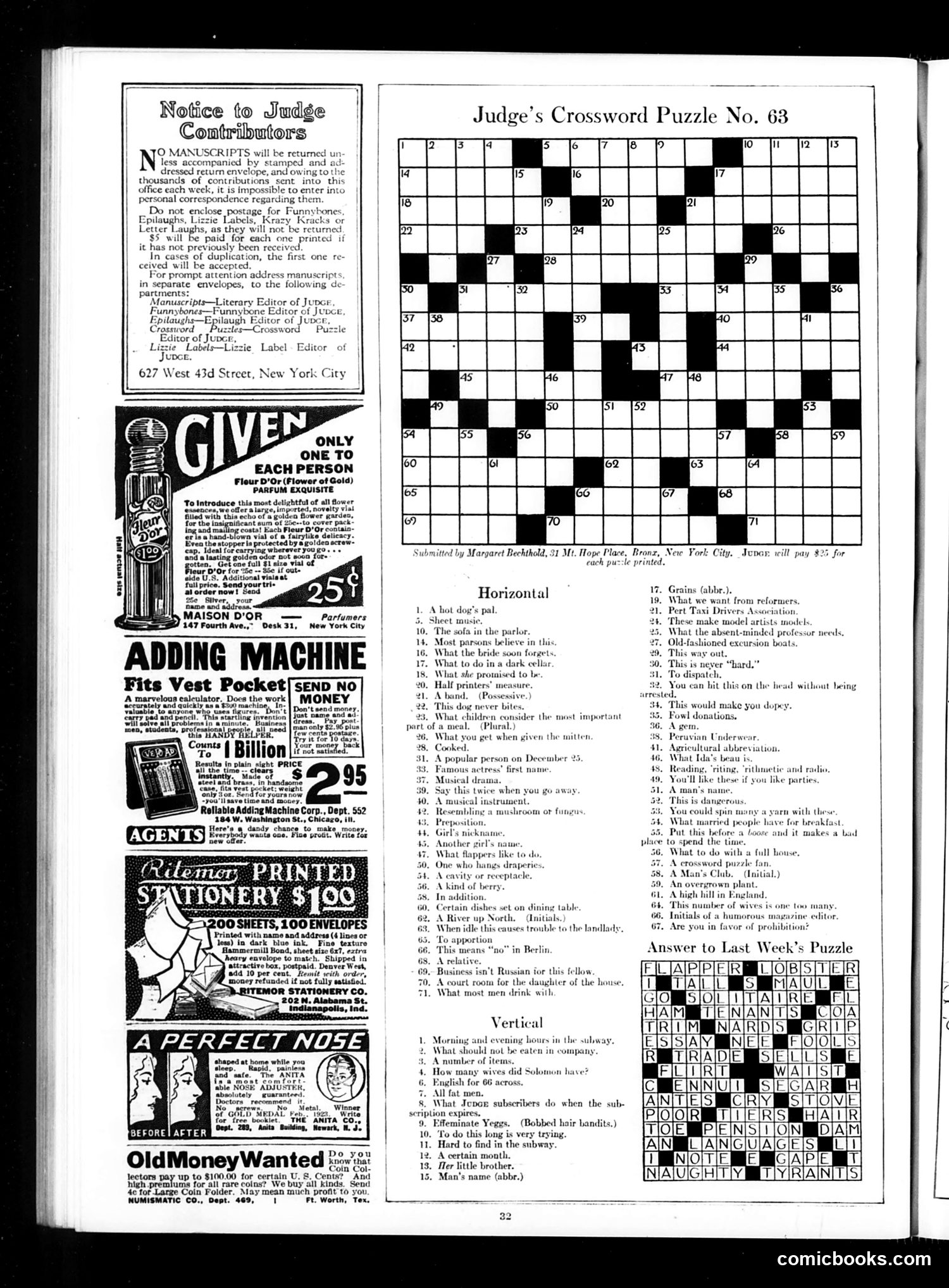
This page is primarily a **crossword puzzle** (No. 63) with accompanying clues, rather than political satire. The puzzle itself contains no caricatures or political commentary visible in the grid or clues provided. The page also includes: 1. **"Notice to Judge Contributors"** — editorial guidelines for manuscript submissions 2. **Period advertisements** — including "Maison d'Or" perfume, an adding machine, printing stationery, a "perfect nose" remedy (likely for cosmetic concerns), and a coin-buying service The only potentially satirical content appears in some crossword clue answers shown in the solved puzzle at bottom (references to "lobster," "oyster," "flirt," "naughty"), but these seem to be standard puzzle wordplay rather than social commentary. The page reflects **1920s-1930s consumer culture** through its ads, but contains no identifiable political figures or satirical commentary worthy of historical analysis. It's primarily a **service/entertainment page** rather than editorial content.
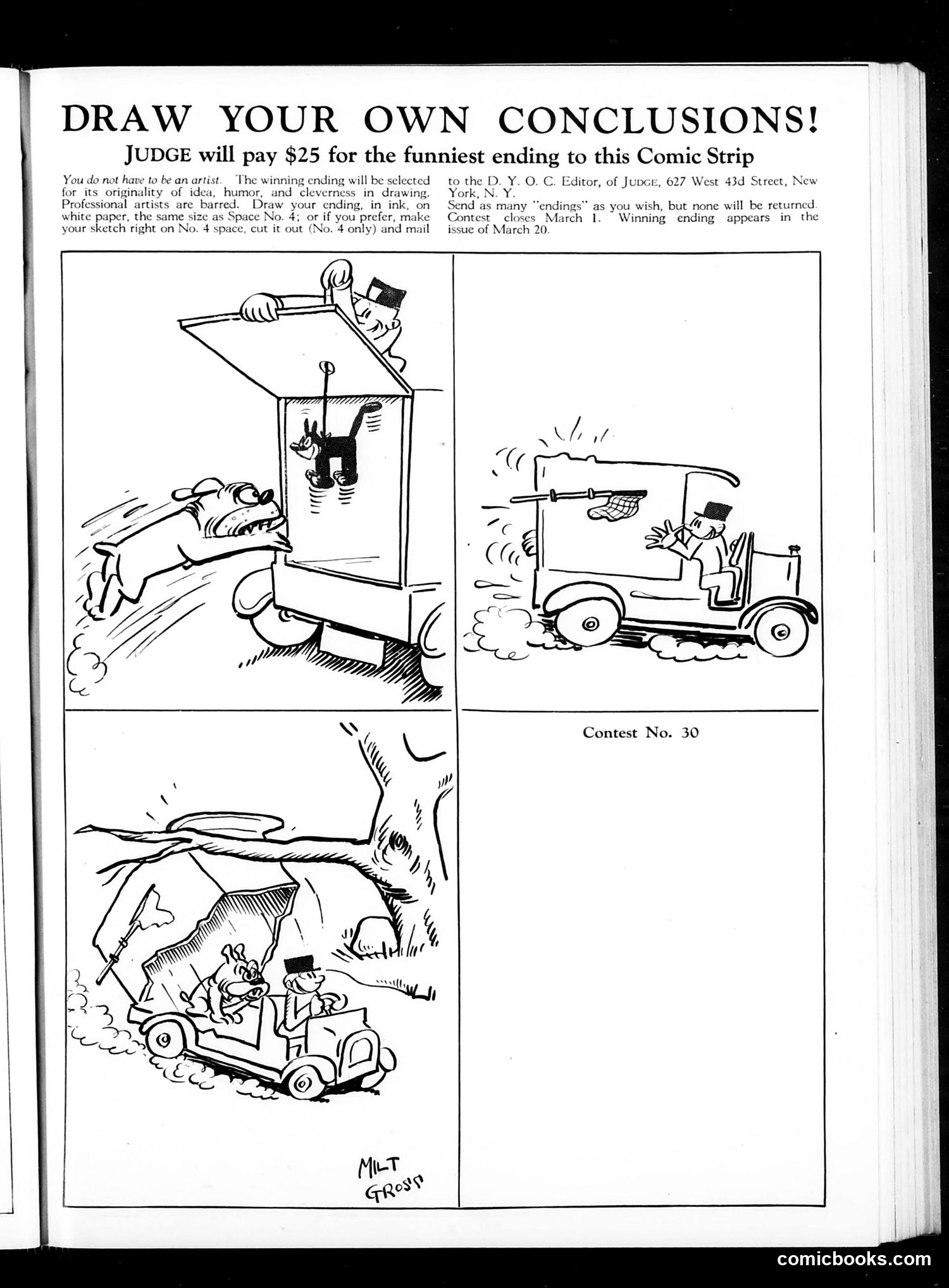
This is a reader-participation contest page from **Judge**, a satirical humor magazine. The page presents an incomplete comic strip in three panels showing various slapstick scenarios: a man on a roof lowering a cat in a box while a dog chases below; a man in a motorized vehicle being chased by projectiles; and figures near a tree as a car approaches. Readers were invited to draw their own funny conclusion to the strip and submit it for a $25 prize. The contest explicitly barred professional artists, making it accessible to amateur contributors. This represents an early form of interactive media engagement—Judge soliciting audience participation to generate humorous content. The absurdist, physical-comedy style typifies early 20th-century American comic humor.
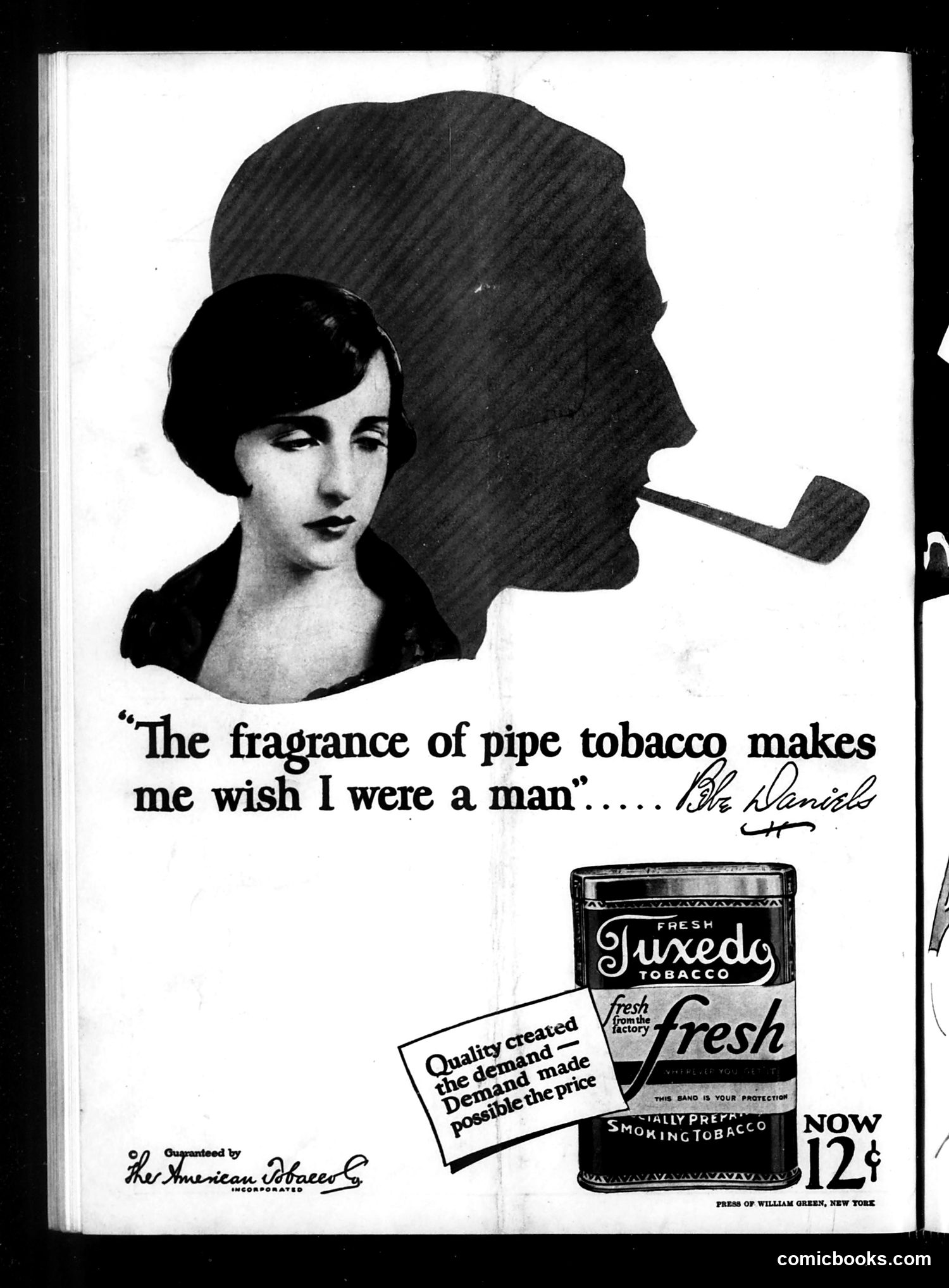
This is a **tobacco advertisement**, not satire or editorial content. It features a woman's portrait alongside a silhouette of a man smoking a pipe, promoting "Tuxedo" brand pipe tobacco. The ad's headline—"The fragrance of pipe tobacco makes me wish I were a man"—exploits early 20th-century gender norms. It suggests pipe smoking was exclusively masculine, and that the product's appeal is so strong it inspires female envy of male privilege. The ad emphasizes quality ("Guaranteed by The American Tobacco Co.") and price (12¢). The tagline "Quality created the demand—Demand made possible the price" attempts to justify the cost through prestige marketing. This represents how vintage tobacco ads normalized smoking while reinforcing gender stereotypes—treating male exclusivity as desirable and aspirational for women.