
A complete issue · 37 pages · 1925
Judge — December 26, 1925
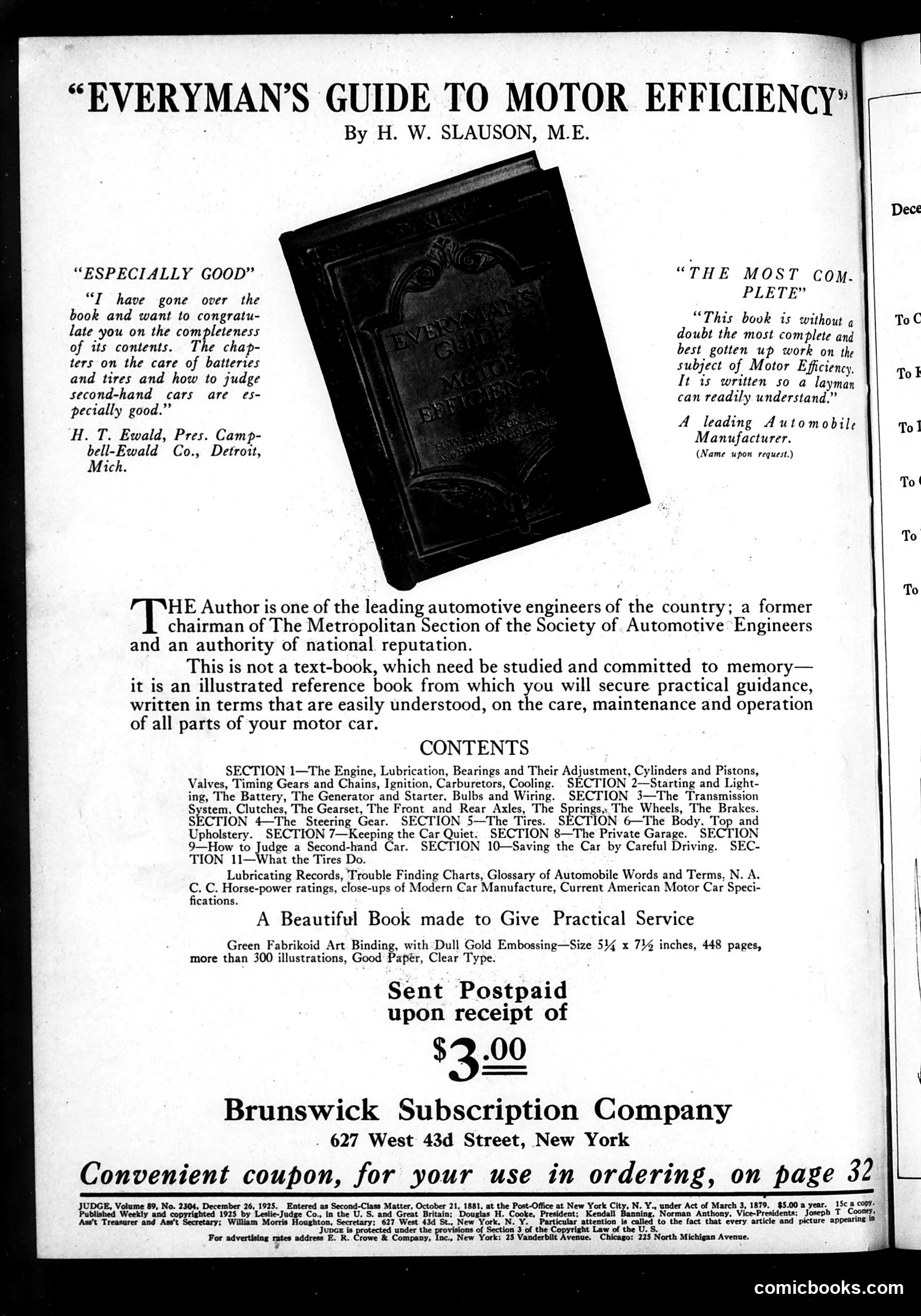
This page is primarily **advertising, not satire or political cartoon**. It promotes "Everyman's Guide to Motor Efficiency" by H.W. Slauson, M.E., a practical automotive maintenance manual. The page features: - **Testimonials** from industry figures praising the book's completeness and accessibility to laypeople - **Author credentials**: Slauson is identified as a leading automotive engineer and former chairman of the Society of Automotive Engineers - **Book details**: 448 pages, over 300 illustrations, green binding with gold embossing - **Price and publisher**: $3.00 postpaid from Brunswick Subscription Company, New York The content reflects early 20th-century American interest in motor car maintenance and operation as essential practical knowledge for vehicle owners. There is no political satire present—this is a straightforward product advertisement placed in *Judge* magazine.
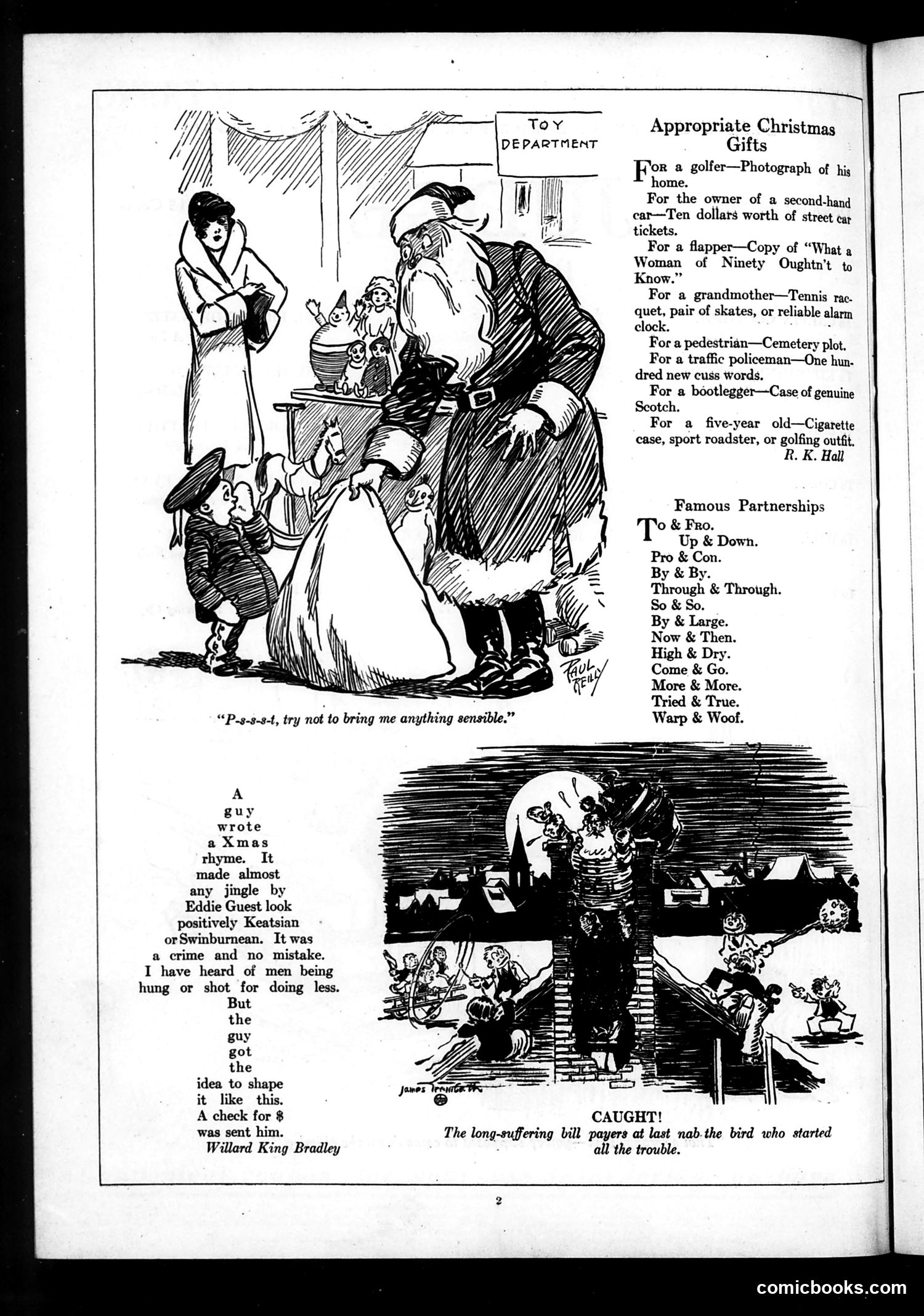
This page contains **satirical gift suggestions** and humor pieces rather than political cartoons. The top illustration mocks gift-giving with Santa telling a woman "P-s-s-t, try not to bring me anything sensible"—satirizing impractical Christmas presents. The suggested gifts are deliberately absurd (cemetery plots for pedestrians, cuss words for bootleggers), mocking what people actually give. The middle section lists "Famous Partnerships" (Up & Down, Pro & Con, etc.)—wordplay jokes. The bottom cartoon titled "CAUGHT!" depicts Santa trapped on a rooftop, apparently caught by bill collectors. The caption states "The long-suffering bill payers at last nab the bird who started all the trouble"—blaming Santa/Christmas commercialism for financial hardship during what appears to be an economically difficult period.
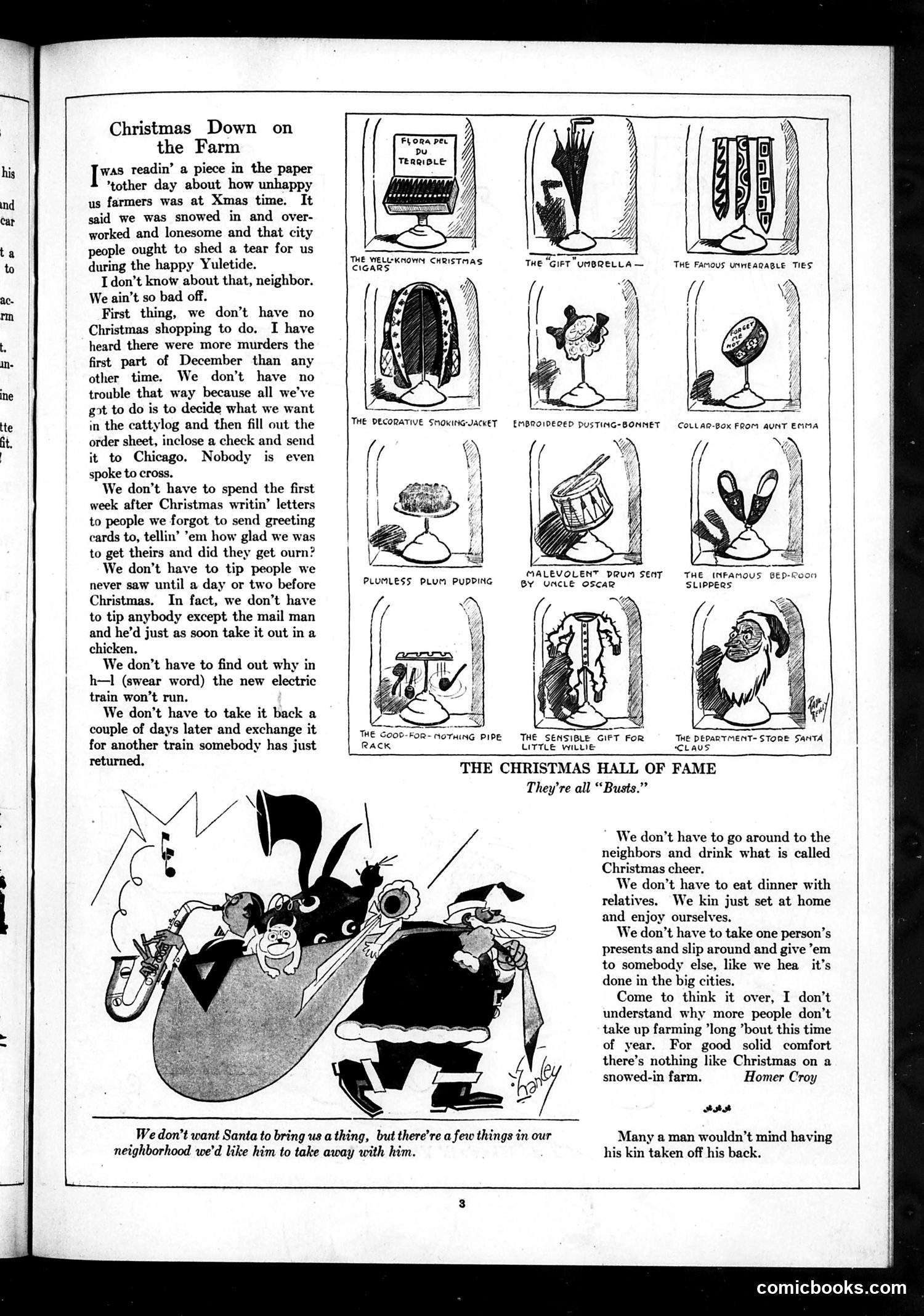
This satirical piece celebrates rural farm life during Christmas by contrasting it favorably with urban customs. The farmer-narrator humorously lists what farms *don't* have to do: no Christmas shopping murders, no sending greeting cards, no tipping strangers, no broken electric trains to exchange. **"The Christmas Hall of Fame"** section presents twelve impractical or useless gift items as jokes—things like "The Famous Unbreakable Tie," "Pillowless Plum Pudding," and "The Department-Store Santa Claus." All are labeled "Busts" (failures). The large cartoon shows Santa drowning in unwanted gifts, with the caption expressing desire for Santa to *take away* neighborhood items instead. The overall satire mocks urban Christmas consumerism and consumer culture, positioning rural simplicity as preferable to city materialism and its attendant social obligations.
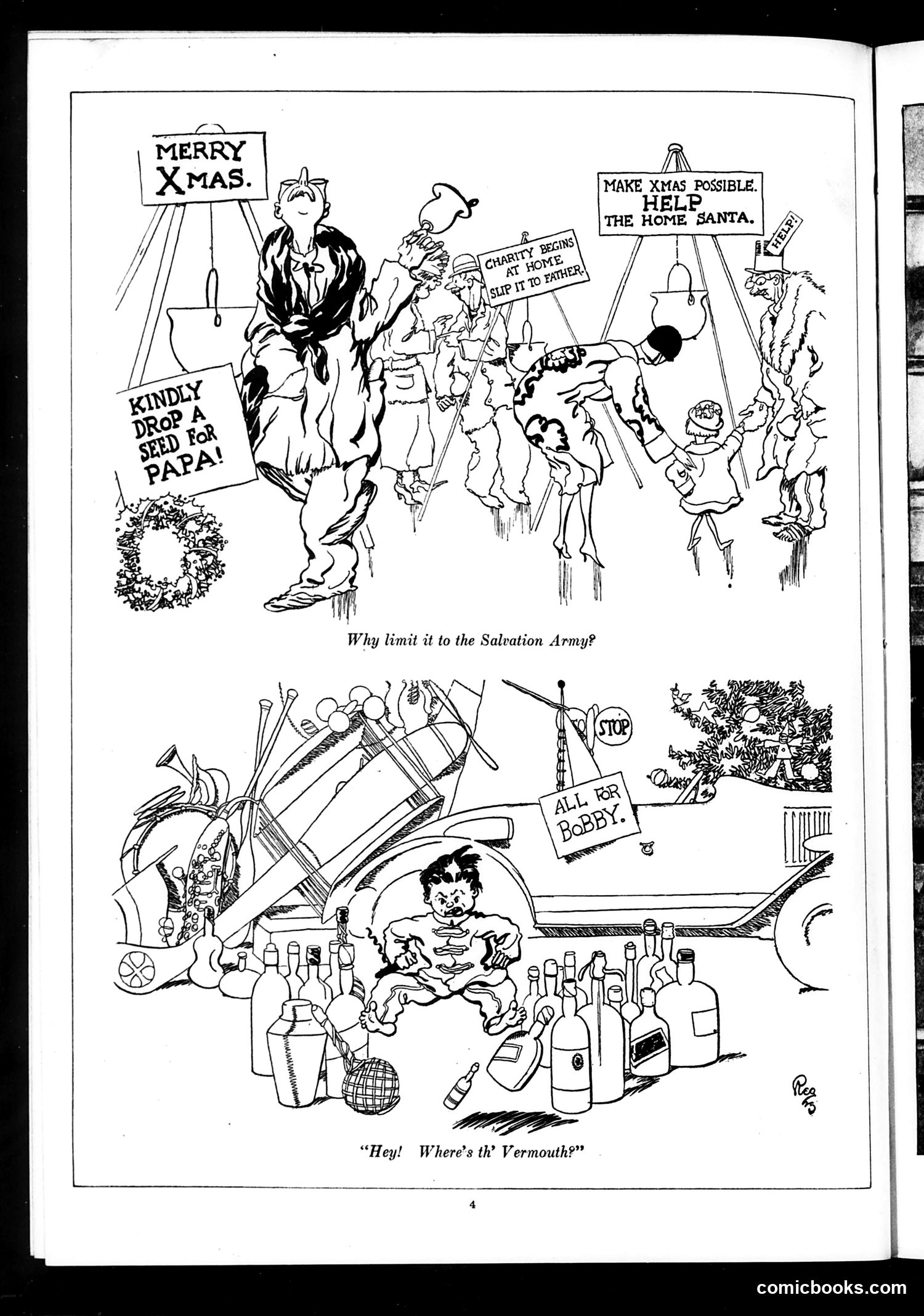
This page contains two satirical cartoons addressing Christmas charity during what appears to be Prohibition-era America (suggested by the alcohol references). **Top cartoon**: Shows Santa Claus surrounded by charitable organizations holding signs ("Make Xmas Possible," "Help the Home Santa," "Charity Beginning at Home"). The question "Why limit it to the Salvation Army?" suggests debate over which charitable organizations should receive holiday donations—the satire criticizes the fragmentation of charitable giving. **Bottom cartoon**: Depicts a disheveled figure surrounded by liquor bottles beneath a sign reading "All for Bobby." The caption "Hey! Where's th' Vermouth?" mocks how Christmas charity is being diverted toward alcohol rather than legitimate causes, satirizing the hypocrisy of charitable giving during Prohibition when illegal drinking persisted. Both cartoons critique how Christmas generosity was being misappropriated.
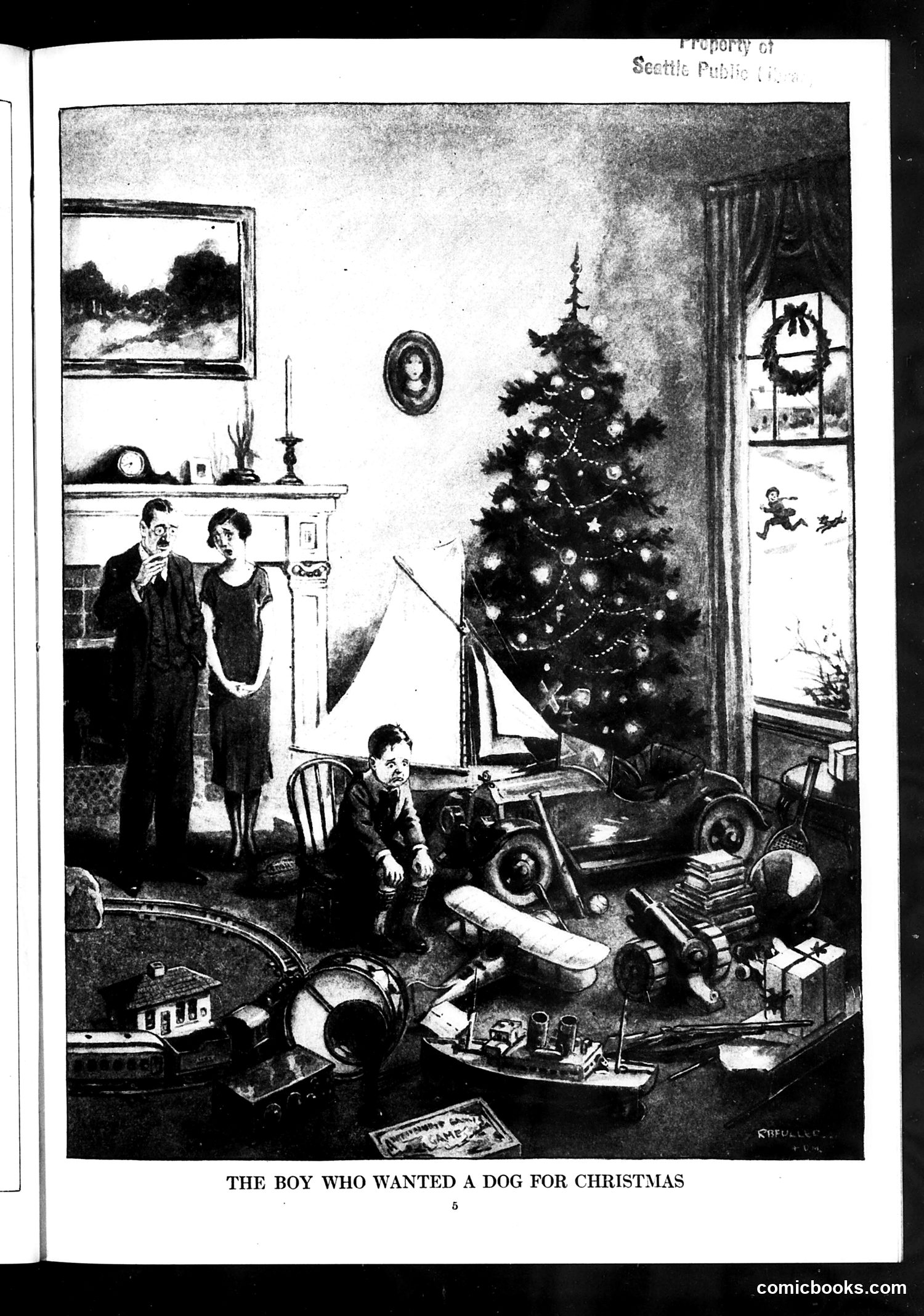
This illustration depicts a domestic Christmas scene with social commentary typical of Judge magazine's satirical style. A young boy sits surrounded by an elaborate collection of toys and mechanical devices—toy cars, boats, trains, and various gadgets—while his parents observe from behind. A decorated Christmas tree stands in the background. The satire appears to critique consumer excess and materialism during the Christmas season. Despite receiving numerous expensive, elaborate gifts, the boy's desire remains unfulfilled: he wanted a dog, not manufactured toys. The image mocks both parental indulgence in purchasing complex mechanical toys instead of simpler, more meaningful gifts that children actually desire, and the era's growing consumer culture that equated love with material abundance rather than understanding a child's genuine wishes.
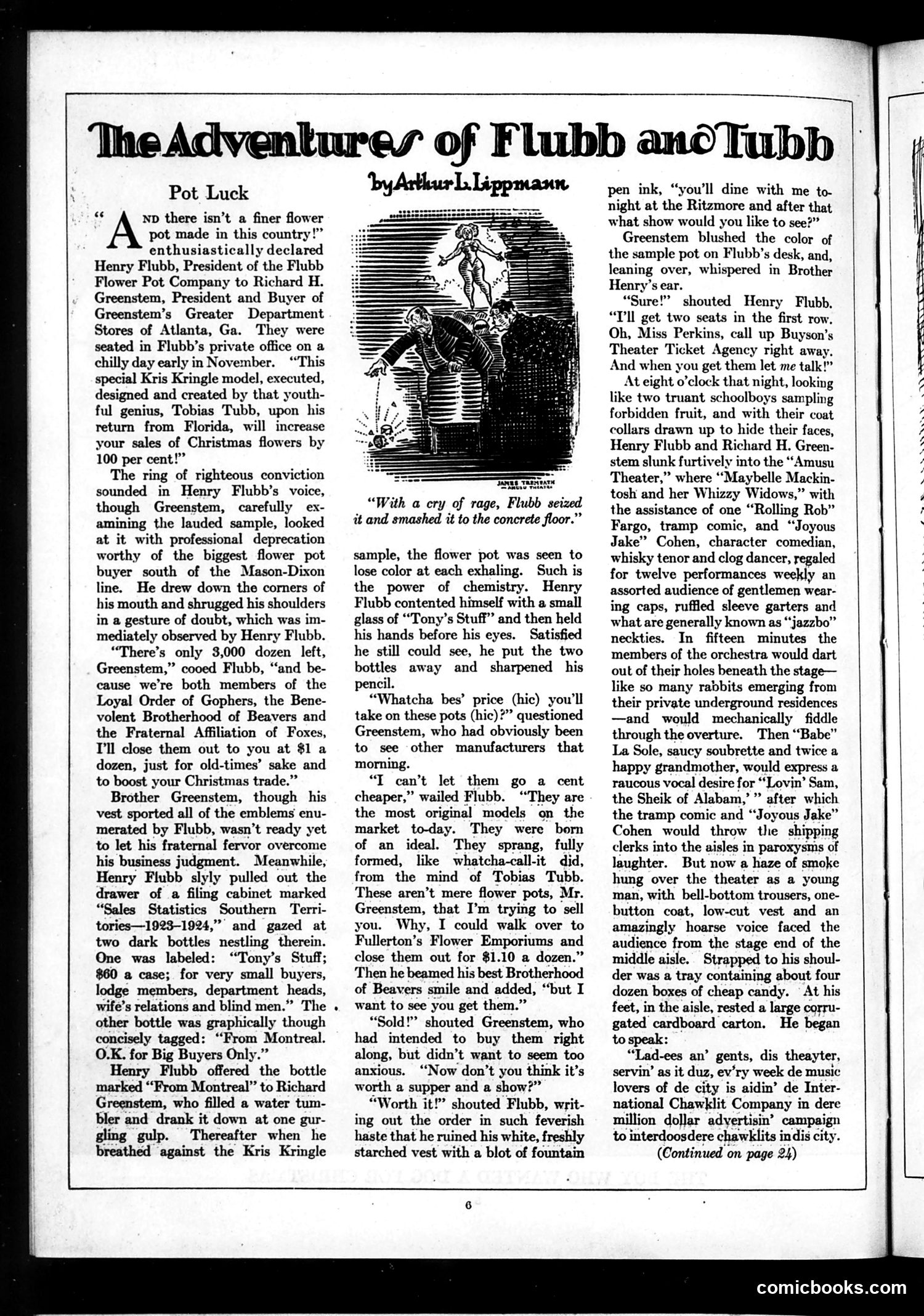
This is a humorous business satire by Arthur L. Lippmann about sales tactics during Prohibition (implied by the hidden liquor bottles). Two businessmen—Henry Flubb (flower pot manufacturer) and Richard Greenstem (department store buyer)—negotiate a deal. Flubb uses fraternal lodge membership and alcohol to lower Greenstem's resistance: he plies him with bootleg "Montreal" liquor while withholding it from himself, then uses flattery and false scarcity claims ("only 3,000 dozen left") to close the sale. The joke satirizes dishonest sales methods and the way fraternal organizations supposedly enabled corruption. The cartoon depicts Flubb manipulating Greenstem through emotional appeals and intoxication rather than honest business practice. The story continues on page 21, suggesting this was serialized humor for Judge magazine's readers.
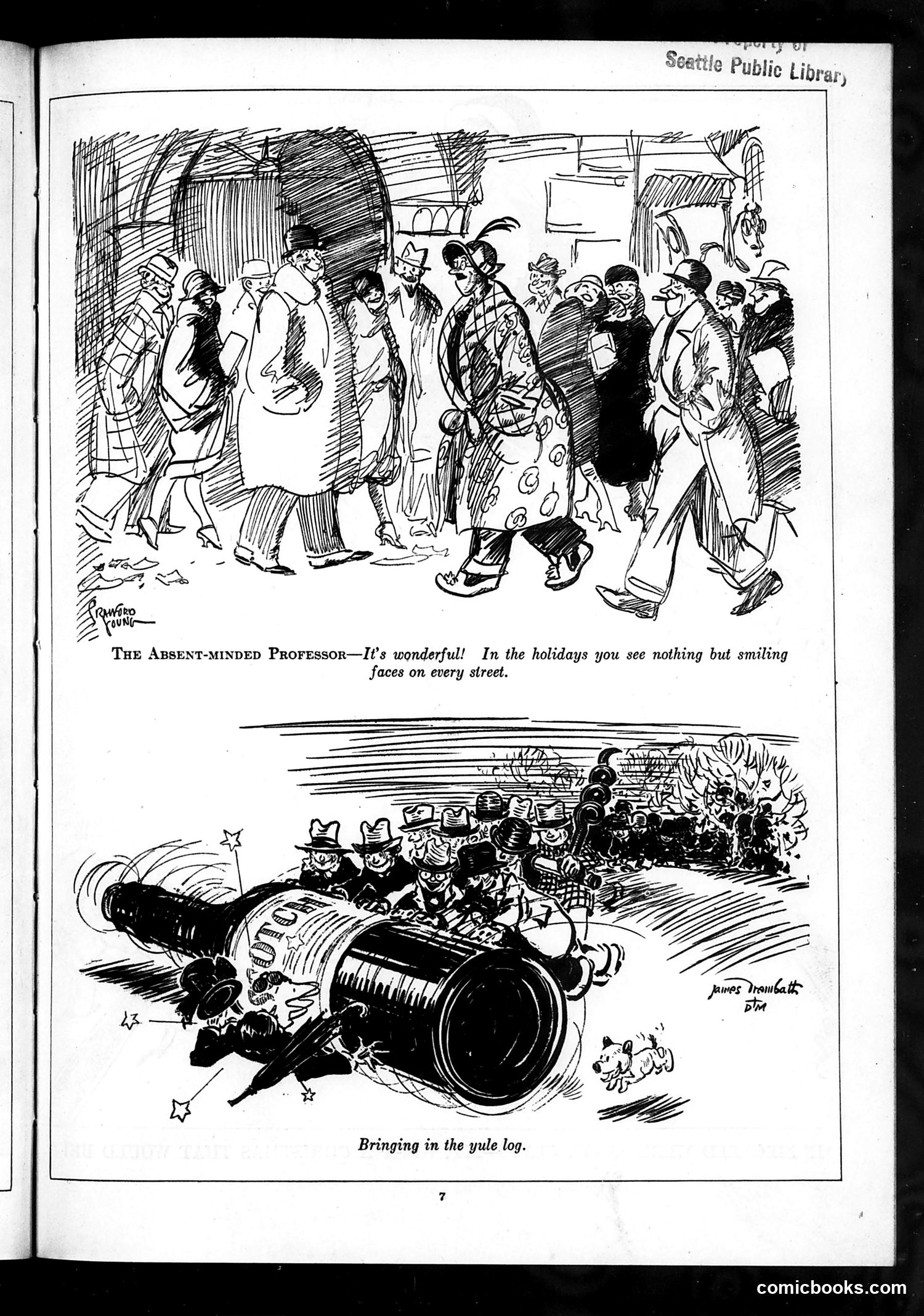
**Top cartoon**: Titled "The Absent-minded Professor," it depicts a crowded street scene with numerous people in holiday attire. The professor's observation—that holidays show "nothing but smiling faces on every street"—appears to be straightforward, though possibly ironic commentary on the cheerfulness people display during Christmas season. **Bottom cartoon**: "Bringing in the yule log" shows anthropomorphized animals (appearing to be mice or similar creatures) riding inside or on a large cylindrical object labeled what seems to be a log or cannon. The imagery suggests a festive, whimsical holiday scene, though the exact satirical point is unclear from the image alone. Both cartoons use holiday themes, likely from an early-to-mid 20th century Judge magazine issue.
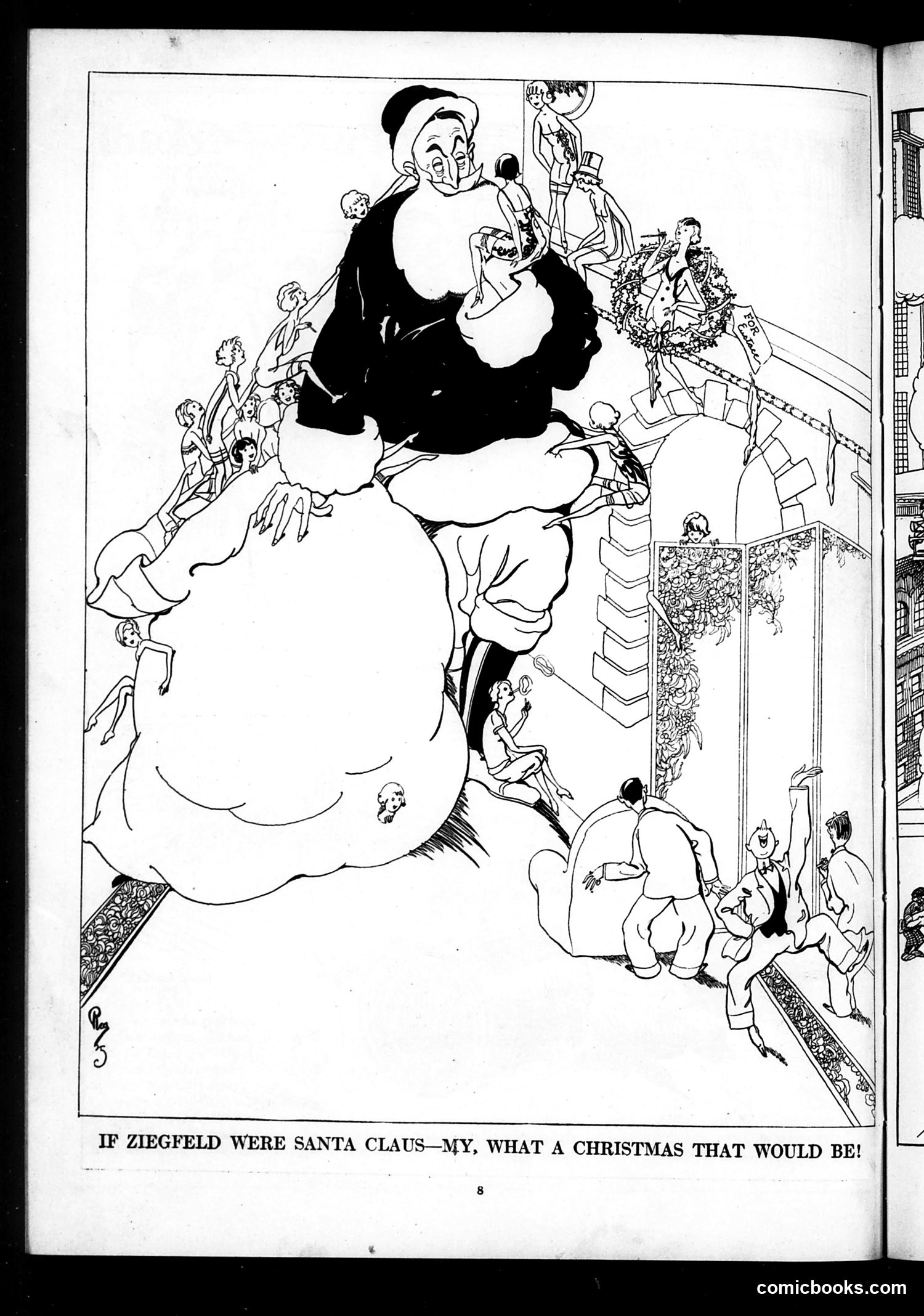
This satirical cartoon references **Florenz Ziegfeld**, the famous Broadway impresario known for the lavish "Ziegfeld Follies" theatrical productions featuring elaborate staging and attractive chorus girls. The cartoon imagines "if Ziegfeld were Santa Claus," depicting an impossibly corpulent Santa surrounded by scantily-clad women and children in an urban setting. The satire works on multiple levels: it mocks Ziegfeld's reputation for spectacular excess and objectification of female performers, while humorously suggesting his entertainment empire's extravagance could rival Christmas gift-giving itself. The exaggerated physical proportions and the crowded, chaotic composition emphasize the absurdity of this hypothetical scenario—implying Ziegfeld's theatrical productions were already as over-the-top as an imagined Ziegfeld-style Christmas would be.
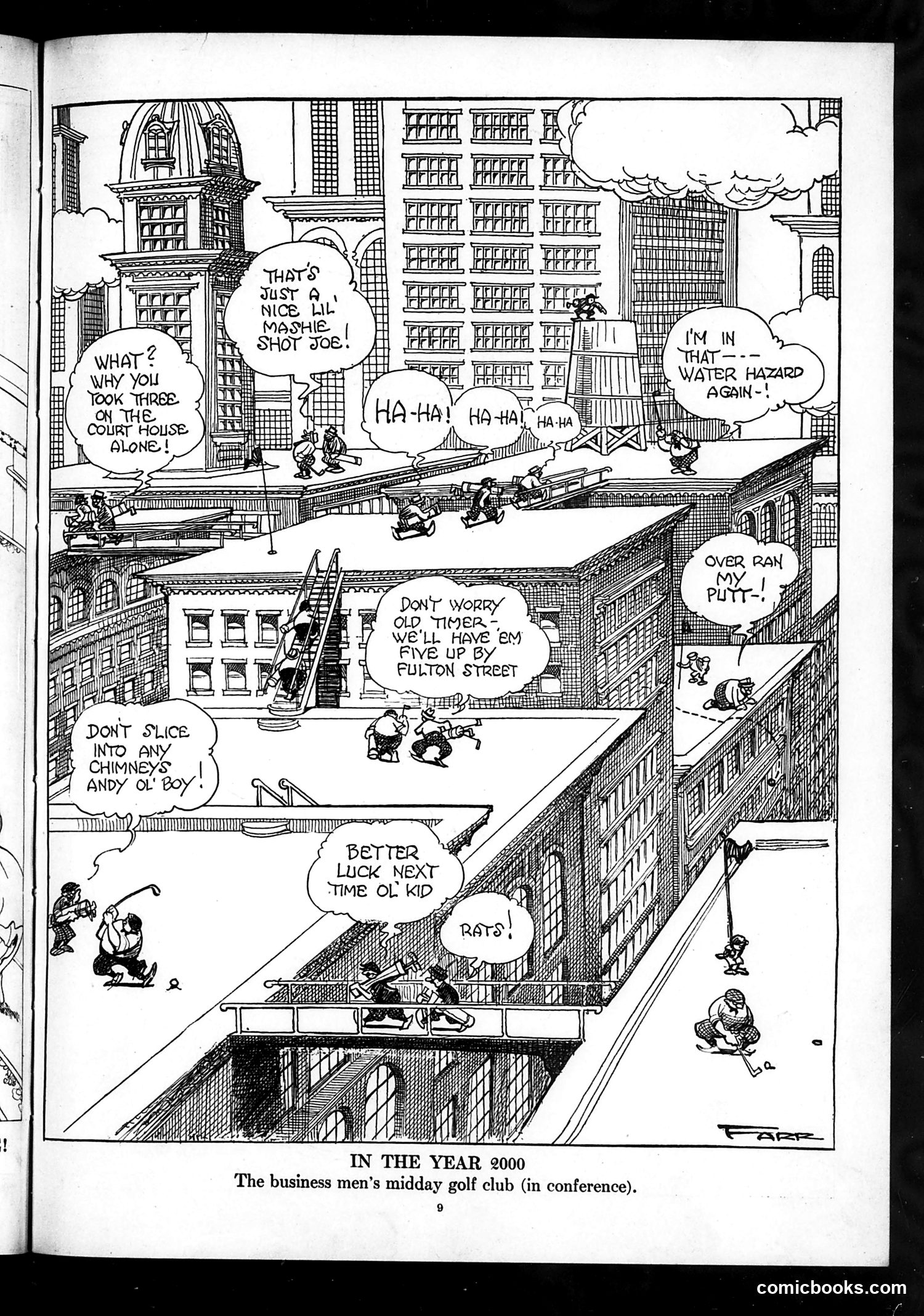
This is a futuristic satire imagining businessmen playing golf in the year 2000 on rooftops between tall skyscrapers in what appears to be a dense urban center (likely New York City, given Fulton Street reference). The joke mocks the absurdity of cramped city living and overscheduling: despite congestion and hazards—water towers, chimneys, tight spaces, rats—businessmen persist in their leisure golf game during lunch breaks, offering each other casual warnings ("Don't slice into chimneys") as if these were normal golfing obstacles rather than urban dangers. The cartoon satirizes American business culture's obsession with golf and leisure time, even as urbanization makes such activities increasingly ridiculous. The comic's tone suggests this futuristic scenario seemed both comedically exaggerated and plausible enough to Judge's audience to warrant mockery.
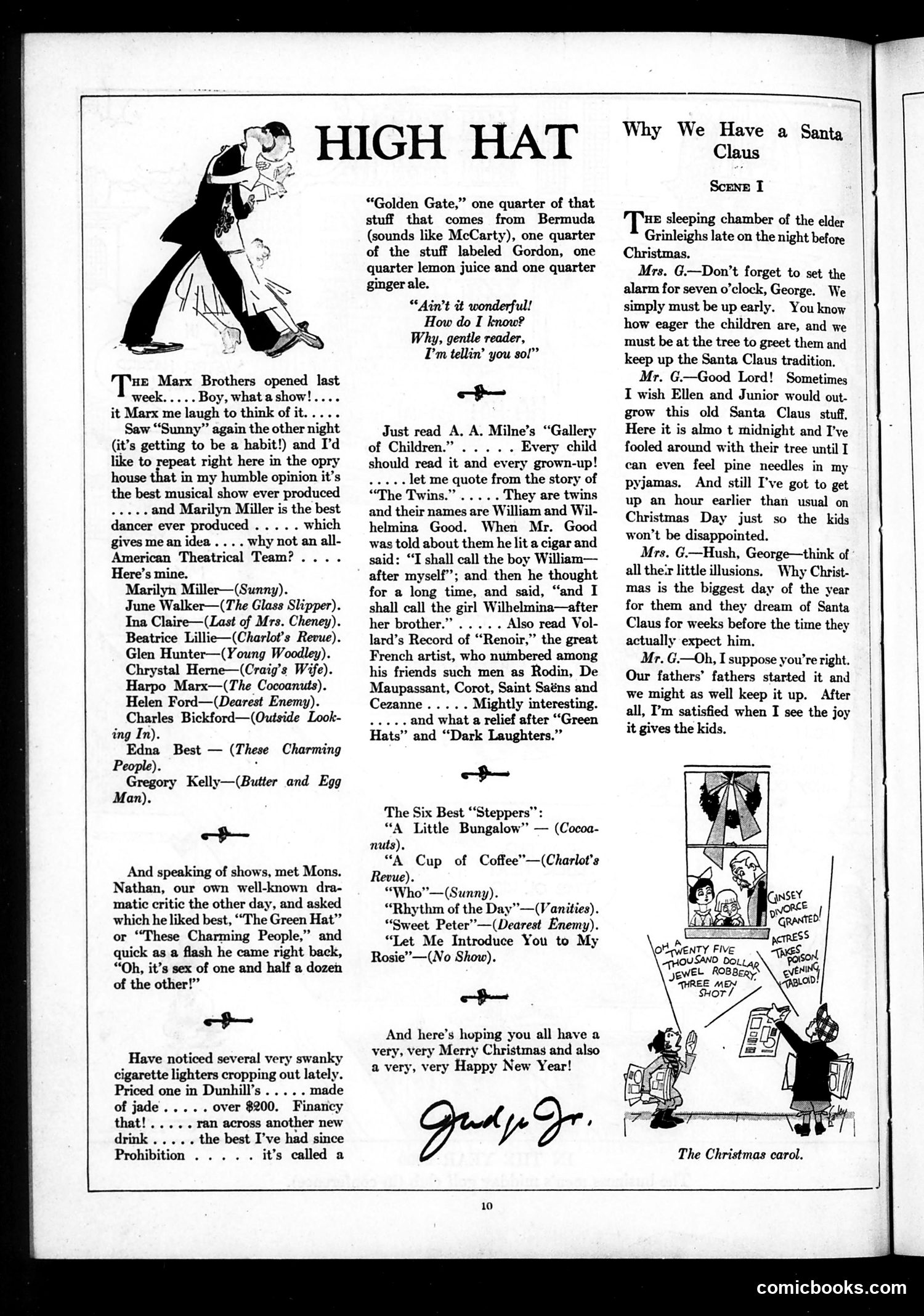
This page from *Judge* combines entertainment commentary with a Christmas story. The "High Hat" column reviews current Broadway shows (Marx Brothers, *Sunny*) and proposes an ideal all-American theatrical cast. It also discusses A.A. Milne's children's book and recommends cocktails and expensive cigarette lighters—typical consumer culture content for a wealthy audience. The main feature, "Why We Have a Santa Claus," is a domestic comedy sketch. Scene I depicts a married couple the night before Christmas. The husband grumbles about the exhausting Santa Claus charade—setting up trees, waking early—while the wife defends it as preserving children's magical illusions. The accompanying cartoon illustrates their conflict humorously. The satire targets adult resentment of holiday traditions while acknowledging their emotional value to children—a common theme in early 20th-century humor about modern parenting anxieties and the commercialization of Christmas.
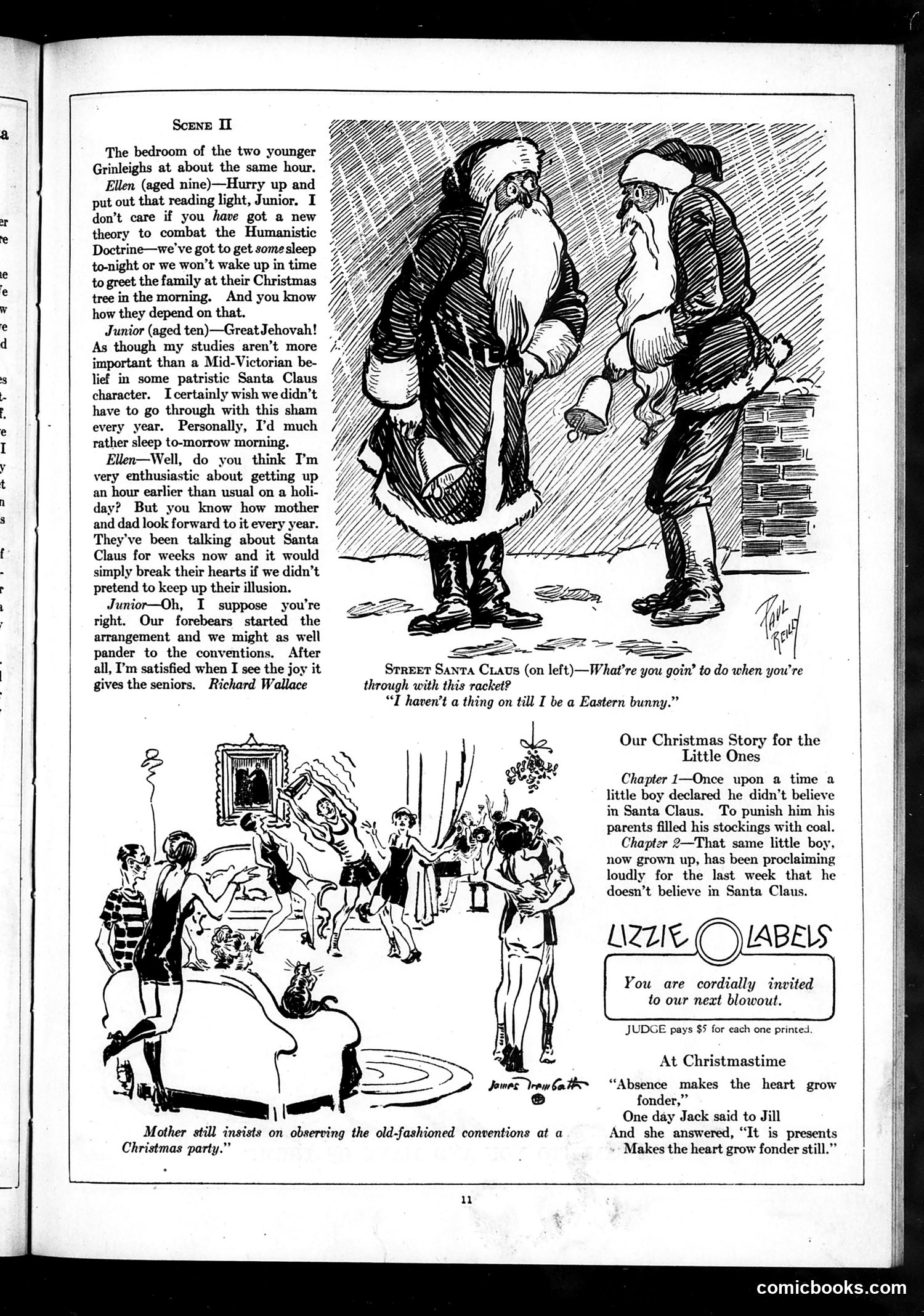
This page satirizes the generation gap and changing attitudes toward Christmas traditions circa the 1920s-30s. **Main Cartoon (top):** Two Street Santas discuss their work. One asks what the other will do "when you're through with this racket"—the reply, "I haven't a thing on till I be a Eastern bunny," treats Santa as a temporary seasonal job, degrading the figure to mere commercial employment rather than beloved tradition. **Scene II dialogue:** Young children Junior (age 10) and Ellen (age 9) cynically discuss the Christmas morning charade. Junior dismisses Santa belief as outdated "Mid-Victorian" superstition incompatible with modern study. Ellen appeals to parental sentiment—their parents *need* to believe the children still believe. The satire targets precocious, intellectually arrogant children who've lost childhood wonder, yet must perform enthusiasm to spare their parents' feelings. **Lower cartoon:** A Christmas party scene mocking adults clinging to "old-fashioned conventions." The overall message: Modern youth view Santa and traditions as quaint nonsense, while parents desperately cling to comforting illusions about childhood innocence.
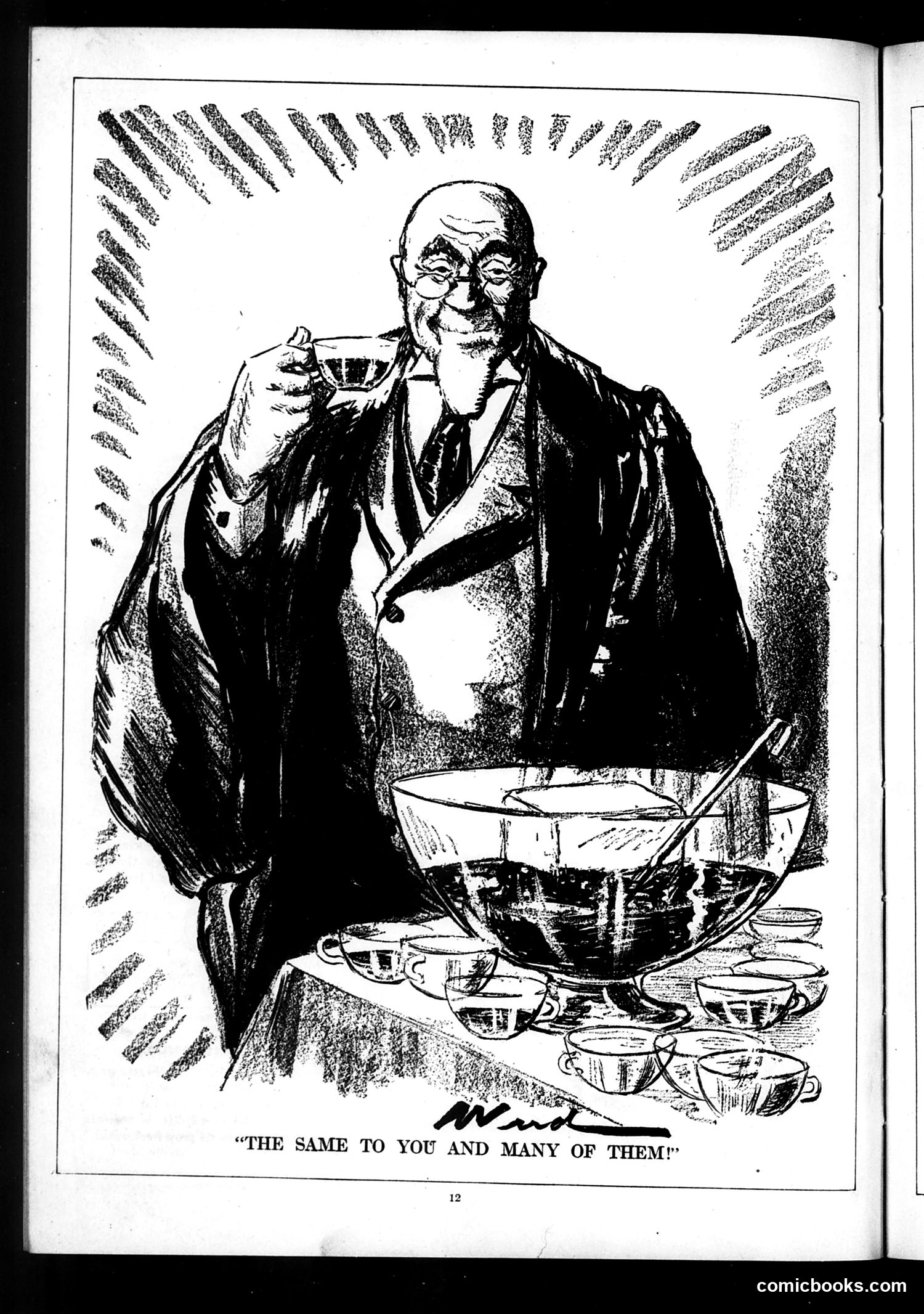
This political cartoon depicts a rotund, bespectacled gentleman in formal attire raising a drink in a toast, surrounded by multiple empty cups and teacups on a table. The caption reads "The Same to You and Many of Them!" The cartoon appears to be satirizing a wealthy or privileged figure's excessive consumption or indulgence—possibly drinking, dining, or enjoying luxuries. The multiplication of empty vessels suggests either abundant wealth spent frivolously or repeated self-congratulatory toasting. The figure's smug expression and gesture imply mockery of the upper classes' self-serving celebrations. Without additional context about the publication date or specific political events referenced, the exact target remains unclear, but Judge magazine typically lampooned the wealthy, politicians, and social hypocrisy of the era.
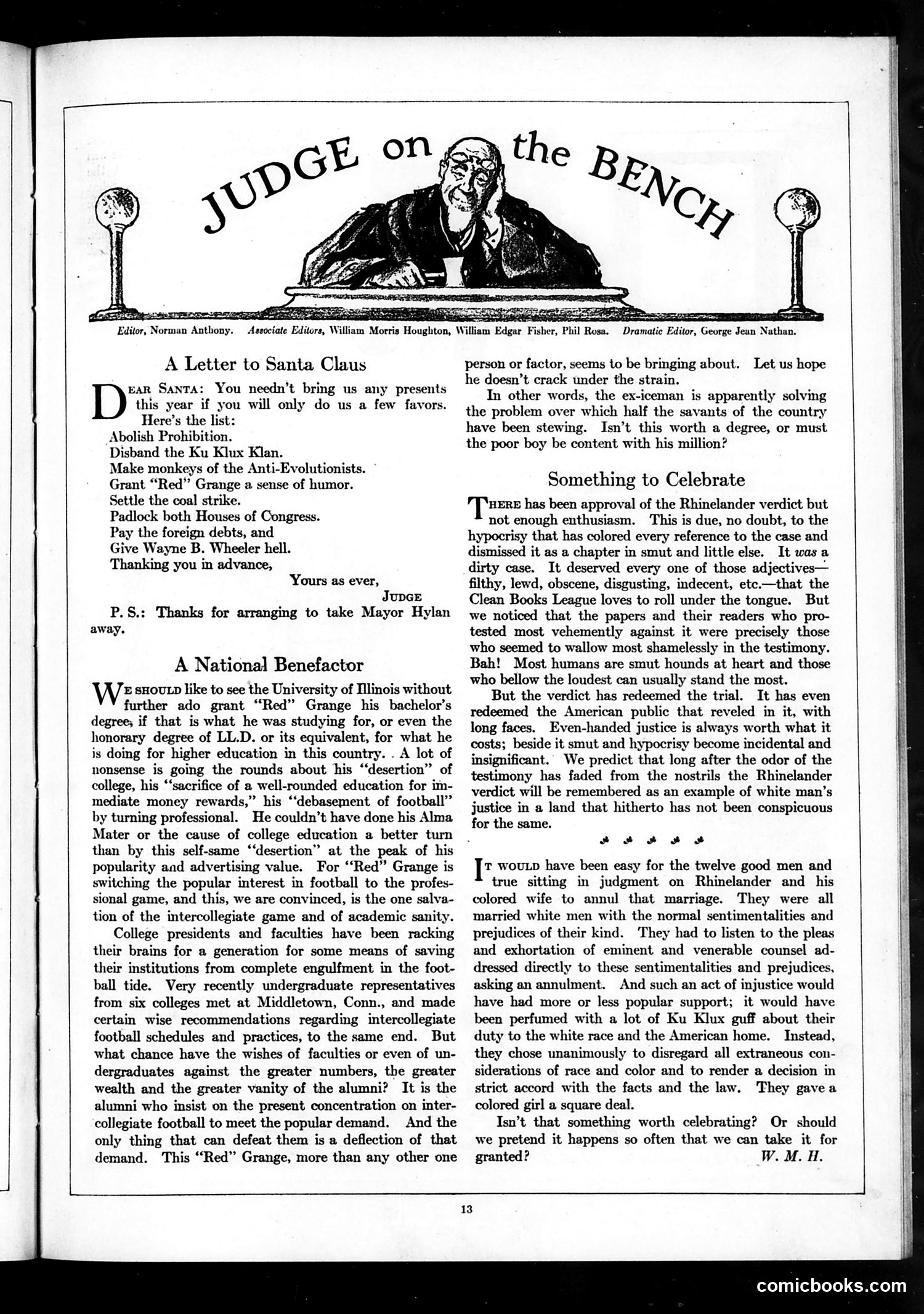
This page contains satirical editorials addressing 1920s American issues. The "Letter to Santa Claus" humorously lists social problems Judge's editors want solved: Prohibition, the Ku Klux Klan, anti-evolutionists, and Wayne B. Wheeler (a prominent Prohibition advocate). The main editorial praises "Red" Grange, a famous football player who left college to play professionally. Rather than criticizing this as a betrayal of education, Judge argues Grange inadvertently solved academia's problem—alumni obsession with football. By shifting popular interest to professional football, he freed colleges from the sport's stranglehold. The final section celebrates the Rhinelander verdict, a high-profile trial involving alleged racial deception. Judge criticizes public hypocrisy: newspapers and readers who condemned the "dirty case" had actually relished its salacious testimony. The verdict represents justice despite society's moral inconsistency—a rare victory for integrity over scandal-mongering.
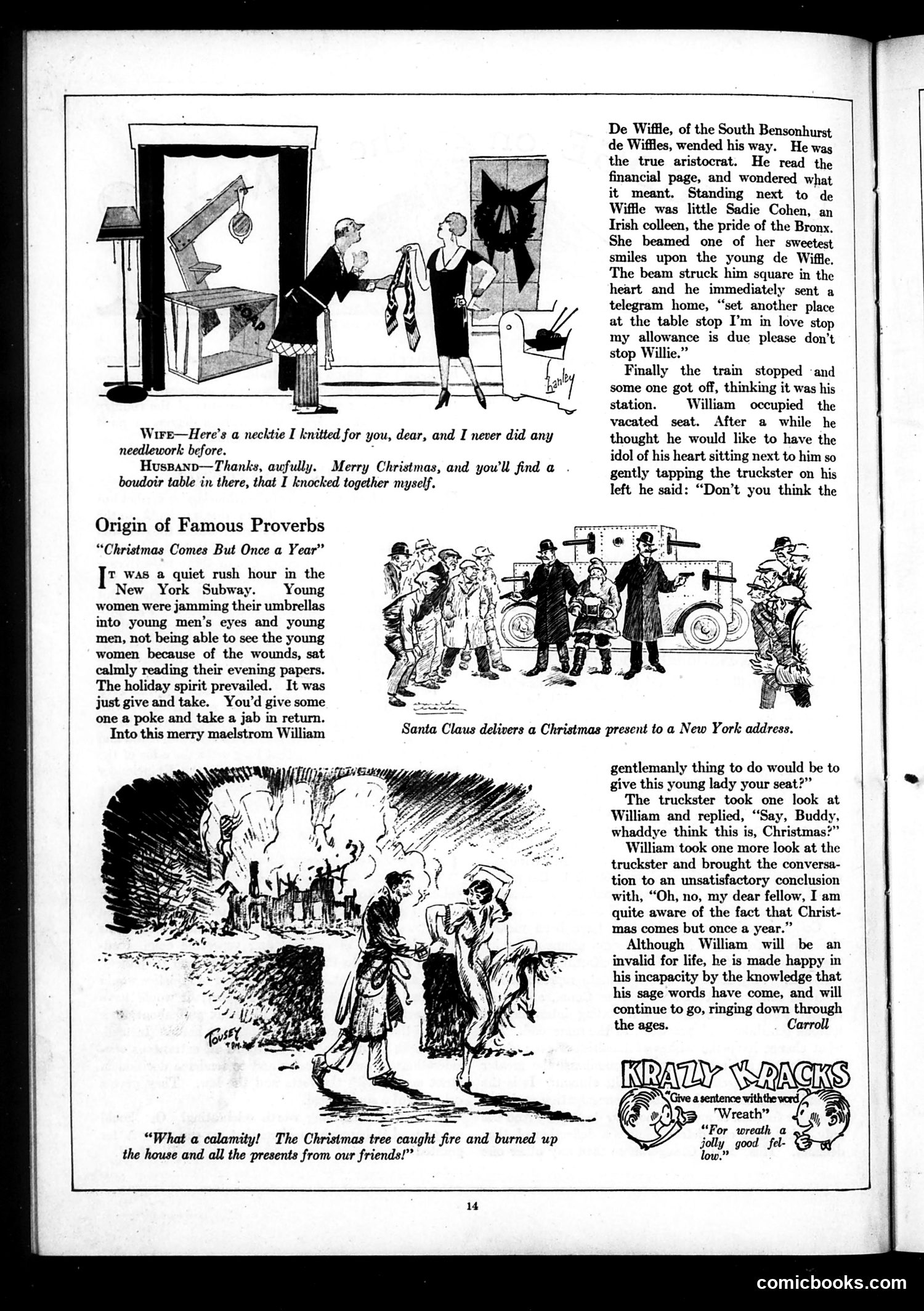
This page contains three satirical pieces mocking Christmas sentimentality and social behavior: **Top cartoon**: A wife gives her husband a homemade necktie and knitted needlework; he pretends gratitude while mentally calculating the expense of the boudoir table he must buy her—satirizing the commercialization masked by holiday sentiment. **"Origin of Famous Proverbs"**: The main story mocks the cliché "Christmas Comes But Once a Year." A wealthy but clueless young man (de Wiffle) falls for Sadie Cohen, a working-class woman on the subway. When he asks a truckster to give up his seat so she can sit nearby, the worker snaps, "Whaddye think this is, Christmas?"—exposing that seasonal "goodwill" is a thin veneer. De Wiffle gets beaten up, but finds comfort that his naive words will echo through the ages. **Lower cartoon**: Shows a chaotic subway scene during holiday rush hour—umbrellas jabbed in eyes, violence disguised as "give and take"—satirizing the contradiction between Christmas's peace-and-goodwill messaging and actual urban behavior. The satire targets both false sentimentality and class pretension during the holidays.
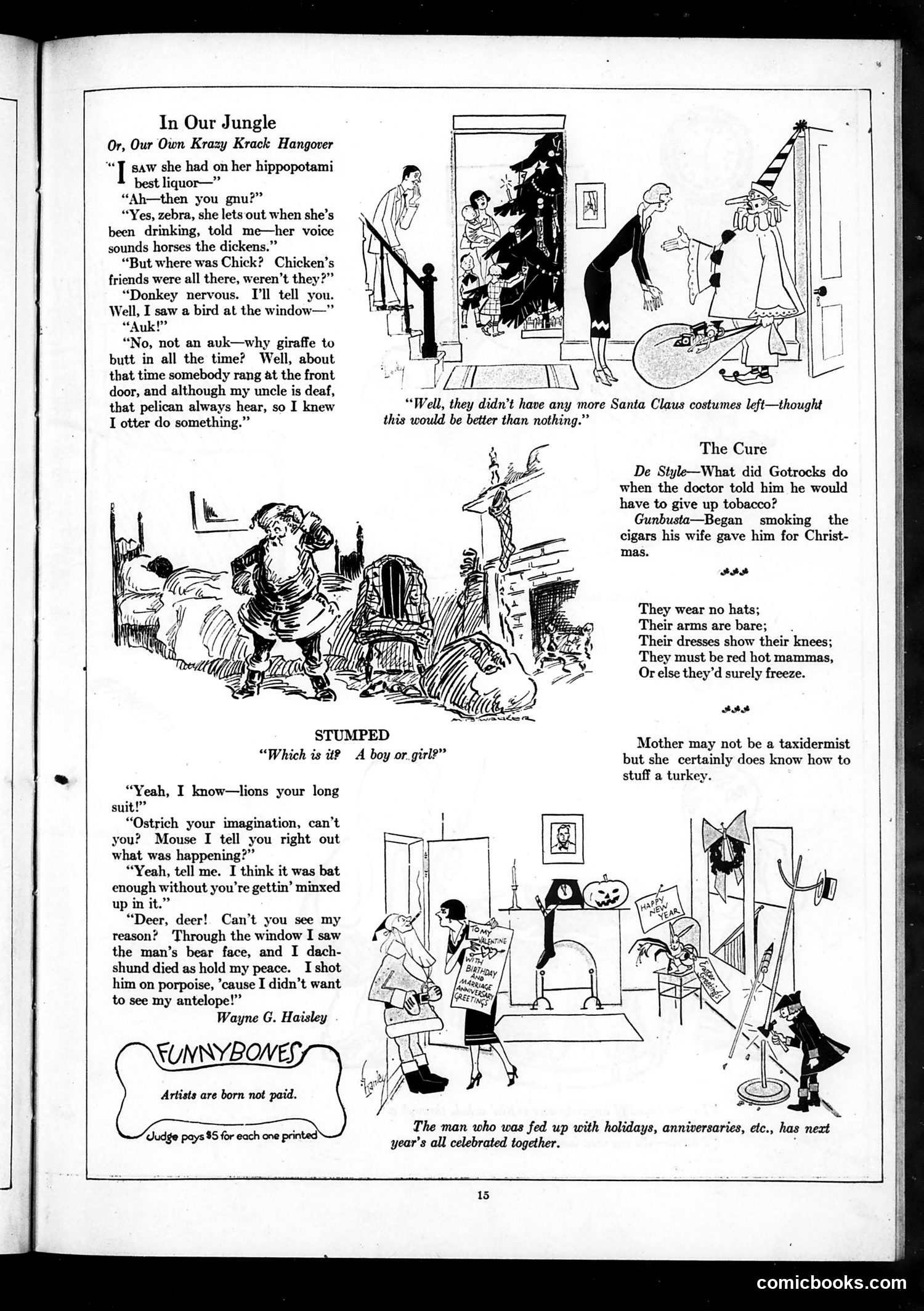
This page from *Judge* contains several interconnected humor pieces relying on animal puns and wordplay. **"In Our Jungle"** (top): A lengthy narrative joke by Wayne G. Haisley using animal names as homonyms—"gnu" (knew), "zebra" (see bar), "horses" (hoarse as), "auk" (auk/hawk), "giraffe" (care), "otter" (ought to), "pelican" (pell-can/tell), "dachshund" (dashed), "porpoise" (on purpose), "antelope" (aunt elope). The joke's structure mimics 1920s radio comedy: a narrator struggling to tell a story while a listener interrupts with bad animal puns, growing increasingly exasperated. **"The Cure"** and related jokes play on tobacco-giving and holiday fatigue—gentle domestic humor typical of the era. **"Stumped"** features a Santa Claus costume shortage, likely post-WWI rationing humor. The page exemplifies early 20th-century *Judge* style: pun-heavy, vaudeville-influenced comedy with minimal political content, aimed at readers who found animal wordplay entertaining.
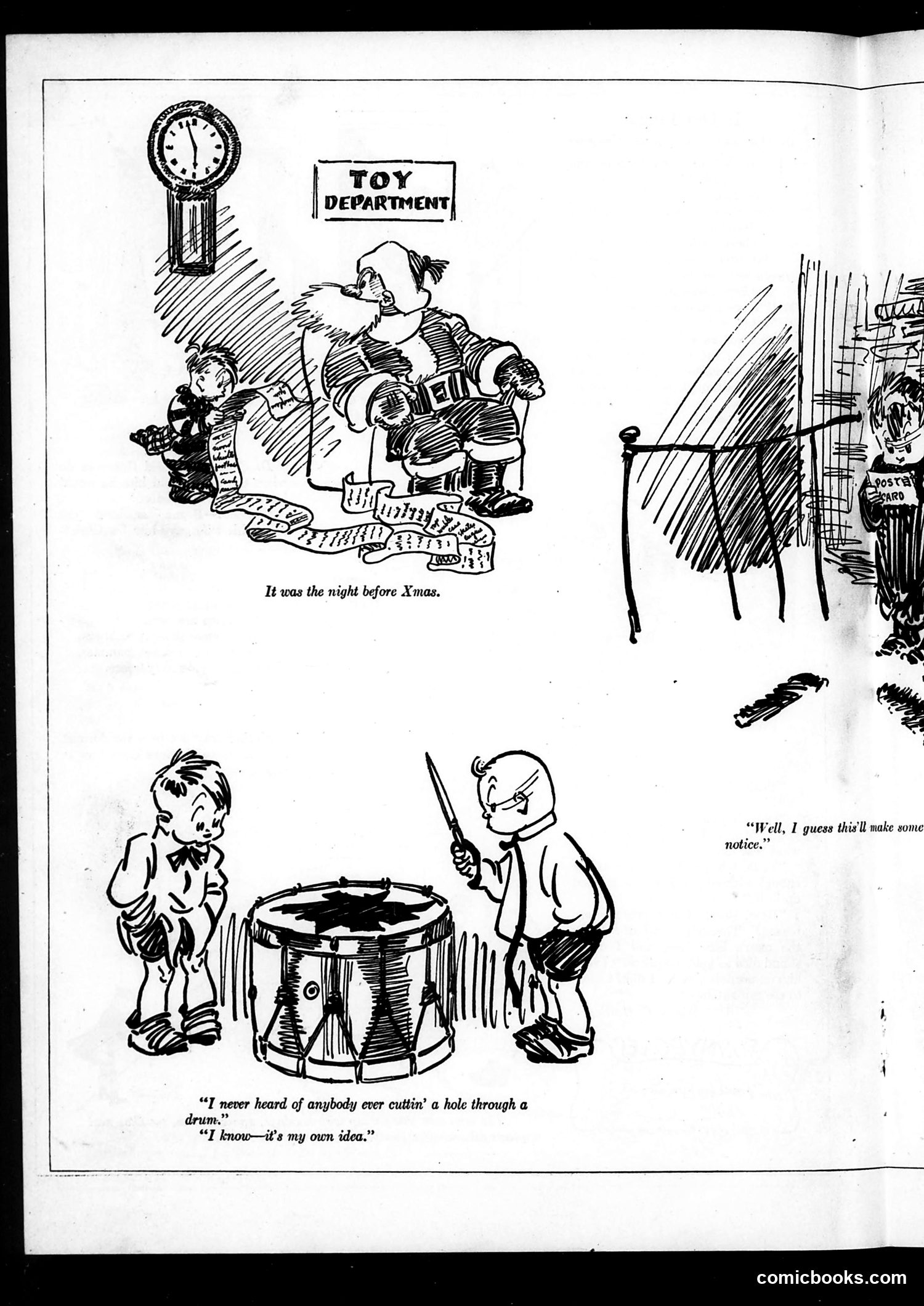
This page contains two separate cartoons satirizing Christmas gift-giving and children's behavior. The top cartoon, "It was the night before Xmas," shows children receiving toys from what appears to be a stern authority figure (possibly a store clerk or parent), with money scattered about—mocking the commercialization of Christmas. The bottom cartoon depicts two boys with a drum, one holding a knife. The dialogue reveals the "joke": one boy proudly claims to have invented cutting a hole through a drum, apparently unaware this destroys the instrument's function. This satirizes children's destructive "creativity" and lack of understanding about how things work—a common theme in vintage humor mocking youthful ignorance. Both cartoons use exaggerated, mischievous child characters typical of early 20th-century satirical illustration, poking fun at the chaos of Christmas gift-giving and children's poor judgment.
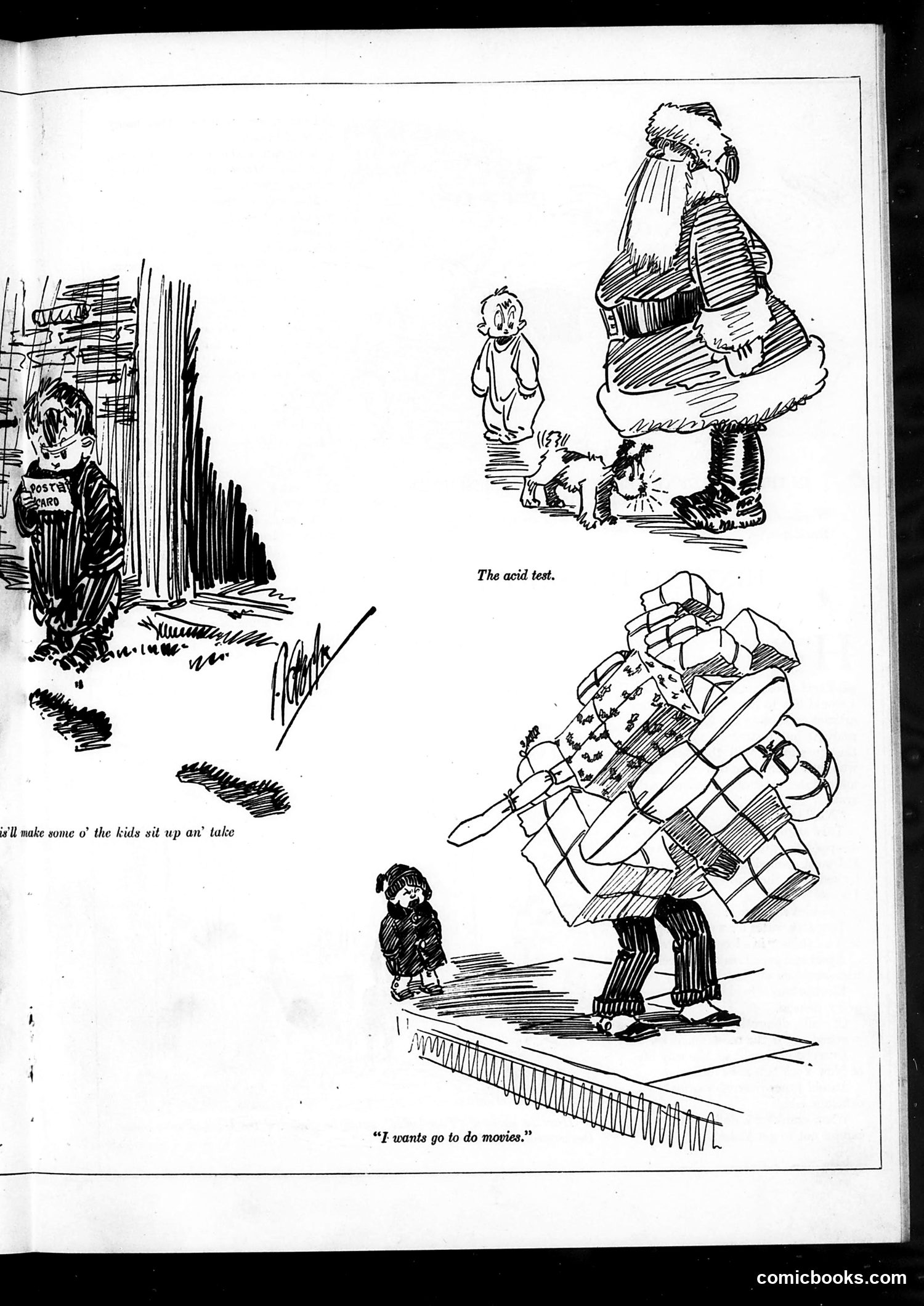
This page from *Judge* magazine contains several cartoon vignettes with satirical humor about childhood and Christmas. The top cartoon, "The acid test," depicts Santa Claus with children and animals, likely commenting on children's reactions to gift-giving or holiday authenticity. The bottom cartoon, "I wants go to do movies," shows a child carrying an enormous stack of wrapped presents, with an adult watching. The joke appears to satirize children's ingratitude or materialism—despite receiving lavish gifts, the child still wants something else (to go to movies), suggesting modern youth prioritize entertainment over material goods. The left panel shows a child in what appears to be mischievous behavior, with text about making "kids sit up an' take" something, though the exact reference is unclear without more context. The cartoons use exaggerated illustration styles typical of early 20th-century satirical magazines to mock contemporary social attitudes about childhood, consumerism, and parental indulgence.
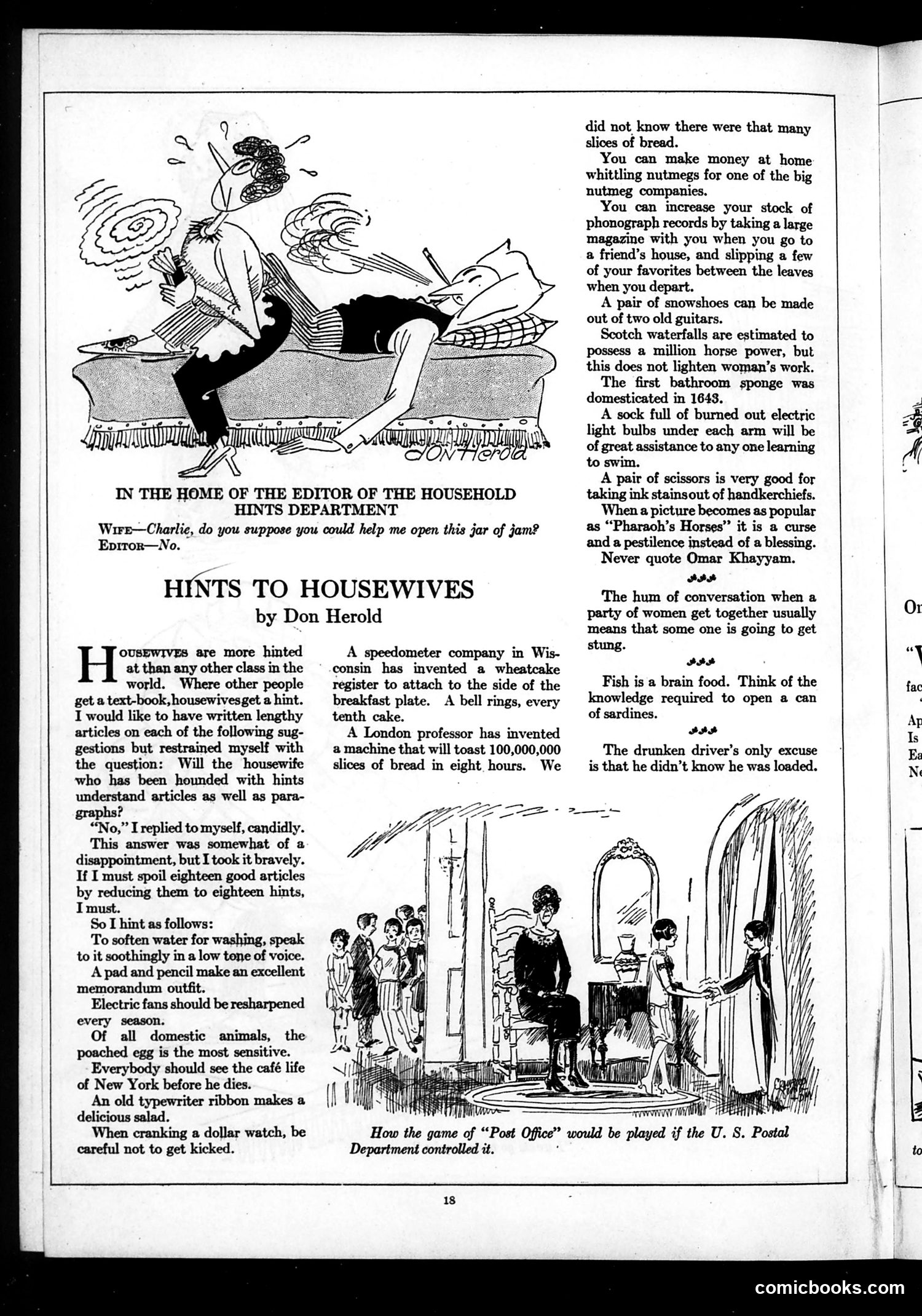
This page contains two distinct pieces from *Judge* magazine's humor section: **Top Cartoon:** A domestic scene mocking the "Household Hints" editorial department. A wife asks her husband (the hints editor) to help open a jar of jam. He refuses—the irony being that someone dispensing household advice to thousands lacks basic helpfulness at home. **"Hints to Housewives" Column:** Don Herold satirizes the contemporary obsession with household tips. Rather than write full articles, he reduces advice to absurd one-liners: "speak to water soothingly," "electric fans should be resharpened," "a poached egg is the most sensitive domestic animal." The satire targets both: (1) the explosion of patronizing "hints" literature directed at women, treating housewives as needing constant instruction, and (2) the ridiculous nature of some genuine advice circulating at the time (mixed with pure nonsense). **Bottom Cartoon:** References "Post Office," a parlor game. The joke critiques U.S. Postal Department inefficiency—implying government control would make even a children's kissing game bureaucratic and dysfunctional.
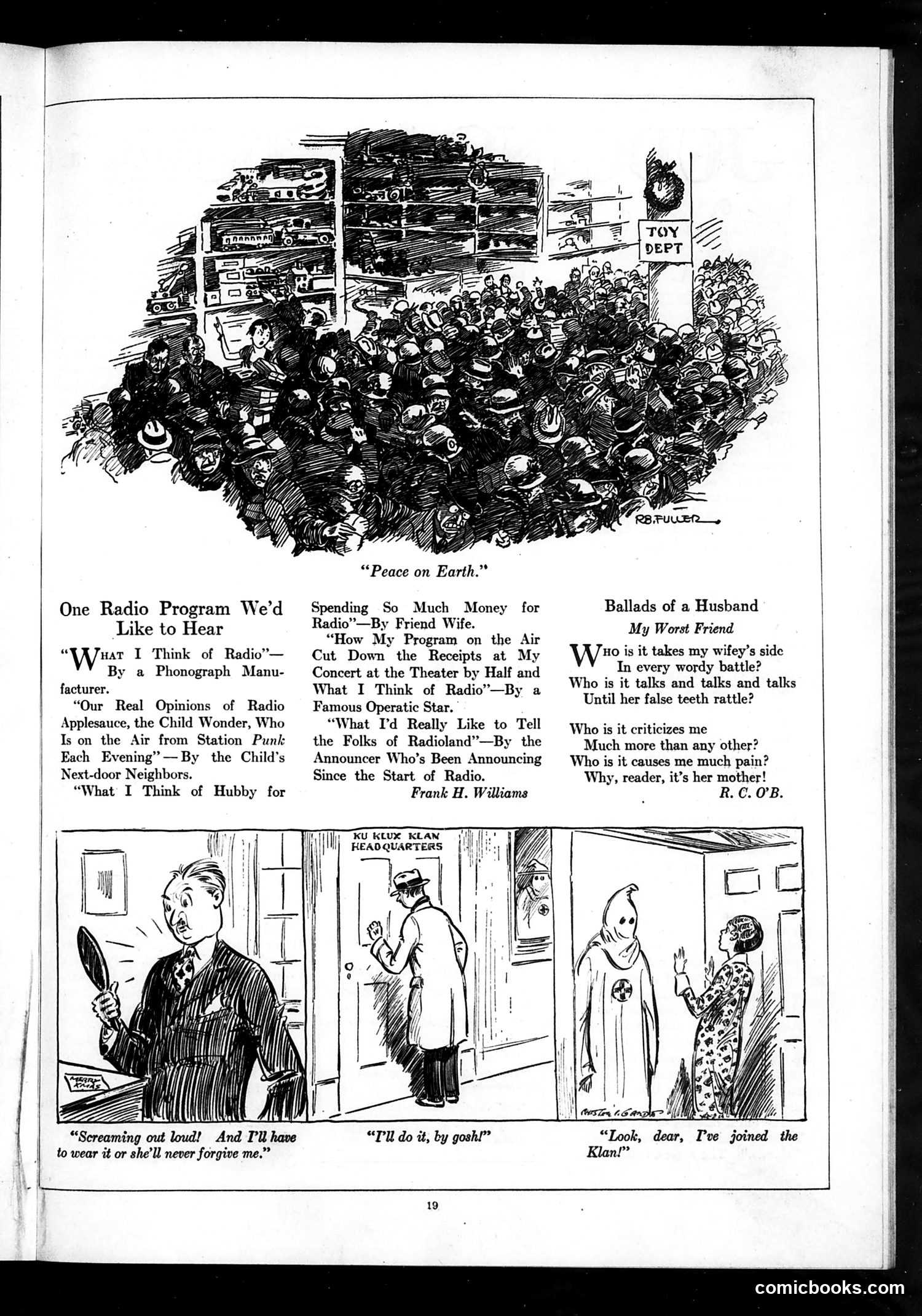
**Top cartoon "Peace on Earth":** Satirizes Christmas commercialism by depicting a massive, chaotic crowd of shoppers swarming a toy department store display. The irony mocks the disconnect between the holiday's peaceful message and consumer frenzy. **Middle section:** Lists satirical radio program titles mocking various groups' complaints about radio (phonograph manufacturers worried about competition, neighbors annoyed by broadcasts, wives upset about radio expenses, opera singers threatened by radio entertainment). This reflects 1920s anxiety about radio's disruptive social impact. **Bottom comic strip:** Three panels showing domestic scenes. The final panel depicts a man telling his wife he's joined the KKK—presented as darkly comedic commentary on the Klan's resurgence during this period. The casual announcement suggests the Klan's disturbing normalization in American society, though Judge's intent (satire or condemnation) remains ambiguous from this image alone. The page reflects 1920s social anxieties: new technology disruption, consumer culture, and racial violence.
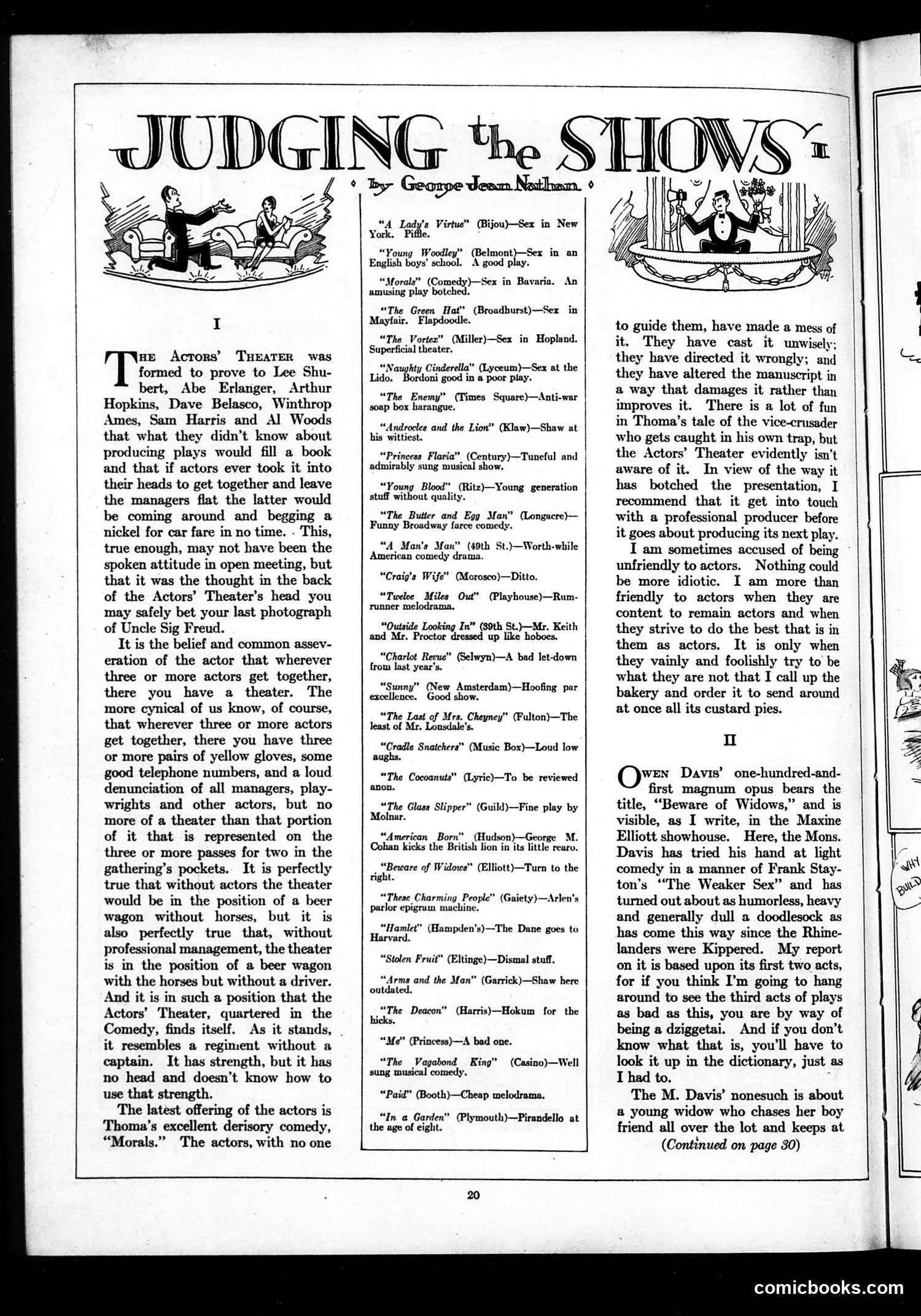
This is a theater review column by George Jean Nathan critiquing the Actors' Theater company and current Broadway productions. The opening essay satirizes the Actors' Theater's founding premise—that actors believed they could manage theaters better than professional producers like Lee Shubert, Abe Erlanger, and David Belasco. Nathan mocks the actors' naive confidence, using colorful language: actors gathered together produce "yellow gloves," phone numbers, and complaints about managers—not actual theater. He argues the theater needs professional management like a beer wagon needs a driver; actors alone cannot steer an organization, despite their talent. The bulk of the page lists current Broadway shows with brief, caustic assessments (many productions are dismissed as "sex" plays or poor quality). Nathan's overall point: the Actors' Theater's production of "Morals" will likely fail because actors lack managerial competence, no matter their artistic abilities.
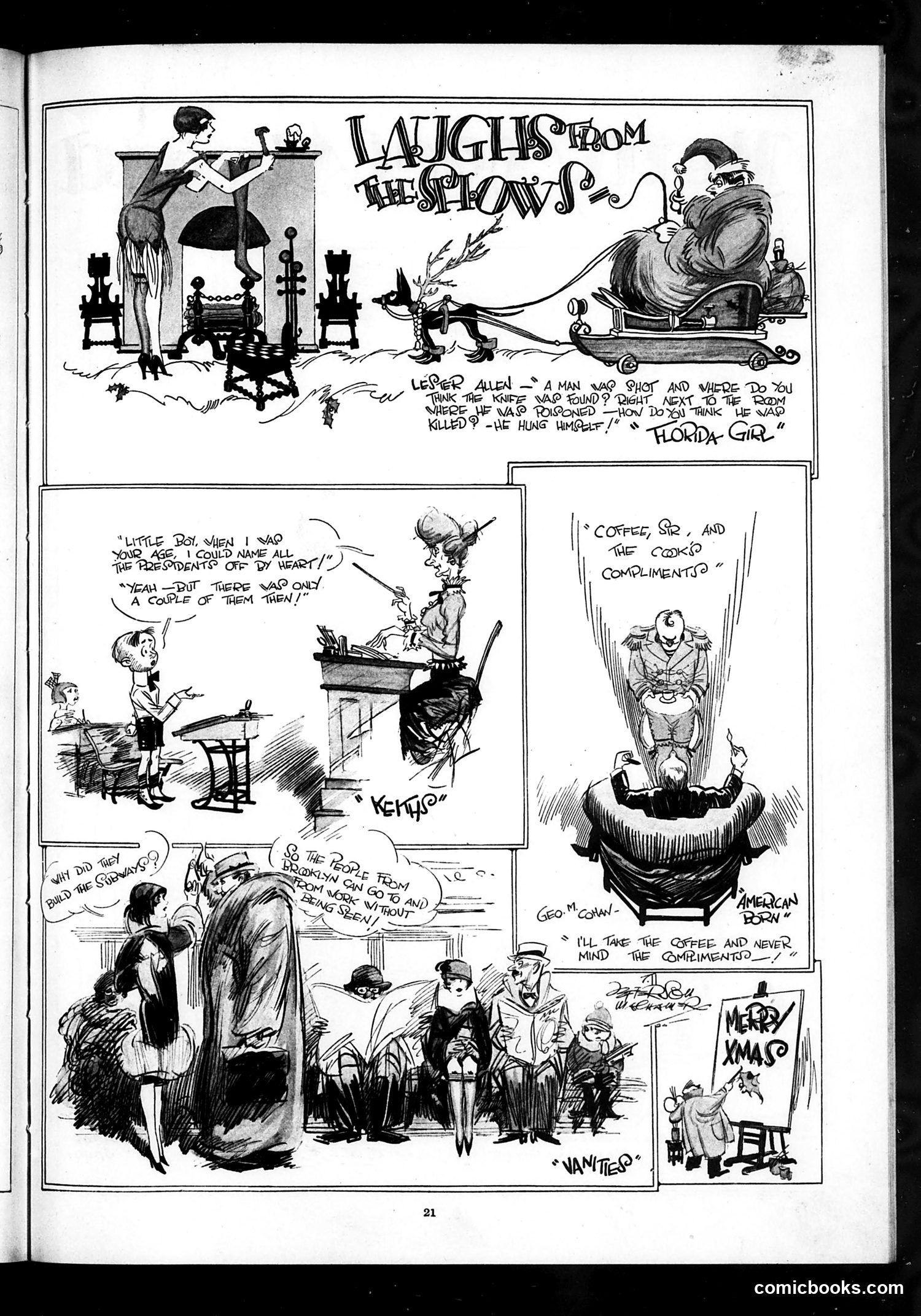
This page collects humorous sketches lampooning theater and entertainment personalities of the era. The top panel references a "Florida Girl" character, likely from a Broadway show. The middle and lower panels mock vaudeville and theatrical types through stereotypical situations: a pompous conductor dismissing compliments, a waiter offering coffee with false courtesy, and various theater-district characters. The humor relies on exaggerating pretension and social affectation common to show-business types. One panel mocks someone claiming they could "name all the presidents of [their] heart"—satirizing sentimental theater dialogue. Another features a character accepting coffee while ignoring compliments, poking fun at affected modesty. The sketches appear designed to lampoon the vanity and theatrical mannerisms of performers and entertainment-world figures familiar to Judge's urban, middle-class readership. The humor is character-based rather than politically substantive.
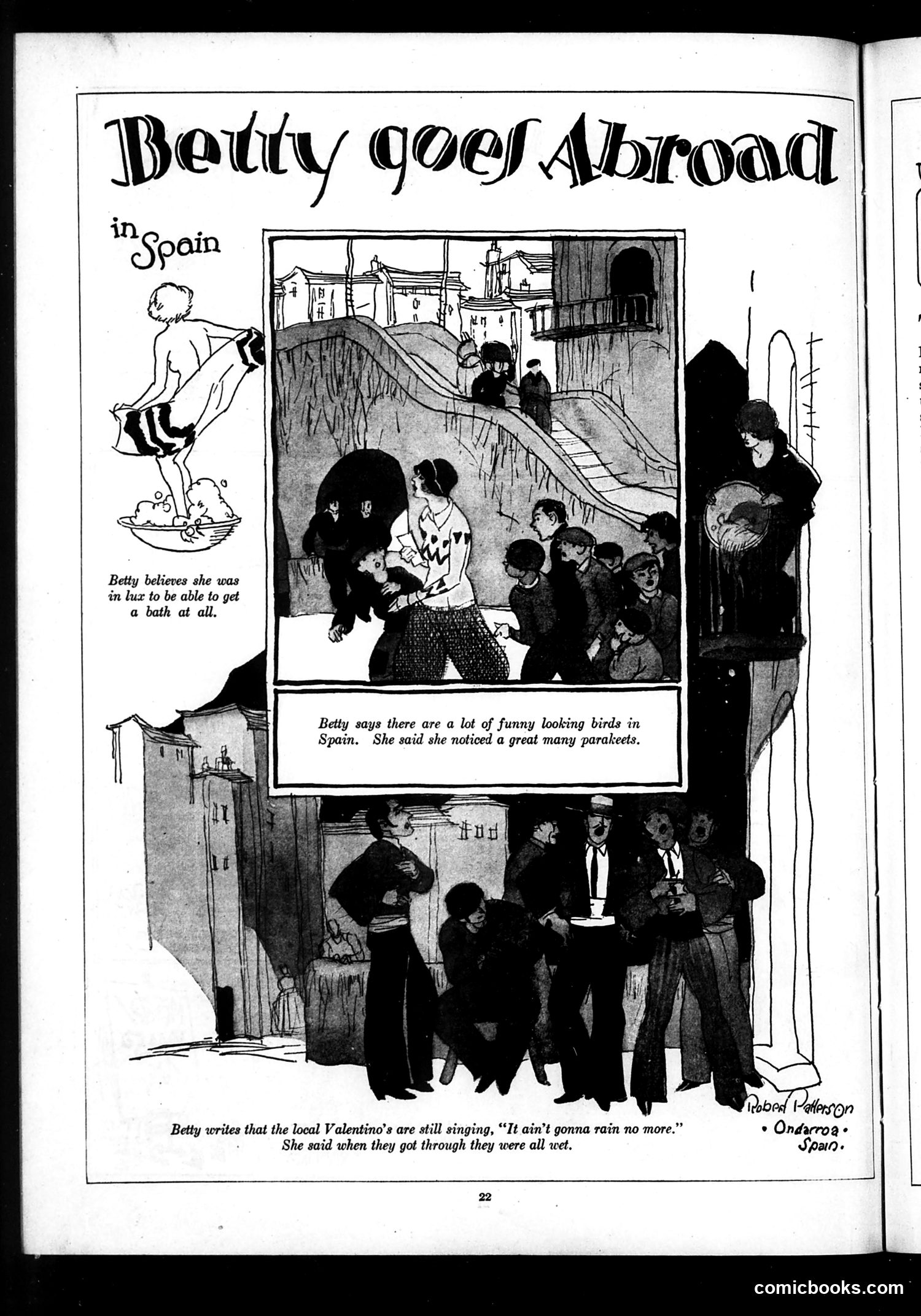
This is a humorous travel narrative featuring a character named Betty visiting Spain. The comic makes light of cultural differences and living conditions through her observations: **The humor relies on:** 1. **Bathing access**: Betty considers herself fortunate merely to find bathing facilities—implying Spanish accommodations were considered primitive or lacking by American standards of the era. 2. **"Funny looking birds"**: Betty's observation about parakeets suggests unfamiliarity with local wildlife, playing on American tourists' cultural naiveté. 3. **Local "Valentinos"**: References to men resembling Rudolph Valentino (the famous silent-film star), suggesting Spanish men's romantic appeal or appearance. 4. **The song reference**: "It Ain't Gonna Rain No More" (a 1923 popular song) creates a pun—local singers perform it until they're drenched, conflicting with the song's title. The comic portrays Spain as exotic and somewhat backward, reflecting 1920s American attitudes toward European travel and cultural superiority. Betty's naive observations drive the satire.
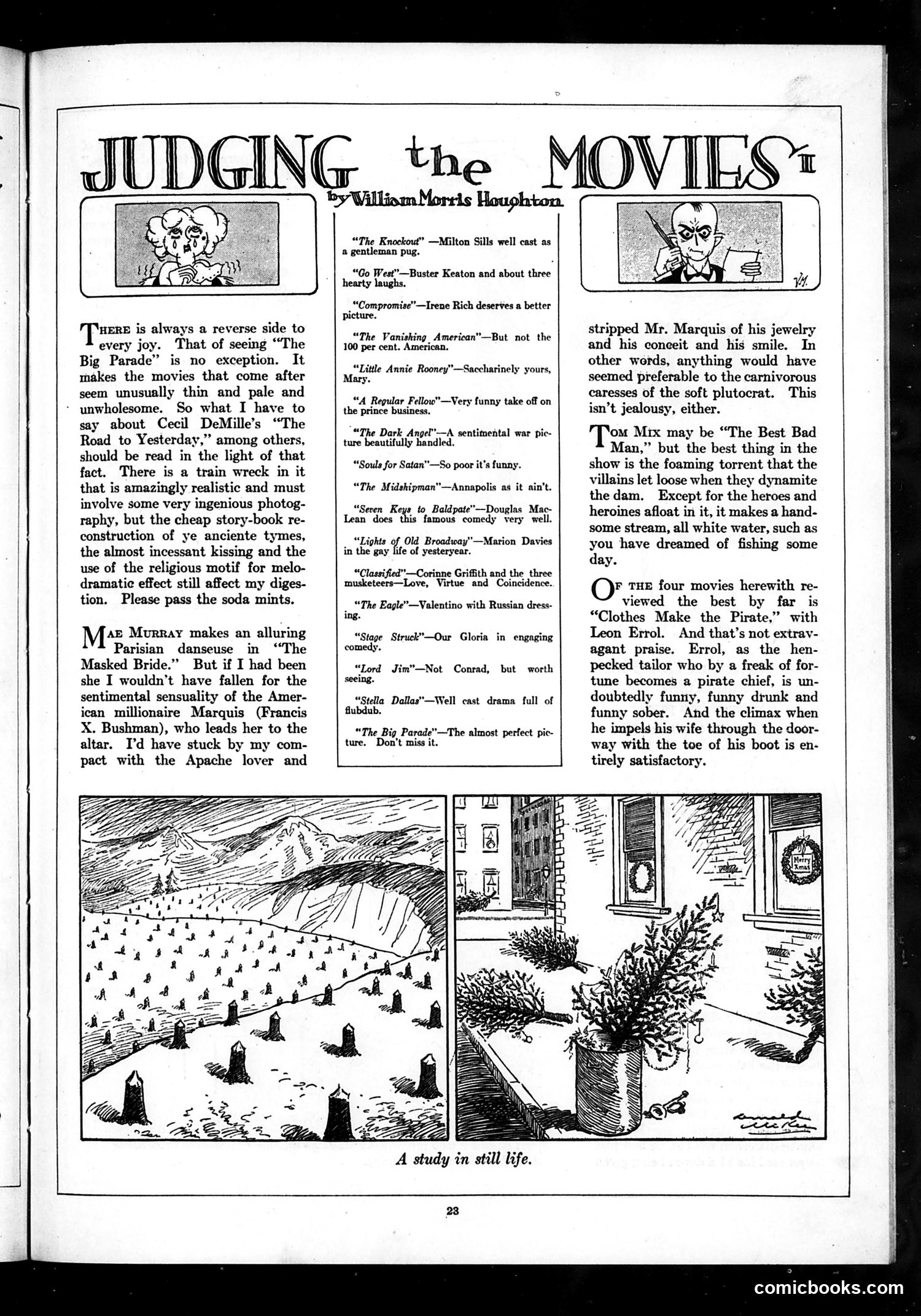
This is William Morris Houghton's film review column for *Judge*, a satirical magazine. The piece critiques contemporary silent films (circa mid-1920s based on titles like "The Big Parade" and references to Buster Keaton, Valentino, and Mary Pickford). The satire targets both filmmaking trends and audience tastes. Houghton mocks Cecil DeMille's historical melodramas ("The Road to Yesterday") for cheap, overwrought reconstructions of "olden times" and excessive kissing. He skewers sentimental plots—particularly wealthy Americans seducing foreign women—and praises only comedy and spectacle (Leon Errol's drunken antics, realistic train wrecks, dynamited dams). The humor assumes readers share disgust for artificial emotion and prefer either slapstick or technical achievement. The two ink sketches at bottom ("A study in still life") appear to be unrelated illustrations.
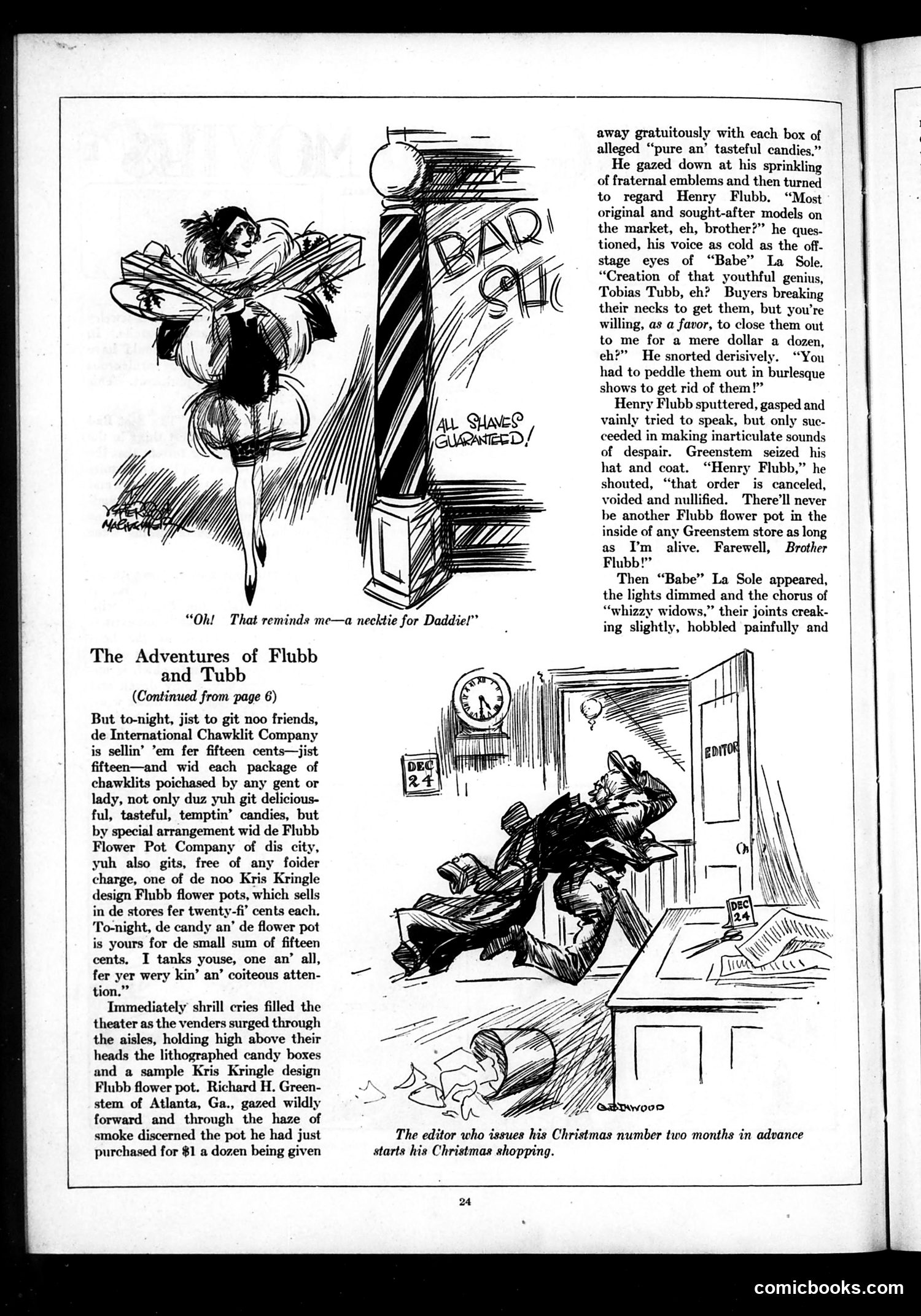
This page contains a serialized comic story satirizing deceptive marketing practices. The plot involves a theater promotion where candy boxes come with "free" Kris Kringle flower pots—items normally sold separately for 25 cents. A customer, Richard Greenstem, discovers the same pots are being given away with every purchase, exposing the promotional scheme as fraudulent. He angrily confronts Henry Flubb, the apparent promoter, accusing him of peddling inferior merchandise through burlesque shows before resorting to this gimmick. The satire targets common early 20th-century advertising deception: manufacturers bundling unwanted items with products and falsely claiming exclusivity or scarcity. The bottom illustration humorously shows an exhausted editor, suggesting another jab at commercial pressure—specifically the practice of issuing Christmas editions months early to drive advertising and sales.
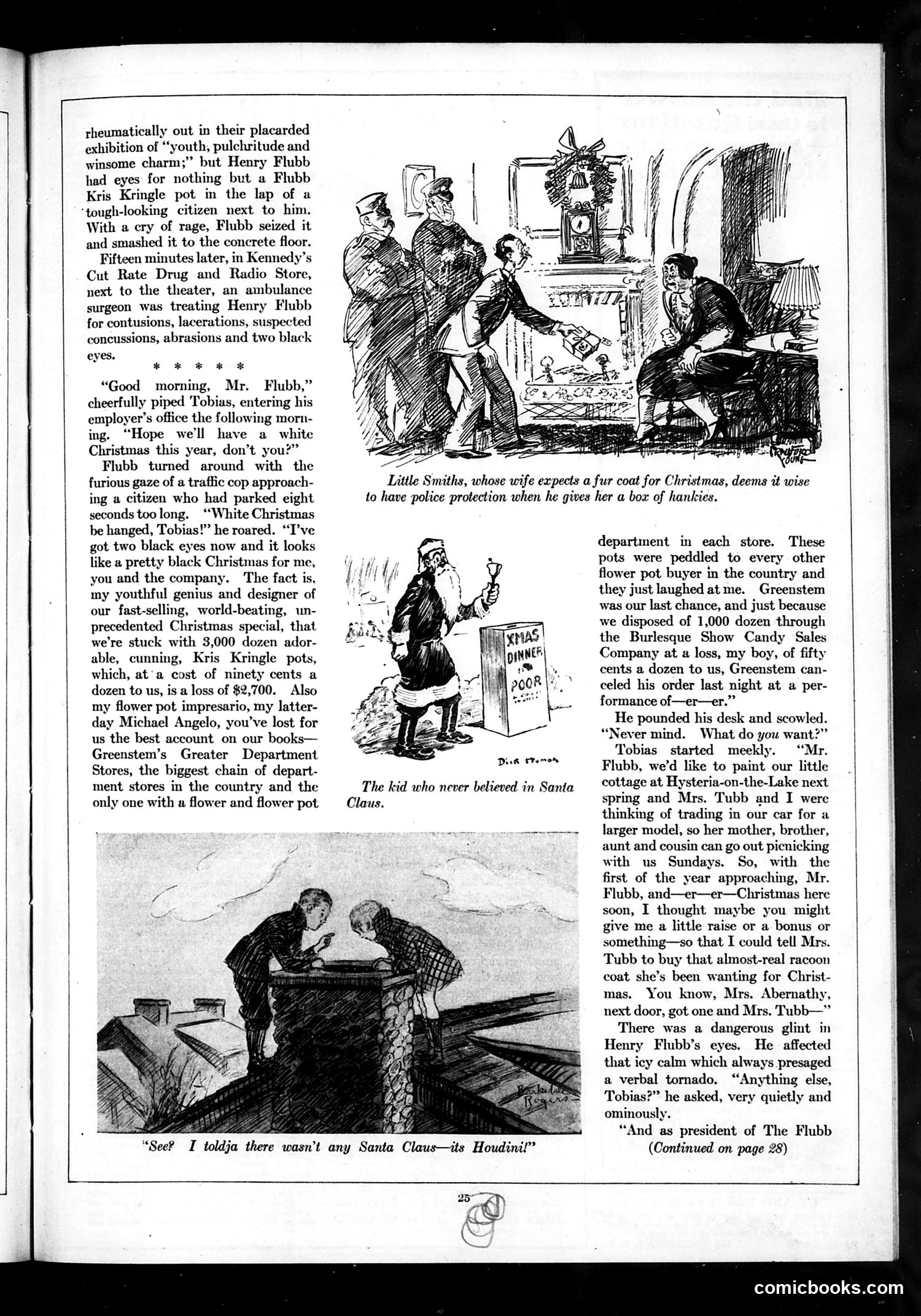
This is a narrative story with satirical illustrations about Henry Flubb, a businessman whose Christmas product fails spectacularly. The satire operates on multiple levels: **The Setup:** Flubb designed "Kris Kringle" decorative flower pots as a Christmas special, producing 3,000 dozen. He lost money on them and damaged his relationship with Greenstem's—his largest retail account. **The Joke:** When his employee Tobias timidly requests a Christmas bonus to buy his wife a fur coat and afford a bigger car, Flubb has just suffered financial losses from unsold inventory. The irony is bitter: Flubb pushed a product nobody wanted while ordinary workers like Tobias aspire to modest middle-class comforts he cannot afford. **Social Context:** This reflects 1920s-30s economic anxiety—workers hoping for raises during Christmas, the gap between employer losses and worker poverty, and consumer aspiration (fur coats, cars) as status symbols. The illustrations mock both Flubb's rage and consumer culture's empty promises.
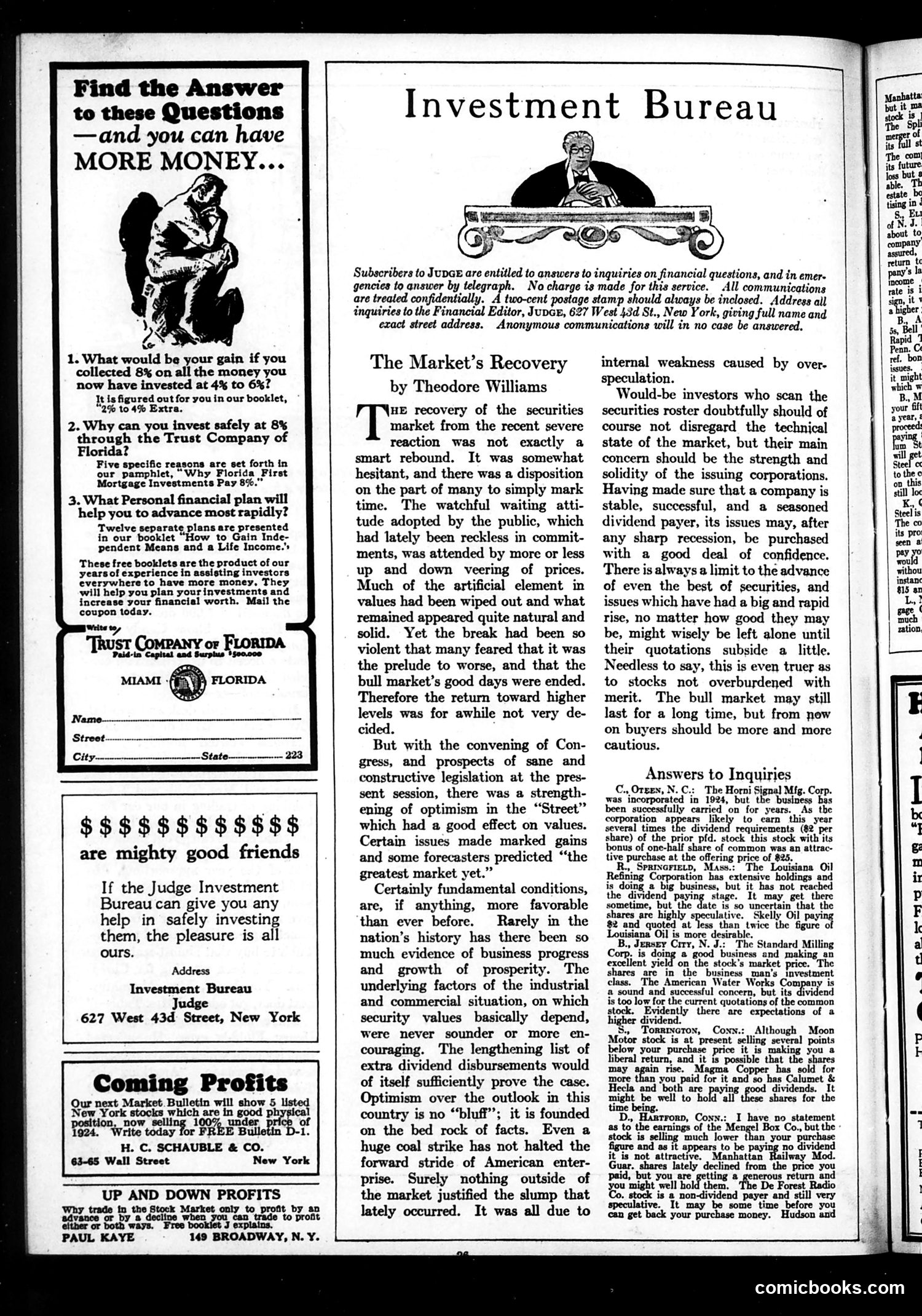
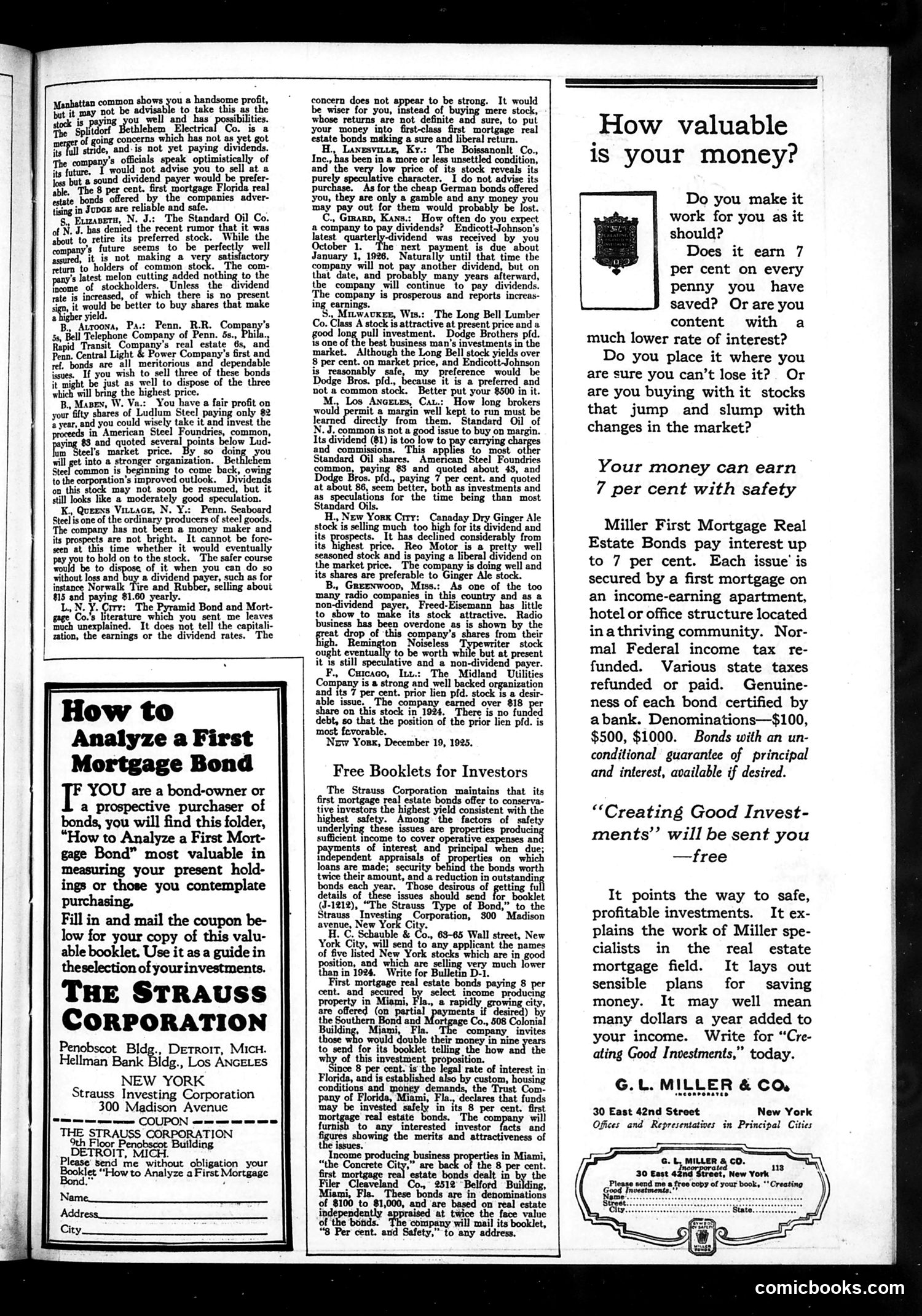
This page is primarily **advertising and financial advice**, not satirical political content. It contains: 1. **A financial advice column** answering reader questions about stocks and bonds (Standard Oil, Pennsylvania Railroad, Steel companies, etc.) 2. **Multiple advertisements for investment products**, particularly: - The Strauss Corporation promoting a booklet "How to Analyze a First Mortgage Bond" - G.L. Miller & Co. advertising "Miller First Mortgage Real Estate Bonds" paying 7% interest - The Strauss Corporation offering free booklets about real estate bonds 3. **The central theme**: Encouraging readers to invest in "safe" first mortgage real estate bonds rather than volatile stocks. The ads emphasize security, guaranteed returns, and income-producing properties. **Context for modern readers**: This appears from the 1920s investment era, before the 1929 crash. These ads promoted real estate bonds as conservative alternatives to stock market speculation—a pitch that would prove tragically ironic within years. No political satire or caricatures are present on this page.
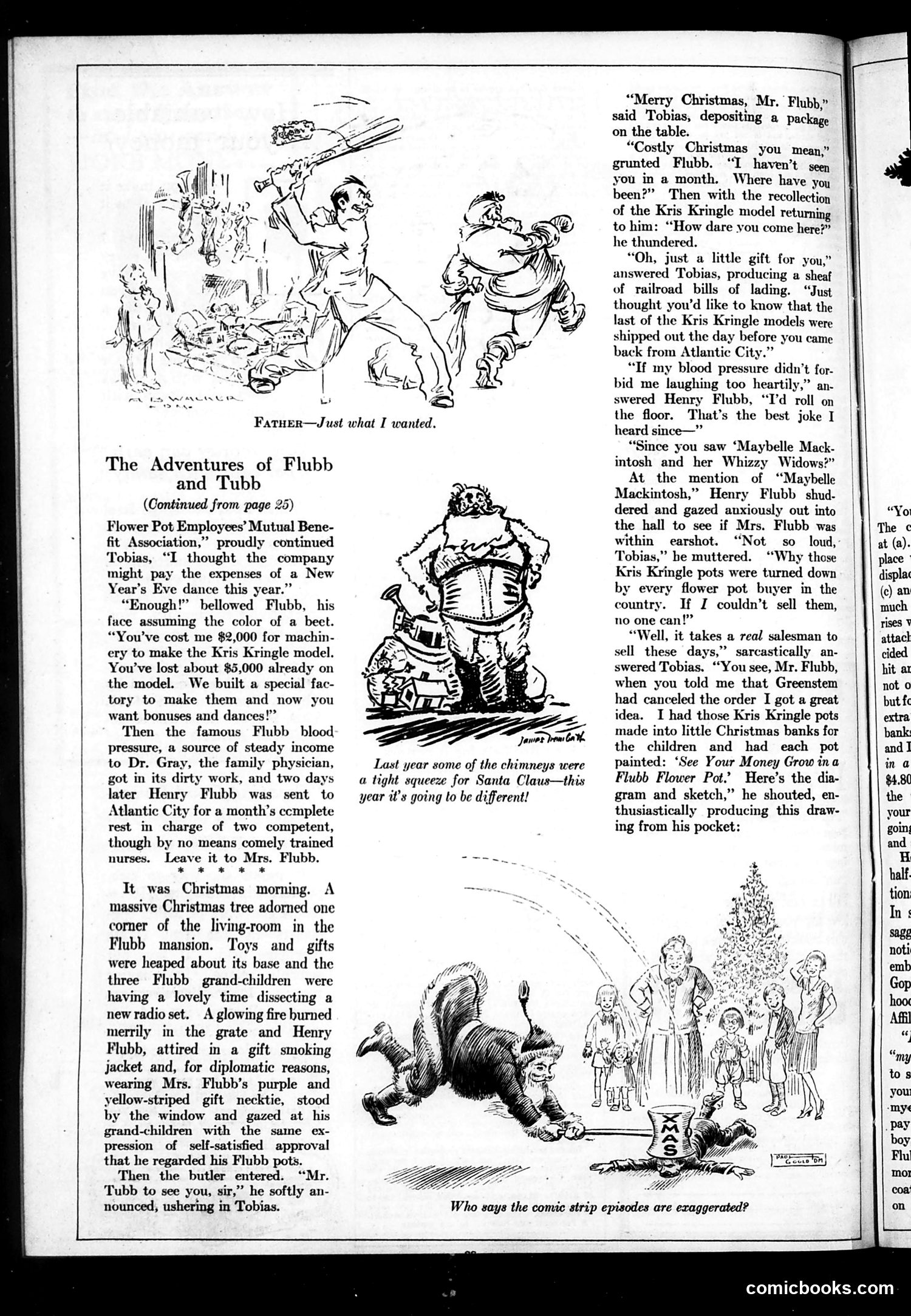
This is a serialized comic continuing a story about a wealthy industrialist named Flubb and his employee Tobias. The humor centers on a business failure: Flubb invested heavily in manufacturing a "Kris Kringle model" (likely a novelty Christmas decoration shaped like Santa), which flopped commercially. The satire targets Flubb's stingy, temperamental nature—he refuses to fund employee benefits or Christmas celebrations while his own failed business venture costs him thousands. When Tobias arrives on Christmas morning, the joke culminates in his redemption: he personally salvaged the unsold flower-pot inventory by converting them into children's piggy banks, successfully marketing them as "See Your Money Grow in a Flubb Flower Pot." The humor plays on class dynamics and capitalist inefficiency—the greedy boss's expensive failure versus the resourceful worker's clever solution. The magazine's final caption ("Who says the comic strip episodes are exaggerated?") suggests this reflected real Depression-era business absurdities readers recognized.
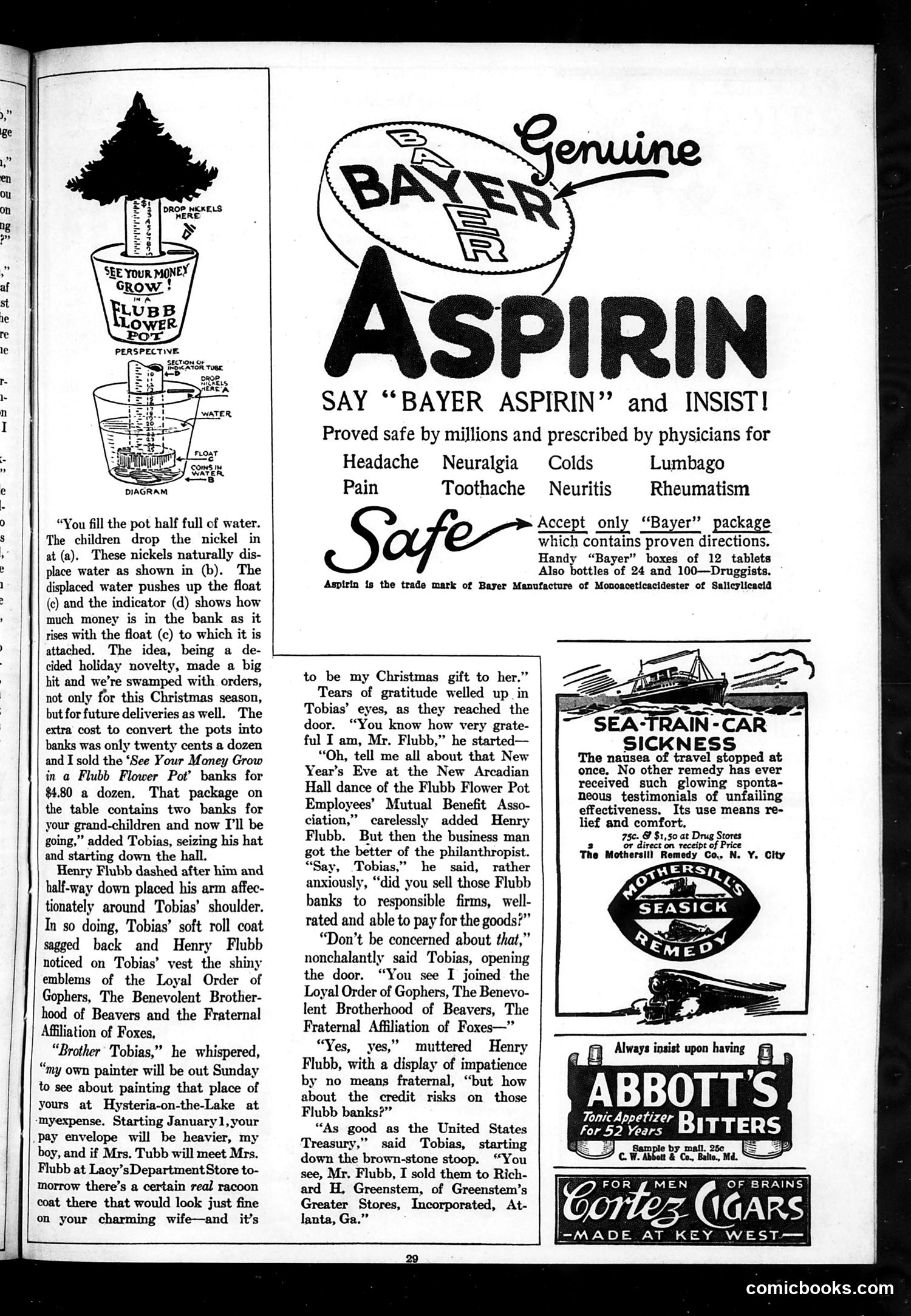
This page combines a short story with period advertisements. The main narrative satirizes **business opportunism and fraternal lodge culture** in early 20th-century America. **The Story's Point:** Henry Flubb has manufactured "See Your Money Grow" novelty banks (a flower pot with a float mechanism showing accumulated savings). Salesman Tobias sells them successfully, claiming credit is "as good as the United States Treasury" because he's sold them to a well-known merchant, Richard H. Greenstem. **The Satire:** Flubb initially offers Tobias lavish gifts (painting his house, a raccoon coat for his wife, higher wages)—seeming philanthropic. But when he learns the sales went to a single merchant, his concern shifts immediately to credit risk, revealing his generosity was performative business networking, not genuine kindness. **Social Context:** The fraternal lodge emblems (Loyal Order of Gophers, Brotherhood of Beavers, etc.) are clearly fictional, mocking how working men joined numerous fraternal organizations. The joke: Tobias naively believes lodge membership validates creditworthiness—a touching but foolish assumption. **The Ads** are contemporary period products (Bayer Aspirin, seasickness remedies, bitters tonics).
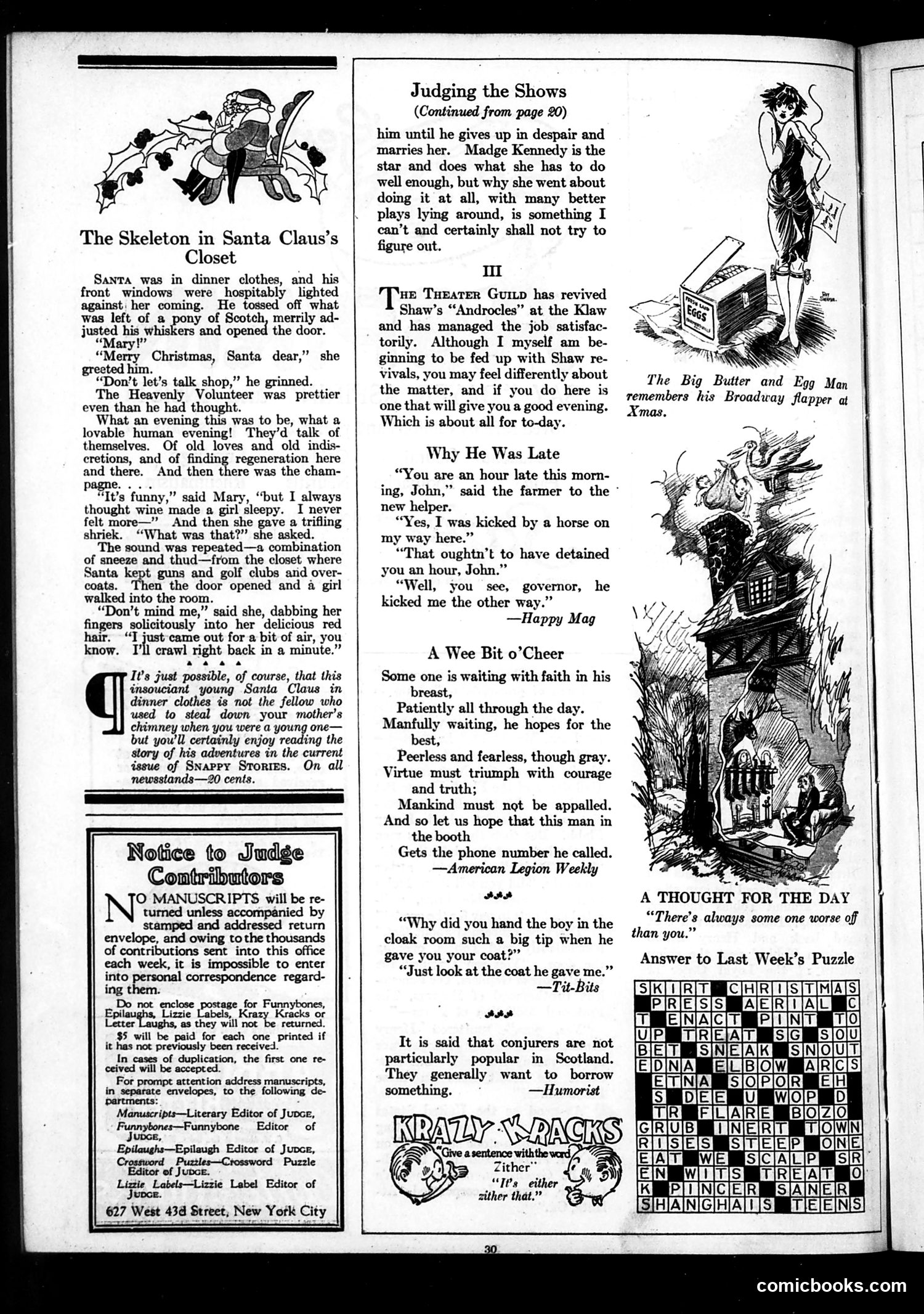
This page contains a humorous short story titled "The Skeleton in Santa Claus's Closet," which subverts the wholesome Santa Claus mythology. The joke plays on the phrase "skeleton in the closet" (a hidden shameful secret). Here, a debauched Santa—depicted as a romantic libertine in dinner clothes—entertains a woman called "Mary" (identified as "the Heavenly Volunteer"), only to have an actual *girl* emerge from his closet mid-tryst, ruining his evening. The satire mocks the contradiction between Santa's idealized public image as a benevolent, moral figure and his private behavior as a dissolute seducer. It's cynical commentary on hypocrisy and false respectability—common themes in Judge's satirical tradition. The page also includes theater reviews, humorous anecdotes, and puzzle content typical of 1920s magazine layout. The overall tone is sophisticated, adult-oriented humor aimed at urbane readers skeptical of sentimentality.
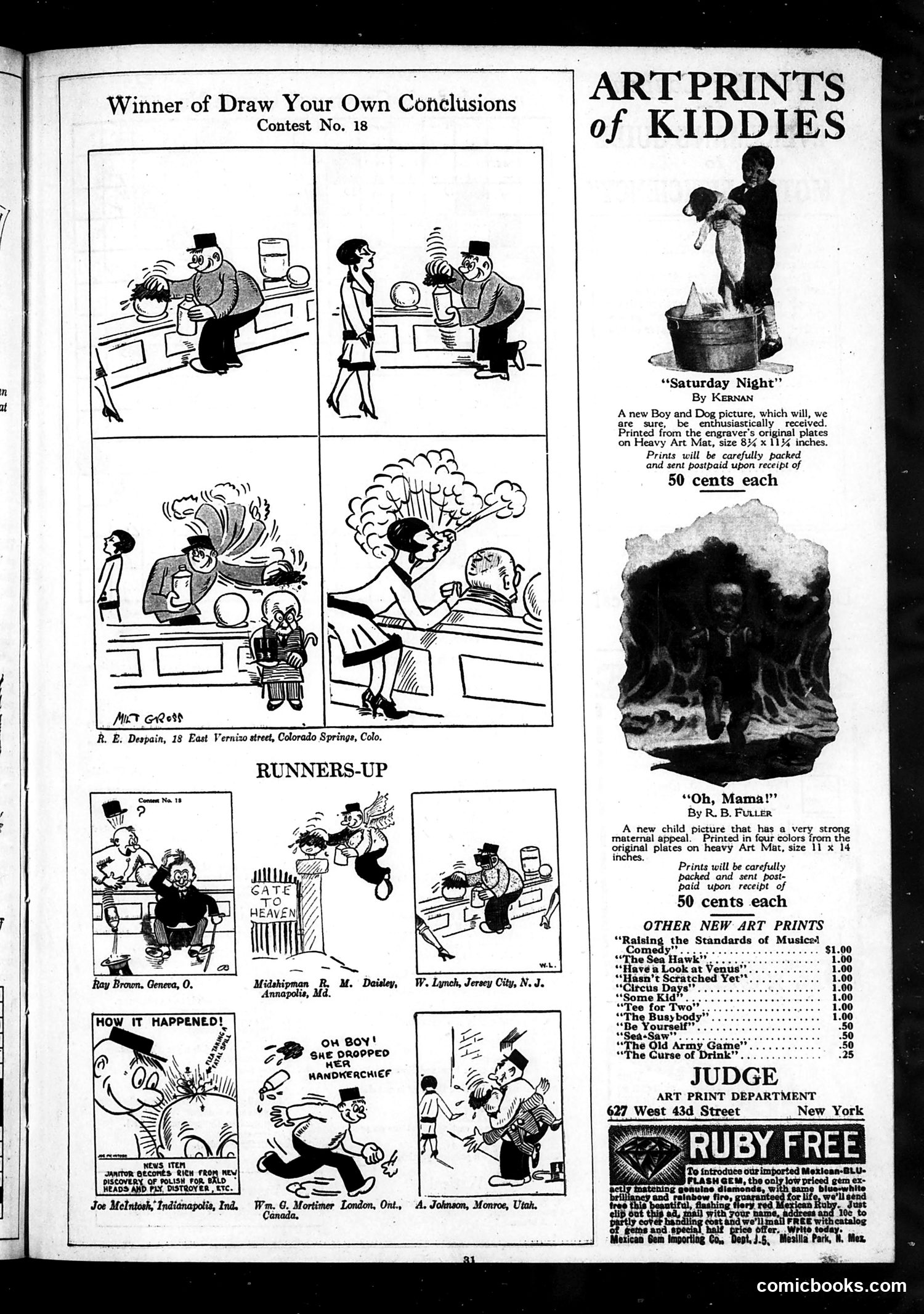
This page showcases **Contest No. 18's winning cartoon** from Judge magazine's "Draw Your Own Conclusions" competition. The winner, by Milt Gross (credited as "MET GROSS"), depicts a domestic scene: a man in a top hat repeatedly dunking his child into a basin of water while a woman watches in horror. The humor appears to derive from the absurd, exaggerated response to a mundane parenting task—likely bathing a reluctant child. Below are "Runners-Up" entries by other cartoonists, showing similar domestic comedy scenarios involving children and adults in chaotic situations. The right side advertises **children's art prints** available for 50 cents each, including "Saturday Night" (a boy and dog picture) and "Oh, Mama!" Both are promoted as appealing to families and printed on quality art board. This reflects early 20th-century American humor: slapstick domestic scenes treating child-rearing as comedic fodder, combined with commercial art print sales targeting middle-class households.
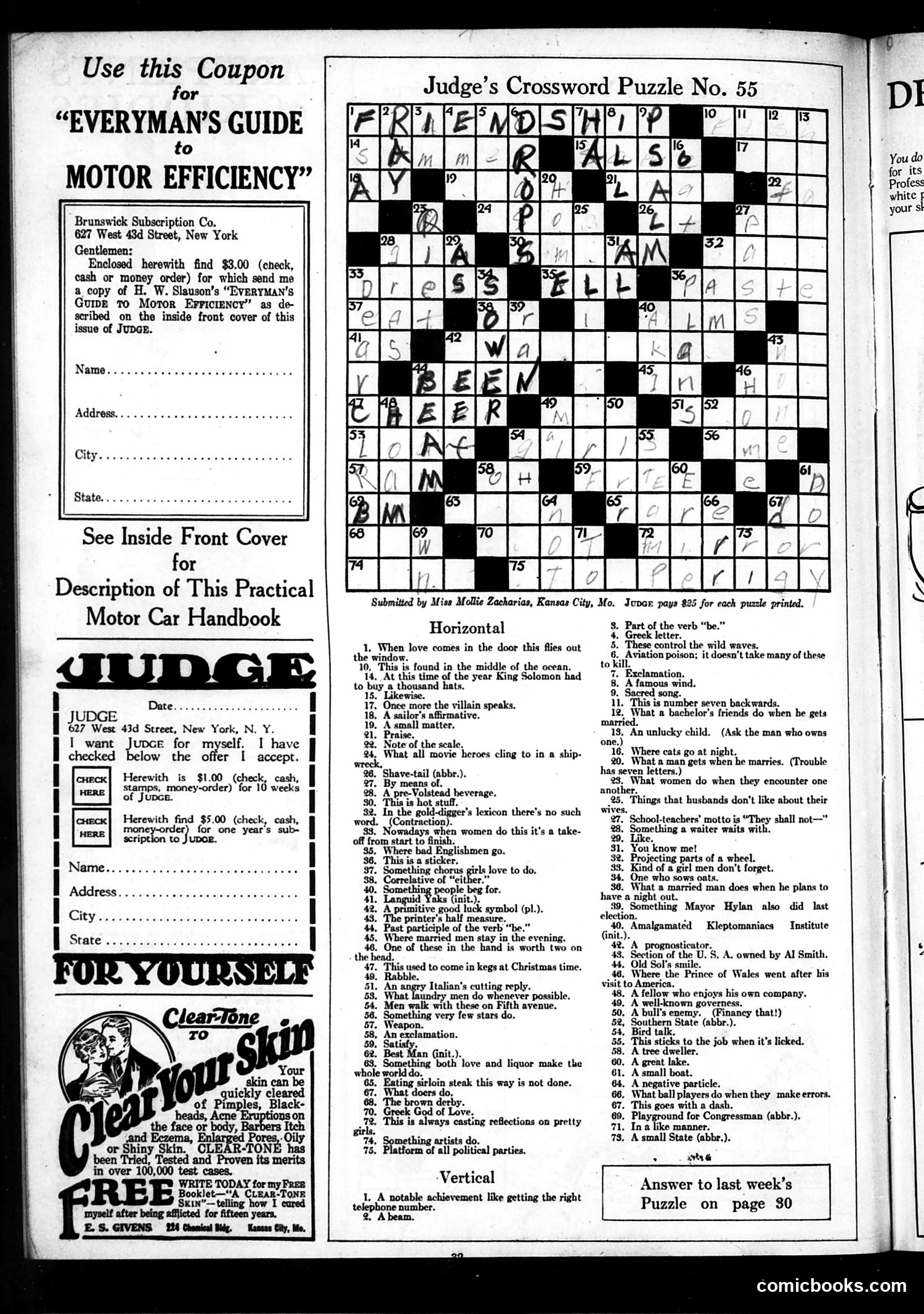
This page is primarily a **crossword puzzle** with accompanying subscription offers, not political satire. The main content is "Judge's Crossword Puzzle No. 55," submitted by Miss Mollie Zacharias of Kansas City, Missouri, with clues printed horizontally and vertically below the grid. The surrounding material consists of **advertising and subscription coupons** for Judge magazine itself and related products: H.W. Slauson's "Everyman's Guide to Motor Efficiency" (a motor car handbook), a "Clear-Tone" skin treatment product, and Judge's own subscription offerings at various price points ($1, $3, and $5). This appears to be a **typical interior page** from Judge magazine featuring leisure content (the crossword) alongside commercial promotions—standard magazine filler material of the era rather than editorial commentary or political satire.
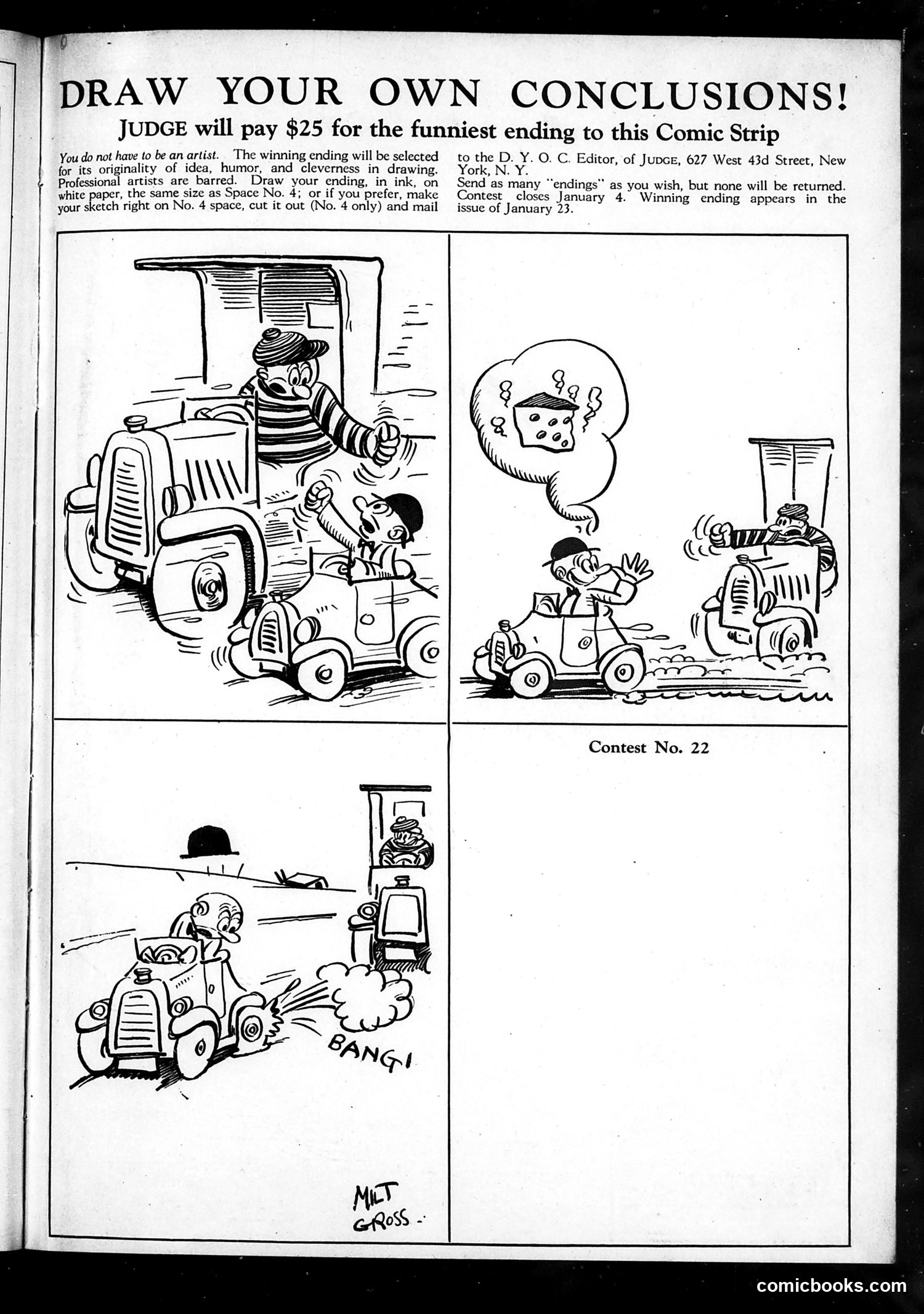
This is a **reader participation contest**, not a political cartoon. Judge magazine invited readers to complete an unfinished comic strip about toy cars and clowns for a $25 prize—substantial money in this era. The three panels show: 1. A clown in a large toy car chasing a smaller car 2. The smaller car's driver dreaming of dice (gambling reference) 3. A clown firing a gun at a gas pump The humor appears to involve slapstick chaos and toy-car mayhem, though the exact narrative setup is unclear without context. **Key detail**: Professional artists were explicitly barred from entering, making this a contest for amateurs. Readers submitted their own comic endings on the blank fourth panel, judged on "originality of idea, humor, and cleverness." This democratized comic creation, reflecting the magazine's interactive relationship with its audience.
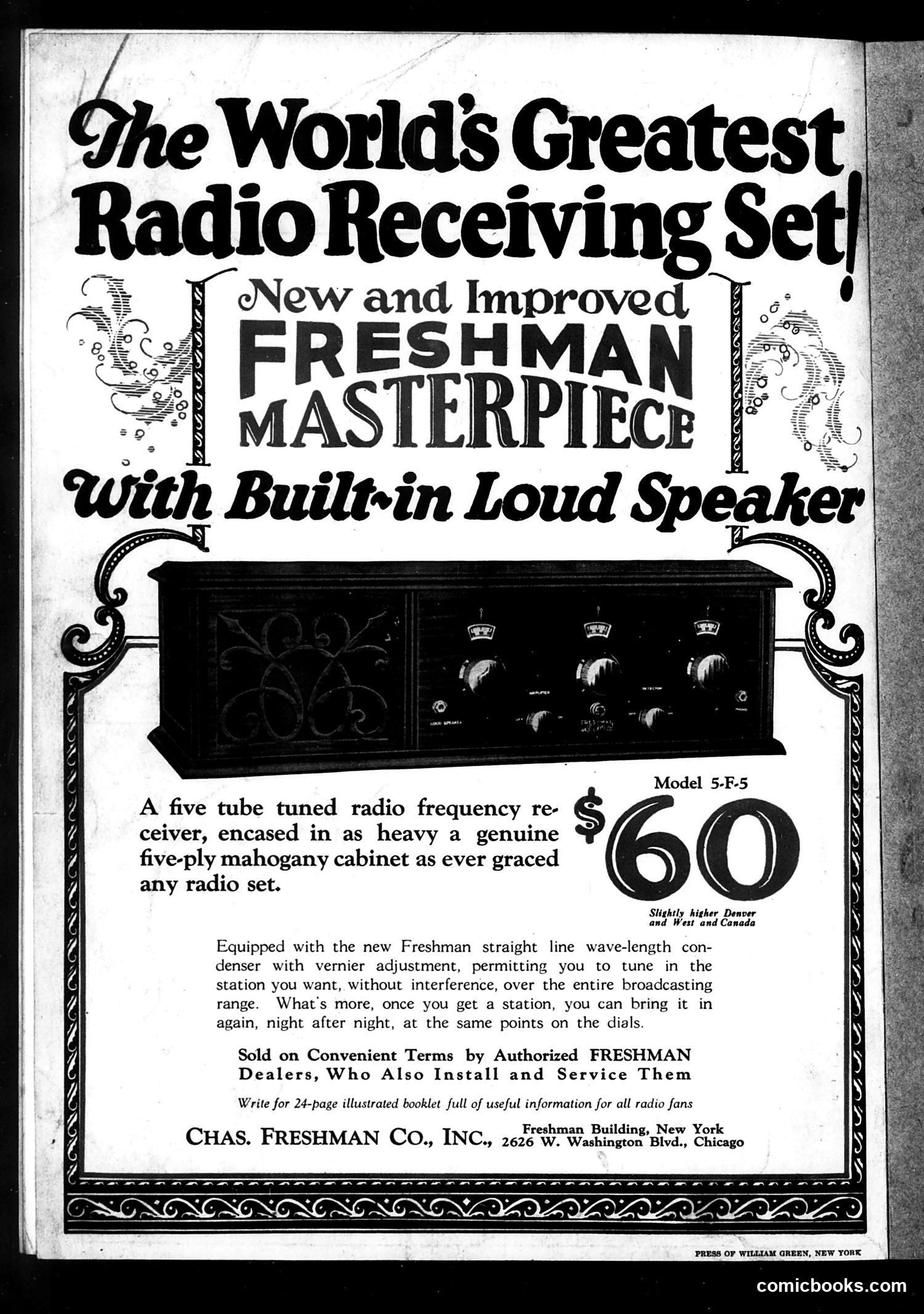
This page is **not a cartoon or satire**—it's a straightforward advertisement for a Freshman brand radio receiver (Model 5-F-5), priced at $60. The ad promotes a five-tube radio set housed in mahogany cabinetry with a built-in speaker. Key selling points include the "straight line wave-length condenser with vernier adjustment," allowing listeners to tune stations without interference across the broadcasting range and return to the same station reliably. The ad appears in *Judge* magazine, which was primarily satirical, but this page itself contains only commercial messaging: product specifications, pricing, sales terms ("Convenient Terms by Authorized FRESHMAN Dealers"), and contact information for Chas. Freshman Co., Inc. in New York and Chicago. The decorative border and typeface reflect 1920s design aesthetics, consistent with the early radio era when home radio receivers were luxury consumer goods.
I can see this is a page from *Judge* magazine, but the image quality is too poor for me to discern any cartoon artwork, text, or specific content details with confidence. The page appears to be mostly blank or heavily degraded, showing only a grainy gray surface with some marks along the left and right edges (possibly binding or reference marks). Without being able to read any OCR text beyond the watermark "comicbooks.com," I cannot identify any figures, political references, or satirical points. To provide accurate historical analysis as you've requested, I would need a clearer image where the cartoon and text are legible.