
Judge, 1925-12-26 · page 22 of 37
Judge — December 26, 1925 — page 22: what you’re looking at
What you’re looking at
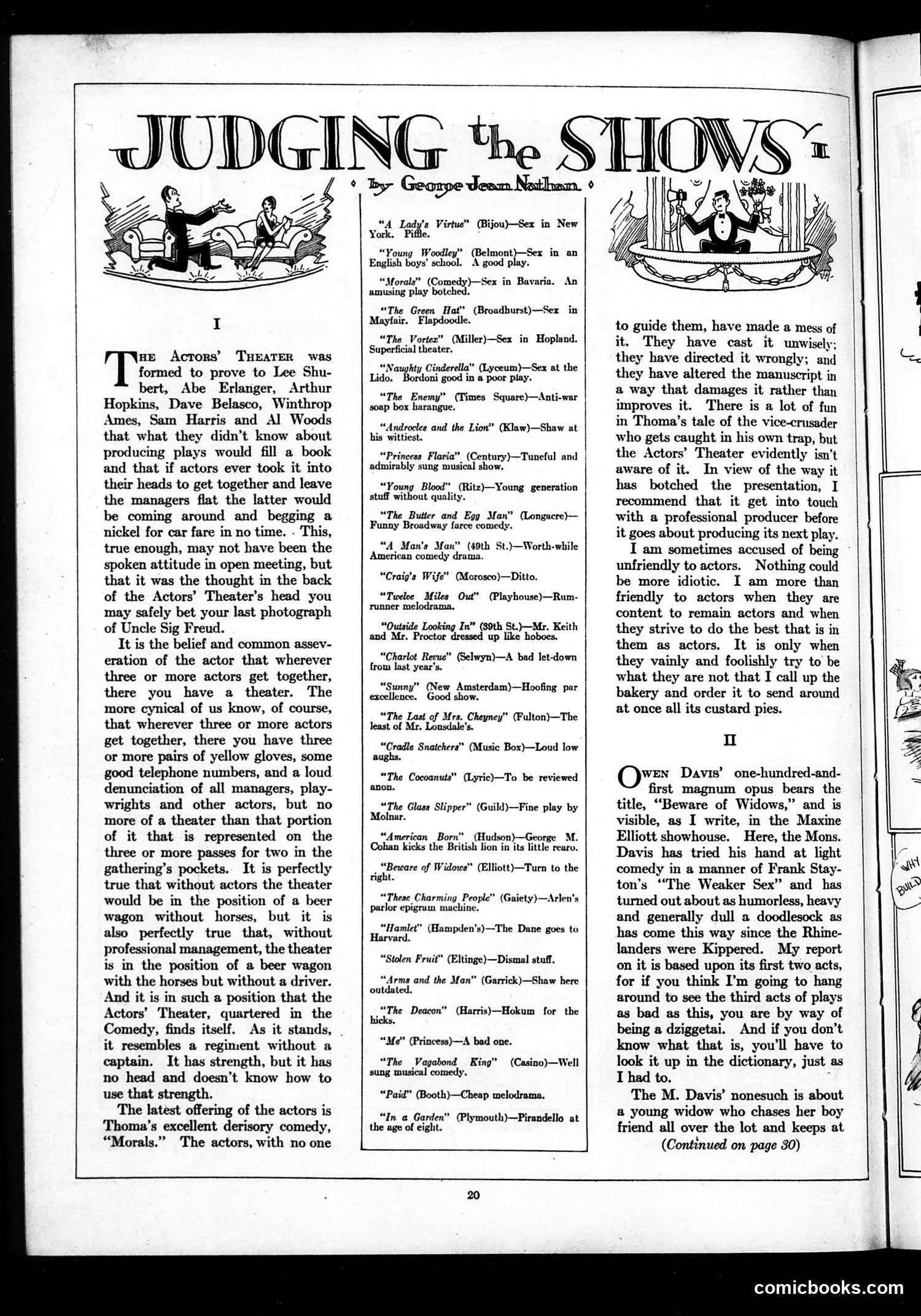
This is a theater review column by George Jean Nathan critiquing the Actors' Theater company and current Broadway productions. The opening essay satirizes the Actors' Theater's founding premise—that actors believed they could manage theaters better than professional producers like Lee Shubert, Abe Erlanger, and David Belasco. Nathan mocks the actors' naive confidence, using colorful language: actors gathered together produce "yellow gloves," phone numbers, and complaints about managers—not actual theater. He argues the theater needs professional management like a beer wagon needs a driver; actors alone cannot steer an organization, despite their talent. The bulk of the page lists current Broadway shows with brief, caustic assessments (many productions are dismissed as "sex" plays or poor quality). Nathan's overall point: the Actors' Theater's production of "Morals" will likely fail because actors lack managerial competence, no matter their artistic abilities.
📄 Transcribed text from this page (OCR, searchable)
Machine-transcribed from the original scan — historical spelling and the odd misread are preserved.
HE Actors’ THEATER was | formed to prove to Lee Shu- bert, Abe Erlanger, Arthur Hopkins, Dave Belasco, Winthrop Ames, Sam Harris and Al Woods that what they didn’t know about producing plays would fill a book and that if actors ever took it into their heads to get together and leave the managers flat the latter would be coming around and begging a nickel for car fare in no time. - This, true enough, may not have been the spoken attitude in open meeting, but that it was the thought in the back of the Actors’ Theater’s head you may safely bet your last photograph of Uncle Sig Freud. It is the belief and common assev- eration of the actor that wherever three or more actors get together, there you have a theater. The more cynical of us know, of course, that wherever three or more actors get together, there you have three or more pairs of yellow gloves, some good telephone numbers, and a loud denunciation of all managers, play- wrights and other actors, but no more of a theater than that portion of it that is represented on the three or more passes for two in the gathering’s pockets. It is perfectly true that without actors the theater would be in the position of a beer wagon without horses, but it is also perfectly true that, without professional management, the theater is in the position of a beer wagon with the horses but without a driver. And it is in such a position that the Actors’ Theater, quartered in the Comedy, finds itself. As it stands, it resembles a regiment without a captain. It has strength, but it has no head and doesn’t know how to use that strength. The latest offering of the actors is Thoma’s excellent derisory comedy, “Morals.” The actors, with no one “A Lady's Virtue” (Bijou)—Sex in New York. "Pifile. “Young Woodley” (Belmont)—Sex in an Enghch boys ochoul, 4 good play. “Morals” {Camedy)—-Sex in Bavaria. An amusing p! tched. “The Green pet Prvadiueat) Sex in Mayfair. Flapdoodk “The Vortex” (Miller)\—Sex in Hopland. Superficial theater. aj Nenglty Cinderela” yceum)—Sex at the Bordon’ good in a poor play. “The Enemy” (Times Square)—Anti-war soap box harangue. “Androcles and the Lion” (Klaw)—Shaw at his wittiest. “Princess Flavia” (Century)—Tuneful and rably sung musical show. “Young Blood” (Ritz)—Young generation stuff without quality. “The Butter and Egg Man” (Longacre)— Funny Broadway farce comedy. “A Man's Man” (49th St.)—Worth-while American comedy drama. “Craig's Wife” (Morosco)—Ditto. “Twelve Miles Out” (Playhouse)—Rum- runner melodrama, “Outside Looking In” (89th St.}—Mr. Keith and Mr. Proctor dressed up like hoboes. “Charlot Recue” (Selwyn)—A bad let-down from last year's. “Sunny” (New Amsterdam)—Hoofing par excellence. “The Last of Mrs. Ci ”" Fulton)—The wan eee rs. Cheyney” Fr n)—The “Cradle Snatchers” (Music Box)—Loud I Py le rs” (Music Box’ ud low “The Cocoanuts” (Lyric)—To be reviewed anon. “The Glass Slipper” (Guild)—Fine play by Molnar. ?E aes “American Born” (Hudson)—George M. Cohan kicks the British lion in its Tittle rearo. sig heeare of Widows” (Eliott)—Tur to the “These Charming People” (Gaiety)—Arlen's parlor epigram muchine. eral (Hampden’s)—The Dane goes to “Stolen Fruit” (Eltinge)—Dismal stuff. “Arma and the Man” (Garrick)—Shaw here outdated. “The Deacon” (Harris)\—Hokum for the hicks, “Me” (Princess)—A bad one. “The Vagabond King” sung musical comedy. “Paid” (Booth)—Cheap melodrama, (Casino)—Well “In @ Garden” (Plymouth)—Pirandello at mince wae JUDGING ‘he SHOWS to guide them, have made a mess of it. They have cast it unwisely; they have directed it wrongly; and they have altered the manuscript in a way that damages it rather than improves it. There is a lot of fun in Thoma’s tale of the vice-crusader who gets caught in his own trap, but the Actors’ Theater evidently isn’t aware of it. In view of the way it has botched the presentation, I recommend that it get into touch with a professional producer before it goes about producing its next play, I am sometimes accused of being unfriendly to actors. Nothing could be more idiotic. I am more than friendly to actors when they are content to remain actors and when they strive to do the best that is in them as actors. It is only when they vainly and foolishly try to be what they are not that I call up the bakery and order it to send around at once all its custard pies. ang WEN Davis’ one-hundred-and- first magnum opus bears the title, “Beware of Widows,” and is visible, as I write, in the Maxine Elliott showhouse. Here, the Mons. Davis has tried his hand at light comedy in a manner of Frank Stay- ton’s “The Weaker Sex” and has turned out about as humorless, heavy and generally dull a doodlesock as has come this way since the Rhine- landers were Kippered. My report on it is based upon its first two acts, for if you think I’m going to hang around to see the third acts of plays as bad as this, you are by way of being a dziggetai. And if you don’t know what that is, you'll have to look it up in the dictionary, just. as Thad to. The M. Davis’ nonesuch is about a young widow who chases her boy friend all over the lot and keeps at (Continued on page 30) comicbooks.com