
Judge, 1925-12-26 · page 8 of 37
Judge — December 26, 1925 — page 8: what you’re looking at
What you’re looking at
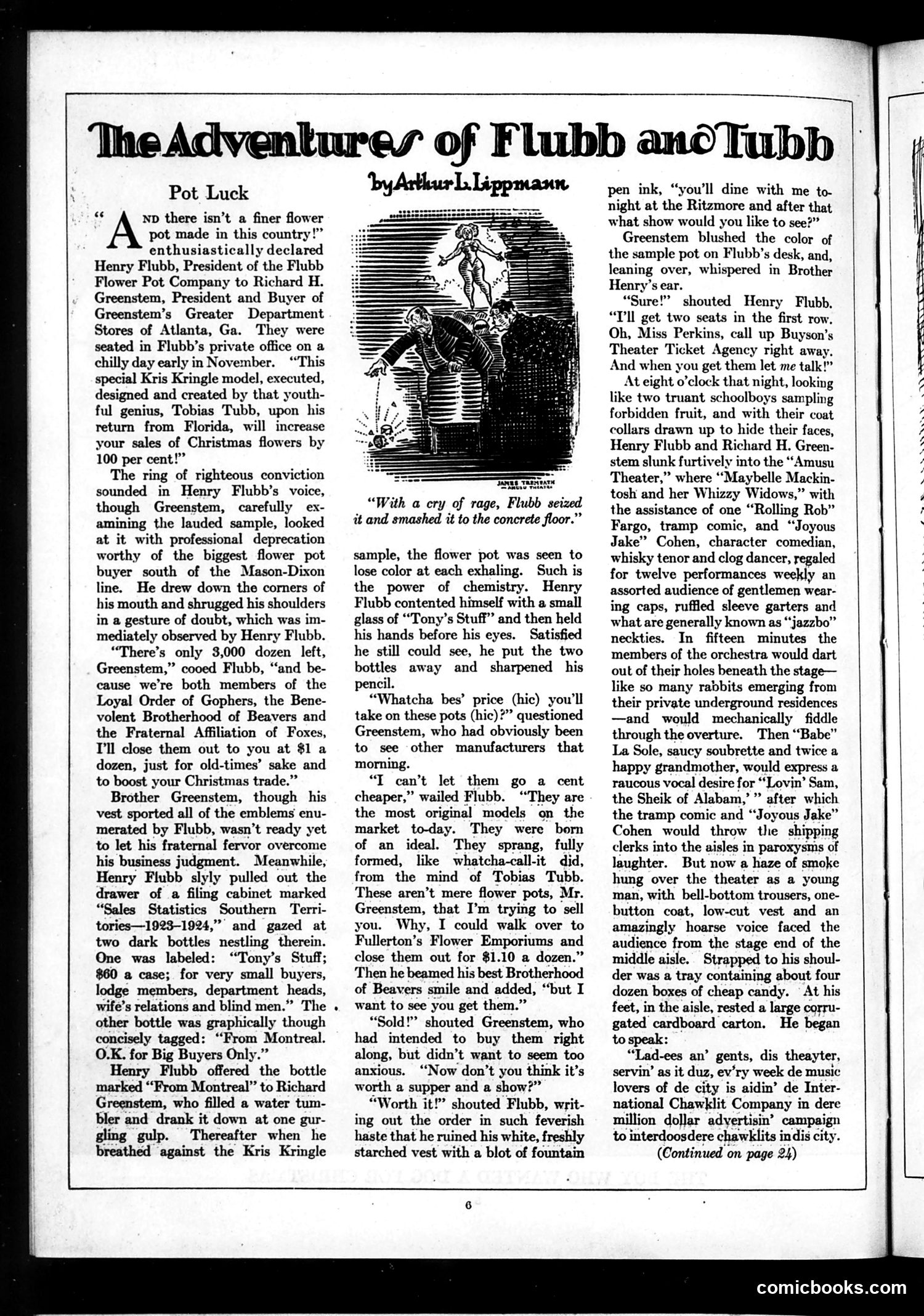
This is a humorous business satire by Arthur L. Lippmann about sales tactics during Prohibition (implied by the hidden liquor bottles). Two businessmen—Henry Flubb (flower pot manufacturer) and Richard Greenstem (department store buyer)—negotiate a deal. Flubb uses fraternal lodge membership and alcohol to lower Greenstem's resistance: he plies him with bootleg "Montreal" liquor while withholding it from himself, then uses flattery and false scarcity claims ("only 3,000 dozen left") to close the sale. The joke satirizes dishonest sales methods and the way fraternal organizations supposedly enabled corruption. The cartoon depicts Flubb manipulating Greenstem through emotional appeals and intoxication rather than honest business practice. The story continues on page 21, suggesting this was serialized humor for Judge magazine's readers.
📄 Transcribed text from this page (OCR, searchable)
Machine-transcribed from the original scan — historical spelling and the odd misread are preserved.
The Adventures of Flubb an©Tubb Pot Luck Np there isn’t a finer flower pot made in this country!” enthusiastically declared Henry Flubb, President of the Flubb Flower Pot Company to Richard H. Greenstem, President and Buyer of Greenstem’s Greater Department Stores of Atlanta, Ga. They were seated in Flubb’s private office on a chilly day early in November. “This special Kris Kringle model, executed, designed and created by that youth- ful genius, Tobias Tubb, upon his return from Florida, will increase your sales of Christmas flowers by 100 per cent!” The ring of righteous conviction sounded in Henry Flubb’s voice, though Greenstem, carefully ex- amining the lauded sample, looked at it with professional deprecation worthy of the biggest flower pot buyer south of the Mason-Dixon line. He drew down the corners of his mouth and shrugged his shoulders in a gesture of doubt, which was im- mediately observed by Henry Flubb. “There’s only 3,000 dozen left, Greenstem,” cooed Flubb, “and be- cause we're both members of the Loyal Order of Gophers, the Bene- volent Brotherhood of Beavers and the Fraternal Affiliation of Foxes, T'll close them out to you at $1 a dozen, just for old-times’ sake and to boost your Christmas trade.” Brother Greenstem, though his vest sported all of the emblems enu- merated by Flubb, wasn’t ready yet to let his fraternal fervor overcome his business judgment. Meanwhile, Henry Flubb slyly pulled out the drawer of a filing cabinet marked “Sales Statistics Southern Terri- tories—1923-1924,” and gazed at two dark bottles nestling therein. One was labeled: “Tony’s Stuff; $60 a case; for very small buyers, lodge members, department heads, wife’s relations and blind men.” The other bottle was graphically though concisely tagged: “From Montreal. O.K. for Big Buyers Only.” Henry Flubb offered the bottle marked “From Montreal” to Richard Greenstem, who filled a water tum- bler and drank it down at one gur- gling gulp. Thereafter when he breathed against the Kris Kringle “With a cry of rage, Flubb seized it and smashed it to the concrete floor.” sample, the flower pot was seen to lose color at each exhaling. Such is the power of chemistry. Henry Flubb contented himself with a small glass of “Tony’s Stuff” and then held his hands before his eyes. Satisfied he still could see, he put the two bottles away and sharpened his pencil. “Whatcha bes’ price (hic) you'll take on these pots (hic)?” questioned Greenstem, who had obviously been to see other manufacturers that morning. “T can’t let them go a cent cheaper,” wailed Flubb. “They are the most original models on the market to-day. They were bom of an ideal. They sprang, fully formed, like whatcha-call-it did, from the mind of Tobias Tubb. These aren’t mere flower pots, Mr. Greenstem, that I’m trying to sell you. Why, I could walk over to Fullerton’s Flower Emporiums and close them out for $1.10 a dozen.” Then he beamed his best Brotherhood of Beavers smile and added, “but I want to see you get them.” “Sold! shouted Greenstem, who had intended to buy them right along, but didn’t want to seem too anxious. ‘“Now don’t you think it’s worth a supper and a show?” “Worth it!” shouted Flubb, writ- ing out the order in such feverish haste that he ruined his white, freshly starched vest with a blot of fountain pen ink, “you'll dine with me to- night at the Ritzmore and after that what show would you like to see?” Greenstem blushed the color of the sample pot on Flubb’s desk, and, leaning over, whispered in Brother Henry’s ear. “Sure!” shouted Henry Flubb. “Tl get two seats in the first row. Oh, Miss Perkins, call up Buyson’s Theater Ticket Agency right away. And when you get them let me talk!” At eight o’clock that night, looking like two truant schoolboys sampling forbidden fruit, and with their coat collars drawn up to hide their faces, Henry Flubb and Richard H. Green- stem slunk furtively into the “Amusu Theater,” where “Maybelle Mackin- tosh and her Whizzy Widows,” with the assistance of one “Rolling Rob” Fargo, tramp comic, and “Joyous Jake” Cohen, character comedian, whisky tenor and clog dancer, regaled for twelve performances weekly an assorted audience of gentlemen wear- ing caps, ruffled sleeve garters and what are generally known as “jazzbo” neckties. In fifteen minutes the members of the orchestra would dart out of their holes beneath the stage— like so many rabbits emerging from their private underground residences —and would mechanically fiddle through the overture. Then “Babe” La Sole, saucy soubrette and twice a happy grandmother, would express a raucous vocal desire for ‘Lovin’ Sam, the Sheik of Alabam,’” after which the tramp comic and “Joyous Jake” Cohen would throw the shipping clerks into the aisles in paroxysms of laughter. But now a haze of smoke hung over the theater as a young man, with bell-bottom trousers, one- button coat, low-cut vest and an amazingly hoarse voice faced the audience from the stage end of the middle aisle. Strapped to his shoul- der was a tray containing about four dozen boxes of cheap candy. At his feet, in the aisle, rested a large corru- gated cardboard carton. He began to speak: “Lad-ees an’ gents, dis theayter, servin’ as it duz, ev’ry week de music lovers of de city is aidin’ de Inter- national Chawklit Company in dere million dollar adyertisin’ campaign to interdoosdere chawklits indis city. (Continued on page 24) comicbooks.com