
A complete issue · 36 pages · 1925
Judge — April 18, 1925
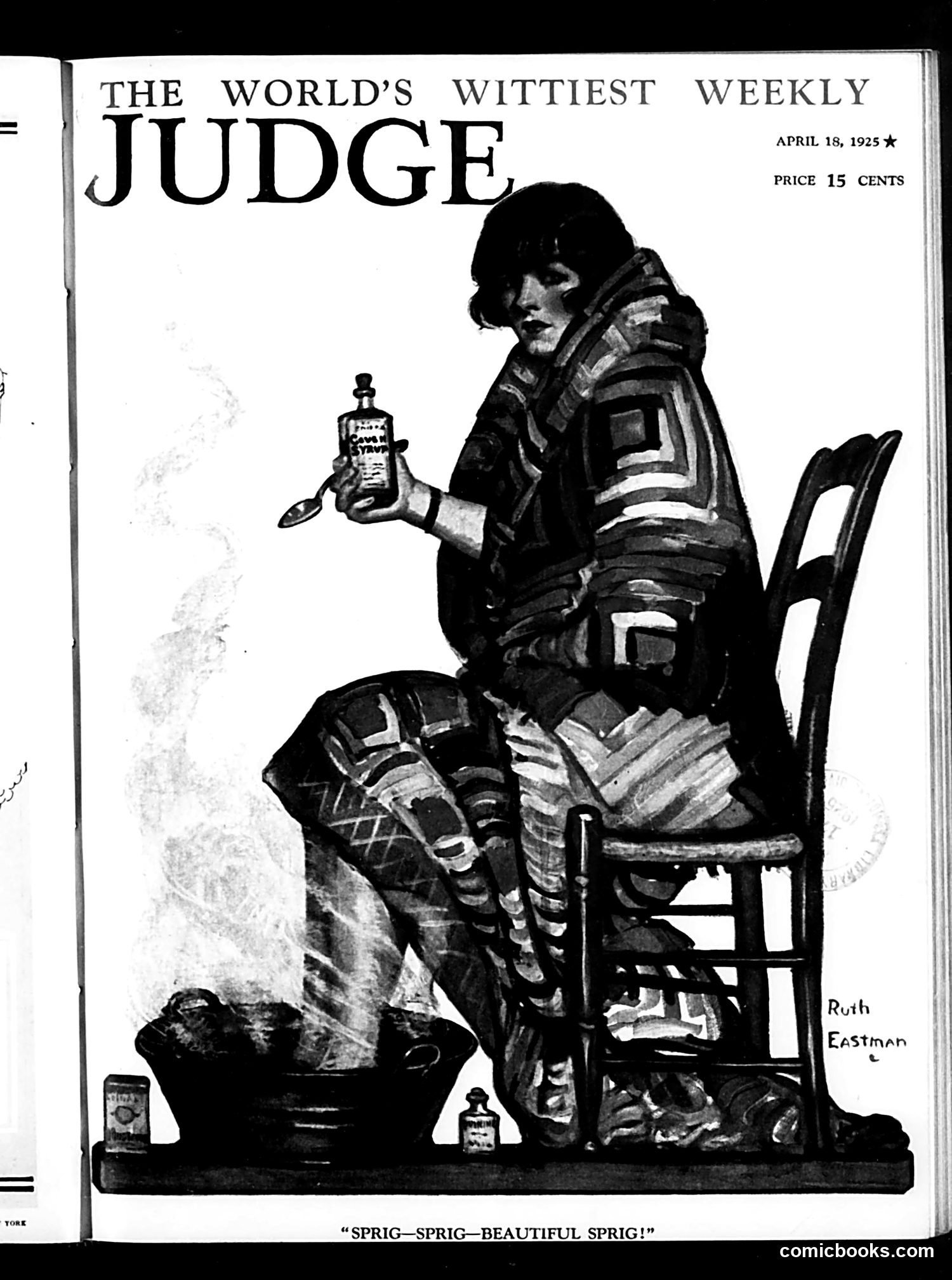
This satirical cover by Ruth Eastman depicts a woman sitting on a chair, dressed in heavily patterned, layered clothing typical of 1920s fashion. She holds a bottle labeled "SPRING SYRUP" and appears to be applying or examining it. The caption reads "SPRIG-SPRIG-BEAUTIFUL SPRIG!" – likely a play on advertising slogans of the era. The satire targets **spring fashion trends** of the 1920s, mocking the ornate, pattern-heavy clothing styles women wore during this season. By showing her treating fashion like a medicinal "syrup" she must apply, Eastman humorously suggests spring fashion is an excessive, almost obligatory ritual rather than practical dress. The exaggerated patterns and layers represent the era's sometimes absurd aesthetic demands on women's appearance.
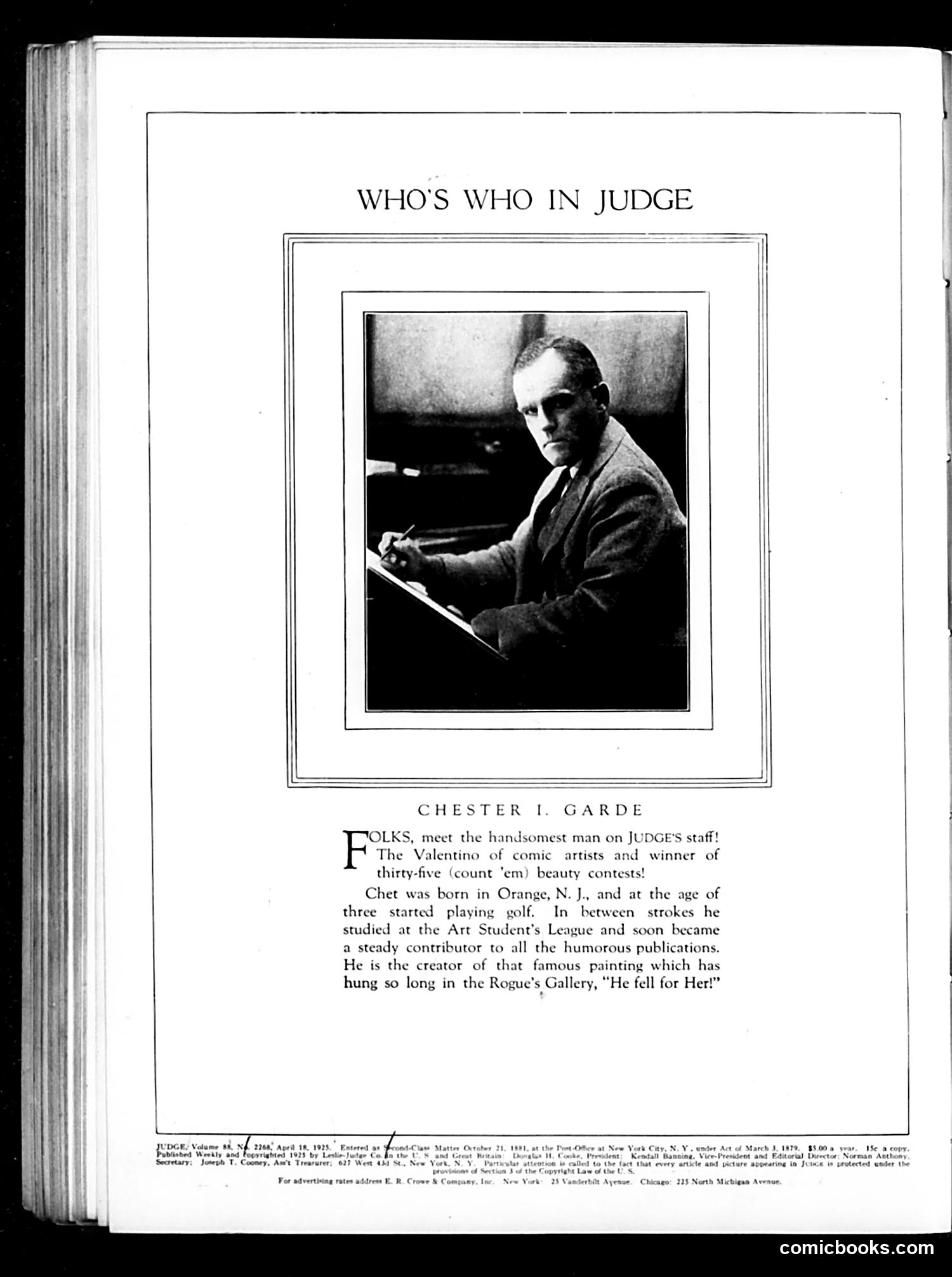
This is a biographical profile of **Chester I. Garde**, a comic artist and illustrator for *Judge* magazine. The text identifies him as "the handsomest man on JUDGE's staff" and notes he won thirty-five beauty contests. The profile highlights his career: born in Orange, New Jersey, he began as a golfer before studying at the Art Student's League. He became a regular contributor to humorous publications and created a famous painting titled "He Fell for Her!" displayed in the Rogue's Gallery. The photograph shows Garde at work, holding a drawing implement. This appears to be a lighthearted staff spotlight rather than political satire—a common feature in magazines celebrating their creative talent.
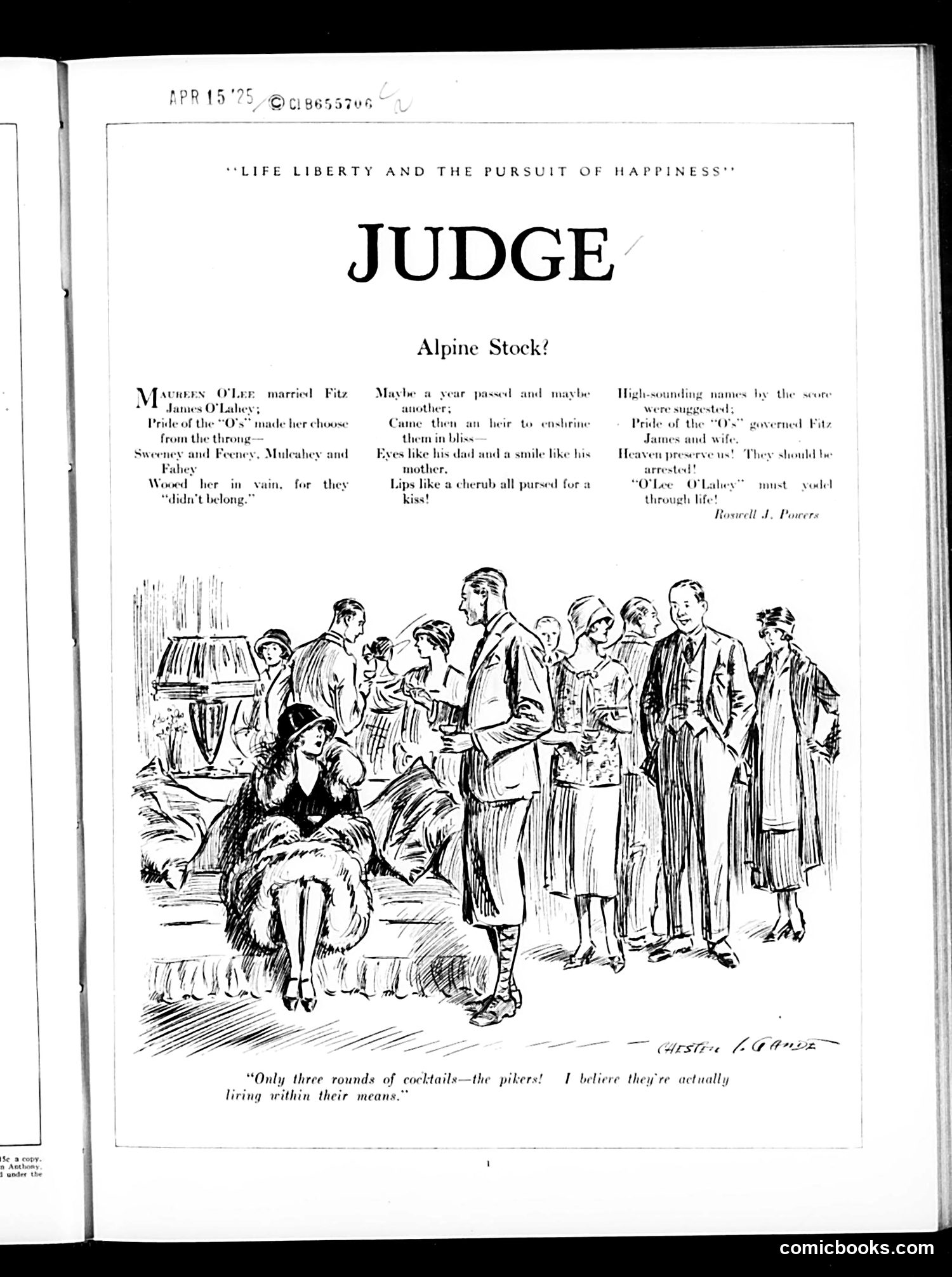
This satirical piece mocks the marriage of Muriel O'Lee (Pride of the "O's") to Fitz James O'Flaherty. The text suggests the O'Lee family—from Sweeney, Flaherty, Mulcahy and Fahey stock—disapproved, feeling they "didn't belong." The cartoon shows a social gathering where a woman (likely Muriel) sits while well-dressed guests stand discussing her. The caption jokes about "three rounds of cocktails—the pikers! I believe they're actually living within their means." The satire targets class pretension and snobbery: the O'Lee family's pride in their "stock" (ancestry) conflicts with their apparent modest means. The humor lies in the gap between aristocratic pretense and actual financial capacity—they're criticized for responsible spending rather than ostentatious wealth.
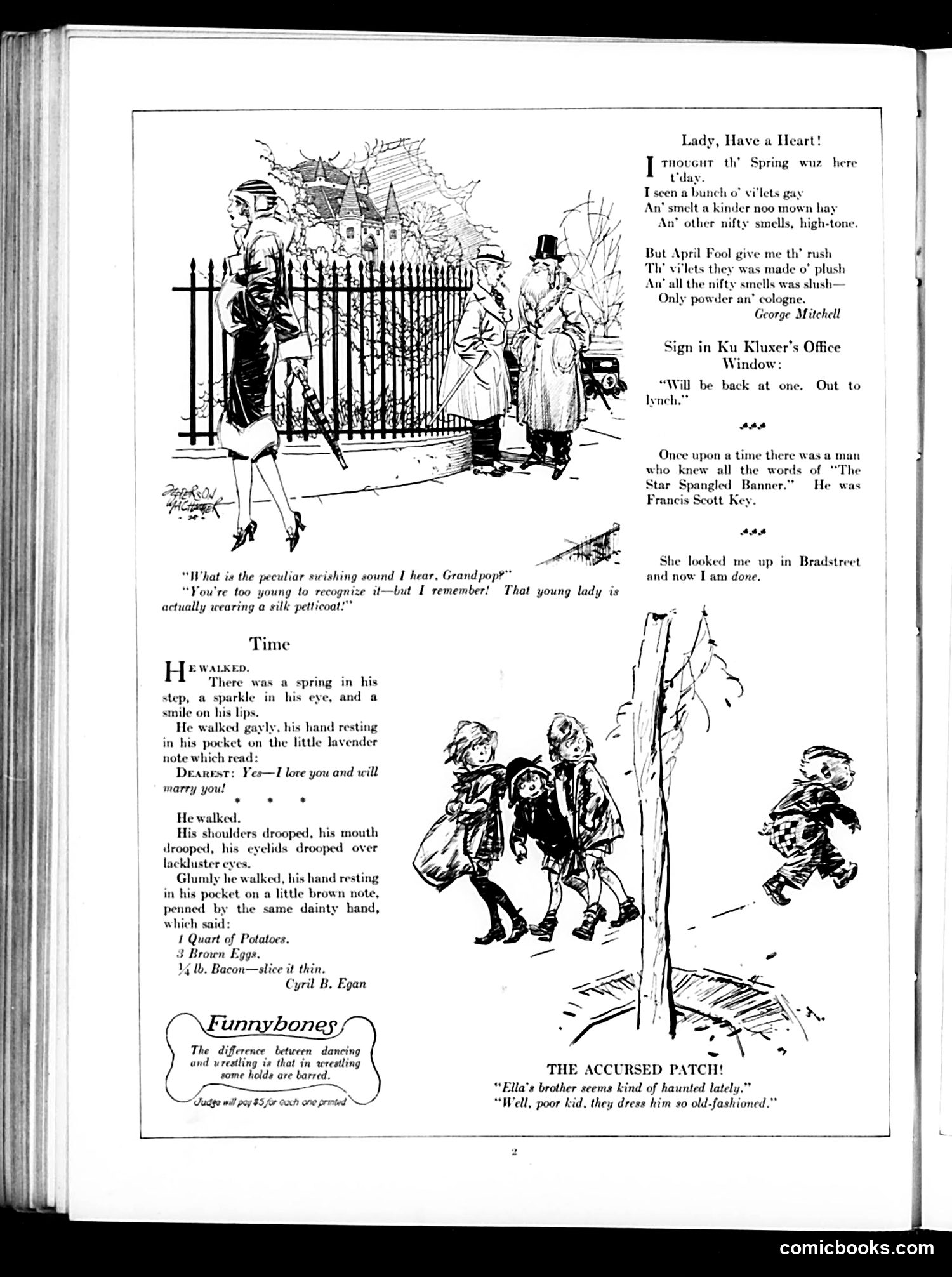
This page contains three distinct pieces of humor content typical of early 20th-century Judge magazine: 1. **Top cartoon**: Depicts a fashionable woman at a gate, with a dialogue about "peculiar rushing sounds" and a silk petticoat—satirizing the noisy, rustling clothing styles of the era, likely mocking women's fashion. 2. **"Time" poem**: A sentimental narrative about a man's emotional journey, contrasting his hopeful beginning with his later melancholy decline, using shopping lists as a darkly humorous detail about diminished romance in marriage. 3. **"The Accursed Patch"**: Shows children playing, with commentary about a boy's shabby clothing patch—likely satirizing poverty or class distinctions visible in children's dress. The **Funnybones** section offers a joke about the difference between dancing and wrestling. Overall, the page blends social satire about fashion, romance, and class with light humor.
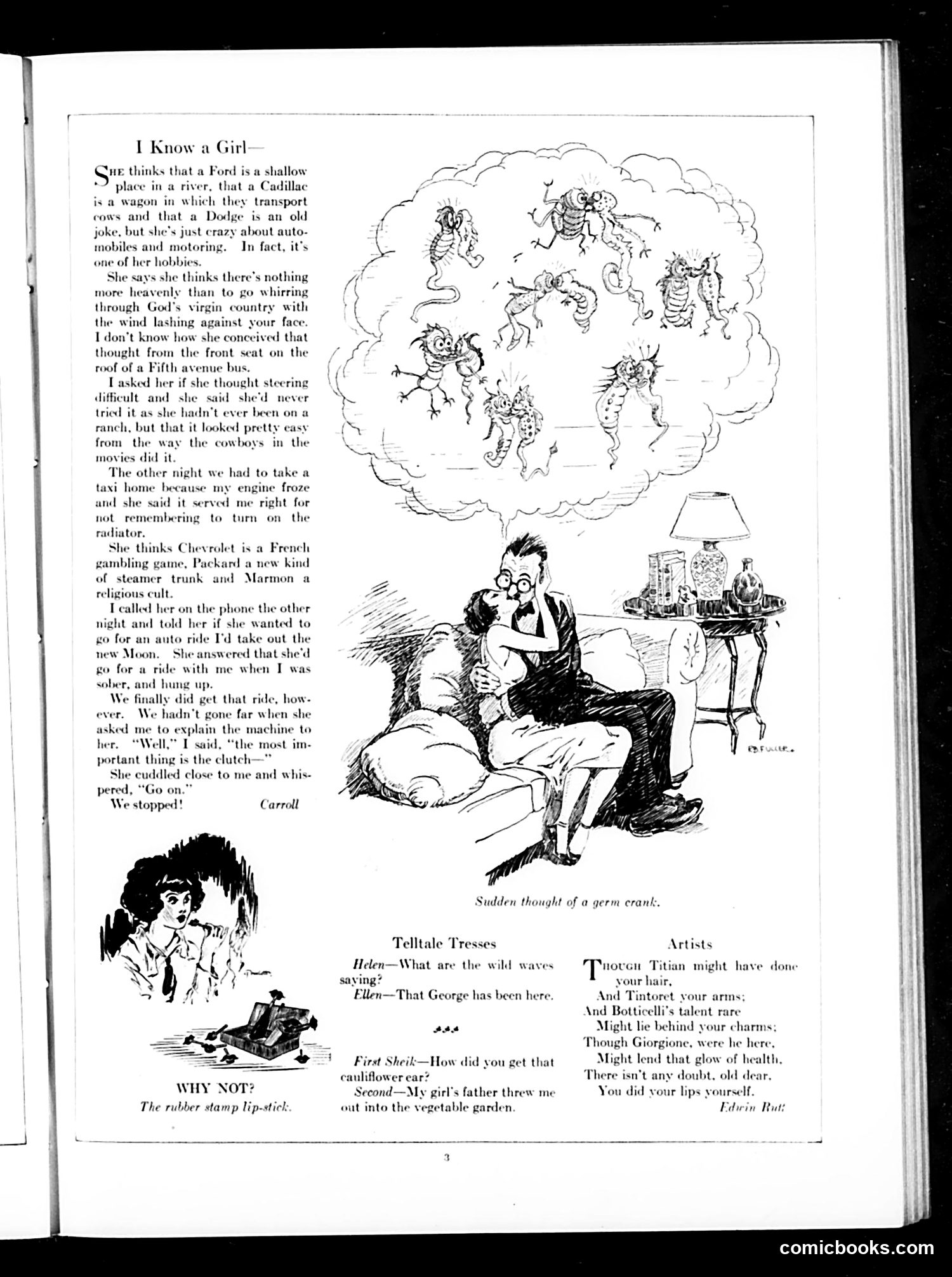
This page contains humorous anecdotes and illustrations typical of early 20th-century satirical magazines. The main story "I Know a Girl" by Carroll mocks automobile enthusiasts through the narrator's account of a woman obsessed with cars—she considers Fords "shallow," discusses Cadillacs as transport wagons, and views her automobile hobby as serious. The humor derives from exaggerating automotive fandom as pretentious behavior. The illustration depicts a man experiencing sudden hypochondriacal worry ("Sudden thought of a germ crank"), reflecting contemporary anxieties about germs and disease—a common satirical target in this era. The bottom sections include wordplay jokes and cultural references to artists like Titian and Botticelli, typical of Judge's sophisticated, literary humor aimed at educated readers. The "WHY NOT?" section offers a rubber-stamp lip-stick joke.
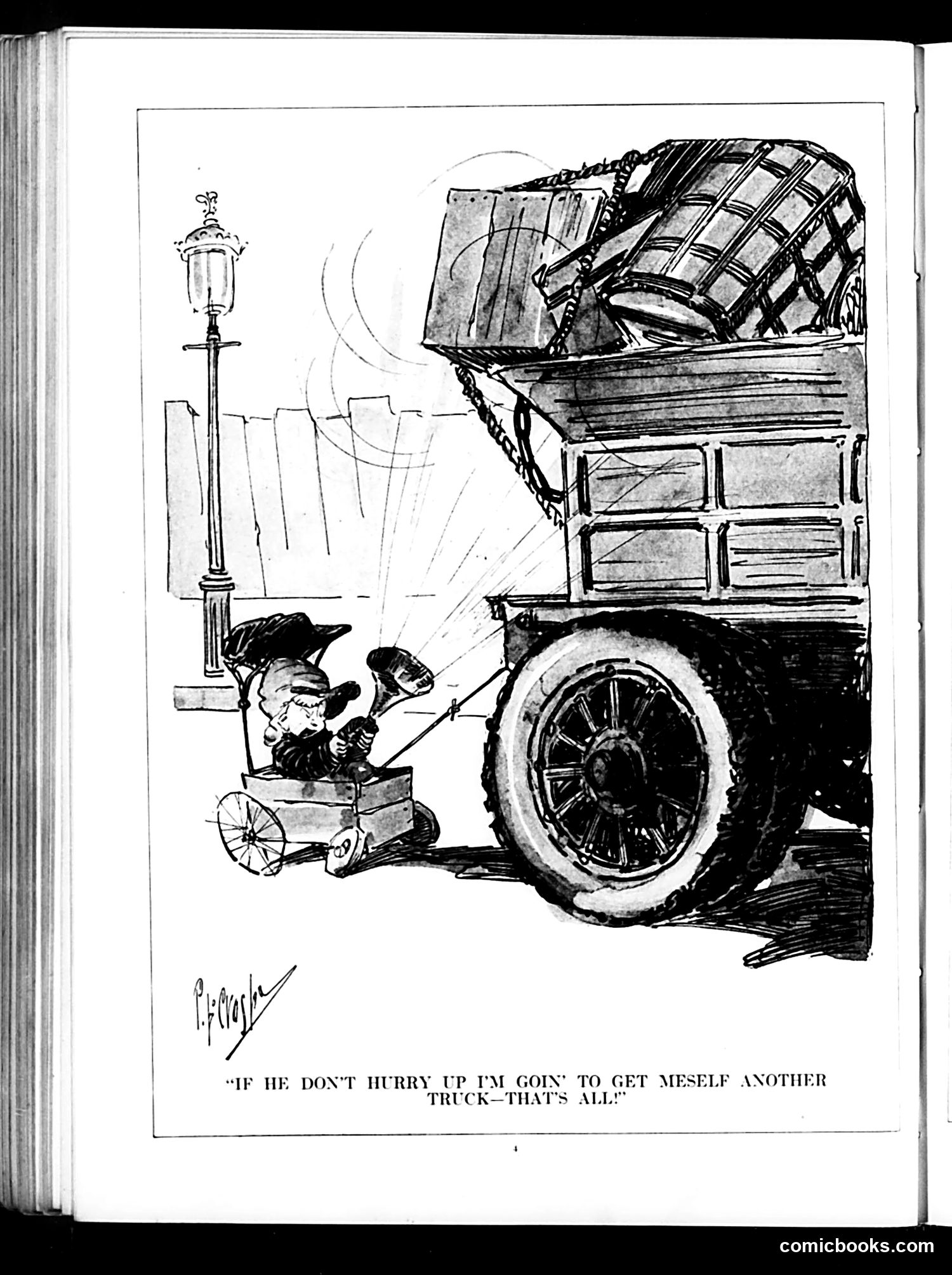
This cartoon depicts a small figure (appearing to be a delivery driver or worker) in a tiny cart confronting a large, heavily-loaded truck. The caption reads: "If he don't hurry up I'm goin' to get meself another truck—that's all!" The satire comments on **labor relations and worker impatience**, likely from the early 20th century. The small figure represents a laborer or driver frustrated with slow service or performance. By threatening to replace the entire truck rather than wait for the current one to be unloaded or repaired, the cartoon satirizes the casual attitude toward dismissing workers or equipment—suggesting that replacements are readily available and workers are considered expendable. The artist's signature appears to read "P. Briggs."
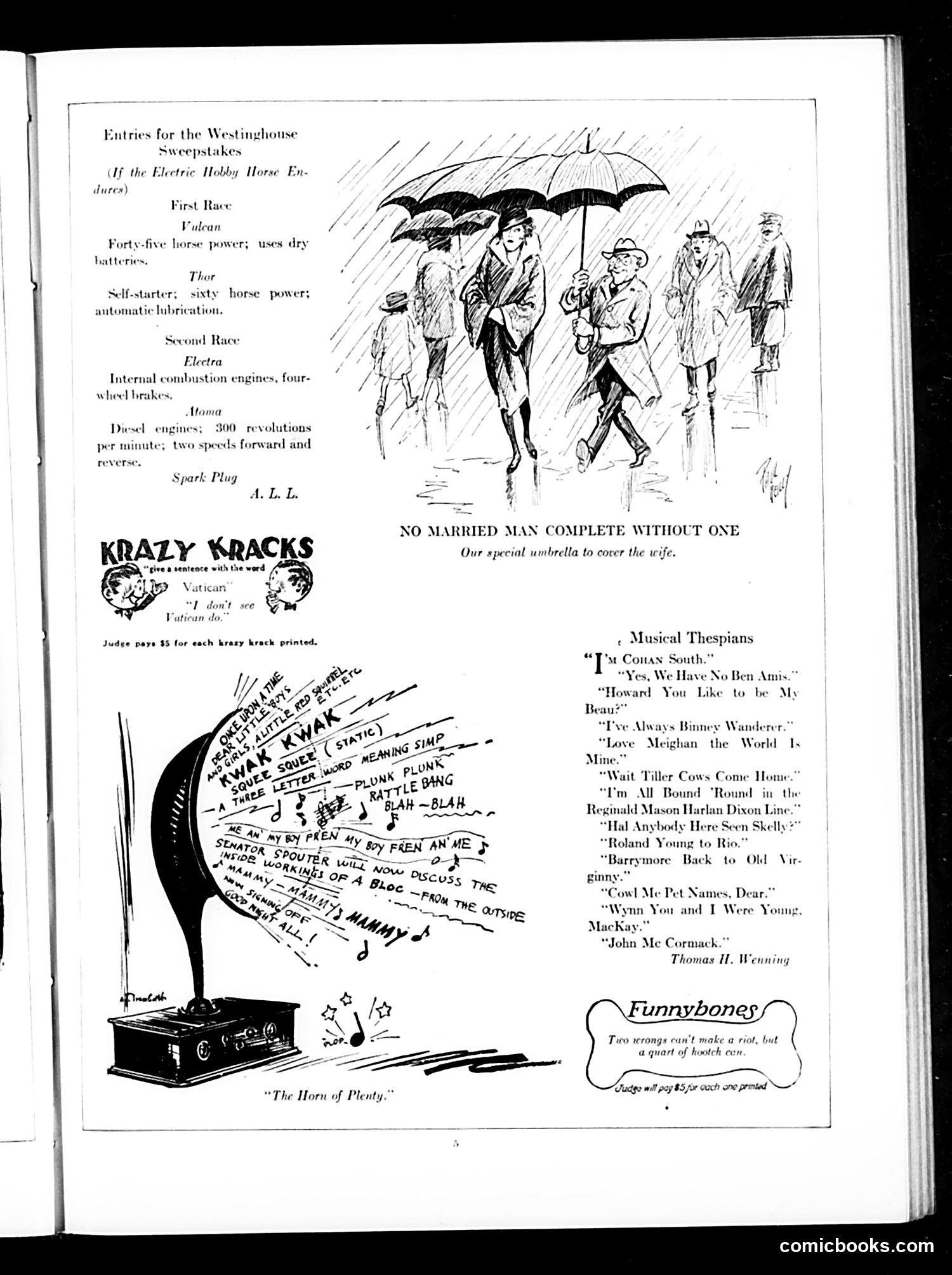
This page contains primarily **advertisements and entertainment listings** rather than political satire. The top section advertises entries for the "Westinghouse Sweepstakes" featuring electric hobby horses with various engine specifications—a humorous commercial pitch. "Krazy Kracks" is a **joke feature** where readers submit puns; the example shown is a play on "Vatican" ("I don't see Vatican do"). The center illustration titled "The Horn of Plenty" appears to be a **humorous drawing of a gramophone** with musical notes and nonsensical text emanating from it—likely satirizing the absurdity or noise of early recorded music. The bottom section lists "Musical Thespians" performing popular songs of the era. "Funnybones" is a **joke feature** with the punchline: "Two wrongs can't make a riot, but a quart of hooch can." The page is essentially **entertainment content with mild social humor** rather than political commentary.
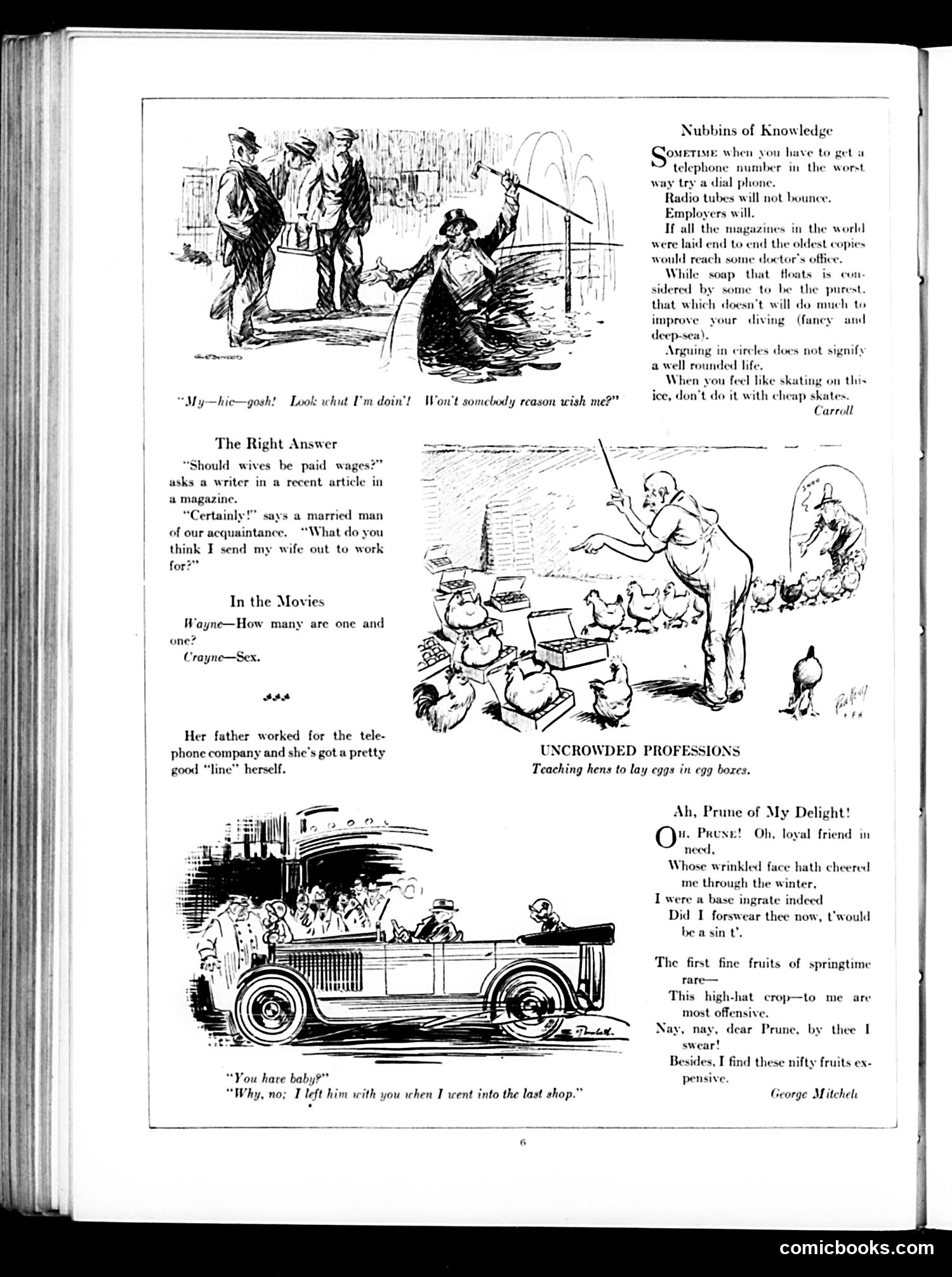
This page contains multiple humorous vignettes typical of Judge magazine's satirical style: **"Nubbins of Knowledge"** presents brief, cynical observations about modern life—dial phones being frustrating, radio tubes fragility, and doctors' offices filled with old magazines. The final quip about cheap skates warns against shortcuts. **"The Right Answer"** satirizes marital dynamics and gender roles, with a husband claiming he sends his wife to work for financial gain—mocking both wives' economic dependence and male attitudes toward women's labor. **"In the Movies"** is a quick joke playing on "Wayne" and "Crayne" (unclear if these reference specific silent-film personalities), with the punchline that "one and one" equals "sex." **"Uncrowded Professions"** cartoon mocks an absurd job: teaching hens to lay eggs in boxes—suggesting some occupations are so ridiculous they remain unpopulated. **"Ah, Prune of My Delight!"** is a mock-romantic poem addressing a prune, humorously lamenting that spring's new fruits seem pretentious compared to the humble prune. The page reflects 1920s-era concerns: telephone technology, women's work, silent cinema, and consumer goods.
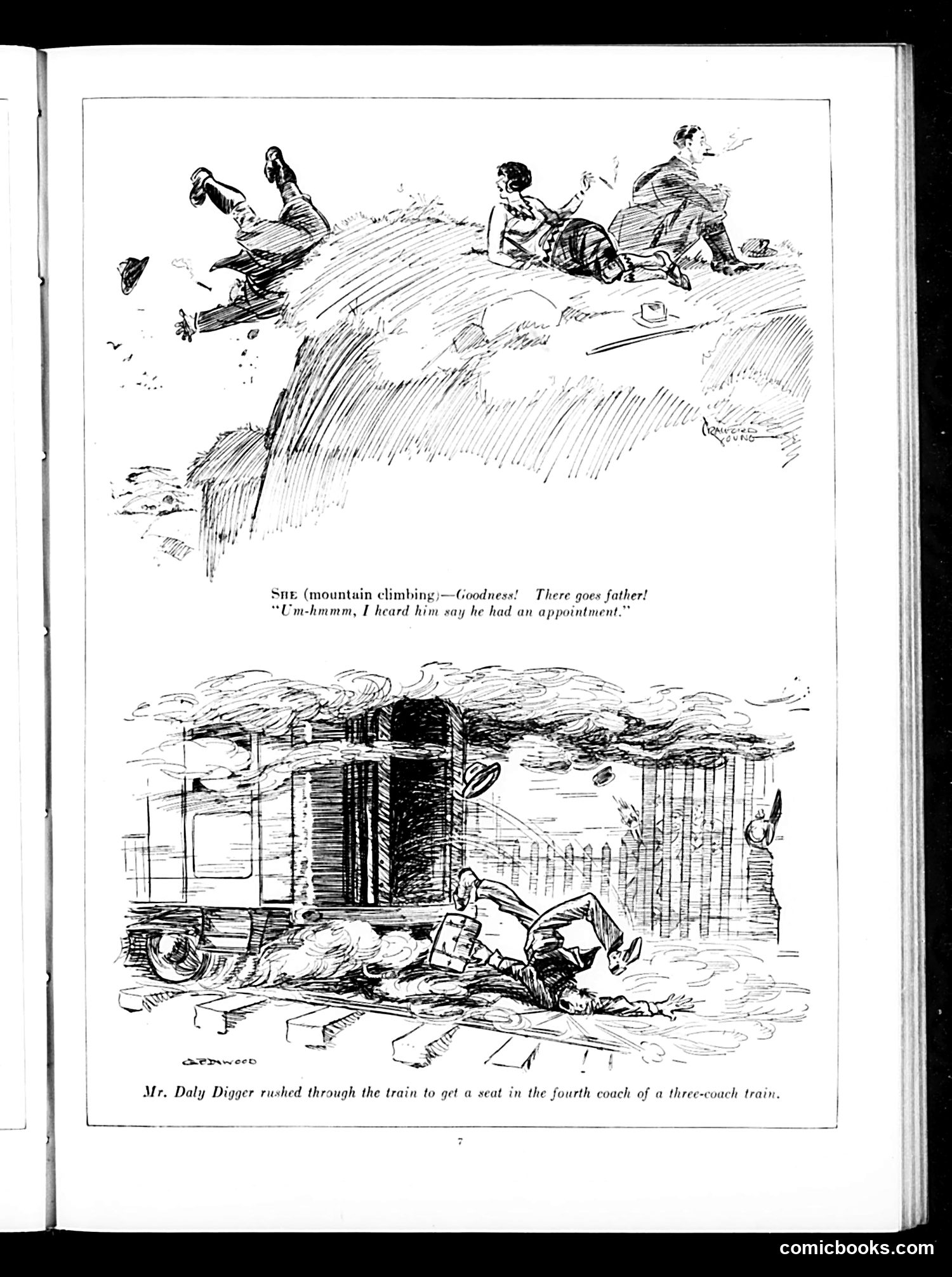
This page contains two unrelated satirical cartoons: **Top cartoon**: Shows a woman and child on a mountain slope watching a man tumble down. The joke plays on the woman's casual response to her husband's fall—she mentions he had an "appointment," suggesting his accident is predictable or unsurprising, perhaps implying he's accident-prone or the marriage is strained enough that she's indifferent to his misfortune. **Bottom cartoon**: Depicts Mr. Daly Digger rushing frantically through a train, apparently trying to reach a fourth coach of a three-coach train—an impossible task. The satire mocks either excessive eagerness, poor spatial reasoning, or the absurdity of rushing for something that doesn't exist, likely commentary on foolish human behavior or desperation. Both cartoons use exaggerated situations for comedic effect typical of early 20th-century humor magazines.
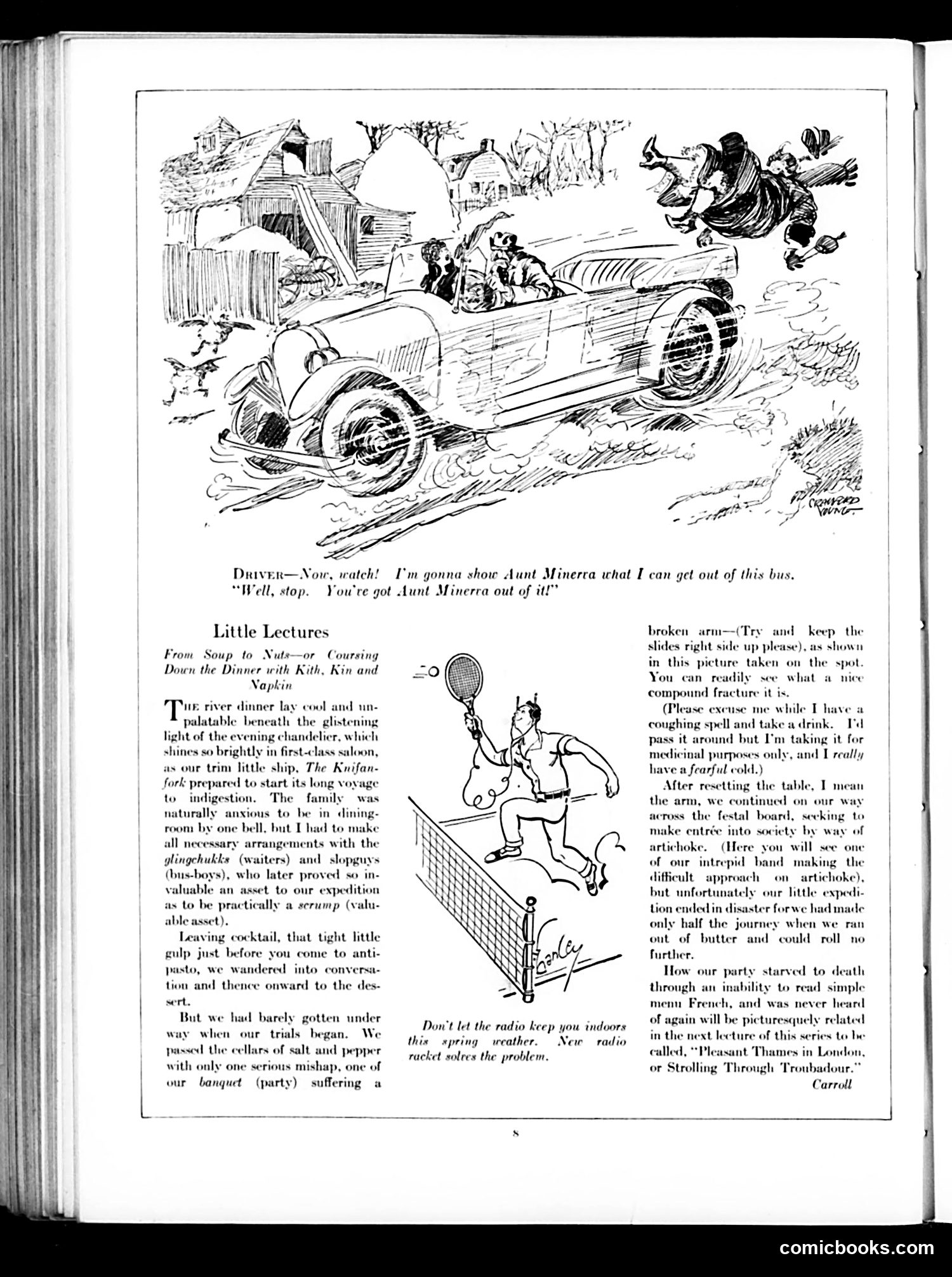
This page contains two separate humorous pieces from *Judge* magazine: **Top cartoon**: A comedic driving scene where a driver brags to Aunt Minerva about the bus's capabilities, then immediately loses control, ejecting her from the vehicle. The joke is simple physical comedy—the driver's boast is immediately undercut by disaster. **"Little Lectures" essay**: A mock-serious narrative about a formal dinner aboard a ship, written in deliberately overwrought, pretentious language. The humor derives from: - **Absurd vocabulary**: Made-up words like "glingchukks" (waiters) and "serump" (valuable asset) that sound pseudo-sophisticated - **Escalating disasters**: A guest breaks an arm passing the salt and pepper; the party runs out of butter mid-journey - **Social satire**: Mocking upper-class dining formality and the pretension of French cuisine ("unable to read simple menu French") The captions about radio and spring weather appear to be unrelated advertisements or filler. The overall tone satirizes both automotive enthusiasm and upper-class dinner etiquette as inherently chaotic despite their veneer of sophistication.
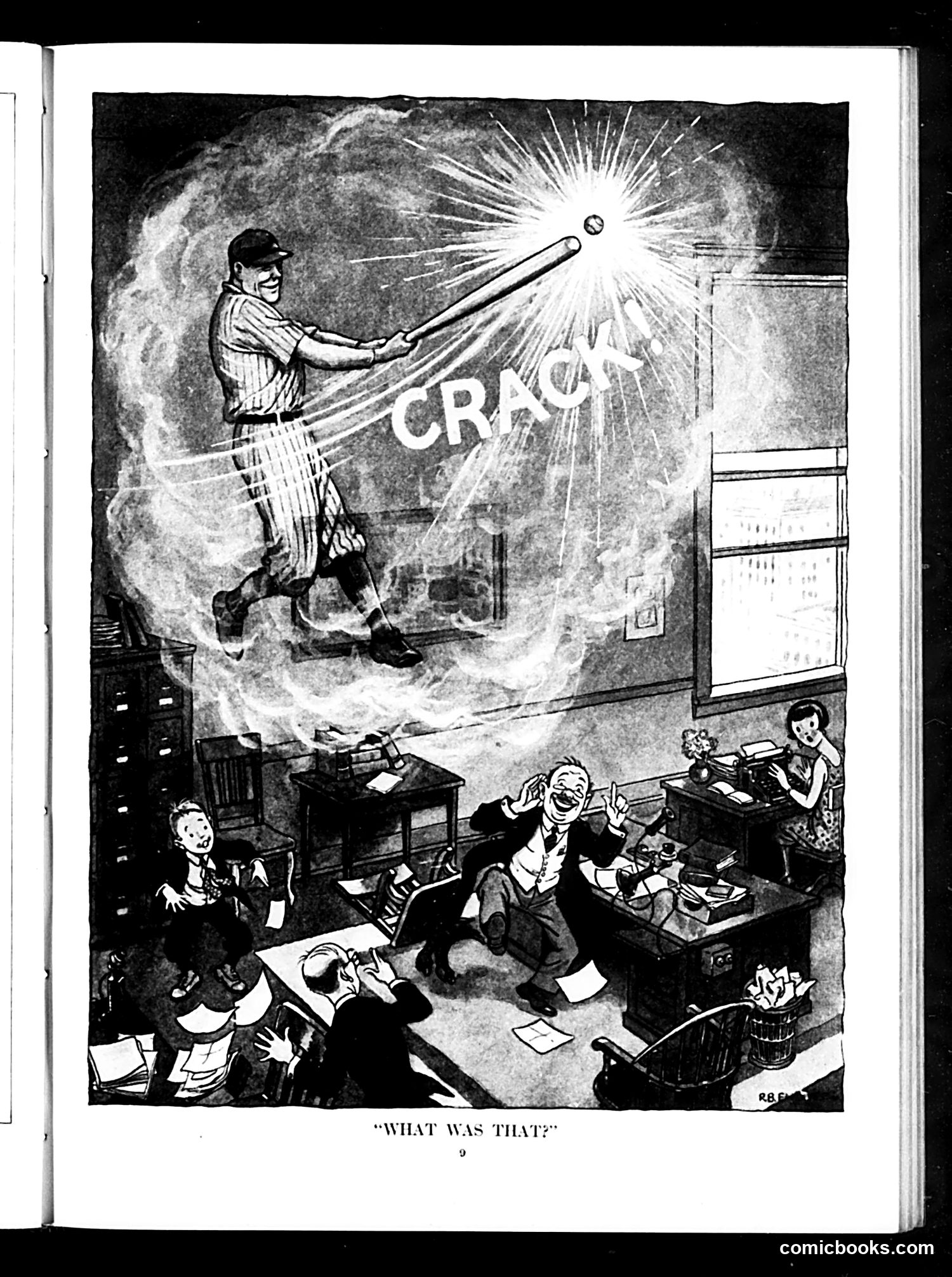
This cartoon depicts a baseball player mid-swing, hitting a ball labeled "CRASH" that bursts dramatically through an office wall. Office workers inside scatter in alarm, reacting to the impact with shock and confusion—hence the caption "What Was That?" The satire likely plays on the intersection of baseball culture and workplace disruption. The baseball player appears to represent either an overzealous athlete or perhaps American sporting excess intruding violently into corporate/bureaucratic space. The dramatic lighting and explosive visual effect emphasize the chaotic collision between these two worlds. Without clearer context or visible date, the specific political or social commentary remains unclear, though it may critique either baseball's cultural dominance or workplace disruptions of the era.
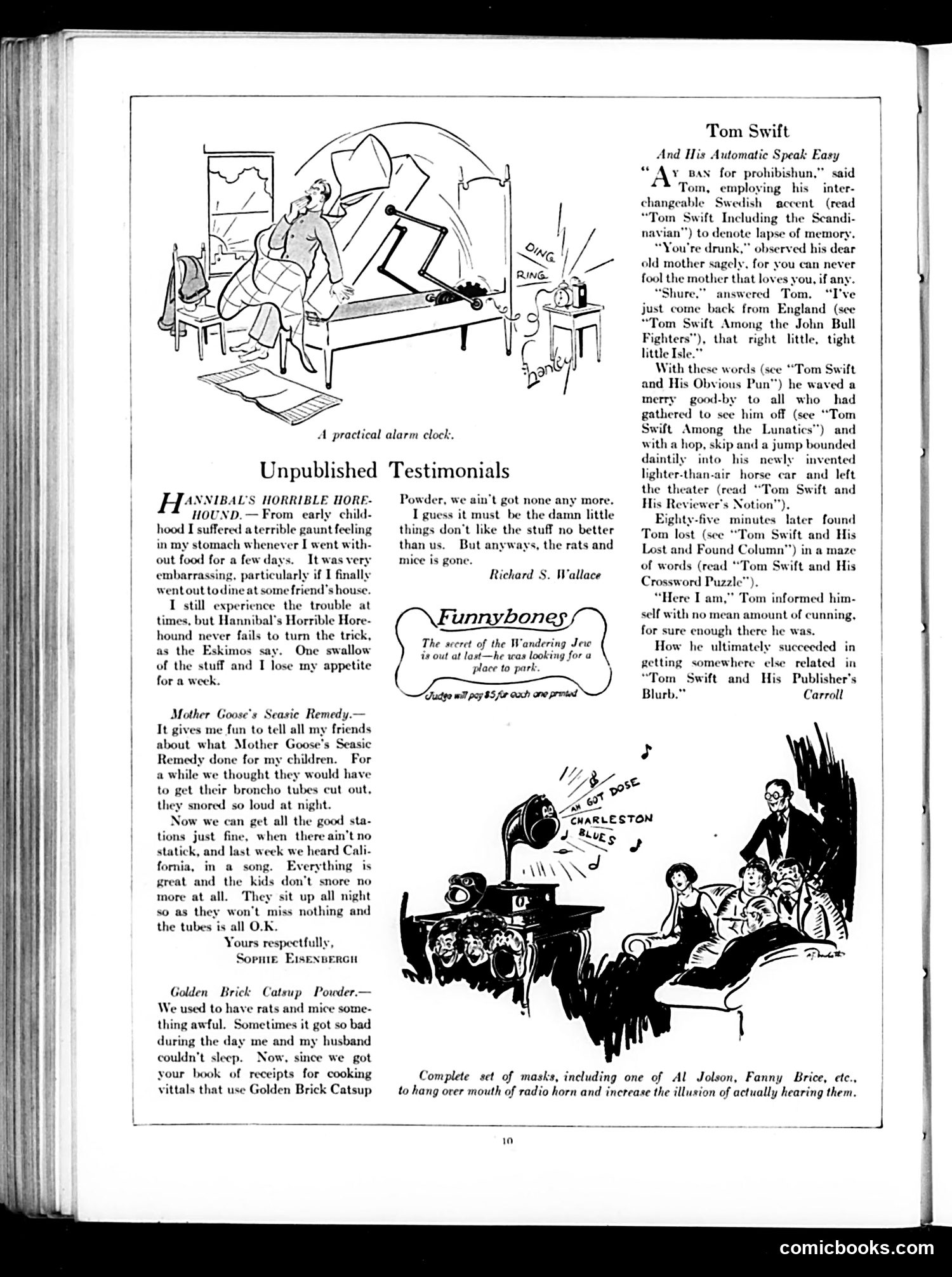
This page satirizes popular culture and advertising through mock testimonials and parodies. The **"Unpublished Testimonials"** section ridicules patent medicine ads common in the era—fake endorsements for absurd products like "Hannibal's Horrible Horehound" (appetite suppressant) and "Mother Goose's Seasic Remedy" (which somehow cures snoring by improving radio reception). The crude dialect ("vittals," "ain't got none") mocks rural consumers and credulous testimonial-givers. The **Tom Swift parody** lampoons the popular adventure book series by exaggerating its relentless sequel titling and pun-heavy wordplay ("His Obvious Pun," "Crossword Puzzle"). The **"Funnybones" box** contains an obscure joke about the Wandering Jew legend. The **bottom cartoon** mocks 1920s radio entertainment by suggesting masks of popular performers (Al Jolson, Fanny Brice) hung over radio horns would create "the illusion of actually hearing them"—satirizing radio's then-novel, disembodied entertainment and perhaps the phoniness of celebrity voices. Overall: satire of advertising hucksterism, literary formula, and new media entertainment.
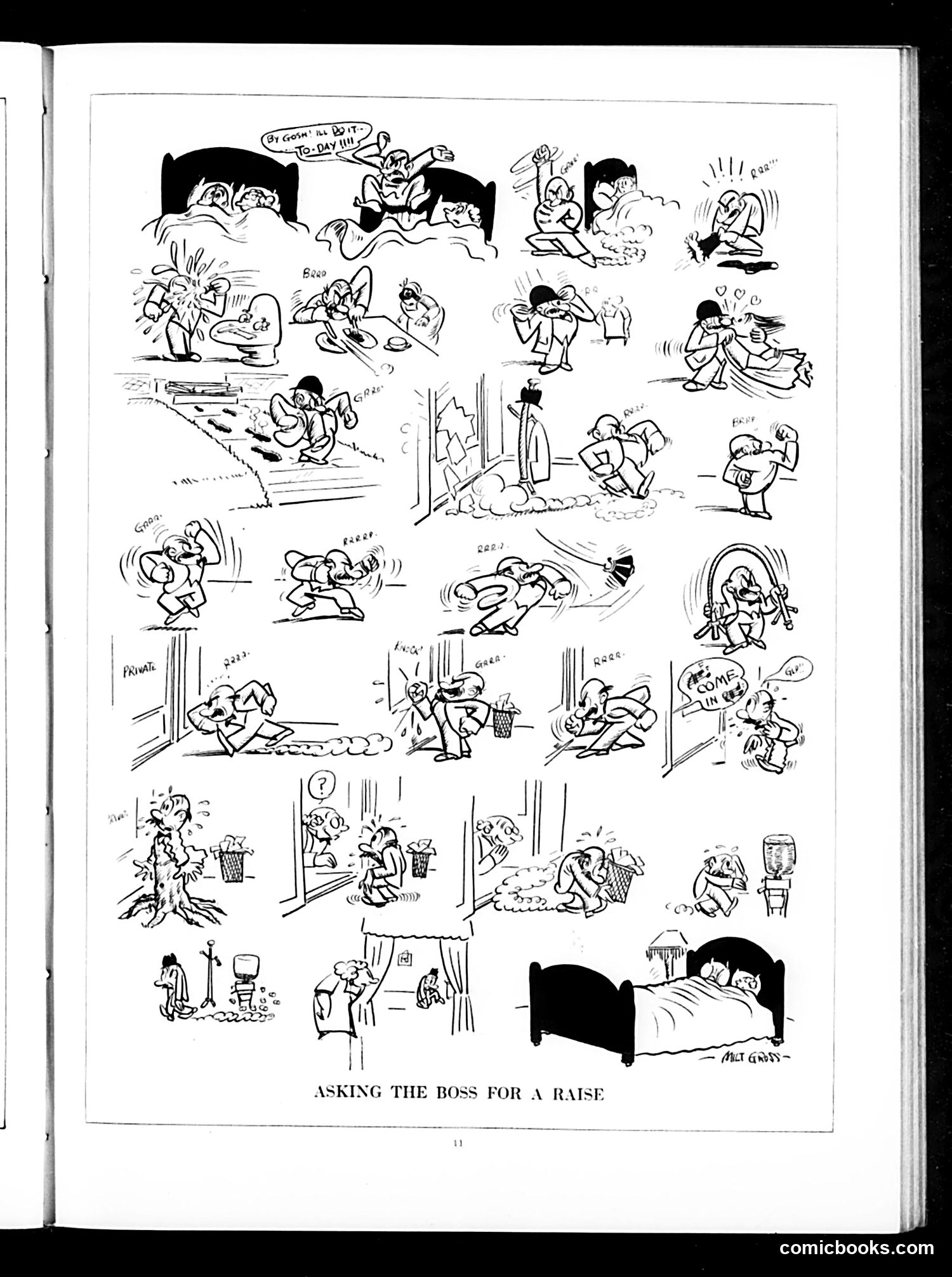
This is a humorous comic strip sequence depicting the internal and external struggle of an employee attempting to request a salary increase from their boss. The narrative unfolds through multiple panels showing: **The employee's mental preparation**: Early panels show him psyching himself up, rehearsing arguments, and building courage while experiencing anxiety and self-doubt. **The confrontation**: Middle sections depict the actual encounter—the nervous employee approaching the boss's office, stammering through his request, and the boss's dismissive responses. **The aftermath**: Later panels show the employee's deflation after rejection or minimal success, culminating in him returning home to bed, presumably defeated. The satire mocks the workplace power dynamic and the common anxiety workers face when negotiating wages. The exaggerated physical comedy—trembling, sweating, pratfalls—emphasizes how psychologically difficult this ordinary workplace interaction feels to employees.
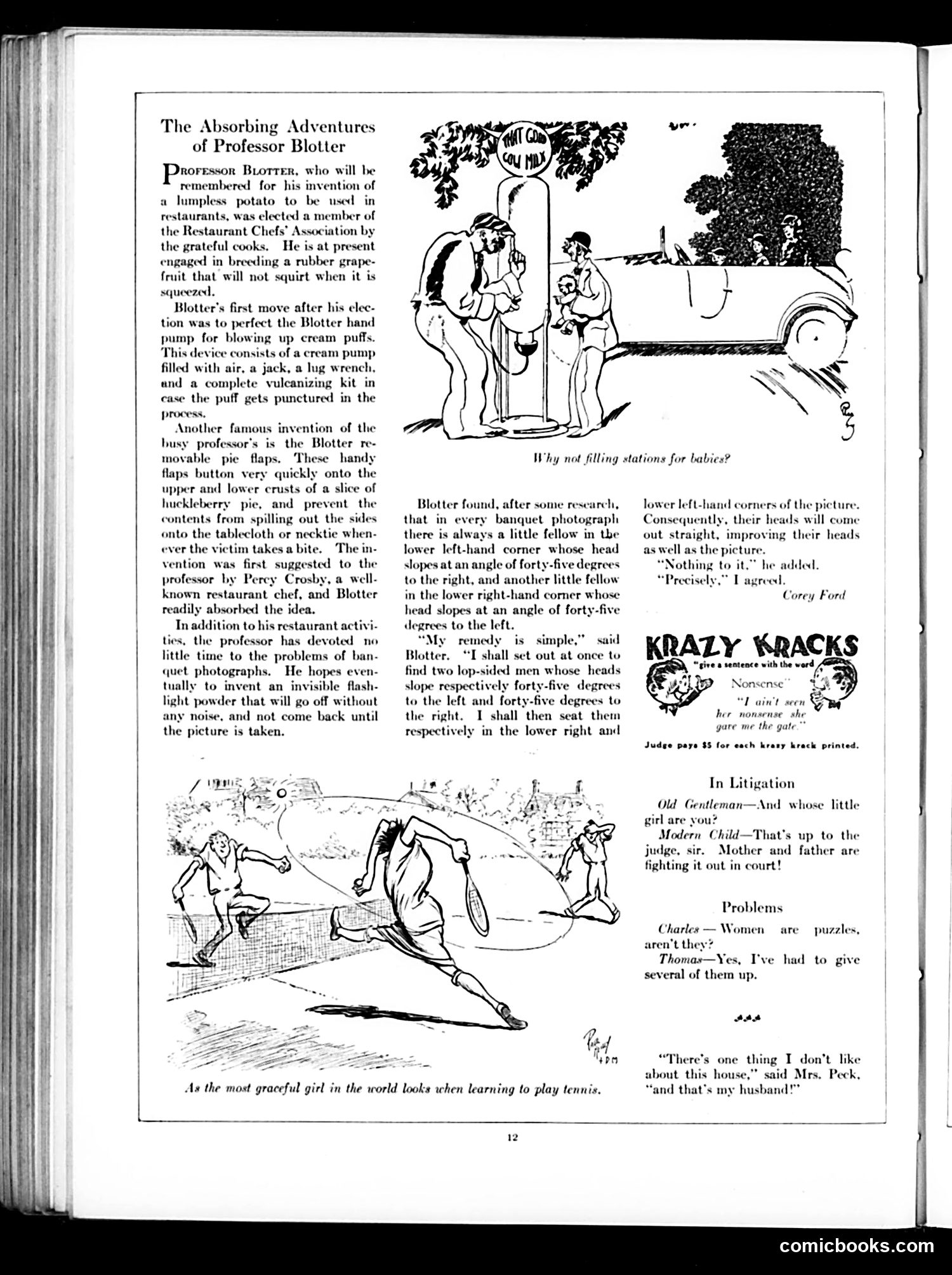
This humorous feature satirizes both the obsessive inventor-type and restaurant industry pretensions of the era. Professor Blotter represents the well-meaning but absurdly overcomplicated innovator, creating elaborate "solutions" to trivial dining problems: a vulcanizing kit to fix squeezed cream puffs, removable pie flaps to prevent spillage, and invisible flashlight powder for banquet photography. The satire peaks in Blotter's scheme to "correct" banquet photos by positioning men with sloped heads to counterbalance naturally tilted heads of children—treating human beings as mere compositional elements. The cartoonist (Corey Ford) mocks both mechanical thinking applied to human problems and the obsession with technological "progress" for its own sake, suggesting that some problems are unsolvable or inherently ridiculous. The page also includes unrelated jokes about litigation and marriage, typical of Judge magazine's miscellaneous humor format.
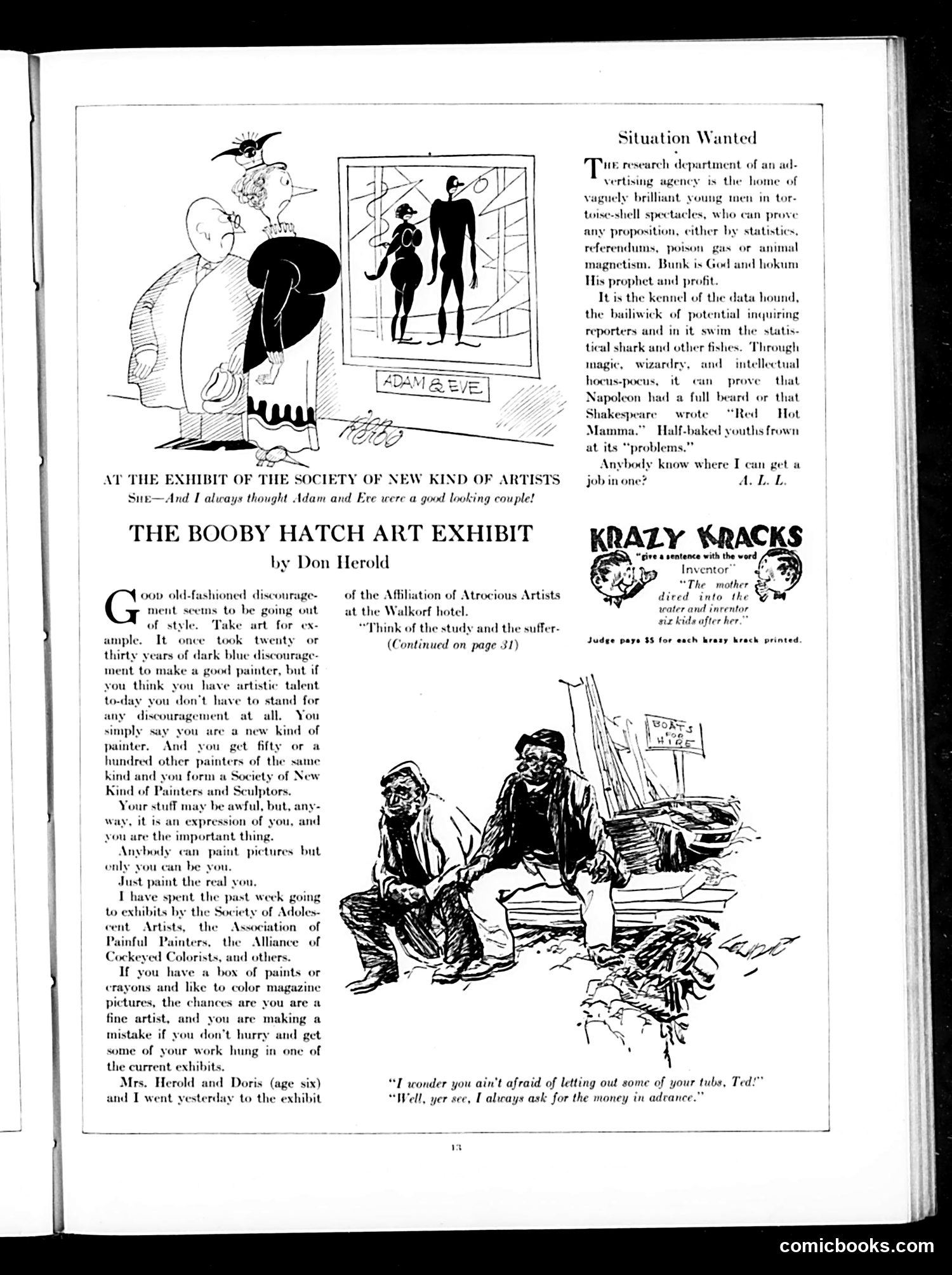
This page contains two satirical pieces about modern art movements and artistic pretension in the 1920s era. **"The Booby Hatch Art Exhibit"** by Don Herold mocks the proliferation of avant-garde art movements. The satire suggests that aspiring artists who lack talent can now simply declare themselves a "new kind of painter," form a society with other mediocre artists, and gain exhibition opportunities. The piece ridicules how artistic "expression" shields bad work from legitimate criticism—artists claim their flawed pieces represent their authentic selves rather than lack of skill. **"Situation Wanted"** (top right) humorously critiques advertising research departments as places where statistics, "magic," and "hocus-pocus" disguise manipulation—claims can "prove" anything (even that Shakespeare wrote "Red Hot Mamma"). It's seeking someone to work in this morally dubious field. The accompanying **cartoons** illustrate these themes through exaggerated figures, showing both the pretentious art world and questionable business practices. The overall message: modern society rewards mediocrity dressed in artistic or intellectual language over genuine talent.
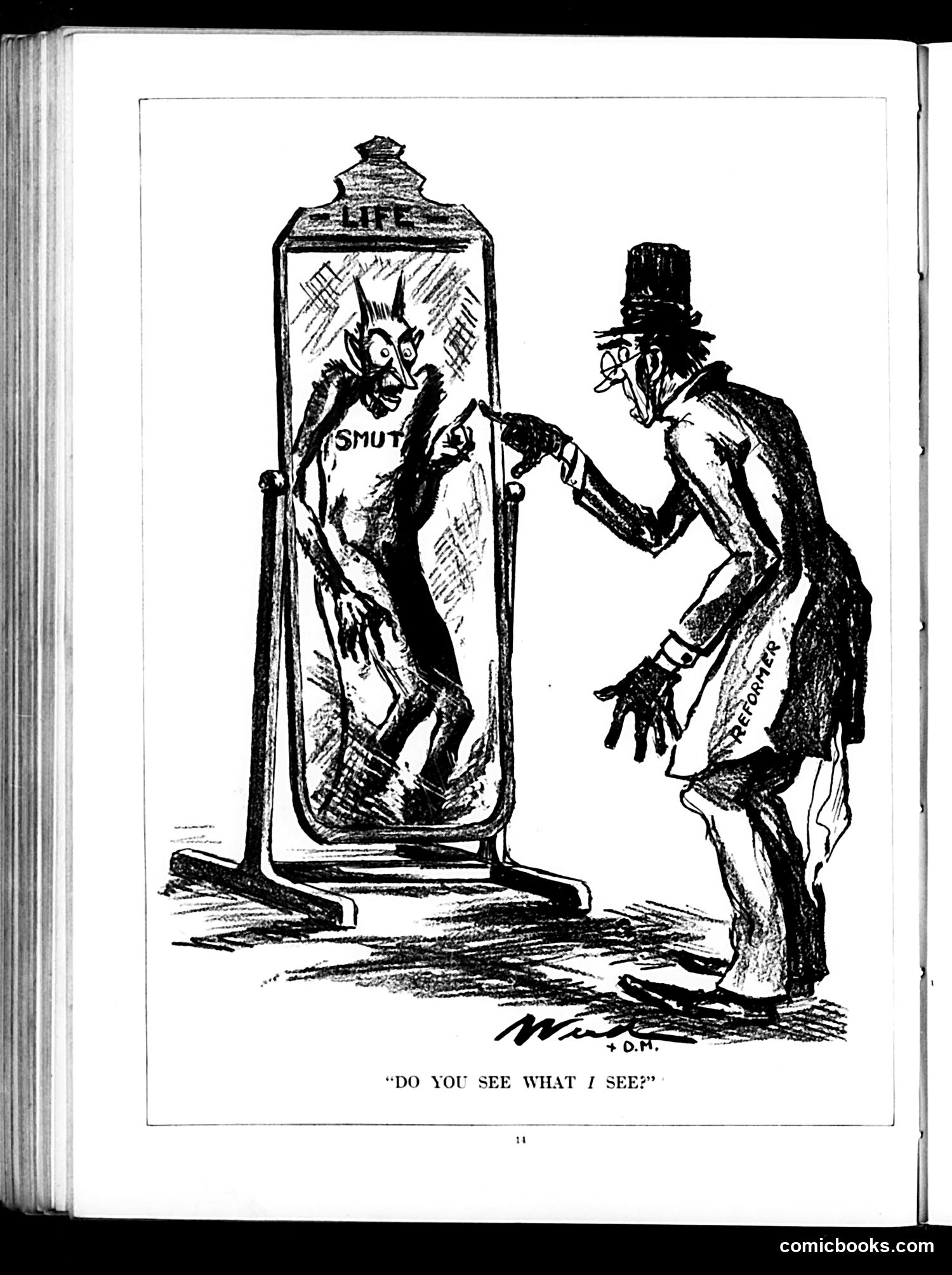
This cartoon depicts a well-dressed gentleman with a top hat looking into a large jar or container labeled "SMUT." Inside the jar appears to be a demonic or grotesque figure. The caption reads "DO YOU SEE WHAT I SEE?" The cartoon satirizes moral panic about obscenity and vice. The gentleman represents someone—likely a reformer, censor, or moral crusader—pointing out alleged "smut" to the viewer, essentially asking if we share his concerns about indecency in society. The jar functions as a magnifying device, suggesting the figure obsessively focuses on and amplifies perceived moral corruption. This reflects late 19th or early 20th-century debates about censorship, obscenity laws, and moral reform movements that sought to regulate publications and entertainment. The satire appears to mock such crusaders' exaggerated concern with depravity.
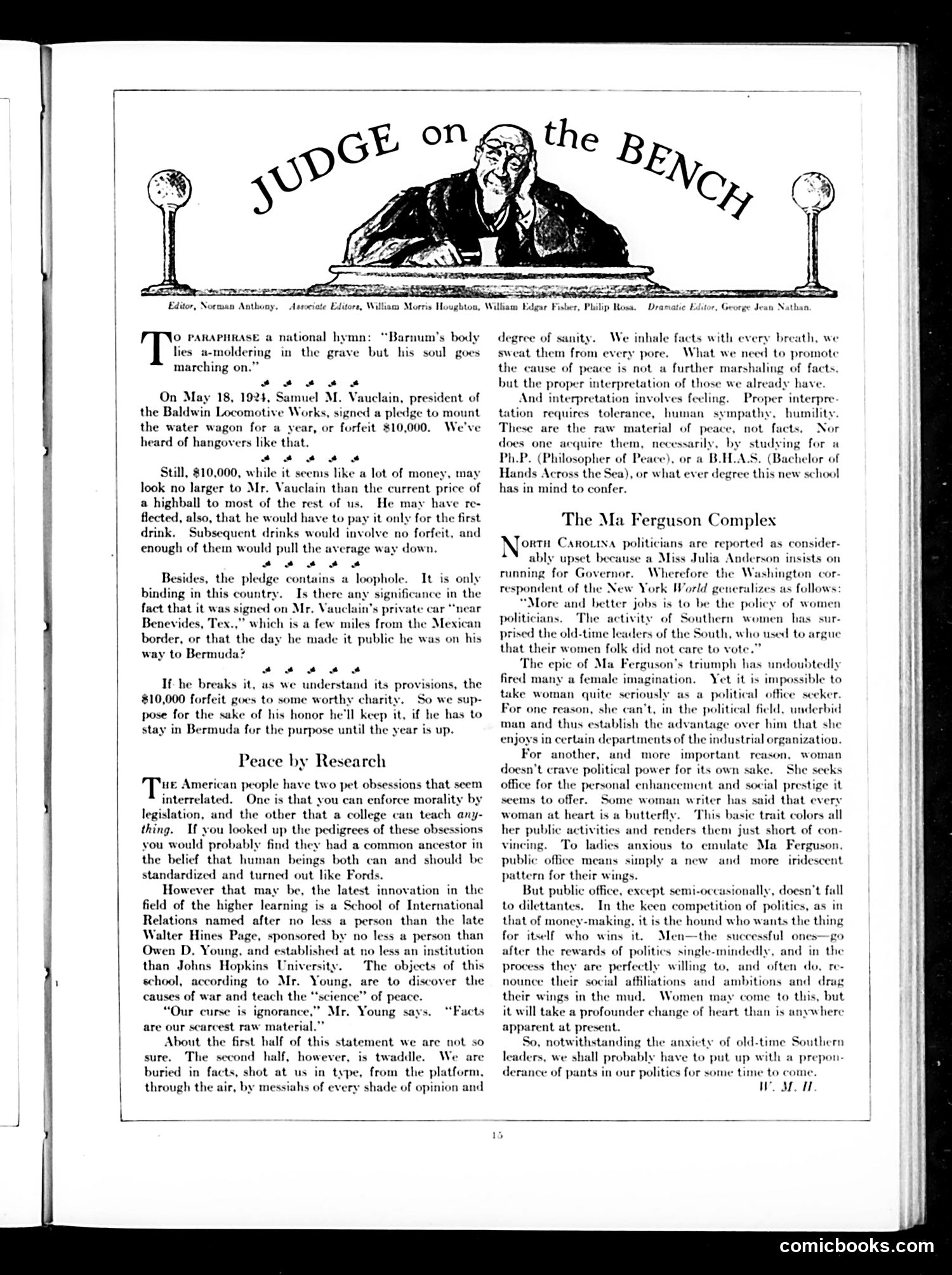
This page contains three satirical pieces from Judge magazine (dated May 18, 1924): **"Barnum's Body"**: Mocks Samuel M. Vauclain, president of Baldwin Locomotive Works, who pledged $10,000 to abstain from alcohol for a year. The satire highlights the hypocrisy: he signed near the Mexican border and immediately traveled to Bermuda—locations where the pledge wouldn't bind him—suggesting he never intended serious compliance. **"Peace by Research"**: Criticizes Johns Hopkins University's new School of International Relations (funded by Owen D. Young, named after Walter Hines Page) as naive. The author argues that facts alone cannot produce peace; rather, tolerance, sympathy, and humility matter more. It mocks the notion that institutional education can solve war. **"The Ma Ferguson Complex"**: References Texas governor "Ma" Ferguson's recent political success, noting North Carolina politicians are upset about female candidate Julia Anderson running for governor. The piece sardonically suggests women cannot be taken seriously in politics despite Ferguson's triumph, reflecting 1920s gender bias.
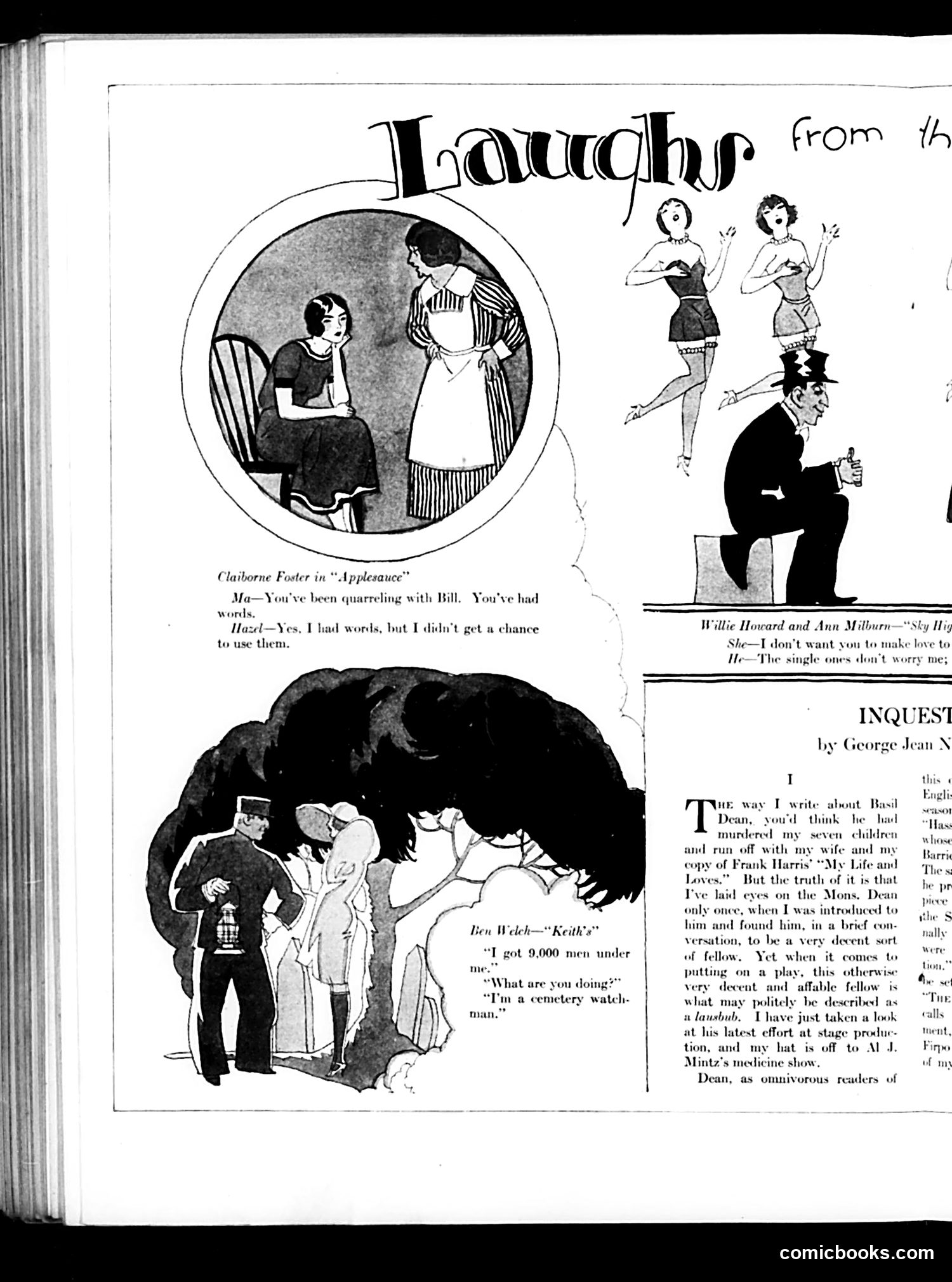
This is a page of comedic sketches and commentary from *Judge* magazine. The top cartoons are brief sight gags: a woman who wanted to argue with "Bill" but couldn't get a word in; a military officer commanding 9,000 men; and a cemetery watchman. These are simple one-liners with accompanying illustrations—typical vaudeville-style humor. The main content is "Inquest" by George Jean Nathan, a theater critic. Nathan discusses actor Basil Dean, claiming that while Dean seems like "a very decent sort of fellow" in person, his stage work is terrible ("a lausbub"—likely a misspelling). This is theatrical gossip and professional criticism—Nathan is mocking Dean's acting or productions while grudgingly respecting him personally. The humor relies on inside knowledge of Broadway performers and recent plays referenced but not explained here.
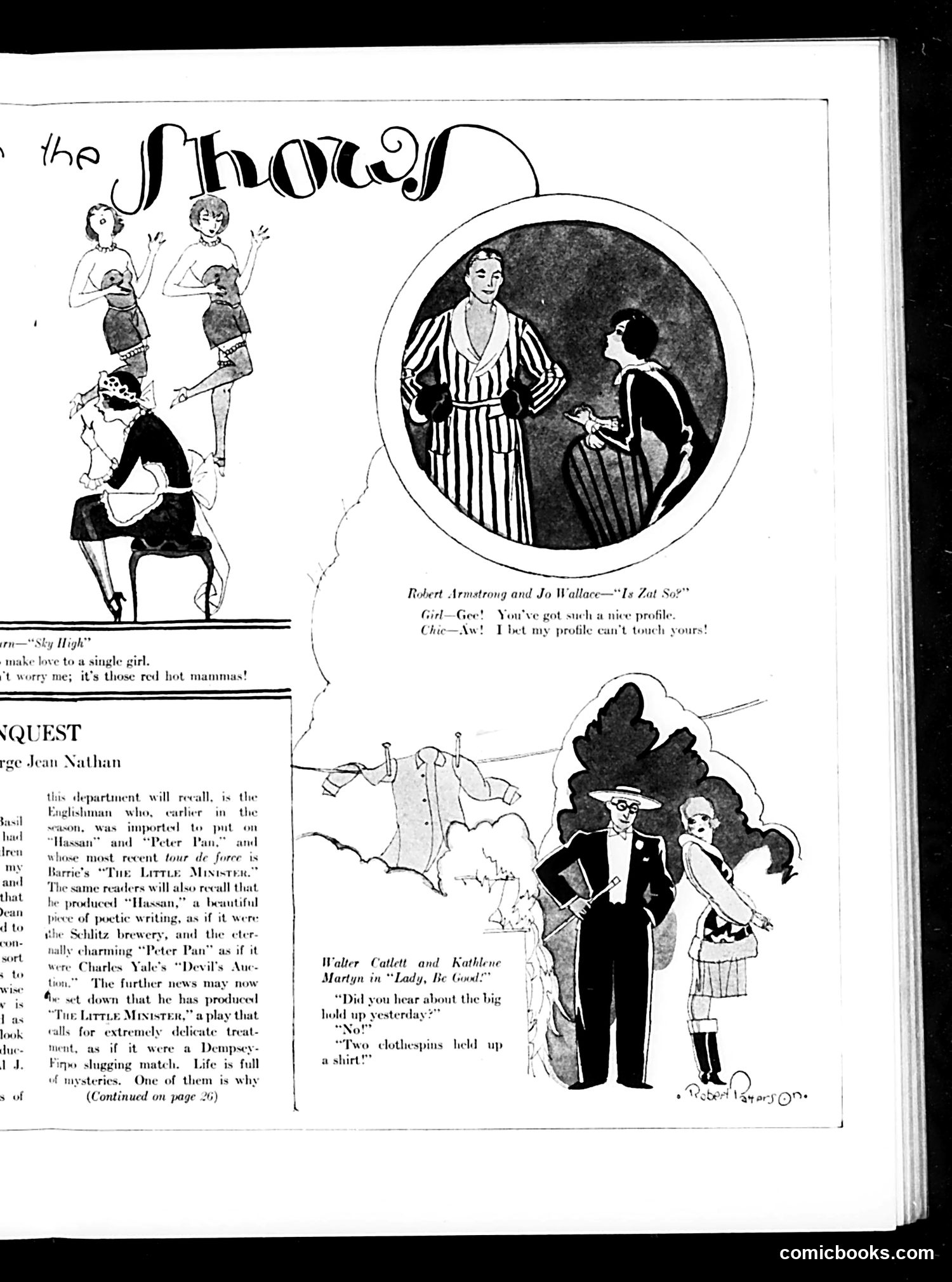
This page from *Judge* magazine features theatrical reviews and entertainment humor typical of the 1920s era. The main cartoons are joke illustrations accompanying reviews of Broadway productions: "Is Zat So?" (starring Robert Armstrong and Jo Wallace) and "Lady, Be Good!" (with Walter Catlett and Kathlene Martyn). The "Is Zat So?" cartoon depicts a flirtatious exchange between a man and woman about their profiles—a mild romantic jest. The "Lady, Be Good!" cartoon presents a vaudeville-style joke: a setup-and-punchline about a "big hold up" (robbery) that's revealed to be a clothesline mishap rather than a crime—typical slapstick humor. The left column discusses George Jean Nathan's theatrical work, referencing his adaptations of Barrie plays and other productions. The satire is gentle—poking fun at contemporary theater, romance tropes, and wordplay rather than targeting specific political figures or social movements.
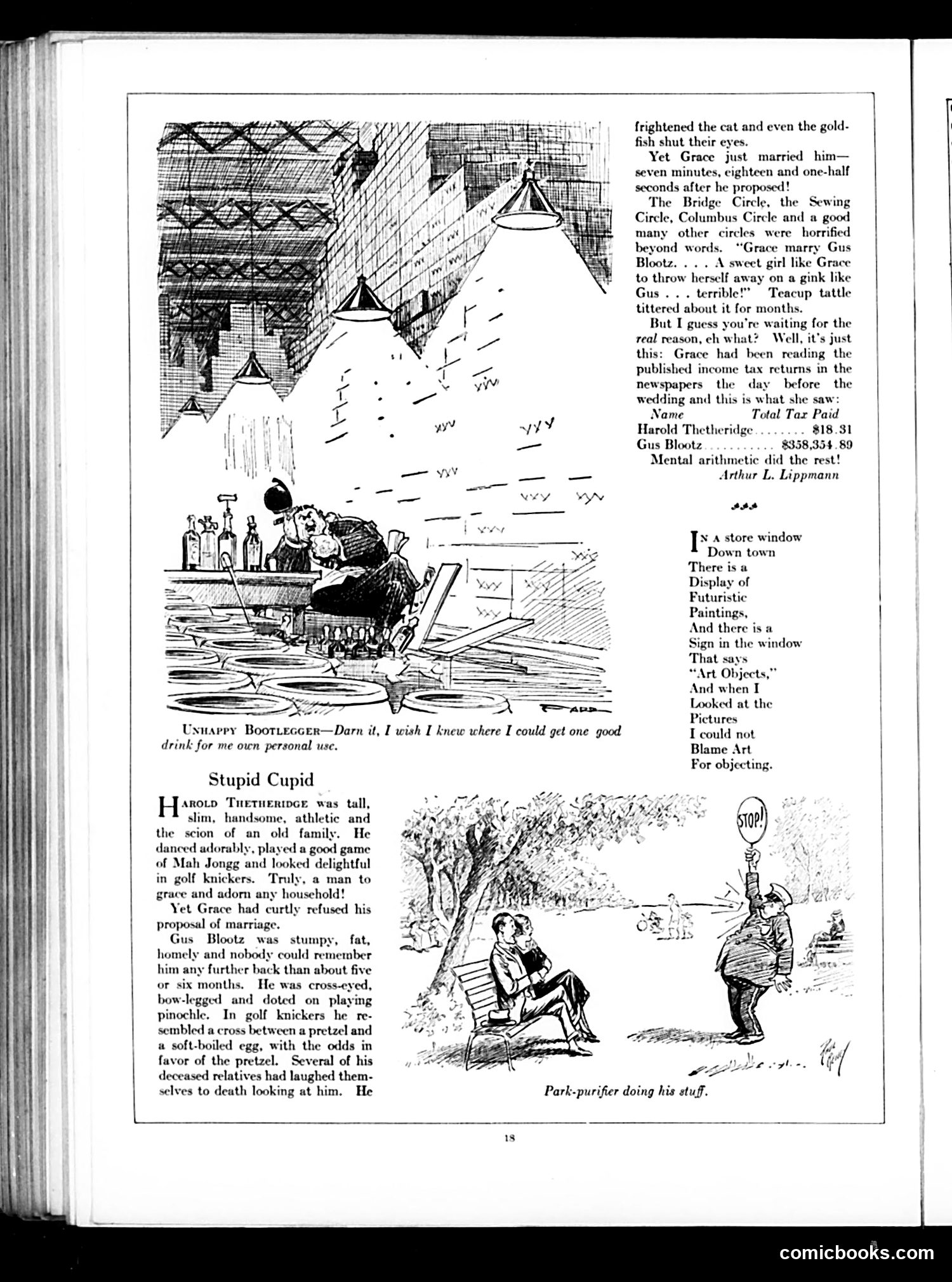
This page contains two satirical pieces about marriage and social values. **"Stupid Cupid"** mocks romantic idealism by contrasting two suitors: Harold Thetheridge, an attractive, accomplished gentleman whom Grace refuses, and Gus Blootz, described as physically repulsive and unremarkable. The punchline reveals Grace's "real reason" for marrying Blootz: she read published income tax returns showing Blootz paid $358,354.89 in taxes versus Thetheridge's $318.31—making Blootz vastly wealthier. The satire critiques materialism and the superficiality of women (a common period stereotype), suggesting Grace calculated marriage based purely on wealth rather than character or affection. The accompanying cartoon about Prohibition depicts an "unhappy bootlegger" lamenting the difficulty of obtaining alcohol, satirizing the era's illegal liquor trade during Prohibition enforcement. A brief poem criticizes modern "futuristic" art as pretentious nonsense unworthy of serious consideration.
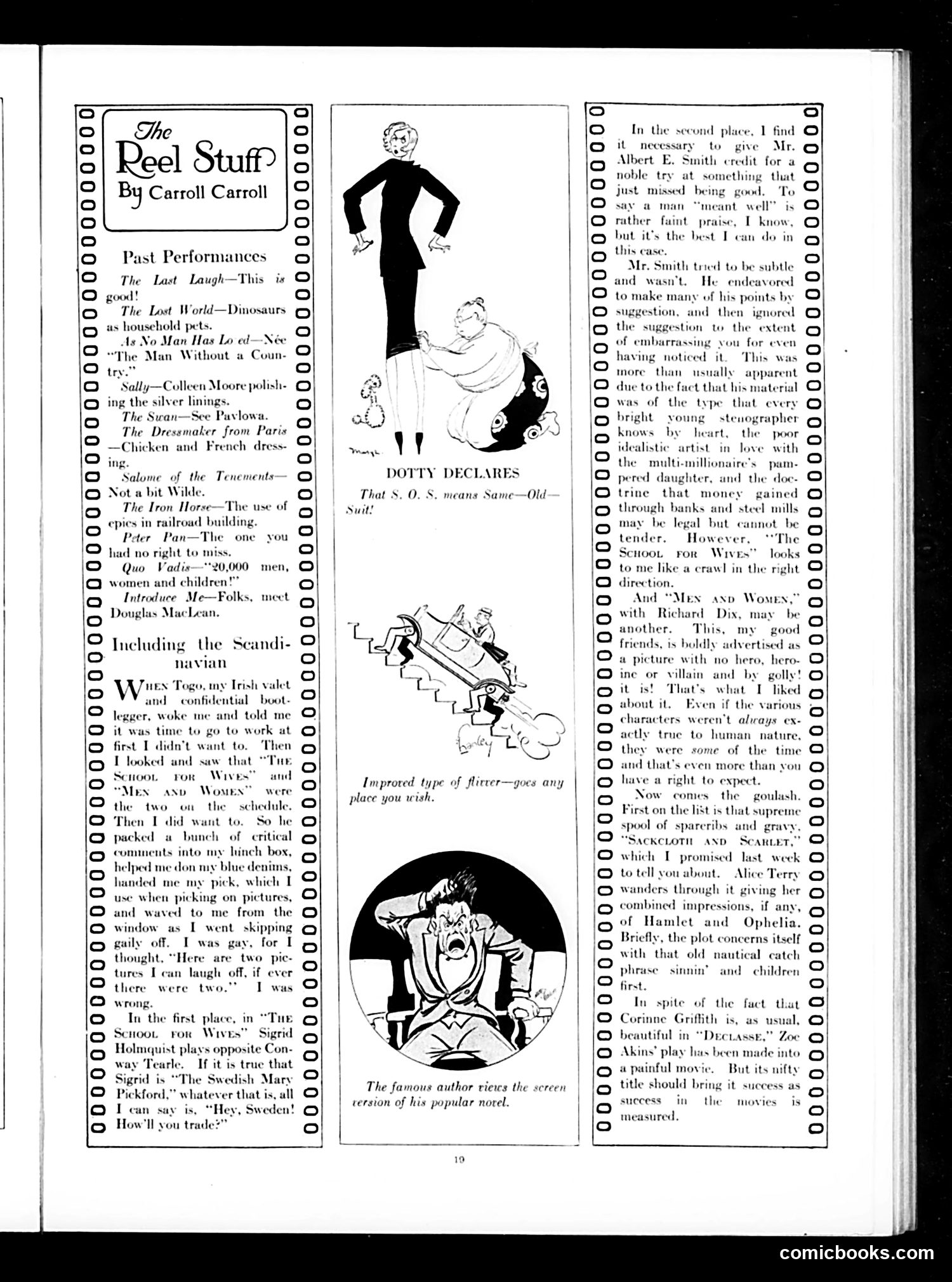
This is a film criticism column by Carroll Carroll reviewing contemporary movies. The page contains no political satire but rather entertainment criticism with illustrations. **Content:** Carroll reviews recent films including "The School for Wives," "Men and Women," and others, offering opinions on their quality and stars (Sigrid Holmquist, Conway Tearle, Richard Dix, Corinne Griffith, Alice Terry). **Key point:** Carroll praises Albert E. Smith's effort in one film while noting it "just missed being good"—the material relies on clichés (stenographers, millionaires' pampered daughters) familiar to every viewer. He's more favorable toward "Men and Women," calling it bold for having no traditional hero, heroine, or villain. **The illustrations** show exaggerated character poses typical of 1920s theatrical silhouette style, depicting scenes from the reviewed films. This is straightforward entertainment journalism aimed at Judge's readers interested in cinema, not political commentary.
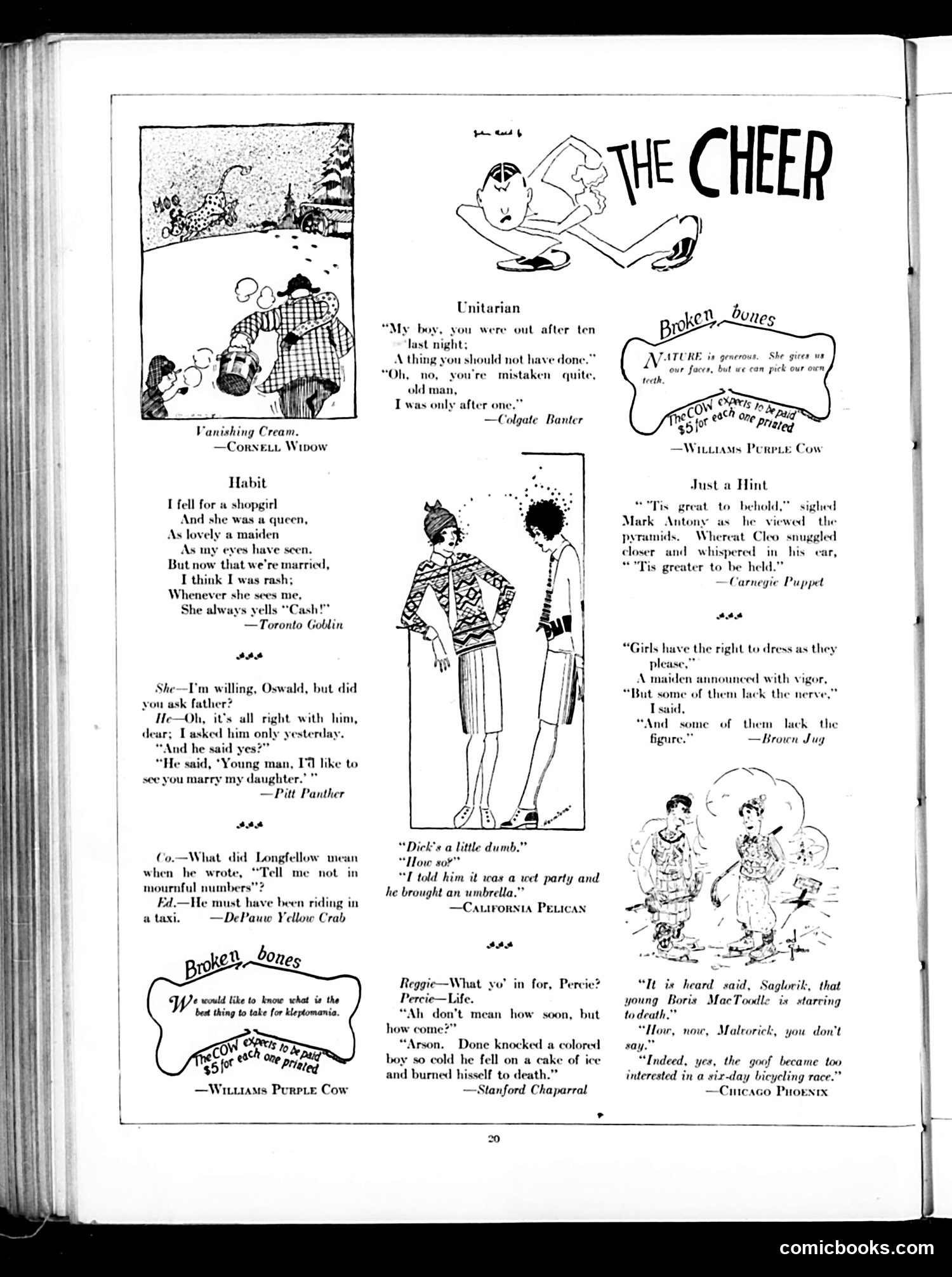
This page from *Judge* magazine collects brief humorous quips and jokes from various college publications (Colgate Banter, Stanford Chaparral, Toronto Goblin, etc.), arranged with small illustrations. The humor relies on **wordplay and social observation**: - "Vanishing Cream" jokes about a wife demanding money - The "Unitarian" bit plays on ambiguous phrasing (being "out after ten" vs. "after one") - Several jokes target male anxiety about courtship and marriage ("did you ask father?") - The "Broken Bones" recurring ad-joke frames absurd logic as medical advice - One joke uses a racist caricature and offensive dialect to describe violence The cartoons show **1920s social anxieties**: women's changing roles (fashion, independence), generational conflicts with parents, and relationship dynamics. The college paper attributions suggest this was aspirational humor for educated, middle-class readers. By modern standards, the racial content is deeply offensive; the gender dynamics reflect outdated attitudes about courtship and control.
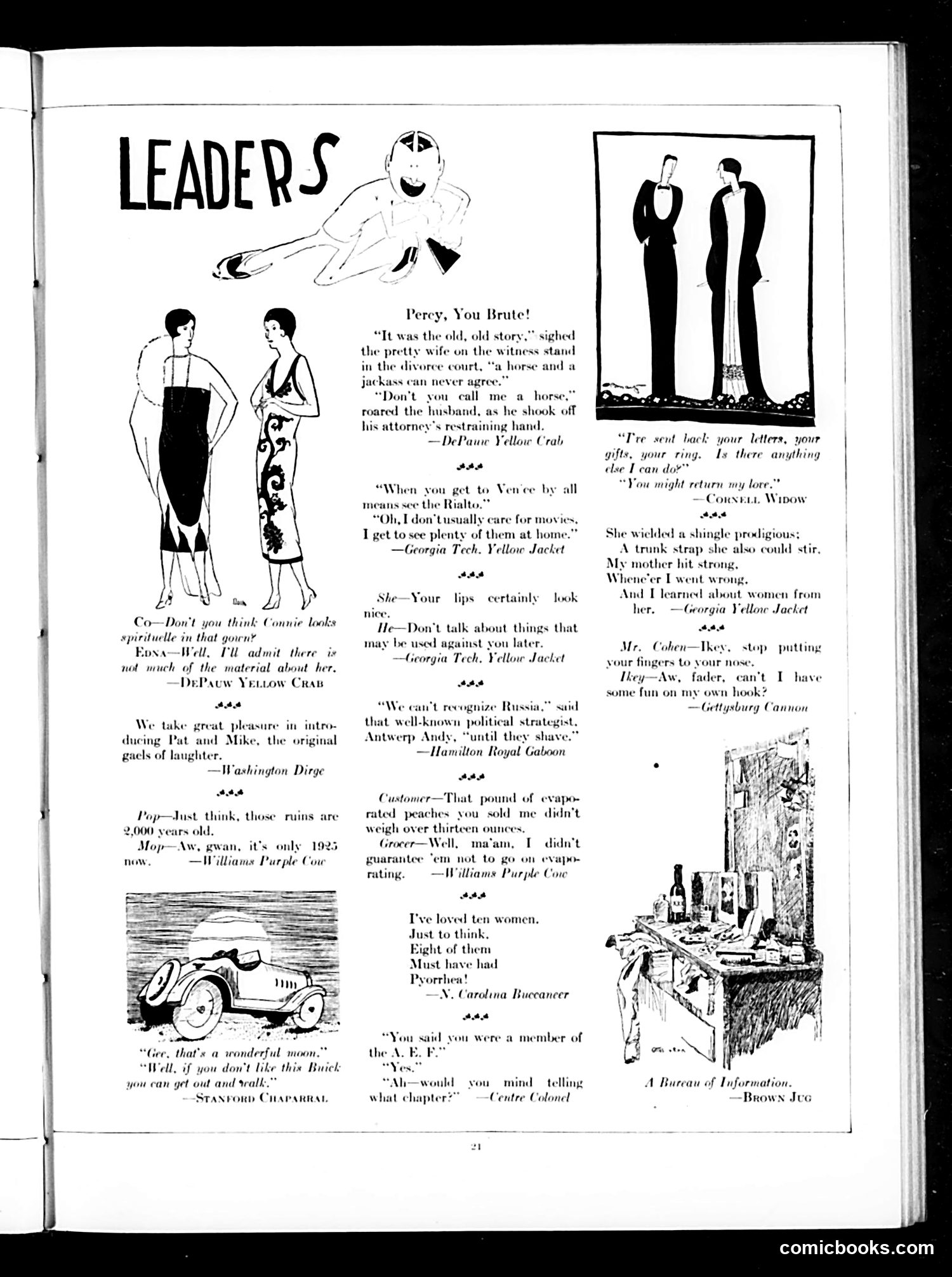
This page collects brief satirical jokes and observations organized around the theme of "Leaders"—people in positions of authority or influence. The humor targets early 1920s social conventions and human foibles rather than specific political figures. **Key satirical targets include:** - **Gender relations**: Multiple jokes mock marital discord, divorce proceedings, and romantic complications (the "Percy, You Brute!" divorce court scene) - **Consumer culture**: Grocer and customer exchanges joke about evaporating goods and poor value - **Materialism**: References to luxury items (Buick cars, jewelry) as relationship commodities - **Social pretension**: Jokes about theater-going, travel to Venice/Rialto, and club membership - **Generational conflict**: "Pop and Mop" discuss ancient ruins humorously miscalculated as 1925-era buildings - **Prohibition era**: Likely references in some dialogue, though unclear The cartoons feature flapper-era women and men in formal dress, reflecting 1920s aesthetics. This is entertainment humor from college magazines (Georgia Tech, Williams College credited), emphasizing domestic absurdities over political commentary.
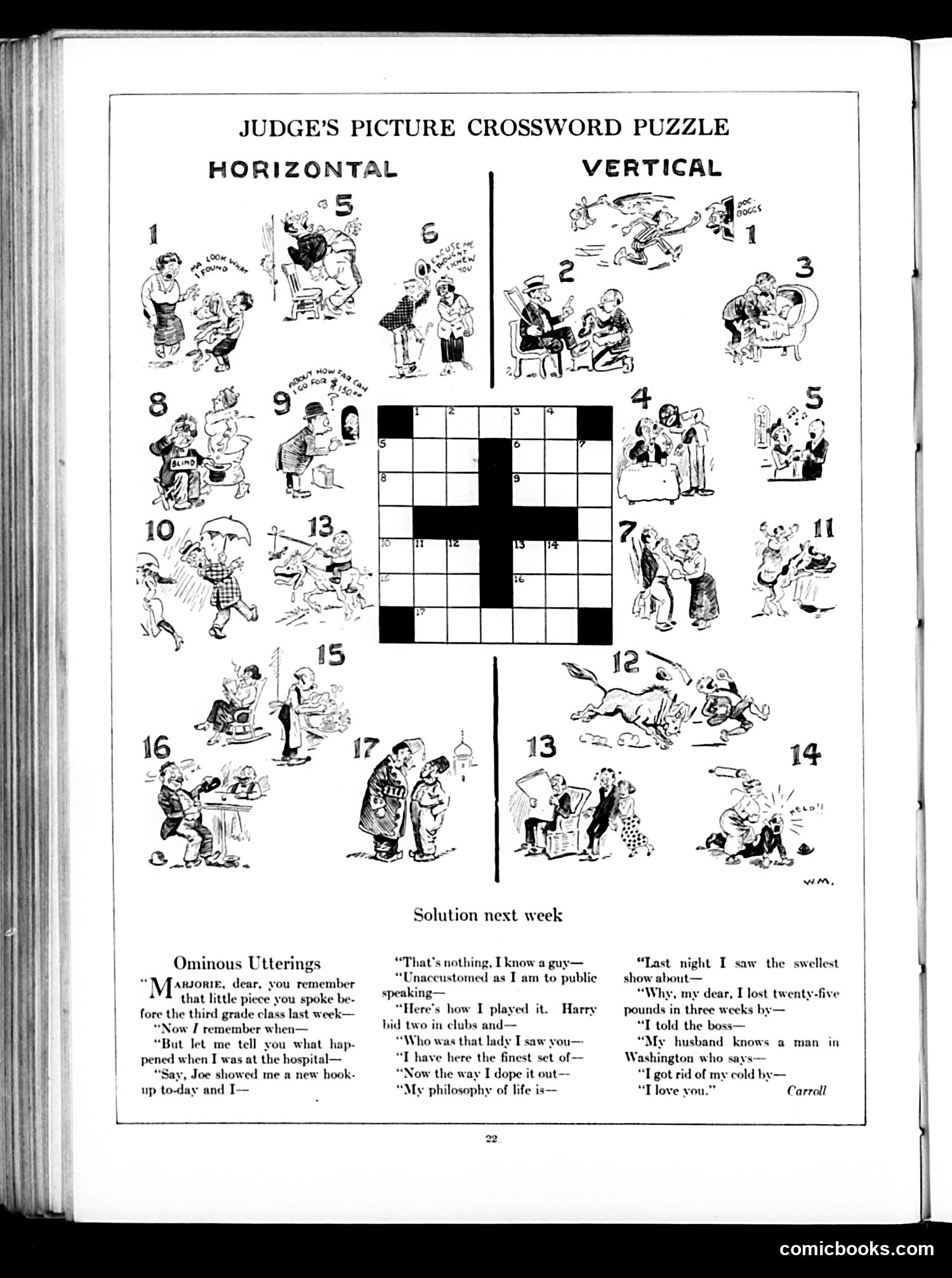
This page features a **picture crossword puzzle** where clues are illustrated cartoons rather than written descriptions. The horizontal and vertical clue images depict common social situations and conversation types. The accompanying text section, "Ominous Utterings," satirizes **tedious conversational habits**—specifically people who monopolize conversations with banal openings like "That's nothing, I know a guy..." or interrupt with irrelevant anecdotes ("You remember that piece you spoke..."). The phrases mock habitual talkers who launch into personal stories, use clichéd public-speaking openers ("Unaccustomed as I am..."), and bore listeners with unsolicited advice. The satire targets **social rudeness and narcissistic conversation patterns**—the way certain people dominate discourse regardless of others' interest. This reflects early-20th-century anxieties about civility and the irritating personality types found in everyday life. The crossword's visual approach makes identifying these social annoyances both humorous and participatory for readers.
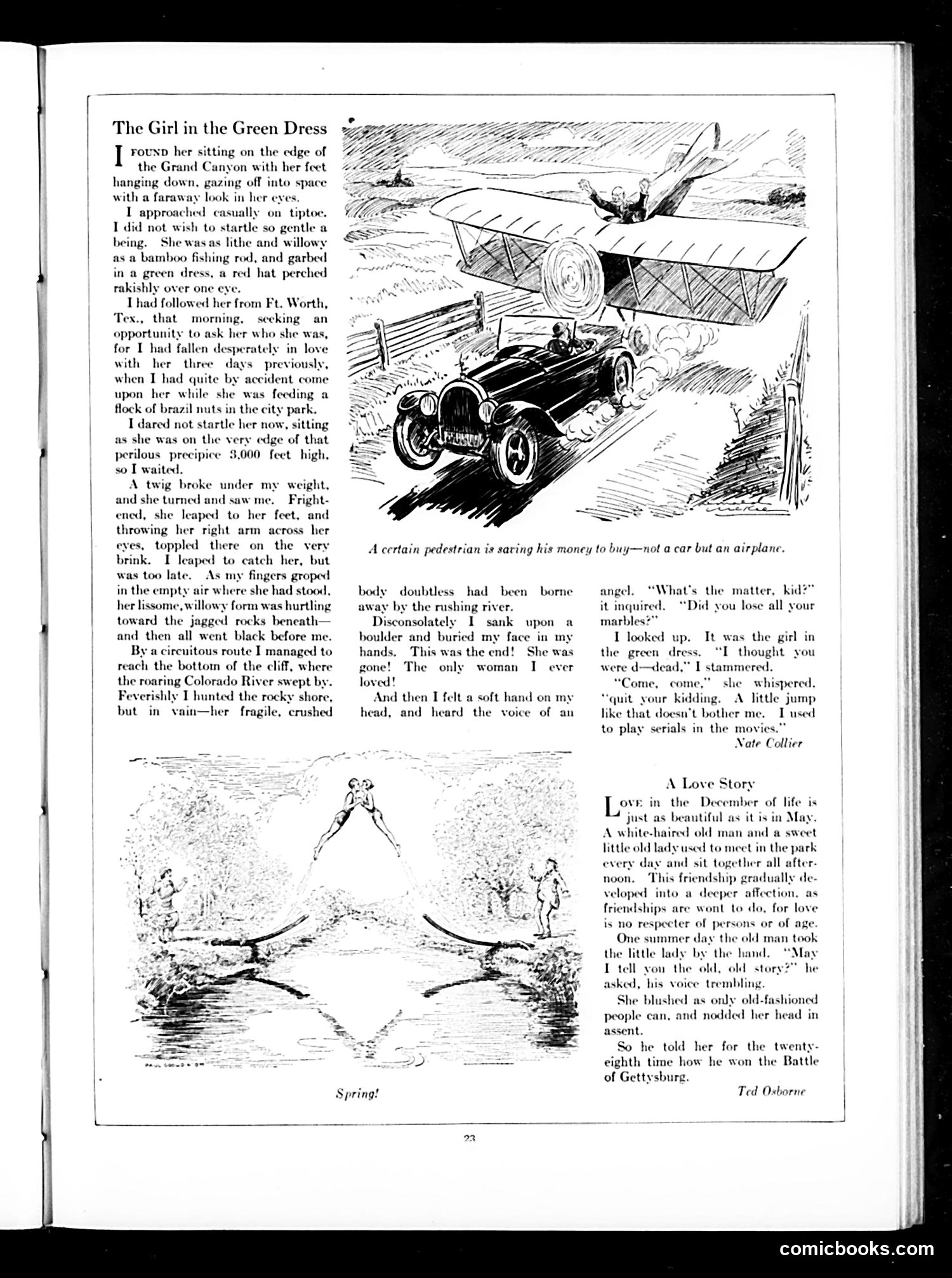
This page contains two unrelated humorous stories with illustrations, typical of Judge's format. **"The Girl in the Green Dress"** (by Nate Collier): A romantic comedy where a man pursues a woman from Fort Worth to the Grand Canyon, only to watch her fall off a cliff after he startles her. The joke's twist: she survives unharmed and casually reveals she's a former movie serial actress accustomed to such stunts. The satire mocks melodramatic romance and early cinema's popular serial adventures. **"A Love Story"** (by Ted Osborne): An elderly couple's park romance culminates when the old man asks to tell her "the old, old story"—implying a marriage proposal. The punchline reveals he's actually been repeatedly telling the same anecdote: how he personally won the Battle of Gettysburg (the Civil War's pivotal 1863 battle). This satirizes elderly people's tendency toward repetitive war stories. Both pieces use absurdist humor typical of 1920s Judge magazine—exaggeration and unexpected reveals rather than topical satire.
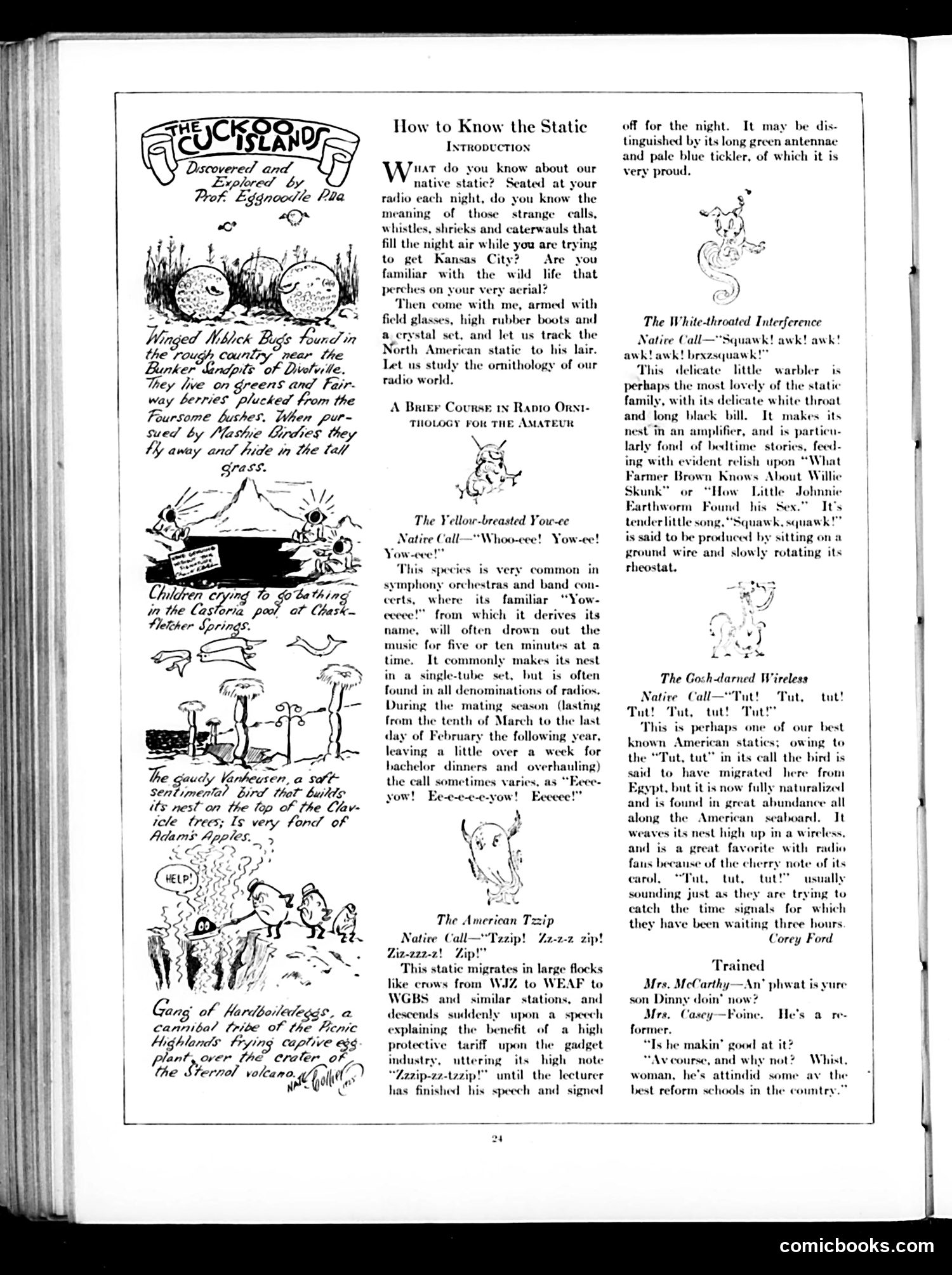
This is a humorous naturalist's guide mocking early radio interference. The page presents "static" (radio noise) as fictional bird species with Latin-style descriptions, parodying scientific field guides. The satire targets the widespread frustration with radio reception in the early broadcast era. Listeners constantly encountered unexplained sounds—whistles, squeaks, and interference—while trying to tune stations like WJZ and WEAF. The joke anthropomorphizes these annoyances as exotic "wildlife": the "Yellow-breasted You-ee" mimics symphony orchestra feedback, the "American Tzzip" interrupts tariff speeches, and the "Gosh-darned Wireless" produces repetitive "tut-tut" sounds during time-signal broadcasts. The left-side cartoons mock radio culture—children wanting to bathe in "Castoria pool," references to golf courses and radio sets. The brief "Trained" dialogue at bottom appears unrelated filler. This reflects genuine public irritation with radio's technical limitations before broadcast standards improved, presented through playful pseudo-scientific language.
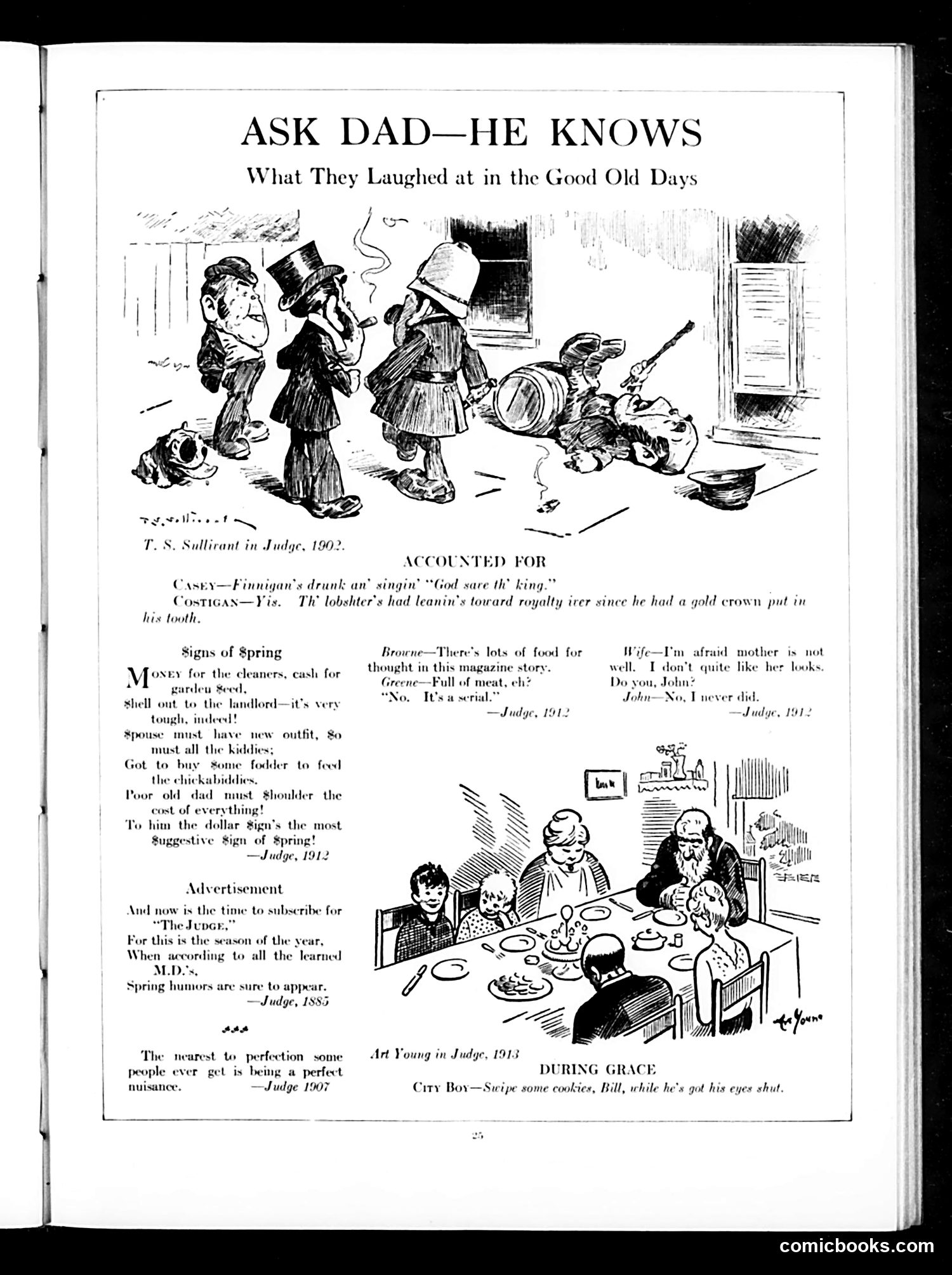
This page collects vintage humor from Judge magazine spanning 1902-1913, presented as nostalgic comedy—"what they laughed at in the good old days." The cartoons satirize **domestic life and social expectations**. "Signs of Spring" mocks the financial burden fathers faced as spring arrived: wives and children demanded new clothes, servants needed feeding, landlords wanted rent. The joke centers on the father's exhaustion at constant expense. Other jokes target **class pretension** (a lobster with a gold crown acting aristocratic) and **immigrant Irish stereotypes** (Finnigan, drunk and singing the British anthem). The bottom cartoon, "During Grace," depicts a **city boy teaching rural children to steal cookies during prayer**—satirizing urban corruption of innocent country children. These represent period humor relying on gender roles (spendthrift wives), class mockery, ethnic caricature, and moral lessons about childhood mischief—comedy conventions modern readers would find dated or offensive.
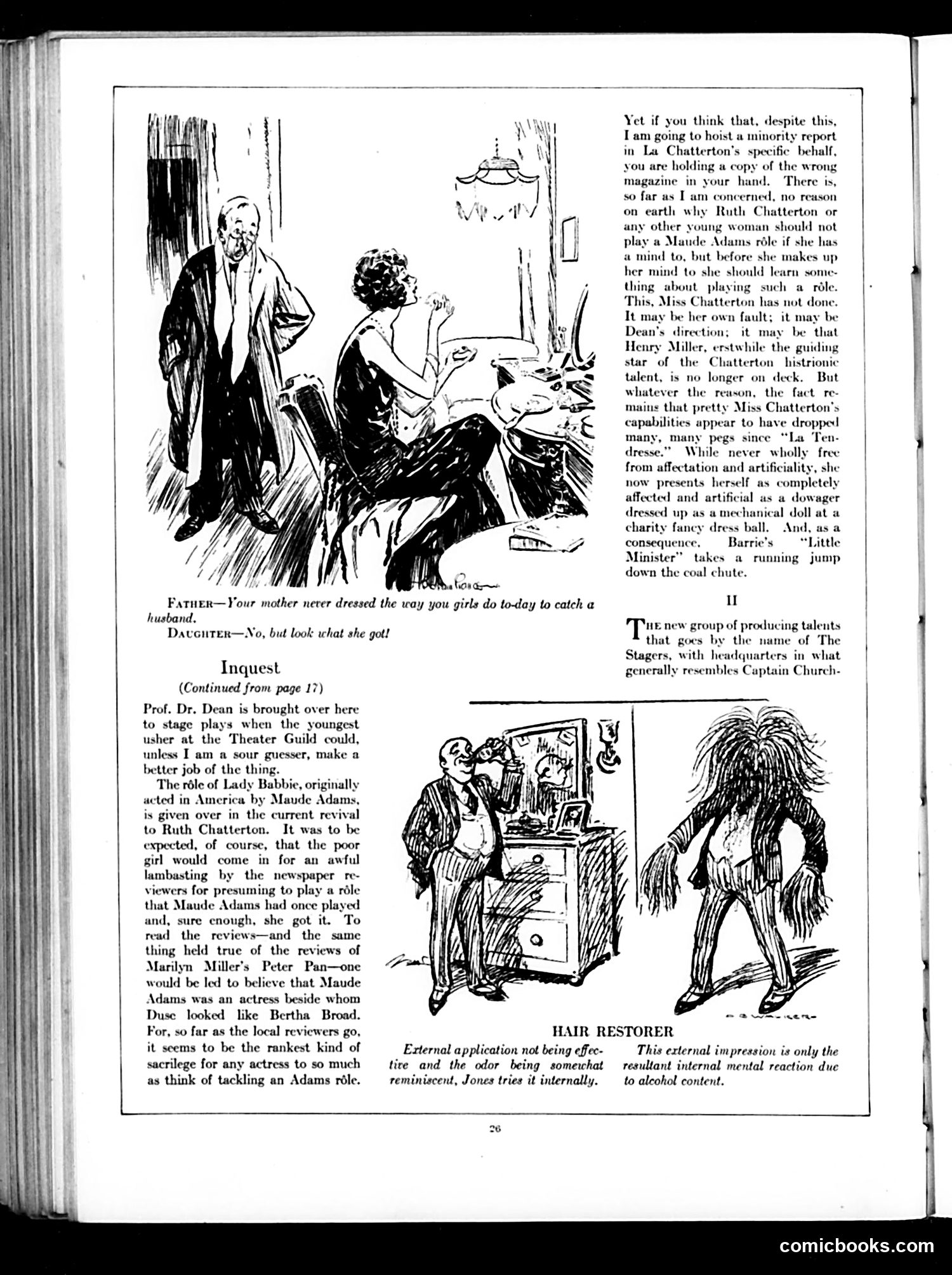
This page contains theatrical criticism and satirical cartoons about 1920s Broadway productions. **"Inquest" section:** A theater critic harshly reviews Ruth Chatterton's performance as Lady Babbie, a role famously played by legendary actress Maude Adams. The critic argues that while any actress *should* be allowed to attempt Adams' famous roles, Chatterton specifically lacks the necessary training and skill. The piece criticizes director Prof. Dr. Dean for importing European talent when American Theater Guild members could do better work. **Top cartoon:** A father and daughter discuss changing fashion standards—the daughter's modern attire shocks him, but she retorts that while her mother dressed more conservatively, look at the husband she "caught" (implying their marriage wasn't ideal). **"Hair Restorer" cartoon:** A satirical take on patent medicine quackery—a man tries drinking hair restorer after external application fails, humorously attributing his mental impressions to alcohol rather than the product's efficacy. The page reflects 1920s concerns about theatrical standards, generational fashion conflicts, and popular medical frauds.
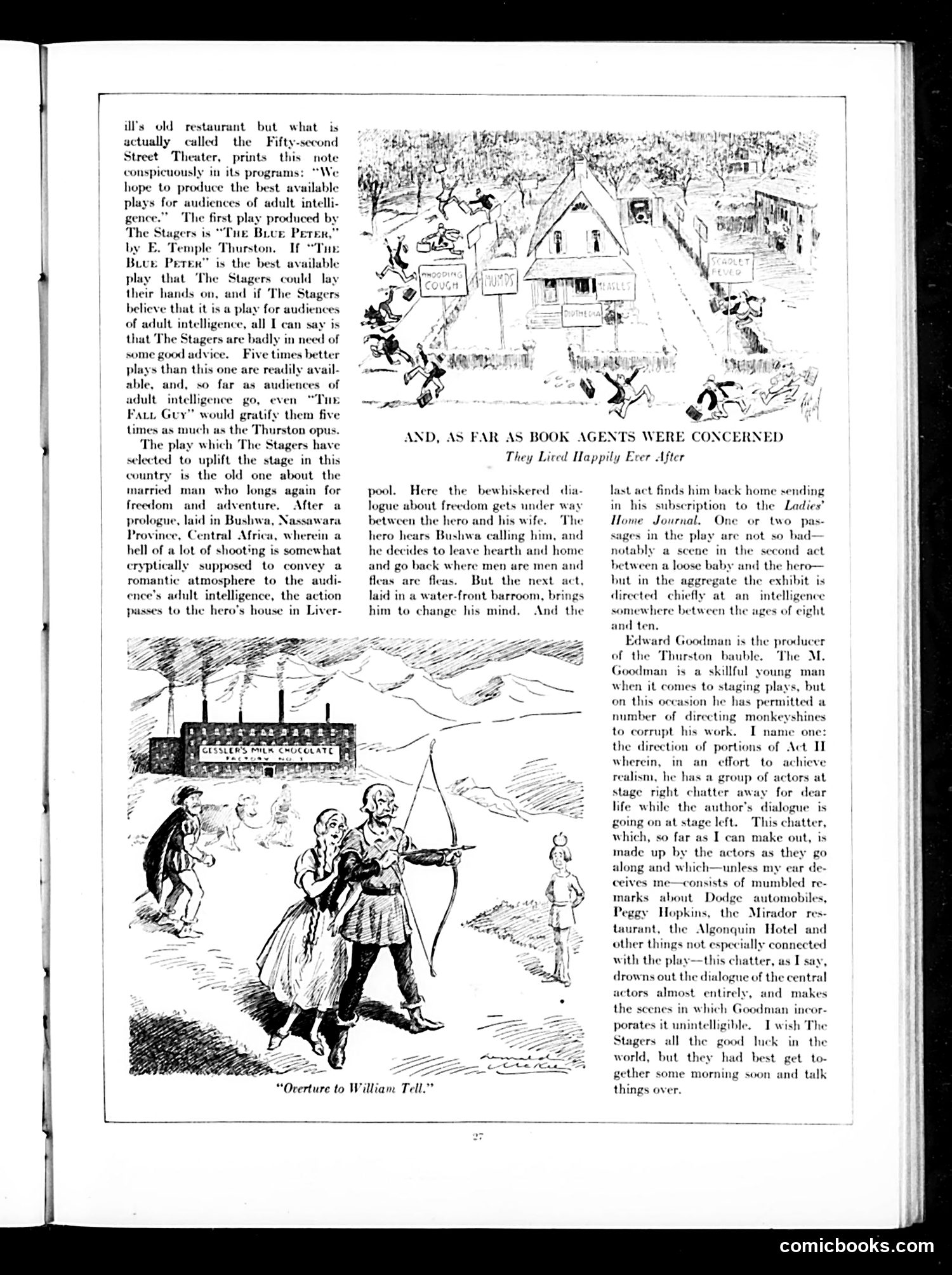
This page critiques the Fifty-second Street Theater's production of "The Blue Peter" by E. Temple Thurston, staged by a group called "The Stagers." The critic argues the theater's claim to produce plays for "audiences of adult intelligence" is undermined by their choice of this tired, conventional plot about a married man tempted by freedom and adventure in Africa, before ultimately returning home. The satire targets both the mediocre play itself and director Edward Goodman's heavy-handed staging choices. Goodman's main offense: actors mumble ad-libbed chatter about contemporary trivialities (Dodge cars, Peggy Hopkins, the Algonquin Hotel) during dramatic scenes, drowning out the dialogue. The critic finds this "realism" technique both pretentious and unintelligible—essentially mocking modernist directorial affectations. The cartoons illustrate scenes from the play's African prologue and barroom scenes, reinforcing the critic's dismissal of its melodramatic setup.
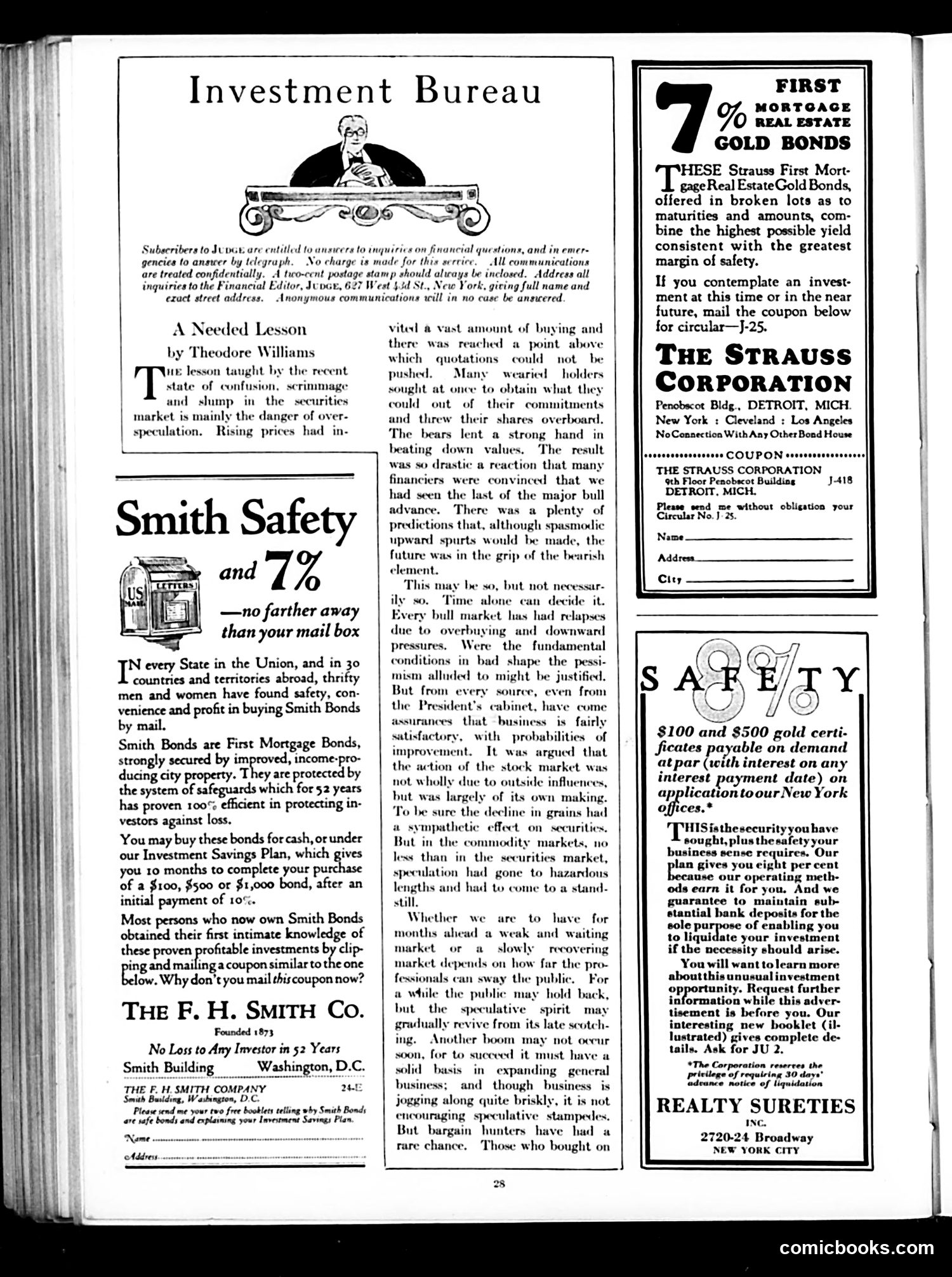
This page is primarily **financial advertising** dressed in editorial clothing, typical of early 20th-century investment magazines. The main content is Theodore Williams's article "A Needed Lesson," which discusses the 1920s stock market crash and warns against **overspeculation**. Williams argues that while recent market collapse was severe, it doesn't necessarily signal permanent decline—business fundamentals remain "fairly satisfactory" with government assurances of improvement. He suggests the market's dramatic fall was largely self-inflicted by speculators rather than caused by external economic problems. The surrounding advertisements (Smith Bonds, Strauss Corporation, Realty Surities) exploit this cautionary message by positioning themselves as **safer alternatives** to risky stock speculation—ironic, since they're selling investment products to readers frightened by market volatility. The cartoon figure at top left (unlabeled) appears to represent financial advisory services or the magazine itself, offering guidance during market turmoil. The overall message: panic-driven speculation causes crashes, but sound, conservative investments remain reliable.
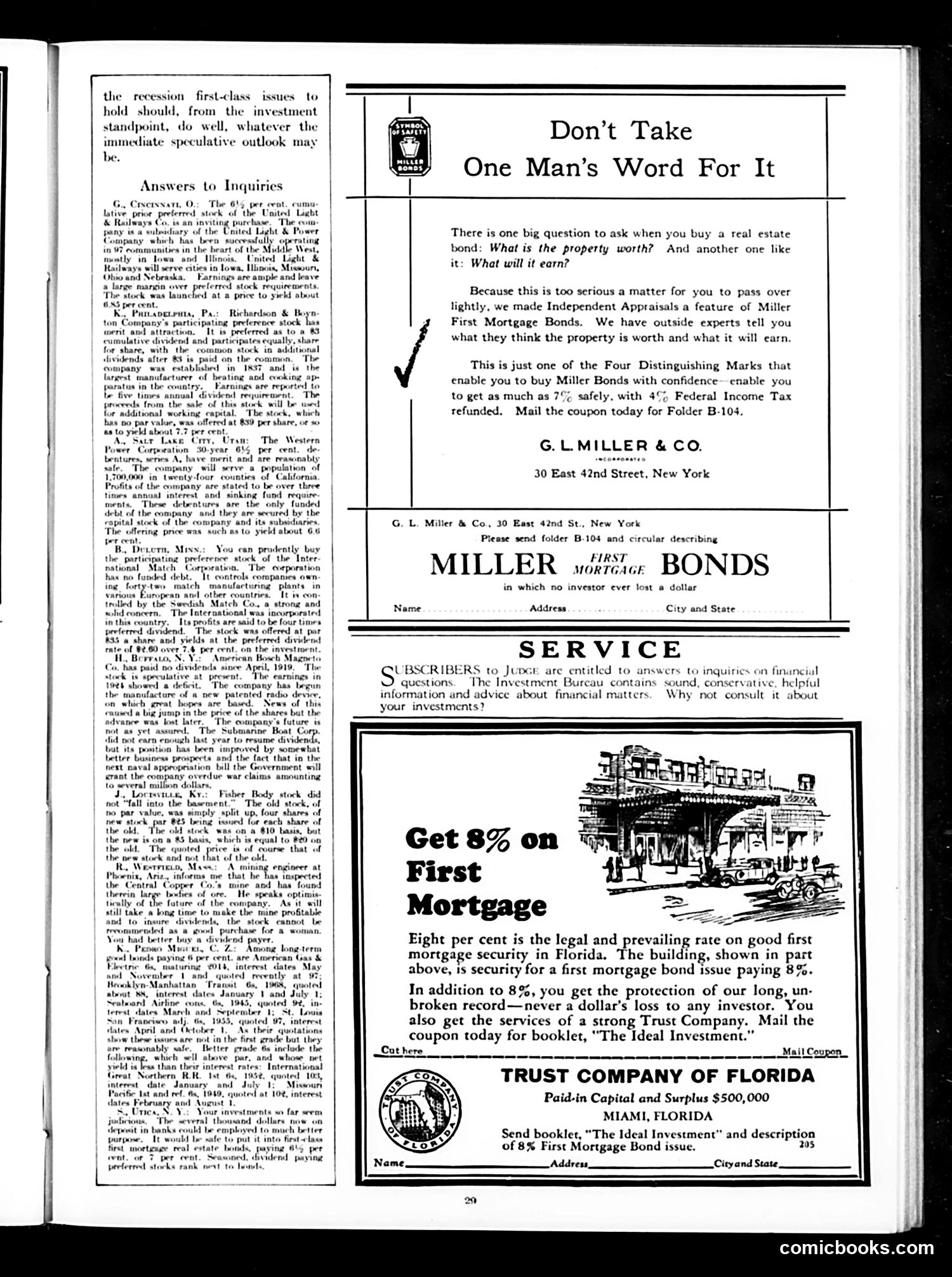
This page is primarily **advertising and financial advice**, not political satire or cartooning. The left column contains an "Answers to Inquiries" section offering investment advice on various stocks and bonds—utility companies, match manufacturers, and shipping concerns. This reflects the 1920s financial boom period. The right side features advertisements for mortgage bonds and investment services. The largest ad promotes **Miller First Mortgage Bonds**, emphasizing independent appraisals to verify property value. Below that, **Trust Company of Florida** advertises 8% first mortgage bonds, using an illustration of a commercial building as security collateral. These ads reflect investor concerns about transparency and safety during the prosperous 1920s—before the 1929 stock market crash. There is **no cartoon or political satire visible** on this page. It represents Judge magazine functioning as a financial publication for its wealthy readership, not as a satirical commentary vehicle.
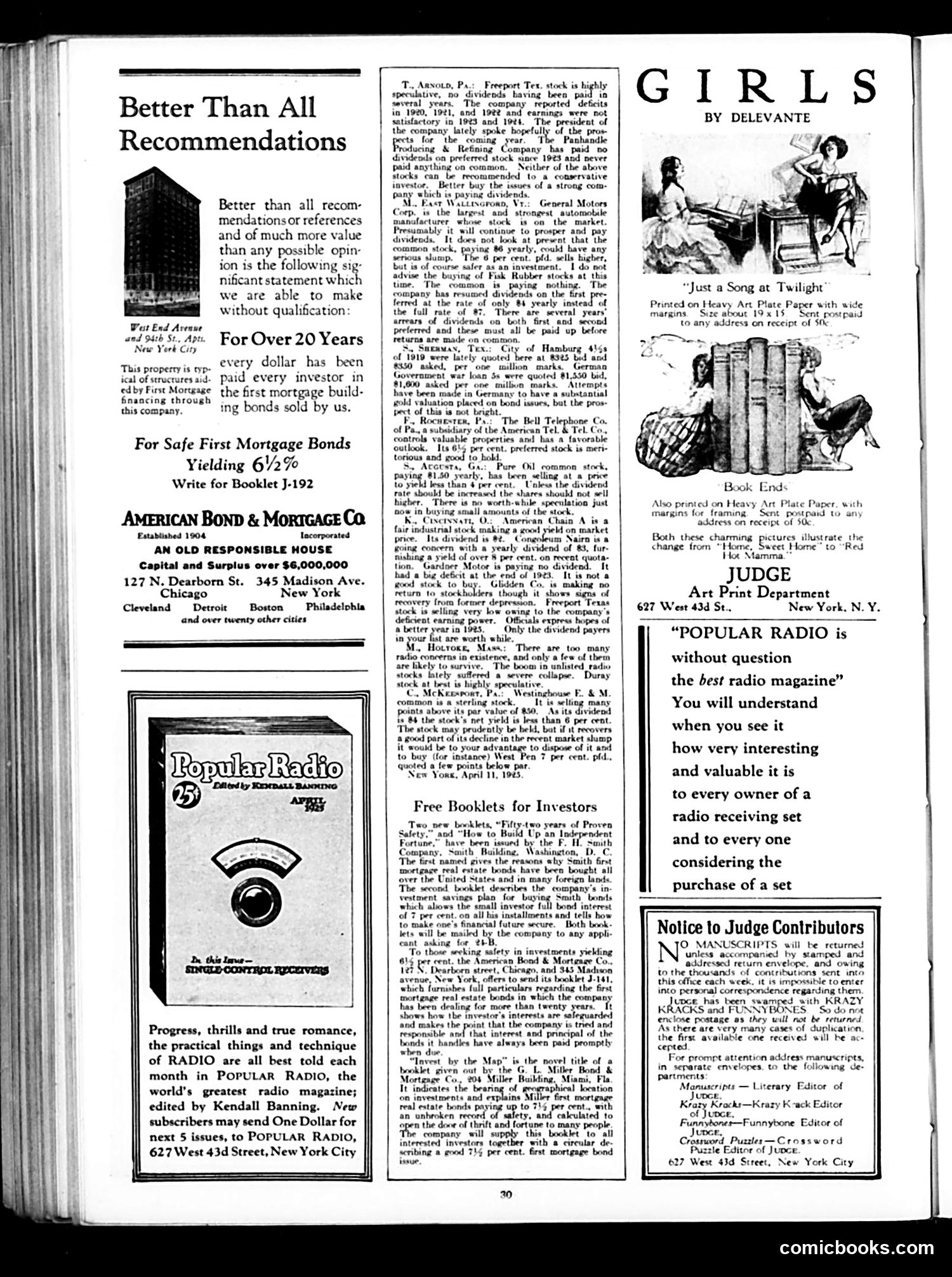
This page is primarily **financial advertising and investment advice**, not political satire. The dominant content includes: 1. **American Bond & Mortgage Co. advertisement** promoting first mortgage bonds yielding 6½%, emphasizing 20 years of reliable dividend payments to investors. 2. **Popular Radio magazine advertisement** promoting the publication as "the world's greatest radio magazine," reflecting the 1920s radio boom when radio ownership was novel and expanding. 3. **Investment Q&A column** providing conservative stock advice, warning against speculative stocks (Freeport, Texas oil; Panhandle Producing) while recommending established companies like General Motors and Pure Oil—reflecting 1920s investor concerns. 4. **Girls by Dellavante** illustration (top right) appears to be unrelated decorative content. The page reflects 1920s economic interests: real estate financing, emerging radio technology investment, and stock market guidance during the pre-Depression era.
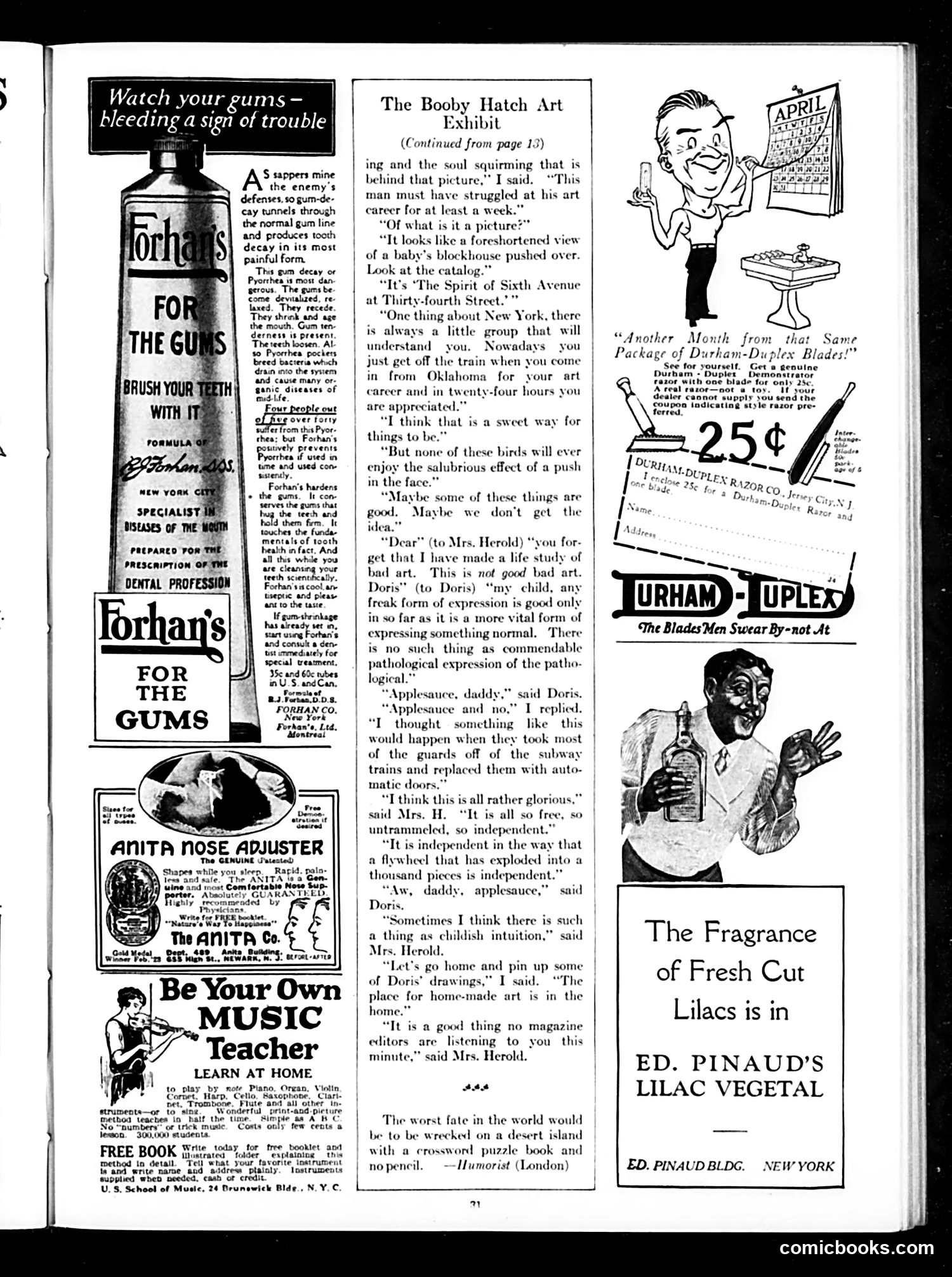
This page combines advertisements with a serialized humor piece called "The Booby Hatch Art Exhibit." The main satire mocks modernist/avant-garde art by depicting characters viewing a deliberately awful abstract painting titled "The Spirit of Sixth Avenue at Thirty-fourth Street," which looks like "a foreshortened view of a baby's blockhouse pushed over." The joke targets 1920s New York's art scene: the characters ironically praise incomprehensible art as "glorious," "free," and "independent," while the narrator sarcastically suggests the artist "struggled at his art career for at least a week." The dialogue satirizes both pretentious art appreciation and the absurd rationalizations people use to defend bad work—comparing "independence" of exploded machinery to artistic merit. The surrounding ads (Forhan's toothpaste, music lessons, razor blades) are typical period product advertisements unrelated to the satire.
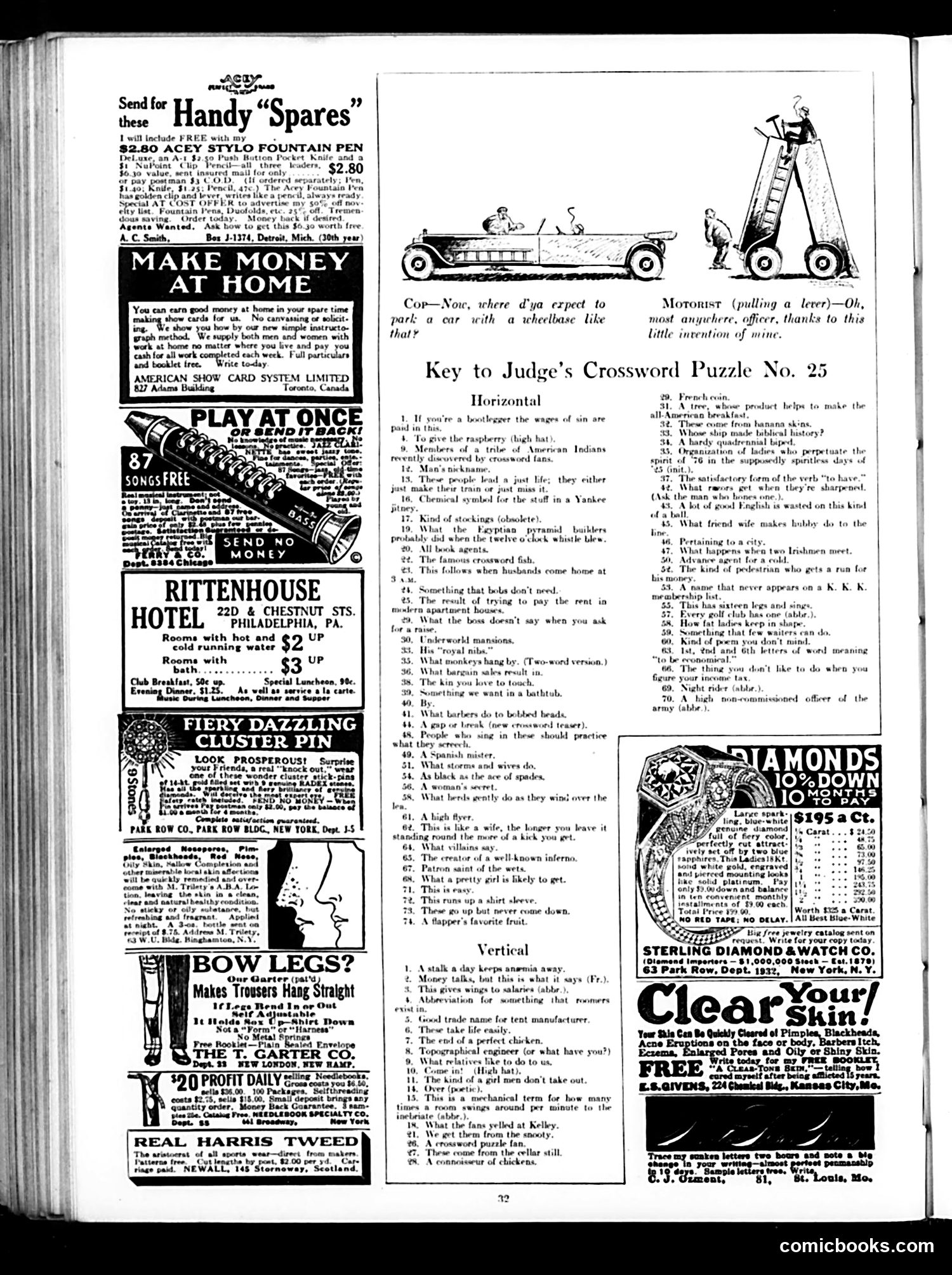
This page is primarily **advertising and puzzle content** rather than editorial satire. The single cartoon at the top shows a motorist explaining to a police officer how his car can park anywhere because of "this little invention of mine"—depicting an accordion-like or telescoping wheelbase mechanism. The joke is a practical one: the motorist has solved the urban parking problem (acute even in this era) through mechanical ingenuity. The cartoon references the contemporary frustration with automobile parking in crowded cities, a growing infrastructure challenge of the 1920s-30s. The remainder of the page consists of classified advertisements (mail-order pens, "make money at home" schemes, hotel listings, beauty products, diamonds) and the answer key to Judge's Crossword Puzzle No. 25. This was typical magazine filler content generating revenue.
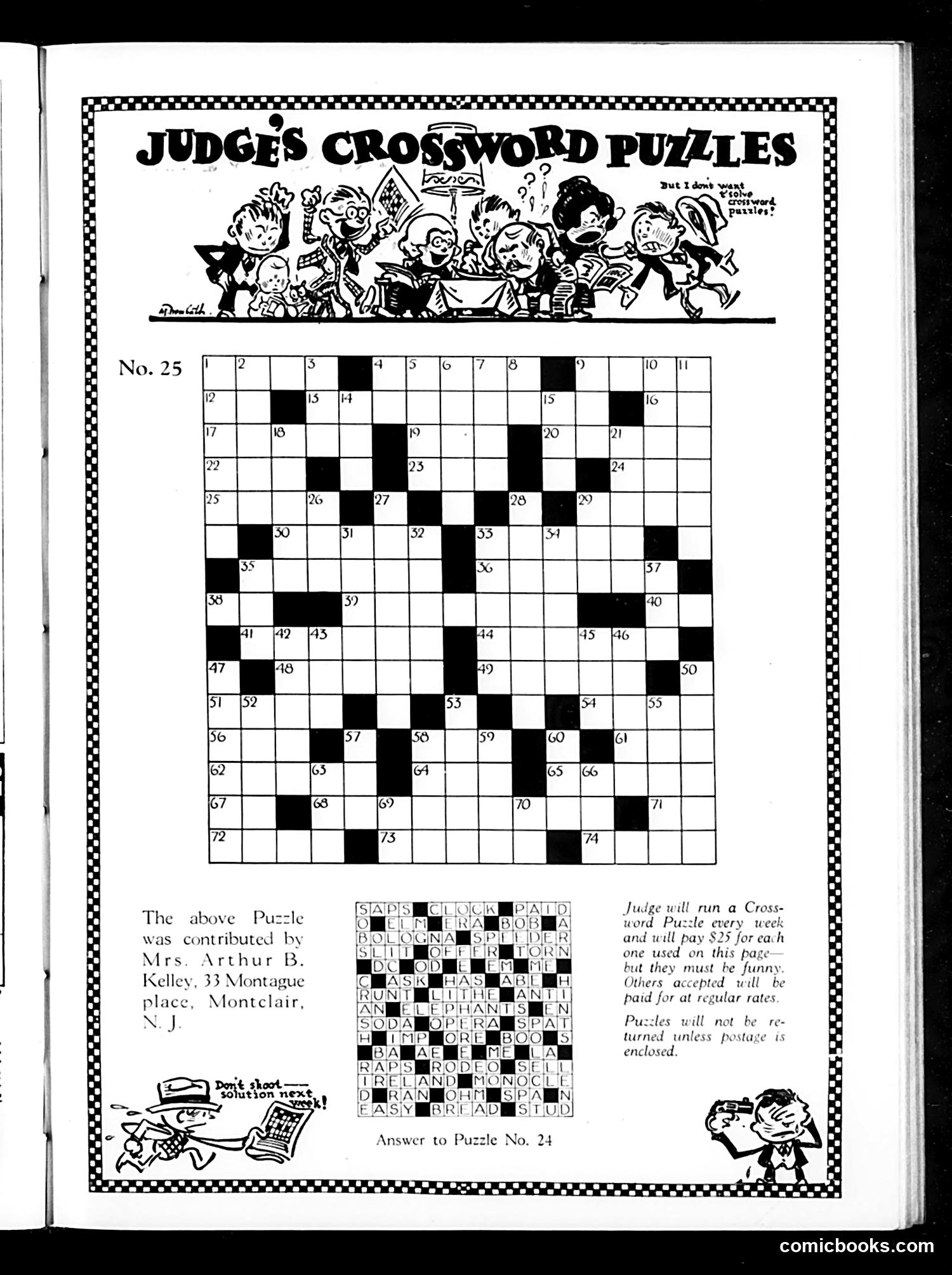
This page is primarily a **crossword puzzle** contributed by a reader from Montclair, New Jersey. The content is not satirical commentary but rather a puzzle offering—Judge magazine solicited reader-submitted crosswords, paying contributors for funny ones published in the magazine. The decorative header features cartoon children engaged with puzzles and games, establishing the recreational tone. The small cartoon at bottom left ("Don't short solution next") appears to be a running joke about puzzle-solvers. The page includes the answer grid to the previous week's puzzle (No. 24) and submission guidelines clarifying that Judge pays $25 for accepted funny puzzles but requires return postage. This represents Judge's role as an entertainment magazine mixing satire with popular diversions like word games—typical leisure activities for early-to-mid 20th century readers.
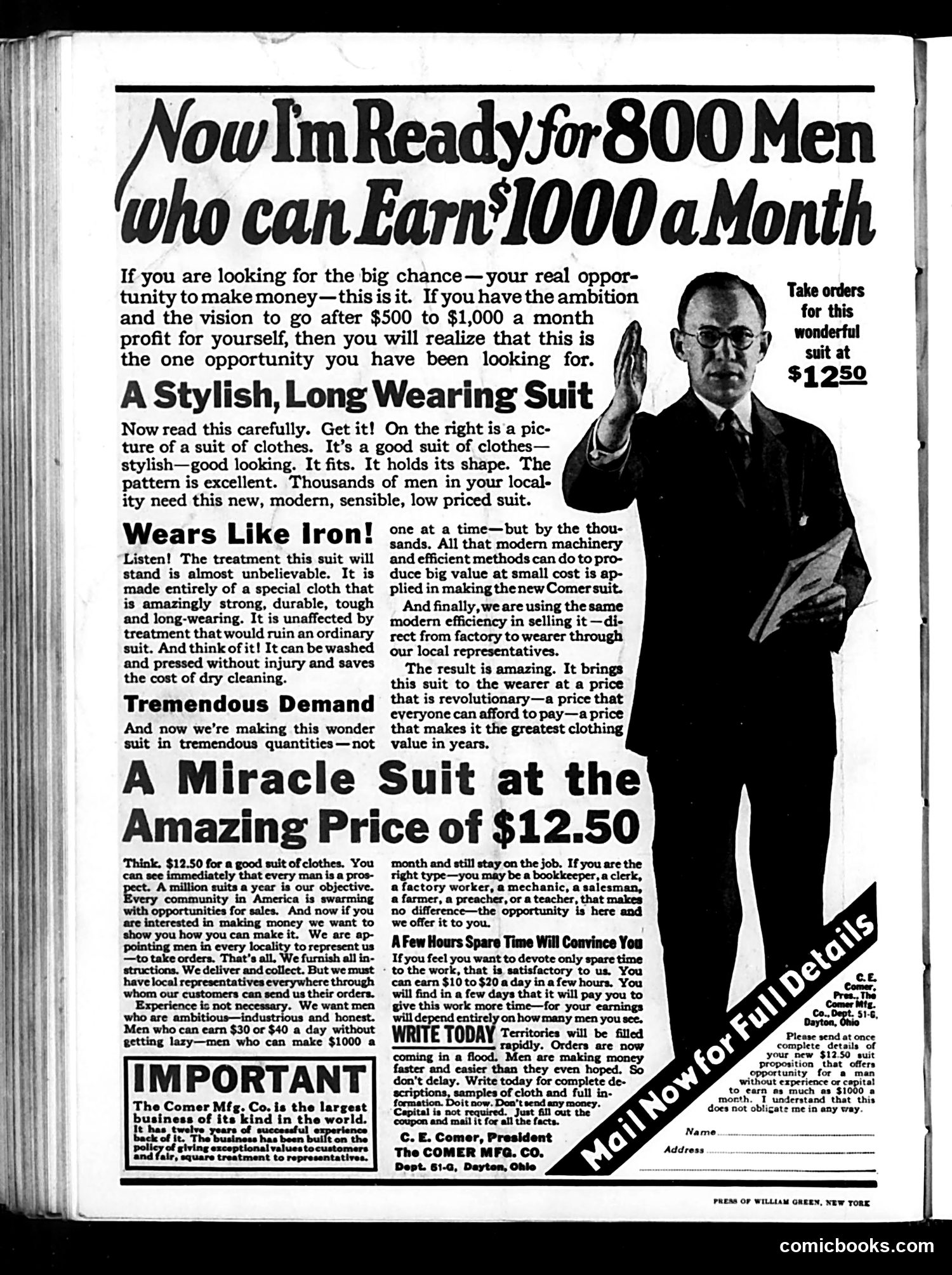
This is **not a cartoon or satire**, but rather a **straightforward advertisement** masquerading as editorial content—a common practice in early 20th-century magazines. The Comer Manufacturing Company advertises a $12.50 suit and, more importantly, a **sales opportunity**: men could earn $500-$1,000 monthly by taking orders in their locality. The pitch targets ambitious individuals willing to work as door-to-door salesmen or local representatives. The language emphasizes the suit's durability ("wears like iron," washable, press-resistant) and the company's efficiency in direct factory-to-wearer distribution. The accompanying photograph of a professional man in a suit serves as the aspirational product image. The "miracle" framing reflects period optimism about industrial manufacturing and mass-production economies. While modern readers might see this as a proto-pyramid scheme, contemporary audiences would have recognized this as typical door-to-door sales recruitment—a legitimate (if demanding) business model before retail chains and mass advertising dominated.