
A complete issue · 36 pages · 1925
Judge — February 7, 1925
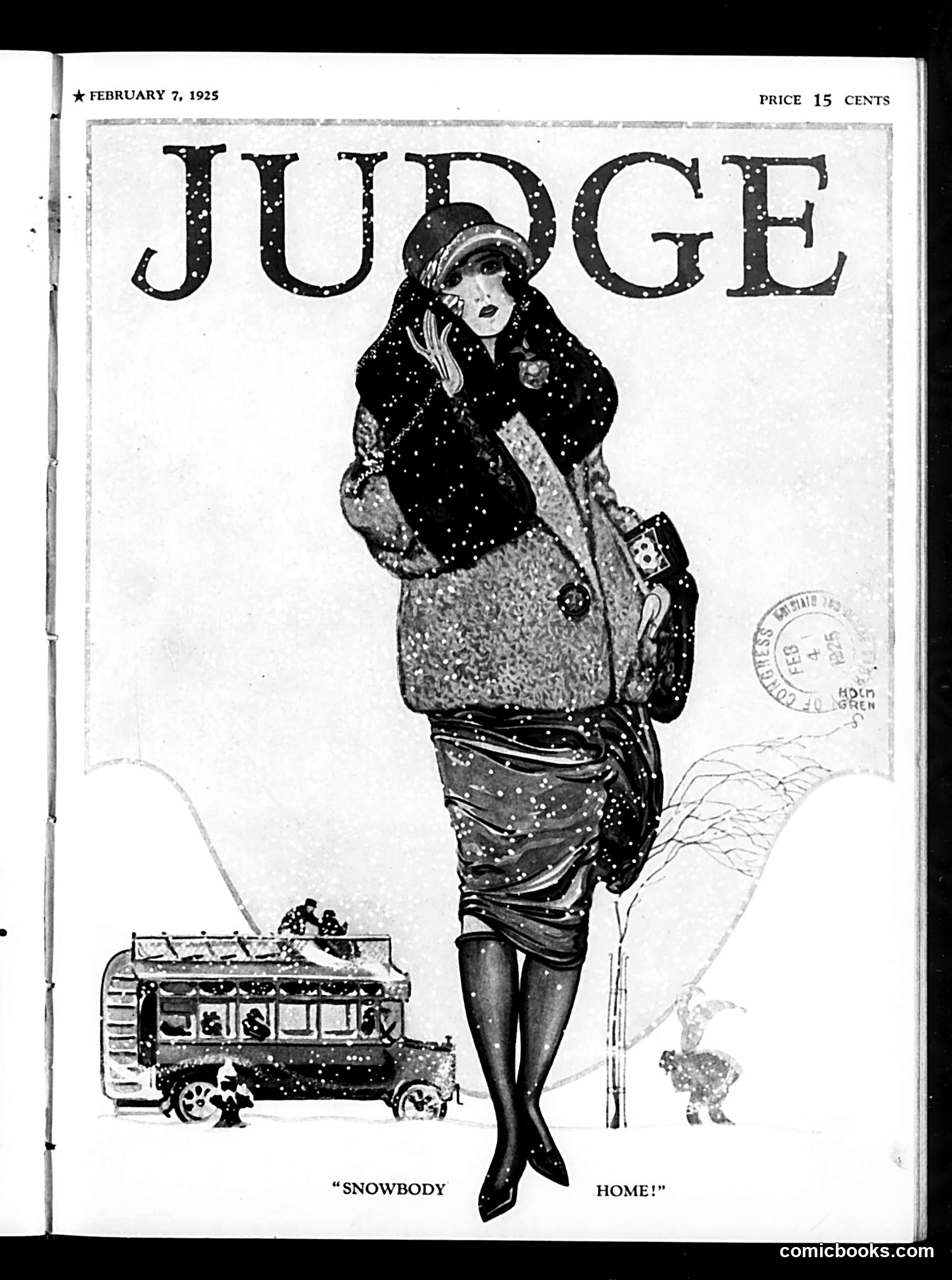
**February 7, 1925** This cover features a fashionable woman in 1920s winter attire—a cloche hat, fur-trimmed coat, and decorative stockings—standing in snow with the caption "Snowbody Home!" The visual pun plays on "somebody" versus "snow-body," referencing winter and snow. The tiny illustration of a bus at lower left suggests urban transportation. The satire likely comments on the modern "flapper" lifestyle and winter social patterns of the Jazz Age. The woman's stylish appearance and apparent solitude in winter weather may be gently mocking either winter isolation, seasonal travel, or the new independence of 1920s women who ventured out in inclement weather rather than remaining homebound—a notable social shift from Victorian domesticity.
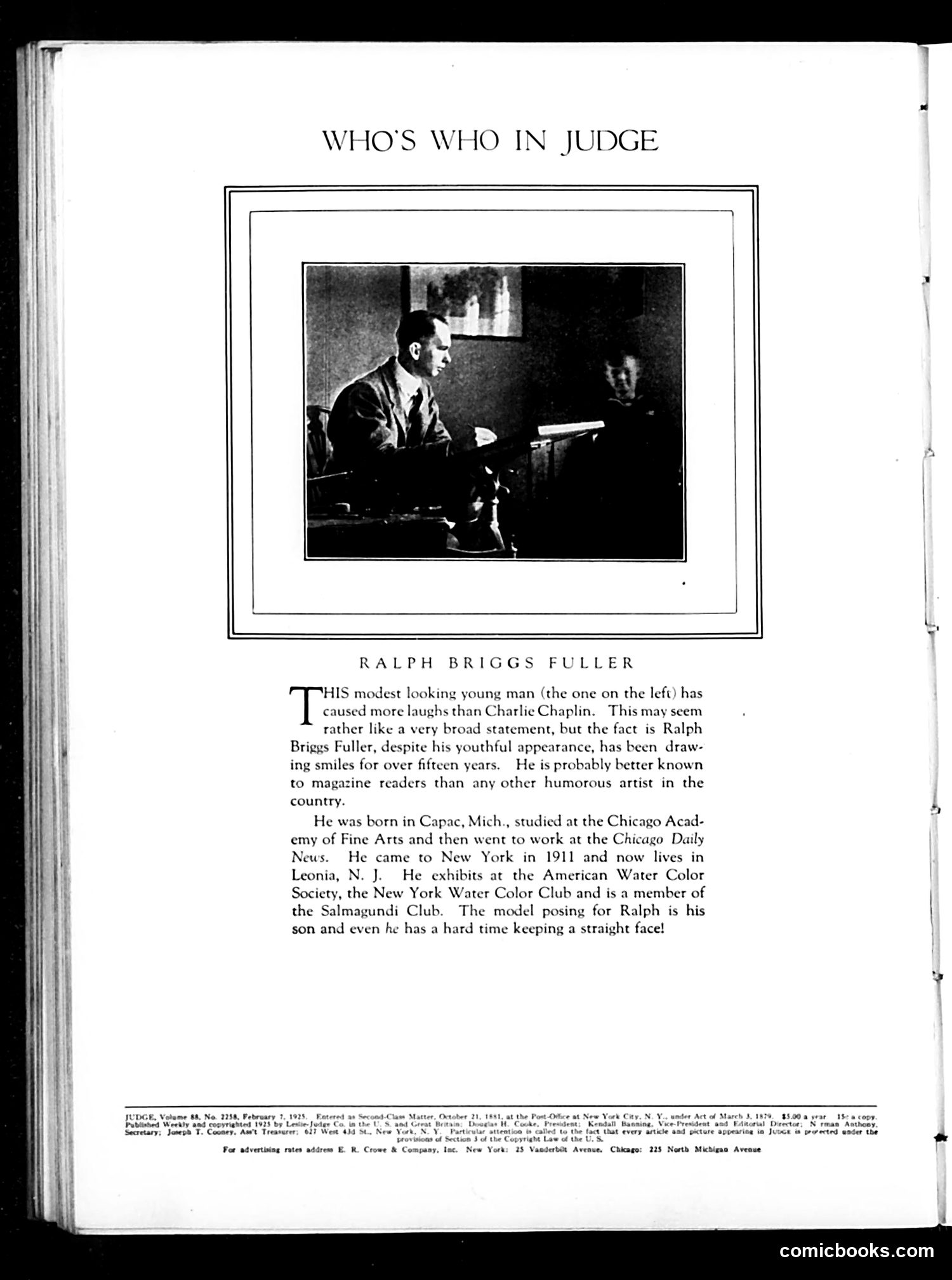
This page profiles cartoonist **Ralph Briggs Fuller**, identified as a major humorous artist who the text claims has "caused more laughs than Charlie Chaplin" over fifteen years. The photograph shows Fuller (left) in what appears to be a studio or office setting. The biographical text notes Fuller was born in Capac, Michigan, studied at the Chicago Academy of Fine Arts, worked for the Chicago Daily News, and relocated to New York in 1911, later settling in Leonia, New Jersey. He exhibited with prestigious art organizations including the American Water Color Society. The humor here is gentle: Fuller's own son served as his model, and the text jokes that even the son "has a hard time keeping a straight face" while posing—a self-referential gag about Fuller's comedic talent.
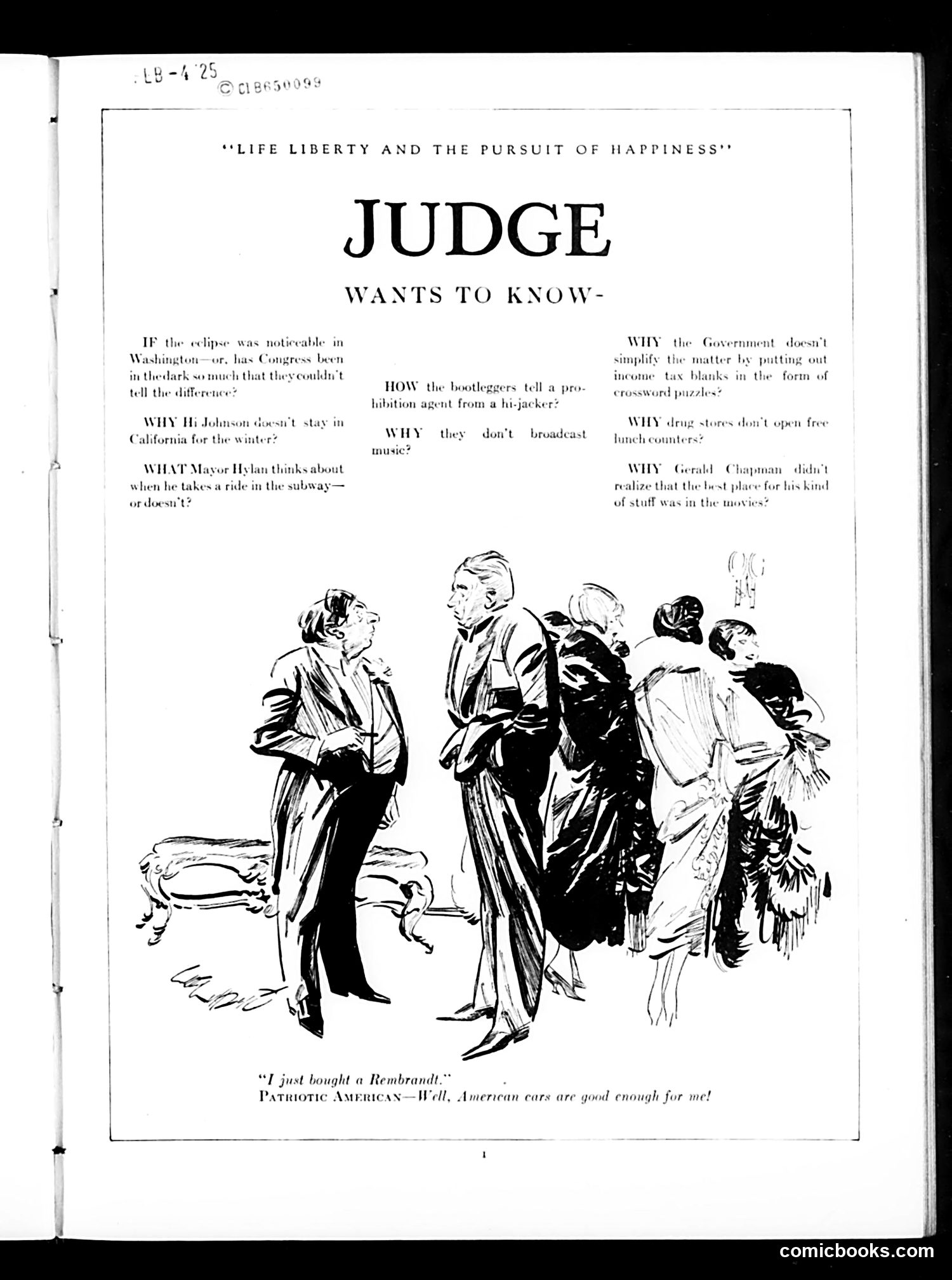
This page from *Judge* magazine presents a series of rhetorical questions the publication believes a "Judge" (presumably representing judicial authority or common sense) should ask about contemporary issues. The topics span Prohibition enforcement, income tax policy, drug regulation, and entertainment censorship—suggesting early-to-mid 20th century American debates. The bottom illustration shows a well-dressed man announcing he's purchased a Rembrandt painting, with the caption mocking his patriotic claim that "American cars are good enough for me!" The satire critiques wealthy Americans who buy European art while claiming patriotic support for American goods—exposing hypocrisy in nationalist rhetoric. The scattered questions above function as social commentary on government inconsistency and ineffectiveness across multiple policy areas.
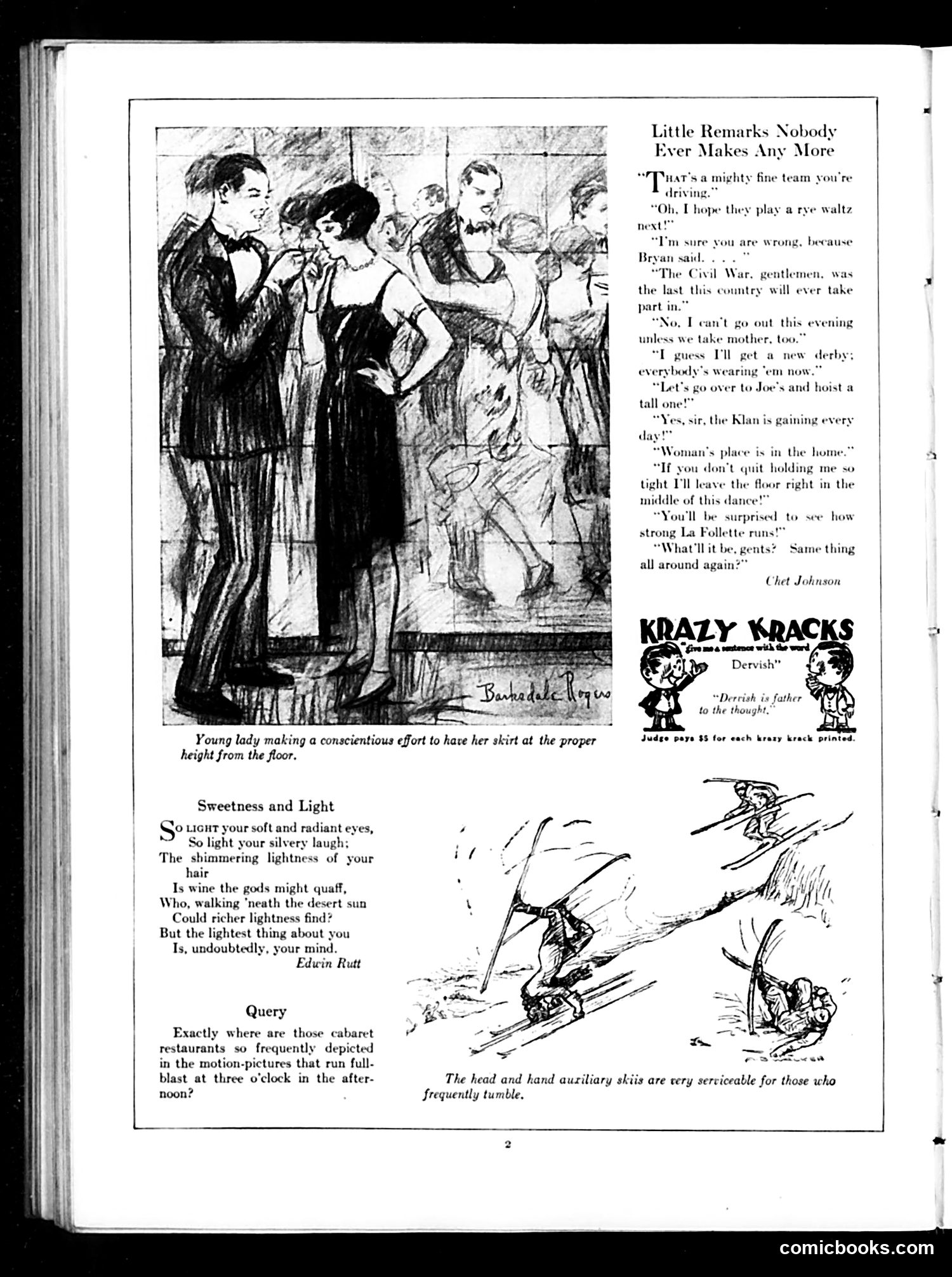
This page contains social commentary and humor typical of early 20th-century Judge magazine. The main cartoon depicts a young woman at a formal gathering consciously adjusting her skirt height—satirizing women's efforts to maintain proper decorum while fashions were becoming more revealing. The dialogue references the Ku Klux Klan ("the Klan is gaining every day") and debates about women's roles, with a male character asserting "Woman's place is in the home," reflecting contemporary gender tensions. The "Krazy Kracks" section offers brief jokes. Below, a poem titled "Sweetness and Light" and a "Query" section complete the page, typical of Judge's mixed-content format blending social satire with poetry and reader questions.
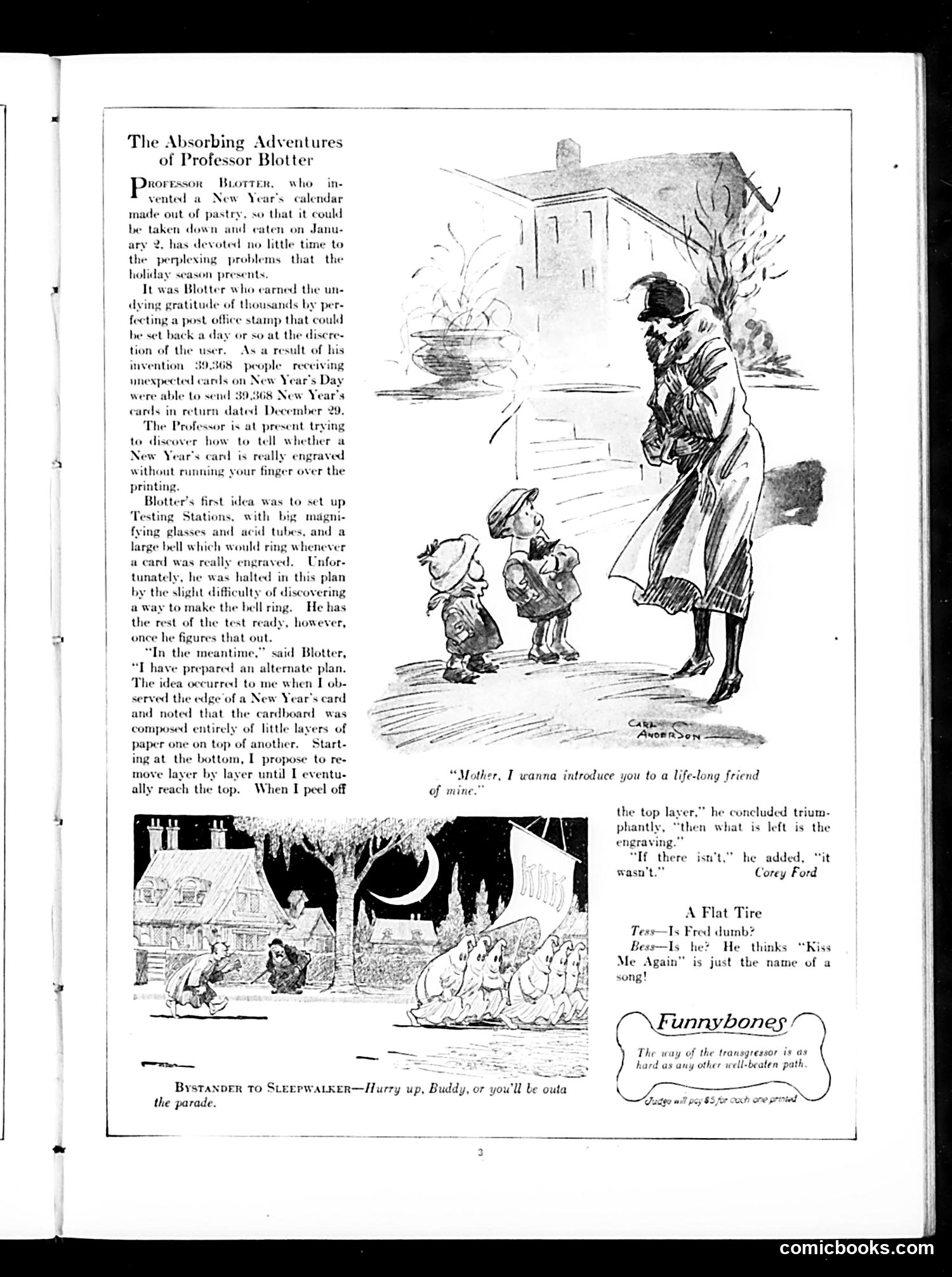
This is a humorous story about Professor Blotter's impractical invention: a New Year's calendar made of pastry designed to be eaten daily. The satire mocks both the Professor's eccentric inventiveness and the era's obsession with novelty products. The main cartoon shows Blotter attempting to create a bell mechanism that rings when a card is removed—an overly complicated solution to a simple problem. The joke critiques how inventors sometimes pursue absurdly complex designs when simple alternatives exist. The bottom cartoon depicts Blotter presenting his idea to someone, satirizing the common pattern of inventors pitching impractical schemes. The humor derives from the fundamental impracticality: a pastry calendar would be unsanitary, fragile, and absurd.
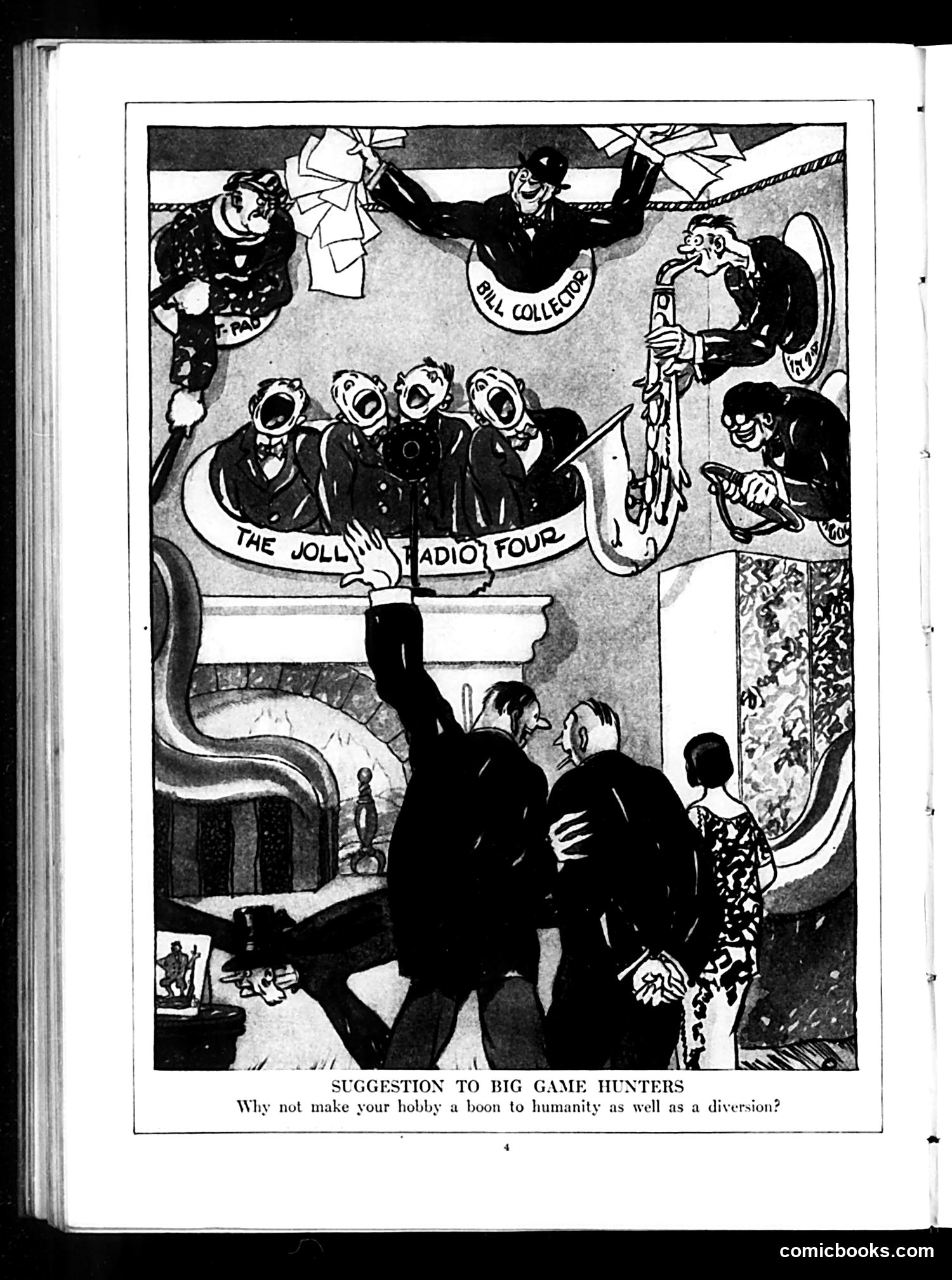
This satirical cartoon critiques wealthy big-game hunters by contrasting their hobby with charitable work. The upper portion depicts an elaborate nightclub or entertainment venue featuring "The Jolly Adios Four" (appears to be a musical act) and a "Bill Collector" character, suggesting frivolous spending. The lower scene shows well-dressed men and a woman observing this spectacle, presumably the "big game hunters" referenced in the title. The caption poses a moral challenge: "Why not make your hobby a boon to humanity as well as a diversion?" The satire suggests that hunting exotic animals for sport and entertainment represents misplaced priorities when the same wealth and effort could benefit society. This reflects Progressive Era concerns about wealthy class excess during a period of significant social inequality.
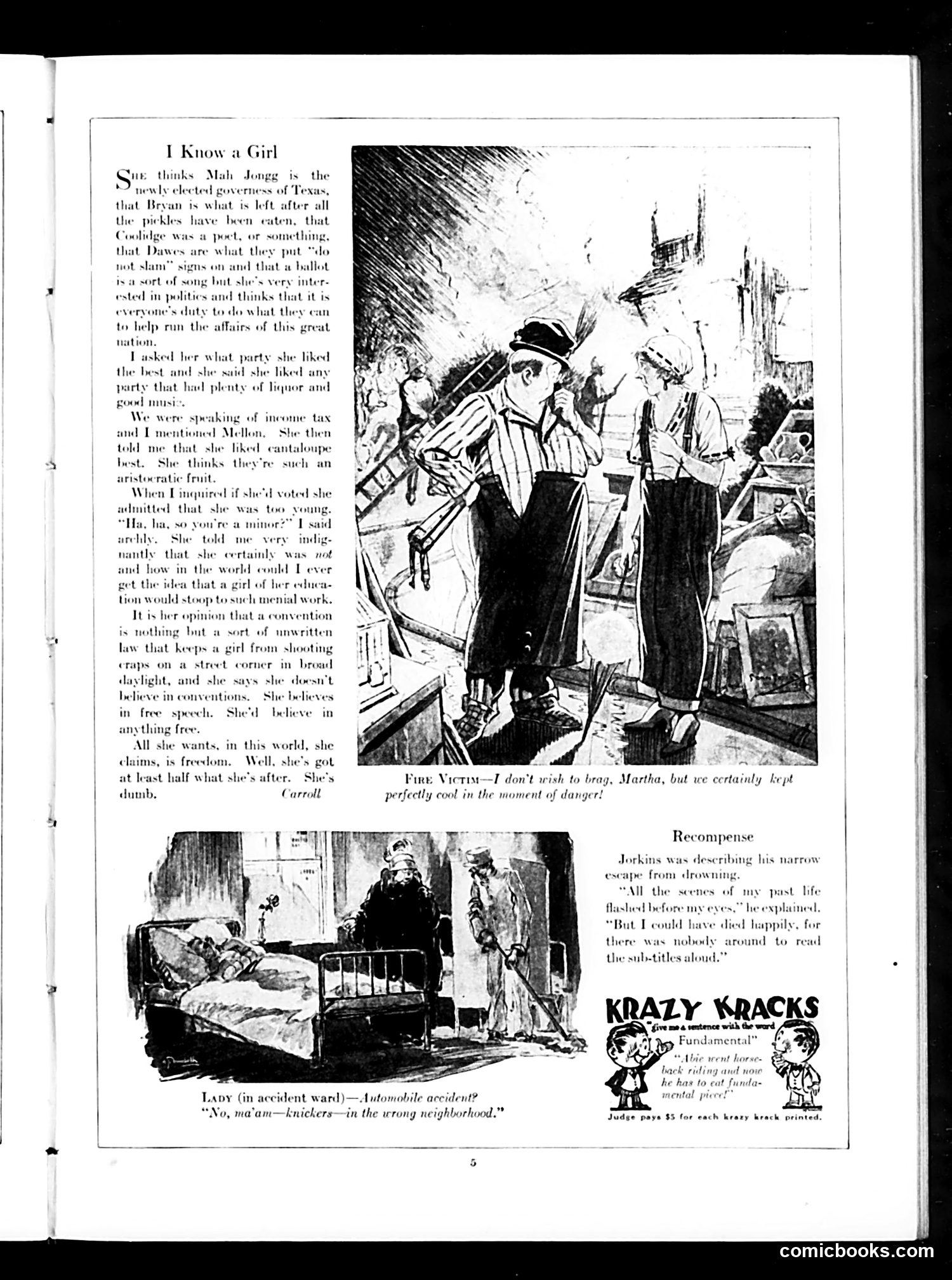
This page contains two distinct pieces: **"I Know a Girl"** (top): A humorous column by Carroll describing a politically-minded young woman. She admires Texas governor Ma Jinnett (newly elected), considers Bryan a "leftover," and views Coolidge as pretentious. She favors candidates with "liquor and good music." The piece mocks female voters as inconsistent and frivolous—suggesting they base political opinions on entertainment value rather than policy. This reflects 1920s skepticism about women's voting rights (granted in 1920). **Lower illustrations**: Show a lady in an automobile accident claiming "knucklers—in the wrong neighborhood," followed by a "Recompense" anecdote about drowning survival, and a "Krazy Kracks" advertisement. The satire targets both politicians (through the girl's dismissive characterizations) and newly-enfranchised women voters.
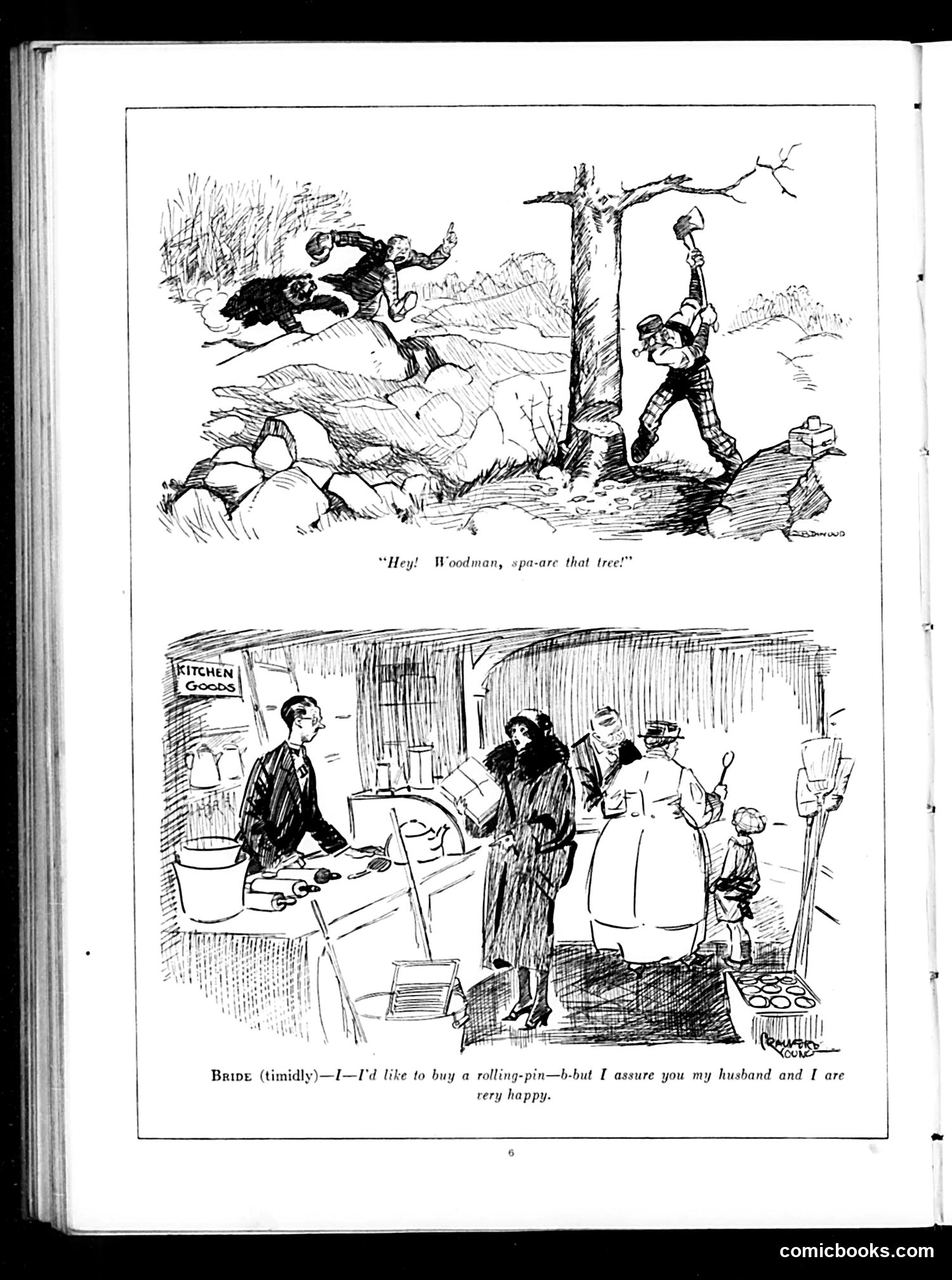
**Top cartoon**: A woodman chops down a dead tree while another man shouts to stop him. The joke appears to reference the fairy tale or proverb about sparing trees—likely playing on "spare the rod, spoil the child" or similar sayings about corporal punishment. **Bottom cartoon**: A nervous bride enters a kitchen goods store to buy a rolling pin. She stammers that she and her husband are "very happy," despite requesting an item historically associated with domestic violence (wives hitting husbands with rolling pins). The joke satirizes the clichéd complaint that newlyweds quarrel, while also mocking the bride's defensive reassurance—suggesting the rolling pin purchase itself contradicts her claim of happiness. It's dark humor about marital discord.
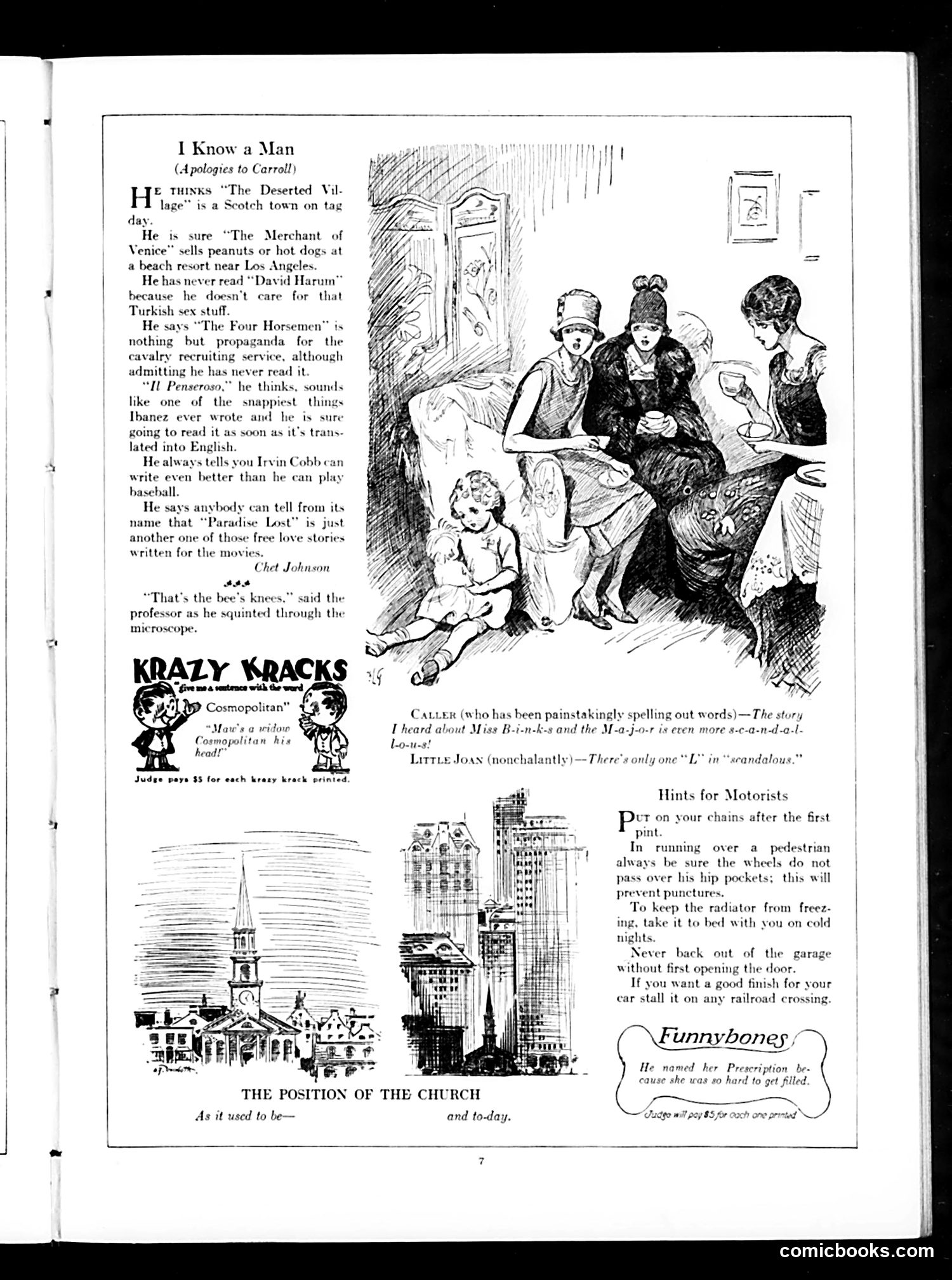
This page satirizes cultural ignorance and literary illiteracy among contemporary readers. The main article "I Know a Man" (attributed to Chet Johnson) mocks someone who confuses classic literature titles with trivial entertainments—mistaking "The Deserted Village" for a Scottish town, "The Merchant of Venice" for a hot dog stand, and "Paradise Lost" for a movie about free love. The satire targets readers who pretend familiarity with canonical works without actually reading them, and who prefer popular entertainers like Irvin Cobb to serious literature. The accompanying cartoons present light humor: a church architectural comparison showing its declining social centrality, a spelling joke about scandalous gossip, and motorist "safety tips" that are intentionally ridiculous (chaining up after drinking, keeping radiators in bed). The overall message critiques middlebrow American culture of the era—people adopting sophisticated pretenses while remaining fundamentally uncultured.
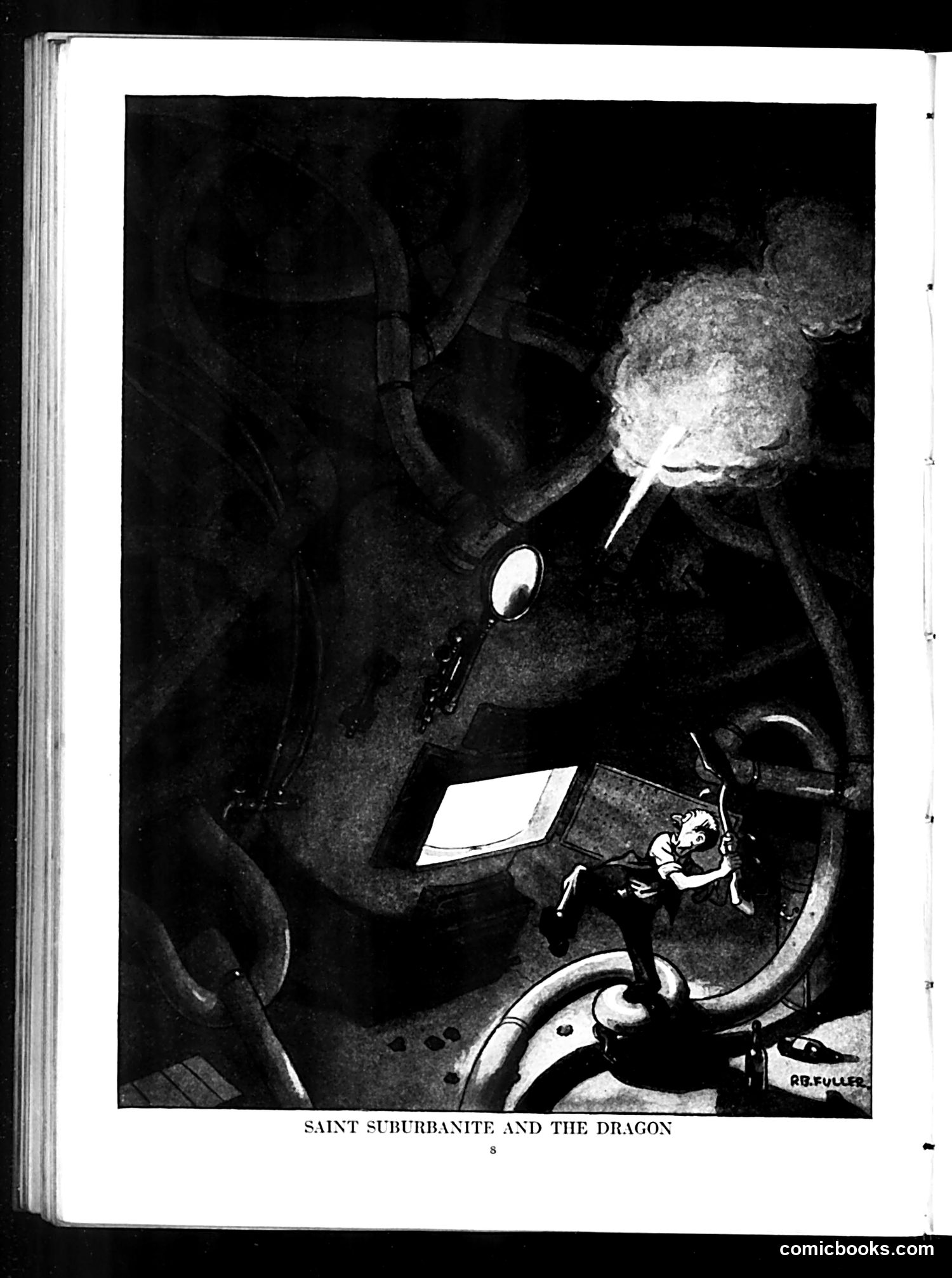
This illustration depicts a small human figure confronting an enormous dragon in a dramatic scene. The caption titles it "Saint Suburbanite and the Dragon," suggesting a satirical take on the medieval saint-slaying-dragon legend, but updated to modern (early 20th century) times. The "suburbanite" appears to be an ordinary citizen facing down a massive serpent, likely representing some threat to suburban life or American society. Without additional context from the magazine's issue, the specific dragon being referenced is unclear—it could represent a political threat, corporate power, labor unrest, or another contemporary concern that Judge's readership would have recognized. The artwork is credited to "R.B. Fuller" (visible in the lower right).
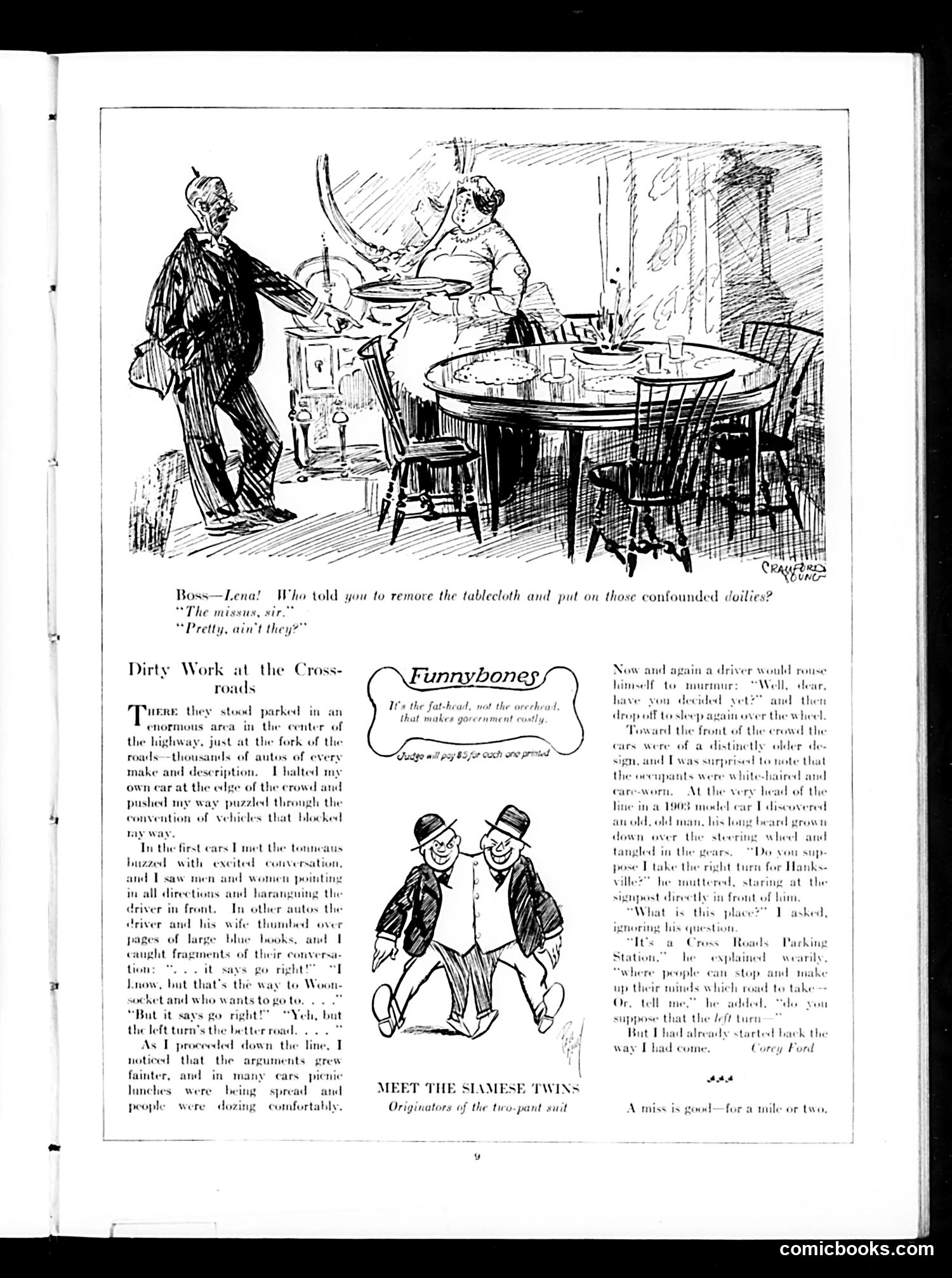
This page contains two distinct pieces of satire: **Top cartoon**: A domestic humor joke mocking working-class domesticity. A boss scolds his maid "Lena" for replacing a tablecloth with decorative doilies. Her response—"Pretty, ain't they?"—suggests she prioritized aesthetics over practicality, satirizing the clash between employer expectations and servant sensibilities. **"Dirty Work at the Crossroads"**: A longer narrative by Corey Ford satirizing the emerging automobile culture and traffic confusion of the 1920s-30s. The narrator describes visiting a crowded intersection where thousands of parked cars create gridlock. Drivers argue about which route to take, consulting maps, while some give up entirely and nap. At the front, an elderly couple remains perpetually indecisive at a "Cross Roads Parking Station." Ford mocks both driver confusion and the chaos of early motoring culture before standardized traffic rules. **"Meet the Siamese Twins"**: A caption referencing the two-pant suit—likely a fashion joke about a new menswear style.
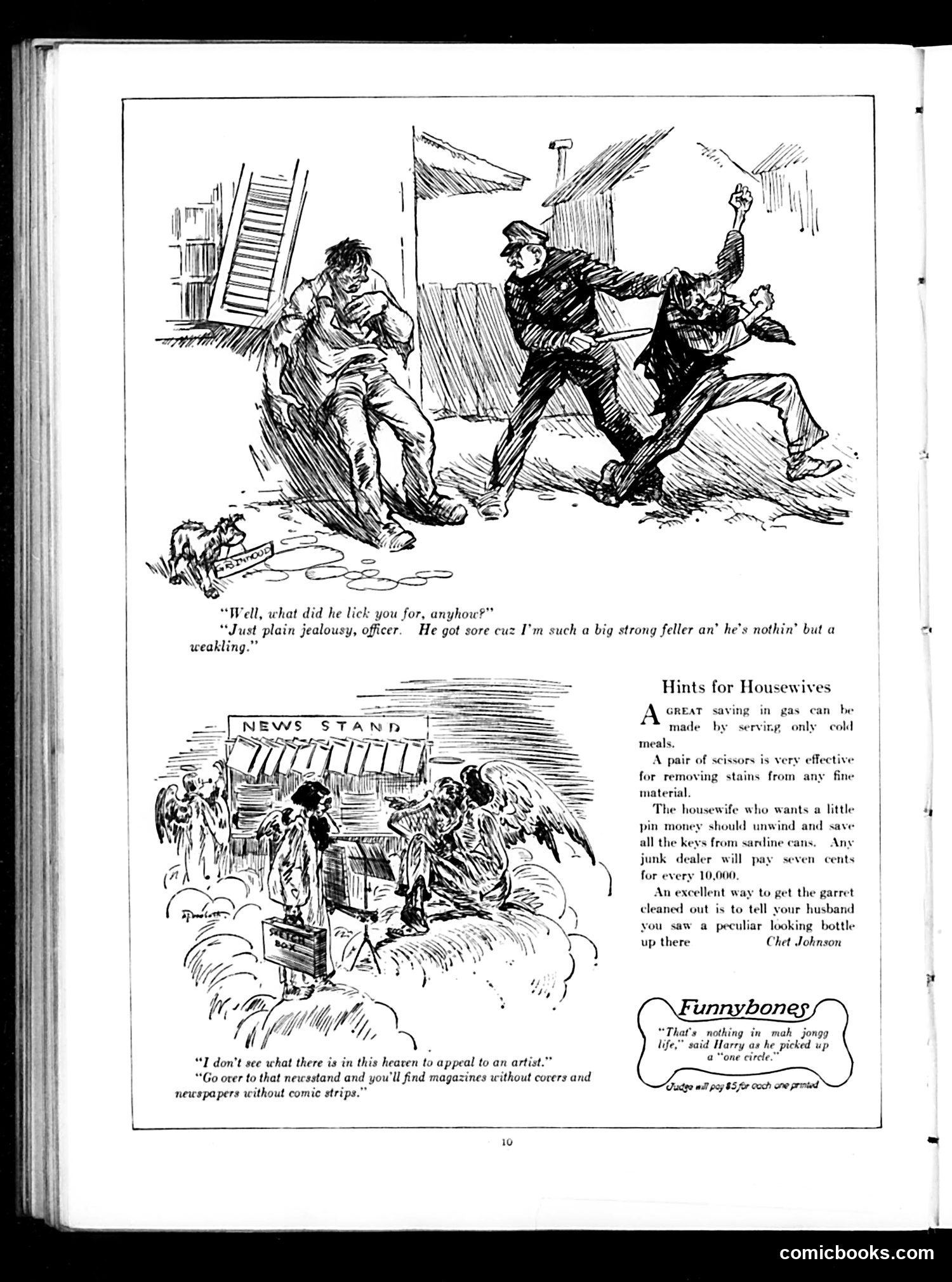
This page contains two satirical cartoons mocking contemporary attitudes and behaviors: **Top cartoon**: A street fight scene where one man claims the other attacked him out of "jealousy" because he's a "big strong feller" while his opponent is a "weakling." The satire targets masculine vanity and the excuses men make for violence—blaming jealousy rather than admitting fault. **Bottom cartoon**: Set at a newsstand, an artist complains heaven has nothing to appeal to him. His companion suggests the newsstand is "heaven" because it has magazines without covers and newspapers without comic strips—implying artists consider their own work (comics and illustrations) to be eyesores rather than art worth preserving. The page also includes practical "Hints for Housewives" offering money-saving tips (some tongue-in-cheek, like saving sardine-can keys for junk dealers), reflecting Depression-era frugality concerns. The cartoons use working-class dialogue and everyday scenarios to satirize vanity, artistic pretension, and consumer attitudes of the era.
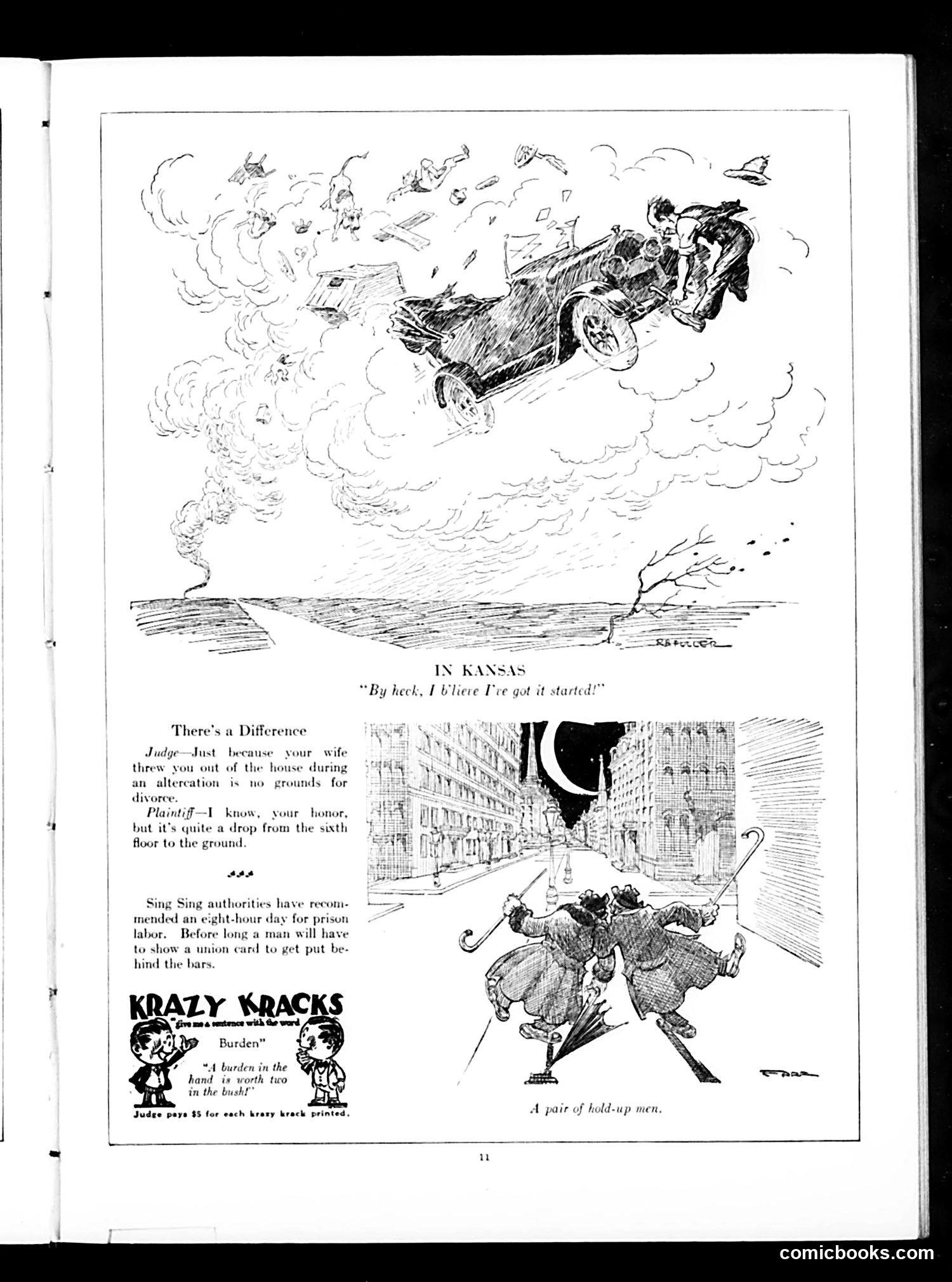
This page contains three separate satirical pieces typical of early 20th-century American humor: **Top cartoon ("In Kansas"):** Shows a man in a car being violently thrown upward by an explosion or tornado, with debris flying. The caption "By heck, I believe I've got it started!" suggests he's attempting to start his vehicle—a joke about the difficulty and danger of early automobiles, which required hand-cranking and could kick back violently. **Middle section:** Two brief legal/social commentary jokes. The first mocks divorce law by describing a wife throwing a husband from the sixth floor—the humor relies on exaggeration and the absurdity of legal technicalities. The second satirizes proposed prison labor reforms, suggesting that unionization efforts are so pervasive they're approaching prisons. **"Krazy Kracks":** An advertisement for a children's joke product, with the phrase about a "burden in hand." **Bottom cartoon:** Shows two men being robbed at gunpoint on a city street at night—straightforward crime illustration without elaborate commentary visible. The page reflects early 20th-century concerns: automobiles, labor unions, and urban crime.
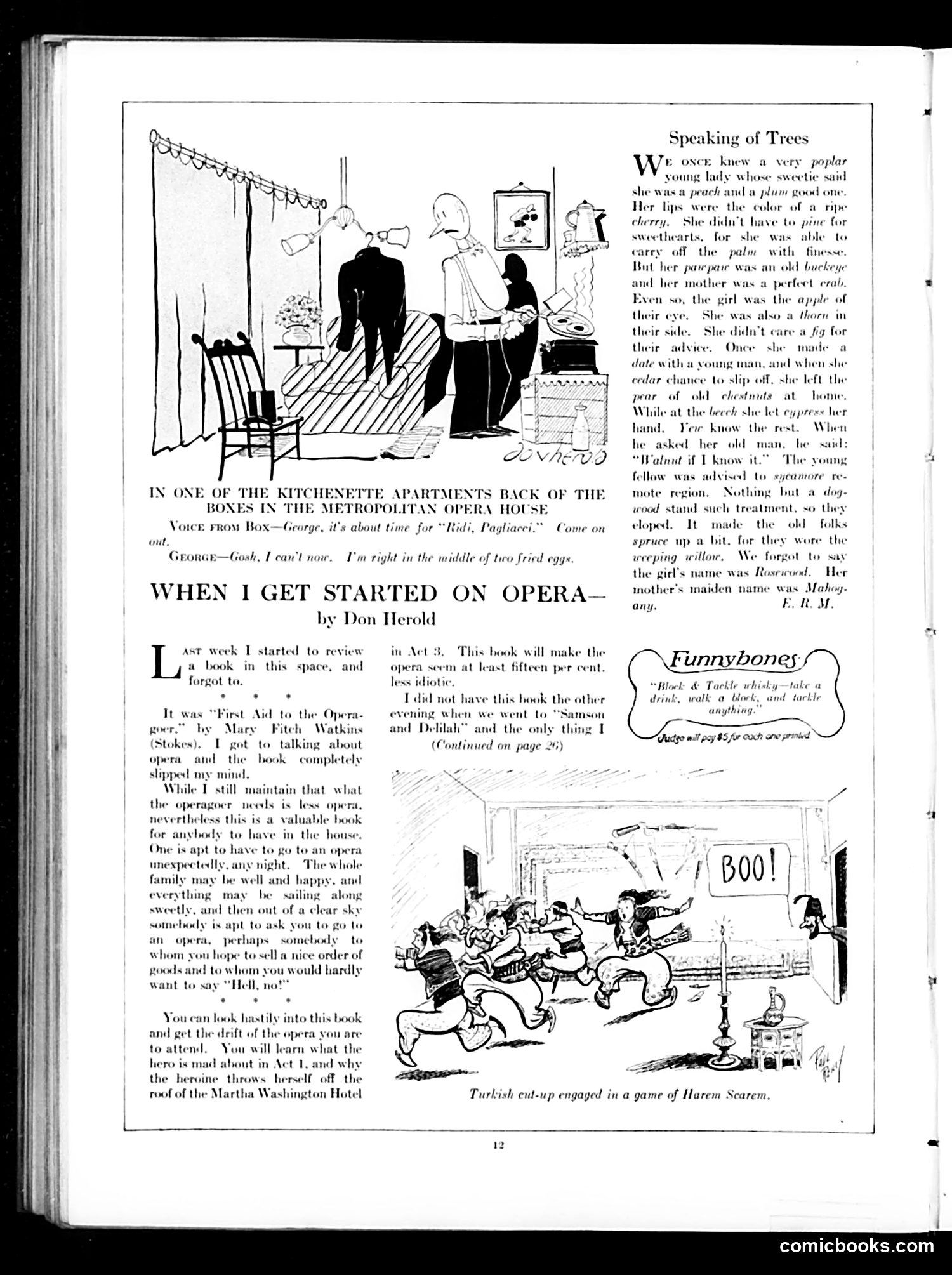
This page contains opera-related humor and wordplay typical of 1920s-30s Judge magazine. **Top cartoon:** Shows Metropolitan Opera House patrons in a backstage apartment. A man (George) tells his companion he can't leave to watch the performance because he's eating fried eggs—a joke about opera's length and tedium forcing audiences to occupy themselves with mundane activities during intermissions. **"When I Get Started on Opera" article:** Don Herold reviews "First Aid to the Operagoer" by Mary Fitch Watkins, a practical guide for opera attendees. Herold mocks opera's inaccessibility and complexity, suggesting the book helps unprepared audience members understand plots without prior knowledge. **"Speaking of Trees" column:** A pun-heavy story using tree/plant names as wordplay (poplar, peach, cherry, palm, buckeye, crab, apple, thorn, fig, chestnut, beech, cypress, walnut, dogwood, willow, rosewood, mahogany). The humor relies entirely on these forced botanical puns. **"Funnybones" cartoon:** Shows chaotic activity with "BOO!" caption—likely depicts Turkish performers or entertainment. The page reflects upper-class entertainment culture and reliance on verbal wordplay typical of Depression-era humor magazines.
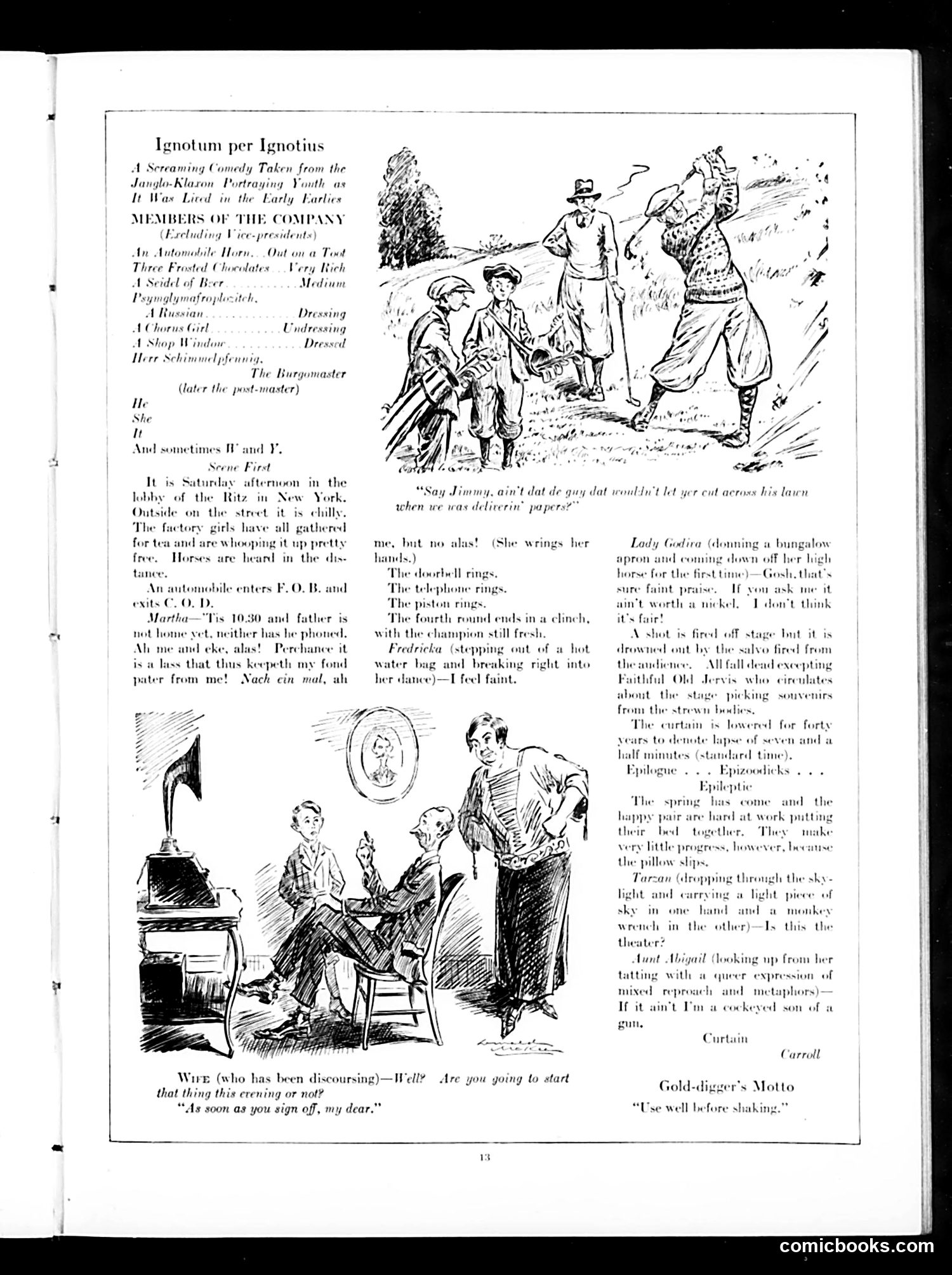
This page satirizes early silent films and their absurd plots. The title—Latin for "the unknown explained by the more unknown"—signals the joke: the "play" outlined is deliberately nonsensical, mocking how incomprehensible early cinema narratives could be. The setup parodies theatrical programs with character names like "A Russian Dressing," "A Shop Window Dressed," and "An Automobile Horn," poking fun at the pretentiousness and randomness of avant-garde theater and film. The "plot" is intentionally incoherent: a Saturday afternoon at the Ritz where doorbells, telephones, and boxing rings all ring simultaneously; Fredricka faints; then the curtain drops for "forty years to denote lapse of seven and a half minutes." The final act introduces Tarzan dropping through the skylight—a complete non-sequitur that underscores the satire's point: early cinema had bewildering, illogical narratives that audiences somehow accepted. The humor targets both filmmakers' pretension and viewers' patience for nonsensical plots.
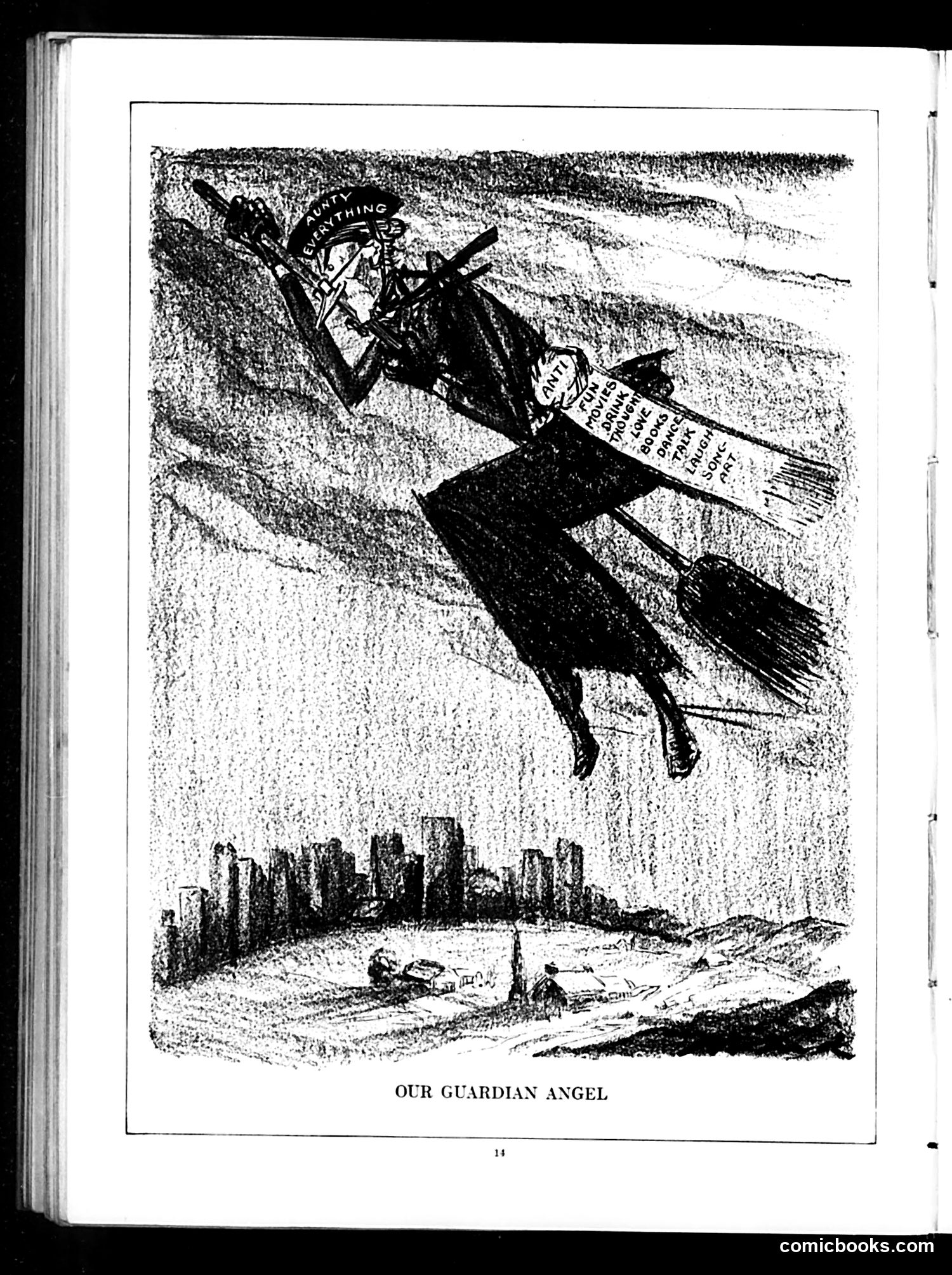
This political cartoon depicts an angel flying protectively above a cityscape, carrying a scroll or banner inscribed with text (illegible in this reproduction). The angel appears to represent a benevolent protective force—likely the American government or a specific political leader or institution—watching over the city below. The satirical point likely critiques or comments on claims of governmental protection or guardianship, though without clearer visibility of the banner's text or knowing Judge magazine's publication date, the specific target is unclear. The juxtaposition of an idealized angel with an industrial city below suggests commentary on industrial-age America and questions about who or what genuinely protects ordinary citizens. The style and printing quality suggest early-to-mid 20th century publication.
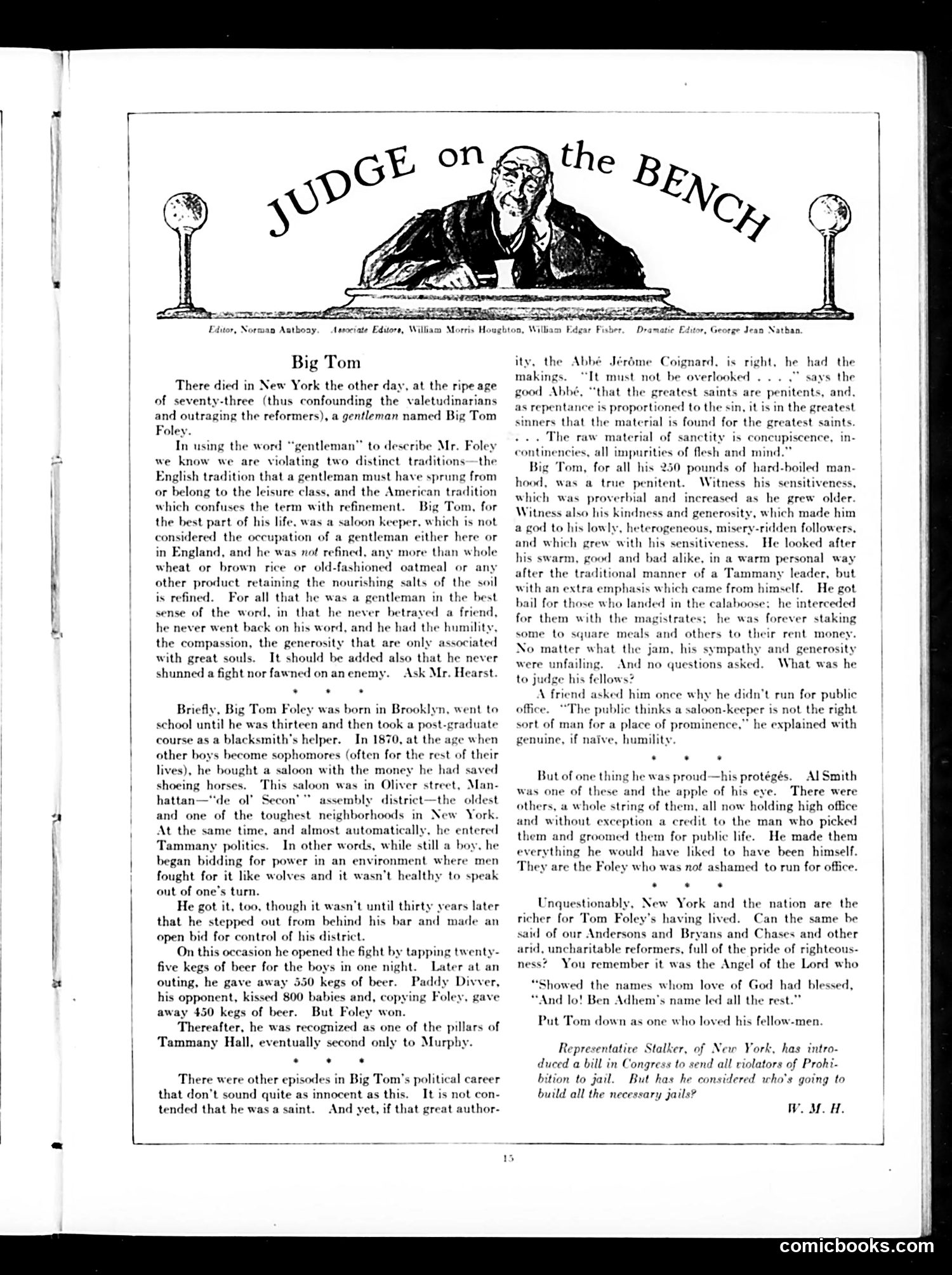
This page presents a laudatory profile of **Big Tom Foley**, a recently deceased New York political figure who died at 73. The article defends Foley against traditional definitions of "gentleman"—he was a saloon keeper in the rough Oliver Street neighborhood who rose through **Tammany Hall** politics (New York's notorious Democratic machine). The satire is subtle: Judge praises Foley's genuine generosity and loyalty to his constituents—bailing them out, interceding with magistrates—while acknowledging his political ruthlessness (referencing unstated episodes "that don't sound quite as innocent"). The joke undercuts reform rhetoric: a crude, unrefined man with working-class roots showed more authentic virtue than genteel elites. By defending a Tammany boss as genuinely noble despite his corruption-adjacent career, Judge ironically critiques both reform hypocrisy and the moral compromises embedded in machine politics. The classical literary reference (Abbé Coignard) reinforces that true character transcends social station.
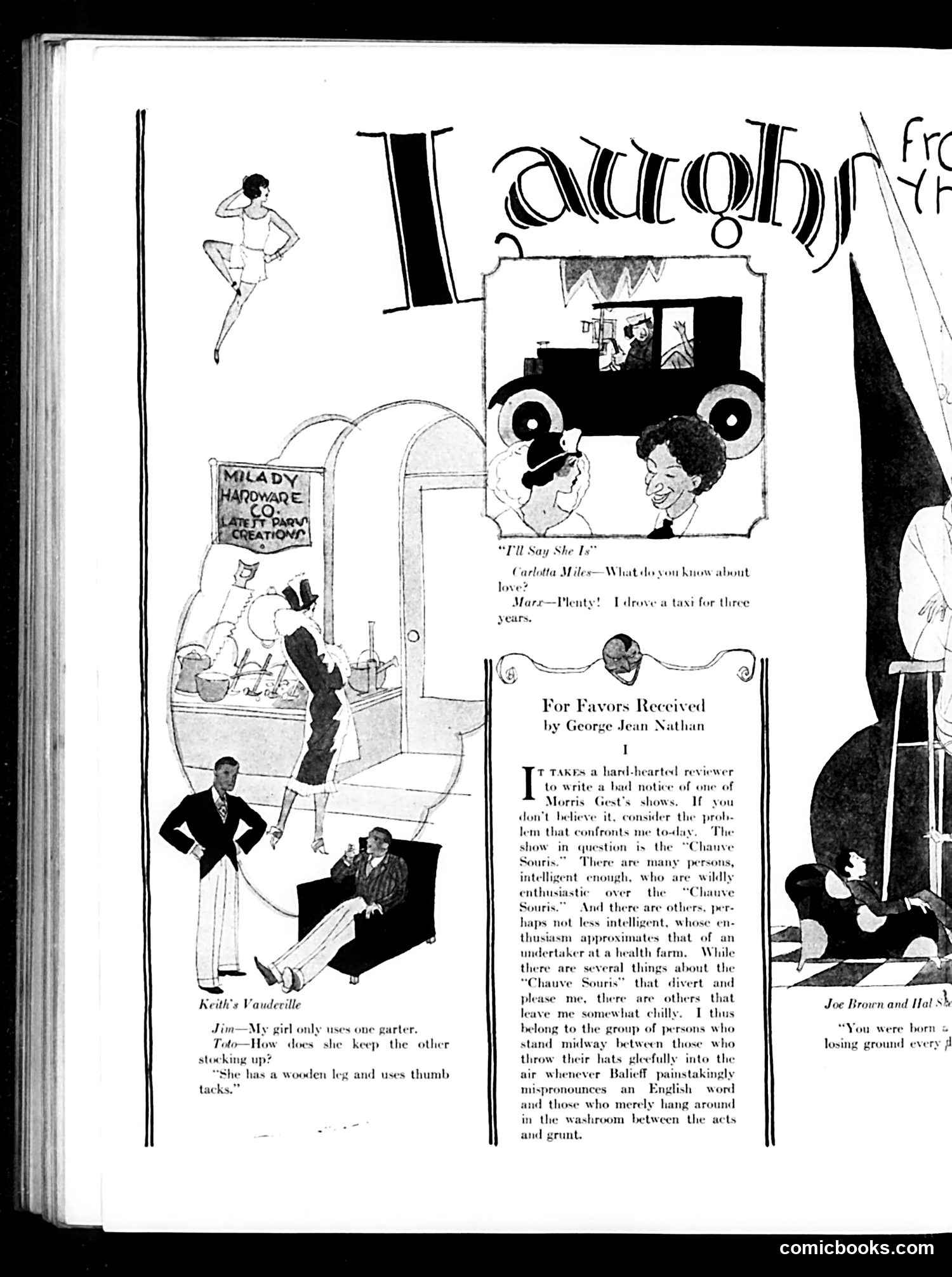
This page contains **vaudeville humor and theater criticism** from Judge magazine's entertainment section. **The vaudeville jokes** ("Keith's Vaudeville") are crude one-liners typical of early 20th-century variety theater—one about a woman with a wooden leg using thumbtacks instead of a garter, another conflating taxi-driving experience with romantic knowledge. These represent the lowbrow comedic style of vaudeville acts. **The main criticism** is by theater reviewer George Jean Nathan, discussing the "Chauve Souris" (a famous Russian cabaret revue). Nathan sarcastically notes that critics struggle to write negative reviews of Morris Gest's productions. He positions himself between two extremes: those who enthusiastically praise Gest's work and those who grudgingly tolerate it. The piece satirizes both **uncritical enthusiasm for fashionable theater** and the social pressure on critics to give favorable reviews to prestigious productions. Nathan uses wit to justify his middling assessment of the show.
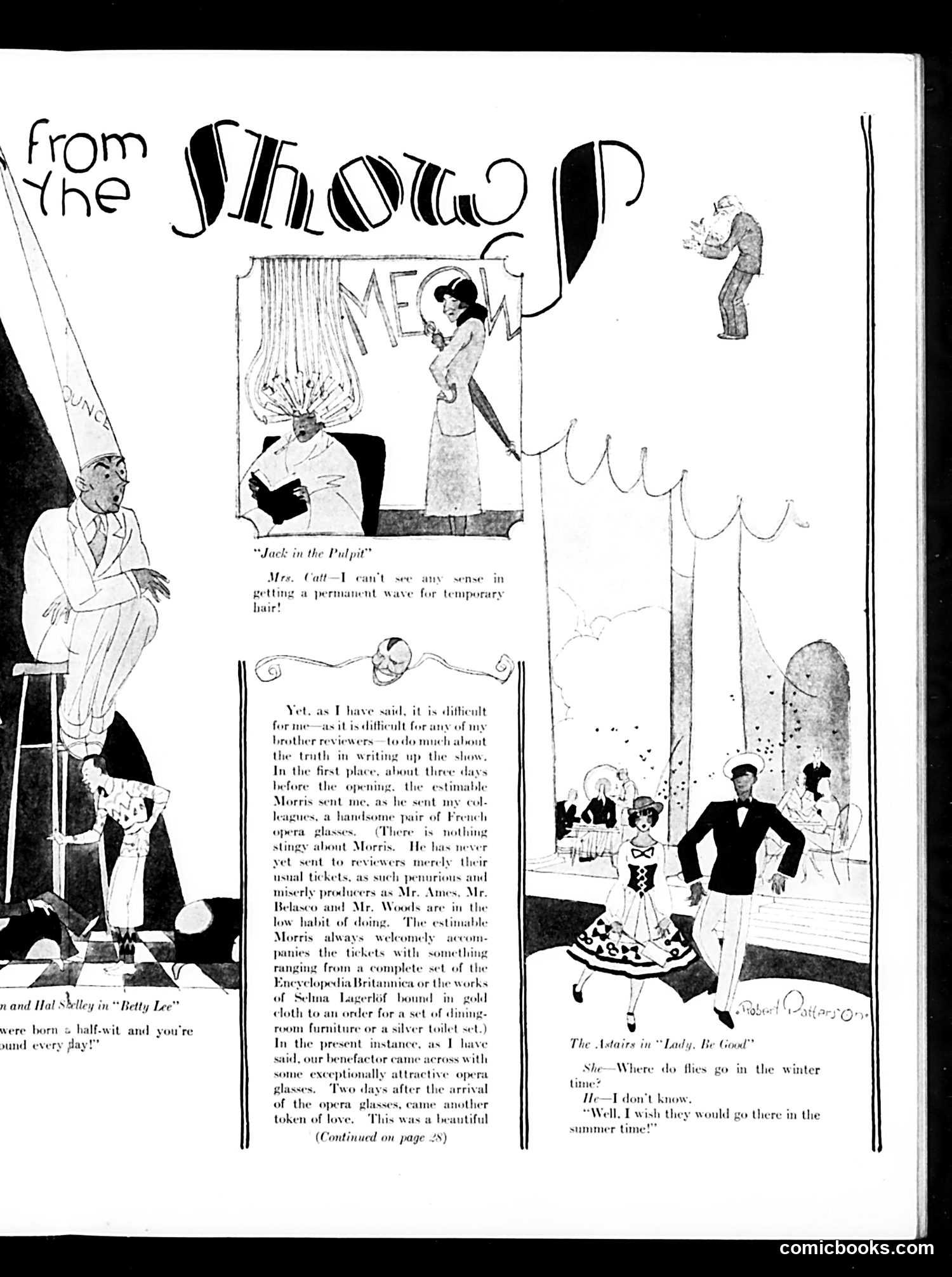
This page satirizes Broadway theater producers and their promotional practices. The central cartoon "Jack in the Pulpit" mocks Mrs. Catt (likely referring to women's suffrage activist Carrie Chapman Catt) for getting a permanent wave—presented as absurdly impractical. The longer article discusses theater critic Morris and how Broadway producers court favorable reviews by lavishing gifts on critics—from French opera glasses to complete Encyclopedia Britannica sets or silver toilet sets. The satire targets the corruption of theater criticism through bribery disguised as generosity. The bottom illustration from "Lady, Be Good" shows a romantic exchange, likely mocking sentimental musical theater dialogue. The overall point: Broadway's review system is compromised by producers' extravagant gift-giving to critics, making honest theatrical criticism impossible.
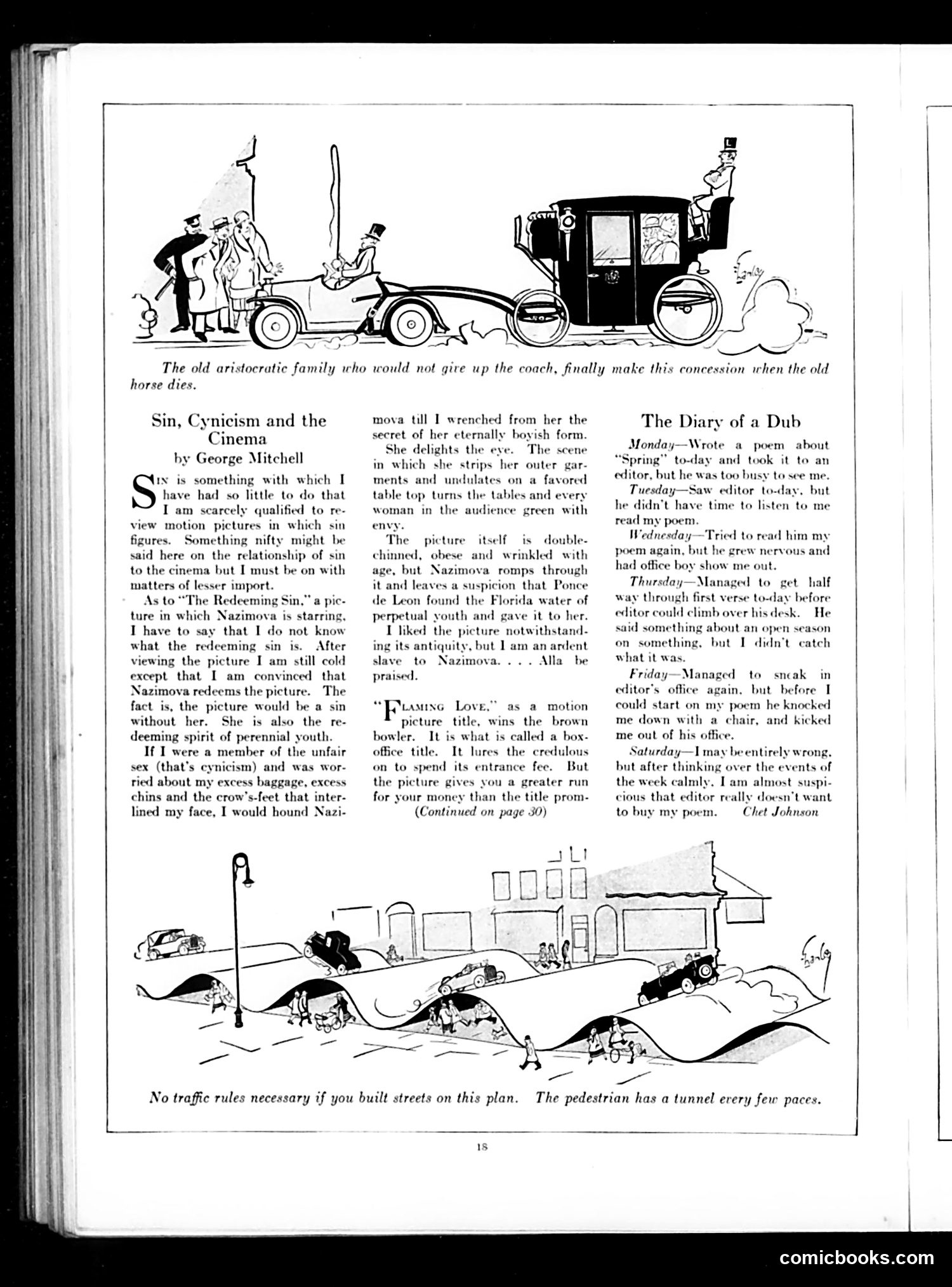
This page contains two satirical pieces from Judge magazine: **Top cartoon:** Shows an aristocratic family reluctantly trading their horse-drawn coach for an automobile after the horse dies—mocking the upper class's resistance to modern technology and social change. **"Sin, Cynicism and the Cinema":** Film critic George Mitchell reviews "The Redeeming Sin" starring Nazimova (a famous silent-film actress). He jokes that the film itself is mediocre ("double-chinned, obese and wrinkled with age"), but Nazimova's youthful beauty and charisma redeem it. The satire targets how star power, not quality storytelling, sells movies. **"The Diary of a Dub":** A humorous diary by Chet Johnson about an aspiring poet desperately trying to show an editor his "Spring" poem. Each day the editor grows more hostile—culminating in physical violence—before the poet finally admits the editor probably doesn't want to buy his work. This satirizes both struggling artists' persistence and editors' frustration with unsolicited submissions.
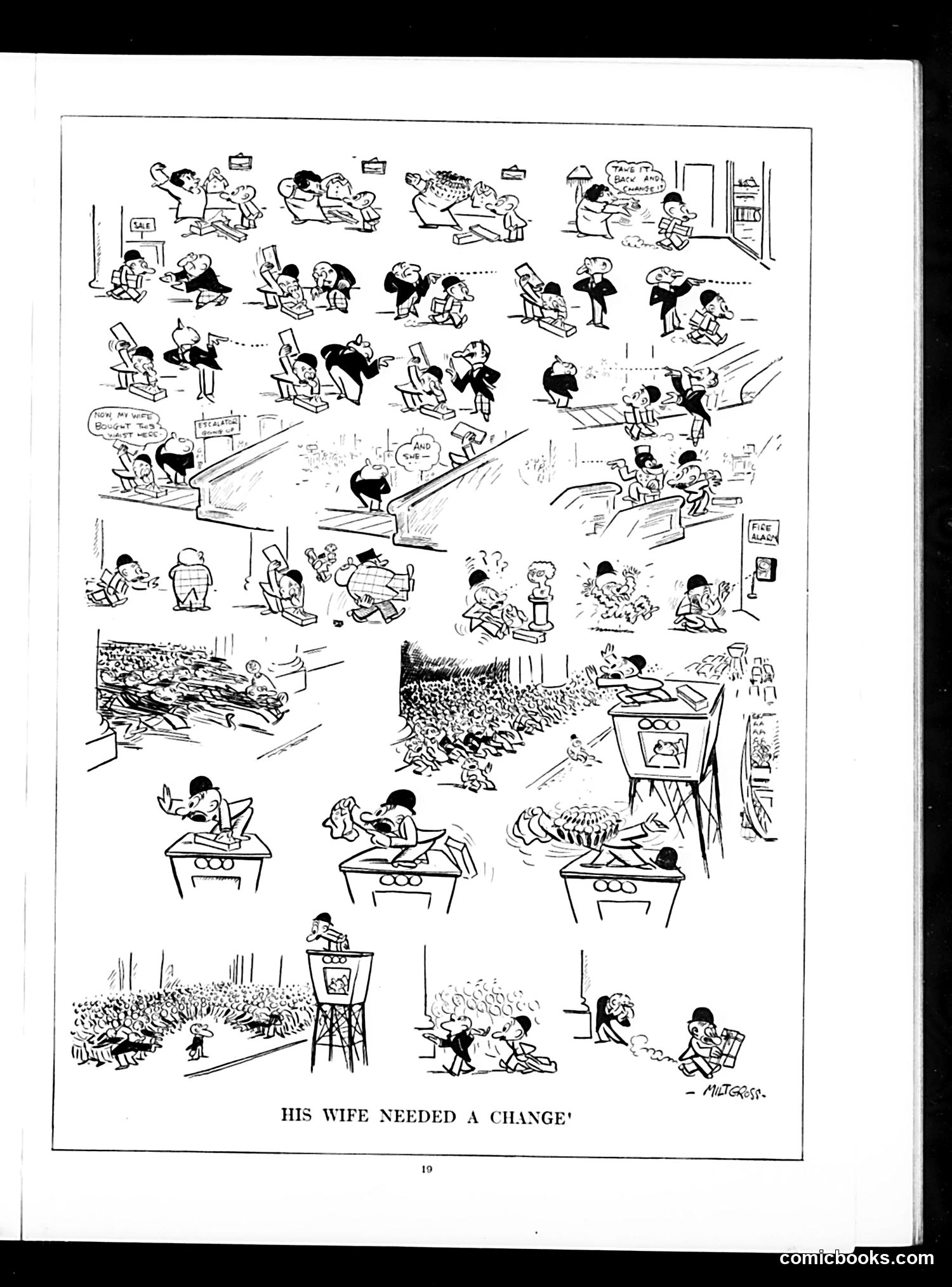
This single-panel comic strip by Mil Gerss (signed lower right) depicts a domestic narrative through sequential vignettes. A husband appears indifferent to his wife's activities throughout their home and daily life—she engages in various domestic tasks and social activities while he reads newspapers and relaxes. The comic culminates in scenes showing the wife literally being taken away or removed (depicted in the trash/disposal bins at bottom), suggesting an absurdist punchline about a wife who "needed a change" being discarded rather than the husband allowing her any actual autonomy or relief from her domestic duties. The satire mocks husbands' dismissiveness toward wives' needs and desires, presenting darkly comic commentary on marital dynamics and women's limited agency in mid-century domestic life.
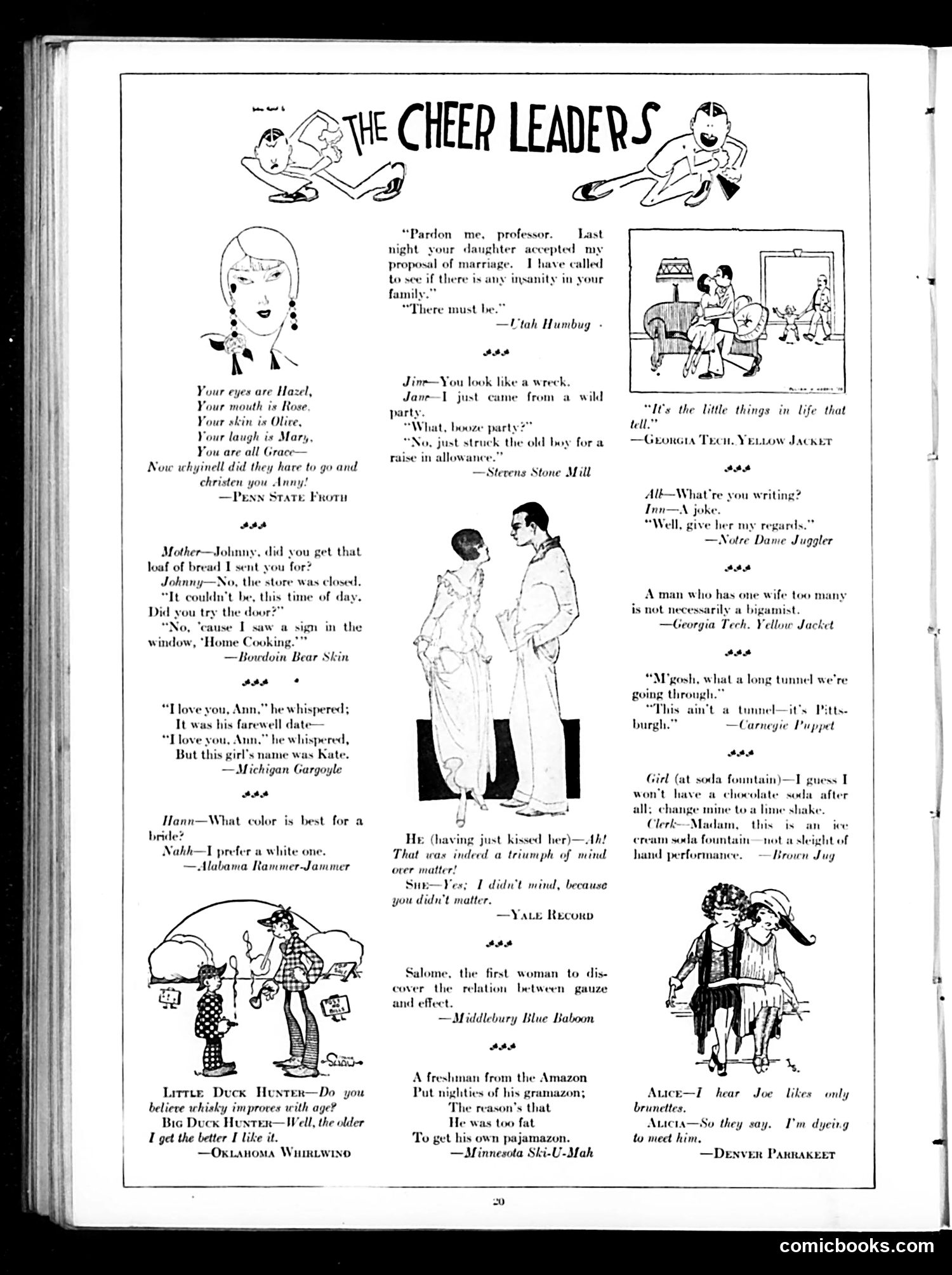
This page collects humorous one-liners and jokes from college humor magazines, attributed to various university publications (Penn State, Michigan, Yale, etc.). The satire targets college life and social conventions of the era. The jokes mock romance and courtship (a man worried his fiancée's family has "insanity"), gender roles (women choosing drinks at soda fountains), and absurd logic (a bigamist joke playing on definitions). One recurring target is pompous authority—a professor asked about family insanity after his daughter accepts a proposal. The cartoon illustrations show domestic scenes and flirting couples, emphasizing the page's focus on courtship humor. The "cheer leaders" title suggests these quips are meant to entertain college readers. The humor reflects period attitudes about marriage, propriety, and gender that modern readers would recognize as dated—particularly the casual treatment of mental illness and the focus on women's appearance and marriageability.
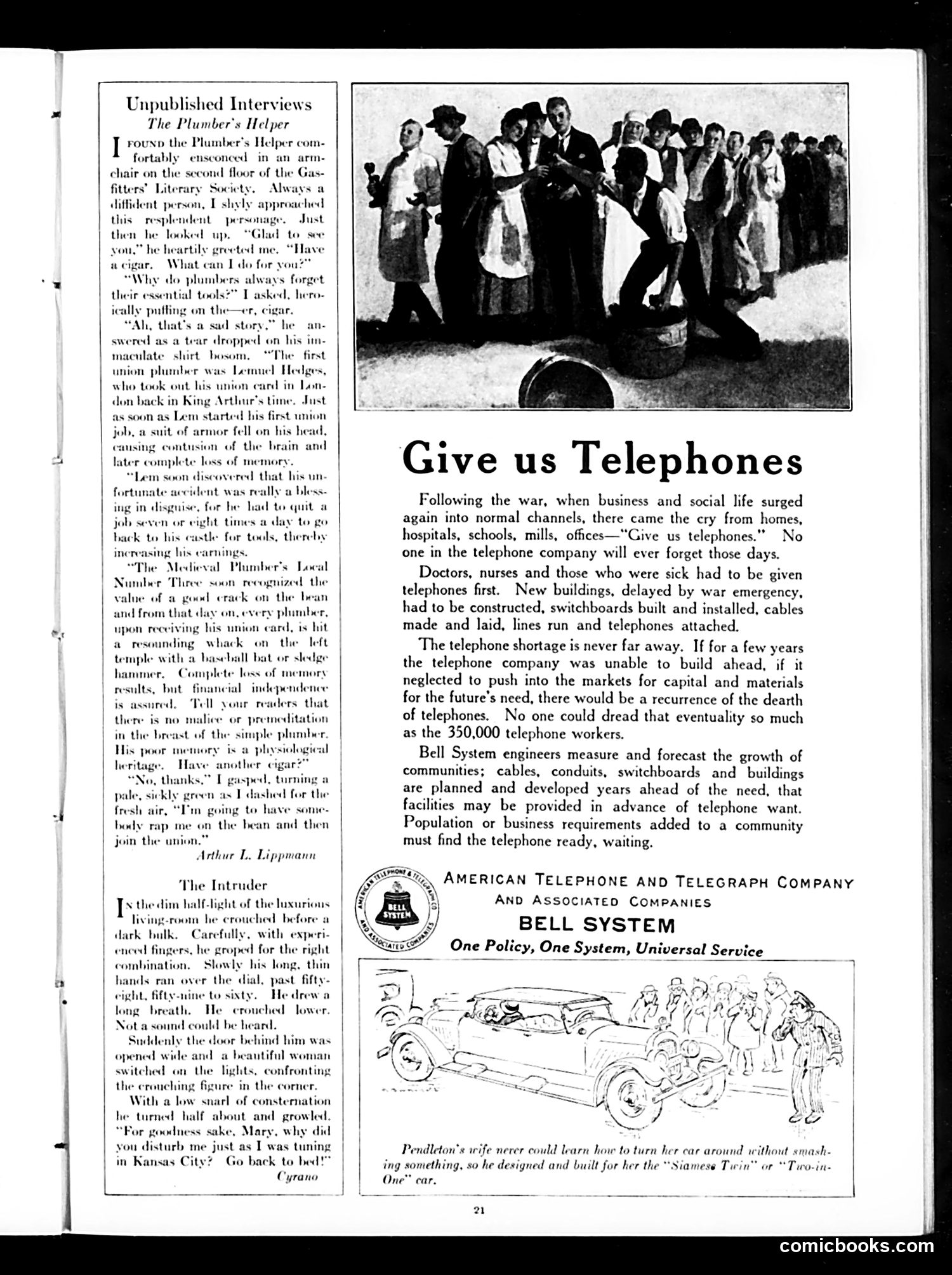
This page contains two satirical pieces and a Bell System advertisement: **"The Plumber's Helper"** (top left): A humorous interview where the narrator asks a plumber's helper why plumbers forget essential tools. The helper responds with an absurd historical narrative: the first union plumber, Lemuel Hedges, worked in King Arthur's time and was struck on the head by armor, causing brain damage. The joke satirizes both labor unions (portraying them as ancient and ridiculous) and the stereotype of plumbers as forgetful. **"The Intruder"** (lower left): A brief comedic story about a man burglarizing a house, only to be interrupted by his wife Mary asking why he's disturbing her while she's tuning a radio to Kansas City. The humor lies in the domestic intrusion ruining criminal activity—a reversal of typical burglary narratives. **Bell System Advertisement** (right): Promotes post-WWI telephone expansion, emphasizing that doctors, nurses, and hospitals needed phones first. It includes a cartoon showing a man designing a special "Two-in-One" car for his wife Pendleton because she cannot turn the car around without crashing into things—mocking women drivers.
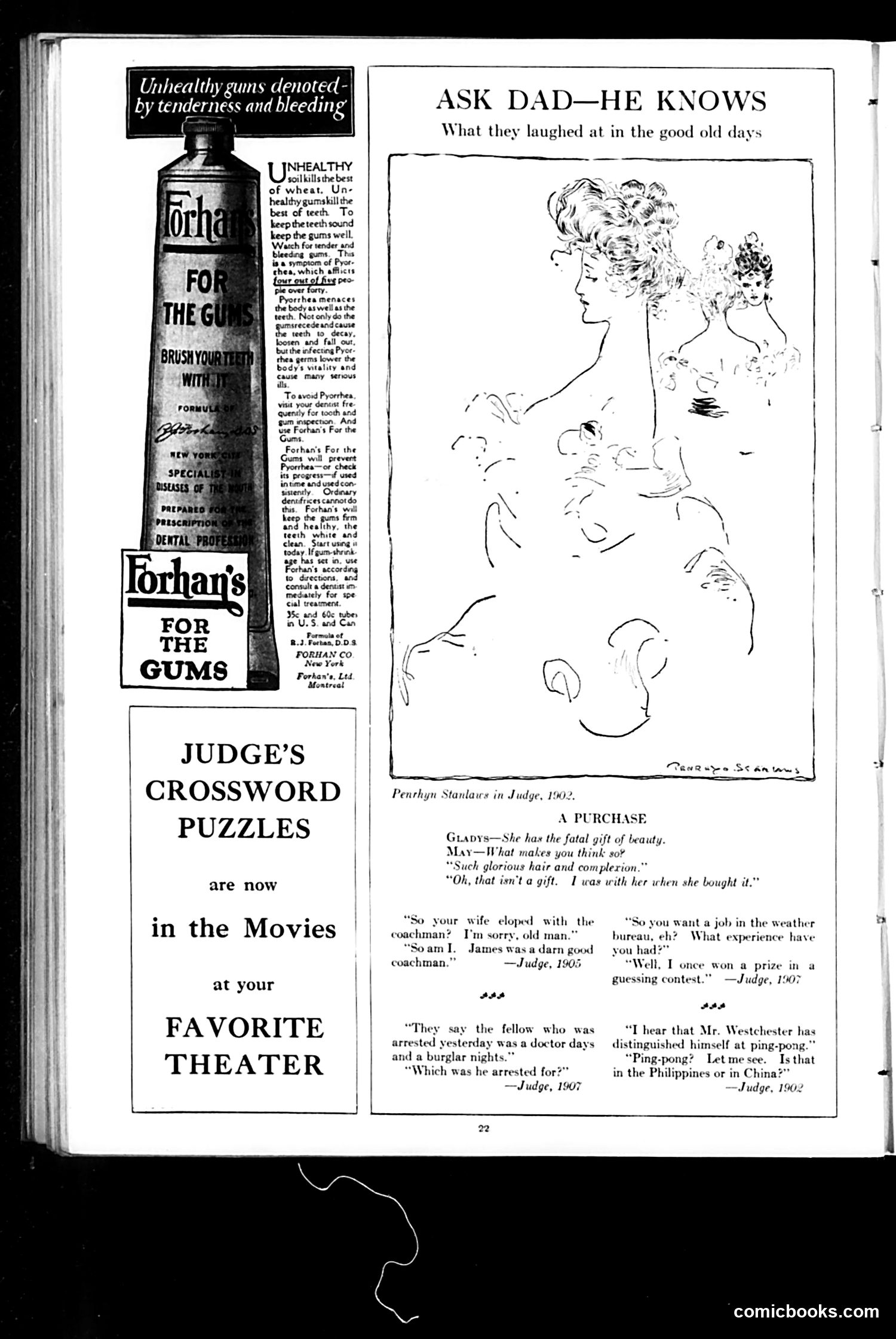
This page mixes advertising with vintage humor. The left side features a **Forhan's toothpaste ad** targeting men anxious about pyorrhea (gum disease), using medical fear-mongering—common early 1900s advertising tactics. The main content is "**Ask Dad—He Knows**," a humor column of jokes attributed to *Judge* magazine (1902-1907). The cartoon by Penrhyn Stanlaws depicts a flirtatious scene illustrating period attitudes about women's appearance and sexuality. The jokes reflect early 20th-century sensibilities: one mocks a woman's purchased beauty rather than natural attributes; another jokes about a doctor-burglar's arrest priorities; one ridicules geographical ignorance about ping-pong (recently trendy); another plays on incompetence in civil service jobs. The humor is mostly gentle social observation about vanity, incompetence, and changing technologies—typical of *Judge's* satirical but non-partisan approach. These represent what audiences found amusing in the "good old days," now mostly dated or mildly offensive by modern standards.
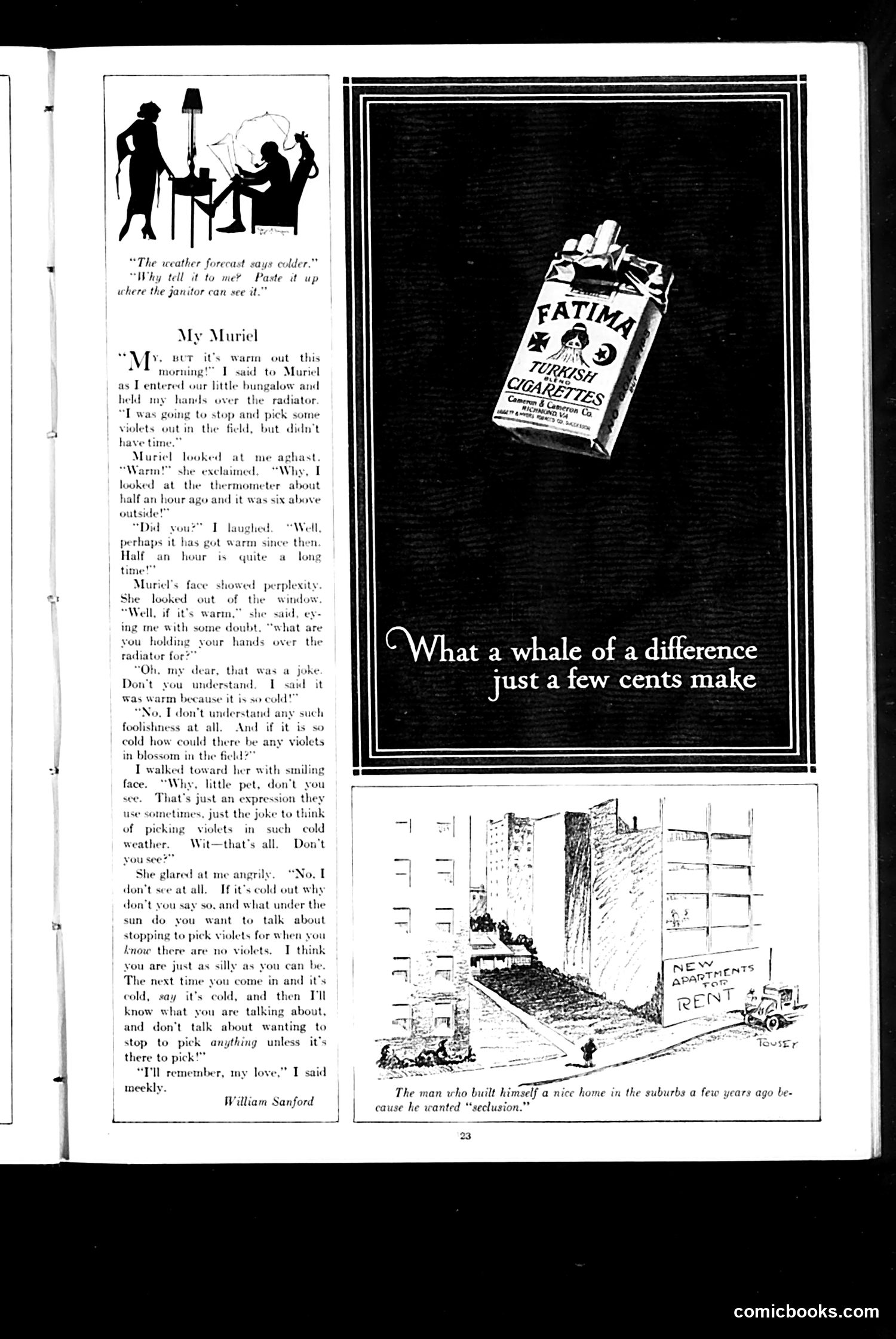
**"My Muriel"** (left): A domestic comedy about a husband's failed wit. He jokes that it's warm outside while shivering by the radiator—then compounds the error by romanticizing picking violets in cold weather. His wife Muriel, exasperated, demands he speak plainly: say it's cold if it's cold. The satire targets husbands who think clever wordplay excuses them from honest communication, and wives' frustration with such performative nonsense. It's a period-typical "battle of the sexes" joke. **Top right advertisement**: A Fatima Turkish Cigarettes ad emphasizing that quality costs only "a few cents more"—a sales pitch suggesting premium cigarettes at modest price differences. **Bottom cartoon**: Depicts a suburban home with a "New Apartments for Rent" sign nearby. The caption notes the homeowner built his house seeking "seclusion," but now faces urban encroachment and development—satirizing how suburban isolation proves temporary as cities expand, rendering his retreat obsolete.
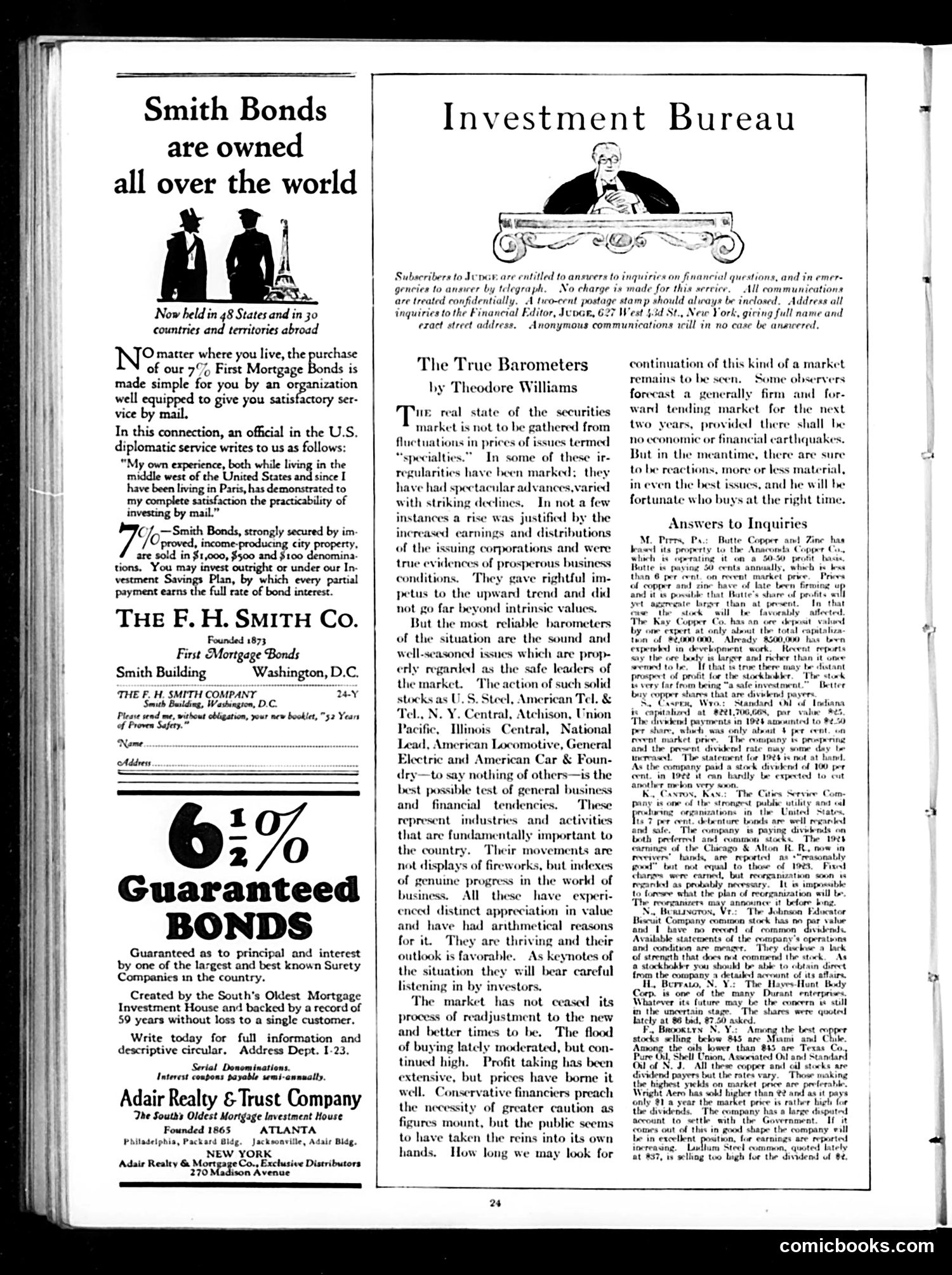
This page is primarily **advertising**, not political satire. It features bond and investment offerings from The F.H. Smith Company and Adair Realty & Trust Company, typical of early-20th-century financial publications. The left side shows a simple illustration of two gentlemen in top hats with the Eiffel Tower, emphasizing that Smith Bonds are sold internationally—a marketing point suggesting safety and global confidence. The right side contains an "Investment Bureau" advice column by Theodore Williams offering investment guidance. Williams argues that reliable stock market health is measured not by speculative stocks' dramatic price swings, but by steady performance of established industrial leaders like U.S. Steel, AT&T, and railroads. This reflects early-1900s economic thinking: fundamental industries indicate genuine business health versus market speculation. There is no political satire or caricature present. This is straightforward financial advertising and investor guidance.
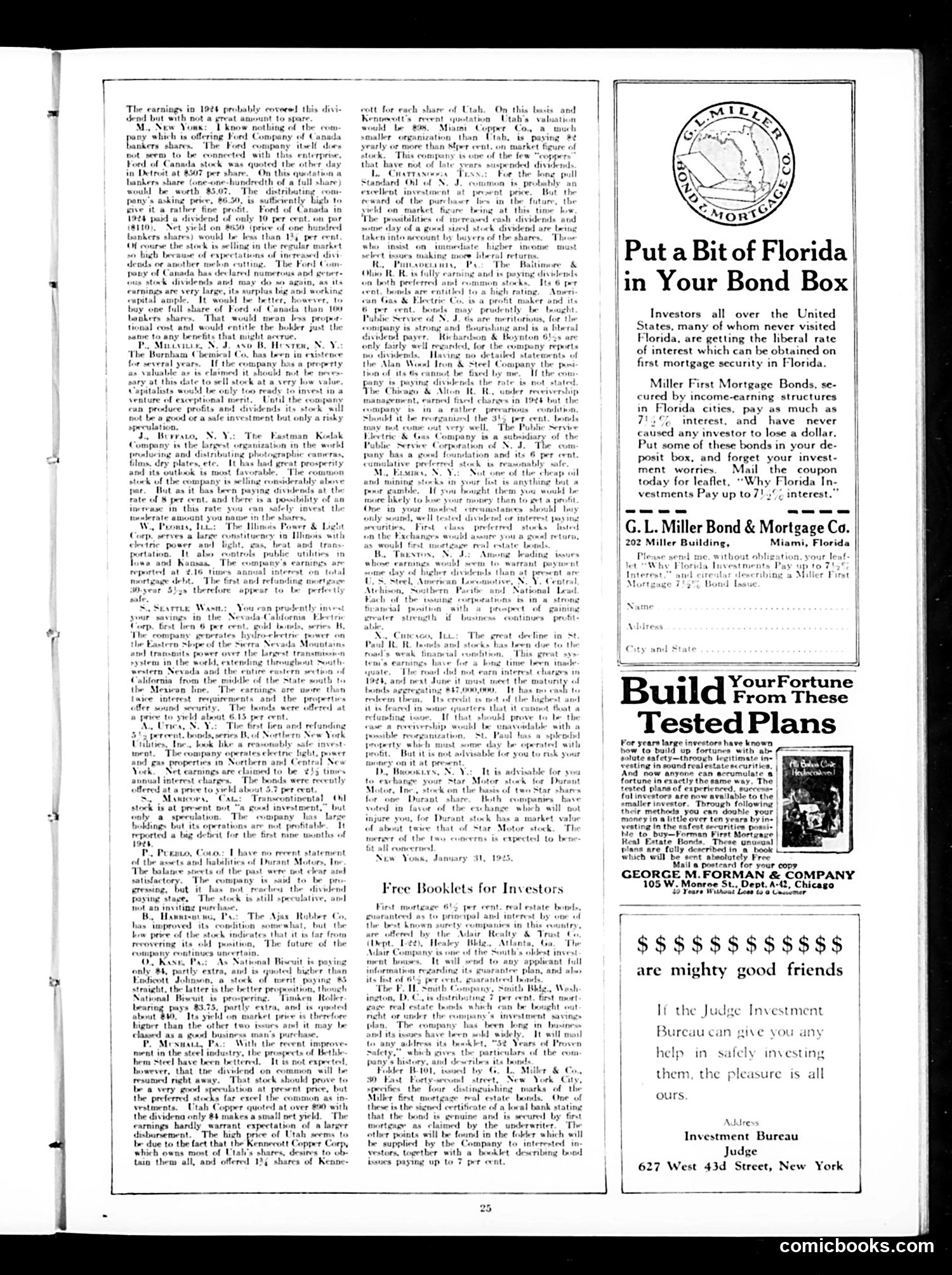
This page is primarily **advertising and investment advice**, not political satire. The dominant content consists of financial recommendations and bond advertisements targeting investors. The main featured advertisement is "Put a Bit of Florida in Your Bond Box" by G.L. Miller Bond & Mortgage Company, promoting Florida real estate mortgages paying 7.5% interest. Below that is George M. Forman & Company advertising "Free Booklets for Investors." The left column contains investment commentary about various stocks (Ford, Standard Oil, Kennecott Copper, Eastern Kodak) written in response to reader inquiries—typical of financial advice columns in 1920s publications. At bottom right is an advertisement from "Judge Investment Bureau" offering investment guidance services. There is **no political cartoon or satire visible** on this page. Judge magazine during this era mixed satirical content with substantial financial advertising, reflecting the investment-focused interests of its primarily affluent readership during the prosperous 1920s.
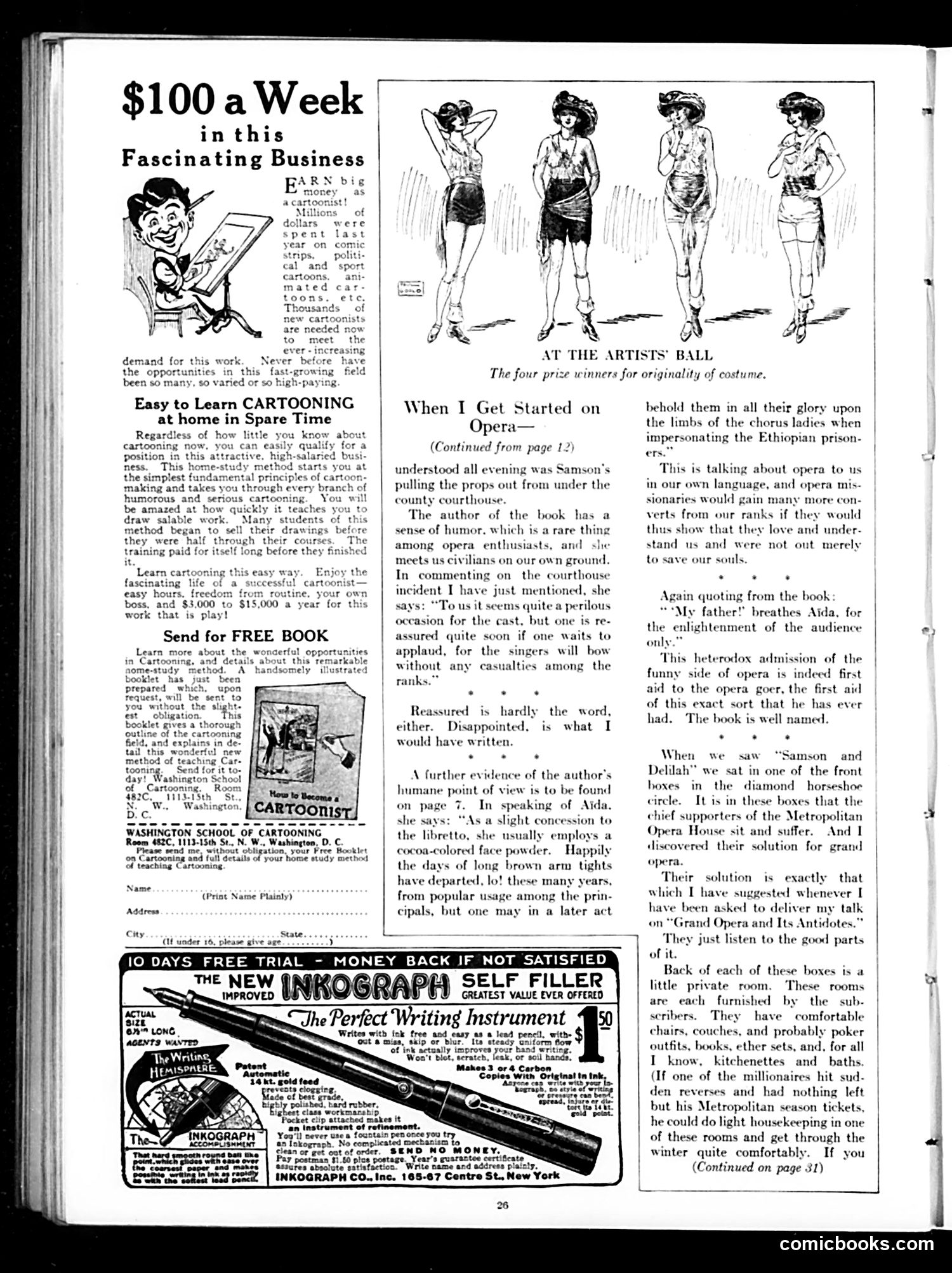
This page is primarily **advertising and light commentary**, not political satire. The dominant content includes: **The Cartoons/Images:** - Left: A cheerful caricature promoting a mail-order cartooning course ($100/week earnings promised) - Right: Four stylized female figures labeled "At the Artists' Ball" - prize winners for costume originality, drawn in the period's fashion-illustration style **The Editorial Content:** A humorous essay titled "When I Get Started on Opera" mocks opera's pretentiousness and inaccessibility to ordinary audiences. The author quotes a book critiquing opera's overwrought conventions—particularly the absurdity of an opera character saying "My father! breathes Aida, for the enlightenment of the audience only." The piece satirizes how wealthy Metropolitan Opera patrons cope by retreating to private boxes with comfortable furniture, essentially ignoring the performance itself. **The Point:** This is social satire targeting elitist opera culture and advertising-driven self-improvement schemes, typical of Judge's early 20th-century humor targeting middle-class aspirations and cultural pretension.
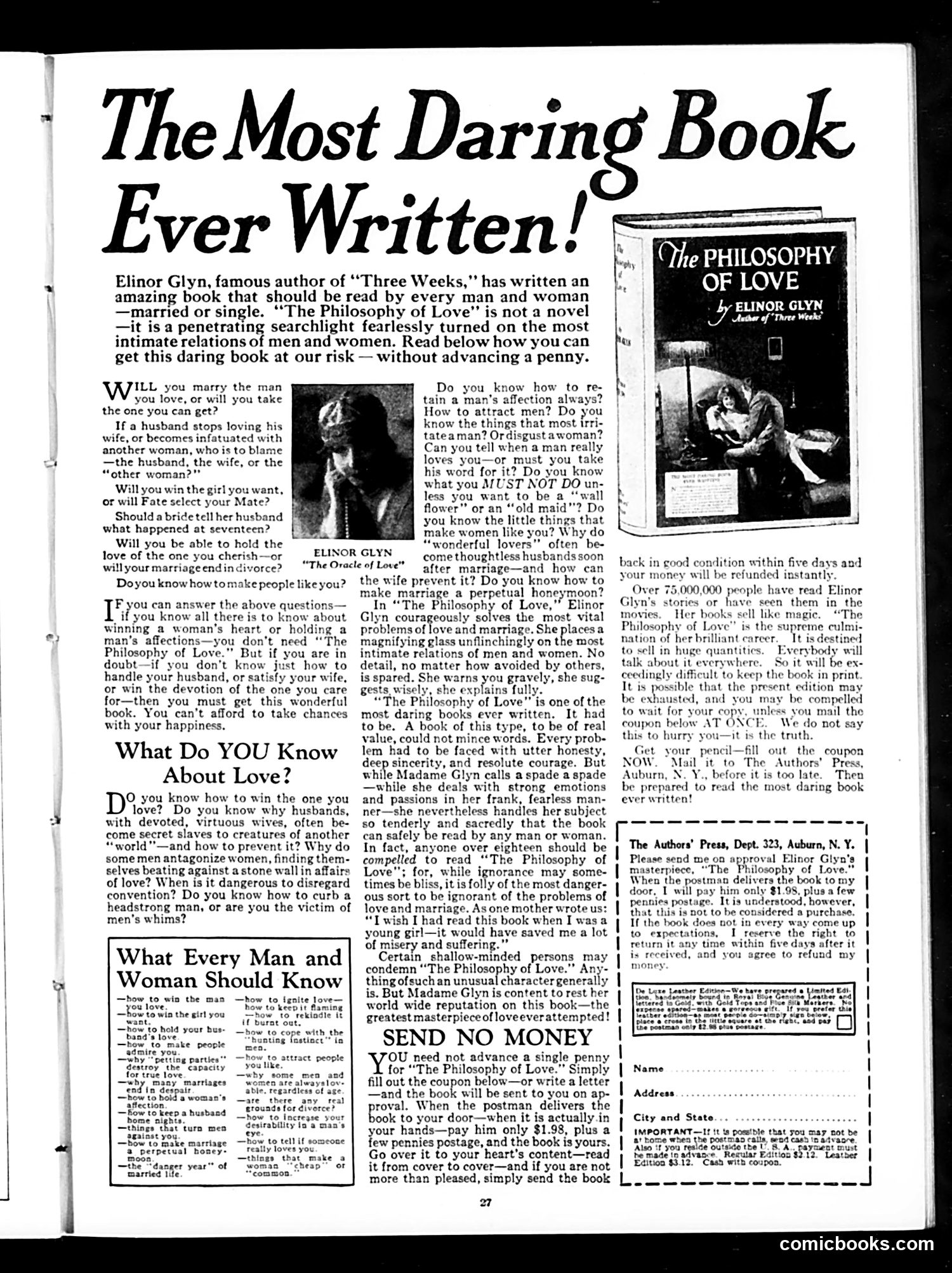
This page is primarily a mail-order advertisement for Elinor Glyn's non-fiction book about relationships and marriage. Glyn was a real, famous author known for her scandalous 1907 novel "Three Weeks." The advertisement uses sensationalist marketing, promising the book answers provocative questions about love, attraction, and marriage—targeting both men and women. The rhetorical questions exploit anxieties about courtship, infidelity, divorce, and marital satisfaction. The copy emphasizes the book's "daring" and "frank" nature, positioning it as honest and courageous compared to conventional silence on intimate matters. This reflected early 20th-century anxieties about modern relationships and changing gender roles. The "risk-free" offer (pay only $1.98 plus postage) was a common mail-order tactic. The advertisement presents relationship expertise as purchasable knowledge, appealing to readers uncertain about romantic success.
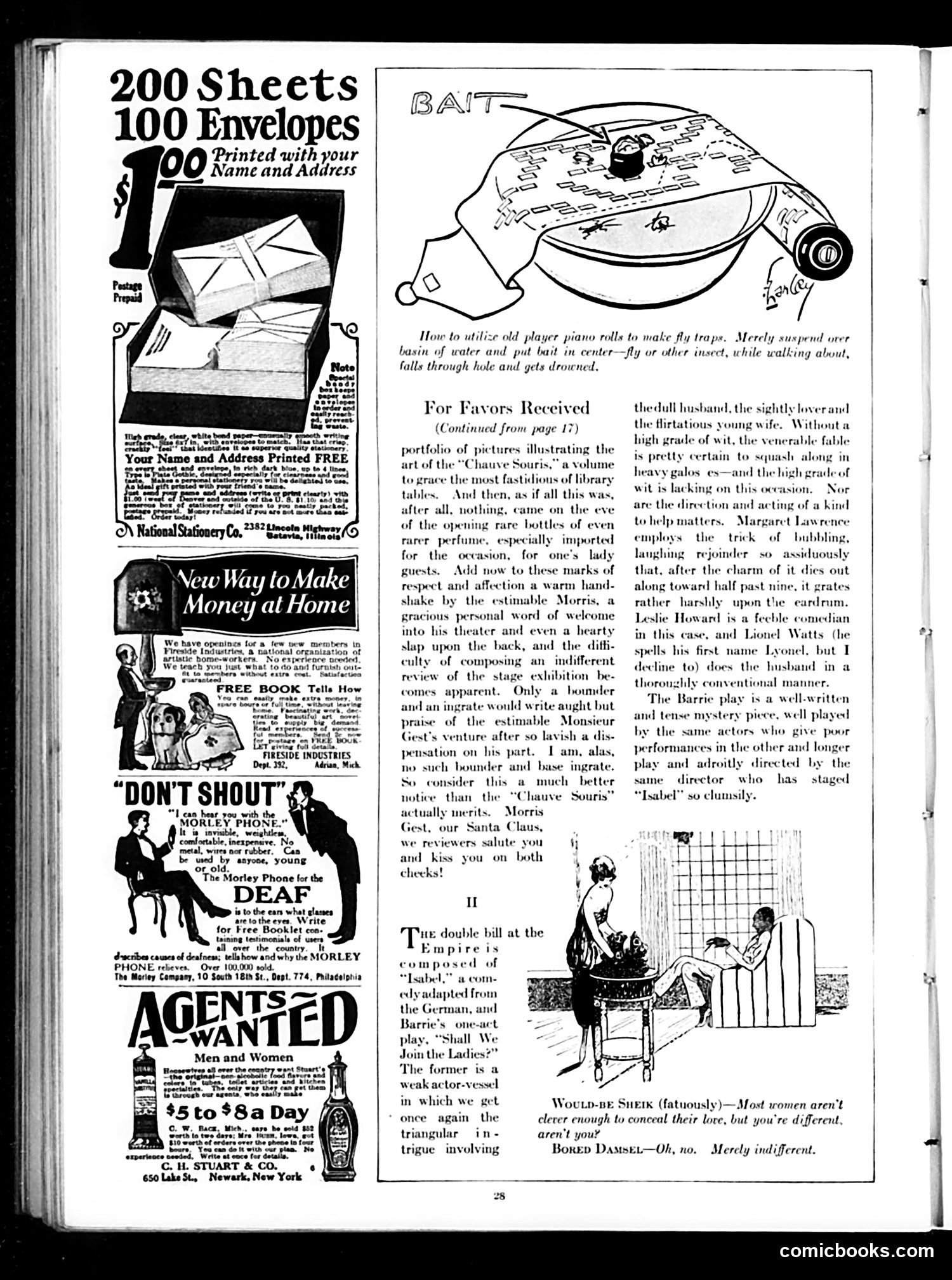
This page is primarily **advertising**, not political satire. The left column contains commercial ads for stationery ($1.00 for 200 sheets/100 envelopes), a "make money at home" scheme, the Morley Phone (a hearing aid for deaf users), and employment opportunities. The right side contains theater reviews, likely from the magazine's entertainment section. The critic discusses two plays at the Empire theater: "Isabel" (a weak German comedy about a tired romantic triangle) and Barrie's "Shall We Join the Ladies?" The reviews critique the performances of actors Leslie Howard and Lionel Watts, praising the director's work on one piece while criticizing it on another. At the bottom, there's a small cartoon captioned "Would-be Sheik" showing flirtation dialogue—light social satire about romantic pretense, not political commentary. The page reflects 1920s consumer culture and entertainment criticism rather than substantive political content.
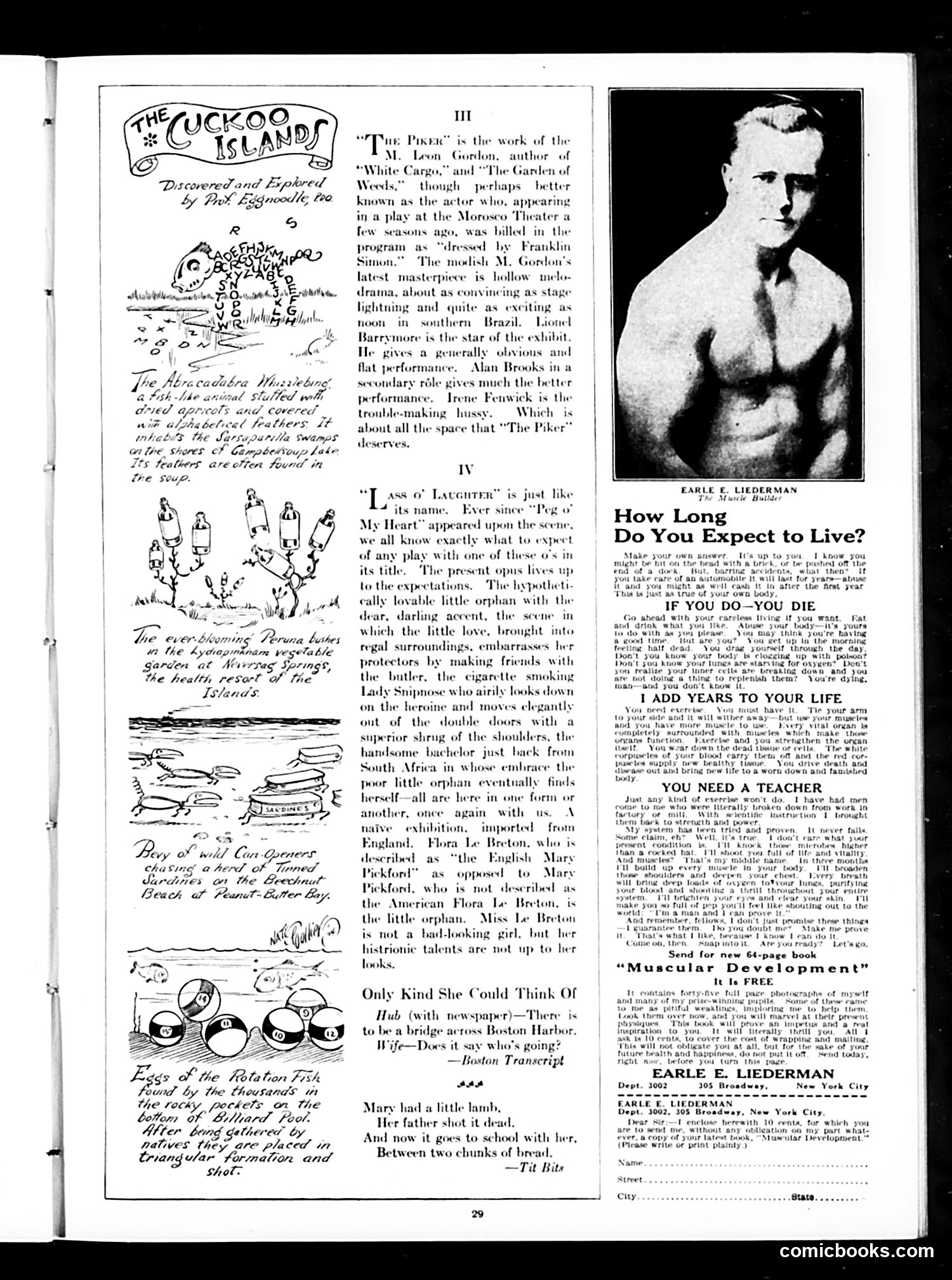
This page combines theatrical reviews with vintage advertising. The left side satirizes two plays through invented "discoveries" on the fictional "Cuckoo Island"—a visual metaphor mocking the absurd plots. **"The Piker"** (Section III) is reviewed harshly: the critic dismisses M. Leon Gordon's drama as unconvincing, with Lionel Barrymore delivering an "obvious and flat" performance. The satire suggests the play is empty spectacle. **"Lass of Laughter"** (Section IV) receives similar mockery for being a predictable tearjerker featuring orphan-girl tropes (poor girl in rich household, melodramatic scenarios, social-climbing villains). Flora Le Breton, described as "the English Mary Pickford," is criticized as attractive but lacking talent—the satire being that pretty actresses without skill can still get roles. The small joke about a Boston Harbor bridge reflects contemporary gossip-column humor. **The right side is advertising**: Earle E. Liederman promoting his bodybuilding course "Muscular Development," using fear-based marketing about premature death without proper fitness.
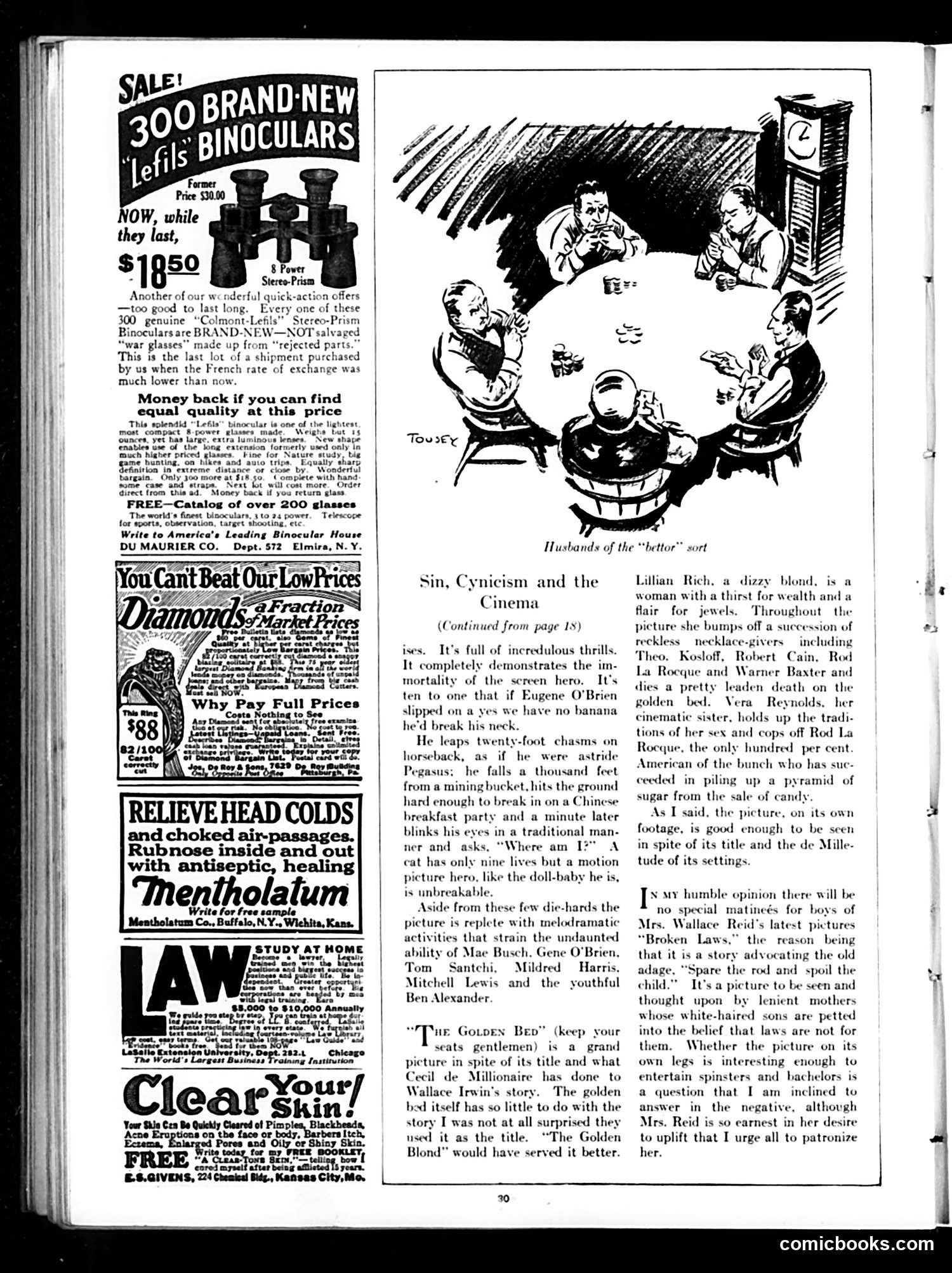
This page is primarily **advertisements** for consumer products (binoculars, Mentholatum, skin treatments, etc.) typical of 1920s magazines. The main editorial content is a **film review column** titled "Sin, Cynicism and the Cinema," discussing recent movies. The reviewer critiques several films: - A picture featuring Eugene O'Brien, praised for demonstrating the "immortality of the screen hero" through absurd stunts (falling thousands of feet unharmed, leaping chasms) - **"The Golden Bed,"** a Cecil B. DeMille production starring Lillian Rich and others, which the reviewer dismisses as having little connection to Wallace Irwin's original story despite its grand production values - **"Broken Laws,"** starring Wallace Reid, which the reviewer recommends as a morality tale about discipline The cartoon illustration (bottom right) shows what appears to be **husbands of the "better" sort**—men in a casual domestic setting, likely satirizing masculine domesticity or marital dynamics of the era. The tone is cynical about cinema's melodrama while acknowledging its technical achievements.
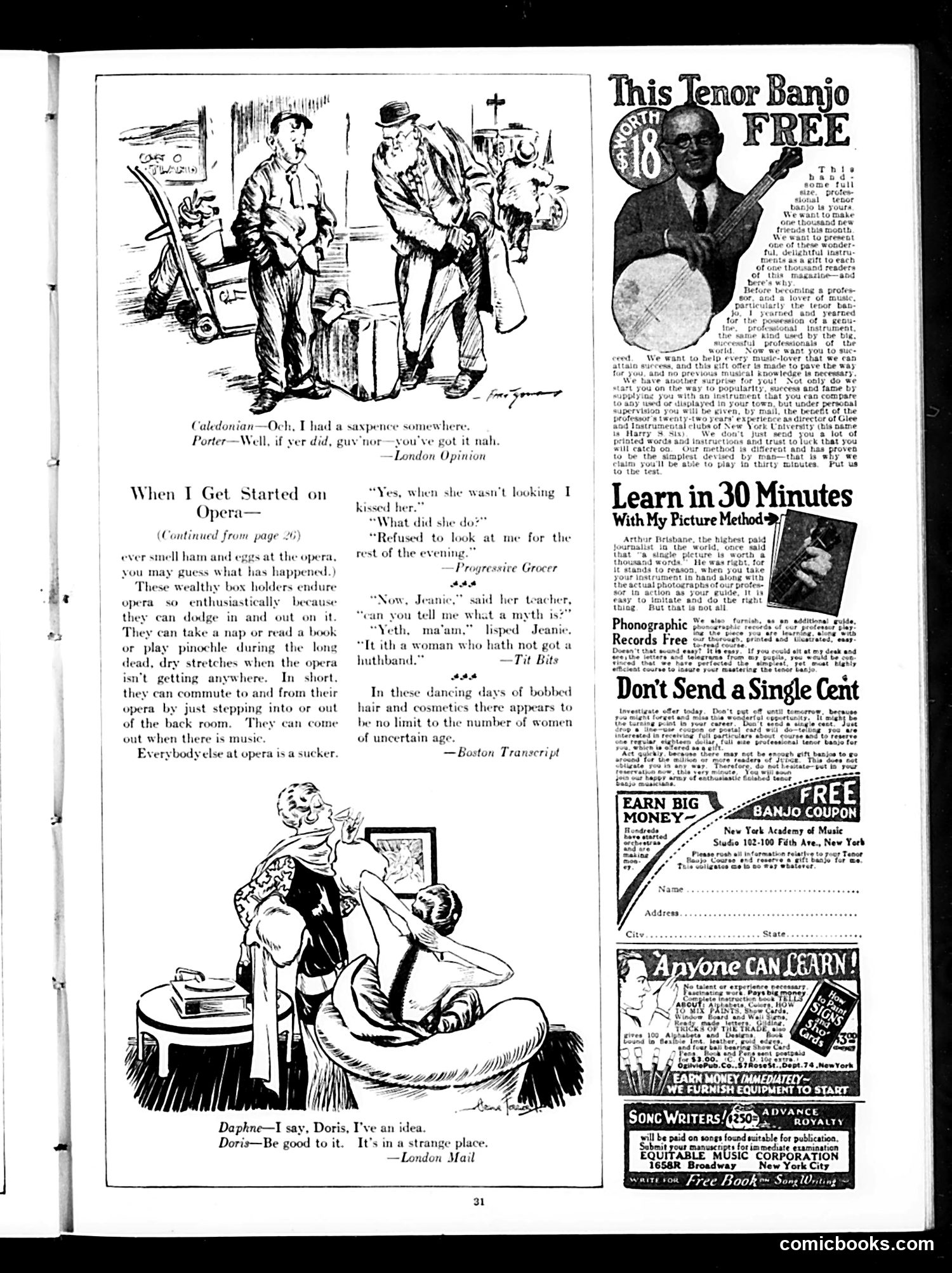
This page contains social humor rather than political cartoons. The main content includes three brief comedic anecdotes mocking upper-class opera attendance and gender relations: 1. **Opera Box Holders**: Satirizes wealthy patrons who treat the opera as a social venue rather than cultural event—napping, reading, playing cards, and sneaking in/out through back rooms to avoid actually listening to music. The joke: "Everybody else at opera is a sucker." 2. **Romance/Courtship Jokes**: Brief quips about a man kissing a woman without permission and a teacher asking a student to define "myth" (implying men who claim to want marriage). Standard period humor about gender dynamics. 3. **Modern Women**: A Boston Transcript quip about bobbed hair and cosmetics making it impossible to determine women's ages. The right side is dominated by **advertisements** for music instruction, banjo lessons, and music publishing—typical magazine filler of the era. No specific political figures or events are referenced. This is primarily entertainment-focused satirical content targeting class pretension and conventional social attitudes.
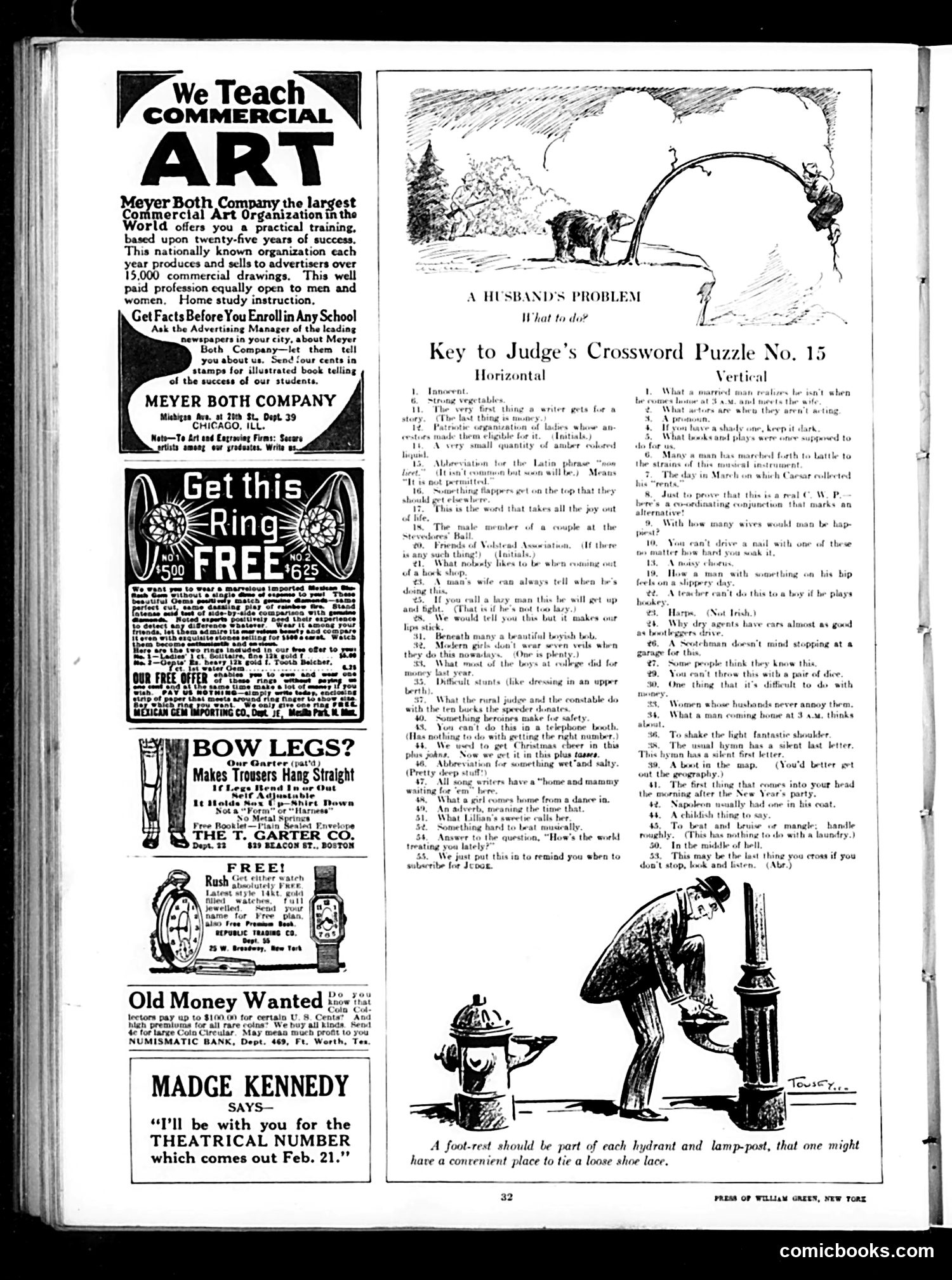
This page is primarily **advertising and editorial content** rather than political satire. The dominant elements are: **Advertisements:** - Meyer Both Company promoting commercial art training - Various personal products (bow-leg correctors, watches, old coins, rings) - Madge Kennedy promoting an upcoming theatrical issue **Main Content:** The centerpiece is "A Husband's Problem: What to do?" — a cartoon showing a man fishing while his wife appears upset on the shore. This illustrates domestic tension, likely about leisure time spent away from marital duties. Below is the answer key to Judge's Crossword Puzzle No. 15, with clues referencing contemporary concerns: women's fashion, dancing, automobiles, and social customs. The final cartoon caption about hydrants and lamp-posts as shoe-lace-tying spots is gentle social commentary on urban inconvenience. **Overall:** This appears to be a standard issue page mixing commercial product pitches with lighthearted domestic humor and wordplay puzzles—typical Judge magazine filler material rather than incisive political or social satire.
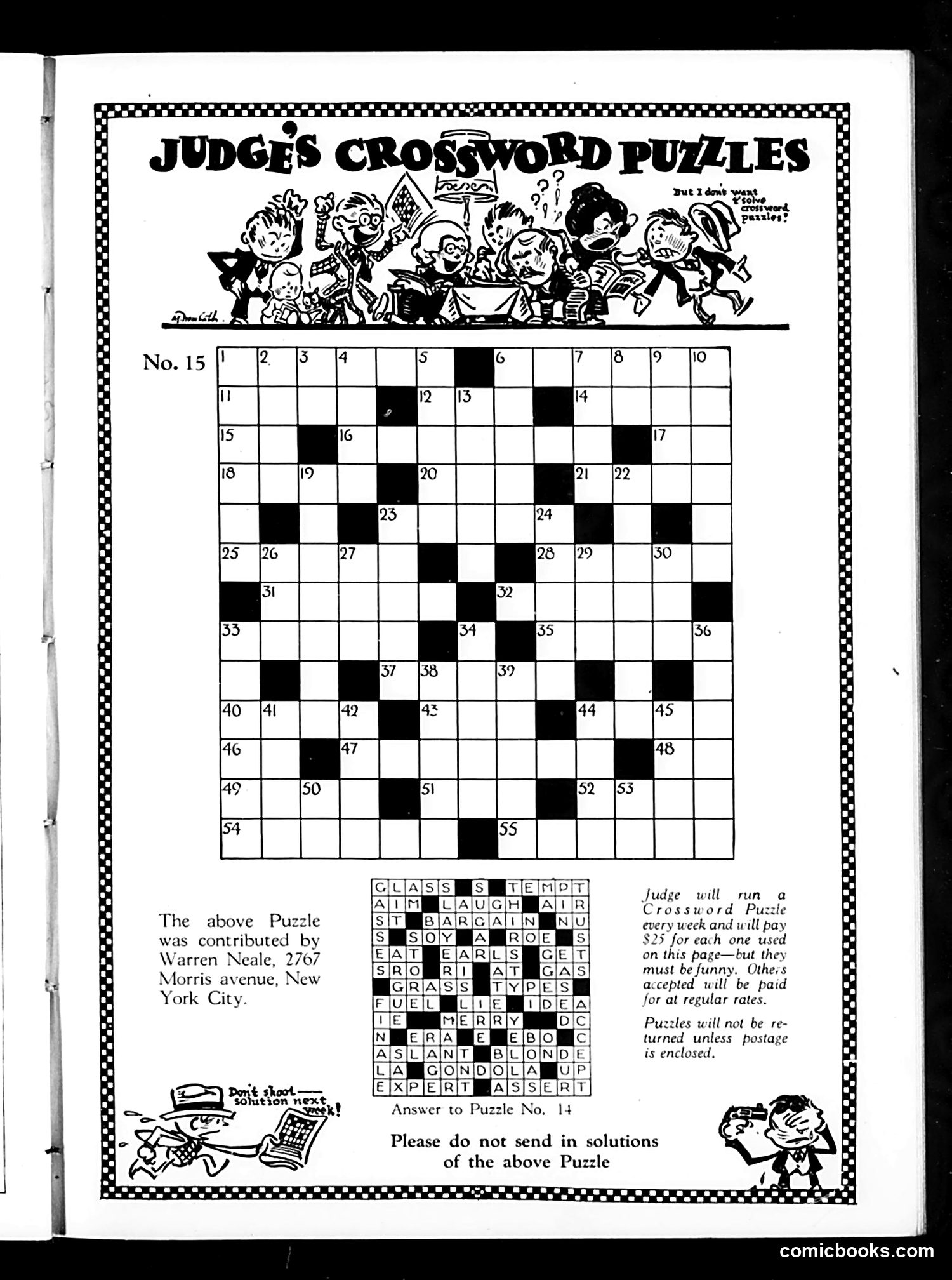
This page features **Judge magazine's weekly crossword puzzle contest** (No. 15), not a political cartoon. The magazine offered $25 payment for crossword puzzles submitted by readers that contained humorous clues or themes—a significant incentive during this era. The page includes a solved example puzzle (answer to Puzzle No. 14) showing typical crossword entries like "CLASS," "AIM," "LAUGH," and "GRASS." The cartoon illustrations are generic decorative elements showing children and judges, not satirizing specific figures or events. The key social context: Judge was soliciting reader-created content, turning puzzle-construction into a participatory, monetized activity for subscribers—an early form of audience engagement in print media before digital crowdsourcing became standard.
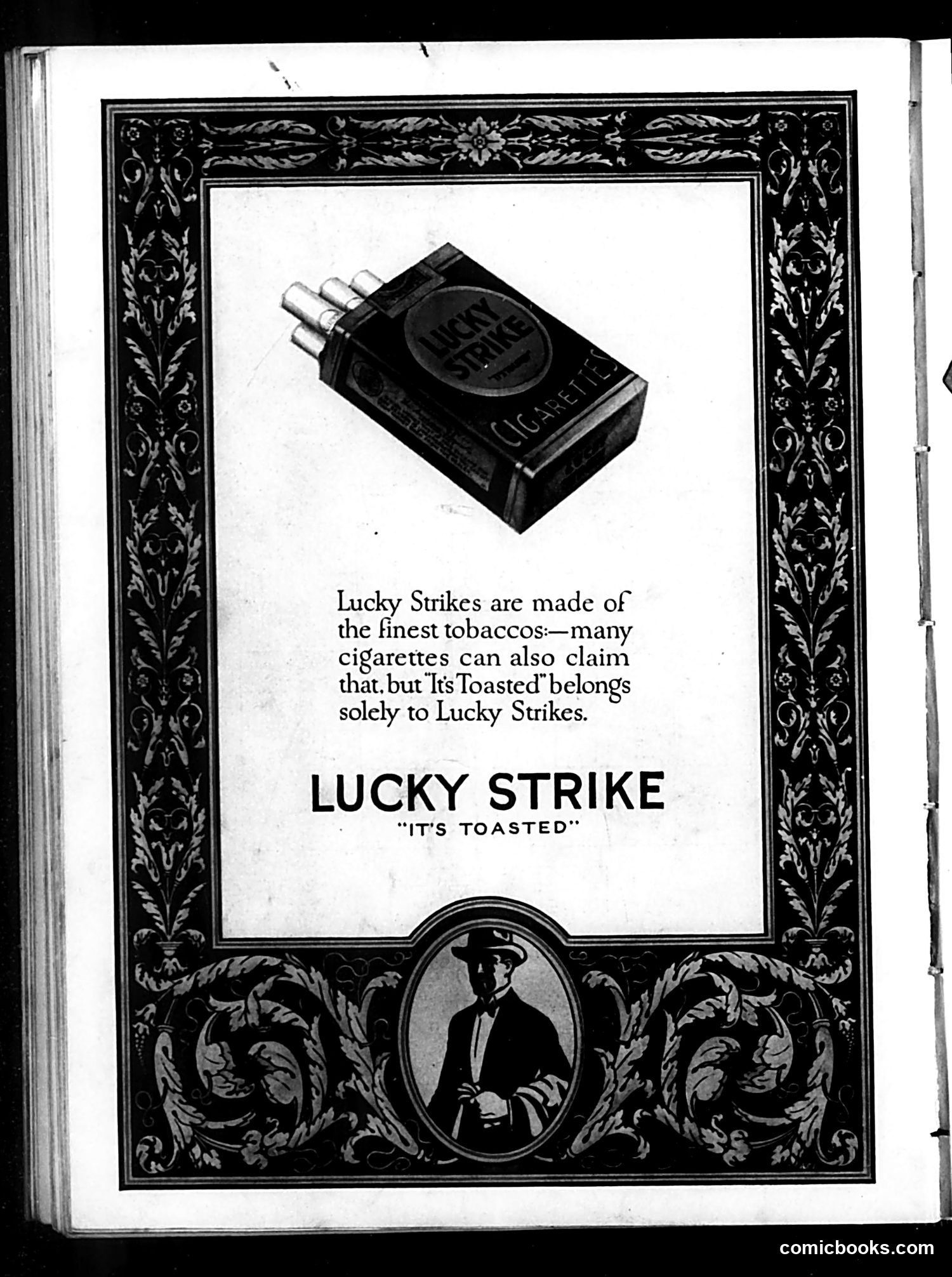
This is primarily a **cigarette advertisement** rather than political satire. It promotes Lucky Strike cigarettes, emphasizing their "It's Toasted" branding as a unique selling point that competitors cannot claim. The ad argues that while many cigarette brands use quality tobacco, only Lucky Strikes possess the distinctive "toasted" process. The ornate decorative border and formal layout were typical of premium cigarette advertising in this era. The small portrait at bottom center appears to be a generic gentleman figure—likely intended to suggest sophistication and social respectability, a common advertising trope of the period. **Historical context**: This reflects early-20th-century tobacco marketing before health warnings were required. Lucky Strikes was a major brand that heavily advertised in magazines like *Judge* to reach educated, affluent readers.