
Judge, 1925-02-07 · page 20 of 36
Judge — February 7, 1925 — page 20: what you’re looking at
What you’re looking at
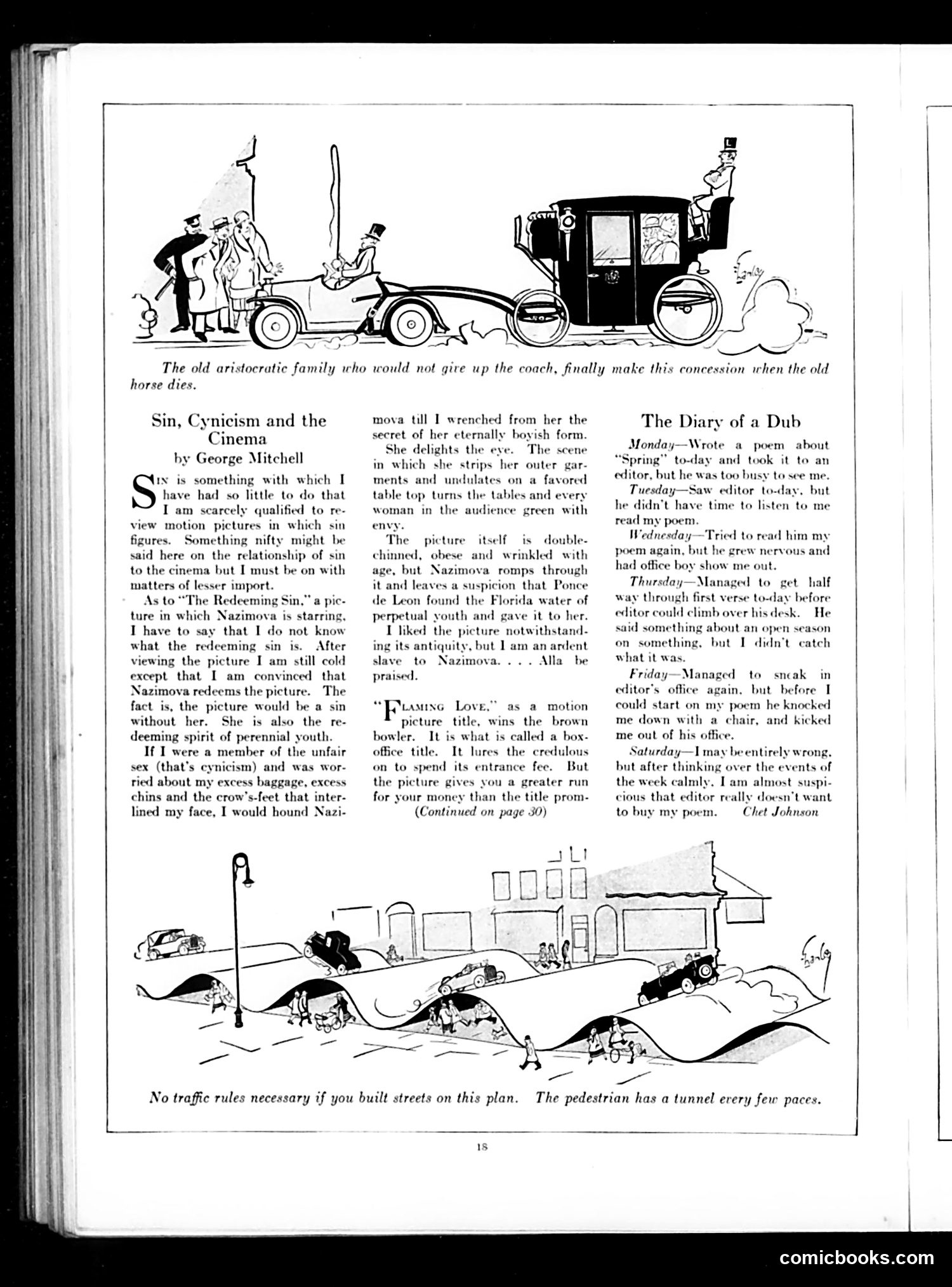
This page contains two satirical pieces from Judge magazine: **Top cartoon:** Shows an aristocratic family reluctantly trading their horse-drawn coach for an automobile after the horse dies—mocking the upper class's resistance to modern technology and social change. **"Sin, Cynicism and the Cinema":** Film critic George Mitchell reviews "The Redeeming Sin" starring Nazimova (a famous silent-film actress). He jokes that the film itself is mediocre ("double-chinned, obese and wrinkled with age"), but Nazimova's youthful beauty and charisma redeem it. The satire targets how star power, not quality storytelling, sells movies. **"The Diary of a Dub":** A humorous diary by Chet Johnson about an aspiring poet desperately trying to show an editor his "Spring" poem. Each day the editor grows more hostile—culminating in physical violence—before the poet finally admits the editor probably doesn't want to buy his work. This satirizes both struggling artists' persistence and editors' frustration with unsolicited submissions.
📄 Transcribed text from this page (OCR, searchable)
Machine-transcribed from the original scan — historical spelling and the odd misread are preserved.
horse dies. Sin, Cynicism and the Cinema by George Mitchell IN is something with which I S have had so little to do that I am scarcely qualified to re- view motion pictures in which sin figures. Something nifty might be said here on the relationship of sin to the cinema but I must be on with matters of lesser import. As to “The Redeeming Sin,” a pic- ture in which Nazimova is starring, I have to say that I do not know what the redeeming sin is. After viewing the picture I am still cold except that I am convinced that Nazimova redeems the picture. The fact is, the picture would be a sin without her. She is also the re- deeming spirit of perennial youth. If I were a member of the unfair sex (that’s cynicism) and was wor- ried about my excess baggage, excess chins and the crow’s-feet that inter- lined my face, I would hound Nazi- The old aristocratic family who would not gite up the coach, finally make this concession when the old mova till I wrenched from her the secret of her eternally boyish form. She delights the eve. The scene in which she strips her outer gar- ments and undulates on a favored table top turns the tables and every woman in the audience green with envy The picture itself is double- chinned, obese and wrinkled with age, but Nazimova romps through it and leaves a suspicion that Ponce de Leon found the Florida water of perpetual youth and gave it to her. I liked the picture notwithstand- ing its antiquity, but 1 am an ardent slave to Nazimova.... / Mla be praised. *Feustixe Love.” as a motion picture title, wins the brown bowler. It is what is called a box: office title. It lures the credulous on to spend its entrance fee. But the picture gives you a greater run for your money than the title prom- (Continued on page 30) The pedestrian has a tunnel every few paces. The Diary of a Dub Monday—Wrote a poem about “Spring” to-day and took it to an editor, but he was too busy to see me. Tuesday—S + but he didn’t have time to listen to me read my poem. Wednesday—Tried to read him my poem again, but he grew nervous and had office boy show me out. to get half first verse to-day before editor could climb over his desk. He said something about an open season on something, but I didn't catch what it was. w editor to- Friday—Managed to sneak in editor's offic gain, but before I could start on my poem he knocked me down with a chair, and kicked me out of his office. Saturday—I may be entirely wrong. but after thinking over the events of the week calmly, Lam almost suspi- cious that editor really doesn’t want to buy my poem. — Chet Johnson comicbooks.com