
Judge, 1925-02-07 · page 17 of 36
Judge — February 7, 1925 — page 17: what you’re looking at
What you’re looking at
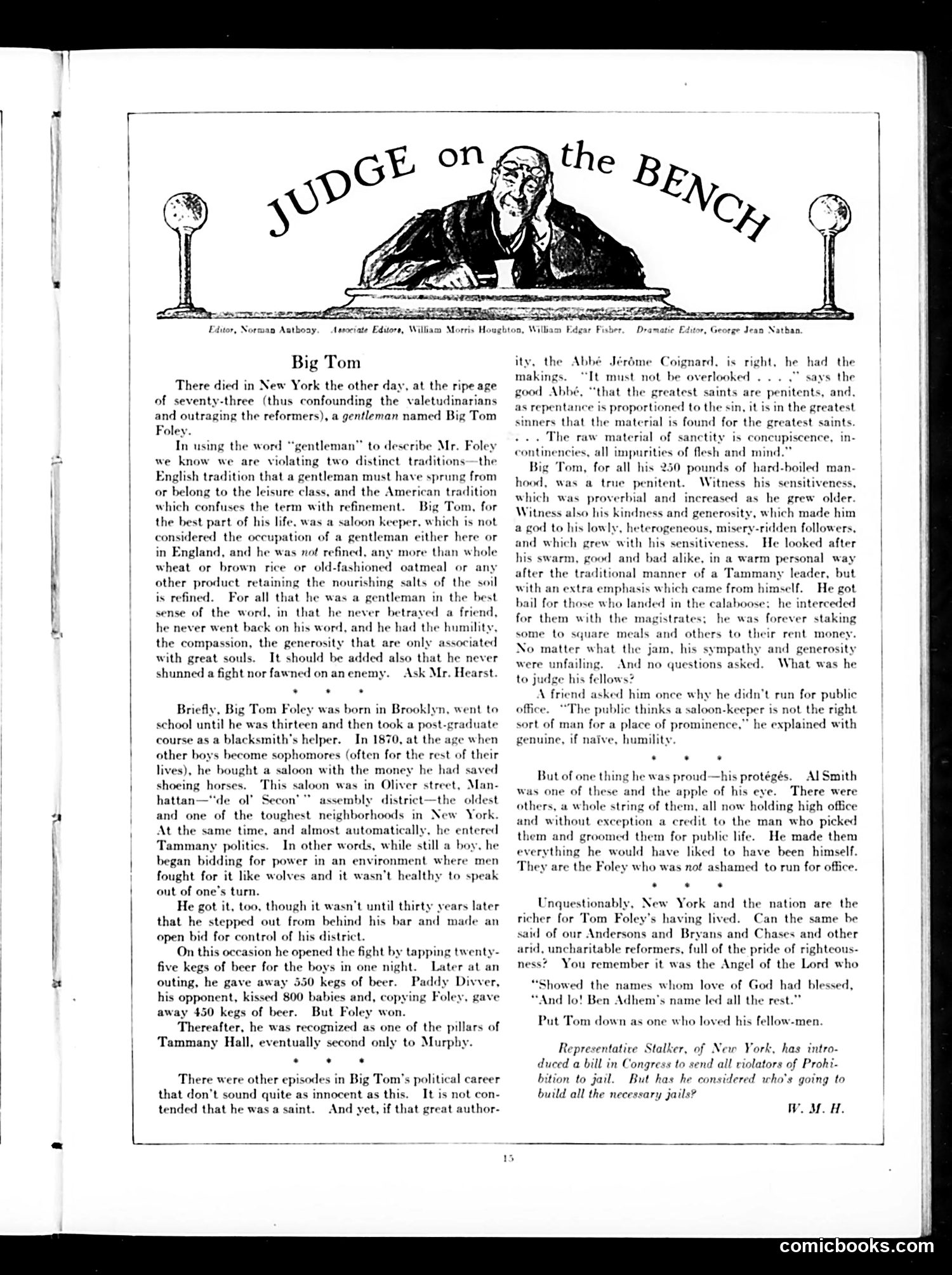
This page presents a laudatory profile of **Big Tom Foley**, a recently deceased New York political figure who died at 73. The article defends Foley against traditional definitions of "gentleman"—he was a saloon keeper in the rough Oliver Street neighborhood who rose through **Tammany Hall** politics (New York's notorious Democratic machine). The satire is subtle: Judge praises Foley's genuine generosity and loyalty to his constituents—bailing them out, interceding with magistrates—while acknowledging his political ruthlessness (referencing unstated episodes "that don't sound quite as innocent"). The joke undercuts reform rhetoric: a crude, unrefined man with working-class roots showed more authentic virtue than genteel elites. By defending a Tammany boss as genuinely noble despite his corruption-adjacent career, Judge ironically critiques both reform hypocrisy and the moral compromises embedded in machine politics. The classical literary reference (Abbé Coignard) reinforces that true character transcends social station.
📄 Transcribed text from this page (OCR, searchable)
Machine-transcribed from the original scan — historical spelling and the odd misread are preserved.
aoe Editor, Normap Antboay, Asrociate Editors, Willi Big Tom There died in New York the other day, at the ripe age of seventy-three (thus confounding the valetudinarians and outraging the reformers), a gentleman named Big Tom Foley. In using the word “gentleman” to describe Mr. Foley we know we are violating two distinct traditions—the English tradition that a gentleman must have sprung from or belong to the leisure class, and the American tradition which confuses the term with refinement. Big Tom, for the best part of his life, was a saloon keeper, which is not considered the occupation of a gentleman either here or in England, and he was not refined, any more than whole wheat or brown rice or old-fashioned oatmeal or any other product retaining the nourishing salts of the soil is refined. For all that he was a gentleman in the best sense of the word, in that he never betrayed a friend, he never went back on his word, and he had the humility, the compassion, the generosity that are only associated with great souls. It should be added also that he never shunned a fight nor fawned on anenemy. Ask Mr. Hearst. Briefly, Big Tom Foley was born in Brooklyn, went to school until he was thirteen and then took a post-graduate course as a blacksmith’s helper. In 1870, at the when other boys become sophomores (often for the rest of their lives), he bought a saloon with the money he had saved shoeing horses. This saloon was in Oliver street, Man- hattan—‘‘de ol’ Secon assembly district—the oldest and one of the toughest neighborhoods in New York. At the same time, and almost automatically, he entered Tammany politics. In other words, while still a boy. h began bidding for power in an environment where men fought for it like wolves and it wasn’t healthy to speak out of one’s turn. He got it, too, though it wasn't until thirty years later that he stepped out from behind his bar and made an open bid for control of his district. On this occasion he opened the fight by tapping twenty- five kegs of beer for the boys in one night. Later at an outing, he gave away 550 kegs of beer. Paddy Divver, his opponent, kissed 800 babies and, copying Foley, gave away 450 kegs of beer. But Foley won. Thereafter, he was recognized as one of the pillars of Tammany Hall, eventually second only to Murphy. There were other episodes in Big Tom’s political career that don’t sound quite as innocent as this. It is not con- tended that he was a saint. And yet, if that great author- Morris Houghton, William Edgar Fisher Dramatic Editor, George Jean Nathan. ity, the Abbé Jéréme Coignard, is right, he had the makings. “It must not be overlooked ... .” good Abbé, “that the greatest saints as repentance is proportioned to the s sinne says the are penitents, and, itis in the greatest that the material is found for the greatest saints. 1e raw material of sanctity is concupiscence, in- continencies, all impurities of flesh and mind.” Big Tom, for all his 250 pounds of har hood, was a true penitent. which was proverbial -boiled man- Witness his sensitiveness, nd increased as he grew older. Witness also his kindness and generosity, which made him a god to his lowly, heterogeneous, misery-ridden followers, He looked after his swarm, good and bad alike, in a warm personal way after the traditional manner of a Tammany leader, but with an extra emphasis which came from himself. He got bail for those who landed in the calaboose; he interceded for them with the magistrates; he was forever staking d which grew with his sensitiveness. some to square meals and others to their rent money. o matter what the jam, his sympathy and generosity were unfailing. And no questions asked. What was he to judge his fellows? \ friend asked him once why he didn’t run for public office. “The public thinks a saloon-keeper is not the right sort of man for a place of prominen he explained with genuine, if naive, humility. . . . But of one thing he was proud—his protégés. Al Smith was one of these and the apple of his eye. There were others, a whole string of them, all now holding high office and without exception a credit to the man who picked them and groomed them for public life. He made them thing he would ha liked to have been himself. y are the Foley who was not ashamed to run for office. . . . Unquestionably, New York and the nation are the richer for Tom Foley’s having liv n the same be said of our Andersons and Bryans and Chases and other arid, uncharitable reformers, full of the pride of righteous- ness? You remember it was the Angel of the Lord who showed the names whom love of God had blessed, “And lo! Ben Adhem’s name led all the rest.” Put Tom down as one who loved his fellow-men. Representative Stalker, of New York, has intro- duced a bill in Congress to send all violators of Prohi- bition to jail. But has he considered who's going to build all the necessary jails? ’, BMH. comicbooks.com