
A complete issue · 36 pages · 1925
Judge — January 17, 1925
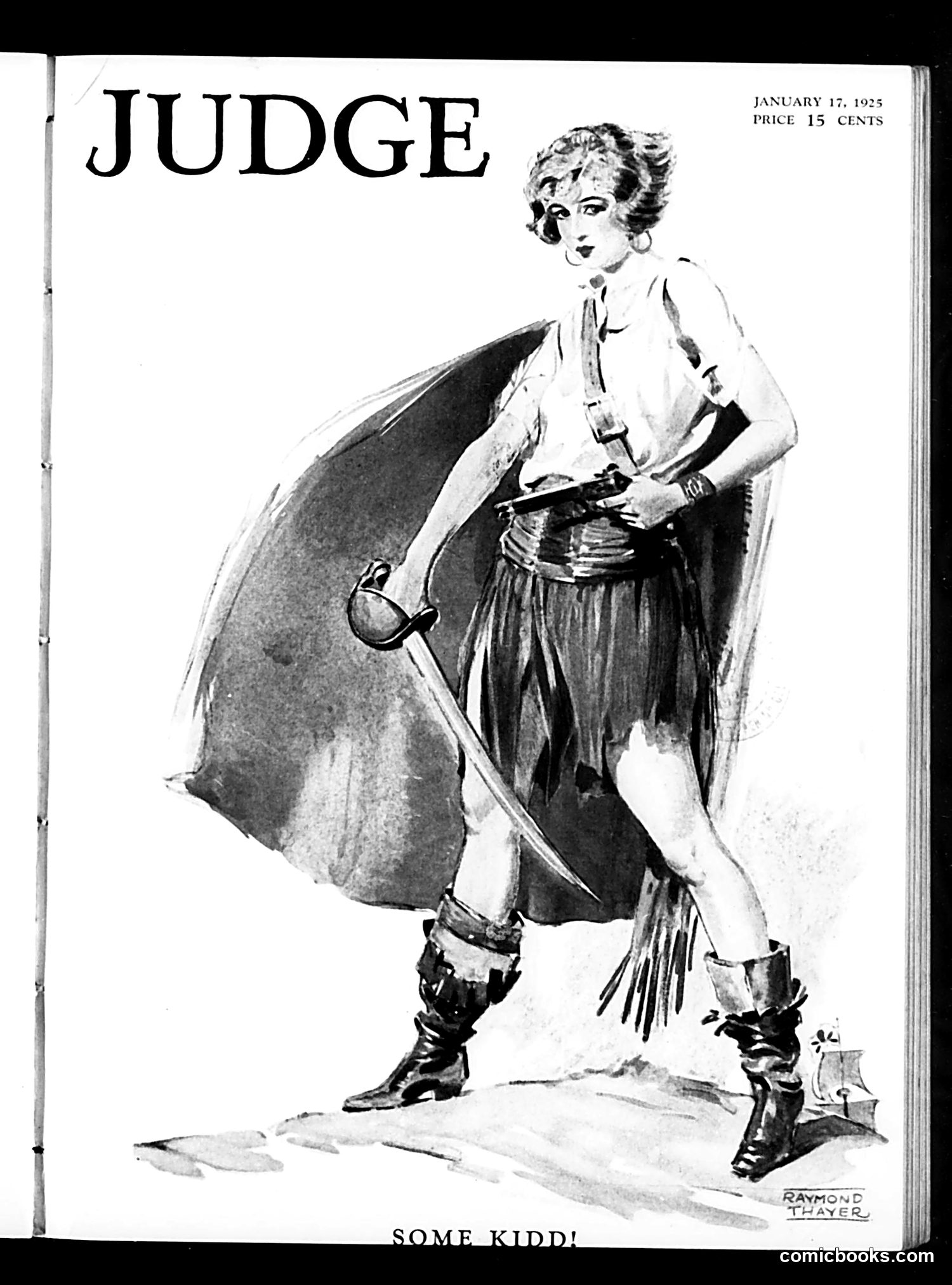
This cover illustration by Raymond Thayer depicts a woman in pirate/swashbuckling costume, holding a sword and wearing a cape. The caption reads "SOME KIDD!" The joke appears to reference **Captain Kidd**, the famous pirate, creating a pun on "some kid" (slang for an impressive person). The illustration likely satirizes 1920s popular culture—possibly a theatrical production, film, or the era's fascination with adventure stories and costume dramas. The woman's modern bob hairstyle and confident pose reflect 1920s attitudes toward female independence during the post-suffrage period. The exact theatrical or cultural reference remains unclear without additional context, but the cover celebrates contemporary entertainment trends of the Jazz Age.
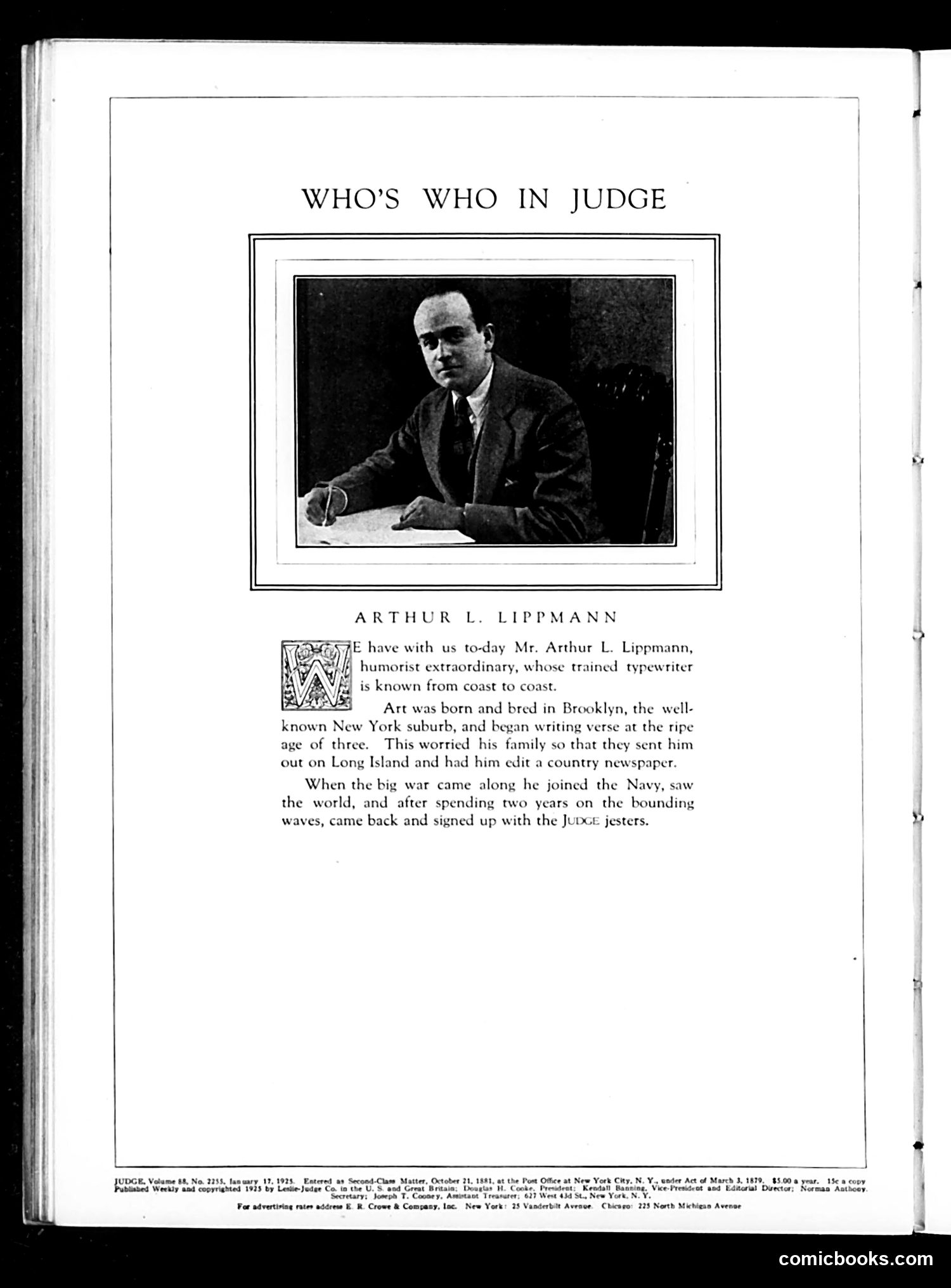
This is a biographical profile of **Arthur L. Lippmann**, described as a "humorist extraordinary" and typewriter writer known nationwide. The text establishes his background: born in Brooklyn, began writing verse at age three, was sent to edit a country newspaper on Long Island, then served two years in the Navy during "the big war" (World War I) before joining Judge's staff as a jester. The page functions as an introduction/profile rather than political satire. It's primarily celebratory, establishing Lippmann's credentials and humor writing career for Judge magazine's readers. The formal portrait photograph presents him as a respectable professional. This appears to be an internal magazine feature showcasing staff talent rather than commentary on external political or social events.
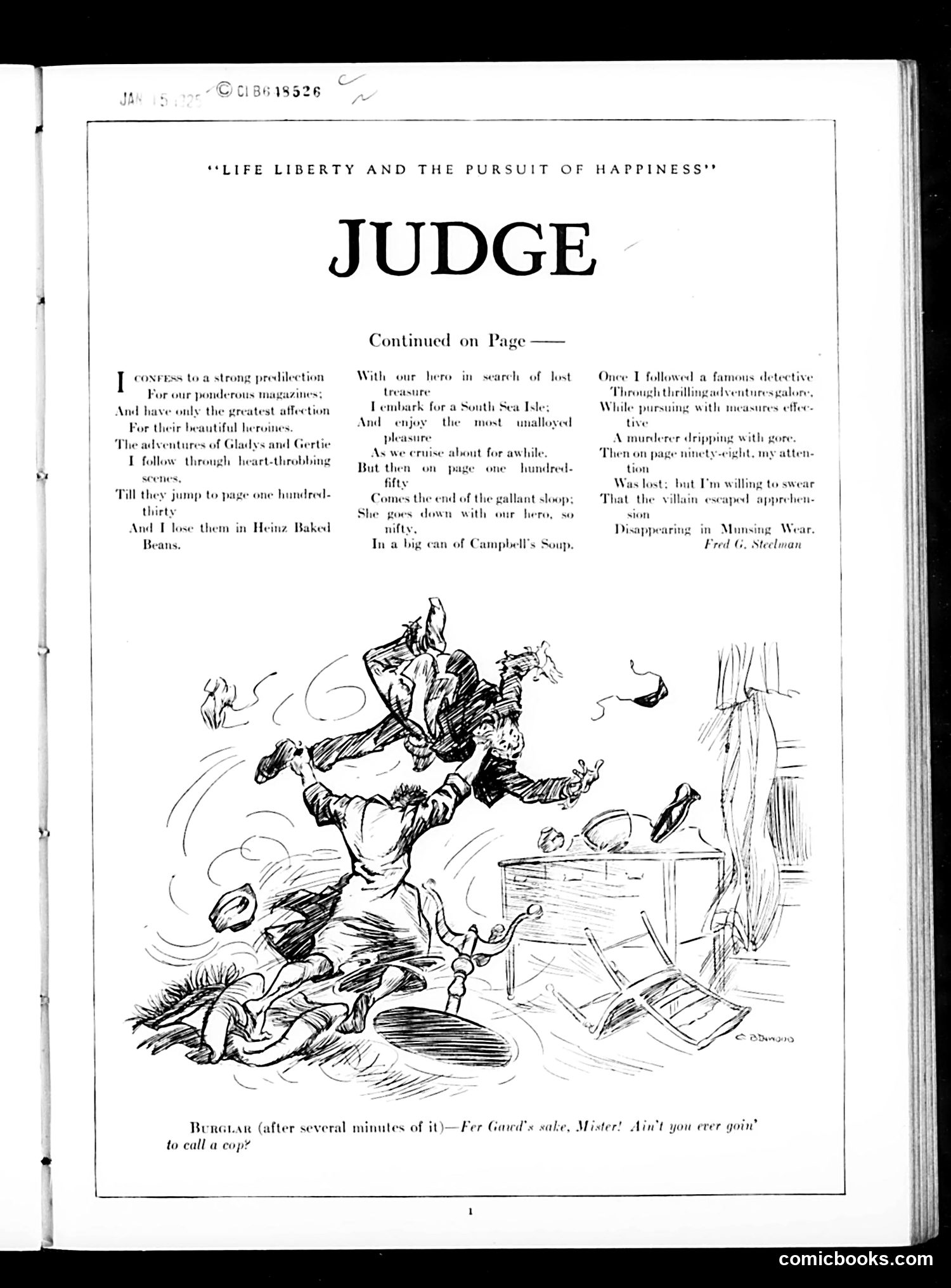
This page from the satirical magazine *Judge* features a humorous story titled "Judge" with an illustration showing a burglar caught mid-heist, apparently startled by a woman. The narrative text, written in verse, celebrates magazine advertisements and adventure stories—particularly mentioning Heinz Baked Beans and Campbell's Soup as product placements. The caption beneath the cartoon reads: "BURGLAR (after several minutes of it)—For Gawd's sake, Sister! Ain't you ever goin' to call a cop?" The joke appears to mock both domestic disruption and the burglary itself: the burglar is so exhausted by the woman's apparent response (unclear from this excerpt) that he's begging her to simply call police rather than continue whatever she's doing. It's a slapstick humor piece typical of early-20th-century satirical magazines.
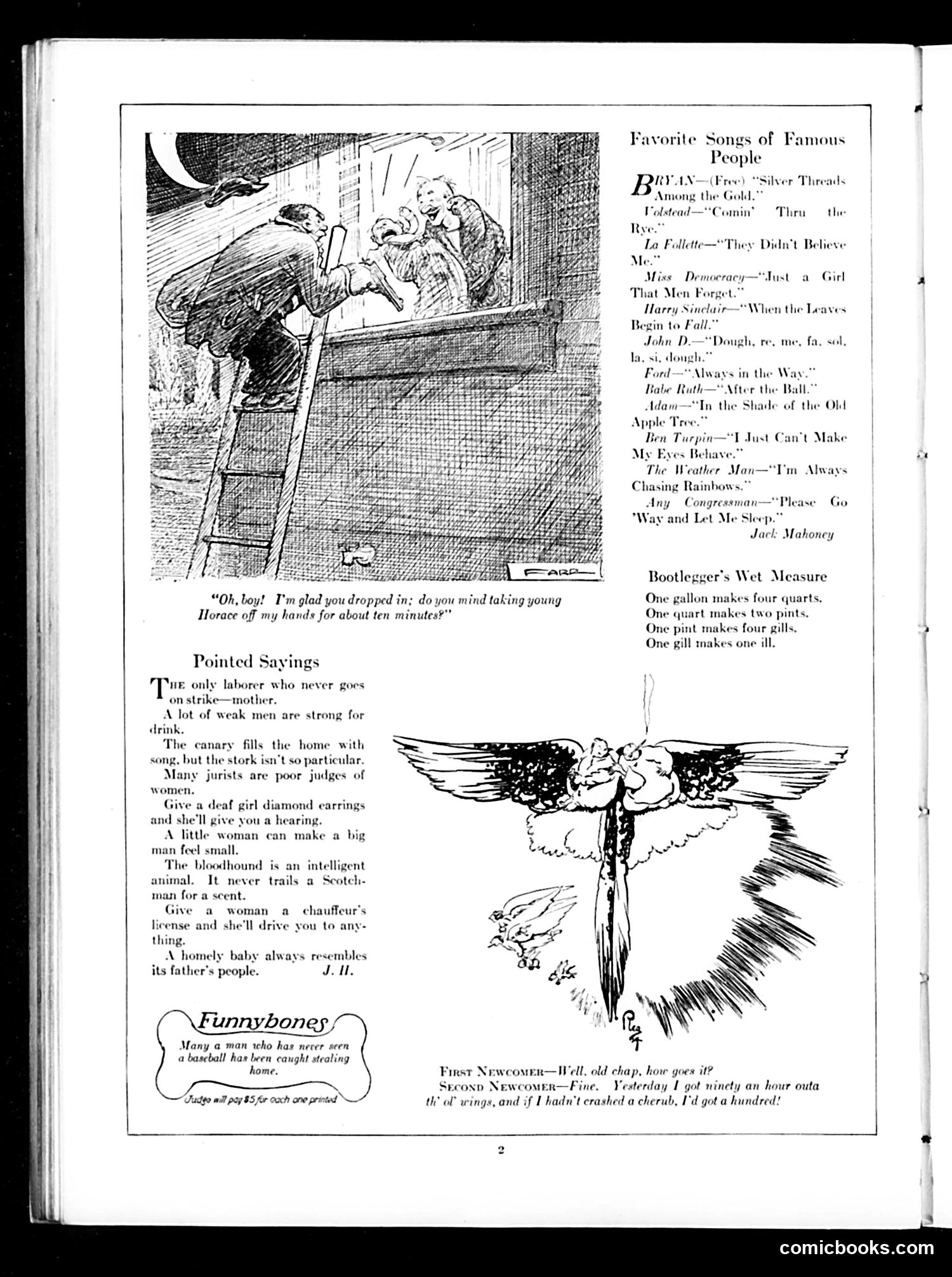
The main illustration shows a man climbing a ladder to a window where a couple is visible inside, with the caption about "young Horace." This appears to be a humorous domestic scene, likely depicting voyeurism or an awkward romantic interruption—a common comedic trope of the era. The "Pointed Sayings" section contains witty observations about gender relations, labor, and social behavior typical of early 20th-century satirical magazines. These target familiar social types: weak men, domineering women, and foolish judges. The "Funnybones" section offers a baseball joke, while the bottom illustration depicts winged cherubs or angels with a joke about newcomers arriving in heaven. The overall tone reflects Judge's formula: gentle social satire mixing domestic humor, gender dynamics, and observations on contemporary life.
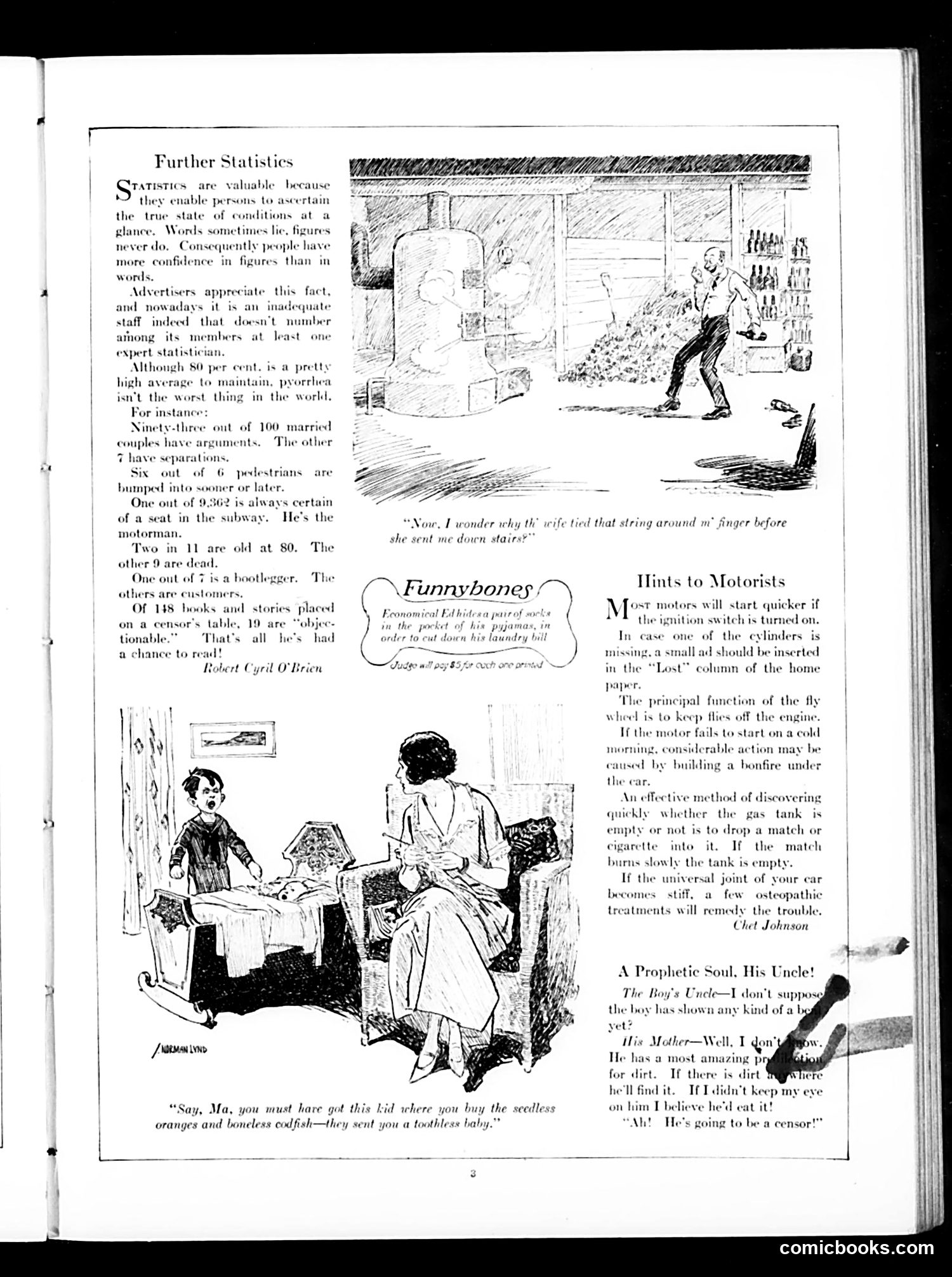
This page contains three distinct sections: 1. **"Further Statistics"** (upper left): A humorous essay by Robert Cyril O'Brien mocking how statistics can mislead. It uses absurd examples (90% of married couples argue, subway seat statistics) to satirize advertisers' misuse of data for credibility. 2. **Top cartoon**: A domestic scene where a husband, tangled in string around his finger, asks his wife why she tied it there before sending him downstairs—a visual gag about forgetfulness. 3. **Bottom cartoon**: A mother tells her child he must buy "scentless oranges and boneless codfish"—satirizing early 20th-century food processing trends and perhaps consumer anxiety about adulterated or artificially processed foods becoming normalized. The page combines social commentary on advertising deception and evolving consumer culture concerns.
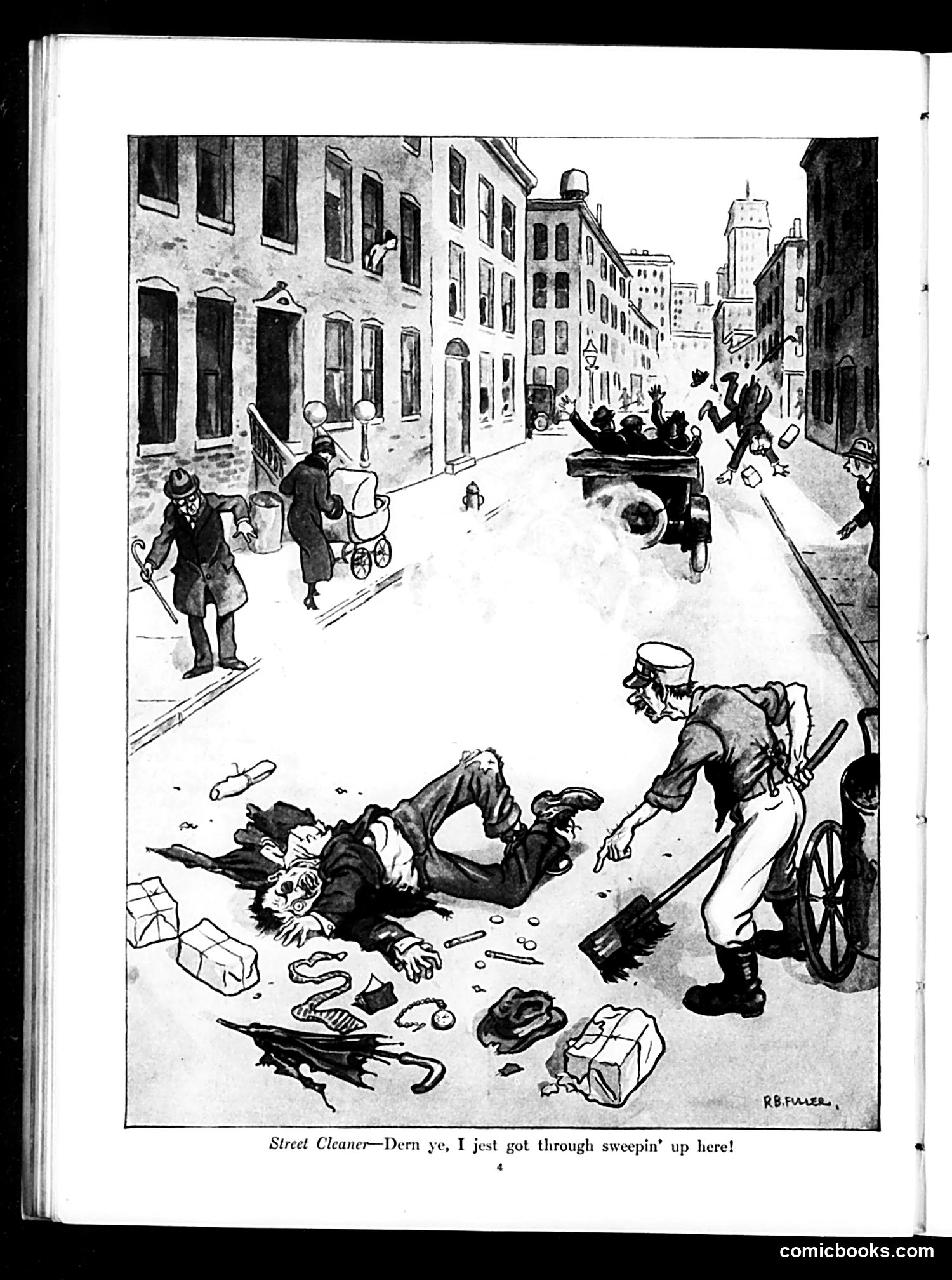
This cartoon depicts a street cleaner who has apparently caused chaos while sweeping. The figure lies sprawled on the ground surrounded by scattered debris, boxes, and broken items, while other figures react with apparent dismay in the background street scene. The humor appears to rest on a visual pun: the street cleaner's job is to clean streets, but instead has created massive disorder—the opposite of their intended purpose. The caption "Dern ye, I jest got through sweepin' up here!" suggests frustration at the mess-making, likely satirizing inefficiency or incompetence in municipal services, a common Judge magazine target. The dialectal speech ("Dern ye") and the exaggerated chaos suggest social commentary on urban administration or working-class services during the early 20th century.
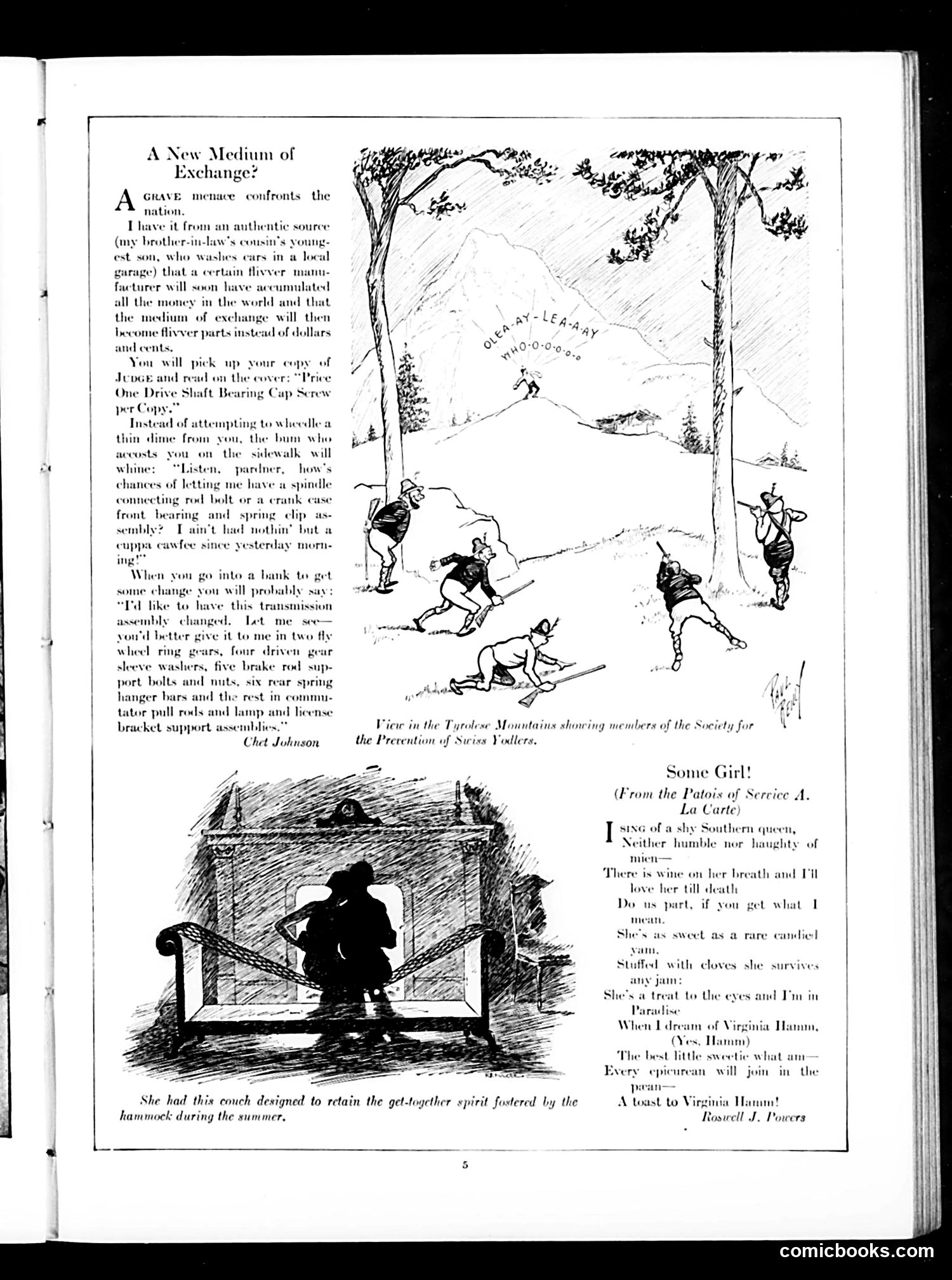
This page contains two distinct pieces: **"A New Medium of Exchange?"** (top) is a satirical article by Chet Johnson accompanying a sketch of people skiing in mountains. The satire mocks a supposed automotive parts shortage—specifically mentioning a "drive shaft bearing cap screw"—suggesting mechanics would soon accept automotive components as currency instead of dollars. The joke targets post-WWI economic inflation and material scarcity. **"Some Girl!"** (bottom) is a poem praising "a Southern queen" with literary references to Virginia Hamm. It's a romantic tribute rather than satire, appearing to celebrate a specific woman admired by the poem's author, Rosswell J. Powers. The page reflects 1920s concerns about inflation and supply shortages while mixing entertainment content typical of Judge magazine's satirical-yet-varied editorial approach.
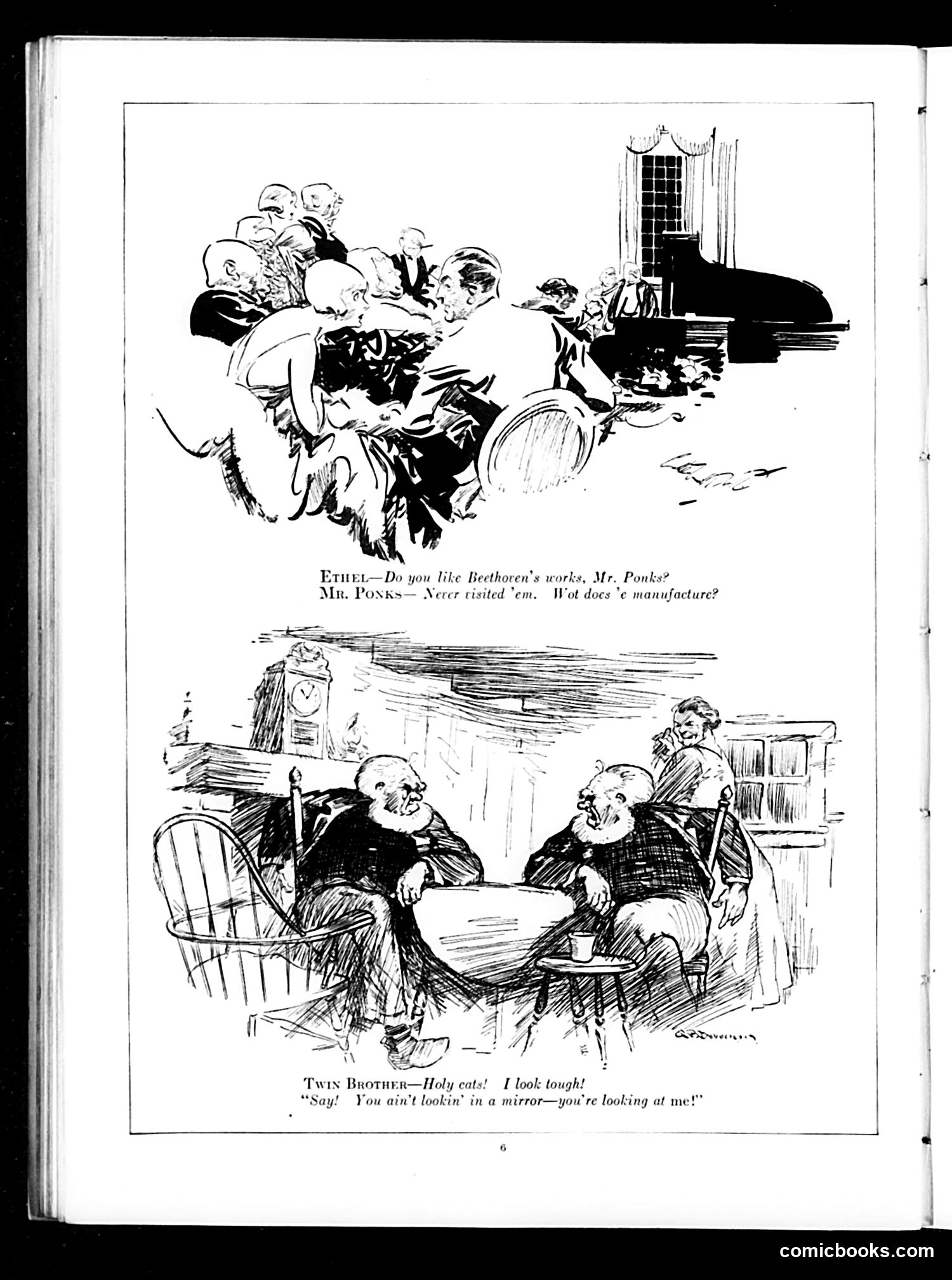
This page contains two separate cartoons satirizing different social types through exaggerated dialect and behavior. The **top cartoon** mocks Mr. Ponks as an uncultured philistine. When asked about Beethoven's "works," he interprets the question literally—assuming Beethoven is a manufacturer rather than recognizing him as a famous composer. The humor relies on his ignorance of high culture and his working-class assumption that "works" means factories. The **bottom cartoon** depicts two men of similar appearance ("Twin Brother"), with one mistaking the other for his own reflection in a mirror. The joke plays on vanity and self-absorption: the speaker is so enamored with his own tough appearance that he assumes he's admiring himself rather than noticing his companion. Both cartoons use dialect humor and class-based mockery typical of early 20th-century Judge magazine satire.
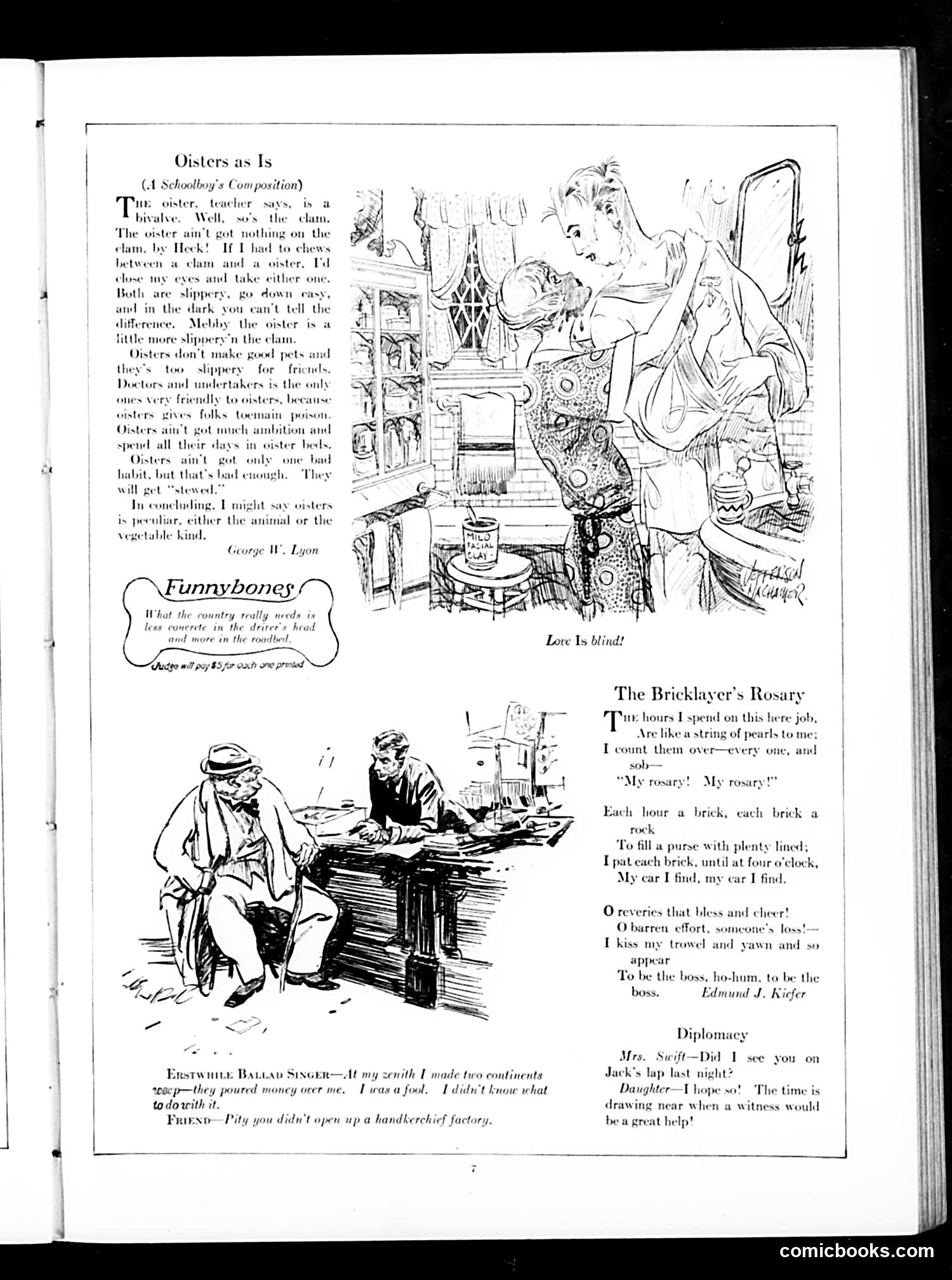
This page contains several humorous pieces from *Judge* magazine: **"Oysters as Is"** is a schoolboy's essay satirizing poor student writing. The boy confuses oysters with clams, uses malapropisms ("bivalve," "Heek"), and makes illogical arguments—the humor lies in the incompetent composition itself, not political commentary. **"The Bricklayer's Rosary"** is sentimental verse about a working-class man counting hours on his job like prayer beads, finding meaning in manual labor while dreaming of his car. **"Diplomacy"** is a brief joke about a woman asking another if she saw her on someone's lap—the daughter hopes so, implying courtship/romantic interest. The sketches illustrate these pieces with period-appropriate drawings. The "Funnybones" box appears to be an advertisement footer. Overall, this represents *Judge*'s mix of social observation humor targeting working-class life and student folly, typical of early 20th-century American satire—no specific political figures or events are referenced.
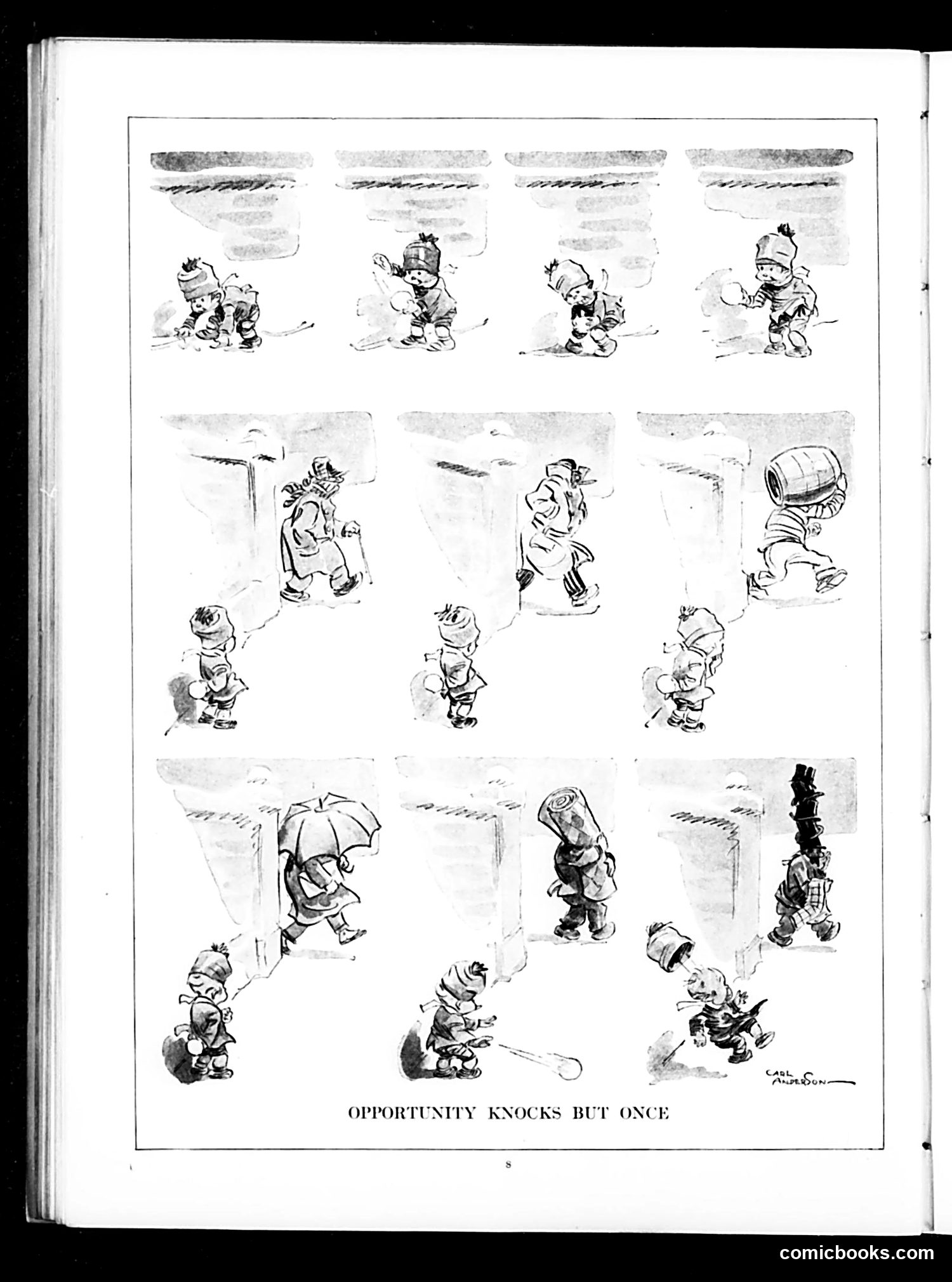
This cartoon uses a sequential narrative to illustrate the proverb in its title. The panels show a small figure (likely representing an everyman or common person) encountering various opportunities—suggested by objects like umbrellas, barrels, and other items appearing at his door or in his path. In the early panels, the figure appears hesitant or unaware. As the sequence progresses, he seems to miss or reject each chance. The final panels show him realizing too late what he's lost, appearing frustrated or regretful. The satire critiques human nature: people's tendency to overlook, hesitate on, or waste opportunities when they present themselves. It's a moral lesson about vigilance and decisiveness—a common theme in Judge magazine's social commentary. The cartoon's humor derives from the relatable experience of recognizing missed chances only in hindsight.
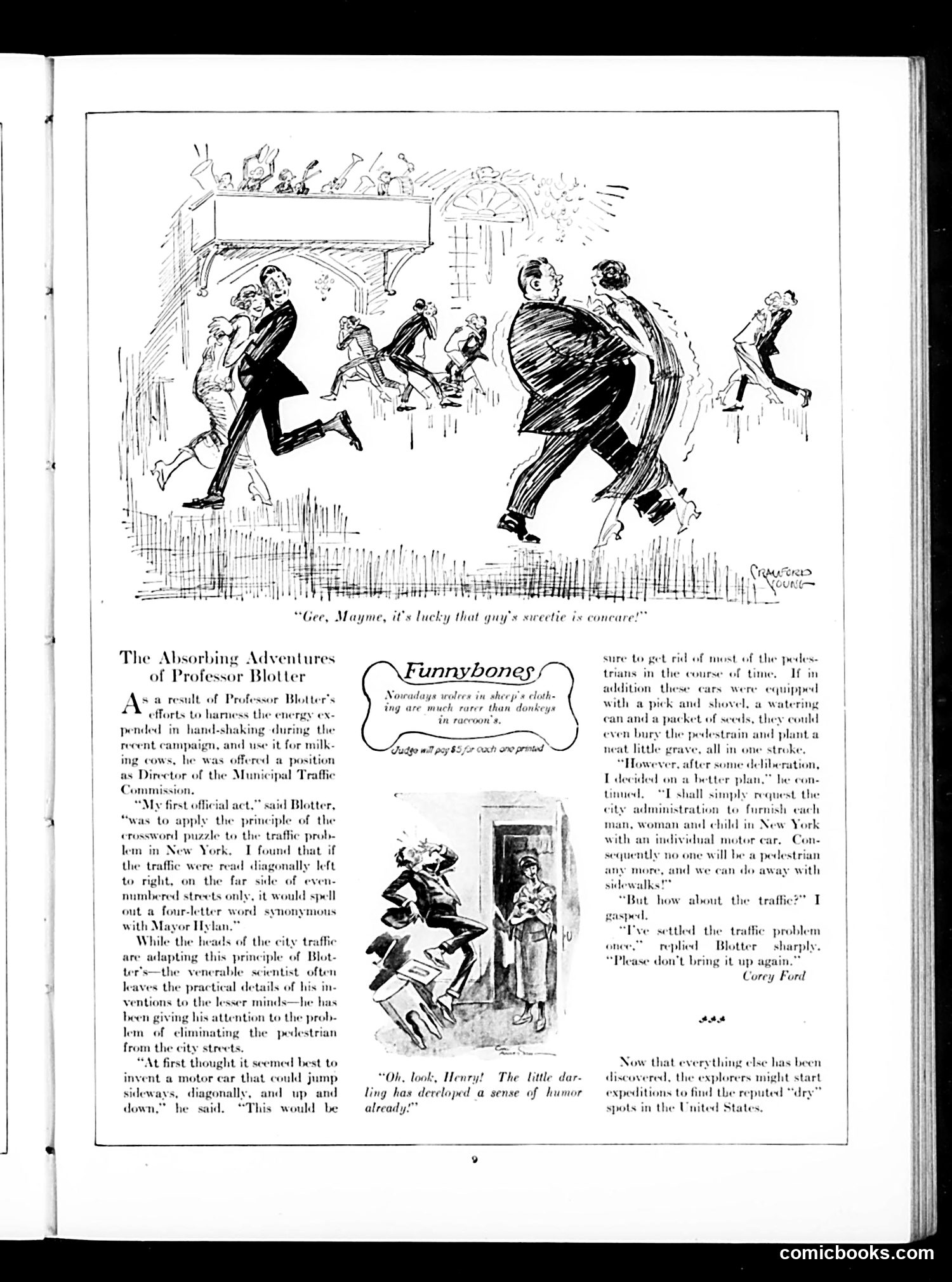
This satirical piece mocks Professor Blotter, a fictional "inventor" hired by New York City's traffic commissioner to solve urban congestion. The joke centers on absurd "solutions": reading traffic diagonally to spell a four-letter insult about Mayor Hylan; eliminating pedestrians by giving each citizen a motor car; and burying pedestrians with shovels. The satire targets both municipal incompetence and the era's naive faith in mechanical/technological fixes for complex social problems. Mayor Hylan (New York's actual mayor 1918-1925) appears as a punchline—suggesting widespread criticism of his administration's traffic management. The humor relies on exaggerated impracticality: the "solutions" would obviously fail or cause chaos. The final quip about "dry" spots references Prohibition-era concerns.
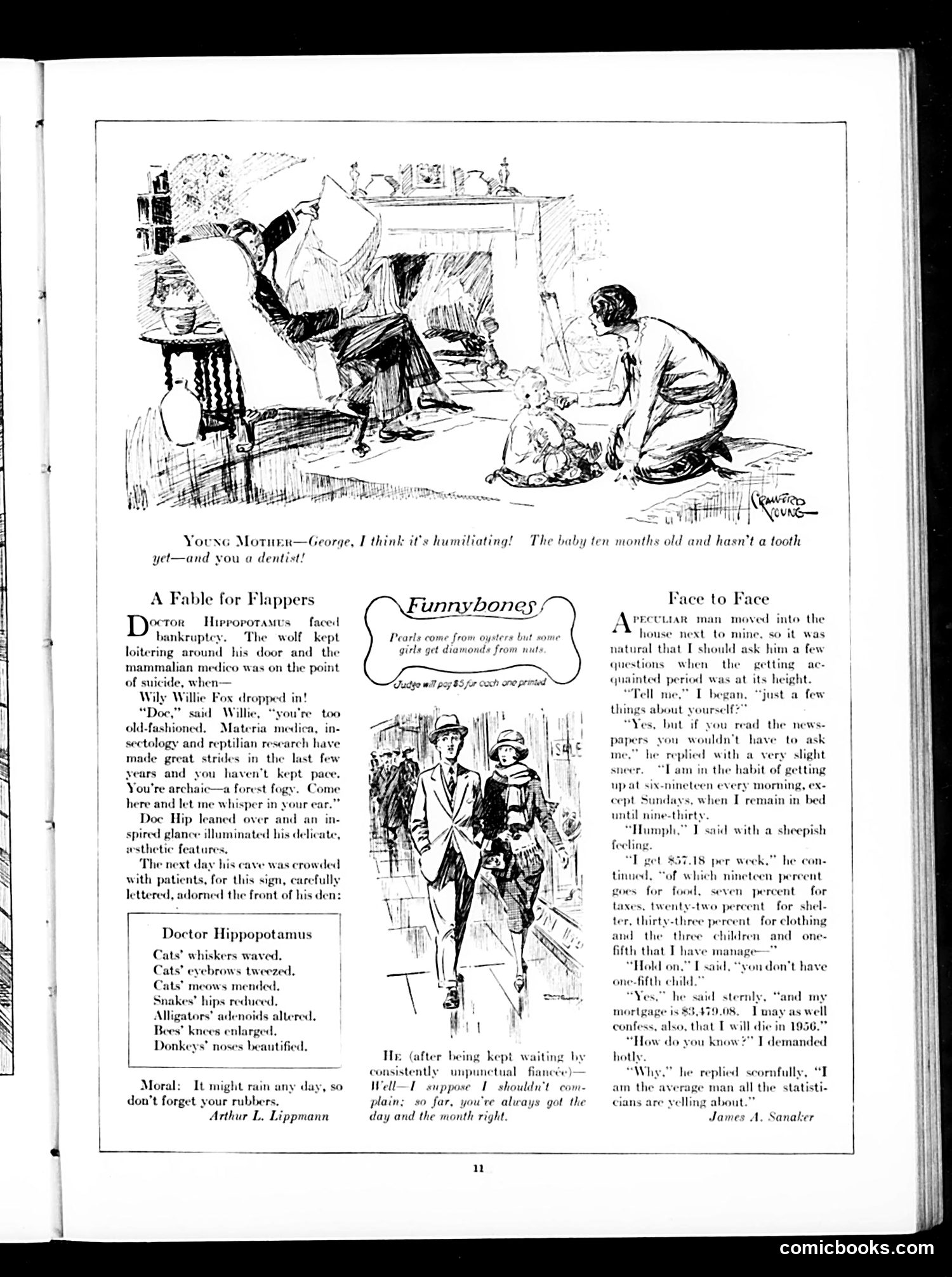
This page contains three separate satirical pieces typical of early 20th-century humor: **Top cartoon**: A young mother complains to her husband (a dentist) about the humiliation of their 10-month-old baby lacking teeth—while he, a dental professional, cannot fix it. The joke mocks the irony of professional expertise failing in one's own family. **"A Fable for Flappers"**: A cautionary tale about Dr. Hippopotamus, an old-fashioned practitioner saved from bankruptcy by the cunning "Willie Fox." The doctor's new sign advertising modernized animal treatments ("Cats' whiskers waved," "Bees' knees enlarged") satirizes both the absurdity of trendy 1920s "flapper" culture (cats' whiskers and bees' knees were slang terms) and the gullibility of following fads. The moral warns against being unprepared. **"Face to Face"**: A statistical-minded neighbor obsessively quantifies every aspect of his life (rising at 6:19 AM, budgeting percentages, predicting his death in 1956), and dismisses the narrator's questions by saying he needn't ask—just read the newspapers. The satire targets excessive quantification and the illusion that statistics reveal truth.
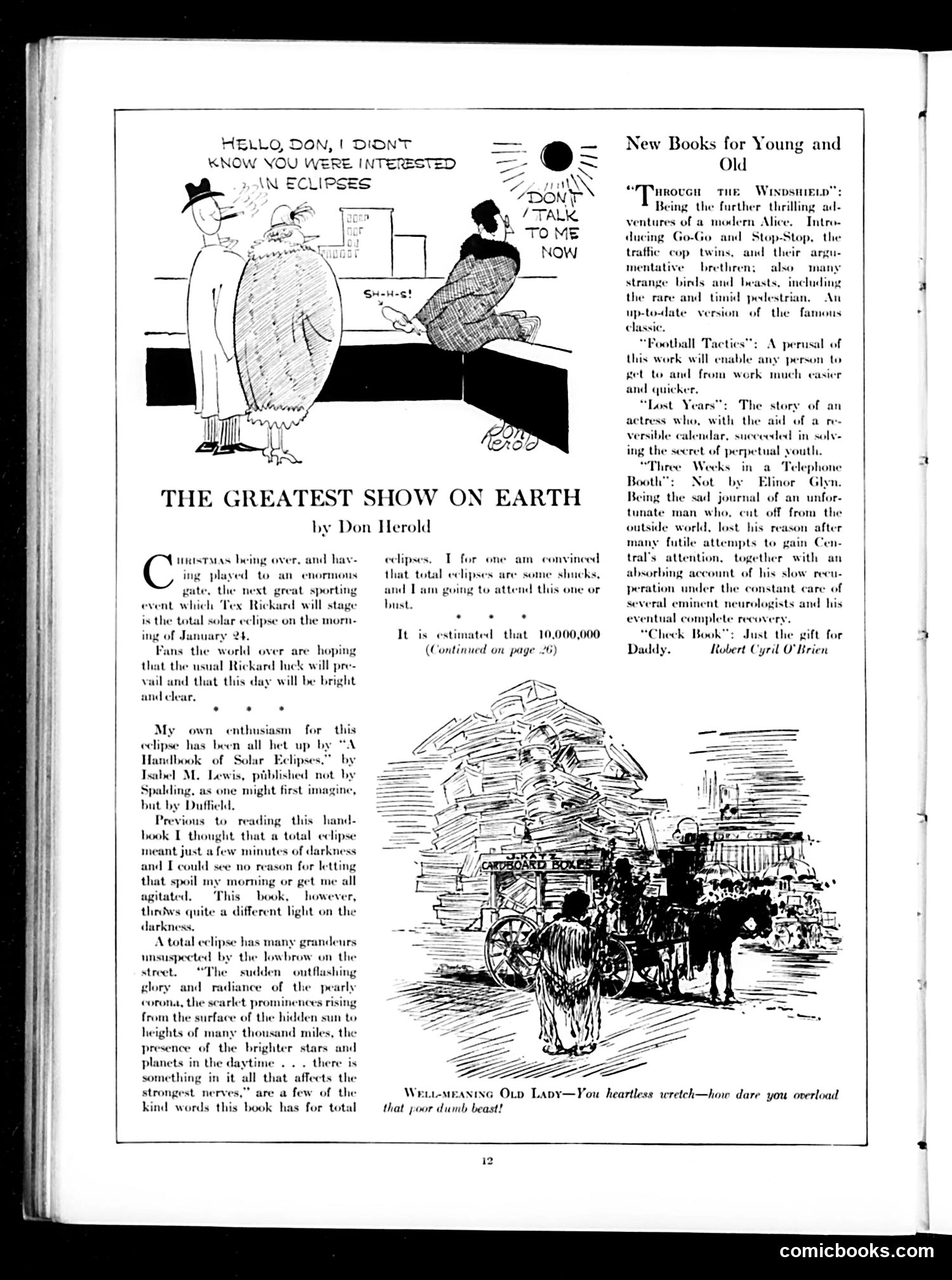
This page satirizes the hype surrounding the total solar eclipse of January 24, 1925. The main cartoon mocks how promoter Tex Rickard (famous for staging massive sporting events like boxing matches) had generated such public excitement about the eclipse that it rivals his commercial spectacles. The cartoon shows a man enthusiastically greeting someone, claiming he didn't know they were "interested in eclipses"—the joke being that *everyone* suddenly cares about the eclipse due to sensational promotion, not genuine scientific interest. The article by Don Herold humorously notes that before reading a handbook on eclipses, he assumed they were minor events. The satire targets how media hype transforms a natural phenomenon into entertainment spectacle comparable to major sporting events, with crowds hoping for ideal "viewing conditions" as if attending a show. The illustration below shows an overloaded cart, captioning the page's book review section.
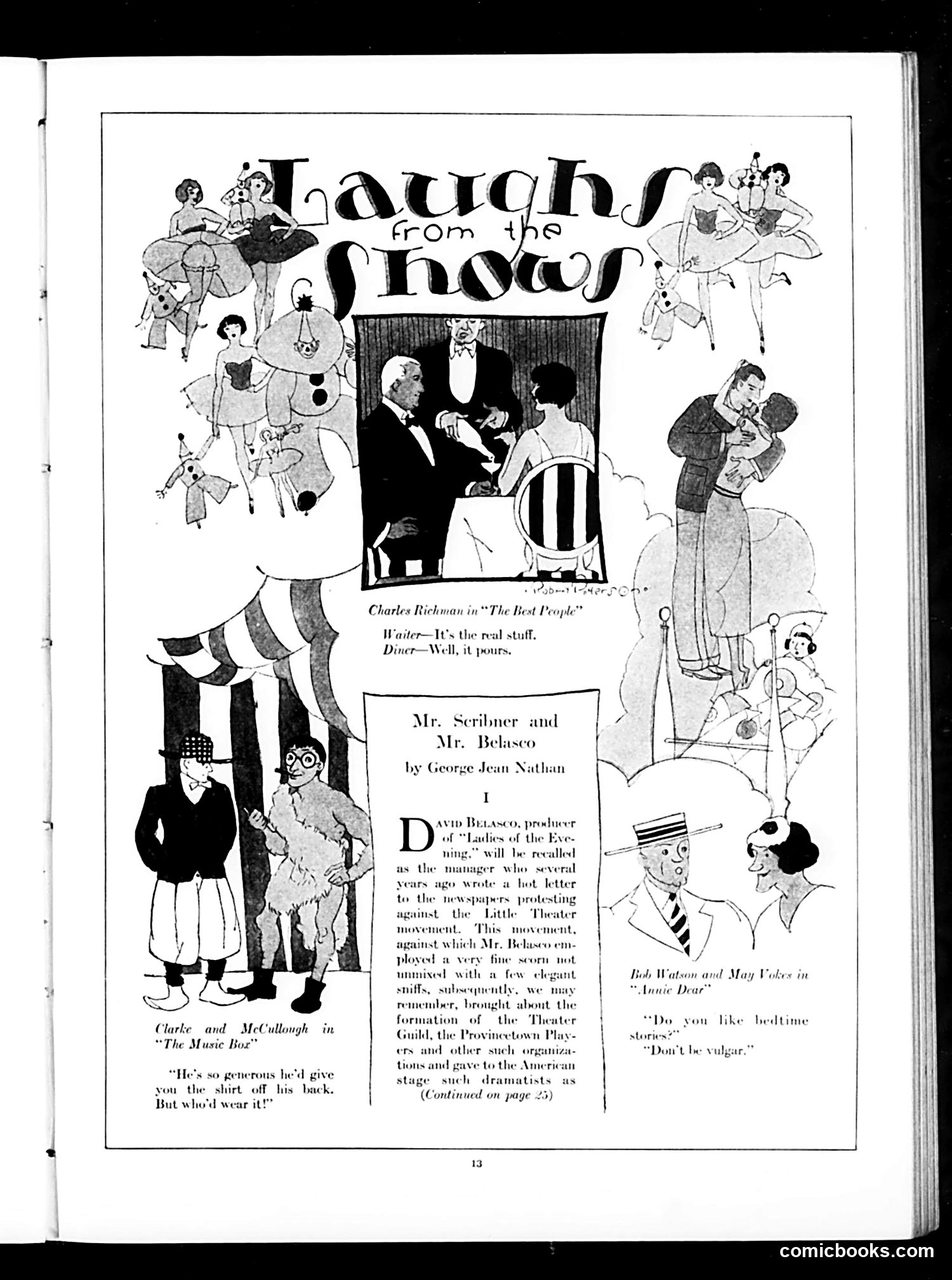
This page from *Judge* magazine showcases theater criticism and comedy from what appears to be the 1920s. The central article discusses David Belasco, a prominent theater producer, and his famous letter protesting the "Little Theater movement"—a decentralized theatrical movement that challenged Broadway's dominance. Belasco's opposition ironically helped establish the Theater Guild and Provincetown Players, organizations that became major forces in American drama. The page also features brief comedy sketches from current theatrical productions, including Charles Richman in "The Best People," Clarke and McCullough in "The Music Box," and others. These snippets showcase popular comedic dialogue and situations from Broadway shows of the era, serving as entertainment promotion for the magazine's readership. The overall content reflects *Judge*'s dual purpose: satirizing theatrical personalities and institutions while promoting current stage productions.
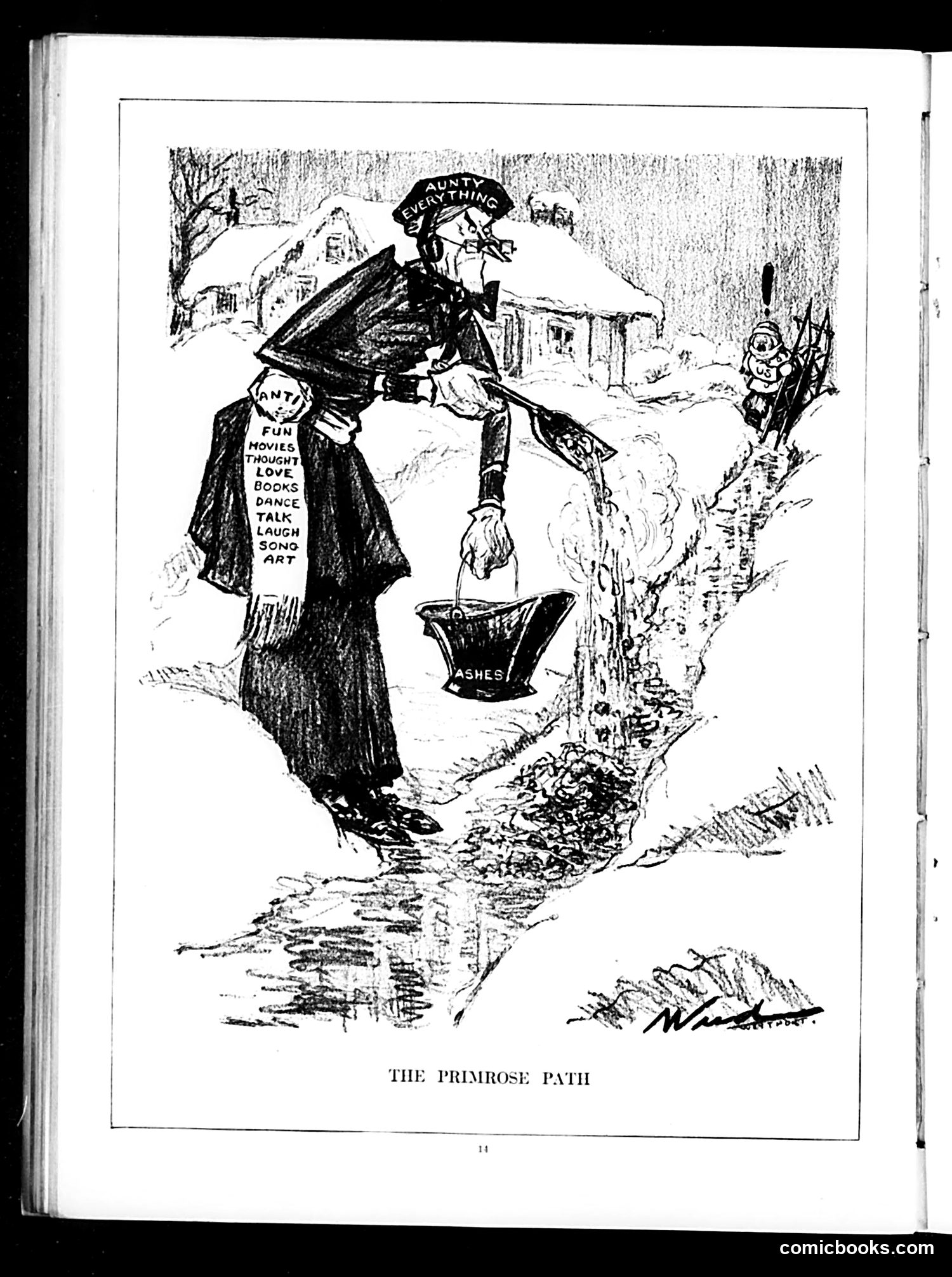
This cartoon depicts "Aunty Everything"—a matronly figure carrying a basket labeled "Ashes"—leading a young person astray. The figure's coat lists temptations: "Fun, Froth, Thought, Books, Dance, Talk, Laugh, Song, Art." The satire criticizes how modern culture—here personified as an aunt figure—seduces youth with superficial pleasures and diversions (entertainment, frivolity, socializing) while metaphorically reducing their substance to "ashes." The "primrose path" (a literary reference to temptation and ruin) suggests these seemingly innocent cultural pursuits are actually morally or intellectually corrupting. This reflects early 20th-century anxieties about modernity, mass culture, and youth morality—concerns common in Judge magazine's conservative satirical commentary.
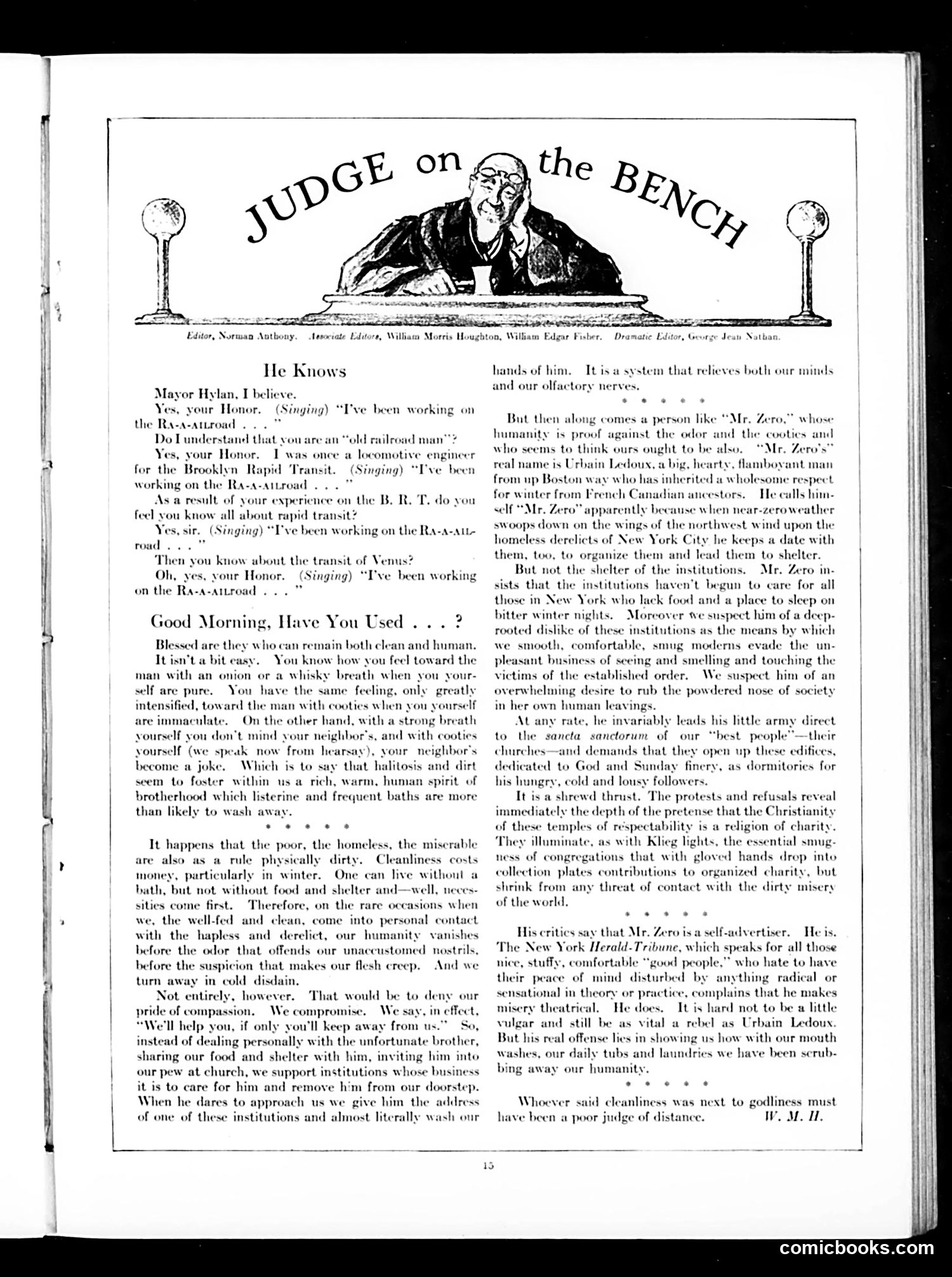
This page contains two satirical pieces. The top cartoon mocks **Mayor Hylan** (NYC mayor 1918-1925) through a dialogue where he claims expertise about rapid transit while hilariously conflating the "Ra-a-ailroad" with the "transit of Venus"—suggesting his actual knowledge is absurdly limited. The longer article critiques wealthy society's hypocrisy toward the homeless poor. It argues that respectable people support charitable **institutions** as a way to help the destitute while avoiding direct contact with them—particularly avoiding their poor hygiene and odor. The article then introduces **"Mr. Zero,"** an activist (real name Urbain Ledoux from Boston) who directly aids homeless New Yorkers during harsh winters, organizing them and leading them into shelters. The satire suggests the establishment finds him threatening because he forces society to confront poverty directly rather than hiding it away institutionally. His nickname apparently references his work during near-zero weather conditions. The piece attacks both Hylan's incompetence and society's self-serving charitable hypocrisy.
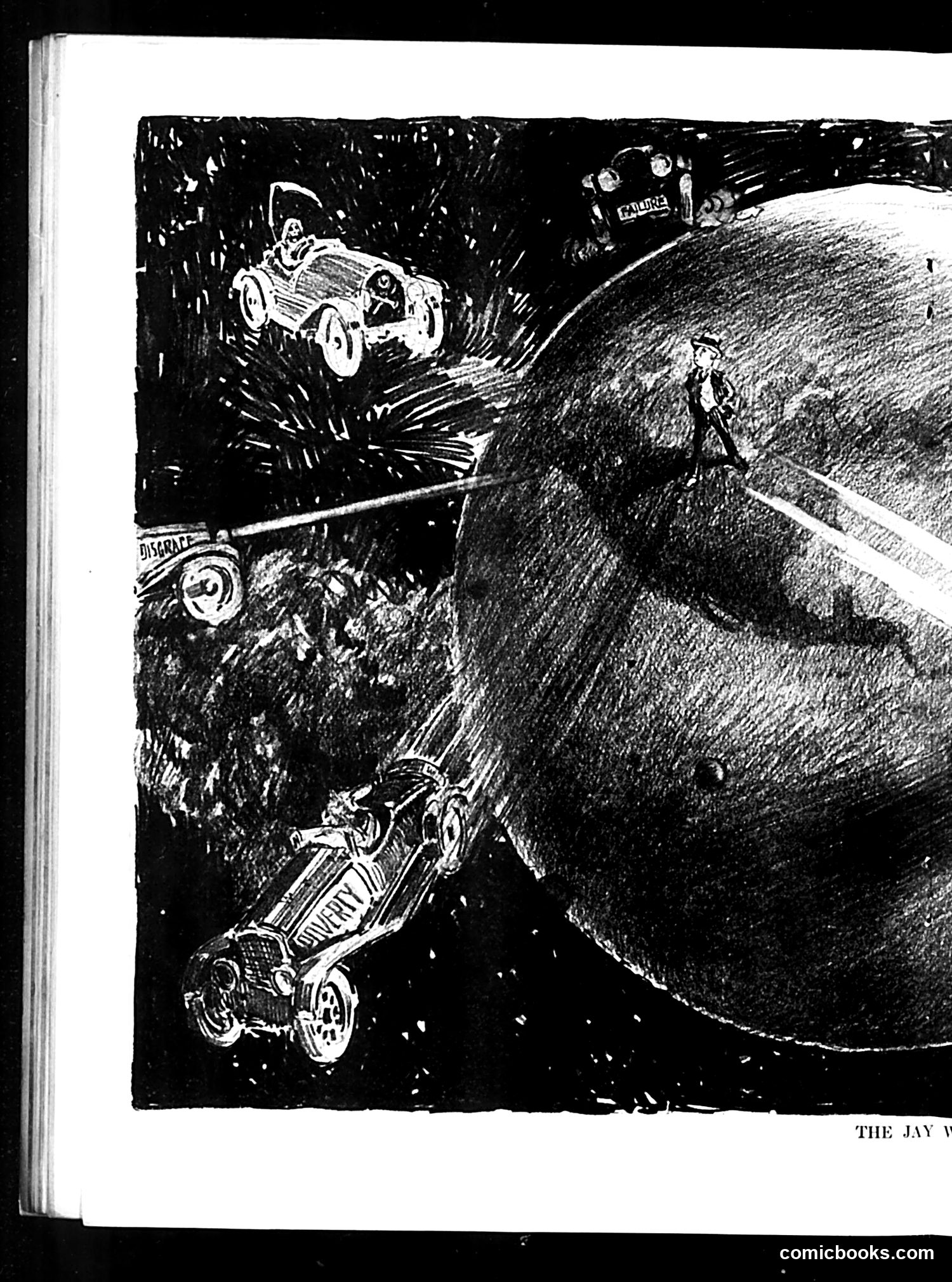
This appears to be a woodcut-style illustration from *Judge* magazine showing a dramatic racing scene with multiple automobiles on what looks like a mountain or hillside road. The image depicts early 20th-century motor cars in various positions—some racing, others appearing to have crashed or lost control near a large spherical object (possibly representing a boulder or obstacle). The visible text fragment "THE JAY" at bottom-right is incomplete, making it difficult to determine the specific satire's target. Without the full caption or article text, I cannot definitively identify which political figures or social commentary this cartoon addresses. The scene likely satirizes reckless automobile racing or dangerous driving practices popular in that era, but the exact point remains unclear from the image alone.
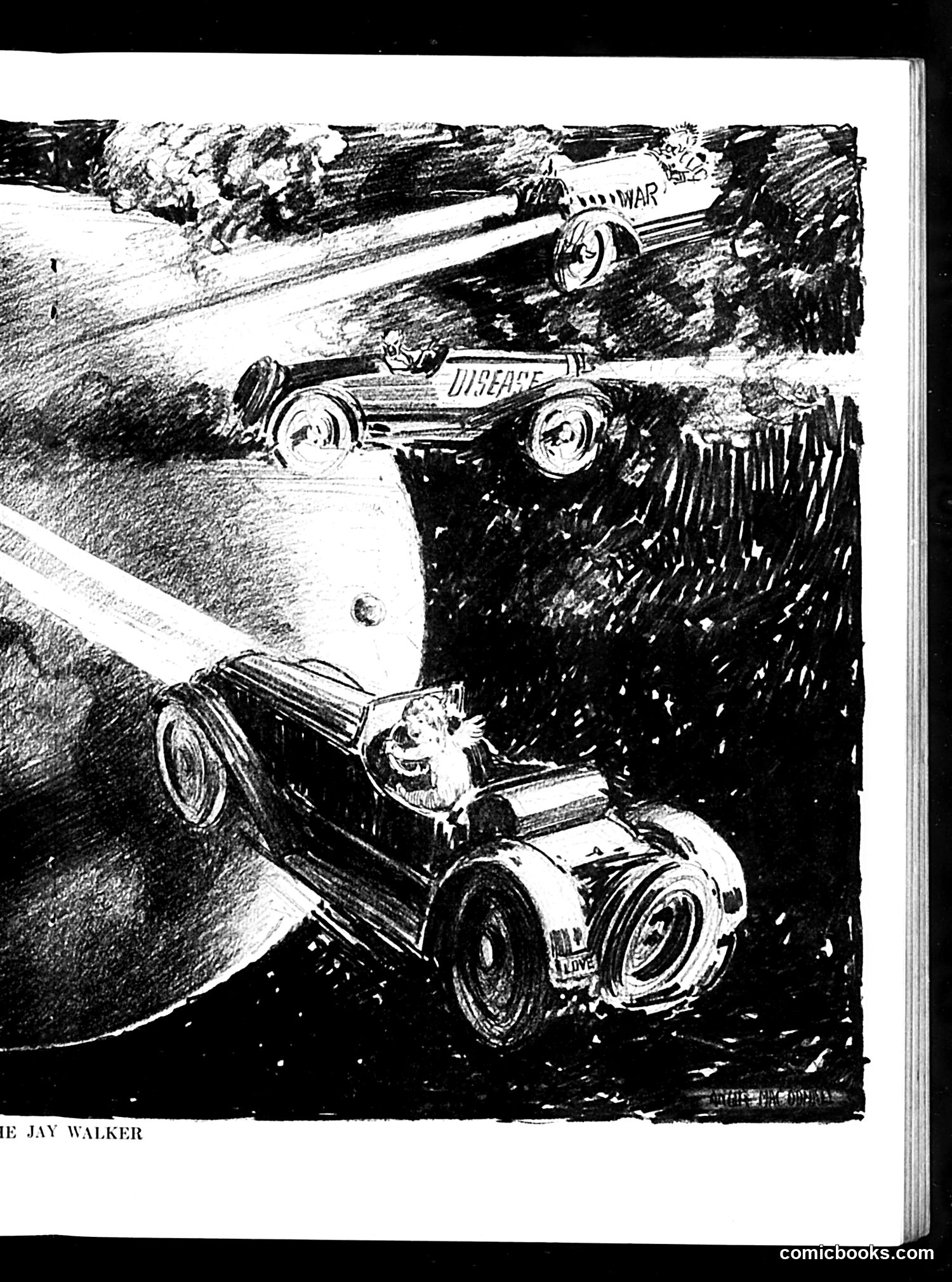
This appears to be a satirical cartoon about automotive racing or competition, likely from the early-to-mid 20th century based on the vintage car designs shown. The image depicts three racing vehicles labeled "WAR," "DISEASE," and what appears to be "LOVE" (partially visible), suggesting an allegory where different human concerns or forces are personified as competitors in a race. The cartoon likely comments on societal priorities or the relative importance of different human endeavors. However, without a visible date, publication context, or clearer text, I cannot identify the specific historical moment being referenced or confirm the exact satirical intent. The artist credit "JAY WALKER" is visible at bottom left.
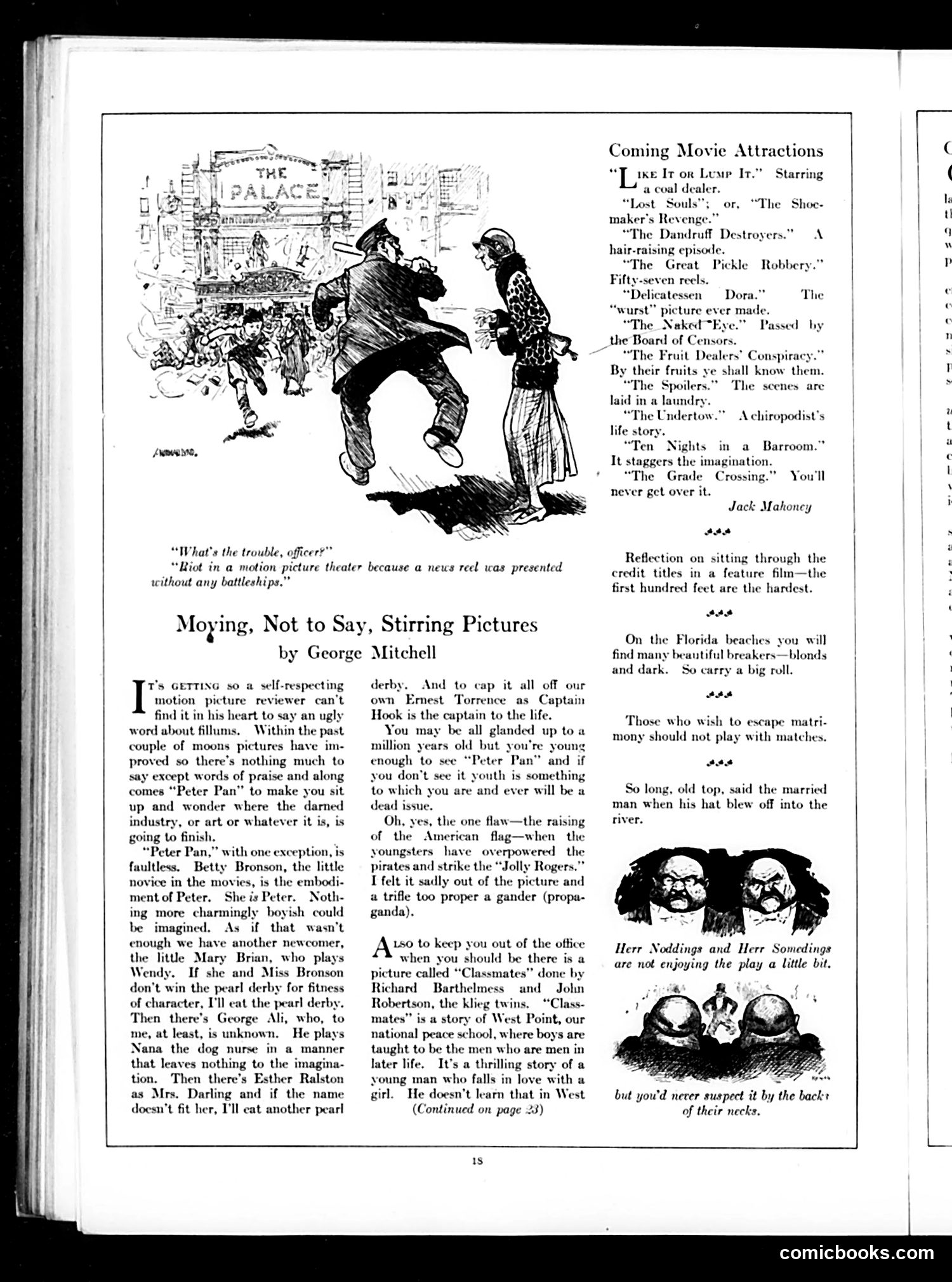
This page satirizes early 1920s cinema culture through multiple lenses: **Main Cartoon (top):** The joke mocks American moviegoers' obsession with naval/military power. A theater riot erupts when a newsreel plays without battleship footage—suggesting the public's fixation on military strength (likely reflecting post-WWI anxieties) has become so extreme that even entertainment must reinforce it. **Movie Reviews (by George Mitchell):** Mitchell critiques recent films, praising *Peter Pan* while noting its flaw: the raising of the American flag during the climax feels like heavy-handed propaganda ("a trifle too proper a gander"). He also reviews *Classmates*, a West Point story. **"Coming Movie Attractions":** Humorous fake movie titles mock both the film industry and social issues—titles like "The Dandruff Destroyers" (hair-raising) and "The Grade Crossing" (you'll never get over it) use puns. These parody how studios churn out formulaic content. **Bottom cartoons:** Two small sketches joke about cinema-going etiquette—annoyed patrons whose displeasure goes unnoticed by their oblivious companions. The page reflects how thoroughly cinema dominated 1920s culture and public discourse.
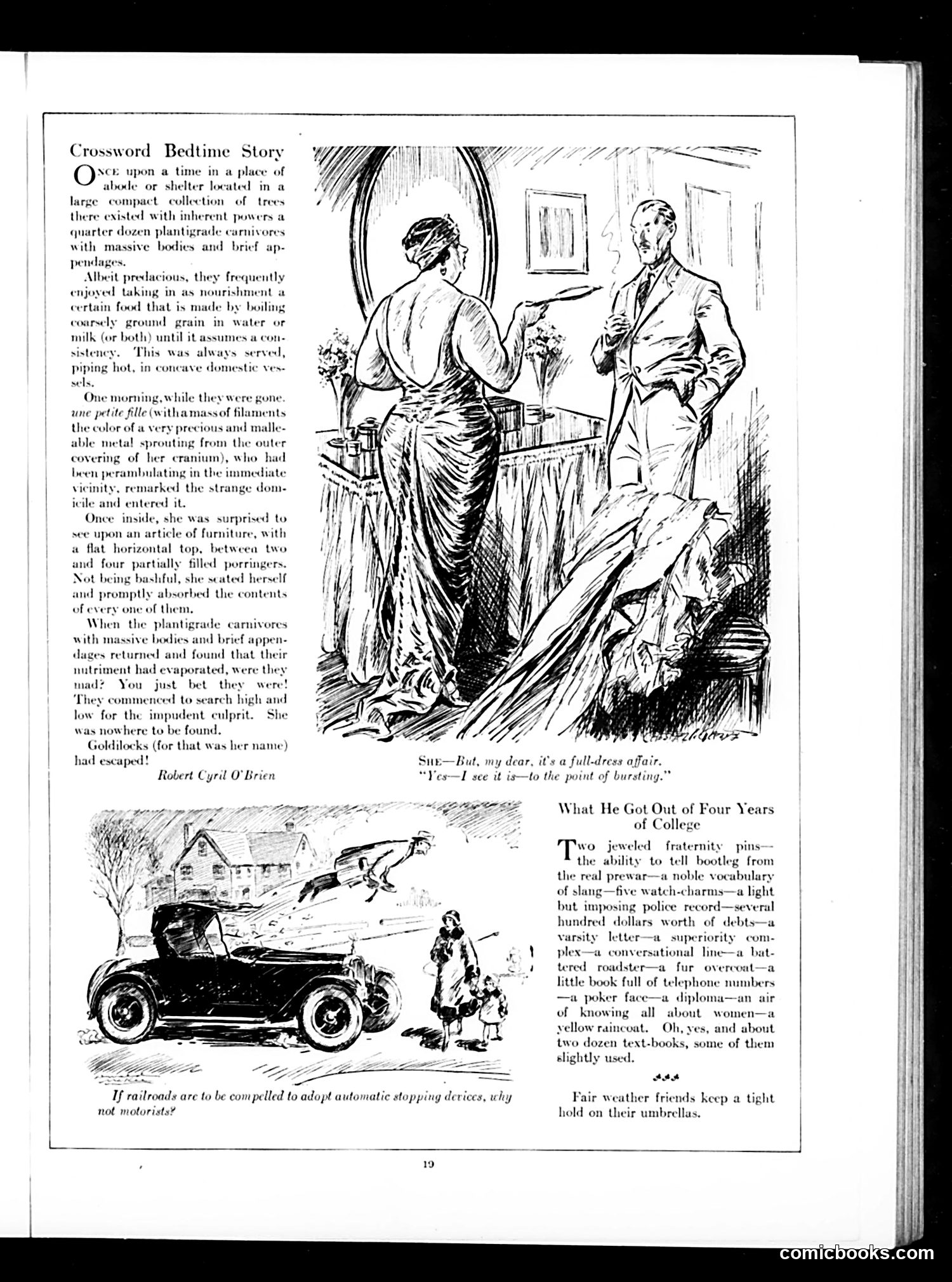
This page contains three distinct pieces of satirical content: **"Crossword Bedtime Story"** (top): A humorous retelling of "Goldilocks and the Three Bears" written entirely in unnecessarily complex, formal vocabulary—"plantigrade carnivores" for bears, "coarsely ground grain in water or milk" for porridge, "petite fille" for little girl. The joke satirizes verbose, pretentious writing and crossword-puzzle language by translating a simple children's story into incomprehensible jargon. The caption's quote about a "full-dress affair" suggests the pretension of formal dress. **Car cartoon** (middle-left): The caption questions why automatic stopping devices should be required for railroads but not for motorists—a period safety regulation debate. The illustration shows a car accident, mocking inconsistent safety standards. **"What He Got Out of Four Years of College"** (right): A satirical list itemizing what a college graduate actually acquires: fraternity pins, debts, a police record, slang vocabulary, but also "two dozen text-books, some of them slightly used"—implying students don't actually read assigned materials. This mocks the actual value of college education versus its reputation.
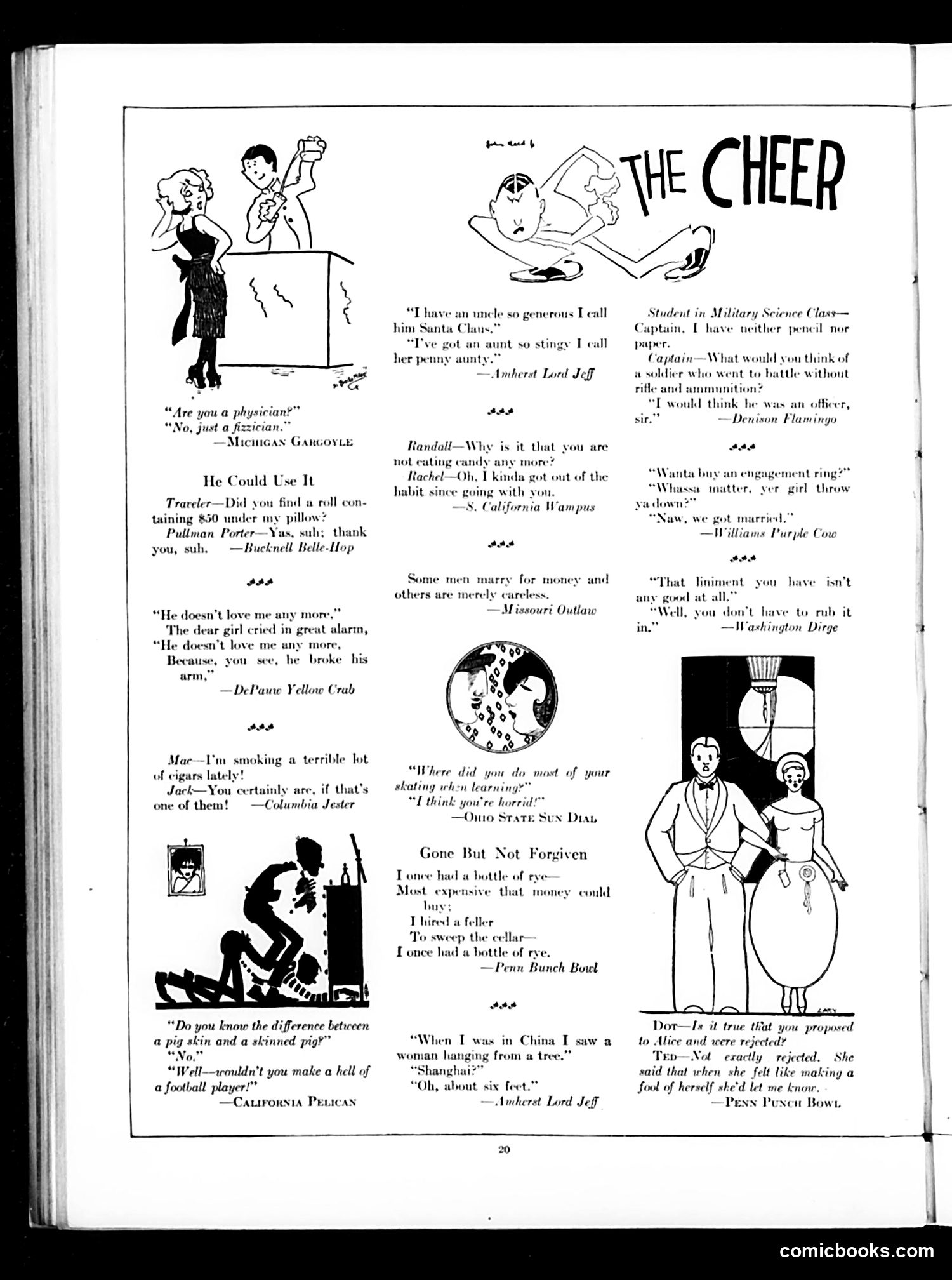
This is a humor anthology page from Judge magazine featuring college newspaper jokes and quips, primarily sourced from university publications (Michigan, Amherst, Columbia, etc.). The jokes reflect early 20th-century campus life: a "fizzician" pun, Pullman porter racial humor (common in the era), relationship complaints, smoking references, and courtship mishaps. The military science exchange satirizes officers as unprepared. A recurring joke involves rejecting a woman's proposal—inverting traditional gender roles for comedic shock value. The cartoons supplement these written jokes with visual gags about cigars and football. The recurring "Amherst Lord Jeff" attribution suggests these quips came from Amherst College's humor column. Most humor relies on wordplay, romantic rejection, and situational comedy. The material reflects college student sensibilities of that period, though some racial and gender dynamics reflect attitudes modern readers would find dated or offensive.
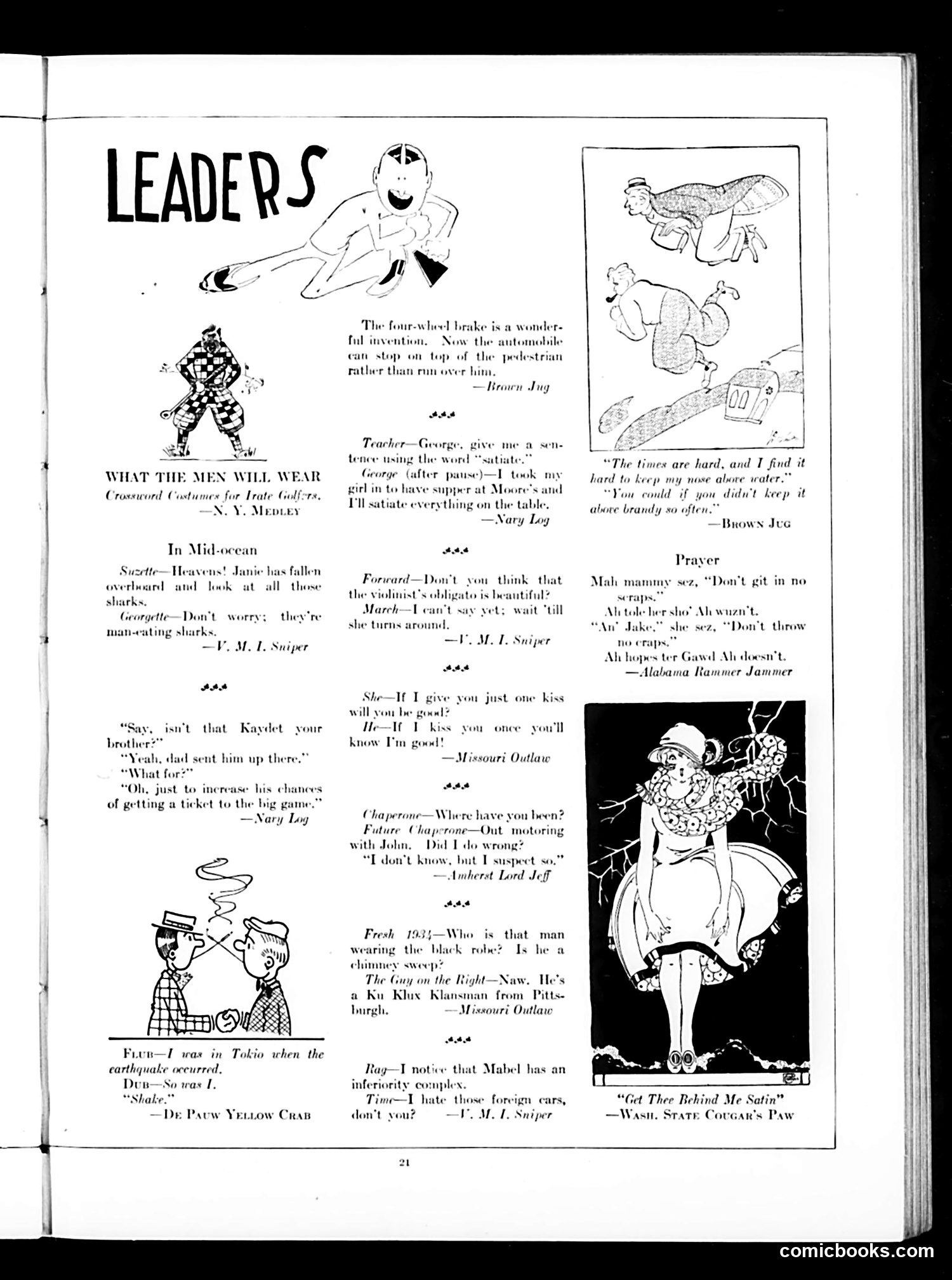
This is a **humor page** of one-liners and jokes rather than political cartoons. The content reflects 1920s-30s American social attitudes: **Key references:** - "Crossword Costumes for Trite Golfers"—jokes about fashionable golf wear - The **four-wheel brake** joke satirizes automotive safety as potentially helping pedestrians rather than drivers - **"Ku Klux Klansman from Pittsburgh"**—dark humor treating KKK membership as an absurd, out-of-place detail (suggesting it as ridiculous even in 1930s context) - Dated gender dynamics in courtship jokes (kissing, chaperonings) - **Prohibition-era humor** ("keep it above brandy")—references illegal drinking - Dialect humor using "Mah mammy" and "Alabama" reflect period racial stereotyping The overall tone is lightweight, topical satire aimed at educated magazine readers familiar with current events, fashion, and social scandals. The cartoons mock vanity, courtship customs, and modern conveniences while accepting contemporary prejudices as comedy material.
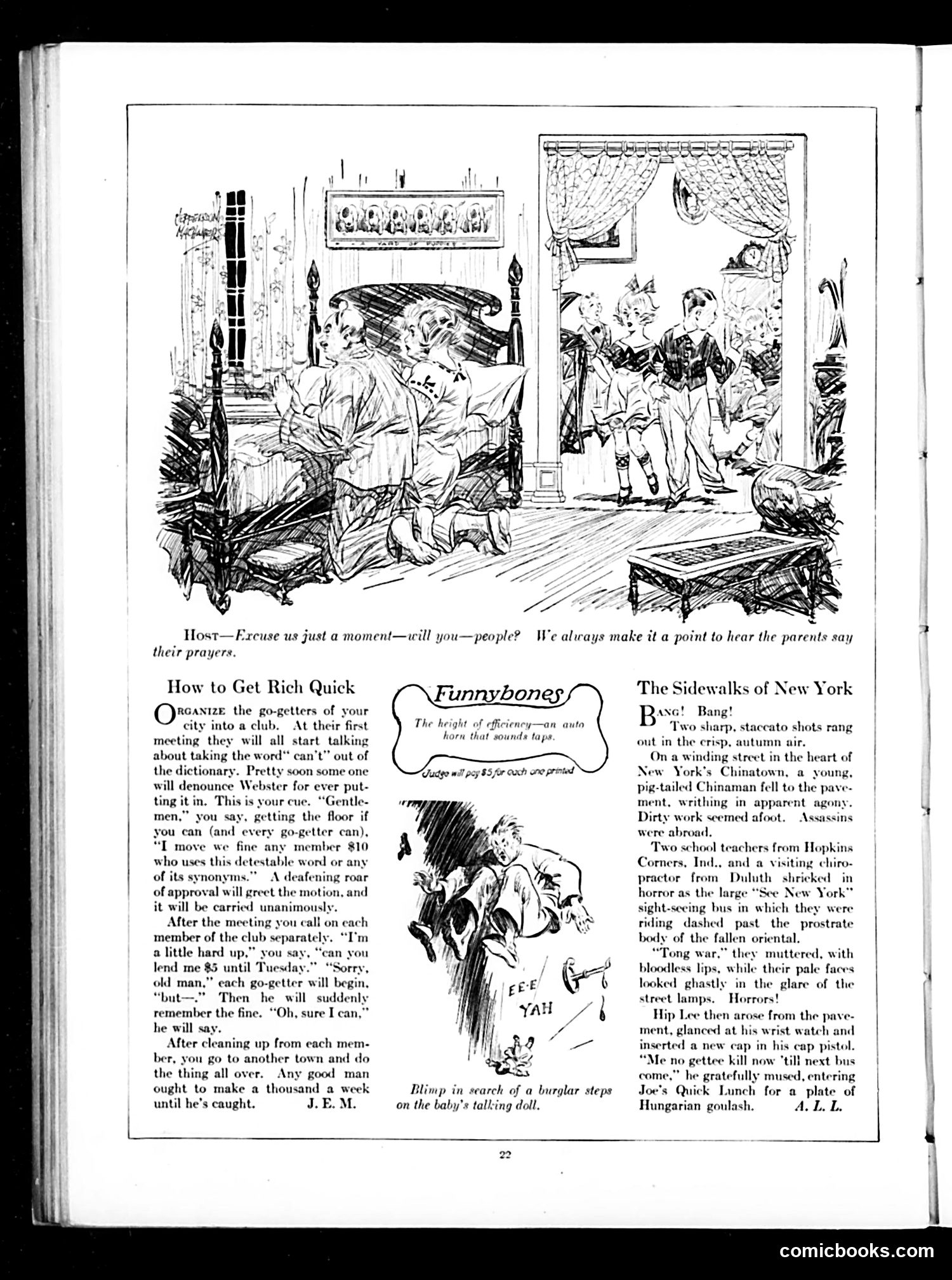
This Judge magazine page contains three separate pieces of humor: **"How to Get Rich Quick"** (left): A satirical con-artist scheme mocking the "go-getter" business culture of the era. The trick: organize a club of ambitious men, get them to fine anyone who says "can't," then visit each member individually claiming poverty. Embarrassed by their own anti-"can't" rule, they'll lend money. The author admits it's fraud but presents it as easy money. **"Funnybones"** (center): A visual gag about an automobile horn that sounds like a bugle call ("taps"—the funeral march)—dark humor about mechanical efficiency. **"The Sidewalks of New York"** (right): Satire of tourist sensationalism and racial stereotypes. Midwestern tourists witness what they assume is a deadly "Tong war" (Chinese gang violence), but it's revealed as a boy's play-acting with a toy cap pistol, breaking character only when no sight-seeing bus is present. The joke mocks both tourist gullibility and casual disregard for Asian life.
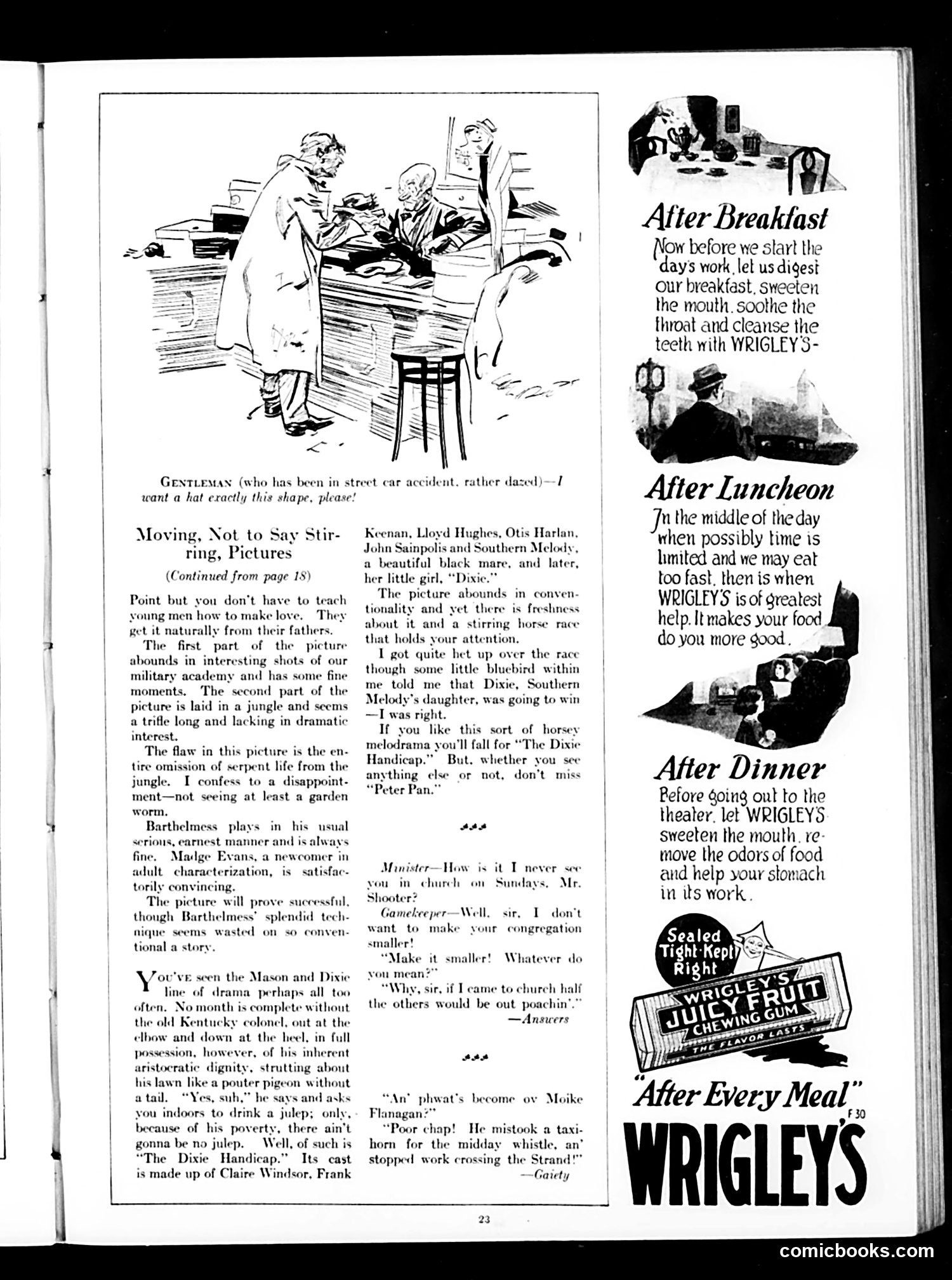
This page contains film reviews and advertising, not political cartoons. The **top cartoon** is a visual joke: a dazed gentleman who survived a street-car accident requests a hat shaped exactly like the dent in his head—absurdist humor about his confused state. The bulk of the page consists of **movie reviews** of early 1920s silent films, including "The Dixie Handicap" (featuring a horse race and Southern plantation setting typical of the era) and "Peter Pan." The critic discusses acting, plot conventions, and cinematic technique with the tone of serious arts criticism. **Three brief comic anecdotes** appear between reviews—Irish and rural working-class humor about a poacher avoiding church and an Irishman mistaking a taxi horn for a factory whistle. The **right side** is dominated by a **Wrigley's chewing gum advertisement** promoting gum consumption "After Breakfast," "After Luncheon," and "After Dinner" for digestion and oral hygiene—typical early 20th-century advertising claims before modern FDA regulations.
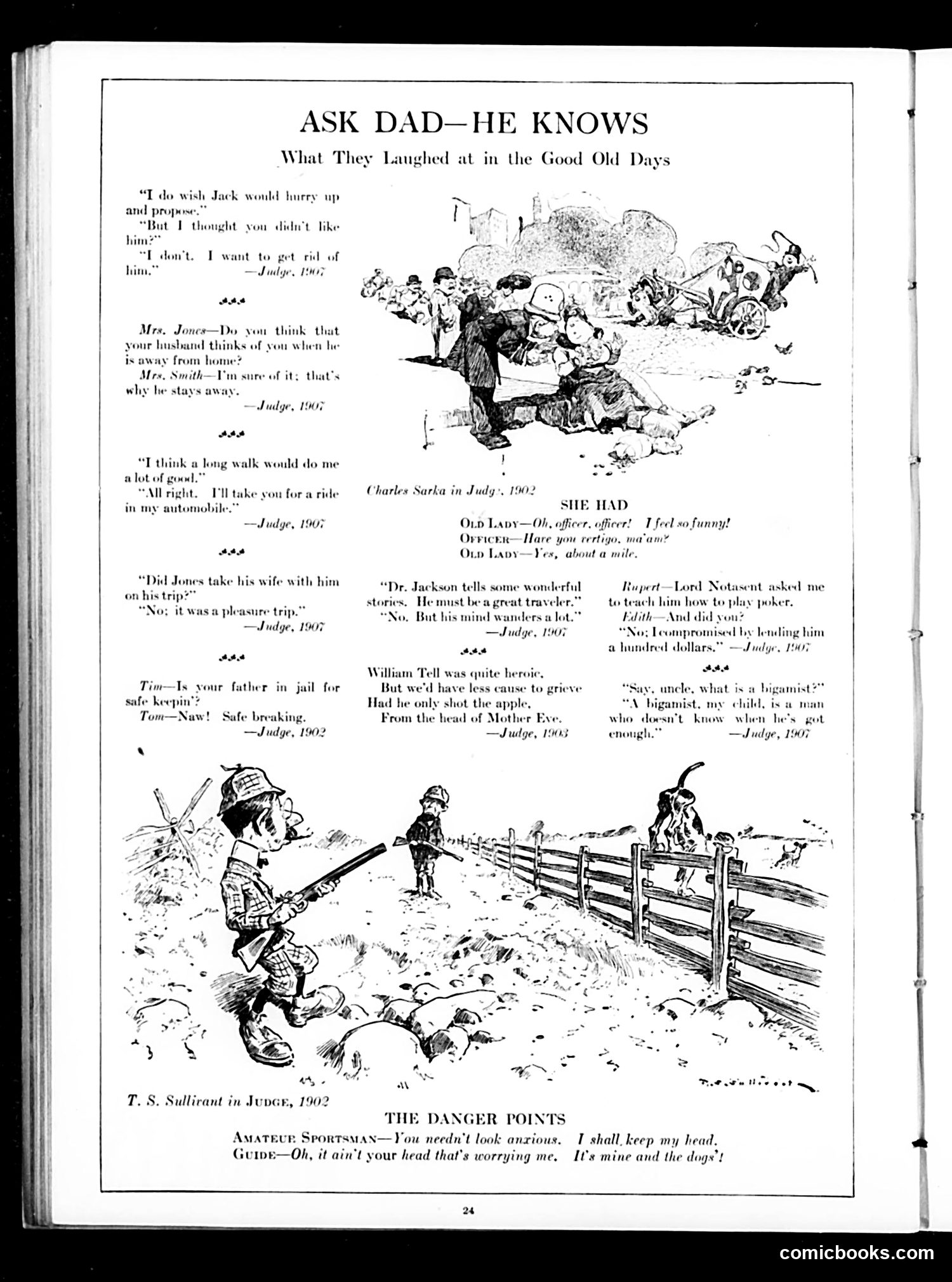
This page collects early-1900s humor from Judge magazine, showcasing period comedies about marriage, courtship, and social life. **Key jokes:** - **Marriage complaints**: Multiple quips mock wives as burdensome—husbands avoid home ("that's why he stays away"), trips without spouses are "pleasure trips." - **Courtship**: A woman wants a boyfriend to propose so she can "get rid of him"—dark humor about reluctant marriage. - **William Tell reference**: A joke suggesting Tell should have shot his wife (Mother Eve) instead of the apple—misogynistic violence played for laughs. - **Automobiles**: Presented as new technology (1907) used to entertain women. - **"Safe breaking/keeping"**: A pun about a father in jail for burglary, not safekeeping. - **The hunting cartoon**: Shows comic danger with a guide reassuring a nervous sportsman that *his* head isn't the concern—the dogs will eat it anyway. The humor reflects early-20th-century attitudes: wives as jokes, marriage as an ordeal, and casual male camaraderie. The tone would be considered deeply sexist today.
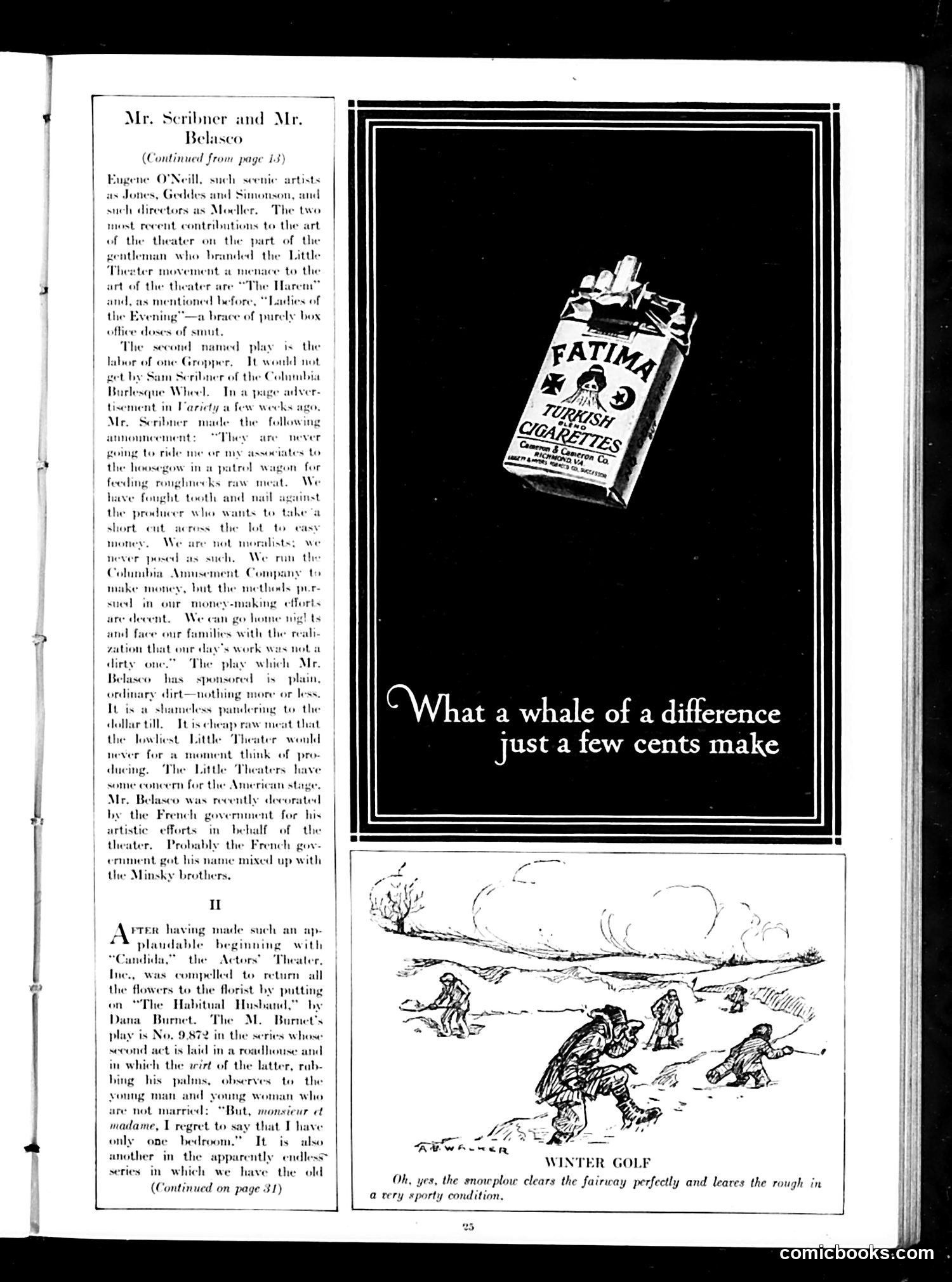
This page critiques theater producers' moral compromises. The left text discusses Samuel Scribner (Columbia Burlesque Wheel) and David Belasco, prominent theater figures. Scribner publicly defended producing crude, sexually explicit plays ("smut") while claiming ethical standards—a transparent hypocrisy the author mocks. Belasco, despite receiving French government honors for artistic contributions, similarly produces formulaic bedroom-farce plays (like "The Habitual Husband") featuring predictable seduction scenarios. The satire's point: these producers prioritize profit over principle, wrapping commercial exploitation in respectability rhetoric. The Fatima cigarette advertisement above ironically emphasizes small margins making "a whale of a difference"—directly undercutting Scribner's claims that minor ethical compromises don't matter. The "Winter Golf" cartoon below shows golfers struggling in snow—a gentle sports humor piece unrelated to the main text.
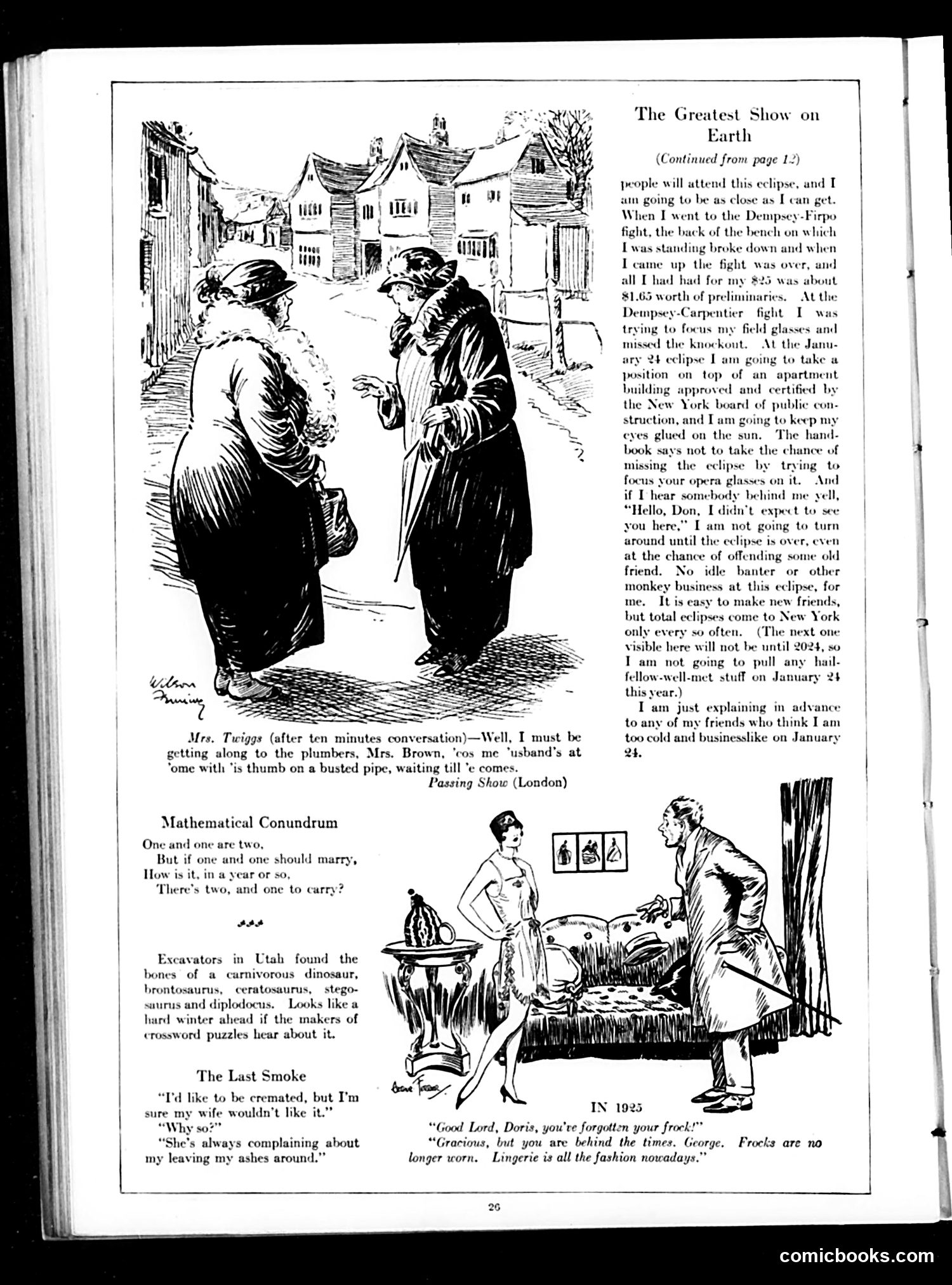
This page contains several brief humorous pieces typical of 1920s satirical magazines: **"Mrs. Twiggs" cartoon**: A working-class woman (indicated by dialect) excuses herself from conversation because her husband is home with his thumb literally plugging a burst pipe, waiting for the plumber. The joke relies on the physical comedy of the situation and class-based humor common to the era. **"Mathematical Conundrum"**: A riddle about childbirth—"one and one" (two people) marry and produce "two, and one to carry" (two children, one being carried). It's mild wordplay about reproduction. **"The Last Smoke"**: A brief joke about cremation preferences. **"The Greatest Show on Earth"**: A longer first-person account about attending a January 24 solar eclipse in New York, treating it with obsessive seriousness after missing previous sporting events due to distractions. **"IN 1925" cartoon**: A domestic scene where a woman appears undressed; the husband protests, but she explains that frocks are outdated—"lingerie is all the fashion." This satirizes 1920s changing women's fashion toward more revealing styles.
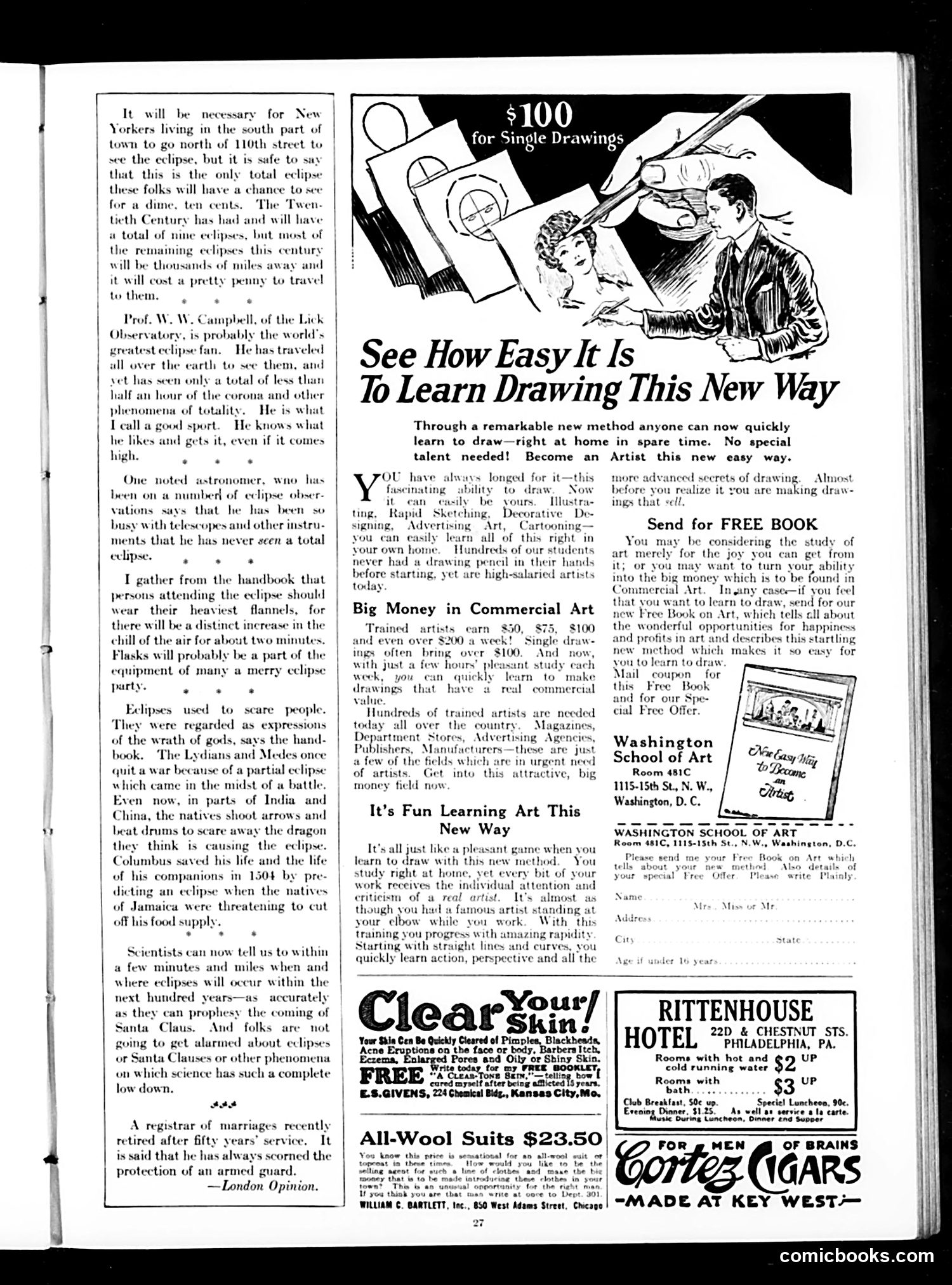
This page is primarily **advertising and editorial content**, not political satire. The dominant feature is a large advertisement for the Washington School of Art's correspondence drawing course ($100 for single drawings). The left column contains **editorial commentary on a solar eclipse**, likely the 1918 eclipse. The text discusses practical viewing details for New Yorkers, mentions eclipse-enthusiast Professor W.W. Campbell, and notes how historically eclipses frightened people—referencing Columbus's 1504 prediction saving his life in Jamaica, and how people in India and China still shoot arrows to "scare away the dragon" causing eclipses. The remainder consists of **vintage advertisements**: a "Clear Your Skin!" acne treatment, all-wool suits, the Rittenhouse Hotel in Philadelphia, and Cortez Cigars. There are no political cartoons visible on this page—it's essentially a magazine advertising section interspersed with general-interest eclipse facts.
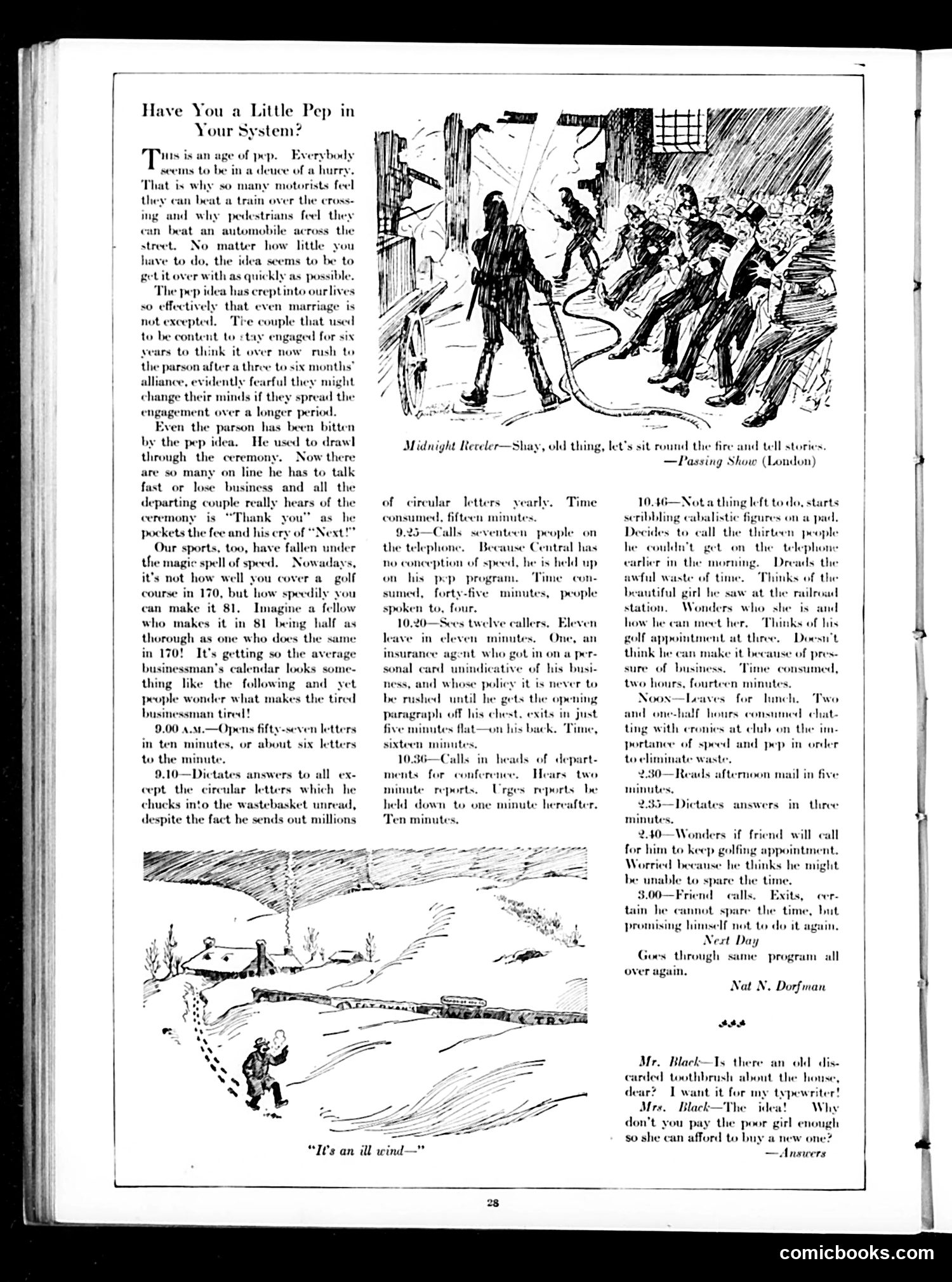
This satirical article mocks the era's obsession with speed and efficiency. The author, Nat N. Dorfman, catalogs a businessman's frantically scheduled day, where he rushes through activities—opening 57 letters in 10 minutes, making phone calls he can't complete, holding meetings—yet accomplishes little of substance. The joke is the contradiction: at midday, having nothing left to do, he wastes two hours and fourteen minutes worrying and daydreaming, then rushes to golf, dreading to spare time he clearly has. The accompanying illustration showing people playing hockey in cramped urban conditions reinforces the theme: modern life compels constant rushing regardless of actual necessity. The brief exchange at bottom, where a man wants a discarded toothbrush "for my typewriter," suggests absurdist desperation born from overwork. The satire critiques 1920s-era productivity culture and the "pep" mentality—the compulsive speed-seeking that had infected American business, sports, even marriage—as ultimately hollow and exhausting.
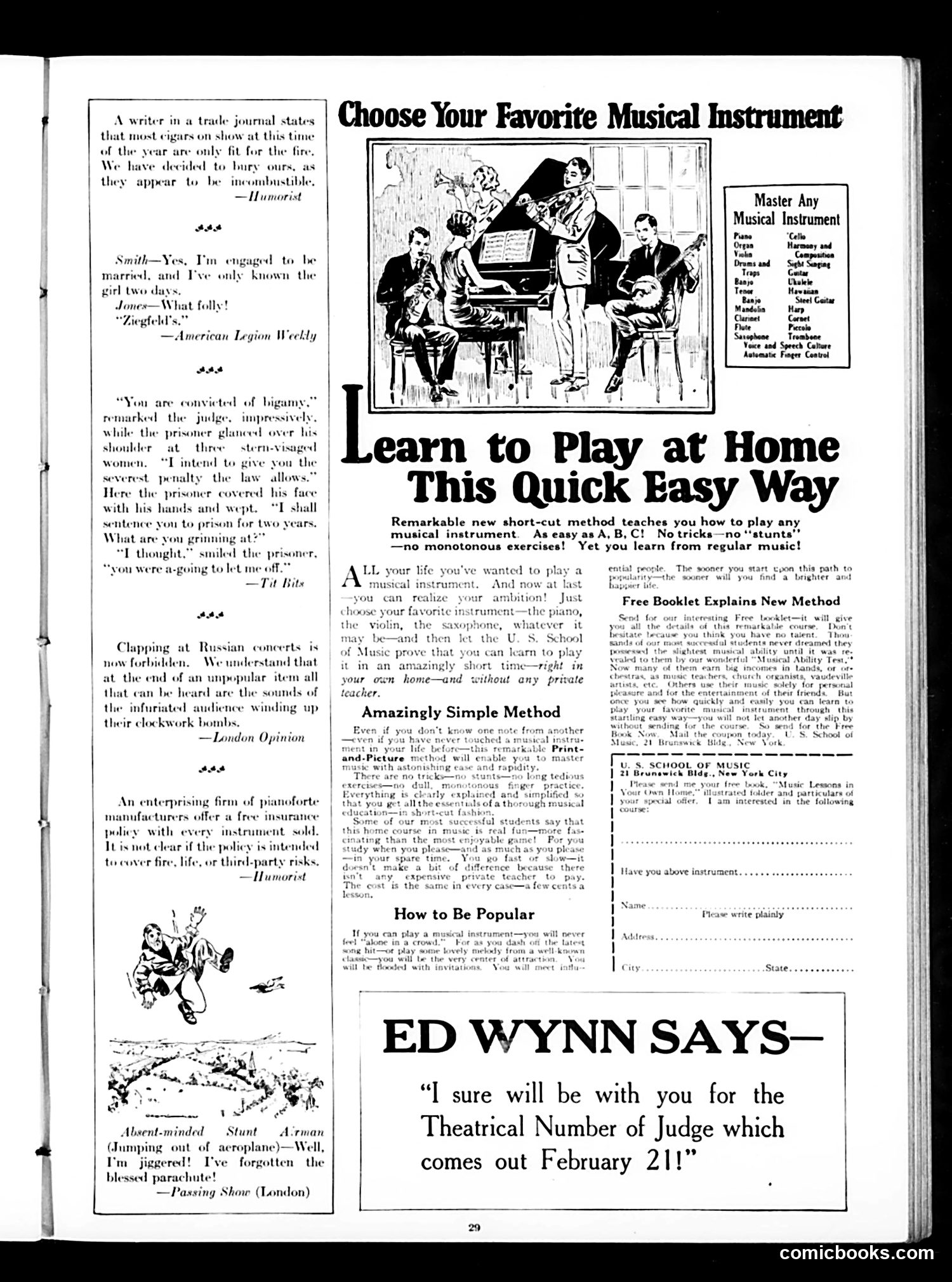
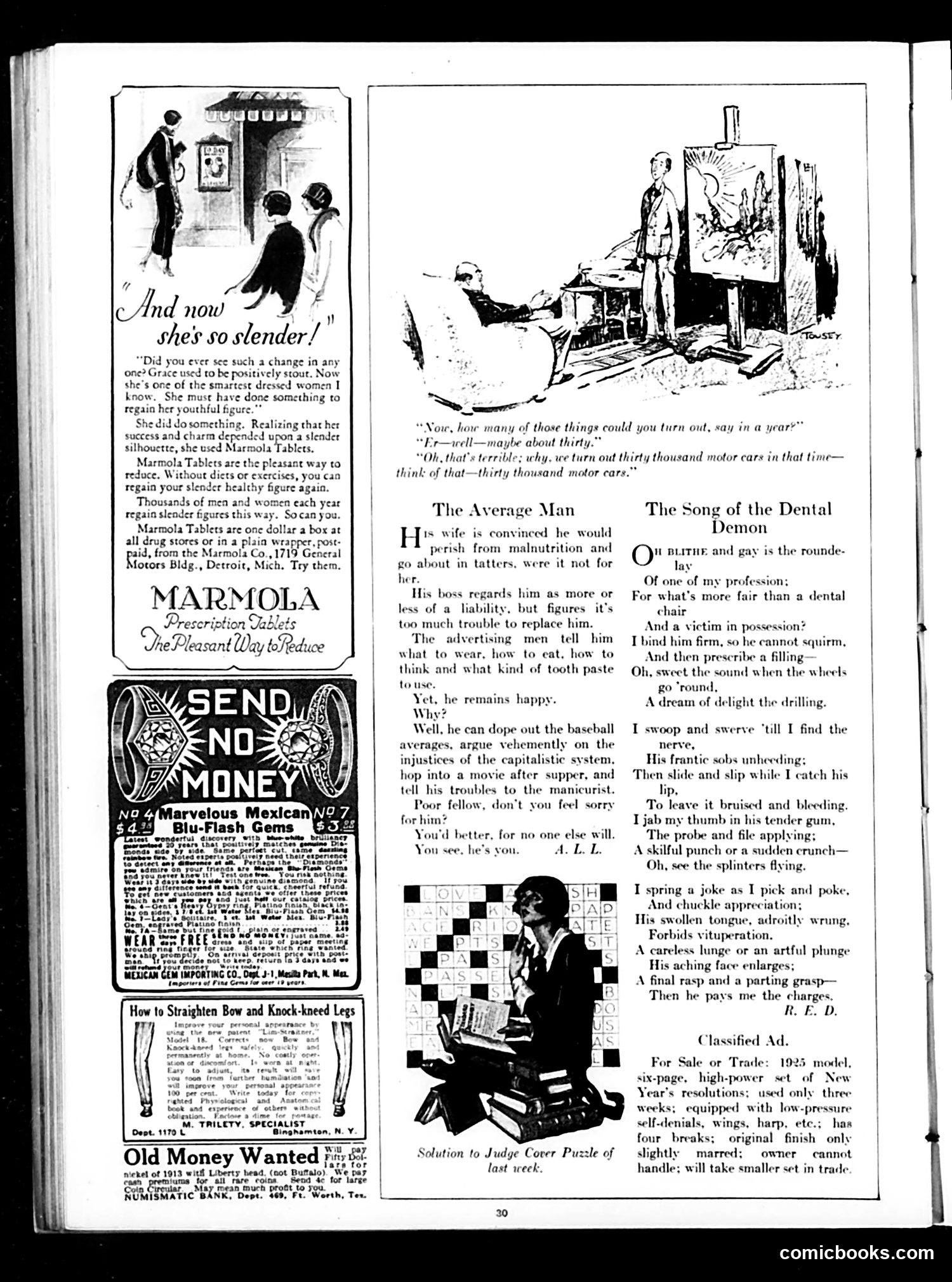
This page contains three distinct pieces of satire: **Left side:** Advertisement for Marmola weight-loss tablets, featuring a satirical dialogue about a woman's dramatic transformation. The joke targets both the product's dubious claims and contemporary obsession with slenderness—the "before" woman was "positively stout," now she's fashionable. The satire lies in presenting a pharmaceutical quick-fix as the solution to social acceptance. **Center:** "The Average Man" essay mocks the ordinary male's delusions of independence. Though his wife, boss, and advertisers control his life, he achieves contentment through escapism (baseball statistics, movies, complaining to manicurists). The satire critiques masculine self-deception and passive acceptance of manipulation. **Right side:** "The Song of the Dental Demon" is darkly comic verse from a dentist's perspective, gleefully describing patient torture—drilling, probing, bruising lips. It's grotesque humor about the sadistic pleasure dentists supposedly derive from inflicting pain, reflecting contemporary anxiety about dental work. All three pieces employ satirical exaggeration to mock consumer culture, gender expectations, and modern anxieties.
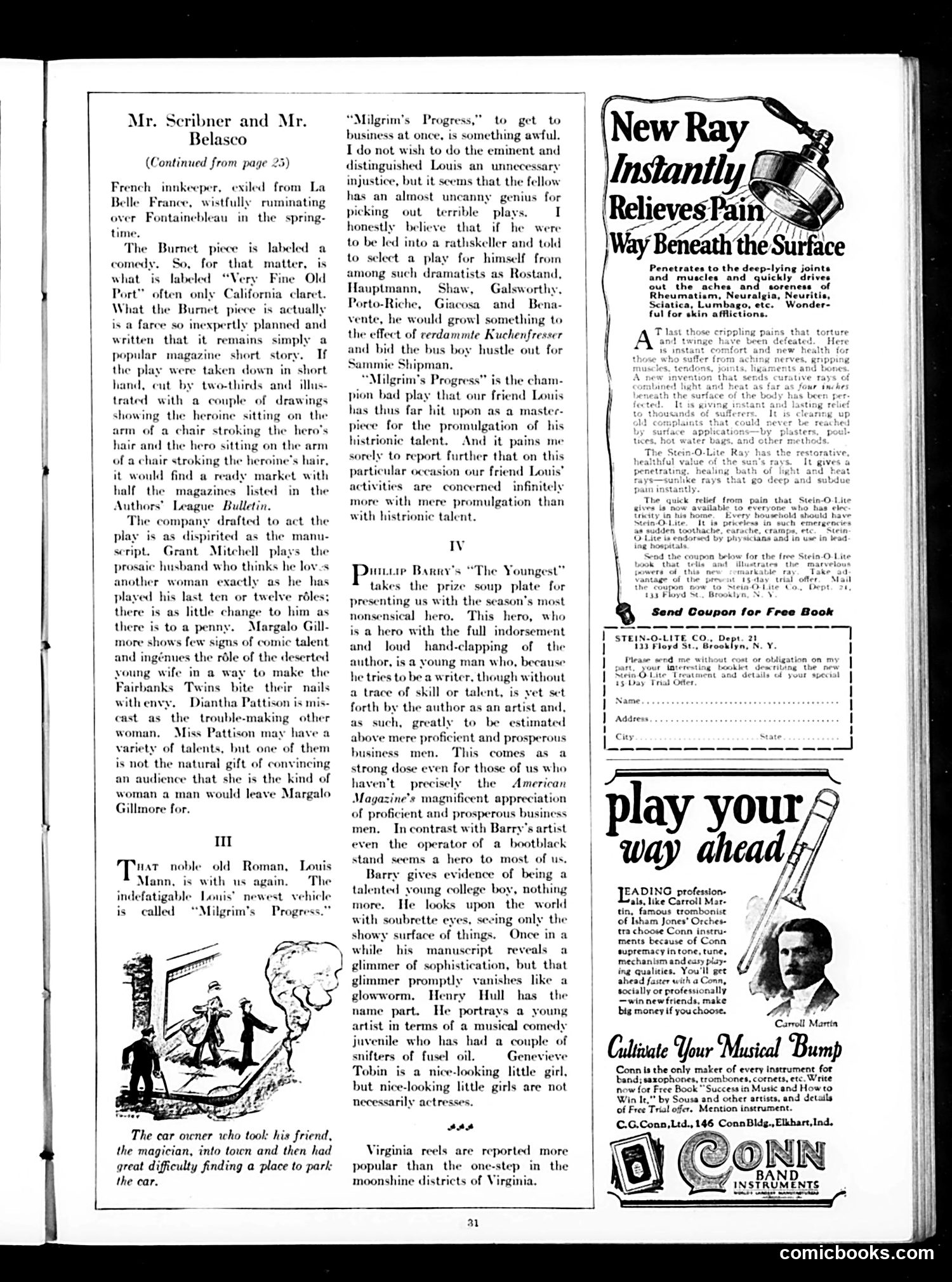
This page contains theater criticism rather than political cartoons. The critic reviews three Broadway plays: **"Milgrim's Progress"** starring Louis Mann is savagely dismissed as "something awful," criticizing both the play itself (a poorly-written farce) and the cast performances, particularly Grant Mitchell's repetitive acting and Diantha Pattison's miscasting. **Philip Barry's "The Youngest"** is criticized for presenting an incompetent would-be writer as an artist-hero worthy of admiration, which the critic finds absurd compared to actual businessmen. Barry himself is portrayed as merely a "talented young college boy" with shallow perspective. The small cartoon (bottom left) depicts a car owner struggling to park after visiting town with a magician—unrelated social commentary on urban parking difficulties. The page's advertisements promote medical products (pain relief) and musical instruments (Conn band instruments), typical of 1920s magazine content.
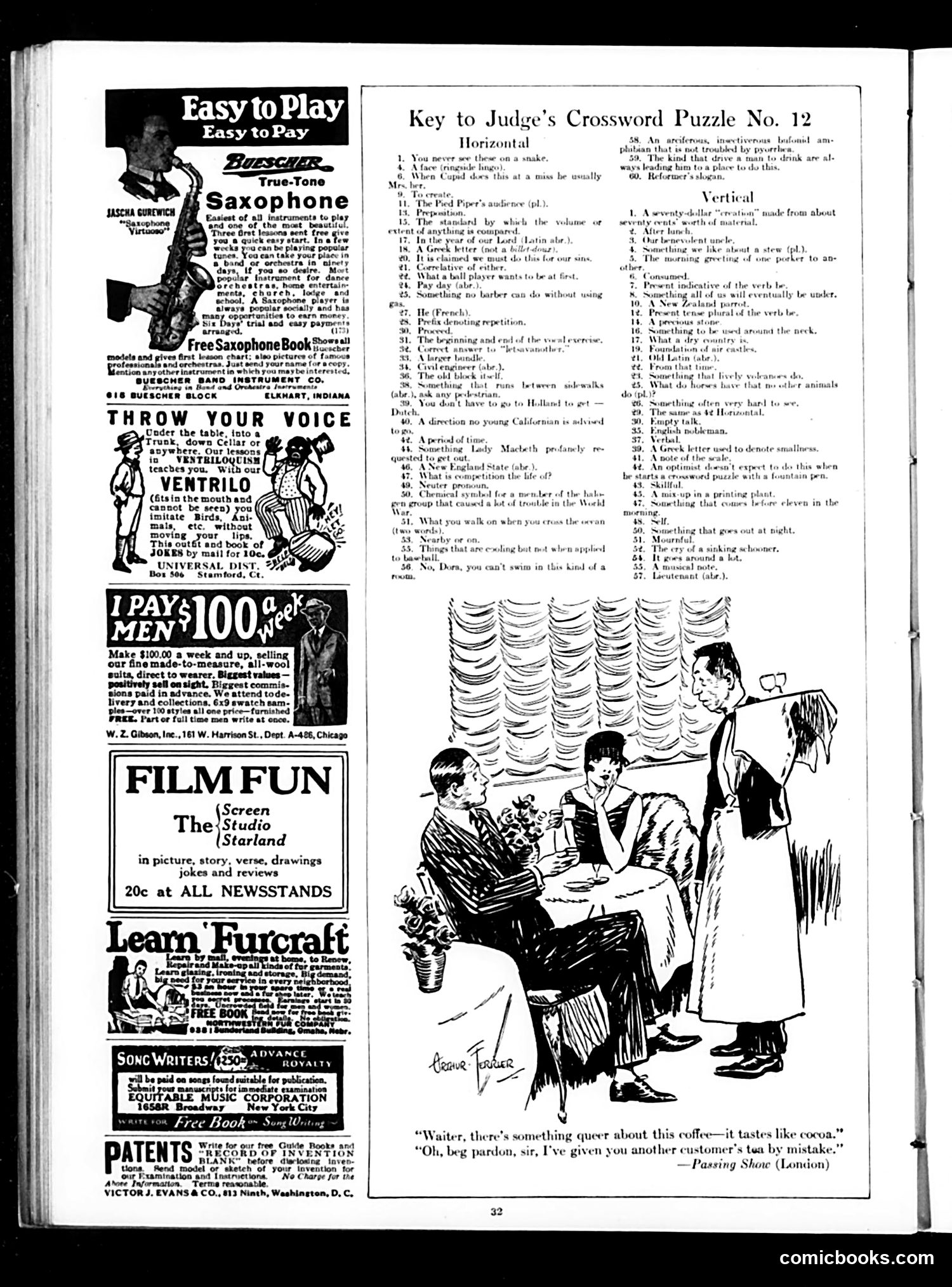
This page is primarily **advertising** with a single cartoon at the bottom. The main content consists of various mail-order ads typical of early-to-mid 20th century magazines: a saxophone course, ventriloquism lessons, suit sales, and patent services. The cartoon depicts a **restaurant or café scene** where a waiter apologizes to a diner. The joke relies on service incompetence: the waiter has mistakenly served the customer another patron's tea instead of coffee, then compounds the error by offering a weak explanation. The humor is situational—a relatable mishap about restaurant mix-ups and poor service. The caption credits "Passing Show (London)," indicating this is a reprinted British cartoon. The satire is gentle social humor rather than political commentary, poking fun at everyday service failures that readers would recognize.
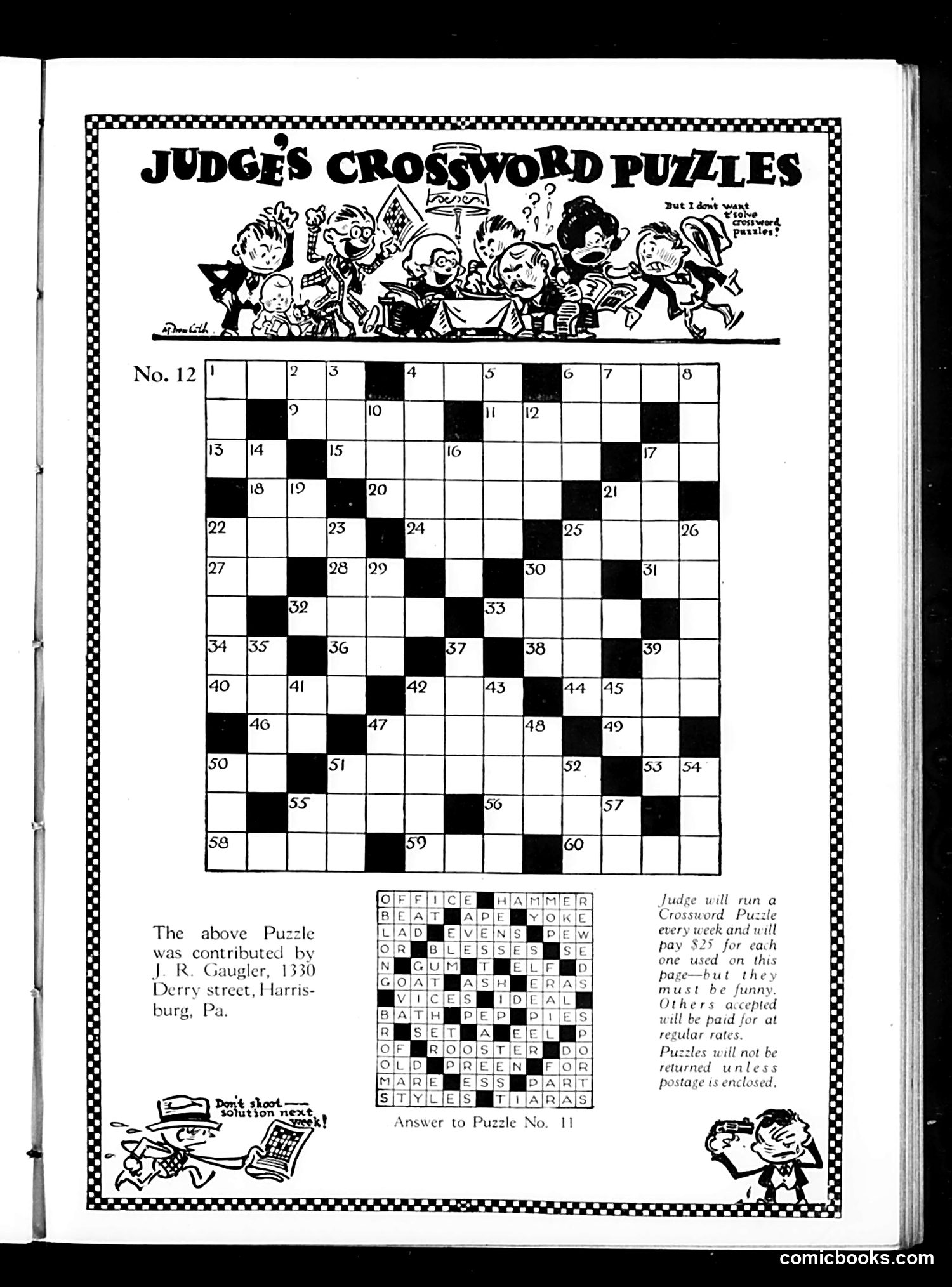
This page features a crossword puzzle contributed by a reader from Harrisburg, Pennsylvania. The cartoon header shows children enthusiastically gathered around puzzles, reflecting the era's puzzle craze. The key content is the **announcement that Judge magazine will regularly run crossword puzzles**, paying $25 per puzzle used. This was significant because crossword puzzles were a relatively new phenomenon in the 1920s-30s, having recently become a widespread cultural fad. The magazine positioned itself as capitalizing on this popular trend while also crowdsourcing content from readers. The stipulations—that puzzles "must be funny," won't be returned without postage, and will be paid at "regular rates"—show Judge's editorial standards while managing submission logistics. The "Answer to Puzzle No. 11" grid displayed confirms this was an ongoing series. The whimsical cartoon elements reinforce the lighthearted, family-friendly nature of the puzzle feature.
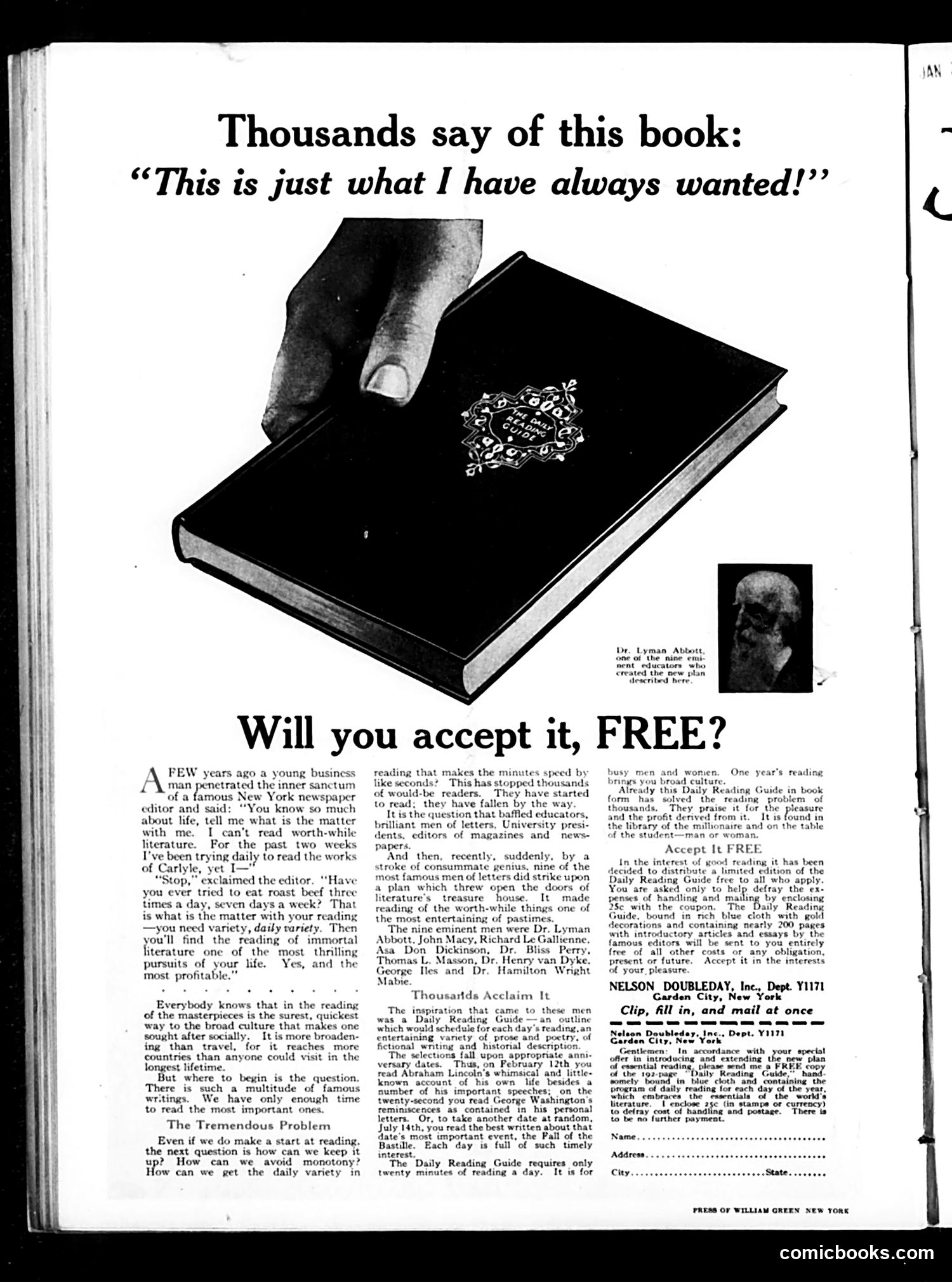
This is primarily **advertising disguised as editorial content** for the "Daily Reading Guide," a curated reading schedule created by nine prominent literary figures (Dr. Lyman Abbott, John Macy, Richard Le Gallienne, and others named in the text). The pitch targets busy, ambitious readers who want to appear cultured but lack time for serious literature. The premise satirizes (or exploits) a common anxiety: that reading difficult classics like Carlyle is monotonous and overwhelming. The "solution" is a daily schedule requiring only 20 minutes, timed to anniversaries (Lincoln on February 12th, Washington on the 22nd, etc.) to create variety and relevance. The appeal is frank: broad culture makes one "sought after socially" and "profitable." The satire—if intentional—mocks the commercialization of self-improvement and the notion that culture can be packaged and consumed in convenient daily doses. However, Judge may be running this earnestly as sponsored content, which itself would be the joke to modern readers: advertising masquerading as serious journalism.