
Judge, 1925-01-17 · page 17 of 36
Judge — January 17, 1925 — page 17: what you’re looking at
What you’re looking at
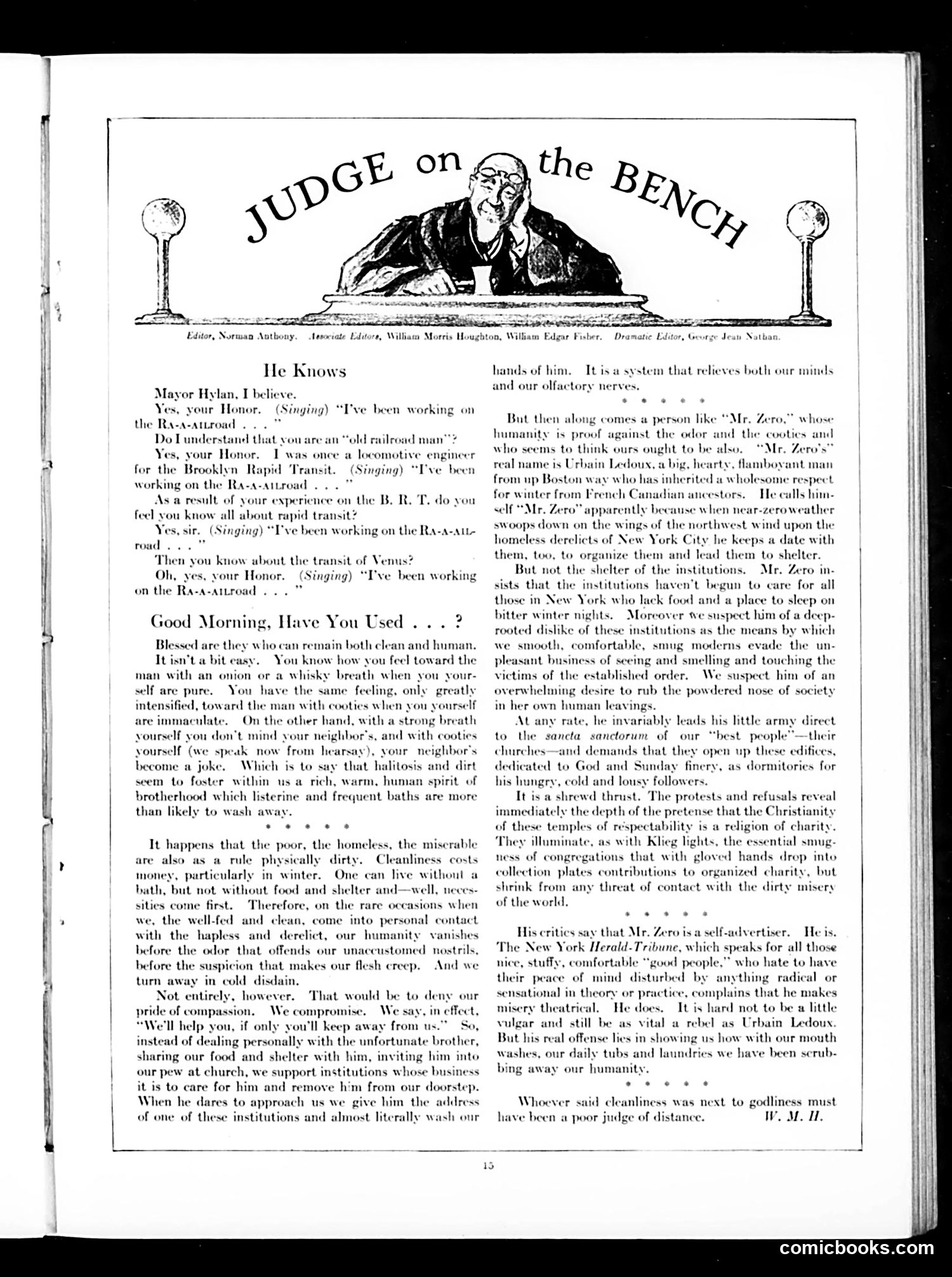
This page contains two satirical pieces. The top cartoon mocks **Mayor Hylan** (NYC mayor 1918-1925) through a dialogue where he claims expertise about rapid transit while hilariously conflating the "Ra-a-ailroad" with the "transit of Venus"—suggesting his actual knowledge is absurdly limited. The longer article critiques wealthy society's hypocrisy toward the homeless poor. It argues that respectable people support charitable **institutions** as a way to help the destitute while avoiding direct contact with them—particularly avoiding their poor hygiene and odor. The article then introduces **"Mr. Zero,"** an activist (real name Urbain Ledoux from Boston) who directly aids homeless New Yorkers during harsh winters, organizing them and leading them into shelters. The satire suggests the establishment finds him threatening because he forces society to confront poverty directly rather than hiding it away institutionally. His nickname apparently references his work during near-zero weather conditions. The piece attacks both Hylan's incompetence and society's self-serving charitable hypocrisy.
📄 Transcribed text from this page (OCR, searchable)
Machine-transcribed from the original scan — historical spelling and the odd misread are preserved.
2 ee Sse Editor, Norman Anthony He Knows Mayor Hylan, I believe. Yes, your Honor, the Ra-a-aturoad .. . 7 Do T understand that vou are an” Yes, your Honor. 1 was once for the Brooklyn Rapid ‘Transit. working on the Ra-a-attroad . Asa result of your experience on the B. R. feel you know all about rapid transit? Yes, sir. (Singing) “I've been working on the Ra-a-atL- Singing) “I've been working on Nd railroad man’? locomotive (Singing) * engineer ve been > you u know about the transit of Venus? Oh, yes, your Honor. (Singing) * on the Ra-a-aitroad . 2.” ve been working Good Morning, Have You Used... ? Bles: e they who can remain both clean and human. It isn’t a bit easy. You know how you feel toward the man with an onion or a whisky breath when you your- self are pure. You have the same feeling, only greatly intensified, toward the man with cooties when you yourself are immaculate. On the other hand, with a strong breath yourself you don’t mind your neighbor , yourself (we speak now from hearsay), your neighbor's become 4 Which is to say that halitosis and dirt seem to foster within us a rich, warm, human spirit of brotherhood which listerine and frequent baths are more than likely to wash away. and with ec It happens that the poor, the homeless, the miserable are also as a rule physically dirty. Cleanliness costs money, particula in winter. One can live withoul a h, but not without food and shelter and—well, 1 sities come first. n the rare oceasions when fed and clean, come into personal contact with the hapless and derelict, our humanity vanishes before the odor that offends our unaccustomed nostrils, before the suspici makes our flesh creep. And we turn away in cold disdain, Not entirely, however. That would be to deny our pride of compassion. We compromise. We say, in effect, “We'll help you, if only you'll keep away from us." So, instead of dealing personally with the unfortunate brother, sharing our food and shelter with him, inviting him into our pew at church, we support institutions whose business it is to care for him and remove him from our doorstep. When he dares to approach us we give him the address of one of these institutions and almost literally wash our we, the we fesortate Edutore, William Morris Houghton, William Edgar Fisher. Dra ¢ Editor, George Jean Nathar hands of him. It is a system that relieves both our minds and our olfactory nerves. “Mr. Zero,” oreand th But then along comes a person like humanity is proof against the who seems to think ours ou, real name is Urbain Lec from up Boston way who. es cootics ¢ ix, a big, hearty, fla! ntiman as inherited a whi espect for winter from French Canadian ancestors. He culls him- self “Mr. Zero” apparently because when near-zeroweather swoops down on the wings of the northwest wind upon the homeless derelicts of New York City he keeps a date with them, too, to organize them and lead them to shelter. But not the shelter of the institutions, Mr. Zero in- sists that the institutions haven't begun to care for all those in New York who lack food and a place to sleep on bitter winter nights. Moreover we suspect him of a deep- rooted dislike of these institutions as the means by whic we smooth, comfo: the un- pleasant business of seeing and smelling and touching the victims of the established order. We suspect him of overwhelming desire to rub the powdered nose of society in her own human leavings. At any rate, he invariably leads his little army direct to the sancta sanctorum of our “best people” —their churches—and demands that they open up these edifices, dedicated to God and Sunday finer: his hungry, cold and lousy followers. It is a shrewd thrust. The protests and refusals reveal immediately the depth of the pretense t the Christianity of these temples of respectability is a religion of charity. They ilumir with Klieg lights, the essential smug- hess of congregations that with gloved hands drop into collection plates contributions to organized charity, but shrink from any threat of contact with the dirty misery of the world, able, smug moc rs eV; 1s dormitories for His critics say that Mr. Zero isa self-advertiser. He is. The New York Herald-Tribune, which speaks for all those ice, stuffy, comfe Je “good people,” who hate to have ir peace of mind disturbed by anything radical or sensational in theory or practice, complains that he makes misery theatrical. He does. It is hard not to be a little vulgar and still be as vital a rebel as Urbain Ledoux But his real offense lies in showing us how with our mouth washes, our daily tubs and laundries we have been serub- bing away our lnmanit Whoever said cleanliness was next to godliness must have been a poor judge of distance. Wo MUL comicbooks.com