
A complete issue · 36 pages · 1925
Judge — January 10, 1925
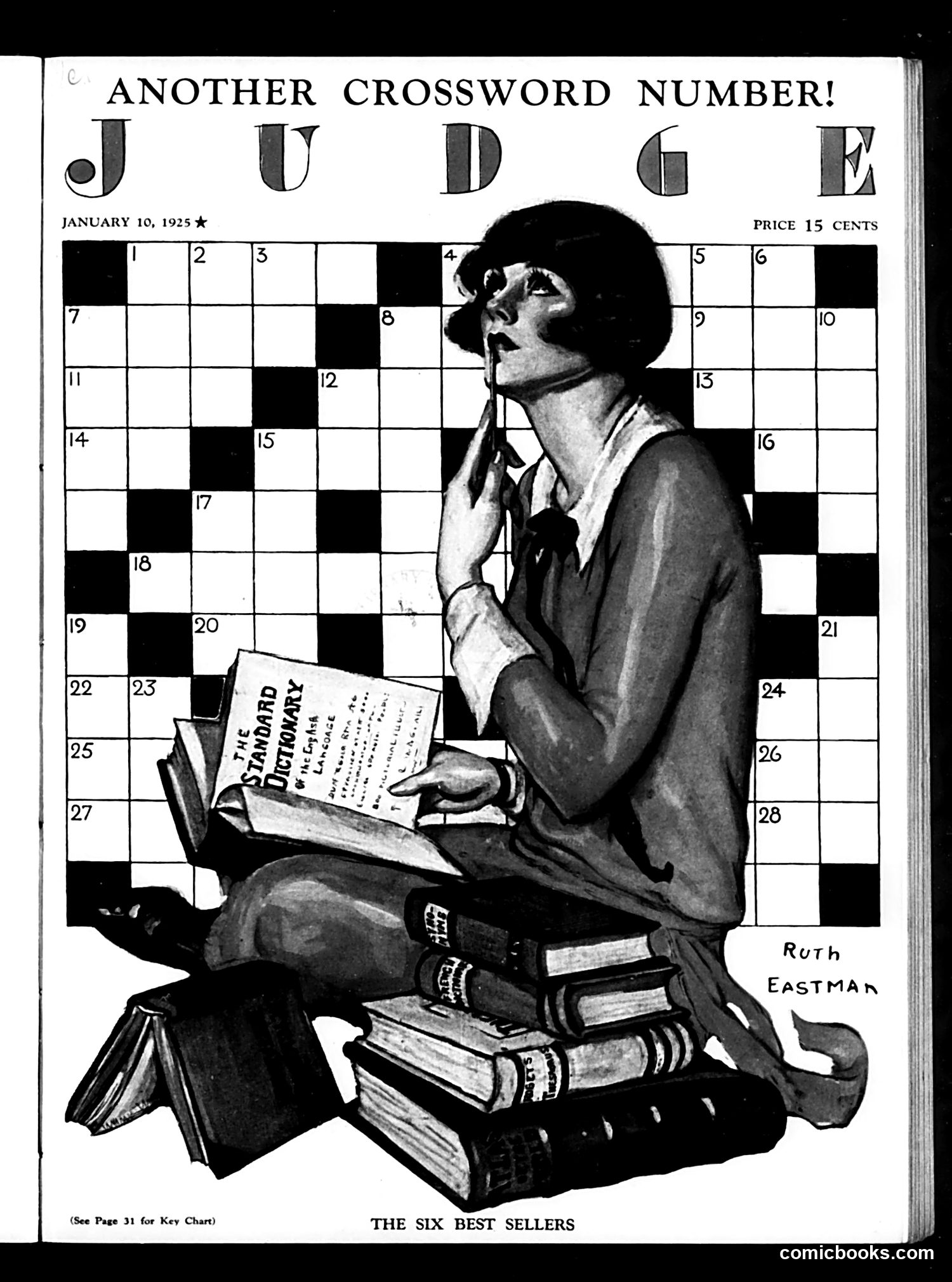
This page features a crossword puzzle framed by an illustration of a woman (labeled "Ruth Eastman") sitting among stacked books while solving "The Diddendary," a reference work visible in her hands. The caption reads "THE SIX BEST SELLERS," suggesting this is commentary on popular reading culture of the 1920s. The woman appears to be a modern, educated figure engaged with contemporary literature—consistent with the "New Woman" of that era who had greater access to education and leisure. The crossword puzzle itself is the featured content, reflecting the enormous craze for crosswords that swept America in the mid-1920s. Judge is satirizing this obsession, presenting puzzle-solving as both intellectual pursuit and cultural phenomenon worthy of magazine space and illustration.
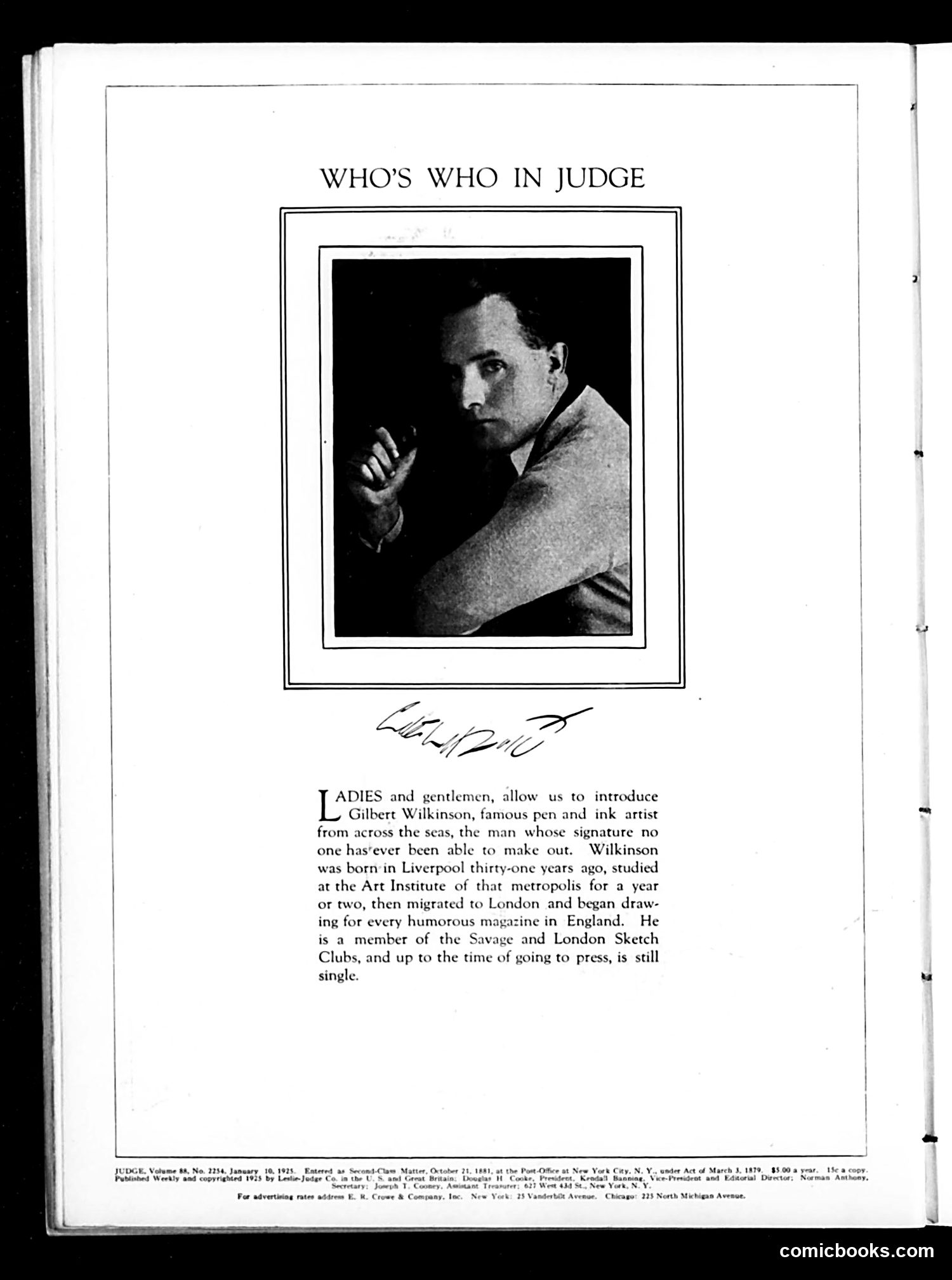
This is a biographical profile of **Gilbert Wilkinson**, a pen-and-ink artist from Liverpool, England. The page introduces him as a celebrated illustrator whose signature was famously difficult to decipher ("no one has ever been able to make out"). According to the text, Wilkinson studied at Liverpool's Art Institute, then relocated to London where he became a prolific contributor to English humorous magazines. He was a member of the Savage and London Sketch Clubs—prestigious artist associations. The notation that he remained "single" at publication appears to be typical Judge-era biographical trivia meant to entertain readers with personal details about notable cultural figures of the time.
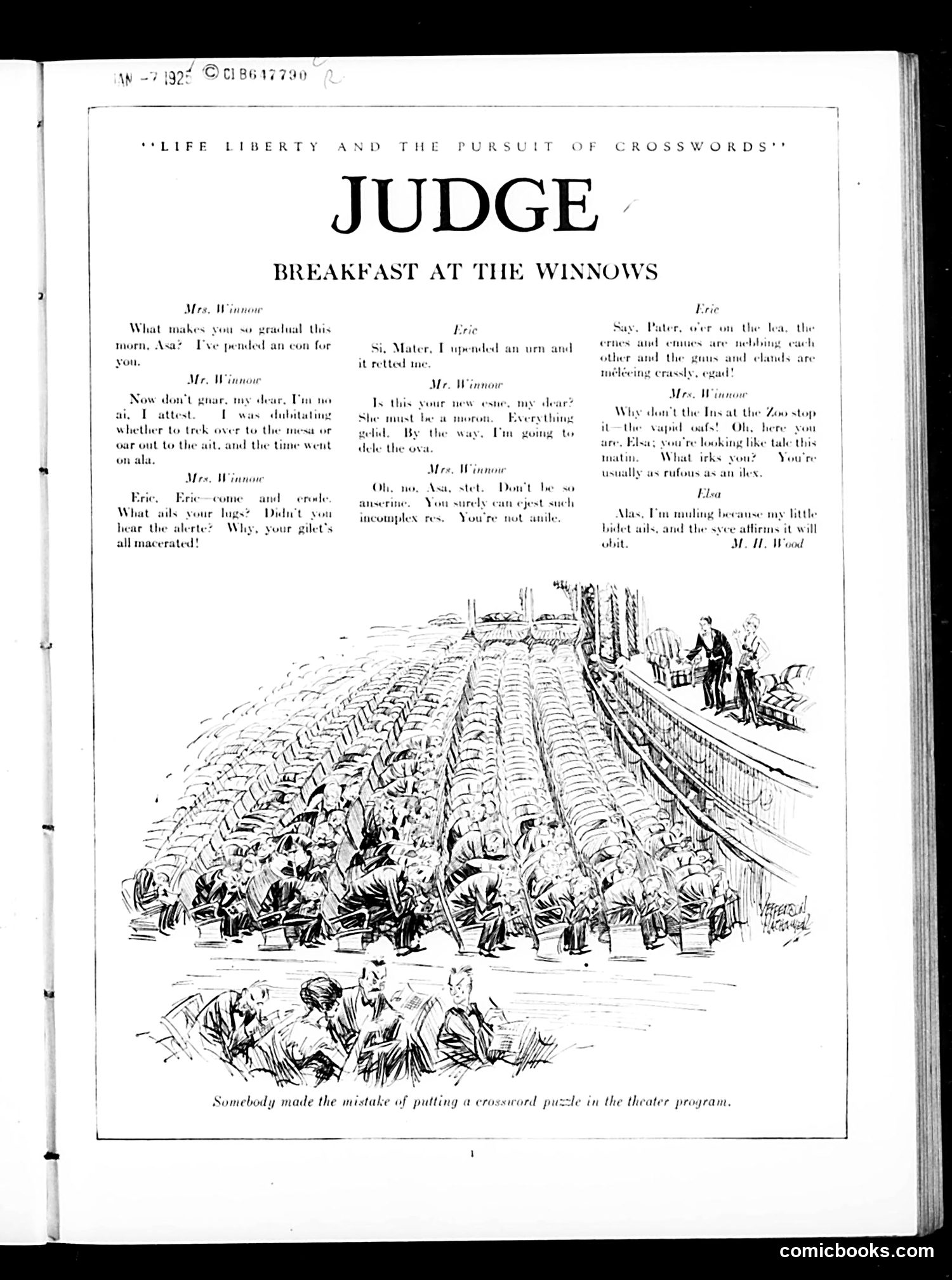
This page presents a satirical sketch titled "Breakfast at the Winnows," featuring dialogue between characters named Mrs. Winnow, Mr. Winnow, and Eric about attending a theatrical performance. The large illustration depicts what appears to be a theater audience in the orchestra section, with a peculiar detail: the caption reveals "Somebody made the mistake of putting a crossword puzzle in the theater program." The joke is that audience members are so absorbed in solving the crossword that they're ignoring the performance on stage—a contemporary reference to the 1920s crossword puzzle craze that had become a national obsession. The satire mocks how this new fad was distracting people from traditional entertainment and social activities.
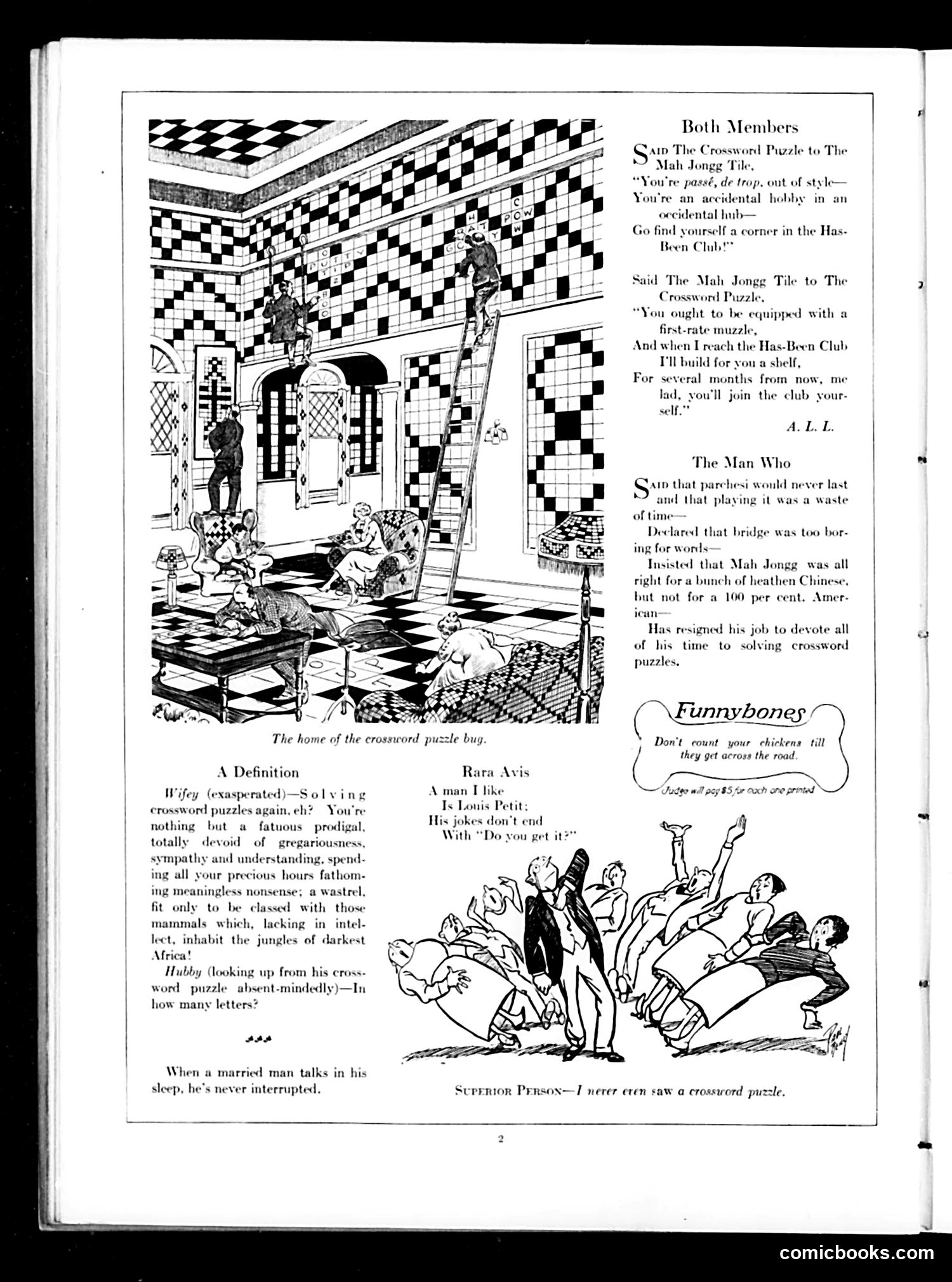
This page satirizes the 1920s crossword puzzle craze. The large illustration shows "the home of the crossword puzzle bug"—a domestic interior where all family members are absorbed in puzzles rather than engaging with each other, even on a decorative checkered floor. The accompanying poems mock puzzle obsession: "Both Members" depicts a couple neglecting their relationship for puzzles, while "The Man Who" profiles someone who abandoned his job to solve them full-time. "A Definition" humorously defines a puzzle-addicted wife as devoid of intelligence and social grace. The "Funnybones" section includes a joke about Louis Petit (unclear reference) and a cartoon mocking a "Superior Person" who claims never to have seen a crossword puzzle—likely implying such people were rare by this date. The satire targets widespread puzzle mania affecting productivity and relationships.
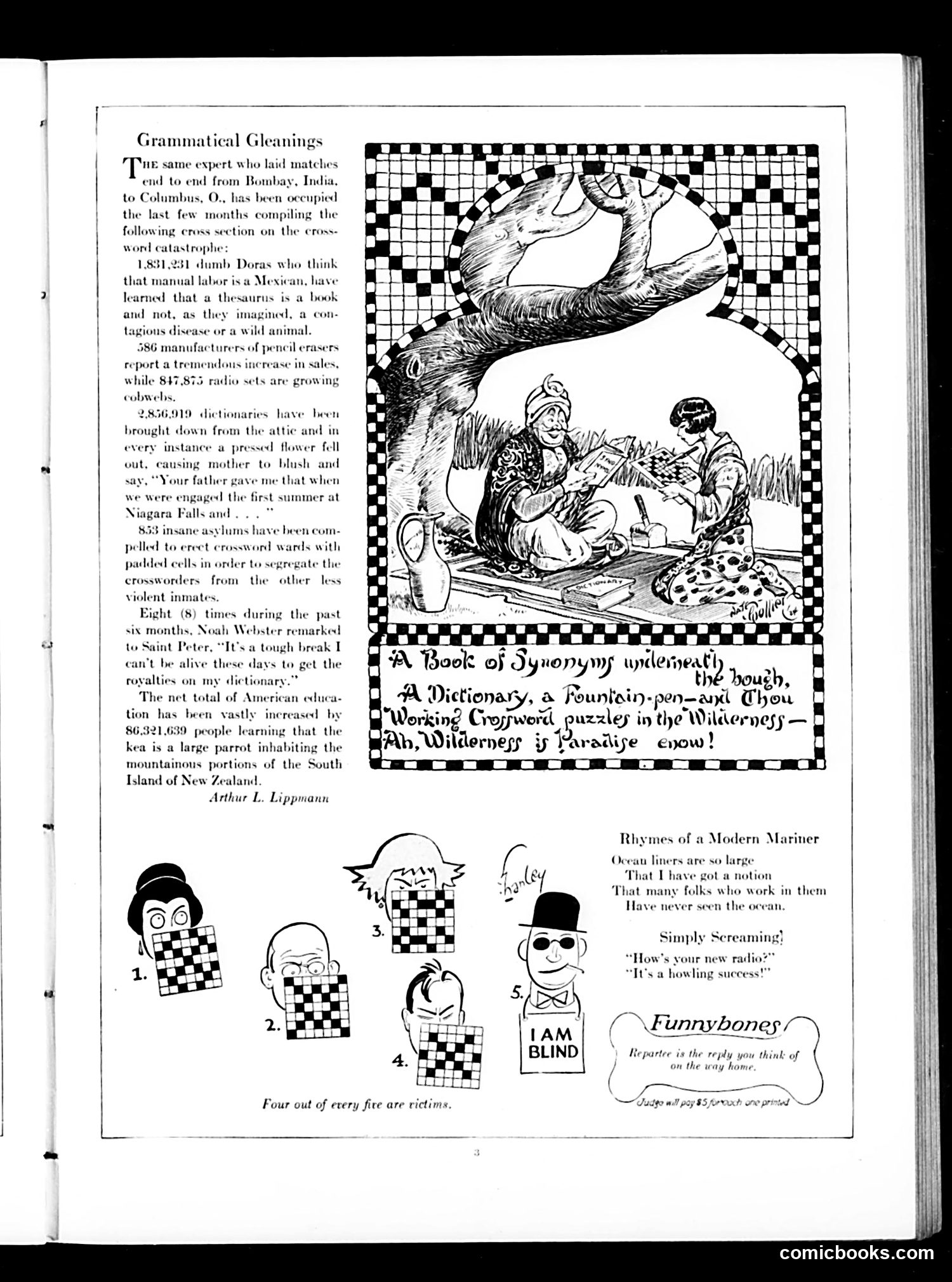
This page contains **"Grammatical Gleanings,"** a humor column mixing statistical trivia with wordplay, and several unrelated comic features. The main illustration depicts a large hand holding two figures in a wilderness setting, accompanying a whimsical caption about dictionaries, fountains, and puzzles—likely a book advertisement. Below are **crossword-related cartoons** showing five figures, numbered 1-5, with the caption "Four out of every five are victims." This appears to reference the growing popularity of crossword puzzles (a 1920s craze), humorously suggesting they're addictive or frustrating for solvers. Additional jokes include "Rhymes of a Modern Mariner" about ocean liners, and "Funnybones," a typical advice column joke. The page primarily features light satirical humor rather than serious political commentary.
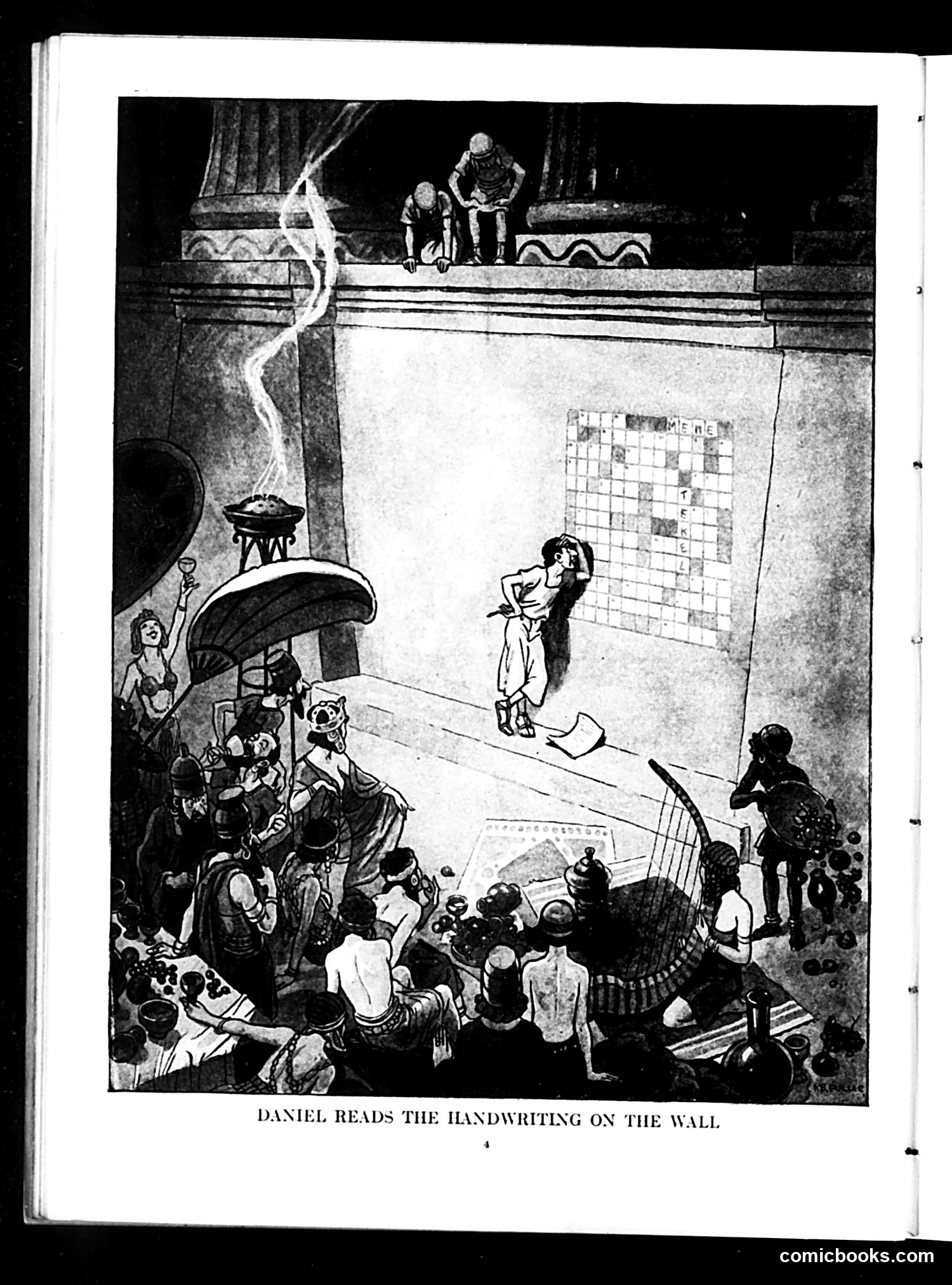
This illustration depicts the biblical story of Daniel interpreting mysterious writing that appeared on King Belshazzar's palace wall, predicting the kingdom's downfall. Judge magazine uses this as political allegory—the "handwriting on the wall" idiom means an ominous sign of impending doom. The image shows a figure (presumably representing Daniel or a contemporary observer) reading from a large grid/wall while crowds gather below. The fantastical elements—the UFO-like craft and alien figures above—suggest this is satirizing contemporary anxieties about technological change, societal collapse, or political decline. Without additional context from the publication date, the specific target remains unclear, but the satire appears to warn readers about some perceived threat to established order through technological or social disruption.
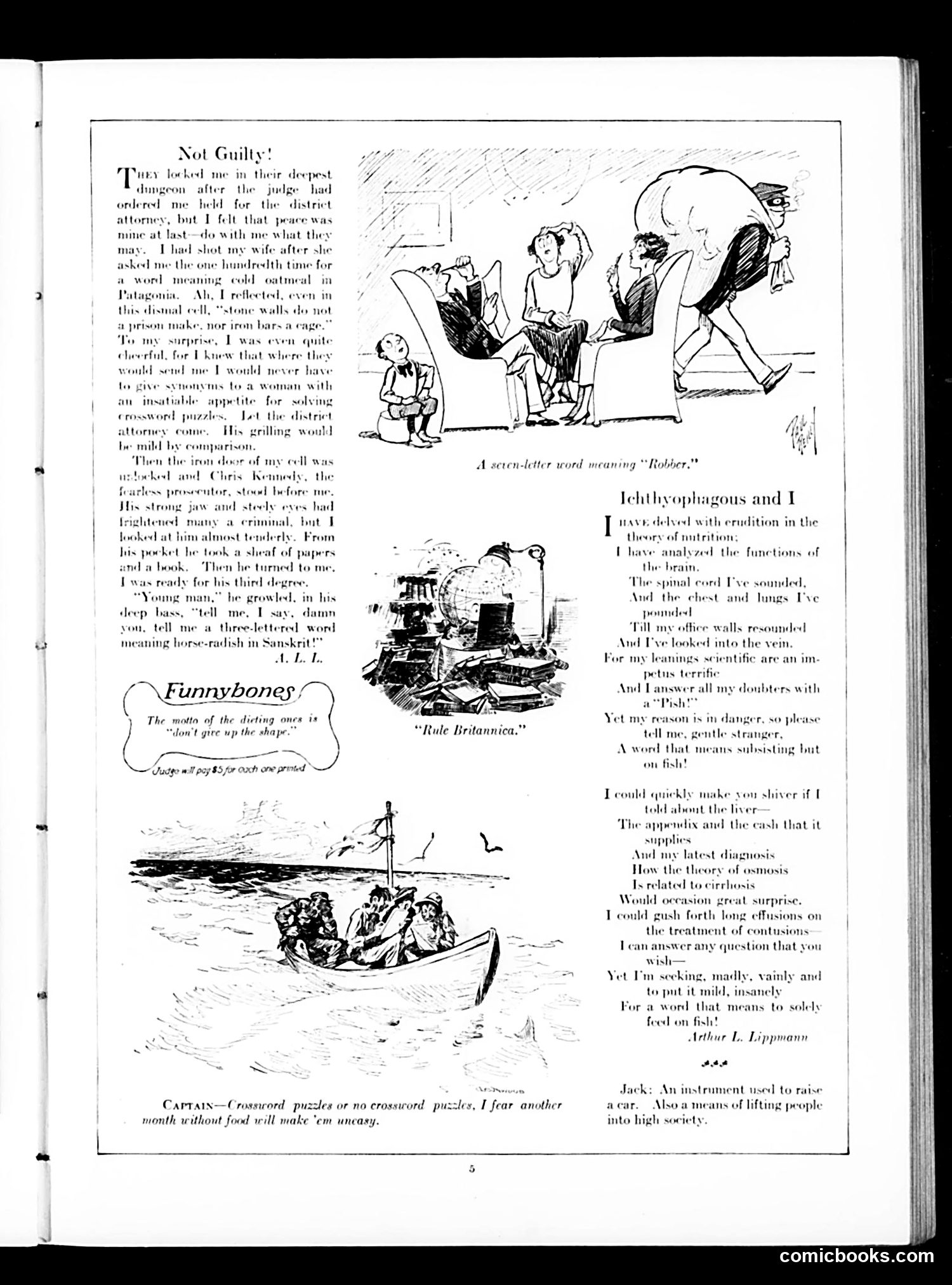
This page from *Judge* magazine contains several unrelated humor pieces rather than a coherent political cartoon: **"Not Guilty!"** depicts a man's courtroom defense for shooting his wife, claiming she nagged him about a "cold oatmeal" breakfast. The satire targets marital discord and gender relations—suggesting wives' domestic complaints justify violence. **"Ichthyophagous and I"** is a poem by Arthur L. Lippmann about human anatomy and medical theory, likely satirizing pseudo-scientific medical debates of the era. The **"Funnybones"** section and boat illustration appear to be general humor content about puzzles and leisure. The overall page reflects early 20th-century *Judge's* mix of domestic satire, medical mockery, and wordplay—targeting educated readers familiar with classical references and contemporary social anxieties.
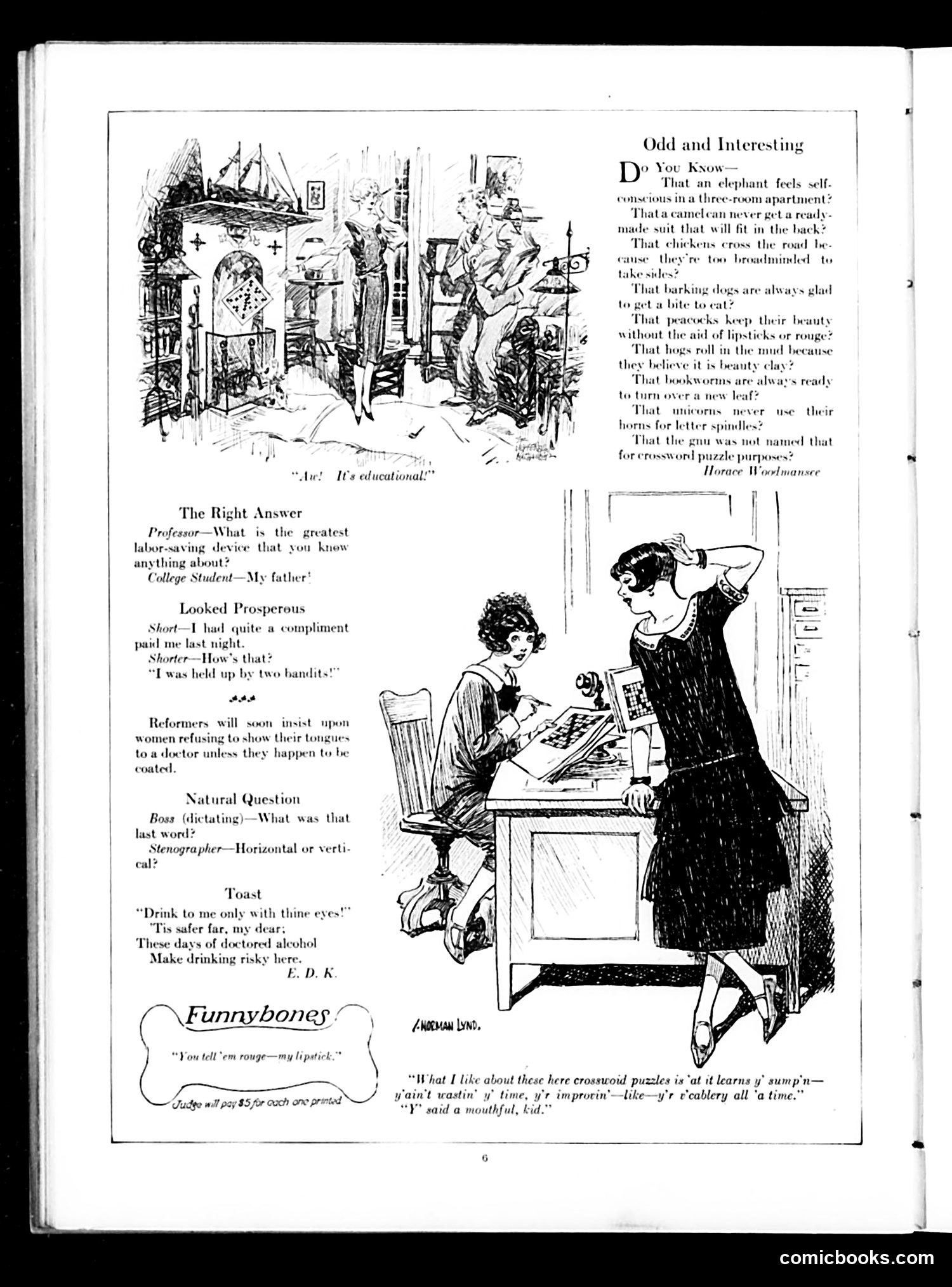
This page collects brief humorous items typical of Judge's satirical format. The main cartoon shows a man watching a woman solve crossword puzzles, with the caption praising them as educational while actually being time-wasting entertainment—the satire targets both the puzzles' dubious educational value and working-class speech patterns ("sump'n," "ain't wastin'"). The surrounding "Odd and Interesting" section mocks pseudo-intellectual trivia and absurdist humor. Other jokes target contemporary concerns: Prohibition-era alcohol adulteration ("doctored alcohol"), the job market (a student claiming his father is labor-saving, implying paternal support), and 1920s cosmetics culture (lipstick and rouge references). The page reflects post-WWI American life: workplace hierarchies, women's changing roles, and anxieties about leisure versus productivity. The humor assumes readers recognize these social tensions while appreciating wordplay and mild irreverence—characteristic of Judge's educated, middle-class audience.
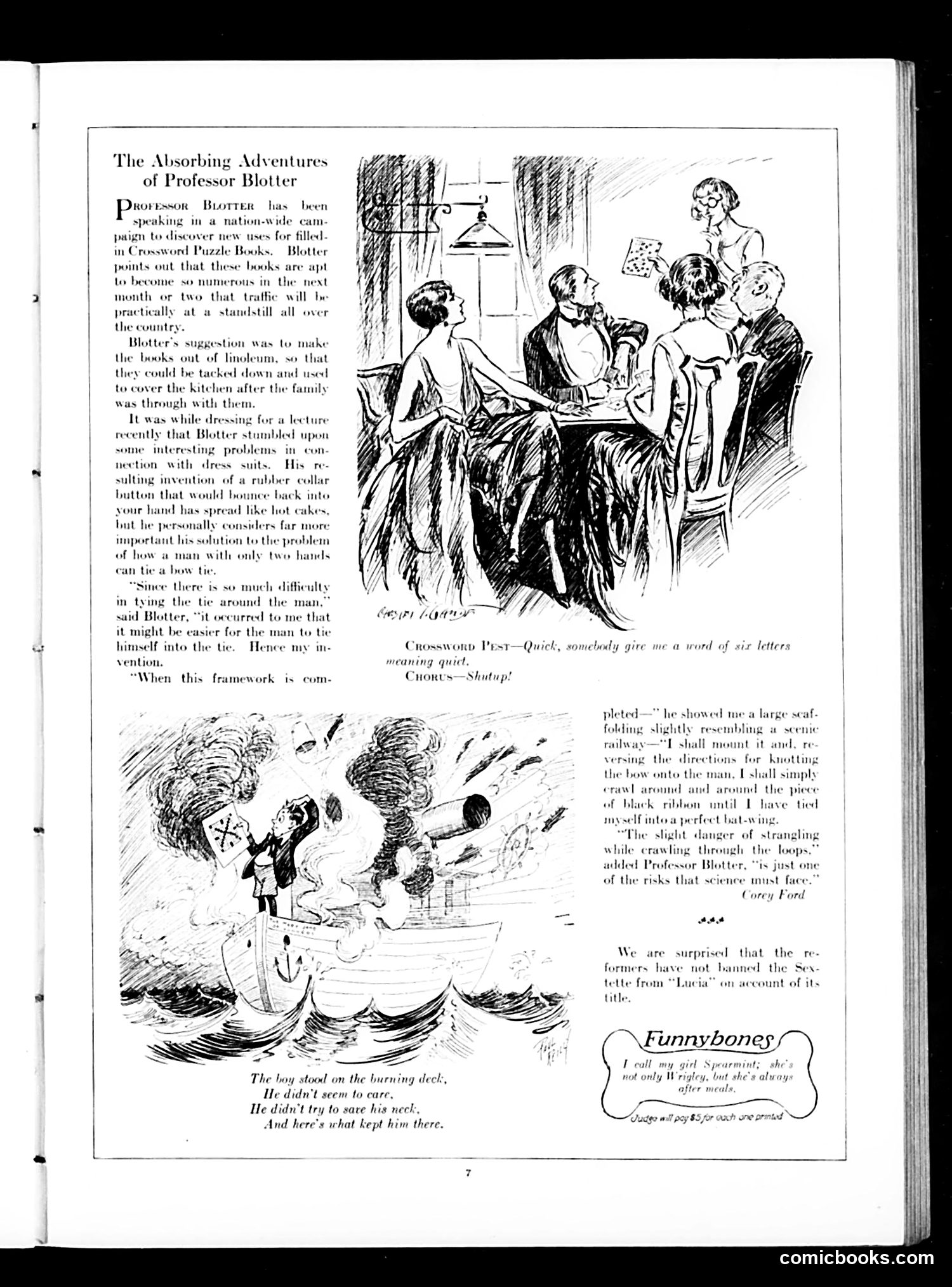
This page features "The Absorbing Adventures of Professor Blotter," a humorous fiction series about an eccentric inventor addressing practical absurdities of modern life. **The Main Satire:** Professor Blotter proposes increasingly ridiculous "solutions" to everyday problems—using filled-in crossword puzzle books as linoleum for kitchens, inventing a self-returning button, and most absurdly, designing a framework that allows a man to tie himself *into* a necktie rather than tie the necktie normally. The humor mocks pseudointellectual inventors and overcomplicated "solutions" to simple problems. **Context for Modern Readers:** The crossword puzzle craze was relatively new in the 1920s-30s, making this a timely reference. The tie-tying invention satirizes both masculine frustration with formal dress and the era's faith in mechanical innovation to solve trivial inconveniences. **Lower Illustrations:** A poetic scene about a boy on a burning ship (likely referencing the famous poem "Casabianca") serves as filler humor; a "Funnybones" joke follows. The tone is gentle, absurdist humor rather than sharp political satire.
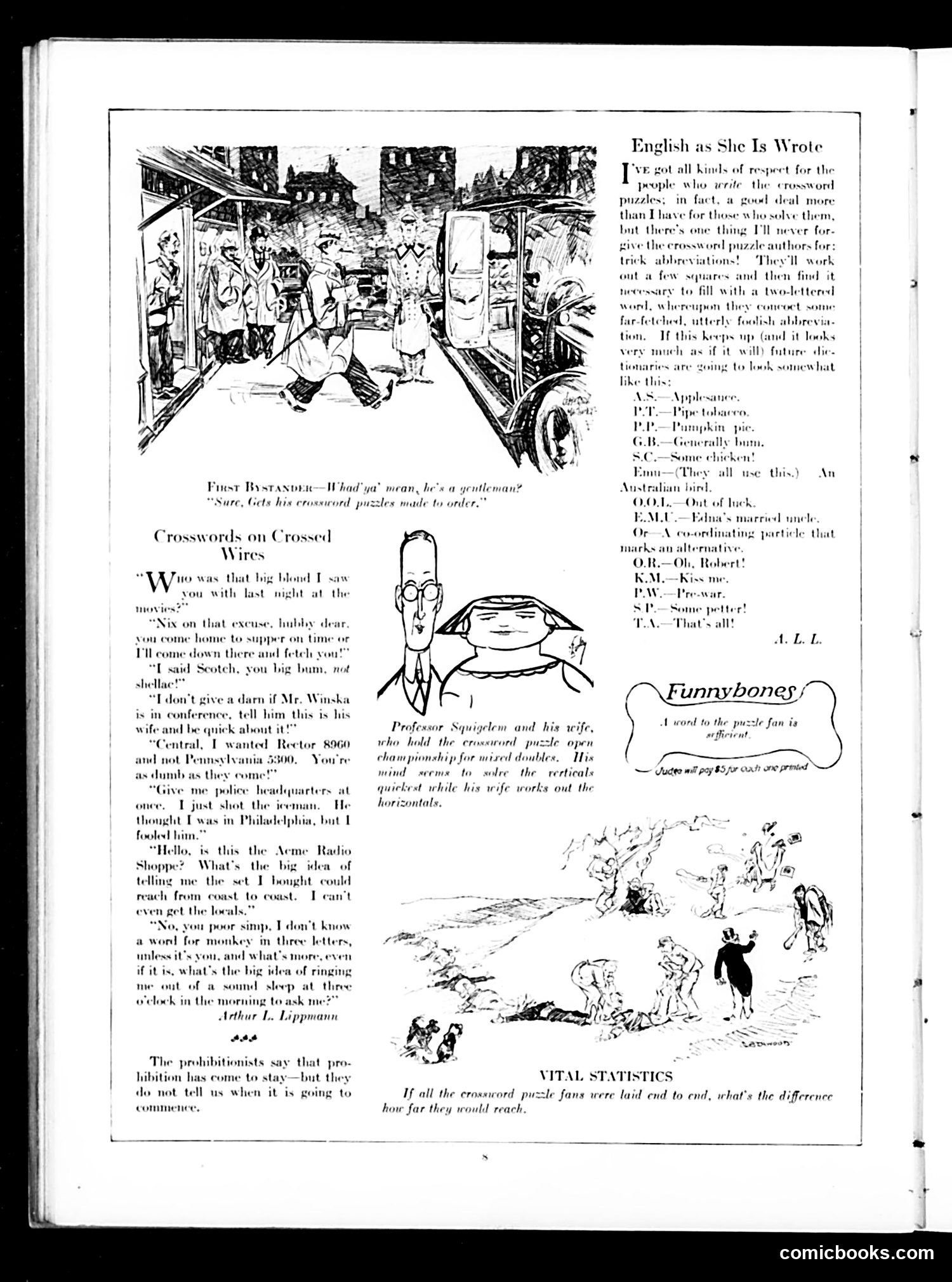
This page satirizes **crossword puzzle culture** and **telephone mishaps**, popular subjects in 1920s-30s American humor. The top cartoon depicts a crowded, chaotic phone exchange where a woman confronts her husband about seeing him with another woman—a classic domestic comedy premise made absurd by operator miscommunications and crossed wires. The main article "English as She Is Wrote" mocks crossword puzzle **abbreviations**—the cryptic shorthand answers required to fit grid spaces. The author complains these abbreviations are nonsensical and contrived (e.g., "E.M.U.—Edna's married uncle"). The "Funnybones" cartoon below shows people on a beach, with the caption "A word to the puzzle fan is different"—suggesting puzzle obsession disconnects people from real life. The "Vital Statistics" joke plays on the puzzle craze's ubiquity. **Context**: Crossword puzzles were a new, wildly popular fad of the era, and Judge frequently mocked fads and their absurd conventions.
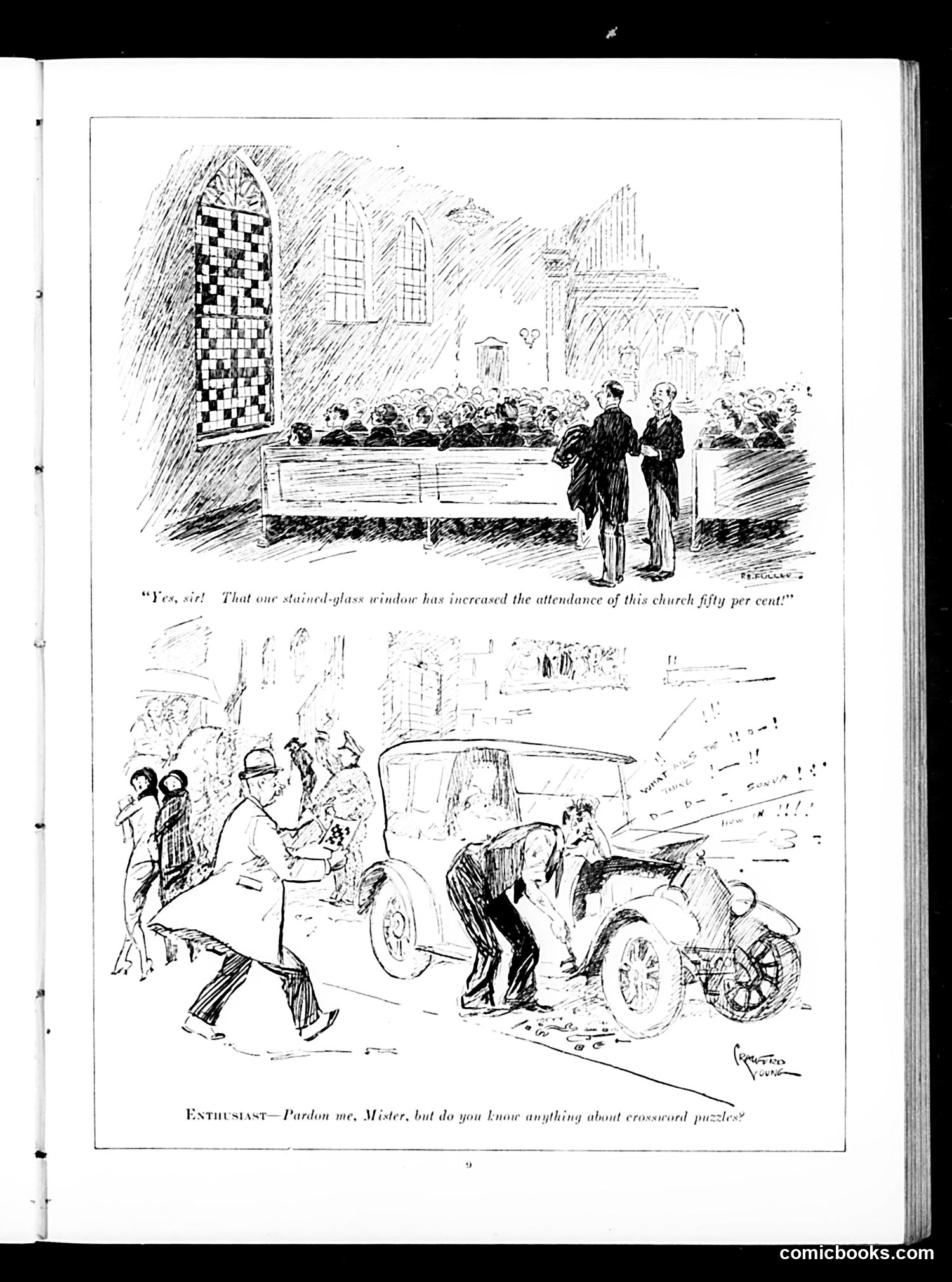
This page contains two separate cartoons satirizing early 20th-century American life. **Top cartoon:** Two clergymen discuss a stained-glass window that allegedly increased church attendance by fifty percent. The satire mocks churches prioritizing aesthetic improvements or gimmicks over genuine spiritual substance to attract congregants. **Bottom cartoon:** An enthusiastic man asks a motorist about crossword puzzles while the driver appears frustrated with his car's mechanical problems. The humor contrasts the era's new fad—crossword puzzles—with practical automotive concerns. This likely satirizes how quickly Americans embraced novelty trends while ignoring more pressing matters, or mocks an oblivious enthusiast interrupting someone with urgent problems. Both cartoons reflect Judge magazine's characteristic social commentary on contemporary American behavior and priorities.
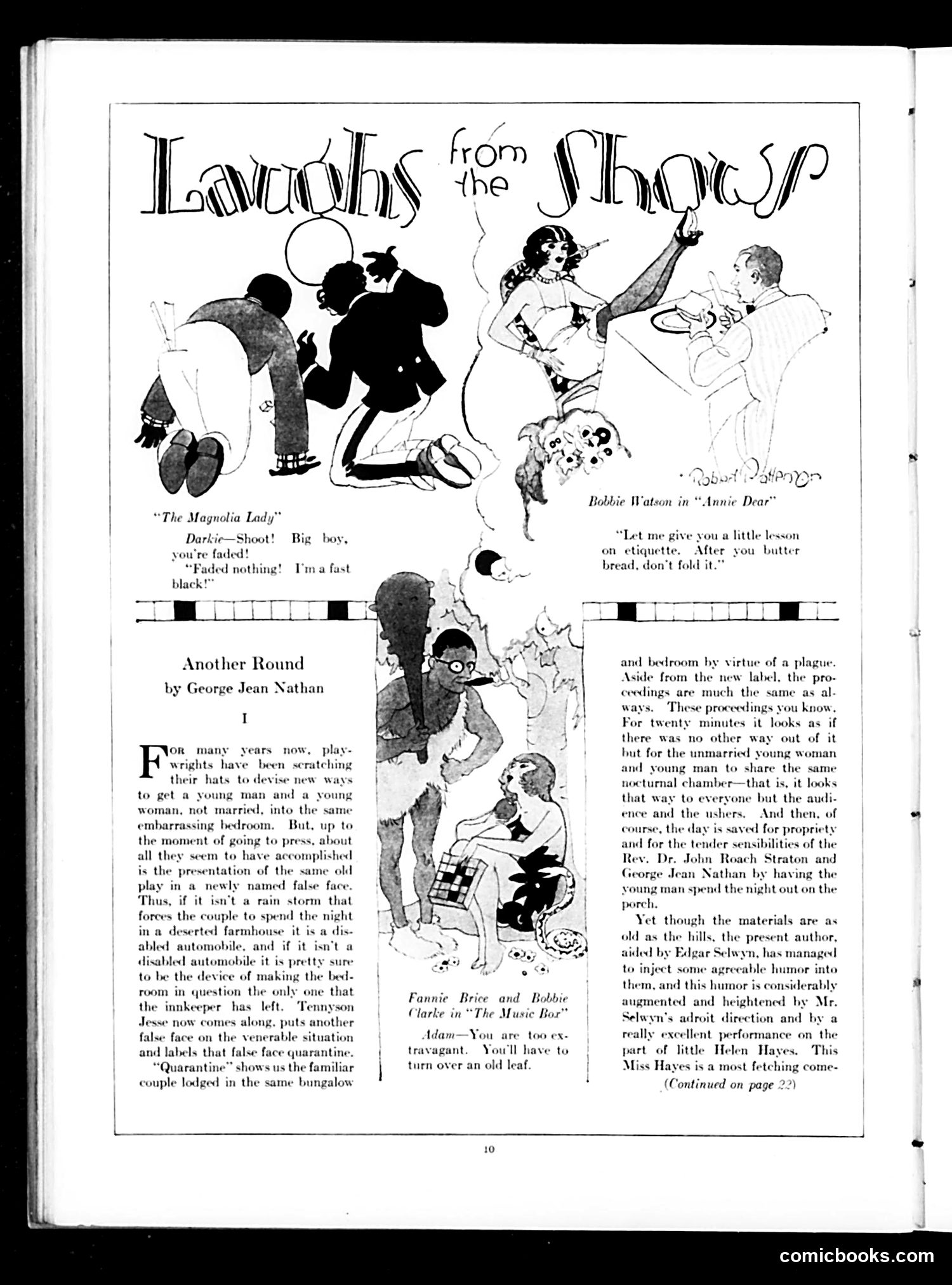
This page from *Judge* magazine features theatrical reviews disguised as humorous sketches. The top section shows "Laughs from the Shows"—brief comedic scenes from stage productions like "Annie Dear" and "The Music Box," featuring actress Bobbie Watson and others. These are not political cartoons but rather entertainment gossip illustrations. The main article, "Another Round" by George Jean Nathan, is a theater critic's commentary on a recurring dramatic plot device: quarantining an unmarried couple together overnight in a bedroom to generate scandal and tension. Nathan satirizes playwrights' reliance on this tired trope across decades—whether forced by rainstorms, broken automobiles, or convenient innkeeper excuses. He notes the new play "Quarantine" (and others like it) merely recycled this predictable scenario with minor variations, though he praises the performances by Helen Hayes and others. The satire targets theatrical laziness, not politics.
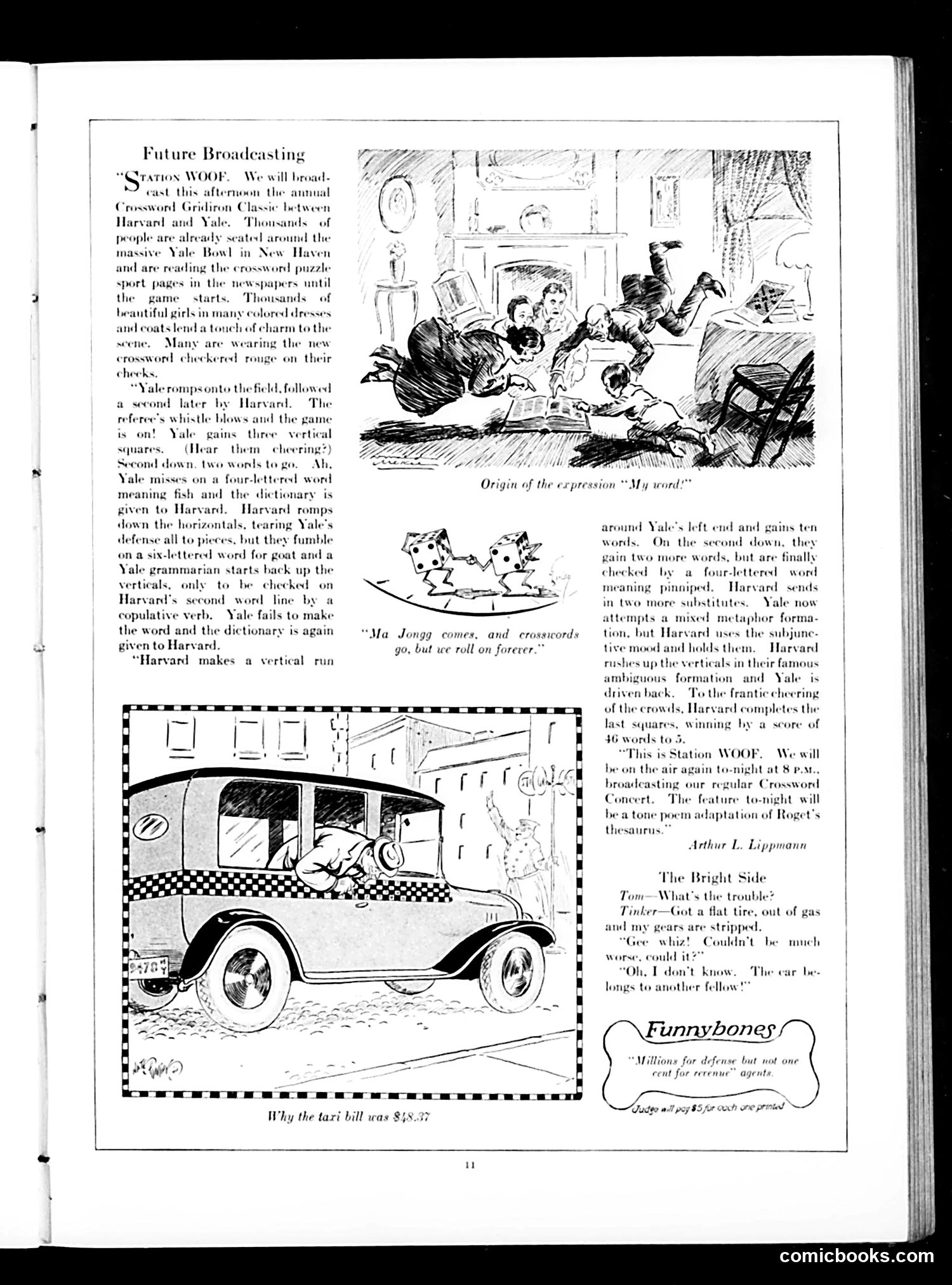
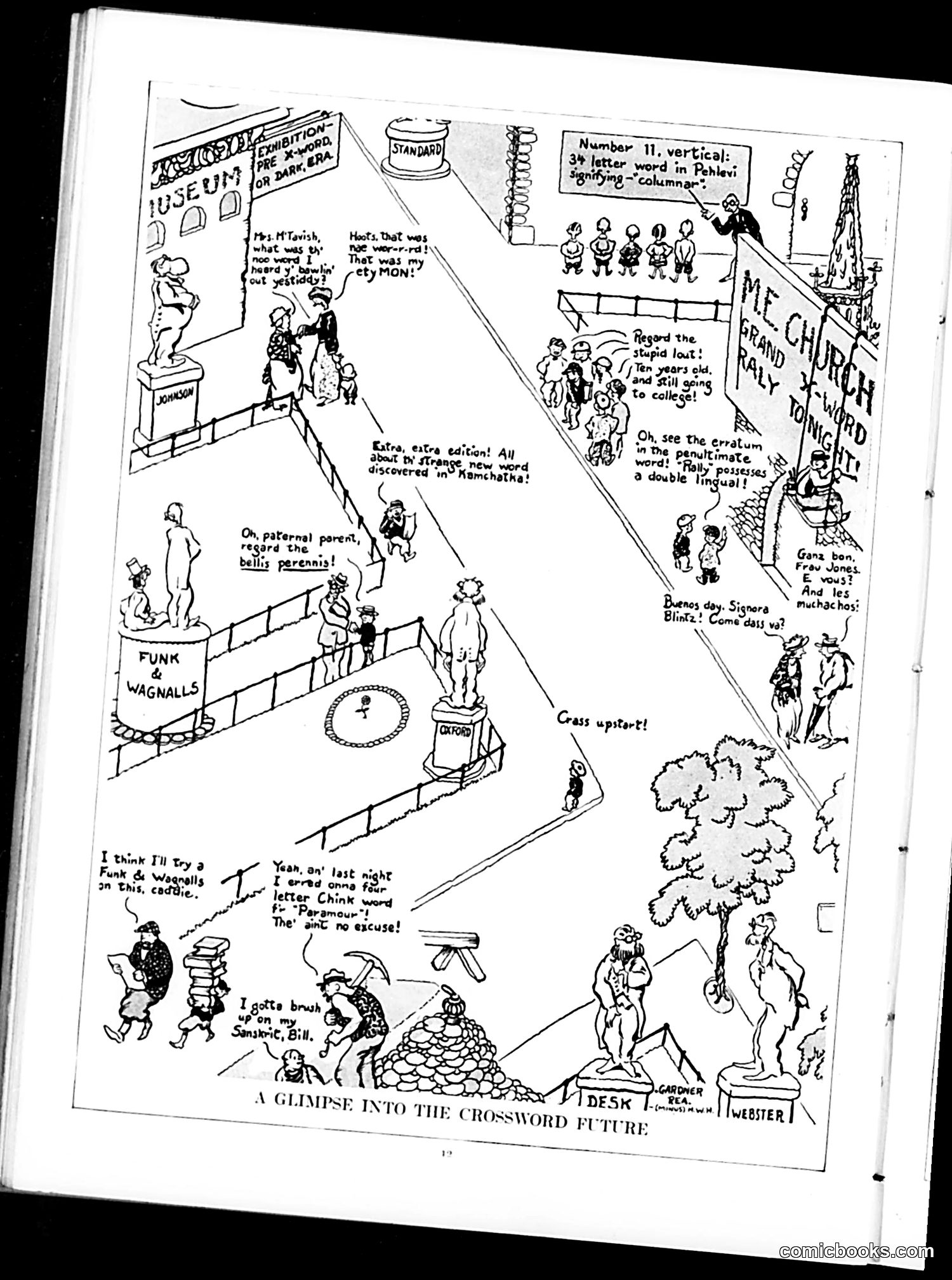
This satirical cartoon mocks the crossword puzzle craze of the 1920s-30s by imagining an absurdly overwrought future where crosswords dominate culture. The humor targets: **The obsession itself**: People of all ages, classes, and backgrounds are consumed by crossword-solving, treating it as life's central activity. **Pretentious cluing**: The cartoon ridicules absurdly erudite, multilingual clues (Pehlevi, Sanskrit, "bellis perennis," French, Spanish). Real crosswords were becoming notoriously difficult, requiring obscure knowledge. **Social commentary**: Characters reference competing interests (et MONIER, "Fanny"), suggesting crosswords displace romance, family time, and education—children mention going to college almost as an afterthought. **Language games**: The focus on foreign words and linguistic trivia reflects actual 1920s-30s crossword trends toward increasingly sophisticated wordplay. The cartoon warns that what was meant as entertainment could become an all-consuming, intellectually elitist obsession that trivializes genuine life priorities.
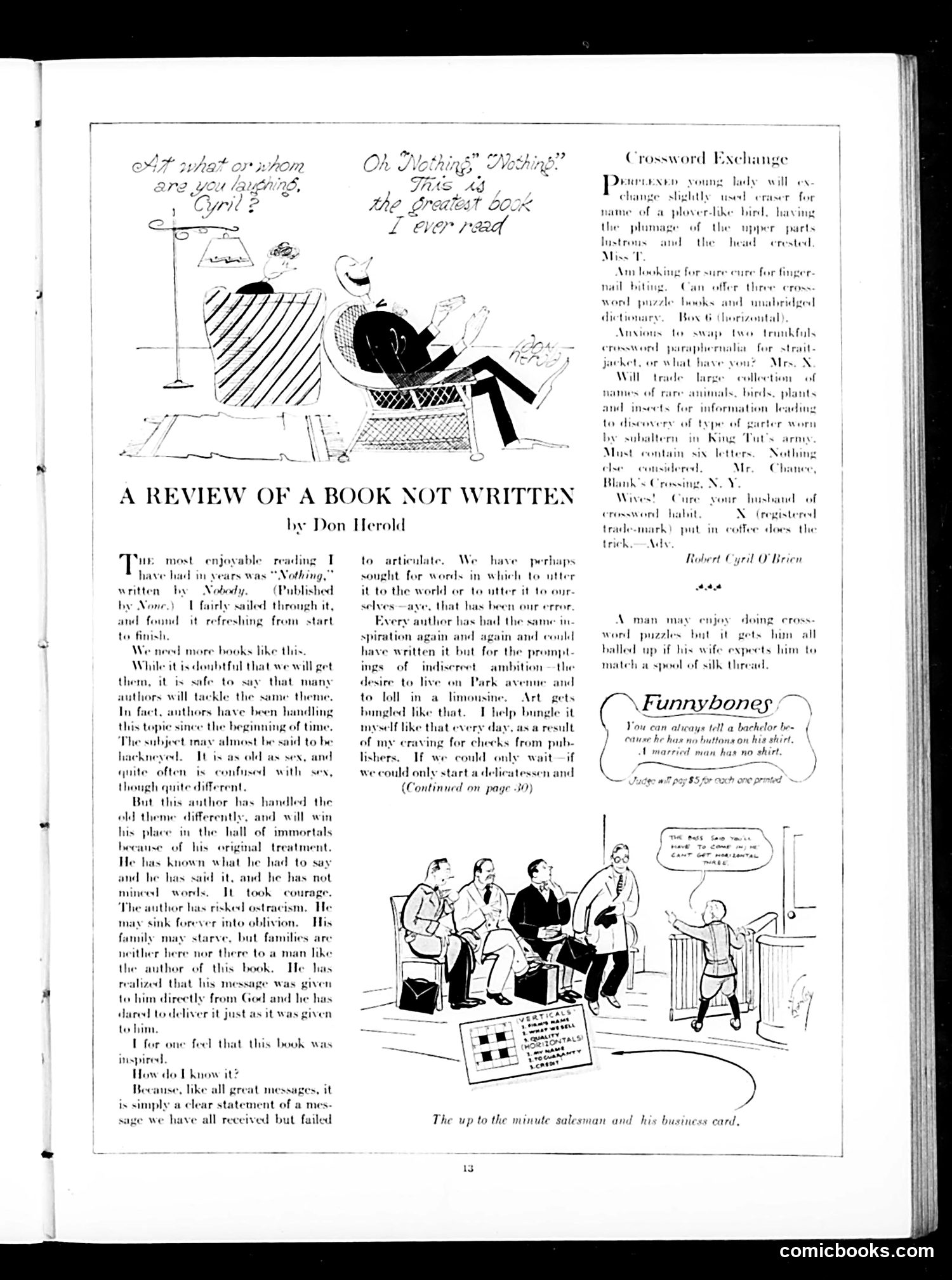
This page from *Judge* magazine contains satirical commentary on literary pretension and domestic life circa the early 20th century. **"A Review of a Book Not Written"** by Don Herold is a humorous essay mocking authors' inflated self-importance. Herold satirizes the cliché that unpublished or "unwritten" books are somehow profound—suggesting authors convince themselves their work is divinely inspired when really they're motivated by desire for Park Avenue wealth and literary prestige. The joke is that every author *could* write such a book but lacks the courage; the piece deflates artistic vanity by implying the "greatest" unpublished work is simply what all artists have thought but failed to articulate clearly. The accompanying **cartoon** appears to depict a salesman pitching to businessmen, likely mocking modern sales techniques or business culture. The **"Funnybones"** section contains light domestic humor: a joke about distinguishing bachelors (missing shirt buttons) and wives "curing" husbands' crossword addiction by drugging their coffee—period humor treating marriage as mild adversarial struggle.
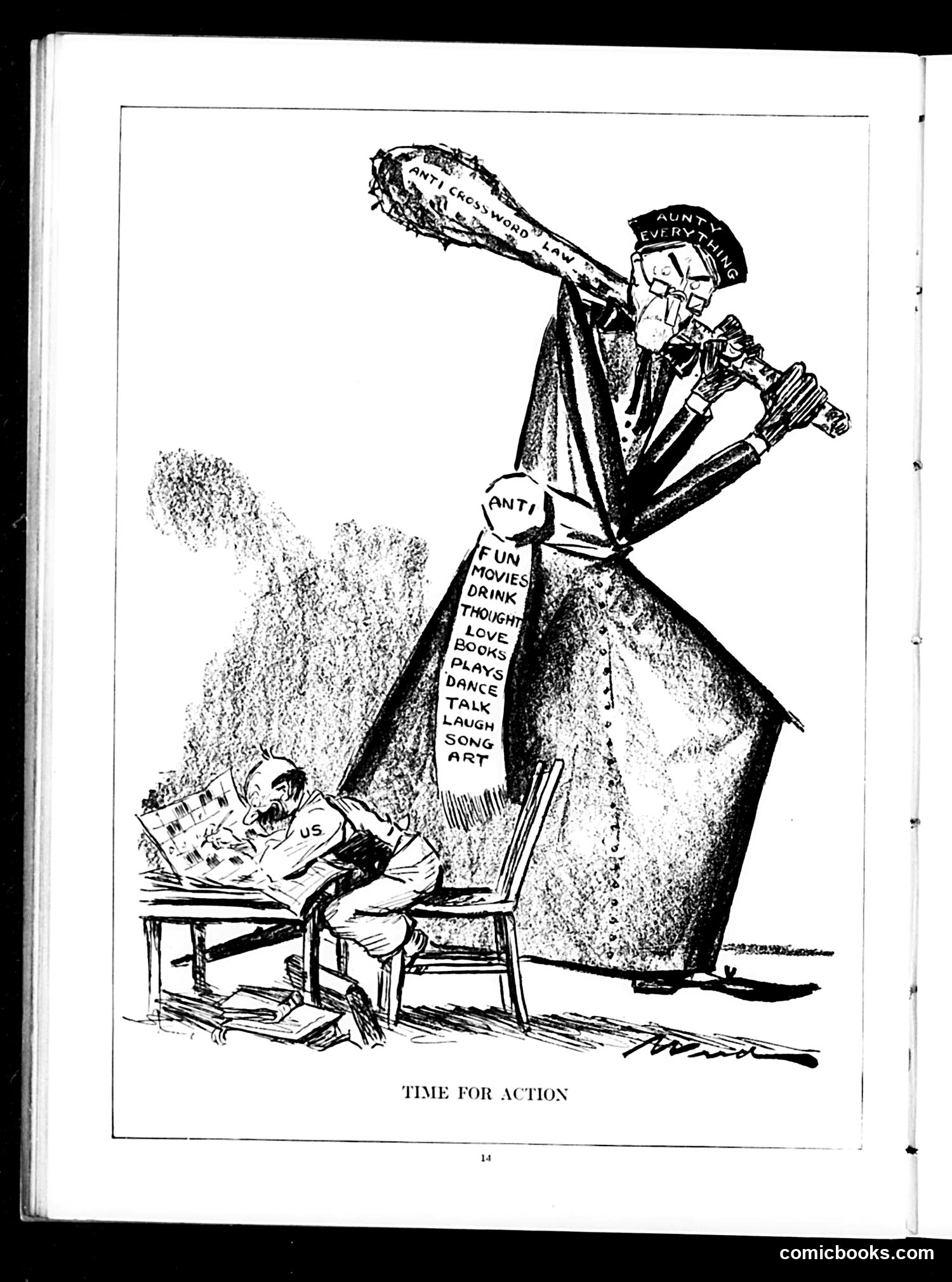
This political cartoon depicts "Aunt Everyting" (a grotesque elderly figure representing conservative opposition to modern culture) wielding a club labeled with various prohibitions: "Anti-Crossword," "Anti-Fun," "Movies," "Drink," "Thought," "Love," "Books," "Boys," "Dance," "Talk," "Laugh," "Song," "Art." Below sits a small child reading, seemingly unafraid of this looming censor. The satire mocks anti-modernist crusades of the early 20th century—likely referencing Prohibition, censorship movements, and conservative attempts to restrict youth culture and entertainment. The cartoon's title "TIME FOR ACTION" suggests readers should resist such restrictive moralism. Judge magazine was satirizing what it saw as excessive puritanical control over American life and culture.
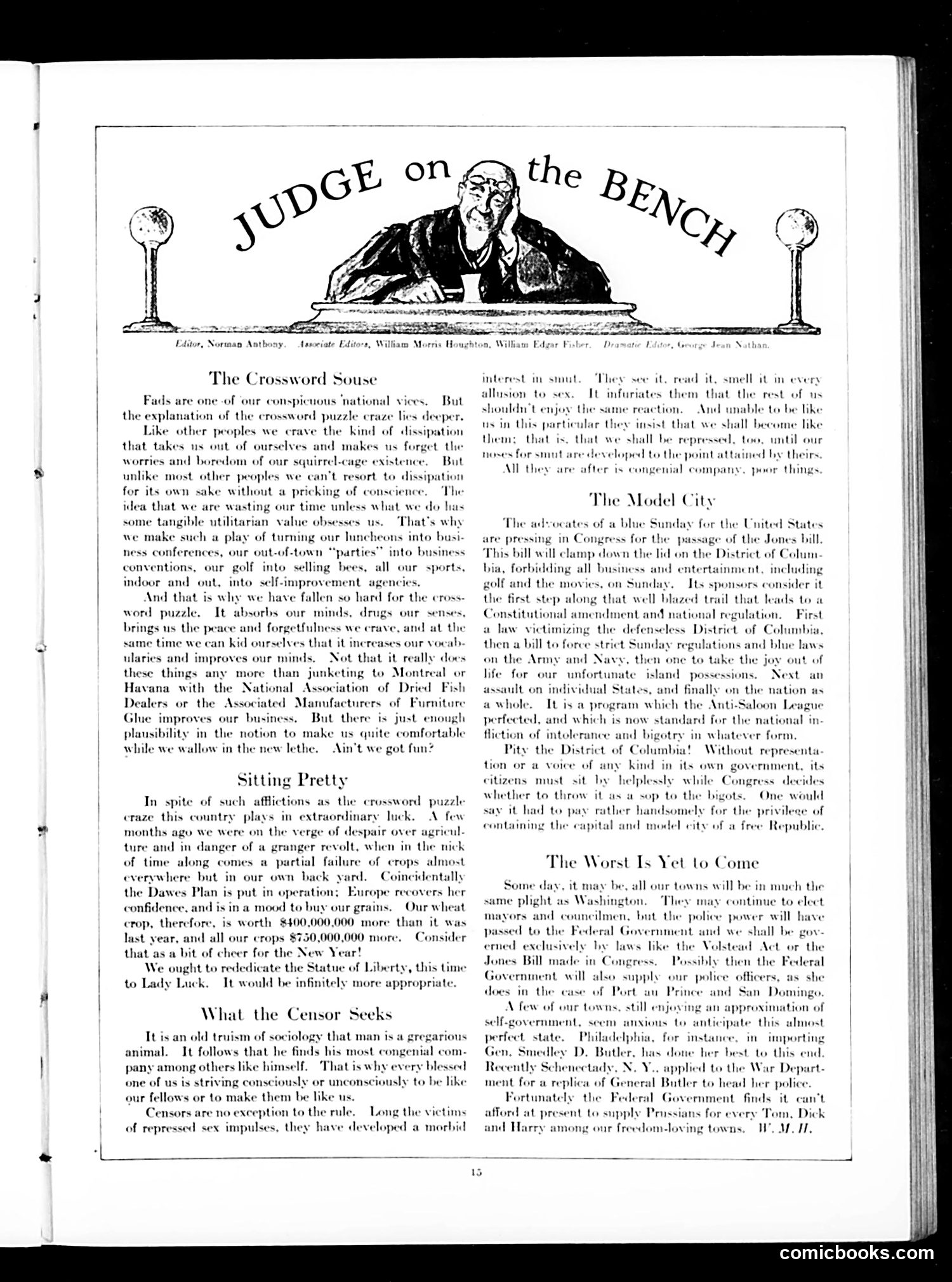
This page contains four satirical opinion pieces attacking contemporary American fads and proposed legislation: **"The Crossword Souse"** mocks Americans' obsession with crossword puzzles, arguing we pursue them under the guise of self-improvement while actually seeking mindless escape—typical of our national hypocrisy about wasting time. **"Sitting Pretty"** celebrates agricultural good fortune: crop failures elsewhere combined with the Dawes Plan's European recovery created unexpected American wheat demand, enriching farmers who faced revolt months earlier. The author ironically suggests thanking "Lady Luck" instead of the Statue of Liberty. **"What the Censor Seeks"** attacks censors (likely targeting Comstock-style moral crusaders) as hypocrites obsessed with suppressing sexual content while pretending moral authority. **"The Model City"** opposes the "Jones bill," which would impose strict Sunday closures on Washington D.C.'s entertainment and business, viewing it as a dangerous precedent for federal control of individual liberty—a stepping stone toward national Sunday laws. The satirical thrust: American society simultaneously indulges frivolous vices while moralists attempt authoritarian control.
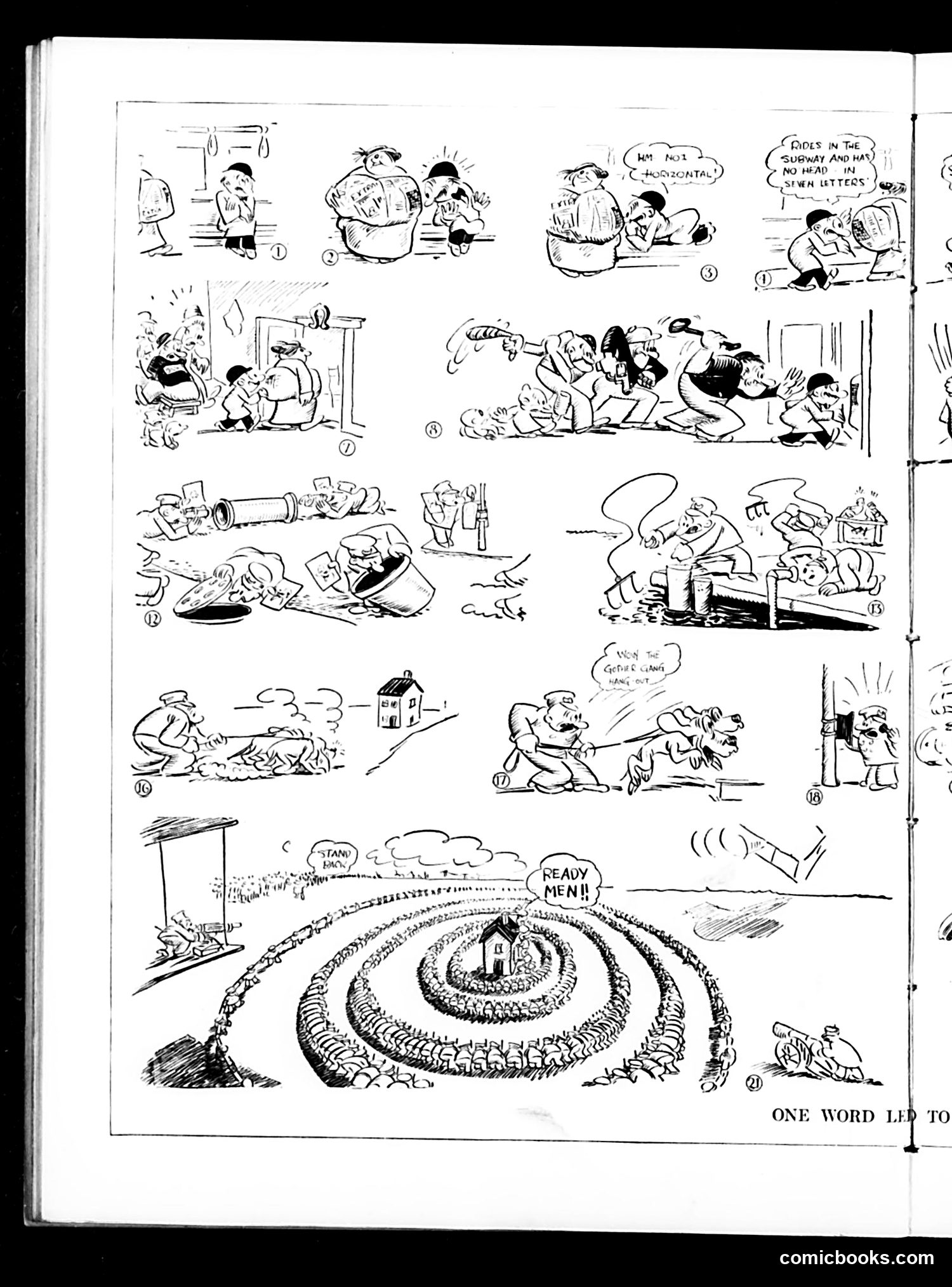
This appears to be a humorous sequential cartoon about subway etiquette and crowding. The numbered panels (1-21) depict increasingly chaotic scenarios of passengers in a crowded subway car, progressing from orderly behavior to complete pandemonium. The text references a riddle: "Cries in the subway and has no head in seven letters" — likely referring to "STRAP," the overhead handles passengers grip. The final massive panel shows soldiers in concentric circular trenches, suggesting this may satirize military preparedness or wartime organization, contrasting the domestic subway chaos with military discipline. The overall satire mocks New York City subway conditions and commuter behavior during what appears to be the early-to-mid 20th century, using escalating absurdity to critique crowding and passenger conduct.
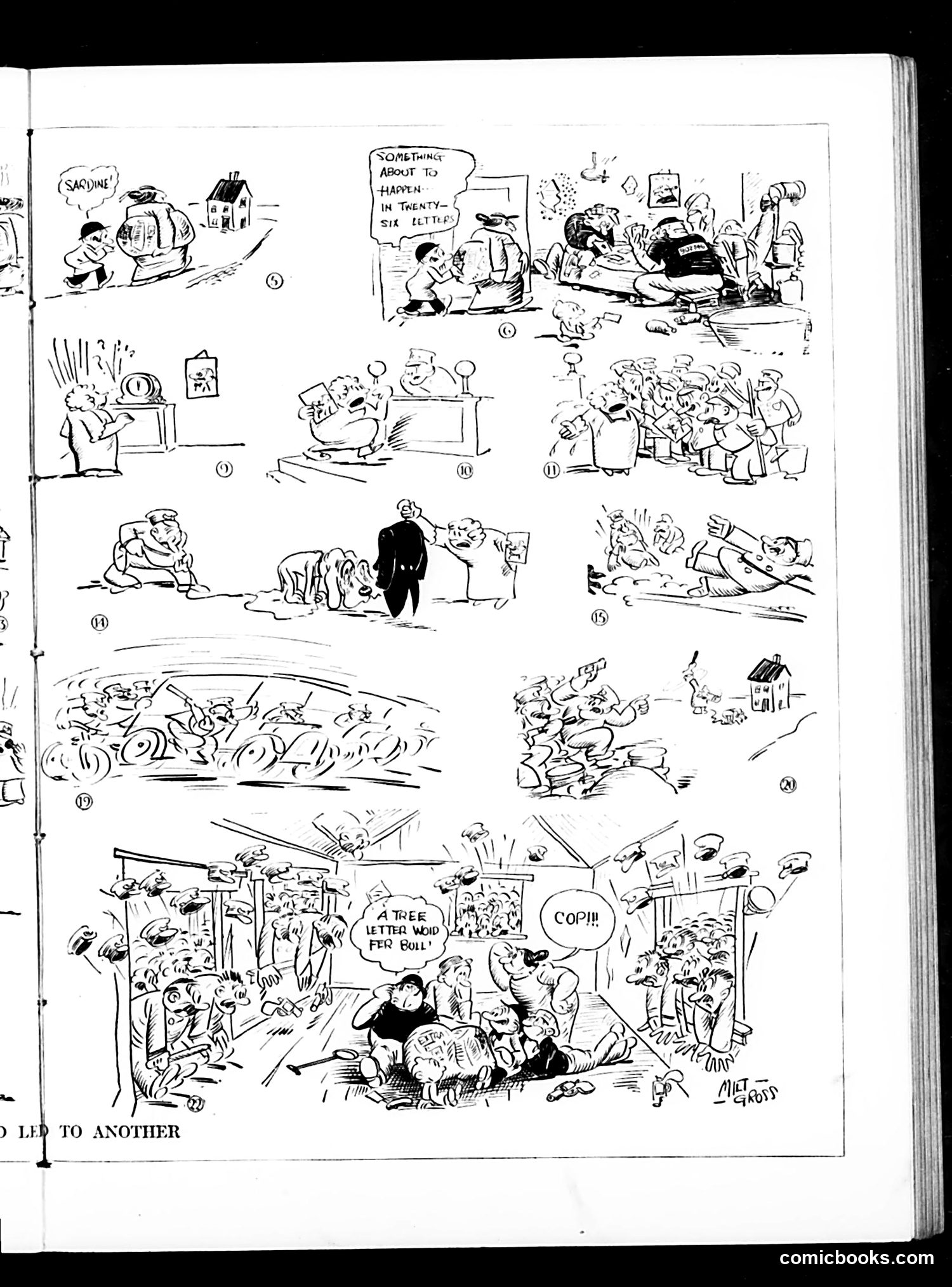
This appears to be a sequential narrative cartoon satirizing bureaucratic chaos or administrative breakdown. The story begins with someone saying "SARDINE" (panel 1), escalates to a warning about something happening "in twenty-six letters" (panel 6), and culminates in complete pandemonium—crowds rioting, police ("COP!!"), and general disorder. The final large panel shows masses of people in chaos with someone shouting "A FREE LETTER WOULD FED BULL" while another cries "COP!!" The satire likely critiques how minor administrative issues or miscommunications spiral into massive public disorder. The "sardine" reference and "free letter" suggest this may lampoon postal service problems or government communication failures, though the exact political event referenced isn't clear from the visible text alone.
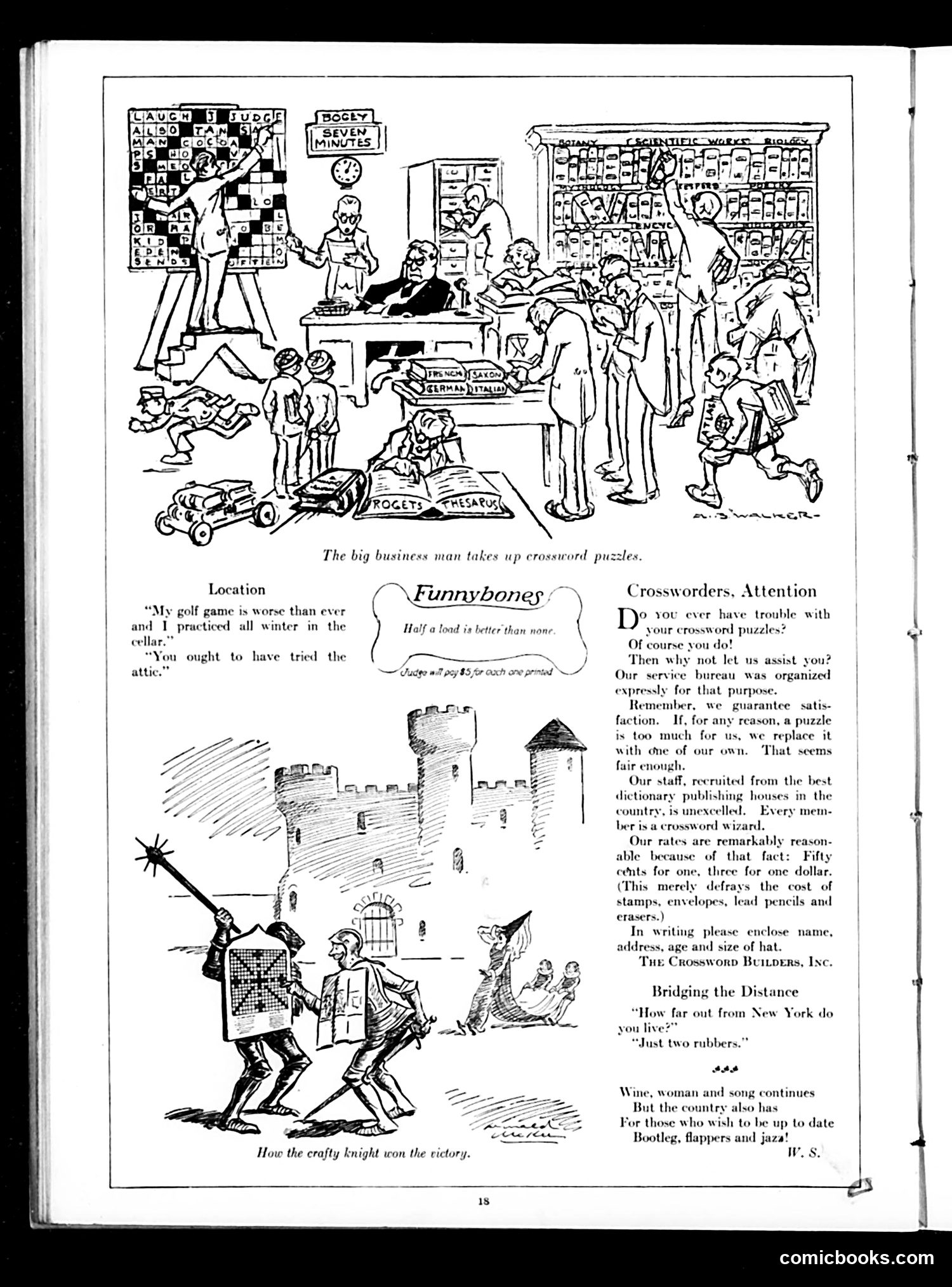
This page satirizes the 1920s crossword puzzle craze. The top cartoon shows a busy businessman's office where crossword puzzles have become so ubiquitous that even executives are solving them during work hours—suggesting the fad has infiltrated all social classes and distracted people from productive labor. The text below advertises "The Crossword Builders, Inc.," a fictional service bureau that solves crosswords for paying customers, mocking both the puzzle obsession and the entrepreneurial schemes it spawned. The rates (50 cents per puzzle) suggest people were genuinely willing to pay for solutions. The bottom cartoon depicts a medieval castle scene with figures fighting over a crossword puzzle grid—a humorous exaggeration of how seriously people took these puzzles. The "Bridging the Distance" joke plays on puzzle terminology while the final verse acknowledges that despite modern trends (bootleg liquor, flappers, jazz), crosswords dominated contemporary culture. The satire ridicules Americans' obsession with this relatively new entertainment fad.
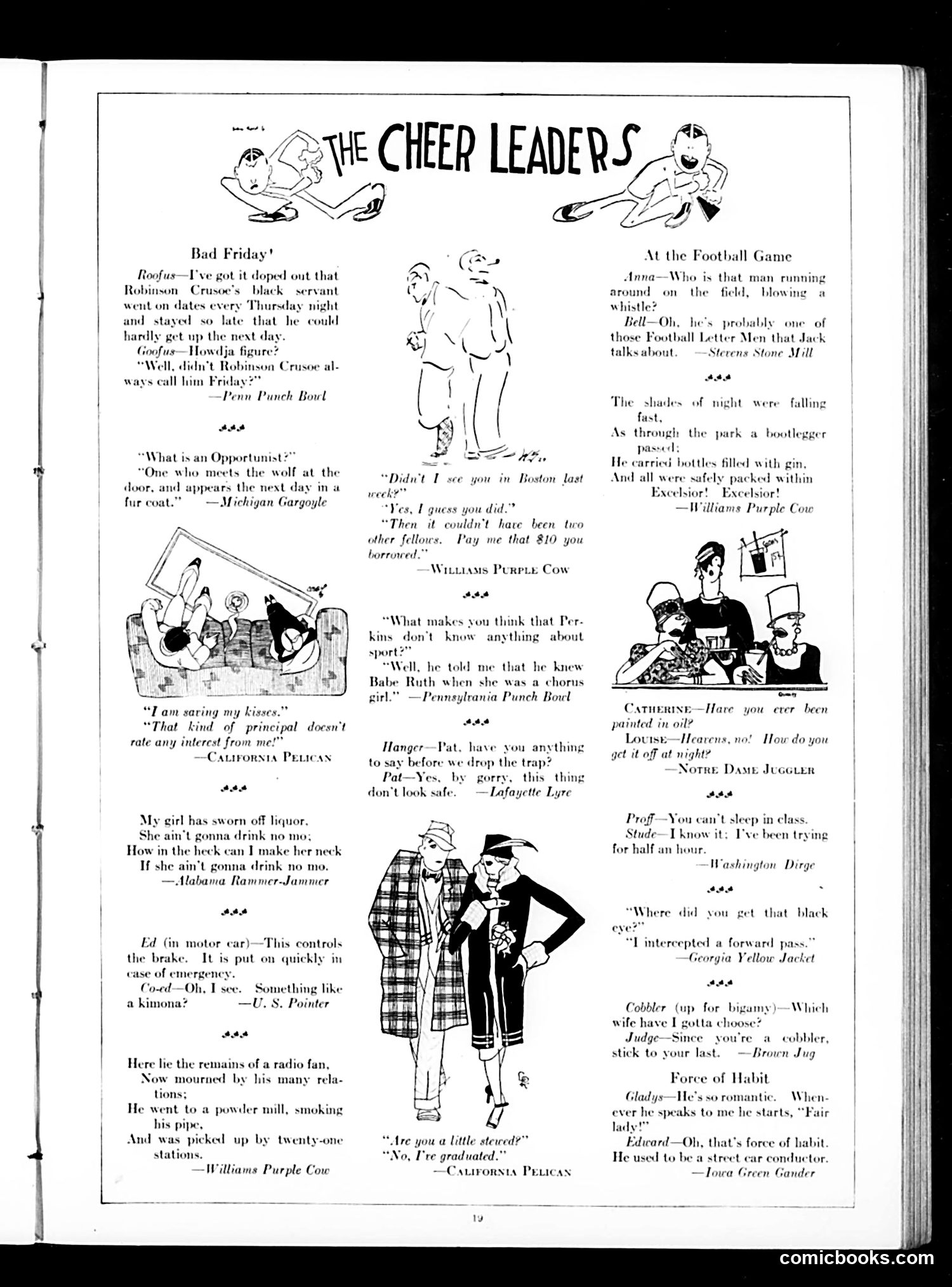
This is a humor compilation page featuring jokes and brief comedic sketches from various college publications and satirical sources, organized around a loose "Cheer Leaders" theme. The jokes target early 20th-century college life and social conventions: a student too tired from dating to attend class; the opportunist who profits from others' misfortune; prohibition-era bootlegging (bottles hidden "within Excelsior"); and casual dating humor. Several jokes mock romantic pretension ("Fair lady" as habitual speech) and gender relations. References include "Babe Ruth" (famous baseball player used to indicate sports ignorance), "bootlegger" (reflecting Prohibition's enforcement), and football Letter Men (prestigious athletes). One joke plays on a woman quitting alcohol: without drinking, the boyfriend loses his excuse for intimacy. The humor is gentle, college-focused, and reflects 1920s social anxieties: changing gender roles, prohibition, courtship norms, and academic disengagement. No specific political figures or events appear—this is purely social satire aimed at educated, collegiate audiences.
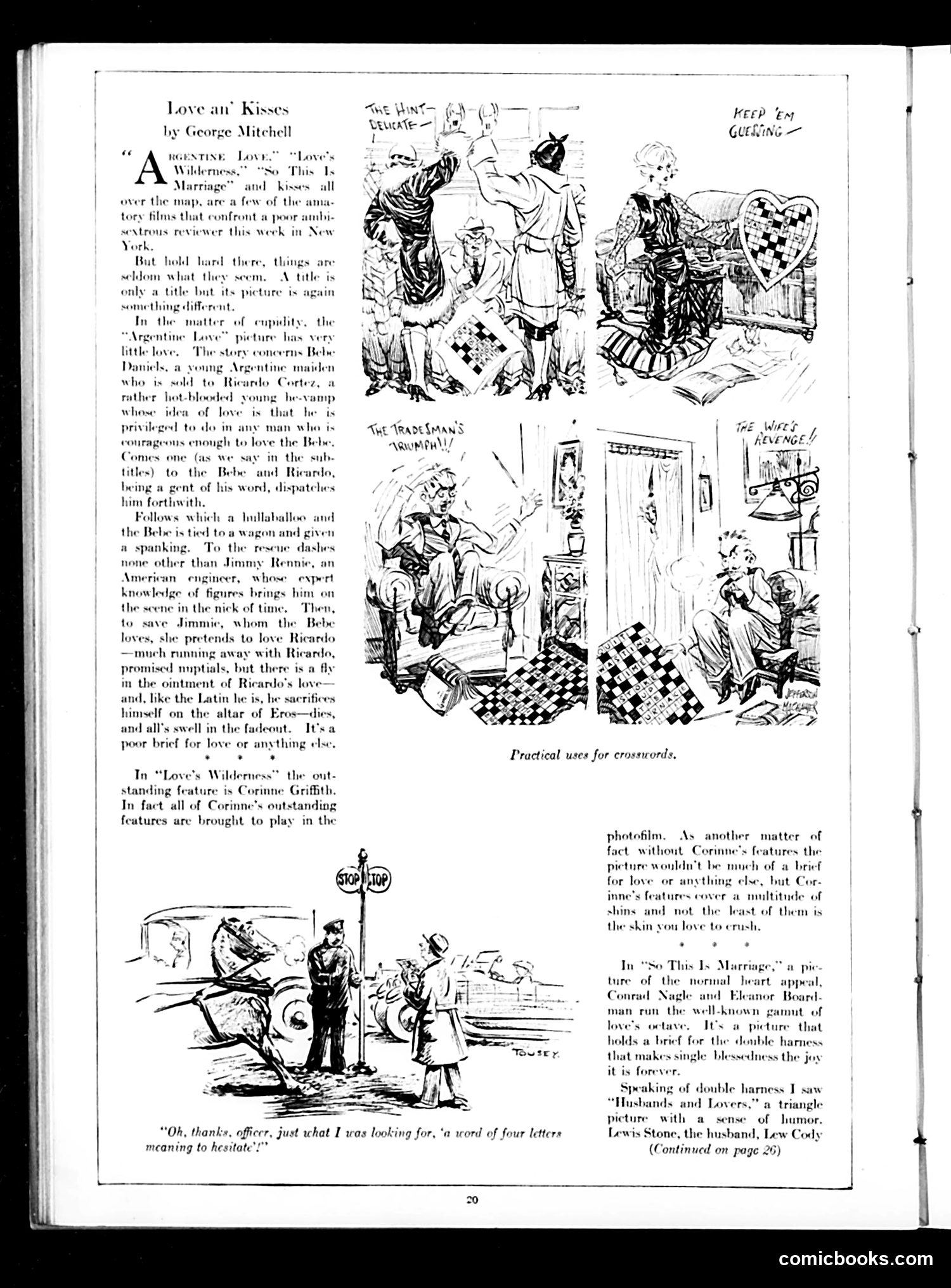
This page reviews recent silent films, using satirical illustrations to mock their melodramatic plots. George Mitchell critiques three movies: **"Argentine Love"** features the actress Bebe and a contrived love triangle involving Ricardo (a hot-blooded Argentine) and Jimmy Rennie (an American engineer). The satire mocks the absurd rescue scenario—Ricardo attempts suicide on an "altar of Eros," but the protagonist saves him, allowing everyone to reconcile implausibly. **"Love's Wilderness"** is praised primarily for actress Corinne Griffith's physical appearance rather than plot substance—Mitchell sardonically notes the picture would fail without her "features" (a double entendre about her attractiveness). **"So This Is Marriage"** depicts a conventional marriage plot with Conrad Nagel and Eleanor Boardman, which Mitchell dismisses as unremarkable. The cartoons at bottom show absurd domestic scenarios ("The Tradesman's 'Hurrah,'" "Keep 'Em Guessing," "The Wife's Revenge"), satirizing predictable film tropes about romance and marriage. The satire targets both films' reliance on attractive stars over substance and their formulaic narratives.
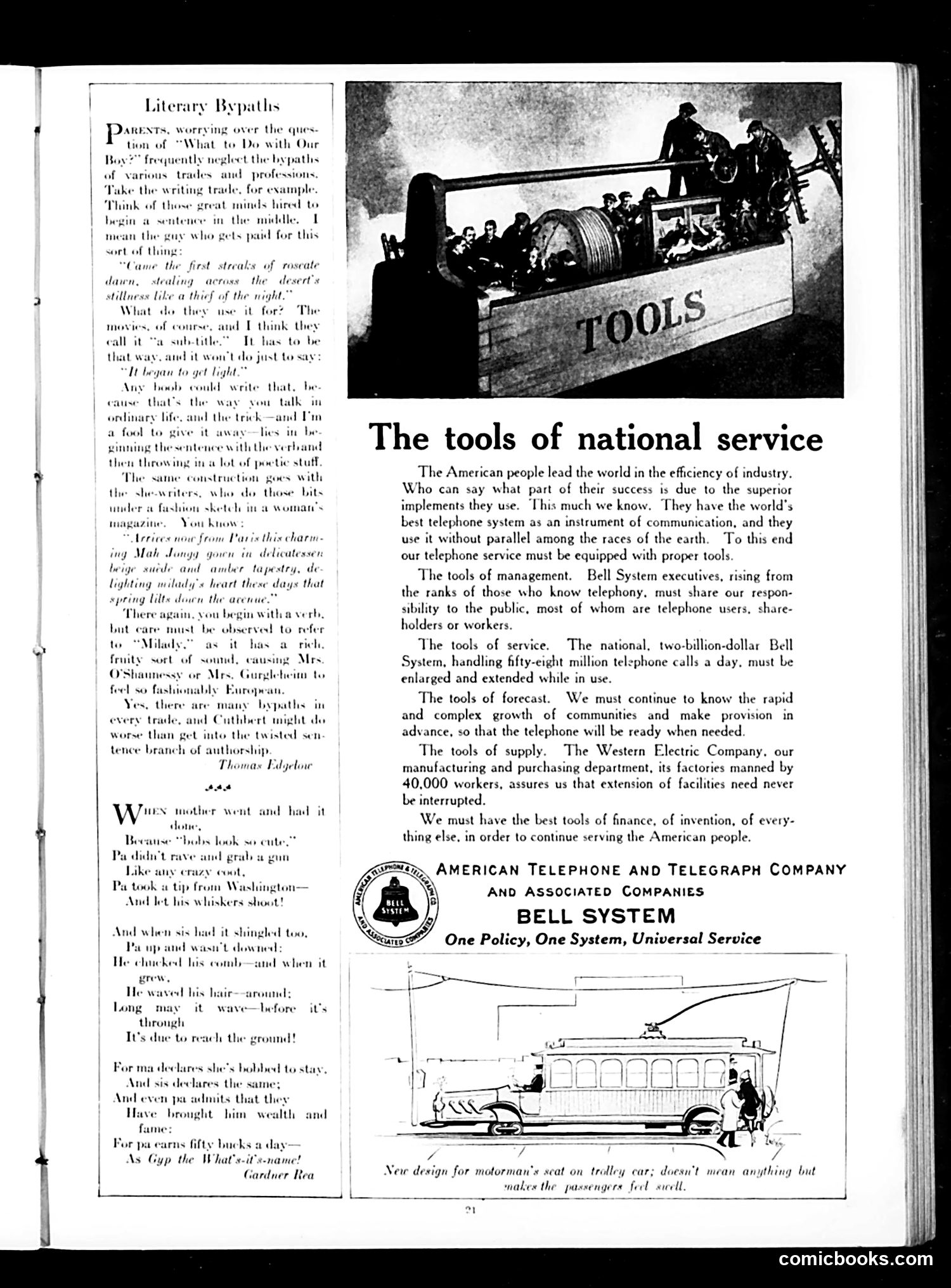
This page mixes literary satire with corporate advertising. The left column mocks pretentious writing—particularly the overuse of flowery language in pulp fiction and magazines. It ridicules how writers employ elaborate descriptions ("roseate dawn, stealing across the desert's stillness") when plain speech would suffice ("it began to get light"). The satire targets both the writers who produce this drivel and the publications that publish it, suggesting that unnecessary ornamentation is standard practice in popular entertainment. The right side is a **Bell System advertisement** masquerading as editorial content—typical of early 20th-century publications. It argues that America's industrial superiority depends on having the "best tools," including telephone infrastructure. The ad emphasizes Bell's "tools of management," "service," "forecast," and "supply," framing the telephone monopoly as essential national infrastructure. The trolley car cartoon below satirizes cosmetic design changes that offer no functional improvement—"doesn't mean anything but makes the passengers feel swell."
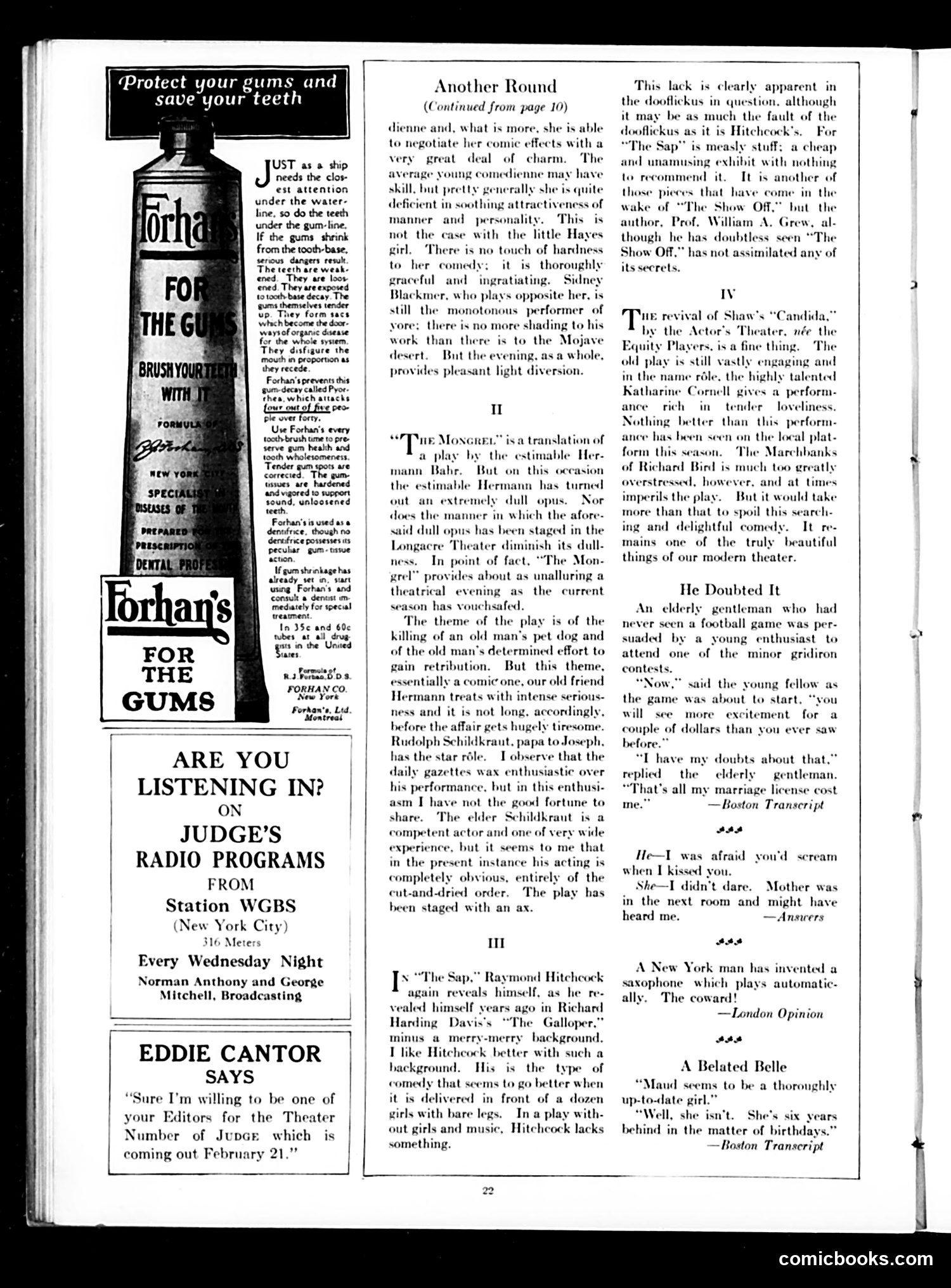
This page is primarily **advertising and entertainment content** rather than political satire. The main elements are: 1. **Forhan's Toothpaste Advertisement**: A large ad promoting gum disease prevention, using medical language about "pyorrhea" (gum disease). The copy emphasizes protecting teeth at the gum line—typical early 20th-century dental advertising. 2. **Judge Radio Programs Announcement**: Promotes the magazine's radio broadcasts on Station WGBS featuring performers Norman Anthony and George Mitchell. 3. **Eddie Cantor Endorsement**: The famous vaudeville/early film entertainer agrees to be an editor for Judge's upcoming Theater Number (February 21). 4. **Theater Reviews**: The bulk of the page contains reviews of Broadway plays, including critical assessments of "The Mongrel" (a Hermann Bahr translation) and performances by actors like Rudolph Schildkraut and Raymond Hitchcock. The page reflects Judge's evolution into entertainment-focused content with advertising, rather than its earlier emphasis on political cartoons. No political satire or social commentary is present.
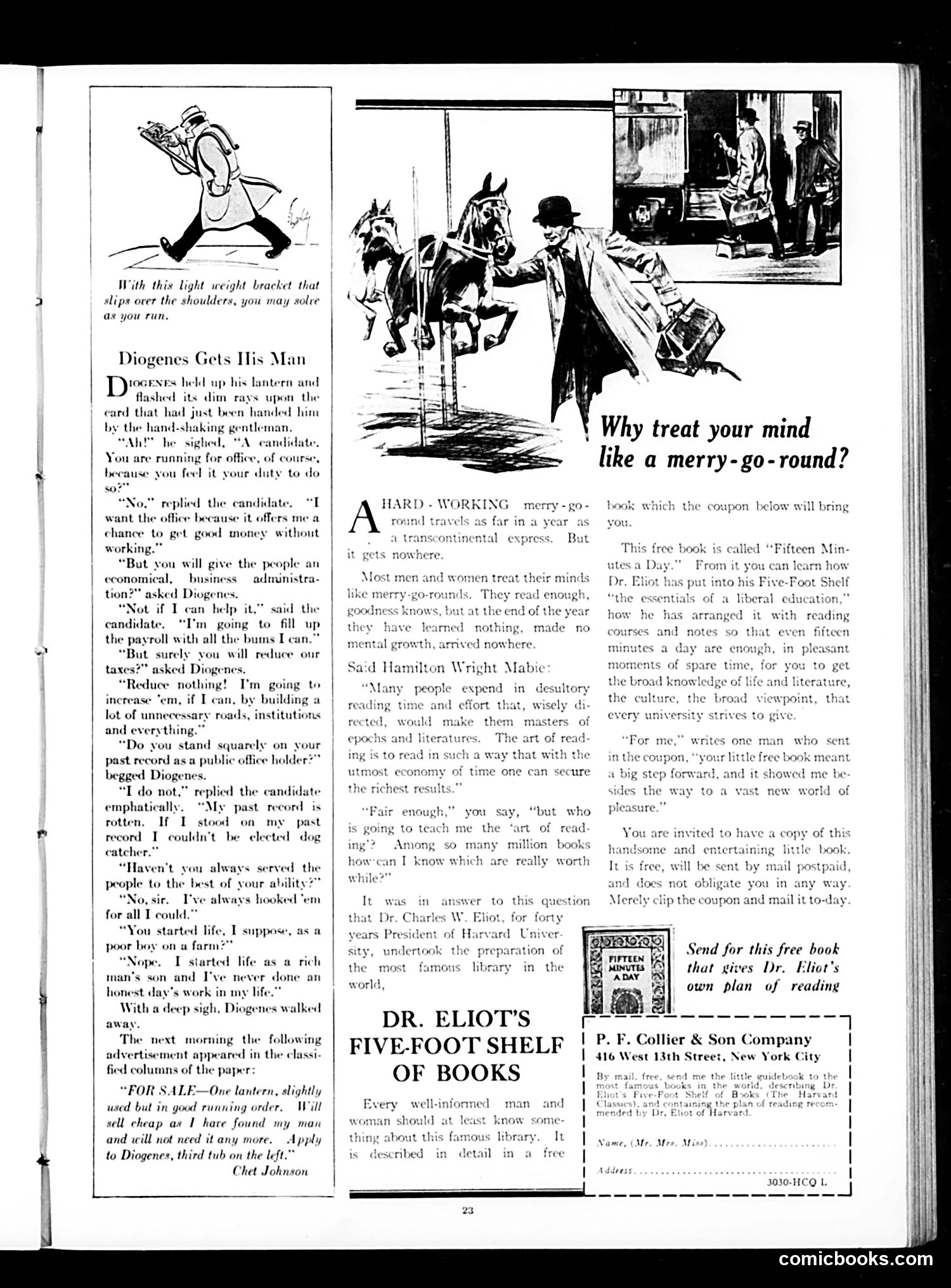
This cartoon satirizes corrupt political candidates and their brazen dishonesty. The classical reference to **Diogenes** (ancient Greek philosopher famous for seeking an honest man with a lantern) frames the joke. A candidate admits to Diogenes that he: - Wants office purely for personal gain, not duty - Plans to pad the payroll with incompetent workers ("bums") - Will *increase* taxes rather than reduce them - Has a "rotten" past record he hides from voters - Never worked an honest day, born wealthy The satire mocks **early 20th-century machine politics**: candidates openly admitting corruption, nepotism, and self-interest that voters supposedly should reject. Diogenes' frustrated decision to sell his lantern—implying he's finally found his dishonest man—delivers the punchline: such candidates are so common, honesty is hopeless. The cartoon critiques both corrupt politicians and a system that tolerates their brazen candor about exploiting public office.
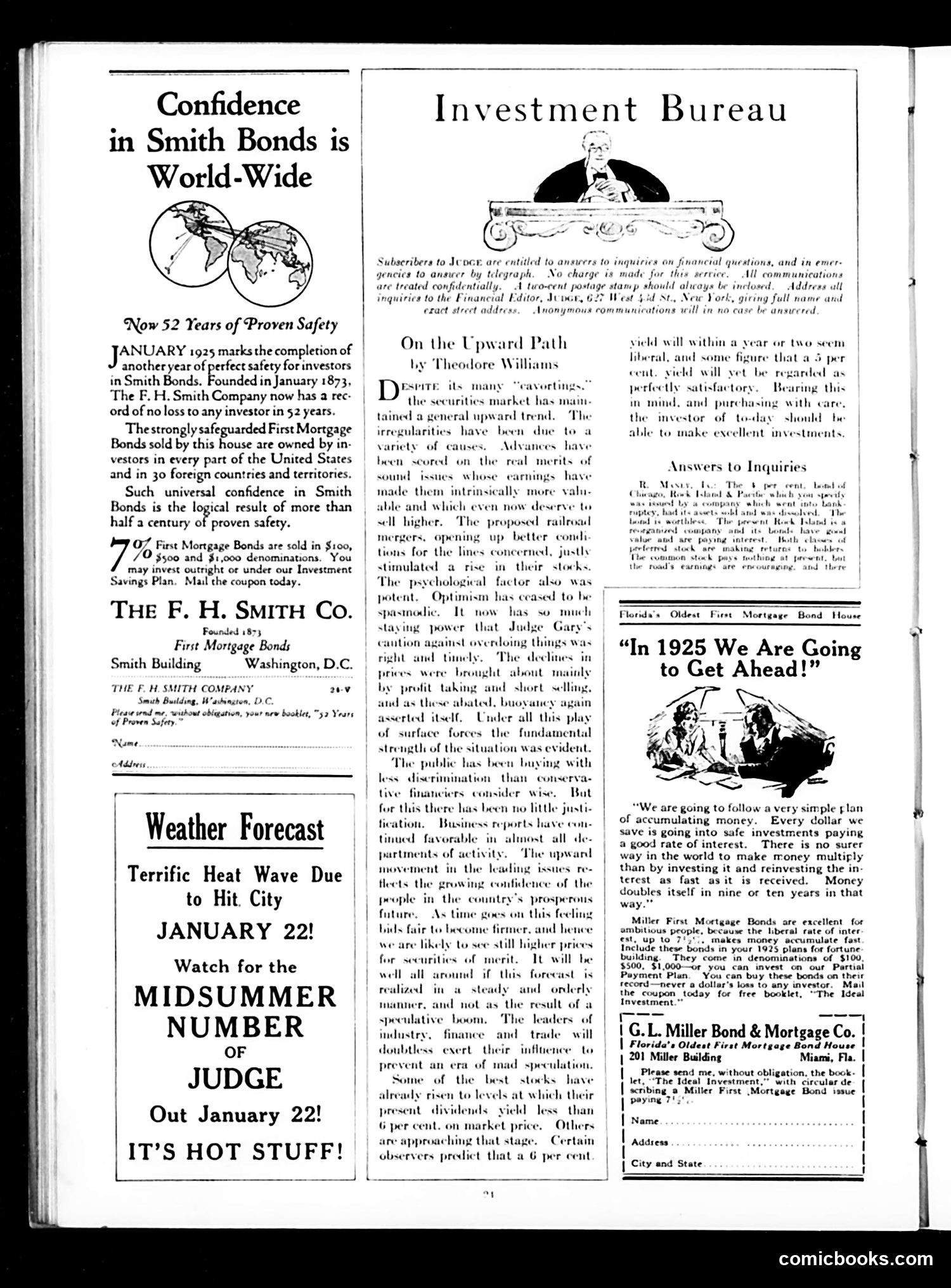
This page is primarily **financial advertising and investment advice**, not political satire. The main content includes: 1. **F.H. Smith Company advertisement** (left): Promotes 52-year-old bond investment firm, emphasizing safety and global confidence in their First Mortgage Bonds—typical 1920s investment marketing. 2. **"Investment Bureau" column** (center/right): An earnest financial advice piece by Theodore Williams discussing the upward trend in securities markets, railroad mergers, and psychological optimism driving stock prices. 3. **G.L. Miller Bond & Mortgage Co. advertisement** (bottom right): Another mortgage bond firm marketing. 4. **"Weather Forecast" joke** (left sidebar): Announces Judge's upcoming "Midsummer Number" arriving January 22, calling it "hot stuff"—a playful pun about the magazine's comedic content rather than actual weather. The page reflects 1920s economic optimism before the October 1929 crash, promoting conservative investment vehicles to middle-class readers. There is **no significant political cartoon or satire** present.
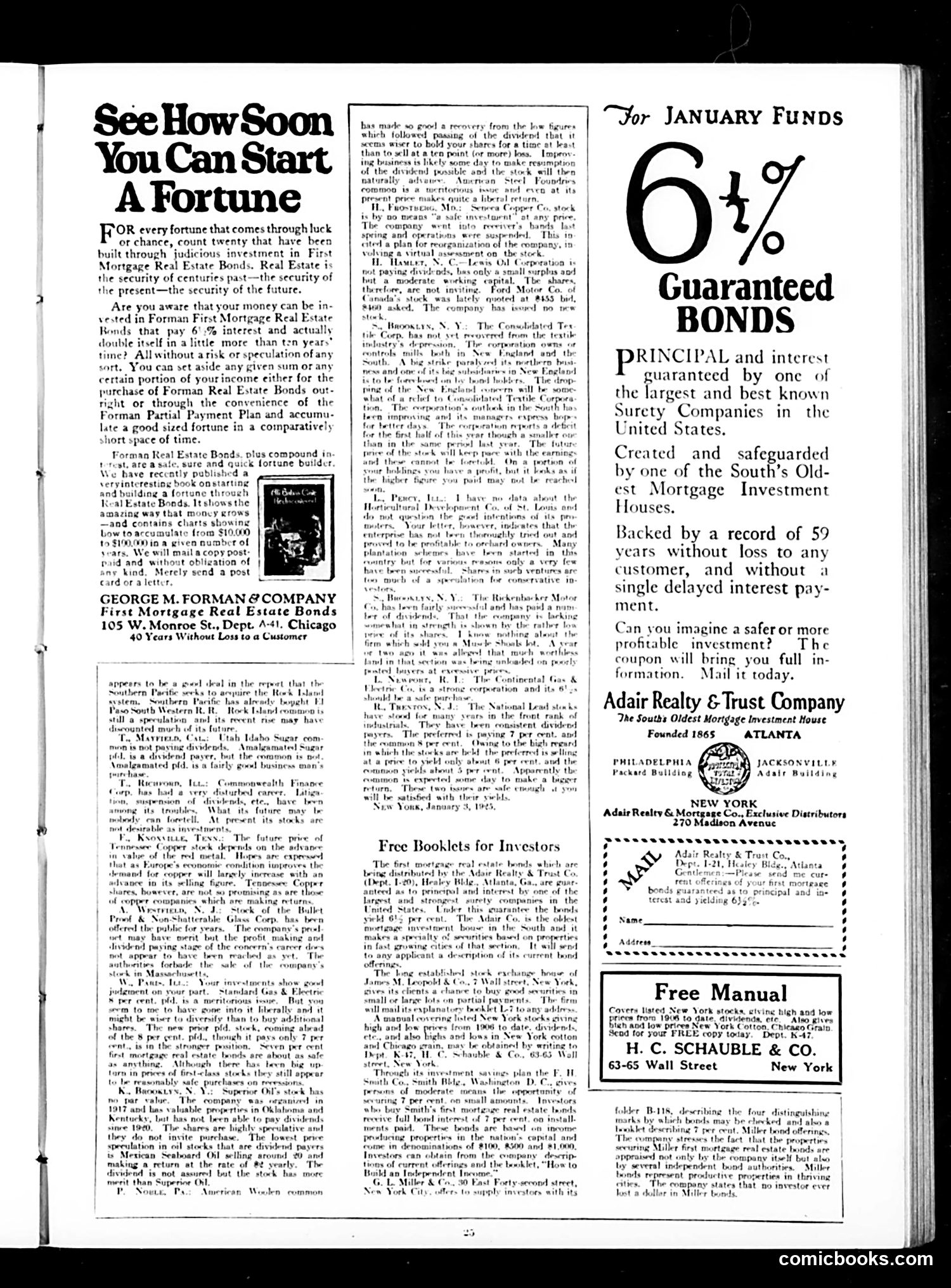
This page is **primarily advertising**, not satirical content. It consists of financial investment promotions rather than political cartoons or satire. The main advertisements promote: 1. **Forman Real Estate Bonds** — promising 6.5% interest and claims that money will "double itself in a little more than ten years" 2. **Adair Realty & Trust Company** — emphasizing a 59-year track record "without loss to any customer" **Historical context for modern readers:** This appears to be from the 1920s economic boom period, when such investment schemes were heavily marketed. The repeated emphasis on "guaranteed" returns and safety suggests these ads were designed to attract middle-class investors seeking wealth-building opportunities. **The implicit satire:** Judge magazine's inclusion of these ads alongside text discussing various speculative stocks (Copper, Oil, Textile companies) creates ironic contrast—the ads claim absolute safety while surrounding text discusses risky ventures, perhaps suggesting contemporary skepticism about such "guaranteed" promises. No specific political figures or caricatures are visible.
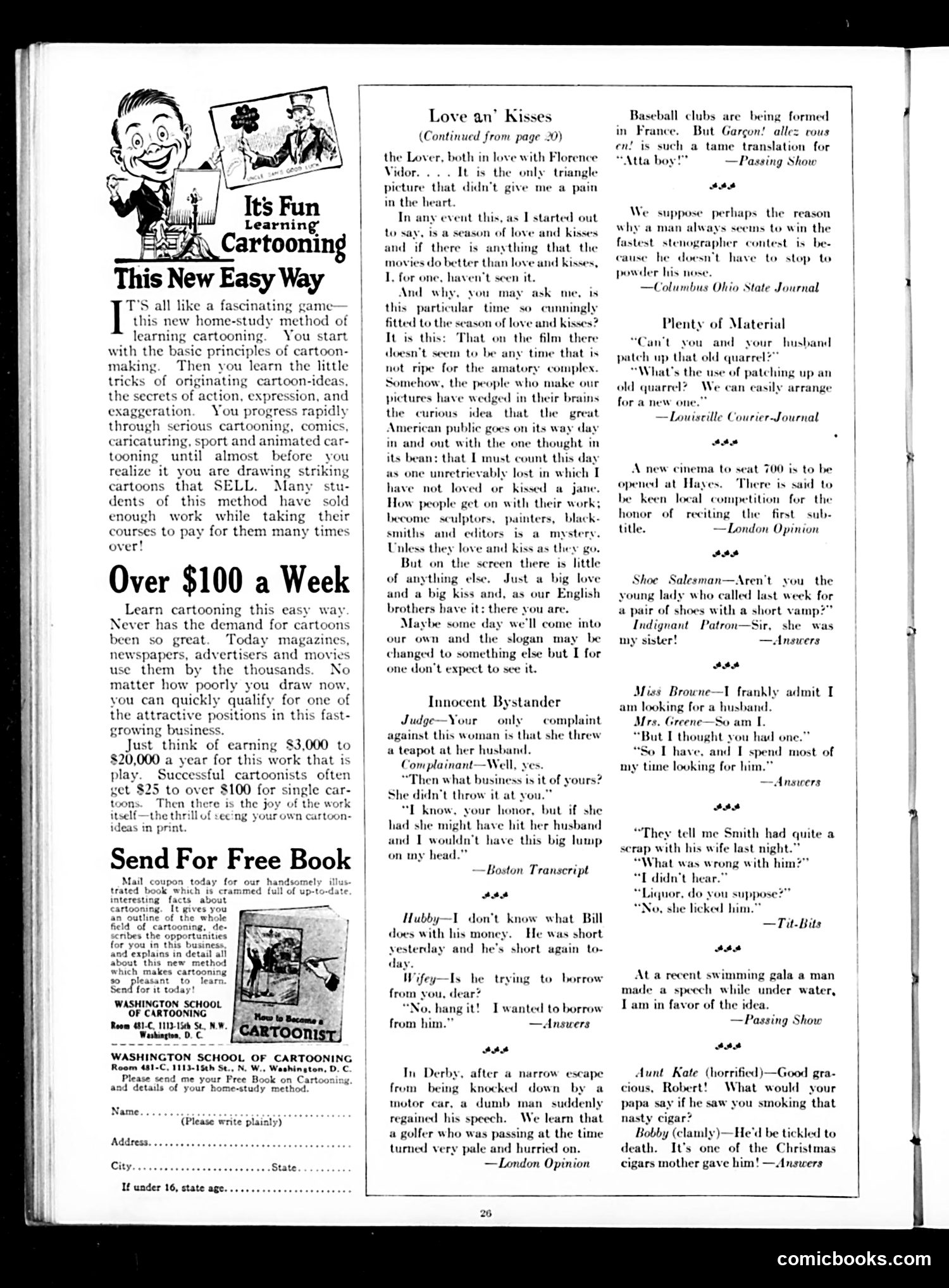
This page is primarily **advertising and filler content** rather than political satire. The dominant feature is a large advertisement for the "Washington School of Cartooning," promoting home-study courses with claims of earning "$100 a week" or "$3,000 to $20,000 a year." The right column contains miscellaneous **short humor pieces and reprinted quips** from newspapers—typical filler for the era. These include: - A commentary on movie "love and kisses" scenes (film criticism) - Brief joke exchanges ("Innocent Bystander," "Hubby," etc.) sourced from papers like the *Boston Transcript* and *London Opinion* - Anecdotes about domestic disputes, borrowing money, and a golf accident None of these pieces contain identifiable political figures or commentary. They're generic, observational humor about everyday situations—marital conflict, financial struggles, social mishaps—aimed at middle-class readers. The page reflects Judge's format: mixing satirical commentary with advertisements and light entertainment filler.
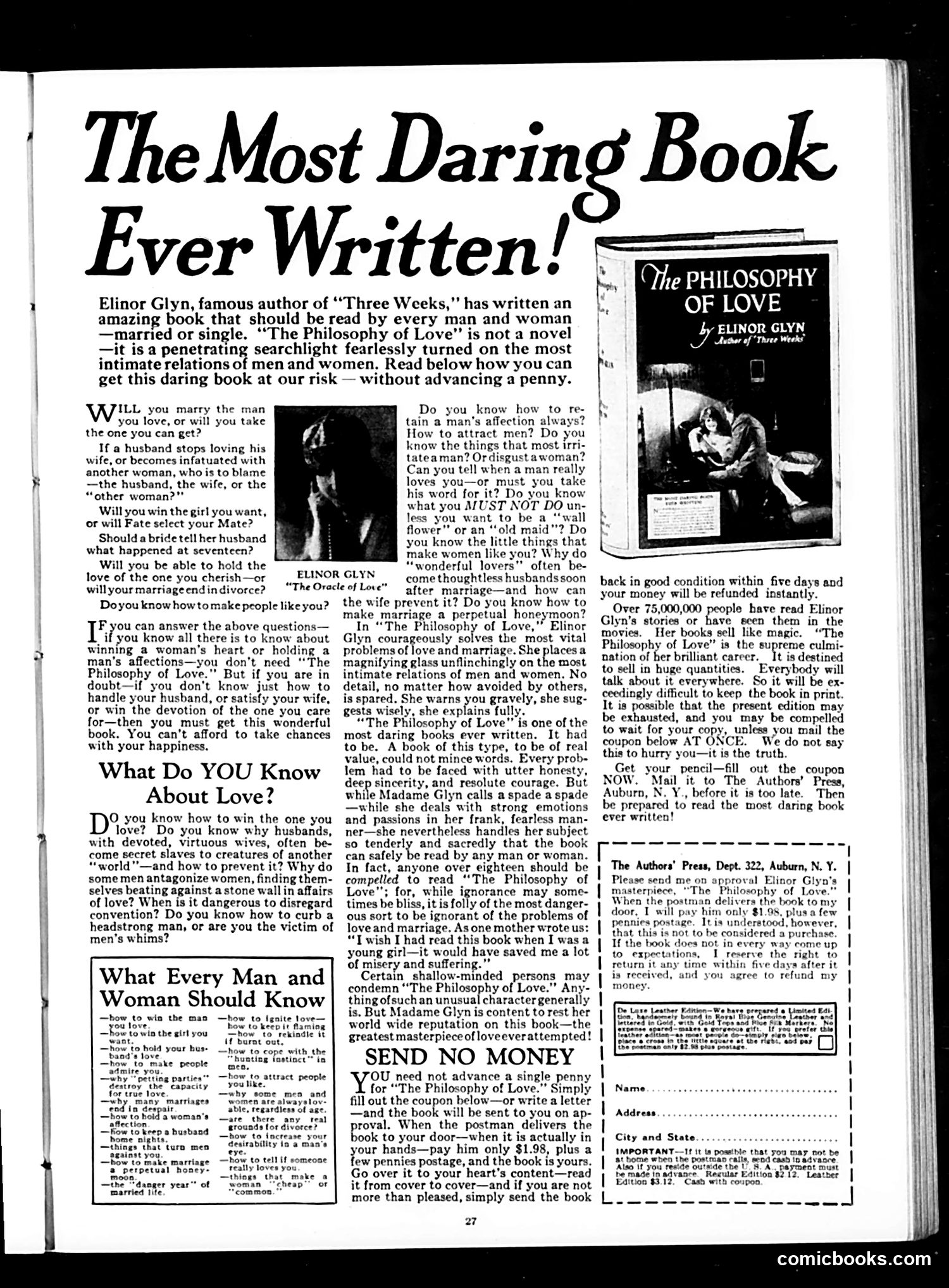
This is primarily a **book advertisement**, not a political cartoon. It promotes Elinor Glyn's non-fiction work "The Philosophy of Love," marketed as daring and frank advice about romantic relationships and marriage. **The figures:** Elinor Glyn (1864-1943) was a real British author famous for her scandalous novel "Three Weeks" (1907). She's presented as "The Oracle of Love"—an authority on intimate relations. **The appeal:** The ad addresses early 20th-century anxieties about marriage, divorce, and gender relations through rhetorical questions: Will you marry for love or convenience? How do you keep a spouse's affection? Can you tell if someone truly loves you? **The satire/point:** The page satirizes how publishers marketed self-help books by promising to solve fundamental human problems through frank discussion of "intimate relations"—then considered scandalous. The "risk-free" offer ($1.95 plus postage) and emphasis on the book's daring nature were marketing tactics exploiting middle-class concerns about modern relationships.
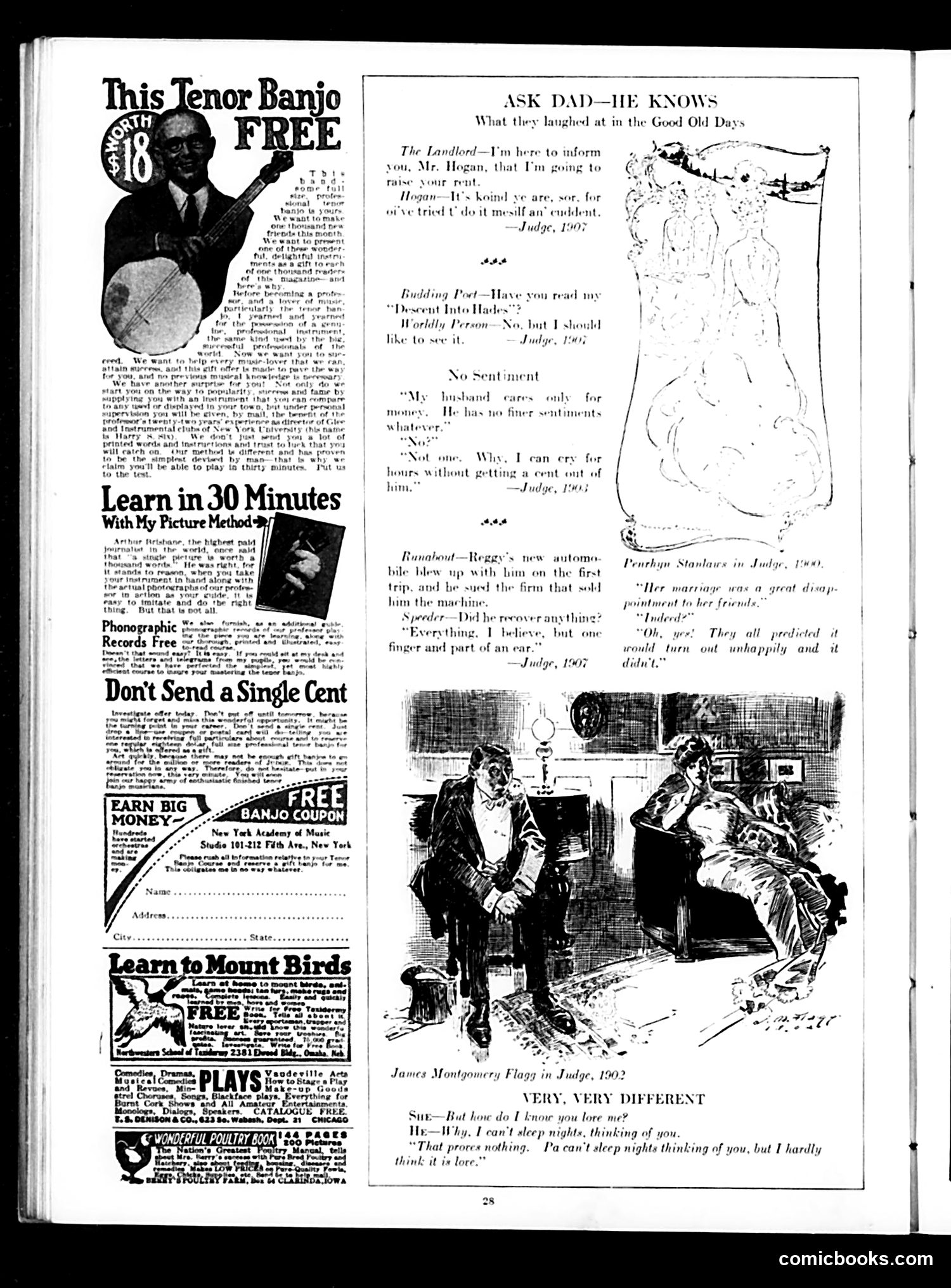
This page from Judge (circa 1902-1907) contains multiple brief satirical jokes reflecting early 20th-century attitudes: **"Ask Dad—He Knows"** presents nostalgic anecdotes supposedly from the past, including a landlord's Irish-accented tenant, and quips about marriage lacking sentiment (a husband caring only for money). **The cartoon by James Montgomery Flagg** depicts a domestic scene where a wife confronts her husband about his claim to love her. The satire mocks romantic sentiment: when he insists he can't sleep thinking of her, she retorts that she also loses sleep over him—but that hardly proves love. This undercuts Victorian sentimentality about romance. The page also advertises mail-order courses (banjo, bird identification, phonographic records), typical of early 20th-century magazine commerce. **Overall meaning**: These jokes target sentimental notions of love and marriage as idealized, suggesting practical self-interest and emotional detachment characterized real relationships—a cynical worldview common to Judge's satirical voice.
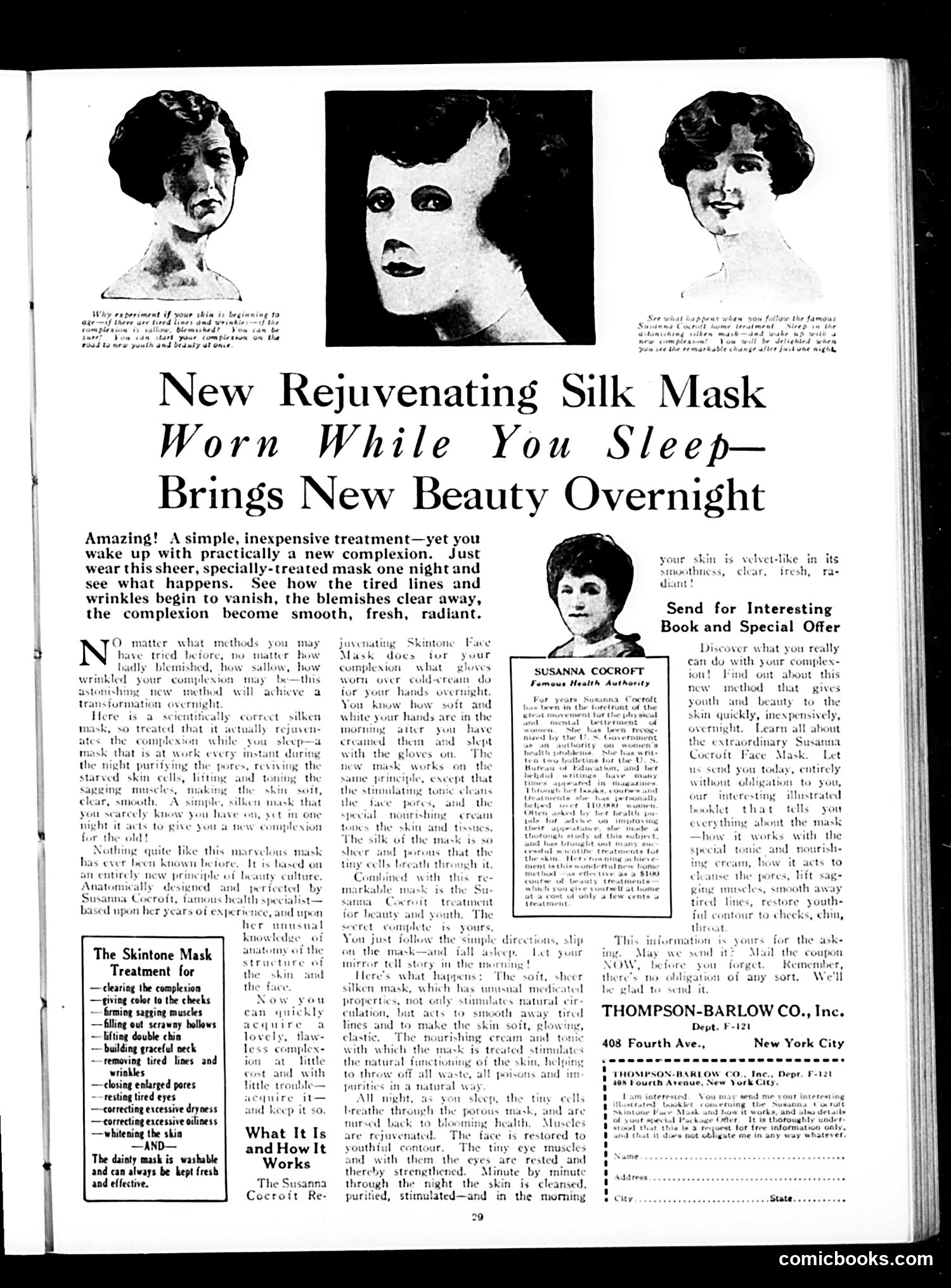
This page is **primarily a beauty product advertisement**, not political satire. It promotes the "Susanna Cocroft" silk face mask—a overnight beauty treatment claiming to reduce wrinkles, clear blemishes, and rejuvenate skin. The three photographs at top show women's faces (before/after style testimonials), with the center image dramatically lit to emphasize transformation. Susanna Cocroft appears identified as the product's creator/endorser. **Historical context for modern readers**: This reflects early 20th-century beauty culture's obsession with overnight miracle treatments and the celebrity endorsement model. The scientific-sounding language ("medicated properties," "stimulates natural circulation," "tiny cells") masks what was likely a standard moisturizing cream—typical of dubious skincare claims of the era. The elaborate testimonial format and mail-order mechanism (coupon at bottom) were standard advertising tactics before modern consumer protection laws regulated beauty product claims. This is **not satire**—it's genuine period advertising reflecting contemporary attitudes about women, appearance, and pseudo-scientific beauty promises.
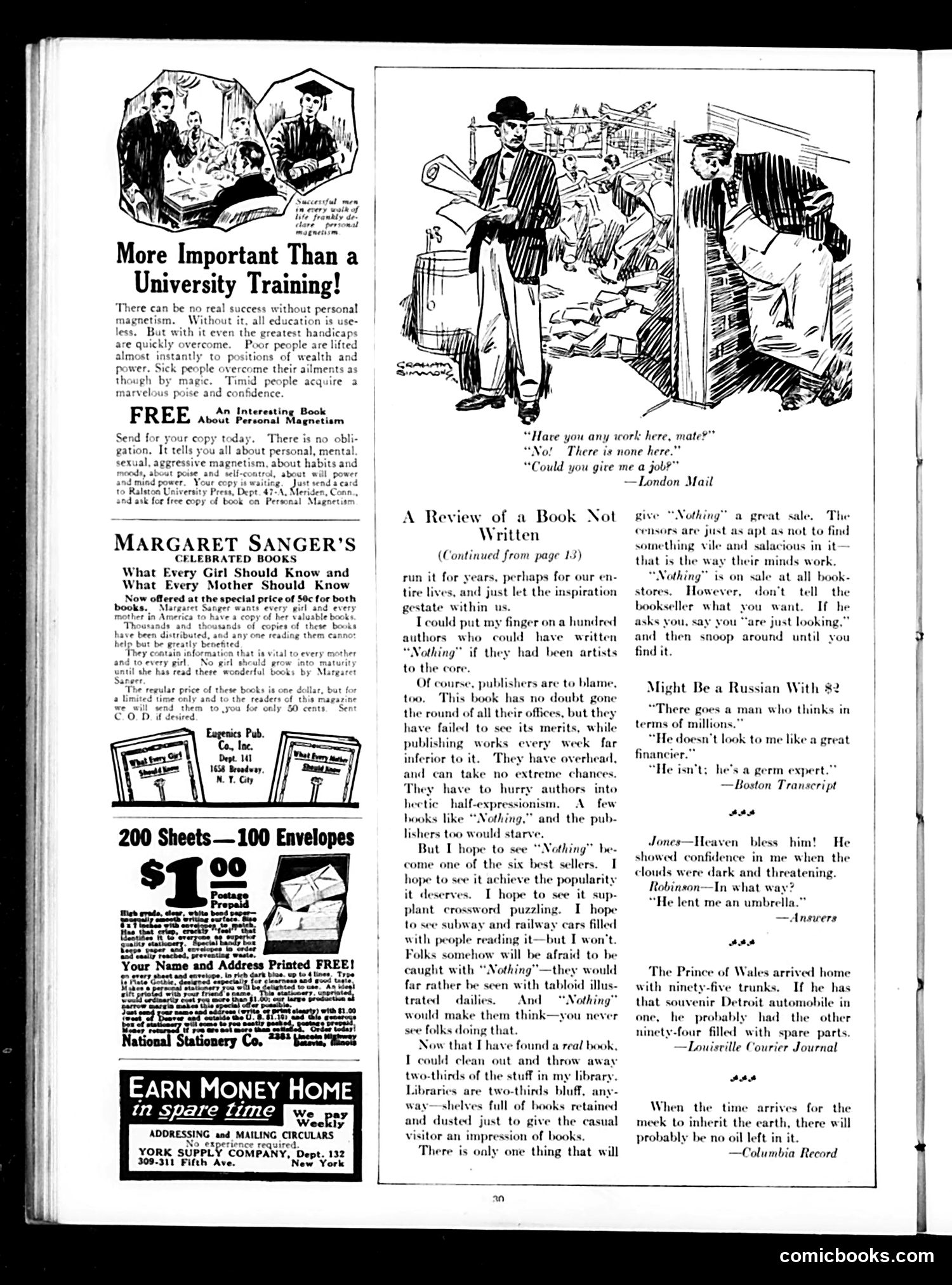
This page mixes advertisements with satirical commentary. The main cartoon depicts a job-seeker asking a man at a desk "Have you any work here, mate?" with the response "No! There is none here." It illustrates employment difficulty—likely referencing post-WWI economic hardship or the Great Depression era when jobs were scarce. The "Review of a Book Not Written" is satirical literary criticism about a fictional book called *"Nothing."* The author mocks how publishers reject unconventional works while printing inferior material, how libraries contain "two-thirds bluff," and suggests *"Nothing"* would only succeed if censors banned it for indecency—satirizing both publishing cowardice and public prudishness. The page's other jokes mock wealthy pretension ("Might Be a Russian With 82") and excess (the Prince of Wales's numerous trunks). The advertisements—for "Personal Magnetism" books, Margaret Sanger's sex education volumes, and stationery—reflect period concerns about self-improvement and modern social topics.
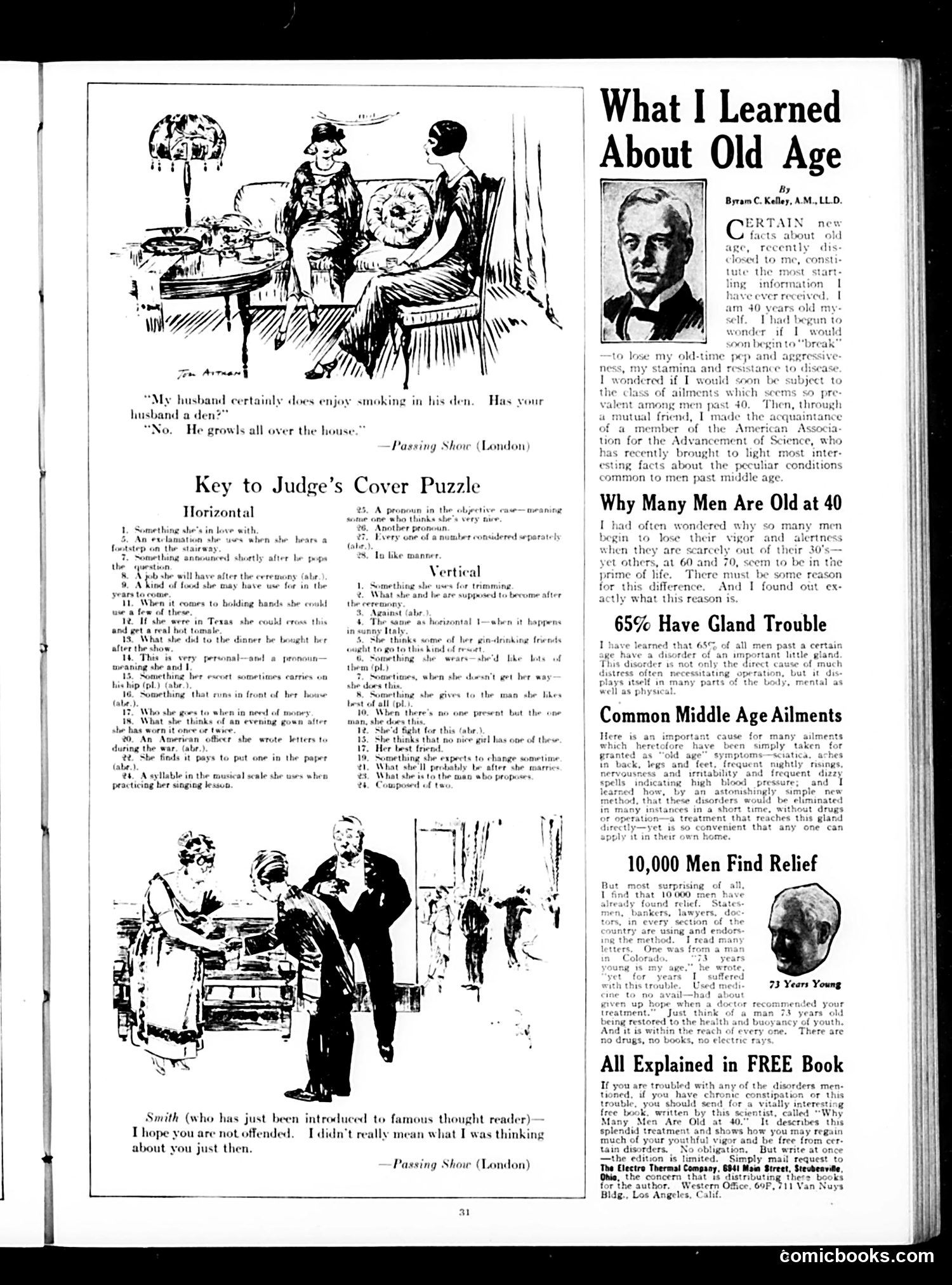
This page combines satirical cartoons with an article about aging in men. The top cartoon shows a couple where the husband smokes constantly in his den while smoke fills the house—a jab at male selfishness and domestic inconsiderateness. The caption mocks husbands who claim private spaces while affecting the whole household. The bottom cartoon depicts a man introduced to a "famous thought reader" who assures the stranger he means no offense about his unspoken thoughts—implying the man was thinking something insulting or embarrassing about the stranger. The main article by Byram C. Kelley argues that many men lose vigor by age 40 due to gland trouble and common middle-age ailments. It advertises a free book explaining these conditions and promising relief through treatment. The "Key to Judge's Cover Puzzle" is a crossword-style game for readers. Overall, this reflects early 20th-century anxieties about male health, vitality, and domestic relations, while the cartoons gently mock male behavior and social awkwardness.
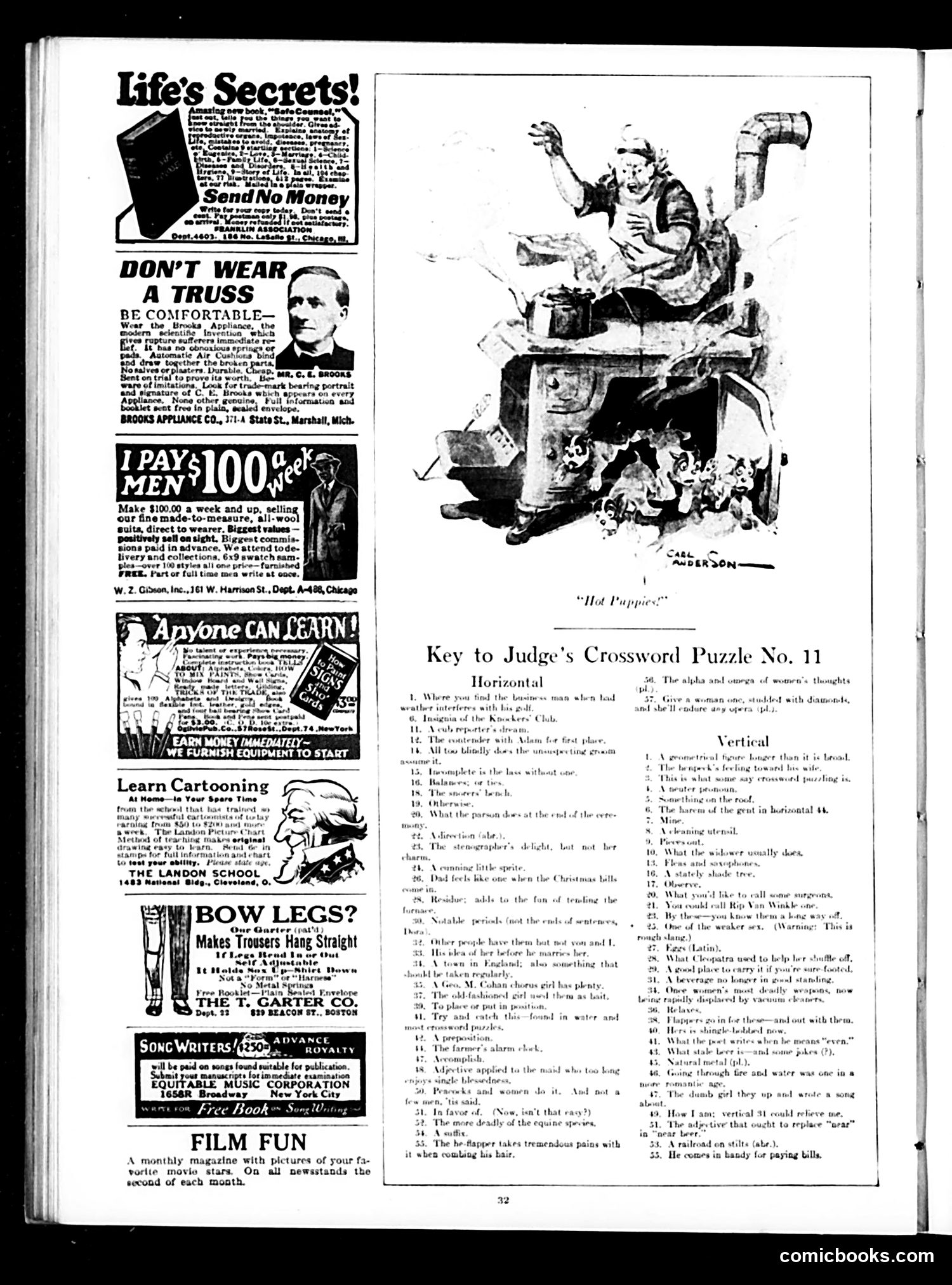
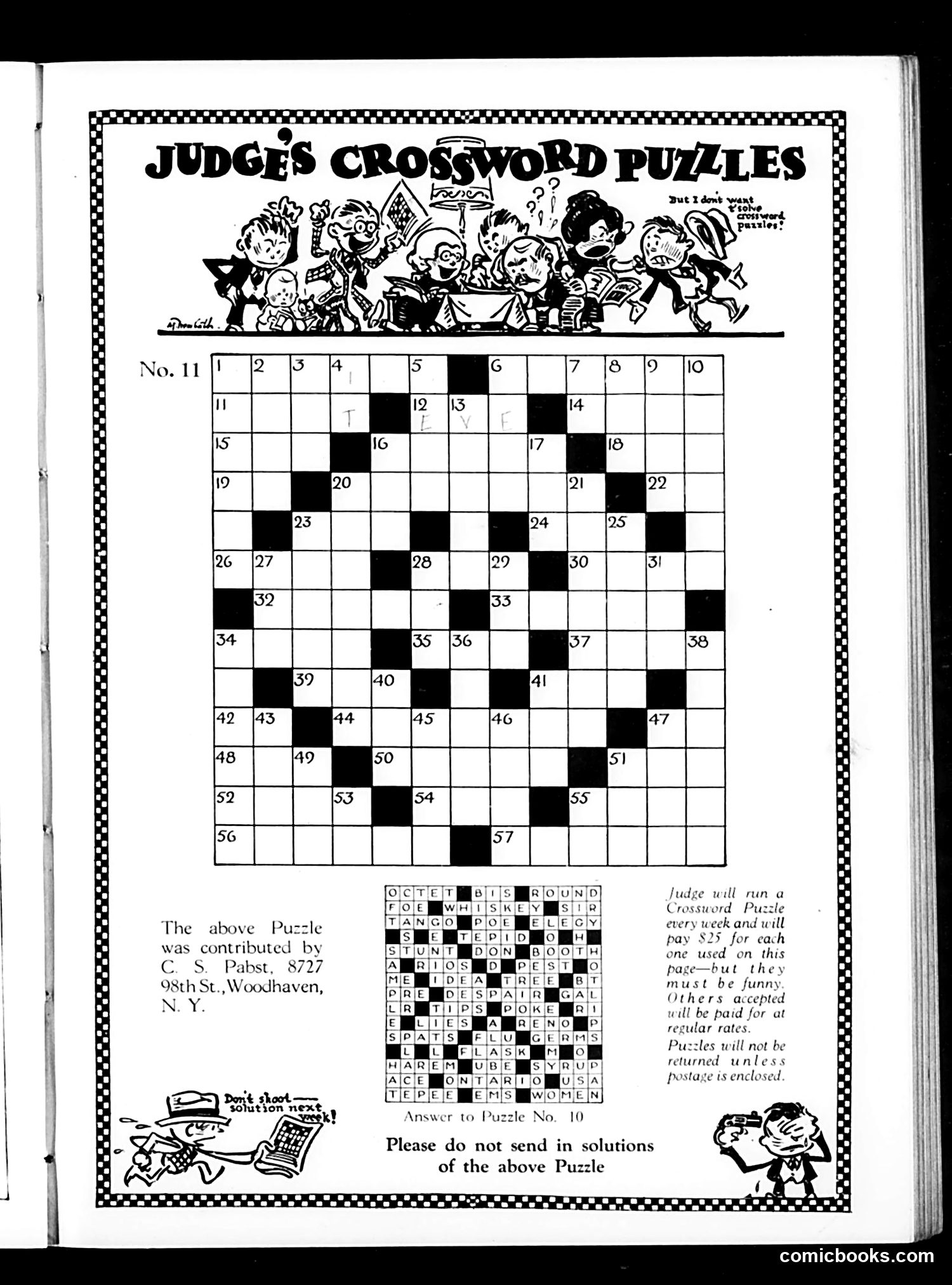
This page presents **Judge's weekly crossword puzzle contest** (No. 11), a reader-participation feature. The header illustration shows cartoon characters celebrating around a large puzzle, establishing a playful tone. The page announces Judge's ongoing crossword puzzle competition, offering **$25 payment for funny puzzles** selected for publication—a substantial sum for the era. Additional accepted puzzles would receive standard rates. Contributors must include return postage or puzzles won't be returned. The small cartoon at top-right depicts a child refusing "parties," likely representing the puzzles' appeal as indoor entertainment—relevant given crosswords were a wildly popular craze in early 20th-century America. The answer grid for the previous week's puzzle (No. 10) is provided below. This represents Judge's strategy of engaging readers as content creators while maintaining the magazine's satirical, humor-focused brand identity through the crossword format.
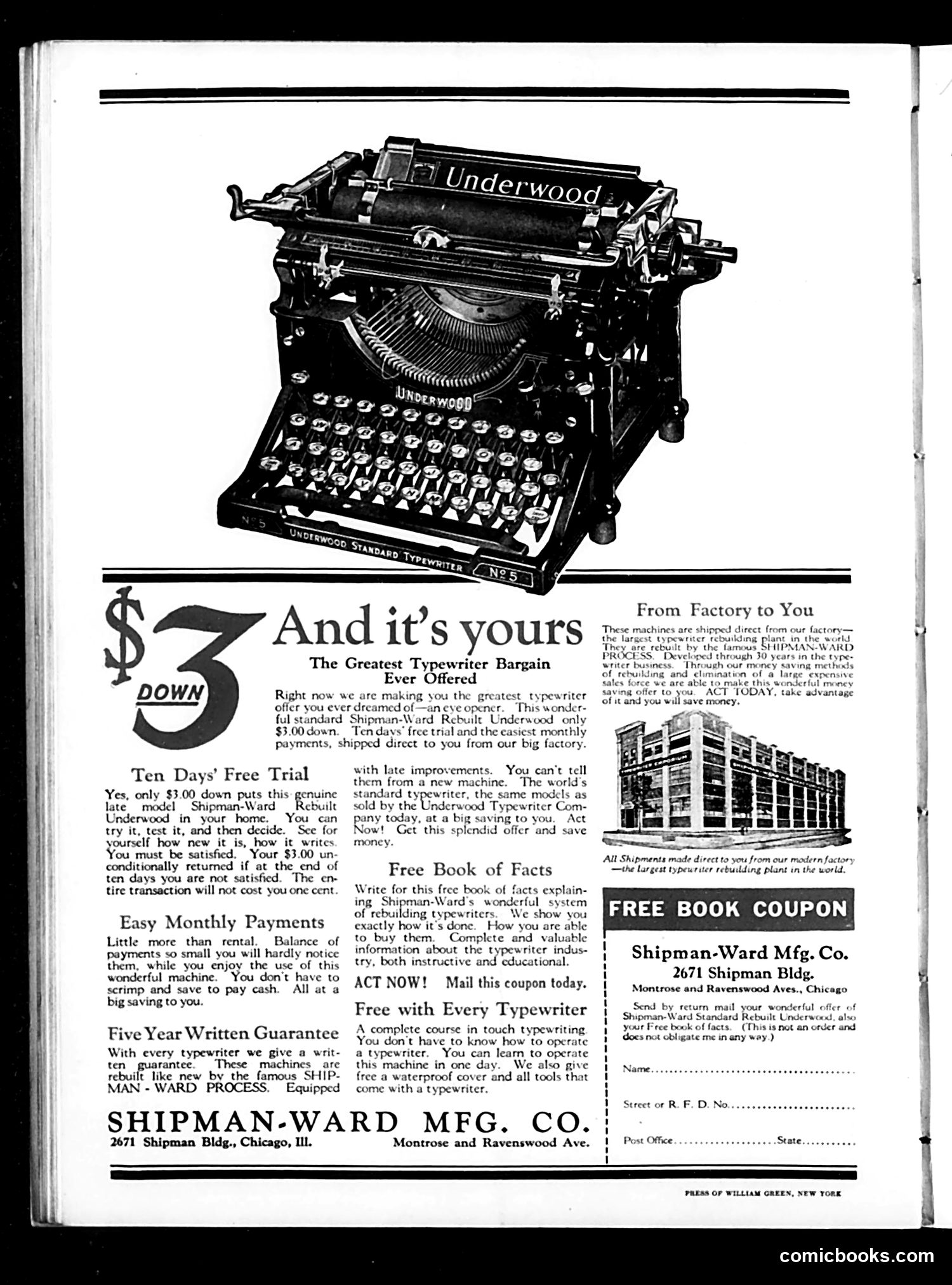
This is **not a political cartoon or satirical content**—it's a full-page advertisement for Shipman-Ward Manufacturing Company, disguised as editorial content in Judge magazine. The ad promotes rebuilt Underwood typewriters with an aggressive sales pitch: $3 down, ten days' free trial, easy monthly payments, and a five-year guarantee. The large typewriter image at top serves as product display. The factory building photo emphasizes manufacturing legitimacy. The placement in Judge (a satirical magazine) is itself the only potentially humorous element—advertising masquerading as legitimate magazine content was common practice in early 20th-century publications. However, this appears to be genuine commercial advertising rather than satire *of* advertising. There are no identifiable caricatures, political figures, or social commentary. The "joke," if any, is simply the aggressive hard-sell marketing tactics typical of the era.