
A complete issue · 36 pages · 1924
Judge — December 20, 1924
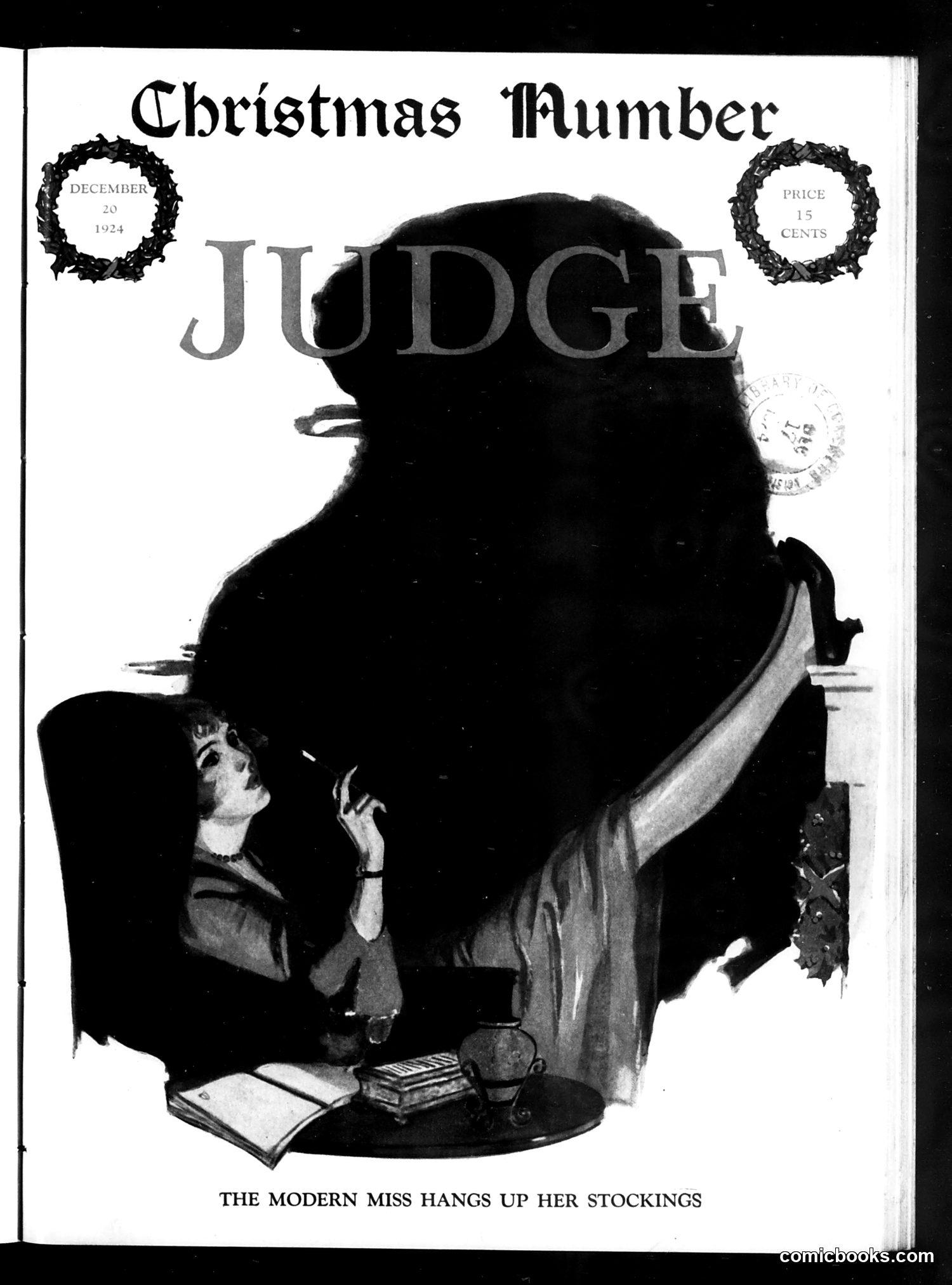
This cover satirizes changing social customs for women in the 1920s. The caption "THE MODERN MISS HANGS UP HER STOCKINGS" plays on the traditional Christmas image of children hanging stockings for Santa Claus, but here a young woman does so—suggesting adult women now participate in holiday traditions previously associated with children. The humor likely reflects anxiety about "modern" women's independence during the Jazz Age. The woman's pose and contemporary dress embody the "flapper" stereotype of the era. By depicting her alongside traditional Christmas imagery (wreath, domestic setting), Judge satirizes the tension between Victorian domestic roles and the emerging independence of 1920s women who increasingly worked, voted, and socialized independently.
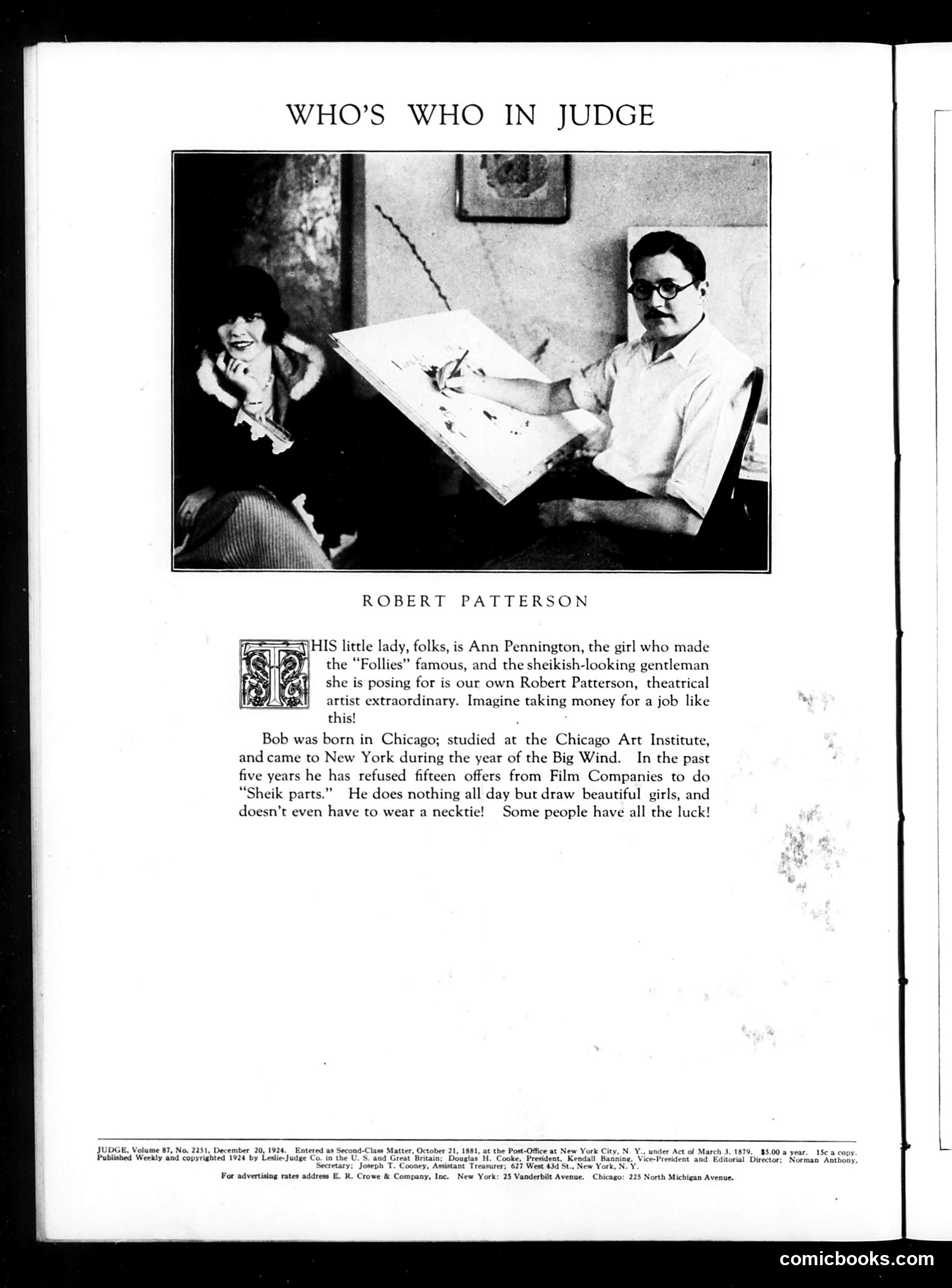
This page profiles **Robert Patterson**, a theatrical artist and illustrator. The photograph shows Patterson drawing a portrait of **Ann Pennington**, a dancer famous for her role in the "Follies" (likely the Ziegfeld Follies, Broadway's premier revue). The satire highlights Patterson's enviable profession: he draws beautiful women all day without formal business attire (no necktie required). The text notes he was born in Chicago, studied at the Chicago Art Institute, and moved to New York during the 1920s. He reportedly rejected fifteen film offers to draw "sheik parts"—a reference to the popular romantic lead archetype of the 1920s. The joke is straightforward: Patterson has an ideal job drawing attractive women for pay.
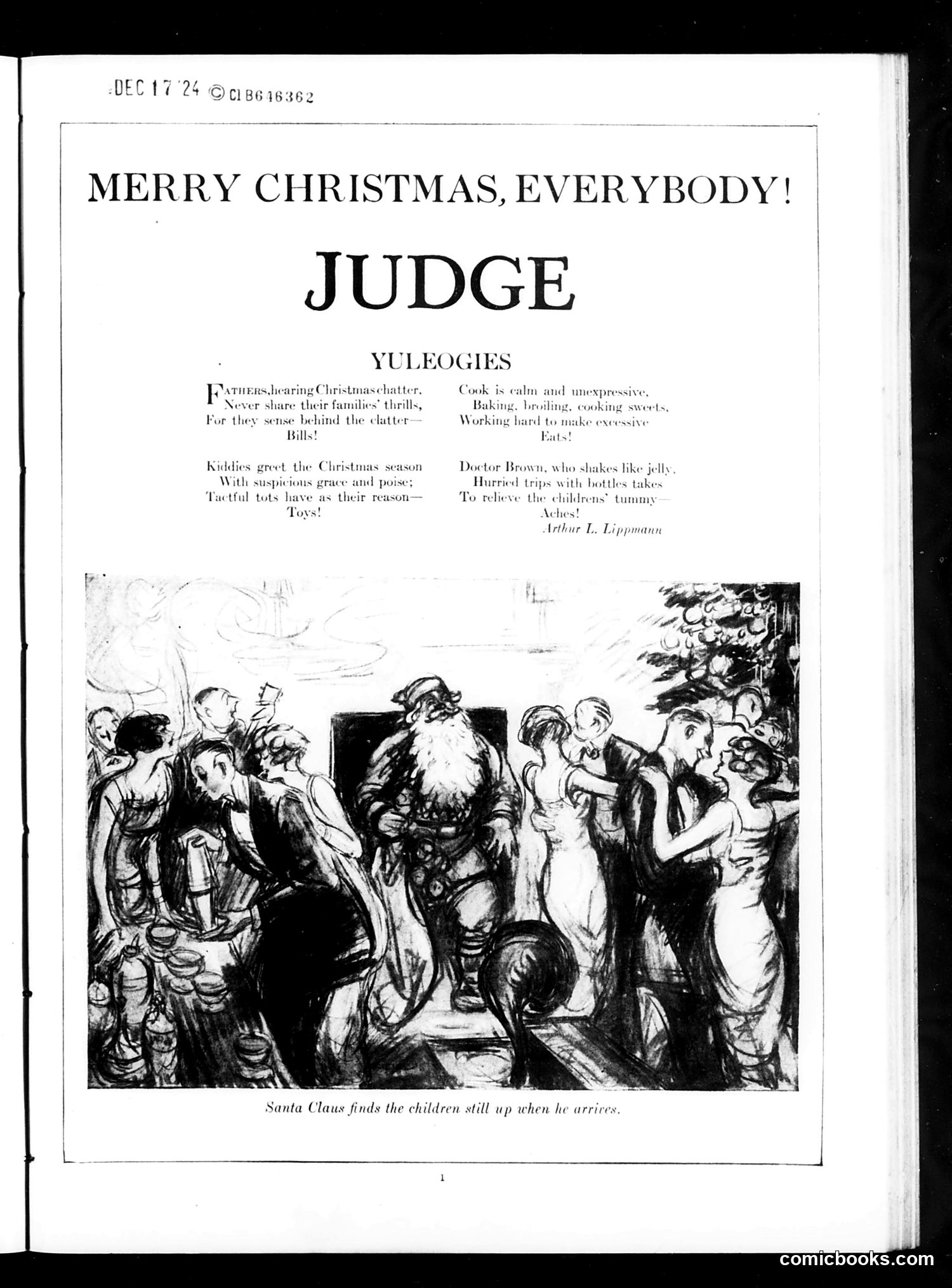
This is a Christmas-themed humor page from *Judge* magazine featuring "Yuleogies"—satirical poems about holiday observations. The content includes: **The Poems:** - Fathers enjoying Christmas chatter while bills mount - Children greeting the season with suspicious grace, wanting toys - Cook working hard making excessive food - Doctor Brown (likely a contemporary figure) dealing with children's stomach troubles from overeating **The Illustration:** Shows Santa Claus arriving at a formal Christmas gathering with adults and children. The caption reads: "Santa Claus finds the children still up when he arrives." **The Satire:** The humor targets typical Christmas complaints: excessive spending, children's materialism, overindulgence in food, and the chaos of holiday entertaining. The yuleogies mock common frustrations with the season rather than celebrating it sentimentally—a characteristic *Judge* approach to deflating holiday idealism with cynical social observation.
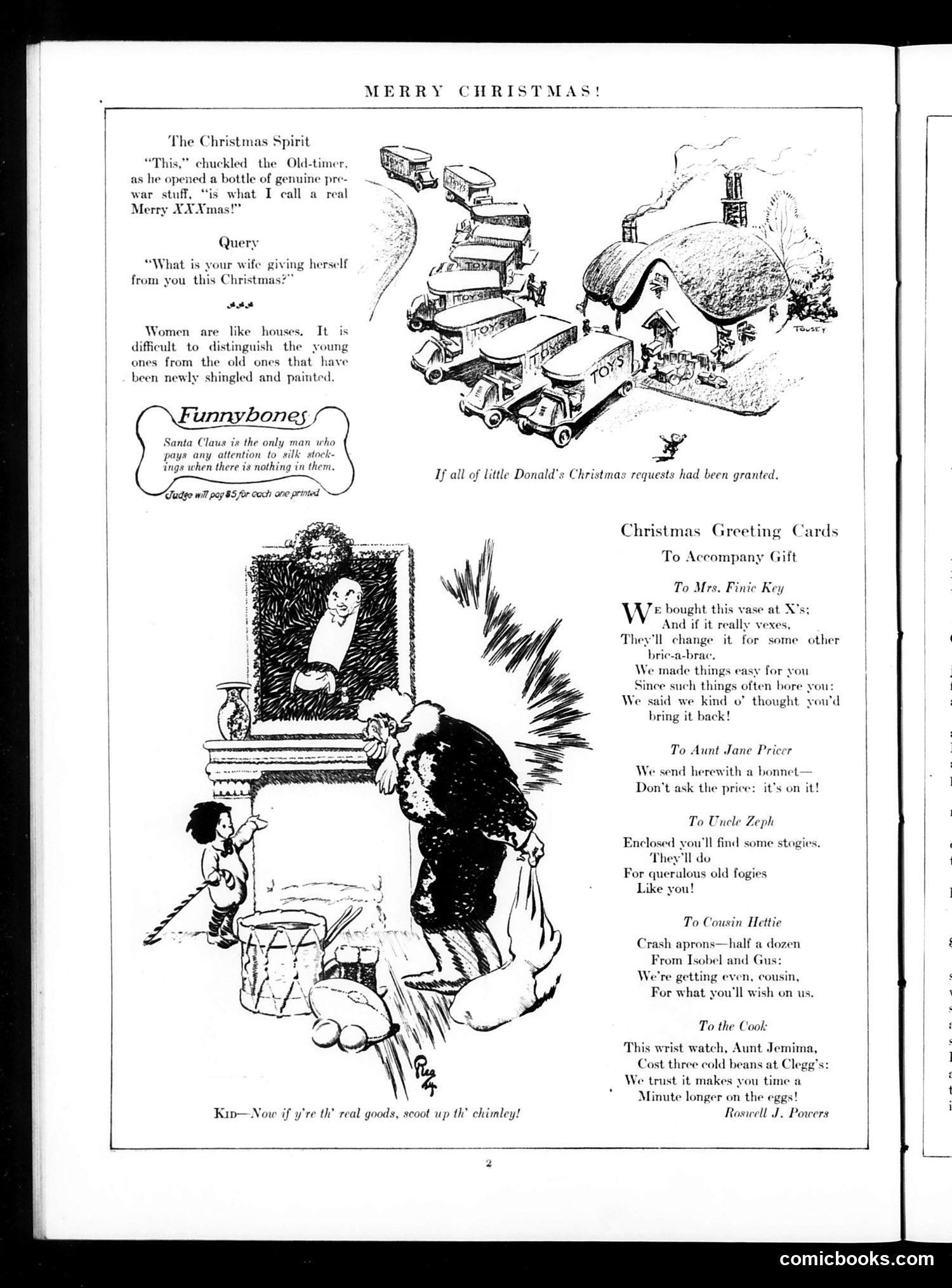
This page is primarily **Christmas content and advertising** rather than political satire. The main elements include: 1. **"The Christmas Spirit"** - A short anecdote about an old-timer opening pre-war whiskey, celebrating traditional Christmas excess. 2. **A large illustration** showing Santa delivering toys (including toy trains and vehicles) to a cottage, with the caption "If all of little Donald's Christmas requests had been granted." This appears to be humorous domestic satire about excessive gift-giving rather than political commentary. 3. **"Christmas Greeting Cards to Accompany Gift"** - A collection of lighthearted verse cards for giving with presents, addressed to various family members. 4. **A "Funnybones" joke** about silk stockings. The page reflects early-to-mid 20th century consumer culture and family gift-giving customs, with no apparent political references or caricatures of public figures.
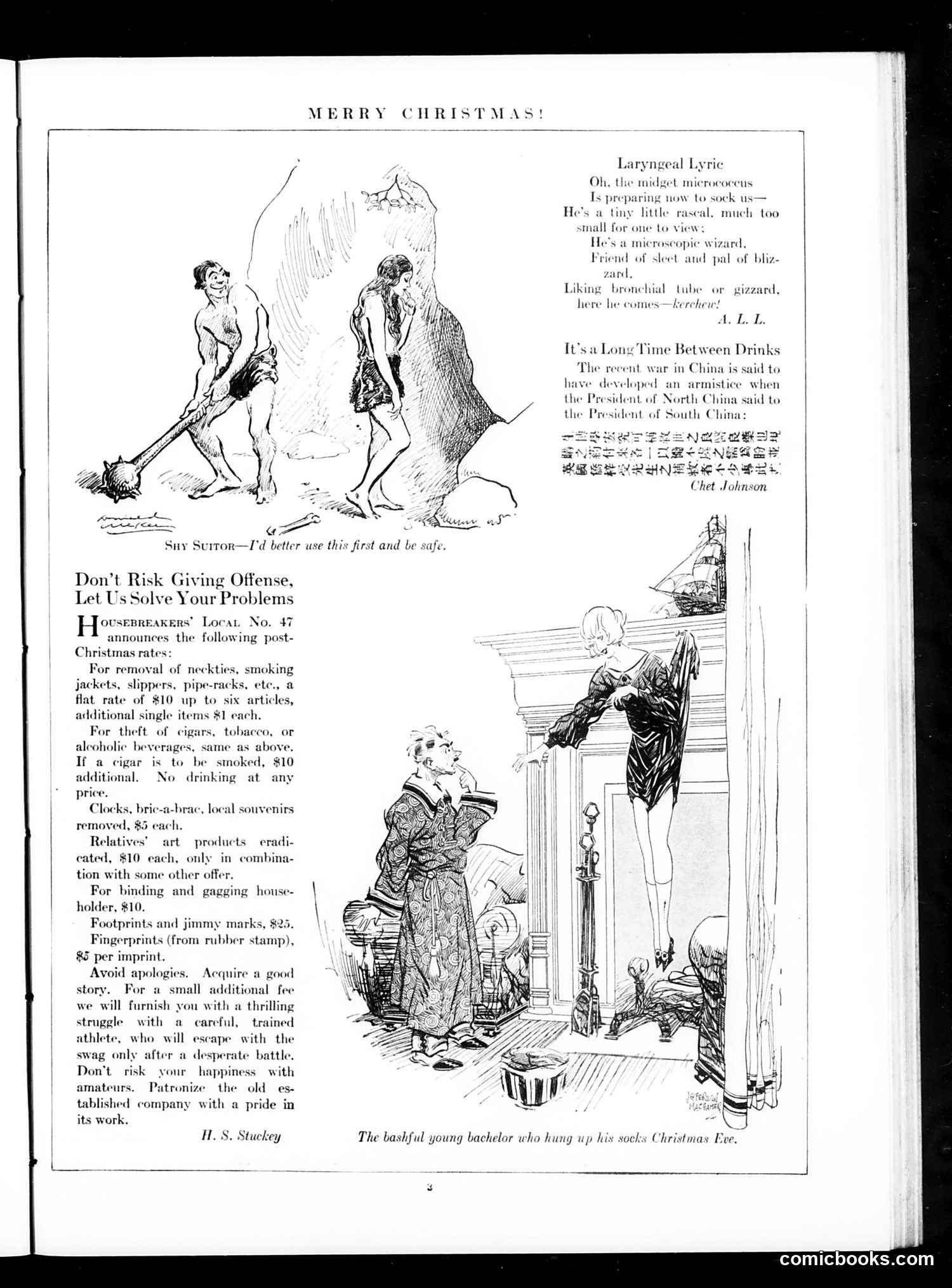
This page contains **humorous Christmas-themed content** rather than political cartoons. **Top section:** A crude joke about a "midget microscopus" (tiny creature) with leering sexual innuendo—typical of Judge's bawdy humor. **Main feature:** "Don't Risk Giving Offense, Let Us Solve Your Problems" advertises **Housebreakers' Local No. 47**, a fictional service offering solutions for Christmas gift-giving embarrassments. The humor comes from treating burglary as a legitimate alternative to gift-shopping. They advertise specific "theft services" (cigars, alcohol, etc.) with humorous pricing, culminating in acquiring exciting stories from trained athletes. **Illustrations:** Sketches show people receiving stolen goods and one man with hung stockings. The satire mocks both gift-giving anxiety and labor unions through absurdist humor—a recurring Judge approach. This is **not political commentary** but rather **recreational holiday satire** targeting common social situations.
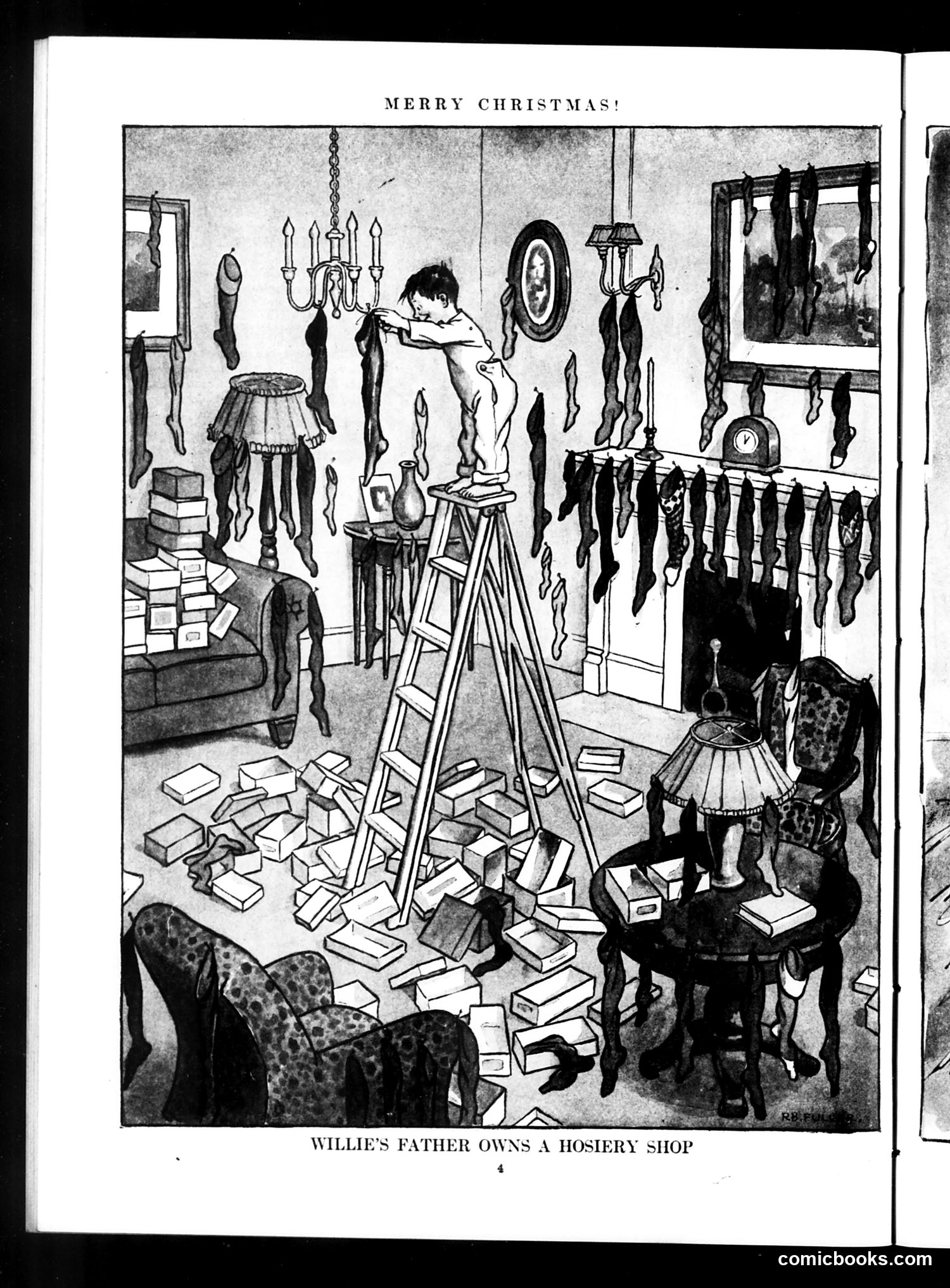
This is a humorous domestic scene satirizing the commercialization of Christmas and childhood excess. A young boy named Willie stands on a ladder in his home, surrounded by mountains of boxed gifts—apparently hosiery (socks/stockings) from his father's shop. The room is decorated with holiday candles and garlands, while wrapped packages pile chaotically across the floor. The joke appears to be twofold: first, the absurd overabundance of identical merchandise as Christmas gifts; second, a satirical comment on how shop owners might exploit their business inventory as presents, creating a comically excessive holiday scene. The cartoon mocks both parental indulgence and the blurring of commerce into family celebration during the Christmas season.
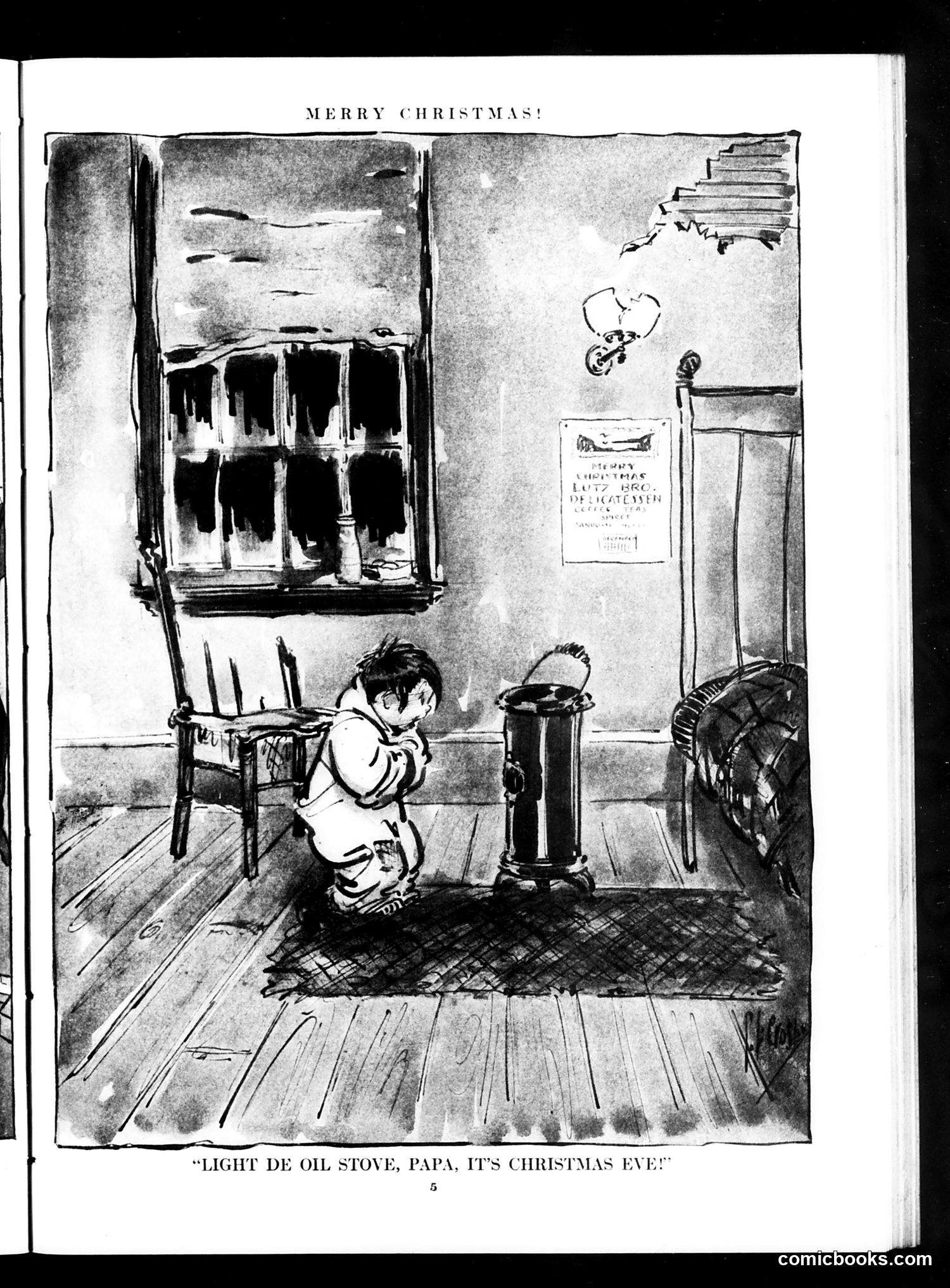
This is a sentimental Christmas illustration rather than political satire. It depicts a poor family's humble holiday scene: a child kneeling by an oil stove in a sparse, cold room with a broken window and minimal furnishings. The caption suggests the child is asking their father to light the stove for warmth on Christmas Eve. The image appears to critique or highlight urban poverty and working-class hardship during the early 20th century. The contrast between the "Merry Christmas" heading and the bleak domestic scene creates irony—emphasizing that not all families experienced prosperous holiday celebrations. Judge magazine frequently published such illustrations addressing social conditions alongside its satirical content.
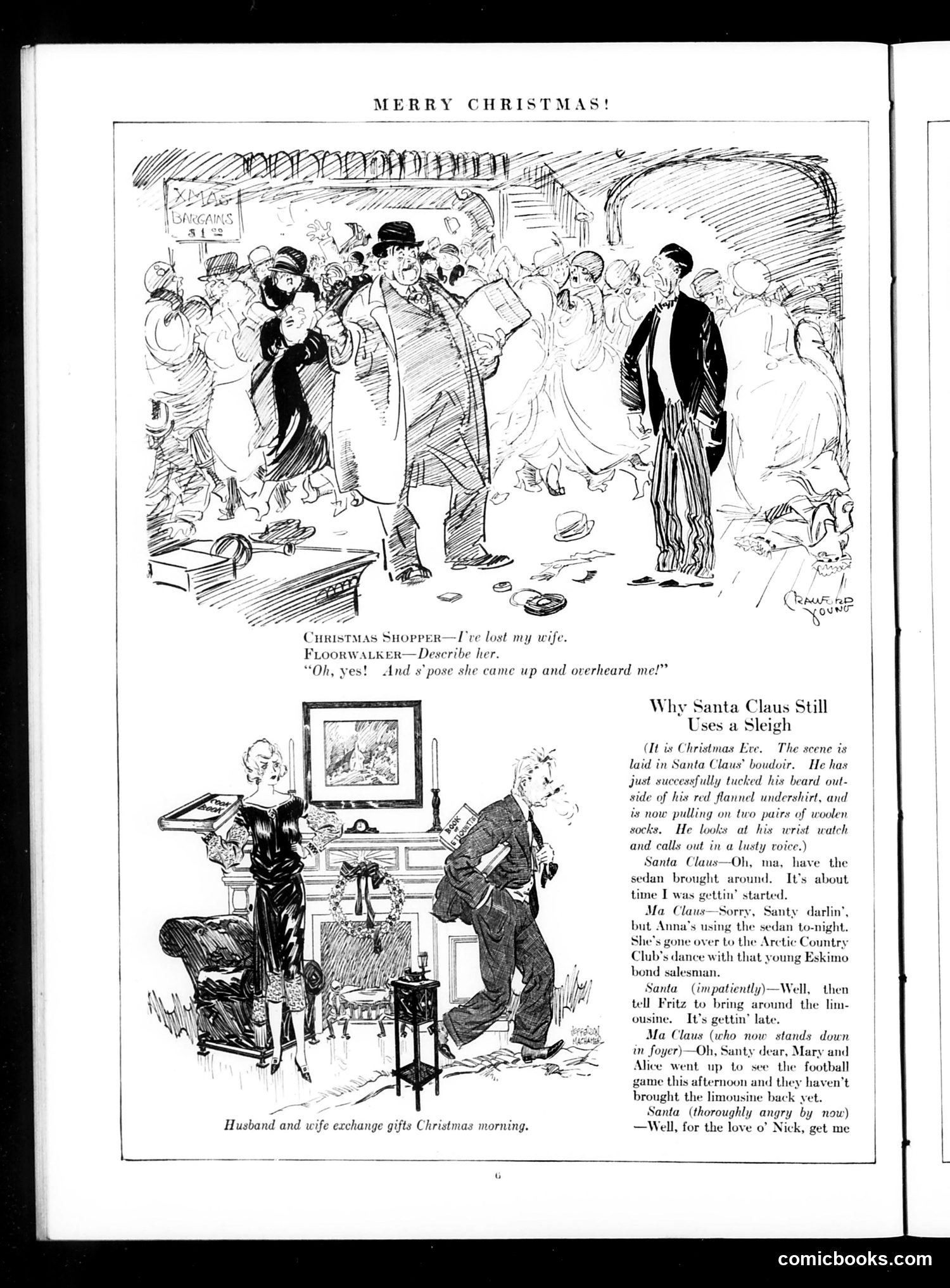
The page contains two satirical pieces about Christmas: **Top cartoon**: A husband lost his wife in a crowded department store and asks a floorwalker to help find her. He immediately catches himself—he was about to describe her negatively, worried she'd overhear him insult her. The joke mocks marital dynamics and the difficulty of gift-shopping in crowded holiday stores. **"Why Santa Claus Still Uses a Sleigh"**: A humorous playlet modernizing Santa as a contemporary gentleman trying to borrow the family car for Christmas Eve deliveries. His wife "Ma Claus" informs him that his daughters have taken both the sedan and limousine for social activities (including a dance at an "Arctic Country Club" with an Eskimo bond salesman). The satire mocks modern domestic life, women's newfound independence and car access, and the inconvenience of automobile culture—suggesting even Santa must resort to his old sleigh because family vehicles are unavailable. Both pieces humorously critique early-20th-century American consumer culture and changing family dynamics.
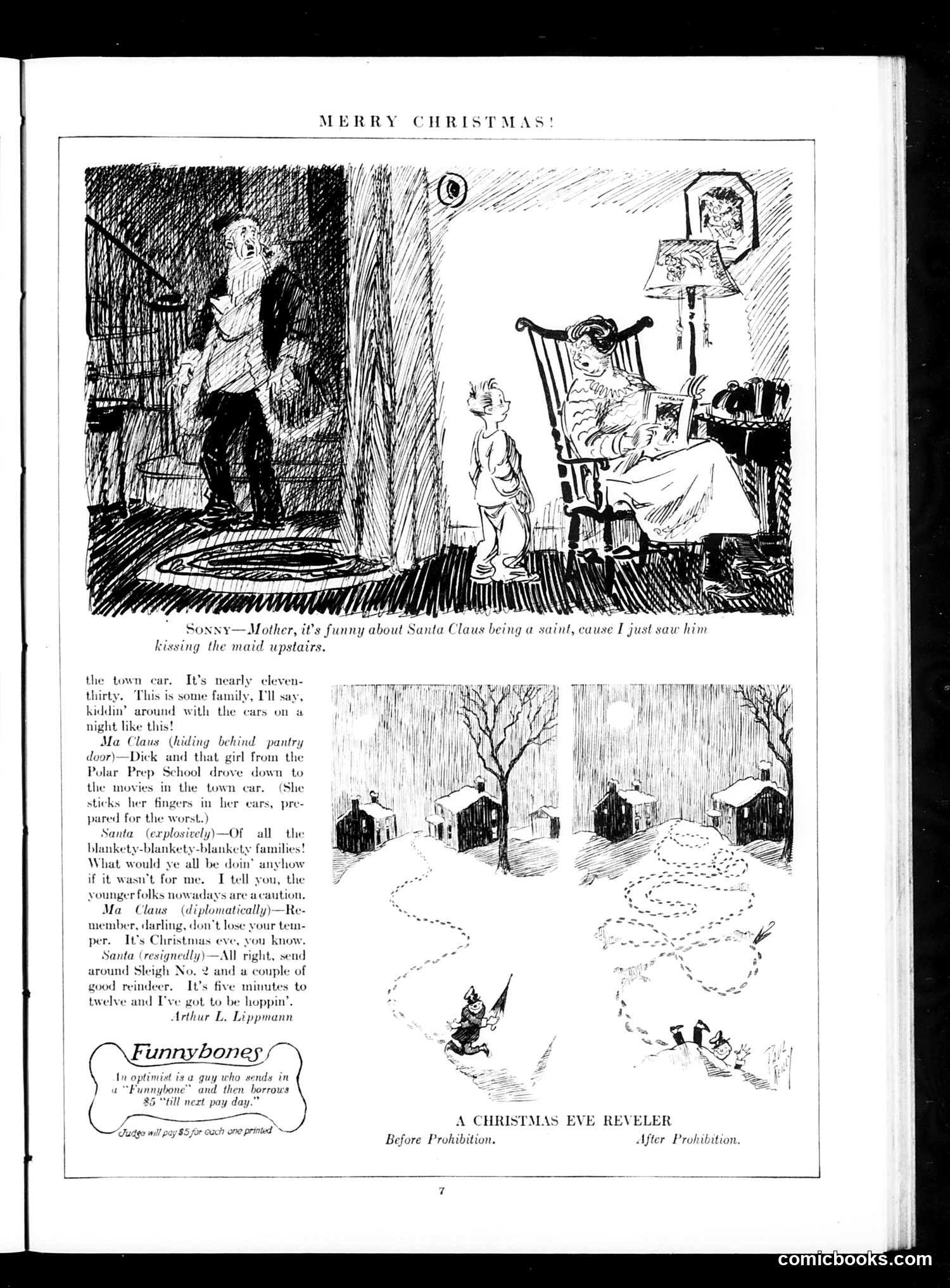
This page contains two satirical cartoons about Christmas and social behavior. **Top cartoon:** A child tells his mother he saw Santa kissing the maid upstairs—a joke playing on the gap between Santa's wholesome public image and adult reality. The family dialogue reveals the parents are actually taking the maid and a girl from "Polar Prep School" to movies in their car, while Santa (the father) grows furious at the younger generation's behavior and lack of discipline. The satire mocks both parental hypocrisy (disapproving of youth misconduct while engaging in it themselves) and generational anxiety about modern young people's morality. **Bottom cartoon:** "A Christmas Eve Reveler" contrasts behavior before and after Prohibition. It appears to depict the same character drunk/rowdy in both scenarios, suggesting that legal restrictions on alcohol didn't actually change social behavior—a commentary on Prohibition's ineffectiveness. The "Funnybones" section is a joke submission box where readers could send humor.
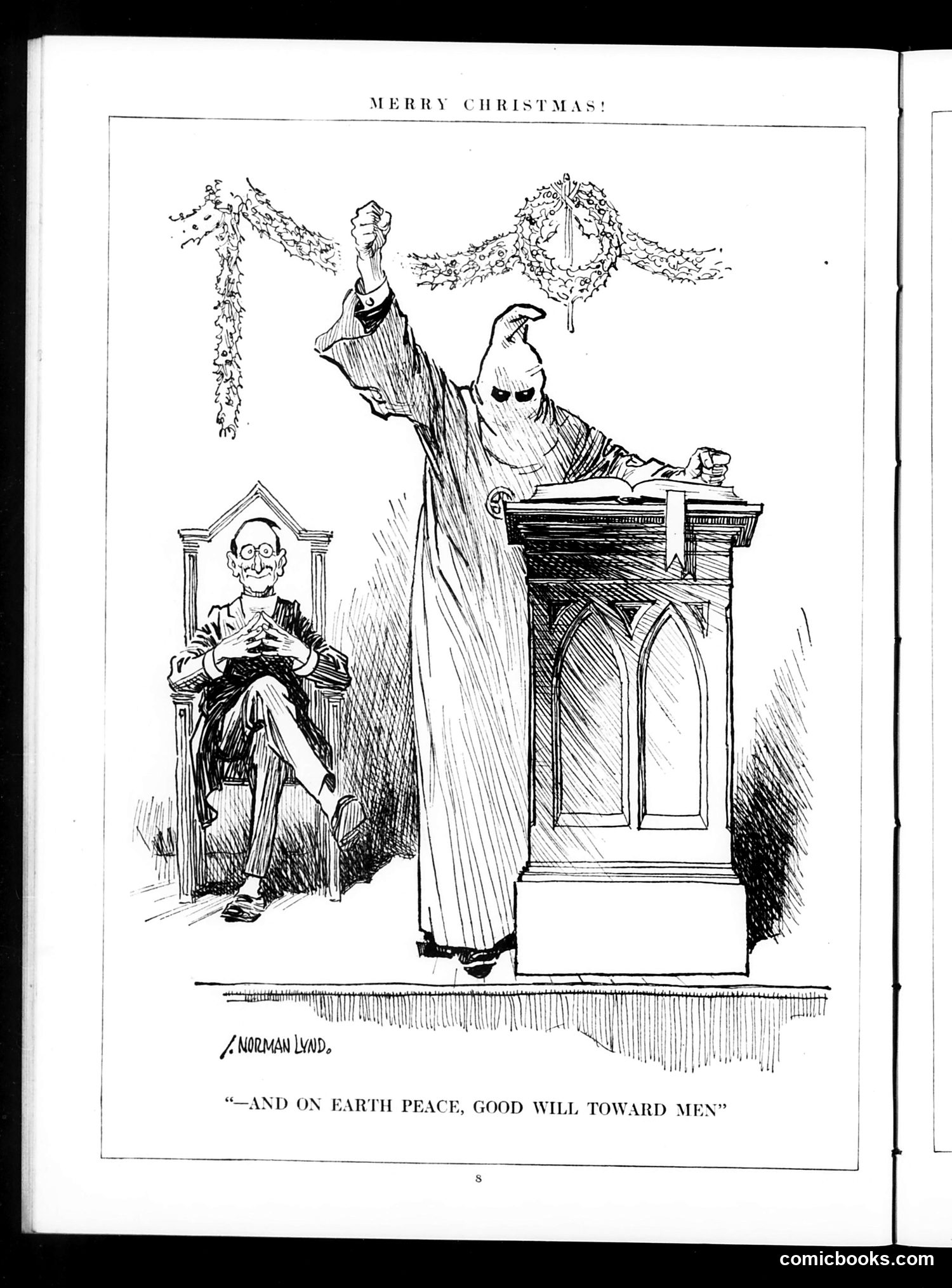
This Christmas cartoon by Norman Lynd depicts a grim reaper figure preaching from a pulpit to a skeletal audience member, with holly garlands above. The caption reads "—AND ON EARTH PEACE, GOOD WILL TOWARD MEN," inverting the traditional Christmas message (Luke 2:14) into something sinister. The satire critiques the gap between Christian ideals of peace and goodwill versus the reality of war, death, and human suffering. The skeleton audience suggests the dead resulting from conflict. The grim reaper as preacher mocks religious hypocrisy—the contradiction between preaching peace while witnessing or enabling violence. Without specific dating visible, the cartoon likely references a contemporary war or social crisis, using Christmas's peace message to highlight mankind's failure to achieve it.
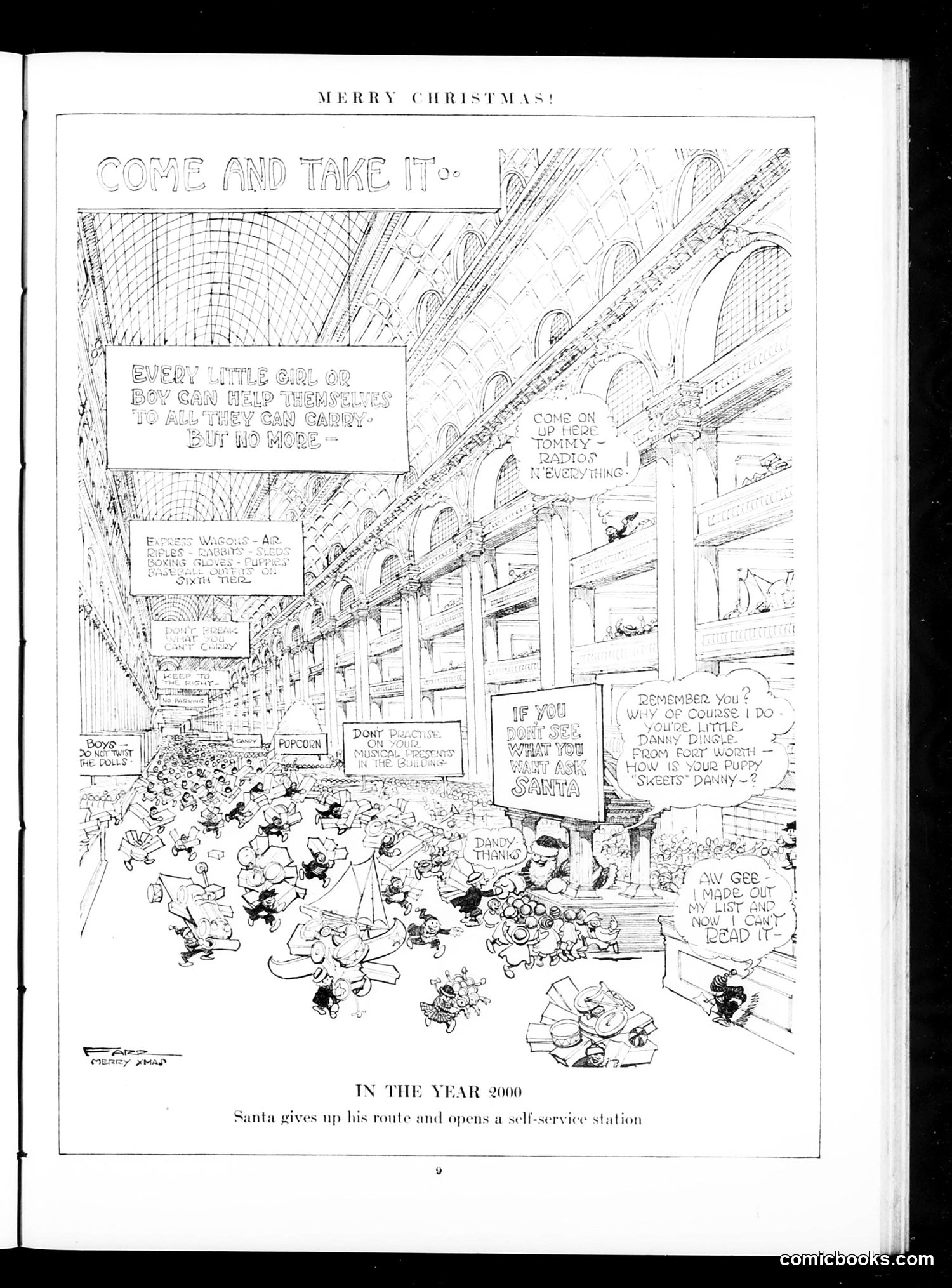
This satirical Christmas cartoon imagines a futuristic scenario where Santa has abandoned traditional gift-delivery to operate a self-service station—likely referencing the growing automation and commercialization of American retail in the early-to-mid 20th century. The crowded illustration shows children flooding into an industrialized warehouse-like space with signage encouraging them to "come and take it," suggesting mass consumerism replacing the personalized magic of Christmas gift-giving. The various dialogue bubbles capture children's materialistic requests about toys and radios. The satire critiques how mechanization, mass production, and self-service retail might devalue Christmas tradition and transform Santa from a magical figure into a mere commercial operator. It's a commentary on modernity eroding cherished holiday customs—a common concern in vintage satirical magazines like *Judge*.
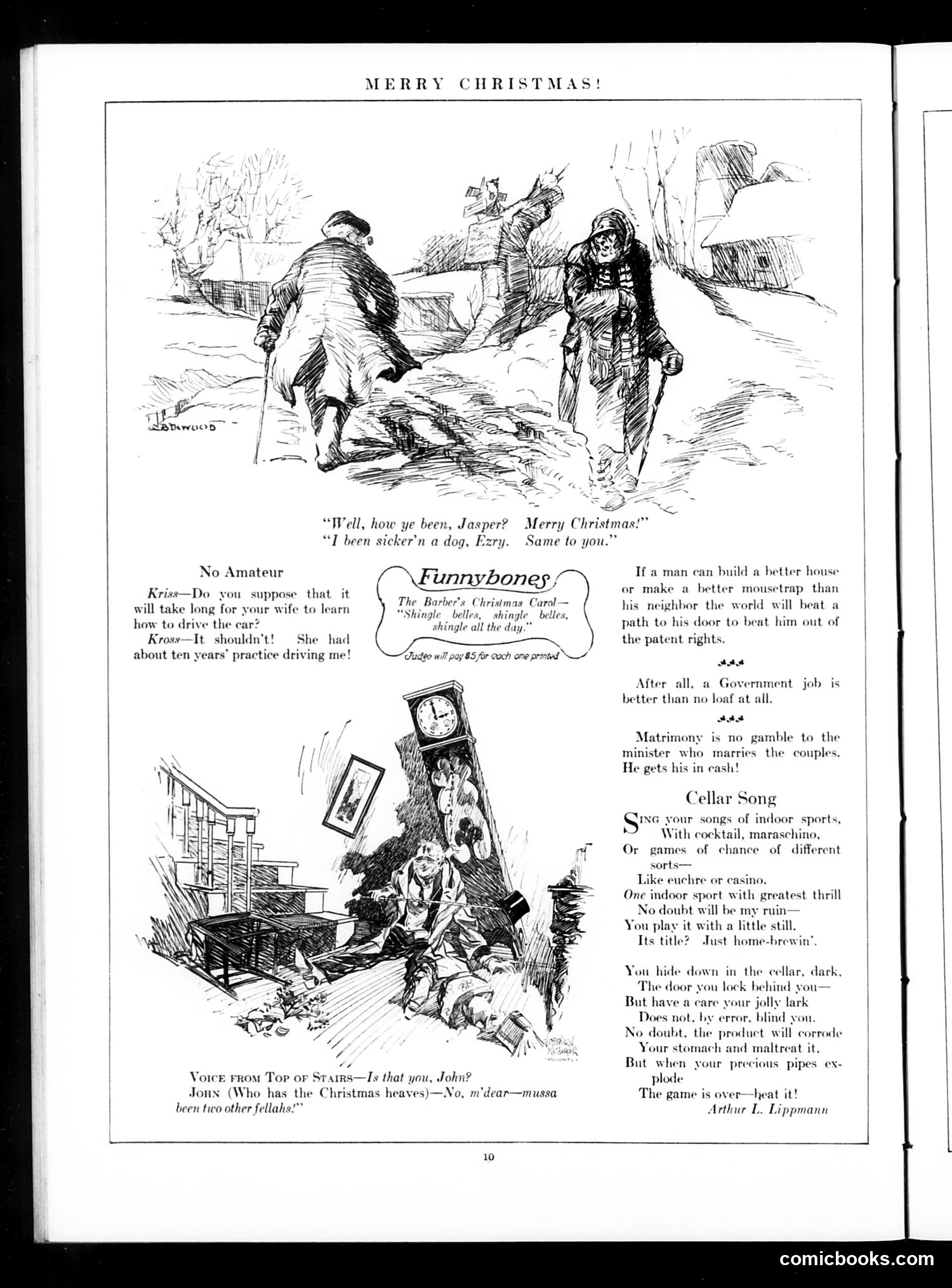
This is a multi-panel satirical page mixing holiday humor with social commentary typical of early 20th-century Judge magazine. **Top cartoon**: Two rural figures ("Jasper" and "Ezry") exchange Christmas greetings while one is visibly ill—gentle, dialect-heavy humor about rural life. **"No Amateur"**: A marital joke about wives learning to drive cars, referencing the novelty and difficulty of automobile operation for women of that era. **"Funnybones"**: A quip about a barber's Christmas carol, playing on the phrase "single bells." **"Cellar Song"**: The most pointed satire—a poem about home-brewed alcohol during Prohibition. It mocks the dangerous practice of making illegal liquor in cellars, warning that the corrosive homemade spirits will damage one's stomach and possibly cause fatal explosions ("pipes explode"). This directly satirizes Prohibition-era lawbreaking. **"Voice from Top of Stairs"**: A brief joke about someone intoxicated on Christmas. The page blends innocent domestic humor with thinly-veiled mockery of Prohibition's consequences.
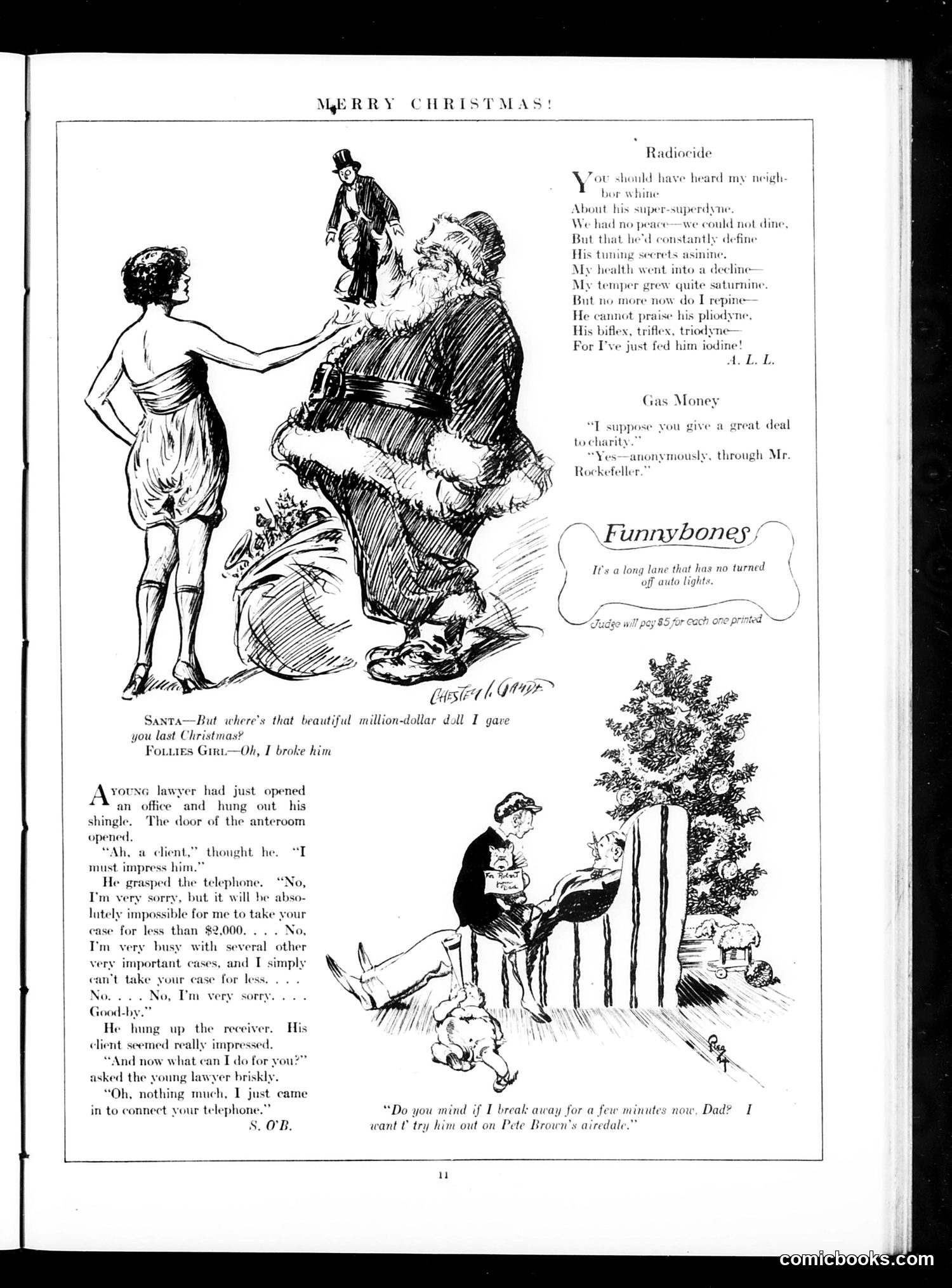
This Christmas-themed satirical page contains several jokes targeting early 1920s American concerns: **"Radiocide"**: A poem mocking the radio craze and technical jargon ("super-superdyne," "pliodyne," "triodyne"). The neighbor's obsessive boasting about radio equipment drives the narrator to poisoning him with iodine—dark humor satirizing how annoying radio enthusiasts had become. **"Gas Money"**: A brief joke about wealthy philanthropists giving "anonymously" through intermediaries like Rockefeller, mocking the pretense of anonymous charity among the rich. **The young lawyer sketch**: A classic joke where an ambitious new lawyer loudly discusses his high fees on the telephone to impress his first client—who turns out to be the telephone company's installer, not a paying client. It ridicules professional pretension. **Other elements** include a Santa/chorus girl gag and a "Funnybones" quip about automobile lights. The page targets nouveau riche affectation, radio-mania, and professional pomposity—typical Judge satire of the period.
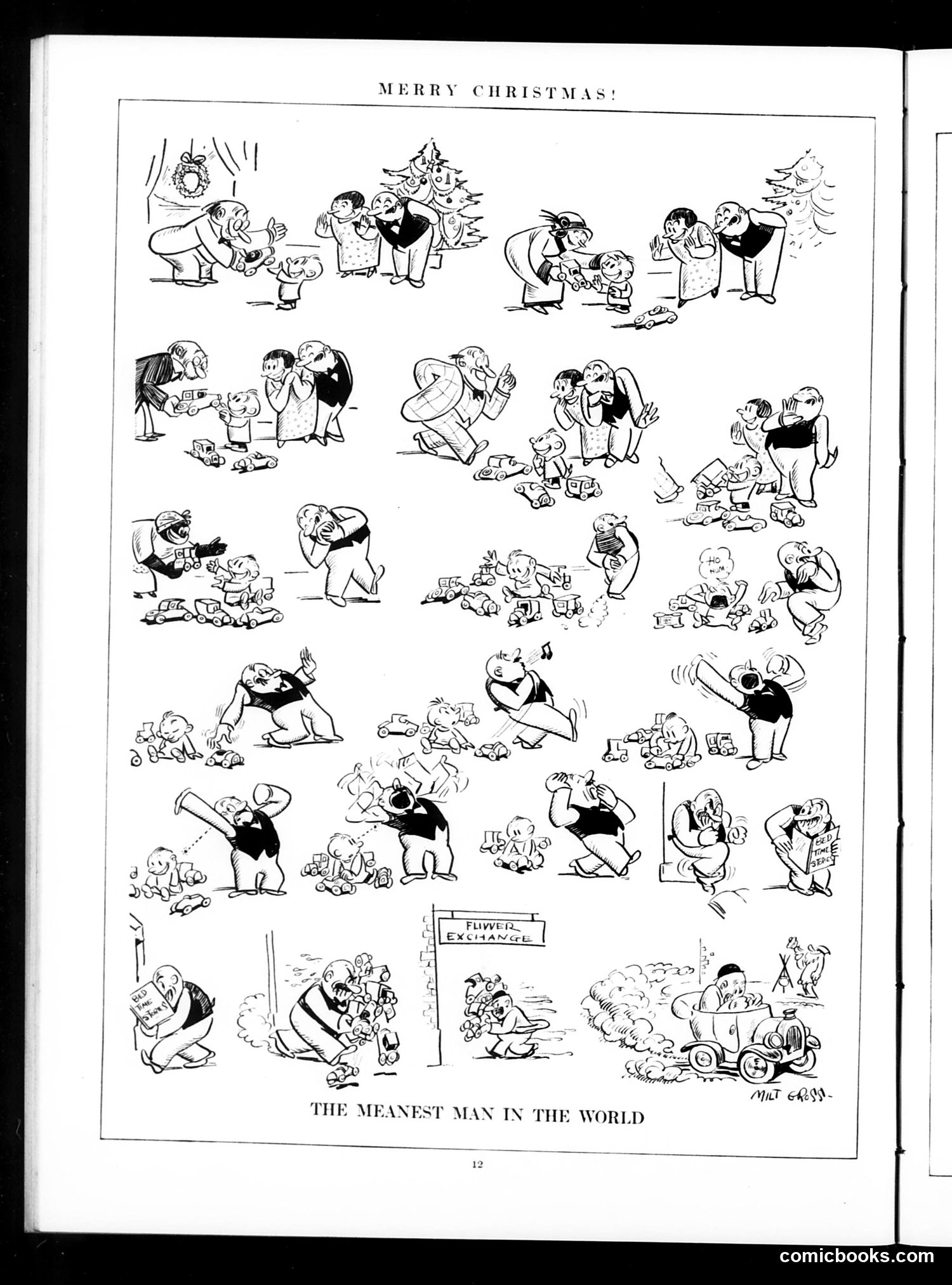
This Christmas-themed comic strip depicts a miserly character repeatedly refusing to give gifts or money to children and others seeking charitable donations. The sequence shows him rejecting carolers, refusing Christmas presents, denying flower donations to the poor, and hoarding his wealth—culminating in scenes of him avoiding generosity in every form. The satire targets wealthy miserliness during the Christmas season, when cultural expectations emphasize charity and gift-giving. The "meanest man" serves as a cautionary figure embodying greed and hardheartedness. This reflects Judge magazine's tradition of satirizing social vices, using exaggeration and visual humor to mock characters who violate cherished social values, particularly the spirit of generosity associated with Christmas.
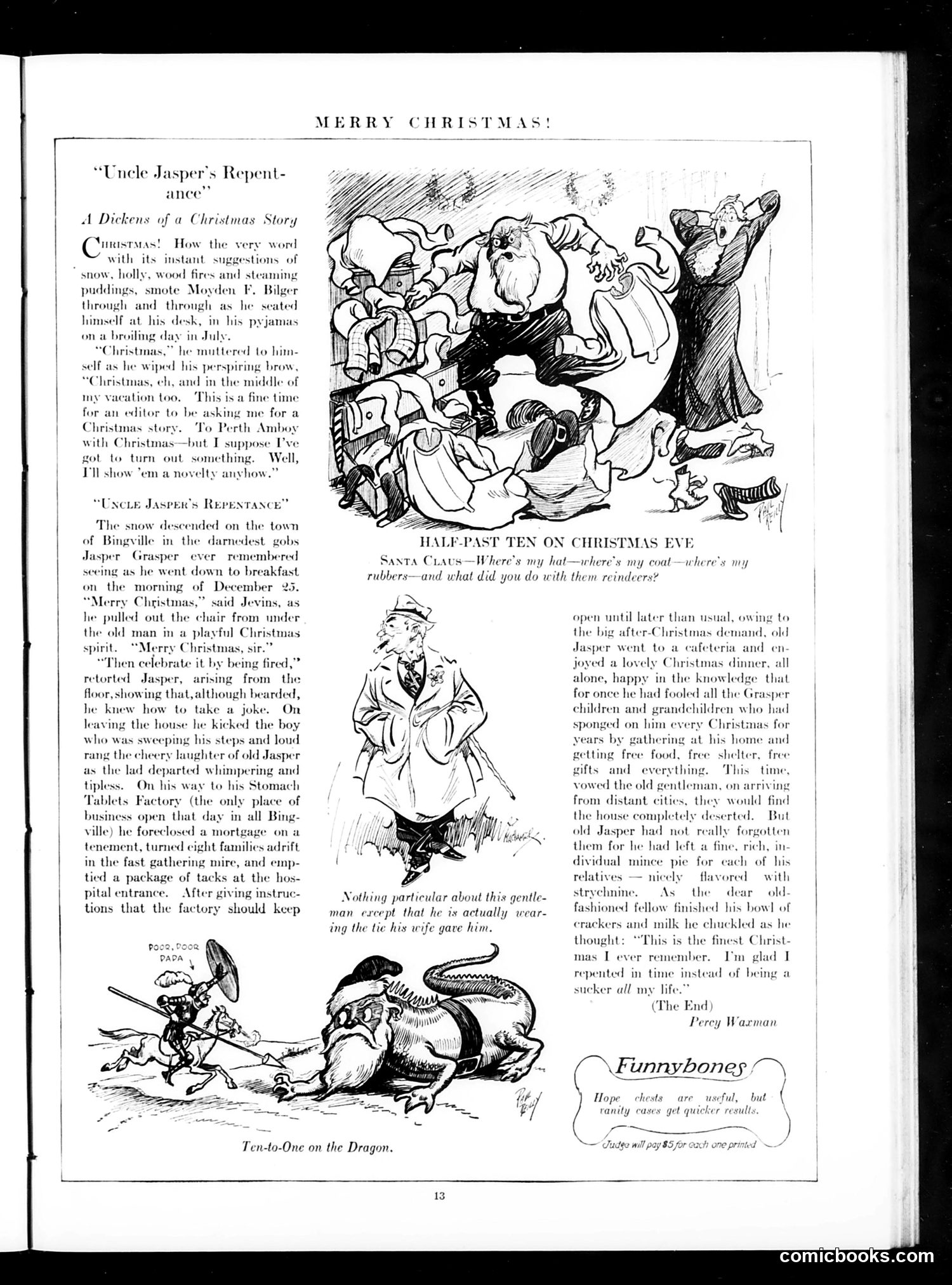
This is a Christmas-themed satirical story titled "Uncle Jasper's Repentance," framed as a Dickensian tale. The satire works by inverting expectations: the editor character is forced to write a Christmas story in July, so he delivers an anti-sentimental parody. The "repentance" involves elderly miser Uncle Jasper avoiding his freeloading relatives by spending Christmas alone—then poisoning the mince pies he leaves them with strychnine as a final "gift." Rather than reforming through Christmas spirit (as in Dickens), Jasper becomes a worse curmudgeon, and the story celebrates his misanthropy. The accompanying illustrations mock Santa (frazzled and demanding), show chaotic Christmas chaos, and depict a slapstick scene titled "Ten-do-One on the Dragon." The joke targets both sentimentalized Christmas narratives and greedy relatives. The "Funnybones" caption offers cynical commentary that hope works slowly but vanity produces "quicker results"—fitting the page's cynical tone about human nature.
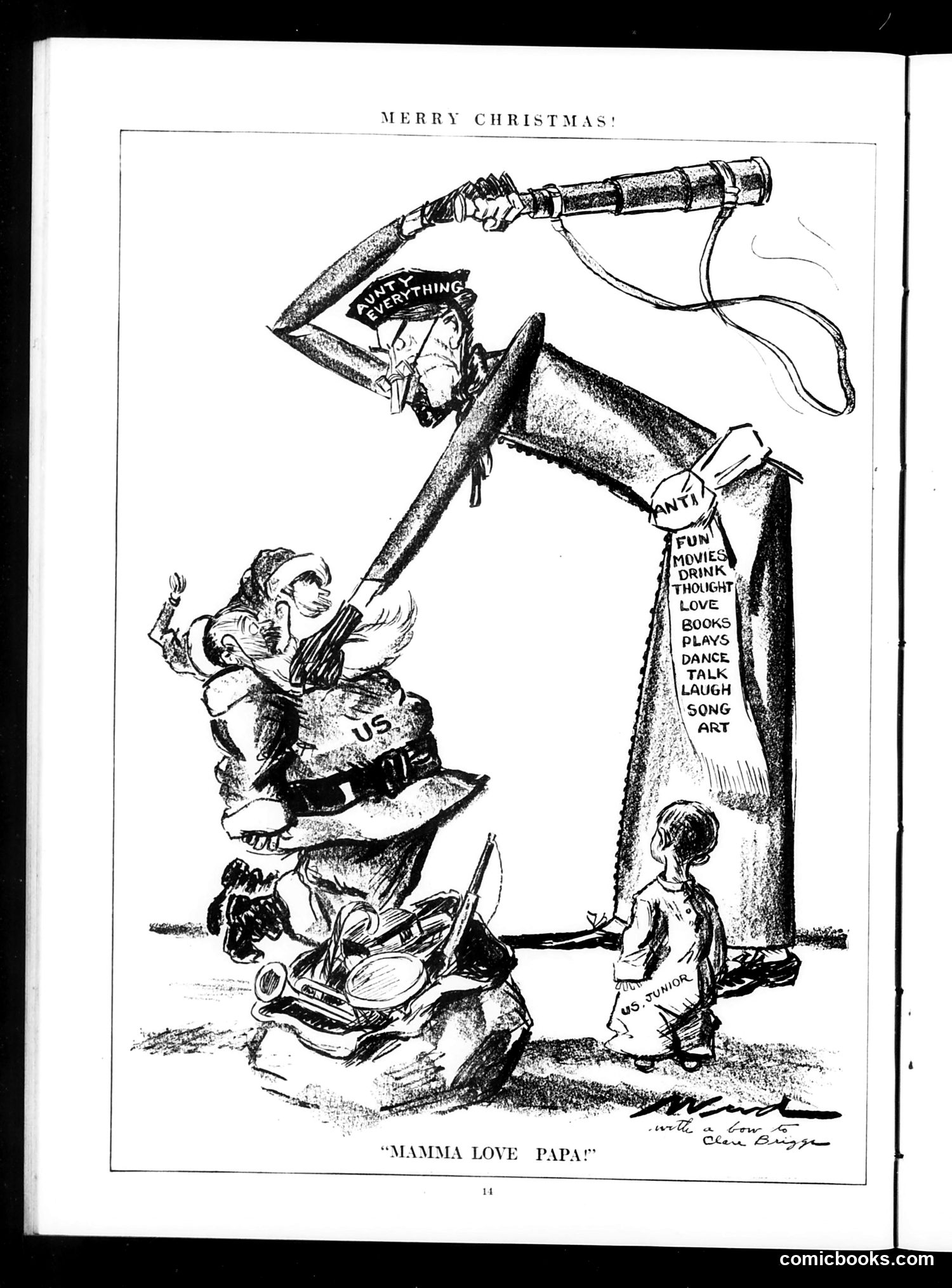
This Christmas-themed satirical cartoon depicts Santa Claus as a massive figure distributing gifts to children below. The central visual joke plays on postwar American consumerism and family values. Santa holds a telescope and cornucopia overflowing with labeled items: "Fun, Movies, Drink, Thought, Love, Books, Plays, Dance, Talk, Laugh, Song, Art." A small child labeled "No Junior" stands apart, suggesting social commentary about class or deprivation during wartime or economic hardship. The title "Mamma Love Papa" suggests the cartoon addresses family stability and domestic ideals. The overall message appears to be satirizing what Santa (and by extension, American prosperity and values) promises to deliver to children—juxtaposing material abundance with emotional and cultural enrichment, while acknowledging some children are left behind.
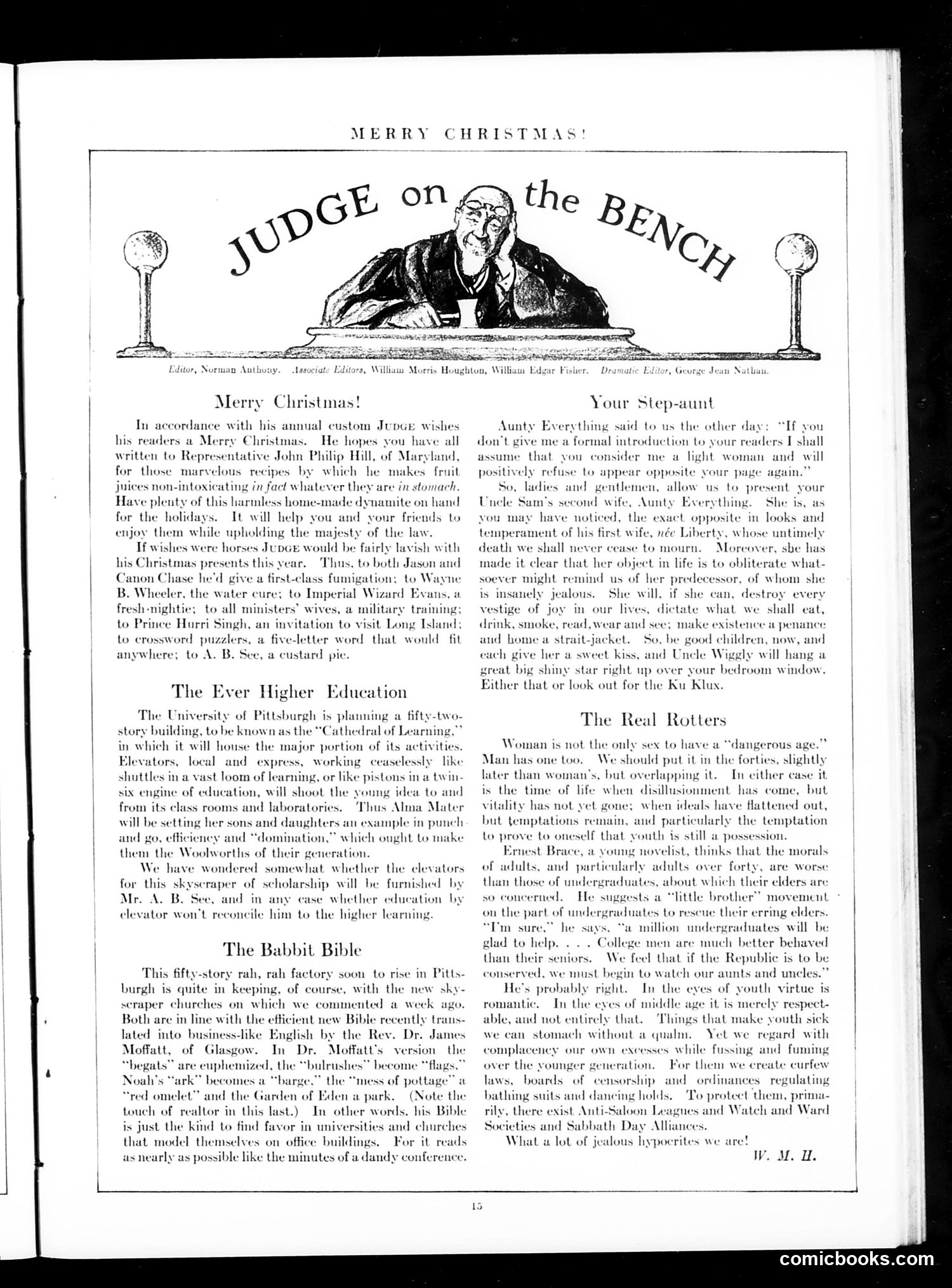
This Christmas issue of Judge combines holiday greetings with sharp political and social satire typical of the 1920s. **"Judge on the Bench"** (masthead): The cartoon shows a stern judge presiding, setting the satirical tone. **Main Satire Targets:** 1. **Prohibition**: The opening mocks Representative John Philip Hill's recipes for "non-intoxicating" fruit juices—clearly winking at homemade alcohol production during Prohibition. 2. **Reform Figures**: Wished-upon punishments include Wayne B. Wheeler (Anti-Saloon League leader) getting "the water cure," and Imperial Wizard Evans receiving "a fresh nightie"—mocking temperance crusaders and the KKK respectively. 3. **Modern Education**: The University of Pittsburgh's planned 52-story "Cathedral of Learning" is ridiculed as a business-efficiency temple rather than genuine learning, reflecting 1920s anxiety about commercialized education. 4. **Religion Modernized**: Dr. Moffatt's updated Bible translation is critiqued for replacing spiritual language with business jargon ("barge" becomes "rah rah factory"), satirizing how institutions compromise values for modernity. The overall tone mocks hypocrisy, corporate mentality, and social reform movements of the era.
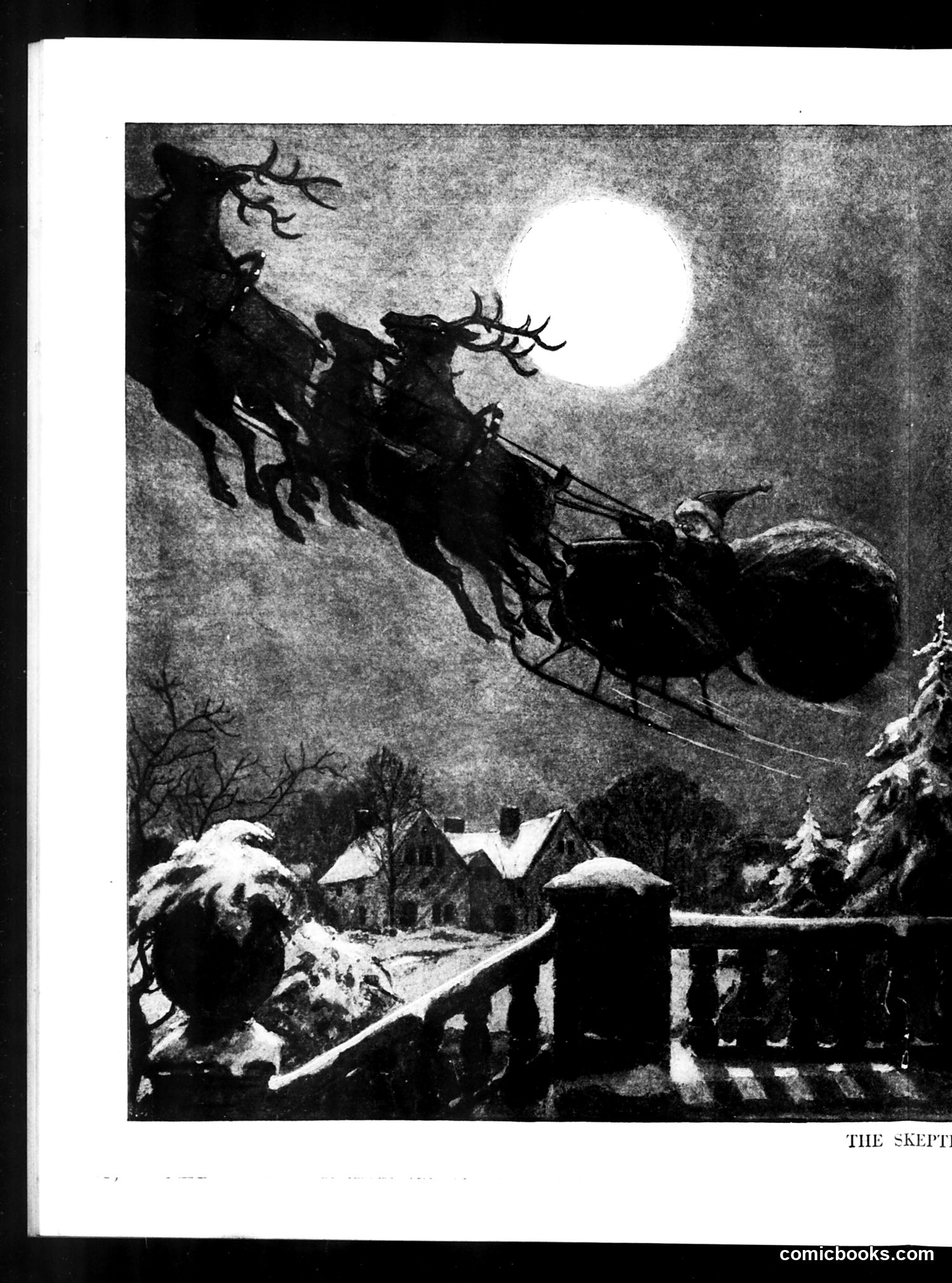
This is the iconic silhouette image of Santa Claus flying across the moon in his sleigh pulled by reindeer, overlooking a snowy village below. The page caption reads "THE SKEPT[IC]" (text cut off), suggesting this appeared in *Judge* magazine. This is **not a political cartoon** but rather a classic Christmas illustration—likely either a standalone festive image or possibly accompanying a humorous holiday story in the magazine. The composition evokes traditional Christmas imagery and wonder. Without the full caption or surrounding text visible, the specific satirical point is unclear. It may have been paired with holiday-themed humor or social commentary typical of *Judge's* satirical content, but the image itself is straightforward holiday illustration rather than overt satire.
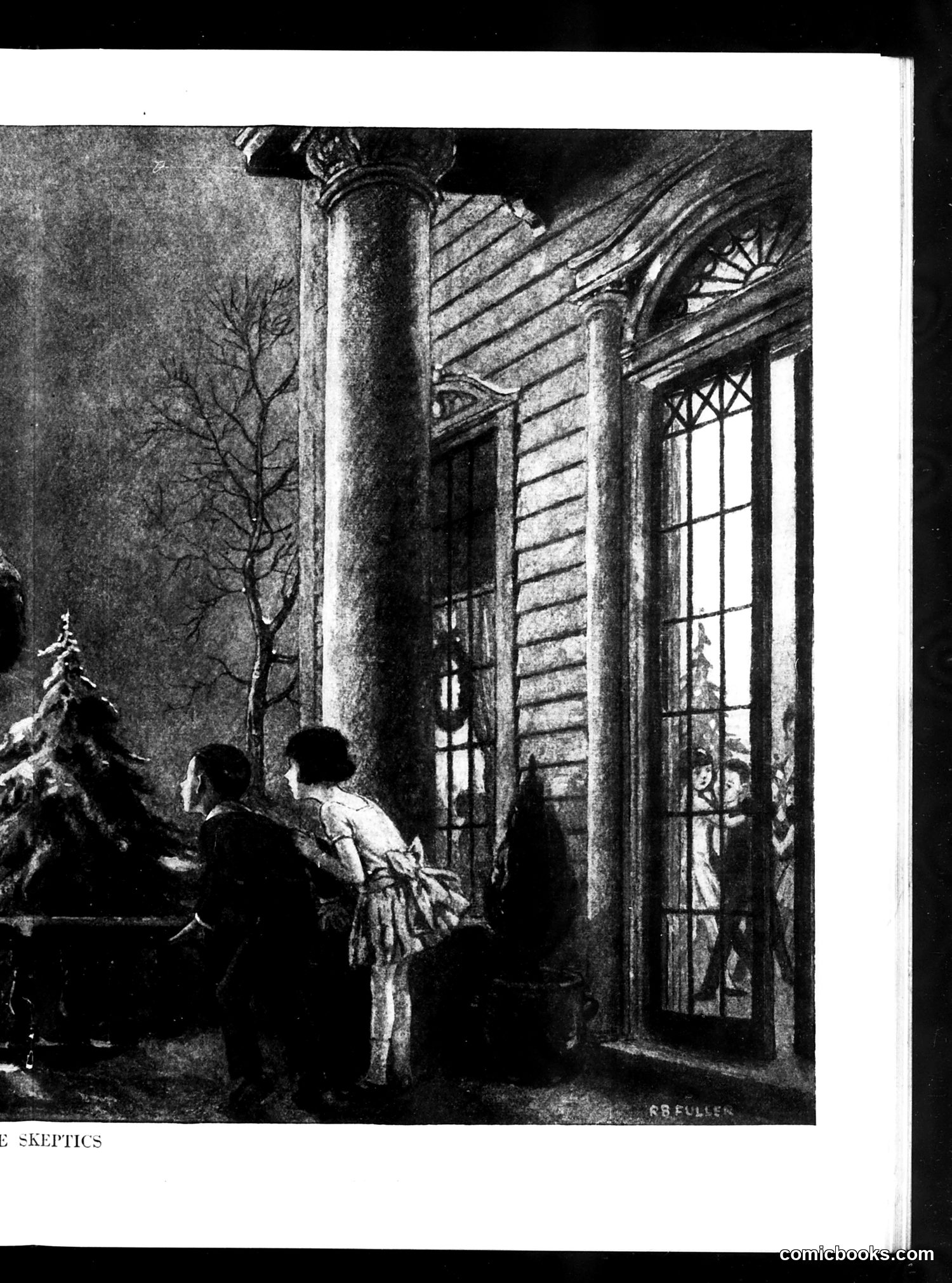
This appears to be a satirical illustration signed by "G.B. Fuller" showing figures in an elegant interior with tall windows and classical columns. The partial text visible reads "E SKEPTICS," suggesting this cartoon comments on skepticism or doubt about something contemporary. The scene depicts well-dressed people gathered indoors, possibly in a government building or palace, looking toward or through large windows. Without the full caption or complete OCR text, the specific political reference remains unclear. The formal architectural setting and the positioning of figures suggests commentary on institutional power or public opinion regarding some matter of debate. To accurately identify the satirical target—whether political figures, social movements, or specific events—would require the complete text and fuller context from Judge magazine's publication date.
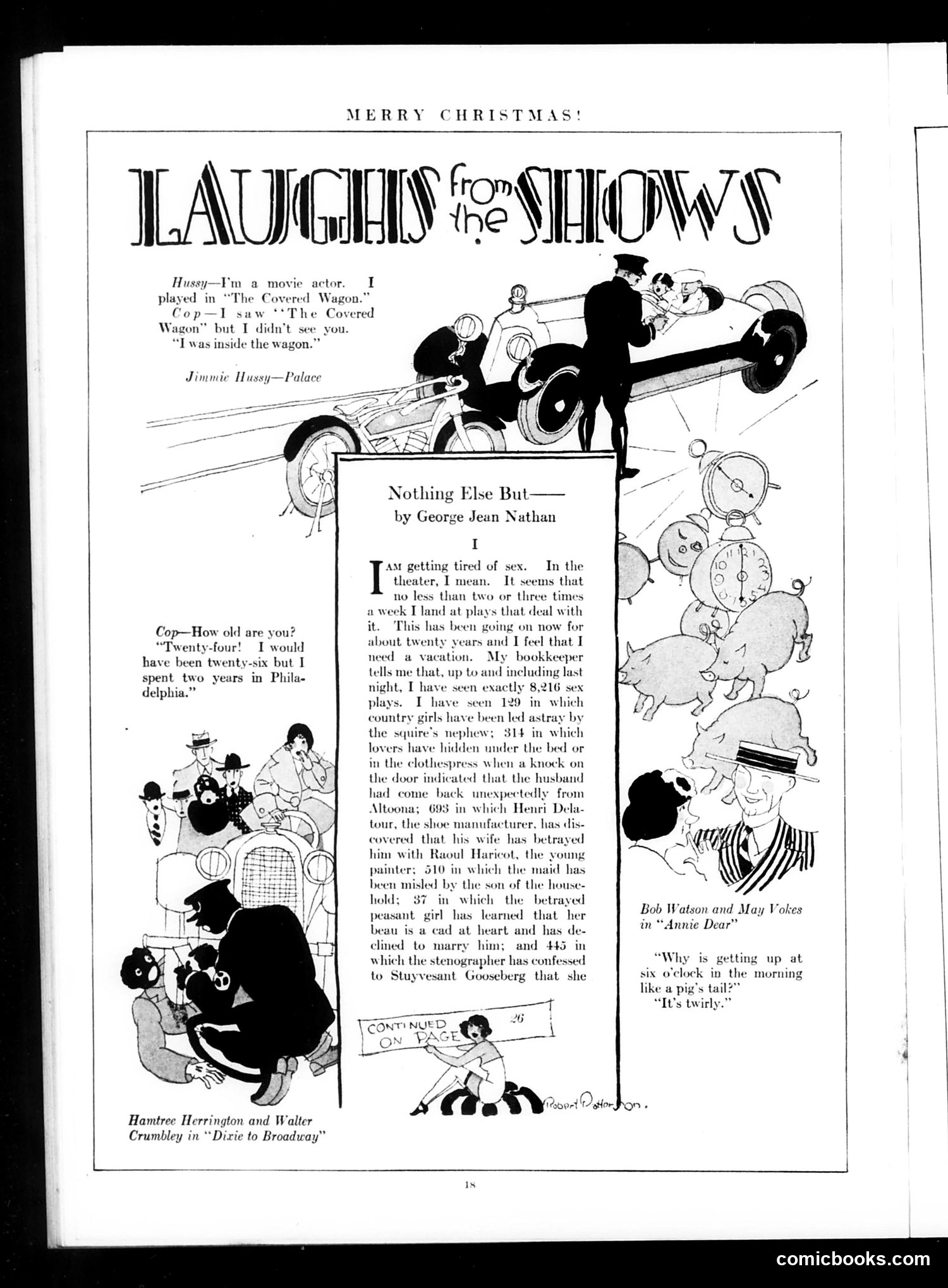
This is a Christmas humor page mixing theatrical jokes with social commentary. The main feature, "Nothing Else But" by George Jean Nathan (a prominent theater critic), satirizes the prevalence of sex-themed plays on Broadway. Nathan catalogues thousands of theatrical productions he's attended, all featuring variations of sexual scandal: seduced country girls, hidden lovers, unfaithful wives, and betrayed servants. His exaggerated statistics (8,216 sex plays seen) mock the theater industry's reliance on adultery and seduction as plot devices. The surrounding comic vignettes ridicule various entertainment figures—including a movie actor's dubious claim to have appeared in "The Covered Wagon," and exchanges between police and show-business personalities. The page critiques both Hollywood and Broadway's formulaic storytelling while maintaining the light, sardonic tone appropriate to Judge's satirical mission.
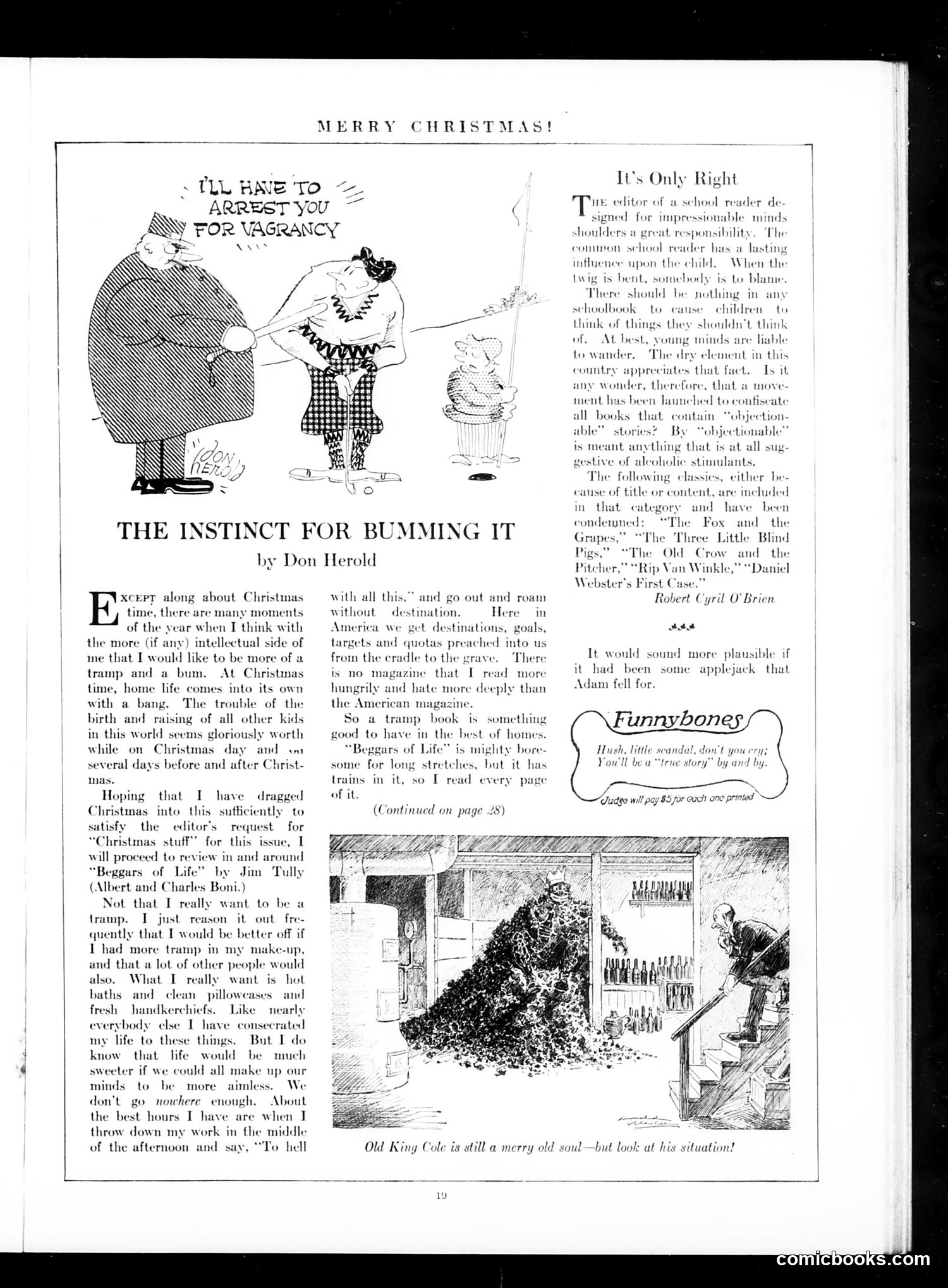
**Top Cartoon**: A police officer arrests a vagrant for vagrancy while saying "I'll have to arrest you for vagrancy." This illustrates Don Herold's essay theme: the irony that society simultaneously romanticizes "tramp" culture (especially around Christmas) while criminalizing actual homelessness. The humor underscores the hypocrisy of middle-class nostalgia for carefree vagabondage versus the legal reality facing the poor. **Bottom Cartoon (Old King Cole)**: This satirizes Prohibition-era censorship of children's literature. Reformers sought to ban classic stories containing alcohol references—"Old King Cole," "Rip Van Winkle," etc.—from school readers. The caption's joke about Adam and applejack mocks this overreach: if we're removing all alcohol mentions, why stop at nursery rhymes? The satire targets puritanical censorship movements that Judge's editors viewed as absurdly overzealous.
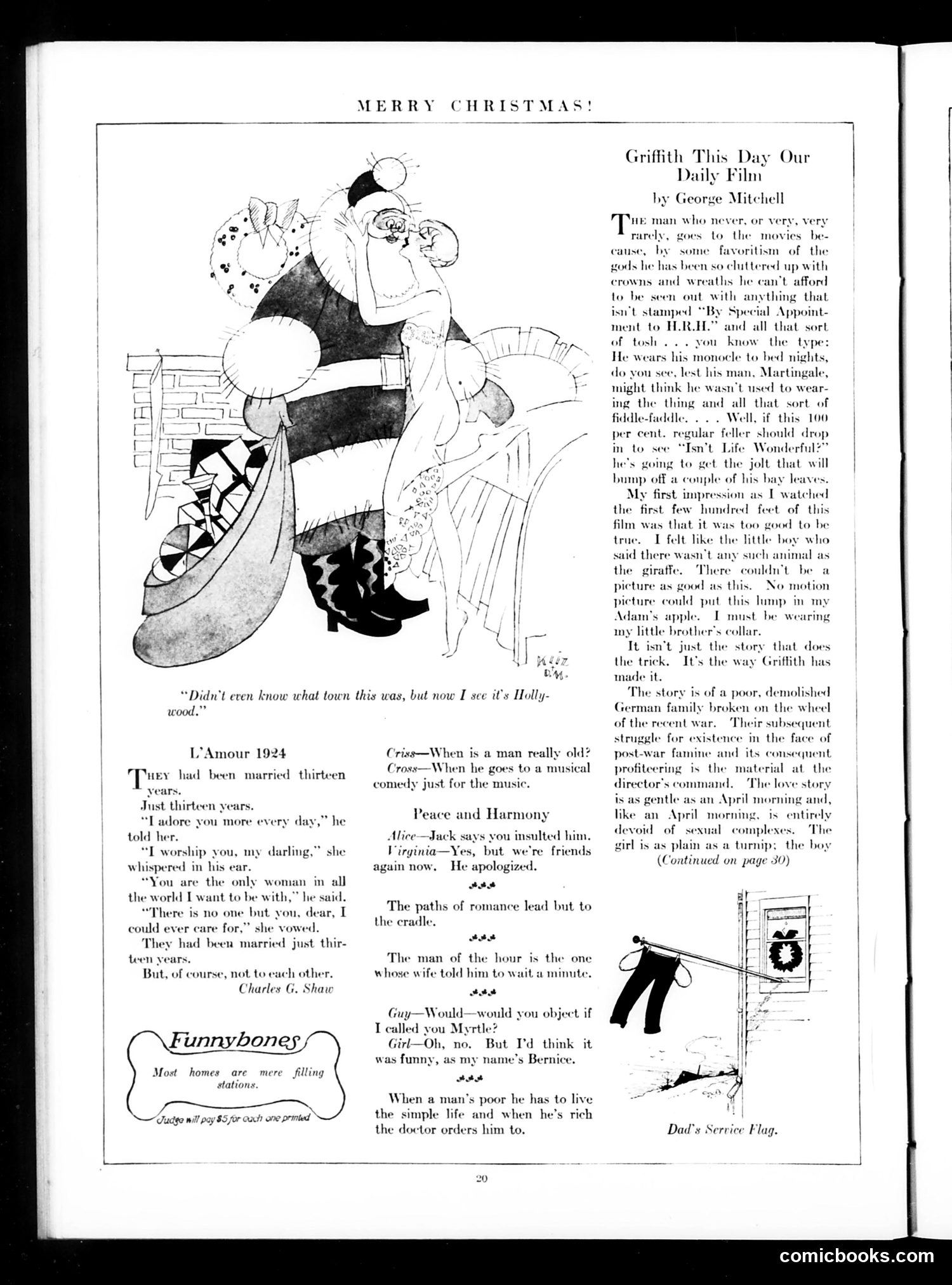
This page contains Christmas-themed humor from 1924. The main cartoon depicts Santa Claus arriving in Hollywood, captioned "Didn't even know what town this was, but now I see it's Hollywood"—satirizing Hollywood's excessive materialism and self-importance during the film industry's boom. The accompanying text reviews D.W. Griffith's film "Isn't Life Wonderful?" The reviewer mocks wealthy society types who affect pretentious manners (monocles, crowns, formal appointments) while praising Griffith's film about a poor post-WWI German family. The satire contrasts artificial upper-class affectation with authentic human emotion in cinema. The scattered one-liners mock marriage ("They had been married just thirteen years, but of course, not to each other"), social climbing, and class-based hypocrisy—typical Judge magazine fare attacking American affluence and pretension during the Jazz Age.
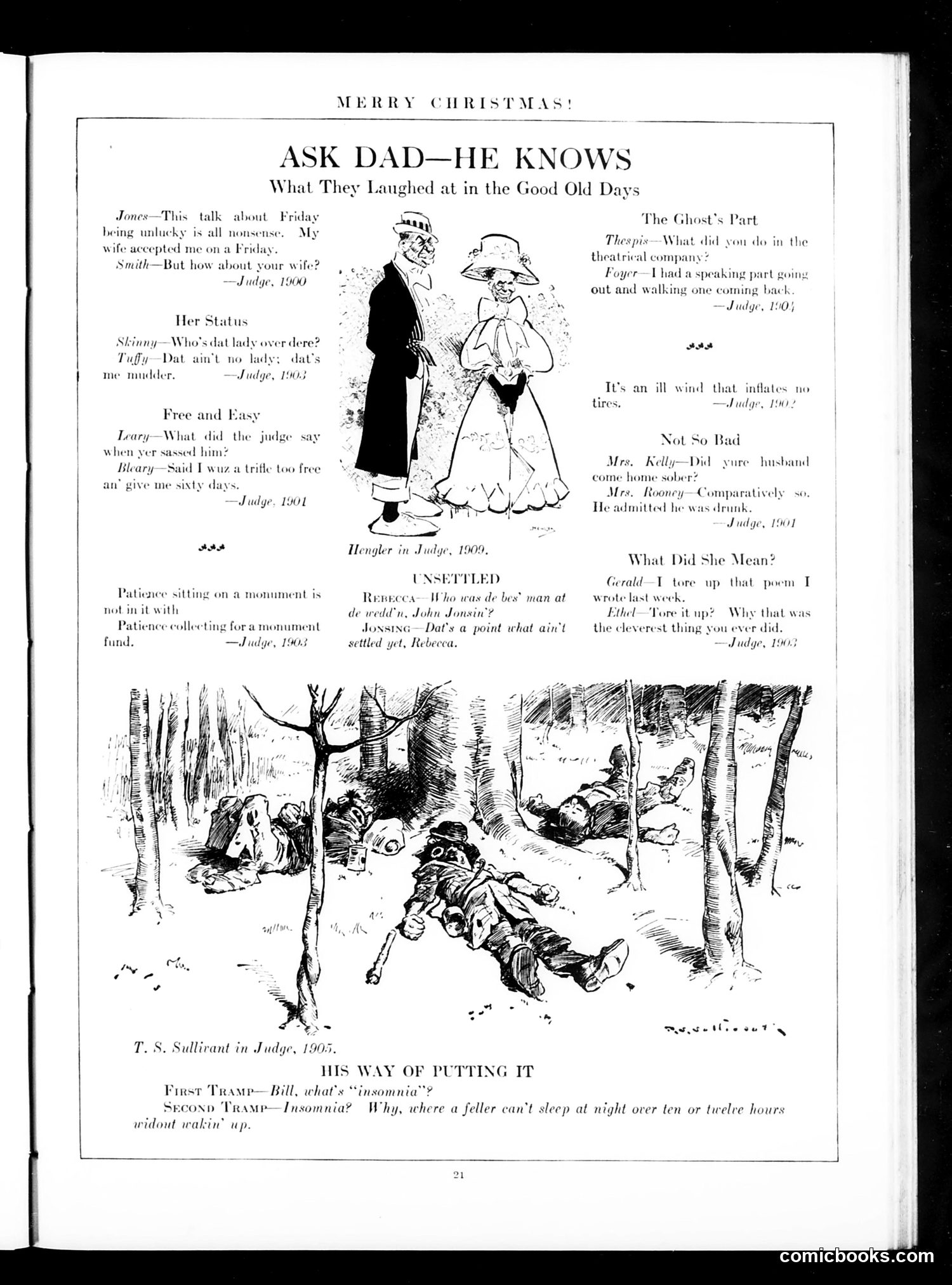
This page collects vintage humor anecdotes labeled "What They Laughed at in the Good Old Days"—nostalgic jokes Judge's readers supposedly found amusing in earlier decades. The jokes rely on period stereotypes and social conventions now dated or offensive. **Content includes:** - Marital humor (Friday unlucky for marriage proposals; wives as burdensome) - Ethnic/dialect humor with stereotyped speech patterns ("dat," "de," "wuz") - Class humor (tramps, poverty) - Judicial/legal jokes (judges sentencing sass-talkers) - A theatrical illustration by T.S. Sullivant showing people resting outdoors The humor reflects early-1900s attitudes: casual misogyny, ethnic caricature, and acceptance of judicial harshness. The "Ask Dad" framing suggests these represent "wholesome" period entertainment—a perspective modern readers would likely find jarring or offensive rather than amusing.
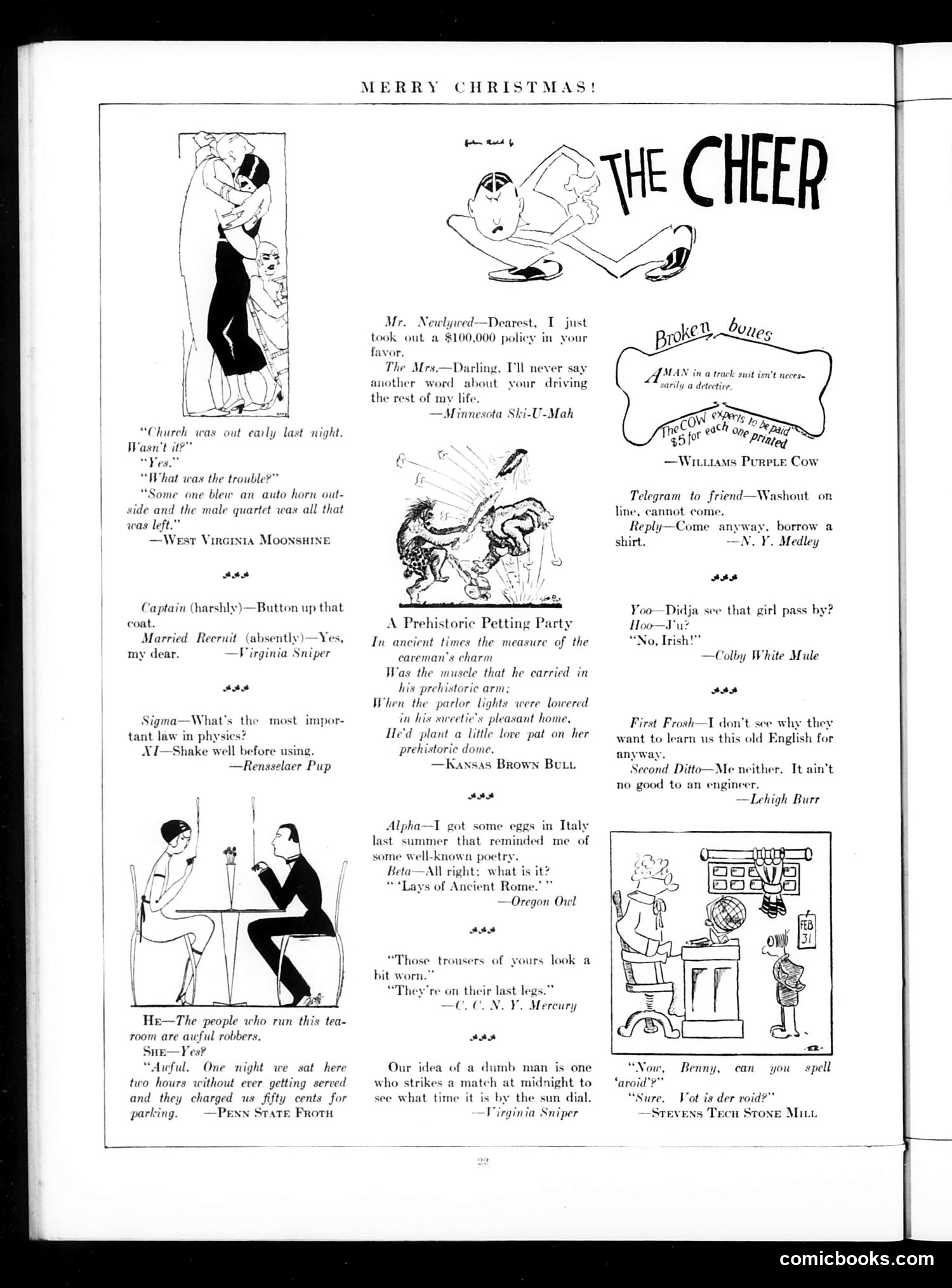
This page collects humorous one-liners and cartoons typical of early 20th-century college and campus humor magazines. The jokes satirize contemporary social situations: **Key themes:** - **Newlyweds & marriage**: A husband takes out life insurance, hoping his wife won't complain about his driving anymore—dark humor about marital tension and automotive accidents. - **College life**: Students mock impractical education (learning "old English"), charging exorbitant fees, and awkward social interactions. - **Gender dynamics**: References to "petting parties" (necking), tea rooms, and flirtation reflect period courtship anxieties. - **Class commentary**: Jokes about "awful robbers" running establishments suggests working-class resentment of pricing. The cartoons feature simple line drawings of couples and social scenarios. The bylines reference college newspapers (Rensselaer, Penn State, Lehigh), suggesting this content came from student publications. **Overall**: Lighthearted satire of young adult life, marriage, education, and social pretension—mildly risqué by 1920s standards but essentially innocent.
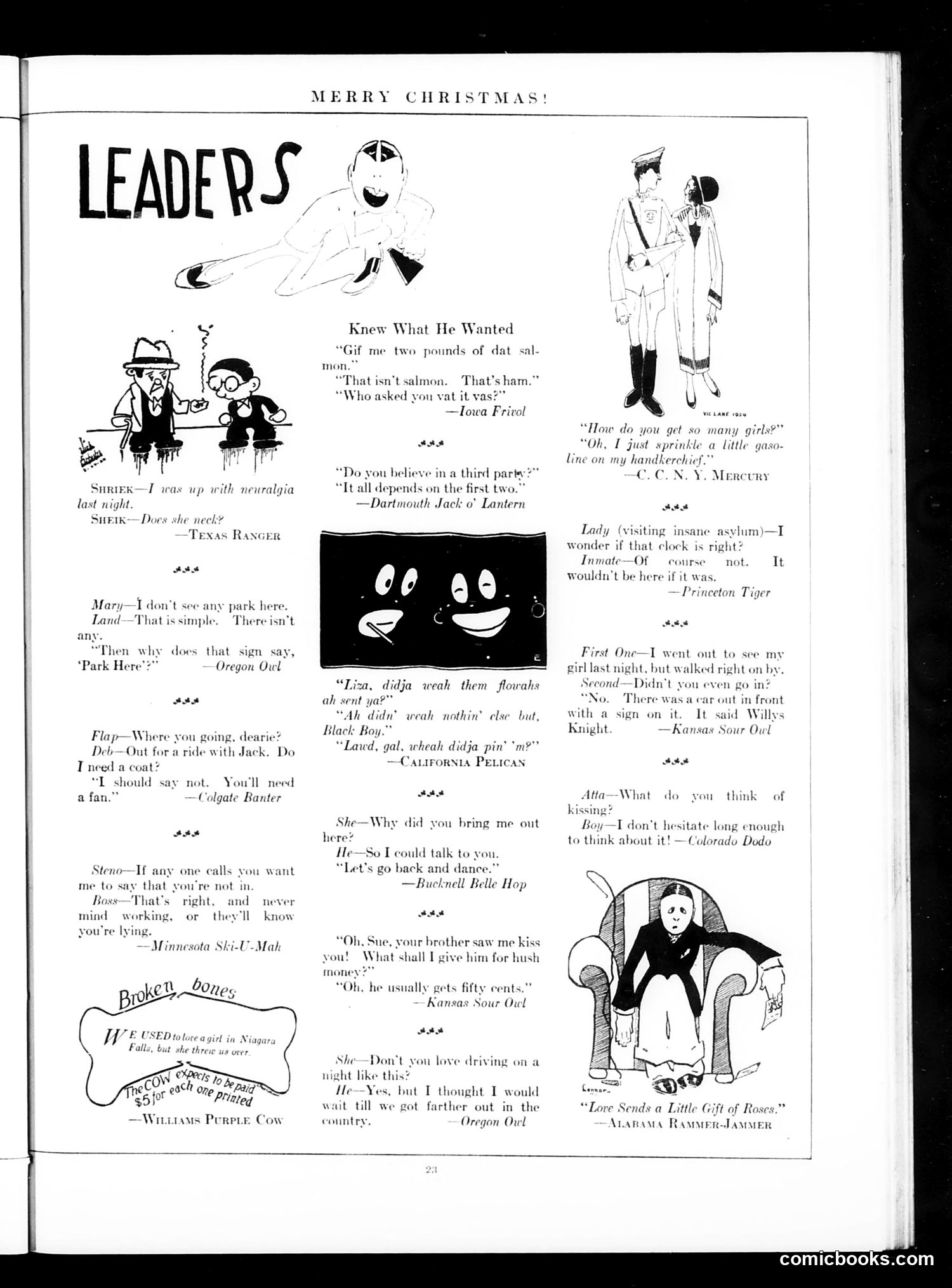
This page collects brief humorous exchanges and jokes from college humor magazines (Iowa Frivol, Texas Ranger, etc.), reflecting 1920s social attitudes. **Key themes:** - **Dating and courtship**: Multiple jokes about necking, kissing, and automobiles as romantic spaces—reflecting anxieties about "modern" youth behavior - **Class/ethnic humor**: Stereotypical dialect jokes (the salmon vendor, "Black Boy" character) that were commonplace in period humor - **Gender dynamics**: Women portrayed as either coy or mercenary; men as pursuers - **Automobile culture**: References to cars as romance venues and status symbols ("Willys Knight") - **Workplace satire**: Boss-employee dynamics, secretaries **The "Leaders" title** appears ironic—these aren't actual leaders but ordinary people, suggesting the magazine is satirizing everyday social behavior rather than political figures. The cartoons are crude by modern standards, employing caricature and stereotypes typical of pre-1930s American college humor without apparent political agenda—mainly recording period attitudes toward youth, romance, and class.
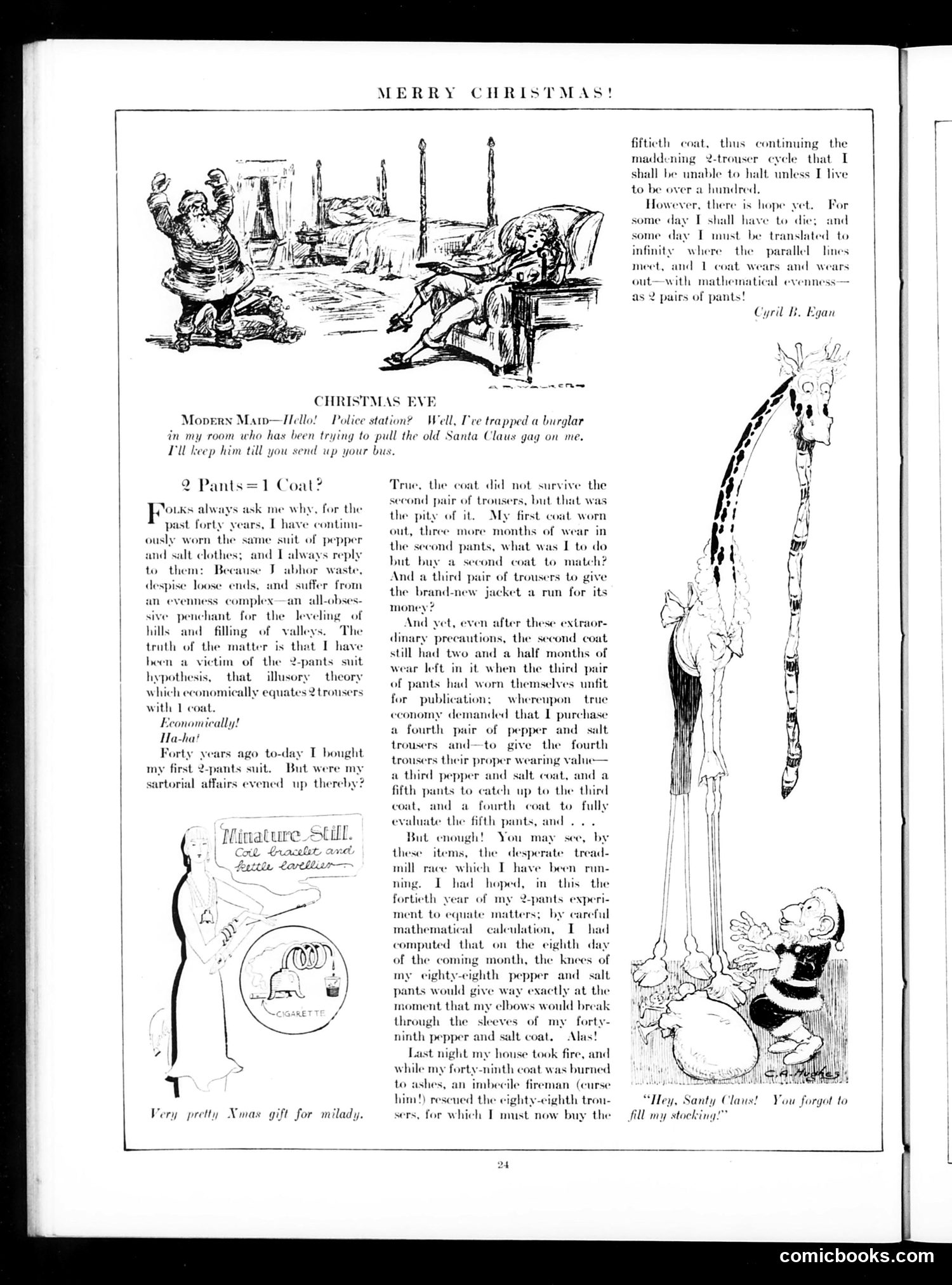
This is a humorous essay-cartoon mocking the false economy of the "2-pants suit"—a men's clothing marketing pitch popular in the early 20th century. Manufacturers claimed buying a suit with two pairs of trousers instead of one saved money. The unnamed narrator obsessively documents how this theory backfired spectacularly over 40 years. When the coat outlasted the first pair of pants, he had to buy another coat to match new trousers—creating an endless cycle. By calculating wear rates with absurd precision, he's discovered his 49th coat will wear out simultaneously with his 88th pants only if he lives over a hundred. A recent house fire destroyed this alignment, dooming him to perpetual imbalance. The satire targets both deceptive marketing and obsessive-compulsive consumer anxiety about waste and symmetry. The joke: attempting rational economy often produces irrational spending spirals.
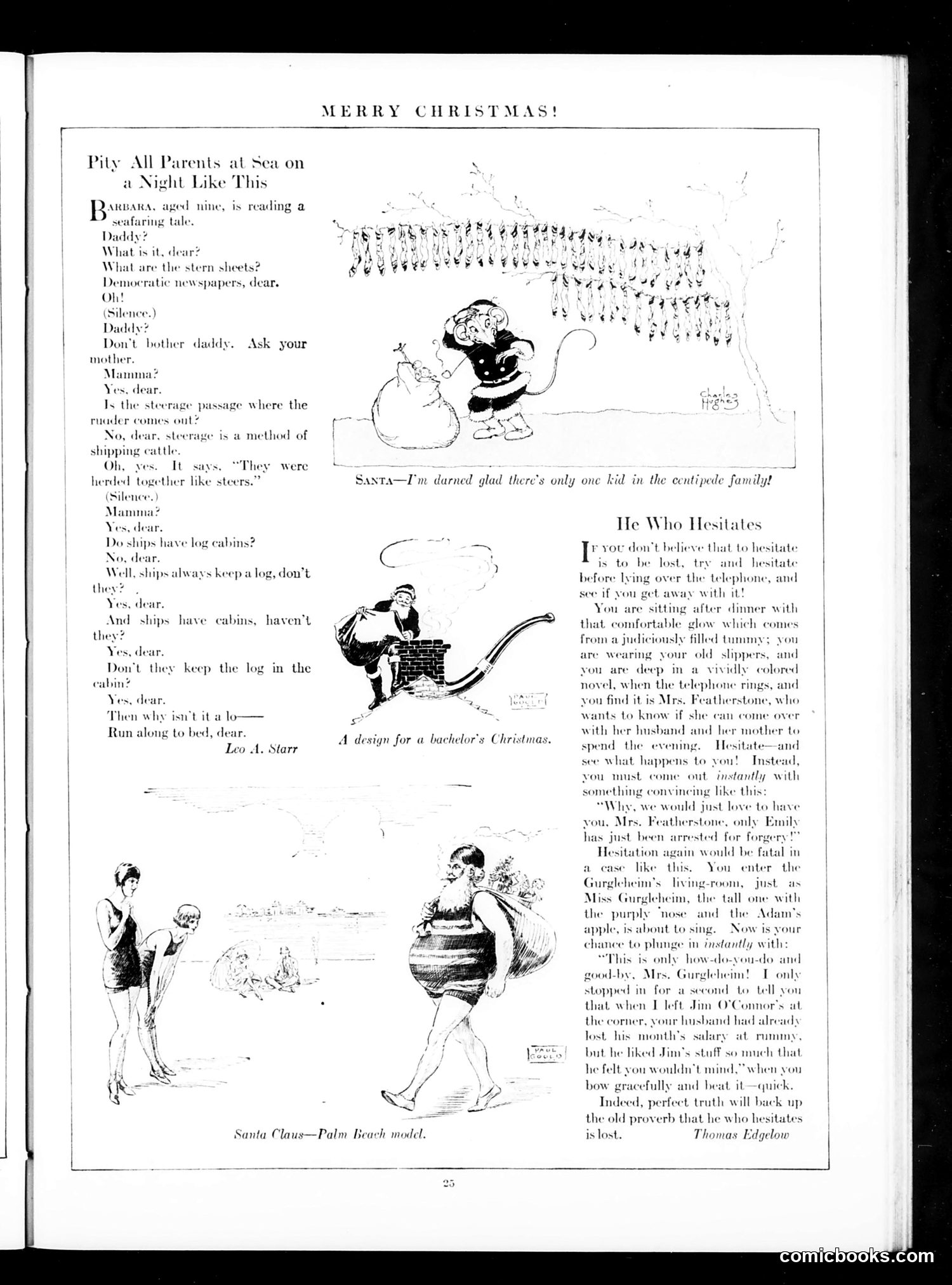
This Christmas-themed page contains two satirical pieces: **"Pity All Parents at Sea on a Night Like This"** features a child's naive misinterpretations of nautical terminology. The joke relies on wordplay: the child conflates "stern sheets" with "Democratic newspapers," "steerage" with cattle shipping, and "log cabins" with ship logs—creating absurd but logical conclusions from adult jargon. The reference to "Democratic newspapers" suggests mild political ribbing typical of Judge's conservative leanings. **"He Who Hesitates"** satirizes social etiquette and white lies. It mocks the modern telephone culture and social obligations, showing how one must instantly manufacture convenient excuses (a daughter arrested for forgery, a husband gambling away his salary) to escape unwanted social visits. The satire targets the phoniness of polite society and the tension between comfort-seeking and social performance. Both pieces humorously depict everyday domestic situations rather than explicit political content, reflecting Judge's mix of family humor with subtle social commentary.
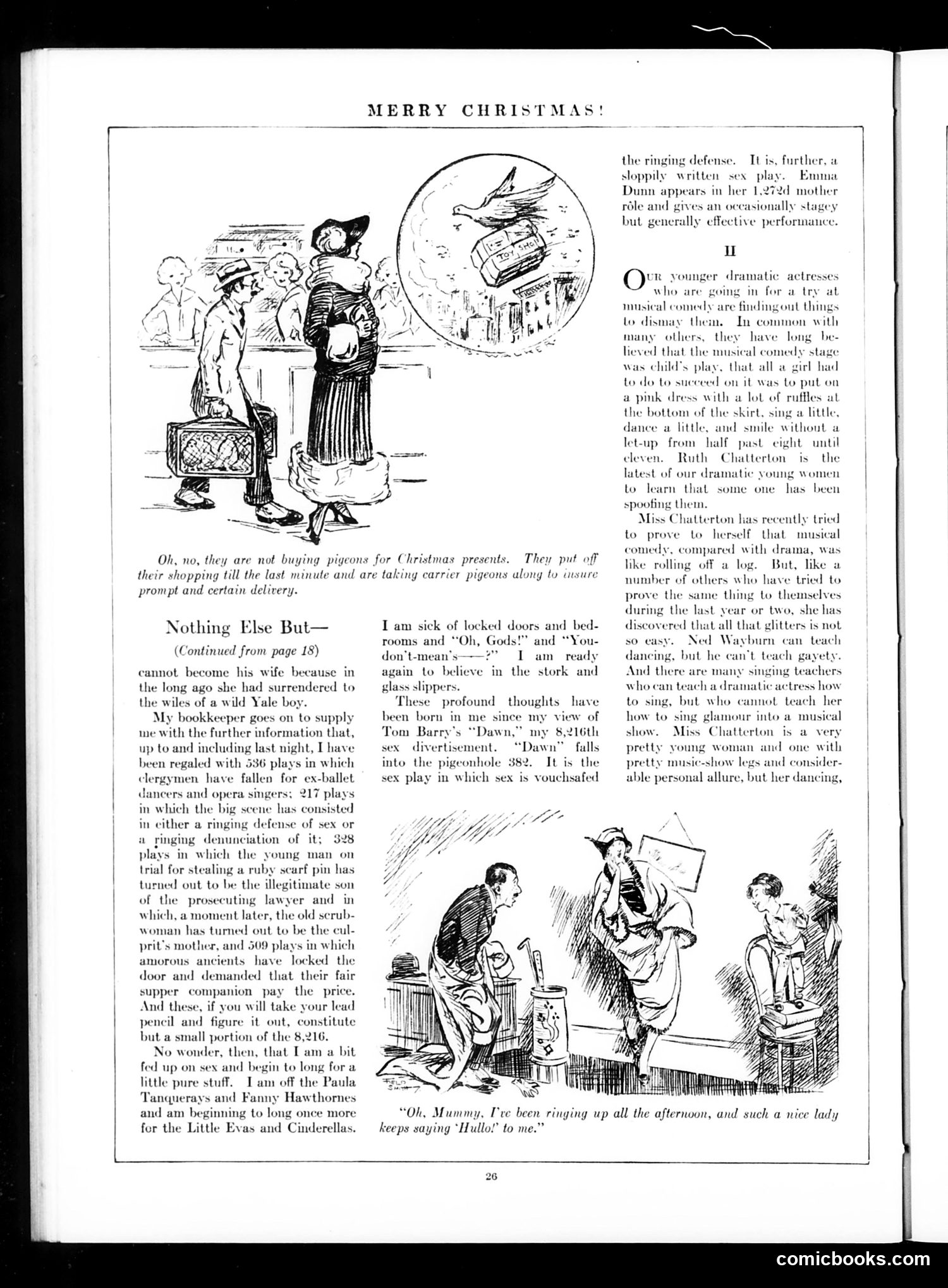
This page contains two distinct pieces of satirical content: **Top cartoon:** A joke about last-minute Christmas shopping. The caption explains that people aren't buying carrier pigeons as gifts—they're using carrier pigeons to deliver their hastily-purchased presents, ensuring "prompt and certain delivery" despite shopping at the last minute. **Main article ("Nothing Else But—"):** A theater critic's exhausted rant about formula-driven sex plays. The writer catalogs 536+ plays featuring identical tired plots: clergymen seduced by dancers, "ringing defenses" of sex, illegitimate sons revealed in courtrooms, and women demanding payment from supper companions. He's fed up and longs for innocent theatrical fare like "Little Eva" and "Cinderella" stories instead. The secondary piece criticizes young dramatic actresses (like Ruth Chatterton) who naively assume musical comedy is easy—requiring only a pink dress, smiling, and singing. They discover the form demands genuine skill that Ned Wayburn's dancing instruction and singing lessons cannot provide. Both pieces mock formulaic entertainment and audience/performer delusions.
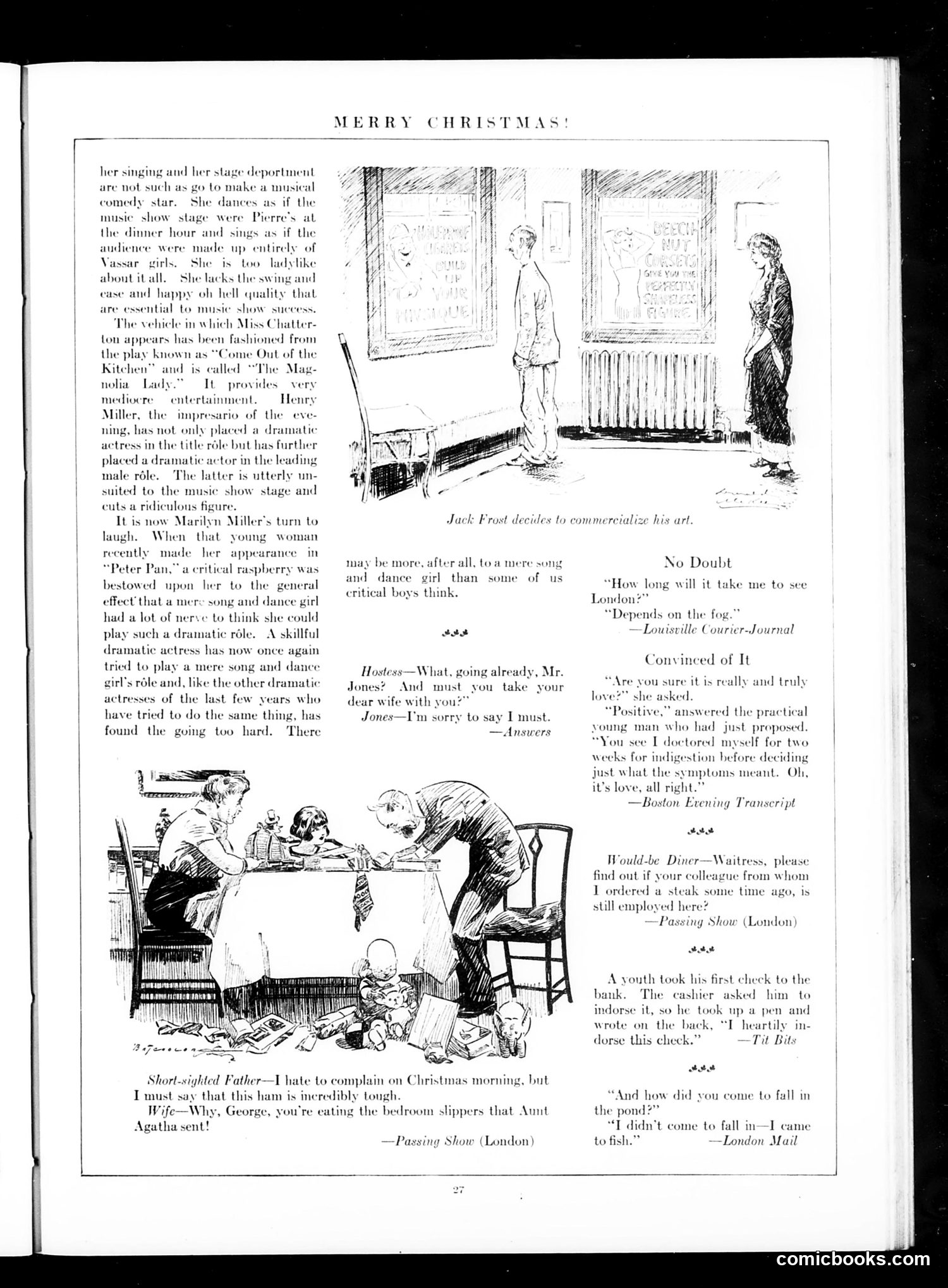
This is a theatrical review page mixed with humor shorts. The main content critiques actresses attempting to cross genres: **The Central Satire:** The page mocks dramatic actresses (Chatterton, and by reference Marilyn Miller) who try performing in musical comedy shows, and vice versa—dramatic actors in musical roles. The point: each genre requires different skills. A "dramatic actress" lacks the necessary swing, ease, and stage presence for musical theater; a dramatic actor "cuts a ridiculous figure" on the music show stage. The irony is that critics previously mocked Miller for being "merely" a song-and-dance girl trying serious drama—now that complaint reverses. **The Humor Shorts:** These are separate gag jokes about Christmas domestic life: a man eating bedroom slippers thinking they're ham; misunderstandings about London fog; a youth literally endorsing a check by writing "I heartily indorse this"; a man who "came to fish" not "came to fall in" the pond. The overall theme: professional expertise matters; dilettantism across fields produces comedy (intentional and unintentional).
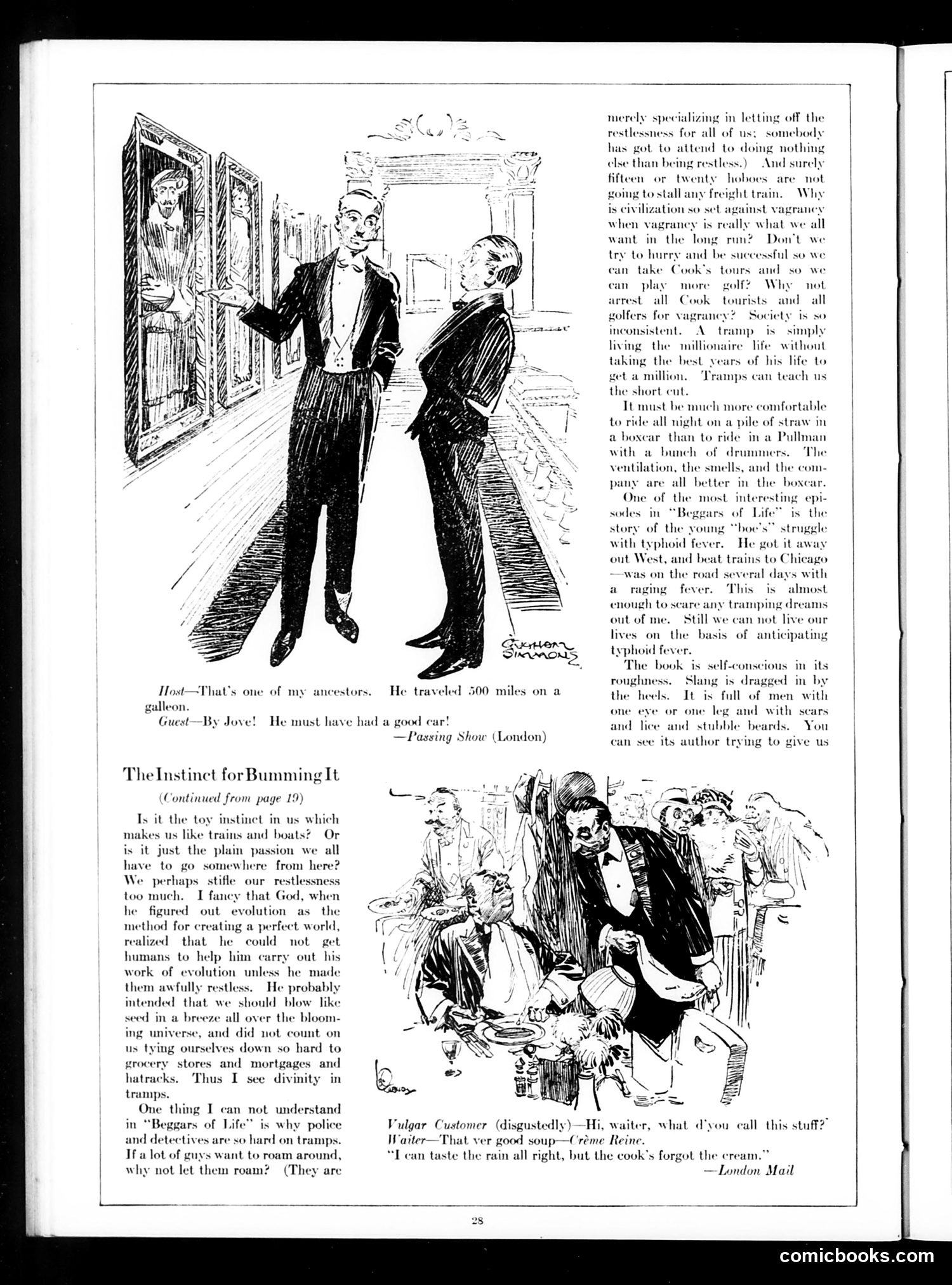
This page contains two satirical pieces about vagrancy and wanderlust in early 20th-century America. **Top cartoon**: A host boasts to a guest about an ancestor who "traveled 500 miles on a galleon," to which the guest replies "He must have had a good car!"—satirizing how Americans measure ancestral accomplishment by transportation rather than actual achievement. **Main article**: A lengthy essay titled "The Instinct for Bumming It" argues that society unfairly criminalizes tramps and vagrants while celebrating the same restlessness in wealthy tourists taking Cook's tours or playing golf. The author suggests tramping represents a democratic form of the millionaire lifestyle and questions why civilization suppresses natural human wanderlust. **Bottom cartoons**: Two restaurant jokes mocking pretentious French cuisine—one waiter serves "Crème Reine" soup while a customer complains he can taste rain but the cook forgot cream, suggesting fancy names mask poor cooking. The satire critiques class hypocrisy: restlessness is acceptable for the wealthy but criminalized in the poor.
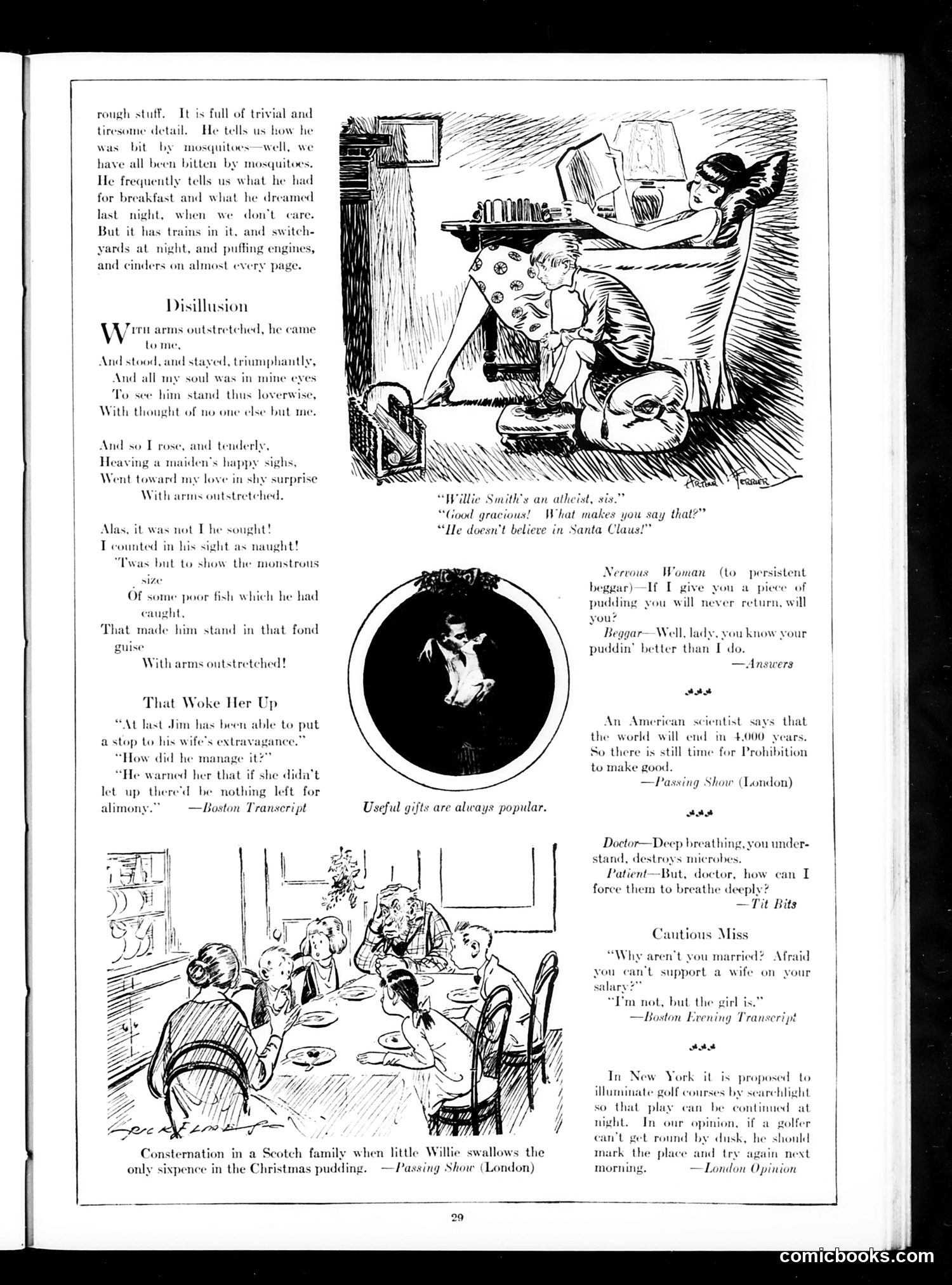
This page from *Judge* contains multiple short humor pieces typical of early 20th-century satirical magazines: **"Disillusion"** is a romantic poem with ironic twist: a woman eagerly greets her lover with outstretched arms, only to discover he was excited about showing her a fish he caught—a commentary on male obliviousness to romantic moments. **"That Woke Her Up"** jokes about marital conflict: a husband stops his wife's extravagance by warning her that excessive spending during divorce would leave nothing for alimony payments—dark humor about marriage economics. **The Scottish pudding cartoon** depicts family dismay when a child swallows sixpence hidden in Christmas pudding and becomes an atheist—apparently the lost money symbolizes lost faith, a absurdist joke. The remaining items are brief one-liners on various topics (Prohibition, golf course lighting, doctor-patient exchanges) typical of *Judge's* miscellaneous humor format. The page reflects period concerns with matrimonial discord, materialism, and changing social attitudes, delivered through gentle satirical wit rather than serious political commentary.
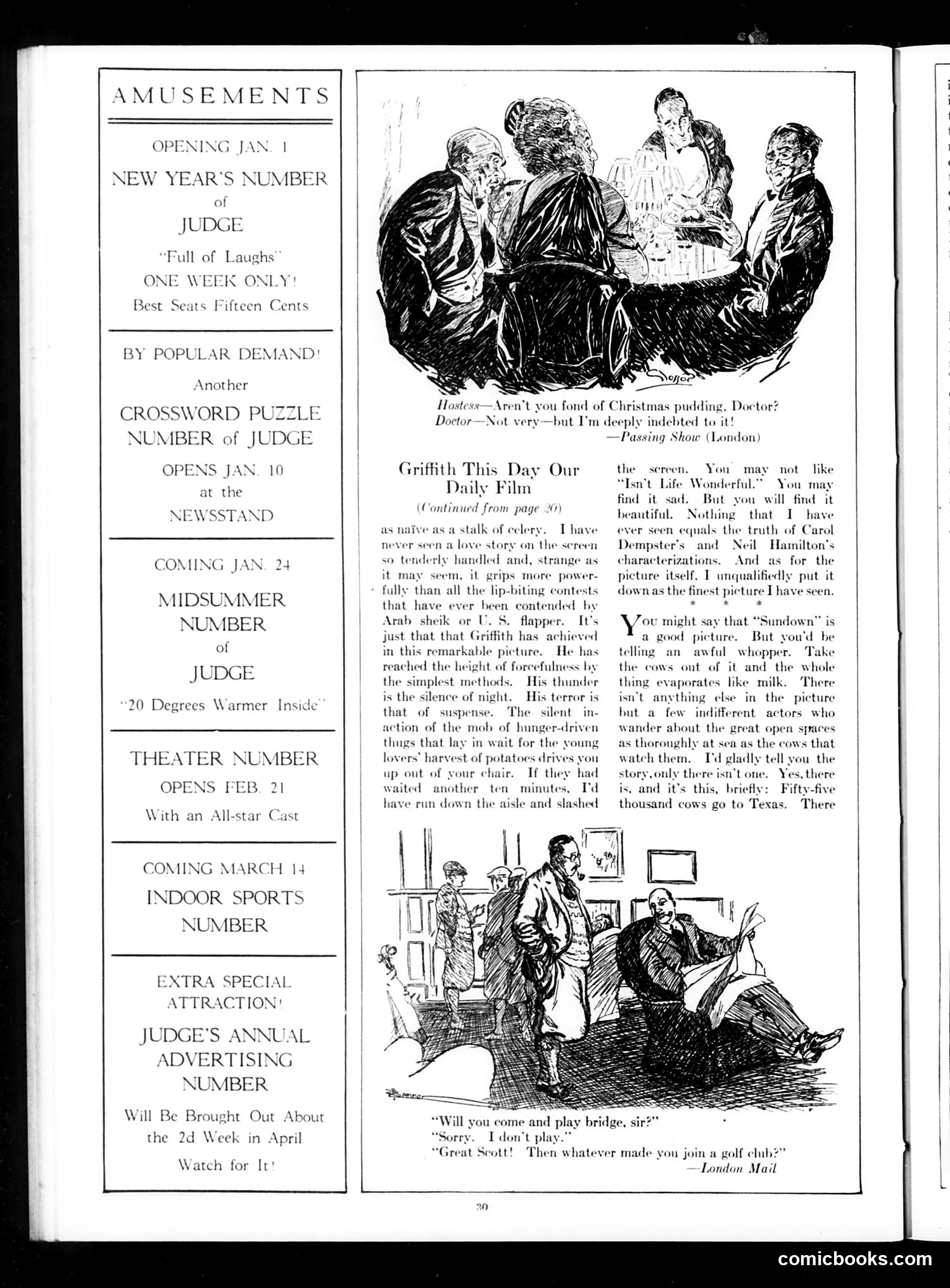
This page is primarily **advertising for Judge magazine's upcoming issues** rather than political satire. The left column announces special themed numbers launching January 1 through April, including crossword puzzles and theater coverage. The right side contains **two humor cartoons** unrelated to politics: 1. **Top cartoon**: A doctor and hostess exchange jokes about Christmas pudding—a light domestic gag about indigestion, credited to *Passing Show* (London). 2. **Bottom cartoon**: A man declines a bridge invitation, claiming he doesn't play. When asked why he joined a golf club then, it's implied as absurd social behavior—a mild joke about club membership contradictions. The central article reviews D.W. Griffith films ("Isn't Life Wonderful" and "Sundown"), praising their cinematography and emotional impact. This represents standard entertainment criticism, not satire. The page lacks contemporary political commentary or identifiable public figures being lampooned.
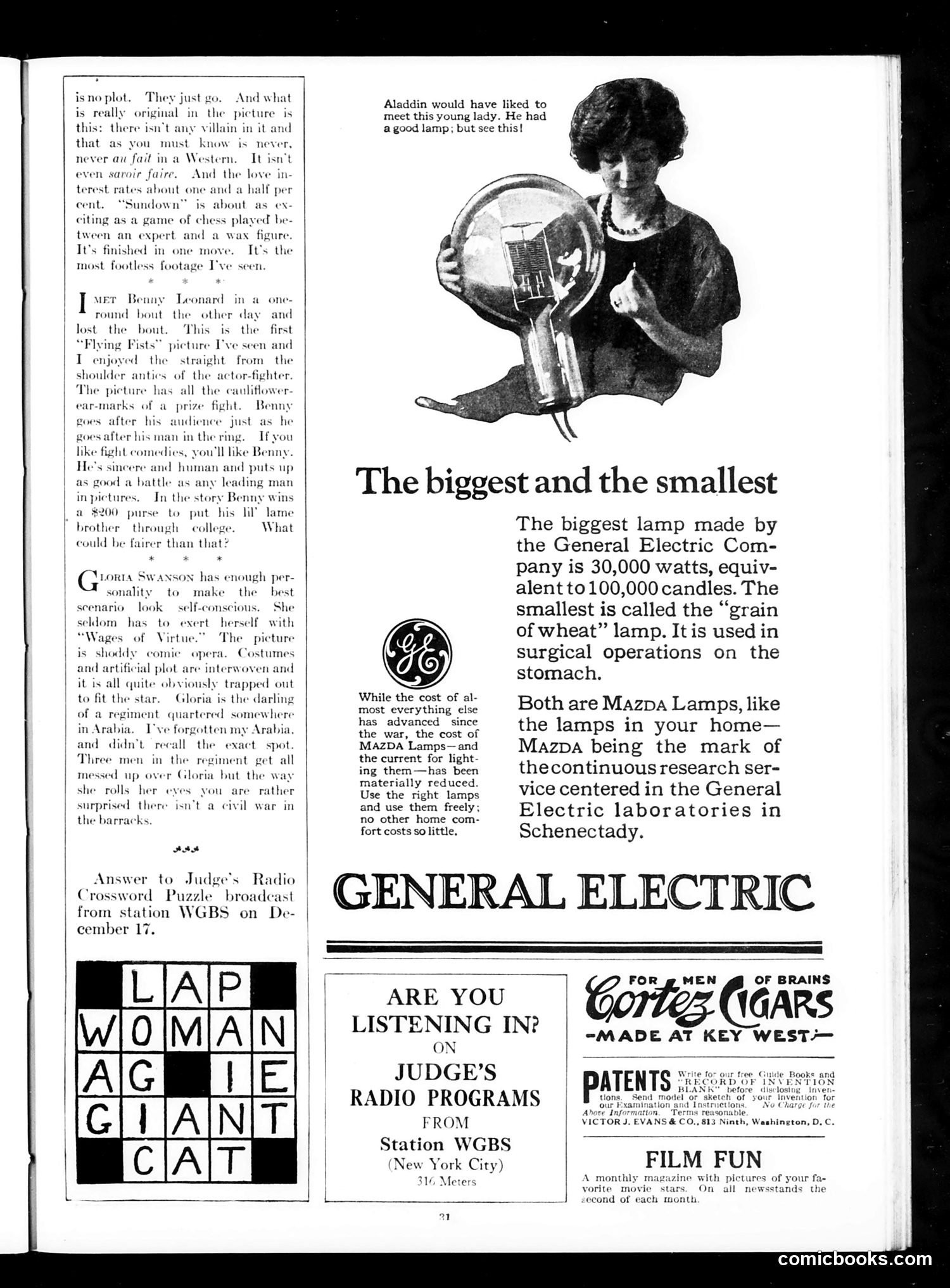
This page is primarily **advertising and filler content** rather than satire or editorial commentary. The main content includes: 1. **Film reviews** (left column): Critical commentary on recent movies featuring actors like Benny Leonard and Gloria Swanson, discussing plot weaknesses and performances in contemporary silent films. 2. **General Electric advertisement** (center/right): Showcases the contrast between GE's largest lamp (30,000 watts) and smallest ("grain of wheat" lamp for surgery), emphasizing technological innovation and affordability post-WWI. 3. **Miscellaneous ads**: Radio program announcements, a crossword puzzle answer, and cigarette/patent advertisements typical of 1920s magazines. There is **no political cartoon or satire** on this page. The image of a woman with a lamp relates only to the GE advertisement's "Aladdin's lamp" comparison—a common commercial metaphor about wishing and modern convenience.
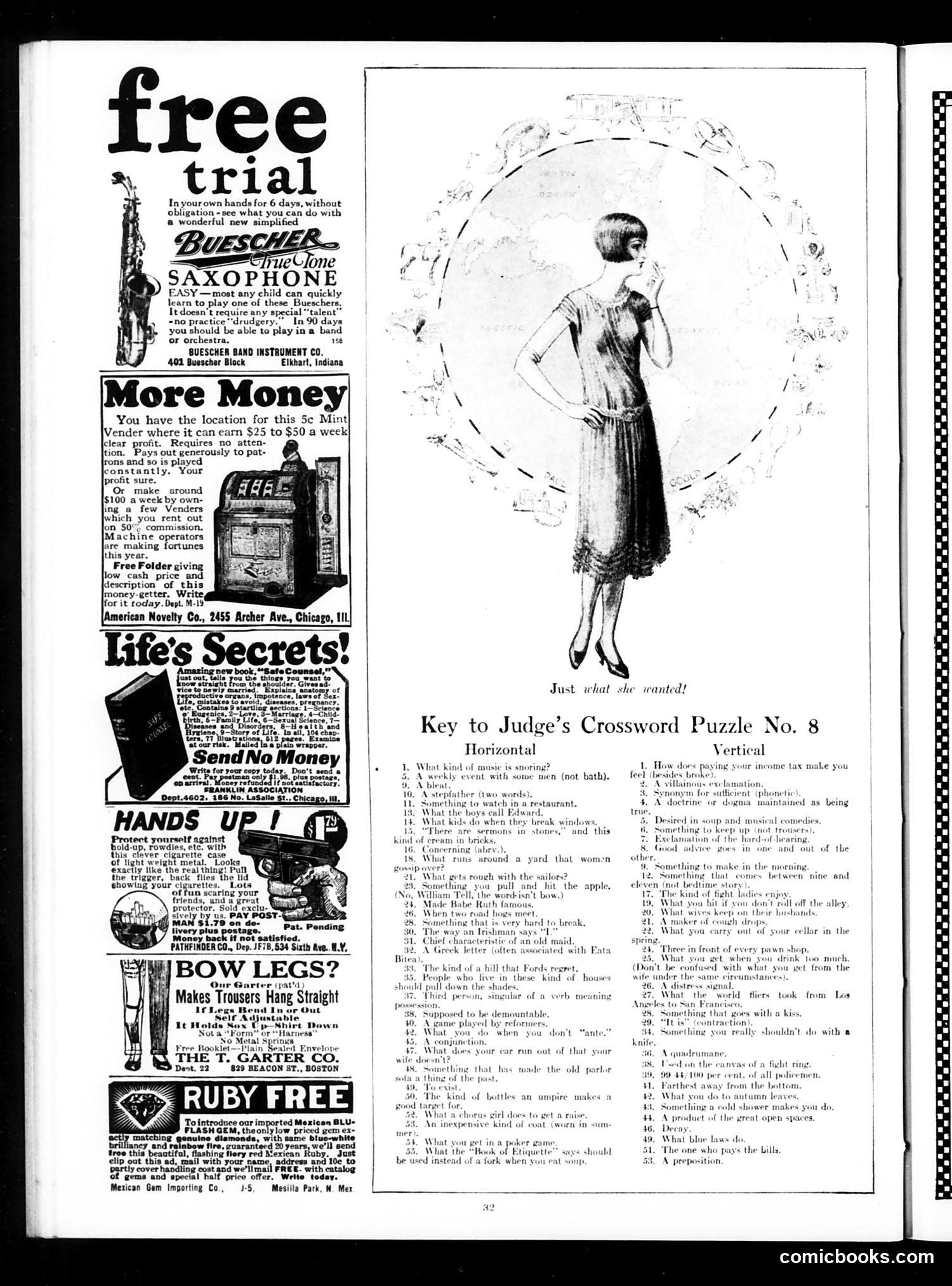
This page is primarily **advertising** rather than political satire. It features multiple product advertisements typical of early 20th-century magazines: - **Buescher Saxophone**: promoting easy instrument learning - **Mint Vending Machine**: a business opportunity promising $25-50 weekly profit - **Cigarette Case**: a metal case disguised as a lighter for "protection" - **Bow Legs Garter**: a device to straighten trouser hang - **Ruby gemstone**: marketing synthetic gems as diamond alternatives The only non-advertising content is **"Key to Judge's Crossword Puzzle No. 8"** with clues listed. The illustration of a woman in 1920s dress with a circular spiral background appears decorative, captioned "Just what she wanted!"—likely an advertisement image rather than editorial cartoon. The page reflects consumer culture of the era: quick-profit schemes, self-improvement products, and leisure goods marketed to middle-class readers. No political commentary or satirical figures are evident.
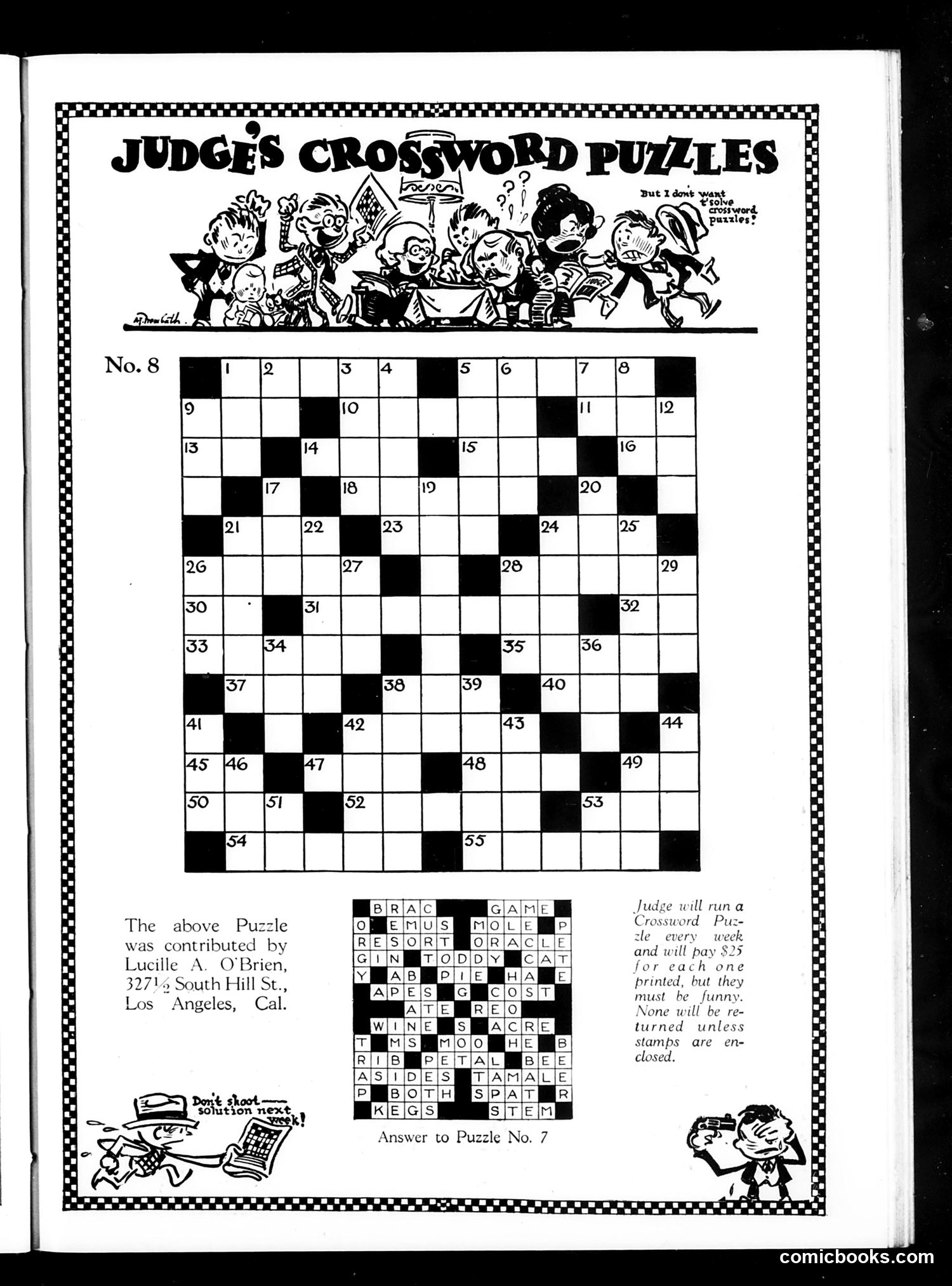
This page from *Judge* magazine features **Puzzle No. 8**, a standard crossword puzzle with no political or satirical content itself. The page serves primarily as a **puzzle feature** rather than editorial commentary. The top illustration shows cheerful cartoon characters working on puzzles—generic, lighthearted imagery typical of puzzle pages. Below is the crossword grid, contributed by a Los Angeles reader named Lucille A. O'Brien. The noteworthy element is the **editorial announcement**: *Judge* is soliciting crossword puzzle submissions from readers and offering **$25 payment** for each accepted puzzle, on the condition that "they must be funny." This reflects crossword puzzles' enormous popularity in 1920s American culture and *Judge*'s attempt to monetize reader engagement while maintaining the magazine's comedic brand. The small cartoon vignettes in corners (a figure with a calculator, another reading) are just decorative filler typical of the era.
This is a **cigarette advertisement**, not political satire. It promotes Lucky Strike cigarettes, emphasizing their "toasted" manufacturing process as a distinctive feature that allegedly enhances flavor. The image shows hands holding a cigarette and what appears to be a tobacco product or package. The ad's appeal is straightforward: toasting brings out superior taste, making Lucky Strikes irresistible to consumers. **Historical context for modern readers**: This advertisement predates widespread knowledge of smoking's health dangers. The glamorous framing and pseudo-scientific claims about "toasting" were typical marketing tactics of the era. Lucky Strike's "It's Toasted" slogan was a major advertising campaign that positioned toasting as a desirable, quality-enhancing process—a claim designed to differentiate the brand in a competitive market.