
Judge, 1924-12-20 · page 27 of 36
Judge — December 20, 1924 — page 27: what you’re looking at
What you’re looking at
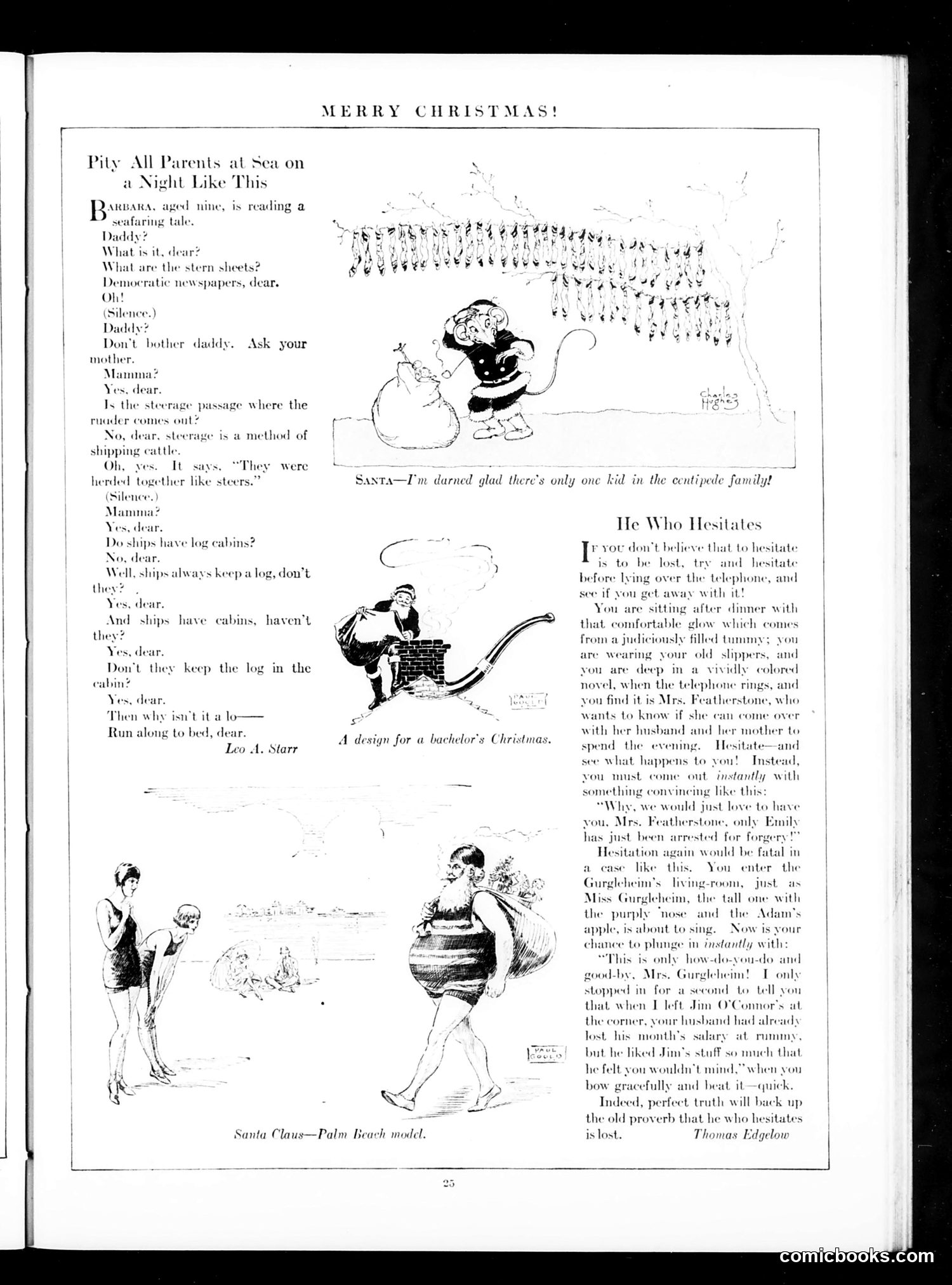
This Christmas-themed page contains two satirical pieces: **"Pity All Parents at Sea on a Night Like This"** features a child's naive misinterpretations of nautical terminology. The joke relies on wordplay: the child conflates "stern sheets" with "Democratic newspapers," "steerage" with cattle shipping, and "log cabins" with ship logs—creating absurd but logical conclusions from adult jargon. The reference to "Democratic newspapers" suggests mild political ribbing typical of Judge's conservative leanings. **"He Who Hesitates"** satirizes social etiquette and white lies. It mocks the modern telephone culture and social obligations, showing how one must instantly manufacture convenient excuses (a daughter arrested for forgery, a husband gambling away his salary) to escape unwanted social visits. The satire targets the phoniness of polite society and the tension between comfort-seeking and social performance. Both pieces humorously depict everyday domestic situations rather than explicit political content, reflecting Judge's mix of family humor with subtle social commentary.
📄 Transcribed text from this page (OCR, searchable)
Machine-transcribed from the original scan — historical spelling and the odd misread are preserved.
MERRY CHRISTMAS! ee Pity All Parents at Sea on a Night Like This Byvees. aged nine, is reading a seafaring tale. Daddy? What is it, ded What are the stern sheets? Democratic newspapers, dear. Oh! (Silence.) Daddy? Don't bother daddy. Ask your mother. Mamma? Is the steerage passage where the ruader comes out? No, dear, steerage is a method of shipping cattle Oh, ves. Tt says, “They were herded together like steers.” Santa—I'm darned glad there's only one kid in the centipede family? (Silence Mamma? Yes, dear. Do ships have log cabins? No, dear. Well, ships always keep a log, don’t they? , Yes, dear. And ships have cabins, haven't they? Yes, dear. Don’t they keep the log in the cabin? Yes, dear. Then why isw't it a lka— Run along to bed, dear. A design for a bachelor’s Christmas. Leo A. Starr an J Ife Who Hesitates T you don't believe that to hesitate is to be lost, try and hesitate before Lying over the telephone, and see if you get away with it! You are sitting after diner with that comfortable glow which comes froma judiciously filled tummy; you are wearing your old. slippers, and you are deep in a vividly colored novel, when the telephone rings, and you find it is Mrs. Featherstone, who wants to know if she can come over with her husband and her mother to spend the evening. Hesitate—and see what happens to vou! Instead, you must come out instantly with something convincing like this “Why, we would just love to have you, Mrs. Featherstone, only Emily has just been arrested for forgery!” Hesitation again would be fatal in a_case like this. You enter the Gurgleheim’s living-room, just as Miss Gurgleheim, the tall one with the purply “nose and the Adam's apple, is about to sing. Now is your chance to phinge in instantly with: “This is only how-do-yeu-do and good-by, Mrs. Gurgleheim! [only stopped in for a second to: tell you that when I left. Jim O'Connor's at the corner, your husband had already lost his month's salary at- rummy, but he liked Jim's stuff so much that he felt you wouldn't mind,” when you bow efully and beat it—quick. Indeed, perfect truth will back up the old proverb that he who hesitates is lost. Thomas Edgelow