
A complete issue · 36 pages · 1924
Judge — November 1, 1924
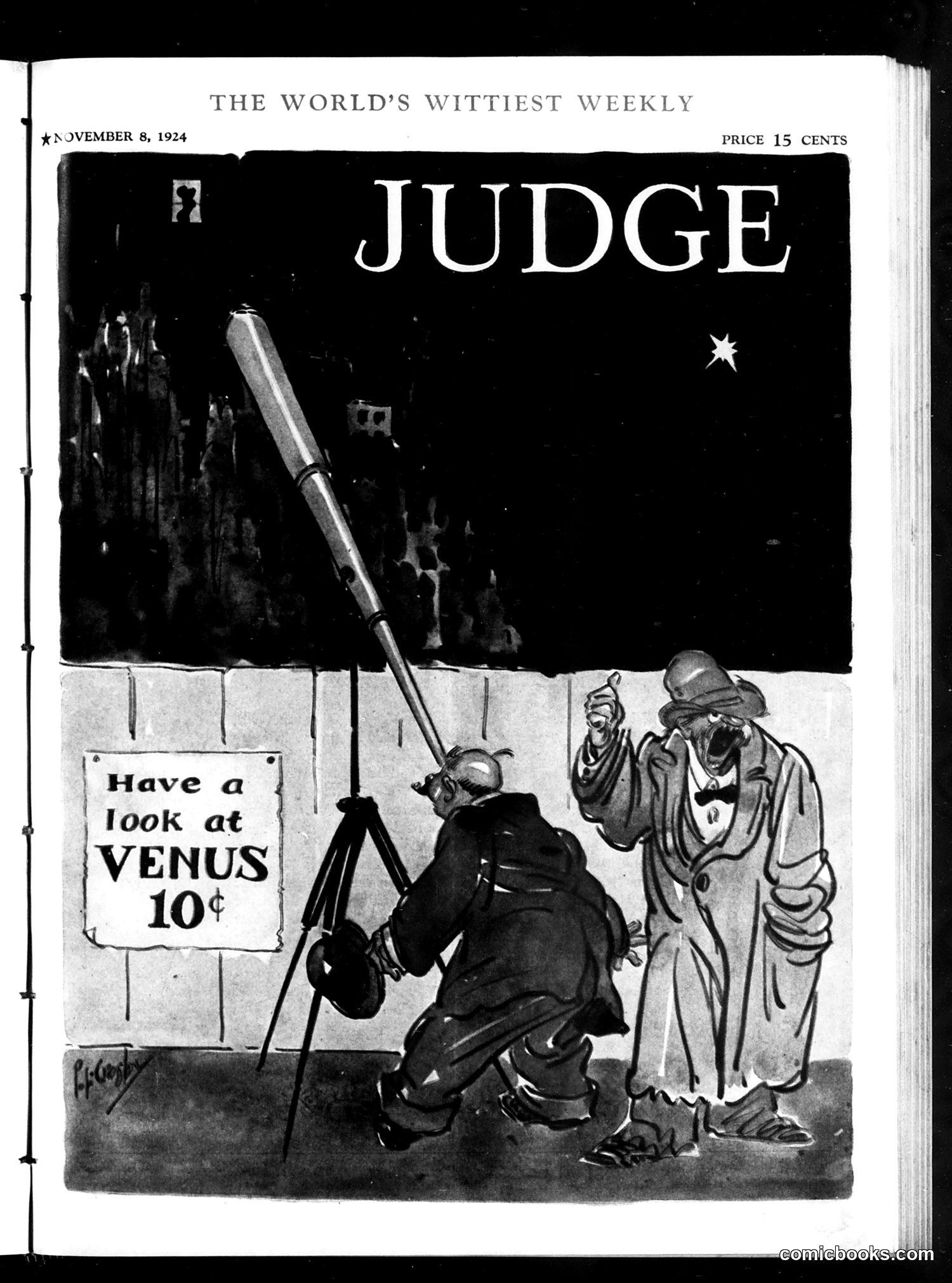
This cover satirizes the public's fascination with astronomy during the 1920s, likely referencing contemporary telescope observations or astronomical discoveries. The cartoon depicts two men operating a telescope to "have a look at VENUS 10¢"—presenting stargazing as a commercial novelty, like a street-side peepshow attraction. The satire works on multiple levels: it mocks both the sensationalization of scientific interest and the opportunistic monetization of public curiosity. The figure operating the telescope appears to be a con-artist or carnival barker type, suggesting the "scientific" observation is actually a financial scheme. The phrase "Have a look at VENUS" carries an additional double meaning—Venus being associated with romance and sexuality—adding ribald humor typical of Judge magazine's satirical style.
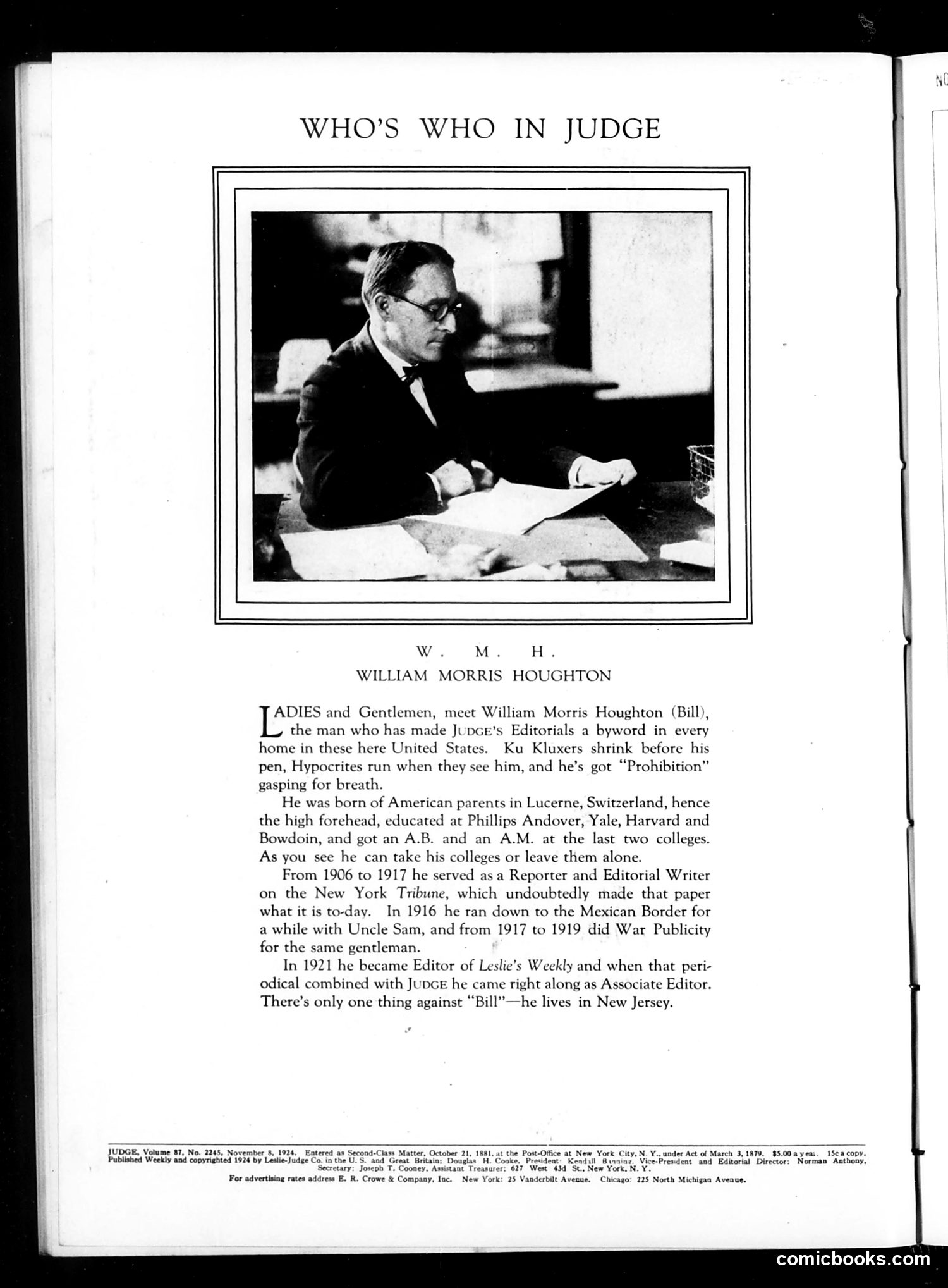
This is a biographical profile of **William Morris Houghton**, identified as "Bill," an editor at *Judge* magazine. The text describes him as the man responsible for *Judge*'s editorials, claiming they're so influential that "Ku Kluxers shrink before his pen" and "Hypocrites run when they see him." The satire is self-promotional: *Judge* credits Houghton with near-mythical power to reform society through editorial writing. His background includes work at the *New York Tribune* (1906-1917) and war publicity roles. By 1921, he became editor of *Leslie's Weekly* before joining *Judge* as Associate Editor. The humor lies in the exaggerated claims of editorial influence—a common *Judge* self-congratulatory joke about American journalism's cultural authority.
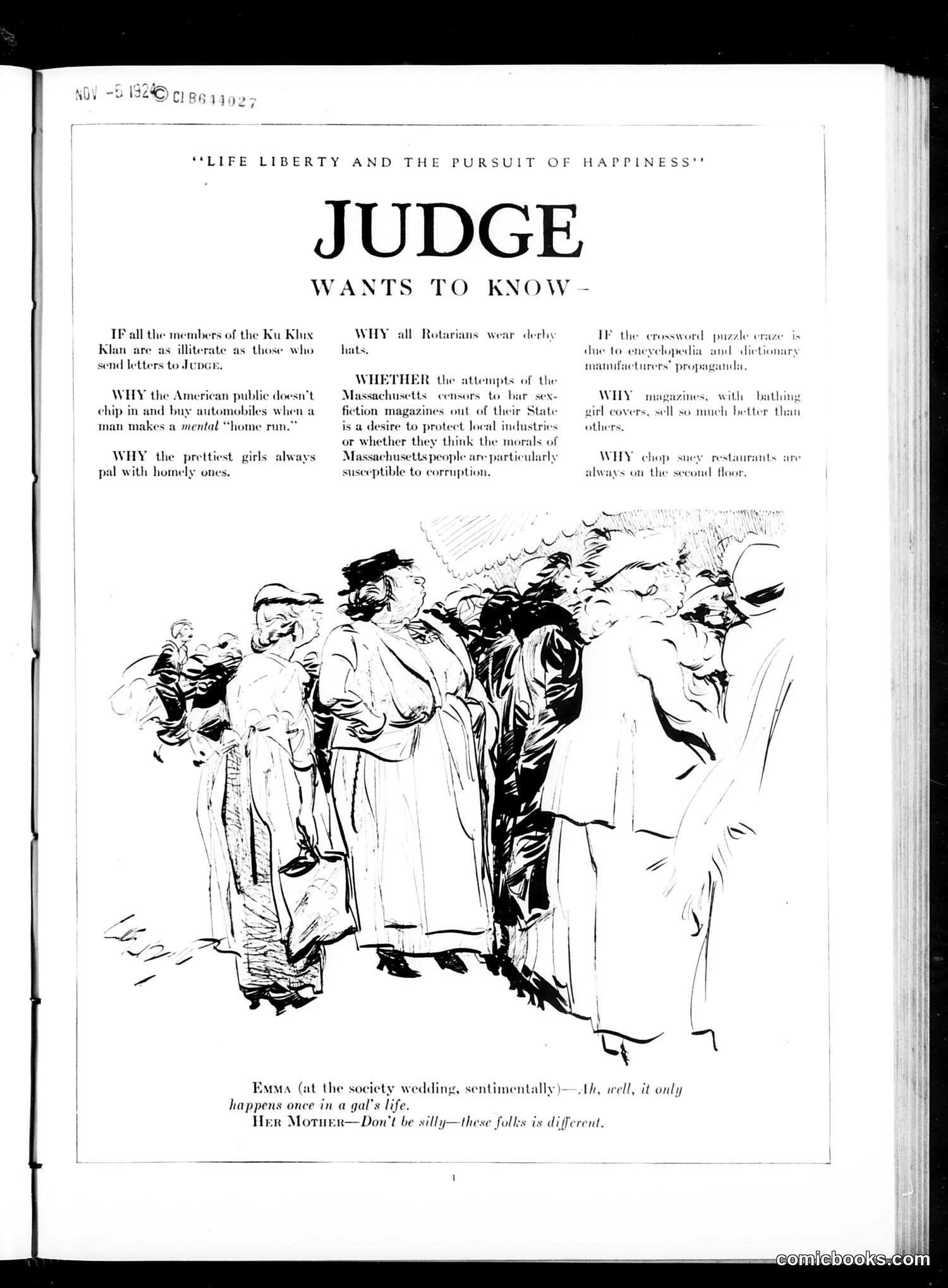
This page from *Judge* magazine satirizes various social curiosities through the section "Judge Wants to Know," listing absurd observations disguised as serious inquiries—a format common to *Judge*'s humor. The main cartoon depicts a wedding scene where Emma (the bride) sentimentally remarks that such moments happen "once in a gal's life," while her Mother pragmatically responds "Don't be silly—these folks is different," implying the guests have married multiple times. The surrounding text topics mock contemporary concerns: Ku Klux Klan membership, American domestic life, beauty standards, censorship debates (Massachusetts banning certain magazines), Rotarian conventions, encyclopedia marketing, magazine covers, and restaurant locations. These represent early-20th-century social anxieties and absurdities *Judge* found worthy of ridicule.
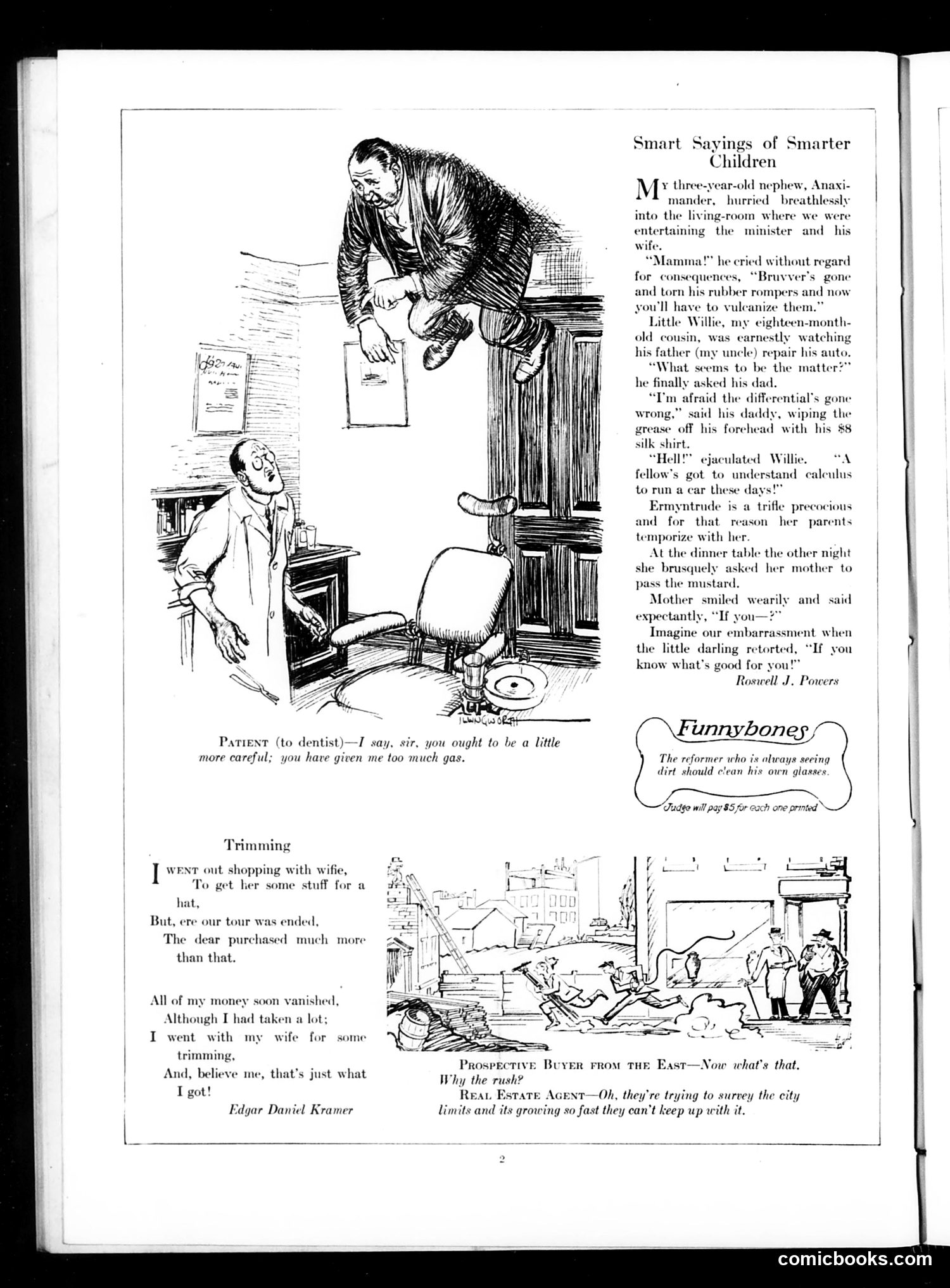
This page contains three separate humor pieces: 1. **"Smart Sayings of Smarter Children"** - A nostalgic anecdote by Roswell J. Powers about children's precocious remarks, including a three-year-old's tantrum and an eight-year-old's comment about calculus being necessary to "run a car these days." This reflects early 1900s anxiety about rapid technological change affecting daily life. 2. **"Patient" cartoon** - A dentist joke where a patient complains the dentist gave him too much anesthesia (gas), a common contemporary concern with dental procedures. 3. **"Trimming"** - A poem by Edgar Daniel Kramer about excessive spending while shopping with one's wife, a timeless domestic humor theme, paired with a real-estate satire cartoon about Eastern buyers overwhelming the city market. The content reflects early 20th-century middle-class concerns: technology, medical procedures, marital finances, and urban development.
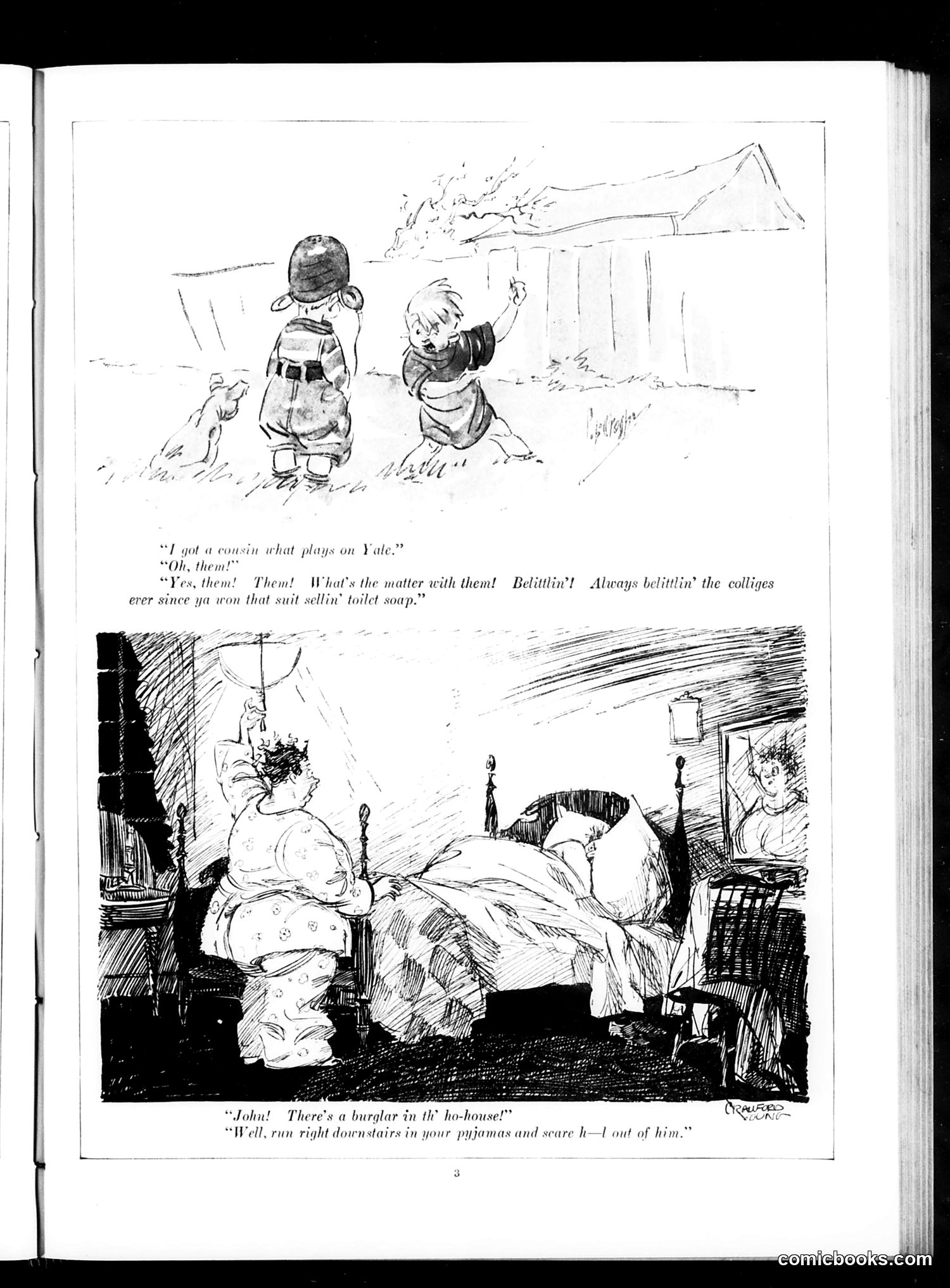
This page contains two cartoons satirizing American class and social anxieties from the early 20th century. The **top cartoon** mocks upper-class parents' concerns about their children's education and social standing. A child mentions having "a cousin what plays on Yale," prompting worried parents to fret the child might be "belittlin' the colliges" and losing social status—apparently from using a commercial toilet soap. The **bottom cartoon** depicts a wealthy woman in bed confronting a burglar, demanding he "run right downstairs in your pajamas and scare h—l out of him" (apparently a servant or another household member). The satire targets the absurdity of upper-class anxiety, where even criminal intrusions become opportunities to exploit subordinates rather than address genuine danger. Both cartoons ridicule bourgeois social pretensions and class anxieties.
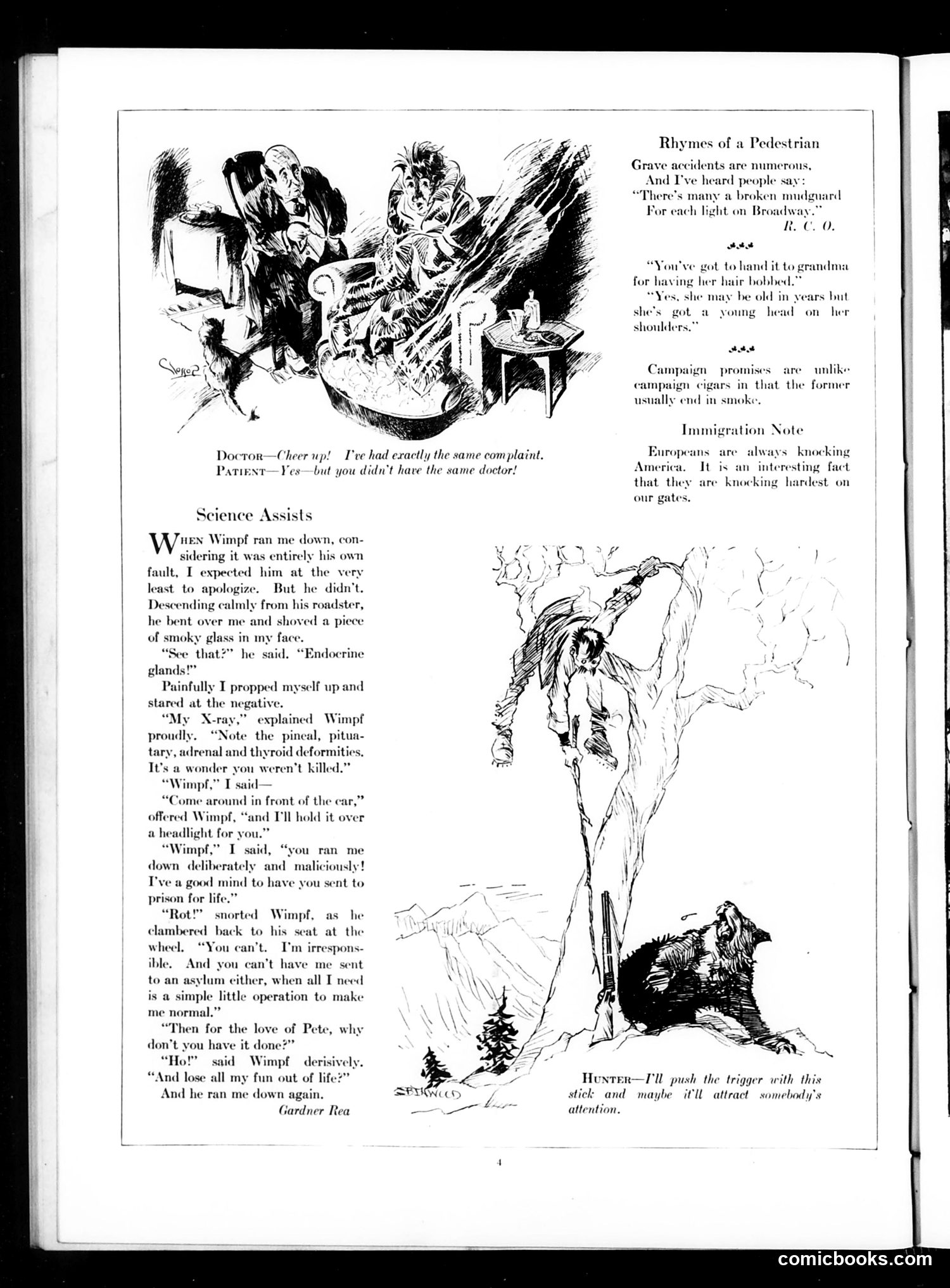
**Top Cartoon:** A doctor reassures a patient that despite identical complaints, they have different doctors—a joke about medical repetition and the proliferation of practitioners. **"Rhymes of a Pedestrian":** Brief satirical verses about street accidents and urban dangers. The reference to "broken mudguard / For each light on Broadway" suggests early automobile traffic hazards in New York City. **"Immigration Note":** Social commentary suggesting Europeans criticize America while seeking entry—a jab at immigrant complaints about American conditions despite their desire to immigrate. **"Science Assists":** A humorous anecdote about a doctor (Wimpf) who runs down the narrator, then shows an X-ray of "endocrine glands" as scientific justification. The satire mocks pseudo-scientific excuses for reckless behavior. **Bottom illustration:** Appears unrelated—possibly accompanying separate content about hunting.
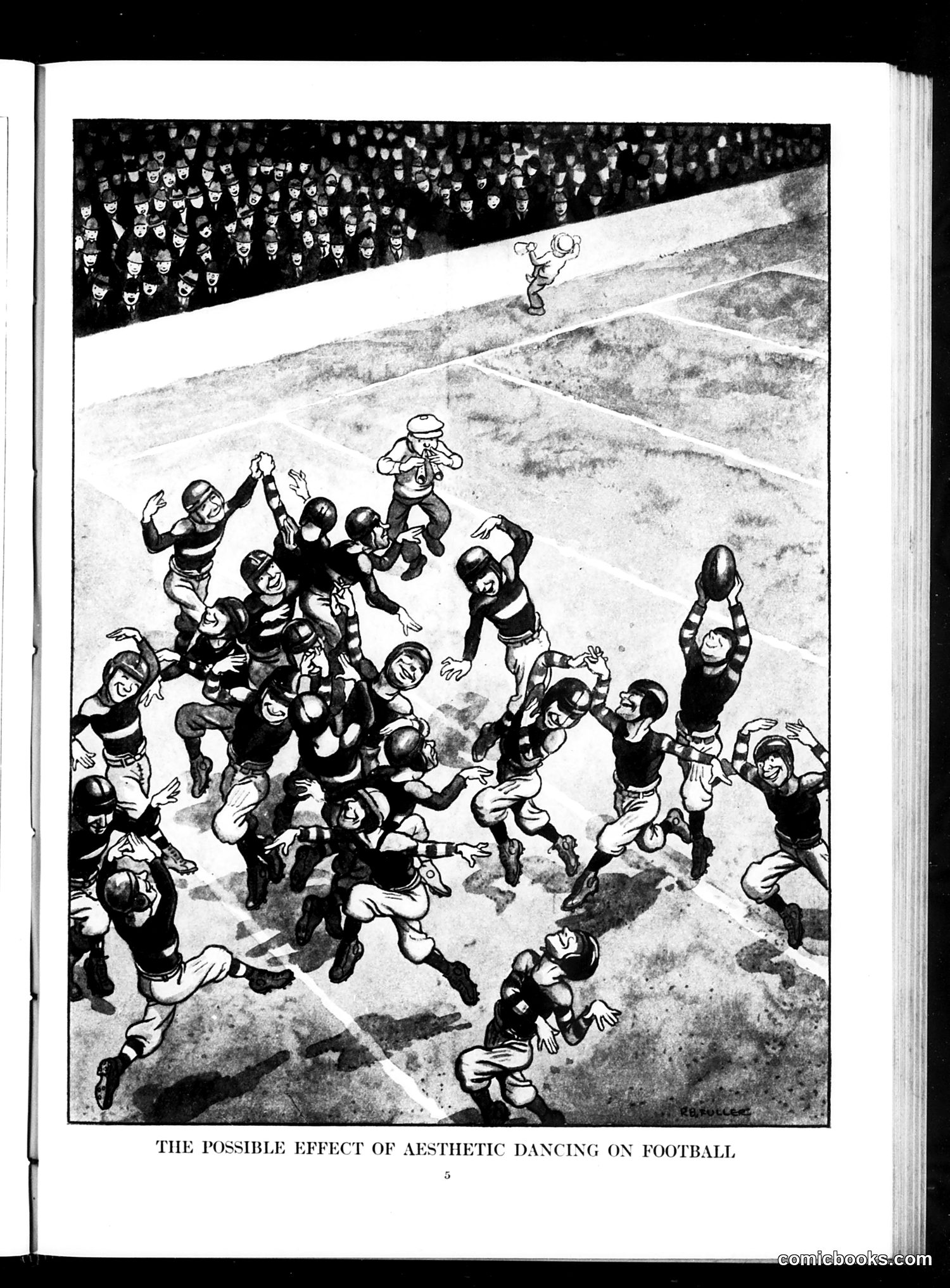
This satirical cartoon mocks the early 20th-century craze for "aesthetic dancing"—a modernist dance movement emphasizing artistic expression over traditional forms. The caption's ironic title suggests what might happen if football players adopted these graceful, interpretive movements instead of the sport's standard rough-and-tumble physicality. The image shows football players in a chaotic, ballet-like heap—striking exaggerated poses and gestures rather than engaged in actual athletic play. Spectators in the upper left observe the absurdity. The joke targets contemporary anxieties about artistic modernism as effete and incompatible with masculine sports. By depicting footballers performing "aesthetic dancing," the cartoon ridicules both the dance movement and fears that "highbrow" culture threatened traditional American sporting values.
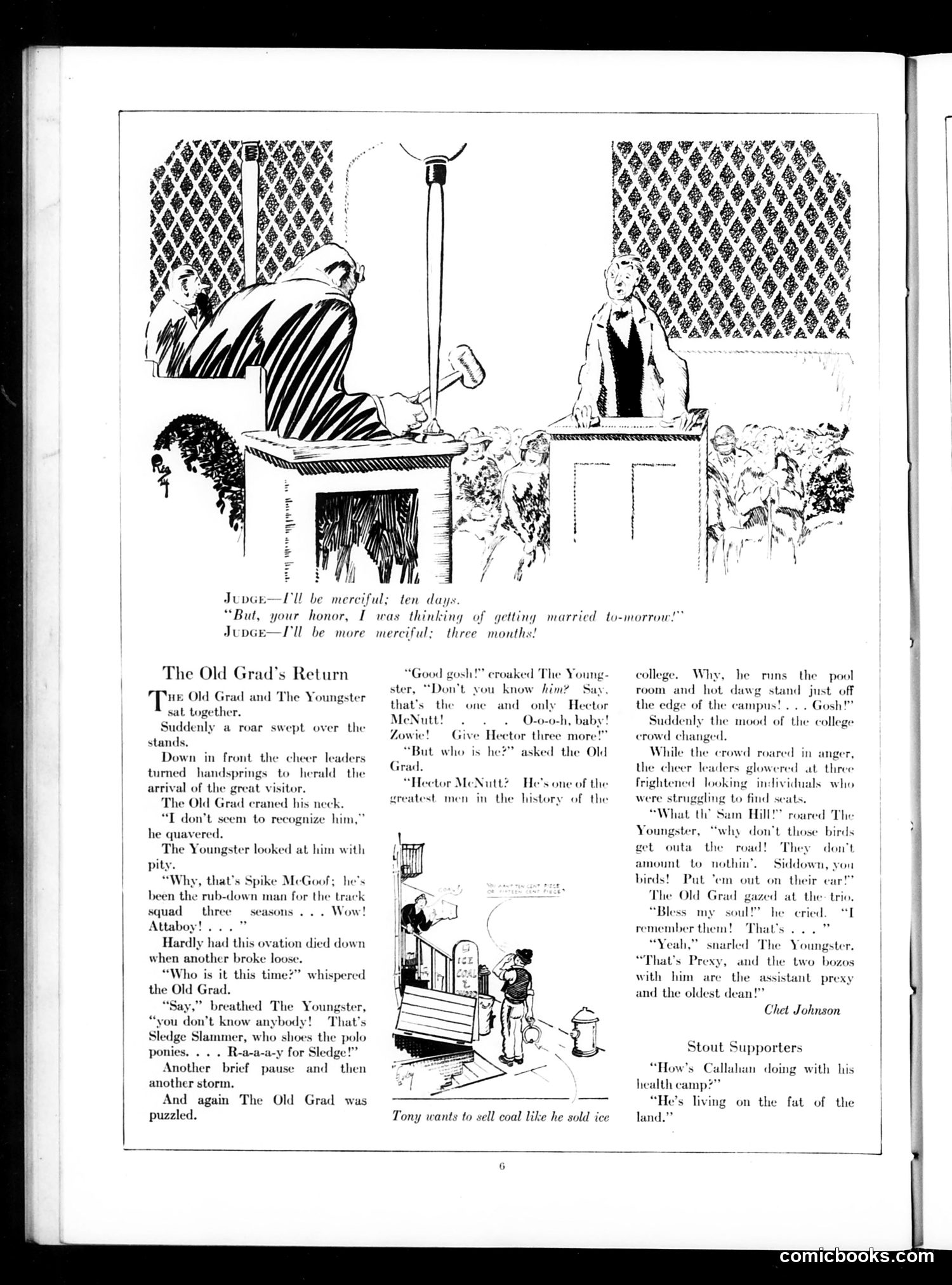
This satirical piece mocks how college communities celebrate the *wrong* people. An elderly alumnus attends a football game expecting to cheer for distinguished visitors, but the crowd erupts in wild ovations for campus *workers*—a track team rub-down man (Spike McGoof), a polo pony shoer (Sledge Slammer), and a pool-room operator (Hector McNutt). The joke's twist: when the *actual* college leadership appears (the President and deans), the crowd boos and demands they leave, telling them to "get outa the road." The satire criticizes misplaced college priorities—celebrating minor functionaries while dismissing institutional leaders. It suggests that student and alumni enthusiasm is directed at trivial or amusing figures rather than genuine authority or academic purpose. The Old Grad's confusion underscores how values have inverted at the modern university.
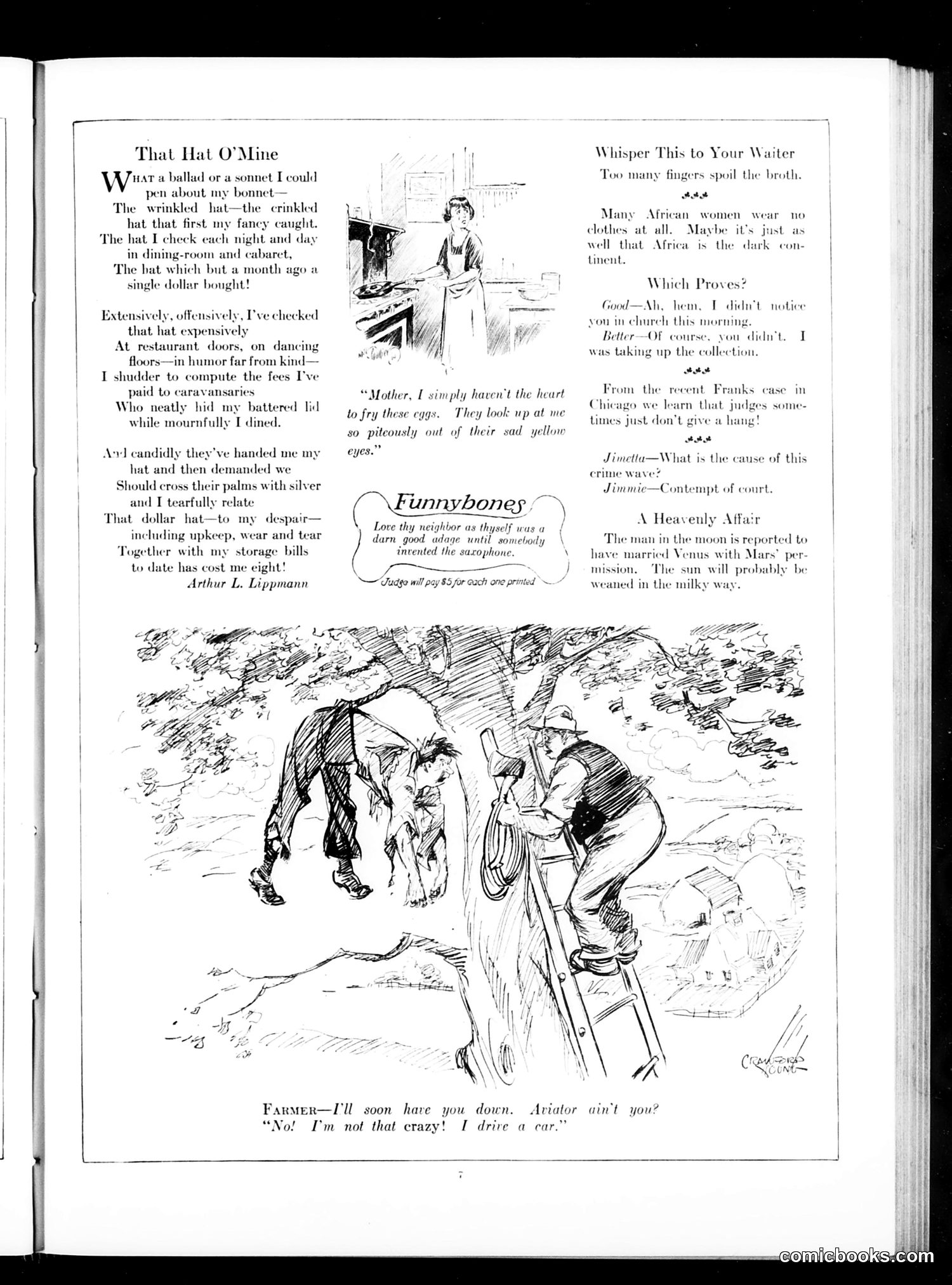
This page contains several humorous short pieces typical of early 20th-century American satirical magazines: **"That Hat O'Mine"** is a comic poem by Arthur L. Lippmann about the hidden costs of hat maintenance—checking and storage fees at restaurants and cabarets that transform a one-dollar hat into an eight-dollar expense. It satirizes the emerging service economy and tipping culture. **The main cartoon** shows a farmer and aviator at a well or pit, with the farmer saying he'll "soon have you down" while the aviator insists he drives a car, not being "that crazy." This appears to mock early aviation skepticism and the rivalry between new transportation technologies (planes vs. automobiles). **"Funnybones"** contains brief one-liners: complaints about saxophone noise, a joke about consciences regarding eating eggs, and observations about African clothing and American crime. The satire targets emerging modern anxieties—service industry costs, new technologies, and social changes—through gentle humor rather than sharp political commentary.
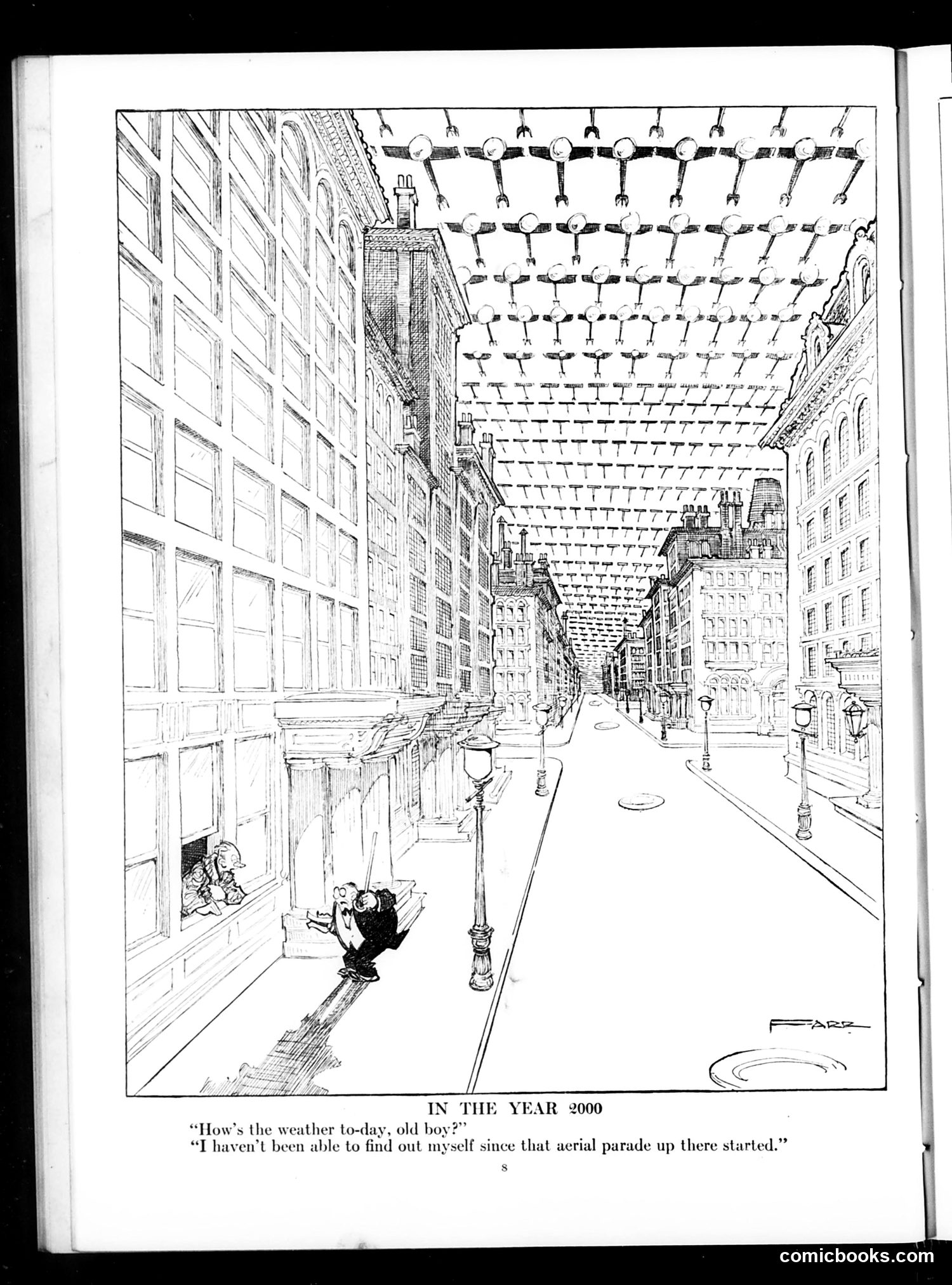
This is a futuristic satire titled "In the Year 2000." The cartoon depicts an urban street covered entirely by overhead electrical lights or aerial vehicles in dense formation, blocking out the sky. Two figures converse below, where one complains he cannot determine the weather because an "aerial parade" overhead obscures the sky. The joke satirizes rapid technological advancement and urbanization. The cartoonist imagines a future so crowded with aerial traffic or electrical infrastructure that it literally blocks natural light and weather observation. This reflects early 20th-century anxieties about technology overwhelming human experience and the natural world. The humor lies in the absurdist image of progress creating such extreme conditions that basic activities become impossible—a common theme in satirical "future predictions" of this era.
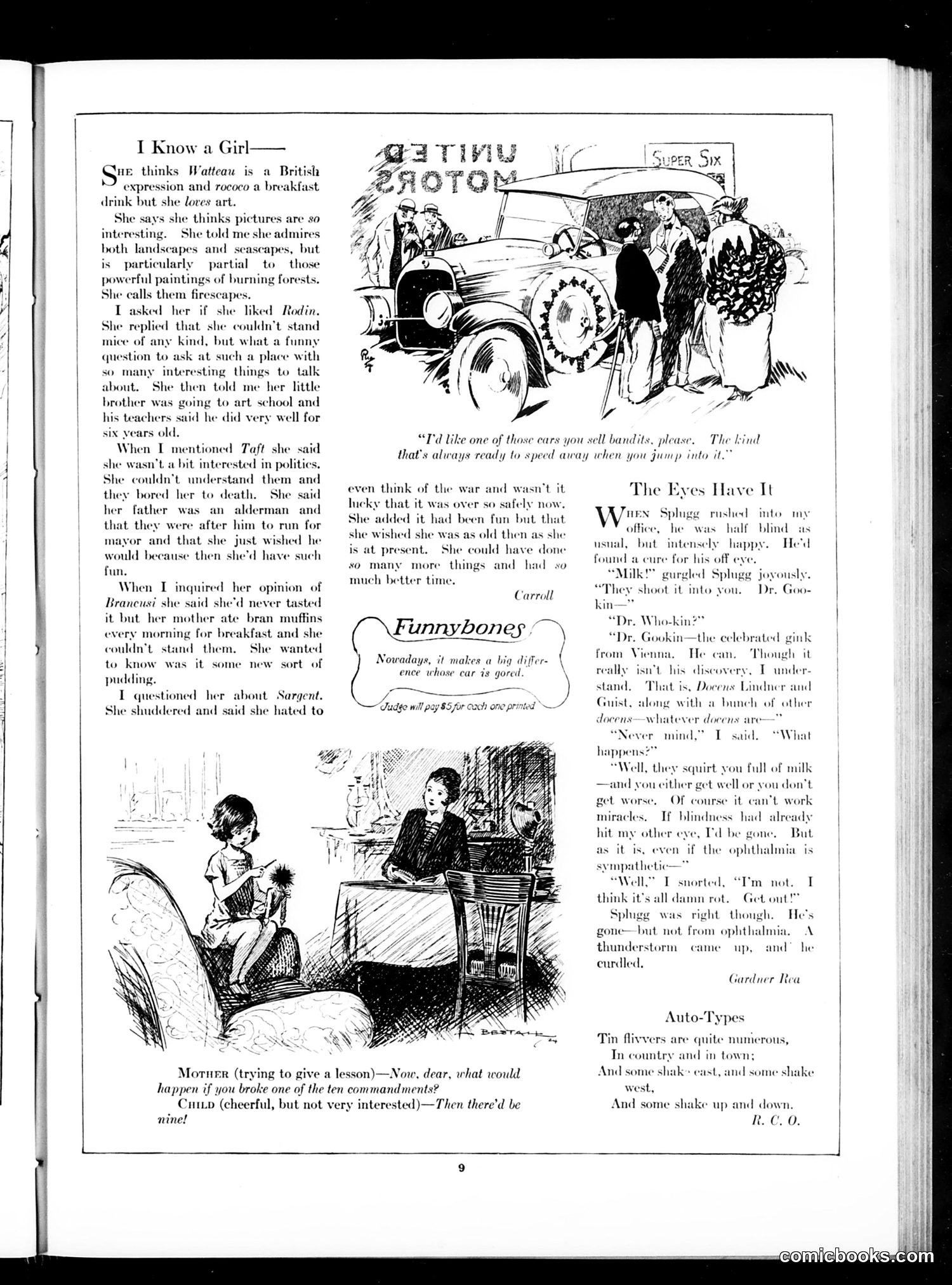
This page from *Judge* magazine contains several satirical pieces mocking early 20th-century cultural attitudes: **"I Know a Girl"** ridicules a woman who confuses art terminology with food/health topics—mistaking Watteau (French painter) for British slang, rococo for a breakfast drink, and Rodin (sculptor) for rodents. The joke targets upper-class pretension: she loves "art" but understands nothing about it. References to Taft (President William Howard Taft) and Sargent (painter John Singer Sargent) suggest contemporary figures. **"The Eyes Have It"** satirizes dubious medical treatments—squirting milk into eyes as an eye-cure. The humor relies on the absurdity of quack medicine and the patient's naive faith in it. **"Auto-Types"** and the car cartoon mock early automobiles ("tin flivvers") and bandit getaway vehicles, reflecting contemporary crime concerns and the newfound mobility cars enabled. The overall tone mocks cultural ignorance, medical charlatanism, and modern anxieties about new technology.
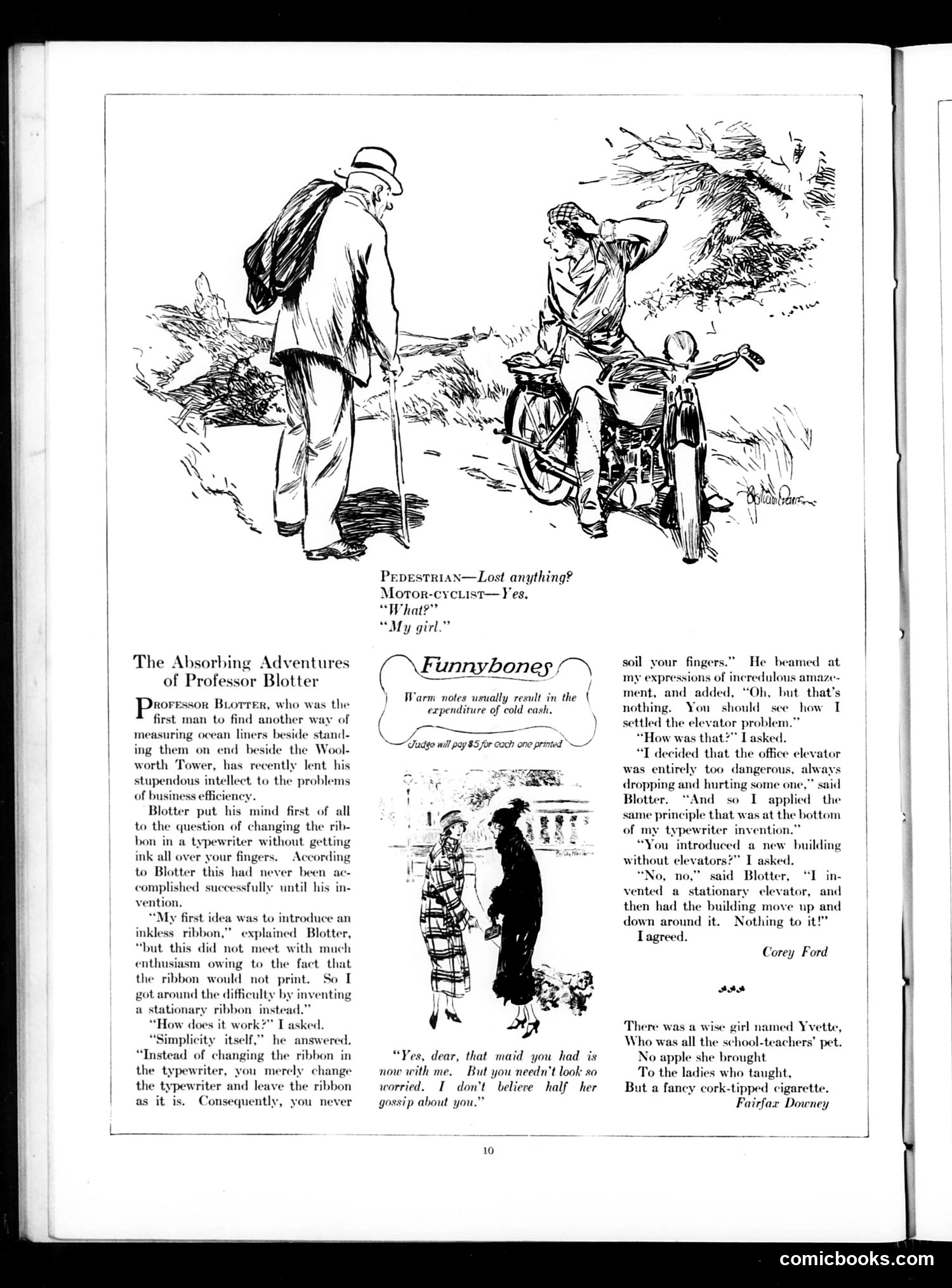
This page contains two distinct pieces from Judge magazine: **"The Absorbing Adventures of Professor Blotter"** is a humorous story mocking absurd "business efficiency" schemes. Professor Blotter supposedly solves workplace problems through circular logic—for the typewriter ribbon issue, he proposes changing the typewriter instead of the ribbon; for dangerous elevators, he invents a "stationary elevator" and moves the building around it instead. The satire targets early-20th-century management consultants and their often ridiculous "solutions" to simple problems. **The cartoon at top** shows a motorist telling a pedestrian he's lost his girlfriend—a joke about the era's new motorcycle culture and romantic entanglements. **"Funnybones"** and the poem about Yvette are brief, unrelated gags: one about expensive romantic gestures, the other a mildly risqué poem about a schoolgirl giving cigarettes rather than apples to teachers—poking fun at changing social norms regarding women and smoking.
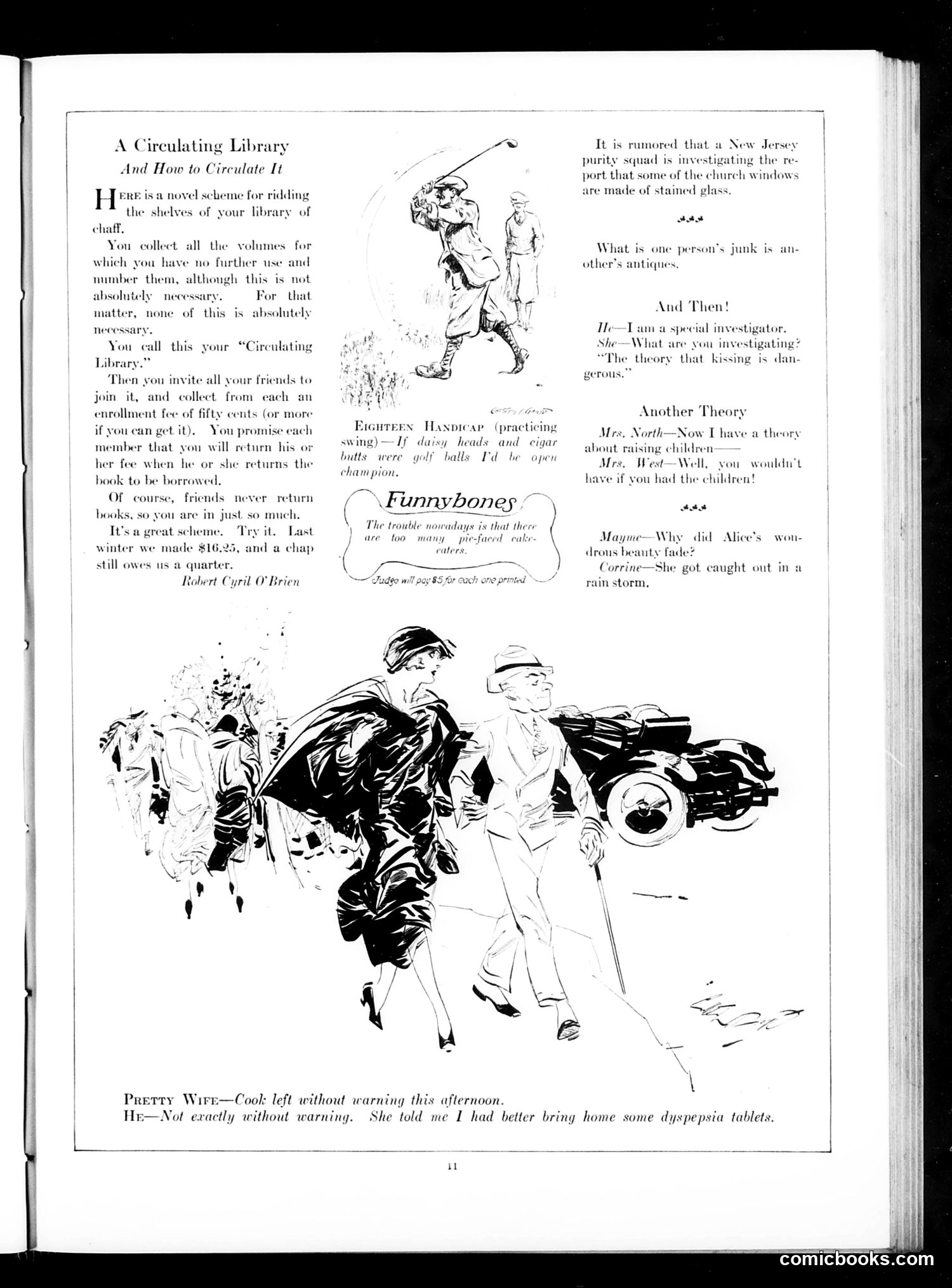
This page from the satirical magazine **Judge** contains three distinct humor pieces typical of early 20th-century American comedy: **"A Circulating Library"** satirizes a common social practice: lending books to friends. The scheme humorously exploits the reality that borrowed books are never returned—the author admits collecting $1.25 in fees while still owed a quarter, making a dubious "profit" from friends' dishonesty. **"Funnybones"** is a brief joke about golf: a poor golfer claims that if everyday objects (daisy heads, cigar butts) counted as golf balls, he'd be excellent—mocking his actual incompetence. The remaining short jokes target: - A New Jersey "purity squad" investigating whether church windows contain stained glass (implying stained glass is considered scandalous or worldly) - Married life absurdities (wives leaving without warning; the importance of antacids) - Beauty fading from weather exposure The illustrations depict a golfer and motorists, matching the text content. The humor relies on domestic observational comedy and gentle social satire typical of Judge's audience.
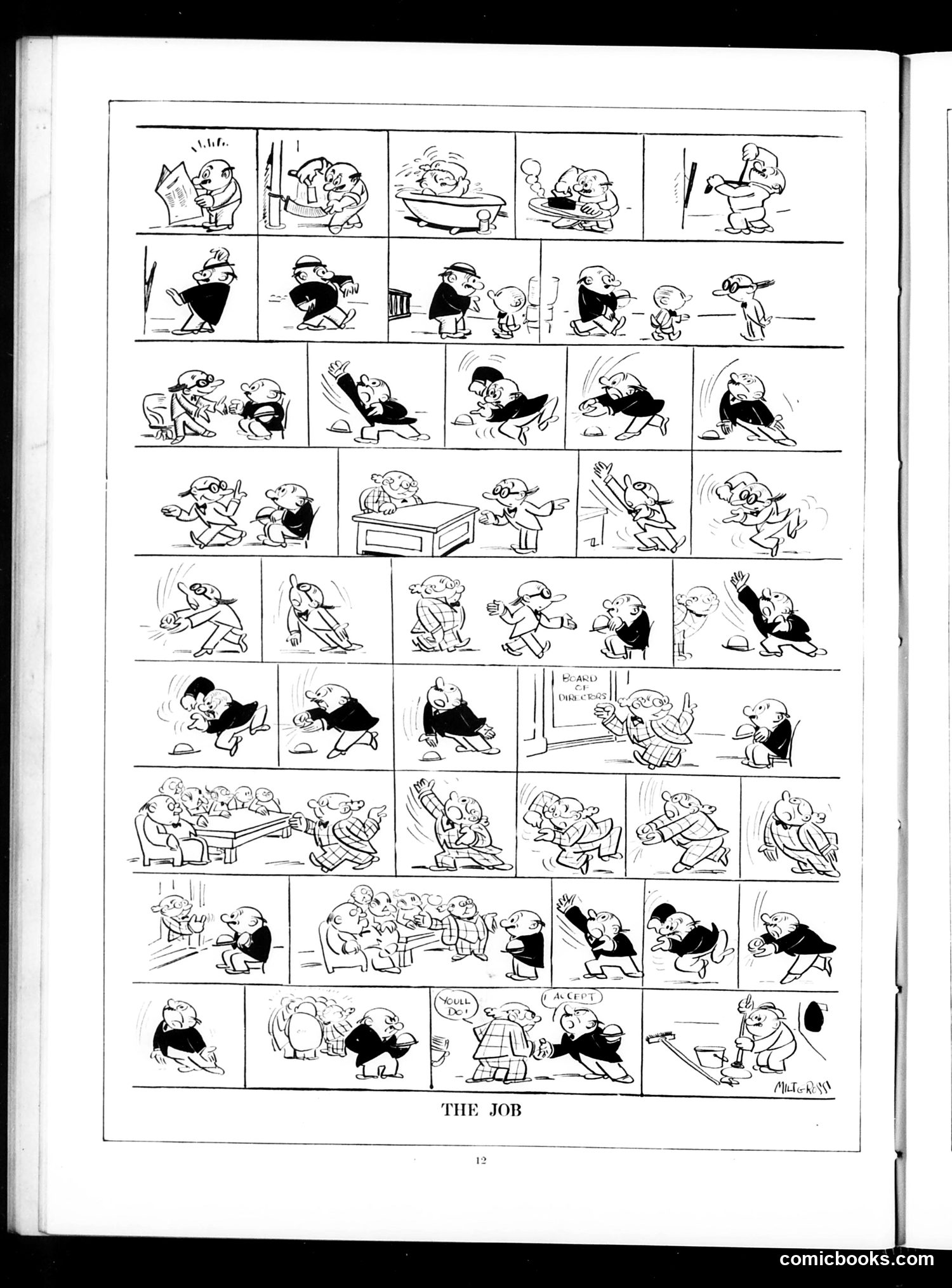
This is a wordless comic strip depicting a working man's struggles through various forms of manual labor and employment. The sequence shows a character attempting different jobs—reading newspapers for opportunities, working in construction, bathing, moving furniture, gardening, and other laboring tasks. The satire appears to comment on **working-class employment instability** and the difficulty of finding stable work. Each panel shows the character either struggling, failing, or being displaced from jobs, suggesting commentary on **economic hardship and job insecurity**—likely reflecting Depression-era or post-Depression American anxieties about employment. The final panels show the character with supervisors or authority figures, possibly satirizing workplace power dynamics and exploitation of laborers. The title "THE JOB" ironically encompasses the broader struggle of finding and maintaining employment itself.
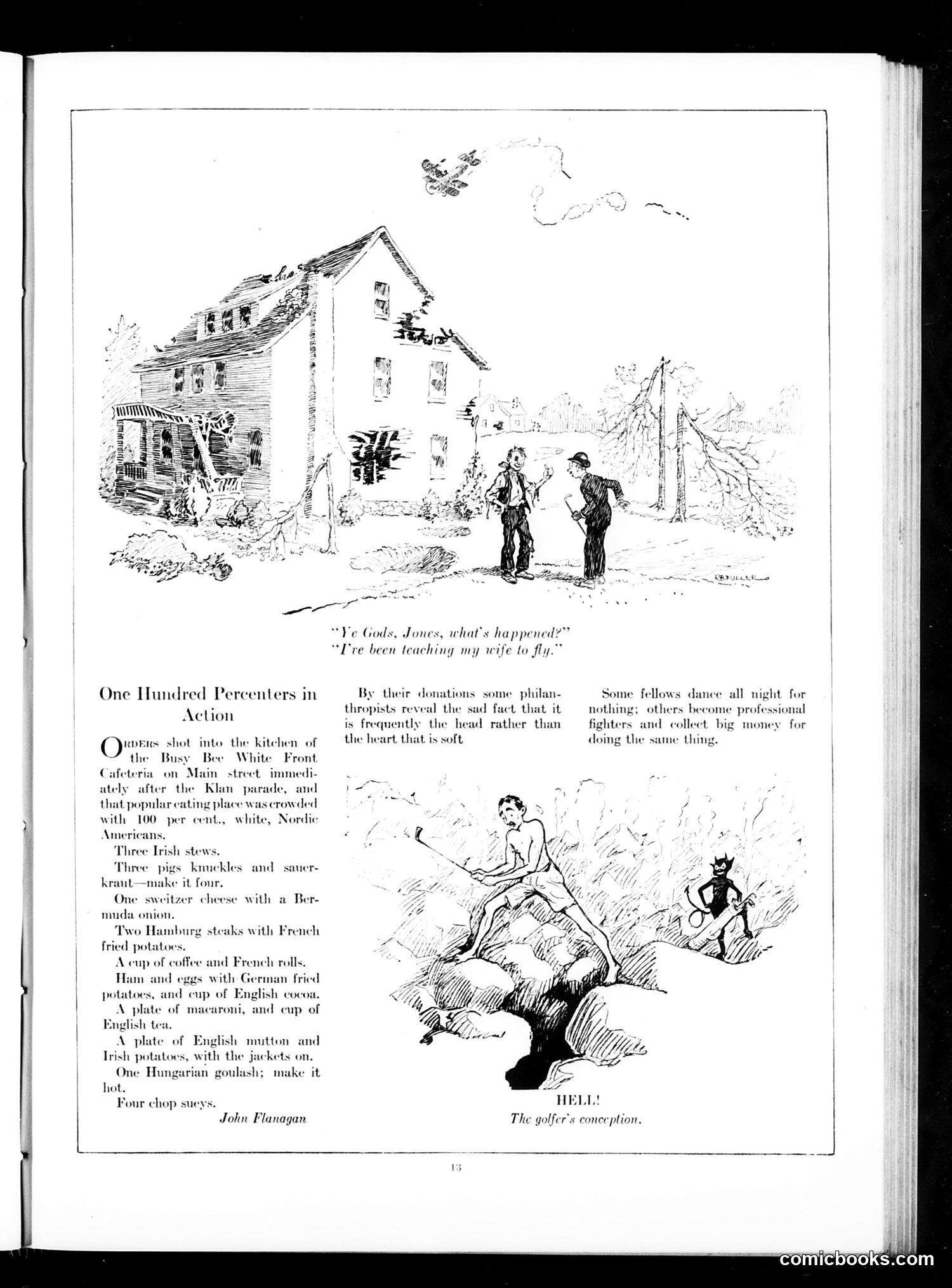
This Judge magazine page satirizes the hypocrisy of "100 Percenters"—white supremacists and KKK members who claimed to champion "Nordic Americans" and ethnic purity. The top cartoon shows two men discussing a wife learning to "fly," likely a euphemism for infidelity or scandal. The main satire is the restaurant menu: despite the cafeteria being "crowded with 100 per cent., white, Nordic Americans" after a Klan parade, the orders reveal the supposed ethnic purity is a sham. Patrons order **Irish stews, Swiss cheese, Hamburg steaks, French fries, German fried potatoes, English mutton, Hungarian goulash, and Chinese chop suey**—dishes from the very immigrant groups the Klan despised and discriminated against. The joke exposes the contradictions of nativist ideology: these self-proclaimed defenders of American racial purity eagerly consumed and embraced the foods and cultures of immigrants they publicly rejected. Their intolerance couldn't survive basic appetite. The bottom cartoon about "the golfer's conception" of Hell appears unrelated to the main satire.
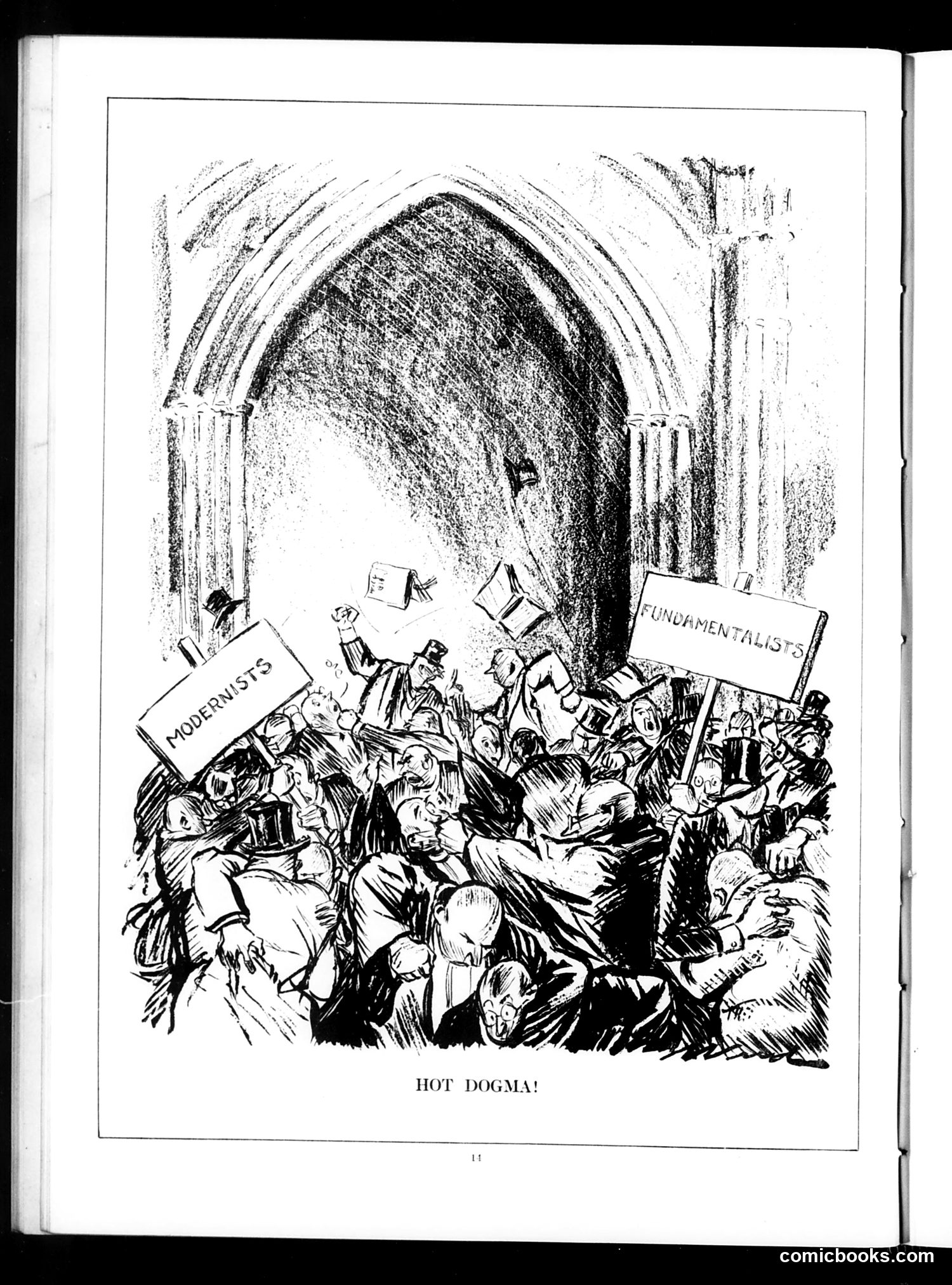
This cartoon satirizes conflict between religious modernists and fundamentalists in early 20th-century America. A large crowd of figures holding signs labeled "MODERNISTS" and "FUNDAMENTALISTS" are depicted arguing inside what appears to be a church (suggested by the Gothic arch). The clash between these two groups—those advocating religious adaptation to contemporary thought versus those defending traditional doctrine—is portrayed as heated dispute within the institutional church itself. The title "Hot Dogma!" puns on "hot dog" while referencing the inflammatory theological debates of the era. The cartoon critiques how bitter these disagreements had become, literally tearing at the church from within. This reflects the actual "Modernist-Fundamentalist Controversy" dominating American Protestantism during the 1920s-1930s.
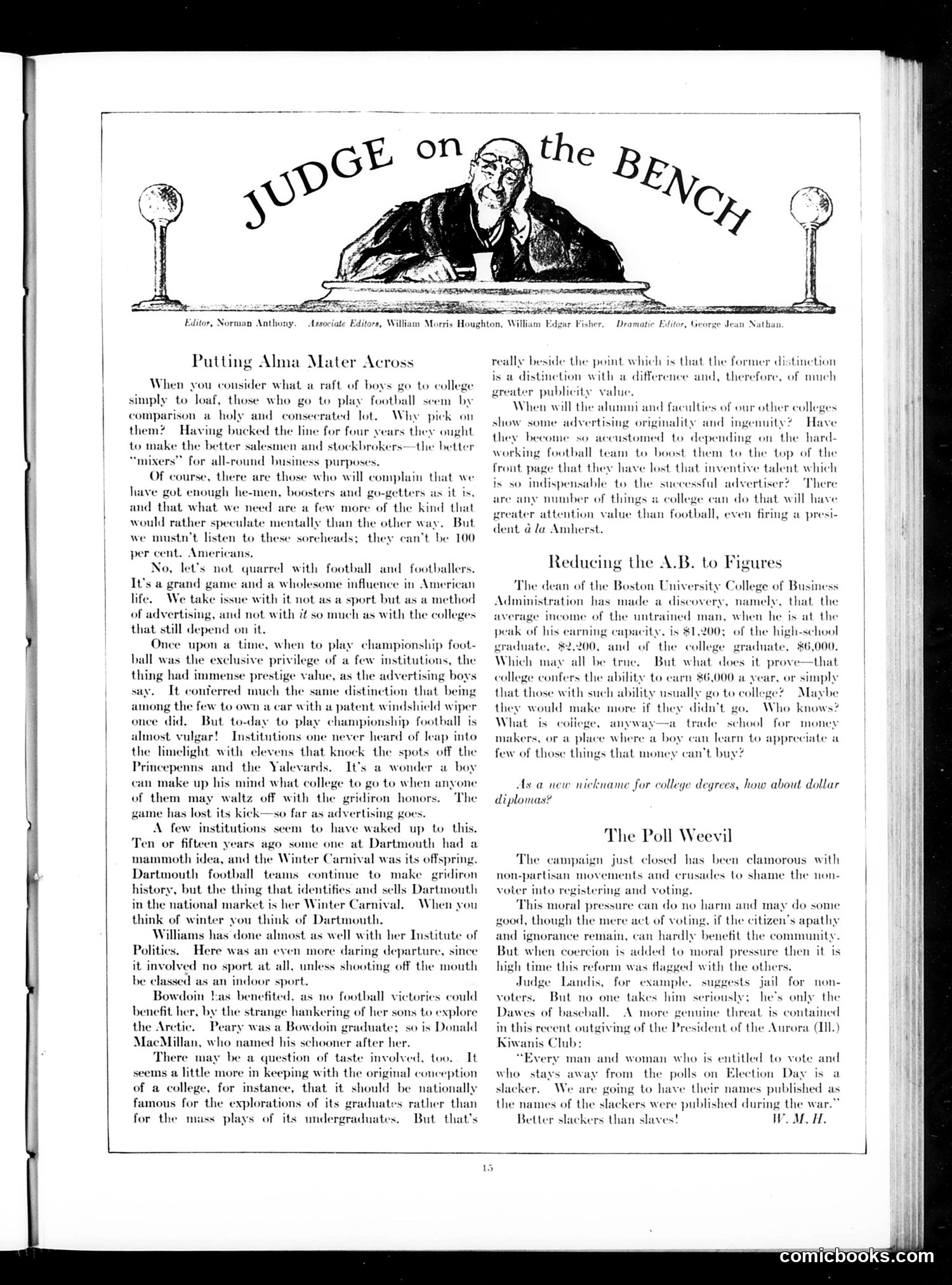
The main article criticizes how American colleges use football as their primary form of advertising and prestige-building. The author argues that when football was exclusive to a few institutions, it conferred genuine distinction. However, now that many colleges field competitive teams ("institutions one never heard of"), football has lost its advertising value and become vulgar. The piece advocates for colleges to instead develop unique, non-athletic marketing angles—pointing to examples like Dartmouth's Winter Carnival and Williams' Institute of Politics. The satire targets colleges' lazy dependence on football for national visibility, suggesting they lack the "advertising originality and ingenuity" to promote themselves through distinctive intellectual or cultural endeavors. The underlying critique appears to be that American higher education prioritizes commercial marketing and sports reputation over genuine academic distinction.
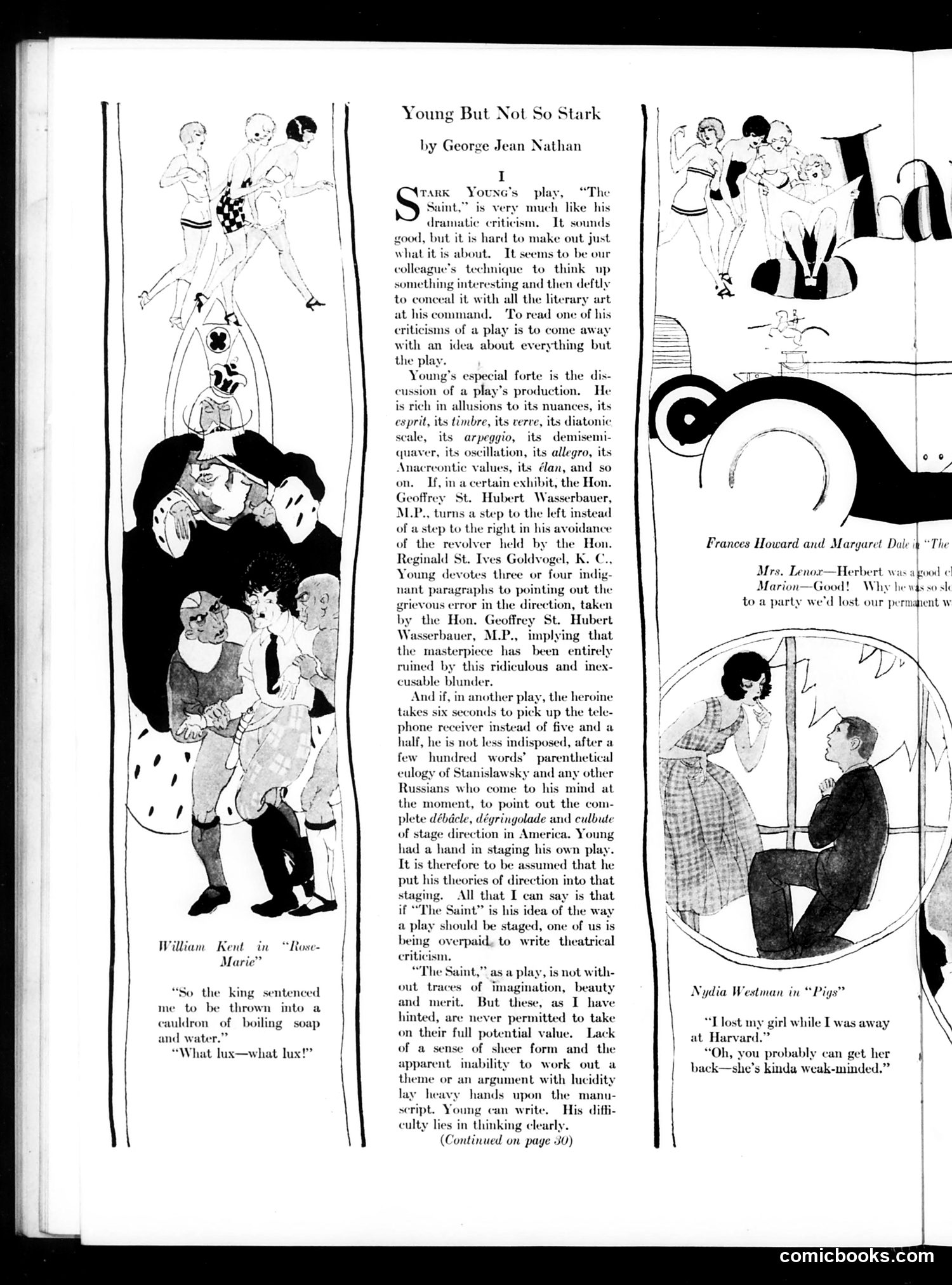
This page contains a theater review essay by George Jean Nathan (a prominent drama critic of the era) critiquing playwright Frank Young's play "The Saint." Nathan satirizes Young's reviewing style and dramatic work through mockery: Young, he claims, obscures rather than clarifies meaning, drowning productions in pretentious musical and theatrical terminology (esprit, timbre, dégringolade, etc.) while missing the play itself. Nathan further ridicules Young's nitpicking—complaining when actors take six seconds instead of five to pick up a telephone—as absurd overanalysis that ignores actual artistic merit. The accompanying illustrations show theatrical scenes, including William Kent in "Rose-Marie" and Nydia Westman in "Pigs," with humorous captions. The page represents Judge's characteristic blend of satirical theater criticism and entertainment gossip aimed at urban, culturally-aware readers.
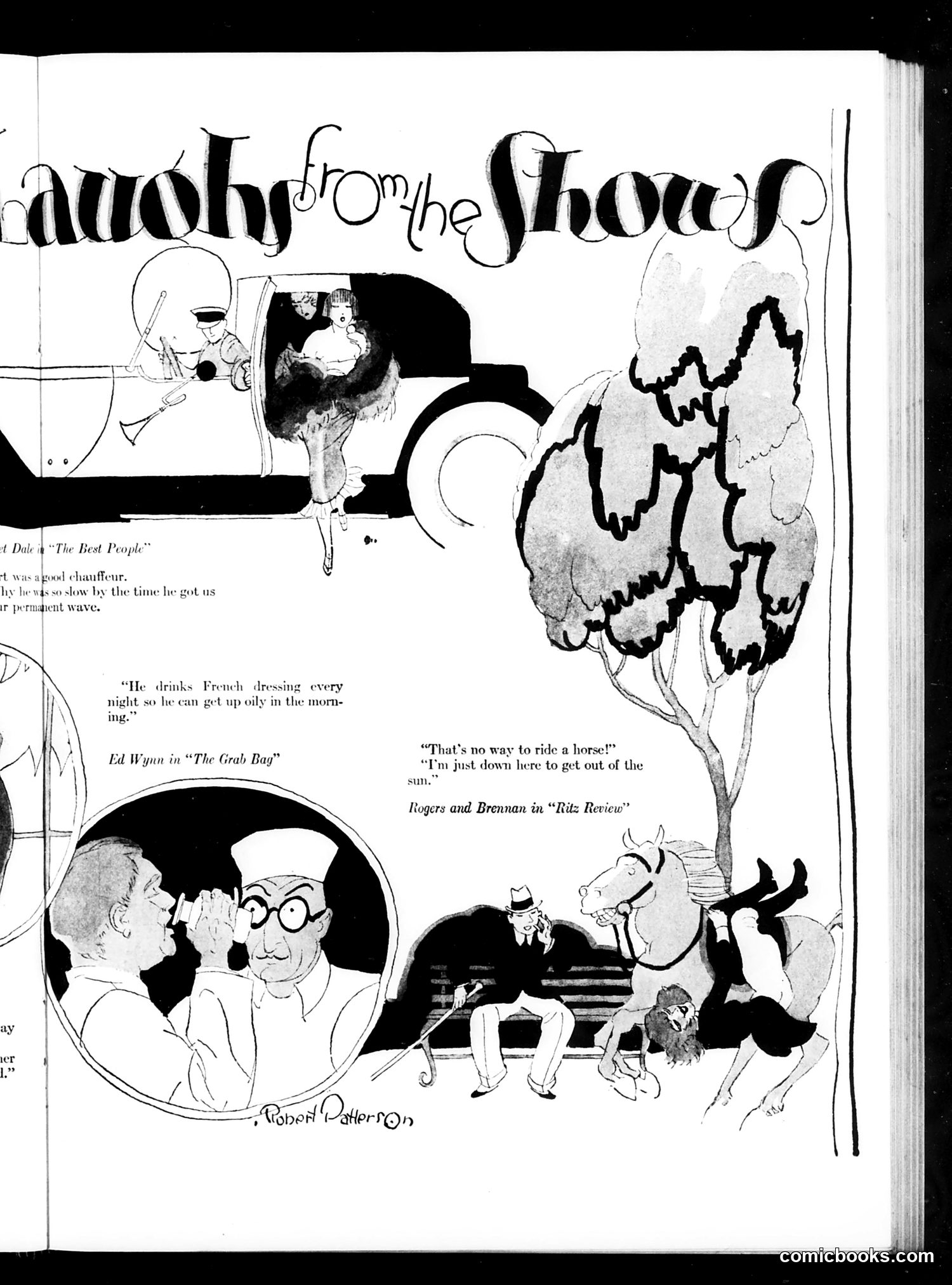
This page collects satirical vignettes mocking wealthy "best people" and their affectations. The top cartoon shows a fashionable woman with her chauffeur and car—the joke being about servants indulging their employers' vanity (the permanent wave reference). The middle quote jokes that someone drinks French dressing nightly to wake up "oily"—satirizing pretentious, affected behavior among the elite. The bottom scene, credited to Rogers and Brennan in "Ritz Review," depicts a man on a horse claiming he's avoiding the sun—absurd excuse-making by the wealthy. The large tree suggests irony: despite being outdoors specifically to escape sun, he positions himself under shade. Overall, the page mocks the superficiality, poor reasoning, and ridiculous vanity of the upper class, a common Judge magazine theme.
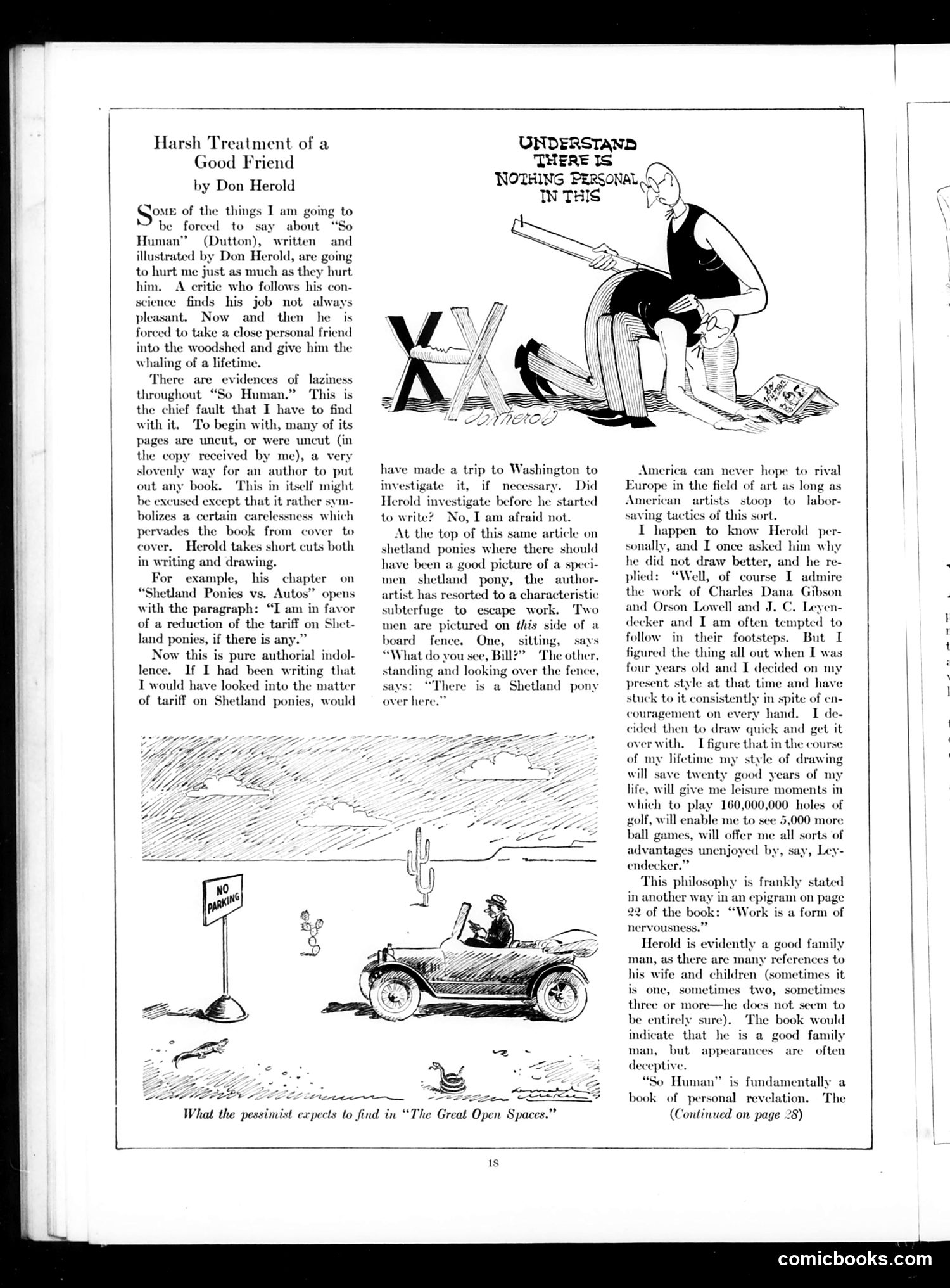
This is a book review of Don Herold's illustrated collection "So Human" (published by Dutton). The critic—writing as a "close personal friend"—attacks Herold for lazy craftsmanship: uncut pages, insufficient research (e.g., not actually investigating tariff policy on Shetland ponies), and deliberately simplistic drawing style. The cartoons illustrate Herold's shortcuts. The top image shows a spanking scene emphasizing the harsh critique. The bottom cartoon depicts what a pessimist expects in "The Great Open Spaces"—an absurdist desert scene with a "No Parking" sign, mocking Herold's tendency toward lazy, throwaway gags rather than genuine artistic effort. The reviewer quotes Herold's own (likely self-aware) admission that he deliberately chose a quick drawing style at age four to save time for golf and other leisure—essentially confessing to prioritizing pleasure over artistic excellence. The satire suggests American art suffers when talented artists choose expediency over European standards of craftsmanship.
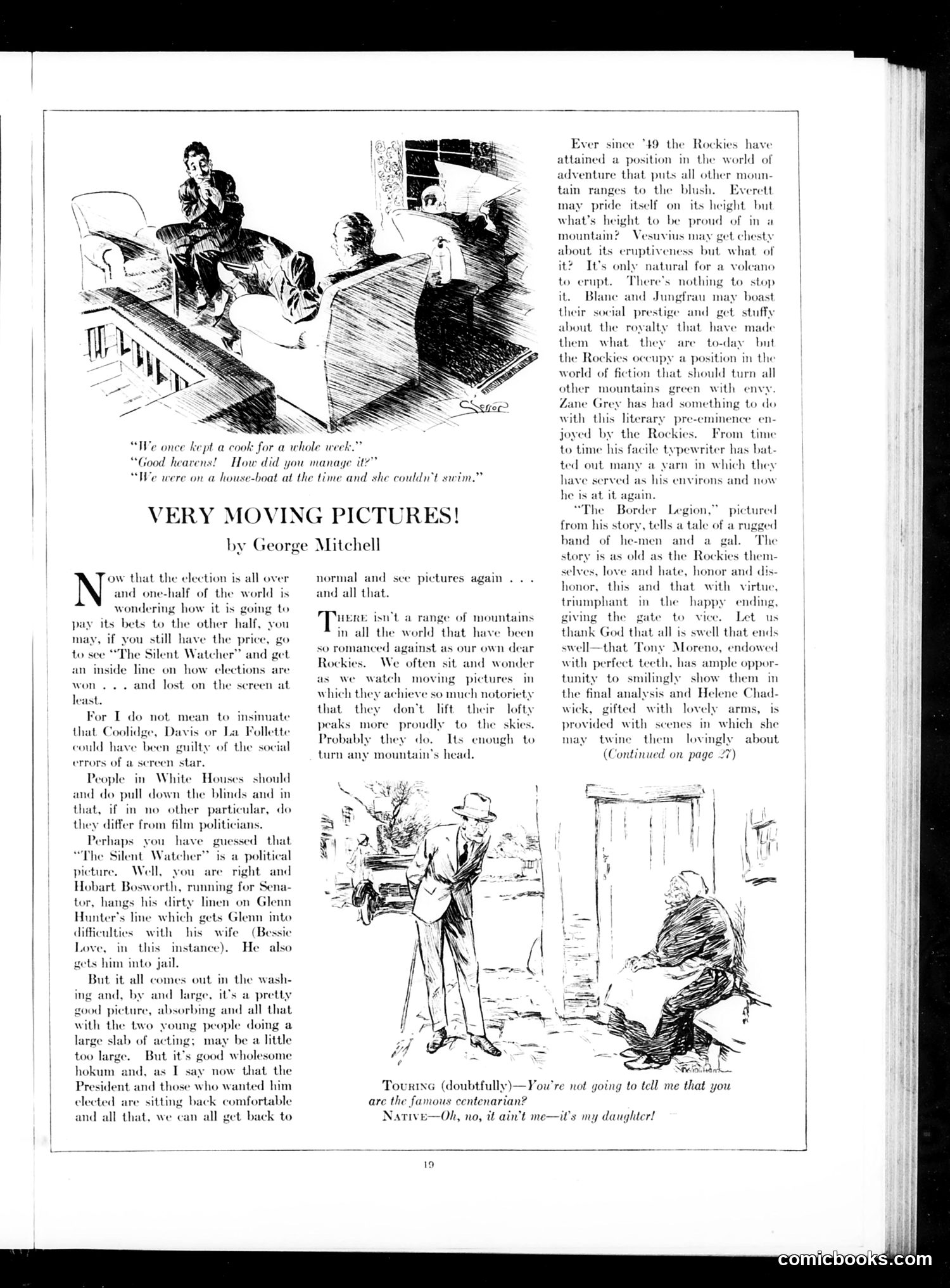
This page reviews two films through a satirical lens relevant to 1924 America. **"The Silent Watcher"** is a political melodrama where a senatorial candidate (Hobart Bosworth) hangs compromising laundry on a neighbor's clothesline, creating scandal. Mitchell jokes that real politicians—unlike movie ones—actually *hide* their dirty laundry behind closed doors. The satire mocks how Hollywood dramatizes politics while the actual 1924 election (recently concluded) involved real candidates like Coolidge, Davis, and La Follette engaged in actual backroom dealings. **"The Border Legion"** and other films exploit the Rocky Mountains as scenic backdrop for adventure narratives. Mitchell wryly notes that Zane Grey's prolific pulp fiction has given the Rockies such literary prestige that the mountains themselves should be proud. The review credits actors like Tony Moreno and Helene Chadwick with competent if formulaic romantic heroics. The humor targets Hollywood's self-importance and reliance on natural scenery and stock plots to compensate for thin storytelling.
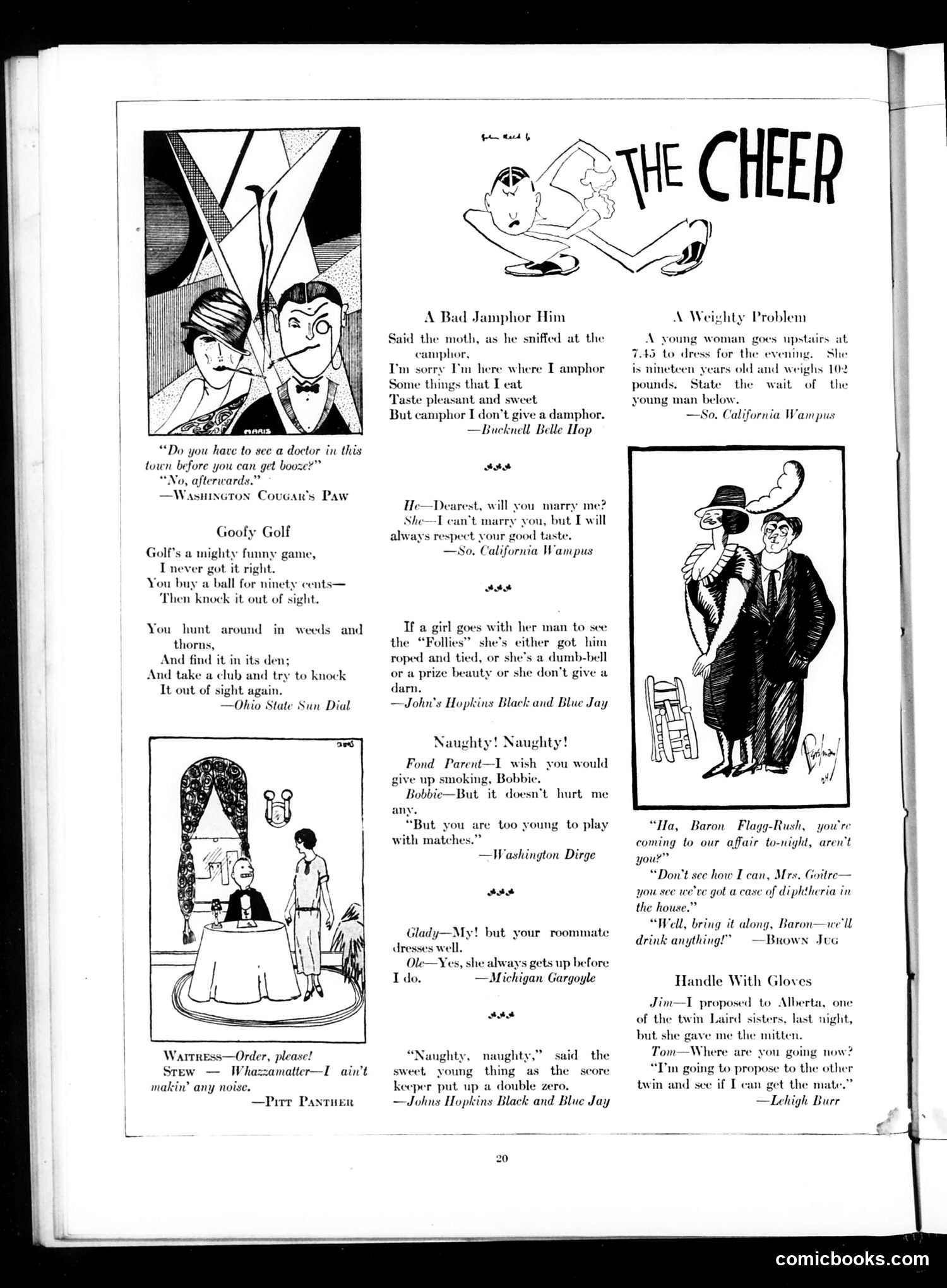
This page from *Judge* magazine collects humorous short jokes and verses organized by topic. The content reflects early 20th-century social humor: **Key recurring themes:** - **Dating/courtship humor**: Multiple jokes about young men proposing or courting women, often with rejections ("the mitten" means rejection) - **Prohibition era**: References to obtaining alcohol despite legal restrictions ("do you have to see a doctor in this town before you can get booze?") - **Gender stereotypes**: Women portrayed as weight-conscious, materialistic, or difficult; young women at entertainments ("Follies") categorized by how they've trapped men - **Youth behavior**: Smoking, matches, naughtiness—parental concern about young people's conduct - **Social embarrassment**: The "diphtheria" joke relies on guests finding any excuse acceptable for non-attendance The cartoons are light, whimsical satire targeting college-aged readers. The humor depends on period assumptions about romance, courtship conventions, and social propriety now largely obsolete.
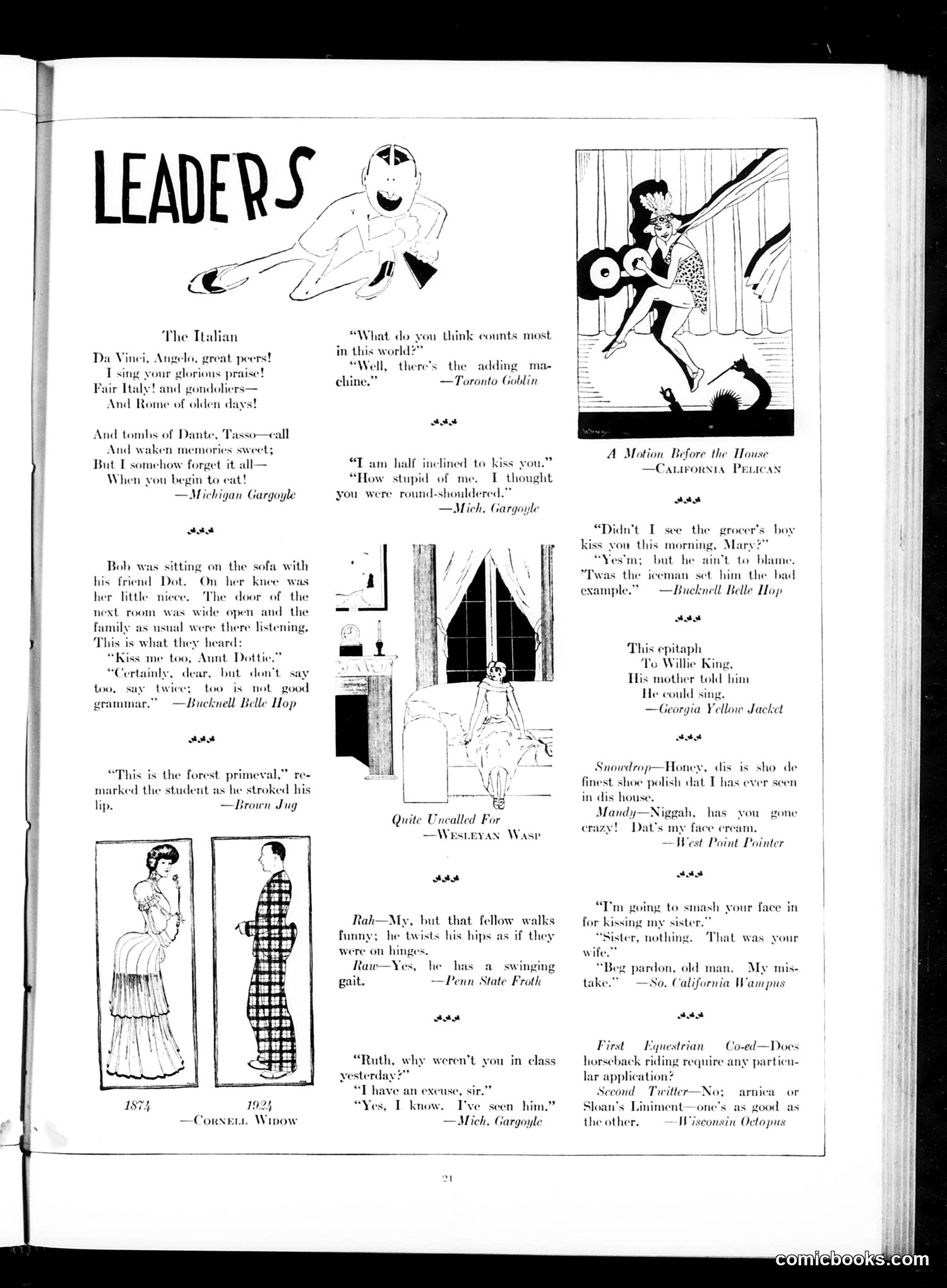
This page from *Judge* magazine collects brief humorous quotes and cartoons from various college publications, organized under the theme "LEADERS." The content is primarily **collegiate humor** rather than political satire—jokes exchanged between campus newspapers. The cartoons and quips satirize common social situations: romantic misunderstandings, disciplinary excuses, physical mannerisms, and courtship customs of the 1920s era. Notable elements: - **"A Motion Before the House"**: A flirtation scene poking fun at miscommunication between young people. - **Fashion comparison (1874 vs. 1924)**: Shows changing women's silhouettes—corseted Victorian dress versus looser 1920s styles. - **Racial dialect humor**: Period-typical offensive stereotypes ("Niggah," exaggerated dialect) reflecting the casual racism common in publications of this era. - **Campus life jokes**: References to classroom absences, dancing styles, and courtship norms. The "leaders" theme appears ironic—these aren't actual leaders but ordinary people in everyday situations, suggesting the magazine pokes fun at human nature generally rather than targeting specific figures or events.
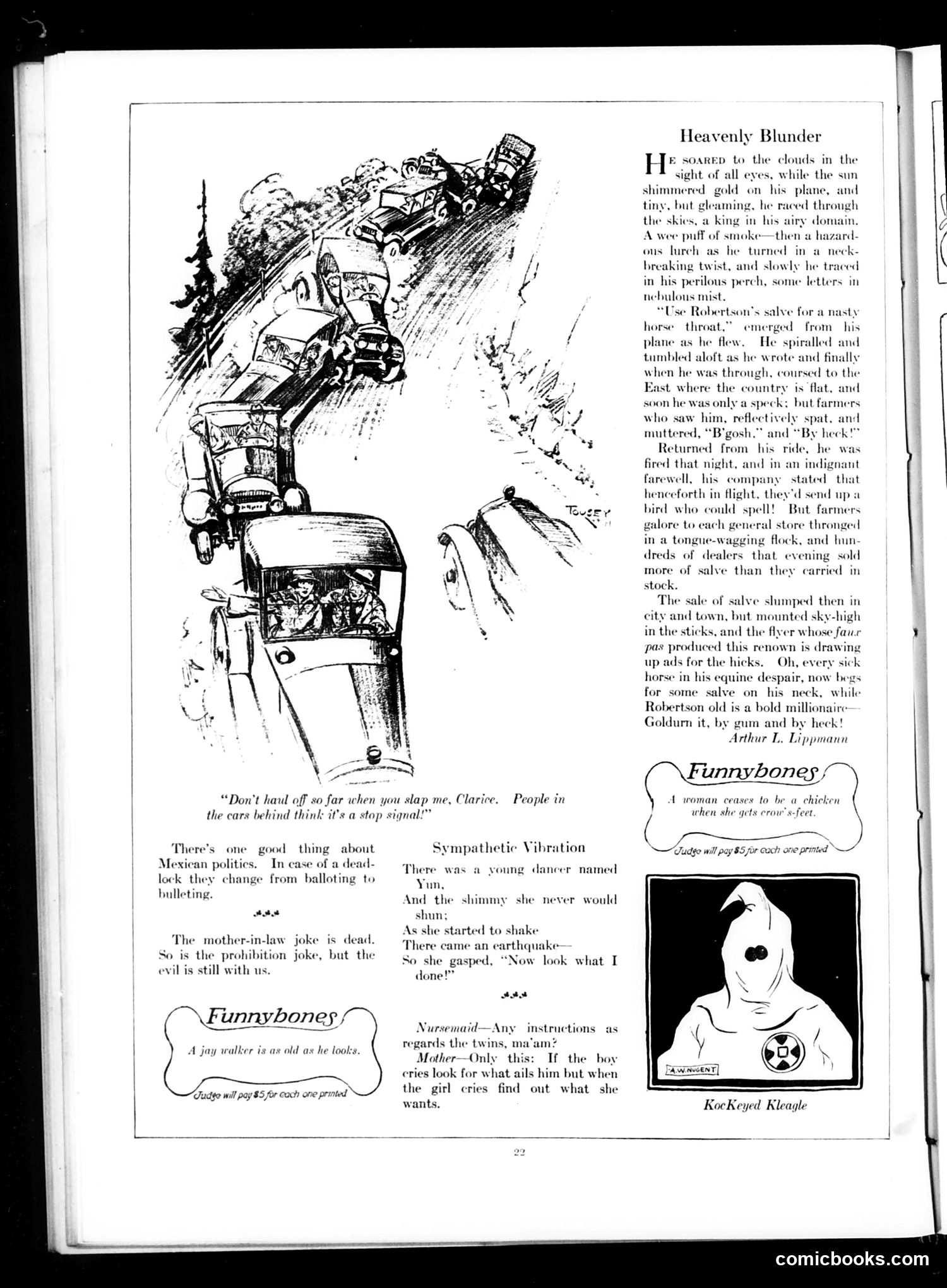
This page contains several satirical pieces typical of early 20th-century American humor: **"Heavenly Blunder"** depicts an airplane pilot skywriting an advertisement for salve. The joke: his dramatic aerial maneuvers while writing cause a crash landing; farmers see the skywritten message and spread word so effectively that salve sales skyrocket in rural areas ("the sticks"), enriching "Robertson" (the salve seller). The satire mocks both the absurdity of aerial advertising and rural gullibility. **Other items** include brief jokes about politics (balloting vs. "bulleting"—likely referencing political violence), the "shimmy" dance craze (earthquake pun), mother-in-law humor, and gender stereotypes about how boys versus girls cry. The illustration shows a chaotic stack of vehicles careening downward, supporting the "Heavenly Blunder" narrative. The page exemplifies Judge's style: visual exaggeration combined with wordplay targeting contemporary fads, social conventions, and rural/urban divides.
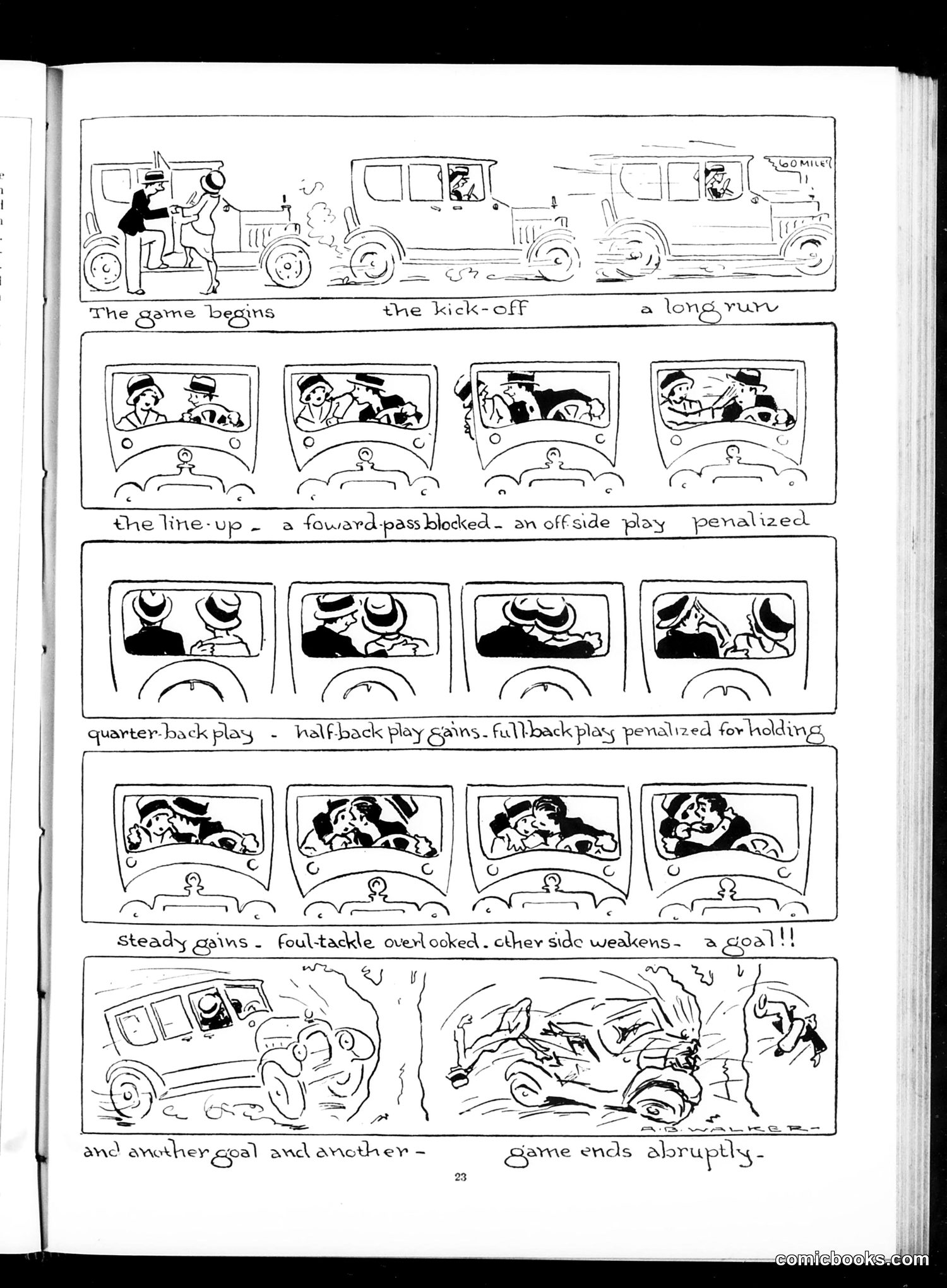
This page satirizes American football through the metaphor of automobiles. The cartoon sequences show a football game's progression—kickoff, lineup, various plays (forward pass, off-side, penalties), and concluding with a crash ending the match. The satire appears to mock football's growing complexity and rule violations rather than target specific political figures. Each panel shows cars and drivers representing players, with the vehicle metaphor emphasizing the sport's mechanical, collision-heavy nature. The humor relies on the visual pun of "running plays" depicted literally as automobiles in motion, with crashes representing tackles and collisions. The final panels show increasingly chaotic pile-ups, suggesting football devolves into mere physical brutality. This reflects early 20th-century American attitudes toward the sport's violence and developing regulatory framework.
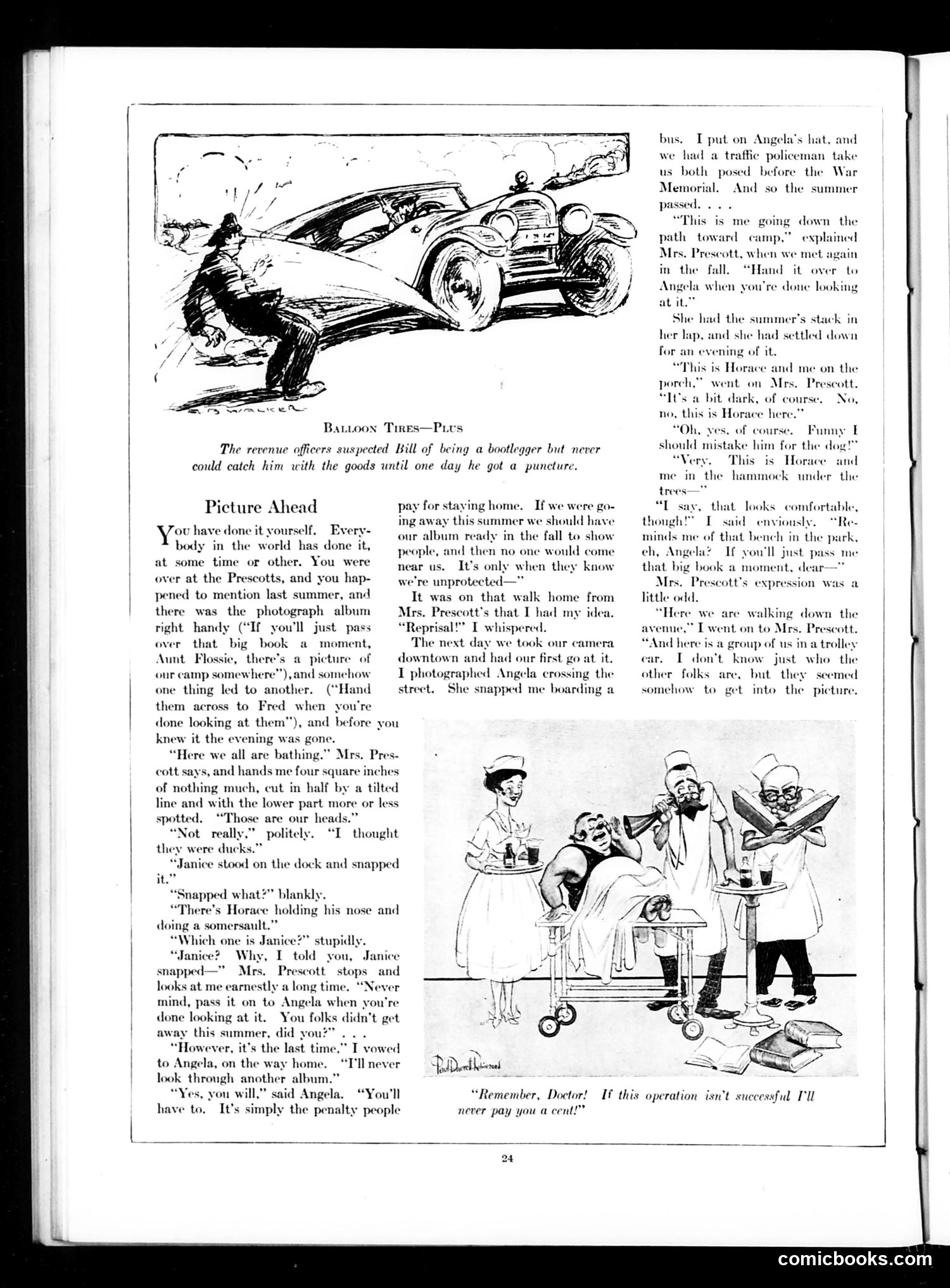
This page satirizes the tedious social obligation of viewing vacation photograph albums. The main cartoon depicts the familiar scenario: visiting friends who insist on showing endless, poorly-composed vacation photos while the hapless guest is trapped into feigned enthusiasm. The joke centers on the narrator's "reprisal"—deliberately photographing mundane, local activities (crossing streets, boarding buses, posing at a war memorial) to create their own fake "vacation album." This mocks both the social pressure to document summers away and the absurdity of people pretending ordinary moments are exotic vacation experiences. The secondary cartoon at bottom shows a surgical operation, with the caption "Remember, Doctor! If this operation isn't successful I'll never pay you a cent!"—a dark joke about medical fees and outcome-based payment. The satire reflects 1920s middle-class anxieties about status displays, photography as a new leisure pursuit, and the social performance of having had an eventful summer.
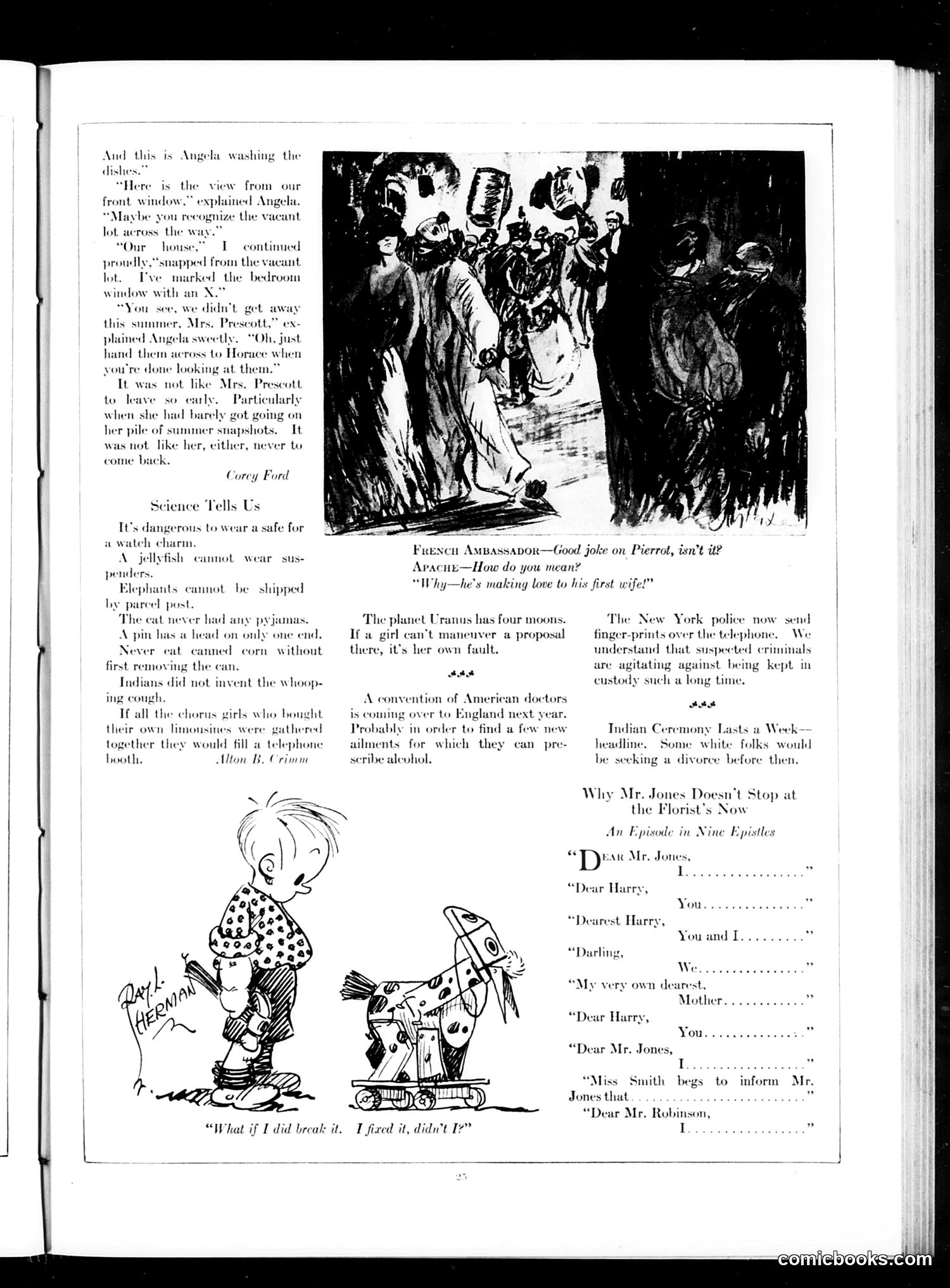
This page from *Judge* contains several brief satirical pieces typical of the magazine's format: **Main cartoon narrative** (top): A domestic humor piece where Angela shows Mrs. Prescott photographs of their summer—but Mrs. Prescott, insulted at being shown snapshots of a vacant lot rather than exotic vacation sites, abruptly leaves without returning the pictures. The satire targets middle-class summer tourism culture and social pretension. **"Science Tells Us"** section: Mock "facts" spoofing pseudo-scientific humor—jellyfish in suspenders, elephants in parcels, etc. This was common filler humor. **Lower cartoons & text**: Include mild international satire (a French ambassador's joke about infidelity), commentary on American doctors' conventions, and absurdist observations about chorus girls and Indian divorce customs. **"Why Mr. Jones Doesn't Stop at the Florist's Now"** (bottom right): Satirizes romantic letter-writing through escalating salutations ("Dear," "Dearest," "Darling") suggesting a relationship's deterioration or marital discord. The overall tone is lighthearted social observation rather than sharp political critique.
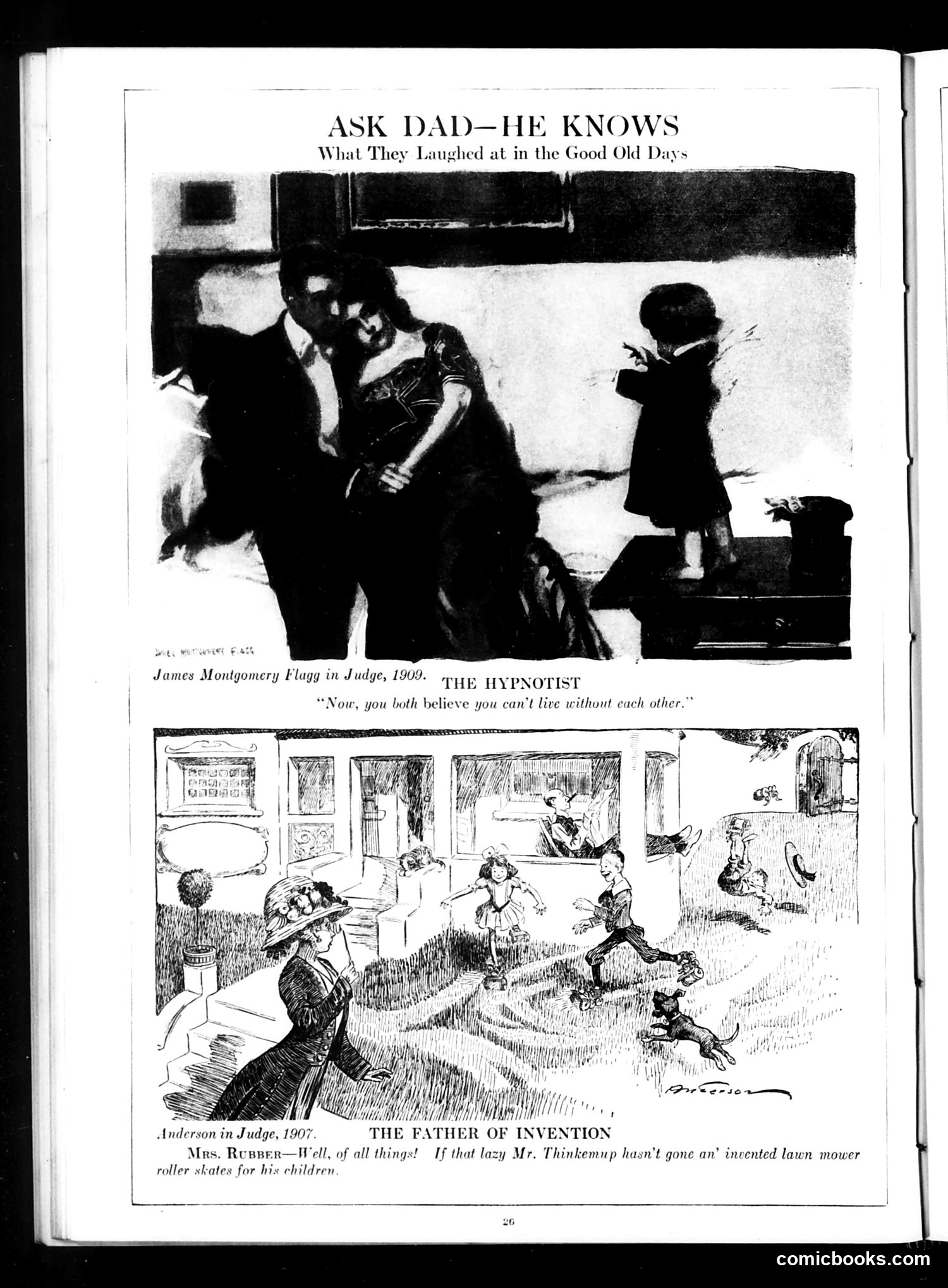
This page presents two satirical cartoons from the early 1900s by prominent illustrators James Montgomery Flagg and Anderson. **"The Hypnotist" (1909):** Shows a hypnotist manipulating a couple into believing they're dependent on each other—satirizing romantic relationships and the power of suggestion over rational thought. **"The Father of Invention" (1907):** Depicts Mr. Thinkemup, a lazy man who's invented "lawn mower roller skates" for children to use while mowing. Mrs. Rusper's reaction mocks this as absurd pseudo-innovation—the joke being that he's created a dangerous contraption rather than doing honest work himself. Both cartoons target human folly: one exploiting gullibility in love, the other mocking lazy ingenuity and impractical inventions. The "Ask Dad—He Knows" header frames these as nostalgic humor from "the good old days," suggesting the magazine's perspective that such foolishness was timeless.
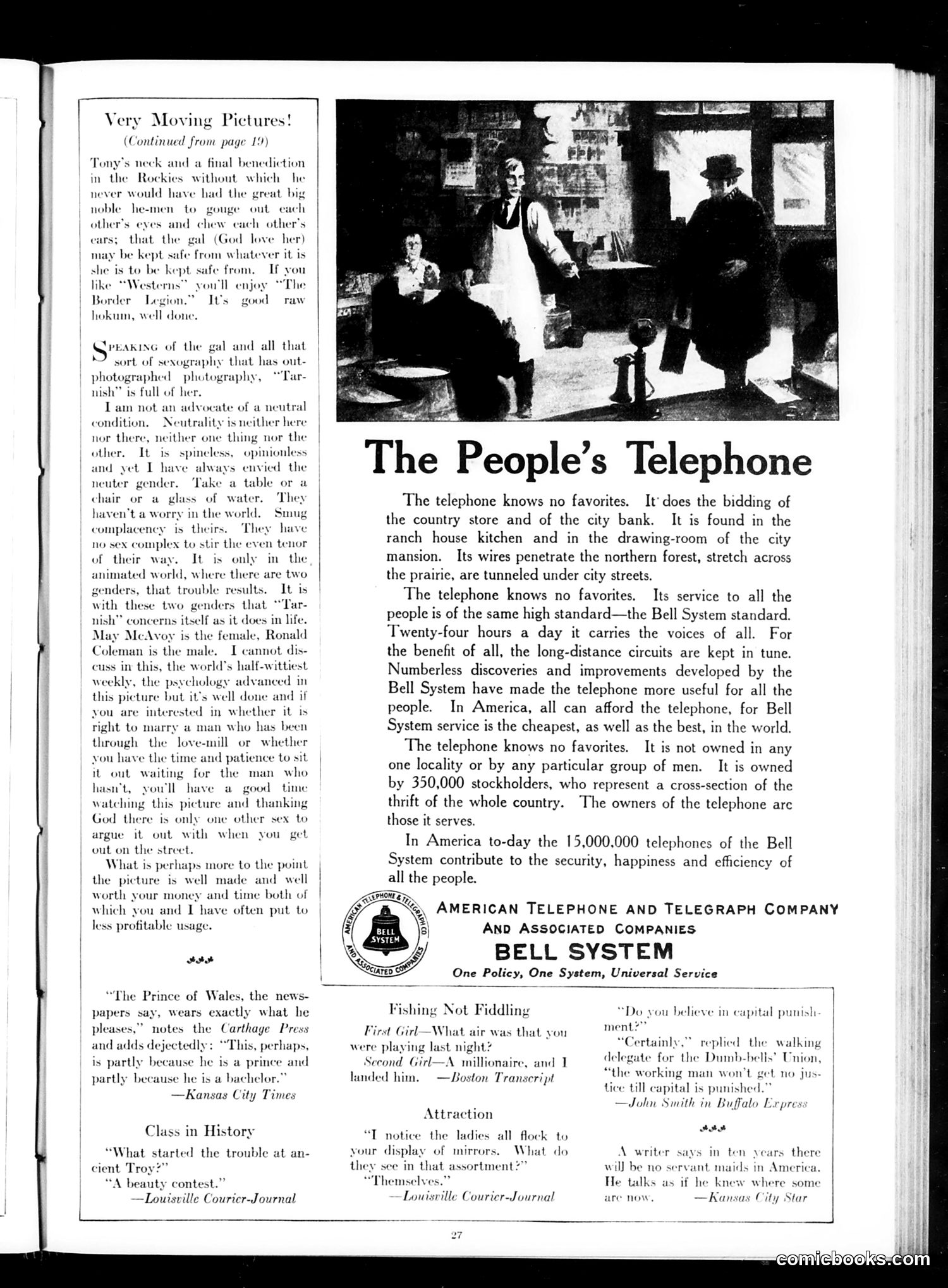
This is a **full-page advertisement for the Bell System telephone company**, not a political cartoon. The ad promotes the Bell System as a democratic utility serving all Americans equally—"the telephone knows no favorites"—whether in country stores, ranch kitchens, or city mansions. The ad emphasizes accessibility (affordable to all Americans), universal ownership (350,000 stockholders representing "a cross-section of thrift"), and 24-hour reliability. It frames the telephone as serving "the security, happiness and efficiency of all the people." At page bottom are brief jokes unrelated to the telephone: one about a beauty contest causing the Trojan War, one about a woman landing a millionaire. The film reviews above discuss movies like "The Border Legion" and discuss gender dynamics in cinema. This page mixes entertainment criticism with corporate messaging—typical of Judge magazine's revenue model.
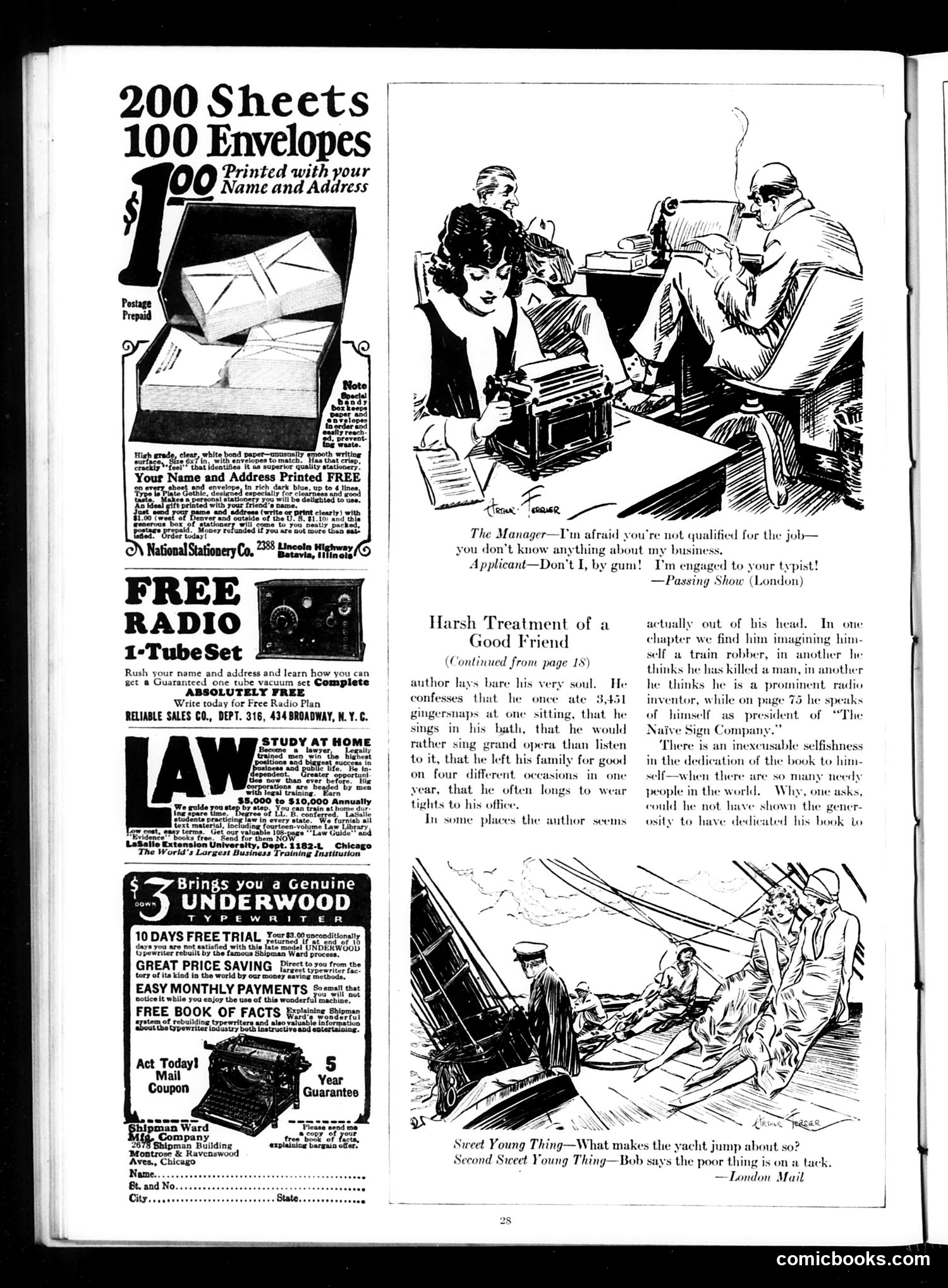
This page is primarily **advertising**, with two small cartoon jokes inserted among commercial notices. The top-left features ads for personalized stationery ($1.00), a free radio tube set, and business training courses. Below are promotions for typewriters and office equipment. The two cartoons are brief workplace humor: 1. **"The Manager"** shows a job interview where an applicant claims qualification despite the manager's skepticism. The applicant reveals he's "engaged to your typist"—suggesting he'll gain knowledge through his fiancée rather than actual competence. The joke mocks both nepotism and the idea that romantic connections substitute for job qualifications. 2. **"Second Young Thing"** (lower right) depicts a yacht scene where someone questions why a boat "jumps about." The response: "the poor thing is on a tack"—a sailing term the questioner apparently doesn't understand, playing on upper-class ignorance of nautical terminology. Both cartoons reflect early 20th-century workplace and social dynamics, with gentle satire of incompetence and class pretension.
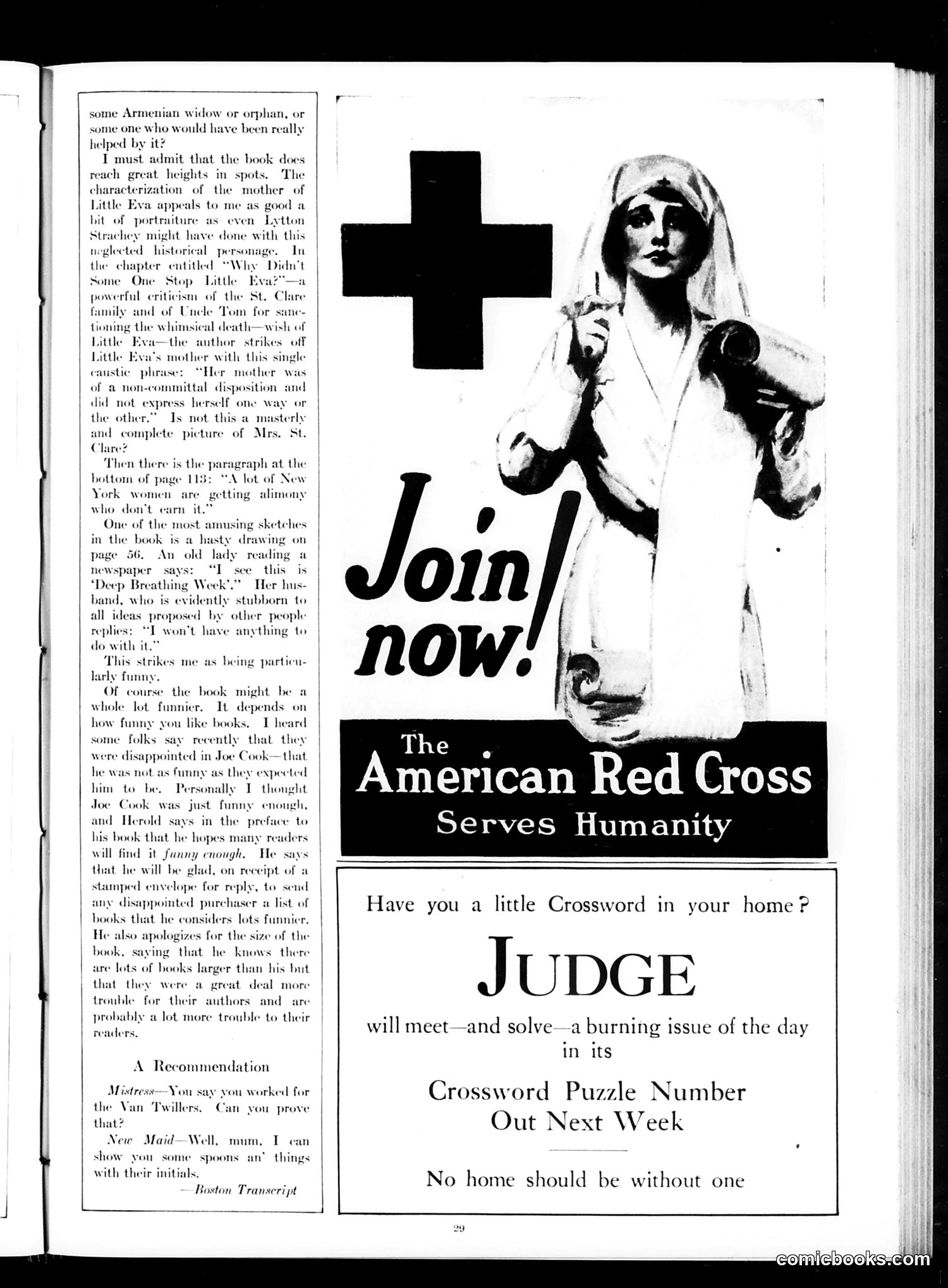
This page contains **two distinct elements**: a book review (left) and a **Red Cross recruitment advertisement** (right). **The Advertisement's Context:** The large right panel is a World War I-era recruitment ad for the American Red Cross. The woman holding a cross and what appears to be medical supplies represents the Red Cross nurse—a symbol of humanitarian service during wartime. The phrase "Join now!" and "Serves Humanity" are direct calls to patriotic action and charitable donation, common during WWI when the Red Cross mobilized for medical aid. **The Joke Below:** The crossword puzzle advertisement puns on this urgency, claiming that Judge's next crossword will tackle "a burning issue of the day" in puzzle form. This is gentle satire—treating a puzzle as equally important to actual humanitarian concerns, mocking both the exaggerated gravity of magazine promotions and perhaps the craze for crossword puzzles that had recently swept America (they became popular in the 1920s). **Overall:** The page juxtaposes earnest wartime charity appeals with lighthearted magazine marketing.
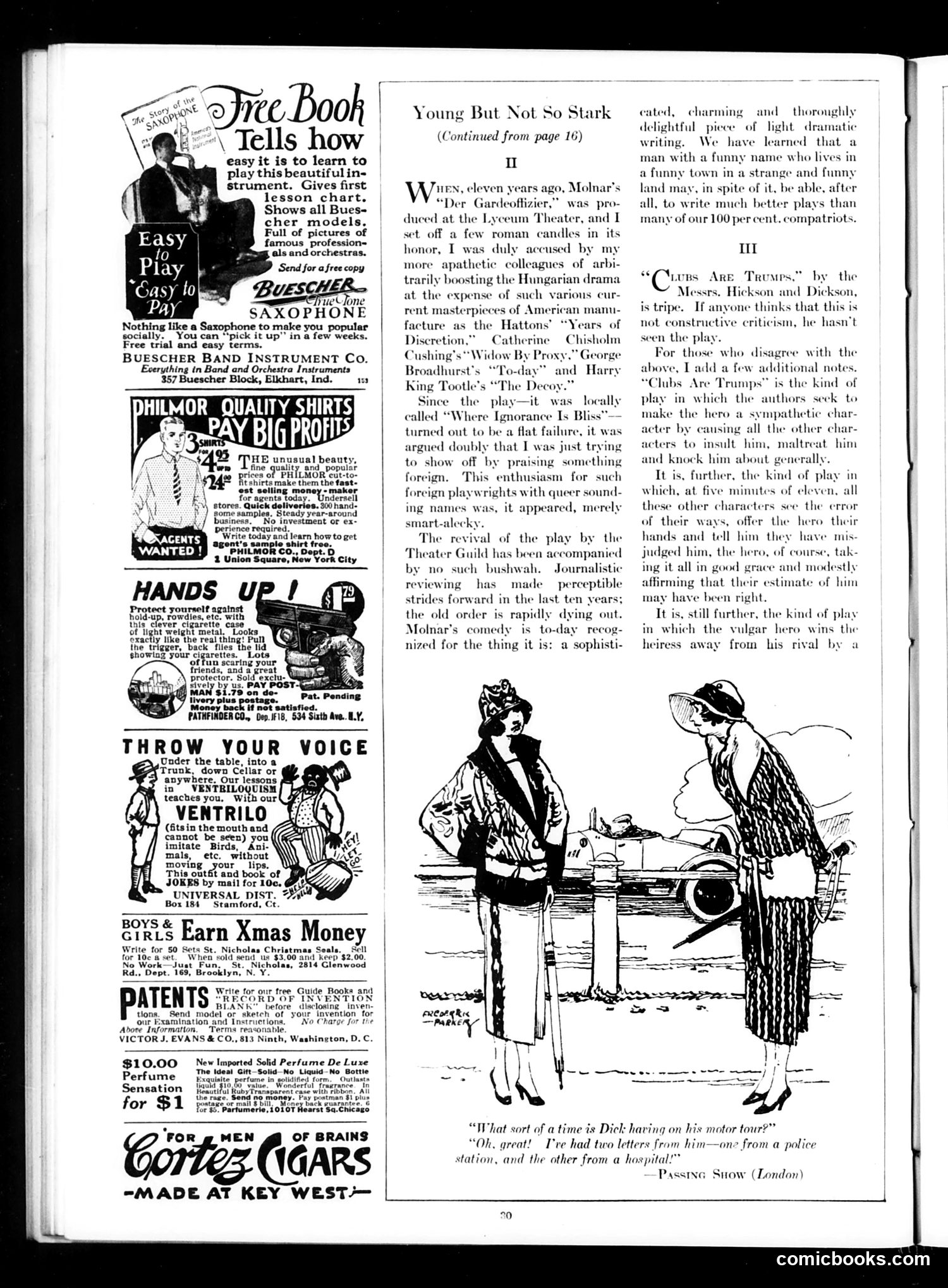
This page primarily features **advertisements** rather than political cartoons. The main content is a theater criticism article titled "Young But Not So Stark," discussing playwright Ferenc Molnár's work. The **one cartoon** shows two women in 1920s dress discussing a man's motor tour—one received letters from a police station, the other from a hospital—a joke about reckless driving. The **article's satire** targets American theater critics' provincial attitudes. The author recalls defending Molnár's Hungarian play "Der Gardeoftizier" eleven years prior, only to be accused of pretentiously favoring foreign work over American productions. He argues that critics have since matured: they now recognize good drama regardless of the playwright's nationality or "queer sounding" name. He critiques a new American play, "Cups Are Trumps," as "tripe," suggesting critical standards have genuinely improved rather than remaining snobbish. The surrounding advertisements peddle novelty items (ventriloquism lessons, fake gun cigarette cases, perfume) and musical instruments—typical Judge magazine filler targeting aspiring entertainers and amateur musicians.
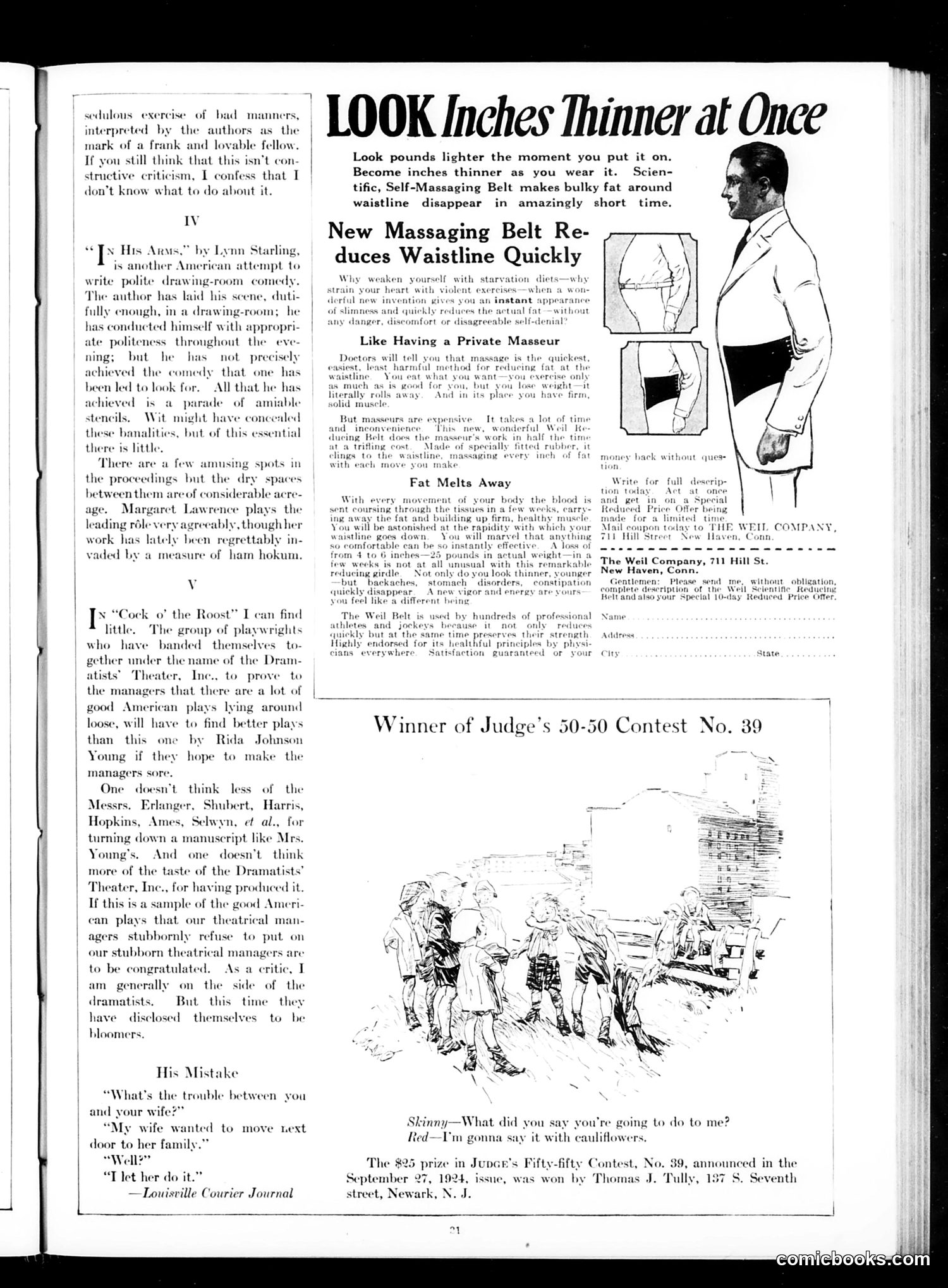
This page combines literary criticism with period advertising, typical of Judge's format. **Left column** contains reviews of American plays, critiquing works like "His Ants" by Lynn Starling and "Cork o' the Roost" by Rida Johnson Young. The critic dismisses these drawing-room comedies as lacking genuine wit, calling them parade of "amiable stencils" and "banalities." He chides theatrical managers for both rejecting good scripts and accepting mediocre ones. **Right side** features a full-page advertisement for the "Well Massaging Belt"—a weight-reduction garment typical of early-20th-century quack remedies. It promises instant slimming without diet or exercise, claiming users lose 4-6 inches in weeks. The ad uses pseudo-scientific language ("massaging," "healthy muscle") and testimonials from athletes/jockeys to appear legitimate. **Bottom** shows a Judge contest cartoon winner depicting street-level humor. The contrast between serious theatrical criticism and snake-oil advertising reflects Judge's satirical mission—simultaneously mocking both pretentious theater and consumer gullibility.
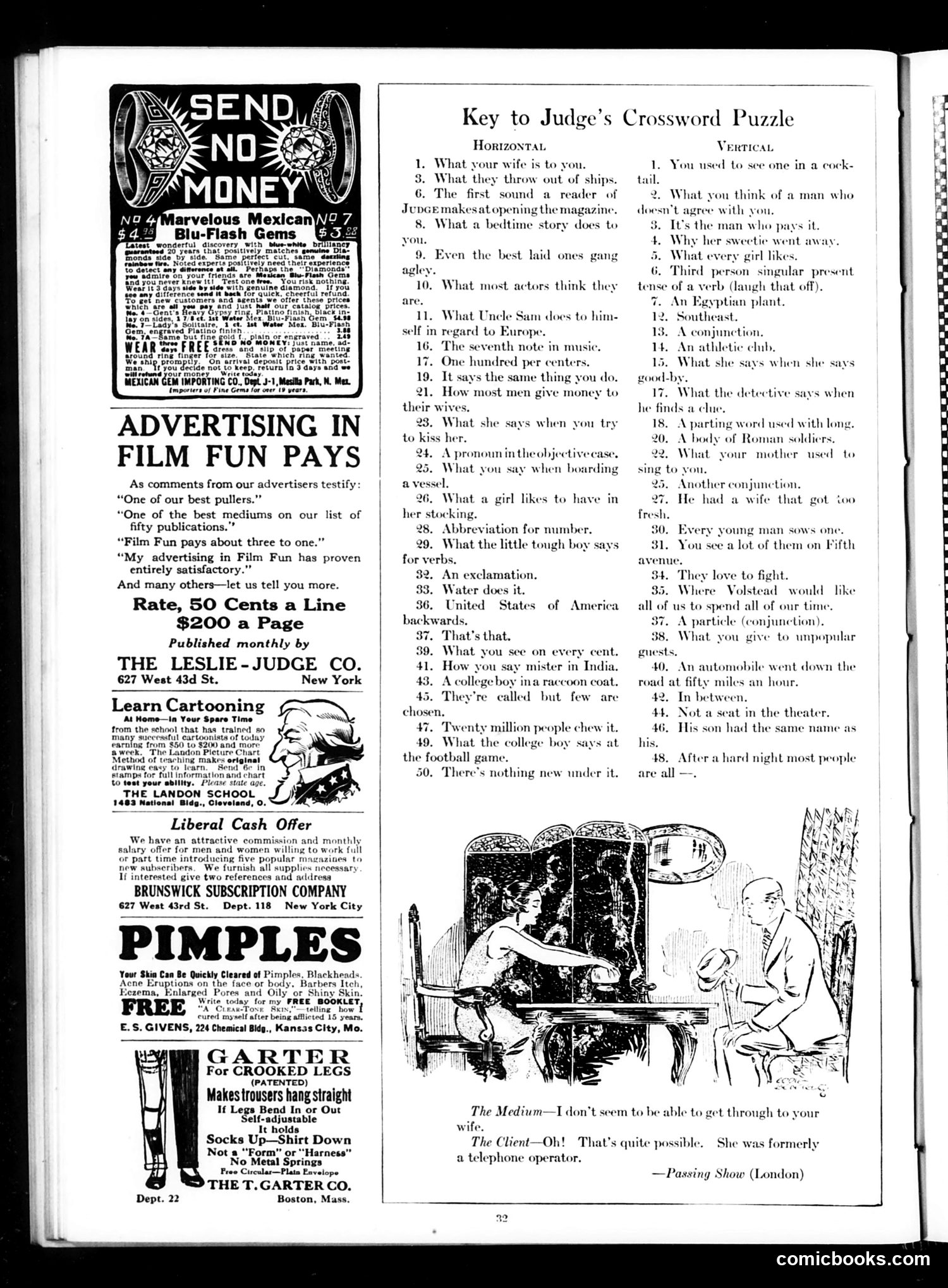
This page is primarily **advertising and puzzle content** rather than political satire. The main elements are: **Crossword Puzzle**: The central feature is a "Key to Judge's Crossword Puzzle" with clues reflecting 1920s-era social attitudes—references to wives, courting, drinking (Volstead appears, referencing Prohibition), and flapper culture. **Single Cartoon**: At bottom right, a small cartoon depicts a "medium" (spiritualist) unable to contact a client's wife, who replies she was "formerly a telephone operator." This is mild workplace humor about women operators being difficult to reach—a joke about job-related stereotypes rather than political commentary. **Advertisements**: The bulk of the page advertises products (pimple cures, garters for crooked legs, cartooning courses) and promotes *Film Fun* magazine as an advertising medium. **Context**: This appears to be a filler page from the 1920s-30s, emphasizing Judge's role as a commercial publication rather than hard-hitting satire. The content reflects period gender stereotypes and consumer culture rather than substantive political commentary.
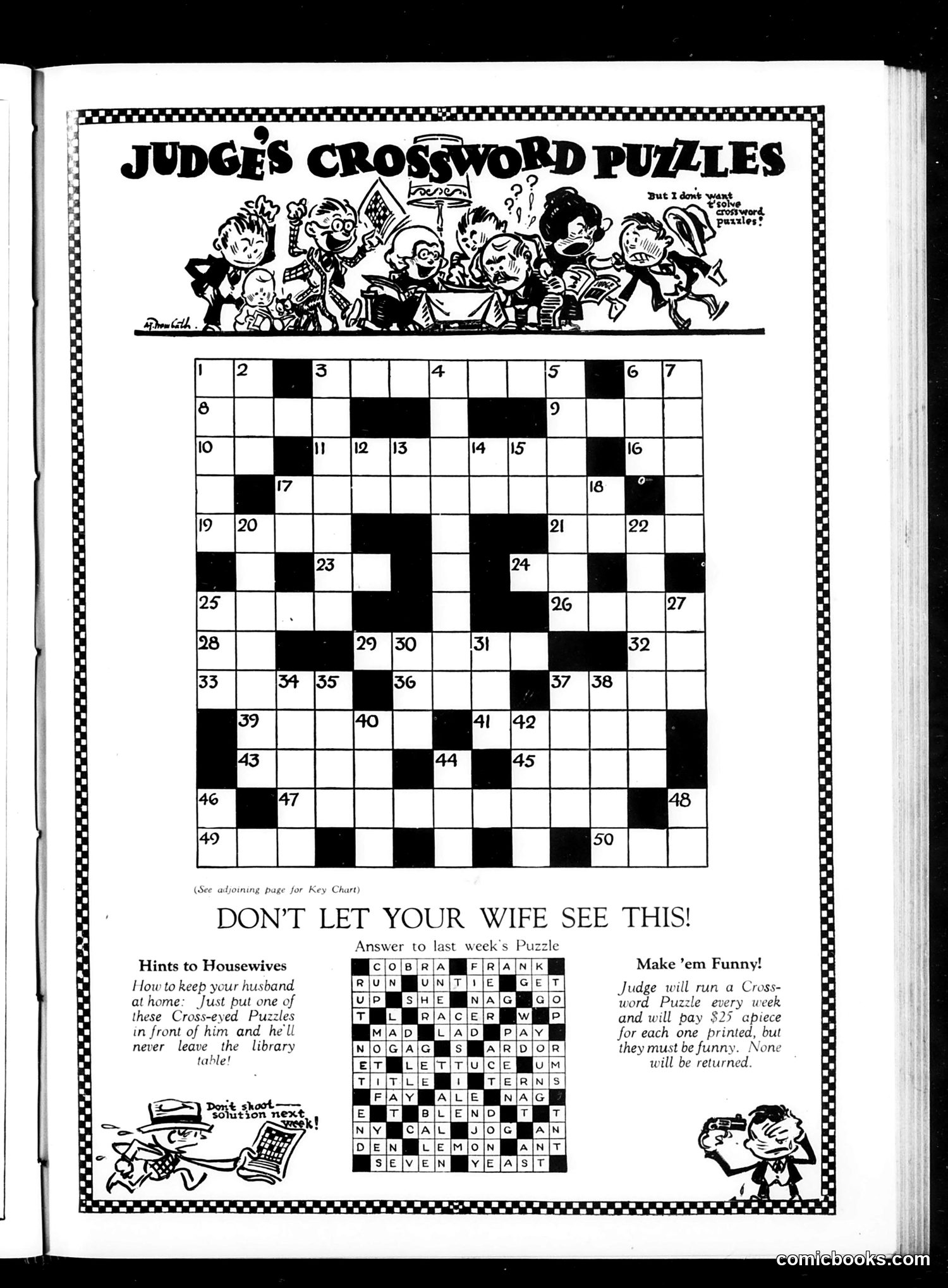
This page from *Judge* magazine features a humorous crossword puzzle with gendered satire typical of early-to-mid 20th century publications. The header "DON'T LET YOUR WIFE SEE THIS!" frames the puzzle as male-targeted content. The accompanying "Hints to Housewives" jokes that wives should strategically place crossword puzzles in front of husbands to keep them home and seated at the library table—implying husbands otherwise escape to bars or other venues. The cartoon illustrations show exaggerated, mischievous characters typical of *Judge's* style. The satirical point reflects period gender stereotypes: wives managing husbands through domestic activities, and the assumption that men need to be "kept" at home through entertainment. A secondary note announces *Judge* will pay $25 per published puzzle, inviting reader submissions for funny crossword puzzles—indicating this was reader-generated content. The actual puzzle grid is standard crossword format with no visible political figures or references.
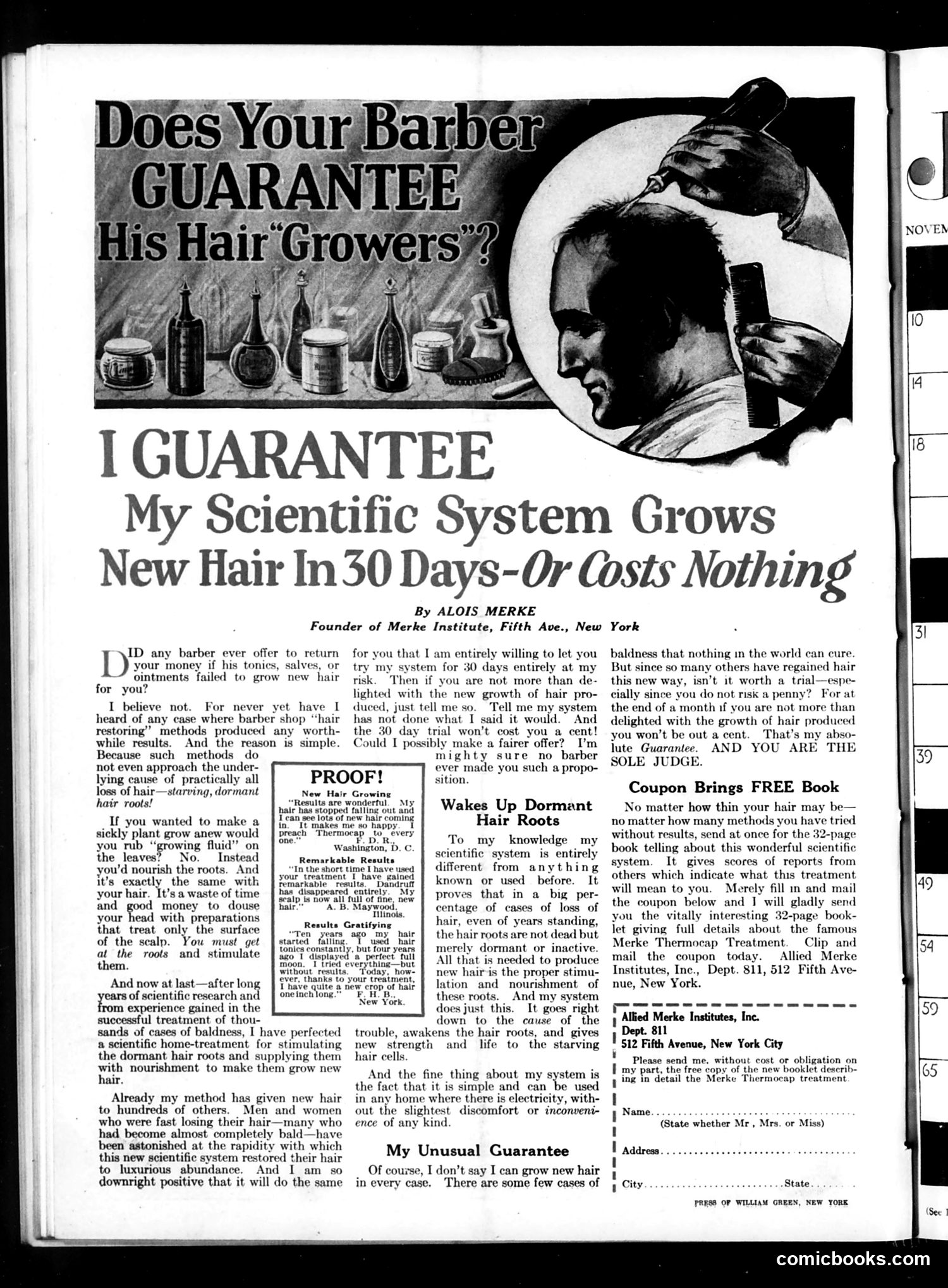
This page is **not satire or political commentary** — it's a straightforward (if dubious) commercial advertisement for the "Merke Thermiage Treatment," a mail-order hair-growth system from the early 20th century. **What it shows:** The ad features Alois Merke, founder of the Merke Institute in New York, promoting a home electrical treatment claiming to grow new hair in 30 days or cost nothing. The circular inset photo shows the device's application to a bald man's scalp. **The pitch:** Merke argues that barber shop tonics fail because they only treat the scalp surface, not dormant hair roots. His "scientific system" uses electricity to stimulate these roots. He includes testimonials from satisfied customers and offers a money-back guarantee. **Context for modern readers:** This represents the era of unregulated medical/beauty claims common in early 1900s magazines. Such "scientific" electrical devices were popular despite questionable efficacy. Judge published these ads alongside satire—the juxtaposition itself might be the intended irony, though the ad appears presented earnestly.