
Judge, 1924-11-01 · page 20 of 36
Judge — November 1, 1924 — page 20: what you’re looking at
What you’re looking at
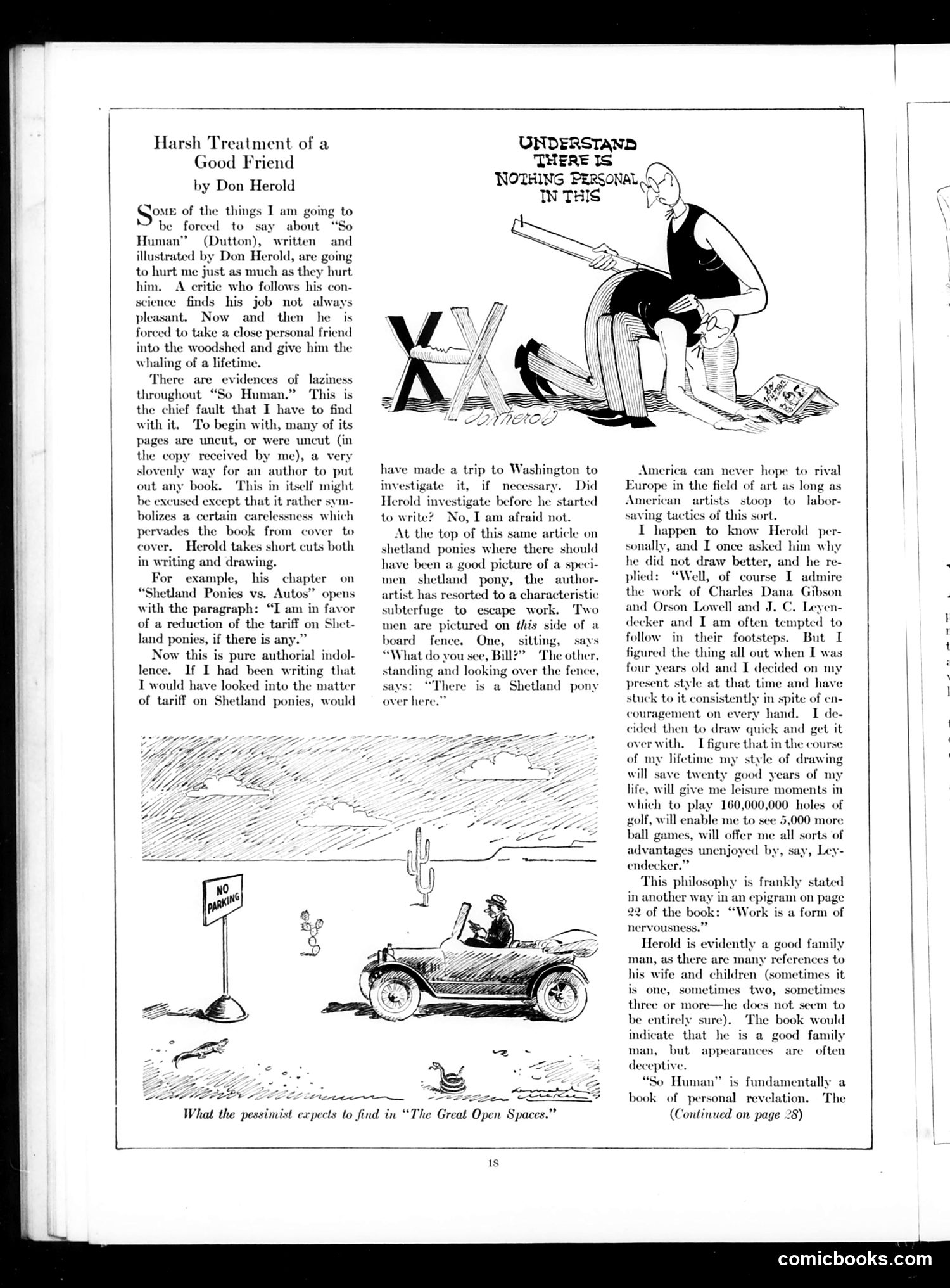
This is a book review of Don Herold's illustrated collection "So Human" (published by Dutton). The critic—writing as a "close personal friend"—attacks Herold for lazy craftsmanship: uncut pages, insufficient research (e.g., not actually investigating tariff policy on Shetland ponies), and deliberately simplistic drawing style. The cartoons illustrate Herold's shortcuts. The top image shows a spanking scene emphasizing the harsh critique. The bottom cartoon depicts what a pessimist expects in "The Great Open Spaces"—an absurdist desert scene with a "No Parking" sign, mocking Herold's tendency toward lazy, throwaway gags rather than genuine artistic effort. The reviewer quotes Herold's own (likely self-aware) admission that he deliberately chose a quick drawing style at age four to save time for golf and other leisure—essentially confessing to prioritizing pleasure over artistic excellence. The satire suggests American art suffers when talented artists choose expediency over European standards of craftsmanship.
📄 Transcribed text from this page (OCR, searchable)
Machine-transcribed from the original scan — historical spelling and the odd misread are preserved.
Harsh Treatment of a Good Friend by Don Herold some of the things I am going to be forced to say about “So Human” (Dutton), written and illustrated by Don Herold, are going to hurt me just as much as they hurt him. A critic who follows his con- science finds his job not always pleasant. Now and then he is forced to take a close personal friend into the woodshed and give him the whaling of a lifetime. ‘There are evidences of laziness throughout “So Human.” This is the chief fault that I have to find with it. To begin with, many of its pages are uncut, or were uncut (in the copy received by me), a very slovenly way for an author to put out book. ‘This in itself might be excused except that it rather sym- i a certain carelessness which les the book from cover to cover. Herold takes short cuts both in writing and drawing. For example, his chapter on “Shetland Ponies vs. Autos” opens with the paragraph: “I am in favor of a reduction of the tariff on Shet- land ponies, if there is any.” Now this is pure authorial indol- lence. If I had been writing that I would have looked into the matter of tariff on Shetland ponies, would UNDERSTAND THERE Is Nomans Personal a TN THIS have made a trip to Washington to y. Did Herold investigate before he started to write? No, I am afraid not. At the top of this same article on shetland ponies where there should have been a good picture of a speci- men shetland pony, the author- artist has resorted to a characteristic subterfuge to escape work. Two men are pictured on this side of a board fence. One, sitting, says “What do you see, Bill?” ‘The other, standing and looking over the fence, “There is a Shetland pony investigate it, if neces cee te What the pessimist expects to find in “The Great Open Spaces.” 7 COTES t America can never hope to rival Europe in the field of art as lon American artists stoop to labor- saving tactics of this sort. I happen to know Herold per- lly, and I once asked him why he did not draw better, and he re- plied: “Well, of course I admire the work of Charles Dana Gibson and Orson Lowell and J. C. Leyen- decker and I am often tempted to follow in their footsteps. But I figured the thing all out when I was four years old and I decided on my present style at that time and have stuck to it consistently in spite of en- couragement on every hand. I de- cided then to draw quick and get it over with. I figure that in the course of my lifetime my style of drawing will save twenty good years of my life, will give me leisure moments in which to play 160,000,000 holes of golf, will enable me to see 5,000 more ball games, will offer me all sorts of advantages unenjoyed by, say, Ley- endecker. This philosophy is frankly stated in another way in an epigram on page 22 “Work is a form of 22 of the boo nervousnes: Herold is evidently a good family man, as there are many references to his wife and children (sometimes it is one, sometimes two, sometimes three or more—he does not seem to be entirely sure). ‘The book would indicate that he is a good family) man, but appearances are often deceptive. “So Human” is fundamentally a book of personal revelation. The (Continued on page 28) comicbooks.com