
A complete issue · 36 pages · 1924
Judge — October 25, 1924
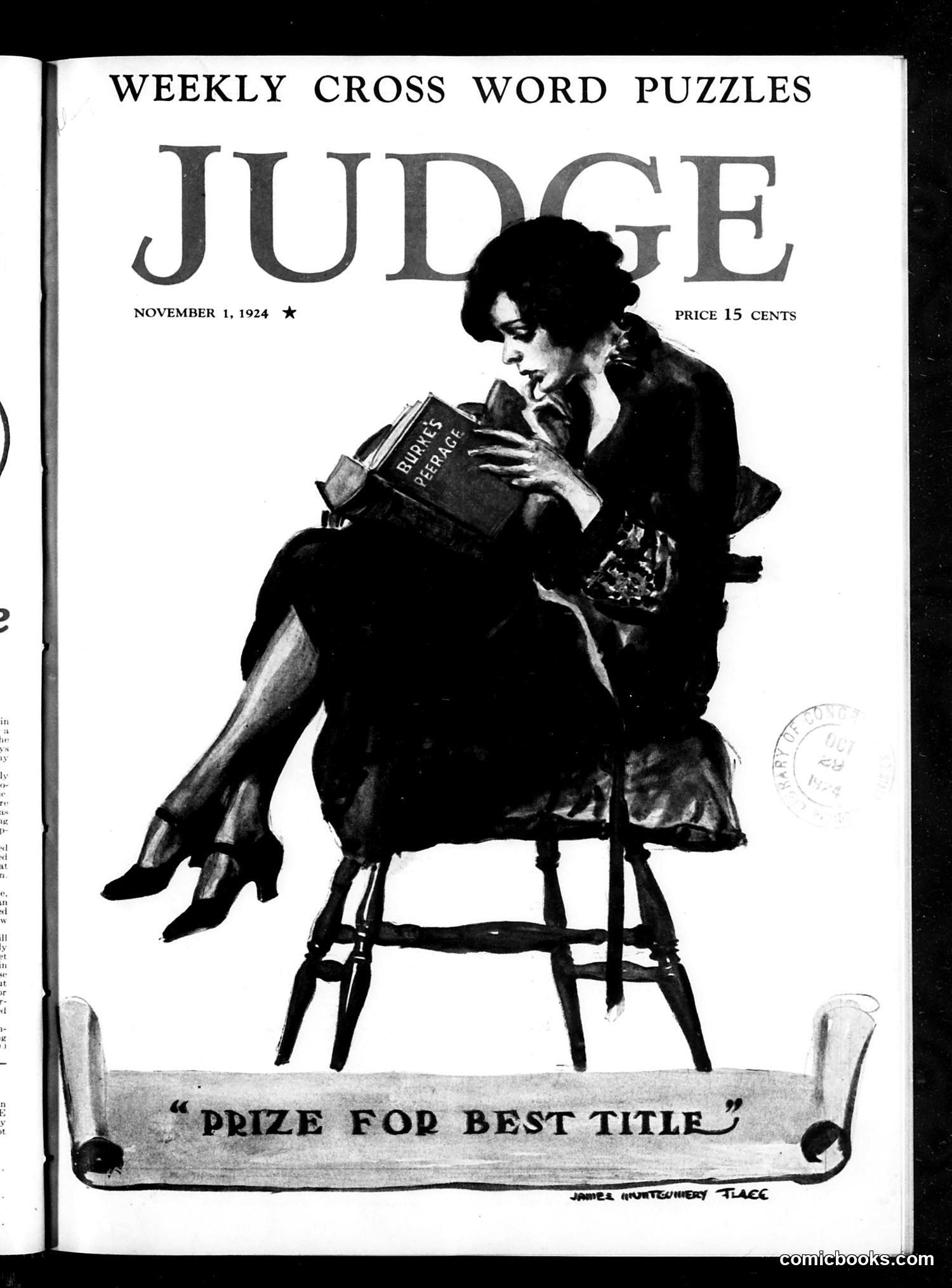
This is a cover for Judge's "Weekly Cross Word Puzzles" feature, not political satire. The illustration shows a woman seated on a stool, reading a book titled "Blues Perpetual," with an ornate border announcing a "Prize for Best Title." The image likely references the 1920s craze for crossword puzzles, which became a wildly popular pastime during this period. The "Blues" reference may allude to jazz-age culture or simply to a melancholic mood. The artwork style and fashion (bobbed hair, flapper-era clothing) are typical of early 1920s commercial illustration. The cover functions primarily as promotional material for the magazine's puzzle content rather than as social or political commentary.
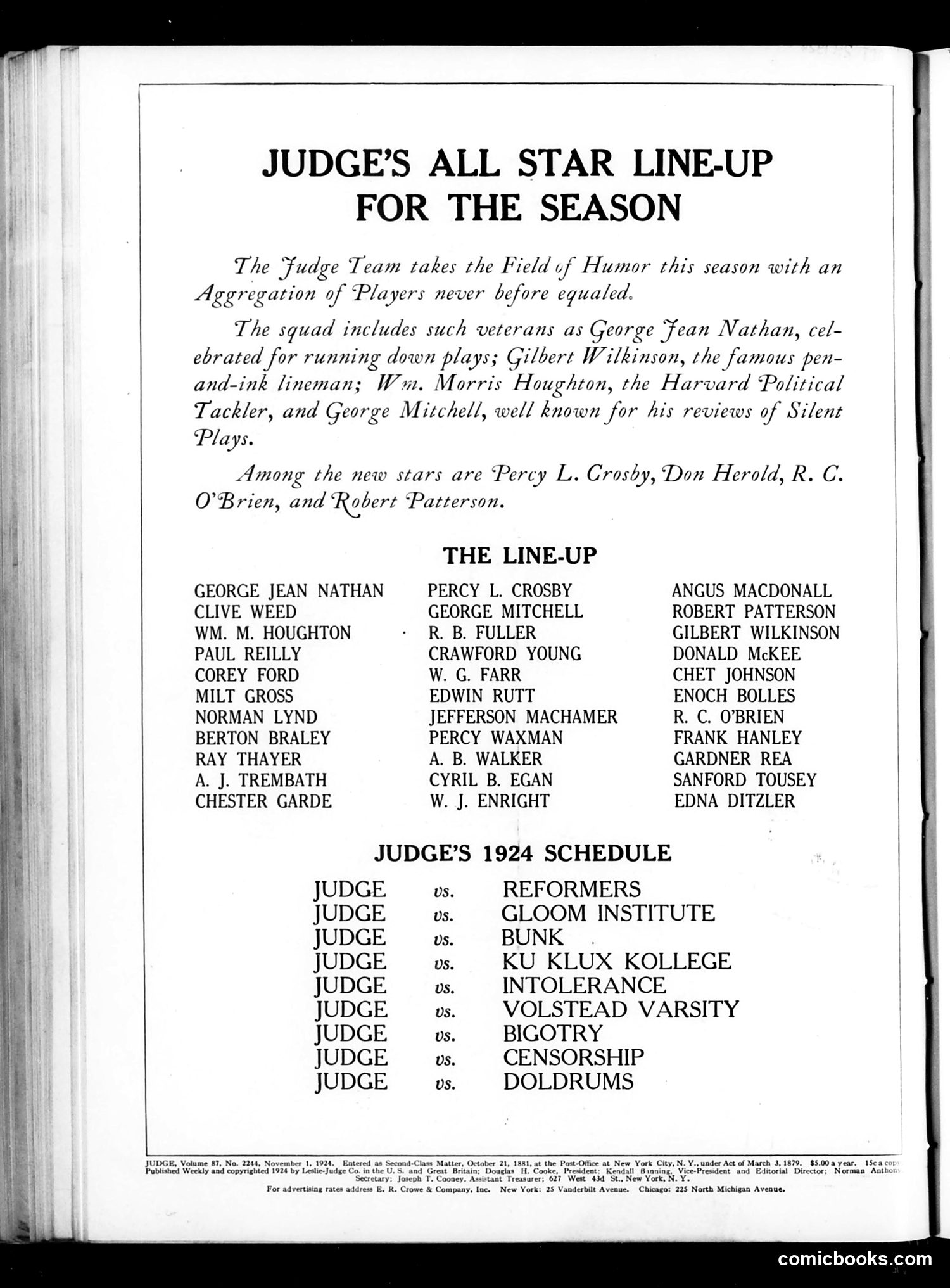
This page from Judge magazine (November 1, 1924) announces a satirical "Judge Team" roster for the 1924 season, treating humor creation like a sports team. It lists prominent humorists and writers of the era as "players," including George Jean Nathan (known for theater criticism) and Gilbert Wilkinson (described as a "pen-and-ink lineman"). The schedule parodies sports matchups, with "Judge" facing opponents like "Reformers," "Gloom Institute," "KU Klux Kollege" (a satirical spelling referencing the Ku Klux Klan), and "Intolerance." This structure humorously positions Judge magazine's satirical content as competitive "games" against social problems and cultural opponents of the 1920s. The joke relies on treating serious social critique as entertainment spectacle—a meta-commentary on satire itself.
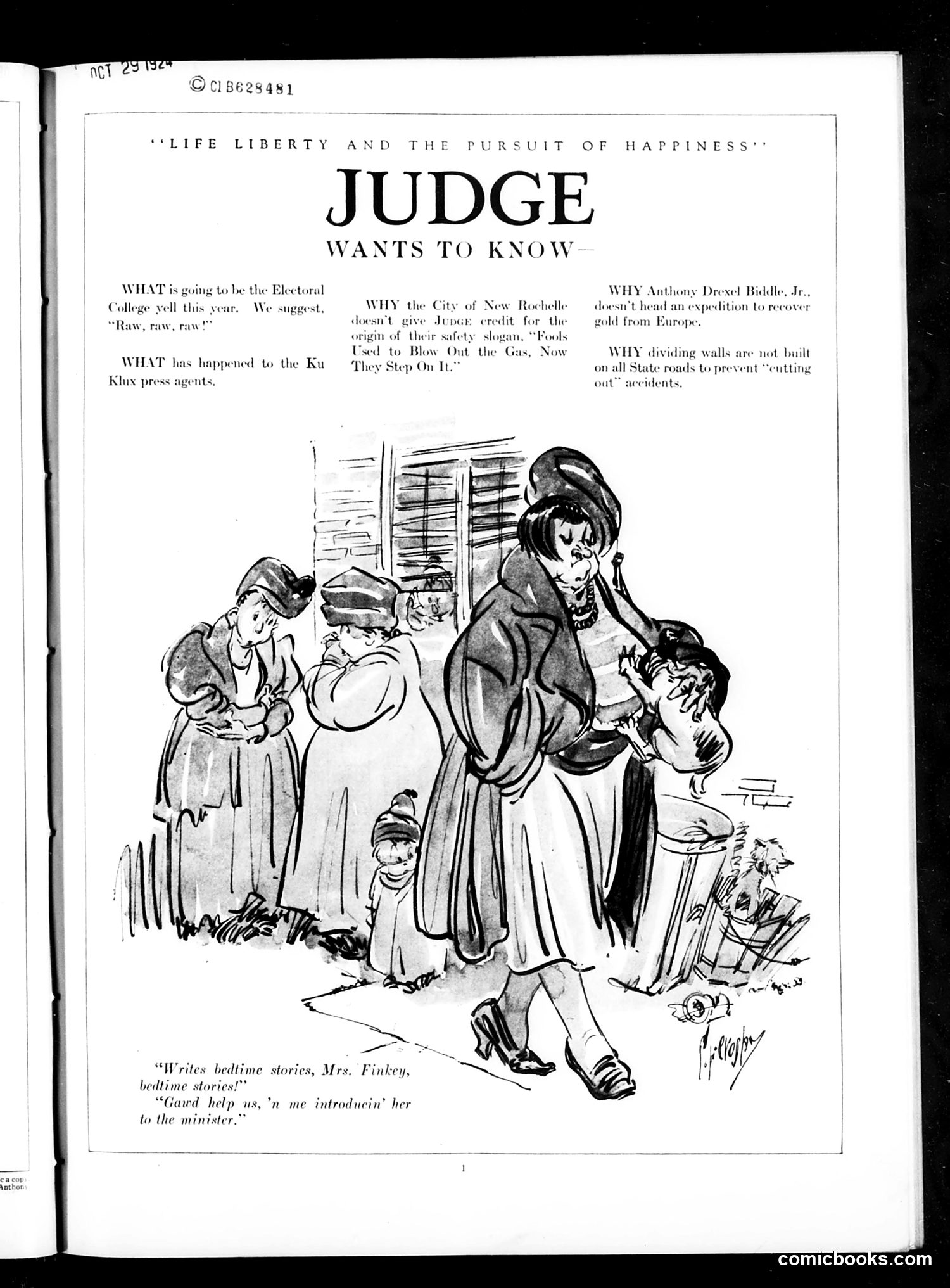
This page satirizes contemporary 1924 issues through the persona of "Judge" asking what citizens should know. The central cartoon depicts a woman (labeled Mrs. Finbey) introducing children to "the minister," with the caption "Writes bedtime stories, Mrs. Finbey, bedtime stories!" / "Guard help us, 'n me introducin' her to the minister." The humor appears to mock sensationalist or inappropriate children's literature masquerading as innocent bedtime stories. The side-column questions address topical concerns: Electoral College mechanics, the Ku Klux Klan's organizational activities, New Rochelle's municipal finances, and highway safety dividing walls—issues reflecting 1924 American anxieties about institutions, extremist groups, municipal governance, and modern dangers.
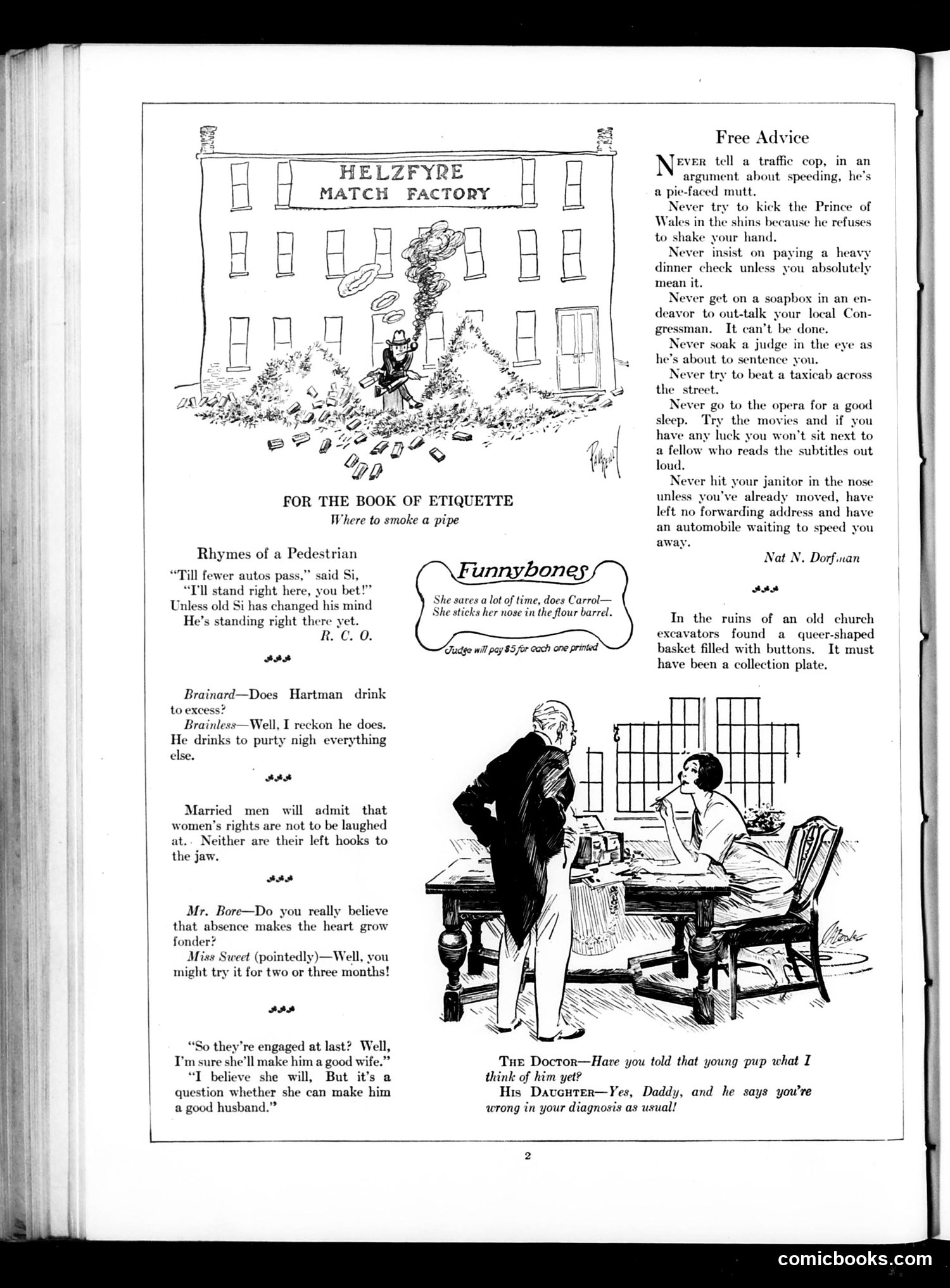
The top cartoon depicts the "Helzfyre Match Factory" exploding, satirizing a real industrial disaster. The illustration shows a building with matches and debris flying outward, with a figure amid the chaos. This references actual match factory explosions that were common workplace hazards in the early 20th century, often caused by the highly flammable phosphorus used in match production. The cartoon likely critiques inadequate factory safety regulations and working conditions. The page also contains humorous advice column entries and social commentary jokes typical of Judge's satirical content. The "Funnybones" section offers lighthearted observations about human behavior and relationships rather than political commentary. The overall page reflects Judge's mix of industrial-age social criticism and genteel humor aimed at middle-class readers.
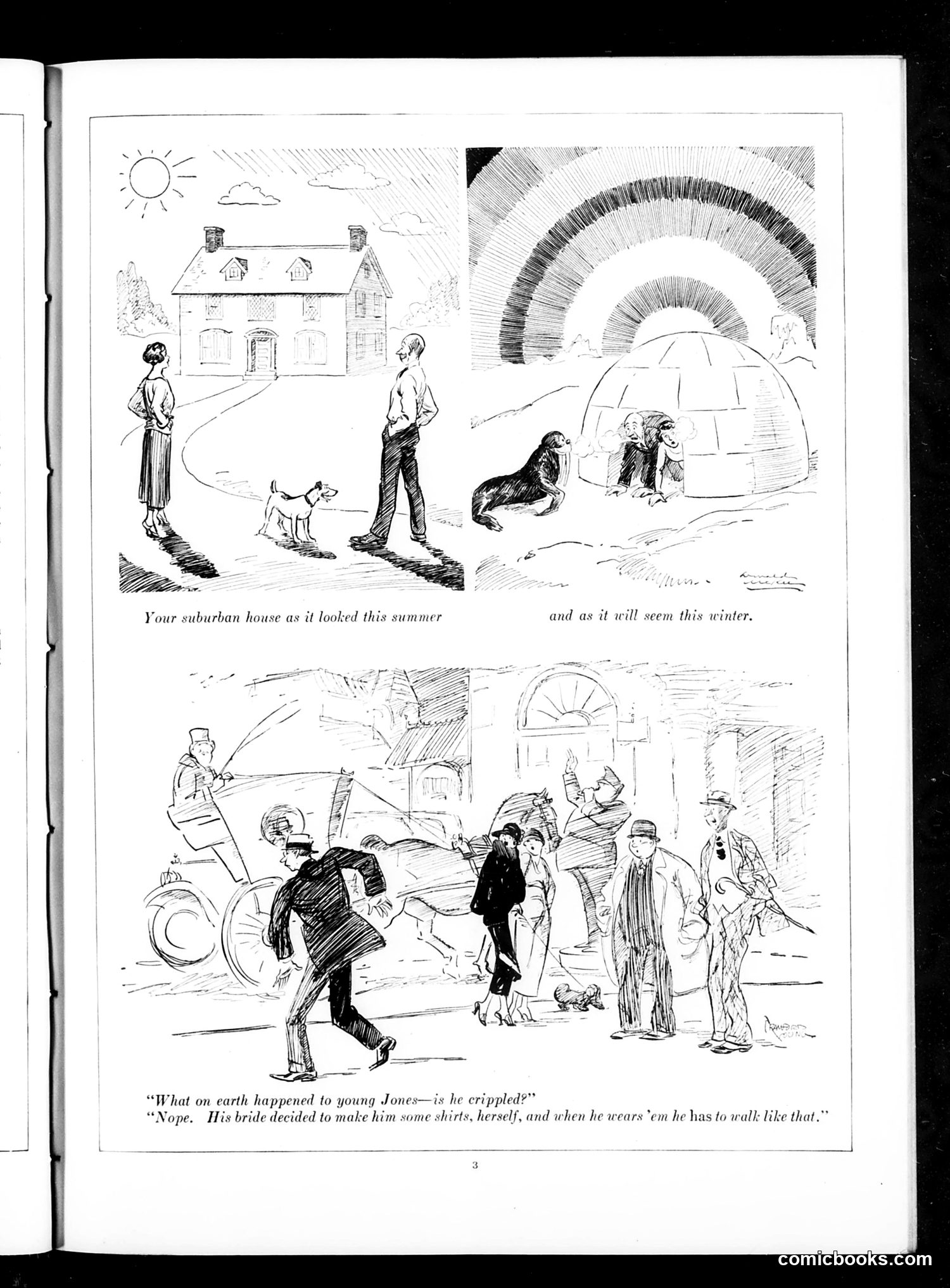
This page contains two separate cartoons satirizing suburban life and domestic expectations. **Top panel**: Contrasts a family's comfortable suburban house in summer with the same property transformed into an igloo during winter—a visual joke about harsh winter conditions making suburban homes uninhabitable or forcing residents to adopt primitive shelter. **Bottom panel**: Shows a street scene where someone asks about a man named Jones who now walks in an unusual, contorted manner. The response explains that Jones's bride made him custom shirts herself, and his awkward gait results from wearing these poorly-fitted garments. The satire mocks newlywed domestic life and the unintended consequences of wives' homemade clothing efforts, suggesting amateur tailoring could literally cripple a man. Both cartoons humorously critique suburban domesticity and its drawbacks.
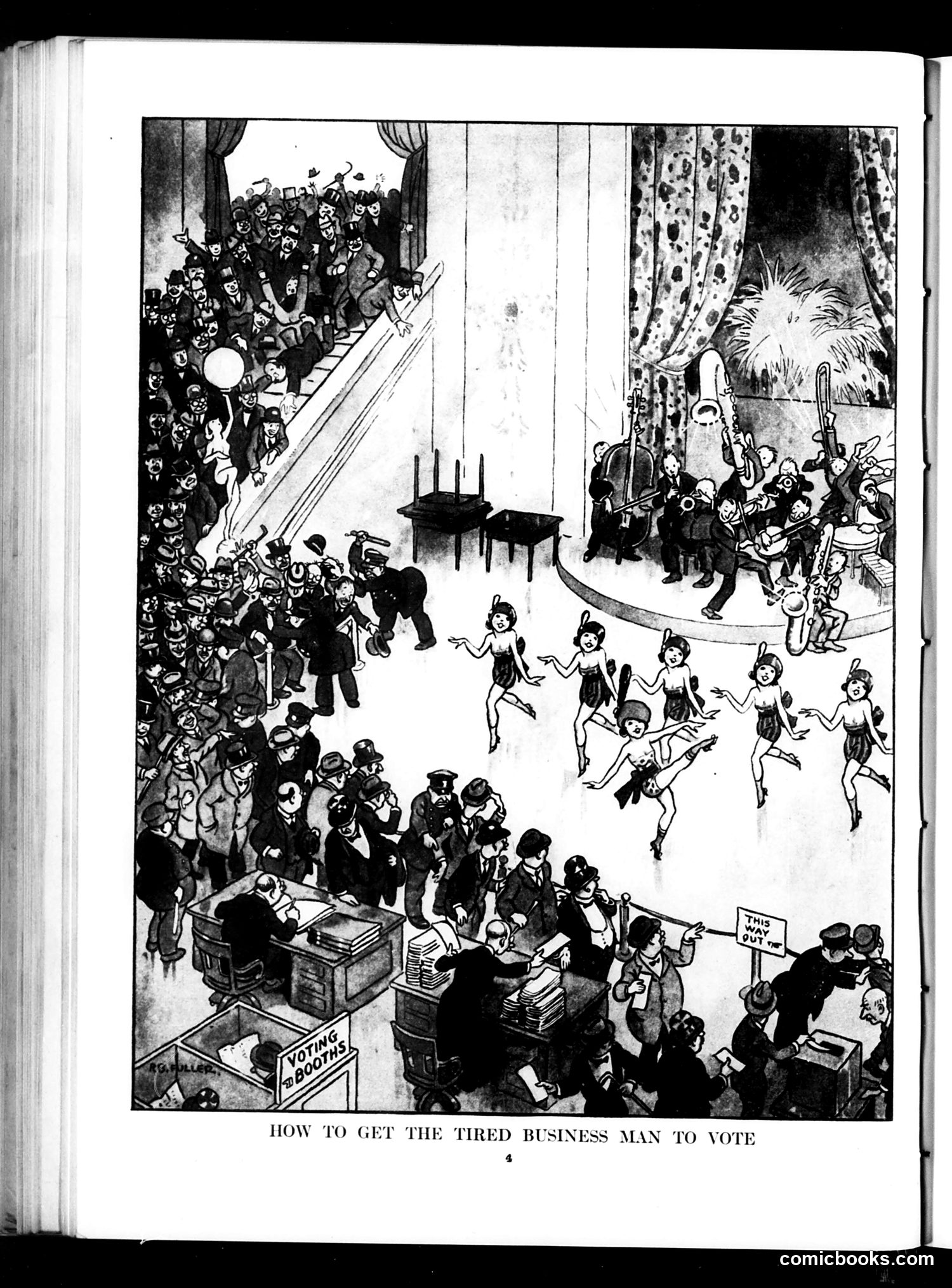
This satirical cartoon from *Judge* magazine critiques voter apathy among businessmen. The image depicts an elaborate, carnival-like spectacle designed to entice reluctant voters to participate in elections. The central scene shows scantily-clad chorus girls performing a can-can dance, surrounded by marching bands, acrobats, and theatrical entertainment. Voting booths are visible at ground level, nearly overshadowed by the extravagant show above. The satire suggests that civic duty—voting—has become so unappealing to busy, preoccupied businessmen that organizers must resort to entertainment and spectacle comparable to a circus to motivate political participation. The cartoon mocks both voter indifference and the perceived desperation of those promoting electoral engagement during the early 20th century.
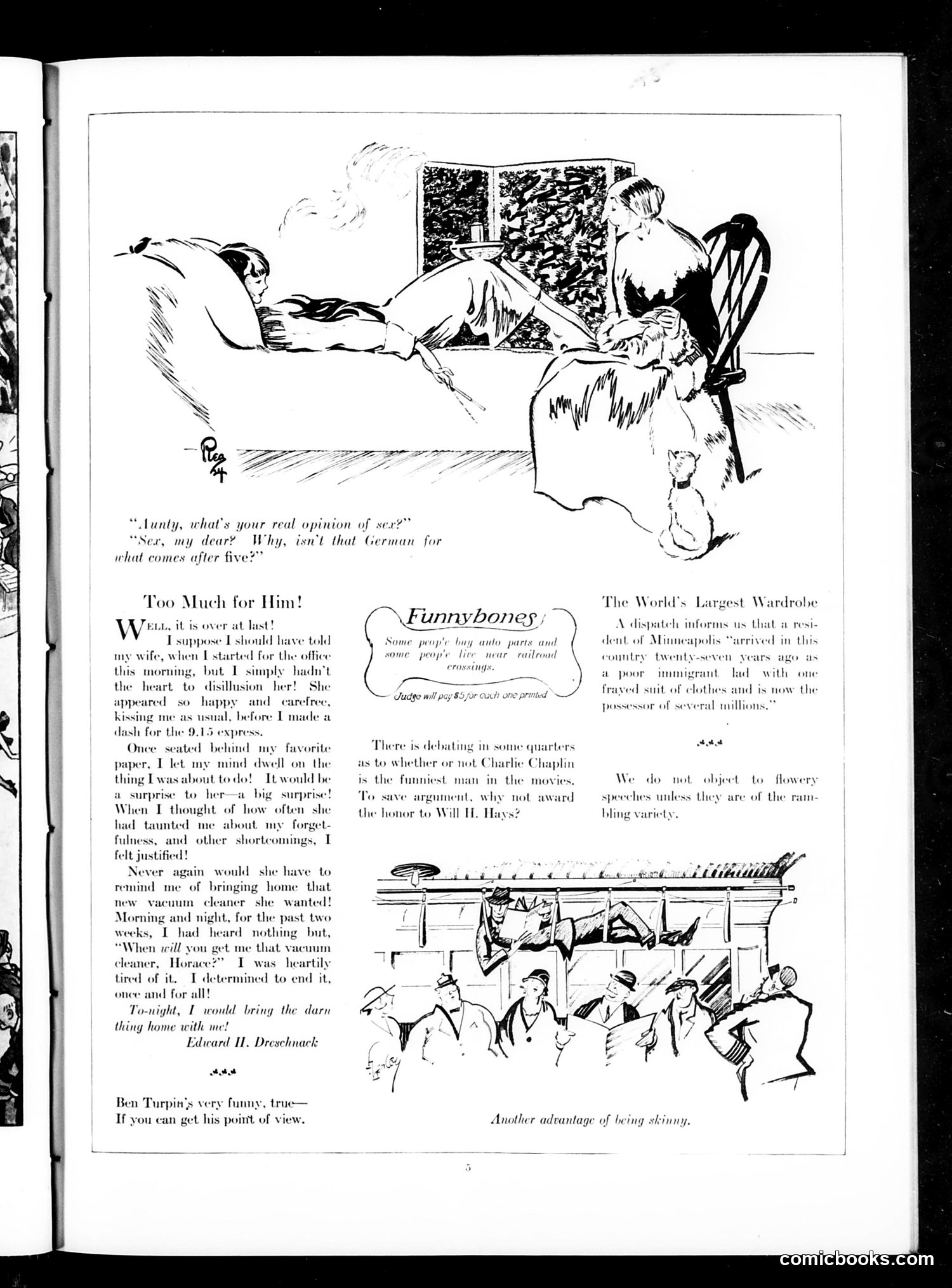
This page contains multiple satirical pieces typical of early 20th-century Judge humor: **Top cartoon**: Depicts a couple in bed discussing "sex"—likely referencing post-WWI social anxieties about changing sexual attitudes. The woman's prudish misunderstanding (mishearing "sex" as something after "five") satirizes generational gaps in discussing modern morality. **"Too Much for Him!"**: A husband's monologue about finally surprising his forgetful wife by bringing home a vacuum cleaner. The humor lies in his self-satisfaction over this modest domestic act—satirizing both male complacency and consumer culture's elevation of household appliances. **"Funnybones" items**: Quick jokes mocking contemporary figures (Charlie Chaplin, Will H. Hays) and modern anxieties (auto accidents, immigration wealth). **Bottom cartoon**: Labeled "Another advantage of being skinny," showing thin men fitting through tight spaces on a ship—playing on class commentary about steerage immigrants versus wealthy passengers. The overall tone reflects 1920s-era attitudes toward domesticity, immigration, and celebrity culture.
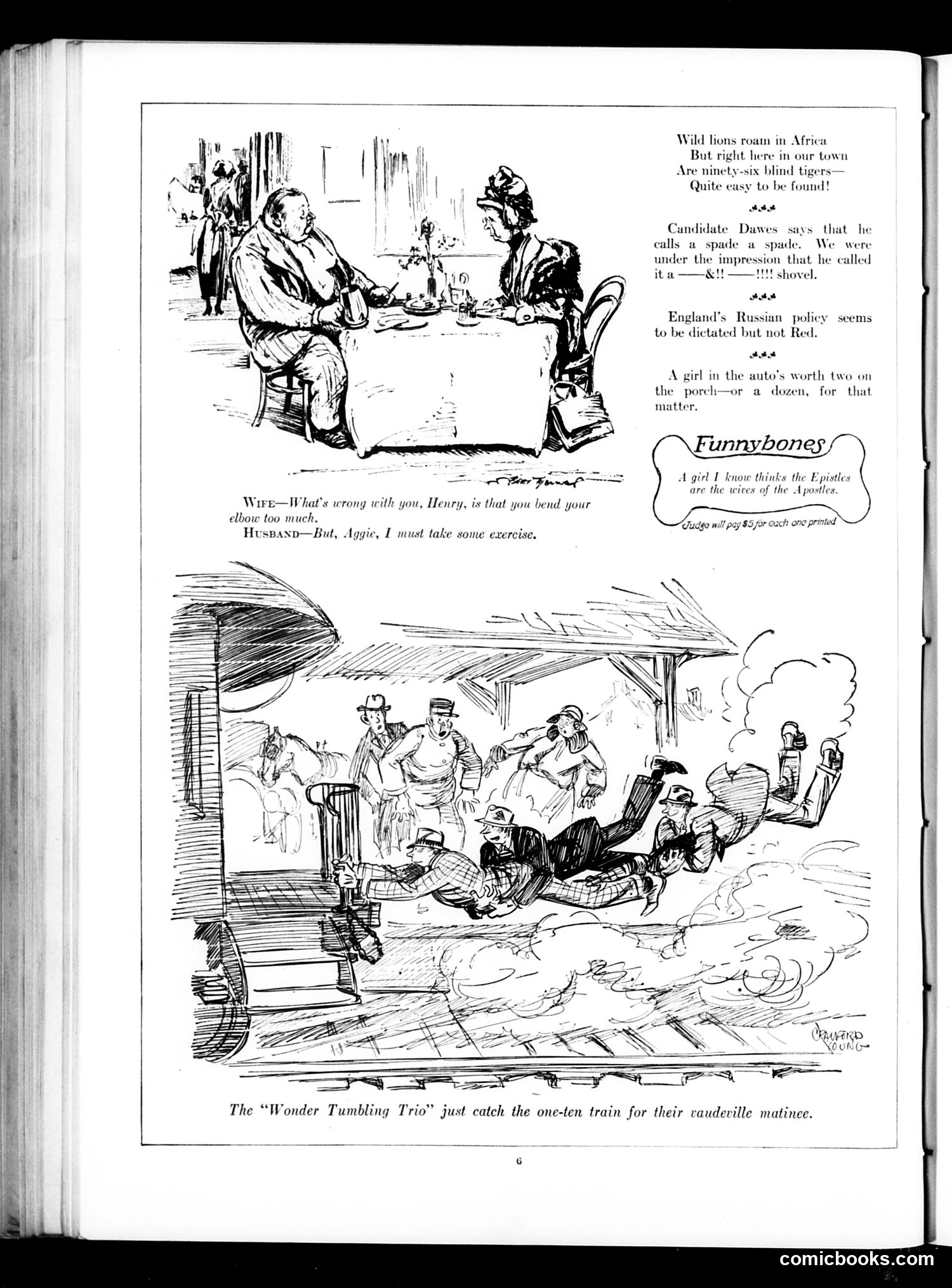
This page from *Judge* contains political commentary and humorous quips typical of early 20th-century American satire. The top cartoon depicts a domestic dispute about drinking. The wife scolds Henry for bending his elbow (a period euphemism for drinking alcohol), while he claims he needs "exercise"—a joke about Prohibition-era drinking culture. The text references "ninety-six blind tigers," slang for illegal speakeasies operating despite Prohibition laws. "Candidate Dawes" likely refers to Charles G. Dawes, a prominent political figure of the 1920s-30s, mocking his blunt speaking style. The bottom cartoon shows acrobats catching a train, captioned "The 'Wonder Tumbling Trio' just catch the one-ten train for their vaudeville matinee"—illustrating vaudeville entertainment, popular in this era. The scattered quips mock women's education ("Epistles are wives of Apostles") and dating customs. Overall, the page reflects Prohibition-era American social anxieties and popular entertainment.
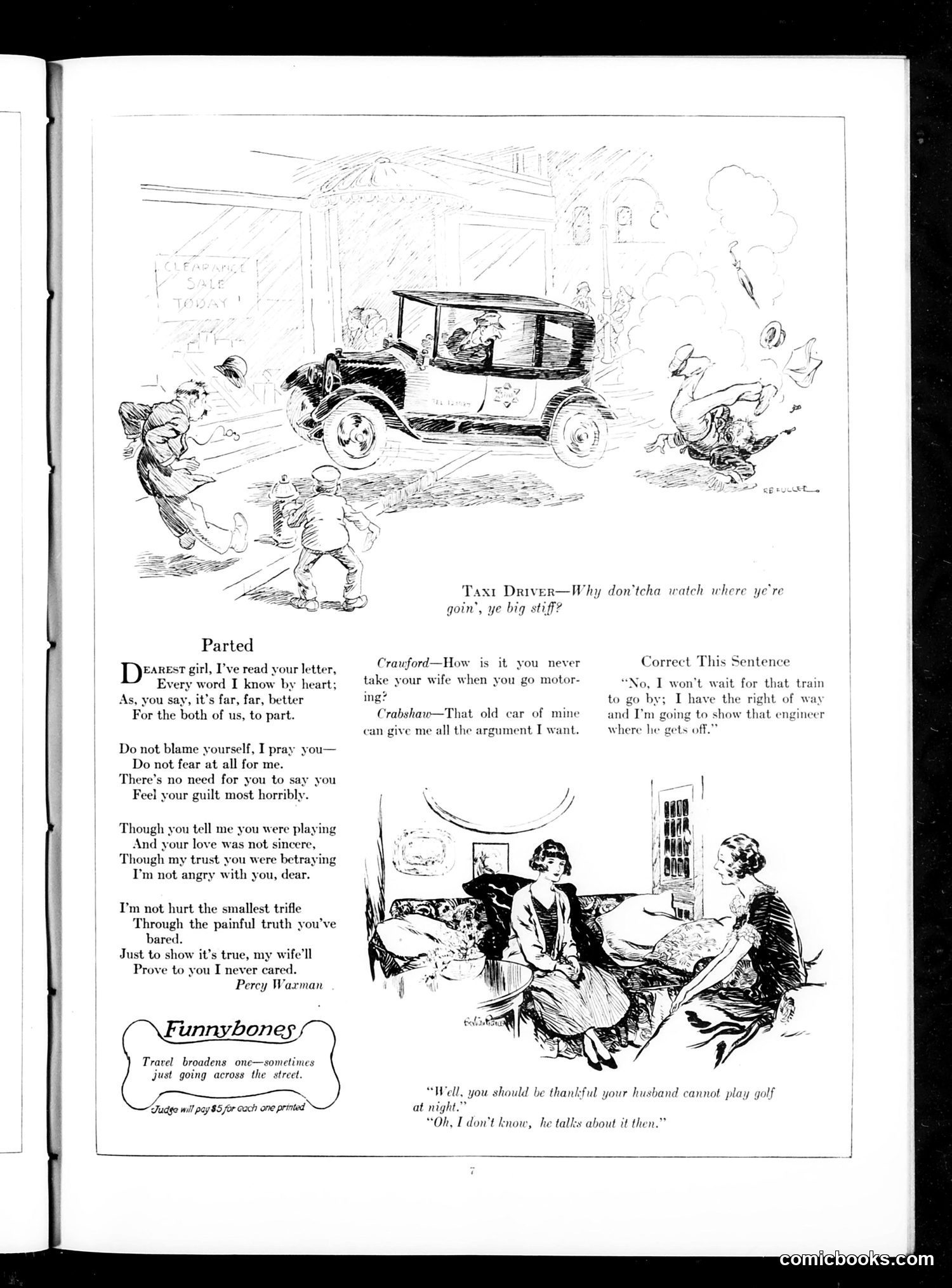
This page contains three unrelated humor items typical of Judge magazine's format: **"Parted"** — A sentimental poem by Percy Warman about a couple breaking up. The speaker claims he's unbothered by his girlfriend's infidelity, sarcastically noting his wife will "prove" his indifference. The joke's irony: his elaborate performance of not caring actually reveals he cares deeply. **"Taxi Driver" cartoon** — A street scene showing a car surrounded by pedestrians. The taxi driver shouts at the vehicle's occupant for reckless driving ("watch where ye're goin'"). The humor targets careless motorists, a recurring satire theme as automobiles were still relatively new and dangerous. **"Correct This Sentence"** — A grammar exercise where a woman tells her husband she's grateful he *can't* play golf at night because he'd only talk about it. The joke mocks husbands' obsession with golf—a leisure activity gaining popularity among middle-class men. **"Funnybones"** — A one-liner about travel broadening perspective, submitted by readers for payment. Overall, the page satirizes early 20th-century domestic life, new automobile culture, and male leisure habits.
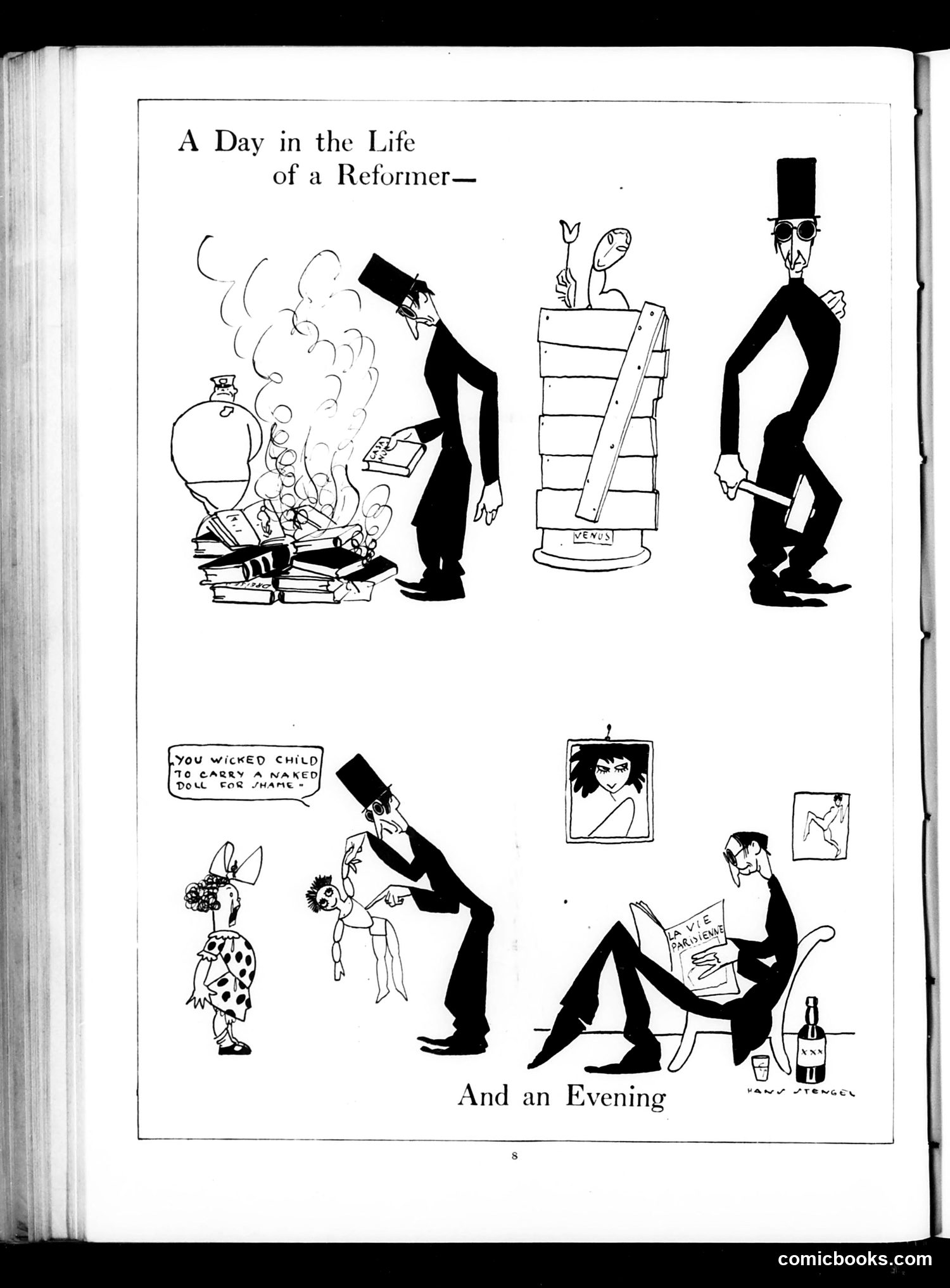
This satirical cartoon mocks social reformers through visual contrasts. The top panels show a well-dressed reformer burning books and moral pamphlets, then tending a plant labeled "VICES," and finally appearing exhausted—suggesting reformers create their own work by perpetuating the problems they claim to fight. The bottom panel shows the reformer scolding a child for carrying a "naked doll" while he himself relaxes at evening with what appears to be risqué artwork on the walls and alcohol nearby—exposing hypocrisy in the reformer's moral standards. The joke targets the pretentiousness and double standards of social reformers: they publicly crusade against vice while privately indulging in it, and their zealousness may do more harm than good.
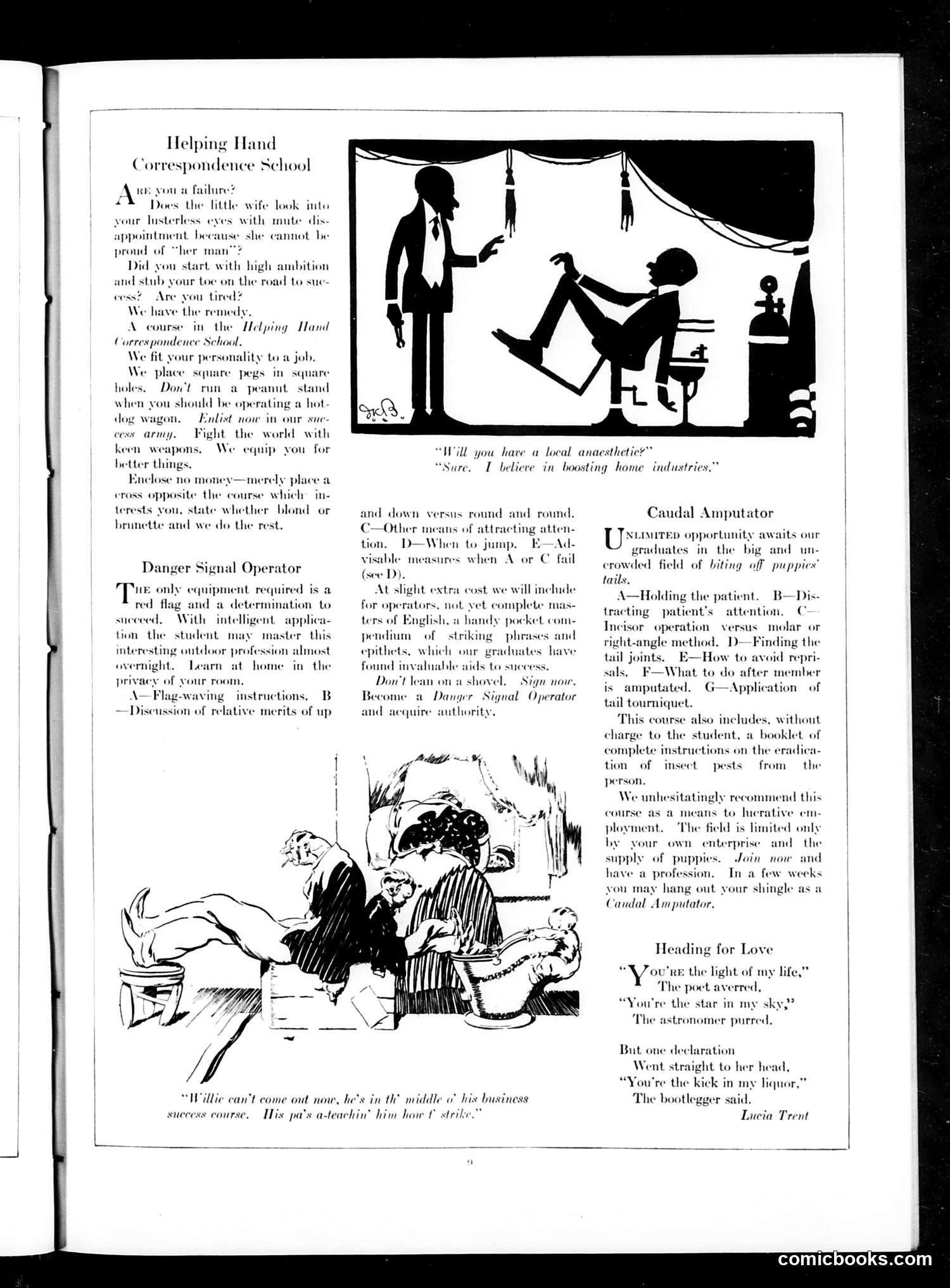
This page satirizes correspondence school advertisements popular in early 20th-century America—mail-order programs promising quick career advancement to struggling men. The "Helping Hand Correspondence School" mocks these schemes with absurd job training courses. The **"Danger Signal Operator"** course teaches men to wave red flags, presented as legitimate employment. The **"Caudal Amputator"** is even more outrageous: instructions for biting off puppies' tails as a "lucrative" profession—clearly satirizing both the ridiculousness of these programs and animal cruelty. The accompanying cartoons reinforce the joke: one shows a dentist offering anesthesia while apparently torturing a patient; another depicts a man learning this "profession" from his father. The final poem, "Heading for Love," pivots to Prohibition-era humor: while poets and astronomers offer romantic declarations, a bootlegger (illegal alcohol dealer) wins a woman's heart with "You're the kick in my liquor"—a crude compliment celebrating intoxication during the alcohol ban. The satire targets both fraudulent self-improvement schemes and period social anxieties about masculine failure.
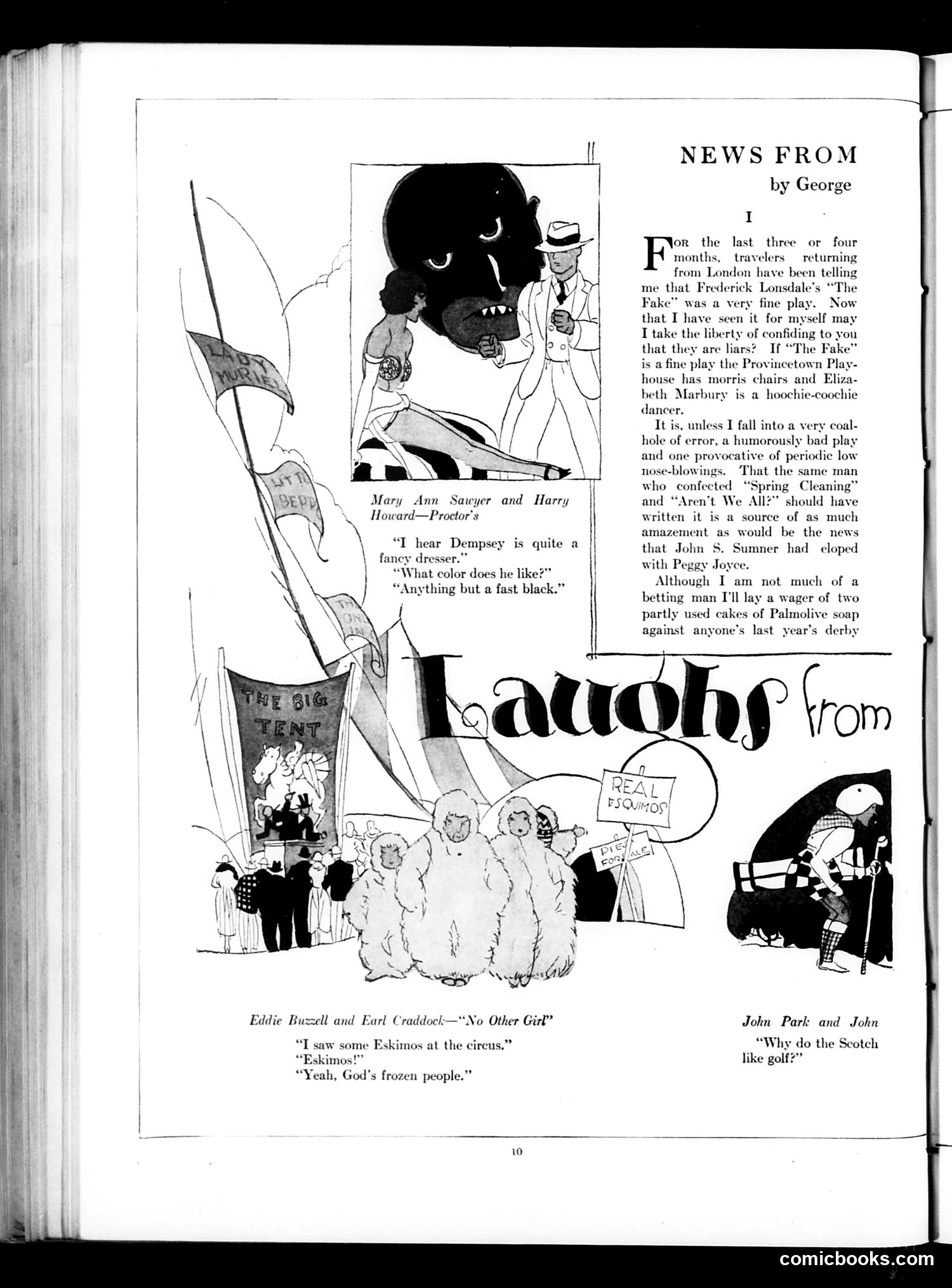
This page contains theater reviews and entertainment humor typical of 1920s Judge magazine. The main content is "News From" by George, a theater critic reviewing Frederick Lonsdale's play "The Fake," recently seen in London. The reviewer sarcastically denounces it as a "humorously bad play," contrasting travelers' praise with his own negative assessment. He references other Lonsdale works ("Spring Cleaning," "Aren't We All?") to highlight the playwright's inconsistency. The "Laughs" section contains vaudeville-style one-liners tied to theatrical performers: a joke about boxer Jack Dempsey's skin color; commentary on Eskimos at the circus; and a golf joke about Scottish people. The illustrations show theatrical scenes and performers from contemporary plays. The humor relies on topical entertainment references—Dempsey was a famous boxer, and the plays/performers mentioned were recognizable to 1920s readers. The content is essentially entertainment gossip and theater criticism packaged as satire.
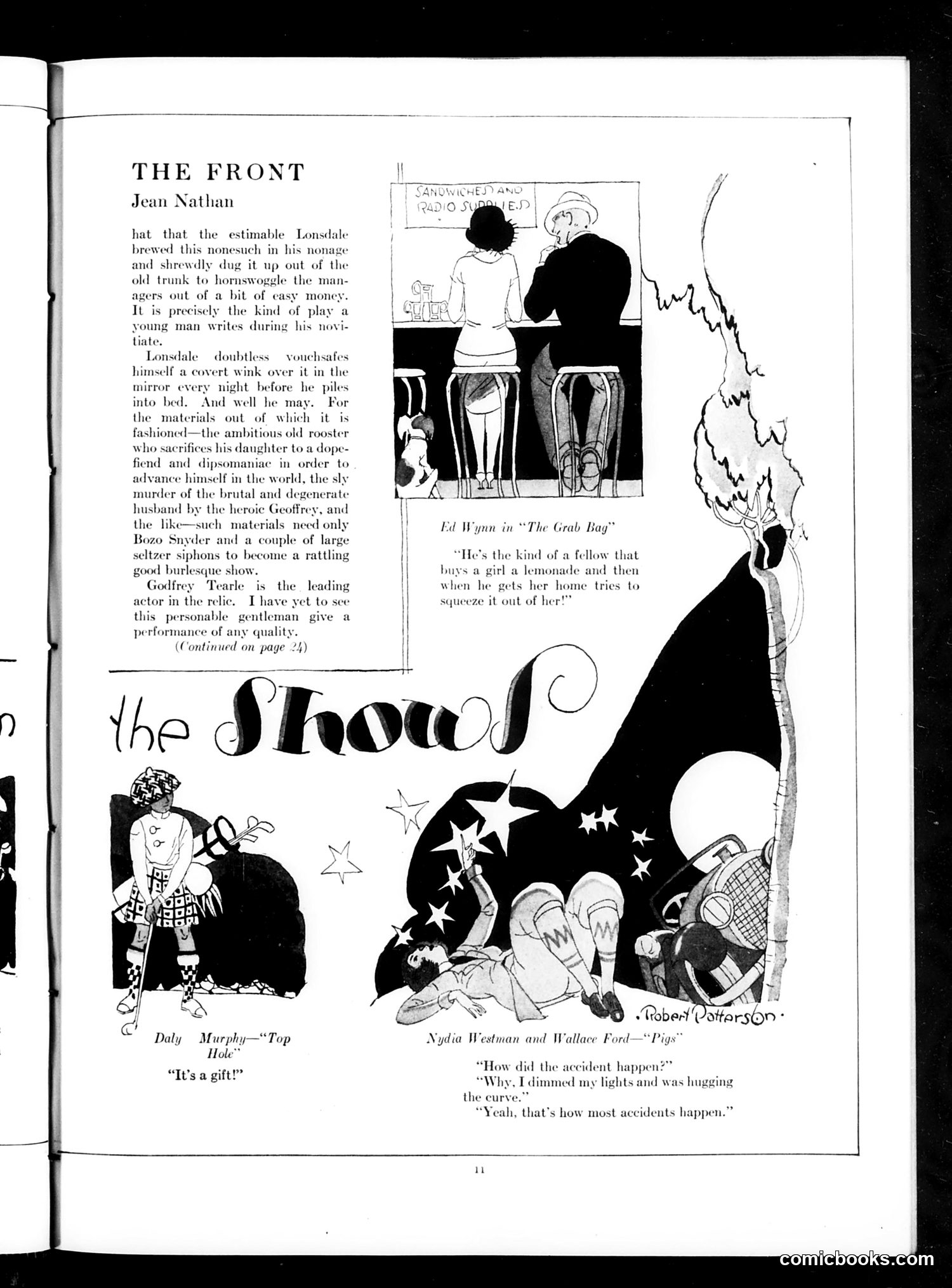
This page reviews theatrical productions, mixing drama criticism with vaudeville humor. **"The Front"** discusses a play by Lonsdale (likely Frederick Lonsdale, a real playwright), which the critic Jean Nathan dismisses as derivative hackwork—old material recycled to exploit managers. He criticizes its melodramatic plot elements (ambitious men, victimized daughters, murder) as suitable only for burlesque comedy. **"The Shawl"** features three separate comedy sketches from stage/film performances: - Daly Murphy's "Top Hole" joke: trivial wordplay - Ed Wynn in "The Grab Bag": crude innuendo about a date trying to extract value (squeeze lemonade) from a girl after buying her a drink - Nydia Westman and Wallace Ford in "Pigs": a driving accident joke where dimmed headlights caused hugging a curve—the punchline suggests reckless driving causes most accidents The page exemplifies early-20th-century entertainment journalism mixing legitimate theater criticism with slapstick and suggestive humor typical of Judge's satirical tone.
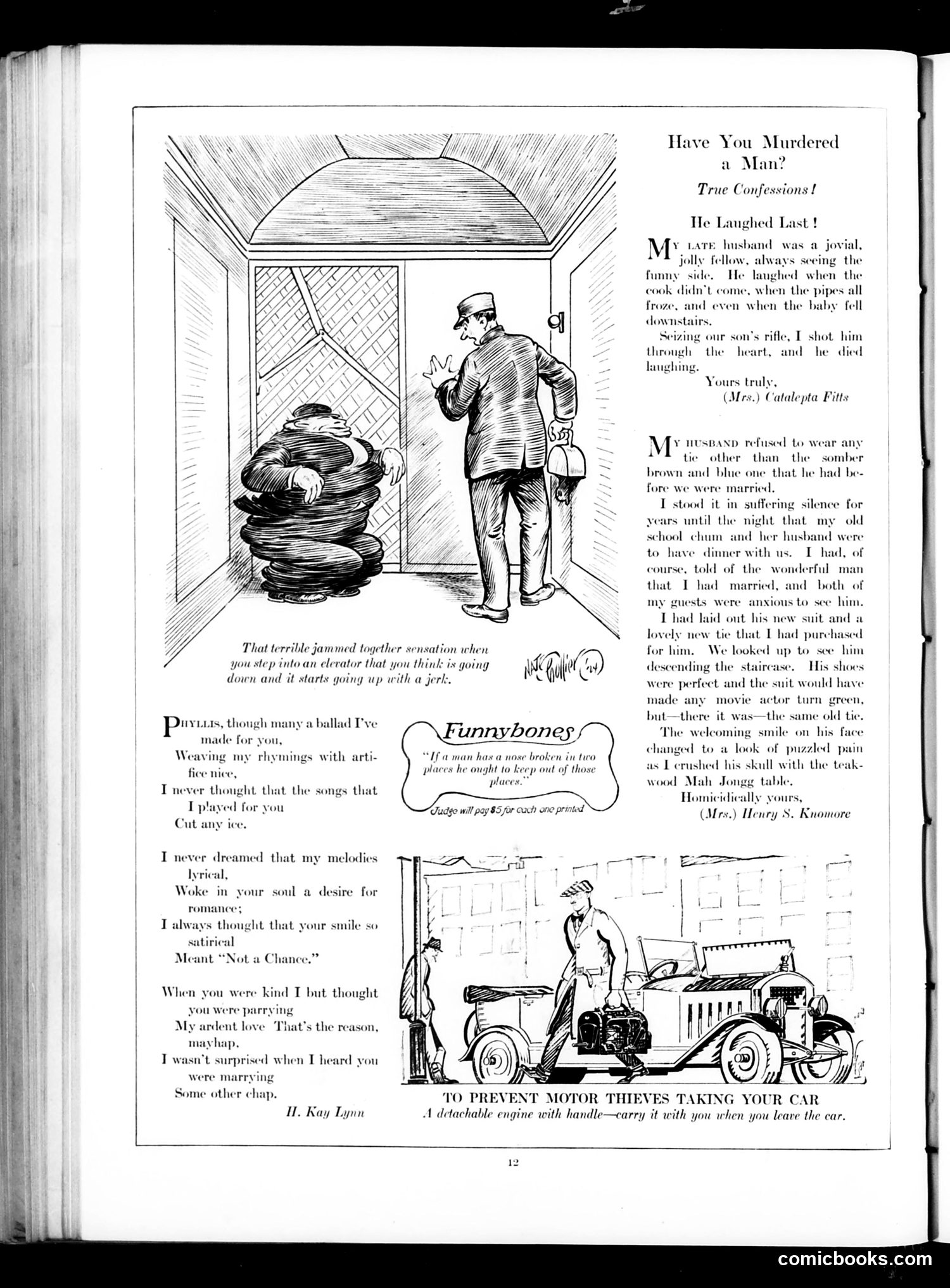
This Judge magazine page contains three satirical pieces: 1. **Top cartoon**: An absurdist joke about elevator confusion—the humor lies in the mundane modern annoyance of stepping into an elevator uncertain of its direction, then being startled by sudden movement. 2. **"Funnybones" section**: A humorous advice box playing on the double-meaning of a "broken nose in two places." 3. **"Have You Murdered a Man?" confessions**: Darkly comedic fake "true confessions" where women describe murdering their husbands over domestic frustrations—a jolly husband who laughs at everything, a husband refusing to change his tie. The exaggerated violence responds to trivial annoyances, satirizing both confession magazines (then-popular) and marital tensions. 4. **Motor theft cartoon**: Practical safety advice: detach your car's engine and carry it when leaving the vehicle, mocking car theft as a growing urban problem of the era. The overall tone mixes absurdist humor, domestic satire, and social commentary on modern anxieties around technology and urban life.
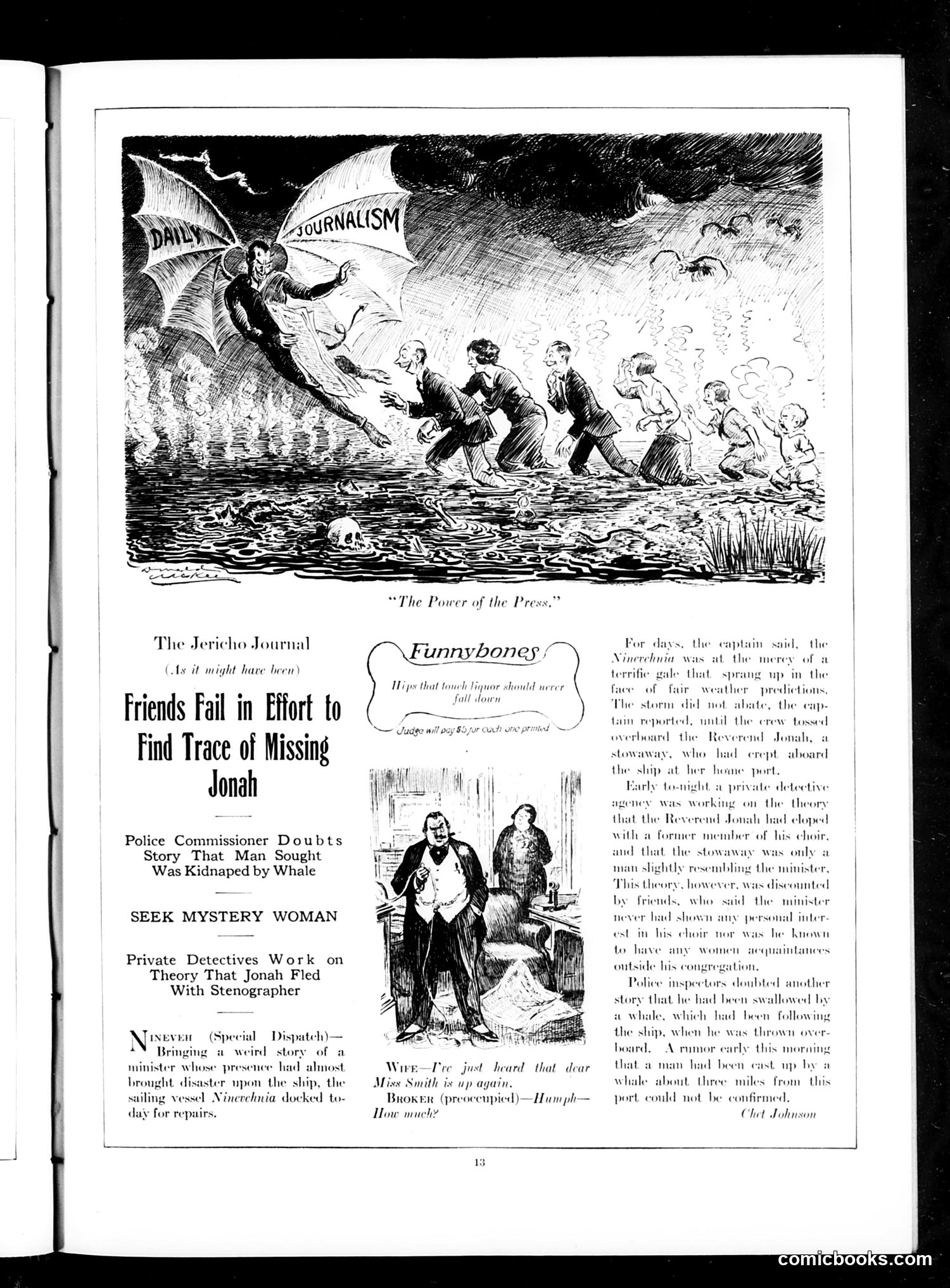
The top cartoon satirizes sensationalist journalism by reimagining the Biblical story of Jonah as a modern newspaper scandal. It depicts journalists (labeled "Daily" and "Journalism") as bat-winged devils stirring up chaos among ordinary people wading through murky water, illustrating how the press sensationalizes and distorts reality. Below, "The Jericho Journal" parodies yellow journalism further by presenting absurd headlines about a "missing Jonah" — treating the biblical account as contemporary news. The mock newspaper features increasingly ridiculous investigative angles: kidnapping by whale, elopement theories, and conflicting police reports. The satire mocks both sensationalist reporting (which manufactures drama from thin evidence) and the gullibility of readers who accept these fabrications. By transplanting ancient scripture into modern tabloid-style coverage complete with "special dispatches" and competing theories, Judge ridicules how the press distorts facts for entertainment value.
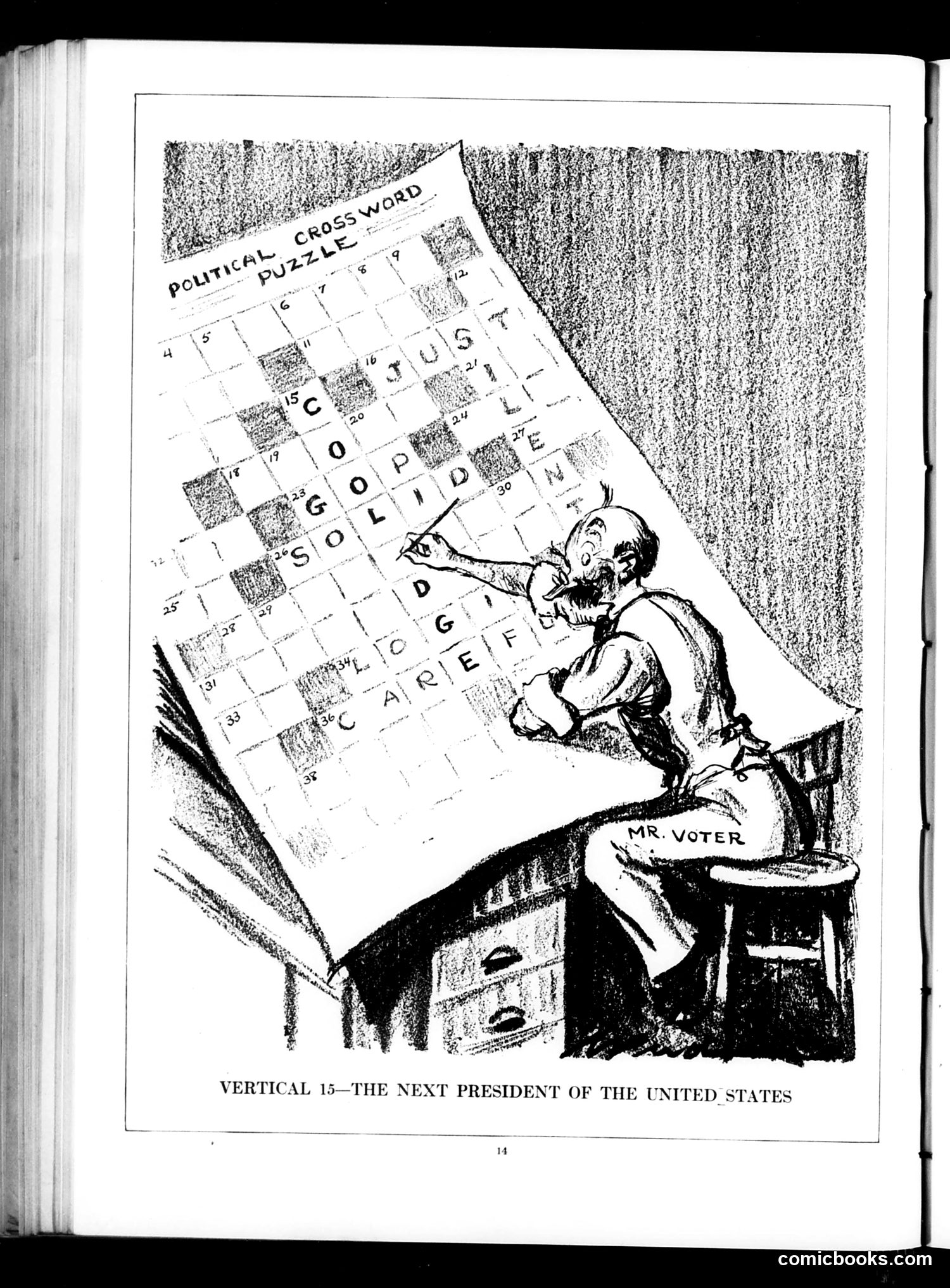
This Judge magazine cartoon depicts "Mr. Voter" attempting to solve a "Political Crossword Puzzle" titled "The Next President of the United States." The figure struggles with the puzzle, appearing frustrated or confused while filling in answers. The satire mocks the difficulty voters face in choosing a presidential candidate—presenting the election decision as an unsolvable puzzle. Visible puzzle answers include fragments like "JUST," "SOLID," "GOOD," and "GRIEF," suggesting political platitudes or empty campaign promises. The cartoon critiques either the inadequacy of available candidates or voters' difficulty distinguishing between them based on substantive differences. The crossword metaphor implies that selecting a president involves guesswork rather than informed choice. The publication date and specific election year remain unclear from the visible text.
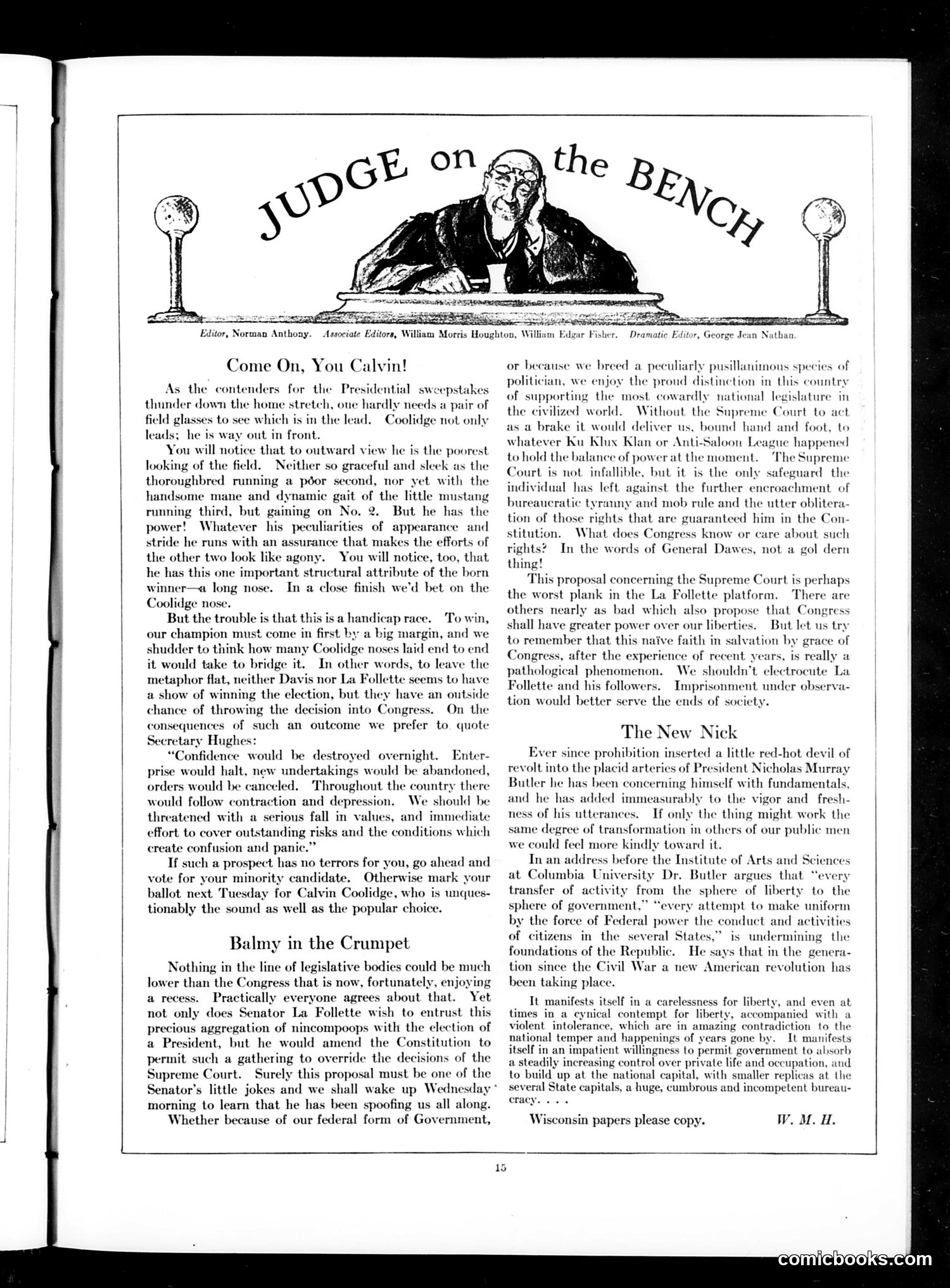
This page contains two satirical political articles from the 1924 U.S. Presidential election. **"Come On, You Calvin!"** uses a horse-racing metaphor to argue for Calvin Coolidge's re-election. The author depicts Coolidge as the clear frontrunner against rivals (likely John W. Davis and Robert La Follette), though physically unimpressive—notably possessing a prominent nose. The piece warns that if neither opponent wins decisively, the election could go to Congress, creating economic chaos (quoting Secretary Hughes). Readers are urged to vote Coolidge to avoid this catastrophe. **"Balmy in the Crumpet"** attacks La Follette's progressive platform, specifically his proposal to allow Congress to override Supreme Court decisions. The author argues this would dangerously empower an incompetent legislature, removing the only protection against mob rule and special interests (referencing the Ku Klux Klan and Anti-Saloon League). The satire defends judicial independence as essential to protecting individual rights from majoritarian tyranny. Both pieces advocate conservative positions opposing progressive reform.
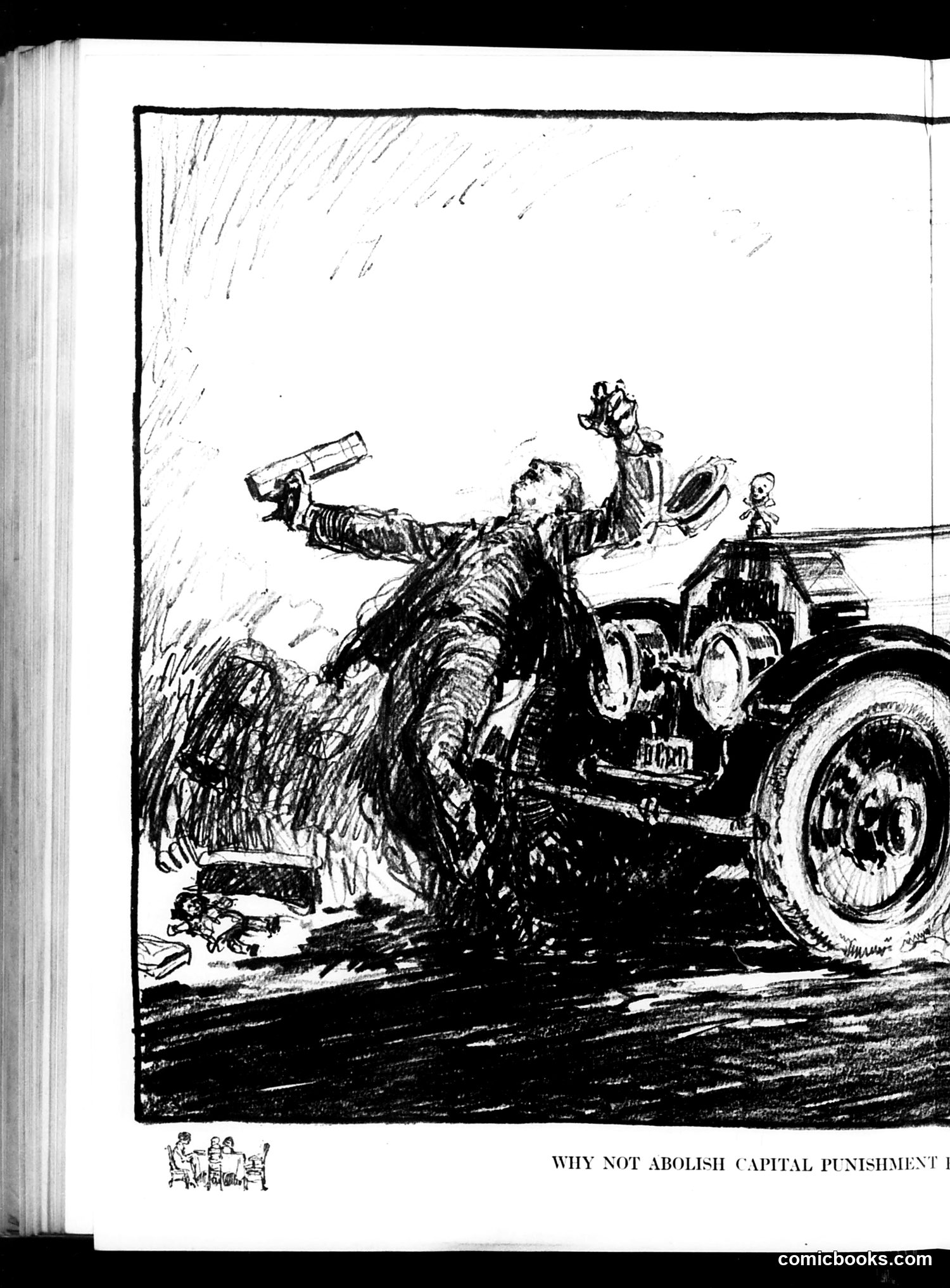
This is a political cartoon arguing for the abolition of capital punishment. The image shows a man in formal attire (appearing to be an executioner or authority figure) standing triumphantly beside an early 1900s automobile, holding a telescope and raising his fist. The cartoon's dark satire suggests that modern technology and automobiles—which were causing numerous fatal accidents—were effectively delivering death sentences without legal process. The title "Why Not Abolish Capital Punishment?" is ironic: if society accepts automobile deaths as inevitable progress, the argument goes, why maintain formal executions? This represents early 20th-century anxiety about industrial safety and questions the moral consistency of legally sanctioning death through execution while tolerating deaths from new technologies. The cartoon critiques society's selective outrage about different forms of fatality.
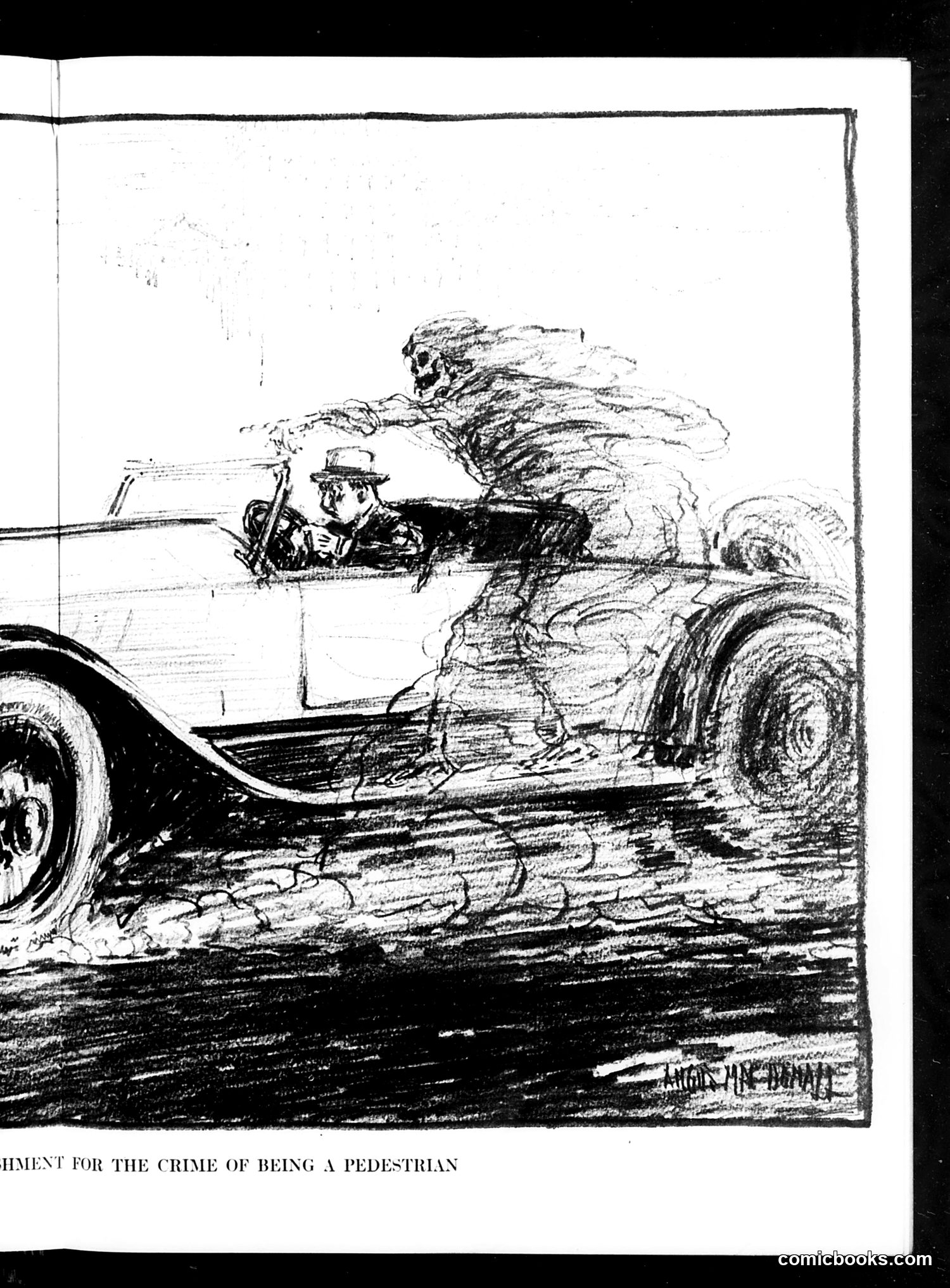
This cartoon satirizes traffic dangers and automobile culture's disregard for pedestrians. The image shows a skeletal Death figure operating a car that has struck down a pedestrian (visible in the background being hit). The caption reads "PUNISHMENT FOR THE CRIME OF BEING A PEDESTRIAN," using dark irony to critique how pedestrians were increasingly killed by vehicles in early automobile era America. The skeleton at the wheel suggests that driving recklessly—or simply being a pedestrian—is essentially a death sentence. The cartoon appears to be Judge magazine's commentary on the growing pedestrian fatality crisis as automobiles became more common, blaming vehicular violence while ironically framing the victim as the "criminal."
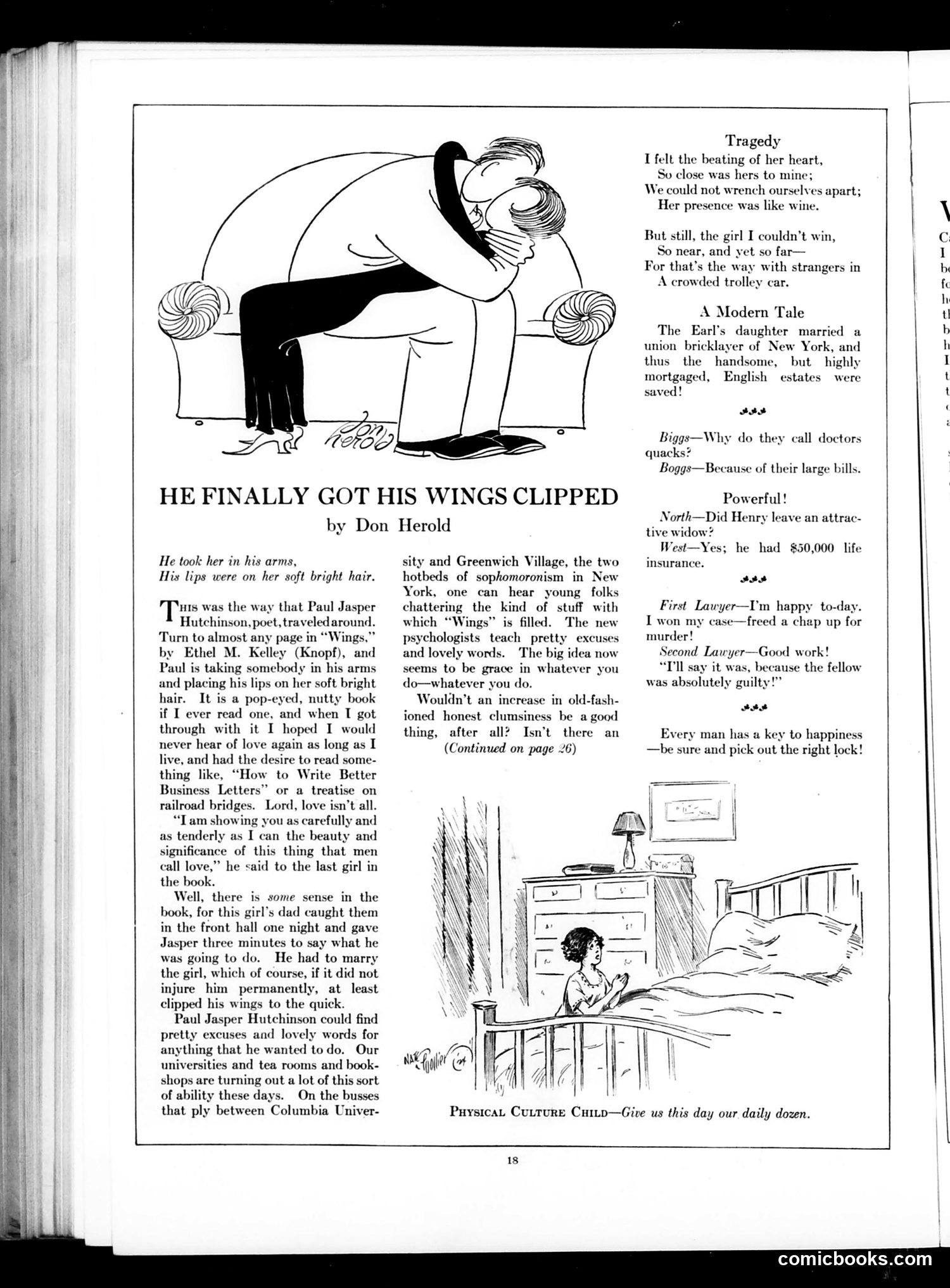
This page from *Judge* magazine contains a satirical story and several short jokes typical of 1920s humor. **"He Finally Got His Wings Clipped"** mocks a popular novel called *Wings* by Ethel M. Kelley. The story's protagonist, Paul Jasper Hutchinson, is a romantic poet who constantly seduces women using flowery language and philosophical excuses. The satire criticizes both the book's overwrought sentimentality and the broader cultural trend of intellectuals (particularly from Columbia University and Greenwich Village) who use pseudo-psychological "lovely words" to justify immoral behavior. The cartoon's punchline: when caught by a girl's father, Hutchinson must marry her, ending his philandering—his "wings" are "clipped." The surrounding jokes target doctors' high fees, mercenary marriage motivations, and dishonest lawyers. The final item, "Physical Culture Child," appears to be a fitness advice panel. The satire reflects 1920s anxieties about bohemian culture, "new psychology," and the loosening of sexual morality in post-war America.
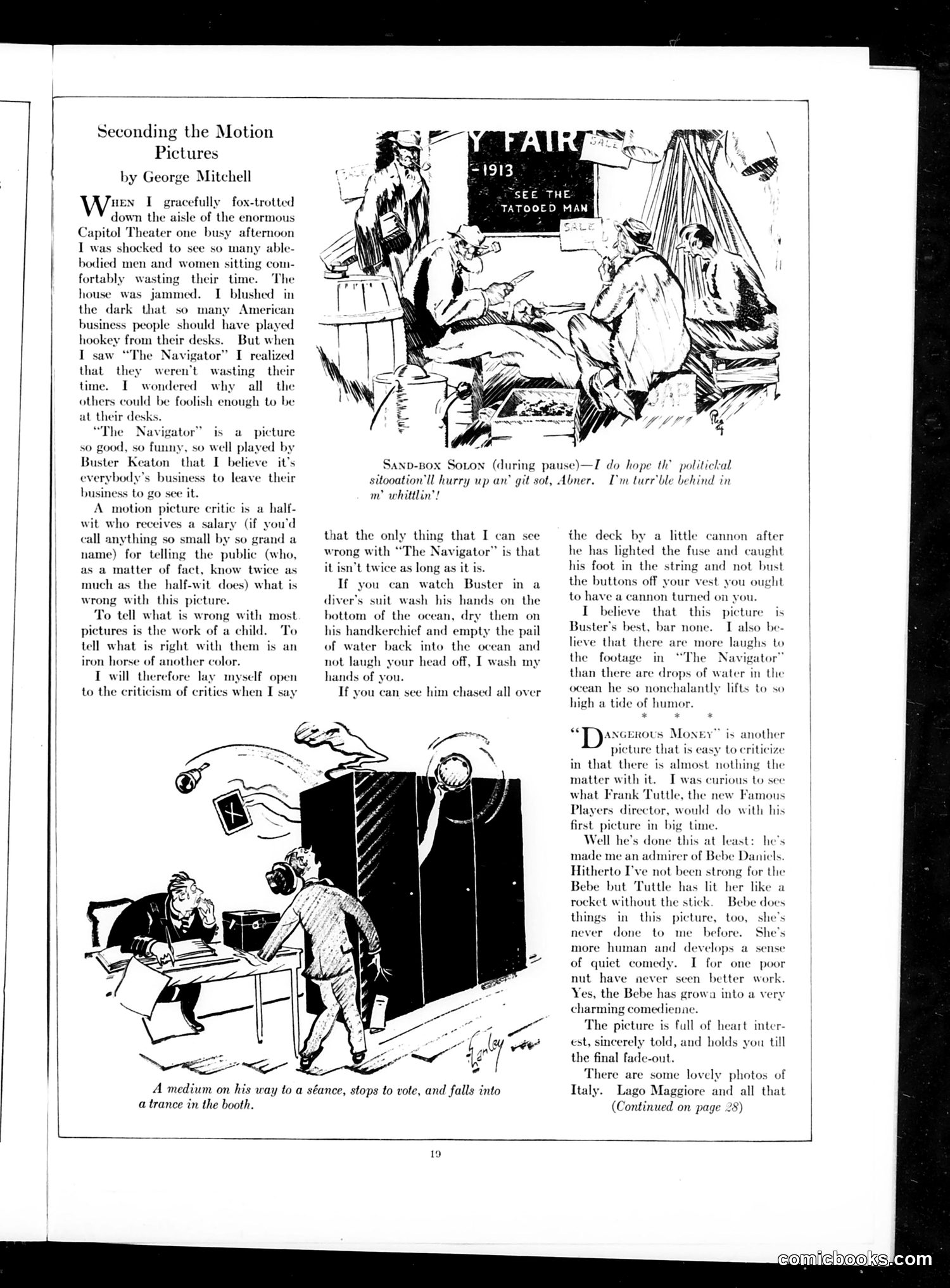
This is a film review column by George Mitchell praising Buster Keaton's "The Navigator" as so entertaining that business people abandoning work to see it is justified. Mitchell critiques film critics themselves as unqualified "half-wits" earning pittance to judge movies, claiming ordinary audiences understand films better. The cartoon below shows a spiritualist medium distracted from a séance, voting in a booth and falling into a trance—likely satirizing how even supernatural practitioners get drawn into the political process, or how voting mesmerizes citizens. The final section reviews "Dangerous Money," praising director Frank Tuttle's first big film and actress Bebe Daniels' improved comedic performance. The small 1913 fair banner references early cinema's novelty appeal, contrasting with contemporary film's advancement.
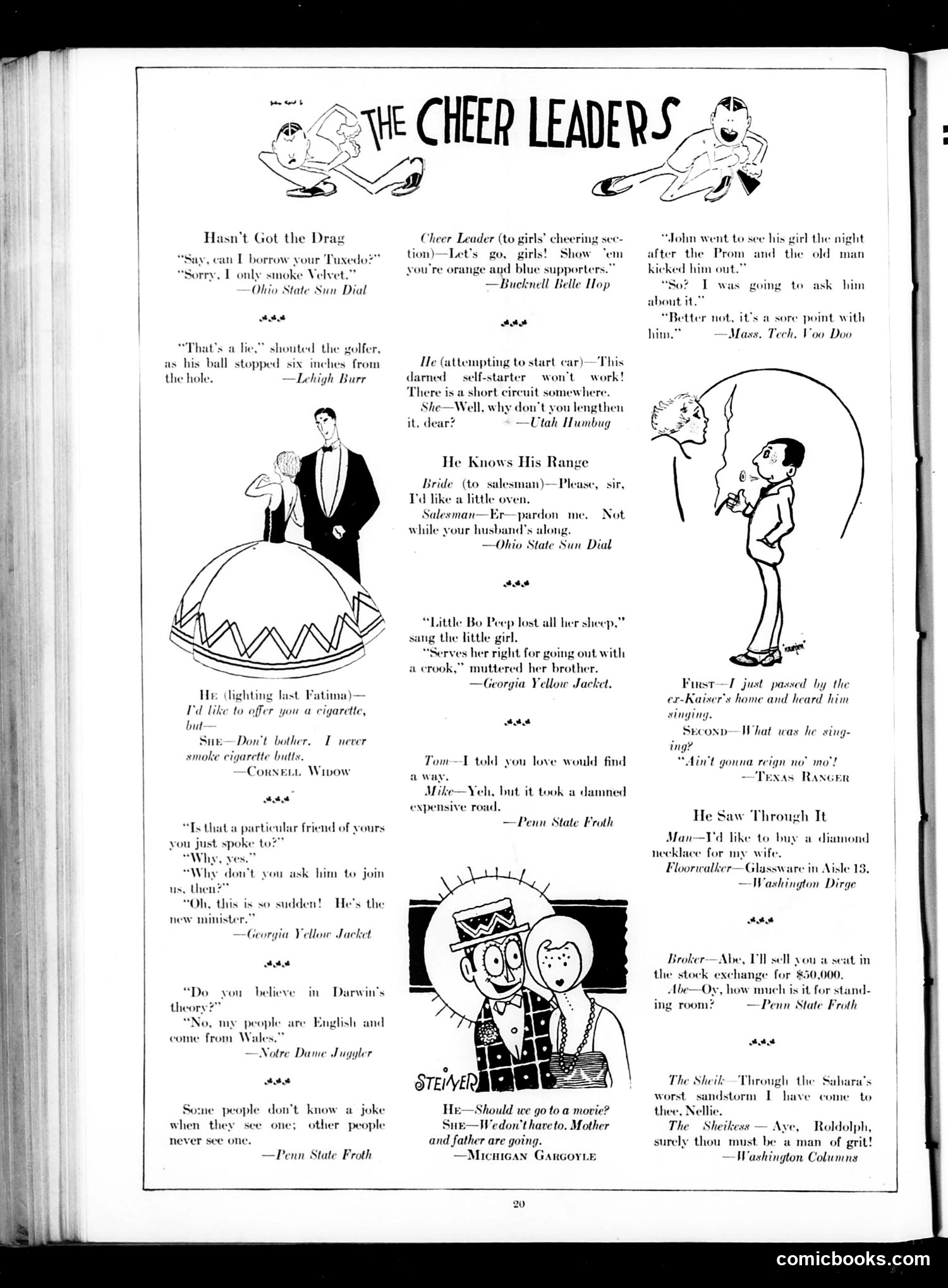
This page collects brief humorous anecdotes from various college humor magazines, organized around dating and courtship themes popular in the 1920s era. The jokes rely on period-specific social contexts: references to college rivalries (orange and blue supporters), automobile anxieties (the newfangled self-starter), and gender dynamics of courtship. Several target women—a bride asking about ovens, a girl losing sheep for "going out with a crook," a wife being bought diamonds. The humor often hinges on wives/girlfriends as objects or impediments. The "He Saw Through It" and "Broker" jokes mock consumerism and materialism. References to "the ex-Kaiser" suggest post-WWI timing. The "Sheik" reference likely alludes to the 1921 Rudolph Valentino film—contemporary pop culture. The overall tone is lighthearted, collegiate, and heteronormative, reflecting 1920s attitudes toward romance, marriage, and gender roles that modern readers would find dated or problematic.
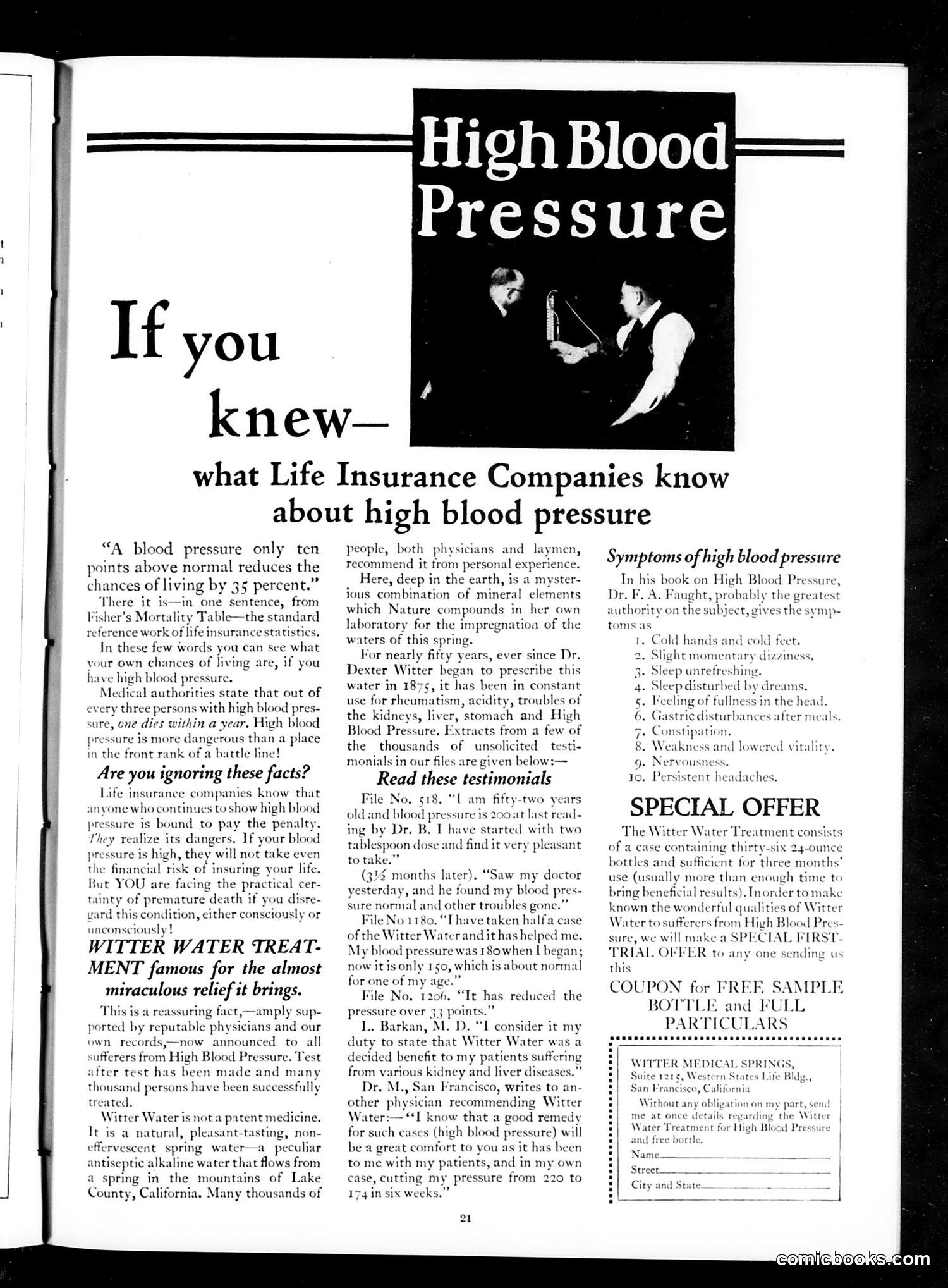
This page is primarily **medical advertising** rather than satire or political commentary. It promotes "Witter Water," a mineral spring water claimed to treat high blood pressure. The content uses a fear-based marketing approach: opening with insurance statistics about mortality risk from hypertension to establish urgency, then pivoting to testimonials endorsing the product. This was common in early 20th-century patent medicine advertising. The photograph shows two men examining what appears to be medical equipment (likely a blood pressure cuff), lending pseudo-scientific authority to the claims. **What's notable for modern readers:** The advertisement relies entirely on anecdotal testimonials and vague appeals to "nature's compounds" rather than clinical evidence—marketing tactics the FDA would later heavily regulate. This represents pre-regulation American medical advertising, when such claims faced minimal scrutiny.
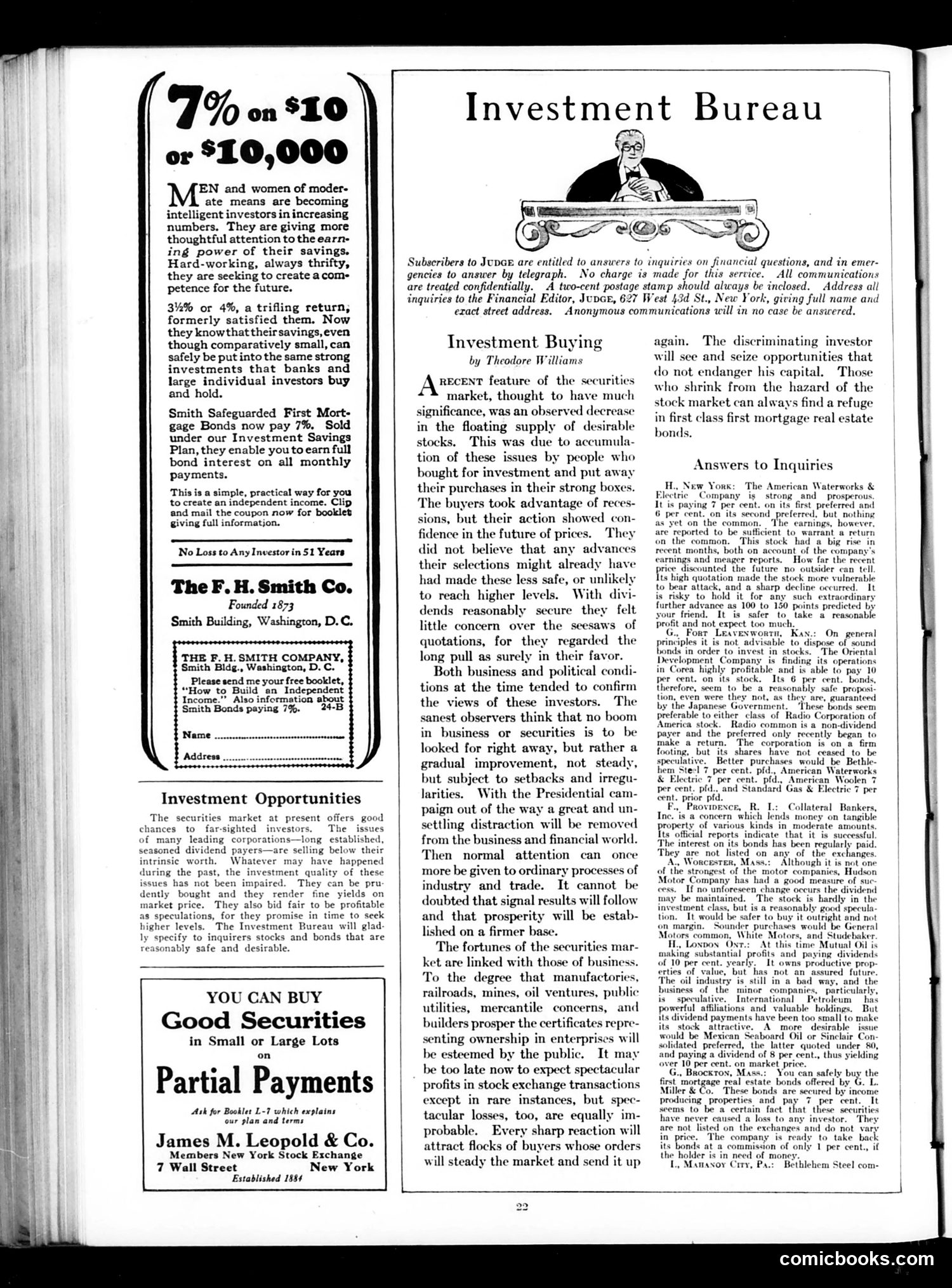
This page is primarily **financial advertising** from early 20th-century America, not political satire. The main content consists of investment firm advertisements (F.H. Smith Co., James M. Leopold & Co.) promoting bonds and securities to middle-class savers. The "Investment Buying" article by Theodore Williams discusses stock market strategy—specifically, savvy investors accumulating quality stocks during market downturns, confident in long-term gains. The article references contemporary anxieties: it mentions a "Presidential campaign" causing "unsettling distraction" to business (likely the 1908 or 1912 election), and expresses optimism that once political uncertainty clears, normal economic attention will resume. **No identifiable political cartoons or caricatures appear on this page.** It reflects Judge's dual function as satire magazine and advertising platform, here emphasizing financial opportunities for "men and women of moderate means" seeking investment growth beyond meager savings account returns.
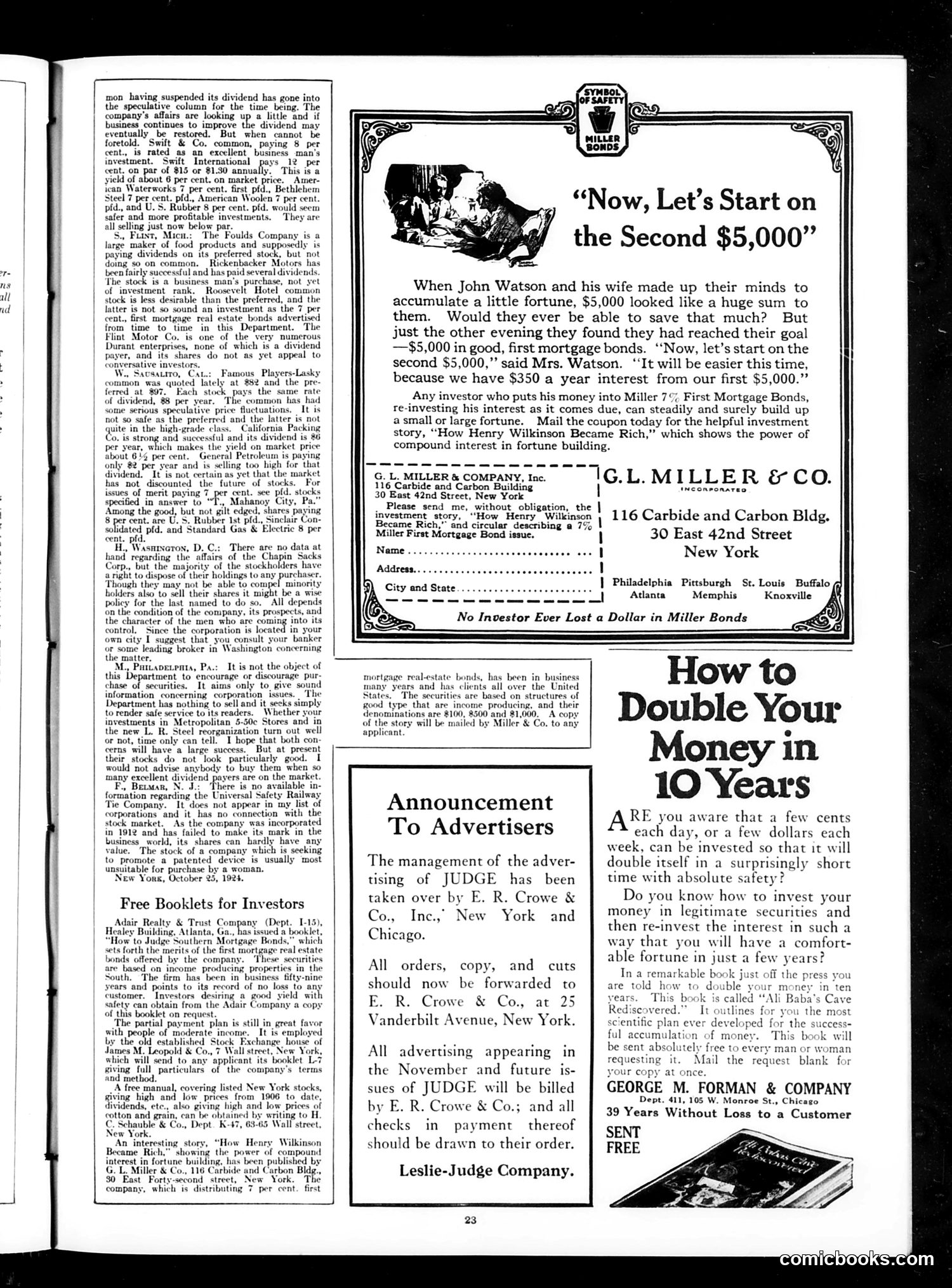
This page from Judge (dated October 25, 1924) is primarily **investment advice and advertising**, not political satire. The main feature is G.L. Miller & Co.'s advertisement promoting first mortgage bonds as a safe investment vehicle. The accompanying illustration shows a couple (John and Jane Watson) celebrating reaching their $5,000 savings goal, illustrating how compound interest can help ordinary people build wealth through Miller bonds. The bulk of the page consists of **investment guidance columns** answering reader questions about various stocks and securities—discussing dividend yields, company prospects, and relative safety of different investments. This reflects 1920s prosperity-era financial enthusiasm. A secondary notice announces that **E.R. Crowe & Co. has taken over advertising management** of Judge magazine itself. The "How to Double Your Money in 10 Years" sidebar advertises George M. Foreman & Company's investment book, promising scientific wealth-building methods. This is essentially a financial services page aimed at middle-class savers, not satirical commentary.
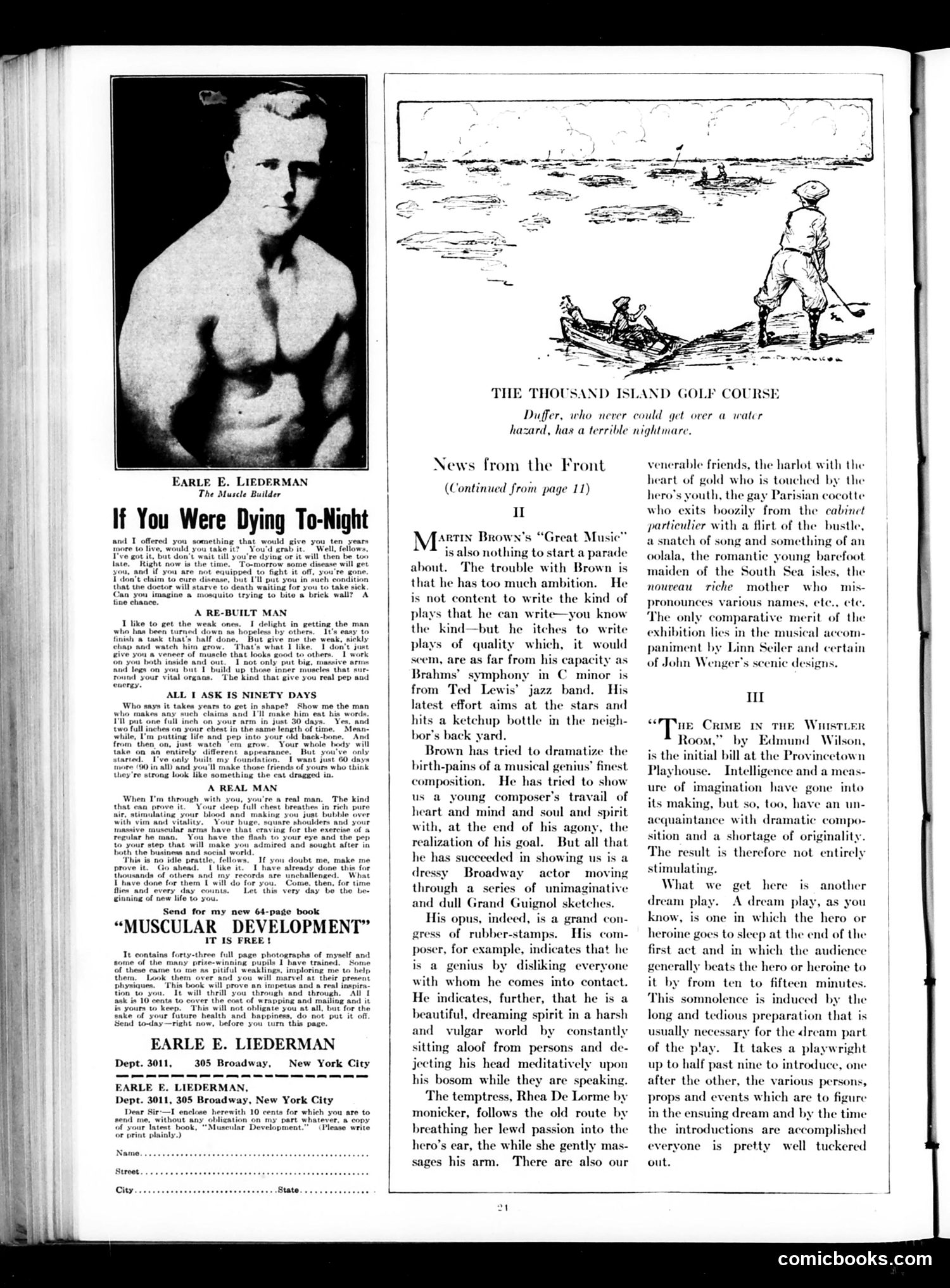
This page contains **advertising and theater criticism**, not political satire. The dominant content is an advertisement for **Earle E. Liederman's muscle-building course**. Liederman was a famous 1920s fitness entrepreneur who promised to build physiques in "ninety days." The shirtless photograph and promotional copy ("If You Were Dying To-Night") use dramatic language to sell his mail-order bodybuilding system and free instructional booklet. The right side features theater reviews under "News from the Front," criticizing Martin Brown's play "Great Music" as derivative and poorly executed, and praising Edmund Wilson's "The Crime in the Whistler Room" at the Provincetown Playhouse. There is also a single cartoon captioned "The Thousand Island Golf Course," depicting a golfer's nightmare about water hazards—a light visual joke rather than political commentary. The page reflects 1920s consumer culture and theater criticism, not satire of political figures or events.
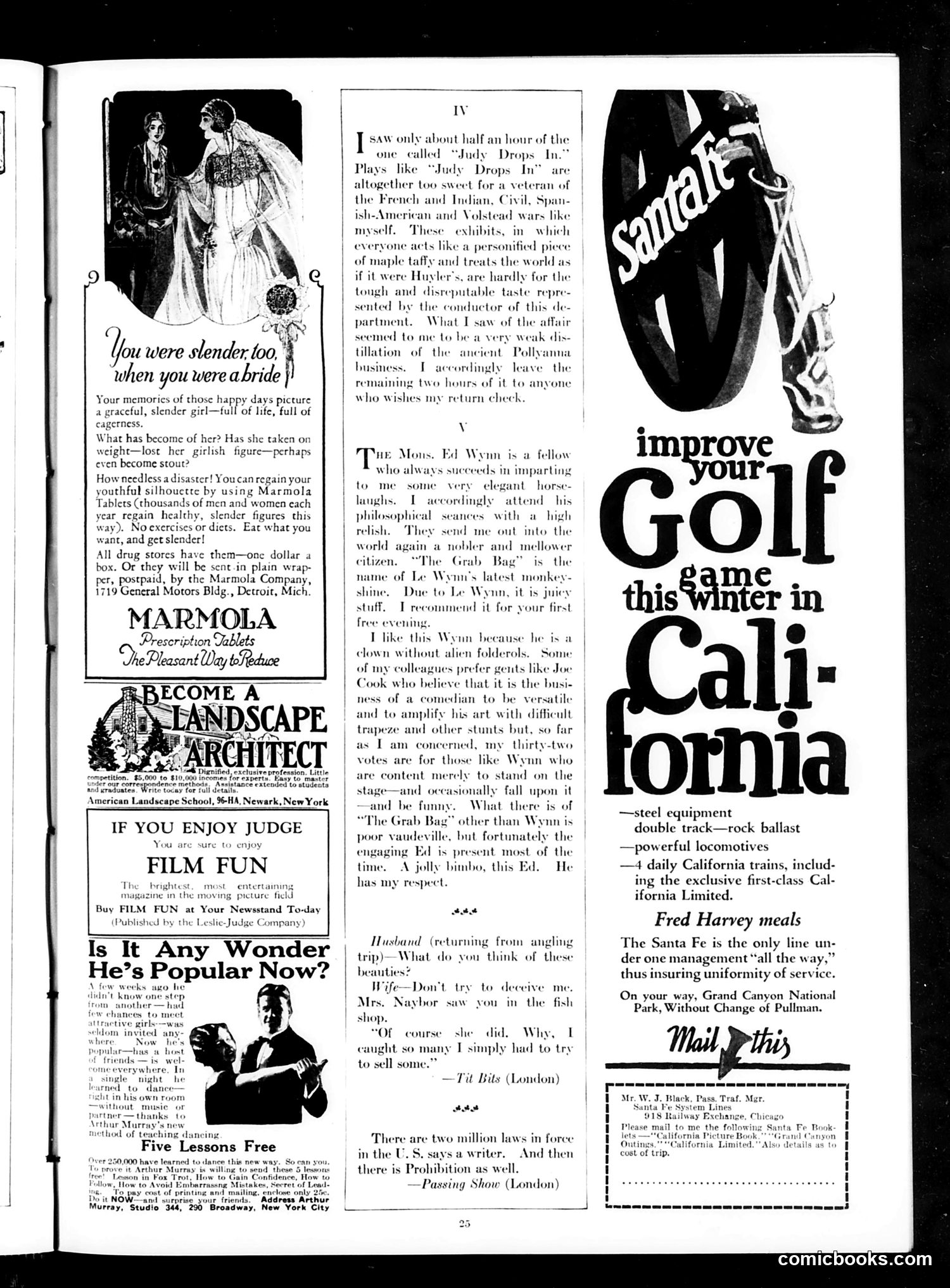
This is primarily a **advertising and entertainment page** from Judge magazine, not political satire. **Key Content:** 1. **Marmola Diet Tablets ad** (top left): Uses shame-based marketing targeting women who gained weight after marriage—"You were slender, too, when you were a bride." Reflects 1920s attitudes about female appearance and beauty standards. 2. **Film/Theater reviews** (center): A critic dismisses the play "Judy Drops In" as overly sentimental ("maple taffy"), preferring comedian Ed Wynn's vaudeville act "The Grab Bag." References the "Volstead wars" (Prohibition era). 3. **Miscellaneous ads**: Landscape architecture school, "Film Fun" magazine, dancing lessons. 4. **Brief jokes** (bottom): Includes humor about fishing and a quip about "two million laws...and then there is Prohibition." **Historical Context:** The page reflects 1920s consumer culture, vaudeville entertainment popularity, and Prohibition-era references—but contains **no significant political cartoon or satire** in the traditional sense.
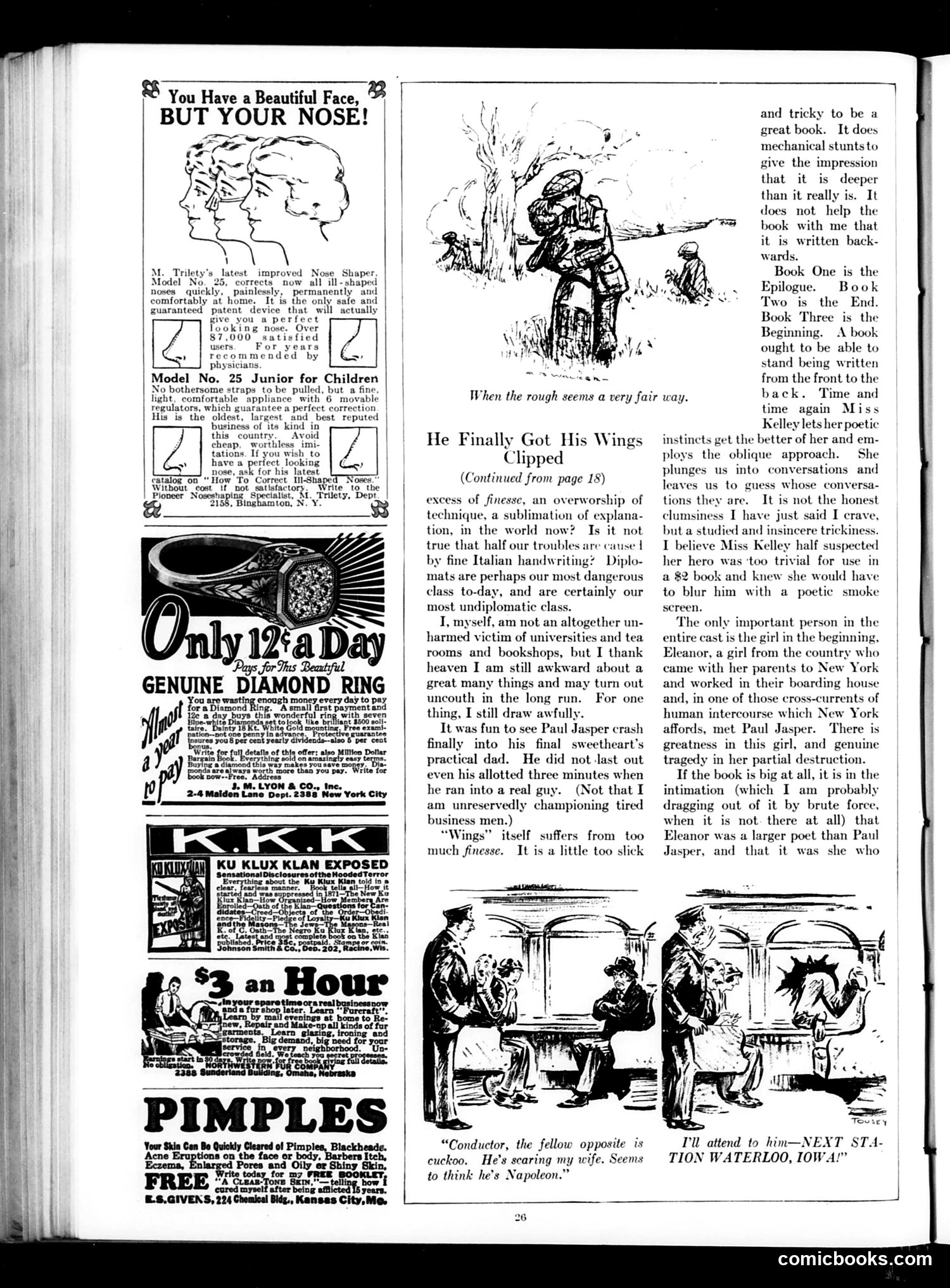
This page contains primarily **advertisements** for period remedies and products, plus a book review—not political cartoons. The main ads peddle dubious "solutions" to personal insecurities: - **M. Trilety's Nose Shaper**: A corrective device promising to reshape "ill-shaped noses" without surgery. This satirizes the era's obsession with appearance and pseudoscientific personal "improvement" products. - **Genuine Diamond Ring** and **Pimples remedy**: Standard dubious mail-order products exploiting vanity and insecurity. The illustrated story "He Finally Got His Wings Clipped" is a book review critiquing a novel called *Wings* by Miss Kelley. The reviewer praises its country girl character Eleanor but faults the male protagonist Paul Jasper as trivial, and criticizes the book's "studied" stylistic tricks (written backwards: Epilogue, End, Beginning) as insincere "finesse." The cartoon vignettes show train passengers gossiping—illustrating the review's themes about social pretension and conversation.
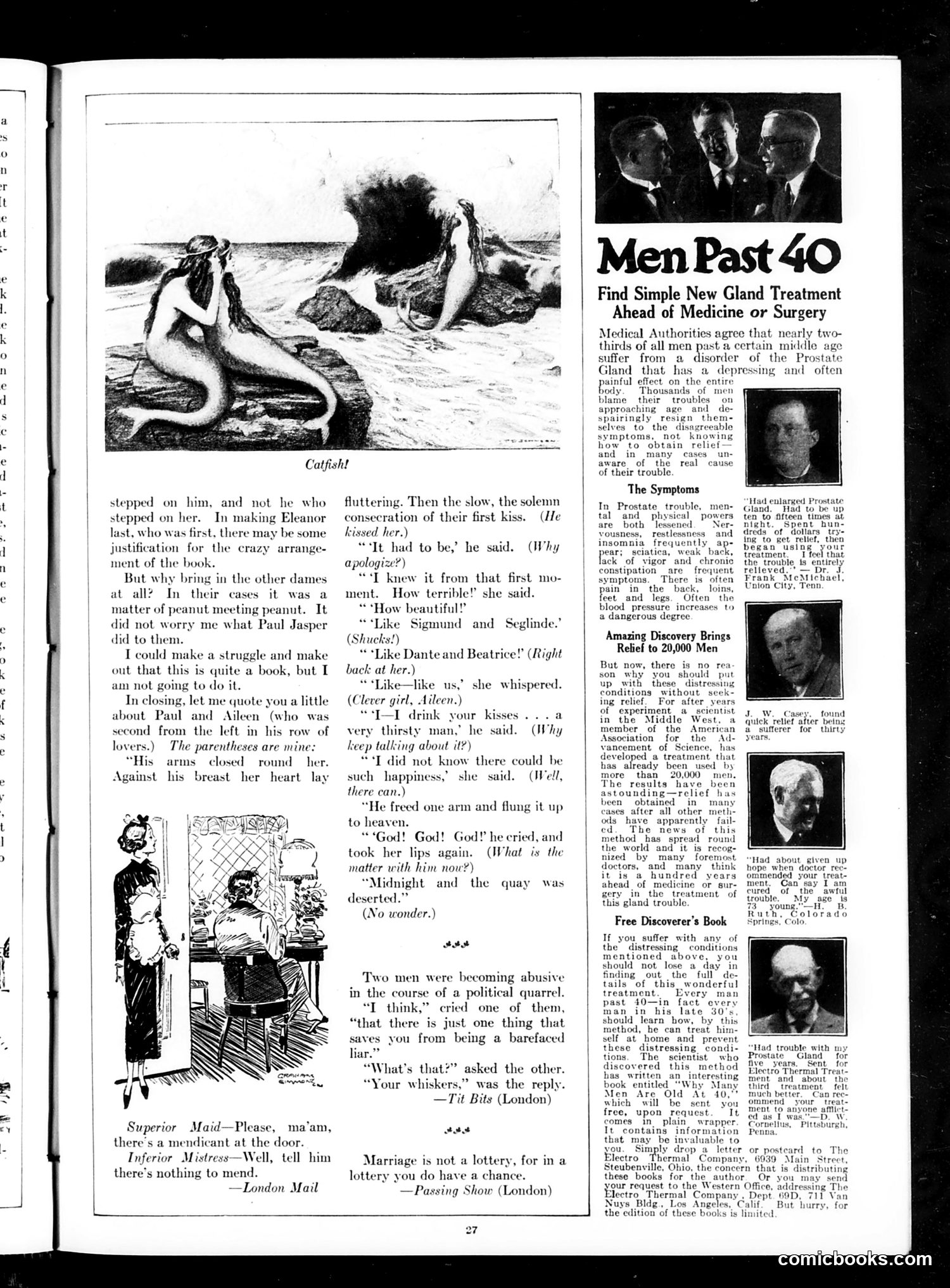
This page contains satirical content typical of Judge magazine, mixing literary criticism, jokes, and medical advertising. **Main Cartoon/Literary Critique (Left):** The large illustrated section critiques a novel called "Catfish," reviewing a romantic scene between characters Paul and Aileen. The reviewer mocks the overwrought, purple prose of their first kiss—filled with operatic references (Dante, Wagner) and melodramatic declarations. The parenthetical asides ("Why keep talking about it?" "What is the matter with him now?") provide sarcastic commentary on the author's excessive sentimentality, a common target of early 20th-century literary satire. **Political Joke (Center):** Two men quarreling about politics; one says the other would be "a barefaced liar" except for one thing—his whiskers. This suggests his facial hair is the only honest thing about him, mocking both political dishonesty and possibly outdated facial grooming conventions. **Right Side:** Medical advertisement for prostate gland treatment—not satirical content but actual period advertising claiming relief for thousands of men, typical of Judge's commercial content.
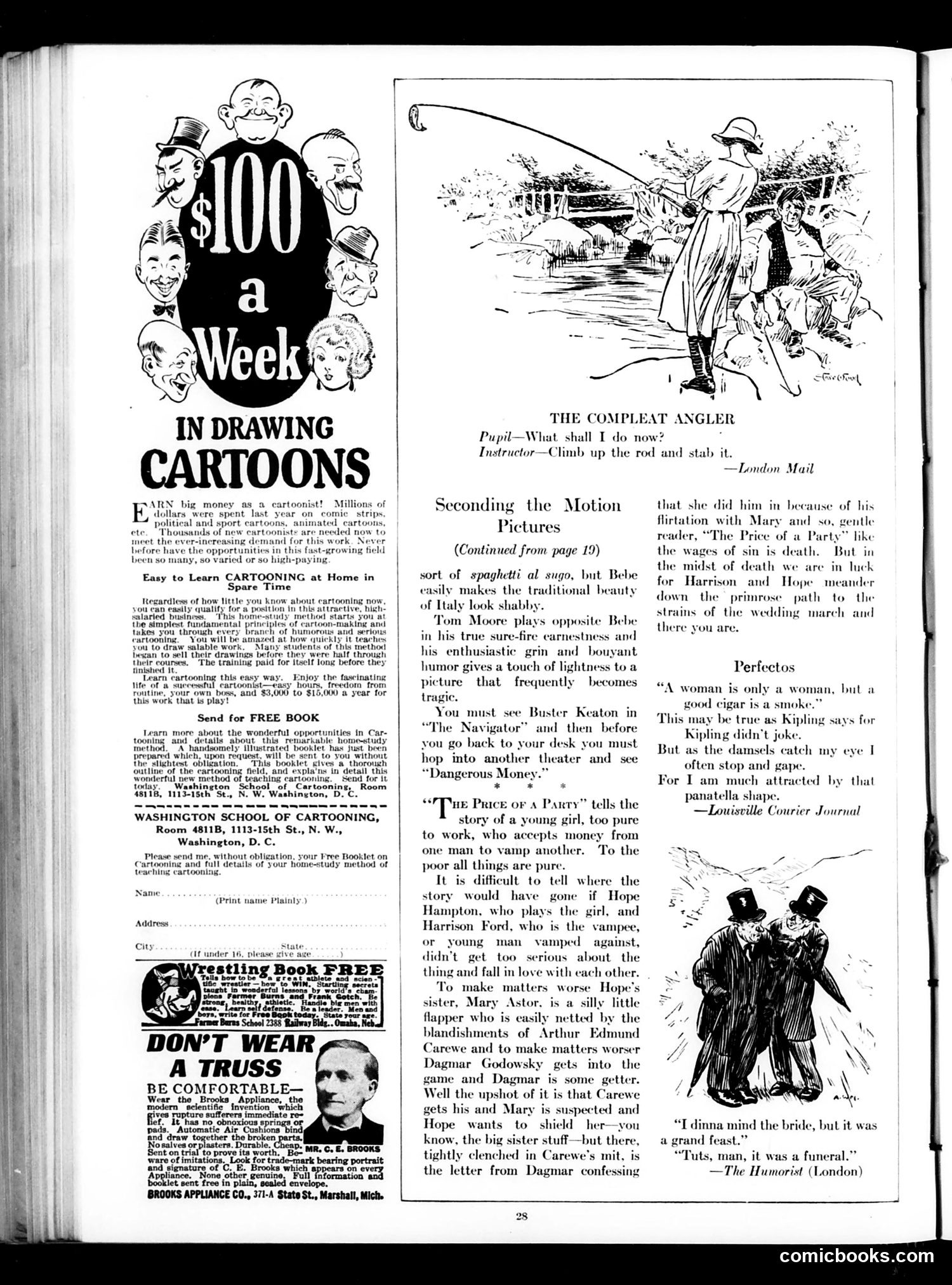
This page combines advertising with entertainment content typical of 1920s Judge magazine. **Main Content:** "The Compleat Angler" cartoon depicts a fishing instructor telling a pupil to "climb up the rod and stab it"—a nonsensical, absurdist joke playing on misunderstanding. **Film Reviews:** "Seconding the Motion Pictures" discusses contemporary silent films, including Buster Keaton's "The Navigator" and "Dangerous Money," and "The Price of a Party" starring Hope Hampton and Harrison Ford. The review critiques the melodramatic plot about a pure girl accepting money from one man to seduce another, noting the story becomes a conventional romance when the leads fall genuinely in love. **Advertisements:** The page heavily promotes the Washington School of Cartooning's correspondence course ($3,000-$15,000 annual potential), a medical truss appliance, and a free book on cartooning—typical early-20th-century direct-mail advertising. **Humor Shorts:** Brief jokes appear throughout, including a Kipling reference and London publication quotes, representing the magazine's satirical, joke-heavy format.
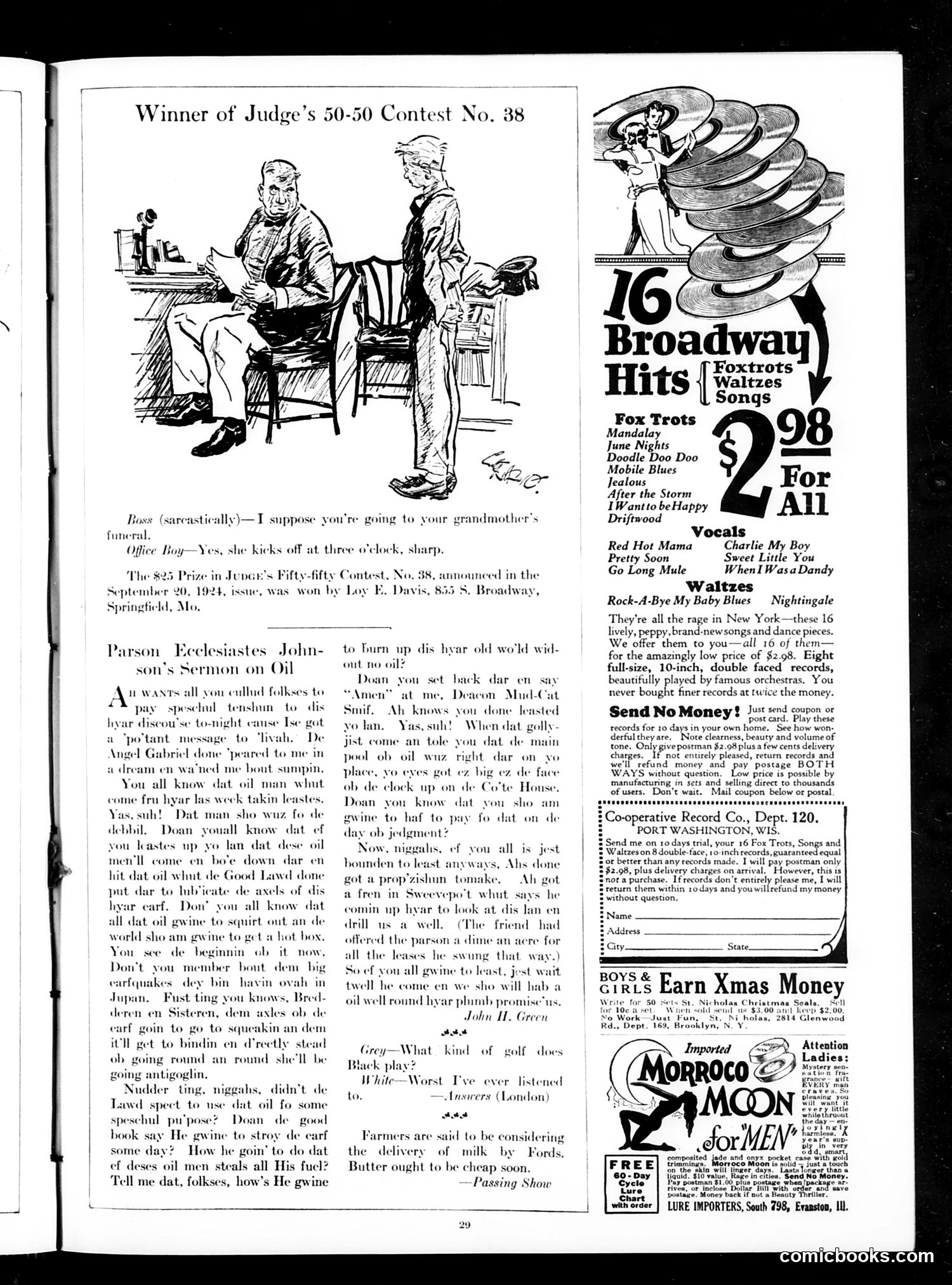
The main cartoon depicts a humorous sermon by "Parson Ecclesiastes Johnson" warning against oil leasing. The parson, rendered in dialect with racial stereotypes typical of 1920s-era Judge magazine, preaches that leasing land for oil drilling will cause the Earth to lose its lubricating oil and either seize up or explode—God's intended method for destroying the world. The joke satirizes the oil boom's land-lease fever sweeping through rural America in the early 1920s. Farmers were being aggressively courted to sign oil leases. The parson's absurd geological warnings mock both the superstitious resistance some rural communities had to industrialization and the gullibility of landowners being sold dubious promises. The page is otherwise filled with period advertisements, including sheet music and phonograph records, reflecting Judge's commercial orientation alongside its satire.
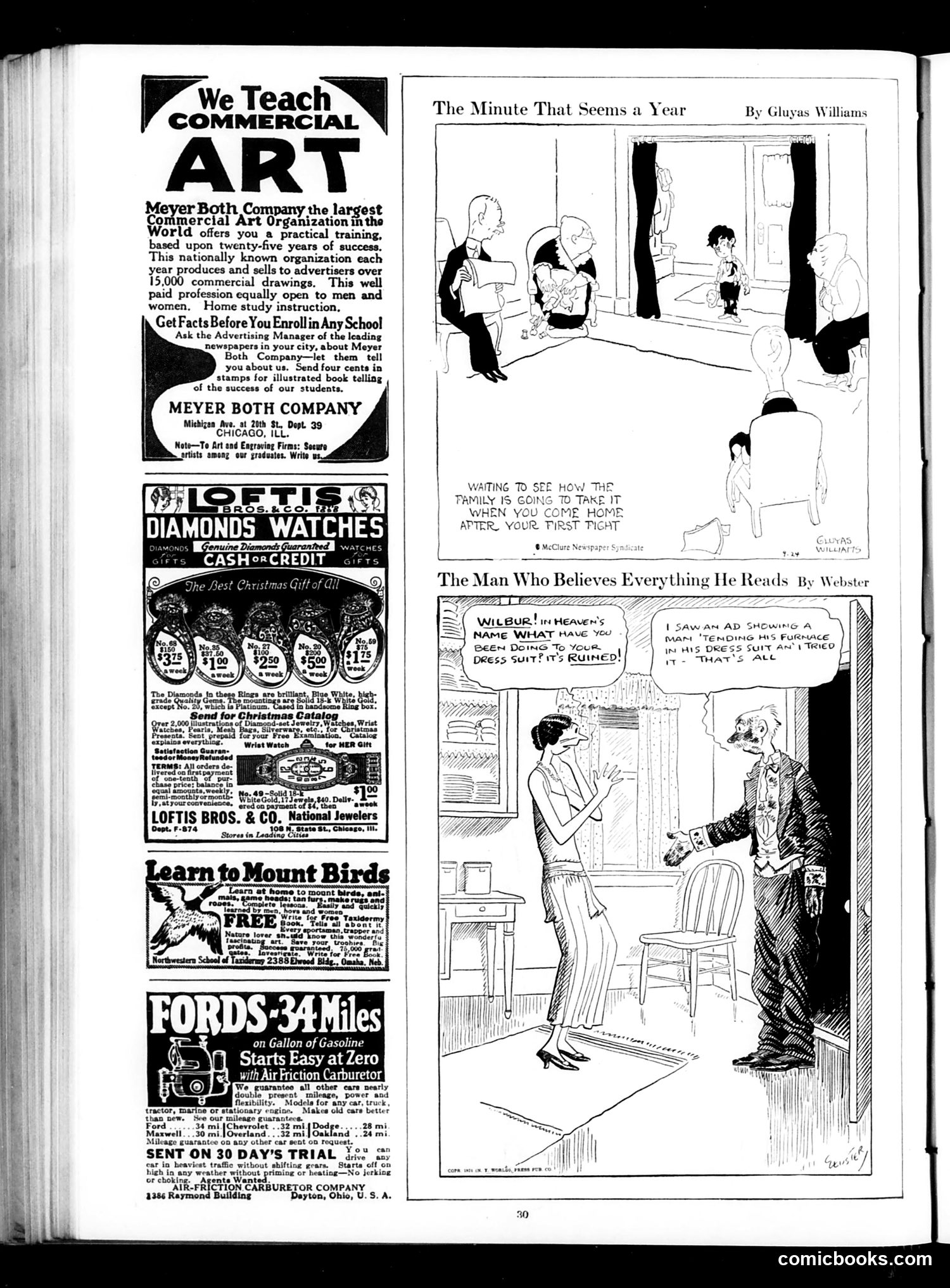
This page contains two cartoons and period advertisements (commercial art school, jewelry, bird-mounting course, Ford carburetor). **"The Minute That Seems a Year"** (top) depicts a domestic scene where a wife anxiously waits to see how her family will react when the husband comes home after his first night out. The satire captures the tension and dread of anticipating a spouse's judgment. **"The Man Who Believes Everything He Reads"** (bottom) shows a husband arriving home in a ruined dress suit. When his wife expresses outrage, he explains he saw an advertisement showing a man tending his furnace in a dress suit—and believed it literally, attempting to replicate what the ad depicted. The joke mocks gullible readers who take advertising claims at face value without critical thinking, a common satirical target in this era of increasingly aggressive commercial advertising.
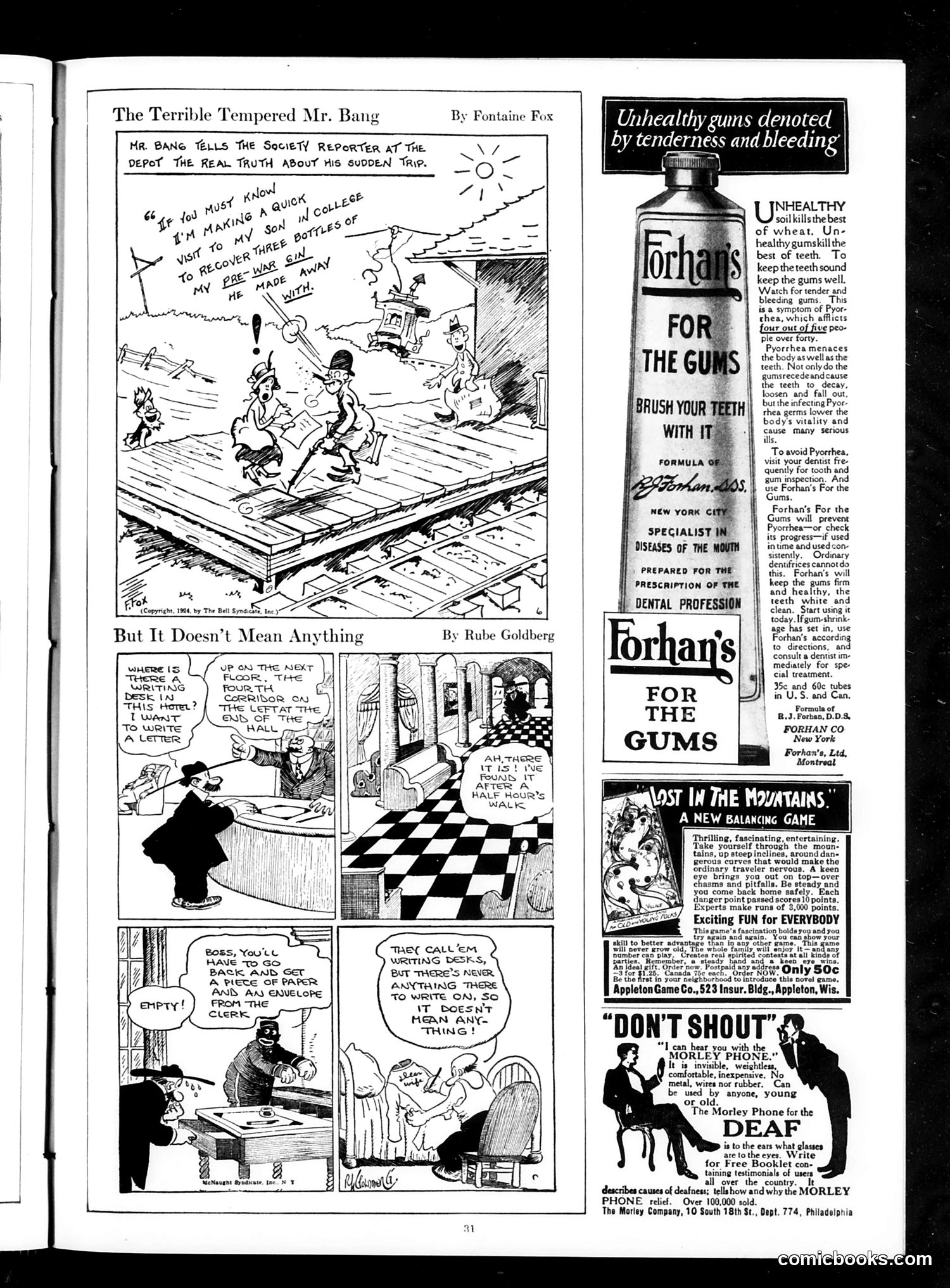
**"The Terrible Tempered Mr. Bang"** (top) depicts a character giving an apparently false explanation to a society reporter about a sudden trip. The satire appears to mock wealthy men who make excuses to their social circles—the character invents an elaborate story about needing to recover "three bottled" from college, suggesting he's covering up something embarrassing or scandalous with a fabricated tale. **"But It Doesn't Mean Anything"** (bottom) shows a hotel clerk dealing with a guest's complaints about noise and lack of writing materials. The joke turns on bureaucratic absurdity: despite occupying a "writing desk" position, the clerk insists there's "never anything there to write on"—a commentary on institutional incompetence and the gap between job titles and actual function. The page is dominated by period **advertisements** for Forhan's dental product (addressing pyorrhea/gum disease) and other consumer goods, reflecting early 20th-century advertising practices in magazines.
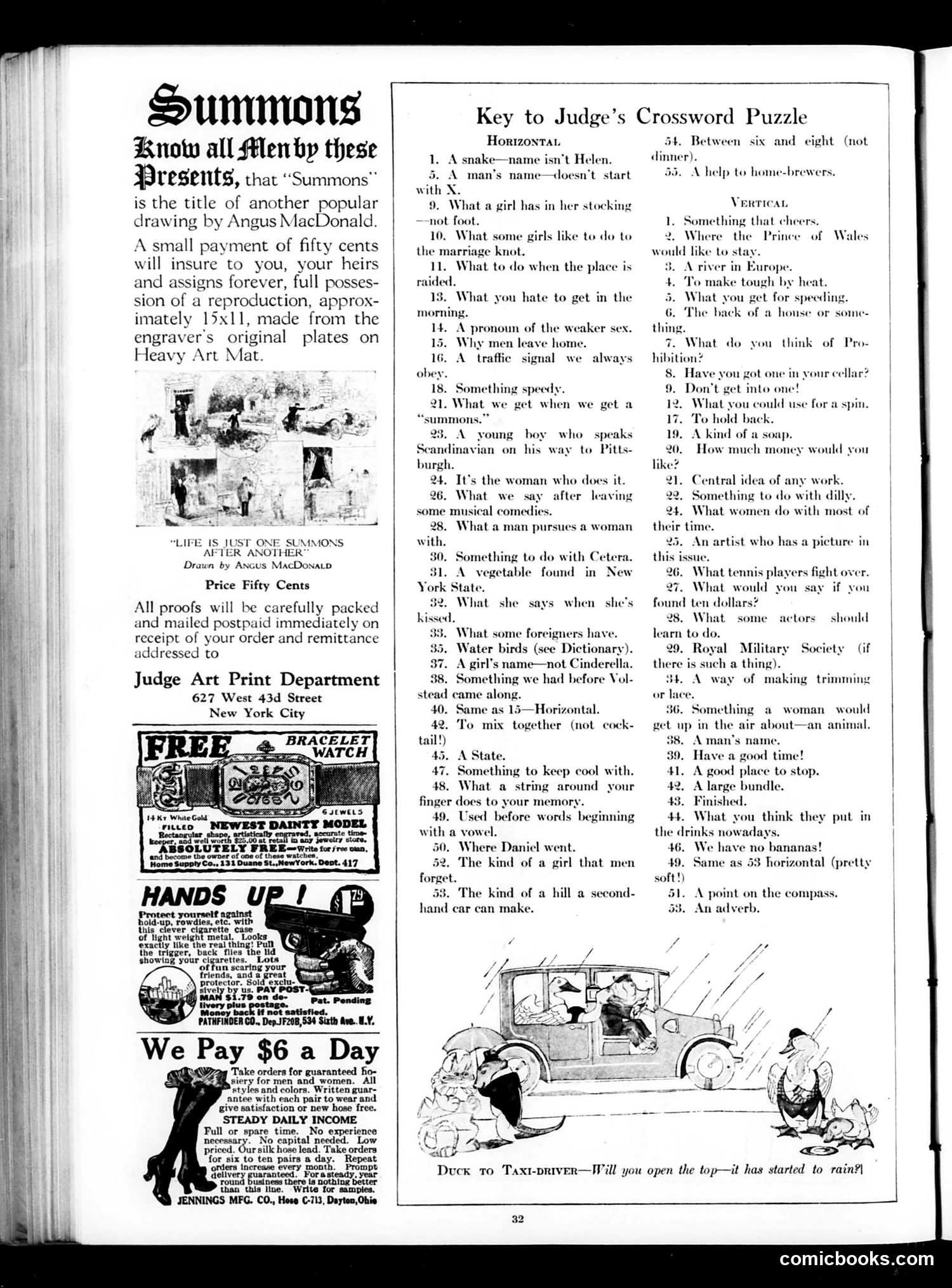
This page is primarily **advertising and puzzles**, not political satire. The main content includes: **"Summons" Print Advertisement**: Angus MacDonald's drawing titled "Life is Just One Summons After Another"—a cynical commentary on everyday legal harassment, likely referencing frequent lawsuits or court summonses in 1920s America. **The Cartoon**: The bottom illustration shows a taxi driver in rain with the caption "Duck to Taxi-driver—Will you open the top—it has started to rain!" This is a simple visual gag about a convertible car's retractable top, not political satire. **Surrounding Ads**: Typical 1920s-era classified advertisements hawking novelty items (fake cigarette case guns, silk hosiery, jewelry watches), employment schemes, and patent medicines—reflecting the magazine's commercial nature. **Crossword Puzzle**: Standard puzzle with contemporaneous references (Prohibition, "Volstead," marriage customs). No significant political commentary or caricature appears on this page.
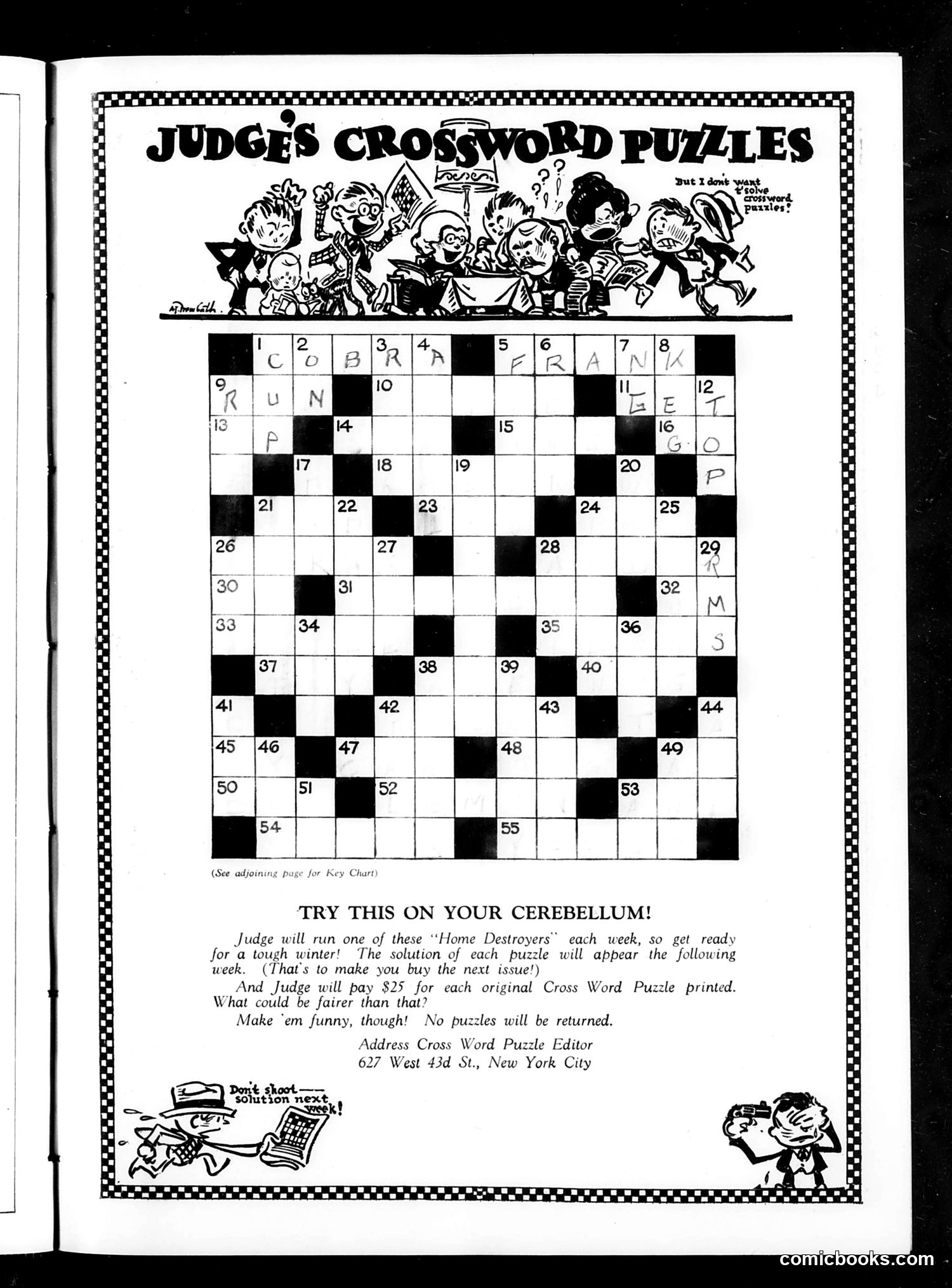
This page is primarily a **crossword puzzle** with advertising/contest information rather than political satire. The content announces Judge's weekly crossword puzzle feature, humorously called "Home Destroyers"—referencing the addictive nature of crosswords that were enormously popular in the 1920s-30s. The puzzle itself contains some filled-in letters, suggesting this is an example or partially completed puzzle. The key detail is the **monetary incentive**: Judge offers $25 for original crossword puzzles submitted by readers, encouraging participation while ensuring fresh content. The phrase "Make 'em funny, though!" suggests Judge wanted puzzles with humorous or clever clues fitting the magazine's satirical character. The cartoon illustrations of people working on puzzles reinforce the "Home Destroyer" concept—depicting crosswords as an obsessive, time-consuming pastime. This reflects genuine 1920s-30s cultural anxiety about crossword puzzles' addictive grip on the American public.
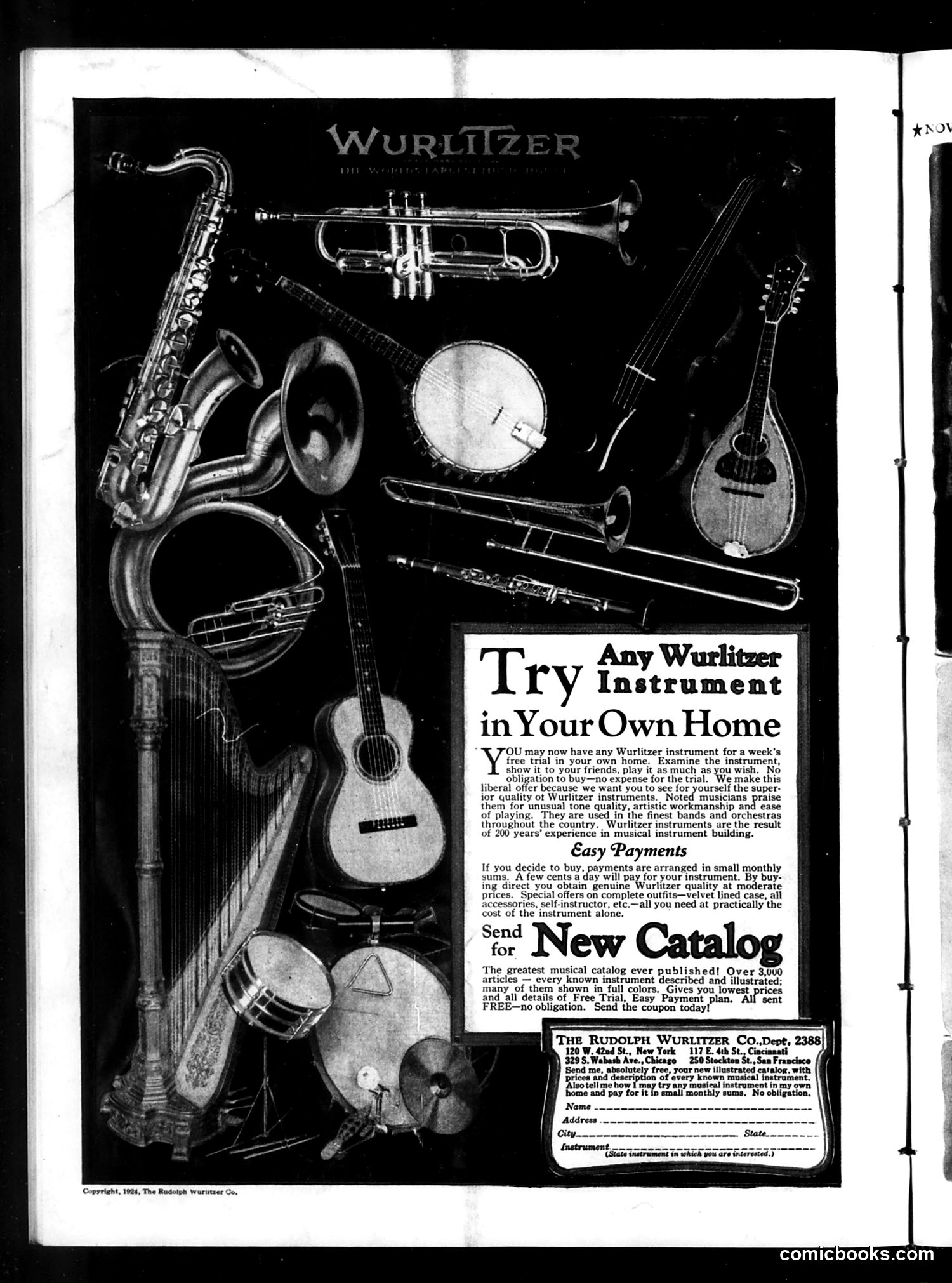
This is **not a cartoon or satirical content**—it's a **full-page advertisement** for Wurlitzer musical instruments, circa 1924. The page displays various instruments (saxophone, trumpet, guitar, mandolin, drums, bassoon) arranged around a central sales pitch. Wurlitzer, a real German-American instrument manufacturer, offers customers a week-long free home trial with no obligation to purchase. The ad emphasizes affordable monthly payments ("a few cents a day") and promises a comprehensive catalog of over 3,000 items. There is no political or social satire here. This represents early 20th-century marketing strategy: leveraging direct mail, payment plans, and trial offers to drive consumer purchases during a period when buying musical instruments was a significant household investment. The ad reflects the era's growing consumer culture and mail-order commerce.