
Judge, 1924-10-25 · page 26 of 36
Judge — October 25, 1924 — page 26: what you’re looking at
What you’re looking at
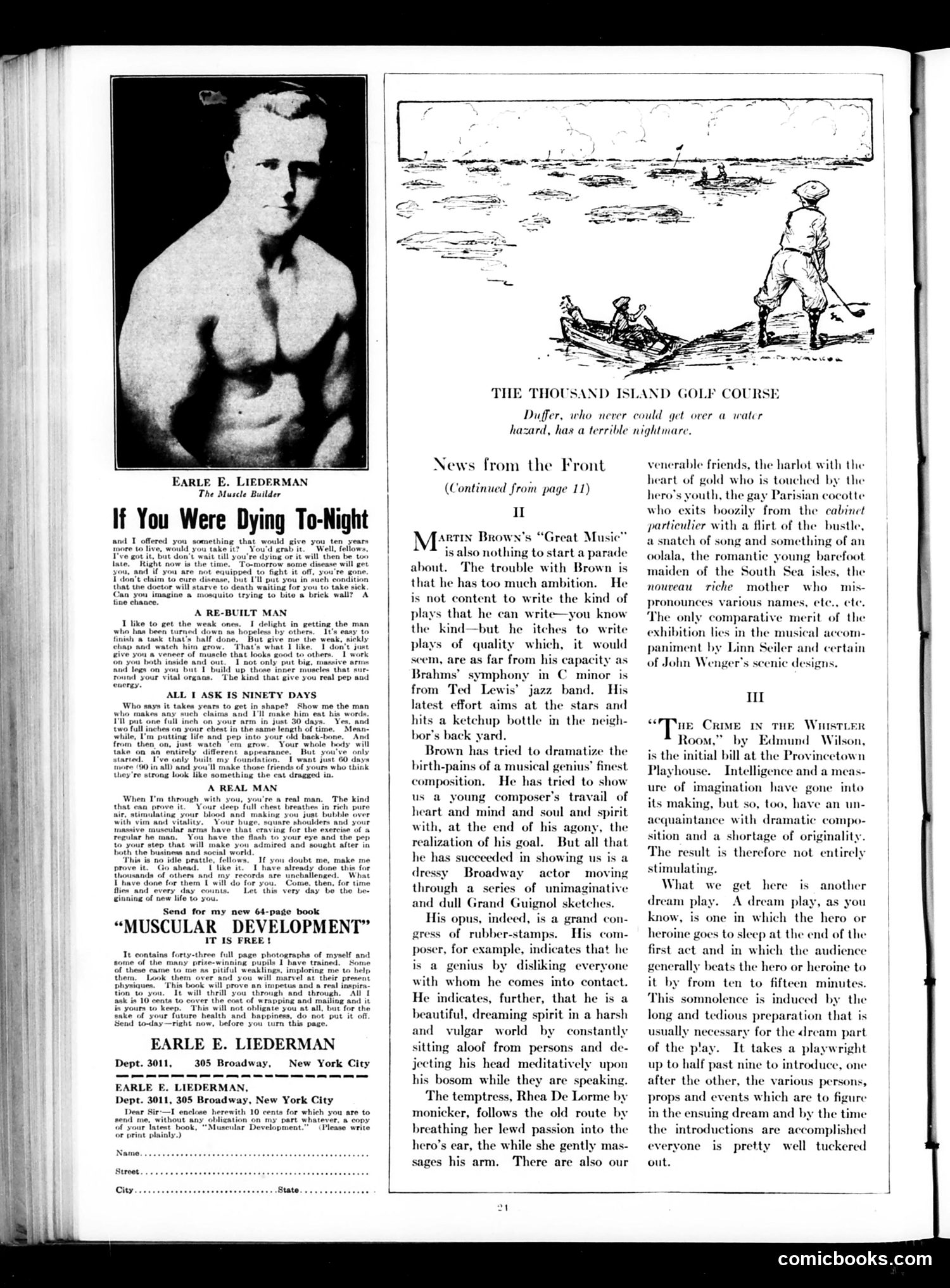
This page contains **advertising and theater criticism**, not political satire. The dominant content is an advertisement for **Earle E. Liederman's muscle-building course**. Liederman was a famous 1920s fitness entrepreneur who promised to build physiques in "ninety days." The shirtless photograph and promotional copy ("If You Were Dying To-Night") use dramatic language to sell his mail-order bodybuilding system and free instructional booklet. The right side features theater reviews under "News from the Front," criticizing Martin Brown's play "Great Music" as derivative and poorly executed, and praising Edmund Wilson's "The Crime in the Whistler Room" at the Provincetown Playhouse. There is also a single cartoon captioned "The Thousand Island Golf Course," depicting a golfer's nightmare about water hazards—a light visual joke rather than political commentary. The page reflects 1920s consumer culture and theater criticism, not satire of political figures or events.
📄 Transcribed text from this page (OCR, searchable)
Machine-transcribed from the original scan — historical spelling and the odd misread are preserved.
EARLE E. LIEDERMAN The Muscle Builder If You Were Dying To-Night ed ¥0 half chap and watch him grow. ‘That's what I like. r of munclo that looks good to others. ALL I ASK IS NINETY DAYS Who says it takes years to get in shape? Show me the man makes any such claims and I'll make him eat his words nt . 30 days. Yes, and es ter Mean But you've o i want just 60 days of strong look like something the A REAL M. When I'm through with you, you're a real man. ‘The kind that cap Your deep full chest breathes in rich pure ‘and making you F step that will imake you admired and sought after in eb and social make me We this for unchallenged. What ome, then, for time flies ery di 2 Leet this very day bo the be- ginning of new life to you Send for my new 64-page book “MUSCULAR DEVELOPMENT” IT IS FREE! : ‘arp weaklines, imploring me to be ri Sand through All L EARLE E. LIEDERMAN Dept. 3011, 305 Broadway, New York City EARLE E. LIEDERMAN, New York City —I enclose herewith 10 cents for which you are to part whatever, © copy opment.” (Please write Name. Street City. THE THOUSAND ISLAND GOLF COURSE Duffer, who never could get over a water hazard, has a terrible nightmare. News from the Front (Continued froin page 11) II TIN Brown's “Great Music” also nothing to start a parade about. The trouble with Brown is that he has too much ambition. He is not content to write the kind of plays that he can write—you know the kind—but he itches to write s of quality which, it would 1, are as far from his capacity as Brahms’ symphony in © minor is from Ted Lewis’ jazz band. His latest effort aims at the stars and hits a ketchup bottle in the neigh- bor’s back yard. Brown has tried to dramatize the birth-pains of a musical genius’ finest composition. He tried to show us a young composer's travail of heart and mind and soul and spirit with, at the end of his agony, the realization of his goal. But all t he has succeeded in showing us dressy Broadway actor movir through a series of unimaginative and dull and Guignol sketches. His opus, indeed, is a grand con- gress of rubber-stamps. His com- poser, for example, indicates that he is a genius by disliking everyone with whom he comes into contact. He indicates, further, that he is a beautiful, dreaming spirit in a harsh and vulgar world by constantly sitting aloof from persons and de- jecting his head meditatively upon his bosom while they are speaking. The temptress, Rhea De Lorme by monicker, follows the old route by breathing her lewd passion into the hero’s ear, the while she gently mas- sages his arm. There are also our venerable friends, the harlot with the heart of gold who is touched by the hero's youth, the gay Parisian cocotte who exits boozily from the cabinet particulier with a flirt of the bustle, a snatch of song and something of an lala, the romantic young barefoot maiden of the South Sea isles, the nouveau riche mother who mis- pronounces various names, ete. ete. The only comparative merit of the exhibition lies in the musical 4 paniment by Linn Seiler and ¢ of John Wenger's scenic designs. Ill “Tue Crme in THE WnistLer Room,” by Edmund Wilson, is the initial bill at the Provincetown Playhouse. Intelligence and a me ure of imagination have gone into its making, but so, too, have an un- acquaintance with dramatic compo- sition and a shortage of originali The result is therefore not entirely stimulating. What we get here is another dream play. A dream play, as you know, is one in which the hero or heroine goes to sleep at the end of the first act and in which the audience generally beats the hero or heroine to it by from ten to fifteen minutes. This somnolence is induced by the long and tedious preparation that is usually necessary for the dream part of the play. It takes a playwright up to half past nine to introduce, one after the other, the various persons, props and events which are to figure in the ensuing dream and by the time the introductions are accomplished everyone is pretty well tuckered out. _ | comicbooks.com