
A complete issue · 36 pages · 1924
Judge — September 27, 1924
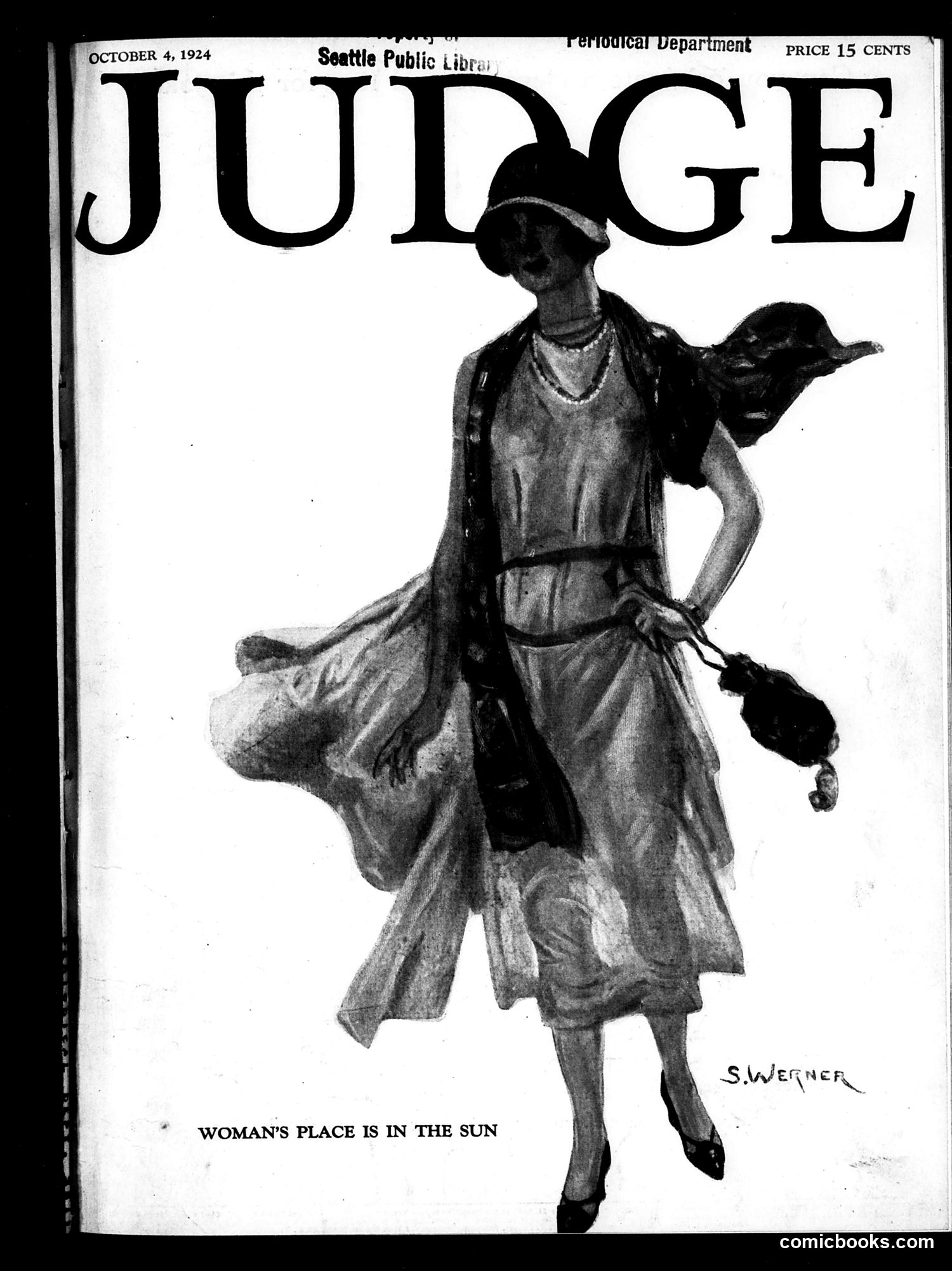
This cover illustrates the phrase "Woman's Place Is in the Sun," depicting a fashionable woman in 1920s attire actively engaged outdoors—holding what appears to be sports equipment and wearing practical clothing for recreation rather than domestic confinement. The satire comments on evolving gender roles during the 1920s, the era of the "New Woman" and women's suffrage (19th Amendment, 1920). The caption ironically inverts the traditional saying "a woman's place is in the home" to celebrate women's newfound freedom for public activities, sports, and independence. The illustration, signed by S. Werner, reflects Judge magazine's commentary on post-WWI social changes where women increasingly participated in public life, athletics, and social engagement rather than remaining confined to domestic spheres.
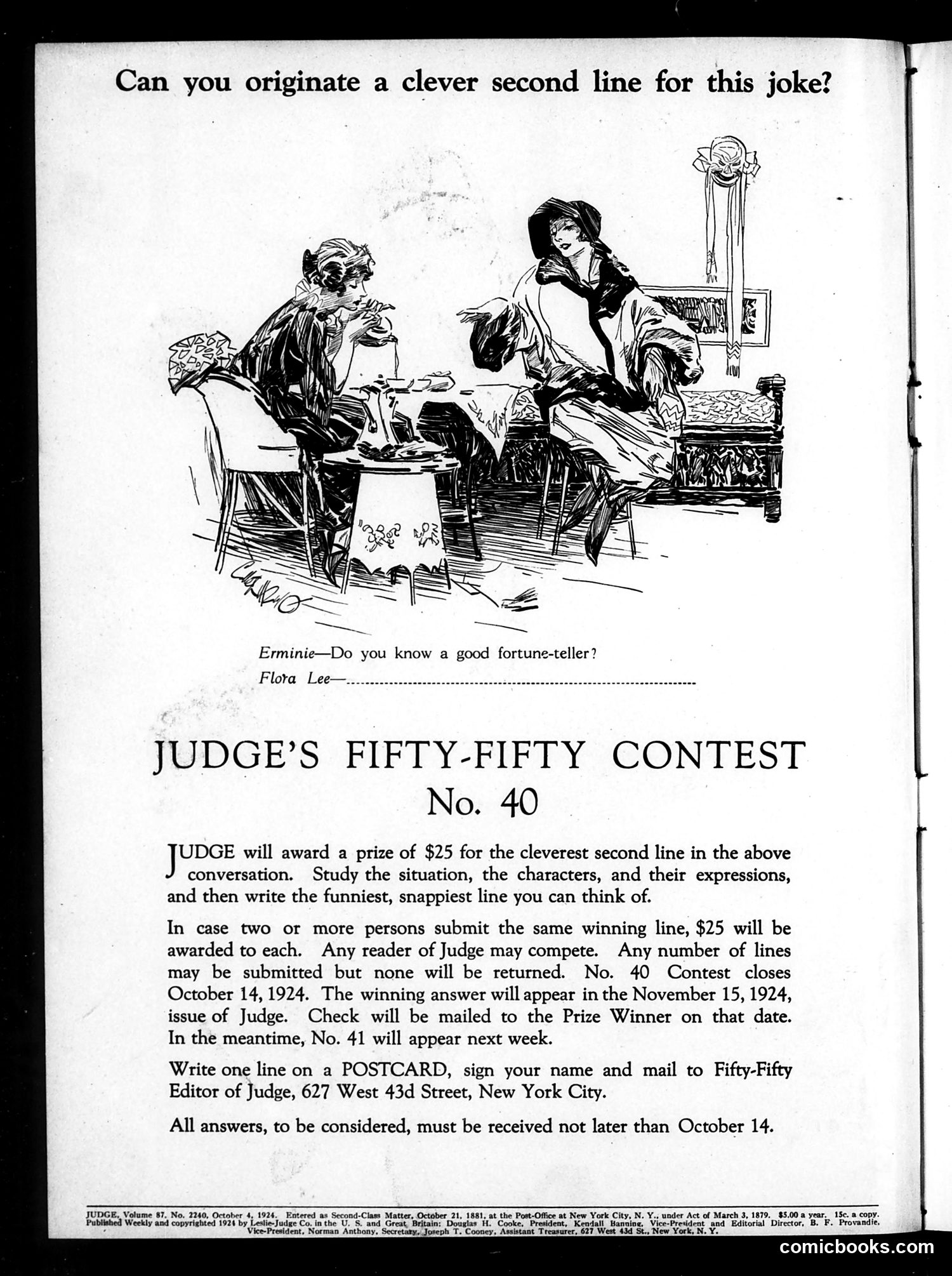
This page features a humor contest, not a political cartoon. Two women are depicted in what appears to be a parlor setting. One (Erminie) asks the other (Flora Lee): "Do you know a good fortune-teller?" The setup invites readers to submit witty second-line responses. The joke likely plays on 1920s social conventions around fortune-telling—either as a parlor game among women or as commentary on gullibility. The contest offered $25 for the cleverest submission, with entries due by October 14, 1924. This reflects Judge magazine's regular practice of crowdsourcing humor from readers, engaging the audience directly in joke-writing while generating content. The illustration style and fashion are typical of early 1920s periodical humor.
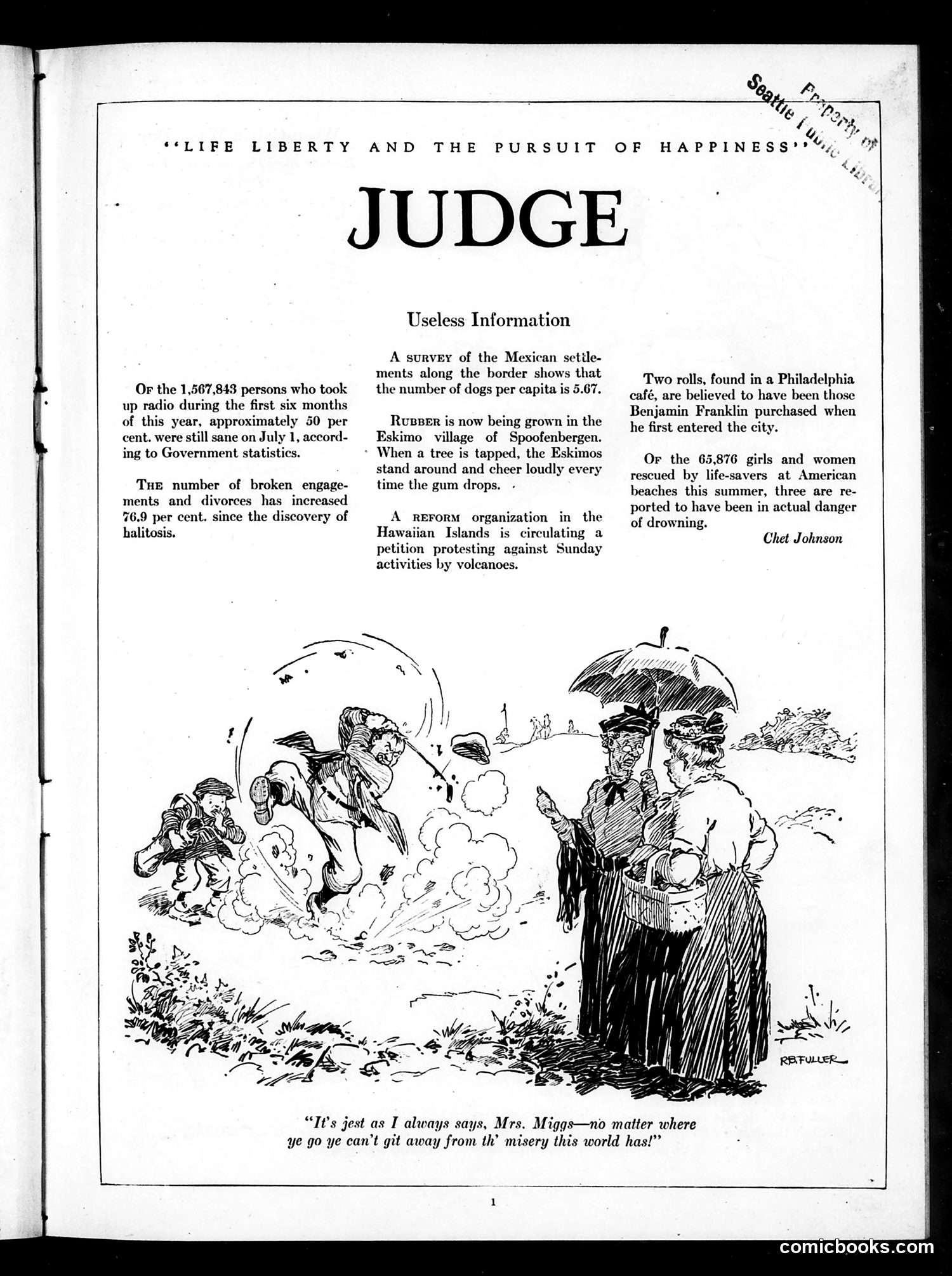
This page contains miscellaneous brief items labeled "Useless Information" rather than a unified political cartoon. The main illustration shows a woman (Mrs. Miggs) standing in rain with children, addressing a man with an umbrella. Her quote—"It's jest as I always says, Mrs. Miggs—no matter where ye go ye can't git away from th' misery this world has!"—presents a pessimistic, working-class perspective on unavoidable hardship. The surrounding text snippets mock various statistics: Mexican dog populations, broken engagements since discovering halitosis, rubber cultivation, Eskimo gum-chewing, Hawaiian volcanic concerns, and rescued swimmers. The humor relies on the absurdity and perceived triviality of these "facts." The overall tone is cynical, typical of Judge's satirical approach to contemporary social conditions and human folly.
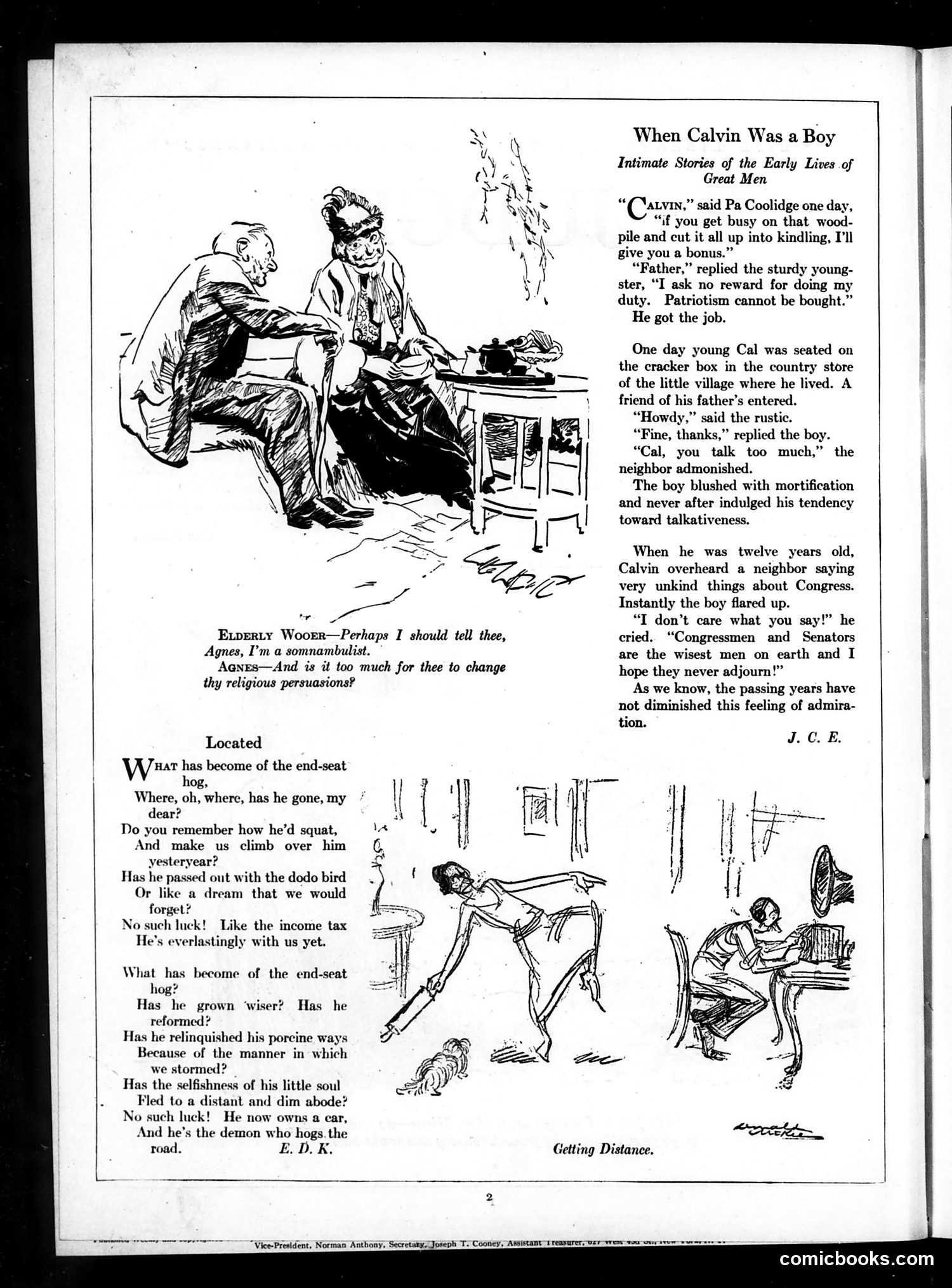
This page contains two unrelated pieces: **"When Calvin Was a Boy"** (top): A biographical sketch about Calvin Coolidge's youth, emphasizing his work ethic and patriotism. It describes young Calvin refusing a bonus for cutting wood and later defending Congress against a neighbor's criticism. The anecdote reinforces Coolidge's reputation for quiet industriousness and respect for government—qualities being promoted during his presidency. **"Located"** (bottom): A satirical poem mocking an absent "end-seat hog"—likely a social commentary on inconsiderate public behavior. The accompanying sketches show people relaxing or lounging in theater or public seating. Both pieces reflect Judge magazine's mix of biographical hagiography and social satire typical of the 1920s-30s era.
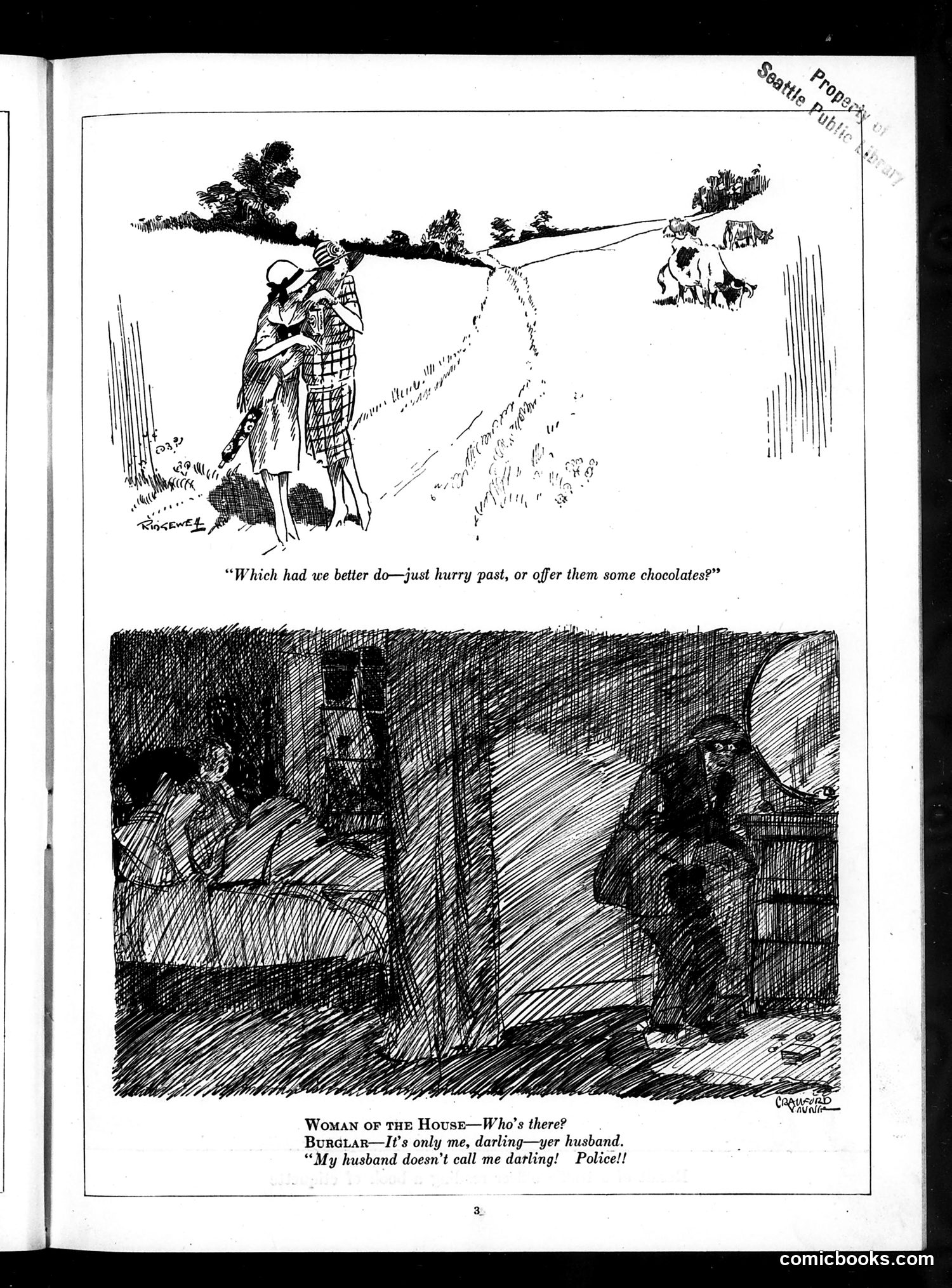
This page contains two unrelated cartoons: **Top cartoon**: Two figures stand beside a large tree branch, observing people in the distance. The caption asks whether they should "hurry past, or offer them some chocolates?" The joke appears to reference a social encounter or meeting scenario, though the specific context is unclear from the image alone. **Bottom cartoon**: Titled "Woman of the House," depicts a domestic scene where a burglar has entered. The wife tells the burglar "It's only me, darling—yer husband," to which the woman responds indignantly: "My husband doesn't call me darling! Police!!" This joke satirizes modern marriage by suggesting the wife recognizes the intruder isn't her husband because he uses an affectionate term her actual husband never uses—implying marital coldness or distance.
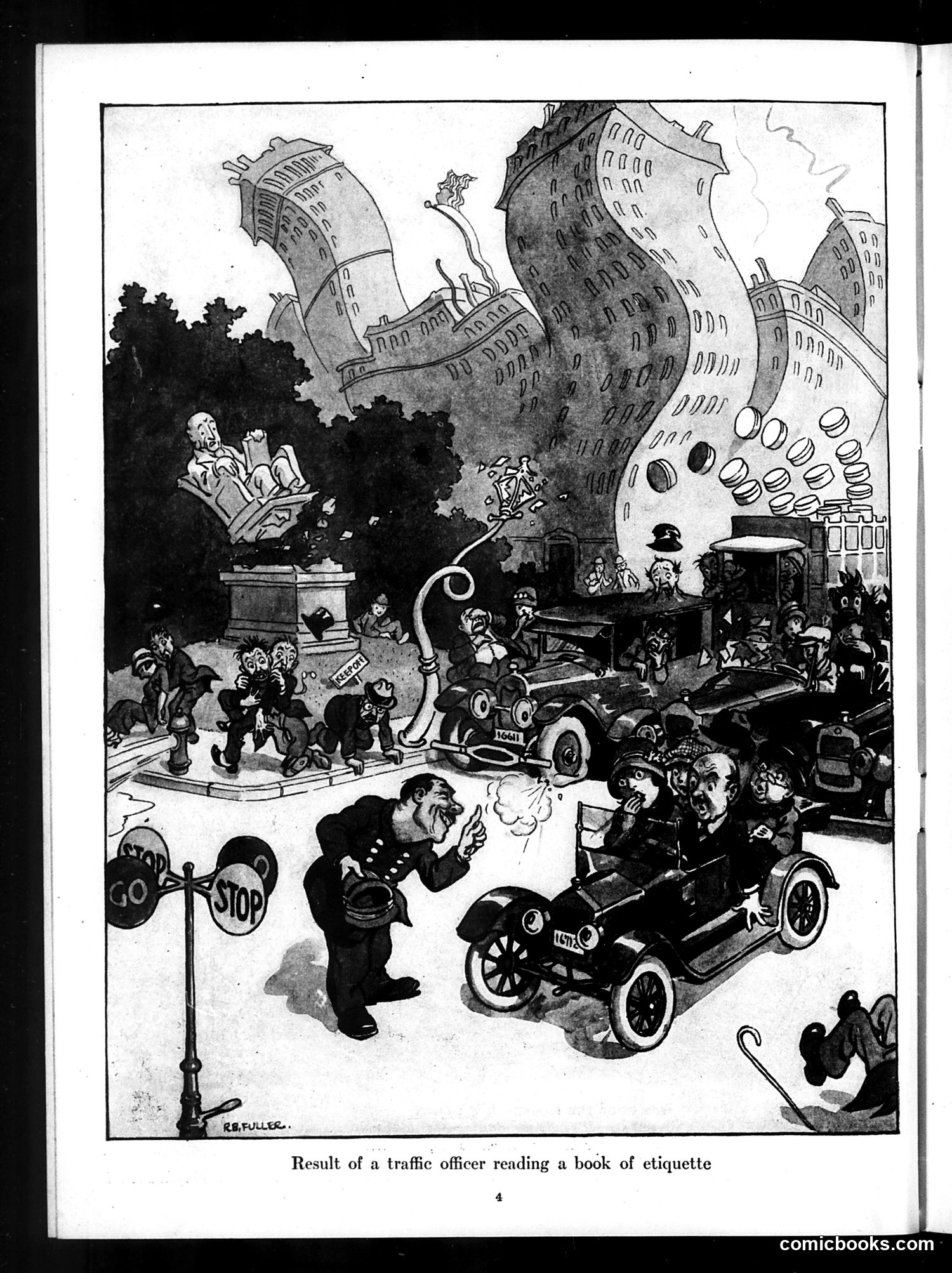
This satirical cartoon mocks the collision between rigid social etiquette and urban traffic chaos. The caption's joke: a traffic officer who has learned *politeness* from an etiquette manual becomes ineffective at his actual job—managing vehicles. The scene shows a chaotic street intersection with automobiles, pedestrians, and what appears to be a statue or monument in the background. The traffic officer in the foreground gestures politely rather than authoritatively directing traffic, resulting in gridlock and mayhem. The satire critiques the era's emerging "modern manners" culture—suggesting that excessive politeness and formality are impractical obstacles to necessary urban control. Early 20th-century Judge frequently lampooned social pretension as incompatible with American pragmatism and efficiency.
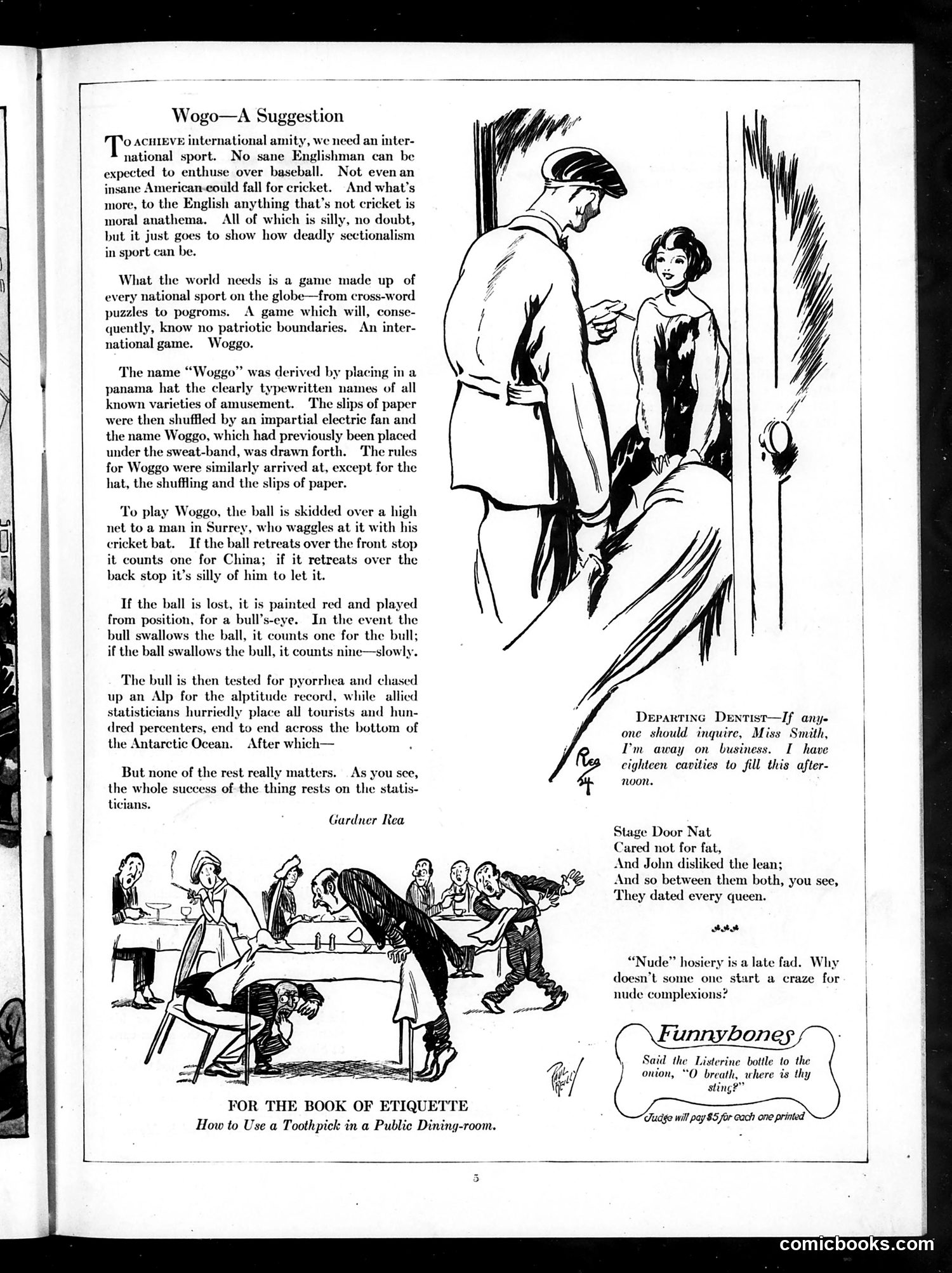
This satirical piece mocks international sports nationalism through absurdist humor. The author argues that English people dismiss baseball as "morally anathema" while Americans won't embrace cricket, demonstrating how "deadly sectionalism in sport" prevents global unity. The solution? "Wogo"—a deliberately nonsensical international sport combining elements from every nation: cricket bats, bulls, Swiss Alps, Antarctic Oceans, and random scoring rules (a swallowed bull counts nine points "slowly"). The joke lies in the absurdity: if you arbitrarily mix every culture's sports together, you get something equally ridiculous and therefore equally fair to everyone. The accompanying illustration shows people awkwardly playing this imaginary sport. The satire targets both nationalistic pride in sports and the naïve belief that forced "international cooperation" through invented compromise actually builds unity. It's a commentary on the futility of transcending deep-rooted cultural preferences through artificial solutions.
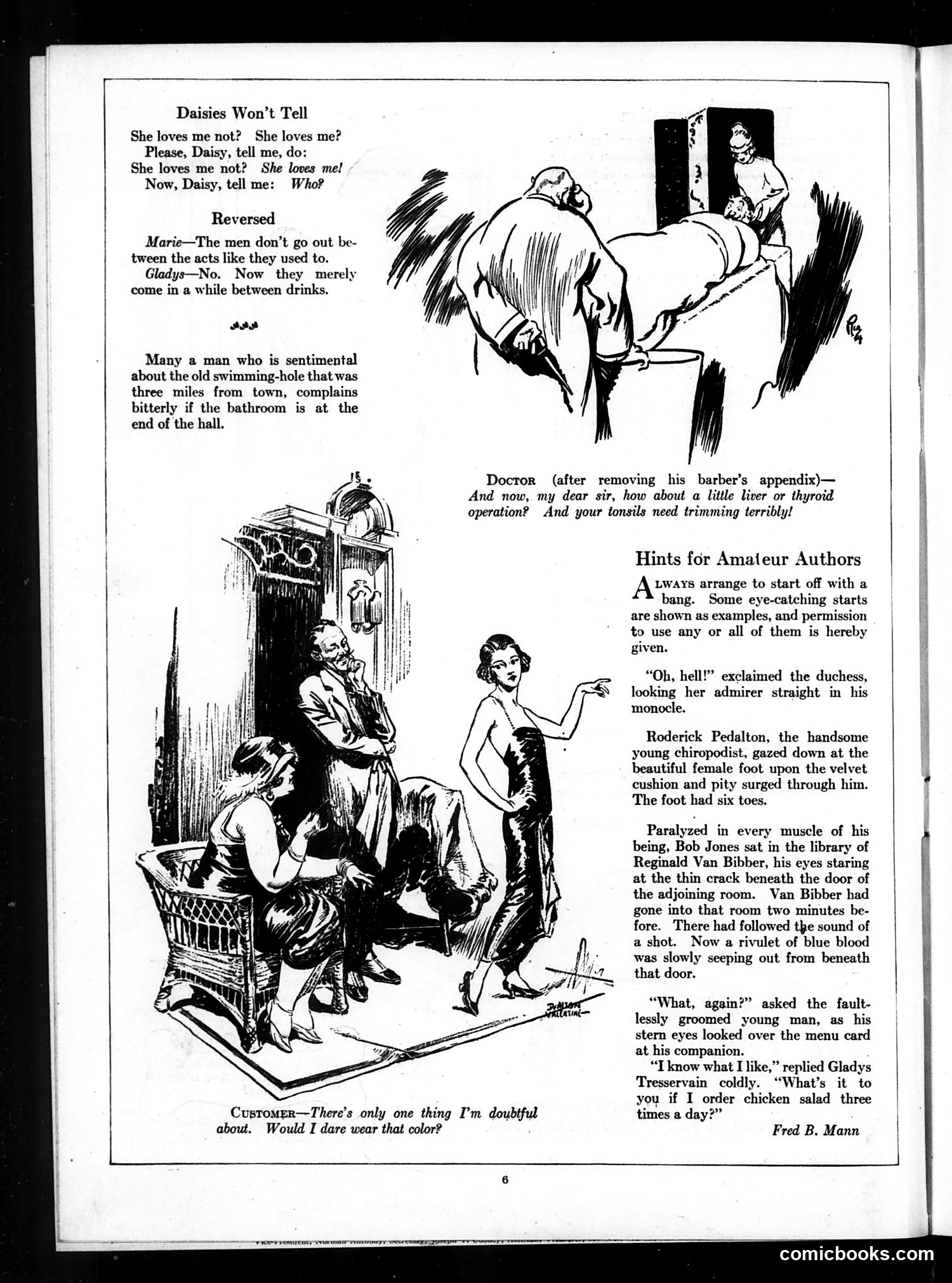
This Judge magazine page contains several satirical pieces mocking early 20th-century social conventions and literary trends. **Top cartoons** joke about gender dynamics (a woman's ambiguous feelings) and changing male behavior—men now slip away between theater acts to drink rather than socialize, reflecting Prohibition-era concerns. **Doctor cartoon**: A physician, having removed a patient's appendix, immediately suggests more surgeries (thyroid, tonsils). The satire targets unnecessary medical procedures and doctors' profit motives—a recurring concern about overtreatment. **Clothing cartoon**: A customer questions whether he can wear a particular color, satirizing male fashion insecurity and consumerism. **"Hints for Amateur Authors"** section parodies melodramatic pulp fiction tropes: a duchess swearing, an inexplicably six-toed woman, "blue blood" (literal blood), and arbitrary repeated behavior. The satire mocks overwrought, sensationalist popular fiction of the era.
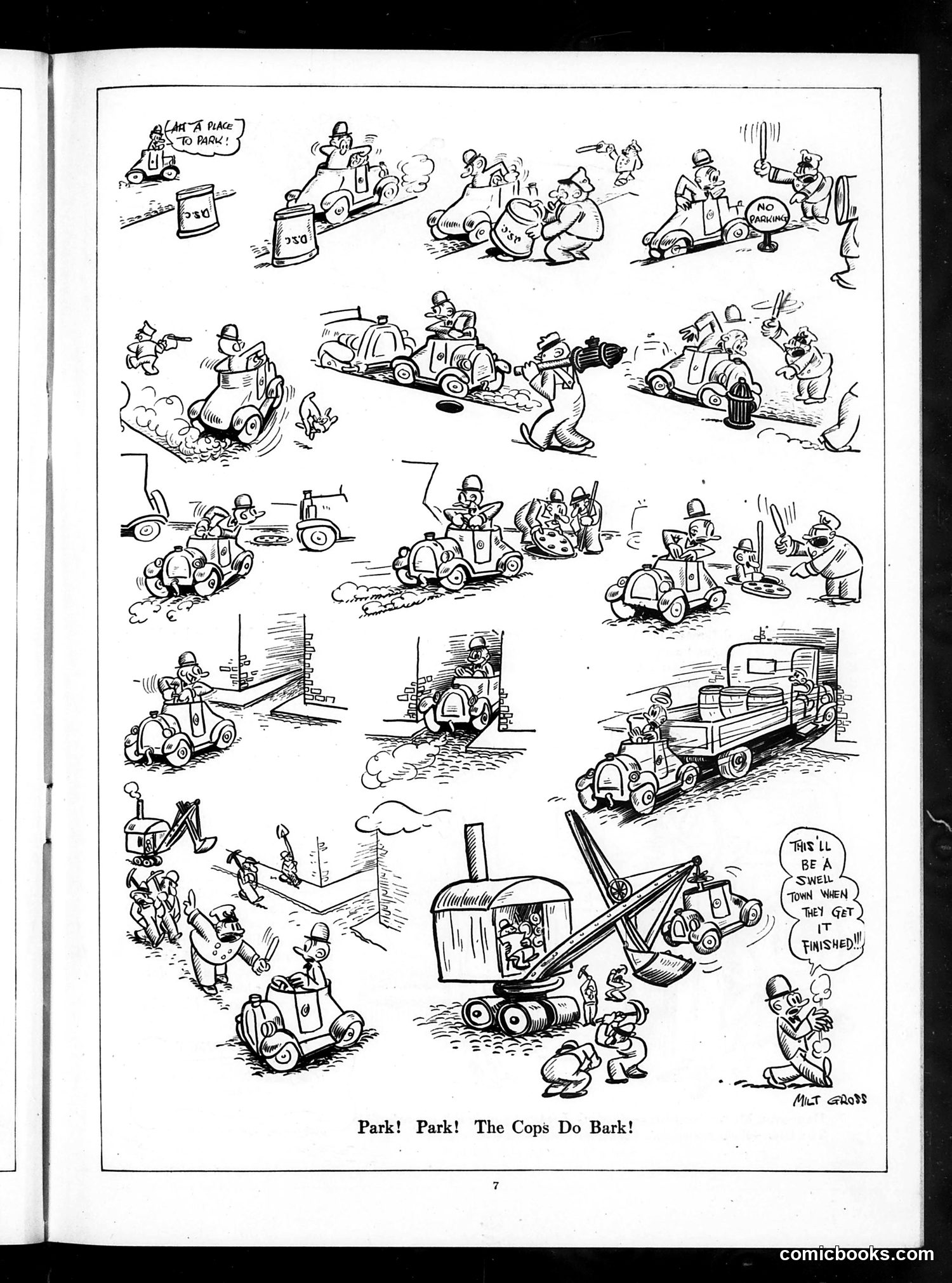
This is a humorous sequential comic strip by Milt Gross depicting traffic cops attempting to manage parking in what appears to be a crowded urban area. The strip shows a series of chaotic scenes where police officers struggle to direct and control automobiles—cars collide, stack up, and create comedic mayhem. The joke plays on the phrase "bark" (referring to dogs' behavior), suggesting the cops are barking orders like dogs herding animals. The satire likely mocks the ineffectiveness of early traffic management and police authority in controlling the explosive growth of automobile culture in American cities. The final panel shows completion of the chaotic task, with an officer noting it will be "a swell town when they get it finished"—mocking urban development and congestion.
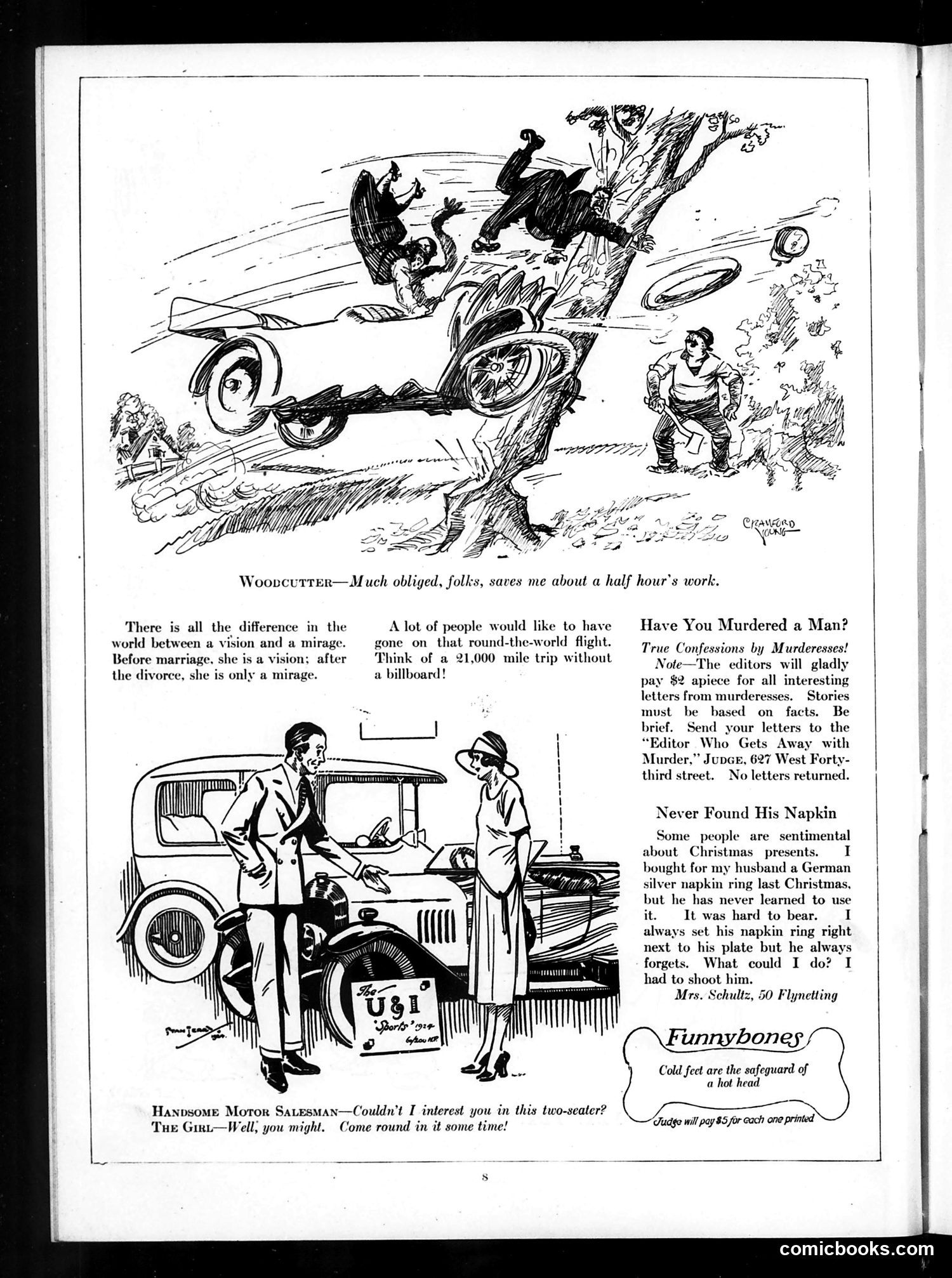
This page contains several satirical pieces typical of Judge's humor: **"Woodcutter" cartoon**: A slapstick scene of people crashing motorcycles and a car into a tree—the woodcutter jokes that it saves him work chopping it down. **Marriage/Divorce joke**: A quip that before marriage a woman is a "vision" (idealized), but after divorce becomes a "mirage" (illusion/disappointment)—standard misogynistic humor of the era. **"Round-the-world flight" gag**: Satirizes Americans' obsession with advertising, joking that a 21,000-mile trip without billboards would be unthinkable. **"Have You Murdered a Man?" section**: Judge humorously solicits "true confessions" from murderesses, paying $2 per letter. The example from "Mrs. Schultz" about shooting her husband over a forgotten napkin ring is dark comedy mocking both domestic frustration and the era's sensational confession magazines. **Motor Salesman cartoon**: A flirtatious exchange where the salesman pitches a two-seater car; the woman suggestively replies he should "come round in it sometime." The page reflects 1920s-era attitudes: casual misogyny, dark domestic humor, and fascination with crime narratives.
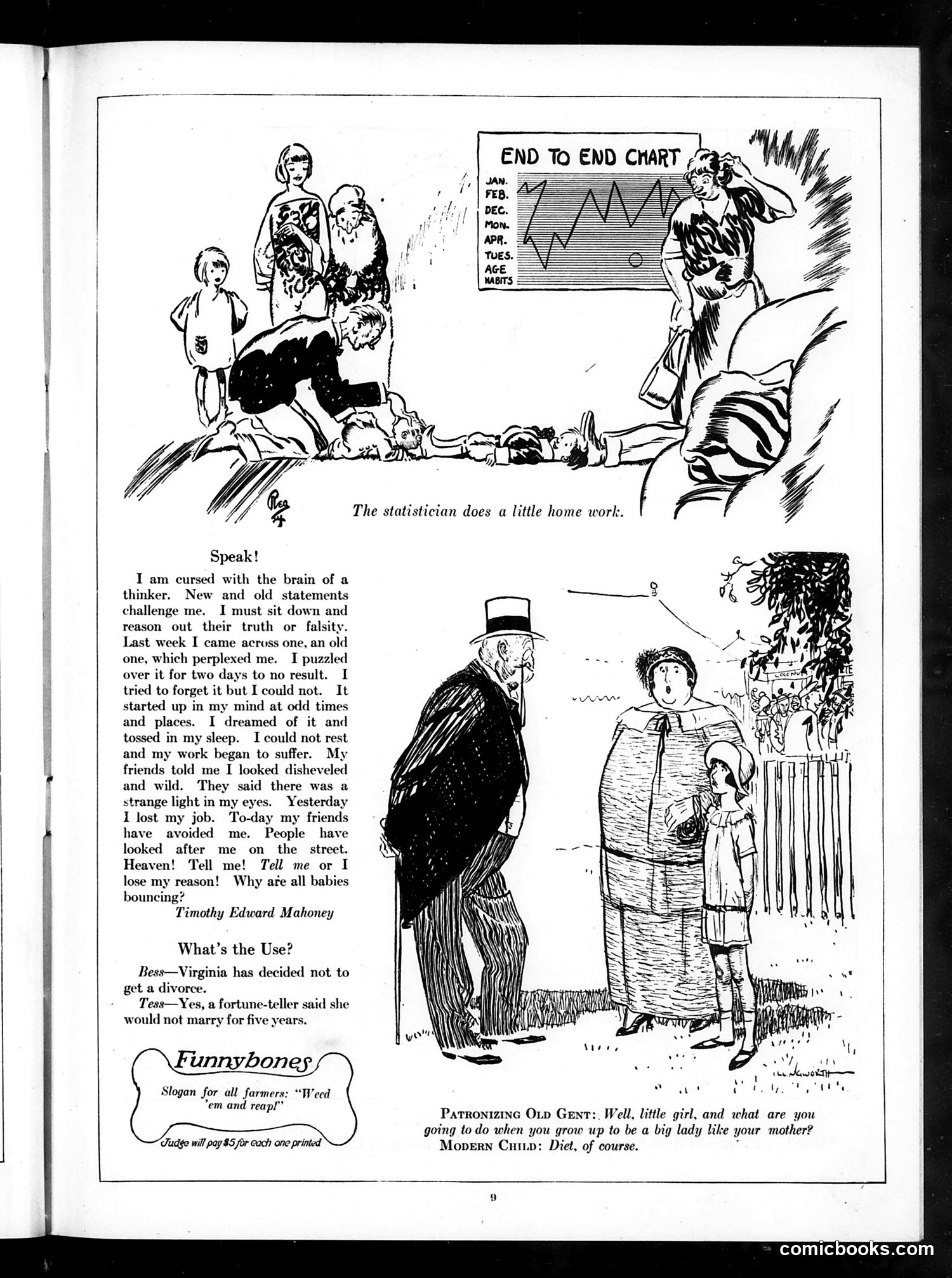
This page contains three distinct satirical pieces typical of early 20th-century American humor: **Top cartoon:** "The Statistician Does a Little Home Work" mocks the obsessive nature of statistical analysis, showing a man surrounded by chaotic family life while consulting an "End to End Chart." The joke ridicules how statisticians reduce messy reality to abstract data. **"Speak!" monologue:** Timothy Edward Mahoney's existential complaint about an unsolvable riddle ("Why are all babies bouncing?") satirizes overthinking intellectuals driven to madness by unanswerable philosophical questions—likely mocking contemporary pseudo-intellectual discourse. **Bottom sections:** Two brief jokes: one about divorce and fortune-telling (poking fun at both marital instability and superstition), and a final cartoon where a child answers that she'll "diet" when grown—satirizing contemporary anxieties about women's body image and the era's obsession with dieting fads. The humor targets early 20th-century social trends: data-mania, philosophical pretension, unstable marriages, and emerging consumer culture around weight management.
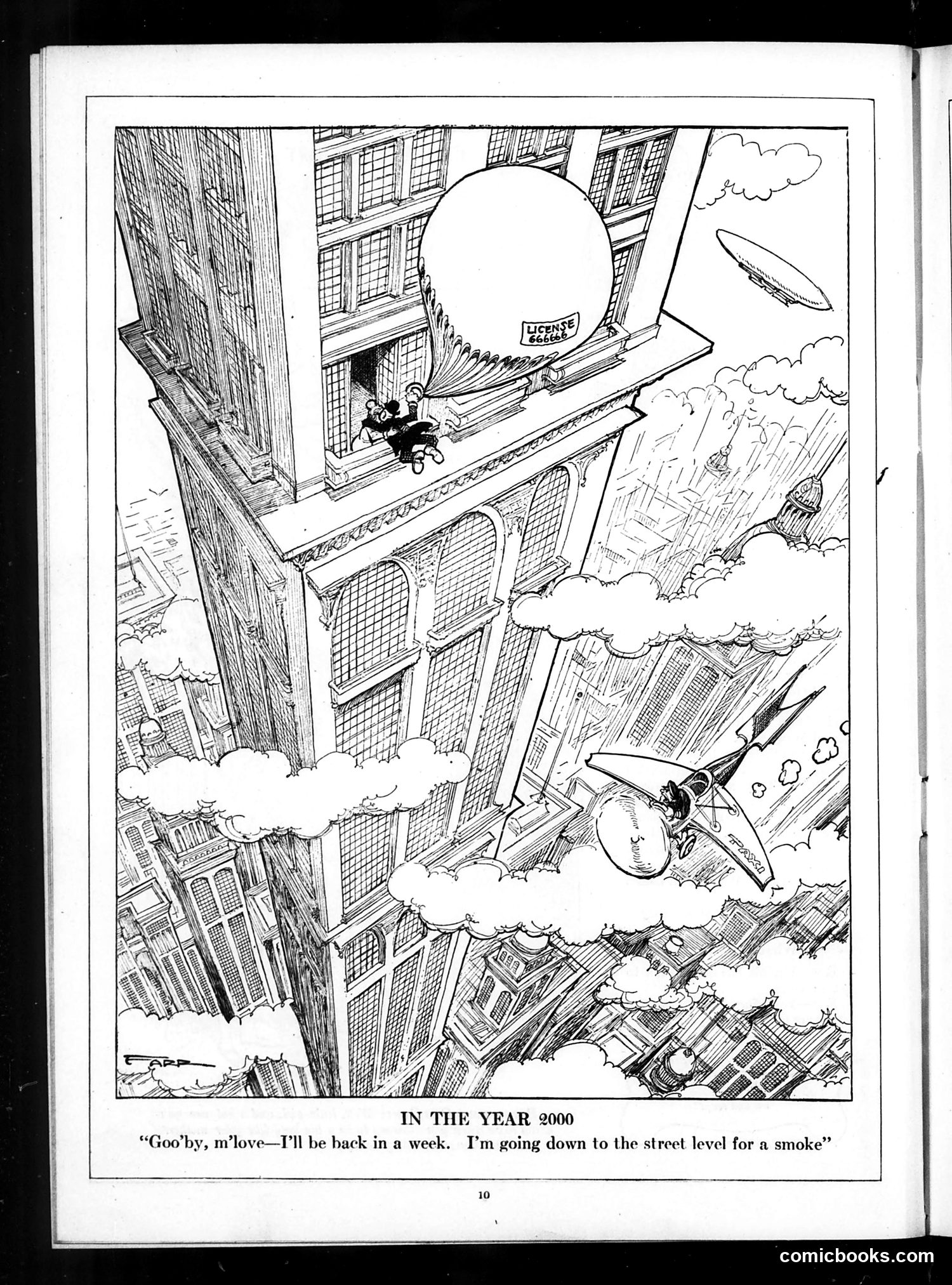
This satirical cartoon depicts a futuristic cityscape where a man bids farewell to his wife from an extremely high building platform, saying he's "going down to the street level for a smoke." The joke satirizes predictions about year-2000 urban development: buildings have grown so monumentally tall that ground level is now a week-long journey away, making a simple cigarette break absurdly inconvenient. The cartoon mocks both architectural ambition and the growing anti-smoking sentiment. It suggests that if skyscraper trends continued unchecked, ordinary activities would become logistically nightmarish. The massive scale—with aircraft visible among the clouds and buildings stretching impossibly high—exaggerates contemporary concerns about urban overcrowding and vertical expansion to absurd extremes. This reflects early 20th-century anxieties about modernization's pace and consequences.
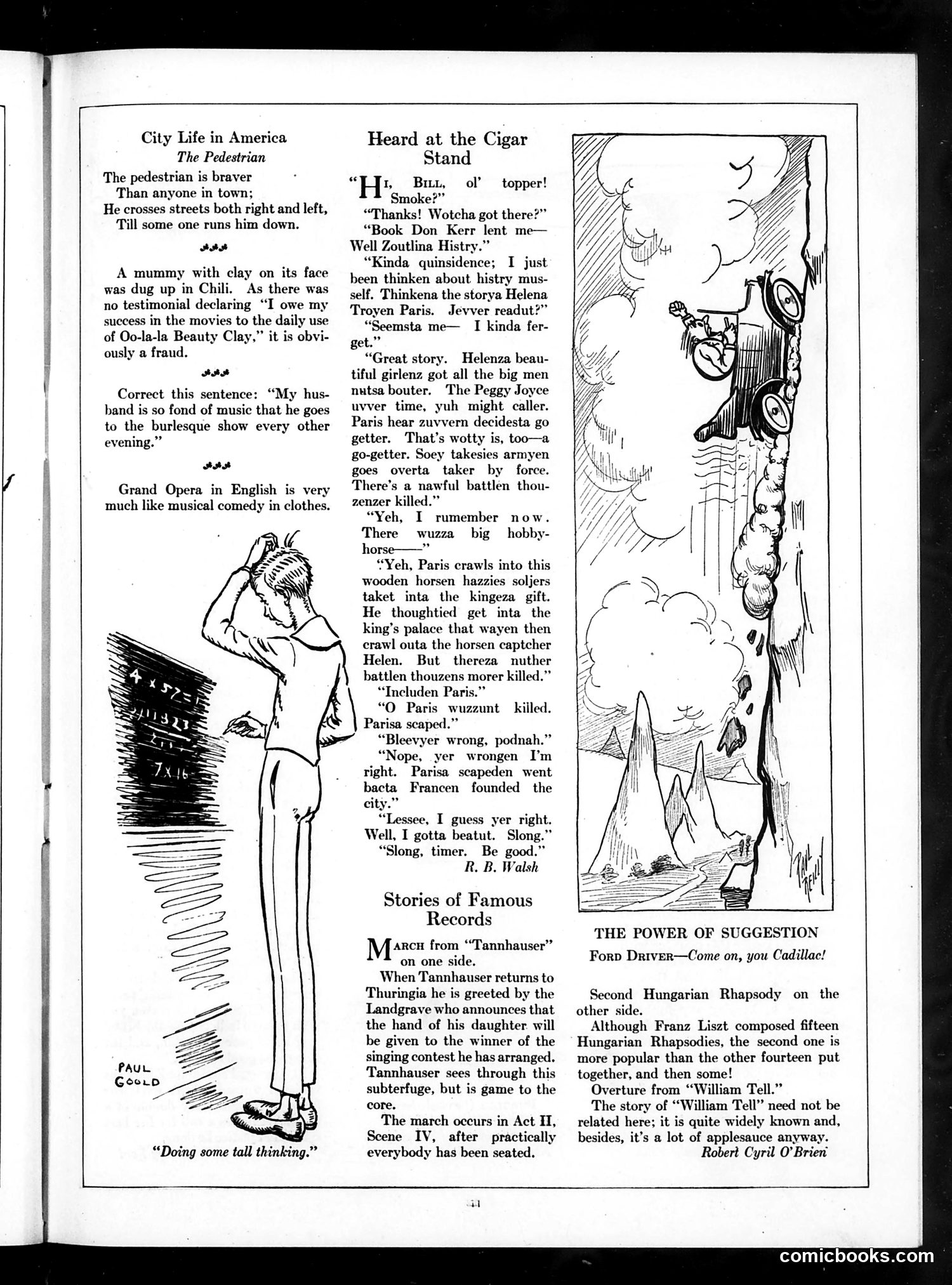
This Judge magazine page contains three distinct pieces: **"City Life in America"** presents satirical observations about urban pedestrians and cultural absurdities—a mummy excavated in Chile fraudulently claiming beauty-product success, and the observation that English Grand Opera resembles musical comedy. **"Heard at the Cigar Stand"** depicts working-class men mangling the Trojan War narrative through dialect humor. They confuse details about Helen, Paris, and the Trojan Horse, mixing historical reference with phonetic dialect ("wuzza big hobby-horse," "battlen thouzens"). This satirizes both historical ignorance and the broad comedic use of ethnic/working-class speech patterns common to early 20th-century humor. **"Stories of Famous Records"** discusses classical music—Wagner's "Tannhauser" march and Liszt's Hungarian Rhapsody—paired with a cartoon of a Ford driver calling to a Cadillac ("Come on, you Cadillac!"), illustrating "The Power of Suggestion." The page blends social satire, dialect comedy (now considered offensive), classical culture references, and automobile humor typical of Judge's mixed content targeting educated, middle-class readers.
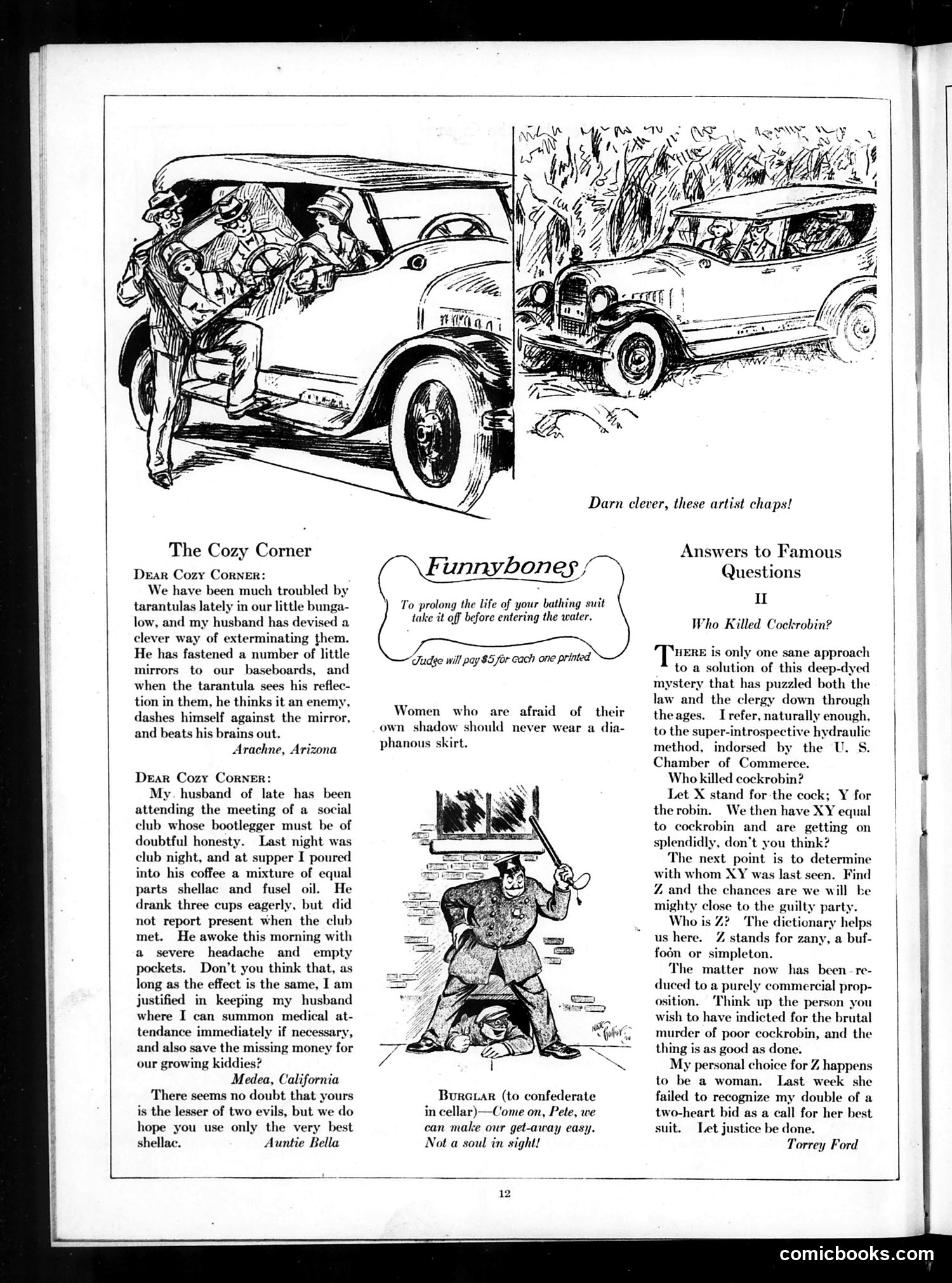
This Judge magazine page contains three distinct pieces of satire from the Prohibition era: **"The Cozy Corner"** is an advice column where readers describe domestic situations with dark humor. One woman describes poisoning her husband's coffee with shellac and fusel oil (industrial chemicals) to keep him home instead of attending a speakeasy—and the columnist endorses this as the "lesser of two evils." This satirizes both bootleggers' prevalence during Prohibition and the desperation of wives trying to control their husbands' drinking. **"Funnybones"** offers brief jokes poking fun at fashion and behavior—women in sheer skirts casting shadows, burglars confident they're unobserved. **"Answers to Famous Questions"** humorously "solves" the nursery rhyme "Who Killed Cock Robin?" using absurdist mathematical and dictionary logic, ultimately blaming a woman for failing to recognize a bridge-playing signal. This mocks both pseudo-intellectual problem-solving and appears to stereotype women as foolish. The overall tone reflects Judge's satirical commentary on 1920s American life: Prohibition's hypocrisy, domestic tensions, and social absurdities.
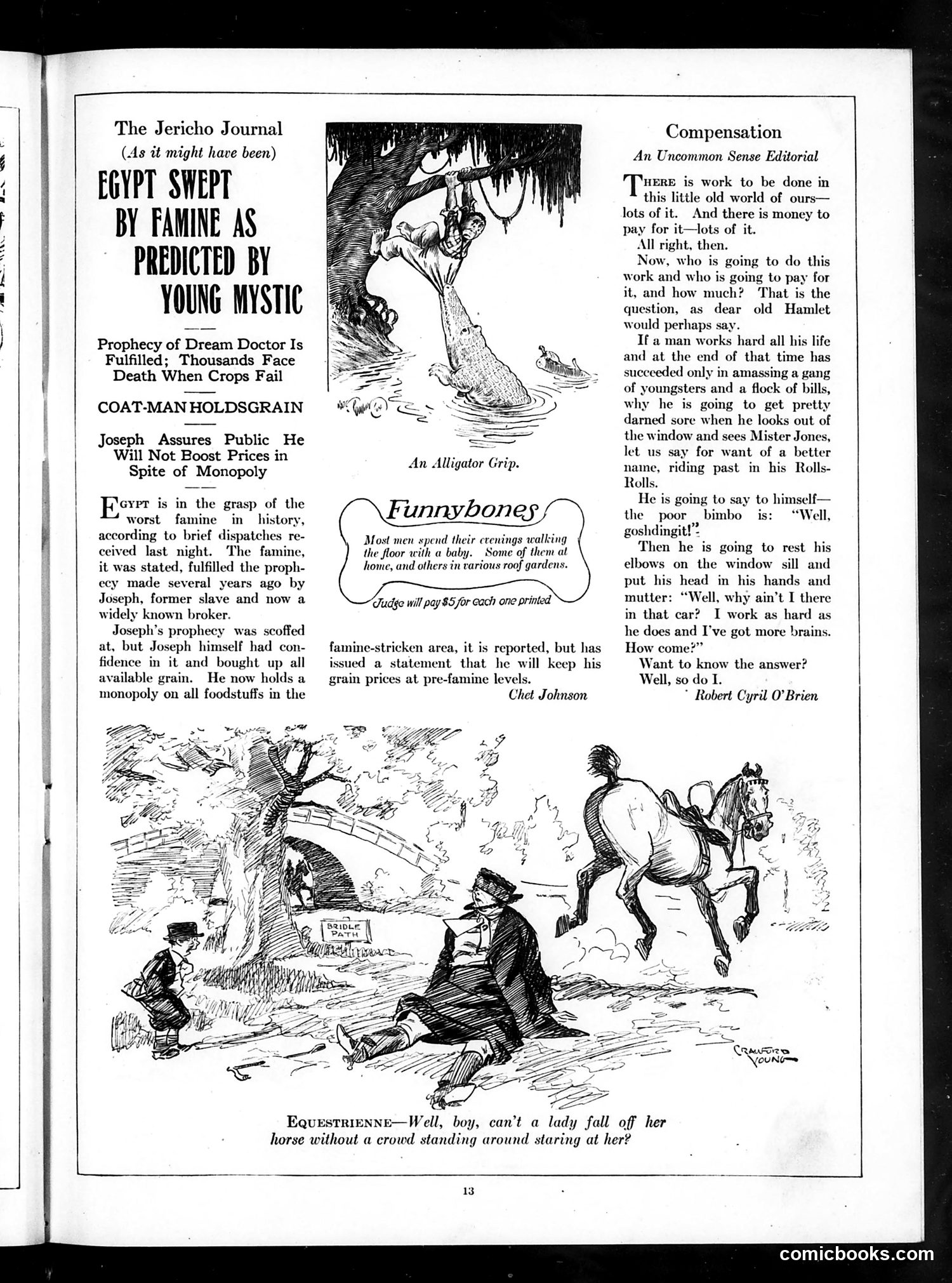
This page satirizes **Joseph's biblical famine prophecy** (Genesis 41) as if it were a contemporary news story. The headline treats Joseph as a modern financial operator who predicted Egypt's famine, then exploited it by monopolizing grain supplies—positioning himself as wealthy while ordinary people starve. The satire critiques **monopolistic capitalism and price-gouging**: Joseph claims he won't raise prices despite controlling all food, a hollow reassurance to a desperate population. The "Coat-Man Holds Grain" subheading references Joseph's coat of many colors, blending ancient scripture with Gilded Age economic abuses. The separate editorial "Compensation" addresses **wealth inequality**: a working man envies his neighbor's Rolls-Royce despite working equally hard, asking why compensation is so unequal. The answer—implied but unstated—is systemic unfairness. The bottom cartoon about the equestrienne is unrelated visual humor. Together, these pieces criticize how the wealthy accumulate and control resources while the poor labor without reward.
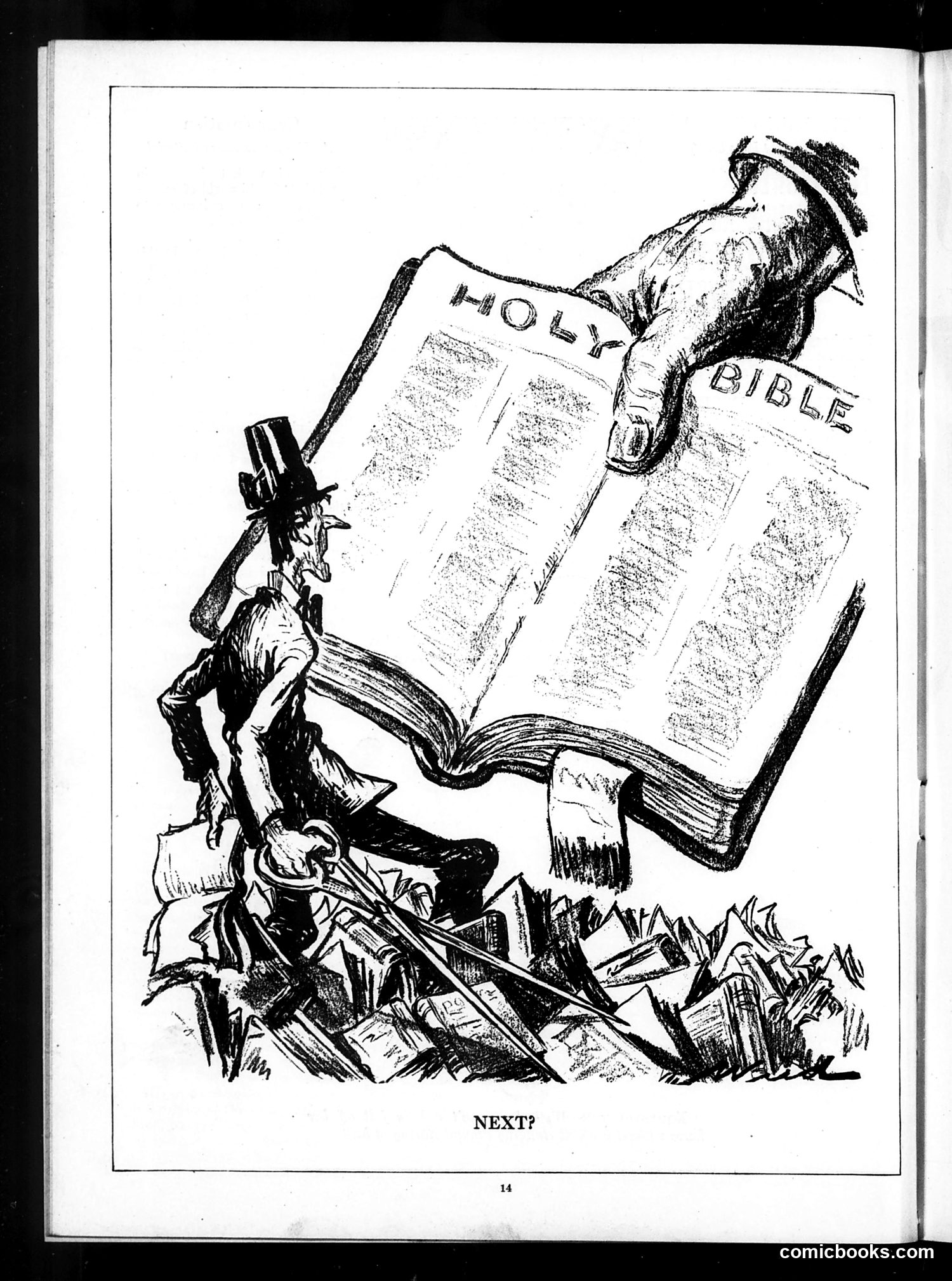
This single-panel cartoon titled "NEXT?" depicts a caricatured figure in a top hat standing atop a large, open Holy Bible, appearing to balance or walk upon it. The figure carries an axe and wears a menacing expression. Below the Bible lie scattered, destroyed books or papers, suggesting destruction of literature or knowledge. The satire appears to critique attacks on religious authority or biblical teachings—likely commenting on secularism, anti-religious sentiment, or efforts to undermine Christian doctrine. The "NEXT?" caption suggests the cartoonist warns of further threats to religious institutions following previous attacks. The specific historical context (date unclear from image) would determine which exact religious or political controversy this references, but the overall message warns against destruction of religious values and authority.
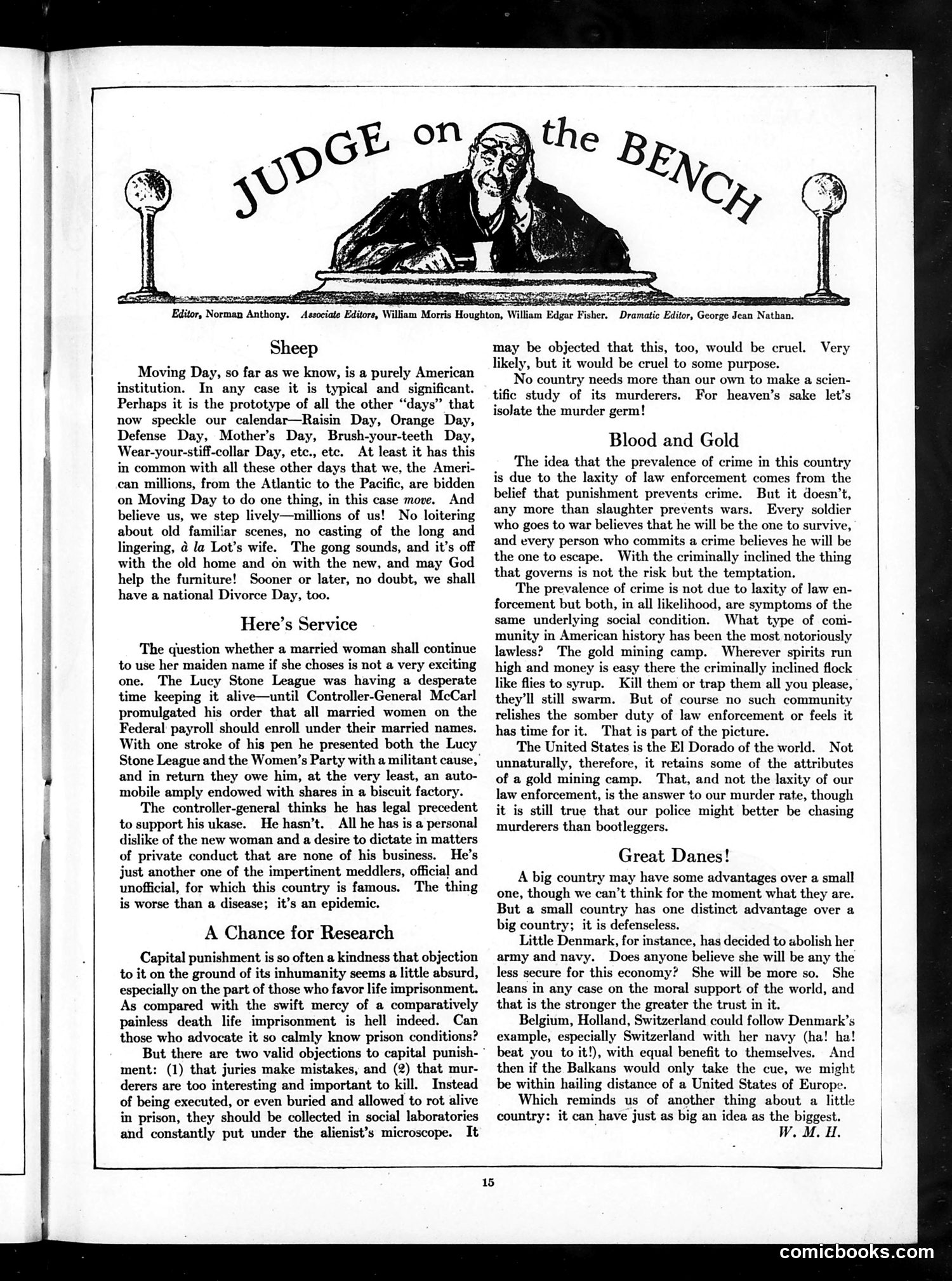
This page from Judge (a satirical American magazine) contains several editorial essays rather than illustrated cartoons. The content critiques various American social and political issues: **"Sheep"** mocks Americans' conformity, particularly the proliferation of arbitrary "days" (Moving Day, Raisin Day, etc.) that compel nationwide participation. The satire suggests Americans unthinkingly follow such trends. **"Here's Service"** attacks Controller-General McCarl for ordering federal employees' wives to use married names, overriding the Lucy Stone League's advocacy for women's right to maiden names. The piece condemns government meddling in private conduct. **"A Chance for Research"** argues against capital punishment—not from humanitarian grounds, but because murderers merit scientific study rather than execution, treating criminology as requiring laboratory research. **"Blood and Gold"** argues crime stems from social conditions and temptation, not inadequate law enforcement, using the gold mining camp as historical example of lawlessness. The editorial stance is progressive-reformist, attacking government overreach, advocating scientific approaches to social problems, and defending individual liberty.
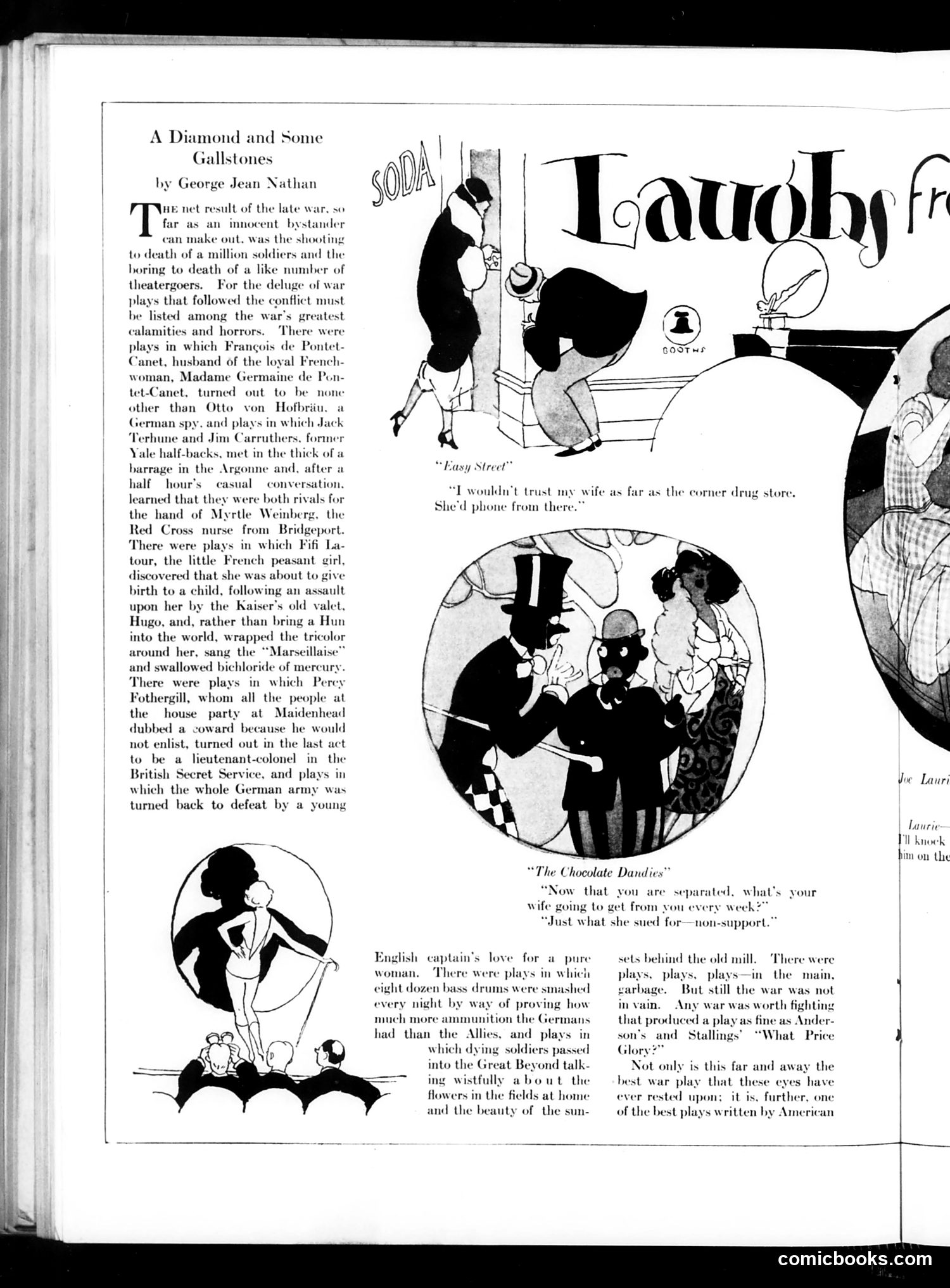
This is a theater critic's essay sarcastically attacking the flood of World War I plays that followed the conflict. Nathan argues these productions were artistically terrible—exploitative melodramas with absurd plots (German spies posing as French aristocrats, cowardly officers revealed as secret agents, peasant girls committing suicide rather than bear "Hun" children). The accompanying cartoons illustrate marital humor unrelated to the essay's main topic. "Easy Street" jokes about spousal distrust; "The Chocolate Dandies" mocks a separated husband's non-support obligations. Nathan's point: the war itself was calamitous, but the theatrical response was worse—cynical cash-ins on public trauma. His sole exception is Anderson and Stallings' *What Price Glory?*, which he praises as genuinely excellent and among the finest American plays ever written. The overall tone: bitingly sarcastic critique of both war profiteering and low artistic standards in American theater.
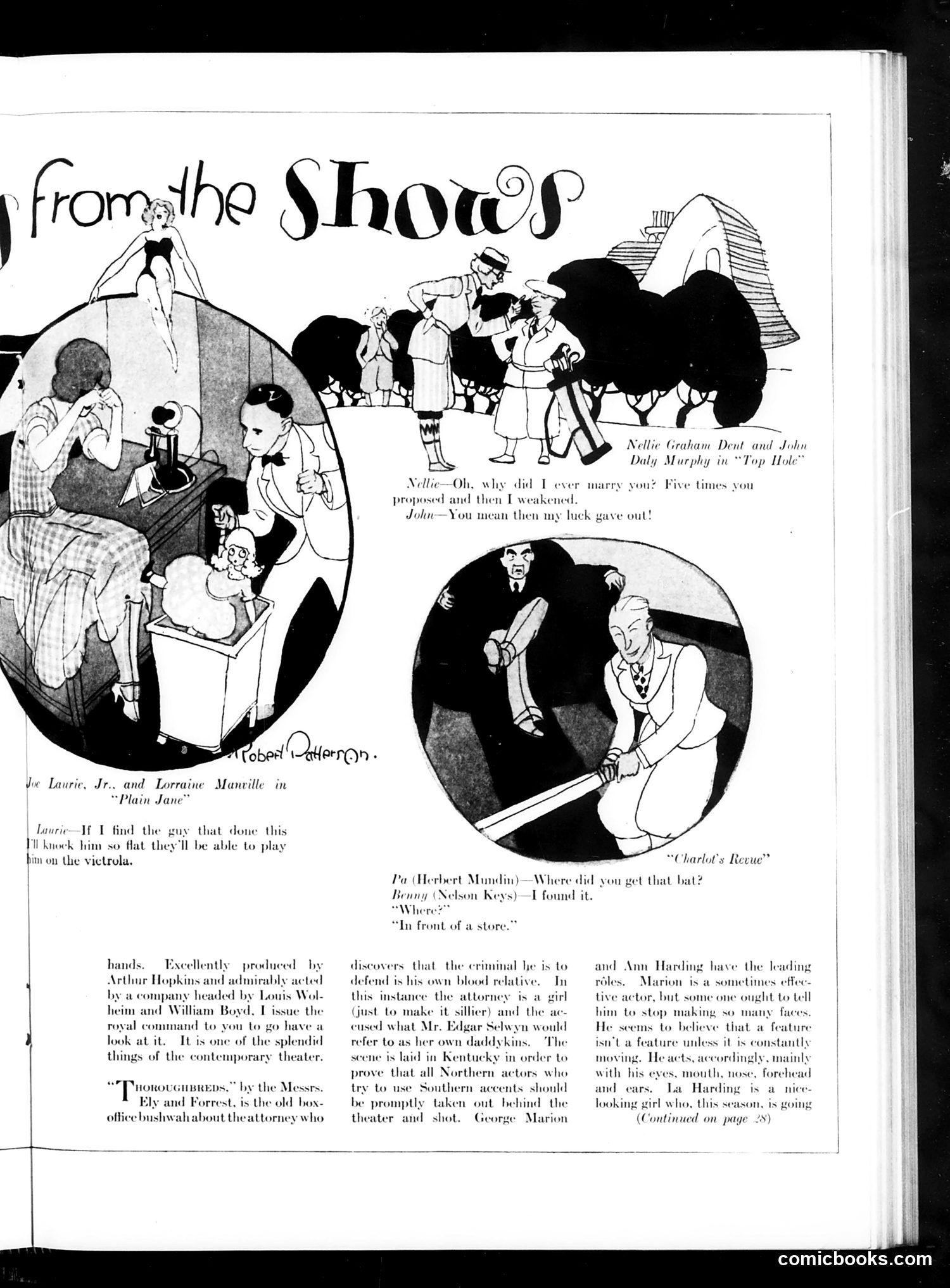
This page reviews contemporary Broadway productions from the 1920s era. The cartoons illustrate scenes from three shows: "Top Hole," "Plain Jane," and "Charlot's Revue." The humor is straightforward theatrical comedy: - In "Top Hole," a wife jokes that her husband's repeated marriage proposals only succeeded when his "luck gave out" - In "Plain Jane," a father threatens violence against whoever damaged something (unclear what), joking he'll beat the culprit flat enough "to play him on the victrola" (a phonograph) - In "Charlot's Revue," a son claims he "found" a bat in front of a store—an obvious and innocent-sounding lie The text criticizes some performances, particularly actor Marion's excessive facial expressions, and praises others like Louis Wolheim and William Boyd. The reviews are typical theater criticism—assessing acting, production quality, and plot merit—with light satirical jabs at theatrical conventions and Southern accent parodies.
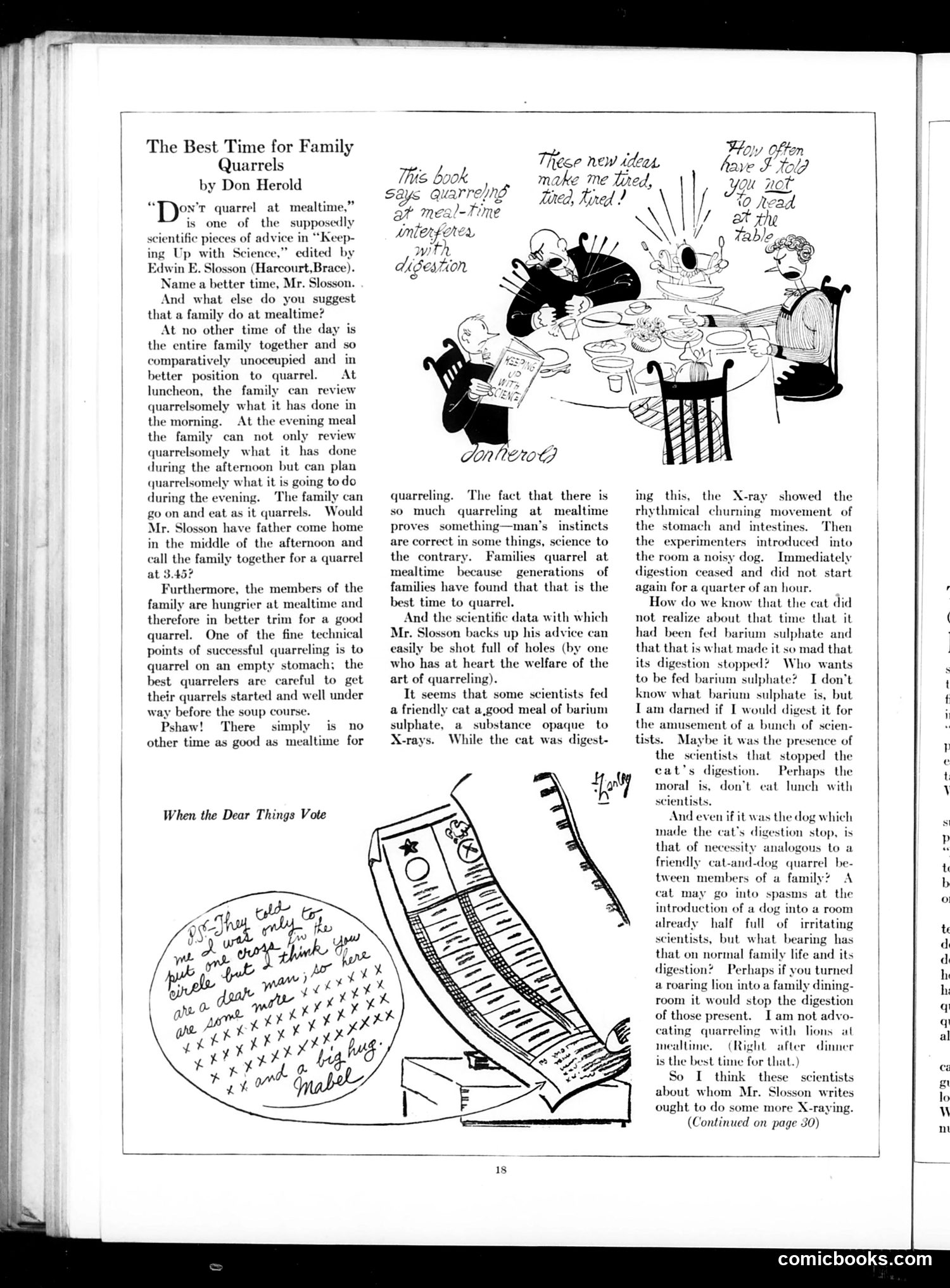
This is a humorous essay by Don Herold satirizing scientific advice from Edwin E. Slosson's book "Keeping Up with Science." Slosson apparently claimed families should quarrel at mealtime—supposedly scientific guidance that Herold finds absurd. Herold's satire works through mock-serious reasoning: he agrees mealtime is *ideal* for quarreling (the whole family's present and hungry), but uses this to ridicule the "advice" as stating the obvious rather than offering wisdom. He then skewers the scientific evidence—an experiment where a cat's digestion stopped when a noisy dog entered the room. Herold sarcastically questions whether the cat was actually offended by being fed barium sulphate, or whether the scientists themselves disrupted digestion. The accompanying cartoons show a chaotic family dinner and a voting ballot, visualizing domestic discord. The satire targets pseudo-scientific self-help advice, a common Judge target, mocking how scientists present obvious human behavior as novel discovery.
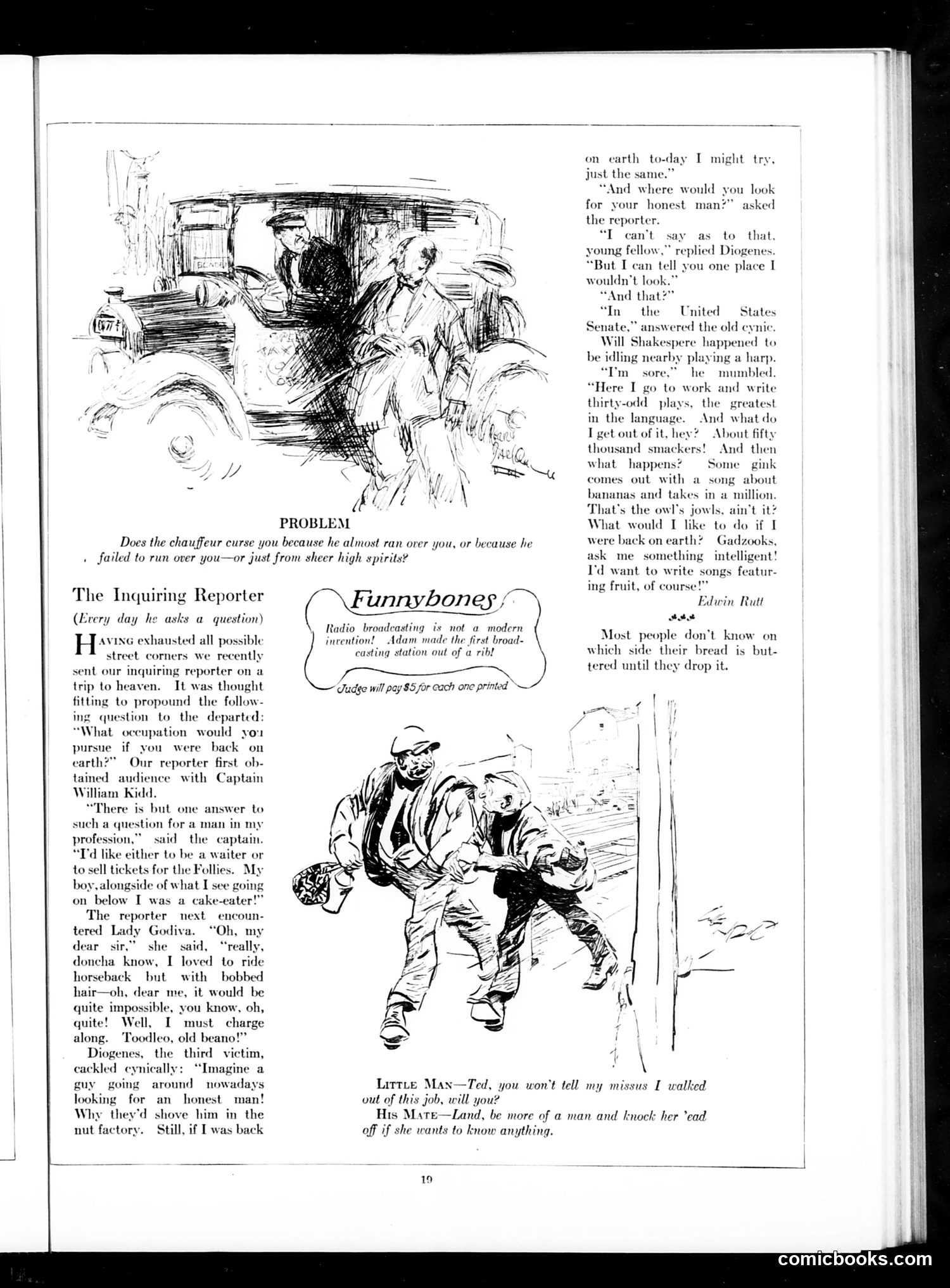
This page from *Judge* magazine contains satirical commentary on several topics: **"The Inquiring Reporter"** frames a heavenly interview where departed historical figures answer what job they'd pursue on Earth. The satirical point: **Captain Kidd** (the pirate) would become a waiter or ticket-seller—implying modern capitalism is as corrupt as piracy. **Lady Godiva** complains bobbed hair (a 1920s fashion) makes horseback riding impossible, mocking women's fashion obsessions. **Diogenes** (ancient Greek cynic famous for seeking an honest man) declares he wouldn't even *look* in the U.S. Senate—a direct jab at Congressional corruption and dishonesty. **Shakespeare's complaint** satirizes the entertainment industry's unfair pay: serious dramatic work earns pittance while novelty songs about fruit become million-dollar hits. The **"Problem" cartoon** above questions whether a reckless chauffeur acts from malice or mere carelessness—poking fun at aggressive driving culture. All three pieces mock American institutions (government, entertainment, driving) as fundamentally corrupt or absurd.
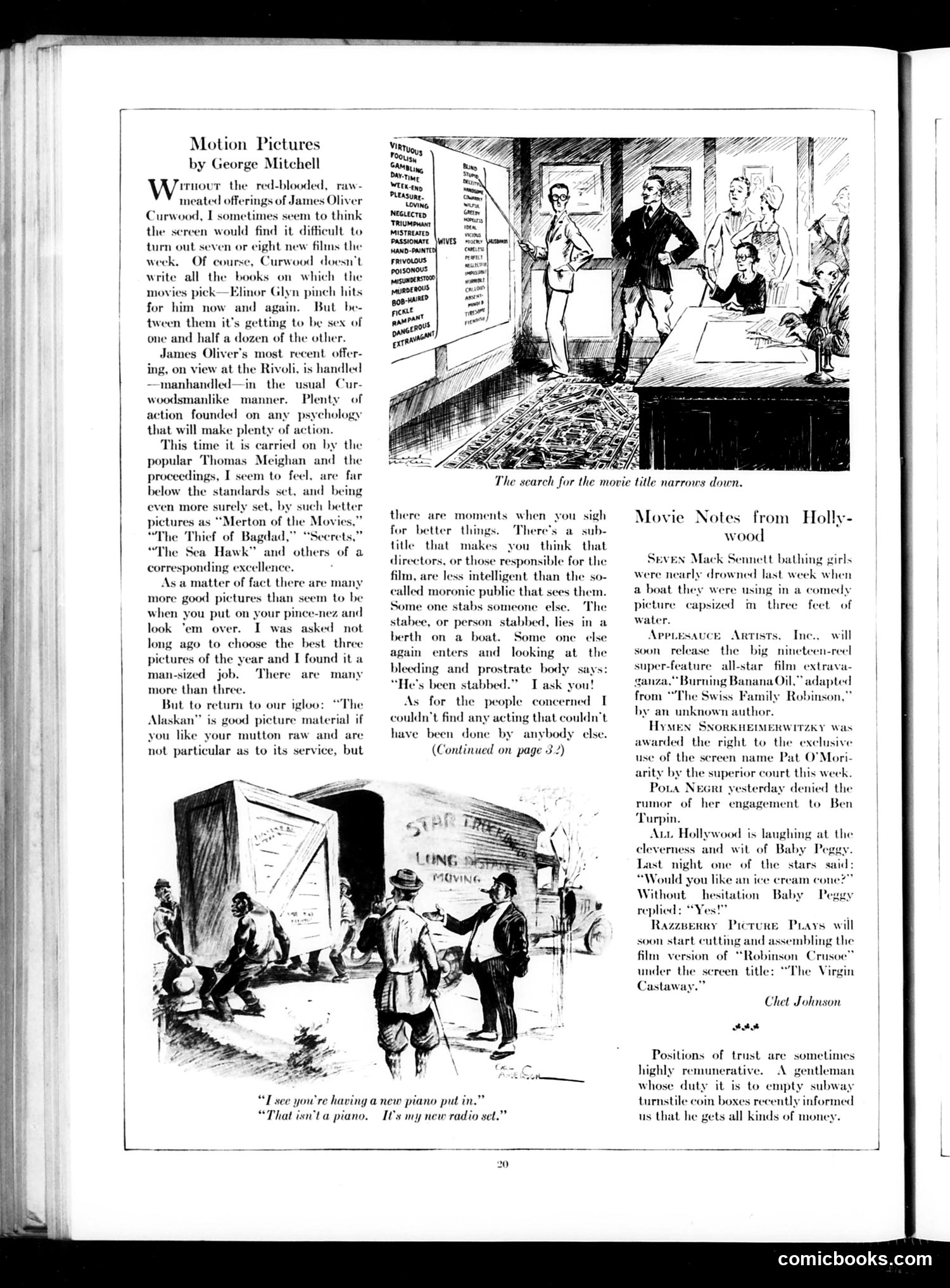
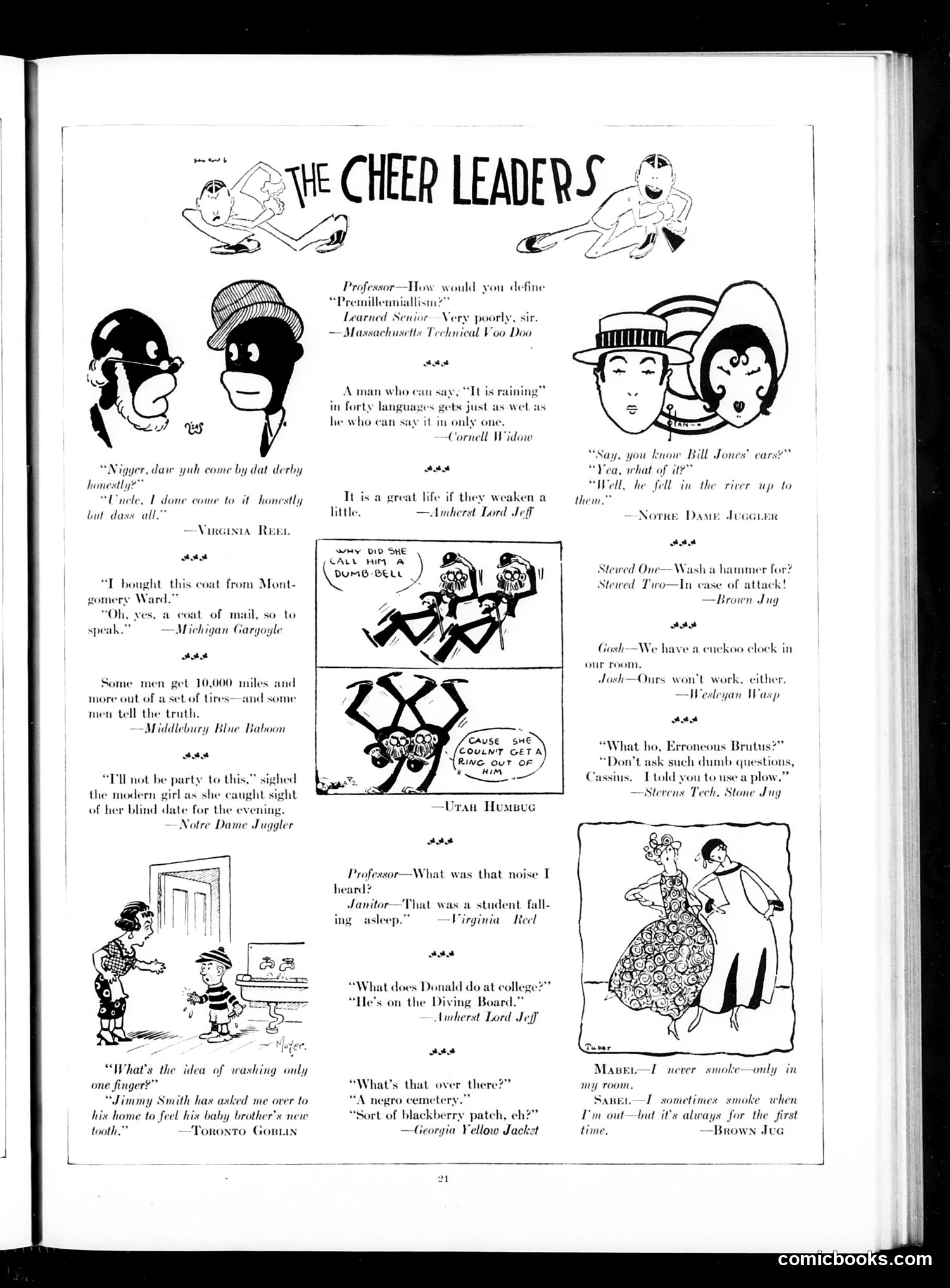
This page from *Judge* magazine collects brief jokes and comic strips from various college humor publications (Notre Dame Juggler, Cornell Widow, Amherst Lord Jeff, etc.). The humor targets early 20th-century college life and social attitudes. The jokes mock: - **Racial stereotypes**: References to "negro cemetery" and dialect humor using "nigger" reflect the period's casual racist language and attitudes. - **Class and consumerism**: Jokes about buying from Montgomery Ward (mail-order, working-class shopping) and secondhand clothing. - **Gender**: A woman unable to get a ring off a man's finger; modern girls criticized for shallow behavior. - **College life**: Students falling asleep in class, poor academics, diving board activities. - **Absurdist humor**: A man's ears so large he drowns; using a hammer for self-defense; a broken cuckoo clock. The cartoons are crude, slapstick drawings accompanying these quips. The overall tone is lighthearted mockery of contemporary social pretension and student behavior, typical of collegiate humor magazines of this era.
This page is primarily **financial advertising and investment advice**, not political satire. Judge magazine included a Financial Editor service answering subscriber questions about investments. The content reflects 1920s investment culture: advertisements for mortgage bonds offering 7% returns (presented as "safe"), alongside an article by Theodore Williams discussing volatile stock market conditions. Williams discusses recent market turbulence—specifically American Woolen dividend suspension—and notes leading financial houses advising caution. The only potentially satirical element is implicit: the contrast between advertisements promising safety and high returns versus Williams's article cautioning investors about uncertainty and unpredictability. This reflects post-WWI economic uncertainty. There are no identifiable political cartoons or caricatured figures on this page. The small illustration at top is decorative (an "Investment Bureau" header with a generic businessman figure, not a specific person). The page documents 1920s investment marketing and financial journalism rather than political commentary.
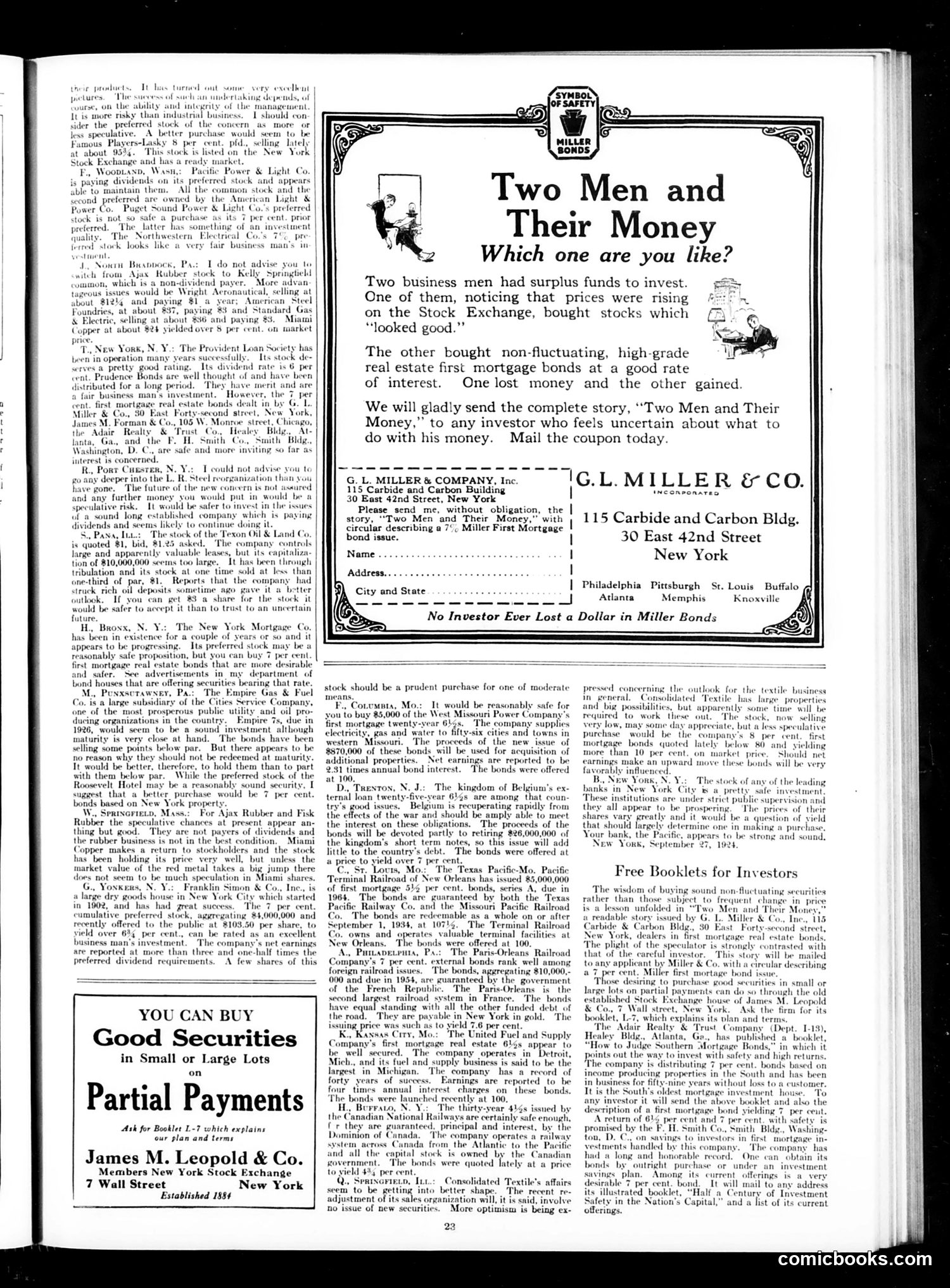
This page is primarily **financial advertising**, not satire. The central content is G.L. Miller & Company's promotional piece titled "Two Men and Their Money," which presents a contrast between two investment strategies: - **Man 1**: Buys fluctuating stocks on the rising stock market (implied to be risky) - **Man 2**: Purchases stable real estate mortgage bonds (presented as prudent) The headline "Which one are you like?" is designed to make readers question their own investment choices. **Context for today**: This appears from the 1920s (ads reference "September 27, 1924"), during the pre-crash stock market boom. The advertisement subtly discourages stock speculation in favor of Miller's bond offerings—which they claim have never lost investors money ("No Investor Ever Lost a Dollar in Miller Bonds"). The rest of the page contains financial advice columns responding to reader investment questions about various utility stocks and bonds. This reflects a period when investment guidance was distributed through popular magazines to middle-class readers.
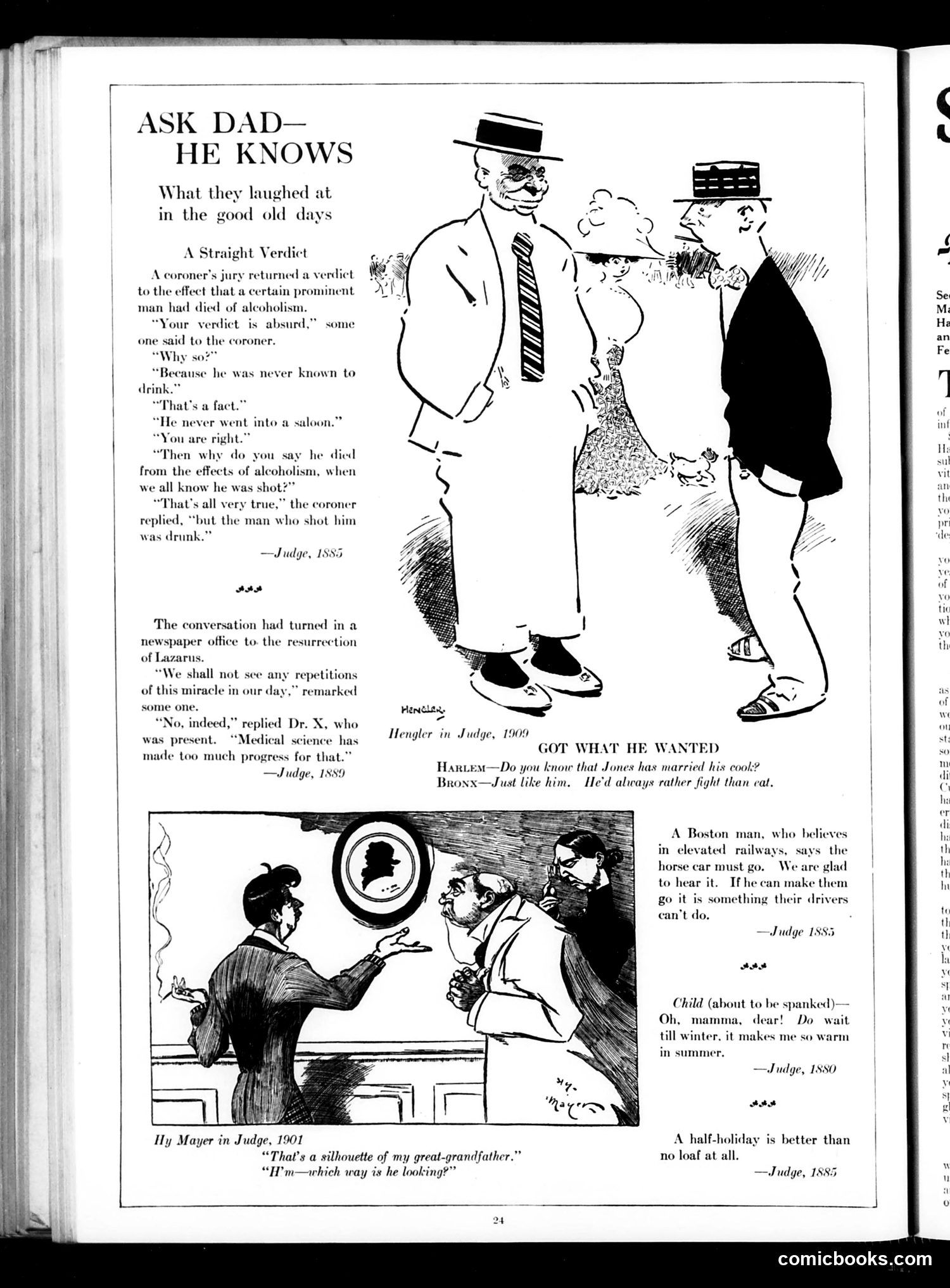
This page from *Judge* magazine collects brief humorous anecdotes and cartoons typical of late 19th/early 20th-century American satire. **"A Straight Verdict"** (1885): A coroner's jury struggles with logic—a prominent man dies, and while everyone agrees he never drank publicly, the coroner insists he died of alcoholism because the man who *shot* him was drunk. The joke mocks both the absurdity of the verdict and period attitudes toward alcoholism and violence. **The silhouette cartoon** (Hy Mayer, 1901): A man shows a profile portrait, claiming it's his great-grandfather. The humor relies on the ambiguous profile appearing to look in either direction—a visual pun on unclear family resemblance or genealogy. **Other brief jokes** target period concerns: elevated railways replacing horse cars, a man marrying his cook (class commentary), and childhood attempts to delay punishment. The "half-holiday" quip mocks work culture. These represent *Judge*'s formula: topical humor about technology, class, drinking, and domestic life, designed for educated, urban readers familiar with contemporary social anxieties.
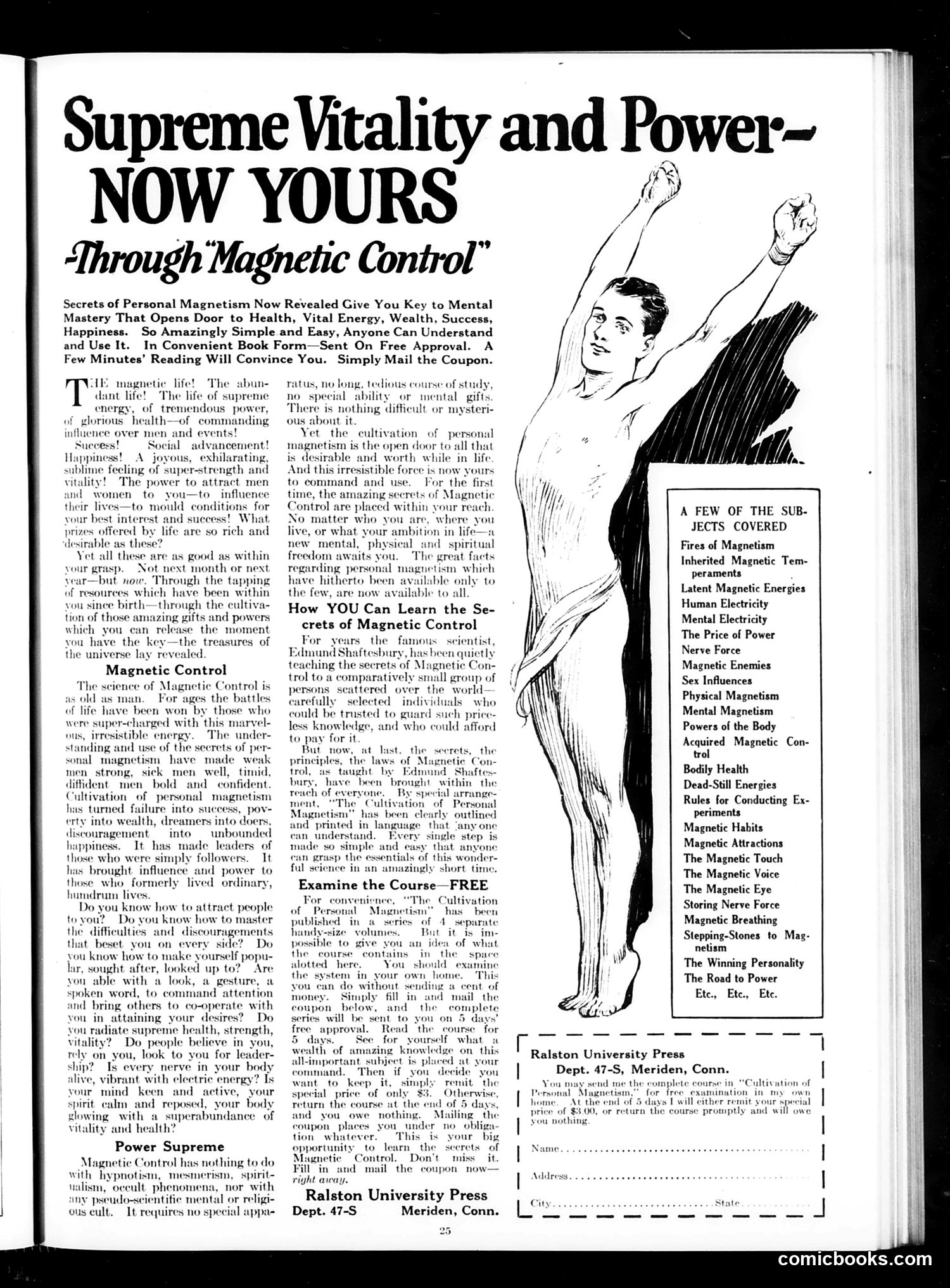
This is **not a political cartoon or satire**—it's a full-page advertisement for a mail-order self-help course called "The Cultivation of Personal Magnetism" by Ralston University Press. The ad promises that readers can acquire mysterious "magnetic control" to gain health, wealth, success, and the power to influence others—all through a cheap mail-order booklet. The illustration shows a muscular man with raised fists, embodying the promised vitality. This represents **pseudoscientific self-help marketing** of the early 20th century, exploiting readers' anxieties about personal power and social success. The vague promises ("secrets," "irresistible force," "available only to the few") and free-trial offer are classic con-artist techniques. Modern readers would recognize this as snake-oil salesmanship disguised in pseudo-scientific language about "personal magnetism."
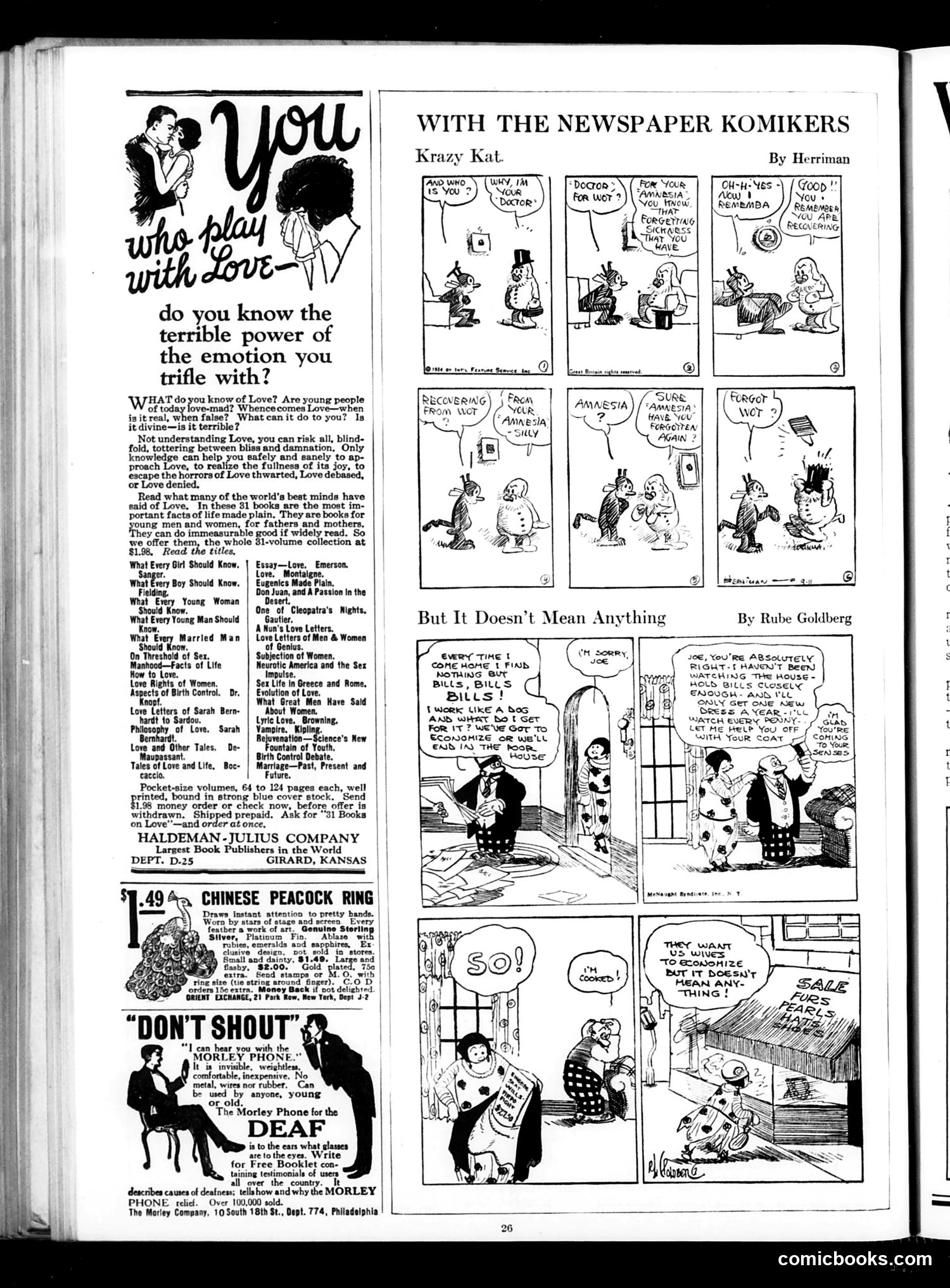
This page contains two newspaper comic strips and period advertisements. **"Krazy Kat" by Herriman** (top): This classic strip shows the cat character in various situations involving amnesia and memory loss—a recurring comedic theme. The strip is relatively straightforward slapstick humor without specific political content. **"But It Doesn't Mean Anything" by Rube Goldberg** (bottom): This domestic comedy depicts a husband returning home to find bills and household expenses. He complains about money while his wife points out the necessities—food, rent, coal for heating. The satire targets the gap between male breadwinners' complaints about expenses and the actual costs of maintaining a household, a relatable post-WWI economic anxiety theme. **Advertisements**: The page includes typical period ads for a mail-order book collection on love/relationships, a Chinese peacock ring, and a hearing aid ("Morley Phone"), reflecting early 20th-century consumer marketing aimed at magazine readers. The overall page reflects working-class domestic concerns and commercial culture of the era.
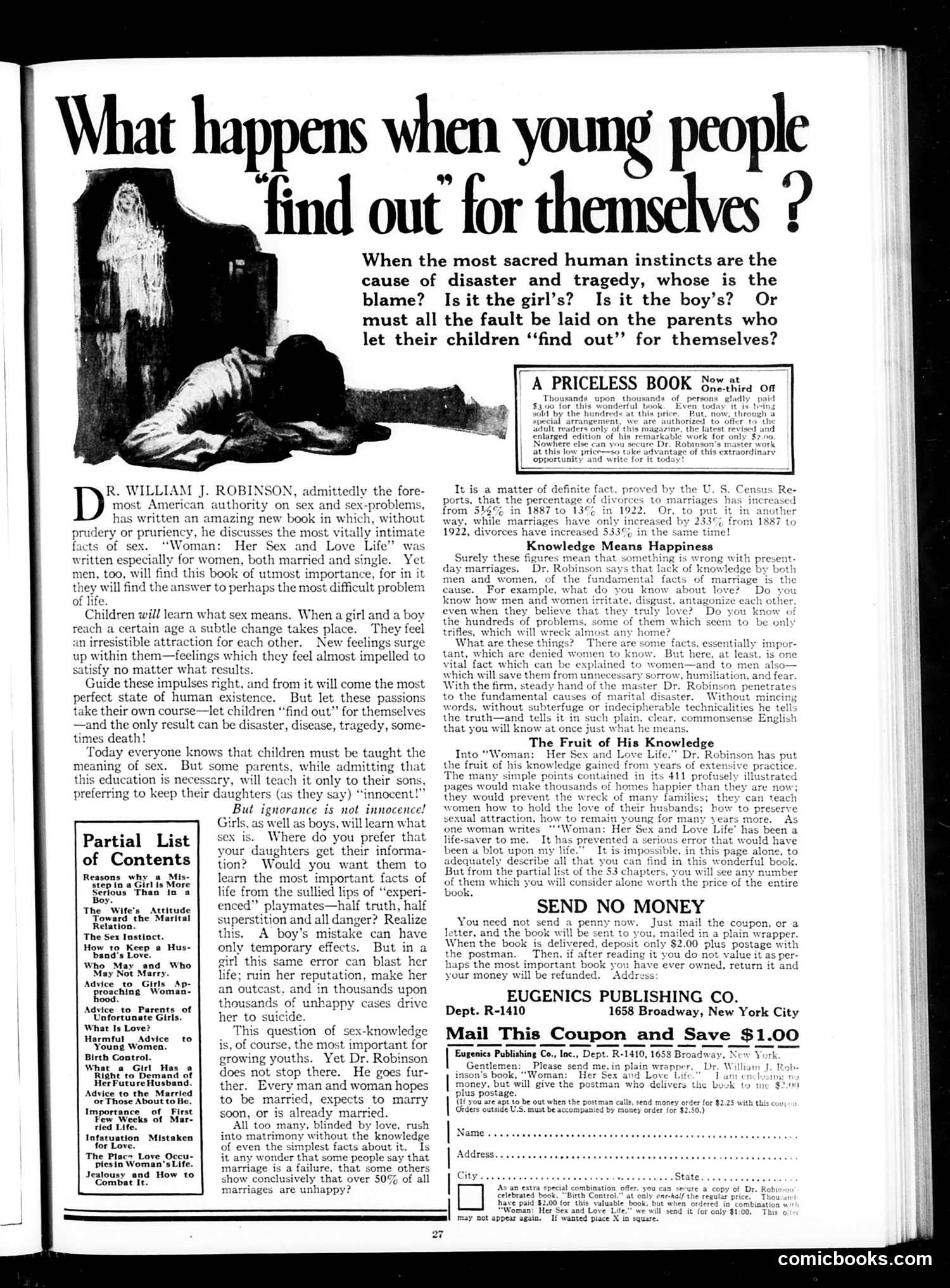
This page advertises Dr. William J. Robinson's sex education book "Woman: Her Sex and Love Life" (published by Eugenics Publishing Co.). The illustration shows a distressed young woman, implying consequences of sexual ignorance. **The argument:** Parents who let children "find out for themselves" about sex—rather than receiving proper education—risk disaster: disease, pregnancy, suicide, and failed marriages. The ad cites U.S. Census data showing divorce rates rising from 5.1% (1887) to 13% (1922). **The sales pitch:** Robinson's book allegedly provides frank, scientific guidance on sex, courtship, and marriage—addressing topics like birth control, marital relations, and infidelity. The ad emphasizes that ignorance is particularly dangerous for girls, whose "mistakes" permanently ruin reputation and life, whereas boys face only "temporary effects." **Historical context:** This reflects 1920s Progressive Era confidence that scientific education (not moral repression) solves social problems. The mention of "eugenics" reflects era-typical, now-discredited pseudo-scientific thinking about improving humanity through better breeding knowledge. The satire in *Judge* likely mocked this earnest, sensationalist advertising approach.
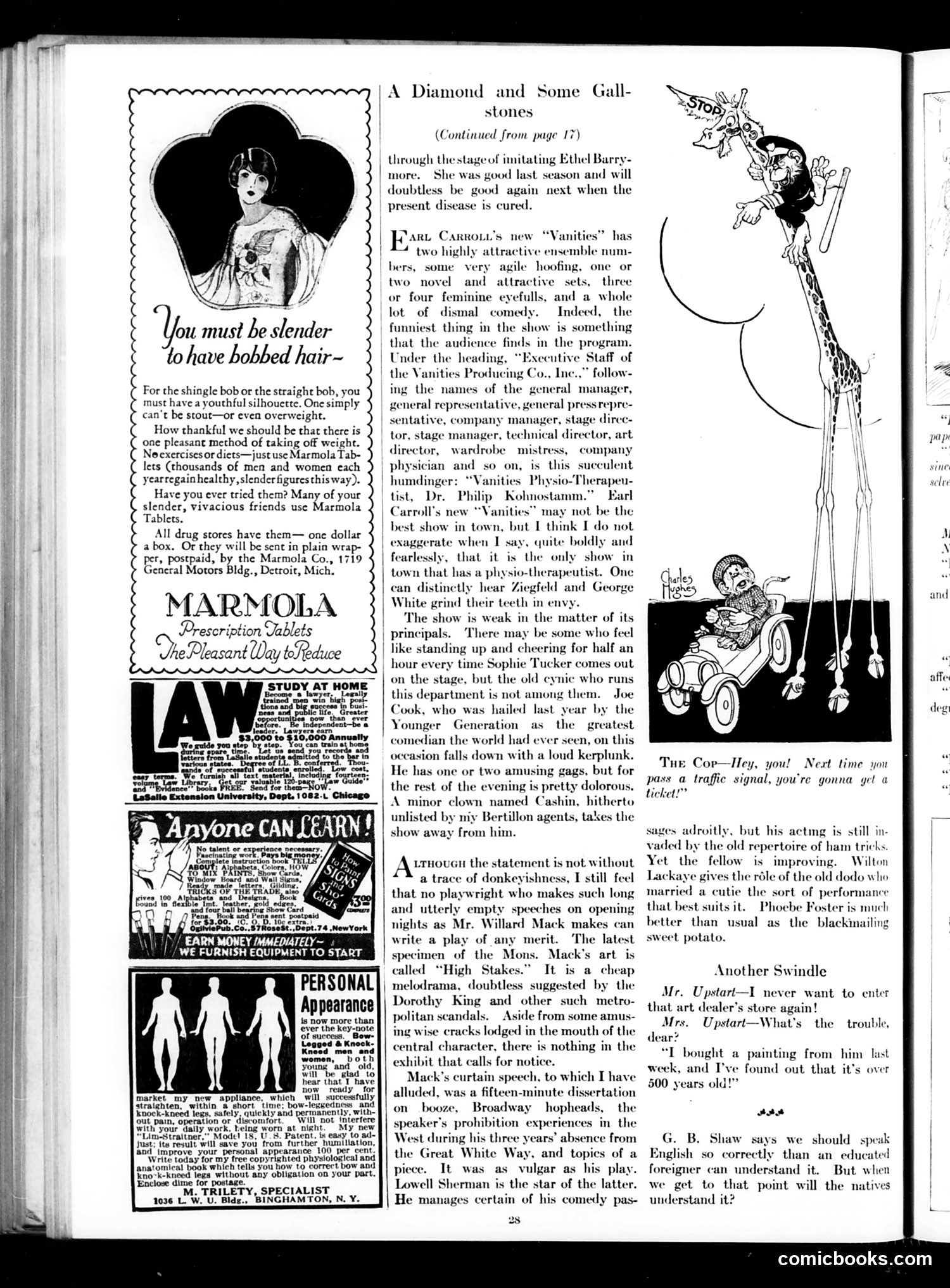
This page contains **primarily advertisements** interspersed with theatrical criticism. The main satirical content is a brief theater review criticizing Earl Carroll's "Vanities" show. The reviewer mocks the production's pretentiousness by highlighting its absurdly inflated staff roster, which includes a "Physio-Therapeutist, Dr. Philip Kohnostamm"—a position the critic suggests is comically unnecessary and designed to make the show sound more important than it is. The joke invokes competitors Florenz Ziegfeld and George White, prominent Broadway producers, implying they would "grind their teeth in envy" over such an outlandish credential. The advertisements reflect 1920s concerns: **Marmola Tablets** (weight-loss pills) plays on fashion anxiety about the "bobbed hair" trend requiring slender figures, while other ads promote correspondence courses and medical devices for correcting physical "defects." The cartoon illustrations (top right and center) appear to be unrelated vignettes typical of Judge's satirical style, though their specific references are unclear from the image quality.
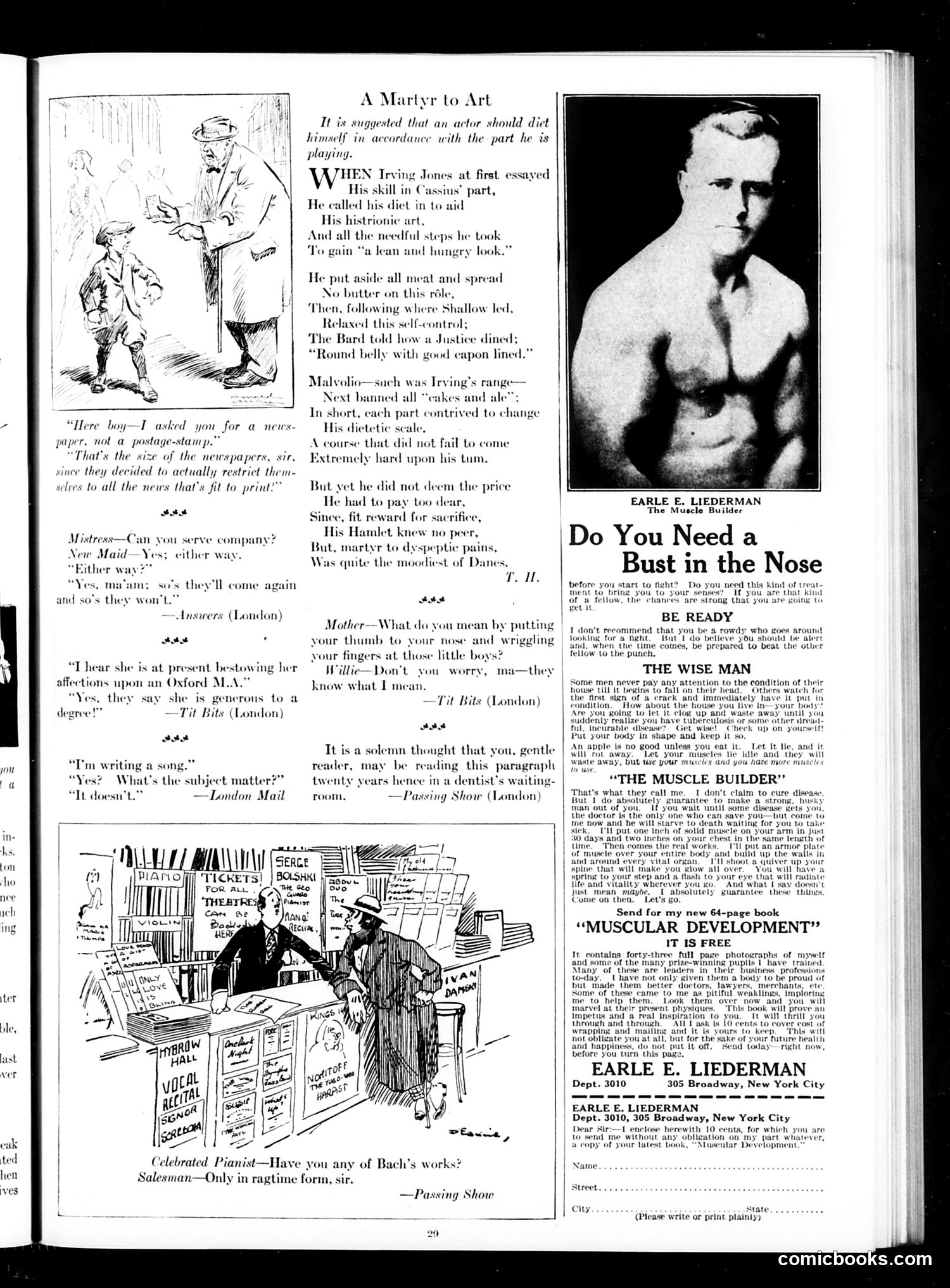
The main cartoon satirizes actor **Irving Jones** (or a fictional character representing method acting). The joke: Jones famously dieted to match each Shakespearean role he played—eliminating meat for Cassius, banning "cakes and ale" for other parts, then indulging with capon for Malvolio. The satire mocks this extreme physical commitment to character work, suggesting his stomach suffered ("dyspeptic pains") though he gained acclaim for his Hamlet. The page's opening gag references **newspaper size reduction**—editors claimed to print "all the news that's fit to print," but actually shrunk papers so drastically they became tiny, contradicting their stated principle. Other brief jokes mock social absurdities: a new maid's confusion about serving guests, a woman's Oxford education going unappreciated, and a pianist only knowing classical works in ragtime form. The right side advertises **Earle E. Liederman's bodybuilding correspondence course**, a period-typical fitness pitch combining before/after photos with muscular ideology.
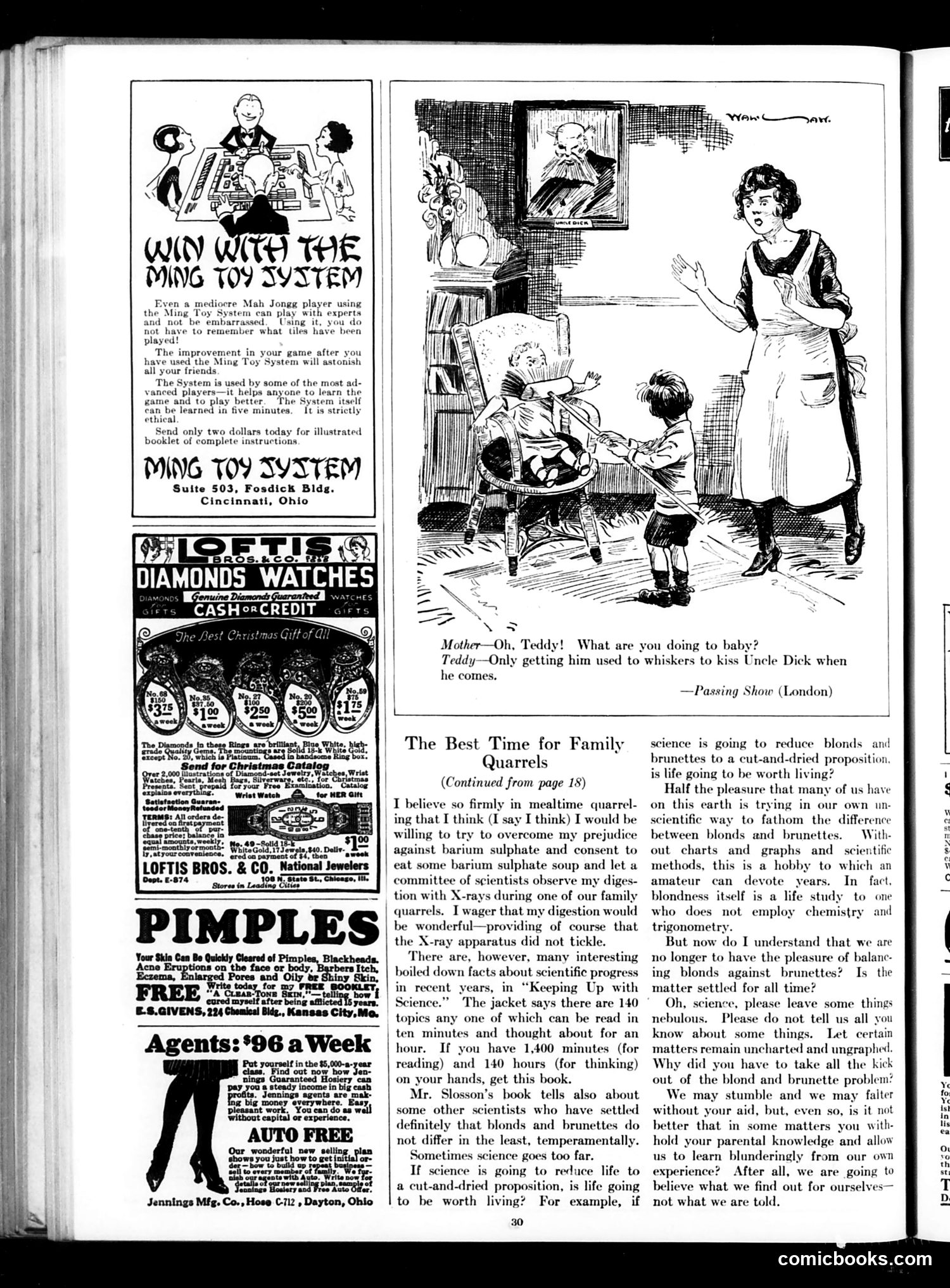
This page is primarily **advertisements and filler content** rather than political satire. The main cartoon is a domestic humor sketch (credited to *Passing Show*, London) showing a mother watching a toddler practice kissing, preparing him for when his Uncle Dick visits—a gentle joke about children mimicking adults' affectionate customs. The bulk of the page consists of period product ads: the Ming Toy System (a Mah Jongg instruction guide), Loftis diamonds watches, a pimple-clearing treatment, and a hosiery sales opportunity. These reflect 1920s consumer culture. The longer text article discusses scientific findings about digestion, blonde vs. brunette temperament, and whether science oversimplifies life's pleasures. It's lighthearted social commentary rather than political satire—musing that reducing human differences to charts and graphs removes the fun from romantic speculation. **For modern readers**: This represents Judge's mix of humor, advertising revenue, and middlebrow commentary on contemporary life and commerce.
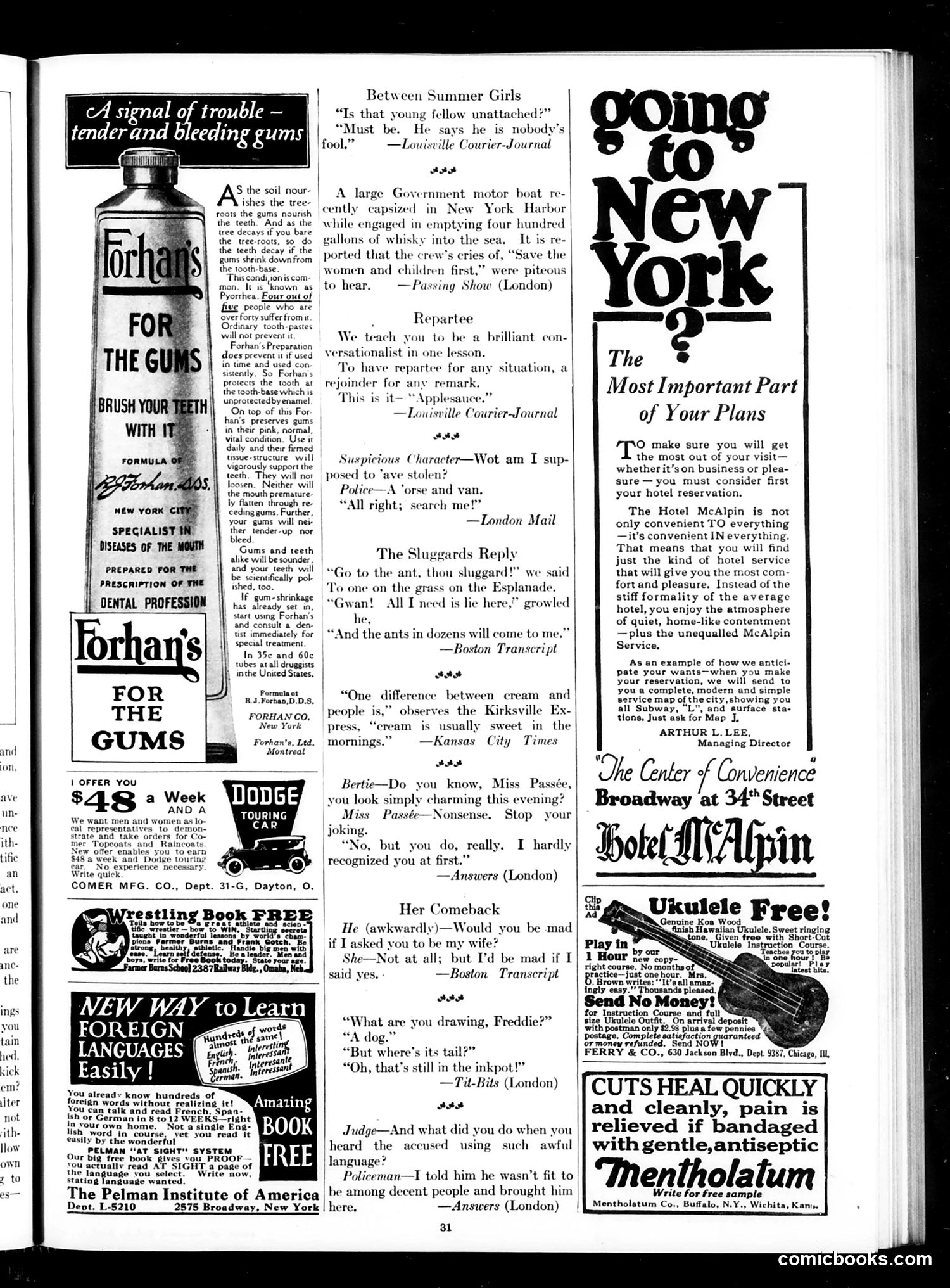
This page is primarily **advertisements and short humor pieces** rather than political cartoons. The content reflects early 20th-century American consumer culture. **Major elements:** - **Forhan's toothpaste ads** dominate, claiming to prevent pyorrhea (gum disease) in a pseudo-medical pitch targeting anxious consumers about aging - **Dodge touring car ad** offering $4/week sales positions - **Language-learning course** promising to teach foreign languages at home - **Hotel McAlpin advertisement** promoting convenient Manhattan lodging **Humor pieces** include brief jokes about: - A government boat dumping whisky (Prohibition-era reference) - "Repartee" lessons teaching clever comebacks - Various one-liners about relationships and character foibles The page exemplifies Judge's mixed format: satirical humor alongside aggressive consumer advertising targeting middle-class anxieties about health, social skills, employment, and status. The tone assumes readers aspire to urban sophistication and worry about physical decline.
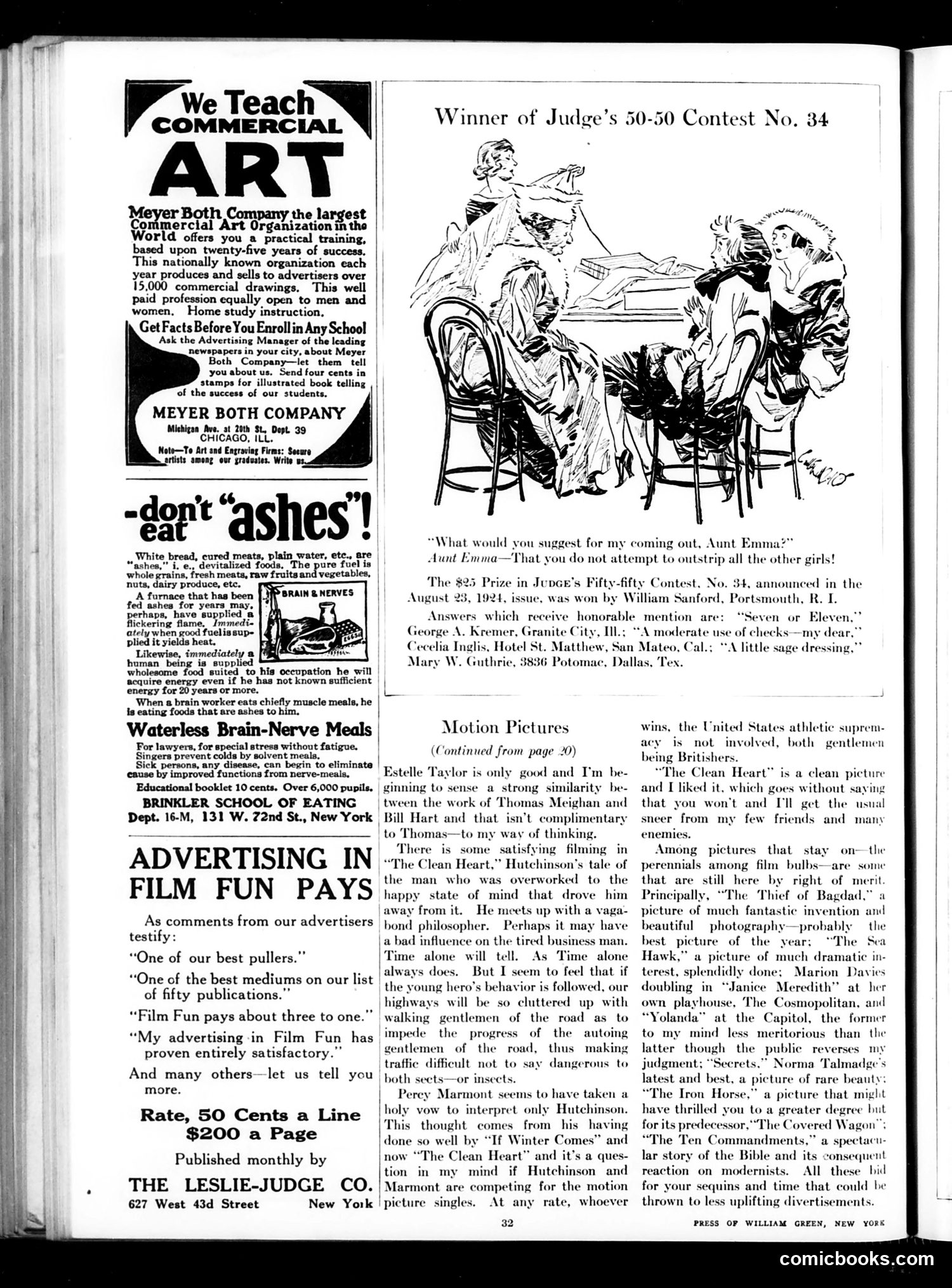
This is primarily a **magazine advertising and film review page** from Judge. The main content includes: **Advertisements:** Commercial art school (Meyer Booth Company), food/health products ("Waterless Brain Nerve Meals"), and Film Fun magazine tout advertising effectiveness with testimonials. **The Cartoon (top right):** Titled "Winner of Judge's 50-50 Contest No. 34," it shows a young woman asking an older aunt for advice about "coming out" (debut into society). The aunt's response—"That you do not attempt to outstrip all the other girls!"—is a gentle satirical jab at female social competition and vanity during the 1920s debutante season. **Film Reviews:** Critic discusses current motion pictures including "The Clean Heart" and "The Thief of Bagdad," comparing actors like Estelle Taylor, Bill Hart, and Percy Marmont. The page reflects **1920s concerns**: social propriety for young women, emerging advertising industries, and cinema as popular entertainment. The satire is mild—social commentary rather than political critique.
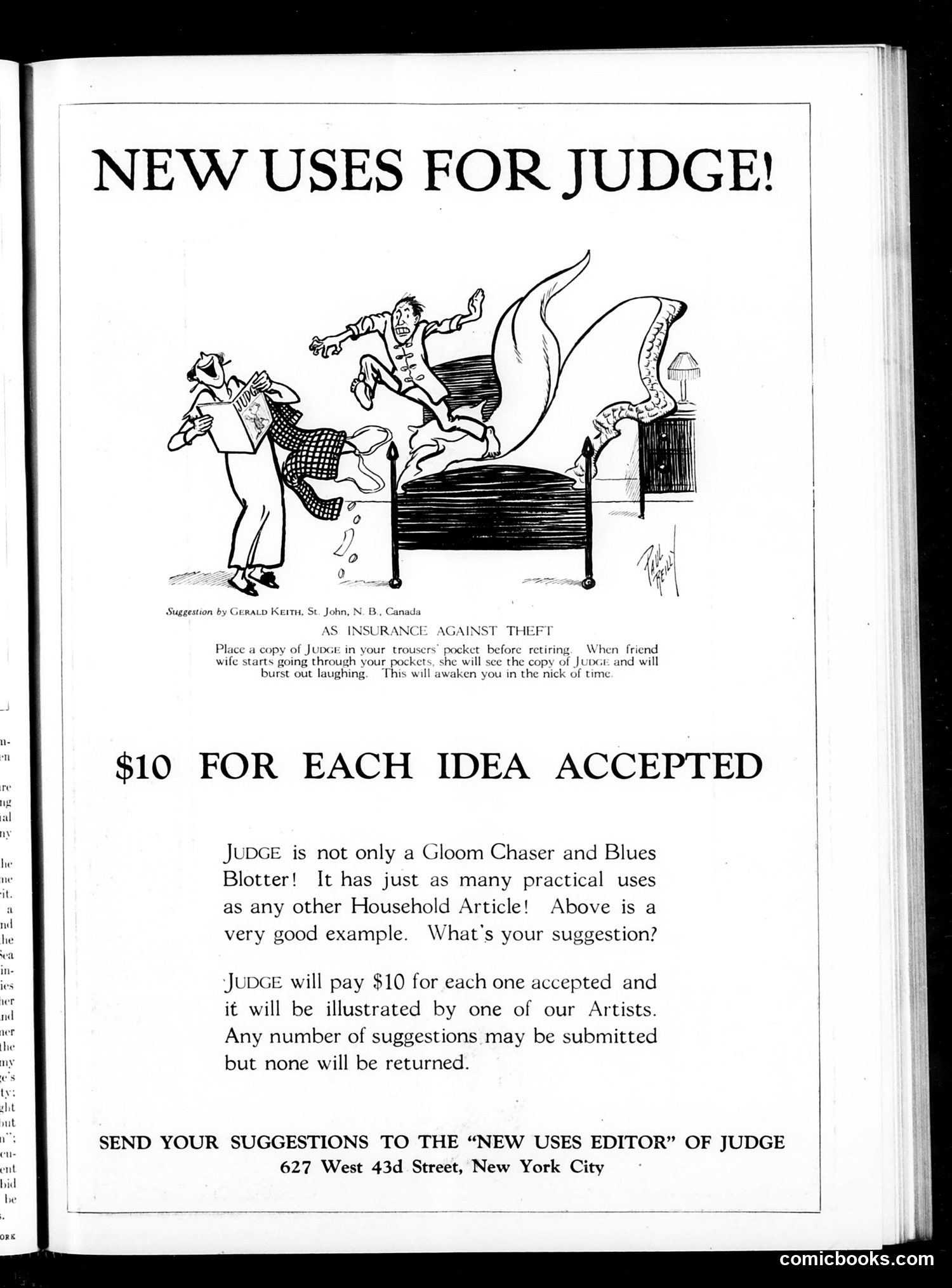
This is primarily **advertising/promotional content** rather than political satire. Judge magazine is soliciting reader submissions for "New Uses for Judge" — creative suggestions for alternative purposes of the magazine itself. The cartoon illustrates the first example: placing a copy of Judge in one's trouser pocket as a theft deterrent. The joke is that when a wife searches her husband's pockets at night, she'll discover the magazine, laugh at it, and inadvertently wake him — thus "protecting" him from her potential theft of his money. The humor relies on period stereotypes about wives as spenders and marital dynamics where husbands need to guard their wallets. Judge offered $10 per accepted idea, inviting readers to participate in this lighthearted competition. This was a common engagement strategy for magazines of this era, turning the publication itself into a subject of practical domestic comedy.

This is a **Lucky Strike cigarette advertisement**, not political satire. The ad uses class-based language to market toasted cigarettes: the "45 minutes toasting" process supposedly creates an "aristocratic flavor" while mass production keeps the price "democratic" (affordable). The ornate decorative border mimics high-class design, reinforcing the luxury positioning. The silhouette portrait at bottom suggests sophistication and refinement. The humor or appeal lies in the paradox: ordinary consumers can afford a product with aristocratic qualities. This reflects 1920s-30s advertising strategy that sold mass-produced goods by associating them with elite status—a clever sales pitch positioning cigarettes as accessible luxury. There's no political cartoon here—it's purely commercial messaging dressed in elegant presentation.