
Judge, 1924-09-27 · page 13 of 36
Judge — September 27, 1924 — page 13: what you’re looking at
What you’re looking at
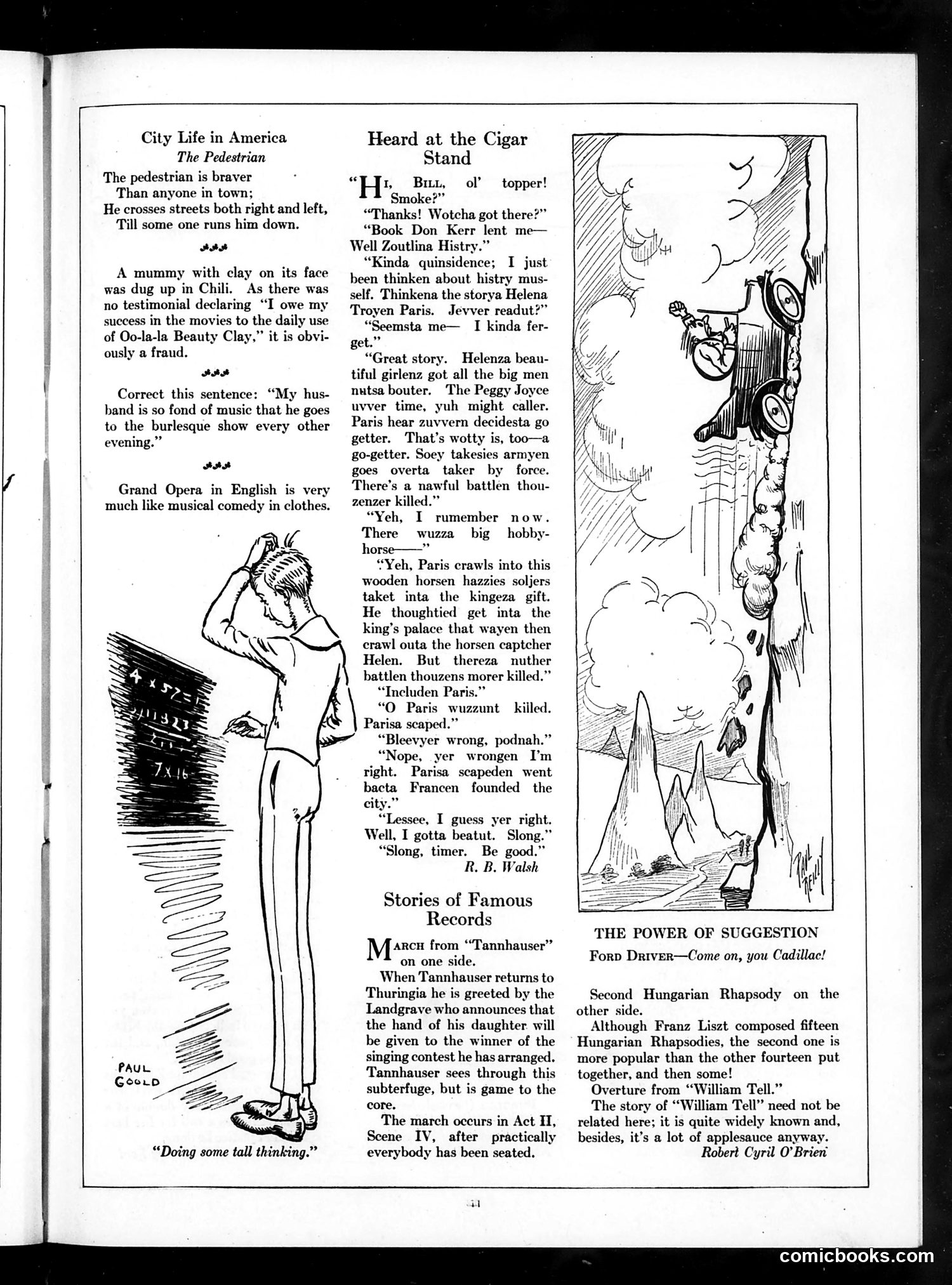
This Judge magazine page contains three distinct pieces: **"City Life in America"** presents satirical observations about urban pedestrians and cultural absurdities—a mummy excavated in Chile fraudulently claiming beauty-product success, and the observation that English Grand Opera resembles musical comedy. **"Heard at the Cigar Stand"** depicts working-class men mangling the Trojan War narrative through dialect humor. They confuse details about Helen, Paris, and the Trojan Horse, mixing historical reference with phonetic dialect ("wuzza big hobby-horse," "battlen thouzens"). This satirizes both historical ignorance and the broad comedic use of ethnic/working-class speech patterns common to early 20th-century humor. **"Stories of Famous Records"** discusses classical music—Wagner's "Tannhauser" march and Liszt's Hungarian Rhapsody—paired with a cartoon of a Ford driver calling to a Cadillac ("Come on, you Cadillac!"), illustrating "The Power of Suggestion." The page blends social satire, dialect comedy (now considered offensive), classical culture references, and automobile humor typical of Judge's mixed content targeting educated, middle-class readers.
📄 Transcribed text from this page (OCR, searchable)
Machine-transcribed from the original scan — historical spelling and the odd misread are preserved.
City Life in America Heard at the Cigar The Pedestrian Stand The pedestrian is braver . “ ’ i Than anyone in town; ya Bae, emer He crosses streets both right and left, “Thanks! Wotcha got there?” Till some one runs him down. “Rock Don. Kern leat me— PIS Well Zoutlina Histry.” . . “Kinda quinsidence; I just A mummy with ‘ lay on its face been thinken about histry mus- bm dug Up Chili. As there was elf, Thinkena the storya Helena no testimonial declaring “I owe my Troyen Paris. Jevver readut?” success in the movies to the daily use “Zecrsta aie— 1 Linda ters of Oo-la-la Beauty Clay,” it is obvi- | | ieee get.” q ously a traud. “Great story. Helenza beau- aad tiful girlenz got all the big men Correct this sentence: “My hus- nutsa bouter. The Peggy Joyce band is so fond of music that he goes UVver time, yuh might caller. to the burlesque show every other Paris hear zuvvern decidesta go evening.” getter. That’s wotty is, too—a go-getter. Soey takesies armyen. | goes overta taker by force. f | Grand Opera in English is very There’s a nawful battlen thou- / much like musical comedy in clothes. 7€n2eT killed.” “Yeh, I rumember now. There wuzza big hobby- horse——” “Yeh, Paris crawls into this wooden horsen hazzies soljers taket inta the kingeza gift. He thoughtied get inta the king’s palace that wayen then crawl outa the horsen captcher Helen. But thereza nuther battlen thouzens morer killed.” “Includen Paris.” Rad Parisa scaped.” “Bleevyer wrong, podnah.” “Nope, yer wrongen I’m right. Parisa scapeden went bacta Francen founded the city.” “Lessee, I guess yer right. Well, I gotta beatut. Slong.” “Slong, timer. Be good.” R. B. Walsh Stories of Famous Records arcH from “Tannhauser” on one side. When Tannhauser returns to Thuringia he is greeted by the Second Hungarian Rhapsody on the Landgrave who announces that other side. the hand of his daughter. will Although Franz Liszt composed fifteen be given to the winner of the Hungarian Rhapsodies, the second one is singing contest he hasarranged. more popular than the other fourteen put Tannhauser sees through this together, and then some! subterfuge, but is game to the Overture from “William Tell.” core. The story of “William Tell” need not be The march occurs in Act II, related here; it is quite widely known and, Scene IV, after practically besides, it’s a lot of applesauce anyway. everybody has been seated. Robert Cyril O’ Brien’ THE POWER OF SUGGESTION Forp Driver—Come on, you Cadillac! “Doing some tall thinking.” comicbooks.com