
A complete issue · 36 pages · 1924
Judge — February 23, 1924
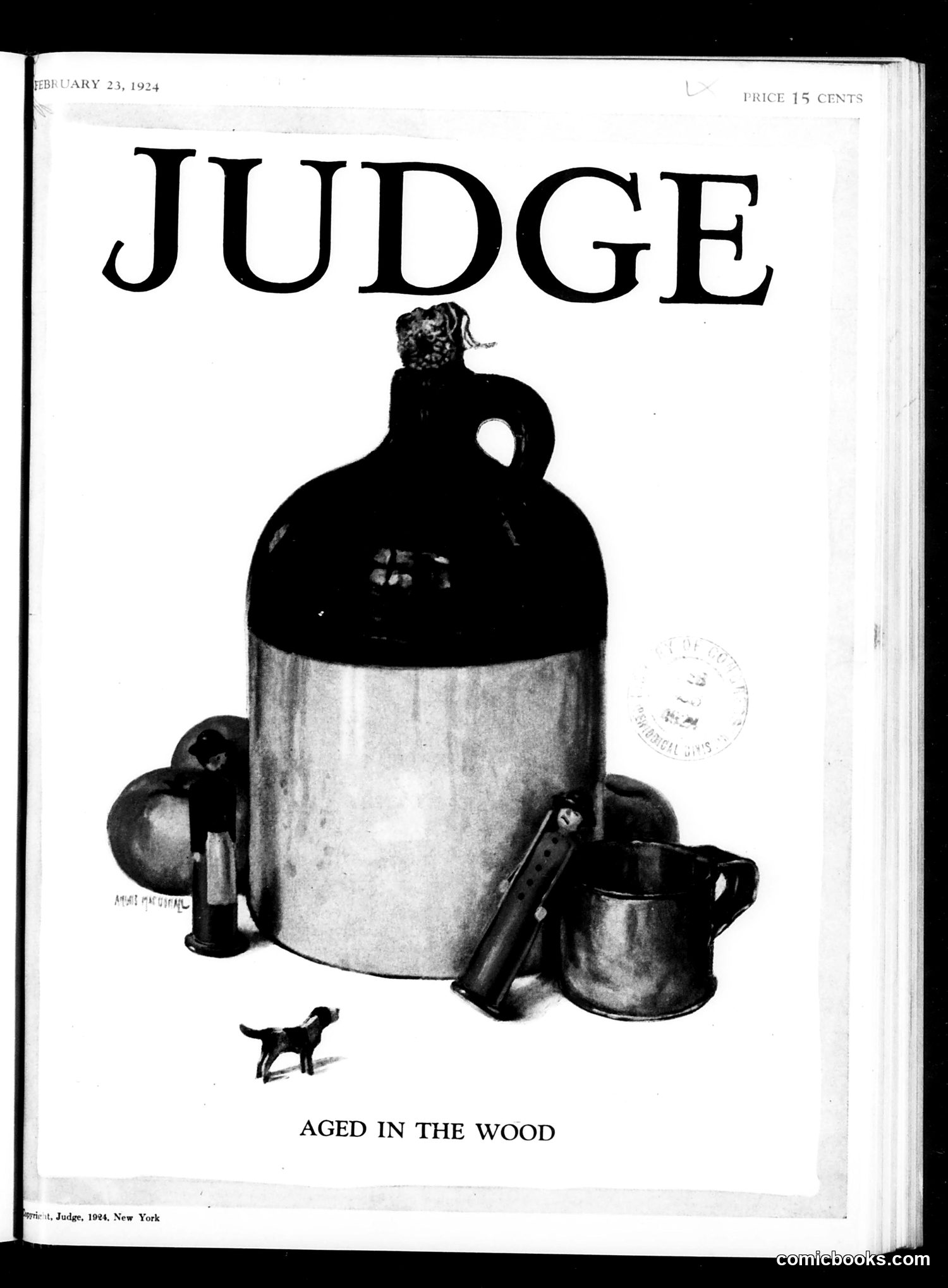
This satirical cover depicts a large jug or demijohn labeled with a face at the top, surrounded by brewing equipment and a small dog. The title "Aged in the Wood" is a pun referencing barrel-aging of alcohol. Published during Prohibition (1920-1933), this cartoon mocks illegal home distilling and bootlegging. The jug represents contraband liquor being secretly produced. The grotesque face suggests the cartoon is personifying alcohol or possibly satirizing a specific bootlegger or politician associated with illegal liquor production during this era. The humor derives from the open display of obviously illicit brewing activity—poking fun at how widespread and barely-concealed such operations had become despite federal law.
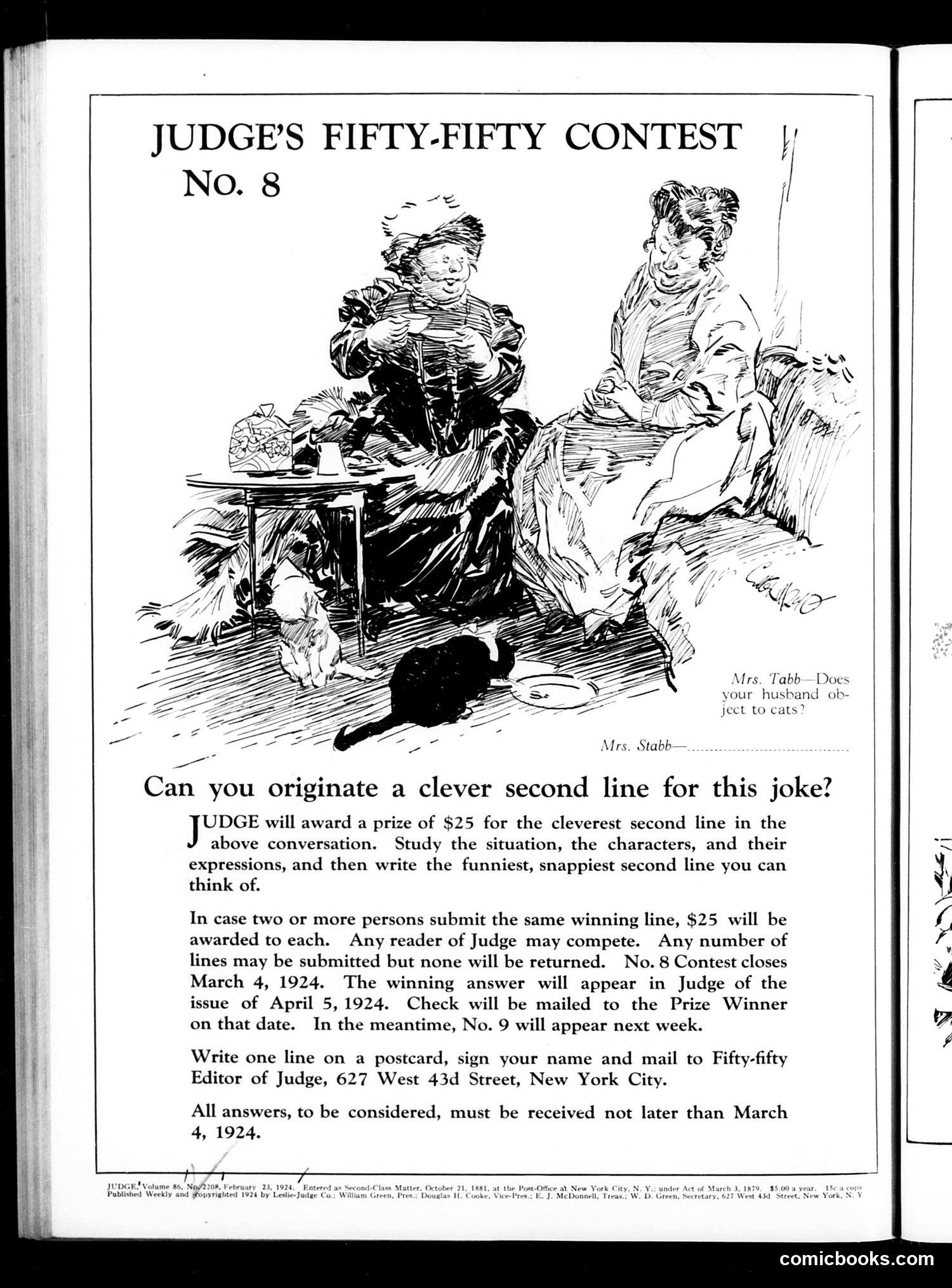
This page presents a humor contest rather than political satire. Two women—Mrs. Tabb and Mrs. Stabb—are depicted in a domestic drawing room scene with a cat present. Mrs. Tabb asks the opening line: "Does your husband object to cats?" Readers are invited to submit a clever "second line" response (a punchline) to complete the joke. The $25 prize suggests this was a popular reader-engagement feature in Judge magazine. The humor likely relies on wordplay or unexpected domestic scenarios typical of 1920s comic sensibilities. Without the winning answer provided on this page, the specific joke's intent remains unclear to modern readers, though the setup appears to involve spousal attitudes toward pets in upper-class households.
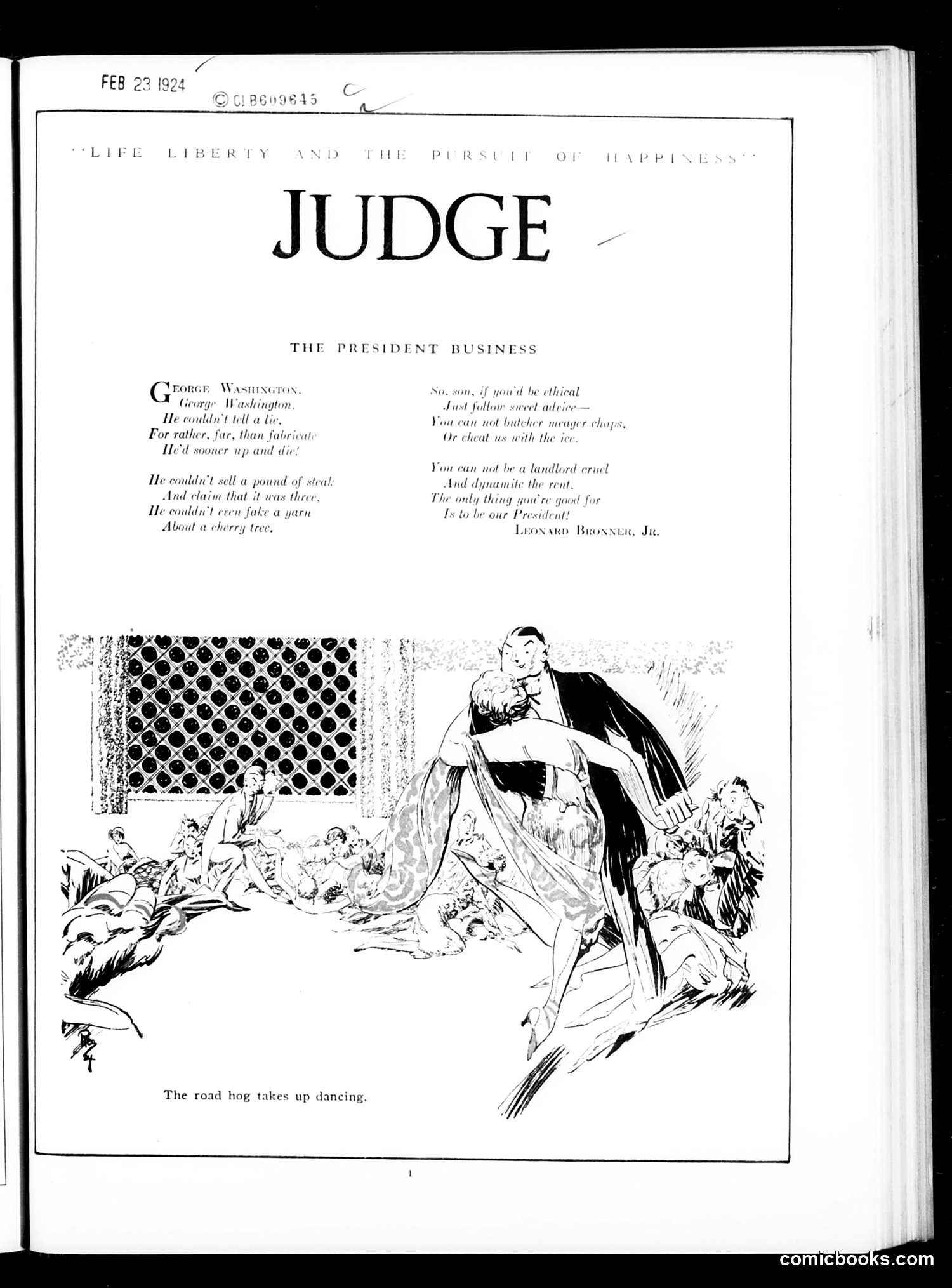
This satirical piece titled "The President's Business" mocks George Washington's famous honesty (the cherry tree legend), contrasting it with requirements for modern presidents. The poem suggests contemporary presidents must be dishonest—able to tell lies, evade taxes, accept bribes, and ignore rent disputes—to succeed politically. The illustration shows a dignified figure (likely representing the presidency or Washington's legacy) watching common people and corruption, with the caption "The road hog takes up dancing," suggesting moral decay and social disorder. The satire critiques 1920s political corruption and moral compromise. By invoking Washington's mythologized integrity against current leadership standards, Judge argues that honest governance has become impossible in contemporary American politics.
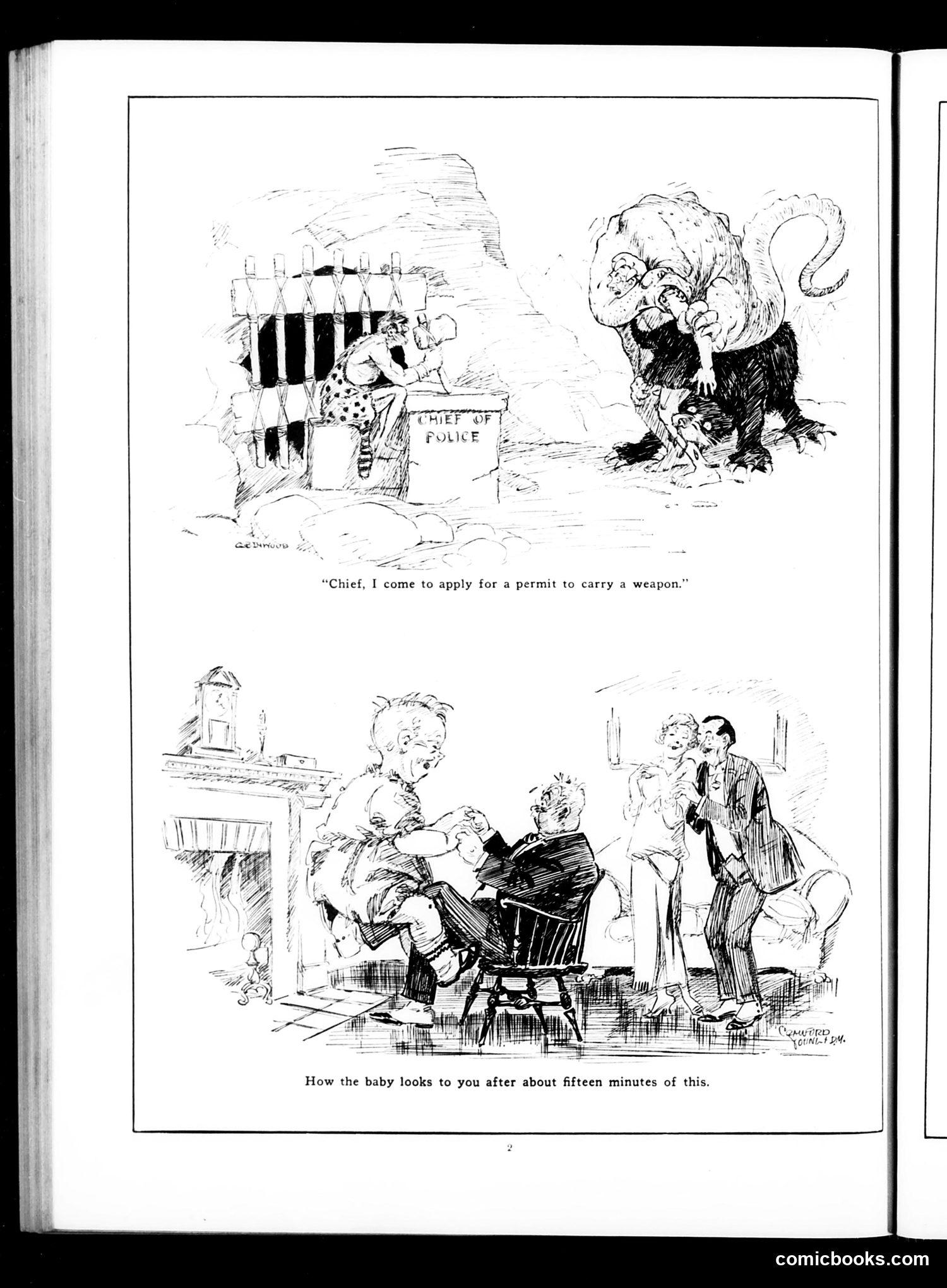
This page contains two satirical cartoons from *Judge* magazine mocking gun control permit applications. **Top cartoon:** A Native American chief approaches a "Chief of Police" jail to "apply for a permit to carry a weapon." The satire likely references debates over gun ownership rights and the irony of indigenous peoples—historically dispossessed of weapons and sovereignty—now needing government permission to arm themselves. **Bottom cartoon:** Shows a couple presenting a screaming, disheveled baby to what appears to be government officials, captioned "How the baby looks to you after about fifteen minutes of this." This mocks the bureaucratic ordeal of obtaining weapon permits, comparing the exhausting application process to the chaos of caring for an infant. Both cartoons satirize excessive government regulation of gun ownership as absurd and frustrating.
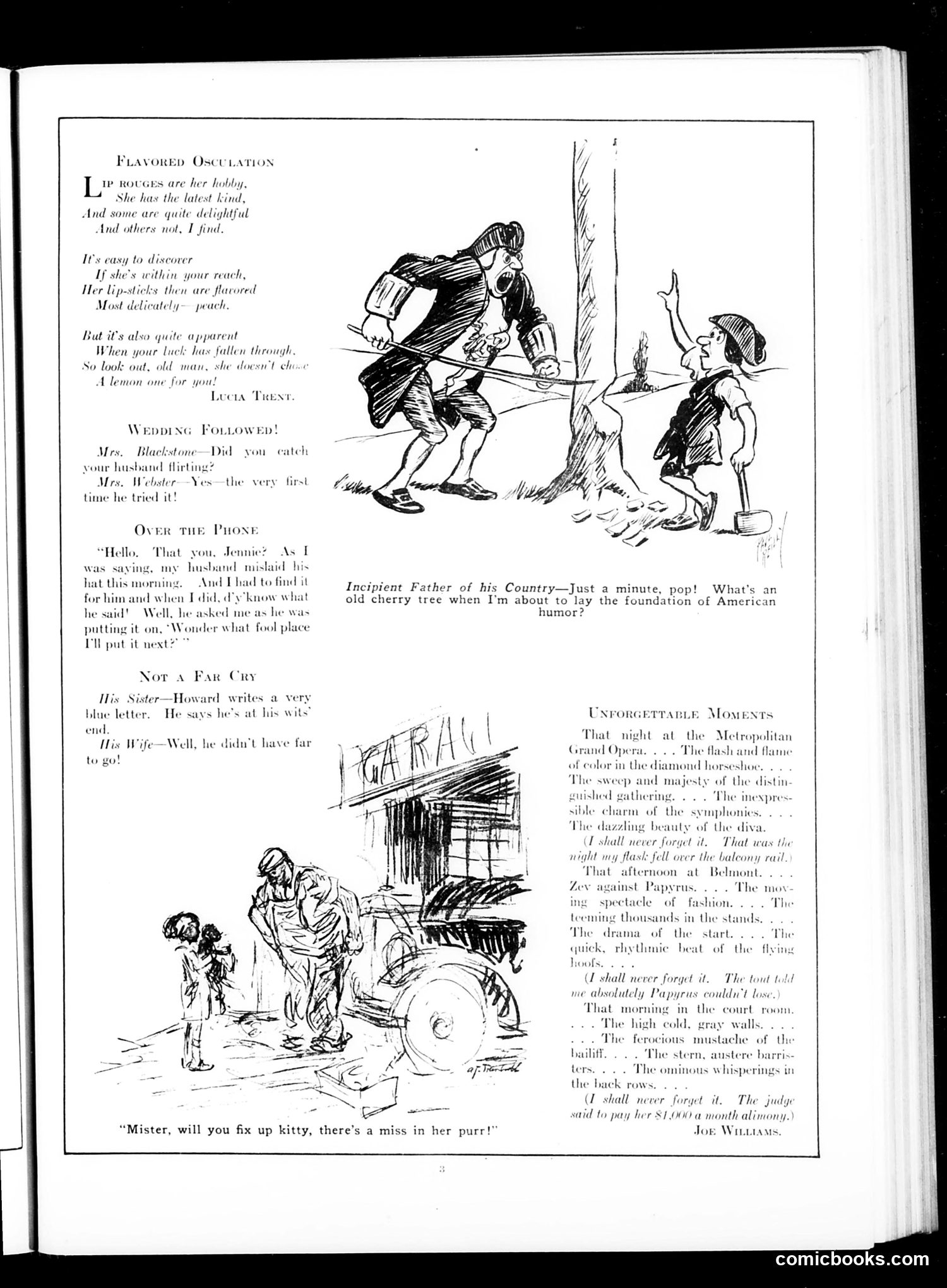
This page contains four distinct humor sections typical of early 20th-century satirical magazines: 1. **"Flavored Osculation"** — A poem by Lucia Trent about women's lipstick flavors, mocking the latest cosmetic trends. 2. **"Wedding Followed!"** and **"Over the Phone"** — Brief comedic anecdotes about marital misunderstandings. 3. **"Not a Far Cry"** — A joke about a wife's indifference to her husband's travels. 4. **"Unforgettable Moments"** — A poem by Joe Williams nostalgically recounting experiences at the Metropolitan Opera and other society events, with an illustration showing what appears to be working-class figures. The humor likely derives from the contrast between high culture aspirations and everyday reality. The bottom cartoon shows a mechanic and cat, punning on "purr" (the cat's sound) as a mechanical problem.
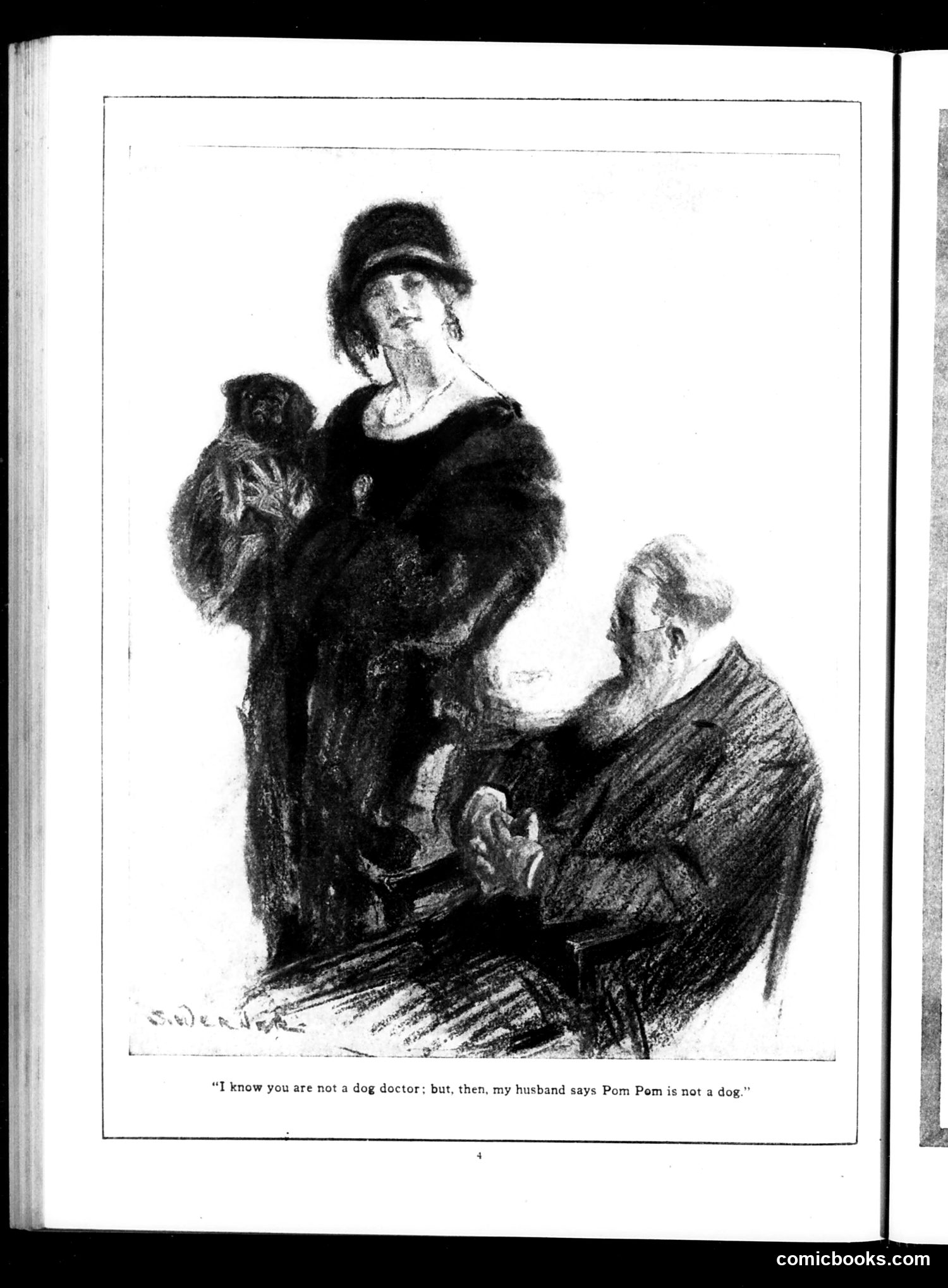
This cartoon satirizes class attitudes toward pets and veterinary care. A well-dressed woman holds a small dog while speaking to an older male veterinarian seated at right. The caption reads: "I know you are not a dog doctor; but, then, my husband says Pom Pom is not a dog." The humor relies on the contrast between the woman's fashionable appearance and her dismissive attitude toward professional expertise. "Pom Pom" (likely a Pomeranian) is portrayed as a pampered lap dog—barely recognizable as a dog at all to working people. The joke mocks wealthy owners who treat small ornamental dogs as quasi-human companions rather than actual animals, while simultaneously belittling the veterinarian's profession. It's satire of upper-class pretension and the absurdity of treating companion animals as status symbols.
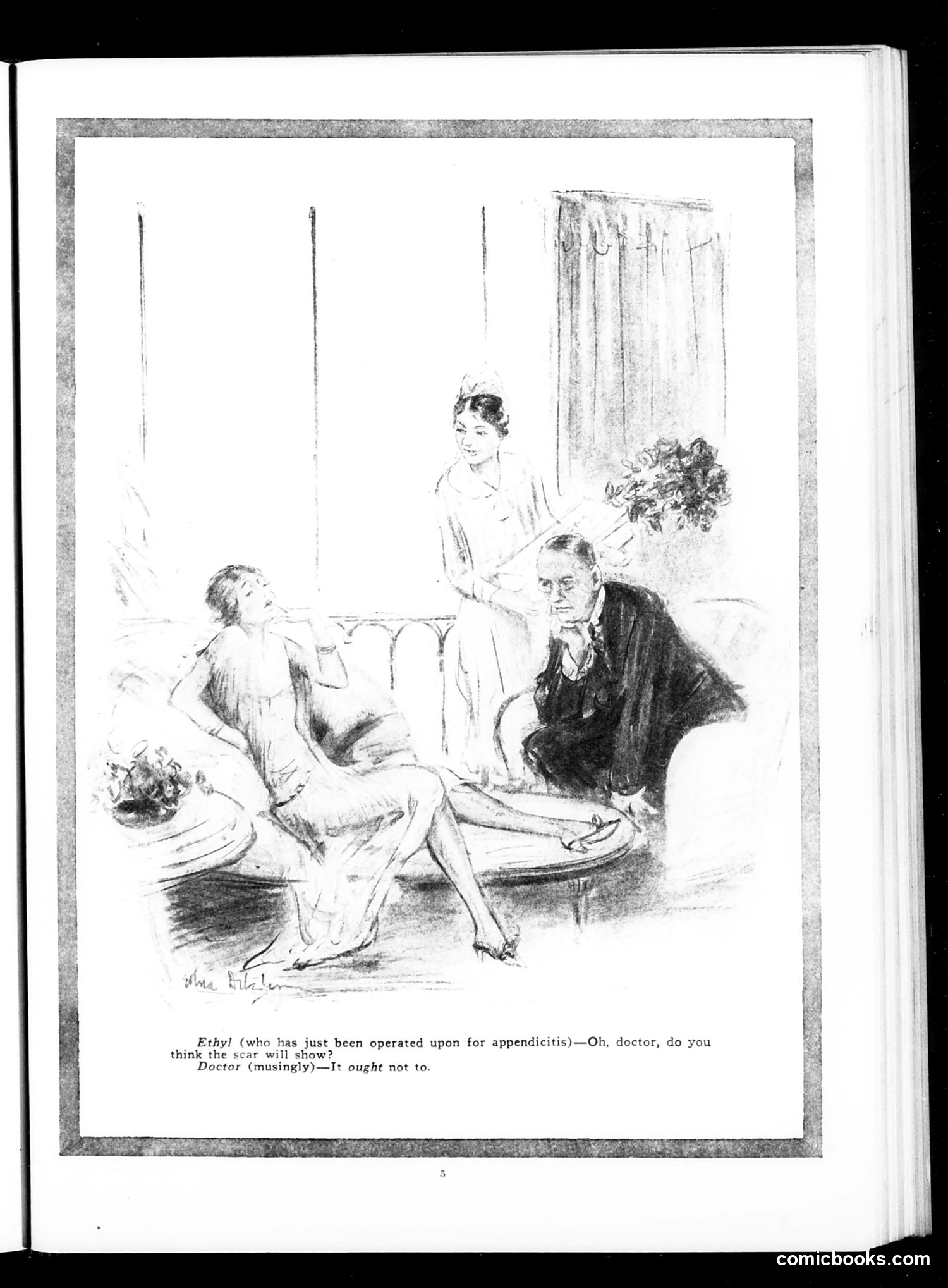
This is a single-panel cartoon satirizing post-surgical vanity. A woman named Ethyl, recently operated on for appendicitis, asks her doctor whether her surgical scar will be visible—presumably because she's concerned about its appearance. The doctor's response—"It ought not to"—is the joke's punchline. The humor appears to turn on the doctor's implied reassurance that the scar won't show *because of where it's located* (typically on the lower abdomen), though the exact anatomical joke is left to readers' inference. The cartoon reflects early 20th-century attitudes about female appearance and vanity, presenting a woman's concern with visible scarring as humorous and somewhat frivolous, while also poking gentle fun at the doctor's knowing, reassuring bedside manner.
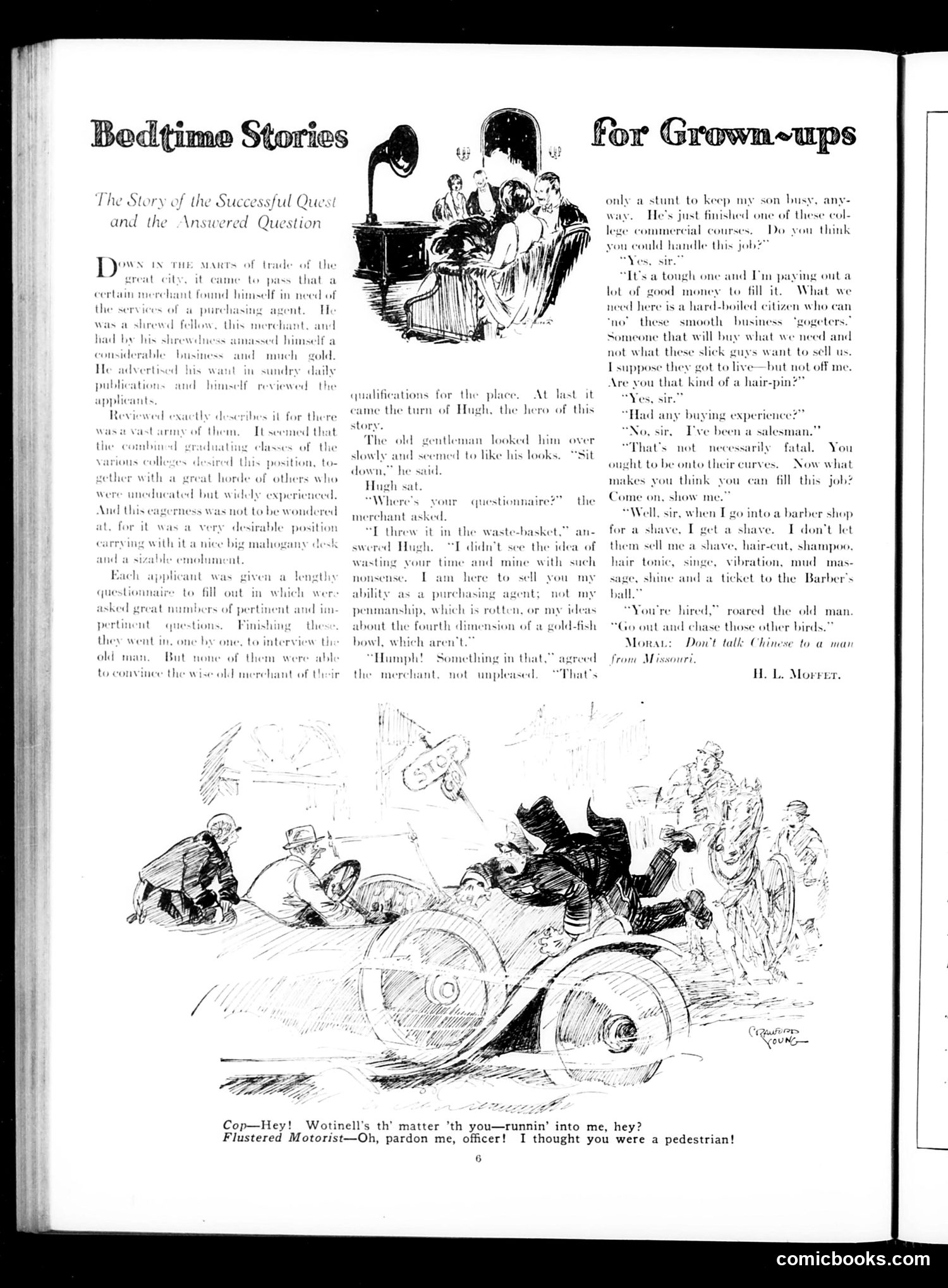
This page satirizes hiring practices and business mentality of the era. A merchant seeking a purchasing agent receives dozens of applicants with credentials—salesmen citing experience, education, and prepared questionnaires. He rejects them all until Hugh arrives, a man with *no* relevant background. Hugh's advantage: he refuses to be sold unnecessary services. When getting a barber's shave, he buys only a shave—resisting upselling tactics. The merchant, impressed by this practical shrewdness, hires him on the spot. The satire mocks both pretentious credentialing (the failed applicants' degrees and credentials) and aggressive salesmanship of the period. It suggests that common sense and resistance to manipulation matter more than formal qualifications or polish. The cartoon below provides comic relief: a flustered motorist apologizes to a police officer for hitting him, mistakenly calling him a "pedestrian"—simple slapstick humor unrelated to the main story.
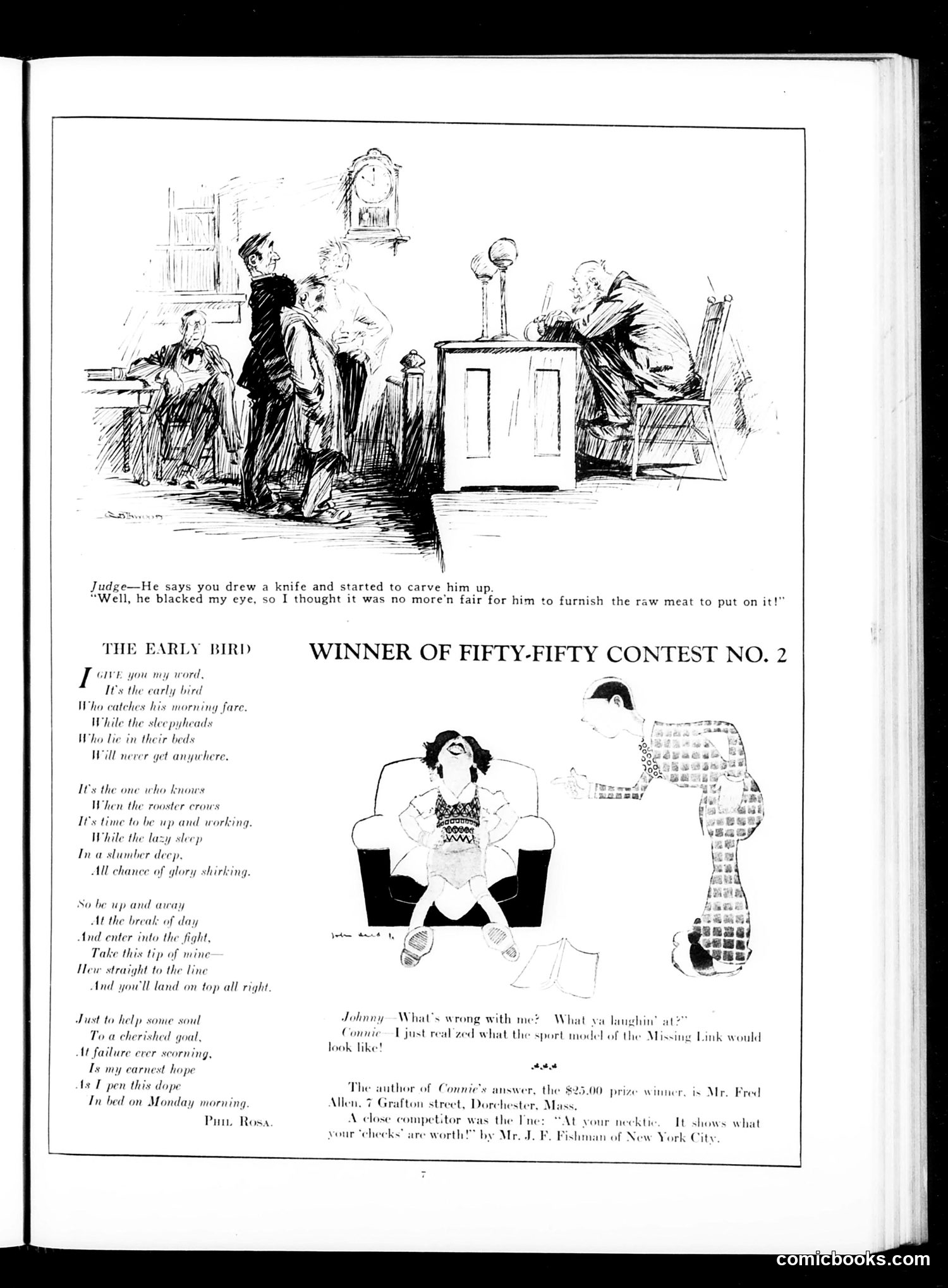
The page contains three distinct pieces: 1. **Top Cartoon**: A courtroom scene where a defendant explains fighting by claiming self-defense—his opponent gave him a black eye, so it was "fair" the opponent provide "raw meat" (his own flesh) for treatment. This is crude humor about reciprocal violence. 2. **"The Early Bird" Poem**: A moralizing verse by Phil Rosa promoting hard work and early rising, contrasting industrious people with "lazy" sleepers. It reflects early 20th-century American Protestant work ethic messaging common in satirical magazines. 3. **"Fifty-Fifty Contest No. 2"**: A humor competition where readers complete a caption. The winning entry compares an unattractive man ("Johnny") to a "Missing Link" (evoking Darwinian evolution jokes—a common insult suggesting someone looks primitive or ape-like). The $25 prize-winner was Fred Allen from Massachusetts. The page reflects period attitudes: casual violence acceptance, pro-capitalist moralizing, and racist/evolutionary pseudoscience humor typical of early 20th-century American satire.
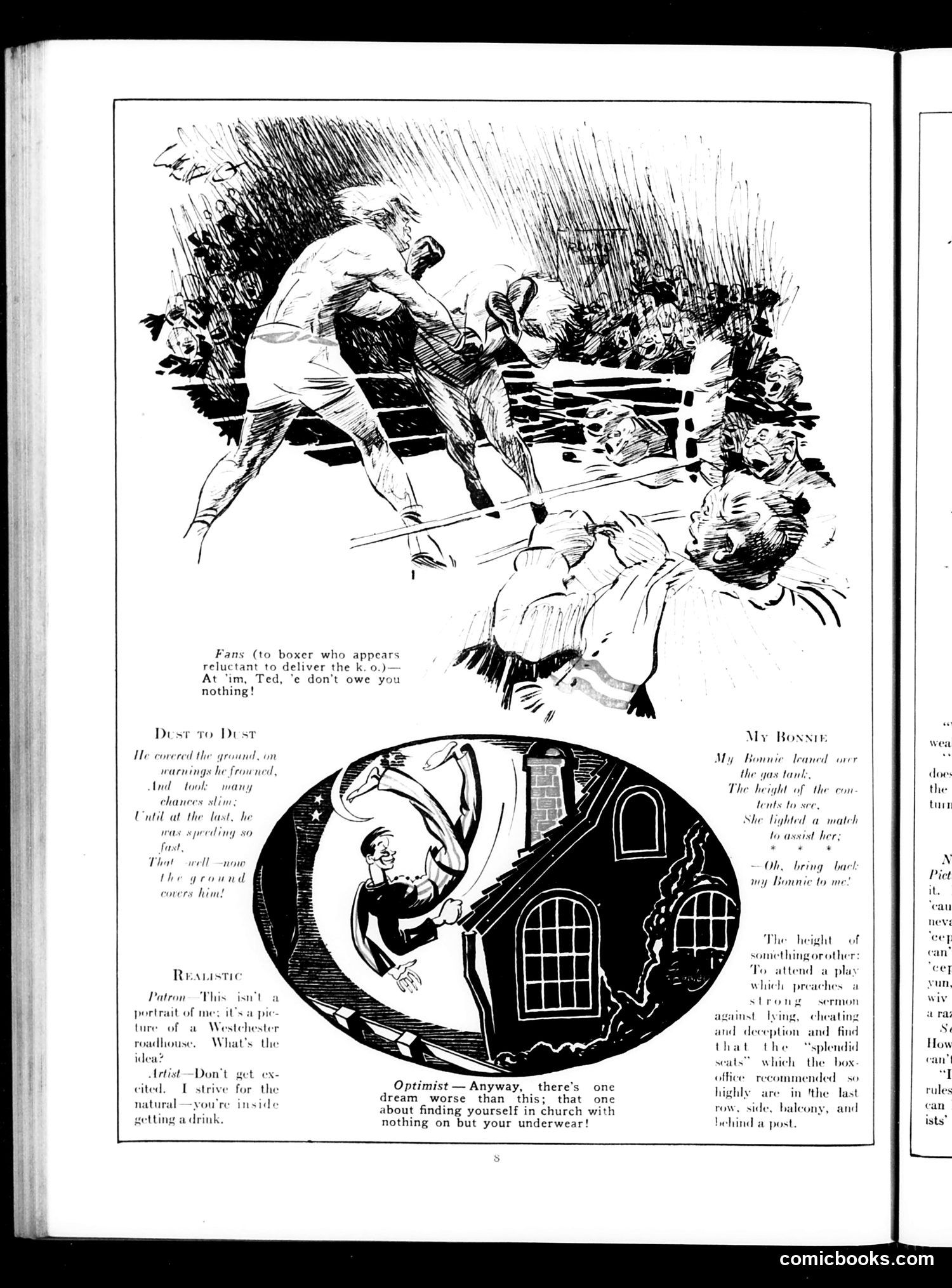
This page contains several satirical cartoons and humorous verses typical of early 20th-century American magazine humor. **Top cartoon**: Shows a boxing match where fans urge a reluctant boxer ("Ted") to deliver a knockout blow, shouting he owes his opponent nothing—satirizing the pressure and rough language of boxing crowds. **"Dust to Dust"**: A darkly humorous poem about a reckless driver who ignored warnings, eventually speeding to his death. This reflects contemporary anxiety about automobile safety. **"Realistic"**: A patron complains a portrait looks like a roadhouse interior rather than himself. The artist defends depicting "natural" scenes—satirizing both pretentious art criticism and the artist's obvious incompetence. **"My Bonnie"**: A morbid parody of the Scottish song, where a woman dies trying to light a match to see gas tank contents—dark humor about automobile dangers and female carelessness. **"Optimist"**: A joke about embarrassing dreams, playing on common anxieties about public humiliation. The page collectively satirizes modern dangers (automobiles, boxing) and human folly.
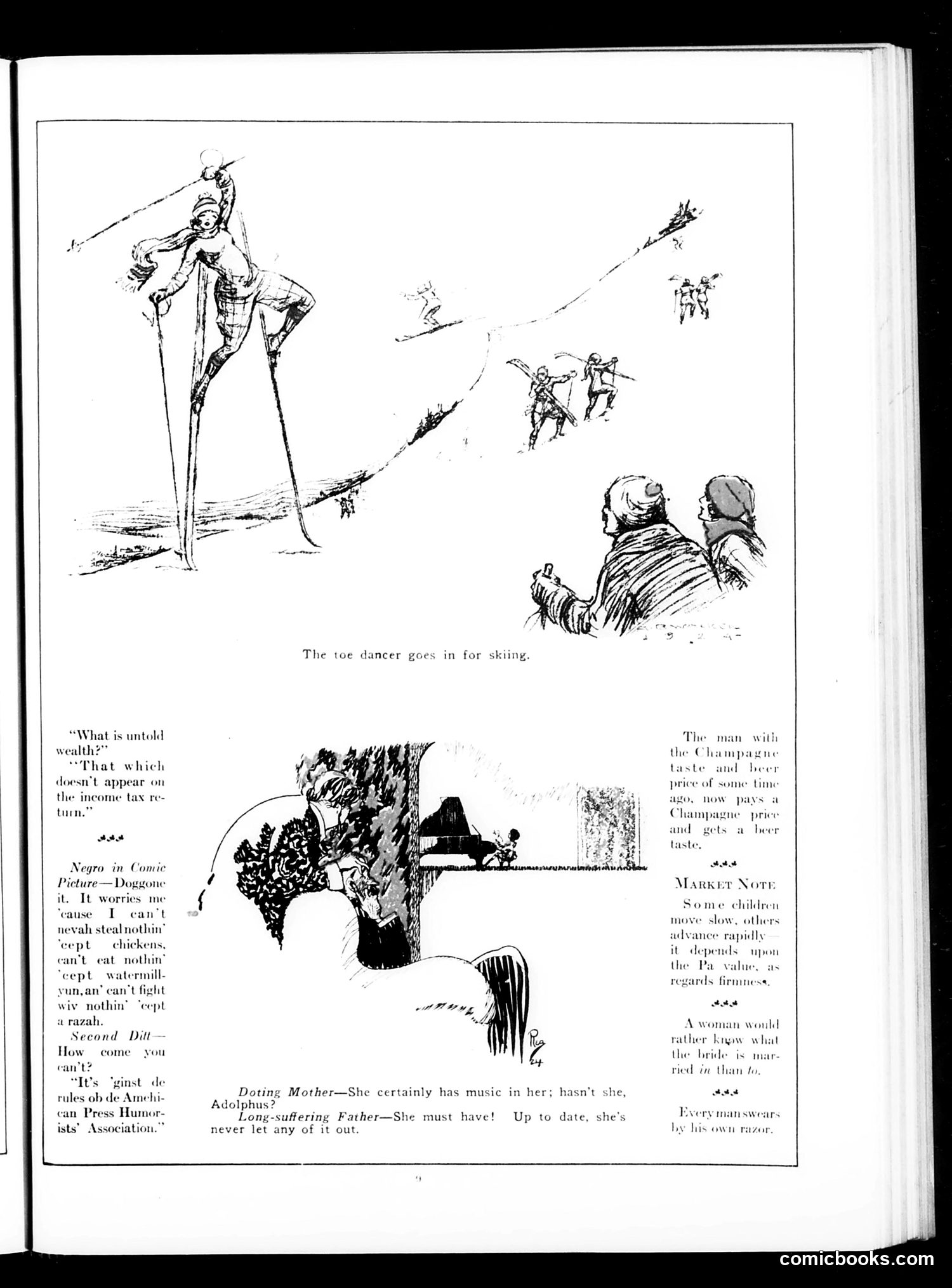
This page contains multiple satirical sketches typical of early 20th-century American humor: **Top sketch**: "The toe dancer goes in for skiing" shows a contortionist performer on stilts, with spectators watching. The joke appears to be about an entertainer attempting an incongruous activity. **Middle sections** contain brief comedic dialogues: - A "Negro in Comic Picture" dialogue uses period racist dialect to joke about poverty and theft—reflecting the regrettable stereotyping common in Judge at the time. - A "Market Note" about Champagne suggests inflation or price increases. - A conversation about tax returns plays on hidden wealth. **Bottom sketch** ("Doting Mother") depicts marital humor: parents discuss their daughter's musical talent, with the father suggesting she's "up to date" because "she's never let any of it out"—implying she doesn't actually play despite claims. The page uses crude caricature and offensive racial material alongside genteel domestic satire, reflecting Judge's mixed-audience approach to early-1900s American humor.
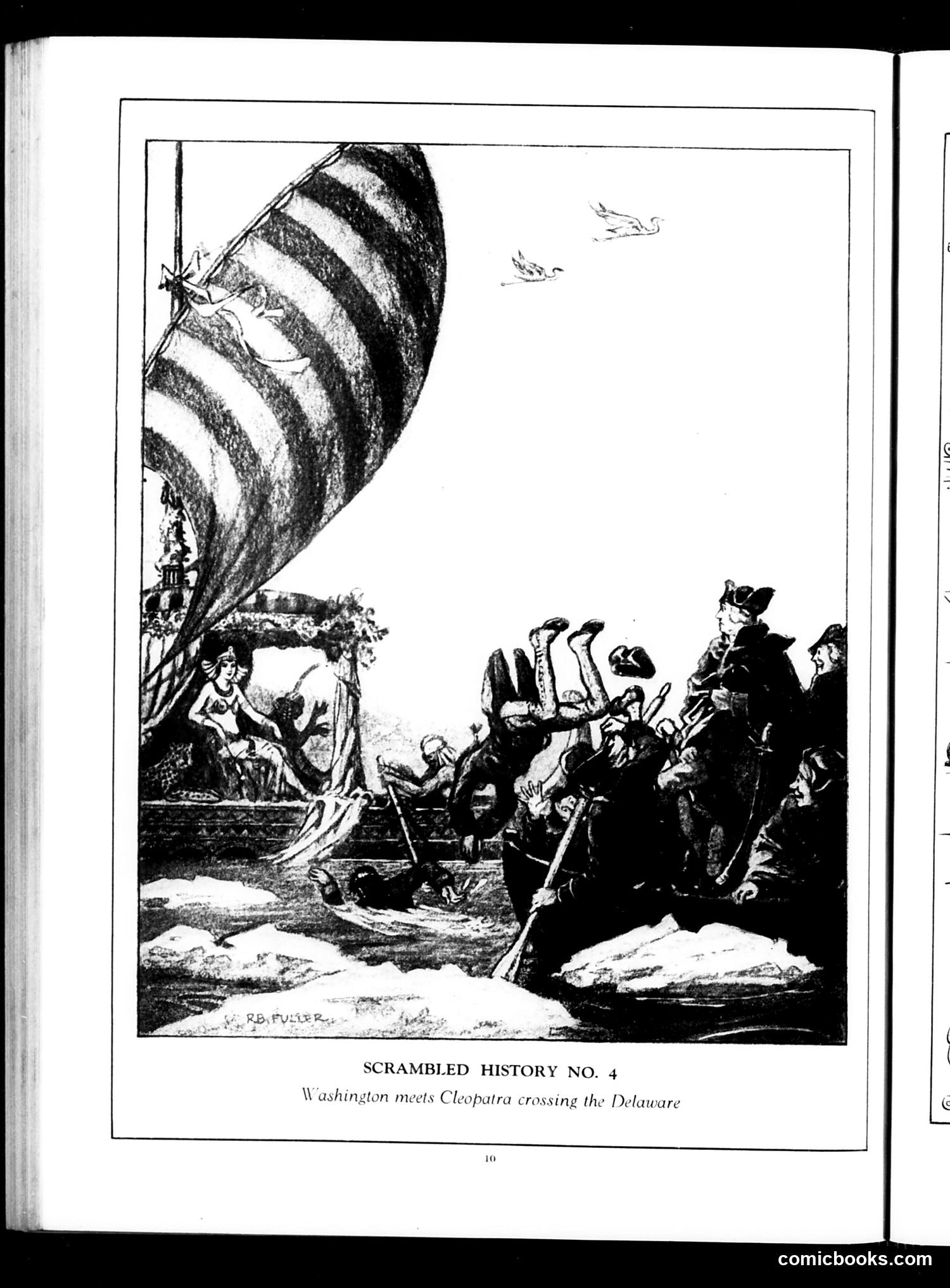
This is a humorous illustration that reimagines the famous "Washington Crossing the Delaware" historical scene by replacing the expected figures with an anachronistic encounter: George Washington meeting Cleopatra. The striped sail and boat recreate Emanuel Leutze's iconic 1851 painting, but instead of Revolutionary War soldiers, the composition includes Egyptian and period-costumed figures. The joke appears to be absurdist historical mashing—combining two entirely unrelated historical figures and eras for comedic effect. The "Scrambled History" series title suggests Judge magazine's recurring feature that playfully scrambles or confuses historical events and figures for satirical humor. This particular installment targets no specific political figure or contemporary issue, but rather offers lighthearted historical parody as entertainment.
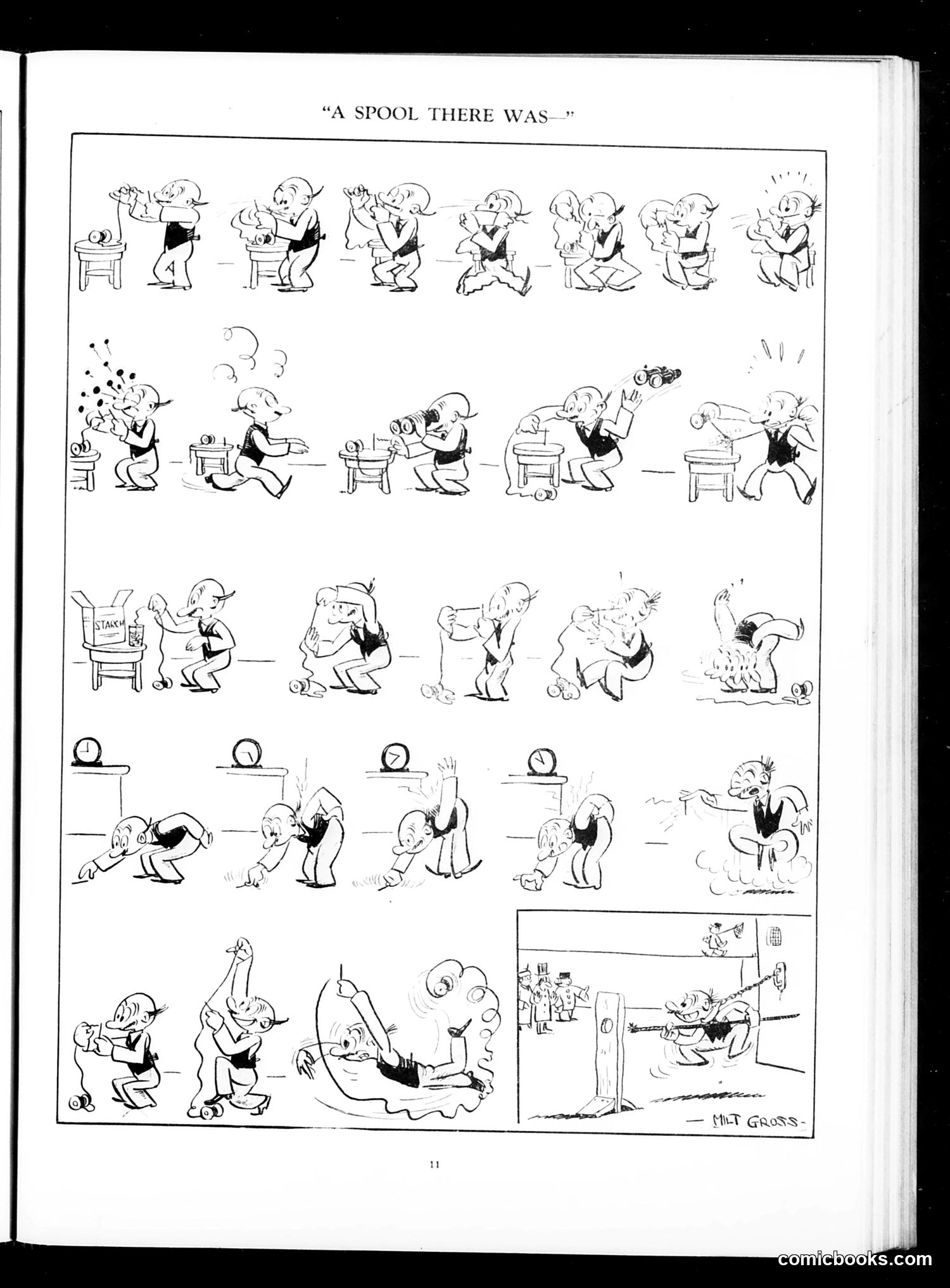
This wordless comic strip depicts a child discovering and playing with a spool of thread, creating increasingly chaotic situations. The narrative progresses from innocent play (pulling thread from a chair) through escalating mischief: the child winds thread around furniture, creates tangled webs throughout the house, and eventually becomes wrapped up themselves. The final panel shows the child covered in thread in an outdoor scene. The satire appears to target parental negligence or inadequate supervision—a common Judge theme mocking domestic life. The humor relies on visual escalation of consequences from a single unattended object, illustrating how minor oversights by caregivers can spiral into disorder. The signed artist credit reads "MEL GROSS."
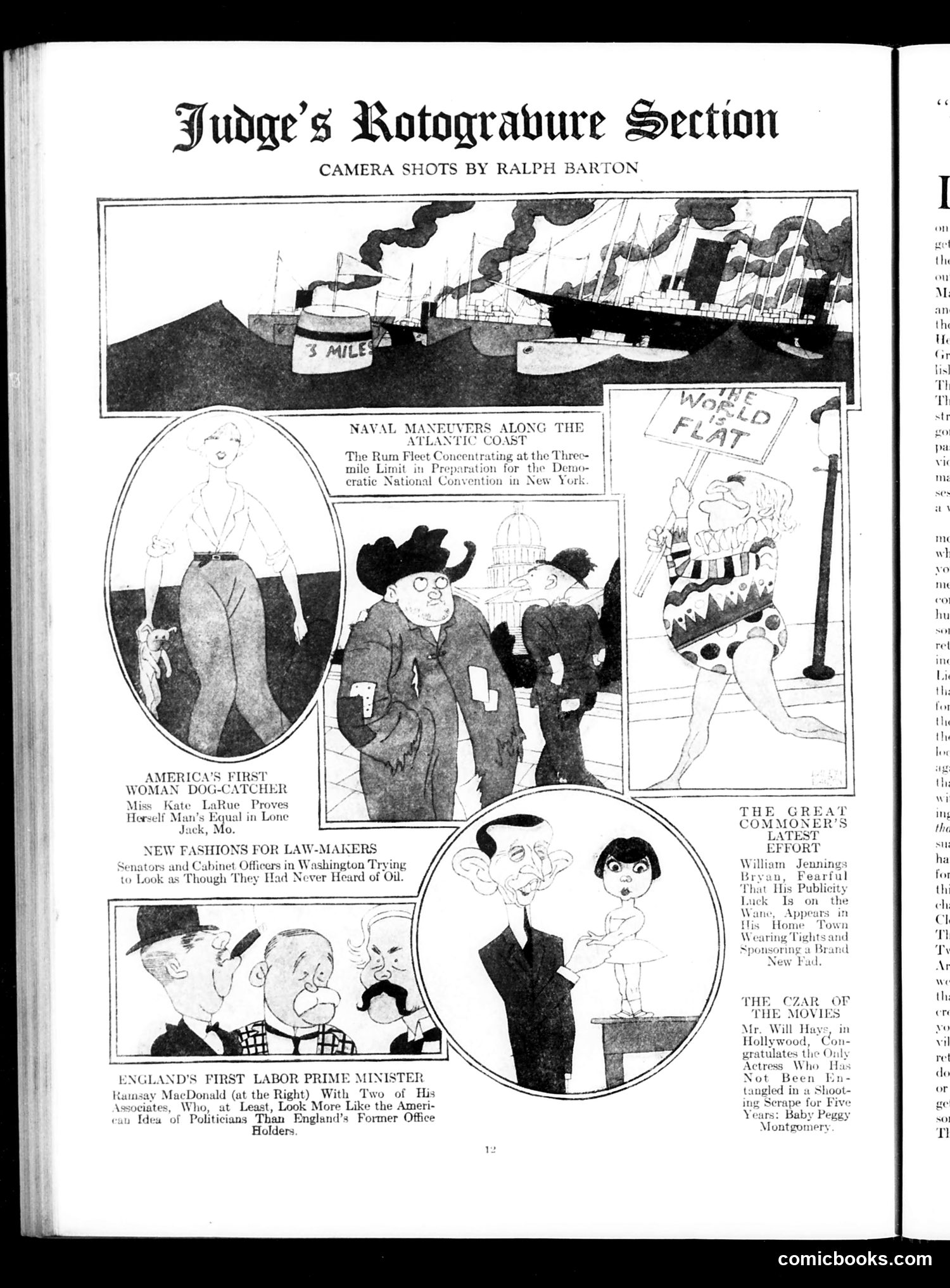
This is a satirical page from Judge magazine featuring political and social commentary through cartoons and captions by Ralph Barton. **Key subjects:** 1. **"America's First Woman Dog-Catcher"** — satirizes women entering traditionally male professions, presenting it as novelty rather than progress. 2. **"New Fashions for Law-Makers"** — mocks senators and cabinet officers attempting to appear innocent regarding oil scandals (likely the Teapot Dome scandal of the early 1920s), suggesting politicians are theatrical in denying corruption. 3. **England's First Labor Prime Minister Ramsay MacDonald** — caricatures the new Labour leader with associates, implying American politicians look more "American" (authentic?) than their British counterparts. 4. **"The Great Commoner's Contest Effort"** involving William Jennings Bryan — references Bryan's fading political relevance and luck. 5. **"The Czar of the Movies"** — celebrates producer Will Hays congratulating baby actress Peggy Montgomery for avoiding Hollywood scandals. The page blends political satire with entertainment gossip typical of 1920s Judge magazine.
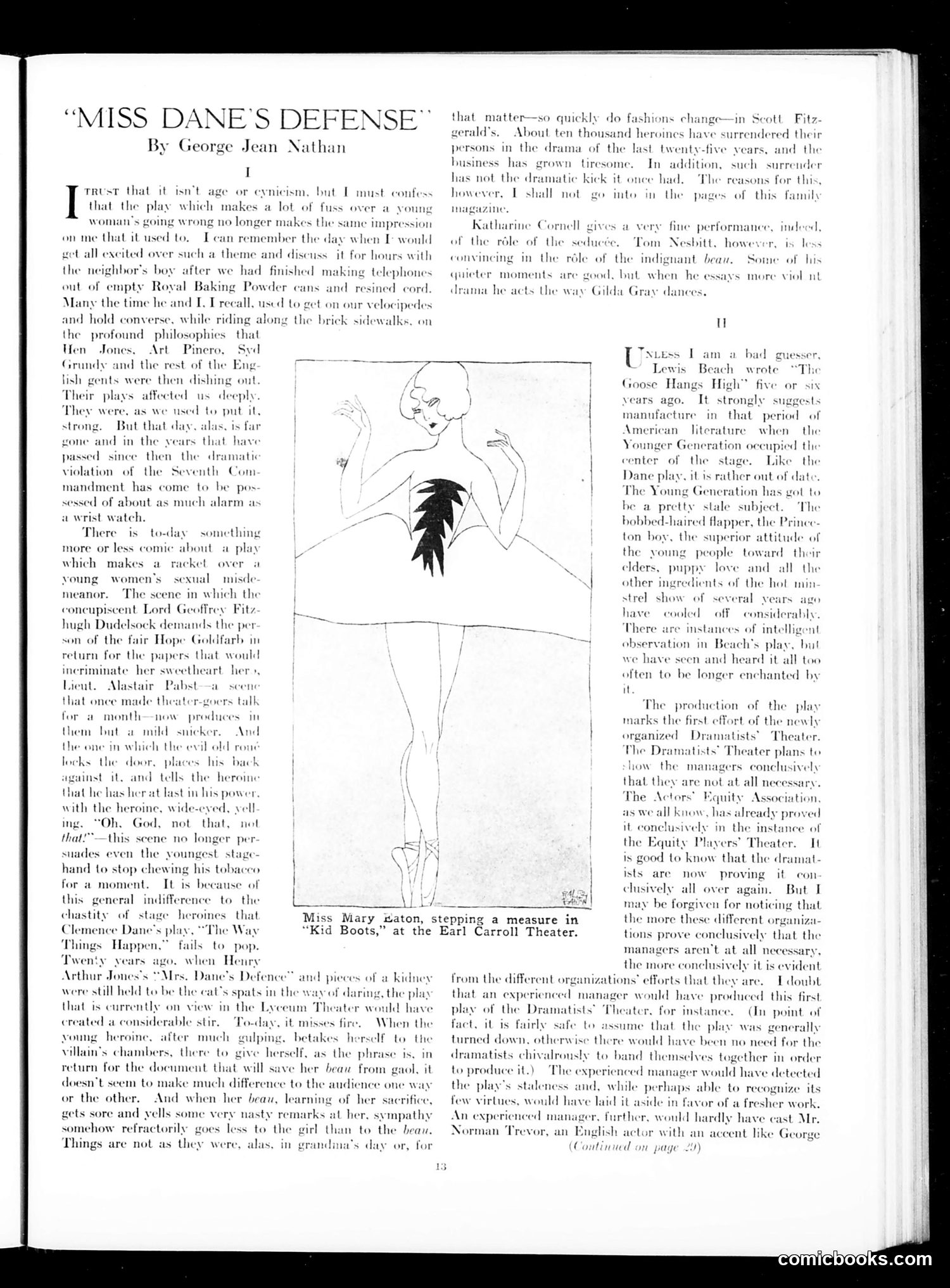
This is a theater review by George Jean Nathan critiquing a play (appears to be "The Way Things Happen" or similar production featuring Katharine Cornell). The accompanying illustration shows a woman in a stylized pose—likely depicting the "seducée" character discussed in the text. Nathan's satire targets the tired theatrical trope of the "fallen woman" plot. He argues that audiences no longer find moral outrage compelling when young women characters are sexually compromised—a staple of serious drama from earlier decades (referencing Ibsen, Pinero, and W.S. Gilbert). The specific scene mocking Lord Geoffrey Fitzugh Dudelsock's blackmail demand for sexual favors "once made theater-goers talk for a month" but now produces only "mild snicker[s]." Nathan also dismisses the "Younger Generation" as played-out subject matter—the bobbed-haired flappers and Jazz Age rebels have become clichéd. He's sardonically praising the Dramatists' Theater's inaugural production for proving managers "are not at all necessary" by assembling a mediocre play.
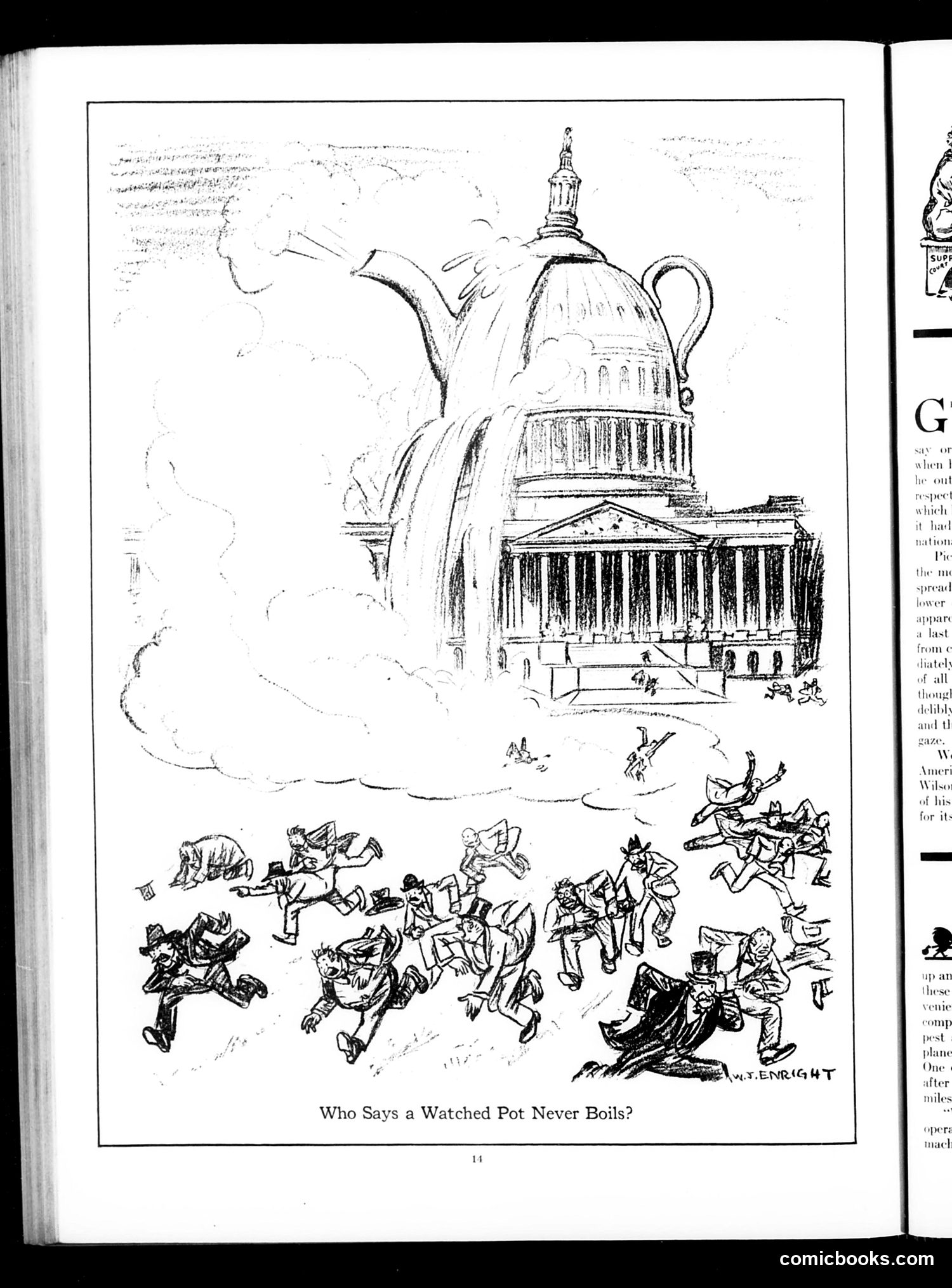
This political cartoon satirizes Congressional gridlock or legislative delay, likely from the Wilson era (referenced in the OCR text). The U.S. Capitol building, depicted as a giant teapot, hovers above a chaotic crowd of politicians and officials running frantically below. The title's reference to the proverb "a watched pot never boils" suggests that despite intense scrutiny and activity, important legislation or government action remains stalled. The cartoon criticizes the perceived ineffectiveness of Congress—politicians are in apparent disarray while the Capitol itself (the "pot") refuses to "boil" or produce results. This reflects common Progressive-era frustration with legislative slowness and partisan bickering preventing meaningful reform or action on pressing national issues.
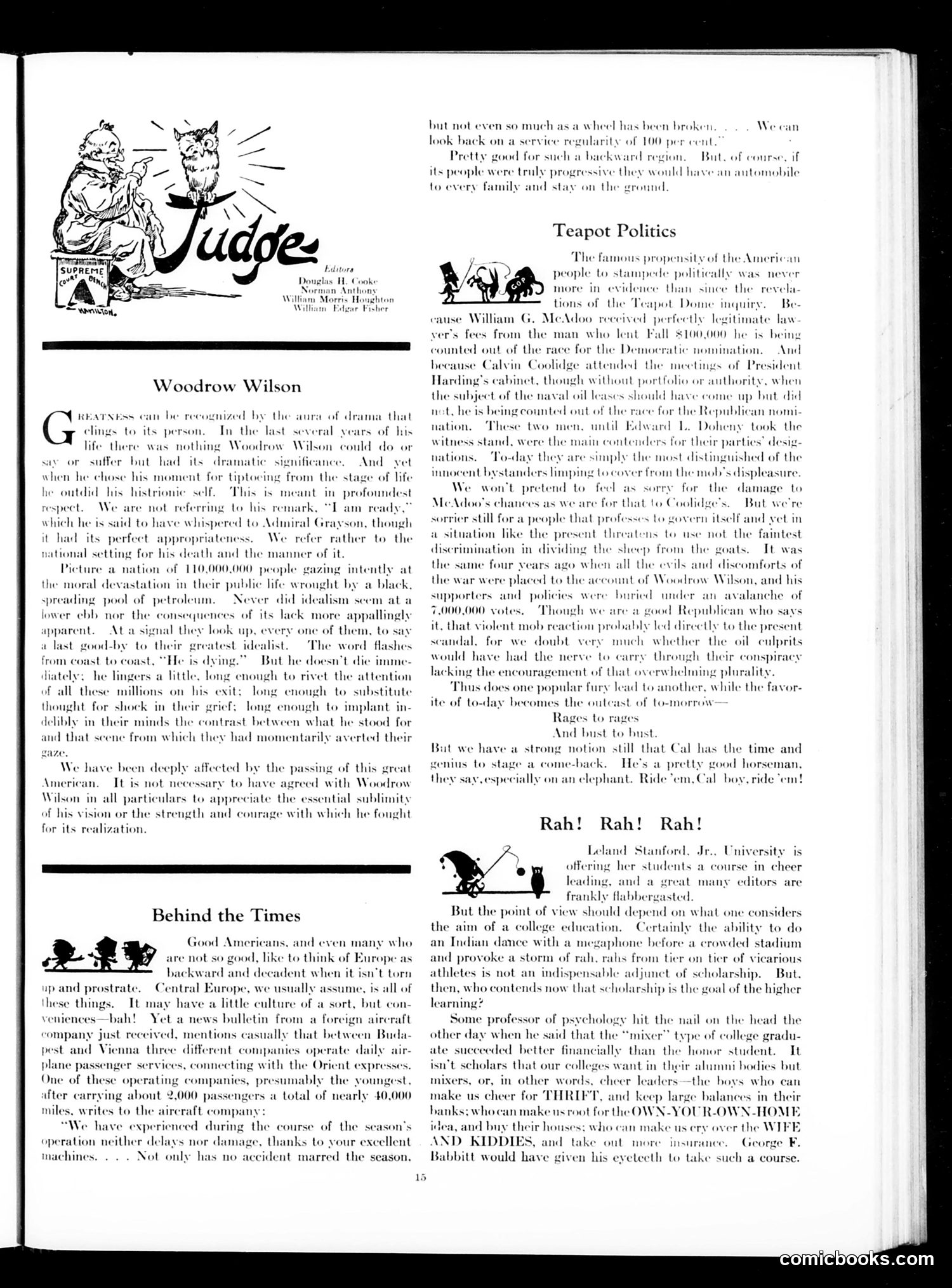
**"Woodrow Wilson"**: This eulogy-style piece commemorates Wilson's death with dramatic flair. The cartoon shows Wilson as a towering figure commanding national attention even in his final moments—suggesting his death was a perfectly staged political theater that refocused Americans' moral attention amid the "black, spreading pool of petroleum" (the Teapot Dome scandal). The satire praises Wilson's idealism while subtly mocking how his exit dominated public discourse during a period of national corruption. **"Behind the Times"**: This mocks American assumptions about European backwardness. An aircraft company's boast about 100% service reliability from "backward" Central Europe undermines the prejudice that only advanced America maintains such standards—a gentle jab at American arrogance. **"Teapot Politics"**: This criticizes American political mob mentality regarding the Teapot Dome scandal. William McAdoo and Calvin Coolidge, previously viable candidates, were stampeded out of contention simply by association with the scandal, despite minimal actual wrongdoing. The satire laments how Americans reflexively punish anyone touched by scandal rather than applying reasoned judgment.
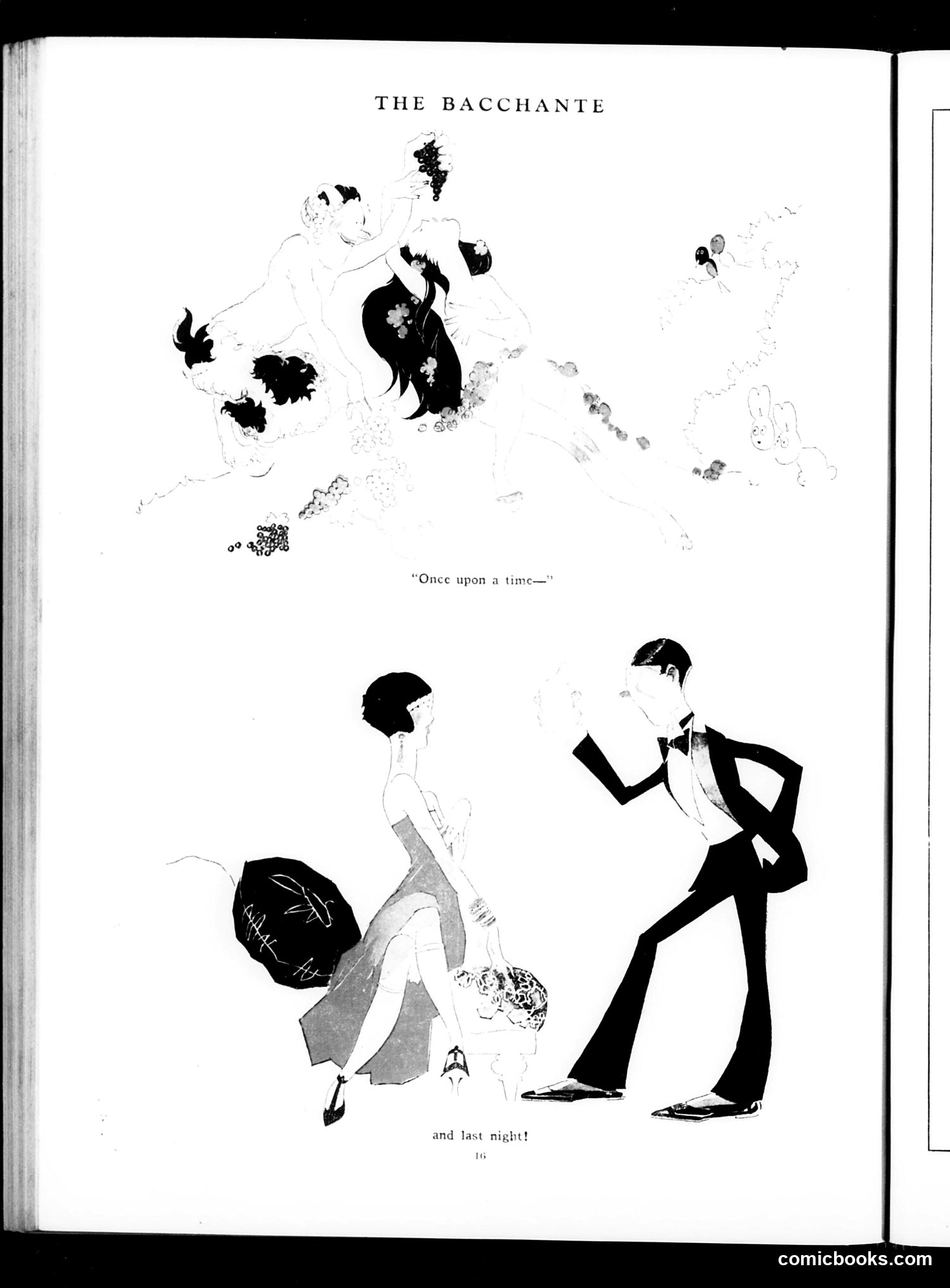
This appears to be a satirical commentary on a famous sculpture or artwork called "The Bacchante" (likely referencing the classical work depicting Bacchus's female followers). The top panel shows the mythological scene—a wild, uninhibited revelry. The bottom panel presents a modern contrast: a formally dressed man in a tuxedo attempting to court or impress a woman in contemporary dress, with the caption "and last night!" The satire suggests the gap between classical ideals of abandon and ecstasy versus modern, restrained social conventions. The well-dressed gentleman's stiff posture and formal attire mock how contemporary society has tamed or constrained the uninhibited pleasure represented by ancient Bacchic revels. The joke critiques modern propriety as a diminishment of authentic revelry.
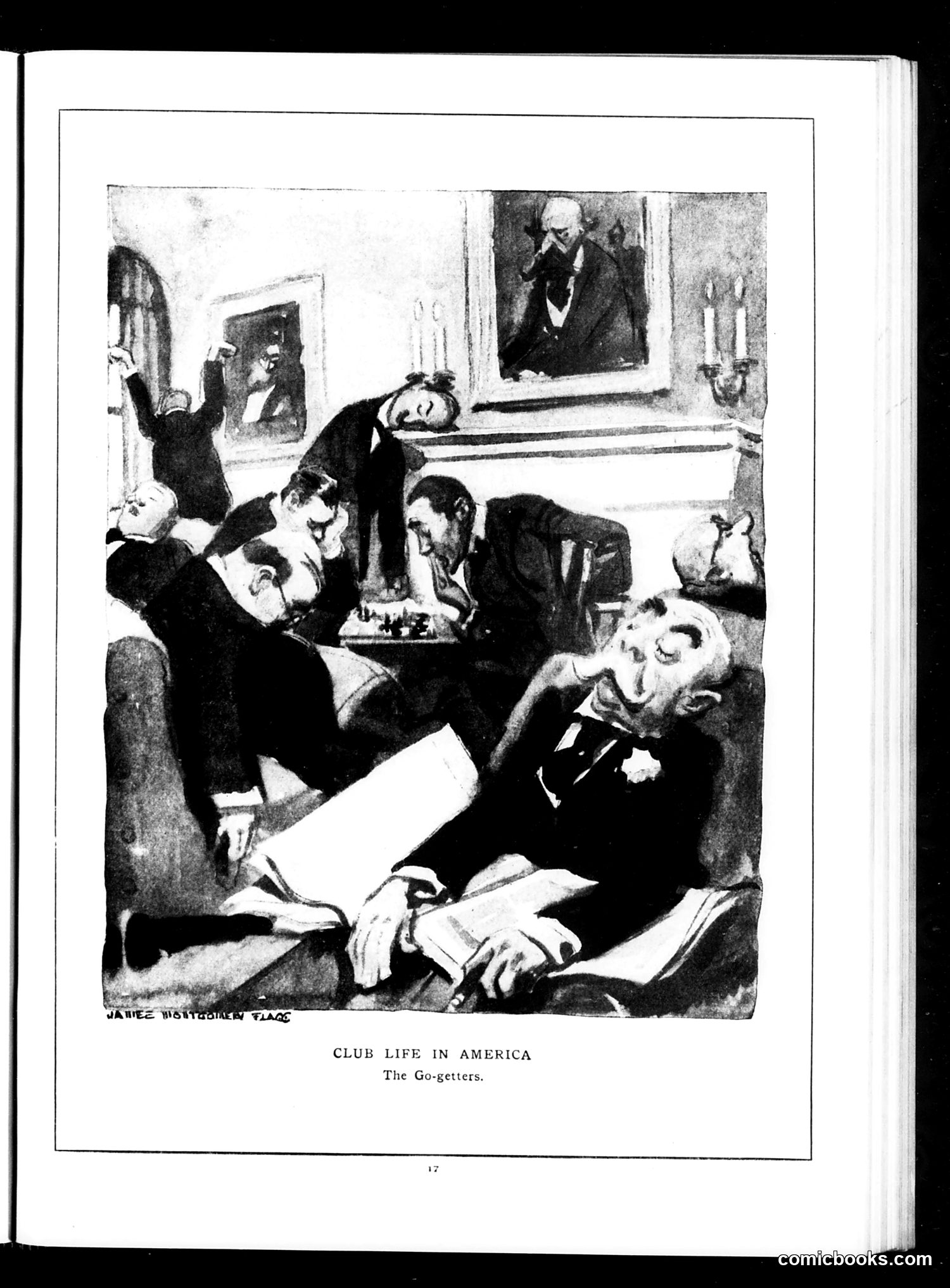
This satirical illustration by James Montgomery Flagg depicts wealthy American men engaged in leisure activities—specifically playing chess and socializing in what appears to be an exclusive club setting. The title "The Go-getters" is ironic: these men, despite the term's association with ambitious, hard-working individuals, are lounging passively indoors. The satire likely critiques American business culture and the leisure class of the early 20th century. "Go-getters" was contemporary slang for aggressive entrepreneurs, making the contrast between the stereotype and these idle clubmen the joke. The ornate surroundings and formal dress underscore their wealth and exclusivity. The cartoon mocks either the pretensions of wealthy Americans or the gap between their self-image as dynamic "go-getters" and their actual comfortable, sedentary reality.
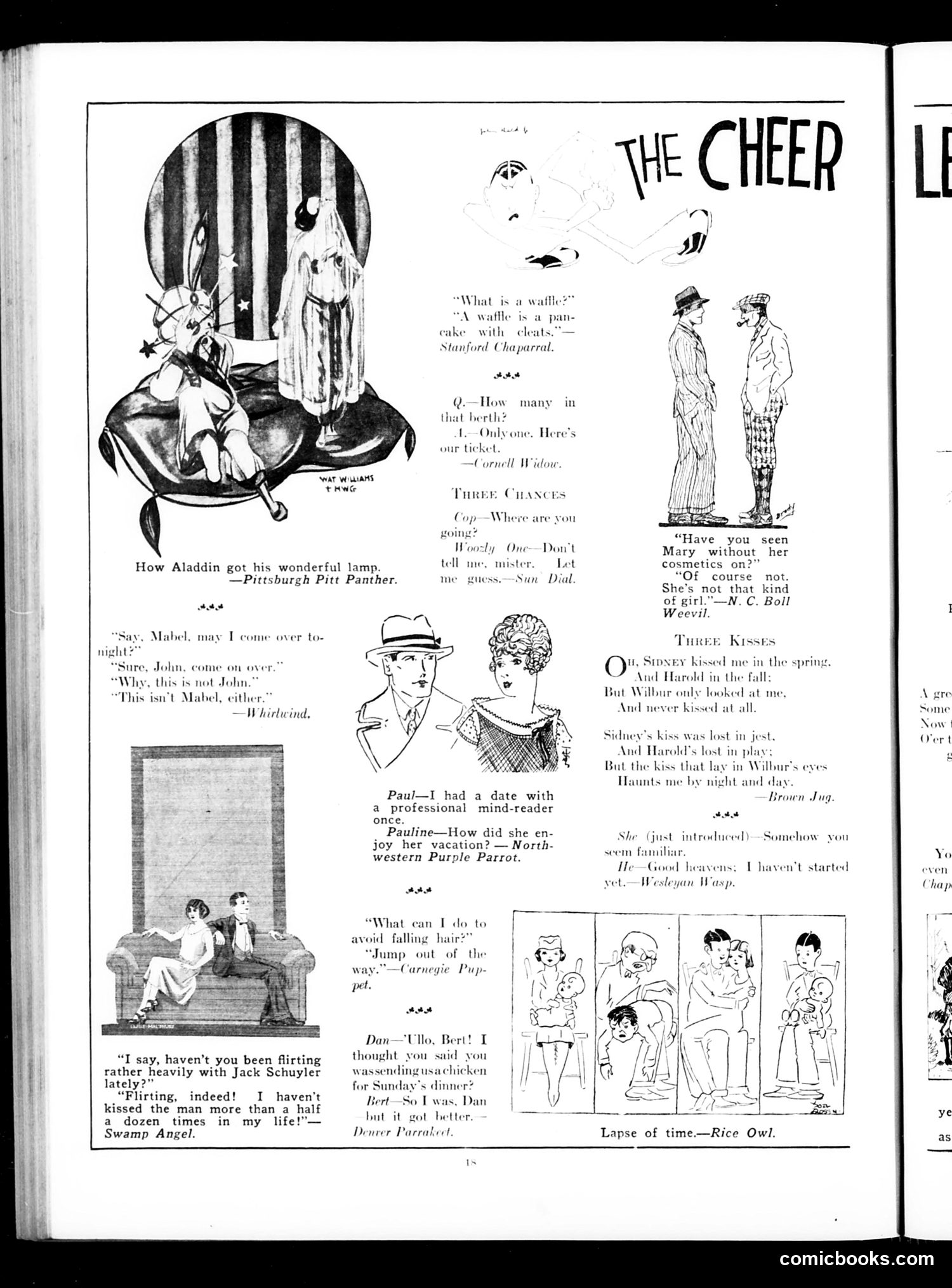
This page from *Judge* magazine collects humor excerpts and jokes sourced from college newspaper humor columns—indicated by attributions like "Stanford Chaparral," "Cornell Widow," and "Rice Owl" (college publications). The content is entirely non-political social satire targeting early 20th-century courtship customs and dating behavior. Recurring themes include: - **Romantic confusion**: mistaken identities, awkward date situations - **Flirtation and kissing**: multiple jokes about romantic encounters, with one recurring motif about three different suitors' kisses - **Dating etiquette violations**: a woman visiting a man alone ("Say, Mabel, may I come over tonight?") - **Physical appearance concerns**: references to cosmetics and hair loss The cartoons feature simple line drawings of young couples in period dress. The humor is genteel and aimed at a college-educated audience, trading in recognizable social embarrassments rather than political commentary. This represents mainstream American humor journalism of the era—collegiate, heterosexual-focused, and mildly risqué by contemporary standards.
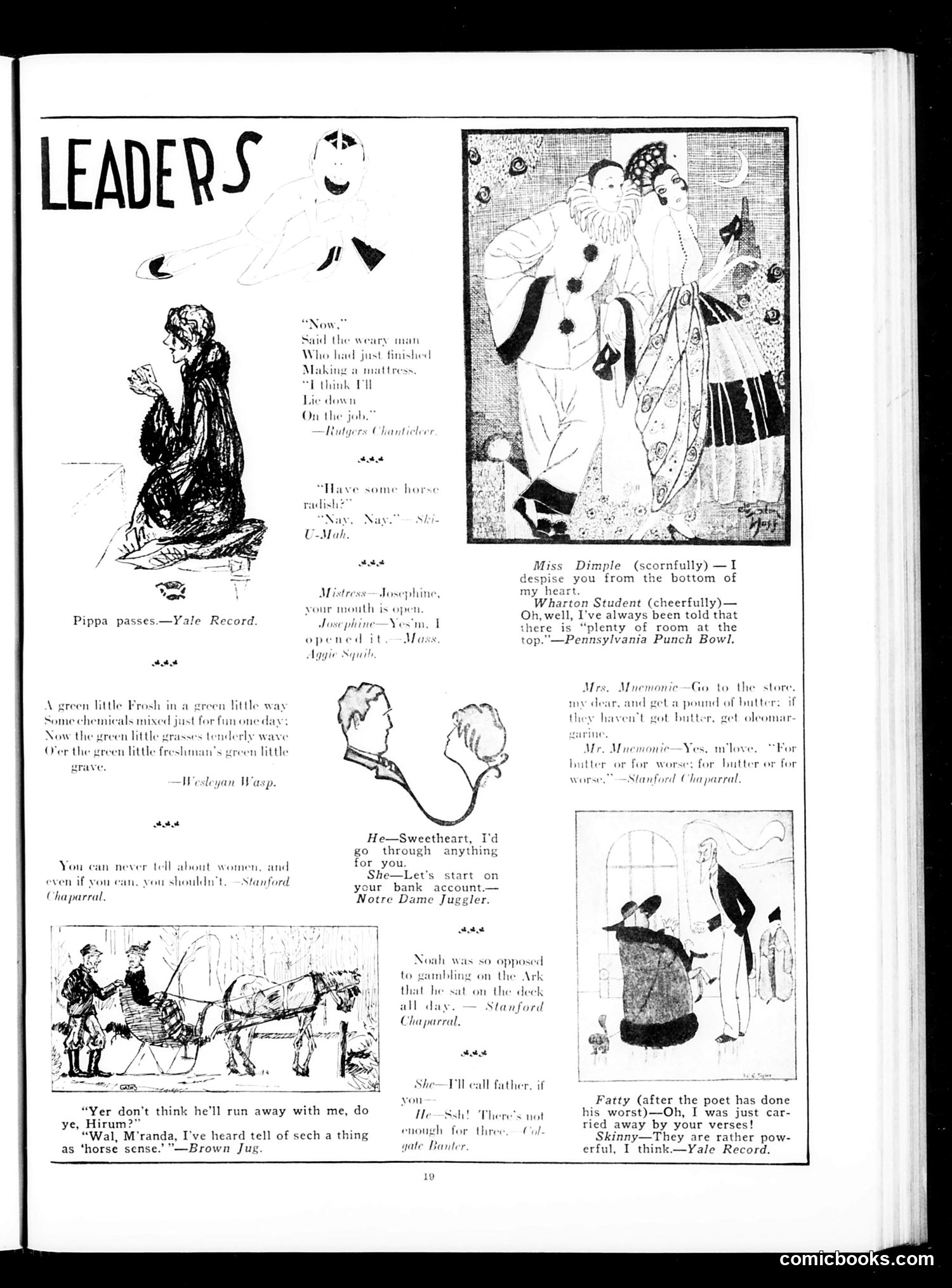
This page collects humorous quotes and cartoons from various college humor magazines (Yale Record, Stanford Chaparral, Wesleyan Wasp, etc.). The jokes target typical college-era situations: freshman naïveté, romantic miscommunication, gender stereotypes, and domestic life. Key jokes include mockery of young men's incompetence (a "green" freshman, a man exhausted from making a mattress), absurd romantic exchanges (a woman despising a man "from the bottom of my heart" while he remains cheerfully oblivious), and gender dynamics ("You can never tell about women"). The cartoons feature period illustrations of courtship scenes and domestic comedy. The "leaders" title likely indicates these are the magazine's featured humor selections. The overall satirical point targets youthful foolishness and the confusion between men and women—standard collegiate humor of the era, reflecting early-20th-century attitudes about gender roles and courtship conventions.
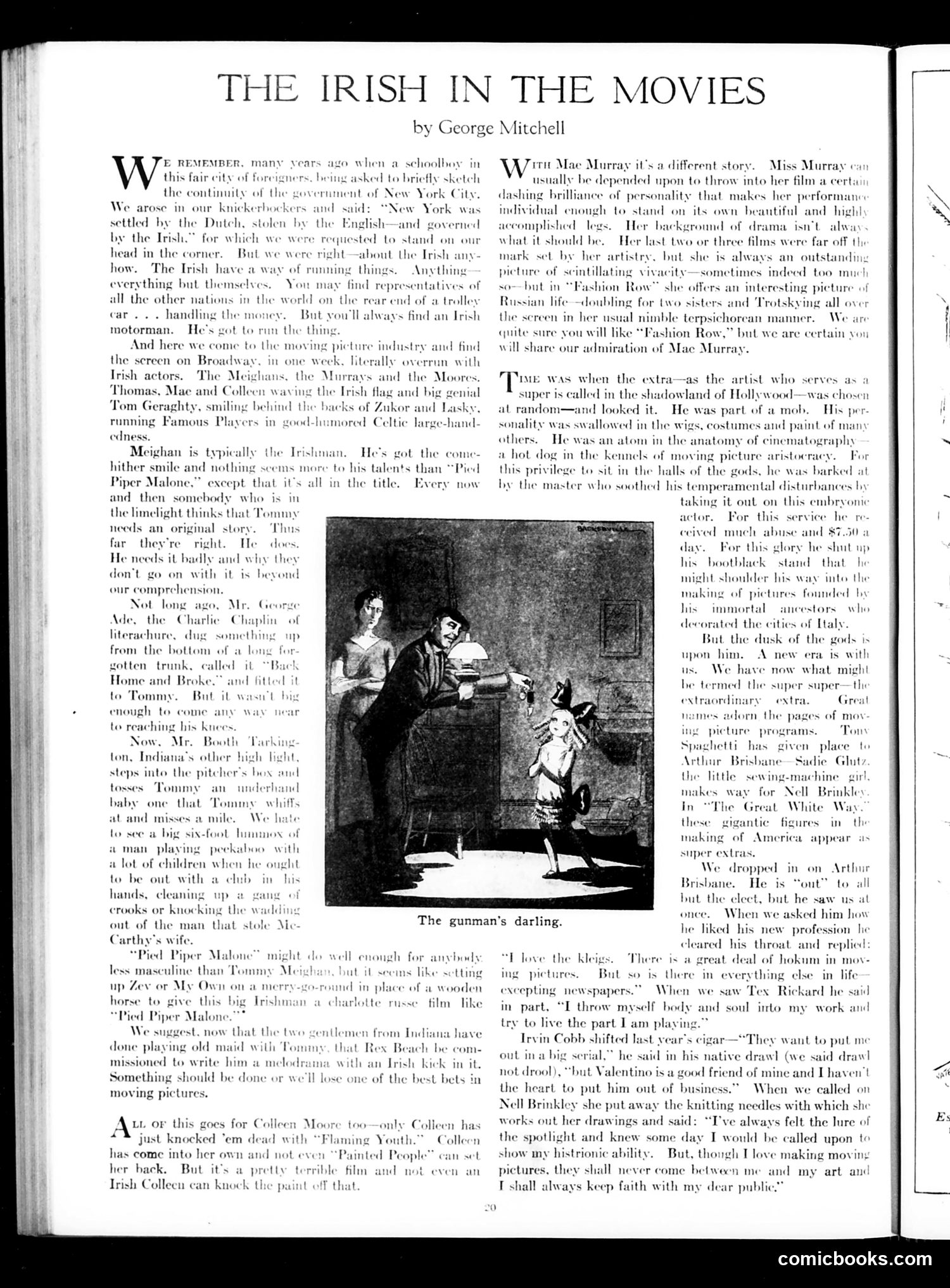
This article celebrates Irish actors dominating Hollywood in the early 1920s. Mitchell praises **Tommy Meighan** as the archetypal Irish leading man and discusses fellow Irish performers like **Mae Murray**, **Colleen Moore**, and **Tom Geraghty**. The accompanying photograph shows a scene from "The Gunman's Darling," featuring what appears to be an action sequence typical of the era. Mitchell critiques casting decisions, particularly suggesting that Meighan deserves better material than "Pied Piper Malone"—arguing Tommy needs serious dramatic roles, not comedic parts. He advocates for Irish writers (mentioning George Ade) to create authentic Irish-themed melodramas for these stars. The piece reflects early-1920s Hollywood's celebration of immigrant success while also gently mocking Irish stereotypes and the film industry's formulaic approach to casting. It's essentially a fan's argument that talented Irish actors were underutilized by studios.
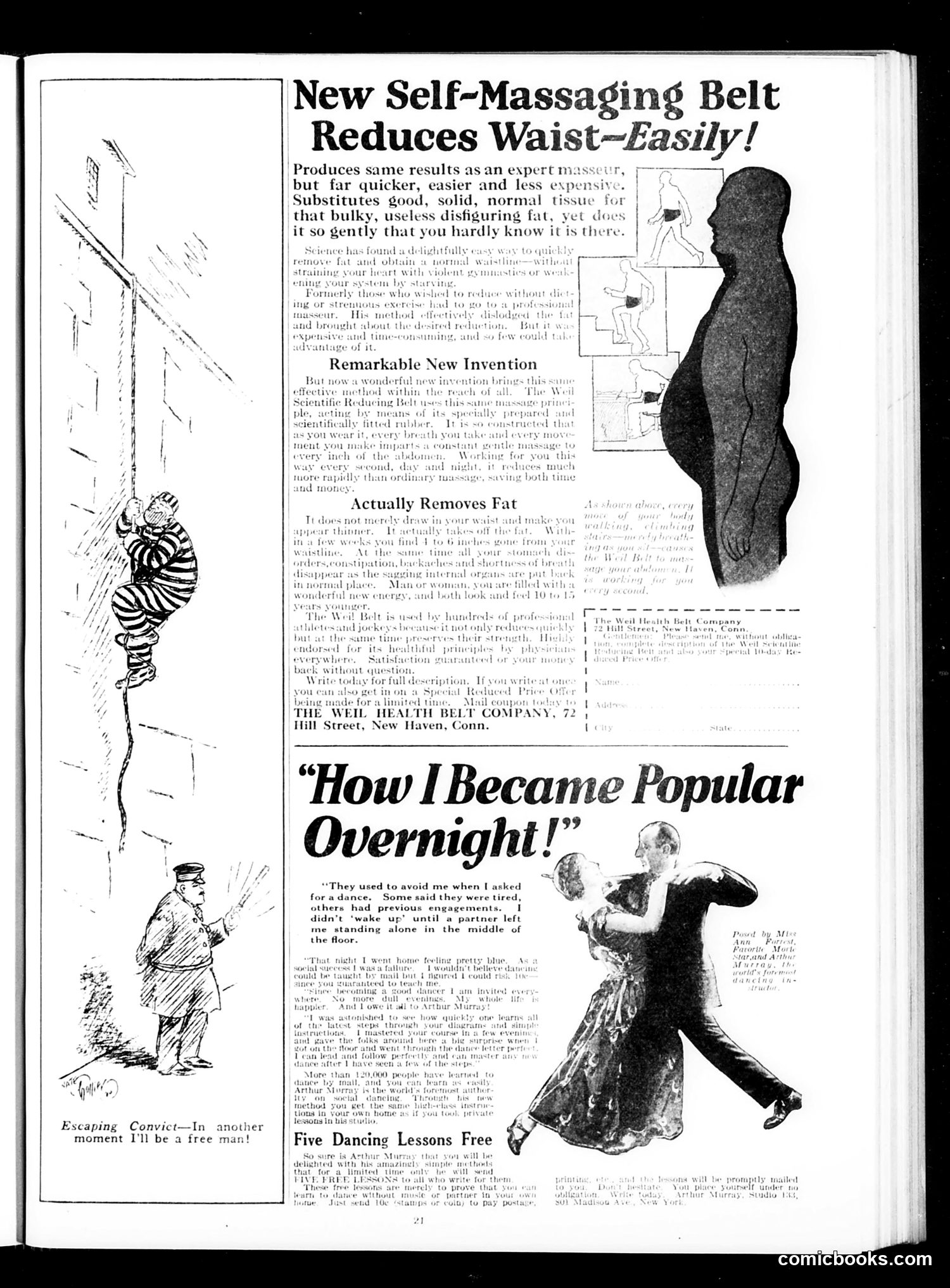
This page combines **advertisements with satirical cartoons** typical of early 20th-century Judge magazine. **Top section:** Promotes the "Weil Health Belt," a vibrating corset-like device claiming to reduce waist fat without exercise or dieting—a common dubious health product of the era. The ad exploits period anxieties about weight and appearance. **Bottom cartoons:** 1. **"Escaping Convict"** (left): A simple sight-gag showing a convict breaking free, with the punch line that in "another moment I'll be a free man"—likely commenting on the absurdity or desperation of escape attempts. 2. **"How I Became Popular Overnight"** (right): A social satire showing a dancing couple. The narrative describes someone initially rejected for dances who becomes mysteriously popular. The humor likely mocks either social climbers, sudden fame's shallowness, or—given the Arthur Murray dancing school advertisement below—the promise that dance lessons guarantee social success, a common advertising trope promising instant transformation. The page satirizes **period consumer culture and its false promises of self-improvement.**
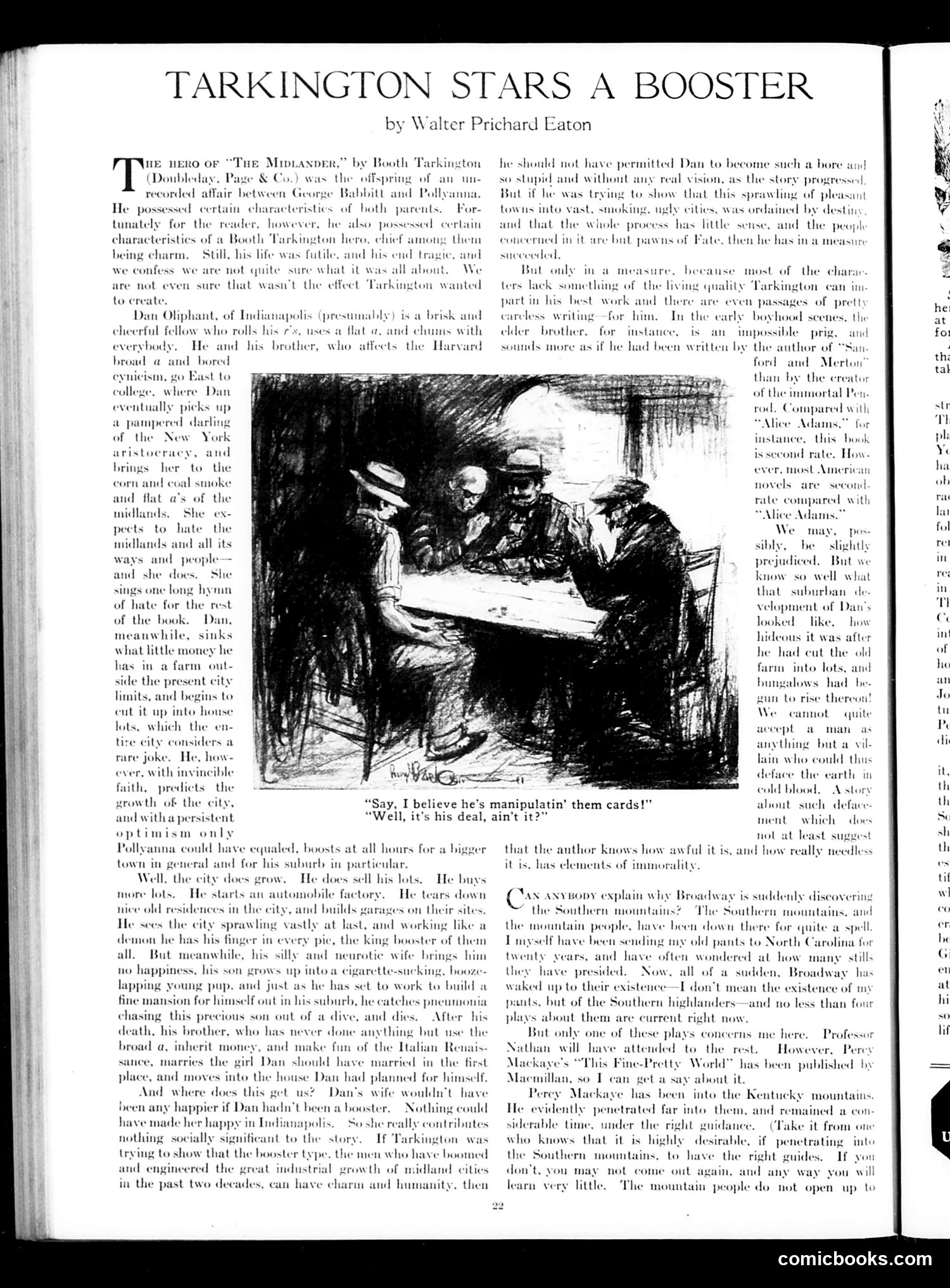
This is a literary review by Walter Prichard Eaton of Booth Tarkington's novel *The Midlander*. The accompanying sketch illustrates a scene of men playing cards, with dialogue: "Say, I believe he's manipulatin' them cards!" / "Well, it's his deal, ain't it?" The review critiques Tarkington's portrayal of Dan Oliphant, a brash Indianapolis businessman who aggressively promotes suburban development and industrial growth. Eaton argues the novel is thematically muddled: it's unclear whether Tarkington aims to celebrate the "booster" type (ambitious self-promoters driving Midwestern expansion) or condemn their destructive optimism. The reviewer finds Dan's characterization weak—too foolish and short-sighted to convincingly represent real boosters' charm and vision. Eaton compares it unfavorably to Tarkington's acclaimed *Alice Adams*, suggesting this work is "second rate." The critique reflects early 20th-century literary debates about whether American business expansion was progress or cultural destruction.
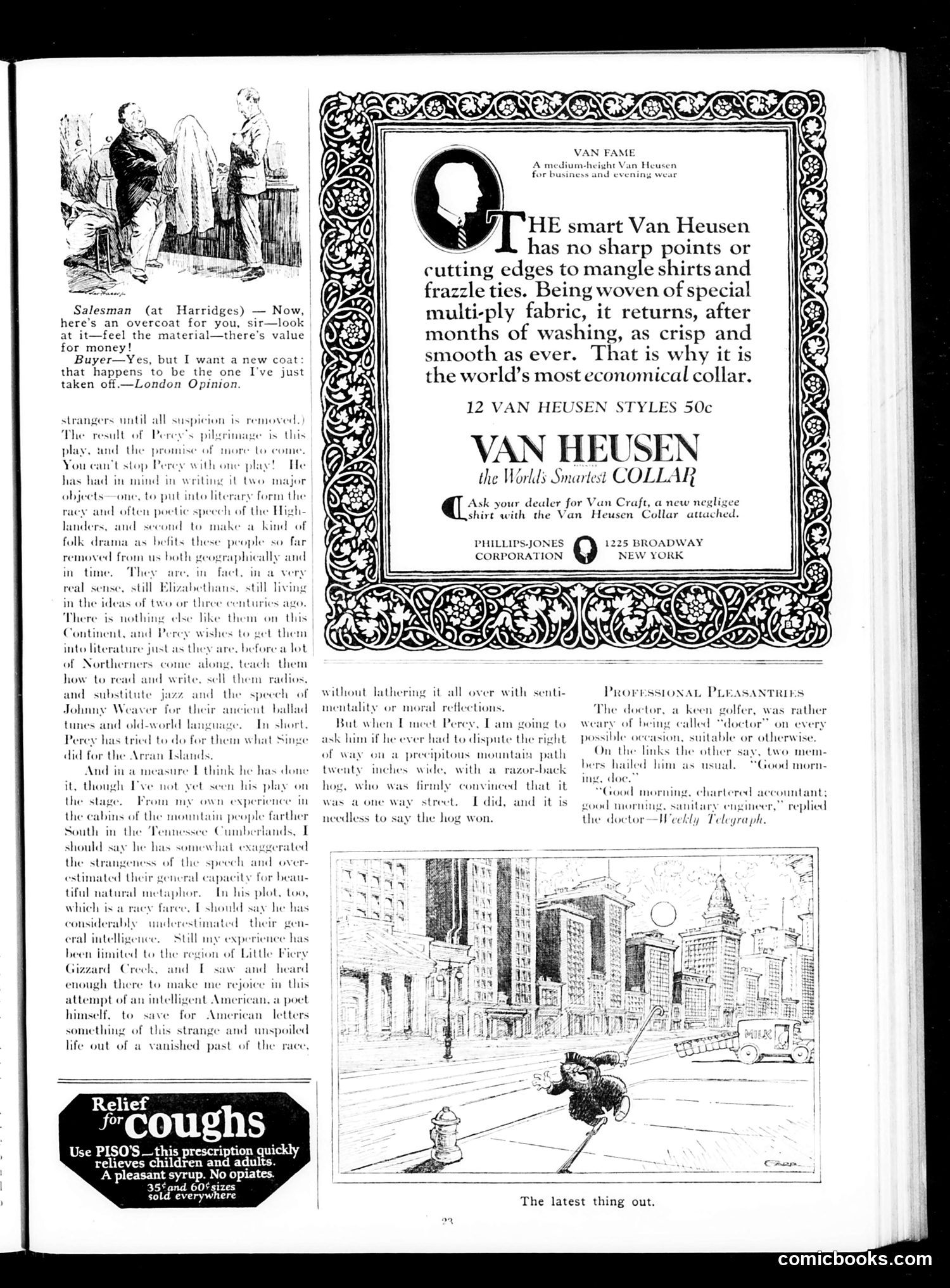
This page is primarily **advertising and literary commentary**, not political satire. The main content includes: - A **Van Heusen collar advertisement** featuring a salesman-customer dialogue joke about an overcoat's durability - A **Piso's cough medicine ad** (black box, lower left) - **Literary discussion** of a play (likely by J.M. Synge or similar) about Scottish Highlanders/mountain people, praising efforts to preserve their dialect and folk traditions before modernization erases them - A "**Professional Pleasantries**" humor piece about a doctor-golfer making puns on his occupation The only cartoon visible is a **street scene** at page bottom showing what appears to be "the latest thing out"—likely depicting modern urban life or fashion, though details are unclear. No major political figures or events are referenced. This page reflects early 20th-century concerns about cultural preservation and modernization's impact on traditional communities.
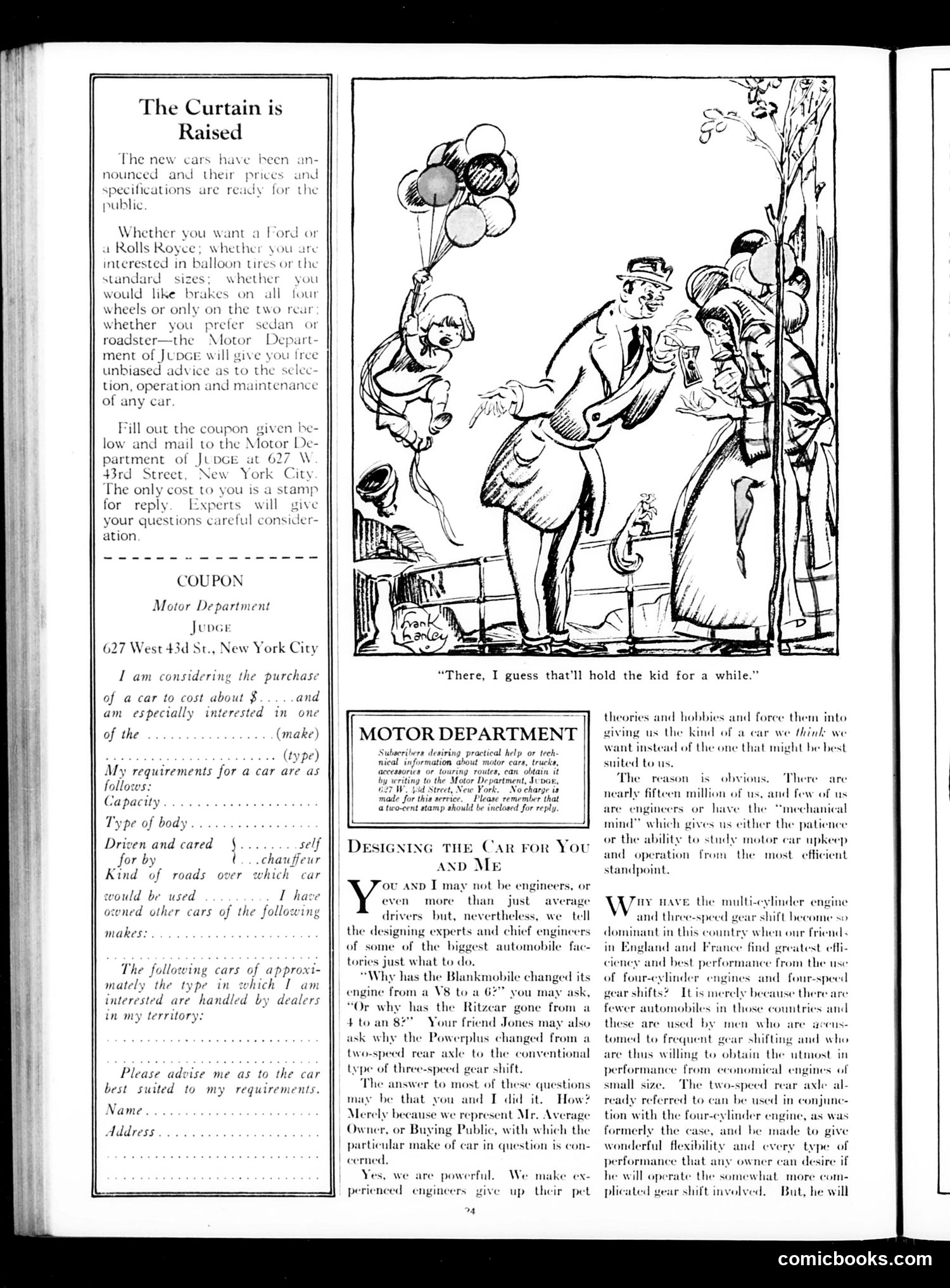
This page combines advertising with editorial content about automobile design. The cartoon depicts a man with balloons entertaining a child, captioned "There, I guess that'll hold the kid for a while."—a lighthearted domestic scene unrelated to the automotive text. The main content is Judge magazine's Motor Department announcement offering free expert advice on car purchases. The editorial section argues that average car owners, collectively representing "Mr. Average Owner, or Buying Public," actually influence automotive design decisions more than engineers realize. The satire mocks both engineers' attachment to technical innovations and consumers' (often ignorant) demand for features. It references specific vehicles—Blankmobile, Ritzcar, Powerplus—as generic examples of cars changing engines and gear systems based on public preference rather than engineering merit. The broader point: ordinary buyers, despite lacking mechanical knowledge, wield surprising power over design choices, often demanding less-efficient solutions simply because they're fashionable.
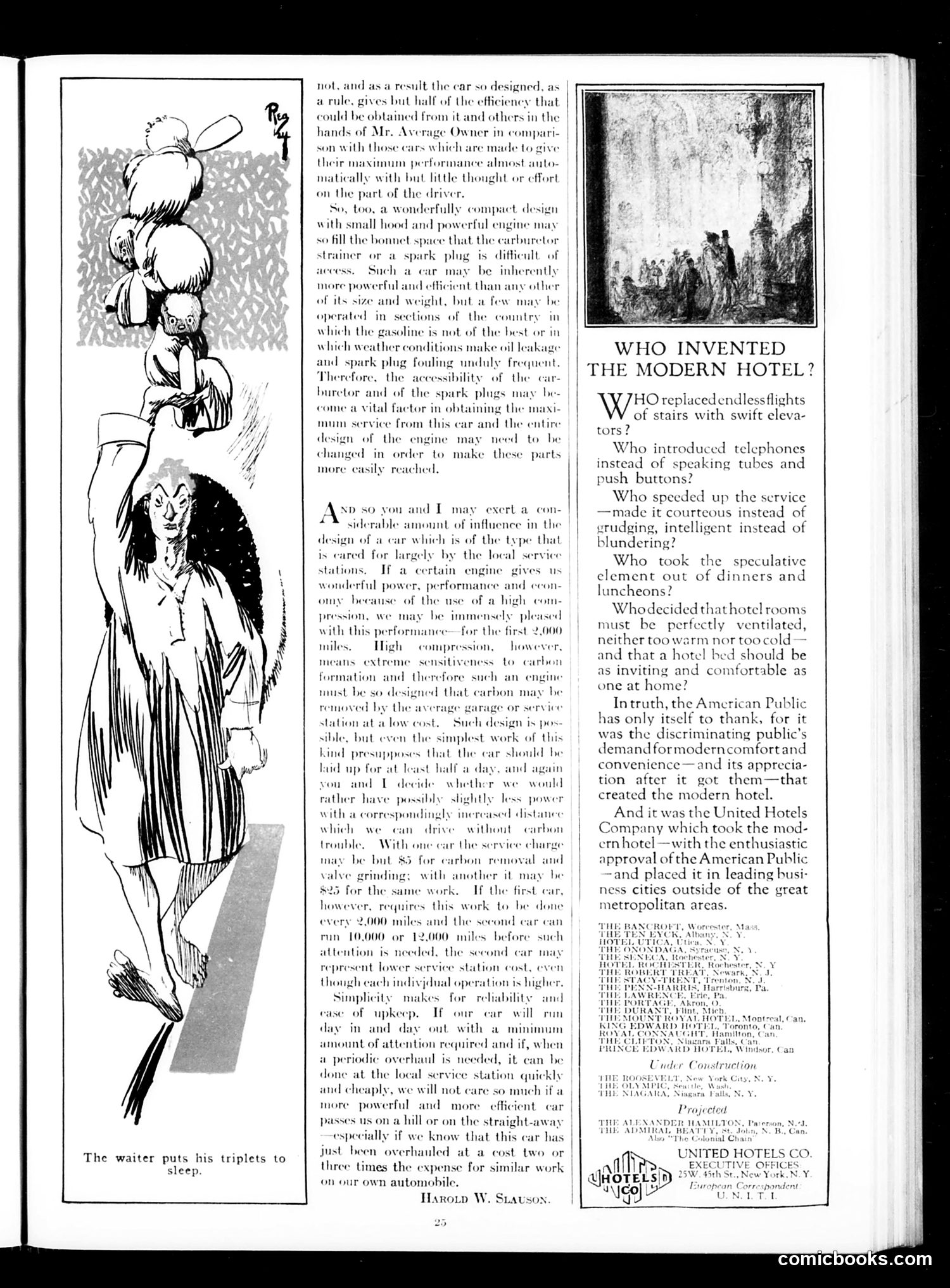
This page contains two distinct pieces: **Left side:** A cartoon captioned "The waiter puts his triplets to sleep." The sketch shows a waiter with three small figures (his "triplets") stacked vertically on his back as he leans backward. The joke appears to be a visual pun—the triplets are asleep/limp, making them dead weight, and the waiter is literally "putting them to sleep" by carrying them, presumably after their shift or during work hours. It's a workplace humor piece about the burden of childcare. **Right side:** An article titled "WHO INVENTED THE MODERN HOTEL?" This is likely advertising copy for United Hotels Co., promoting their chain by claiming credit for modern hotel innovations—elevators, telephones, ventilation, comfortable beds—attributing these to "the American Public's demand" for comfort and convenience. It's essentially corporate self-congratulation disguised as consumer advocacy. The page mixes editorial humor with advertising content, typical of *Judge* magazine's format.
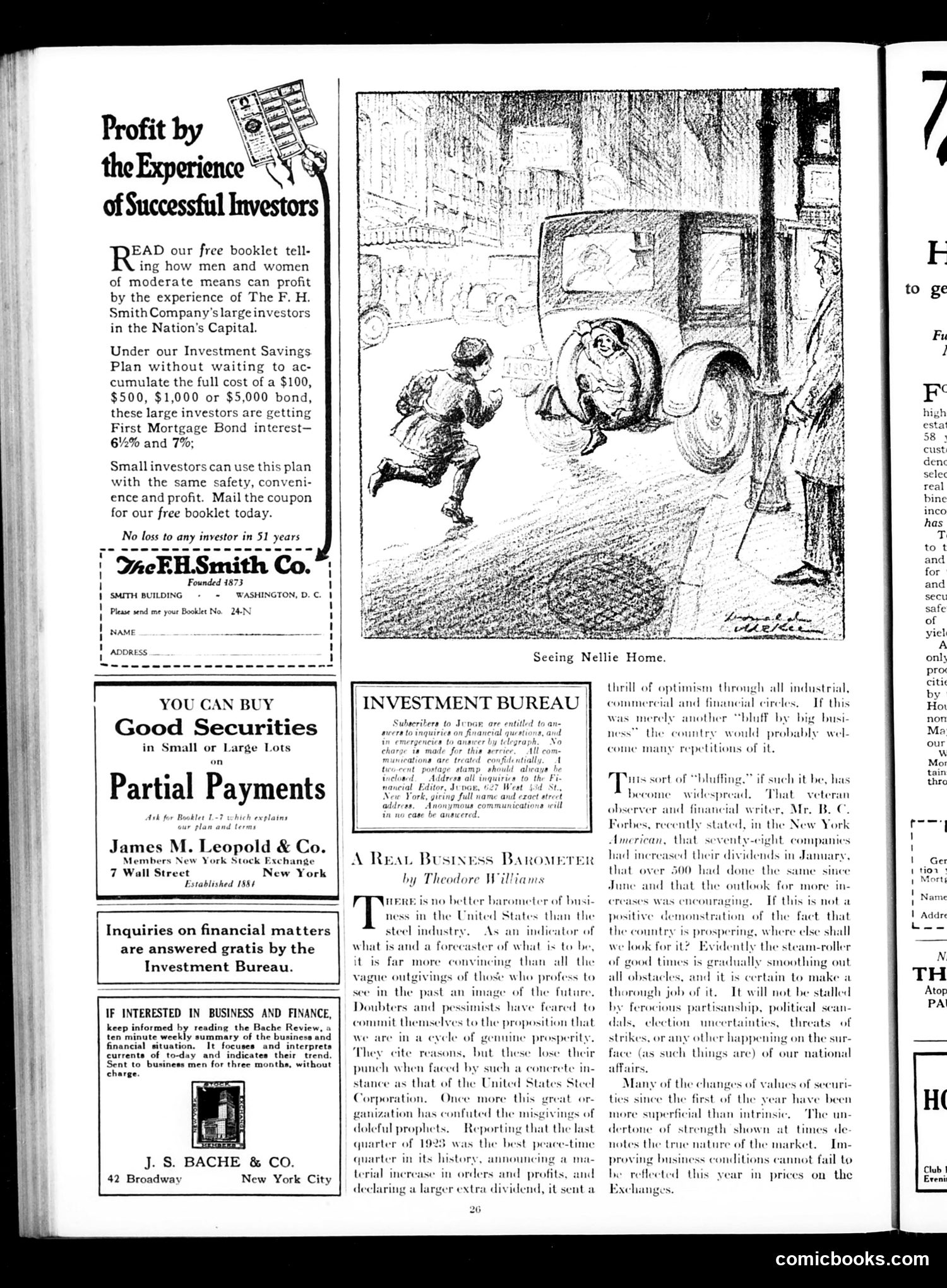
This page is primarily **financial advertising** with one small cartoon illustration titled "Seeing Nellie Home." The sketch depicts children playing in a street, with one child appearing to push or chase another toward a doorway or building entrance—likely a humorous domestic scene of neighborhood children, possibly referencing a popular song or common childhood experience of the era. The page's real focus is investment promotions from F.H. Smith Company, James M. Leopold & Co., and J.S. Bache & Co., offering bonds and securities to small investors. The accompanying article "A Real Business Barometer" discusses U.S. Steel Corporation's strength as evidence of national economic prosperity, citing increased dividends among companies as proof the country is thriving. The cartoon itself carries no political satire—it's simply a genre scene illustrating everyday urban life, serving as visual relief amid dense advertising copy aimed at middle-class investors.
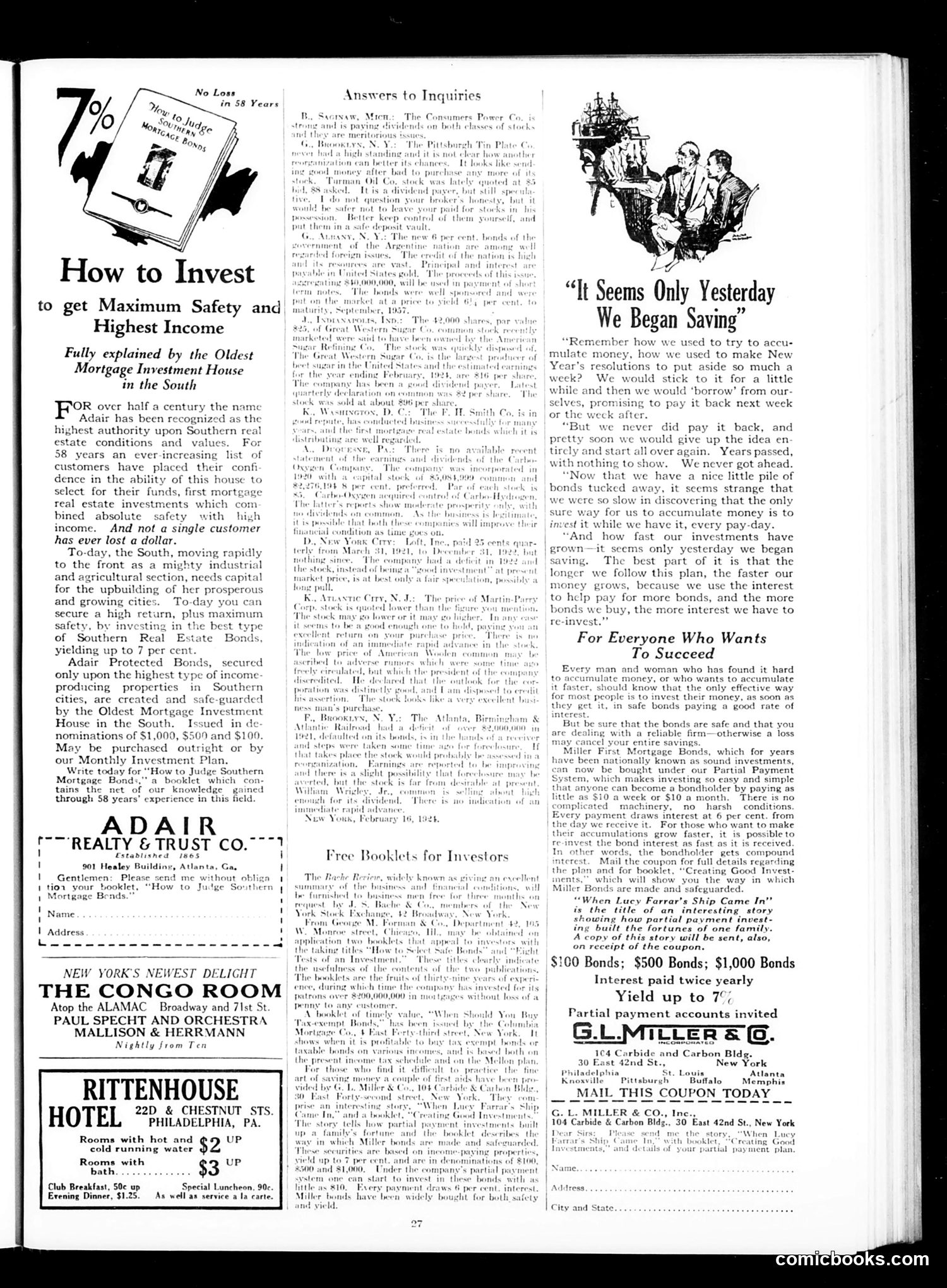
This is primarily a **financial/investment advertising page** from Judge magazine, not a political cartoon page. The main content consists of investment advertisements and responses to reader inquiries about stocks and bonds. The notable visual element is the illustration titled **"It Seems Only Yesterday We Began Saving"**—a domestic scene showing a couple reflecting on their journey to financial security through disciplined bond investing. The accompanying text presents a narrative about learning to accumulate wealth through regular investment rather than sporadic saving attempts. The page promotes various investment products (mortgage bonds, real estate investments, company stocks) from established firms, emphasizing safety and steady returns. There are also advertisements for hotels and entertainment venues like "The Congo Room" in New York. This reflects the **1920s investment culture** when bonds and mortgages were marketed as accessible wealth-building tools for ordinary middle-class Americans—before the 1929 crash would devastate such confidence in the market.
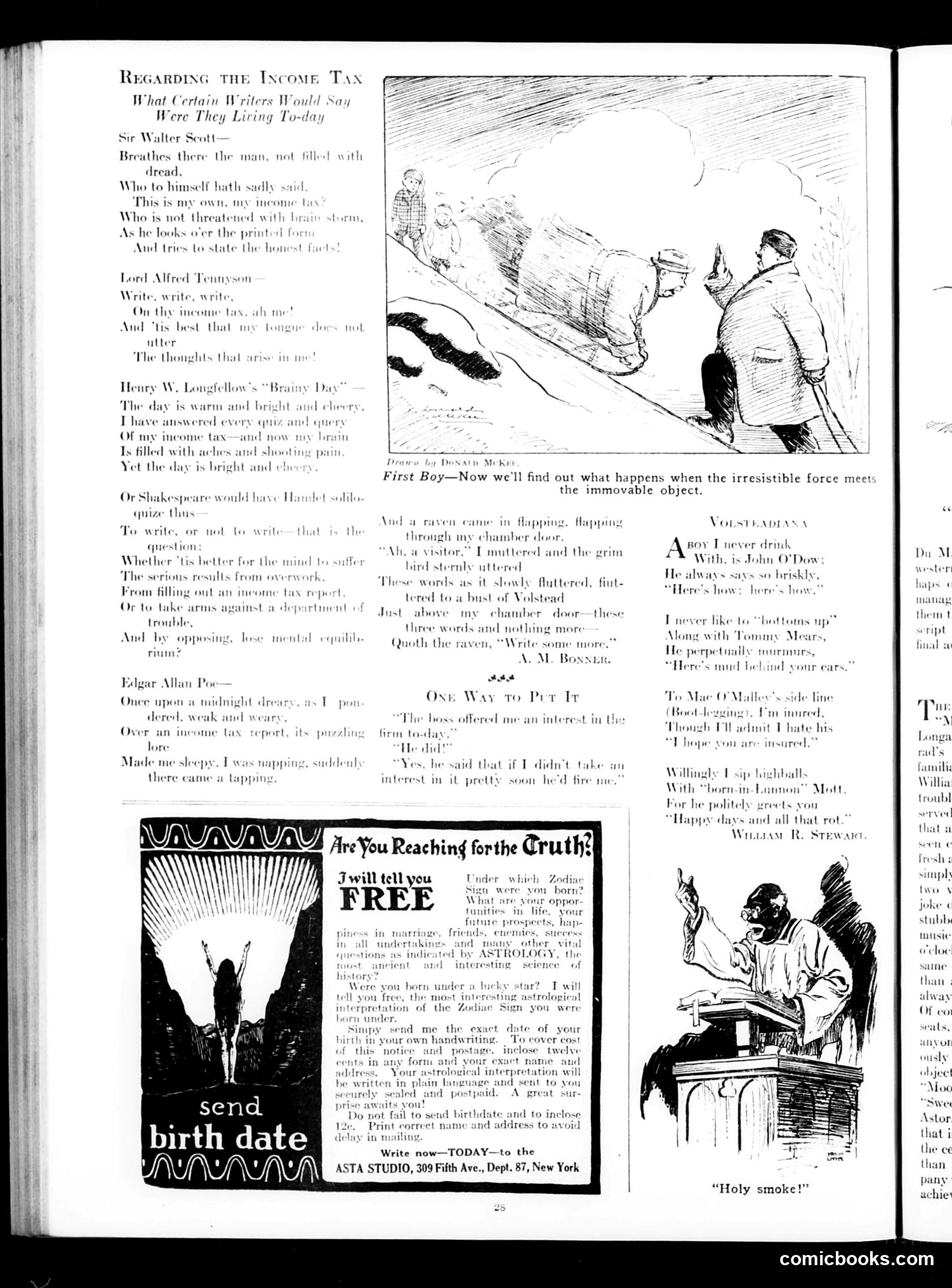
This page satirizes the frustration Americans felt over filing income tax returns (likely from the 1920s-30s era). The main cartoon imagines famous literary figures reacting to the new income tax burden: Sir Walter Scott, Lord Tennyson, Longfellow, Shakespeare, and Edgar Allan Poe are all reimagined complaining about or obsessing over their tax forms. The joke is that even great poets—whose work celebrates nobility, beauty, and transcendent thought—would be reduced to anxiety about taxes. References to Volstead (Prohibition enforcer) and "boot-legging" ground this in the post-Prohibition era. The cartoon at bottom shows two boys discussing how compound interest works as an "irresistible force meets immovable object"—a physics metaphor suggesting the overwhelming complexity of financial obligations. The side column includes period social commentary (drinking culture, dating etiquette) and an advertisement for astrology readings, typical of the magazine's miscellaneous content.
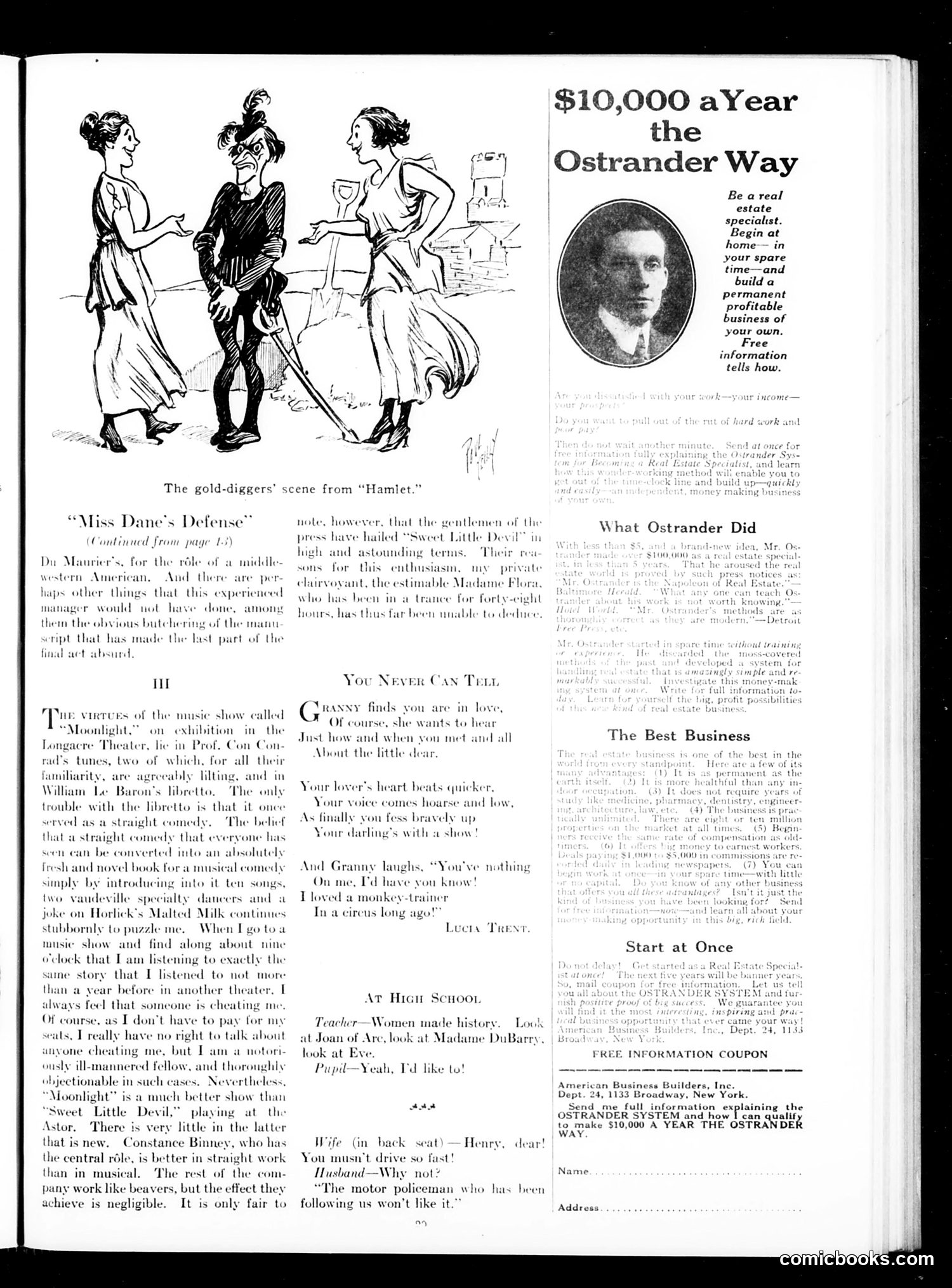
The top cartoon satirizes theatrical "gold-diggers"—women who pursued wealthy men. The scene mimics Shakespeare's *Hamlet*, showing three fashionably dressed women eyeing a gentleman, suggesting they're hunting for financial prey rather than genuine romance. Below, the page contains theater reviews and casual humor pieces, including a school joke about women in history and a domestic exchange about speeding. The dominant content is advertising: a full column for the "Ostrander System," promising readers $10,000 annually through real estate work from home. This appears to be typical mail-order business promotion common to 1920s magazines—encouraging spare-time entrepreneurship to working-class readers. The juxtaposition is notable: satirical mockery of women pursuing money sits beside aggressive advertising promising the same financial independence to readers. The page reflects both contemporary gender anxieties and the advertising-driven business culture of the Jazz Age era.
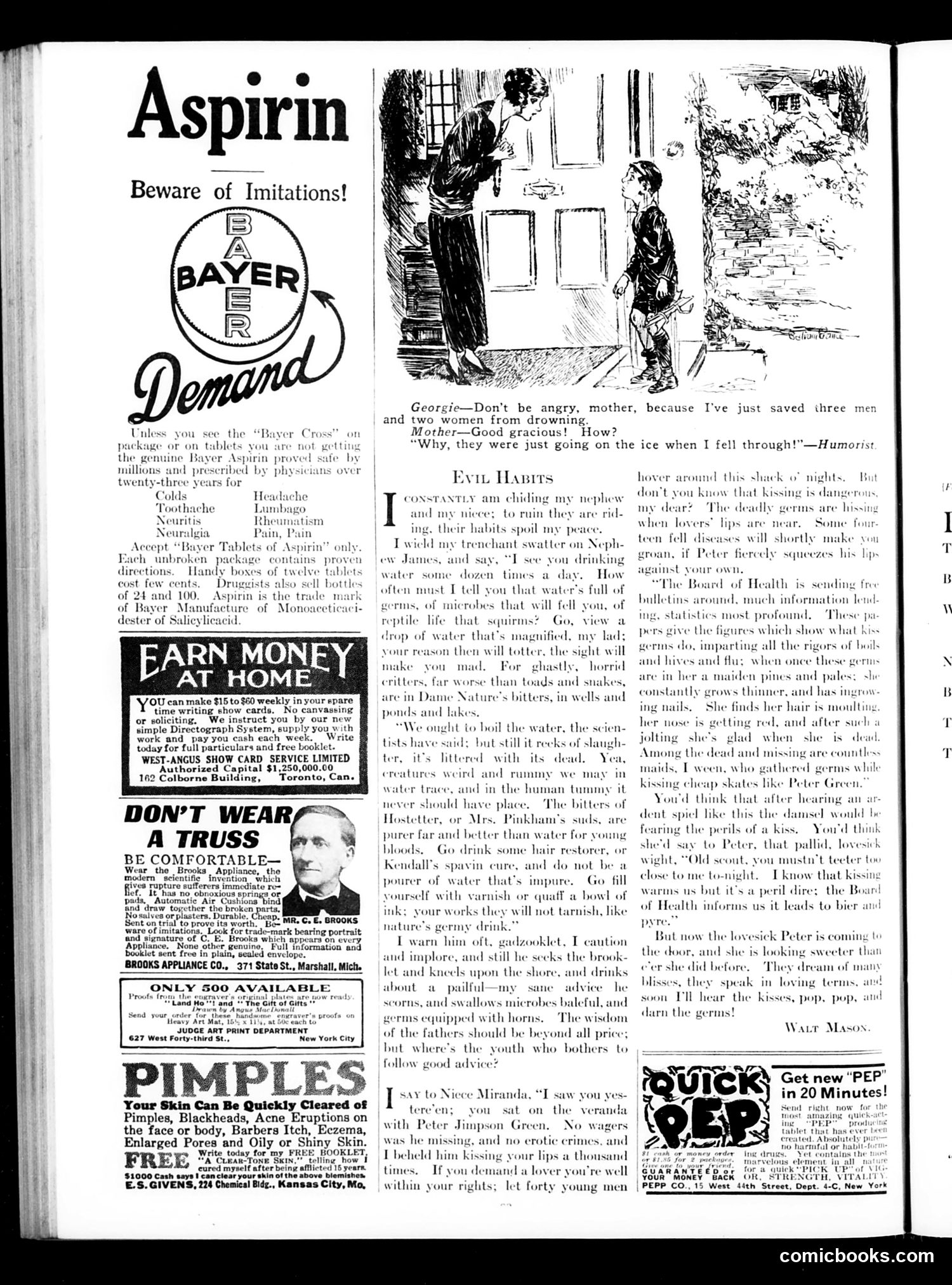
This page is primarily **advertising**, not editorial content. The dominant feature is a Bayer Aspirin advertisement warning consumers against counterfeit products—a significant concern in early 20th-century pharmaceuticals before FDA regulation. The small illustration and accompanying joke at top-right depicts a child who fell through ice and rescued three people by accident—mild domestic humor typical of the era. Below that is a column titled "Evil Habits," a moralizing essay warning a nephew against drinking untreated water. The author uses exaggerated, almost comical language about microscopic organisms and germs to discourage the boy from drinking from natural sources. This reflects genuine public health concerns of the era regarding waterborne disease, though expressed in dated, theatrical prose. The remaining content consists of classified advertisements for mail-order products: show-card work, truss devices, skin treatments, and hair restoration—typical of Judge magazine's revenue model. **No political satire appears on this page.**
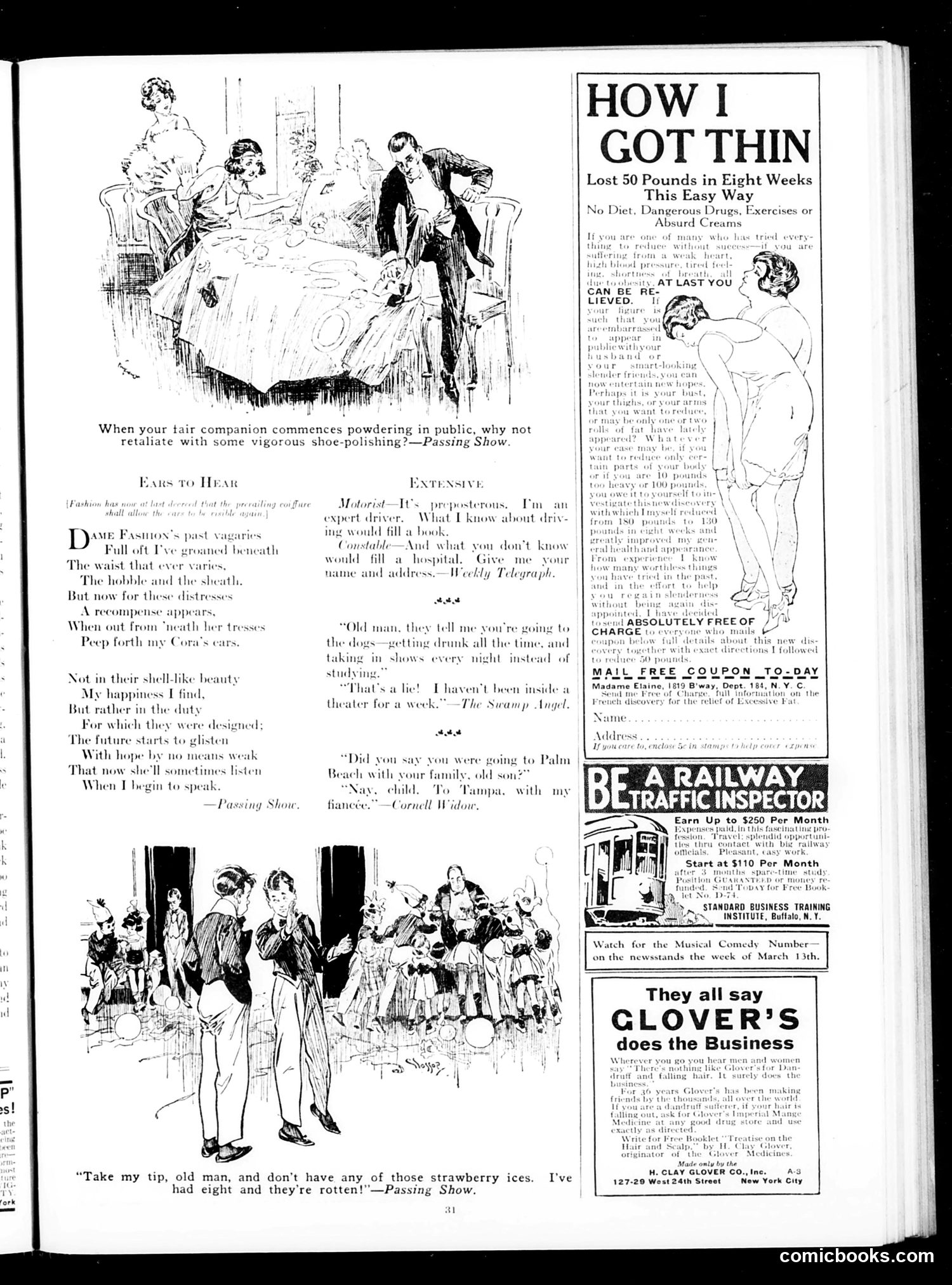
This page contains three unrelated cartoons plus advertisements typical of early 20th-century magazines. **Top Left Cartoon ("Ears to Hear"):** A poem satirizing courtship etiquette. A man celebrates that his female companion now actually listens to him—her newly visible ears (from changed hairstyles) metaphorically represent her willingness to hear him speak. The joke plays on fashion changes where women's hairstyles covered or exposed ears differently. **Bottom Left Cartoon:** Two men discussing a young person heading to "Palm Beach" instead of studying. The punchline suggests the youth is going for entertainment rather than education—social commentary on priorities of the wealthy or idle youth. **Right Side:** Advertisements dominate, including a diet scheme ("How I Got Thin—50 Pounds in Eight Weeks"), a railway job opportunity, and Glover's Medicine. These reflect common early-20th-century mail-order marketing targeting insecurities. The cartoons employ gentle social satire about fashion, courtship, and youth behavior rather than hard political commentary.
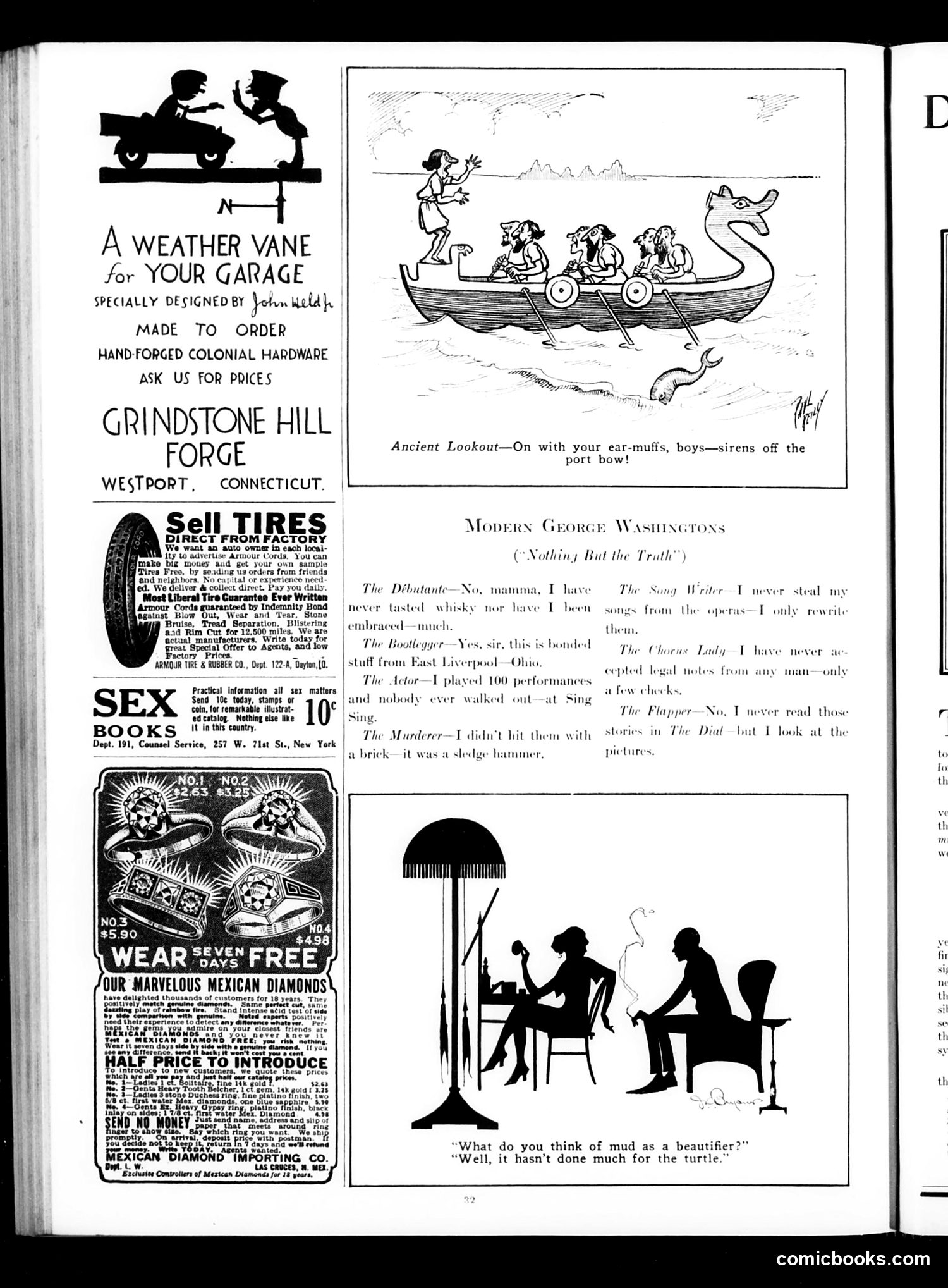
This page features a comic dialogue titled "Modern George Washington's (Nothing But the Truth)" that satirizes various professions and social types through their contradictory claims to honesty. Each character makes an implausible denial: - A debutante claims never to have drunk whisky or been embraced - A bootlegger insists his illegal alcohol is legitimately "bonded" - An actor falsely claims 100 uninterrupted performances - A song writer denies plagiarizing from operas - A chorus lady claims never accepting payment except checks - A murderer denies using a brick weapon The satire plays on the irony of each speaker's profession or known behavior making their denials absurd. The title references Washington's mythical honesty, contrasting sharply with these modern lies. The bottom cartoon shows two people discussing mud as a beautifier, with the punchline suggesting mud hasn't improved even a turtle—a crude joke about cosmetics and vanity.
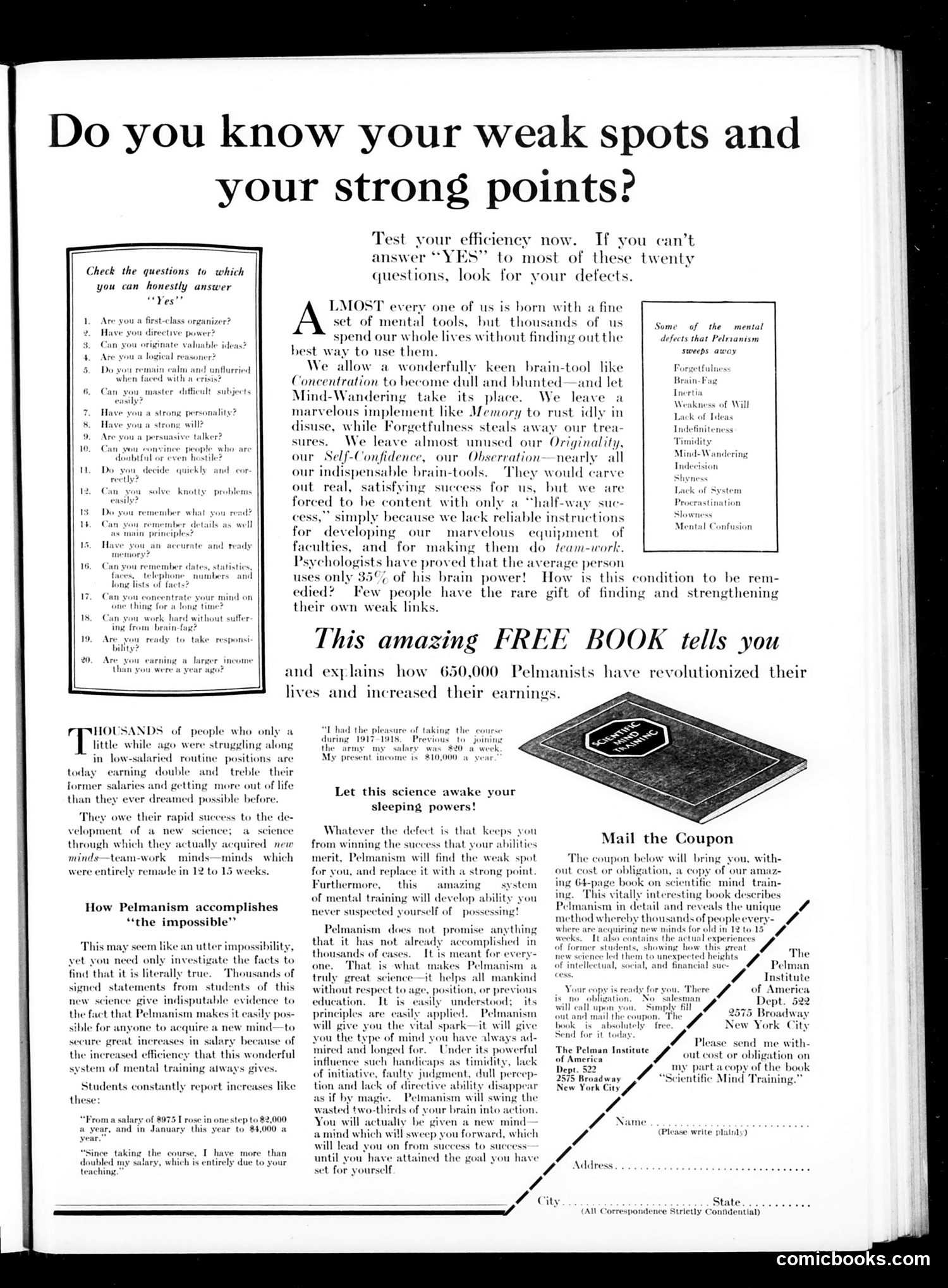
This page is primarily **advertising for "Pelmanism,"** a mail-order mental training system popular in the early 20th century. It's not a satirical cartoon but rather a promotional advertisement disguised as self-improvement content. The page uses a checklist of twenty questions to make readers feel inadequate about their mental abilities, then promises that Pelmanism—a correspondence course costing 64 pages—will "revolutionize" their lives and increase earnings. Testimonials claim participants doubled or tripled their salaries within 12-15 weeks. The appeal targets ambitious but struggling workers in "low-salaried routine positions," offering the fantasy that mental training alone could transform their circumstances. Terms like "brain power," "mental tools," and "concentration" echo pseudoscientific psychology of the era, lending false credibility to what appears to be an unsubstantiated self-help scheme. The coupon at page's bottom—requesting name, address, and city—indicates this was a lead-generation advertisement typical of early direct-mail marketing.
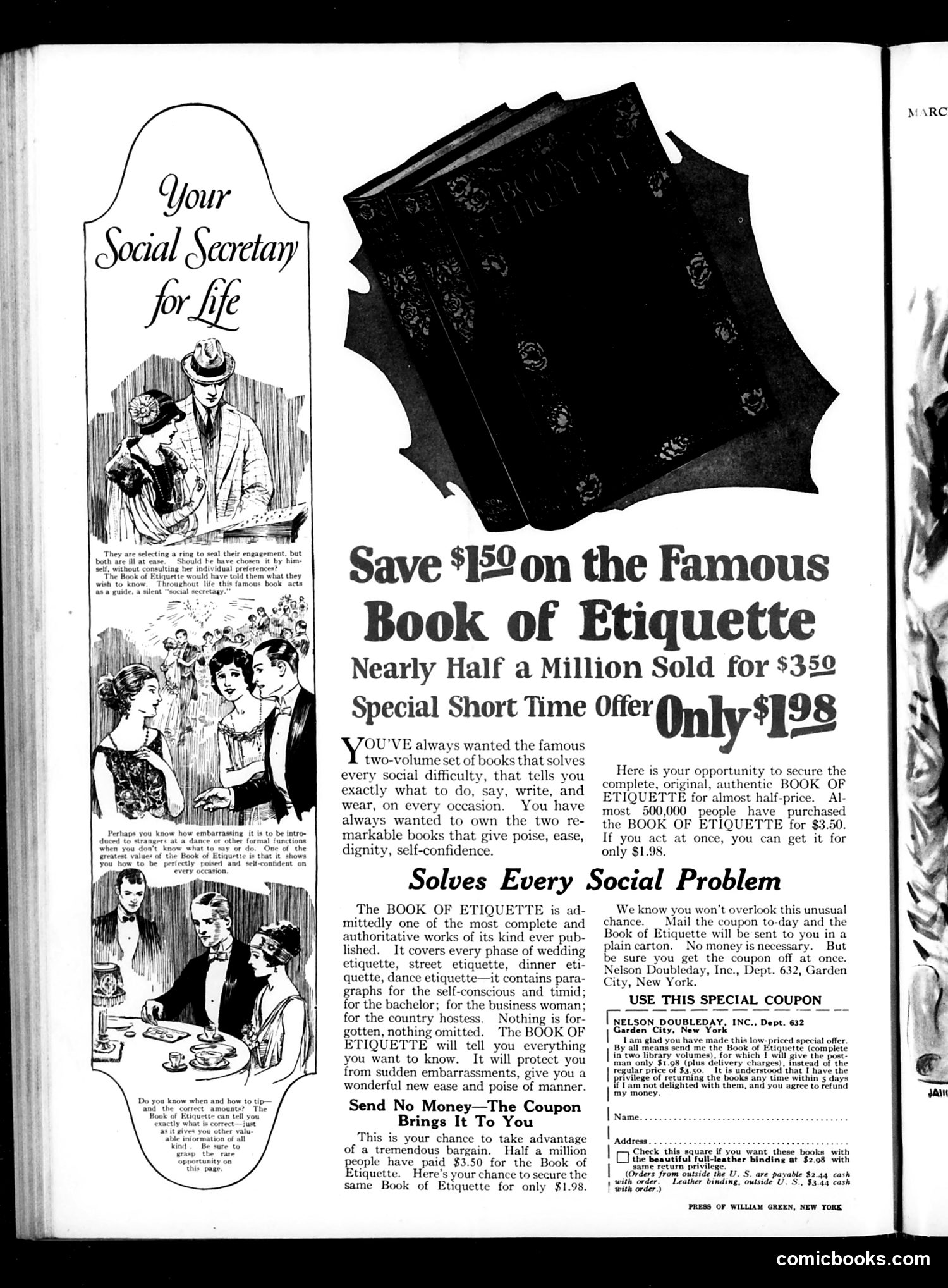
This page is primarily **advertising**, not satire or political commentary. It contains: **Left side:** Illustrated vignettes showing social situations (a couple, dinner scenes, formal gatherings) accompanying the headline "Your Social Secretary for life" — establishing the book's purpose. **Right side:** A sales advertisement for the "Book of Etiquette," a two-volume reference guide, offered at a reduced price of $1.98 (down from $3.50). The ad emphasizes the book "solves every social problem" and covers wedding etiquette, dinner etiquette, street behavior, and social confidence. **The pitch:** Appeals to readers' anxiety about social embarrassment and desire for "poise, ease, dignity, self-confidence." The offer includes a coupon requiring no money upfront. **Social context:** This reflects early-20th-century American middle-class aspirations — etiquette books were popular guides for navigating an increasingly complex social landscape, particularly for those climbing the social ladder or uncertain of proper behavior. There is no identifiable political satire here; this is straightforward consumer advertising.