
Judge, 1924-02-23 · page 24 of 36
Judge — February 23, 1924 — page 24: what you’re looking at
What you’re looking at
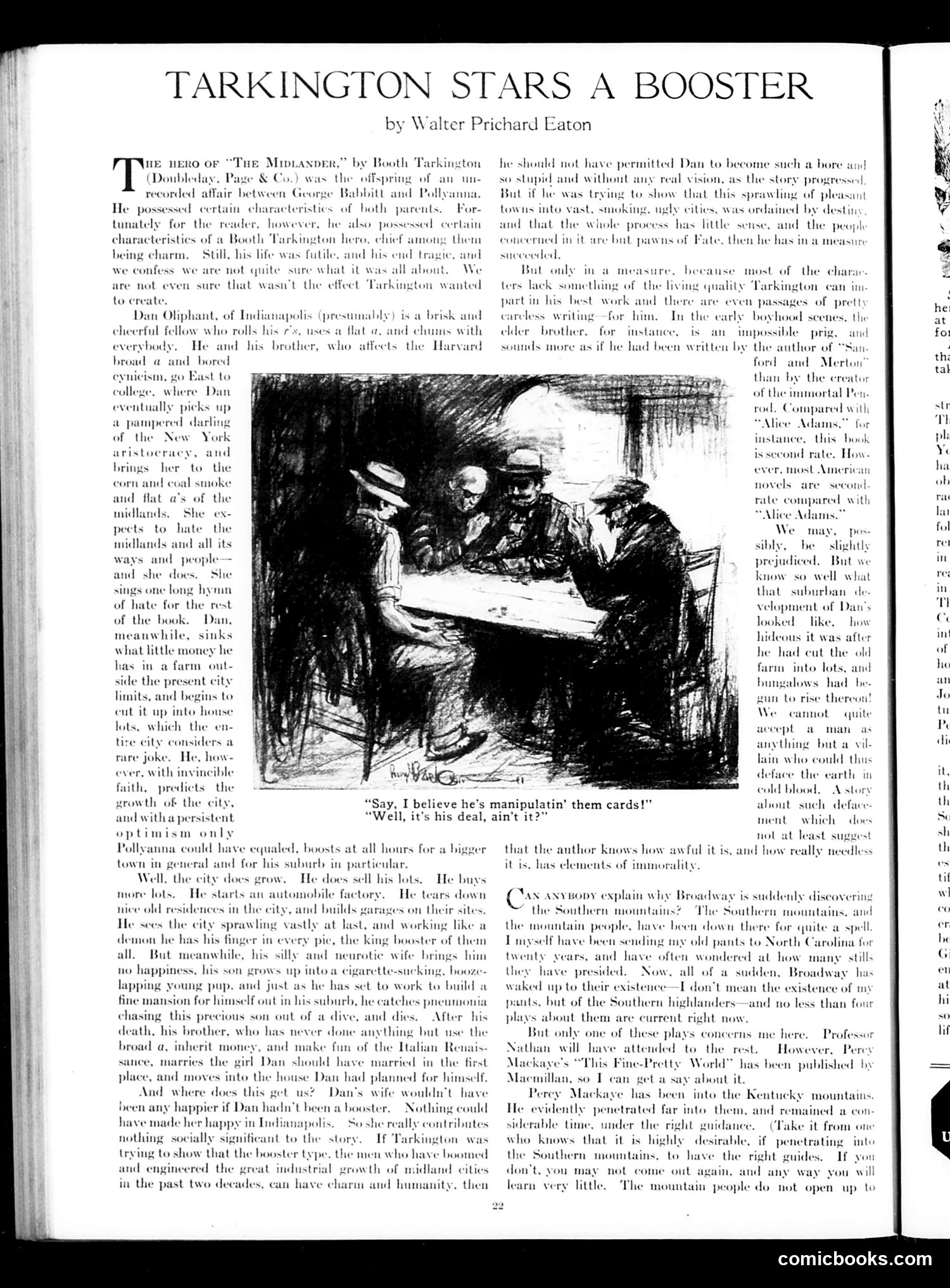
This is a literary review by Walter Prichard Eaton of Booth Tarkington's novel *The Midlander*. The accompanying sketch illustrates a scene of men playing cards, with dialogue: "Say, I believe he's manipulatin' them cards!" / "Well, it's his deal, ain't it?" The review critiques Tarkington's portrayal of Dan Oliphant, a brash Indianapolis businessman who aggressively promotes suburban development and industrial growth. Eaton argues the novel is thematically muddled: it's unclear whether Tarkington aims to celebrate the "booster" type (ambitious self-promoters driving Midwestern expansion) or condemn their destructive optimism. The reviewer finds Dan's characterization weak—too foolish and short-sighted to convincingly represent real boosters' charm and vision. Eaton compares it unfavorably to Tarkington's acclaimed *Alice Adams*, suggesting this work is "second rate." The critique reflects early 20th-century literary debates about whether American business expansion was progress or cultural destruction.
📄 Transcribed text from this page (OCR, searchable)
Machine-transcribed from the original scan — historical spelling and the odd misread are preserved.
f —— TARKINGTON STARS A BOOSTER by Walter Prichard Eaton HE HERO oF “THe Mipianper,” by Booth Tarkington | Doubleday, Page & Co.) was the offspring of an un- recorded affair between George Babbitt and Pollya He possessed certain characteristics of both parents. tunately for the reader, characteristics of a Booth Tarkir being charm. Still, his life v wever, he also possessed certain mm hero, chief among them as futile, and his end tragic, and we confess we are not quite) sure what it was all about. We are not even sure that wasn't the effect Tarkington wanted to create. Dan Oliphant, of Indiana cheerful fellow who rolls his lis (presumably) is a brisk and uses it fata, and chums with rvbody. He and his brother, who affects the Harvard and bored » East to . Where Dan eventually picks up a pampered darling of the New York aristocracy, and brings her to the corn and coal smoke and flat a’s of the midlands. She ex- pects to hate the midlands and all its ways and people— and she does. She sings one long hymn of hate for the rest of the book. Dan, meanwhi *, sinks what little money he has in a farm out- side the present city limits, and begins to cut it up into house lots, which the en- tire city considers a rare joke. He, h We ever, with invincible faith, predicts the growth of the city, and witha persistent optimism only Pollyanna could have equaled, boosts at all hours for a! town in general and for his suburb in particular. Well, the city does grow. He does sell his lots. He buys more lots. He starts an automobile factory. He tears down nice old residences in the city, and builds garages on their sites, He sees the city sprawling vastly at last, and working like a demon he has his finger in every pie, the king booster of them all. But meanwhile, his silly and neurotic wife brin him no happiness, his son grows up into a cigarette-sucking, booze- lapping young pup, and just as he has set to work to build a fine mansion for himself out in his suburb, he catches pneumonia chasing this precious son out of a dive, and dies. After his death, his brother, who has never done anything but use the broad a, inherit money, and make fun of the Italian Renais- sance, 1 es the girl Dan should have married in the fir nd moves into the house Dan had planned for himself, And where does this get us? Dan's wife wouldn't have vany happier if Dan hadn't been a booster. Nothing could have made her happy in Indianapolis. So she really contributes nothing socially significant to the story. If Tarkington was show that the booster type, the men who have boomed vat industrial growth of midland cities in the past two decades, can have charm and humanity, then he should not have permitted Dan to become such a bo: so stupid and without any real vision, as the story prog But if he was trying to show that this spri wling of pleasant tined by destin and the peopl concerned in it are but pawns of Fate, then he has in aim towns into vast, smoking, ugly cities, was or and that the whole process has little sens succeeded But only in a measure, because most of the cha ters lack something of the living quality Tarkington can in. part in his best work and there are even passages of pret careless writing —for him. In the early boyhood scenes, the elder brother, for instance, is an impossible prig sounds more as if he had been written by the author of ford and) Merton than by the create: of the immortal Pen- rod. Compared will “Alice Adams, instance, this issecond rate. H ever, most American novels are second rate compared with “Alice Adams.” We may, pos sibly, be slightly prejudiced. But wi know so well what that suburban de velopment of Dan's hideous it was after he had cut the old farm into lots, and bungalows had_ be- gun to rise there We cannot — quite n accept a oman as anything but a vil- lain who could thus deface the earth in cold blood. A story elieve he’s manipulatin’ them cards!” about such deface- s his deal, ain’t it?” ment which — does not at | st that the author knows how awful it is, and how really needless it is, has elements of immorality. ast su (Cas sxynony explain why Broadway is suddenly discovering the Southern mountains? ‘The Southern mountains, and the mountain people, have been down there for quite a spell T myself have n sending my old pants to North Carolina for and have often wondered at how many: stills they have presided. Now, all of a sudden, Broadway h waked up to their existence—I don’t mean the existence of my pants, but of the Southern high twenty year unders—and no less than four t now But only one of these plays concerns me here. Prof Nathan will have attended to the rest. However, Perey Mackaye’s “This Fine-Pretty: World” has been published. b, Macmillan, so T can get Perey Mackaye has plays about them are current ay about it. cen into the Kentucky mountains He evidently penetrated far into. them, and remained a con siderable time, under the right guidance. who knows that it is highly desirable, if penetrating into the Southern mountains, to have the right guides. If yor don’t, you may not come out z (Take it from one wd any way you will learn very little. ‘The mountain people do not open up to comicbooks.com