
A complete issue · 32 pages · 1920
Judge — November 20, 1920
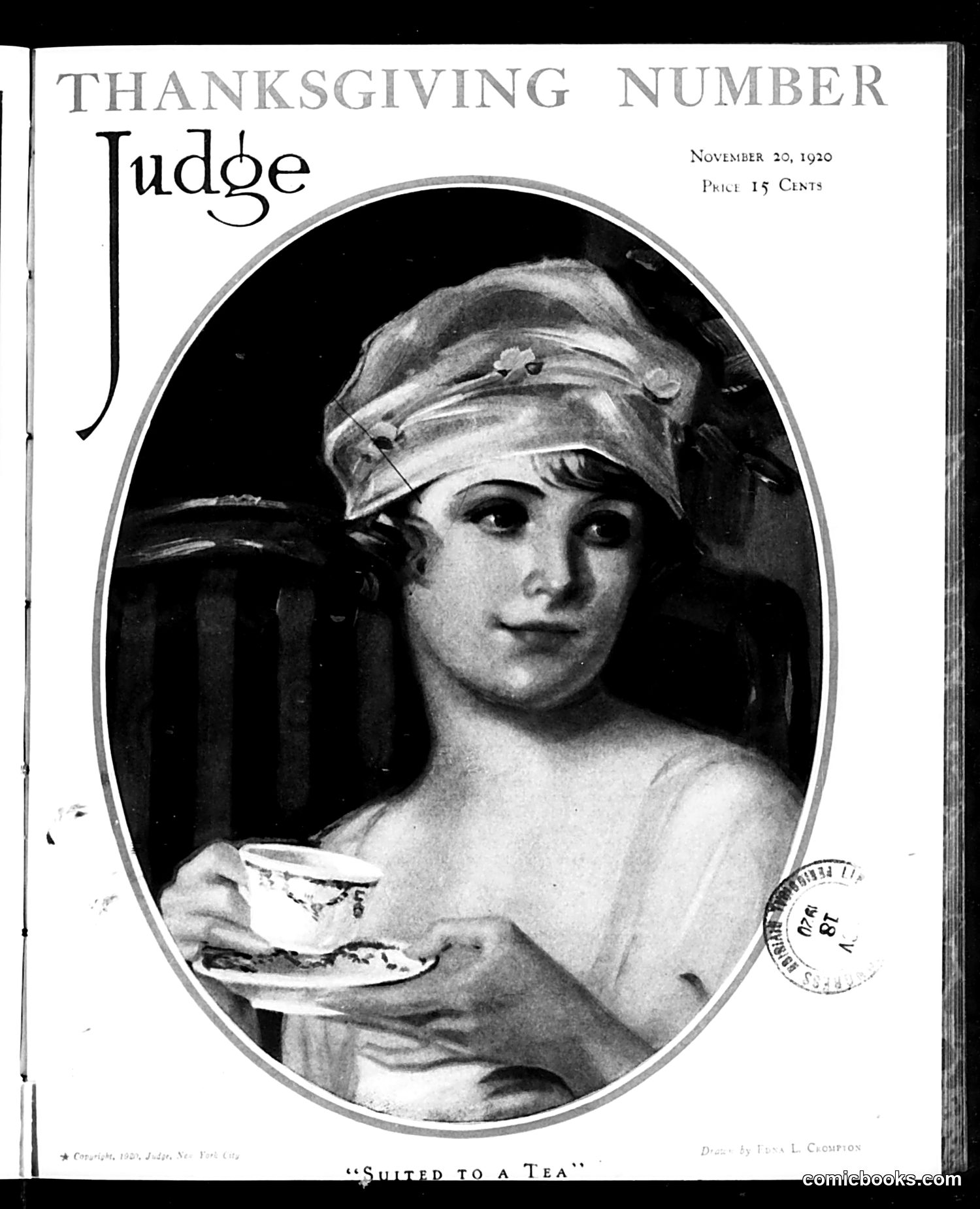
This is Judge magazine's Thanksgiving Number from November 20, 1920, priced at 15 cents. The cover features a young woman wearing a decorative headband, holding a teacup, with the caption "Suited to a Tea." The illustration appears to be a social commentary on 1920s flirtation and courtship customs. The woman's fashionable headwear and the act of serving/holding tea reference the popular "tea party" social gatherings of the era, which were occasions for young people to socialize. The satire likely mocks the superficiality of these social rituals or comments on changing gender roles and courtship practices in the post-WWI 1920s. Without additional context or interior content, the specific satirical target remains unclear, though the overall tone suggests commentary on contemporary social customs and dating culture.
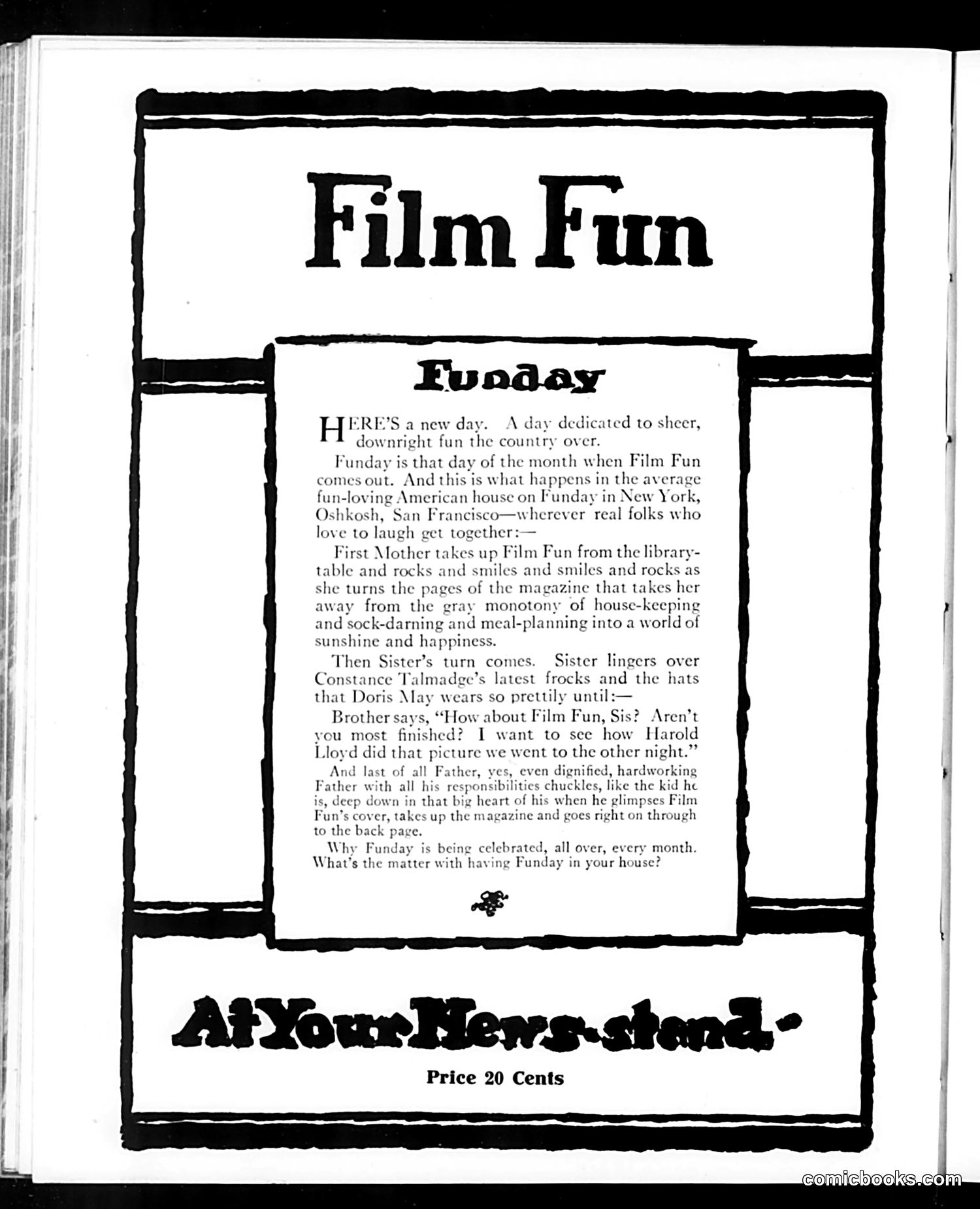
This page celebrates "Funday"—the monthly publication day of *Film Fun* magazine. The satire depicts an idealized American family discovering joy through this entertainment publication, contrasting sharply with their ordinary domestic routines of "house-keeping and sock-darning and meal-planning." The humor centers on how *Film Fun* transports readers from mundane reality into "a world of sunshine and happiness." The family members mentioned—Mother, Sister, Brother, and Father—each abandon their responsibilities to engage with the magazine's content, particularly fascinated by celebrity gossip about stars like Constance Talmadge and Doris May, and references to Harold Lloyd's films. The satire critiques both popular culture's escapist appeal and the era's gender roles, suggesting that entertainment magazines offered middle-class Americans relief from domestic tedium.
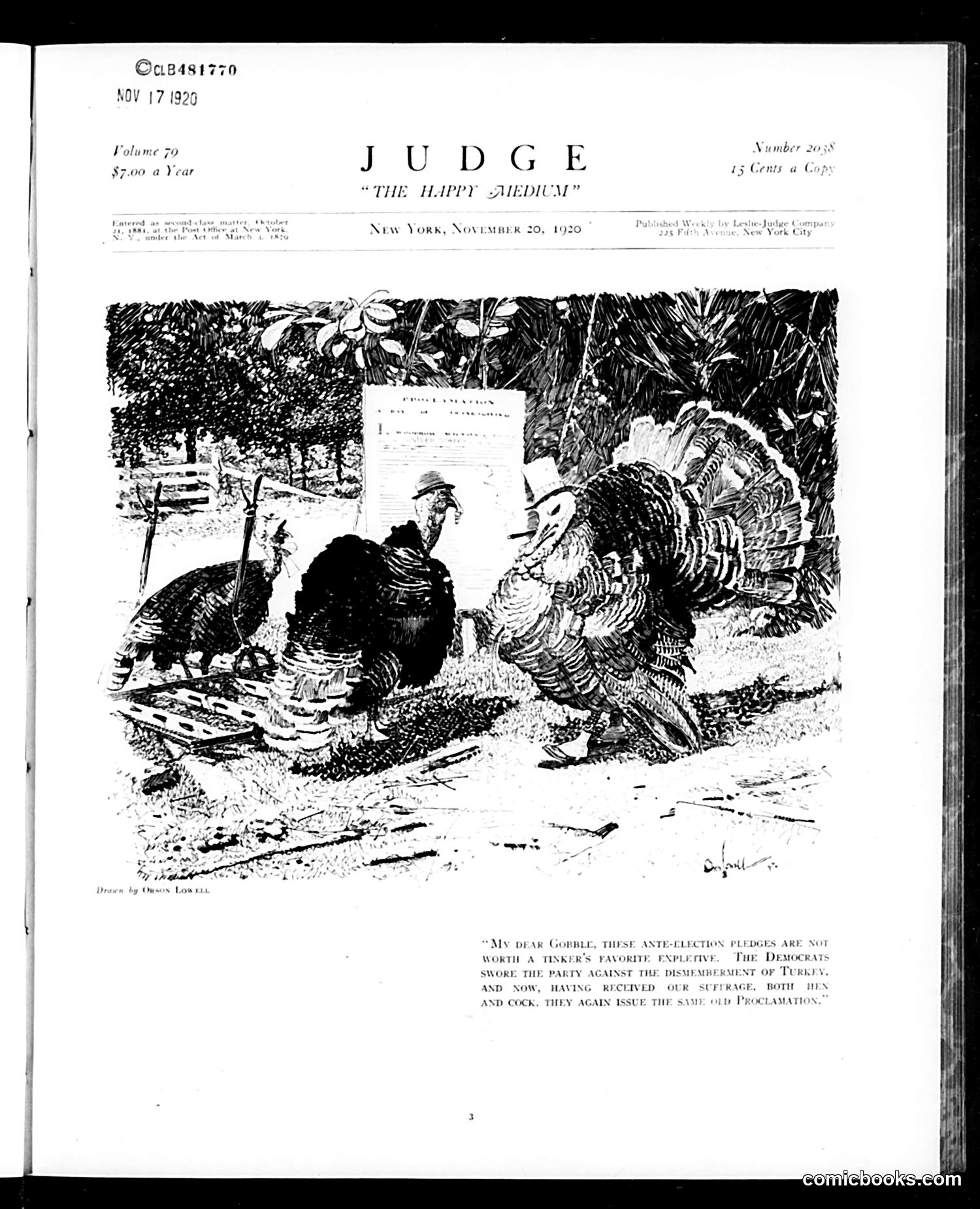
This cartoon depicts turkeys in an outdoor setting, with one turkey addressing others. The caption references "anti-election fudges" and mentions Democrats' opposition to Turkey's disfranchisement, alongside suffrage being granted to "both hen and cock." The satire appears to conflate poultry with political figures, likely using turkeys as metaphors for politicians or voters. The reference to suffrage (voting rights for both male and female) suggests this comments on the recently-passed 19th Amendment (ratified August 1920), while the Turkey reference remains unclear—possibly alluding to a political figure nicknamed "turkey" or using the bird as general mockery of political adversaries. The exact political targets are difficult to determine without additional context about November 1920 events.
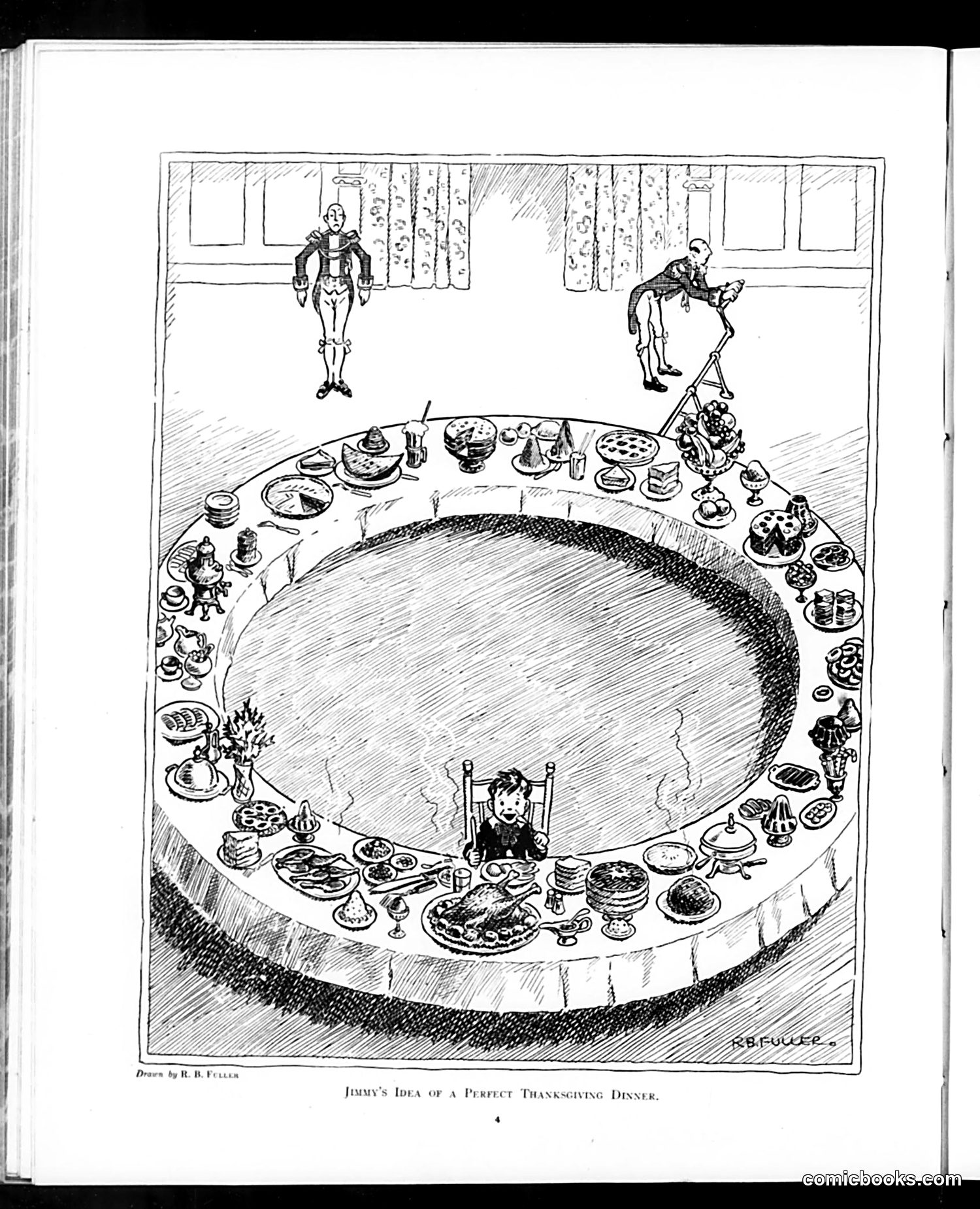
This cartoon depicts a child's imaginative fantasy of an ideal Thanksgiving meal. A young boy sits alone at an enormous table laden with lavish foods—multiple roasted birds, pies, desserts, and elaborate dishes arranged in a circular abundance. Two adults stand in the background, appearing to observe or react to this scene. The satire is straightforward: it mocks the excessive materialism and gluttony associated with Thanksgiving celebrations, presenting the holiday through a child's uncritical, greedy perspective. The joke relies on the contrast between modest, traditional family dinners and this over-the-top fantasy of endless indulgence. The title ironically labels this excess as "perfect," critiquing both consumer culture and holiday excess through the innocent lens of childhood desire.
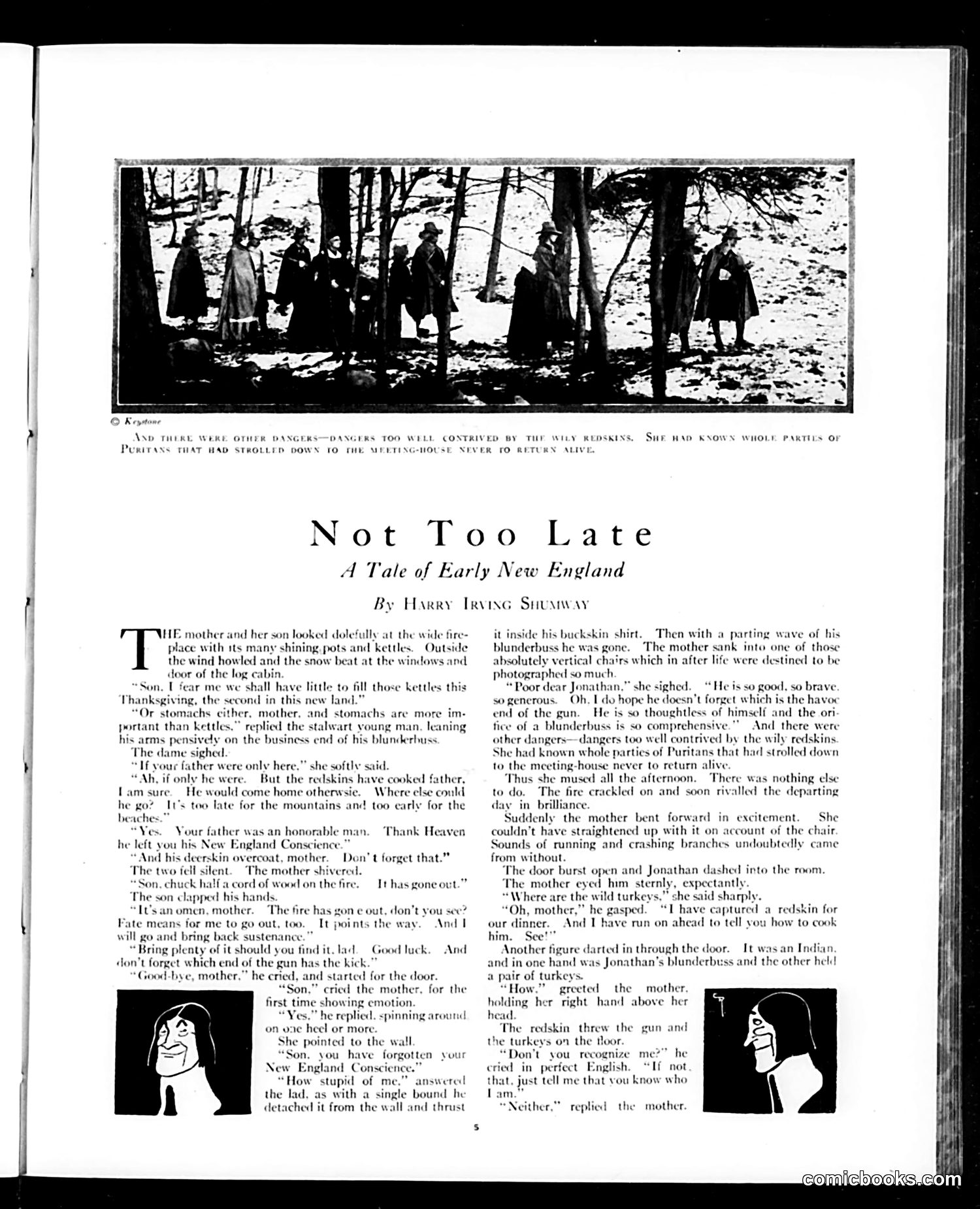
This page contains "Not Too Late: A Tale of Early New England" by Harry Irving Shumway—a fictional story rather than political satire. The narrative depicts a colonial-era mother and son during Thanksgiving, emphasizing Puritan values like conscience and duty. The story's moral centers on the son's obligation to return home despite danger from "wild redskins" (Native Americans), framed through the mother's invocation of his "New England Conscience." The illustrations show caricatured faces emphasizing this earnest, rigid moralism. This appears to be **historical fiction celebrating Puritan virtue**, not political commentary. It reflects early 20th-century American nostalgia for colonial settler values, though the depiction of Native Americans as simple "dangers" reflects period biases.
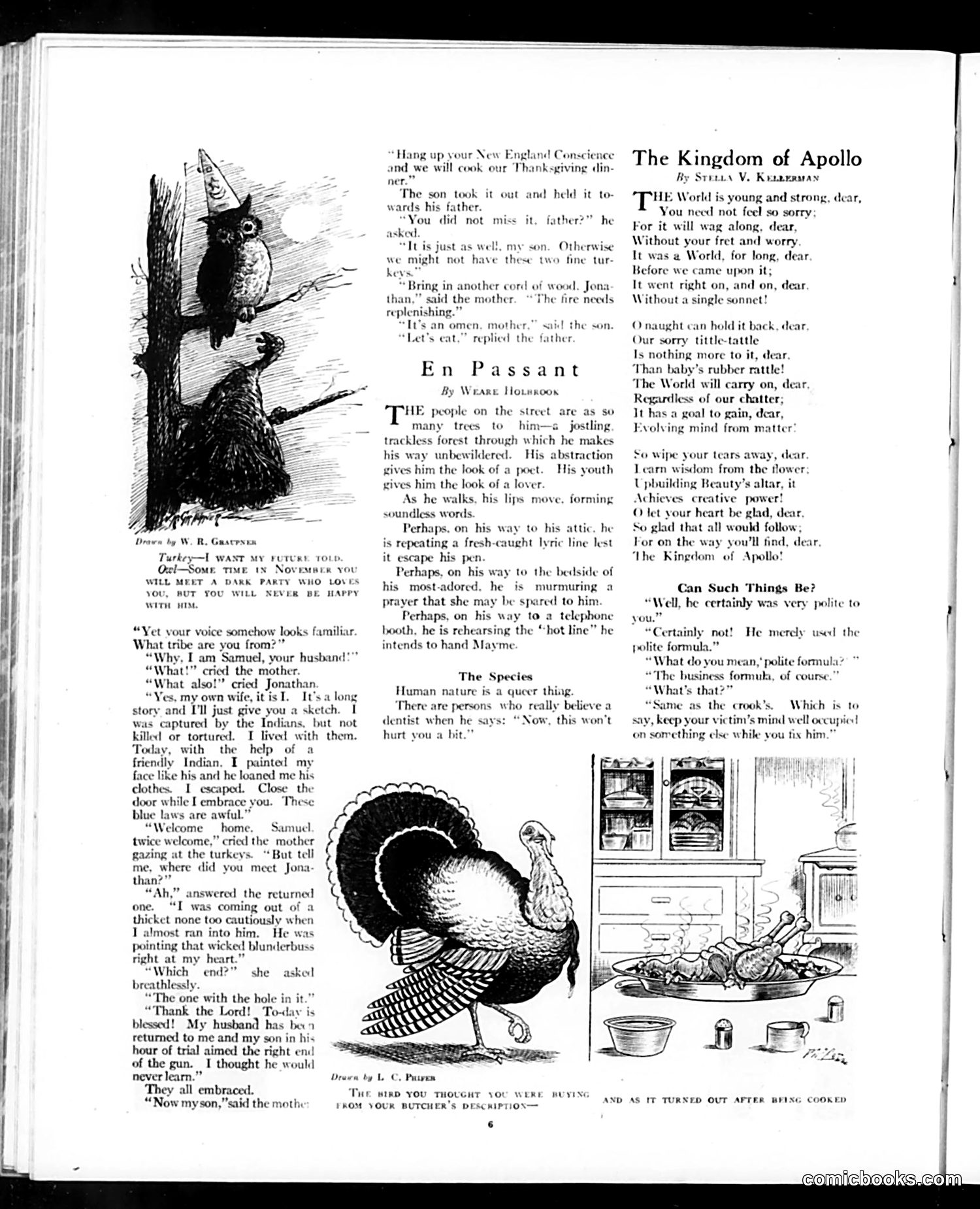
This page contains three separate literary pieces rather than political cartoons: 1. **"En Passant"** by Wease Holbrook - A sketch about a distracted poet walking through city streets, lost in thought and composing verses. 2. **"The Kingdom of Apollo"** by Stella V. Keleerman - A poem addressing "the World" as young and strong, encouraging resilience through life's troubles. 3. **"The Species"** - A brief humorous dialogue about whether certain people truly believe their own claims. The illustrations are decorative rather than satirical: an owl in a party hat, a turkey, and a kitchen scene. This page appears to be primarily literary content—poetry, short fiction, and humor pieces—rather than political satire. No specific political figures or events are referenced.
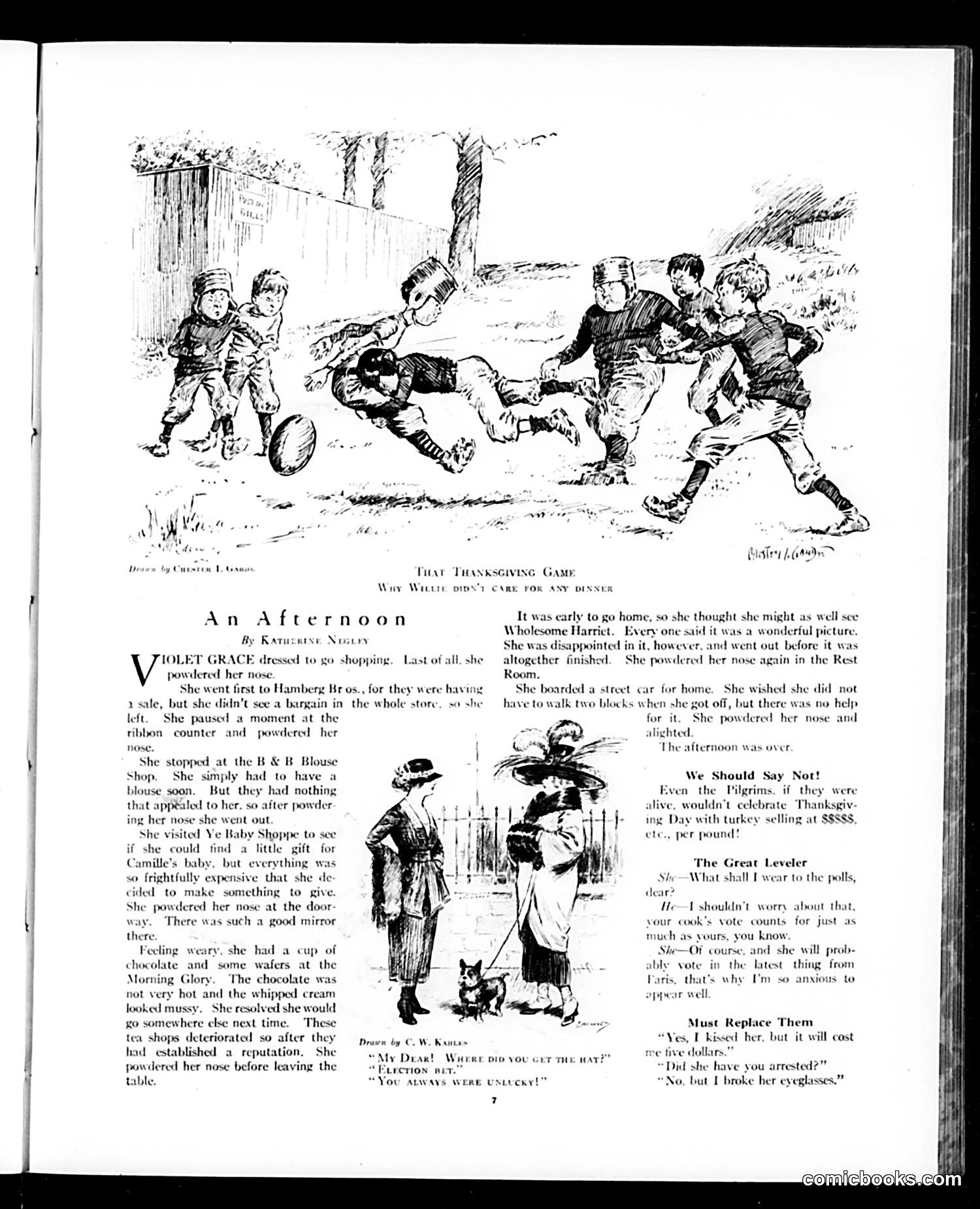
**Main Story: "An Afternoon"** This satirical narrative mocks the vapid consumerism and vanity of upper-class women. Violet Grace spends her afternoon shopping—visiting department stores, boutique shops, and galleries—yet finds nothing satisfactory. The running joke is her constant nose-powdering, presented as reflexive behavior suggesting shallow preoccupation with appearance over substance. The story critiques how privileged women fill their days with aimless consumption and self-grooming rituals. **Political/Social Context:** The cartoons reference early women's suffrage debates. "The Great Leveler" jokes that women's newly won voting rights are absurd because even servants will vote—suggesting anxiety about working-class political participation. "We Should Say Not!" comments on post-WWI inflation (turkeys selling at inflated prices), mocking wealthy Americans' entitlement. **Visual Content:** The top illustration depicts a chaotic Thanksgiving football game, satirizing how commercialized the holiday had become. The page reflects 1920s anxieties about women's liberation, economic change, and class disruption.
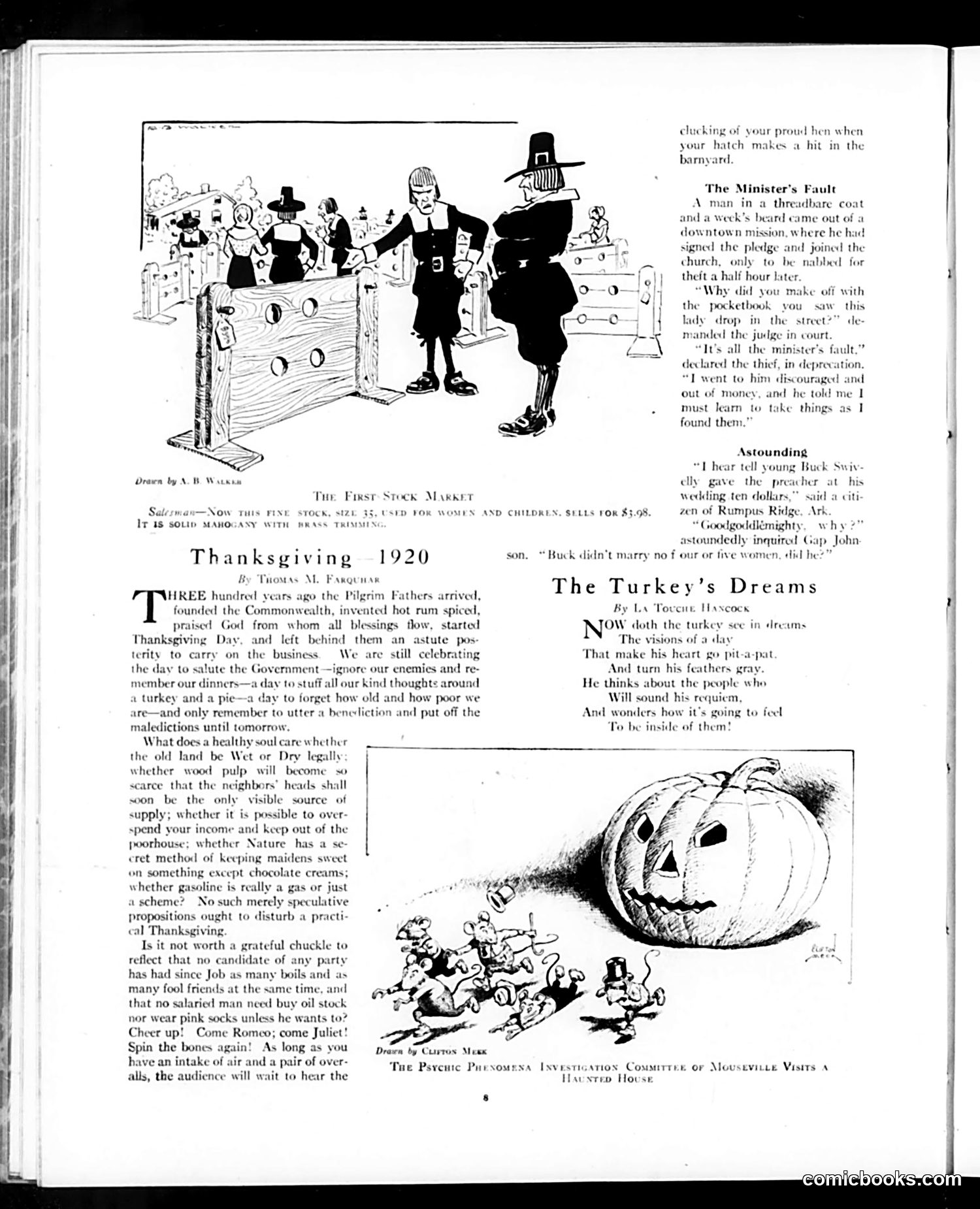
**"The First Stock Market"** (top left cartoon): A sardonic illustration of a wooden stock labeled for "women and children" at $3.98. This satirizes post-WWI commercialism and the emerging consumer culture—reducing family life and domestic goods to marketable commodities. The "stock market" pun references the volatile financial markets of the era. **"Thanksgiving 1920"** (center text): A philosophical essay questioning traditional American values during the post-war period, asking whether citizens truly celebrate gratefully or merely escape hardship through holiday indulgence. It critiques political corruption and economic inequality. **"The Minister's Fault"** and **"Astounding"** (anecdotes, right): Two short jokes mocking clergy—one depicting a minister's poor moral guidance leading a man to theft, the other joking about stingy wedding donations. These reflect 1920s skepticism toward religious authority. **"The Turkey's Dreams"** (lower right): A darkly humorous poem personifying a turkey awaiting slaughter, contemplating the people who will eat him. Classic holiday irony—anthropomorphizing the meal to highlight its grim fate.
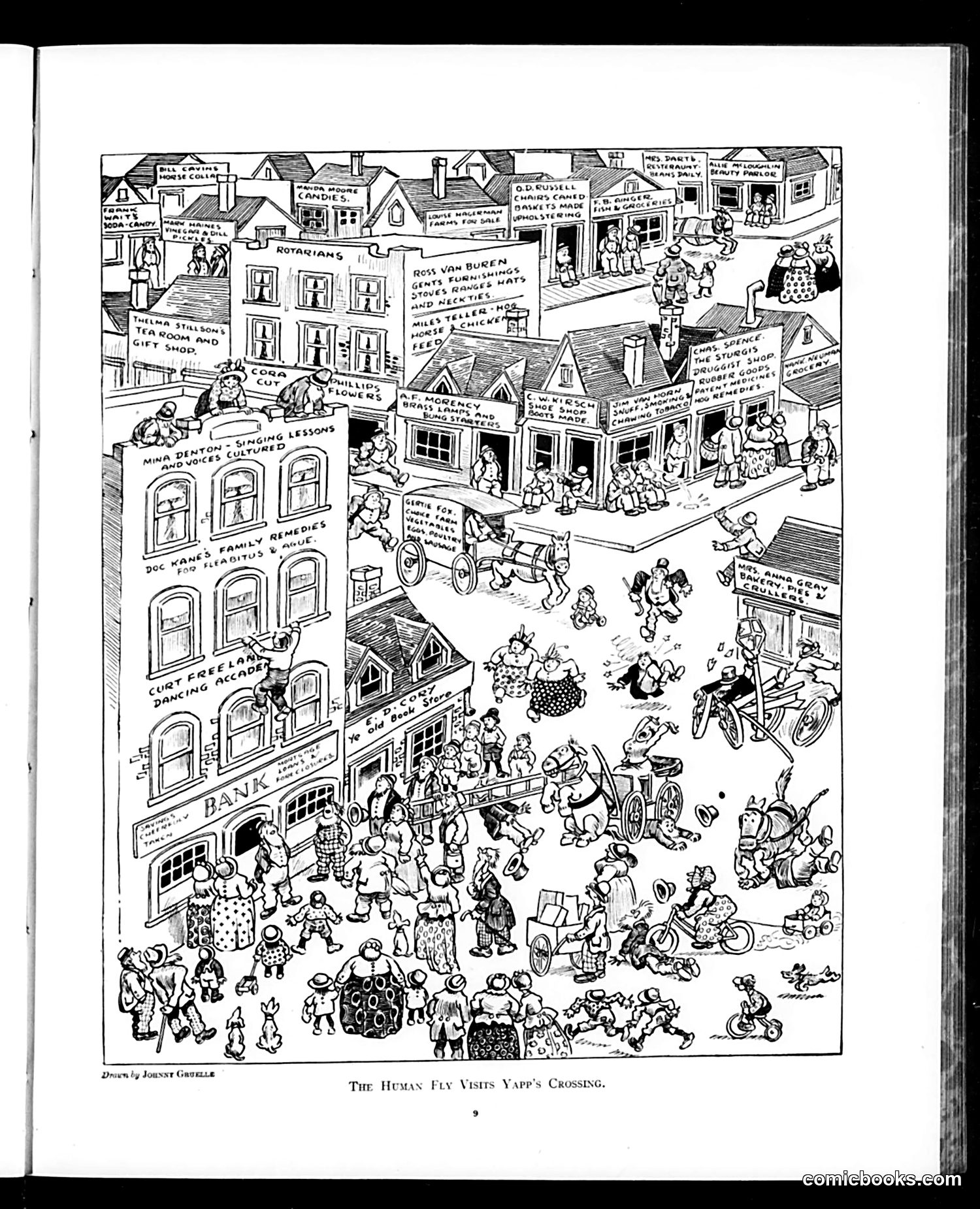
This is a densely detailed satirical illustration by Johnny Gruelle titled "The Human Fly Visits Yapp's Crossing." The cartoon depicts a bustling small-town street scene populated with numerous figures and labeled storefronts. The labels identify various local businesses and residents—a bank, doctor's office, rotarians club, candies shop, and numerous named individuals—suggesting this represents a specific community, likely satirizing small-town American life and its cast of recognizable characters. The "human fly" reference appears to be a fantastical element observing this ordinary streetscape. The cartoon's humor derives from the dense, chaotic arrangement of townspeople engaged in everyday activities, creating a "Where's Waldo"-style composition that mocks the interconnected social dynamics and commercial life of a typical American town during this era.
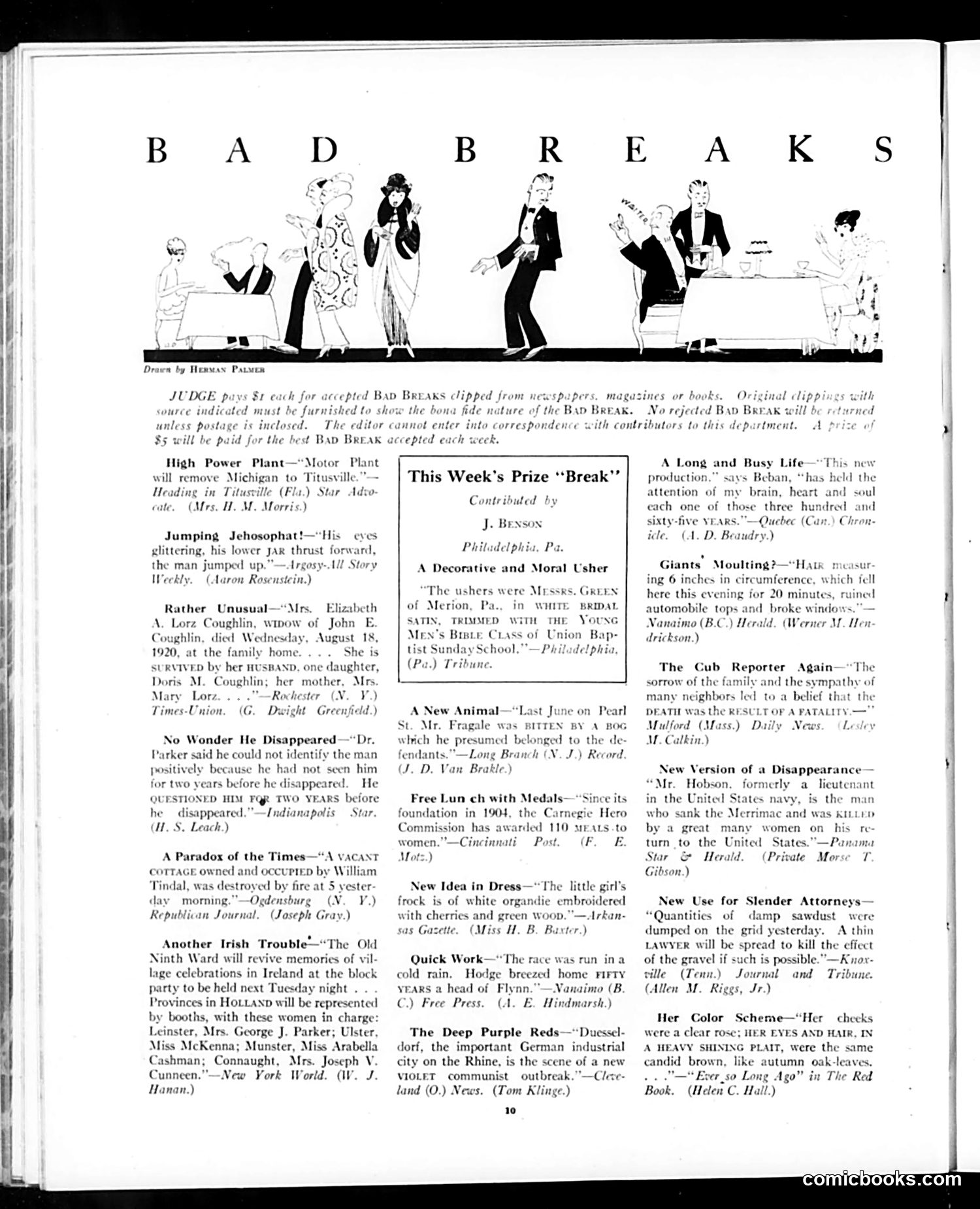
This page features Judge magazine's recurring "Bad Breaks" humor column, which satirizes absurd newspaper headlines and poorly-written journalism. The cartoons at the top show various mishaps and embarrassments—people caught in awkward, undignified situations. The column's joke is exposing unintentionally funny or contradictory newspaper clippings submitted by readers. Examples include: - A doctor who questioned a man for two years, then claimed he didn't know him when the man disappeared - A "vacant cottage" that was occupied when it burned down - A race run in "cold rain" where someone finished "fifty years ahead" - An usher in white satin at a Baptist wedding (unclear significance today) The satire targets journalism's carelessness—confusing headlines, logical impossibilities, and poor editing that create unintended comedy. Readers competed for a $5 prize by finding the week's best "break." This was lighthearted media criticism for an educated audience accustomed to print journalism's quirks.
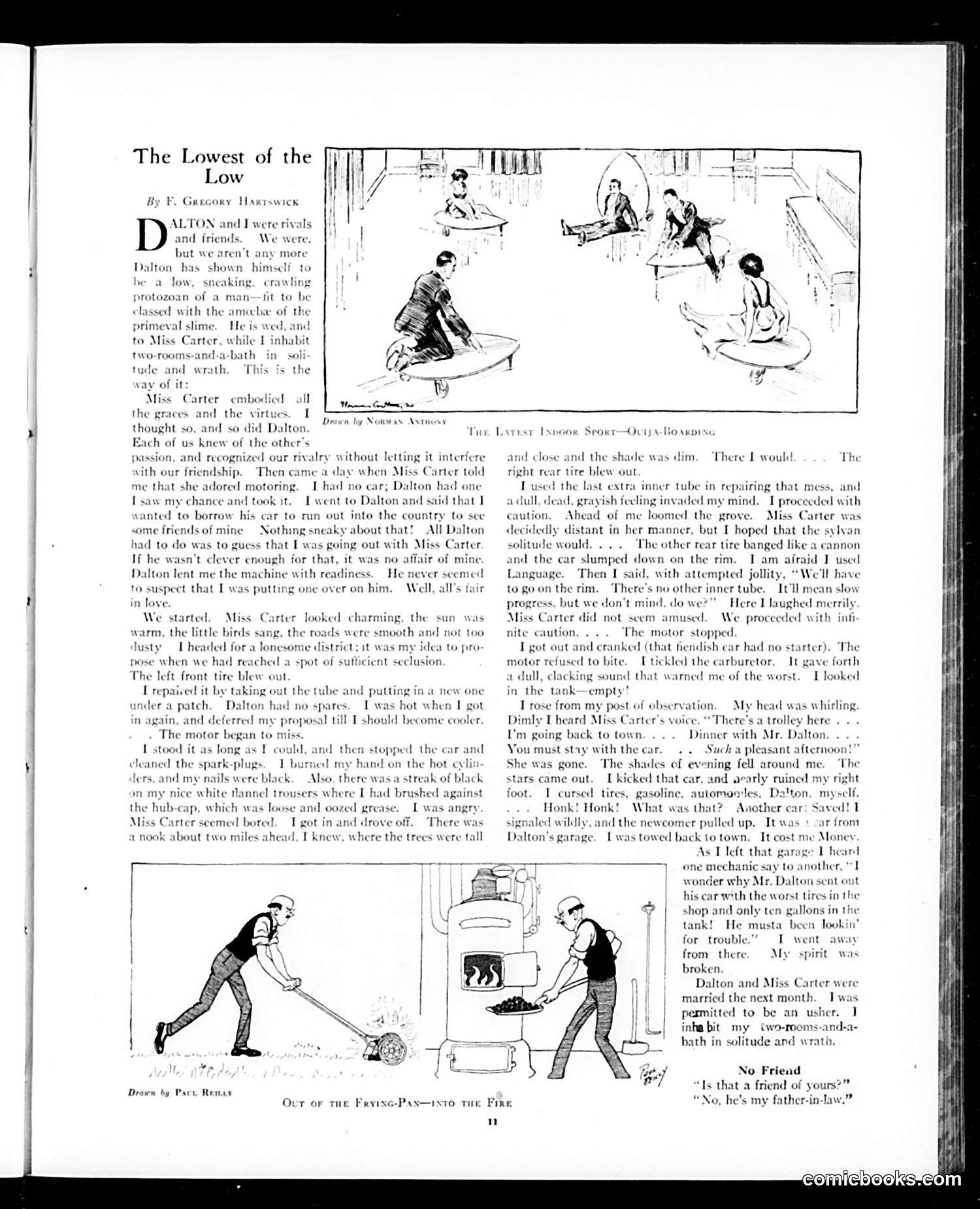
This is a humorous short story (not political satire) about romantic rivalry and comeuppance. The narrator and his rival Dalton both court Miss Carter. The narrator borrows Dalton's car to impress her, viewing this as clever romantic competition ("all's fair in love"). However, the outing becomes a disaster: the car suffers multiple flat tires, engine trouble, and breakdowns. Miss Carter abandons him for dinner with Dalton. The narrator must be towed back to town at considerable expense. The joke's ironic twist: mechanics mention Dalton sent the car with "the worst tires in the shop and only ten gallons in the tank"—suggesting Dalton deliberately sabotaged it, turning the narrator's own sneaky tactics against him. The title "The Lowest of the Low" refers to the narrator's moral descent into deception, which backfires spectacularly. The illustrations show the indoor sport of "sky-boarding" (surfing on tables) and the car troubles.
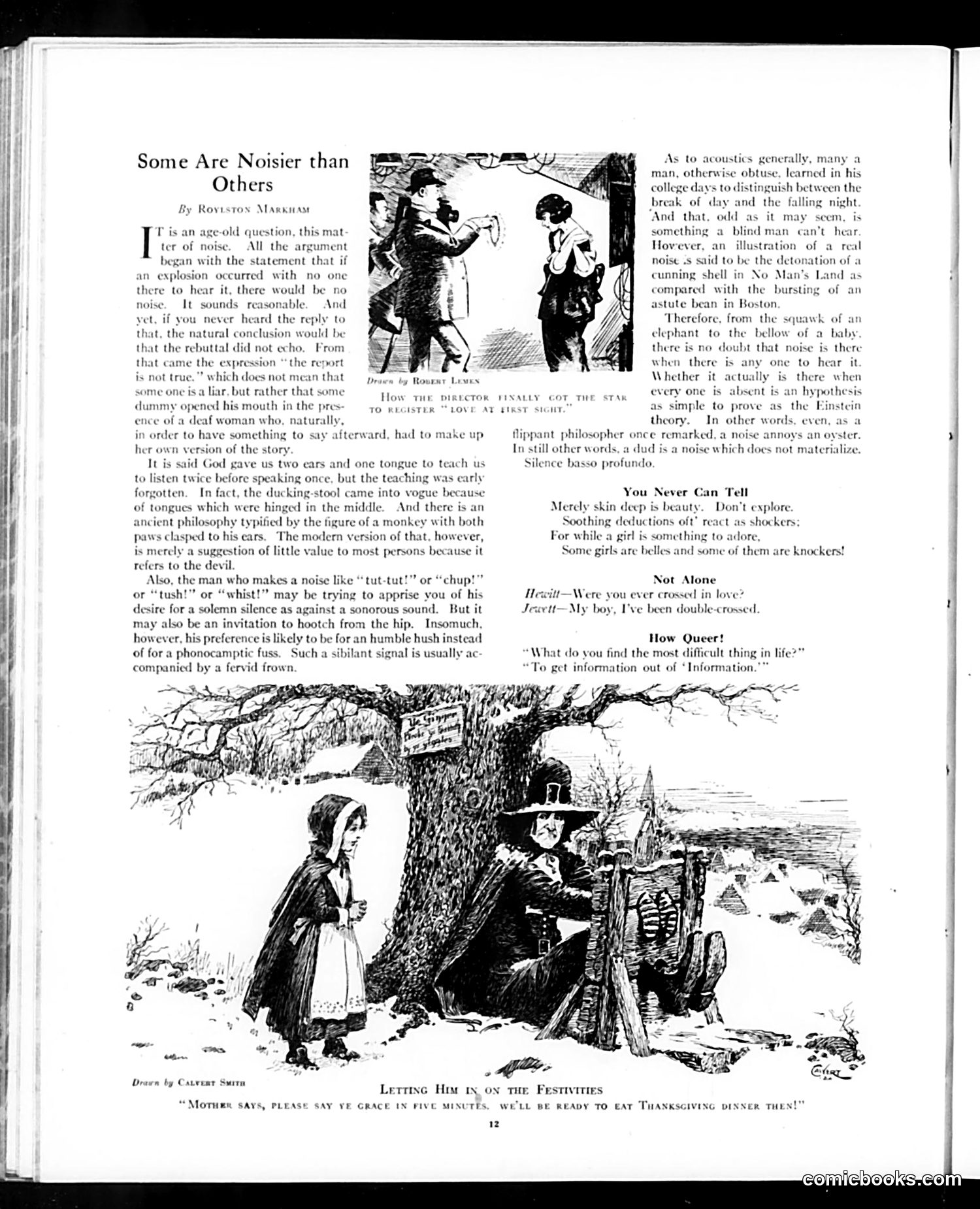
This page from the satirical magazine *Judge* contains several distinct pieces: **Main Article "Some Are Noisier than Others"** by Royston Markham is a philosophical humor piece about noise and perception—playing on the old question of whether sound exists without an observer. It's lighthearted wordplay rather than political satire. **The Cartoons:** The upper illustration shows two people in what appears to be a romantic or theatrical scene, captioned about a director finally achieving "love at first sight"—likely mocking melodramatic theater or romance conventions. The lower cartoon by Calvert Smith depicts a skeleton (Death) sitting under a tree while a woman approaches, with the caption "Mother says, please say ye grace in five minutes. We'll be ready to eat Thanksgiving dinner then!" This is dark humor personifying Death as a dinner guest—a memento mori joke playing on Thanksgiving's theme of gratitude for life. **The Short Jokes** below satirize shallow observations about beauty, romance, and bureaucratic frustration—typical light satirical filler for the magazine. The page contains no obvious political commentary, focusing instead on social satire and absurdist humor typical of early 20th-century American comedy magazines.
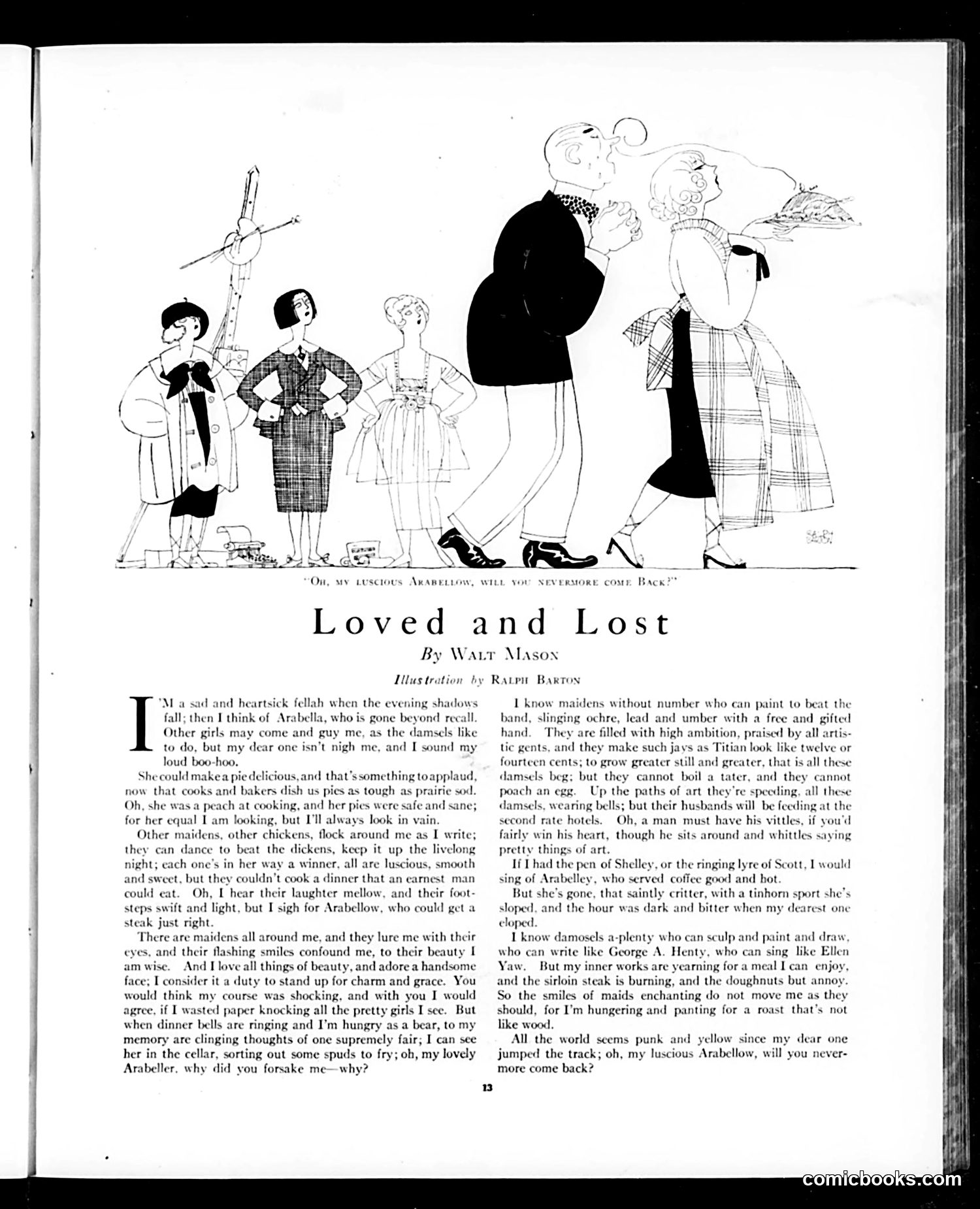
This piece satirizes early 20th-century anxieties about women's changing roles. The narrator laments his lost love, Arabella, contrasting her practical domestic skills (cooking, pie-making) with the "modern" women now pursuing him. The satire targets contemporary women's ambitions in art, music, and intellectual pursuits—painting, singing, writing like "George A. Henty" or "Ellen Yaw" (likely a reference to opera singer Ellen Beach Yaw). The joke is that these accomplished women neglect domestic duties. The poem mocks both the narrator's excessive sentimentality and contemporary complaints that educated, ambitious women made poor homemakers. The illustration shows fashionably dressed women in various poses, reinforcing the theme of modern femininity detached from traditional domesticity. The satire reflects Judge magazine's conservative stance: women pursuing "high art" and independence were abandoning their "natural" roles as cooks and wives—a common refrain in early 1900s American satire.
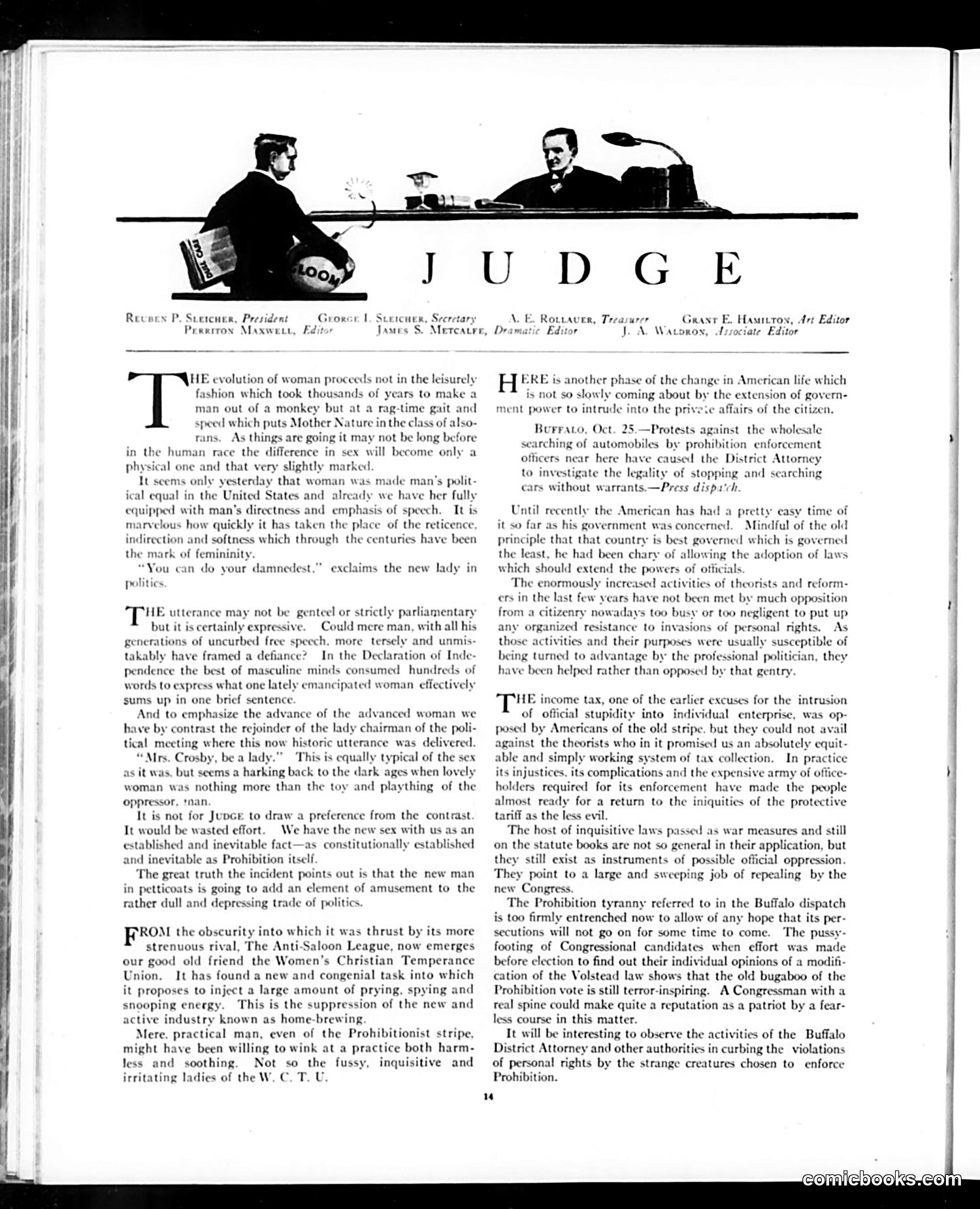
This editorial page satirizes the rapid social changes affecting American women and their newfound political power, circa 1920s (post-suffrage). **The Main Cartoon** (top): Shows a judge presiding over a courtroom—visual metaphor for Judge magazine's role as arbiter of social commentary. **Key Satire Targets:** 1. **"New Woman" in Politics**: The article mocks how quickly women have adopted aggressive masculine speech and directness in politics, contrasting a woman's crude declaration ("You can do your damnedest") with an older woman's plea to "be a lady"—suggesting women are abandoning traditional femininity. 2. **Prohibition Enforcement**: The editorial criticizes how Prohibition enforcement (and the Women's Christian Temperance Union) represents intrusive government power violating citizens' privacy—police searching automobiles without warrants. 3. **Government Overreach**: The piece argues that expanded official power threatens traditional American values of limited government, using women activists and reformers as examples of this disturbing trend. The satire is fundamentally conservative, expressing anxiety about rapid social change, women's political voice, and regulatory expansion.
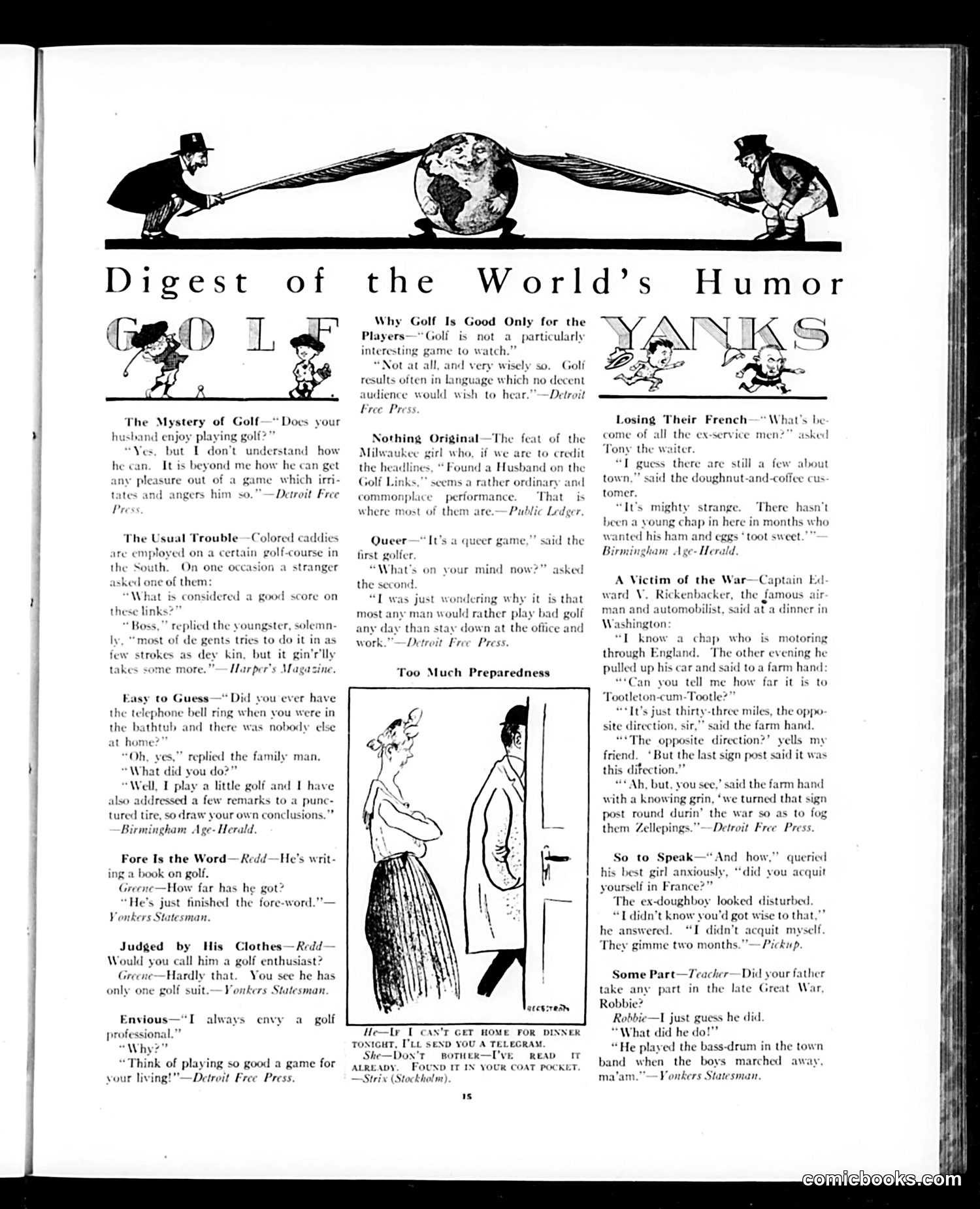
This is a humor digest page featuring golf jokes and post-WWI social commentary. The jokes mock golf as a frustrating, anger-inducing game that spectators avoid—a common American attitude toward the sport in the early 20th century. The racial humor reflects the era's casual racism: a joke about Black caddies in the South includes dialect stereotyping ("dey kin," "gin'r'lly"). Several pieces reference World War I's recent conclusion. "A Victim of the War" describes a motorist confused by British signposts deliberately turned around during wartime to confuse German aircraft. "Some Part" jokes that a father's war contribution was playing bass drum in a town band—implying non-combat roles were common or lesser. The "ex-doughboy" reference indicates these WWI veterans were still fresh in public consciousness, recently returned and adjusting to civilian life. "Too Much Preparedness" satirizes wives who anticipate husbands' excuses before they're even made—a domestic comedy trope about predictability in marriage.
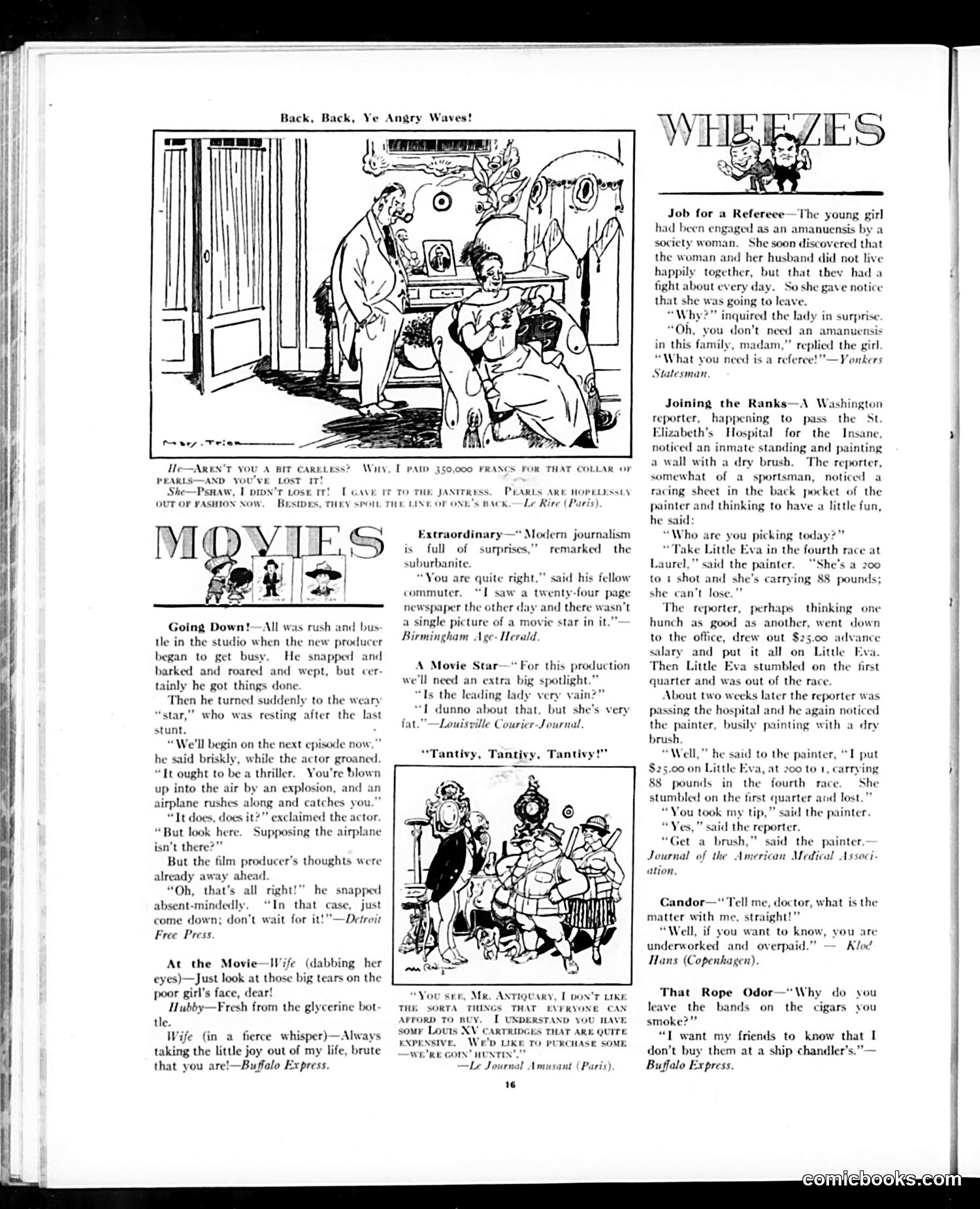
This page contains several brief satirical pieces and cartoons mocking early 20th-century social pretensions and film industry absurdities. **"Back, Back, Ye Angry Waves!"** depicts a woman distressed over losing expensive pearls, dismissing the loss because they're "out of fashion." The satire targets wealthy women's frivolous materialism and contradictory values—caring enough to panic yet caring so little about fashion that a 350,000-franc collar becomes disposable. **Movie-industry jokes** mock both filmmaking's dangerous improvisation (an actor questioned whether the safety plane would actually catch him) and actresses' vanity. One quip notes modern journalism contains pictures of movie stars—implying this is shamefully predictable; another mocks how productions need oversized spotlights for vain, heavyset actresses. **"Joining the Ranks"** satirizes asylum patients' mental instability by showing a painter giving racing tips. When his tip fails, the reporter becomes institutionalized—suggesting that following an insane person's advice proves one's own madness. These reflect Judge's characteristic humor: mocking consumerism, entertainment culture's superficiality, and human folly through brief, pointed anecdotes.
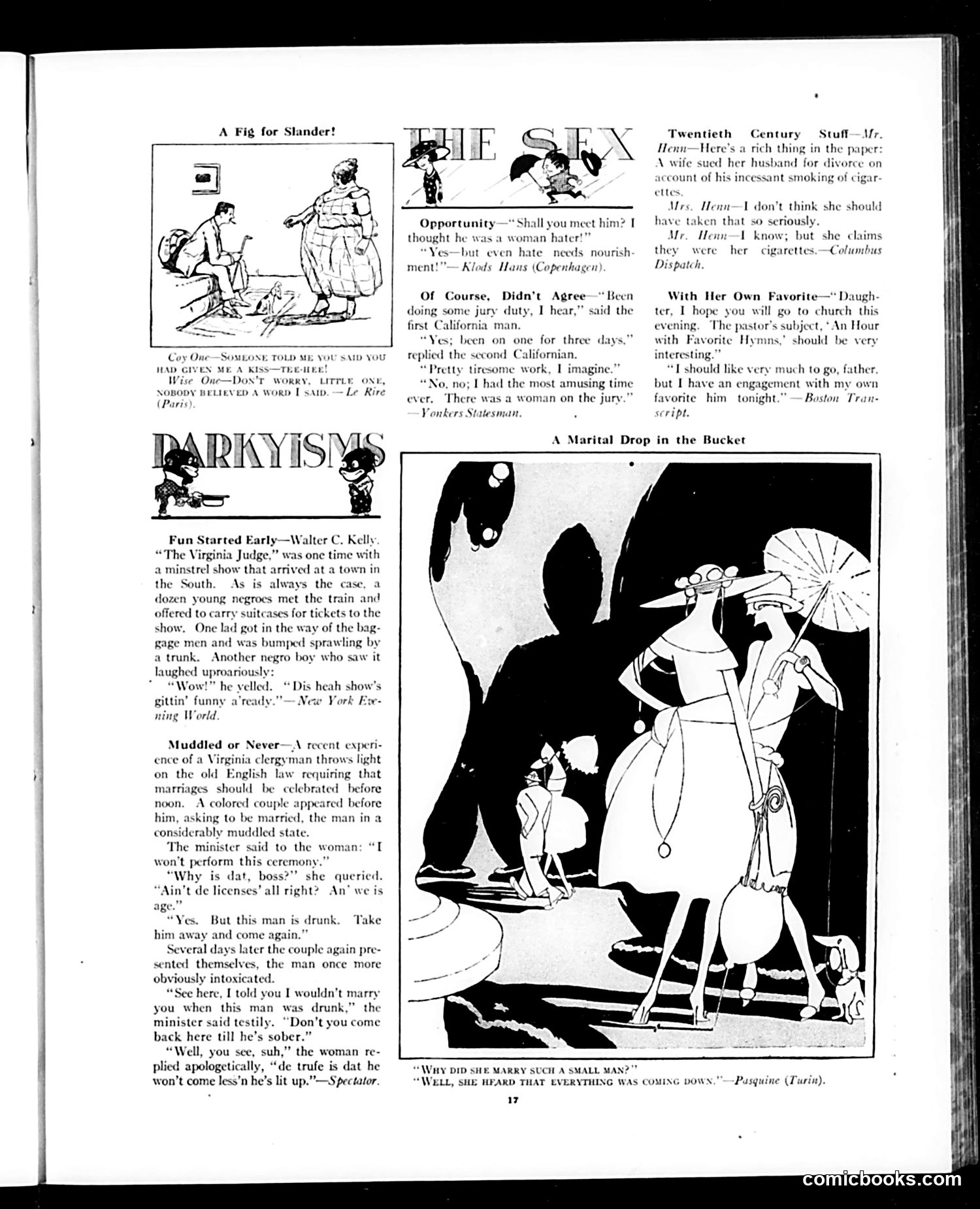
This page contains several brief satirical pieces typical of *Judge* magazine's humor: **"A Fig for Slander"** mocks gossip—a man reassures a woman that nobody believed the rumor someone spread about them kissing. **The minstrel show anecdote** records a racist joke about Black workers at a traveling show, reflecting the era's casual acceptance of demeaning stereotypes and dialect humor. **"Opportunity"** plays on the idea that even hatred requires emotional sustenance. **The jury duty and cigarette pieces** are light domestic humor about marital disagreements. **The main cartoon, "A Marital Drop in the Bucket,"** depicts a woman marrying a short man because she heard "everything was coming down"—a pun on economic decline (likely the Depression era). The satire suggests women marry men for practical/financial reasons rather than love. These pieces reflect early 20th-century attitudes: casual racism, cynicism about marriage, and economic anxiety presented as comedic material.
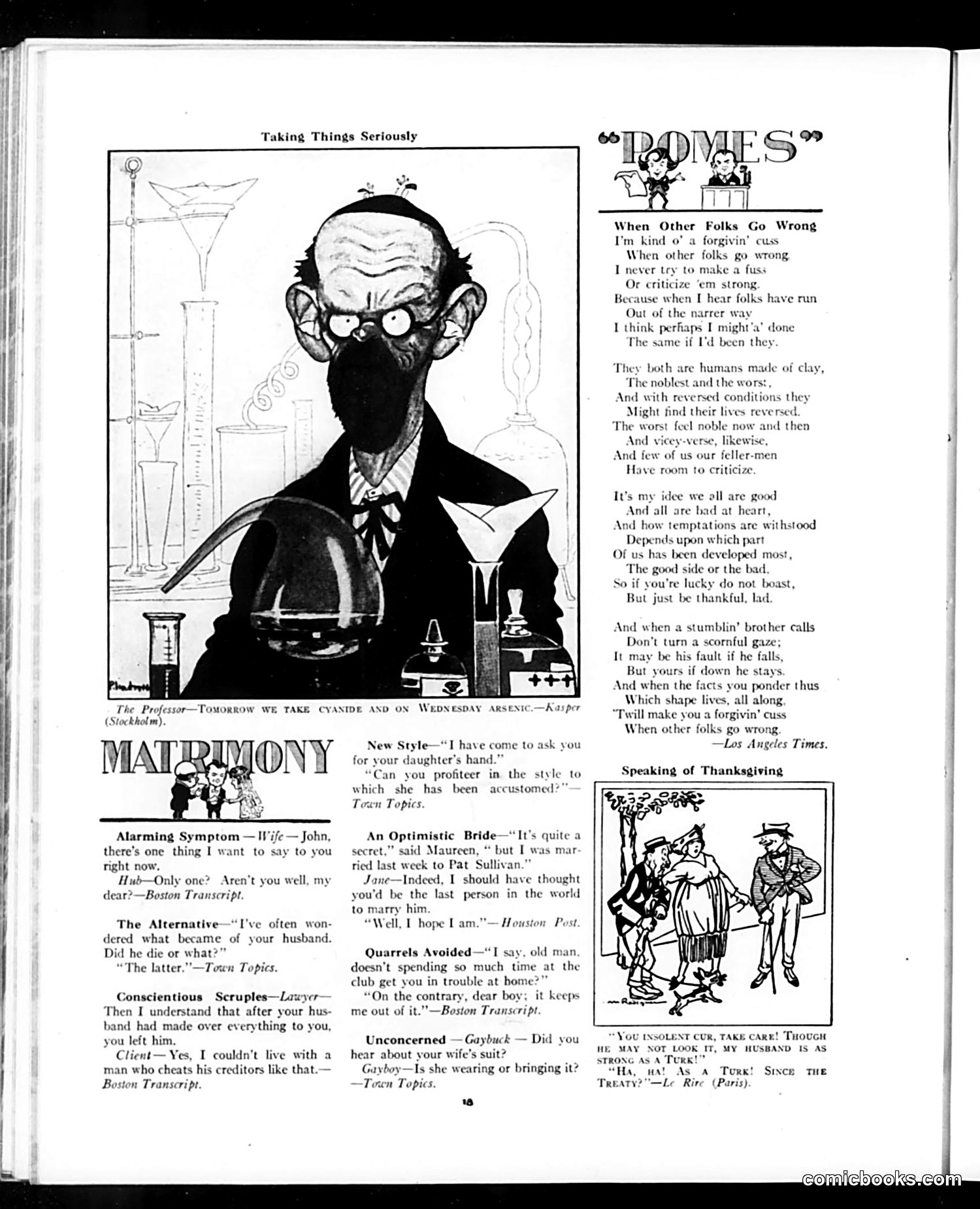
This page contains several short humor pieces typical of early 20th-century satirical magazines, plus two cartoons. **"Taking Things Seriously"** (top): A caricatured professor appears to discuss toxic chemicals (cyanide, arsenic) in what seems a darkly humorous academic context. **"Matrimony" section**: Brief joke exchanges about marriage, infidelity, and financial concerns—standard marital comedy of the era. **"Dames" poem**: A moralistic verse counseling forgiveness toward others' failings, emphasizing that all humans contain both good and bad impulses. **"Speaking of Thanksgiving" cartoon** (bottom right): A woman defends her husband against an insulting man by boasting of his strength "as a Turk." The punchline references post-WWI Turkish political status, likely mocking either Ottoman decline or contemporary Turkish-European relations. The overall page reflects typical Judge content: domestic humor, mild social satire, and topical political references accessible to educated American readers of the period.
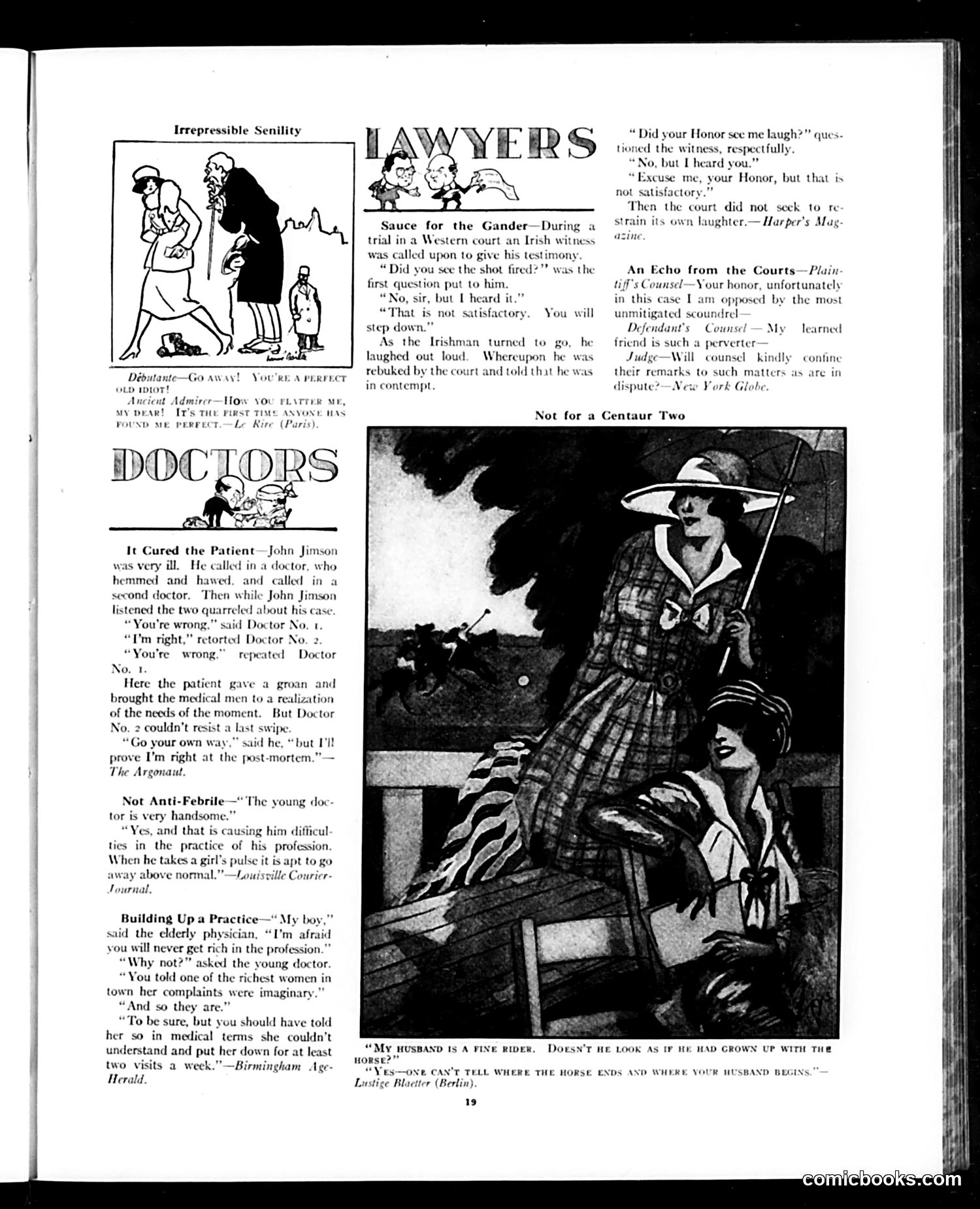
This page collects brief humorous anecdotes mocking professional incompetence and human folly across different fields. **"Irrepressible Senility"** and **"Sauce for the Gander"** both ridicule courtroom absurdity: an Irish witness is dismissed for answering reasonably ("I heard it"), then the judge himself laughs and commits the very contempt he punished the witness for—hypocrisy exposed. **"Doctors"** section mocks medical pretension: two quarreling physicians ignore their dying patient to argue, one threatening to prove his case "at the post-mortem." Another doctor's handsomeness interferes with practice (patients' pulse rates spike). A third learns that wealthy patients need medical jargon and repeated visits to justify fees—satire of doctors prioritizing profit over health. **"Not for a Centaur Two"** jokes about a woman whose husband is such an accomplished rider he's indistinguishable from his horse—a visual pun about merging identities through obsessive skill. The cartoons target professional vanity, legal incompetence, and social pretense typical of early-20th-century American satire.
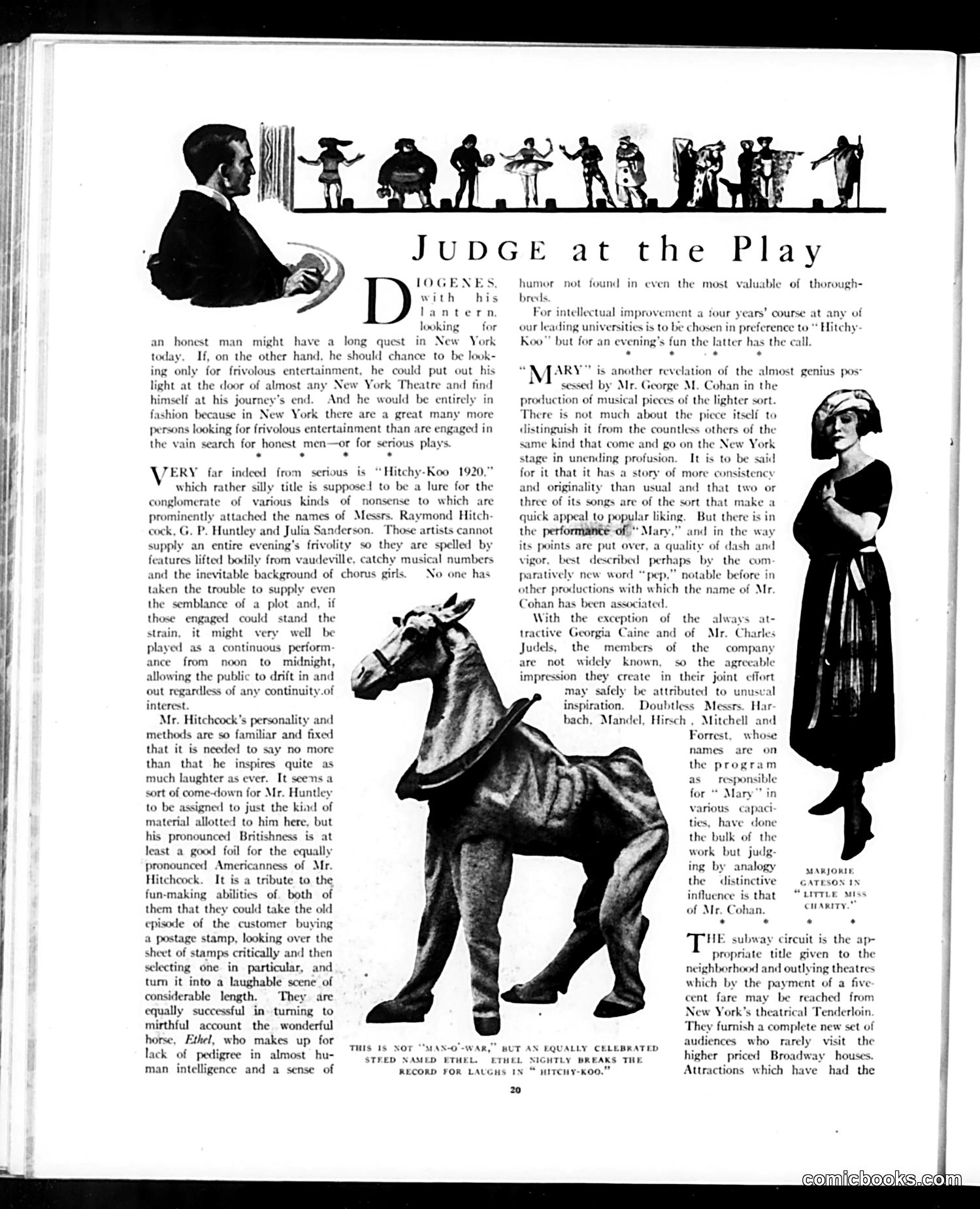
This page is a theater review column titled "Judge at the Play," critiquing Broadway shows. The author uses the classical reference to Diogenes—who searched for an honest man—to satirize New York's preference for frivolous entertainment over serious drama. The column reviews "Hitchy-Koo 1920," a vaudeville-style revue starring comedians Raymond Hitchcock and G. P. Huntley. The reviewer dismisses it as plotless entertainment cobbled together from music, comedy bits, and chorus girls—noting that even a horse named Ethel (pictured) generates laughs despite lack of pedigree, paralleling the show's lack of coherent structure. The second review praises George M. Cohan's "Mary," calling it relatively sophisticated musical theater with "pep" (vigor)—though populated by lesser-known performers whose collective effort creates its appeal. The satire targets both audience taste (preferring entertainment to substance) and the commercial theater's low artistic standards.
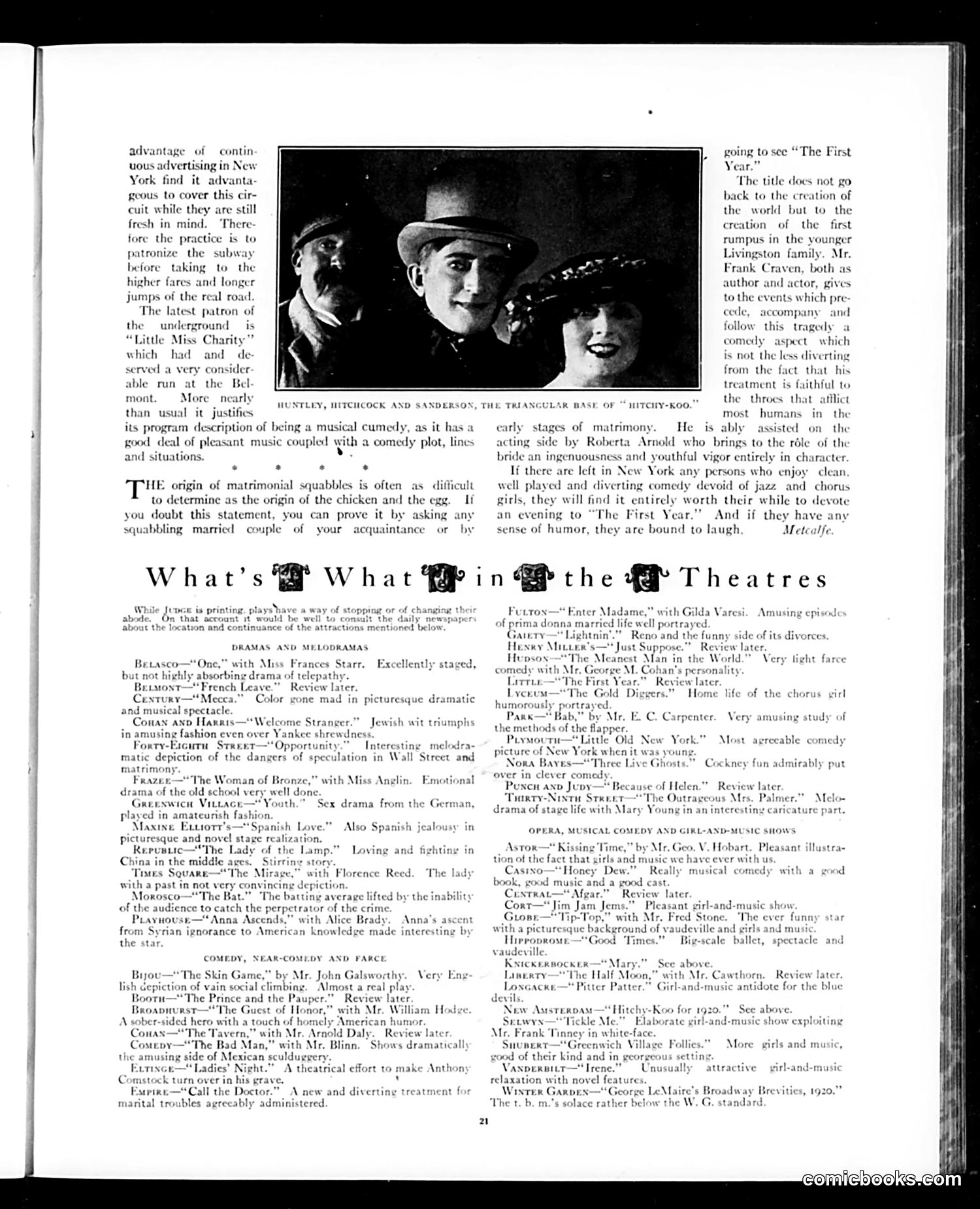
This page is primarily a **theater review section** titled "What's What in the Theatres," listing current Broadway productions with brief critical commentary. The single **photograph at top** shows three men in formal attire and hats, captioned "HUNTLEY, HITCHCOCK AND SANDERSON, THE TRIANGULAR BASE OF 'HITCHY-KOO.'" This appears to reference a musical comedy called "Hitchy-Koo," though the specific satirical point is unclear from the image alone. The reviews themselves are straightforward theatrical criticism—noting which shows are amusing, poorly done, or worth attending. No apparent political satire is present; this is entertainment journalism rather than political cartooning. The page reflects 1920s Broadway offerings, with titles like "The First Year" and "Honey Dew" mentioned prominently.
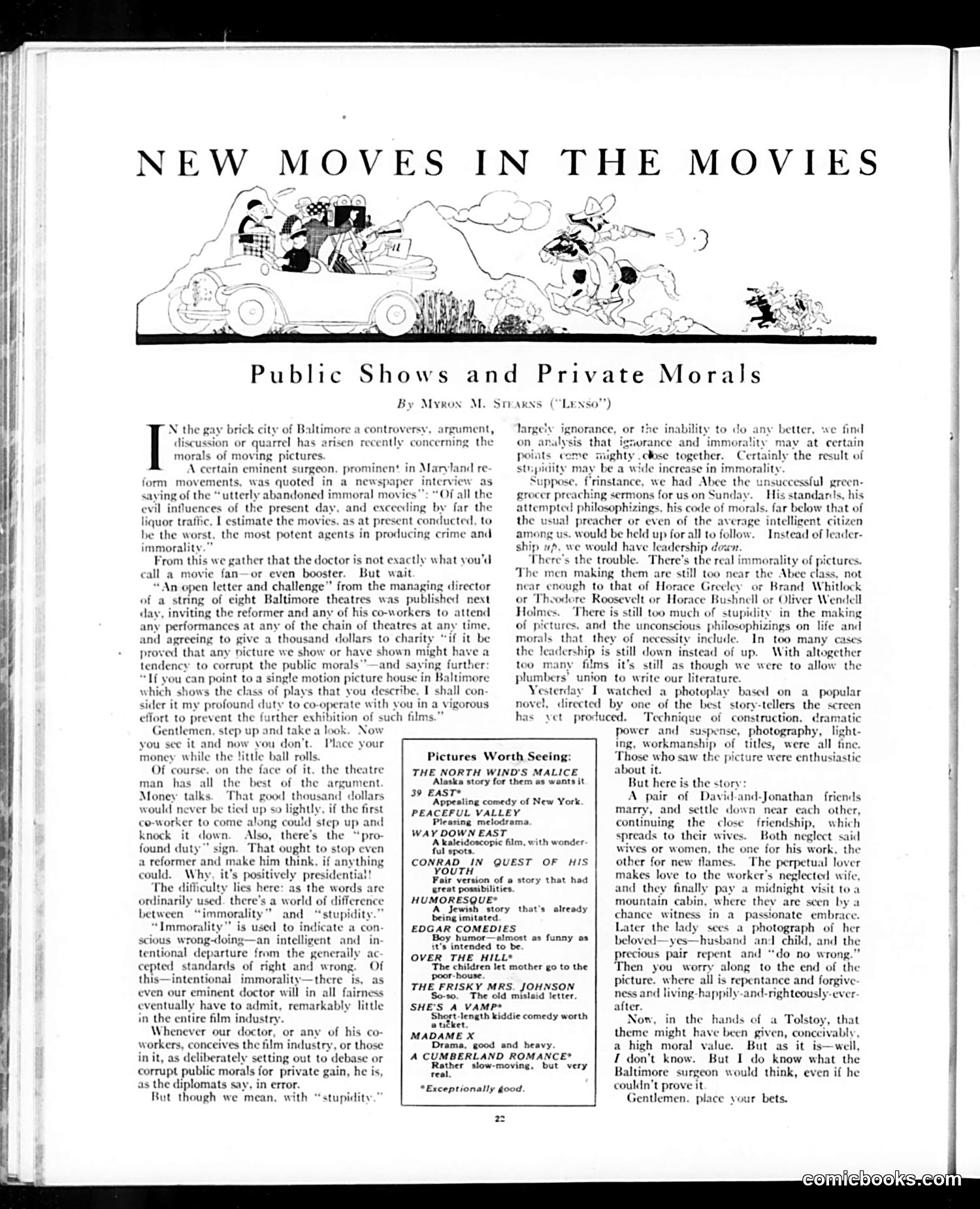
This article criticizes a Baltimore surgeon's claims that movies are immoral influences. The author, Myron M. Stearns, argues the real problem isn't deliberate moral corruption but **stupidity and incompetence** in filmmaking. A theater chain manager challenged the doctor to identify specific "immoral" films, offering $1,000 to charity if he could prove any movie tends to corrupt public morals—a bet the author suggests the doctor won't win. The satire's point: reformers exaggerate movie dangers; most poor filmmaking results from lack of skill, not intentional wickedness. The author distinguishes between "immorality" (conscious wrongdoing for profit) and mere incompetence. He uses the analogy of a failed grocer preaching sermons—bad execution, not evil intent. The sidebar lists contemporary films worth seeing, reinforcing that quality cinema exists and serves legitimate purposes. This reflects 1920s debates over film censorship and moral panic about popular entertainment's influence.
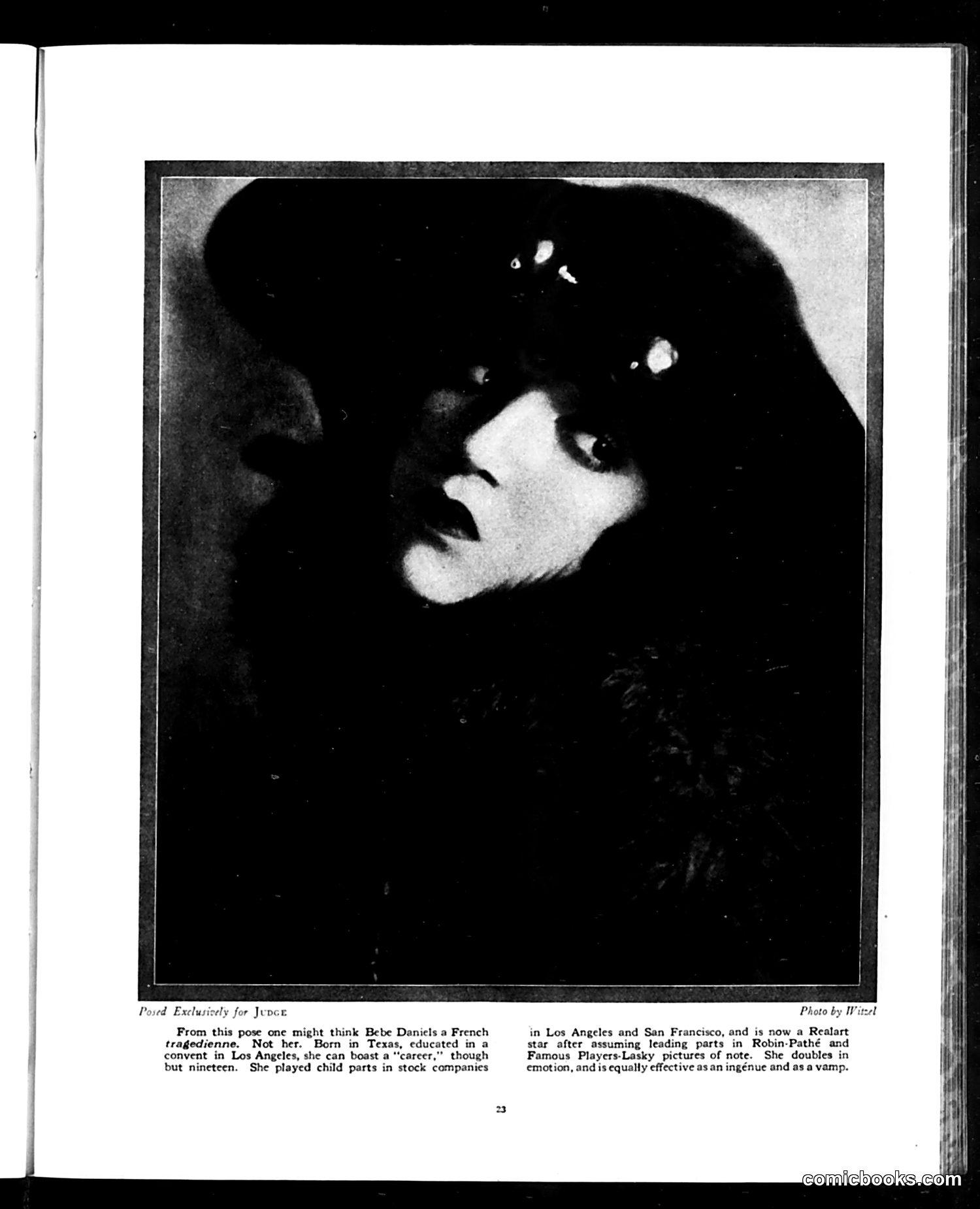
This page features a dramatic profile photograph and biographical sketch of **Bebe Daniels**, a young silent film actress. The satire is gentle: the caption ironically notes that her serious, brooding pose might suggest she's a French tragic actress, but she's actually a Texas-born performer who began in stage stock companies and rose to prominence in major film studios (Robin-Pathé, Famous Players-Lasky, and Realart). The humor lies in the contrast between her pretentious artistic pose and her practical American show-business background. At nineteen, she's already achieved significant "career" success—a point made with slight skepticism (note the quotation marks). The final line—that she's "equally effective as an ingénue and as a vamp"—suggests she's a versatile actress capable of playing diverse roles, a valuable skill in silent film's broad emotional vocabulary.
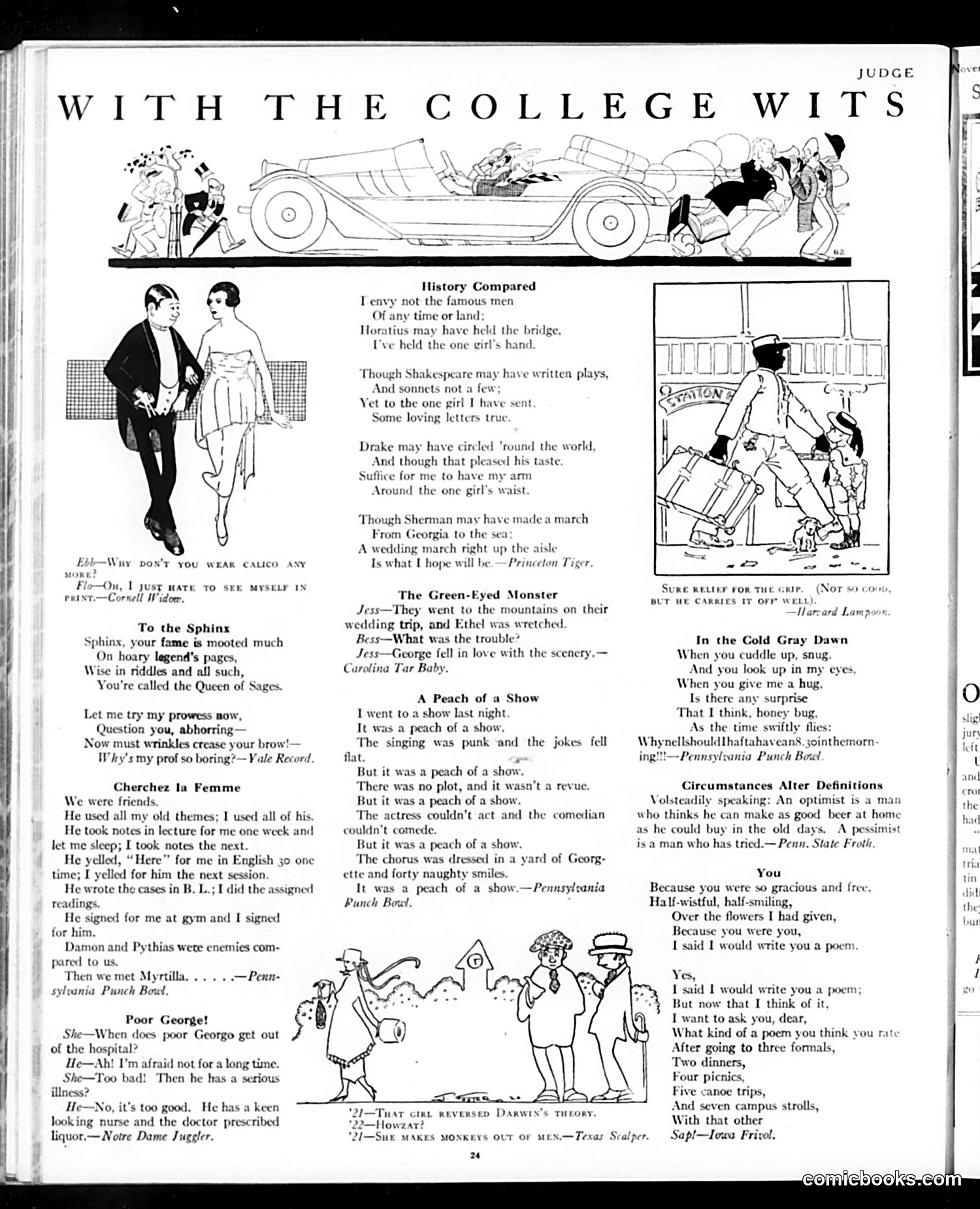
This page collects humorous verse and cartoons from college humor magazines, reprinted in *Judge*. The content satirizes college life and romance circa the 1920s. **Key themes:** - **"History Compared"**: A college man boasts that holding his girlfriend's hand surpasses historical achievements (Horatius holding the bridge, Drake circumnavigating the world, Sherman's march). The joke mocks undergraduate pretension and self-absorption. - **"A Peach of a Show"**: Satirizes theater-goers who overlook a show's complete lack of merit—bad acting, no plot, poor singing—simply because of attractive chorus girls in revealing costumes ("forty naughty smiles"). - **"Cherchez la Femme"** and **"You"**: Mock the transactional nature of college romance, where couples trade favors and expect poetry in exchange for attention. The cartoons and captions target undergraduate vanity, shallow romanticism, and social climbing. The *Judge* reprinting suggests these college magazine pieces were considered noteworthy enough for the national satirical audience.
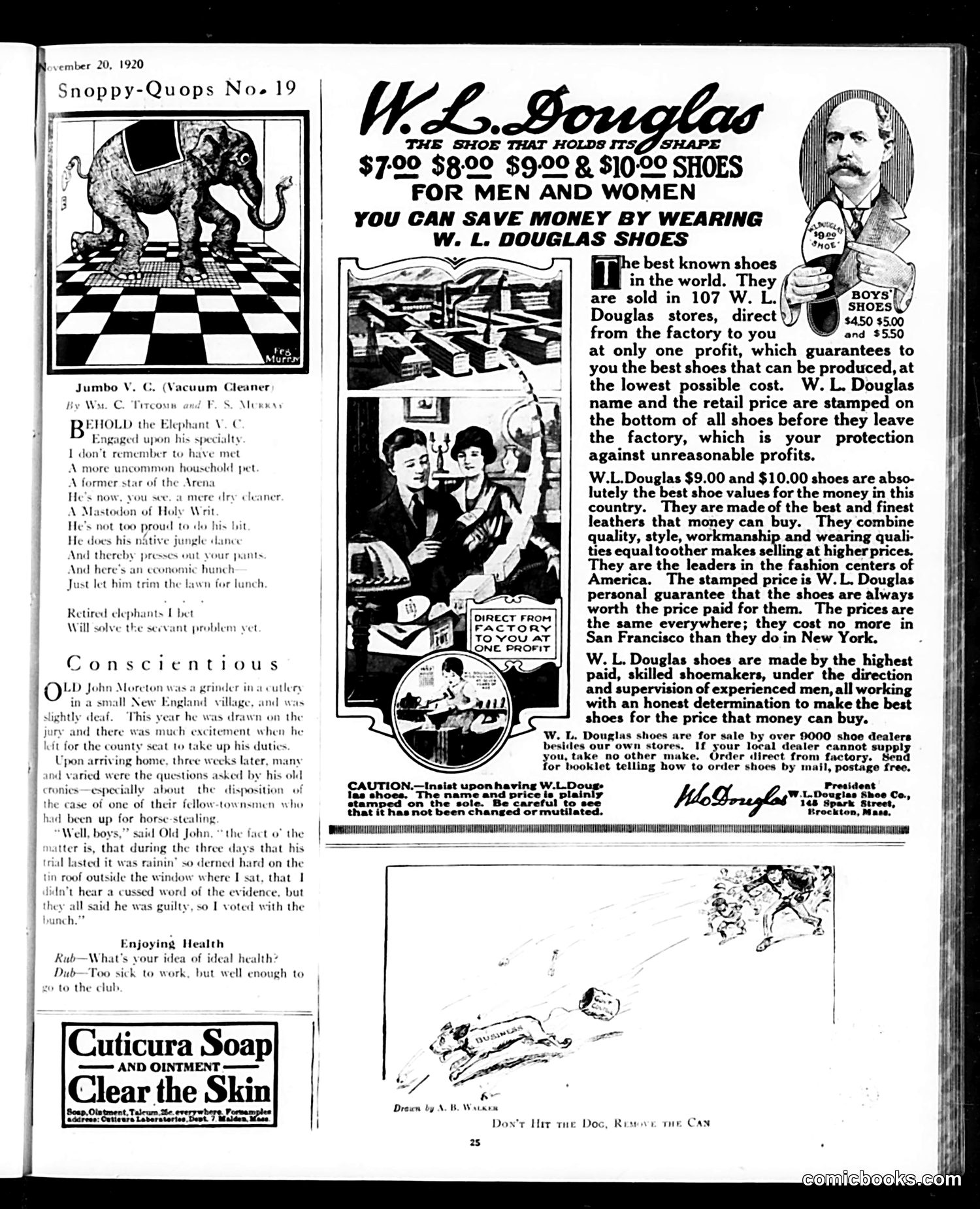
This is a humorous illustrated poem about an elephant repurposed as a household appliance. The cartoon shows an elephant engaged in domestic tasks—vacuuming, cleaning—with the conceit that retired circus elephants could solve the "servant problem" (labor shortage) of the 1920s. The joke plays on the era's anxiety about domestic help availability post-WWI and the absurdity of using an enormous animal for housework. The accompanying story, "Conscientious," recounts a deaf juror who couldn't hear trial evidence due to rain on a tin roof, so simply voted with the majority—a joke about careless civic duty. The page is primarily an advertisement for W.L. Douglas shoes ($7-$10), which dominated the lower half. The ads emphasize factory-direct pricing and quality control as consumer protections against "unreasonable profits."
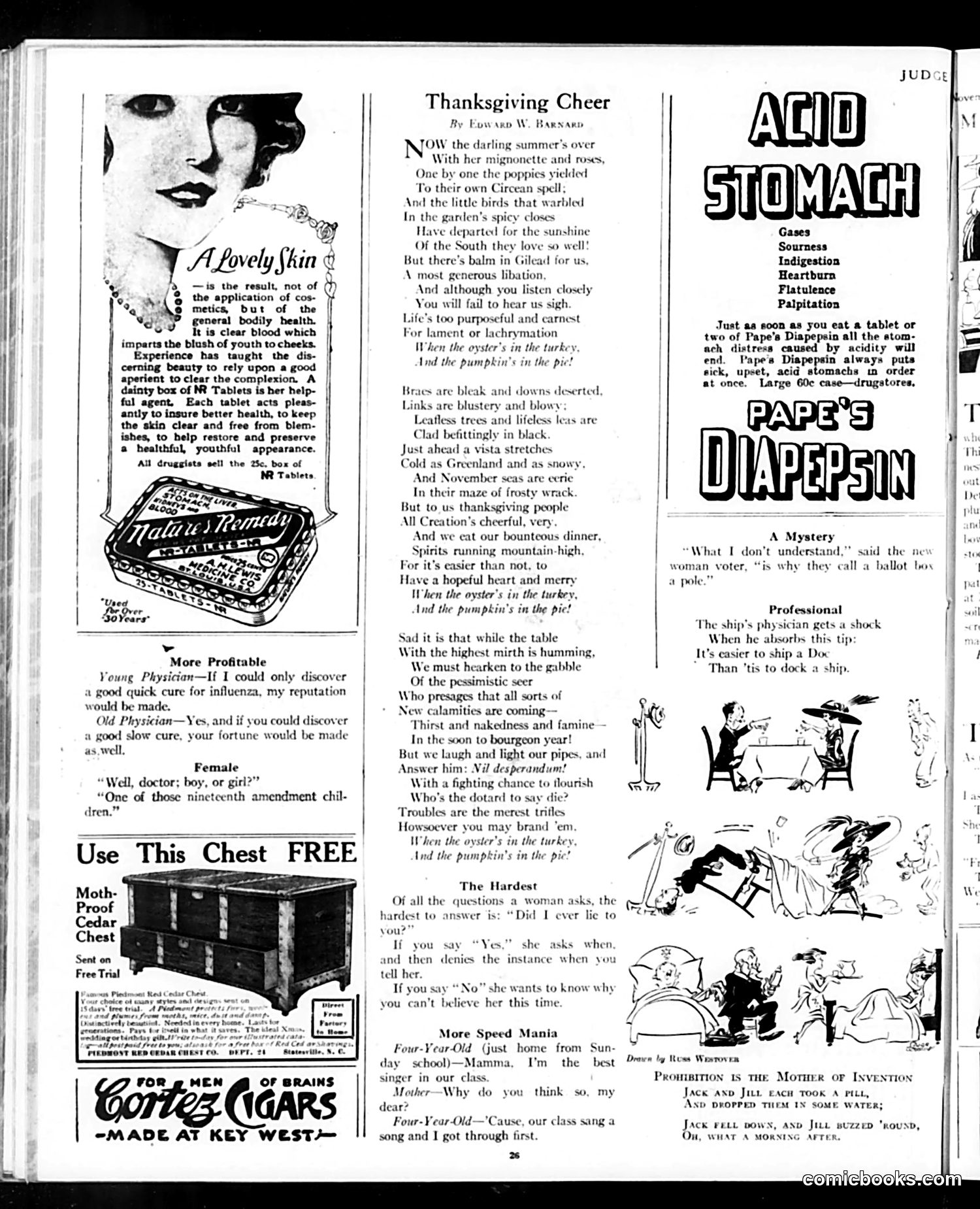
This page from Judge magazine contains mostly **advertisements and light humor pieces** rather than political satire. **Main content includes:** 1. **"A Lovely Skin"** advertisement for Mt. Tablets—promoting a laxative as a beauty product, reflecting early 20th-century patent medicine marketing. 2. **"Thanksgiving Cheer"** poem by Edward W. Barnard—nostalgic verse celebrating autumn and holiday dinner despite economic pessimism ("thirst and nakedness and famine"). 3. **Various brief jokes**, including one referencing the "nineteenth amendment children"—a sarcastic dig at women's suffrage (19th Amendment, ratified 1920), suggesting children born to newly empowered female voters. 4. **"Pape's Diapepsin"** advertisement—antacid promotion typical of the era. 5. **Small cartoons and quips** about doctors, ships' physicians, and a confused female voter questioning ballot terminology. The page reflects **1920s consumer culture and mild social commentary** on women's newfound political rights, without substantive political cartooning.
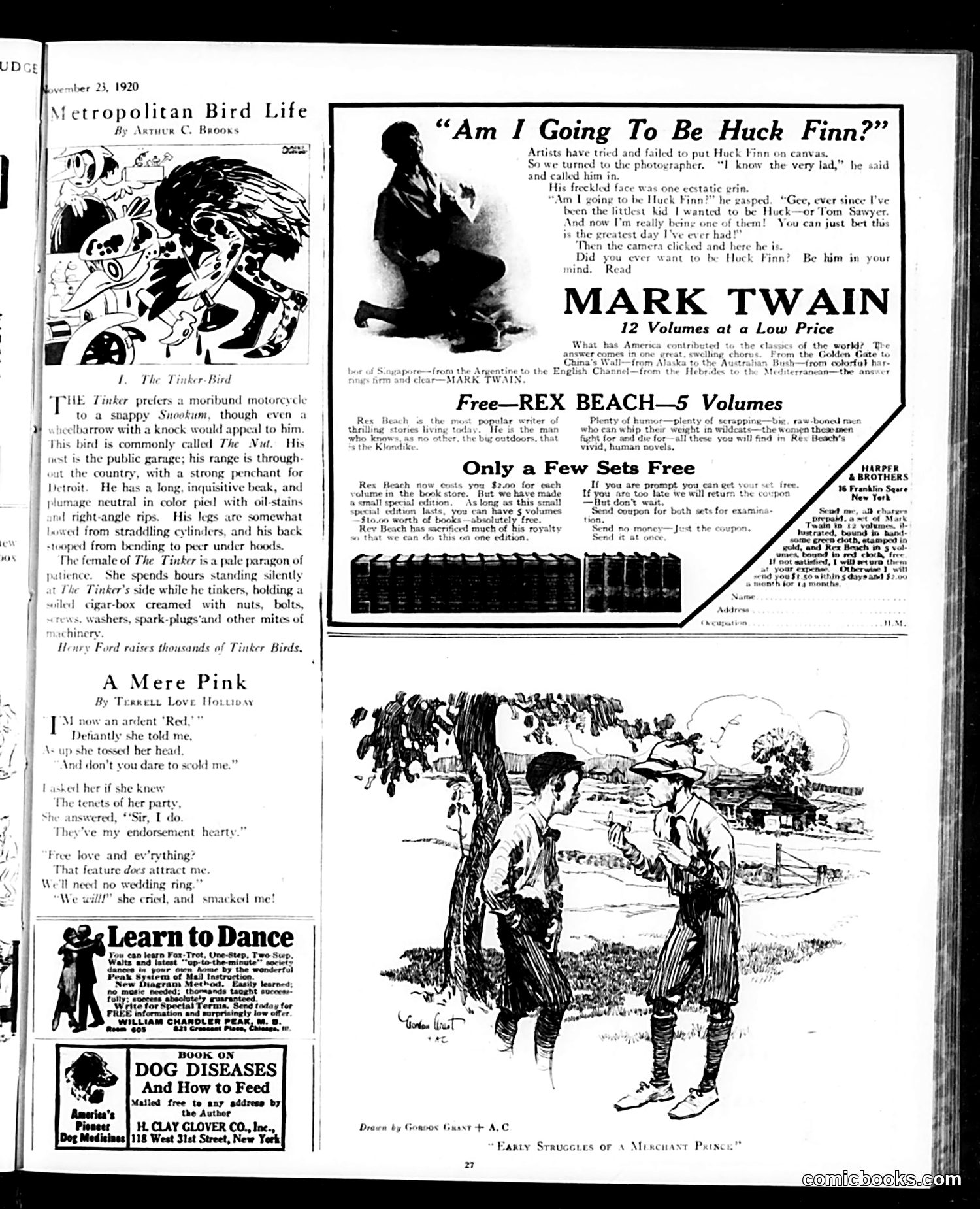
This page combines literary advertising with social commentary typical of 1920 Judge content. **Main Feature:** A advertisement-narrative hybrid titled "Am I Going To Be Huck Finn?" promotes Mark Twain's 12-volume collected works by depicting an excited boy cast to portray Huck Finn for a painter. The piece romanticizes Twain's characters as aspirational American icons—the boy's delight represents nostalgia for boyhood adventure literature. **"A Mere Pink":** A short satirical poem mocking 1920s radical women. The female speaker identifies as a "Red" (communist sympathizer), advocates "free love," and rejects marriage—then impulsively "smacked" the narrator. The satire presents radical women as hypocritical, emotional, and ultimately conventional despite their ideology. **"Metropolitan Bird Life":** Ornithological humor categorizing urban "bird types," including "The Tinker"—a car-obsessed mechanic. This reflects post-WWI American fascination with automobiles and working-class culture. The page reflects 1920 anxieties: nostalgia for pre-modern American virtue, mockery of emerging feminist/radical movements, and celebration of modern technology.
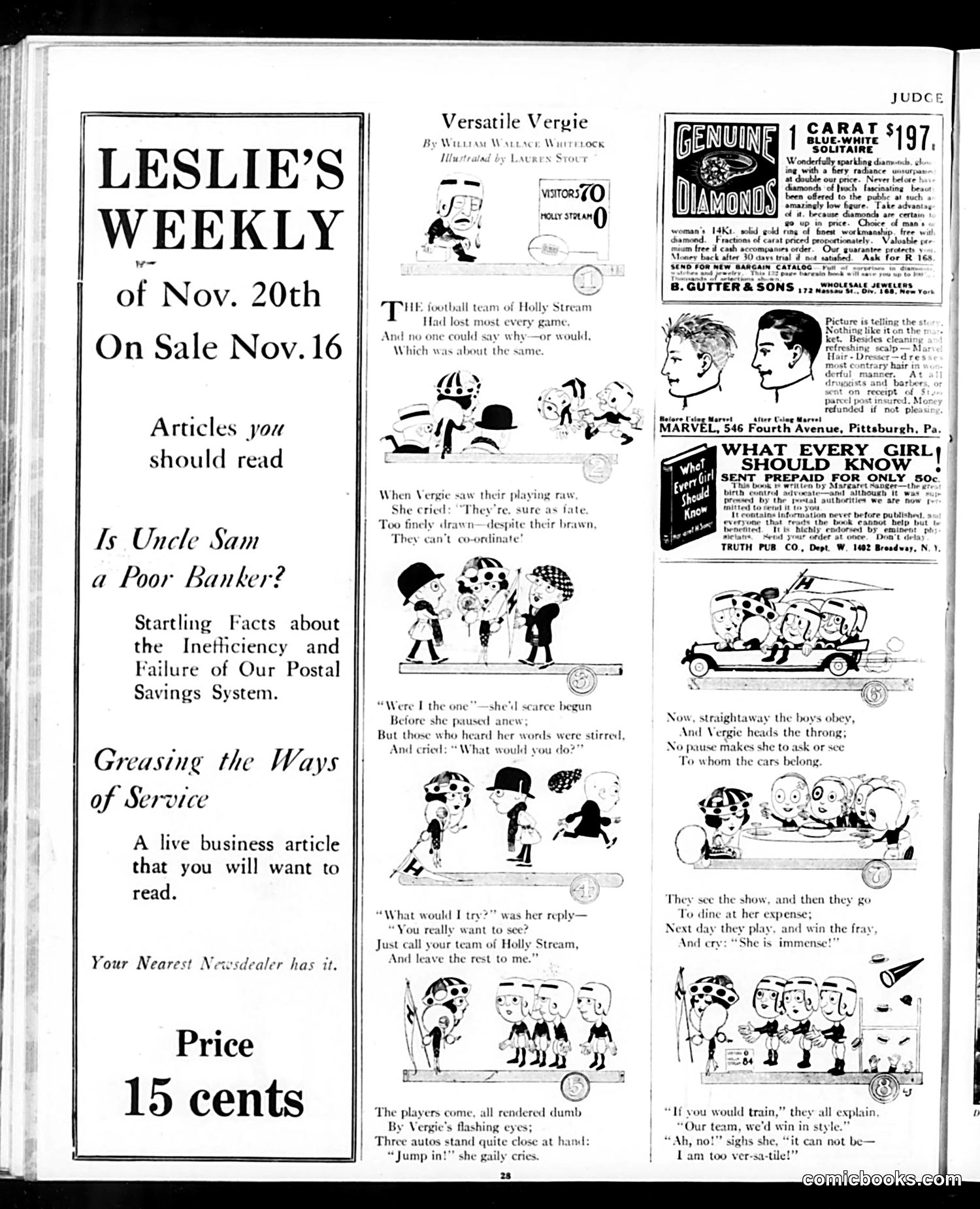
This illustrated story, bylined by William Wallace Whitelock with art by Laurence Stout, is a comic narrative about a woman named Vergie who coaches a losing football team to victory through sheer force of personality. The plot: Holly Stream's football team plays poorly despite physical ability. Vergie diagnoses their problem as lack of coordination and offers to help. She commandeers three automobiles, takes the players to a show, treats them to dinner—all at her expense—and mysteriously inspires them to win their next game. When they credit her training methods and ask her to continue coaching, she declines, saying she's "too versatile" to commit to one task. The humor derives from Vergie's independence, her casual appropriation of automobiles, her willingness to spend money freely, and her flippant refusal of credit. This reflects early 20th-century attitudes about unconventional women—she's simultaneously capable and impulsive, generous and self-centered. The "versatile" punchline suggests she's too restless or scattered to focus on serious work.
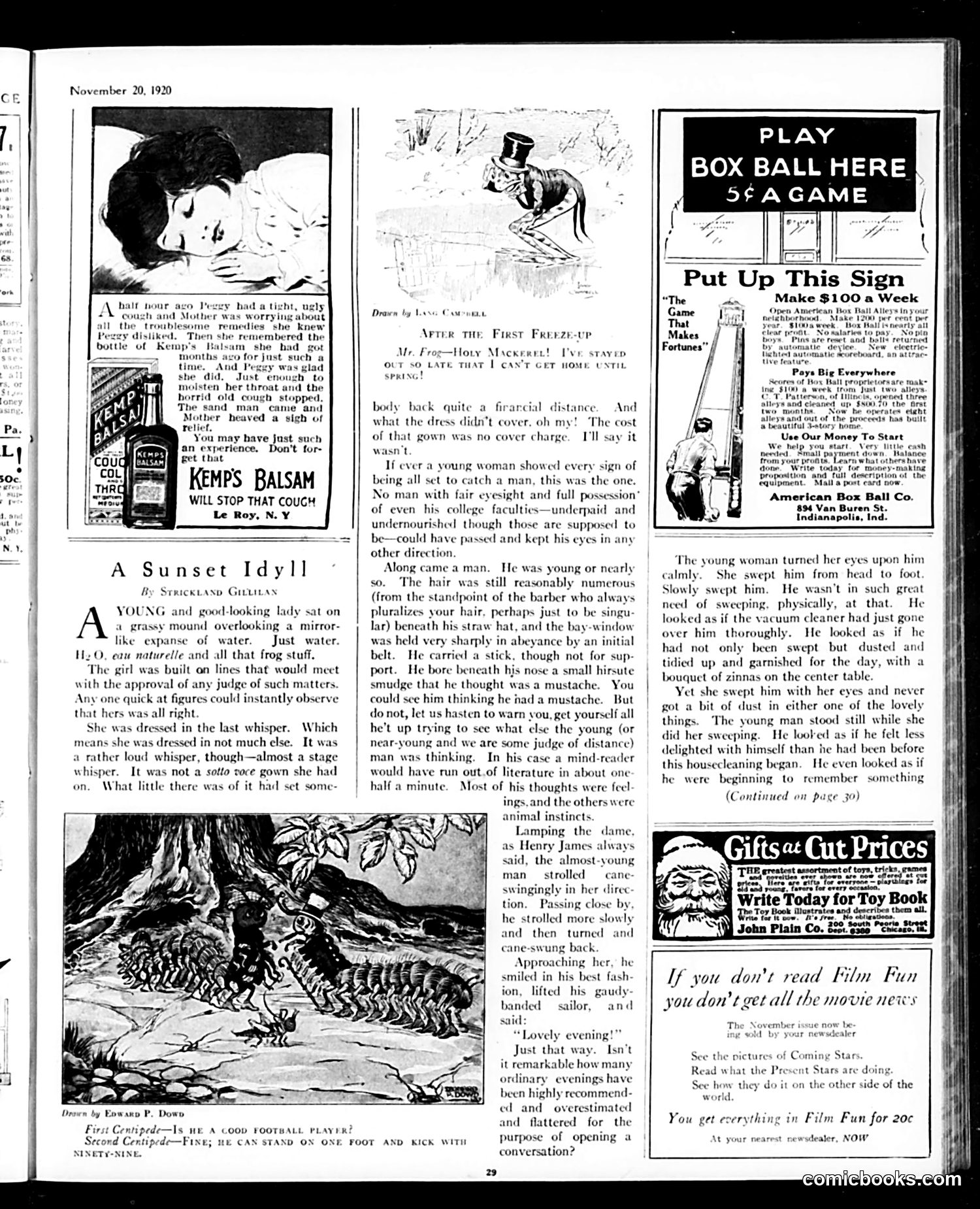
This page contains a romantic short story titled "A Sunset Idyll" by Strickland Gillilan, satirizing courtship rituals of the era. The narrative mocks both a scantily-dressed young woman strategically positioned to attract men and an almost-young man who approaches her with a clichéd opening line ("Lovely evening!"). The satire targets the predictability and superficiality of romantic encounters—the man's shallow thoughts, his affected appearance (fake mustache, styled hair), and his formulaic seduction attempt. The accompanying cartoons—one about a frog frozen out until spring and another about centipedes—are unrelated gag strips typical of Judge's humor format. The page also features period advertisements (Kemp's Balsam cough remedy, a box-ball game business opportunity, and a toy catalog) reflecting 1920s consumer culture. The satire relies on period-specific social codes about courtship, gender presentation, and masculine performance.
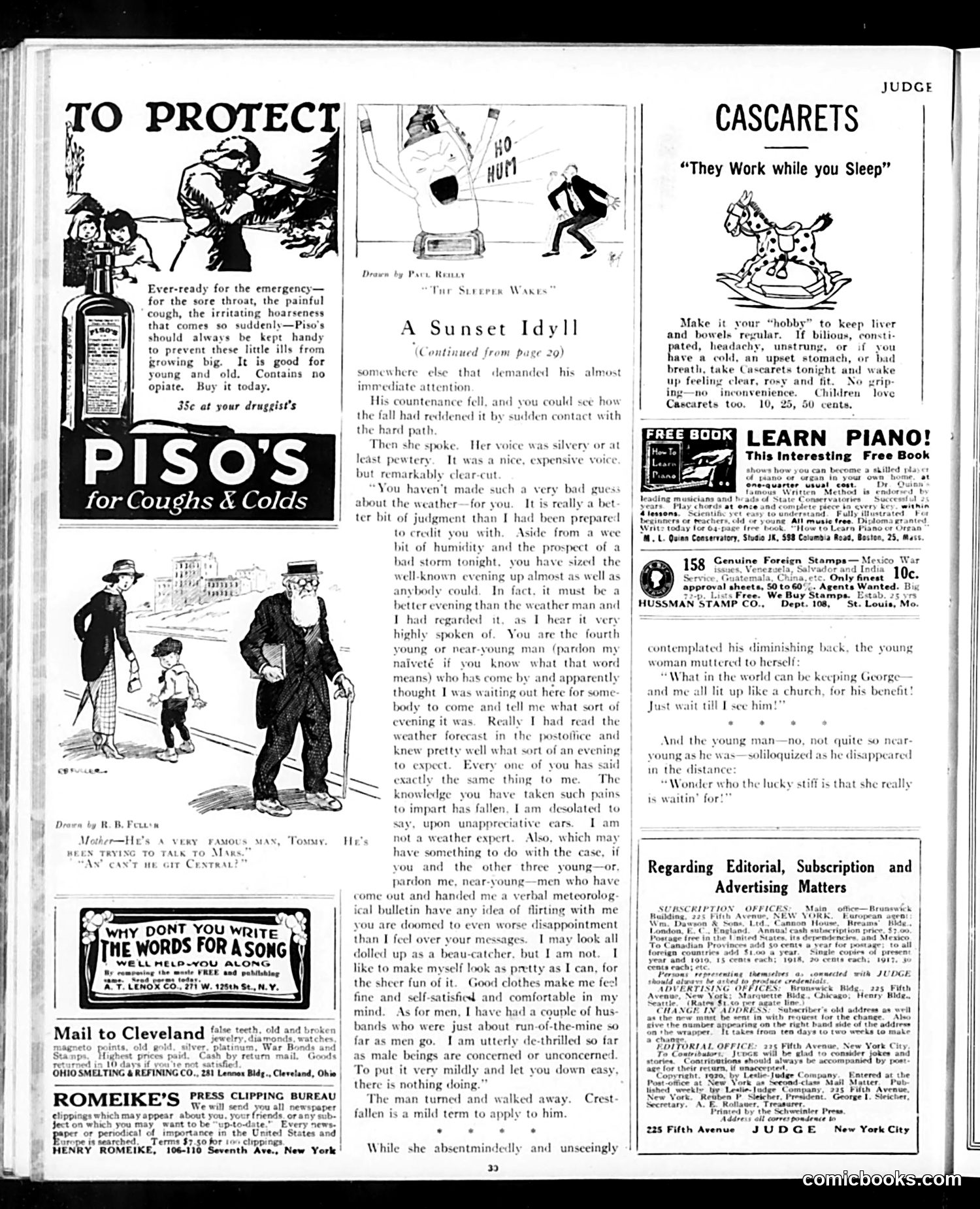
This page mixes fiction and advertising typical of early-20th-century magazines. **"A Sunset Idyll"** is a serialized short story about a young man attempting to flirt with a woman by commenting on the evening weather. She rebuffs him sharply, revealing she's not interested in romantic attention—she dresses well for herself, not to attract men. She's had husbands ("a couple") and finds men predictable and unimpressive. The man leaves defeated. The woman then wonders why she and "George" aren't "lit up like a church" (happy/excited) together, suggesting marital dissatisfaction despite rejecting other suitors. **The cartoons** show everyday scenes: children with adults in winter weather (advertising Piso's cough medicine), and a mother trying to get her son to focus on talking to a famous man at a center—satirizing children's distraction. The page is primarily **advertisements** for patent medicines (Piso's, Cascarets laxatives), services (press clipping bureau, piano lessons), and stamp collecting—standard commercial content filling magazine space.
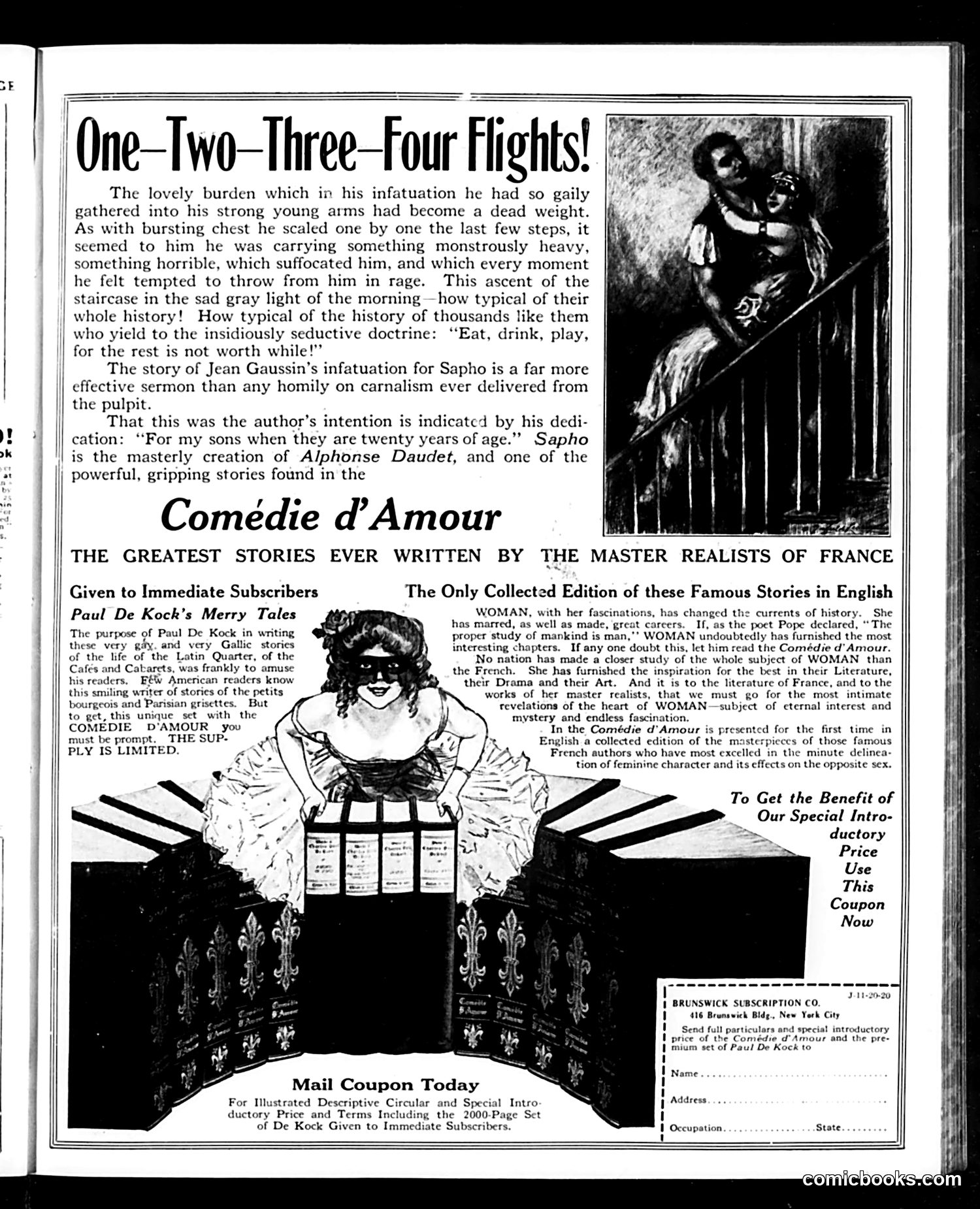
This is primarily a **book subscription advertisement** for the *Comédie d'Amour*, a French literature collection. The page includes two illustrations showing scenes of romantic/sexual entanglement. The top image depicts a man carrying a woman up stairs, illustrating the text's reference to Jean Gaussin's affair with "Sapho" (from Alphonse Daudet's novel)—the "lovely burden" that becomes "monstrously heavy." The narrative frames this as a cautionary tale about the doctrine "Eat, drink, play, for the rest is not worth while." The lower illustration shows a woman in theatrical costume, likely representing the sensual femininity central to the collection's appeal. The ad emphasizes that French realist authors—particularly Daudet and Paul De Kock—provided unparalleled "intimate revelations of the heart of WOMAN." For early 20th-century American readers, French literature signified sophisticated but morally questionable depictions of sexuality and romance. The "special introductory price" and urgency ("supply is limited") were standard subscription marketing tactics of the era.
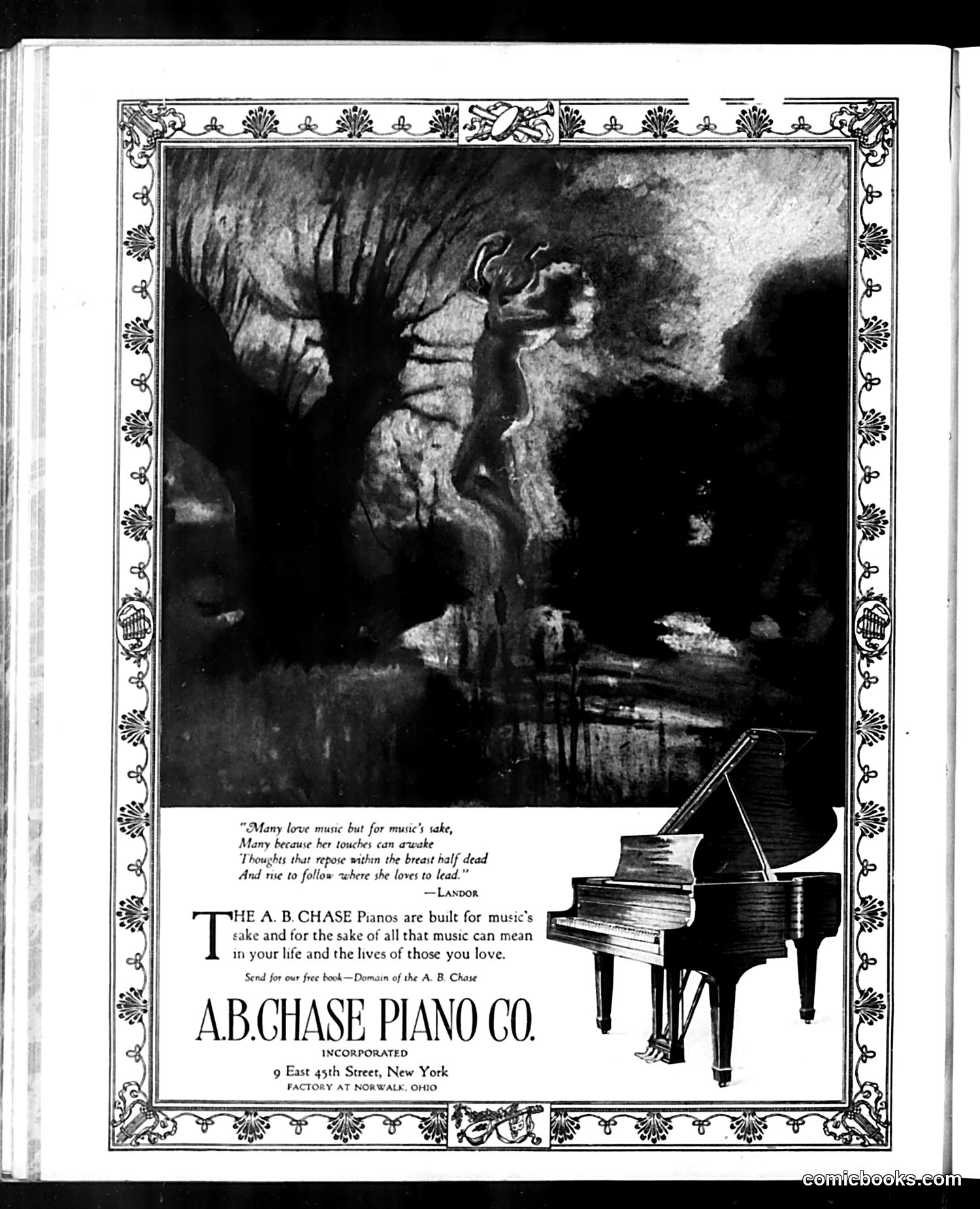
This is primarily a **piano advertisement**, not political satire. The page features a romantic, atmospheric illustration of figures in what appears to be a moonlit or ethereal setting, accompanying an A.B. Chase piano company promotion. The ad quotes Lanvor's poetry about music's emotional power—how music awakens deep thoughts and inspires followers. The company positions its pianos as instruments built to fulfill music's higher purpose in people's lives and families. The ornate decorative border and sentimental imagery reflect late-19th/early-20th-century advertising aesthetics, appealing to middle and upper-class consumers who associated piano ownership with culture, refinement, and family values. While appearing in *Judge* (a satirical magazine), this page itself contains no satire—it's a straightforward commercial pitch using romantic sentiment rather than humor.