
Judge, 1920-11-20 · page 22 of 32
Judge — November 20, 1920 — page 22: what you’re looking at
What you’re looking at
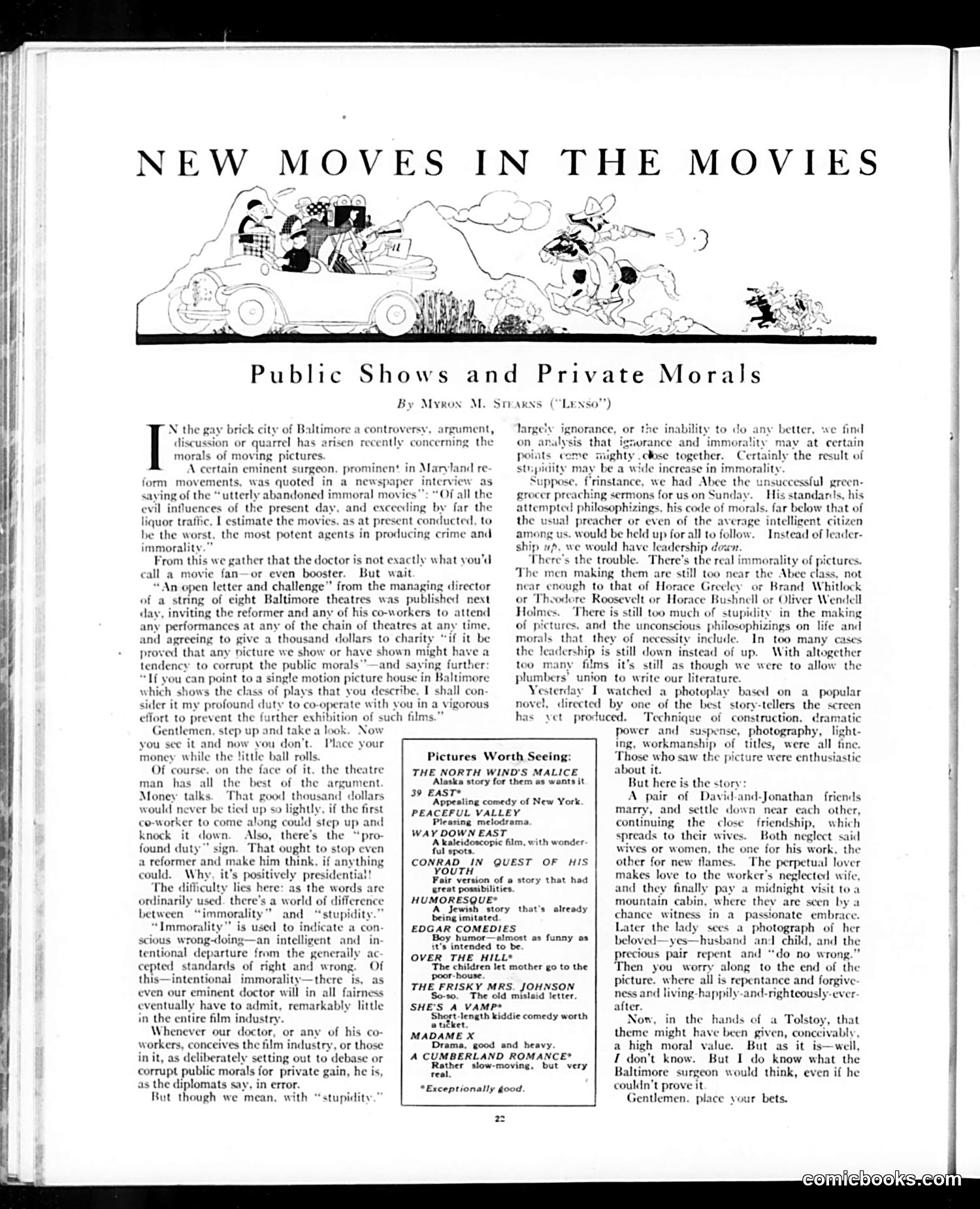
This article criticizes a Baltimore surgeon's claims that movies are immoral influences. The author, Myron M. Stearns, argues the real problem isn't deliberate moral corruption but **stupidity and incompetence** in filmmaking. A theater chain manager challenged the doctor to identify specific "immoral" films, offering $1,000 to charity if he could prove any movie tends to corrupt public morals—a bet the author suggests the doctor won't win. The satire's point: reformers exaggerate movie dangers; most poor filmmaking results from lack of skill, not intentional wickedness. The author distinguishes between "immorality" (conscious wrongdoing for profit) and mere incompetence. He uses the analogy of a failed grocer preaching sermons—bad execution, not evil intent. The sidebar lists contemporary films worth seeing, reinforcing that quality cinema exists and serves legitimate purposes. This reflects 1920s debates over film censorship and moral panic about popular entertainment's influence.
📄 Transcribed text from this page (OCR, searchable)
Machine-transcribed from the original scan — historical spelling and the odd misread are preserved.
—— — NEW ir IS MOVES IN THE MOVIES Public Shows and Private Morals By Myrox M. Stearns (“Leyso") N the gay brick city of Baltimore a controversy, argument, discussion or quarrel has arisen recently concerning the morals of moving pictures. \ certain eminent surgeon, prominent in Maryland re form movements, was quoted in a newspaper interview as saying of the “utterly abandoned immoral movies”: “Of all the evil influences of present da nd exceeding by far the liquor trafiic, I estimate the movies. as at present conducted, to he the worst, the most potent agents in producing crime and immorality.” From this we gather that the doctor is not exactly what vor call a movie fan—or even booster. But wait An open letter and challenge” from the managing director of a string of eight Baltimore theatres was published next day, inviting the reformer and any of his co-workers to attend any performances at any of the chain of theatres at any time, and agreeing to give a thousand dollars to charity “if it be proved that any picture we show or have shown might have a tendency to corrupt the public morals'’—and saying further: “If you can point to a single motion picture house in Baltimore which shows the class of plays that you describe, I shall con sider it my profound duty to co-operate with vou in a vigorous effort to prevent the further exhibition of such films.” entlemen, step up and take a look. Now you see it and now vou don’t. ace your money while the little ball rolls. man has all the best of the argument Money talks. That good thousand dollars would never be tied up so lightly. i co-worker to come along could step up and found duty” sign. That ought to s a reformer and n could. Why, it’s positively presidenti: The difficulty lies here: ordinarily used. there’s a world of di op even ful spots. YOUTH “Immorality” scious wrong-doing—an intelligent and_ in tentional departure cepted standards of right and wrong. Of this—intentional immorality—there is, as even our eminent doctor will in all fairness poor-house. in the entire film industry. z a ue) . a titket Whenever our doctor, or any of his co- | yabaMex workers, conc in it, as deliberate! corrupt public morals for private gain, he is, as the diplomats say, in error. But though we mean, with “stupidity.” Pictures Worth Seeing: Of course, on the face of it. the theatre THE NORTH WIND'S MALICE Alaska story for them as wants it - ing comedy of New York the first PEACEFUL VALLEY Pleasing melodrema. it « \s< e's » « is WAY DOWN EAST knock it down. Also, there's the “pro- Me eA Tae eith wonder ake him think, if anything CONRAD IN QUEST OF HIS Fair version of a story that had the words are great possibilities. rence HUMORESQUE* between “immorality” and “stupidity.” La char sty is used to indicate a con- EDGAR COMEDIES Boy humor—aelmost as funny as 1 it's intended to be. m the generaily ac OVER THE HILL* The children let mother go to the THE FRISKY MRS. JOHNSON ‘So-so. The old misla eventually have to admit, remarkably little SHE'S A VAMP* Short -length kiddie comedy worth es the film industry, or those Drama, good and heavy. ting out to debase or A CUMBERLAND ROMANCE* her slow-movin, * Exceptionally good. largely ignorance, or the inability to do any better, we find nD analysis wrance and immorality may at certain points ¢¢ righty .close together. Certainly the result of stipidity may be a wide increase in immorality Suppose, f'rinstance, we had Abee the unsuccessful green- grocer preaching sermons for us on Sunday. His standarils, his attempted philosophizings, his code of morals. far below that of the usual preacher or even of the average intelligent citizen among us. would be held up for all to follow. Instead of leader- ship «p, we would have leadership down. There's the trouble. There's the real immorality of pictures. The men making them are still too near the Abee class, not near enough to that of Horace Greeley or Brand Whitlock or Theodore Roosevelt or Horace Bushnell or Oliver Wendell Holmes. There is still too much of stupidity in the making of pictures, and the unconscious philosophizings on life and morals that they of necessity include. In too many cases the leadership is still down instead of up. With altogether too many films it’s still as though we were to allow the plumbers’ union to write our literature. Yesterday I watched a photoplay based on a popular novel, directed by one of the best story-tellers the screen has yet produced. Technique of construction, dramatic power and suspense, photography, light- ing, workmanship of titles, were all fine. Those who saw the picture were enthusiastic about it. But here is the story: A pair of David-and-Jonathan friends marry, and settle down near each other, continuing the close friendship, which spreads to their wives. Both neglect said wives or women, the one for his work, the other for new flames. The perpetual lover makes love to the worker's neglected wife, and they finally pay a midnight visit toa mountain cabin, where thev are seen by a chance witness in a passionate embrace. Later the lady sees a photograph of her beloved—yes—husband and child, and the precious pair repent and “do no wrong.” Then you worry along to the end of the picture. where ail is repentance and forgiv ness and living-happily-and-righteously-ever after. Now, in the hands a Tolstoy, that theme might have been given, conceivably, a high moral value. But as it is—well, Z don’t know. But I do know what the Baltimore surgeon would think, even if he couldn't prove it Gentlemen. place your bets. that’s already letter, but very