
A complete issue · 36 pages · 1920
Judge — June 12, 1920
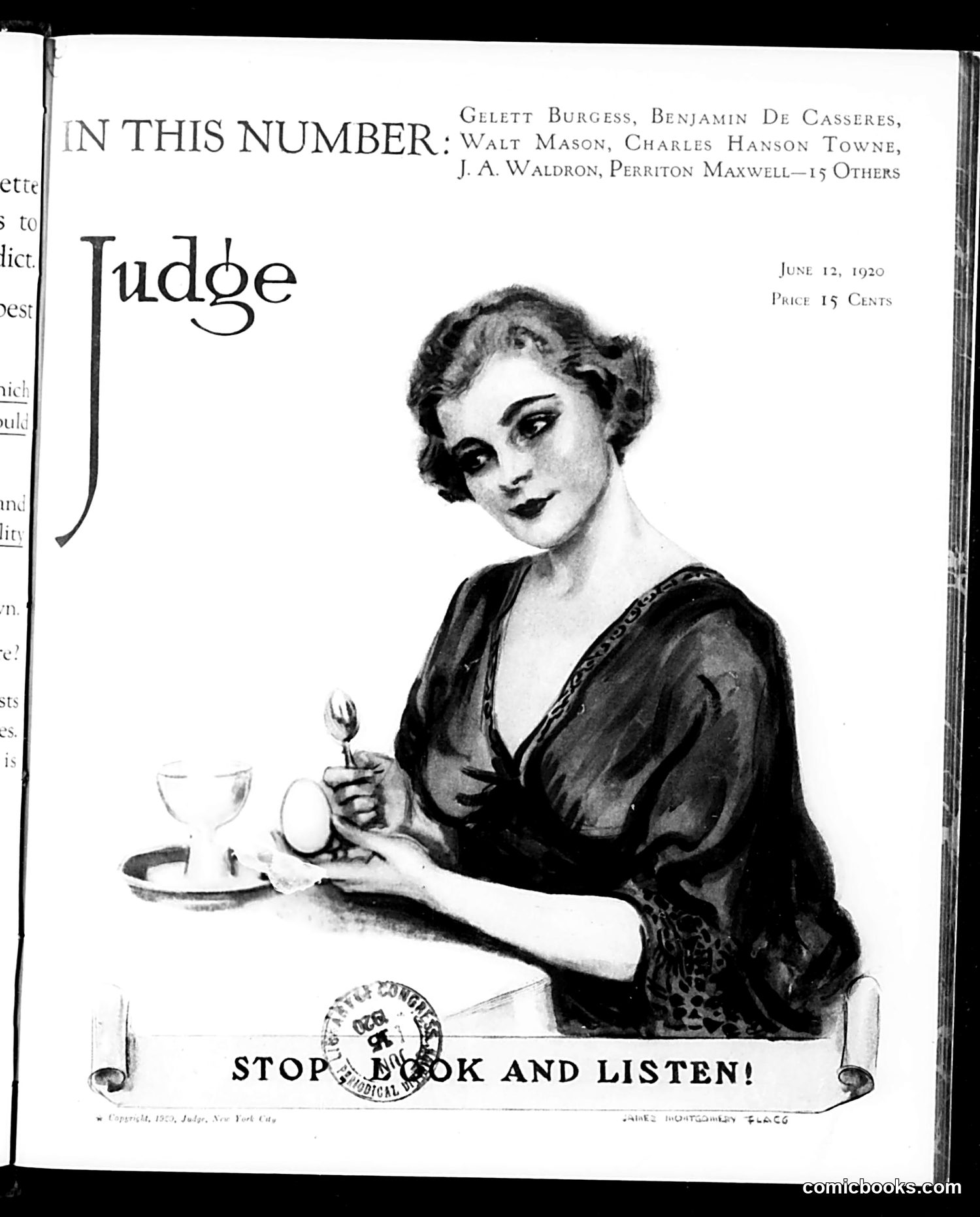
This is the cover of **Judge**, a satirical weekly magazine priced at 15 cents. The illustration depicts a woman in 1920s attire holding a teacup and small utensil, with the caption **"STOP, LOOK AND LISTEN!"** The phrase "Stop, Look and Listen" was a famous railroad safety slogan of the era. Here, it appears to use that recognizable imperative to draw attention—likely promoting the magazine itself or an advertisement within. The woman's fashionable bobbed hair and confident pose reflect 1920s "modern woman" imagery, recently empowered by women's suffrage (19th Amendment, 1920). The satirical magazine likely used this contemporary figure to appeal to its readership during this transformative social period.
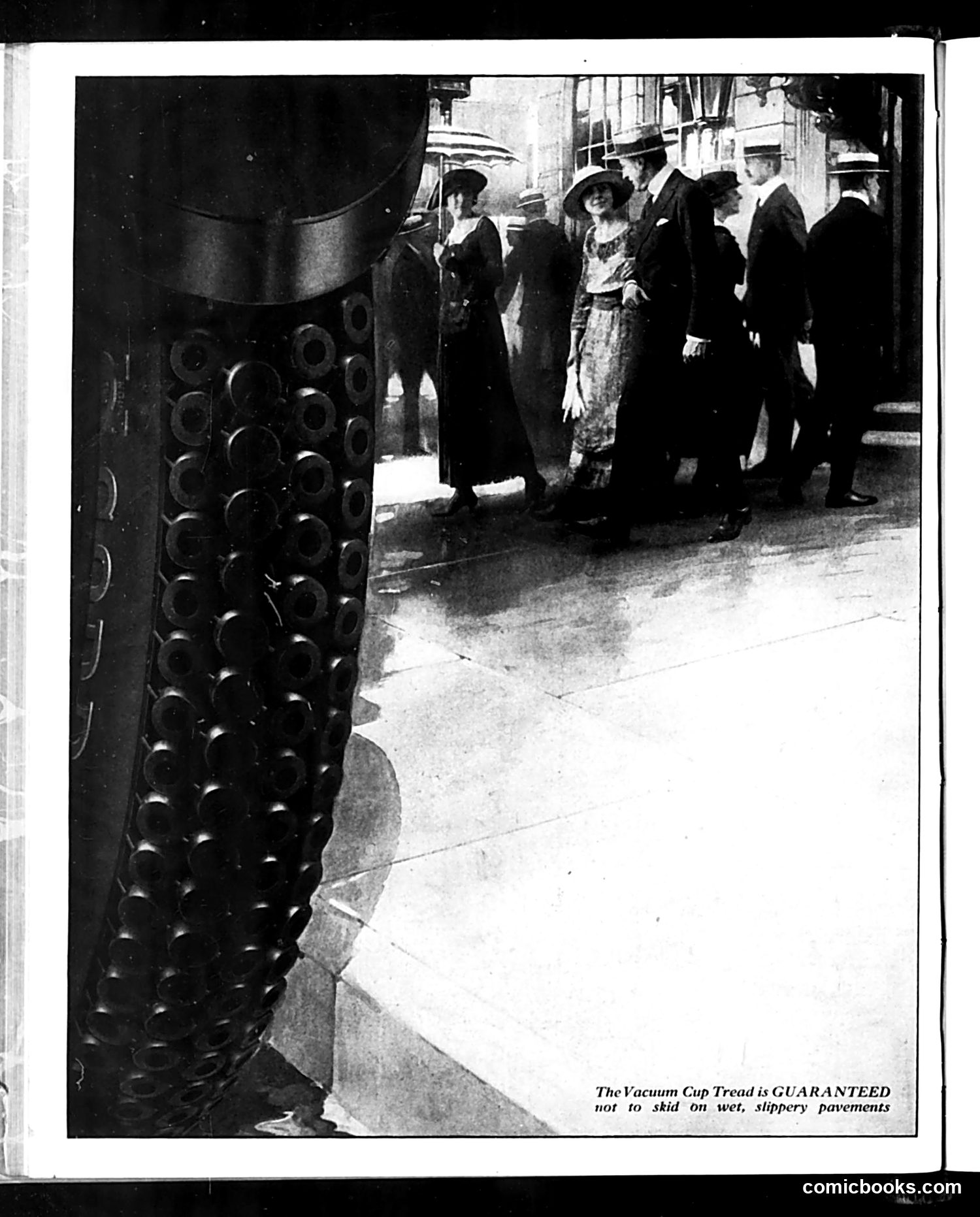
This page is primarily **advertising**, not political satire. The image shows a formal street scene with well-dressed men and women in early 20th-century attire standing near an ornate architectural column or post. The caption reads: "The Vacuum Cup Tread is GUARANTEED not to skid on wet, slippery pavements." This is a product advertisement for **Vacuum Cup Tread** shoe soles or treads. The photograph demonstrates the product's safety feature by showing people in formal dress standing confidently on what appears to be wet pavement near the decorative column. The image implicitly argues that the treaded sole prevents slipping—a practical safety concern for urban pedestrians on wet city streets. There is no political cartoon or satirical commentary on this page.
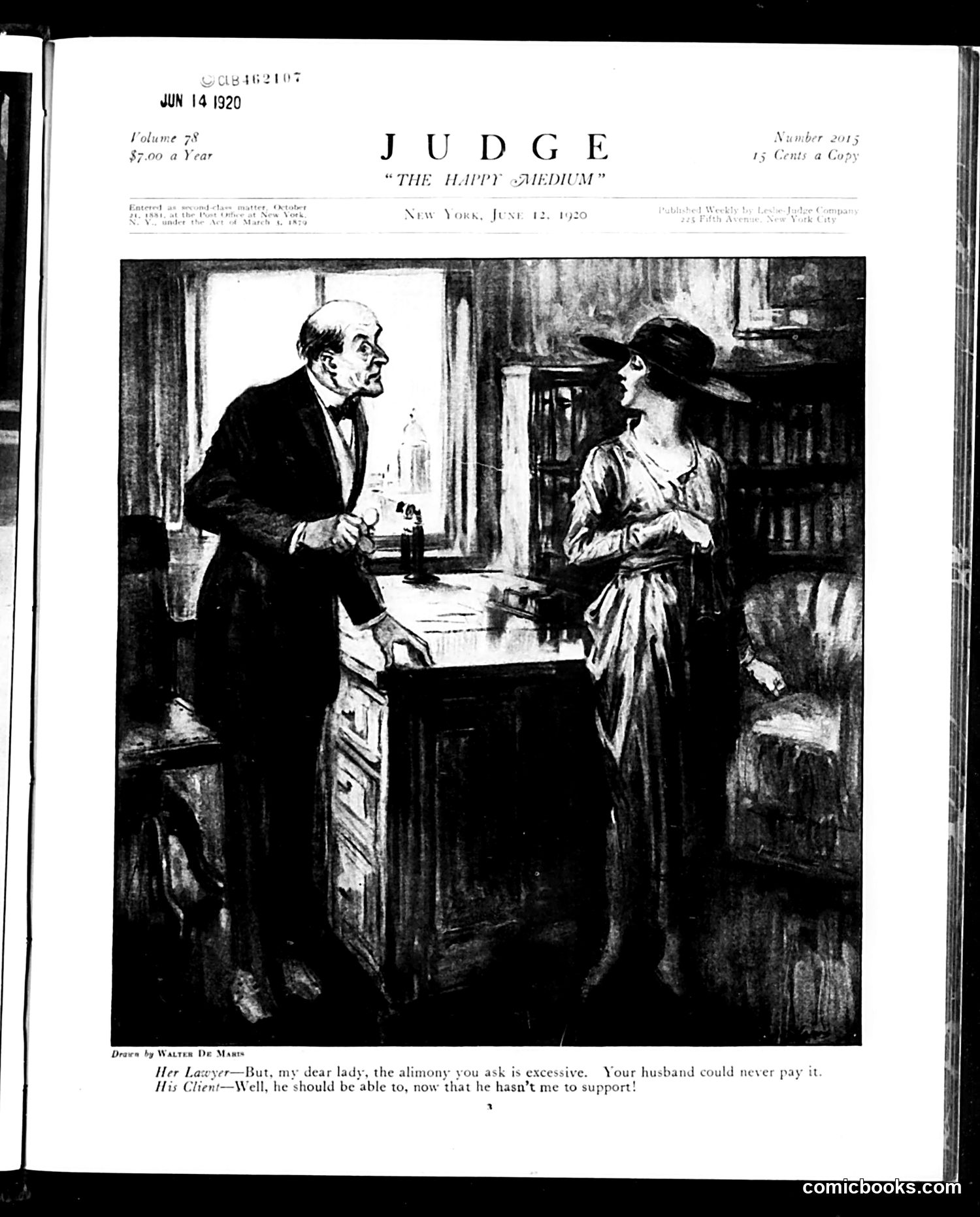
This cartoon satirizes divorce proceedings and spousal support disputes. A lawyer addresses a female client (likely seeking alimony), while a man (presumably her husband) listens in the background. The lawyer tells the woman her requested alimony is "excessive" and that her husband "could never pay it," then suggests the husband "should be able to, now that he hasn't me to support." The joke targets the legal profession itself—the lawyer implies he was a financial burden on the husband, and now that the lawyer is no longer involved, the husband should have more money. It's a self-aware, somewhat cynical jab at lawyers' fees during divorce proceedings, suggesting legal costs drain client resources more than spousal support obligations do.
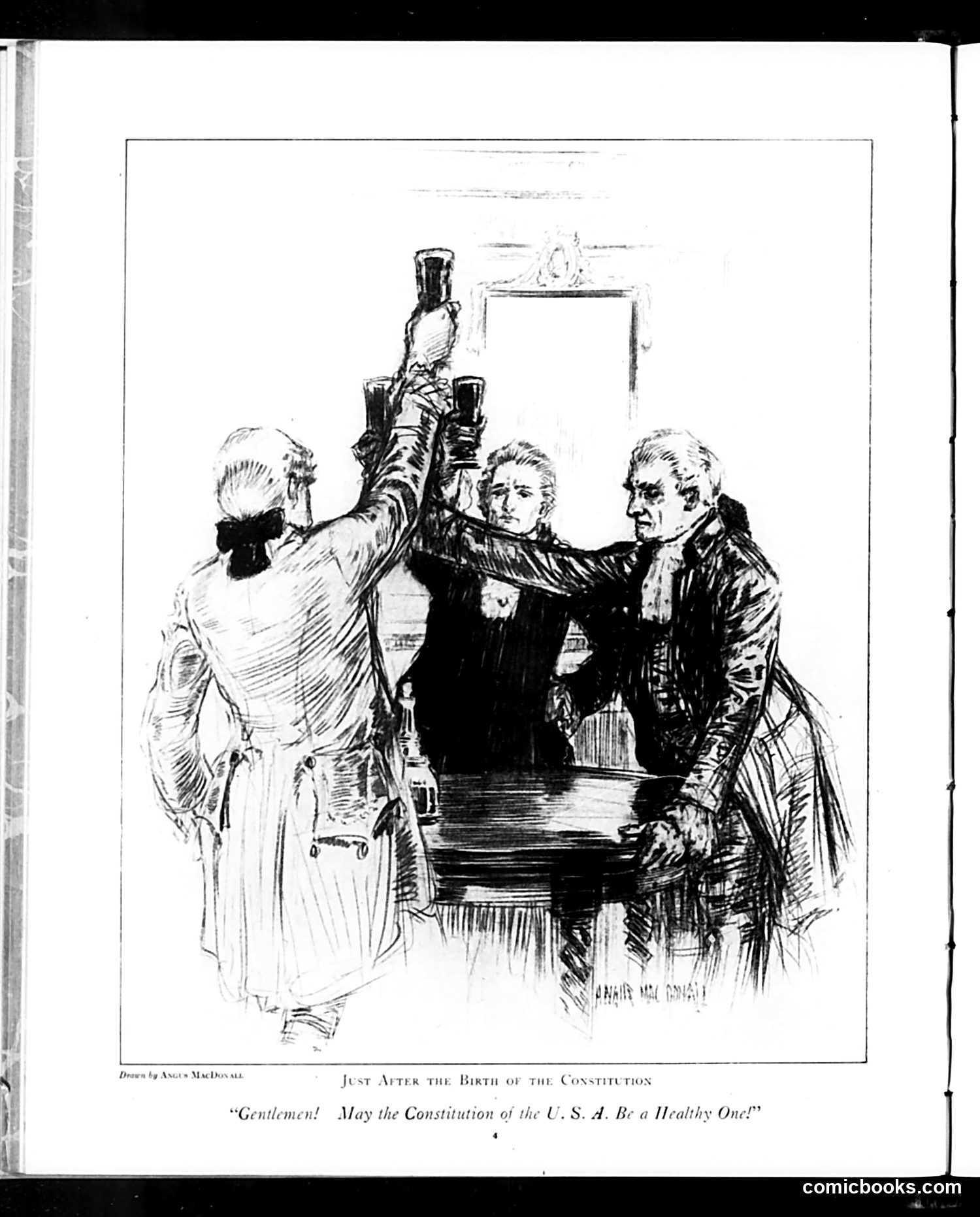
This Judge magazine cartoon, titled "Just After the Birth of the Constitution," depicts three men toasting with a bottle labeled with what appears to be a parrot or bird. The caption reads: "Gentlemen! May the Constitution of the U.S.A. Be a Healthy One!" The satire appears to celebrate the U.S. Constitution's creation, using the metaphor of a newborn infant requiring health and strength. The three figures likely represent Founding Fathers or political figures of the era, raising a celebratory toast to the newly "born" Constitution. However, without more specific identifying features or additional context, I cannot definitively identify which particular Founders are depicted or pinpoint the exact historical moment being referenced. The cartoon's basic meaning—wishing constitutional governance success—is clear, but deeper political significance remains uncertain.
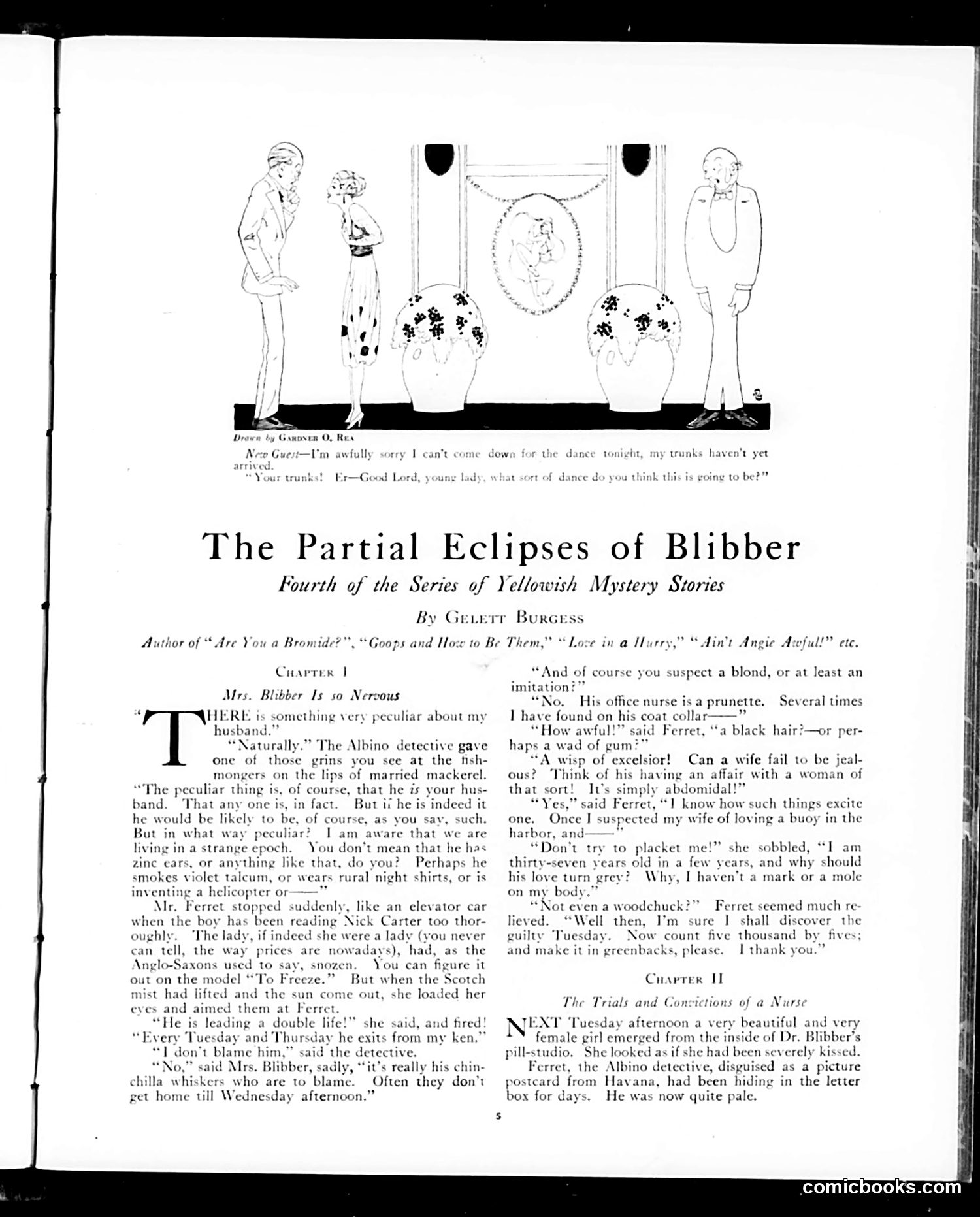
**The Cartoon:** The top illustration depicts a social scene with four figures and large decorative urns. A woman apologizes to a man for missing a dance because her "trunks haven't yet arrived." The man responds sarcastically: "Good Lord, young lady, what sort of dance do you think this is going to be?" **The Joke:** The satire targets the absurdity of using excessive luggage as an excuse for social obligations. The woman's concern with trunks (suitcases) over attending an event is mocked as ridiculous vanity—she's prioritizing material possessions over social commitments. This reflects early 20th-century critiques of wealthy society women's preoccupation with material goods and appearances. **Below** begins a serialized mystery story titled "The Partial Eclipses of Blibber" by Gelett Burgess, unrelated to the cartoon.
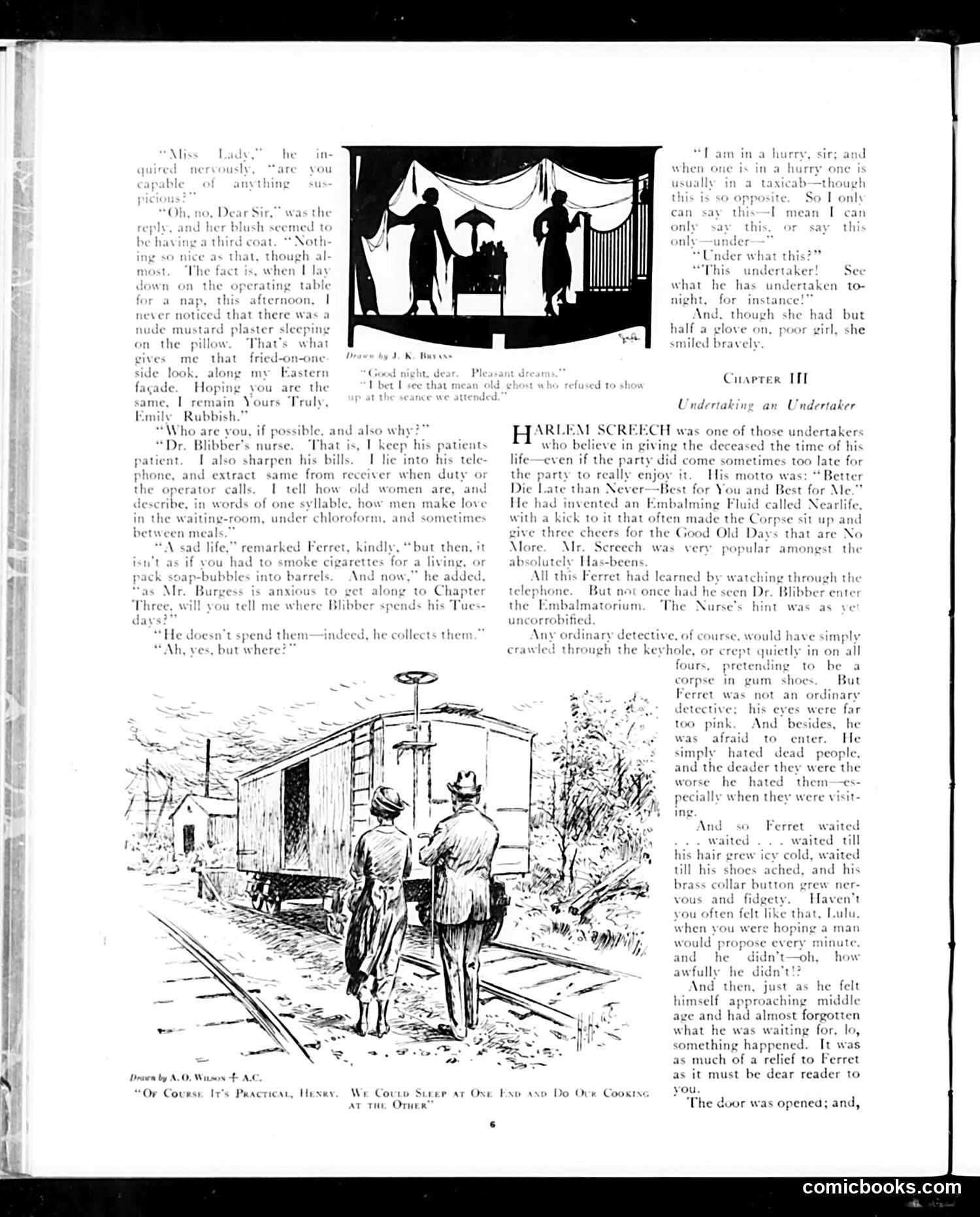
This page contains two distinct illustrations accompanying a serialized fiction story titled "Undertaking an Undertaker" (Chapter III), about a character named Harlem Screech who is an undertaker. The **top silhouette illustration** shows figures in what appears to be a séance scene, accompanying dialogue about "that mean old ghost who refused to show up at the séance we attended." The **bottom illustration** depicts two men in period clothing standing near a railway car or mobile structure, with a caption reading "Of Course It's Practical, Henry. We Could Sleep at One End and Do Our Cooking at the Other." Neither illustration appears to contain political satire or caricature. This seems to be primarily **entertainment/fiction content** rather than political commentary—typical of Judge's mixed editorial approach combining humor, satire, and serialized stories.
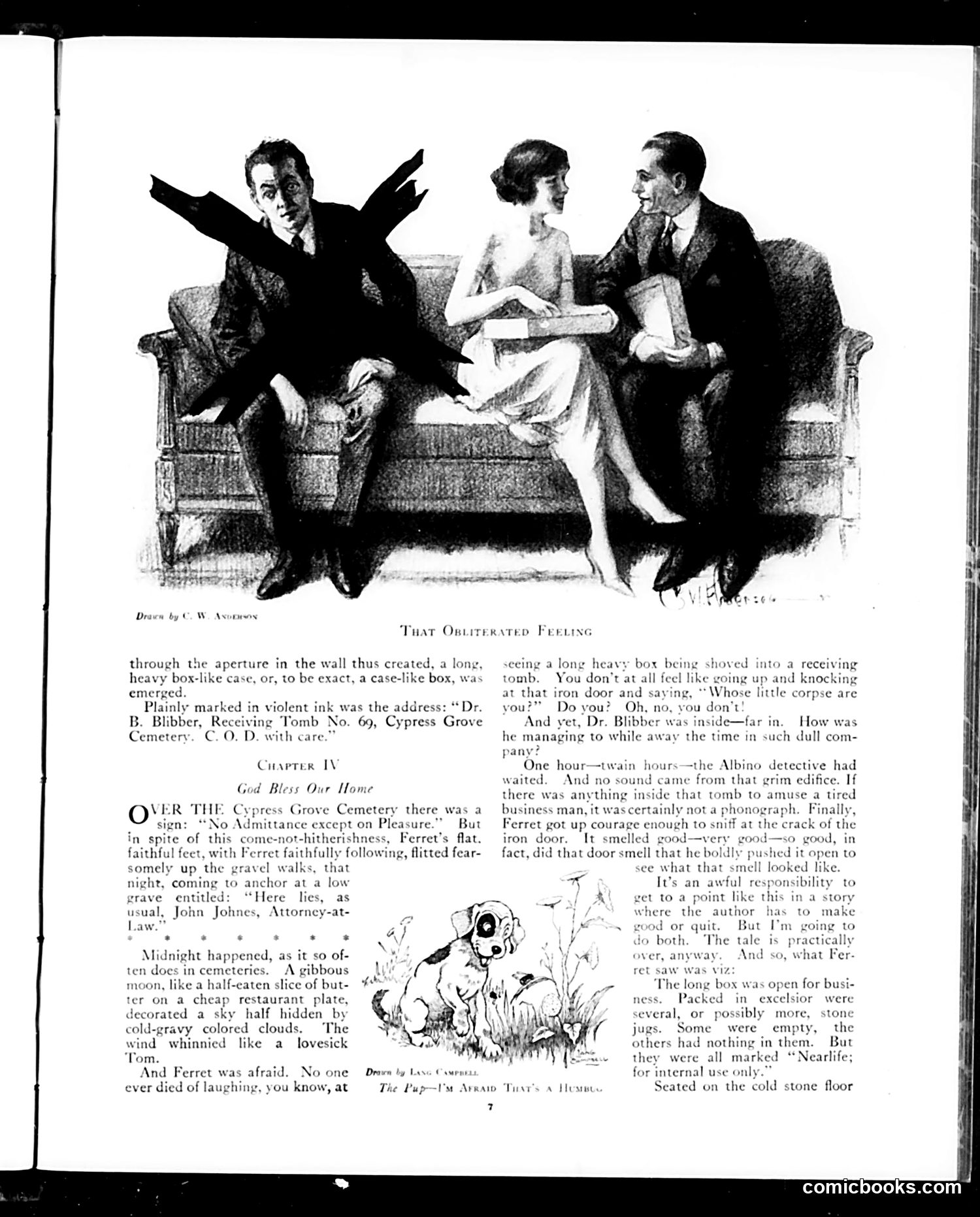
This appears to be a humorous detective/mystery story rather than political satire. The illustration shows three well-dressed figures in a drawing room, illustrating the narrative below. The story concerns detective Ferret investigating a suspicious box delivered to Cypress Grove Cemetery addressed to "Dr. B. Blibber." Ferret sneaks into the cemetery at midnight and discovers the box contains stone jugs marked "Nearlife" and labeled "for internal use only"—clearly a reference to illegal alcohol. **The satire targets Prohibition enforcement**: The joke is that someone is smuggling liquor into a cemetery, of all places, to hide it from authorities. The absurdist humor—hiding bootleg alcohol in a tomb, the detective's melodramatic fear in the graveyard—mocks both the ridiculousness of Prohibition and the lengths people went to circumvent it. This reflects the magazine's likely skepticism toward Prohibition policies popular during the 1920s-30s, presenting law-breakers sympathetically through comedic storytelling.
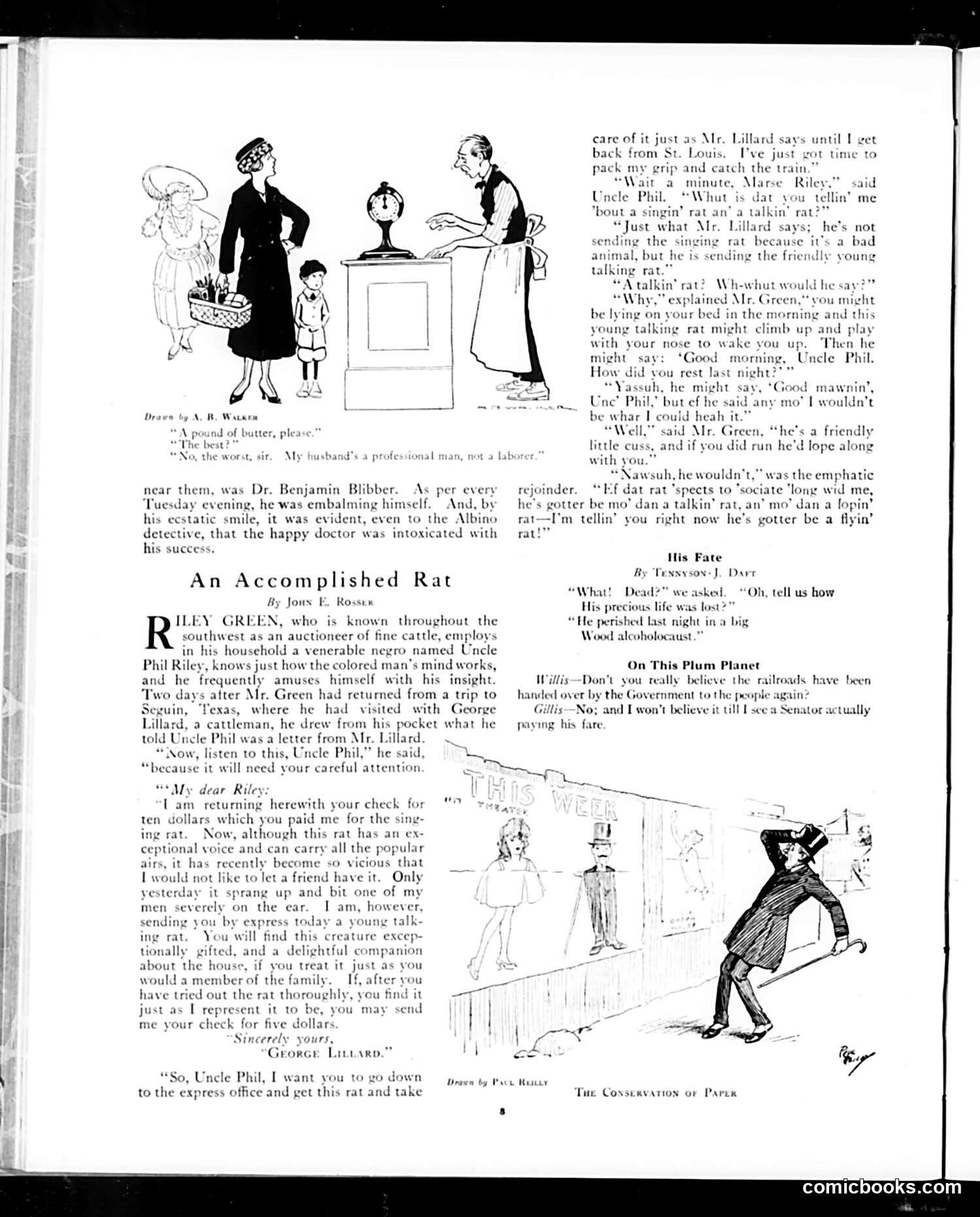
This story satirizes racial stereotypes through a confidence scheme. Riley Green, a cattle auctioneer, tricks his Black servant Uncle Phil with a fabricated letter from "Mr. Lillard" about a supposedly remarkable rat that can sing and talk. The letter is a con—Lillard is actually returning a troublesome rat and demanding more money, claiming it's "exceptional" to swindle Riley into paying extra. Uncle Phil's dialect-heavy responses ("Yassuh," "Marse Riley") and credulity are played for comedic effect, as he logically escalates the rat's impossible abilities—ultimately declaring it must be a "flyin' rat" to meet his standards. The satire targets both the white confidence man and the caricatured Black character. The other cartoons ("On This Plum Planet," "The Conservation of Paper") are separate political/social jokes about railroads and government regulation.
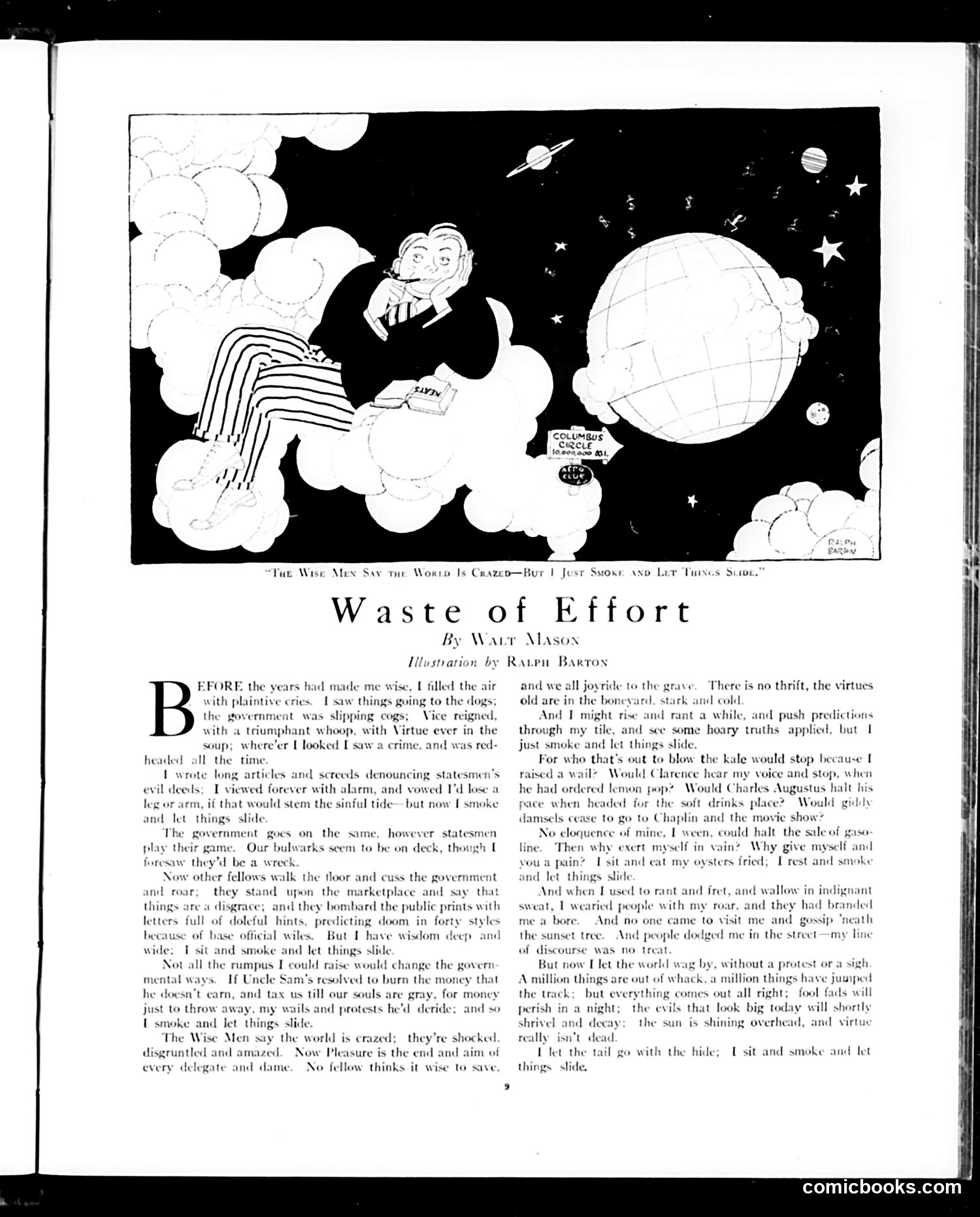
This is a satirical essay with an accompanying illustration mocking political activism and social reform efforts. The cartoon depicts a man relaxing on clouds in space, smoking—representing apathetic resignation. The text chronicles Mason's journey from young idealist to cynical pragmatist. He once wrote angry articles denouncing government corruption and vice, believing activism could change society. Now, older and "wiser," he realizes such efforts are futile: the government continues regardless, corrupt officials ignore protests, and the public pursues pleasure instead of virtue. The satire's target is ambiguous—it could mock either the futility of reform *or* the defeatist attitude itself. The phrase "The Wise Men say the world is crazed" suggests Mason ironically questions whether resignation truly represents wisdom. The essay ultimately endorses passivity ("I sit and smoke and let things slide"), leaving readers uncertain whether Mason endorses this stance or critiques it as moral surrender.
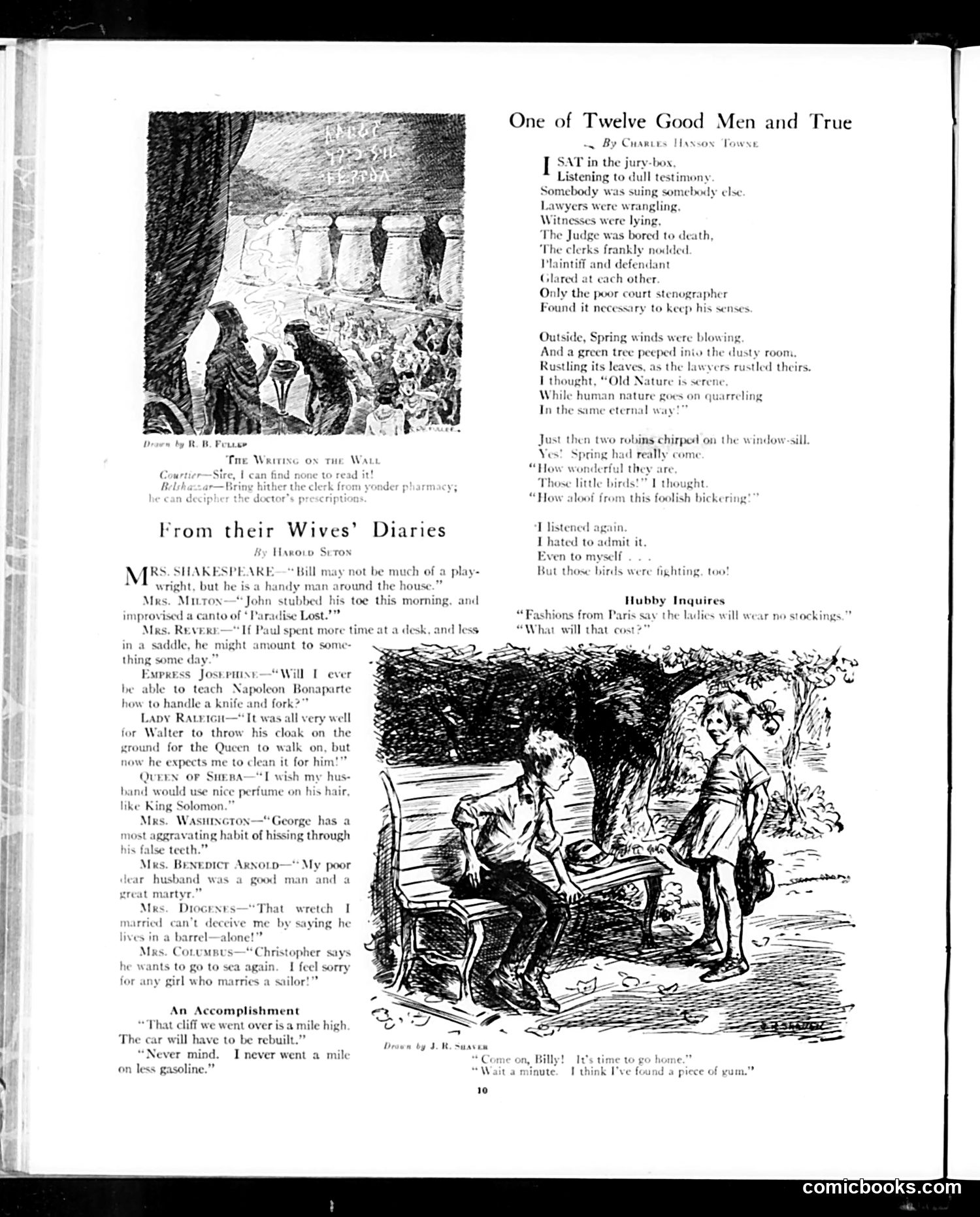
This page from *Judge* magazine contains satirical humor from the early 20th century. **"From their Wives' Diaries"** is a series of short quips where famous historical/literary figures' wives complain about their husbands' shortcomings—Shakespeare isn't handy, Paul (likely a reference to a public figure) doesn't apply himself, Napoleon can't use utensils properly. The humor relies on the contrast between these men's legendary status and their domestic inadequacy. **"One of Twelve Good Men and True"** is a poem about jury duty's tedium. The narrator sits bored through testimony while outside, nature blooms indifferently. The twist ending—observing two robins fighting—suggests that even nature mirrors human quarreling, so there's no escaping pettiness anywhere. Both pieces use gentle mockery of pretension and human nature. The cartoons' crude woodcut style and the magazine's satirical stance aimed at educated readers familiar with classical and historical references.
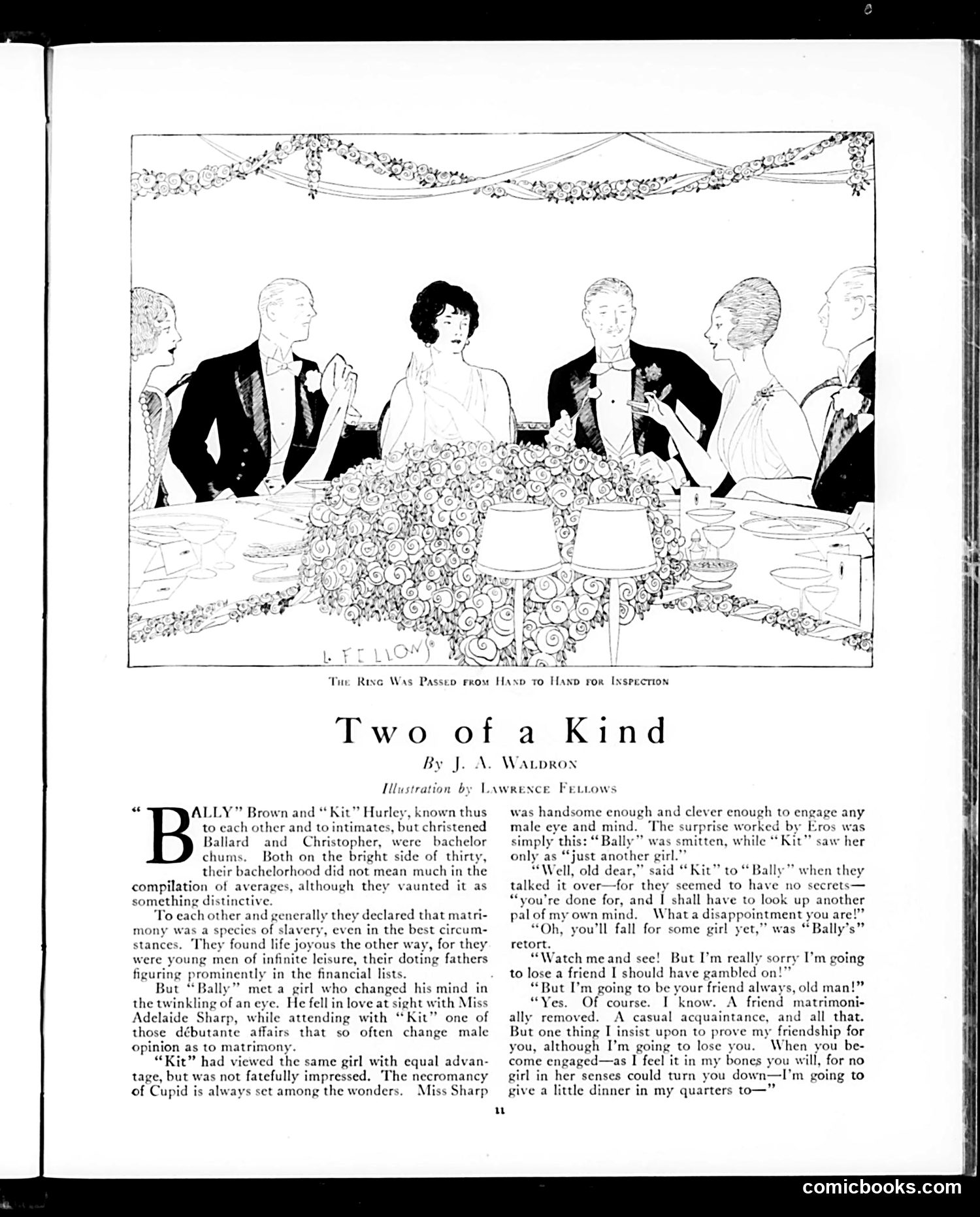
This is a short story (not a political cartoon) depicting early 20th-century bachelor life among wealthy young men. The illustration shows a formal dinner scene where a ring is being passed around for inspection—likely an engagement ring. The narrative concerns two wealthy friends, "Bally" Brown and "Kit" Hurley, who both scorn marriage as "slavery." When Bally falls instantly in love with the beautiful Adelaide Sharp at a debutante ball, Kit remains unmoved by her charms. Bally becomes engaged, while Kit—true to his word—prepares to lose his friend to matrimony. The satire gently mocks male bravado about bachelorhood and the sudden, inexplicable power of romantic attraction to overturn sworn principles. The story represents typical Judge magazine fiction: light social commentary on courtship and marriage customs among the leisure class, with no apparent political content.
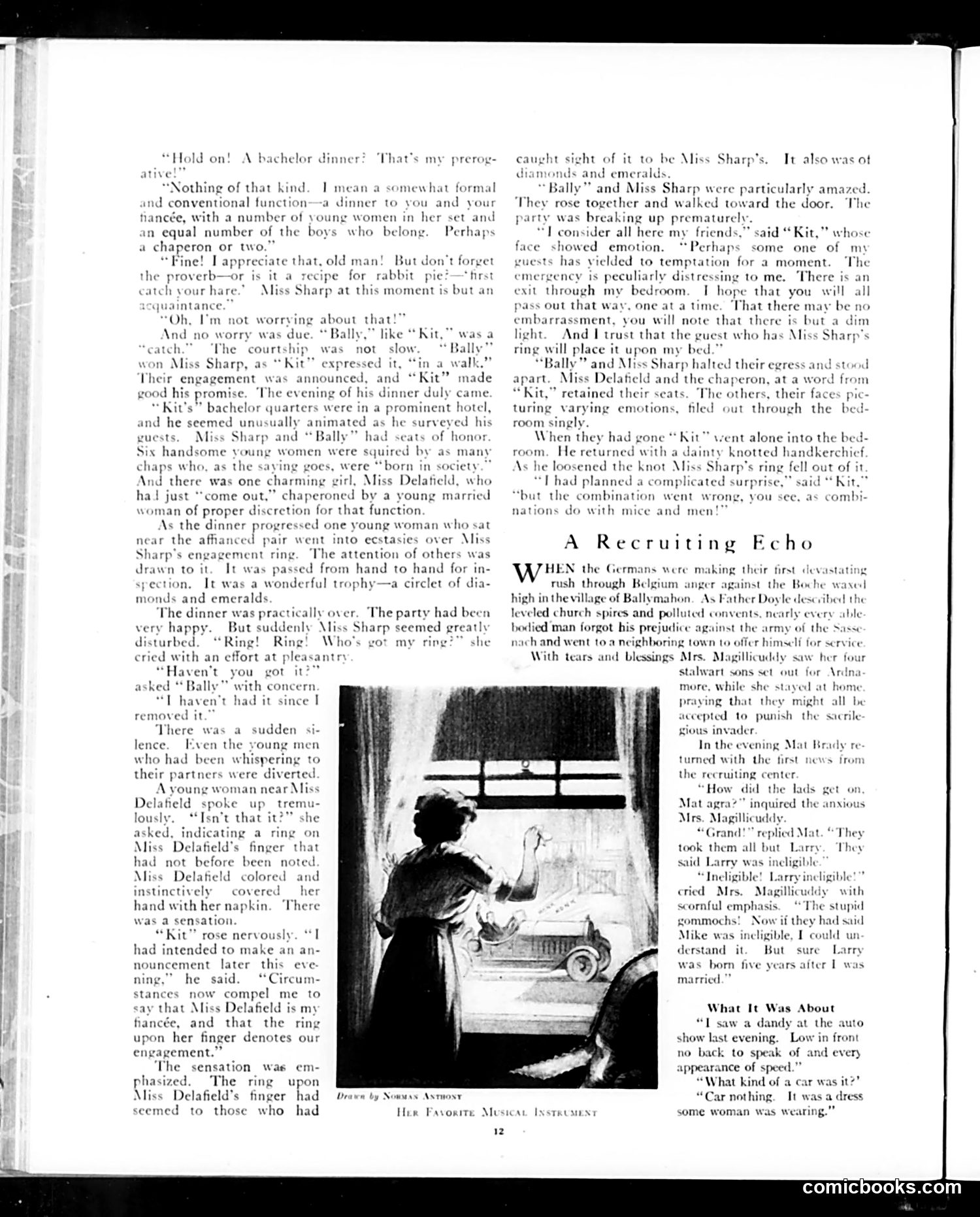
This page contains two separate pieces from *Judge* magazine: **Main Story (top):** A romantic comedy about a bachelor dinner where an engagement ring causes confusion. "Kit" announces his engagement to Miss Delafield, but guests initially mistake her ring for Miss Sharp's (Kit's former fiancée). Kit gracefully handles the awkward moment by allowing departing guests to leave discreetly through his bedroom, preserving everyone's dignity. The humor relies on social embarrassment and class-conscious discretion typical of early 20th-century etiquette satire. **"A Recruiting Echo" (bottom section):** References German military recruitment during WWI, mentioning Belgian villages and conscription. The specific details are partially cut off, but it appears to satirize wartime recruitment propaganda or its effects on civilians. The illustration shows a woman at a window, likely depicting the domestic impact of war. Without seeing the complete text, the exact satirical point remains unclear.
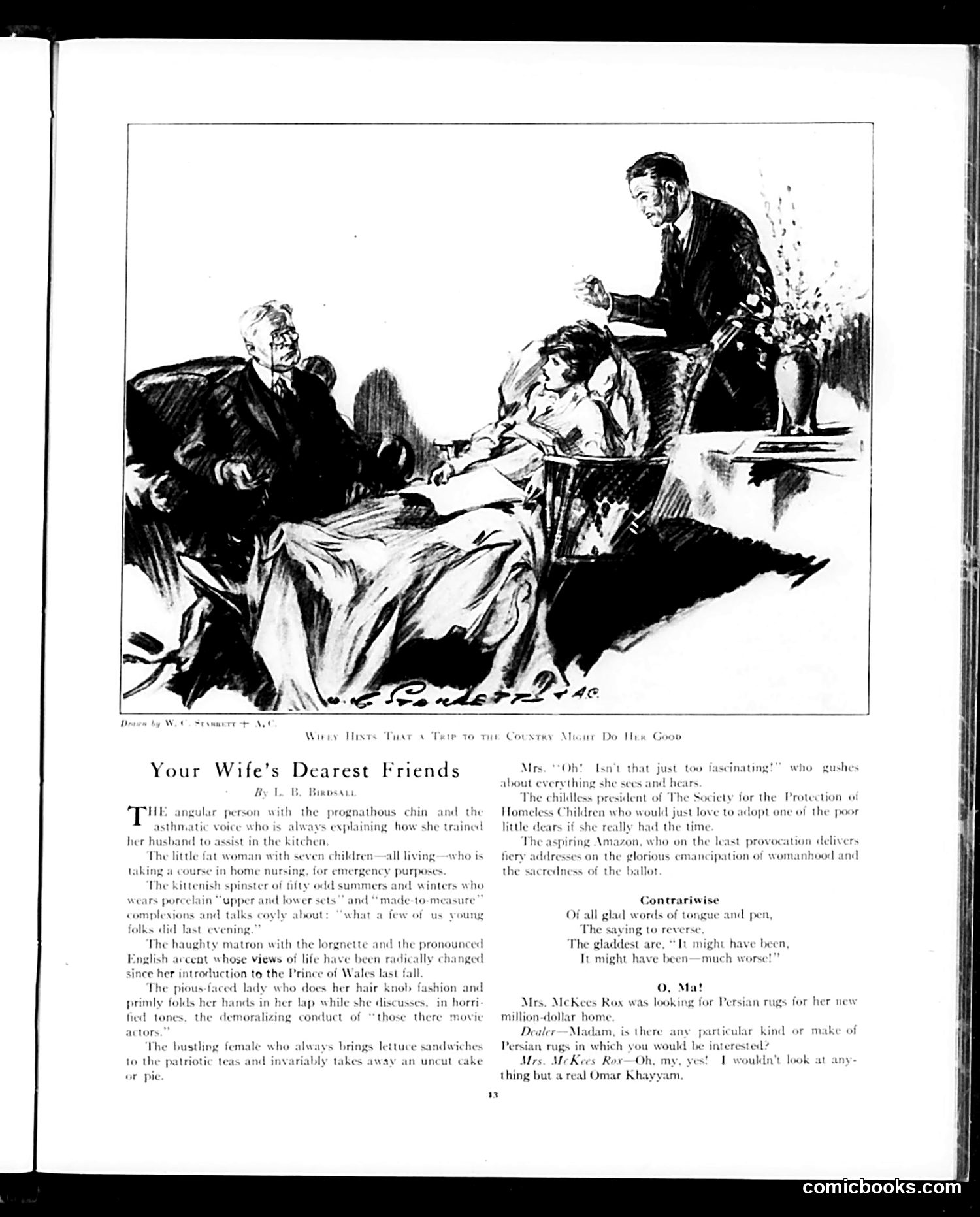
This satirical article by I.B. Birdsall catalogs social types of women the author considers tiresome or ridiculous. The accompanying illustration shows three figures in what appears to be a domestic scene—likely depicting one of these stereotyped "wife's friends." The article targets various female archetypes: the garrulous woman who gushes about everything; the childless society matron; the aspiring feminist orator; the sanctimonious woman who judges "movie actors" while being naive herself; and the social climber Mrs. McKees Rox, who pretentiously seeks "real Omar Khayyam" Persian rugs for her nouveau-riche home. The satire mocks women's social pretensions, reformist zeal, and class-climbing behavior—common Judge magazine targets. The final exchange about Persian rugs suggests ridicule of wealthy women's affected taste and empty snobbery. This reflects early 20th-century attitudes dismissing women's social activities and aspirations as frivolous.
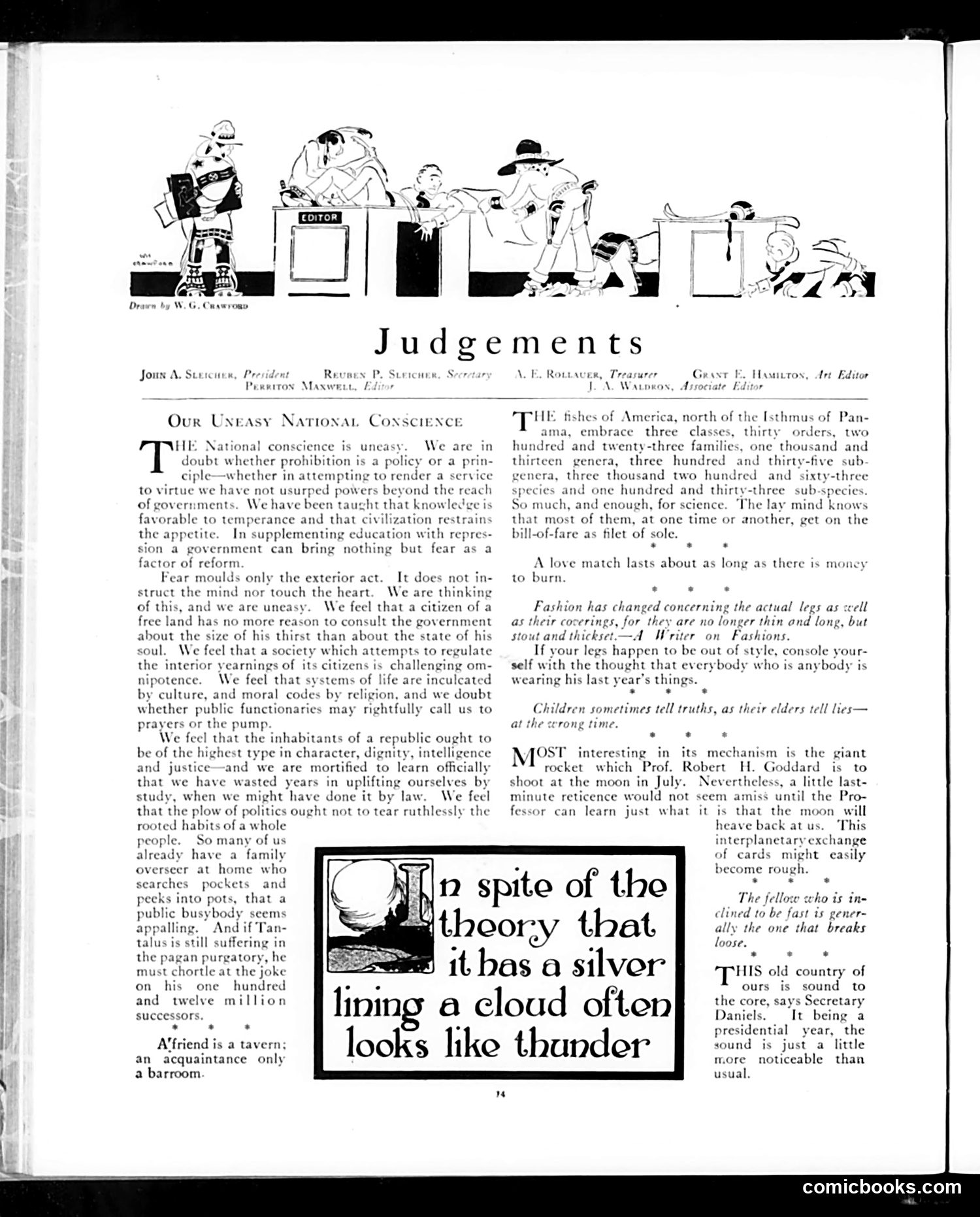
This page from *Judge* magazine presents editorial commentary on several topics through short satirical pieces: **Main Essay - "Our Uneasy National Conscience"**: A critique of Prohibition. The authors argue that laws cannot reform character—only fear can regulate exterior behavior, not internal morality. They suggest that imposing government control over citizens' personal choices (alcohol consumption) violates republican principles and represents governmental overreach into matters of conscience and culture. **Scattered Quips**: Brief satirical observations on fashion (women's legs now "stout and thick" rather than thin), Prof. Robert Goddard's planned moon rocket (humorous concern about interplanetary diplomacy), and political hypocrisy (the country sounds "sound to the core" especially during presidential years). **The Highlighted Quote**: "In spite of the theory that it has a silver lining a cloud often looks like thunder"—a cynical twist on optimism. The overall tone reflects *Judge's* skepticism toward government intervention and paternalism, while mocking contemporary social anxieties about science, fashion, and morality.
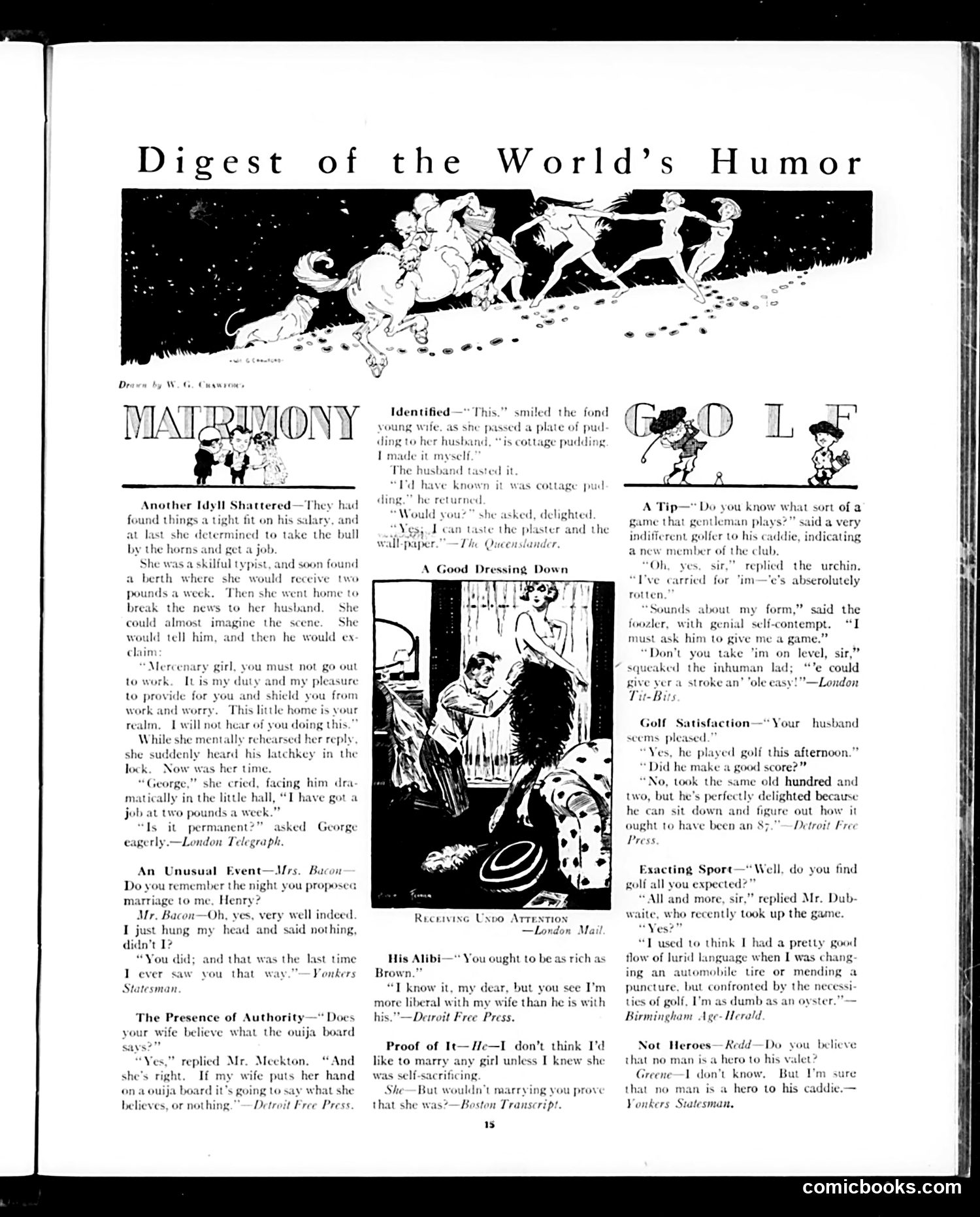
This is a humor digest page from Judge magazine featuring multiple short jokes and anecdotes typical of early 20th-century American humor. The cartoons and text satirize domestic life and gender relations: **"Another Idyll Shattered"** mocks the tension between traditional gender roles and economic necessity. A wife plans to announce she's found employment (earning two pounds weekly) to her husband, anticipating he'll forbid her work. The humor lies in the gap between her imagined confrontation and reality—George's actual response suggests unexpected acceptance or indifference. **"A Good Dressing Down"** (with illustration) depicts a woman being scolded or disciplined, likely by a man, reflecting period attitudes toward authority within marriage. Other jokes target golf enthusiasts, marriage dynamics, and spousal behavior, using the "ouija board" and "caddie" references as punchlines about wives' influence and infidelity. The overall tone reflects paternalistic attitudes toward women's independence and portrays domestic conflict as entertainment for largely male readers.
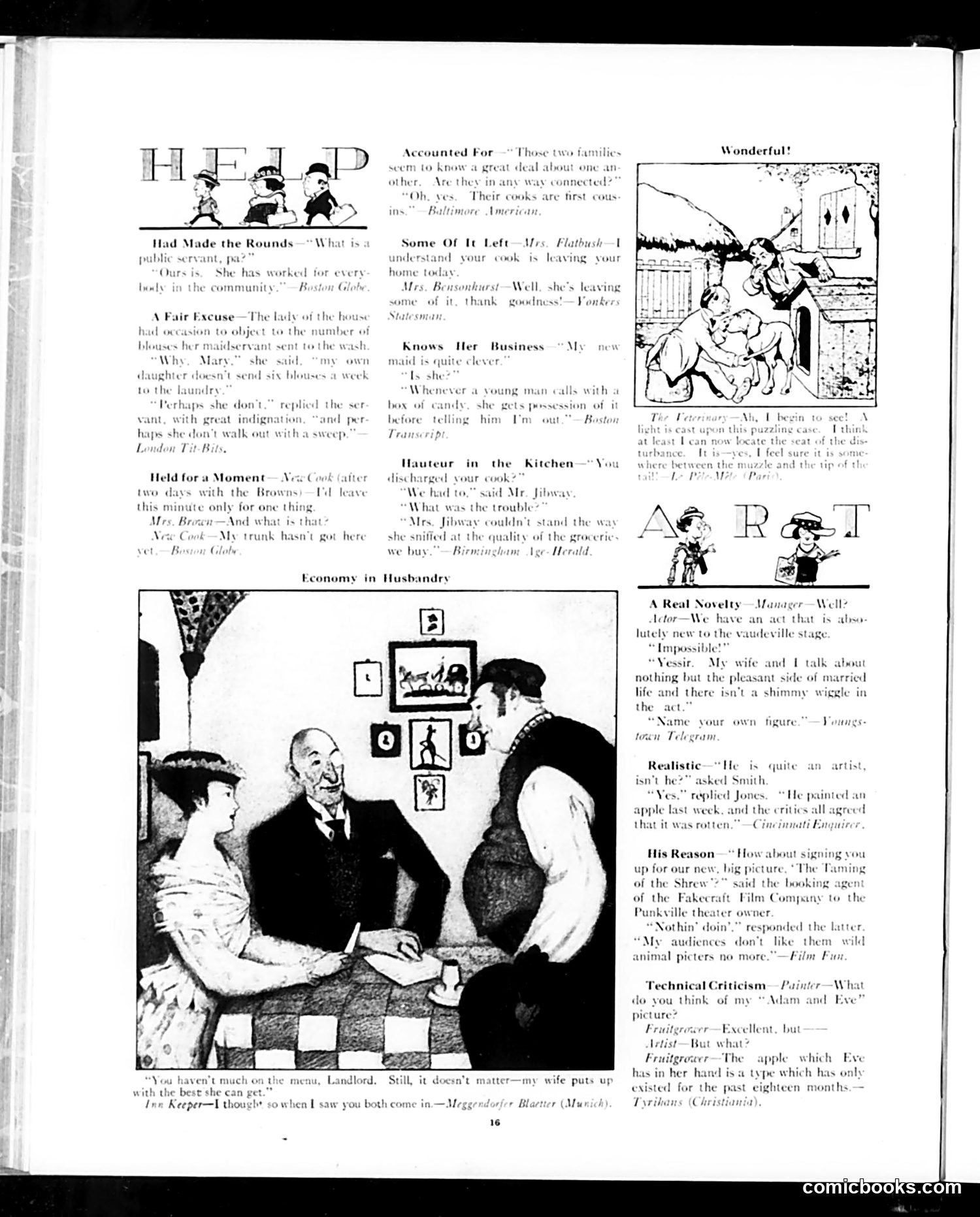
This page from Judge satirizes early 20th-century American domestic life and entertainment. The main cartoon "Economy in Husbandry" depicts a landlord negotiating with tenants over rent, with a portrait of a couple on the wall—likely mocking working-class attempts at respectability through cheap domestic décor. The surrounding humor pieces mock servants leaving employment ("Some Of It Left"), wives' housekeeping excuses, and cooks' pretensions. One section ridicules a vaudeville act where a married couple claims to perform about "nothing but the pleasant side of married life"—contemporary audiences would find this absurdly dishonest. The "Technical Criticism" piece jokes about an artist's apple in an "Adam and Eve" painting, noting the apple variety hasn't existed for eighteen months—poking fun at artistic pretension and anachronistic detail. Overall, the page targets working-class aspirations, domestic service turnover, and theatrical humbug through gentle ridicule typical of Judge's satirical approach.
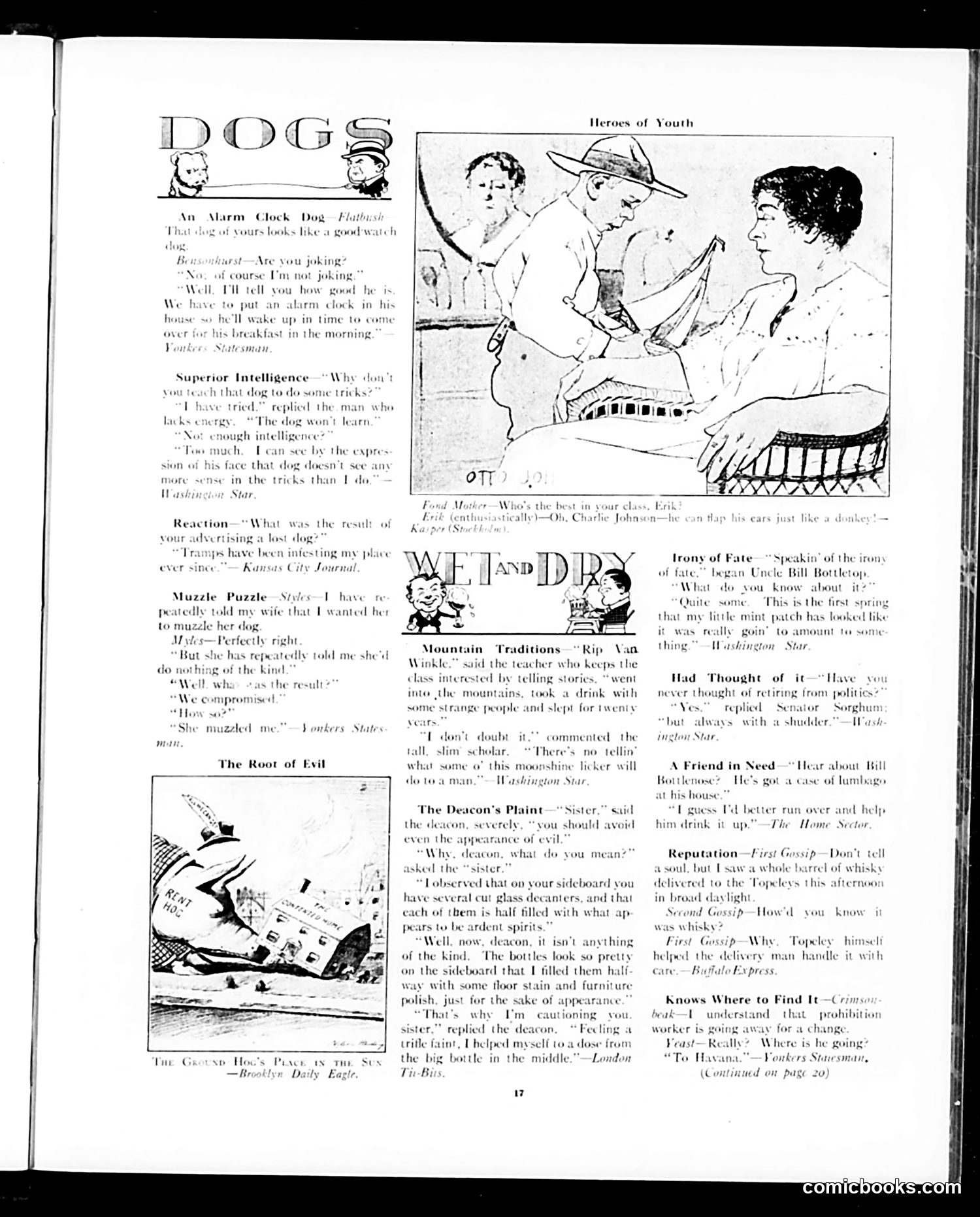
This page contains several short humorous anecdotes satirizing American social attitudes of the early 20th century. **"An Alarm Clock Dog"** jokes about a lazy dog requiring mechanical assistance—humor based on anthropomorphizing pet behavior. **"Superior Intelligence"** mocks both dog-training claims and human self-awareness, suggesting the owner lacks sense comparable to his dog. **"The Root of Evil"** (cartoon) appears to depict financial/economic disaster, though the specific reference is unclear from the visible image. **"The Deacon's Plaint"** satirizes Victorian hypocrisy: a religious figure criticizes a woman's "appearance of evil" (decorative bottles), then secretly drinks from them, getting intoxicated. The humor targets sanctimonious moralizing. **"Reputation"** jokes about society gossip and alcohol consumption—someone receiving a whisky barrel tries hiding it but the delivery man's careful handling reveals its contents. **"Knows Where to Find It"** references Prohibition enforcement: a prohibition worker allegedly heads to Havana (Cuba) where alcohol remains legal—mocking enforcement futility. The page generally satirizes hypocrisy, drinking culture, and social pretense common to early Prohibition-era American society.
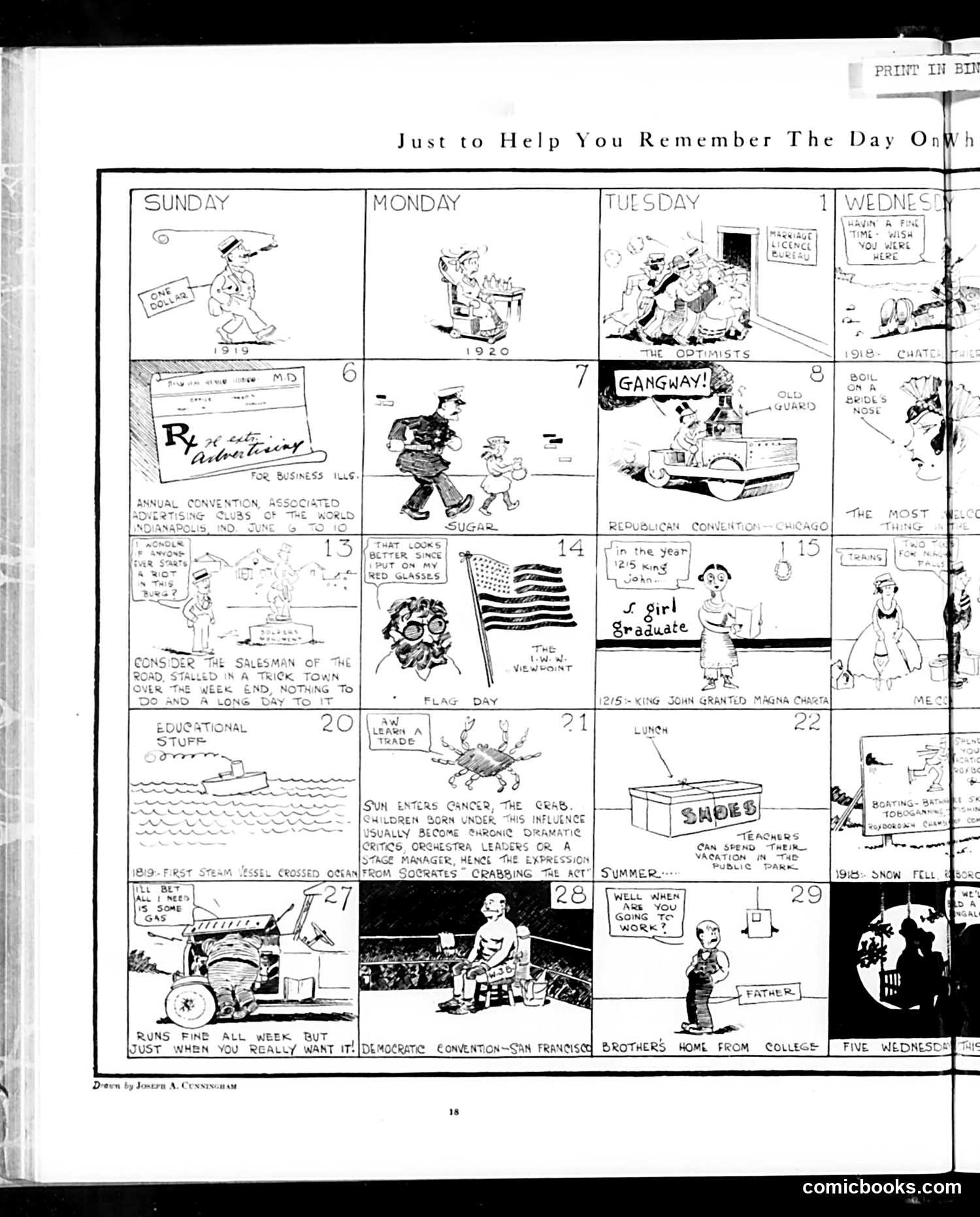
This is a satirical calendar page titled "Just to Help You Remember The Day On Which..." Each numbered panel references a specific historical event from 1919-1920: **Key references include:** - Panel 6: A doctor's prescription labeled "Advertising" (likely mocking patent medicines) - Panel 8: "Gangway" with a Republican Convention reference to Chicago - Panel 14: "Flag Day" with patriotic imagery - Panel 20: "Educational" featuring a steamship (appears to reference naval/maritime themes) - Panel 27: A car "runs fine all week but just when you really want it" (mechanical reliability humor) - Panel 28: "Democratic Convention—San Francisco" (political event satire) - Panel 29: "Brothers Home from College" with dialogue "Well, when are you going to work?" (post-WWI social commentary on youth employment) The overall satire lampoons contemporary American life: political conventions, consumer products, education, and returning soldiers/young people facing employment pressures during the post-war period.
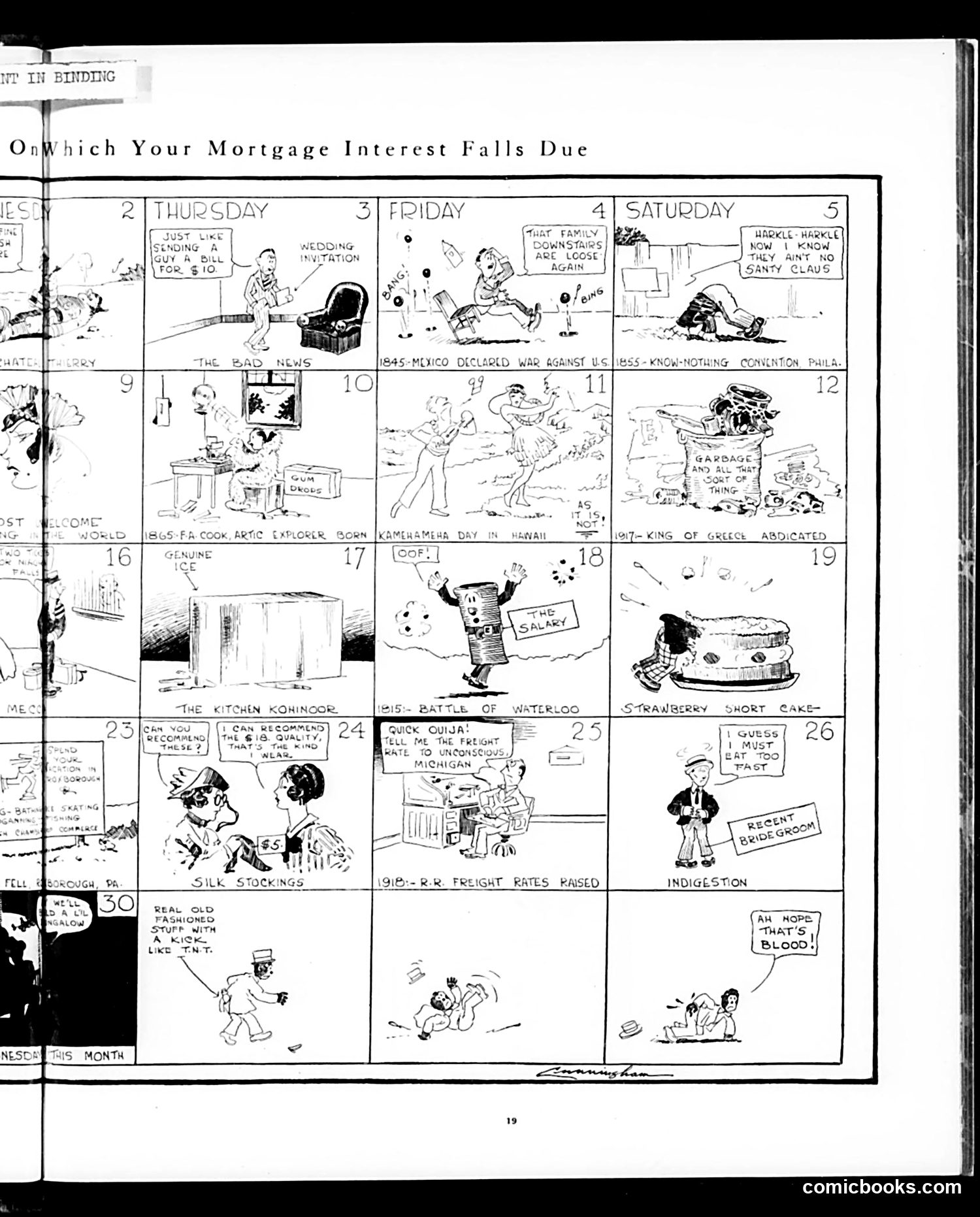
This is a satirical calendar strip mocking the financial pressures on ordinary Americans. Each dated panel pairs a mundane household event or expense with a contemporary news headline, suggesting life's daily troubles coincide with economic hardships. The joke: homeowners must pay mortgage interest while simultaneously dealing with wedding expenses (panel 3), family troubles (4), kitchen problems (17), and digestive issues from stress (26). The strip titles reference actual 1915 events—a Mexico war disclosure, the Battle of Waterloo anniversary, and railroad freight rate increases—implying these external economic shocks directly impact household finances. The satire critiques how ordinary citizens bear the burden of national economic and political instability. Their personal crises align perfectly with larger economic disturbances beyond their control, creating an inescapable squeeze on family budgets.
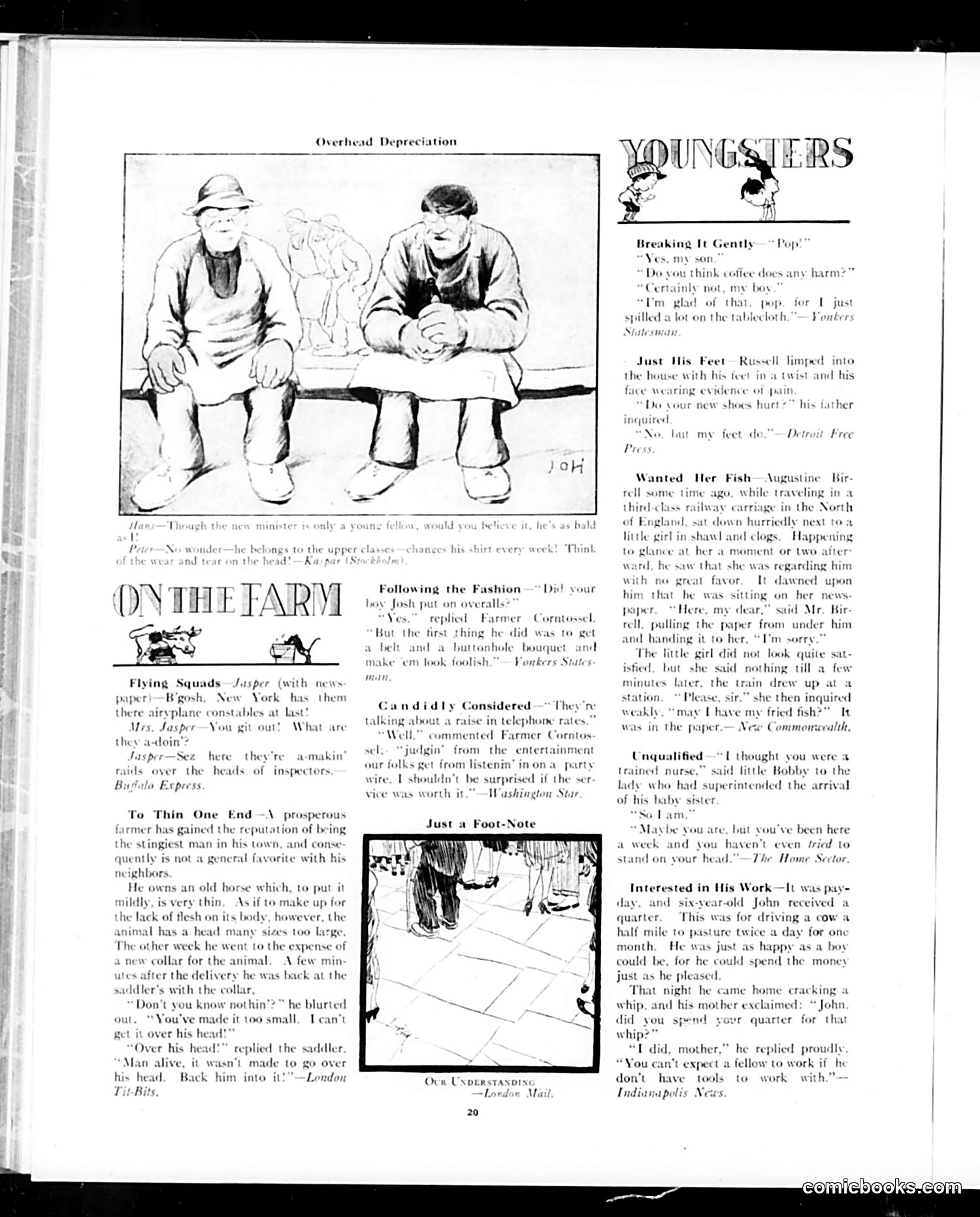
The main cartoon depicts two men on a bench—one elderly and wearing a hat, one younger. The caption explains the satirical point: though the young minister appears respectable, he belongs to "the upper classes" and "changes his shirt every week"—implying wasteful vanity and disconnection from working people. The joke mocks class pretension during an era when frequent shirt changes signaled wealth and frivolity to rural audiences. The page's other content is a humor column titled "Youngsters" and "On the Farm," featuring anecdotes rather than political cartoons. These brief comedic stories involve rural characters (Farmer Corntossel, Jasper) discussing mundane topics like telephone rates, overalls, and farm work—gentle satire of country life and generational attitudes rather than serious political commentary.
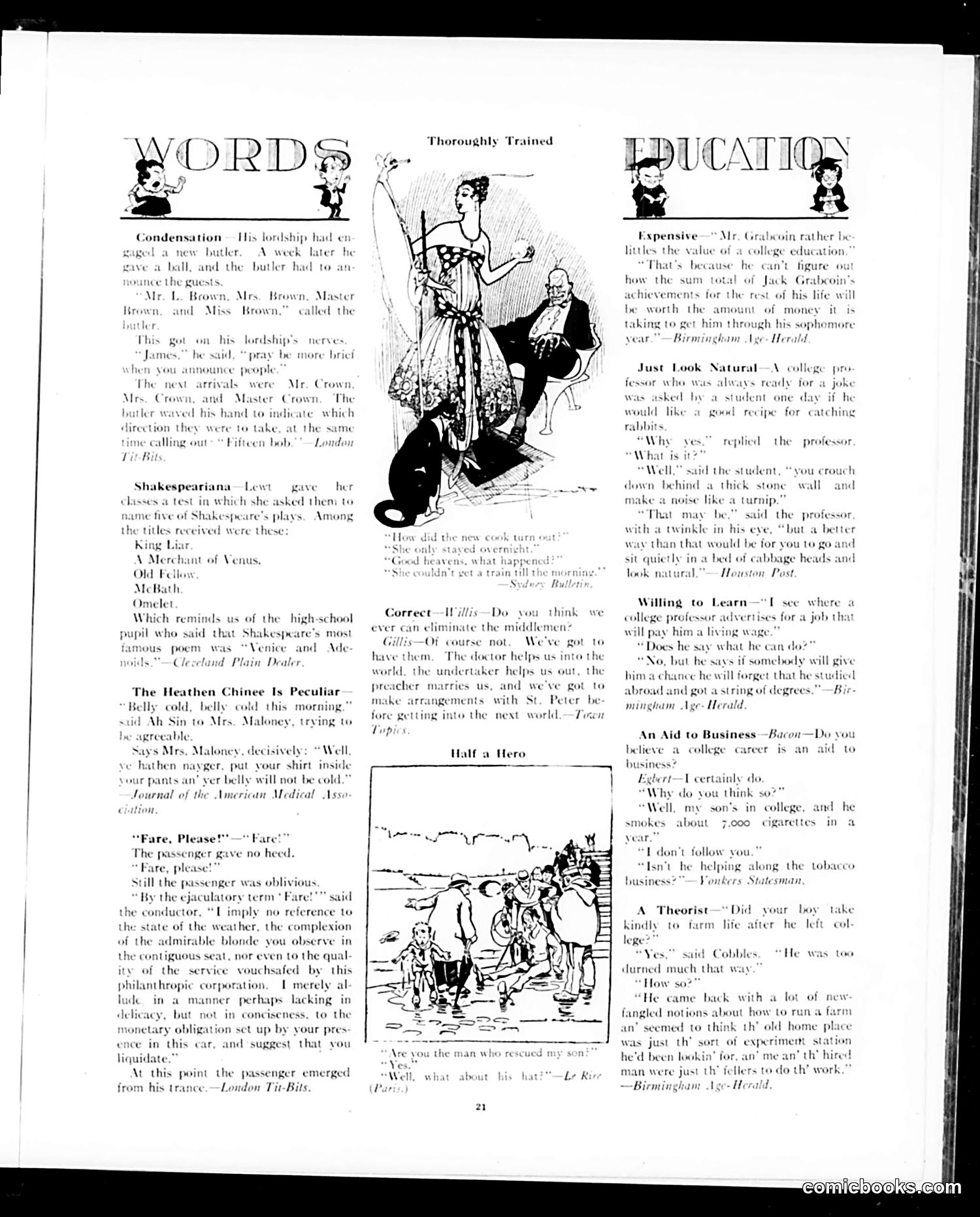
This page from *Judge* magazine (circa early 1900s) contains satirical anecdotes mocking American social pretensions and educational values. **Main themes:** 1. **"Expensive" Education** - Satirizes wealthy parents sending sons to college as wasteful. A father questions whether his son's education justifies its cost, suggesting college produces unemployable graduates. 2. **"Thoroughly Trained"** - Mocks upper-class butler etiquette, where formal announcement procedures cause aristocratic anxiety—satirizing obsession with meaningless social rituals. 3. **College Humor** - Multiple jokes ridicule college professors and students as impractical. A professor asks students about Shakespeare plays, receiving absurd answers ("King Liar," "Omelet"), mocking poor education. 4. **"Aid to Business"** - Ironically suggests college helps business—the son smokes 7,000 cigarettes yearly, supposedly "helping" the tobacco industry, satirizing that college teaches wasteful consumption rather than productive skills. 5. **Farm Life** - A college-educated boy returns home with impractical "scientific" farming ideas incompatible with actual farm work, mocking that education produces theorists disconnected from reality. The overall satirical point: early 1900s American college education was portrayed as producing unemployable, pretentious, impractical individuals.
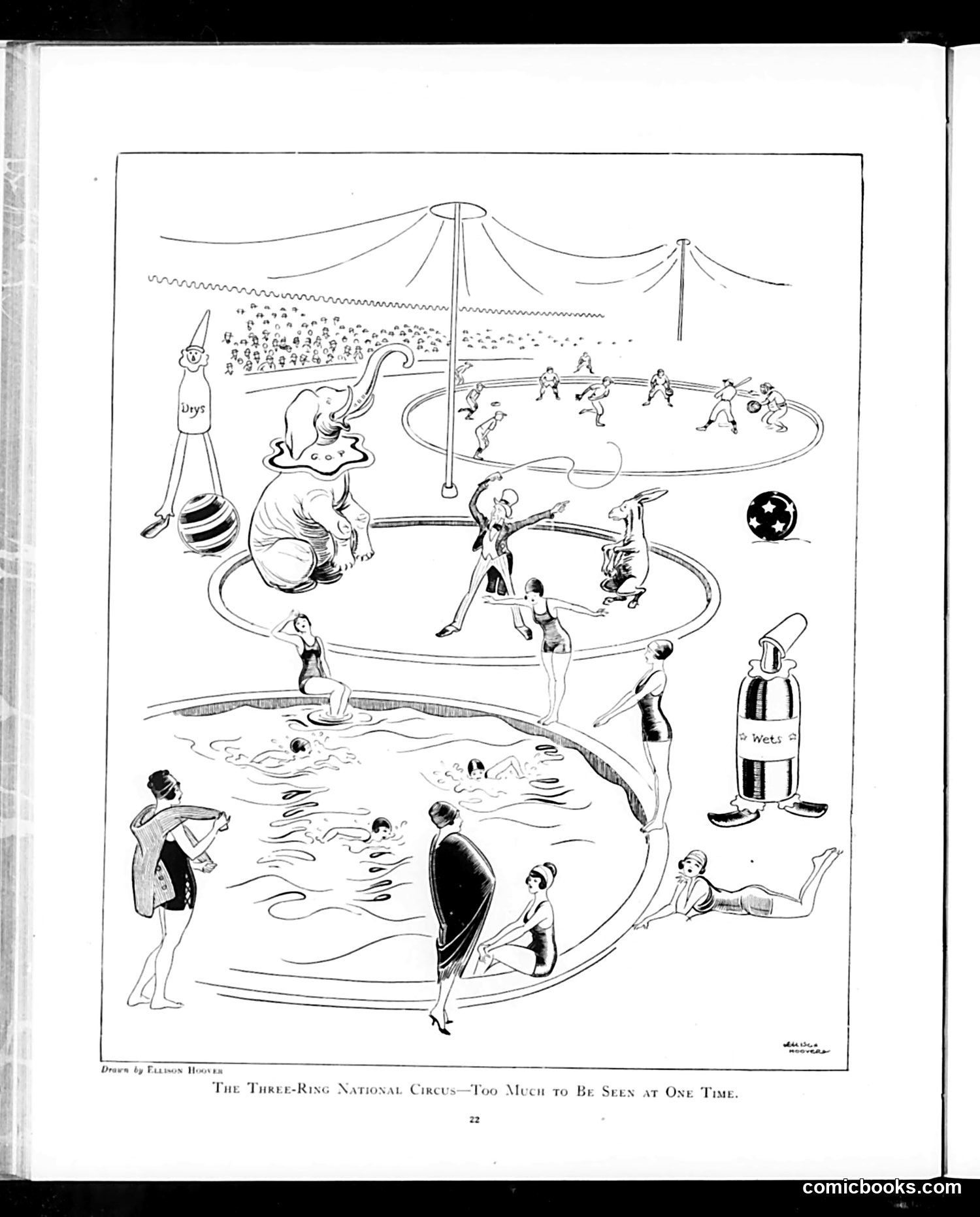
This is a single-panel cartoon titled "The Three-Ring National Circus—Too Much to Be Seen at One Time," drawn by Eldon Hooper. The satire depicts American national politics as an overwhelming circus with simultaneous competing attractions: acrobats, clowns, a band, swimming pool, and rope-walkers all demand attention simultaneously. The cartoon criticizes the chaos and sensory overload of contemporary political discourse—too many scandals, controversies, and spectacles happening at once for citizens to properly follow or understand any single issue. The "three-ring" structure mirrors actual circus layout while suggesting the government presents itself as entertainment rather than serious governance. This reflects early-20th-century concerns about media fragmentation and public distraction from substantive policy issues.
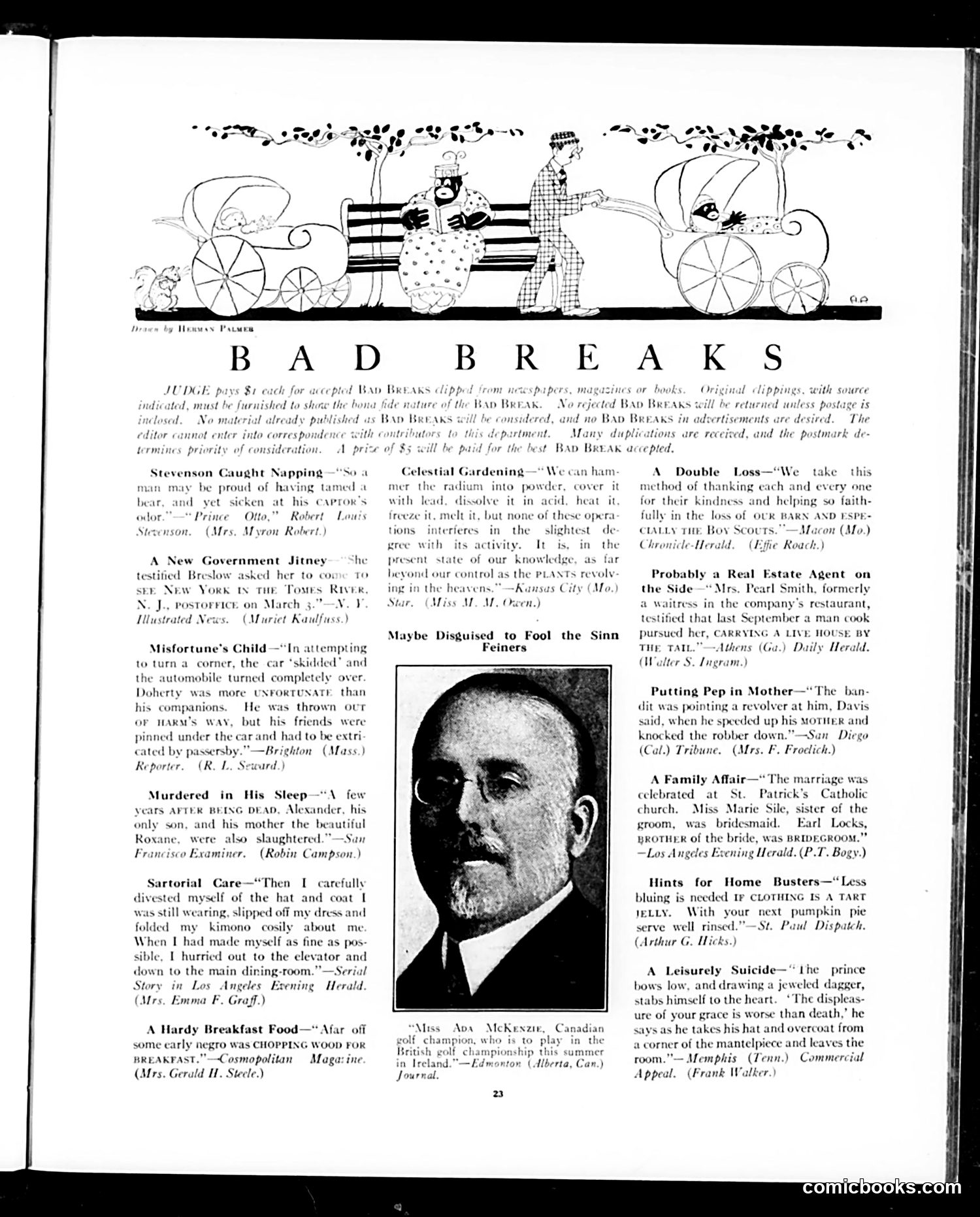
This page is a humor column featuring embarrassing newspaper and magazine typos/editing errors—"Bad Breaks." The top illustration shows people in carriages, likely advertising the feature's premise. The column collects comical unintended meanings from published text. Examples include: a sentence implying someone was "proud" of sickeningly smelling; a woman being "unfortunate" while companions faced "harm"; and a passage where someone "divested" themselves of clothing before appearing publicly "fine." One entry references "Sinn Feiners" (Irish independence activists), suggesting the humor sometimes touched contemporary politics, though the specific joke here is unclear from the OCR. The satire targets careless editing and unintentional double-meanings—what modern readers would call editing fails. Judge magazine collected these real published gaffes to mock newspapers and magazines' quality control, inviting readers to submit their own discoveries.
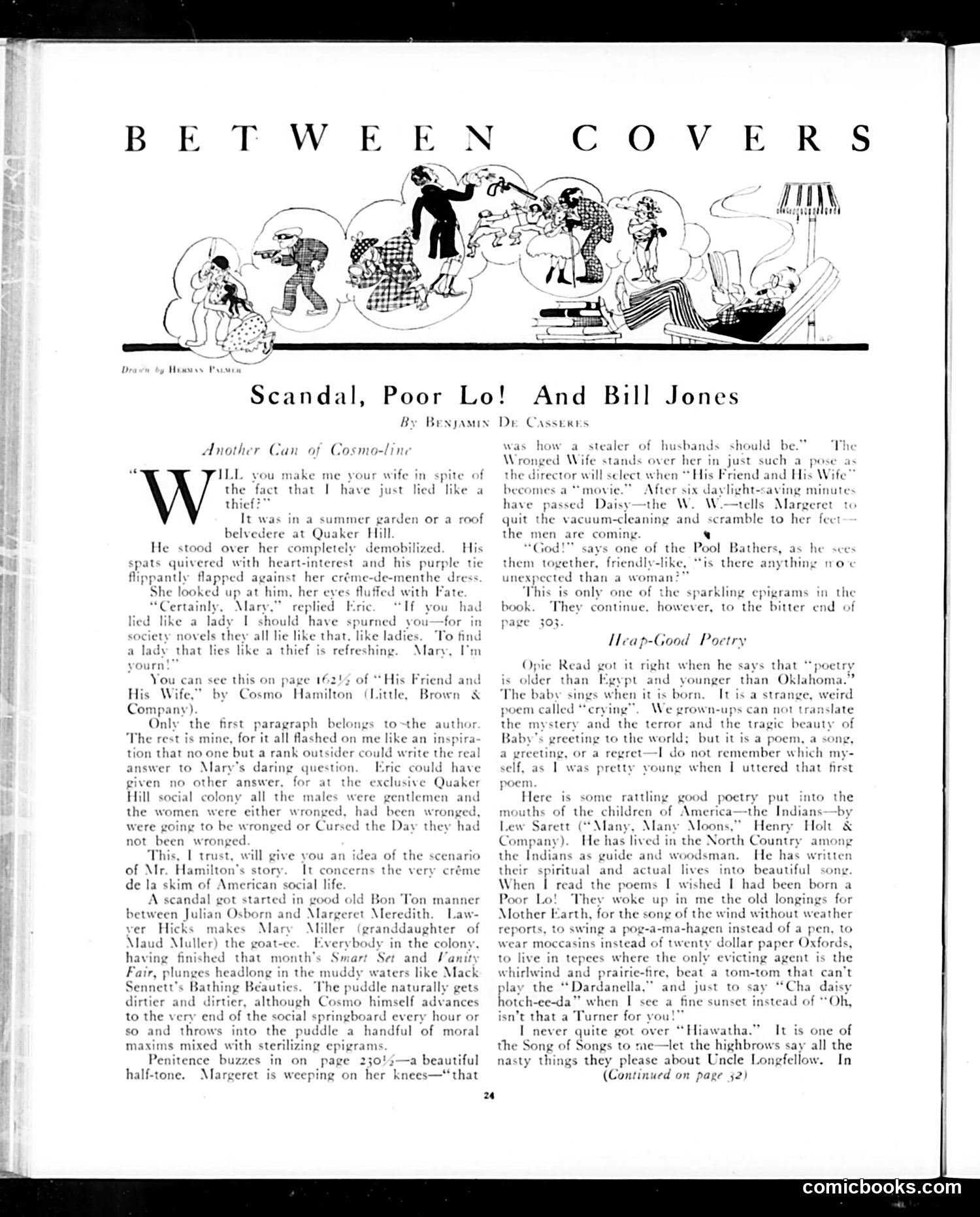
This page contains a book review section titled "Between Covers," discussing several works of fiction and poetry. The main review concerns **"Scandal, Poor Lo! And Bill Jones"** by Benjamin De Casseres, which satirizes social scandals among wealthy Americans at an exclusive country club ("Quaker Hill"). The satire targets how the upper-class colonists—both men and women—are preoccupied with moral transgressions, infidelity, and gossip. The reviewer uses ironic humor to mock characters who engage in elaborate moral philosophizing while simultaneously participating in scandalous behavior. A secondary review discusses poetry by **Lew Sarett**, praising his verses about Native Americans and frontier life. The reviewer expresses romantic nostalgia for Indigenous peoples and natural living, contrasting it with modern urban society. The page demonstrates Judge magazine's characteristic blend of **literary criticism with social satire**, mocking both the superficiality of wealthy social circles and sentimental romanticization of Native Americans—both common satirical targets of the era.
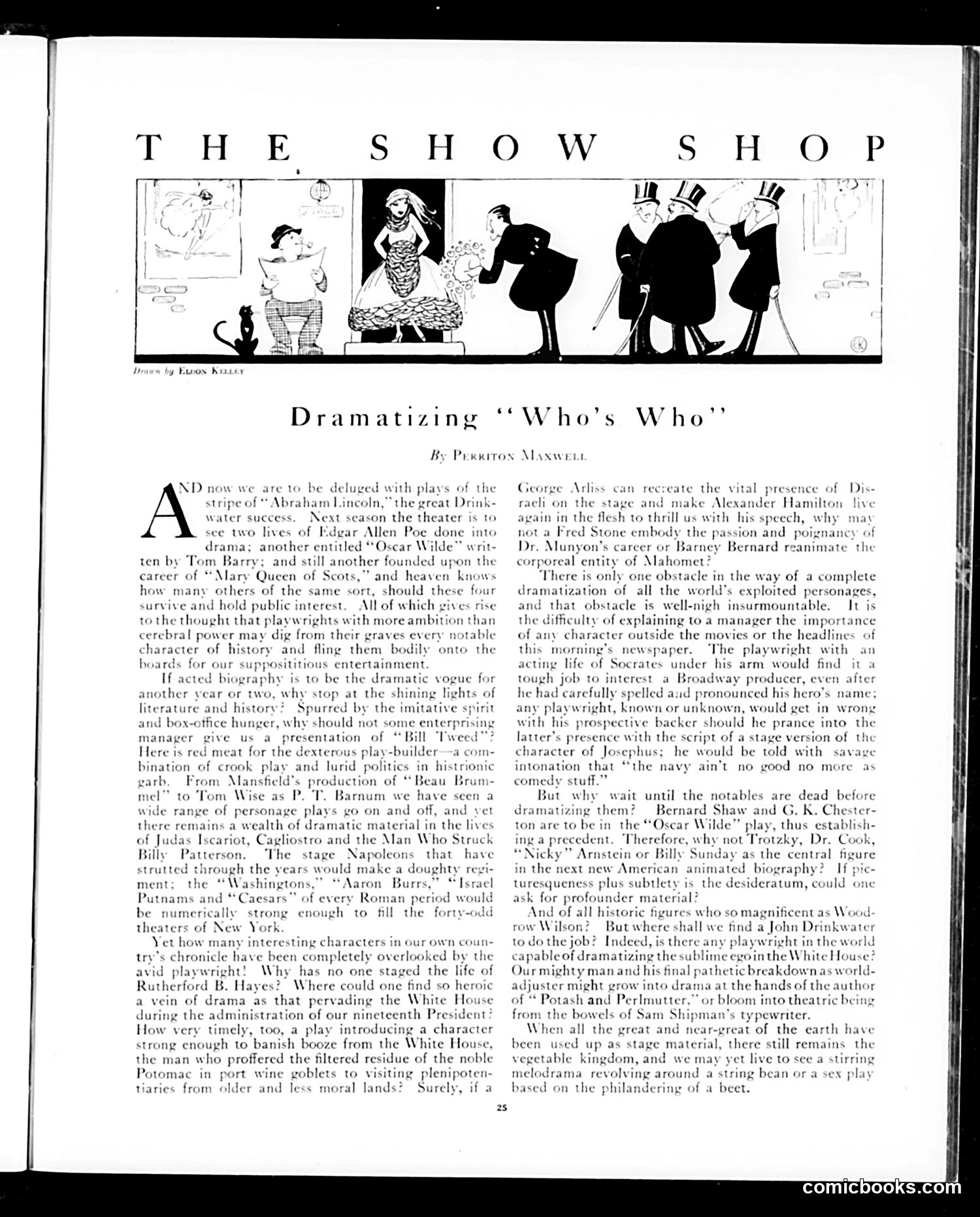
This satirical article by Perriton Maxwell mocks the theatrical trend of adapting biographies into plays. The cartoon header illustrates various theatrical characters and producers, setting up the joke. Maxwell argues that if theaters are producing plays about historical figures like Abraham Lincoln and Edgar Allan Poe, why stop there? He sarcastically proposes dramatizing obscure or ridiculous subjects—"Bill Tweed" (the corrupt Tammany Hall politician), even Judas Iscariot and Cagliostro—to expose the absurdity of the trend. His real critique: Broadway producers only greenlight biographies of famous figures they can recognize or that generate headlines. He mocks this by suggesting that even timely contemporary figures like Trotsky, Dr. Cook, or Billy Sunday would be rejected because producers lack vision beyond box-office appeal. The satire targets both the theatrical industry's formulaic imitation and audiences' predictable tastes during this period of biographical drama popularity.
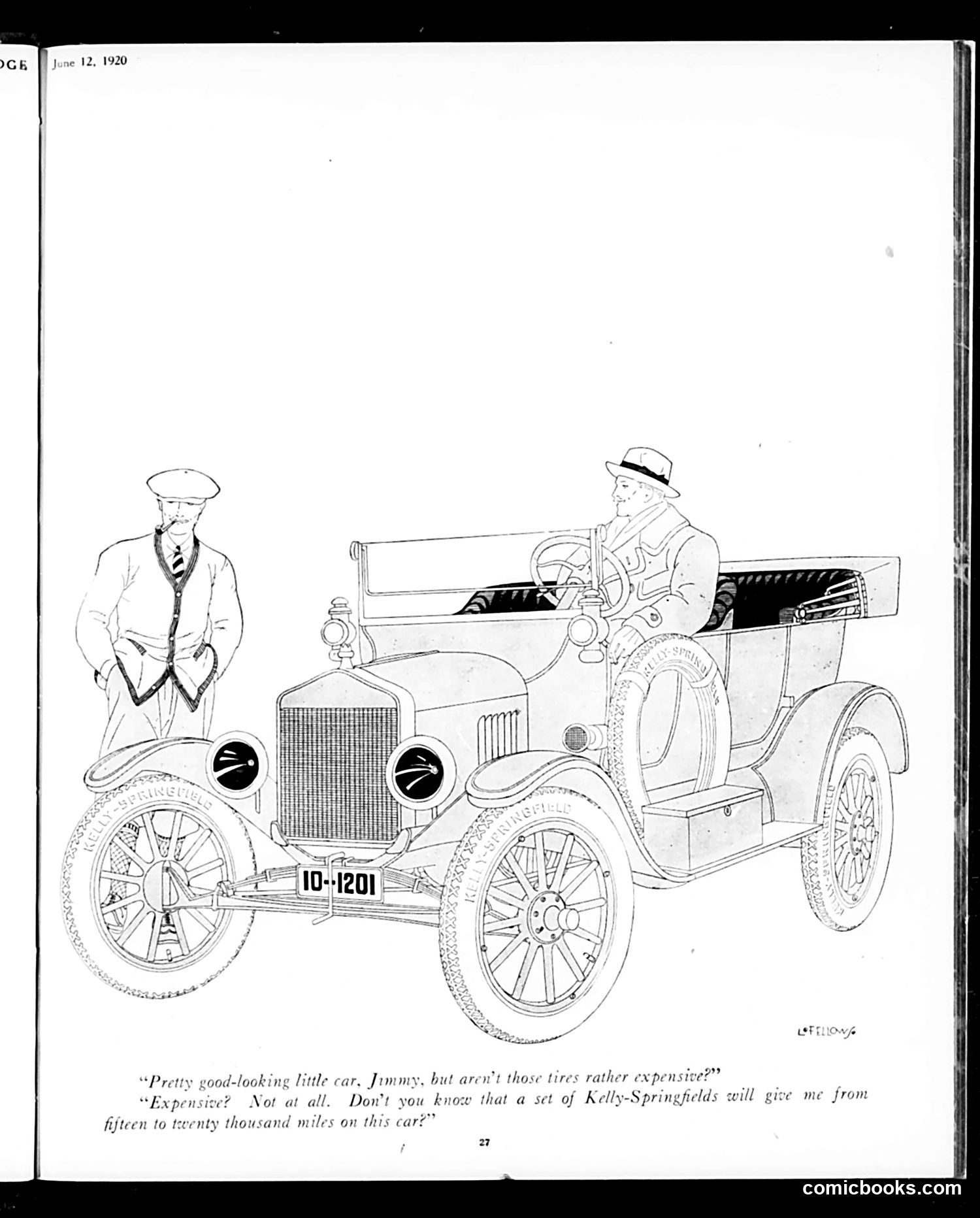
This is a 1920 advertisement disguised as a cartoon joke. Two men discuss a modest early automobile with license plate "10-1201." One man questions whether the tires are expensive; the other responds by touting Kelly-Springfield brand tires' durability—claiming they'll last 15,000 to 20,000 miles. The "joke" is merely promotional: it presents Kelly-Springfield tires as a practical, economical choice for automobile owners. The cartoon format was a common advertising technique in Judge magazine, making product endorsements more engaging than straightforward ads. There's no political satire here—just a period-appropriate pitch for automotive tires to early car owners concerned about maintenance costs.
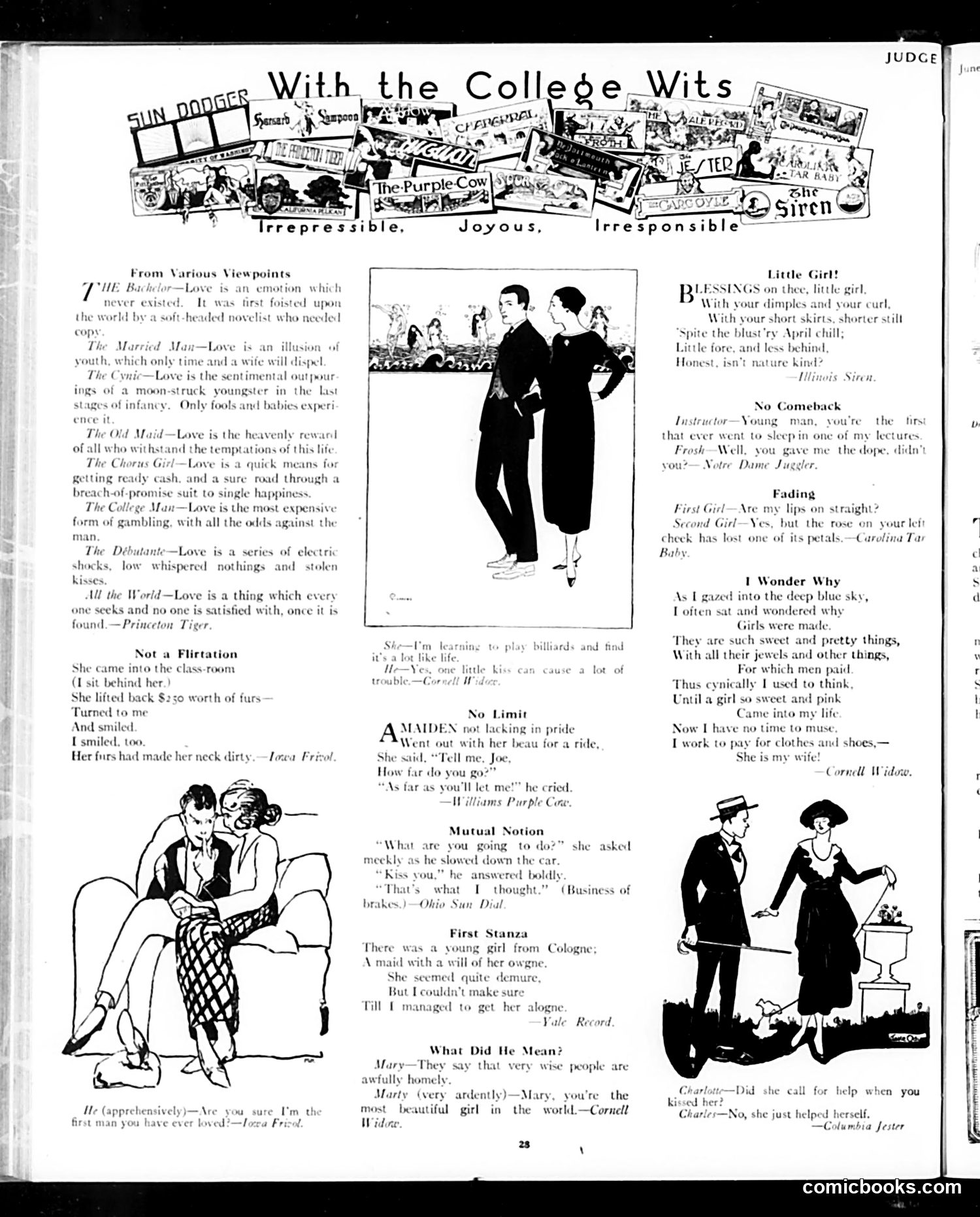
This page features humorous observations about love from various perspectives—"The Bachelor," "The Married Man," "The Cynic," etc.—presented as satirical definitions. The jokes mock conventional romantic notions; for example, "The College Man" is described as engaging in "the most expensive form of gambling." The accompanying illustrations show flirting couples and romantic scenarios. Titles like "Not a Flirtation" and "No Limit" suggest commentary on courtship behavior and dating conventions of the era. The poetry snippets ("Little Girl!", "I Wonder Why") appear sentimental on the surface but likely contain ironic twists typical of Judge's satirical approach. Overall, this page satirizes early 20th-century American courtship rituals and attitudes toward romance among different social classes and age groups, particularly college-age individuals.
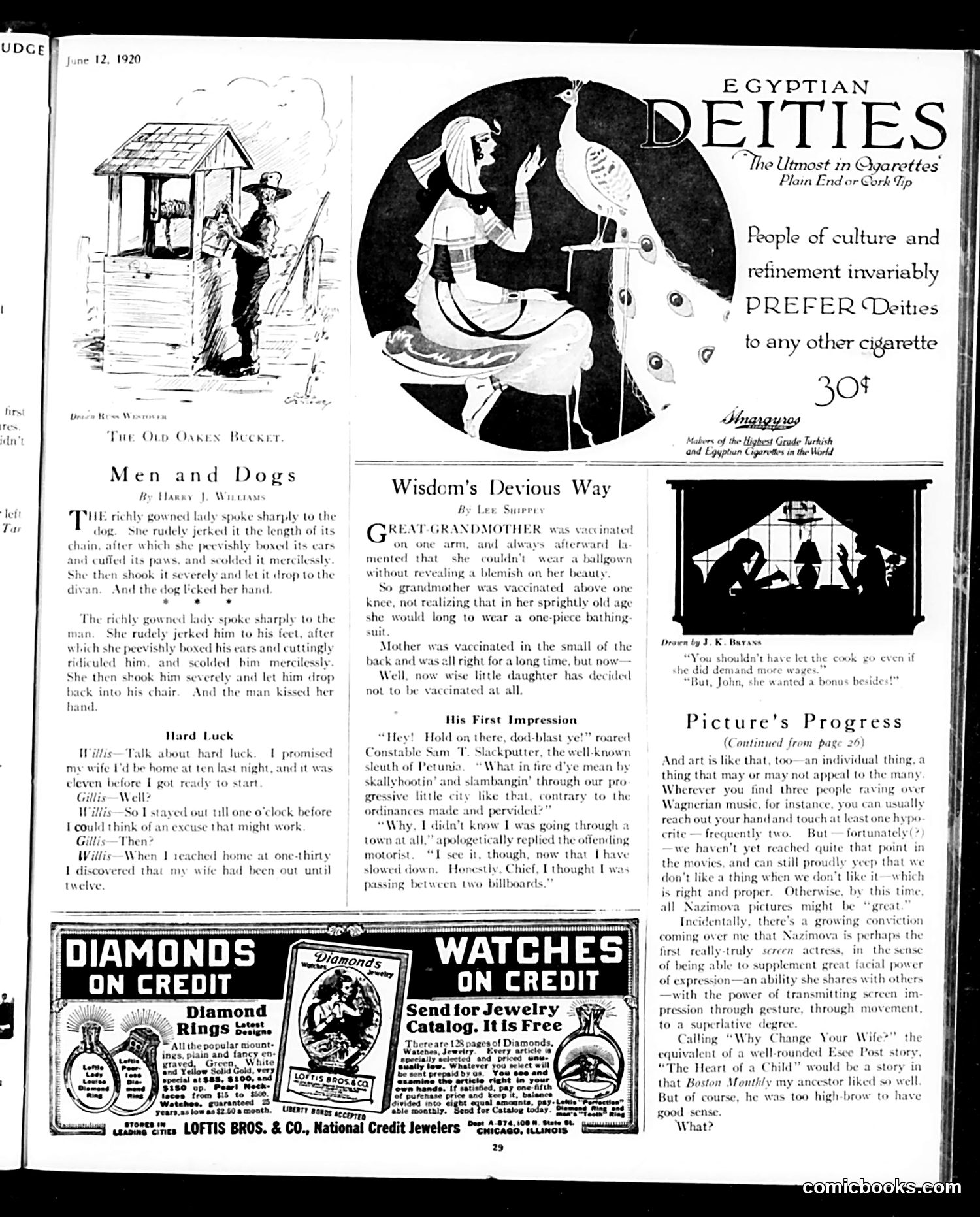
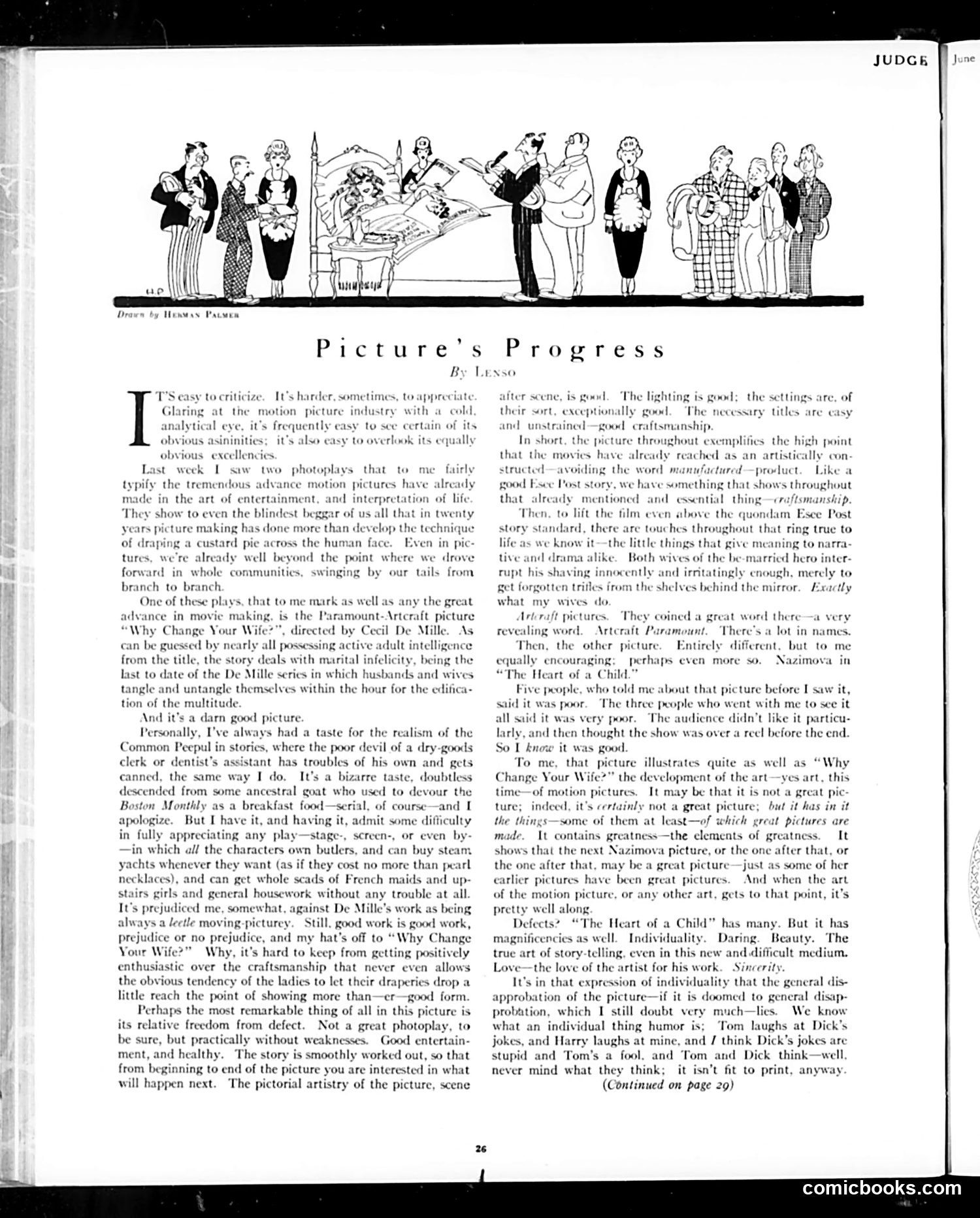
This page contains several satirical pieces and advertisements typical of Judge's humor: **"Men and Dogs"** presents a parallel structure joke: a wealthy woman treats her dog and her male companion identically—rudely jerking, hitting, and scolding both—yet the man accepts this mistreatment and kisses her hand. The satire targets gender relations and male subservience to wealthy women. **"Hard Luck"** and **"Wisdom's Devious Way"** are short humorous anecdotes with ironic twists typical of the era's comedy style. **The Egyptian Deities cigarette advertisement** uses Orientalist imagery (an Egyptian woman with a peacock) to market cigarettes as products for "people of culture and refinement"—typical of 1920s advertising that associated exotic imagery with sophistication. **"His First Impression"** satirizes a motorist's excuse-making when stopped by a constable. **"Picture's Progress"** discusses cinema and actress Nazimova, debating artistic merit and audience taste. The page is primarily entertainment and advertising rather than political satire.
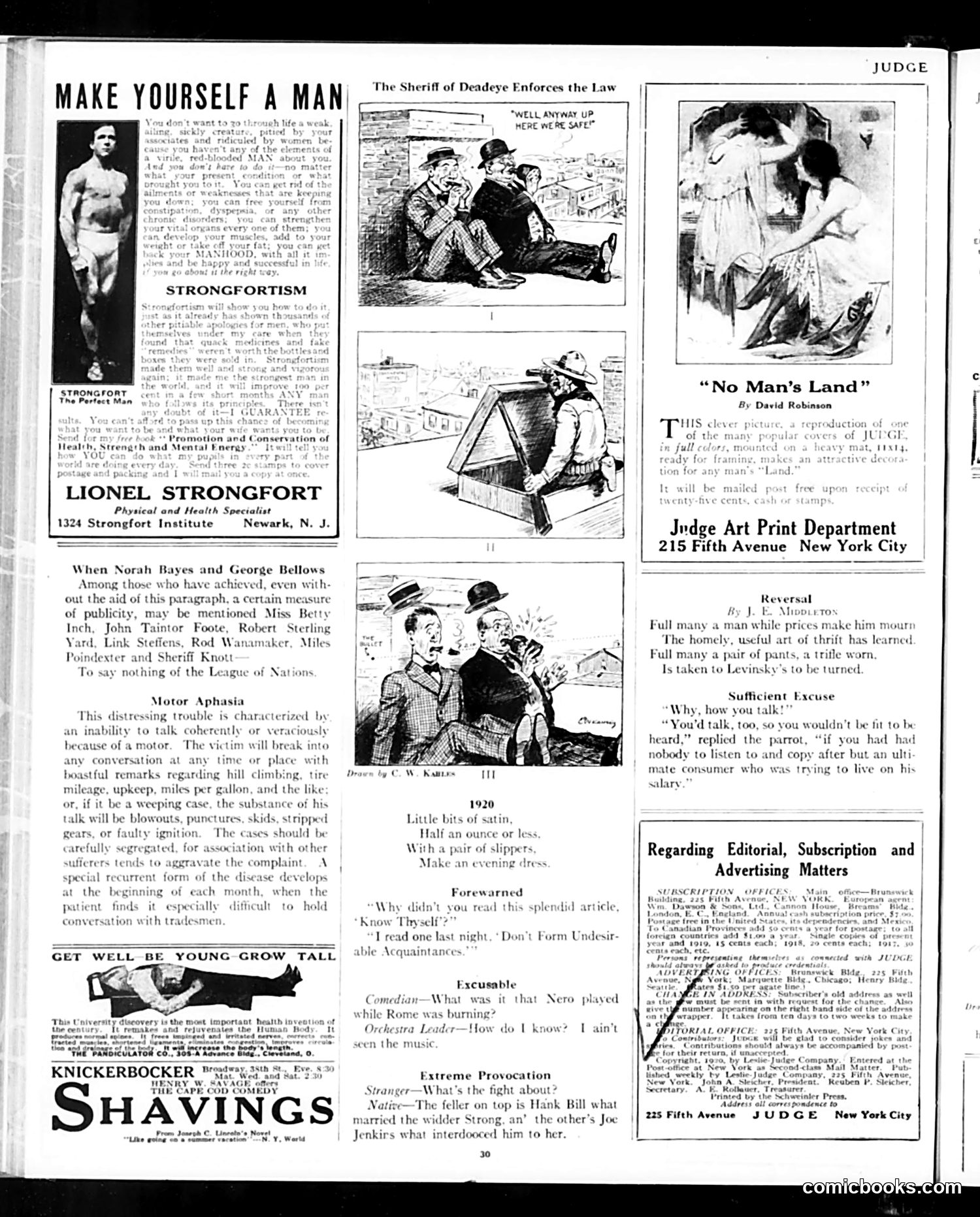
This is primarily an **advertising page** mixed with short humor pieces, rather than political cartoons requiring historical context. The main cartoon shows a sheriff protecting citizens from what appears to be civil unrest ("Well anyway up here we're safe"), reflecting early 1920s anxieties about lawlessness and social upheaval (the post-WWI period saw labor strikes, prohibition violence, and general instability). The humor pieces are lightweight jokes: one about a comedian asking what Nero played while Rome burned; another mocking self-help books ("Know Thyself"); and one about a parrot criticizing a cheap employer, likely satirizing labor's complaints about poor wages. The **Lionel Strongfort advertisement** for physical fitness and the **Knickerbocker Shavings theatrical ad** represent typical early-20th-century magazine commerce. The "No Man's Land" art print reference connects to WWI imagery still culturally relevant in 1920. The overall page reflects post-war America's focus on health, safety, and entertainment during economic transition.
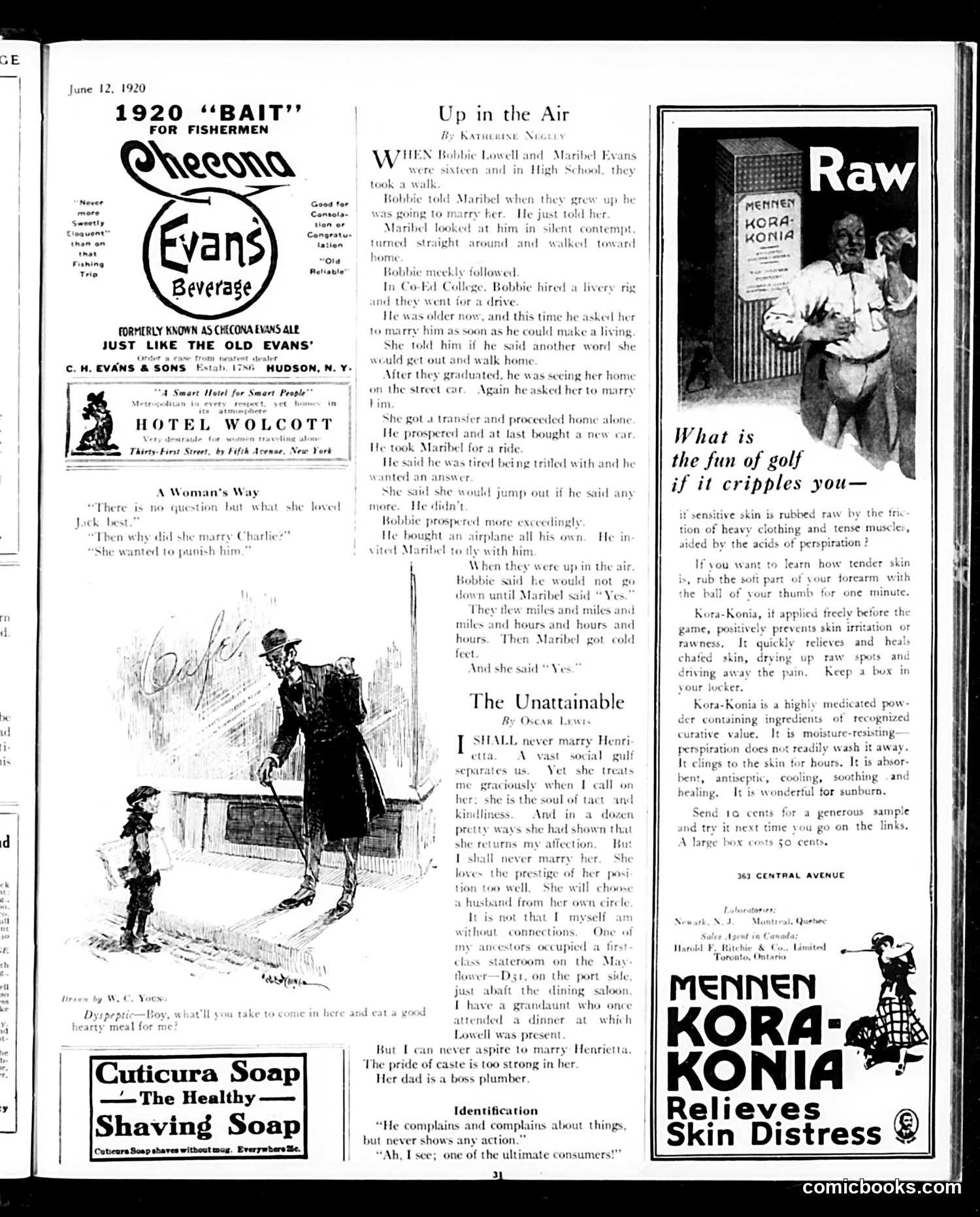
This page contains two main satirical stories: **"Up in the Air"** depicts a man (Bobbie) repeatedly proposing to a woman (Maribel) over years—initially on foot, later by car, finally by airplane. Each time she refuses or deflects. The joke mocks persistent male courtship and female resistance to marriage, with the escalating "bait" (romantic gestures) failing to secure her commitment. The airplane setting suggests modern courtship still produces the same old result. **"The Unattainable"** by Oscar Levant presents a man lamenting he cannot marry a wealthy woman (Henrietta) due to class differences. He notes his ancestor was a servant ("occupied a first-class stateroom on the Mayflower—D 31, on the port side"), while her father is "a boss plumber"—mocking how rigid class consciousness persists even when wealth sources are humble. Both stories satirize 1920s courtship conventions and class pretension among Americans newly concerned with social status. The page is otherwise filled with period advertisements (Cuticura Soap, Mennen Kora-Konia, Hotel Wolcott).
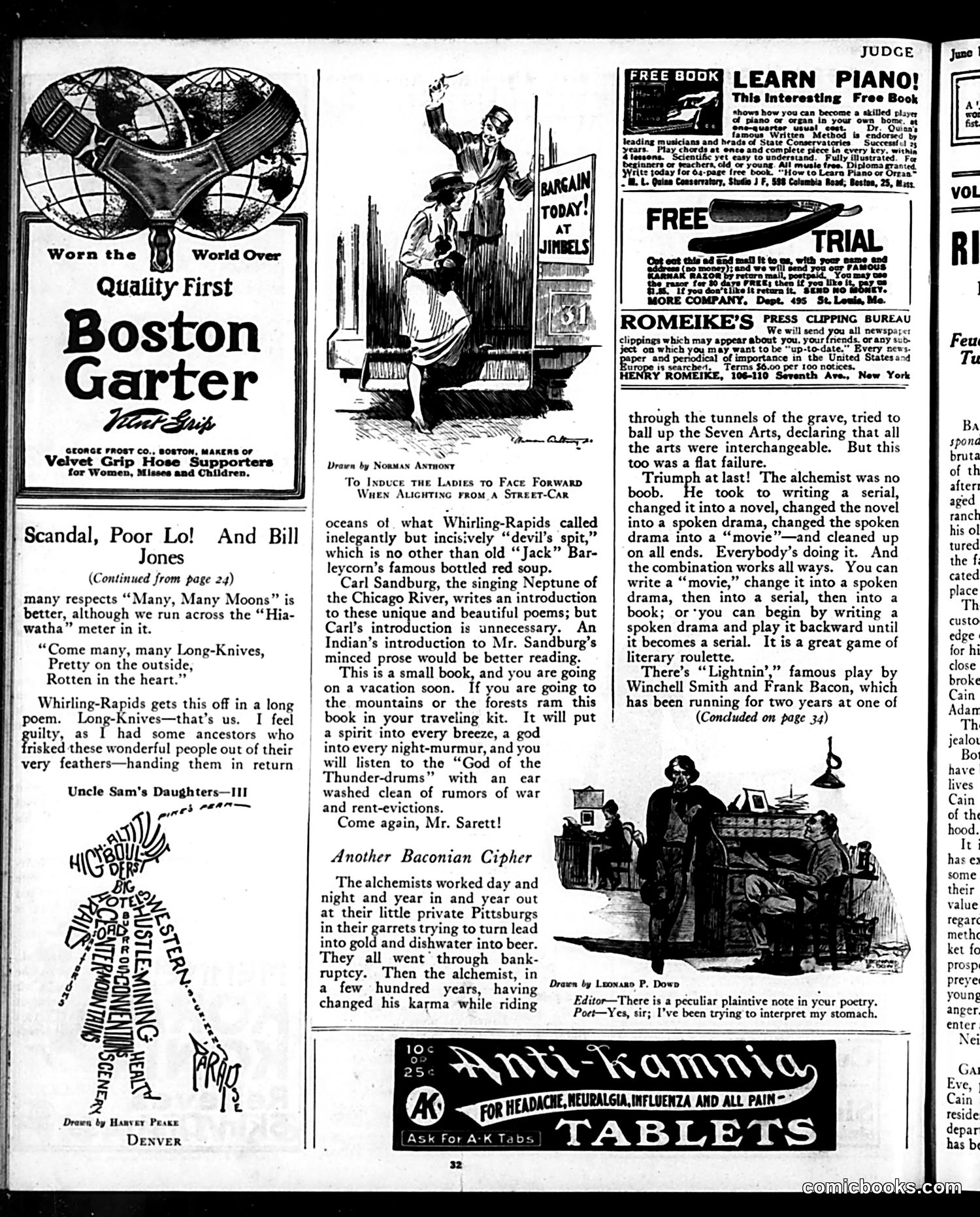
This page primarily contains **literary reviews and advertisements** rather than political cartoons requiring historical context. The main content discusses Carl Sandburg's introduction to Native American poetry by a writer named Sarett. The satirical point critiques Sandburg's unnecessary introduction, suggesting an "Indian's introduction to Mr. Sandburg's minced prose would be better reading"—a jab at pretentious literary gatekeeping. "Another Baconian Cipher" satirizes the commercialization of art: an alchemist (metaphorically) fails at traditional pursuits but succeeds by converting between artistic mediums—writing a serial, novelizing it, adapting to drama, then film—with each conversion making money. The satire mocks how artists can profit by endlessly recycling the same content across different formats ("literary roulette"). The cartoon "Uncle Sam's Daughters—III" by Harvey Peake (captioned "Denver") appears to be part of a series but its specific satirical target is unclear from this image alone. The page is heavily laden with period advertisements for garters, piano lessons, and pain tablets.
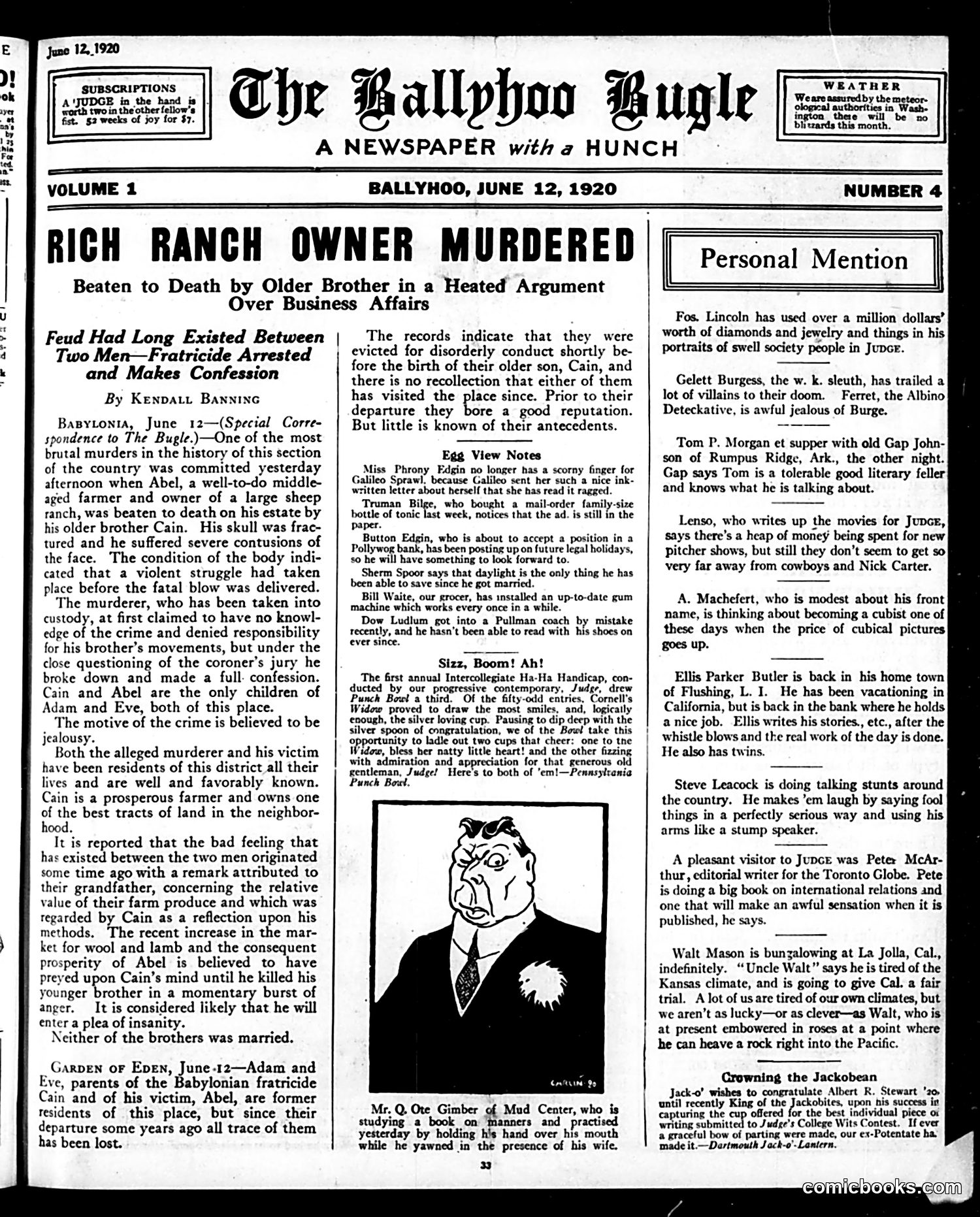
This page from **Ballyhoo**, a humorous magazine spinoff of *Judge*, presents a mock-serious news story about the Biblical murder of Abel by his brother Cain—but set in a contemporary 1920 farming community called "Babylonia." The satire works by treating this ancient religious narrative as a modern crime story, complete with local details (sheep ranches, wool markets, bank positions) that make the absurd premise seem mundane. The characters—Adam, Eve, Cain, Abel—are presented as ordinary farmers with property disputes and jealousy, deflating the biblical story's spiritual weight. The joke hinges on readers recognizing the Cain-and-Abel reference while appreciating how the magazine renders sacred scripture as tabloid news. The "Personal Mention" column's gossip about local figures like "Galileo Sprawl" and "Button Edgin" further mocks small-town newspapers' trivial content. This reflects 1920s satirical humor: irreverent toward tradition, mocking journalistic pomposity, and relying on readers' cultural literacy to catch the biblical allusion.
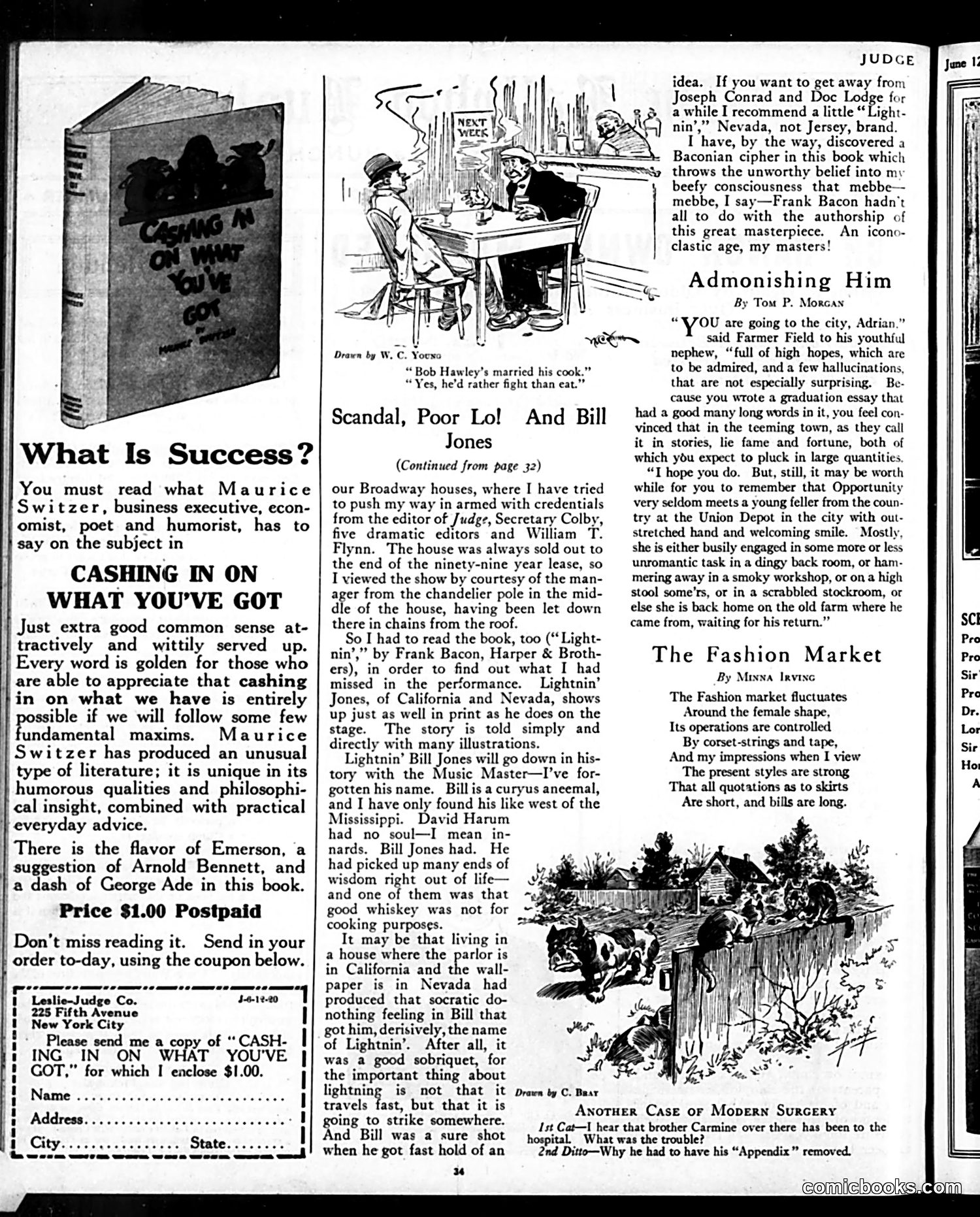
This page combines book advertising with light satirical humor typical of Judge magazine's style. **Main Advertisement**: Promotes Maurice Switzer's book "Cashing In On What You've Got," positioning it as practical business philosophy with wit comparable to Emerson and George Ade—appealing to early 20th-century readers seeking self-improvement literature. **"Scandal, Poor Lo! And Bill Jones"**: A review of the play "Lightnin'" (by Frank Bacon), which was a successful Broadway production. The reviewer uses humorous exaggeration, describing watching from a chandelier pole suspended by chains. The character Lightnin' Bill Jones is portrayed as a folksy, philosophical figure from Nevada/California—contrasted favorably against other literary characters like those in Joseph Conrad novels. **Cartoon jokes**: Include domestic humor ("Bob Hawley married his cook"—implying marital discord) and wordplay about modern surgery ("Appendix" as a pun on a book's appendix versus organ removal). The page reflects Judge's typical mix of literary commentary, gentle social satire, and advertising aimed at educated, middle-class readers.
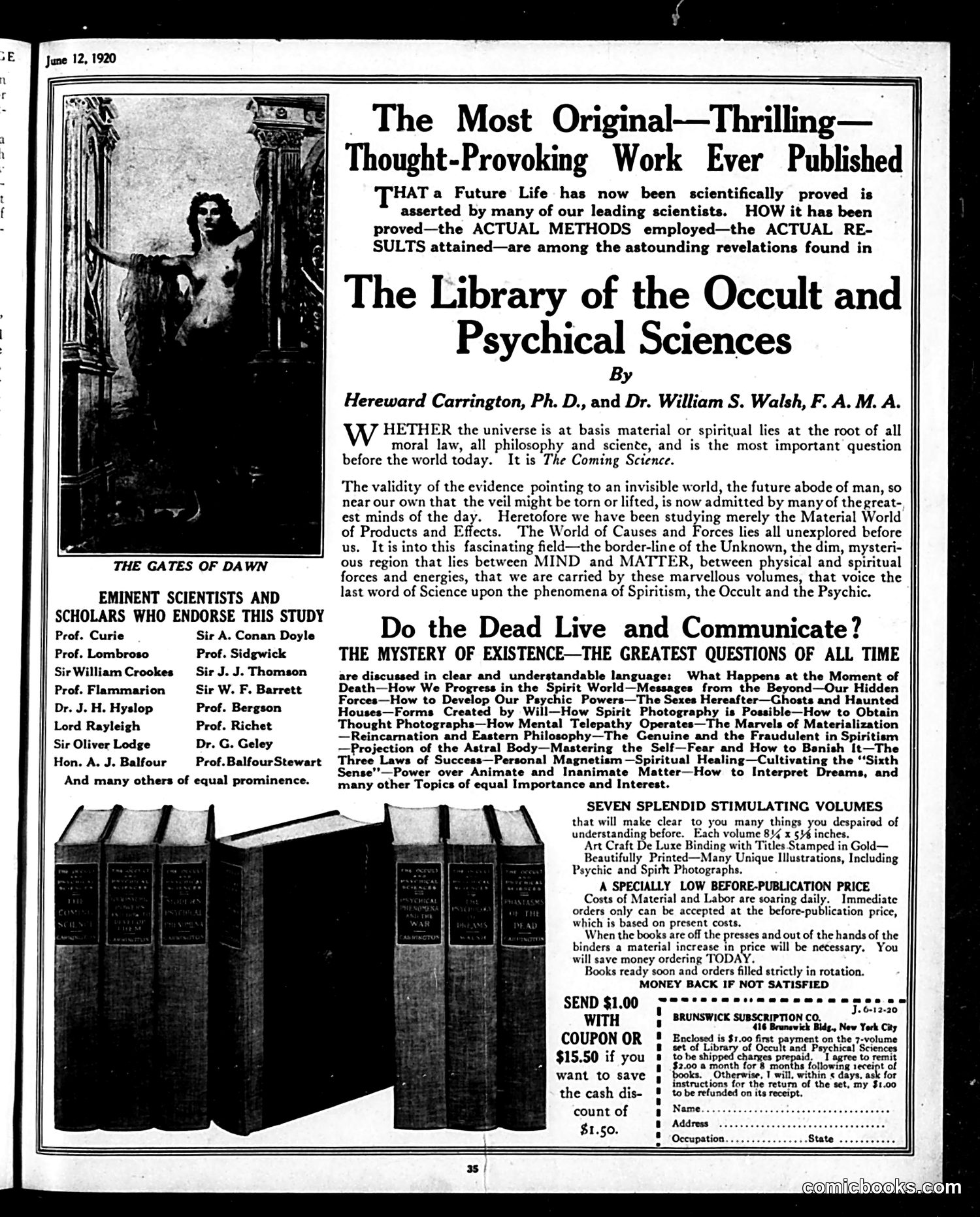
This page is primarily **advertising, not political satire**. It promotes "The Library of the Occult and Psychical Sciences," a seven-volume set about spiritualism, the afterlife, and psychic phenomena. The ad exploits early 20th-century fascination with spiritualism by claiming legitimate scientists endorse the work. The listed endorsers—Lombroso, William Crookes, J.J. Thomson, and others—were real scientists, though their actual views on spiritualism varied; the ad uses their names to lend false credibility. The imagery shows "The Gates of Dawn," depicting a spirit figure, and displays the book set. The text promises answers to mysteries: "Do the Dead Live and Communicate?" and discusses séances, reincarnation, and "spirit photographs." **Context**: This represents the spiritualism craze of the 1920s, when séances and occult claims were genuinely popular, even among educated people. The ad's aggressive marketing ("Money Back If Not Satisfied," pre-publication discount pricing) shows how pseudoscience was commercially exploited during this period. This isn't satire—*Judge* is simply running the ad, likely for payment.
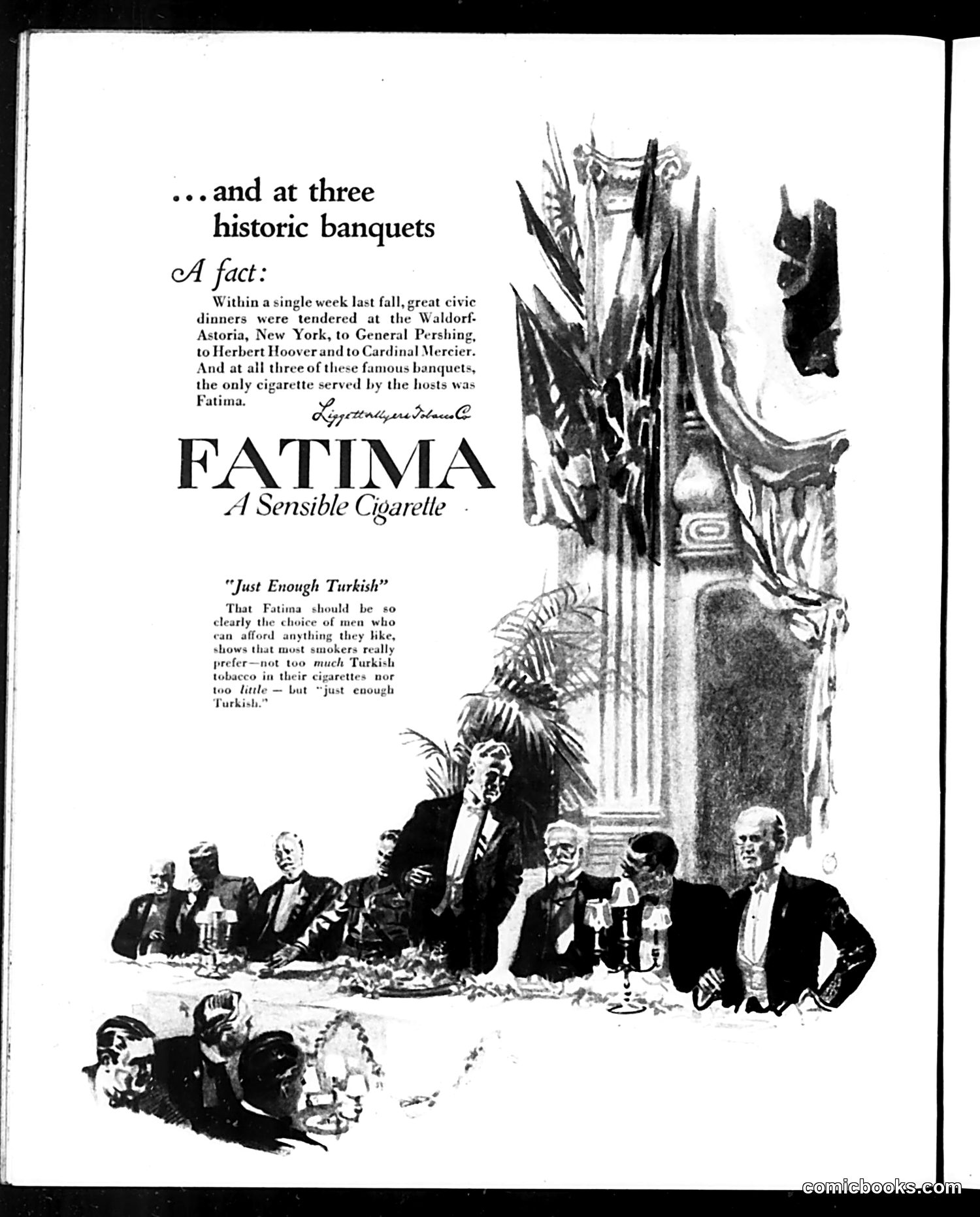
This is a **Fatima cigarette advertisement** disguised as editorial content. The "cartoon" depicts a formal banquet scene with distinguished male diners in formal attire. The ad claims that at three separate 1918-1919 civic dinners honoring prominent figures (General Pershing, Herbert Hoover, and Cardinal Mercier), Fatima was the *only* cigarette served—implying elite endorsement through association. The satirical angle is subtle: the ad positions Fatima as the "sensible" choice for sophisticated men who want "just enough Turkish" tobacco—neither too much nor too little. This appeals to masculine rationality and good taste. The elaborate dinner setting and prestigious guests are meant to suggest that discerning, powerful men chose this brand, making it a status symbol for the average reader. The humor for Judge's audience likely involved the transparent advertising strategy and the absurdity of the claim itself.