
Judge, 1920-06-12 · page 26 of 36
Judge — June 12, 1920 — page 26: what you’re looking at
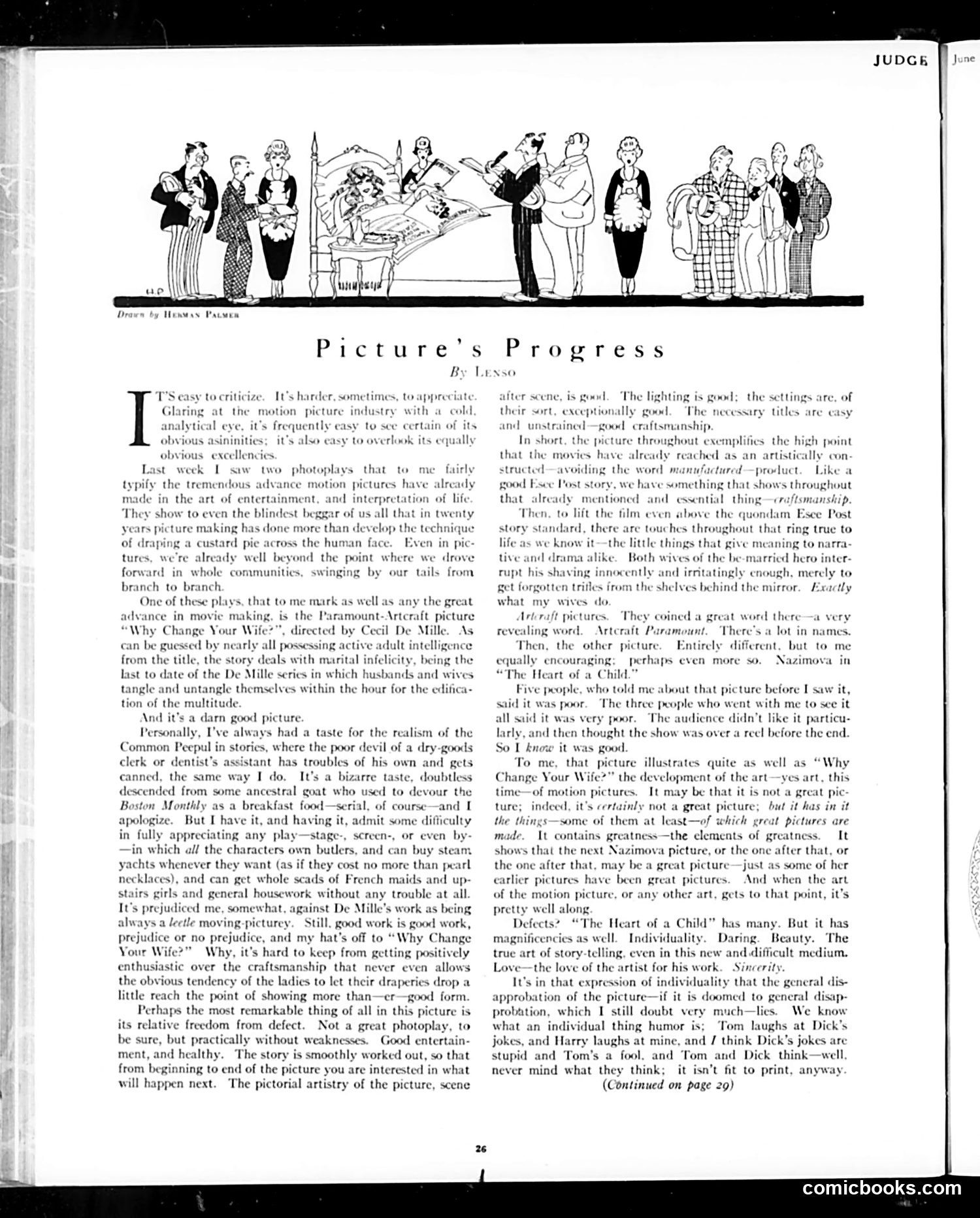
A restored page from Judge, 1920-06-12. Page through the whole issue in the reader above.
📄 Transcribed text from this page (OCR, searchable)
Machine-transcribed from the original scan — historical spelling and the odd misread are preserved.
Dra’ Progress By Lexso T'S easy to criticize at the analytical eye It's harder, sometimes, to appreciate with a cold motion picture industry it’s frequently easy to sce certain of it obvious asininities; it’s also easy to overlook its equally obvious excellencies. Last week | lays typify the tremendous advance motion pictures have already made in the art of entertainment, and interpretation of life They show to even the blindest beggar of us all that in twenty years picture making has done more than develop the technique siw two phot that to me fairly of draping a custard pie across the human face. Even in pic- tures, we're already well beyond the point where we drove forward in whole communities, swinging by our tails from branch to branch One of these plays, that to me mark as well as any the great advance in movie making, is the Paramount-Artcraft picture “Why Change Your Wife?”, directed by Cecil De Mille. As can be guessed by nearly all possessing active adult intelligence from the title, the story deals with marital infelicity, being the last to date of the De Mille series in which husbands and wives tangle and untangle themselves within the hour for the edifica- tion of the multitude. And it’s a darn good picture. Personally, I've always had a taste for the realism of the Common Peepul in stories, where the poor devil of a dry-goods clerk or dentist’s assistant has troubles of his own and gets canned, the sime way I do, It’s a bizarre taste, doubtless descended from some ancestral goat who used to devour the Bo: Monthly as a breakfast food—serial, of course—and L apologize. But I have it, and having it, admit some difficulty in fully appreciating any play—stage-, screen-, or even by- —in which all the characters own butlers, and can buy steam yachts whenever they want (as if they cost no more than pearl necklaces), and can get whole scads of French maids and up- stairs girls and general housework without any trouble at all It's prejudiced me, somewhat, against De Mille’s work as being always a leetle moving-picturey. Still, good work is good work, prejudice or no prejudice, and my hat’s off to “Why Change Your Wife?” Why, it’s hard to keep from getting positively enthusiastic over the craftsmanship that never even allows the obvious tendency of the ladies to let their draperies drop a little reach the point of showing more than—er—good form. Perhaps the most remarkable thing of all in this picture is its relative freedom from defect. Not a great photoplay, to be sure, but practically without weaknesses. Good entertain- ment, and healthy. The story is smoothly worked out, so that from beginning to end of the picture you are interested in what will happen next. The pictorial artistry of the picture, scene after scene, is good. ‘The lighting is good; the settings are, of their sort, exceptionally good. ‘The necesstry titles are easy ind unstrained In short that the structed good craftsmanship. he picture throughout exemplifies the high point s have already reached as an a manufactured x tistically con product. Like a © something that shows throughout avoiding the w good Esee Post story, we hi that already mentioned and essential thing craftsmanship. Then. to lift the film even above the quondam Esce Post story standard, there are touches throughout that ring true to life as we know it—the little things that gi tive and drama alike © meaning to narra Both wives of the be-marricd hero inter- rupt his shaving innocently and irritatingly cnough, merely to get forgotten trifles from the shelves behind the mirror, Exactly what my wives do. Irteraft pictures. They coined a great word there —a very revealing word. Arteraft Paramount Then, the other picture. EF equally encouraging: perhaps even more so. “The Heart of a Child.” Five people, who told me about that picture before I saw it stid it was poor. The three people who went with me to sce it all said it was very poor. The audience didn’t like it particu- larly, and then thought the show was over a rec! before the end. So I know it was good. There's a lot in names. different, but to me Nazimova in ntirely To me, that picture illustrates quite as well as “Why Change Your Wife?” the development of the art—yes art, this time—of motion pictures. It may be that it is not a great pic- ture; indeed, it’s certainly not a great picture; bat it has in it th ings—some of them at least—of which great pictures are mui It contains greatness—the elements of greatness. It shows that the next Nazimova picture, or the one after that, or the one after that, may be a great picture—just as some of her earlier pictures have been great pictures. And when the art f the motion picture, or any other art, gets to that point, it’s pretty well along Defec The Heart of a Child” has many. But it has magnificencies as well. Individuality. Daring. Beauty. The true art of story-telling, even in this new and difficult medium. Love—the love of the artist for his work. Sincerity. It’s in that expression of individuality that the general dis- approbation of the picture—if it is doomed to general disap- probation, which I still doubt very much—lies. We know what an individual thing humor is; Tom laughs at Dick’s jokes, and Harry laughs at mine, and / think Dick’s jokes are stupid and Tom’s a fool, and Tom and Dick think—well never mind what they think; it isn’t fit to print, anyway (Continued on page 29) comicbooks.com