
A complete issue · 37 pages · 1919
Judge — December 27, 1919
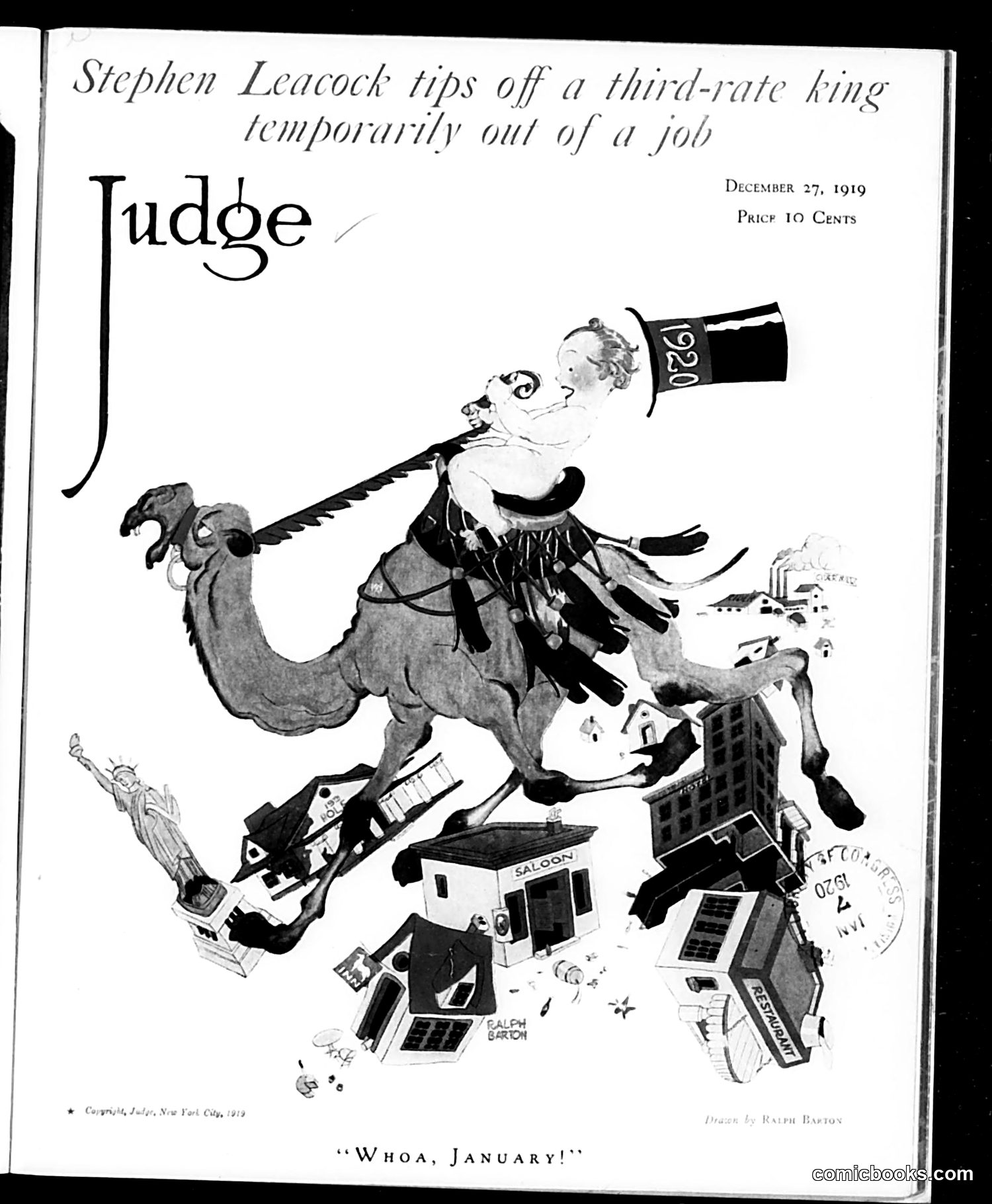
This satirical cartoon depicts Stephen Leacock, a Canadian humorist and writer, being ejected from employment as a "third-rate king." The illustration shows a caricatured figure riding a camel while being literally tipped out of a job—represented by buildings and structures tumbling below, labeled "Saloon" and "Ralph Barton" (likely the artist). The "WHOA, JANUARY!" caption suggests New Year's timing and appears to mock Leacock's temporary departure from some position. The camel, top hat, and chaotic imagery create comedic visual chaos around the theme of job loss or career disruption. The satire targets Leacock specifically, though the exact nature of his employment situation referenced remains unclear from the text alone.
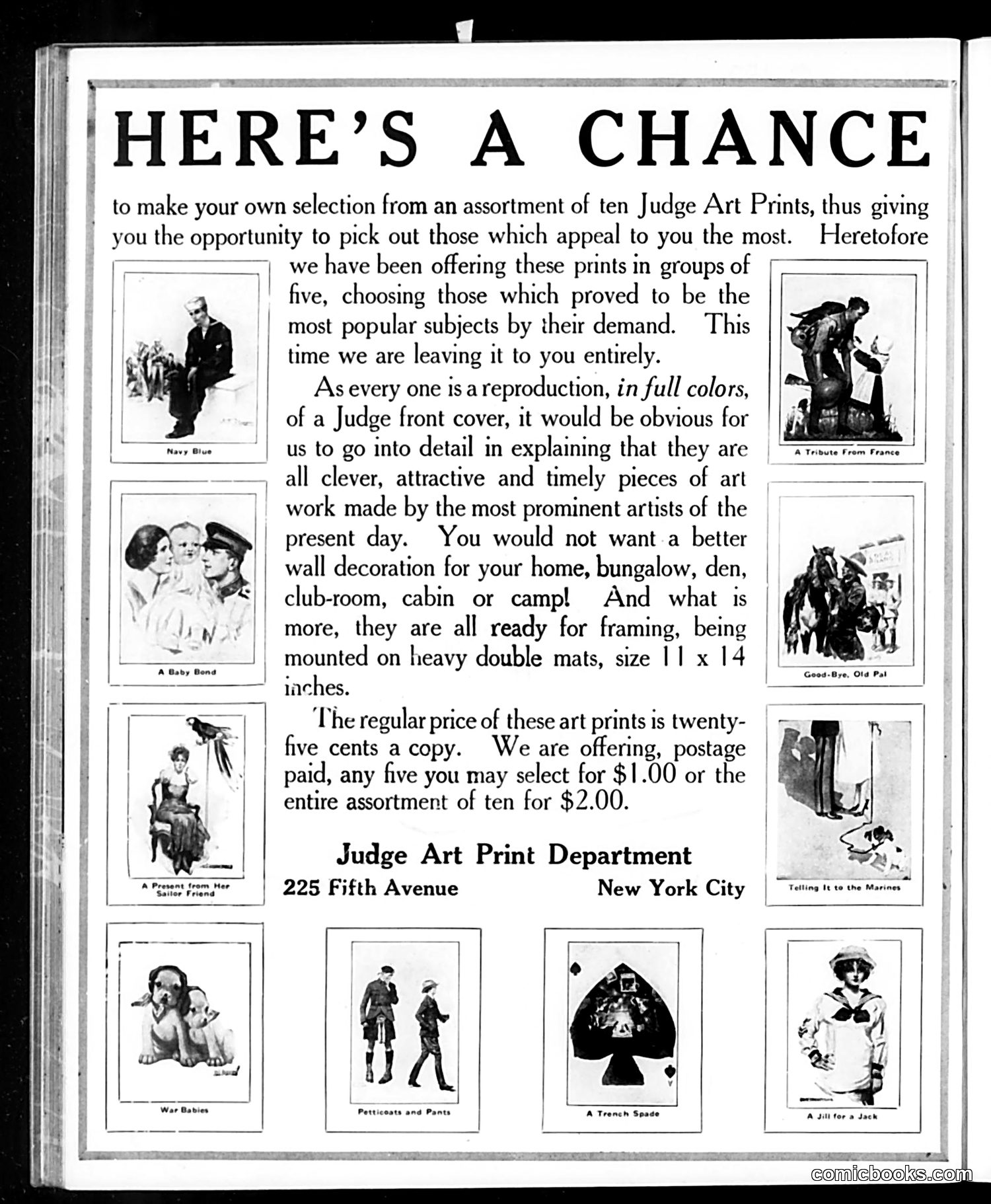
This is primarily a **mail-order advertisement** for Judge magazine's art print department, not political satire. It offers readers a chance to select five art prints from ten available options for $1.00, or all ten for $2.00. The prints are reproductions of Judge's front covers, mounted and ready for framing. The individual print titles visible include "Navy Blue," "A Baby Bond," "A Present from Her," "Good-Bye, Old Pal," "War Babies," "Petticoats and Pants," "A Trench Spade," and "Telling It to the Marines"—suggesting WWI-era themes typical of Judge's satirical commentary on American military and social life during that period. The advertisement emphasizes these are works by "prominent artists" suitable for home decoration.
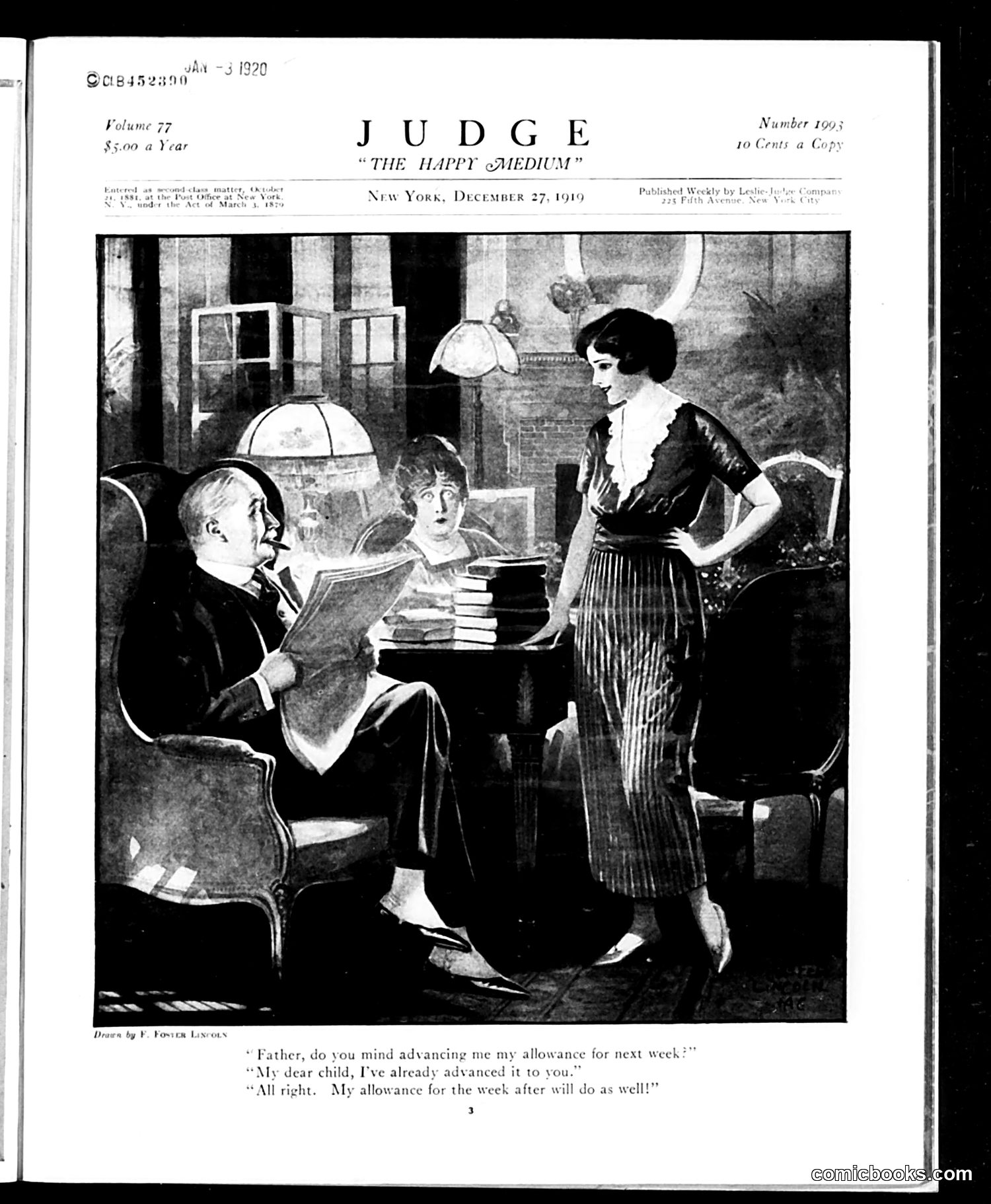
This 1919 cartoon satirizes parental financial irresponsibility toward children. The scene shows a father reading in an armchair while his young son asks to advance his weekly allowance. The father replies he's "already advanced it to you," and the son responds that next week's allowance will therefore suffice as payment. The humor targets the father's contradiction: he's already spent money promised to his son, yet expects future allowances to cover past debts. The cartoon mocks parents who live beyond their means and teach children poor financial habits through example. The domestic setting and the stacks of books suggest an educated household, making the financial mismanagement more absurdly ironic. It's essentially about generational cycles of debt and poor money management.
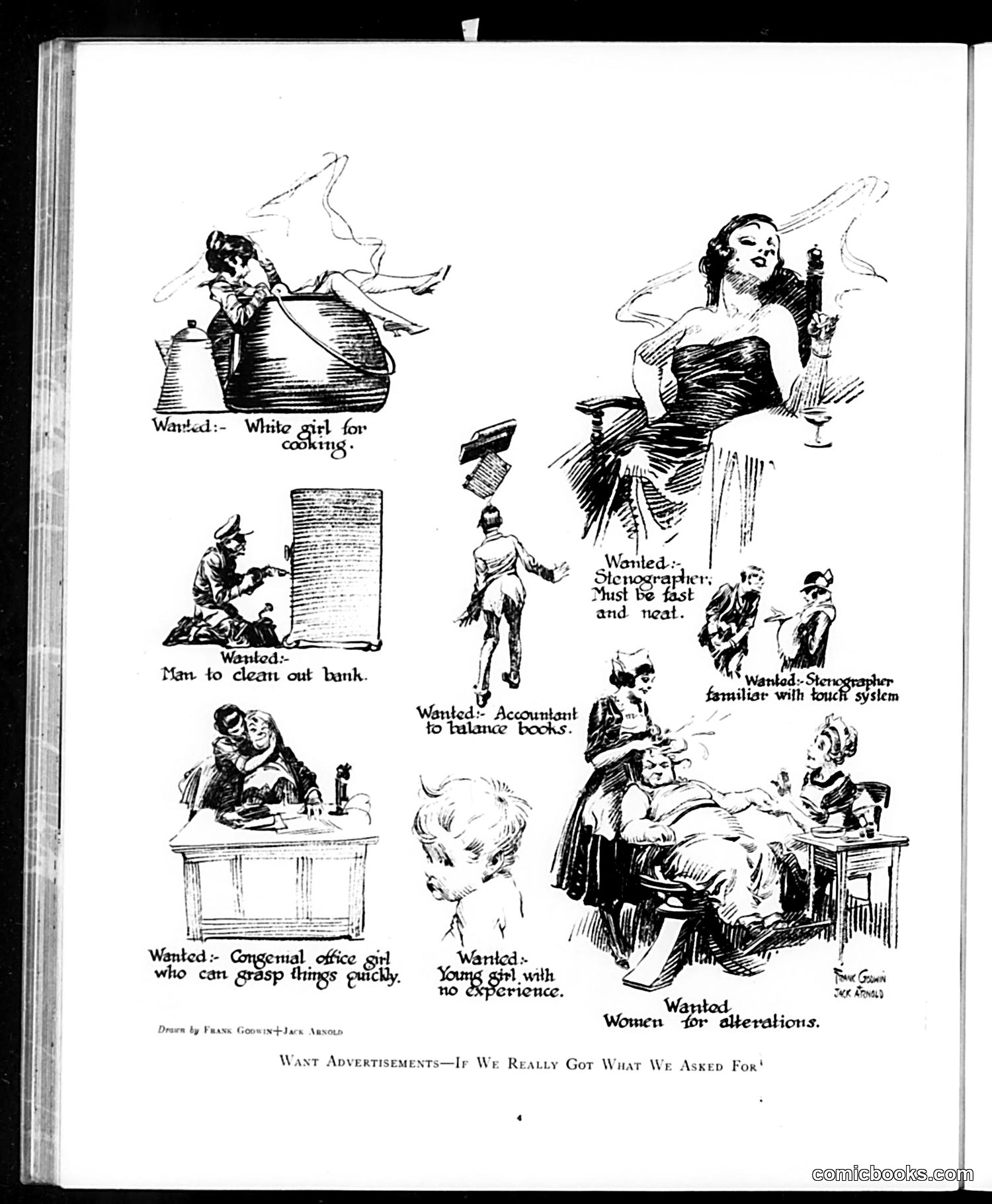
This satirical cartoon page mocks the gap between what employers actually want versus what job advertisements claim to seek. Each vignette presents absurd scenarios showing the consequences of literally getting the requested workers: - "White girl for cooking": depicts a woman lounging while a cherub cooks - "Man to clean out bank": shows someone literally excavating the building - "Stenographer, must be fast": illustrates someone moving at superhuman speed - "Young girl with no experience": shows predictable incompetence The humor targets unrealistic job posting expectations—particularly regarding gender, age, and qualifications. The exaggerated illustrations emphasize how employers' stated requirements rarely match actual workplace reality. This reflects early 20th-century labor market frustrations and gender-based hiring discrimination.
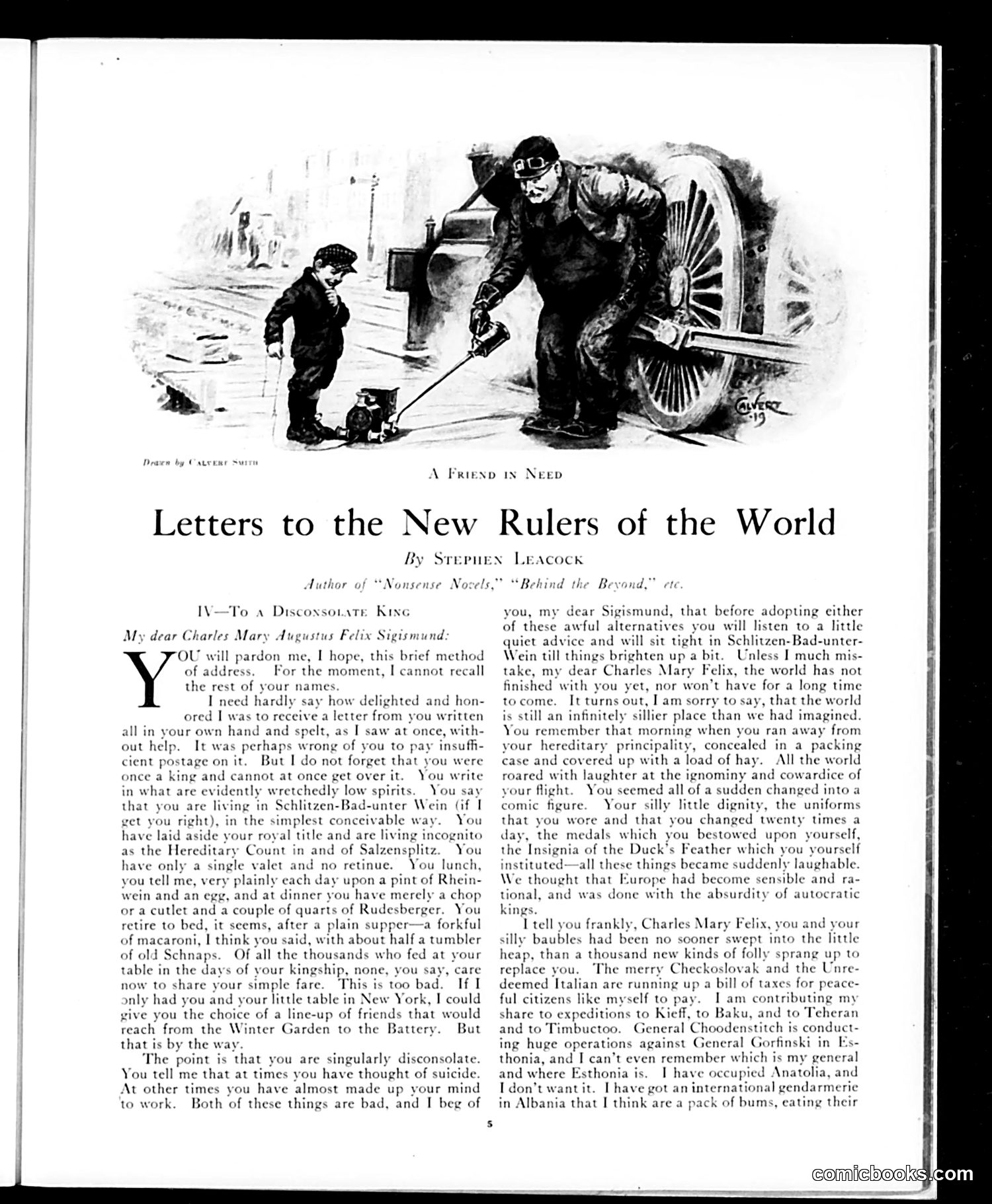
This satirical cartoon depicts an adult (likely a political leader or aristocrat) helping a small child cross what appears to be a street or obstacle. The title "A Friend in Need" is ironic—the interaction suggests paternalistic condescension rather than genuine aid. The accompanying text, "Letters to the New Rulers of the World" by Stephen Leacock, addresses European post-WWI leaders (referencing "Charles Mary Augustus Felix Sigismund"). Leacock critiques the new rulers' incompetence and moral failings, mentioning failed peacekeeping efforts and military operations. The cartoon likely satirizes how post-war leaders positioned themselves as benevolent guides to nations, while actually pursuing self-interested policies. The "help" offered is cynical rather than genuine—mocking claims of humanitarian leadership.
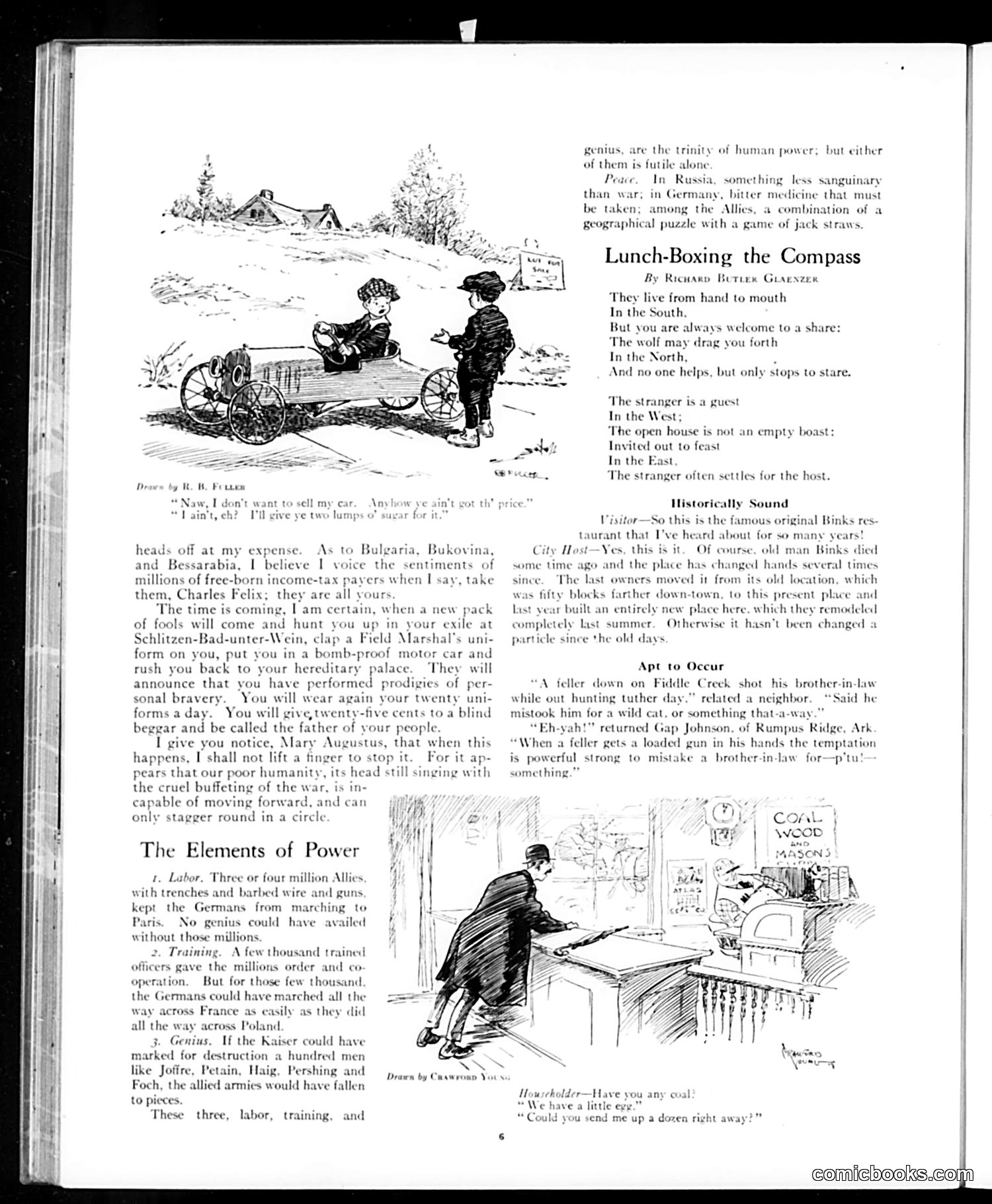
This page contains three distinct pieces: **"Lunch-Boxing the Compass"** by Richard Butler Glaenzer is a poem contrasting hospitality traditions across regions—the South welcomes strangers, the North offers indifference, the West provides open houses, and the East expects guests to repay hosts. **"The Elements of Power"** discusses WWI's deciding factors: labor (millions of Allied troops), training (officers coordinating operations), and genius (military leadership). The text argues Germany could have won with "a hundred men like Joffre, Petain, Haig, Pershing and Foch." **"Apt to Occur"** is a brief anecdote about mistaken identity during hunting, likely satirizing wartime confusion or accidents. The page's illustrations include a sketch of children with a cart and an interior scene of someone using a telephone. The content reflects American WWI-era concerns about military strategy and national character.
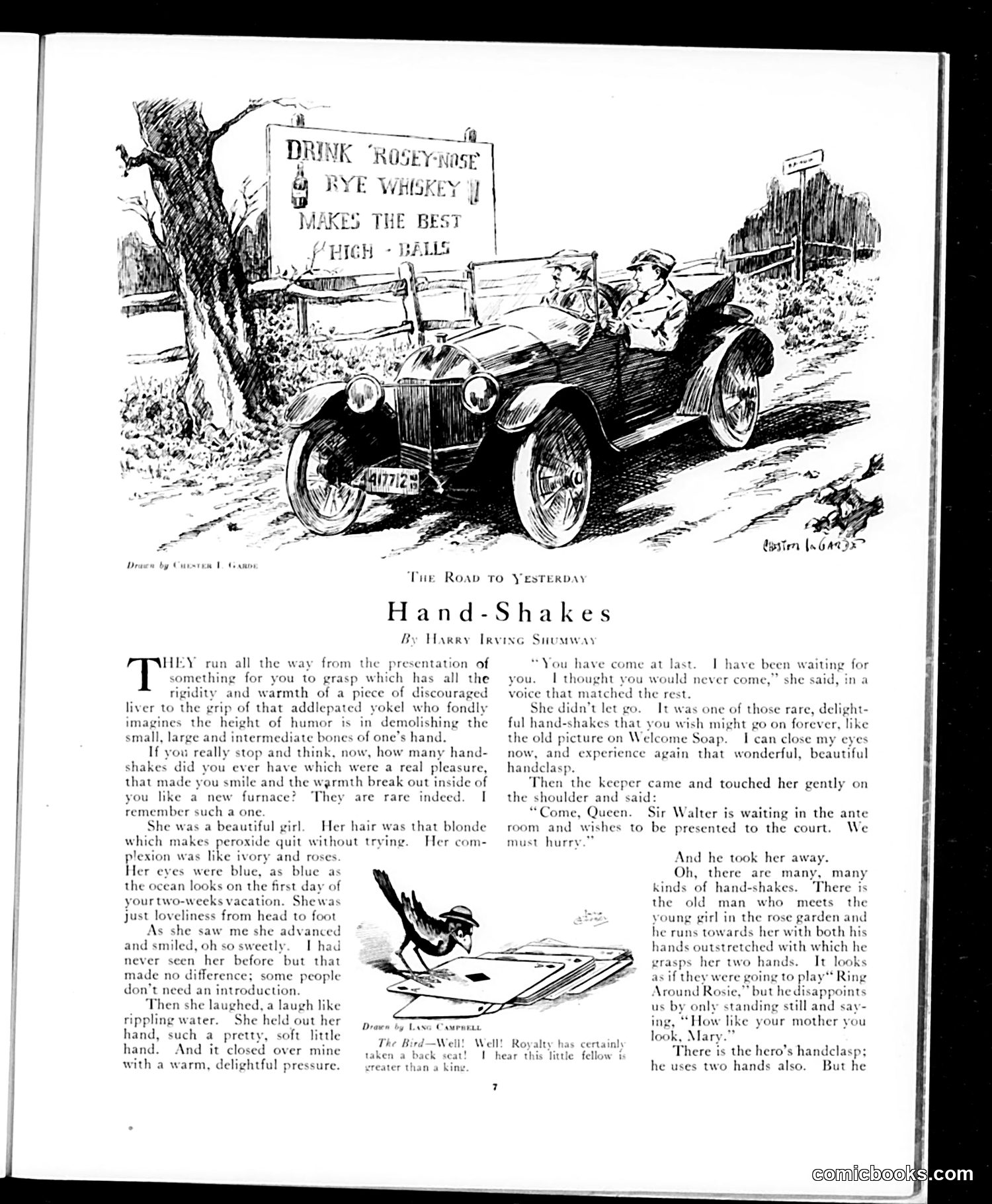
This page from *Judge* magazine contains a sentimental short story titled "Hand-Shakes" by Harry Irvine Summers, illustrated with an early automobile scene at the top. **The main content** is not political satire but rather a nostalgic romance story about memorable handshakes. The narrator recalls meeting a beautiful blonde woman whose warm handshake was genuinely pleasant—a rarity he reflects upon. He later learns she's "Queen" being summoned by "Sir Walter," suggesting a historical or fantastical setting. **The satirical element** appears subtle: the opening mocks people who give painful, bone-crushing handshakes, implying social criticism of affected masculinity or rudeness. The "Rosey-Nose Rye Whiskey" advertisement on the sign is period-appropriate product placement. **For modern context**: The story's emphasis on a woman's delicate beauty, the class distinction (royalty), and nostalgic tone reflect early-20th-century sentimental magazine fiction. The automobile illustration dates it to the automotive age but before modern cars. This is primarily **light entertainment rather than hard political satire**—typical of *Judge*'s mixed content approach.
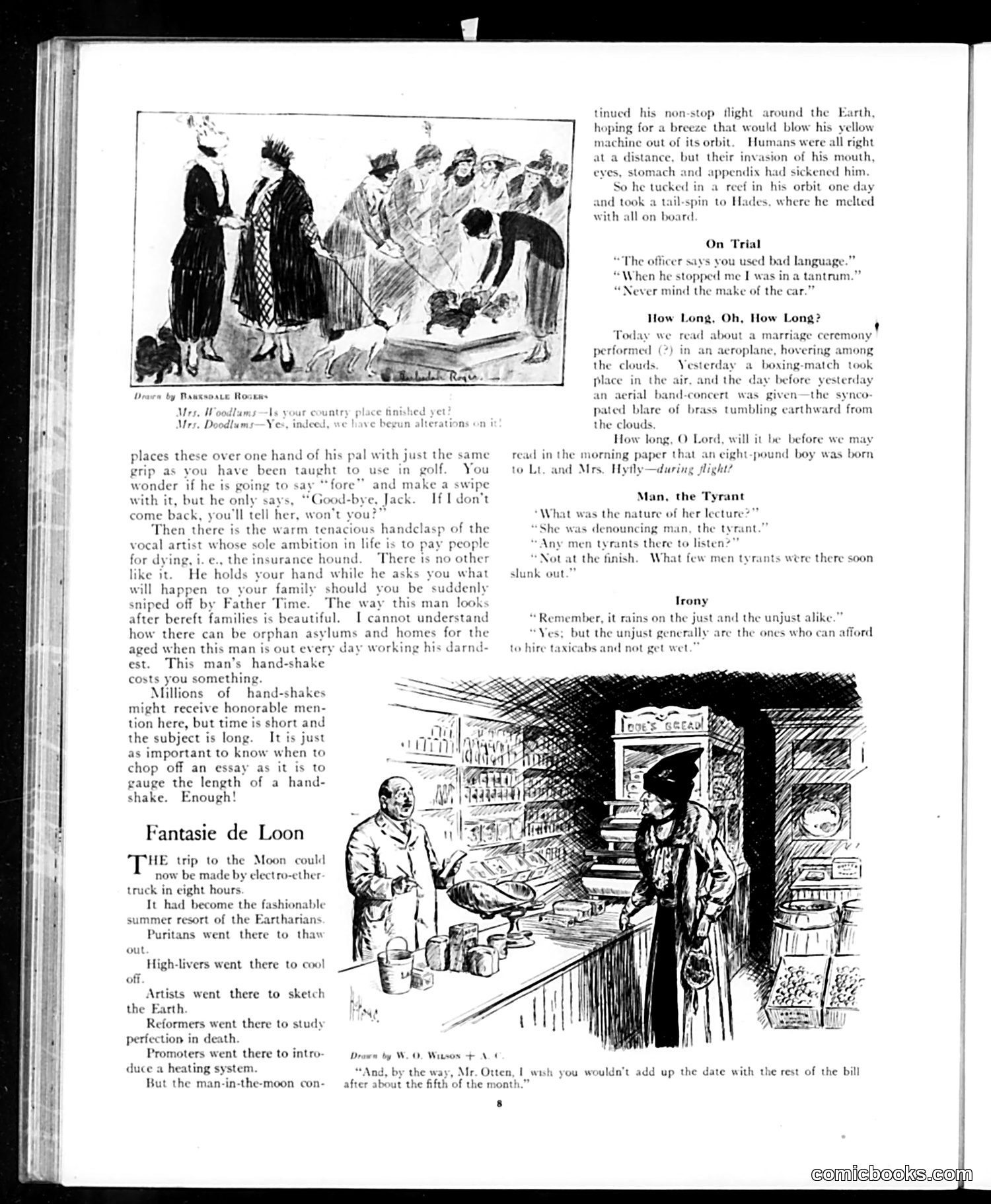
This page contains multiple satirical pieces reflecting early 20th-century anxieties about technological modernity: **Top cartoon**: Depicts a man returning from a flying machine, sickened by human contact. The satire mocks both aviation enthusiasm and modern civilization's invasiveness—a common anxiety as flight technology emerged. **"On Trial"**: Jokes about automobile culture and language standards; the defendant prioritizes the car over his own behavior—satirizing car-obsession among the wealthy. **"How Long, Oh, How Long?"**: Mocks the relentless pace of modern spectacles—aerial marriages, boxing matches, band concerts—suggesting society has become absurdly preoccupied with novelty and celebrity events. **"Man, the Tyrant"**: A brief dialogue satirizing feminist lectures and male indifference to progressive causes. **"Irony"**: Observes class inequality: rain falls equally, but only the wealthy can afford taxis to escape it. **"Fantasie de Loon"**: Imaginative satire about Moon tourism becoming a fashionable resort where different social types pursue their peculiar interests—mocking both technological optimism and human folly. The overall tone criticizes modern excess, technological disruption, and class disparities.
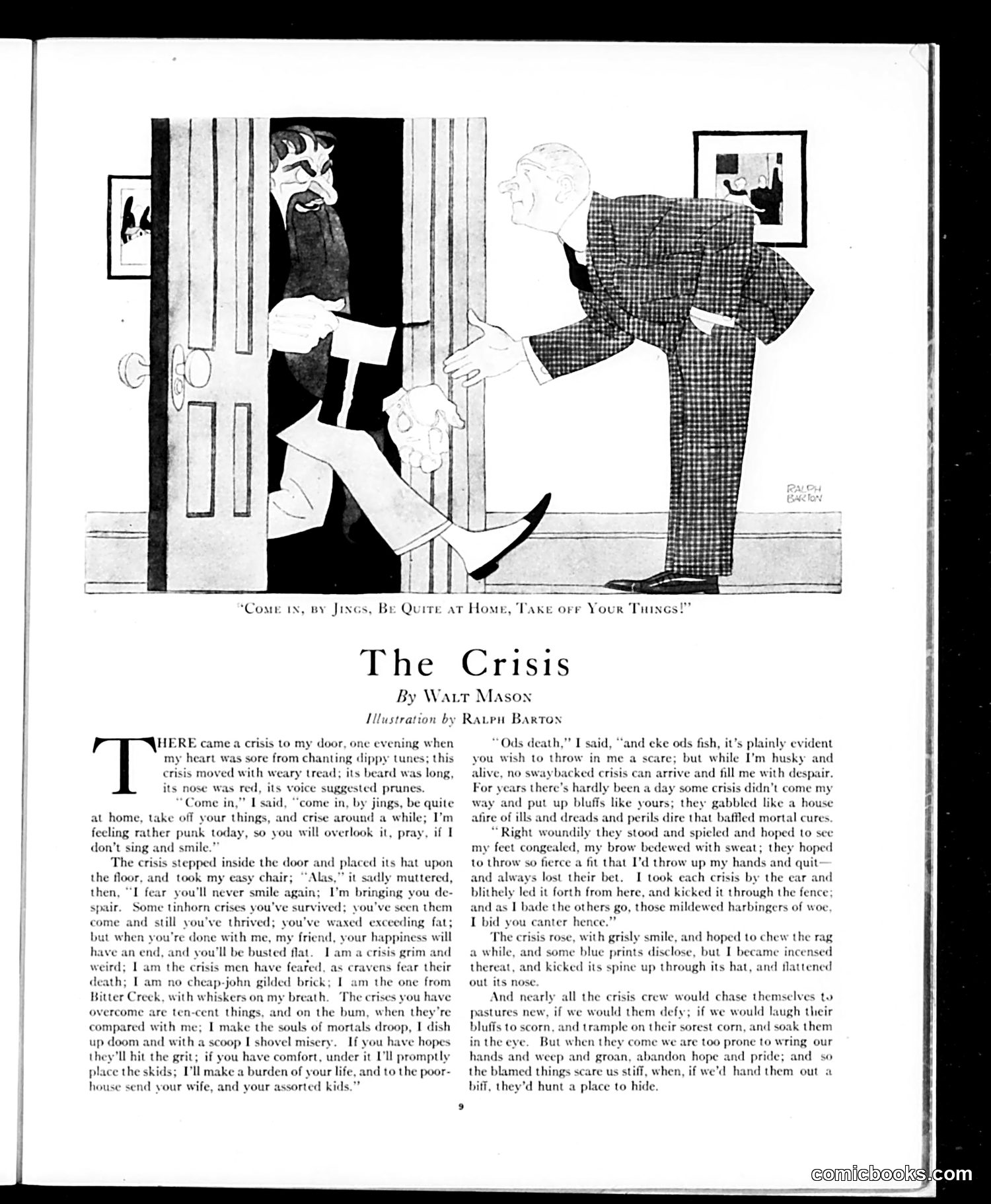
This page combines a humorous illustration with Walt Mason's moralizing poem about facing adversity. **The Cartoon:** Shows a well-dressed man literally kicking a grotesque, demon-like "Crisis" figure out his door. The caption quotes the narrator inviting the crisis inside, establishing the story's setup. **The Message:** The poem personifies "Crisis" as a boastful visitor who threatens the narrator with ruin—loss of wealth, comfort, and family. However, the narrator rejects its threats, recounting how he's survived countless previous crises through determination and defiance. **The Satire's Point:** This is inspirational/morale-boosting rather than political satire. It's a commentary on *resilience during hard times*—likely written during an economic crisis (the early 1900s saw several). Mason argues that crises only have power over us if we surrender to fear; by confronting them aggressively ("hand them out a biff"), we can defeat them. The humor comes from treating abstract hardship as a literal nuisance to be kicked out, transforming despair into slapstick comedy.
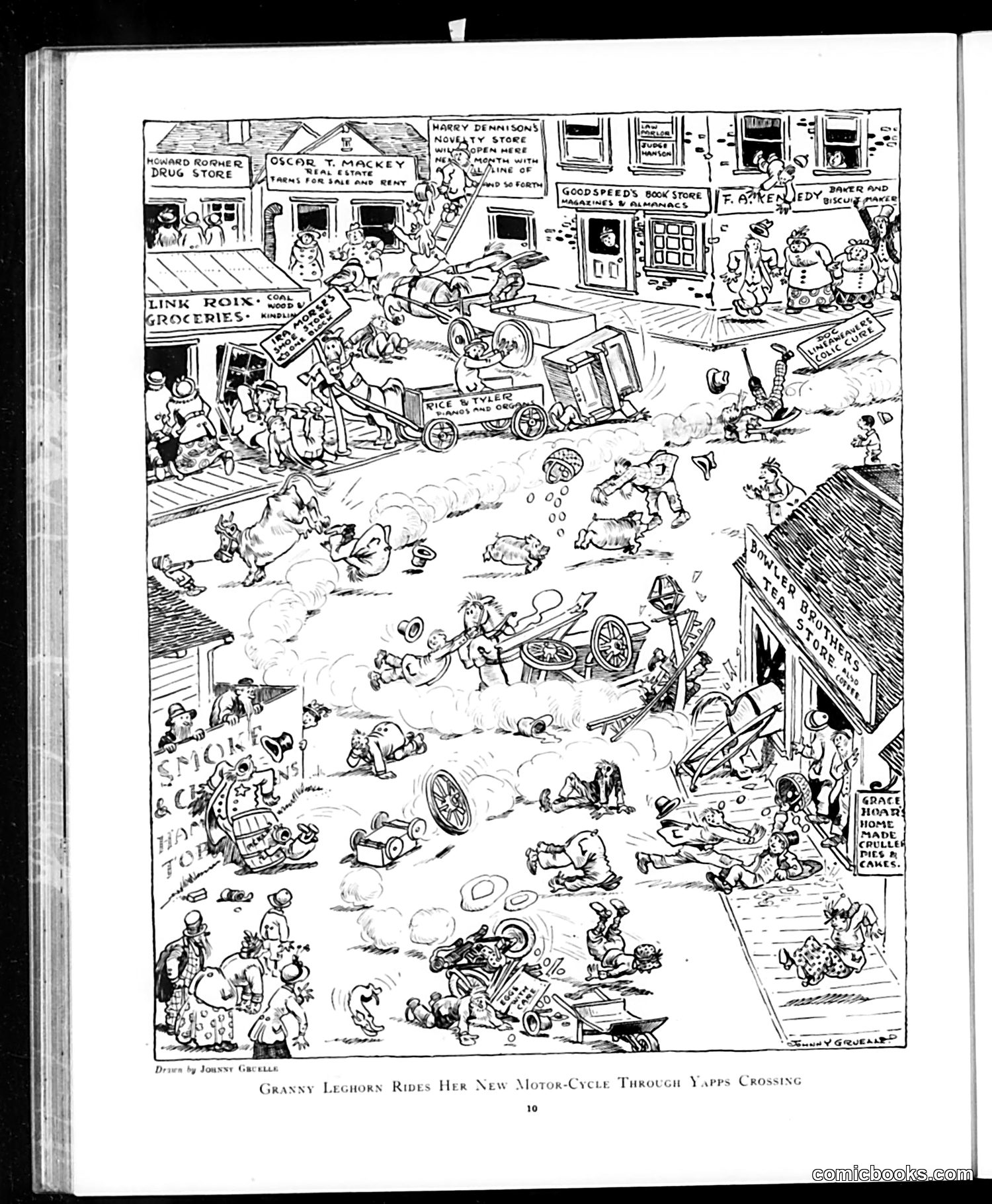
This is a humorous illustration by Johnny Gruelle depicting an elderly woman ("Granny Leghorn") riding a motorcycle through a crowded street named "Yapps Crossing." The cartoon satirizes early-20th-century urban chaos and the novelty of motorcycles. The scene shows pedestrians, various storefronts (drug store, groceries, book store), and numerous children in disarray as the motorcycle passes through. The joke appears to target both the recklessness of early motorists and the general disorder of busy commercial streets. The exaggerated pandemonium—with figures tumbling and fleeing—mocks how motorcycles and automobiles were disruptive to established pedestrian-centered street life. The unlikely figure of an elderly woman as the motorcycle operator adds comedic absurdity to the satire.
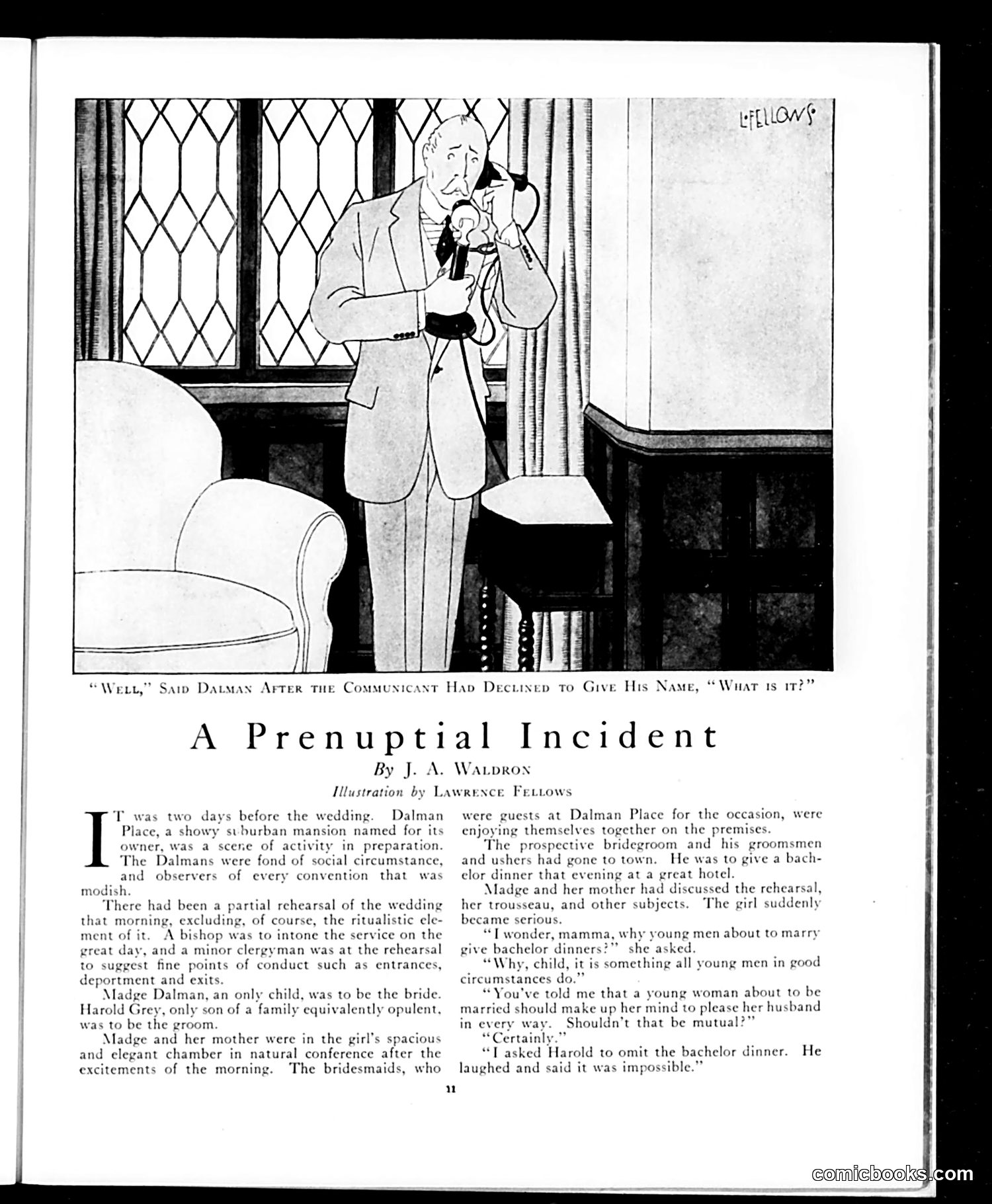
This is a short story illustration from *Judge* magazine, not primarily political satire. The narrative concerns pre-wedding tensions between upper-class newlyweds-to-be. The story's conflict: Madge Dalman, the bride, asks her fiancé Harold Grey to skip his bachelor dinner, arguing that if wives should prioritize pleasing husbands, shouldn't the expectation be mutual? Harold refuses, claiming it's impossible to omit. The illustration shows a man (presumably Dalman, the bride's father, based on the caption) on the telephone, apparently calling to inform someone that a communicant has declined to provide his name—likely a humorous aside about the story's main social drama. The satire targets gender double standards in Edwardian etiquette: wives are expected to subordinate their preferences, yet husbands refuse reciprocal compromise. The story gently mocks both rigid social conventions and masculine resistance to equality.
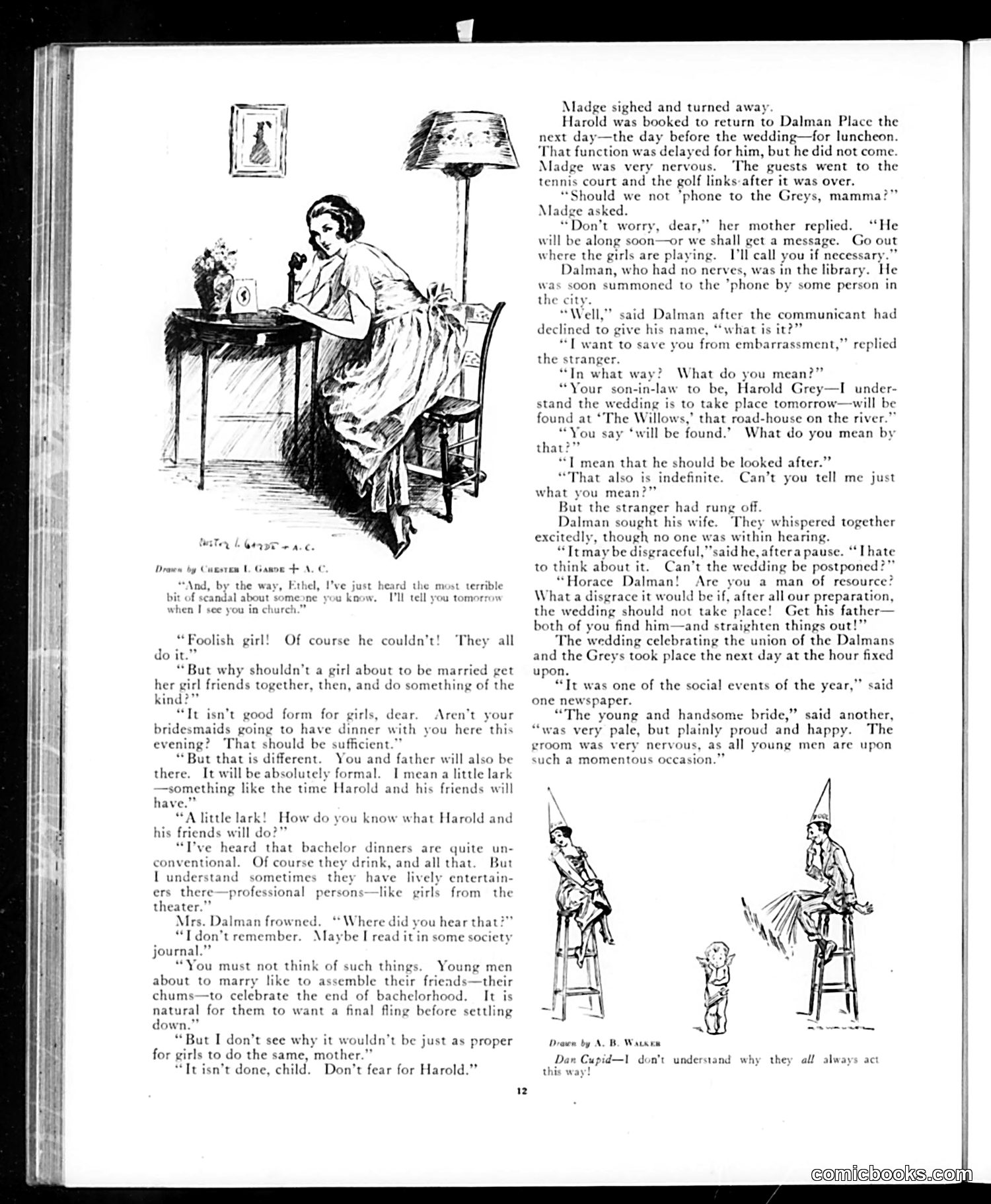
This satirical piece critiques gender double standards regarding premarital behavior. The narrative contrasts Madge's desire for a "lark" with her mother's insistence that bachelor parties—with "professional persons—like girls from the theater"—are natural and acceptable for men, while identical conduct is "not done" for women. The humor lies in the hypocrisy: Mrs. Dalman defends Harold's anticipated debauchery at a roadhouse as harmless male tradition, yet forbids her daughter similar freedoms. When Harold goes missing on his wedding eve (apparently at "The Willows" roadhouse), the family scrambles to conceal this scandal rather than postpone the wedding, prioritizing appearances over principles. The bottom illustration of men on swings labeled "Dan Cupid" appears to mock this childish, reckless behavior the society excuses in grooms. Judge uses this domestic scenario to satirize early 20th-century sexual morality: men's infractions are winked at as inevitable; women's identical desires are shameful.
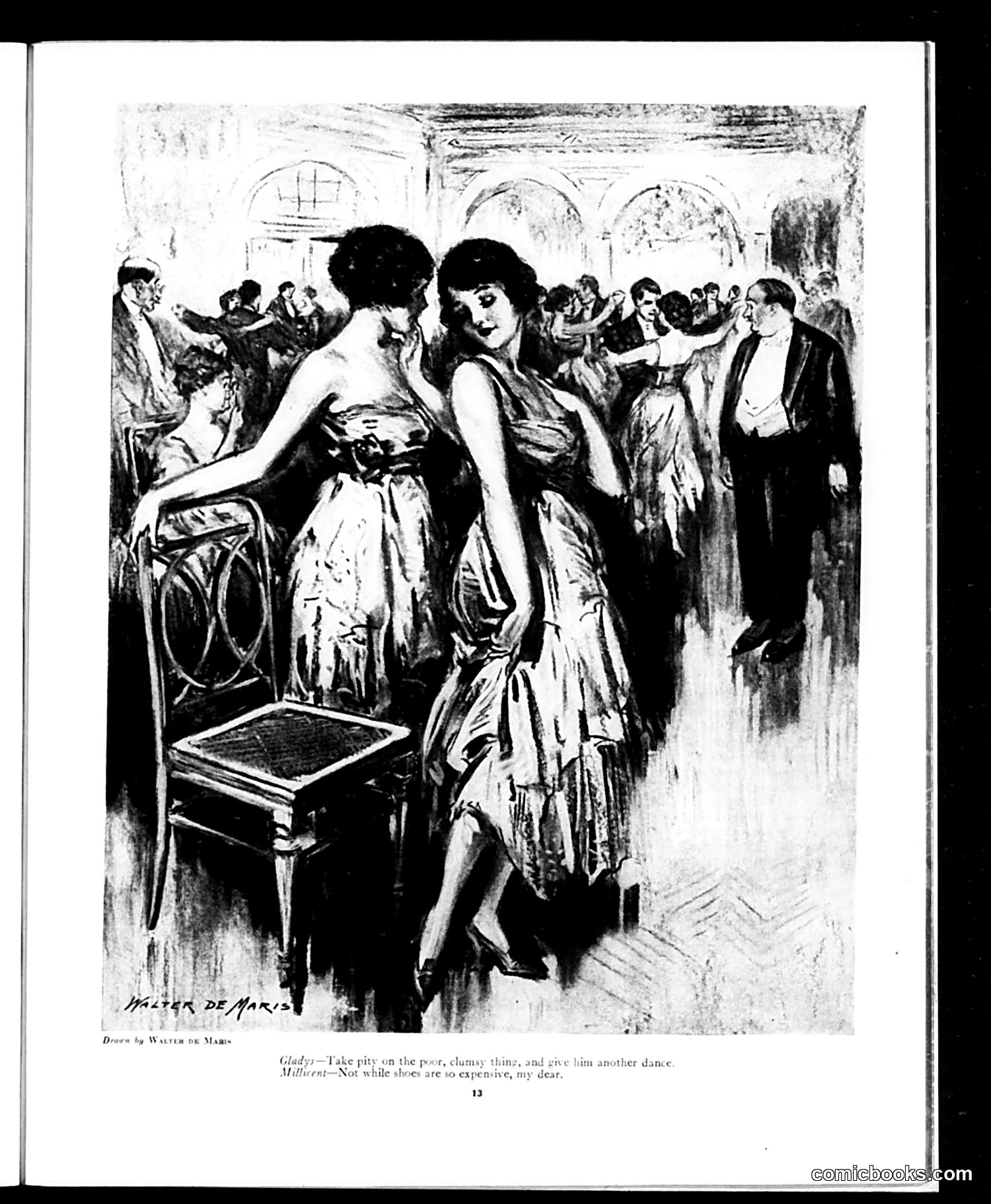
This is an illustration by Walter de Maris depicting a social scene at what appears to be a dance or party venue with arched architecture. The caption reads: "Gladys—Take pity on the poor, clumsy thing, and give him another dance. / Millicent—Not while shoes are so expensive, my dear." The satire targets post-WWI economic anxiety, specifically inflation and the rising cost of living in the 1920s. A woman asks her friend to pity a clumsy male dancer, but Millicent refuses because shoes—damaged by his poor dancing—have become prohibitively expensive. The joke reflects widespread concern about inflation and consumer goods prices during this period, making even social courtesies financially unaffordable for ordinary people. It's a commentary on economic hardship affecting everyday life and leisure.
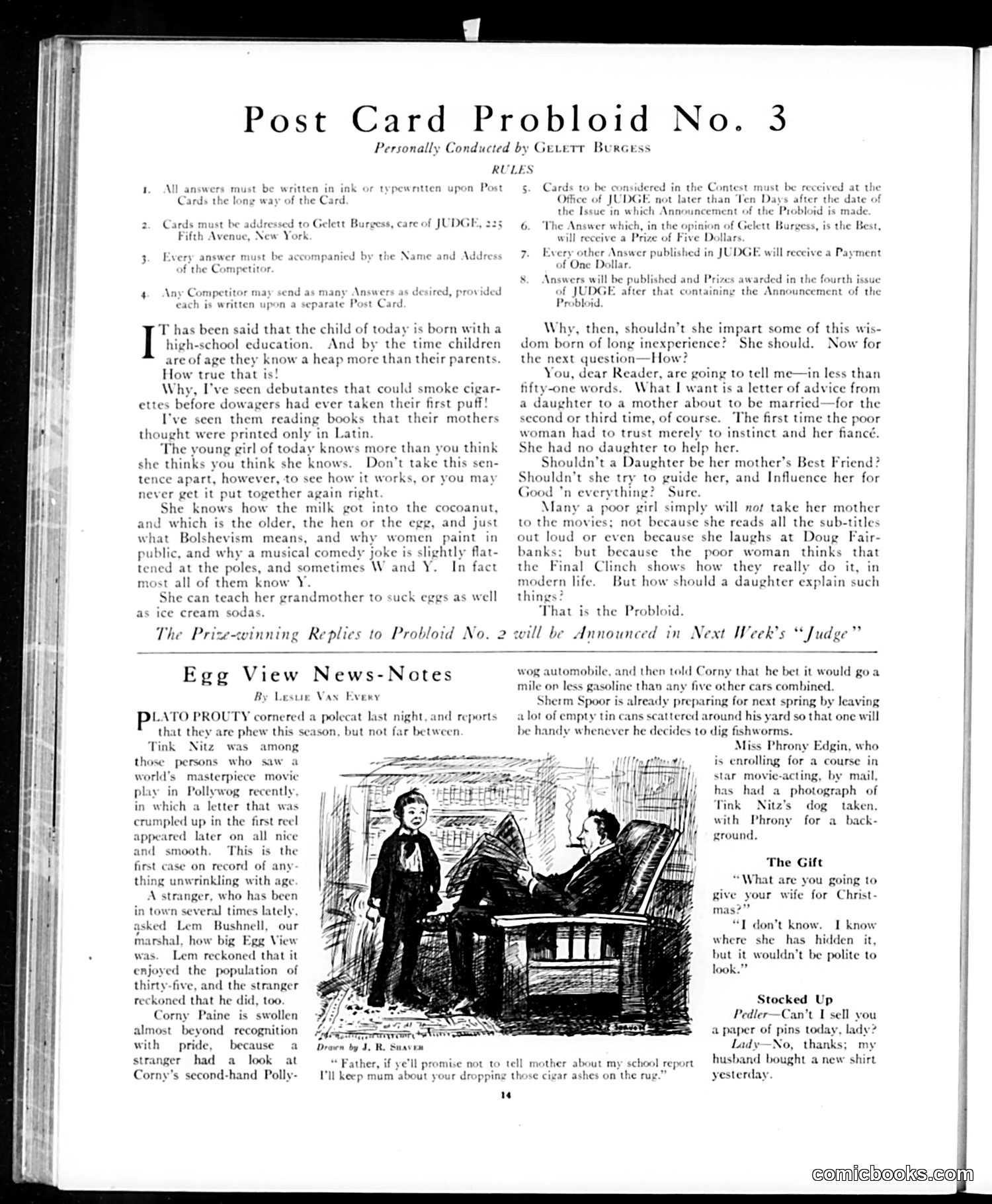
This page from *Judge* magazine contains a satirical essay by Gelett Burgess about modern girls' education and sophistication, paired with a humorous local gossip column. **The Main Essay ("Post Card Probloid No. 3"):** Burgess satirizes how young women of the era (appears to be early 20th century) are allegedly born with advanced knowledge—they understand economics, politics (Bolshevism), and social behavior better than their mothers ever did. The satire's target is the supposed generational gap: daughters are so wise they should advise their remarrying mothers on marriage itself. The joke mocks both exaggerated claims about youth's superiority and the irony that inexperienced girls would presume to guide their elders. **"Egg View News-Notes":** A gentle small-town gossip column featuring local characters like Corny Paine and Lem Bushnell, reporting on trivial events (a movie with wrinkled paper becoming smooth, a man's pride in his old car). This satirizes provincial life and the mundane concerns of rural America. The accompanying cartoon shows a father and son, likely illustrating domestic comedy.
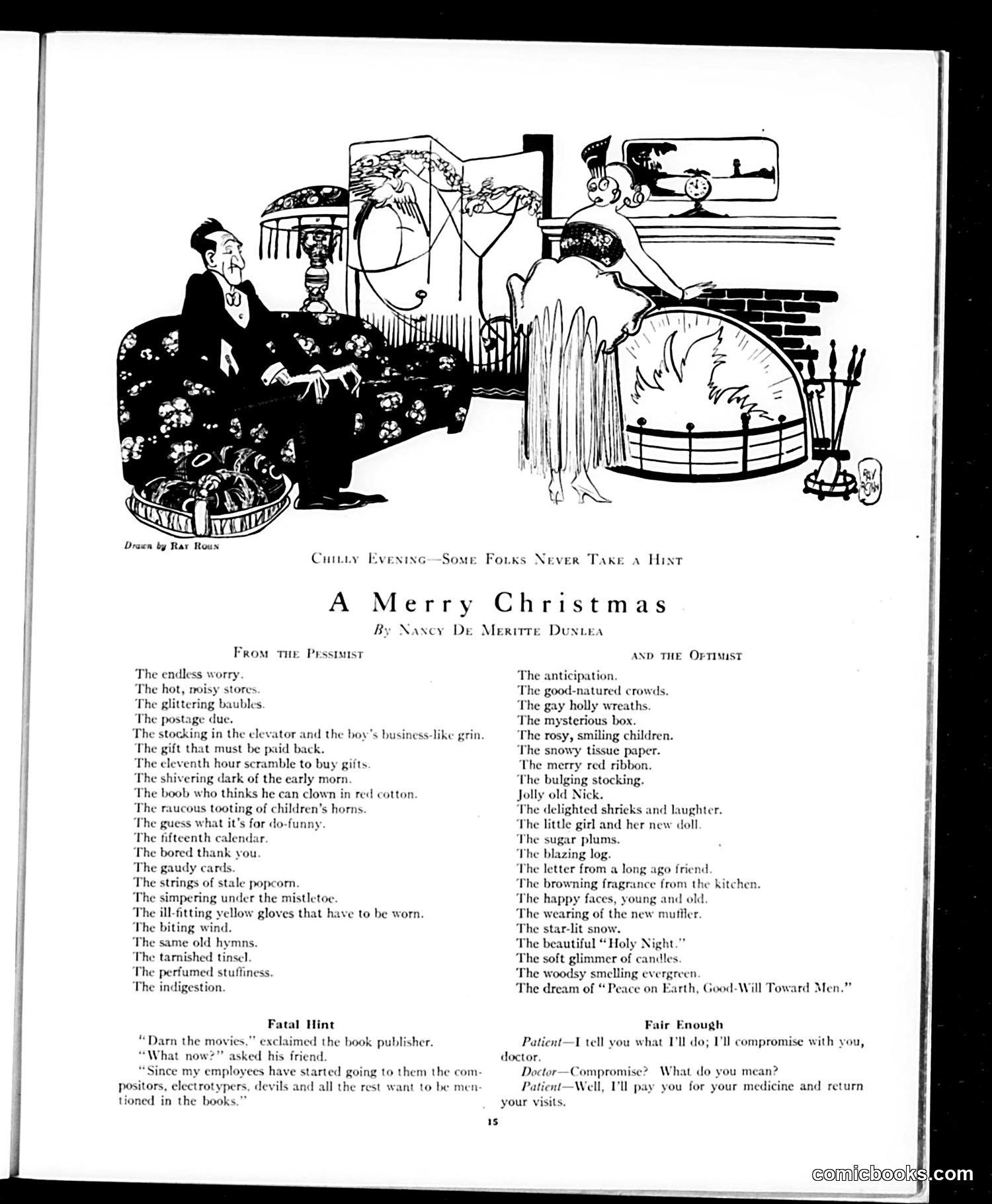
The top illustration, titled "Chilly Evening—Some Folks Never Take a Hint," depicts a pessimist and optimist viewing the same winter holiday scene. The cartoon contrasts two perspectives: one man sees only annoyances (crowded stores, forced gift-buying, uncomfortable clothing), while the other enjoys genuine pleasures (children's joy, festive decorations). Below are three short comedic pieces. "Fatal Hint" mocks a book publisher upset that cinema attendance is making his employees want more glamorous work. "Fair Enough" presents a patient-doctor negotiation where the patient proposes paying for medicine while the doctor forgoes his visit fees—a humorous "compromise" that actually saves the patient money. The content satirizes Christmas commercialism, worker dissatisfaction during the cinema era, and everyday negotiations of the period.
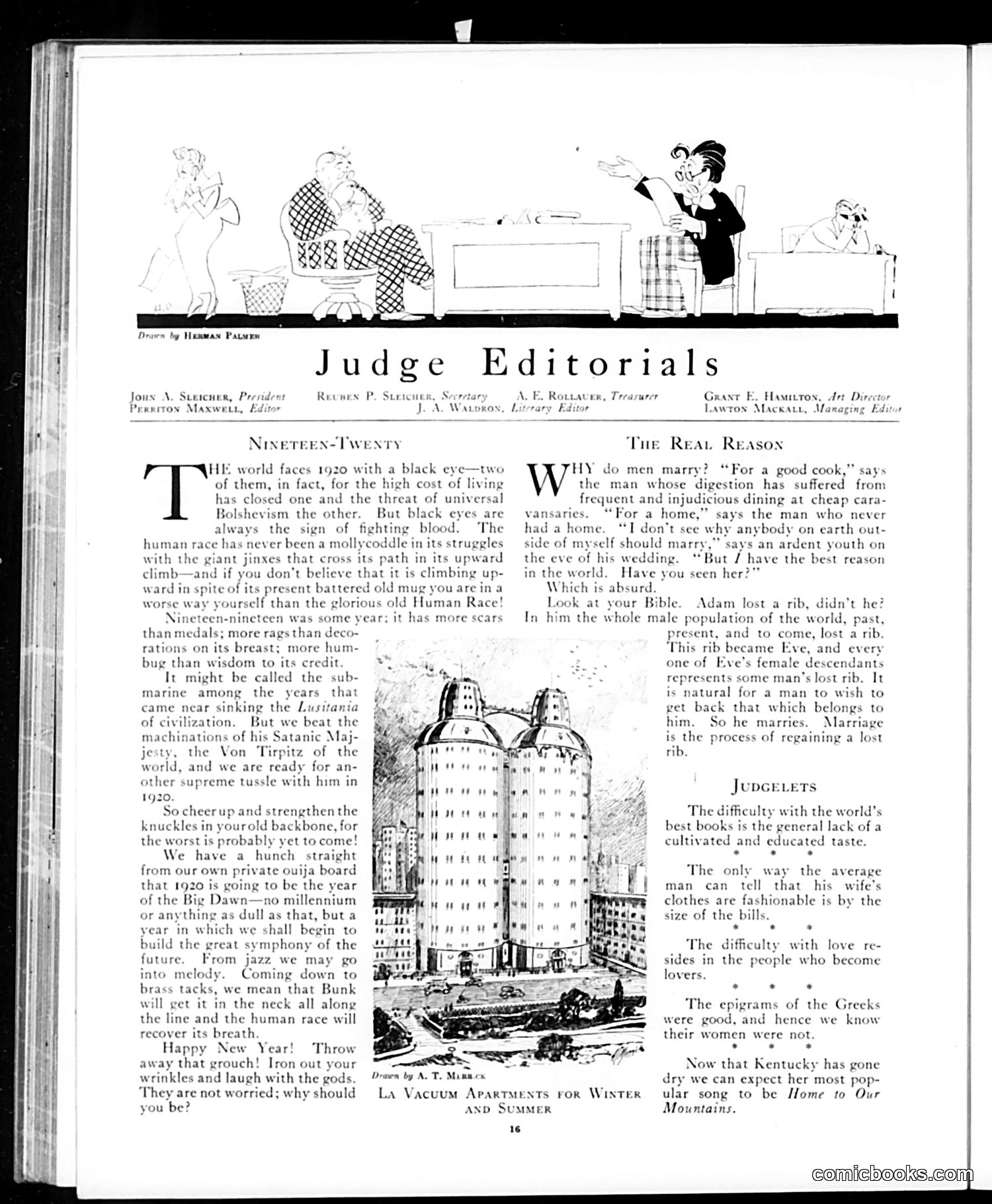
This is a 1920 editorial page from *Judge*, a satirical magazine. The top cartoon depicts various figures facing hardships—likely representing post-WWI America confronting economic crisis and the "Red Scare" (Bolshevism fears). The main editorial, "Nineteen-Twenty," uses boxing metaphor: America enters 1920 "with a black eye" from high cost of living and communist threats, but frames this as a fighting spirit. It references the *Lusitania* sinking and "Von Tirpitz" (German admiral), invoking WWI nostalgia while expressing optimism that 1920 will bring a "Big Dawn"—rejecting "bunk" and restoring human dignity. The secondary pieces are lighter editorials: "The Real Reason" jokes about marriage as reclaiming Adam's lost rib; "Judgelets" offers cynical one-liners about books, fashion, love, and Kentucky's Prohibition (referenced as "gone dry"). The bottom illustration shows apartment buildings, likely satirizing urban housing during post-war inflation.
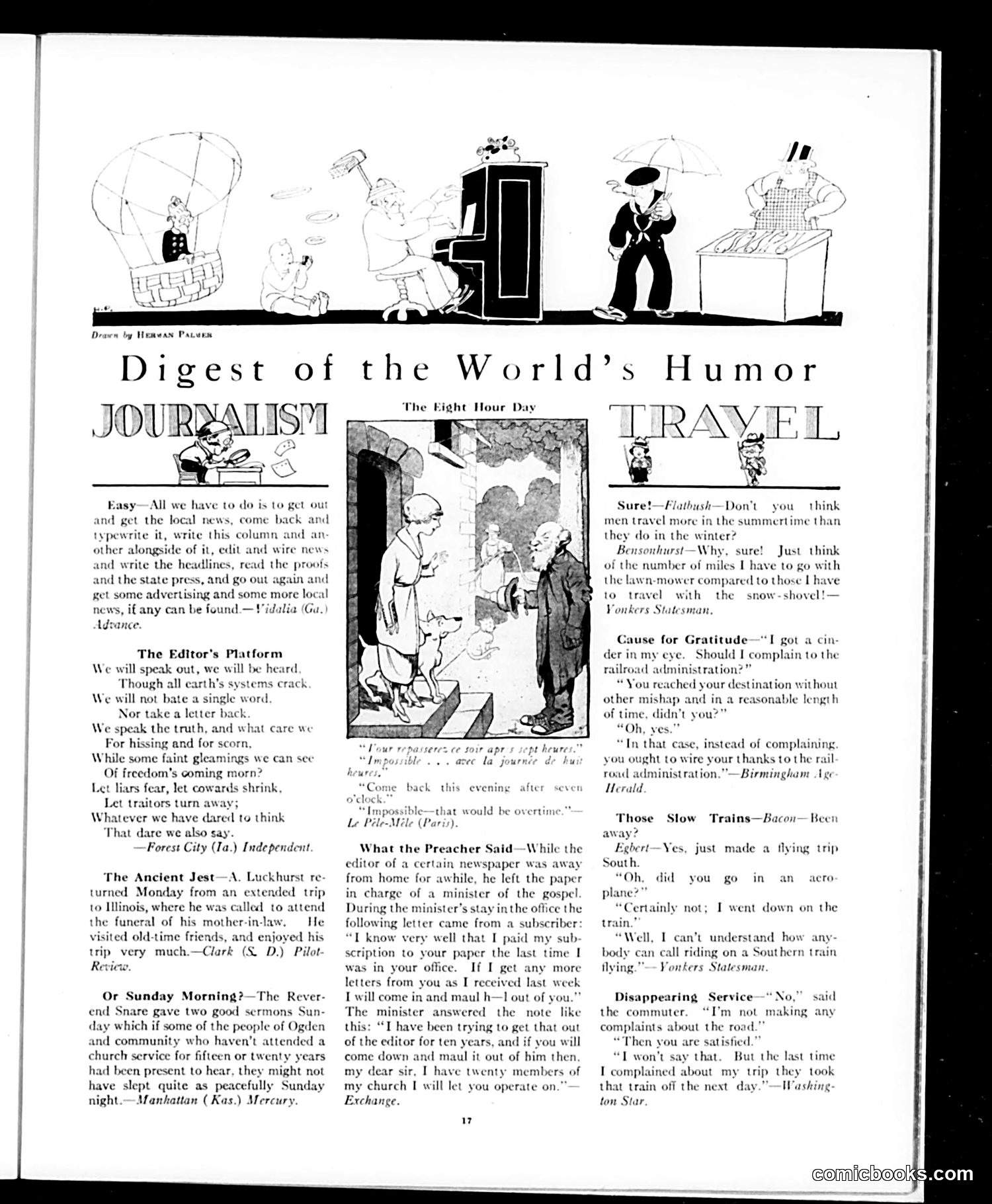
This page collects brief humorous anecdotes from small-town newspapers under the heading "Digest of the World's Humor." The cartoons and text satirize early 20th-century American life. **The top cartoon** illustrates various occupations—a hot air balloon operator, laborer, factory worker, businessman with umbrella, and office worker—suggesting the diversity of human enterprise. **The anecdotes mock:** - **Editorial work**: The impossibility of journalism (gathering news, writing, editing, selling ads simultaneously) - **Eight-hour workday laws**: A Frenchman's confusion about overtime, suggesting labor regulations were still novel - **Railroad service**: Complaints about slow trains and service failures; commuters resigned to poor conditions - **Small-town life**: Ministers editing newspapers, funeral trip complications, church attendance **Key satire targets** include labor regulations (the eight-hour day was contentious), railroad monopolies (a major public complaint), and the absurdity of small-town journalism. The humor relies on the reader understanding contemporary workplace frustrations and rural American newspaper culture.
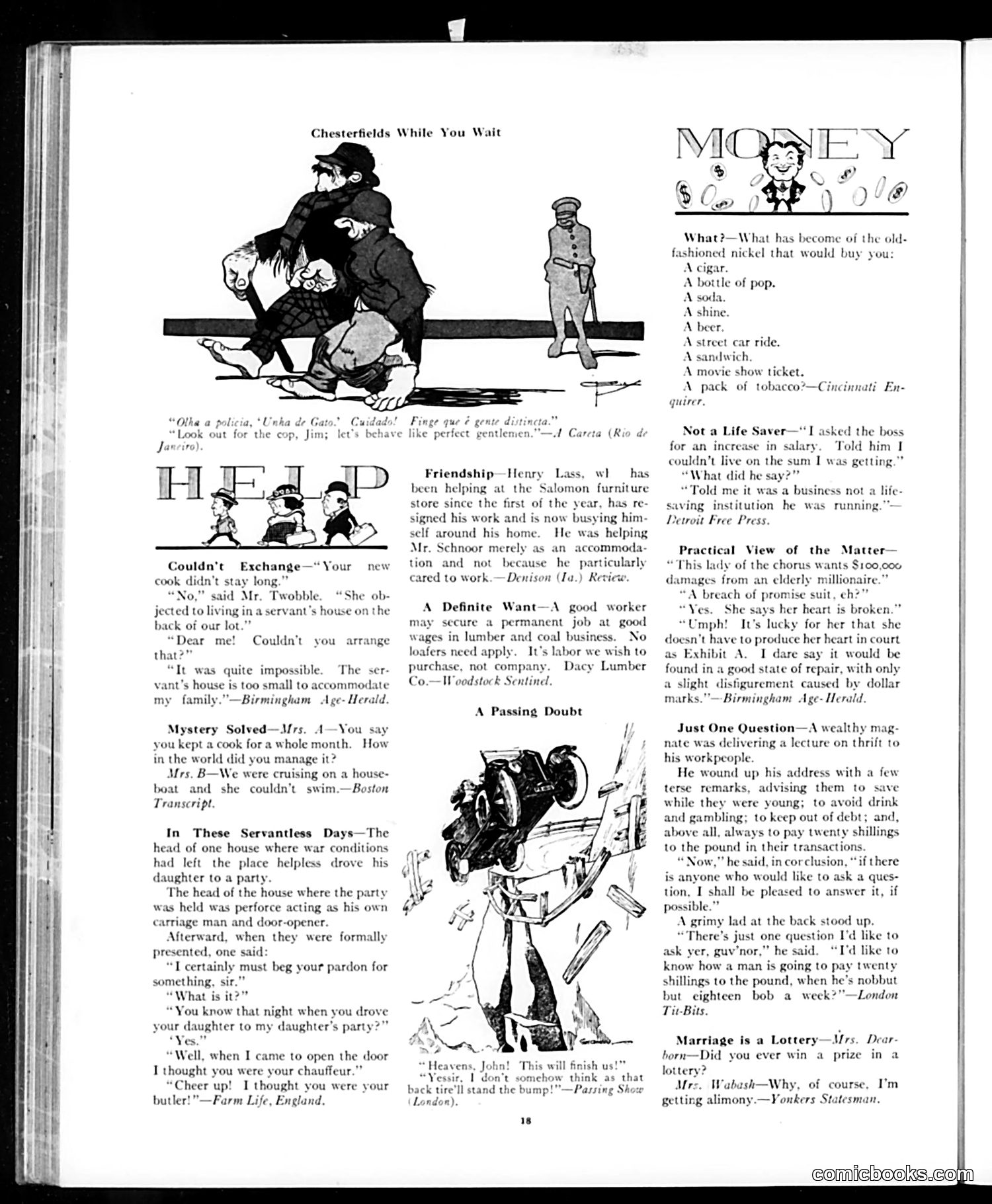
This page from **Judge** (a pre-1923 American satirical magazine) contains humorous anecdotes about post-WWI social disruption, particularly the **servant shortage**. ## Main Themes: **"Servantless Days"** dominates the content. Multiple jokes reference how World War I created labor shortages, forcing middle-class employers to perform their own domestic work. The cartoon shows a wealthy man driving his own carriage—previously a servant's job—leading to an awkward moment where two gentlemen mistake each other for servants. Other anecdotes mock: - Domestic servants' newfound pickiness about working conditions - Inflated prices (the "old nickel" no longer buys anything) - Wealthy employers lecturing workers about thrift while exploiting them - Divorce/alimony as profit ("Marriage is a Lottery") The humor reflects anxieties about **class upheaval and changing labor dynamics** during the 1920s, when workers had more employment options and demanded better treatment. The "Chesterfields While You Wait" cigarette ad is unrelated commercial content.
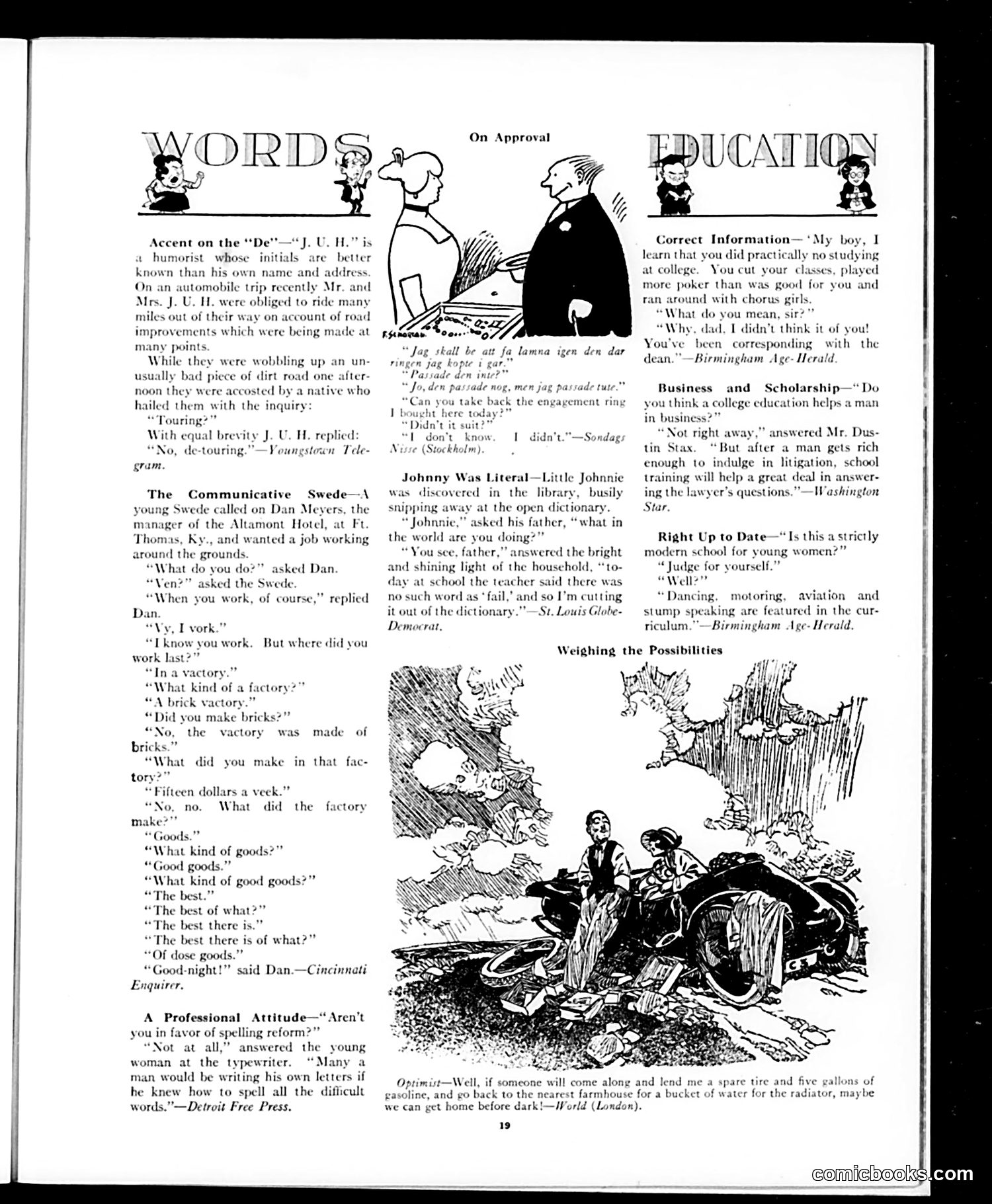
This page from *Judge* contains six brief humorous anecdotes satirizing American social types and attitudes circa the 1910s-20s: **"Accent on the 'De'"** mocks a motorist's pretentious speech ("de-touring" instead of "detouring"). **"The Communicative Swede"** uses a Swedish immigrant's thick accent and circular logic for comedy—a common ethnic stereotype of the era playing on the notion of immigrants as simple-minded laborers. **"Johnny Was Literal"** jokes about a child's naive interpretation of a teacher's statement that "fail" doesn't exist, so he removes it from the dictionary. **"Business and Scholarship"** satirizes the disconnect between college education and practical business success, suggesting schooling only helps wealthy men defend themselves in lawsuits. **"Right Up to Date"** mocks modern women's education, listing "dancing, motoring, aviation and stump speaking" as the curriculum—implying these are frivolous rather than serious subjects. **"Weighing the Possibilities"** (cartoon) shows optimistic motorists stranded with car trouble, illustrating the unreliability of early automobiles. The page reflects period anxieties about immigration, education, gender roles, and technology.
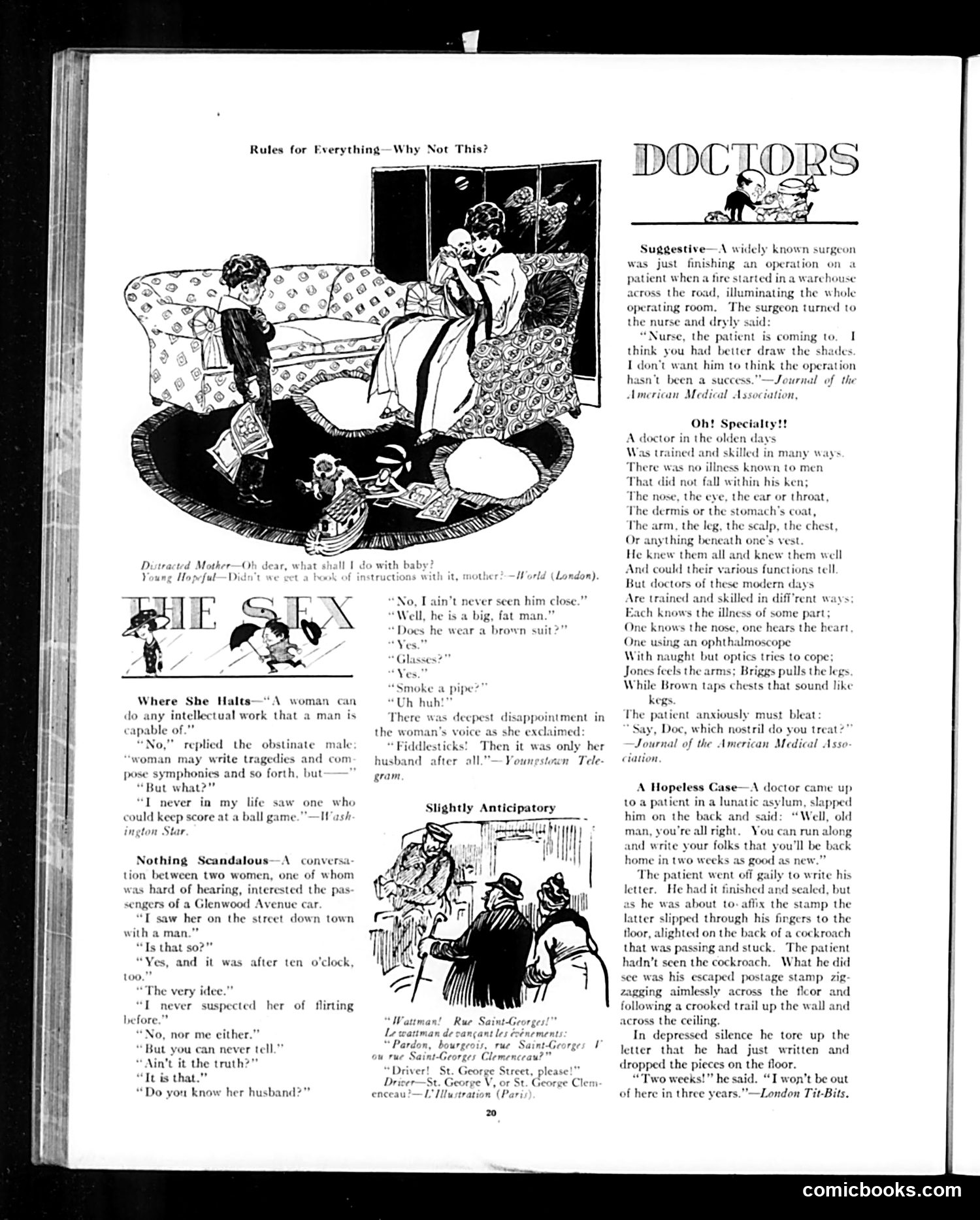
This page contains several satirical pieces mocking early 20th-century attitudes and professions: **"Where She Halts"** satirizes the "New Woman" debate—a man concedes women can do intellectual work but insists one exception proves the rule: a woman who can "keep score at a ball game." The joke reflects anxieties about women's expanding roles. **"Nothing Scandalous"** mocks small-town gossip culture, where two women discuss seeing a woman with a man after 10 PM—scandalous by era standards—yet their detailed description (brown suit, glasses, pipe) reveals she was likely describing the same man, making their moral outrage absurd. **"Oh! Specialty!!"** critiques medical specialization, contrasting old-fashioned doctors who treated everything with modern specialists who each handle only one body part—presented as ridiculous fragmentation of knowledge. **"A Hopeless Case"** uses dark humor: a patient's mental illness is revealed when he cannot cope with a postage stamp landing on a cockroach, believing the roach has "escaped," suggesting his condition is genuinely hopeless despite the doctor's optimism. The satire targets contemporary social anxieties and professional trends.
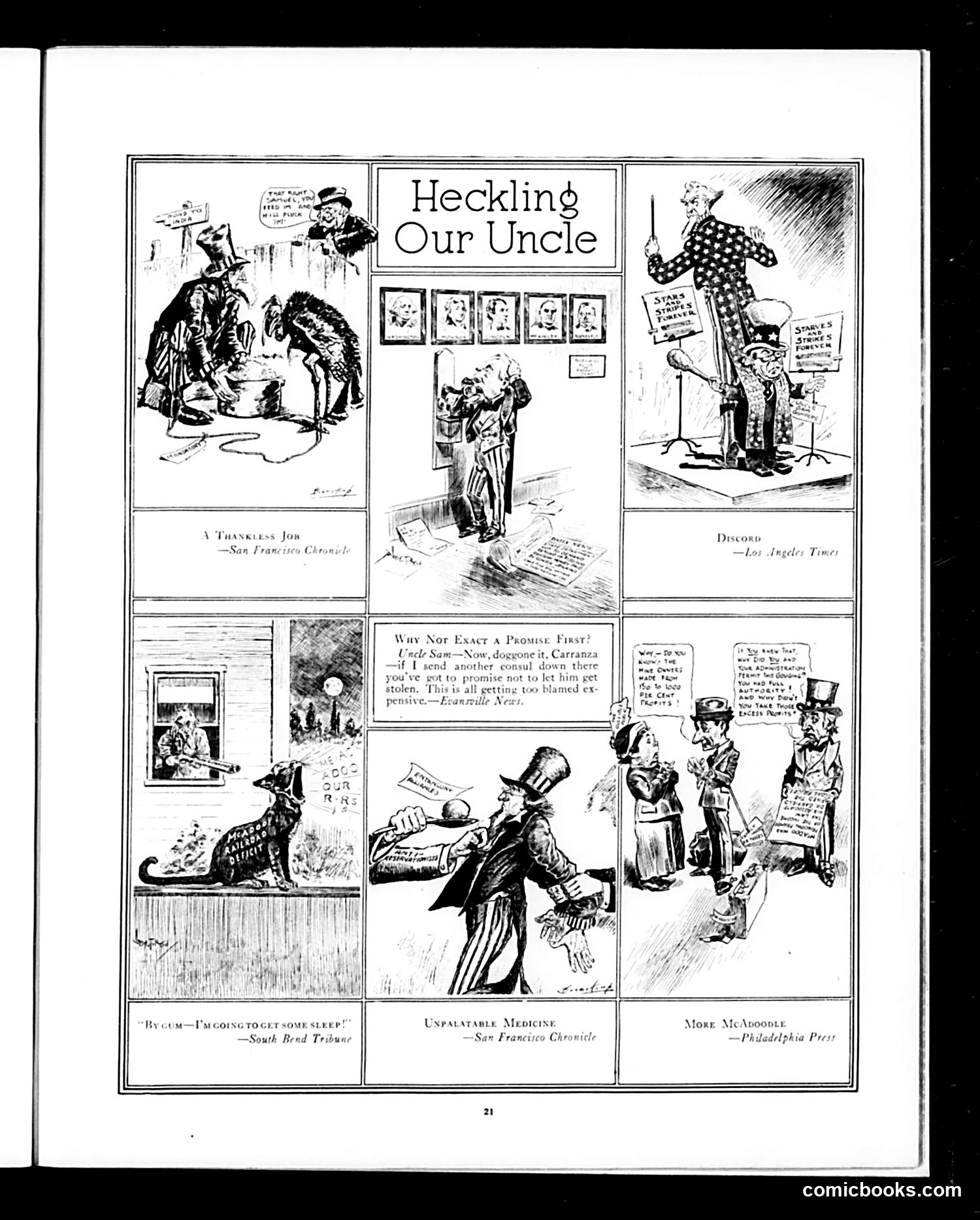
This page satirizes American foreign policy through Uncle Sam (personifying the U.S. government). Multiple newspaper clippings show Uncle Sam being criticized and "heckled" from different directions—literally depicted as people shouting complaints at him while holding protest signs. The captions reference: - **"A Thankless Job"** (San Francisco Chronicle) - **"Discord"** (Los Angeles Times) - **"Why Not Exact a Promise First?"** (Evansville News) - discussing sending consuls to foreign locations - **"Unpalatable Medicine"** (San Francisco Chronicle) - **"More McAdoodle"** (Philadelphia Press) - likely referencing William G. McAdoo, a prominent political figure The satire suggests Uncle Sam faces constant criticism and demands from various regions and interest groups regarding foreign intervention, consular appointments, and diplomatic promises—portraying American foreign policy as thankless and contentious across the nation.
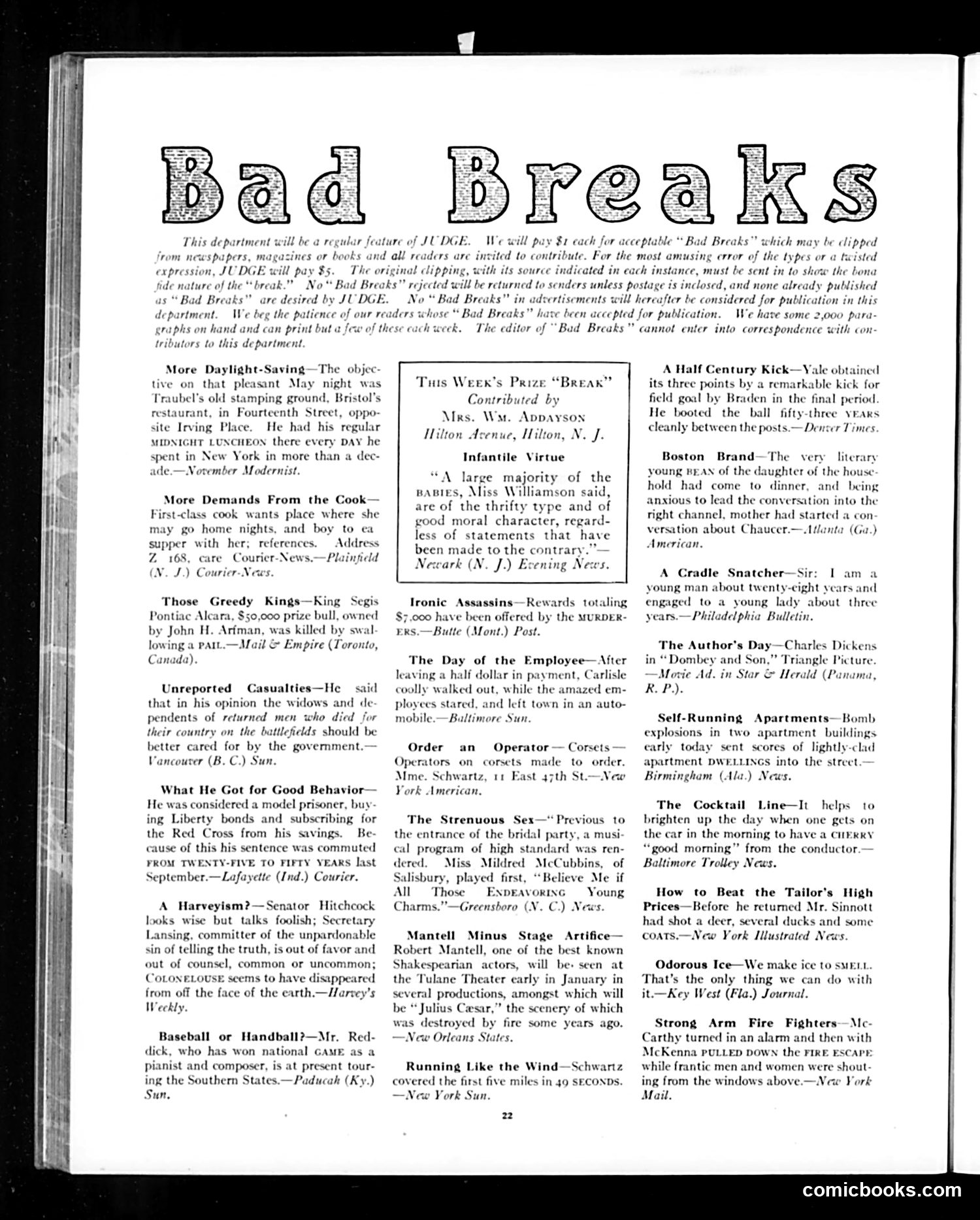
This is a title page for *Judge* magazine's recurring "Bad Breaks" feature—a humor column collecting printing errors and absurd newspaper excerpts submitted by readers. The magazine paid $1 each for acceptable contributions. The examples shown are amusing typographical or editorial mistakes from newspapers nationwide. For instance, one piece notes a "$50,000 prize bull" died from swallowing a "pail" (likely meant "pail" but suggesting something ridiculous). Another reports a model prisoner's sentence was "commuted FROM TWENTY-FIVE TO FIFTY YEARS"—the opposite of what commutation means. The satire targets incompetent newspaper editing and the unintentionally hilarious results when printers and editors work carelessly. By collecting these errors, *Judge* mocked the journalistic profession while entertaining readers with genuine blunders from competing publications. This was a popular feature exploiting newspapers' widespread production mistakes during the early 20th century.
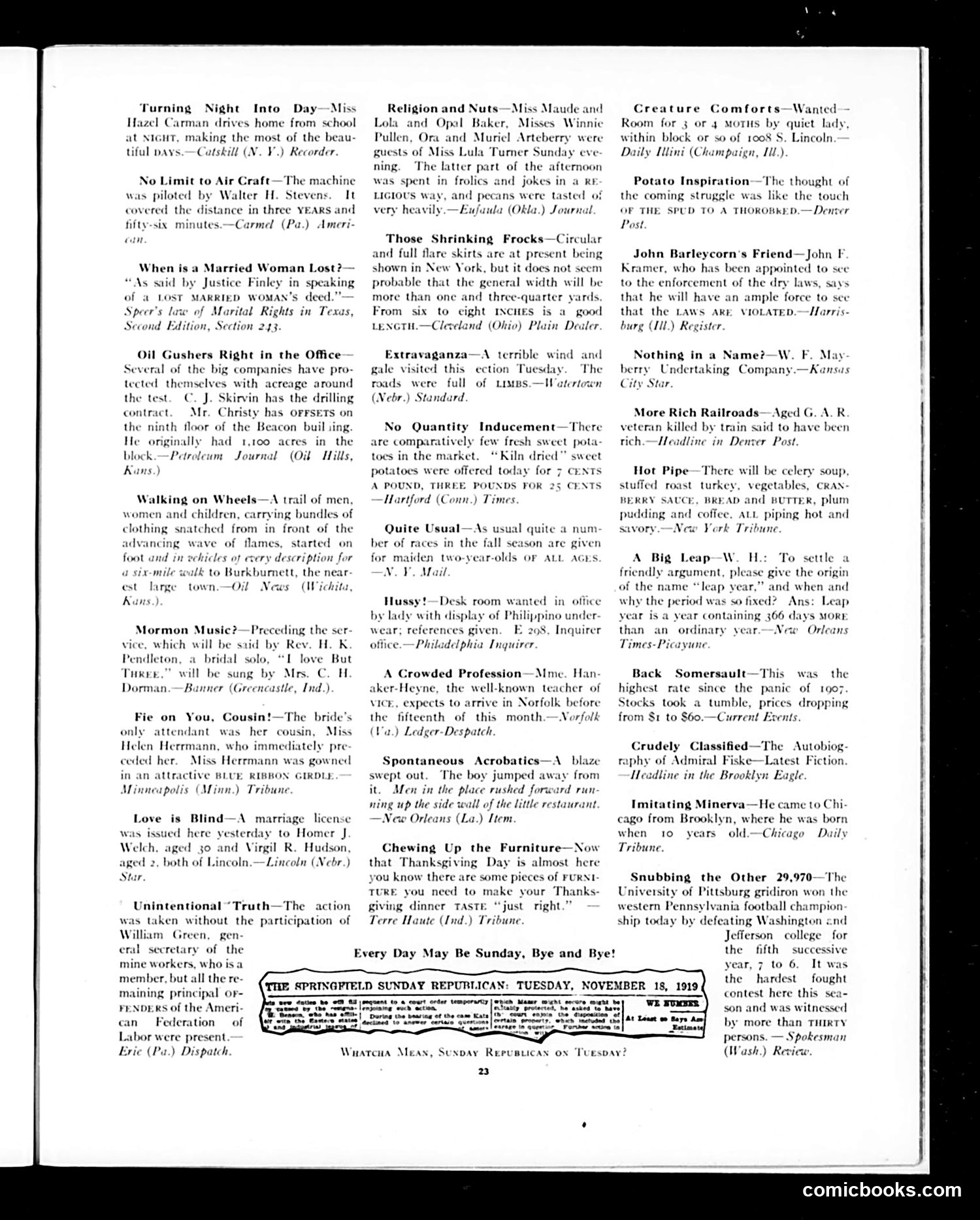
This page consists primarily of a "humor in newspapers" section—a recurring Judge feature that collected absurd or unintentionally funny newspaper clippings. There are no political cartoons visible. The format works by reprinting genuine newspaper excerpts that contain logical contradictions, malapropisms, or double meanings. For example: - A woman drives home from school "at NIGHT" while "making the most of the beautiful DAYS" - A marriage license issued to a 30-year-old and a 2-year-old - An advertisement seeking an office worker skilled in displaying "Philippino underwear" with a teacher of "VICE" The satire targets newspaper editors' carelessness rather than political figures. Judge's joke is that *real newspapers*, not satirists, produce the absurdity. The humor relies on readers catching the contradictions the original papers apparently missed—a gentle mockery of journalistic quality in smaller American towns circa 1919.
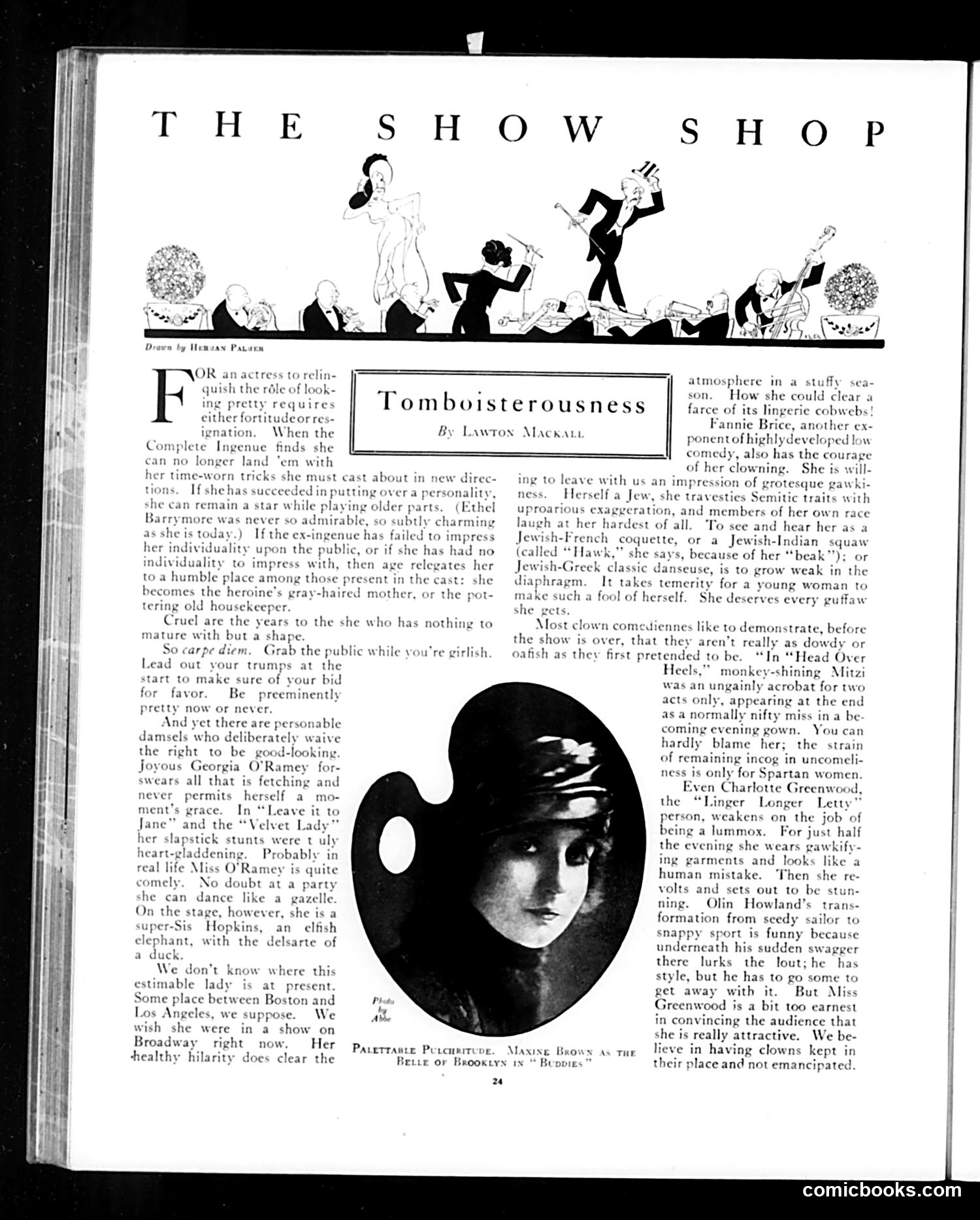
This theatrical criticism by Lawton Mackall evaluates female comedians' performances, specifically their willingness to appear unglamorous on stage. The article praises actresses like Fannie Brice and Georgia O'Ramey for having the courage to perform deliberately unflattering, grotesque comedy—wearing dowdy costumes, exaggerating ethnic stereotypes (the text mentions Jewish and "Jewish-Indian" caricatures), and abandoning vanity for laughs. The satire targets aging actresses facing career obsolescence. Mackall argues they must abandon "time-worn tricks" and choose between remaining glamorous stars or embracing comedic humiliation. He criticizes those who weaken their clown roles by reverting to attractiveness mid-performance (like Charlotte Greenwood), arguing female comedians should remain "in their place and not emancipated"—confined to comedic degradation rather than claiming dramatic or serious roles. The illustration shows theatrical performers in exaggerated poses. This reflects 1920s attitudes: women in comedy were expected to sacrifice dignity for laughs, while serious roles remained male-dominated.
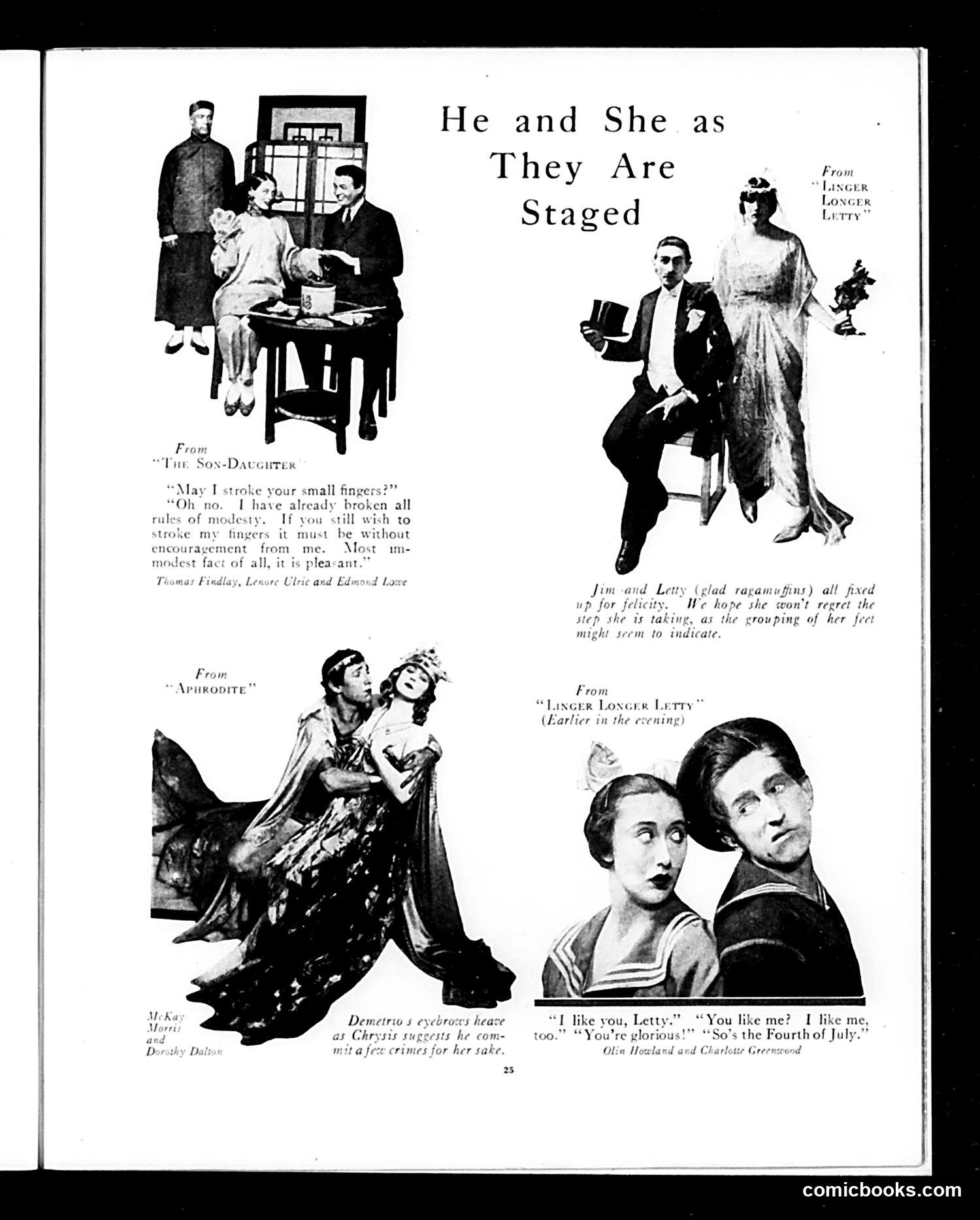
This page showcases scenes from contemporary theatrical productions, presenting romantic and dramatic moments between male and female characters. Each vignette quotes dialogue or describes the staged action from plays including *The Son-Daughter*, *Aphrodite*, and *Linger Longer Letty*. The satire appears gentle—Judge is capturing popular theatrical moments of the era, likely poking mild fun at theatrical conventions: dramatic declarations of love, physical comedy, and the exaggerated gestures actors employed. The captions highlight both the earnestness and absurdity of stage romance—from the coy refusal of hand-stroking in *The Son-Daughter* to the self-absorbed narcissism in *Linger Longer Letty* where a character responds to "I like you" with "You like me? I like me." The humor relies on readers' familiarity with these Broadway productions and contemporary acting styles, mocking theatrical pretension through selective quotation and observation.
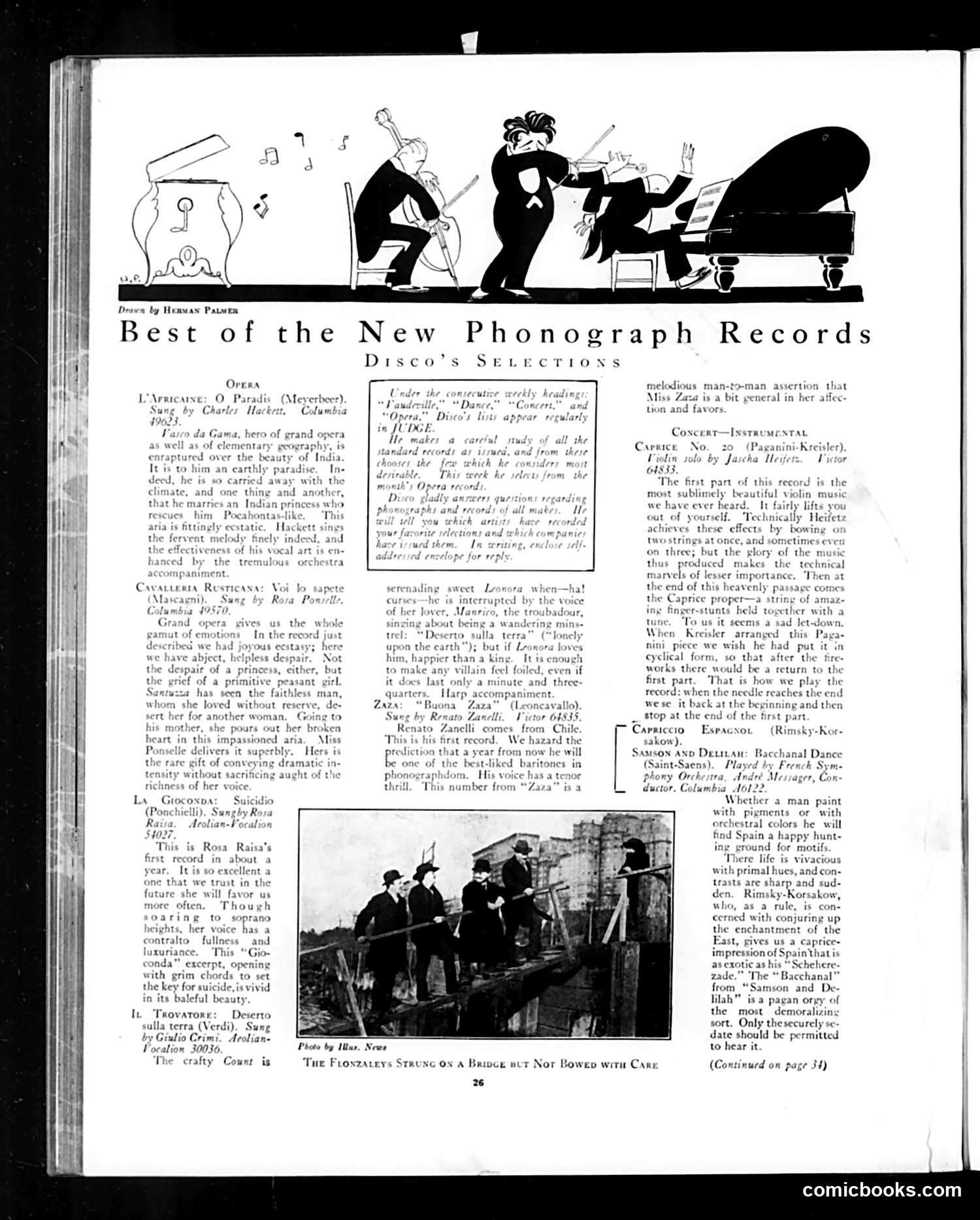
This page is **not primarily a political cartoon**, but rather a **record review column** titled "Best of the New Phonograph Records: Disco's Selections." The illustration at the top—showing musicians performing while sheet music flies about—is a decorative **header** for the music criticism section, not satire. It depicts an orchestra in humorous chaos, emphasizing the energetic nature of recorded music. The content reviews opera and classical recordings, discussing performances by singers like Rosa Raita and Renato Zanelli. The photograph shows what appears to be the Floszalevs performing on a bridge. The page's humor is **mild and incidental**—found in the critic's witty observations about musical performances (such as noting a soprano's voice has "contrallo fullness") rather than in political or social satire. This is a **cultural criticism page**, not a satirical commentary on current events or public figures.
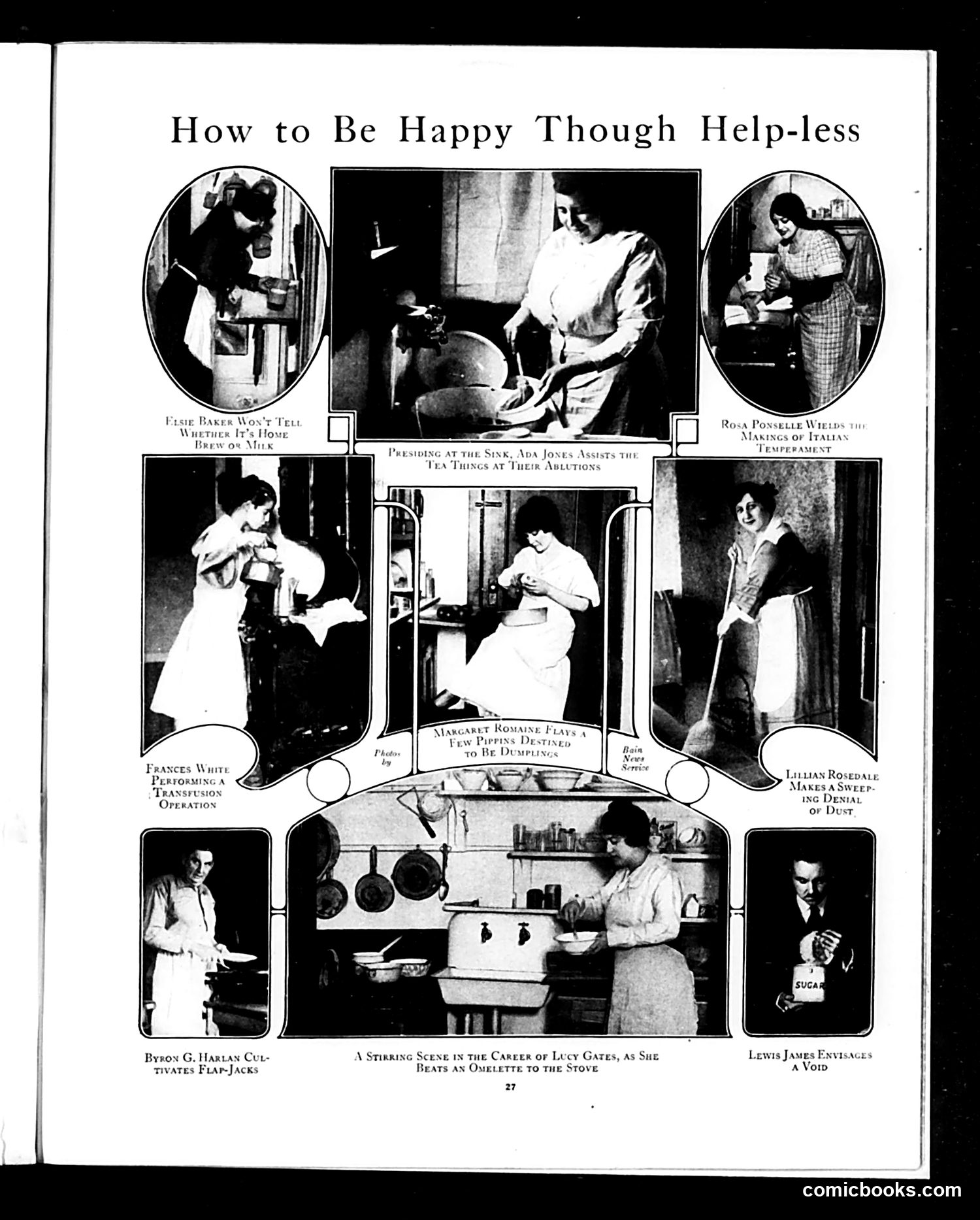
This Judge magazine page satirizes the domestic struggles of early 20th-century housewives managing without household help. The title's paradox—being "happy" while "help-less"—mocks the impossible cheerfulness expected of women doing all housework themselves. The montage shows various female characters (appearing to be celebrities or recognizable figures of the era) performing unglamorous domestic tasks: kitchen work, laundry, cooking, cleaning. Each caption pairs a woman's name with her domestic drudgery—suggesting that even notable women cannot escape these duties. The satire targets two audiences: the expectation that women should remain cheerful despite exhausting unpaid labor, and perhaps the wartime or post-war labor shortage that forced middle-class households to lose domestic servants. The central image of "Lucy Gates" cooking emphasizes that even presumably privileged women must now do manual kitchen work themselves—the core indignity of the joke.
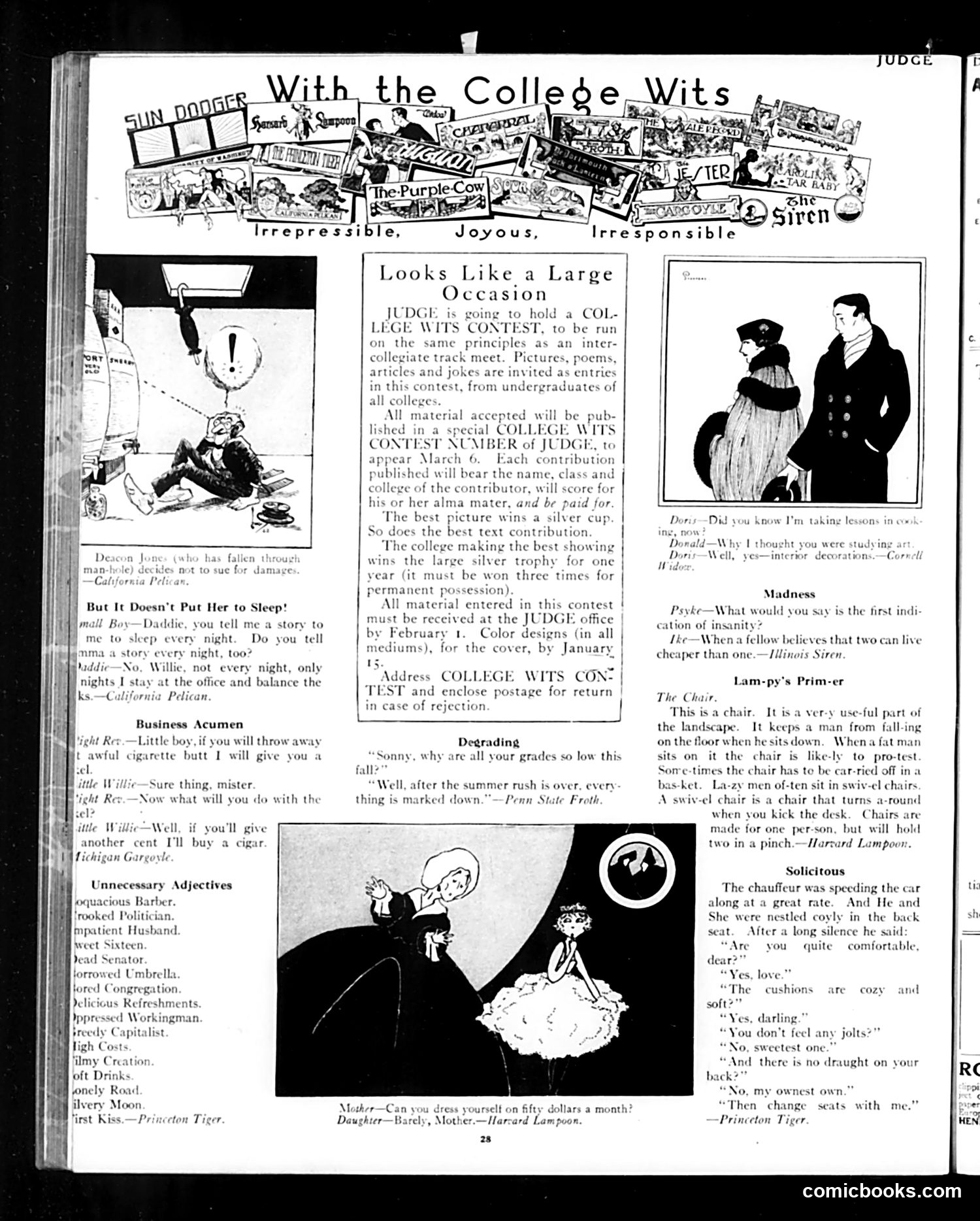
This Judge magazine page collects humorous college-themed content. The main feature announces a **College Wits Contest**—a collegiate talent competition accepting pictures, poems, articles, and jokes from undergraduates nationwide. Winners' work will appear in a special Judge issue, with the best text contributor receiving a silver trophy (kept permanently after three wins). The surrounding jokes satirize common college and domestic scenarios: - **"But It Doesn't Put Her to Sleep"**: A husband admits he only tells bedtime stories on nights he needs to "balance the books"—suggesting marital tension around finances. - **"Business Acumen"**: A child's innocent question about a dropped cigarette reveals adult hypocrisy about waste. - **"Degrading"**: A student's poor grades mysteriously improve after summer, implying grade manipulation. The remaining sections include wordplay on "unnecessary adjectives" (absurd descriptors), a primer-style joke about chairs, and a flirtation scenario. The satire targets college life, parenting, and romantic conventions of the era.
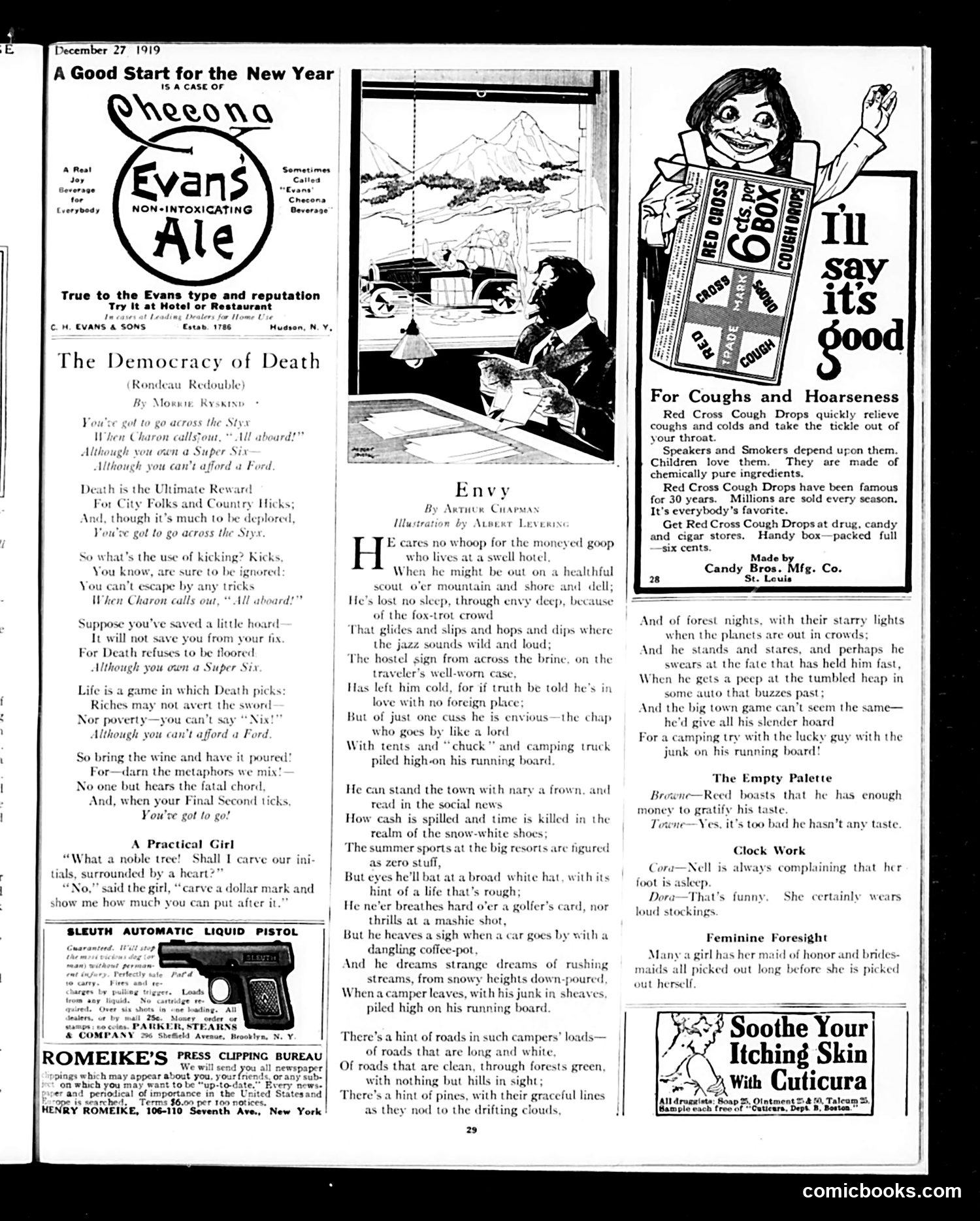
This page mixes advertisements with satirical poetry and humor typical of *Judge* magazine. The main content includes: **"The Democracy of Death"** — a poem mocking pretensions to class distinction. Its message: death is the great equalizer—rich and poor alike must "cross the Styx," so accumulating wealth or status is futile. This reflects post-WWI disillusionment about mortality. **"Envy"** — a longer poem about a wealthy hotel resident who envies a camping enthusiast. The satire suggests that despite material comfort, he craves the authentic freedom of outdoor adventure—implying 1920s anxieties about whether modern luxury actually satisfies. **"A Practical Girl"** — a brief joke mocking romantic sentiment; the girl prefers carving dollar signs to hearts, satirizing materialism and shifting gender attitudes. The advertisements (Cheona Ale, Sleuth pistol, Red Cross cough drops, Cuticura) are period products. The overall tone reflects post-WWI American cynicism about wealth, death, and changing social values.
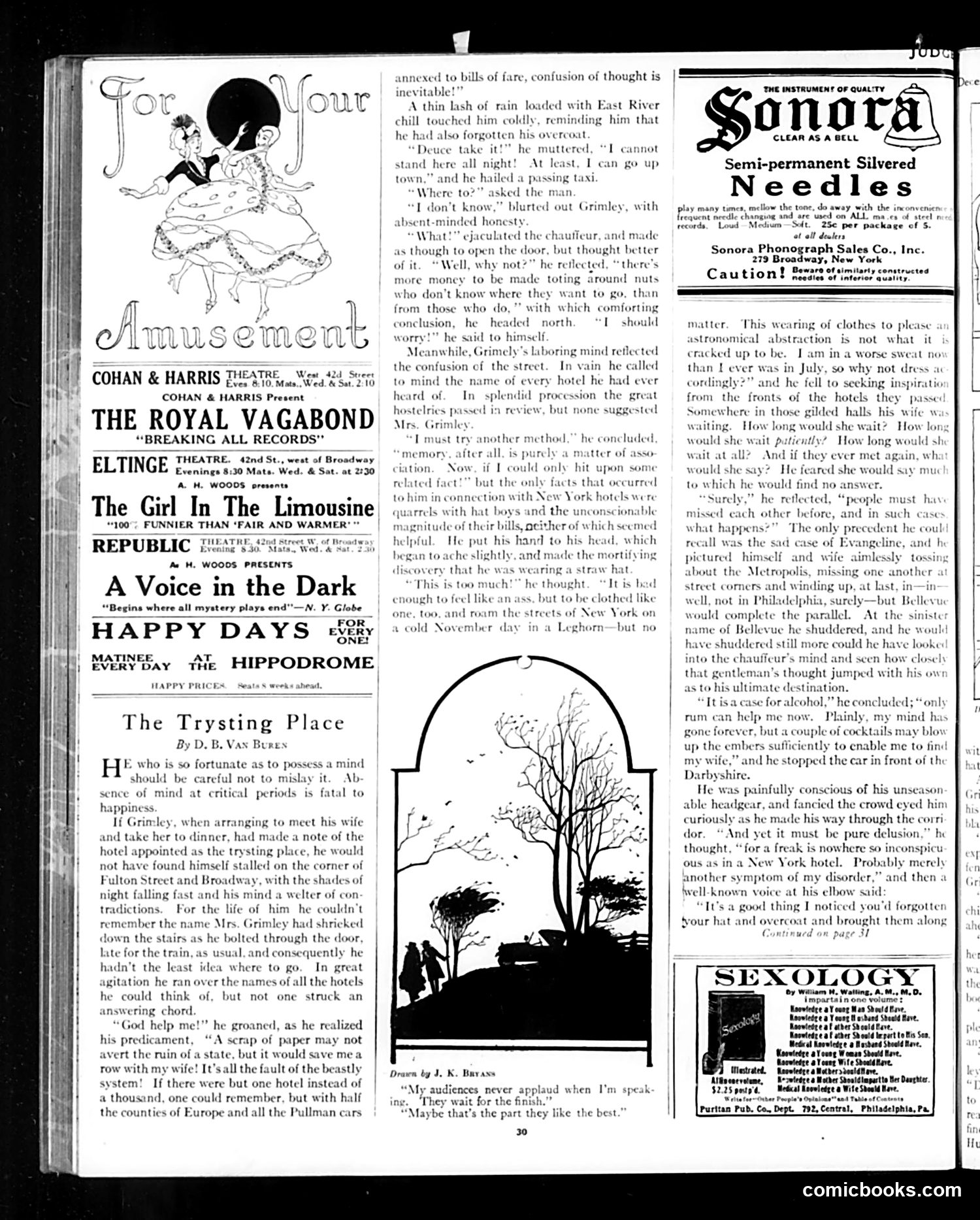
This page is primarily theatrical advertising for Broadway shows (1910s-era), with one complete short story, "The Trysting Place" by D.B. Van Buren. The story satirizes modern urban life's absurdities: A absent-minded husband (Grimley) forgets which hotel he was supposed to meet his wife at in New York City. He cannot remember among the countless hotels, gets caught in rain without his overcoat, and must admit his confusion to a taxi driver. The taxi driver, rather than judge him, philosophically accepts it—noting there's actually *more* money to be made driving confused passengers around than those who know their destination. The satire targets: - The bewildering proliferation of hotels and commercial establishments in modern cities - Male forgetfulness and disorganization - The irony that urban complexity creates profitable confusion The gentle humor relies on readers recognizing the relatable anxiety of getting lost in a sprawling metropolis—a distinctly modern problem for the 1910s audience.
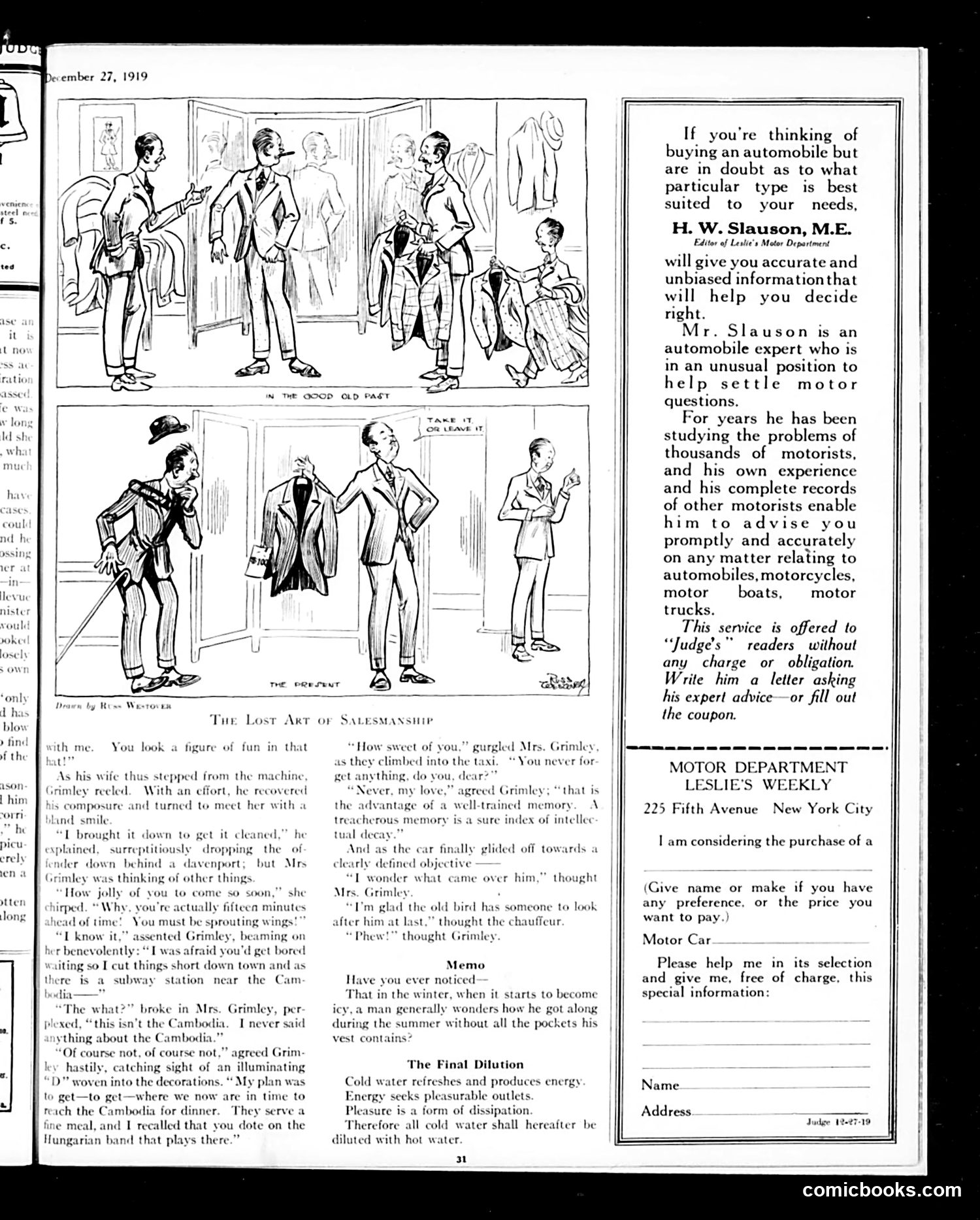
This comic illustrates a husband's bumbling attempt to deceive his wife. Grimley fabricates an elaborate story about taking their car to be cleaned and mentions a "Cambodia" restaurant, when he actually spent the afternoon downtown. His wife catches him in contradictions—she never mentioned the Cambodia, and he invents details to cover his tracks. The satire targets male incompetence at deception and the "lost art" of honest salesmanship. Rather than straightforwardly explaining his absence, Grimley constructs an unconvincing web of lies that any attentive spouse would see through. The cartoon mocks both his transparent dishonesty and the broader cultural anxiety about men's inability to handle domestic situations with integrity or skill—a common Judge theme in the post-WWI era. The accompanying advertisements for automobile advice represent the magazine's practical service content.
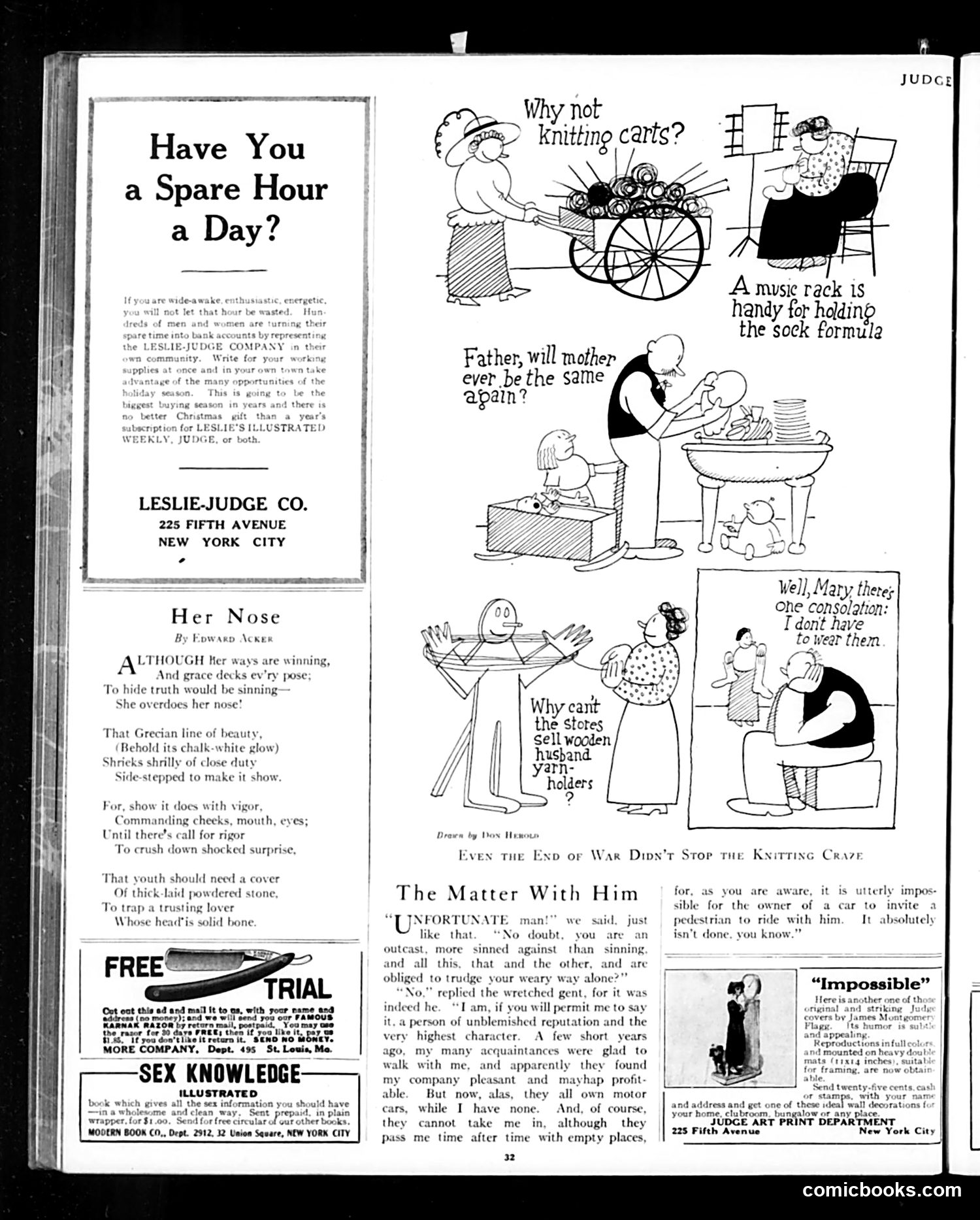
This page combines advertising, poetry, and satirical cartoons reflecting post-WWI American life. **"Her Nose"** is a poem mocking women who apply excessive makeup and powder to their faces, particularly their noses—criticizing artificial beauty standards and vanity. **The knitting cartoons** reference the widespread "knitting craze" mentioned in the headline. During and after WWI, knitting became a major social activity, especially among women making socks and garments for soldiers. The jokes poke fun at how obsessively people pursued this hobby: using music racks to hold knitting patterns, questioning whether family dynamics would change after the war ended, and one woman's humorous claim that she doesn't need to wear the socks she knits. **"The Matter With Him"** depicts a man lamenting that he's socially isolated because he owns no automobile. Friends who previously walked with him now refuse to ride with him (apparently considering it improper to invite a pedestrian into a car), leaving him stranded. The satire critiques how rapidly car ownership became a social status marker in the 1920s. The page is primarily advertising space, with some editorial content.
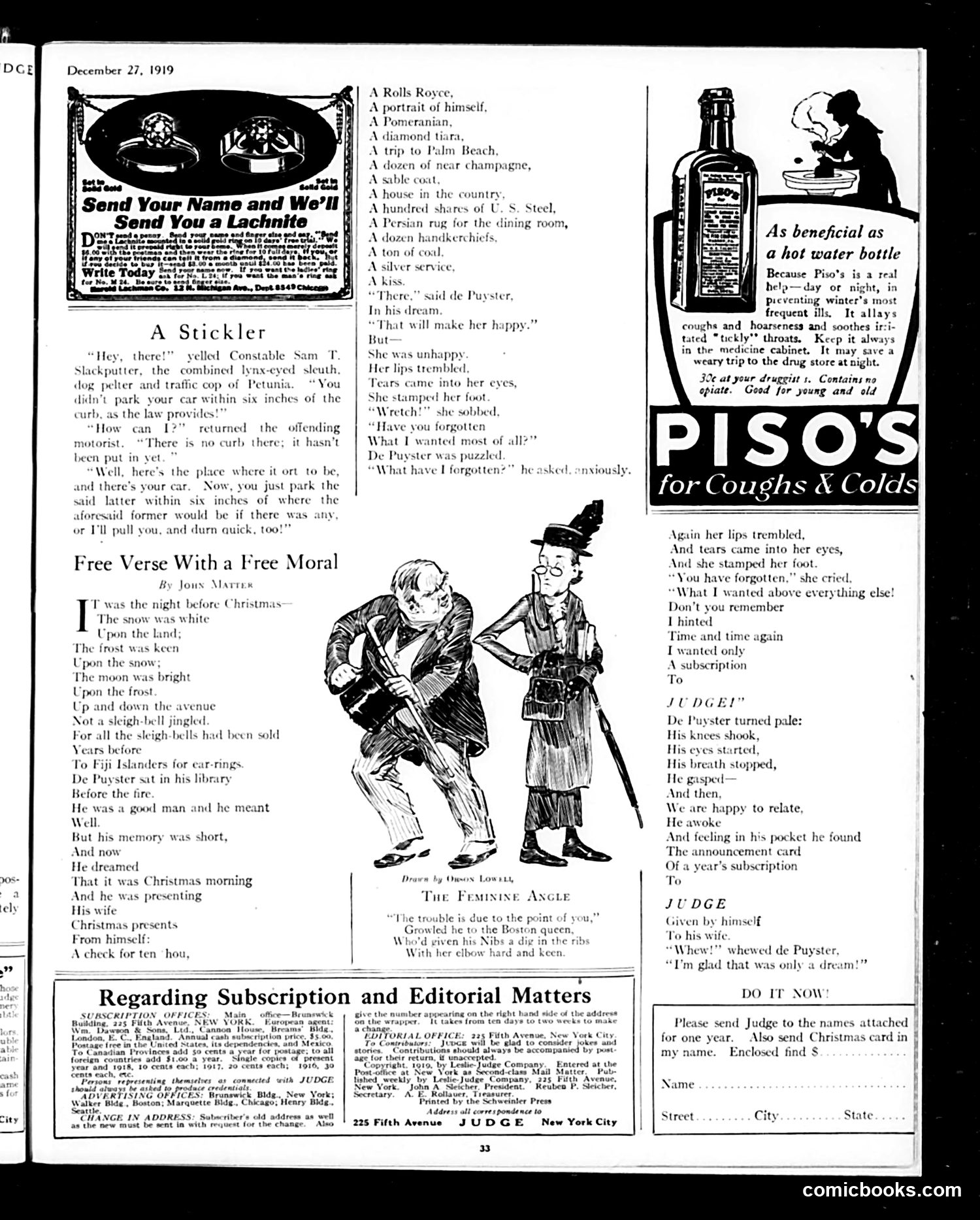
This page contains satirical humor and advertising typical of the era. "A Stickler" mocks overzealous law enforcement—a constable cites a motorist for improper parking near a nonexistent curb, threatening arrest for violating a regulation about a future installation. It's absurdist humor about bureaucratic rigidity. "Free Verse With a Free Moral" parodies sentimental Christmas stories. A wealthy man dreams of giving his wife lavish gifts (Rolls Royce, diamonds, furs, coal)—materialistic excess meant to make her happy. She remains miserable until revealing her true desire: a **subscription to Judge magazine itself**. The joke satirizes both gift-giving pretension and serves as self-promotion, suggesting Judge is more valuable than luxury goods. The advertisements (Piso's cough medicine, Lachnite jewelry) fill remaining space. The page reflects post-WWI consumer culture and Judge's satirical stance toward wealth and American materialism.
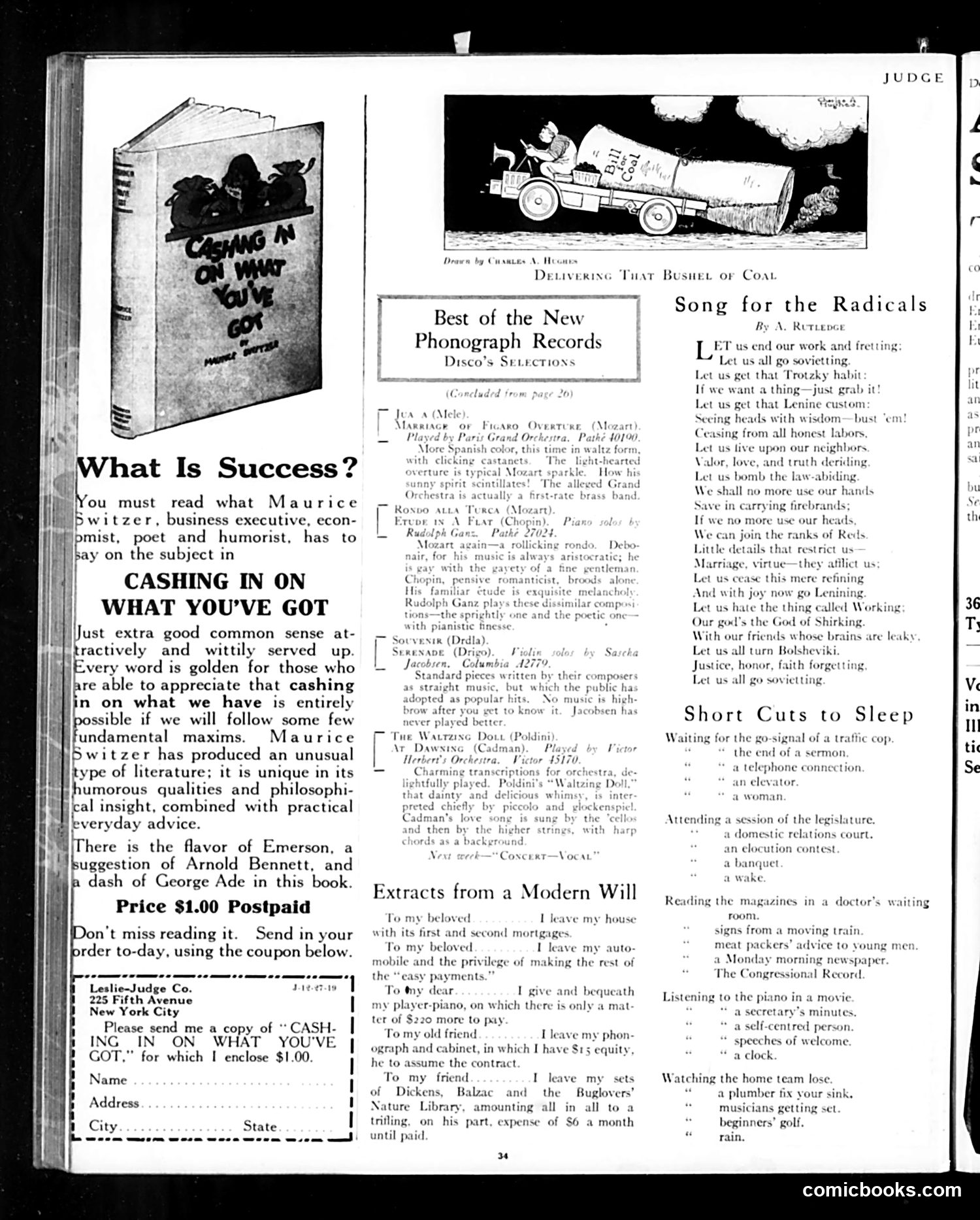
This page primarily contains **advertising and literary content** rather than political cartoons, though it includes satirical pieces attacking radical leftism. The top cartoon by Charles A. Hennessey depicts a truck delivering coal—a mundane image used to introduce "Song for the Radicals," a scathing anti-communist satire. The song mocks Bolshevism, Lenin, and Trotsky, ridiculing radical ideology through exaggeration: advocating theft ("grab it"), living off neighbors, bombing, and rejecting work ("the God of Shirking"). "Extracts from a Modern Will" satirizes consumer debt culture, showing a wealthy man bequeathing mortgaged property, unpaid automobiles, and installment-plan player pianos—suggesting Depression-era anxieties about middle-class indebtedness masked as luxury. "Short Cuts to Sleep" humorously lists tedious experiences (legislative sessions, elevator rides, sermons). The bulk of the page promotes Maurice Switzer's self-help book "Cashing In On What You've Got," positioning practical American individualism against the radical socialism the magazine was attacking.
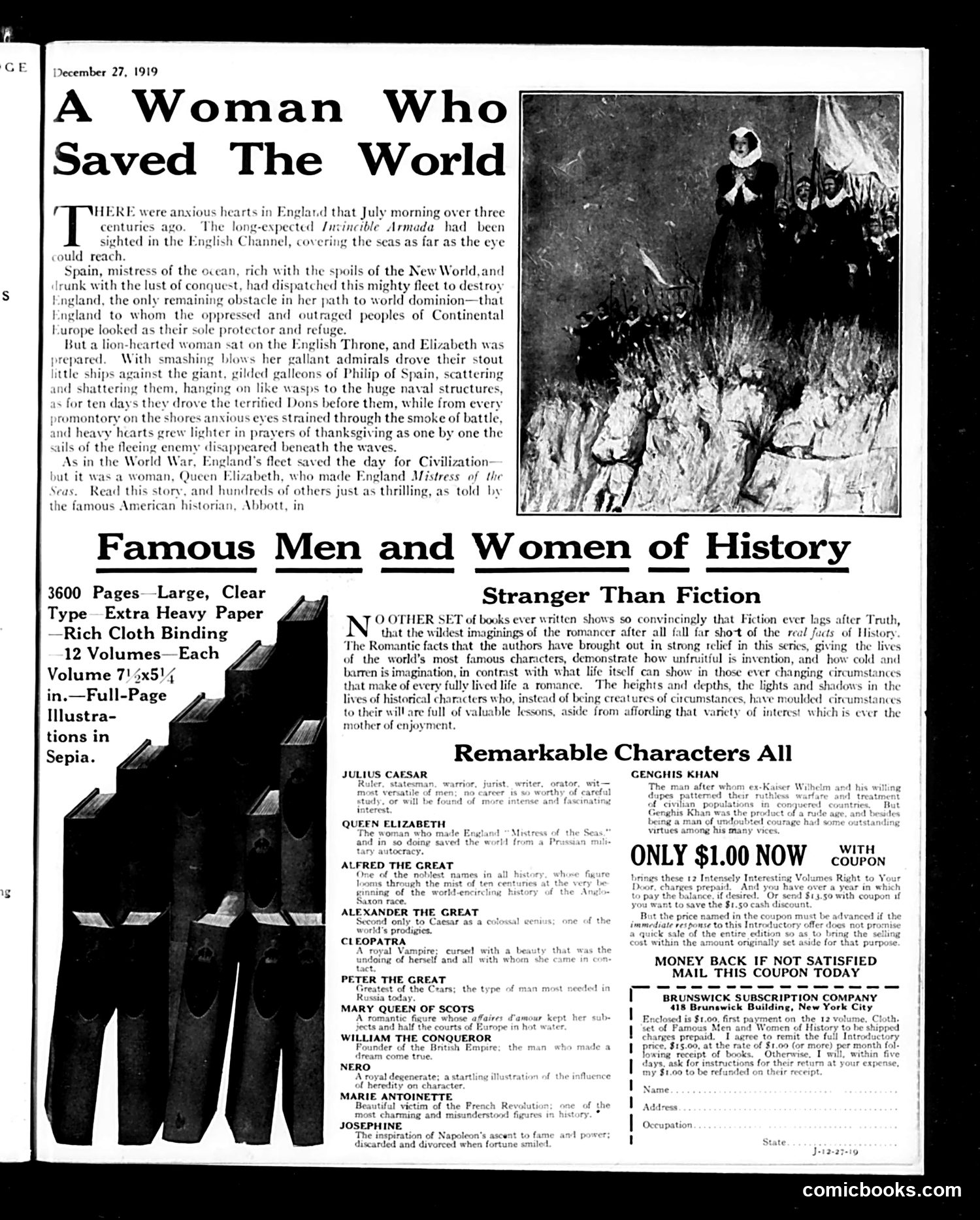
This page is primarily **advertising, not political satire**. It's a 1919 book advertisement for a 12-volume encyclopedia titled *Famous Men and Women of History*. The opening article uses **Queen Elizabeth I and the Spanish Armada (1588)** as a hook to sell the books. The text claims Elizabeth's leadership "saved the world" by preventing Spanish conquest—a patriotic framing common in early 20th-century popular history. The article then draws a parallel to **World War I** (recently ended in 1918), suggesting England's naval power again preserved civilization. This was standard propaganda rhetoric of the era. The advertisement emphasizes the books contain "stranger than fiction" real historical narratives, positioning them against mere imaginative literature. Listed figures include Caesar, Alexander the Great, Napoleon, and other famous historical figures. **The satire is minimal**—mostly the hyperbolic claim that a woman "saved the world," which may gently mock overstated historical narratives, though the text treats Elizabeth seriously. This is essentially a **historical marketing piece** using wartime patriotism to sell educational books.
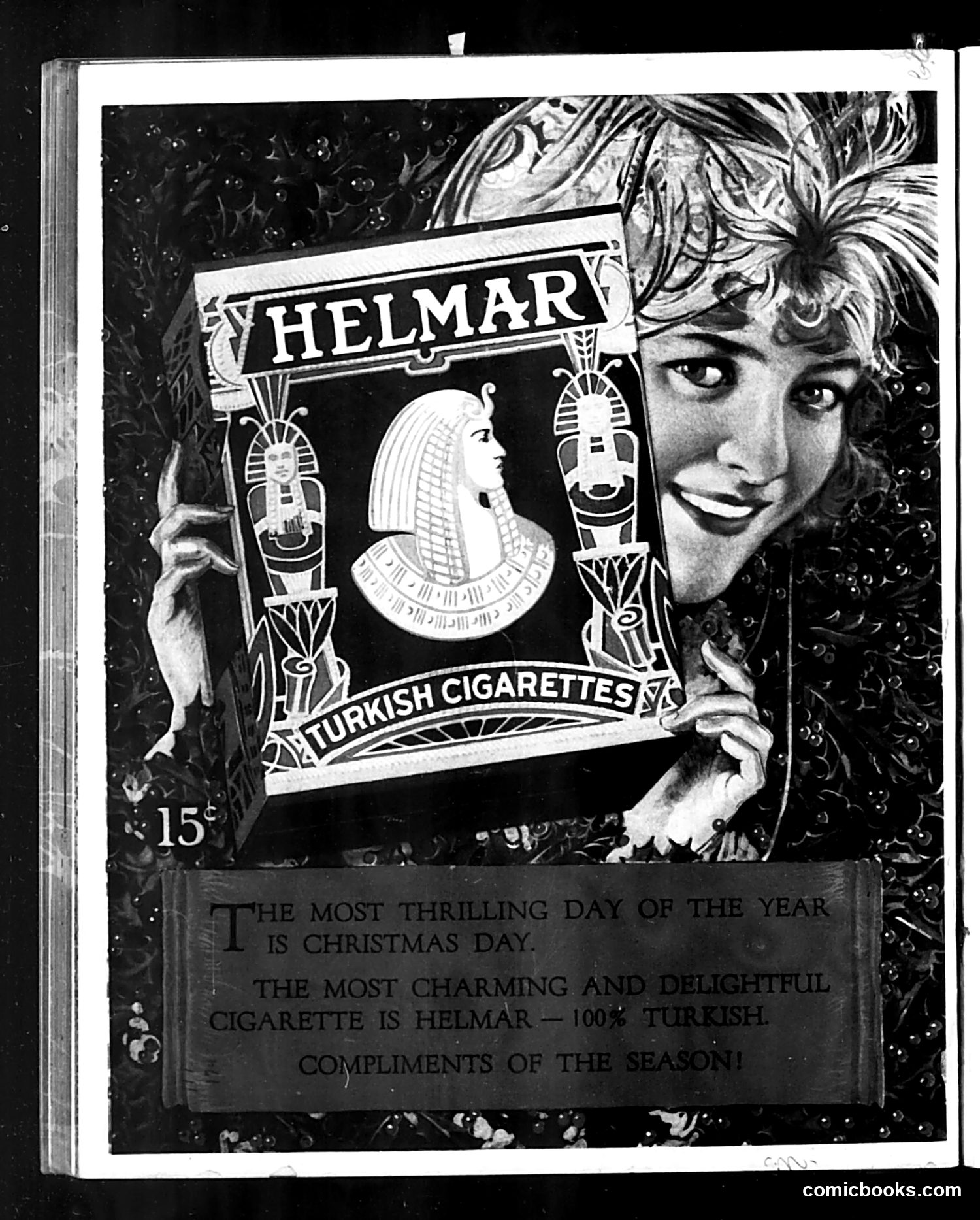
This is a full-page cigarette advertisement rather than political satire. It features a woman in 1920s style dress holding a Helmar Turkish Cigarettes package decorated with Egyptian imagery (pharaoh bust and hieroglyphic-style ornaments). The price is marked at 15 cents. The text positions the product as a luxury Christmas gift: "The most thrilling day of the year is Christmas day. The most charming and delightful cigarette is Helmar—100% Turkish. Compliments of the season!" The ad exploits early-20th-century fascination with Egyptian exoticism and positions smoking as sophisticated and desirable—messaging that would be illegal in modern advertising. The imagery conflates Turkish tobacco with Egyptian mystique to appeal to upscale consumers.
I can see this is a blank or nearly blank page from what appears to be a Judge magazine archive, with only "comicbooks.com" visible at the bottom. The page contains no visible cartoon imagery, text content, or satirical material that I can analyze. Without actual cartoon content, caricatures, or OCR'd text describing political or social commentary, I cannot identify figures, explain historical references, or interpret satire. This appears to be either a blank page, a title/separator page, or a scanning/reproduction issue where the content failed to capture properly. To provide meaningful analysis of Judge magazine's political cartoons and satire, I would need a page with visible imagery and readable text.