
A complete issue · 26 pages · 1915
Judge — April 17, 1915
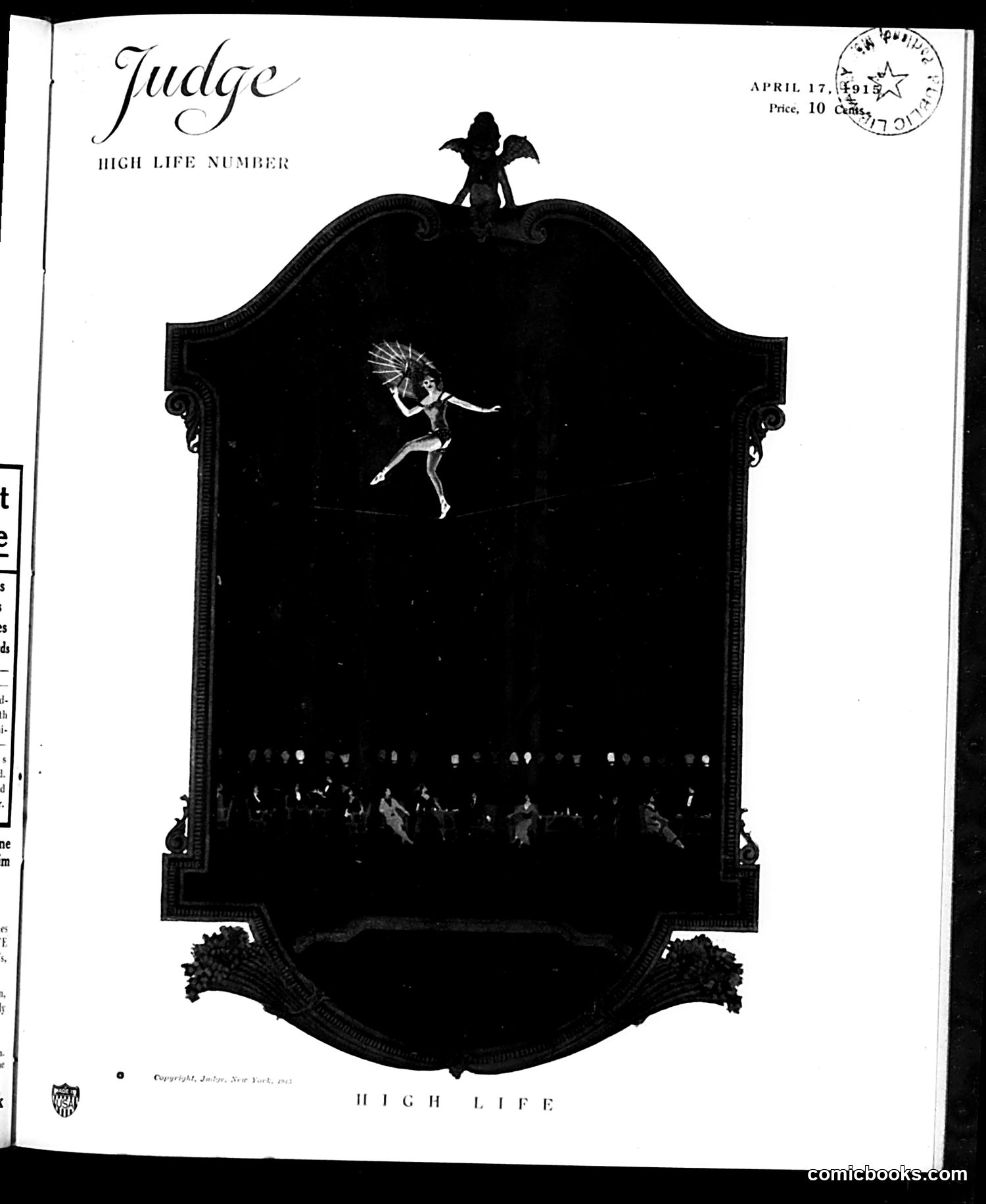
This cover depicts a theatrical stage framed by an ornate proscenium arch. A female acrobat or aerialist performs high above a seated audience in the background. At the top perches a demonic or devilish figure. The title "HIGH LIFE NUMBER" suggests this issue focuses on entertainment and society themes. The theatrical setting and acrobat likely satirize contemporary entertainment trends or perhaps the social pretensions of wealthy audiences who patronized such performances during the 1910s. The demonic figure overhead may represent danger, moral concerns about modern entertainment, or commentary on theatrical excess—common subjects for Judge's satirical commentary during this Progressive Era period. Without additional text identifying specific performers or events, the precise target remains unclear.
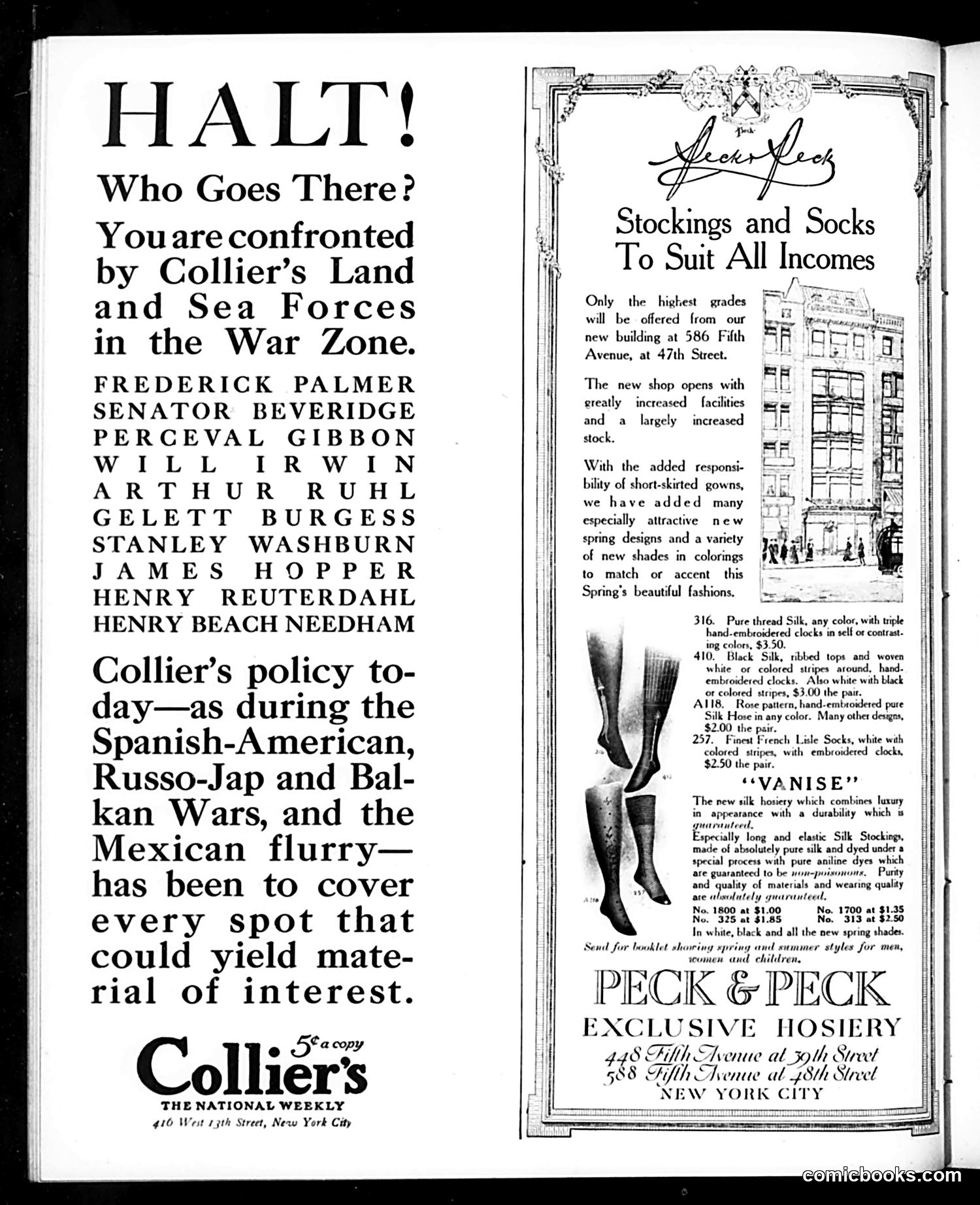
This page contains two distinct advertisements rather than satirical cartoon content. On the left, Collier's magazine advertises its war coverage, listing prominent journalists and politicians (Frederick Palmer, Senator Beveridge, Perceval Gibbon, and others) who reportedly covered conflicts including the Spanish-American War, Russo-Japanese War, Balkan Wars, and Mexican conflicts. The ad emphasizes Collier's comprehensive coverage of global hotspots. On the right, Peck & Peck advertises exclusive hosiery—silk stockings and socks for various occasions and income levels. The advertisement includes product details and prices, with illustrations of women's legs displaying different stocking styles. Neither section contains political satire or caricature. The page is primarily commercial advertising from what appears to be an early 20th-century publication period.
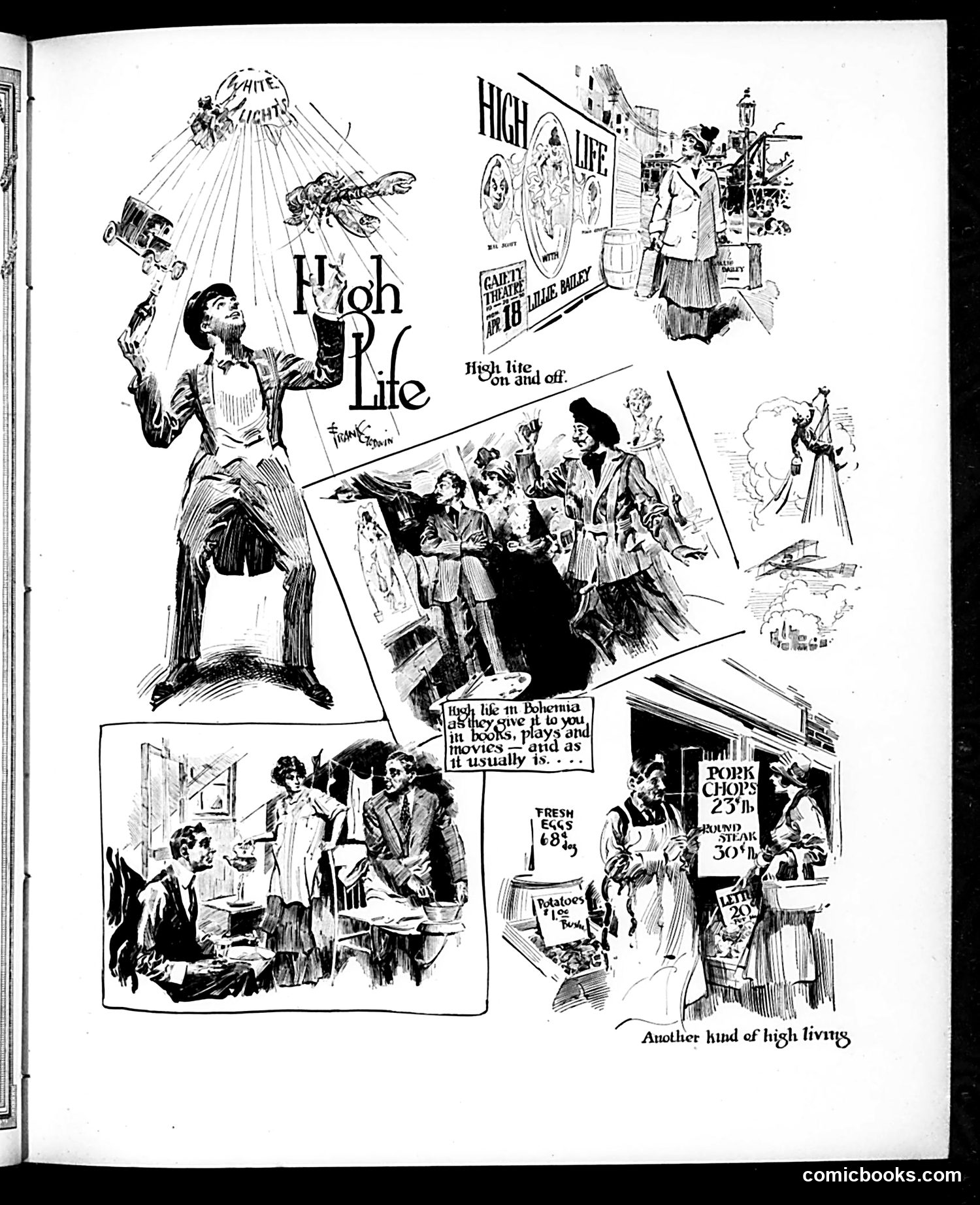
This satirical page contrasts wealthy "high life" aspirations with working-class reality. The main figure on the left gazes heavenward at symbols of luxury (cars, jewelry), representing aspirational dreams of upward mobility. The surrounding vignettes mock this gap between fantasy and reality: - Upper right shows theater and urban sophistication - Lower panels depict actual "high living" as modest—a Bohemian apartment, grocery shopping for basic items (fresh eggs, pork chops, potatoes) - The caption "Another kind of high living" suggests ironic commentary The satire targets early 20th-century working and middle-class Americans who romanticized wealthy lifestyles while their actual daily life involved mundane domestic concerns and limited means. The magazine ridicules both the aspirational fantasy and the gap between classes.
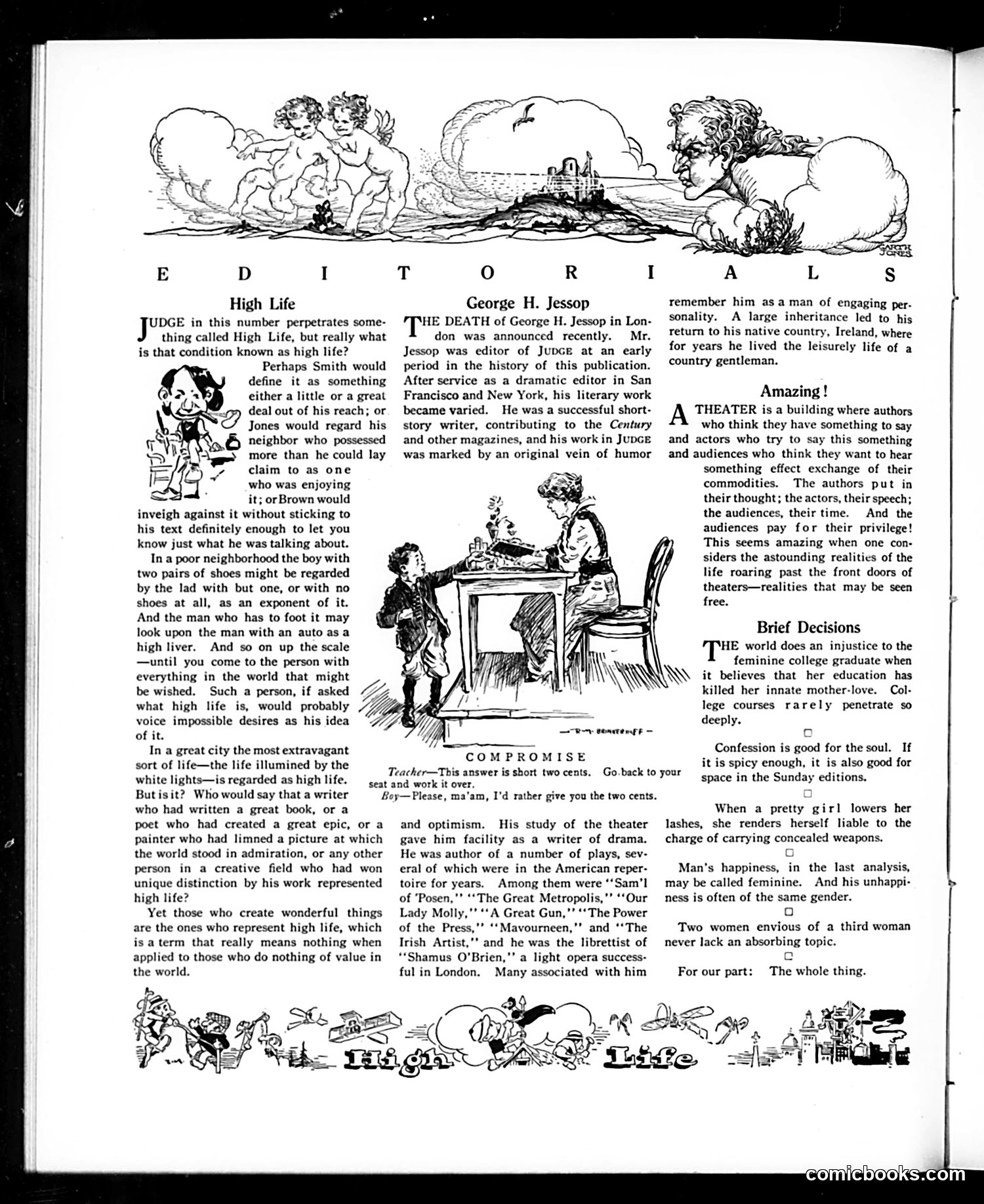
This page from **Judge** magazine contains three distinct pieces: 1. **"High Life"** (left): A satirical essay defining "high life" through class observation—from barefoot children to wealthy society figures. The accompanying caricature shows a smug, well-dressed man, likely representing pretentious upper-class affectation that Judge frequently mocked. 2. **"George H. Jessop"** (center): An obituary-style tribute to a deceased editor and playwright, noting his literary contributions and theatrical works. 3. **"Amazing!"** and **"Brief Decisions"** (right): Short satirical commentary on theater, education, gender relations, and social hypocrisy—typical Judge fare targeting contemporary manners and morals. The page's tone is characteristic of early 20th-century American satirical journalism: sophisticated mockery of class pretension and social contradictions.
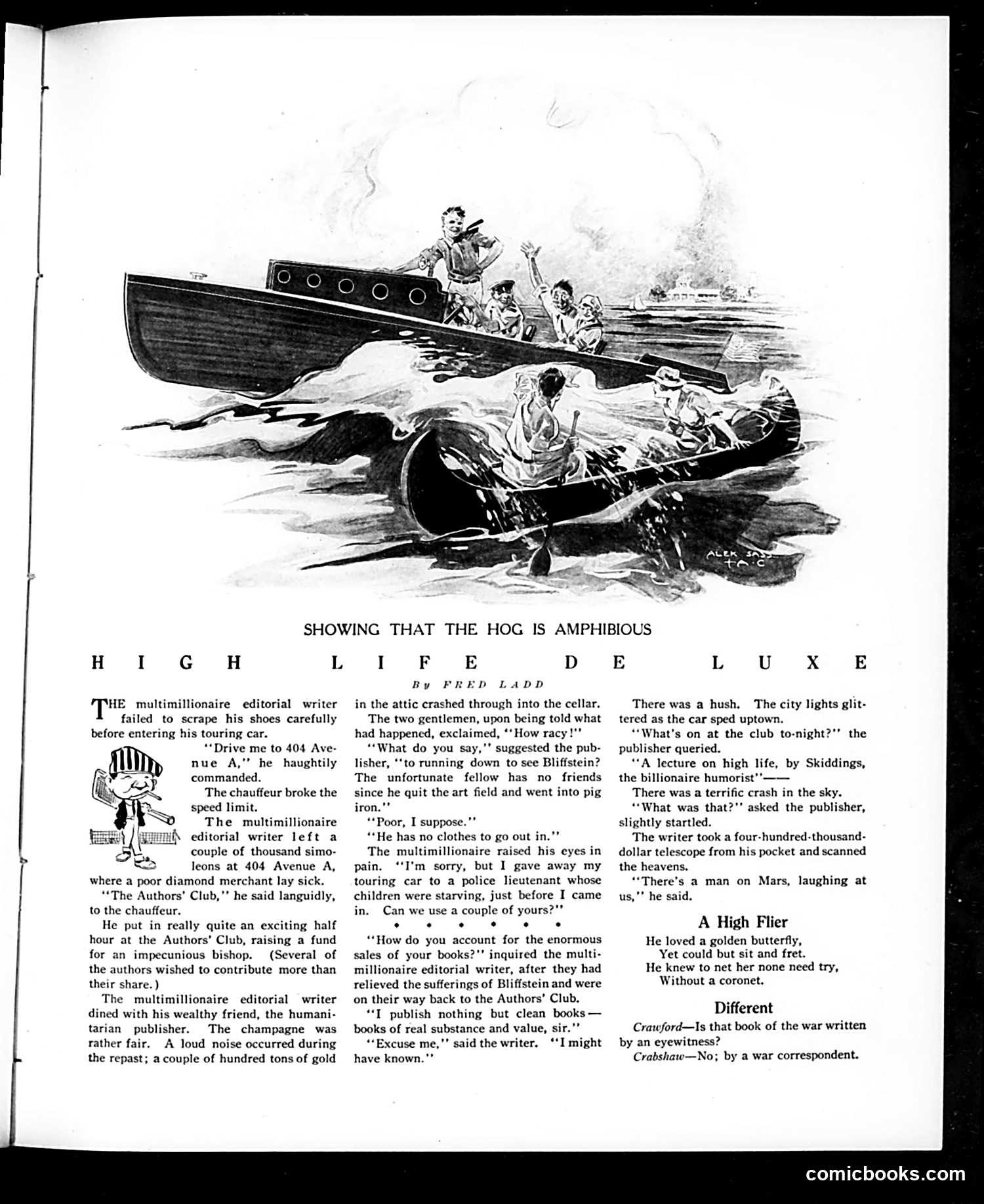
This satirical story mocks wealthy New York society figures. A multimillionaire editorial writer attempts to impress his wealthy friend, a humanitarian publisher, by dining at an exclusive club. During the meal, a massive crash occurs—the writer's touring car has fallen through the street into the cellar below. The joke satirizes the pretensions of the wealthy: the writer's concern with maintaining appearances at the club, and his casual admission that he gave away his touring car to a police lieutenant whose children were starving. The irony is that his expensive car, symbol of his wealth and status, literally cannot support itself and collapses—a visual metaphor for the instability and emptiness of high-society life.
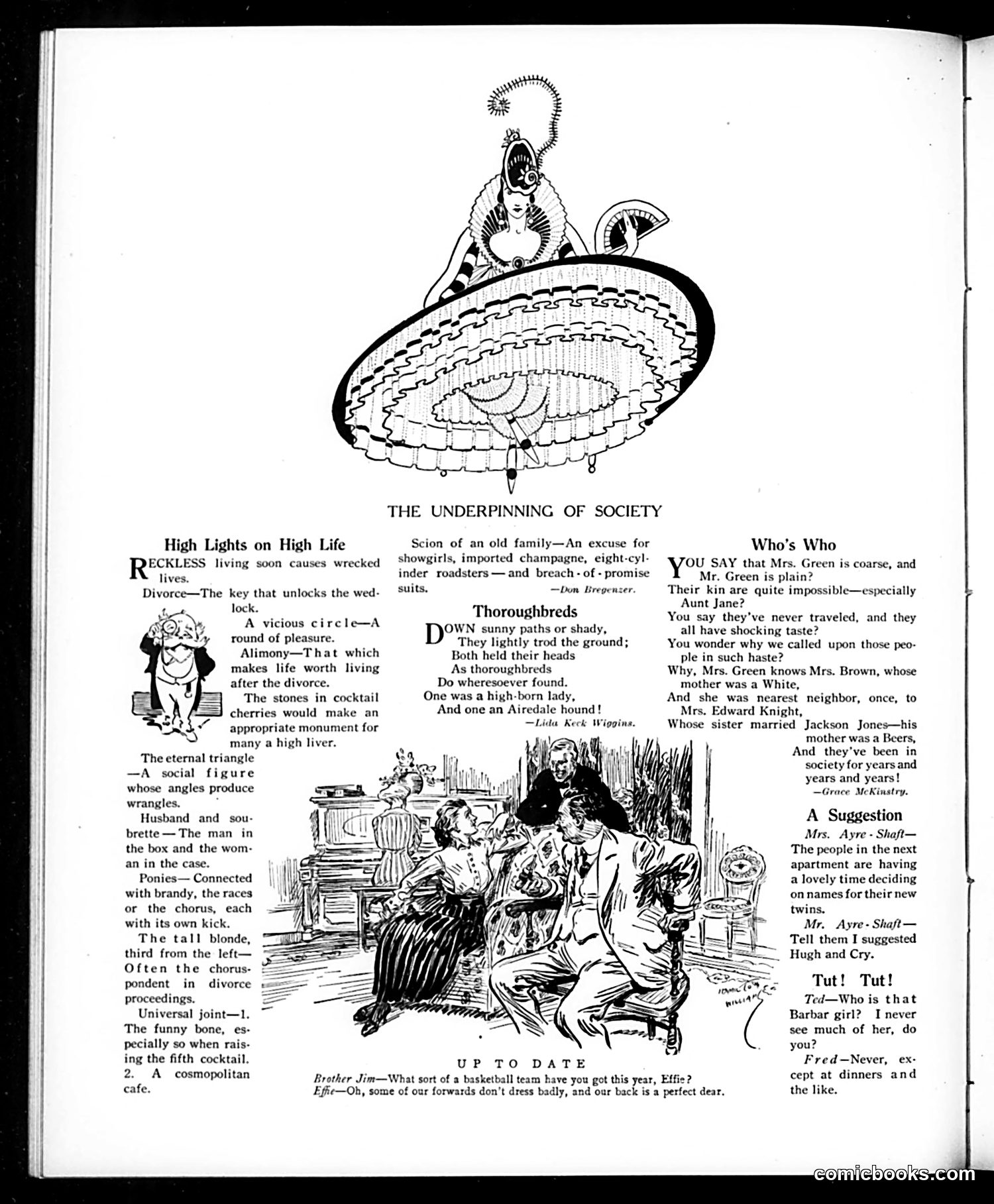
This page satirizes upper-class American social hypocrisy and shallow values circa early 20th century. The main cartoon "The Underpinning of Society" depicts a UFO-like flying saucer with a wealthy socialite aboard, mocking how frivolous high society rests upon unstable foundations. The "High Lights on High Life" column uses cynical wordplay to ridicule wealthy lifestyles: divorce as "unlocking wedlock," alimony as making "life worth living," and cocktail cherries as monuments to "high livers." "Who's Who" satirizes social climbing through manufactured genealogies—people gain status by claiming distant connections to old families, regardless of actual merit or character. The humor throughout targets the disconnect between aristocratic pretension and actual behavior, particularly marital infidelity, excessive drinking, and the obsession with family connections as social currency. The "Thoroughbreds" poem extends this mockery by comparing wealthy people to animals. This reflects Progressive-era skepticism toward inherited privilege and society's superficiality.
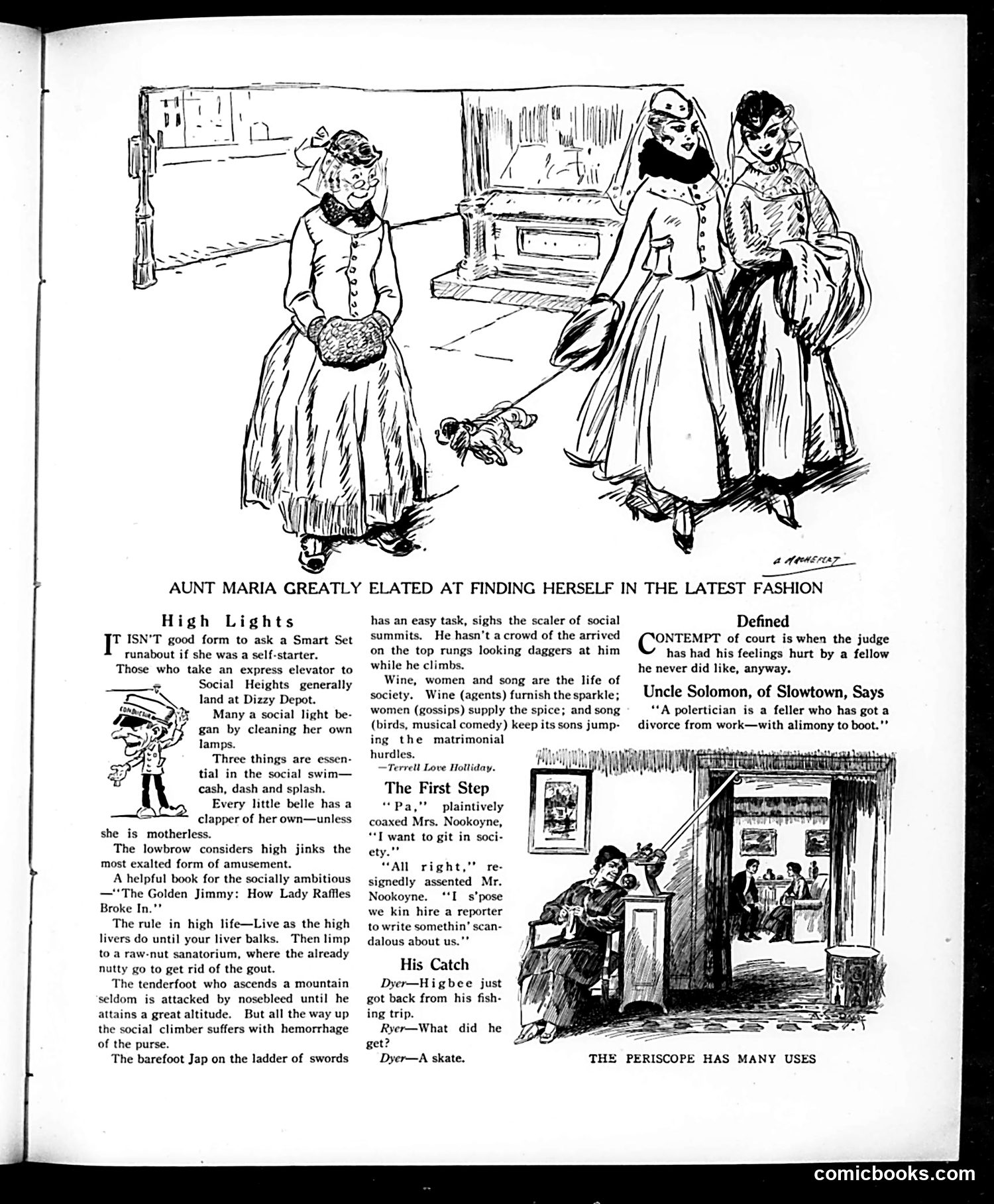
This is a satirical humor page from *Judge* magazine mocking the nouveau riche attempting to gain social status. The main cartoon shows "Aunt Maria" arriving in fashionable clothing, thrilled to fit in with high society—the joke being her obvious lower-class origins make her an outsider regardless of dress. The surrounding text contains brief satirical quips about social climbing. Key points include mockery of those buying their way into society ("cash, dash and splash"), the expense of social advancement ("hemorrhage of the purse"), and superficial markers of status (hiring reporters to create scandal, as Mr. Nookoyne suggests). References like "Dizzy Depot" and the "Golden Jimmy" book are invented comic names. The humor targets the pretension and phoniness of American high society during this era—suggesting that money alone cannot purchase genuine social acceptance, and that the desperate pursuit of status is inherently ridiculous.
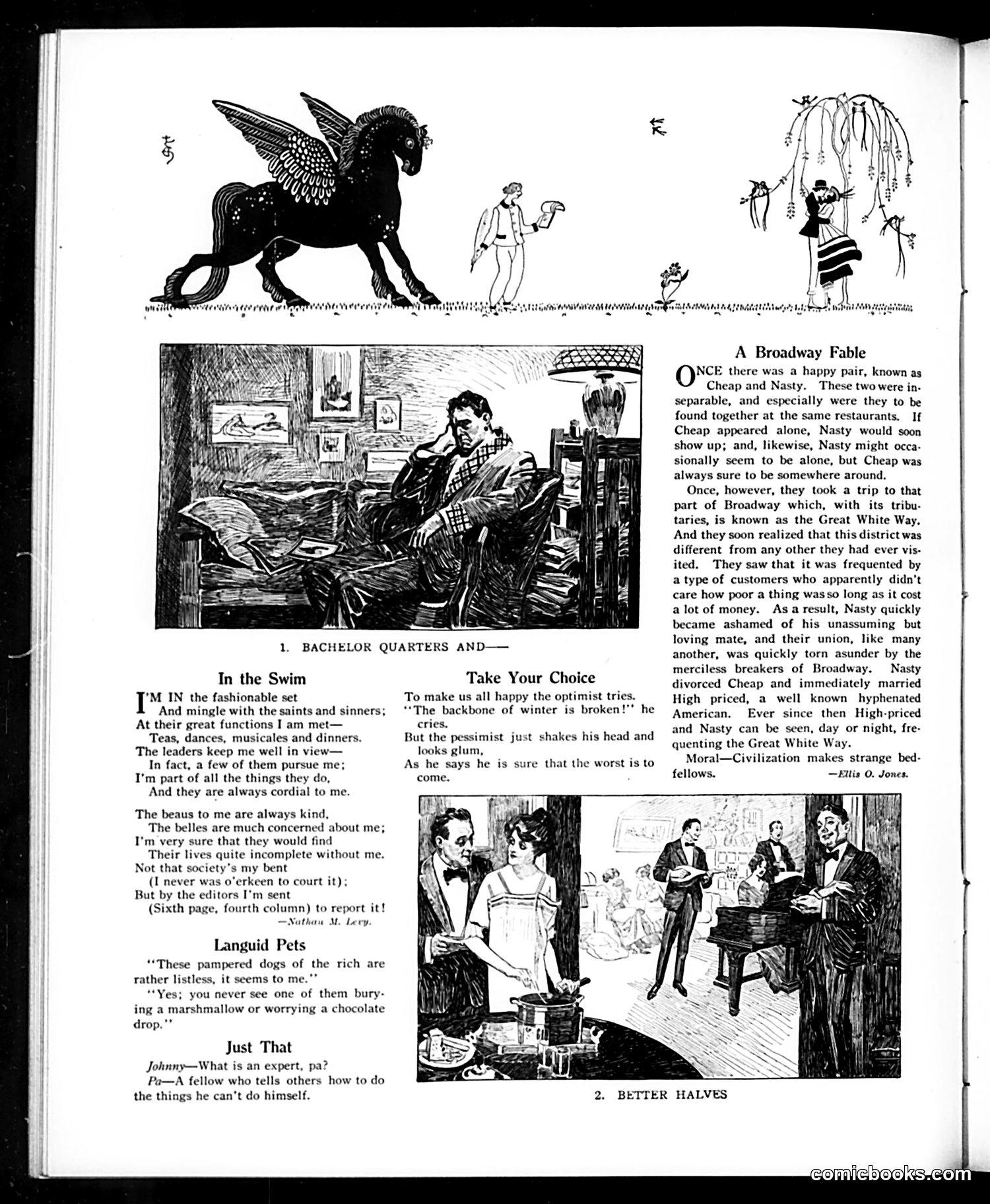
This page contains social satire typical of early 20th-century American humor. The top illustration depicts a winged horse (Pegasus) with figures below—likely representing classical ideals meeting modern Broadway culture. **"A Broadway Fable"** satirizes social climbing and materialism on Broadway's "Great White Way." The allegorical characters—Cheap and Nasty (a romantic couple)—represent unpretentious people who divorce when exposed to wealthy Broadway society. Nasty abandons his partner for "High priced," a wealthy spouse. The moral critiques how civilization and commercialism corrupt authentic relationships. The surrounding verses and humor ("In the Swim," "Languid Pets," "Just That") mock 1920s social pretension—society reporters attending fashionable events, wealthy people's affectations, and self-proclaimed experts. The satire targets the artificial values and status-seeking of urban high society, suggesting that material wealth and social climbing fundamentally damage genuine human connection.
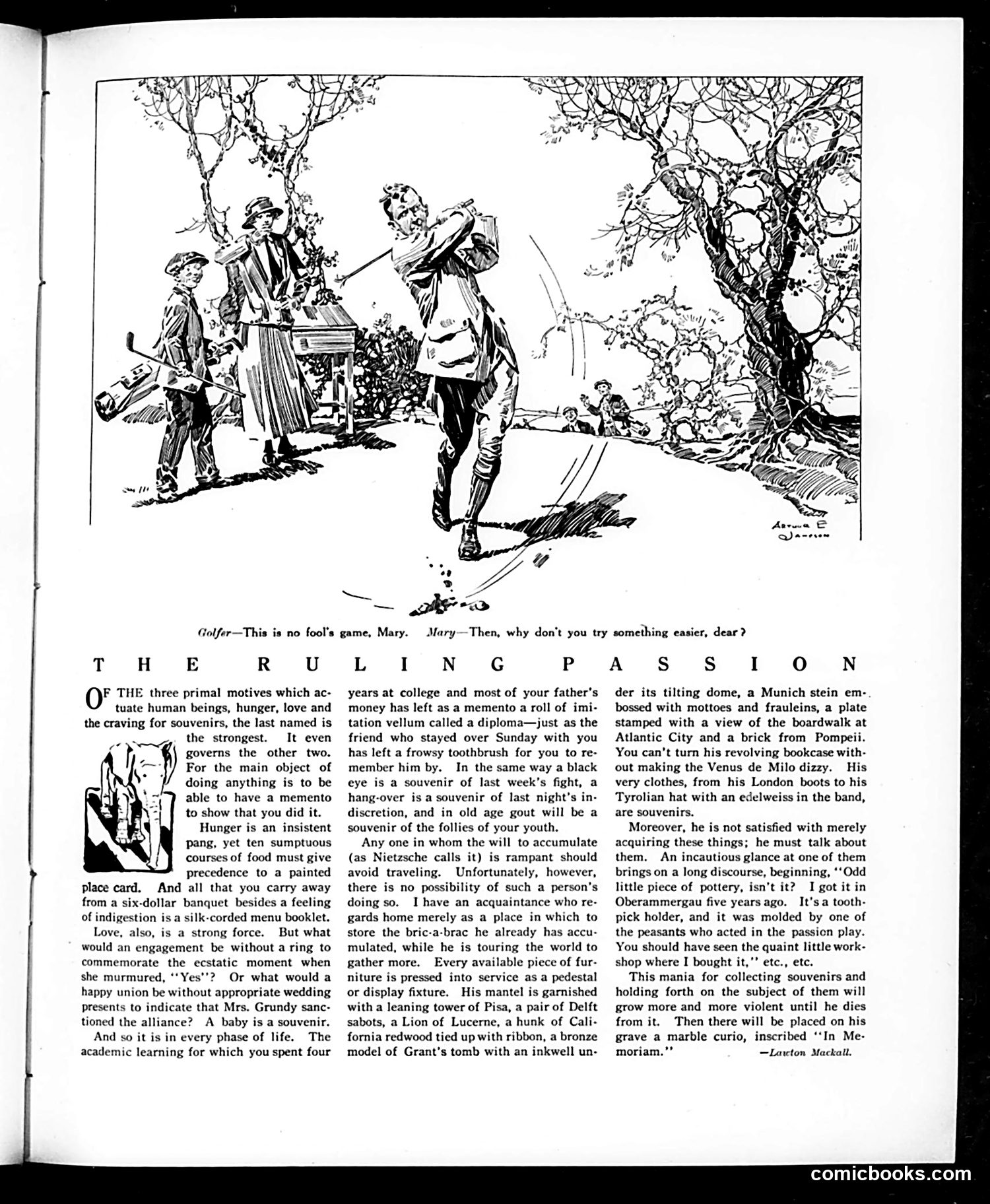
The cartoon shows a golfer and his wife, illustrating the article's satirical thesis: humans are primarily motivated by acquiring souvenirs rather than hunger or love. The wife's caption—"Then, why don't you try something easier, dear?"—humorously implies golf itself is difficult, not foolish as the husband claims. The accompanying essay (bylined Laxton Mackall) expands this theme, arguing that the compulsion to collect and display travel mementos governs modern behavior. The author mocks a specific acquaintance who obsessively gathers European trinkets (Pisa towers, Delft sabots, Pompeii bricks, Munich steins) and tediously narrates their origins. For modern readers: this satirizes early 20th-century tourism culture—the newly accessible leisure travel enabling middle/upper-class Americans to accumulate foreign souvenirs as status symbols. The piece criticizes both the acquisitiveness itself and the accompanying social obligation to hear endless anecdotes about purchases. It's gentle mockery of emerging consumer culture and tourist behavior.
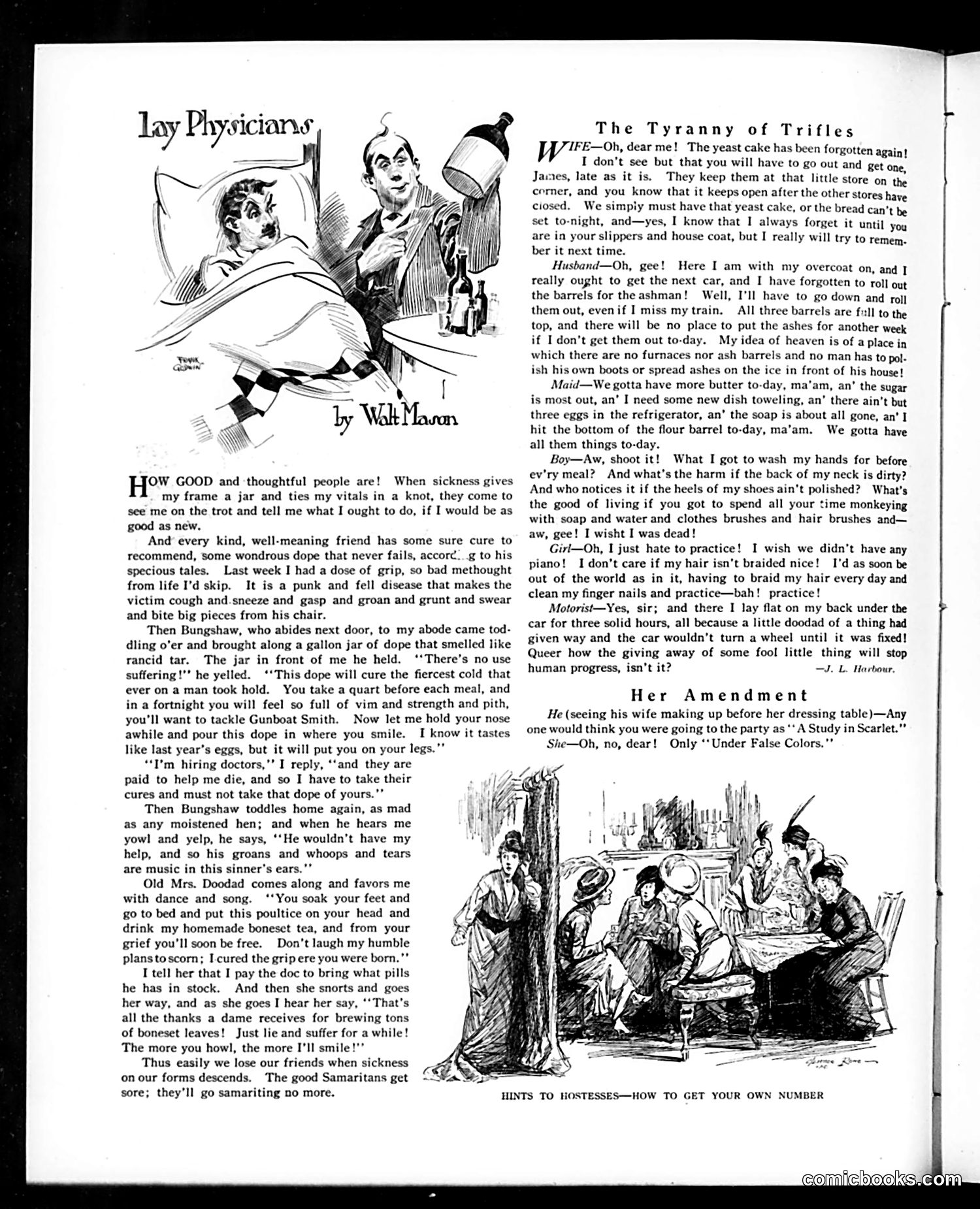
This page contains two distinct pieces of social satire typical of Judge magazine's early 20th-century humor. **"Lay Physicians"** (left): A satirical poem mocking well-meaning neighbors who offer unsolicited home remedies during illness. Characters like "Bungshaw" and "Mrs. Doodad" insist their dubious concoctions (rancid-smelling "dope," poultices, boneset tea) will cure the narrator's grip (influenza). When he refuses and relies on actual doctors instead, his neighbors become offended and resentful. The satire targets the social awkwardness of rejecting folk remedies and the petty vindictiveness of people whose "help" is spurned. **"The Tyranny of Trifles"** (right): A domestic comedy showing how minor household tasks create constant demands. Wife, husband, and maid each have urgent needs—yeast cake, rolled ash barrels, butter, sugar, eggs—that interrupt their plans. The title's point: trivial domestic obligations tyrannize household members, preventing any real rest or escape. Both pieces satirize the frustrations of ordinary life rather than targeting specific political figures or events.
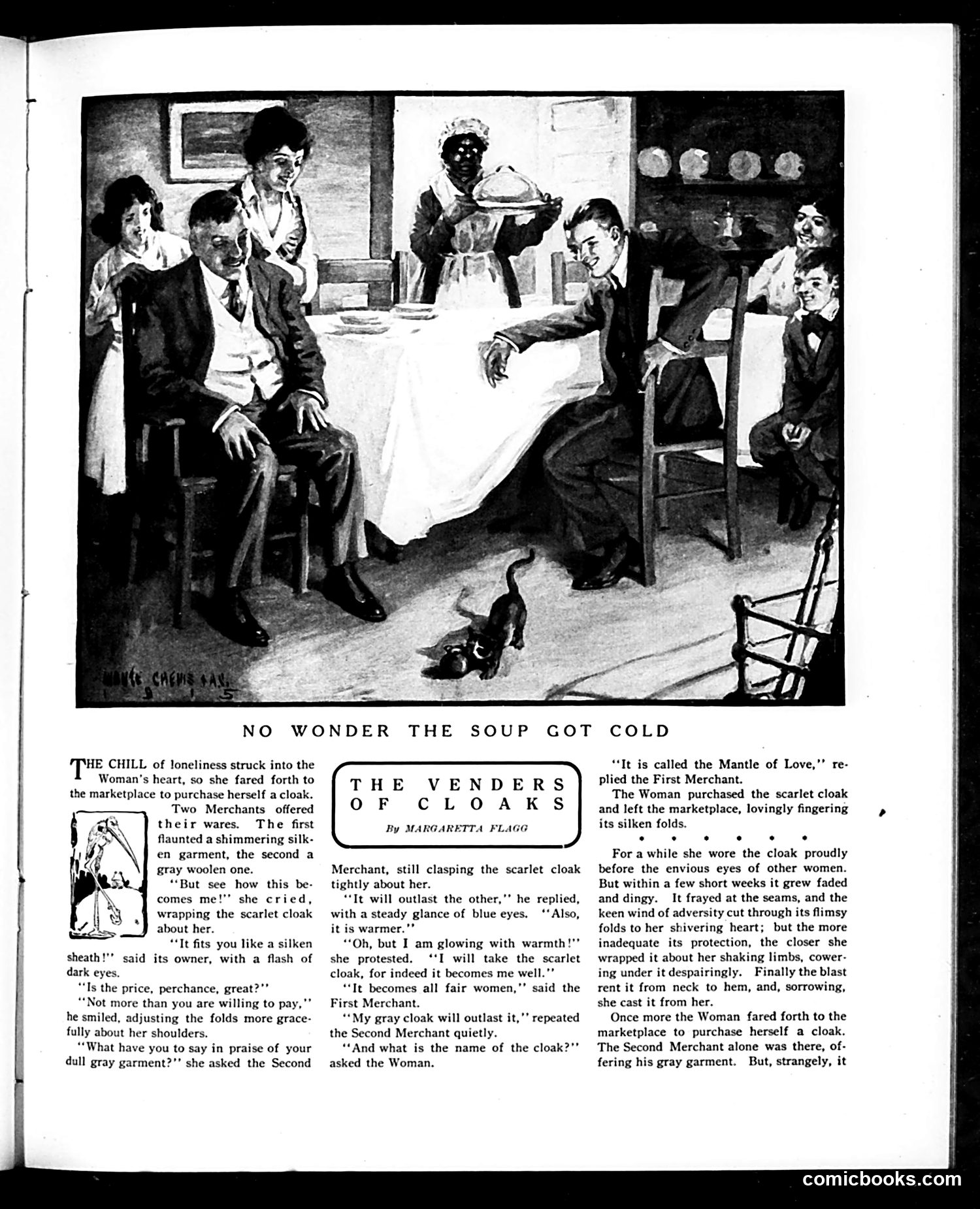
This is a cautionary tale by Margaretta Flagg about choosing romance over practicality. A lonely woman must choose between two merchants: one selling a scarlet "Mantle of Love" with flattering words and charm, the other offering a durable gray cloak with honest utility. She chooses the romantic scarlet cloak, which quickly fades and tears under real-world hardship. Desperate and cold, she returns to find only the Second Merchant remains—implying the practical choice endures while romantic illusions fail. The title "No Wonder the Soup Got Cold" suggests domestic neglect caused by romantic distraction. This appears to be early-20th-century moralizing about women prioritizing emotional appeal over sensible judgment in matters (romantic partners, marriage) that affect household management. The satirical point criticizes both the woman's poor judgment and the First Merchant's manipulative seduction.
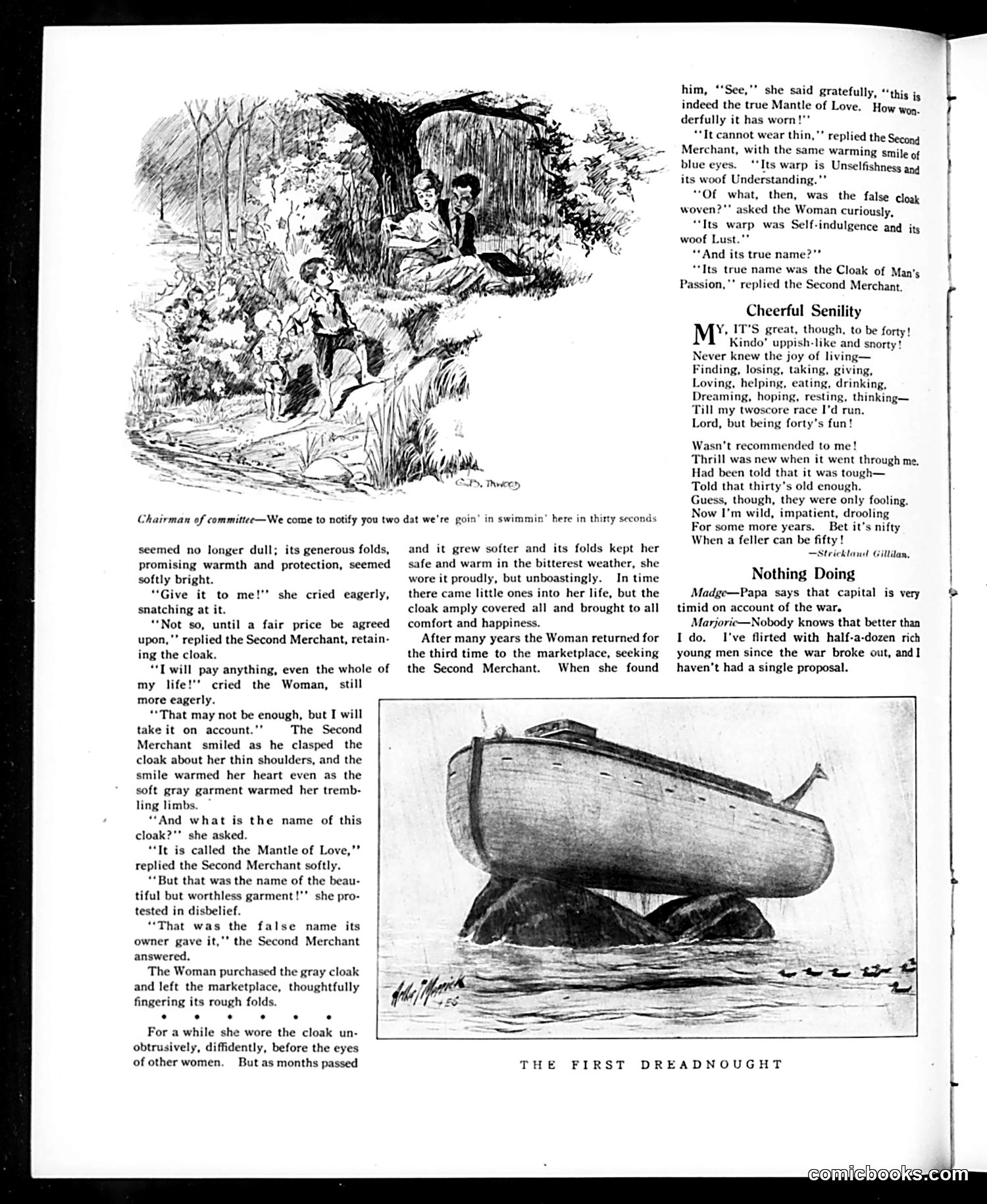
This page contains three distinct pieces of satirical content: 1. **"The Mantle of Love"** (main narrative with illustration): An allegorical tale contrasting true love with mere passion. A woman purchases a gray cloak labeled the "Mantle of Love" from a merchant, which represents genuine, selfless devotion ("warp of Unselfishness, woof of Understanding"). This contrasts with the false "Cloak of Man's Passion" (woven from "Self-indulgence"). The satire critiques superficial romantic relationships. 2. **"Cheerful Senility"** (poem): A lighthearted verse celebrating turning forty, mocking outdated beliefs that life ends at thirty. It satirizes societal attitudes about aging and vitality. 3. **"Nothing Doing"** (brief dialogue joke): Two young women discuss how wartime capital shortage hasn't stopped them from flirting with wealthy men—yet none have proposed. It satirizes both the economic anxiety of wartime and young women's marriage-focused social calculations. The bottom illustration titled "The First Dreadnought" appears unrelated—likely a separate naval/military cartoon.
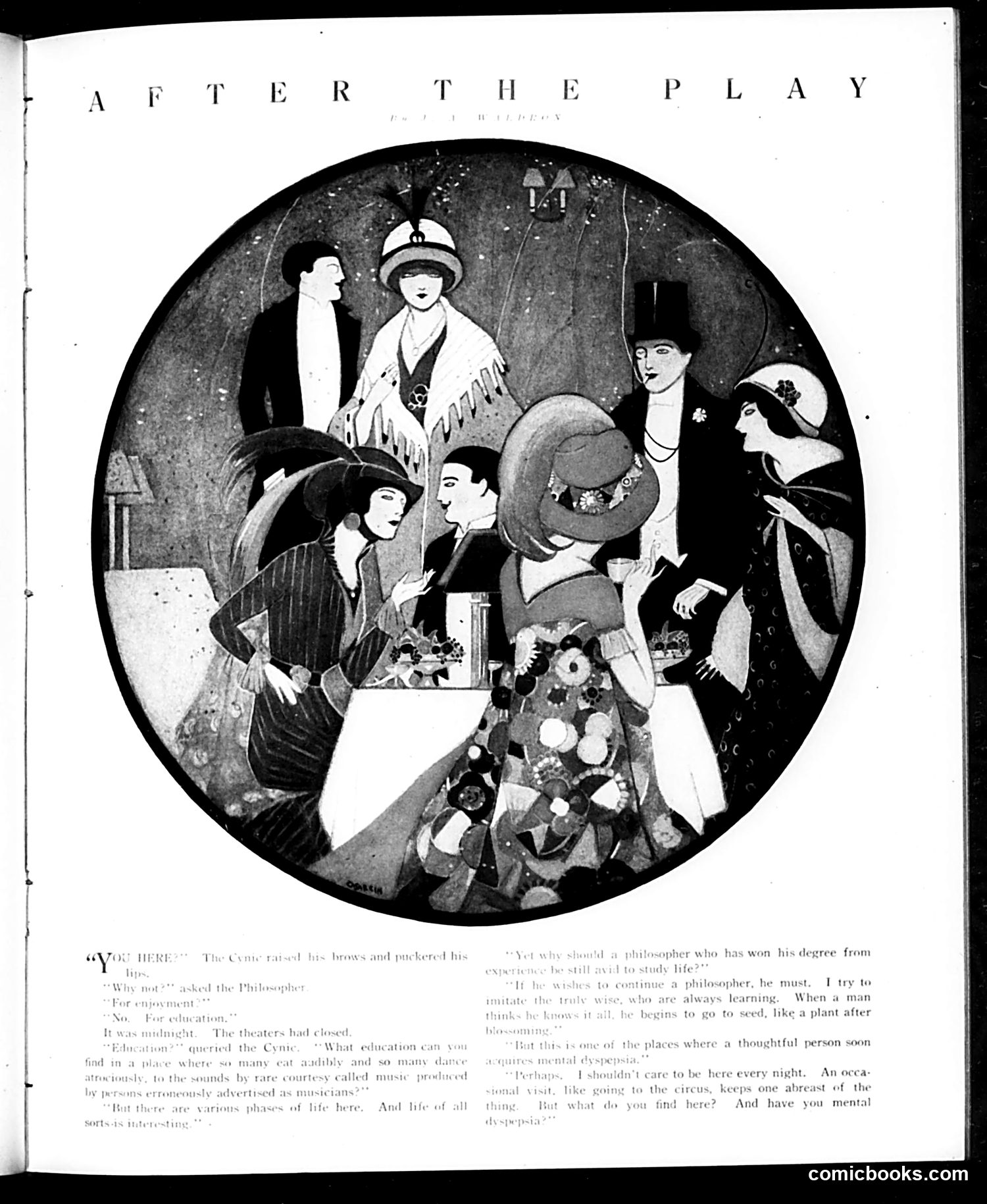
This page from *Judge* magazine presents a satirical scene titled "After the Play." The circular illustration depicts well-dressed figures in 1920s attire gathered in what appears to be a theater lobby or social venue, with flowers visible. The dialogue centers on a philosophical debate: a Cynic character questions the value of education, while another figure (likely representing conventional wisdom) defends philosophical study. The satire mocks pretentious post-theater socializing—where attendees engage in superficial intellectual discussion about art and education while actually seeking entertainment and social status. The humor targets the gap between aspiring intellectuals' actual understanding and their performative displays of learning in fashionable social settings. The Cynic's dismissive stance suggests that such venues are poor places for genuine thought.
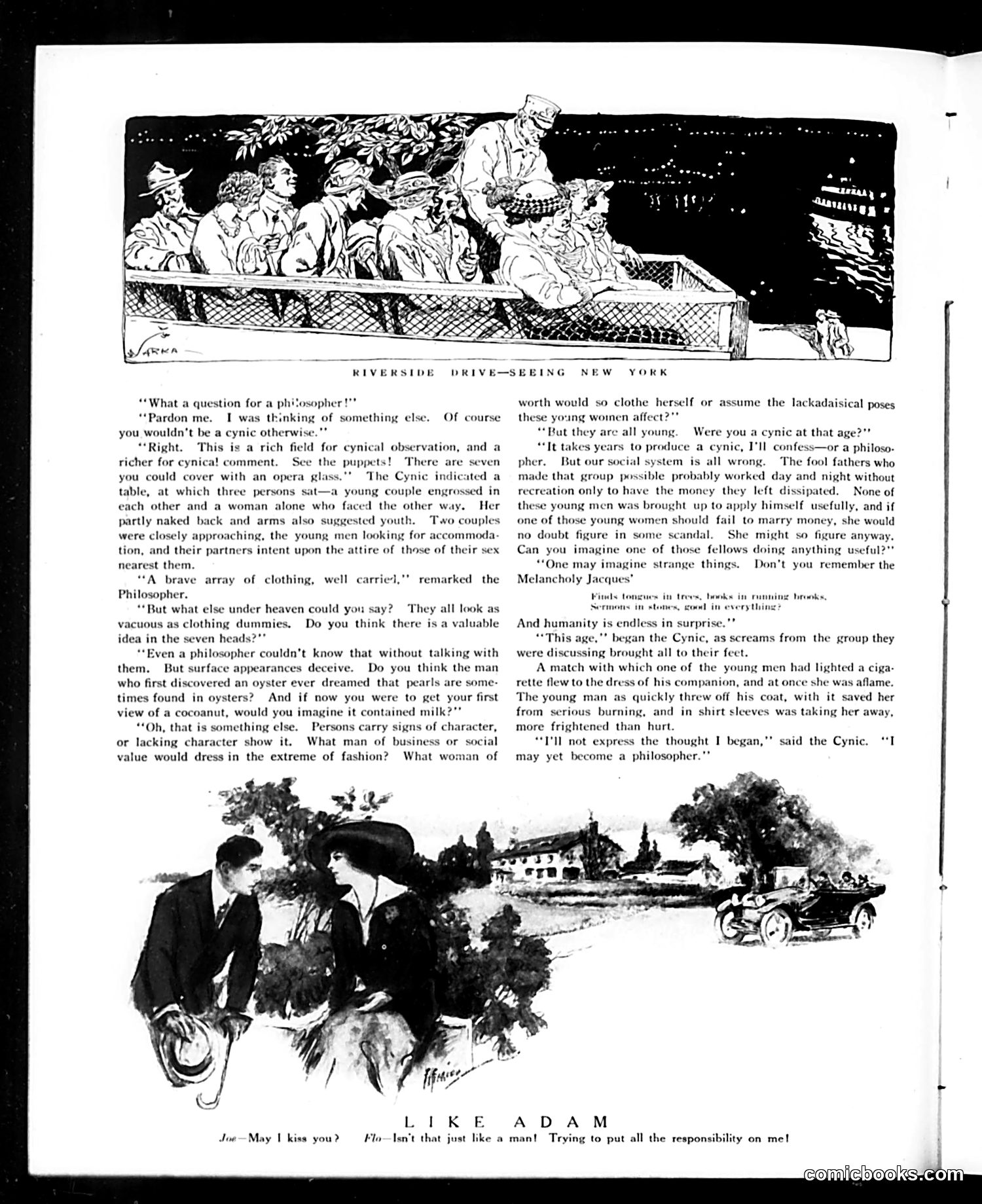
This page contains two satirical pieces from *Judge* magazine critiquing early 20th-century youth culture and gender dynamics. **Top cartoon ("Riverside Drive"):** A philosopher and cynic observe fashionable young people on a riverside outing in New York. The cynic mocks the vacuous appearance of well-dressed youth, particularly women, arguing their expensive clothing masks empty heads. The philosopher counters that appearances deceive—character runs deep. Their debate is interrupted when a young man's cigarette ignites his companion's dress; he heroically extinguishes it with his coat. The cynic then concedes he may become a philosopher, having witnessed genuine human decency. **Bottom cartoon ("Like Adam"):** A couple in a landscape. The woman ("Flo") rejects a man's advance by sardonically comparing his behavior to Adam's—implying he's trying to shift blame onto her, as Adam blamed Eve for the Fall. Both pieces satirize romantic courtship, gender relations, and social pretension of the era.
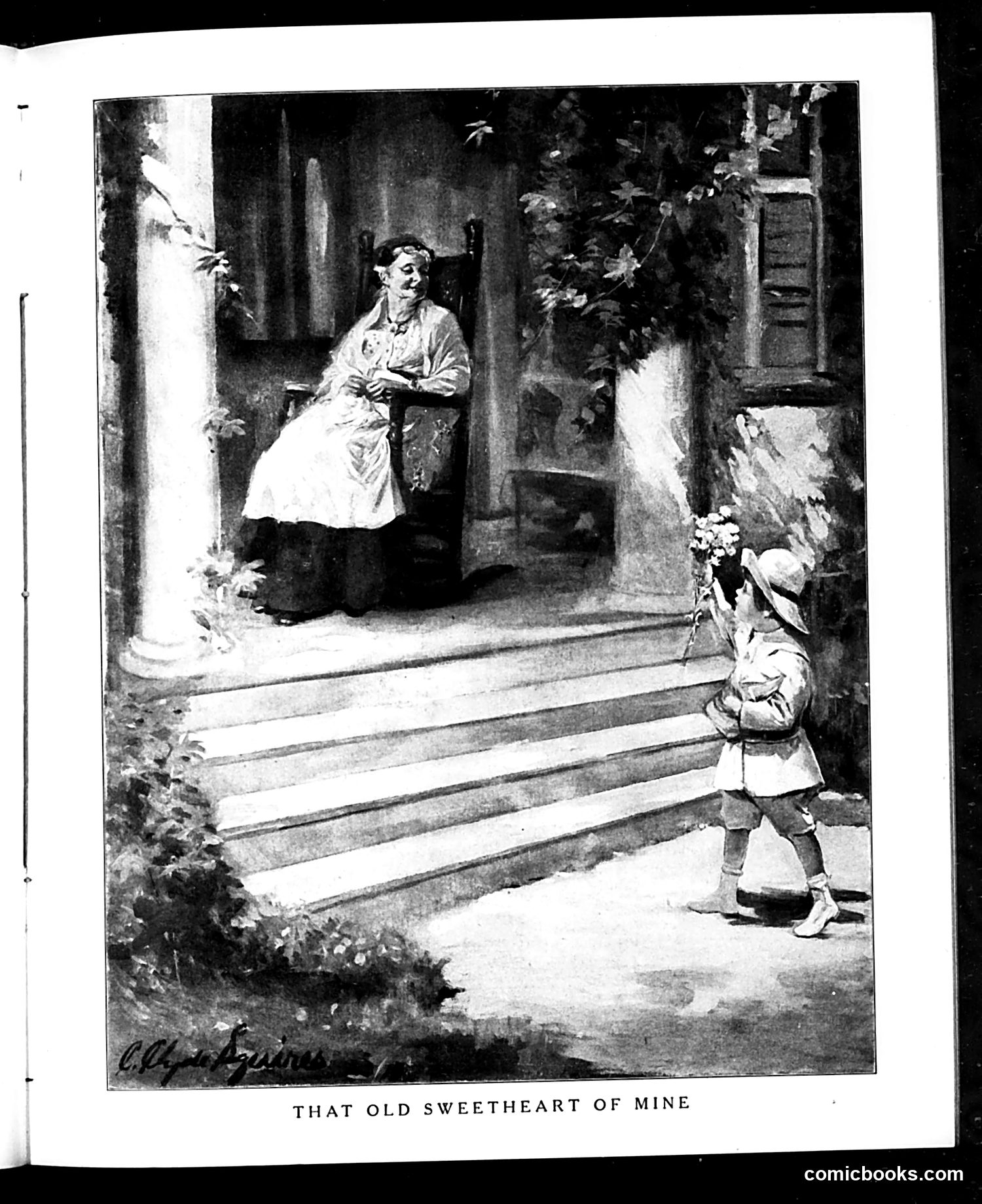
This appears to be an illustration from *Judge* magazine showing a nostalgic romantic scene. A woman in an apron stands at a doorway of what seems to be a modest home, while a small child holding flowers approaches on the steps below. The title references the 1911 popular song "That Old Sweetheart of Mine." The cartoon likely plays on sentimental domesticity—juxtaposing childhood innocence with adult romance, or perhaps commenting on idealized notions of home and family life. Without additional context or visible satirical elements, the piece seems more illustrative than explicitly political or sharply satirical, appearing to appeal to *Judge* readers' nostalgic and sentimental sensibilities rather than mock contemporary figures or events.
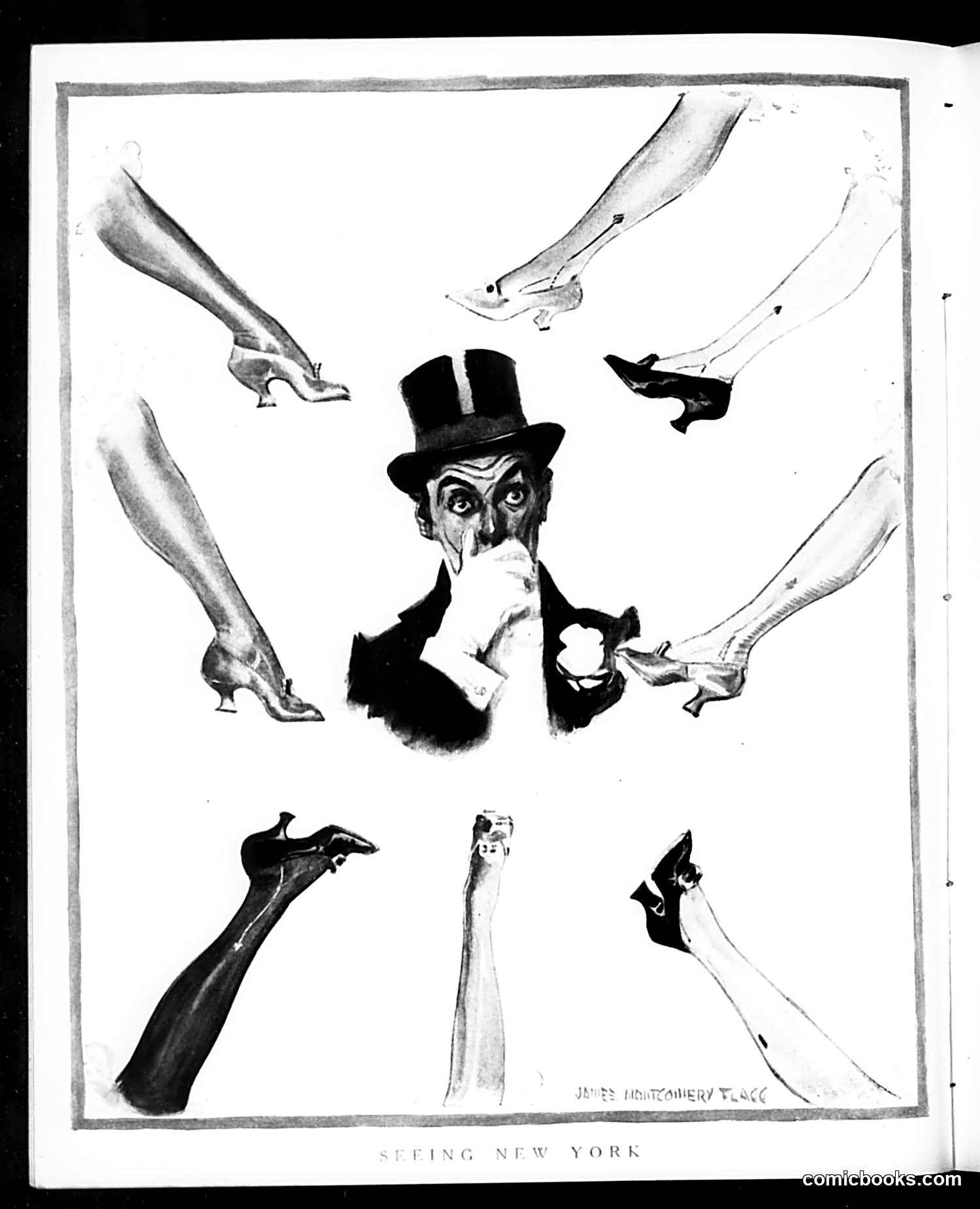
This is a satirical illustration by James Montgomery Flagg titled "Seeing New York." The central figure is a wealthy gentleman in a top hat, appearing shocked or overwhelmed while surrounded by stylized women's legs in various fashionable shoes and stockings of the era. The satire likely mocks the experience of a well-to-do visitor navigating New York City's social scene, particularly its obsession with fashionable women and conspicuous consumption. The exaggerated legs and shoes emphasize how the city—especially its female population and their fashion—dominates the visual landscape and captures the attention of male visitors. It's a commentary on vanity, materialism, and the spectacle of modern urban life in early 20th-century New York.
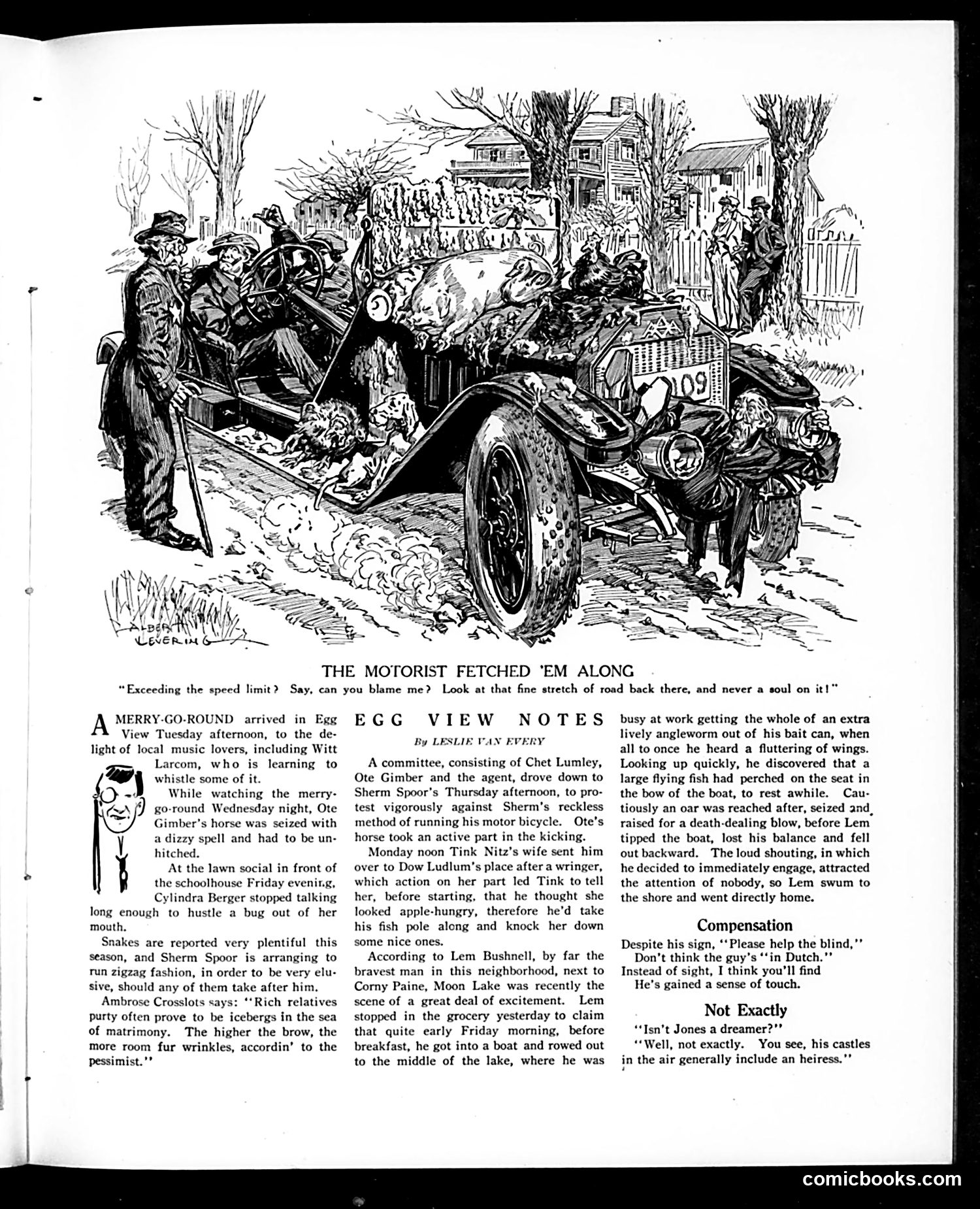
This page from *Judge* satirizes the reckless behavior of early motorists. The main cartoon depicts a speeding automobile whose driver brazenly defends exceeding the speed limit by pointing to an empty road—the joke being his complete disregard for safety laws. The accompanying "Egg View Notes" column contains humorous small-town anecdotes, including one about Sherm Spoor's dangerous motorcycle riding, which prompted neighbors to formally protest. The satire targets the emerging automobile culture of the early 20th century, when motorists were often viewed as dangerous, arrogant menaces who ignored traffic safety for thrills. The column's rural, folksy tone contrasts with the modern technology, emphasizing how automobiles represented a disruptive force in traditional American communities. The overall message: these new motorists are reckless show-offs endangering everyone.
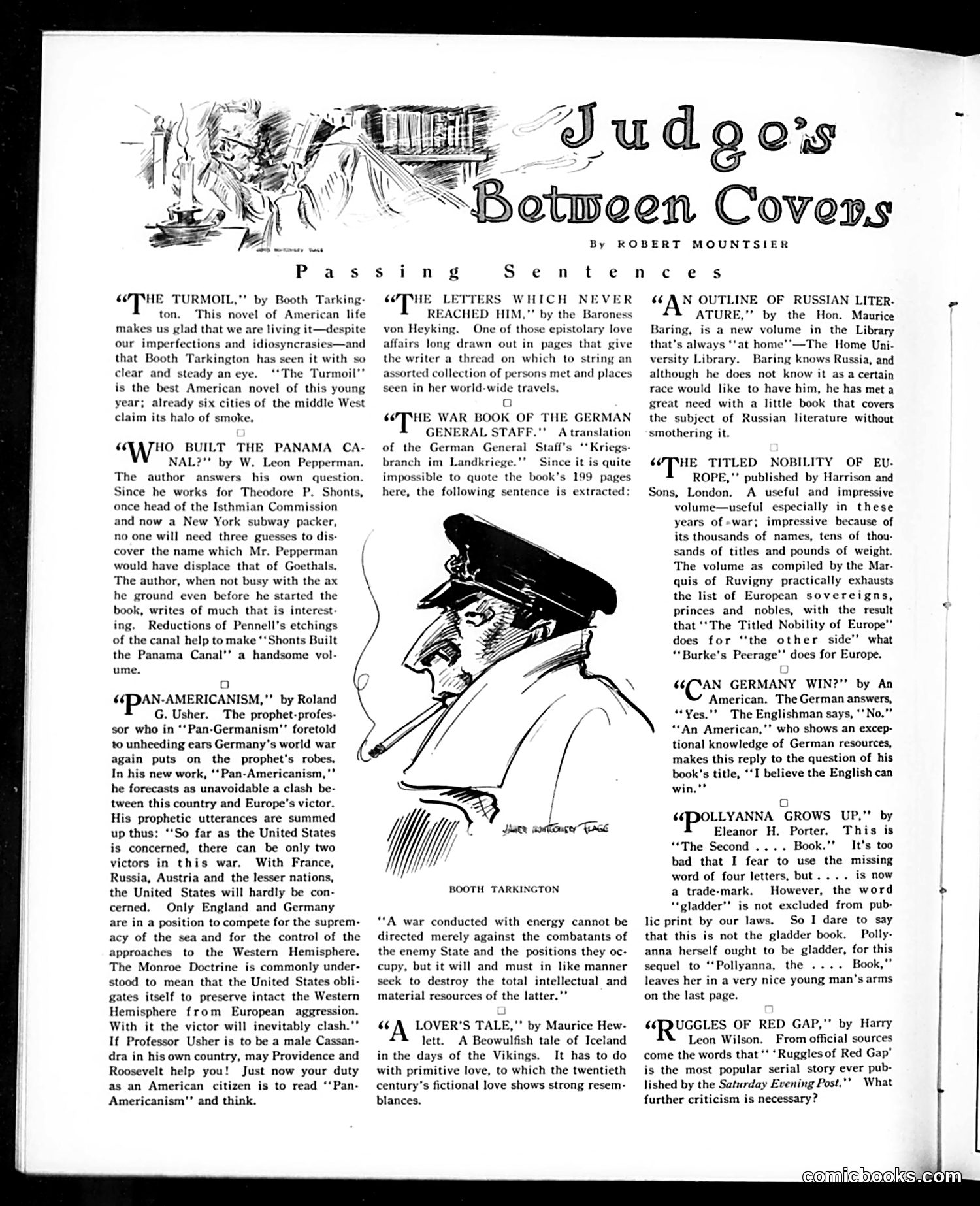
This page from *Judge* magazine presents book reviews under the heading "The Judge's Between Covers," by Robert Mountsier. The central cartoon depicts **Booth Tarkington**, the acclaimed American novelist, shown in caricature as a contemplative figure—likely celebrating his novel *The Turmoil*, which the review praises as "the best American novel of this young year." The reviews satirize contemporary wartime literature and geopolitical commentary. One entry mocks a Panama Canal book by W. Leon Pepperman, suggesting the author used the project merely to promote Theodore P. Shonts over the actual chief engineer Goethals. Another review examines Roland Usher's *Pan-Americanism*, a prophetic work warning of inevitable conflict between America and European powers post-World War I—the magazine's tone suggests skepticism about such dire predictions. The German General Staff's war philosophy quote emphasizes total war doctrine, relevant to WWI debates about civilian targeting. Other reviews cover romance novels and reference works, reflecting wartime publishing trends.
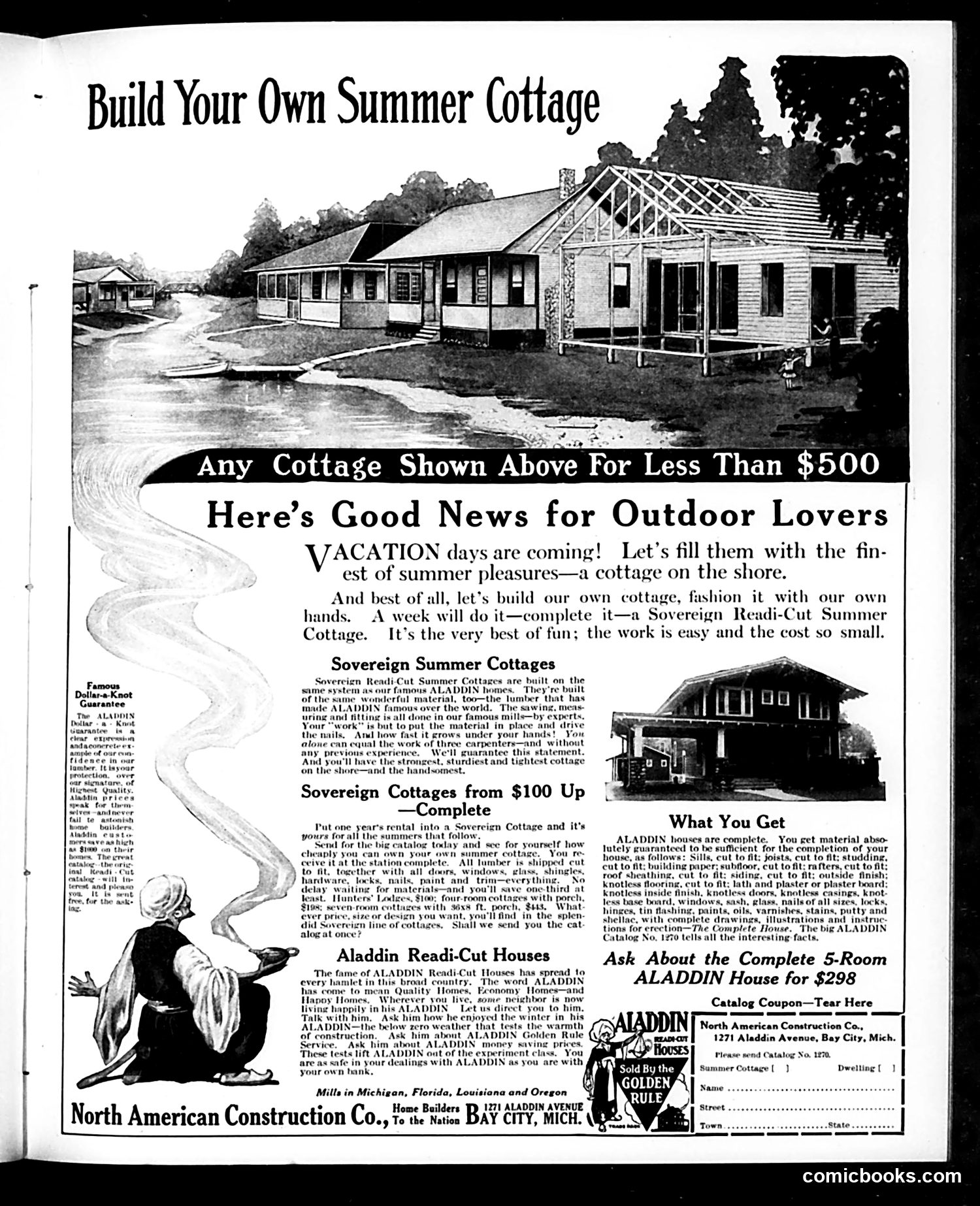
This is primarily a **product advertisement**, not satire or political commentary. It promotes Aladdin Readi-Cut Houses—prefabricated cottage kits marketed to middle-class Americans seeking affordable vacation homes. The page appeals to post-WWI consumer aspirations: owning a summer retreat is presented as accessible to ordinary workers ("a week will do it"). The emphasis on DIY assembly and low cost ($100-$500) reflects 1920s optimism about mass production and consumer goods making leisure affordable. The illustration shows several pre-fabricated cottage designs. A illustration of a man in work clothes suggests ordinary homeowners can build these without professional carpentry skills—the key marketing pitch. There is **no apparent satire** here. Judge magazine mixed serious advertising with humorous content; this page represents the commercial side. The tone is earnest promotion of modern, standardized housing as a democratic consumer product rather than commentary on American life.
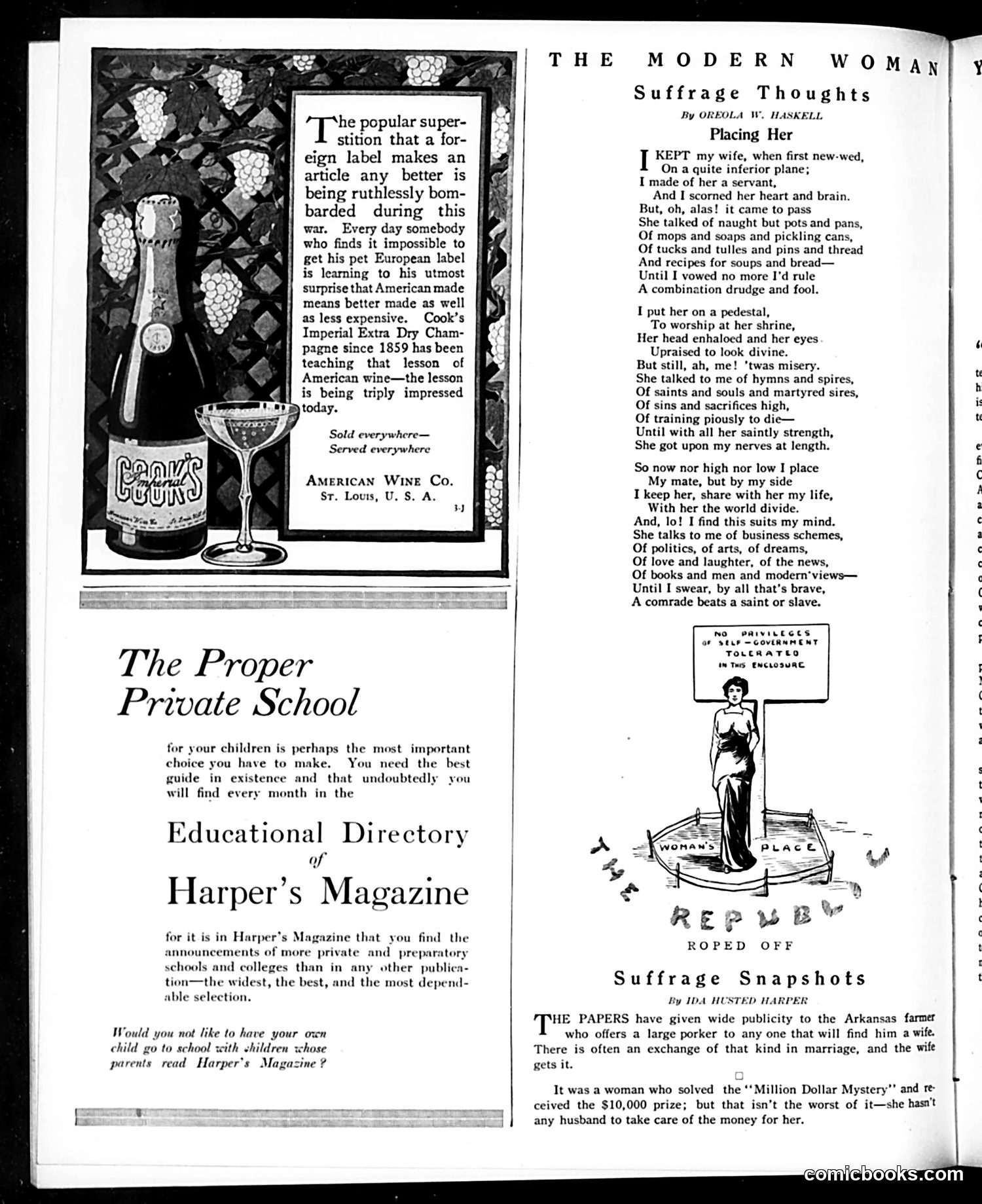
This page contains **satirical commentary on women's suffrage and roles**, presented through poetry and social commentary circa WWI era. The main cartoon (bottom right) depicts a woman statue labeled "Woman's Place" enclosed by a rope with a sign reading "No Privileges of Self Government Tolerated in This Enclosure"—**mocking restrictions on women's autonomy and voting rights**. Two poems follow: **"Placing Her"** by Oreola W. Haskell satirizes male attitudes: a husband initially keeps his wife as an inferior servant, then elevates her to an idealized pedestal, until finally treating her as an equal partner capable of discussing "business schemes" and "modern views." The satirical point: **equality of intellectual partnership actually works**. **"Suffrage Snapshots"** by Ida Husted Harper uses anecdotes mocking anti-suffrage arguments—noting a woman solved a major mystery, yet opponents claim women can't manage money without male guardianship. The implicit critique: **women demonstrate competence; opposition to suffrage is baseless**. The page advocates for women's political and intellectual equality through humor directed at prevailing male attitudes.
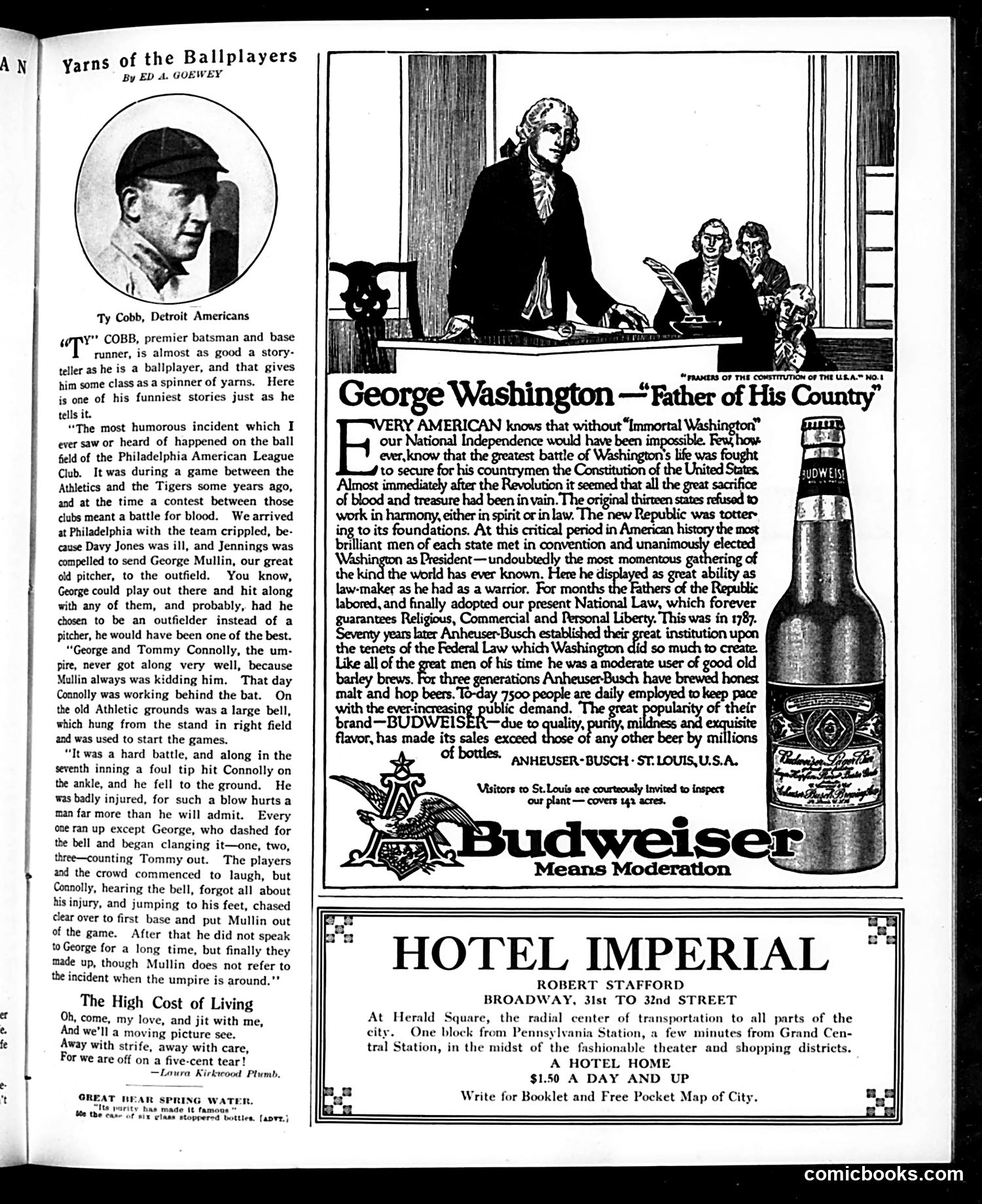
This page contains two distinct elements: **Left side - "Yarns of the Ballplayers"**: A humorous anecdote by baseball player Ty Cobb about pitcher George Mullin pranking umpire Tommy Connolly during a 1900s Tigers-Athletics game. When Connolly is injured by a foul tip, Mullin rings the field bell as if calling him "out," tricking Connolly into jumping up and chasing him. The joke relies on early baseball culture and the well-known friction between Mullin and Connolly. **Center/Right - Large Budweiser advertisement**: Disguised as patriotic content, it compares George Washington's leadership during America's founding crisis to Anheuser-Busch's role in establishing a "great institution" (the brewery). The ad claims Washington was a "moderate user of good old malt" beers—an entirely fabricated historical claim designed to associate beer-drinking with American patriotism and respectability. This is pure propaganda using nationalistic imagery to sell alcohol. The juxtaposition reveals Judge magazine's mixed content: entertainment alongside aggressive advertising masquerading as historical commentary.
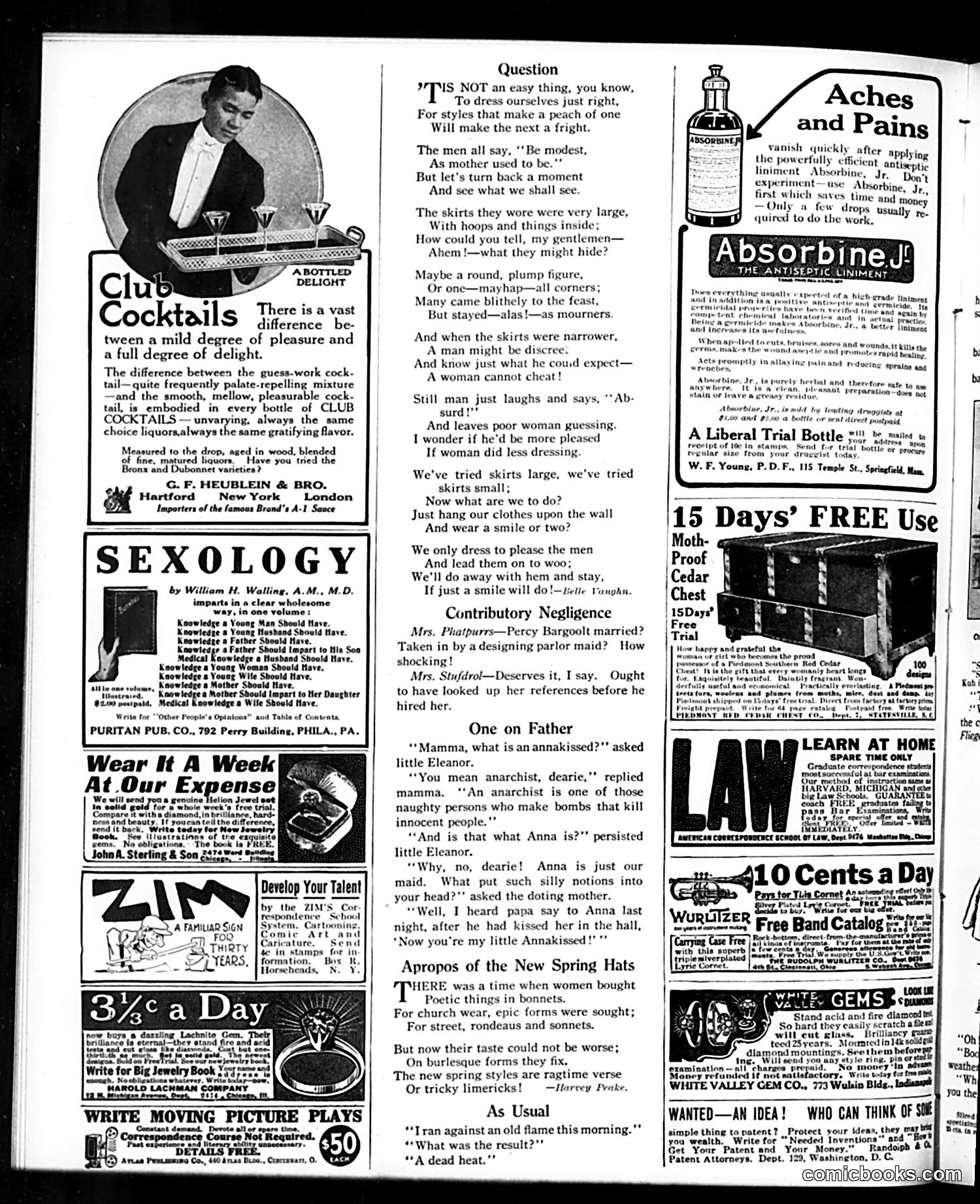
This page is primarily **advertisements and light humor**, typical of Judge magazine's satirical content. The main illustrated cartoon—"Club Cocktails"—shows a bartender mixing drinks, with text distinguishing between mediocre and quality cocktails. This reflects Prohibition-era anxieties about maintaining standards during illegal alcohol consumption. The **poems and humorous pieces** satirize social conventions: - "Question" mocks conflicting expectations about women's dress—men demanded modesty while Victorian fashion obscured women's bodies entirely, then complained when fashions changed. - "One on Father" plays on the double meaning of "annakissed" (anarchist/Anna kissed), a pun on contemporary fears about anarchists and servants. - "Apropos of the New Spring Hats" criticizes modern hat fashions as crude compared to earlier Victorian styles. The remaining content comprises **patent medicines and mail-order advertisements** (Absorbine Jr., correspondence schools, jewelry, books on sexuality) typical of early 20th-century magazines—many products later discredited or heavily regulated.
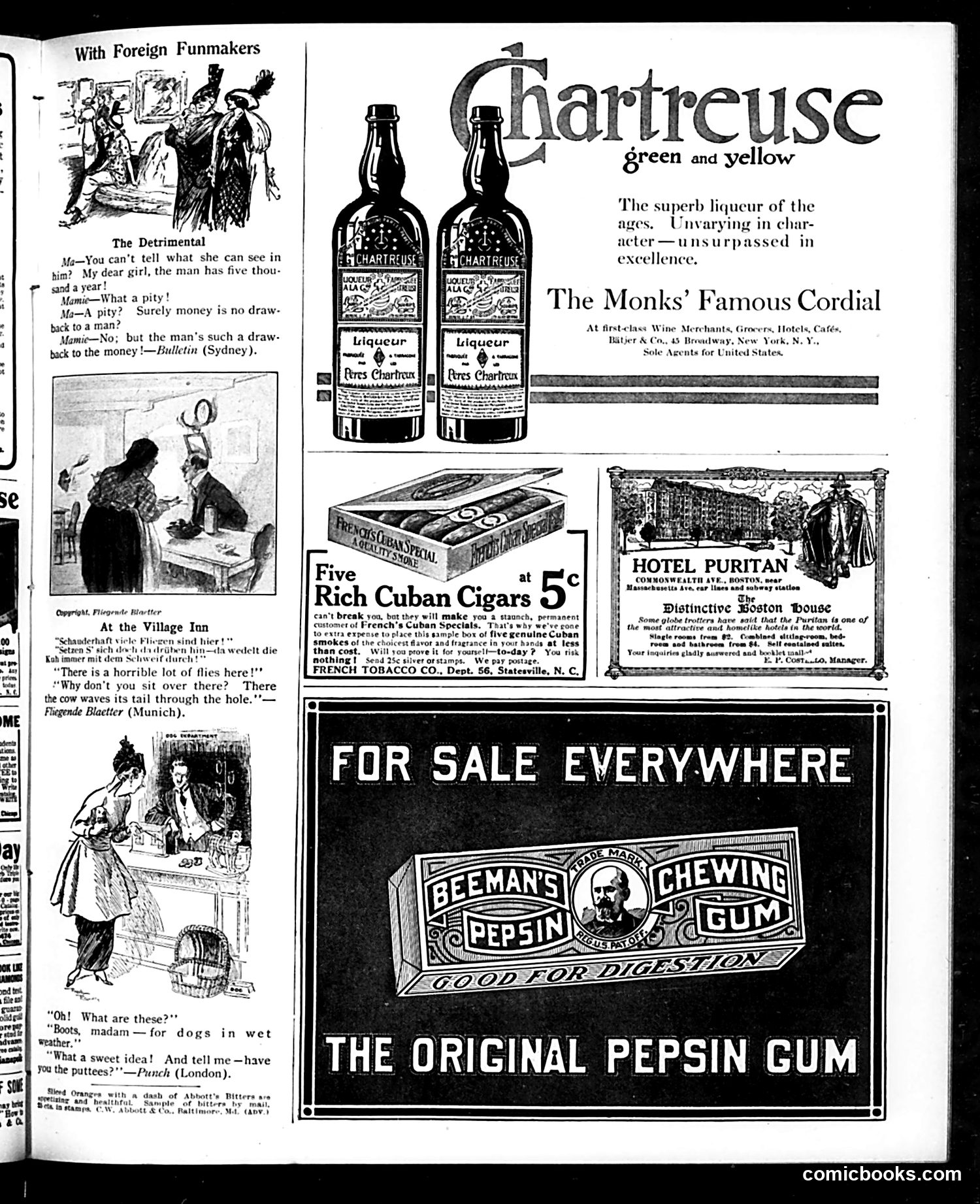
This page is primarily **advertising with comedic filler content**. The cartoons are brief, internationally sourced jokes: **"The Detrimental"** plays on class anxieties: a mother values a suitor's £5,000 annual income, but her daughter counters that he's such a poor match he's actually a liability to the money itself—satirizing shallow matrimonial calculations. **"At the Village Inn"** is a German/Bavarian humor piece about flies in a rustic inn, where the solution involves a cow's tail swatting through a hole—crude but typical of early 20th-century international comic exchanges reprinted in American magazines. **"Boots, Madam"** shows someone selling waterproof boots labeled "for dogs in wet weather," which the customer naively interprets literally, asking for purchasing advice—a play on misunderstanding product marketing language. The bulk of the page comprises **period advertisements** for Chartreuse liqueur, Cuban cigars, Hotel Puritan in Boston, and notably, **Beeman's Pepsin Chewing Gum**, marketed for digestive health—a common early-1900s health claim for patent medicines and novelty products.
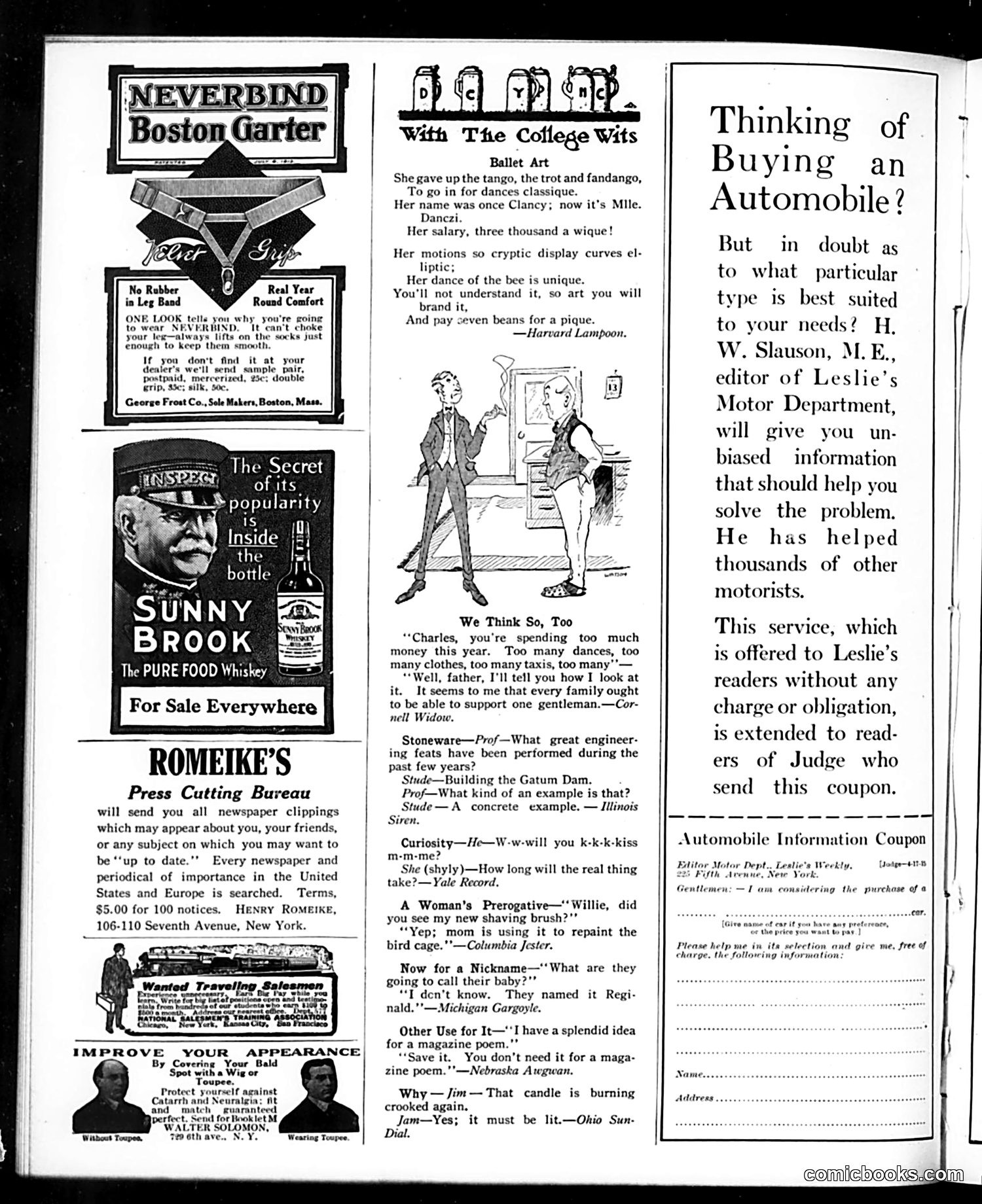
This page is primarily **advertising and miscellaneous content**, not political satire. The main elements are: **Advertisements:** - Nevermind Boston Garter (hosiery) - Sunnybrook Pure Food Whiskey - Romeike's Press Cutting Bureau (clipping service) - Traveling salesman wanted ad - Toupee advertisement - Leslie's Automobile Information service (coupon) **"College Wits" Humor Section:** Contains reprinted jokes from college magazines (Harvard Lampoon, Yale Record, Cornell Widow, etc.) poking gentle fun at student life: overspending on social activities, romance mishaps, and wordplay. These are lighthearted gags without political content. **Overall:** This appears to be a mid-century magazine page mixing advertisements with college humor reprints—typical filler content. There are no political cartoons or significant social satire visible. The page reflects period concerns (automobile purchasing, grooming, social spending) but contains no identifiable political figures or commentary.
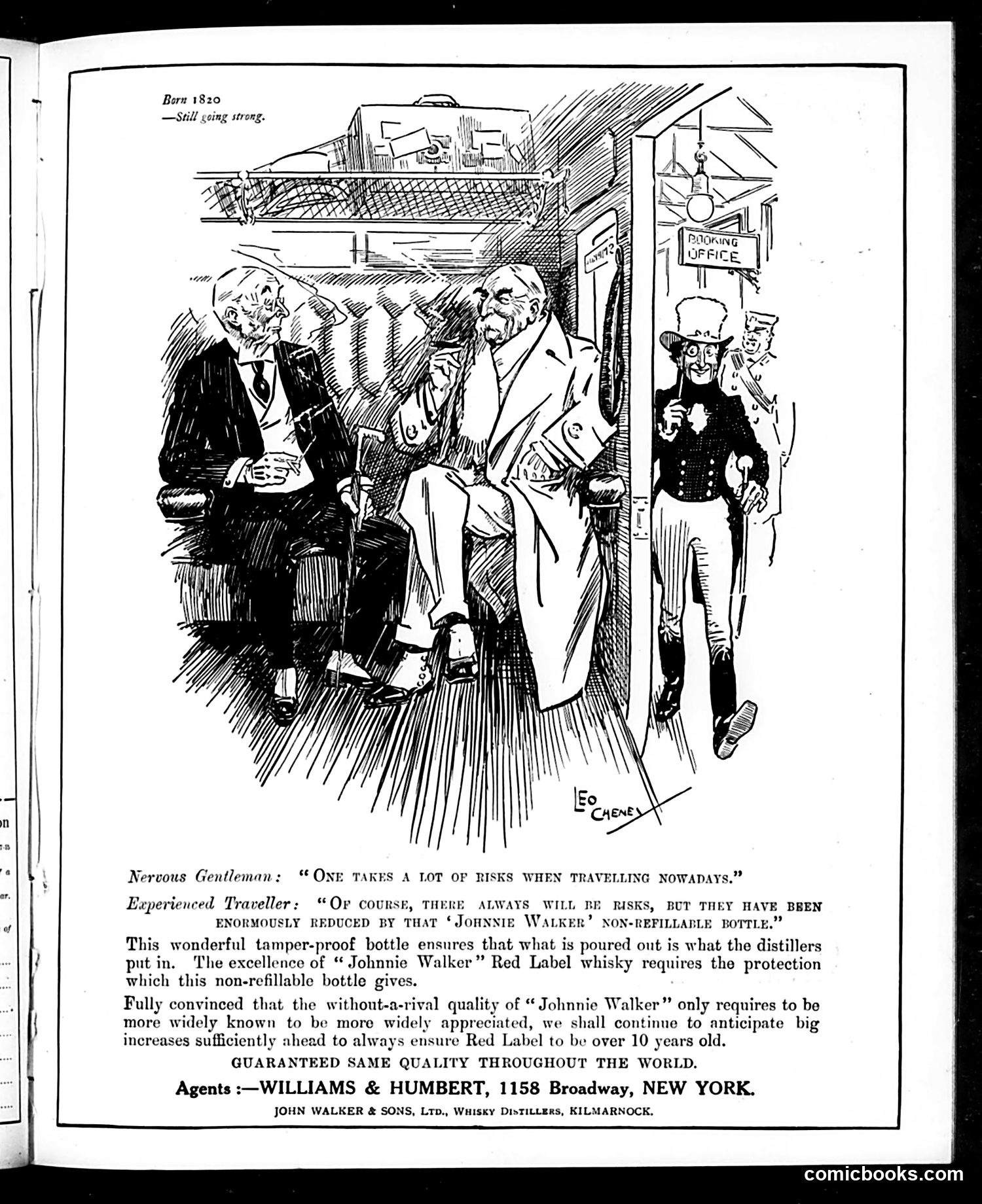
This is primarily a **full-page advertisement** rather than satirical content. It depicts two men on a ship discussing travel risks. The "Nervous Gentleman" worries about dangers of modern travel, while the "Experienced Traveller" reassures him that whisky quality risks are solved by Johnnie Walker's tamper-proof bottle. The advertisement plays on anxieties about **adulterated alcohol**—a genuine concern in this era when spirits could be refilled or contaminated. The non-refillable bottle guaranteed authenticity. The ship setting references international commerce and the product's global distribution ("guaranteed same quality throughout the world"). The brand was established 1820 (noted at top), positioning it as a reliable, long-standing product. This is essentially a trust-building marketing pitch disguised as conversational advice, targeting travelers and international traders concerned about product authenticity.
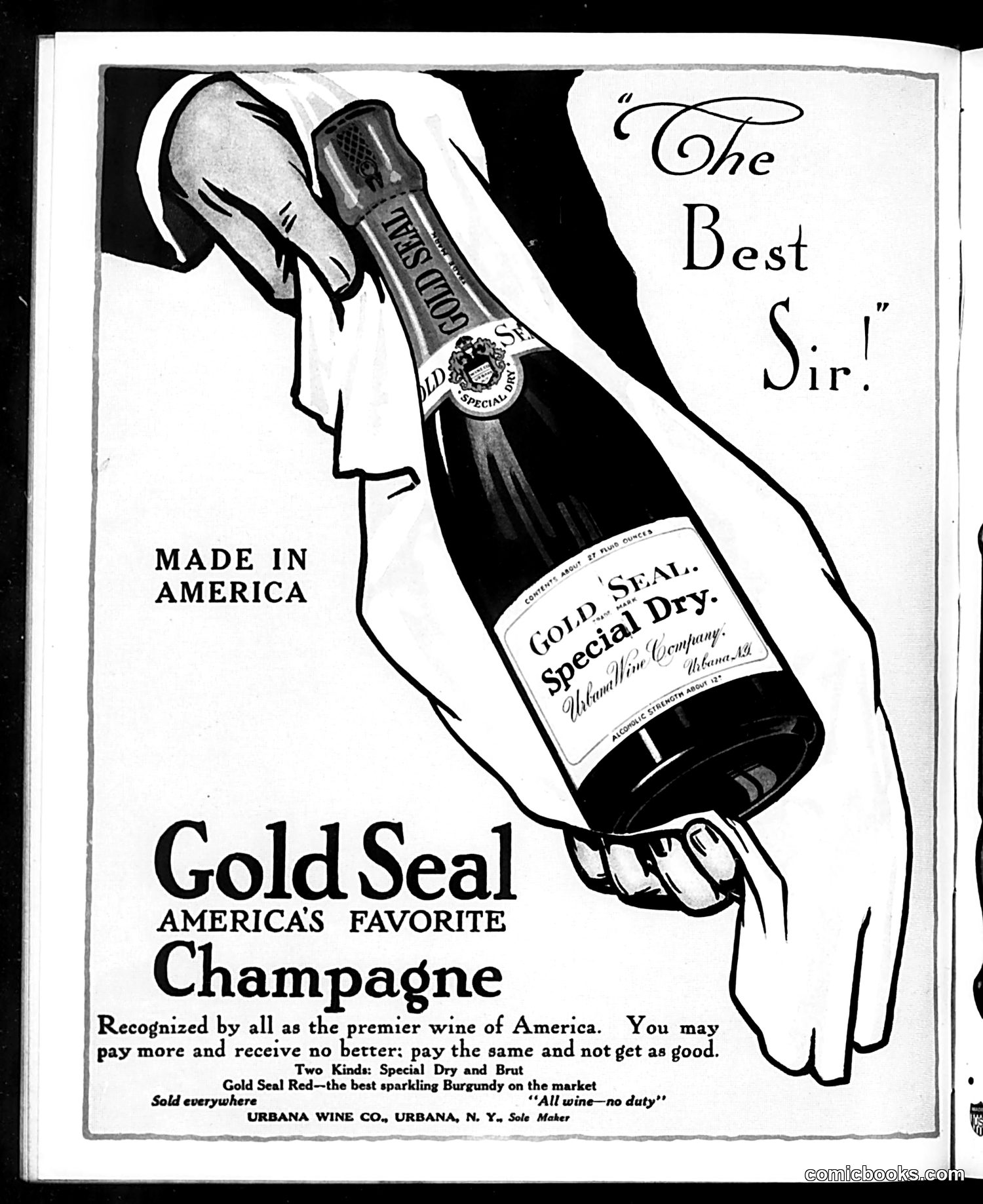
This is a **full-page advertisement**, not political satire. It promotes Gold Seal Champagne, made in Urbana, New York by the Urbana Wine Company. The image shows elegantly gloved hands holding a champagne bottle, emphasizing luxury and refinement. The tagline "The Best Sir" adopts a refined, servile tone common to period advertising. Key marketing claims: Gold Seal is "America's Favorite" and the "premier wine of America"—positioning it against imported French champagne. The phrase "All wine—no duty" references tariffs, suggesting this American product avoids import taxes. The ad's appeal: patriotic pride in American manufacturing combined with luxury positioning. The phrase "you may pay more and receive no better" challenges consumers to choose American quality over expensive imports, a sales strategy during an era of growing American industrial confidence.