
Judge, 1915-04-17 · page 18 of 26
Judge — April 17, 1915 — page 18: what you’re looking at
What you’re looking at
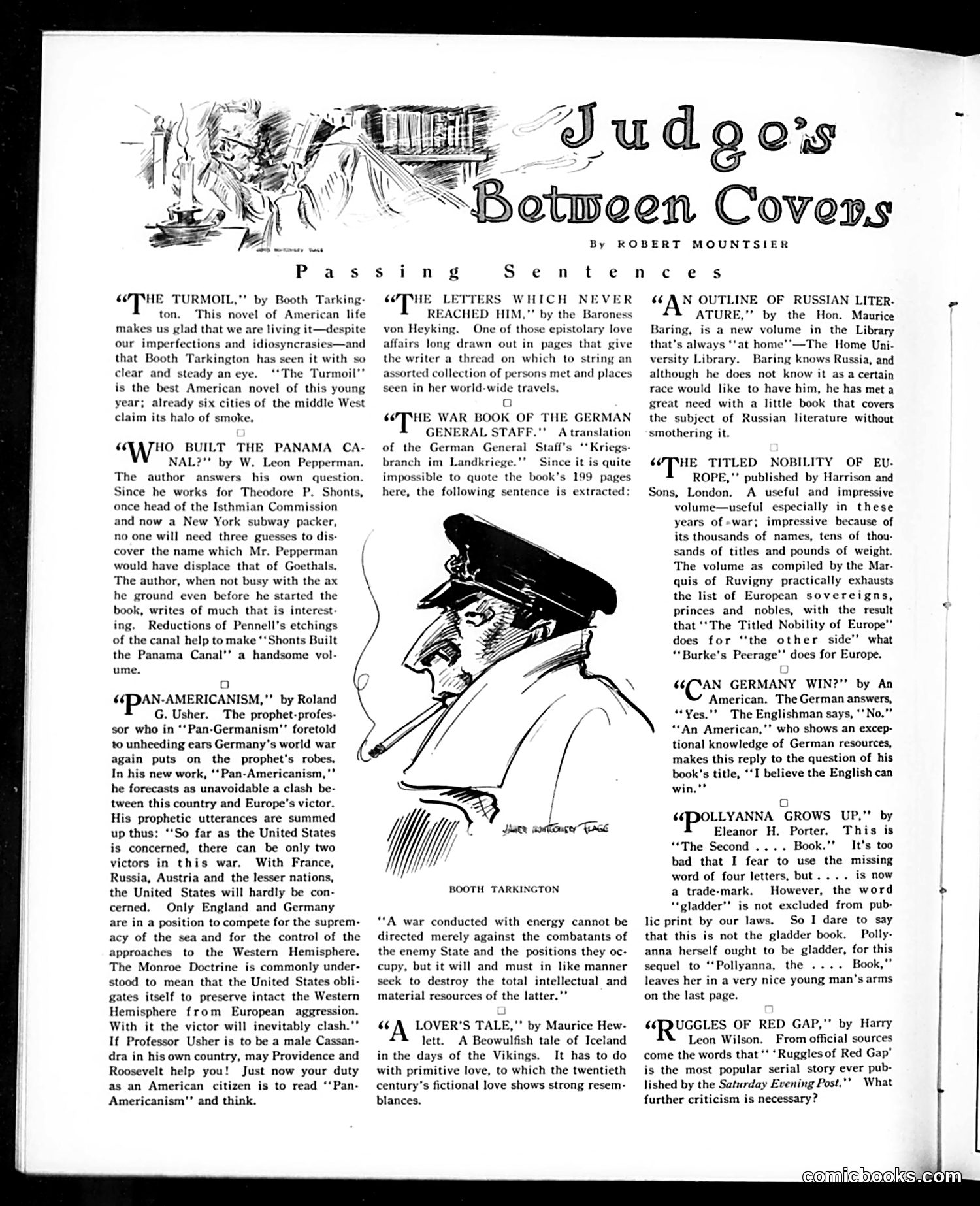
This page from *Judge* magazine presents book reviews under the heading "The Judge's Between Covers," by Robert Mountsier. The central cartoon depicts **Booth Tarkington**, the acclaimed American novelist, shown in caricature as a contemplative figure—likely celebrating his novel *The Turmoil*, which the review praises as "the best American novel of this young year." The reviews satirize contemporary wartime literature and geopolitical commentary. One entry mocks a Panama Canal book by W. Leon Pepperman, suggesting the author used the project merely to promote Theodore P. Shonts over the actual chief engineer Goethals. Another review examines Roland Usher's *Pan-Americanism*, a prophetic work warning of inevitable conflict between America and European powers post-World War I—the magazine's tone suggests skepticism about such dire predictions. The German General Staff's war philosophy quote emphasizes total war doctrine, relevant to WWI debates about civilian targeting. Other reviews cover romance novels and reference works, reflecting wartime publishing trends.
📄 Transcribed text from this page (OCR, searchable)
Machine-transcribed from the original scan — historical spelling and the odd misread are preserved.
as 6¢THE TURMOIL,” by Booth Tarking- ton, This novel of American life makes us glad that we are living it—despite our imperfections and idiosyncrasies—and that Booth Tarkington has seen it with clear and steady an eye. The Turmoil is the best American novel of this young year; already six cities of the middle West claim its halo of smoke. “ HO BUILT THE PANAMA CA- NAL?" by W. Leon Pepperman. The author answers his own question. Since he works for Theodore P. Shonts, once head of the Isthmian Commission and now a New York subway packer, no one will need three guesses to dis- cover the name which Mr. Pepperman would have displace that of Goethals. The author, when not busy with the ax he ground even before he started the book, writes of much that is interest- ing. Reductions of Pennell’s etchings of the canal help to make ‘‘Shonts Built the Panama Canal'’ a handsome vol- ume. 0 66PDAN-AMERICANISM,”’ by Roland G. Usher. The prophet-profes- sor who in ‘*Pan-Germanism"’ foretold to unheeding ears Germany's world war again puts on the prophet’s robes. In his new work, ‘*Pan-Americanism,"* he forecasts as unavoidable a clash be- tween this country and Europe's victor. His prophetic utterances are summed up thus: ‘So far as the United States is concerned, there can be only two victors in this war. With France, Russia, Austria and the lesser nations, the United States will hardly be con- cerned. Only England and Germany are in a position to compete for the suprem- acy of the sea and for the control of the approaches to the Western Hemisphere. The Monroe Doctrine is commonly under- stood to mean that the United States obli- gates itself to preserve intact the Western Hemisphere from European aggression. With it the victor will inevitably clash."’ If Professor Usher is to be a male Cassan- dra in his own country, may Providence and Roosevelt help you! Just now your duty as an American citizen is to read ‘‘Pan- Americanism” and think. By Sent WHICH NEVER REACHED HIM," by the Baroness yking. One of those epistolary love affairs long drawn out in pages that give the writer a thread on which to string an assorted collection of persons met and places seen in her world-wide travels, o 60 PHE WAR BOOK OF THE GE RMAN GENERAL STAF of the German General branch im Landkriege."" impossible to quote the book’ here, the following sentence von H 199 pages $ extracted: ee BOOTH TARKINGTON “A war conducted with energy cannot be directed merely against the combatants of the enemy State and the positions they oc- cupy, but it will and must in like manner seek to destroy the total intellectual and material resources of the latter."" “ LOVER'S TALE,"’ by Maurice Hew- lett. A Beowulfish tale of Iceland in the days of the Vikings. It has to do with primitive love, to which the twentieth century’s fictional love shows strong resem- blances. Judgors ‘Between Covers ROBERT MOUNTSIER ences “cc NE OF RUSSIAN LITER- by the Hon. Maurice a new volume in the Library at home’’—The Home Uni- versity L. ibrary. Baring knows Russia, and although he does not know it as a certain race would like to have him, he has meta need with a little book that covers the subject of Russian literature without smothering it. 67THE TITLED NOBILITY OF Ev- ROPI published by Harrison and Sons, London, A useful and impressive volume—useful especially in these years of «war; impressive because of its thousands of names, tens of thou- sands of titles and pounds of weight. The volume as compiled by the Mar- quis of Ruvigny practically exhausts the list of European sovereigns, princes and nobles, with the result that ‘The Titled Nobility of Europe’ does for ‘‘the other side’’ what “Burke's Peerage’’ does for Europe. 66(Q4AN GERMANY WIN?" by An American. The German answers, “*Yes.'" The Englishman says, ‘‘No."’ “*An American,’’ who shows an excep- tional knowledge of German resources, makes this reply to the question of his book's title, ‘‘I believe the English can win."” ia} 6“ LLYANNA GROWS UP," by Eleanor H. Porter. This is “The Second .... Book.'’ It’s too bad that I fear to use the missing word of four letters, but... . is now a trade-mark. However, the word **gladder’’ is not excluded from pub- lic print by our laws, So I dare to say that this is not the gladder book. Polly- anna herself ought to be gladder, for this sequel to ‘*Pollyanna, the .... Book," leaves her in a very nice young man's arms on the last page. 66JQUGGLES OF RED GAP,"’ by Harry Leon Wilson. From official sources come the words that “‘ ‘Ruggles of Red Gap’ is the most popular serial story ever pub- lished by the Saturday Evening Post". What further criticism is necessary?